EP4095253A1 - Verfahren zur grossskaligen synthese langkettiger rna und verfahren zur ortsspezifischen modifikation davon - Google Patents
Verfahren zur grossskaligen synthese langkettiger rna und verfahren zur ortsspezifischen modifikation davon Download PDFInfo
- Publication number
- EP4095253A1 EP4095253A1 EP20916091.0A EP20916091A EP4095253A1 EP 4095253 A1 EP4095253 A1 EP 4095253A1 EP 20916091 A EP20916091 A EP 20916091A EP 4095253 A1 EP4095253 A1 EP 4095253A1
- Authority
- EP
- European Patent Office
- Prior art keywords
- rna
- long
- fragments
- chain
- chain rna
- Prior art date
- Legal status (The legal status is an assumption and is not a legal conclusion. Google has not performed a legal analysis and makes no representation as to the accuracy of the status listed.)
- Withdrawn
Links
Images



Classifications
-
- C—CHEMISTRY; METALLURGY
- C12—BIOCHEMISTRY; BEER; SPIRITS; WINE; VINEGAR; MICROBIOLOGY; ENZYMOLOGY; MUTATION OR GENETIC ENGINEERING
- C12P—FERMENTATION OR ENZYME-USING PROCESSES TO SYNTHESISE A DESIRED CHEMICAL COMPOUND OR COMPOSITION OR TO SEPARATE OPTICAL ISOMERS FROM A RACEMIC MIXTURE
- C12P19/00—Preparation of compounds containing saccharide radicals
- C12P19/26—Preparation of nitrogen-containing carbohydrates
- C12P19/28—N-glycosides
- C12P19/30—Nucleotides
- C12P19/34—Polynucleotides, e.g. nucleic acids, oligoribonucleotides
-
- C—CHEMISTRY; METALLURGY
- C12—BIOCHEMISTRY; BEER; SPIRITS; WINE; VINEGAR; MICROBIOLOGY; ENZYMOLOGY; MUTATION OR GENETIC ENGINEERING
- C12N—MICROORGANISMS OR ENZYMES; COMPOSITIONS THEREOF; PROPAGATING, PRESERVING, OR MAINTAINING MICROORGANISMS; MUTATION OR GENETIC ENGINEERING; CULTURE MEDIA
- C12N9/00—Enzymes; Proenzymes; Compositions thereof; Processes for preparing, activating, inhibiting, separating or purifying enzymes
- C12N9/93—Ligases (6)
-
- C—CHEMISTRY; METALLURGY
- C12—BIOCHEMISTRY; BEER; SPIRITS; WINE; VINEGAR; MICROBIOLOGY; ENZYMOLOGY; MUTATION OR GENETIC ENGINEERING
- C12N—MICROORGANISMS OR ENZYMES; COMPOSITIONS THEREOF; PROPAGATING, PRESERVING, OR MAINTAINING MICROORGANISMS; MUTATION OR GENETIC ENGINEERING; CULTURE MEDIA
- C12N9/00—Enzymes; Proenzymes; Compositions thereof; Processes for preparing, activating, inhibiting, separating or purifying enzymes
- C12N9/10—Transferases (2.)
- C12N9/12—Transferases (2.) transferring phosphorus containing groups, e.g. kinases (2.7)
- C12N9/1241—Nucleotidyltransferases (2.7.7)
-
- C—CHEMISTRY; METALLURGY
- C12—BIOCHEMISTRY; BEER; SPIRITS; WINE; VINEGAR; MICROBIOLOGY; ENZYMOLOGY; MUTATION OR GENETIC ENGINEERING
- C12N—MICROORGANISMS OR ENZYMES; COMPOSITIONS THEREOF; PROPAGATING, PRESERVING, OR MAINTAINING MICROORGANISMS; MUTATION OR GENETIC ENGINEERING; CULTURE MEDIA
- C12N9/00—Enzymes; Proenzymes; Compositions thereof; Processes for preparing, activating, inhibiting, separating or purifying enzymes
- C12N9/14—Hydrolases (3)
- C12N9/16—Hydrolases (3) acting on ester bonds (3.1)
- C12N9/22—Ribonucleases [RNase]; Deoxyribonucleases [DNase]
-
- C—CHEMISTRY; METALLURGY
- C12—BIOCHEMISTRY; BEER; SPIRITS; WINE; VINEGAR; MICROBIOLOGY; ENZYMOLOGY; MUTATION OR GENETIC ENGINEERING
- C12Y—ENZYMES
- C12Y207/00—Transferases transferring phosphorus-containing groups (2.7)
- C12Y207/07—Nucleotidyltransferases (2.7.7)
- C12Y207/0705—Nucleotidyltransferases (2.7.7) mRNA guanylyltransferase (2.7.7.50)
-
- C—CHEMISTRY; METALLURGY
- C12—BIOCHEMISTRY; BEER; SPIRITS; WINE; VINEGAR; MICROBIOLOGY; ENZYMOLOGY; MUTATION OR GENETIC ENGINEERING
- C12Y—ENZYMES
- C12Y301/00—Hydrolases acting on ester bonds (3.1)
- C12Y301/03—Phosphoric monoester hydrolases (3.1.3)
- C12Y301/03033—Polynucleotide 5'-phosphatase (3.1.3.33)
-
- C—CHEMISTRY; METALLURGY
- C12—BIOCHEMISTRY; BEER; SPIRITS; WINE; VINEGAR; MICROBIOLOGY; ENZYMOLOGY; MUTATION OR GENETIC ENGINEERING
- C12Y—ENZYMES
- C12Y605/00—Ligases forming phosphoric ester bonds (6.5)
- C12Y605/01—Ligases forming phosphoric ester bonds (6.5) forming phosphoric ester bonds (6.5.1)
- C12Y605/01001—DNA ligase (ATP) (6.5.1.1)
-
- C—CHEMISTRY; METALLURGY
- C12—BIOCHEMISTRY; BEER; SPIRITS; WINE; VINEGAR; MICROBIOLOGY; ENZYMOLOGY; MUTATION OR GENETIC ENGINEERING
- C12Y—ENZYMES
- C12Y605/00—Ligases forming phosphoric ester bonds (6.5)
- C12Y605/01—Ligases forming phosphoric ester bonds (6.5) forming phosphoric ester bonds (6.5.1)
- C12Y605/01003—RNA ligase (ATP) (6.5.1.3)
Definitions
- the present invention relates to the technical field of gene engineering and particularly relates to a method for large-scale synthesis of a long-chain RNA and a method for site-specific modification of the long-chain RNA.
- RNA technologies such as siRNA, non-coding RNA, RNA aptamer, ribozyme, etc. are rapidly developed, and RNA is getting more attention in biology ( John C, et al. Chemistry&Biology. 2012,19(1): 60-71 ).
- RNA biological researches and drug developments require the use of high-purity RNA in milligram-level or even gram-level, some previous synthetic methods have gradually failed to meet requirements of scientific research experiment and drug development on RNA.
- higher requirements are also made for quality of RNA products ( Laura E, et al. RNA. 2010, 16(3): 647-653 ).
- the main method for RNA synthesis is the chemical synthesis method.
- This method has the biggest advantage of large-scale synthesis, but there are also some disadvantages and technical limitations.
- the method has a high cost.
- the existing synthesis technology can only synthesize short-chain RNA molecules, and once the length of the synthesized RNA exceeds about 170 nt, the synthesis efficiency is greatly reduced and sequences of byproducts are increased, which not only increases difficulty of downstream purification but also further increases the cost ( Zhonghua Zhang, Chinese Bulletin of Life Sciences, 2004,16(4):231-235 ) ( Junichi Yano, et al. Advance in Polymer Science, 2012, 2491-48 ) ( Songzi Zhao, et al.
- RNA of larger than about 40 nt by a transcription synthesis method, i.e., the T7, T3 or SP6 RNA polymerase is used to transcribe a double-stranded DNA template with its promoter to obtain a long single-stranded RNA ( SA McKenna,et al. Nature Protocols. 2007. 2, 3270-3277 ).
- one copy of a DNA template can produce tens to hundreds of copies of RNA by optimizing concentrations of Mg 2+ and nucleotide triphosphates (rNTPs) in transcription conditions, thus a larger amount of RNA products can be obtained by the method.
- rNTPs nucleotide triphosphates
- the chemical synthesis of RNA is more difficult than that of DNA.
- the chemically synthesized RNA has a length of no more than 170 nt, which cannot meet the synthesis requirement of a long-chain RNA with a length of more than 1,000 nt.
- RNA The biosynthesis method of RNA has many advantages, for example, labeling with isotopes or fluorescent dyes can be conducted and the transcription length is not limited, etc., thus the method is widely used for structural or biological studies of nucleic acids. Nevertheless, there are also some problems with synthesis of RNA molecules via transcription: stable large-scale production cannot be realized. The reason is that the RNA polymerase is needed for in vitro synthesis of RNA with different lengths via transcription, which leads to a certain probability of mismatching in biological reaction and thus causes mutation of an RNA sequence. This is not beneficial to scale-up production.
- RNA transcribed by the non-target DNA has a biological function quite different from that of the target RNA, such that a sufficient amount of correct DNA transcription templates cannot be obtained by the PCR method.
- the main objective of the present invention is to provide a method for large-scale synthesis of a long-chain RNA and a method for site-specific modification of the long-chain RNA.
- a large number of short RNA fragments are first chemically synthesized, and then the short RNA fragments are ligated to form a long-chain RNA by a biosynthesis method, so as to overcome the problem that large-scale production of a long-chain RNA cannot be realized in the related technologies.
- the present invention provides a method for large-scale synthesis of a long-chain RNA, comprising:
- the GC base content of the short RNA fragments at 5' end and 3' end is higher than 15%; and the GC base content of the splint DNA fragments at 5' end and 3' end is higher than 15%.
- the molar concentration ratio of the short RNA fragments to the splint DNA fragments is 8-10:11.
- the capping enzyme comprises one or a combination of RNA triphosphatase, RNA guanyltransferase, guanine-7-methyltransferase or 2-O-methyltransferase.
- the cap structure in step c comprises a Cap 0 structure or a Cap 1 structure.
- the short RNA fragment has a length of 100-170 nt; and the splint DNA has a length of 30 bp-40 bp.
- removing the splint DNA fragments in step d comprises adding the DNase to the capped long-chain RNA in step c to remove the splint DNA ligated in the capped long-chain RNA to obtain the desired long-chain RNA, and the method further comprises the following steps after step d:
- the present invention further provides a method for site-specific modification of a long-chain RNA, comprising:
- a large number of splint DNA fragments and different short RNA fragments are first chemically synthesized, and then the different short RNA fragments are ligated by a biological method to form a target long-chain RNA.
- the ligation between the different short RNA fragments and the splint DNA fragments is realized by the DNA ligase
- the ligation between the short RNA fragments and the 3' polyA tail is realized by the RNA ligase
- the 5'end of the uncapped long-chain RNA is capped by the capping enzyme (the capping enzyme includes, but is not limited to one or a combination of 2'-O-methyltransferase, RNA triphosphatase, RNA guanyltransferase and guanine-7-methyltransferase)
- the splint DNA fragments in the capped long-chain RNA are removed by the DNase to obtain the desired long-chain RNA.
- the whole process is simple to operate and has a low production cost.
- the product long-chain RNA has a low mutation rate, a plurality of the short RNA fragments can be assembled in a single reaction, and the long-chain RNA can be synthesized at a high throughput so as to fulfill large-scale production of the long-chain RNA.
- the method uses a site-specific chemical modification strategy, which enables the RNA product to be more stable and have a reduced immunogenicity and significantly enhanced translation efficiency. Therefore, the method is of great significance for clinical application of RNA drugs.
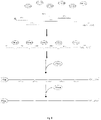
- Fig. 1 is a process flow diagram of an example of a method for large-scale synthesis of a long-chain RNA in the present invention
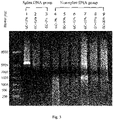
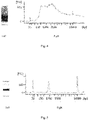
- Fig. 2 shows the purification and purity analysis of the long-chain RNA obtained in an example of the present invention
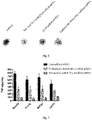
- Fig. 3 shows the protein expression of the site-specific modified long-chain RNA obtained in an example of a method for site-specific modification of a long-chain RNA in the present invention.
- the working principle of the method for large-scale synthesis of a long-chain RNA in the present invention is as follows: first, a large number of different short RNA fragments (including the non-chemically modified short RNA fragments and the site-specific modified short RNA fragments) and the splint DNA fragments are chemically synthesized, then the different short RNA fragments are ligated by a biological method so as to form an uncapped long-chain RNA, finally, a cap structure is ligated to the uncapped long-chain RNA to form the target long-chain RNA.
- RNA fragments and the splint DNA fragments are chemically synthesized; then the different short RNA fragments and the splint DNA fragments are ligated by a DNA ligase, and at the same time, the short RNA fragments and the 3' polyA tail are ligated by an RNA ligase to form the uncapped long-chain RNA; and then the cap structure is added to the 5' end of the uncapped long-chain RNA by a capping enzyme to form the capped long-chain RNA; finally, the splint DNA fragments in the capped long-chain RNA is removed by a DNase to obtain the desired long-chain RNA.
- the whole process is simple to operate and has a low production cost.
- the product long-chain RNA has a low mutation rate, a plurality of the short RNA fragments can be assembled in a single reaction, and the long-chain RNA can be synthesized at a high throughput so as to fulfill the large-scale production of the long-chain RNA.
- the short RNA fragments are site-specific modified, the site-specific modification of the long-chain RNA can be realized, to enhance RNA stability and intracellular translation efficiency, and reduce RNA immunogenicity.
- the uncapped long-chain RNA can also be capped through the capping enzyme of one or a combination of RNA triphosphatase, RNA guanyltransferase, guanine-7-methyltransferase and 2'-O-methyltransferase.
- the Cap 0 cap structure is formed when the 7th carbon atom of G is methylated to form m7GPPPN; and the Cap 1 cap structure is formed when the 2'-O position of the first nucleotide of a transcript is methylated to form m7GPPPNm.
- sequences of the short RNA fragments and the splint DNA fragments can be designed according to the specific structure of the RNA to be synthesized on a large scale, but they should meet the following requirements: 1) the designed and synthesized short RNA fragments have a length of 100-170 nt; 2) the GC base content of the short RNA fragments at 5' end and 3' end is higher than 15%; and 3) the GC base content of the splint DNA fragments at 5' end and 3' end is higher than 15%.
- the desired short RNA fragments were synthesized by solid-phase synthesis. It should be further noted that the entire reaction was carried out from 3' end to 5' end of the RNA.
- splint DNA fragments are synthesized by a commercial chemical method, which is not specifically described.
- RNA purification there are many method for purifying long-chain RNA, including but not limited to lithium chloride/ethanol precipitation, centrifugal column, chlorine extraction/ethanol precipitation, gel purification and purification by high performance liquid chromatography.
- HPLC HPLC is mainly used for purification.
- gel electrophoresis technique is used to analyze the purity of the desired long-chain RNA obtained in example 4.
- in-vitro transcribed RNA As shown in Fig. 6 , 200 ng of in-vitro transcribed RNA was used to encode mEPO, and the dot blot assay mentioned in step 1 which uses K1 monoclonal antibodies to recognize dsRNA were employed for analysis.
- the dsRNA positive control experiment contained the dsRNA with a length of 328 bp (25 ng). It is known that the in-vitro transcribed RNA is immunogenic and contains DNA contaminants.
- dendritic cells were treated with mRNAs of the intracellular reninase (T7TSRenA30), luciferase (T7TSLucA30), luciferase (T7TSMetlucA30) and methoxyphosphine (TEVmEPOA51), respectively.
- T7TSRenA30 mRNAs of the intracellular reninase
- T7TSLucA30 luciferase
- T7TSMetlucA30 luciferase
- T7TSMetlucA30 methoxyphosphine
- TNF-a tumor necrosis factor-a
- the long-chain RNAs were obtained under different conditions of Ligation (modified), IVT (unmodified), Ligation (unmodified) and IVT (unmodified) in step 2, and the expression of the luciferase was measured after 24 h.
- 500 ng of the long-chain RNA is transfected into the Hela cells, the expression of the obtained luciferase is the largest.
- the expression of the luciferase in the site-specific chemically modified long-chain RNA is much higher than that in the unmodified long-chain RNA.
- the content of the luciferase expressed by the site-specific chemically modified long-chain RNA in the present invention is nearly an order of magnitude higher than that in a traditional in-vitro transcription method.
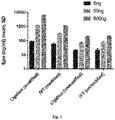
- RNAs As shown in Fig. 9 , 5 ng, 50 ng and 500 ng of the long-chain RNAs were transfected into Hela cells respectively, the long-chain RNAs were obtained under different conditions of Ligation (modified), IVT (unmodified), Ligation (unmodified) and IVT (unmodified) in step 2, and the expression of erythropoietin was measured after 24 h.
- 500 ng of the long-chain RNA is transfected into the Hela cells, the expression of the obtained erythropoietin is the largest.
- the expression of the erythropoietin in the site-specific chemically modified long-chain RNA is much higher than that in the unmodified long-chain RNA.
- the content of the erythropoietin expressed by the site-specific chemically modified long-chain RNA in the present invention is nearly 11 times of that in a traditional in-vitro transcription method.
- the mice were transfected with 5 ng, 50 ng and 500 ng of the long-chain RNAs obtained by Ligation (modified), IVT (unmodified), Ligation (unmodified) and IVT (unmodified), respectively, and the expression of the haematocrit was measured after 7 d.
- 500 ng of the long-chain RNA is transfected into the mice, the expression of the obtained haematocrit is the largest.
- the haematocrit of the mice in the site-specific chemically modified long-chain RNA is much higher than that in the unmodified long-chain RNA.
- the haematocrit expressed in the site-specific chemically modified long-chain RNA in the present invention is nearly three times of that in a traditional in-vitro transcription method.
- the method for large-scale synthesis of a long-chain RNA in the examples of the present invention has a lower cost and stable structure compared with the traditional synthesis of a long-chain RNA.
- the present invention further provides a method for site-specific chemical modification of a designated sequence. The method overcomes the disadvantages that the site-specific modification can only be conducted on the entire RNA molecule in the traditional site-specific chemical modification method, and realizes different site-specific modifications on different designated fragments of the long-chain RNA molecule.
- RNA molecule due to the particularity of the method for site-specific modification of a long-chain RNA provided by the examples of the present invention, it can realize various modifications to specific bases on the RNA molecule, which is beneficial to research on cell experiments, animal experiments and clinical RNA drug functions.
Landscapes
- Life Sciences & Earth Sciences (AREA)
- Chemical & Material Sciences (AREA)
- Health & Medical Sciences (AREA)
- Organic Chemistry (AREA)
- Engineering & Computer Science (AREA)
- Zoology (AREA)
- Wood Science & Technology (AREA)
- Genetics & Genomics (AREA)
- Bioinformatics & Cheminformatics (AREA)
- General Health & Medical Sciences (AREA)
- Biochemistry (AREA)
- General Engineering & Computer Science (AREA)
- Molecular Biology (AREA)
- Microbiology (AREA)
- Biotechnology (AREA)
- Biomedical Technology (AREA)
- Medicinal Chemistry (AREA)
- Chemical Kinetics & Catalysis (AREA)
- General Chemical & Material Sciences (AREA)
- Measuring Or Testing Involving Enzymes Or Micro-Organisms (AREA)
- Preparation Of Compounds By Using Micro-Organisms (AREA)
Applications Claiming Priority (2)
| Application Number | Priority Date | Filing Date | Title |
|---|---|---|---|
| CN202010068138.0A CN111235198B (zh) | 2020-01-20 | 2020-01-20 | 规模化合成长链rna的方法及其定点修饰的方法 |
| PCT/CN2020/136416 WO2021147570A1 (zh) | 2020-01-20 | 2020-12-15 | 规模化合成长链rna的方法及其定点修饰的方法 |
Publications (2)
| Publication Number | Publication Date |
|---|---|
| EP4095253A1 true EP4095253A1 (de) | 2022-11-30 |
| EP4095253A4 EP4095253A4 (de) | 2023-10-04 |
Family
ID=70872898
Family Applications (1)
| Application Number | Title | Priority Date | Filing Date |
|---|---|---|---|
| EP20916091.0A Withdrawn EP4095253A4 (de) | 2020-01-20 | 2020-12-15 | Verfahren zur grossskaligen synthese langkettiger rna und verfahren zur ortsspezifischen modifikation davon |
Country Status (5)
| Country | Link |
|---|---|
| US (1) | US12454712B2 (de) |
| EP (1) | EP4095253A4 (de) |
| CN (1) | CN111235198B (de) |
| AU (1) | AU2020423979B2 (de) |
| WO (1) | WO2021147570A1 (de) |
Cited By (1)
| Publication number | Priority date | Publication date | Assignee | Title |
|---|---|---|---|---|
| EP4763984A1 (de) * | 2024-12-23 | 2026-06-24 | 4basebio UK Ltd | Rna-produkte und verfahren zur herstellung |
Families Citing this family (10)
| Publication number | Priority date | Publication date | Assignee | Title |
|---|---|---|---|---|
| CN111235198B (zh) * | 2020-01-20 | 2021-06-15 | 深圳市瑞吉生物科技有限公司 | 规模化合成长链rna的方法及其定点修饰的方法 |
| CN111744019B (zh) * | 2020-07-01 | 2023-08-04 | 深圳瑞吉生物科技有限公司 | 基于甘露糖的mRNA靶向递送系统及其应用 |
| CN114807154B (zh) * | 2020-12-10 | 2024-05-28 | 深圳瑞吉生物科技有限公司 | 一种修饰的核酸及其应用 |
| WO2022170707A1 (zh) * | 2021-02-10 | 2022-08-18 | 清华大学 | 一种制备定点修饰的长链dna的方法 |
| WO2022170705A1 (zh) * | 2021-02-10 | 2022-08-18 | 清华大学 | 一种制备定点修饰的长链rna的方法 |
| CN115010769B (zh) * | 2022-08-04 | 2022-11-15 | 上海百力格生物技术有限公司 | 固相亚磷酰胺三酯法合成长链rna核酸的方法 |
| WO2024245313A1 (zh) * | 2023-05-30 | 2024-12-05 | 北京超环生物科技有限公司 | 一种制备带有精准定点修饰的单链环状rna的方法 |
| CN117070513B (zh) * | 2023-10-16 | 2024-04-26 | 吉林凯莱英医药化学有限公司 | 含有硫代磷酸酯键的rna及其制备方法 |
| CN117070512B (zh) * | 2023-10-16 | 2024-04-26 | 吉林凯莱英医药化学有限公司 | tRNA及其生物合成方法 |
| WO2026002219A1 (zh) * | 2024-06-28 | 2026-01-02 | 图维生物医药科技(苏州)有限公司 | 一种高效rna酶促连接方法 |
Family Cites Families (6)
| Publication number | Priority date | Publication date | Assignee | Title |
|---|---|---|---|---|
| JP2002171983A (ja) * | 2000-12-05 | 2002-06-18 | Gencom Co | 核酸の連結方法 |
| CA3064197A1 (en) * | 2016-05-23 | 2017-11-30 | Tribiotica Llc | Methods for using nucleic acid aptamers for directed templated assembly |
| PL3529380T3 (pl) * | 2016-10-19 | 2022-10-24 | Illumina, Inc. | Sposoby chemicznej ligacji kwasów nukleinowych |
| US11286481B2 (en) * | 2017-03-17 | 2022-03-29 | Cubicstars, Inc. | Method for producing complex of RNA molecule and peptide, and utilization thereof |
| US20200362382A1 (en) * | 2017-08-18 | 2020-11-19 | Modernatx, Inc. | Methods of preparing modified rna |
| CN111235198B (zh) * | 2020-01-20 | 2021-06-15 | 深圳市瑞吉生物科技有限公司 | 规模化合成长链rna的方法及其定点修饰的方法 |
-
2020
- 2020-01-20 CN CN202010068138.0A patent/CN111235198B/zh active Active
- 2020-12-15 WO PCT/CN2020/136416 patent/WO2021147570A1/zh not_active Ceased
- 2020-12-15 AU AU2020423979A patent/AU2020423979B2/en active Active
- 2020-12-15 EP EP20916091.0A patent/EP4095253A4/de not_active Withdrawn
-
2022
- 2022-07-18 US US17/813,290 patent/US12454712B2/en active Active
Cited By (2)
| Publication number | Priority date | Publication date | Assignee | Title |
|---|---|---|---|---|
| EP4763984A1 (de) * | 2024-12-23 | 2026-06-24 | 4basebio UK Ltd | Rna-produkte und verfahren zur herstellung |
| WO2026139603A1 (en) * | 2024-12-23 | 2026-07-02 | 4Basebio Uk Ltd | Rna products and methods of production |
Also Published As
| Publication number | Publication date |
|---|---|
| AU2020423979B2 (en) | 2023-09-14 |
| AU2020423979A1 (en) | 2022-08-11 |
| EP4095253A4 (de) | 2023-10-04 |
| US12454712B2 (en) | 2025-10-28 |
| WO2021147570A1 (zh) | 2021-07-29 |
| CN111235198B (zh) | 2021-06-15 |
| CN111235198A (zh) | 2020-06-05 |
| US20220372538A1 (en) | 2022-11-24 |
Similar Documents
| Publication | Publication Date | Title |
|---|---|---|
| US12454712B2 (en) | Method for large-scale synthesis of long-chain RNA and method for site-specific modification of long-chain RNA | |
| EP2010659B1 (de) | Kits und Verfahren zur Erzeugung von RNA mit 5'-Cap-Struktur | |
| EP3044228B1 (de) | Hocheffiziente synthese von langen rna mittels eines verfahrens in umgekehrter richtung | |
| EP2971165A1 (de) | Entfernung von dna-fragmenten in mrna-herstellungsverfahren | |
| WO2011056866A2 (en) | Methods and kits for 3'-end-tagging of rna | |
| WO1985004674A1 (en) | Immobilization of nucleic acids | |
| CN114907430A (zh) | 一种mRNA的分离纯化方法 | |
| EP4582542A1 (de) | Verfahren zur herstellung von oligonukleotiden unter verwendung von rna-ligase | |
| Kojima et al. | PCR amplification of 4′-thioDNA using 2′-deoxy-4′-thionucleoside 5′-triphosphates | |
| CN116875658A (zh) | 一种脱氧核酶及检测mRNA加帽率的方法 | |
| CN116356002A (zh) | 一种rna加帽效率的定量方法、试剂盒及其应用 | |
| HK40080658A (en) | Method for large-scale synthesis of long-chain rna and method for site-specific modification thereof | |
| Che et al. | On‐column capping of poly dT media‐tethered mRNA accomplishes high capping efficiency, enhanced mRNA recovery, and improved stability against RNase | |
| EP4713333A1 (de) | Zirkuläre rna-analoga, herstellung und anwendung davon | |
| CN119432957A (zh) | 一种通过体外转录制备rna的方法及应用 | |
| CN115197935A (zh) | 纤维素色谱纯化rna的方法 | |
| US20260043018A1 (en) | Nucleic acid purification | |
| KR102165917B1 (ko) | 말단 뉴클레오티드 전이효소를 이용한 단일 뉴클레오티드가 도입된 dna 올리고머의 제조방법 | |
| WO2026050151A1 (en) | Rna polymerases for mrna manufacturing | |
| CN120210149A (zh) | 一种dna聚合酶突变体及其用于位点特异性标记rna的方法 | |
| WO2024121360A1 (en) | In vitro enzymatical rna synthesis | |
| WO2026050155A1 (en) | RNA POLYMERASES FOR mRNA MANUFACTURING | |
| CN118109539A (zh) | 一种无模板酶法合成含非天然碱基的核糖核酸链的方法及其应用 | |
| WO2025193642A1 (en) | Rna purification methods | |
| Baron | Synthesis, detection, and quantification of modified nucleotides in RNA |
Legal Events
| Date | Code | Title | Description |
|---|---|---|---|
| STAA | Information on the status of an ep patent application or granted ep patent |
Free format text: STATUS: THE INTERNATIONAL PUBLICATION HAS BEEN MADE |
|
| PUAI | Public reference made under article 153(3) epc to a published international application that has entered the european phase |
Free format text: ORIGINAL CODE: 0009012 |
|
| STAA | Information on the status of an ep patent application or granted ep patent |
Free format text: STATUS: REQUEST FOR EXAMINATION WAS MADE |
|
| 17P | Request for examination filed |
Effective date: 20220812 |
|
| AK | Designated contracting states |
Kind code of ref document: A1 Designated state(s): AL AT BE BG CH CY CZ DE DK EE ES FI FR GB GR HR HU IE IS IT LI LT LU LV MC MK MT NL NO PL PT RO RS SE SI SK SM TR |
|
| DAV | Request for validation of the european patent (deleted) | ||
| DAX | Request for extension of the european patent (deleted) | ||
| REG | Reference to a national code |
Ref country code: HK Ref legal event code: DE Ref document number: 40080658 Country of ref document: HK |
|
| P01 | Opt-out of the competence of the unified patent court (upc) registered |
Effective date: 20230621 |
|
| STAA | Information on the status of an ep patent application or granted ep patent |
Free format text: STATUS: EXAMINATION IS IN PROGRESS |
|
| A4 | Supplementary search report drawn up and despatched |
Effective date: 20230904 |
|
| RIC1 | Information provided on ipc code assigned before grant |
Ipc: C12N 9/22 20060101ALI20230829BHEP Ipc: C12N 9/12 20060101ALI20230829BHEP Ipc: C12N 9/00 20060101ALI20230829BHEP Ipc: C12P 19/34 20060101AFI20230829BHEP |
|
| 17Q | First examination report despatched |
Effective date: 20230919 |
|
| STAA | Information on the status of an ep patent application or granted ep patent |
Free format text: STATUS: THE APPLICATION IS DEEMED TO BE WITHDRAWN |
|
| 18D | Application deemed to be withdrawn |
Effective date: 20240403 |