EP4074550A1 - Verkleidungsteil für einen fahrzeuginnenraum gebildet als spritzguss-mehrkomponentenbauteil - Google Patents
Verkleidungsteil für einen fahrzeuginnenraum gebildet als spritzguss-mehrkomponentenbauteil Download PDFInfo
- Publication number
- EP4074550A1 EP4074550A1 EP22176805.4A EP22176805A EP4074550A1 EP 4074550 A1 EP4074550 A1 EP 4074550A1 EP 22176805 A EP22176805 A EP 22176805A EP 4074550 A1 EP4074550 A1 EP 4074550A1
- Authority
- EP
- European Patent Office
- Prior art keywords
- light guide
- paneling
- component
- carrier part
- carrier
- Prior art date
- Legal status (The legal status is an assumption and is not a legal conclusion. Google has not performed a legal analysis and makes no representation as to the accuracy of the status listed.)
- Granted
Links
Images
Classifications
-
- B—PERFORMING OPERATIONS; TRANSPORTING
- B60—VEHICLES IN GENERAL
- B60R—VEHICLES, VEHICLE FITTINGS, OR VEHICLE PARTS, NOT OTHERWISE PROVIDED FOR
- B60R13/00—Elements for body-finishing, identifying, or decorating; Arrangements or adaptations for advertising purposes
- B60R13/02—Internal Trim mouldings ; Internal Ledges; Wall liners for passenger compartments; Roof liners
- B60R13/0237—Side or rear panels
- B60R13/0243—Doors
-
- B—PERFORMING OPERATIONS; TRANSPORTING
- B29—WORKING OF PLASTICS; WORKING OF SUBSTANCES IN A PLASTIC STATE IN GENERAL
- B29C—SHAPING OR JOINING OF PLASTICS; SHAPING OF MATERIAL IN A PLASTIC STATE, NOT OTHERWISE PROVIDED FOR; AFTER-TREATMENT OF THE SHAPED PRODUCTS, e.g. REPAIRING
- B29C45/00—Injection moulding, i.e. forcing the required volume of moulding material through a nozzle into a closed mould; Apparatus therefor
- B29C45/16—Making multilayered or multicoloured articles
- B29C45/1676—Making multilayered or multicoloured articles using a soft material and a rigid material, e.g. making articles with a sealing part
-
- B—PERFORMING OPERATIONS; TRANSPORTING
- B60—VEHICLES IN GENERAL
- B60Q—ARRANGEMENT OF SIGNALLING OR LIGHTING DEVICES, THE MOUNTING OR SUPPORTING THEREOF OR CIRCUITS THEREFOR, FOR VEHICLES IN GENERAL
- B60Q3/00—Arrangement of lighting devices for vehicle interiors; Lighting devices specially adapted for vehicle interiors
- B60Q3/40—Arrangement of lighting devices for vehicle interiors; Lighting devices specially adapted for vehicle interiors specially adapted for specific vehicle types
- B60Q3/41—Arrangement of lighting devices for vehicle interiors; Lighting devices specially adapted for vehicle interiors specially adapted for specific vehicle types for mass transit vehicles, e.g. buses
- B60Q3/43—General lighting
-
- B—PERFORMING OPERATIONS; TRANSPORTING
- B60—VEHICLES IN GENERAL
- B60Q—ARRANGEMENT OF SIGNALLING OR LIGHTING DEVICES, THE MOUNTING OR SUPPORTING THEREOF OR CIRCUITS THEREFOR, FOR VEHICLES IN GENERAL
- B60Q3/00—Arrangement of lighting devices for vehicle interiors; Lighting devices specially adapted for vehicle interiors
- B60Q3/50—Mounting arrangements
- B60Q3/54—Lighting devices embedded in interior trim, e.g. in roof liners
-
- B—PERFORMING OPERATIONS; TRANSPORTING
- B60—VEHICLES IN GENERAL
- B60Q—ARRANGEMENT OF SIGNALLING OR LIGHTING DEVICES, THE MOUNTING OR SUPPORTING THEREOF OR CIRCUITS THEREFOR, FOR VEHICLES IN GENERAL
- B60Q3/00—Arrangement of lighting devices for vehicle interiors; Lighting devices specially adapted for vehicle interiors
- B60Q3/60—Arrangement of lighting devices for vehicle interiors; Lighting devices specially adapted for vehicle interiors characterised by optical aspects
- B60Q3/62—Arrangement of lighting devices for vehicle interiors; Lighting devices specially adapted for vehicle interiors characterised by optical aspects using light guides
- B60Q3/64—Arrangement of lighting devices for vehicle interiors; Lighting devices specially adapted for vehicle interiors characterised by optical aspects using light guides for a single lighting device
-
- B—PERFORMING OPERATIONS; TRANSPORTING
- B60—VEHICLES IN GENERAL
- B60Q—ARRANGEMENT OF SIGNALLING OR LIGHTING DEVICES, THE MOUNTING OR SUPPORTING THEREOF OR CIRCUITS THEREFOR, FOR VEHICLES IN GENERAL
- B60Q3/00—Arrangement of lighting devices for vehicle interiors; Lighting devices specially adapted for vehicle interiors
- B60Q3/70—Arrangement of lighting devices for vehicle interiors; Lighting devices specially adapted for vehicle interiors characterised by the purpose
- B60Q3/78—Arrangement of lighting devices for vehicle interiors; Lighting devices specially adapted for vehicle interiors characterised by the purpose for generating luminous strips, e.g. for marking trim component edges
-
- B—PERFORMING OPERATIONS; TRANSPORTING
- B29—WORKING OF PLASTICS; WORKING OF SUBSTANCES IN A PLASTIC STATE IN GENERAL
- B29L—INDEXING SCHEME ASSOCIATED WITH SUBCLASS B29C, RELATING TO PARTICULAR ARTICLES
- B29L2011/00—Optical elements, e.g. lenses, prisms
- B29L2011/0075—Light guides, optical cables
-
- B—PERFORMING OPERATIONS; TRANSPORTING
- B29—WORKING OF PLASTICS; WORKING OF SUBSTANCES IN A PLASTIC STATE IN GENERAL
- B29L—INDEXING SCHEME ASSOCIATED WITH SUBCLASS B29C, RELATING TO PARTICULAR ARTICLES
- B29L2031/00—Other particular articles
- B29L2031/30—Vehicles, e.g. ships or aircraft, or body parts thereof
- B29L2031/3005—Body finishings
- B29L2031/3014—Door linings
-
- B—PERFORMING OPERATIONS; TRANSPORTING
- B29—WORKING OF PLASTICS; WORKING OF SUBSTANCES IN A PLASTIC STATE IN GENERAL
- B29L—INDEXING SCHEME ASSOCIATED WITH SUBCLASS B29C, RELATING TO PARTICULAR ARTICLES
- B29L2031/00—Other particular articles
- B29L2031/30—Vehicles, e.g. ships or aircraft, or body parts thereof
- B29L2031/3005—Body finishings
- B29L2031/3041—Trim panels
-
- B—PERFORMING OPERATIONS; TRANSPORTING
- B60—VEHICLES IN GENERAL
- B60R—VEHICLES, VEHICLE FITTINGS, OR VEHICLE PARTS, NOT OTHERWISE PROVIDED FOR
- B60R13/00—Elements for body-finishing, identifying, or decorating; Arrangements or adaptations for advertising purposes
- B60R13/02—Internal Trim mouldings ; Internal Ledges; Wall liners for passenger compartments; Roof liners
- B60R2013/0287—Internal Trim mouldings ; Internal Ledges; Wall liners for passenger compartments; Roof liners integrating other functions or accessories
Definitions
- the invention relates to a trim part designed for a vehicle interior formed as an injection-molded multi-component part.
- 2-component parts Generic injection-molded multi-component parts are known in the art as 2-component parts, in which two plastics are processed in injection molding, with the first plastic forming a hard component and the second plastic forming a soft component.
- the soft component serves as a physical decoupling and acts as a kind of damping element between adjacent plastic components that absorb relative movements otherwise unwanted creaking noises can occur. This is particularly problematic in the case of vehicle parts that are installed in the interior, since vehicle passengers react sensitively to such noises and find them particularly annoying. At the same time, the quality of the product is judged negatively if it makes such noises while driving.
- paneling parts are often provided with lighting or backlighting.
- the light required for this is directed to the illuminated areas via light guides.
- the light guides are clipped into the trim part or into a receptacle formed thereon, which is provided on a base body of the trim part.
- the problem here is that the components required for the lighting, in particular the guidance of the light guides via light guide mounts, can themselves produce undesirable noises during relative movements.
- Printed prior art in the present technical field is from the documents DE 10 2010 039 270 A1 and EP 3 575 153 A1 known.
- the invention is therefore based on the object of providing an illuminated or backlit paneling part with noise decoupling.
- a trim part designed for a vehicle interior and designed to be backlit or transilluminated is proposed.
- the paneling part includes a carrier part designed for fastening the paneling part in the vehicle interior, the carrier part being formed as an injection-molded multi-component part made from at least two different plastics.
- At the carrier part of the trim panel are a first plastic as a hard component and a second plastic as a soft component connected to each other in injection molding.
- the lining part has at least one light guide receptacle for attaching at least one light guide and decoupled from the hard component of the carrier part, the light guide receptacle being formed from the soft component of the carrier part.
- the light guide holder is molded onto the carrier part as a soft component and prevents noise from occurring during use, e.g. while driving, due to a relative movement of the light guide holder in relation to the carrier part.
- the light guide to be inserted into the light guide receptacle is also decoupled from the carrier part and thus from the hard component. Additional assembly steps for attaching the light guide receptacle can be omitted, so that incorrect assembly is also ruled out.
- the soft component preferably covers a surface of the carrier part which adjoins the at least one light guide receptacle. There is thus a direct transition between the part of the soft component, which is applied flatly to the carrier part as noise decoupling, and the light guide receptacle, which also contributes to noise decoupling.
- the soft component is therefore preferably provided in one piece on the carrier part.
- the light guide receptacle is partially formed from webs of the hard component protruding from the carrier part, the webs between them forming an insertion channel for the light guide that is injected with the soft component.
- the carrier part can thus provide structural elements through the webs, which provide guidance for the light guides.
- the additionally provided soft component forms the contact surface of the insertion channel for the light guides, so that there is no direct contact in the assembled state between the light guide and the hard component.
- a plurality of light guide receptacles are arranged in a row on the carrier part of the trim part, which fix the light guide on the trim part decoupled from the carrier part.
- the light guide can thus be routed over the necessary extension along the trim part via the respective light guide receptacles in order to ensure uniform lighting or backlighting over the desired extension of the trim component.
- a further development of the trim part is characterized in that a diffuser is arranged directly adjacent to the at least one light guide receptacle or covering it.
- the light coupled into the light guide via a coupling element can be scattered by means of the diffuser, so that homogeneous illumination over a surface is ensured.
- the cladding part has at least one LED module to which the at least one light guide is connected.
- the light for backlighting or transillumination of the paneling component is generated via the LED module.
- an advantageous solution provides that the at least one LED module is fastened to the carrier part on a module receptacle, which is preferably formed by the soft component. This means that the LED module mount is also noise-decoupled.
- the trim part has a decorative layer which is attached to the support part on a visible side of the trim part. Veneers or fabrics, for example, which provide the visible side of the trim part, can serve as a decorative layer.
- the decorative layer is transilluminated or backlit completely or in sections in order, for example, to produce a frame-like light strip.
- the decorative layer and the lens are arranged next to one another in the same plane, so that direct illumination through the lens by means of the light guide is made possible. From the visible side, the decorative layer can then be seen with the adjoining, directly backlit lens, which, for example, forms the frame or a frame element of the trim part.
- the hard component is formed, for example, from PC/ABS (polycarbonate/acrylonitrile butadiene styrene), in particular with a glass fiber content, and the soft component is formed from a thermoplastic elastomer (TPE).
- PC/ABS polycarbonate/acrylonitrile butadiene styrene
- TPE thermoplastic elastomer
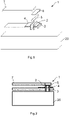
- the Figures 1 and 2 are only schematic by way of example and serve for a better understanding of the disclosure. Shown is the trim part 1 for attachment to a modular component 20, which can be, for example, a dashboard or a door of a motor vehicle.
- the paneling part 1 includes the carrier part 3 with which it is attached to the module component 20 .
- the decorative layer 7 is arranged on the carrier part 3 pointing towards the visible side.
- the decorative layer 7 forms the essential element that the user recognizes from the trim part 1.
- the diffuser 8 is provided laterally in the same or almost the same plane adjacent to the decorative layer 7 and covers the light guide 5 connected to the LED module (not shown). The light is distributed by the diffuser 8 via the light guide 5, so that the trim part 1 has a kind of frame that is illuminated on one side.
- the lens 8 can also be formed above or below the decorative layer 7 .
- the carrier part 3 of the lining part 1 is formed as an injection-molded multi-component part with two different plastics.
- the soft component 4 is distributed over a large area on the surface of the carrier part 3 and forms noise decoupling from adjacent components, for example the decorative layer 7 or the module component 20.
- the soft component 4 of the carrier part 3 can also be used for this purpose on the to the module -Component 20 facing surface of the support part 3 are provided. In any case, however, the soft component 4 forms the light guide receptacle 2 for attaching the light guide 5 and decoupling it from the hard component of the carrier part 3.
- the carrier part 3 which is a kind of frame structure intended for the light guide receptacle 2, which is then overmoulded with the soft component. This results in an insertion channel from the soft component for the light guide 5.
- the diffuser 5 rests on the light guide receptacle 2 formed from the soft component and is therefore also noise-decoupled.
- the light guide 5 is shown in the form of a rod, but can alternatively also be formed from one or more light plates.
Landscapes
- Engineering & Computer Science (AREA)
- Mechanical Engineering (AREA)
- Manufacturing & Machinery (AREA)
- Arrangements Of Lighting Devices For Vehicle Interiors, Mounting And Supporting Thereof, Circuits Therefore (AREA)
- Vehicle Interior And Exterior Ornaments, Soundproofing, And Insulation (AREA)
Abstract
Description
- Die Erfindung betrifft ein Verkleidungsteil ausgeführt für einen Fahrzeuginnenraum gebildet als Spritzguss-Mehrkomponentenbauteil.
- Gattungsbildende Spritzguss-Mehrkomponentenbauteile sind in der Technik als 2K-Bauteile bekannt, bei denen zwei Kunststoffe im Spritzguss verarbeitet werden, wobei der erste Kunststoff eine Hartkomponente und der zweite Kunststoff eine Weichkomponente bildet. Die Weichkomponente dient als physikalische Entkopplung und fungiert dabei als eine Art Dämpfungselement zwischen angrenzenden Kunststoffbauteilen, die bei Relativbewegungen sonst unerwünschte Knarzgeräusche verursachen können. Dies ist insbesondere bei Fahrzeugteilen problematisch, die im Innenraum verbaut werden, da Fahrzeugpassagiere sensibel auf derartige Geräusche reagieren und diese als besonders lästig empfinden. Gleichzeitig wird die Wertigkeit des Produktes negativ beurteilt, wenn es während der Fahrt derartige Geräusche erzeugt.
- In neueren Entwicklungen werden Verkleidungsteile häufig mit einer Beleuchtung oder Hinterleuchtung versehen. Das hierfür benötigte Licht wird über Lichtleiter an die beleuchtenden Stellen geleitet. Die Lichtleiter werden dabei in das Verkleidungsteil oder eine daran ausgebildete Aufnahme geklipst, welche an einem Grundkörper des Verkleidungsteils vorgesehen ist. Dabei ist problematisch, dass die für die Beleuchtung benötigten Bauteile, insbesondere die Führung der Lichtleiter über Lichtleiteraufnahmen bei Relativbewegungen selbst unerwünschte Geräusche erzeugen können.
- Druckschriftlicher Stand der Technik aus dem vorliegenden technischen Gebiet ist aus den Dokumenten
DE 10 2010 039 270 A1 undEP 3 575 153 A1 bekannt. - Der Erfindung liegt deshalb die Aufgabe zugrunde, ein beleuchtbares oder hinterleuchtbares Verkleidungsteil mit Geräuschentkopplung bereitzustellen.
- Diese Aufgabe wird durch die Merkmalskombination gemäß Patentanspruch 1 gelöst.
- Erfindungsgemäß wird ein Verkleidungsteil, ausgeführt für einen Fahrzeuginnenraum und ausgebildet hinterleuchtet oder durchleuchtet zu werden, vorgeschlagen. Das Verkleidungsteil umfasst ein Trägerteil ausgebildet zur Befestigung des Verkleidungsteils im Fahrzeuginnenraum, wobei das Trägerteil als Spritzguss-Mehrkomponentenbauteil aus mindestens zwei unterschiedlichen Kunststoffen gebildet ist. Bei dem Trägerteil des Verkleidungsteils sind ein erster Kunststoff als Hartkomponente und ein zweiter Kunststoff als Weichkomponente im Spritzguss miteinander verbunden. Ferner weist das Verkleidungsteil mindestens eine Lichtleiteraufnahme zur befestigenden und von der Hartkomponente des Trägerteils entkoppelten Aufnahme mindestens eines Lichtleiters auf, wobei die Lichtleiteraufnahme aus der Weichkomponente des Trägerteils gebildet ist.
- Die Lichtleiteraufnahme wird als Weichkomponente an das Trägerteil mit angespritzt und verhindert, dass im Einsatz, z.B. während der Fahrt, Geräusche durch eine Relativbewegung der Lichtleiteraufnahme gegenüber dem Trägerteil entstehen. Auch wird der in die Lichtleiteraufnahme einzulegende Lichtleiter von dem Trägerteil und somit der Hartkomponente entkoppelt. Zusätzliche Montageschritte für die Befestigung der Lichtleiteraufnahme können entfallen, so dass auch Fehlmontagen ausgeschlossen sind.
- Bei dem Verkleidungsteil überdeckt die Weichkomponente vorzugsweise eine Oberfläche des Trägerteils, welche an die mindestens eine Lichtleiteraufnahme angrenzt. Es besteht somit ein unmittelbarer Übergang zwischen dem Teil der Weichkomponente, welche als Geräuschentkopplung auf dem Trägerteil flächig aufgebracht wird und der Lichtleiteraufnahme, welche ebenfalls zur Geräuschentkopplung beiträgt. Die Weichkomponente ist somit vorzugsweise einstückig an dem Trägerteil vorgesehen.
- In einer Ausführungsvariante des Verkleidungsteils ist vorgesehen, dass die Lichtleiteraufnahme teilweise aus von dem Trägerteil vorstehenden Stegen aus der Hartkomponente gebildet ist, wobei die Stege zwischen sich einen mit der Weichkomponente ausgespritzten Einlegekanal für den Lichtleiter bilden. Das Trägerteil kann somit durch die Stege strukturelle Elemente bereitstellen, welche eine Führung für die Lichtleiter bieten. Die zusätzlich vorgesehene Weichkomponente bildet jedoch die Anlagefläche des Einlegekanals für die Lichtleiter, so dass im montierten Zustand kein direkter Kontakt zwischen dem Lichtleiter und der Hartkomponente besteht.
- Erfindungsgemäß werden an dem Trägerteil des Verkleidungsteils mehrere Lichtleiteraufnahmen in Reihe angeordnet, welche den Lichtleiter an dem Verkleidungsteil entkoppelt von dem Trägerteil fixieren. Der Lichtleiter ist somit über die notwendige Erstreckung entlang des Verkleidungsteils über die jeweiligen Lichtleiteraufnahmen führbar, um die Beleuchtung oder Hinterleuchtung über die gewünschte Erstreckung des Verkleidungsbauteils gleichmäßig zu gewährleisten.
- Eine Weiterbildung des Verkleidungsteils ist dadurch gekennzeichnet, dass an der mindestens einen Lichtleiteraufnahme unmittelbar angrenzend oder diese überdeckend eine Streuscheibe angeordnet ist. Mittels der Streuscheibe kann das über eine Einkoppelelement in den Lichtleiter eingekoppelte Licht gestreut werden, so dass eine homogene Ausleuchtung über eine Fläche gewährleistet ist.
- Ferner ist günstig, dass das Verkleidungsteil mindestens ein LED-Modul aufweist, mit dem der mindestens eine Lichtleiter verbunden ist. Über das LED-Modul wird das Licht für die Hinterleuchtung bzw. Durchleuchtung des Verkleidungsbauteils erzeugt. Dabei sieht eine vorteilhafte Lösung vor, dass das mindestens eine LED-Modul an dem Trägerteil an einer Modulaufnahme befestigt ist, die vorzugsweise durch die Weichkomponente gebildet ist. Somit ist auch die LED-Modulaufnahme geräuschentkoppelt.
- In einer Weiterbildung weist das Verkleidungsteil eine Dekorlage auf, welche auf einer Sichtseite des Verkleidungsteils an dem Trägerteil befestigt ist. Als Dekorlage können beispielsweise Furniere oder Gewebe dienen, welche die Sichtseite des Verkleidungsteils bereitstellen. Die Dekorlage wird vollständig oder abschnittsweise durchleuchtet oder hinterleuchtet, um beispielsweise einen rahmenartigen Leuchtstreifen zu erzeugen.
- In einer Ausführungsvariante des Verkleidungsteils werden die Dekorlage und die Streuscheibe nebeneinander in derselben Ebene angeordnet, so dass eine unmittelbare Beleuchtung mittels des Lichtleiters durch die Streuscheibe ermöglicht ist. Von der Sichtseite ist dann die Dekorlage mit angrenzender unmittelbar hinterleuchteter Streuscheibe zu erkennen, welche beispielsweise den Rahmen oder ein Rahmenelement des Verkleidungsteils bildet.
- Die Hartkomponente wird in einer für die Erfindung günstigen Ausführung beispielsweise aus PC/ABS (Polycarbonate/Acrylnitril Butadien Styrol) insbesondere mit einem Glasfaseranteil, die Weichkomponente aus einem thermoplastischen Elastomer (TPE) gebildet.
- Andere vorteilhafte Weiterbildungen der Erfindung sind in den Unteransprüchen gekennzeichnet bzw. werden nachstehend zusammen mit der Beschreibung der bevorzugten Ausführung der Erfindung anhand der Figuren näher dargestellt. Es zeigen:
- Fig. 1
- eine schematische Explosionsdarstellung eines Verkleidungsteils zur Befestigung an einem Modul-Bauteil;
- Fig. 2
- das schematische Verkleidungsteil gemäß
Figur 1 im montierten Zustand. - Die
Figuren 1 und 2 sind lediglich beispielhaft schematisch und dienen zum besseren Verständnis der Offenbarung. Gezeigt ist das Verkleidungsteil 1 zur Befestigung an einem Modul-Bauteil 20, welches beispielsweise ein Armaturenbrett oder eine Tür eines Kraftfahrzeugs sein kann. - Das Verkleidungsteil 1 umfasst das Trägerteil 3, mit dem es an der Modul-Bauteil 20 befestigt wird. Zur Sichtseite weisend ist auf dem Trägerteil 3 die Dekorlage 7 angeordnet. Die Dekorlage 7 bildet das wesentliche Element, dass der Benutzer von dem Verkleidungsteil 1 erkennt. Seitlich in derselben oder nahezu derselben Ebene angrenzend an die Dekorlage 7 ist in der gezeigten Ausführung die Streuscheibe 8 vorgesehen, welche den mit dem LED-Modul (nicht gezeigt) verbundenen Lichtleiter 5 überdeckt. Über den Lichtleiter 5 wird das Licht durch die Streuscheibe 8 verteilt, so dass das Verkleidungsteil 1 eine Art einseitig beleuchteten Rahmen aufweist. In einer nicht gezeigten alternativen Ausführung kann die Streuscheibe 8 auch zur Dekorlage 7 überstehend oder unterstehend gebildet sein.
- Das Trägerteil 3 des Verkleidungsteils 1 ist als Spritzguss-Mehrkomponentenbauteil mit zwei unterschiedlichen Kunststoffen gebildet. Flächig auf der Oberfläche des Trägerteils 3 ist die Weichkomponente 4 verteilt und bildet eine Geräuschentkopplung gegenüber angrenzenden Bauteilen, beispielsweise der Dekorlage 7 oder dem Modul-Bauteil 20. Wenn auch nicht gezeigt, so kann die Weichkomponente 4 des Trägerteils 3 hierfür auch auf der zum Modul-Bauteil 20 weisenden Oberfläche des Trägerteils 3 vorgesehen werden. Die Weichkomponente 4 bildet jedoch in jedem Fall die Lichtleiteraufnahme 2 zur befestigenden und von der Hartkomponente des Trägerteils 3 entkoppelten Aufnahme des Lichtleiters 5. In den Figuren ist dies vereinfacht dargestellt, jedoch kann an dem Trägerteil 3 auch eine Stegkonstruktion vorgesehen werden, welche eine Art Rahmenstruktur für die Lichtleiteraufnahme 2 bestimmt, die dann mit der Weichkomponente umspritzt wird. Somit ergibt sich ein Einlegekanal aus der Weichkomponente für den Lichtleiter 5.
- Die Streuscheibe 5 liegt auf der Lichtleiteraufnahme 2 gebildet aus der Weichkomponente auf und ist mithin ebenfalls geräuschentkoppelt. Der Lichtleiter 5 ist stangeartig dargestellt, kann alternativ jedoch auch aus einer oder mehreren Lichtplatten gebildet werden.
Claims (9)
- Verkleidungsteil (1) ausgeführt für einen Fahrzeuginnenraum und ausgebildet hinterleuchtet oder durchleuchtet zu werden, wobei das Verkleidungsteil (1) ein Trägerteil (3) ausgebildet zur Befestigung des Verkleidungsteils (1) im Fahrzeuginnenraum umfasst, welches Trägerteil (3) als Spritzguss-Mehrkomponentenbauteil aus mindestens zwei unterschiedlichen Kunststoffen gebildet ist, wobei ein erster Kunststoff als Hartkomponente und ein zweiter Kunststoff als Weichkomponente im Spritzguss miteinander verbunden sind, und wobei das Verkleidungsteil (1) mindestens eine Lichtleiteraufnahme (2) zur befestigenden und von dem Trägerteil (3) entkoppelten Aufnahme mindestens eines Lichtleiters (5) aufweist und die Lichtleiteraufnahme (2) aus der Weichkomponente des Trägerteils (3) gebildet ist, dadurch gekennzeichnet, dass an dem Trägerteil (3) mehrere Lichtleiteraufnahmen (2) in Reihe angeordnet sind, welche den Lichtleiter (5) an dem Verkleidungsteil (1) entkoppelt von dem Trägerteil (3) fixieren.
- Verkleidungsteil nach Anspruch 1, dadurch gekennzeichnet, dass die Weichkomponente eine Oberfläche des Trägerteils (3) überdeckt, welche an die mindestens eine Lichtleiteraufnahme (2) angrenzt.
- Verkleidungsteil nach Anspruch 1 oder 2, dadurch gekennzeichnet, dass die Lichtleiteraufnahme (2) teilweise aus von dem Trägerteil (3) vorstehenden Stegen aus der Hartkomponente gebildet ist, wobei die Stege zwischen sich einen mit der Weichkomponente ausgespritzten Einlegekanal für den Lichtleiter (5) bilden.
- Verkleidungsteil nach einem der vorigen Ansprüche, dadurch gekennzeichnet, dass an der mindestens einen Lichtleiteraufnahme (2) unmittelbar angrenzend oder diese überdeckend eine Streuscheibe (8) angeordnet ist.
- Verkleidungsteil nach einem der vorigen Ansprüche, dadurch gekennzeichnet, dass es eine Dekorlage (7) aufweist, welche auf einer Sichtseite des Verkleidungsteils (1) an dem Trägerteil (3) befestigt ist, wobei der Lichtleiter (5) eine indirekte Beleuchtung für die Dekorlage (7) bildet.
- Verkleidungsteil nach dem vorigen Anspruch, dadurch gekennzeichnet, dass die Dekorlage (7) und die Streuscheibe (8) nebeneinander in derselben Ebene angeordnet sind.
- Verkleidungsteil nach einem der vorigen Ansprüche, dadurch gekennzeichnet, dass es mindestens ein LED-Modul aufweist, mit dem der mindestens eine Lichtleiter (5) verbunden ist.
- Verkleidungsteil nach dem vorigen Anspruch, dadurch gekennzeichnet, dass das mindestens eine LED-Modul an dem Trägerteil (3) an einer Modulaufnahme befestigt ist, wobei die Modulaufnahme durch die Hartkomponente oder die Weichkomponente gebildet ist.
- Verkleidungsteil nach einem der vorigen Ansprüche, dadurch gekennzeichnet, dass die Hartkomponente aus einem thermoplastischen Kunststoff, insbesondere aus PC/ABS (Polycarbonate/Acrylnitril Butadien Styrol) mit einem Glasfaseranteil und die Weichkomponente aus einem thermoplastischen Elastomer (TPE) gebildet ist.
Applications Claiming Priority (3)
| Application Number | Priority Date | Filing Date | Title |
|---|---|---|---|
| DE102019111547.7A DE102019111547A1 (de) | 2019-05-03 | 2019-05-03 | Verkleidungsteil für einen Fahrzeuginnenraum gebildet als Spritzguss-Mehrkomponentenbauteil |
| EP20719598.3A EP3934938B1 (de) | 2019-05-03 | 2020-04-09 | Verkleidungsteil für einen fahrzeuginnenraum gebildet als spritzguss-mehrkomponentenbauteil |
| PCT/EP2020/060178 WO2020224913A1 (de) | 2019-05-03 | 2020-04-09 | Verkleidungsteil für einen fahrzeuginnenraum gebildet als spritzguss-mehrkomponentenbauteil |
Related Parent Applications (2)
| Application Number | Title | Priority Date | Filing Date |
|---|---|---|---|
| EP20719598.3A Division-Into EP3934938B1 (de) | 2019-05-03 | 2020-04-09 | Verkleidungsteil für einen fahrzeuginnenraum gebildet als spritzguss-mehrkomponentenbauteil |
| EP20719598.3A Division EP3934938B1 (de) | 2019-05-03 | 2020-04-09 | Verkleidungsteil für einen fahrzeuginnenraum gebildet als spritzguss-mehrkomponentenbauteil |
Publications (2)
| Publication Number | Publication Date |
|---|---|
| EP4074550A1 true EP4074550A1 (de) | 2022-10-19 |
| EP4074550B1 EP4074550B1 (de) | 2024-10-02 |
Family
ID=70292952
Family Applications (4)
| Application Number | Title | Priority Date | Filing Date |
|---|---|---|---|
| EP22176807.0A Active EP4079580B1 (de) | 2019-05-03 | 2020-04-09 | Verkleidungsteil für einen fahrzeuginnenraum gebildet als spritzguss-mehrkomponentenbauteil |
| EP20719598.3A Active EP3934938B1 (de) | 2019-05-03 | 2020-04-09 | Verkleidungsteil für einen fahrzeuginnenraum gebildet als spritzguss-mehrkomponentenbauteil |
| EP22176805.4A Active EP4074550B1 (de) | 2019-05-03 | 2020-04-09 | Verkleidungsteil für einen fahrzeuginnenraum gebildet als spritzguss-mehrkomponentenbauteil |
| EP22176808.8A Pending EP4091883A1 (de) | 2019-05-03 | 2020-04-09 | Verkleidungsteil für einen fahrzeuginnenraum gebildet als spritzguss-mehrkomponentenbauteil |
Family Applications Before (2)
| Application Number | Title | Priority Date | Filing Date |
|---|---|---|---|
| EP22176807.0A Active EP4079580B1 (de) | 2019-05-03 | 2020-04-09 | Verkleidungsteil für einen fahrzeuginnenraum gebildet als spritzguss-mehrkomponentenbauteil |
| EP20719598.3A Active EP3934938B1 (de) | 2019-05-03 | 2020-04-09 | Verkleidungsteil für einen fahrzeuginnenraum gebildet als spritzguss-mehrkomponentenbauteil |
Family Applications After (1)
| Application Number | Title | Priority Date | Filing Date |
|---|---|---|---|
| EP22176808.8A Pending EP4091883A1 (de) | 2019-05-03 | 2020-04-09 | Verkleidungsteil für einen fahrzeuginnenraum gebildet als spritzguss-mehrkomponentenbauteil |
Country Status (3)
| Country | Link |
|---|---|
| EP (4) | EP4079580B1 (de) |
| DE (1) | DE102019111547A1 (de) |
| WO (1) | WO2020224913A1 (de) |
Citations (8)
| Publication number | Priority date | Publication date | Assignee | Title |
|---|---|---|---|---|
| US20020101738A1 (en) * | 2001-01-31 | 2002-08-01 | Misaras David M. | Backlighting method for an automotive trim panel |
| DE202006003768U1 (de) * | 2006-03-08 | 2006-06-08 | Sidler Gmbh & Co. Kg | Fahrzeugbeleuchtung mit biegsamem Lichtleiter |
| DE102010039270A1 (de) | 2009-08-17 | 2011-02-24 | Euwe Eugen Wexler Gmbh | Verbundbauteil, insbesondere für Innenraum-Verkleidungselemente von Kraftfahrzeugen |
| DE102011089285A1 (de) * | 2011-12-20 | 2013-06-20 | Bayerische Motoren Werke Aktiengesellschaft | Formschlüssige Lichtintegration in Dekorhaut |
| DE102013202222A1 (de) * | 2013-02-12 | 2014-08-14 | Lisa Dräxlmaier GmbH | Funktionale Überbrückung von Dekoröffnungen |
| DE102016215218A1 (de) * | 2016-08-16 | 2018-02-22 | Volkswagen Aktiengesellschaft | Verfahren zum Herstellen eines Kraftfahrzeug-Innenverkleidungsteils |
| US20180264697A1 (en) * | 2017-03-17 | 2018-09-20 | Uniteam Italia S.R.L. | Method for molding a part, for example for vehicle interiors, typically a dashboard and/or internal panels, and corresponding part |
| EP3575153A1 (de) | 2019-05-29 | 2019-12-04 | WEIDPLAS GmbH | Hinterleuchtbares bauteil |
Family Cites Families (6)
| Publication number | Priority date | Publication date | Assignee | Title |
|---|---|---|---|---|
| DE102009017363A1 (de) * | 2009-04-14 | 2010-10-28 | Daimler Ag | Dekorelement und Verfahren zu dessen Herstellung und Verfahren zu dessen Ansteuerung |
| DE202010005688U1 (de) * | 2010-06-21 | 2011-09-02 | Novem Car Interior Design Gmbh | Formteil mit Lichtleitern zur Symboldarstellung |
| DE102013016325A1 (de) * | 2013-10-04 | 2015-04-09 | Webasto SE | Verfahren zum Herstellen eines Fahrzeugaußenflächenbauteils und Fahrzeugaußenflächenbauteil |
| DE102015101012B4 (de) * | 2015-01-23 | 2022-02-03 | Novem Car Interior Design Gmbh | Formteil, insbesondere als Formteil ausgebildetes Dekorteil und/oder Verkleidungsteil für einen Fahrzeuginnenraum, und Verfahren zum Herstellen eines derartigen Formteils |
| GB2547413B (en) * | 2016-02-08 | 2019-12-04 | Jaguar Land Rover Ltd | Lighting device |
| DE102016009227A1 (de) * | 2016-07-28 | 2018-02-01 | Audi Ag | Fahrzeugdekorteil und Verfahren zu dessen Herstellung |
-
2019
- 2019-05-03 DE DE102019111547.7A patent/DE102019111547A1/de active Pending
-
2020
- 2020-04-09 EP EP22176807.0A patent/EP4079580B1/de active Active
- 2020-04-09 EP EP20719598.3A patent/EP3934938B1/de active Active
- 2020-04-09 EP EP22176805.4A patent/EP4074550B1/de active Active
- 2020-04-09 EP EP22176808.8A patent/EP4091883A1/de active Pending
- 2020-04-09 WO PCT/EP2020/060178 patent/WO2020224913A1/de not_active Ceased
Patent Citations (8)
| Publication number | Priority date | Publication date | Assignee | Title |
|---|---|---|---|---|
| US20020101738A1 (en) * | 2001-01-31 | 2002-08-01 | Misaras David M. | Backlighting method for an automotive trim panel |
| DE202006003768U1 (de) * | 2006-03-08 | 2006-06-08 | Sidler Gmbh & Co. Kg | Fahrzeugbeleuchtung mit biegsamem Lichtleiter |
| DE102010039270A1 (de) | 2009-08-17 | 2011-02-24 | Euwe Eugen Wexler Gmbh | Verbundbauteil, insbesondere für Innenraum-Verkleidungselemente von Kraftfahrzeugen |
| DE102011089285A1 (de) * | 2011-12-20 | 2013-06-20 | Bayerische Motoren Werke Aktiengesellschaft | Formschlüssige Lichtintegration in Dekorhaut |
| DE102013202222A1 (de) * | 2013-02-12 | 2014-08-14 | Lisa Dräxlmaier GmbH | Funktionale Überbrückung von Dekoröffnungen |
| DE102016215218A1 (de) * | 2016-08-16 | 2018-02-22 | Volkswagen Aktiengesellschaft | Verfahren zum Herstellen eines Kraftfahrzeug-Innenverkleidungsteils |
| US20180264697A1 (en) * | 2017-03-17 | 2018-09-20 | Uniteam Italia S.R.L. | Method for molding a part, for example for vehicle interiors, typically a dashboard and/or internal panels, and corresponding part |
| EP3575153A1 (de) | 2019-05-29 | 2019-12-04 | WEIDPLAS GmbH | Hinterleuchtbares bauteil |
Also Published As
| Publication number | Publication date |
|---|---|
| EP3934938B1 (de) | 2024-07-03 |
| EP4079580B1 (de) | 2024-10-02 |
| WO2020224913A1 (de) | 2020-11-12 |
| EP4079580A1 (de) | 2022-10-26 |
| DE102019111547A1 (de) | 2020-11-05 |
| EP3934938A1 (de) | 2022-01-12 |
| EP4091883A1 (de) | 2022-11-23 |
| EP4074550B1 (de) | 2024-10-02 |
Similar Documents
| Publication | Publication Date | Title |
|---|---|---|
| EP3048015B1 (de) | Formteil, insbesondere als formteil ausgebildetes dekorteil und/oder verkleidungsteil für einen fahrzeuginnenraum, und verfahren zum herstellen eines formteils | |
| DE102018103919B4 (de) | Formteil und Verfahren zum Herstellen eines Formteils | |
| DE202016100258U1 (de) | Formteil, insbesondere als Formteil ausgebildetes Dekorteil und/oder Verkleidungsteil für einen Fahrzeuginnenraum | |
| DE102015121006A1 (de) | Formteil und Verfahren zum Herstellen eines Formteils | |
| WO2005009795A2 (de) | Dekor-zierteil | |
| DE102008064233A1 (de) | Einstiegsleiste für Kraftfahrzeuge | |
| DE102012021870B4 (de) | Verbindungsanordnung zwischen einem ersten und einem zweiten Bauteil eines Fahrzeugs und Fahrzeug dazu | |
| EP4021762B1 (de) | Innenverkleidungsteil mit einem lichtleiter für ein kraftfahrzeug | |
| DE202018100970U1 (de) | Formteil | |
| DE102022119183B4 (de) | Kraftfahrzeugsitz mit einer beleuchtbaren Blende und Kraftfahrzeug mit einem solchen Kraftfahrzeugsitz | |
| DE102010016365A1 (de) | Vorrichtung zum Befestigen eines Armaturenbrettes an einem Fahrzeug | |
| EP4074550B1 (de) | Verkleidungsteil für einen fahrzeuginnenraum gebildet als spritzguss-mehrkomponentenbauteil | |
| DE202019005357U1 (de) | Verkleidungsteil für einen Fahrzeuginnenraum gebildet als Spritzguss-Mehrkomponentenbauteil | |
| EP2080665A2 (de) | Befestigungsvorrichtung für einen Scheinwerfer | |
| DE102020117815A1 (de) | Formteil mit einer durchleuchtbaren Oberflächenschicht und Verfahren zum Herstellen eines Formteils mit einer durchleuchtbaren Oberflächenschicht | |
| EP2305518A1 (de) | Vorrichtung für die Befestigung einer Stoßfängerverkleidung | |
| DE102007031585A1 (de) | Hutablage für ein Kraftfahrzeug und Kraftfahrzeug mit einer solchen Hutablage | |
| DE102021001463B3 (de) | Beleuchtetes Bauteil und Ambientebeleuchtung | |
| DE102013010127A1 (de) | Zierteil für ein Fahrzeug und Verfahren zu dessen Herstellung | |
| DE102016215218B4 (de) | Verfahren zum Herstellen eines Kraftfahrzeug-Innenverkleidungsteils | |
| DE102009031343B4 (de) | Verbindungsanordnung für Verkleidungsteile | |
| DE102020113334A1 (de) | Pressträger mit partieller Hinterleuchtung | |
| DE202020002576U1 (de) | Selektiv verchromte und hintergrundbeleuchtbare Fahrzeugkomponente | |
| DE102004050553A1 (de) | Instrumententafel für ein Fahrzeug | |
| DE102023105780A1 (de) | Fahrzeugscheibe mit einer Beleuchtungseinrichtung |
Legal Events
| Date | Code | Title | Description |
|---|---|---|---|
| PUAI | Public reference made under article 153(3) epc to a published international application that has entered the european phase |
Free format text: ORIGINAL CODE: 0009012 |
|
| STAA | Information on the status of an ep patent application or granted ep patent |
Free format text: STATUS: THE APPLICATION HAS BEEN PUBLISHED |
|
| AC | Divisional application: reference to earlier application |
Ref document number: 3934938 Country of ref document: EP Kind code of ref document: P |
|
| AK | Designated contracting states |
Kind code of ref document: A1 Designated state(s): AL AT BE BG CH CY CZ DE DK EE ES FI FR GB GR HR HU IE IS IT LI LT LU LV MC MK MT NL NO PL PT RO RS SE SI SK SM TR |
|
| STAA | Information on the status of an ep patent application or granted ep patent |
Free format text: STATUS: REQUEST FOR EXAMINATION WAS MADE |
|
| 17P | Request for examination filed |
Effective date: 20230403 |
|
| RBV | Designated contracting states (corrected) |
Designated state(s): AL AT BE BG CH CY CZ DE DK EE ES FI FR GB GR HR HU IE IS IT LI LT LU LV MC MK MT NL NO PL PT RO RS SE SI SK SM TR |
|
| GRAP | Despatch of communication of intention to grant a patent |
Free format text: ORIGINAL CODE: EPIDOSNIGR1 |
|
| STAA | Information on the status of an ep patent application or granted ep patent |
Free format text: STATUS: GRANT OF PATENT IS INTENDED |
|
| INTG | Intention to grant announced |
Effective date: 20240603 |
|
| GRAS | Grant fee paid |
Free format text: ORIGINAL CODE: EPIDOSNIGR3 |
|
| GRAA | (expected) grant |
Free format text: ORIGINAL CODE: 0009210 |
|
| STAA | Information on the status of an ep patent application or granted ep patent |
Free format text: STATUS: THE PATENT HAS BEEN GRANTED |
|
| AC | Divisional application: reference to earlier application |
Ref document number: 3934938 Country of ref document: EP Kind code of ref document: P |
|
| AK | Designated contracting states |
Kind code of ref document: B1 Designated state(s): AL AT BE BG CH CY CZ DE DK EE ES FI FR GB GR HR HU IE IS IT LI LT LU LV MC MK MT NL NO PL PT RO RS SE SI SK SM TR |
|
| REG | Reference to a national code |
Ref country code: GB Ref legal event code: FG4D Free format text: NOT ENGLISH |
|
| REG | Reference to a national code |
Ref country code: CH Ref legal event code: EP |
|
| REG | Reference to a national code |
Ref country code: DE Ref legal event code: R096 Ref document number: 502020009403 Country of ref document: DE |
|
| REG | Reference to a national code |
Ref country code: IE Ref legal event code: FG4D Free format text: LANGUAGE OF EP DOCUMENT: GERMAN |
|
| REG | Reference to a national code |
Ref country code: LT Ref legal event code: MG9D |
|
| REG | Reference to a national code |
Ref country code: NL Ref legal event code: MP Effective date: 20241002 |
|
| PG25 | Lapsed in a contracting state [announced via postgrant information from national office to epo] |
Ref country code: NL Free format text: LAPSE BECAUSE OF FAILURE TO SUBMIT A TRANSLATION OF THE DESCRIPTION OR TO PAY THE FEE WITHIN THE PRESCRIBED TIME-LIMIT Effective date: 20241002 |
|
| PG25 | Lapsed in a contracting state [announced via postgrant information from national office to epo] |
Ref country code: NL Free format text: LAPSE BECAUSE OF FAILURE TO SUBMIT A TRANSLATION OF THE DESCRIPTION OR TO PAY THE FEE WITHIN THE PRESCRIBED TIME-LIMIT Effective date: 20241002 |
|
| PG25 | Lapsed in a contracting state [announced via postgrant information from national office to epo] |
Ref country code: HR Free format text: LAPSE BECAUSE OF FAILURE TO SUBMIT A TRANSLATION OF THE DESCRIPTION OR TO PAY THE FEE WITHIN THE PRESCRIBED TIME-LIMIT Effective date: 20241002 Ref country code: IS Free format text: LAPSE BECAUSE OF FAILURE TO SUBMIT A TRANSLATION OF THE DESCRIPTION OR TO PAY THE FEE WITHIN THE PRESCRIBED TIME-LIMIT Effective date: 20250202 Ref country code: PT Free format text: LAPSE BECAUSE OF FAILURE TO SUBMIT A TRANSLATION OF THE DESCRIPTION OR TO PAY THE FEE WITHIN THE PRESCRIBED TIME-LIMIT Effective date: 20250203 |
|
| PG25 | Lapsed in a contracting state [announced via postgrant information from national office to epo] |
Ref country code: FI Free format text: LAPSE BECAUSE OF FAILURE TO SUBMIT A TRANSLATION OF THE DESCRIPTION OR TO PAY THE FEE WITHIN THE PRESCRIBED TIME-LIMIT Effective date: 20241002 |
|
| PG25 | Lapsed in a contracting state [announced via postgrant information from national office to epo] |
Ref country code: BG Free format text: LAPSE BECAUSE OF FAILURE TO SUBMIT A TRANSLATION OF THE DESCRIPTION OR TO PAY THE FEE WITHIN THE PRESCRIBED TIME-LIMIT Effective date: 20241002 |
|
| PG25 | Lapsed in a contracting state [announced via postgrant information from national office to epo] |
Ref country code: ES Free format text: LAPSE BECAUSE OF FAILURE TO SUBMIT A TRANSLATION OF THE DESCRIPTION OR TO PAY THE FEE WITHIN THE PRESCRIBED TIME-LIMIT Effective date: 20241002 |
|
| PG25 | Lapsed in a contracting state [announced via postgrant information from national office to epo] |
Ref country code: NO Free format text: LAPSE BECAUSE OF FAILURE TO SUBMIT A TRANSLATION OF THE DESCRIPTION OR TO PAY THE FEE WITHIN THE PRESCRIBED TIME-LIMIT Effective date: 20250102 |
|
| PG25 | Lapsed in a contracting state [announced via postgrant information from national office to epo] |
Ref country code: LV Free format text: LAPSE BECAUSE OF FAILURE TO SUBMIT A TRANSLATION OF THE DESCRIPTION OR TO PAY THE FEE WITHIN THE PRESCRIBED TIME-LIMIT Effective date: 20241002 Ref country code: GR Free format text: LAPSE BECAUSE OF FAILURE TO SUBMIT A TRANSLATION OF THE DESCRIPTION OR TO PAY THE FEE WITHIN THE PRESCRIBED TIME-LIMIT Effective date: 20250103 |
|
| PG25 | Lapsed in a contracting state [announced via postgrant information from national office to epo] |
Ref country code: PL Free format text: LAPSE BECAUSE OF FAILURE TO SUBMIT A TRANSLATION OF THE DESCRIPTION OR TO PAY THE FEE WITHIN THE PRESCRIBED TIME-LIMIT Effective date: 20241002 Ref country code: CZ Free format text: LAPSE BECAUSE OF FAILURE TO SUBMIT A TRANSLATION OF THE DESCRIPTION OR TO PAY THE FEE WITHIN THE PRESCRIBED TIME-LIMIT Effective date: 20241002 |
|
| PG25 | Lapsed in a contracting state [announced via postgrant information from national office to epo] |
Ref country code: RS Free format text: LAPSE BECAUSE OF FAILURE TO SUBMIT A TRANSLATION OF THE DESCRIPTION OR TO PAY THE FEE WITHIN THE PRESCRIBED TIME-LIMIT Effective date: 20250102 |
|
| PG25 | Lapsed in a contracting state [announced via postgrant information from national office to epo] |
Ref country code: SM Free format text: LAPSE BECAUSE OF FAILURE TO SUBMIT A TRANSLATION OF THE DESCRIPTION OR TO PAY THE FEE WITHIN THE PRESCRIBED TIME-LIMIT Effective date: 20241002 |
|
| REG | Reference to a national code |
Ref country code: DE Ref legal event code: R097 Ref document number: 502020009403 Country of ref document: DE |
|
| PGFP | Annual fee paid to national office [announced via postgrant information from national office to epo] |
Ref country code: DE Payment date: 20250625 Year of fee payment: 6 |
|
| PG25 | Lapsed in a contracting state [announced via postgrant information from national office to epo] |
Ref country code: DK Free format text: LAPSE BECAUSE OF FAILURE TO SUBMIT A TRANSLATION OF THE DESCRIPTION OR TO PAY THE FEE WITHIN THE PRESCRIBED TIME-LIMIT Effective date: 20241002 |
|
| PG25 | Lapsed in a contracting state [announced via postgrant information from national office to epo] |
Ref country code: EE Free format text: LAPSE BECAUSE OF FAILURE TO SUBMIT A TRANSLATION OF THE DESCRIPTION OR TO PAY THE FEE WITHIN THE PRESCRIBED TIME-LIMIT Effective date: 20241002 |
|
| PG25 | Lapsed in a contracting state [announced via postgrant information from national office to epo] |
Ref country code: RO Free format text: LAPSE BECAUSE OF FAILURE TO SUBMIT A TRANSLATION OF THE DESCRIPTION OR TO PAY THE FEE WITHIN THE PRESCRIBED TIME-LIMIT Effective date: 20241002 |
|
| PG25 | Lapsed in a contracting state [announced via postgrant information from national office to epo] |
Ref country code: SK Free format text: LAPSE BECAUSE OF FAILURE TO SUBMIT A TRANSLATION OF THE DESCRIPTION OR TO PAY THE FEE WITHIN THE PRESCRIBED TIME-LIMIT Effective date: 20241002 |
|
| PG25 | Lapsed in a contracting state [announced via postgrant information from national office to epo] |
Ref country code: IT Free format text: LAPSE BECAUSE OF FAILURE TO SUBMIT A TRANSLATION OF THE DESCRIPTION OR TO PAY THE FEE WITHIN THE PRESCRIBED TIME-LIMIT Effective date: 20241002 |
|
| PLBE | No opposition filed within time limit |
Free format text: ORIGINAL CODE: 0009261 |
|
| STAA | Information on the status of an ep patent application or granted ep patent |
Free format text: STATUS: NO OPPOSITION FILED WITHIN TIME LIMIT |
|
| PG25 | Lapsed in a contracting state [announced via postgrant information from national office to epo] |
Ref country code: SE Free format text: LAPSE BECAUSE OF FAILURE TO SUBMIT A TRANSLATION OF THE DESCRIPTION OR TO PAY THE FEE WITHIN THE PRESCRIBED TIME-LIMIT Effective date: 20241002 |
|
| 26N | No opposition filed |
Effective date: 20250703 |
|
| REG | Reference to a national code |
Ref country code: CH Ref legal event code: H13 Free format text: ST27 STATUS EVENT CODE: U-0-0-H10-H13 (AS PROVIDED BY THE NATIONAL OFFICE) Effective date: 20251125 |
|
| PG25 | Lapsed in a contracting state [announced via postgrant information from national office to epo] |
Ref country code: LU Free format text: LAPSE BECAUSE OF NON-PAYMENT OF DUE FEES Effective date: 20250409 |
|
| PG25 | Lapsed in a contracting state [announced via postgrant information from national office to epo] |
Ref country code: MC Free format text: LAPSE BECAUSE OF FAILURE TO SUBMIT A TRANSLATION OF THE DESCRIPTION OR TO PAY THE FEE WITHIN THE PRESCRIBED TIME-LIMIT Effective date: 20241002 |
|
| GBPC | Gb: european patent ceased through non-payment of renewal fee |
Effective date: 20250409 |
|
| REG | Reference to a national code |
Ref country code: BE Ref legal event code: MM Effective date: 20250430 |
|
| PG25 | Lapsed in a contracting state [announced via postgrant information from national office to epo] |
Ref country code: GB Free format text: LAPSE BECAUSE OF NON-PAYMENT OF DUE FEES Effective date: 20250409 |
|
| PG25 | Lapsed in a contracting state [announced via postgrant information from national office to epo] |
Ref country code: FR Free format text: LAPSE BECAUSE OF NON-PAYMENT OF DUE FEES Effective date: 20250430 |
|
| PG25 | Lapsed in a contracting state [announced via postgrant information from national office to epo] |
Ref country code: BE Free format text: LAPSE BECAUSE OF NON-PAYMENT OF DUE FEES Effective date: 20250430 |
|
| PG25 | Lapsed in a contracting state [announced via postgrant information from national office to epo] |
Ref country code: CH Free format text: LAPSE BECAUSE OF NON-PAYMENT OF DUE FEES Effective date: 20250430 |
|
| PG25 | Lapsed in a contracting state [announced via postgrant information from national office to epo] |
Ref country code: IE Free format text: LAPSE BECAUSE OF NON-PAYMENT OF DUE FEES Effective date: 20250409 |