EP4074418A1 - Elektrodenkatalysator für brennstoffzelle, elektrodenkatalysatorschicht für brennstoffzelle, membran-/elektrodenanordnung und brennstoffzelle - Google Patents
Elektrodenkatalysator für brennstoffzelle, elektrodenkatalysatorschicht für brennstoffzelle, membran-/elektrodenanordnung und brennstoffzelle Download PDFInfo
- Publication number
- EP4074418A1 EP4074418A1 EP20886178.1A EP20886178A EP4074418A1 EP 4074418 A1 EP4074418 A1 EP 4074418A1 EP 20886178 A EP20886178 A EP 20886178A EP 4074418 A1 EP4074418 A1 EP 4074418A1
- Authority
- EP
- European Patent Office
- Prior art keywords
- electrode
- electrode catalyst
- equal
- fuel battery
- catalyst
- Prior art date
- Legal status (The legal status is an assumption and is not a legal conclusion. Google has not performed a legal analysis and makes no representation as to the accuracy of the status listed.)
- Granted
Links
Images


Classifications
-
- H—ELECTRICITY
- H01—ELECTRIC ELEMENTS
- H01M—PROCESSES OR MEANS, e.g. BATTERIES, FOR THE DIRECT CONVERSION OF CHEMICAL ENERGY INTO ELECTRICAL ENERGY
- H01M4/00—Electrodes
- H01M4/86—Inert electrodes with catalytic activity, e.g. for fuel cells
- H01M4/90—Selection of catalytic material
- H01M4/9075—Catalytic material supported on carriers, e.g. powder carriers
- H01M4/9083—Catalytic material supported on carriers, e.g. powder carriers on carbon or graphite
-
- B—PERFORMING OPERATIONS; TRANSPORTING
- B01—PHYSICAL OR CHEMICAL PROCESSES OR APPARATUS IN GENERAL
- B01J—CHEMICAL OR PHYSICAL PROCESSES, e.g. CATALYSIS OR COLLOID CHEMISTRY; THEIR RELEVANT APPARATUS
- B01J35/00—Catalysts, in general, characterised by their form or physical properties
- B01J35/60—Catalysts, in general, characterised by their form or physical properties characterised by their surface properties or porosity
- B01J35/61—Surface area
- B01J35/618—Surface area more than 1000 m2/g
-
- B—PERFORMING OPERATIONS; TRANSPORTING
- B01—PHYSICAL OR CHEMICAL PROCESSES OR APPARATUS IN GENERAL
- B01J—CHEMICAL OR PHYSICAL PROCESSES, e.g. CATALYSIS OR COLLOID CHEMISTRY; THEIR RELEVANT APPARATUS
- B01J35/00—Catalysts, in general, characterised by their form or physical properties
- B01J35/60—Catalysts, in general, characterised by their form or physical properties characterised by their surface properties or porosity
- B01J35/64—Pore diameter
- B01J35/647—2-50 nm
-
- H—ELECTRICITY
- H01—ELECTRIC ELEMENTS
- H01M—PROCESSES OR MEANS, e.g. BATTERIES, FOR THE DIRECT CONVERSION OF CHEMICAL ENERGY INTO ELECTRICAL ENERGY
- H01M4/00—Electrodes
- H01M4/86—Inert electrodes with catalytic activity, e.g. for fuel cells
- H01M4/8605—Porous electrodes
-
- H—ELECTRICITY
- H01—ELECTRIC ELEMENTS
- H01M—PROCESSES OR MEANS, e.g. BATTERIES, FOR THE DIRECT CONVERSION OF CHEMICAL ENERGY INTO ELECTRICAL ENERGY
- H01M4/00—Electrodes
- H01M4/86—Inert electrodes with catalytic activity, e.g. for fuel cells
- H01M4/8605—Porous electrodes
- H01M4/8621—Porous electrodes containing only metallic or ceramic material, e.g. made by sintering or sputtering
-
- H—ELECTRICITY
- H01—ELECTRIC ELEMENTS
- H01M—PROCESSES OR MEANS, e.g. BATTERIES, FOR THE DIRECT CONVERSION OF CHEMICAL ENERGY INTO ELECTRICAL ENERGY
- H01M4/00—Electrodes
- H01M4/86—Inert electrodes with catalytic activity, e.g. for fuel cells
- H01M4/8647—Inert electrodes with catalytic activity, e.g. for fuel cells consisting of more than one material, e.g. consisting of composites
- H01M4/8657—Inert electrodes with catalytic activity, e.g. for fuel cells consisting of more than one material, e.g. consisting of composites layered
-
- H—ELECTRICITY
- H01—ELECTRIC ELEMENTS
- H01M—PROCESSES OR MEANS, e.g. BATTERIES, FOR THE DIRECT CONVERSION OF CHEMICAL ENERGY INTO ELECTRICAL ENERGY
- H01M4/00—Electrodes
- H01M4/86—Inert electrodes with catalytic activity, e.g. for fuel cells
- H01M4/90—Selection of catalytic material
- H01M4/92—Metals of platinum group
- H01M4/925—Metals of platinum group supported on carriers, e.g. powder carriers
- H01M4/926—Metals of platinum group supported on carriers, e.g. powder carriers on carbon or graphite
-
- H—ELECTRICITY
- H01—ELECTRIC ELEMENTS
- H01M—PROCESSES OR MEANS, e.g. BATTERIES, FOR THE DIRECT CONVERSION OF CHEMICAL ENERGY INTO ELECTRICAL ENERGY
- H01M8/00—Fuel cells; Manufacture thereof
- H01M8/10—Fuel cells with solid electrolytes
-
- H—ELECTRICITY
- H01—ELECTRIC ELEMENTS
- H01M—PROCESSES OR MEANS, e.g. BATTERIES, FOR THE DIRECT CONVERSION OF CHEMICAL ENERGY INTO ELECTRICAL ENERGY
- H01M8/00—Fuel cells; Manufacture thereof
- H01M8/10—Fuel cells with solid electrolytes
- H01M8/1004—Fuel cells with solid electrolytes characterised by membrane-electrode assemblies [MEA]
-
- H—ELECTRICITY
- H01—ELECTRIC ELEMENTS
- H01M—PROCESSES OR MEANS, e.g. BATTERIES, FOR THE DIRECT CONVERSION OF CHEMICAL ENERGY INTO ELECTRICAL ENERGY
- H01M8/00—Fuel cells; Manufacture thereof
- H01M8/10—Fuel cells with solid electrolytes
- H01M2008/1095—Fuel cells with polymeric electrolytes
-
- H—ELECTRICITY
- H01—ELECTRIC ELEMENTS
- H01M—PROCESSES OR MEANS, e.g. BATTERIES, FOR THE DIRECT CONVERSION OF CHEMICAL ENERGY INTO ELECTRICAL ENERGY
- H01M4/00—Electrodes
- H01M4/86—Inert electrodes with catalytic activity, e.g. for fuel cells
- H01M4/90—Selection of catalytic material
- H01M4/92—Metals of platinum group
- H01M4/921—Alloys or mixtures with metallic elements
-
- Y—GENERAL TAGGING OF NEW TECHNOLOGICAL DEVELOPMENTS; GENERAL TAGGING OF CROSS-SECTIONAL TECHNOLOGIES SPANNING OVER SEVERAL SECTIONS OF THE IPC; TECHNICAL SUBJECTS COVERED BY FORMER USPC CROSS-REFERENCE ART COLLECTIONS [XRACs] AND DIGESTS
- Y02—TECHNOLOGIES OR APPLICATIONS FOR MITIGATION OR ADAPTATION AGAINST CLIMATE CHANGE
- Y02E—REDUCTION OF GREENHOUSE GAS [GHG] EMISSIONS, RELATED TO ENERGY GENERATION, TRANSMISSION OR DISTRIBUTION
- Y02E60/00—Enabling technologies; Technologies with a potential or indirect contribution to GHG emissions mitigation
- Y02E60/30—Hydrogen technology
- Y02E60/50—Fuel cells
Definitions
- the present disclosure relates to an electrode catalyst for a fuel battery, an electrode catalyst layer of a fuel battery, a membrane-electrode assembly, and a fuel battery.
- a solid polymer fuel battery including a proton-conductive solid polymer membrane includes a membrane-electrode assembly for subjecting hydrogencontaining fuel gas and oxygen-containing oxidant gas to an electrochemical reaction (a power generation reaction).
- an electrode catalyst layer constituting the membrane-electrode assembly is formed by applying a catalyst paste to a polymer electrolyte membrane or another such base material and thereafter performing drying.
- This catalyst paste is formed by dispersing a catalyst and a polymer electrolyte having proton conductivity (hereafter referred to as an "ionomer") in a solvent such as water or an alcohol.
- a catalyst metal such as platinum is supported on a conductive material such as carbon black.
- catalyst metal particles are supported in a carrier formed of mesoporous carbon.
- the present disclosure has been made in light of the problem described above and has an object to provide an electrode catalyst for a fuel battery, an electrode catalyst layer of a fuel battery, a membrane-electrode assembly, and a fuel battery that are capable of reducing the deterioration of the catalyst activity to a greater extent than in the related art.
- an electrode catalyst for a fuel battery includes a mesoporous material and catalyst metal particles supported at least in the mesoporous material.
- the mesoporous material before supporting the catalyst metal particles, has mesopores having a mode radius of greater than or equal to 1 nm and less than or equal to 25 nm and has a value of greater than 0.90, the value being determined by dividing a specific surface area S 1-25 (m 2 /g) of the mesopores obtained by analyzing a nitrogen adsorption-desorption isotherm according to a BJH method, the mesopores having a radius of greater than or equal to 1 nm and less than or equal to 25 nm, by a BET specific surface area (m 2 /g) evaluated according to a BET method.
- an electrode catalyst layer of a fuel battery includes the electrode catalyst for a fuel battery and an ionomer.
- the electrode catalyst for a fuel battery includes a mesoporous material and catalyst metal particles supported at least in the mesoporous material.
- the mesoporous material has mesopores having a mode radius of greater than or equal to 1 nm and less than or equal to 25 nm and has a value of greater than 0.90, the value being determined by dividing a specific surface area S 1-25 (m 2 /g) of the mesopores obtained by analyzing a nitrogen adsorption-desorption isotherm according to a BJH method, the mesopores having a radius of greater than or equal to 1 nm and less than or equal to 25 nm, by a BET specific surface area (m 2 /g) evaluated according to a BET method.
- a membrane-electrode assembly includes a polymer electrolyte membrane; and a fuel electrode and an air electrode respectively disposed on both main surfaces of the polymer electrolyte membrane, the fuel electrode and the air electrode each including an electrode catalyst layer and a gas diffusion layer.
- at least the electrode catalyst layer of the air electrode includes the electrode catalyst layer of a fuel battery including the electrode catalyst for a fuel battery and an ionomer.
- the electrode catalyst for a fuel battery includes a mesoporous material and catalyst metal particles supported at least in the mesoporous material.
- the mesoporous material has mesopores having a mode radius of greater than or equal to 1 nm and less than or equal to 25 nm and has a value of greater than 0.90, the value being determined by dividing a specific surface area S 1-25 (m 2 /g) of the mesopores obtained by analyzing a nitrogen adsorption-desorption isotherm according to a BJH method, the mesopores having a radius of greater than or equal to 1 nm and less than or equal to 25 nm, by a BET specific surface area (m 2 /g) evaluated according to a BET method.
- one aspect of a fuel battery according to the present disclosure includes the membrane-electrode assembly including a polymer electrolyte membrane; and a fuel electrode and an air electrode respectively disposed on both main surfaces of the polymer electrolyte membrane, the fuel electrode and the air electrode each including an electrode catalyst layer and a gas diffusion layer.
- the electrode catalyst layer of the air electrode includes the electrode catalyst layer of a fuel battery including the electrode catalyst for a fuel battery and an ionomer.
- the electrode catalyst for a fuel battery includes a mesoporous material and catalyst metal particles supported at least in the mesoporous material.
- the mesoporous material has mesopores having a mode radius of greater than or equal to 1 nm and less than or equal to 25 nm and has a value of greater than 0.90, the value being determined by dividing a specific surface area S 1-25 (m 2 /g) of the mesopores obtained by analyzing a nitrogen adsorption-desorption isotherm according to a BJH method, the mesopores having a radius of greater than or equal to 1 nm and less than or equal to 25 nm, by a BET specific surface area (m 2 /g) evaluated according to a BET method.
- the present disclosure has an effect where the electrode catalyst for a fuel battery, the electrode catalyst layer of a fuel battery, the membrane-electrode assembly, and the fuel battery are capable of reducing the deterioration of the catalyst activity to a greater extent than in the related art.
- the present inventors have repeatedly conducted intensive studies on the deterioration of the catalyst activity in the existing techniques disclosed in PTL 1 to 3. As a result, the inventors have focused on the fact that the ratio of the surface area of mesopores to the whole surface area of a mesoporous carbon carrier contributes to the deterioration of the catalyst activity of catalyst metal particles that is caused by an ionomer.
- the inventors have found that the deterioration of the catalyst activity is reduced by, before a mesoporous material supports catalyst metal particles, making the mesoporous material have a value of greater than 0.90, the value being determined by dividing a specific surface area S 1-25 (m 2 /g) of mesopores obtained by analysis according to a BJH method, the mesopores having a radius of greater than or equal to 1 nm and less than or equal to 25 nm, by a BET specific surface area (m 2 /g) evaluated according to a BET method.
- the present disclosure has been made based on this knowledge. Accordingly, the present disclosure specifically provides the aspects described below.
- An electrode catalyst for a fuel battery includes a mesoporous material and catalyst metal particles supported at least in the mesoporous material, where, before supporting the catalyst metal particles, the mesoporous material may have mesopores having a mode radius of greater than or equal to 1 nm and less than or equal to 25 nm and may have a value of greater than 0.90, the value being determined by dividing a specific surface area S 1-25 (m 2 /g) of the mesopores obtained by analyzing a nitrogen adsorption-desorption isotherm according to a BJH method, the mesopores having a radius of greater than or equal to 1 nm and less than or equal to 25 nm, by a BET specific surface area (m 2 /g) evaluated according to a BET method.
- catalyst metal particles can be supported in the mesopores of the mesoporous material. Furthermore, for example, even when an ionomer is in contact with the electrode catalyst, because the ionomer is less likely to enter the mesopores, the surface area of the catalyst metal particles covered with the ionomer can be reduced. Thus, the deterioration of the catalyst activity of the electrode catalyst due to the covering of the catalyst metal particles with the ionomer can be reduced.
- the mesopores of the mesoporous material may have a mode radius of greater than 1.65 nm.
- the BET specific surface area of the mesoporous material may be greater than or equal to 1500 (m 2 /g). Aggregation of the catalyst metal particles supported in the mesoporous material is reduced to a greater extent in the case of the mesoporous material having a BET specific surface area of greater than or equal to 1500 (m 2 /g) than in the case of a mesoporous material having a BET specific surface area of less than 1500 (m 2 /g). Thus, the decrease in the specific surface area of the catalyst metal particles due to aggregation is reduced, and accordingly, the deterioration of the catalyst activity of the electrode catalyst can be reduced.
- the catalyst metal particles supported in the mesopores may be greater than or equal to 0.90. According to this structure, for example, even when an ionomer is in contact with the electrode catalyst, the deterioration of the catalyst activity of the electrode catalyst due to the covering of the catalyst metal particles with the ionomer can be reduced.
- An electrode catalyst layer of a fuel battery according to a fifth aspect of the present disclosure may include at least the electrode catalyst for a fuel battery according to any one of the first to the fourth aspects and at least an ionomer. According to this structure, because the deterioration of the catalyst activity of the electrode catalyst due to the covering of the catalyst metal particles with the ionomer is reduced, the deterioration of the catalyst activity of the electrode catalyst layer due to the ionomer can be prevented or reduced.
- An electrode catalyst layer of a fuel battery according to a sixth aspect of the present disclosure in the fifth aspect, may include at least one of carbon black or carbon nanotubes.
- the drainage properties of the electrode catalyst layer is enhanced, and the deterioration of the catalyst activity of and the gas diffusivity in the electrode catalyst layer due to water can be reduced.
- the electrical resistance between the mesoporous material particles can be reduced.
- a membrane-electrode assembly may include a polymer electrolyte membrane; and a fuel electrode and an air electrode respectively disposed on both main surfaces of the polymer electrolyte membrane, the fuel electrode and the air electrode each including an electrode catalyst layer and a gas diffusion layer, where at least the electrode catalyst layer of the air electrode may include the electrode catalyst layer of a fuel battery according to the fifth or the sixth aspect.
- a fuel battery according to an eighth aspect of the present disclosure may include the membrane-electrode assembly according to the seventh aspect. According to this structure, because the deterioration of the catalyst activity of the membrane-electrode assembly is reduced, the deterioration of the catalyst activity of the fuel battery can be reduced.
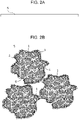
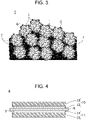
- an electrode catalyst 1 for a fuel battery includes a mesoporous material 2 and catalyst metal particles 3 supported at least in the mesoporous material 2.
- the mesoporous material 2 is formed of a porous material having many mesopores 4 and is a carrier in which the catalyst metal particles 3 are supported.
- the mesoporous material 2 has, for example a particle shape, but is not limited thereto.
- the average particle diameter of the mesoporous material 2 is, for example, greater than or equal to 200 nm.
- the average particle diameter is the median diameter (D50) of the particle size distribution of the mesoporous material 2.
- examples of the mesoporous material 2 include mesoporous carbon and oxides of, for example, titanium, tin, niobium, tantalum, zirconium, aluminum, and silicon (silicon).
- the mesopores 4 are pores formed in the mesoporous material 2, open at the outer surface of the mesoporous material 2, and extend from the opening into the mesoporous material 2. Some of a plurality of the mesopores 4 or all the mesopores 4 may penetrate through the mesoporous material 2. Before the mesoporous material 2 supports the catalyst metal particles 3, the mesopores 4 have a mode radius of greater than or equal to 1 nm and less than or equal to 25 nm.
- the mode radius refers to the most frequent diameter in a diameter distribution of the mesopores 4 of the mesoporous material 2 (the radius corresponding to a maximum value).
- the radius of the mesopore 4 is half the dimension thereof in the direction perpendicular to the direction in which the mesopore 4 extends.
- the mode radius of the mesopores 4 may be greater than or equal to 3 nm and less than or equal to 6 nm, and furthermore, may be greater than or equal to 3 nm and less than or equal to 4 nm.
- the mode radius of the mesopores 4 is greater than or equal to 3 nm, gas is likely to pass through the mesopores 4.
- the mode radius is less than or equal to 4 nm, for example, even in the case where an ionomer is in contact with the electrode catalyst 1, the ionomer is less likely to enter the mesopores 4.
- the pore volume of the mesopores 4 may be greater than or equal to 1.0 cm 3 /g and less than or equal to 3.0 cm 3 /g.
- the pore volume of the mesopores 4 is greater than or equal to 1.0 cm 3 /g, many catalyst metal particles 3 can be supported in the mesoporous material 2 (i.e., the mesopores 4).
- the mesoporous material 2 is capable of having high strength as a structural body.
- the pore volume and the mode radius of the mesopores 4 are determined by analyzing nitrogen adsorption-desorption isotherm measurement data according to a method such as a BJH method, a Non-Localized Density Functional Theory (NLDFT) method, or a Quenched Solid Density Functional Theory (QSDFT) method.
- a method such as a BJH method, a Non-Localized Density Functional Theory (NLDFT) method, or a Quenched Solid Density Functional Theory (QSDFT) method.
- the mesoporous material 2 Before supporting the catalyst metal particles 3, the mesoporous material 2 has a pore surface area ratio of greater than 0.90.
- the pore surface area ratio (S 1-25 /Sa) is a value determined by dividing a specific surface area S 1-25 (m 2 /g) of the mesopores 4, the mesopores 4 having a radius of greater than or equal to 1 nm and less than or equal to 25 nm, by a BET specific surface area Sa (m 2 /g) evaluated according to a BET method.
- the specific surface area S 1-25 of the mesopores 4 is obtained by analyzing a nitrogen adsorption-desorption isotherm of the mesoporous material 2 according to a Barrett-Joyner-Halenda (BJH) method.
- This nitrogen adsorption-desorption isotherm is measured by causing the mesoporous material 2 to adsorb nitrogen at a predetermined temperature such as a liquid nitrogen temperature.
- the specific surface area S 1-25 is the inner surface area per unit weight of the mesoporous material 2, and the inner surface of the mesoporous material 2 is a surface of the mesoporous material 2 defining the mesopores 4, the mesopores 4 having a radius of greater than or equal to 1 nm and less than or equal to 25 nm.
- the BET specific surface area Sa is obtained by evaluating the mesoporous material 2 according to a Brunauer-Emmett-Teller (BET) method and is the whole surface (inner surface and outer surface) area per unit weight of the mesoporous material 2.
- BET Brunauer-Emmett-Teller
- the surface area of the mesoporous material 2 is determined by applying a BET equation to a region of a nitrogen adsorption-desorption isotherm, the region being a region of a relative pressure of greater than or equal to 0.05 and less than or equal to 0.35.
- the outer surface of the mesoporous material 2 is, of the whole surface of the mesoporous material 2, a surface other than the inner surface.
- the production method for the mesoporous material 2 is not particularly limited, but, for example, a method disclosed in PTL 3 can be suitably used.
- the mesoporous material 2 produced according to the method has mesopores 4 having a large pore volume and a structure in which the mesopores 4 are in communication with one another.
- the mesoporous material 2 easily supports the catalyst metal particles 3 in the mesopores 4, and gas is likely to be supplied to the catalyst metal particles 3 supported in the mesoporous material 2.
- the average particle diameter of the mesoporous material 2 may be adjusted by pulverization treatment.
- a pulverization method such as a wet bead mill, a dry bead mill, a wet ball mill, a dry ball mill, a wet jet mill, or a dry jet mill is used.
- the mesoporous material 2 is likely to be pulverized to a small particle diameter.
- the catalyst metal particles 3 are supported at least in the mesoporous material 2. That is, the catalyst metal particles 3 are supported at the inner surface of the mesoporous material 2, in the mesopores 4. The catalyst metal particles 3 may be supported or unsupported at the outer surface of the mesoporous material 2.
- the catalyst metal particles 3 are formed of, for example, platinum (Pt), ruthenium (Ru), palladium (Pd), iridium (Ir), silver (Ag), or gold (Au).
- the platinum and alloys thereof have a high catalyst activity for an oxidation-reduction reaction and good durability in a power generation environment of a fuel battery, and are thus appropriate as the electrode catalyst 1 for a fuel battery.
- the average particle diameter of the catalyst metal particles 3 is, for example, greater than or equal to 1 nm and less than or equal to 20 nm, and furthermore, may be greater than or equal to 1 nm and less than or equal to 10 nm.
- the average particle diameter of the catalyst metal particles 3 is less than or equal to 10 nm, the surface area per unit weight (specific surface area) of the catalyst metal particles 3 is large, and thus the catalyst activity of the catalyst metal particles 3 is high.
- the average particle diameter of the catalyst metal particles 3 is greater than or equal to 1 nm, the catalyst metal particles 3 are chemically stabilized, and, for example, are less likely to melt even in a power generation environment of a fuel battery.
- the weight ratio of the catalyst metal particles 3 to the weight of the mesoporous material 2 may be greater than or equal to 0.65 and less than or equal to 1.5.
- the weight ratio is greater than or equal to 0.65, the amount of a catalyst metal required for a fuel battery can be obtained without increasing the thickness of an electrode catalyst layer including the electrode catalyst 1.
- the weight ratio is less than or equal to 1.5, the amount of the catalyst metal particles 3 per unit area of the mesoporous material 2 is not excessively large, and thus the catalyst metal particles 3 are less likely to aggregate and are likely to be diffused to the surface of the mesoporous material 2.
- the mesoporous material 2 before supporting the catalyst metal particles 3, the mesoporous material 2 has the mesopores 4 having a mode radius of greater than or equal to 1 nm and less than or equal to 25 nm and has a value of greater than 0.90, the value being determined by dividing a specific surface area S 1-25 (m 2 /g) of the mesopores 4 obtained by analyzing a nitrogen adsorption-desorption isotherm according to a BJH method, the mesopores 4 having a radius of greater than or equal to 1 nm and less than or equal to 25 nm, by a BET specific surface area (m 2 /g) evaluated according to a BET method.
- the electrode catalyst 1 in which the mesoporous material 2 has a pore surface area ratio (S 1-25 /Sa) of greater than 0.90 more catalyst metal particles 3 can be supported at the inner surface of the mesoporous material 2, in the mesopores 4, than in the case of an electrode catalyst in which the mesoporous material 2 has a pore surface area ratio of less than or equal to 0.90. Furthermore, for example, even when an ionomer is in contact with the electrode catalyst 1, because the ionomer is less likely to enter the mesopores 4, the specific surface of the catalyst metal particles 3 covered with the ionomer can be reduced. Thus, the deterioration of the catalyst activity of the electrode catalyst 1 due to the covering of the catalyst metal particles 3 with the ionomer can be reduced.
- the mesopores 4 of the mesoporous material 2 may have a mode radius of greater than 1.65 nm.
- the mode radius of the mesopores 4 may be less than or equal to 25 nm, less than or equal to 6 nm, and less than or equal to 4 nm.
- the mesoporous material 2 in which the mesopores 4 have a mode radius of greater than 1.65 nm is less likely to aggregate even under severe conditions during the operation of a fuel battery than a mesoporous material in which the mesopores 4 have a mode radius of less than or equal to 1.65 nm.
- the decrease in the specific surface area of the mesoporous material 2 and that of the catalyst metal particles 3 supported in the mesoporous material 2 due to aggregation is reduced, and accordingly, the deterioration of the catalyst activity of the electrode catalyst 1 can be reduced.
- the mesopores 4 are less likely to be blocked by the catalyst metal particles 3.
- the water is drained through the gap between the catalyst metal particles 3 and the inner circumferential surface of the mesoporous material 2.
- the deterioration of the catalyst activity that is caused by the decrease in the specific surface area of the catalyst metal particles 3 due to water can be reduced.
- gas is supplied through the mesopores 4 to the catalyst metal particles 3, the deterioration of the power generation performance of the fuel battery can be prevented or reduced.
- the BET specific surface area of the mesoporous material 2 may be greater than or equal to 1500 (m 2 /g).
- Aggregation of the catalyst metal particles 3 supported in the mesoporous material 2 is reduced to a greater extent in the case of the mesoporous material 2 having a BET specific surface area of greater than or equal to 1500 (m 2 /g) than in the case of a mesoporous material 2 having a BET specific surface area of less than 1500 (m 2 /g).
- the decrease in the specific surface area of the catalyst metal particles 3 due to aggregation is reduced, and accordingly, the deterioration of the catalyst activity of the electrode catalyst 1 can be reduced.
- the catalyst metal particles 3 supported in the mesopores 4 may be greater than or equal to 0.90.
- an Na number of the catalyst metal particles 3 are supported at the surface of the mesoporous material 2, and of this surface, an No number of the catalyst metal particles 3 are supported at the outer surface and an Ni number of the catalyst metal particles 3 are supported at the inner surface.
- the ratio of the number of the catalyst metal particles 3 supported at the outer surface to the number of the catalyst metal particles 3 supported at the whole surface (No/Na) is less than 0.10, and the ratio of the number of the catalyst metal particles 3 supported at the inner surface to the number of the catalyst metal particles 3 supported at the whole surface (Ni/Na) is greater than or equal to 0.90.
- the specific surface area of the catalyst metal particles 3 covered with the ionomer can be kept smaller than in the case of an electrode catalyst 1 having an Ni/Na of less than 0.90.
- the decrease in the specific surface area of the catalyst metal particles 3 due to the ionomer is reduced, and accordingly, the deterioration of the catalyst activity of the electrode catalyst 1 can be reduced.
- an electrode catalyst layer 5 of a fuel battery according to a second embodiment includes the electrode catalyst 1 and an ionomer 6.
- the electrode catalyst 1 is at least one of the electrode catalysts for a fuel battery according to the first embodiment or Modifications 1 to 3 thereof.
- the electrode catalyst layer 5 is, for example, a thin film and may have a flat shape having a small thickness.
- the ionomer 6 is a polymer electrolyte covering the outer surface of the electrode catalyst 1 and having proton conductivity and is formed of, for example, an ion exchange resin.
- ion exchange resins a perfluorosulfonic acid resin has high proton conductivity and is stably present even in a power generation environment of a fuel battery, and thus it is suitably used as the ionomer 6 of the electrode catalyst layer 5 of a fuel battery.
- the fuel battery is capable of obtaining high power generation performance due to the proton conductivity of the ionomer 6.
- the ion exchange capacity of an ion exchange resin may be greater than or equal to 0.9 milliequivalent/g of dry resin and less than or equal to 2.0 milliequivalent/g of dry resin.
- the ion exchange capacity is greater than or equal to 0.9 milliequivalent/g of dry resin, the ionomer 6 is likely to obtain high proton conductivity.
- the ion exchange capacity is less than or equal to 2.0 milliequivalent/g of dry resin, the swelling of the resin due to water content is prevented or reduced, and the gas diffusivity in the electrode catalyst layer 5 is less likely to be inhibited.
- the electrode catalyst layer 5 is produced according to a production method commonly used for fuel batteries.
- the catalyst metal particles 3 are supported in the mesoporous material 2 to thereby form the electrode catalyst 1 for a fuel battery.
- This electrode catalyst 1 and the ionomer 6 are dispersed in a solvent containing water and/or an alcohol. This dispersion is applied to the base materials such as a polymer electrolyte membrane, gas diffusion layers, and various transfer films and thereafter dried to thereby form the electrode catalyst layer 5.
- the electrode catalyst layer 5 of a fuel battery according to Modification 4 may further include at least one carbon material 7 of carbon black or carbon nanotubes in addition to the structure according to the second embodiment.
- the average particle diameter of the carbon material 7 is smaller than the average particle diameter of the mesoporous material 2, and is, for example, greater than or equal to 10 nm and less than or equal to 100 nm.
- the carbon material 7 is disposed between the mesoporous material particles 2 adjacent to one another and fills the gap between them.
- the carbon material 7 which are carbon black and/or carbon nanotubes causes a capillary phenomenon, it prevents the stagnation of water in the gap between the mesoporous material 2 particles. As a result, the drainage properties of the electrode catalyst layer 5 are enhanced, and accordingly, the efficiency of a power generation reaction of a fuel battery can be enhanced. Furthermore, because the carbon material 7 has conductivity, it aids the conductivity between the mesoporous material 2 particles. As a result, the resistance of the electrode catalyst layer 5 is reduced, and accordingly, the efficiency of the power generation reaction of the fuel battery can be enhanced.
- a membrane-electrode assembly 8 includes a polymer electrolyte membrane 9; and a fuel electrode 10 and an air electrode 11.
- the fuel electrode 10 and the air electrode 11 are respectively disposed on both main surfaces of the polymer electrolyte membrane 9, the fuel electrode 10 and the air electrode 11 each including an electrode catalyst layer and a gas diffusion layer.
- At least the electrode catalyst layer of the air electrode 11 includes the electrode catalyst layer 5 of a fuel battery according to the second embodiment or Modification 4 thereof.
- the polymer electrolyte membrane 9 combines proton conductivity and gas barrier properties, and examples thereof include ion exchange fluororesin membranes or ion exchange hydrocarbon resin membranes. Among these, a perfluorosulfonic acid resin membrane has high proton conductivity and is capable of being stably present, for example, even in a power generation environment of a fuel battery, and thus it is preferable as the polymer electrolyte membrane 9.
- the electrode catalyst layer 5 includes a pair of surfaces (main surfaces), and the dimension between them (film thickness) is, for example, greater than or equal to 5 ⁇ m and less than or equal to 50 ⁇ m.
- film thickness is, for example, greater than or equal to 5 ⁇ m and less than or equal to 50 ⁇ m.
- the film thickness is greater than or equal to 5 ⁇ m, the polymer electrolyte membrane 9 is capable of obtaining high gas barrier properties.
- the film thickness is less than or equal to 50 ⁇ m, the polymer electrolyte membrane 9 is capable of obtaining high proton conductivity.
- the fuel electrode 10 is disposed on a first main surface of the pair of the main surfaces of the polymer electrolyte membrane 9 and the air electrode 11 is disposed on a second main surface of the pair of the main surfaces of the polymer electrolyte membrane 9.
- the fuel electrode 10 and the air electrode 11 have the polymer electrolyte membrane 9 interposed therebetween.
- the air electrode 11 is a cathode electrode of the fuel battery and includes an electrode catalyst layer (a second electrode catalyst layer 14) and a gas diffusion layer (a second gas diffusion layer 15).
- a first surface of the second electrode catalyst layer 14 is disposed on the second main surface of the polymer electrolyte membrane 9 and a first surface of the second gas diffusion layer 15 is disposed on a second surface of the second electrode catalyst layer 14.
- a water repellent layer may be disposed between the first gas diffusion layer 13 and the first electrode catalyst layer 12 and between the second gas diffusion layer 15 and the second electrode catalyst layer 14.
- the water repellent layer is a layer for enhancing the liquid permeability (drainage properties).
- the water repellent layer is formed of, for example, a conductive material such as carbon black and a water repellent resin such as polytetrafluoroethylene (PTFE) as a main component.
- PTFE polytetrafluoroethylene
- Each of the electrode catalyst layers 12 and 14 is a layer accelerating the rate of a power generation reaction of the electrodes.
- the first electrode catalyst layer 12 may include the electrode catalyst layer 5 and may have the same structure as a commonly used existing electrode catalyst layer in the membrane-electrode assembly 8 of a fuel battery. Because the second electrode catalyst layer 14 is constituted by the electrode catalyst layer 5, the deterioration of the catalyst activity of the membrane-electrode assembly 8 can be reduced.
- a fuel battery 16 according to a fourth embodiment includes the membrane-electrode assembly 8 according to the third embodiment.
- the fuel battery 16 is constituted by a single cell having one cell, but may be constituted by a stack of a plurality of cells, the cells being layered.
- the membrane-electrode assembly 8 is interposed between a pair of separators 17 and 18.
- a first separator 17 is disposed on the fuel electrode 10 and has a surface facing a second surface of the first gas diffusion layer 13 (a surface of the first gas diffusion layer 13 facing away from the first electrode catalyst layer 12 side).
- This surface includes a supply channel for supplying fuel gas such as hydrogen to the fuel electrode 10.
- a second separator 18 is disposed on the air electrode 11 and has a surface facing a second surface of the second gas diffusion layer 15 (a surface of the gas diffusion layer 15 facing away from the second electrode catalyst layer 14 side).
- This surface includes a supply channel for supplying oxidant gas such as air to the air electrode 11.
- mesoporous carbon having a design pore size of 10 nm (CNovel, manufactured by Toyo Tanso Co., Ltd.) was used as a mesoporous material. This mesoporous carbon was placed into a mixed solvent containing equal amounts of water and ethanol to thereby adjust a slurry having a solid concentration of 1 wt%. Pulverization treatment was thereafter performed on the mesoporous carbon.
- the average particle diameter of the mesoporous carbon was adjusted by dry pulverization treatment.
- the same method as with the electrode catalyst of Example 1 was performed to form the electrode catalyst of Example 2.
- the BET specific surface area Sa was determined by evaluating the mesoporous carbon according to a BET method.
- the pore surface area ratio (S 1-25 /Sa) was obtained by dividing the specific surface area S 1-25 (m 2 /g) of the mesopores 4 by the BET specific surface area Sa (m 2 /g) of the mesoporous carbon.
- the specific surface area S 1-25 and the mode radius of the mesopores of the mesoporous carbon, before the mesoporous carbon supported the catalyst metal, were determined from an adsorption isotherm of nitrogen gas at a liquid nitrogen temperature. Specifically, using a physical adsorption apparatus (Autosorb-iQ2, manufactured by Anton Paar GmbH), the nitrogen adsorption isotherm of the mesoporous carbon was measured, and using an analysis software accompanying the apparatus, the cumulative pore size distribution (S vs D) and the log differential pore size distribution (dS/d(logD) vs D) were calculated according to a BJH method.
- the specific surface area S 1-25 of the mesopores of the mesoporous carbon was calculated from the numerical data of the cumulative pore size distribution. Furthermore, the peak maximum value of the log differential pore size distribution was determined as the mode radius of the mesoporous carbon.
- the electrode catalysts of Examples 1 and 2 and Comparative Examples 1 and 2 were each obtained.
- Each electrode catalyst and Ketjen black (EC300J, manufactured by Lion Specialty Chemicals Co., Ltd) having half the weight of the mesoporous carbon contained in each electrode catalyst were placed into a mixed solvent containing equal amounts of water and ethanol, and stirring was performed.
- an ionomer (Nafion, manufactured by Dupont, Inc.) was placed such that the weight ratio of the ionomer to the total carbon (mesoporous carbon + Ketjen black) would be 0.8, and ultrasonic dispersion treatment was performed.
- the catalyst ink thus obtained was applied to a first main surface of a polymer electrolyte membrane (GORE-SELECT III, manufactured by W. L. Gore and Associates G. K.) according to a spray method to thereby form a second electrode catalyst layer.
- a polymer electrolyte membrane GORE-SELECT III, manufactured by W. L. Gore and Associates G. K.
- a commercially available platinum-supporting carbon black catalyst (TEC10E50E, manufactured by TANAKA Kikinzoku Kogyo K. K.) was placed into a mixed solvent containing equal amounts of water and ethanol, and stirring was performed.
- an ionomer Nafion, manufactured by Dupont, Inc.
- This catalyst ink was applied to a second main surface of the polymer electrolyte membrane (a surface facing away from the second electrode catalyst layer side) according to a spray method to thereby form a first electrode catalyst layer.
- a first gas diffusion layer (GDL25BC, manufactured by SGL Carbon Japan Co., Ltd.) was disposed on the first electrode catalyst layer, and a second gas diffusion layer (GDL25BC, manufactured by SGL Carbon Japan Co., Ltd.) was disposed on the second electrode catalyst layer.
- a pressure of 7 kgf/cm 2 was applied at a high temperature of 140°C for 5 minutes to thereby form a membrane-electrode assembly.
- the membrane-electrode assembly obtained was interposed between separators each including a flow channel having a serpentine shape. This interposed structure was fitted into a predetermined jig to thereby form a fuel battery of a single cell.
- the temperature of the fuel battery obtained was kept at 80°C, and hydrogen having a dew point of 80°C was supplied to a fuel electrode and oxygen having a dew point of 80°C was supplied to an air electrode.
- the hydrogen and the oxygen were each supplied at a flow rate sufficiently larger than the amount to be consumed by an electrochemical reaction (oxidation-reduction reaction) of the fuel battery.
- each voltage of the fuel battery was measured during constant current operation.
- the electrical resistance of the fuel battery was measured in-situ.
- a current value at 0.9 V was read and was thereafter normalized by the platinum amount contained in the electrode catalyst layer of the air electrode to thereby obtain the index of the catalyst activity. This is called a mass activity at 0.9 V (A/g-Pt) and is commonly used as an index indicating the catalyst activity of a fuel battery.
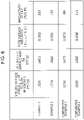
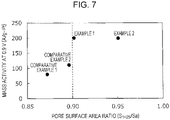
- the table of Fig. 6 and the graph of Fig. 7 illustrate the relationship between the pore surface area ratio (S 1-25 /Sa) of the mesoporous carbon and the mass activity at 0.9 V (A/g-Pt) of the fuel batteries in the cases of the fuel batteries including the electrode catalysts of Examples 1 and 2 and Comparative Examples 1 and 2. As presented, it is revealed that the fuel batteries including the electrode catalysts of Examples 1 and 2 have a higher mass activity at 0.9 V than the fuel batteries including the electrode catalysts of Comparative Examples 1 and 2.
- the decrease in the specific surface area of the catalyst metal particles due to the ionomer is reduced to a greater extent and the catalyst activity of the fuel batteries is higher than in the cases of the mesoporous carbon having a pore surface area ratio of less than or equal to 0.90 before supporting the catalyst metal particles.
- Modification 2 is applicable to Modification 1.
- Modification 3 is applicable to Modifications 1 and 2 and a combination of these.
- the electrode catalyst for a fuel battery, the electrode catalyst layer of a fuel battery, the membrane-electrode assembly, and the fuel battery according to the present disclosure are useful as, for example, an electrode catalyst for a fuel battery, an electrode catalyst layer of a fuel battery, a membrane-electrode assembly, and a fuel battery that are capable of reducing the deterioration of the catalyst activity to a greater extent than in the related art.
Landscapes
- Chemical & Material Sciences (AREA)
- Chemical Kinetics & Catalysis (AREA)
- General Chemical & Material Sciences (AREA)
- Electrochemistry (AREA)
- Engineering & Computer Science (AREA)
- Materials Engineering (AREA)
- Sustainable Energy (AREA)
- Life Sciences & Earth Sciences (AREA)
- Sustainable Development (AREA)
- Manufacturing & Machinery (AREA)
- Ceramic Engineering (AREA)
- Organic Chemistry (AREA)
- Composite Materials (AREA)
- Inert Electrodes (AREA)
- Catalysts (AREA)
- Nanotechnology (AREA)
Applications Claiming Priority (3)
| Application Number | Priority Date | Filing Date | Title |
|---|---|---|---|
| JP2019224819 | 2019-12-12 | ||
| JP2020169841 | 2020-10-07 | ||
| PCT/JP2020/040475 WO2021117369A1 (ja) | 2019-12-12 | 2020-10-28 | 燃料電池用の電極触媒、燃料電池の電極触媒層、膜/電極接合体および燃料電池 |
Publications (3)
| Publication Number | Publication Date |
|---|---|
| EP4074418A1 true EP4074418A1 (de) | 2022-10-19 |
| EP4074418A4 EP4074418A4 (de) | 2023-08-09 |
| EP4074418B1 EP4074418B1 (de) | 2025-05-21 |
Family
ID=76329745
Family Applications (1)
| Application Number | Title | Priority Date | Filing Date |
|---|---|---|---|
| EP20886178.1A Active EP4074418B1 (de) | 2019-12-12 | 2020-10-28 | Elektrodenkatalysator für brennstoffzelle, elektrodenkatalysatorschicht für brennstoffzelle, membran-/elektrodenanordnung und brennstoffzelle |
Country Status (5)
| Country | Link |
|---|---|
| US (2) | US20220021005A1 (de) |
| EP (1) | EP4074418B1 (de) |
| JP (1) | JP6931808B1 (de) |
| CN (1) | CN113207317A (de) |
| WO (1) | WO2021117369A1 (de) |
Families Citing this family (3)
| Publication number | Priority date | Publication date | Assignee | Title |
|---|---|---|---|---|
| JP7795469B2 (ja) * | 2020-09-29 | 2026-01-07 | エヌ・イーケムキャット株式会社 | 電極用触媒、ガス拡散電極形成用組成物、ガス拡散電極、膜・電極接合体、及び、燃料電池スタック |
| KR102778283B1 (ko) * | 2022-11-21 | 2025-03-11 | 현대자동차주식회사 | 연료 전지에 대하여 분석하기 위한 방법 및 장치 |
| EP4686516A1 (de) * | 2024-07-29 | 2026-02-04 | ReCatalyst, razvoj, proizvodnja in prodaja Katalizatorskih kompozitov, d.o.o. | Kompositmaterial zur verwendung als katalysator |
Family Cites Families (15)
| Publication number | Priority date | Publication date | Assignee | Title |
|---|---|---|---|---|
| JPS6094937A (ja) | 1983-10-28 | 1985-05-28 | Agency Of Ind Science & Technol | シクロヘキサン環をもつジヒドロキシジカルボン酸及びそのエステル |
| CN104145360B (zh) * | 2012-02-28 | 2018-11-13 | 日产自动车株式会社 | 燃料电池用阴极电极 |
| CN105122540A (zh) * | 2013-04-11 | 2015-12-02 | 索尼公司 | 电极及其制造方法、以及二次电池 |
| CN105518917B (zh) | 2013-04-25 | 2018-06-15 | 日产自动车株式会社 | 催化剂以及使用该催化剂的电极催化剂层、膜电极接合体及燃料电池 |
| EP2990116B1 (de) * | 2013-04-25 | 2018-06-06 | Nissan Motor Co., Ltd | Katalysator, elektrodenkatalysatorschicht unter verwendung dieses katalysators, membranelektrodenanordnung und brennstoffzelle |
| US20160064744A1 (en) * | 2013-04-25 | 2016-03-03 | Nissan Motor Co., Ltd. | Catalyst and electrode catalyst layer for fuel cell having the catalyst |
| JP6063039B2 (ja) * | 2013-05-16 | 2017-01-18 | トヨタ自動車株式会社 | 燃料電池用電極およびその製造方法 |
| JP6309386B2 (ja) * | 2014-07-31 | 2018-04-11 | 旭化成株式会社 | 炭素触媒及びその製造方法 |
| JP2017091812A (ja) * | 2015-11-10 | 2017-05-25 | 株式会社豊田中央研究所 | 固体高分子形燃料電池電極触媒 |
| JP7094075B2 (ja) * | 2016-05-18 | 2022-07-01 | 日本製鉄株式会社 | 触媒担体用炭素材料、固体高分子形燃料電池用触媒、固体高分子形燃料電池用触媒層、及び固体高分子形燃料電池 |
| JP6608800B2 (ja) * | 2016-12-09 | 2019-11-20 | トヨタ自動車株式会社 | 燃料電池用電極触媒 |
| JP6566331B2 (ja) * | 2017-04-17 | 2019-08-28 | パナソニックIpマネジメント株式会社 | 電気化学デバイスの電極触媒層、電気化学デバイスの膜/電極接合体、電気化学デバイス、および電気化学デバイスの電極触媒層の製造方法 |
| EP3476475B1 (de) * | 2017-10-27 | 2022-04-06 | Heraeus Battery Technology GmbH | Herstellung eines porösen kohlenstoffprodukts |
| CN112106242B (zh) * | 2017-11-16 | 2022-09-06 | 日清纺控股株式会社 | 正极、膜电极组件和电池 |
| JP6572416B1 (ja) * | 2018-03-26 | 2019-09-11 | 大豊精機株式会社 | 導電性ナノファイバ部材、燃料電池用部材、燃料電池、及び導電性ナノファイバ部材の製造方法 |
-
2020
- 2020-10-28 CN CN202080005423.6A patent/CN113207317A/zh active Pending
- 2020-10-28 WO PCT/JP2020/040475 patent/WO2021117369A1/ja not_active Ceased
- 2020-10-28 EP EP20886178.1A patent/EP4074418B1/de active Active
- 2020-10-28 JP JP2021502907A patent/JP6931808B1/ja active Active
-
2021
- 2021-05-19 US US17/324,577 patent/US20220021005A1/en not_active Abandoned
-
2024
- 2024-08-20 US US18/810,091 patent/US20240413351A1/en not_active Abandoned
Also Published As
| Publication number | Publication date |
|---|---|
| JPWO2021117369A1 (de) | 2021-06-17 |
| US20220021005A1 (en) | 2022-01-20 |
| WO2021117369A1 (ja) | 2021-06-17 |
| EP4074418A4 (de) | 2023-08-09 |
| EP4074418B1 (de) | 2025-05-21 |
| US20240413351A1 (en) | 2024-12-12 |
| JP6931808B1 (ja) | 2021-09-08 |
| CN113207317A (zh) | 2021-08-03 |
Similar Documents
| Publication | Publication Date | Title |
|---|---|---|
| US11367879B2 (en) | Electrode catalyst of electrochemical device, electrode catalyst layer of electrochemical device, membrane electrode assembly of electrochemical device, electrochemical device, method for manufacturing electrode catalyst of electrochemical device, and method for manufacturing membrane electrode assembly of electrochemical device | |
| US10790526B2 (en) | Electrode catalyst layer of electrochemical device, membrane electrode assembly of electrochemical device, and electrochemical device | |
| US20240413351A1 (en) | Electrode catalyst for fuel battery, electrode catalyst layer of fuel battery, membrane-electrode assembly, and fuel battery | |
| EP3520161B1 (de) | Kathoden-elektrodendesign für elektrochemische brennstoffzellen | |
| JP6222530B2 (ja) | 燃料電池用触媒層及び燃料電池 | |
| JP2008186798A (ja) | 電解質膜−電極接合体 | |
| JP4133654B2 (ja) | 固体高分子形燃料電池 | |
| EP3553862B1 (de) | Membrankatalysatorschichtanordnung einer elektrochemischen vorrichtung, membranelektrodenanordnung, elektrochemische vorrichtung, verfahren zur herstellung einer membrankatalysatorschichtanordnung einer elektrochemischen vorrichtung | |
| WO2010070994A1 (ja) | 固体高分子型燃料電池のアノード触媒層 | |
| JP5596277B2 (ja) | 膜電極接合体および燃料電池 | |
| US20190074522A1 (en) | Catalyst electrode layer, membrane-electrode assembly, and fuel cell | |
| JP2005174835A (ja) | 電極 | |
| WO2021131386A1 (ja) | 電気化学デバイスの電極触媒及び電極触媒層、膜/電極接合体、並びに、電気化学デバイス | |
| JP4271127B2 (ja) | 固体高分子型燃料電池の電極構造体 | |
| JP5458774B2 (ja) | 電解質膜−電極接合体 | |
| JP2006079840A (ja) | 燃料電池用電極触媒、および、これを用いた燃料電池用mea | |
| EP4668374A1 (de) | Elektrode für eine brennstoffzelle, membranelektrodenanordnung und herstellungsverfahren dafür | |
| WO2025104436A1 (en) | Catalyst-coated ion-conducting membrane | |
| JP2007250214A (ja) | 電極触媒とその製造方法 | |
| JP2021108262A (ja) | 燃料電池用電極の製造方法 | |
| JP2010146762A (ja) | 固体高分子型燃料電池の触媒層 |
Legal Events
| Date | Code | Title | Description |
|---|---|---|---|
| STAA | Information on the status of an ep patent application or granted ep patent |
Free format text: STATUS: UNKNOWN |
|
| STAA | Information on the status of an ep patent application or granted ep patent |
Free format text: STATUS: THE INTERNATIONAL PUBLICATION HAS BEEN MADE |
|
| PUAI | Public reference made under article 153(3) epc to a published international application that has entered the european phase |
Free format text: ORIGINAL CODE: 0009012 |
|
| STAA | Information on the status of an ep patent application or granted ep patent |
Free format text: STATUS: REQUEST FOR EXAMINATION WAS MADE |
|
| 17P | Request for examination filed |
Effective date: 20220531 |
|
| AK | Designated contracting states |
Kind code of ref document: A1 Designated state(s): AL AT BE BG CH CY CZ DE DK EE ES FI FR GB GR HR HU IE IS IT LI LT LU LV MC MK MT NL NO PL PT RO RS SE SI SK SM TR |
|
| RIN1 | Information on inventor provided before grant (corrected) |
Inventor name: WADA, TOMOKATSU Inventor name: SHINTANI, HARUHIKO Inventor name: MIYATA, NOBUHIRO |
|
| DAV | Request for validation of the european patent (deleted) | ||
| DAX | Request for extension of the european patent (deleted) | ||
| A4 | Supplementary search report drawn up and despatched |
Effective date: 20230706 |
|
| RIC1 | Information provided on ipc code assigned before grant |
Ipc: H01M 8/1004 20160101ALI20230630BHEP Ipc: B01J 23/42 20060101ALI20230630BHEP Ipc: H01M 8/10 20160101ALI20230630BHEP Ipc: H01M 4/90 20060101ALI20230630BHEP Ipc: H01M 4/86 20060101ALI20230630BHEP Ipc: B01J 35/10 20060101AFI20230630BHEP Ipc: H01M 4/92 20060101ALI20230630BHEP |
|
| REG | Reference to a national code |
Ref country code: DE Ref legal event code: R079 Free format text: PREVIOUS MAIN CLASS: B01J0035100000 Ipc: H01M0004860000 Ref country code: DE Ref legal event code: R079 Ref document number: 602020051839 Country of ref document: DE Free format text: PREVIOUS MAIN CLASS: B01J0035100000 Ipc: H01M0004860000 |
|
| GRAP | Despatch of communication of intention to grant a patent |
Free format text: ORIGINAL CODE: EPIDOSNIGR1 |
|
| STAA | Information on the status of an ep patent application or granted ep patent |
Free format text: STATUS: GRANT OF PATENT IS INTENDED |
|
| RIC1 | Information provided on ipc code assigned before grant |
Ipc: H01M 8/1004 20160101ALI20241220BHEP Ipc: H01M 4/92 20060101ALI20241220BHEP Ipc: B01J 23/42 20060101ALI20241220BHEP Ipc: H01M 8/10 20160101ALI20241220BHEP Ipc: H01M 4/90 20060101ALI20241220BHEP Ipc: H01M 4/86 20060101AFI20241220BHEP |
|
| INTG | Intention to grant announced |
Effective date: 20250124 |
|
| GRAS | Grant fee paid |
Free format text: ORIGINAL CODE: EPIDOSNIGR3 |
|
| GRAA | (expected) grant |
Free format text: ORIGINAL CODE: 0009210 |
|
| STAA | Information on the status of an ep patent application or granted ep patent |
Free format text: STATUS: THE PATENT HAS BEEN GRANTED |
|
| AK | Designated contracting states |
Kind code of ref document: B1 Designated state(s): AL AT BE BG CH CY CZ DE DK EE ES FI FR GB GR HR HU IE IS IT LI LT LU LV MC MK MT NL NO PL PT RO RS SE SI SK SM TR |
|
| REG | Reference to a national code |
Ref country code: GB Ref legal event code: FG4D |
|
| REG | Reference to a national code |
Ref country code: CH Ref legal event code: EP |
|
| REG | Reference to a national code |
Ref country code: DE Ref legal event code: R096 Ref document number: 602020051839 Country of ref document: DE |
|
| REG | Reference to a national code |
Ref country code: IE Ref legal event code: FG4D |
|
| REG | Reference to a national code |
Ref country code: NL Ref legal event code: MP Effective date: 20250521 |
|
| PG25 | Lapsed in a contracting state [announced via postgrant information from national office to epo] |
Ref country code: FI Free format text: LAPSE BECAUSE OF FAILURE TO SUBMIT A TRANSLATION OF THE DESCRIPTION OR TO PAY THE FEE WITHIN THE PRESCRIBED TIME-LIMIT Effective date: 20250521 Ref country code: PT Free format text: LAPSE BECAUSE OF FAILURE TO SUBMIT A TRANSLATION OF THE DESCRIPTION OR TO PAY THE FEE WITHIN THE PRESCRIBED TIME-LIMIT Effective date: 20250922 Ref country code: ES Free format text: LAPSE BECAUSE OF FAILURE TO SUBMIT A TRANSLATION OF THE DESCRIPTION OR TO PAY THE FEE WITHIN THE PRESCRIBED TIME-LIMIT Effective date: 20250521 |
|
| REG | Reference to a national code |
Ref country code: LT Ref legal event code: MG9D |
|
| PG25 | Lapsed in a contracting state [announced via postgrant information from national office to epo] |
Ref country code: NO Free format text: LAPSE BECAUSE OF FAILURE TO SUBMIT A TRANSLATION OF THE DESCRIPTION OR TO PAY THE FEE WITHIN THE PRESCRIBED TIME-LIMIT Effective date: 20250821 Ref country code: GR Free format text: LAPSE BECAUSE OF FAILURE TO SUBMIT A TRANSLATION OF THE DESCRIPTION OR TO PAY THE FEE WITHIN THE PRESCRIBED TIME-LIMIT Effective date: 20250822 |
|
| PG25 | Lapsed in a contracting state [announced via postgrant information from national office to epo] |
Ref country code: NL Free format text: LAPSE BECAUSE OF FAILURE TO SUBMIT A TRANSLATION OF THE DESCRIPTION OR TO PAY THE FEE WITHIN THE PRESCRIBED TIME-LIMIT Effective date: 20250521 Ref country code: PL Free format text: LAPSE BECAUSE OF FAILURE TO SUBMIT A TRANSLATION OF THE DESCRIPTION OR TO PAY THE FEE WITHIN THE PRESCRIBED TIME-LIMIT Effective date: 20250521 |
|
| PG25 | Lapsed in a contracting state [announced via postgrant information from national office to epo] |
Ref country code: BG Free format text: LAPSE BECAUSE OF FAILURE TO SUBMIT A TRANSLATION OF THE DESCRIPTION OR TO PAY THE FEE WITHIN THE PRESCRIBED TIME-LIMIT Effective date: 20250521 |
|
| PG25 | Lapsed in a contracting state [announced via postgrant information from national office to epo] |
Ref country code: HR Free format text: LAPSE BECAUSE OF FAILURE TO SUBMIT A TRANSLATION OF THE DESCRIPTION OR TO PAY THE FEE WITHIN THE PRESCRIBED TIME-LIMIT Effective date: 20250521 |
|
| PG25 | Lapsed in a contracting state [announced via postgrant information from national office to epo] |
Ref country code: RS Free format text: LAPSE BECAUSE OF FAILURE TO SUBMIT A TRANSLATION OF THE DESCRIPTION OR TO PAY THE FEE WITHIN THE PRESCRIBED TIME-LIMIT Effective date: 20250821 |
|
| PG25 | Lapsed in a contracting state [announced via postgrant information from national office to epo] |
Ref country code: IS Free format text: LAPSE BECAUSE OF FAILURE TO SUBMIT A TRANSLATION OF THE DESCRIPTION OR TO PAY THE FEE WITHIN THE PRESCRIBED TIME-LIMIT Effective date: 20250921 |
|
| PG25 | Lapsed in a contracting state [announced via postgrant information from national office to epo] |
Ref country code: LV Free format text: LAPSE BECAUSE OF FAILURE TO SUBMIT A TRANSLATION OF THE DESCRIPTION OR TO PAY THE FEE WITHIN THE PRESCRIBED TIME-LIMIT Effective date: 20250521 |
|
| REG | Reference to a national code |
Ref country code: AT Ref legal event code: MK05 Ref document number: 1797577 Country of ref document: AT Kind code of ref document: T Effective date: 20250521 |
|
| PGFP | Annual fee paid to national office [announced via postgrant information from national office to epo] |
Ref country code: DE Payment date: 20251021 Year of fee payment: 6 |
|
| PG25 | Lapsed in a contracting state [announced via postgrant information from national office to epo] |
Ref country code: DK Free format text: LAPSE BECAUSE OF FAILURE TO SUBMIT A TRANSLATION OF THE DESCRIPTION OR TO PAY THE FEE WITHIN THE PRESCRIBED TIME-LIMIT Effective date: 20250521 Ref country code: SM Free format text: LAPSE BECAUSE OF FAILURE TO SUBMIT A TRANSLATION OF THE DESCRIPTION OR TO PAY THE FEE WITHIN THE PRESCRIBED TIME-LIMIT Effective date: 20250521 Ref country code: AT Free format text: LAPSE BECAUSE OF FAILURE TO SUBMIT A TRANSLATION OF THE DESCRIPTION OR TO PAY THE FEE WITHIN THE PRESCRIBED TIME-LIMIT Effective date: 20250521 |
|
| PG25 | Lapsed in a contracting state [announced via postgrant information from national office to epo] |
Ref country code: CZ Free format text: LAPSE BECAUSE OF FAILURE TO SUBMIT A TRANSLATION OF THE DESCRIPTION OR TO PAY THE FEE WITHIN THE PRESCRIBED TIME-LIMIT Effective date: 20250521 |
|
| PG25 | Lapsed in a contracting state [announced via postgrant information from national office to epo] |
Ref country code: EE Free format text: LAPSE BECAUSE OF FAILURE TO SUBMIT A TRANSLATION OF THE DESCRIPTION OR TO PAY THE FEE WITHIN THE PRESCRIBED TIME-LIMIT Effective date: 20250521 |
|
| PG25 | Lapsed in a contracting state [announced via postgrant information from national office to epo] |
Ref country code: SK Free format text: LAPSE BECAUSE OF FAILURE TO SUBMIT A TRANSLATION OF THE DESCRIPTION OR TO PAY THE FEE WITHIN THE PRESCRIBED TIME-LIMIT Effective date: 20250521 |
|
| PG25 | Lapsed in a contracting state [announced via postgrant information from national office to epo] |
Ref country code: IT Free format text: LAPSE BECAUSE OF FAILURE TO SUBMIT A TRANSLATION OF THE DESCRIPTION OR TO PAY THE FEE WITHIN THE PRESCRIBED TIME-LIMIT Effective date: 20250521 |
|
| PG25 | Lapsed in a contracting state [announced via postgrant information from national office to epo] |
Ref country code: RO Free format text: LAPSE BECAUSE OF FAILURE TO SUBMIT A TRANSLATION OF THE DESCRIPTION OR TO PAY THE FEE WITHIN THE PRESCRIBED TIME-LIMIT Effective date: 20250521 |