EP4069930B1 - Feuerschutzrolltor - Google Patents
Feuerschutzrolltor Download PDFInfo
- Publication number
- EP4069930B1 EP4069930B1 EP20717793.2A EP20717793A EP4069930B1 EP 4069930 B1 EP4069930 B1 EP 4069930B1 EP 20717793 A EP20717793 A EP 20717793A EP 4069930 B1 EP4069930 B1 EP 4069930B1
- Authority
- EP
- European Patent Office
- Prior art keywords
- fire
- rolling door
- insulating material
- heat
- slats
- Prior art date
- Legal status (The legal status is an assumption and is not a legal conclusion. Google has not performed a legal analysis and makes no representation as to the accuracy of the status listed.)
- Active
Links
Images
Classifications
-
- A—HUMAN NECESSITIES
- A62—LIFE-SAVING; FIRE-FIGHTING
- A62C—FIRE-FIGHTING
- A62C2/00—Fire prevention or containment
- A62C2/06—Physical fire-barriers
- A62C2/12—Hinged dampers
- A62C2/14—Hinged dampers with two or more blades
- A62C2/16—Hinged dampers with two or more blades multi-vane roll or fold-up type
-
- B—PERFORMING OPERATIONS; TRANSPORTING
- B60—VEHICLES IN GENERAL
- B60J—WINDOWS, WINDSCREENS, NON-FIXED ROOFS, DOORS, OR SIMILAR DEVICES FOR VEHICLES; REMOVABLE EXTERNAL PROTECTIVE COVERINGS SPECIALLY ADAPTED FOR VEHICLES
- B60J5/00—Doors
- B60J5/10—Doors arranged at the vehicle rear
- B60J5/12—Doors arranged at the vehicle rear slidable; foldable
- B60J5/14—Doors arranged at the vehicle rear slidable; foldable of roller-blind type made of rigid elements
-
- E—FIXED CONSTRUCTIONS
- E06—DOORS, WINDOWS, SHUTTERS, OR ROLLER BLINDS IN GENERAL; LADDERS
- E06B—FIXED OR MOVABLE CLOSURES FOR OPENINGS IN BUILDINGS, VEHICLES, FENCES OR LIKE ENCLOSURES IN GENERAL, e.g. DOORS, WINDOWS, BLINDS, GATES
- E06B5/00—Doors, windows, or like closures for special purposes; Border constructions therefor
- E06B5/10—Doors, windows, or like closures for special purposes; Border constructions therefor for protection against air-raid or other war-like action; for other protective purposes
- E06B5/16—Fireproof doors or similar closures; Adaptations of fixed constructions therefor
-
- E—FIXED CONSTRUCTIONS
- E06—DOORS, WINDOWS, SHUTTERS, OR ROLLER BLINDS IN GENERAL; LADDERS
- E06B—FIXED OR MOVABLE CLOSURES FOR OPENINGS IN BUILDINGS, VEHICLES, FENCES OR LIKE ENCLOSURES IN GENERAL, e.g. DOORS, WINDOWS, BLINDS, GATES
- E06B9/00—Screening or protective devices for wall or similar openings, with or without operating or securing mechanisms; Closures of similar construction
- E06B9/02—Shutters, movable grilles, or other safety closing devices, e.g. against burglary
- E06B9/08—Roll-type closures
- E06B9/11—Roller shutters
- E06B9/15—Roller shutters with closing members formed of slats or the like
Definitions
- the present invention relates to a fire protection roller door, consisting of a roller shutter curtain made of profile slats connected to one another in an articulated manner, a sheet-like intermediate layer of fire- and heat-insulating material and overlapping cover slats, which can be guided in the open state above an opening to be closed in the event of a fire in guide rails on both sides.
- the fire protection roller door of the generic type known for example from EP 0 367 883 A1 , is an airtight and fire-retardant fire protection roller door.
- it is combined with a pass door. This makes it possible, e Wicket doors can leave one wagon and cross over to the other or can also enter the wagon again.
- the fire-related closure required for safety reasons is provided and at the same time the required airtightness is guaranteed.
- it is therefore possible to create an airtight room that is fire-proof to the outside through the fire protection roller shutters and into which an extinguishing gas can be introduced when the wagon is unoccupied. Similar problems arise today, for example, in the equipment of ferries and cruise ships.
- a generic fire protection roller door consists of a roller shutter curtain made of hinge-like profile slats connected to one another in an articulated manner, a sheet-like intermediate layer of fire and heat-insulating material and overlapping cover slats. Such a door is usually held horizontally under a wagon roof in the open state in guide rails on both sides and a ceiling guide for holding the roller door curtain and is kept airtight in the closed state by a sealing device.
- a generic fire protection roller door which can be guided in the open state in guide rails on both sides and is held above an opening to be closed in the event of a fire, is rolled up above the opening or arranged horizontally.
- the width is the dimension transverse to the opening to be closed, i.e. the horizontal.
- This direction corresponds to the specifications of the different widths of the individual components such as cover lamellas, profile lamellas, intermediate layers, etc.
- the width of the components and thus of the roller shutter curtain is determined, for example, by the horizontal spacing of the guide rails.
- the open height of an opening to be closed, i.e. the vertical, determines the dimension of the minimum height of the roller shutter curtain and thus the height and number of individual components such as cover slats, profile slats, etc.
- the present invention is based on the object of further developing a fire protection roller door of the generic type in such a way that the operational safety is improved and increased and, in particular, selective heat transfer through the door is avoided in order to improve the fire resistance period and the thermal insulation capacity.
- the sheet-like intermediate layer has plate-like carrier segments which are covered on both sides with at least one layer of fire- and heat-insulating material.
- the plate-shaped carrier segments are advantageously designed as metallic carrier elements. This can be panels or profile elements.
- the carrier segments have a U-shape Cross-section. If one assumes that the support segments extend over the width of the roller shutter, ie they lie with their longitudinal edge extension transversely in the roller shutter, then an upper and possibly lower edge can be reinforced by a fold. If both longitudinal edges are bent in the same direction, a U-shaped or C-shaped cross section results, for example. From this, a receiving space or receiving area for spacer elements made of fire- and heat-insulating material can be formed. The height of the carrier segments is adjusted to the height of the profile slats, which promotes a corresponding roll-up.
- the profile slats are connected to the carrier segments.
- Pin-like connecting elements such as rivets, screws, bolts and the like are used for this purpose. This results in an assembly consisting of a carrier segment, an intermediate layer element made of fire- and heat-insulating material and a profiled lamella.
- cover slats are also connected to the carrier segments.
- Pin-like connecting elements such as rivets, screws, bolts and the like can also be used for this. This results in an assembly of carrier segment, intermediate layer element made of fire- and heat-insulating material and cover lamellae.
- each represent one half of the overall combination of profile slats, intermediate layer element made of fire and heat insulating material, carrier segment, the other intermediate layer element made of fire and heat insulating material and the cover slats.
- the connecting elements to the profile slats on the one hand and the cover slats on the other hand offset from one another, since there is only a straight connection from the respective slat to the carrier segment. In this way, continuous metallic connections are avoided.
- offset means in any direction, i.e. horizontally, vertically, diagonally or in any suitable way, in order to avoid a direct continuous connection through the roller shutter curtain by touching connecting elements.
- one or more additional carrier segments with heat-insulating material can be introduced. This results in parallel intermediate layers. This increases thermal insulation and fire resistance duration further.
- the other carrier segments are offset in the same way as described and connected to another carrier segment, the profile lamella or the cover lamella. In these embodiments too, the profile slats and the cover slats are always only connected to one or more carrier elements and in no case directly to one another by means of a continuous connecting element. Thus, middle support elements are then connected to one another and the connecting elements are offset accordingly.
- Carrier segments can be provided with seals at their contact edges or at the mutually adjacent longitudinal edges.
- the cover lamellae can be coated on one or both sides with fire and heat insulating material.
- the side of the cover slat facing the roller shutter curtain can be coated with a suitable material.
- This material can have purely heat-insulating properties or, for example, foam up in the event of fire or release corresponding substances depending on the temperature development and the like, so that in the event of fire the foaming properties of the material enable increased sealing.
- the profile slats can be coated on both sides with fire- and heat-insulating material.
- appropriate material can be introduced into box-shaped housings, which are then arranged on the profile slats.
- the intermediate layers of fire- and heat-insulating material can be continuous webs of material or, for example, plate-shaped segments.
- the intermediate layers arranged on both sides of the carrier segments can be designed identically or also differently, depending on the functionality. They can also have purely heat-insulating properties or, for example, foam up in the event of fire or release corresponding substances depending on the temperature development and the like.
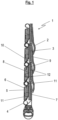
- the fire protection roller door 1 shown has cover slats 2 on one side, which in the exemplary embodiment shown are coated with fire and heat-insulating material 3 on the side facing the door.
- profile slats 4 are arranged, which are hingedly connected to one another in order to enable rolling or winding.
- the profile slats 4 are also coated on the side facing away from the door with fire- and heat-insulating material 5, which is placed in a box-shaped housing 6 in the exemplary embodiment shown.
- the profile slats are fastened to the carrier element 9 with rivets 11 .
- Rivets 12 are used to attach the cover slats 2 to the carrier element 9 .
- the rivets 11 and the rivets 12 are offset from one another.
Landscapes
- Engineering & Computer Science (AREA)
- Structural Engineering (AREA)
- Civil Engineering (AREA)
- Health & Medical Sciences (AREA)
- Public Health (AREA)
- Business, Economics & Management (AREA)
- Emergency Management (AREA)
- Architecture (AREA)
- Mechanical Engineering (AREA)
- Special Wing (AREA)
Description
- Die vorliegende Erfindung betrifft ein Feuerschutzrolltor, bestehend aus einem Rolltorpanzer aus gelenkig miteinander verbundenen Profillamellen, einer bahnförmigen Zwischenlage aus feuer- und wärmedämmendem Material und sich überlappenden Decklamellen, der in beidseitigen Führungsschienen führbar im Öffnungszustand oberhalb einer im Brandfall zu verschließenden Öffnung gehalten ist.
- Das Feuerschutzrolltor der gattungsgemäßen Art, beispielsweise bekannt aus der
EP 0 367 883 A1 , ist ein luftdicht und feuerhemmend ausgestaltetes Feuerschutzrolltor. In diesem Stand der Technik ist es kombiniert mit einer Schlupftür. Hierdurch ist es möglich, z.B. Lastkraftwagen, wie auch Busse oder PKWs in die Waggons jeweils von der Vorderseite oder Rückseite hereinfahren und ausfahren zu lassen und jeden Waggon nach seiner Beladung durch Herablassen der stirnseitigen Feuerschutzrolltore derart zu schließen, dass im Normalfall Personen noch durch die entsprechenden Schlupftüren den einen Waggon verlassen und zum anderen überschreiten können bzw. den Waggon auch wieder betreten können. Für den Alarmfall ist der sicherheitstechnisch erforderliche feuertechnische Abschluss gegeben und gleichzeitig die erforderliche Luftdichtigkeit gewährleistet. Im Brandfall ist es demzufolge möglich, bei personenfreiem Waggon einen luftdichten und durch die Feuerschutzrolltore nach außen feuergesicherten Raum herzustellen, in den ein Löschgas eingegeben werden kann. Gleichartige Problemstellungen ergeben sich heutzutage beispielsweise in der Ausrüstung von Fähr- und Kreuzfahrschiffen. - Ein gattungsgemäßes Feuerschutzrolltor besteht aus einem Rolltorpanzer aus gelenkig miteinander verbundenen scharnierartigen Profillamellen, einer bahnförmigen Zwischenlage aus feuer- und wärmedämmendem Material und sich überlappenden Decklamellen. Ein derartiges Tor ist in der Regel in beidseitigen Führungsschienen sowie einer Unter-Decken-Führung zur Halterung des Rolltorpanzers im Öffnungszustand horizontal unter einer Waggondecke gehalten und im Schließzustand durch eine Abdichtungseinrichtung luftdicht abgeschlossen gehalten. Ein gattungsgemäßes in beidseitigen Führungsschienen führbar im Öffnungszustand oberhalb einer im Brandfall zu verschließenden Öffnung gehaltenes Feuerschutzrolltor ist oberhalb der Öffnung aufgerollt oder horizontal angeordnet. Somit ist die Breite die Dimension quer zur zu verschließenden Öffnung, also die Horizontale. Diese Richtung entspricht den Angaben der unterschiedlichen Breiten der einzelnen Bauteile wie Decklamellen, Profillamellen, Zwischenlagen usw. Die Breite der Bauteile und damit des Rolltorpanzers wird beispielsweise durch den horizontalen Abstand der Führungsschienen bestimmt. Die offene Höhe einer zu verschließenden Öffnung, also die Vertikale, bestimmt die Dimension der Mindest-Höhe des Rolltorpanzers und damit der Höhe und der Anzahl der einzelnen Bauteile wie Decklamellen, Profillamellen usw.
- Im Stand der Technik ist es bekannt, dass die Zwischenlage und die Decklamellen an den Profillamellen befestigt sind. Dabei sind die Befestigungen für die Zwischenlage und die Decklamellen als Haken, Nieten oder dgl. an den Profillamellen ausgebildet. Daraus ergibt sich der Nachteil, dass beide Seiten des Feuerschutzrolltores durch vergleichsweise lange und üblicherweise metallische Elemente auf einer in bestimmungsgemäßer Abdichtposition horizontalen Linie verbunden sind. Dies bedeutet erhebliche unerwünschte Wärmeübergänge. In der Praxis hat sich herausgestellt, dass sich hier Schwachstellen bei entsprechenden Feuerschutzrolltoren herausbilden und die Feuerwiderstandsdauer und Wärmedämmfähigkeit dadurch begrenzt sind. Die Dokumente
DE2901400 undAT355784 - Ausgehend vom vorbeschriebenen Stand der Technik liegt der vorliegenden Erfindung die Aufgabe zugrunde, ein Feuerschutzrolltor der gattungsgemäßen Art dahingehend weiterzubilden, dass die Betriebssicherheit verbessert und erhöht wird und insbesondere punktuelle das Tor durchreichende Wärmeübergänge vermieden werden, um die Feuerwiderstandsdauer und die Wärmedämmfähigkeit zu verbessern.
- Zur technischen Lösung dieser Aufgabe wird ein Feuerschutzrolltor mit den Merkmalen des Patentanspruches 1 vorgeschlagen. Weitere Vorteile und Merkmale ergeben sich aus den Unteransprüchen.
- Gemäß der Erfindung ist vorgesehen, dass die bahnförmige Zwischenlage plattenförmige Trägersegmente aufweist, welche beidseitig mit je wenigstens einer Lage aus feuer- und wärmedämmendem Material überdeckt sind. Diese Einfügung von plattenförmigen Trägersegmenten in die Zwischenlage ermöglicht es nun, die Befestigungen sowohl der Profillamellen als auch der Decklamellen unabhängig und variabel zu gestalten.
- In vorteilhafter Weise werden die plattenförmigen Trägersegmente als metallische Trägerelemente ausgebildet. Dies können Platten oder auch Profilelemente sein. Gemäß einem fortlaufenden Vorschlag der Erfindung haben die Trägersegmente einen U-förmigen Querschnitt. Geht man davon aus, dass sich die Trägersegmente über die Rolltorpanzer-Breite erstrecken, d.h. sie liegen mit ihrer Längskanten-Ausdehnung quer im Rolltorpanzer, so kann eine obere und gegebenenfalls untere Kante durch eine Abkantung verstärkt sein. Werden beide Längskanten in die gleiche Richtung abgekantet, ergibt sich beispielsweise ein U- oder C- förmiger Querschnitt. Hieraus kann ein Aufnahmeraum oder Aufnahmebereich für Zwischenlagenelemente aus feuer- und wärmedämmendem Material gebildet werden. In der Höhe sind die Trägersegmente an die Höhe der Profillamellen angepasst, was ein entsprechendes Aufrollen fördert.
- Erfindungsgemäß sind die Profillamellen mit den Trägersegmenten verbunden. Hierfür werden stiftartigen Verbindungselemente wie Nieten, Schrauben, Bolzen und dergleichen verwendet. Es ergibt sich somit eine Baugruppe aus Trägersegment, Zwischenlagenelement aus feuer- und wärmedämmendem Material und Profillamelle.
- Weiterhin werden die Decklamellen ebenfalls mit den Trägersegmenten verbunden. Auch hierfür können stiftartigen Verbindungselemente wie Nieten, Schrauben, Bolzen und dergleichen verwendet werden. Es ergibt sich somit eine Baugruppe aus Trägersegment, Zwischenlagenelement aus feuer- und wärmedämmendem Material und Decklamellen.
- Diese als "Baugruppen" bezeichneten Elementgruppen stellen die jeweils eine Hälfte des Gesamtverbundes aus Profillamellen, Zwischenlagenelement aus feuer- und wärmedämmendem Material, Trägersegment, dem weiteren Zwischenlagenelement aus feuer- und wärmedämmendem Material und den Decklamellen. Durch diesen Aufbau ist es nunmehr möglich, die Verbindungselemente zu den Profillamellen einerseits bzw. den Decklamellen andererseits zueinander versetzt anzuordnen, da es eine geradlinige Verbindung ja nur noch von der jeweiligen Lamelle zum Trägersegment gibt. Auf diese Weise sind durchgehende metallische Verbindungen vermieden. Versetzt im Sinne der vorliegenden Erfindung bedeutet in jeglicher Richtung, also horizontal, vertikal, schräg oder in jeder geeigneten Weise, um eine direkte durchgehende Verbindung durch den Rolltorpanzer durch Berührung von Verbindungselementen zu vermeiden.
- In einer weiteren gattungsgemäßen Ausführungsform können ein oder mehrere weitere Trägersegmente mit wärmedämmendem Material eingebracht werden. Es ergeben sich somit parallele Zwischenlagen. Dadurch erhöhen sich die Wärmedämmung und die Feuerwiderstandsdauer weiter. Die weiteren Trägersegmente werden in gleicher Weise wie beschrieben versetzt angeordnet mit einem anderen Trägersegment, der Profillamelle oder der Decklamelle verbunden. Auch bei diesen Ausführungsformen sind die Profillamellen und die Decklamellen immer nur mit einem oder mehreren Trägerelementen und in keinem Fall direkt miteinander mittels eines durchgehenden Verbindungselementes verbunden. Somit sind dann mittlere Trägerelemente miteinander verbunden und die Verbindungselemente entsprechend versetzt.
- Trägersegmente können an ihren Berührungskanten bzw. an den zueinander benachbarten Längskanten mit Dichtungen versehen sein. Hier eignen sich Elastomere, Gummies, aber auch schnurartige Träger, die mit Mitteln getränkt oder versehen sind, die auf im Brandfall auftretende Temperaturen beispielsweise mit Aufschäumen reagieren. Dadurch wird die Gesamtabdichtungseigenschaft des Rolltorpanzers, beispielsweise gegen Rauchgase, verbessert.
- In vorteilhafter Weise können die Decklamellen einseitig oder auch beidseitig mit feuer- und wärmedämmendem Material beschichtet sein. Insbesondere die zum Rolltorpanzer zugewandte Seite der Decklamelle kann mit entsprechendem Material beschichtet sein. Dieses Material kann reine wärmedämmende Eigenschaften aufweisen oder beispielsweise im Brandfall aufschäumen bzw. in Abhängigkeit von der Temperaturentwicklung entsprechende Stoffe freisetzen und dergleichen, sodass im Brandfall durch die aufschäumenden Eigenschaften des Materials eine erhöhte Abdichtung ermöglicht ist.
- In gleicher Weise können die Profillamellen beidseitig mit feuer- und wärmedämmendem Material beschichtet sein. Zu diesem Zweck kann beispielsweise entsprechendes Material in kastenförmige Gehäuse eingebracht werden, welche dann auf den Profillamellen angeordnet werden.
- Die Zwischenlagen aus feuer- und wärmedämmendem Material können durchgängige Materialbahnen sein oder auch beispielsweise plattenförmige Segmente. Die beidseitig der Trägersegmente angeordneten Zwischenlagen können identisch oder je nach Funktionalität auch unterschiedlich ausgebildet sein. Sie können ebenfalls reine wärmedämmende Eigenschaften aufweisen oder beispielsweise im Brandfall aufschäumen bzw. in Abhängigkeit von der Temperaturentwicklung entsprechende Stoffe freisetzen und dergleichen.
- Mit der Erfindung wird ein solide aufgebautes Feuerschutzrolltor bereitgestellt, bei welchem die Feuersicherheit und der Wirkungsgrad erheblich erhöht sind. Insbesondere ist die Feuerwiderstandsdauer deutlich erhöht. Weitere Vorteile und Merkmale der Erfindung ergeben sich aus der folgenden Beschreibung anhand der Figuren. Dabei zeigen:
- Fig. 1
- ein schematischer Querschnitt durch einen Teil einer Ausführungsform eines Feuerschutzrolltors nach der Erfindung.
- Das in
Figur 1 gezeigte Feuerschutzrolltor 1 weist einseitig Decklamellen 2 auf, die im gezeigten Ausführungsbeispiel auf der zum Tor weisenden Seite mit feuer- und wärmedämmendem Material 3 beschichtet sind. - Auf der gegenüberliegenden Oberfläche sind Profillamellen 4 angeordnet, die scharnierartig gelenkig miteinander verbunden sind, um ein Rollen bzw. Wickeln zu ermöglichen. Im gezeigten Ausführungsbeispiel sind die Profillamellen 4 auf der vom Tor wegweisenden Seite ebenfalls mit feuer- und wärmedämmendem Material 5 beschichtet, welches im gezeigten Ausführungsbeispiel jeweils in einem kastenförmige Gehäuse 6 eingebracht ist.
- In der Mitte sind zwei Zwischenlagen aus feuer- und wärmedämmendem Material 7,8 angeordnet. Zwischen beiden sind plattenförmige Trägerelemente 9 positioniert. Im gezeigten Ausführungsbeispiel sind jeweils Segmente gebildet, die im Wesentlichen der Höhe der Profillamellen entsprechen. Zwischen diesen Segmenten sind Dichtungen 10 angeordnet.
- Die Profillamellen sind mit Nieten 11 am Trägerelement 9 befestigt. Für die Befestigung der Decklamellen 2 am Trägerelement 9 sind Nieten 12 eingesetzt. Wie sich zeigt, sind die Nieten 11 und die Nieten 12 zueinander versetzt.
- Die Beschreibung des Ausführungsbeispiels dient der Erläuterung und ist nicht beschränkend.
-
- 1
- Feuerschutzrolltor
- 2
- Decklamelle
- 3
- Feuer- und wärmedämmendes Material
- 4
- Profillamelle
- 5
- Feuer- und wärmedämmendes Material
- 6
- Gehäuse
- 7
- Feuer- und wärmedämmendes Material
- 8
- Feuer- und wärmedämmendes Material
- 9
- Trägersegment
- 10
- Dichtung
- 11
- Nieten
- 12
- Nieten
Claims (10)
- Feuerschutzrolltor aus einem Rolltorpanzer aus gelenkig miteinander verbundenen Profillamellen (4), einer bahnförmigen Zwischenlage aus feuer- und wärmedämmendem Material und sich überlappenden Decklamellen (2), der in beidseitigen Führungsschienen führbar im Öffnungszustand oberhalb einer im Brandfall zu verschließenden Öffnung gehalten ist, dadurch gekennzeichnet, dass die bahnförmige Zwischenlage plattenförmige Trägersegmente (9) aufweist, welche beidseitig mit je wenigstens einer Lage aus feuer- und wärmedämmendem Material (7, 8) überdeckt sind, wobei die plattenförmigen Trägersegmente (9) mittels erster Verbindungselemente (11) mit den Profillamellen (4) und mittels zweiter Verbindungselemente (12) mit den Decklamellen (2) verbunden sind, wobei die ersten und zweiten Verbindungselemente (11, 12) stiftförmig sind und wobei die ersten und zweiten Verbindungselemente (11, 12) zueinander versetzt sind.
- Feuerschutzrolltor nach Anspruch 1, wobei die plattenförmigen Trägersegmente (9) aus Metall gebildet sind.
- Feuerschutzrolltor nach einem der vorhergehenden Ansprüche, wobei sich die plattenförmigen Trägersegmente (9) im Wesentlichen über die Breite des Rolltorpanzers erstrecken.
- Feuerschutzrolltor nach einem der vorhergehenden Ansprüche, wobei die plattenförmigen Trägersegmente (9) in der Höhe an die Ausdehnung der Profillamellen (4) angepasst sind.
- Feuerschutzrolltor nach einem der vorhergehenden Ansprüche, wobei zwischen zueinander weisenden Kanten benachbarter plattenförmiger Trägersegmente (9) Dichtungselemente (10) angeordnet sind.
- Feuerschutzrolltor nach einem der vorhergehenden Ansprüche, wobei die plattenförmigen Trägersegmente (5) einen U-Querschnitt aufweisen.
- Feuerschutzrolltor nach einem der vorhergehenden Ansprüche, wobei die Decklamellen (2) wenigstens einseitig mit feuer- und wärmedämmendem Material (3) beschichtet sind.
- Feuerschutzrolltor nach einem der vorhergehenden Ansprüche, wobei auf die Profillamellen (4) eine Schicht aus feuer- und wärmedämmendem Material (5) aufgelegt ist.
- Feuerschutzrolltor nach Anspruch 8, wobei die auf die Profillamellen (4) aufgesetzte Schicht aus feuer- und wärmedämmendem Material in einem Kastengehäuse (6) angeordnet ist.
- Feuerschutzrolltor nach einem der vorhergehenden Ansprüche, wobei mehrere plattenförmige Trägersegmente (9), welche beidseitig mit je wenigstens einer Lage aus feuer- und wärmedämmendem Material (7, 8) überdeckt sind, parallel angeordnet sind.
Priority Applications (1)
| Application Number | Priority Date | Filing Date | Title |
|---|---|---|---|
| PL20717793.2T PL4069930T3 (pl) | 2020-03-30 | 2020-03-30 | Przeciwpożarowa brama rolowana |
Applications Claiming Priority (1)
| Application Number | Priority Date | Filing Date | Title |
|---|---|---|---|
| PCT/EP2020/058998 WO2021197571A1 (de) | 2020-03-30 | 2020-03-30 | Feuerschutzrolltor |
Publications (2)
| Publication Number | Publication Date |
|---|---|
| EP4069930A1 EP4069930A1 (de) | 2022-10-12 |
| EP4069930B1 true EP4069930B1 (de) | 2023-03-15 |
Family
ID=70227998
Family Applications (1)
| Application Number | Title | Priority Date | Filing Date |
|---|---|---|---|
| EP20717793.2A Active EP4069930B1 (de) | 2020-03-30 | 2020-03-30 | Feuerschutzrolltor |
Country Status (5)
| Country | Link |
|---|---|
| US (1) | US11724137B2 (de) |
| EP (1) | EP4069930B1 (de) |
| FI (1) | FI4069930T3 (de) |
| PL (1) | PL4069930T3 (de) |
| WO (1) | WO2021197571A1 (de) |
Families Citing this family (1)
| Publication number | Priority date | Publication date | Assignee | Title |
|---|---|---|---|---|
| US20250076007A1 (en) * | 2023-08-31 | 2025-03-06 | Qualitas Manufacturing, Inc. | Rollup Bullet Proof/Cut Resistant Panel |
Family Cites Families (6)
| Publication number | Priority date | Publication date | Assignee | Title |
|---|---|---|---|---|
| AT355784B (de) * | 1978-11-08 | 1980-03-25 | Brueglhuber Dietmar | Rolltor |
| DE2901400C2 (de) * | 1979-01-15 | 1981-02-19 | Herbert 4070 Rheydt Effertz-Lex | Feuer- und wärmedämmender aufrollbarer Abschluß |
| ATE74843T1 (de) | 1988-11-09 | 1992-05-15 | Effertz Rolladenwerk | Waggon zum transport von fahrzeugen. |
| US5419386A (en) * | 1994-03-07 | 1995-05-30 | Magro; Sebastian | Insulated roll-up door provided with metal outer and inner walls |
| TW201116700A (en) * | 2009-11-12 | 2011-05-16 | shi-xian Wang | Door slat component, fireproof and heat insulation door slat and rolling door |
| MX2019011464A (es) * | 2017-03-27 | 2019-11-01 | Cornellcookson Llc | Puerta contra incendios. |
-
2020
- 2020-03-30 WO PCT/EP2020/058998 patent/WO2021197571A1/de not_active Ceased
- 2020-03-30 FI FIEP20717793.2T patent/FI4069930T3/fi active
- 2020-03-30 US US17/915,602 patent/US11724137B2/en active Active
- 2020-03-30 PL PL20717793.2T patent/PL4069930T3/pl unknown
- 2020-03-30 EP EP20717793.2A patent/EP4069930B1/de active Active
Also Published As
| Publication number | Publication date |
|---|---|
| EP4069930A1 (de) | 2022-10-12 |
| FI4069930T3 (fi) | 2023-05-22 |
| PL4069930T3 (pl) | 2023-08-14 |
| US11724137B2 (en) | 2023-08-15 |
| US20230131519A1 (en) | 2023-04-27 |
| WO2021197571A1 (de) | 2021-10-07 |
Similar Documents
| Publication | Publication Date | Title |
|---|---|---|
| DE3009729A1 (de) | Bauteil (bauelement) | |
| EP1669110B1 (de) | Dichtungsanordnung für einen Brand- bzw. Rauchvorhang | |
| EP4069930B1 (de) | Feuerschutzrolltor | |
| EP2326784B1 (de) | Hubtor | |
| DE2547818C2 (de) | Feuerschutzabschluß für eine Öffnung in Wänden oder Decken, welche von einer Förderanlage durchquert wird | |
| EP3101190B1 (de) | Trennwandmodul einer trennwand | |
| DE2529778B2 (de) | Sicherheitstuer | |
| DE10110795B4 (de) | Einfassprofil für einen Feuer- und/oder Rauchschutzabschluss | |
| DE102015107324B4 (de) | Profilschienensystem für den Einbau von Schiebetüren in Hohlwände | |
| EP3055475A1 (de) | Schiebetür oder schiebefenster | |
| EP1327740B1 (de) | Staffeltor | |
| EP2987940A1 (de) | Tor, insbesondere hubtor, zum verschliessen einer öffnung in einer zwei verschiedene temperaturzonen voneinander trennenden wandung | |
| DE102009022827B4 (de) | Brandschutz- und/oder Rauchschutzschiebetür | |
| DE3820684A1 (de) | Wandelement | |
| EP3854979A1 (de) | Sektionaltor | |
| DE4213146A1 (de) | Lüftertür | |
| DE10353822A1 (de) | Schwellenprofil für eine Schiebetür oder ein Schiebefenster | |
| DE7705685U1 (de) | Absperrvorrichtung, insbesondere druckentlastungsjalousieklappe | |
| EP2372060B1 (de) | Brandschutz-Schiebetüre | |
| DE102020103603B4 (de) | Hochwasserbeständiges Sektionaltor | |
| EP0087806A1 (de) | Rolladen zum luftdichten Abdecken von Wandöffnungen durch Ausbildung wenigstens einer ruhenden Luftschicht | |
| EP4534792A1 (de) | Tor mit beweglichen torsegmenten | |
| AT511473B1 (de) | Schiebefenster, insbesondere für ein dach | |
| EP2320019A2 (de) | Hebe-Schiebe-Konstruktion sowie Schiebefenster- oder Schiebetüranordnung | |
| WO2013056690A2 (de) | Brand- oder rauchschutzvorrichtung zum verschliessen einer deckenöffnung |
Legal Events
| Date | Code | Title | Description |
|---|---|---|---|
| STAA | Information on the status of an ep patent application or granted ep patent |
Free format text: STATUS: UNKNOWN |
|
| STAA | Information on the status of an ep patent application or granted ep patent |
Free format text: STATUS: THE INTERNATIONAL PUBLICATION HAS BEEN MADE |
|
| PUAI | Public reference made under article 153(3) epc to a published international application that has entered the european phase |
Free format text: ORIGINAL CODE: 0009012 |
|
| STAA | Information on the status of an ep patent application or granted ep patent |
Free format text: STATUS: REQUEST FOR EXAMINATION WAS MADE |
|
| 17P | Request for examination filed |
Effective date: 20220708 |
|
| AK | Designated contracting states |
Kind code of ref document: A1 Designated state(s): AL AT BE BG CH CY CZ DE DK EE ES FI FR GB GR HR HU IE IS IT LI LT LU LV MC MK MT NL NO PL PT RO RS SE SI SK SM TR |
|
| GRAP | Despatch of communication of intention to grant a patent |
Free format text: ORIGINAL CODE: EPIDOSNIGR1 |
|
| STAA | Information on the status of an ep patent application or granted ep patent |
Free format text: STATUS: GRANT OF PATENT IS INTENDED |
|
| INTG | Intention to grant announced |
Effective date: 20221021 |
|
| GRAS | Grant fee paid |
Free format text: ORIGINAL CODE: EPIDOSNIGR3 |
|
| GRAA | (expected) grant |
Free format text: ORIGINAL CODE: 0009210 |
|
| STAA | Information on the status of an ep patent application or granted ep patent |
Free format text: STATUS: THE PATENT HAS BEEN GRANTED |
|
| AK | Designated contracting states |
Kind code of ref document: B1 Designated state(s): AL AT BE BG CH CY CZ DE DK EE ES FI FR GB GR HR HU IE IS IT LI LT LU LV MC MK MT NL NO PL PT RO RS SE SI SK SM TR |
|
| DAV | Request for validation of the european patent (deleted) | ||
| DAX | Request for extension of the european patent (deleted) | ||
| REG | Reference to a national code |
Ref country code: CH Ref legal event code: EP Ref country code: GB Ref legal event code: FG4D Free format text: NOT ENGLISH |
|
| REG | Reference to a national code |
Ref country code: DE Ref legal event code: R096 Ref document number: 502020002760 Country of ref document: DE |
|
| REG | Reference to a national code |
Ref country code: IE Ref legal event code: FG4D Free format text: LANGUAGE OF EP DOCUMENT: GERMAN |
|
| REG | Reference to a national code |
Ref country code: AT Ref legal event code: REF Ref document number: 1554099 Country of ref document: AT Kind code of ref document: T Effective date: 20230415 |
|
| REG | Reference to a national code |
Ref country code: NL Ref legal event code: FP |
|
| P01 | Opt-out of the competence of the unified patent court (upc) registered |
Effective date: 20230516 |
|
| REG | Reference to a national code |
Ref country code: LT Ref legal event code: MG9D |
|
| PG25 | Lapsed in a contracting state [announced via postgrant information from national office to epo] |
Ref country code: RS Free format text: LAPSE BECAUSE OF FAILURE TO SUBMIT A TRANSLATION OF THE DESCRIPTION OR TO PAY THE FEE WITHIN THE PRESCRIBED TIME-LIMIT Effective date: 20230315 Ref country code: NO Free format text: LAPSE BECAUSE OF FAILURE TO SUBMIT A TRANSLATION OF THE DESCRIPTION OR TO PAY THE FEE WITHIN THE PRESCRIBED TIME-LIMIT Effective date: 20230615 Ref country code: LV Free format text: LAPSE BECAUSE OF FAILURE TO SUBMIT A TRANSLATION OF THE DESCRIPTION OR TO PAY THE FEE WITHIN THE PRESCRIBED TIME-LIMIT Effective date: 20230315 Ref country code: LT Free format text: LAPSE BECAUSE OF FAILURE TO SUBMIT A TRANSLATION OF THE DESCRIPTION OR TO PAY THE FEE WITHIN THE PRESCRIBED TIME-LIMIT Effective date: 20230315 Ref country code: HR Free format text: LAPSE BECAUSE OF FAILURE TO SUBMIT A TRANSLATION OF THE DESCRIPTION OR TO PAY THE FEE WITHIN THE PRESCRIBED TIME-LIMIT Effective date: 20230315 |
|
| PG25 | Lapsed in a contracting state [announced via postgrant information from national office to epo] |
Ref country code: SE Free format text: LAPSE BECAUSE OF FAILURE TO SUBMIT A TRANSLATION OF THE DESCRIPTION OR TO PAY THE FEE WITHIN THE PRESCRIBED TIME-LIMIT Effective date: 20230315 Ref country code: GR Free format text: LAPSE BECAUSE OF FAILURE TO SUBMIT A TRANSLATION OF THE DESCRIPTION OR TO PAY THE FEE WITHIN THE PRESCRIBED TIME-LIMIT Effective date: 20230616 |
|
| PG25 | Lapsed in a contracting state [announced via postgrant information from national office to epo] |
Ref country code: SM Free format text: LAPSE BECAUSE OF FAILURE TO SUBMIT A TRANSLATION OF THE DESCRIPTION OR TO PAY THE FEE WITHIN THE PRESCRIBED TIME-LIMIT Effective date: 20230315 Ref country code: RO Free format text: LAPSE BECAUSE OF FAILURE TO SUBMIT A TRANSLATION OF THE DESCRIPTION OR TO PAY THE FEE WITHIN THE PRESCRIBED TIME-LIMIT Effective date: 20230315 Ref country code: PT Free format text: LAPSE BECAUSE OF FAILURE TO SUBMIT A TRANSLATION OF THE DESCRIPTION OR TO PAY THE FEE WITHIN THE PRESCRIBED TIME-LIMIT Effective date: 20230717 Ref country code: ES Free format text: LAPSE BECAUSE OF FAILURE TO SUBMIT A TRANSLATION OF THE DESCRIPTION OR TO PAY THE FEE WITHIN THE PRESCRIBED TIME-LIMIT Effective date: 20230315 Ref country code: EE Free format text: LAPSE BECAUSE OF FAILURE TO SUBMIT A TRANSLATION OF THE DESCRIPTION OR TO PAY THE FEE WITHIN THE PRESCRIBED TIME-LIMIT Effective date: 20230315 Ref country code: CZ Free format text: LAPSE BECAUSE OF FAILURE TO SUBMIT A TRANSLATION OF THE DESCRIPTION OR TO PAY THE FEE WITHIN THE PRESCRIBED TIME-LIMIT Effective date: 20230315 |
|
| PG25 | Lapsed in a contracting state [announced via postgrant information from national office to epo] |
Ref country code: SK Free format text: LAPSE BECAUSE OF FAILURE TO SUBMIT A TRANSLATION OF THE DESCRIPTION OR TO PAY THE FEE WITHIN THE PRESCRIBED TIME-LIMIT Effective date: 20230315 Ref country code: IS Free format text: LAPSE BECAUSE OF FAILURE TO SUBMIT A TRANSLATION OF THE DESCRIPTION OR TO PAY THE FEE WITHIN THE PRESCRIBED TIME-LIMIT Effective date: 20230715 |
|
| REG | Reference to a national code |
Ref country code: BE Ref legal event code: MM Effective date: 20230331 |
|
| REG | Reference to a national code |
Ref country code: DE Ref legal event code: R097 Ref document number: 502020002760 Country of ref document: DE |
|
| PG25 | Lapsed in a contracting state [announced via postgrant information from national office to epo] |
Ref country code: LU Free format text: LAPSE BECAUSE OF NON-PAYMENT OF DUE FEES Effective date: 20230330 |
|
| PG25 | Lapsed in a contracting state [announced via postgrant information from national office to epo] |
Ref country code: MC Free format text: LAPSE BECAUSE OF FAILURE TO SUBMIT A TRANSLATION OF THE DESCRIPTION OR TO PAY THE FEE WITHIN THE PRESCRIBED TIME-LIMIT Effective date: 20230315 |
|
| REG | Reference to a national code |
Ref country code: IE Ref legal event code: MM4A |
|
| PLBE | No opposition filed within time limit |
Free format text: ORIGINAL CODE: 0009261 |
|
| STAA | Information on the status of an ep patent application or granted ep patent |
Free format text: STATUS: NO OPPOSITION FILED WITHIN TIME LIMIT |
|
| PG25 | Lapsed in a contracting state [announced via postgrant information from national office to epo] |
Ref country code: SI Free format text: LAPSE BECAUSE OF FAILURE TO SUBMIT A TRANSLATION OF THE DESCRIPTION OR TO PAY THE FEE WITHIN THE PRESCRIBED TIME-LIMIT Effective date: 20230315 Ref country code: MC Free format text: LAPSE BECAUSE OF FAILURE TO SUBMIT A TRANSLATION OF THE DESCRIPTION OR TO PAY THE FEE WITHIN THE PRESCRIBED TIME-LIMIT Effective date: 20230315 Ref country code: IE Free format text: LAPSE BECAUSE OF NON-PAYMENT OF DUE FEES Effective date: 20230330 Ref country code: DK Free format text: LAPSE BECAUSE OF FAILURE TO SUBMIT A TRANSLATION OF THE DESCRIPTION OR TO PAY THE FEE WITHIN THE PRESCRIBED TIME-LIMIT Effective date: 20230315 |
|
| 26N | No opposition filed |
Effective date: 20231218 |
|
| PG25 | Lapsed in a contracting state [announced via postgrant information from national office to epo] |
Ref country code: BE Free format text: LAPSE BECAUSE OF NON-PAYMENT OF DUE FEES Effective date: 20230331 |
|
| PG25 | Lapsed in a contracting state [announced via postgrant information from national office to epo] |
Ref country code: BG Free format text: LAPSE BECAUSE OF FAILURE TO SUBMIT A TRANSLATION OF THE DESCRIPTION OR TO PAY THE FEE WITHIN THE PRESCRIBED TIME-LIMIT Effective date: 20230315 |
|
| GBPC | Gb: european patent ceased through non-payment of renewal fee |
Effective date: 20240330 |
|
| PG25 | Lapsed in a contracting state [announced via postgrant information from national office to epo] |
Ref country code: BG Free format text: LAPSE BECAUSE OF FAILURE TO SUBMIT A TRANSLATION OF THE DESCRIPTION OR TO PAY THE FEE WITHIN THE PRESCRIBED TIME-LIMIT Effective date: 20230315 |
|
| PG25 | Lapsed in a contracting state [announced via postgrant information from national office to epo] |
Ref country code: GB Free format text: LAPSE BECAUSE OF NON-PAYMENT OF DUE FEES Effective date: 20240330 |
|
| PG25 | Lapsed in a contracting state [announced via postgrant information from national office to epo] |
Ref country code: GB Free format text: LAPSE BECAUSE OF NON-PAYMENT OF DUE FEES Effective date: 20240330 |
|
| PGFP | Annual fee paid to national office [announced via postgrant information from national office to epo] |
Ref country code: CH Payment date: 20250401 Year of fee payment: 6 |
|
| PG25 | Lapsed in a contracting state [announced via postgrant information from national office to epo] |
Ref country code: CY Free format text: LAPSE BECAUSE OF FAILURE TO SUBMIT A TRANSLATION OF THE DESCRIPTION OR TO PAY THE FEE WITHIN THE PRESCRIBED TIME-LIMIT; INVALID AB INITIO Effective date: 20200330 |
|
| PG25 | Lapsed in a contracting state [announced via postgrant information from national office to epo] |
Ref country code: HU Free format text: LAPSE BECAUSE OF FAILURE TO SUBMIT A TRANSLATION OF THE DESCRIPTION OR TO PAY THE FEE WITHIN THE PRESCRIBED TIME-LIMIT; INVALID AB INITIO Effective date: 20200330 |
|
| PG25 | Lapsed in a contracting state [announced via postgrant information from national office to epo] |
Ref country code: TR Free format text: LAPSE BECAUSE OF FAILURE TO SUBMIT A TRANSLATION OF THE DESCRIPTION OR TO PAY THE FEE WITHIN THE PRESCRIBED TIME-LIMIT Effective date: 20230315 |
|
| PGFP | Annual fee paid to national office [announced via postgrant information from national office to epo] |
Ref country code: NL Payment date: 20260206 Year of fee payment: 7 |
|
| REG | Reference to a national code |
Ref country code: CH Ref legal event code: U11 Free format text: ST27 STATUS EVENT CODE: U-0-0-U10-U11 (AS PROVIDED BY THE NATIONAL OFFICE) Effective date: 20260401 |
|
| PGFP | Annual fee paid to national office [announced via postgrant information from national office to epo] |
Ref country code: DE Payment date: 20260206 Year of fee payment: 7 |
|
| PGFP | Annual fee paid to national office [announced via postgrant information from national office to epo] |
Ref country code: AT Payment date: 20260206 Year of fee payment: 7 |
|
| PGFP | Annual fee paid to national office [announced via postgrant information from national office to epo] |
Ref country code: FI Payment date: 20260206 Year of fee payment: 7 Ref country code: IT Payment date: 20260324 Year of fee payment: 7 |
|
| PGFP | Annual fee paid to national office [announced via postgrant information from national office to epo] |
Ref country code: FR Payment date: 20260323 Year of fee payment: 7 |
|
| PGFP | Annual fee paid to national office [announced via postgrant information from national office to epo] |
Ref country code: PL Payment date: 20260303 Year of fee payment: 7 |