EP4067211B1 - Fahrzeugkarosseriestruktur - Google Patents
Fahrzeugkarosseriestruktur Download PDFInfo
- Publication number
- EP4067211B1 EP4067211B1 EP22155107.0A EP22155107A EP4067211B1 EP 4067211 B1 EP4067211 B1 EP 4067211B1 EP 22155107 A EP22155107 A EP 22155107A EP 4067211 B1 EP4067211 B1 EP 4067211B1
- Authority
- EP
- European Patent Office
- Prior art keywords
- floor panel
- seat
- panel
- pedal
- vehicle
- Prior art date
- Legal status (The legal status is an assumption and is not a legal conclusion. Google has not performed a legal analysis and makes no representation as to the accuracy of the status listed.)
- Active
Links
Images

Classifications
-
- B—PERFORMING OPERATIONS; TRANSPORTING
- B62—LAND VEHICLES FOR TRAVELLING OTHERWISE THAN ON RAILS
- B62D—MOTOR VEHICLES; TRAILERS
- B62D25/00—Superstructure or monocoque structure sub-units; Parts or details thereof not otherwise provided for
- B62D25/20—Floors or bottom sub-units
-
- B—PERFORMING OPERATIONS; TRANSPORTING
- B60—VEHICLES IN GENERAL
- B60N—SEATS SPECIALLY ADAPTED FOR VEHICLES; VEHICLE PASSENGER ACCOMMODATION NOT OTHERWISE PROVIDED FOR
- B60N2/00—Seats specially adapted for vehicles; Arrangement or mounting of seats in vehicles
- B60N2/02—Seats specially adapted for vehicles; Arrangement or mounting of seats in vehicles the seat or part thereof being movable, e.g. adjustable
- B60N2/04—Seats specially adapted for vehicles; Arrangement or mounting of seats in vehicles the seat or part thereof being movable, e.g. adjustable the whole seat being movable
- B60N2/06—Seats specially adapted for vehicles; Arrangement or mounting of seats in vehicles the seat or part thereof being movable, e.g. adjustable the whole seat being movable slidable
-
- B—PERFORMING OPERATIONS; TRANSPORTING
- B60—VEHICLES IN GENERAL
- B60N—SEATS SPECIALLY ADAPTED FOR VEHICLES; VEHICLE PASSENGER ACCOMMODATION NOT OTHERWISE PROVIDED FOR
- B60N2/00—Seats specially adapted for vehicles; Arrangement or mounting of seats in vehicles
- B60N2/02—Seats specially adapted for vehicles; Arrangement or mounting of seats in vehicles the seat or part thereof being movable, e.g. adjustable
- B60N2/04—Seats specially adapted for vehicles; Arrangement or mounting of seats in vehicles the seat or part thereof being movable, e.g. adjustable the whole seat being movable
- B60N2/06—Seats specially adapted for vehicles; Arrangement or mounting of seats in vehicles the seat or part thereof being movable, e.g. adjustable the whole seat being movable slidable
- B60N2/07—Slide construction
-
- B—PERFORMING OPERATIONS; TRANSPORTING
- B60—VEHICLES IN GENERAL
- B60N—SEATS SPECIALLY ADAPTED FOR VEHICLES; VEHICLE PASSENGER ACCOMMODATION NOT OTHERWISE PROVIDED FOR
- B60N2/00—Seats specially adapted for vehicles; Arrangement or mounting of seats in vehicles
- B60N2/005—Arrangement or mounting of seats in vehicles, e.g. dismountable auxiliary seats
-
- B—PERFORMING OPERATIONS; TRANSPORTING
- B60—VEHICLES IN GENERAL
- B60N—SEATS SPECIALLY ADAPTED FOR VEHICLES; VEHICLE PASSENGER ACCOMMODATION NOT OTHERWISE PROVIDED FOR
- B60N3/00—Arrangements or adaptations of other passenger fittings, not otherwise provided for
- B60N3/06—Arrangements or adaptations of other passenger fittings, not otherwise provided for of footrests
-
- B—PERFORMING OPERATIONS; TRANSPORTING
- B62—LAND VEHICLES FOR TRAVELLING OTHERWISE THAN ON RAILS
- B62D—MOTOR VEHICLES; TRAILERS
- B62D25/00—Superstructure or monocoque structure sub-units; Parts or details thereof not otherwise provided for
- B62D25/20—Floors or bottom sub-units
- B62D25/2009—Floors or bottom sub-units in connection with other superstructure subunits
- B62D25/2036—Floors or bottom sub-units in connection with other superstructure subunits the subunits being side panels, sills or pillars
Definitions
- the present disclosure relates to a vehicle body structure including a floor panel, for example.
- a front seat is attached to a front portion of a floor panel, and the rear seat is attached to a rear portion of the floor panel positioned away rearward from the front seat (e.g. see Patent Document 1).
- a vehicle body structure of Patent Document 1 includes a floor position adjuster capable of adjusting the height of a floor on which a leg of an occupant operating a pedal is placed.
- Patent Document 1 describes that, in general, the occupant is in an ergonomically comfortable state in a posture with a wide angle between an upper leg from the pelvis to a knee and a lower leg from a knee to an ankle when the seating position of the occupant is low.
- the floor position adjuster is provided to optimize this angle.
- PATENT DOCUMENT 1 Japanese Unexamined Patent Publication No. 2005-178581
- JP 2008 260349 A describes a vehicle body structure according to the preamble of claim 1.
- this document describes that in the foot rest structure for the automobile, a recession part for placing a left foot of a driver is provided on a driver's seat floor of the automobile.
- a pedal operation direction is not the horizontal direction but an obliquely-downward direction, and the small angle between the lower leg and the floor during the pedal operation results in small up-down component force input from the heel.
- This allows, e.g., the quick and accurate operation of switching the pedal to be stepped on from an accelerator pedal to a brake pedal or from the brake pedal to the accelerator pedal. As a result, the operability of the pedals is improved.
- An approach for raising the position of the heel of the occupant operating the pedal is to provide the floor position adjuster of Patent Document 1.
- a floor position adjuster of Patent Document 1 there is a need for incorporating, in a vehicle body, a lifting/lowering mechanism for lifting/lowering the floor, a lock mechanism for locking the floor at a desired height, etc. In some vehicles, it is difficult to ensure spaces for these mechanisms.
- the sliding speed of such a power seat is not fast. Particularly, when a sliding amount is increased to achieve better boarding/alighting, the occupant has to wait for the seat to move rearward, which inhibits smooth boarding/alighting.
- the front floor panel for placing the heel of the pedal operator is positioned higher than the rear floor panel.
- the heel of the pedal operator is placed at a high position. This results in a small angle between a lower leg of the pedal operator and the front floor panel, which leads to small up-down component force input from a heel upon pedal operation.
- pedal operability is improved.
- At least the front portion of the connection panel between the front floor panel and the rear floor panel is positioned at the front of the front portion of the front seat.
- the occupant seated on the front seat can put one's foot on the connection panel upon boarding/alighting.
- counterforce causes the front seat to slide rearward.
- at least part of the connection panel is formed so as to be positioned downward toward the rear side, the foot is less likely to slip forward even if force is applied to stretch the leg and the front seat can reliably slide rearward quicker than a typical power seat.
- a sliding amount of the front seat can be increased.
- the occupant on the front seat can easily get off the vehicle.
- the front seat is also slid rearward upon boarding, the occupant can easily get on the vehicle.
- connection panel is positioned at the front of the front portion of the front seat while the front seat is in the state of having been slid to the foremost position by the slide mechanism.
- the front seat is expected to be slid to the foremost position. Even in the state in which the front seat has been slid to the foremost position, the front portion of the connection panel is positioned at the front of the front portion of the front seat, and therefore, even the small occupant can easily slide the front seat rearward by placing one's foot on the connection panel and applying force to stretch one's leg.
- the invention includes a pair of right and left hinge pillars arranged to extend in an up-down direction at both end portions of the front floor panel in a vehicle width direction.
- the front portion of the connection panel is positioned at the front of rear portions of the hinge pillars as viewed from the side of a vehicle body.
- a front portion of a door opening at the side is formed by a rear portion of the hinge pillar.
- An aspect of the present disclosure includes a pair of right and left side sills arranged to extend in a front-rear direction at both end portions of the floor panel in the vehicle width direction.
- An upper surface of the front floor panel is positioned higher than upper portions of the side sills.
- the front floor panel is positioned relatively high. This can achieve a sufficiently-small angle between the lower leg of the pedal operator and the front floor panel.
- the rear floor panel includes a rear seat fixing portion for fixing a rear portion of the slide mechanism.
- the rear floor panel includes a front seat fixing portion for fixing a front portion of the slide mechanism.
- the slide mechanism is configured to perform manual unlocking.
- the front seat when the occupant manually unlocks the front seat and stretches one's leg on the connection panel, the front seat can be moved rearward to a desired position. Since the front seat can be then locked at the rearwardly-moved position, the occupant can easily get on the vehicle.
- a not-claimed example of the present disclosure may premise a vehicle body structure including a floor panel on which a front seat having a slide mechanism is provided.
- the floor panel includes a front panel portion for placing a heel of a pedal operator operating a pedal provided in the vehicle, a rear panel portion provided at the rear of the front panel portion at a position lower than the front panel portion, and a connection panel portion extending from a rear portion of the front panel portion to a front portion of the rear panel portion, the connection panel portion being inclined or curved so as to be positioned downward toward a rear side. At least a front portion of the connection panel portion is positioned at the front of a front portion of the front seat.
- the pedal operability can be improved by the small angle between the lower leg of the pedal operator and the front floor panel, and boarding/alighting can be improved by providing, in the vicinity of the foot of the occupant, the connection panel that is inclined or curved so as to be positioned downward toward the rear side.
- FIG. 1 is a left side view of a motor vehicle 1 of an embodiment of the present disclosure.
- the motor vehicle 1 is a so-called passenger car. Note that in the description of this embodiment, the front side of the vehicle is simply referred to as “front,” the rear side of the vehicle is simply referred to as “rear,” the right side of the vehicle is simply referred to as “right,” and the left side of the vehicle is simply referred to as “left.”
- a right-left direction of the vehicle is a vehicle width direction.
- a power house S In a front portion of the motor vehicle 1, a power house S is provided.
- a power train (not shown) including an internal combustion engine, a traction motor, etc. is stored.
- the power house S can also be referred to as, e.g., a power train storage compartment, an engine room, or a motor room.
- a hood 2 Provided above the power house S is a hood 2.
- the motor vehicle 1 may be such a front-engine rear-drive vehicle (hereinafter referred to as an FR vehicle) that an engine, a traction motor, etc. mounted in a power house S drives rear wheels, or such a front-engine front-drive vehicle (hereinafter referred to as an FF vehicle) that an engine, a traction motor, etc. mounted in a power house S drives front wheels.
- the motor vehicle may also be a 4-wheel drive vehicle configured such that an engine mounted in a power house S drives four wheels.
- a vehicle interior R is provided at the rear of the power house S, as shown in FIG. 2 .
- a bottom surface of the vehicle interior R is formed by a floor panel 3, and therefore, a space above the floor panel 3 is the vehicle interior R.
- a roof 4 is provided above the vehicle interior R.
- a front door 5 and a rear door 6 are arranged in an openable/closable manner at a left portion of the motor vehicle 1. Note that a front door and a rear door are also arranged in an openable/closable manner on the right side of the motor vehicle 1, although not shown in the figure.
- the motor vehicle 1 has a vehicle body structure 1A of the present disclosure.
- the vehicle body structure 1A includes the floor panel 3 and a dash panel 7, the dash panel 7 may be a member not forming the vehicle body structure 1A of the present disclosure.
- a member dividing the vehicle interior R and the power house S from each other in the front-rear direction is the dash panel 7.
- the dash panel 7 is made of, e.g., a steel plate, and extends not only in the right-left direction but also in the up-down direction.
- a lower portion of the dash panel 7 is inclined or curved so as to be positioned rearward toward a lower end portion thereof, and a lower end portion of the dash panel 7 is connected to a front end portion of the floor panel 3.
- the floor panel 3 is provided so as to extend rearward from the lower end portion of the dash panel 7.
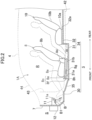
- FIG. 2 is a cross-sectional view of the driver seat side of the motor vehicle 1, and shows the cross sections of the floor panel 3 and the dash panel 7 and a schematic structure of a driver seat 8 and a rear seat 10 attached to the floor panel 3 as well as a brake pedal B attached to the dash panel 7. While the driver seat 8 is provided on the right side of a center portion of the vehicle interior R in the right-left direction, a passenger seat 9 (shown in FIG. 1 ) is provided on the left side of the center portion of the vehicle interior R in the right-left direction.
- the present disclosure is not limited to abov, and the driver seat side may be on the left side of the vehicle interior R and the passenger seat side may be on the right side of the vehicle interior R. Further, there may be two or more rows of rear seats in the vehicle interior R.
- the vehicle body structure 1A of the motor vehicle 1 will be described more specifically. As indicated by broken lines in FIG. 1 , at each of the right and left portions of the motor vehicle 1, there are a front door opening 40 to be opened or closed by the front door 5 and a rear door opening 41 to be opened or closed by the rear door 6. As indicated by virtual lines in FIG. 2 , the vehicle body structure 1A includes a pair of right and left side sills 42 (only the left one is shown) arranged to extend in the front-rear direction at both end portions of the floor panel 3 in the right-left direction.
- the vehicle body structure 1A also includes a pair of right and left hinge pillars 43 (only the left one is shown) arranged to extend in the up-down direction at both end portions of a front floor panel 30 forming a front portion of the floor panel 3.
- a lower portion of the hinge pillar 43 is connected to the vicinity of a front portion of the side sill 42, and the hinge pillar 43 extends upward from such a portion.
- a lower portion of a front pillar 44 is connected to an upper portion of the hinge pillar 43.
- the front pillar 44 extends while being inclined so as to be positioned rearward toward the upper side, and is connected to a front portion of the roof 4.
- the vehicle body structure 1A includes a center pillar 45 extending upward from the a middle portion of the side sill 42 in the front-rear direction.
- the front door opening 40 is formed by a rear edge portion of the hinge pillar 43, a lower edge portion of the front pillar 44, an upper edge portion of the side sill 42, a front edge portion of the center pillar 45, and the roof 4.
- the front door 5 is supported by the hinge pillar 43, and the rear door 6 is supported by the center pillar 45.
- the rear door 6 may be omitted, and in this case, the rear door opening 41 is also omitted.
- the brake pedal B is swingably provided at the dash panel 7. That is, in the vehicle interior R on the right side of the dash panel 7, a pedal bracket 11 is attached to a portion facing the driver seat 8.
- the pedal bracket 11 is provided away upward from an upper surface of the floor panel 3.
- a spindle 11a extending in the right-left direction is provided at the pedal bracket 11.
- An upper end portion of the brake pedal B is pivotably supported on the spindle 11a.
- the brake pedal B extends downward from the portion supported by the spindle 11a.
- a lower end portion of the brake pedal B is a portion to be stepped on by an occupant.
- a rear end portion of a rod B1 is coupled to the brake pedal B.
- a front end portion of the rod B1 is connected to an input of a brake booster apparatus 12. Note that the front end portion of the rod B1 may be coupled to a brake force generation apparatus other than the brake booster apparatus 12.
- the support structure of the brake pedal B is not limited to one described above and the brake pedal B may be a so-called organ pedal type brake pedal although not shown in the figure.
- a lower portion of the brake pedal is swingably supported on the floor panel 3 through a spindle extending in the right-left direction.
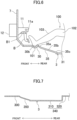
- FIG. 3 is a cross-sectional view of the dash panel 7 and the floor panel 3, and shows the position of an accelerator pedal A.
- the accelerator pedal A is of a so-called organ pedal type, and a lower portion of the accelerator pedal A is swingably supported to the floor panel 3 through a spindle A1 extending in the right-left direction.
- the accelerator pedal A may be of a hanging type.
- an upper portion of the accelerator pedal A is swingably supported on the dash panel 7 via the spindle extending in the right-left direction.
- the motor vehicle 1 driven by the traction motor also includes a pedal to be operated upon acceleration, and such a pedal will be also referred to as an accelerator pedal in the present specification.
- a pedal for operating a clutch is provided in the vehicle interior R.
- the accelerator pedal A is arranged at the rightmost position
- the brake pedal B is arranged at the left of the accelerator pedal A
- a clutch pedal is arranged at the left of the brake pedal B.
- an accelerator pedal and a brake pedal are also provided on a passenger seat side as in a driver seat side, although not shown in the figure.
- the present disclosure is also applicable to such an instruction vehicle.
- the floor panel 3 includes the front floor panel 30, a seat-mounted floor panel 34, and a connection panel 35 (details will be described later).
- the front floor panel 30, the seat-mounted floor panel 34, and the connection panel 35 are formed by separate members, and are joined to each other to form the single floor panel 3.
- the seat-mounted floor panel 34 includes a first floor panel (a rear floor panel) 31 forming a front portion of the seat-mounted floor panel 34 and a second floor panel 32 forming a rear portion of the seat-mounted floor panel 34.
- the first floor panel 31 and the second floor panel 32 are separate members, and are joined to each other to form the seat-mounted floor panel 34.
- a floor tunnel portion may be formed at the front floor panel 30, the connection panel 35, and the first floor panel 31.
- the floor tunnel portion can be formed in such a manner that center portions of the front floor panel 30, the connection panel 35, and the first floor panel 31 in the right-left direction bulge upward, and for example, may be formed so as to continuously extend in the front-rear direction from a front portion of the front floor panel 30 to a rear portion of the first floor panel 31.
- the front floor panel 30 extends rearward from the lower end portion of the dash panel 7, and extends in the right-left direction.
- a heel rest portion 30a on which a heel of the pedal operator operating the brake pedal B and the accelerator pedal A is placed is provided at the front floor panel 30.
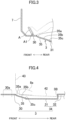
- the heel rest portion 30a is a portion where the heel of the occupant is naturally placed when the occupant operates the accelerator pedal A or the brake pedal B. This portion varies to some extent according to the physique, driving postures, etc. of the occupant, but is generally an area (region) shown in FIG. 4 .
- the heel rest portion 30a can be defined as a continuous region from a portion away rearward from a front end portion of the front floor panel 30 to a portion away forward from a rear end portion of the front floor panel 30, and can also be a middle portion of the front floor panel 30 in the front-rear direction.
- the upper edge portion of the side sill 42 is indicated by a virtual line.
- An upper surface of the front floor panel 30 is positioned higher than the upper edge portion (upper portion) of the side sill 42. With this configuration, the height of the front floor panel 30 can be raised.
- the second floor panel 32 is a member provided away rearward from the front floor panel 30 and attached to the rear seat 10.
- the rear seat 10 includes a rear-seat cushion portion 10a forming a seat surface and a rear-seat seat back portion 10b forming a back rest portion.
- the rear-seat cushion portion 10a is fixed to an upper surface of the second floor panel 32.
- the second floor panel 32 is continuously formed at least from a portion corresponding to a front end portion to a portion corresponding to a rear end portion of the rear-seat cushion portion 10a, the second floor panel 32 may be further extended rearward beyond the rear end portion of the rear-seat cushion portion 10a.
- a rear seat of a second row or a luggage compartment for placing luggage can be provided at the rear of the rear seat 10.
- the first floor panel 31 extends from a rear portion of the connection panel 35 to a front portion of the second floor panel 32.
- the first floor panel 31 is positioned lower than the front floor panel 30.
- the front floor panel 30 may extend substantially horizontally in the front-rear direction, and the first floor panel 31 may also be in such a shape that the first floor panel 31 extends substantially horizontally in the front-rear direction.
- the second floor panel 32 may also be in such a shape that the second floor panel 32 extends substantially horizontally in the front-rear direction.
- the second floor panel 32 is positioned higher than the first floor panel 31.
- the floor panel 3 includes a rear plate portion 3B extending in the up-down direction from the front portion of the second floor panel 32 to the rear portion of the first floor panel 31. Since the second floor panel 32 and the first floor panel 31 are connected to each other through the rear plate portion 3B, a step is formed between the second floor panel 32 and the first floor panel 31.
- the first floor panel 31 is positioned one step lower than the front floor panel 30 and the second floor panel 32.
- a difference in a height between the first floor panel 31 and each of the front floor panel 30 and the second floor panel 32 may be set to 5 cm or more, 10 cm or more, or 15 cm or more, for example.
- the front floor panel 30 and the second floor panel 32 may be at the same height, or the front floor panel 30 may be lower or higher than the second floor panel 32.
- the front floor panel 30, the first floor panel 31, and the second floor panel 32 are not necessarily precisely horizontal, and may be inclined so as to be positioned downward toward the rear side. Further, only part of the front floor panel 30, the first floor panel 31, and the second floor panel 32 may be inclined, and the remaining part may be substantially horizontal.
- the second floor panel 32 may be at the same height as that of the first floor panel 31.
- the rear plate portion 3B may be integrally molded with the second floor panel 32 or with the first floor panel 31. Alternatively, the rear plate portion 3B may be formed separately from these floor panels 31, 32. Further, the rear plate portion 3B may extend substantially vertically, or may be inclined or curved. For example, the rear plate portion 3B can be inclined or curved so as to be positioned forward toward the lower side.
- the first floor panel 31 includes a first front-seat fixing portion (front seat fixing portion) 31a and a second front-seat fixing portion (rear seat fixing portion) 31b for fixing the front seat 8.
- the first front-seat fixing portion 31a is provided at the front of a center portion of the first floor panel 31 in the front-rear direction, and for example, includes a member fixed to the first floor panel 31 and formed long in the right-left direction.
- the second front-seat fixing portion 31b also includes a member formed long in the right-left direction, and is provided a predetermined distance away rearward from the first front-seat fixing portion 31a.
- the configurations of the first front-seat fixing portion 31a and the second front-seat fixing portion 31b are not limited to the members as described above, and may be members formed in various shapes by plate members etc. Note that in this embodiment, the first front-seat fixing portion 31a is formed so as to be higher than the second front-seat fixing portion 31b. However, the heights of the first front-seat fixing portion 31a and the second front-seat fixing portion 31b may be the same as each other.
- a rear-seat fixing portion 32a for fixing the rear seat 10 is provided at least at a front portion of the second floor panel 32.
- the rear-seat fixing portion 32a may be configured similarly to or differently from the front-seat fixing portions 31a, 31b.
- the front seat 8 and the rear seat 10 can be arranged at the same height.
- the front seat 8 includes a front-seat cushion portion 8a, a front-seat seat back portion 8b, and a seat slide mechanism 8c configured to adjust the position of the front-seat cushion portion 8a in the front-rear direction.
- the front-seat cushion portion 8a is a portion forming a seat surface for a front seat occupant, and although not shown in the figure, includes, e.g., a seat frame provided in the front-seat cushion portion 8a, a cushion material supported on the seat frame, and a cover material covering the cushion material.
- the front-seat seat back portion 8b is a portion forming a back rest portion for the front seat occupant, and although not shown in the figure, includes, e.g., a seat frame, a cushion material, and a cover material.
- a lower portion of the front-seat seat back portion 8b is attached to a rear portion of the front-seat cushion portion 8a through a reclining mechanism 8d.
- the reclining mechanism 8d is typically well-known, and is a mechanism for fixing the front-seat seat back portion 8b at an optional inclination angle.
- the seat slide mechanism 8c may be a typically well-known mechanism, and for example, includes a movable member 8e fixed to a lower portion of the front-seat cushion portion 8a and a rail 8f fixed to the first front-seat fixing portion 31a and the second front-seat fixing portion 31b on the first floor panel 31.
- the rail 8f is a member for guiding the front-seat cushion portion 8a in the front-rear direction, and extends in the front-rear direction.
- a front portion of the rail 8f is fixed to the first front-seat fixing portion 31a, and a rear portion of the rail 8f is fixed to the second front-seat fixing portion 31b. Since the first front-seat fixing portion 31a is higher than the second front-seat fixing portion 31b, the rail 8f is inclined so as to be positioned upward toward the front.
- the rail 8f may be substantially horizontal.
- the movable member 8e is a member capable of moving relative to the rail 8f in the front-rear direction while being engaged with the rail 8f.
- the position of the movable member 8e with respect to the rail 8f in the front-rear direction can be an optional position within a predetermined range, and the movable member 8e can be locked to the rail 8f at such a position.
- the seat slide mechanism 8c includes a lock mechanism 8g capable of switching the movable member 8e between a locked state in which the movable member 8e is locked to the rail 8f and an unlocked state in which the movable member 8e is slidable in the front-rear direction.
- the lock mechanism 8g is typically well-known and includes an operation lever 8h, and is configured so as to be unlocked by manual operation of the operation lever 8h by the occupant. For example, by upwardly operating the operation lever 8h which is constantly biased downward, the lock mechanism 8g is switched to the unlocked state. On the other hand, by releasing a hand from the operation lever 8h, the operation lever 8h moves downward and switches the lock mechanism 8g to the locked state.
- the range of adjustment of the front seat 8 in the front-rear direction i.e., the foremost position and the rearmost position of the front seat 8 in the front-rear direction, can be set by the seat slide mechanism 8c.
- the height of the seat slide mechanism 8c can be set according to the height of the first floor panel 31, the height of the first front-seat fixing portion 31a, and the height of the second front-seat fixing portion 31b.
- the height of the seat slide mechanism 8c is set such that the front floor panel 30 is at a position higher than the seat slide mechanism 8c when compared with the front floor panel 30.
- the rear seat 10 includes the rear-seat cushion portion 10a and the rear-seat seat back portion 10b.
- the rear-seat cushion portion 10a and the rear-seat seat back portion 10b can be configured similarly to those in the front seat 8.
- the rear-seat cushion portion 10a is fixed to the rear-seat fixing portion 32a on the second floor panel 32.
- the rear seat 10 may be also provided with a seat slide mechanism and a reclining mechanism similar to those of the front seat 8.
- connection panel 35 is a member that connects the front floor panel 30 and the first floor panel 31 with each other, and extends continuously from a rear portion of the front floor panel 30 to a front portion of the first floor panel 31.
- the connection panel 35 connecting these panels is inclined or curved so as to be positioned downward toward the rear side.
- the connection panel 35 may be entirely inclined or curved, or at least part of the connection panel 35 in the front-rear direction may be inclined or curved.
- FIG. 4 indicates, by a virtual line, a front portion of the front-seat cushion portion 8a in a state in which the front seat 8 has slid to the foremost position by the seat slide mechanism 8c.
- the front portion of the connection panel 35 is positioned at the front of the front portion of the front-seat cushion portion 8a at this position, and therefore, is in such a positional relationship that the front portion and/or the middle portion of the connection panel 35 are visible at the front of the front-seat cushion portion 8a as viewed in plane.
- FIG. 4 indicates the rear edge portion of the hinge pillar 43 by a virtual line.
- the front portion of the connection panel 35 is positioned at the front of a rear portion (the rear edge portion) of the hinge pillar 43 as viewed from the side of the vehicle body. That is, since the rear edge portion of the hinge pillar 43 is a portion to be a front edge portion of the front door opening 40 (shown by a broken line in FIG. 1 ), the front portion of the connection panel 35 is positioned at the front of the front edge portion of the front door opening 40.
- connection panel 35 may be a member that is inclined at the same inclination angle from the rear portion of the front floor panel 30 to the front portion of the first floor panel 31.
- the connection panel 35 may have a portion in the front-rear direction, the portion being inclined at an inclination angle different from that of other portions.
- the connection panel 35 may be a member that is curved with the same curvature from the rear portion of the front floor panel 30 to the front portion of the first floor panel 31.
- the connection panel 35 may have a portion in the front-rear direction, the portion being curved with a curvature different from that of other portions.
- a portion of the connection panel 35 in the front-rear direction may be inclined, and other portions may be curved. Only a portion of the connection panel 35 in the front-rear direction may be a horizontal portion that is substantially horizontal, or there may be a step at a portion of the connection panel 35 in the front-rear direction.
- connection panel 35 has such a structure that the connection panel 35 is dividable into three regions, i.e., a front region 35a, a middle region 35b, and a rear region 35c.
- the front region 35a is positioned at the front of the front portion of the front-seat cushion portion 8a having slid to the foremost position.
- the front region 35a is a region extending from the front edge portion to the middle portion of the connection panel 35 in the front-rear direction.
- the rear region 35c is a region extending from the rear edge portion to the middle portion of the connection panel 35 in the front-rear direction.
- the middle region 35b is a region extending from a rear edge portion of the front region 35a to a front edge portion of the rear region 35c.
- connection panel 35 may be dividable into four or more regions.
- the front region 35a is formed by a portion curved downward so as to be positioned downward toward the rear side, and forms a recessed portion at the rear of the front floor panel 30.
- the middle region 35b is formed by a portion inclined so as to be positioned downward toward the rear side.
- the rear region 35c is formed by a portion curved upward so as to be positioned downward toward the rear side, and forms a raised portion at the front of the first floor panel 31.
- the front region 35a and the middle region 35b are formed smoothly continuously to each other. Further, the middle region 35b and the rear region 35c are also formed smoothly continuously to each other.
- the middle region 35b may be curved.
- a recessed or raised portion may be formed at the middle portion of the connection panel 35 in the front-rear direction.
- an anti-slip portion may be provided on the upper surface of the connection panel 35.
- the anti-slip portion may have a recessedraised shape or may be a member having a high coefficient of friction, such as rubber.
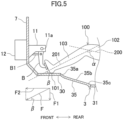
- FIG. 5 is a view showing a lower limb 100 of the front seat occupant (a pedal operator) seated on the front seat 8, the floor panel 3, the dash panel 7, the brake pedal B, and the vicinity thereof.
- the lower rear portion of the seat frame 8g of the front seat 8 is positioned lower than the upper surface of the front floor panel 30.
- the hip point of the pedal operator can be lowered. Lowering the hip point of the pedal operator means that the seating position of the pedal operator is lowered. This lowers the height of the center of gravity of the vehicle while the occupant is on-board.
- the heel 101 of the pedal operator is placed at a position higher as compared to a general operation posture.
- Such a layout leads to such a posture that an upper leg 102 and a lower leg 103 of the pedal operator are widely open.
- a reference numeral 200 indicates the center line of the upper leg 102 of the pedal operator whereas a reference numeral 201 indicates the center line of the lower leg 103, and a difference in a height between the front floor panel 30 and the first floor panel 31 is set such that an angle (an opening angle ⁇ between the upper leg 102 and the lower leg 103) between the center lines 200, 201 falls within a range of 125° to 150°.
- the position of the front seat 8 in the front-rear direction is a position according to, e.g., the physique of the occupant, so that the occupant can be in a predetermined driving posture as described above.
- the front seat 8 is positioned at the front of its rearmost position. If the occupant is small, the front seat 8 is at the foremost position as indicated by a virtual line in FIG. 4 in some cases. Even when the front seat 8 is at the foremost position, the front portion of the connection panel 35 is positioned at the front of the front portion of the front-seat cushion portion 8a. Thus, the occupant only needs to bend one's leg to place at least the heel of one's foot on the connection panel 35.
- the counterforce can cause the front seat 8 to slide rearward.
- the connection panel 35 is formed so as to be positioned downward toward the rear side, the foot is less likely to slip forward even if force is applied to stretch the leg and the front seat 8 can reliably slide rearward quicker than a power seat.
- a rearward slide amount may vary according to an occupant, or the front seat 8 may be slid to the rearmost position or to a position immediately before the rearmost position.
- the front door opening 40 becomes widely usable at the side of the occupant, and the occupant on the driver seat side moves away from a steering wheel. Thus, the occupant can easily get off the vehicle.
- the seat on the passenger seat side can be similarly slid rearward upon alighting.
- connection panel 35 since the front portion of the connection panel 35 is positioned at the front of the rear portion of the hinge pillar 43 when viewed from the side of the vehicle body, the front portion of the connection panel 35 can be arranged corresponding to the front portion of the front door opening 40. As a result, a space below the foot can be enlarged corresponding to the front door opening 40, and boarding/alighting can be further improved.
- connection panel 35 since the front region 35a of the connection panel 35 is in a recessed shape, the heel can be hooked on the front region 35a. Thus, when the leg is stretched, the heel is less likely to slip forward, and therefore, the front seat 8 can be easily slid rearward.
- this embodiment can improve the comfort of the rear seat occupant.
- the second floor panel 32 to which the rear seat 10 is attached is positioned higher than the first floor panel 31, the occupant on the rear seat 10 is seated at a relatively-high position, which improves the field of view.
- the feet of the rear seat occupant are placed on the first floor panel 31. Since the first floor panel 31 is positioned lower than the second floor panel 32, a wide foot space for the rear seat occupant is ensured particularly in the height direction.
- the pedal operability can be improved by the small angle ⁇ between the lower leg 103 of the pedal operator and the front floor panel 30 while boarding/alighting is improved by providing, in the vicinity of the foot of the occupant, the connection panel 35 that is inclined or curved so as to be positioned downward toward the rear side.
- the seat fixing portions 31a, 31b are provided on the first floor panel 31 positioned lower than the front floor panel 30, the hip point of the pedal operator seated on the front seat 8 is lowered. This can achieve a sufficiently-small angle ⁇ between the lower leg 103 of the pedal operator and the front floor panel 30.
- the front floor panel 30 has, at a portion corresponding to the brake pedal B, a recessed portion 30b for placing the heel 101 of the pedal operator. It may only be required that the depth of the recessed portion 30b is set so as to house at least part of a heel portion of a shoe, and the depth can be 2 cm or more or 3 cm or more, for example. Since the pedal operability might be degraded if the recessed portion 30b is extremely deep, the depth may be 7 cm or less, for example.
- the width (the dimension in the right-left direction) of the recessed portion 30b can be, for example, 5 cm or more or 7 cm or more.
- the heel 101 is less likely to shift in the right-left direction. This can make the foot stable in the case of turning a toe in the right-left direction about the vicinity of the heel 101, such as the case of stepping on the accelerator pedal A after having stepped on the brake pedal B, for example.
- the pedal operability can be further improved by a synergy effect with the above-described advantage of the small angle ⁇ between the lower leg 103 of the pedal operator and the front floor panel 30.
- the floor panel 3 may be a single piece from the front portion to the rear portion.
- the floor panel 3 of Variation 2 includes a front panel portion 300 on which the heel of the pedal operator is to be placed, a seat-mounted panel portion 340, and a connection panel portion 350.
- the seat-mounted panel portion 340 is provided at the rear of the front panel portion 300, and includes a first panel portion (rear panel portion) 310 to which at least the front seat 8 is attached and a second panel portion 320.
- a front portion of the connection panel portion 350 is positioned at the front of the front portion of the front-seat cushion portion 8a having been slid to the foremost position.
- the front panel portion 300 is equivalent to the above-described front floor panel 30, the first panel portion 310 is equivalent to the above-described first floor panel 31, the second panel portion 320 is equivalent to the above-described second floor panel 32, and the connection panel portion 350 is equivalent to the above-described connection panel 35.
- the front panel portion 300 and the connection panel portion 350 may be integrally formed, and the first panel portion 310 may be a separate member.
- the first panel portion 310 and the connection panel portion 350 may be integrally formed, and the front panel portion 300 may be a separate member.
- the vehicle body structure of the present disclosure is applicable to a motor vehicle having a floor panel, for example.
Landscapes
- Engineering & Computer Science (AREA)
- Transportation (AREA)
- Mechanical Engineering (AREA)
- Chemical & Material Sciences (AREA)
- Combustion & Propulsion (AREA)
- Aviation & Aerospace Engineering (AREA)
- Body Structure For Vehicles (AREA)
Claims (6)
- Eine Fahrzeugkarosseriestruktur (1A) mit einer Bodenplatte (3), auf der ein Vordersitz (8) mit einem Gleitmechanismus (8c) bereitgestellt wird, umfassend:eine vordere Bodenplatte (30), auf dem eine Ferse (101) eines Pedalbedieners platziert werden kann, die ein in einem Fahrzeug (1) bereitgestelltes Pedal (B) betätigt;eine hintere Bodenplatte (31), die hinter der vorderen Bodenplatte (30) an einer Position bereitgestellt wird, die unter der vorderen Bodenplatte (30) liegt;eine Verbindungsplatte (35), die sich von einem hinteren Abschnitt der vorderen Bodenplatte (30) zu einem vorderen Abschnitt der hinteren Bodenplatte (31) erstreckt, wobei die Verbindungsplatte (35) zumindest teilweise so geneigt oder gekrümmt ist, dass sie zu einer Rückseite hin absteigend positioniert ist,wobei zumindest ein vorderer Abschnitt der Verbindungsplatte (35) vor einem vorderen Abschnitt des Vordersitzes (8) positioniert ist; undein Paar rechter und linker Scharniersäulen (43), die so angeordnet sind, dass sie sich in einer Auf-Ab-Richtung an beiden Endabschnitten der vorderen Bodenplatte (30) in einer Fahrzeugbreitenrichtung erstrecken,dadurch gekennzeichnet, dassder vordere Abschnitt der Verbindungsplatte (35), von einer Seite einer Fahrzeugkarosserie aus gesehen, an der Vorderseite von hinteren Abschnitten der Scharniersäulen (43) angeordnet ist.
- Die Fahrzeugkarosseriestruktur (1A) nach Anspruch 1, wobei zumindest der vordere Abschnitt der Verbindungsplatte (35) vor dem vorderen Abschnitt des Vordersitzes (8) positioniert ist, wenn sich der Vordersitz (8) in einem Zustand befindet, in dem er durch den Gleitmechanismus (8c) in eine vorderste Position geschoben wurde.
- Die Fahrzeugkarosseriestruktur (1A) nach Anspruch 1 oder 2, die ferner Folgendes umfasst:ein Paar rechter und linker Seitenschweller (42), die so angeordnet sind, dass sie sich in einer Vorwärts-Rückwärts-Richtung an beiden Endabschnitten der Bodenplatte (3) in der Fahrzeugbreitenrichtung erstrecken,wobei eine obere Fläche der vorderen Bodenplatte (30) höher positioniert ist als obere Abschnitte der Seitenschweller (42).
- Die Fahrzeugkarosseriestruktur (1A) nach irgendeinem der Ansprüche von 1 bis 3, wobei
die hintere Bodenplatte (31) einen Rücksitzbefestigungsabschnitt (31b) zum Befestigen eines hinteren Abschnitts des Gleitmechanismus (8c) beinhaltet. - Die Fahrzeugkarosseriestruktur (1A) nach Anspruch 4, wobei
die hintere Bodenplatte (31) einen Vordersitzbefestigungsabschnitt (31a) zur Befestigung eines vorderen Abschnitts des Gleitmechanismus (8c) beinhaltet. - Die Fahrzeugkarosseriestruktur (1A) nach irgendeinem der Ansprüche von 1 bis 5, wobei
der Gleitmechanismus (8c) konfiguriert ist, um eine manuelle Entriegelung durchzuführen.
Applications Claiming Priority (1)
| Application Number | Priority Date | Filing Date | Title |
|---|---|---|---|
| JP2021057815A JP7552477B2 (ja) | 2021-03-30 | 2021-03-30 | 車体構造 |
Publications (3)
| Publication Number | Publication Date |
|---|---|
| EP4067211A2 EP4067211A2 (de) | 2022-10-05 |
| EP4067211A3 EP4067211A3 (de) | 2022-10-12 |
| EP4067211B1 true EP4067211B1 (de) | 2023-11-08 |
Family
ID=80218484
Family Applications (1)
| Application Number | Title | Priority Date | Filing Date |
|---|---|---|---|
| EP22155107.0A Active EP4067211B1 (de) | 2021-03-30 | 2022-02-04 | Fahrzeugkarosseriestruktur |
Country Status (4)
| Country | Link |
|---|---|
| US (1) | US11738809B2 (de) |
| EP (1) | EP4067211B1 (de) |
| JP (1) | JP7552477B2 (de) |
| CN (1) | CN115140198B (de) |
Families Citing this family (2)
| Publication number | Priority date | Publication date | Assignee | Title |
|---|---|---|---|---|
| JP2023141218A (ja) * | 2022-03-23 | 2023-10-05 | テイ・エス テック株式会社 | 車両 |
| WO2023181891A1 (ja) * | 2022-03-23 | 2023-09-28 | テイ・エス テック株式会社 | 車両 |
Family Cites Families (12)
| Publication number | Priority date | Publication date | Assignee | Title |
|---|---|---|---|---|
| JP2807818B2 (ja) * | 1989-01-17 | 1998-10-08 | ヤマハ発動機株式会社 | 小型車両 |
| DE29823235U1 (de) | 1998-12-30 | 1999-04-29 | Trw Repa Gmbh | Fahrzeugsicherheitsvorrichtung zum Schutz der Füße des Insassen |
| JP4479233B2 (ja) | 2003-12-19 | 2010-06-09 | マツダ株式会社 | 車両の運転姿勢調整装置 |
| JP2006281911A (ja) | 2005-03-31 | 2006-10-19 | Mazda Motor Corp | 可動フロア装置用の駆動モータ配設構造 |
| JP5233145B2 (ja) | 2007-03-30 | 2013-07-10 | マツダ株式会社 | 運転姿勢調整装置 |
| JP5233144B2 (ja) * | 2007-03-30 | 2013-07-10 | マツダ株式会社 | 運転姿勢調整装置 |
| JP2008260349A (ja) | 2007-04-10 | 2008-10-30 | Kanto Auto Works Ltd | 自動車のフットレスト構造 |
| EP2298613B1 (de) * | 2009-09-18 | 2013-04-24 | Mazda Motor Corporation | Vorrichtung zur Einstellung der Fahrposition für ein Fahrzeug und damit ausgestattetes Fahrzeug |
| JP2011201510A (ja) * | 2010-03-26 | 2011-10-13 | Mazda Motor Corp | 車両のフロアパネル構造 |
| JP2014046812A (ja) | 2012-08-31 | 2014-03-17 | Imasen Electric Ind Co Ltd | スライドレバー連結構造 |
| WO2016063567A1 (ja) * | 2014-10-22 | 2016-04-28 | 本田技研工業株式会社 | 車両 |
| KR20180003605A (ko) * | 2015-05-12 | 2018-01-09 | 닛산 지도우샤 가부시키가이샤 | 차량용 시트 |
-
2021
- 2021-03-30 JP JP2021057815A patent/JP7552477B2/ja active Active
-
2022
- 2022-01-26 US US17/649,007 patent/US11738809B2/en active Active
- 2022-02-04 EP EP22155107.0A patent/EP4067211B1/de active Active
- 2022-02-14 CN CN202210132297.1A patent/CN115140198B/zh active Active
Also Published As
| Publication number | Publication date |
|---|---|
| CN115140198B (zh) | 2024-01-16 |
| US20220315128A1 (en) | 2022-10-06 |
| CN115140198A (zh) | 2022-10-04 |
| EP4067211A3 (de) | 2022-10-12 |
| US11738809B2 (en) | 2023-08-29 |
| EP4067211A2 (de) | 2022-10-05 |
| JP2022154672A (ja) | 2022-10-13 |
| JP7552477B2 (ja) | 2024-09-18 |
Similar Documents
| Publication | Publication Date | Title |
|---|---|---|
| US11850933B2 (en) | Vehicle body structure | |
| US11858333B2 (en) | Vehicle body structure | |
| EP4067211B1 (de) | Fahrzeugkarosseriestruktur | |
| US11993141B2 (en) | Vehicle body structure | |
| US7597395B2 (en) | Vehicle seat | |
| US20220315130A1 (en) | Vehicle body structure | |
| US20220315127A1 (en) | Vehicle body structure | |
| JP7501428B2 (ja) | 車体構造 | |
| CN111016752B (zh) | 车辆用座椅 | |
| JP7484793B2 (ja) | 車体構造 | |
| JP7468434B2 (ja) | 車体構造 | |
| JP7484792B2 (ja) | 車体構造 | |
| JP3441644B2 (ja) | 車両のシート取付構造 | |
| JP4186244B2 (ja) | 自動車のフロア構造 | |
| JP2025109500A (ja) | 車両構造 | |
| JP2026052685A (ja) | 車両 |
Legal Events
| Date | Code | Title | Description |
|---|---|---|---|
| PUAI | Public reference made under article 153(3) epc to a published international application that has entered the european phase |
Free format text: ORIGINAL CODE: 0009012 |
|
| STAA | Information on the status of an ep patent application or granted ep patent |
Free format text: STATUS: THE APPLICATION HAS BEEN PUBLISHED |
|
| PUAL | Search report despatched |
Free format text: ORIGINAL CODE: 0009013 |
|
| AK | Designated contracting states |
Kind code of ref document: A2 Designated state(s): AL AT BE BG CH CY CZ DE DK EE ES FI FR GB GR HR HU IE IS IT LI LT LU LV MC MK MT NL NO PL PT RO RS SE SI SK SM TR |
|
| AK | Designated contracting states |
Kind code of ref document: A3 Designated state(s): AL AT BE BG CH CY CZ DE DK EE ES FI FR GB GR HR HU IE IS IT LI LT LU LV MC MK MT NL NO PL PT RO RS SE SI SK SM TR |
|
| RIC1 | Information provided on ipc code assigned before grant |
Ipc: B60N 2/015 20060101ALI20220905BHEP Ipc: B60N 2/02 20060101ALI20220905BHEP Ipc: B62D 25/20 20060101AFI20220905BHEP |
|
| STAA | Information on the status of an ep patent application or granted ep patent |
Free format text: STATUS: REQUEST FOR EXAMINATION WAS MADE |
|
| 17P | Request for examination filed |
Effective date: 20230316 |
|
| RBV | Designated contracting states (corrected) |
Designated state(s): AL AT BE BG CH CY CZ DE DK EE ES FI FR GB GR HR HU IE IS IT LI LT LU LV MC MK MT NL NO PL PT RO RS SE SI SK SM TR |
|
| GRAP | Despatch of communication of intention to grant a patent |
Free format text: ORIGINAL CODE: EPIDOSNIGR1 |
|
| STAA | Information on the status of an ep patent application or granted ep patent |
Free format text: STATUS: GRANT OF PATENT IS INTENDED |
|
| RIC1 | Information provided on ipc code assigned before grant |
Ipc: B60N 3/06 20060101ALI20230705BHEP Ipc: B60N 2/06 20060101ALI20230705BHEP Ipc: B60N 2/015 20060101ALI20230705BHEP Ipc: B60N 2/02 20060101ALI20230705BHEP Ipc: B62D 25/20 20060101AFI20230705BHEP |
|
| INTG | Intention to grant announced |
Effective date: 20230720 |
|
| GRAS | Grant fee paid |
Free format text: ORIGINAL CODE: EPIDOSNIGR3 |
|
| GRAA | (expected) grant |
Free format text: ORIGINAL CODE: 0009210 |
|
| STAA | Information on the status of an ep patent application or granted ep patent |
Free format text: STATUS: THE PATENT HAS BEEN GRANTED |
|
| AK | Designated contracting states |
Kind code of ref document: B1 Designated state(s): AL AT BE BG CH CY CZ DE DK EE ES FI FR GB GR HR HU IE IS IT LI LT LU LV MC MK MT NL NO PL PT RO RS SE SI SK SM TR |
|
| REG | Reference to a national code |
Ref country code: GB Ref legal event code: FG4D |
|
| REG | Reference to a national code |
Ref country code: CH Ref legal event code: EP |
|
| REG | Reference to a national code |
Ref country code: DE Ref legal event code: R096 Ref document number: 602022000879 Country of ref document: DE |
|
| REG | Reference to a national code |
Ref country code: IE Ref legal event code: FG4D |
|
| REG | Reference to a national code |
Ref country code: LT Ref legal event code: MG9D |
|
| PG25 | Lapsed in a contracting state [announced via postgrant information from national office to epo] |
Ref country code: GR Free format text: LAPSE BECAUSE OF FAILURE TO SUBMIT A TRANSLATION OF THE DESCRIPTION OR TO PAY THE FEE WITHIN THE PRESCRIBED TIME-LIMIT Effective date: 20240209 |
|
| PG25 | Lapsed in a contracting state [announced via postgrant information from national office to epo] |
Ref country code: IS Free format text: LAPSE BECAUSE OF FAILURE TO SUBMIT A TRANSLATION OF THE DESCRIPTION OR TO PAY THE FEE WITHIN THE PRESCRIBED TIME-LIMIT Effective date: 20240308 |
|
| PG25 | Lapsed in a contracting state [announced via postgrant information from national office to epo] |
Ref country code: LT Free format text: LAPSE BECAUSE OF FAILURE TO SUBMIT A TRANSLATION OF THE DESCRIPTION OR TO PAY THE FEE WITHIN THE PRESCRIBED TIME-LIMIT Effective date: 20231108 |
|
| REG | Reference to a national code |
Ref country code: AT Ref legal event code: MK05 Ref document number: 1629389 Country of ref document: AT Kind code of ref document: T Effective date: 20231108 |
|
| PG25 | Lapsed in a contracting state [announced via postgrant information from national office to epo] |
Ref country code: NL Free format text: LAPSE BECAUSE OF FAILURE TO SUBMIT A TRANSLATION OF THE DESCRIPTION OR TO PAY THE FEE WITHIN THE PRESCRIBED TIME-LIMIT Effective date: 20231108 |
|
| PG25 | Lapsed in a contracting state [announced via postgrant information from national office to epo] |
Ref country code: AT Free format text: LAPSE BECAUSE OF FAILURE TO SUBMIT A TRANSLATION OF THE DESCRIPTION OR TO PAY THE FEE WITHIN THE PRESCRIBED TIME-LIMIT Effective date: 20231108 |
|
| PG25 | Lapsed in a contracting state [announced via postgrant information from national office to epo] |
Ref country code: ES Free format text: LAPSE BECAUSE OF FAILURE TO SUBMIT A TRANSLATION OF THE DESCRIPTION OR TO PAY THE FEE WITHIN THE PRESCRIBED TIME-LIMIT Effective date: 20231108 |
|
| PG25 | Lapsed in a contracting state [announced via postgrant information from national office to epo] |
Ref country code: NL Free format text: LAPSE BECAUSE OF FAILURE TO SUBMIT A TRANSLATION OF THE DESCRIPTION OR TO PAY THE FEE WITHIN THE PRESCRIBED TIME-LIMIT Effective date: 20231108 Ref country code: LT Free format text: LAPSE BECAUSE OF FAILURE TO SUBMIT A TRANSLATION OF THE DESCRIPTION OR TO PAY THE FEE WITHIN THE PRESCRIBED TIME-LIMIT Effective date: 20231108 Ref country code: IS Free format text: LAPSE BECAUSE OF FAILURE TO SUBMIT A TRANSLATION OF THE DESCRIPTION OR TO PAY THE FEE WITHIN THE PRESCRIBED TIME-LIMIT Effective date: 20240308 Ref country code: GR Free format text: LAPSE BECAUSE OF FAILURE TO SUBMIT A TRANSLATION OF THE DESCRIPTION OR TO PAY THE FEE WITHIN THE PRESCRIBED TIME-LIMIT Effective date: 20240209 Ref country code: ES Free format text: LAPSE BECAUSE OF FAILURE TO SUBMIT A TRANSLATION OF THE DESCRIPTION OR TO PAY THE FEE WITHIN THE PRESCRIBED TIME-LIMIT Effective date: 20231108 Ref country code: BG Free format text: LAPSE BECAUSE OF FAILURE TO SUBMIT A TRANSLATION OF THE DESCRIPTION OR TO PAY THE FEE WITHIN THE PRESCRIBED TIME-LIMIT Effective date: 20240208 Ref country code: AT Free format text: LAPSE BECAUSE OF FAILURE TO SUBMIT A TRANSLATION OF THE DESCRIPTION OR TO PAY THE FEE WITHIN THE PRESCRIBED TIME-LIMIT Effective date: 20231108 Ref country code: PT Free format text: LAPSE BECAUSE OF FAILURE TO SUBMIT A TRANSLATION OF THE DESCRIPTION OR TO PAY THE FEE WITHIN THE PRESCRIBED TIME-LIMIT Effective date: 20240308 |
|
| PG25 | Lapsed in a contracting state [announced via postgrant information from national office to epo] |
Ref country code: SE Free format text: LAPSE BECAUSE OF FAILURE TO SUBMIT A TRANSLATION OF THE DESCRIPTION OR TO PAY THE FEE WITHIN THE PRESCRIBED TIME-LIMIT Effective date: 20231108 Ref country code: RS Free format text: LAPSE BECAUSE OF FAILURE TO SUBMIT A TRANSLATION OF THE DESCRIPTION OR TO PAY THE FEE WITHIN THE PRESCRIBED TIME-LIMIT Effective date: 20231108 Ref country code: PL Free format text: LAPSE BECAUSE OF FAILURE TO SUBMIT A TRANSLATION OF THE DESCRIPTION OR TO PAY THE FEE WITHIN THE PRESCRIBED TIME-LIMIT Effective date: 20231108 Ref country code: NO Free format text: LAPSE BECAUSE OF FAILURE TO SUBMIT A TRANSLATION OF THE DESCRIPTION OR TO PAY THE FEE WITHIN THE PRESCRIBED TIME-LIMIT Effective date: 20240208 Ref country code: LV Free format text: LAPSE BECAUSE OF FAILURE TO SUBMIT A TRANSLATION OF THE DESCRIPTION OR TO PAY THE FEE WITHIN THE PRESCRIBED TIME-LIMIT Effective date: 20231108 Ref country code: HR Free format text: LAPSE BECAUSE OF FAILURE TO SUBMIT A TRANSLATION OF THE DESCRIPTION OR TO PAY THE FEE WITHIN THE PRESCRIBED TIME-LIMIT Effective date: 20231108 |
|
| PG25 | Lapsed in a contracting state [announced via postgrant information from national office to epo] |
Ref country code: DK Free format text: LAPSE BECAUSE OF FAILURE TO SUBMIT A TRANSLATION OF THE DESCRIPTION OR TO PAY THE FEE WITHIN THE PRESCRIBED TIME-LIMIT Effective date: 20231108 |
|
| PG25 | Lapsed in a contracting state [announced via postgrant information from national office to epo] |
Ref country code: CZ Free format text: LAPSE BECAUSE OF FAILURE TO SUBMIT A TRANSLATION OF THE DESCRIPTION OR TO PAY THE FEE WITHIN THE PRESCRIBED TIME-LIMIT Effective date: 20231108 |
|
| PG25 | Lapsed in a contracting state [announced via postgrant information from national office to epo] |
Ref country code: SK Free format text: LAPSE BECAUSE OF FAILURE TO SUBMIT A TRANSLATION OF THE DESCRIPTION OR TO PAY THE FEE WITHIN THE PRESCRIBED TIME-LIMIT Effective date: 20231108 |
|
| PG25 | Lapsed in a contracting state [announced via postgrant information from national office to epo] |
Ref country code: SM Free format text: LAPSE BECAUSE OF FAILURE TO SUBMIT A TRANSLATION OF THE DESCRIPTION OR TO PAY THE FEE WITHIN THE PRESCRIBED TIME-LIMIT Effective date: 20231108 Ref country code: SK Free format text: LAPSE BECAUSE OF FAILURE TO SUBMIT A TRANSLATION OF THE DESCRIPTION OR TO PAY THE FEE WITHIN THE PRESCRIBED TIME-LIMIT Effective date: 20231108 Ref country code: RO Free format text: LAPSE BECAUSE OF FAILURE TO SUBMIT A TRANSLATION OF THE DESCRIPTION OR TO PAY THE FEE WITHIN THE PRESCRIBED TIME-LIMIT Effective date: 20231108 Ref country code: IT Free format text: LAPSE BECAUSE OF FAILURE TO SUBMIT A TRANSLATION OF THE DESCRIPTION OR TO PAY THE FEE WITHIN THE PRESCRIBED TIME-LIMIT Effective date: 20231108 Ref country code: EE Free format text: LAPSE BECAUSE OF FAILURE TO SUBMIT A TRANSLATION OF THE DESCRIPTION OR TO PAY THE FEE WITHIN THE PRESCRIBED TIME-LIMIT Effective date: 20231108 Ref country code: DK Free format text: LAPSE BECAUSE OF FAILURE TO SUBMIT A TRANSLATION OF THE DESCRIPTION OR TO PAY THE FEE WITHIN THE PRESCRIBED TIME-LIMIT Effective date: 20231108 Ref country code: CZ Free format text: LAPSE BECAUSE OF FAILURE TO SUBMIT A TRANSLATION OF THE DESCRIPTION OR TO PAY THE FEE WITHIN THE PRESCRIBED TIME-LIMIT Effective date: 20231108 |
|
| REG | Reference to a national code |
Ref country code: DE Ref legal event code: R097 Ref document number: 602022000879 Country of ref document: DE |
|
| PLBE | No opposition filed within time limit |
Free format text: ORIGINAL CODE: 0009261 |
|
| STAA | Information on the status of an ep patent application or granted ep patent |
Free format text: STATUS: NO OPPOSITION FILED WITHIN TIME LIMIT |
|
| PG25 | Lapsed in a contracting state [announced via postgrant information from national office to epo] |
Ref country code: MC Free format text: LAPSE BECAUSE OF FAILURE TO SUBMIT A TRANSLATION OF THE DESCRIPTION OR TO PAY THE FEE WITHIN THE PRESCRIBED TIME-LIMIT Effective date: 20231108 |
|
| PG25 | Lapsed in a contracting state [announced via postgrant information from national office to epo] |
Ref country code: LU Free format text: LAPSE BECAUSE OF NON-PAYMENT OF DUE FEES Effective date: 20240204 |
|
| 26N | No opposition filed |
Effective date: 20240809 |
|
| PG25 | Lapsed in a contracting state [announced via postgrant information from national office to epo] |
Ref country code: SI Free format text: LAPSE BECAUSE OF FAILURE TO SUBMIT A TRANSLATION OF THE DESCRIPTION OR TO PAY THE FEE WITHIN THE PRESCRIBED TIME-LIMIT Effective date: 20231108 |
|
| PG25 | Lapsed in a contracting state [announced via postgrant information from national office to epo] |
Ref country code: SI Free format text: LAPSE BECAUSE OF FAILURE TO SUBMIT A TRANSLATION OF THE DESCRIPTION OR TO PAY THE FEE WITHIN THE PRESCRIBED TIME-LIMIT Effective date: 20231108 Ref country code: LU Free format text: LAPSE BECAUSE OF NON-PAYMENT OF DUE FEES Effective date: 20240204 |
|
| REG | Reference to a national code |
Ref country code: BE Ref legal event code: MM Effective date: 20240229 |
|
| PG25 | Lapsed in a contracting state [announced via postgrant information from national office to epo] |
Ref country code: BE Free format text: LAPSE BECAUSE OF NON-PAYMENT OF DUE FEES Effective date: 20240229 |
|
| PG25 | Lapsed in a contracting state [announced via postgrant information from national office to epo] |
Ref country code: FR Free format text: LAPSE BECAUSE OF NON-PAYMENT OF DUE FEES Effective date: 20240229 |
|
| PG25 | Lapsed in a contracting state [announced via postgrant information from national office to epo] |
Ref country code: IE Free format text: LAPSE BECAUSE OF NON-PAYMENT OF DUE FEES Effective date: 20240204 |
|
| PG25 | Lapsed in a contracting state [announced via postgrant information from national office to epo] |
Ref country code: IE Free format text: LAPSE BECAUSE OF NON-PAYMENT OF DUE FEES Effective date: 20240204 Ref country code: FR Free format text: LAPSE BECAUSE OF NON-PAYMENT OF DUE FEES Effective date: 20240229 Ref country code: BE Free format text: LAPSE BECAUSE OF NON-PAYMENT OF DUE FEES Effective date: 20240229 |
|
| PG25 | Lapsed in a contracting state [announced via postgrant information from national office to epo] |
Ref country code: CY Free format text: LAPSE BECAUSE OF FAILURE TO SUBMIT A TRANSLATION OF THE DESCRIPTION OR TO PAY THE FEE WITHIN THE PRESCRIBED TIME-LIMIT; INVALID AB INITIO Effective date: 20220204 |
|
| REG | Reference to a national code |
Ref country code: CH Ref legal event code: PL |
|
| PG25 | Lapsed in a contracting state [announced via postgrant information from national office to epo] |
Ref country code: FI Free format text: LAPSE BECAUSE OF FAILURE TO SUBMIT A TRANSLATION OF THE DESCRIPTION OR TO PAY THE FEE WITHIN THE PRESCRIBED TIME-LIMIT Effective date: 20231108 |
|
| PG25 | Lapsed in a contracting state [announced via postgrant information from national office to epo] |
Ref country code: CH Free format text: LAPSE BECAUSE OF NON-PAYMENT OF DUE FEES Effective date: 20250228 |
|
| PG25 | Lapsed in a contracting state [announced via postgrant information from national office to epo] |
Ref country code: TR Free format text: LAPSE BECAUSE OF FAILURE TO SUBMIT A TRANSLATION OF THE DESCRIPTION OR TO PAY THE FEE WITHIN THE PRESCRIBED TIME-LIMIT Effective date: 20231108 |
|
| PGFP | Annual fee paid to national office [announced via postgrant information from national office to epo] |
Ref country code: DE Payment date: 20251230 Year of fee payment: 5 |