EP4061996B1 - Câble multi-torons à deux couches à énergie de rupture surfacique améliorée - Google Patents
Câble multi-torons à deux couches à énergie de rupture surfacique améliorée Download PDFInfo
- Publication number
- EP4061996B1 EP4061996B1 EP20817463.1A EP20817463A EP4061996B1 EP 4061996 B1 EP4061996 B1 EP 4061996B1 EP 20817463 A EP20817463 A EP 20817463A EP 4061996 B1 EP4061996 B1 EP 4061996B1
- Authority
- EP
- European Patent Office
- Prior art keywords
- external
- cord
- layer
- strand
- internal
- Prior art date
- Legal status (The legal status is an assumption and is not a legal conclusion. Google has not performed a legal analysis and makes no representation as to the accuracy of the status listed.)
- Active
Links
Images




Classifications
-
- D—TEXTILES; PAPER
- D07—ROPES; CABLES OTHER THAN ELECTRIC
- D07B—ROPES OR CABLES IN GENERAL
- D07B1/00—Constructional features of ropes or cables
- D07B1/06—Ropes or cables built-up from metal wires, e.g. of section wires around a hemp core
- D07B1/0606—Reinforcing cords for rubber or plastic articles
- D07B1/0613—Reinforcing cords for rubber or plastic articles the reinforcing cords being characterised by the rope configuration
-
- D—TEXTILES; PAPER
- D07—ROPES; CABLES OTHER THAN ELECTRIC
- D07B—ROPES OR CABLES IN GENERAL
- D07B1/00—Constructional features of ropes or cables
- D07B1/06—Ropes or cables built-up from metal wires, e.g. of section wires around a hemp core
- D07B1/0606—Reinforcing cords for rubber or plastic articles
- D07B1/062—Reinforcing cords for rubber or plastic articles the reinforcing cords being characterised by the strand configuration
- D07B1/0633—Reinforcing cords for rubber or plastic articles the reinforcing cords being characterised by the strand configuration having a multiple-layer configuration
-
- D—TEXTILES; PAPER
- D07—ROPES; CABLES OTHER THAN ELECTRIC
- D07B—ROPES OR CABLES IN GENERAL
- D07B1/00—Constructional features of ropes or cables
- D07B1/06—Ropes or cables built-up from metal wires, e.g. of section wires around a hemp core
- D07B1/0606—Reinforcing cords for rubber or plastic articles
- D07B1/066—Reinforcing cords for rubber or plastic articles the wires being made from special alloy or special steel composition
-
- D—TEXTILES; PAPER
- D07—ROPES; CABLES OTHER THAN ELECTRIC
- D07B—ROPES OR CABLES IN GENERAL
- D07B1/00—Constructional features of ropes or cables
- D07B1/06—Ropes or cables built-up from metal wires, e.g. of section wires around a hemp core
- D07B1/0606—Reinforcing cords for rubber or plastic articles
- D07B1/062—Reinforcing cords for rubber or plastic articles the reinforcing cords being characterised by the strand configuration
- D07B1/0626—Reinforcing cords for rubber or plastic articles the reinforcing cords being characterised by the strand configuration the reinforcing cords consisting of three core wires or filaments and at least one layer of outer wires or filaments, i.e. a 3+N configuration
-
- D—TEXTILES; PAPER
- D07—ROPES; CABLES OTHER THAN ELECTRIC
- D07B—ROPES OR CABLES IN GENERAL
- D07B1/00—Constructional features of ropes or cables
- D07B1/16—Ropes or cables with an enveloping sheathing or inlays of rubber or plastics
- D07B1/165—Ropes or cables with an enveloping sheathing or inlays of rubber or plastics characterised by a plastic or rubber inlay
-
- D—TEXTILES; PAPER
- D07—ROPES; CABLES OTHER THAN ELECTRIC
- D07B—ROPES OR CABLES IN GENERAL
- D07B2201/00—Ropes or cables
- D07B2201/10—Rope or cable structures
- D07B2201/104—Rope or cable structures twisted
- D07B2201/1044—Rope or cable structures twisted characterised by a value or range of the pitch parameter given
-
- D—TEXTILES; PAPER
- D07—ROPES; CABLES OTHER THAN ELECTRIC
- D07B—ROPES OR CABLES IN GENERAL
- D07B2201/00—Ropes or cables
- D07B2201/10—Rope or cable structures
- D07B2201/104—Rope or cable structures twisted
- D07B2201/1064—Rope or cable structures twisted characterised by lay direction of the strand compared to the lay direction of the wires in the strand
- D07B2201/1068—Rope or cable structures twisted characterised by lay direction of the strand compared to the lay direction of the wires in the strand having the same lay direction
-
- D—TEXTILES; PAPER
- D07—ROPES; CABLES OTHER THAN ELECTRIC
- D07B—ROPES OR CABLES IN GENERAL
- D07B2201/00—Ropes or cables
- D07B2201/20—Rope or cable components
- D07B2201/2001—Wires or filaments
- D07B2201/2009—Wires or filaments characterised by the materials used
-
- D—TEXTILES; PAPER
- D07—ROPES; CABLES OTHER THAN ELECTRIC
- D07B—ROPES OR CABLES IN GENERAL
- D07B2201/00—Ropes or cables
- D07B2201/20—Rope or cable components
- D07B2201/2015—Strands
- D07B2201/2024—Strands twisted
- D07B2201/2029—Open winding
- D07B2201/203—Cylinder winding, i.e. S/Z or Z/S
-
- D—TEXTILES; PAPER
- D07—ROPES; CABLES OTHER THAN ELECTRIC
- D07B—ROPES OR CABLES IN GENERAL
- D07B2201/00—Ropes or cables
- D07B2201/20—Rope or cable components
- D07B2201/2015—Strands
- D07B2201/2024—Strands twisted
- D07B2201/2029—Open winding
- D07B2201/2031—Different twist pitch
- D07B2201/2032—Different twist pitch compared with the core
-
- D—TEXTILES; PAPER
- D07—ROPES; CABLES OTHER THAN ELECTRIC
- D07B—ROPES OR CABLES IN GENERAL
- D07B2201/00—Ropes or cables
- D07B2201/20—Rope or cable components
- D07B2201/2015—Strands
- D07B2201/2038—Strands characterised by the number of wires or filaments
- D07B2201/2039—Strands characterised by the number of wires or filaments three to eight wires or filaments respectively forming a single layer
-
- D—TEXTILES; PAPER
- D07—ROPES; CABLES OTHER THAN ELECTRIC
- D07B—ROPES OR CABLES IN GENERAL
- D07B2201/00—Ropes or cables
- D07B2201/20—Rope or cable components
- D07B2201/2047—Cores
- D07B2201/2052—Cores characterised by their structure
- D07B2201/2059—Cores characterised by their structure comprising wires
- D07B2201/2061—Cores characterised by their structure comprising wires resulting in a twisted structure
-
- D—TEXTILES; PAPER
- D07—ROPES; CABLES OTHER THAN ELECTRIC
- D07B—ROPES OR CABLES IN GENERAL
- D07B2201/00—Ropes or cables
- D07B2201/20—Rope or cable components
- D07B2201/2047—Cores
- D07B2201/2052—Cores characterised by their structure
- D07B2201/2065—Cores characterised by their structure comprising a coating
-
- D—TEXTILES; PAPER
- D07—ROPES; CABLES OTHER THAN ELECTRIC
- D07B—ROPES OR CABLES IN GENERAL
- D07B2205/00—Rope or cable materials
- D07B2205/30—Inorganic materials
- D07B2205/3021—Metals
- D07B2205/3025—Steel
- D07B2205/3046—Steel characterised by the carbon content
- D07B2205/3057—Steel characterised by the carbon content having a high carbon content, e.g. greater than 0,8 percent respectively SHT or UHT wires
-
- D—TEXTILES; PAPER
- D07—ROPES; CABLES OTHER THAN ELECTRIC
- D07B—ROPES OR CABLES IN GENERAL
- D07B2207/00—Rope or cable making machines
- D07B2207/40—Machine components
- D07B2207/4072—Means for mechanically reducing serpentining or mechanically killing of rope
-
- D—TEXTILES; PAPER
- D07—ROPES; CABLES OTHER THAN ELECTRIC
- D07B—ROPES OR CABLES IN GENERAL
- D07B2401/00—Aspects related to the problem to be solved or advantage
- D07B2401/20—Aspects related to the problem to be solved or advantage related to ropes or cables
- D07B2401/2005—Elongation or elasticity
-
- D—TEXTILES; PAPER
- D07—ROPES; CABLES OTHER THAN ELECTRIC
- D07B—ROPES OR CABLES IN GENERAL
- D07B2501/00—Application field
- D07B2501/20—Application field related to ropes or cables
- D07B2501/2046—Tyre cords
-
- D—TEXTILES; PAPER
- D07—ROPES; CABLES OTHER THAN ELECTRIC
- D07B—ROPES OR CABLES IN GENERAL
- D07B2801/00—Linked indexing codes associated with indexing codes or classes of D07B
- D07B2801/12—Strand
-
- D—TEXTILES; PAPER
- D07—ROPES; CABLES OTHER THAN ELECTRIC
- D07B—ROPES OR CABLES IN GENERAL
- D07B2801/00—Linked indexing codes associated with indexing codes or classes of D07B
- D07B2801/24—Rope
Definitions
- the invention relates to cables and a tire comprising these cables.
- WO2016017655 a tire for a civil engineering vehicle with a radial carcass reinforcement comprising a tread, two inextensible beads, two sidewalls connecting the beads to the tread and a crown reinforcement, arranged circumferentially between the carcass reinforcement and the tread rolling.
- This top frame comprises four layers reinforced by reinforcing elements such as metal cables, the cables of a layer being embedded in an elastomeric matrix of the layer.
- This top frame comprises several working layers comprising several reinforcing wire elements.
- the diameter of the uncoated cable is equal to 3.72 mm for a breaking force of 17,572 N.
- a cable according to the preamble of claims 1 and 4 is known from JP H06 173179 A .
- the subject of the invention is a cable making it possible to reduce, or even eliminate, the number of breaks and the number of perforations.
- the cable according to the invention makes it possible to reduce perforations and therefore to extend the life of the tire and also to reduce the number of ruptures.
- the inventors at the origin of the invention discovered that the determining criterion for reducing cable breaks was not only the breaking force as is widely taught in the state of the art but the energy with surface rupture represented in the present application by an indicator equal to the product of the force at rupture, the elongation at rupture and the weakening coefficient of the cable divided by the diameter of the cable.
- the weakening coefficient makes it possible to take into account the loss of cable performance in traction due to transverse weakening in the inter-wire contacts at the level of the external metal wires of the internal layer and the external layer.
- This weakening coefficient depends on the number of external metal wires of the internal layer, the contact angle between the internal strand and the or each external strand, the diameters d3 and d3' respectively of the external metal wires of the internal layer and the external metal wires of the outer layer, the helix angle of an outer strand and the breaking force of an outer strand.
- a solid cable will have a weakening coefficient close to 1 and a weakened cable will have a non-optimal weakening coefficient, rather close to 0.5.
- the cables of the state of the art present either a relatively high breaking force but a non-optimal weakening coefficient, or an optimal weakening coefficient, that is to say close to 1 but a force at relatively weak breakage like example 8 of WO2016017655 .
- the cables of the state of the art have a relatively low surface breaking energy.
- the cable according to the invention due to its relatively high weakening coefficient and its breaking strength, has a relatively high elongation at break as well as a relatively high surface breaking energy.
- any interval of values designated by the expression “between a and b” represents the range of values going from more than a to less than b (that is to say limits a and b excluded) while any interval of values designated by the expression “from a to b” means the range of values going from terminal “a” to terminal “b”, that is to say including the strict limits “a” and “b”.
- the diameter of a strand is the diameter of the smallest circle within which the strand is circumscribed.
- the diameter of the cable is the diameter of the smallest circle in which the cable is circumscribed without the hoop.
- the cable has a diameter D such that D ⁇ 6.0 mm, preferably such that 5.0 mm ⁇ D ⁇ 5.5 mm.
- the diameter D is measured on the cable according to ASTM D2969-04.
- the cable has two layers of strands, that is to say that it comprises an assembly consisting of two layers of strands, neither more nor less, that is to say that the assembly has two layers of strands, not one, not three, but only two.
- the internal strand of the cable is surrounded by a polymer composition then by the external layer.
- the internal strand has cylindrical layers.
- each external strand has cylindrical layers.
- the internal strand and each external strand have cylindrical layers. It is recalled that such cylindrical layers are obtained when the different layers of a strand are wound at different pitches and/or when the directions of winding of these layers are distinct from one layer to another.
- a strand with cylindrical layers is very highly penetrable unlike a strand with compact layers in which the pitches of all the layers are equal and the directions of winding of all the layers are identical which has a much lower penetrability.
- the internal strand is two-layer.
- the inner strand comprises a wire assembly consisting of two layers of wires, neither more nor less, that is, the wire assembly has two layers of wires, not one, not three, but only two.
- the outer strand is two-layer.
- the outer strand comprises a wire assembly consisting of two layers of wires, neither more nor less, that is, the wire assembly has two layers of wires, not one, not three, but only two.
- the pitch of a strand represents the length of this strand, measured parallel to the axis of the cable, at the end of which the strand having this pitch makes a complete turn around said axis of the cable.
- the pitch of a wire represents the length of this wire, measured parallel to the axis of the strand in which it is located, at the end of which the wire having this pitch makes a complete turn around said axis of the strand.
- winding direction of a layer of strands or wires we mean the direction formed by the strands or wires relative to the axis of the cable or strand.
- the direction of winding is commonly designated by the letter either Z or S.
- the pitches, winding direction and diameters of the wires and strands are determined in accordance with the 2014 ASTM D2969-04 standard.
- the contact angle between the external metal wires of the internal strand and the external metal wires of the external strands is the angle ⁇ f represented on the Figure 7 .
- the axis AA' of the cable is shown around which the internal layer and the external layer are wound.
- the helix radius Re of the outer layer of the cable is the radius of the theoretical circle passing through the centers of the outer strands of the outer layer in a plane perpendicular to the axis of the cable.
- the total elongation At a quantity well known to those skilled in the art, is determined for example by applying the ASTM D2969-04 standard of 2014 to a wire tested so as to obtain a force-elongation curve.
- Fm maximum breaking force value
- the strands do not undergo preformation.
- the cable is metallic.
- metal cable we mean definition a cable made up of wires consisting mainly (that is to say for more than 50% of these wires) or entirely (for 100% of the wires) of a metallic material.
- a metallic material is preferably used with a steel material, more preferably pearlitic (or ferrito-pearlitic) carbon steel designated below by "carbon steel”, or else stainless steel (by definition, steel comprising at least 11% chromium and at least 50% iron). But it is of course possible to use other steels or other alloys.
- its carbon content (% by weight of steel) is preferably between 0.4% and 1.2%, in particular between 0.5% and 1.1%; these contents represent a good compromise between the mechanical properties required for the tire and the feasibility of the wires.
- the metal or steel used can itself be coated with a metallic layer improving, for example, the processing properties of the metal cable and/or its constituent elements, or the usage properties of the cable and/or the tire themselves, such as adhesion properties, corrosion resistance or even resistance to aging.
- the steel used is covered with a layer of brass (Zn-Cu alloy) or zinc.
- the wires of the same layer of a predetermined strand all have substantially the same diameter.
- the external strands all have substantially the same diameter.
- the external strands are wound helically around the internal strand at a pitch ranging from 40 mm to 100 mm and preferably ranging from 50 mm to 90 mm.
- the cable according to the invention has a greatly improved surface energy compared to the cable of the state of the art which has a surface energy of 120 N.mm -1 .
- the inventors at the origin of the invention hypothesize that the more inter-wire contacts we have and more particularly in the inter-strand zones which are the most demanding, that is to say the more contact we have between the external metal wires of the internal strand and the external metal wires of the external strands, the more we dilute the weakening effort on the number of contacts.
- This contact force depends on the force that each strand can absorb, that is to say the force of the cable divided by the number of strands.
- the inventors behind the invention hypothesize that it is necessary to have good geometric properties of the contact and more precisely of the contact angle between the external metal wires of the internal strand and the external metal wires of the external strands in order to optimize contacts inside the cable.
- ES ⁇ 160 N.mm -1 preferably ES ⁇ 165 N.mm -1 and more preferably ES ⁇ 170 N.mm -1 .
- the breaking force is measured according to standard ASTM D2969-04.
- the cable has a relatively high breaking force so as to maximize the surface breaking energy.
- the total elongation At of the extracted cable is measured in a manner analogous to the total elongation At of the cable defined previously.
- the extracted cable has a diameter D such that D ⁇ 6.0 mm, of preferably such as 5.0 mm ⁇ D ⁇ 5.5 mm.
- the diameter D is measured on the extracted cable according to standard ASTM D2969-04.
- the weakening coefficient Cfrag' takes into account the penetration of the cable by the polymer matrix using the inter-strand penetration coefficient Cp.
- a cross-section of the cable extracted with a saw is made. We repeat this operation ten times to obtain ten cross sections on which we will calculate an average penetration coefficient Cp.
- a well penetrated cable will have a penetration coefficient close to 1 and a less well penetrated cable will have a penetration coefficient close to 0.5.
- the polymeric matrix is an elastomeric matrix.
- the polymeric matrix preferably elastomeric, is based on a polymeric composition, preferably elastomeric.
- polymer matrix is meant a matrix comprising at least one polymer.
- the polymer matrix is thus based on a polymer composition.
- elastomeric matrix is meant a matrix comprising at least one elastomer.
- the preferential elastomeric matrix is thus based on the elastomeric composition.
- the composition comprises the mixture and/or the in situ reaction product of the different constituents used, some of these constituents being able to react and/or being intended to react with each other, at least less partially, during the different phases of manufacturing the composition; the composition can thus be in the totally or partially crosslinked state or in the non-crosslinked state.
- polymeric composition that the composition comprises at least one polymer.
- a polymer may be a thermoplastic, for example a polyester or a polyamide, a thermosetting polymer, an elastomer, for example natural rubber, a thermoplastic elastomer or a mixture of these polymers.
- elastomeric composition comprises at least one elastomer and at least one other component.
- the composition comprising at least one elastomer and at least one other component comprises an elastomer, a crosslinking system and a filler.
- the compositions which can be used for these layers are conventional compositions for calendering wire reinforcing elements and comprise a diene elastomer, for example natural rubber, a reinforcing filler, for example carbon black and/or silica, a system of crosslinking, for example a vulcanization system, preferably comprising sulfur, stearic acid and zinc oxide, and optionally a vulcanization accelerator and/or retarder and/or various additives.
- the adhesion between the metal wires and the matrix in which they are embedded is ensured for example by a metallic coating, for example a layer of brass.
- the values of the characteristics described in the present application for the extracted cable are measured on or determined from cables extracted from a polymeric matrix, in particular elastomeric, for example from a tire.
- the strip of material is removed radially outside the cable to be extracted so as to see the cable to be extracted radially flush with the polymer matrix. This removal can be done by peeling using pliers and knives or by planing. Then, we release the end of the cable to be extracted using a knife. Then, we pull on the cable so as to extract it from the matrix by applying a relatively small angle so as not to plasticize the cable to be extracted.
- the extracted cables are then carefully cleaned, for example using a knife, so as to detach the remains of polymer matrix attached locally to the cable and taking care not to degrade the surface of the metal wires.
- the breaking force is measured on the extracted cable according to standard ASTM D2969-04.
- ⁇ f is greater than or equal to 0° and preferably greater than or equal to 5°.
- ⁇ f is less than or equal to 25° and preferably less than or equal to 20°.
- ⁇ t is greater than or equal to 0° and preferably greater than or equal to 5°.
- ⁇ t is less than or equal to 20°, preferably less than or equal to 15° and more preferably less than or equal to 10°.
- each metal wire of the cable comprises a steel core having a composition conforming to standard NF EN 10020 of September 2000 and a carbon rate C > 0.80%, preferably C ⁇ 0.82%.
- steel compositions include non-alloy steels (points 3.2.1 and 4.1 of standard NF EN 10020 of September 2000), stainless steels (points 3.2.2 and 4.2 of standard NF EN 10020 of September 2000) and other alloy steels (point 3.2.3 and 4.3 of standard NF EN 10020 of September 2000).
- a relatively high carbon content makes it possible to achieve the mechanical strength of the metal wires of the cables according to the invention.
- each metal wire of the cable comprises a steel core having a composition conforming to standard NF EN 10020 of September 2000 and a carbon rate C ⁇ 1.20% and preferably C ⁇ 1.10%.
- a carbon rate C ⁇ 1.20% and preferably C ⁇ 1.10% is on the one hand relatively expensive and on the other hand leads to a reduction in the fatigue-corrosion endurance of the metal wires.
- d1, d1', d3, d3' range, independently of each other, from 0.25 mm to 0.50 mm, preferably from 0.30 mm to 0.45 mm and more preferably from 0.32 mm to 0.42 mm.
- the external layer of the cable is saturated so that the inter-strand distance of the external strands is strictly less than 20 ⁇ m.
- a saturated cable layer is such that the inter-strand distance of the external strands is strictly less than 20 ⁇ m.
- the inter-strand distance of the outer layer of outer strands is defined, on a section of the cable perpendicular to the main axis of the cable, as the shortest distance which separates, on average, the circular envelopes in which two strands are inscribed adjacent external ones.
- the inter-strand distance E is the distance between the 2 centers of 2 adjacent external strands, points A and B as presented on the Figure 9 , minus the diameter of the external strand.
- the wires of the same layer of a predetermined strand all have substantially the same diameter.
- the strands external all have approximately the same diameter.
- a desaturated cable layer is such that the inter-strand distance of the external strands is greater than or equal to 20 ⁇ m.
- the outer layer of the internal strand is desaturated.
- a desaturated layer is such that there is sufficient space between the wires to allow the passage of a polymer composition, preferably elastomeric.
- a desaturated layer means that the wires do not touch each other and that there is sufficient space between two adjacent wires allowing the passage of a polymeric composition, preferably elastomeric.
- a saturated layer is such that there is not sufficient space between the threads of the layer to allow the passage of a polymeric composition, preferably elastomeric, for example because the threads of the layer touch each other twice. together.
- the interwire distance of a layer is defined, on a section of the cable perpendicular to the main axis of the cable, as the shortest distance which separates, on average, two adjacent wires of the layer.
- the sum SI3' is the sum of the interwire distances separating each pair of adjacent external wires of the external layer.
- the interwire distance of the external layer of the internal strand is greater than or equal to 5 ⁇ m.
- the interwire distance of the outer layer of the internal strand is greater than or equal to 15 ⁇ m, more preferably greater than or equal to 35 ⁇ m, even more preferably greater than or equal to 50 ⁇ m and very preferably greater than or equal to 60 ⁇ m.
- the interwire distance of the outer layer of the inner strand is less than or equal to 100 ⁇ m.
- the sum SI3 of the interwire distances I3 of the outer layer of the internal strand is greater than the diameter d3 of the outer wires of the outer layer.
- each strand is of the type not gummed in situ.
- not gummed in situ we mean that before assembling the strands together, each strand is made up of wires from the different layers and devoid of polymeric composition, in particular elastomeric composition.
- the outer layer of each outer strand is desaturated.
- the interwire distance of the outer layer of each outer strand is greater than or equal to 5 ⁇ m.
- the interwire distance of the outer layer of each outer strand is greater than or equal to 15 ⁇ m, more preferably greater than or equal to 35 ⁇ m, even more preferably greater than or equal to 50 ⁇ m and very preferably greater than or equal to 60 ⁇ m.
- the interwire distance of the outer layer of each outer strand is less than or equal to 100 ⁇ m.
- the sum SI3' of the interwire distances I3' of the external layer of each external strand is greater than or equal to the diameter d3' of the external wires of the external layer.
- each internal metal wire of the internal strand has a diameter d1 greater than or equal to the diameter d3 of each external metal wire of the internal strand, preferably 1.00 ⁇ d1/d3 ⁇ 1.20.
- each internal metal wire of each external strand has a diameter d1' greater than or equal to the diameter d3' of each external metal wire of each external strand (TE), preferably 1.00 ⁇ d1'/d3' ⁇ 1, 20.
- each internal wire has a diameter d1 or d1' greater than or equal to the diameter d3 or d3' of each external wire respectively.
- the use of diameters such as d1>d3 or d1'>d3' makes it possible to promote the penetrability of the polymeric composition, for example the elastomeric composition, through the external layer.
- the outer layer of the inner strand is wound around the inner layer of the inner strand in contact with the inner layer of the inner strand.
- L 6, 7 or 8
- the most severe transverse forces are the transverse forces exerted by the external strands on the internal strand.
- Q>1, preferably Q 2, 3 or 4.
- Q the internal wire of the internal strand exits radially from the internal strand and even from the cable. Thanks to the presence of several wires in the internal layer of the internal strand (Q>1), this risk is reduced, the compressive forces then being distributed over the plurality of wires of the internal layer.
- each internal wire of the internal strand has a diameter d1 equal to the diameter d3 of each external wire of the internal strand.
- the same wire diameter is preferably used on the internal and external layers of the internal strand, which limits the number of different wires to manage during the manufacture of the cable.
- each internal wire of the external strand has a diameter d1' equal to the diameter d3' of each external wire of the external strand.
- the same wire diameter is preferably used on the internal and external layers of the external strand, which limits the number of different wires to manage during the manufacture of the cable.
- Another object of the invention is a reinforced product comprising a polymer matrix and at least one cable or extracted cable as defined above.
- the reinforced product comprises one or more cables according to the invention embedded in the polymer matrix, and in the case of several cables, the cables are arranged side by side in a main direction.
- Another object of the invention is a tire comprising at least one cable or a reinforced product as defined above.
- the tire comprises a carcass reinforcement anchored in two beads and surmounted radially by a crown reinforcement itself surmounted by a tread, the crown reinforcement being joined to said beads by two sidewalls and comprising at least one cable as defined above.
- the top frame comprises a protective frame and a working frame, the working frame comprising at least one cable as defined above, the protective frame being radially interposed between the tread and working frame.
- the cable is particularly intended for industrial vehicles chosen from heavy vehicles such as "heavy goods vehicles” - ie, metro, bus, road transport vehicles. (trucks, tractors, trailers), off-road vehicles -, agricultural or civil engineering machinery, other transport or handling vehicles.
- heavy vehicles such as "heavy goods vehicles” - ie, metro, bus, road transport vehicles. (trucks, tractors, trailers), off-road vehicles -, agricultural or civil engineering machinery, other transport or handling vehicles.
- the tire is for a civil engineering type vehicle.
- the tire has a dimension in which the diameter, in inches, of the seat of the rim on which the tire is intended to be mounted is greater than or equal to 40 inches.
- the invention also relates to a rubber article comprising an assembly according to the invention, or an impregnated assembly according to the invention.
- rubber article is meant any type of rubber article such as a ball, a non-pneumatic object such as a non-pneumatic tire, a conveyor belt or a track.
- the “median circumferential plane” M of the tire is the plane which is normal to the axis of rotation of the tire and which is located equidistant from the annular reinforcing structures of each bead.
- the tire 10 is for heavy civil engineering type vehicles, for example of the “dumper” type.
- the tire 10 has a dimension of type 53/80R63.
- the tire 10 comprises a crown 12 reinforced by a crown reinforcement 14, two sidewalls 16 and two beads 18, each of these beads 18 being reinforced with an annular structure, here a rod 20.
- the crown reinforcement 14 is surmounted radially by a tread 22 and joined to the beads 18 by the sidewalls 16.
- a carcass reinforcement 24 is anchored in the two beads 18, and is here wound around the two rods 20 and includes a turnaround 26 disposed towards the outside of the tire 20 which is shown here mounted on a rim 28.
- the carcass reinforcement 24 is surmounted radially by the crown reinforcement 14.
- the carcass reinforcement 24 comprises at least one carcass ply 30 reinforced by radial carcass cables (not shown).
- the carcass cables are arranged substantially parallel to each other and extend from one bead 18 to the other so as to form an angle of between 80° and 90° with the median circumferential plane M (plane perpendicular to the axis of rotation of the tire which is located halfway between the two beads 18 and passes through the middle of the crown reinforcement 14).
- the tire 10 also comprises a sealing ply 32 made of an elastomer (commonly called inner rubber) which defines the radially internal face 34 of the tire 10 and which is intended to protect the carcass ply 30 from the diffusion of air coming from of the interior space of the tire 10.
- a sealing ply 32 made of an elastomer (commonly called inner rubber) which defines the radially internal face 34 of the tire 10 and which is intended to protect the carcass ply 30 from the diffusion of air coming from of the interior space of the tire 10.
- the crown reinforcement 14 comprises, radially from the outside towards the inside of the tire 10, a protective reinforcement 36 arranged radially inside the tread 22, a working reinforcement 38 arranged radially inside of the protective frame 36 and an additional frame 40 arranged radially inside the working frame 38.
- the protective frame 36 is thus radially interposed between the tread 22 and the working frame 38.
- the working frame 38 is radially interposed between the protective frame 36 and the additional frame 40.
- the protective frame 36 comprises first and second protective layers 42, 44 comprising metallic protective cables, the first layer 42 being arranged radially inside the second layer 44.
- the metallic protective cables make an angle at least equal to 10°, preferably ranging from 10° to 35° and preferably from 15° to 30° with the circumferential direction Z of the tire.
- the working frame 38 comprises first and second working layers 46, 48, the first layer 46 being arranged radially inside the second layer 48.
- Each layer 46, 48 comprises at least one cable 50.
- cables working metal 50 are crossed from one working ply to another and make an angle at most equal to 60°, preferably ranging from 15° to 40° with the circumferential direction Z of the tire.
- the additional reinforcement 40 also called a limiter block, whose function is to partially absorb the mechanical inflation stresses, comprises, for example and in a manner known per se, additional metallic reinforcing elements, for example as described in FR 2 419 181 Or FR 2 419 182 making an angle at most equal to 10°, preferably ranging from 5° to 10° with the circumferential direction Z of the tire 10.
- the reinforced product 100 comprises at least one cable 50, in this case several cables 50, embedded in the polymer matrix 102.
- the reinforced product 100 comprises several cables 50 arranged side by side in the main direction X and extending parallel to each other within the reinforced product 100 and collectively embedded in the polymeric matrix 102.
- the polymer matrix 102 is an elastomeric matrix based on an elastomeric composition.
- each protective reinforcement element 43, 45 and each hooping reinforcement element 53, 55 is formed, after extraction of the tire 10, by an extracted cable 50' as described below.
- the cable 50 is obtained by embedding in a polymer matrix, in this case in a polymer matrix respectively forming each polymer matrix of each protective layer 42, 44 and each hooping layer 52, 54 in which the reinforcing elements are respectively embedded protection 43, 45 and hooping 53, 55.
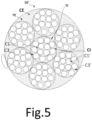
- the cable 50 and the extracted cable 50' are metallic and of the multi-strand type with two cylindrical layers.
- the layers of strands constituting the cable 50 or 50' are two in number, no more, no less.
- the outer layer CE is made up of L>1 outer strands TE wound around the inner layer Cl of the cable.
- the cable 50 also includes a hoop F not shown consisting of a single hoop wire.
- the 50' extracted cable has a surface breaking energy:
- Cp surface breaking energy
- the outer layer of cables 50 and 50' is saturated.
- the inter-strand distance E of the external strands is strictly less than 20 ⁇ m.
- E 0 ⁇ m.
- ⁇ f is greater than or equal to 0° and preferably greater than or equal to 5° and less than or equal to 25° and preferably less than or equal to 20°.
- ⁇ f 18.9°.
- ⁇ t is greater than or equal to 0° and preferably greater than or equal to 5° and less than or equal to 20°, preferably less than or equal to 15° and more preferably less than or equal to 10°.
- ⁇ t 9.1°.
- the outer layer C3 of each internal strand TI is desaturated.
- the interwire distance of the outer layer of the internal strand is greater than or equal to 15 ⁇ m, more preferably greater than or equal to 35 ⁇ m, even more preferably greater than or equal to 50 ⁇ m and very preferably greater than or equal to 60 ⁇ m and here equal to 61 ⁇ m.
- the sum SI3 of the interwire distances I3 of the outer layer C3 is greater than the diameter d3 of the outer wires F3 of the outer layer C3.
- Each internal and external wire of each internal strand TI has a diameter d1 and d3 respectively.
- Each internal metal wire F1 of each internal strand TI has a diameter d1 greater than or equal to the diameter d3 of each external metal wire F3 of each internal strand TI, preferably 1.00 ⁇ d1/d3 ⁇ 1.20.
- d1 and d3 range, independently of each other, from 0.25 mm to 0.50 mm, preferably from 0.30 mm to 0.45 mm and more preferably from 0.32 mm to 0.42 mm .
- the outer layer C3' of each outer strand TE is desaturated. Being desaturated, the interwire distance I3' of the external layer C3' separating on average the N' external wires is greater than or equal to 5 ⁇ m.
- the interwire distance I3' of the outer layer of each outer strand is greater than or equal to 15 ⁇ m, more preferably greater than or equal to 35 ⁇ m, even more preferably greater than or equal to 50 ⁇ m and very preferably greater than or equal to 60 ⁇ m and here equal to 61 ⁇ m.
- the sum SI3' of the interwire distances I3' of the external layer C3' is greater than the diameter d3' of the external wires F3' of the external layer C3'.
- Each internal and external layer C1', C3' of each external strand TE is wound in the same direction of winding of the cable and the internal and external layers C1, C3 of the internal strand TI.
- the direction of winding of each layer of the cable and the cable is Z.
- Each internal and external wire of each external strand TE has a diameter d1' and d3' respectively.
- Each internal metal wire F1' of each external strand TE has a diameter d1' greater than or equal to the diameter d3' of each external metal wire F3' of each external strand TE, preferably 1.00 ⁇ d1'/d3' ⁇ 1, 20.
- d1' and d3' range, independently of each other, from 0.25 mm to 0.50 mm, preferably from 0.30 mm to 0.45 mm and more preferably from 0.32 mm to 0. 42mm.
- At least 50% of the metal wires, preferably at least 60%, more preferably at least 70% of the metal wires, and very preferably each metal wire of the cable comprises a steel core having a composition conforming to standard NF EN 10020 of September 2000 and a carbon content C > 0.80% and preferably C ⁇ 0.82% and at least 50% of the metal wires, preferably at least 60%, more preferably at least 70% of the metal wires, and very preferably each metal wire of the cable comprises a steel core having a composition conforming to the standard NF EN 10020 of September 2000 and a carbon rate C ⁇ 1.20% and preferably C ⁇ 1.10%.
- Each wire has a breaking strength, noted Rm, such that 2500 ⁇ Rm ⁇ 3100 MPa.
- the steel of these wires is said to be SHT (“Super High Tensile”) grade.
- Other yarns can be used, for example yarns of a lower grade, for example of grade NT (“Normal Tensile”) or HT (“High Tensile”), as well as yarns of a higher grade, for example of grade UT (“ Ultra Tensile”) or MT (“Mega Tensile”).
- torque balancing we mean here in a manner well known to those skilled in the art profession the cancellation of the residual torques (or the elastic return of torsion) exerted on each wire of the strand, in the intermediate layer as in the outer layer.
- each strand is wound on one or more receiving reels, for storage, before the subsequent operation of assembling the elementary strands by wiring to obtain the multi-strand cable.
- the cable 50 is then incorporated by calendering into composite fabrics formed from a known composition based on natural rubber and carbon black as a reinforcing filler, conventionally used for the manufacture of crown reinforcements of radial tires.
- This composition essentially comprises, in addition to the elastomer and the reinforcing filler (carbon black), an antioxidant, stearic acid, an extension oil, cobalt naphthenate as an adhesion promoter, finally a vulcanization system (sulfur, accelerator, ZnO).
- the composite fabrics reinforced by these cables comprise a matrix of elastomeric composition formed of two thin layers of elastomeric composition which are superimposed on either side of the cables and which respectively have a thickness ranging from 1 and 4 mm.
- the calendering pitch (no laying of cables in the elastomeric composition fabric) ranges from 4 mm to 8 mm.
- Table 1 Cables 50 50' 60 IT Q/N 4/9 4/9 3/8 d1/d3 meaning 0.40/0.40 0.40/0.40 0.40/0.40 C1/pitch p1 (mm) Z/10 Z/10 Z/10 direction C3/p3 pitch (mm) Z/20 Z/20 Z/20 I3( ⁇ m/SI3(mm) 61/0.55 61/0.55 78/0.62 YOU Q'/N' 4/9 4/9 3/8 d1'/d3' 0.40/0.40 0.40/0.40 0.40/0.40 direction C1'/step p1'(mm) Z/10 Z/10 Z/10 direction C3'/not p3'(mm) Z/20 Z/20 Z/20 I3'( ⁇ m)/SI3'(mm) 61/0.55 61/0.55 78/0.62 Cable/pi/pe direction Z/inf/70 Z/inf/70 Z/inf/70 K 1 1 1 L 6
- Table 2 Cables EDT EDT Q/N 3/8 3/8 d1/d3 0.33/0.35 0.33/0.35 IT direction C1/step p1 (mm) Z/10 Z/10 direction C3/p3 pitch (mm) Z/20 Z/20 I3( ⁇ m)/SI3(mm) 53/0.42 53/0.42 YOU Q'/N' 3/9 3/9 d1'/d3' 0.29/0.29 0.29/0.29 direction C1'/step p1' (mm) Z/10 Z/10 direction C3'/step p3' (mm) Z/20 Z/20 I3'( ⁇ m)/SI3'(mm) 21/0.19 21/0.19 Cable/pi/pe direction Z/inf/70 Z/inf/70 K 1 1 L 6 6 E ( ⁇ m) 98 98 Fm (N) 223 223 D (mm) 3.7 3.7 Av
- Tables 1 and 2 show that the cables 50, 50' and 60 have an improved surface breaking energy compared to the cables of the state of the art EDT and EDT'.
- the EDT and EDT' cables have a relatively high weakening coefficient but a relatively low breaking force resulting in an insufficient surface breaking energy to reduce the number of ruptures and the number of perforations of the cables in the tire.
- the cables according to the invention have a surface breaking energy ES ⁇ 150 N.mm -1 sufficiently high to remedy these drawbacks.
Landscapes
- Ropes Or Cables (AREA)
- Tires In General (AREA)
- Engineering & Computer Science (AREA)
- Mechanical Engineering (AREA)
Applications Claiming Priority (2)
| Application Number | Priority Date | Filing Date | Title |
|---|---|---|---|
| FR1913078A FR3103500A1 (fr) | 2019-11-22 | 2019-11-22 | Câble multi-torons à deux couches à énergie de rupture surfacique améliorée |
| PCT/FR2020/051999 WO2021099712A1 (fr) | 2019-11-22 | 2020-11-05 | Câble multi-torons à deux couches à énergie de rupture surfacique améliorée |
Publications (2)
| Publication Number | Publication Date |
|---|---|
| EP4061996A1 EP4061996A1 (fr) | 2022-09-28 |
| EP4061996B1 true EP4061996B1 (fr) | 2024-01-03 |
Family
ID=70008659
Family Applications (1)
| Application Number | Title | Priority Date | Filing Date |
|---|---|---|---|
| EP20817463.1A Active EP4061996B1 (fr) | 2019-11-22 | 2020-11-05 | Câble multi-torons à deux couches à énergie de rupture surfacique améliorée |
Country Status (7)
| Country | Link |
|---|---|
| US (1) | US12163280B2 (https=) |
| EP (1) | EP4061996B1 (https=) |
| JP (1) | JP7737372B2 (https=) |
| KR (1) | KR102912171B1 (https=) |
| CN (1) | CN114729505B (https=) |
| FR (1) | FR3103500A1 (https=) |
| WO (1) | WO2021099712A1 (https=) |
Families Citing this family (5)
| Publication number | Priority date | Publication date | Assignee | Title |
|---|---|---|---|---|
| FR3111921B1 (fr) * | 2020-06-24 | 2022-06-17 | Michelin & Cie | Câble multi-torons à deux couches à endurance sous flexion améliorée |
| FR3111923B1 (fr) | 2020-06-24 | 2022-06-17 | Michelin & Cie | Câble multi-torons à deux couches à endurance sous flexion améliorée |
| FR3122672A1 (fr) * | 2021-05-07 | 2022-11-11 | Compagnie Generale Des Etablissements Michelin | Câble multi-torons à deux couches à énergie de rupture surfacique améliorée |
| FR3122677B1 (fr) * | 2021-05-07 | 2024-07-12 | Michelin & Cie | Câble multi-torons à deux couches à énergie de rupture surfacique améliorée |
| FR3122676B1 (fr) * | 2021-05-07 | 2024-07-12 | Michelin & Cie | Câble multi-torons à deux couches à énergie de rupture surfacique améliorée |
Family Cites Families (34)
| Publication number | Priority date | Publication date | Assignee | Title |
|---|---|---|---|---|
| FR2419181A1 (fr) | 1978-03-10 | 1979-10-05 | Michelin & Cie | Perfectionnements aux pneumatiques a carcasse radiale |
| FR2419182A1 (fr) | 1978-03-10 | 1979-10-05 | Michelin & Cie | Pneumatique a carcasse radiale, notamment pour engins de genie civil |
| JPH06173179A (ja) * | 1992-12-01 | 1994-06-21 | Bridgestone Corp | ゴム物品補強用スチールコード |
| CA2109904C (en) * | 1992-12-18 | 2004-09-14 | Pol Bruyneel | Multi-strand steel cord |
| JP2971058B1 (ja) * | 1998-05-15 | 1999-11-02 | 住友ゴム工業株式会社 | 重荷重用ラジアルタイヤ |
| WO2001034900A1 (en) * | 1999-11-11 | 2001-05-17 | Bridgestone Corporation | Rubber article-reinforcing steel cord and tire |
| US6272830B1 (en) * | 2000-02-18 | 2001-08-14 | The Goodyear Tire & Rubber Company | Steel cord for reinforcing elastomeric articles |
| RU2191705C2 (ru) * | 2000-12-21 | 2002-10-27 | Общество с ограниченной ответственностью Научно-производственный и коммерческий центр "ВЕСКОМ" | Покрышка пневматической шины |
| RU2263731C2 (ru) * | 2003-08-19 | 2005-11-10 | Республиканское Унитарное Предприятие "Белорусский Металлургический Завод" | Компактный нерасслаивающийся металлокорд |
| JP2009242983A (ja) * | 2008-03-31 | 2009-10-22 | Kanai Hiroaki | ゴム製品補強用スチールコード、空気入りタイヤおよびゴムクローラー |
| WO2010060878A1 (en) * | 2008-11-25 | 2010-06-03 | Nv Bekaert Sa | Off-the-road steel cord with crimped strands |
| US20110253279A1 (en) * | 2008-12-22 | 2011-10-20 | Guido Luigi Daghini | Tyre reinforced with steel cords comprising fine filaments |
| FR2947574B1 (fr) * | 2009-07-03 | 2012-11-09 | Michelin Soc Tech | Cable multitorons dont les torons elementaires sont des cables a deux couches gommes in situ. |
| FR2947575B1 (fr) * | 2009-07-03 | 2011-08-19 | Michelin Soc Tech | Cable multitorons dont les torons elementaires sont des cables a deux couches gommes in situ. |
| WO2011116493A1 (en) * | 2010-03-23 | 2011-09-29 | Nv Bekaert Sa | Open off-the-road cord with preformed filaments |
| FR2959517B1 (fr) * | 2010-04-28 | 2012-09-21 | Michelin Soc Tech | Cable metallique multitorons elastique a haute permeabilite. |
| FR2990962B1 (fr) * | 2012-05-25 | 2014-06-27 | Michelin & Cie | Procede de fabrication d'un cable metallique multi-torons a deux couches. |
| FR2990963B1 (fr) * | 2012-05-25 | 2014-12-05 | Michelin & Cie | Cable metallique multi-torons a deux couches. |
| US9441325B2 (en) * | 2012-10-04 | 2016-09-13 | The Goodyear Tire & Rubber Company | Atmospheric plasma treatment of reinforcement cords and use in rubber articles |
| FR3020016B1 (fr) * | 2014-04-22 | 2016-04-01 | Michelin & Cie | Pneumatique pour vehicule industriel lourd |
| JP6689747B2 (ja) * | 2014-07-28 | 2020-04-28 | 株式会社ブリヂストン | ゴム物品補強用スチールコード |
| ES2743486T5 (es) | 2014-07-28 | 2023-04-10 | Bridgestone Corp | Cable de acero para reforzar un artículo de caucho |
| FR3017885A1 (fr) * | 2015-06-16 | 2015-08-28 | Michelin & Cie | Cable metallique multi-torons |
| FR3060617A1 (fr) * | 2016-12-20 | 2018-06-22 | Compagnie Generale Des Etablissements Michelin | Cable multi-torons a deux couches a penetrabilite amelioree |
| FR3060616A1 (fr) * | 2016-12-20 | 2018-06-22 | Compagnie Generale Des Etablissements Michelin | Cable multi-torons a deux couches a penetrabilite amelioree |
| US20190184749A1 (en) * | 2017-12-15 | 2019-06-20 | Toyo Tire & Rubber Co., Ltd. | Pneumatic tire |
| CN111684127A (zh) * | 2017-12-19 | 2020-09-18 | 米其林集团总公司 | 具有极低、低和中等的模量的双层多线股帘线 |
| US11346049B2 (en) * | 2017-12-19 | 2022-05-31 | Compagnie Generale Des Etablissements Michelin | Two-layer multi-strand cords having very low, low and medium moduli |
| CN111492106B (zh) * | 2017-12-19 | 2022-03-29 | 米其林集团总公司 | 具有极低、低和中等的模量的双层多线股帘线 |
| JP7308834B2 (ja) * | 2017-12-19 | 2023-07-14 | コンパニー ゼネラール デ エタブリッスマン ミシュラン | 超低、低、及び中程度の弾性率を有する2層マルチストランドコード |
| EP3728730B1 (fr) * | 2017-12-19 | 2022-06-29 | Compagnie Générale des Etablissements Michelin | Câbles multi-torons à deux couches à très bas, bas et moyen modules |
| CN208219266U (zh) * | 2018-04-28 | 2018-12-11 | 江苏巨力钢绳有限公司 | 一种耐高温防断裂钢丝绳 |
| FR3111923B1 (fr) * | 2020-06-24 | 2022-06-17 | Michelin & Cie | Câble multi-torons à deux couches à endurance sous flexion améliorée |
| FR3111921B1 (fr) * | 2020-06-24 | 2022-06-17 | Michelin & Cie | Câble multi-torons à deux couches à endurance sous flexion améliorée |
-
2019
- 2019-11-22 FR FR1913078A patent/FR3103500A1/fr not_active Withdrawn
-
2020
- 2020-11-05 US US17/778,687 patent/US12163280B2/en active Active
- 2020-11-05 WO PCT/FR2020/051999 patent/WO2021099712A1/fr not_active Ceased
- 2020-11-05 JP JP2022529028A patent/JP7737372B2/ja active Active
- 2020-11-05 CN CN202080080845.XA patent/CN114729505B/zh active Active
- 2020-11-05 KR KR1020227019269A patent/KR102912171B1/ko active Active
- 2020-11-05 EP EP20817463.1A patent/EP4061996B1/fr active Active
Also Published As
| Publication number | Publication date |
|---|---|
| US20220412000A1 (en) | 2022-12-29 |
| EP4061996A1 (fr) | 2022-09-28 |
| KR20220098374A (ko) | 2022-07-12 |
| JP2023503055A (ja) | 2023-01-26 |
| US12163280B2 (en) | 2024-12-10 |
| JP7737372B2 (ja) | 2025-09-10 |
| CN114729505A (zh) | 2022-07-08 |
| FR3103500A1 (fr) | 2021-05-28 |
| WO2021099712A1 (fr) | 2021-05-27 |
| CN114729505B (zh) | 2023-06-23 |
| KR102912171B1 (ko) | 2026-01-16 |
Similar Documents
| Publication | Publication Date | Title |
|---|---|---|
| EP4061996B1 (fr) | Câble multi-torons à deux couches à énergie de rupture surfacique améliorée | |
| EP4172406B1 (fr) | Câble multi-torons à deux couches à endurance sous flexion améliorée | |
| EP4172407B1 (fr) | Câble multi-torons à deux couches à endurance sous flexion améliorée | |
| EP4172408B1 (fr) | Câble multi-torons à deux couches à endurance sous flexion améliorée | |
| EP4172405B1 (fr) | Câble multi-torons à deux couches à endurance sous flexion améliorée | |
| EP4334523B1 (fr) | Câble multi-torons à deux couches à énergie de rupture surfacique améliorée | |
| EP4334141B1 (fr) | Câble multi-torons à deux couches à énergie de rupture surfacique améliorée | |
| EP4334524B1 (fr) | Câble multi-torons à deux couches à énergie de rupture surfacique améliorée | |
| EP4540455B1 (fr) | Câble multi-torons à deux couches de multi-torons | |
| FR3122674A1 (fr) | Câble multi-torons à deux couches à énergie de rupture surfacique améliorée | |
| FR3122678A1 (fr) | Câble multi-torons à deux couches à énergie de rupture surfacique améliorée | |
| FR3122675A1 (fr) | Câble multi-torons à deux couches à énergie de rupture surfacique améliorée | |
| FR3122673A1 (fr) | Câble multi-torons à deux couches à énergie de rupture surfacique améliorée | |
| FR3130858A1 (fr) | Câble multi-torons à deux couches à endurance sous flexion améliorée | |
| WO2025008148A1 (fr) | Câble multi-torons à deux couches de multi-torons | |
| WO2025008147A1 (fr) | Câble multi-torons à deux couches de multi-torons | |
| FR3136788A1 (fr) | Câble multi-torons à deux couches de multi-torons | |
| EP4540457A1 (fr) | Câble multi-torons à deux couches de multi-torons | |
| EP4240897A1 (fr) | Câble multi-torons à deux couches avec couche interne gainée à pénétrabilité améliorée |
Legal Events
| Date | Code | Title | Description |
|---|---|---|---|
| STAA | Information on the status of an ep patent application or granted ep patent |
Free format text: STATUS: UNKNOWN |
|
| STAA | Information on the status of an ep patent application or granted ep patent |
Free format text: STATUS: THE INTERNATIONAL PUBLICATION HAS BEEN MADE |
|
| PUAI | Public reference made under article 153(3) epc to a published international application that has entered the european phase |
Free format text: ORIGINAL CODE: 0009012 |
|
| STAA | Information on the status of an ep patent application or granted ep patent |
Free format text: STATUS: REQUEST FOR EXAMINATION WAS MADE |
|
| 17P | Request for examination filed |
Effective date: 20220622 |
|
| AK | Designated contracting states |
Kind code of ref document: A1 Designated state(s): AL AT BE BG CH CY CZ DE DK EE ES FI FR GB GR HR HU IE IS IT LI LT LU LV MC MK MT NL NO PL PT RO RS SE SI SK SM TR |
|
| DAV | Request for validation of the european patent (deleted) | ||
| DAX | Request for extension of the european patent (deleted) | ||
| GRAJ | Information related to disapproval of communication of intention to grant by the applicant or resumption of examination proceedings by the epo deleted |
Free format text: ORIGINAL CODE: EPIDOSDIGR1 |
|
| STAA | Information on the status of an ep patent application or granted ep patent |
Free format text: STATUS: GRANT OF PATENT IS INTENDED |
|
| GRAP | Despatch of communication of intention to grant a patent |
Free format text: ORIGINAL CODE: EPIDOSNIGR1 |
|
| INTG | Intention to grant announced |
Effective date: 20230719 |
|
| GRAS | Grant fee paid |
Free format text: ORIGINAL CODE: EPIDOSNIGR3 |
|
| GRAA | (expected) grant |
Free format text: ORIGINAL CODE: 0009210 |
|
| STAA | Information on the status of an ep patent application or granted ep patent |
Free format text: STATUS: THE PATENT HAS BEEN GRANTED |
|
| AK | Designated contracting states |
Kind code of ref document: B1 Designated state(s): AL AT BE BG CH CY CZ DE DK EE ES FI FR GB GR HR HU IE IS IT LI LT LU LV MC MK MT NL NO PL PT RO RS SE SI SK SM TR |
|
| REG | Reference to a national code |
Ref country code: GB Ref legal event code: FG4D Free format text: NOT ENGLISH |
|
| REG | Reference to a national code |
Ref country code: CH Ref legal event code: EP |
|
| REG | Reference to a national code |
Ref country code: DE Ref legal event code: R096 Ref document number: 602020023973 Country of ref document: DE |
|
| REG | Reference to a national code |
Ref country code: IE Ref legal event code: FG4D Free format text: LANGUAGE OF EP DOCUMENT: FRENCH |
|
| REG | Reference to a national code |
Ref country code: LT Ref legal event code: MG9D |
|
| PG25 | Lapsed in a contracting state [announced via postgrant information from national office to epo] |
Ref country code: ES Free format text: LAPSE BECAUSE OF FAILURE TO SUBMIT A TRANSLATION OF THE DESCRIPTION OR TO PAY THE FEE WITHIN THE PRESCRIBED TIME-LIMIT Effective date: 20240103 |
|
| PG25 | Lapsed in a contracting state [announced via postgrant information from national office to epo] |
Ref country code: ES Free format text: LAPSE BECAUSE OF FAILURE TO SUBMIT A TRANSLATION OF THE DESCRIPTION OR TO PAY THE FEE WITHIN THE PRESCRIBED TIME-LIMIT Effective date: 20240103 |
|
| REG | Reference to a national code |
Ref country code: NL Ref legal event code: MP Effective date: 20240103 |
|
| REG | Reference to a national code |
Ref country code: AT Ref legal event code: MK05 Ref document number: 1646887 Country of ref document: AT Kind code of ref document: T Effective date: 20240103 |
|
| PG25 | Lapsed in a contracting state [announced via postgrant information from national office to epo] |
Ref country code: NL Free format text: LAPSE BECAUSE OF FAILURE TO SUBMIT A TRANSLATION OF THE DESCRIPTION OR TO PAY THE FEE WITHIN THE PRESCRIBED TIME-LIMIT Effective date: 20240103 |
|
| PG25 | Lapsed in a contracting state [announced via postgrant information from national office to epo] |
Ref country code: NL Free format text: LAPSE BECAUSE OF FAILURE TO SUBMIT A TRANSLATION OF THE DESCRIPTION OR TO PAY THE FEE WITHIN THE PRESCRIBED TIME-LIMIT Effective date: 20240103 |
|
| PG25 | Lapsed in a contracting state [announced via postgrant information from national office to epo] |
Ref country code: IS Free format text: LAPSE BECAUSE OF FAILURE TO SUBMIT A TRANSLATION OF THE DESCRIPTION OR TO PAY THE FEE WITHIN THE PRESCRIBED TIME-LIMIT Effective date: 20240503 |
|
| PG25 | Lapsed in a contracting state [announced via postgrant information from national office to epo] |
Ref country code: LT Free format text: LAPSE BECAUSE OF FAILURE TO SUBMIT A TRANSLATION OF THE DESCRIPTION OR TO PAY THE FEE WITHIN THE PRESCRIBED TIME-LIMIT Effective date: 20240103 |
|
| PG25 | Lapsed in a contracting state [announced via postgrant information from national office to epo] |
Ref country code: GR Free format text: LAPSE BECAUSE OF FAILURE TO SUBMIT A TRANSLATION OF THE DESCRIPTION OR TO PAY THE FEE WITHIN THE PRESCRIBED TIME-LIMIT Effective date: 20240404 |
|
| PG25 | Lapsed in a contracting state [announced via postgrant information from national office to epo] |
Ref country code: HR Free format text: LAPSE BECAUSE OF FAILURE TO SUBMIT A TRANSLATION OF THE DESCRIPTION OR TO PAY THE FEE WITHIN THE PRESCRIBED TIME-LIMIT Effective date: 20240103 Ref country code: RS Free format text: LAPSE BECAUSE OF FAILURE TO SUBMIT A TRANSLATION OF THE DESCRIPTION OR TO PAY THE FEE WITHIN THE PRESCRIBED TIME-LIMIT Effective date: 20240403 |
|
| PG25 | Lapsed in a contracting state [announced via postgrant information from national office to epo] |
Ref country code: CZ Free format text: LAPSE BECAUSE OF FAILURE TO SUBMIT A TRANSLATION OF THE DESCRIPTION OR TO PAY THE FEE WITHIN THE PRESCRIBED TIME-LIMIT Effective date: 20240103 Ref country code: AT Free format text: LAPSE BECAUSE OF FAILURE TO SUBMIT A TRANSLATION OF THE DESCRIPTION OR TO PAY THE FEE WITHIN THE PRESCRIBED TIME-LIMIT Effective date: 20240103 |
|
| PG25 | Lapsed in a contracting state [announced via postgrant information from national office to epo] |
Ref country code: RS Free format text: LAPSE BECAUSE OF FAILURE TO SUBMIT A TRANSLATION OF THE DESCRIPTION OR TO PAY THE FEE WITHIN THE PRESCRIBED TIME-LIMIT Effective date: 20240403 Ref country code: NO Free format text: LAPSE BECAUSE OF FAILURE TO SUBMIT A TRANSLATION OF THE DESCRIPTION OR TO PAY THE FEE WITHIN THE PRESCRIBED TIME-LIMIT Effective date: 20240403 Ref country code: LT Free format text: LAPSE BECAUSE OF FAILURE TO SUBMIT A TRANSLATION OF THE DESCRIPTION OR TO PAY THE FEE WITHIN THE PRESCRIBED TIME-LIMIT Effective date: 20240103 Ref country code: IS Free format text: LAPSE BECAUSE OF FAILURE TO SUBMIT A TRANSLATION OF THE DESCRIPTION OR TO PAY THE FEE WITHIN THE PRESCRIBED TIME-LIMIT Effective date: 20240503 Ref country code: HR Free format text: LAPSE BECAUSE OF FAILURE TO SUBMIT A TRANSLATION OF THE DESCRIPTION OR TO PAY THE FEE WITHIN THE PRESCRIBED TIME-LIMIT Effective date: 20240103 Ref country code: GR Free format text: LAPSE BECAUSE OF FAILURE TO SUBMIT A TRANSLATION OF THE DESCRIPTION OR TO PAY THE FEE WITHIN THE PRESCRIBED TIME-LIMIT Effective date: 20240404 Ref country code: CZ Free format text: LAPSE BECAUSE OF FAILURE TO SUBMIT A TRANSLATION OF THE DESCRIPTION OR TO PAY THE FEE WITHIN THE PRESCRIBED TIME-LIMIT Effective date: 20240103 Ref country code: BG Free format text: LAPSE BECAUSE OF FAILURE TO SUBMIT A TRANSLATION OF THE DESCRIPTION OR TO PAY THE FEE WITHIN THE PRESCRIBED TIME-LIMIT Effective date: 20240103 Ref country code: AT Free format text: LAPSE BECAUSE OF FAILURE TO SUBMIT A TRANSLATION OF THE DESCRIPTION OR TO PAY THE FEE WITHIN THE PRESCRIBED TIME-LIMIT Effective date: 20240103 |
|
| PG25 | Lapsed in a contracting state [announced via postgrant information from national office to epo] |
Ref country code: PL Free format text: LAPSE BECAUSE OF FAILURE TO SUBMIT A TRANSLATION OF THE DESCRIPTION OR TO PAY THE FEE WITHIN THE PRESCRIBED TIME-LIMIT Effective date: 20240103 Ref country code: PT Free format text: LAPSE BECAUSE OF FAILURE TO SUBMIT A TRANSLATION OF THE DESCRIPTION OR TO PAY THE FEE WITHIN THE PRESCRIBED TIME-LIMIT Effective date: 20240503 |
|
| PG25 | Lapsed in a contracting state [announced via postgrant information from national office to epo] |
Ref country code: SE Free format text: LAPSE BECAUSE OF FAILURE TO SUBMIT A TRANSLATION OF THE DESCRIPTION OR TO PAY THE FEE WITHIN THE PRESCRIBED TIME-LIMIT Effective date: 20240103 Ref country code: PT Free format text: LAPSE BECAUSE OF FAILURE TO SUBMIT A TRANSLATION OF THE DESCRIPTION OR TO PAY THE FEE WITHIN THE PRESCRIBED TIME-LIMIT Effective date: 20240503 Ref country code: PL Free format text: LAPSE BECAUSE OF FAILURE TO SUBMIT A TRANSLATION OF THE DESCRIPTION OR TO PAY THE FEE WITHIN THE PRESCRIBED TIME-LIMIT Effective date: 20240103 Ref country code: LV Free format text: LAPSE BECAUSE OF FAILURE TO SUBMIT A TRANSLATION OF THE DESCRIPTION OR TO PAY THE FEE WITHIN THE PRESCRIBED TIME-LIMIT Effective date: 20240103 |
|
| REG | Reference to a national code |
Ref country code: DE Ref legal event code: R097 Ref document number: 602020023973 Country of ref document: DE |
|
| PG25 | Lapsed in a contracting state [announced via postgrant information from national office to epo] |
Ref country code: DK Free format text: LAPSE BECAUSE OF FAILURE TO SUBMIT A TRANSLATION OF THE DESCRIPTION OR TO PAY THE FEE WITHIN THE PRESCRIBED TIME-LIMIT Effective date: 20240103 |
|
| PG25 | Lapsed in a contracting state [announced via postgrant information from national office to epo] |
Ref country code: SM Free format text: LAPSE BECAUSE OF FAILURE TO SUBMIT A TRANSLATION OF THE DESCRIPTION OR TO PAY THE FEE WITHIN THE PRESCRIBED TIME-LIMIT Effective date: 20240103 |
|
| PG25 | Lapsed in a contracting state [announced via postgrant information from national office to epo] |
Ref country code: EE Free format text: LAPSE BECAUSE OF FAILURE TO SUBMIT A TRANSLATION OF THE DESCRIPTION OR TO PAY THE FEE WITHIN THE PRESCRIBED TIME-LIMIT Effective date: 20240103 |
|
| PG25 | Lapsed in a contracting state [announced via postgrant information from national office to epo] |
Ref country code: SK Free format text: LAPSE BECAUSE OF FAILURE TO SUBMIT A TRANSLATION OF THE DESCRIPTION OR TO PAY THE FEE WITHIN THE PRESCRIBED TIME-LIMIT Effective date: 20240103 |
|
| PG25 | Lapsed in a contracting state [announced via postgrant information from national office to epo] |
Ref country code: SM Free format text: LAPSE BECAUSE OF FAILURE TO SUBMIT A TRANSLATION OF THE DESCRIPTION OR TO PAY THE FEE WITHIN THE PRESCRIBED TIME-LIMIT Effective date: 20240103 Ref country code: SK Free format text: LAPSE BECAUSE OF FAILURE TO SUBMIT A TRANSLATION OF THE DESCRIPTION OR TO PAY THE FEE WITHIN THE PRESCRIBED TIME-LIMIT Effective date: 20240103 Ref country code: RO Free format text: LAPSE BECAUSE OF FAILURE TO SUBMIT A TRANSLATION OF THE DESCRIPTION OR TO PAY THE FEE WITHIN THE PRESCRIBED TIME-LIMIT Effective date: 20240103 Ref country code: EE Free format text: LAPSE BECAUSE OF FAILURE TO SUBMIT A TRANSLATION OF THE DESCRIPTION OR TO PAY THE FEE WITHIN THE PRESCRIBED TIME-LIMIT Effective date: 20240103 Ref country code: DK Free format text: LAPSE BECAUSE OF FAILURE TO SUBMIT A TRANSLATION OF THE DESCRIPTION OR TO PAY THE FEE WITHIN THE PRESCRIBED TIME-LIMIT Effective date: 20240103 |
|
| PLBE | No opposition filed within time limit |
Free format text: ORIGINAL CODE: 0009261 |
|
| STAA | Information on the status of an ep patent application or granted ep patent |
Free format text: STATUS: NO OPPOSITION FILED WITHIN TIME LIMIT |
|
| PG25 | Lapsed in a contracting state [announced via postgrant information from national office to epo] |
Ref country code: IT Free format text: LAPSE BECAUSE OF FAILURE TO SUBMIT A TRANSLATION OF THE DESCRIPTION OR TO PAY THE FEE WITHIN THE PRESCRIBED TIME-LIMIT Effective date: 20240103 |
|
| 26N | No opposition filed |
Effective date: 20241007 |
|
| PG25 | Lapsed in a contracting state [announced via postgrant information from national office to epo] |
Ref country code: IT Free format text: LAPSE BECAUSE OF FAILURE TO SUBMIT A TRANSLATION OF THE DESCRIPTION OR TO PAY THE FEE WITHIN THE PRESCRIBED TIME-LIMIT Effective date: 20240103 |
|
| PG25 | Lapsed in a contracting state [announced via postgrant information from national office to epo] |
Ref country code: SI Free format text: LAPSE BECAUSE OF FAILURE TO SUBMIT A TRANSLATION OF THE DESCRIPTION OR TO PAY THE FEE WITHIN THE PRESCRIBED TIME-LIMIT Effective date: 20240103 |
|
| REG | Reference to a national code |
Ref country code: CH Ref legal event code: PL |
|
| PG25 | Lapsed in a contracting state [announced via postgrant information from national office to epo] |
Ref country code: MC Free format text: LAPSE BECAUSE OF FAILURE TO SUBMIT A TRANSLATION OF THE DESCRIPTION OR TO PAY THE FEE WITHIN THE PRESCRIBED TIME-LIMIT Effective date: 20240103 |
|
| PG25 | Lapsed in a contracting state [announced via postgrant information from national office to epo] |
Ref country code: LU Free format text: LAPSE BECAUSE OF NON-PAYMENT OF DUE FEES Effective date: 20241105 |
|
| REG | Reference to a national code |
Ref country code: CH Ref legal event code: PL |
|
| GBPC | Gb: european patent ceased through non-payment of renewal fee |
Effective date: 20241105 |
|
| PG25 | Lapsed in a contracting state [announced via postgrant information from national office to epo] |
Ref country code: CH Free format text: LAPSE BECAUSE OF NON-PAYMENT OF DUE FEES Effective date: 20241130 |
|
| REG | Reference to a national code |
Ref country code: BE Ref legal event code: MM Effective date: 20241130 |
|
| PG25 | Lapsed in a contracting state [announced via postgrant information from national office to epo] |
Ref country code: FI Free format text: LAPSE BECAUSE OF FAILURE TO SUBMIT A TRANSLATION OF THE DESCRIPTION OR TO PAY THE FEE WITHIN THE PRESCRIBED TIME-LIMIT Effective date: 20240103 |
|
| PG25 | Lapsed in a contracting state [announced via postgrant information from national office to epo] |
Ref country code: GB Free format text: LAPSE BECAUSE OF NON-PAYMENT OF DUE FEES Effective date: 20241105 Ref country code: BE Free format text: LAPSE BECAUSE OF NON-PAYMENT OF DUE FEES Effective date: 20241130 |
|
| PG25 | Lapsed in a contracting state [announced via postgrant information from national office to epo] |
Ref country code: IE Free format text: LAPSE BECAUSE OF NON-PAYMENT OF DUE FEES Effective date: 20241105 |
|
| PGFP | Annual fee paid to national office [announced via postgrant information from national office to epo] |
Ref country code: DE Payment date: 20251119 Year of fee payment: 6 |
|
| PGFP | Annual fee paid to national office [announced via postgrant information from national office to epo] |
Ref country code: FR Payment date: 20251126 Year of fee payment: 6 |
|
| PG25 | Lapsed in a contracting state [announced via postgrant information from national office to epo] |
Ref country code: HU Free format text: LAPSE BECAUSE OF FAILURE TO SUBMIT A TRANSLATION OF THE DESCRIPTION OR TO PAY THE FEE WITHIN THE PRESCRIBED TIME-LIMIT; INVALID AB INITIO Effective date: 20201105 |
|
| PG25 | Lapsed in a contracting state [announced via postgrant information from national office to epo] |
Ref country code: CY Free format text: LAPSE BECAUSE OF FAILURE TO SUBMIT A TRANSLATION OF THE DESCRIPTION OR TO PAY THE FEE WITHIN THE PRESCRIBED TIME-LIMIT; INVALID AB INITIO Effective date: 20201105 |