EP4052322B1 - Batteriemodul mit überwachung des thermischen durchgehens von einzelnen zellen - Google Patents
Batteriemodul mit überwachung des thermischen durchgehens von einzelnen zellen Download PDFInfo
- Publication number
- EP4052322B1 EP4052322B1 EP20796524.5A EP20796524A EP4052322B1 EP 4052322 B1 EP4052322 B1 EP 4052322B1 EP 20796524 A EP20796524 A EP 20796524A EP 4052322 B1 EP4052322 B1 EP 4052322B1
- Authority
- EP
- European Patent Office
- Prior art keywords
- battery
- module
- sensor
- housing part
- accumulators
- Prior art date
- Legal status (The legal status is an assumption and is not a legal conclusion. Google has not performed a legal analysis and makes no representation as to the accuracy of the status listed.)
- Active
Links
Images


Classifications
-
- H—ELECTRICITY
- H01—ELECTRIC ELEMENTS
- H01M—PROCESSES OR MEANS, e.g. BATTERIES, FOR THE DIRECT CONVERSION OF CHEMICAL ENERGY INTO ELECTRICAL ENERGY
- H01M50/00—Constructional details or processes of manufacture of the non-active parts of electrochemical cells other than fuel cells, e.g. hybrid cells
- H01M50/30—Arrangements for facilitating escape of gases
- H01M50/342—Non-re-sealable arrangements
- H01M50/3425—Non-re-sealable arrangements in the form of rupturable membranes or weakened parts, e.g. pierced with the aid of a sharp member
-
- H—ELECTRICITY
- H01—ELECTRIC ELEMENTS
- H01M—PROCESSES OR MEANS, e.g. BATTERIES, FOR THE DIRECT CONVERSION OF CHEMICAL ENERGY INTO ELECTRICAL ENERGY
- H01M10/00—Secondary cells; Manufacture thereof
- H01M10/42—Methods or arrangements for servicing or maintenance of secondary cells or secondary half-cells
- H01M10/48—Accumulators combined with arrangements for measuring, testing or indicating the condition of cells, e.g. the level or density of the electrolyte
-
- H—ELECTRICITY
- H01—ELECTRIC ELEMENTS
- H01M—PROCESSES OR MEANS, e.g. BATTERIES, FOR THE DIRECT CONVERSION OF CHEMICAL ENERGY INTO ELECTRICAL ENERGY
- H01M10/00—Secondary cells; Manufacture thereof
- H01M10/42—Methods or arrangements for servicing or maintenance of secondary cells or secondary half-cells
- H01M10/48—Accumulators combined with arrangements for measuring, testing or indicating the condition of cells, e.g. the level or density of the electrolyte
- H01M10/486—Accumulators combined with arrangements for measuring, testing or indicating the condition of cells, e.g. the level or density of the electrolyte for measuring temperature
-
- H—ELECTRICITY
- H01—ELECTRIC ELEMENTS
- H01M—PROCESSES OR MEANS, e.g. BATTERIES, FOR THE DIRECT CONVERSION OF CHEMICAL ENERGY INTO ELECTRICAL ENERGY
- H01M50/00—Constructional details or processes of manufacture of the non-active parts of electrochemical cells other than fuel cells, e.g. hybrid cells
- H01M50/20—Mountings; Secondary casings or frames; Racks, modules or packs; Suspension devices; Shock absorbers; Transport or carrying devices; Holders
- H01M50/204—Racks, modules or packs for multiple batteries or multiple cells
- H01M50/207—Racks, modules or packs for multiple batteries or multiple cells characterised by their shape
- H01M50/213—Racks, modules or packs for multiple batteries or multiple cells characterised by their shape adapted for cells having curved cross-section, e.g. round or elliptic
-
- H—ELECTRICITY
- H01—ELECTRIC ELEMENTS
- H01M—PROCESSES OR MEANS, e.g. BATTERIES, FOR THE DIRECT CONVERSION OF CHEMICAL ENERGY INTO ELECTRICAL ENERGY
- H01M50/00—Constructional details or processes of manufacture of the non-active parts of electrochemical cells other than fuel cells, e.g. hybrid cells
- H01M50/20—Mountings; Secondary casings or frames; Racks, modules or packs; Suspension devices; Shock absorbers; Transport or carrying devices; Holders
- H01M50/218—Mountings; Secondary casings or frames; Racks, modules or packs; Suspension devices; Shock absorbers; Transport or carrying devices; Holders characterised by the material
- H01M50/22—Mountings; Secondary casings or frames; Racks, modules or packs; Suspension devices; Shock absorbers; Transport or carrying devices; Holders characterised by the material of the casings or racks
- H01M50/227—Organic material
-
- H—ELECTRICITY
- H01—ELECTRIC ELEMENTS
- H01M—PROCESSES OR MEANS, e.g. BATTERIES, FOR THE DIRECT CONVERSION OF CHEMICAL ENERGY INTO ELECTRICAL ENERGY
- H01M50/00—Constructional details or processes of manufacture of the non-active parts of electrochemical cells other than fuel cells, e.g. hybrid cells
- H01M50/20—Mountings; Secondary casings or frames; Racks, modules or packs; Suspension devices; Shock absorbers; Transport or carrying devices; Holders
- H01M50/249—Mountings; Secondary casings or frames; Racks, modules or packs; Suspension devices; Shock absorbers; Transport or carrying devices; Holders specially adapted for aircraft or vehicles, e.g. cars or trains
-
- H—ELECTRICITY
- H01—ELECTRIC ELEMENTS
- H01M—PROCESSES OR MEANS, e.g. BATTERIES, FOR THE DIRECT CONVERSION OF CHEMICAL ENERGY INTO ELECTRICAL ENERGY
- H01M50/00—Constructional details or processes of manufacture of the non-active parts of electrochemical cells other than fuel cells, e.g. hybrid cells
- H01M50/20—Mountings; Secondary casings or frames; Racks, modules or packs; Suspension devices; Shock absorbers; Transport or carrying devices; Holders
- H01M50/289—Mountings; Secondary casings or frames; Racks, modules or packs; Suspension devices; Shock absorbers; Transport or carrying devices; Holders characterised by spacing elements or positioning means within frames, racks or packs
- H01M50/293—Mountings; Secondary casings or frames; Racks, modules or packs; Suspension devices; Shock absorbers; Transport or carrying devices; Holders characterised by spacing elements or positioning means within frames, racks or packs characterised by the material
-
- H—ELECTRICITY
- H01—ELECTRIC ELEMENTS
- H01M—PROCESSES OR MEANS, e.g. BATTERIES, FOR THE DIRECT CONVERSION OF CHEMICAL ENERGY INTO ELECTRICAL ENERGY
- H01M50/00—Constructional details or processes of manufacture of the non-active parts of electrochemical cells other than fuel cells, e.g. hybrid cells
- H01M50/30—Arrangements for facilitating escape of gases
- H01M50/35—Gas exhaust passages comprising elongated, tortuous or labyrinth-shaped exhaust passages
- H01M50/367—Internal gas exhaust passages forming part of the battery cover or case; Double cover vent systems
-
- H—ELECTRICITY
- H01—ELECTRIC ELEMENTS
- H01M—PROCESSES OR MEANS, e.g. BATTERIES, FOR THE DIRECT CONVERSION OF CHEMICAL ENERGY INTO ELECTRICAL ENERGY
- H01M50/00—Constructional details or processes of manufacture of the non-active parts of electrochemical cells other than fuel cells, e.g. hybrid cells
- H01M50/50—Current conducting connections for cells or batteries
- H01M50/528—Fixed electrical connections, i.e. not intended for disconnection
- H01M50/529—Intercell connections through partitions, e.g. in a battery casing
-
- H—ELECTRICITY
- H01—ELECTRIC ELEMENTS
- H01M—PROCESSES OR MEANS, e.g. BATTERIES, FOR THE DIRECT CONVERSION OF CHEMICAL ENERGY INTO ELECTRICAL ENERGY
- H01M50/00—Constructional details or processes of manufacture of the non-active parts of electrochemical cells other than fuel cells, e.g. hybrid cells
- H01M50/50—Current conducting connections for cells or batteries
- H01M50/572—Means for preventing undesired use or discharge
- H01M50/574—Devices or arrangements for the interruption of current
- H01M50/578—Devices or arrangements for the interruption of current in response to pressure
-
- H—ELECTRICITY
- H01—ELECTRIC ELEMENTS
- H01M—PROCESSES OR MEANS, e.g. BATTERIES, FOR THE DIRECT CONVERSION OF CHEMICAL ENERGY INTO ELECTRICAL ENERGY
- H01M50/00—Constructional details or processes of manufacture of the non-active parts of electrochemical cells other than fuel cells, e.g. hybrid cells
- H01M50/50—Current conducting connections for cells or batteries
- H01M50/572—Means for preventing undesired use or discharge
- H01M50/574—Devices or arrangements for the interruption of current
- H01M50/581—Devices or arrangements for the interruption of current in response to temperature
-
- H—ELECTRICITY
- H01—ELECTRIC ELEMENTS
- H01M—PROCESSES OR MEANS, e.g. BATTERIES, FOR THE DIRECT CONVERSION OF CHEMICAL ENERGY INTO ELECTRICAL ENERGY
- H01M2200/00—Safety devices for primary or secondary batteries
- H01M2200/20—Pressure-sensitive devices
-
- Y—GENERAL TAGGING OF NEW TECHNOLOGICAL DEVELOPMENTS; GENERAL TAGGING OF CROSS-SECTIONAL TECHNOLOGIES SPANNING OVER SEVERAL SECTIONS OF THE IPC; TECHNICAL SUBJECTS COVERED BY FORMER USPC CROSS-REFERENCE ART COLLECTIONS [XRACs] AND DIGESTS
- Y02—TECHNOLOGIES OR APPLICATIONS FOR MITIGATION OR ADAPTATION AGAINST CLIMATE CHANGE
- Y02E—REDUCTION OF GREENHOUSE GAS [GHG] EMISSIONS, RELATED TO ENERGY GENERATION, TRANSMISSION OR DISTRIBUTION
- Y02E60/00—Enabling technologies; Technologies with a potential or indirect contribution to GHG emissions mitigation
- Y02E60/10—Energy storage using batteries
Definitions
- the invention relates to a battery module, in particular for lithium-based accumulators, with sensors for detecting a thermal runaway of at least one cell of the battery module.
- Lithium-based batteries are becoming increasingly interesting, for example due to their high energy density.
- the individual cells cannot simply be enlarged at will. This means that a large number of batteries are regularly combined to form a larger module.
- these batteries in particular have the problem of thermal runaway, especially when they overheat during charging or discharging and chemical reactions are started, which, among other things, lead to strong gas development. Since this also produces a large amount of gas, often dangerous or flammable gases, and the volume therefore increases dramatically, this represents a major risk, particularly in critical or closed environments, as has been shown for example with batteries in aircraft.
- the battery module according to the invention has at least a first accumulator and a second accumulator. All accumulators have at least two electrical contacts. Furthermore, all accumulators have a bursting membrane. All bursting membranes are arranged in the same direction. This allows the electrical energy to be dissipated centrally on one side.
- All accumulators are arranged in a module housing. At least one first sensor is arranged in the direction of action behind the bursting membrane of the accumulators. The first sensor is designed to measure the temperature.
- the first sensor in the direction of action behind is to be understood as meaning that the first sensor is arranged in the area in which the gases escape after the bursting membrane of the accumulator bursts, i.e. in which direction the pressure is released.
- the direction of action behind therefore not only includes the area immediately behind the bursting membrane of the accumulator, but also includes areas into which the escaping gas is possibly diverted.
- the module housing has at least one first gas channel, the first gas channel being arranged behind the bursting membranes of the accumulators in the direction of action.
- a first gas channel has the advantage that it is possible to direct the gases that are produced and to carry them away from other accumulators, thus avoiding thermal stress on other accumulators or a chemical reaction between the gases and the accumulators that are not affected.
- the gas channel particularly preferably has an outlet. This outlet of the gas channel is preferably arranged on the top of the module housing.
- the first sensor and a second sensor are arranged in the first gas channel, the second sensor being designed to detect the temperature. From the maximum measured value, for example the highest temperature, and/or the gradient of the rise, for example from the
- Temperature can be used to determine the distance to the battery, and thus the battery in which thermal runaway has occurred can be identified.
- the first sensor and the second sensor are arranged at a distance from one another in the first gas channel. This results in simpler evaluation, since the time difference between the two signals can be used to determine the location of the origin and thus the defective battery.
- the first sensor and the second sensor can be arranged at opposite ends of the first gas channel in one possible embodiment.
- the first sensor and the second sensor are preferably constructed in the same way, and they measure the same quantity. The first and second sensors can therefore measure the temperature, for example.
- the first sensor and the second sensor are redundant.
- the first sensor consists of two independent sensors, both of which are preferably connected independently of one another to an evaluation unit, preferably a module battery management system.
- the second sensor consists of two independent sensors, both of which are preferably connected independently of one another to an evaluation unit, preferably a module battery management system.
- the gas channel can have a gas channel bursting membrane at its upper end, which opens when gas escapes.
- a gas channel bursting membrane has the advantage that, on the one hand, no foreign bodies can enter the gas channel and, on the other hand, that the heated, escaping gas accumulates in front of the upper sensor, making it easier to detect a temperature increase there.
- the first sensor is arranged at the outlet of the first gas channel. Furthermore, the first sensor and the second sensor are at least half the length of the first gas channel apart.
- This embodiment is advantageous for detecting incidents, even if they are relatively moderate, for example due to a low charge level of a battery. If, for example, the temperature is detected, the gas escaping from a battery may already have been cooled by the surrounding module before it reaches one of the sensors due to the heat capacity of the module, so that the escaping gas has been cooled so much that an incident cannot be detected by a sensor.
- the selected arrangement of the two sensors is therefore advantageous because the distance to the sensors is preferably limited to a maximum of half the length of the gas channel.
- the sensors are arranged on the module in such a way that they detect both the temperature increase of the gas and a temperature increase in the module.
- the sensors can be arranged on the module-side wall of the gas channel and thermally connected or coupled to it in such a way that a temperature increase in the module is detected.
- Such a coupling can be achieved, for example, by embedding the modules in a heat-conducting casting compound that conducts the heat in the module up to the outside of the module.
- the first sensor is designed to detect a chemical substance selected from the group comprising hydrogen and carbon monoxide.
- all accumulators have a cylindrical design. This means that the individual accumulators are not designed as pouch cells, which can usually compensate for a larger change in volume. Instead, accumulators in a cylindrical shape can be easily manufactured and connected in large numbers to form a module.
- all accumulators have at least two electrical contacts on a first cylinder face.
- the arrangement of both electrical contacts simplifies both production and contacting in the finished battery module.
- all accumulators have a bursting membrane on a second cylinder face. This enables a good arrangement of the cylindrical accumulators.
- all accumulators are arranged parallel to each other.
- all first cylinder end faces are arranged in the same direction.
- the module housing has a first module housing part and a second module housing part.
- the first module housing part is flat and arranged perpendicular to the longitudinal direction of the accumulators.
- the second module housing part is also flat and arranged perpendicular to the longitudinal direction of the accumulators.
- the second module housing part has second recesses for accommodating a part of the accumulators in the region of the second end faces, with a cavity being arranged between the second module housing part and the bursting membranes of the second cylinder end faces.
- the cavity can, for example and preferably, be gas-filled, in particular air-filled, or protective gas-filled, in particular filled with nitrogen or argon.
- a third sensor is arranged in the cavity.
- the third sensor is arranged in the cavity.
- the advantage of this embodiment is that it is known exactly in which accumulator a thermal runaway was observed.
- the disadvantage is that at least one separate sensor is required for each accumulator in addition to the two sensors located in the gas channel.
- a second sensor is arranged next to the first sensor.
- additional sensors can be provided to increase accuracy and reduce the risk of a false alarm.
- a further sensor is designed to detect a chemical substance selected from the group comprising hydrogen and carbon monoxide. These are easily detectable gases that are produced during thermal runaway.
- the second module housing part has bursting points in the region of the second recesses.
- the second module housing part preferably has at least one first gas channel, wherein the first gas channel connects at least the bursting point of the second module housing part, which is arranged behind the first accumulator, and the bursting point of the second module housing part, which is arranged behind the second accumulator, on the side opposite the cavities.
- the gas channel can be closed at the bottom and open at the top, closed by a valve or closed by another sealing membrane.
- the sealing membrane can be designed in such a way that it closes the opening and is opened when gas escapes. It can be a thin adhesive film, for example.
- the first module housing part has first recesses for receiving a part of the accumulators in the region of the first end faces, wherein the first module housing part has openings in the region of the first recesses for carrying out the electrical connections.
- the first module housing part and the second module housing part consist of a fiber-reinforced plastic, in particular of a fiber-reinforced epoxy.
- the plastic has a thermal conductivity of more than 0.03 W / (m ⁇ K), preferably more than 0.2 W / (m ⁇ K), more preferably more than 0.5 W / (m ⁇ K), particularly preferably more than 0.8 W / (m ⁇ K). Even if an arbitrarily high thermal conductivity would be desirable, realistically the plastic has a thermal conductivity which is less than 20 W / (m ⁇ K), more likely less than 5 W / (m ⁇ K), even more likely less than 2 W / (m ⁇ K). In particular, the thermal conductivity is determined in accordance with ISO 8894-1.
- a potting compound is arranged between the first module housing part, the second module housing part and the accumulators.
- the battery module has 20 to 500, preferably 50 to 200, accumulators.
- the electrical contacts of the accumulators protrude from the battery module through openings of the first recesses in the first module housing part.
- the electrical contacts are electrically connected by means of a busbar located in the first module housing part, thus dissipating the power from the battery module.
- the first module housing part has, for example, at least one first busbar and at least one second busbar to contact the two poles.
- the accumulators can also be connected in series to achieve a higher output voltage. The disadvantage here is that the failure of one accumulator would interrupt the electrical functionality. A combination of series connection and parallel connection can also be used.
- the first module housing part and the second module housing part consist of a fiber-reinforced plastic, in particular of a fiber-reinforced epoxy, in particular of glass fiber-reinforced epoxy.
- the invention relates to a battery string with at least one first battery module according to the invention and a second battery module according to the invention.
- the first battery module and the second battery module are particularly preferably battery modules according to the invention.
- the first battery module has a first module battery management system and the second battery module has a second module battery management system.
- the battery string has a string battery management system.
- the first module battery management system reads the first sensor and the second sensor of the first battery module. The reading is preferably carried out continuously, so that not only the current value of the sensor is recorded, but also changes, in particular the gradient of a measured value, can be evaluated over time.
- the gradient i.e. the derivative with respect to time, is an important indicator of fast-running processes, for example the arrival of a hot gas.
- the second module battery management system reads the first sensor and the second sensor of the second battery module, also preferably continuously.
- the first module battery management system and the second module battery management system are designed to report an incident to the string battery management system in the event of an incident detected by at least one sensor, wherein the string battery management system is designed to disconnect the battery string from a network in the event of an incident in a battery module.
- disconnecting means that no energy can be delivered from the battery module to the network.
- the accumulators in a battery module are connected in series to achieve the high voltage for the power grid.
- the battery modules in a battery string are even connected in series. If a single accumulator is destroyed, this means that the complete disconnection of a battery string is advantageous in order to protect the entire energy storage system and thus the safety of the submarine.
- the invention relates to an energy storage device.
- the energy storage device has a load output for transferring electrical energy to at least one consumer.
- this is a busbar which collects the electrical energy from various accumulators and transfers it to the on-board network of, for example, a submarine.
- the energy storage device has at least one first battery module according to the invention.
- Preferably, several modules are arranged in groups in strings. More preferably, several strings are arranged.
- a submarine usually has an energy storage device which has about 10 to 50 strings, each string having about 4 to 10 modules.
- a module can have, for example, 20 to 500 accumulators.
- At least two battery modules according to the invention are arranged in a room.
- the room also has an infrared camera.
- the infrared camera is able to localize the position of a thermal event and thus identify the battery module in which the thermal runaway of an accumulator occurred. For example, escaping warm gases can be identified in this way, the temperature of which is not sufficient to trigger a sensor, but can still be easily detected as an event by an infrared camera due to heat and movement. This also makes it possible to determine the location of the event, so that the affected battery module can be identified.
- the invention relates to a battery compartment with at least one first battery string according to the invention, a second battery string according to the invention and at least one electrical network.
- the first battery string is made up of battery modules according to the invention and can be connected to the network
- the second battery string is also made up of battery modules according to the invention and can be connected to the network.
- a battery string is preferably made up of three to eight, preferably five to eight battery modules, which are preferably connected to one another in a series circuit. This makes it possible to achieve a high output voltage, for example from 600 V to 1,000 V, which is required for a traction motor, for example.
- 20 to 100, preferably 40 to 60 battery strings are arranged.
- the battery strings can each be connected directly to the network and can therefore be electrically connected in parallel. This makes it possible to provide a high power, a high current, at the voltage provided by the battery string, for example for a traction motor.
- the battery strings can be disconnected from the network or connected to it individually or in groups, depending on which power is currently required.
- the battery compartment has at least one first room sensor, which is designed to detect temperature or a chemical substance.
- the battery compartment has a control device, the control device being designed to disconnect a battery string from the network if the first room sensor detects an incident in the battery string.
- the battery compartment particularly preferably has a first room sensor, the first room sensor being designed to detect carbon monoxide or hydrogen, and a second room sensor, the second room sensor being an infrared camera.
- This embodiment is advantageous for detecting incidents that are comparatively moderate. Due to the very low heat development, it is possible that neither the first sensor nor the second sensor of the affected battery module detects an incident and the second room sensor does not detect it either. However, by detecting the chemical products of such a process by the first room sensor, an incident can still be detected and the exit of the gas channel of the battery module from which they must have escaped can then be identified from the data recorded by the second room sensor. This makes detection possible even without exceeding a temperature threshold or a rapid temperature increase.
- the invention relates to a watercraft with an energy storage device according to the invention.
- the watercraft is preferably a military watercraft.
- the military watercraft is selected from the group comprising submarines, aircraft carriers, helicopter carriers, cruisers, destroyers, frigates, corvettes, landing ships, minelayers, mine clearing vehicles, mine hunting vehicles, patrol boats, speedboats, escort boats, hovercrafts and reconnaissance ships.
- the military watercraft is particularly preferably selected from the group comprising submarines, Cruiser, destroyer, frigate, corvette, speedboat and escort boat.
- the most preferred military vessel is a submarine.
- the invention relates to a method for detecting an incident in a battery module according to the invention, particularly preferably in a battery module according to the invention.
- the battery module has a module battery management system, wherein the module battery management system is designed to read a first sensor and a second sensor.
- the module battery management system records the temporal profile of the first sensor and the temporal profile of the second sensor and detects an incident based on the level and speed of a signal increase in at least one sensor.
- the first sensor and the second sensor record the temperature, wherein the module battery management system determines an incident if at least one sensor detects a rise above 50 °C at a rate of increase of at least 0.5 °C / s or a rise above 150 °C regardless of the rate of increase.
- the invention relates to a method for operating a battery module according to the invention, wherein the method comprises regularly reading the sensors in order to switch off the battery module in the event of an incident being registered.
- a method for operating several battery modules wherein in the event of an incident being registered, the damaged battery module and the battery module adjacent to the battery membrane are switched off.
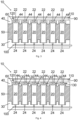
- Fig. 1 to Fig. 4 show battery modules 10 which have, for example, 6 accumulators 20.
- the accumulators have two electrical contacts 24 on the first cylinder end face. On the opposite second cylinder end face, the accumulators each have a bursting membrane 22. All accumulators 20 are arranged parallel to one another and point in the same direction.
- the accumulators 20 are arranged in a module housing, wherein the module housing has a first module housing part 30 and a second module housing part 40 and a casting compound 50 in between.
- the second module housing part 40 has a bursting point 44 of the second module housing part 40 opposite the bursting membrane 22 of the accumulators 20, between which a cavity 60 is arranged.
- Fig.1 shows a first example of a battery module 10, in which a third sensor 130 is arranged in each cavity 60.
- the third sensor 130 can be a pressure sensor or a temperature sensor.
- a pressure sensor and a temperature sensor can be arranged. In this way, each accumulator 20 is monitored.
- the Fig.1 can be part of a battery module 10 according to the invention, as for example in Fig.4 shown.
- Fig.2 shows a second example
- the second module housing part 40 has a gas channel 90.
- a first sensor 110 is arranged in the gas channel 90. This measures the temperature. Depending on which accumulator 20 is damaged, the temperature peak comes with a different temporal distribution or with a different maximum value at the first sensor 110. If, as an extreme case, the accumulator 20 closest to the first sensor 110 is damaged, the steepest rise and the highest maximum value are to be expected. If, as a further extreme case, the accumulator 20 furthest from the first sensor 110 is damaged, the weakest rise and the lowest maximum value are to be expected.
- a second sensor 120 is also arranged in the gas channel 90. which is spaced approximately half the length of the gas channel 90 from the first sensor 110. This also allows weak thermal effects, for example from the accumulator 20 shown on the far left, to be detected by the second sensor 120 if the thermal effects could be too weak to be reliably detected by the first sensor 110 at the outlet of the gas channel 90 and recognized as an incident.
- Fig.3 shows a third example
- the second module housing part 40 has a gas channel 90.
- this example has a collector 100, which is arranged in the first module housing part 30.
- a first sensor 110 is arranged at the outlet and a second sensor 120 at the opposite end of the gas channel 90. If, for example, the first sensor 110 and the second sensor 120 measure the pressure (not part of the invention), the position of the damaged accumulator 20 can be determined from the time difference of the measured maxima.
- the fourth example shown combines the first example and the third example.
- Third sensors 130 are arranged in all cavities 60.
- a second sensor 120 and a first sensor 110 are arranged in the gas channel 90, with the first sensor 110 being arranged at the outlet of the gas channel 90. This achieves high precision and redundancy.
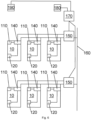
- a battery string is shown.
- the battery string has three battery modules 10, which are shown here in a highly simplified manner.
- Each battery module 10 has a first sensor 110 and a second sensor 120, temperature sensors, which are arranged in a gas channel 90 omitted here for the sake of simplicity.
- the first sensor 110 and the second sensor 120 are connected to a module battery management system 140.
- the three module battery management systems 140 are connected to a string battery management system 150, wherein the string battery management system 150 is designed to disconnect the connection between the battery modules 10 and the network 160.
- Fig.6 The interior of a battery compartment is shown.
- the battery compartment has two identical battery strings connected in parallel, as shown in Fig.5 are shown.
- the battery compartment has a first room sensor 180, for example a carbon monoxide detector. This detects the presence of carbon monoxide as the presence of an incident that may not have been detected by any of the first sensors 110 and the second sensors 120, for example because the corresponding accumulator 20 has only caused a slight heating due to a low residual capacity.
- the battery compartment also has a second room sensor 190, for example and in particular an IR camera.
- the second room sensor 190 After an incident has been detected by the first room sensor 180, it can be subsequently analyzed from which outlet of a gas channel 90 of which battery module 10 a temperature peak, even if only very weak, can be detected, but a different temperature peak compared to all other battery modules 10. This allows the defective battery module 10 to be identified and disconnected from the network 160 by the control device 170 using the string battery management system 150.
Landscapes
- Chemical & Material Sciences (AREA)
- Chemical Kinetics & Catalysis (AREA)
- Electrochemistry (AREA)
- General Chemical & Material Sciences (AREA)
- Engineering & Computer Science (AREA)
- Manufacturing & Machinery (AREA)
- Aviation & Aerospace Engineering (AREA)
- Battery Mounting, Suspending (AREA)
- Secondary Cells (AREA)
Description
- Die Erfindung betrifft ein Batteriemodul insbesondere für Akkumulatoren auf Lithium-Basis mit Sensoren zur Detektion eines thermischen Durchgehens wenigstens einer Zelle des Batteriemoduls.
- Akkumulatoren auf Lithium-Basis sind zunehmend interessant, beispielsweise aufgrund der hohen Energiedichte. Gerade für große Energiespeicher gibt es jedoch zwei grundlegende Unterschiede beispielsweise zum Blei-Schwefelsäure-Akkumulator. Zum einen können die einzelnen Zellen nicht einfach beliebig vergrößert werden. Dieses führt dazu, dass regelmäßig eine Vielzahl von Akkumulatoren zu einem größeren Modul zusammengestellt werden. Zum anderen ist gerade bei diesen Akkumulatoren das Problem des thermischen Durchgehens gegeben, gerade wenn diese im Ladevorgang oder Entladevorgang überhitzen und dadurch chemische Reaktionen gestartet werden, die unter anderem zu einer starken Gasentwicklung führt. Da hierbei auch eine große Menge an Gas, oftmals selbst gefährlicher oder entzündlicher Gase, entsteht und sich somit das Volumen dramatisch vergrößert, bedeutet dieses ein großes Risiko, insbesondere in kritischen oder geschlossenen Umgebungen, wie sich beispielsweise an Akkumulatoren in Luftfahrzeugen gezeigt hat.
- Aus der
US 2014 / 0 308 550 A1 offenbart ein Batteriemodul mit einer Mehrzahl an Sekundärzellen. - Aus der
JP 2007 027 011 A - Aus der
DE 10 2008 013 188 A1 ist ein elektrochemischer Akkumulator und ein Fahrzeug mit einem elektrochemischen Akkumulator bekannt. - Aus der
DE 10 2014 006 807 A1 ist ein Batteriesystem mit einer Sensorvorrichtung bekannt. - Aus der
JP 02 174 077 A - Aus der
DE 10 2017 214 289 A1 ist ein Batteriemodul und ein Fahrzeug mit dem Batteriemodul bekannt. - Aus der
DE 10 2013 201 007 A1 ist ein Batteriemodul und ein Batteriesystem bekannt. - Aus der
WO 2011 / 101 942 A1 ist ein Batteriemodul bekannt. - Aus der
US 2017 / 012 268 A1 ist eine Konstruktionseinheit bekannt. - Aus der
DE 10 2011 054 775 A1 ist ein Druckausgleichsystem für ventilgesteuerte Batterien bekannt. - Aus der
DE 10 2014 221 272 A1 ist eine Überwachungseinrichtung für eine Batterie sowie ein Überwachungsverfahren bekannt. - Aus der
US 22016 / 218 533 A1 ist eine Leiterplatte für einen Akkumulator und ein Batterieelement mit der Leiterplatte bekannt. - Aus der
EP 2 259 365 A1 ist eine Vorrichtung zur Erfassung von Abnormalitäten in einem Akkumulator bekannt. - Aus der
DE 10 2019 106 356 A1 ist ein Rauchgaserfassungssystem und ein Rauchgaserfassungsverfahren bekannt. - Aus der
US 2014 / 222 359 A1 ist eine Überwachungs- und Speichervorrichtung für eine Batterie bekannt. - Aufgabe der Erfindung ist es, ein Batteriemodul zur Verfügung zu stellen, welches im Falle eines thermischen Durchgehens diesen Zwischenfall detektiert.
- Gelöst wird diese Aufgabe durch das Batteriemodul mit den in Anspruch 1 angegebenen Merkmalen. Vorteilhafte Weiterbildungen ergeben sich aus den Unteransprüchen, der nachfolgenden Beschreibung sowie den Zeichnungen.
- Das erfindungsgemäße Batteriemodul weist wenigstens einen ersten Akkumulator und einen zweiten Akkumulator auf. Alle Akkumulatoren weisen wenigstens zwei elektrische Kontakte auf. Weiter weisen alle Akkumulatoren eine Berstmembran auf. Alle Berstmembranen sind in die gleiche Richtung angeordnet sind. Hierdurch kann die elektrische Energie zentral auf einer Seite abgeführt werden.
- Alle Akkumulatoren sind in einem Modulgehäuse angeordnet. Wenigstens ein erster Sensor ist in Wirkrichtung hinter der Berstmembran der Akkumulatoren angeordnet. Der erste Sensor ist zur Erfassung der Temperatur ausgebildet.
- In Wirkrichtung hinter ist im Sinne der Erfindung so zu verstehen, dass der erste Sensor in dem Bereich angeordnet ist, in welchen nach dem Bersten der Berstmembran des Akkumulators die Gase hin entweichen, in welche Richtung also der Druck hin abgeführt wird. Somit umfasst in Wirkrichtung hinter nicht nur den Bereich unmittelbar hinter der Berstmembran des Akkumulators, sondern umfasst auch Bereiche, in welche das austretende Gas gegebenfalls umgelenkt wird.
- Durch die Anordnung aller Akkumulatoren in dem Modulgehäuse sind alle Akkumulatoren gegenüber der Umgebung geschützt. Kommt es nun zum thermischen Durchgehen eines Akkumulators, so produziert dieser großen Mengen heißer Gase, welche bei direkten Kontakt leicht dazu führen können, dass benachbarte Akkumulatoren ebenfalls kritisch werden und selber thermischen durchgehen. Da die Akkumulatoren jedoch innerhalb des Modulgehäuses geschützt sind, kann ein einzelner durchgehender Akkumulator nicht benachbarte Akkumulatoren ebenfalls kritisch werden lassen. Ein einfaches und vollständiges Einbauen würde jedoch dazu führen, dass der entstehende Druck nicht abgeführt werden kann. Kommt es bei einem einzelnen Akkumulator nun zu einem thermischen Durchgehen, so entsteht im Inneren des Akkumulators ein Druck, dieser lässt die Berstmembran bersten.
- Das Modulgehäuse weist wenigstens einen ersten Gaskanal auf, wobei der erste Gaskanal in Wirkrichtung hinter den Berstmembranen der Akkumulatoren angeordnet ist. Ein erster Gaskanal hat den Vorteil, dass es mit dem ersten Gaskanal möglich ist, die entstehenden Gase zu lenken und von anderen Akkumulatoren fortzuführen und so eine thermische Belastung weiterer Akkumulatoren oder eine chemische Reaktion zwischen den Gasen und den nicht betroffenen Akkumulatoren zu vermeiden. Besonders bevorzugt hat der Gaskanal einen Ausgang. Bevorzugt ist dieser Ausgang des Gaskanals an der Oberseite des Modulgehäuses angeordnet.
- Erfindungsgemäß ist der erste Sensor und ein zweiter Sensor im ersten Gaskanal angeordnet, wobei der zweite Sensor zur Erfassung der Temperatur ausgebildet ist. Aus dem maximalen Meßwert, beispielsweise der Höchsttemperatur, und/oder der Steigung des Anstieges, beispielsweise von der
- Temperatur kann auf die Entfernung zum Akkumulator geschlossen werden und so der Akkumulator ermittelt werden, bei dem ein thermisches Durchgehen erfolgt ist. Erfindungsgemäß sind der erste Sensor und der zweite Sensor zueinander beabstandet im ersten Gaskanal angeordnet. Hier ergibt sich eine einfachere Auswertung, da aus der Zeitdifferenz zwischen den beiden Signalen auf den Ort des Ursprungs und somit auf den defekten Akkumulator geschlossen werden kann. Hierzu können der erste Sensor und der zweite Sensor in einer möglichen Ausführungsform an den gegenüberliegenden Enden des ersten Gaskanals angeordnet. Dazu sind der erste Sensor und der zweite Sensor bevorzugt gleichartig aufgebaut, wobei sie die gleiche Größe messen. Der erste und der zweite Sensor können also beispielsweise die Temperatur messen.
- In einer weiteren Ausführungsform der Erfindung sind der erste Sensor und der zweite Sensor redundant ausgeführt. Dieses bedeutet, dass der erste Sensor aus zwei voneinander unabhängigen Sensoren besteht, die beide bevorzugt unabhängig voneinander mit einer Auswerteeinheit, bevorzugt einem Modul-Batteriemanagementsystem verbunden sind. Ebenso ist der zweite Sensor aus zwei voneinander unabhängigen Sensoren besteht, die beide bevorzugt unabhängig voneinander mit einer Auswerteeinheit, bevorzugt einem Modul-Batteriemanagementsystem verbunden sind.
- Der Gaskanal kann an seinem oberen Ende eine Gaskanalberstmembran aufweisen, die sich bei austretendem Gas öffnet. Eine solche Gaskanalberstmembran hat den Vorteil, dass einerseits keine Fremdkörper in den Gaskanal eintreten können und andererseits, dass sich das erwärmte, austretende Gas vor dem oberen Sensor staut und dort die Detektion eines Temperaturanstiegs erleichtert.
- Erfindungsgemäß ist der erste Sensor am Ausgang des ersten Gaskanals angeordnet. Weiter weisen der erste Sensor und der zweite Sensor wenigstens eine Distanz der halben Länge des ersten Gaskanals auf. Diese Ausführungsform ist vorteilhaft um gerade Zwischenfälle detektieren zu können, auch wenn diese, beispielsweise auf Grund eines geringen Ladezustandes eines Akkumulators vergleichsweise moderat abläuft. Wird beispielsweise die Temperatur detektiert, so kommt zusätzlich dazu, dass das aus einem Akkumulator entweichende Gas bereits durch das umgebende Modul vor Erreichen eines der Sensoren durch die Wärmekapazität des Moduls soweit abgekühlt sein kann, dass das austretende Gas so weit abgekühlt wurde, dass ein Zwischenfall durch einen Sensor nicht erfassbar ist. Daher ist die gewählte Anordnung der beiden Sensoren vorteilhaft, da so die Distanz zu den Sensoren vorzugsweise auf maximal die halbe Distanz der Länge des Gaskanals begrenzt wird.
- In einer Weiterbildung der Ausführungsform sind die Sensoren so am Modul angeordnet, dass sie sowohl den Temperaturanstieg des Gases als auch einen Temperaturanstieg im Modul. Dazu können die Sensoren an der modulseitigen Wand des Gaskanals angeordnet sein und thermisch mit dieser so verbunden oder gekoppelt sein, dass ein Temperaturanstieg im Modul erfasst wird. Eine derartige Kopplung kann beispielsweise durch Einbetten der Module in eine wärmeleitende Vergussmasse erreicht werden, die die Wärme im Modul bis an die Außenseite des Moduls leitet. Dieses hat den Vorteil, dass eine Fehlfunktion einer Batterie sowohl beim Austreten von Gas oder bereits vorher erfasst werden kann. Es kann vorkommen, dass eine Batterie zwar eine Fehlfunktion aufweist, aber kein Gas austritt. Bei einer solchen Fehlfunktion erhitzt sich die Batterie stark und erwärmt die Umgebung. Dieses würde durch die Anordnung von Temperatursensoren erfasst, ohne dass jedes Modul eines einzelnen Temperatursensors der Überwachung bedarf. Im Unterschied zum Gasaustritt ist dann der Temperaturanstieg am Sensor jedoch schwach und langsam, dafür auch von längerer Dauer, während die heißen Gase einen raschen starken Temperaturanstieg verursachen und nach dem Entweichen aber auch einen ebenso raschen Rückgang. Durch diese Anordnung von Temperatursensoren kann also mit wenigen Sensoren mehrere Fehlerzustände überwacht werden.
- In einer weiteren Ausführungsform der Erfindung ist der erste Sensor zur Erfassung einer chemischen Substanz ausgebildet ausgewählt aus der Gruppe umfassend Wasserstoff und Kohlenmonoxid.
- In einer weiteren Ausführungsform der Erfindung weisen alle Akkumulatoren eine zylindrische Bauform auf. Das bedeutet, die einzelnen Akkumulatoren sind nicht als Pouch-Zellen ausgeführt, die üblicherweise eine größere Volumenveränderung kompensieren können. Dafür können Akkumulatoren in zylindrischer Form leicht hergestellt und auch in großer Anzahl zu einem Modul verbunden werden.
- In einer weiteren Ausführungsform der Erfindung weisen alle Akkumulatoren auf einer ersten Zylinderstirnfläche wenigstens zwei elektrische Kontakte auf. Durch die Anordnung beider elektrischen Kontakte ist zum einen die Fertigung zum anderen die Kontaktierung im fertigen Batteriemodul vereinfacht.
- In einer weiteren Ausführungsform der Erfindung weisen alle Akkumulatoren auf einer zweiten Zylinderstirnfläche eine Berstmembran auf. Hierdurch ist eine gute Anordnung der zylindrischen Akkumulatoren möglich.
- In einer weiteren Ausführungsform der Erfindung sind alle Akkumulatoren parallel zueinander angeordnet.
- In einer weiteren Ausführungsform der Erfindung sind alle ersten Zylinderstirnflächen in die gleiche Richtung angeordnet.
- In einer weiteren Ausführungsform der Erfindung weist das Modulgehäuse ein erstes Modulgehäuseteil und ein zweites Modulgehäuseteil auf. Das erste Modulgehäuseteil ist flächig ausgeführt und senkrecht zur Längsrichtung der Akkumulatoren angeordnet. Das zweite Modulgehäuseteil ist ebenfalls flächig ausgeführt und senkrecht zur Längsrichtung der Akkumulatoren angeordnet. Das zweite Modulgehäuseteil weist zweite Ausnehmungen zur Aufnahme jeweils eines Teils der Akkumulatoren im Bereich der zweiten Stirnflächen auf, wobei zwischen dem zweiten Modulgehäuseteil und den Berstmembranen der zweiten Zylinderstirnflächen jeweils ein Hohlraum angeordnet ist. Der Hohlraum kann beispielsweise und bevorzugt gasgefüllt, insbesondere luftgefüllt oder Schutzgas-gefüllt, insbesondere mit Stickstoff oder Argon gefüllt, sein.
- In einer weiteren Ausführungsform der Erfindung ist ein dritter Sensor im Hohlraum angeordnet ist.
- In einer weiteren Ausführungsform der Erfindung ist der dritte Sensor im Hohlraum angeordnet. Vorteil dieser Ausführungsform ist, dass exakt bekannt ist, bei welchem Akkumulator ein thermisches Durchgehen beobachtet wurde. Nachteilig ist, dass für jeden Akkumulator wenigstens ein eigener Sensor zusätzlich zu den beiden im Gaskanal befindlichen Sensoren benötigt wird.
- Neben dem ersten Sensor ist ein zweiter Sensor angeordnet. Selbstverständlich können noch weitere Sensoren vorgesehen sein, um die Genauigkeit zu erhöhen und die Gefahr eines Fehlalarms zu verringern.
- In einer weiteren Ausführungsform der Erfindung ist ein weiterer Sensor zur Erfassung einer chemischen Substanz ausgebildet ausgewählt aus der Gruppe umfassend Wasserstoff und Kohlenmonoxid. Dieses sind einfach detektierbare und beim thermischen Durchgehen entstehende Gase.
- In einer weiteren Ausführungsform der Erfindung weist das zweite Modulgehäuseteil im Bereich der zweiten Ausnehmungen Berststellen auf. Bevorzugt weist das zweite Modulgehäuseteil wenigstens einen ersten Gaskanal auf, wobei der erste Gaskanal wenigsten die Berststelle des zweiten Modulgehäuseteils, welche hinter dem ersten Akkumulator angeordnet ist, und die Berststelle des zweiten Modulgehäuseteils, welche hinter dem zweiten Akkumulator angeordnet ist, auf der den Hohlräumen gegenüberliegenden Seite miteinander verbindet.
- Der Gaskanal kann an der Unterseite geschlossen und an der Oberseite offen, durch ein Ventil verschlossen oder durch eine weitere Verschlussmembran geschlossen sein. Die Verschlussmembran kann derart ausgeführt sein, dass sie die Öffnung verschließt und bei austretendem Gas geöffnet wird. Es handelt sich beispielsweise um einen dünnen Klebefilm. Durch den beidseitigen Verschluss des Gaskanals wird in einer feuchten oder nassen Umgebung vermieden, dass sich Feuchtigkeit im Gaskanal sammelt.
- Steigt der Druck im Hohlraum, welcher zu dem Akkumulator benachbart ist ansteigen, so führt dieser Druckanstieg dazu, dass auch die Berststelle im Bereich der zweiten Ausnehmungen des zweiten Modulgehäuse Teils birst, sodass die entstehenden Gase nach außen abgeführt werden und der Druck abgebaut wird, ohne dass weiterer Schaden erzeugt wird.
- In einer weiteren Ausführungsform der Erfindung weist das erste Modulgehäuseteil erste Ausnehmungen zur Aufnahme jeweils eines Teils der Akkumulatoren im Bereich der ersten Stirnflächen auf, wobei das erste Modulgehäuseteil im Bereich der ersten Ausnehmungen Öffnungen zur Durchführung der elektrischen Verbindungen aufweist.
- In einer weiteren Ausführungsform der Erfindung besteht das erste Modulgehäuseteil und das zweite Modulgehäuseteil aus einem faserverstärktem Kunststoff, insbesondere aus einem faserverstärktem Epoxid. Beispielsweise weist der Kunststoff eine Wärmeleitfähigkeit von mehr als 0,03 W / (m · K), bevorzugt mehr als 0,2 W / (m · K), weiter bevorzugt mehr als 0,5 W / (m . K), besonders bevorzugt mehr als 0,8 W / (m · K), auf. Auch wenn eine beliebig hohe Wärmeleitfähigkeit wünschenswert wäre, so weist jedoch realistisch der Kunststoff eine Wärmeleitfähigkeit auf, welche kleiner ist als 20 W / (m · K), wahrscheinlicher kleiner als 5 W / (m · K), noch wahrscheinlicher kleiner als 2 W / (m · K). Insbesondere wird die Wärmeleitfähigkeit gemäß ISO 8894-1 bestimmt.
- In einer weiteren Ausführungsform der Erfindung ist zwischen dem ersten Modulgehäuseteil, den zweiten Modulgehäuseteil und den Akkumulatoren eine Vergussmasse angeordnet.
- In einer weiteren Ausführungsform der Erfindung weist das Batteriemodul 20 bis 500, bevorzugt 50 bis 200, Akkumulatoren auf.
- In einer weiteren Ausführungsform der Erfindung ragen die elektrischen Kontakte der Akkumulatoren durch Öffnungen der ersten Ausnehmungen in dem ersten Modulgehäuseteil aus dem Batteriemodul heraus.
- In einer weiteren alternativen Ausführungsform der Erfindung werden die elektrische Kontakte mittels einer in dem ersten Modulgehäuseteil liegenden Sammelschiene elektrisch verbunden und so die Leistung aus dem Batteriemodul abgeführt. Hierzu weist das erste Modulgehäuseteil beispielsweise wenigstens eine erste Sammelschiene und wenigstens eine zweite Sammelschiene auf, um die beiden Pole zu kontaktieren. Dieses entspricht einer elektrischen Parallelschaltung. Alternativ können die Akkumulatoren auch in Reihe geschaltet werden, um eine höhere Ausgangsspannung zu erzielen. Nachteil hierbei ist, dass der Ausfall eines Akkumulators die elektrische Funktionalität unterbrechen würde. Es kann auch eine Kombination aus Reihenschaltung und Parallelschaltung vorgenommen sein.
- In einer weiteren Ausführungsform der Erfindung bestehen das erste Modulgehäuseteil und das zweite Modulgehäuseteil aus einem faserverstärktem Kunststoff, insbesondere aus einem faserverstärktem Epoxid, insbesondere aus glasfaserverstärkten Epoxid.
- In einem weiteren Aspekt betrifft die Erfindung einen Batteriestrang mit wenigstens einem ersten erfindungsgemäßen Batteriemodul und einem zweiten erfindungsgemäßen Batteriemodul. Besonders bevorzugt sind das erste Batteriemodul und das zweite Batteriemodul erfindungsgemäße Batteriemodule. Das erste Batteriemodul weist ein erstes Modul-Batteriemanagementsystem und das zweite Batteriemodul weist ein zweites Modul-Batteriemanagementsystem auf. Der Batteriestrang weist ein Strang-Batteriemanagementsystem auf. Das erste Modul-Batteriemanagementsystem liest den ersten Sensor und den zweiten Sensor des ersten Batteriemoduls aus. Das Auslesen erfolgt hierbei bevorzugt kontinuierlich, sodass nicht nur der aktuelle Wert des Sensors erfasst ist, sondern durch den zeitlichen Verlauf auch Veränderungen, insbesondere die Steigung eines Messwertes auswertbar ist. Die Steigung, also die Ableitung nach der Zeit, ist ein wichtiges Indiz für schnell ablaufende Prozesse, beispielsweise die Ankunft eines heißen Gases. Das zweite Modul-Batteriemanagementsystem liest den ersten Sensor und den zweiten Sensor des zweiten Batteriemoduls aus, ebenfalls bevorzugt kontinuierlich. Das erste Modul-Batteriemanagementsystem und das zweite Modul-Batteriemanagementsystem sind dazu ausgebildet, im Falle eines durch wenigstens einen Sensor detektierten Zwischenfalls, den Zwischenfall an das Strang-Batteriemanagementsystem zu melden, wobei das Strang-Batteriemanagementsystem dazu ausgebildet ist, den Batteriestrang im Falle eines Zwischenfalls in einem Batteriemodul von einem Netz zu trennen. Trennen bedeutet in diesem Zusammenhang, dass keine Energie vom Batteriemodul an das Netz abgegeben werden kann.
- Insbesondere in der Anwendung in einem Unterseeboot werden die Akkumulatoren in einem Batteriemodul in Reihe geschaltet, um die hohe Spannung für das Fahrnetz zu erreichen. Bevorzugt werden sogar die Batteriemodule in einem Batteriestrang in Reihe geschaltet. Hierdurch führt die Zerstörung eines einzelnen Akkumulators dazu, dass die vollständige Abtrennung eines Batteriestranges zum Schutze des gesamten Energiespeichers und damit der Sicherheit des Unterseebootes vorteilhaft ist.
- In einem weiteren Aspekt betrifft die Erfindung eine Energiespeichervorrichtung. Die Energiespeichervorrichtung weist einen Lastausgang zur Übergabe elektrischer Energie an wenigstens einen Verbraucher auf. Beispielsweise handelt es sich hierbei um eine Sammelschiene, welche die elektrische Energie von verschiedenen Akkumulatoren sammelt und an das Bordnetz beispielsweise eines Unterseebootes übergibt. Die Energiespeichervorrichtung weist wenigstens ein erstes erfindungsgemäßes Batteriemodul auf. Bevorzugt sind mehrere Module in Strängen gruppiert angeordnet. Weiter bevorzugt sind mehrere Stränge angeordnet. Ein Unterseeboot weist beispielsweise üblicherweise eine Energiespeichervorrichtung auf, welche etwa 10 bis 50 Stränge aufweist, wobei jeder Strang etwa 4 bis 10 Module aufweist. Ein Modul kann beispielsweise 20 bis 500 Akkumulatoren aufweisen.
- In einer weiteren Ausführungsform der Erfindung sind in einem Raum wenigstens zwei erfindungsgemäße Batteriemodulen angeordnet. Ferner weist der Raum eine Infrarotkamera auf. Die Infrarotkamera ist in der Lage die Position eines thermischen Ereignisses so lokalisieren und somit das Batteriemodul zu identifizieren, in welchem das thermische Durchgehen eines Akkumulators erfolgt ist. Beispielsweise können so austretende warme Gase identifiziert werden, deren Temperatur nicht ausreicht, einen Sensor auszulösen, aber durch Wärme und Bewegung durch eine Infrarotkamera als Ereignis dennoch gut erfassbar ist. Hierdurch ist auch eine Ortsbestimmung des Ereignisses möglich, sodass das betroffene Batteriemodul identifiziert werden kann.
- In einem weiteren Aspekt betrifft die Erfindung einen Batterieraum mit wenigstens einem ersten erfindungsgemäßen Batteriestrang, einem zweiten erfindungsgemäßen Batteriestrang und wenigstens ein elektrisches Netz. Der erste Batteriestrang ist aus erfindungsgemäßen Batteriemodulen aufgebaut und mit dem Netz verbindbar und ebenso ist der zweite Batteriestrang aus erfindungsgemäßen Batteriemodulen aufgebaut und mit dem Netz verbindbar. Bevorzugt ist ein Batteriestrand aus drei bis acht, bevorzugt fünf bis acht Batteriemodulen aufgebaut, welche bevorzugt in eine Reihenschaltung mit einander verbunden sind. Hierdurch kann eine hohe Ausgangsspannung, beispielsweise von 600 V bis 1.000 V, welche beispielsweise für einen Fahrmotor benötigt wird, erreicht werden. Bevorzugt sind im Batterieraum 20 bis 100, bevorzugt 40 bis 60 Batteriestränge angeordnet. Die Batteriestränge sind jeweils direkt mit dem Netz verbindbar und daher elektrisch parallel schaltbar. Hierdurch kann eine hohe Leistung, ein hoher Strom, bei der durch den Batteriestrang gegebenen Spannung, beispielsweise für einen Fahrmotor bereitgestellt werden. Außerdem können die Batteriestränge einzeln oder in Gruppen vom Netz getrennt oder mit diesem verbunden werden, je nachdem welche Leistung gerade benötigt wird. Der Batterieraum weist wenigstens einen ersten Raumsensor auf, wobei der zur Erfassung von Temperatur oder einer chemischen Substanz ausgebildet ist. Der Batterieraum weist eine Steuervorrichtung auf, wobei die Steuervorrichtung dazu ausgebildet ist, einen Batteriestrang von Netz zu trennen, wenn der erste Raumsensor einen Zwischenfall in dem Batteriestrang detektiert. Besonders bevorzugt weist der Batterieraum einen ersten Raumsensor auf, wobei der erste Raumsensor zur Erfassung von Kohlenmonoxid oder Wasserstoff ausgebildet ist, und einen zweiten Raumsensor, wobei der zweite Raumsensor eine Infrarotkamera ist. Diese Ausführungsform ist vorteilhaft, um auch Zwischenfälle zu detektieren, die vergleichsweise moderat ablaufen. Aufgrund der sehr geringen Hitzeentwicklung kann es sein, dass weder der erste Sensor noch der zweite Sensor des betroffenen Batteriemoduls einen Zwischenfall detektieren und auch der zweite Raumsensor diesen nicht erfasst. Durch die Detektion der chemischen Produkte eines solchen Prozesses durch den ersten Raumsensor kann dann jedoch immer noch ein Zwischenfall erfasst werden und anschließend der Ausgang des Gaskanals des Batteriemoduls aus den durch den zweiten Raumsensor erfassten Daten zu identifizieren, aus dem diese ausgetreten sein müssen. Hierdurch ist eine Erkennung auch ohne Übersteigen eines Temperaturschwellwertes oder eines schnellen Temperaturanstieges möglich.
- In einem weiteren Aspekt betrifft die Erfindung ein Wasserfahrzeug mit einer erfindungsgemäßen Energiespeichervorrichtung. Bevorzugt handelt es sich bei dem Wasserfahrzeug um ein militärisches Wasserfahrzeug. Insbesondere ist das militärische Wasserfahrzeug ausgewählt aus der Gruppe umfassend Unterseeboot, Flugzeugträger, Hubschrauberträger, Kreuzer, Zerstörer, Fregatte, Korvette, Landungsschiffe, Minenleger, Minenräumfahrzeug, Minenjagdfahrzeug, Patrouillenboot, Schnellboot, Geleitboot, Luftkissenboot und Aufklärungsschiff. Besonders bevorzugt ist das militärische Wasserfahrzeug ausgewählt aus der Gruppe umfassend Unterseeboot, Kreuzer, Zerstörer, Fregatte, Korvette, Schnellboot und Geleitboot. Ganz besonders bevorzugt ist das militärische Wasserfahrzeug ein Unterseeboot.
- In einem weiteren Aspekt betrifft die Erfindung ein Verfahren zur Detektion eines Zwischenfalls in einem erfindungsgemäßen Batteriemodul, besonders bevorzugt in einem erfindungsgemäßen Batteriemodul. Das Batteriemodul weist ein Modul-Batteriemanagementsystem auf, wobei des Modul-Batteriemanagementsystem zur Auslesung eines ersten Sensors und eines zweiten Sensors ausgebildet ist. Das Modul-Batteriemanagementsystem erfasst den zeitlichen Verlauf des ersten Sensors und den zeitlichen Verlauf des zweiten Sensors und detektiert aufgrund der Höhe und der Geschwindigkeit eines Signalanstieges bei wenigstens einem Sensor einen Zwischenfall. Erfindungsgemäß erfassen der erste Sensor und der zweite Sensor die Temperatur, wobei das Modul-Batteriemanagementsystem einen Zwischenfall feststellt, wenn wenigstens ein Sensor einen Anstieg über 50 °C bei einer Anstiegsrate von wenigstens 0,5 °C / s oder einen Anstieg über 150 °C unabhängig von der Anstiegsrate erfasst.
- In einem weiteren Aspekt betrifft die Erfindung ein Verfahren zum Betrieb eines erfindungsgemäßen Batteriemoduls, wobei das Verfahren das regelmäßige Auslesen der Sensoren umfasst um im Falle der Registrierung eines Zwischenfalls das Batteriemodul abschaltet.
- In einer weiteren Ausführungsform der Erfindung ein Verfahren zum Betrieb von mehreren Batteriemodulen, wobei im Falle der Registrierung eines Zwischenfalls das beschädigte Batteriemodul und das zur Bestmembran benachbarte Batteriemodul abschaltet werden.
- Nachfolgend ist das erfindungsgemäße Batteriemodul anhand eines in den Zeichnungen dargestellten Ausführungsbeispiels näher erläutert.
- Fig. 1
- Batteriemodul mit ersten Sensoren im Hohlraum
- Fig. 2
- Batteriemodul mit erstem Sensor im Gaskanal
- Fig. 3
- Batteriemodul mit erstem Sensor und zweitem Sensor im Gaskanal
- Fig. 4
- Batteriemodul mit Sensoren in den Hohlräumen und im Gaskanal
- Fig. 5
- Batteriestrang
- Fig. 6
- Batterieraum
-
Fig. 1 bis Fig. 4 zeigen Batteriemodule 10, welche beispielhaft 6 Akkumulatoren 20 ausweisen. Die Akkumulatoren weisen auf der ersten Zylinderstirnfläche zwei elektrische Kontakte 24 auf. Auf der gegenüberliegenden zweiten Zylinderstirnfläche weisen die Akkumulatoren jeweils eine Berstmembran 22 auf. Alle Akkumulatoren 20 sind parallel nebeneinander angeordnet und weisen in die gleiche Richtung. Die Akkumulatoren 20 sind in einem Modulgehäuse angeordnet, wobei das Modulgehäuse ein erstes Modulgehäuseteil 30 und ein zweites Modulgehäuseteil 40 sowie dazwischen eine Vergussmasse 50 aufweist. Das zweite Modulgehäuseteil 40 weist jeweils der Berstmembran 22 der Akkumulatoren 20 gegenüberliegend eine Berststelle 44 des zweiten Modulgehäuseteils 40 auf, zwischen denen jeweils ein Hohlraum 60 angeordnet ist. -
Fig. 1 zeigt ein erstes Beispiel eines Batteriemoduls 10, bei welchem in jedem Hohlraum 60 ein dritter Sensor 130 angeordnet ist. Der dritte Sensor 130 kann ein Drucksensor oder ein Temperatursensor sein. Optional können jeweils ein Drucksensor und ein Temperatursensor angeordnet sein. Auf diese Weise erfolgt eine Überwachung jedes Akkumulators 20. Das inFig. 1 kann Teil eines erfindungsgemäßen Batteriemoduls 10 sein, wie beispielsweise inFig. 4 gezeigt. -
Fig. 2 zeigt ein zweites Beispiel, das zweite Modulgehäuseteil 40 einen Gaskanal 90 aufweist. Im Gaskanal 90 ist ein erster Sensor 110 angeordnet. Dieser misst die Temperatur. Je nachdem, welcher Akkumulator 20 beschädigt wird, kommt die Temperaturspitze mit einer anderen zeitlichen Verteilung beziehungsweise mit einem anderen Maximalwert beim ersten Sensor 110. Wird als Extremfall der Akkumulator 20 beschädigt, der dem ersten Sensor 110 an nächsten ist, so ist mit dem steilsten Anstieg und dem höchsten Maximalwert zu rechnen. Wird als weiterer Extremfall der Akkumulator 20 beschädigt, der dem ersten Sensor 110 an entferntesten ist, so ist mit dem schwächsten Anstieg und dem geringsten Maximalwert zu rechnen. Weiter ist im Gaskanal 90 ein zweiter Sensor 120 angeordnet, der etwa die halbe Länge des Gaskanals 90 vom ersten Sensor 110 beabstandet ist. Hierdurch können auch schwache thermische Effekte beispielsweise von dem ganz links gezeigten Akkumulator 20 mit dem zweiten Sensor 120 detektiert werden, wenn die thermischen Effekte zu schwach sein könnten, um vom ersten Sensor 110 am Ausgang des Gaskanals 90 sicher erfasst und als Zwischenfall erkannt zu werden. -
Fig. 3 zeigt ein drittes Beispiel, das zweite Modulgehäuseteil 40 einen Gaskanal 90 aufweist. Zusätzlich weist dieses Beispiel eine Sammelscheine 100 auf, welche in dem ersten Modulgehäuseteil 30 angeordnet ist. Im Gaskanal 90 ist ein erster Sensor 110 am Ausgang und ein zweiter Sensor 120 am gegenüberliegenden Ende des Gaskanals 90 angeordnet. Messen beispielsweise der erste Sensor 110 und der zweite Sensor 120 den Druck (nicht Teil der Erfindung) so kann aus der Zeitdifferenz der gemessenen Maxima die Position des beschädigten Akkumulators 20 ermittelt werden. - Das in
Fig. 4 gezeigte vierte Beispiel kombiniert das erste Beispiel und das dritte Beispiel. Es sind dritte Sensoren 130 in allen Hohlräumen 60 angeordnet. Zusätzlich sind ein zweiter Sensor 120 und ein erster Sensor 110 im Gaskanal 90 angeordnet, wobei der erste Sensor 110 am Ausgang des Gaskanals 90 angeordnet ist. Hierdurch wird eine hohe Präzision und Redundanz erreicht. - In
Fig. 5 ist ein Batteriestrang gezeigt. Der Batteriestrang weist im gezeigten Beispiel drei Batteriemodule 10 auf, welche hier stark vereinfacht dargestellt sind. Jedes Batteriemodul 10 weist einen ersten Sensor 110 und einen zweiten Sensor 120 auf, Temperatursensoren, welche in einem hier zur Vereinfachung weggelassenem Gaskanal 90 angeordnet sind. Der erste Sensor 110 und der zweite Sensor 120 sind mit einem Modul-Batteriemanagementsystem 140 verbunden. Die drei Modul-Batteriemanagementsysteme 140 sind mit einem Strang-Batteriemanagementsystem 150 verbunden, wobei das Strang-Batteriemanagementsystem 150 dazu ausgebildet ist, die Verbindung zwischen den Batteriemodulen 10 und dem Netz 160 zu trennen. - In
Fig. 6 ist das Innere eines Batterieraumes gezeigt. Zur Vereinfachung weist der Batterieraum zwei identische, parallel geschaltete Batteriestränge auf, wie diese inFig. 5 gezeigt sind. Zusätzlich weist der Batterieraum einen ersten Raumsensor 180, beispielsweise einen Kohlenmonoxid-Detektor auf. Dieser detektiert über das Vorhandensein von Kohlenmonoxid das Vorhandensein eines Zwischenfalls, der gegebenenfalls durch keinen der ersten Sensoren 110 und der zweiten Sensoren 120 detektiert wurde, beispielsweise, weil der entsprechende Akkumulator 20 aufgrund einer geringen Restkapazität nur eine geringe Erwärmung verursacht hat. Weiter weist der Batterieraum einen zweiten Raumsensor 190 auf, beispielsweise und insbesondere eine IR-Kamera. Mit Hilfe des zweiten Raumsensors 190 kann nach Detektion eines Zwischenfalls durch den ersten Raumsensor 180 nachträglich analysiert werden aus welchem Ausgang eines Gaskanals 90 von welchem Batteriemodul 10 eine auch nur sehr schwache Temperaturspitze, aber im Vergleich zu allen anderen Batteriemodulen 10 doch unterschiedliche Temperaturspitze erkennbar ist. Hierdurch kann das defekte Batteriemodul 10 identifiziert und durch das Steuerungsgerät 170 mittels des Strang-Batteriemanagementsystems 150 vom Netz 160 getrennt werden. -
- 10
- Batteriemodul
- 20
- Akkumulator
- 22
- Berstmembran des Akkumulators
- 24
- elektrischer Kontakt
- 30
- erstes Modulgehäuseteil
- 40
- zweites Modulgehäuseteil
- 44
- Berststelle des zweiten Modulgehäuseteils
- 50
- Vergussmasse
- 60
- Hohlraum
- 70
- Abdichtung
- 90
- Gaskanal
- 100
- Sammelschiene
- 110
- erster Sensor
- 120
- zweiter Sensor
- 130
- dritter Sensor
- 140
- Modul-Batteriemanagementsystem
- 150
- Strang-Batteriemanagementsystem
- 160
- Netz
- 170
- Steuervorrichtung
- 180
- erster Raumsensor
- 190
- zweiter Raumsensor
Claims (12)
- Batteriemodul (10), wobei das Batteriemodul (10) wenigstens einen ersten Akkumulator (20) und einen zweiten Akkumulator (20) aufweist, wobei alle Akkumulatoren (20) wenigstens zwei elektrische Kontakte (24) aufweisen, wobei alle Akkumulatoren (20) eine Berstmembran (22) aufweisen, wobei alle Berstmembranen (22) in die gleiche Richtung angeordnet sind, wobei alle Akkumulatoren (20) in einem Modulgehäuse angeordnet sind, wobei wenigstens ein erster Sensor (110) in Wirkrichtung hinter der Berstmembran (22) der Akkumulatoren (20) angeordnet ist, wobei der erste Sensor (110) zur Erfassung der Temperatur ausgebildet ist, wobei das Modulgehäuse wenigstens einen ersten Gaskanal (90) aufweist, wobei der erste Gaskanal (90) in Wirkrichtung hinter den Berstmembranen (22) der Akkumulatoren (20) angeordnet ist, wobei der erste Sensor (110) und ein zweiter Sensor (120) im ersten Gaskanal angeordnet sind, wobei der zweite Sensor (120) zur Erfassung der Temperatur ausgebildet ist, wobei der erste Sensor (110) und der zweite Sensor (120) zueinander beabstandet im ersten Gaskanal (90) angeordnet sind, dadurch gekennzeichnet, dass der erste Sensor (110) am Ausgang des ersten Gaskanals (90) angeordnet ist, wobei der erste Sensor (110) und der zweite Sensor (120) wenigstens eine Distanz der halben Länge des ersten Gaskanals (90) aufweisen, wobei der erste Sensor (110) und der zweite Sensor (120) Temperatursensoren sind.
- Batteriemodul (10) nach einem der vorstehenden Ansprüche, dadurch gekennzeichnet, dass alle Akkumulatoren (20) auf einer zweiten Zylinderstirnfläche eine Berstmembran (22) aufweisen.
- Batteriemodul (10) nach einem der vorstehenden Ansprüche, dadurch gekennzeichnet, dass die Akkumulatoren (20) jeweils eine erste Stirnfläche und eine zweite Stirnfläche aufweisen, wobei das Modulgehäuse ein erstes Modulgehäuseteil (30) und ein zweites Modulgehäuseteil (40) aufweist, wobei das erste Modulgehäuseteil (30) flächig ausgeführt und senkrecht zur Längsrichtung der Akkumulatoren (20) angeordnet ist, wobei das zweite Modulgehäuseteil (40) flächig ausgeführt und senkrecht zur Längsrichtung der Akkumulatoren (20) angeordnet ist, wobei das zweite Modulgehäuseteil (40) zweite Ausnehmungen zur Aufnahme jeweils eines Teils der Akkumulatoren (20) im Bereich der zweiten Stirnflächen aufweist, wobei zwischen dem zweiten Modulgehäuseteil (40) und den Berstmembranen (22) der zweiten Zylinderstirnflächen jeweils ein Hohlraum (60) angeordnet ist.
- Batteriemodul (10) nach Anspruch 3, dadurch gekennzeichnet, dass das zweite Modulgehäuseteil (40) im Bereich der zweiten Ausnehmungen Berststellen (44) aufweist.
- Batteriemodul (10) nach Anspruch 4, dadurch gekennzeichnet, dass das zweite Modulgehäuseteil (40) wenigstens den ersten Gaskanal (90) aufweist, wobei der erste Gaskanal (90) wenigsten die Berststelle (44) des zweiten Modulgehäuseteils (40), welche hinter dem ersten Akkumulator (20) angeordnet ist, und die Berststelle (44) des zweiten Modulgehäuseteils (40), welche hinter dem zweiten Akkumulator (20) angeordnet ist, auf der den Hohlräumen gegenüberliegenden Seite miteinander verbindet.
- Batteriemodul (10) nach einem der Ansprüche 3 bis 5, dadurch gekennzeichnet, dass das erste Modulgehäuseteil (30) erste Ausnehmungen zur Aufnahme jeweils eines Teils der Akkumulatoren (20) im Bereich der ersten Stirnflächen aufweist, wobei das erste Modulgehäuseteil (30) im Bereich der ersten Ausnehmungen Öffnungen zur Durchführung der elektrischen Verbindungen aufweist.
- Batteriemodul (10) nach einem der Ansprüche 3 bis 6, dadurch gekennzeichnet, dass das erste Modulgehäuseteil (30) und das zweite Modulgehäuseteil (40) aus einem faserverstärktem Epoxid bestehen.
- Batteriemodul (10) nach einem der Ansprüche 3 bis 7, dadurch gekennzeichnet, dass zwischen dem ersten Modulgehäuseteil (30), den zweiten Modulgehäuseteil (40) und den Akkumulatoren (20) eine Vergussmasse (50) angeordnet ist.
- Batteriestrang mit wenigstens einem ersten Batteriemodul nach einem der vorstehenden Ansprüche und einem zweiten Batteriemodul nach einem der vorstehenden Ansprüche, wobei das erste Batteriemodul ein erstes Modul-Batteriemanagementsystem (140) und das zweite Batteriemodul ein zweites Modul-Batteriemanagementsystem (140) aufweist, wobei der Batteriestrang ein Strang-Batteriemanagementsystem aufweist, wobei das erste Modul-Batteriemanagementsystem (140) den ersten Sensor und den zweiten Sensor des ersten Batteriemoduls ausliest, wobei das zweite Modul-Batteriemanagementsystem (140) den ersten Sensor und den zweiten Sensor des zweiten Batteriemoduls ausliest, wobei das erste Modul-Batteriemanagementsystem (140) und das zweite Modul-Batteriemanagementsystem (140) dazu ausgebildet sind, im Falle eines durch wenigstens einen Sensor detektierten Zwischenfalls diesen an das Strang-Batteriemanagementsystem (150) zu melden, wobei das Strang-Batteriemanagementsystem (150) dazu ausgebildet ist, den Batteriestrang im Falle eines Zwischenfalls in einem Batteriemodul von einem Netz (160) zu trennen.
- Batterieraum mit wenigstens einem ersten Batteriestrang nach Anspruch 9, einem zweiten Batteriestrang nach Anspruch 10 in wenigstens einem Netz (160), wobei der erste Batteriestrang mit dem Netz (160) verbindbar ist, wobei der zweite Batteriestrang mit dem Netz (160) verbindbar ist, wobei der Batterieraum wenigstens einen ersten Raumsensor (180) aufweist, wobei der zur Erfassung von Temperatur oder einer chemischen Substanz ausgebildet ist, wobei der Batterieraum eine Steuervorrichtung (170) aufweist, wobei die Steuervorrichtung (170) dazu ausgebildet ist, einen Batteriestrang von Netz (160) zu trennen, wenn der erste Raumsensor (180) einen Zwischenfall in dem Batteriestrang detektiert.
- Verfahren zur Detektion eines Zwischenfalls in einem Batteriemodul nach einem der Ansprüche 1 bis 8, wobei das Batteriemodul ein Modul-Batteriemanagementsystem (140) aufweist, wobei des Modul-Batteriemanagementsystem (140) zur Auslesung eines ersten Sensors (110) und eines zweiten Sensors (120) ausgebildet ist, wobei das Modul-Batteriemanagementsystem (140) den zeitlichen Verlauf des ersten Sensors und den zeitlichen Verlauf des zweiten Sensors erfasst, wobei des Modul-Batteriemanagementsystem (140) aufgrund der Hohe und der Geschwindigkeit eines Signalanstieges bei wenigstens einem Sensor einen Zwischenfall detektiert.
- Verfahren nach Anspruch 11, dadurch gekennzeichnet, dass der erste Sensor und der zweite Sensor die Temperatur erfassen, wobei das Modul-Batteriemanagementsystem (140) einen Zwischenfall feststellt, wenn wenigstens ein Sensor einen Anstieg über 50 °C bei einer Anstiegsrate von wenigstens 0,5 °C / s oder einen Anstieg über 150 °C unabhängig von der Anstiegsrate erfasst.
Applications Claiming Priority (2)
| Application Number | Priority Date | Filing Date | Title |
|---|---|---|---|
| DE102019216608.3A DE102019216608A1 (de) | 2019-10-29 | 2019-10-29 | Batteriemodul mit Überwachung des thermischen Durchgehens von einzelnen Zellen |
| PCT/EP2020/079355 WO2021083703A2 (de) | 2019-10-29 | 2020-10-19 | Batteriemodul mit überwachung des thermischen durchgehens von einzelnen zellen |
Publications (3)
| Publication Number | Publication Date |
|---|---|
| EP4052322A2 EP4052322A2 (de) | 2022-09-07 |
| EP4052322C0 EP4052322C0 (de) | 2024-06-12 |
| EP4052322B1 true EP4052322B1 (de) | 2024-06-12 |
Family
ID=73005597
Family Applications (1)
| Application Number | Title | Priority Date | Filing Date |
|---|---|---|---|
| EP20796524.5A Active EP4052322B1 (de) | 2019-10-29 | 2020-10-19 | Batteriemodul mit überwachung des thermischen durchgehens von einzelnen zellen |
Country Status (5)
| Country | Link |
|---|---|
| EP (1) | EP4052322B1 (de) |
| KR (1) | KR102797592B1 (de) |
| DE (1) | DE102019216608A1 (de) |
| ES (1) | ES2992957T3 (de) |
| WO (1) | WO2021083703A2 (de) |
Families Citing this family (10)
| Publication number | Priority date | Publication date | Assignee | Title |
|---|---|---|---|---|
| WO2023080551A1 (ko) * | 2021-11-08 | 2023-05-11 | 주식회사 엘지에너지솔루션 | 폿팅 수지의 누액 방지 기능이 구비된 전지 모듈 및 이를 포함하는 전지 팩 |
| DE102021129192B3 (de) | 2021-11-10 | 2022-08-25 | Bayerische Motoren Werke Aktiengesellschaft | Antriebsbatterie für ein Kraftfahrzeug, Kraftfahrzeug und Verfahren zum Steuern von Entgasungselementen einer Antriebsbatterie |
| DE102022203196B4 (de) * | 2022-03-31 | 2024-02-29 | Vitesco Technologies GmbH | Verfahren zum Bestimmen der Funktionstüchtigkeit eines Drucksensors und Batterieanordnung |
| DE102022208979B4 (de) | 2022-08-30 | 2025-07-24 | Thyssenkrupp Ag | Verfahren zur Steigerung der Reichweite eines getauchten Unterseebootes |
| EP4340113B1 (de) | 2022-09-13 | 2025-02-26 | thyssenkrupp Marine Systems GmbH | Batteriemodul |
| WO2026002715A1 (de) | 2024-06-28 | 2026-01-02 | Tkms Gmbh | Bereitstellung einer kurzfristigen leistungsreserve in einem unterseeboot |
| WO2026002704A1 (de) | 2024-06-28 | 2026-01-02 | Tkms Gmbh | Hot-standby für batteriesysteme |
| DE102024118306B3 (de) | 2024-06-28 | 2025-09-25 | Thyssenkrupp Ag | Verfahren zum Betreiben eines Energiespeichers in einem Unterseeboot ohne aktive Kühlung |
| DE102024118305A1 (de) | 2024-06-28 | 2025-12-31 | Thyssenkrupp Ag | Verfahren zum Betreiben einer Mehrzahl von Energiespeichern an einem Bordnetz in einem Unterseeboot |
| DE102024135243A1 (de) * | 2024-06-28 | 2025-12-31 | Thyssenkrupp Ag | Bereitstellung einer kurzfristigen Leistungsreserve in einem Unterseeboot |
Family Cites Families (21)
| Publication number | Priority date | Publication date | Assignee | Title |
|---|---|---|---|---|
| JPS5951959B2 (ja) * | 1978-11-24 | 1984-12-17 | 大塚製薬株式会社 | ペニシラン酸誘導体 |
| JPH02174077A (ja) | 1988-12-27 | 1990-07-05 | Matsushita Electric Ind Co Ltd | 固体二次電池とその製造法 |
| JP2007027011A (ja) | 2005-07-20 | 2007-02-01 | Sanyo Electric Co Ltd | 電源装置 |
| JP4358245B2 (ja) * | 2007-03-09 | 2009-11-04 | レノボ・シンガポール・プライベート・リミテッド | 電池パックおよび携帯式電子機器 |
| DE102008013188A1 (de) * | 2008-03-07 | 2009-09-17 | Johnson Controls Hybrid And Recycling Gmbh | Elektrochemischer Akkumulator und Fahrzeug mit einem elektrochemischen Akkumulator |
| JP4696291B2 (ja) * | 2009-06-04 | 2011-06-08 | 三菱自動車工業株式会社 | 二次電池異常検出装置 |
| JP2011129372A (ja) * | 2009-12-17 | 2011-06-30 | Toshiba Corp | 二次電池装置 |
| JP4824842B2 (ja) * | 2010-02-19 | 2011-11-30 | パナソニック株式会社 | 電池モジュール |
| DE102011054775B4 (de) * | 2011-10-18 | 2018-01-11 | Abertax Research & Development Ltd. | Ventilgesteuerte Batterie mit Druckausgleichsystem |
| JP5951959B2 (ja) * | 2011-10-28 | 2016-07-13 | 株式会社マキタ | 温度検出装置及びバッテリパック |
| JP5903607B2 (ja) * | 2011-11-11 | 2016-04-13 | パナソニックIpマネジメント株式会社 | 電池パック |
| KR20130131079A (ko) * | 2012-05-23 | 2013-12-03 | 주식회사 동진쎄미켐 | 유리섬유 강화용 에폭시 수지 조성물 |
| KR20140070447A (ko) * | 2012-11-30 | 2014-06-10 | 주식회사 엘지화학 | 배터리 사용 환경과 사용 이력을 관리하는 장치 및 방법 |
| DE102013201007A1 (de) * | 2013-01-23 | 2014-07-24 | Robert Bosch Gmbh | Batteriemodul und Batteriesystem |
| JP5949796B2 (ja) * | 2014-01-22 | 2016-07-13 | トヨタ自動車株式会社 | 接続ユニット |
| EP3128574B1 (de) * | 2014-04-30 | 2018-08-22 | LG Chem, Ltd. | Batteriepack mit mit einer sekundärbatterie mit pouch-zellentyp und diese sekundärbatterie mit einer leiterplatte |
| DE102014006807A1 (de) * | 2014-05-08 | 2015-11-12 | Daimler Ag | Batteriesystem mit Sensorvorrichtung |
| DE102014221272B4 (de) * | 2014-10-21 | 2024-09-19 | Robert Bosch Gmbh | Überwachungseinrichtung für eine Batterie, eine Lithium-Ionen-Batterie sowie Verfahren zur Überwachung einer Batterie |
| CA3021576A1 (en) * | 2016-04-20 | 2017-10-26 | Corvus Energy Inc. | Backplane assembly with power and cooling substructures |
| DE102017214289A1 (de) * | 2017-08-16 | 2019-02-21 | Robert Bosch Gmbh | Batteriemodul und Fahrzeug mit dem Batteriemodul |
| CN110277600B (zh) * | 2018-03-14 | 2022-06-03 | 丰田自动车株式会社 | 排烟检测系统及排烟检测方法 |
-
2019
- 2019-10-29 DE DE102019216608.3A patent/DE102019216608A1/de not_active Withdrawn
-
2020
- 2020-10-19 ES ES20796524T patent/ES2992957T3/es active Active
- 2020-10-19 WO PCT/EP2020/079355 patent/WO2021083703A2/de not_active Ceased
- 2020-10-19 EP EP20796524.5A patent/EP4052322B1/de active Active
- 2020-10-19 KR KR1020227002228A patent/KR102797592B1/ko active Active
Also Published As
| Publication number | Publication date |
|---|---|
| EP4052322C0 (de) | 2024-06-12 |
| DE102019216608A1 (de) | 2021-04-29 |
| KR20220024852A (ko) | 2022-03-03 |
| ES2992957T3 (en) | 2024-12-19 |
| EP4052322A2 (de) | 2022-09-07 |
| WO2021083703A2 (de) | 2021-05-06 |
| KR102797592B1 (ko) | 2025-04-18 |
| WO2021083703A3 (de) | 2021-07-22 |
Similar Documents
| Publication | Publication Date | Title |
|---|---|---|
| EP4052322B1 (de) | Batteriemodul mit überwachung des thermischen durchgehens von einzelnen zellen | |
| EP2550702B1 (de) | Überwachungssystem für eine energiespeicherzelle | |
| EP3389115B1 (de) | Modular aufgebaute batterie mit verbesserten sicherheitseigenschaften | |
| DE10011233B4 (de) | Batterieeinheit | |
| DE102018210975B4 (de) | Batteriemanagementsystem für eine Hochvoltbatterie eines Kraftfahrzeugs, Hochvoltbatterie sowie Kraftfahrzeug | |
| EP2449612B1 (de) | Elektroenergie-speichervorrichtung aus flachzellen und rahmenelementen mit versorgungskanal | |
| EP3066704B1 (de) | Batteriemodul | |
| WO2014072073A1 (de) | Boot mit elektroantrieb | |
| DE102011076993A1 (de) | Batteriesystem und Kraftfahrzeug mit diesem Batteriesystem sowie Verfahren zur Ermittlung einer Entgasung einer Speicherzelle eines Batteriesystems | |
| DE102013204532A1 (de) | Batteriezelleinrichtung mit Überhitzungssicherheitsfunktion und Verfahren zum Überwachen einer Batteriezelle | |
| DE102013204527A1 (de) | Batteriezelleinrichtung mit Lithiumablagerungssicherheitsfunktion und Verfahren zum Überwachen einer Batteriezelle | |
| DE102014006807A1 (de) | Batteriesystem mit Sensorvorrichtung | |
| DE102013214448A1 (de) | Verfahren und Vorrichtung zur Erkennung einer Temperaturerhöhung in einer Vielzahl elektrochemischer Speicherzellen | |
| WO2016005220A1 (de) | Gehäuse für eine vielzahl von batteriezellen umfassend drei hauptbestandteile | |
| WO2021198518A1 (de) | Überwachungsverfahren und überwachungseinrichtung | |
| DE102013015700A1 (de) | Verfahren zum Herstellen einer Batteriezelle und Batteriezelle | |
| DE102010055612A1 (de) | Vorrichtung zur Erfassung der Temperatur von Batterieeinzelzellen | |
| DE102021200672A1 (de) | Ventilvorrichtung und elektrochemisches System | |
| DE102019219617A1 (de) | Elektrischer energiespeicher mit gasempfindlicher sensorkomponente und ein verfahren zum bestimmen eines zustands eines elektrischen energiespeichers | |
| DE102014208627A1 (de) | Batteriezelle | |
| WO2016015958A1 (de) | Batteriemodul | |
| DE102011087747B4 (de) | Energiespeichersystem, umfassend einen elektrischen Energiespeicher und eine Temperaturüberwachungseinrichtung | |
| DE102014209280A1 (de) | Verfahren zum Betreiben einer Energiespeichereinheit, Batteriemanagementsystem zur Ausführung eines solchen Verfahrens sowie Energiespeichereinheit mit einem solchen Batteriemanagementsystem | |
| DE102016213364A1 (de) | Fahrzeug mit einem Hochvoltspeicher | |
| DE102020202752A1 (de) | Elektrischer Energiespeicher, Vorrichtung und Verfahren |
Legal Events
| Date | Code | Title | Description |
|---|---|---|---|
| STAA | Information on the status of an ep patent application or granted ep patent |
Free format text: STATUS: UNKNOWN |
|
| STAA | Information on the status of an ep patent application or granted ep patent |
Free format text: STATUS: THE INTERNATIONAL PUBLICATION HAS BEEN MADE |
|
| PUAI | Public reference made under article 153(3) epc to a published international application that has entered the european phase |
Free format text: ORIGINAL CODE: 0009012 |
|
| STAA | Information on the status of an ep patent application or granted ep patent |
Free format text: STATUS: REQUEST FOR EXAMINATION WAS MADE |
|
| 17P | Request for examination filed |
Effective date: 20220530 |
|
| AK | Designated contracting states |
Kind code of ref document: A2 Designated state(s): AL AT BE BG CH CY CZ DE DK EE ES FI FR GB GR HR HU IE IS IT LI LT LU LV MC MK MT NL NO PL PT RO RS SE SI SK SM TR |
|
| DAV | Request for validation of the european patent (deleted) | ||
| DAX | Request for extension of the european patent (deleted) | ||
| GRAP | Despatch of communication of intention to grant a patent |
Free format text: ORIGINAL CODE: EPIDOSNIGR1 |
|
| STAA | Information on the status of an ep patent application or granted ep patent |
Free format text: STATUS: GRANT OF PATENT IS INTENDED |
|
| RIC1 | Information provided on ipc code assigned before grant |
Ipc: H01M 50/529 20210101ALI20240111BHEP Ipc: H01M 50/293 20210101ALI20240111BHEP Ipc: H01M 50/227 20210101ALI20240111BHEP Ipc: H01M 50/213 20210101ALI20240111BHEP Ipc: H01M 50/581 20210101ALI20240111BHEP Ipc: H01M 50/578 20210101ALI20240111BHEP Ipc: H01M 50/367 20210101ALI20240111BHEP Ipc: H01M 50/342 20210101ALI20240111BHEP Ipc: H01M 50/249 20210101ALI20240111BHEP Ipc: H01M 10/48 20060101AFI20240111BHEP |
|
| INTG | Intention to grant announced |
Effective date: 20240131 |
|
| GRAS | Grant fee paid |
Free format text: ORIGINAL CODE: EPIDOSNIGR3 |
|
| GRAA | (expected) grant |
Free format text: ORIGINAL CODE: 0009210 |
|
| STAA | Information on the status of an ep patent application or granted ep patent |
Free format text: STATUS: THE PATENT HAS BEEN GRANTED |
|
| AK | Designated contracting states |
Kind code of ref document: B1 Designated state(s): AL AT BE BG CH CY CZ DE DK EE ES FI FR GB GR HR HU IE IS IT LI LT LU LV MC MK MT NL NO PL PT RO RS SE SI SK SM TR |
|
| REG | Reference to a national code |
Ref country code: GB Ref legal event code: FG4D Free format text: NOT ENGLISH |
|
| REG | Reference to a national code |
Ref country code: CH Ref legal event code: EP |
|
| REG | Reference to a national code |
Ref country code: IE Ref legal event code: FG4D Free format text: LANGUAGE OF EP DOCUMENT: GERMAN |
|
| REG | Reference to a national code |
Ref country code: DE Ref legal event code: R096 Ref document number: 502020008284 Country of ref document: DE |
|
| U01 | Request for unitary effect filed |
Effective date: 20240705 |
|
| U07 | Unitary effect registered |
Designated state(s): AT BE BG DE DK EE FI FR IT LT LU LV MT NL PT SE SI Effective date: 20240715 |
|
| PG25 | Lapsed in a contracting state [announced via postgrant information from national office to epo] |
Ref country code: HR Free format text: LAPSE BECAUSE OF FAILURE TO SUBMIT A TRANSLATION OF THE DESCRIPTION OR TO PAY THE FEE WITHIN THE PRESCRIBED TIME-LIMIT Effective date: 20240612 |
|
| PG25 | Lapsed in a contracting state [announced via postgrant information from national office to epo] |
Ref country code: GR Free format text: LAPSE BECAUSE OF FAILURE TO SUBMIT A TRANSLATION OF THE DESCRIPTION OR TO PAY THE FEE WITHIN THE PRESCRIBED TIME-LIMIT Effective date: 20240913 |
|
| PG25 | Lapsed in a contracting state [announced via postgrant information from national office to epo] |
Ref country code: HR Free format text: LAPSE BECAUSE OF FAILURE TO SUBMIT A TRANSLATION OF THE DESCRIPTION OR TO PAY THE FEE WITHIN THE PRESCRIBED TIME-LIMIT Effective date: 20240612 Ref country code: GR Free format text: LAPSE BECAUSE OF FAILURE TO SUBMIT A TRANSLATION OF THE DESCRIPTION OR TO PAY THE FEE WITHIN THE PRESCRIBED TIME-LIMIT Effective date: 20240913 Ref country code: RS Free format text: LAPSE BECAUSE OF FAILURE TO SUBMIT A TRANSLATION OF THE DESCRIPTION OR TO PAY THE FEE WITHIN THE PRESCRIBED TIME-LIMIT Effective date: 20240912 |
|
| U20 | Renewal fee for the european patent with unitary effect paid |
Year of fee payment: 5 Effective date: 20241025 |
|
| REG | Reference to a national code |
Ref country code: ES Ref legal event code: FG2A Ref document number: 2992957 Country of ref document: ES Kind code of ref document: T3 Effective date: 20241219 |
|
| PG25 | Lapsed in a contracting state [announced via postgrant information from national office to epo] |
Ref country code: PL Free format text: LAPSE BECAUSE OF FAILURE TO SUBMIT A TRANSLATION OF THE DESCRIPTION OR TO PAY THE FEE WITHIN THE PRESCRIBED TIME-LIMIT Effective date: 20240612 |
|
| PG25 | Lapsed in a contracting state [announced via postgrant information from national office to epo] |
Ref country code: IS Free format text: LAPSE BECAUSE OF FAILURE TO SUBMIT A TRANSLATION OF THE DESCRIPTION OR TO PAY THE FEE WITHIN THE PRESCRIBED TIME-LIMIT Effective date: 20241012 |
|
| PG25 | Lapsed in a contracting state [announced via postgrant information from national office to epo] |
Ref country code: CZ Free format text: LAPSE BECAUSE OF FAILURE TO SUBMIT A TRANSLATION OF THE DESCRIPTION OR TO PAY THE FEE WITHIN THE PRESCRIBED TIME-LIMIT Effective date: 20240612 |
|
| PG25 | Lapsed in a contracting state [announced via postgrant information from national office to epo] |
Ref country code: RO Free format text: LAPSE BECAUSE OF FAILURE TO SUBMIT A TRANSLATION OF THE DESCRIPTION OR TO PAY THE FEE WITHIN THE PRESCRIBED TIME-LIMIT Effective date: 20240612 Ref country code: SK Free format text: LAPSE BECAUSE OF FAILURE TO SUBMIT A TRANSLATION OF THE DESCRIPTION OR TO PAY THE FEE WITHIN THE PRESCRIBED TIME-LIMIT Effective date: 20240612 |
|
| PG25 | Lapsed in a contracting state [announced via postgrant information from national office to epo] |
Ref country code: SM Free format text: LAPSE BECAUSE OF FAILURE TO SUBMIT A TRANSLATION OF THE DESCRIPTION OR TO PAY THE FEE WITHIN THE PRESCRIBED TIME-LIMIT Effective date: 20240612 |
|
| PG25 | Lapsed in a contracting state [announced via postgrant information from national office to epo] |
Ref country code: SM Free format text: LAPSE BECAUSE OF FAILURE TO SUBMIT A TRANSLATION OF THE DESCRIPTION OR TO PAY THE FEE WITHIN THE PRESCRIBED TIME-LIMIT Effective date: 20240612 Ref country code: SK Free format text: LAPSE BECAUSE OF FAILURE TO SUBMIT A TRANSLATION OF THE DESCRIPTION OR TO PAY THE FEE WITHIN THE PRESCRIBED TIME-LIMIT Effective date: 20240612 Ref country code: RO Free format text: LAPSE BECAUSE OF FAILURE TO SUBMIT A TRANSLATION OF THE DESCRIPTION OR TO PAY THE FEE WITHIN THE PRESCRIBED TIME-LIMIT Effective date: 20240612 Ref country code: PL Free format text: LAPSE BECAUSE OF FAILURE TO SUBMIT A TRANSLATION OF THE DESCRIPTION OR TO PAY THE FEE WITHIN THE PRESCRIBED TIME-LIMIT Effective date: 20240612 Ref country code: IS Free format text: LAPSE BECAUSE OF FAILURE TO SUBMIT A TRANSLATION OF THE DESCRIPTION OR TO PAY THE FEE WITHIN THE PRESCRIBED TIME-LIMIT Effective date: 20241012 Ref country code: CZ Free format text: LAPSE BECAUSE OF FAILURE TO SUBMIT A TRANSLATION OF THE DESCRIPTION OR TO PAY THE FEE WITHIN THE PRESCRIBED TIME-LIMIT Effective date: 20240612 |
|
| PLBE | No opposition filed within time limit |
Free format text: ORIGINAL CODE: 0009261 |
|
| STAA | Information on the status of an ep patent application or granted ep patent |
Free format text: STATUS: NO OPPOSITION FILED WITHIN TIME LIMIT |
|
| 26N | No opposition filed |
Effective date: 20250313 |
|
| REG | Reference to a national code |
Ref country code: CH Ref legal event code: PL |
|
| GBPC | Gb: european patent ceased through non-payment of renewal fee |
Effective date: 20241019 |
|
| PG25 | Lapsed in a contracting state [announced via postgrant information from national office to epo] |
Ref country code: MC Free format text: LAPSE BECAUSE OF FAILURE TO SUBMIT A TRANSLATION OF THE DESCRIPTION OR TO PAY THE FEE WITHIN THE PRESCRIBED TIME-LIMIT Effective date: 20240612 |
|
| PG25 | Lapsed in a contracting state [announced via postgrant information from national office to epo] |
Ref country code: GB Free format text: LAPSE BECAUSE OF NON-PAYMENT OF DUE FEES Effective date: 20241019 |
|
| PG25 | Lapsed in a contracting state [announced via postgrant information from national office to epo] |
Ref country code: CH Free format text: LAPSE BECAUSE OF NON-PAYMENT OF DUE FEES Effective date: 20241031 |
|
| PG25 | Lapsed in a contracting state [announced via postgrant information from national office to epo] |
Ref country code: IE Free format text: LAPSE BECAUSE OF NON-PAYMENT OF DUE FEES Effective date: 20241019 |
|
| U20 | Renewal fee for the european patent with unitary effect paid |
Year of fee payment: 6 Effective date: 20251028 |
|
| PGFP | Annual fee paid to national office [announced via postgrant information from national office to epo] |
Ref country code: NO Payment date: 20251024 Year of fee payment: 6 |
|
| PGFP | Annual fee paid to national office [announced via postgrant information from national office to epo] |
Ref country code: TR Payment date: 20251013 Year of fee payment: 6 |
|
| PG25 | Lapsed in a contracting state [announced via postgrant information from national office to epo] |
Ref country code: CY Free format text: LAPSE BECAUSE OF FAILURE TO SUBMIT A TRANSLATION OF THE DESCRIPTION OR TO PAY THE FEE WITHIN THE PRESCRIBED TIME-LIMIT; INVALID AB INITIO Effective date: 20201019 |
|
| PGFP | Annual fee paid to national office [announced via postgrant information from national office to epo] |
Ref country code: ES Payment date: 20251216 Year of fee payment: 6 |
|
| PG25 | Lapsed in a contracting state [announced via postgrant information from national office to epo] |
Ref country code: HU Free format text: LAPSE BECAUSE OF FAILURE TO SUBMIT A TRANSLATION OF THE DESCRIPTION OR TO PAY THE FEE WITHIN THE PRESCRIBED TIME-LIMIT; INVALID AB INITIO Effective date: 20201019 |