EP4049580B1 - Nachverfolgungsverfahren und -system für ametropiebehandlung - Google Patents
Nachverfolgungsverfahren und -system für ametropiebehandlung Download PDFInfo
- Publication number
- EP4049580B1 EP4049580B1 EP22168322.0A EP22168322A EP4049580B1 EP 4049580 B1 EP4049580 B1 EP 4049580B1 EP 22168322 A EP22168322 A EP 22168322A EP 4049580 B1 EP4049580 B1 EP 4049580B1
- Authority
- EP
- European Patent Office
- Prior art keywords
- individual
- eye
- refractive
- age
- change
- Prior art date
- Legal status (The legal status is an assumption and is not a legal conclusion. Google has not performed a legal analysis and makes no representation as to the accuracy of the status listed.)
- Active
Links
Images
Classifications
-
- A—HUMAN NECESSITIES
- A61—MEDICAL OR VETERINARY SCIENCE; HYGIENE
- A61B—DIAGNOSIS; SURGERY; IDENTIFICATION
- A61B3/00—Apparatus for testing the eyes; Instruments for examining the eyes
- A61B3/0016—Operational features thereof
- A61B3/0025—Operational features thereof characterised by electronic signal processing, e.g. eye models
-
- A—HUMAN NECESSITIES
- A61—MEDICAL OR VETERINARY SCIENCE; HYGIENE
- A61B—DIAGNOSIS; SURGERY; IDENTIFICATION
- A61B3/00—Apparatus for testing the eyes; Instruments for examining the eyes
- A61B3/10—Objective types, i.e. instruments for examining the eyes independent of the patients' perceptions or reactions
- A61B3/1005—Objective types, i.e. instruments for examining the eyes independent of the patients' perceptions or reactions for measuring distances inside the eye, e.g. thickness of the cornea
-
- A—HUMAN NECESSITIES
- A61—MEDICAL OR VETERINARY SCIENCE; HYGIENE
- A61B—DIAGNOSIS; SURGERY; IDENTIFICATION
- A61B3/00—Apparatus for testing the eyes; Instruments for examining the eyes
- A61B3/10—Objective types, i.e. instruments for examining the eyes independent of the patients' perceptions or reactions
- A61B3/103—Objective types, i.e. instruments for examining the eyes independent of the patients' perceptions or reactions for determining refraction, e.g. refractometers, skiascopes
-
- G—PHYSICS
- G02—OPTICS
- G02C—SPECTACLES; SUNGLASSES OR GOGGLES INSOFAR AS THEY HAVE THE SAME FEATURES AS SPECTACLES; CONTACT LENSES
- G02C7/00—Optical parts
- G02C7/02—Lenses; Lens systems ; Methods of designing lenses
- G02C7/024—Methods of designing ophthalmic lenses
- G02C7/027—Methods of designing ophthalmic lenses considering wearer's parameters
-
- G—PHYSICS
- G02—OPTICS
- G02C—SPECTACLES; SUNGLASSES OR GOGGLES INSOFAR AS THEY HAVE THE SAME FEATURES AS SPECTACLES; CONTACT LENSES
- G02C7/00—Optical parts
- G02C7/02—Lenses; Lens systems ; Methods of designing lenses
- G02C7/024—Methods of designing ophthalmic lenses
- G02C7/028—Special mathematical design techniques
-
- G—PHYSICS
- G02—OPTICS
- G02C—SPECTACLES; SUNGLASSES OR GOGGLES INSOFAR AS THEY HAVE THE SAME FEATURES AS SPECTACLES; CONTACT LENSES
- G02C7/00—Optical parts
- G02C7/02—Lenses; Lens systems ; Methods of designing lenses
- G02C7/04—Contact lenses for the eyes
- G02C7/047—Contact lens fitting; Contact lenses for orthokeratology; Contact lenses for specially shaped corneae
-
- G—PHYSICS
- G16—INFORMATION AND COMMUNICATION TECHNOLOGY [ICT] SPECIALLY ADAPTED FOR SPECIFIC APPLICATION FIELDS
- G16H—HEALTHCARE INFORMATICS, i.e. INFORMATION AND COMMUNICATION TECHNOLOGY [ICT] SPECIALLY ADAPTED FOR THE HANDLING OR PROCESSING OF MEDICAL OR HEALTHCARE DATA
- G16H10/00—ICT specially adapted for the handling or processing of patient-related medical or healthcare data
-
- G—PHYSICS
- G16—INFORMATION AND COMMUNICATION TECHNOLOGY [ICT] SPECIALLY ADAPTED FOR SPECIFIC APPLICATION FIELDS
- G16H—HEALTHCARE INFORMATICS, i.e. INFORMATION AND COMMUNICATION TECHNOLOGY [ICT] SPECIALLY ADAPTED FOR THE HANDLING OR PROCESSING OF MEDICAL OR HEALTHCARE DATA
- G16H20/00—ICT specially adapted for therapies or health-improving plans, e.g. for handling prescriptions, for steering therapy or for monitoring patient compliance
- G16H20/40—ICT specially adapted for therapies or health-improving plans, e.g. for handling prescriptions, for steering therapy or for monitoring patient compliance relating to mechanical, radiation or invasive therapies, e.g. surgery, laser therapy, dialysis or acupuncture
-
- G—PHYSICS
- G16—INFORMATION AND COMMUNICATION TECHNOLOGY [ICT] SPECIALLY ADAPTED FOR SPECIFIC APPLICATION FIELDS
- G16H—HEALTHCARE INFORMATICS, i.e. INFORMATION AND COMMUNICATION TECHNOLOGY [ICT] SPECIALLY ADAPTED FOR THE HANDLING OR PROCESSING OF MEDICAL OR HEALTHCARE DATA
- G16H50/00—ICT specially adapted for medical diagnosis, medical simulation or medical data mining; ICT specially adapted for detecting, monitoring or modelling epidemics or pandemics
- G16H50/20—ICT specially adapted for medical diagnosis, medical simulation or medical data mining; ICT specially adapted for detecting, monitoring or modelling epidemics or pandemics for computer-aided diagnosis, e.g. based on medical expert systems
-
- G—PHYSICS
- G16—INFORMATION AND COMMUNICATION TECHNOLOGY [ICT] SPECIALLY ADAPTED FOR SPECIFIC APPLICATION FIELDS
- G16H—HEALTHCARE INFORMATICS, i.e. INFORMATION AND COMMUNICATION TECHNOLOGY [ICT] SPECIALLY ADAPTED FOR THE HANDLING OR PROCESSING OF MEDICAL OR HEALTHCARE DATA
- G16H50/00—ICT specially adapted for medical diagnosis, medical simulation or medical data mining; ICT specially adapted for detecting, monitoring or modelling epidemics or pandemics
- G16H50/50—ICT specially adapted for medical diagnosis, medical simulation or medical data mining; ICT specially adapted for detecting, monitoring or modelling epidemics or pandemics for simulation or modelling of medical disorders
-
- G—PHYSICS
- G02—OPTICS
- G02C—SPECTACLES; SUNGLASSES OR GOGGLES INSOFAR AS THEY HAVE THE SAME FEATURES AS SPECTACLES; CONTACT LENSES
- G02C2202/00—Generic optical aspects applicable to one or more of the subgroups of G02C7/00
- G02C2202/24—Myopia progression prevention
-
- G—PHYSICS
- G16—INFORMATION AND COMMUNICATION TECHNOLOGY [ICT] SPECIALLY ADAPTED FOR SPECIFIC APPLICATION FIELDS
- G16H—HEALTHCARE INFORMATICS, i.e. INFORMATION AND COMMUNICATION TECHNOLOGY [ICT] SPECIALLY ADAPTED FOR THE HANDLING OR PROCESSING OF MEDICAL OR HEALTHCARE DATA
- G16H30/00—ICT specially adapted for the handling or processing of medical images
Definitions
- the present invention relates to methods and a system for determining myopia progression in an individual by predicting changes in the axial length of the individual's eye based on that individual's past refractive rate of change, and for recommending a myopia control treatment option for controlling refractive progression based on the predicted axial elongation.
- myopia and hyperopia for which corrective lenses in the form of spectacles, or rigid or soft contact lenses, are prescribed.
- the conditions are generally described as the imbalance between the length of the eye and the focus of the optical elements of the eye.
- Myopic eyes focus light in front of the retinal plane and hyperopic eyes focus light behind the retinal plane.
- Myopia typically develops because the axial length of the eye grows to be longer than the focal length of the optical components of the eye, that is, the eye grows too long.
- Hyperopia typically develops because the axial length of the eye is too short compared with the focal length of the optical components of the eye, that is, the eye does not grow long enough.
- Myopia has a high prevalence rate in many regions of the world. Of greatest concern with this condition is its possible progression to high myopia, for example, greater than five (5) or six (6) diopters, which dramatically affects one's ability to function without optical aids.
- High myopia is also associated with an increased risk of retinal disease, cataract, glaucoma, and myopic macular degeneration (MMD; also known as myopic retinopathy), and may become a leading cause of permanent blindness worldwide.
- MMD has been related to refractive error (RE) to a degree rendering no clear distinction between pathological and physiological myopia and such that there is no "safe" level of myopia.
- RE refractive error
- Corrective lenses are used to alter the gross focus of the eye to render a clearer image at the retinal plane, by shifting the focus from in front of the plane to correct myopia, or from behind the plane to correct hyperopia, respectively.
- the corrective approach to the conditions does not address the cause of the condition, but is merely prosthetic or intended to address symptoms.
- myopia and hyperopia are used to include simple myopia and myopic astigmatism and hyperopia and hyperopic astigmatism respectively.
- Emmetropia describes the state of clear vision where an object at infinity is in relatively sharp focus without the need for optical correction and with the crystalline lens relaxed.
- light from both distant and close objects passing through the central or paraxial region of the aperture or pupil is focused by the crystalline lens inside the eye close to the retinal plane where the inverted image is sensed.
- D Diopters
- the measure D is the dioptric power, defined as the reciprocal of the focal distance of a lens or optical system, in meters.
- the spherical aberration of the normal eye is not constant.
- accommodation the change in optical power of the eye derived primarily through changes to the crystalline lens
- U.S. Patent No. 6,045,578 discloses that the addition of positive spherical aberration on a contact lens will reduce or control the progression of myopia.
- the method includes changing the spherical aberration of an ocular system to alter the growth in eye length.
- emmetropization may be regulated by spherical aberration.
- the cornea of a myopic eye is fitted with a lens having increasing dioptric power away from the lens center. Paraxial light rays entering the central portion of the lens are focused on the retina of the eye, producing a clear image of an object.
- Marginal light rays entering the peripheral portion of the cornea are focused in a plane between the cornea and the retina, and produce positive spherical aberration of the image on the latter.
- This positive spherical aberration produces a physiological effect on the eye which tends to inhibit growth of the eye, thus mitigating the tendency for the myopic eye to grow longer.
- EP 1154302 A1 relates to a spectacle lens which has a more optimized prescription surface, taking into consideration individual wearing conditions, and a manufacturing method therefor.
- Prescription values comprising data related to a VR value of each spectacles wearer, and other information required in the design and manufacture of a spectacle lens, are sent via a terminal installed at a spectacles store (ordering party) to a host computer installed at a spectacles processing plant (processing party), these data are processed by the host computer, processing conditions are determined by obtaining an optimized lens form based on an optical model of simulated wearing conditions, a spectacle lens is manufactured by numerically-controlled processing machines and an edger, and delivered to an ordering party.
- KR 2016/0062893 A relates to an equation to calculate an axial length without actually measuring the axial length in order to apply a variable, called the axial length, to design a personalized progressive additional ophthalmic lens and a monofocal ophthalmic lens.
- a calculation method enables the axial length to be calculated using only a corneal radius value and a spherical equivalent refraction anomaly value.
- the calculation equation enables the personalized progressive additional ophthalmic lenses and the monofocal ophthalmic lenses, to which the axial length is applied, to be designed and commercialized.
- the present invention relates to methods and a system for tracking an individual's refractive error progression over time by estimating a future axial elongation (change of length) of an eye of an individual and using an axial elongation value as an index of an individual's myopic progression.
- a computer implemented system runs computer program products having methods to predict an individual's eye growth, i.e., axial elongation of an individual's eye, based on that individual's past myopia progression rate as a function of refractive change values detected for that individual over a past predetermined time period, i.e., (e.g., over a past year), and other parameters.
- the present invention is directed to a method for estimating future myopic progression based on a predicted axial elongation of an eye of an individual, providing a treatment option to reduce, retard, eliminate and potentially reverse progression of myopia in individuals.
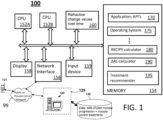
- FIG. 1 depicts a computer-implemented system for estimating future axial elongation of an eye of an individual and determining a myopia control treatment.
- system 100 may include a computing device, a mobile device, or a server.
- computing device 100 may include, for example, personal computers, laptops, tablets, smart devices, smart phones, or any other similar computing device for receiving input data; for performing data analysis such as one or more of the method steps discussed herein, and for outputting data.
- the input data and output data may be stored or saved in at least one database 130.
- the input and/or output data may be accessed by a software application 170 installed on computer 100 [for example a computer in the office of an Eye Care Practitioner (ECP)]; by a downloadable software application (app) on a smart device 121; or by a secure website 125 or web link accessible by a computer via network 99.
- the input and/or output data may be displayed on a graphical user interface of a computer or smart device.
- computing system 100 may include one or more hardware processors 152A, 152B, a memory 154, e.g., for storing an operating system and application program instructions, a network interface 156, a display device 158, an input device 159, and any other features common to a computing device.
- computing system 100 may, for example, be any computing device that is configured to communicate with a web-site 125 or web- or cloud-based server 120 over a public or private communications network 99.
- historical data pertaining to individuals' refractive changes captured from clinicians' measurements and including associated myopia control treatments are obtained and stored in an attached, or a remote memory storage device, e.g., a database 130.
- processors 152A, 152B may include, for example, a microcontroller, Field Programmable Gate Array (FPGA), or any other processor that is configured to perform various operations.
- processors 152A, 152B may be configured to execute instructions as described below. These instructions may be stored, for example, as programmed modules in memory storage device 154.
- Memory 154 may include, for example, non-transitory computer readable media in the form of volatile memory, such as random access memory (RAM) and/or cache memory or others. Memory 154 may include, for example, other removable/non-removable, volatile/non-volatile storage media.
- memory 154 may include a portable computer diskette, a hard disk, a random access memory (RAM), a read-only memory (ROM), an erasable programmable read-only memory (EPROM or Flash memory), a portable compact disc read-only memory (CD-ROM), an optical storage device, a magnetic storage device, or any suitable combination of the foregoing.
- Network interface 156 is configured to transmit and receive data or information to and from a web-site server 120, e.g., via wired or wireless connections.
- network interface 156 may utilize wireless technologies and communication protocols such as Bluetooth ® , WIFI (e.g., 802.11 a/b/g/n), cellular networks (e.g., CDMA, GSM, M2M, and 3G/4G/4G LTE), near-field communications systems, satellite communications, via a local area network (LAN), via a wide area network (WAN), or any other form of communication that allows computing device 100 to transmit information to or receive information from the server 120.
- WIFI e.g., 802.11 a/b/g/n
- cellular networks e.g., CDMA, GSM, M2M, and 3G/4G/4G LTE
- near-field communications systems e.g., satellite communications
- LAN local area network
- WAN wide area network
- Display 158 may include, for example, a computer monitor, television, smart television, a display screen integrated into a personal computing device such as, for example, laptops, smart phones, smart watches, virtual reality headsets, smart wearable devices, or any other mechanism for displaying information to a user.
- display 158 may include a liquid crystal display (LCD), an e-paper/e-ink display, an organic LED (OLED) display, or other similar display technologies.
- LCD liquid crystal display
- OLED organic LED
- display 158 may be touch-sensitive and may also function as an input device.
- Input device 159 may include, for example, a keyboard, a mouse, a touch-sensitive display, a keypad, a microphone, or other similar input devices or any other input devices that may be used alone or together to provide a user with the capability to interact with the computing device 100.
- the system 100 includes: a memory 160 configured to store data relating to a current individual's past refractive changes/errors, e.g., data received from a clinician over a defined period of time, e.g., a past year.
- this data may be stored in a local memory 160, i.e., local to the computer or mobile device system 100, or otherwise, may be retrieved from a remote server 120, over a network.
- the data relating to a current individual's past refractive changes may be accessed via a remote network connection for input to a local attached memory storage device 160 of system 100.
- the computing system 100 provides a technology platform employing programmed processing modules stored in a device memory 154 that may be run via the processor(s) 152A, 152B to provide the system with abilities for computing future axial elongation length of the eye of an individual based on the input set of historical refractive change data received for that individual.
- program modules stored in memory 154 may include operating system software 170 and a software applications module 175 for running the methods herein that may include associated mechanisms such as APIs (application programming interfaces) for specifying how the various software modules interact, web-services, etc. that are employed to control operations used to carry out the change in axial length computations.
- One program module 180 stored in device memory 154 may include a "RECIPY” calculator 190 for determining a value (“RECIPY”) representative of a current individual's refractive change in a past time period, e.g., one year.
- a further program module 190 stored in device memory 154 may include program code providing the various data and processing instructions of an algorithm that is run by the processors to predict a change in axial length (" ⁇ AL") value for that individual. Based on the predicted change in axial length (" ⁇ AL") value for that individual, a further module 195 may be invoked to recommend to a clinician, the individual, or any user, a treatment option(s) such as a type of myopia contact lens, that may be used for inhibiting or preventing refractive changes or reducing a refractive progression rate for the individual.
- a treatment option(s) such as a type of myopia contact lens
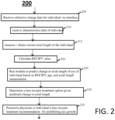
- FIG. 2 depicts a computer-implemented method 200 run at system 100 for estimating future axial elongation of an individual's eye and for suggesting a treatment option for myopic patients based on an estimated future axial elongation of an individual's eye according to one embodiment.
- An individual may include children having an approximate age of 6 to 14. However, the methods herein could also be applied to younger children, older adolescents, or young adults.
- the method at 205 receives data representing the refractive values measured for that individual over a period of time.
- the system 100 of FIG. 1 receives from the memory data representing the refractive change of an individual over a period of time.
- a period of time may be one or more years prior to a reference time point, e.g., a current day.
- the system of FIG. 1 receives characteristics about the individual including at least, the age of the individual.
- the system 100 receives the current measure of the axial length of the eye.
- the clinician or ECP may be prompted via a system display interface 158 to obtain or take a current measurement of the axial length of the individual's eye using ultrasonographic, partial coherence interferometry, optical low-coherence reflectometry, swept-source optical coherence tomography or other measurement techniques.
- the system invokes the RECIPY calculator module 180 to compute the rate of refractive change value of an individual over a period of time at 220. By annualizing the rate of change, the system calculates the "RECIPY" Refractive Error Change In the Previous Year.
- refractive error data is known for 2 years prior to the current date and the change in refraction was -2D, then there would be a RECIPY value of -1D where D is diopters.
- refractive error change is typically measured in clinical practice as refractive error change, future progression is captured as axial elongation as this parameter is a more sensitive measure than refractive error in monitoring progression and is most relevant to the development of myopia related changes, such as myopic retinopathy.
- myopia progression may be characterized by an individual's refractive error change
- myopia progression is characterized as the change in axial length of the individual's eye.
- the system 100 runs the change in axial length calculator module 190 for predicting a change in axial length of the individual's eye. Equation 1) below represents the predicted change in axial length " ⁇ AL” as a function of the annualized past rate of refractive change "RECIPY” value, age data received at step 210, and axial length data at the time of making the prediction received at 215.
- ⁇ AL f RECIPY , Age , Axial Length
- ⁇ AL a mm / D ⁇ RECIPY D ⁇ b mm / yr ⁇ age yrs ] + c ⁇ axial length mm ⁇ d mm
- ⁇ AL is the estimated axial elongation of the eye, e.g., over the 12-month period after the reference timepoint, and is measured in millimeters
- RECIPY is the refractive error change in the prior year (or relativized amount where refraction data is not specifically available for the prior 12-month period) and is measured in diopters D
- "age” is the age of the child in years
- axial length is the axial length of the eye as measured in mm at the reference timepoint.
- equation 1) for predicting a future axial elongation of the eye as a function of the prior refractive change, current axial length and age of the patient may be implemented.
- Such a prediction of future refractive change may receive a past axial elongation measurement as an input parameter.
- Such a prediction of future refractive change may also output a future predicted refractive error change.
- equation 1) may be modified to receive additional input parameters corresponding to other potential predictors of refractive error progression including, but not limited to: biometric data of the patient or of the patient's eye, such as corneal radius, anterior chamber depth, lens thickness, lens power, vitreous chamber depth or similar, or behavioral aspects of the patient, including but not limited to an amount of time engaged in certain activities, including outdoor activity, levels of close work activity (e.g., number of reading hours per day or week or month or time spent on studying or reading or time spent on digital devices), or information regarding genetic make-up of the patient, including but not limited to: a number of myopic parents or siblings, the refractive status of the patient's parents or siblings, the patient's race, ethnicity, gender, or further parameters including but not limited to a geographic location such as country or degree of urbanization, or any other type of demographic or environmental variables considered relevant to refractive progression.
- biometric data of the patient or of the patient's eye such as corneal radius, anterior chamber depth, lens thickness, lens power, vitreous
- equation 1) resulted from a model developed to predict the future ⁇ AL change in refractive progression according to data from control groups in clinical studies.
- 100 subjects in the control groups have been followed for 2 years and the system obtained cycloplegic autorefraction, and axial length data available at baseline, 12 months and 24 months as well as sex, race and ethnicity data for the subjects.
- the first 12-month data was used as prior history and the second 12-month data was used as future progression with the 12-month examination set as the date at which the prediction of progression for the second twelve-month period is made (i.e., the 'reference' timepoint).
- the mean (tSD) of "RECIPY" of this dataset was -0.64 ⁇ 0.52D in refraction change (range: -2.25 to +0.50D).
- Axial elongation during the first 12-month period was 0.25 ⁇ 0.16mm (range: -0.18 to 0.65mm).
- the mean ⁇ SD of spherical equivalent of cycloplegic autorefraction was -3.35 ⁇ 1.26D (range: -1.37 to -6.87D), and the mean ⁇ SD of axial length was 24.86 ⁇ 0.87mm (range: 23.07 to 26.78mm).
- ⁇ AL ⁇ 0.12051 mm / D ⁇ RECIPY D ⁇ 0.03954 mm / yr ⁇ age yrs + 0.036819 ⁇ axial length mm ⁇ 0.35111 mm .
- fast progressors may be considered to have axial elongation above, for example, 0.20mm.
- the equation 1) algorithm exhibits a sensitivity of 0.87 and specificity of 0.58.
- the mean progression in those predicted to be fast progressors is 0.301 mm/yr by this criterion and was twice that of those predicted to be slow progressors (0.146mm/yr). If a cutoff value from the algorithm of 0.23mm is used to predict those who will progress more than 0.20mm, the sensitivity is 0.79 with specificity of 0.71.
- Table 2 shows some selected example predictions for axial elongation in the 2 nd year for the given data at the reference timepoint, i.e., age at reference time point, axial length of the referent time point, and the determined RECIPY value.
- Table 2 Age RECIPY Axial Length Predicted Axial Elongation Effect of age 7 -0.500 23.5 0.298 8 -0.500 23.5 0.258 9 -0.500 23.5 0.219 12 -0.500 23.5 0.100 Effect of RECIPY 8 -0.250 23.5 0.228 8 -0.500 23.5 0.258 8 -0.750 23.5 0.288 Effect of axial length 8 -0.500 23.5 0.258 8 -0.500 24.5 0.295 8 -0.500 25.5 0.332
- the system 100 may determine an optical device such as a soft contact lens having a suitable refraction design for use as myopia treatment for the individual given the individual's predicted progression of myopia based on the predicted ⁇ AL change over the next year.
- the treatment option may include a multi-focal contact lens having positive spherical aberration and increasing dioptric power away from the lens center that creates an amount of peripheral "blur" to deprive the eye of light in a manner as known for inhibiting the eye's growth.
- a regimen of eye drops or other pharmaceutical treatment administered to the individual may be suitable for reducing the progression of myopia; or a regimen of time spent outdoors may be determined to retard or prevent myopia progression.
- Any treatment option available now or in the future that may reduce, retard, eliminate or even reverse the progression of myopia in the individual is determined at 230.
- the system may automatically generate a recommendation for the clinician via system display interface 158 whether locally connected to the system or for communication over a network to a remote computer.
- the display may be a graphical user interface of the computer or a smart device (e.g., a tablet computer, smart phone, personal digital assistant, wearable digital device, gaming device, TV).
- a smart device e.g., a tablet computer, smart phone, personal digital assistant, wearable digital device, gaming device, TV.
- the display may be synchronized on an Eye Care provider's computer or smart device and on a user computer or smart device.
- system 100 may further identify myopes likely to be fast progressors. Detecting of such myopes may be useful for targeting treatment regimens and in designing myopia control clinical studies. As it has been showed that history of fast progression is a factor of similar or better predictive value than age, a well-known risk factor, in assessing likelihood of future fast progression, the algorithm of equation 1) including historical refractive progression (RECIPY) may be used for predicting future fast progression.
- RECIPY historical refractive progression
- the system 100 received the Cycloplegic autorefraction (CAR) data and axial length data, (e.g., obtained by partial interferometry) obtained over a time period including at baseline, 1 yr and 2 yrs in 100 children aged 8 to 15 years with -0.75 to -5.00D of myopia.
- CAR Cycloplegic autorefraction
- axial length data (e.g., obtained by partial interferometry) obtained over a time period including at baseline, 1 yr and 2 yrs in 100 children aged 8 to 15 years with -0.75 to -5.00D of myopia.
- a multivariable regression analysis was conducted with right eye axial elongation during the 2 nd yr was fit in the multivariable analysis by refractive error change in the previous year (RECIPY), age, gender, ethnicity, 1yr axial length and 1yr refractive error.
- Axial elongation was chosen as the dependent variable because of its better sensitivity in identifying progression, but past
- Example p-value analysis results for RECIPY, age, 1-year axial length factors are: RECIPY (p ⁇ 0.0001), age (p ⁇ 0.001), 1 yr axial length (p ⁇ 0.05) and RECIPY*age interaction (p ⁇ 0.05) indicating that all these factors contributed significantly in predicting axial elongation between 1 and 2 yrs. Gender, ethnicity and 1 yr refractive error did not contribute significantly to predicting of axial elongation. The model fit accounted for 57% of the variance in axial elongation in the 2 nd yr. Using a criterion of 0.2mm, the model has a sensitivity of 0.87 and a specificity of 0.58 in predicting fast progressors. The mean progression in those categorized as fast progressors (0.301mm/yr) by this criterion was twice that of those predicted to be slow progressors (0.146mm/yr).
- Applicant's co-pending United States Patent Application No.15/007,660 details a system and method for predicting and tracking an individual's refractive error progression over time. The system and method described are applied to optimally determine a course of treatment for myopia and for an ECP to evaluate over time whether the course of treatment applied for the individual has been/maybe effective. ECPs, parents, and patients are thus provided with a better understanding of the possible long-term benefit of a particular myopia control treatment.
- the present invention may assist an ECP to choose a type of myopia control treatment and/or ophthalmic lens for a child based on the computed future axial elongation of the eye and a resulting anticipated progression of myopia.
- the methods described in co-pending United States Patent Application No.15/007,660 system may be implemented for ECPs to demonstrate and track the effectiveness of treatments to slow the progression of myopia and allow individuals to understand the long-term benefit of a myopia control treatment.
- the principles described in co-pending United States Patent Application No. 15/007,660 may be applied to track myopia control treatments to slow the progression of myopia based on the determining of the predicted axial elongation values according to equation 1).
- the tracking methods and system to estimate a potential axial elongation of an individual's eye over a future predetermined period of time relative to a reference population may be used to: 1) allow ECPs to predict and track axial elongation (and hence, refractive) progression as well as demonstrate and track the effectiveness of treatments to slow the progression of myopia and/or 2) allow patients or parents to understand the long-term benefit of a myopia control treatment.
- aspects of the present invention may be embodied as a system, method, or computer program product. Accordingly, aspects of the present invention may take the form of an entirely hardware embodiment, a processor operating with software embodiment (including firmware, resident software, micro-code, etc.) or an embodiment combining software and hardware aspects that may all generally be referred to herein as a "circuit,” “module” or “system.” Furthermore, aspects of the present invention may take the form of a computer program product embodied in one or more computer readable medium(s) having computer readable program code embodied thereon.
- the computer readable medium may be a computer readable signal medium or a computer readable storage medium.
- a computer readable storage medium may be, for example, but not limited to, an electronic, magnetic, optical, electromagnetic, infrared, or semiconductor system, apparatus, or device, or any suitable combination of the foregoing.
- a computer readable storage medium may be any tangible medium that can contain, or store a program for use by or in connection with an instruction execution system, apparatus, or device.
- Computer program code for carrying out operations for aspects of the present invention may be written in any combination of one or more programming languages, including an object-oriented programming language such as Java, Smalltalk, C++, C#, Transact-SQL, XML, PHP or the like and conventional procedural programming languages, such as the "C" programming language or similar programming languages.
- the program code may execute entirely on the user's computer, partly on the user's computer, as a stand-alone software package, partly on the user's computer and partly on a remote computer or entirely on the remote computer or server.
- the remote computer may be connected to the user's computer through any type of network, including a local area network (LAN) or a wide area network (WAN), or the connection may be made to an external computer (for example, through the Internet using an Internet Service Provider).
- LAN local area network
- WAN wide area network
- Internet Service Provider an Internet Service Provider
- Computer program instructions may be provided to a processor of a general-purpose computer, special purpose computer, or other programmable data processing apparatus to produce a machine, such that the instructions, which execute with the processor of the computer or other programmable data processing apparatus, create means for implementing the functions/acts specified.
- These computer program instructions may also be stored in a computer readable medium that can direct a computer, other programmable data processing apparatus, or other devices to function in a particular manner, such that the instructions stored in the computer readable medium produce an article of manufacture including instructions which implement the functions/acts specified.
- the computer program instructions may also be loaded onto a computer, other programmable data processing apparatus, or other devices to cause a series of operational steps to be performed on the computer, other programmable apparatus or other devices to produce a computer implemented process such that the instructions which execute on the computer or other programmable apparatus provide processes for implementing the functions/acts specified.
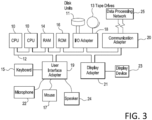
- FIG. 3 a representative hardware environment for practicing at least one embodiment of the invention is depicted.
- the system comprises at least one processor or central processing unit (CPU) 10.
- the CPUs 10 are interconnected with system bus 12 to various devices such as a random access memory (RAM) 14, read-only memory (ROM) 16, and an input/output (I/O) adapter 18.
- RAM random access memory
- ROM read-only memory
- I/O input/output
- the I/O adapter 18 can connect to peripheral devices, such as disk units 11 and tape drives 13, or other program storage devices that are readable by the system.
- the system can read the inventive instructions on the program storage devices and follow these instructions to execute the methodology of at least one embodiment of the invention.
- the system further includes a user interface adapter 19 that connects a keyboard 15, mouse 17, speaker 24, microphone 22, and/or other user interface devices such as a touch screen device (not shown) to the bus 12 to gather user input.
- a communication adapter 20 connects the bus 12 to a data processing network 25, and a display adapter 21 connects the bus 12 to a display device 23 which may be embodied as an output device such as a monitor, printer, or transmitter, for example.
- in communication includes physical and wireless connections that are indirect through one or more additional components (or over a network) or directly between the two components described as being in communication.
Landscapes
- Health & Medical Sciences (AREA)
- Engineering & Computer Science (AREA)
- Life Sciences & Earth Sciences (AREA)
- General Health & Medical Sciences (AREA)
- Public Health (AREA)
- Medical Informatics (AREA)
- Physics & Mathematics (AREA)
- Ophthalmology & Optometry (AREA)
- Biomedical Technology (AREA)
- Surgery (AREA)
- Primary Health Care (AREA)
- Epidemiology (AREA)
- Animal Behavior & Ethology (AREA)
- Molecular Biology (AREA)
- Heart & Thoracic Surgery (AREA)
- Veterinary Medicine (AREA)
- Biophysics (AREA)
- Optics & Photonics (AREA)
- General Physics & Mathematics (AREA)
- Data Mining & Analysis (AREA)
- Databases & Information Systems (AREA)
- Pathology (AREA)
- Signal Processing (AREA)
- Nuclear Medicine, Radiotherapy & Molecular Imaging (AREA)
- Urology & Nephrology (AREA)
- Mathematical Physics (AREA)
- Eye Examination Apparatus (AREA)
Claims (13)
- Computer-implementiertes Verfahren zum Schätzen der zukünftigen Achsverlängerung des Auges einer Person, umfassend:Empfangen, über eine Schnittstelle an einem Computer, von Daten, die sich auf eine Refraktionsänderung in einem früheren, vorbestimmten Zeitraum ab einem Referenzzeitpunkt (205) beziehen, für die Person;Empfangen, über die Schnittstelle, von Daten, die ein Alter der Person darstellen, und von Daten, die einen aktuellen Achslängenwert des Auges darstellen, wie er zum Referenzzeitpunkt (210) gemessen wurde;Vorhersagen, durch einen Prozessor, einer zukünftigen Achsverlängerung des Auges als Funktion aus dem Alter der Person, dem aktuellen Achslängenwert des Auges, wie er zum Referenzzeitpunkt gemessen wurde, und der Refraktionsänderung in dem früheren, vorbestimmten Zeitraum (225);Erzeugen einer Ausgangsanzeige der vorhergesagten zukünftigen Achsverlängerung des Auges über die Schnittstelle (230).
- Computerimplementiertes Verfahren nach Anspruch 1, ferner umfassend:Empfangen von Daten, die sich auf zurückliegende Refraktionsänderungen beziehen, für die Person; undBerechnen, aus den Daten zurückliegender Refraktionsänderungen, einer Änderungsfortschrittrate der Refraktionsänderungen für die Person; undUmrechnen der berechneten Änderungsrate auf ein Jahr, um die Refraktionsänderung für ein zurückliegendes Jahr zu erhalten.
- Computerimplementiertes Verfahren nach Anspruch 1, ferner umfassend:Vergleichen, durch den Prozessor, der vorhergesagten zukünftigen Achsverlängerung des Auges mit einem vorbestimmten Schwellenwert; undIdentifizieren, durch den Prozessor, einer Person als einen schnellen Krankheitsfortschritt aufweisend, wenn die vorhergesagte zukünftige Achsverlängerung des Auges größer als der vorbestimmte Schwellenwert ist.
- Computerimplementiertes Verfahren nach Anspruch 3, wobei der vorbestimmte Schwellenwert etwa 0,301 mm/Jahr beträgt.
- Computerimplementiertes Verfahren nach Anspruch 2, wobei die vorhergesagte zukünftige Achsverlängerung des Auges ein Wert ΔAL ist, wobei das Verfahren umfasst, ΔAL wie folgt zu berechnen:

- Computersystem (100) zum Schätzen der zukünftigen Achsverlängerung des Auges einer Person, umfassend:einen Speicher (154) zum Speichern von Anweisungen; undeinen Prozessor (152), der mit dem Speicher gekoppelt ist, wobei der Prozessor die gespeicherten Anweisungen ausführt zum:Empfangen, über eine Schnittstelle (156) am Server, von Daten, die sich auf eine Refraktionsänderung in einem früheren, vorbestimmten Zeitraum ab einem Referenzzeitpunkt (205) beziehen, für die Person;Empfangen, über die Schnittstelle, von Daten, die ein Alter der Person darstellen, und von Daten, die einen aktuellen Achslängenwert des Auges darstellen, wie er zum Referenzzeitpunkt (210) gemessen wurde;Vorhersagen einer zukünftigen Achsverlängerung als Funktion aus dem Alter der Person, dem aktuellen Achslängenwert des Auges, wie er zum Referenzzeitpunkt gemessen wurde, und der Refraktionsänderung in dem früheren, vorbestimmten Zeitraum (225);Erzeugen einer Ausgangsanzeige der vorhergesagten zukünftigen Achsverlängerung des Auges über die Schnittstelle.
- Computersystem nach Anspruch 6, wobei die gespeicherten Anweisungen den Prozessor ferner konfigurieren zum:Empfangen von Daten, die sich auf zurückliegende Refraktionsänderungen beziehen, für die Person; undBerechnen, aus den Daten zurückliegender Refraktionsänderungen, einer Änderungsfortschrittrate der Refraktionsänderungen für die Person; undUmrechnen der berechneten Änderungsrate auf ein Jahr, um die Refraktionsänderung für ein zurückliegendes Jahr zu erhalten.
- Computersystem nach Anspruch 6, wobei der Prozessor ferner Anweisungen ausführt zum:Vergleichen der vorhergesagten zukünftigen Achsverlängerung des Auges mit einem vorbestimmten Schwellenwert; undIdentifizieren einer Person als einen schnellen Krankheitsfortschritt aufweisend, wenn die vorhergesagte zukünftige Achsverlängerung des Auges größer als der vorbestimmte Schwellenwert ist; undAuswählen einer Myopie-Kontrollbehandlung für die Person mit schnellem Krankheitsfortschritt.
- Computersystem nach Anspruch 6, wobei die vorhergesagte zukünftige Achsverlängerung des Auges ein Wert ΔAL ist, wobei der Prozessor weitere Anweisungen ausführt zum:Berechnen von ΔAL wie folgt:
 wobei a, b und c jeweilige Koeffizienten sind; d ein konstanter Wert in mm ist, RECIPY die Refraktionsänderung in Dioptrien darstellt, Alter das Alter einer Person in Jahren darstellt und die Achslänge in mm angegeben ist.
 - Computerprogrammprodukt zum Schätzen der zukünftigen Achsverlängerung des Auges einer Person, wobei das Computerprogrammprodukt ein nichttransitorisches, computerlesbares Speichermedium mit darin ausgeführten Programmanweisungen umfasst, wobei die Programmanweisungen von einem Prozessor ausgeführt werden können, um ein Verfahren durchzuführen, das umfasst:Empfangen, über eine Schnittstelle an einem Computer, von Daten, die sich auf eine Refraktionsänderung in einem früheren, vorbestimmten Zeitraum ab einem Referenzzeitpunkt (205) beziehen, für die Person;Empfangen, über die Schnittstelle, von Daten, die ein Alter der Person darstellen, und von Daten, die einen aktuellen Achslängenwert des Auges darstellen, wie er zum Referenzzeitpunkt (210) gemessen wurde;Vorhersagen, durch den Prozessor, einer zukünftigen Achsverlängerung des Auges als Funktion aus dem Alter der Person, dem aktuellen Achslängenwert des Auges, wie er zum Referenzzeitpunkt gemessen wurde, und der Refraktionsänderung in dem früheren, vorbestimmten Zeitraum (225); undErzeugen einer Ausgangsanzeige der vorhergesagten zukünftigen Achsverlängerung des Auges über die Schnittstelle.
- Computerprogrammprodukt nach Anspruch 10, wobei die Programmanweisungen den Prozessor ferner konfigurieren zum:Empfangen von Daten, die sich auf zurückliegende Refraktionsänderungen beziehen, für die Person; undBerechnen, aus den Daten zurückliegender Refraktionsänderungen, einer Änderungsfortschrittrate der Refraktionsänderungen für die Person; undUmrechnen der berechneten Änderungsrate auf ein Jahr, um die Refraktionsänderung für ein zurückliegendes Jahr zu erhalten.
- Computerprogrammprodukt nach Anspruch 10, wobei die vorhergesagte zukünftige Achsverlängerung des Auges ein Wert ΔAL ist, wobei das Verfahren umfasst, ΔAL wie folgt zu berechnen:

- Computerimplementiertes Verfahren nach Anspruch 5, Computersystem nach Anspruch 9 oder Computerprogrammprodukt nach Anspruch 12, wobei a = -0,12051 +/- 0,05162 (mm/D); Koeffizientenwert b = 0,03954 +/- 0,00323 (mm/Jahr); Koeffizientenwert c = 0,036819 +/- 0,001098; und Wert d = 0,35111 (mm) +/-0,025809.
Applications Claiming Priority (3)
| Application Number | Priority Date | Filing Date | Title |
|---|---|---|---|
| US201762489666P | 2017-04-25 | 2017-04-25 | |
| US15/952,335 US10912456B2 (en) | 2016-01-27 | 2018-04-13 | Ametropia treatment tracking methods and system |
| EP18168950.6A EP3395233B1 (de) | 2017-04-25 | 2018-04-24 | Nachverfolgungsverfahren und -system für ametropiebehandlung |
Related Parent Applications (1)
| Application Number | Title | Priority Date | Filing Date |
|---|---|---|---|
| EP18168950.6A Division EP3395233B1 (de) | 2017-04-25 | 2018-04-24 | Nachverfolgungsverfahren und -system für ametropiebehandlung |
Publications (3)
| Publication Number | Publication Date |
|---|---|
| EP4049580A1 EP4049580A1 (de) | 2022-08-31 |
| EP4049580C0 EP4049580C0 (de) | 2023-09-06 |
| EP4049580B1 true EP4049580B1 (de) | 2023-09-06 |
Family
ID=62062887
Family Applications (2)
| Application Number | Title | Priority Date | Filing Date |
|---|---|---|---|
| EP18168950.6A Revoked EP3395233B1 (de) | 2017-04-25 | 2018-04-24 | Nachverfolgungsverfahren und -system für ametropiebehandlung |
| EP22168322.0A Active EP4049580B1 (de) | 2017-04-25 | 2018-04-24 | Nachverfolgungsverfahren und -system für ametropiebehandlung |
Family Applications Before (1)
| Application Number | Title | Priority Date | Filing Date |
|---|---|---|---|
| EP18168950.6A Revoked EP3395233B1 (de) | 2017-04-25 | 2018-04-24 | Nachverfolgungsverfahren und -system für ametropiebehandlung |
Country Status (2)
| Country | Link |
|---|---|
| US (2) | US10912456B2 (de) |
| EP (2) | EP3395233B1 (de) |
Families Citing this family (18)
| Publication number | Priority date | Publication date | Assignee | Title |
|---|---|---|---|---|
| AU2017382218B2 (en) | 2016-12-21 | 2023-05-11 | Acucela Inc. | Miniaturized mobile, low cost optical coherence tomography system for home based ophthalmic applications |
| CN112638233B (zh) | 2018-06-20 | 2024-06-14 | 奥克塞拉有限公司 | 基于家庭的眼科应用的微型移动低成本光学相干断层扫描系统 |
| CN113015932B (zh) * | 2018-11-15 | 2023-05-02 | 依视路国际公司 | 确定适于矫正配戴者眼睛的异常屈光的眼科镜片的方法 |
| WO2020126513A1 (en) * | 2018-12-21 | 2020-06-25 | Essilor International | A method and device for building a model for predicting evolution over time of a vision-related parameter |
| KR102250775B1 (ko) | 2019-10-18 | 2021-05-11 | 주식회사 에스알파테라퓨틱스 | 근시 치료를 위한 디지털 장치 및 애플리케이션 |
| US12271057B1 (en) | 2019-12-20 | 2025-04-08 | The Uab Research Foundation | Chromatic aberration tuning ophthalmic corrector lens methods |
| GB201918993D0 (en) | 2019-12-20 | 2020-02-05 | Univ Dublin Technological | A system and method of determining the ocular biometric status of a patient |
| WO2021134087A1 (en) | 2019-12-26 | 2021-07-01 | Acucela Inc. | Optical coherence tomography patient alignment system for home based ophthalmic applications |
| EP3865046B1 (de) * | 2020-02-12 | 2025-09-03 | Essilor International | Detektion und korrektur einer variation eines aktuellen refraktiven fehlers und der aktuellen akkommodationsamplitude einer person |
| US10959613B1 (en) | 2020-08-04 | 2021-03-30 | Acucela Inc. | Scan pattern and signal processing for optical coherence tomography |
| AU2021324968A1 (en) | 2020-08-14 | 2023-03-02 | Acucela Inc. | System and method for optical coherence tomography a-scan decurving |
| US11393094B2 (en) | 2020-09-11 | 2022-07-19 | Acucela Inc. | Artificial intelligence for evaluation of optical coherence tomography images |
| AU2021352417A1 (en) | 2020-09-30 | 2023-04-06 | Acucela Inc. | Myopia prediction, diagnosis, planning, and monitoring device |
| CN116916811A (zh) * | 2020-12-18 | 2023-10-20 | 依视路国际公司 | 用于确定对近视受试者使用的初始近视控制方案的修改或改变的系统和方法 |
| WO2022204622A1 (en) * | 2021-03-24 | 2022-09-29 | Acucela Inc. | Axial length measurement monitor |
| US20230081566A1 (en) * | 2021-09-03 | 2023-03-16 | Johnson & Johnson Vision Care, Inc. | Systems and methods for predicting myopia risk |
| US20250111922A1 (en) * | 2022-01-26 | 2025-04-03 | Hakan Kaymak | Method and system for the treatment of progressing myopia |
| CN119446567B (zh) * | 2024-08-30 | 2025-10-03 | 湖南爱尔眼视光研究所 | 一种近视防控效果预测系统及设备 |
Citations (4)
| Publication number | Priority date | Publication date | Assignee | Title |
|---|---|---|---|---|
| EP1154302A1 (de) | 1999-02-12 | 2001-11-14 | Hoya Corporation | Brille und ihre herstellung |
| KR20160062893A (ko) | 2014-11-26 | 2016-06-03 | 김형수 | 각막곡률과 굴절이상을 이용한 안축길이 계산 방법 |
| EP3199097A2 (de) | 2016-01-27 | 2017-08-02 | Johnson & Johnson Vision Care Inc. | Ametropiebehandlungs-nachverfolgungsverfahren und system |
| WO2017218539A1 (en) | 2016-06-14 | 2017-12-21 | Plenoptika, Inc. | Tunable-lens-based refractive examination |
Family Cites Families (31)
| Publication number | Priority date | Publication date | Assignee | Title |
|---|---|---|---|---|
| US6045578A (en) | 1995-11-28 | 2000-04-04 | Queensland University Of Technology | Optical treatment method |
| AU5312198A (en) * | 1997-01-06 | 1998-08-03 | Klaus Trier Aps | Screening method |
| JP4785814B2 (ja) | 1999-02-12 | 2011-10-05 | Hoya株式会社 | 累進屈折力レンズの製造方法 |
| US6626538B1 (en) | 2000-07-12 | 2003-09-30 | Peter N. Arrowsmith | Method for determining the power of an intraocular lens used for the treatment of myopia |
| US6582078B2 (en) | 2001-02-27 | 2003-06-24 | Barton L. Halpern | Method and system for planning corrective refractive surgery |
| ES2253141T3 (es) * | 2003-04-11 | 2015-04-20 | Technolas Perfect Vision Gmbh | Método y sistema asociados con la planificación del tratamiento para corregir la visión |
| GB2430047B (en) | 2004-07-01 | 2009-01-28 | Auckland Uniservices Ltd | Method of manufacturing a contact lens system for correcting myopic vision |
| FR2898993B1 (fr) | 2006-03-24 | 2008-08-01 | Essilor Int | Procede de determination d'une lentille ophtalmique progressive |
| WO2008111856A1 (en) | 2007-03-09 | 2008-09-18 | Auckland Uniservices Limited | Contact lens and method |
| ITFI20080081A1 (it) | 2008-04-18 | 2009-10-19 | Strumenti Oftalmici C S O S R | Procedimento e sistema per la registrazione di risposte elettrofunzionali erg, perg e vep multifocali in tempo reale |
| WO2010028654A1 (en) * | 2008-09-11 | 2010-03-18 | Iol Innovations Aps | System and method for determining and predicting iol power in situ |
| US10500092B2 (en) * | 2010-12-30 | 2019-12-10 | Amo Wavefront Sciences, Llc | Treatment planning method and system for controlling laser refractive surgery |
| US10582847B2 (en) * | 2010-12-30 | 2020-03-10 | Amo Wavefront Sciences, Llc | Method and system for eye measurements and cataract surgery planning using vector function derived from prior surgeries |
| TWI631334B (zh) | 2011-01-14 | 2018-08-01 | 美國華盛頓大學商業中心 | 診斷及治療眼球長度相關病症之方法 |
| TWI588560B (zh) | 2012-04-05 | 2017-06-21 | 布萊恩荷登視覺協會 | 用於屈光不正之鏡片、裝置、方法及系統 |
| US9594258B2 (en) | 2012-09-25 | 2017-03-14 | Osaka University | Contact lens having myopia progression suppression capability, and contact lens set having myopia progression suppression capability |
| US9201250B2 (en) | 2012-10-17 | 2015-12-01 | Brien Holden Vision Institute | Lenses, devices, methods and systems for refractive error |
| RU2015121415A (ru) | 2012-11-07 | 2016-12-27 | Клэрити Медикал, Системз Инк. | Устройство и способ для работы последовательного датчика волнового фронта большого диоптрийного диапазона реального времени |
| JP6480873B2 (ja) | 2013-03-01 | 2019-03-13 | エシロール エンテルナショナル | 近視抑制製品の効率を評価するシステム、コンピュータプログラムおよびコンピュータプログラムが格納されたコンピュータプログラム可読記憶媒体 |
| WO2015054521A1 (en) | 2013-10-10 | 2015-04-16 | Wavetec Vision Systems, Inc. | Correction values for iol power estimates |
| US9753309B2 (en) | 2013-11-04 | 2017-09-05 | Myopiaok Limited | Contact lens and method for prevention of myopia progression |
| AU2014346484A1 (en) | 2013-11-07 | 2016-01-07 | Amo Development Llc | Treatment validation systems and methods |
| WO2015087436A1 (ja) | 2013-12-09 | 2015-06-18 | 株式会社ユニバーサルビュー | コンタクトレンズ及びその選定方法 |
| JP5667730B1 (ja) | 2013-12-09 | 2015-02-12 | 株式会社ユニバーサルビュー | 近視進行診断装置、近視進行判別方法、プログラム及び記憶媒体 |
| WO2015087435A1 (ja) | 2013-12-09 | 2015-06-18 | 株式会社ユニバーサルビュー | 近視進行診断装置、近視進行判別方法、プログラム及び記憶媒体 |
| FR3019458B1 (fr) | 2014-04-08 | 2016-04-22 | Essilor Int | Refracteur |
| RU2567273C1 (ru) | 2014-05-06 | 2015-11-10 | Лев Павлович Чередниченко | Способ раннего определения аномального рефрактогенеза у детей |
| US9638936B2 (en) | 2014-08-20 | 2017-05-02 | Johnson & Johnson Vision Care, Inc. | High plus treatment zone lens design for preventing and/or slowing myopia progression |
| JP6499416B2 (ja) | 2014-10-10 | 2019-04-10 | キヤノン株式会社 | 眼科装置および眼科装置の制御方法 |
| US10010502B2 (en) | 2015-05-19 | 2018-07-03 | Amorphex Therapeutics Llc | Device that delivers a sustained low-dose of a myopia-suppressing drug, while preserving pupillary function and accommodation |
| CN105066901B (zh) | 2015-07-16 | 2018-06-29 | 复旦大学附属金山医院 | 一种离体测量计算实验动物眼球形态及眼轴和曲率的方法 |
-
2018
- 2018-04-13 US US15/952,335 patent/US10912456B2/en active Active
- 2018-04-24 EP EP18168950.6A patent/EP3395233B1/de not_active Revoked
- 2018-04-24 EP EP22168322.0A patent/EP4049580B1/de active Active
-
2021
- 2021-01-06 US US17/143,008 patent/US12144544B2/en active Active
Patent Citations (4)
| Publication number | Priority date | Publication date | Assignee | Title |
|---|---|---|---|---|
| EP1154302A1 (de) | 1999-02-12 | 2001-11-14 | Hoya Corporation | Brille und ihre herstellung |
| KR20160062893A (ko) | 2014-11-26 | 2016-06-03 | 김형수 | 각막곡률과 굴절이상을 이용한 안축길이 계산 방법 |
| EP3199097A2 (de) | 2016-01-27 | 2017-08-02 | Johnson & Johnson Vision Care Inc. | Ametropiebehandlungs-nachverfolgungsverfahren und system |
| WO2017218539A1 (en) | 2016-06-14 | 2017-12-21 | Plenoptika, Inc. | Tunable-lens-based refractive examination |
Non-Patent Citations (8)
| Title |
|---|
| ANONYMOUS: "GSLS - Why attend?", 25 January 2017 (2017-01-25), XP093193162, Retrieved from the Internet <URL:https://web.archive.org/web/20170125152647/http://www.gslsymposium.com/> |
| D13 - PRELIMINARY OPINION ON EP3395233 |
| JONES-JORDAN LISA A, ET AL: "Myopia Progression as a Function of Sex, Age, and Ethnicity", INVESTIGATIVE OPTHALMOLOGY & VISUAL SCIENCE, ASSOCIATION FOR RESEARCH IN VISION AND OPHTHALMOLOGY, US, 1 January 2021 (2021-01-01), US , pages 1 - 10, XP093019783, ISSN: 1552-5783 |
| LUONG TIFFANY Q, ET AL: "Racial and Ethnic Differences in Myopia Progression in a Large, Diverse Cohort of Pediatric Patients", INVESTIGATIVE OPTHALMOLOGY & VISUAL SCIENCE, ASSOCIATION FOR RESEARCH IN VISION AND OPHTHALMOLOGY, US, 1 January 2020 (2020-01-01), US , pages 1 - 8, XP093019799, ISSN: 1552-5783 |
| MUTTI DONALD O, HAYES JOHN R, MITCHELL G LYNN, JONES LISA A, MOESCHBERGER MELVIN L, COTTER SUSAN A, KLEINSTEIN ROBERT N, MANNY RUT: "Refractive Error, Axial Length, and Relative Peripheral Refractive Error before and after the Onset of Myopia", INVESTIGATIVE OPHTHALMOLOGY & VISUAL SCIENCE, vol. 48, no. 6, 1 June 2007 (2007-06-01), pages 2510 - 2519, XP093193167, DOI: 10.1167/iovs.06 |
| NIXON ALEX, CHENG XU, TOUBOUTI YOUSSEF, BULLIMORE MARK, BRENNAN NOEL: "We Can't Predict Future Axial Elongation in Myopic Children with Confidence", JOHNSON & JOHNSON VISION, 7 October 2020 (2020-10-07), XP093193161 |
| PAN CHEN-WEI, ET AL: "Prevalence of Refractive Errors in a Multiethnic Asian Population: The Singapore Epidemiology of Eye Disease Study", INVESTIGATIVE OPTHALMOLOGY & VISUAL SCIENCE, ASSOCIATION FOR RESEARCH IN VISION AND OPHTHALMOLOGY, US, 1 January 2013 (2013-01-01), US , pages 2590 - 2598, XP093019788, ISSN: 1552-5783 |
| WANG BINGJIE, ET AL: "Factors related to axial length elongation and myopia progression in orthokeratology practice", PLOS ONE, 18 April 2017 (2017-04-18), pages 1 - 14, XP093019802 |
Also Published As
| Publication number | Publication date |
|---|---|
| EP4049580C0 (de) | 2023-09-06 |
| US20180228364A1 (en) | 2018-08-16 |
| US10912456B2 (en) | 2021-02-09 |
| US20190142267A9 (en) | 2019-05-16 |
| US20210121057A1 (en) | 2021-04-29 |
| EP4049580A1 (de) | 2022-08-31 |
| EP3395233A1 (de) | 2018-10-31 |
| EP3395233B1 (de) | 2022-04-20 |
| US12144544B2 (en) | 2024-11-19 |
Similar Documents
| Publication | Publication Date | Title |
|---|---|---|
| EP4049580B1 (de) | Nachverfolgungsverfahren und -system für ametropiebehandlung | |
| AU2018202725B2 (en) | Ametropia treatment tracking methods and system | |
| US10642067B2 (en) | Ametropia treatment tracking methods and system | |
| Vincent | The rigid lens renaissance: a surge in sclerals | |
| Qinghui et al. | Factors determining effective orthokeratology treatment for controlling juvenile myopia progression | |
| JP7741326B2 (ja) | 人の屈折値の進行に関するデータを決定するためのデバイス及び方法 | |
| HK40078657B (en) | Ametropia treatment tracking methods and system | |
| HK40078657A (en) | Ametropia treatment tracking methods and system | |
| HK1260847B (en) | Ametropia treatment tracking methods and system | |
| HK1260847A1 (en) | Ametropia treatment tracking methods and system | |
| CA3230735A1 (en) | Systems and methods for predicting myopia risk | |
| JPWO2023079062A5 (de) | ||
| HK1239497B (en) | Ametropia treatment tracking methods and system |
Legal Events
| Date | Code | Title | Description |
|---|---|---|---|
| PUAI | Public reference made under article 153(3) epc to a published international application that has entered the european phase |
Free format text: ORIGINAL CODE: 0009012 |
|
| STAA | Information on the status of an ep patent application or granted ep patent |
Free format text: STATUS: THE APPLICATION HAS BEEN PUBLISHED |
|
| AC | Divisional application: reference to earlier application |
Ref document number: 3395233 Country of ref document: EP Kind code of ref document: P |
|
| AK | Designated contracting states |
Kind code of ref document: A1 Designated state(s): AL AT BE BG CH CY CZ DE DK EE ES FI FR GB GR HR HU IE IS IT LI LT LU LV MC MK MT NL NO PL PT RO RS SE SI SK SM TR |
|
| STAA | Information on the status of an ep patent application or granted ep patent |
Free format text: STATUS: REQUEST FOR EXAMINATION WAS MADE |
|
| 17P | Request for examination filed |
Effective date: 20230106 |
|
| RBV | Designated contracting states (corrected) |
Designated state(s): AL AT BE BG CH CY CZ DE DK EE ES FI FR GB GR HR HU IE IS IT LI LT LU LV MC MK MT NL NO PL PT RO RS SE SI SK SM TR |
|
| REG | Reference to a national code |
Ref country code: HK Ref legal event code: DE Ref document number: 40078657 Country of ref document: HK |
|
| TPAC | Observations filed by third parties |
Free format text: ORIGINAL CODE: EPIDOSNTIPA |
|
| GRAP | Despatch of communication of intention to grant a patent |
Free format text: ORIGINAL CODE: EPIDOSNIGR1 |
|
| STAA | Information on the status of an ep patent application or granted ep patent |
Free format text: STATUS: GRANT OF PATENT IS INTENDED |
|
| INTG | Intention to grant announced |
Effective date: 20230519 |
|
| P01 | Opt-out of the competence of the unified patent court (upc) registered |
Effective date: 20230521 |
|
| GRAS | Grant fee paid |
Free format text: ORIGINAL CODE: EPIDOSNIGR3 |
|
| GRAA | (expected) grant |
Free format text: ORIGINAL CODE: 0009210 |
|
| STAA | Information on the status of an ep patent application or granted ep patent |
Free format text: STATUS: THE PATENT HAS BEEN GRANTED |
|
| AC | Divisional application: reference to earlier application |
Ref document number: 3395233 Country of ref document: EP Kind code of ref document: P |
|
| AK | Designated contracting states |
Kind code of ref document: B1 Designated state(s): AL AT BE BG CH CY CZ DE DK EE ES FI FR GB GR HR HU IE IS IT LI LT LU LV MC MK MT NL NO PL PT RO RS SE SI SK SM TR |
|
| REG | Reference to a national code |
Ref country code: GB Ref legal event code: FG4D |
|
| REG | Reference to a national code |
Ref country code: CH Ref legal event code: EP |
|
| REG | Reference to a national code |
Ref country code: IE Ref legal event code: FG4D |
|
| REG | Reference to a national code |
Ref country code: DE Ref legal event code: R096 Ref document number: 602018057346 Country of ref document: DE |
|
| U01 | Request for unitary effect filed |
Effective date: 20231005 |
|
| U07 | Unitary effect registered |
Designated state(s): AT BE BG DE DK EE FI FR IT LT LU LV MT NL PT SE SI Effective date: 20231016 |
|
| P04 | Withdrawal of opt-out of the competence of the unified patent court (upc) registered |
Effective date: 20231011 |
|
| PG25 | Lapsed in a contracting state [announced via postgrant information from national office to epo] |
Ref country code: GR Free format text: LAPSE BECAUSE OF FAILURE TO SUBMIT A TRANSLATION OF THE DESCRIPTION OR TO PAY THE FEE WITHIN THE PRESCRIBED TIME-LIMIT Effective date: 20231207 |
|
| PG25 | Lapsed in a contracting state [announced via postgrant information from national office to epo] |
Ref country code: RS Free format text: LAPSE BECAUSE OF FAILURE TO SUBMIT A TRANSLATION OF THE DESCRIPTION OR TO PAY THE FEE WITHIN THE PRESCRIBED TIME-LIMIT Effective date: 20230906 Ref country code: NO Free format text: LAPSE BECAUSE OF FAILURE TO SUBMIT A TRANSLATION OF THE DESCRIPTION OR TO PAY THE FEE WITHIN THE PRESCRIBED TIME-LIMIT Effective date: 20231206 Ref country code: HR Free format text: LAPSE BECAUSE OF FAILURE TO SUBMIT A TRANSLATION OF THE DESCRIPTION OR TO PAY THE FEE WITHIN THE PRESCRIBED TIME-LIMIT Effective date: 20230906 Ref country code: GR Free format text: LAPSE BECAUSE OF FAILURE TO SUBMIT A TRANSLATION OF THE DESCRIPTION OR TO PAY THE FEE WITHIN THE PRESCRIBED TIME-LIMIT Effective date: 20231207 |
|
| PG25 | Lapsed in a contracting state [announced via postgrant information from national office to epo] |
Ref country code: IS Free format text: LAPSE BECAUSE OF FAILURE TO SUBMIT A TRANSLATION OF THE DESCRIPTION OR TO PAY THE FEE WITHIN THE PRESCRIBED TIME-LIMIT Effective date: 20240106 |
|
| PG25 | Lapsed in a contracting state [announced via postgrant information from national office to epo] |
Ref country code: ES Free format text: LAPSE BECAUSE OF FAILURE TO SUBMIT A TRANSLATION OF THE DESCRIPTION OR TO PAY THE FEE WITHIN THE PRESCRIBED TIME-LIMIT Effective date: 20230906 |
|
| PG25 | Lapsed in a contracting state [announced via postgrant information from national office to epo] |
Ref country code: SM Free format text: LAPSE BECAUSE OF FAILURE TO SUBMIT A TRANSLATION OF THE DESCRIPTION OR TO PAY THE FEE WITHIN THE PRESCRIBED TIME-LIMIT Effective date: 20230906 Ref country code: RO Free format text: LAPSE BECAUSE OF FAILURE TO SUBMIT A TRANSLATION OF THE DESCRIPTION OR TO PAY THE FEE WITHIN THE PRESCRIBED TIME-LIMIT Effective date: 20230906 Ref country code: IS Free format text: LAPSE BECAUSE OF FAILURE TO SUBMIT A TRANSLATION OF THE DESCRIPTION OR TO PAY THE FEE WITHIN THE PRESCRIBED TIME-LIMIT Effective date: 20240106 Ref country code: ES Free format text: LAPSE BECAUSE OF FAILURE TO SUBMIT A TRANSLATION OF THE DESCRIPTION OR TO PAY THE FEE WITHIN THE PRESCRIBED TIME-LIMIT Effective date: 20230906 Ref country code: CZ Free format text: LAPSE BECAUSE OF FAILURE TO SUBMIT A TRANSLATION OF THE DESCRIPTION OR TO PAY THE FEE WITHIN THE PRESCRIBED TIME-LIMIT Effective date: 20230906 Ref country code: SK Free format text: LAPSE BECAUSE OF FAILURE TO SUBMIT A TRANSLATION OF THE DESCRIPTION OR TO PAY THE FEE WITHIN THE PRESCRIBED TIME-LIMIT Effective date: 20230906 |
|
| U20 | Renewal fee for the european patent with unitary effect paid |
Year of fee payment: 7 Effective date: 20240422 |
|
| PG25 | Lapsed in a contracting state [announced via postgrant information from national office to epo] |
Ref country code: PL Free format text: LAPSE BECAUSE OF FAILURE TO SUBMIT A TRANSLATION OF THE DESCRIPTION OR TO PAY THE FEE WITHIN THE PRESCRIBED TIME-LIMIT Effective date: 20230906 |
|
| REG | Reference to a national code |
Ref country code: DE Ref legal event code: R026 Ref document number: 602018057346 Country of ref document: DE |
|
| PLBI | Opposition filed |
Free format text: ORIGINAL CODE: 0009260 |
|
| PLAX | Notice of opposition and request to file observation + time limit sent |
Free format text: ORIGINAL CODE: EPIDOSNOBS2 |
|
| 26 | Opposition filed |
Opponent name: LUMI IP GMBH Effective date: 20240605 |
|
| PLBB | Reply of patent proprietor to notice(s) of opposition received |
Free format text: ORIGINAL CODE: EPIDOSNOBS3 |
|
| PG25 | Lapsed in a contracting state [announced via postgrant information from national office to epo] |
Ref country code: MC Free format text: LAPSE BECAUSE OF FAILURE TO SUBMIT A TRANSLATION OF THE DESCRIPTION OR TO PAY THE FEE WITHIN THE PRESCRIBED TIME-LIMIT Effective date: 20230906 |
|
| PG25 | Lapsed in a contracting state [announced via postgrant information from national office to epo] |
Ref country code: MC Free format text: LAPSE BECAUSE OF FAILURE TO SUBMIT A TRANSLATION OF THE DESCRIPTION OR TO PAY THE FEE WITHIN THE PRESCRIBED TIME-LIMIT Effective date: 20230906 |
|
| REG | Reference to a national code |
Ref country code: CH Ref legal event code: PL |
|
| P05 | Withdrawal of opt-out of the competence of the unified patent court (upc) changed |
Free format text: CASE NUMBER: APP_579724/2023 Effective date: 20231016 |
|
| PG25 | Lapsed in a contracting state [announced via postgrant information from national office to epo] |
Ref country code: CH Free format text: LAPSE BECAUSE OF NON-PAYMENT OF DUE FEES Effective date: 20240430 |
|
| U20 | Renewal fee for the european patent with unitary effect paid |
Year of fee payment: 8 Effective date: 20250310 |
|
| PGFP | Annual fee paid to national office [announced via postgrant information from national office to epo] |
Ref country code: IE Payment date: 20250310 Year of fee payment: 8 |
|
| PGFP | Annual fee paid to national office [announced via postgrant information from national office to epo] |
Ref country code: GB Payment date: 20250306 Year of fee payment: 8 |
|
| PG25 | Lapsed in a contracting state [announced via postgrant information from national office to epo] |
Ref country code: CY Free format text: LAPSE BECAUSE OF FAILURE TO SUBMIT A TRANSLATION OF THE DESCRIPTION OR TO PAY THE FEE WITHIN THE PRESCRIBED TIME-LIMIT; INVALID AB INITIO Effective date: 20180424 |
|
| PG25 | Lapsed in a contracting state [announced via postgrant information from national office to epo] |
Ref country code: HU Free format text: LAPSE BECAUSE OF FAILURE TO SUBMIT A TRANSLATION OF THE DESCRIPTION OR TO PAY THE FEE WITHIN THE PRESCRIBED TIME-LIMIT; INVALID AB INITIO Effective date: 20180424 |
|
| PLCK | Communication despatched that opposition was rejected |
Free format text: ORIGINAL CODE: EPIDOSNREJ1 |