EP4048838B1 - Zellulose-verbundmaterial und verfahren zur herstellung eines solchen materials - Google Patents
Zellulose-verbundmaterial und verfahren zur herstellung eines solchen materials Download PDFInfo
- Publication number
- EP4048838B1 EP4048838B1 EP20807083.9A EP20807083A EP4048838B1 EP 4048838 B1 EP4048838 B1 EP 4048838B1 EP 20807083 A EP20807083 A EP 20807083A EP 4048838 B1 EP4048838 B1 EP 4048838B1
- Authority
- EP
- European Patent Office
- Prior art keywords
- grid
- cellulose material
- layer
- composite
- material according
- Prior art date
- Legal status (The legal status is an assumption and is not a legal conclusion. Google has not performed a legal analysis and makes no representation as to the accuracy of the status listed.)
- Active
Links
Images



Classifications
-
- D—TEXTILES; PAPER
- D21—PAPER-MAKING; PRODUCTION OF CELLULOSE
- D21H—PULP COMPOSITIONS; PREPARATION THEREOF NOT COVERED BY SUBCLASSES D21C OR D21D; IMPREGNATING OR COATING OF PAPER; TREATMENT OF FINISHED PAPER NOT COVERED BY CLASS B31 OR SUBCLASS D21G; PAPER NOT OTHERWISE PROVIDED FOR
- D21H27/00—Special paper not otherwise provided for, e.g. made by multi-step processes
- D21H27/02—Patterned paper
-
- D—TEXTILES; PAPER
- D21—PAPER-MAKING; PRODUCTION OF CELLULOSE
- D21H—PULP COMPOSITIONS; PREPARATION THEREOF NOT COVERED BY SUBCLASSES D21C OR D21D; IMPREGNATING OR COATING OF PAPER; TREATMENT OF FINISHED PAPER NOT COVERED BY CLASS B31 OR SUBCLASS D21G; PAPER NOT OTHERWISE PROVIDED FOR
- D21H27/00—Special paper not otherwise provided for, e.g. made by multi-step processes
-
- D—TEXTILES; PAPER
- D21—PAPER-MAKING; PRODUCTION OF CELLULOSE
- D21H—PULP COMPOSITIONS; PREPARATION THEREOF NOT COVERED BY SUBCLASSES D21C OR D21D; IMPREGNATING OR COATING OF PAPER; TREATMENT OF FINISHED PAPER NOT COVERED BY CLASS B31 OR SUBCLASS D21G; PAPER NOT OTHERWISE PROVIDED FOR
- D21H17/00—Non-fibrous material added to the pulp, characterised by its constitution; Paper-impregnating material characterised by its constitution
- D21H17/20—Macromolecular organic compounds
- D21H17/21—Macromolecular organic compounds of natural origin; Derivatives thereof
- D21H17/24—Polysaccharides
- D21H17/28—Starch
-
- D—TEXTILES; PAPER
- D21—PAPER-MAKING; PRODUCTION OF CELLULOSE
- D21H—PULP COMPOSITIONS; PREPARATION THEREOF NOT COVERED BY SUBCLASSES D21C OR D21D; IMPREGNATING OR COATING OF PAPER; TREATMENT OF FINISHED PAPER NOT COVERED BY CLASS B31 OR SUBCLASS D21G; PAPER NOT OTHERWISE PROVIDED FOR
- D21H19/00—Coated paper; Coating material
- D21H19/36—Coatings with pigments
- D21H19/44—Coatings with pigments characterised by the other ingredients, e.g. the binder or dispersing agent
- D21H19/54—Starch
-
- D—TEXTILES; PAPER
- D21—PAPER-MAKING; PRODUCTION OF CELLULOSE
- D21H—PULP COMPOSITIONS; PREPARATION THEREOF NOT COVERED BY SUBCLASSES D21C OR D21D; IMPREGNATING OR COATING OF PAPER; TREATMENT OF FINISHED PAPER NOT COVERED BY CLASS B31 OR SUBCLASS D21G; PAPER NOT OTHERWISE PROVIDED FOR
- D21H27/00—Special paper not otherwise provided for, e.g. made by multi-step processes
- D21H27/10—Packing paper
-
- D—TEXTILES; PAPER
- D21—PAPER-MAKING; PRODUCTION OF CELLULOSE
- D21H—PULP COMPOSITIONS; PREPARATION THEREOF NOT COVERED BY SUBCLASSES D21C OR D21D; IMPREGNATING OR COATING OF PAPER; TREATMENT OF FINISHED PAPER NOT COVERED BY CLASS B31 OR SUBCLASS D21G; PAPER NOT OTHERWISE PROVIDED FOR
- D21H27/00—Special paper not otherwise provided for, e.g. made by multi-step processes
- D21H27/18—Paper- or board-based structures for surface covering
- D21H27/20—Flexible structures being applied by the user, e.g. wallpaper
Definitions
- the present invention relates to a cellulose composite material, different products made from such a material such as packaging for food, cosmetic or pharmaceutical products, papers for bags, sachets and pouches, a core for cellular or multi-structure “sandwich” panels.
- a cellulose composite material different products made from such a material such as packaging for food, cosmetic or pharmaceutical products, papers for bags, sachets and pouches, a core for cellular or multi-structure “sandwich” panels.
- -paper towels or toilet paper, or even wallpaper printed papers for promotional uses such as poster papers, for inserts, inserts or prospectuses, papers for domestic use such as paper tablecloths, stationery items such as book covers or an envelope for example, as well as a process for manufacturing such material.
- Grid-type structures or frames are widely present in nature, notably in the leaves of certain plants where they support the body of the leaves, or in the wings of certain insects.
- Man has been inspired by it to develop plate or shell structures used in many industrial sectors, particularly in transport (marine, nautical, aeronautics, aerospace) and civil engineering.
- These structures are made up of a skin and a network of reinforcing ribs extending over a surface of the skin, and are of interest for applications which require both rigidity, strength and lightness.
- This arrangement allows the material to be placed where it is needed: when such a structure is subjected to torsion or bending, the skin works essentially in so-called membrane deformation mode, while the network of ribs works essentially in bending/torsion. . It is thus possible to obtain parts, most often in the form of ultralight flat or curved panels having very good specific mechanical properties (that is to say in relation to their density).
- the mechanical properties of deformation in flexion (curvature of the structure) and in torsion (twisting of the structure), as well as the buckling behavior of ribbed structures are determined in particular by the geometry of the network of ribs.
- the optimization of these properties requires the development of geometries adapted to the stresses [1].
- specific geometric patterns can confer auxetic behavior [2], i.e. exhibiting a negative Poisson's ratio, to the structures they constitute and significantly improve some of their geometric and mechanical properties.
- the document FR 2 250 853 describes on this subject a process for improving the mechanical properties of a sheet of paper. This process consists of forming a reinforcement in the sheet of paper made up of a regular network of continuous thin lines of a binder commonly used in the paper industry.
- the binder in particular a polyvinyl alcohol or a rubber, penetrates into the sheet of paper, and leads to the formation of a reinforcement at the heart of the sheet of paper.
- the reinforcement integrated into the sheet of paper, gives the latter increased tensile strength, while preserving the flexibility of the sheet, particularly in bending and torsion.
- the reinforcement is formed in the sheet of paper, at the heart of said sheet of paper.
- the resulting sheet of reinforced paper exhibits improved mechanical properties in the plane of the sheet, including improved tensile strength.
- the mechanical properties outside the plane of the sheet such as the resistance in bending and torsion, remain unchanged and therefore low since they approximately correspond to those of the initial sheet of paper.
- the sheet of reinforced paper is therefore not rigid, and therefore is not suitable for use in areas where the paper is heavily stressed, in particular according to constraints perpendicular to the plane of the sheet of paper such as as bending or twisting. This is particularly the case when paper is used for the manufacture of packaging, in particular for the transport or storage of food products.
- An aim of the invention is to provide a cellulose composite material making it possible to overcome the drawbacks described above.
- the invention aims in particular to provide such a cellulosic composite material comprising a layer of a cellulosic material, which has mechanical properties outside the plane of the sheet, in particular the bending resistance and the torsional resistance, increased compared to said layer of cellulose material alone.
- the invention aims in particular to provide such a cellulose composite material suitable for use in areas where paper is in high demand, particularly but not exclusively for the manufacture of packaging for food, cosmetic or pharmaceutical products, papers for bags , bags and pockets, a core for cellular “sandwich” panels or multi-ply structure for paper towels or toilet paper, or even wallpaper, printed papers for promotional uses such as poster papers, for inserts, inserts or leaflets , papers for household use such as paper tablecloths, stationery such as book covers or an envelope for example
- the invention proposes a cellulose composite material as described in claim 1, the claims which depend thereon describing advantageous embodiments.
- the invention also relates to articles made from the cellulose composite material described above.
- Such articles may be in particular, but not exclusively, flexible packaging, such as food packaging for example, wallpaper, a billboard, preferably of the sandwich type, or even an envelope.
- flexible packaging such as food packaging for example, wallpaper, a billboard, preferably of the sandwich type, or even an envelope.
- Another object of the invention relates to a method of manufacturing a cellulose composite material according to claim 15, the claims which depend thereon describing advantageous modes of implementation.
- the invention relates to a cellulosic composite material comprising a layer of a cellulosic material and a reinforcing grid positioned on at least one surface of the layer of cellulosic material.
- the reinforcing grid can be deposited over the entire surface, or over only part of this surface.
- a “composite material” corresponds to a combination of at least two immiscible components. A synergy effect is obtained by such a combination, so that a composite material has properties, particularly mechanical, that each of the components alone does not possess, or possesses to a lower degree than the composite material.
- the first component of the cellulosic composite material is the layer of a cellulosic material
- the second component is the reinforcing grid.
- the layer of cellulosic material forms the matrix of the cellulosic composite material.
- Such a matrix ensures the cohesion of the structure of the cellulose composite material, and transmits the forces exerted on the latter to the reinforcing grid.
- the reinforcing grid is a reinforcement of the cellulose composite material, and ensures good mechanical strength thereof.
- Deposition of the reinforcing layer on the surface of the cellulosic material layer thus makes it possible to improve the specific mechanical properties outside the plane of said cellulosic material layer, in particular by increasing its bending strength as well as its torsional strength.
- the layer of cellulosic material is preferably a sheet of paper.
- the sheet of paper has a weight of between 13 g/m 2 and 140 g/m 2 , preferably between 30 g/m 2 and 90 g/m 2 .
- These weight ranges correspond to a relatively flexible sheet of paper, typically sheets intended for the manufacture of flexible packaging such as pockets, bags and sachets, which are particularly preferred for producing the cellulose composite material of the invention.
- the reinforcing grid comprises a plurality of meshes delimited by grid wires.
- the reinforcing grid includes starch.
- the starch may be native starch or modified starch, for example a dextrin.
- Starch is a polymer of glucose, generally a mixture of amylopectin (branched) and amylose (linear), naturally present in many plants.
- two starch modification strategies are usually implemented industrially: acidic or enzymatic conversion of starch in order to generate polymers of lower molecular weight, for example dextrins, and the chemical modification of starch, by reacting the hydroxyl groups of the starch with functional agents to introduce substitution groups.
- functional agents to introduce substitution groups.
- substitution groups include, for example, starches such as hydroxypropyl ethers or hydroxypropyl starches.
- the native or modified starch can be associated with other constituents in the reinforcing grid.
- the starch shrinks when it dries.
- the shrinkage forces exerted during the drying of the starch-based formulation previously deposited on the surface of the cellulosic layer lead to a deformation gradient in the thickness of the cellulosic layer. This deformation is favored by the rewetting of the cellulose layer which occurs between the removal of the grid and the end of drying.
- a fold is then formed, which can also be called a “valley fold” in that a valley is formed in the fold on the face on which the reinforcing grid has been deposited, at the locations where the retraction of the reinforcement occurs.
- all thickness means the distance between the planes tangent to the upper and lower rough surfaces of the cellulosic layer, and parallel to each other.
- the determination of the overall thickness, noted Ep, is illustrated on the Figure 14 .
- the deposition of the starch grid on the surface of the cellulosic layer thus makes it possible to obtain a synergistic effect: a local increase in thickness, at the level of the grid deposition zones, due to the local addition of material (starch), as well as an additional effect of increasing the overall thickness, which occurs more generally on the cellulosic layer, and more significantly at the level of the deposition zones of the grid, depending on the deformation gradient in the thickness of said cellulosic layer.
- the thickness of the composite material obtained is greater than the sum of the thicknesses of the layer of cellulosic material and of the reinforcing grid.
- the measurement of the overall thickness is carried out according to the ISO12625-3 standard, as being the distance between a fixed reference plate on which the sample rests and a parallel probe which exerts a specified load on the surface under test.
- a precision counterweight micrometer is used which includes two parallel and flat horizontal keys, between which a test piece of the material of interest is placed.
- the upper circular probe has a larger diameter of (35.7 ⁇ 0.1) mm, or a nominal surface area of 10.0 cm 2 .
- the pressure between the two micrometer keys is (2.0 ⁇ 0.1) kPa.
- a starch grid also offers the advantage of being inexpensive.
- the starch can be in the form of a starch suspension, which simplifies the deposition of the grid, the starch suspension being in fact relatively simple to use and being properly distributed over the surface of the layer. of cellulosic material.
- the starch suspension can be supplemented with a certain number of products, such as in particular rheology modifiers, pigments, plasticizers, surfactants in order to modulate or improve its properties during the implementation of the grid or during its use.
- the coverage rate of the reinforcing grid on the surface of the layer of cellulosic material is greater than or equal to 10%, preferably greater than or equal to 20%.
- the coverage rate of the reinforcing grid can be defined as being the ratio between the surface portion of the cellulosic material layer which is covered by the reinforcing grid, and the portion of said surface which is free, i.e. -say not covered by said reinforcing grid.
- the coverage rate of the reinforcing grid on the surface of the layer of cellulosic material is less than or equal to 60%, preferably less than or equal to 50%.
- a coverage rate greater than 60% does not further improve the out-of-plane mechanical properties, in addition to significantly stiffening the composite material formed, particularly in the plane, which is not necessarily desirable depending on the subsequent application of the composite material. .
- a coverage rate less than 60% but greater than 50% only slightly improves the out-of-plane mechanical properties and stiffens the composite material in the plane.
- the coverage rate is between 10% and 60%, preferably between 10% and 50%, and more preferably between 20% and 50%. These coverage rates make it possible to have a good compromise between an improvement in the overall thickness and the resistance in bending and torsion, and the cost of manufacturing the cellulose composite material using a moderate quantity of reinforcing grid composition. .
- the reinforcing grid is deposited on the paper layer preferably by screen printing, three-dimensional printing, intaglio, flexography, or spraying via one or more nozzles.
- Screen printing is a printing technique using a canvas, also called a screen, as a printing form, the mesh of which is closed in the areas which should not be printed.
- the ink is deposited on the back of the canvas and a doctor blade system forces the ink to pass through the unobstructed mesh of the canvas and come into contact with the material to be printed.
- This technique is advantageous for the deposition of reinforcing grid, since it uses inks of medium viscosities (viscosities between 500 and 5000 mPa.s) and allows localized deposits to be carried out which can range from 5 to 120 ⁇ m ink thickness. before drying.
- intaglio technique hollows are engraved in the printing form (generally a metal plate). The plate is covered with ink then scraped to leave ink only in the recesses of the printer form. This shape printer is pressed on the paper to allow transfer of the ink from the recesses of the printer form to the surface of the sheet.
- This process is particularly advantageous for depositing ink thicknesses of 10 to 60 ⁇ m before drying, but requires a particularly viscous ink (viscosity between 10,000 and 25,000 mPa.s) and exerts a pressure constraint on transfer reducing the thickness of the cellulose layer.
- Flexography makes it possible to print the reinforcement grid using a flexible relief printing form.
- the reinforcing grid preferably represents an increase in weight after drying of between 2 and 50 g/m 2 , preferably between 5 and 20 g/m 2 . In other words, this corresponds to the quantity of reinforcing grid which is positioned on the surface of the cellulosic material layer.
- the grid wires have a width in the plane of the grid of between 0.1 mm and 3 mm, preferably between 0.5 mm and 2.5 mm.
- the meshes of the reinforcement grid can have various patterns. It may for example be a square, rectangular, hexagonal, honeycomb type, bow tie type, or even sinusoidal pattern.
- the meshes are sized to have a coverage rate of approximately 30%.
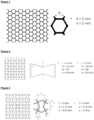
- the reinforcement grid includes hexagonal pattern mesh.
- the hexagon has six parallel sides in pairs and of the same length, denoted b, equal to 5 mm.
- the thickness of the wires forming the mesh, noted e, is equal to 1 mm.
- the reinforcing grid comprises meshes with a bow tie or hourglass type pattern.
- the length L of a lateral side of the bow tie is equal to 6 mm
- the length H of the base is equal to 12 mm
- the angle ⁇ between the base and the lateral side is equal to 45°
- the thickness e of the wires forming the mesh is equal to 0.8 mm.
- the length L of a lateral side of the bow tie is equal to 5 mm
- the length H of the base is equal to 10 mm
- the angle ⁇ between the base and the lateral side is equal to 60°
- the thickness e of the wires forming the mesh is equal to 0.8 mm.
- the reinforcing grid comprises meshes with a sinusoidal type pattern.
- Each stitch is formed by two warp threads which extend opposite each other in a substantially vertical direction, the curvature of one thread being reversed relative to that of the other thread, and by two weft threads which extend opposite each other in a substantially horizontal direction, the curvature of one thread being reversed relative to that of the other thread.
- the curved deviation, denoted a, of each wire relative to an equivalent straight wire is equal to 1.5 mm
- the space I between two opposite sides of the equivalent square is equal to 5 mm
- the thickness e of the wires forming the mesh is equal to 0.8 mm.
- the curved deviation, denoted a, of each wire relative to an equivalent straight wire is equal to 1.8 mm
- the space I between two opposite sides of the equivalent square is equal to 6 mm
- the thickness e of the wires forming the mesh is equal to 1 mm.
- the invention also relates to a process for manufacturing a cellulose composite material as described above.
- the method comprises a step consisting of depositing the reinforcing grid on at least one surface of the cellulosic material.
- the deposition of the grid is carried out by screen printing, three-dimensional printing, intaglio, flexography, or spraying via one or more nozzles.
- the composition of the reinforcing grid comprises at least one starch suspension having a dry matter content of between 5% and 65% by weight when the reinforcing grid is deposited.
- Example 1 determination of the bending resistance of cellulosic composite materials comprising reinforcing grids at different coverage rates
- a rectangular mesh reinforcement grid was printed by screen printing on 55 g/m 2 dry weight paper, to obtain the corresponding cellulose composite material.
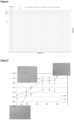
- the grid is shown on the Figure 4 .
- the thickness of the grid is 20 ⁇ m for a line width, denoted a, of between 0.25 mm and 2.5 mm depending on the coverage percentage of between 20% and 75%.
- the medians of the lines are spaced from each other by 5 mm.
- the grid has a dimension of 300 mm by 200 mm.
- the resulting cellulose composite material was dried in an oven at a temperature of 60°C for 1 minute and 30 seconds.
- the results obtained with the reinforcing grid based on low molecular weight dextrin are illustrated in the Figure 5 .
- the graph of the figure 5 shows the bending resistance (mNm) at 15° as a function of the coverage rate (%). Photographs illustrate the surface appearance of the composite material obtained.
- the bending resistance of the material increases by 0.07 mNm (zero coverage rate, absence of reinforcing grid) in the running direction, also known as the machine direction and denoted MD, at 0.22 mNm for the cellulose composite material having a coverage rate of 50%.
- the bending resistance increases from 0.04 mNm to 0.12 mNm.
- the results obtained with the reinforcement grid based on the mixture of 90% dextrin and 10% waxy type starch are illustrated on the Figure 6 , and are similar to those of the Figure 5 .
- the graph of the Figure 6 shows the bending resistance (mNm) at 15° as a function of the coverage rate (%).
- the bending resistance of the material goes from 0.07 mNm (zero coverage rate, absence of reinforcing grid) in the MD running direction, to 0.21 mNm for the Cellulosic composite material with a coverage rate of 50%.
- the bending resistance increases from 0.04 mNm to 0.13 mNm.
- Example 2 determination of the bending resistance of cellulosic composite materials comprising reinforcing grids having different patterns
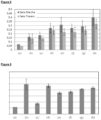
- the results are represented in the form of a graph on the Figure 7 .
- the graph of the Figure 7 shows the bending strength (mNm) depending on the different materials.
- Example 3 determination of the bending resistance of cellulosic composite materials comprising reinforcing grids of different materials
- Eight cellulosic composite materials comprising grids made from several different compositions, and having meshes of a pattern identical to sinusoidal hexagonal meshes, were tested to determine their flexural strength. The coverage rate is approximately 30% for the eight materials. All eight composite materials include the same cellulosic material: Gerstar TM flexible packaging material.
- the results are represented in the form of a graph on the figure 8 .
- the graph of the figure 8 shows the bending strength (mNm) depending on the different materials.
- the overall thickness (mm) of the different cellulosic materials is shown on the Figure 9
- the weight (g/m 2 ) of the different cellulosic materials is represented on the Figure 10 .
- Measurements are taken in the machine direction MD as well as in the cross direction CD.
- FIG. 11A A photograph of the composite material obtained by deposition of the starch grid is shown on the Figure 11A .
- a grazing view photograph of this same material is shown on the Figure 11B .
- PVOH and water grids give less good results than starches: the gain in bending strength compared to the reference is relatively small. This is explained by the fact that the synergy effect observed for the starch grids does not occur. There is only a local increase in the thickness of the material at the level of the deposition zones of the grids due to the deposition of material.
- a starch grid was also deposited on other cellulosic materials: paper and blotting paper.
- the results are represented on the graphs of figures 12 And 13 .
- the graph of the Figure 12 shows the bending strength (mNm) depending on the different materials.
- the graph of the Figure 13 shows the overall thickness (mm) based on different materials.
Landscapes
- Laminated Bodies (AREA)
- Paper (AREA)
Claims (18)
- Zellulose-Verbundmaterial, umfassend:- eine Schicht aus einem Zellulosematerial,- ein Verstärkungsgitter auf der Basis von Stärke, das auf mindestens einer Oberfläche der Schicht aus Zellulosematerial gemäß Positionierungszonen positioniert ist, wobei das Verstärkungsgitter eine Ebene definiert und eine Vielzahl von Maschen umfasst, die von Gitterfäden begrenzt sind, wobei die Gitterfäden eine Breite in der Ebene des Gitters aufweisen, die zwischen 0,1 mm und 3 mm liegt und der Bedeckungsgrad des Verstärkungsgitters auf der Oberfläche der Schicht aus Zellulosematerial zwischen 10 % und 60 % liegt,wobei das Zellulose-Verbundmaterial ein dreidimensionales Relief aufweist, in welchem die Schicht aus Zellulosematerial Falten im Bereich der Positionierungszonen des Verstärkungsgitters und von den Falten begrenzte Relieferhebungen beiderseits der Ebene des Gitters aufweist.
- Zellulose-Verbundmaterial nach Anspruch 1, wobei das dreidimensionale Relief eine Dicke über alles aufweist, die größer als die Summe der Dicken der Schicht aus Zellulosematerial und des Verstärkungsgitters ist.
- Zellulose-Verbundmaterial nach Anspruch 1 oder Anspruch 2, wobei der Bedeckungsgrad des Verstärkungsgitters auf der Oberfläche der Schicht aus Zellulosematerial größer oder gleich 10 %, vorzugsweise größer oder gleich 20 % ist.
- Zellulose-Verbundmaterial nach einem der vorangehenden Ansprüche, wobei der Bedeckungsgrad des Verstärkungsgitters auf der Oberfläche der Schicht aus Zellulosematerial kleiner oder gleich 60 %, vorzugsweise kleiner oder gleich 50 % ist.
- Zellulose-Verbundmaterial nach einem der vorangehenden Ansprüche, wobei die Gitterfäden quadratische oder rechteckige Maschen, sechseckige Maschen, bienenwabenförmige Maschen oder fliegenförmige Maschen bilden.
- Zellulose-Verbundmaterial nach einem der vorangehenden Ansprüche, wobei ein oder mehrere Gitterfäden sinusförmig sind.
- Zellulose-Verbundmaterial nach einem der vorangehenden Ansprüche, wobei das Verstärkungsgitter auf der Papierschicht durch Siebdruck, dreidimensionalen Druck, Intaglio, Flexodruck oder durch Sprühen anhand einer oder mehrerer Düsen aufgebracht ist.
- Zellulose-Verbundmaterial nach einem der vorangehenden Ansprüche, wobei das Verstärkungsgitter auf der Oberfläche der Schicht aus Zellulosematerial gemäß einer Menge positioniert ist, die zwischen 2 g/m2 et 50 g/m2 nach Trocknung liegt.
- Zellulose-Verbundmaterial nach einem der vorangehenden Ansprüche, wobei die Gitterfäden eine Breite in der Ebene des Gitters aufweisen, die zwischen 0,5 mm und 2,5 mm liegt.
- Zellulose-Verbundmaterial nach einem der vorangehenden Ansprüche, wobei der Bedeckungsgrad des Verstärkungsgitters auf der Oberfläche der Schicht aus Zellulosematerial zwischen 20 % und 50 % liegt.
- Flexible Verpackung, dadurch gekennzeichnet, dass sie ein Zellulose-Verbundmaterial nach einem der Ansprüche 1 bis 10 umfasst.
- Tapete, dadurch gekennzeichnet, dass sie ein Zellulose-Verbundmaterial nach einem der Ansprüche 1 bis 10 umfasst.
- Anzeigetafel, vorzugsweise vom Typ Sandwich, dadurch gekennzeichnet, dass sie ein Zellulose-Verbundmaterial nach einem der Ansprüche 1 bis 10 umfasst.
- Umhüllung, dadurch gekennzeichnet, dass sie ein Zellulose-Verbundmaterial nach einem der Ansprüche 1 bis 10 umfasst.
- Verfahren zur Herstellung eines Zellulose-Verbundmaterials nach einem der Ansprüche 1 bis 10 aus einer Schicht aus einem Zellulosematerial, dadurch gekennzeichnet, dass es einen Schritt umfasst, der darin besteht, ein Verstärkungsgitter auf der Basis von Stärke auf mindestens einer Oberfläche des Zellulosematerials aufzubringen, wobei das Verstärkungsgitter eine Vielzahl von Maschen umfasst, die von Gitterfäden begrenzt sind, um ein dreidimensionales Relief zu bilden, wobei die Schicht aus Zellulosematerial Falten im Bereich der Positionierungszonen des Verstärkungsgitters und von den Falten begrenzte Relieferhebungen beiderseits der Ebene des Gitters aufweist.
- Herstellungsverfahren nach Anspruch 15, wobei das auf dem Zellulosematerial aufgebrachte Verstärkungsgitter eine Stärkesuspension umfasst.
- Herstellungsverfahren nach Anspruch 15 oder Anspruch 16, wobei das Aufbringen des Gitters durch Siebdruck, dreidimensionalen Druck, Intaglio, Flexodruck oder durch Sprühen anhand einer oder mehrerer Düsen durchgeführt wird.
- Herstellungsverfahren nach einem der Ansprüche 15 bis 17, wobei die Zusammensetzung des Verstärkungsgitters mindestens eine Stärkesuspension umfasst, die einen Trockenmasseanteil aufweist, der zwischen 5 und 65 Gew.-% beim Aufbringen des Verstärkungsgitters liegt.
Applications Claiming Priority (2)
| Application Number | Priority Date | Filing Date | Title |
|---|---|---|---|
| FR1911879A FR3102491B1 (fr) | 2019-10-23 | 2019-10-23 | Materiau composite cellulosique et procede de fabrication d’un tel materiau |
| PCT/FR2020/051917 WO2021079073A1 (fr) | 2019-10-23 | 2020-10-23 | Materiau composite cellulosique et procede de fabrication d'un tel materiau |
Publications (3)
| Publication Number | Publication Date |
|---|---|
| EP4048838A1 EP4048838A1 (de) | 2022-08-31 |
| EP4048838C0 EP4048838C0 (de) | 2024-04-17 |
| EP4048838B1 true EP4048838B1 (de) | 2024-04-17 |
Family
ID=69024419
Family Applications (1)
| Application Number | Title | Priority Date | Filing Date |
|---|---|---|---|
| EP20807083.9A Active EP4048838B1 (de) | 2019-10-23 | 2020-10-23 | Zellulose-verbundmaterial und verfahren zur herstellung eines solchen materials |
Country Status (5)
| Country | Link |
|---|---|
| US (1) | US20220389662A1 (de) |
| EP (1) | EP4048838B1 (de) |
| FR (1) | FR3102491B1 (de) |
| PL (1) | PL4048838T4 (de) |
| WO (1) | WO2021079073A1 (de) |
Families Citing this family (1)
| Publication number | Priority date | Publication date | Assignee | Title |
|---|---|---|---|---|
| FR3102491B1 (fr) * | 2019-10-23 | 2021-10-15 | Centre Technique Du Papier | Materiau composite cellulosique et procede de fabrication d’un tel materiau |
Family Cites Families (14)
| Publication number | Priority date | Publication date | Assignee | Title |
|---|---|---|---|---|
| US1208535A (en) * | 1915-11-12 | 1916-12-12 | Silas M Ford | Method of making lath-board. |
| FR1024323A (fr) * | 1950-09-05 | 1953-03-31 | Tech Pour L Agriculture Soc Et | Sac d'emballage en papier renforcé avec enveloppe textile |
| FR2250853A1 (en) | 1973-11-13 | 1975-06-06 | Ferron Maurice | Strengthening paper sheet using conventional adhesive - applied to one surface in a grid pattern |
| WO1998042289A1 (en) * | 1997-03-21 | 1998-10-01 | Kimberly-Clark Worldwide, Inc. | Dual-zoned absorbent webs |
| US9485917B2 (en) * | 2006-12-15 | 2016-11-08 | Ecovative Design, LLC | Method for producing grown materials and products made thereby |
| FR2924041B1 (fr) * | 2007-11-26 | 2010-04-30 | Arjowiggins Licensing Sas | Procede de fabrication d'un produit abrasif applique renforce et produit obtenu |
| ITMI20111897A1 (it) * | 2011-10-19 | 2013-04-20 | Milano Politecnico | Resina legante per nontessuti, in particolare per la produzione di supporti per membrane bituminose, procedura per la sua preparazione e nontessuto ottenuto con l'uso della resina suddetta. |
| CN203846718U (zh) * | 2014-05-13 | 2014-09-24 | 景泰县金龙化工建材有限公司 | 带护面纸的复合式网格筋层制品 |
| CN105415788B (zh) * | 2015-06-23 | 2017-04-05 | 湖南工业大学 | 一种多层复合轻质抗冲板 |
| JP6960381B2 (ja) * | 2018-08-22 | 2021-11-05 | 大王製紙株式会社 | 吸収性物品 |
| CN109397767A (zh) * | 2018-12-22 | 2019-03-01 | 浙江欣莱科包装科技有限公司 | 高边压强度多层瓦楞纸板 |
| FR3102491B1 (fr) * | 2019-10-23 | 2021-10-15 | Centre Technique Du Papier | Materiau composite cellulosique et procede de fabrication d’un tel materiau |
| US12454795B2 (en) * | 2020-08-14 | 2025-10-28 | The United States Of America, As Represented By The Secretary Of Agriculture | Moisture/oil-resistant fiber/starch composite materials |
| CN115161829A (zh) * | 2022-06-29 | 2022-10-11 | 素湃科技(上海)有限公司 | 一种天然抗菌防螨复合纸纱及其制作方法 |
-
2019
- 2019-10-23 FR FR1911879A patent/FR3102491B1/fr active Active
-
2020
- 2020-10-23 PL PL20807083.9T patent/PL4048838T4/pl unknown
- 2020-10-23 EP EP20807083.9A patent/EP4048838B1/de active Active
- 2020-10-23 WO PCT/FR2020/051917 patent/WO2021079073A1/fr not_active Ceased
- 2020-10-23 US US17/770,427 patent/US20220389662A1/en not_active Abandoned
Also Published As
| Publication number | Publication date |
|---|---|
| FR3102491A1 (fr) | 2021-04-30 |
| US20220389662A1 (en) | 2022-12-08 |
| EP4048838C0 (de) | 2024-04-17 |
| EP4048838A1 (de) | 2022-08-31 |
| PL4048838T3 (pl) | 2024-11-12 |
| WO2021079073A1 (fr) | 2021-04-29 |
| PL4048838T4 (pl) | 2024-11-12 |
| FR3102491B1 (fr) | 2021-10-15 |
Similar Documents
| Publication | Publication Date | Title |
|---|---|---|
| EP2286027B1 (de) | Karton geringer dichte | |
| FR2948948A1 (fr) | Structures fibreuses | |
| FR2991345A1 (fr) | Structures fibreuses et leurs procedes de preparation | |
| FR3015212A1 (de) | ||
| FR2963940A1 (fr) | Produit de papier ayant des proprietes physiques uniques | |
| FR3015213A1 (de) | ||
| FR3015214A1 (de) | ||
| FR3015215A1 (de) | ||
| EP3083263B1 (de) | Verfahren zur behandlung der oberfläche eines sicherheitsdokuments und sicherheitsdokument | |
| EP4048838A1 (de) | Zusammengesetztes cellulosematerial und verfahren zur herstellung eines solchen materials | |
| PT1381476E (pt) | Artigos em papel para armazenamento a longo prazo | |
| EP1331308A1 (de) | Gekrepptes Blatt eines saugfähigen Papiers, Prägewalze wie auch entsprechendes Verfahren | |
| JP7577354B2 (ja) | 単層グラフェンオキシドを含む積層セルロースボードの製造用の水系接着剤、それを用いて得られる積層セルロースボード、及びその製造方法 | |
| EP2146610B1 (de) | Rolle mit toilettenpapierähnlichen saugproduktblättern | |
| CN115726223A (zh) | 烟用接装纸及其制备方法和应用 | |
| Setajit et al. | Development of grease resistant packaging paper using cellulose nanocrystals and sodium alginate | |
| JP2021502443A (ja) | バリア特性のある包装材料 | |
| WO2024062435A1 (en) | Packaging material comprising a cellulose foam | |
| BR112018073012B1 (pt) | Material de embalagem, e, método para fabricar um material de embalagem | |
| Bridarolli | Multiscale approach in the assessment of nanocellulose-based materials as consolidants for painting canvases | |
| Fagbemi et al. | Synergistic Multi‐Layer Renewable Barrier Coatings on Porous Packaging Materials Using Enhanced Anionic Cellulose‐Based Biopolymers and Chitosan | |
| FR3071518B1 (fr) | Support papier, document de securite qui le comprend et procede de fabrication | |
| EP0563245B1 (de) | Kaschierte markierte bedruckbare folie und verfahren zu ihrer herstellung | |
| WO2019150045A1 (fr) | Matériau solide, poreux, en fibres et son procédé de préparation | |
| AT522767A4 (de) | Transferpapier für Thermosublimationsdruck-Prozesse und Verfahren zur Herstellung von Transferpapier |
Legal Events
| Date | Code | Title | Description |
|---|---|---|---|
| STAA | Information on the status of an ep patent application or granted ep patent |
Free format text: STATUS: UNKNOWN |
|
| STAA | Information on the status of an ep patent application or granted ep patent |
Free format text: STATUS: THE INTERNATIONAL PUBLICATION HAS BEEN MADE |
|
| PUAI | Public reference made under article 153(3) epc to a published international application that has entered the european phase |
Free format text: ORIGINAL CODE: 0009012 |
|
| STAA | Information on the status of an ep patent application or granted ep patent |
Free format text: STATUS: REQUEST FOR EXAMINATION WAS MADE |
|
| 17P | Request for examination filed |
Effective date: 20220428 |
|
| AK | Designated contracting states |
Kind code of ref document: A1 Designated state(s): AL AT BE BG CH CY CZ DE DK EE ES FI FR GB GR HR HU IE IS IT LI LT LU LV MC MK MT NL NO PL PT RO RS SE SI SK SM TR |
|
| DAV | Request for validation of the european patent (deleted) | ||
| DAX | Request for extension of the european patent (deleted) | ||
| STAA | Information on the status of an ep patent application or granted ep patent |
Free format text: STATUS: EXAMINATION IS IN PROGRESS |
|
| 17Q | First examination report despatched |
Effective date: 20230201 |
|
| GRAP | Despatch of communication of intention to grant a patent |
Free format text: ORIGINAL CODE: EPIDOSNIGR1 |
|
| STAA | Information on the status of an ep patent application or granted ep patent |
Free format text: STATUS: GRANT OF PATENT IS INTENDED |
|
| INTG | Intention to grant announced |
Effective date: 20231107 |
|
| GRAS | Grant fee paid |
Free format text: ORIGINAL CODE: EPIDOSNIGR3 |
|
| GRAA | (expected) grant |
Free format text: ORIGINAL CODE: 0009210 |
|
| STAA | Information on the status of an ep patent application or granted ep patent |
Free format text: STATUS: THE PATENT HAS BEEN GRANTED |
|
| AK | Designated contracting states |
Kind code of ref document: B1 Designated state(s): AL AT BE BG CH CY CZ DE DK EE ES FI FR GB GR HR HU IE IS IT LI LT LU LV MC MK MT NL NO PL PT RO RS SE SI SK SM TR |
|
| REG | Reference to a national code |
Ref country code: GB Ref legal event code: FG4D Free format text: NOT ENGLISH |
|
| REG | Reference to a national code |
Ref country code: CH Ref legal event code: EP |
|
| REG | Reference to a national code |
Ref country code: IE Ref legal event code: FG4D Free format text: LANGUAGE OF EP DOCUMENT: FRENCH Ref country code: DE Ref legal event code: R096 Ref document number: 602020029267 Country of ref document: DE |
|
| U01 | Request for unitary effect filed |
Effective date: 20240517 |
|
| U07 | Unitary effect registered |
Designated state(s): AT BE BG DE DK EE FI FR IT LT LU LV MT NL PT SE SI Effective date: 20240527 |
|
| PG25 | Lapsed in a contracting state [announced via postgrant information from national office to epo] |
Ref country code: IS Free format text: LAPSE BECAUSE OF FAILURE TO SUBMIT A TRANSLATION OF THE DESCRIPTION OR TO PAY THE FEE WITHIN THE PRESCRIBED TIME-LIMIT Effective date: 20240817 |
|
| PG25 | Lapsed in a contracting state [announced via postgrant information from national office to epo] |
Ref country code: HR Free format text: LAPSE BECAUSE OF FAILURE TO SUBMIT A TRANSLATION OF THE DESCRIPTION OR TO PAY THE FEE WITHIN THE PRESCRIBED TIME-LIMIT Effective date: 20240417 |
|
| PG25 | Lapsed in a contracting state [announced via postgrant information from national office to epo] |
Ref country code: GR Free format text: LAPSE BECAUSE OF FAILURE TO SUBMIT A TRANSLATION OF THE DESCRIPTION OR TO PAY THE FEE WITHIN THE PRESCRIBED TIME-LIMIT Effective date: 20240718 |
|
| PG25 | Lapsed in a contracting state [announced via postgrant information from national office to epo] |
Ref country code: ES Free format text: LAPSE BECAUSE OF FAILURE TO SUBMIT A TRANSLATION OF THE DESCRIPTION OR TO PAY THE FEE WITHIN THE PRESCRIBED TIME-LIMIT Effective date: 20240417 |
|
| PG25 | Lapsed in a contracting state [announced via postgrant information from national office to epo] |
Ref country code: NO Free format text: LAPSE BECAUSE OF FAILURE TO SUBMIT A TRANSLATION OF THE DESCRIPTION OR TO PAY THE FEE WITHIN THE PRESCRIBED TIME-LIMIT Effective date: 20240717 Ref country code: IS Free format text: LAPSE BECAUSE OF FAILURE TO SUBMIT A TRANSLATION OF THE DESCRIPTION OR TO PAY THE FEE WITHIN THE PRESCRIBED TIME-LIMIT Effective date: 20240817 Ref country code: HR Free format text: LAPSE BECAUSE OF FAILURE TO SUBMIT A TRANSLATION OF THE DESCRIPTION OR TO PAY THE FEE WITHIN THE PRESCRIBED TIME-LIMIT Effective date: 20240417 Ref country code: GR Free format text: LAPSE BECAUSE OF FAILURE TO SUBMIT A TRANSLATION OF THE DESCRIPTION OR TO PAY THE FEE WITHIN THE PRESCRIBED TIME-LIMIT Effective date: 20240718 Ref country code: ES Free format text: LAPSE BECAUSE OF FAILURE TO SUBMIT A TRANSLATION OF THE DESCRIPTION OR TO PAY THE FEE WITHIN THE PRESCRIBED TIME-LIMIT Effective date: 20240417 Ref country code: RS Free format text: LAPSE BECAUSE OF FAILURE TO SUBMIT A TRANSLATION OF THE DESCRIPTION OR TO PAY THE FEE WITHIN THE PRESCRIBED TIME-LIMIT Effective date: 20240717 |
|
| U20 | Renewal fee for the european patent with unitary effect paid |
Year of fee payment: 5 Effective date: 20241011 |
|
| REG | Reference to a national code |
Ref country code: DE Ref legal event code: R097 Ref document number: 602020029267 Country of ref document: DE |
|
| PG25 | Lapsed in a contracting state [announced via postgrant information from national office to epo] |
Ref country code: CZ Free format text: LAPSE BECAUSE OF FAILURE TO SUBMIT A TRANSLATION OF THE DESCRIPTION OR TO PAY THE FEE WITHIN THE PRESCRIBED TIME-LIMIT Effective date: 20240417 |
|
| PG25 | Lapsed in a contracting state [announced via postgrant information from national office to epo] |
Ref country code: SK Free format text: LAPSE BECAUSE OF FAILURE TO SUBMIT A TRANSLATION OF THE DESCRIPTION OR TO PAY THE FEE WITHIN THE PRESCRIBED TIME-LIMIT Effective date: 20240417 Ref country code: RO Free format text: LAPSE BECAUSE OF FAILURE TO SUBMIT A TRANSLATION OF THE DESCRIPTION OR TO PAY THE FEE WITHIN THE PRESCRIBED TIME-LIMIT Effective date: 20240417 |
|
| PG25 | Lapsed in a contracting state [announced via postgrant information from national office to epo] |
Ref country code: SM Free format text: LAPSE BECAUSE OF FAILURE TO SUBMIT A TRANSLATION OF THE DESCRIPTION OR TO PAY THE FEE WITHIN THE PRESCRIBED TIME-LIMIT Effective date: 20240417 |
|
| PG25 | Lapsed in a contracting state [announced via postgrant information from national office to epo] |
Ref country code: SM Free format text: LAPSE BECAUSE OF FAILURE TO SUBMIT A TRANSLATION OF THE DESCRIPTION OR TO PAY THE FEE WITHIN THE PRESCRIBED TIME-LIMIT Effective date: 20240417 Ref country code: SK Free format text: LAPSE BECAUSE OF FAILURE TO SUBMIT A TRANSLATION OF THE DESCRIPTION OR TO PAY THE FEE WITHIN THE PRESCRIBED TIME-LIMIT Effective date: 20240417 Ref country code: RO Free format text: LAPSE BECAUSE OF FAILURE TO SUBMIT A TRANSLATION OF THE DESCRIPTION OR TO PAY THE FEE WITHIN THE PRESCRIBED TIME-LIMIT Effective date: 20240417 Ref country code: CZ Free format text: LAPSE BECAUSE OF FAILURE TO SUBMIT A TRANSLATION OF THE DESCRIPTION OR TO PAY THE FEE WITHIN THE PRESCRIBED TIME-LIMIT Effective date: 20240417 |
|
| PLBE | No opposition filed within time limit |
Free format text: ORIGINAL CODE: 0009261 |
|
| STAA | Information on the status of an ep patent application or granted ep patent |
Free format text: STATUS: NO OPPOSITION FILED WITHIN TIME LIMIT |
|
| 26N | No opposition filed |
Effective date: 20250120 |
|
| REG | Reference to a national code |
Ref country code: CH Ref legal event code: PL |
|
| GBPC | Gb: european patent ceased through non-payment of renewal fee |
Effective date: 20241023 |
|
| PG25 | Lapsed in a contracting state [announced via postgrant information from national office to epo] |
Ref country code: MC Free format text: LAPSE BECAUSE OF FAILURE TO SUBMIT A TRANSLATION OF THE DESCRIPTION OR TO PAY THE FEE WITHIN THE PRESCRIBED TIME-LIMIT Effective date: 20240417 |
|
| PG25 | Lapsed in a contracting state [announced via postgrant information from national office to epo] |
Ref country code: GB Free format text: LAPSE BECAUSE OF NON-PAYMENT OF DUE FEES Effective date: 20241023 |
|
| PG25 | Lapsed in a contracting state [announced via postgrant information from national office to epo] |
Ref country code: CH Free format text: LAPSE BECAUSE OF NON-PAYMENT OF DUE FEES Effective date: 20241031 |
|
| PGFP | Annual fee paid to national office [announced via postgrant information from national office to epo] |
Ref country code: PL Payment date: 20250918 Year of fee payment: 6 |
|
| PG25 | Lapsed in a contracting state [announced via postgrant information from national office to epo] |
Ref country code: IE Free format text: LAPSE BECAUSE OF NON-PAYMENT OF DUE FEES Effective date: 20241023 |
|
| U20 | Renewal fee for the european patent with unitary effect paid |
Year of fee payment: 6 Effective date: 20250911 |
|
| PG25 | Lapsed in a contracting state [announced via postgrant information from national office to epo] |
Ref country code: CY Free format text: LAPSE BECAUSE OF FAILURE TO SUBMIT A TRANSLATION OF THE DESCRIPTION OR TO PAY THE FEE WITHIN THE PRESCRIBED TIME-LIMIT; INVALID AB INITIO Effective date: 20201023 |
|
| PG25 | Lapsed in a contracting state [announced via postgrant information from national office to epo] |
Ref country code: HU Free format text: LAPSE BECAUSE OF FAILURE TO SUBMIT A TRANSLATION OF THE DESCRIPTION OR TO PAY THE FEE WITHIN THE PRESCRIBED TIME-LIMIT; INVALID AB INITIO Effective date: 20201023 |
|
| PG25 | Lapsed in a contracting state [announced via postgrant information from national office to epo] |
Ref country code: TR Free format text: LAPSE BECAUSE OF FAILURE TO SUBMIT A TRANSLATION OF THE DESCRIPTION OR TO PAY THE FEE WITHIN THE PRESCRIBED TIME-LIMIT Effective date: 20240417 |