EP4044874B1 - Polyester-transportteppich und verfahren zum herstellen eines polyestertransportteppichs - Google Patents
Polyester-transportteppich und verfahren zum herstellen eines polyestertransportteppichs Download PDFInfo
- Publication number
- EP4044874B1 EP4044874B1 EP20792653.6A EP20792653A EP4044874B1 EP 4044874 B1 EP4044874 B1 EP 4044874B1 EP 20792653 A EP20792653 A EP 20792653A EP 4044874 B1 EP4044874 B1 EP 4044874B1
- Authority
- EP
- European Patent Office
- Prior art keywords
- fabric
- carpet
- needle felt
- warp
- reactions
- Prior art date
- Legal status (The legal status is an assumption and is not a legal conclusion. Google has not performed a legal analysis and makes no representation as to the accuracy of the status listed.)
- Active
Links
Images
Classifications
-
- D—TEXTILES; PAPER
- D06—TREATMENT OF TEXTILES OR THE LIKE; LAUNDERING; FLEXIBLE MATERIALS NOT OTHERWISE PROVIDED FOR
- D06N—WALL, FLOOR, OR LIKE COVERING MATERIALS, e.g. LINOLEUM, OILCLOTH, ARTIFICIAL LEATHER, ROOFING FELT, CONSISTING OF A FIBROUS WEB COATED WITH A LAYER OF MACROMOLECULAR MATERIAL; FLEXIBLE SHEET MATERIAL NOT OTHERWISE PROVIDED FOR
- D06N7/00—Flexible sheet materials not otherwise provided for, e.g. textile threads, filaments, yarns or tow, glued on macromolecular material
- D06N7/0063—Floor covering on textile basis comprising a fibrous top layer being coated at the back with at least one polymer layer, e.g. carpets, rugs, synthetic turf
- D06N7/0071—Floor covering on textile basis comprising a fibrous top layer being coated at the back with at least one polymer layer, e.g. carpets, rugs, synthetic turf characterised by their backing, e.g. pre-coat, back coating, secondary backing, cushion backing
-
- B—PERFORMING OPERATIONS; TRANSPORTING
- B32—LAYERED PRODUCTS
- B32B—LAYERED PRODUCTS, i.e. PRODUCTS BUILT-UP OF STRATA OF FLAT OR NON-FLAT, e.g. CELLULAR OR HONEYCOMB, FORM
- B32B5/00—Layered products characterised by the non- homogeneity or physical structure, i.e. comprising a fibrous, filamentary, particulate or foam layer; Layered products characterised by having a layer differing constitutionally or physically in different parts
- B32B5/02—Layered products characterised by the non- homogeneity or physical structure, i.e. comprising a fibrous, filamentary, particulate or foam layer; Layered products characterised by having a layer differing constitutionally or physically in different parts characterised by structural features of a fibrous or filamentary layer
- B32B5/022—Non-woven fabric
-
- B—PERFORMING OPERATIONS; TRANSPORTING
- B32—LAYERED PRODUCTS
- B32B—LAYERED PRODUCTS, i.e. PRODUCTS BUILT-UP OF STRATA OF FLAT OR NON-FLAT, e.g. CELLULAR OR HONEYCOMB, FORM
- B32B5/00—Layered products characterised by the non- homogeneity or physical structure, i.e. comprising a fibrous, filamentary, particulate or foam layer; Layered products characterised by having a layer differing constitutionally or physically in different parts
- B32B5/02—Layered products characterised by the non- homogeneity or physical structure, i.e. comprising a fibrous, filamentary, particulate or foam layer; Layered products characterised by having a layer differing constitutionally or physically in different parts characterised by structural features of a fibrous or filamentary layer
- B32B5/024—Woven fabric
-
- B—PERFORMING OPERATIONS; TRANSPORTING
- B32—LAYERED PRODUCTS
- B32B—LAYERED PRODUCTS, i.e. PRODUCTS BUILT-UP OF STRATA OF FLAT OR NON-FLAT, e.g. CELLULAR OR HONEYCOMB, FORM
- B32B5/00—Layered products characterised by the non- homogeneity or physical structure, i.e. comprising a fibrous, filamentary, particulate or foam layer; Layered products characterised by having a layer differing constitutionally or physically in different parts
- B32B5/22—Layered products characterised by the non- homogeneity or physical structure, i.e. comprising a fibrous, filamentary, particulate or foam layer; Layered products characterised by having a layer differing constitutionally or physically in different parts characterised by the presence of two or more layers which are next to each other and are fibrous, filamentary, formed of particles or foamed
- B32B5/24—Layered products characterised by the non- homogeneity or physical structure, i.e. comprising a fibrous, filamentary, particulate or foam layer; Layered products characterised by having a layer differing constitutionally or physically in different parts characterised by the presence of two or more layers which are next to each other and are fibrous, filamentary, formed of particles or foamed one layer being a fibrous or filamentary layer
- B32B5/26—Layered products characterised by the non- homogeneity or physical structure, i.e. comprising a fibrous, filamentary, particulate or foam layer; Layered products characterised by having a layer differing constitutionally or physically in different parts characterised by the presence of two or more layers which are next to each other and are fibrous, filamentary, formed of particles or foamed one layer being a fibrous or filamentary layer another layer next to it also being fibrous or filamentary
-
- B—PERFORMING OPERATIONS; TRANSPORTING
- B32—LAYERED PRODUCTS
- B32B—LAYERED PRODUCTS, i.e. PRODUCTS BUILT-UP OF STRATA OF FLAT OR NON-FLAT, e.g. CELLULAR OR HONEYCOMB, FORM
- B32B7/00—Layered products characterised by the relation between layers; Layered products characterised by the relative orientation of features between layers, or by the relative values of a measurable parameter between layers, i.e. products comprising layers having different physical, chemical or physicochemical properties; Layered products characterised by the interconnection of layers
- B32B7/04—Interconnection of layers
- B32B7/08—Interconnection of layers by mechanical means
- B32B7/09—Interconnection of layers by mechanical means by stitching, needling or sewing
-
- B—PERFORMING OPERATIONS; TRANSPORTING
- B32—LAYERED PRODUCTS
- B32B—LAYERED PRODUCTS, i.e. PRODUCTS BUILT-UP OF STRATA OF FLAT OR NON-FLAT, e.g. CELLULAR OR HONEYCOMB, FORM
- B32B7/00—Layered products characterised by the relation between layers; Layered products characterised by the relative orientation of features between layers, or by the relative values of a measurable parameter between layers, i.e. products comprising layers having different physical, chemical or physicochemical properties; Layered products characterised by the interconnection of layers
- B32B7/04—Interconnection of layers
- B32B7/12—Interconnection of layers using interposed adhesives or interposed materials with bonding properties
-
- D—TEXTILES; PAPER
- D06—TREATMENT OF TEXTILES OR THE LIKE; LAUNDERING; FLEXIBLE MATERIALS NOT OTHERWISE PROVIDED FOR
- D06N—WALL, FLOOR, OR LIKE COVERING MATERIALS, e.g. LINOLEUM, OILCLOTH, ARTIFICIAL LEATHER, ROOFING FELT, CONSISTING OF A FIBROUS WEB COATED WITH A LAYER OF MACROMOLECULAR MATERIAL; FLEXIBLE SHEET MATERIAL NOT OTHERWISE PROVIDED FOR
- D06N7/00—Flexible sheet materials not otherwise provided for, e.g. textile threads, filaments, yarns or tow, glued on macromolecular material
- D06N7/0063—Floor covering on textile basis comprising a fibrous top layer being coated at the back with at least one polymer layer, e.g. carpets, rugs, synthetic turf
- D06N7/0071—Floor covering on textile basis comprising a fibrous top layer being coated at the back with at least one polymer layer, e.g. carpets, rugs, synthetic turf characterised by their backing, e.g. pre-coat, back coating, secondary backing, cushion backing
- D06N7/0081—Floor covering on textile basis comprising a fibrous top layer being coated at the back with at least one polymer layer, e.g. carpets, rugs, synthetic turf characterised by their backing, e.g. pre-coat, back coating, secondary backing, cushion backing with at least one extra fibrous layer at the backing, e.g. stabilizing fibrous layer, fibrous secondary backing
-
- A—HUMAN NECESSITIES
- A47—FURNITURE; DOMESTIC ARTICLES OR APPLIANCES; COFFEE MILLS; SPICE MILLS; SUCTION CLEANERS IN GENERAL
- A47G—HOUSEHOLD OR TABLE EQUIPMENT
- A47G27/00—Floor fabrics; Fastenings therefor
- A47G27/02—Carpets; Stair runners; Bedside rugs; Foot mats
- A47G27/0243—Features of decorative rugs or carpets
-
- B—PERFORMING OPERATIONS; TRANSPORTING
- B32—LAYERED PRODUCTS
- B32B—LAYERED PRODUCTS, i.e. PRODUCTS BUILT-UP OF STRATA OF FLAT OR NON-FLAT, e.g. CELLULAR OR HONEYCOMB, FORM
- B32B2250/00—Layers arrangement
- B32B2250/02—2 layers
-
- B—PERFORMING OPERATIONS; TRANSPORTING
- B32—LAYERED PRODUCTS
- B32B—LAYERED PRODUCTS, i.e. PRODUCTS BUILT-UP OF STRATA OF FLAT OR NON-FLAT, e.g. CELLULAR OR HONEYCOMB, FORM
- B32B2250/00—Layers arrangement
- B32B2250/20—All layers being fibrous or filamentary
-
- B—PERFORMING OPERATIONS; TRANSPORTING
- B32—LAYERED PRODUCTS
- B32B—LAYERED PRODUCTS, i.e. PRODUCTS BUILT-UP OF STRATA OF FLAT OR NON-FLAT, e.g. CELLULAR OR HONEYCOMB, FORM
- B32B2262/00—Composition or structural features of fibres which form a fibrous or filamentary layer or are present as additives
- B32B2262/02—Synthetic macromolecular fibres
-
- B—PERFORMING OPERATIONS; TRANSPORTING
- B32—LAYERED PRODUCTS
- B32B—LAYERED PRODUCTS, i.e. PRODUCTS BUILT-UP OF STRATA OF FLAT OR NON-FLAT, e.g. CELLULAR OR HONEYCOMB, FORM
- B32B2262/00—Composition or structural features of fibres which form a fibrous or filamentary layer or are present as additives
- B32B2262/02—Synthetic macromolecular fibres
- B32B2262/0276—Polyester fibres
-
- B—PERFORMING OPERATIONS; TRANSPORTING
- B32—LAYERED PRODUCTS
- B32B—LAYERED PRODUCTS, i.e. PRODUCTS BUILT-UP OF STRATA OF FLAT OR NON-FLAT, e.g. CELLULAR OR HONEYCOMB, FORM
- B32B2307/00—Properties of the layers or laminate
- B32B2307/30—Properties of the layers or laminate having particular thermal properties
- B32B2307/306—Resistant to heat
- B32B2307/3065—Flame resistant or retardant, fire resistant or retardant
-
- B—PERFORMING OPERATIONS; TRANSPORTING
- B32—LAYERED PRODUCTS
- B32B—LAYERED PRODUCTS, i.e. PRODUCTS BUILT-UP OF STRATA OF FLAT OR NON-FLAT, e.g. CELLULAR OR HONEYCOMB, FORM
- B32B2307/00—Properties of the layers or laminate
- B32B2307/70—Other properties
- B32B2307/718—Weight, e.g. weight per square meter
-
- B—PERFORMING OPERATIONS; TRANSPORTING
- B32—LAYERED PRODUCTS
- B32B—LAYERED PRODUCTS, i.e. PRODUCTS BUILT-UP OF STRATA OF FLAT OR NON-FLAT, e.g. CELLULAR OR HONEYCOMB, FORM
- B32B2307/00—Properties of the layers or laminate
- B32B2307/70—Other properties
- B32B2307/732—Dimensional properties
-
- B—PERFORMING OPERATIONS; TRANSPORTING
- B32—LAYERED PRODUCTS
- B32B—LAYERED PRODUCTS, i.e. PRODUCTS BUILT-UP OF STRATA OF FLAT OR NON-FLAT, e.g. CELLULAR OR HONEYCOMB, FORM
- B32B2307/00—Properties of the layers or laminate
- B32B2307/70—Other properties
- B32B2307/732—Dimensional properties
- B32B2307/734—Dimensional stability
-
- B—PERFORMING OPERATIONS; TRANSPORTING
- B32—LAYERED PRODUCTS
- B32B—LAYERED PRODUCTS, i.e. PRODUCTS BUILT-UP OF STRATA OF FLAT OR NON-FLAT, e.g. CELLULAR OR HONEYCOMB, FORM
- B32B2471/00—Floor coverings
- B32B2471/02—Carpets
-
- B—PERFORMING OPERATIONS; TRANSPORTING
- B32—LAYERED PRODUCTS
- B32B—LAYERED PRODUCTS, i.e. PRODUCTS BUILT-UP OF STRATA OF FLAT OR NON-FLAT, e.g. CELLULAR OR HONEYCOMB, FORM
- B32B2471/00—Floor coverings
- B32B2471/04—Mats
-
- B—PERFORMING OPERATIONS; TRANSPORTING
- B32—LAYERED PRODUCTS
- B32B—LAYERED PRODUCTS, i.e. PRODUCTS BUILT-UP OF STRATA OF FLAT OR NON-FLAT, e.g. CELLULAR OR HONEYCOMB, FORM
- B32B2605/00—Vehicles
- B32B2605/003—Interior finishings
-
- B—PERFORMING OPERATIONS; TRANSPORTING
- B32—LAYERED PRODUCTS
- B32B—LAYERED PRODUCTS, i.e. PRODUCTS BUILT-UP OF STRATA OF FLAT OR NON-FLAT, e.g. CELLULAR OR HONEYCOMB, FORM
- B32B2605/00—Vehicles
- B32B2605/18—Aircraft
-
- D—TEXTILES; PAPER
- D06—TREATMENT OF TEXTILES OR THE LIKE; LAUNDERING; FLEXIBLE MATERIALS NOT OTHERWISE PROVIDED FOR
- D06N—WALL, FLOOR, OR LIKE COVERING MATERIALS, e.g. LINOLEUM, OILCLOTH, ARTIFICIAL LEATHER, ROOFING FELT, CONSISTING OF A FIBROUS WEB COATED WITH A LAYER OF MACROMOLECULAR MATERIAL; FLEXIBLE SHEET MATERIAL NOT OTHERWISE PROVIDED FOR
- D06N2209/00—Properties of the materials
- D06N2209/06—Properties of the materials having thermal properties
- D06N2209/067—Flame resistant, fire resistant
-
- D—TEXTILES; PAPER
- D06—TREATMENT OF TEXTILES OR THE LIKE; LAUNDERING; FLEXIBLE MATERIALS NOT OTHERWISE PROVIDED FOR
- D06N—WALL, FLOOR, OR LIKE COVERING MATERIALS, e.g. LINOLEUM, OILCLOTH, ARTIFICIAL LEATHER, ROOFING FELT, CONSISTING OF A FIBROUS WEB COATED WITH A LAYER OF MACROMOLECULAR MATERIAL; FLEXIBLE SHEET MATERIAL NOT OTHERWISE PROVIDED FOR
- D06N2211/00—Specially adapted uses
- D06N2211/12—Decorative or sun protection articles
- D06N2211/26—Vehicles, transportation
- D06N2211/267—Aircraft
Definitions
- the invention relates to a flame-retardant carpet suitable for the interior of means of transport, preferably aircraft.
- the invention relates, in a second aspect, also to a method for manufacturing a flame-retardant carpet suitable for the interior of means of transport, preferably aircraft.
- Carpets are part of the usual equipment of the interior of aircraft, but also of any other means of transport such as trains or ships. In addition to the floor, parts of the interior walls of aircraft are often also provided with carpets. Carpets in aircraft are subject to very strict requirements. In particular, they must be flame-retardant and in the event of a fire, the development of toxic fumes and vapours must not exceed the strict requirements. In general, corresponding standards are legally required. In the case of airliners in particular, only carpets may be used that also meet the standards, for example the ABD 0031 standard regarding the development of toxic fumes and vapours, the FAR 25.853 standard regarding flammability and the ISO 6356 standard regarding the tendency to form static electricity in the case of textile and laminated chipboard floor coverings.
- the carpet must have a light weight per unit area to reduce the fuel consumption of an aircraft.
- Such a device is known among others from WO 2007/112608 , in which a flame retardant carpet for aircraft interiors is described.
- the carpet comprises a woven top layer, needle felt as a bottom layer and an intermediate layer for laminating the two layers together. It is a carpet with a light weight per unit area which can be quickly installed in an aircraft using Velcro strips.
- WO 2015/014335 relates to a textile floor covering, particularly for use in aircraft interiors.
- the carpet comprises a top layer, which may be a pile fabric, a smooth fabric or a tufted carpet, needle felt as a bottom layer and an intermediate layer for laminating the two layers together.
- a top layer which may be a pile fabric, a smooth fabric or a tufted carpet
- needle felt as a bottom layer
- an intermediate layer for laminating the two layers together.
- an acrylic latex is applied below the needle felt. This acrylic latex layer prevents the carpet from slipping, so that it can be installed in the aircraft without the use of velcro strips, glue or double-sided adhesive tape.
- JP 2000 308604 describes a base fabric for a carpet for dust control.
- JP 2000 282347 describes a pile carpet.
- JP 2005 152159 describes a woven rug.
- WO 2005/113229 describes a hybrid of vinyl flooring and soft cushioned carpet.
- EP 3 192 906 describes a fray-resistant carpet featuring fusible yarns.
- WO 2012/076348 describes a process for manufacturing a textile product and a textile product resulting from said process.
- EP 3 196 344 describes a fray-resistant carpet featuring natural yarns.
- WO 2007/112608 has the disadvantage that the top layer is a lightweight fabric. Therefore, the fabric itself is not sufficiently resistant to the heavy loads of everyday passengers and trolley cases and does not have sufficient dimensional stability.
- the fabric is reinforced for the application of a glue based on polyacrylate as an intermediate layer between the fabric and the needle felt.
- the glue laminates the fabric to the needle felt, but also keeps the bonds between the growing warp and weft threads together. For this, it is necessary that the glue partially mixes with the warp and weft threads.
- the intermediate layer increases the weight of the carpet. In addition, the intermediate layer complicates the recycling of the carpet because the fabric threads and the needle felt can hardly be separated from the intermediate layer. This is a significant disadvantage given the frequent replacement of carpets in aircraft.
- WO 2015/014335 has similar disadvantages.
- the top layer itself is stronger and has more dimensional stability, but both are heavier than a smooth fabric, which can then be disadvantageous.
- a tufted carpet or pile fabric is less suitable for rolling with trolley cases and is more susceptible to wear.
- WO 2015/014335 uses fusion lamination to bond the top layer and needle felt and keep the warp and weft yarns together at the same time. This again leads to an increase in weight and complicates the recycling of the top layer and needle felt.
- the present invention aims to provide a solution to resolve these drawbacks.
- the present invention relates to a device according to claim 1.
- the fabric is already reinforced by fusion bonding, it is not necessary to use a heavy intermediate layer to reinforce the fabric and to laminate the fabric and needle felt.
- a lighter intermediate layer can be used to laminate only the fabric and needle felt. This leads to a reduction in weight per unit area for the carpet. Since the glue does not have to be partially mixed with the warp and weft yarns, it is easier to separate and recycle the fabric and needle felt.
- the invention uses 100% flame retardant thermoplastic polyester (PES) for both the fabric and the needle felt. Therefore, the carpet meets the required standards regarding for example the ABD 0031 standard for the development of toxic fumes and vapors and the FAR 25.853 standard regarding flammability.
- PES flame retardant thermoplastic polyester
- the invention relates to a device according to claim 7.
- PES is also used as an adhesive to laminate the fabric and the needle felt. This improves the recycling even more. Now, it is not even necessary to separate the fabric and the needle felt.
- the intermediate layer can even be processed and recycled together with the fabric and the needle felt.
- the present invention relates to a method according to claim 10. Because, before the fabric and the needle felt are laminated, the fabric is led along a heated surface to at least partially melt a portion of the warp yarns on the back side of the mechanically or mechanically mutually woven fabric, said method has among other advantages that a fabric is obtained which is sufficiently strong and has dimensional stability.
- the fabric can be laminated to the needle felt with a lightweight intermediate layer and the fabric and the needle felt can easily be separated later for recycling.
- the present invention relates to the manufacture of a carpet according to the first aspect, using a method according to the second aspect.
- A, “an”, “the”, “the” and “the” refer in this document to both the singular and the plural unless the context clearly implies otherwise.
- “A segment” means, for example, one or more segments.
- a measurable quantity, parameter, time or moment etc. means variations of +/-20% or less, preferably +/-10% or less, more preferably +/-5% or less, more preferably +/-1% or less, and even more preferably +/-0.1% or less of the value cited, as long as such variations apply to the above invention.
- the value of the quantity with which the term “about” or “roughly” is used must itself be specifically expressed.
- Quoting numerical intervals by means of endpoints includes all integers, fractions, and/or real numbers between the endpoints, including those endpoints.
- thermoplastic refers to a polymeric material that can be bent, kneaded or liquefied above a specific temperature and that substantially hardens upon cooling.
- thermoplastic polymers include, but are not limited to, vinyl including thermoplastics: such as polyvinyl chloride, polyvinyl acetate, polyvinyl alcohol and other vinyl and vinylidene resins and their copolymers; polyethylene compounds: such as low density polyethylene and high density polyethylene and their copolymers; styrene compounds: such as ABS, SAN and polystyrenes and their copolymers, polypropylene and their copolymers; saturated and unsaturated polyesters; acrylic; polyamides; engineering plastic such as acetyl, polycarbonate, polyimide, polysulfone, polyphenylene oxide and sulfide resins and others.
- float refers to a section of a yarn appearing on the surface of a fabric. Floats can be top floats and/or bottom floats.
- top float refers to a section of a yarn appearing above a fabric.
- a top float is formed by a binding pattern with a warp:weft binding density of 2:1, 3:1, 4:1, 5:1, 6:1, 7:1, 8:1, 9:1, 10:1 or greater. This means that each weft yarn floats above at least two warp yarns, above at least 3 warp yarns, etc. Alternatively, each warp yarn floats above at least two weft yarns, above at least 3 weft yarns, etc.
- bottom float refers to a section of a yarn appearing below a fabric.
- a lower float is formed by a binding pattern with a warp:weft binding density of 1:2, 1:3, 1:4, 1:5, 1:6, 1:7, 1:8, 1:9, 1:10 or less. This means that each weft thread floats below at least two warp threads, below at least 3 warp threads, etc. Alternatively, each warp thread floats below at least two weft threads, below at least 3 warp threads, etc. weft, etc.
- binding is used to refer to the weaving of weft threads with warp threads to form a fabric.
- weft float refers to a float formed by weft threads.
- warp float refers to a float formed by warp threads.
- Yarn number refers to the thickness of the yarn. The measurement is indicated as the ratio of the weight to the length of a piece of yarn. In weight numbering, the weight of a fixed length of yarn is determined. In length numbering, the length of a fixed weight of yarn is determined. Tex is an example of weight numbering, in which tex indicates the weight in grams of 1000 m of yarn. Dtx is used more often, which is the weight in grams of 10,000 m of yarn. Another example of weight numbering is denier, denoted den, in which the weight in grams of 9000 m of yarn is indicated. For yarns comprising filaments, denier weight numbering is also used for filaments. Last per filament or DPF refers to the weight number of a filament of the yarn.
- the invention relates to a flame-retardant carpet suitable for the interior of means of transport, more particularly aircraft.
- the device comprises a machine- or mechanically woven fabric with a weight of maximum 650 g/m 2 , comprising a front side as a use surface and a back side, comprising warp and weft threads of essentially 100% flame-retardant thermoplastic polyester (PES), a needle felt with a weight of maximum 220 g/m 2 of essentially 100% flame-retardant thermoplastic polyester (PES), an intermediate layer between the needle felt and the machine- or mechanically woven fabric with a weight of maximum 180 g/m 2 , in which a part of the warp threads on the back side of the machine- or mechanically woven fabric have at least partially fused to each other.
- PES flame-retardant thermoplastic polyester
- the fabric consists of a front and a back side.
- the front side is the surface of use on which passengers walk and roll with their trolleys and suitcases. After installation, it is the visible part of the carpet.
- a fabric has the advantage over tufted carpet that a base, such as a fabric or needle felt, is not required, through which a pile yarn is pierced.
- a base such as a fabric or needle felt
- the weight can be reduced compared to tufted carpet.
- tufted carpets are often long-piled, which is a hindrance when rolling with trolleys and suitcases. In addition, such long-pile carpets therefore wear out more quickly.
- the fabric is preferably a smooth fabric.
- a pile fabric has the same disadvantage as a long-pile tufted carpet when using trolleys and suitcases. A pile fabric will wear out again more quickly.
- a second disadvantage of pile fabrics is that besides the pile yarn that is used to form the pile, the warp yarn also includes additional threads to bind the pile. As a result, the fabric becomes heavier compared to a smooth fabric.
- the fabric preferably has a smooth bond.
- each weft thread alternately runs above and below a warp thread and each warp thread alternately runs above and below a weft thread.
- the daily heavy load of the fabric by passengers and trolley cases can tear the warp and weft threads and reduce the dimensional stability.
- a strong bond is advantageous to combat this. Additionally, a strong bond will ensure that the warp and weft threads are less mobile relative to each other under the influence of the load of passengers and trolley cases, so that there is less friction between the threads and therefore less wear. This has no influence on the wear of the threads due to friction with, for example, passengers' shoes and trolley case wheels.
- the binding in the fabric is a weft rep.
- Each weft thread extends alternately above and below two juxtaposed warp threads and each warp thread alternately above and below a weft thread. This provides a different visual effect than in a smooth binding. Because the weft thread extends only above or below two juxtaposed warp threads in a weft rep, this is always a strong binding.
- the fabric preferably has a limited number of floats, both upper and lower floats.
- Floats can be used in combination with different coloured threads to weave patterns, emblems or indications into the fabric.
- the disadvantage of using floats is that it introduces a deviation from a smooth bond and therefore weakens the bond in the fabric locally.
- Floats preferably have a binding density less than or equal to 7:1 and greater than or equal to 1:7, more preferably a binding density less than or equal to 5:1 and greater than or equal to 1:5, and even more preferably less than or equal to 2:1 and greater than or equal to 1:2.
- the fabric is a Jacquard fabric.
- a Jacquard fabric includes intricate patterns and/or emblems that cannot be woven using frames on a weaving machine. Weaving with frames means that all of the warp threads that are passed through a single frame, are located at each weft thread in the fabric either all on one side or the other side of the weft thread.
- a Jacquard fabric is woven using a weaving machine with a Jacquard. The Jacquard allows for an individual warp thread to be located in a position on either side or the other side of the weft thread, independent of the position of the other warp threads.
- the fabric consists of warp and weft yarns of essentially 100% flame-retardant thermoplastic polyester (PES).
- PES flame-retardant thermoplastic polyester
- the yarn is not attacked by mold and bacteria. This is advantageous because in an airplane, liquids and food can be spilled, which can lead to mold and bacteria.
- PES hardly absorbs liquids. It is well resistant to acids, oxidizing agents and diluted alkaline lyes. It can be sterilized using steam. Thanks to these characteristics, the fabric is suitable for being cleaned efficiently and quickly, which is also advantageous for a carpet in an airplane.
- Flame retardant PES has excellent heat resistance. It is flame retardant, extinguishes flames and results in limited smoke development. Thanks to these characteristics, it is possible to meet the ABD 0031 standard regarding the development of toxic fumes and vapors and the FAR 25.853 standard regarding flammability.
- the carpet also includes a needle felt of essentially 100% flame retardant thermoplastic polyester (PES). Therefore, the needle felt meets the ABD 0031 standard for development of toxic fumes and vapors and the FAR 25.853 standard for flammability.
- the needle felt is a nonwoven textile.
- the needle felt has a thickness of 0.5 mm to 4 mm, preferably 0.5 mm to 3 mm, more preferably 0.5 mm to 2 mm and even more preferably 0.5 mm to 1 mm.
- the needle felt is attached to the back side of the fabric with the help of the intermediate layer.
- the needle felt is suitable for mechanically reinforcing the fabric. It is suitable for providing rigidity to the carpet at sharp edges, for giving high dimensional stability to the carpet, for increasing the comfort of walking on the carpet and for improving sound insulation and thus acoustics inside an aircraft.
- the carpet is suitable for rapid installation and replacement in an aircraft.
- the carpet is attached to the aircraft floor using Velcro strips.
- the Velcro strips are adhered to the aircraft floor.
- the hooks of the Velcro strips hook into the threads of the needle felt, so that the carpet is immobilized.
- the carpet can easily be removed by tearing the carpet off the Velcro strips.
- the Velcro strips are reusable and remain adhered to the aircraft floor.
- a new carpet according to the invention can easily be installed by adhering the new carpet to the already existing Velcro strips, so that the new carpet is immobilized.
- a Velcro strip is made of a flame retardant material and meets FAR 25.853 (a)(1)(ii) for flammability.
- a non-limiting advantage of a suitable material is polyamide PA6.
- the weight is preferably less than 0.60 kg/m 2 , more preferably less than 0.55 kg/m 2 , more preferably less than 0.55 kg/m 2 and even more preferably less than 0.45 kg/m 2 .
- the Velcro strips comprise hooks on one side of the strip, configured to hook the wires, and on the opposite side, an adhesive.
- the adhesive has an adhesive strength of at least 10.0 N/cm on aluminum, preferably at least 12.0 N/cm on aluminum and even more preferably at least 13.0 N/cm on aluminum.
- the force required to tear the carpet from the hooks of the Velcro strip is at least 0.60 N/cm, preferably at least 0.70 N/cm and even more preferably at least 0.80 N/cm.
- the shear force of the Velcro strip is at least 20 N/cm 2 , preferably at least 25 N/cm 2 and even more preferably at least 29 N/cm 2 .
- the loop tension is at least 5 N/cm 2 , preferably at least 7 N/cm 2 and even more preferably at least 8 N/cm 2 .
- a non-limiting example of a suitable Velcro strip is HTH 577 from the company Velcro.
- the fabric has a weight of maximum 650 g/m 2 .
- the needle felt has a weight of maximum 220 g/m 2 .
- the intermediate layer has a weight of maximum 180 g/m 2 .
- the total weight of a carpet is therefore maximum 1050 g/m 2 .
- a standard carpet can weigh up to 2000 g/m 2 and even 3000 g/m 2 . This makes a carpet according to the invention particularly suitable for application in an aircraft, where a weight reduction results in a fuel reduction.
- a portion of the warp threads of the machine-woven or mechanically woven fabric have melted together at least partially on the back side.
- a warp thread has melted preferably over at least 10% of its length, more preferably over at least 20% of its length, even more preferably over at least 30% and even more preferably over at least 50% of its length of the juxtaposed warp threads. Because a portion of the warp threads have melted together, the warp threads are movable relative to each other to a limited extent. As a result, the dimensional stability increases and there is less friction between the threads and therefore also less wear. This strengthens the fabric and the carpet.
- the fabric is reinforced by applying an adhesive layer or a melt coating adhering the knots of the fabric.
- the glue or melt coating must then penetrate between the threads of the fabric, so that more glue or melt coating is required than simply to attach the fabric to the needle felt.
- Another advantage is that the glue or melt coating does not have to penetrate between the threads, so that it is easier to recycle the fabric threads and the needle felt.
- the yarn number of the warp and weft yarns is 1100 dtex to 4400 dtex.
- a higher thread count means a heavier and thicker thread.
- a high thread count is indicated for heavy and strong fabrics with high dimensional stability.
- a low thread count is indicated for light and flexible fabrics.
- a conveyor belt is preferably light, strong and maintains its shape under the daily load of passengers and trolleys.
- a thread count of 1100 dtex to 4400 dtex, preferably 1500 dtex to 3700 dtex and even more preferably 1800 dtex to 3100 dtex is indicated for a conveyor belt. The belt is then sufficiently light and strong.
- the weft and warp yarns comprise filaments.
- the filament has a weight number from 2 DPF to 20 DPF, preferably from 2 DPF to 15 DPF, more preferably from 2 DPF to 10 DPF and even more preferably from 2 DPF to 5 DPF.
- the filament has a weight number of 2 DPF to 20 DPF, preferably 5 DPF to 20 DPF, more preferably 8 DPF to 20 DPF and even more preferably 10 DPF to 20 DPF.
- weft and warp yarns are so-called continuous filament yarns and the yarns comprise continuous filaments.
- the weft and warp yarns are so-called continuous filament yarns and the yarns comprise continuous filaments, in which the texture of the yarns is modified using air jets, in which small loops are formed. This provides additional insulation and strength.
- the number of warp threads per cm of fabric is 8 to 30.
- the number of warp threads per cm of fabric also determines the density of the fabric. A denser fabric will be stronger and have more dimensional stability, but it will also be heavier. With a lower number of warp threads per cm of fabric, the fabric is lighter and more flexible, but it will be less strong and have less dimensional stability.
- the number of warp threads per cm of fabric ranges from 8 to 30, preferably from 13 to 25, even more preferably from 15 to 20. The carpet is then sufficiently light and strong.
- the number of weft threads per cm of fabric is 3 to 10.
- the number of weft threads per cm of fabric also determines the density of the fabric. A denser fabric will be stronger and have more dimensional stability, but it will also be heavier. In case of a lower number of weft threads per cm of fabric, The fabric is lighter and more flexible, but it will be less strong and have less dimensional stability.
- the number of weft threads per cm of fabric is from 3 to 10, preferably from 3 to 8, even more preferably from 3 to 7. The carpet is then sufficiently light and strong.
- the weight per unit area of the carpet is a maximum of 950 g/ m2 .
- the weight of the carpet is determined by the weight of the fabric, the intermediate layer and the needle felt.
- the weight of the carpet can be optimized by careful selection of the fabric, the intermediate layer and the needle felt.
- a heavier fabric is already stronger in itself and requires a thinner needle felt for good dimensional stability. Because some of the warp threads of the machine-woven or mechanically woven fabric have at least partially fused together on the back side, the intermediate layer is minimal.
- the intermediate layer is the connection between the fabric and the needle felt.
- a lighter fabric requires a slightly thicker needle felt for good dimensional stability.
- the intermediate layer can always be minimal.
- the weight of the carpet is a maximum of 950 g/ cm2 , preferably a maximum of 925 g/ cm2 , even more preferably a maximum of 900 g/ cm2 and even more preferably 875 g/ cm2 .
- the machine-woven or mechanically woven fabric and the needle felt are laminated to each other using the intermediate layer.
- the machine-woven or mechanically woven fabric and the needle felt are bonded together.
- the needle felt provides dimensional stability and strengthens the fabric because they are bonded to the fabric.
- the fabric and the needle felt are laminated to each other with the help of the intermediate layer.
- the intermediate layer comprises the PES adhesive.
- PES as an adhesive
- the conveyor belt can be recycled easily.
- Both the fabric, the needle felt and the adhesive in the intermediate layer contain PES, so that the complete belt can be recycled collectively. It is not necessary to separate the fabric and the needle felt.
- the PES adhesive is for example a PES melt adhesive film, a PES melt powder or other suitable means.
- the mat comprises reactive molecules to form thermoreversible covalent interactions in the intermediate layer.
- This embodiment allows the covalent interactions to be reversed by heating the carpet. This contributes to simple recycling of the carpet. By reversing the reaction between the reactive molecules, the original bonding structure in the intermediate layer, binding the fabric and the needle felt, breaks down into smaller molecules. These smaller molecules can be removed more easily from the fabric and the needle felt than a traditional glue or melt coating. For example, it is possible to dissolve the residual smaller molecules in a mild solvent and recover these molecules from the solvent afterwards. Another possibility is to recycle the molecules together with the fabric and/or the needle felt, for example by mixing the molecules with the yarns of the fabric and/or the filament of the needle felt.
- Thermoreversible covalent reactions are already known from chemistry.
- a non-limiting list of examples are Michael reactions, nitroso dimerization reactions, cyclic anhydride reactions in which ester compounds are compounded, urethane-forming reactions, aliphatic ion-forming reactions, and phenol-azlactone adduction-forming reactions.
- the reaction is between a first molecule, comprising a conjugated diene group and a second molecule comprising a dienophile group.
- Diels-Alder reactions Such reactions between a conjugated diene group and a dienophile group are referred to as Diels-Alder reactions.
- Diels-Alder reactions The advantage of Diels-Alder reactions is that thermal reversibility can occur at relatively low temperatures. This can avoid possible physical and chemical damage to the fabric and needle felt.
- a conjugated diene is an acyclic hydrogen with a molecular structure consisting of two hydrogen-hydrogen double compounds, separated by a single compound.
- the conjugated diene group may be part of a molecule comprising atoms other than carbon and hydrogen.
- a dienophile is the component alkene (double carbon compound) from a reaction between an alkene and a diene.
- the dienophyll group can be part of a molecule containing atoms other than carbon and hydrogen.
- the diene group is a furan (such as furfuryl), anthracene, thiophene or pyrrole.
- the dienophile group is a maleimide, fumarate, maleate or alkyne. These groups are suitable for application in the invention. It is clear that this embodiment does not exclude the use of other diene groups and/or dienophile groups.
- a portion of the weft threads on the back face of the machine- or mechanically-woven fabric have at least partially fused with a portion of the warp threads.
- the weft and warp threads are movable relative to each other to a limited extent. Some of the knots of the weft and warp threads are therefore fixed. As a result, the dimensional stability is increased and there is less friction between the mutual threads and therefore also less wear. This strengthens the fabric and the carpet.
- the fabric is reinforced by applying a layer of adhesive or a melt coating adhering the knots of the fabric. The adhesive or melt coating must then penetrate between the threads of the fabric, so that more adhesive or melt coating is required than simply to attach the fabric to the needle felt. In the case of a carpet according to the invention, there is therefore an additional weight reduction compared to the prior art. Another advantage is that there is no need for glue or melt coating to penetrate between the threads, so it is easier to recycle fabric threads and needle felt.
- the invention in a second aspect, relates to a method for manufacturing a flame-retardant carpet suitable for the interior of means of transport, particularly aircraft.
- the method comprises the steps of mechanically or mechanically weaving a fabric, comprising a front face as a use surface and a back face, comprising warp and weft yarns of essentially 100% flame-retardant thermoplastic polyester (PES), manufacturing a needled felt of substantially 100% flame retardant thermoplastic polyester (PES), laminating the needle felt to the fabric using an intermediate layer, wherein the method comprises the additional step prior to lamination of leading the back face of the fabric along a heated surface to at least partially melt a portion of the warp yarns to the back face of the machine-woven or mechanically woven fabric.
- PES flame-retardant thermoplastic polyester
- PES flame retardant thermoplastic polyester
- the fabric preferably has a weight of maximum 650 g/ m2 .
- the needle felt has a weight of maximum 220 g/ m2 .
- the intermediate layer has a weight of maximum 180 g/ m2 .
- a needle felt from filaments is known in the prior art. This can take place in two ways: a continuous method and a discontinuous method.
- a continuous method filaments are formed directly in an uninterrupted process by extrusion from grains, a needle felt is formed and filaments are bonded in the needle felt.
- the filament threads are fed to a needle felting machine from bobbins. There, the filament threads are opened, processed into the desired shape into needle felt and then bonded.
- a mechanical method is used for bonding the filaments in the needle felt.
- An example is the needling of the needle felt using needles with barbs.
- the filaments are mixed, but there are also still many loose filament ends or loops that can get caught in the hooks of the Velcro strip by means of the Velcro strip when attaching to the aircraft floor.
- Chemical reinforcement of the needle felt is less preferred because this can have an influence on the recycling of the needle felt.
- Thermal reinforcement of the needle felt can reduce the number of loops or loose filament ends that can get caught by the hooks of a Velcro strip.
- the needle felt is laminated to the fabric.
- the back side of the fabric is led through a heated surface to at least partially melt a part of the warp threads to each other.
- the fabric is led through a series of support rollers. Between two support rollers there is a heated surface.
- the heated surface pushes against the back side of the fabric.
- the heated surface is preferably adjustable so that it can push more or less against the back side of the fabric.
- the back side here indicates a face of the fabric and not the position of the heated surface relative to the fabric.
- the heated surface can be positioned horizontally or vertically, above, below, to the left or right, in front of or under the fabric. It is clear to the person skilled in the art how the arrangement of the support rollers and the orientation of the fabric must be adapted so that the heated surface pushes against the back side of the fabric.
- the heated surface is a heating plate, a heating roller, a metal sheet with a tip, another suitable surface, or a combination of the foregoing.
- the fabric is led with its back side through the heated surface, some of the warp threads at least partially melt to each other. By pushing the heated surface more or less against the warp threads, the degree of melting of the warp threads can be changed. Other parameters that influence it are the temperature of the heated surface and the speed with which the fabric is led through the heated body.
- the fabric may be directed through one, two, three or more heated bodies, depending on the desired degree to which some of the warp threads have fused to each other.
- an additional support roller can be positioned on the other side of the fabric, facing the heated body.
- This support roller supports the fabric while the heated body pushes against the back side of the fabric.
- the lamination comprises using PES as an adhesive in the intermediate layer.
- a PES fusion self-adhesive film is used during lamination.
- the fabric is unrolled from a first roll, the PES fusion self-adhesive film from a second roll, and the needle felt from a third roll.
- the fabric, the self-adhesive film, and the needle felt are assembled, wherein the self-adhesive film touches the back side of the fabric and the needle felt.
- the whole is heated, so that that the PES fusion self-adhesive film becomes sticky, and is pushed strongly against each other between two rollers.
- the fabric and the needle felt are assembled by the self-adhesive film.
- the self-adhesive film forms an intermediate layer.
- a PES melt powder is used during the lamination.
- the fabric is unrolled from a first roll and the needle felt from a second roll.
- the PES melt powder is distributed using a suitable dispenser across either the back side of the fabric or one side of the needle felt or the back side of the fabric and one side of the needle felt.
- the fabric and the needle felt are assembled, in which the back side of the fabric is oriented towards the needle felt and the PES melt powder is between the fabric and the needle felt. The whole is heated, so that the PES melt powder becomes sticky, and is pushed strongly against each other between two rolls. After cooling, the fabric and the needle felt are assembled using the PES melt powder.
- the PES melt powder forms an intermediate layer.
- the lamination comprises using reactive molecules to form thermoreversible covalent interactions in the intermediate layer.
- a composition comprising reactive molecules A is applied to the back side of the fabric.
- a composition comprising reactive molecules B is applied to one side of the needle felt.
- the fabric and the needle felt are joined together, wherein the back side of the fabric and the side of the needle felt with the composition thereon touch each other and wherein the circumstances are such that molecules A and B react and thereby form thermoreversible covalent interactions.
- a thin intermediate layer is formed which connects the fabric and the needle felt.
- a composition comprising reactive molecules B is applied to the back side of the fabric.
- a composition comprising reactive molecules B is also applied.
- the fabric and the needle felt are assembled, wherein the back side of the fabric and the side of the needle felt with the composition thereon are oriented toward each other.
- a thin intermediate layer comprising reactive molecules A is applied between the fabric and the needle felt. The circumstances are such that the molecules A and B react and thus form thermoreversible covalent interactions.
- the thin intermediate layer connects the fabric and the needle felt.
- the method comprises the additional step prior to lamination of directing the back face of the fabric along a heated surface to at least partially melt a portion of the weft yarns to the back face of the fabric machine-woven or mechanically woven with a portion of the warp yarns.
- the invention relates to the manufacture of a carpet according to the first aspect, using a method according to the second aspect.
- a carpet according to the present invention is suitable not only for use in aircraft, but also for use in other means of transport, such as for example trains and ships, where low weight, high wear resistance and the fact that it is hardly flammable are required.
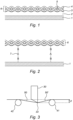
- the fabric 50' is directed through support rollers 41 and 42.
- the direction is from support roller 41 to support roller 42.
- the heated surface pushes with a tip 33 against the back side of the fabric 50'.
- a part of the warp threads have fused together at least partially to the back side of the fabric 50'.
- the fused warp threads are distributed to an essentially flat surface by means of the movement through the tip 33 of the heated surface 30. Afterwards, they cool and form the fabric 50, which is stronger, has greater dimensional stability and is more wear-resistant than the fabric 50'.
- the heated surface 30 can be moved over a distance d.
- This distance d is for example from 0 mm to 50 mm.
- the tip 33 of the heated surface 30 pushes against the back side of the fabric.
- the required distance d is determined by the desired result of the at least partial melting of a part of the warp threads, together with the temperature of the heated surface 30 and its tip 33, the speed with which the fabric 50' is directed through the tip 33 and the fabric 50' itself. If a fabric 50' is not resistant to a large distance d, further variations of the parameters speed, distance d and temperature of the heated surface 30 and its tip 33 are possible to obtain the desired result.
- the example relates to an embodiment of a polyester conveyor belt, more particularly an aircraft belt, according to the invention.
- the aircraft belt comprises a smooth fabric, an intermediate layer and a needle felt.
- Both the smooth fabric and the needle felt consist of 100% flame retardant PES.
- the middle layer consists of a PES glue. Therefore, the aircraft carpet is 100% recyclable in a simple way after it has been replaced by a new aircraft carpet.
- Needle felt is a non-woven textile.
- Velcro strips of the type HTH577 are glued.
- the many loose filament ends or loops in the needle felt hook into the hooks of the Velcro strip.
- the aircraft carpet can be quickly installed in the aircraft, but also quickly replaced.
- the aircraft carpet simply has to be torn off the Velcro strips and the new aircraft carpet adhered to the Velcro strip.
- glue residues There are no glue residues that have to be removed from the aircraft floor.
- glue residues on the needle felt which simplifies recycling.
- the fabric consists of warp and weft yarns with a yarn count of 2200 dtex.
- the yarns have an average breaking elongation of 30% and a minimum tensile strength of 3 g/den, tested according to ISO 2062.
- the average boiling shrinkage of the yarns amounts to an average of 1.5% according to ISO 12590.
- the weight of the fabric is limited to 570 g/m 2 .
- a part of the warp and weft threads have at least partially melted together on the back side of the fabric. This strengthens the fabric and increases the dimensional stability.
- the warp and weft threads are less mobile relative to each other, which leads to less friction between the warp and weft threads and therefore also less wear during the daily load of passengers and trolley cases.
- the fabric is stronger and has greater dimensional stability due to the at least partial melting of a part of the warp and weft threads, it is not necessary to use glue to fix the knots between the warp and weft threads.
- the intermediate layer comprising glue, is therefore lighter. The weight of the intermediate layer is limited to 130 g/m 2 .
- Needle felts are suitable for providing the necessary dimensional stability to aircraft carpets. Needle felts are suitable for increasing the walking comfort of passengers on aircraft carpets and for serving as sound insulation. Because the fabric is stronger due to the at least partial melting of some of the warp and weft threads, the fabric already has a certain dimensional stability. Therefore, it is possible to use a thinner needle felt for aircraft carpets. Needle felts have a maximum weight of 150 g/m 2 . The total weight of a carpet is therefore 850 g/m 2 .
- the aircraft carpet was tested in accordance with FAR 25.853 for flammability, specifically FAR 25.853(A)-App.f Part I para (a)(1)(ii) Measurement of flammability of aircraft material.
- the test was conducted in a draft-free cabinet in accordance with Federal Test Method Standard 191, Method 5903.2.
- Three 75 mm by 305 mm samples of the aircraft carpet were exposed for 60 s to a Bunsen burner flame with a temperature of at least 843°C. The samples were suspended vertically in their longitudinal direction 20 mm above the tip of the Bunsen burner.
- the Bunsen burner flame had a height of 40 mm measured from the tip of the Bunsen burner.
- the aircraft carpet then burned for an average of no more than 2 s over a length and width less than 80 mm. There were no burning parts of the aircraft carpet falling off. Therefore, the aircraft carpet meets the standard, which requires that after the flame is removed, the carpet continues to burn for a maximum of 15 s, that the carpet burns over a maximum length of 152 mm and that burning parts of the carpet burn for a maximum of 5 s.
- the aircraft carpet was subjected to a Vetterman test and a Lisson test.
- the Vetterman test simulates wear under laboratory conditions.
- the Lisson test determines the loss of mass and the binding of fibres or threads, after the aircraft carpet has been subjected to a prescribed number of double passes of a quadruped wheel.
- the aircraft carpet obtained the highest classification of 33, which means that it is suitable for heavy intensive use.
- the aircraft carpet is suitable for the daily heavy load of passengers and trolley cases.
- the aircraft carpet meets the ISO 6356 standard regarding the tendency for static electricity to form in textile and laminated chipboard floor coverings.
Landscapes
- Engineering & Computer Science (AREA)
- Textile Engineering (AREA)
- Mechanical Engineering (AREA)
- Carpets (AREA)
- Laminated Bodies (AREA)
- Belt Conveyors (AREA)
Claims (13)
- Ein flammhemmender Teppich, der für die Innenausstattung von Transportmitteln, vorzugsweise Flugzeugen, geeignet ist, umfassend:- ein maschinell gewebtes Gewebe mit einem Gewicht von höchstens 650 g/m2, umfassend eine Vorderseite als Nutzfläche und eine Rückseite, umfassend Kett- und Schussfäden aus im Wesentlichen 100% thermoplastischem, flammhemmendem Polyester,- einen Nadelfilz mit einem Gewicht von maximal 220 g/m2 aus im Wesentlichen 100% thermoplastischem flammhemmendem Polyester,- eine Zwischenschicht zwischen dem Nadelfilz und dem maschinell gewebtem Gewebe mit einem Gewicht von maximal 180 g/m2,dadurch gekennzeichnet, dass ein Teil der Kettfäden auf der Rückseite des maschinell gewebten Gewebes zumindest teilweise miteinander verschmolzen sind.
- Teppich nach Anspruch 1, dadurch gekennzeichnet, dass die Fadenzahl der Kett- und Schussfäden 1100 dtex bis 4400 dtex beträgt.
- Teppich nach Anspruch 1 oder 2, dadurch gekennzeichnet, dass die Anzahl der Kettfäden pro cm Gewebe 8 bis 30 beträgt.
- Teppich nach einem der vorhergehenden Ansprüche 1 bis 3, dadurch gekennzeichnet, dass die Anzahl der Schussfäden pro cm Gewebe 3 bis 10 beträgt.
- Teppich nach einem der vorhergehenden Ansprüche 1 bis 4, dadurch gekennzeichnet, dass das Gewicht des Teppichs maximal 950 g/m2 beträgt.
- Teppich nach einem der vorhergehenden Ansprüche 1 bis 5, dadurch gekennzeichnet, dass das maschinell gewebte Gewebe und der Nadelfilz mit Hilfe der Zwischenschicht miteinander laminiert sind.
- Teppich nach einem der vorhergehenden Ansprüche 1 bis 6, dadurch gekennzeichnet, dass die Zwischenschicht Polyesterkleber umfasst.
- Teppich nach einem der vorhergehenden Ansprüche 1 bis 6, dadurch gekennzeichnet, dass der Teppich reaktive Moleküle zur Ausbildung thermoreversibler kovalenter Wechselwirkungen in der Zwischenschicht umfasst, wobei es sich bei den thermoreversiblen kovalenten Wechselwirkungen um Michael-Reaktionen, Nitrosodimerisierungsreaktionen, zyklische Anhydridreaktionen, bei denen Esterverbindungen aufgebaut werden, Urethanbildungsreaktionen, aliphatische Ionenbildungsreaktionen, Phenol-Azlacton-Adduktionsbildungsreaktionen oder Reaktionen zwischen einem ersten Molekül, das eine konjugierte Diengruppe umfasst, und einem zweiten Molekül, das eine Dienophilgruppe umfasst, handelt.
- Teppich nach einem der vorhergehenden Ansprüche 1 bis 8, dadurch gekennzeichnet, dass ein Teil der Schussfäden des maschinell gewebten Gewebes zumindest teilweise mit einem Teil der Kettfäden verschmolzen ist.
- Verfahren zur Herstellung eines für die Innenausstattung von Transportmitteln, vorzugsweise Flugzeugen, geeigneten flammhemmenden Teppichs, umfassend:- maschinelles Weben eines Gewebes mit einem Gewicht von höchstens 650 g/m2, umfassend eine Vorderseite als Nutzfläche und eine Rückseite, umfassend Kett- und Schussfäden aus im Wesentlichen 100% thermoplastischem, flammhemmendem Polyester,- Herstellung eines Nadelfilzes mit einem Gewicht von maximal 220 g/m2 aus im Wesentlichen 100% thermoplastischem flammhemmendem Polyester,- Laminierung des Nadelfilzes mit einem Gewicht von maximal 180 g/m2 auf das Gewebe unter Verwendung einer Zwischenschicht,dadurch gekennzeichnet, dass das Verfahren den zusätzlichen Schritt vor dem Laminieren umfasst, bei dem die Rückseite des Gewebes an einer erhitzten Oberfläche entlanggeführt wird, um einen Teil der Kettfäden auf der Rückseite des mechanisch gewebten Gewebes zumindest teilweise miteinander zu verschmelzen.
- Das Verfahren nach Anspruch 10, dadurch gekennzeichnet, dass die Laminierung die Verwendung von PES als Klebstoff in der Zwischenschicht umfasst.
- Das Verfahren nach Anspruch 10, dadurch gekennzeichnet, dass die Laminierung die Verwendung reaktiver Moleküle zur Bildung thermoreversibler kovalenter Wechselwirkungen in der Zwischenschicht umfasst, wobei es sich bei den thermoreversiblen kovalenten Wechselwirkungen um Michael-Reaktionen, Nitrosodimerisierungsreaktionen, zyklische Anhydridreaktionen, bei denen die Esterverbindungen aufgebaut werden, Urethanbildungsreaktionen, aliphatische Ionenbildungsreaktionen, Phenol-Azlacton-Adduktionsbildungsreaktionen oder Reaktionen zwischen einem ersten Molekül, das eine konjugierte Diengruppe umfasst, und einem zweiten Molekül, das eine Dienophilgruppe umfasst, handelt.
- Das Verfahren nach Anspruch 10, 11 oder 12, dadurch gekennzeichnet, dass das Verfahren den zusätzlichen Schritt vor dem Laminieren umfasst, bei dem die Rückseite des Gewebes an einer erhitzten Oberfläche entlanggeführt wird, um einen Teil der Schussfäden auf der Rückseite des maschinell gewebten Gewebes zumindest teilweise mit einem Teil der Kettfäden zu verschmelzen.
Applications Claiming Priority (2)
| Application Number | Priority Date | Filing Date | Title |
|---|---|---|---|
| BE20195715A BE1027683B1 (fr) | 2019-10-17 | 2019-10-17 | Tapis de transport en polyester et procede de fabrication d'un tapis de transport en polyester |
| PCT/EP2020/079237 WO2021074394A1 (fr) | 2019-10-17 | 2020-10-16 | Tapis de transport en polyester et procédé de fabrication d'un tapis de transport en polyester |
Publications (3)
| Publication Number | Publication Date |
|---|---|
| EP4044874A1 EP4044874A1 (de) | 2022-08-24 |
| EP4044874C0 EP4044874C0 (de) | 2025-01-08 |
| EP4044874B1 true EP4044874B1 (de) | 2025-01-08 |
Family
ID=69191809
Family Applications (1)
| Application Number | Title | Priority Date | Filing Date |
|---|---|---|---|
| EP20792653.6A Active EP4044874B1 (de) | 2019-10-17 | 2020-10-16 | Polyester-transportteppich und verfahren zum herstellen eines polyestertransportteppichs |
Country Status (6)
| Country | Link |
|---|---|
| US (1) | US12116726B2 (de) |
| EP (1) | EP4044874B1 (de) |
| JP (1) | JP7601865B2 (de) |
| BE (1) | BE1027683B1 (de) |
| CA (1) | CA3157783A1 (de) |
| WO (1) | WO2021074394A1 (de) |
Families Citing this family (1)
| Publication number | Priority date | Publication date | Assignee | Title |
|---|---|---|---|---|
| BE1027683B1 (fr) | 2019-10-17 | 2021-05-18 | Depoortere Deco Sa | Tapis de transport en polyester et procede de fabrication d'un tapis de transport en polyester |
Family Cites Families (26)
| Publication number | Priority date | Publication date | Assignee | Title |
|---|---|---|---|---|
| US3719546A (en) * | 1968-03-14 | 1973-03-06 | Bigelow Sanford Inc | Lubricated non-woven fabric |
| IT1070269B (it) * | 1975-10-21 | 1985-03-29 | Allied Chem | Moduli di tappeto staccabili |
| EP1533114A2 (de) * | 1997-10-14 | 2005-05-25 | Interface, Inc. | Bodenbelag mit gewebtem Obermaterial |
| US20030035919A1 (en) * | 1998-12-11 | 2003-02-20 | Edward Barkis | Tuftable fabric with balanced construction |
| JP2000308604A (ja) * | 1999-02-16 | 2000-11-07 | Masahiro Watanabe | ダストコントロール用マットの基布 |
| JP2000282347A (ja) * | 1999-03-30 | 2000-10-10 | Murakami Shikimono Kk | 平織パイルカーペット |
| JP4085354B2 (ja) * | 2000-08-31 | 2008-05-14 | 株式会社オーノ | タフテッドカーペットと一次基布 |
| JP2005152159A (ja) * | 2003-11-21 | 2005-06-16 | Murakami Shikimono Kk | 織成カーペット |
| US7326661B2 (en) * | 2004-05-14 | 2008-02-05 | Chilewich L.L.C. | Fiberglass fabric flooring system |
| WO2006115482A2 (en) * | 2005-04-21 | 2006-11-02 | Foss Manufacturing Co., Inc. | Fire-retardant, lightweight aircraft carpet |
| EP1842660A1 (de) * | 2006-04-04 | 2007-10-10 | Lantal Textiles | Schwer entflammbarer Teppich für den Innenraum von Flugzeugen |
| CN101583749A (zh) * | 2006-12-04 | 2009-11-18 | 世联株式会社 | 绒头布帛 |
| JP5366132B2 (ja) * | 2009-03-31 | 2013-12-11 | 住江織物株式会社 | タフテッドカーペットの裏加工方法及びその裏加工方法で製造されたタフテッドカーペット。 |
| NL2005608C2 (en) * | 2010-11-01 | 2012-05-02 | Interface Internat B V | Method of manufacturing a carpet or carpet tile, carpet or carpet tile obtained by performing the manufacturing method, and support material for use in the method. |
| JP2012097373A (ja) * | 2010-11-02 | 2012-05-24 | Toray Ind Inc | 粘着テープ用基布 |
| PL2649234T3 (pl) * | 2010-12-06 | 2020-07-13 | Dsm Ip Assets B.V. | Sposób wytwarzania produktu włókienniczego i wynikający z niego produkt włókienniczy |
| DE102013012843A1 (de) | 2013-08-02 | 2015-02-05 | Anker-Teppichboden Gebr. Schoeller Gmbh + Co. Kg | Textiler Fußbodenbelag, insbesondere zur Verwendung im Innenraum von Flugzeugen |
| US10370568B2 (en) * | 2013-12-27 | 2019-08-06 | Mitsubishi Chemical Corporation | Double-sided pressure-sensitive adhesive tape for fixing aircraft parts |
| EP3020860A1 (de) * | 2014-11-11 | 2016-05-18 | Bonar B.V. | Primäre Teppichrückbeschichtung für latexfreie Tuftteppiche |
| BE1023422B1 (fr) * | 2016-01-14 | 2017-03-15 | De Poortere Deco S.A. | Tapis résistant à l'effilochage présentant des fils fusibles |
| BE1023423B1 (fr) * | 2016-01-14 | 2017-03-15 | De Poortere Deco S.A. | Tapis résistant à l'effilochage présentant des fils naturels |
| BE1023938B1 (fr) * | 2016-01-25 | 2017-09-15 | De Poortere Deco S.A. | Tapis présentant des fils brillants |
| WO2017137409A1 (en) * | 2016-02-08 | 2017-08-17 | Dsm Ip Assets B.V. | A method to manufacture a textile product, a use thereof and a device for applying the method |
| BE1026566B1 (nl) * | 2019-02-13 | 2020-03-19 | Undrc Bvba | Dimensioneel stabiel vloerbedekkingsmateriaal |
| BE1027683B1 (fr) | 2019-10-17 | 2021-05-18 | Depoortere Deco Sa | Tapis de transport en polyester et procede de fabrication d'un tapis de transport en polyester |
| US20210372042A1 (en) * | 2020-05-29 | 2021-12-02 | Columbia Insurance Company | Carpet and method of making same without latex precoat |
-
2019
- 2019-10-17 BE BE20195715A patent/BE1027683B1/fr active IP Right Grant
-
2020
- 2020-10-16 CA CA3157783A patent/CA3157783A1/en active Pending
- 2020-10-16 US US17/754,861 patent/US12116726B2/en active Active
- 2020-10-16 EP EP20792653.6A patent/EP4044874B1/de active Active
- 2020-10-16 WO PCT/EP2020/079237 patent/WO2021074394A1/fr not_active Ceased
- 2020-10-16 JP JP2022522263A patent/JP7601865B2/ja active Active
Also Published As
| Publication number | Publication date |
|---|---|
| JP7601865B2 (ja) | 2024-12-17 |
| US20240093429A1 (en) | 2024-03-21 |
| EP4044874C0 (de) | 2025-01-08 |
| CA3157783A1 (en) | 2021-04-22 |
| BE1027683A1 (fr) | 2021-05-11 |
| EP4044874A1 (de) | 2022-08-24 |
| US12116726B2 (en) | 2024-10-15 |
| JP2022552964A (ja) | 2022-12-21 |
| BE1027683B1 (fr) | 2021-05-18 |
| WO2021074394A1 (fr) | 2021-04-22 |
Similar Documents
| Publication | Publication Date | Title |
|---|---|---|
| US10422075B2 (en) | Method to produce a pile textile product and a textile product resulting from the same | |
| JP5883209B2 (ja) | 面ファスナー用の複合材要素 | |
| JPWO2004094136A1 (ja) | 高強力不織布 | |
| FR2728280A1 (fr) | Stratifies film/non-tisse rendus compatibles mecaniquement et article comprenant un tel stratifie | |
| EP0192691B1 (de) | Durchgehende verbundpapierbahn | |
| KR20110128950A (ko) | 열고정성 인터라이닝 부직포, 인터라이닝 부직포의 제조 방법, 및 인터라이닝 부직포의 용도 | |
| PL175100B1 (pl) | Podłogowy materiał wykładzinowy i sposób wytwarzania podłogowego materiału wykładzinowego | |
| NL8401637A (nl) | Werkwijze ter behandeling van vliezen en verkregen produkt. | |
| EP4044874B1 (de) | Polyester-transportteppich und verfahren zum herstellen eines polyestertransportteppichs | |
| US20140093698A1 (en) | Hydrophilic industrial absorbent with dual-layer, slip-resistant scrim | |
| EP4044873B1 (de) | Polyester-teppichfliese oder -teppichstreifen und verfahren zum herstellen einer polyester-teppichfliese oder eines -teppichstreifens | |
| JPH07250803A (ja) | 寸法安定性に優れたダストコントロール用マット及びその製造法 | |
| EP3128982A1 (de) | Streifen oder ansatz mit schleifen in form eines laminats mit gedruckten mustern | |
| RU2373311C2 (ru) | Напольное покрытие с упругим виниловым подкладочным слоем | |
| CN105899727B (zh) | 纺织品及其用途、用于生产这种纺织品的方法以及用于回收该产品的方法 | |
| BE1029320B1 (fr) | Tuile de tapis ou bande de tapis en polyester et procede de fabrication d’une tuile de tapis ou bande de tapis en polyester | |
| JPH07257260A (ja) | タフテッドカーペット | |
| JP3977571B2 (ja) | ダストクロス及びその製法 | |
| JPH07292947A (ja) | タイルカーペット及びその製造方法 |
Legal Events
| Date | Code | Title | Description |
|---|---|---|---|
| STAA | Information on the status of an ep patent application or granted ep patent |
Free format text: STATUS: UNKNOWN |
|
| STAA | Information on the status of an ep patent application or granted ep patent |
Free format text: STATUS: THE INTERNATIONAL PUBLICATION HAS BEEN MADE |
|
| PUAI | Public reference made under article 153(3) epc to a published international application that has entered the european phase |
Free format text: ORIGINAL CODE: 0009012 |
|
| STAA | Information on the status of an ep patent application or granted ep patent |
Free format text: STATUS: REQUEST FOR EXAMINATION WAS MADE |
|
| 17P | Request for examination filed |
Effective date: 20220420 |
|
| AK | Designated contracting states |
Kind code of ref document: A1 Designated state(s): AL AT BE BG CH CY CZ DE DK EE ES FI FR GB GR HR HU IE IS IT LI LT LU LV MC MK MT NL NO PL PT RO RS SE SI SK SM TR |
|
| DAV | Request for validation of the european patent (deleted) | ||
| DAX | Request for extension of the european patent (deleted) | ||
| STAA | Information on the status of an ep patent application or granted ep patent |
Free format text: STATUS: EXAMINATION IS IN PROGRESS |
|
| 17Q | First examination report despatched |
Effective date: 20240208 |
|
| GRAP | Despatch of communication of intention to grant a patent |
Free format text: ORIGINAL CODE: EPIDOSNIGR1 |
|
| STAA | Information on the status of an ep patent application or granted ep patent |
Free format text: STATUS: GRANT OF PATENT IS INTENDED |
|
| INTG | Intention to grant announced |
Effective date: 20240801 |
|
| GRAS | Grant fee paid |
Free format text: ORIGINAL CODE: EPIDOSNIGR3 |
|
| GRAA | (expected) grant |
Free format text: ORIGINAL CODE: 0009210 |
|
| STAA | Information on the status of an ep patent application or granted ep patent |
Free format text: STATUS: THE PATENT HAS BEEN GRANTED |
|
| AK | Designated contracting states |
Kind code of ref document: B1 Designated state(s): AL AT BE BG CH CY CZ DE DK EE ES FI FR GB GR HR HU IE IS IT LI LT LU LV MC MK MT NL NO PL PT RO RS SE SI SK SM TR |
|
| REG | Reference to a national code |
Ref country code: GB Ref legal event code: FG4D Free format text: NOT ENGLISH |
|
| REG | Reference to a national code |
Ref country code: CH Ref legal event code: EP |
|
| REG | Reference to a national code |
Ref country code: DE Ref legal event code: R096 Ref document number: 602020044570 Country of ref document: DE |
|
| REG | Reference to a national code |
Ref country code: IE Ref legal event code: FG4D Free format text: LANGUAGE OF EP DOCUMENT: FRENCH |
|
| U01 | Request for unitary effect filed |
Effective date: 20250206 |
|
| U07 | Unitary effect registered |
Designated state(s): AT BE BG DE DK EE FI FR IT LT LU LV MT NL PT RO SE SI Effective date: 20250212 |
|
| PG25 | Lapsed in a contracting state [announced via postgrant information from national office to epo] |
Ref country code: RS Free format text: LAPSE BECAUSE OF FAILURE TO SUBMIT A TRANSLATION OF THE DESCRIPTION OR TO PAY THE FEE WITHIN THE PRESCRIBED TIME-LIMIT Effective date: 20250408 |
|
| PG25 | Lapsed in a contracting state [announced via postgrant information from national office to epo] |
Ref country code: PL Free format text: LAPSE BECAUSE OF FAILURE TO SUBMIT A TRANSLATION OF THE DESCRIPTION OR TO PAY THE FEE WITHIN THE PRESCRIBED TIME-LIMIT Effective date: 20250108 |
|
| PG25 | Lapsed in a contracting state [announced via postgrant information from national office to epo] |
Ref country code: ES Free format text: LAPSE BECAUSE OF FAILURE TO SUBMIT A TRANSLATION OF THE DESCRIPTION OR TO PAY THE FEE WITHIN THE PRESCRIBED TIME-LIMIT Effective date: 20250108 |
|
| PG25 | Lapsed in a contracting state [announced via postgrant information from national office to epo] |
Ref country code: NO Free format text: LAPSE BECAUSE OF FAILURE TO SUBMIT A TRANSLATION OF THE DESCRIPTION OR TO PAY THE FEE WITHIN THE PRESCRIBED TIME-LIMIT Effective date: 20250408 Ref country code: IS Free format text: LAPSE BECAUSE OF FAILURE TO SUBMIT A TRANSLATION OF THE DESCRIPTION OR TO PAY THE FEE WITHIN THE PRESCRIBED TIME-LIMIT Effective date: 20250508 |
|
| PG25 | Lapsed in a contracting state [announced via postgrant information from national office to epo] |
Ref country code: HR Free format text: LAPSE BECAUSE OF FAILURE TO SUBMIT A TRANSLATION OF THE DESCRIPTION OR TO PAY THE FEE WITHIN THE PRESCRIBED TIME-LIMIT Effective date: 20250108 |
|
| PG25 | Lapsed in a contracting state [announced via postgrant information from national office to epo] |
Ref country code: GR Free format text: LAPSE BECAUSE OF FAILURE TO SUBMIT A TRANSLATION OF THE DESCRIPTION OR TO PAY THE FEE WITHIN THE PRESCRIBED TIME-LIMIT Effective date: 20250409 |
|
| PG25 | Lapsed in a contracting state [announced via postgrant information from national office to epo] |
Ref country code: SM Free format text: LAPSE BECAUSE OF FAILURE TO SUBMIT A TRANSLATION OF THE DESCRIPTION OR TO PAY THE FEE WITHIN THE PRESCRIBED TIME-LIMIT Effective date: 20250108 |
|
| PG25 | Lapsed in a contracting state [announced via postgrant information from national office to epo] |
Ref country code: CZ Free format text: LAPSE BECAUSE OF FAILURE TO SUBMIT A TRANSLATION OF THE DESCRIPTION OR TO PAY THE FEE WITHIN THE PRESCRIBED TIME-LIMIT Effective date: 20250108 |
|
| PG25 | Lapsed in a contracting state [announced via postgrant information from national office to epo] |
Ref country code: SK Free format text: LAPSE BECAUSE OF FAILURE TO SUBMIT A TRANSLATION OF THE DESCRIPTION OR TO PAY THE FEE WITHIN THE PRESCRIBED TIME-LIMIT Effective date: 20250108 |
|
| PLBE | No opposition filed within time limit |
Free format text: ORIGINAL CODE: 0009261 |
|
| STAA | Information on the status of an ep patent application or granted ep patent |
Free format text: STATUS: NO OPPOSITION FILED WITHIN TIME LIMIT |
|
| U20 | Renewal fee for the european patent with unitary effect paid |
Year of fee payment: 6 Effective date: 20251028 |