EP4034839B1 - Verfahren und fahrzeug mit einer einrichtung zum auffinden des fahrzeugs - Google Patents
Verfahren und fahrzeug mit einer einrichtung zum auffinden des fahrzeugs Download PDFInfo
- Publication number
- EP4034839B1 EP4034839B1 EP20768527.2A EP20768527A EP4034839B1 EP 4034839 B1 EP4034839 B1 EP 4034839B1 EP 20768527 A EP20768527 A EP 20768527A EP 4034839 B1 EP4034839 B1 EP 4034839B1
- Authority
- EP
- European Patent Office
- Prior art keywords
- vehicle
- user
- voice output
- loudspeaker
- entry
- Prior art date
- Legal status (The legal status is an assumption and is not a legal conclusion. Google has not performed a legal analysis and makes no representation as to the accuracy of the status listed.)
- Active
Links
Images

Classifications
-
- G—PHYSICS
- G01—MEASURING; TESTING
- G01C—MEASURING DISTANCES, LEVELS OR BEARINGS; SURVEYING; NAVIGATION; GYROSCOPIC INSTRUMENTS; PHOTOGRAMMETRY OR VIDEOGRAMMETRY
- G01C21/00—Navigation; Navigational instruments not provided for in groups G01C1/00 - G01C19/00
- G01C21/26—Navigation; Navigational instruments not provided for in groups G01C1/00 - G01C19/00 specially adapted for navigation in a road network
- G01C21/34—Route searching; Route guidance
- G01C21/3407—Route searching; Route guidance specially adapted for specific applications
-
- G—PHYSICS
- G01—MEASURING; TESTING
- G01C—MEASURING DISTANCES, LEVELS OR BEARINGS; SURVEYING; NAVIGATION; GYROSCOPIC INSTRUMENTS; PHOTOGRAMMETRY OR VIDEOGRAMMETRY
- G01C21/00—Navigation; Navigational instruments not provided for in groups G01C1/00 - G01C19/00
- G01C21/20—Instruments for performing navigational calculations
-
- G—PHYSICS
- G01—MEASURING; TESTING
- G01C—MEASURING DISTANCES, LEVELS OR BEARINGS; SURVEYING; NAVIGATION; GYROSCOPIC INSTRUMENTS; PHOTOGRAMMETRY OR VIDEOGRAMMETRY
- G01C21/00—Navigation; Navigational instruments not provided for in groups G01C1/00 - G01C19/00
- G01C21/26—Navigation; Navigational instruments not provided for in groups G01C1/00 - G01C19/00 specially adapted for navigation in a road network
- G01C21/34—Route searching; Route guidance
- G01C21/3407—Route searching; Route guidance specially adapted for specific applications
- G01C21/3438—Rendezvous; Ride sharing
-
- G—PHYSICS
- G01—MEASURING; TESTING
- G01C—MEASURING DISTANCES, LEVELS OR BEARINGS; SURVEYING; NAVIGATION; GYROSCOPIC INSTRUMENTS; PHOTOGRAMMETRY OR VIDEOGRAMMETRY
- G01C21/00—Navigation; Navigational instruments not provided for in groups G01C1/00 - G01C19/00
- G01C21/26—Navigation; Navigational instruments not provided for in groups G01C1/00 - G01C19/00 specially adapted for navigation in a road network
- G01C21/34—Route searching; Route guidance
- G01C21/36—Input/output arrangements for on-board computers
- G01C21/3602—Input other than that of destination using image analysis, e.g. detection of road signs, lanes, buildings, real preceding vehicles using a camera
-
- G—PHYSICS
- G01—MEASURING; TESTING
- G01C—MEASURING DISTANCES, LEVELS OR BEARINGS; SURVEYING; NAVIGATION; GYROSCOPIC INSTRUMENTS; PHOTOGRAMMETRY OR VIDEOGRAMMETRY
- G01C21/00—Navigation; Navigational instruments not provided for in groups G01C1/00 - G01C19/00
- G01C21/26—Navigation; Navigational instruments not provided for in groups G01C1/00 - G01C19/00 specially adapted for navigation in a road network
- G01C21/34—Route searching; Route guidance
- G01C21/36—Input/output arrangements for on-board computers
- G01C21/3626—Details of the output of route guidance instructions
- G01C21/3629—Guidance using speech or audio output, e.g. text-to-speech
-
- G—PHYSICS
- G01—MEASURING; TESTING
- G01C—MEASURING DISTANCES, LEVELS OR BEARINGS; SURVEYING; NAVIGATION; GYROSCOPIC INSTRUMENTS; PHOTOGRAMMETRY OR VIDEOGRAMMETRY
- G01C21/00—Navigation; Navigational instruments not provided for in groups G01C1/00 - G01C19/00
- G01C21/26—Navigation; Navigational instruments not provided for in groups G01C1/00 - G01C19/00 specially adapted for navigation in a road network
- G01C21/34—Route searching; Route guidance
- G01C21/36—Input/output arrangements for on-board computers
- G01C21/3626—Details of the output of route guidance instructions
- G01C21/3661—Guidance output on an external device, e.g. car radio
-
- H—ELECTRICITY
- H04—ELECTRIC COMMUNICATION TECHNIQUE
- H04W—WIRELESS COMMUNICATION NETWORKS
- H04W4/00—Services specially adapted for wireless communication networks; Facilities therefor
- H04W4/02—Services making use of location information
- H04W4/029—Location-based management or tracking services
-
- H—ELECTRICITY
- H04—ELECTRIC COMMUNICATION TECHNIQUE
- H04W—WIRELESS COMMUNICATION NETWORKS
- H04W4/00—Services specially adapted for wireless communication networks; Facilities therefor
- H04W4/30—Services specially adapted for particular environments, situations or purposes
- H04W4/40—Services specially adapted for particular environments, situations or purposes for vehicles, e.g. vehicle-to-pedestrians [V2P]
-
- G—PHYSICS
- G01—MEASURING; TESTING
- G01C—MEASURING DISTANCES, LEVELS OR BEARINGS; SURVEYING; NAVIGATION; GYROSCOPIC INSTRUMENTS; PHOTOGRAMMETRY OR VIDEOGRAMMETRY
- G01C21/00—Navigation; Navigational instruments not provided for in groups G01C1/00 - G01C19/00
- G01C21/26—Navigation; Navigational instruments not provided for in groups G01C1/00 - G01C19/00 specially adapted for navigation in a road network
- G01C21/34—Route searching; Route guidance
- G01C21/36—Input/output arrangements for on-board computers
- G01C21/3688—Systems comprising multiple parts or multiple output devices (not client-server), e.g. detachable faceplates, key fobs or multiple output screens
Definitions
- the present invention relates to a method for locating a vehicle, wherein the vehicle has a device with an environmental sensor system with which the access authorization of a user to the vehicle and its position are determined, wherein the device is indirectly or directly connected to a loudspeaker that generates acoustic signals in order to navigate the user along a route to the location of the vehicle given access authorization.
- driverless vehicles are currently one of the central topics when considering future mobility in the automotive industry.
- the use of such driverless vehicles is diverse.
- shared mobility vehicles such vehicles can be called in a similar way to a taxi and are accessible to everyone as public transport.
- owned mobility vehicles individual tasks can be carried out by the vehicle, such as transporting shopping, taking children to school, picking up visitors from the train station and much more.
- the self-driving vehicles also enable mobility for everyone, such as children, the elderly or people with physical disabilities.
- physically impaired people with visual impairments currently have insufficient access to both shared mobility vehicles and owned mobility vehicles because the vehicles are not easily found by people with visual impairments.
- DE 10 2015 226 238 A1 Vehicles are known to travel the distance between a Vehicle and the user can be illuminated to make it easier to find the vehicle, but illuminating the path is of no help if the markings cannot be recognized and perceived due to visual impairment.
- the invention provides that the user's entry into the vehicle is voice-assisted by means of the loudspeaker, which is directly connected to the device, in that states of the vehicle relevant to entry, namely "The door is opening” or "Attention: Step up to enter", are described by voice output. Because visually impaired people can also pick up such acoustic signals and follow the instructions, visually impaired people also have unrestricted access to autonomously controlled vehicles thanks to the present invention, regardless of whether they are designed as shared mobility vehicles or as owned mobility vehicles.
- the device for determining the access authorization is connected wirelessly to a mobile terminal of the user.
- a mobile device can be, for example, a smartphone or tablet on which an application (app) is installed, through which correspondence with the vehicle takes place.
- the vehicle can be requested via this application, whereby the current location at which the vehicle is to pick up the user can be transmitted immediately.
- Payment options can also be processed via the application when using a shared mobility vehicle after the journey has been completed.
- the acoustic signals are provided in the form of a voice output on the mobile device, with the voice output containing detailed navigation to the vehicle.
- this can be used to inform the visually impaired user in particular how to get from their current location to their vehicle or the requested vehicle.
- visually impaired people can use this to orient themselves safely, which increases the radius of action many times over.
- the voice output will be such that the user is given a description of the route to the vehicle, for example: "50 m straight ahead... turn left in 10 m... the vehicle is on the right side of the sidewalk in 50 m".
- an advantageous embodiment of the invention provides that the route to the vehicle is shown on a map on a display of the mobile device.
- a display as augmented information on the camera image of the mobile device is also provided. In both cases, the requested vehicles can be easily identified and found.
- voice output on the mobile device can be dispensed with and the acoustic signals in the form of a voice output or in the form of a signal tone can be given via a loudspeaker that is located directly on the vehicle and is connected to the device.
- a signal tone in the form of a beep can also indicate the position of the requested vehicle.
- the beep emitted by the vehicle can be specified by the user himself using the application and thus personalized, so that in the case of several visually impaired people, the vehicles can be clearly assigned.
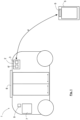
- the vehicle 1 shown is an autonomously driving vehicle 1 that is integrated into the public transport fleet as a shared mobility vehicle.
- the vehicle 1 has a device 2 that is equipped with an environmental sensor system 3.
- the environmental sensor system 3 can be used to establish a wireless connection 4 to a mobile device 5 of a user (not shown), who can request the vehicle 1 via an application installed on it.
- voice-assisted navigation to the vehicle 1 takes place by issuing appropriate directions and specific instructions on the loudspeaker 6 of the mobile device.
- another loudspeaker 6' is arranged directly on the vehicle, via which further instructions are given when getting into the vehicle 1.
- the vehicle 1 has at least one display 7 and/or at least one LED strip 8, with which the position of the vehicle 1 can be displayed visually.
- Projectors 9 are also provided to illuminate the path from the user's current location to the vehicle 1, which is particularly useful in dark visibility conditions at night. or in parking garages.
- the entry area can also be illuminated by means of such projectors 9, which makes it easier to get into the vehicle 1.
- Fig. 2 shows a map section 10 of a pedestrian zone 11 that is closed to car traffic. Adjacent to the pedestrian zone 11 there is a taxi stand 12 where several autonomous vehicles 1 are waiting to pick up any users. A visually impaired user 13 can request such a vehicle 1 from any position using a mobile device 5. The location of the user 13 is communicated to the vehicle 1 via a wireless communication connection 4 and the direct route from the current location of the user 13 to the requested vehicle 1 is calculated. The route description or the instructions for the route are then given via the loudspeaker 6 of the mobile device 5 until the user 13 has reached the vehicle 13 and can get in there.
Landscapes
- Engineering & Computer Science (AREA)
- Remote Sensing (AREA)
- Radar, Positioning & Navigation (AREA)
- Automation & Control Theory (AREA)
- General Physics & Mathematics (AREA)
- Physics & Mathematics (AREA)
- Computer Networks & Wireless Communication (AREA)
- Signal Processing (AREA)
- Multimedia (AREA)
- General Health & Medical Sciences (AREA)
- Audiology, Speech & Language Pathology (AREA)
- Health & Medical Sciences (AREA)
- Computer Vision & Pattern Recognition (AREA)
- Traffic Control Systems (AREA)
- Navigation (AREA)
Description
- Die vorliegende Erfindung betrifft ein Verfahren zum Auffinden eines Fahrzeugs, wobei das Fahrzeug eine Einrichtung mit einer Umfeldsensorik aufweist, mit der die Zugangsberechtigung eines Nutzers in das Fahrzeug sowie dessen Position festgestellt wird, wobei die Einrichtung mittelbar oder unmittelbar mit einem Lautsprecher verbunden ist, der akustische Signale erzeugt, um den Nutzer bei gegebener Zugangsberechtigung entlang einer Route zum Standort des Fahrzeugs zu navigieren.
- Die Entwicklung von autonom und fahrerlos fahrenden Fahrzeugen ist derzeit eines der zentralen Themen bei der Betrachtung der zukünftigen Mobilität in der Automobilindustrie. Der Einsatz solcher fahrerlosen Fahrzeuge ist dabei vielfältig. Als Shared-Mobility-Fahrzeug können solche Fahrzeuge ähnlich wie ein Taxi gerufen werden und sind für jedermann als öffentliches Verkehrsmittel zugänglich. Beim Einsatz als Owned-Mobility-Fahrzeug können individuelle Aufgaben vom Fahrzeug erledigt werden, wie z.B. Einkäufe transportieren, Kinder zur Schule bringen, Besucher vom Bahnhof abholen und vieles mehr.
- Neben den technologischen Herausforderungen und den rechtlichen Anforderungen eröffnet das fahrerlose Fahren neue Perspektiven der Mobilität. Mit der Erhöhung der Fahrzeugsicherheit im Straßenverkehr steht vor allem die optimale Nutzung der Infrastruktur im Vordergrund. Die Bewältigung der steigenden Verkehrsdichte im städtischen Innenraum und die Reduktion von Emissionen durch eine ökonomische Fahrweise sind weitere Treiber für die Entwicklung automatisierter Fahrfunktionen.
- Für die Nutzer ergeben sich zusätzlich neue Möglichkeiten, die Zeit während der Fahrt zu nutzen und dabei fahrfremde Tätigkeiten auszuführen. Die selbstfahrenden Fahrzeuge ermöglichen vor allem auch Mobilität für jedermann, wie z.B. Kinder, ältere Menschen oder Menschen mit körperlichen Beeinträchtigungen. Insbesondere körperlich beeinträchtigten Personen mit einer Sehbehinderung steht der Zugang sowohl an Shared-Mobility-Fahrzeugen als auch am Owned-Mobility-Fahrzeugen gegenwärtig nur unzureichend zur Verfügung, weil die Fahrzeuge von Personen mit einer Sehbehinderung nicht ohne Weiteres aufgefunden werden. Aus
DE 10 2015 226 238 A1 sind zwar Fahrzeuge bekannt, die den Weg zwischen einem Fahrzeug und dem Nutzer ausleuchten, um das Fahrzeug leichter auffinden zu können, allerdings hilft das Ausleuchten des Weges nicht weiter, wenn die Markierungen aufgrund der Sehbehinderung nicht erkannt und wahrgenommen werden. - Ein gattungsgemäßes Verfahren wird in
US 2018/0321050 A1 offenbart. Ferner sind vergleichbare Verfahren ausUS 2009/058685 A1 ,EP 2 985 569 A1 undDE 10 2017 218 525 A1 bekannt. Weitere gattungsfremde Verfahren sind ausDE 10 2015 226697 A1 undDE 10 2014 222204 A1 bekannt. - Es ist daher die Aufgabe der vorliegenden Erfindung, ein Verfahren und eine Vorrichtung anzugeben, die insbesondere sehbehinderten Personen den Zugang zur autonomen Mobilität erleichtert.
- Diese Aufgabe wird durch das Verfahren nach Anspruch 1 gelöst. Ausgehend von einem ein Verfahren zum Auffinden eines Fahrzeugs, wobei das Fahrzeug eine Einrichtung mit einer Umfeldsensorik aufweist, mit der die Zugangsberechtigung eines Nutzers in das Fahrzeug sowie dessen Position festgestellt wird, wobei die Einrichtung mittelbar oder unmittelbar mit einem Lautsprecher verbunden ist, der akustische Signale erzeugt, um den Nutzer bei gegebener Zugangsberechtigung entlang einer Route zum Standort des Fahrzeugs zu navigieren, ist erfindungsgemäß vorgesehen, dass der Einstieg des Nutzers in das Fahrzeug mittels des Lautsprechers sprachassistiert erfolgt, der unmittelbar mit der Einrichtung verbunden ist, indem einstiegsrelevante Zustände des Fahrzeugs, nämlich "Die Tür öffnet sich" oder "Achtung: Stufe zum Einstieg nach oben", per Sprachausgabe beschrieben werden. Weil auch sehbehinderte Personen solche akustischen Signale aufnehmen und den Anweisungen folgen können, haben auch sehbehinderte Personen durch die vorliegende Erfindung uneingeschränkten Zugang zu autonom gesteuerten Fahrzeugen unabhängig davon, ob sie als Shared-Mobility-Fahrzeug oder als Owned-Mobility-Fahrzeug ausgebildet sind.
- Bevorzugte Ausführungsformen der vorliegenden Erfindung werden nachfolgend und in den Unteransprüchen angegeben.
- Nach einer ersten vorteilhaften Ausführungsform der Erfindung ist vorgesehen, dass die Einrichtung zur Feststellung der Zugangsberechtigung drahtlos mit einem mobilen Endgerät des Nutzers verbunden ist. Ein solches mobiles Endgerät kann beispielsweise ein Smartphone oder ein Tablet sein, auf dem eine Applikation (App) installiert ist, über die die Korrespondenz mit dem Fahrzeug erfolgt. Über diese Applikation kann das Fahrzeug angefordert werden, wobei unmittelbar der aktuelle Standort übermittelt werden kann, an dem das Fahrzeug den Benutzer abholen soll. Auch Bezahloptionen können bei der Nutzung eines Shared-Mobility-Fahrzeugs über die Applikation abgewickelt werden, nachdem die Fahrt abgeschlossen wurde.
- Nach einer vorteilhaften Ausführungsform der Erfindung ist vorgesehen, dass die akustischen Signale in Form einer Sprachausgabe an dem mobilen Endgerät erfolgen, wobei die Sprachausgabe eine detaillierte Navigation zum Fahrzeug enthält. Insbesondere an Orten oder in Verkehrssituationen, bei denen das Fahrzeug den Nutzer nicht unmittelbar an seinem Standort abholen kann, sondern bei denen der Nutzer eine bestimmte Strecke zum Fahrzeug eigenständig zurücklegen muss, kann hierdurch insbesondere dem sehbehinderten Nutzer mitgeteilt werden, wie er von seinem aktuellen Standort zu seinem bzw. dem angeforderten Fahrzeug gelangt. Insbesondere in Fußgängerzonen, an Flughäfen und in Bahnhöfen können sich hierdurch sehbehinderte Personen sicher orientieren, was den Aktionsradius um ein Vielfaches erhöht. In der Praxis wird dabei die Sprachausgabe beispielsweise so erfolgen, dass den Nutzern der Weg zum Fahrzeug beschrieben wird, wie beispielsweise: "50 m gerade aus... in 10 m links abbiegen... in 50 m befindet sich das Fahrzeug auf der rechten Gehwegseite".
- Um dabei den optimalen Weg für den Nutzer feststellen zu können, ist nach einer bevorzugten Ausgestaltung der Erfindung vorgesehen, dass das mobile Endgerät und/oder das Fahrzeug zur Navigation des Nutzers mit einem online verfügbaren Kartendienst verbunden ist.
- Für Nutzer, die unter keiner Beeinträchtigung des Sehvermögens leiden, ist nach einer vorteilhaften Ausführungsform der Erfindung vorgesehen, dass die Route zum Fahrzeug auf einer Karte auf einem Display des mobilen Endgerätes angezeigt wird. Alternativ ist auch eine Darstellung als augmentierte Information auf dem Kamerabild des mobilen Endgerätes vorgesehen. In beiden Fällen lassen sich hierdurch die angeforderten Fahrzeuge leicht identifizieren und auffinden.
- Sobald der Nutzer in unmittelbarer Nähe des Fahrzeugs ist, beispielsweise innerhalb eines Umkreises von 20 m, kann auf eine Sprachausgabe am mobilen Endgerät verzichtet werden und die akustischen Signale in Form einer Sprachausgabe oder in Form eines Signaltons können über einen Lautsprecher abgegeben werden, der unmittelbar am Fahrzeug angeordnet ist und mit der Einrichtung verbunden ist. Neben einer Sprachausgabe in der Form der zuvor erläuterten Wegbeschreibung kann auch ein Signalton in Form eines Pieptons die Position des angeforderten Fahrzeugs anzeigen. Der vom Fahrzeug abgegebene Piepton kann nach einer vorteilhaften Ausgestaltung der Erfindung vom Nutzer selbst mittels der Applikation vorgegeben mit mithin personalisiert sein, so dass im Falle von mehreren sehbehinderten Personen eine eindeutige Zuordnung der Fahrzeuge gegeben ist.
- Erfindungsgemäß ist vorgesehen, dass der Einstieg des Nutzers in das Fahrzeug sprachassistiert erfolgt, indem einstiegsrelevante Zustände des Fahrzeugs per Sprachausgabe beschrieben werden, nämlich "Die Tür öffnet sich", oder "Achtung: Stufe zum Einstieg nach oben". Konkrete Ausführungsformen der vorliegenden Erfindung werden nachfolgend anhand der Figuren beschrieben. Es zeigen:
- Fig. 1
- ein Fahrzeug und ein mobiles Endgerät und
- Fig. 2
- einen Kartenausschnitt.
- Das in
Fig. 1 dargestellte Fahrzeug 1 ist ein autonom fahrendes Fahrzeug 1, das als Shared-Mobility-Fahrzeug in die Flotte öffentlicher Verkehrsmittels eingebunden ist. Das Fahrzeug 1 besitzt eine Einrichtung 2, die mit einer Umfeldsensorik 3 ausgestattet ist. Über die Umfeldsensorik 3 kann eine drahtlose Verbindung 4 zu einem mobilen Endgerät 5 eines (nicht dargestellten) Nutzers hergestellt werden, der über eine hierauf installierte Applikation das Fahrzeug 1 anfordern kann. Sobald sich das Fahrzeug 1 in der Nähe des Nutzers befindet, erfolgt eine sprachassistierte Navigation zum Fahrzeug 1, indem eine entsprechende Wegbeschreibung und konkrete Handlungsanweisungen am Lautsprecher 6 des mobilen Endgerätes ausgegeben werden. Um den Einstieg in das Fahrzeug 1, insbesondere für sehbehinderte Nutzer zu erleichtern, ist ein weiterer Lautsprecher 6' unmittelbar am Fahrzeug angeordnet, über die weitere Anweisungen beim Zustieg in das Fahrzeug 1 abgegeben werden. Für nicht sehbehinderte Personen besitzt das Fahrzeug 1 mindestens ein Display 7 und/oder mindestens eine LED-Leiste 8, womit die Position des Fahrzeugs 1 visuell dargestellt werden kann. Es sind auch Projektoren 9 vorgesehen, die den Weg vom aktuellen Standort des Nutzers zum Fahrzeug 1 ausleuchten, was insbesondere bei dunklen Sichtverhältnissen in der Nacht oder in Parkhäusern vorteilhaft ist. Auch kann der Einstiegsbereich mittels solcher Projektoren 9 ausgeleuchtet werden, was den Zustieg in das Fahrzeug 1 erleichtert. -
Fig. 2 zeigt einen Kartenausschnitt 10 einer Fußgängerzone 11, die für den Autoverkehr gesperrt ist. Angrenzend zur Fußgängerzone 11 befindet sich ein Taxistand 12, an dem mehrere autonom fahrende Fahrzeuge 1 warten, um etwaige Nutzer abzuholen. Ein sehbehinderter Nutzer 13 kann mittels eines mobilen Endgerätes 5 ein solches Fahrzeug 1 von einer beliebigen Position anfordern. Dem Fahrzeug 1 wird über eine drahtlose Kommunikationsverbindung 4 der Standort des Nutzers 13 mitgeteilt und es erfolgt eine Berechnung der direkten Route vom aktuellen Standort des Nutzers 13 zum angeforderten Fahrzeug 1. Die Wegbeschreibung bzw. die Anweisungen zur Wegführung werden anschließend über den Lautsprecher 6 des mobilen Endgerätes 5 abgegeben, bis der Nutzer 13 an dem Fahrzeug 13 angelangt ist und dort zusteigen kann. -
- 1
- Fahrzeug
- 2
- Einrichtung
- 3
- Umfeldsensorik
- 4
- drahtlose Kommunikationsverbindung
- 5
- mobiles Endgerät
- 6, 6'
- Lautsprecher
- 7
- Display
- 8
- LED-Leiste
- 9
- Projektor
- 10
- Kartenausschnitt
- 11
- Fußgängerzone
- 12
- Taxistand
- 13
- Nutzer
Claims (6)
- Verfahren zum Auffinden eines Fahrzeugs (1), wobei das Fahrzeug eine Einrichtung (2) mit einer Umfeldsensorik (3) aufweist, mit der die Zugangsberechtigung eines Nutzers (13) in das Fahrzeug (1) sowie dessen Position festgestellt wird, wobei die Einrichtung (2) mittelbar oder unmittelbar mit einem Lautsprecher (6, 6') verbunden ist, der akustische Signale erzeugt, um den Nutzer (13) bei gegebener Zugangsberechtigung entlang einer Route zum Standort des Fahrzeugs (1) zu navigieren, dadurch gekennzeichnet, dass der Einstieg des Nutzers (13) in das Fahrzeug (1) mittels des Lautsprechers (6') sprachassistiert erfolgt, der unmittelbar mit der Einrichtung (2) verbunden ist, indem einstiegsrelevante Zustände des Fahrzeugs (1), nämlich "Die Tür öffnet sich" oder "Achtung: Stufe zum Einstieg nach oben", per Sprachausgabe beschrieben werden.
- Verfahren nach Anspruch 1, dadurch gekennzeichnet, dass die Einrichtung (2) zur Feststellung der Zugangsberechtigung drahtlos mit einem mobilen Endgerät (5) des Nutzers (13) verbunden ist.
- Verfahren nach einem der Ansprüche 1 oder 2, dadurch gekennzeichnet, dass die akustischen Signale in Form einer Sprachausgabe an dem mobilen Endgerät (5) erzeugt werden, wobei die Sprachausgabe eine detaillierte Navigation zum Fahrzeug (1) enthält.
- Verfahren nach einem der Ansprüche 1 bis 3, dadurch gekennzeichnet, dass das mobile Endgerät (5) und/oder das Fahrzeug (1) zur Navigation des Nutzers (13) mit einem online verfügbaren Kartendienst verbunden ist.
- Verfahren nach einem der Ansprüche 1 bis 4, dadurch gekennzeichnet, dass die Route zum Fahrzeug (1) auf einer Karte auf einem Display des mobilen Endgerätes (5) angezeigt wird.
- Verfahren nach einem der Ansprüche 1 bis 5, dadurch gekennzeichnet, dass die akustischen Signale in Form einer Sprachausgabe oder eines Signaltons über einen Lautsprecher (6') abgegeben werden, der unmittelbar am Fahrzeug (1) angeordnet und mit der Einrichtung (2) verbunden ist.
Applications Claiming Priority (2)
| Application Number | Priority Date | Filing Date | Title |
|---|---|---|---|
| DE102019214660.0A DE102019214660A1 (de) | 2019-09-25 | 2019-09-25 | Verfahren und Fahrzeug mit einer Einrichtung zum Auffinden des Fahrzeugs |
| PCT/EP2020/074352 WO2021058239A1 (de) | 2019-09-25 | 2020-09-01 | Verfahren und fahrzeug mit einer einrichtung zum auffinden des fahrzeugs |
Publications (2)
| Publication Number | Publication Date |
|---|---|
| EP4034839A1 EP4034839A1 (de) | 2022-08-03 |
| EP4034839B1 true EP4034839B1 (de) | 2025-02-26 |
Family
ID=72432866
Family Applications (1)
| Application Number | Title | Priority Date | Filing Date |
|---|---|---|---|
| EP20768527.2A Active EP4034839B1 (de) | 2019-09-25 | 2020-09-01 | Verfahren und fahrzeug mit einer einrichtung zum auffinden des fahrzeugs |
Country Status (3)
| Country | Link |
|---|---|
| EP (1) | EP4034839B1 (de) |
| DE (1) | DE102019214660A1 (de) |
| WO (1) | WO2021058239A1 (de) |
Families Citing this family (2)
| Publication number | Priority date | Publication date | Assignee | Title |
|---|---|---|---|---|
| DE102021204267A1 (de) | 2021-04-29 | 2022-11-03 | Psa Automobiles Sa | Verfahren zur Unterstützung eines einstiegberechtigten Passagiers beim Einsteigen in ein Kraftfahrzeug |
| DE102022202457A1 (de) | 2022-03-11 | 2023-09-14 | Volkswagen Aktiengesellschaft | Verfahren und System zur Sitzplatzfindung in einem Personenbeförderungsfahrzeug für Personen mit eingeschränkter visueller Wahrnehmung |
Citations (2)
| Publication number | Priority date | Publication date | Assignee | Title |
|---|---|---|---|---|
| DE102014222204A1 (de) * | 2014-10-30 | 2016-05-04 | Bombardier Transportation Gmbh | Verfahren zur Bereitstellung einer Verkehrsmittelinformation |
| DE102015226697A1 (de) * | 2015-12-23 | 2017-06-29 | Volkswagen Aktiengesellschaft | Anordnung, Fortbewegungsmittel und Verfahren zur Komfortverbesserung eines Einstiegs in ein Fortbewegungsmittel |
Family Cites Families (9)
| Publication number | Priority date | Publication date | Assignee | Title |
|---|---|---|---|---|
| US7847709B2 (en) * | 2007-08-28 | 2010-12-07 | Gm Global Technology Operations, Inc. | Multimode vehicle location device and method |
| JP2014202705A (ja) * | 2013-04-09 | 2014-10-27 | パナソニック株式会社 | 電子キー、車載装置、案内装置、およびカーファインダシステム |
| WO2017106497A1 (en) * | 2015-12-17 | 2017-06-22 | Counterfy Llc | Displayed identifier for a ridesharing service |
| DE102015226238A1 (de) | 2015-12-21 | 2017-06-22 | Bayerische Motoren Werke Aktiengesellschaft | Verfahren für eine optische Nutzerführung eines Nutzers einer Zugangsvorrichtung eines Kraftfahrzeuges |
| US20190186930A1 (en) * | 2016-08-26 | 2019-06-20 | Nokia Technologies Oy | A method, apparatus and computer program product for assisting a user in locating a vehicle |
| WO2018208789A1 (en) * | 2017-05-08 | 2018-11-15 | Chase Arnold | Autonomous vehicle enhancement system |
| DE102017218525A1 (de) * | 2017-10-17 | 2019-04-18 | Ford Global Technologies, Llc | Verfahren zum Rufen eines autonomen Taxis |
| JP6780625B2 (ja) * | 2017-10-26 | 2020-11-04 | トヨタ自動車株式会社 | 自動運転車両の配車システム、及び自動運転車両 |
| US10989547B2 (en) * | 2018-10-22 | 2021-04-27 | Ford Global Technologies, Llc | Autonomous vehicle ride service systems and methods |
-
2019
- 2019-09-25 DE DE102019214660.0A patent/DE102019214660A1/de active Pending
-
2020
- 2020-09-01 WO PCT/EP2020/074352 patent/WO2021058239A1/de not_active Ceased
- 2020-09-01 EP EP20768527.2A patent/EP4034839B1/de active Active
Patent Citations (2)
| Publication number | Priority date | Publication date | Assignee | Title |
|---|---|---|---|---|
| DE102014222204A1 (de) * | 2014-10-30 | 2016-05-04 | Bombardier Transportation Gmbh | Verfahren zur Bereitstellung einer Verkehrsmittelinformation |
| DE102015226697A1 (de) * | 2015-12-23 | 2017-06-29 | Volkswagen Aktiengesellschaft | Anordnung, Fortbewegungsmittel und Verfahren zur Komfortverbesserung eines Einstiegs in ein Fortbewegungsmittel |
Also Published As
| Publication number | Publication date |
|---|---|
| WO2021058239A1 (de) | 2021-04-01 |
| DE102019214660A1 (de) | 2021-03-25 |
| EP4034839A1 (de) | 2022-08-03 |
Similar Documents
| Publication | Publication Date | Title |
|---|---|---|
| EP3630569B1 (de) | Verfahren zum betreiben eines kraftfahrzeugs sowie ein kraftfahrzeug | |
| EP3256353B1 (de) | Verfahren und vorrichtung zum überwachen eines sich in einem autonomen betriebsmodus und auf einem parkplatz befindenden fahrzeugs | |
| DE102017202834B4 (de) | Verfahren zum Betreiben eines Kraftfahrzeugs in einem aktivierten zumindest teilautonomen Fahrmodus | |
| EP3483026A1 (de) | Verfahren und vorrichtung um einen schnellen halt eines autonom fahrenden fahrzeugs zu ermöglichen | |
| DE102008028550A1 (de) | Parkleitsystem zur Navigation eines parkplatzsuchenden Fahrzeugs zu einem freien Parkplatz | |
| WO2017036461A1 (de) | Mobile kommunikationseinrichtung und softwarecode sowie verkehrsentität | |
| DE102019100069A1 (de) | Parkeinrichtung | |
| DE102018102389A1 (de) | Vorrichtung zum autonomen Fahren und Verfahren zum autonomen Fahren | |
| DE102005039893A1 (de) | Kartenanzeigevorrichtung | |
| DE102015202486A1 (de) | Verfahren und Vorrichtung zum Überwachen eines auf einem Parkplatz fahrenden Fahrzeugs | |
| EP3410069B1 (de) | Verfahren zum unterstützen eines benutzers eines kraftfahrzeugs bei einer fahrt mit dem kraftfahrzeug, navigationseinrichtung und kraftfahrzeug | |
| DE102018212901A1 (de) | Verfahren zur Ermittlung einer Halteposition für ein automatisiert betriebenes Fahrzeug | |
| DE102017101494A1 (de) | Systeme und verfahren zur sicherheit bei fahrzeug-fahrten und sicherheit für personen und eigentum | |
| DE102017221932A1 (de) | Verfahren zum Betreiben eines Kraftfahrzeugs und Kraftfahrzeug mit einem Engstellenassistenten | |
| DE102020212376A1 (de) | Ableitung der Intention eines Passagiers im Fahrzeug anhand einer Interaktion des Passagiers mit einem Gegenstand | |
| EP4034839A1 (de) | Verfahren und fahrzeug mit einer einrichtung zum auffinden des fahrzeugs | |
| WO2024033082A1 (de) | Verfahren zur bestimmung der verfügbarkeit von ladestationen | |
| DE102016012774A1 (de) | Verfahren zum Betrieb eines autonom betreibbaren Fahrzeugs | |
| EP3573860B1 (de) | Darstellen eines soll-fahrzeugöffnungsvorfelds eines automatisierten fahrzeugs | |
| DE102017209508A1 (de) | Verfahren und Vorrichtung zum Betreiben eines Parkplatzassistenzsystems in einem Kraftfahrzeug mit einer Datenbrille | |
| WO2018041659A1 (de) | Verfahren zur automatisierten führung eines kraftfahrzeugs | |
| DE102016215478A1 (de) | Konzept zum Warnen von Verkehrsteilnehmern in einem Umfeld eines Kraftfahrzeugs auf ein bevorstehendes Aussteigen eines oder mehrerer Kraftfahrzeuginsassen des Kraftfahrzeugs | |
| DE102025116257A1 (de) | Verfahren, System, Fahrzeug und Computerprogrammprodukt zur Verbesserung der Sicherheit von gefährdeten Verkehrsteilnehmern | |
| DE102017213082A1 (de) | Verfahren zur Hilfestellung für einen Nutzer | |
| DE102011121043A1 (de) | Verfahren zum Betreiben einer Kommunikationseinrichtungeines Fahrzeugs und Fahrzeug mit einer Vorrichtung zum Betreiben der Kommunikationseinrichtung |
Legal Events
| Date | Code | Title | Description |
|---|---|---|---|
| STAA | Information on the status of an ep patent application or granted ep patent |
Free format text: STATUS: UNKNOWN |
|
| STAA | Information on the status of an ep patent application or granted ep patent |
Free format text: STATUS: THE INTERNATIONAL PUBLICATION HAS BEEN MADE |
|
| PUAI | Public reference made under article 153(3) epc to a published international application that has entered the european phase |
Free format text: ORIGINAL CODE: 0009012 |
|
| STAA | Information on the status of an ep patent application or granted ep patent |
Free format text: STATUS: REQUEST FOR EXAMINATION WAS MADE |
|
| 17P | Request for examination filed |
Effective date: 20220425 |
|
| AK | Designated contracting states |
Kind code of ref document: A1 Designated state(s): AL AT BE BG CH CY CZ DE DK EE ES FI FR GB GR HR HU IE IS IT LI LT LU LV MC MK MT NL NO PL PT RO RS SE SI SK SM TR |
|
| DAV | Request for validation of the european patent (deleted) | ||
| DAX | Request for extension of the european patent (deleted) | ||
| STAA | Information on the status of an ep patent application or granted ep patent |
Free format text: STATUS: EXAMINATION IS IN PROGRESS |
|
| 17Q | First examination report despatched |
Effective date: 20230719 |
|
| GRAP | Despatch of communication of intention to grant a patent |
Free format text: ORIGINAL CODE: EPIDOSNIGR1 |
|
| STAA | Information on the status of an ep patent application or granted ep patent |
Free format text: STATUS: GRANT OF PATENT IS INTENDED |
|
| INTG | Intention to grant announced |
Effective date: 20241029 |
|
| P01 | Opt-out of the competence of the unified patent court (upc) registered |
Free format text: CASE NUMBER: APP_65381/2024 Effective date: 20241211 |
|
| GRAS | Grant fee paid |
Free format text: ORIGINAL CODE: EPIDOSNIGR3 |
|
| GRAA | (expected) grant |
Free format text: ORIGINAL CODE: 0009210 |
|
| STAA | Information on the status of an ep patent application or granted ep patent |
Free format text: STATUS: THE PATENT HAS BEEN GRANTED |
|
| AK | Designated contracting states |
Kind code of ref document: B1 Designated state(s): AL AT BE BG CH CY CZ DE DK EE ES FI FR GB GR HR HU IE IS IT LI LT LU LV MC MK MT NL NO PL PT RO RS SE SI SK SM TR |
|
| REG | Reference to a national code |
Ref country code: GB Ref legal event code: FG4D Free format text: NOT ENGLISH |
|
| REG | Reference to a national code |
Ref country code: CH Ref legal event code: EP |
|
| REG | Reference to a national code |
Ref country code: DE Ref legal event code: R096 Ref document number: 502020010499 Country of ref document: DE |
|
| REG | Reference to a national code |
Ref country code: IE Ref legal event code: FG4D Free format text: LANGUAGE OF EP DOCUMENT: GERMAN |
|
| REG | Reference to a national code |
Ref country code: NL Ref legal event code: MP Effective date: 20250226 |
|
| PG25 | Lapsed in a contracting state [announced via postgrant information from national office to epo] |
Ref country code: RS Free format text: LAPSE BECAUSE OF FAILURE TO SUBMIT A TRANSLATION OF THE DESCRIPTION OR TO PAY THE FEE WITHIN THE PRESCRIBED TIME-LIMIT Effective date: 20250526 |
|
| PG25 | Lapsed in a contracting state [announced via postgrant information from national office to epo] |
Ref country code: FI Free format text: LAPSE BECAUSE OF FAILURE TO SUBMIT A TRANSLATION OF THE DESCRIPTION OR TO PAY THE FEE WITHIN THE PRESCRIBED TIME-LIMIT Effective date: 20250226 |
|
| PG25 | Lapsed in a contracting state [announced via postgrant information from national office to epo] |
Ref country code: PL Free format text: LAPSE BECAUSE OF FAILURE TO SUBMIT A TRANSLATION OF THE DESCRIPTION OR TO PAY THE FEE WITHIN THE PRESCRIBED TIME-LIMIT Effective date: 20250226 |
|
| PG25 | Lapsed in a contracting state [announced via postgrant information from national office to epo] |
Ref country code: ES Free format text: LAPSE BECAUSE OF FAILURE TO SUBMIT A TRANSLATION OF THE DESCRIPTION OR TO PAY THE FEE WITHIN THE PRESCRIBED TIME-LIMIT Effective date: 20250226 |
|
| REG | Reference to a national code |
Ref country code: LT Ref legal event code: MG9D |
|
| PG25 | Lapsed in a contracting state [announced via postgrant information from national office to epo] |
Ref country code: IS Free format text: LAPSE BECAUSE OF FAILURE TO SUBMIT A TRANSLATION OF THE DESCRIPTION OR TO PAY THE FEE WITHIN THE PRESCRIBED TIME-LIMIT Effective date: 20250626 Ref country code: NO Free format text: LAPSE BECAUSE OF FAILURE TO SUBMIT A TRANSLATION OF THE DESCRIPTION OR TO PAY THE FEE WITHIN THE PRESCRIBED TIME-LIMIT Effective date: 20250526 |
|
| PG25 | Lapsed in a contracting state [announced via postgrant information from national office to epo] |
Ref country code: NL Free format text: LAPSE BECAUSE OF FAILURE TO SUBMIT A TRANSLATION OF THE DESCRIPTION OR TO PAY THE FEE WITHIN THE PRESCRIBED TIME-LIMIT Effective date: 20250226 |
|
| PG25 | Lapsed in a contracting state [announced via postgrant information from national office to epo] |
Ref country code: HR Free format text: LAPSE BECAUSE OF FAILURE TO SUBMIT A TRANSLATION OF THE DESCRIPTION OR TO PAY THE FEE WITHIN THE PRESCRIBED TIME-LIMIT Effective date: 20250226 |
|
| PG25 | Lapsed in a contracting state [announced via postgrant information from national office to epo] |
Ref country code: PT Free format text: LAPSE BECAUSE OF FAILURE TO SUBMIT A TRANSLATION OF THE DESCRIPTION OR TO PAY THE FEE WITHIN THE PRESCRIBED TIME-LIMIT Effective date: 20250626 Ref country code: LV Free format text: LAPSE BECAUSE OF FAILURE TO SUBMIT A TRANSLATION OF THE DESCRIPTION OR TO PAY THE FEE WITHIN THE PRESCRIBED TIME-LIMIT Effective date: 20250226 |
|
| PG25 | Lapsed in a contracting state [announced via postgrant information from national office to epo] |
Ref country code: GR Free format text: LAPSE BECAUSE OF FAILURE TO SUBMIT A TRANSLATION OF THE DESCRIPTION OR TO PAY THE FEE WITHIN THE PRESCRIBED TIME-LIMIT Effective date: 20250527 Ref country code: BG Free format text: LAPSE BECAUSE OF FAILURE TO SUBMIT A TRANSLATION OF THE DESCRIPTION OR TO PAY THE FEE WITHIN THE PRESCRIBED TIME-LIMIT Effective date: 20250226 |
|
| PG25 | Lapsed in a contracting state [announced via postgrant information from national office to epo] |
Ref country code: SE Free format text: LAPSE BECAUSE OF FAILURE TO SUBMIT A TRANSLATION OF THE DESCRIPTION OR TO PAY THE FEE WITHIN THE PRESCRIBED TIME-LIMIT Effective date: 20250226 |
|
| PG25 | Lapsed in a contracting state [announced via postgrant information from national office to epo] |
Ref country code: SM Free format text: LAPSE BECAUSE OF FAILURE TO SUBMIT A TRANSLATION OF THE DESCRIPTION OR TO PAY THE FEE WITHIN THE PRESCRIBED TIME-LIMIT Effective date: 20250226 |
|
| PG25 | Lapsed in a contracting state [announced via postgrant information from national office to epo] |
Ref country code: DK Free format text: LAPSE BECAUSE OF FAILURE TO SUBMIT A TRANSLATION OF THE DESCRIPTION OR TO PAY THE FEE WITHIN THE PRESCRIBED TIME-LIMIT Effective date: 20250226 |
|
| PGFP | Annual fee paid to national office [announced via postgrant information from national office to epo] |
Ref country code: DE Payment date: 20250930 Year of fee payment: 6 |
|
| PG25 | Lapsed in a contracting state [announced via postgrant information from national office to epo] |
Ref country code: IT Free format text: LAPSE BECAUSE OF FAILURE TO SUBMIT A TRANSLATION OF THE DESCRIPTION OR TO PAY THE FEE WITHIN THE PRESCRIBED TIME-LIMIT Effective date: 20250226 |
|
| PGFP | Annual fee paid to national office [announced via postgrant information from national office to epo] |
Ref country code: GB Payment date: 20250923 Year of fee payment: 6 |
|
| PGFP | Annual fee paid to national office [announced via postgrant information from national office to epo] |
Ref country code: FR Payment date: 20250925 Year of fee payment: 6 |
|
| PG25 | Lapsed in a contracting state [announced via postgrant information from national office to epo] |
Ref country code: CZ Free format text: LAPSE BECAUSE OF FAILURE TO SUBMIT A TRANSLATION OF THE DESCRIPTION OR TO PAY THE FEE WITHIN THE PRESCRIBED TIME-LIMIT Effective date: 20250226 Ref country code: EE Free format text: LAPSE BECAUSE OF FAILURE TO SUBMIT A TRANSLATION OF THE DESCRIPTION OR TO PAY THE FEE WITHIN THE PRESCRIBED TIME-LIMIT Effective date: 20250226 |
|
| PG25 | Lapsed in a contracting state [announced via postgrant information from national office to epo] |
Ref country code: RO Free format text: LAPSE BECAUSE OF FAILURE TO SUBMIT A TRANSLATION OF THE DESCRIPTION OR TO PAY THE FEE WITHIN THE PRESCRIBED TIME-LIMIT Effective date: 20250226 |
|
| PG25 | Lapsed in a contracting state [announced via postgrant information from national office to epo] |
Ref country code: SK Free format text: LAPSE BECAUSE OF FAILURE TO SUBMIT A TRANSLATION OF THE DESCRIPTION OR TO PAY THE FEE WITHIN THE PRESCRIBED TIME-LIMIT Effective date: 20250226 |
|
| REG | Reference to a national code |
Ref country code: DE Ref legal event code: R097 Ref document number: 502020010499 Country of ref document: DE |
|
| PLBE | No opposition filed within time limit |
Free format text: ORIGINAL CODE: 0009261 |
|
| STAA | Information on the status of an ep patent application or granted ep patent |
Free format text: STATUS: NO OPPOSITION FILED WITHIN TIME LIMIT |
|
| REG | Reference to a national code |
Ref country code: CH Ref legal event code: L10 Free format text: ST27 STATUS EVENT CODE: U-0-0-L10-L00 (AS PROVIDED BY THE NATIONAL OFFICE) Effective date: 20260107 |
|
| 26N | No opposition filed |
Effective date: 20251127 |
|
| REG | Reference to a national code |
Ref country code: CH Ref legal event code: H13 Free format text: ST27 STATUS EVENT CODE: U-0-0-H10-H13 (AS PROVIDED BY THE NATIONAL OFFICE) Effective date: 20260504 |