EP4032694B1 - Set aus einer presspolster-pressblech-einheit und einer heizplatte oder set aus einer presspolster-heizplatten-einheit und einem pressblech, für den einsatz in einer hydraulischen ein- oder mehretagen-heizpresse - Google Patents
Set aus einer presspolster-pressblech-einheit und einer heizplatte oder set aus einer presspolster-heizplatten-einheit und einem pressblech, für den einsatz in einer hydraulischen ein- oder mehretagen-heizpresse Download PDFInfo
- Publication number
- EP4032694B1 EP4032694B1 EP22160709.6A EP22160709A EP4032694B1 EP 4032694 B1 EP4032694 B1 EP 4032694B1 EP 22160709 A EP22160709 A EP 22160709A EP 4032694 B1 EP4032694 B1 EP 4032694B1
- Authority
- EP
- European Patent Office
- Prior art keywords
- press
- plate
- spring elements
- pad
- heating
- Prior art date
- Legal status (The legal status is an assumption and is not a legal conclusion. Google has not performed a legal analysis and makes no representation as to the accuracy of the status listed.)
- Active
Links
Images




Classifications
-
- B—PERFORMING OPERATIONS; TRANSPORTING
- B30—PRESSES
- B30B—PRESSES IN GENERAL
- B30B15/00—Details of, or accessories for, presses; Auxiliary measures in connection with pressing
- B30B15/06—Platens or press rams
- B30B15/061—Cushion plates
-
- B—PERFORMING OPERATIONS; TRANSPORTING
- B27—WORKING OR PRESERVING WOOD OR SIMILAR MATERIAL; NAILING OR STAPLING MACHINES IN GENERAL
- B27N—MANUFACTURE BY DRY PROCESSES OF ARTICLES, WITH OR WITHOUT ORGANIC BINDING AGENTS, MADE FROM PARTICLES OR FIBRES CONSISTING OF WOOD OR OTHER LIGNOCELLULOSIC OR LIKE ORGANIC MATERIAL
- B27N3/00—Manufacture of substantially flat articles, e.g. boards, from particles or fibres
- B27N3/08—Moulding or pressing
- B27N3/20—Moulding or pressing characterised by using platen-presses
- B27N3/203—Moulding or pressing characterised by using platen-presses with heating or cooling means
-
- B—PERFORMING OPERATIONS; TRANSPORTING
- B30—PRESSES
- B30B—PRESSES IN GENERAL
- B30B15/00—Details of, or accessories for, presses; Auxiliary measures in connection with pressing
- B30B15/06—Platens or press rams
- B30B15/062—Press plates
- B30B15/064—Press plates with heating or cooling means
-
- D—TEXTILES; PAPER
- D03—WEAVING
- D03D—WOVEN FABRICS; METHODS OF WEAVING; LOOMS
- D03D1/00—Woven fabrics designed to make specified articles
-
- B—PERFORMING OPERATIONS; TRANSPORTING
- B27—WORKING OR PRESERVING WOOD OR SIMILAR MATERIAL; NAILING OR STAPLING MACHINES IN GENERAL
- B27N—MANUFACTURE BY DRY PROCESSES OF ARTICLES, WITH OR WITHOUT ORGANIC BINDING AGENTS, MADE FROM PARTICLES OR FIBRES CONSISTING OF WOOD OR OTHER LIGNOCELLULOSIC OR LIKE ORGANIC MATERIAL
- B27N3/00—Manufacture of substantially flat articles, e.g. boards, from particles or fibres
- B27N3/08—Moulding or pressing
- B27N3/18—Auxiliary operations, e.g. preheating, humidifying, cutting-off
-
- B—PERFORMING OPERATIONS; TRANSPORTING
- B27—WORKING OR PRESERVING WOOD OR SIMILAR MATERIAL; NAILING OR STAPLING MACHINES IN GENERAL
- B27N—MANUFACTURE BY DRY PROCESSES OF ARTICLES, WITH OR WITHOUT ORGANIC BINDING AGENTS, MADE FROM PARTICLES OR FIBRES CONSISTING OF WOOD OR OTHER LIGNOCELLULOSIC OR LIKE ORGANIC MATERIAL
- B27N7/00—After-treatment, e.g. reducing swelling or shrinkage, surfacing; Protecting the edges of boards against access of humidity
- B27N7/005—Coating boards, e.g. with a finishing or decorating layer
-
- D—TEXTILES; PAPER
- D10—INDEXING SCHEME ASSOCIATED WITH SUBLASSES OF SECTION D, RELATING TO TEXTILES
- D10B—INDEXING SCHEME ASSOCIATED WITH SUBLASSES OF SECTION D, RELATING TO TEXTILES
- D10B2101/00—Inorganic fibres
- D10B2101/20—Metallic fibres
Definitions
- the invention relates to a set comprising a press pad/press plate unit and a heating plate for use in a hydraulic single- or multi-stage heating press. Furthermore, the invention relates to a set comprising a press pad/press plate unit and a pressing plate for use in a hydraulic single- or multi-stage heating press.
- the coating of wood-based panels is usually carried out using high-quality pulp paper impregnated with aminoplast resin.
- These papers can be printed with various designs or be plain.
- the aminoplast resins consist of pre-condensed melamine/formaldehyde resins or mixed resins made from melamine and urea or phenol and cresol.
- the pre-condensed resins are in a liquid phase, which is why paper webs are thoroughly soaked in special impregnation channels with drying and cooling zones. In the heated drying zone, the polycondensation of the resins is stimulated again at a temperature between approx. 150°C and 170°C and interrupted in a subsequent cooling zone, depending on the desired degree of condensation.
- the paper webs obtained in this way have a low water content and are solid and therefore transportable for further processing in a press system, in particular in the form of a hydraulic single- or multi-daylight heating press.
- the impregnated decorative papers are then used with the appropriately selected wood-based panels in a hydraulic heating press, which can have one or more floors.
- a hydraulic heating press which can have one or more floors.
- the pre-condensed aminoplast resins first become liquid, whereby the viscosity of the liquid resins increases again due to further molecular cross-linking and finally a solid surface is formed.
- metallic press plates with structured, matt or glossy surfaces are brought into contact with the decorative papers or the aminoplast resins.
- the press plates are usually chrome-plated to protect the surface against abrasion and damage.
- the chrome layer also has the function of allowing a perfect separation from the resin layer after the coating process (lamination).
- Metallic press plates can be made of brass, the MS64 alloy or the materials AISI 410 or AISI 630, although steel sheets are preferred today due to their higher hardness and longer service life.
- the wood-based panels have different densities and therefore require different pressing pressures.
- the specific pressing pressures are particularly high and amount to approx. 400 N/cm 2 to 600 N/cm 2 , as the densities of the panels are around 800 N/cm 3 to 1000 N/cm 3.
- the raw panels themselves have a very low cushioning effect and also have thickness tolerances that must be compensated for during the coating process. In principle, all panel materials have greater or lesser thickness tolerances. Further tolerances arise from the respective press system itself, in particular the press plates and heating plates contained therein.
- the press systems are always equipped with appropriate press pads, particularly those in the form of pressure equalization fabrics or mats.
- the press pads are fixed between the heating plates and the press plates. They must be heat-stable, i.e. they must not decompose even at temperatures between 200°C and 230°C, they must have a good spring effect or restoring force and high thermal conductivity. The even pressure distribution and the rapid flow of heat during the coating process are particularly important factors.
- the aminoplast resin becomes liquid again under pressure and heat, releasing formaldehyde and water in vapor form.
- the system Since the resin is located between the metal press plate and the wood-based panel, the system is hermetically sealed and the corresponding vapors must diffuse into the paper web and the panel surface in the short time dictated by the timing of the press systems. If this does not happen because the pressing pressure is uneven, the gas bubbles remain trapped in the resin layer and are later visible as milky, cloudy spots on the surface. Such defective plates are then no longer suitable for further use. Due to the high heating plate temperatures (approx. 200°C to 230°C), the choice of suitable materials for the pressing pads is comparatively small. In recent decades, an elastomer material based on silicone rubber has proven to be suitable, although blend materials and copolymers made of silicone rubber and fluorosilicone rubber or fluororubber are also used.
- the pressing pads according to the state of the art are typically made of fabric with elastomer material. Threads or as coated mats with an inner, usually metallic supporting fabric.
- a press pad that has a fabric that contains a copolymer consisting of a silicone and a fluorosilicone rubber.
- the copolymer is incorporated into the press pad in the form of coated threads that are used as warp or weft threads.
- metallic additives can be added to the elastomer material.
- the EP 0 735 949 A1 describes a press pad which has a silicone elastomer in one thread system and metal threads in the other thread system.
- the threads containing the silicone elastomer can be designed as sheath-core threads, whereby, for example, the thread core consists of wire and the thread sheath consists of the silicone elastomer.
- EP 1 300 235 A and the DE 23 19 593 A A press pad made of metal fabric, which is then coated with a silicone rubber over its entire surface is known.
- the metal threads lying on a surface of the press pad, in particular their loops or loops, are exposed by doctoring during the coating process in order to achieve metallic contact between the press pad and the heating plate or press plate.
- particles can be mixed into the silicone elastomer to increase the thermal conductivity.
- the disadvantage in this context is the fact that the addition of the particulate additives to the elastomer matrix negatively affects its elasticity and recovery properties.
- the known press pads often have the disadvantage of material fatigue, particularly in relation to their restoring force or spring effect.
- the press pads must therefore be replaced relatively early, which results in downtimes of the press systems and causes increased environmental pollution, especially since the press pads made of the known materials or material mixtures are very difficult to recycle. are.
- press pads are required that have a high recovery value even over a long period of use and a very high heat transfer.
- HDF panels for flooring laminate
- sets according to the invention can also be used in so-called high-pressure press systems in which, for example, so-called high-pressure laminates, e.g. in the form of base materials for circuit boards, are produced by pressing under heat.
- a press pad for such use which consists of a high-temperature-resistant plastic fleece and a PTFE film glued to it, is known from DE 200 11 432 U Due to the long cycle times in such pressing processes, metals are not required for this high-pressure cushion.
- the invention is based on the object of providing a set comprising a press pad-press plate unit and a heating plate or a set comprising a press pad-heating plate unit and a press plate, wherein the press pad is characterized by a very high elastic recovery capacity, which is maintained without fatigue over the longest possible period of time, as well as a high thermal conductivity.
- the metal plate is a press plate or a heating plate of the single or multi-stage heating press and the spring elements are glued and/or soldered and/or welded and/or positively connected to the plate.
- Metal spring elements have two advantages over elastomer materials or aromatic polymer materials: Firstly, due to the metal material, they can have a very high modulus of elasticity, i.e. a high spring stiffness. This means that the restoring forces are already very high even with comparatively small deflections, i.e. deformations, of the spring elements.
- Metals with a high modulus of elasticity and at the same time a high elongation at break are, for example, steel, in particular spring steel. In principle, however, other metal materials such as copper alloys (e.g. beryllium copper) are also possible. Despite the high spring constants, metal springs retain their restoring properties over very long periods of time, so that the press pads according to the invention have a correspondingly long service life.
- metallic spring elements have a very good thermal conductivity, so that the heat transfer through the press pad according to the invention is positively influenced, especially in comparison with press pads that have large proportions of an elastomer material that is basically characterized by its comparatively poor thermal conductivity properties.
- the invention thus allows for the first time the use of a press cushion component that is equally advantageous both in terms of its thermal conductivity properties and in terms of its spring properties (resilience).
- different components were always used to optimize both properties (thermal conductivity and resilience), such as elastomer materials for resilience and metal materials, in particular metal threads, for good thermal conductivity.
- the support structure is formed by a metal plate, namely a press plate or a heating plate of the single or multi-stage heating press.
- a unit is created from a press plate and spring elements or heating plate and spring elements.
- the spring elements are glued and/or soldered and/or welded and/or positively connected to the respective plate, for example by inserting spring sections into corresponding recesses or openings in the plate.
- a combination of a metallic plate and a textile fabric is also possible.
- the spring elements are preferably connected to the textile fabric and the metallic plate.
- a suitable connection between the textile fabric and the metallic plate is required, for example in the form of gluing or welding or soldering or a positive connection between threads of the textile fabric and the plate, e.g. guiding threads of the textile fabric through openings or recesses in the metallic plate.
- the textile fabric can be designed as a knitted fabric or a nonwoven fabric or a woven fabric, wherein at least some of the threads forming the textile fabric consist of metal or contain metal, wherein the metal can in particular be formed from brass, copper, bronze, steel, in particular stainless steel.
- Disc springs or coil springs or leaf springs or wave springs can preferably be used as metallic spring elements.
- the spring elements can have openings through which threads of the textile fabric, in particular the aforementioned warp and weft threads, are passed.
- a particularly preferred embodiment is formed by a press pad in which the spring elements each have four openings, through two of which a warp thread is passed and through the other two a weft thread.
- the intersection points of the respective threads can be designed particularly advantageously in this way.
- the spring elements should be arranged equidistantly from one another, in particular in intersecting rows, and in particular along the weft and/or warp threads of a fabric serving as a supporting structure. This results in a type of matrix structure and a particularly simple arrangement of the spring elements.
- the spring elements can be partially embedded in an elastomer material, preferably in a silicone elastomer or a fluorosilicone elastomer or a blend polymer or copolymer of the two aforementioned elastomers.
- sections or parts of the spring elements on both opposite sides of the press pad each form part of the surface of the press pad. In this way, particularly good heat transfer is achieved, since the transfer of heat on both surfaces of the press pad is created by metallic contact surfaces of the press pad to the press plate or to the heating plate.
- particles to the elastomer material can be useful to add particles to the elastomer material to increase the thermal conductivity of the press pad.
- particles are in particular particles made of a metal or a mineral, whereby these particles should preferably be in the form of nanoparticles.
- the press pad 1 is arranged between a heating plate and a press sheet of a single- or multi-stage heating press in order to compensate for thickness tolerances present in the press sheet or the heating plate and at the same time to enable the heat emanating from the heating plate to be transferred to the press sheet.
- the press pad 1 not according to the invention comprises a flat support structure 2 and a plurality of spring elements 3.
- the flat support structure 2 is designed in the form of a fabric which comprises two thread systems 4, 5, namely warp threads 6 and weft threads 7.
- the warp threads 6 and the weft threads 7 are designed in the form of wire strands made of brass and are woven together to form a plain weave. The warp threads 6 therefore run alternately over and under the weft threads 7 and vice versa.
- the spring elements 3 of the press pad 1 are designed in the form of metallic disc springs 8.
- the disc spring 8 in an undeformed state is only in contact with a heating plate of a single or multi-stage heating press by means of a circular upper edge 9 and a pressing plate of a single or multi-stage heating press by means of a circular lower edge 10, wherein the two edges 9, 10 each form a circular Form contact lines 11, 12.
- a reversed orientation of the spring element 3 is also conceivable, in which the upper edge 9 is in contact with the press plate and the lower edge 10 is in contact with the heating plate.
- the disc springs 8 have bevelled (conical) side sections 15, which cause a reduction in the diameter of the first contact line 11 compared to the diameter of the second contact line 12.
- a section through a disc spring 8 is shown in the Figure 2 shown and illustrates a truncated cone shape.
- the spring element 3 is deformed in such a way that a flat, upper contact surface 13 is formed. At the same time, a flat, lower contact surface 14 is formed.
- one of the contact surfaces 13, 14 is in contact with the heating plate, while the other contact surface 13, 14 is in contact with the press plate.
- the disc spring 8 thus essentially takes on the shape of a hollow cylinder during the pressing process.
- the disc springs 8 are provided with four openings 17, which are arranged on a circle at an angle of 90° to one another and, to simplify production, can also be open to the circular outer edge of the disc spring 8 in order to avoid having to "thread” the weft threads 7 or warp threads 6 with one thread end, but rather to be able to "thread” them in from the side.
- a thread 6, 7 of a thread system 4, 5 is guided through two opposite openings 17 of the spring elements 3, while the remaining two openings 17 are intended to receive a thread 6, 7 of the corresponding other thread system 4, 5.
- a crossing point 18 of a warp thread 6 and a weft thread 7 essentially corresponds to a central axis 19 of the spring element 3.
- the disc springs 8 are arranged equidistantly in the press pad 1 and form rows crossing at an angle of 90° in the press pad 1. The press pad 1 can therefore be easily rolled up and transported.
- an upper contact surface of the press pad 1 is formed by the total of the upper contact surfaces 9 of the individual disc springs 8, while a lower contact surface of the press pad 1' is determined by the total of the lower contact surfaces 10 of the individual disc springs 8.
- FIG. 3 A further embodiment of a press pad 1' not according to the invention is shown in Figure 3
- the press pad 1' also comprises a flat support structure 2 in the form of a fabric and a plurality of metallic spring elements 3.
- the press pad 1' shown in FIG. 1 has the press pad 1' according to the Figure 2 a double-sided coating 25 made of a heat-stable elastomer material.
- the press pad 1' shown is therefore essentially embedded in the elastomer material.
- the coating 25 is removed in the area of each spring element 3, as can be seen in the Figure 4 can be seen.
- a lower surface and a lower surface 26 of the press pad 1' are thus partially formed by the spring elements 3.
- a single-stage heating press 27 according to the state of the art is shown in Figure 5 shown.
- the single-level heating press 27 comprises two heating plates 28 and two pressing plates 29.
- a pressing pad 1', 1 is arranged between a heating plate 28 and a pressing plate 29 of the single-level heating press 27.
- a wood-based panel 30 to be coated is placed between the two pressing plates 29 and is covered with a decorative paper (not shown in the figure). The decorative paper is bonded to the wood-based panel 30 by means of the heat emanating from the single-level heating press 27 and the pressure exerted on the wood-based panel 30.
- An embodiment of a press pad heating plate unit 31 of a set according to the invention which is shown in the Figure 6 shown comprises a press pad 1, 1', as described above, for example, and a heating plate 28 of a single- or multi-stage heating press.
- the press pad 1, 1' is glued to the heating plate 28 in such a way that a single component is formed.
- FIG. 7 An embodiment of a press pad-press plate unit 32 of another set according to the invention is shown in Figure 7 shown.
- the press pad 1', 1, as described above, for example is not connected, for example glued, to a heating plate 28, but to a press plate 29 of a single- or multi-stage heating press, and thus also forms a single component.
Landscapes
- Engineering & Computer Science (AREA)
- Mechanical Engineering (AREA)
- Textile Engineering (AREA)
- Life Sciences & Earth Sciences (AREA)
- Manufacturing & Machinery (AREA)
- Wood Science & Technology (AREA)
- Forests & Forestry (AREA)
- Casting Or Compression Moulding Of Plastics Or The Like (AREA)
- Press Drives And Press Lines (AREA)
- Shaping Metal By Deep-Drawing, Or The Like (AREA)
- Steam Or Hot-Water Central Heating Systems (AREA)
Description
- Die Erfindung betrifft ein Set aus einer Presspolster-Pressblech-Einheit und einer Heizplatte für den Einsatz in einer hydraulischen Ein- oder Mehretagen-Heizpresse. Darüber hinaus betrifft die Erfindung ein Set aus einer Presspolster-Heizplatten-Einheit und einem Pressblech für den Einsatz in einer hydraulischen Ein- oder Mehretagen-Heizpresse.
- Die Beschichtung von Holzwerkstoffplatten, wie beispielsweise Sperrholz-, Span-, MDF-, HDF- oder Multiplex-Platten erfolgt in der Regel mittels mit Aminoplastharz imprägnierten Edelzellstoff-Papieren. Diese Papiere können mit verschiedenen Dekoren bedruckt oder unifarbig sein. Die Aminoplastharze bestehen aus vorkondensierten Melamin-/Formaldehydharzen oder auch aus Mischharzen aus Melamin und Harnstoff oder Phenol und Kresol. Die vorkondensierten Harze befinden sich in einer Flüssigphase, weshalb Papierbahnen auf speziellen Imprägnierkanälen mit Trocken- und Kühlzonen gut durchtränkt werden. In der aufgeheizten Trockenzone wird bei einer Temperatur zwischen ca. 150°C und 170°C die Polykondensation der Harze wieder angeregt und in einer sich anschließenden Kühlzone, je nach dem gewünschten Kondensationsgrad, unterbrochen. Die so erhaltenen Papierbahnen weisen einen geringen Wassergehalt auf und sind fest und damit transportfähig für die Weiterverarbeitung in einer Pressenanlage, insbesondere in Form einer hydraulischen Ein- oder Mehretagenheizpresse.
- Die imprägnierten Dekorpapiere werden nun mit den entsprechend gewählten Holzwerkstoffplatten in einer hydraulischen Heizpresse, die sowohl eine als auch alternativ mehrere Etagen aufweisen kann, eingesetzt. Unter Druck und Temperatur werden zunächst die vorkondensierten Aminoplastharze flüssig, wobei die Viskosität der flüssigen Harze durch die weitere Molekülvernetzung wieder ansteigt und schließlich eine feste Oberfläche ausgebildet wird. Für die Oberflächenausbildung werden metallische Pressbleche mit strukturierten, matten oder glänzenden Oberflächen mit den Dekorpapieren bzw. den Aminoplastharzen in Kontakt gebracht. Die Pressbleche sind in der Regel verchromt, um die Oberfläche gegen Abrieb und Beschädigung zu schützen. Die Chromschicht hat außerdem die Funktion, dass nach dem Beschichtungsvorgang (Kaschierung) eine einwandfreie Trennung von der Harzschicht erfolgen kann. Metallische Pressbleche können beispielsweise aus Messing, der Legierung MS64 oder den Werkstoffen AISI 410 oder AISI 630 bestehen, wobei heute Stahlbleche bedingt durch ihre höhere Härte und längere Lebensdauer bevorzugt werden.
- Die Holzwerkstoffplatten weisen je nach Einsatzgebiet unterschiedliche Rohdichten auf und benötigen daher auch unterschiedliche Pressdrücke. Bei der Herstellung von Fußbodenplatten (Flooring-Platten) aus HDF-Material (High Density Fibreboard) sind die spezifischen Pressdrücke besonders hoch und betragen ca. 400 N/cm2 bis 600 N/cm2, da die Rohdichten der Platten rund 800 N/cm3 bis 1000 N/cm3 betragen. Die Rohplatten selbst besitzen eine sehr geringe eigene Polsterwirkung und weisen dazu Dickentoleranzen auf, die beim Beschichtungsvorgang kompensiert werden müssen. Grundsätzlich weisen alle Plattenmaterialien mehr oder weniger große Dickentoleranzen auf. Weitere Toleranzen ergeben sich aus der jeweiligen Pressenanlage selbst, insbesondere den darin vorhandenen Pressblechen und den Heizplatten.
- Werden die vorgenannten Toleranzen nicht ausgeglichen, kommt es bei der Ausbildung der Oberflächen der beschichteten Holzwerkstoffplatten zu erheblichen Oberflächenstörungen. Daher werden die Pressenanlagen grundsätzlich mit entsprechenden Presspolstern, insbesondere solchen in Form von Druckausgleichsgeweben oder -matten ausgerüstet. Die Presspolster werden zwischen den Heizplatten und den Pressblechen fixiert. Sie müssen wärmestabil sein, d.h. dürfen sich auch bei Temperaturen zwischen 200°C und 230°C nicht zersetzen, müssen eine gute Federwirkung bzw. Rückstellkraft und eine hohe Wärmeleitfähigkeit besitzen. Die gleichmäßige Druckverteilung und der schnelle Wärmefluss während des Beschichtungsprozesses sind dabei ganz besonders wichtige Faktoren. Wie zuvor erwähnt wird das Aminoplastharz unter Druck und Hitze wieder flüssig, wobei Formaldehyd und Wasser in Dampfform abgegeben wird. Da sich das Harz zwischen dem metallischen Pressblech und der Holzwerkstoffplatte befindet, ist das System luftdicht abgeschlossen und die entsprechenden Dämpfe müssen in der kurzen Zeit, die die Taktung der Pressenanlagen vorgibt, in die Papierbahn und die Plattenoberfläche diffundieren. Geschieht dies nicht, weil der Pressdruck ungleichmäßig ist, bleiben die Gasblasen in der Harzschicht eingeschlossen und sind als milchig trübe Flecken in der Oberfläche später sichtbar. Derartig fehlerhafte Platten sind dann für die weitere Verwendung nicht mehr geeignet. Aufgrund der hohen Heizplatten-Temperaturen (ca. 200°C bis 230°C) ist die Auswahl geeigneter Materialien für die Presspolster vergleichsweise gering. In den letzten Jahrzehnten hat sich ein Elastomerwerkstoff auf Silikonkautschuk-Basis als geeignet erwiesen, wobei auch Blendmaterialien und Copolymere aus Silikonkautschuk und Fluorsilikonkautschuk oder Fluorkautschuk eingesetzt werden. Die Presspolster nach dem Stand der Technik sind typischerweise als Gewebe mit Elastomerwerkstoff enthaltenden Fäden oder aber als beschichtete Matten mit einem inneren, meist metallischen Stützgewebe ausgeführt.
- Aus der
EP 1 136 248 A ist ein ein Gewebe aufweisendes Presspolster bekannt, das ein Copolymer, bestehend aus einen Silikon und einem Fluorsilikonkautschuk enthält. Das Copolymer ist in Form von beschichteten Fäden, die als Kett- oder Schussfäden Verwendung finden, in das Presspolster eingearbeitet. Um die Wärmeleitfähigkeit zu steigern, können metallische Zuschlagstoffe dem Elastomerwerkstoff zugefügt werden. - Die
EP 0 735 949 A1 beschreibt ein Presspolster, welches ein Silikonelastomer in einem Fadensystem und Metallfäden in dem anderen Fadensystem aufweist. Die das Silikonelastomer aufweisenden Fäden können als Mantel-Seele-Fäden ausgeführt sein, wobei beispielsweise die Fadenseele aus Draht und der Fadenmantel aus dem Silikonelastomer bestehen. - Bei dem aus der
DE 20 2012 005 265 U bekannten Presspolster sind bestimmte Fäden als Wärmeleitfäden ausgebildet, die aufgrund ihres zu den Presspolsteroberflächen möglichst senkrechten Verlaufs eine direktere Wärmeübertragung ermöglichen sollen. - Außerdem sind aus der
EP 1 300 235 A und derDE 23 19 593 A jeweils ein Presspolster aus Metallgewebe, welches anschließend mit einem Silikonkautschuk im Wesentlichen vollflächig beschichtet wird, bekannt. Nach der Lehre derEP 1 300 235 A werden die zu einer Oberfläche des Presspolsters hin liegenden Metallfäden, insbesondere deren Schlingen bzw. Schlaufen, durch Abrakeln im Rahmen des Beschichtungsvorgangs freigelegt, um auf diese Weise einen metallischen Kontakt zwischen Presspolster und Heizplatte bzw. Pressblech zu erreichen. Außerdem können zur Steigerung der Wärmeleitfähigkeit dem Silikonelastomer Partikel beigemischt werden. Nachteilig ist in diesem Zusammenhang der Umstand, dass die Hinzufügung der partikelförmigen Zuschlagstoffe in die Elastomermatrix deren Elastizität und auch Rückstelleigenschaften negativ beeinflusst werden. - Aus der
DE 10 2014 112244 A1 sind eine Presspolster-Pressblech-Einheit mit den technischen Merkmalen des Oberbegriffs des Anspruchs 1 und eine Presspolster-Heizplatten-Einheit mit den Merkmalen des Oberbegriffs des Anspruchs 2 bekannt. - Häufig besitzen die bekannten Presspolster den Nachteil einer Materialermüdung, insbesondere in Bezug auf ihre Rückstellkraft bzw. Federwirkung. Die bekannten Silikonelastomere aber auch alternativ verwendete Presspolster mit Fäden aus aromatischen Polymeren, insbesondere Polyamiden, weisen bei Dauertemperaturen oberhalb von ca. 200°C bis 230°C derartige Alterungsprozesse auf. Die Presspolster müssen daher relativ frühzeitig ausgetauscht werden, wodurch Stillstandszeiten der Pressenanlagen resultieren und eine erhöhte Umweltbelastung hervorgerufen wird, insbesondere da die Presspolster aus den bekannten Materialien bzw. Materialmischungen nur sehr schlecht recyclingfähig sind. Vor allem bei der Beschichtung von Fußbodenplatten werden Presspolster benötigt, die einen hohen Rückstellwert auch über eine lange Einsatzdauer sowie einen sehr großen Wärmedurchgang aufweisen. Bislang ist bei der Beschichtung von HDF-Platten für den Fußbodenbereich ("Laminat") ein Plattenformatwechsel mit den bekannten Presspolstern nicht möglich, da die Polster in dem gewählten Plattenformat stark verdichtet werden und ein späterer Wechsel auf ein größeres Format Markierungen auf dem Pressgut hinterlässt.
- Darüber hinaus können erfindungsgemäße Sets auch in so genannten Hochdruck-Pressenanlagen verwendet werden, in denen beispielsweise so genannte HochdruckLaminate z.B. in Form von Basismaterialien für Leiterplatten durch Pressen unter Hitze hergestellt werden. Ein Presspolster für einen solchen Einsatz, das aus einem hochtemperaturbeständigen Kunststoffvlies sowie einer damit verklebten PTFE-Folie besteht, ist aus der
DE 200 11 432 U bekannt. Aufgrund der langen Taktzeiten bei solchen Pressvorgängen sind Metalle bei diesem Hochdruckpolster nicht erforderlich. - Der Erfindung liegt die Aufgabe zugrunde, ein Set aus einer Presspolster-Pressblech-Einheit und einer Heizplatte oder ein Set aus einer Presspolster-Heizplatten-Einheit und einem Pressblech bereitzustellen, wobei sich das Presspolster durch ein sehr hohes elastisches Rückstellvermögen, das ermüdungsfrei über einen möglichst langen Zeitraum erhalten bleibt, sowie eine große Wärmeleitfähigkeit auszeichnet.
- Erfindungsgemäß wird diese Aufgabe, ausgehend von einem Presspolster der eingangs genannten Art, dadurch gelöst, dass die metallische Platte ein Pressblech oder eine Heizplatte der Ein- oder Mehretagen-Heizpresse ist und die Federelemente mit der Platte verklebt und/oder verlötet und/oder verschweißt und/oder formschlüssig verbunden sind. Metallische Federelemente haben gegenüber Elastomermaterialien oder aromatischen Polymermaterialien zweierlei Vorteile: Zum einen können sie aufgrund des Metallmaterials einen sehr hohen Elastizitätsmodul, d.h. eine große Federsteifigkeit, besitzen. Dies bedeutet, dass die Rückstellkräfte auch bei vergleichsweise geringen Auslenkungen, d.h. Verformungen, der Federelemente bereits sehr groß sind. Metalle mit hohem Elastizitätsmodul bei gleichzeitig großer Bruchdehnung sind z.B. Stahl, insbesondere Federstahl. Grundsätzlich kommen aber auch andere Metallmaterialien wie z.B. Kupferlegierungen (z.B. Berylliumkupfer) in Frage. Trotz der großen Federkonstanten behalten metallische Federn ihre Rückstelleigenschaften über sehr lange Zeiträume bei, so dass die erfindungsgemäßen Presspolster eine entsprechend große Lebensdauer besitzen.
- Zum anderen besitzen metallische Federelemente ein sehr gutes Wärmeleitvermögen, so dass der Wärmedurchgang durch das erfindungsgemäße Presspolster positiv beeinflusst wird, insbesondere im Vergleich mit Presspolstern, die große Anteile eines Elastomermaterials aufweisen, das sich grundsätzlich durch seine vergleichsweise schlechten Wärmeleiteigenschaften auszeichnet.
- Die Erfindung erlaubt somit erstmals die Verwendung eines Presspolsterbauteils, das sowohl im Hinblick auf seine Wärmeleitfähigkeitseigenschaften als auch im Hinblick auf seine Federeigenschaften (Rückstellvermögen) gleichermaßen vorteilhaft ist. Im Stand der Technik wurden zur Optimierung beider Eigenschaften (Wärmeleitfähigkeit und Rückstellvermögen) stets unterschiedliche Komponenten, wie z.B. Elastomermaterialien für ein Rückstellvermögen und Metallmaterialien, insbesondere Metallfäden, für eine gute Wärmeleitfähigkeit verwendet. Im Rahmen der vorliegenden Erfindung wird die Tragstruktur von einer metallischen Platte, nämlich einem Pressblech oder eine Heizplatte der Ein- oder Mehretagenheizpresse gebildet. In den beiden letztgenannten Fällen einer Verbindung der Federelemente mit einem Pressblech oder einer Heizplatte wird jeweils eine Einheit aus Pressblech und Federelementen bzw. Heizplatte und Federelementen geschaffen.
- Die Federelemente werden mit der jeweiligen Platte verklebt und/oder verlötet und/oder verschweißt und/oder formschlüssig verbunden, beispielsweise durch Einsetzen von Federabschnitten in entsprechende Ausnehmungen oder Durchbrüche in der Platte. Außerdem kommt auch eine Kombination einer metallischen Platte und eines textilen Flächengebildes in Frage. Vorzugsweise sind bei dieser Variante die Federelemente mit dem textilen Flächengebilde und der metallischen Platte verbunden. Darüber hinaus ist eine geeignete Verbindung zwischen dem textilen Flächengebilde und der metallischen Platte erforderlich, beispielsweise in Form einer Verklebung oder Verschweißung oder Verlötung oder einer formschlüssigen Verbindung zwischen Fäden des textilen Flächengebildes und der Platte, z.B. dem Führen von Fäden des textilen Flächengebildes durch Durchbrüche oder Ausnehmungen in der metallischen Platte.
- Insbesondere kann das textile Flächengebilde als Gewirk oder Gestrick oder Vliesstoff oder Gewebe ausgebildet sein, wobei zumindest ein Teil von Fäden, die das textile Flächengebilde bilden, aus Metall bestehen oder Metall enthalten, wobei das Metall insbesondere von Messing, Kupfer, Bronze, Stahl, insbesondere Edelstahl, gebildet sein kann.
- Als metallische Federelemente können vorzugsweise Tellerfedern oder Schraubenfedern oder Blattfedern oder Wellenfedern verwendet werden.
- Gemäß einer bevorzugten Ausgestaltung der Erfindung wird vorgeschlagen, die Federelemente mit Fäden des textilen Flächengebildes zu verbinden, insbesondere formschlüssig zu verbinden, und zwar vorzugsweise an Kreuzungspunkten von Kettfäden und Schussfäden, anzuordnen. Zu diesem Zweck können die Federelemente Durchbrüche aufweisen, durch die Fäden des textilen Flächengebildes, insbesondere die vorgenannten Kett- und Schussfäden, hindurchgeführt sind. Eine besonders bevorzugte Ausführungsform wird von einem Presspolster gebildet, bei dem die Federelemente jeweils vier Durchbrüche besitzen, von denen durch zwei ein Kettfaden und durch die anderen zwei ein Schussfaden geführt ist. Die Kreuzungsstellen der jeweiligen Fäden können auf diese Weise besonders vorteilhaft gestaltet werden.
- Um eine möglichst gute Homogenität der Federeigenschaften des Presspolsters zu erzielen, sollten die Federelemente äquidistant voneinander entfernt, insbesondere in sich kreuzenden Reihen, weiter insbesondere entlang der Schuss- und/oder Kettfäden eines als Tragstruktur dienenden Gewebes angeordnet sein. Auf diese Weise ergeben sich eine Art Matrixstruktur und eine besonders einfache Anordnung der Federelemente.
- Die Erfindung weiter ausgestaltend ist vorgesehen, dass die Federelemente teilweise in ein Elastomermaterial eingebettet werden können, vorzugsweise in ein Silikonelastomer oder ein Fluorsilikonelastomer oder ein Blendpolymer bzw. Copolymer der beiden vorgenannten Elastomere. Vorzugsweise bilden Abschnitte bzw. Teile der Federelemente an beiden gegenüber liegenden Seiten des Presspolsters jeweils einen Teil der Oberfläche des Presspolsters. Auf diese Weise wird ein besonders guter Wärmedurchgang erzielt, da die Übertragung von Wärme an beiden Oberflächen des Presspolsters durch metallische Kontaktflächen des Presspolsters zu dem Pressblech bzw. zu der Heizplatte geschaffen werden. Besonders vorteilhaft ist es in diesem Zusammenhang, wenn die Federelemente sich vollständig über die gesamte Dicke des Presspolsters durch dieses hindurch erstrecken, um die Wärmedurchleitung zu optimieren.
- In Verbindung mit einer Kombination metallischer Federelemente mit einem Elastomermaterial kann es sinnvoll sein, in das Elastomermaterial Partikel zur Erhöhung der Wärmeleitfähigkeit des Presspolsters hinzuzufügen. Dies sind insbesondere Partikel aus einem Metall oder einem Mineral, wobei diese Partikel vorzugsweise als Nanopartikel ausgebildet sein sollten.
- Die Erfindung wird nachfolgend anhand von Ausführungsbeispielen, die in den Figuren dargestellt sind, näher erläutert. Es zeigt:
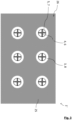
- Figur 1
- eine schematische Ansicht eines nicht erfindungsgemäßen Presspolsters,
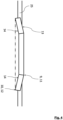
- Figur 2
- einen vertikalen Schnitt durch ein Federelement aus
Figur 1 , - Figur 3
- eine schematische Ansicht eines weiteren nicht erfindungsgemäßen Presspolsters,
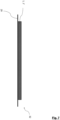
- Figur 4
- einen vertikalen Schnitt durch das Presspolster aus
Figur 3 , - Figur 5
- einen vertikalen Schnitt durch eine Einetagen-Heizpresse gemäß dem Stand der Technik,
- Figur 6
- einen vertikalen Schnitt durch eine Presspolster-Heizplatten-Einheit eines erfindungsgemäßen Sets und
- Figur 7
- einen vertikalen Schnitt durch eine Presspolster-Pressblech-Einheit eines weiteren erfindungsgemäßen Sets.
- Ein Ausführungsbeispiel, das in der
Figur 1 gezeigt ist, umfasst ein nicht erfindungsgemäßes Presspolster 1' für den Einsatz in einer hydraulischen Ein- oder Mehretagen-Heizpresse. Wie im Stand der Technik ist vorgesehen, das Presspolster 1 zwischen einer Heizplatte und einem Pressblech einer Ein- oder Mehretagen-Heizpressen anzuordnen, um in dem Pressblech oder der Heizplatte vorhandene Dickentoleranzen auszugleichen und gleichzeitig eine Übertragung der von der Heizplatte ausgehenden Wärme auf das Pressblech zu ermöglichen. - Das nicht erfindungsgemäße Presspolster 1 umfasst eine flächige Tragstruktur 2 sowie eine Vielzahl von Federelementen 3. Die flächige Tragstruktur 2 ist in Form eines Gewebes ausgebildet, welches zwei Fadensysteme 4, 5, nämlich Kettfäden 6 und Schussfäden 7, umfasst. Die Kettfäden 6 als auch die Schussfäden 7 sind in Form von Drahtlitzen aus Messing ausgebildet und sind unter Ausbildung einer Leinwandbindung miteinander verwebt. Die Kettfäden 6 verlaufen demnach abwechselnd über und unter den Schussfäden 7 und umgekehrt.
- Die Federelemente 3 des Presspolsters 1 sind in Form von metallischen Tellerfedern 8 ausgebildet. Beim Einsatz in einer Ein- oder Mehretagen-Heizpresse steht die Tellerfeder 8 in einem unverformten Zustand lediglich mit einer kreisförmig umlaufenden, oberen Kante 9 mit einer Heizplatte einer Ein- oder Mehretagen-Heizpresse und mit einer ebenfalls kreisförmig umlaufenden, unteren Kante 10 mit einem Pressblech einer Ein- oder Mehretagen-Heizpresse in Kontakt, wobei die beiden Kanten 9, 10 jeweils eine kreisförmige Kontaktlinie 11, 12 ausbilden. Ebenfalls ist jedoch auch eine umgekehrte Ausrichtung des Federelements 3 denkbar, bei der die obere Kante 9 mit dem Pressblech und die untere Kante 10 mit der Heizplatte in Kontakt steht.
- Ferner weisen die Tellerfedern 8 abgeschrägte (konische) Seitenabschnitte 15 auf, welche eine Verkleinerung eines Durchmessers der ersten Kontaktlinie 11 gegenüber einem Durchmesser der zweiten Kontaktlinie 12 herbeiführen. Ein Schnitt durch eine Tellerfeder 8 ist in der
Figur 2 gezeigt und verdeutlicht eine Kegelstumpfform. - Bei einem Pressvorgang in einer Ein- oder Mehretagen-Heizpresse wird das Federelement 3 derart verformt, dass eine plane, obere Kontaktfläche 13 ausgebildet wird. Gleichzeitig wird eine plane, untere Kontaktfläche 14 ausgebildet. Dabei steht eine der Kontaktflächen 13, 14 beim Einsatz in einer Ein- oder Mehretagen-Heizpresse mit der Heizplatte in Kontakt, während die andere Kontaktfläche 13, 14 mit dem Pressblech in Kontakt steht. Die Tellerfeder 8 nimmt während des Pressvorgangs somit im Wesentlichen die Form eines Hohlzylinders an.
- In einem Randbereich 16 sind die Tellerfedern 8 mit vier Durchbrüchen 17 versehen, welche in einem Winkel von jeweils 90° zueinander auf einem Kreis angeordnet sind und zu Vereinfachung der Herstellung jeweils auch zur kreisförmigen Außenkante der Tellerfeder 8 offen sein können, um die Schussfäden 7 bzw. Kettfäden 6 nicht mit einem Fadenende "durchfädeln" zu müssen sondern seitlich "einfädeln" zu können. Durch zwei gegenüberliegende Durchbrüche 17 der Federelemente 3 wird jeweils ein Faden 6, 7 eines Fadensystems 4, 5 hindurchgeführt, während die verbleibenden beiden Durchbrüche 17 zur Aufnahme eines Fadens 6, 7 des entsprechend anderen Fadensystems 4, 5 vorgesehen sind. Ein Kreuzungspunkt 18 eines Kettfadens 6 und eines Schussfadens 7 entspricht hierbei im Wesentlichen einer Mittelachse 19 des Federelements 3. Die Tellerfedern 8 sind äquidistant in dem Presspolster 1 angeordnet und bilden sich unter einem Winkel von 90° kreuzende Reihen in dem Presspolster 1 aus. Das Presspolster 1 ist mithin einfach aufrollbar und transportfähig.
- Aufgrund einer gegenüber einem Durchmesser 20 der Kettfäden 6 und Schussfäden 7 vergrößerten ungespannten (kräftefreien) Länge 21 der Tellerfedern 8 wird eine obere Kontaktfläche des Presspolsters 1 von der Gesamtheit der oberen Kontaktflächen 9 der einzelnen Tellerfedern 8 gebildet, während eine untere Kontaktfläche des Presspolsters 1' von der Gesamtheit der unteren Kontaktflächen 10 der einzelnen Tellerfedern 8 bestimmt wird. Hierdurch kann gewährleistet werden, dass unterschiedliche Dicken in der Heizplatte und/oder dem Pressblech mittels einer federnden Wirkung der Tellerfedern 8 ausgeglichen werden, wobei sich ein Grad der federnden Wirkung mittels einer Änderung eines Außendurchmessers 22, eines Innendurchmessers 23, einer Materialstärke 24 und der ungespannten Länge 21 der Tellerfeder 8 variieren und somit an die konkreten Anforderungen in der Ein- oder Mehretagen-Heizpressen anpassen lässt. Die Kettfäden 6 und die Schussfäden 7 kommen demnach nicht mit dem Pressblech bzw. der Heizplatte in Kontakt. Infolge der wärmeleitenden Eigenschaft der Tellerfedern 8, welche sich sehr direkt, d.h. auf kurzem Weg, durch das Pressblech hindurch erstrecken, erfolgt eine gute Übertragung der von der Heizplatte ausgehenden Wärme auf das Pressblech.
- Ein weiteres Ausführungsbeispiel eines nicht erfindungsgemäßen Presspolsters 1' ist in der
Figur 3 gezeigt. Das Presspolster 1' umfasst ebenfalls eine flächige Tragstruktur 2 in Form eines Gewebes sowie eine Vielzahl von metallischen Federelementen 3. Im Gegensatz zu dem in derFigur 1 dargestellten Presspolster 1' weist das Presspolster 1' gemäß derFigur 2 eine beidseitige Beschichtung 25 aus einem wärmestabilen Elastomerwerkstoff auf. Das in derFigur 1 gezeigte Presspolster 1' ist mithin im Wesentlichen in dem Elastomerwerkstoff eingebettet. Um sicherzustellen, dass der Kontakt der Heizplatte bzw. des Pressblechs weiterhin lediglich mit den Federelementen 3 erfolgt, ist die Beschichtung 25 im Bereich eines jeden Federelements 3 entfernt, wie gut in derFigur 4 erkennbar ist. Eine untere Oberfläche und eine untere Oberfläche 26 des Presspolsters 1' wird mithin teilweise von den Federelementen 3 gebildet. - Eine Einetagen-Heizpresse 27 gemäß dem Stand der Technik ist in
Figur 5 gezeigt. Die Einetagen-Heizpresse 27 umfasst zwei Heizplatten 28 und zwei Pressbleche 29. Es ist wie bereits im Stand der Technik vorgesehen, jeweils ein Presspolster 1', 1 zwischen einer Heizplatte 28 und einem Pressblech 29 der Einetagen-Heizpresse 27 anzuordnen. Zwischen den beiden Pressblechen 29 wird eine zu beschichtende Holzwerkstoffplatte 30 eingelegt, welche mit einem nicht in der Figur gezeigten Dekorpapier überdeckt ist. Mittels der von der Einetagen-Heizpresse 27 ausgehenden Wärme und des auf die Holzwerkstoffplatte 30 ausgeübten Drucks wird das Dekorpapier mit der Holzwerkstoffplatte 30 verbunden. - Ein Ausführungsbeispiel einer Presspolster-Heizplatten-Einheit 31 eines erfindungsgemäßen Sets, welches in der
Figur 6 gezeigt ist, umfasst ein Presspolster 1, 1', wie es beispielsweise weiter oben beschrieben wurde, sowie eine Heizplatte 28 einer Ein- oder Mehretagen-Heizpresse. Hierbei ist das Presspolster 1, 1' mit der Heizplatte 28 derart verklebt, dass ein einziges Bauteil ausgebildet wird. - Ein Ausführungsbeispiel einer Presspolster-Pressblech-Einheit 32 eines weiteren erfindungsgemäßen Sets ist in der
Figur 7 gezeigt. Im Gegensatz zu der Presspolster-Heizplatten-Einheit 31 ist das Presspolster 1', 1, wie es beispielsweise oben beschrieben wurde, nicht mit einer Heizplatte 28, sondern mit einem Pressblech 29 einer Ein- oder Mehretagen-Heizpresse verbunden, beispielsweise verklebt, und bildet somit ebenfalls ein einziges Bauteil aus. -
- 1' Presspolster
- 1 Presspolster
- 2 Tragstruktur
- 3 Federelement
- 4 Fadensystem
- 5 Fadensystem
- 6 Kettfaden
- 7 Schussfaden
- 8 Tellerfeder
- 9 obere Kante
- 10 untere Kante
- 11 Kontaktlinie
- 12 Kontaktlinie
- 13 obere Kontaktfläche
- 14 untere Kontaktfläche
- 15 Seitenabschnitt
- 16 Randbereich
- 17 Durchbruch
- 18 Kreuzungspunkt
- 19 Mittelachse
- 20 Durchmesser
- 21 ungespannte Länge
- 22 Außendurchmesser
- 23 Innendurchmesser
- 24 Materialstärke
- 25 Beschichtung
- 26 Oberfläche
- 27 Einetagen-Heizpresse
- 28 Heizplatte
- 29 Pressblech
- 30 Holzwerkstoffplatte
- 31 Presspolster-Heizplatten-Einheit
- 32 Presspolster-Pressblech-Einheit
Claims (11)
- Set aus einer Presspolster-Pressblech-Einheit und einer Heizplatte für den Einsatz in einer hydraulischen Ein- oder Mehretagen-Heizpresse, umfassend eine flächige Tragstruktur (2) sowie eine Vielzahl von metallischen Federelementen (3), die mit der Tragstruktur (2) verbunden und verteilt darin oder daran angeordnet sind, wobei die Tragstruktur (2) eine metallische Platte ist, wobei die metallische Platte ein Pressblech für den Einsatz in einer Ein- oder Mehretagen-Heizpresse ist und die Federelemente (3) mit der Platte verklebt und/oder verlötet und/oder verschweißt und/oder formschlüssig verbunden sind, dadurch gekennzeichnet, dass die Federelemente (3) zwischen dem Pressblech und der Heizplatte angeordnet sind.
- Set aus einer Presspolster-Heizplatten-Einheit und einem Pressblech für den Einsatz in einer hydraulischen Ein- oder Mehretagen-Heizpresse, umfassend eine flächige Tragstruktur (2) sowie eine Vielzahl von metallischen Federelementen (3), die mit der Tragstruktur (2) verbunden und verteilt darin oder daran angeordnet sind, wobei die Tragstruktur (2) eine metallische Platte ist, wobei die metallische Platte eine Heizplatte für den Einsatz in einer Ein- oder Mehretagen-Heizpresse ist und die Federelemente (3) mit der Platte verklebt und/oder verlötet und/oder verschweißt und/oder formschlüssig verbunden sind, dadurch gekennzeichnet, dass die Federelemente (3) zwischen dem Pressblech und der Heizplatte angeordnet sind.
- Set nach Anspruch 1 oder 2, dadurch gekennzeichnet, dass die metallische Platte mit einem textilen Flächengebilde verbunden ist, wobei die Federelemente (3) mit dem textilen Flächengebilde und der metallischen Platte verbunden sind.
- Set nach Anspruch 3, dadurch gekennzeichnet, dass das textile Flächengebilde ein Gewirk oder ein Gestrick oder ein Vliesstoff oder ein Gewebe ist, wobei zumindest ein Teil von Fäden (6, 7), die das textile Flächengebilde bilden, aus Metall bestehen oder Metall enthalten, wobei das Metall insbesondere von Messing, Kupfer, Bronze, Stahl, insbesondere Edelstahl, gebildet ist.
- Set nach einem der Ansprüche 1 bis 4, dadurch gekennzeichnet, dass die Federelemente (3) Tellerfedern (8) oder Schraubenfedern oder Blattfedern oder Wellenfedern sind.
- Set nach einem der Ansprüche 3 bis 5, dadurch gekennzeichnet, dass die Federelemente (3) mit Fäden (6, 7) des textilen Flächengebildes verbunden, insbesondere formschlüssig damit verbunden sind, wobei die Federelemente (3) vorzugsweise an Kreuzungspunkten (18) von Kett- und Schussfäden (6, 7) des textilen Flächengebildes angeordnet sind.
- Set nach Anspruch 6, dadurch gekennzeichnet, dass die Federelemente (3) Durchbrüche (17) aufweisen, durch die Fäden (6, 7) des textilen Flächengebildes hindurch geführt sind.
- Set nach Anspruch 7, dadurch gekennzeichnet, dass die Federelemente (3) mindestens vier Durchbrüche (17) besitzen, von denen durch zwei ein Kettfaden (6) und durch die anderen zwei ein Schussfaden (7) geführt ist.
- Set nach einem der Ansprüche 6 bis 8, dadurch gekennzeichnet, dass die Federelemente (3) äquidistant voneinander entfernt, insbesondere in sich kreuzenden Reihen, insbesondere entlang der Schuss- und/oder Kettfäden (6, 7), angeordnet sind.
- Set nach einem der Ansprüche 1 bis 9, dadurch gekennzeichnet, dass die Federelemente (3) teilweise in ein Elastomermaterial eingebettet sind, vorzugsweise ein Silikonelastomer oder ein Fluorsilikonelastomer oder ein Blendpolymer oder ein Copolymer der beiden vorgenannten Elastomere eingebettet sind, wobei die Federelemente (3) an beiden gegenüber liegenden Seiten des Presspolsters (1, 1') vorzugsweise jeweils einen Teil der Oberfläche (26) des Presspolsters (1, 1') bilden.
- Set nach Anspruch 10, dadurch gekennzeichnet, dass in dem Elastomermaterial Partikel zur Erhöhung der Wärmeleitfähigkeit, insbesondere Partikel aus einem Metall oder einem Mineral, jeweils vorzugsweise insbesondere in Form von Nanopartikeln enthalten sind.
Applications Claiming Priority (3)
| Application Number | Priority Date | Filing Date | Title |
|---|---|---|---|
| DE202019000828.4U DE202019000828U1 (de) | 2019-02-20 | 2019-02-20 | Presspolster mit hoher Federwirkung auf metallischer Basis für die Beschichtung von Holzwerkstoffplatten und Herstellung von Kunststoffplatten in hydraulischen Ein- und Mehretagenheizpressen. |
| EP20706437.9A EP3927540B1 (de) | 2019-02-20 | 2020-02-18 | Presspolster für den einsatz in einer hydraulischen ein- oder mehretagen-heizpresse sowie presspolster-pressblech-einheit und presspolster-heizplatte-einheit |
| PCT/EP2020/054156 WO2020169556A2 (de) | 2019-02-20 | 2020-02-18 | Presspolster für den einsatz in einer hydraulischen ein- oder mehretagen-heizpresse sowie presspolster-pressblech-einheit und pressblech-heizplatten-einheit |
Related Parent Applications (2)
| Application Number | Title | Priority Date | Filing Date |
|---|---|---|---|
| EP20706437.9A Division EP3927540B1 (de) | 2019-02-20 | 2020-02-18 | Presspolster für den einsatz in einer hydraulischen ein- oder mehretagen-heizpresse sowie presspolster-pressblech-einheit und presspolster-heizplatte-einheit |
| EP20706437.9A Division-Into EP3927540B1 (de) | 2019-02-20 | 2020-02-18 | Presspolster für den einsatz in einer hydraulischen ein- oder mehretagen-heizpresse sowie presspolster-pressblech-einheit und presspolster-heizplatte-einheit |
Publications (2)
| Publication Number | Publication Date |
|---|---|
| EP4032694A1 EP4032694A1 (de) | 2022-07-27 |
| EP4032694B1 true EP4032694B1 (de) | 2025-02-12 |
Family
ID=69645953
Family Applications (2)
| Application Number | Title | Priority Date | Filing Date |
|---|---|---|---|
| EP20706437.9A Active EP3927540B1 (de) | 2019-02-20 | 2020-02-18 | Presspolster für den einsatz in einer hydraulischen ein- oder mehretagen-heizpresse sowie presspolster-pressblech-einheit und presspolster-heizplatte-einheit |
| EP22160709.6A Active EP4032694B1 (de) | 2019-02-20 | 2020-02-18 | Set aus einer presspolster-pressblech-einheit und einer heizplatte oder set aus einer presspolster-heizplatten-einheit und einem pressblech, für den einsatz in einer hydraulischen ein- oder mehretagen-heizpresse |
Family Applications Before (1)
| Application Number | Title | Priority Date | Filing Date |
|---|---|---|---|
| EP20706437.9A Active EP3927540B1 (de) | 2019-02-20 | 2020-02-18 | Presspolster für den einsatz in einer hydraulischen ein- oder mehretagen-heizpresse sowie presspolster-pressblech-einheit und presspolster-heizplatte-einheit |
Country Status (8)
| Country | Link |
|---|---|
| US (1) | US12076955B2 (de) |
| EP (2) | EP3927540B1 (de) |
| JP (1) | JP7337942B2 (de) |
| CN (1) | CN113439022B (de) |
| BR (1) | BR112021015190A2 (de) |
| DE (1) | DE202019000828U1 (de) |
| ES (1) | ES2953330T3 (de) |
| WO (1) | WO2020169556A2 (de) |
Family Cites Families (25)
| Publication number | Priority date | Publication date | Assignee | Title |
|---|---|---|---|---|
| GB1249825A (en) * | 1969-08-01 | 1971-10-13 | Ronald Percy Gudgeon | Improvements in or relating to laundry, textile and other presses |
| GB1444093A (en) * | 1973-01-22 | 1976-07-28 | Ici Ltd | Pressure distributing device and a method and apparatus for making a pressed article using such a device |
| DE2319593B2 (de) | 1973-04-18 | 1976-09-23 | Becker & van Hüllen Niederrheinische Maschinenfabrik, 4150 Krefeld | Presspolster fuer heizplattenpressen |
| US3980016A (en) * | 1975-06-18 | 1976-09-14 | Imperial Chemical Industries Limited | Pressing apparatus |
| JPH0817880B2 (ja) | 1990-11-28 | 1996-02-28 | 帝人株式会社 | プレスクッション材 |
| EP0493630B1 (de) | 1990-12-31 | 1995-05-24 | RHEINISCHE FILZTUCHFABRIK GmbH | Presspolster für Hochdruckpressen |
| JPH05138675A (ja) * | 1991-11-26 | 1993-06-08 | Hitachi Chem Co Ltd | プレス用クツシヨン材 |
| GB9421573D0 (en) | 1994-10-26 | 1994-12-14 | Marathon Belting Ltd | A press pad |
| JP2001018242A (ja) * | 1999-07-05 | 2001-01-23 | Ichikawa Woolen Textile Co Ltd | 成形プレス用耐熱クッション材 |
| TW524749B (en) * | 1999-09-17 | 2003-03-21 | Ichikawa Co Ltd | Heat resistant cushion material for forming press |
| US6737370B2 (en) | 2000-03-21 | 2004-05-18 | Rheinische Filztuchfabrik Gmbh | Press pad containing fluoroelastomer or fluorosilicone elastomer priority claim |
| DE20011432U1 (de) | 2000-07-05 | 2000-10-26 | Rheinische Filztuchfabrik GmbH, 52222 Stolberg | Preßpolster |
| DE20115945U1 (de) * | 2001-09-27 | 2001-12-13 | Thomas Josef Heimbach GmbH & Co., 52353 Düren | Preßpolster |
| ATE290461T1 (de) | 2001-09-27 | 2005-03-15 | Heimbach Gmbh Thomas Josef | Presspolster |
| RU2235642C2 (ru) | 2002-07-23 | 2004-09-10 | Кручинина Галина Николаевна | Прессовая компенсационная подушка для формующего пресса |
| JP5204429B2 (ja) * | 2007-05-23 | 2013-06-05 | 三ツ星ベルト株式会社 | 熱プレス用クッション材 |
| DE202012005265U1 (de) | 2012-05-26 | 2012-06-27 | Rolf Espe | Presspolster für Ein- und Mehretagenheizpressen mit wärmeleitenden Kontaktschlussfäden in Kett- und/oder Schussrichtung |
| DE102014112244A1 (de) * | 2014-08-26 | 2016-03-03 | Benteler Automobiltechnik Gmbh | Verfahren und Presse zur Herstellung wenigstens abschnittsweise gehärteter Blechbauteile |
| US10108033B2 (en) * | 2015-08-04 | 2018-10-23 | Rogers Corporation | Subassemblies comprising a compressible pressure pad, methods for reducing ripple effect in a display device, and methods for improving impact absorption in a display device |
| DE202015006923U1 (de) * | 2015-10-02 | 2015-10-16 | Rolf Espe | Presspolster für den Einsatz in hydraulischen Ein- oder Mehretagenheizpressen |
| CN205439318U (zh) * | 2016-04-11 | 2016-08-10 | 李良泽 | 一种旧物品压包机 |
| CN105965623A (zh) * | 2016-07-09 | 2016-09-28 | 衡水华科橡塑有限公司 | 一种热压机导热缓冲压垫 |
| CN107718230A (zh) * | 2017-11-14 | 2018-02-23 | 江门市尚林板饰厂有限公司 | 一种可防偏移的装饰板加工用冷压机 |
| CN109049809A (zh) * | 2018-07-10 | 2018-12-21 | 安徽省宇鸿纺织工艺制品有限公司 | 一种密封性强的羽绒家纺生产用压实机 |
| CN108638565A (zh) * | 2018-07-12 | 2018-10-12 | 江阴盛鼎机械制造有限公司 | 一种用于液压机的压力垫 |
-
2019
- 2019-02-20 DE DE202019000828.4U patent/DE202019000828U1/de not_active Expired - Lifetime
-
2020
- 2020-02-18 CN CN202080014702.9A patent/CN113439022B/zh not_active Expired - Fee Related
- 2020-02-18 JP JP2021547866A patent/JP7337942B2/ja active Active
- 2020-02-18 WO PCT/EP2020/054156 patent/WO2020169556A2/de not_active Ceased
- 2020-02-18 EP EP20706437.9A patent/EP3927540B1/de active Active
- 2020-02-18 BR BR112021015190-7A patent/BR112021015190A2/pt active Search and Examination
- 2020-02-18 EP EP22160709.6A patent/EP4032694B1/de active Active
- 2020-02-18 ES ES20706437T patent/ES2953330T3/es active Active
-
2021
- 2021-07-17 US US17/378,692 patent/US12076955B2/en active Active
Also Published As
| Publication number | Publication date |
|---|---|
| ES2953330T3 (es) | 2023-11-10 |
| EP4032694A1 (de) | 2022-07-27 |
| EP3927540B1 (de) | 2023-07-19 |
| EP3927540A2 (de) | 2021-12-29 |
| WO2020169556A2 (de) | 2020-08-27 |
| US20220001636A1 (en) | 2022-01-06 |
| BR112021015190A2 (pt) | 2021-09-28 |
| JP7337942B2 (ja) | 2023-09-04 |
| CN113439022A (zh) | 2021-09-24 |
| DE202019000828U1 (de) | 2020-02-24 |
| US12076955B2 (en) | 2024-09-03 |
| JP2022521202A (ja) | 2022-04-06 |
| WO2020169556A3 (de) | 2020-10-15 |
| CN113439022B (zh) | 2023-11-07 |
Similar Documents
| Publication | Publication Date | Title |
|---|---|---|
| DE102010036539B4 (de) | Presspolster für eine hydraulische Presse | |
| EP2756947B1 (de) | Presspolster für eine ein- oder mehretagenpresse | |
| EP1136251A2 (de) | Verfahren zur Herstellung dekorativer plattenförmiger Verbundwerkstoffe | |
| EP3405334B1 (de) | Presspolster für eine hydraulische heizpresse und verfahren zu dessen herstellung | |
| EP1059160A2 (de) | Verbundmaterial | |
| DE202007019506U1 (de) | Verbesserungen an Presspolstern | |
| CH639731A5 (de) | Blattfoermiges oder plattenfoermiges material aus verfilzten fasern und trockenem harz und verfahren zu dessen herstellung sowie verwendung desselben. | |
| WO2017055535A1 (de) | Ein- oder mehretagenheizpresse, verfahren zur herstellung eines presspolsters sowie verwendung desselben | |
| DE10352754B3 (de) | Heiss-Pressvorrichtung mit einem Pressblech und mindestens einem elastischen Belag | |
| EP2514585A1 (de) | Kontinuierliche Presse | |
| EP1779999B1 (de) | Druckausgleichsgewebe für hydraulische Heizpressenanlagen | |
| DE19860166A1 (de) | Friktionselement und Verfahren zu seiner Herstellung | |
| DE102008027235A1 (de) | Werkstoffplatte | |
| DE102018133542A1 (de) | Presspolster sowie Verfahren zu dessen Herstellung | |
| EP4032694B1 (de) | Set aus einer presspolster-pressblech-einheit und einer heizplatte oder set aus einer presspolster-heizplatten-einheit und einem pressblech, für den einsatz in einer hydraulischen ein- oder mehretagen-heizpresse | |
| EP2666623B1 (de) | Verfahren zur Herstellung eines Presspolsters sowie zugehöriger Elastomerfaden und zugehöriges Presspolster | |
| EP1386723A2 (de) | Presspolster | |
| DE202007006767U1 (de) | Presspolster | |
| DE10161667C1 (de) | Wärmetauscher aus Kunststoff | |
| DE102018115121A1 (de) | Herstellungsverfahren für Harzverbundplatten | |
| EP3753724A1 (de) | Verfahren zur herstellung eines presspolsters sowie pressblechset | |
| DE202024002144U1 (de) | Druckausgleichsgewebe mit schnellen und variablen Wärmeleitfähigkeiten für hydraulische Ein- und Mehretagenheizpressen | |
| WO2024141250A1 (de) | Presspolster mit einem gewebe sowie heizpresse | |
| DE69810365T2 (de) | Heizplattenpresse zum Paneelpressen | |
| DE202006004594U1 (de) | Presspolster |
Legal Events
| Date | Code | Title | Description |
|---|---|---|---|
| PUAI | Public reference made under article 153(3) epc to a published international application that has entered the european phase |
Free format text: ORIGINAL CODE: 0009012 |
|
| STAA | Information on the status of an ep patent application or granted ep patent |
Free format text: STATUS: THE APPLICATION HAS BEEN PUBLISHED |
|
| AC | Divisional application: reference to earlier application |
Ref document number: 3927540 Country of ref document: EP Kind code of ref document: P |
|
| AK | Designated contracting states |
Kind code of ref document: A1 Designated state(s): AL AT BE BG CH CY CZ DE DK EE ES FI FR GB GR HR HU IE IS IT LI LT LU LV MC MK MT NL NO PL PT RO RS SE SI SK SM TR |
|
| STAA | Information on the status of an ep patent application or granted ep patent |
Free format text: STATUS: REQUEST FOR EXAMINATION WAS MADE |
|
| 17P | Request for examination filed |
Effective date: 20221206 |
|
| RBV | Designated contracting states (corrected) |
Designated state(s): AL AT BE BG CH CY CZ DE DK EE ES FI FR GB GR HR HU IE IS IT LI LT LU LV MC MK MT NL NO PL PT RO RS SE SI SK SM TR |
|
| STAA | Information on the status of an ep patent application or granted ep patent |
Free format text: STATUS: EXAMINATION IS IN PROGRESS |
|
| 17Q | First examination report despatched |
Effective date: 20230817 |
|
| GRAP | Despatch of communication of intention to grant a patent |
Free format text: ORIGINAL CODE: EPIDOSNIGR1 |
|
| STAA | Information on the status of an ep patent application or granted ep patent |
Free format text: STATUS: GRANT OF PATENT IS INTENDED |
|
| RIC1 | Information provided on ipc code assigned before grant |
Ipc: B27N 7/00 20060101ALN20241004BHEP Ipc: B27N 3/18 20060101ALN20241004BHEP Ipc: D03D 1/00 20060101ALI20241004BHEP Ipc: B27N 3/20 20060101ALI20241004BHEP Ipc: B30B 15/06 20060101AFI20241004BHEP |
|
| INTG | Intention to grant announced |
Effective date: 20241031 |
|
| GRAS | Grant fee paid |
Free format text: ORIGINAL CODE: EPIDOSNIGR3 |
|
| GRAA | (expected) grant |
Free format text: ORIGINAL CODE: 0009210 |
|
| STAA | Information on the status of an ep patent application or granted ep patent |
Free format text: STATUS: THE PATENT HAS BEEN GRANTED |
|
| AC | Divisional application: reference to earlier application |
Ref document number: 3927540 Country of ref document: EP Kind code of ref document: P |
|
| AK | Designated contracting states |
Kind code of ref document: B1 Designated state(s): AL AT BE BG CH CY CZ DE DK EE ES FI FR GB GR HR HU IE IS IT LI LT LU LV MC MK MT NL NO PL PT RO RS SE SI SK SM TR |
|
| REG | Reference to a national code |
Ref country code: GB Ref legal event code: FG4D Free format text: NOT ENGLISH |
|
| REG | Reference to a national code |
Ref country code: CH Ref legal event code: EP |
|
| REG | Reference to a national code |
Ref country code: DE Ref legal event code: R096 Ref document number: 502020010401 Country of ref document: DE |
|
| REG | Reference to a national code |
Ref country code: IE Ref legal event code: FG4D Free format text: LANGUAGE OF EP DOCUMENT: GERMAN |
|
| REG | Reference to a national code |
Ref country code: NL Ref legal event code: MP Effective date: 20250212 |
|
| PG25 | Lapsed in a contracting state [announced via postgrant information from national office to epo] |
Ref country code: RS Free format text: LAPSE BECAUSE OF FAILURE TO SUBMIT A TRANSLATION OF THE DESCRIPTION OR TO PAY THE FEE WITHIN THE PRESCRIBED TIME-LIMIT Effective date: 20250512 |
|
| PG25 | Lapsed in a contracting state [announced via postgrant information from national office to epo] |
Ref country code: FI Free format text: LAPSE BECAUSE OF FAILURE TO SUBMIT A TRANSLATION OF THE DESCRIPTION OR TO PAY THE FEE WITHIN THE PRESCRIBED TIME-LIMIT Effective date: 20250212 |
|
| PG25 | Lapsed in a contracting state [announced via postgrant information from national office to epo] |
Ref country code: PL Free format text: LAPSE BECAUSE OF FAILURE TO SUBMIT A TRANSLATION OF THE DESCRIPTION OR TO PAY THE FEE WITHIN THE PRESCRIBED TIME-LIMIT Effective date: 20250212 |
|
| PG25 | Lapsed in a contracting state [announced via postgrant information from national office to epo] |
Ref country code: ES Free format text: LAPSE BECAUSE OF FAILURE TO SUBMIT A TRANSLATION OF THE DESCRIPTION OR TO PAY THE FEE WITHIN THE PRESCRIBED TIME-LIMIT Effective date: 20250212 |
|
| REG | Reference to a national code |
Ref country code: LT Ref legal event code: MG9D |
|
| PG25 | Lapsed in a contracting state [announced via postgrant information from national office to epo] |
Ref country code: IS Free format text: LAPSE BECAUSE OF FAILURE TO SUBMIT A TRANSLATION OF THE DESCRIPTION OR TO PAY THE FEE WITHIN THE PRESCRIBED TIME-LIMIT Effective date: 20250612 Ref country code: NO Free format text: LAPSE BECAUSE OF FAILURE TO SUBMIT A TRANSLATION OF THE DESCRIPTION OR TO PAY THE FEE WITHIN THE PRESCRIBED TIME-LIMIT Effective date: 20250512 |
|
| PG25 | Lapsed in a contracting state [announced via postgrant information from national office to epo] |
Ref country code: NL Free format text: LAPSE BECAUSE OF FAILURE TO SUBMIT A TRANSLATION OF THE DESCRIPTION OR TO PAY THE FEE WITHIN THE PRESCRIBED TIME-LIMIT Effective date: 20250212 |
|
| PG25 | Lapsed in a contracting state [announced via postgrant information from national office to epo] |
Ref country code: HR Free format text: LAPSE BECAUSE OF FAILURE TO SUBMIT A TRANSLATION OF THE DESCRIPTION OR TO PAY THE FEE WITHIN THE PRESCRIBED TIME-LIMIT Effective date: 20250212 |
|
| PG25 | Lapsed in a contracting state [announced via postgrant information from national office to epo] |
Ref country code: PT Free format text: LAPSE BECAUSE OF FAILURE TO SUBMIT A TRANSLATION OF THE DESCRIPTION OR TO PAY THE FEE WITHIN THE PRESCRIBED TIME-LIMIT Effective date: 20250612 Ref country code: LV Free format text: LAPSE BECAUSE OF FAILURE TO SUBMIT A TRANSLATION OF THE DESCRIPTION OR TO PAY THE FEE WITHIN THE PRESCRIBED TIME-LIMIT Effective date: 20250212 |
|
| PG25 | Lapsed in a contracting state [announced via postgrant information from national office to epo] |
Ref country code: GR Free format text: LAPSE BECAUSE OF FAILURE TO SUBMIT A TRANSLATION OF THE DESCRIPTION OR TO PAY THE FEE WITHIN THE PRESCRIBED TIME-LIMIT Effective date: 20250513 Ref country code: BG Free format text: LAPSE BECAUSE OF FAILURE TO SUBMIT A TRANSLATION OF THE DESCRIPTION OR TO PAY THE FEE WITHIN THE PRESCRIBED TIME-LIMIT Effective date: 20250212 |
|
| REG | Reference to a national code |
Ref country code: DE Ref legal event code: R119 Ref document number: 502020010401 Country of ref document: DE |
|
| PG25 | Lapsed in a contracting state [announced via postgrant information from national office to epo] |
Ref country code: SE Free format text: LAPSE BECAUSE OF FAILURE TO SUBMIT A TRANSLATION OF THE DESCRIPTION OR TO PAY THE FEE WITHIN THE PRESCRIBED TIME-LIMIT Effective date: 20250212 |
|
| REG | Reference to a national code |
Ref country code: CH Ref legal event code: PL |
|
| PG25 | Lapsed in a contracting state [announced via postgrant information from national office to epo] |
Ref country code: SM Free format text: LAPSE BECAUSE OF FAILURE TO SUBMIT A TRANSLATION OF THE DESCRIPTION OR TO PAY THE FEE WITHIN THE PRESCRIBED TIME-LIMIT Effective date: 20250212 |
|
| PG25 | Lapsed in a contracting state [announced via postgrant information from national office to epo] |
Ref country code: DK Free format text: LAPSE BECAUSE OF FAILURE TO SUBMIT A TRANSLATION OF THE DESCRIPTION OR TO PAY THE FEE WITHIN THE PRESCRIBED TIME-LIMIT Effective date: 20250212 |
|
| PG25 | Lapsed in a contracting state [announced via postgrant information from national office to epo] |
Ref country code: IT Free format text: LAPSE BECAUSE OF FAILURE TO SUBMIT A TRANSLATION OF THE DESCRIPTION OR TO PAY THE FEE WITHIN THE PRESCRIBED TIME-LIMIT Effective date: 20250212 Ref country code: LU Free format text: LAPSE BECAUSE OF NON-PAYMENT OF DUE FEES Effective date: 20250218 |
|
| PG25 | Lapsed in a contracting state [announced via postgrant information from national office to epo] |
Ref country code: CH Free format text: LAPSE BECAUSE OF NON-PAYMENT OF DUE FEES Effective date: 20250228 |
|
| PG25 | Lapsed in a contracting state [announced via postgrant information from national office to epo] |
Ref country code: EE Free format text: LAPSE BECAUSE OF FAILURE TO SUBMIT A TRANSLATION OF THE DESCRIPTION OR TO PAY THE FEE WITHIN THE PRESCRIBED TIME-LIMIT Effective date: 20250212 Ref country code: CZ Free format text: LAPSE BECAUSE OF FAILURE TO SUBMIT A TRANSLATION OF THE DESCRIPTION OR TO PAY THE FEE WITHIN THE PRESCRIBED TIME-LIMIT Effective date: 20250212 |
|
| PG25 | Lapsed in a contracting state [announced via postgrant information from national office to epo] |
Ref country code: RO Free format text: LAPSE BECAUSE OF FAILURE TO SUBMIT A TRANSLATION OF THE DESCRIPTION OR TO PAY THE FEE WITHIN THE PRESCRIBED TIME-LIMIT Effective date: 20250212 |
|
| PG25 | Lapsed in a contracting state [announced via postgrant information from national office to epo] |
Ref country code: SK Free format text: LAPSE BECAUSE OF FAILURE TO SUBMIT A TRANSLATION OF THE DESCRIPTION OR TO PAY THE FEE WITHIN THE PRESCRIBED TIME-LIMIT Effective date: 20250212 |
|
| REG | Reference to a national code |
Ref country code: BE Ref legal event code: MM Effective date: 20250228 |
|
| PLBE | No opposition filed within time limit |
Free format text: ORIGINAL CODE: 0009261 |
|
| STAA | Information on the status of an ep patent application or granted ep patent |
Free format text: STATUS: NO OPPOSITION FILED WITHIN TIME LIMIT |
|
| PG25 | Lapsed in a contracting state [announced via postgrant information from national office to epo] |
Ref country code: MC Free format text: LAPSE BECAUSE OF FAILURE TO SUBMIT A TRANSLATION OF THE DESCRIPTION OR TO PAY THE FEE WITHIN THE PRESCRIBED TIME-LIMIT Effective date: 20250212 |
|
| PG25 | Lapsed in a contracting state [announced via postgrant information from national office to epo] |
Ref country code: DE Free format text: LAPSE BECAUSE OF NON-PAYMENT OF DUE FEES Effective date: 20250902 |
|
| PG25 | Lapsed in a contracting state [announced via postgrant information from national office to epo] |
Ref country code: FR Free format text: LAPSE BECAUSE OF NON-PAYMENT OF DUE FEES Effective date: 20250412 |
|
| PG25 | Lapsed in a contracting state [announced via postgrant information from national office to epo] |
Ref country code: BE Free format text: LAPSE BECAUSE OF NON-PAYMENT OF DUE FEES Effective date: 20250228 |
|
| PG25 | Lapsed in a contracting state [announced via postgrant information from national office to epo] |
Ref country code: IE Free format text: LAPSE BECAUSE OF NON-PAYMENT OF DUE FEES Effective date: 20250218 |
|
| 26N | No opposition filed |
Effective date: 20251113 |
|
| GBPC | Gb: european patent ceased through non-payment of renewal fee |
Effective date: 20250512 |