EP4011970B1 - Transparentes thermoplastisches harz und verfahren zur herstellung davon - Google Patents
Transparentes thermoplastisches harz und verfahren zur herstellung davon Download PDFInfo
- Publication number
- EP4011970B1 EP4011970B1 EP21856078.7A EP21856078A EP4011970B1 EP 4011970 B1 EP4011970 B1 EP 4011970B1 EP 21856078 A EP21856078 A EP 21856078A EP 4011970 B1 EP4011970 B1 EP 4011970B1
- Authority
- EP
- European Patent Office
- Prior art keywords
- weight
- thermoplastic resin
- copolymer
- alkyl
- rubber
- Prior art date
- Legal status (The legal status is an assumption and is not a legal conclusion. Google has not performed a legal analysis and makes no representation as to the accuracy of the status listed.)
- Active
Links
Images
Classifications
-
- C—CHEMISTRY; METALLURGY
- C08—ORGANIC MACROMOLECULAR COMPOUNDS; THEIR PREPARATION OR CHEMICAL WORKING-UP; COMPOSITIONS BASED THEREON
- C08F—MACROMOLECULAR COMPOUNDS OBTAINED BY REACTIONS ONLY INVOLVING CARBON-TO-CARBON UNSATURATED BONDS
- C08F2/00—Processes of polymerisation
- C08F2/12—Polymerisation in non-solvents
- C08F2/16—Aqueous medium
- C08F2/22—Emulsion polymerisation
- C08F2/24—Emulsion polymerisation with the aid of emulsifying agents
- C08F2/26—Emulsion polymerisation with the aid of emulsifying agents anionic
-
- C—CHEMISTRY; METALLURGY
- C08—ORGANIC MACROMOLECULAR COMPOUNDS; THEIR PREPARATION OR CHEMICAL WORKING-UP; COMPOSITIONS BASED THEREON
- C08F—MACROMOLECULAR COMPOUNDS OBTAINED BY REACTIONS ONLY INVOLVING CARBON-TO-CARBON UNSATURATED BONDS
- C08F265/00—Macromolecular compounds obtained by polymerising monomers on to polymers of unsaturated monocarboxylic acids or derivatives thereof as defined in group C08F20/00
- C08F265/04—Macromolecular compounds obtained by polymerising monomers on to polymers of unsaturated monocarboxylic acids or derivatives thereof as defined in group C08F20/00 on to polymers of esters
- C08F265/06—Polymerisation of acrylate or methacrylate esters on to polymers thereof
-
- C—CHEMISTRY; METALLURGY
- C08—ORGANIC MACROMOLECULAR COMPOUNDS; THEIR PREPARATION OR CHEMICAL WORKING-UP; COMPOSITIONS BASED THEREON
- C08F—MACROMOLECULAR COMPOUNDS OBTAINED BY REACTIONS ONLY INVOLVING CARBON-TO-CARBON UNSATURATED BONDS
- C08F285/00—Macromolecular compounds obtained by polymerising monomers on to preformed graft polymers
-
- C—CHEMISTRY; METALLURGY
- C08—ORGANIC MACROMOLECULAR COMPOUNDS; THEIR PREPARATION OR CHEMICAL WORKING-UP; COMPOSITIONS BASED THEREON
- C08F—MACROMOLECULAR COMPOUNDS OBTAINED BY REACTIONS ONLY INVOLVING CARBON-TO-CARBON UNSATURATED BONDS
- C08F6/00—Post-polymerisation treatments
- C08F6/14—Treatment of polymer emulsions
- C08F6/22—Coagulation
-
- C—CHEMISTRY; METALLURGY
- C08—ORGANIC MACROMOLECULAR COMPOUNDS; THEIR PREPARATION OR CHEMICAL WORKING-UP; COMPOSITIONS BASED THEREON
- C08L—COMPOSITIONS OF MACROMOLECULAR COMPOUNDS
- C08L51/00—Compositions of graft polymers in which the grafted component is obtained by reactions only involving carbon-to-carbon unsaturated bonds; Compositions of derivatives of such polymers
- C08L51/003—Compositions of graft polymers in which the grafted component is obtained by reactions only involving carbon-to-carbon unsaturated bonds; Compositions of derivatives of such polymers grafted on to macromolecular compounds obtained by reactions only involving unsaturated carbon-to-carbon bonds
-
- C—CHEMISTRY; METALLURGY
- C08—ORGANIC MACROMOLECULAR COMPOUNDS; THEIR PREPARATION OR CHEMICAL WORKING-UP; COMPOSITIONS BASED THEREON
- C08L—COMPOSITIONS OF MACROMOLECULAR COMPOUNDS
- C08L51/00—Compositions of graft polymers in which the grafted component is obtained by reactions only involving carbon-to-carbon unsaturated bonds; Compositions of derivatives of such polymers
- C08L51/04—Compositions of graft polymers in which the grafted component is obtained by reactions only involving carbon-to-carbon unsaturated bonds; Compositions of derivatives of such polymers grafted on to rubbers
-
- C—CHEMISTRY; METALLURGY
- C08—ORGANIC MACROMOLECULAR COMPOUNDS; THEIR PREPARATION OR CHEMICAL WORKING-UP; COMPOSITIONS BASED THEREON
- C08L—COMPOSITIONS OF MACROMOLECULAR COMPOUNDS
- C08L2201/00—Properties
- C08L2201/10—Transparent films; Clear coatings; Transparent materials
Definitions
- the present invention relates to a transparent thermoplastic resin. More particularly, the present invention relates to a transparent thermoplastic resin having excellent transparency, impact strength, gloss, fluidity, and weather resistance and excellent non-whitening properties, characterized in that whitening does not occur when bent or hit, and a method of preparing the thermoplastic resin.
- ASA resins acrylic copolymers typified by acrylate-styrene-acrylonitrile graft copolymers (hereinafter referred to as "ASA resins") without an ethylenically unsaturated bond have been used.
- ASA resins have excellent physical properties, such as processability, impact resistance, chemical resistance, and weather resistance, and thus have been used in various fields, such as materials for buildings, interior and exterior materials for automobiles and motorcycles, electric and electronic products, ships, leisure goods, and gardening goods.
- appearance characteristics, such as colorability, of ASA resins are poor, compared to painted ABS resins, and ASA resins are insufficient to satisfy increasing weather resistance levels required in the market.
- thermoplastic resins are mainly manufactured in the form of a film and then processed into a final product through a process such as bending or folding according to the shape of a substrate to which the finishing material is applied.
- thermoplastic ASA resin due to the characteristics of a thermoplastic ASA resin, when the above-described finishing treatment is performed at room temperature, whitening occurs, thereby losing the original color of the resin and deteriorating aesthetics.
- thermoplastic resin composition exhibiting excellent physical properties has not yet been developed, and non-whitening properties have also not been satisfactorily implemented.
- US 2012/128940 A1 discloses a thermoplastic resin composition, its preparation method and a moulded article prepared therefrom, comprising a BA/MMA graft copolymer and a matrix resin comprising an MMA/MA copolymer.
- the present invention has been made in view of the above problems, and it is one object of the present invention to provide a transparent thermoplastic resin having excellent transparency, impact strength, gloss, weather resistance, and fluidity and excellent non-whitening properties, characterized in that occurrence of whitening is suppressed even when bent or hit and a method of preparing the thermoplastic resin. It is another object of the present invention to provide a molded article manufactured using the thermoplastic resin of the present invention.
- thermoplastic resin including: an alkyl acrylate-alkyl methacrylate graft copolymer (A), or an alkyl acrylate-alkyl methacrylate graft copolymer (A); and a matrix resin (B) including one or more selected from the group consisting of an alkyl methacrylate polymer and an alkyl methacrylate-alkyl acrylate copolymer, wherein a transparency (haze value), measured according to ASTM D-1003 under a condition of 0.15 mm thickness, is 2 or less, and a transparency measured under a condition of 3 mm thickness is 4 or less, a total content of the alkyl acrylate is 20 to 50 % by weight, and a refractive index difference (according to ASTM D542) between a sol and a gel of the thermoplastic resin under a condition of using acetone is 0.02 or less.
- a transparency haze value
- thermoplastic resin including: an alkyl acrylate-alkyl methacrylate graft copolymer (A), or an alkyl acrylate-alkyl methacrylate graft copolymer (A); and a matrix resin (B) including one or more selected from the group consisting of an alkyl methacrylate polymer and an alkyl methacrylate-alkyl acrylate copolymer, wherein a transparency (haze value), measured according to ASTM D-1003 under a condition of 0.15 mm thickness, is 2 or less, and a transparency measured under a condition of 3 mm thickness is 4 or less, a total content of the alkyl acrylate is 20 to 50 % by weight, and an elution amount of butyl acrylate in acetone is 0.01 % by weight or more.
- a transparency haze value
- a refractive index difference (according to ASTM D542) between a sol and a gel of the thermoplastic resin under a condition of using acetone may be 0.02 or less.
- the alkyl acrylate rubber may be prepared by emulsion polymerization of an alkyl acrylate-based compound.
- the acrylate rubber may be prepared by mixing an acrylate-based compound, an emulsifier, an initiator, a grafting agent, a crosslinking agent, an electrolyte, and a solvent and performing emulsion polymerization of the mixture. In this case, grafting efficiency may increase, thereby improving physical properties such as impact resistance.
- the rubber (a-1) may include a rubber seed.
- the rubber seed may be prepared by polymerizing alkyl acrylate and, optionally alkyl methacrylate.
- alkyl methacrylate When alkyl methacrylate is included, the alkyl methacrylate may be included in an amount of 0.1 to 25 % by weight, preferably 1 to 20 % by weight, more preferably 2 to 15 % by weight based on 100 % by weight of the rubber seed. Within this range, impact strength, weather resistance, and physical property balance are excellent.
- the rubber seed may be prepared by adding 0.1 to 1 part by weight of a crosslinking agent, 0.01 to 1 part by weight of an initiator, and 0.1 to 3.0 parts by weight of an emulsifier to monomers including an alkyl acrylate and an alkyl methacrylate and performing polymerization.
- a polymer having an even size may be prepared within a short time, and physical properties such as weather resistance and impact strength may be further improved.
- the alkyl acrylate compound may be an alkyl acrylate containing an alkyl group having 1 to 15 carbon atoms, and as a specific example, may include one or more selected from the group consisting of methyl acrylate, ethyl acrylate, propyl acrylate, butyl acrylate, 2-ethylbutyl acrylate, octyl acrylate, 2-ethylhexyl acrylate, hexyl acrylate, heptyl acrylate, n-pentyl acrylate, and lauryl acrylate.
- the alkyl acrylate compound preferably is an alkyl acrylate containing a chain alkyl group having 1 to 4 carbon atoms, more preferably butyl acrylate.
- crosslinking agents commonly used in the art to which the present invention pertains may be used in the present invention without particular limitation.
- one or more compounds including an unsaturated vinyl group and capable of serving as a crosslinking agent, or one or more compounds including two or more unsaturated vinyl groups having different reactivities may be used as the crosslinking agent of the present invention.
- a mixture containing one or more selected from the group consisting of KCl, NaCl, KHCO 3 , NaHCO 3 , K 2 CO 3 , Na 2 CO 3 , KHSO 3 , NaHSO 3 , K 4 P 2 O 7 , Na 4 P 2 O 7 , K 3 PO 4 , Na 3 PO 4 , K 2 HPO 4 , Na 2 HPO 4 , KOH, NaOH, and Na 2 S 2 O 7 may be used as the electrolyte, without being limited thereto.
- initiators commonly used in the art to which the present invention pertains may be used in the present invention without particular limitation.
- radical initiators such as water-soluble initiators and fat-soluble initiators may be used, and a mixture containing one or more of the radical initiators may be used.
- the water-soluble initiator may include one or more selected from the group consisting of inorganic peroxides including sodium persulfate, potassium persulfate, ammonium persulfate, potassium superphosphate, and hydrogen peroxide, without being limited thereto.
- the fat-soluble initiator may include one or more selected from the group consisting of dialkyl peroxides, diacyl peroxides, diperoxyketals, hydroperoxides, peroxyesters, peroxydicarbonates, and azo compounds.
- the fat-soluble initiator may include one or more selected from the group consisting of organic peroxides such as cumene hydroperoxide, p-menthane hydroperoxide, di-t-butyl peroxide, dicumyl peroxide, t-butylcumyl peroxide, di-t-amyl peroxide, 2,5-dimethyl-2,5-di(t-butylperoxy)-hexane, 1,1,-di(t-butylperoxy)-3,3,5-trimethylcyclohexane, 1,1-di(t-butylperoxy)-cyclohexane, 1,1-di(t-amylperoxy)-cyclohexane, ethyl 3,3-di(t-amylperoxy)-butyrate, diisopropylbenzene mono-hydroperoxide, t-amyl hydroperoxide, t-butyl hydroperoxide
- an oxidation-reduction catalyst may be optionally used to further accelerate initiation reaction.
- the oxidation-reduction catalyst may include one or more selected from the group consisting of sodium pyrophosphate, dextrose, ferrous sulfide, sodium sulfite, sodium formaldehyde sulfoxylate, sodium ethylenediaminetetraacetate, sulfonato acetic acid metal salt, and sulfinato acetic acid metal salt without being limited thereto.
- an activator is preferably used to promote initiation reaction of peroxides.
- the activator preferably includes one or more selected from the group consisting of sodium formaldehyde, sulfoxylate, sodium ethylenediamine, tetraacetate, ferrous sulfate, dextrose, sodium pyrrolate, sodium sulfite, sulfonato acetic acid metal salt, and sulfinato acetic acid metal salt.
- the activator may be added in an amount of 0.01 to 3 parts by weight or 0.01 to 1 part by weight. Within this range, polymerization rate may increase.
- step of preparing a seed and the step of preparing a core as a method of feeding monomers, batch feed or continuous feed may be used alone, or two methods may be used in combination.
- the emulsifier may include one or more selected from the group consisting of reactive emulsifiers selected from the group consisting of sulfoethyl methacrylate, 2-acrylamido-2-methylpropane sulfonic acid, sodium styrene sulfonate, sodium dodecyl allyl sulfosuccinate, a copolymer of styrene and sodium dodecyl allyl sulfosuccinate, polyoxyethylene alkylphenyl ether ammonium sulfates, C16-18 alkenyl succinic acid di-potassium salt, and sodium methallyl sulfonate; and non-reactive emulsifiers selected from the group consisting of alkyl aryl sulfonate, alkali methyl alkyl sulfate, sulfonated alkyl esters, fatty acid soap, and alkali salts of rosin
- the derivatives of C12 to C18 alkyl sulfosuccinate metal salts may includesodium or potassium salts of dicyclohexyl sulfonate, dihexyl sulfosuccinate, and dioctyl sulfosuccinate
- the C12 to C20 alkyl sulfate esters or the sulfonic acid metal salts may include alkyl sulfate metal salts such as sodium lauric sulfate, sodium dodecyl sulfate, sodium dodecyl benzene sulfate, sodium octadecyl sulfate, sodium oleic sulfate, potassium dodecyl sulfate, and potassium octadecyl sulfate.
- the emulsifiers may be used alone or in combination thereof.
- a derivative of a compound refers to a substance obtained by substituting at least one of hydrogen and a functional group of the compound with another type of group such as an alkyl group or a halogen group.
- a molecular weight modifier when preparing the copolymer (A), a molecular weight modifier may be optionally included, and then emulsion polymerization may be performed. Based on 100 parts by weight of units constituting the copolymer (A), the molecular weight modifier may be included in an amount of 0.01 to 2 parts by weight, 0.05 to 2 parts by weight, or 0.05 to 1 part by weight. Within this range, a polymer having a desired molecular weight may be easily prepared.
- the molecular weight modifier may include one or more selected from the group consisting of mercaptans such as ⁇ -methyl styrene dimer, t-dodecyl mercaptan, n-dodecyl mercaptan, and octyl mercaptan; halogenated hydrocarbons such as carbon tetrachloride, methylene chloride, and methylene bromide; and sulfur-containing compounds such as tetra ethyl thiuram disulfide, dipentamethylene thiuram disulfide, and diisopropylxanthogen disulfide, and preferably includes mercaptan compounds such as tert-dodecylmercaptan, without being limited thereto.
- mercaptans such as ⁇ -methyl styrene dimer, t-dodecyl mercaptan, n-dodecyl mercaptan, and
- polymerization temperature is not particularly limited. In general, emulsion polymerization may be performed at 50 to 85 °C, preferably 60 to 80 °C.
- the copolymer latex (A) prepared in the above step may have a coagulum content of 1 % or less, preferably 0.5 % or less, still more preferably 0.1 % or less. Within this range, the productivity of a resin may be increased, and mechanical strength and appearance properties may be improved.
- the matrix resin (B) is a hard matrix capable of being melt-kneaded with the dry powder (DP) of the copolymer (A), and includes a hard polymer-forming monomer having a glass transition temperature of 60 °C or higher.
- the matrix resin (B) preferably has a glass transition temperature of 80 to 160 °C, more preferably 90 to 150 °C. Within this range, molding processability may be further improved.
- the alkyl methacrylate-alkyl acrylate copolymer that may be included in the matrix resin (B) differs from the graft copolymer (A).
- Each of the alkyl methacrylate and the alkyl acrylate included in the matrix resin may be appropriately selected within the same range as those referred regarding the graft copolymer (A).
- the alkyl methacrylate included in the matrix resin may be methyl methacrylate.
- the alkyl acrylate included in the matrix resin may be one or more selected from the group consisting of methyl acrylate and ethyl acrylate.
- the matrix resin (B) may be prepared by a commonly known method. When preparing the matrix resin (B), one or more of an initiator, a crosslinking agent, and a molecular weight modifier may be included when necessary.
- the matrix resin (B) may be prepared by suspension polymerization, emulsion polymerization, bulk polymerization, or solution polymerization.
- Materials required for reaction such as solvents and emulsifiers or conditions such as polymerization temperature and polymerization time, which are to be added or changed according to polymerization methods, may be appropriately selected without particular limitation when the materials and the conditions are generally applicable depending on a polymerization method selected for the preparation of a matrix resin.
- a commercially available matrix resin may be used as the matrix resin (B).
- the thermoplastic resin may include 50 to 100 % by weight of the copolymer (A) and 0 to 50 % by weight of the matrix resin (B), preferably 60 to 100 % by weight of the copolymer (A) and 0 to 40 % by weight of the matrix resin (B), more preferably 60 to 90 % by weight of the copolymer (A) and 10 to 40 % by weight of the matrix resin (B).
- the matrix resin B
- the total content of the alkyl acrylate included in 100 % by weight in total of the thermoplastic resin is 20 to 50 % by weight, preferably 22 to 50 % by weight, more preferably 25 to 50 % by weight. Within this range, impact strength and non-whitening properties may be excellent without deterioration in weather resistance.
- the total content of the alkyl acrylate included in 100 % by weight in total of the thermoplastic resin refers to the sum of the total weight of the alkyl acrylate compounds respectively included in the copolymer (A) and the matrix resin (B), and may be calculated, for example, by summing the weights (parts by weight) of alkyl acrylate compounds fed to prepare the thermoplastic resin.
- the total content of the alkyl acrylate may be quantitatively determined by subjecting the thermoplastic resin to nuclear magnetic resonance (NMR) analysis or Fourier transform infrared spectroscopy (FT-IR) analysis.
- NMR nuclear magnetic resonance
- FT-IR Fourier transform infrared spectroscopy
- NMR analysis means analysis by 1 H NMR unless otherwise specified.
- FT-IR analysis may be performed according to a method commonly practiced in the art, and a specific measurement example is as follows.
- the thermoplastic resin has a butyl acrylate coverage value (X)of 50 % or more, preferably 50 to 250 %, more preferably 55 to 200 % as calculated by Equation 1 below through the limited composition as described above. Within this range, non-whitening is further improved.
- X % G ⁇ Y / Y * 100 wherein G represents the total gel content (%) of the thermoplastic resin, and Y represents the content (% by weight) of butyl acrylate in the gel contained in the thermoplastic resin.
- the content of butyl acrylate in the gel of the thermoplastic resin refers to the content (based on based on 100 % by weight in total of the fed thermoplastic resin) of butyl acrylate in insoluble matter (gel) obtained in the aforementioned process of determining gel content.
- the gel content refers to the content (% by weight) of the insoluble matter based on 100 % by weight in total of the thermoplastic resin.
- the refractive index may be measured using an Abbe refractometer at 25 °C according to ASTM D542.
- thermoplastic resin of the present invention has excellent whitening resistance when bending or folding.
- thermoplastic resin when the thermoplastic resin is extruded into a film having a width and length of 100 mm x 100 mm and a thickness of 0.15 mm and the film is bent at 180° at a temperature of 23 °C, whitening does not occur, indicating that non-whitening properties are excellent.
- the thermoplastic resin may have a gloss of 110 or more, preferably 110 to 150, more preferably 115 or 150, still more preferably 120 to 140 as measured at an incidence angle of 60° according to ASTM D528. Within this range, gloss may be excellent without deterioration in other physical properties, thereby providing a molded article having excellent appearance quality.
- a melt index may be measured at a temperature of 220 °C for a reference time of 10 minutes under a load of 10 kg according to ASTM D1238.
- a specimen is heated to 220 °C using a melt indexer (GOETTFERT Co.), the specimen is placed in the cylinder of the melt indexer, and a load of 10 kg is applied with a piston.
- the weight (g) of a resin melted and flowing out for 10 minutes is measured, and a melt index is calculated based on the measured value.
- a method of preparing the thermoplastic resin of the present invention as defined previously includes a step of kneading and extruding 50 to 100 parts by weight of the alkyl acrylate-alkyl methacrylate graft copolymer (A) and 0 to 50 parts by weight of the matrix resin (B) including one or more selected from the group consisting of an alkyl methacrylate polymer and an alkyl methacrylate-alkyl acrylate copolymer, wherein an X value as measured by Equation 1 below is 50 % or more.
- X % G ⁇ Y / Y ⁇ 100
- Equation 1 G represents the total gel content (%) of the thermoplastic resin, and Y represents the content (% by weight) of butyl acrylate in the gel of the thermoplastic resin.
- the copolymer (A) used in the preparation of the thermoplastic resin may be prepared by the method of preparing the copolymer (A). In this case, grafting degree and molecular weight may be properly adjusted, and thus molding processability and non-whitening properties may be excellent.
- thermoplastic resin of the present invention when necessary, one or more selected from the group consisting of a lubricant, a heat stabilizer, a light stabilizer, an antioxidant, a ultraviolet light stabilizer, a dye, a pigment, a colorant, a release agent, an antistatic agent, an antibacterial agent, a processing aid, a compatibilizer, a metal deactivator, a flame retardant, a smoke suppressant, an anti-drip agent, a foaming agent, a plasticizer, a reinforcing agent, a filler, a matting agent, an antifriction agent, and an anti-wear agent may be further included in an amount of 0.01 to 5 parts by weight, 0.05 to 3 parts by weight, 0.05 to 2 parts by weight, or 0.05 to 1 part by weight based on 100 parts by weight in total of the copolymer (A) and the matrix resin (B). Within this range, required physical properties may be implemented without a lubricant, a heat stabilizer, a light stabilizer, an antioxidant,
- the lubricant may include one or more selected from ethylene bis stearamide, polyethylene oxide wax, magnesium stearate, calcium stearamide, and stearic acid, without being limited thereto.
- a refractive index difference between the sol and the gel of the thermoplastic resin was 0.019, and a refractive index difference between the rubber and the matrix resin was 0.03.
- Preparation processes were performed in the same manner as in Example 1, except that 33.25 parts by weight of butyl acrylate and 1.75 parts by weight of methyl methacrylate were used when preparing a rubber core, and 0.95 parts by weight of sodium dodecyl sulfate, 4.75 parts by weight of butyl acrylate, and 0.25 parts by weight of methyl methacrylate were used when preparing a rubber seed.
- the BA content in the prepared thermoplastic resin was 21.2 %, a rubber glass transition temperature was -21 °C, a BA coverage value was 217.0 %, and the elution amount of BA in a resin sol was 0.04 %.
- the BA content in the resin was 33.5 %, a BA coverage value was 116.0 %, and the elution amount of BA in a resin sol was 5.00 %.
- Preparation processes were performed in the same manner as in Example 1, except that 55 parts by weight of butyl acrylate were used when preparing a rubber core, and 40 parts by weight of methyl methacrylate were used when preparing a copolymer shell.
- the BA content in the resin was 42.0 %
- the glass transition temperature of the rubber was -47 °C
- a BA coverage value was 38.0 %
- the elution amount of BA in a resin sol was 0 %.
- a refractive index difference between the sol and the gel of the thermoplastic resin was 0.022, and a refractive index difference between the rubber and the matrix resin was 0.03.
- Preparation processes were performed in the same manner as in Example 2, except that 20 parts by weight of butyl acrylate were used when preparing a rubber core, and 75 parts by weight of methyl methacrylate were used when preparing a copolymer shell.
- An average particle size of the obtained rubber polymer was 75 nm, a grafting degree of the graft copolymer was 100 %, and the weight-average molecular weight of the shell was 71,000.
- the BA content in the resin was 17.5 %, the glass transition temperature of the rubber was -47 °C, a BA coverage value was 100.0 %, and the elution amount of BA in a resin sol was 0 %.
- a refractive index difference between the sol and the gel of the thermoplastic resin was 0.015, and a refractive index difference between the rubber and the matrix resin was 0.029.
- Preparation processes were performed in the same manner as in Example 3, except that 0.11 parts by weight of sodium dodecyl sulfate were used when preparing a rubber seed, and 50 parts by weight of methyl methacrylate were used to prepare a shell.
- An average particle size of the obtained rubber polymer was 150 nm, a grafting degree of the graft copolymer was 98 %, and the weight-average molecular weight of the shell was 126,000.
- the BA content in the resin was 35.0 %, a BA coverage value was 98.0 %, and the elution amount of BA in a resin sol was 0 %.
- a refractive index difference between the sol and the gel of the thermoplastic resin was 0.015, and a refractive index difference between the rubber and the matrix resin was 0.030.
- Preparation processes were performed in the same manner as in Example 1, except that 0.75 parts by weight of sodium dodecyl sulfate, 3.5 parts by weight of butyl acrylate, and 1.5 parts by weight of methyl methacrylate were used when preparing a rubber seed, 24.5 parts by weight of butyl acrylate and 10.5 parts by weight of methyl methacrylate were used when preparing a rubber core, and 60 parts by weight of methyl methacrylate were used when preparing a shell.
- a grafting degree of the obtained graft copolymer was 120 %, and the weight-average molecular weight of the shell was 32,000.
- the BA content in the resin was 19.6 %
- the glass transition temperature of the rubber was -14 °C
- a BA coverage value was 214.3 %
- the elution amount of BA in a resin sol was 0 %.
- a refractive index difference between the sol and the gel of the thermoplastic resin was 0.01, and a refractive index difference between the rubber and the matrix resin was 0.021.
- a grafting degree of the obtained graft copolymer was 59 %, and the weight-average molecular weight of the shell was 121,000.
- the BA content in the resin was 38.5 %, a BA coverage value was 38.6 %, and the elution amount of BA in a resin sol was 11.48 %.
- a refractive index difference between the sol and the gel of the thermoplastic resin was 0.018, and a refractive index difference between the rubber and the matrix resin was 0.030.
- Preparation processes were performed in the same manner as in Example 1, except that 40 parts by weight of the graft copolymer powder and 60 parts by weight of the matrix resin were used when preparing a thermoplastic resin.
- the BA content in the resin was 17.2 %, a BA coverage value was 77.5 %, and the elution amount of BA in a resin sol was 0.74 %.
- a refractive index difference between the sol and the gel of the thermoplastic resin was 0.017, and a refractive index difference between the rubber and the matrix resin was 0.030.
- Preparation processes were performed in the same manner as in Comparative Example 1, except that 85 parts by weight of the graft copolymer powder and 15 parts by weight of the matrix resin were used when preparing a thermoplastic resin.
- the BA content in the resin was 51.0 %, a BA coverage value was 38.0 %, and the elution amount of BA in a resin sol was 0 %.
- a refractive index difference between the sol and the gel of the thermoplastic resin was 0.022, and a refractive index difference between the rubber and the matrix resin was 0.030.
- a refractive index difference between the sol and the gel of the thermoplastic resin was 0.022, and a refractive index difference between the rubber and the matrix resin was 0.030.
- a refractive index difference between the sol and the gel of the thermoplastic resin was 0.064, and a refractive index difference between the rubber and the matrix resin was 0.107.
- Preparation processes were performed in the same manner as in Example 1, except that 30 parts by weight of a styrene-acrylonitrile-methyl methacrylate copolymer (XT500 manufactured by LG Chem) as a matrix resin were used when preparing a thermoplastic resin.
- XT500 styrene-acrylonitrile-methyl methacrylate copolymer
- a BA coverage value was 77.5 %, and the elution amount of BA in a resin sol was 1.89 %.
- a refractive index difference between the sol and the gel of the thermoplastic resin was 0.031, and a refractive index difference between the rubber and the matrix resin was 0.054.
- a graft copolymer was prepared in the same manner as in Example 1, except that 4.25 parts by weight of butyl acrylate and 0.75 parts by weight of methyl methacrylate were used when preparing a rubber seed, 34 parts by weight of butyl acrylate and 6 parts by weight of methyl methacrylate were used when preparing a rubber core, and 52.25 parts by weight of methyl methacrylate and 2.75 parts by weight of butyl acrylate were used when preparing a copolymer shell.
- a grafting degree of the obtained graft copolymer was 103 %, and the weight-average molecular weight of the shell was 61,000.
- thermoplastic resin was prepared in the same manner as in Example 1, except that the prepared graft copolymer was used in an amount of 50 parts by weight, and 50 parts by weight of an alphamethylstyrene-styrene-acrylonitrile copolymer (S99UH manufactured by LG Chem) were used as a matrix resin.
- S99UH manufactured by LG Chem an alphamethylstyrene-styrene-acrylonitrile copolymer
- a grafting degree of the obtained graft copolymer was 62 %, and the weight-average molecular weight of the shell was 118,000.
- the BA content in the resin was 38.1 %, a BA coverage value was 41.0 %, and the elution amount of BA in a resin sol was 10.82 %.
- a refractive index difference between the sol and the gel of the thermoplastic resin was 0.018, and a refractive index difference between the rubber and the matrix resin was 0.030.
- the weight of grafted monomers is a value obtained by subtracting the weight (g) of rubber from the weight of insoluble matter (gel) obtained by dissolving a graft copolymer in acetone and performing centrifugation
- the weight (g) of rubber is the amount (parts by weight) of rubber components theoretically included in the graft copolymer powder.
- the parts by weight of the rubber means the total sum of parts by weights of unit components fed when preparing a rubber seed and a core.
- Equation 1 G represents the total gel content (%) of the thermoplastic resin, and Y represents the content (% by weight) of butyl acrylate in the gel.
- the content (% by weight) of butyl acrylate in the gel was quantitatively measured using an 1 H NMR analyzer or FT-IR.
- Weather resistance The weather resistance of a specimen manufactured by adding 1 part by weight of a black colorant to 100 parts by weight of the thermoplastic resin was measured for 6,000 hours under SAE J2527 condition using an accelerated weather resistance test apparatus (weather-o-meter, Ci4000 manufactured by ATLAS, xenon arc lamp, Quartz (inner)/S.Boro (outer) filter, irradiance 0.55 W/m 2 at 340 nm), and then evaluated as ⁇ E calculated according to Equation 5 below.
- ⁇ E below is an arithmetic mean value of Hunter Lab (L, a, b) values measured before and after the accelerated weather resistance test. As ⁇ E is close to 0, weather resistance is superior.
- ⁇ E ⁇ L ⁇ L ′ 2 + a ⁇ a ′ 2 + b ⁇ b ′ 2 ( ⁇ : radical symbol)
- thermoplastic resins (Examples 1 to 12) according to the present invention exhibit excellent transparency, gloss and weather resistance while appropriately maintaining the balance between a melt index and impact strength and, specifically, do not exhibit bending-caused whitening and exhibit a haze difference of 10 or less before and after dropping impact, which indicates excellent non-whitening properties.
- thermoplastic resins (Comparative Examples 1 to 13) outside the scope of the present invention, the balance between a melt index and impact strength is decreased, and transparency, gloss, and weather resistance are generally decreased or whitening occurs when bent, and a haze difference before and after dropping impact exceeds 10, which indicates that the property balance among transparency, gloss, weather resistance, and non-whitening properties is very poor.
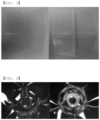
- FIG. 2 includes images taken after hitting, using a Gardner impact tester, films manufactured in an example (left image) and a comparative example (right image) to check whether whitening occurs.
- whitening does not occur at the hit portion, indicating that the example according to the present invention has non-whitening properties.
- whitening occurs clearly at the hit portion.
Landscapes
- Chemical & Material Sciences (AREA)
- Health & Medical Sciences (AREA)
- Chemical Kinetics & Catalysis (AREA)
- Medicinal Chemistry (AREA)
- Polymers & Plastics (AREA)
- Organic Chemistry (AREA)
- Graft Or Block Polymers (AREA)
- Compositions Of Macromolecular Compounds (AREA)
Claims (13)
- Thermoplastisches Harz, umfassend:ein Alkylacrylat-Alkylmethacrylat-Pfropfcopolymer (A) oder ein Alkylacrylat-Alkylmethacrylat-Pfropfcopolymer (A) und ein Matrixharz (B), umfassend eines oder mehrere, ausgewählt aus der Gruppe, bestehend aus einem Alkylmethacrylatpolymer und einem Alkylmethacrylat-Alkylacrylat-Copolymer,wobei eine Transparenz (Trübungswert), gemessen gemäß ASTM D-1003 unter einer Bedingung von 0,15 mm Dicke, 2 oder weniger beträgt und eine Transparenz, gemessen unter einer Bedingung von 3 mm Dicke, 4 oder weniger beträgt,ein Gesamtgehalt des Alkylacrylats 20 bis 50 Gew.-% beträgt undein Butylacrylatbedeckungswert (X), wie durch die nachstehende Gleichung 1 berechnet, 50 oder mehr beträgt:
 wobei G einen Gesamtgelgehalt (%) des thermoplastischen Harzes darstellt und Y einen Gehalt (Gew.-%) an Butylacrylat in dem Gel des thermoplastischen Harzes darstellt,wobei das Copolymer (A) 25 bis 50 Gew.-% eines Alkylacrylatkautschuks (a-1) mit einem mittleren DLS-Teilchendurchmesser von 40 bis 120 nm oder einem mittleren TEM-Teilchendurchmesser von 25 bis 100 nm und 50 bis 75 Gew.-% eines Alkylacrylat-Alkylmethacrylat-Copolymers (a-2), bezogen auf insgesamt 100 Gew.-% des Copolymers (A), umfasst,wobei das Copolymer (A) einen Pfropfgrad von 60 bis 200 % aufweist und das Copolymer (a-2) ein gewichtsmittleres Molekulargewicht von 40.000 bis 120.000 g/mol aufweist undwobei der Gesamtgehalt des Alkylacrylats, der Butylacrylatbedeckungswert, der Gesamtgelgehalt des thermoplastischen Harzes, der Gehalt an Butylacrylat in dem Gel, der Pfropfgrad und das gewichtsmittlere Molekulargewicht wie in der Beschreibung offenbart gemessen werden.
 - Thermoplastisches Harz gemäß Anspruch 1, wobei eine Brechungsindexdifferenz (gemäß ASTM D542) zwischen einem Sol und einem Gel des thermoplastischen Harzes unter einer Bedingung der Verwendung von Aceton 0,02 oder weniger beträgt.
- Thermoplastisches Harz gemäß Anspruch 1, wobei das Copolymer (A) in einer Menge von 50 bis 100 Gew.-% enthalten ist und das Matrixharz (B) in einer Menge von 0 bis 50 Gew.-% enthalten ist.
- Thermoplastisches Harz gemäß Anspruch 1, wobei, wenn das thermoplastische Harz unter Verwendung von Aceton eluiert wird, eine Elutionsmenge an Butylacrylat 0,01 Gew.-% oder mehr beträgt, wobei die Elutionsmenge wie in der Beschreibung offenbart gemessen wird.
- Thermoplastisches Harz gemäß Anspruch 1, wobei das thermoplastische Harz, der Kautschuk (a-1) oder sowohl das thermoplastische Harz als auch der Kautschuk (a-1) eine Glasübergangstemperatur von -50 bis -20 °C aufweisen, wobei die Glasübergangstemperatur wie in der Beschreibung offenbart gemessen wird.
- Thermoplastisches Harz gemäß Anspruch 1, wobei der Kautschuk (a-1) ferner Alkylmethacrylat umfasst.
- Thermoplastisches Harz gemäß Anspruch 6, wobei das Alkylmethacrylat in einer Menge von 0,1 bis 25 Gew.-%, bezogen auf insgesamt 100 Gew.-% des Kautschuks (a-1), enthalten ist.
- Thermoplastisches Harz gemäß Anspruch 1, wobei das Copolymer (a-2) 80 bis 99,9 Gew.-% Alkylmethacrylat und 0,1 bis 20 Gew.-% Alkylacrylat, bezogen auf insgesamt 100 Gew.-% des Copolymers (a-2), umfasst.
- Thermoplastisches Harz gemäß Anspruch 1, wobei eine Brechungsindexdifferenz (gemäß ASTM D542) zwischen dem Kautschuk (a-1) und dem Matrixharz (B) 0,02 oder mehr beträgt.
- Thermoplastisches Harz gemäß Anspruch 1, wobei, wenn das thermoplastische Harz extrudiert wird, um einen Film mit einer Dicke von 0,15 mm zu erhalten, und ein Gewicht mit einem Gewicht von 1 kg vertikal auf den Film von einer Höhe von 100 mm bei einer Temperatur von 23 °C unter Verwendung eines Gardner-Schlagtesters fallengelassen wird, eine Differenz in Trübungswerten, gemessen vor und nach dem Schlagen gemäß ASTM D1003-95 für eine Fläche, auf die das Gewicht auftrifft, 10 oder weniger beträgt.
- Verfahren zur Herstellung eines thermoplastischen Harzes, wobei das Verfahren umfasst:einen Schritt des Knetens und Extrudierens eines Alkylacrylat-Alkylmethacrylat-Pfropfcopolymers (A) oder eines Alkylacrylat-Alkylmethacrylat-Pfropfcopolymers (A) und eines Matrixharzes (B), umfassend eines oder mehrere, ausgewählt aus der Gruppe, bestehend aus einem Alkylmethacrylatpolymer und einem Alkylmethacrylat-Alkylacrylat-Copolymer,wobei eine Transparenz (Trübungswert), gemessen gemäß ASTM D-1003 unter einer Bedingung von 0,15 mm Dicke, des thermoplastischen Harzes 2 oder weniger beträgt und eine Transparenz, gemessen unter einer Bedingung von 3 mm Dicke, 4 oder weniger beträgt,ein Gesamtgehalt des Alkylacrylats in dem thermoplastischen Harz 20 bis 50 Gew.-% beträgt undein Butylacrylatbedeckungswert (X), wie durch die nachstehende Gleichung 1 berechnet, des thermoplastischen Harzes 50 oder mehr beträgt:
 wobei G einen Gesamtgelgehalt (%) des thermoplastischen Harzes darstellt und Y einen Gehalt (Gew.-%) an Butylacrylat in dem Gel des thermoplastischen Harzes darstellt,wobei das Copolymer (A) 25 bis 50 Gew.-% eines Alkylacrylatkautschuks (a-1) mit einem mittleren DLS-Teilchendurchmesser von 40 bis 120 nm oder einem mittleren TEM-Teilchendurchmesser von 25 bis 100 nm und 50 bis 75 Gew.-% eines Alkylacrylat-Alkylmethacrylat-Copolymers (a-2), bezogen auf insgesamt 100 Gew.-% des Copolymers (A), umfasst,wobei das Copolymer (A) einen Pfropfgrad von 60 bis 200 % aufweist und das Copolymer (a-2) ein gewichtsmittleres Molekulargewicht von 40.000 bis 120.000 g/mol aufweist undwobei der Gesamtgehalt des Alkylacrylats, der Butylacrylatbedeckungswert, der Gesamtgelgehalt des thermoplastischen Harzes, der Gehalt an Butylacrylat in dem Gel, der Pfropfgrad und das gewichtsmittlere Molekulargewicht wie in der Beschreibung offenbart gemessen werden.
 - Verfahren gemäß Anspruch 11, wobei das Pfropfcopolymer (A) durch Emulsionspolymerisation von insgesamt 100 Gewichtsteilen einer Monomermischung, umfassend 25 bis 50 Gewichtsteile Alkylacrylatkautschuk mit einem mittleren DLS-Teilchendurchmesser von 40 bis 120 nm oder einem mittleren TEM-Teilchendurchmesser von 25 bis 100 nm und 50 bis 75 Gewichtsteile einer Alkylacrylatverbindung und einer Alkylmethacrylatverbindung, hergestellt wird.
- Formkörper, umfassend das thermoplastische Harz gemäß einem der Ansprüche 1 bis 10.
Applications Claiming Priority (3)
| Application Number | Priority Date | Filing Date | Title |
|---|---|---|---|
| KR20200100369 | 2020-08-11 | ||
| KR1020210091422A KR102683556B1 (ko) | 2020-08-11 | 2021-07-13 | 투명 열가소성 수지 및 이의 제조방법 |
| PCT/KR2021/009219 WO2022035072A1 (ko) | 2020-08-11 | 2021-07-19 | 투명 열가소성 수지 및 이의 제조방법 |
Publications (3)
| Publication Number | Publication Date |
|---|---|
| EP4011970A1 EP4011970A1 (de) | 2022-06-15 |
| EP4011970A4 EP4011970A4 (de) | 2022-12-14 |
| EP4011970B1 true EP4011970B1 (de) | 2025-07-02 |
Family
ID=80247127
Family Applications (1)
| Application Number | Title | Priority Date | Filing Date |
|---|---|---|---|
| EP21856078.7A Active EP4011970B1 (de) | 2020-08-11 | 2021-07-19 | Transparentes thermoplastisches harz und verfahren zur herstellung davon |
Country Status (6)
| Country | Link |
|---|---|
| US (1) | US20220348761A1 (de) |
| EP (1) | EP4011970B1 (de) |
| JP (1) | JP7455961B2 (de) |
| CN (1) | CN114651045B (de) |
| TW (1) | TWI879998B (de) |
| WO (1) | WO2022035072A1 (de) |
Families Citing this family (1)
| Publication number | Priority date | Publication date | Assignee | Title |
|---|---|---|---|---|
| WO2022019581A1 (ko) * | 2020-07-20 | 2022-01-27 | (주) 엘지화학 | 열가소성 수지 및 이의 제조방법 |
Family Cites Families (20)
| Publication number | Priority date | Publication date | Assignee | Title |
|---|---|---|---|---|
| JP4410390B2 (ja) * | 1999-06-15 | 2010-02-03 | 三菱レイヨン株式会社 | アクリル樹脂フィルム状物及び積層体 |
| KR100509868B1 (ko) * | 2003-06-09 | 2005-08-22 | 주식회사 엘지화학 | 내후성 및 외관특성이 우수한 열가소성 수지 조성물 |
| CN101218295B (zh) | 2005-07-05 | 2010-12-08 | 株式会社钟化 | 甲基丙烯酸类树脂组合物 |
| KR100865497B1 (ko) * | 2006-12-28 | 2008-10-27 | 제일모직주식회사 | 충격보강제, 그 제조방법 및 이를 이용한 내스크래치성메타크릴레이트계 수지 조성물 |
| CN102472832B (zh) * | 2009-07-31 | 2016-04-27 | 株式会社钟化 | 表面形成有棱镜型回归反射结构的薄膜用组成物 |
| KR101441314B1 (ko) * | 2011-12-30 | 2014-09-19 | 제일모직주식회사 | 내충격성, 내후성, 및 착색성이 우수한 asa 그라프트 공중합체 및 그 제조방법 |
| WO2013100448A1 (ko) * | 2011-12-30 | 2013-07-04 | 제일모직주식회사 | 내충격성, 내후성, 및 착색성이 우수한 asa 그라프트 공중합체 및 그 제조방법 |
| KR101486564B1 (ko) * | 2012-07-04 | 2015-01-26 | 제일모직 주식회사 | 열가소성 수지 조성물 및 이를 이용한 성형품 |
| KR101681212B1 (ko) * | 2013-09-03 | 2016-11-30 | 롯데첨단소재(주) | 열가소성 수지 조성물을 이용한 자동차용 성형품 |
| KR101651736B1 (ko) * | 2013-09-04 | 2016-09-05 | 주식회사 엘지화학 | 내후성 보강 아크릴레이트계 수지의 제조방법 |
| JP6314549B2 (ja) * | 2014-03-06 | 2018-04-25 | ユーエムジー・エービーエス株式会社 | 熱可塑性樹脂組成物及び樹脂成形品 |
| KR101692106B1 (ko) * | 2014-06-12 | 2017-01-02 | 주식회사 엘지화학 | 코어-쉘 구조의 아크릴계 충격보강제 및 이를 포함하는 아크릴계 수지 조성물 |
| KR20160081497A (ko) * | 2014-12-31 | 2016-07-08 | 삼성에스디아이 주식회사 | 그라프트 공중합체 및 이를 포함하는 열가소성 수지 조성물 |
| JP6813439B2 (ja) | 2017-06-22 | 2021-01-13 | 株式会社クラレ | メタクリル樹脂組成物 |
| KR102074489B1 (ko) * | 2017-12-14 | 2020-02-06 | 주식회사 엘지화학 | 그라프트 공중합체, 이를 포함하는 열가소성 수지 조성물 및 열가소성 수지 성형품 |
| KR102226064B1 (ko) * | 2018-01-24 | 2021-03-11 | 주식회사 엘지화학 | 열가소성 수지 조성물 |
| KR102354837B1 (ko) * | 2018-10-19 | 2022-01-25 | 주식회사 엘지화학 | 그라프트 공중합체 분말의 제조방법 |
| KR102202653B1 (ko) | 2019-02-18 | 2021-01-12 | 박재성 | 전동식 텔레스코픽형 길이조절 기구 |
| KR102464051B1 (ko) * | 2019-08-30 | 2022-11-07 | 주식회사 엘지화학 | (메트)아크릴레이트 그라프트 공중합체를 포함하는 열가소성 수지 조성물 및 이의 제조방법 |
| KR20210091422A (ko) | 2020-01-14 | 2021-07-22 | 주식회사 코스모테크 | 댐 및 저수지의 담수율을 표시한 수위표 |
-
2021
- 2021-07-19 EP EP21856078.7A patent/EP4011970B1/de active Active
- 2021-07-19 CN CN202180006266.5A patent/CN114651045B/zh active Active
- 2021-07-19 WO PCT/KR2021/009219 patent/WO2022035072A1/ko not_active Ceased
- 2021-07-19 TW TW110126400A patent/TWI879998B/zh active
- 2021-07-19 JP JP2022520266A patent/JP7455961B2/ja active Active
- 2021-07-19 US US17/766,162 patent/US20220348761A1/en active Pending
Also Published As
| Publication number | Publication date |
|---|---|
| JP2022551835A (ja) | 2022-12-14 |
| EP4011970A1 (de) | 2022-06-15 |
| CN114651045A (zh) | 2022-06-21 |
| CN114651045B (zh) | 2023-08-18 |
| EP4011970A4 (de) | 2022-12-14 |
| TW202219090A (zh) | 2022-05-16 |
| JP7455961B2 (ja) | 2024-03-26 |
| TWI879998B (zh) | 2025-04-11 |
| WO2022035072A1 (ko) | 2022-02-17 |
| US20220348761A1 (en) | 2022-11-03 |
Similar Documents
| Publication | Publication Date | Title |
|---|---|---|
| EP4006102B1 (de) | Thermoplastisches harz und verfahren zu seiner herstellung | |
| EP4019587B1 (de) | Thermoplastisches harz und herstellungsverfahren dafür | |
| EP4019589B1 (de) | Transparentes thermoplastisches harz und verfahren zum herstellen desselben | |
| KR102680228B1 (ko) | 투명 열가소성 수지 및 이의 제조방법 | |
| EP3882285B1 (de) | Acrylpfropfcopolymer, verfahren zur herstellung davon und thermoplastische harzzusammensetzung damit | |
| EP3708599B1 (de) | Verfahren zur herstellung von pfropfcopolymer, pfropfcopolymer und thermoplastischer kunstharzformartikel mit pfropfcopolymeren | |
| EP4011970B1 (de) | Transparentes thermoplastisches harz und verfahren zur herstellung davon | |
| KR102683556B1 (ko) | 투명 열가소성 수지 및 이의 제조방법 | |
| KR102693912B1 (ko) | 열가소성 수지 및 이의 제조방법 |
Legal Events
| Date | Code | Title | Description |
|---|---|---|---|
| STAA | Information on the status of an ep patent application or granted ep patent |
Free format text: STATUS: THE INTERNATIONAL PUBLICATION HAS BEEN MADE |
|
| PUAI | Public reference made under article 153(3) epc to a published international application that has entered the european phase |
Free format text: ORIGINAL CODE: 0009012 |
|
| STAA | Information on the status of an ep patent application or granted ep patent |
Free format text: STATUS: REQUEST FOR EXAMINATION WAS MADE |
|
| 17P | Request for examination filed |
Effective date: 20220311 |
|
| AK | Designated contracting states |
Kind code of ref document: A1 Designated state(s): AL AT BE BG CH CY CZ DE DK EE ES FI FR GB GR HR HU IE IS IT LI LT LU LV MC MK MT NL NO PL PT RO RS SE SI SK SM TR |
|
| A4 | Supplementary search report drawn up and despatched |
Effective date: 20221115 |
|
| RIC1 | Information provided on ipc code assigned before grant |
Ipc: C08F 2/26 20060101ALI20221109BHEP Ipc: C08F 6/22 20060101ALI20221109BHEP Ipc: C08F 285/00 20060101ALI20221109BHEP Ipc: C08L 51/00 20060101ALI20221109BHEP Ipc: C08F 265/06 20060101ALI20221109BHEP Ipc: C08F 2/22 20060101ALI20221109BHEP Ipc: C08L 51/04 20060101ALI20221109BHEP Ipc: C08L 33/10 20060101AFI20221109BHEP |
|
| DAV | Request for validation of the european patent (deleted) | ||
| DAX | Request for extension of the european patent (deleted) | ||
| GRAP | Despatch of communication of intention to grant a patent |
Free format text: ORIGINAL CODE: EPIDOSNIGR1 |
|
| STAA | Information on the status of an ep patent application or granted ep patent |
Free format text: STATUS: GRANT OF PATENT IS INTENDED |
|
| INTG | Intention to grant announced |
Effective date: 20250327 |
|
| GRAS | Grant fee paid |
Free format text: ORIGINAL CODE: EPIDOSNIGR3 |
|
| GRAA | (expected) grant |
Free format text: ORIGINAL CODE: 0009210 |
|
| STAA | Information on the status of an ep patent application or granted ep patent |
Free format text: STATUS: THE PATENT HAS BEEN GRANTED |
|
| AK | Designated contracting states |
Kind code of ref document: B1 Designated state(s): AL AT BE BG CH CY CZ DE DK EE ES FI FR GB GR HR HU IE IS IT LI LT LU LV MC MK MT NL NO PL PT RO RS SE SI SK SM TR |
|
| REG | Reference to a national code |
Ref country code: GB Ref legal event code: FG4D |
|
| REG | Reference to a national code |
Ref country code: CH Ref legal event code: EP |
|
| REG | Reference to a national code |
Ref country code: DE Ref legal event code: R096 Ref document number: 602021033543 Country of ref document: DE |
|
| REG | Reference to a national code |
Ref country code: IE Ref legal event code: FG4D |
|
| PGFP | Annual fee paid to national office [announced via postgrant information from national office to epo] |
Ref country code: DE Payment date: 20250721 Year of fee payment: 5 |
|
| PGFP | Annual fee paid to national office [announced via postgrant information from national office to epo] |
Ref country code: IT Payment date: 20250722 Year of fee payment: 5 |
|
| PGFP | Annual fee paid to national office [announced via postgrant information from national office to epo] |
Ref country code: GB Payment date: 20250722 Year of fee payment: 5 |
|
| PGFP | Annual fee paid to national office [announced via postgrant information from national office to epo] |
Ref country code: AT Payment date: 20251020 Year of fee payment: 5 Ref country code: FR Payment date: 20250725 Year of fee payment: 5 |
|
| REG | Reference to a national code |
Ref country code: NL Ref legal event code: MP Effective date: 20250702 |
|
| PG25 | Lapsed in a contracting state [announced via postgrant information from national office to epo] |
Ref country code: PT Free format text: LAPSE BECAUSE OF FAILURE TO SUBMIT A TRANSLATION OF THE DESCRIPTION OR TO PAY THE FEE WITHIN THE PRESCRIBED TIME-LIMIT Effective date: 20251103 |
|
| PG25 | Lapsed in a contracting state [announced via postgrant information from national office to epo] |
Ref country code: NL Free format text: LAPSE BECAUSE OF FAILURE TO SUBMIT A TRANSLATION OF THE DESCRIPTION OR TO PAY THE FEE WITHIN THE PRESCRIBED TIME-LIMIT Effective date: 20250702 |
|
| REG | Reference to a national code |
Ref country code: AT Ref legal event code: MK05 Ref document number: 1809239 Country of ref document: AT Kind code of ref document: T Effective date: 20250702 |
|
| PG25 | Lapsed in a contracting state [announced via postgrant information from national office to epo] |
Ref country code: IS Free format text: LAPSE BECAUSE OF FAILURE TO SUBMIT A TRANSLATION OF THE DESCRIPTION OR TO PAY THE FEE WITHIN THE PRESCRIBED TIME-LIMIT Effective date: 20251102 |
|
| PG25 | Lapsed in a contracting state [announced via postgrant information from national office to epo] |
Ref country code: NO Free format text: LAPSE BECAUSE OF FAILURE TO SUBMIT A TRANSLATION OF THE DESCRIPTION OR TO PAY THE FEE WITHIN THE PRESCRIBED TIME-LIMIT Effective date: 20251002 |
|
| REG | Reference to a national code |
Ref country code: LT Ref legal event code: MG9D |
|
| PG25 | Lapsed in a contracting state [announced via postgrant information from national office to epo] |
Ref country code: AT Free format text: LAPSE BECAUSE OF FAILURE TO SUBMIT A TRANSLATION OF THE DESCRIPTION OR TO PAY THE FEE WITHIN THE PRESCRIBED TIME-LIMIT Effective date: 20250702 |
|
| PG25 | Lapsed in a contracting state [announced via postgrant information from national office to epo] |
Ref country code: FI Free format text: LAPSE BECAUSE OF FAILURE TO SUBMIT A TRANSLATION OF THE DESCRIPTION OR TO PAY THE FEE WITHIN THE PRESCRIBED TIME-LIMIT Effective date: 20250702 |
|
| PG25 | Lapsed in a contracting state [announced via postgrant information from national office to epo] |
Ref country code: HR Free format text: LAPSE BECAUSE OF FAILURE TO SUBMIT A TRANSLATION OF THE DESCRIPTION OR TO PAY THE FEE WITHIN THE PRESCRIBED TIME-LIMIT Effective date: 20250702 |
|
| PG25 | Lapsed in a contracting state [announced via postgrant information from national office to epo] |
Ref country code: GR Free format text: LAPSE BECAUSE OF FAILURE TO SUBMIT A TRANSLATION OF THE DESCRIPTION OR TO PAY THE FEE WITHIN THE PRESCRIBED TIME-LIMIT Effective date: 20251003 |
|
| PG25 | Lapsed in a contracting state [announced via postgrant information from national office to epo] |
Ref country code: CZ Free format text: LAPSE BECAUSE OF FAILURE TO SUBMIT A TRANSLATION OF THE DESCRIPTION OR TO PAY THE FEE WITHIN THE PRESCRIBED TIME-LIMIT Effective date: 20250702 Ref country code: SE Free format text: LAPSE BECAUSE OF FAILURE TO SUBMIT A TRANSLATION OF THE DESCRIPTION OR TO PAY THE FEE WITHIN THE PRESCRIBED TIME-LIMIT Effective date: 20250702 |
|
| PG25 | Lapsed in a contracting state [announced via postgrant information from national office to epo] |
Ref country code: LV Free format text: LAPSE BECAUSE OF FAILURE TO SUBMIT A TRANSLATION OF THE DESCRIPTION OR TO PAY THE FEE WITHIN THE PRESCRIBED TIME-LIMIT Effective date: 20250702 |
|
| PG25 | Lapsed in a contracting state [announced via postgrant information from national office to epo] |
Ref country code: BG Free format text: LAPSE BECAUSE OF FAILURE TO SUBMIT A TRANSLATION OF THE DESCRIPTION OR TO PAY THE FEE WITHIN THE PRESCRIBED TIME-LIMIT Effective date: 20250702 Ref country code: PL Free format text: LAPSE BECAUSE OF FAILURE TO SUBMIT A TRANSLATION OF THE DESCRIPTION OR TO PAY THE FEE WITHIN THE PRESCRIBED TIME-LIMIT Effective date: 20250702 |
|
| PG25 | Lapsed in a contracting state [announced via postgrant information from national office to epo] |
Ref country code: RS Free format text: LAPSE BECAUSE OF FAILURE TO SUBMIT A TRANSLATION OF THE DESCRIPTION OR TO PAY THE FEE WITHIN THE PRESCRIBED TIME-LIMIT Effective date: 20251002 |
|
| PG25 | Lapsed in a contracting state [announced via postgrant information from national office to epo] |
Ref country code: ES Free format text: LAPSE BECAUSE OF FAILURE TO SUBMIT A TRANSLATION OF THE DESCRIPTION OR TO PAY THE FEE WITHIN THE PRESCRIBED TIME-LIMIT Effective date: 20250702 |
|
| REG | Reference to a national code |
Ref country code: CH Ref legal event code: H13 Free format text: ST27 STATUS EVENT CODE: U-0-0-H10-H13 (AS PROVIDED BY THE NATIONAL OFFICE) Effective date: 20260224 |
|
| PG25 | Lapsed in a contracting state [announced via postgrant information from national office to epo] |
Ref country code: LU Free format text: LAPSE BECAUSE OF NON-PAYMENT OF DUE FEES Effective date: 20250719 Ref country code: RO Free format text: LAPSE BECAUSE OF FAILURE TO SUBMIT A TRANSLATION OF THE DESCRIPTION OR TO PAY THE FEE WITHIN THE PRESCRIBED TIME-LIMIT Effective date: 20250702 |