EP4011679B1 - Verfahren und vorrichtung zur energierückgewinnung für ein fahrzeug - Google Patents
Verfahren und vorrichtung zur energierückgewinnung für ein fahrzeug Download PDFInfo
- Publication number
- EP4011679B1 EP4011679B1 EP20879374.5A EP20879374A EP4011679B1 EP 4011679 B1 EP4011679 B1 EP 4011679B1 EP 20879374 A EP20879374 A EP 20879374A EP 4011679 B1 EP4011679 B1 EP 4011679B1
- Authority
- EP
- European Patent Office
- Prior art keywords
- vehicle
- energy recovery
- speed
- engine
- recovery control
- Prior art date
- Legal status (The legal status is an assumption and is not a legal conclusion. Google has not performed a legal analysis and makes no representation as to the accuracy of the status listed.)
- Active
Links
Images
Classifications
-
- B—PERFORMING OPERATIONS; TRANSPORTING
- B60—VEHICLES IN GENERAL
- B60L—PROPULSION OF ELECTRICALLY-PROPELLED VEHICLES; SUPPLYING ELECTRIC POWER FOR AUXILIARY EQUIPMENT OF ELECTRICALLY-PROPELLED VEHICLES; ELECTRODYNAMIC BRAKE SYSTEMS FOR VEHICLES IN GENERAL; MAGNETIC SUSPENSION OR LEVITATION FOR VEHICLES; MONITORING OPERATING VARIABLES OF ELECTRICALLY-PROPELLED VEHICLES; ELECTRIC SAFETY DEVICES FOR ELECTRICALLY-PROPELLED VEHICLES
- B60L15/00—Methods, circuits, or devices for controlling the traction-motor speed of electrically-propelled vehicles
- B60L15/20—Methods, circuits, or devices for controlling the traction-motor speed of electrically-propelled vehicles for control of the vehicle or its driving motor to achieve a desired performance, e.g. speed, torque, programmed variation of speed
- B60L15/2054—Methods, circuits, or devices for controlling the traction-motor speed of electrically-propelled vehicles for control of the vehicle or its driving motor to achieve a desired performance, e.g. speed, torque, programmed variation of speed by controlling transmissions or clutches
-
- B—PERFORMING OPERATIONS; TRANSPORTING
- B60—VEHICLES IN GENERAL
- B60K—ARRANGEMENT OR MOUNTING OF PROPULSION UNITS OR OF TRANSMISSIONS IN VEHICLES; ARRANGEMENT OR MOUNTING OF PLURAL DIVERSE PRIME-MOVERS IN VEHICLES; AUXILIARY DRIVES FOR VEHICLES; INSTRUMENTATION OR DASHBOARDS FOR VEHICLES; ARRANGEMENTS IN CONNECTION WITH COOLING, AIR INTAKE, GAS EXHAUST OR FUEL SUPPLY OF PROPULSION UNITS IN VEHICLES
- B60K6/00—Arrangement or mounting of plural diverse prime-movers for mutual or common propulsion, e.g. hybrid propulsion systems comprising electric motors and internal combustion engines
- B60K6/20—Arrangement or mounting of plural diverse prime-movers for mutual or common propulsion, e.g. hybrid propulsion systems comprising electric motors and internal combustion engines the prime-movers consisting of electric motors and internal combustion engines, e.g. HEVs
- B60K6/42—Arrangement or mounting of plural diverse prime-movers for mutual or common propulsion, e.g. hybrid propulsion systems comprising electric motors and internal combustion engines the prime-movers consisting of electric motors and internal combustion engines, e.g. HEVs characterised by the architecture of the hybrid electric vehicle
- B60K6/48—Parallel type
- B60K6/485—Motor-assist type
-
- B—PERFORMING OPERATIONS; TRANSPORTING
- B60—VEHICLES IN GENERAL
- B60L—PROPULSION OF ELECTRICALLY-PROPELLED VEHICLES; SUPPLYING ELECTRIC POWER FOR AUXILIARY EQUIPMENT OF ELECTRICALLY-PROPELLED VEHICLES; ELECTRODYNAMIC BRAKE SYSTEMS FOR VEHICLES IN GENERAL; MAGNETIC SUSPENSION OR LEVITATION FOR VEHICLES; MONITORING OPERATING VARIABLES OF ELECTRICALLY-PROPELLED VEHICLES; ELECTRIC SAFETY DEVICES FOR ELECTRICALLY-PROPELLED VEHICLES
- B60L1/00—Supplying electric power to auxiliary equipment of vehicles
- B60L1/02—Supplying electric power to auxiliary equipment of vehicles to electric heating circuits
- B60L1/04—Supplying electric power to auxiliary equipment of vehicles to electric heating circuits fed by the power supply line
- B60L1/06—Supplying electric power to auxiliary equipment of vehicles to electric heating circuits fed by the power supply line using only one supply
- B60L1/08—Methods and devices for control or regulation
-
- B—PERFORMING OPERATIONS; TRANSPORTING
- B60—VEHICLES IN GENERAL
- B60L—PROPULSION OF ELECTRICALLY-PROPELLED VEHICLES; SUPPLYING ELECTRIC POWER FOR AUXILIARY EQUIPMENT OF ELECTRICALLY-PROPELLED VEHICLES; ELECTRODYNAMIC BRAKE SYSTEMS FOR VEHICLES IN GENERAL; MAGNETIC SUSPENSION OR LEVITATION FOR VEHICLES; MONITORING OPERATING VARIABLES OF ELECTRICALLY-PROPELLED VEHICLES; ELECTRIC SAFETY DEVICES FOR ELECTRICALLY-PROPELLED VEHICLES
- B60L15/00—Methods, circuits, or devices for controlling the traction-motor speed of electrically-propelled vehicles
- B60L15/20—Methods, circuits, or devices for controlling the traction-motor speed of electrically-propelled vehicles for control of the vehicle or its driving motor to achieve a desired performance, e.g. speed, torque, programmed variation of speed
- B60L15/2009—Methods, circuits, or devices for controlling the traction-motor speed of electrically-propelled vehicles for control of the vehicle or its driving motor to achieve a desired performance, e.g. speed, torque, programmed variation of speed for braking
-
- B—PERFORMING OPERATIONS; TRANSPORTING
- B60—VEHICLES IN GENERAL
- B60L—PROPULSION OF ELECTRICALLY-PROPELLED VEHICLES; SUPPLYING ELECTRIC POWER FOR AUXILIARY EQUIPMENT OF ELECTRICALLY-PROPELLED VEHICLES; ELECTRODYNAMIC BRAKE SYSTEMS FOR VEHICLES IN GENERAL; MAGNETIC SUSPENSION OR LEVITATION FOR VEHICLES; MONITORING OPERATING VARIABLES OF ELECTRICALLY-PROPELLED VEHICLES; ELECTRIC SAFETY DEVICES FOR ELECTRICALLY-PROPELLED VEHICLES
- B60L50/00—Electric propulsion with power supplied within the vehicle
- B60L50/10—Electric propulsion with power supplied within the vehicle using propulsion power supplied by engine-driven generators, e.g. generators driven by combustion engines
-
- B—PERFORMING OPERATIONS; TRANSPORTING
- B60—VEHICLES IN GENERAL
- B60L—PROPULSION OF ELECTRICALLY-PROPELLED VEHICLES; SUPPLYING ELECTRIC POWER FOR AUXILIARY EQUIPMENT OF ELECTRICALLY-PROPELLED VEHICLES; ELECTRODYNAMIC BRAKE SYSTEMS FOR VEHICLES IN GENERAL; MAGNETIC SUSPENSION OR LEVITATION FOR VEHICLES; MONITORING OPERATING VARIABLES OF ELECTRICALLY-PROPELLED VEHICLES; ELECTRIC SAFETY DEVICES FOR ELECTRICALLY-PROPELLED VEHICLES
- B60L7/00—Electrodynamic brake systems for vehicles in general
- B60L7/10—Dynamic electric regenerative braking
-
- B—PERFORMING OPERATIONS; TRANSPORTING
- B60—VEHICLES IN GENERAL
- B60L—PROPULSION OF ELECTRICALLY-PROPELLED VEHICLES; SUPPLYING ELECTRIC POWER FOR AUXILIARY EQUIPMENT OF ELECTRICALLY-PROPELLED VEHICLES; ELECTRODYNAMIC BRAKE SYSTEMS FOR VEHICLES IN GENERAL; MAGNETIC SUSPENSION OR LEVITATION FOR VEHICLES; MONITORING OPERATING VARIABLES OF ELECTRICALLY-PROPELLED VEHICLES; ELECTRIC SAFETY DEVICES FOR ELECTRICALLY-PROPELLED VEHICLES
- B60L7/00—Electrodynamic brake systems for vehicles in general
- B60L7/10—Dynamic electric regenerative braking
- B60L7/18—Controlling the braking effect
-
- B—PERFORMING OPERATIONS; TRANSPORTING
- B60—VEHICLES IN GENERAL
- B60W—CONJOINT CONTROL OF VEHICLE SUB-UNITS OF DIFFERENT TYPE OR DIFFERENT FUNCTION; CONTROL SYSTEMS SPECIALLY ADAPTED FOR HYBRID VEHICLES; ROAD VEHICLE DRIVE CONTROL SYSTEMS FOR PURPOSES NOT RELATED TO THE CONTROL OF A PARTICULAR SUB-UNIT
- B60W10/00—Conjoint control of vehicle sub-units of different type or different function
- B60W10/02—Conjoint control of vehicle sub-units of different type or different function including control of driveline clutches
-
- B—PERFORMING OPERATIONS; TRANSPORTING
- B60—VEHICLES IN GENERAL
- B60W—CONJOINT CONTROL OF VEHICLE SUB-UNITS OF DIFFERENT TYPE OR DIFFERENT FUNCTION; CONTROL SYSTEMS SPECIALLY ADAPTED FOR HYBRID VEHICLES; ROAD VEHICLE DRIVE CONTROL SYSTEMS FOR PURPOSES NOT RELATED TO THE CONTROL OF A PARTICULAR SUB-UNIT
- B60W10/00—Conjoint control of vehicle sub-units of different type or different function
- B60W10/04—Conjoint control of vehicle sub-units of different type or different function including control of propulsion units
- B60W10/06—Conjoint control of vehicle sub-units of different type or different function including control of propulsion units including control of combustion engines
-
- B—PERFORMING OPERATIONS; TRANSPORTING
- B60—VEHICLES IN GENERAL
- B60W—CONJOINT CONTROL OF VEHICLE SUB-UNITS OF DIFFERENT TYPE OR DIFFERENT FUNCTION; CONTROL SYSTEMS SPECIALLY ADAPTED FOR HYBRID VEHICLES; ROAD VEHICLE DRIVE CONTROL SYSTEMS FOR PURPOSES NOT RELATED TO THE CONTROL OF A PARTICULAR SUB-UNIT
- B60W20/00—Control systems specially adapted for hybrid vehicles
- B60W20/10—Controlling the power contribution of each of the prime movers to meet required power demand
- B60W20/15—Control strategies specially adapted for achieving a particular effect
-
- B—PERFORMING OPERATIONS; TRANSPORTING
- B60—VEHICLES IN GENERAL
- B60W—CONJOINT CONTROL OF VEHICLE SUB-UNITS OF DIFFERENT TYPE OR DIFFERENT FUNCTION; CONTROL SYSTEMS SPECIALLY ADAPTED FOR HYBRID VEHICLES; ROAD VEHICLE DRIVE CONTROL SYSTEMS FOR PURPOSES NOT RELATED TO THE CONTROL OF A PARTICULAR SUB-UNIT
- B60W30/00—Purposes of road vehicle drive control systems not related to the control of a particular sub-unit, e.g. of systems using conjoint control of vehicle sub-units
- B60W30/18—Propelling the vehicle
- B60W30/18009—Propelling the vehicle related to particular drive situations
- B60W30/18072—Coasting
-
- B—PERFORMING OPERATIONS; TRANSPORTING
- B60—VEHICLES IN GENERAL
- B60W—CONJOINT CONTROL OF VEHICLE SUB-UNITS OF DIFFERENT TYPE OR DIFFERENT FUNCTION; CONTROL SYSTEMS SPECIALLY ADAPTED FOR HYBRID VEHICLES; ROAD VEHICLE DRIVE CONTROL SYSTEMS FOR PURPOSES NOT RELATED TO THE CONTROL OF A PARTICULAR SUB-UNIT
- B60W30/00—Purposes of road vehicle drive control systems not related to the control of a particular sub-unit, e.g. of systems using conjoint control of vehicle sub-units
- B60W30/18—Propelling the vehicle
- B60W30/18009—Propelling the vehicle related to particular drive situations
- B60W30/18109—Braking
- B60W30/18127—Regenerative braking
-
- B—PERFORMING OPERATIONS; TRANSPORTING
- B60—VEHICLES IN GENERAL
- B60L—PROPULSION OF ELECTRICALLY-PROPELLED VEHICLES; SUPPLYING ELECTRIC POWER FOR AUXILIARY EQUIPMENT OF ELECTRICALLY-PROPELLED VEHICLES; ELECTRODYNAMIC BRAKE SYSTEMS FOR VEHICLES IN GENERAL; MAGNETIC SUSPENSION OR LEVITATION FOR VEHICLES; MONITORING OPERATING VARIABLES OF ELECTRICALLY-PROPELLED VEHICLES; ELECTRIC SAFETY DEVICES FOR ELECTRICALLY-PROPELLED VEHICLES
- B60L2240/00—Control parameters of input or output; Target parameters
- B60L2240/10—Vehicle control parameters
- B60L2240/12—Speed
-
- B—PERFORMING OPERATIONS; TRANSPORTING
- B60—VEHICLES IN GENERAL
- B60L—PROPULSION OF ELECTRICALLY-PROPELLED VEHICLES; SUPPLYING ELECTRIC POWER FOR AUXILIARY EQUIPMENT OF ELECTRICALLY-PROPELLED VEHICLES; ELECTRODYNAMIC BRAKE SYSTEMS FOR VEHICLES IN GENERAL; MAGNETIC SUSPENSION OR LEVITATION FOR VEHICLES; MONITORING OPERATING VARIABLES OF ELECTRICALLY-PROPELLED VEHICLES; ELECTRIC SAFETY DEVICES FOR ELECTRICALLY-PROPELLED VEHICLES
- B60L2240/00—Control parameters of input or output; Target parameters
- B60L2240/40—Drive Train control parameters
- B60L2240/42—Drive Train control parameters related to electric machines
- B60L2240/423—Torque
-
- B—PERFORMING OPERATIONS; TRANSPORTING
- B60—VEHICLES IN GENERAL
- B60L—PROPULSION OF ELECTRICALLY-PROPELLED VEHICLES; SUPPLYING ELECTRIC POWER FOR AUXILIARY EQUIPMENT OF ELECTRICALLY-PROPELLED VEHICLES; ELECTRODYNAMIC BRAKE SYSTEMS FOR VEHICLES IN GENERAL; MAGNETIC SUSPENSION OR LEVITATION FOR VEHICLES; MONITORING OPERATING VARIABLES OF ELECTRICALLY-PROPELLED VEHICLES; ELECTRIC SAFETY DEVICES FOR ELECTRICALLY-PROPELLED VEHICLES
- B60L2240/00—Control parameters of input or output; Target parameters
- B60L2240/40—Drive Train control parameters
- B60L2240/44—Drive Train control parameters related to combustion engines
- B60L2240/441—Speed
-
- B—PERFORMING OPERATIONS; TRANSPORTING
- B60—VEHICLES IN GENERAL
- B60L—PROPULSION OF ELECTRICALLY-PROPELLED VEHICLES; SUPPLYING ELECTRIC POWER FOR AUXILIARY EQUIPMENT OF ELECTRICALLY-PROPELLED VEHICLES; ELECTRODYNAMIC BRAKE SYSTEMS FOR VEHICLES IN GENERAL; MAGNETIC SUSPENSION OR LEVITATION FOR VEHICLES; MONITORING OPERATING VARIABLES OF ELECTRICALLY-PROPELLED VEHICLES; ELECTRIC SAFETY DEVICES FOR ELECTRICALLY-PROPELLED VEHICLES
- B60L2240/00—Control parameters of input or output; Target parameters
- B60L2240/40—Drive Train control parameters
- B60L2240/44—Drive Train control parameters related to combustion engines
- B60L2240/443—Torque
-
- B—PERFORMING OPERATIONS; TRANSPORTING
- B60—VEHICLES IN GENERAL
- B60L—PROPULSION OF ELECTRICALLY-PROPELLED VEHICLES; SUPPLYING ELECTRIC POWER FOR AUXILIARY EQUIPMENT OF ELECTRICALLY-PROPELLED VEHICLES; ELECTRODYNAMIC BRAKE SYSTEMS FOR VEHICLES IN GENERAL; MAGNETIC SUSPENSION OR LEVITATION FOR VEHICLES; MONITORING OPERATING VARIABLES OF ELECTRICALLY-PROPELLED VEHICLES; ELECTRIC SAFETY DEVICES FOR ELECTRICALLY-PROPELLED VEHICLES
- B60L2240/00—Control parameters of input or output; Target parameters
- B60L2240/40—Drive Train control parameters
- B60L2240/44—Drive Train control parameters related to combustion engines
- B60L2240/445—Temperature
-
- B—PERFORMING OPERATIONS; TRANSPORTING
- B60—VEHICLES IN GENERAL
- B60L—PROPULSION OF ELECTRICALLY-PROPELLED VEHICLES; SUPPLYING ELECTRIC POWER FOR AUXILIARY EQUIPMENT OF ELECTRICALLY-PROPELLED VEHICLES; ELECTRODYNAMIC BRAKE SYSTEMS FOR VEHICLES IN GENERAL; MAGNETIC SUSPENSION OR LEVITATION FOR VEHICLES; MONITORING OPERATING VARIABLES OF ELECTRICALLY-PROPELLED VEHICLES; ELECTRIC SAFETY DEVICES FOR ELECTRICALLY-PROPELLED VEHICLES
- B60L2240/00—Control parameters of input or output; Target parameters
- B60L2240/40—Drive Train control parameters
- B60L2240/50—Drive Train control parameters related to clutches
- B60L2240/507—Operating parameters
-
- B—PERFORMING OPERATIONS; TRANSPORTING
- B60—VEHICLES IN GENERAL
- B60L—PROPULSION OF ELECTRICALLY-PROPELLED VEHICLES; SUPPLYING ELECTRIC POWER FOR AUXILIARY EQUIPMENT OF ELECTRICALLY-PROPELLED VEHICLES; ELECTRODYNAMIC BRAKE SYSTEMS FOR VEHICLES IN GENERAL; MAGNETIC SUSPENSION OR LEVITATION FOR VEHICLES; MONITORING OPERATING VARIABLES OF ELECTRICALLY-PROPELLED VEHICLES; ELECTRIC SAFETY DEVICES FOR ELECTRICALLY-PROPELLED VEHICLES
- B60L2250/00—Driver interactions
- B60L2250/26—Driver interactions by pedal actuation
-
- B—PERFORMING OPERATIONS; TRANSPORTING
- B60—VEHICLES IN GENERAL
- B60L—PROPULSION OF ELECTRICALLY-PROPELLED VEHICLES; SUPPLYING ELECTRIC POWER FOR AUXILIARY EQUIPMENT OF ELECTRICALLY-PROPELLED VEHICLES; ELECTRODYNAMIC BRAKE SYSTEMS FOR VEHICLES IN GENERAL; MAGNETIC SUSPENSION OR LEVITATION FOR VEHICLES; MONITORING OPERATING VARIABLES OF ELECTRICALLY-PROPELLED VEHICLES; ELECTRIC SAFETY DEVICES FOR ELECTRICALLY-PROPELLED VEHICLES
- B60L2250/00—Driver interactions
- B60L2250/26—Driver interactions by pedal actuation
- B60L2250/28—Accelerator pedal thresholds
-
- B—PERFORMING OPERATIONS; TRANSPORTING
- B60—VEHICLES IN GENERAL
- B60L—PROPULSION OF ELECTRICALLY-PROPELLED VEHICLES; SUPPLYING ELECTRIC POWER FOR AUXILIARY EQUIPMENT OF ELECTRICALLY-PROPELLED VEHICLES; ELECTRODYNAMIC BRAKE SYSTEMS FOR VEHICLES IN GENERAL; MAGNETIC SUSPENSION OR LEVITATION FOR VEHICLES; MONITORING OPERATING VARIABLES OF ELECTRICALLY-PROPELLED VEHICLES; ELECTRIC SAFETY DEVICES FOR ELECTRICALLY-PROPELLED VEHICLES
- B60L2260/00—Operating Modes
- B60L2260/20—Drive modes; Transition between modes
- B60L2260/24—Coasting mode
-
- B—PERFORMING OPERATIONS; TRANSPORTING
- B60—VEHICLES IN GENERAL
- B60L—PROPULSION OF ELECTRICALLY-PROPELLED VEHICLES; SUPPLYING ELECTRIC POWER FOR AUXILIARY EQUIPMENT OF ELECTRICALLY-PROPELLED VEHICLES; ELECTRODYNAMIC BRAKE SYSTEMS FOR VEHICLES IN GENERAL; MAGNETIC SUSPENSION OR LEVITATION FOR VEHICLES; MONITORING OPERATING VARIABLES OF ELECTRICALLY-PROPELLED VEHICLES; ELECTRIC SAFETY DEVICES FOR ELECTRICALLY-PROPELLED VEHICLES
- B60L2260/00—Operating Modes
- B60L2260/20—Drive modes; Transition between modes
- B60L2260/26—Transition between different drive modes
-
- B—PERFORMING OPERATIONS; TRANSPORTING
- B60—VEHICLES IN GENERAL
- B60L—PROPULSION OF ELECTRICALLY-PROPELLED VEHICLES; SUPPLYING ELECTRIC POWER FOR AUXILIARY EQUIPMENT OF ELECTRICALLY-PROPELLED VEHICLES; ELECTRODYNAMIC BRAKE SYSTEMS FOR VEHICLES IN GENERAL; MAGNETIC SUSPENSION OR LEVITATION FOR VEHICLES; MONITORING OPERATING VARIABLES OF ELECTRICALLY-PROPELLED VEHICLES; ELECTRIC SAFETY DEVICES FOR ELECTRICALLY-PROPELLED VEHICLES
- B60L2270/00—Problem solutions or means not otherwise provided for
- B60L2270/10—Emission reduction
- B60L2270/12—Emission reduction of exhaust
-
- B—PERFORMING OPERATIONS; TRANSPORTING
- B60—VEHICLES IN GENERAL
- B60W—CONJOINT CONTROL OF VEHICLE SUB-UNITS OF DIFFERENT TYPE OR DIFFERENT FUNCTION; CONTROL SYSTEMS SPECIALLY ADAPTED FOR HYBRID VEHICLES; ROAD VEHICLE DRIVE CONTROL SYSTEMS FOR PURPOSES NOT RELATED TO THE CONTROL OF A PARTICULAR SUB-UNIT
- B60W30/00—Purposes of road vehicle drive control systems not related to the control of a particular sub-unit, e.g. of systems using conjoint control of vehicle sub-units
- B60W30/18—Propelling the vehicle
- B60W30/18009—Propelling the vehicle related to particular drive situations
- B60W30/18072—Coasting
- B60W2030/18081—With torque flow from driveshaft to engine, i.e. engine being driven by vehicle
-
- B—PERFORMING OPERATIONS; TRANSPORTING
- B60—VEHICLES IN GENERAL
- B60W—CONJOINT CONTROL OF VEHICLE SUB-UNITS OF DIFFERENT TYPE OR DIFFERENT FUNCTION; CONTROL SYSTEMS SPECIALLY ADAPTED FOR HYBRID VEHICLES; ROAD VEHICLE DRIVE CONTROL SYSTEMS FOR PURPOSES NOT RELATED TO THE CONTROL OF A PARTICULAR SUB-UNIT
- B60W30/00—Purposes of road vehicle drive control systems not related to the control of a particular sub-unit, e.g. of systems using conjoint control of vehicle sub-units
- B60W30/18—Propelling the vehicle
- B60W30/18009—Propelling the vehicle related to particular drive situations
- B60W30/18072—Coasting
- B60W2030/1809—Without torque flow between driveshaft and engine, e.g. with clutch disengaged or transmission in neutral
-
- B—PERFORMING OPERATIONS; TRANSPORTING
- B60—VEHICLES IN GENERAL
- B60W—CONJOINT CONTROL OF VEHICLE SUB-UNITS OF DIFFERENT TYPE OR DIFFERENT FUNCTION; CONTROL SYSTEMS SPECIALLY ADAPTED FOR HYBRID VEHICLES; ROAD VEHICLE DRIVE CONTROL SYSTEMS FOR PURPOSES NOT RELATED TO THE CONTROL OF A PARTICULAR SUB-UNIT
- B60W2520/00—Input parameters relating to overall vehicle dynamics
- B60W2520/10—Longitudinal speed
-
- B—PERFORMING OPERATIONS; TRANSPORTING
- B60—VEHICLES IN GENERAL
- B60W—CONJOINT CONTROL OF VEHICLE SUB-UNITS OF DIFFERENT TYPE OR DIFFERENT FUNCTION; CONTROL SYSTEMS SPECIALLY ADAPTED FOR HYBRID VEHICLES; ROAD VEHICLE DRIVE CONTROL SYSTEMS FOR PURPOSES NOT RELATED TO THE CONTROL OF A PARTICULAR SUB-UNIT
- B60W2540/00—Input parameters relating to occupants
- B60W2540/10—Accelerator pedal position
-
- B—PERFORMING OPERATIONS; TRANSPORTING
- B60—VEHICLES IN GENERAL
- B60W—CONJOINT CONTROL OF VEHICLE SUB-UNITS OF DIFFERENT TYPE OR DIFFERENT FUNCTION; CONTROL SYSTEMS SPECIALLY ADAPTED FOR HYBRID VEHICLES; ROAD VEHICLE DRIVE CONTROL SYSTEMS FOR PURPOSES NOT RELATED TO THE CONTROL OF A PARTICULAR SUB-UNIT
- B60W2540/00—Input parameters relating to occupants
- B60W2540/12—Brake pedal position
-
- B—PERFORMING OPERATIONS; TRANSPORTING
- B60—VEHICLES IN GENERAL
- B60W—CONJOINT CONTROL OF VEHICLE SUB-UNITS OF DIFFERENT TYPE OR DIFFERENT FUNCTION; CONTROL SYSTEMS SPECIALLY ADAPTED FOR HYBRID VEHICLES; ROAD VEHICLE DRIVE CONTROL SYSTEMS FOR PURPOSES NOT RELATED TO THE CONTROL OF A PARTICULAR SUB-UNIT
- B60W2710/00—Output or target parameters relating to a particular sub-units
- B60W2710/02—Clutches
- B60W2710/021—Clutch engagement state
-
- B—PERFORMING OPERATIONS; TRANSPORTING
- B60—VEHICLES IN GENERAL
- B60W—CONJOINT CONTROL OF VEHICLE SUB-UNITS OF DIFFERENT TYPE OR DIFFERENT FUNCTION; CONTROL SYSTEMS SPECIALLY ADAPTED FOR HYBRID VEHICLES; ROAD VEHICLE DRIVE CONTROL SYSTEMS FOR PURPOSES NOT RELATED TO THE CONTROL OF A PARTICULAR SUB-UNIT
- B60W2710/00—Output or target parameters relating to a particular sub-units
- B60W2710/06—Combustion engines, Gas turbines
- B60W2710/0616—Position of fuel or air injector
- B60W2710/0627—Fuel flow rate
-
- Y—GENERAL TAGGING OF NEW TECHNOLOGICAL DEVELOPMENTS; GENERAL TAGGING OF CROSS-SECTIONAL TECHNOLOGIES SPANNING OVER SEVERAL SECTIONS OF THE IPC; TECHNICAL SUBJECTS COVERED BY FORMER USPC CROSS-REFERENCE ART COLLECTIONS [XRACs] AND DIGESTS
- Y02—TECHNOLOGIES OR APPLICATIONS FOR MITIGATION OR ADAPTATION AGAINST CLIMATE CHANGE
- Y02T—CLIMATE CHANGE MITIGATION TECHNOLOGIES RELATED TO TRANSPORTATION
- Y02T10/00—Road transport of goods or passengers
- Y02T10/60—Other road transportation technologies with climate change mitigation effect
Definitions
- the disclosure relates to the technical field of vehicles, in particular to an energy recovery control method and device for a vehicle.
- CN 110 239 507 A discloses an energy recovery control method for a hybrid vehicle, wherein the energy recovery control method comprises: determining whether the vehicle satisfies an activation condition for entering a preset high-speed coasting mode, wherein the high-speed coasting mode is used to show a working condition in which the speed of the vehicle is greater than or equal to a preset first speed threshold and the driver does not have an obvious braking requirement, and controlling the vehicle to perform an energy recovery cancellation operation when the vehicle enters the high-speed coasting mode.
- the present disclosure aims to provide an energy recovery control method for a vehicle to at least partially solve the above technical problems.
- An energy recovery control method for a vehicle includes: determining whether the vehicle satisfies an activation condition for entering a preset high-speed coasting mode, the high-speed coasting mode being used to show a working condition in which the speed of the vehicle is greater than or equal to a preset first speed threshold and the driver does not have an obvious braking requirement; and controlling the vehicle to perform an energy recovery cancellation operation when the vehicle enters the high-speed coasting mode.
- the activation condition is configured to include the following: the speed of the vehicle is greater than or equal to the preset first speed threshold; an accelerator pedal opening of the vehicle is less than or equal to a preset opening threshold; a brake pedal of the vehicle is in a non-depressed state; and a cooling mechanism of the vehicle is in a state that an engine does not need to be kept starting.
- the activation condition further includes any one or more of the following: the current driving mode of the vehicle is an economical driving mode; and the vehicle currently has not received an engine stop prohibition instruction or engine failure information.
- controlling the vehicle to perform an energy recovery cancellation operation includes: controlling a clutch of the vehicle to open; and controlling the engine of the vehicle to cut off fuel and stop.
- the energy recovery control method further includes: for the vehicle in the high-speed coasting mode, determining whether the vehicle satisfies an exit condition for exiting the high-speed coasting mode; and, controlling the vehicle to perform an energy recovery operation or a normal driving operation when the vehicle satisfies the exit condition and exits the high-speed coasting mode.
- exit condition includes any one of the following:
- controlling the vehicle to perform an energy recovery operation or a normal driving operation includes: controlling the vehicle to perform the energy recovery operation when the vehicle satisfies the first exit condition and the second exit condition; and controlling the vehicle to perform the normal driving operation when the vehicle satisfies the third exit condition.
- controlling the vehicle to perform the energy recovery operation includes: for the vehicle with a BSG, requesting the BSG to start through a hybrid vehicle control unit (HCU), controlling an engine speed of the vehicle to increase to achieve a target speed range for implementing clutch engagement, controlling the engine to be in a fuel cut-off state during the speed increase process, and entering the energy recovery process of the BSG after the clutch engagement is completed; and/or the controlling the vehicle to perform the normal driving operation includes: for the vehicle with the BSG, requesting the BSG to start through the HCU, starting the engine to start fuel injection, controlling the engine speed to increase to achieve the target speed range for implementing clutch engagement, and entering the normal driving process of the BSG after the clutch engagement is completed.
- HCU hybrid vehicle control unit
- the energy recovery method for a vehicle has the following advantages: energy recovery management can be considered from the perspective of driver's driving intention; and in the high-speed coasting mode, it is recognized that that the driver currently does not have a strong braking intention, and energy recovery is cancelled, thereby reducing fuel consumption, achieving better driver intention recognition, and improving vehicle coasting comfort.
- Another objective of the disclosure is to provide an energy recovery control device for a vehicle to at least partially solve the above technical problems.
- An energy recovery control device for a vehicle includes a controller, the controller executing the above-mentioned energy recovery control method.
- An energy recovery control device for a vehicle includes: one or more processors; a memory for storing one or more programs, the one or more programs, when executed by the one or more processors, causing the one or more processors to implement the energy recovery control method as described above.
- Another objective of the disclosure is to provide a machine-readable storage medium and a processor to at least partially solve the above technical problems.
- a machine-readable storage medium stores instructions that cause a machine to execute the above-mentioned energy recovery control method.
- a processor for running a program when the program is run, the energy recovery control method as described above is executed.
- the energy recovery control device for a vehicle, the machine-readable storage medium and the processor have the same advantages as the above-mentioned energy recovery control method for a vehicle over the prior art, which will not be repeated here.
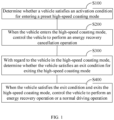
- FIG. 1 is a schematic flowchart of an energy recovery control method for a vehicle according to an example of the disclosure. As shown in FIG. 1 , the energy recovery control method may include the following steps: Step S100, whether the vehicle satisfies an activation condition for entering a preset high-speed coasting mode is determined.
- the high-speed coasting mode is used to show a working condition in which the speed of the vehicle is greater than or equal to a preset first speed threshold and the driver does not have an obvious braking requirement. For example, when the speed of the vehicle is greater than or equal to 52 km/h, it is determined that the vehicle is in a high-speed state, and the driver does not brake, but just releases an accelerator pedal, which indicates that the driver may have no obvious braking requirement, and the corresponding working condition can be set as the high-speed coasting mode. In the high-speed coasting mode, energy recovery is not suitable.
- the activation condition for the high-speed coasting mode in this example of the disclosure is configured to include the following four:
- the engine needs to be kept starting to realize the cooling function on the vehicle, and the high-speed coasting mode in the example of the disclosure requires that the engine is not started. Therefore, it is necessary to determine whether the cooling mechanism (mainly an air conditioner) of the vehicle is in a state that the engine does not need to be kept starting. For example, when the air conditioner is not turned on or the difference between the set temperature and the ambient temperature after the air conditioner is turned on is less than a preset lower temperature (for example, 7°C), it can be determined that the cooling mechanism is in the state that the engine does not need to be kept starting.
- a preset lower temperature for example, 7°C
- the activation condition further includes any one or more of the following:
- the current driving mode of the vehicle is an economical driving mode (Ecology, Conservation and Optimization, abbreviated as ECO).
- the engine When the vehicle is in the ECO mode, the engine usually does not need to be started. When the vehicle is in other driving modes other than the ECO mode, such as a sports driving mode, the engine usually needs to maintain a certain speed to improve the dynamic response capability of the vehicle.
- condition 6 usually does not occur and is mainly for the scenario where the vehicle encounters an accident and breaks down.
- Step S200 the vehicle is controlled to perform an energy recovery cancellation operation when the vehicle enters the high-speed coasting mode.
- the example of the disclosure sets a high-speed coasting mode in which the driver does not have an obvious braking requirement and energy recovery is not required. Then in step S200, when the vehicle enters the high-speed coasting mode, the vehicle is controlled to perform an energy recovery cancellation operation, to avoid energy loss caused by blindly entering the energy recovery process. More energy is lost mainly due to the losses of mechanical transmission and chemical conversion during energy conversion from kinetic energy to electrical energy.
- controlling the vehicle to perform an energy recovery cancellation operation in step S200 may include: a clutch of the vehicle is controlled to open; and the engine of the vehicle is controlled to cut off fuel and stop.
- the engine is disconnected from a drive system by opening the clutch, that is, a power system is disconnected, which is beneficial to reducing the mechanical loss of the power system.
- the operation of stopping fuel injection is beneficial to reducing fuel consumption.
- the energy recovery control method for a vehicle considers energy recovery management from the perspective of driver's driving intention, and in the high-speed coasting mode, it is recognized that the current driver does not have a strong braking intention, thereby achieving better driving intention recognition; operations such as canceling energy recovery (and/or opening the clutch, and cutting off engine oil) are performed to reduce the load, thereby reducing fuel consumption; and the vehicle is kept in a coasting state to improve vehicle coasting comfort.
- the energy recovery control method for a vehicle according to the example of the disclosure further includes step S300 and step S400 as follows.
- Step S300 for the vehicle in the high-speed coasting mode, whether the vehicle satisfies an exit condition for exiting the high-speed coasting mode is determined.
- the example of the disclosure further sets the exit condition for determining whether the vehicle exits the high-speed coasting mode.
- the exit condition may be any one of the following three condition:
- the first speed threshold is, for example, 52 km/h.
- the second speed threshold is, for example, 42 km/h.
- the opening threshold is, for example, 5% of the full opening of the accelerator pedal. All of the thresholds are TBD.
- the fifth exit condition and the sixth exit condition correspond to the activation conditions 4) and 6) mentioned above.
- the vehicle control strategy for exiting the high-speed coasting mode may be different, which will be described in detail below.
- Step S400 the vehicle is controlled to perform an energy recovery operation or a normal driving operation when the vehicle satisfies the exit condition and exits the high-speed coasting mode.
- the accelerator pedal is in a released state with an opening less than or equal to the preset opening threshold in both the first exit condition and the second exit condition, while the accelerator pedal is in a depressed state with an opening greater than the opening threshold in the third exit condition, so it can be inferred that when the third exit condition is satisfied, the driver has an acceleration intention.
- the acceleration process needs to meet normal operation of normal driving, so the energy recovery is not suitable.
- the vehicle is controlled to perform the energy recovery operation when the vehicle satisfies the first exit condition and the second exit condition, and the vehicle is controlled to perform the normal driving operation when the vehicle satisfies the third exit condition.
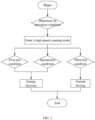
- FIG. 2 is a schematic flowchart of vehicle control according to different exit conditions according to an example of the disclosure.
- the operation of controlling the vehicle to perform the energy recovery includes: the BSG is requested to start through a Hybrid Vehicle Control Unit (HCU), an engine speed of the vehicle is controlled to increase to achieve a target speed range for implementing clutch engagement, the engine is controlled to be in a fuel cut-off state during the speed increase process, and the energy recovery process of the BSG is entered after the clutch engagement is completed.
- HCU Hybrid Vehicle Control Unit
- the controlling an engine speed of the vehicle to increase to achieve a target speed range for implementing clutch engagement includes: the engine speed is controlled to increase to a requested speed of a TCU (Transmission Control Unit), and when the speed reaches within 100n from the target speed, the clutch is engaged to enter the energy recovery process of the BSG.
- n represents a preset speed, which is TBD.
- the clutch being engaged to enter the energy recovery process of the BSG may include: the clutch first starts to slip and engage, then synchronizes through torque transmission, and finally fully engages; and after the clutch engagement is completed, the kinetic energy generated by the coasting of the vehicle is transmitted to the BSG through the vehicle-front axle-clutch-engine-BSG, and the energy recovery process of the BSG is entered.
- the controlling the vehicle to perform the energy recovery operation is similar to that of the first exit condition, so details are not described herein again. It should be noted that when the vehicle is in the high-speed coasting mode, if a series of operations such as opening the clutch and cutting off engine oil are performed while the energy recovery is canceled, the losses of energy conversion and kinetic energy can be reduced after exiting the high-speed coasting mode, and the endurance mileage can be quickly increased by energy recovery.
- the controlling the vehicle to perform the normal driving operation may include: the BSG is requested to start through the HCU, the engine is started to start fuel injection, the engine speed is controlled to increase to achieve the target speed range for implementing clutch engagement, and the normal driving process of the BSG is entered after the clutch engagement is completed.
- the process of clutch engagement is similar to the situations corresponding to the first exit condition and the second exit condition, but after the clutch engagement is completed, the kinetic energy generated by the engine is transmitted through the engine-clutch-front axle-vehicle, and then the normal driving process is entered.
- the energy recovery control method for a vehicle not only defines the high-speed coasting mode for canceling the energy recovery, but also restores the energy recovery function of the vehicle after it is recognized that the vehicle exits the high-speed coasting mode, thereby increasing the endurance mileage.
- an energy recovery control device for a vehicle.
- the energy recovery control device includes a controller, and the controller executes the energy recovery control method described in the above example.
- the controller may be, for example, an HCU, which may be used to run a program, and when the program is run, the energy recovery control method described in the above example is executed.
- an energy recovery control device for a vehicle, including: one or more processors; and a memory for storing one or more programs, the one or more programs, when executed by the one or more processors, causing the one or more processors to implement the energy recovery control method according to any one of claims 1 to 6.
- a machine-readable storage medium storing instructions that cause a machine to execute the energy recovery control method described in the above example.
- An example of the disclosure further provides a processor for running a program, and when the program is run, the energy recovery control method described in the above example is executed.
- An example of the disclosure further provides a computer program product, which, when executed on a vehicle-related component, is adapted to execute a program initialized with the following method steps: the energy recovery control method described in the above example.
- the examples of the disclosure may be provided as a method, an apparatus or a computer program product. Therefore, the disclosure may be in the form of a full hardware example, a full software example, or an example combining software and hardware. In addition, the disclosure may be in the form of a computer program product implemented on one or more computer available storage media (including but not limited to a disk memory, a CD-ROM, an optical memory, etc.) including computer available program codes.
- a computer available storage media including but not limited to a disk memory, a CD-ROM, an optical memory, etc.
- These computer program instructions can also be stored in a computer-readable memory that can guide a computer or other programmable data processing device to work in a specific manner, so that the instructions stored in the computer-readable memory generate a product including an instruction device, where the instruction device implements functions specified in one or more processes in the flowcharts and/or one or more blocks in the block diagrams.
- These computer program instructions may also be loaded into a computer or another programmable data processing device, so that a series of operation steps are performed on the computer or another programmable data processing device to generate processing implemented by a computer, and instructions executed on the computer or another programmable data processing device provide steps for implementing functions specified in one or more processes in the flowcharts and/or one or more blocks in the block diagrams.
- the computing device includes one or more central processing units (CPUs), an input/output interface, a network interface, and a memory.
- CPUs central processing units
- input/output interface input/output interface
- network interface network interface
- memory a memory
- the memory may be in the form of a volatile memory, a random access memory (RAM) and/or a non-volatile memory, such as a read-only memory (ROM) or a flash RAM, in a computer-readable medium.
- RAM random access memory
- ROM read-only memory
- flash RAM flash RAM
- the computer-readable medium can store information by any method or technology.
- the information can be computer-readable instructions, data structures, modules of programs or other data.
- Examples of the computer storage medium include, but are not limited to, a phase change memory (PRAM), a static random access memory (SRAM), a dynamic random access memory (DRAM), other type of random access memory (RAM), a read-only memory (ROM), an electrically erasable programmable read-only memory (EEPROM), a flash memory or other memory technology, a read-only disk read-only memory (CD-ROM), a digital versatile disc (DVD) or other optical storage, a magnetic cartridge tape, a tape disk storage or other magnetic storage device or any other non-transportable media, which can be used to store information that can be accessed by a computing device.
- PRAM phase change memory
- SRAM static random access memory
- DRAM dynamic random access memory
- RAM random access memory
- ROM read-only memory
- EEPROM electrically erasable programmable read-only memory
Landscapes
- Engineering & Computer Science (AREA)
- Transportation (AREA)
- Mechanical Engineering (AREA)
- Power Engineering (AREA)
- Chemical & Material Sciences (AREA)
- Combustion & Propulsion (AREA)
- Automation & Control Theory (AREA)
- Electric Propulsion And Braking For Vehicles (AREA)
- Hybrid Electric Vehicles (AREA)
- Control Of Driving Devices And Active Controlling Of Vehicle (AREA)
Claims (9)
- Energierückgewinnungssteuerverfahren für ein Hybrid-Fahrzeug, wobei das Energierückgewinnungsverfahren die folgenden Schritte aufweist:Feststellen, ob das Fahrzeug eine Aktivierungsbedingung für den Eintritt in einen voreingestellten Hochgeschwindigkeitsleerlaufmodus erfüllt, (S100),wobei der Hochgeschwindigkeitsleerlaufmodus verwendet wird, um einen Betriebszustand darzustellen, in welchem die Geschwindigkeit des Fahrzeugs höher als oder gleich einem ersten voreingestellten Geschwindigkeitsschwellenwert ist und der Fahrer keinen offensichtlichen Bremsbedarf hat, wobei ein offensichtlicher Bremsbedarf besteht, wenn sich das Fahrzeug in einem Hochgeschwindigkeitszustand befindet und der Fahrer nicht bremst, sondern lediglich ein Gaspedal loslässt; undSteuern des Fahrzeugs, um eine Energierückgewinnungsbeendigungsoperation durchzuführen, wenn das Fahrzeug in den Hochgeschwindigkeitsleerlaufmodus eintritt, (S200),wobei die Aktivierungsbedingung derart ausgebildet ist, dass sie Folgendes aufweist:die Geschwindigkeit des Fahrzeugs ist höher als oder gleich dem ersten Geschwindigkeitsschwellenwert;ein Gaspedalhub des Fahrzeugs ist geringer als oder gleich einem voreingestellten Hubschwellenwert;ein Bremspedal des Fahrzeug ist in einem nicht betätigten Zustand; unddadurch gekennzeichnet, dass die Aktivierungsbedingung derart ausgebildet ist, ferner aufzuweisen:ein Kühlmechanismus des Fahrzeugs befindet sich in einem Zustand, in dem ein Motor des Fahrzeugs nicht weiter gestartet werden muss, wie es der Fall ist, wenn eine in dem Kühlmechanismus enthaltene Klimaanlage nicht eingeschaltete ist oder die Differenz zwischen der Solltemperatur und der Umgebungstemperatur nach dem Einschalten der Klimaanlage geringer als eine voreingestellte niedrigere Temperatur ist;wobei die Aktivierungsbedingung ferner Folgendes aufweist:der aktuelle Fahrmodus des Fahrzeugs ist ein wirtschaftlicher Fahrmodus ist; und/oderdas Fahrzeug gegenwärtig keinen Motorstoppverbotsbefehl oder keine Motorausfallinformationen zu dem Motor des Fahrzeugs empfangen hat.
- Energierückgewinnungssteuerverfahren für ein Fahrzeug nach Anspruch 1, bei welchem das Steuern des Fahrzeugs, um eine Energierückgewinnungsbeendigungsoperation durchzuführen, die folgenden Schritte aufweist:Steuern einer Kupplung des Fahrzeugs zum Öffnen derselben, so dass der Motor des Fahrzeugs von einem Antriebssystem des Fahrzeugs getrennt wird; undSteuern des Motors des Fahrzeugs, um die Treibstoffzufuhr zu unterbrechen und den Motor anzuhalten.
- Energierückgewinnungssteuerverfahren für ein Fahrzeug nach Anspruch 1, bei welchem das Energierückgewinnungssteuerverfahren ferner die folgenden Schritte aufweist:bei in dem Hochgeschwindigkeitsleerlaufmodus befindlichem Fahrzeug, Feststellen, ob eine Austrittsbedingung für das Verlassen des Hochgeschwindigkeitsleerlaufmodus erfüllt, (S300); undSteuern des Fahrzeugs, um eine Energierückgewinnungsoperation oder eine normale Fahroperation durchzuführen, wenn das Fahrzeug die Austrittsbedingung erfüllt und den Hochgeschwindigkeitsleerlaufmodus verlässt (S400).
- Energierückgewinnungssteuerverfahren für ein Fahrzeug nach Anspruch 3, bei welchem die Austrittsbedingung einen der folgenden Schritte aufweist:eine erste Austrittsbedingung, die derart ausgebildet ist, dass sie aufweist: die Geschwindigkeit des Fahrzeugs ist geringer als ein voreingestellter zweiter Geschwindigkeitsschwellenwert, wobei der zweite Geschwindigkeitsschwellenwert geringer als der erste Geschwindigkeitsschwellenwert ist;eine zweite Austrittsbedingung, die derart ausgebildet ist, dass sie aufweist: der Gaspedalhub des Fahrzeugs ist geringer als oder gleich dem voreingestellten Hubschwellenwert und das Bremspedal des Fahrzeugs befindet sich in einem betätigten Zustand;eine dritte Austrittsbedingung, die derart ausgebildet ist, dass sie aufweist: der Gaspedalhub des Fahrzeugs ist größer als der voreingestellte Hubschwellenwert und das Bremspedal des Fahrzeugs befindet sich in dem nicht betätigten Zustand;eine vierte Austrittsbedingung, die derart ausgebildet ist, dass sie aufweist: die Geschwindigkeit des Fahrzeugs ist geringer als der voreingestellte zweite Geschwindigkeitsschwellenwert ist, und der Gaspedalhub des Fahrzeugs geringer als oder gleich dem voreingestellten Hubschwellenwert ist und/oder das Bremspedal des Fahrzeugs befindet sich in dem nicht betätigten Zustand, wobei der zweite Geschwindigkeitsschwellenwert geringer als der erste Geschwindigkeitsschwellenwert ist;eine fünfte Austrittsbedingung, die derart ausgebildet ist, dass sie aufweist: das Fahrzeug hat aktuelle den Motorstoppverbotsbefehls oder Motorausfallinformationen empfangen, undeine sechste Austrittsbedingung, die derart ausgebildet ist, dass sie aufweist: der Kühlmechanismus des Fahrzeugs befindet sich in dem Zustand, in dem der Motor nicht weiter gestartet werden muss.
- Energierückgewinnungssteuerverfahren für ein Fahrzeug nach Anspruch 4, bei welchem das Steuern des Fahrzeugs, um eine Energierückgewinnungsoperation oder eine normale Fahroperation durchzuführen, die folgenden Schritte aufweist:Steuern des Fahrzeugs, um eine Energierückgewinnungsoperation durchzuführen, wenn das Fahrzeug die erste Austrittsbedingung und die zweite Austrittsbedingung erfüllt; undSteuern des Fahrzeugs, um die normale Fahroperation durchzuführen, wenn das Fahrzeug die dritte Austrittsbedingung erfüllt.
- Energierückgewinnungssteuerverfahren für ein Fahrzeug nach Anspruch 3, bei welchem das Fahrzeug einen riemengetriebenen Startergenerator (BSG) und eine Hybrid-Fahrzeug-Steuereinheit (HCU) aufweist; und
wobei das Steuern des Fahrzeugs, um eine Energierückgewinnungsoperation durchzuführen, die folgenden Schritte aufweist:bei einem Fahrzeug mit riemengetriebenem Startergenerator (BSG), Anfordern des Startens des BSG durch die Hybrid-Fahrzeug-Steuereinheit (HCU), Steuern der Motordrehzahl des Fahrzeugs derart, dass diese ansteigt, um einen Ziel-Drehmomentbereich für das Implementieren des Einrückens der Kupplung zu erreichen, Steuern des Motors derart, dass er sich während des Drehzahlerhöhungsvorgangs in einem Treibstoffzufuhrunterbrechungszustand befindet, und Eintreten in den Energierückgewinnungsvorgang des BSG nach Abschluss des Einrückens der Kupplung; und/oderdas Steuern des Fahrzeugs, um die normale Fahroperation durchzuführen, die folgenden Schritte aufweist:
bei dem Fahrzeug mit dem BSG, Anfordern des Startens des BSG durch die HCU, Starten des Motors um die Treibstoffeinspritzung zu beginnen, Steuern der Motordrehzahl des Fahrzeugs derart, dass diese ansteigt, um einen Ziel-Drehmomentbereich für das Implementieren des Einrückens der Kupplung zu erreichen, und Eintreten in den Energierückgewinnungsvorgang des BSG nach Abschluss des Einrückens der Kupplung. - Energierückgewinnungssteuervorrichtung für ein Hybrid-Fahrzeug, bei welcher die Energierückgewinnungssteuervorrichtung aufweist:einen oder mehrere Prozessoren; undeine Speichervorrichtung zum Speichern eines oder mehrerer Programme,wobei das eine oder die mehreren Programme bei Ausführung durch den einen oder die mehreren Prozessoren den einen oder die mehreren Prozessoren veranlassen, das Energierückgewinnungssteuerverfahren nach einem der Ansprüche 1 bis 6 zu implementieren.
- Energierückgewinnungssteuervorrichtung nach Anspruch 7, bei welcher die Speichervorrichtung ein maschinenlesbares Speichermedium ist, das Befehle speichert, welche eine Maschine veranlasst, das Energierückgewinnungssteuerverfahren nach einem der Ansprüche 1 bis 6 auszuführen.
- Energierückgewinnungssteuervorrichtung nach Anspruch 7 oder 8, bei welcher der eine oder die mehreren Prozessoren jeweils ein Prozessor zum Ausführen eines Programms sind, wobei bei Ausführung des Programms das Energierückgewinnungssteuerverfahren nach einem der Ansprüche 1 bis 6 ausgeführt wird.
Applications Claiming Priority (2)
| Application Number | Priority Date | Filing Date | Title |
|---|---|---|---|
| CN201911022151.6A CN111634281A (zh) | 2019-10-25 | 2019-10-25 | 车辆的能量回收控制方法及装置 |
| PCT/CN2020/110695 WO2021077885A1 (zh) | 2019-10-25 | 2020-08-24 | 车辆的能量回收控制方法及装置 |
Publications (3)
| Publication Number | Publication Date |
|---|---|
| EP4011679A1 EP4011679A1 (de) | 2022-06-15 |
| EP4011679A4 EP4011679A4 (de) | 2022-09-14 |
| EP4011679B1 true EP4011679B1 (de) | 2024-12-18 |
Family
ID=72324643
Family Applications (1)
| Application Number | Title | Priority Date | Filing Date |
|---|---|---|---|
| EP20879374.5A Active EP4011679B1 (de) | 2019-10-25 | 2020-08-24 | Verfahren und vorrichtung zur energierückgewinnung für ein fahrzeug |
Country Status (3)
| Country | Link |
|---|---|
| EP (1) | EP4011679B1 (de) |
| CN (1) | CN111634281A (de) |
| WO (1) | WO2021077885A1 (de) |
Families Citing this family (9)
| Publication number | Priority date | Publication date | Assignee | Title |
|---|---|---|---|---|
| CN113250833B (zh) * | 2021-05-29 | 2022-06-10 | 奇瑞汽车股份有限公司 | 一种车辆滑行阶段的发动机断油控制方法 |
| CN113147727B (zh) * | 2021-06-04 | 2022-09-02 | 一汽解放青岛汽车有限公司 | 混合动力汽车的能量回收控制方法、车辆及存储介质 |
| CN115465110A (zh) * | 2021-06-11 | 2022-12-13 | 格力博(江苏)股份有限公司 | 一种车辆制动控制方法及系统 |
| CN114132368B (zh) * | 2021-11-23 | 2022-12-20 | 交控科技股份有限公司 | 一种车辆控制方法、装置、设备及可读存储介质 |
| CN119630573A (zh) * | 2022-08-19 | 2025-03-14 | 深圳引望智能技术有限公司 | 控制方法、装置以及车辆 |
| CN115431984A (zh) * | 2022-09-29 | 2022-12-06 | 安徽江淮汽车集团股份有限公司 | 电动汽车能量回收控制方法、系统、电子设备及存储介质 |
| CN115503498B (zh) * | 2022-11-04 | 2025-08-19 | 摩登汽车有限公司 | 车辆能量回收强度评估方法 |
| CN119308774A (zh) * | 2024-10-11 | 2025-01-14 | 中国第一汽车股份有限公司 | 一种发动机拖滞力矩控制方法、装置、电子设备及车辆 |
| CN119568157A (zh) * | 2024-12-09 | 2025-03-07 | 杭叉集团股份有限公司 | 一种工业车辆的自动减速控制方法及系统 |
Citations (4)
| Publication number | Priority date | Publication date | Assignee | Title |
|---|---|---|---|---|
| US8612108B2 (en) * | 2012-01-24 | 2013-12-17 | C.R.F. Societa' Consortile Per Azioni | Entering and leaving a motor vehicle freewheel running condition with internal combustion engine off |
| CN103661381A (zh) * | 2012-08-29 | 2014-03-26 | 现代自动车株式会社 | 控制滑行状态中车辆的行驶的装置和方法 |
| CN110077390A (zh) * | 2019-03-22 | 2019-08-02 | 中国第一汽车股份有限公司 | 一种支持48v能量回收的dct变速器控制方法及系统 |
| CN110239507A (zh) * | 2019-05-23 | 2019-09-17 | 浙江吉利控股集团有限公司 | 一种汽车能量管理方法、装置及终端 |
Family Cites Families (14)
| Publication number | Priority date | Publication date | Assignee | Title |
|---|---|---|---|---|
| JP3578071B2 (ja) * | 2000-09-14 | 2004-10-20 | トヨタ自動車株式会社 | 可変気筒エンジンの制御装置および車両の制御装置 |
| JP5162998B2 (ja) * | 2006-10-12 | 2013-03-13 | 日産自動車株式会社 | ハイブリッド車両のモード切り替え制御装置 |
| CN102501850B (zh) * | 2011-12-27 | 2015-09-23 | 广东戈兰玛汽车系统有限公司 | 一种自动启停系统 |
| WO2014073435A1 (ja) * | 2012-11-07 | 2014-05-15 | 日産自動車株式会社 | ハイブリッド車両の制御装置 |
| JP5505492B1 (ja) * | 2012-11-28 | 2014-05-28 | トヨタ自動車株式会社 | ハイブリッド車両の走行状態制御装置 |
| EP2902292B1 (de) * | 2014-01-31 | 2019-09-04 | Ford Global Technologies, LLC | Verfahren und System zur Steuerung des regenerativen Bremsens eines Fahrzeuges |
| WO2015125407A1 (ja) * | 2014-02-20 | 2015-08-27 | パナソニックIpマネジメント株式会社 | 車両用ハイブリッドシステム |
| JP6168031B2 (ja) * | 2014-11-14 | 2017-07-26 | トヨタ自動車株式会社 | 車両 |
| DE102015206919A1 (de) * | 2015-04-16 | 2016-10-20 | Ford Global Technologies, Llc | Elektro-Kraftfahrzeug und Betriebsverfahren für ein Elektro-Kraftfahrzeug |
| WO2016203452A1 (en) * | 2015-06-17 | 2016-12-22 | Consortium De Recherche Brp – Universite De Sherbrooke S.E.N.C. | Regenerative braking system and method |
| KR101786666B1 (ko) * | 2015-08-26 | 2017-10-18 | 현대자동차 주식회사 | 모터를 구비한 차량의 제어 장치 및 방법 |
| KR20180067984A (ko) * | 2016-12-13 | 2018-06-21 | 현대자동차주식회사 | 마일드 하이브리드 차량의 mhsg 제어 방법 및 장치 |
| CN107199893B (zh) * | 2017-05-27 | 2019-09-03 | 北京新能源汽车股份有限公司 | 能量回收方法及装置 |
| CN108544927B (zh) * | 2018-03-21 | 2022-03-11 | 重庆长安汽车股份有限公司 | 汽车48v能量回收系统及方法 |
-
2019
- 2019-10-25 CN CN201911022151.6A patent/CN111634281A/zh active Pending
-
2020
- 2020-08-24 EP EP20879374.5A patent/EP4011679B1/de active Active
- 2020-08-24 WO PCT/CN2020/110695 patent/WO2021077885A1/zh not_active Ceased
Patent Citations (4)
| Publication number | Priority date | Publication date | Assignee | Title |
|---|---|---|---|---|
| US8612108B2 (en) * | 2012-01-24 | 2013-12-17 | C.R.F. Societa' Consortile Per Azioni | Entering and leaving a motor vehicle freewheel running condition with internal combustion engine off |
| CN103661381A (zh) * | 2012-08-29 | 2014-03-26 | 现代自动车株式会社 | 控制滑行状态中车辆的行驶的装置和方法 |
| CN110077390A (zh) * | 2019-03-22 | 2019-08-02 | 中国第一汽车股份有限公司 | 一种支持48v能量回收的dct变速器控制方法及系统 |
| CN110239507A (zh) * | 2019-05-23 | 2019-09-17 | 浙江吉利控股集团有限公司 | 一种汽车能量管理方法、装置及终端 |
Also Published As
| Publication number | Publication date |
|---|---|
| WO2021077885A1 (zh) | 2021-04-29 |
| CN111634281A (zh) | 2020-09-08 |
| EP4011679A4 (de) | 2022-09-14 |
| EP4011679A1 (de) | 2022-06-15 |
Similar Documents
| Publication | Publication Date | Title |
|---|---|---|
| EP4011679B1 (de) | Verfahren und vorrichtung zur energierückgewinnung für ein fahrzeug | |
| JP5935886B2 (ja) | 車両の制御装置 | |
| US9145134B2 (en) | Method and system for controlling engine start of hybrid vehicle | |
| US10913447B2 (en) | Control method and system for clutch engagement of hybrid vehicle | |
| US9475489B2 (en) | Method and system for controlling running mode change for hybrid vehicle | |
| KR102692281B1 (ko) | 모터 구동 차량의 모터 토크 제어 방법 | |
| US20100304923A1 (en) | Method For Controlling A Hybrid Drive | |
| US9043117B2 (en) | Driver assistance system in a motor vehicle comprising a speed limiting function | |
| US10626836B2 (en) | Control method of idle stop and go system | |
| US10363932B2 (en) | SSC-SCC system for increasing SSC distance using SSC and method for controlling the same | |
| CN111845689B (zh) | 离合器的控制方法、装置及计算机可读存储介质 | |
| CN110194141B (zh) | 一种爬行控制方法、装置、变速器及车辆 | |
| CN111894747A (zh) | 混动车辆发动机启动控制方法、系统及混动车辆 | |
| EP2212148B1 (de) | Verfahren zur effizienteren verwendung eines verbrennungsmotors in einem mit einer automatikstufengetriebe ausgestatteten fahrzeug | |
| US10352438B1 (en) | Vehicle propulsion system and method for controlling a vehicle propulsion system | |
| CN118928440A (zh) | 一种车辆的控制方法、装置、车辆和存储介质 | |
| CN106671968B (zh) | 混合动力电动车辆及其有效控制变速器的方法 | |
| KR20240001766A (ko) | 차량, 차량 제어 방법 및 차량 제동 제어 방법 | |
| JP2014172456A (ja) | アイドルストップ車の制御装置 | |
| Liu et al. | Research on vehicle mode control in P2. 5 hybrid system | |
| CN115264057B (zh) | 车辆的控制方法、装置、存储介质及处理器 | |
| CN120120132B (zh) | 发动机控制方法、控制器、车辆、介质和产品 | |
| US12427980B2 (en) | Vehicle control method for a stop on the move state | |
| KR20170107244A (ko) | Ssc 진입상태에서의 차속제어방법 및 장치 | |
| CN120229250A (zh) | 车辆自适应巡航的控制方法、装置及车辆 |
Legal Events
| Date | Code | Title | Description |
|---|---|---|---|
| STAA | Information on the status of an ep patent application or granted ep patent |
Free format text: STATUS: THE INTERNATIONAL PUBLICATION HAS BEEN MADE |
|
| PUAI | Public reference made under article 153(3) epc to a published international application that has entered the european phase |
Free format text: ORIGINAL CODE: 0009012 |
|
| STAA | Information on the status of an ep patent application or granted ep patent |
Free format text: STATUS: REQUEST FOR EXAMINATION WAS MADE |
|
| 17P | Request for examination filed |
Effective date: 20220309 |
|
| AK | Designated contracting states |
Kind code of ref document: A1 Designated state(s): AL AT BE BG CH CY CZ DE DK EE ES FI FR GB GR HR HU IE IS IT LI LT LU LV MC MK MT NL NO PL PT RO RS SE SI SK SM TR |
|
| A4 | Supplementary search report drawn up and despatched |
Effective date: 20220816 |
|
| RIC1 | Information provided on ipc code assigned before grant |
Ipc: B60W 20/15 20160101ALI20220809BHEP Ipc: B60K 6/20 20071001ALI20220809BHEP Ipc: B60W 50/00 20060101ALI20220809BHEP Ipc: B60L 1/08 20060101ALI20220809BHEP Ipc: B60L 7/18 20060101ALI20220809BHEP Ipc: B60L 50/10 20190101ALI20220809BHEP Ipc: B60L 15/20 20060101ALI20220809BHEP Ipc: B60W 30/18 20120101ALI20220809BHEP Ipc: B60L 7/10 20060101AFI20220809BHEP |
|
| DAV | Request for validation of the european patent (deleted) | ||
| DAX | Request for extension of the european patent (deleted) | ||
| P01 | Opt-out of the competence of the unified patent court (upc) registered |
Effective date: 20230530 |
|
| STAA | Information on the status of an ep patent application or granted ep patent |
Free format text: STATUS: EXAMINATION IS IN PROGRESS |
|
| 17Q | First examination report despatched |
Effective date: 20231019 |
|
| GRAP | Despatch of communication of intention to grant a patent |
Free format text: ORIGINAL CODE: EPIDOSNIGR1 |
|
| STAA | Information on the status of an ep patent application or granted ep patent |
Free format text: STATUS: GRANT OF PATENT IS INTENDED |
|
| RIC1 | Information provided on ipc code assigned before grant |
Ipc: B60W 20/15 20160101ALI20240623BHEP Ipc: B60K 6/20 20071001ALI20240623BHEP Ipc: B60W 50/00 20060101ALI20240623BHEP Ipc: B60L 1/08 20060101ALI20240623BHEP Ipc: B60L 7/18 20060101ALI20240623BHEP Ipc: B60L 50/10 20190101ALI20240623BHEP Ipc: B60K 6/485 20071001ALI20240623BHEP Ipc: B60W 10/06 20060101ALI20240623BHEP Ipc: B60W 10/02 20060101ALI20240623BHEP Ipc: B60L 15/20 20060101ALI20240623BHEP Ipc: B60W 30/18 20120101ALI20240623BHEP Ipc: B60L 7/10 20060101AFI20240623BHEP |
|
| INTG | Intention to grant announced |
Effective date: 20240711 |
|
| GRAS | Grant fee paid |
Free format text: ORIGINAL CODE: EPIDOSNIGR3 |
|
| GRAA | (expected) grant |
Free format text: ORIGINAL CODE: 0009210 |
|
| STAA | Information on the status of an ep patent application or granted ep patent |
Free format text: STATUS: THE PATENT HAS BEEN GRANTED |
|
| AK | Designated contracting states |
Kind code of ref document: B1 Designated state(s): AL AT BE BG CH CY CZ DE DK EE ES FI FR GB GR HR HU IE IS IT LI LT LU LV MC MK MT NL NO PL PT RO RS SE SI SK SM TR |
|
| REG | Reference to a national code |
Ref country code: CH Ref legal event code: EP |
|
| REG | Reference to a national code |
Ref country code: DE Ref legal event code: R096 Ref document number: 602020043515 Country of ref document: DE |
|
| REG | Reference to a national code |
Ref country code: IE Ref legal event code: FG4D |
|
| REG | Reference to a national code |
Ref country code: LT Ref legal event code: MG9D |
|
| PG25 | Lapsed in a contracting state [announced via postgrant information from national office to epo] |
Ref country code: HR Free format text: LAPSE BECAUSE OF FAILURE TO SUBMIT A TRANSLATION OF THE DESCRIPTION OR TO PAY THE FEE WITHIN THE PRESCRIBED TIME-LIMIT Effective date: 20241218 |
|
| PG25 | Lapsed in a contracting state [announced via postgrant information from national office to epo] |
Ref country code: FI Free format text: LAPSE BECAUSE OF FAILURE TO SUBMIT A TRANSLATION OF THE DESCRIPTION OR TO PAY THE FEE WITHIN THE PRESCRIBED TIME-LIMIT Effective date: 20241218 |
|
| PG25 | Lapsed in a contracting state [announced via postgrant information from national office to epo] |
Ref country code: BG Free format text: LAPSE BECAUSE OF FAILURE TO SUBMIT A TRANSLATION OF THE DESCRIPTION OR TO PAY THE FEE WITHIN THE PRESCRIBED TIME-LIMIT Effective date: 20241218 |
|
| PG25 | Lapsed in a contracting state [announced via postgrant information from national office to epo] |
Ref country code: NO Free format text: LAPSE BECAUSE OF FAILURE TO SUBMIT A TRANSLATION OF THE DESCRIPTION OR TO PAY THE FEE WITHIN THE PRESCRIBED TIME-LIMIT Effective date: 20250318 |
|
| REG | Reference to a national code |
Ref country code: NL Ref legal event code: MP Effective date: 20241218 |
|
| PG25 | Lapsed in a contracting state [announced via postgrant information from national office to epo] |
Ref country code: LV Free format text: LAPSE BECAUSE OF FAILURE TO SUBMIT A TRANSLATION OF THE DESCRIPTION OR TO PAY THE FEE WITHIN THE PRESCRIBED TIME-LIMIT Effective date: 20241218 Ref country code: GR Free format text: LAPSE BECAUSE OF FAILURE TO SUBMIT A TRANSLATION OF THE DESCRIPTION OR TO PAY THE FEE WITHIN THE PRESCRIBED TIME-LIMIT Effective date: 20250319 |
|
| PG25 | Lapsed in a contracting state [announced via postgrant information from national office to epo] |
Ref country code: RS Free format text: LAPSE BECAUSE OF FAILURE TO SUBMIT A TRANSLATION OF THE DESCRIPTION OR TO PAY THE FEE WITHIN THE PRESCRIBED TIME-LIMIT Effective date: 20250318 |
|
| PG25 | Lapsed in a contracting state [announced via postgrant information from national office to epo] |
Ref country code: NL Free format text: LAPSE BECAUSE OF FAILURE TO SUBMIT A TRANSLATION OF THE DESCRIPTION OR TO PAY THE FEE WITHIN THE PRESCRIBED TIME-LIMIT Effective date: 20241218 |
|
| REG | Reference to a national code |
Ref country code: AT Ref legal event code: MK05 Ref document number: 1752004 Country of ref document: AT Kind code of ref document: T Effective date: 20241218 |
|
| PG25 | Lapsed in a contracting state [announced via postgrant information from national office to epo] |
Ref country code: SM Free format text: LAPSE BECAUSE OF FAILURE TO SUBMIT A TRANSLATION OF THE DESCRIPTION OR TO PAY THE FEE WITHIN THE PRESCRIBED TIME-LIMIT Effective date: 20241218 |
|
| PG25 | Lapsed in a contracting state [announced via postgrant information from national office to epo] |
Ref country code: PL Free format text: LAPSE BECAUSE OF FAILURE TO SUBMIT A TRANSLATION OF THE DESCRIPTION OR TO PAY THE FEE WITHIN THE PRESCRIBED TIME-LIMIT Effective date: 20241218 |
|
| PG25 | Lapsed in a contracting state [announced via postgrant information from national office to epo] |
Ref country code: ES Free format text: LAPSE BECAUSE OF FAILURE TO SUBMIT A TRANSLATION OF THE DESCRIPTION OR TO PAY THE FEE WITHIN THE PRESCRIBED TIME-LIMIT Effective date: 20241218 |
|
| PG25 | Lapsed in a contracting state [announced via postgrant information from national office to epo] |
Ref country code: IS Free format text: LAPSE BECAUSE OF FAILURE TO SUBMIT A TRANSLATION OF THE DESCRIPTION OR TO PAY THE FEE WITHIN THE PRESCRIBED TIME-LIMIT Effective date: 20250418 |
|
| PG25 | Lapsed in a contracting state [announced via postgrant information from national office to epo] |
Ref country code: PT Free format text: LAPSE BECAUSE OF FAILURE TO SUBMIT A TRANSLATION OF THE DESCRIPTION OR TO PAY THE FEE WITHIN THE PRESCRIBED TIME-LIMIT Effective date: 20250421 |
|
| PG25 | Lapsed in a contracting state [announced via postgrant information from national office to epo] |
Ref country code: EE Free format text: LAPSE BECAUSE OF FAILURE TO SUBMIT A TRANSLATION OF THE DESCRIPTION OR TO PAY THE FEE WITHIN THE PRESCRIBED TIME-LIMIT Effective date: 20241218 |
|
| PG25 | Lapsed in a contracting state [announced via postgrant information from national office to epo] |
Ref country code: AT Free format text: LAPSE BECAUSE OF FAILURE TO SUBMIT A TRANSLATION OF THE DESCRIPTION OR TO PAY THE FEE WITHIN THE PRESCRIBED TIME-LIMIT Effective date: 20241218 Ref country code: RO Free format text: LAPSE BECAUSE OF FAILURE TO SUBMIT A TRANSLATION OF THE DESCRIPTION OR TO PAY THE FEE WITHIN THE PRESCRIBED TIME-LIMIT Effective date: 20241218 |
|
| PG25 | Lapsed in a contracting state [announced via postgrant information from national office to epo] |
Ref country code: SK Free format text: LAPSE BECAUSE OF FAILURE TO SUBMIT A TRANSLATION OF THE DESCRIPTION OR TO PAY THE FEE WITHIN THE PRESCRIBED TIME-LIMIT Effective date: 20241218 |
|
| PG25 | Lapsed in a contracting state [announced via postgrant information from national office to epo] |
Ref country code: CZ Free format text: LAPSE BECAUSE OF FAILURE TO SUBMIT A TRANSLATION OF THE DESCRIPTION OR TO PAY THE FEE WITHIN THE PRESCRIBED TIME-LIMIT Effective date: 20241218 |
|
| PG25 | Lapsed in a contracting state [announced via postgrant information from national office to epo] |
Ref country code: IT Free format text: LAPSE BECAUSE OF FAILURE TO SUBMIT A TRANSLATION OF THE DESCRIPTION OR TO PAY THE FEE WITHIN THE PRESCRIBED TIME-LIMIT Effective date: 20241218 |
|
| PG25 | Lapsed in a contracting state [announced via postgrant information from national office to epo] |
Ref country code: SE Free format text: LAPSE BECAUSE OF FAILURE TO SUBMIT A TRANSLATION OF THE DESCRIPTION OR TO PAY THE FEE WITHIN THE PRESCRIBED TIME-LIMIT Effective date: 20241218 |
|
| REG | Reference to a national code |
Ref country code: DE Ref legal event code: R097 Ref document number: 602020043515 Country of ref document: DE |
|
| PG25 | Lapsed in a contracting state [announced via postgrant information from national office to epo] |
Ref country code: DK Free format text: LAPSE BECAUSE OF FAILURE TO SUBMIT A TRANSLATION OF THE DESCRIPTION OR TO PAY THE FEE WITHIN THE PRESCRIBED TIME-LIMIT Effective date: 20241218 |
|
| PGFP | Annual fee paid to national office [announced via postgrant information from national office to epo] |
Ref country code: DE Payment date: 20250812 Year of fee payment: 6 |
|
| PGFP | Annual fee paid to national office [announced via postgrant information from national office to epo] |
Ref country code: GB Payment date: 20250826 Year of fee payment: 6 |
|
| PGFP | Annual fee paid to national office [announced via postgrant information from national office to epo] |
Ref country code: FR Payment date: 20250828 Year of fee payment: 6 |
|
| PLBE | No opposition filed within time limit |
Free format text: ORIGINAL CODE: 0009261 |
|
| STAA | Information on the status of an ep patent application or granted ep patent |
Free format text: STATUS: NO OPPOSITION FILED WITHIN TIME LIMIT |
|
| REG | Reference to a national code |
Ref country code: CH Ref legal event code: L10 Free format text: ST27 STATUS EVENT CODE: U-0-0-L10-L00 (AS PROVIDED BY THE NATIONAL OFFICE) Effective date: 20251029 |
|
| 26N | No opposition filed |
Effective date: 20250919 |
|
| REG | Reference to a national code |
Ref country code: CH Ref legal event code: H13 Free format text: ST27 STATUS EVENT CODE: U-0-0-H10-H13 (AS PROVIDED BY THE NATIONAL OFFICE) Effective date: 20260324 |
|
| PG25 | Lapsed in a contracting state [announced via postgrant information from national office to epo] |
Ref country code: MC Free format text: LAPSE BECAUSE OF FAILURE TO SUBMIT A TRANSLATION OF THE DESCRIPTION OR TO PAY THE FEE WITHIN THE PRESCRIBED TIME-LIMIT Effective date: 20241218 |
|
| PG25 | Lapsed in a contracting state [announced via postgrant information from national office to epo] |
Ref country code: LU Free format text: LAPSE BECAUSE OF NON-PAYMENT OF DUE FEES Effective date: 20250824 |
|
| PG25 | Lapsed in a contracting state [announced via postgrant information from national office to epo] |
Ref country code: CH Free format text: LAPSE BECAUSE OF NON-PAYMENT OF DUE FEES Effective date: 20250831 |