EP4001998B1 - System und verfahren zum kanten von ophthalmischen linsen - Google Patents
System und verfahren zum kanten von ophthalmischen linsen Download PDFInfo
- Publication number
- EP4001998B1 EP4001998B1 EP20306423.3A EP20306423A EP4001998B1 EP 4001998 B1 EP4001998 B1 EP 4001998B1 EP 20306423 A EP20306423 A EP 20306423A EP 4001998 B1 EP4001998 B1 EP 4001998B1
- Authority
- EP
- European Patent Office
- Prior art keywords
- data
- frame
- edging
- database table
- database
- Prior art date
- Legal status (The legal status is an assumption and is not a legal conclusion. Google has not performed a legal analysis and makes no representation as to the accuracy of the status listed.)
- Active
Links
Images

Classifications
-
- B—PERFORMING OPERATIONS; TRANSPORTING
- B24—GRINDING; POLISHING
- B24B—MACHINES, DEVICES, OR PROCESSES FOR GRINDING OR POLISHING; DRESSING OR CONDITIONING OF ABRADING SURFACES; FEEDING OF GRINDING, POLISHING, OR LAPPING AGENTS
- B24B9/00—Machines or devices designed for grinding edges or bevels on work or for removing burrs; Accessories therefor
- B24B9/02—Machines or devices designed for grinding edges or bevels on work or for removing burrs; Accessories therefor characterised by a special design with respect to properties of materials specific to articles to be ground
- B24B9/06—Machines or devices designed for grinding edges or bevels on work or for removing burrs; Accessories therefor characterised by a special design with respect to properties of materials specific to articles to be ground of non-metallic inorganic material, e.g. stone, ceramics, porcelain
- B24B9/08—Machines or devices designed for grinding edges or bevels on work or for removing burrs; Accessories therefor characterised by a special design with respect to properties of materials specific to articles to be ground of non-metallic inorganic material, e.g. stone, ceramics, porcelain of glass
- B24B9/14—Machines or devices designed for grinding edges or bevels on work or for removing burrs; Accessories therefor characterised by a special design with respect to properties of materials specific to articles to be ground of non-metallic inorganic material, e.g. stone, ceramics, porcelain of glass of optical work, e.g. lenses, prisms
- B24B9/146—Accessories, e.g. lens mounting devices
-
- G—PHYSICS
- G02—OPTICS
- G02C—SPECTACLES; SUNGLASSES OR GOGGLES INSOFAR AS THEY HAVE THE SAME FEATURES AS SPECTACLES; CONTACT LENSES
- G02C7/00—Optical parts
- G02C7/02—Lenses; Lens systems ; Methods of designing lenses
- G02C7/024—Methods of designing ophthalmic lenses
-
- B—PERFORMING OPERATIONS; TRANSPORTING
- B24—GRINDING; POLISHING
- B24B—MACHINES, DEVICES, OR PROCESSES FOR GRINDING OR POLISHING; DRESSING OR CONDITIONING OF ABRADING SURFACES; FEEDING OF GRINDING, POLISHING, OR LAPPING AGENTS
- B24B47/00—Drives or gearings; Equipment therefor
- B24B47/22—Equipment for exact control of the position of the grinding tool or work at the start of the grinding operation
- B24B47/225—Equipment for exact control of the position of the grinding tool or work at the start of the grinding operation for bevelling optical work, e.g. lenses
-
- B—PERFORMING OPERATIONS; TRANSPORTING
- B24—GRINDING; POLISHING
- B24B—MACHINES, DEVICES, OR PROCESSES FOR GRINDING OR POLISHING; DRESSING OR CONDITIONING OF ABRADING SURFACES; FEEDING OF GRINDING, POLISHING, OR LAPPING AGENTS
- B24B9/00—Machines or devices designed for grinding edges or bevels on work or for removing burrs; Accessories therefor
- B24B9/02—Machines or devices designed for grinding edges or bevels on work or for removing burrs; Accessories therefor characterised by a special design with respect to properties of materials specific to articles to be ground
- B24B9/06—Machines or devices designed for grinding edges or bevels on work or for removing burrs; Accessories therefor characterised by a special design with respect to properties of materials specific to articles to be ground of non-metallic inorganic material, e.g. stone, ceramics, porcelain
- B24B9/08—Machines or devices designed for grinding edges or bevels on work or for removing burrs; Accessories therefor characterised by a special design with respect to properties of materials specific to articles to be ground of non-metallic inorganic material, e.g. stone, ceramics, porcelain of glass
- B24B9/14—Machines or devices designed for grinding edges or bevels on work or for removing burrs; Accessories therefor characterised by a special design with respect to properties of materials specific to articles to be ground of non-metallic inorganic material, e.g. stone, ceramics, porcelain of glass of optical work, e.g. lenses, prisms
- B24B9/148—Machines or devices designed for grinding edges or bevels on work or for removing burrs; Accessories therefor characterised by a special design with respect to properties of materials specific to articles to be ground of non-metallic inorganic material, e.g. stone, ceramics, porcelain of glass of optical work, e.g. lenses, prisms electrically, e.g. numerically, controlled
-
- G—PHYSICS
- G05—CONTROLLING; REGULATING
- G05B—CONTROL OR REGULATING SYSTEMS IN GENERAL; FUNCTIONAL ELEMENTS OF SUCH SYSTEMS; MONITORING OR TESTING ARRANGEMENTS FOR SUCH SYSTEMS OR ELEMENTS
- G05B19/00—Program-control systems
- G05B19/02—Program-control systems electric
- G05B19/18—Numerical control [NC], i.e. automatically operating machines, in particular machine tools, e.g. in a manufacturing environment, so as to execute positioning, movement or co-ordinated operations by means of program data in numerical form
- G05B19/4093—Numerical control [NC], i.e. automatically operating machines, in particular machine tools, e.g. in a manufacturing environment, so as to execute positioning, movement or co-ordinated operations by means of program data in numerical form characterised by part programming, e.g. entry of geometrical information as taken from a technical drawing, combining this with machining and material information to obtain control information, named part program, for the NC machine
-
- G—PHYSICS
- G02—OPTICS
- G02C—SPECTACLES; SUNGLASSES OR GOGGLES INSOFAR AS THEY HAVE THE SAME FEATURES AS SPECTACLES; CONTACT LENSES
- G02C13/00—Assembling; Repairing; Cleaning
- G02C13/003—Measuring during assembly or fitting of spectacles
-
- G—PHYSICS
- G02—OPTICS
- G02C—SPECTACLES; SUNGLASSES OR GOGGLES INSOFAR AS THEY HAVE THE SAME FEATURES AS SPECTACLES; CONTACT LENSES
- G02C13/00—Assembling; Repairing; Cleaning
- G02C13/003—Measuring during assembly or fitting of spectacles
- G02C13/005—Measuring geometric parameters required to locate ophtalmic lenses in spectacles frames
-
- G—PHYSICS
- G05—CONTROLLING; REGULATING
- G05B—CONTROL OR REGULATING SYSTEMS IN GENERAL; FUNCTIONAL ELEMENTS OF SUCH SYSTEMS; MONITORING OR TESTING ARRANGEMENTS FOR SUCH SYSTEMS OR ELEMENTS
- G05B2219/00—Program-control systems
- G05B2219/30—Nc systems
- G05B2219/35—Nc in input of data, input till input file format
- G05B2219/35522—Database for standard machining data and for personal machining data
-
- G—PHYSICS
- G05—CONTROLLING; REGULATING
- G05B—CONTROL OR REGULATING SYSTEMS IN GENERAL; FUNCTIONAL ELEMENTS OF SUCH SYSTEMS; MONITORING OR TESTING ARRANGEMENTS FOR SUCH SYSTEMS OR ELEMENTS
- G05B2219/00—Program-control systems
- G05B2219/30—Nc systems
- G05B2219/45—Nc applications
- G05B2219/45175—Glasses, spectacles
-
- Y—GENERAL TAGGING OF NEW TECHNOLOGICAL DEVELOPMENTS; GENERAL TAGGING OF CROSS-SECTIONAL TECHNOLOGIES SPANNING OVER SEVERAL SECTIONS OF THE IPC; TECHNICAL SUBJECTS COVERED BY FORMER USPC CROSS-REFERENCE ART COLLECTIONS [XRACs] AND DIGESTS
- Y02—TECHNOLOGIES OR APPLICATIONS FOR MITIGATION OR ADAPTATION AGAINST CLIMATE CHANGE
- Y02P—CLIMATE CHANGE MITIGATION TECHNOLOGIES IN THE PRODUCTION OR PROCESSING OF GOODS
- Y02P90/00—Enabling technologies with a potential contribution to greenhouse gas [GHG] emissions mitigation
- Y02P90/02—Total factory control, e.g. smart factories, flexible manufacturing systems [FMS] or integrated manufacturing systems [IMS]
Definitions
- the present invention generally relates to the field of eyeglasses.
- the first operation is more particularly of interest.
- This operation is generally carried out by an optician, using an outline-reading apparatus including a surface profilometer that is slid along the grooves of the frame rims.
- This outline-reading apparatus then allows the shape of the bottom of the bezel to be registered in order to allow the lens to be machined in such a way that the top of its bevel has a homologous shape to that of the bezel.
- the optician may send the frame to a laboratory for edging, together with data for surfacing the lens.
- the laboratory is in charge of tracing the frame, surfacing the lens and edging the lens to mount it in the frame.
- the optician may only send the name of the model of frame selected by the client together with data for surfacing the lens, this laboratory having a stock of frames. In both variants, the problems raised hereunder still apply.
- document EP 3 654 087 A1 relates to the production of eyeglasses comprising a frame and two lenses, by additive manufacturing.
- Documents US 8 926 401 B and US 4 656 590 A relate to a shaping method for shaping an ophthalmic lens for mounting in an eyeglass frame.
- frame data are stored in a frame database.
- the present invention proposes a solution allowing the shape of the eyewear frame to be obtained less expensively.
- the present invention provides a system for edging ophthalmic lenses as stated in claim 1.
- the first database table comprises data that can be used by every user of centering and edging machines (optician, lens production centers... all named hereinafter "customer").
- the second database table comprises data that are specific to one customer.
- the idea of the invention is to separate core information and local parameters to fine-tune the data according to the specific requirements of the customer, without interfering with the requirements of other customers.
- Principle of a mutualized first database table is to reduce efforts in creating it, to obtain a true reference database table with large amount of qualitative core information.
- This core information is determined for instance by the frame manufacturer. It is identified in the first database by an ID.
- This ID may have several formats. It could be composed of:
- frame ID would be the combination of the GTIN code, the frame name, the batch number and the name of the frame manufacturer.
- this second database table allows cross participation and synergies between database customers for a collaborative work.
- the second database table can be feed not only by a restricted qualified core team but also by every customer.
- the processing unit can also modify the shape of the frame trace read in the first database under certain conditions, for instance only if the characteristics of this frame meet a requirement (for instance only if the frame is in plastic).
- the invention also relates to a method for edging an ophthalmic lens in order to mount it into an eyewear frame, as stated in claim 11.
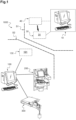
- figure 1 is represented a system 1000 for implementing operations enabling the edging of ophthalmic lenses.
- the premises S1 of the central organization are for instance an office of an ophthalmic lens manufacturer.
- the premises S2 of the customer(s) are for example an office of an optician or of a lens laboratory chain.
- the premises S2 belong to a single customer (an optician). In a variant, we will also contemplate the case where the premises S2 belong to a lens laboratory chain working with several clients (it will be specified in the text when we will do so).
- the central organization premises S1 will be adapted to work with several premises S2.
- the optician's premises S2 includes appliances 100, 130, 200, 300 that enable the optician, on receiving unshaped ophthalmic lenses, to prepare those ophthalmic lenses in order to be able to mount them on the eyeglass frame selected by a the future "wearer" of the eyeglasses.
- these appliances include a first database 130, a centering and blocking appliance 200, and a shaper appliance 300, all of which are controlled by a processing unit 100.
- the centering and blocking appliance 200 serves to center the outlines on the ophthalmic lenses in such a manner that once they are mounted on the frame, the lenses are properly centered relative to the wearer's eyes when looking at infinity. It is also adapted to block the lens.
- the shaper appliance 300 serves to shape the ophthalmic lenses 20 so as to follow those outlines.
- These appliances are controlled according to edging setpoints calculated by the processing unit 100.
- Figure 2 shows an embodiment of a centering and blocking appliance 200 in greater detail.
- This appliance is designed firstly to identify the positions of centering marks on the ophthalmic lens 20 that is to be prepared, and secondly to block the ophthalmic lens 20 by placing a blocking accessory on its front face.
- This centering and blocking appliance 200 is well known to the person skilled in the art and does not itself form the subject matter of the invention described. Its architecture and its operation are described in detail, for example in patent document EP 1 722 924 .
- this appliance comprises:
- the centering means comprise a transparent support plate 221 arranged beneath the holder mechanism 202, lighting means for lighting the ophthalmic lens 20 and arranged under the holder mechanism 202, and means for acquiring and analyzing the light transmitted by said ophthalmic lens 20 through the support plate 221.
- these acquisition and analysis means comprise a digital camera.
- the acquisition and analysis means also include image processor means adapted to process the signal obtained at the output from the digital camera, and display means for displaying the processed signal and constituted by the display screen 205.
- centering means serve in particular to acquire an image of the ophthalmic lens 20 and of its centering marks, and to deduce therefrom the position of the optical frame of reference of the ophthalmic lens 20.
- the blocking means comprise a positioning arm 206 that is preferably automatic and that is connected to the support structure 204.
- the positioning arm 206 is adapted to use a clamp to take one of the blocking accessories arranged on one of the receptacles 207 provided on the support stand 204 and to position the block at a location on the front face of the ophthalmic lens 20 that is determined as a function of the acquired position of the optical frame of reference of said lens.
- the blocking accessory thus forms a position-identifying mark representative of the position of the optical frame of reference of the ophthalmic lens as acquired by the optical centering means. It is for engaging in a corresponding socket of the shaper appliance 300 so that the appliance acquires the position of the optical frame of reference of the ophthalmic lens.
- the blocking may be done without such an accessory.
- the blocking would consist in determining the position of the optical frame of reference of the ophthalmic lens and in registering it in a memory, so as to be able to block the lens in the edging machine while keeping in memory where is this optical frame of reference.
- the blocking can then be ensured directly (without using block nor sticky pads), by the mean of suction vacuum integrated to the arms of the shaper appliance.
- the shaper appliance is likewise well known to the person skilled in the art and does not itself form the subject matter of the invention described. It may be embodied in the form of any machine for cutting or removing material that is suitable for modifying the outline of the ophthalmic lens 20 in order to adapt it to the shape of the selected frame.
- this appliance is for instance constituted by a grinder 300 that is automatic, i.e. numerically controlled.
- the grinder comprises:
- the rocker 301 is fitted in particular with two shafts 302, 303 for clamping the ophthalmic lens 20 and driving it in rotation about a blocking axis A7 parallel to the axis A5.
- a first of the two shafts 302 is stationary in translation along the blocking axis A7.
- the second of the two shafts 303 is on the contrary movable in translation along the blocking axis A7 in order to clamp the ophthalmic lens 20 by applying axial compression thereto.
- the first shaft 302 is fitted at its end with a non-removable accessory 304 for blocking the lens.
- the second shaft 303 is fitted with means for receiving the blocking accessory previously placed on the ophthalmic lens 20 by the arm 206 of the centering and blocking appliance 200.
- the set of grindwheels carried by the grindwheel carriage includes a cylindrical shaper grindwheel 310 that serves to rough-out the ophthalmic lens 20 in such a manner as to bring its initially circular outline to a shape close to the desired shape. It also includes a beveling grindwheel 311 for forming an engagement ridge on the edge face of the ophthalmic lens 20 for mounting in a rimmed eyeglass frame.
- the finishing module 320 carries a finishing wheel 323 controlled to rotate about an axis parallel to the blocking axis A7 in order to groove, chamfer, and polish the ophthalmic lens 20. It also carries a post that carries a drilling tool 321 and a milling tool 322 for acting on the ophthalmic lens 20, and that is mounted to pivot about an axis A10 orthogonal to the blocking axis A7 in order to select one or the other of these two tools in order to mill or drill the lens.
- the shaper appliance may have a different shape.
- it may use milling tools or dry cutting tools or combined tools...
- figure 3 shows an embodiment of a grinder but it does not represent an industrial edger which would be more likely used in a lens laboratory chain. Consequently, in a variant, the customer may use a shaper appliance different from the one shown in figure 3 , for instance the industrial edger marketed by the Applicant under the reference "Pro-E600 edger”.
- the processing unit 100 shown in Fig.1 is used for controlling the two appliances 200, 300, and particularly to calculate edging setpoints to be sent to these appliances 200, 300.
- the processing unit comprises a processor, a memory and various input and output interfaces.
- the processing unit is suitable for communicating with the database 130, the two appliances 200, 300 and with a control unit 10 situated in the central organization premises S1.
- the processing unit stores a computer application, consisting of computer programs comprising instructions, the execution of which by the processor enables the processing unit to implement the process described below.
- the control unit 10 in the central organization premises S1 comprises a processor, a memory and various input and output interfaces.
- control unit 10 is able to communicate with a measuring unit 40 designed to acquire some information about eyeglasses frames and with a database 30.
- the measuring unit 40 is able to acquire geometric information about eyeglasses frames.
- this geometric information is acquired and stored in the database 30. Once stored, this frame model is considered as referenced.
- the system 1000 comprises two databases, a first one illustrated in the central organization premises S1 and the second one illustrated in the optician's premises S2.
- the first database named hereinafter central database 30, comprises at least one table 31 that includes data relating to the referenced eyewear frames.
- the second database named hereinafter optician's database 130, comprises at least one table 131 that includes data relating to corrections to apply to the data stored in the central database 30.
- the first database comprises data accessible to every customers and the second database comprises customized information for local use, thus allowing each customer having his own local parameters to fine-tune the information stored in the first database, according to his specific requirements.
- the central database 30 is accessible to every customer affiliated to the central organization (opticians, lens laboratory chain%) when the optician's database 130 is only accessible to the optician.
- the second database is accessible to all the clients of this lens laboratory chain.
- the central database 30 may comprise various tables 31. For clarity reasons, it will be considered here that it only has a single table 31.
- This table 31 comprises various attributes (the columns of the table) and several records (the rows) each associated with a model of referenced eyewear frame.
- the records only include invariant data that are registered once and for all by the central organization.
- these data can be regularly corrected by the central organization when it is necessary.
- One of the attributes is an identifier of the model of referenced eyewear frame.
- At least another of the attributes is a geometric characteristic of this referenced eyewear frame.
- the table comprises a great number of attributes to store a large amount of information that are determined and measured on a frame sample or that are given by the frame manufacturer.
- the table 31 comprises at least one of the following attributes, and preferably all these attributes:
- the frame model identifier can be a code determined by the frame manufacturer or by the central organization.
- this identifier can be determined as a function of the values of the attributes, making a unique identifier.
- the optician database 130 may comprise various tables 131. For clarity reasons, it will be considered here that it has two tables 131.
- the first table 131 comprises various attributes and at least one record when the second table comprises at least one attribute and several records.
- the value(s) registered in the first table 131 comprise(s) a corrective parameter to be applied to the data read in the central database 30.
- An example of such a corrective parameter is a coefficient for a homothety to be applied to the frame trace (enabling to take into account that the temperature conditions in the optician's workshop are different from the conditions in other sites).
- This corrective parameter is here an offset A registered in the first table 131.
- it could be a linear offset having the form "Ax + B" (x being for instance a polar coordinate of a point of said trace, A and B being values recorded in the first table), or even a more complex offset.
- the optician's database 130 does not only comprise only one corrective parameter to be applied to a single datum recorded in the central database (for instance to the trace).
- the value of a corrective parameter can depend on predetermined conditions.
- the value of the corrective parameter can differ according to the frame manufacturer, or the frame type, or the frame material...
- This corrective parameter value can be determined by the optician or by a machine learning algorithm, as a function of the results of the edging previously done on other lenses.
- the values recorded in this database depend on the location of the optician and on the location of the appliances 200, 300.
- the values recorder in this database are under responsibility of the optician.
- the database 130 is shared between several clients of a lens laboratory chain, some of the values recorded in this database can depend on the locations of the client s when other depend on the location of the appliances 200, 300.
- some of the corrective parameters can be used for all the clients when other parameters are used only for a few numbers of clients.
- a collaborative work is preferred to contribute to the enrichment of this database.
- the second table of the optician's database 130 comprises feedback information relating to the accuracy of the mounting of a previously edged ophthalmic lens 20 into its frame.
- the optician can evaluate the result in terms of sizing (or in terms of fitting or aesthetic). This evaluation can be a qualitative evaluation (1 to 5 stars for instance) or a fitting appreciation (the lens is too small, small, ok, big, too big).
- This feedback information can be stored in the second table and can allow to readjust the corrective parameters registered in the first table 131 when needed, considering not only one evaluation but a great number of evaluations.
- This correction preferably depends on the dynamic evolution of the evaluation (enabling for instance to take into account that the tools of the shaping appliance progressively spoil).
- the first step consists, for the optician, to let the wearer selecting a frame among the frame that are already referenced.
- the second step consists in ordering two lenses that correspond to the prescription of the wearer.
- the optician can determine the shape of the contours along which each lens has to be edged, and the positions of the eyes of the wearer relative to the contours of the selected frame rims (named hereinafter "pupillary position").
- the processing unit 100 can use the processing unit 100 to search in the central database 30 for a record associated to the identifier of the model of the selected frame.
- the processing unit read every relevant information. For instance, it can retrieve in this record the shape of the trace of each frame rim.
- this information is not directly used, but at least a piece of this information is corrected thanks to the corrective parameters registered in the optician's database 130.
- the shape of the trace is corrected by the coefficient of homothety, the value of which is registered in the first table 131 and depends for instance on the frame manufacturer, the frame material and the feedback information recorded in the second table.
- the processing unit 100 is programmed to calculate two edging setpoints, one for each appliance 200, 300.
- an edging setpoint is a file that includes the parameters needed by an appliance to center and/or block and/or edge a lens.
- the ophthalmic lens 20 is blocked between the three jaws 215 of the centering and blocking appliance 200.
- the marks on the ophthalmic lens are read in order to determine the position of its optical center.
- final outline The outline along which the lens is to be edged (named hereinafter "final outline") is then positioned and oriented relative to the ophthalmic lens 20.
- the centering and blocking appliance 200 uses the first edging setpoints in which are stored the corrected trace and the pupillary position.
- the manipulator arm 206 of the centering and blocking appliance 200 proceeds to block the ophthalmic lens 20.
- it takes hold of one of the blocking accessories available on one of the receptacles 207 provided on the support structure 204 and then places it on the front face of the ophthalmic lens 20 at the geometrical center (also known as the "boxing center") of the final outline.
- the optician positions the ophthalmic lens 20 with its blocking accessory between the two shafts 302 and 303 of the shaper appliance 300.
- the optician then uses a pushbutton to cause these two shafts to move towards each other so that the lens is sandwiched between them.
- the electronic unit provided in the shaper appliance 300 then controls the shaping in two operations, a roughing-out operation and a finishing operation.
- the optician extracts the lens from the two shafts 302 and 303 of the appliance.
- the processing unit let him choose between five fitting appreciations (the lens is too small, small, ok, big, too big).
- this feedback information is stored in a new record of the second table of the optician's database 130.
- the central organization When the central organization (or an optician) orders or receives a new frame that is not referenced, it acquires the values of every attributes of this frame (name of the model, geometric features). It can measure these values by means of the measuring unit 40 or asking for them to the frame manufacturer.
- both databases are in the cloud, that is to say registered in web-accessible server(s).
- the optician's database 130 is shown as being located in the optician's premises.
- each optician has his own database.
- this optician's database could be located in the central organization server, provided that it is accessible (at least with the right of "modification") only to the considered optician.
- this variant one could even imagine a large database comprising separate tables each associated with a different optician.
- all the described tables 31, 131 could be located in a single database, but the read/write rights will not be the same for each user and for each table. For example, only the central organization will have these rights for accessing the table 31, and only one optician will have these rights for accessing the tables 131.
Landscapes
- Engineering & Computer Science (AREA)
- Physics & Mathematics (AREA)
- Mechanical Engineering (AREA)
- Ophthalmology & Optometry (AREA)
- Health & Medical Sciences (AREA)
- Ceramic Engineering (AREA)
- Chemical & Material Sciences (AREA)
- General Physics & Mathematics (AREA)
- Inorganic Chemistry (AREA)
- Optics & Photonics (AREA)
- General Health & Medical Sciences (AREA)
- Geometry (AREA)
- Human Computer Interaction (AREA)
- Manufacturing & Machinery (AREA)
- Automation & Control Theory (AREA)
- Eyeglasses (AREA)
Claims (13)
- System zum Kantenschleifen von Brillengläsern (20), umfassend:- eine erste Datenbanktabelle (31), die erste Daten bezüglich referenzierten Brillengestellen enthält, und- eine Verarbeitungseinheit (100), geeignet zum Berechnen eines Kantenschliff-Einstellpunkts als eine Funktion mindestens eines der ersten Daten, wobei der Kantenschliff-Einstellpunkt eine Datei ist, die die Parameter enthält, die von einer Maschine (200, 300) zum Zentrieren und/oder Blockieren und/oder Kantenschleifen eines Brillenglases (20) benötigt werden und die geeignet ist, von der Maschine (200, 300) verwendet zu werden, das Kantenschleifen des Brillenglases (20) entlang eines endgültigen Umrisses zu ermöglichen,wobei das System ferner eine zweite Datenbanktabelle (131) umfasst, die zweite Daten bezüglich Korrekturen, die auf die ersten Daten anzuwenden sind, enthält, wobei die Verarbeitungseinheit (100) geeignet ist zum Berechnen des Kantenschliff-Einstellpunkts als eine Funktion mindestens eines der ersten Daten, korrigiert durch mindestens eine der zweiten Daten, undwobei die zweiten Daten einen Korrekturparameter umfassen, der auf die ersten Daten anzuwenden ist, dadurch gekennzeichnet, dass der Wert des Korrekturparameters von dem Ort der Maschine (200, 300) abhängig ist.
- System nach Anspruch 1, ferner umfassend:- eine Zentrier- und Blockiermaschine (200), geeignet zum Zentrieren des Brillenglases (20) und zum Blockieren dieses in einer von dem Kantenschliff-Einstellpunkt abgeleiteten Position, und/oder- eine Kantenschleifmaschine (300), die Werkzeuge aufweist, die geeignet sind zum automatischen Bearbeiten der Kante des Brillenglases (20) entlang dem endgültigen Umriss gemäß dem Kantenschliff-Einstellpunkt.
- System nach Anspruch 1 oder 2, wobei die erste Datenbanktabelle (31) zu einer ersten Datenbank (30) gehört und die zweite Datenbanktabelle (131) zu einer zweiten Datenbank (130), die von der ersten Datenbank (30) verschieden ist, gehört.
- System nach einem der Ansprüche 1 bis 3, wobei die erste Datenbanktabelle (31) mehrere Aufzeichnungen umfasst, jede mit einer Art von referenziertem Brillengestell assoziiert, und wobei die Aufzeichnungen nur unveränderliche Daten enthalten.
- System nach einem der Ansprüche 1 bis 4, wobei die erste Datenbanktabelle (31) für jede Art von referenzierten Brillengestellen mindestens eines der folgenden Attribute umfasst:- eine Rahmenspur,- eine Kennung,- ein geometrisches Charakteristikum dieser Art von referenzierten Brillengestellen.
- System nach einem der Ansprüche 1 bis 5, wobei die lokale Bedingung die lokale Temperatur umfasst.
- System nach einem der Ansprüche 1 bis 6, wobei die zweiten Daten verschiedene Korrekturparameter, die auf korrespondierende erste Daten anzuwenden sind, umfassen.
- System nach einem der Ansprüche 1 bis 7, wobei der Wert des Korrekturparameters durch einen Optiker bestimmt wird.
- System nach einem der Ansprüche 1 bis 8, wobei die zweiten Daten mindestens eine Rückmeldungsinformation bezüglich der Genauigkeit des Einfassens von Brillengläsern (20), die mittels der Maschine (200, 300) kantengeschliffen wurden, in Brillengestelle umfassen.
- System nach einem der Ansprüche 1 bis 9, wobei die zweite Datenbanktabelle (131) nur für einige der Benutzer der ersten Datenbanktabelle (31) zugänglich ist.
- Verfahren zum Kantenschleifen eines Brillenglases (20), um es in ein Brillengestell einzufassen, umfassend:- Auswählen eines Brillengestells,- Lesen, in einer ersten Datenbanktabelle (31), von ersten Daten bezüglich des ausgewählten Brillengestells,- Berechnen eines Einstellpunkts als eine Funktion der ersten Daten, wobei der Einstellpunkt eine Datei ist, die die Parameter enthält, die von einer Maschine (200, 300) zum Zentrieren und/oder Blockieren und/oder Kantenschleifen eines Brillenglases (20) benötigt werden,- Kantenschleifen des Brillenglases (20) entlang einem endgültigen Umriss gemäß dem Kantenschliff-Einstellpunkt mittels der Maschine,- Lesen, in einer zweiten Datenbanktabelle (131), von zweiten Daten bezüglich der Verwendung der ersten Daten bei den lokalen Bedingungen der Maschine (200, 300),wobei der Einstellpunkt als eine Funktion der ersten Daten berechnet wird, korrigiert durch die zweiten Daten, undwobei die zweiten Daten einen Korrekturparameter umfassen, der auf die ersten Daten anzuwenden ist, wobei der Wert des Korrekturparameters von dem Ort der Maschine (200, 300) abhängig ist.
- Verfahren nach Anspruch 11, ferner die folgenden Schritte umfassend:- Einfassen des Brillenglases (20) in den Rahmen und- Aufzeichnen einer neuen Datengröße in der zweiten Datenbanktabelle (131), wobei die neue Datengröße von der Genauigkeit des Einfassens des Brillenglases (20) in den Rahmen abhängig ist.
- Verfahren nach Anspruch 11 oder 12, wobei die erste Datenbanktabelle (31) mehrere Aufzeichnungen umfasst, die jede mit einer Art von referenzierten Brillengestellen assoziiert ist, wobei das Verfahren, wenn ein Brillengestell erlangt wird, die folgenden Schritte umfasst:- Bestimmen, ob die Art des erlangten Brillengestells in der ersten Datenbanktabelle (31) registriert ist, und wenn nicht- Bestimmen, für das erlangte Brillengestell, des Werts der ersten Daten und- Aufzeichnen, in einer neuen Aufzeichnung der ersten Datenbanktabelle (31), des Wert der ersten Daten, die mit einer Kennung bezüglich der Art des referenzierten Brillengestells assoziiert sind.
Priority Applications (4)
| Application Number | Priority Date | Filing Date | Title |
|---|---|---|---|
| EP20306423.3A EP4001998B1 (de) | 2020-11-20 | 2020-11-20 | System und verfahren zum kanten von ophthalmischen linsen |
| PCT/EP2021/082299 WO2022106618A1 (en) | 2020-11-20 | 2021-11-19 | System and process for edging ophthalmic lenses |
| CN202180069481.XA CN116324595A (zh) | 2020-11-20 | 2021-11-19 | 用于对眼科镜片进行磨边的系统和方法 |
| US18/247,973 US20230375857A1 (en) | 2020-11-20 | 2021-11-19 | System and process for edging ophthalmic lenses |
Applications Claiming Priority (1)
| Application Number | Priority Date | Filing Date | Title |
|---|---|---|---|
| EP20306423.3A EP4001998B1 (de) | 2020-11-20 | 2020-11-20 | System und verfahren zum kanten von ophthalmischen linsen |
Publications (2)
| Publication Number | Publication Date |
|---|---|
| EP4001998A1 EP4001998A1 (de) | 2022-05-25 |
| EP4001998B1 true EP4001998B1 (de) | 2024-07-17 |
Family
ID=73654747
Family Applications (1)
| Application Number | Title | Priority Date | Filing Date |
|---|---|---|---|
| EP20306423.3A Active EP4001998B1 (de) | 2020-11-20 | 2020-11-20 | System und verfahren zum kanten von ophthalmischen linsen |
Country Status (4)
| Country | Link |
|---|---|
| US (1) | US20230375857A1 (de) |
| EP (1) | EP4001998B1 (de) |
| CN (1) | CN116324595A (de) |
| WO (1) | WO2022106618A1 (de) |
Family Cites Families (10)
| Publication number | Priority date | Publication date | Assignee | Title |
|---|---|---|---|---|
| US4656590A (en) * | 1984-11-07 | 1987-04-07 | Ronald Ace | Method and apparatus for making patterns for eyeglasses |
| FR2866718B1 (fr) | 2004-02-24 | 2006-05-05 | Essilor Int | Dispositif centreur-bloqueur d'une lentille ophtalmique de lunettes, methode de detection automatique et methodes de centrage manuel associees |
| FR2910647B1 (fr) * | 2007-05-29 | 2009-11-27 | Essilor Int | Procede de detourage de lentilles ophtalmiques par lecture et mise a jour d'un registre de base de donnees de lentilles et/ou de montures |
| FR2950160B1 (fr) * | 2009-09-14 | 2011-10-07 | Essilor Int | Methode d'elaboration d'une consigne de detourage d'une lentille ophtalmique. |
| FR2964336B1 (fr) * | 2010-09-07 | 2012-09-14 | Essilor Int | Procede de detourage d'une lentille ophtalmique |
| JP6349580B2 (ja) * | 2012-02-10 | 2018-07-04 | エシロール・アンテルナシオナル | リアルタイムで類別を行うシステム及び方法 |
| JP2014164178A (ja) * | 2013-02-26 | 2014-09-08 | Hoya Corp | 眼鏡レンズの製造システム、製造装置、製造方法、製造情報管理システム、製造情報管理装置、および製造情報管理方法 |
| JP5976918B2 (ja) * | 2013-02-26 | 2016-08-24 | Hoya株式会社 | 眼鏡レンズの製造システム、製造装置、製造方法、製造情報管理システム、製造情報管理装置、および製造情報管理方法 |
| JP6836154B2 (ja) * | 2017-02-02 | 2021-02-24 | 株式会社ニデック | 眼鏡レンズ周縁加工情報設定装置、眼鏡レンズ周縁加工装置、及び眼鏡レンズ周縁加工情報設定プログラム |
| EP3654087A1 (de) * | 2018-11-14 | 2020-05-20 | Essilor International | Verfahren zur bestimmung von prozessparametern zur herstellung zumindest eines teils eines brillenglases und brillenmanagementsystems |
-
2020
- 2020-11-20 EP EP20306423.3A patent/EP4001998B1/de active Active
-
2021
- 2021-11-19 US US18/247,973 patent/US20230375857A1/en active Pending
- 2021-11-19 CN CN202180069481.XA patent/CN116324595A/zh active Pending
- 2021-11-19 WO PCT/EP2021/082299 patent/WO2022106618A1/en not_active Ceased
Also Published As
| Publication number | Publication date |
|---|---|
| CN116324595A (zh) | 2023-06-23 |
| US20230375857A1 (en) | 2023-11-23 |
| WO2022106618A1 (en) | 2022-05-27 |
| EP4001998A1 (de) | 2022-05-25 |
Similar Documents
| Publication | Publication Date | Title |
|---|---|---|
| US4656590A (en) | Method and apparatus for making patterns for eyeglasses | |
| US9625743B2 (en) | Method of preparing an ophthalmic lens fitted with a memory mark | |
| US7086928B2 (en) | System and method for ophthalmic lens manufacture | |
| KR100515107B1 (ko) | 안경 가공방법 및 안경 프레임 | |
| CN103974803B (zh) | 眼镜镜片的镜片形状加工系统、眼镜镜片的制造方法及镜片形状加工机 | |
| JPS61284372A (ja) | 粗削りレンズの上にアダプタの中心合わせをして設置し、研磨機を操作するための装置と方法 | |
| JP4908226B2 (ja) | 眼鏡レンズ測定加工装置、その測定加工方法、眼鏡レンズ製造方法及び眼鏡製造方法 | |
| US8639372B2 (en) | Automated optical lens processing system, such as a system for providing supplemental information to laboratory technicians | |
| EP1409198B1 (de) | Verfahren zum herstellen von optalmischen linsen | |
| US8460056B2 (en) | Device for machining an ophthalmic lens | |
| US20130084781A1 (en) | Apparatus and method for working an optical lens | |
| KR102253019B1 (ko) | 안과용 렌즈를 베벨링하기 위한 방법 | |
| EP4001998B1 (de) | System und verfahren zum kanten von ophthalmischen linsen | |
| CN110268304B (zh) | 用于设计眼镜镜片的方法,镜片,和用于设计镜片的装置 | |
| JP2002126984A (ja) | 眼鏡レンズの光学中心測定方法並びに眼鏡レンズのレンズホルダ取付方法及び装置 | |
| EP4596174A1 (de) | Verfahren zur bestimmung von parametern zum trimmen einer optischen linse | |
| JPH06103369B2 (ja) | 眼鏡レンズの外径決定方法 | |
| JP2574026C (de) | ||
| JP2003287723A (ja) | 眼鏡レンズの供給システム | |
| HK1010578B (en) | Method of manufacturing spectacles | |
| JP2000047151A (ja) | 眼鏡レンズの供給システム | |
| JP2000047149A (ja) | 眼鏡レンズの供給システム | |
| JP2000047152A (ja) | 眼鏡レンズの供給システム | |
| JP2000047150A (ja) | 眼鏡レンズの供給システム |
Legal Events
| Date | Code | Title | Description |
|---|---|---|---|
| PUAI | Public reference made under article 153(3) epc to a published international application that has entered the european phase |
Free format text: ORIGINAL CODE: 0009012 |
|
| STAA | Information on the status of an ep patent application or granted ep patent |
Free format text: STATUS: THE APPLICATION HAS BEEN PUBLISHED |
|
| AK | Designated contracting states |
Kind code of ref document: A1 Designated state(s): AL AT BE BG CH CY CZ DE DK EE ES FI FR GB GR HR HU IE IS IT LI LT LU LV MC MK MT NL NO PL PT RO RS SE SI SK SM TR |
|
| STAA | Information on the status of an ep patent application or granted ep patent |
Free format text: STATUS: REQUEST FOR EXAMINATION WAS MADE |
|
| 17P | Request for examination filed |
Effective date: 20221116 |
|
| RBV | Designated contracting states (corrected) |
Designated state(s): AL AT BE BG CH CY CZ DE DK EE ES FI FR GB GR HR HU IE IS IT LI LT LU LV MC MK MT NL NO PL PT RO RS SE SI SK SM TR |
|
| P01 | Opt-out of the competence of the unified patent court (upc) registered |
Effective date: 20230525 |
|
| STAA | Information on the status of an ep patent application or granted ep patent |
Free format text: STATUS: EXAMINATION IS IN PROGRESS |
|
| 17Q | First examination report despatched |
Effective date: 20230718 |
|
| GRAP | Despatch of communication of intention to grant a patent |
Free format text: ORIGINAL CODE: EPIDOSNIGR1 |
|
| STAA | Information on the status of an ep patent application or granted ep patent |
Free format text: STATUS: GRANT OF PATENT IS INTENDED |
|
| RIC1 | Information provided on ipc code assigned before grant |
Ipc: G05B 19/18 20060101ALN20240219BHEP Ipc: B24B 9/14 20060101ALN20240219BHEP Ipc: B24B 47/22 20060101ALI20240219BHEP Ipc: G05B 19/4093 20060101ALI20240219BHEP Ipc: G05B 19/42 20060101ALI20240219BHEP Ipc: G02C 13/00 20060101AFI20240219BHEP |
|
| INTG | Intention to grant announced |
Effective date: 20240319 |
|
| GRAS | Grant fee paid |
Free format text: ORIGINAL CODE: EPIDOSNIGR3 |
|
| GRAA | (expected) grant |
Free format text: ORIGINAL CODE: 0009210 |
|
| STAA | Information on the status of an ep patent application or granted ep patent |
Free format text: STATUS: THE PATENT HAS BEEN GRANTED |
|
| AK | Designated contracting states |
Kind code of ref document: B1 Designated state(s): AL AT BE BG CH CY CZ DE DK EE ES FI FR GB GR HR HU IE IS IT LI LT LU LV MC MK MT NL NO PL PT RO RS SE SI SK SM TR |
|
| REG | Reference to a national code |
Ref country code: CH Ref legal event code: EP |
|
| REG | Reference to a national code |
Ref country code: DE Ref legal event code: R096 Ref document number: 602020034060 Country of ref document: DE |
|
| REG | Reference to a national code |
Ref country code: IE Ref legal event code: FG4D |
|
| REG | Reference to a national code |
Ref country code: LT Ref legal event code: MG9D |
|
| REG | Reference to a national code |
Ref country code: NL Ref legal event code: MP Effective date: 20240717 |
|
| PG25 | Lapsed in a contracting state [announced via postgrant information from national office to epo] |
Ref country code: PT Free format text: LAPSE BECAUSE OF FAILURE TO SUBMIT A TRANSLATION OF THE DESCRIPTION OR TO PAY THE FEE WITHIN THE PRESCRIBED TIME-LIMIT Effective date: 20241118 |
|
| REG | Reference to a national code |
Ref country code: AT Ref legal event code: MK05 Ref document number: 1704698 Country of ref document: AT Kind code of ref document: T Effective date: 20240717 |
|
| PG25 | Lapsed in a contracting state [announced via postgrant information from national office to epo] |
Ref country code: NL Free format text: LAPSE BECAUSE OF FAILURE TO SUBMIT A TRANSLATION OF THE DESCRIPTION OR TO PAY THE FEE WITHIN THE PRESCRIBED TIME-LIMIT Effective date: 20240717 |
|
| PG25 | Lapsed in a contracting state [announced via postgrant information from national office to epo] |
Ref country code: PT Free format text: LAPSE BECAUSE OF FAILURE TO SUBMIT A TRANSLATION OF THE DESCRIPTION OR TO PAY THE FEE WITHIN THE PRESCRIBED TIME-LIMIT Effective date: 20241118 Ref country code: NL Free format text: LAPSE BECAUSE OF FAILURE TO SUBMIT A TRANSLATION OF THE DESCRIPTION OR TO PAY THE FEE WITHIN THE PRESCRIBED TIME-LIMIT Effective date: 20240717 |
|
| PG25 | Lapsed in a contracting state [announced via postgrant information from national office to epo] |
Ref country code: NO Free format text: LAPSE BECAUSE OF FAILURE TO SUBMIT A TRANSLATION OF THE DESCRIPTION OR TO PAY THE FEE WITHIN THE PRESCRIBED TIME-LIMIT Effective date: 20241017 |
|
| PG25 | Lapsed in a contracting state [announced via postgrant information from national office to epo] |
Ref country code: FI Free format text: LAPSE BECAUSE OF FAILURE TO SUBMIT A TRANSLATION OF THE DESCRIPTION OR TO PAY THE FEE WITHIN THE PRESCRIBED TIME-LIMIT Effective date: 20240717 Ref country code: GR Free format text: LAPSE BECAUSE OF FAILURE TO SUBMIT A TRANSLATION OF THE DESCRIPTION OR TO PAY THE FEE WITHIN THE PRESCRIBED TIME-LIMIT Effective date: 20241018 Ref country code: PL Free format text: LAPSE BECAUSE OF FAILURE TO SUBMIT A TRANSLATION OF THE DESCRIPTION OR TO PAY THE FEE WITHIN THE PRESCRIBED TIME-LIMIT Effective date: 20240717 |
|
| PG25 | Lapsed in a contracting state [announced via postgrant information from national office to epo] |
Ref country code: BG Free format text: LAPSE BECAUSE OF FAILURE TO SUBMIT A TRANSLATION OF THE DESCRIPTION OR TO PAY THE FEE WITHIN THE PRESCRIBED TIME-LIMIT Effective date: 20240717 |
|
| PG25 | Lapsed in a contracting state [announced via postgrant information from national office to epo] |
Ref country code: LV Free format text: LAPSE BECAUSE OF FAILURE TO SUBMIT A TRANSLATION OF THE DESCRIPTION OR TO PAY THE FEE WITHIN THE PRESCRIBED TIME-LIMIT Effective date: 20240717 |
|
| PG25 | Lapsed in a contracting state [announced via postgrant information from national office to epo] |
Ref country code: IS Free format text: LAPSE BECAUSE OF FAILURE TO SUBMIT A TRANSLATION OF THE DESCRIPTION OR TO PAY THE FEE WITHIN THE PRESCRIBED TIME-LIMIT Effective date: 20241117 Ref country code: AT Free format text: LAPSE BECAUSE OF FAILURE TO SUBMIT A TRANSLATION OF THE DESCRIPTION OR TO PAY THE FEE WITHIN THE PRESCRIBED TIME-LIMIT Effective date: 20240717 |
|
| PG25 | Lapsed in a contracting state [announced via postgrant information from national office to epo] |
Ref country code: HR Free format text: LAPSE BECAUSE OF FAILURE TO SUBMIT A TRANSLATION OF THE DESCRIPTION OR TO PAY THE FEE WITHIN THE PRESCRIBED TIME-LIMIT Effective date: 20240717 |
|
| PG25 | Lapsed in a contracting state [announced via postgrant information from national office to epo] |
Ref country code: RS Free format text: LAPSE BECAUSE OF FAILURE TO SUBMIT A TRANSLATION OF THE DESCRIPTION OR TO PAY THE FEE WITHIN THE PRESCRIBED TIME-LIMIT Effective date: 20241017 Ref country code: ES Free format text: LAPSE BECAUSE OF FAILURE TO SUBMIT A TRANSLATION OF THE DESCRIPTION OR TO PAY THE FEE WITHIN THE PRESCRIBED TIME-LIMIT Effective date: 20240717 |
|
| PG25 | Lapsed in a contracting state [announced via postgrant information from national office to epo] |
Ref country code: RS Free format text: LAPSE BECAUSE OF FAILURE TO SUBMIT A TRANSLATION OF THE DESCRIPTION OR TO PAY THE FEE WITHIN THE PRESCRIBED TIME-LIMIT Effective date: 20241017 Ref country code: PL Free format text: LAPSE BECAUSE OF FAILURE TO SUBMIT A TRANSLATION OF THE DESCRIPTION OR TO PAY THE FEE WITHIN THE PRESCRIBED TIME-LIMIT Effective date: 20240717 Ref country code: NO Free format text: LAPSE BECAUSE OF FAILURE TO SUBMIT A TRANSLATION OF THE DESCRIPTION OR TO PAY THE FEE WITHIN THE PRESCRIBED TIME-LIMIT Effective date: 20241017 Ref country code: LV Free format text: LAPSE BECAUSE OF FAILURE TO SUBMIT A TRANSLATION OF THE DESCRIPTION OR TO PAY THE FEE WITHIN THE PRESCRIBED TIME-LIMIT Effective date: 20240717 Ref country code: IS Free format text: LAPSE BECAUSE OF FAILURE TO SUBMIT A TRANSLATION OF THE DESCRIPTION OR TO PAY THE FEE WITHIN THE PRESCRIBED TIME-LIMIT Effective date: 20241117 Ref country code: HR Free format text: LAPSE BECAUSE OF FAILURE TO SUBMIT A TRANSLATION OF THE DESCRIPTION OR TO PAY THE FEE WITHIN THE PRESCRIBED TIME-LIMIT Effective date: 20240717 Ref country code: GR Free format text: LAPSE BECAUSE OF FAILURE TO SUBMIT A TRANSLATION OF THE DESCRIPTION OR TO PAY THE FEE WITHIN THE PRESCRIBED TIME-LIMIT Effective date: 20241018 Ref country code: FI Free format text: LAPSE BECAUSE OF FAILURE TO SUBMIT A TRANSLATION OF THE DESCRIPTION OR TO PAY THE FEE WITHIN THE PRESCRIBED TIME-LIMIT Effective date: 20240717 Ref country code: ES Free format text: LAPSE BECAUSE OF FAILURE TO SUBMIT A TRANSLATION OF THE DESCRIPTION OR TO PAY THE FEE WITHIN THE PRESCRIBED TIME-LIMIT Effective date: 20240717 Ref country code: BG Free format text: LAPSE BECAUSE OF FAILURE TO SUBMIT A TRANSLATION OF THE DESCRIPTION OR TO PAY THE FEE WITHIN THE PRESCRIBED TIME-LIMIT Effective date: 20240717 Ref country code: AT Free format text: LAPSE BECAUSE OF FAILURE TO SUBMIT A TRANSLATION OF THE DESCRIPTION OR TO PAY THE FEE WITHIN THE PRESCRIBED TIME-LIMIT Effective date: 20240717 |
|
| PG25 | Lapsed in a contracting state [announced via postgrant information from national office to epo] |
Ref country code: RO Free format text: LAPSE BECAUSE OF FAILURE TO SUBMIT A TRANSLATION OF THE DESCRIPTION OR TO PAY THE FEE WITHIN THE PRESCRIBED TIME-LIMIT Effective date: 20240717 Ref country code: SM Free format text: LAPSE BECAUSE OF FAILURE TO SUBMIT A TRANSLATION OF THE DESCRIPTION OR TO PAY THE FEE WITHIN THE PRESCRIBED TIME-LIMIT Effective date: 20240717 Ref country code: DK Free format text: LAPSE BECAUSE OF FAILURE TO SUBMIT A TRANSLATION OF THE DESCRIPTION OR TO PAY THE FEE WITHIN THE PRESCRIBED TIME-LIMIT Effective date: 20240717 |
|
| REG | Reference to a national code |
Ref country code: DE Ref legal event code: R097 Ref document number: 602020034060 Country of ref document: DE |
|
| PG25 | Lapsed in a contracting state [announced via postgrant information from national office to epo] |
Ref country code: EE Free format text: LAPSE BECAUSE OF FAILURE TO SUBMIT A TRANSLATION OF THE DESCRIPTION OR TO PAY THE FEE WITHIN THE PRESCRIBED TIME-LIMIT Effective date: 20240717 |
|
| PG25 | Lapsed in a contracting state [announced via postgrant information from national office to epo] |
Ref country code: CZ Free format text: LAPSE BECAUSE OF FAILURE TO SUBMIT A TRANSLATION OF THE DESCRIPTION OR TO PAY THE FEE WITHIN THE PRESCRIBED TIME-LIMIT Effective date: 20240717 |
|
| PG25 | Lapsed in a contracting state [announced via postgrant information from national office to epo] |
Ref country code: SK Free format text: LAPSE BECAUSE OF FAILURE TO SUBMIT A TRANSLATION OF THE DESCRIPTION OR TO PAY THE FEE WITHIN THE PRESCRIBED TIME-LIMIT Effective date: 20240717 |
|
| PLBE | No opposition filed within time limit |
Free format text: ORIGINAL CODE: 0009261 |
|
| STAA | Information on the status of an ep patent application or granted ep patent |
Free format text: STATUS: NO OPPOSITION FILED WITHIN TIME LIMIT |
|
| 26N | No opposition filed |
Effective date: 20250422 |
|
| REG | Reference to a national code |
Ref country code: CH Ref legal event code: PL |
|
| PG25 | Lapsed in a contracting state [announced via postgrant information from national office to epo] |
Ref country code: MC Free format text: LAPSE BECAUSE OF FAILURE TO SUBMIT A TRANSLATION OF THE DESCRIPTION OR TO PAY THE FEE WITHIN THE PRESCRIBED TIME-LIMIT Effective date: 20240717 |
|
| PG25 | Lapsed in a contracting state [announced via postgrant information from national office to epo] |
Ref country code: LU Free format text: LAPSE BECAUSE OF NON-PAYMENT OF DUE FEES Effective date: 20241120 |
|
| REG | Reference to a national code |
Ref country code: CH Ref legal event code: PL |
|
| PG25 | Lapsed in a contracting state [announced via postgrant information from national office to epo] |
Ref country code: CH Free format text: LAPSE BECAUSE OF NON-PAYMENT OF DUE FEES Effective date: 20241130 |
|
| REG | Reference to a national code |
Ref country code: BE Ref legal event code: MM Effective date: 20241130 |
|
| PG25 | Lapsed in a contracting state [announced via postgrant information from national office to epo] |
Ref country code: SE Free format text: LAPSE BECAUSE OF FAILURE TO SUBMIT A TRANSLATION OF THE DESCRIPTION OR TO PAY THE FEE WITHIN THE PRESCRIBED TIME-LIMIT Effective date: 20240717 |
|
| PG25 | Lapsed in a contracting state [announced via postgrant information from national office to epo] |
Ref country code: BE Free format text: LAPSE BECAUSE OF NON-PAYMENT OF DUE FEES Effective date: 20241130 |
|
| PG25 | Lapsed in a contracting state [announced via postgrant information from national office to epo] |
Ref country code: IE Free format text: LAPSE BECAUSE OF NON-PAYMENT OF DUE FEES Effective date: 20241120 |
|
| PGFP | Annual fee paid to national office [announced via postgrant information from national office to epo] |
Ref country code: DE Payment date: 20251128 Year of fee payment: 6 |
|
| PGFP | Annual fee paid to national office [announced via postgrant information from national office to epo] |
Ref country code: GB Payment date: 20251127 Year of fee payment: 6 |
|
| PGFP | Annual fee paid to national office [announced via postgrant information from national office to epo] |
Ref country code: IT Payment date: 20251119 Year of fee payment: 6 |
|
| PGFP | Annual fee paid to national office [announced via postgrant information from national office to epo] |
Ref country code: FR Payment date: 20251125 Year of fee payment: 6 |
|
| PG25 | Lapsed in a contracting state [announced via postgrant information from national office to epo] |
Ref country code: HU Free format text: LAPSE BECAUSE OF FAILURE TO SUBMIT A TRANSLATION OF THE DESCRIPTION OR TO PAY THE FEE WITHIN THE PRESCRIBED TIME-LIMIT; INVALID AB INITIO Effective date: 20201120 |
|
| PG25 | Lapsed in a contracting state [announced via postgrant information from national office to epo] |
Ref country code: CY Free format text: LAPSE BECAUSE OF FAILURE TO SUBMIT A TRANSLATION OF THE DESCRIPTION OR TO PAY THE FEE WITHIN THE PRESCRIBED TIME-LIMIT; INVALID AB INITIO Effective date: 20201120 |