EP3997397B1 - Procédé et équipement pour fournir un stockage de neige avec isolation thermique - Google Patents
Procédé et équipement pour fournir un stockage de neige avec isolation thermique Download PDFInfo
- Publication number
- EP3997397B1 EP3997397B1 EP19937192.3A EP19937192A EP3997397B1 EP 3997397 B1 EP3997397 B1 EP 3997397B1 EP 19937192 A EP19937192 A EP 19937192A EP 3997397 B1 EP3997397 B1 EP 3997397B1
- Authority
- EP
- European Patent Office
- Prior art keywords
- insulation board
- snow
- insulation
- mats
- pile
- Prior art date
- Legal status (The legal status is an assumption and is not a legal conclusion. Google has not performed a legal analysis and makes no representation as to the accuracy of the status listed.)
- Active
Links
Images


Classifications
-
- A—HUMAN NECESSITIES
- A63—SPORTS; GAMES; AMUSEMENTS
- A63C—SKATES; SKIS; ROLLER SKATES; DESIGN OR LAYOUT OF COURTS, RINKS OR THE LIKE
- A63C19/00—Design or layout of playing courts, rinks, bowling greens or areas for water-skiing; Covers therefor
- A63C19/10—Ice-skating or roller-skating rinks; Slopes or trails for skiing, ski-jumping or tobogganing
-
- F—MECHANICAL ENGINEERING; LIGHTING; HEATING; WEAPONS; BLASTING
- F25—REFRIGERATION OR COOLING; COMBINED HEATING AND REFRIGERATION SYSTEMS; HEAT PUMP SYSTEMS; MANUFACTURE OR STORAGE OF ICE; LIQUEFACTION SOLIDIFICATION OF GASES
- F25C—PRODUCING, WORKING OR HANDLING ICE
- F25C3/00—Processes or apparatus specially adapted for producing ice or snow for winter sports or similar recreational purposes, e.g. for sporting installations; Producing artificial snow
- F25C3/04—Processes or apparatus specially adapted for producing ice or snow for winter sports or similar recreational purposes, e.g. for sporting installations; Producing artificial snow for sledging or ski trails; Producing artificial snow
-
- A—HUMAN NECESSITIES
- A63—SPORTS; GAMES; AMUSEMENTS
- A63C—SKATES; SKIS; ROLLER SKATES; DESIGN OR LAYOUT OF COURTS, RINKS OR THE LIKE
- A63C19/00—Design or layout of playing courts, rinks, bowling greens or areas for water-skiing; Covers therefor
- A63C19/12—Removable protective covers for courts, rinks, or game pitches or the like
-
- E—FIXED CONSTRUCTIONS
- E01—CONSTRUCTION OF ROADS, RAILWAYS, OR BRIDGES
- E01H—STREET CLEANING; CLEANING OF PERMANENT WAYS; CLEANING BEACHES; DISPERSING OR PREVENTING FOG IN GENERAL CLEANING STREET OR RAILWAY FURNITURE OR TUNNEL WALLS
- E01H4/00—Working on surfaces of snow or ice in order to make them suitable for traffic or sporting purposes, e.g. by compacting snow
- E01H4/02—Working on surfaces of snow or ice in order to make them suitable for traffic or sporting purposes, e.g. by compacting snow for sporting purposes, e.g. preparation of ski trails; Construction of artificial surfacings for snow or ice sports ; Trails specially adapted for on-the-snow vehicles, e.g. devices adapted for ski-trails
-
- F—MECHANICAL ENGINEERING; LIGHTING; HEATING; WEAPONS; BLASTING
- F25—REFRIGERATION OR COOLING; COMBINED HEATING AND REFRIGERATION SYSTEMS; HEAT PUMP SYSTEMS; MANUFACTURE OR STORAGE OF ICE; LIQUEFACTION SOLIDIFICATION OF GASES
- F25C—PRODUCING, WORKING OR HANDLING ICE
- F25C3/00—Processes or apparatus specially adapted for producing ice or snow for winter sports or similar recreational purposes, e.g. for sporting installations; Producing artificial snow
Definitions
- the invention relates to a method and equipment for providing a snow storage with heat insulation.
- the heat-insulation of the snow storage consists of heat-insulators added on top of a snow mass piled up at a desired snow storage site.
- heat-insulators added on top of a snow mass piled up at a desired snow storage site.
- the following continue to be the most common ones: sawdust, different kinds of clothes, as well as polystyrene and/or polyurethane insulation boards.
- the applied methods work well in other aspects but, in the step of insulating and dismantling the snow storage, they require a lot of manual labor as well as transporting a variety of heat-insulating materials from their storage site to the snow storage and back, causing high labor and transportation expenses.
- Document JP2005291605A discloses a snow storage for storing snow and ice till summer for utilizing them as a cooling-heat energy source. According to the document a heat insulation covering comprising heat-insulating materials and rigid framework is assembled above a pile of snow to be stored to form the snow storage.
- Document DE 202018102906 U1 discloses equipment for preserving snow.
- the equipment comprises several flat covering elements made of foamed polyethylene and connected to each other.
- Document US 2018/0111466 A1 discloses a hail-resistant vehicle cover.
- the vehicle cover comprises a plurality of cover panels pivotably attached to each other to form a foldable cover.
- the invention aims at providing a novel method of heat-insulating a snow storage, making it faster and easier to install and uninstall the heat-insulation of the snow storage and, thus, resulting in lower labor and insulation material handling expenses related to the storage of the snow over the summer.
- the invention aims at providing a method of simplifying the operations of installing and uninstalling the heat insulation of the snow storage and, thus, resulting in a significant decrease of the high amount of work and expenses currently involved therein.
- the invention aims at providing equipment for carrying out the method according to the invention.
- the method according to the invention achieves the object of the invention in that at least some of the heat-insulators used for covering the snow pile requiring heat-insulation consist of insulation board mats which are made out of insulating boards joined together in an accordion-like fashion, and, which, as the snow storage is insulated, are pulled to lie side by side and/or one after another on the top/sides of the snow storage, and which, once the snow stored in the snow storage is taken out, are pulled back to lie next to the snow pile, in an accordion-like configuration, where they are stored while the snow stored in the snow storage is being used (i.e. during the skiing season) and from where they are taken back into use when a snow pile intended for the next season's snow supply is stored at the same site.
- the heat-insulators used for covering the snow pile requiring heat-insulation consist of insulation board mats which are made out of insulating boards joined together in an accordion-like fashion, and, which, as the snow storage is insulated, are pulled to lie side by side and/
- the method and equipment according to the invention are characterized in what is set forth in the independent claim 1 and in the independent claim 8, respectively.
- the dependent claims 2 to 7 and the dependent claims 9 to 15 disclose preferred embodiments of the method according to the invention and preferred embodiments of the equipment according to the invention, respectively.
- An advantage of the method and equipment according to the invention is that, as the heat-insulated snow storage is created, they eliminate a slow and laborious step of installing individual insulation boards on the top and sides of the snow pile, and that, as the snow storage is taken into use, they do not have to be individually collected off the snow pile.
- the heat-insulating materials do not have to be transported over long distances to a storage and, then, from the storage back to the proximity of the snow pile to be re-installed on a new snow pile stored over the summer and intended for the needs of the next winter. All these measures facilitate the set-up and use of snow storages by reducing and simplifying the work steps involved in creating the snow storages and in taking them into use, the expenses of the use of the snow stored over the summer thus becoming significantly lower than in the previously known methods.
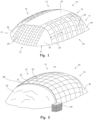
- the heat-insulation of the roof 11, end walls 12 and 13 as well as the lateral walls 14 and 15 parallel to the longer sides is provided by insulation board mats 20 consisting of insulation boards 16 joined together in an accordion-like fashion.
- the insulation boards 16 of the insulation board mats 20 are polyurethane, polystyrene or similar insulation boards, for example.
- the insulation boards 16, or some of them can be other insulation boards, such as foam rubber or cellular plastic boards. It is possible to select the outer dimensions of the insulation boards 16 of the insulation board mats 20 case by case or to use standard-size insulation boards.
- the insulation boards 16 must be thick enough to sufficiently acknowledge the climatic conditions prevailing in the location of the snow storage 30.
- corner inserts 18 are made of an integral piece of an elastic and bendable heat-insulating material, such as a foam rubber or cellular plastic board.
- the outer dimensions and thickness of the corner inserts 18 may also vary according to the size and heat-insulation requirements of the snow storage.
- the corners 17, and therefore, the end walls 12 and 13 of the snow storage as well can also be insulated by means of inner walls made out of snow and/or ice, for example, as well as by means of a heat-insulating layer provided on the inner walls by using sawdust and/or pykrete, i.e. frozen sawdust, accumulated thereon.
- the insulation materials of the roof 11, end walls 12 and 13 as well as the lateral walls 14 and 15 comprise insulation board mats 20 consisting of individual insulation boards 16, or, of groups of insulation boards put together out of several joined insulation boards 16.
- the individual insulation boards 16 or the insulation board groups are pivotably joined together, alternately at the upper corners and the lower corners of the transversal end edges 21 thereof.
- the continuous insulation board mat 20 formed thereby and comprising several insulation boards is foldable into an accordion-like insulation board bundle 20' and re-openable into a continuous insulation board mat 20 (as is shown in Figures 3 and 4 ).
- the insulation boards joined together in the insulation group are preferably fixed together, or inserted into a single bag or sleeve made from a suitable fabric, to hold them against each other, as a single continuous piece of board.
- the successive insulation boards 16 are pivotably connected together by a waterproof cloth 19 (such as a PVC cloth), to form an accordion-like structure, as shown in Figures 3 and 4 .
- a waterproof cloth 19 such as a PVC cloth
- the pivotable connection is achieved by inserting the successive insulation boards into bags made of a fabric-like material, or, into sleeves 19a open at two opposite ends, wherein there are several bags or sleeves one after another, joined, at an edge thereof, to each other by a suitable joint 19b.
- the insulation boards 16 inserted into the bags or sleeves 19a are pivotably joined together at their opposite edges, by the joints between the bags or sleeves 19a.
- two or more insulation boards can be inserted into a single bag or sleeve 19a, one after another and/or side by side, the bags or sleeves 19a thereby pivotably connecting groups of insulation boards to each other, in the way described above.
- the ends and the middle portions of the heat-insulated snow pile 30 are covered with several adjacent insulation board mats 20.
- three successive insulation board mats 20 are pulled over the snow pile 30. Two of them lie on the sides (principally at the lateral walls 14 and 15) while one of them lies on the roof 11 of the snow storage 10, on top of the snow pile 30.
- the position of the insulation board mats 20 is generally selected case by case to restrict the entrance of rainwater into the snow pile as far as possible.
- the entrance of rainwater is also restricted by a joint shield 24 provided on top of the snow pile.
- it covers the midmost insulation board mats 20 as well as the joint areas between them and the first and the last insulation board mats 20.
- rainwater cannot enter the snow pile 30, at least not very easily, through the joints between the successive insulation board mats 20.
- Figure 2 is a view of the snow storage 10 of Figure 1 , with the insulation board mats 20 and the corner inserts 18, provided in the front end 12, as seen from the direction of the Figure, and in the corners 17, respectively, removed, and with the first central insulation board mat 20 of this end face pulled off the snow pile, as the snow storage 10 is taken into use.
- the joint shield 24 provided on the roof of the snow storage and the joint shields 29 between the insulation board mats 20 are removed as well.
- the equipment for insulating a snow pile according to the invention may comprise, in addition to the variety of heat-insulating materials, a pulling device for opening up a bundle of insulation boards 20' into an insulation board mat 20 and for pulling it onto the snow pile 30.
- the pulling device can be an electrically or combustion engine driven winch or the like, for example, allowing each insulation board bundle 20' to be opened up and pulled onto the snow pile 30.
- some or all of the insulation board bundles 20' can be opened up by manual pulling.
- a suitable pulling member such as a pulling rope, wire rope, strap or the like, is attached to an end of the insulation board bundle 20' and taken over the snow pile to allow the insulation board bundle 20' to be opened up and pulled onto the snow pile 30 by manually pulling at the pulling member.
- the heat-insulation is done by using the insulation board mats 20 and the corner inserts 18 as described above as well as different kinds of other heat-insulating materials provided in the intermediate areas between the insulation board mats 20.
- the accordion-like insulation board bundles 20' provided or brought next to the snow pile 30 are opened up into insulation board mats 20 and pulled onto the snow pile 30.
- the accordion-like insulation board bundles 20' are provided on all sides of the snow pile 30, the insulation board bundles 20' intended for each side are situated next to this side.
- the location of the insulation board bundles 20' intended for the roof 11 of the snow storage 10 is selected case by case by to allow them to be pulled onto the snow pile 30 as effortlessly as possible.
- the insulation board bundles 20' provided next to the snow pile 30 can be tilted towards the snow pile 30 to make it easier to open up them by pulling them at the topmost insulation board towards the snow pile 30.
- the most common way of opening up the insulation board bundles 20' of pulling them to lie on the top and the sides of the snow pile 30 is to use an electrical pulling device, such as an electrical pulling winch.
- the pulling winch can be a pulling winch provided on a terrain vehicle, for example, the vehicle being drivable to a suitable position with respect to the pulling direction.
- the insulation board bundles 20' can also be opened up manually and pulled onto the snow pile 30 by means of suitable hand-operated pulling means (such as ropes or straps) extended over the snow pile to the other side of thereof.
- suitable hand-operated pulling means such as ropes or straps
- a driven pulling device for opening up and pulling the larger and heavier ones of the insulation board bundles 20' onto the snow pile 30 and to only use manual force on the smallest ones of them.
- the insulation board bundles 20'onto the snow pile 30 and after removing them from the snow pile 30 are stored next to the snow pile 30 and laterally moved off the snow pile 30, over a required distance (aside from a trail of a ski slope, for instance).
- a suitable, preferably waterproof sheet such as a plastic or PVC cloth
- the duration of use of the snow of the snow storage i.e. mostly for the entire ski season.
- all of the insulation board bundles 20' are situated, at the beginning of the insulation step, on the side of the snow pile 30 encompassing their intended location on top of the snow pile, prior to pulling them onto the snow pile, and, after pulling them off the snow pile 30 and re-folding them into insulation board bundles 20'.
- the insulation board mats are pulled to lie side by side on top of the snow pile 30 so that there are several insulation board mats 20 on top of the snow pile, with their lateral edges 22 against each other.
- the spaces between the adjacent insulation board mats 20 are filled with an appropriate heat-insulating structure 25 consisting of heat-insulating materials 26, 28 and 29.
- the filling is carried out, as is shown in Figure 6, prior to pulling the insulation board mats 20 onto the snow pile 30, by providing the areas between their lateral edges with a sealing cloth 26.
- the sealing cloth 26 can be a single elongated piece of a waterproof fabric or plastic (a piece of PVC fabric having a thickness of approximately 0.5 to 1 m, for example) extending over the entire snow pile. It is also possible to press (by means of a suitable tool) a groove in this point of the surface of snow pile 30, the sealing cloth 26 thus forming a chute in the areas between the lateral edges 22 of the insulation board mats 20 to drain off any rainwater that has entered between the insulation board mats 20 from the snow pile 30.
- an intermediate insulation 28 such as a foam rubber or cellular plastic insulation
- an overlying joint shield 29, such a geotextile is provided between the lateral edges 22 of the insulation board mats 20.
- the joint shield 29 can be fixed on the insulation board mats by means of binding members 31 installed at the lateral regions of the insulation board mats, such as by means of tie-down straps tightened against the insulation board mats 20 (as shown in Figure 6). This filling between the lateral edges 22 of the adjacent insulation board mats 20 provides heat-insulation and restricts the entrance of rainwater into the snow pile 30, through the spaces between the adjacent insulation board mats 20.
- the insulation board mats 20 can be done with an adhesive member removably attaching to the insulation board mats, such as with adhesive tape or Velcro ® fastener tapes/strips.
- two or more of the insulation board mats 20 pulled onto the snow pile are positioned one after another, with a first end of a first insulation board mat 20 abutting a second end of a second insulation board mat 20 and with a rear end of a third insulation board mat 20 abutting a first end of the second insulation board mat 20.
- it desirable to attach the insulation board mats 20 one after another it can be done in a way similar to the way they are attached, side by side, at their lateral edges 22, i.e. with a suitable fastener removably provided between the end edges 21 of the insulation board mats 20.
- a finished heat-insulation of the snow storage 10 created by the method according to the invention does not usually require other heat-insulating materials to be provided the insulation board layer of the insulation board mats 20. However, if it is desirable to do so, it is possible to lay an insulating cloth, such a geotextile and/or moisture shield, such as a plastic or waterproof cloth (such as a PVC cloth) over the insulation board mats. This eliminates the need of the sealing cloth 29 at the joints between the lateral edges 22 of the insulation board mats 20.
- FIG 3 is a longitudinal cross-sectional view of an insulation board mat, presenting an insulation board mat 20 having individual insulation board bundles 20' inserted into bags or sleeves 19a (i.e. laterally open fabric sleeves) made of waterproof fabric 19, as a structural option.
- the waterproof cloth 19 enclosing the insulation boards 16 has joints 19b parallel to the transversal edges of the insulation boards and joining the overlying waterproof fabric 19 and the underlying waterproof fabric 19 of the insulation boards 20 together, welded, glued or sewed between the transversal edges of successive insulation boards 16 (i.e. edges perpendicular to the longitudinal direction of the insulation board mats 20).
- the joints 19b are positioned between the fabric layers by alternating the successive joints 19b at the level of the lower surface and the upper surface of the insulation boards 20.
- articulations transversal to the insulation boards 20 are provided therebetween, allowing the insulation board mat to be folded into an accordion-like insulation board bundle 20', as shown in Figure 4 .
- the insulation board mat can be a single integrated body entirely made of cellular plastic or of a similar highly heat-insulating soft and elastic insulation board material, for example.
- the structure of this integrated insulation board mat may comprise transversal joints or points which are more flexible than the rest of the areas, allowing the insulation board mat to be folded into an accordion-like form and re-opened up into an insulation board mat multiple times without causing damage to the structure.
- An insulation board mat of this type can also be inflated with air, or some other gas that has better heat-insulation properties than air, and also deflated.
Landscapes
- Engineering & Computer Science (AREA)
- Architecture (AREA)
- Civil Engineering (AREA)
- Structural Engineering (AREA)
- Physics & Mathematics (AREA)
- Mechanical Engineering (AREA)
- Thermal Sciences (AREA)
- General Engineering & Computer Science (AREA)
- Building Environments (AREA)
- Working Measures On Existing Buildindgs (AREA)
- Thermal Insulation (AREA)
- Buildings Adapted To Withstand Abnormal External Influences (AREA)
Claims (15)
- Procédé de fourniture d'une isolation thermique à un stockage de neige (10), le procédé comprenant le recouvrement d'un tas de neige (30) réalisé sur un site de stockage de neige avec des matériaux d'isolation thermique (16, 18, 20, 27, 28, 29) dont au moins certains sont des panneaux isolants (16), caractérisé en ce que- l'isolation du tas de neige (30) est réalisée à l'aide de matelas de panneaux isolants (20) qui comportent plusieurs panneaux isolants (16), ou des groupes de panneaux isolants constitués de plusieurs panneaux isolants fixés les uns contre les autres, côte à côte et/ou les uns à la suite des autres, et qui sont reliés entre eux de manière pivotante, alternativement aux coins supérieurs et aux coins inférieurs de leurs bords d'extrémité transversaux opposés (21), le matelas de panneaux isolants continu obtenu (20) composé de plusieurs panneaux isolants les uns à la suite des autres, pouvant être plié pour former un paquet de panneaux isolants en accordéon (20') et pouvant être réouverts pour former un matelas de panneaux isolants continu (20),- lorsque le tas de neige (30) est isolé thermiquement, les paquets de panneaux isolants en accordéon (20') sont ouverts et tirés pour se trouver côte à côte et/ou l'un à la suite de l'autre sur le dessus/les côtés du tas de neige (30), les matelas de panneaux isolants (20) qui ont été ouverts et tirés sur le tas de neige (30) recouvrant ainsi au moins une partie du tas de neige,- lorsque les matelas de panneaux isolants (20) sont retirés du stockage de neige (10), les matelas de panneaux isolants (20) sont retirés du tas de neige (30) et repliés pour former des paquets de panneaux isolants (20') avec une configuration en accordéon.
- Procédé selon la revendication 1, dans lequel les paquets de panneaux isolants (20'), après avoir été retirés du tas de neige (30) et avant d'être tirés sur le tas de neige (30), sont stockés à côté du tas de neige (30).
- Procédé selon la revendication 1 ou 2, dans lequel les matelas de panneaux isolants (20) sont tirés sur le tas de neige (30) pour se trouver côte à côte, ce qui fait que plusieurs matelas de panneaux isolants (20) s'étendent sur le tas de neige, avec leurs bords latéraux (22) en butée les uns contre les autres ou espacés les uns des autres.
- Procédé selon l'une quelconque des revendications 1 à 3, dans lequel des matériaux d'isolation thermique (26, 28, 29) sont ajoutés à la zone entre les bords latéraux (22) des matelas de panneaux isolants adjacents (20).
- Procédé selon l'une quelconque des revendications 1 à 4, dans lequel une rainure (27) est pressée dans la neige sous la zone entre les bords latéraux (22) des matelas de panneaux isolants adjacents (20) et une toile d'étanchéité (26) s'étendant sur le tas de neige (30) est installée dans la région du joint pour évacuer toute eau entrée sous les matelas de panneaux isolants (20), entre les bords latéraux (22) des matelas de panneaux isolants adjacents (20), depuis le haut du tas de neige (30).
- Procédé selon l'une quelconque des revendications 1 à 5, dans lequel deux matelas de panneaux isolants successifs (20) ou plus sont tirés sur le tas de neige (30).
- Procédé selon la revendication 6, dans lequel un bouclier de protection de joint (24), tel qu'un géotextile, une bâche ou similaire, est installé au moins sur les coutures de joint entre les matelas de panneaux isolants successifs (20) reposant sur le toit (11) du stockage de neige (10).
- Équipement permettant d'assurer l'isolation thermique d'un stockage de neige (10), l'équipement comprenant des matériaux d'isolation thermique (16, 18, 20, 27, 28, 29), dont au moins certains sont des panneaux isolants (16), caractérisé en ce que les matériaux d'isolation thermique (16, 18, 20, 27, 28, 29) comprennent plusieurs matelas de panneaux isolants (20) qui sont assemblés à partir de panneaux isolants (16) ou de groupes de panneaux isolants constitués de plusieurs panneaux isolants fixés les uns contre les autres, côte à côte et/ou les uns à la suite des autres, et dans lequel les panneaux isolants individuels (16) ou les groupes de panneaux isolants sont reliés entre eux de manière pivotante, alternativement au niveau des coins supérieurs et des coins inférieurs de leurs bords d'extrémité transversaux opposés (21), le matelas de panneaux isolants continu (20) obtenu, composé de plusieurs panneaux isolants (16) les uns à la suite des autres, pouvant être plié pour former un paquet de panneaux isolants en accordéon (20') et réouvert pour former un matelas de panneaux isolants continu (20).
- Équipement selon la revendication 8, dans lequel les panneaux isolants successifs (16) ou les groupes de panneaux isolants des matelas de panneaux isolants (20) sont fixés les uns aux autres au moyen d'un matériau semblable à un tissu (19).
- Équipement selon la revendication 9, dans lequel les panneaux isolants successifs (16) ou les groupes de panneaux isolants des matelas de panneaux isolants (20) sont insérés dans des sacs en matériau imperméable semblable à du tissu (19), ou dans des manchons (19a) ouverts à deux extrémités opposées, dans lequel il y a plusieurs sacs ou manchons (19a) les uns à la suite des autres, joints, au niveau d'un bord de ces derniers, les uns aux autres, les panneaux isolants (16) insérés dans les sacs ou manchons (19a) étant joints ensemble de manière pivotante au niveau de leurs bords d'extrémité opposés (21), par des joints entre les sacs ou manchons (19a) .
- Équipement selon la revendication 10, dans lequel deux panneaux isolants (16) ou plus sont insérés dans un seul sac ou manchon (19a), les uns à la suite des autres et/ou côte à côte.
- Équipement selon l'une quelconque des revendications 8 à 11, l'équipement comprenant au moins une toile d'étanchéité (26), une isolation intermédiaire (28) et/ou un bouclier de protection de joint (29) pour rendre étanche la zone entre les bords latéraux (22) de deux matelas de panneaux isolants adjacents (20).
- Équipement selon l'une quelconque des revendications 8 à 12, l'équipement comprenant des inserts d'angle triangulaires (18) pour isoler les coins (17) entre les parois d'extrémité (12, 13) et les parois latérales (14, 15) du stockage de neige.
- Équipement selon l'une quelconque des revendications 8 à 13, l'équipement comprenant un bouclier de protection de joint (24) pour rendre étanche la zone de jonction entre deux matelas de panneaux isolants (20) installés l'un à la suite de l'autre sur le tas de neige (30).
- Équipement selon l'une quelconque des revendications 8 à 14, l'équipement comprenant un dispositif de traction pour ouvrir un paquet de panneaux isolants (20') pour former un matelas de panneaux isolants (20) ainsi que pour tirer le matelas de panneaux isolants (20) sur le tas de neige (30) et hors du tas de neige (30).
Applications Claiming Priority (1)
| Application Number | Priority Date | Filing Date | Title |
|---|---|---|---|
| PCT/FI2019/050541 WO2021005261A1 (fr) | 2019-07-10 | 2019-07-10 | Procédé et équipement pour fournir un stockage de neige avec isolation thermique |
Publications (5)
| Publication Number | Publication Date |
|---|---|
| EP3997397A1 EP3997397A1 (fr) | 2022-05-18 |
| EP3997397A4 EP3997397A4 (fr) | 2023-04-26 |
| EP3997397C0 EP3997397C0 (fr) | 2025-03-26 |
| EP3997397B1 true EP3997397B1 (fr) | 2025-03-26 |
| EP3997397B8 EP3997397B8 (fr) | 2025-08-13 |
Family
ID=74113885
Family Applications (1)
| Application Number | Title | Priority Date | Filing Date |
|---|---|---|---|
| EP19937192.3A Active EP3997397B8 (fr) | 2019-07-10 | 2019-07-10 | Procédé et équipement pour fournir un stockage de neige avec isolation thermique |
Country Status (7)
| Country | Link |
|---|---|
| US (1) | US12251620B2 (fr) |
| EP (1) | EP3997397B8 (fr) |
| JP (1) | JP2022546188A (fr) |
| CN (1) | CN114270119A (fr) |
| CA (1) | CA3146779A1 (fr) |
| ES (1) | ES3032832T3 (fr) |
| WO (1) | WO2021005261A1 (fr) |
Families Citing this family (4)
| Publication number | Priority date | Publication date | Assignee | Title |
|---|---|---|---|---|
| FR3111186B1 (fr) * | 2020-06-04 | 2022-07-15 | Ferrari Serge Sas | Structure de stockage de neige et son procédé de montage |
| US20230234493A1 (en) * | 2022-01-27 | 2023-07-27 | Jared Ernest Kocer | Cover systems and methods with perforated tunnels |
| CN115522500A (zh) * | 2022-10-18 | 2022-12-27 | 中国科学院西北生态环境资源研究院 | 一种可重复利用的储雪覆盖材料 |
| CN120813744A (zh) * | 2023-01-13 | 2025-10-17 | 斯诺安全有限公司 | 热绝缘覆盖物、热绝缘系统以及用于使雪堆或冰川热绝缘的方法 |
Citations (2)
| Publication number | Priority date | Publication date | Assignee | Title |
|---|---|---|---|---|
| JP2005291605A (ja) * | 2004-03-31 | 2005-10-20 | Kajima Corp | 雪氷貯蔵庫 |
| WO2022123116A1 (fr) * | 2020-12-08 | 2022-06-16 | Ff-Future Oy | Feuille de plaques isolantes et son utilisation |
Family Cites Families (19)
| Publication number | Priority date | Publication date | Assignee | Title |
|---|---|---|---|---|
| US4413029A (en) | 1982-03-08 | 1983-11-01 | Midwest Canvas Corp. | Protective cover for pile of particulate material |
| US4641400A (en) | 1983-08-15 | 1987-02-10 | Mpc Containment Systems, Ltd. | Airtight, watertight mechanical seam for joining panels of industrial strength fabrics |
| US4632329A (en) * | 1983-10-03 | 1986-12-30 | Burley William G | Thermal barrier device for winter recreation surfaces |
| DE3403645A1 (de) | 1984-02-02 | 1985-08-08 | Thermodach Dachtechnik GmbH, 8598 Waldershof | Ueber dachsparren verlegte waermedaemmplatten |
| EP0201987A1 (fr) * | 1985-03-13 | 1986-11-20 | Adrian Brochu | Dispositif et méthode pour préserver une base de neige sur une piste de ski |
| JPS61222471A (ja) * | 1985-03-13 | 1986-10-02 | アドリアン・ブロシユ | 秋期におけるスキースロープがスキー可能条件になる日を早める方法および雪保持の装置 |
| US4774777A (en) * | 1985-09-18 | 1988-10-04 | Adrian Brochu | Method of collecting, preserving and repositioning snow on a ski slope |
| US4798220A (en) * | 1986-06-03 | 1989-01-17 | Dragomir Smoljo | Thermo blanket |
| JP3022944B2 (ja) | 1993-11-22 | 2000-03-21 | 株式会社熊谷組 | 全天候型スキー場 |
| JP2002115239A (ja) * | 2000-10-05 | 2002-04-19 | Hisao Matsumoto | 凸型形成雪ダム |
| JP2003207241A (ja) * | 2002-01-18 | 2003-07-25 | Mitsubishi Heavy Ind Ltd | 移動式建屋による人工降雪方法及びその装置 |
| JP2003343953A (ja) * | 2002-05-23 | 2003-12-03 | Hisao Matsumoto | 雪山の造成、保冷方法および保冷用部材 |
| JP5726494B2 (ja) * | 2009-12-01 | 2015-06-03 | 株式会社 小川テック | 断熱シート |
| US9994097B2 (en) * | 2016-10-20 | 2018-06-12 | Mallee Corp. | Hail-resistant vehicle cover |
| FI20160270L (fi) * | 2016-11-07 | 2018-05-08 | Snow Secure Oy | Menetelmä lumen varastointiin |
| AT15713U1 (de) * | 2017-05-30 | 2018-04-15 | Steinbacher Daemmstoff Ges M B H | Vorrichtung zum Konservieren von Schnee |
| CN207863196U (zh) | 2017-12-13 | 2018-09-14 | 福建鸿生高科环保科技有限公司 | 一种保温建筑墙体 |
| JP3219140U (ja) * | 2018-09-20 | 2018-11-29 | ヨシオカ商事株式会社 | 折り畳み式断熱パネル |
| FR3111186B1 (fr) * | 2020-06-04 | 2022-07-15 | Ferrari Serge Sas | Structure de stockage de neige et son procédé de montage |
-
2019
- 2019-07-10 CN CN201980098352.6A patent/CN114270119A/zh active Pending
- 2019-07-10 EP EP19937192.3A patent/EP3997397B8/fr active Active
- 2019-07-10 WO PCT/FI2019/050541 patent/WO2021005261A1/fr not_active Ceased
- 2019-07-10 ES ES19937192T patent/ES3032832T3/es active Active
- 2019-07-10 CA CA3146779A patent/CA3146779A1/fr active Pending
- 2019-07-10 US US17/624,961 patent/US12251620B2/en active Active
- 2019-07-10 JP JP2022502072A patent/JP2022546188A/ja active Pending
Patent Citations (2)
| Publication number | Priority date | Publication date | Assignee | Title |
|---|---|---|---|---|
| JP2005291605A (ja) * | 2004-03-31 | 2005-10-20 | Kajima Corp | 雪氷貯蔵庫 |
| WO2022123116A1 (fr) * | 2020-12-08 | 2022-06-16 | Ff-Future Oy | Feuille de plaques isolantes et son utilisation |
Also Published As
| Publication number | Publication date |
|---|---|
| WO2021005261A1 (fr) | 2021-01-14 |
| EP3997397B8 (fr) | 2025-08-13 |
| CN114270119A (zh) | 2022-04-01 |
| EP3997397C0 (fr) | 2025-03-26 |
| US12251620B2 (en) | 2025-03-18 |
| US20220266121A1 (en) | 2022-08-25 |
| JP2022546188A (ja) | 2022-11-04 |
| ES3032832T3 (en) | 2025-07-28 |
| EP3997397A4 (fr) | 2023-04-26 |
| EP3997397A1 (fr) | 2022-05-18 |
| CA3146779A1 (fr) | 2021-01-14 |
Similar Documents
| Publication | Publication Date | Title |
|---|---|---|
| EP3997397B1 (fr) | Procédé et équipement pour fournir un stockage de neige avec isolation thermique | |
| EP3535035B1 (fr) | Procédé de manipulation de matériaux d'isolation utilisés pour le stockage de la neige | |
| EP3631114B1 (fr) | Auvent pour couvrir une zone de manière sélective | |
| US6247484B1 (en) | Eave construction for large canopies | |
| US8955892B1 (en) | Hauling device | |
| US5669227A (en) | Portable skating rink | |
| FI128770B (fi) | Menetelmä lumen varastoimiseksi ja lumivarasto | |
| US20150136283A1 (en) | Roofing cover | |
| CN116568892A (zh) | 隔热板片及其用途 | |
| US6957546B1 (en) | Portable ice skating rink | |
| WO2024149929A1 (fr) | Couvercle d'isolation thermique, système d'isolation thermique et procédé d'isolation thermique d'un pieu de neige ou d'un glacier | |
| CN120077887B (zh) | 一种石榴树冬季防冻保护结构 | |
| EP2813137A1 (fr) | Couverture enroulable, silo et procédé d'ensilage | |
| EP1899217A1 (fr) | Procede et abri permettant de couvrir provisoirement un espace de pont decouvert sur un bateau | |
| GB2047546A (en) | Fluid impervious cover | |
| CA2312299A1 (fr) | Recouvrement de vert de golf | |
| JPH0314531Y2 (fr) | ||
| US20040052584A1 (en) | Ballast system | |
| US20150072808A1 (en) | Constructive provision applied in protective coat for sports court | |
| JP2000024167A (ja) | 凍結防止用養生マット | |
| GB2309172A (en) | Weather protection cover for land areas | |
| JPS63161269A (ja) | 雪降ろし方法 | |
| GB2494038A (en) | Inflatable protective groundsheet and method of inhibiting ground frost | |
| EP2883584A1 (fr) | Disposition constructive appliquée à une enveloppe de protection dans le domaine technique des terrains de sport | |
| JPS6221954A (ja) | 雪下し装置 |
Legal Events
| Date | Code | Title | Description |
|---|---|---|---|
| STAA | Information on the status of an ep patent application or granted ep patent |
Free format text: STATUS: THE INTERNATIONAL PUBLICATION HAS BEEN MADE |
|
| PUAI | Public reference made under article 153(3) epc to a published international application that has entered the european phase |
Free format text: ORIGINAL CODE: 0009012 |
|
| STAA | Information on the status of an ep patent application or granted ep patent |
Free format text: STATUS: REQUEST FOR EXAMINATION WAS MADE |
|
| 17P | Request for examination filed |
Effective date: 20220208 |
|
| AK | Designated contracting states |
Kind code of ref document: A1 Designated state(s): AL AT BE BG CH CY CZ DE DK EE ES FI FR GB GR HR HU IE IS IT LI LT LU LV MC MK MT NL NO PL PT RO RS SE SI SK SM TR |
|
| DAV | Request for validation of the european patent (deleted) | ||
| DAX | Request for extension of the european patent (deleted) | ||
| A4 | Supplementary search report drawn up and despatched |
Effective date: 20230327 |
|
| RIC1 | Information provided on ipc code assigned before grant |
Ipc: F25C 3/00 20060101ALI20230321BHEP Ipc: A63C 19/12 20060101ALI20230321BHEP Ipc: F25C 3/04 20060101ALI20230321BHEP Ipc: E04H 1/12 20060101ALI20230321BHEP Ipc: E04B 1/343 20060101ALI20230321BHEP Ipc: E01H 4/02 20060101ALI20230321BHEP Ipc: A63C 19/10 20060101ALI20230321BHEP Ipc: F25C 5/18 20180101AFI20230321BHEP |
|
| GRAP | Despatch of communication of intention to grant a patent |
Free format text: ORIGINAL CODE: EPIDOSNIGR1 |
|
| STAA | Information on the status of an ep patent application or granted ep patent |
Free format text: STATUS: GRANT OF PATENT IS INTENDED |
|
| INTG | Intention to grant announced |
Effective date: 20241025 |
|
| GRAS | Grant fee paid |
Free format text: ORIGINAL CODE: EPIDOSNIGR3 |
|
| GRAA | (expected) grant |
Free format text: ORIGINAL CODE: 0009210 |
|
| STAA | Information on the status of an ep patent application or granted ep patent |
Free format text: STATUS: THE PATENT HAS BEEN GRANTED |
|
| AK | Designated contracting states |
Kind code of ref document: B1 Designated state(s): AL AT BE BG CH CY CZ DE DK EE ES FI FR GB GR HR HU IE IS IT LI LT LU LV MC MK MT NL NO PL PT RO RS SE SI SK SM TR |
|
| REG | Reference to a national code |
Ref country code: GB Ref legal event code: FG4D |
|
| REG | Reference to a national code |
Ref country code: CH Ref legal event code: EP |
|
| REG | Reference to a national code |
Ref country code: DE Ref legal event code: R096 Ref document number: 602019067959 Country of ref document: DE |
|
| REG | Reference to a national code |
Ref country code: IE Ref legal event code: FG4D |
|
| U01 | Request for unitary effect filed |
Effective date: 20250423 |
|
| U07 | Unitary effect registered |
Designated state(s): AT BE BG DE DK EE FI FR IT LT LU LV MT NL PT RO SE SI Effective date: 20250429 |
|
| U20 | Renewal fee for the european patent with unitary effect paid |
Year of fee payment: 7 Effective date: 20250515 |
|
| GRAT | Correction requested after decision to grant or after decision to maintain patent in amended form |
Free format text: ORIGINAL CODE: EPIDOSNCDEC |
|
| PG25 | Lapsed in a contracting state [announced via postgrant information from national office to epo] |
Ref country code: RS Free format text: LAPSE BECAUSE OF FAILURE TO SUBMIT A TRANSLATION OF THE DESCRIPTION OR TO PAY THE FEE WITHIN THE PRESCRIBED TIME-LIMIT Effective date: 20250626 |
|
| PG25 | Lapsed in a contracting state [announced via postgrant information from national office to epo] |
Ref country code: HR Free format text: LAPSE BECAUSE OF FAILURE TO SUBMIT A TRANSLATION OF THE DESCRIPTION OR TO PAY THE FEE WITHIN THE PRESCRIBED TIME-LIMIT Effective date: 20250326 |
|
| PG25 | Lapsed in a contracting state [announced via postgrant information from national office to epo] |
Ref country code: GR Free format text: LAPSE BECAUSE OF FAILURE TO SUBMIT A TRANSLATION OF THE DESCRIPTION OR TO PAY THE FEE WITHIN THE PRESCRIBED TIME-LIMIT Effective date: 20250627 |
|
| REG | Reference to a national code |
Ref country code: ES Ref legal event code: FG2A Ref document number: 3032832 Country of ref document: ES Kind code of ref document: T3 Effective date: 20250728 |
|
| REG | Reference to a national code |
Ref country code: CH Ref legal event code: PK Free format text: BERICHTIGUNG B8 |
|
| RAP4 | Party data changed (patent owner data changed or rights of a patent transferred) |
Owner name: SNOW SECURE OY |
|
| U1H | Name or address of the proprietor changed after the registration of the unitary effect |
Owner name: SNOW SECURE OY; FI |
|
| PG25 | Lapsed in a contracting state [announced via postgrant information from national office to epo] |
Ref country code: SM Free format text: LAPSE BECAUSE OF FAILURE TO SUBMIT A TRANSLATION OF THE DESCRIPTION OR TO PAY THE FEE WITHIN THE PRESCRIBED TIME-LIMIT Effective date: 20250326 |
|
| PGFP | Annual fee paid to national office [announced via postgrant information from national office to epo] |
Ref country code: ES Payment date: 20250812 Year of fee payment: 7 |
|
| PGFP | Annual fee paid to national office [announced via postgrant information from national office to epo] |
Ref country code: NO Payment date: 20250722 Year of fee payment: 7 |
|
| PG25 | Lapsed in a contracting state [announced via postgrant information from national office to epo] |
Ref country code: PL Free format text: LAPSE BECAUSE OF FAILURE TO SUBMIT A TRANSLATION OF THE DESCRIPTION OR TO PAY THE FEE WITHIN THE PRESCRIBED TIME-LIMIT Effective date: 20250326 |
|
| PGFP | Annual fee paid to national office [announced via postgrant information from national office to epo] |
Ref country code: CH Payment date: 20250801 Year of fee payment: 7 |
|
| PG25 | Lapsed in a contracting state [announced via postgrant information from national office to epo] |
Ref country code: SK Free format text: LAPSE BECAUSE OF FAILURE TO SUBMIT A TRANSLATION OF THE DESCRIPTION OR TO PAY THE FEE WITHIN THE PRESCRIBED TIME-LIMIT Effective date: 20250326 |
|
| PG25 | Lapsed in a contracting state [announced via postgrant information from national office to epo] |
Ref country code: IS Free format text: LAPSE BECAUSE OF FAILURE TO SUBMIT A TRANSLATION OF THE DESCRIPTION OR TO PAY THE FEE WITHIN THE PRESCRIBED TIME-LIMIT Effective date: 20250726 |