EP3989901B1 - Vorrichtung und verfahren zum umlagern von patienten in einem kranken- oder pflegebett sowie zum wechseln eines bettlakens - Google Patents
Vorrichtung und verfahren zum umlagern von patienten in einem kranken- oder pflegebett sowie zum wechseln eines bettlakens Download PDFInfo
- Publication number
- EP3989901B1 EP3989901B1 EP20739260.6A EP20739260A EP3989901B1 EP 3989901 B1 EP3989901 B1 EP 3989901B1 EP 20739260 A EP20739260 A EP 20739260A EP 3989901 B1 EP3989901 B1 EP 3989901B1
- Authority
- EP
- European Patent Office
- Prior art keywords
- bed sheet
- bed
- mattress
- shafts
- patient
- Prior art date
- Legal status (The legal status is an assumption and is not a legal conclusion. Google has not performed a legal analysis and makes no representation as to the accuracy of the status listed.)
- Active
Links
Images

Classifications
-
- A—HUMAN NECESSITIES
- A61—MEDICAL OR VETERINARY SCIENCE; HYGIENE
- A61G—TRANSPORT, PERSONAL CONVEYANCES, OR ACCOMMODATION SPECIALLY ADAPTED FOR PATIENTS OR DISABLED PERSONS; OPERATING TABLES OR CHAIRS; CHAIRS FOR DENTISTRY; FUNERAL DEVICES
- A61G7/00—Beds specially adapted for nursing; Devices for lifting patients or disabled persons
- A61G7/001—Beds specially adapted for nursing; Devices for lifting patients or disabled persons with means for turning-over the patient
-
- A—HUMAN NECESSITIES
- A61—MEDICAL OR VETERINARY SCIENCE; HYGIENE
- A61G—TRANSPORT, PERSONAL CONVEYANCES, OR ACCOMMODATION SPECIALLY ADAPTED FOR PATIENTS OR DISABLED PERSONS; OPERATING TABLES OR CHAIRS; CHAIRS FOR DENTISTRY; FUNERAL DEVICES
- A61G7/00—Beds specially adapted for nursing; Devices for lifting patients or disabled persons
- A61G7/05—Parts, details or accessories of beds
- A61G7/0502—Dispensers of disposable sheets
-
- A—HUMAN NECESSITIES
- A61—MEDICAL OR VETERINARY SCIENCE; HYGIENE
- A61G—TRANSPORT, PERSONAL CONVEYANCES, OR ACCOMMODATION SPECIALLY ADAPTED FOR PATIENTS OR DISABLED PERSONS; OPERATING TABLES OR CHAIRS; CHAIRS FOR DENTISTRY; FUNERAL DEVICES
- A61G7/00—Beds specially adapted for nursing; Devices for lifting patients or disabled persons
- A61G7/10—Devices for lifting patients or disabled persons, e.g. special adaptations of hoists thereto
- A61G7/1025—Lateral movement of patients, e.g. horizontal transfer
- A61G7/1032—Endless belts
Definitions
- the invention relates to a device for installation in or for mounting on a hospital or care bed equipped with a mattress, with two shafts arranged on opposite longitudinal sides of the bed, which are height-adjustable and rotatable in relation to the mattress, and a bed sheet which is in a lowered position of the two corrugations is oriented generally parallel to a planar top surface of the mattress, which in a raised position of the two corrugations sags between the corrugations and is lifted off the mattress together with the patient lying on the bed sheet and which moves between the corrugations for transfer of the patient can be set in motion, with the bed sheet having two opposite ends.
- the invention further relates to a hospital or care bed with such a device, and a method for changing the bed sheet of a hospital or care bed with such a device.
- GB 2 130 482 A discloses a bed that allows disabled patients to be turned over when unable to move themselves, with a mattress placed on a fixed frame. Across the top of the mattress and in a loop underneath is a strap that rolls around runs and is sequentially picked up and ejected by counter-rotating rollers. Freewheel reels positioned outside of the reels have a continuous loop track positioned around them. All rollers are connected to hydraulically operated pistons via a movable frame so that when the pistons are raised all rollers are raised so that a patient lying in the bed sheet is lifted by the sling and suspended over the mattress.
- U.S. 2017/056263 A1 discloses a hospital bed for changing bed sheets while the bed is occupied by a patient and for relieving pressure in certain areas, the hospital bed comprising: a flexible mattress base; a deformable mattress disposed over the flexible mattress base, the deformable mattress comprising a plurality of split foam shapes; a carriage assembly; and a pressure roller assembly.
- CN 106 361 515 B discloses a sheet changing device that can be automatically raised.
- the sheet changing device includes a bed body support, a plurality of elevating mechanisms, a plurality of rotating rod mechanisms, a cloth sheet, a plurality of elastic support members, and a controller.
- FR 371 791 A discloses improvements in hospital beds and in particular an arrangement of sleeping sheets and lifting sheets which offer the advantage of lifting the patient and changing the sheet on which he is lying.
- the mattress is covered with two sheets, one on top of the other, running the length of the bed, each end attached to three rolls.
- the invention is based on the object of improving a device, a patient or care bed with such a device and a method of the type mentioned at the outset in such a way that an additional benefit is achieved which can ensure greater distribution in care.
- the object is achieved in that one of the two ends of the bed sheet is wound onto an additionally provided supply roll, that the dimensions of the bed sheet between its two ends are a multiple of the width of the mattress and that with a plurality of consecutive bed sheet changes unwinding portions of bed sheet from the supply roll at a time and replacing a contaminated section of bed sheet with an adjacent clean section of bed sheet at the top of the mattress.
- the invention is based on the idea that a device of the type mentioned at the outset can be adapted with little effort in such a way that an automated or largely automated change of the bed sheet is possible without the patient leaving the bed or being manually repositioned on the mattress by the nursing staff must.
- it is sufficient to use a long web-shaped bed sheet, one end of which is wound on a supply roll, instead of usual single bed sheets.
- Every bed sheet change preferably in the raised position of the shafts or at least one of the shafts, so much bed sheet is unwound from the supply roll by means of the device that thereafter in the lowered position of the shafts or shaft on the top of the mattress instead of a dirty section of the bed sheet there is an adjacent clean section comes to rest.
- the aim is to make the bed sheet as long as possible, expediently longer than ten meters and preferably longer than fifteen meters, so that with a mattress width of usually one meter, more than ten or more than fifteen bed sheet changes are possible .
- the weight of the supply roll which increases with the length of the bed sheet, makes it increasingly difficult for the nursing staff to exchange an empty supply roll for a new supply roll.
- a further preferred embodiment of the invention provides that the bed sheet is a disposable or disposable bed sheet, which after a one-time Depending on the material, it can be composted or burned if necessary.
- the supply roll is housed beneath the bed mattress, suitably near one of the long sides of the bed.
- the supply roll is conveniently stowed inside an elongated housing, with the bed sheet extending out of the housing through a slit-shaped outlet opening between a lower part and a cover of the housing, so that when the bed sheet is changed it is Partially pulled out of the housing and at the same time can be unwound from the supply roll.
- a further advantageous embodiment of the invention provides that the two height-adjustable shafts are non-driven deflection shafts that deflect the bed sheet downwards and outwards and their height is best controlled either individually or jointly by motor, i.e. with the help of spindle drives, linear drives, rack and pinion drives or lifting cylinders can be adjusted.
- bearing elements or pistons on which one of the ends of an adjacent deflection shaft is rotatably mounted, are advantageously moved up or down inside four hollow vertical bedposts of the bed or inside four hollow supports mounted near the corners of the bed, e.g. by means of one or more roller bearings.
- the bearing elements can each project outwardly through a longitudinal slot of the hollow bedpost or the hollow support.
- the height adjustment of the shafts or deflection shafts in relation to the mattress preferably means that the shafts or deflection shafts are raised or lowered in relation to the stationary mattress.
- both shafts are advantageously moved to the raised position.
- the bed sheet On the side of this wave o, the bed sheet then forms a support for the patient's back, while on the side of the lowered wave, rolling of the patient on the bed sheet is facilitated when the bed sheet is set in motion between the waves in the direction of the raised wave .
- a first alternative of the invention which is particularly suitable for lighter patients, provides that the patient is supported solely by the bed sheet.
- the end of the bed sheet that is not wound up on the supply roll, and thus also the adjacent contaminated sections of the bed sheet, are advantageously wound up on a take-up roll, which, like the supply roll, is driven in rotation by means of a rotary drive and e.g. by means of a worm gear of the respective rotary drive can be locked or locked so that the bed sheet cannot unwind from the rollers when it is in the raised position supporting the weight of the patient.
- the supply roll and the take-up roll are expediently rotated synchronously so that the slack in the bed sheet does not change during the bed sheet change.
- the take-up roll is also advantageously arranged in a housing which has a slit-shaped entry opening for the bed sheet between the lower part of the housing and the housing cover, but which, unlike the housing of the supply roll, contains a disinfectant.
- the bed sheet is wetted with the disinfectant when it enters the housing in order to prevent the multiplication or spread of germs and odor emissions.
- the housings of the supply roll and the take-up roll can be formed as parts of interchangeable cassettes which can be exchanged for two new interchangeable cassettes after the entire bed sheet has been unwound from the supply roll.
- the supply roll and the take-up roll can also be designed as interchangeable rolls that can be exchanged for new rolls. In both cases, the rotary drives are advantageously not replaced at the same time.
- the two ends of the bed sheet are expediently releasably attached to the supply roll and the take-up roll or wrap around them several times until the last bed sheet change, so that the bed sheet can be easily removed from the rolls for washing or disposal.
- a second alternative of the invention which is also suitable for heavy patients, provides that the bed sheet rests above the mattress on an endless flexible support, which expediently consists of a tear-resistant textile material.
- the overlay also extends over the two shafts and is then passed under the mattress, separate from the bed sheet, where the overlay is driven by a rotary drive to set it in motion together with the bed sheet.
- the rotary drive can expediently comprise a drive shaft partially wrapped around by the support and, like the other rotary drives, an electric geared motor or stepper motor.
- the overlay is advantageously guided over a plurality of deflection rollers which can be moved in relation to one another in order to compensate for a change in length of a section of the overlay located under the mattress caused by raising or lowering one or both shafts.
- the bed sheet is unwound from a supply roll, which is suitably also accommodated in a housing.
- a supply roll which is suitably also accommodated in a housing.
- the pad To disinfect the pad, it can be guided underneath the mattress through a housing containing a disinfectant and thereby be wetted with the disinfectant.
- the device suitably comprises at least one sensor with which the tension in the bed sheet or in the pad directly or can be determined indirectly.
- the device preferably includes a controller which, when changing the sheets, controls the rotary drives of the supply roll and the take-up roll in the case of the first alternative or the rotary drive of the drive shaft of the support in the case of the second alternative in such a way that the peripheral surfaces of the Rotate the supply roll and the take-up roll or the drive shaft by an amount corresponding to the width of the mattress.
- This control can also be used at the same time, e.g. to raise the shafts for decubitus prophylaxis and thereby lift the bed sheet with the patient off the mattress, in order to then switch the rotary drives of the supply roll and the take-up roll or the rotary drive of the drive shaft of the overlay alternately for a short time drive with reverse direction of rotation, so that the lifted patient in a rolling or swaying back and forth movement, the movement amplitude is smaller than the amount of forward movement when changing the bed sheet is offset.
- the device comprises at least one vibration exciter with which vibrations can be introduced into the bed sheet or into the support.
- a vibration exciter is preferably arranged at each end of the two shafts, the vibrations of which are introduced into the bed sheet or into the support via the adjacent shaft. Activation of the vibration exciters in the raised position of the shafts can take place through the aforementioned control of the device, either as a function of time or by the patient himself, with the duration and/or intensity of the vibration excitation being able to be changed.
- control comprises voice control, with which the patient himself or the nursing staff can use the device to change the bed sheet and/or to reposition the patient without changing the bed sheet and/or for therapeutic prophylaxis by means of vibration excitation easily control spoken instructions.
- the controller can also automatically change the bed sheet and/or move the patient without changing the bed sheet for decubitus prophylaxis and/or therapeutic prophylaxis by means of the vibration excitation at presettable time intervals and with presettable parameters.
- the device can advantageously include a water-impermeable film tub as an accessory, which is placed flat on the bed sheet and, like when changing the bed sheet, together with the bed sheet can move under the patient.
- the foil tray expediently has a floor and a surrounding wall, in the upper edge of which a pull cord is integrated, so that the wall can be erected by gathering the pull cord as soon as the patient is lying on the bottom of the foil tray.
- the slack in the bed sheet also ensures that the deepest point of the foil tub is approximately in the middle of the floor.
- the latter In order to drain the water from the foil tub, the latter is fitted with a hose connection welded into the middle of the floor at the foot end of the patient, through which the water can be drained or sucked into a designated container under and outside the bed after washing or showering.
- the patient can be showered in bed or subjected to a full body wash without risk of water leakage.
- the device according to the invention is preferably integrated into the sick or care bed, with the devices for adjusting the height of the shafts or deflection shafts being accommodated entirely or at least partially in the hollow bedposts.
- the device can also be retrofitted to existing sickbeds or care beds, in which case the devices for adjusting the height of the shafts or deflection shafts are accommodated in whole or in part in the hollow supports next to the bedposts.
- the bed shown in the drawing is a care bed 10 for a bedridden patient 14 in a care home or other care facility.
- the care bed 10 is equipped with an integrated device 12 for repositioning or moving the patient and for automating or partially automating the changing of the bed sheets.
- the repositioning or moving of the patient 14 primarily serves to prevent bedsores and secondarily to relieve the nursing staff.
- the automated or semi-automated bed sheet change primarily serves to relieve the nursing staff.
- the bed 10 has a bed frame 16 which has a headboard 18 at one end and a footboard 20 at the other end, with the headboard 18 and the footboard 20 being firmly connected to one another by two side sections (not shown).
- the bed frame 16 carries a rectangular bed base 22 which is stationary in relation to the bed frame 16 in the illustrated beds 10, but which can be adjustable in height in relation to the bed frame 16 as in the case of many care beds.
- the bed base 22 supports a mattress 24 which lies on top of the bed base 22 .
- the headboard 18 and footboard 20 of the bed frame 16 are similar and each has the general shape of an inverted U-shaped bracket made from hollow round steel tubing is made.
- the headboard 18 and footboard 20 each comprise two parallel bedposts 26, the lower ends of which rest on the floor and the upper ends of which are connected to one another by a cross member 28.
- the four bedposts 26 are each provided with a longitudinal slot 30 along part of their length, the longitudinal slots 30 in the head part 18 facing the longitudinal slots 30 in the foot part 20 .
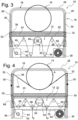
- the device 12 comprises two rotatably mounted hollow deflection shafts 32, which are each arranged between adjacent bed posts 26 of the head part 18 and the foot part 20, aligned parallel to one another and to the longitudinal sides of the bed 10 and to the bed base 22 and in relation to the bed frame 16, to the bed base 22 and to the mattress 24 controlled individually or synchronously between a lowered position ( 3 ) and a raised position ( 4 ) are height adjustable.
- Horizontal bearing journals (not visible), which protrude through the longitudinal slots 30 from the inside of the hollow bed posts 26, are used for the rotatable mounting of the deflection shafts 32.
- the bearing journals protrude into the ends of the hollow deflection shafts 32, which are mounted on the bearing journals by means of roller bearings.
- the trunnions are adjustable in height. Suitable devices for adjusting the height of the bearing journals and the shafts are in the aforementioned WO 03/096958 A1 as well as EP 0 374 784 A2 described and will therefore not be explained in more detail here. Also suitable for height adjustment are hydraulic or pneumatic cylinders, electric linear drives, spindle drives or cable, chain or belt drives, which are controlled by a controller (not shown) of the device 12 .
- the patient 14 rests on a bed sheet 36 which, in the lowered position of the two deflection shafts 32, is aligned above the mattress 24 parallel to the flat upper side thereof, as shown in FIG 3 shown, and in the raised position of the two deflection shafts 32 by the weight of the patient 14 sags between the deflection shafts 32, whereby it is also lifted off the top of the mattress 24 at the lowest point.
- the bed sheet 36 is not a conventional bed sheet whose dimensions transverse to the longitudinal axis of the bed 10 are slightly larger than the width of the mattress 24, but a bed sheet 36 whose dimensions transverse to the longitudinal axis of the bed 10 are between 10 and 20 meters amount to 10 to 20 times the mattress width.
- the bed sheet 36 is a disposable bed sheet 36 preferably made of cellulose, cotton or paper, which can be disposed of by composting or incineration after a single use .
- reusable sheets 36 can also be used, which are washed after use.
- the bed sheet 36 is wound up at one end on a supply roll 38 which is housed in the vicinity of one of the two longitudinal sides of the bed 10 in a housing 40 as an interchangeable cassette below the bed base 22 and the mattress 24 .
- the other end of the bed sheet 36 is wound onto a take-up roll 42, which is also housed in a housing 44 of an interchangeable cassette below the bed base 22 and the mattress 24 near the other of the two longitudinal sides of the bed 10 is.
- the two front ends of the housings 40, 44 of the interchangeable cassettes are detachably attached to the head part 18 and the foot part 20 of the bed 10, so that the latter can be exchanged for two new interchangeable cassettes together with the supply roll 38 and the take-up roll 42 if necessary.
- the two ends of the bed sheet 36 are releasably attached to the supply roll 38 and the take-up roll 42, so that the bed sheet 36, for example, in a service station Nursing facility can be exchanged for a new bed sheet 36, in order to then re-equip a nursing bed 10 with the interchangeable cartridges.
- the housings 40, 44 of the two interchangeable cassettes each have a base and a hinged cover. When the lid is closed, the lid together with the base defines a narrow slit-shaped opening (not shown) through which the bed sheet 36 extends into and out of the housing 40,44.
- the housing 44 of the interchangeable cassette of the take-up roll 42 contains a disinfectant with which the soiled bed sheet 36 is wetted when it enters the housing 44 in order to prevent the multiplication or spread of germs.
- the patient 14 is in the raised position of the deflection shafts 32 ( figure 2 ) carried solely by the bed sheet 36, which extends from the supply roll 38 out of the housing 40 of the interchangeable cassette over a first, elongated, rotatable deflection roller 50 arranged approximately at the height of the bed base 22, upwards to the adjacent deflection shaft 32, from there over the mattress 24 to the other deflection shaft 32 and from there downwards via a second, likewise arranged approximately at the height of the bed base 22 elongate rotatable deflection roller 52 into the housing 44 of the interchangeable cassette into the take-up roller 42.
- both the supply roll 38 and the take-up roll 42 are connected to a rotary electric drive (not shown) mounted at the head end 18 or the foot end 20 of the bed 10, respectively.
- a rotary electric drive (not shown) mounted at the head end 18 or the foot end 20 of the bed 10, respectively.
- a self-locking gear (not shown) is arranged, for example, a worm gear that rotates the supply roll 38 and the take-up roll 42 when de-energized Rotary drive blocked.
- a brake activated by the controller can be provided for the same purpose.
- the supply roller 38 and the take-up roller 42 can be driven synchronously with one another in a reversible direction of rotation for repositioning the patient 14, e.g 42,38 to be unwound and wound onto the other roll 42,38 or 38,42.
- This makes it possible to cause the patient 14 to move the bed sheet 36 lifted from the mattress 24 back and forth while lying on the bed sheet 36 above the mattress 24 in a rolling or rocking motion, as exemplified by the double-headed arrow A in 4 shown.
- the amplitude of the back and forth movement of the bed sheet 36 and thus the amplitude of the rolling or rocking movement of the patient 14 can be adjusted by means of the control by the duration of the activation of the rotary drives. By setting predetermined time intervals between successive activations, the patient 14 can be cycled automatically and without intervention on the part of the nursing staff.
- the rotary drives can be driven by the controller in the same direction of rotation synchronously with one another in order to unwind the bed sheet 36 from the supply roll 38 and wind it onto the take-up roll 42 .
- the two rotary drives are activated by the controller until the outer circumference of the take-up roller 42 and the supply roller 38 have rotated approximately by an amount corresponding to the width of the mattress 24 .
- a section of the bed sheet 36 is unwound from the supply roll 38 and wound onto the take-up roll 42, the width of which corresponds approximately to the width of the mattress 24, so that with each bed sheet change at the top of the mattress 24 a contaminated section of bed sheet 36 is replaced with an adjacent clean section.
- Both the repositioning of the patient 14, e.g. for decubitus prophylaxis, and the bed sheet change take place in the raised position of the two deflection shafts 32, in which the bed sheet 36 is lifted from the upper side of the mattress 24 and therefore there are no frictional forces between the bed sheet 36 and Mattress 24 act.
- the bed sheet 36 moves, the patient 14 rolls on it.
- both rotary drives can be driven in opposite directions of rotation or, alternatively, the bed sheet 36 can only be unwound from the supply roll 38 by driving the rotary drive of the supply roll 38, while the rotary drive of the take-up roll 42 remains de-energized and its rotation is blocked. Both measures serve to additionally provide as much bed sheet 36 above the mattress 24 during the lifting of the deflection shafts that a predetermined tensile stress in the bed sheet 36 is not exceeded.
- both rotary drives can also be driven in opposite directions of rotation or, alternatively, only the rotary drive of the take-up roll 42 can be driven, while the rotary drive of the supply roll 38 remains de-energized and its rotation is blocked. Both measures serve to wind up as much bed sheet 36 during the lowering of the deflection shafts 32 that it always remains slightly taut.
- the bed sheet 36 lies both in the raised and in the lowered position of the two deflection shafts 32 above the mattress 24 on an endless limp support 60, which extends together with the bed sheet 36 over the mattress 24, the two deflection shafts 32 and the two deflection rollers 50, 52 extends away.
- the bed sheet 36 and the support 60 each move apart, with the tubular endless support 60 being guided between the deflection rollers 50, 52 under the bed frame 22.
- the support 60 is partially guided around a central drive shaft 62 provided with a rotary drive 64 and around a plurality of deflection rollers 66 .
- the deflection rollers 66 are each arranged alternately in two superimposed levels, with the deflection rollers 66 of the upper level and the deflection rollers 66 of the lower level being able to be moved apart in order to tension the support 60 so much that it can be stretched under the weight of the patient 14 between the both deflection shafts sag by a desired amount.
- the drive shaft 62 which is wrapped around by the support 60 over an angle of more than 180 degrees, has radially projecting lug-like catches 66 at both of its ends, which are arranged at equal angular distances and which fit into opposite annular eyelets (not visible) on the head and foot edges of the support 60 intervene positively.
- the endless support 60 can be driven together with the bed sheet 60 in spite of the tensile stress in the same, either in one direction for changing the bed sheet or in alternating directions with different directions of rotation for repositioning the patient.
- the deflection rollers 66 of the upper row are rigid with the bed base 22 ( 3 ) or a cross member 68 on the underside of the bed base 22 ( 4 ) connected, while the deflection rollers 66 of the lower row are connected to a height-adjustable cross member 70.
- the deflection shafts 32 ( 3 ) for example by gas springs (not shown) pressed down on the bed post 26 and when lifting the deflection shafts 32 against the force F of the Gas springs moved upward to maintain the desired tension in the pad 60.
- the ends of the bed sheet are wound onto a supply or take-up roll 38, 42 in an exchangeable cassette.
- the dimensions of the bed sheet 36 are also the same, so that the two replacement cassettes only need to be exchanged after about 10 to 20 bed sheet changes.
- the height adjustment of the deflection shafts 32 and the devices provided for this purpose also correspond to those of the previously described embodiment.
- the bed sheet 36 need only be held by the rotary drives of the supply roll 38 and the take-up roll 42 under a slight tension sufficient to prevent wrinkling.
- the deflection shafts 32 When repositioning the patient, e.g. for decubitus prophylaxis, the deflection shafts 32 are first moved from the lowered position ( 3 ) to the raised position ( 4 ) is moved and then the rotary drives of the drive shaft 62 of the support 60, the supply roll 38 and the take-up roll 42 are alternately synchronously driven with the reverse direction of rotation. As a result, the support 60 and the bed sheet 36 are moved back and forth synchronously between the deflection shafts 32 and the patient 14 is thereby set in a rolling or rocking motion on the bed sheet 36 .
- the deflection shafts 32 are also first moved from the lowered position ( 3 ) to the raised position ( 4 ) and then the rotary drives of the drive shaft 62, the supply roll 38 and the take-up roll 42 are driven synchronously with one another with the same direction of rotation in order to wind up a section of the bed sheet 36, approximately the width of the mattress, from the supply roll 38 and onto the take-up roll and thereby onto the upper side of the mattress 24 a contaminated one Replace bed sheet 36 section with an adjacent clean section.
- both the bed sheet change and the repositioning of the patient can take place automatically and without the intervention of the nursing staff take place.
- the patient or the nursing staff can additionally or alternatively also activate the control by means of voice commands or inputs on a keyboard or a touchscreen in order to change the bed sheet or to reposition the patient.
Landscapes
- Health & Medical Sciences (AREA)
- Nursing (AREA)
- Life Sciences & Earth Sciences (AREA)
- Animal Behavior & Ethology (AREA)
- General Health & Medical Sciences (AREA)
- Public Health (AREA)
- Veterinary Medicine (AREA)
- Invalid Beds And Related Equipment (AREA)
Applications Claiming Priority (3)
| Application Number | Priority Date | Filing Date | Title |
|---|---|---|---|
| DE102019004464 | 2019-06-27 | ||
| DE102020101944.0A DE102020101944A1 (de) | 2019-06-27 | 2020-01-28 | Vorrichtung und Verfahren zum Umlagern von Patienten in einem Kranken- oder Pflegebett sowie zum Wechseln eines Bettlakens |
| PCT/DE2020/200050 WO2020259767A1 (de) | 2019-06-27 | 2020-06-17 | Vorrichtung und verfahren zum umlagern von patienten in einem kranken- oder pflegebett sowie zum wechseln eines bettlakens |
Publications (3)
| Publication Number | Publication Date |
|---|---|
| EP3989901A1 EP3989901A1 (de) | 2022-05-04 |
| EP3989901C0 EP3989901C0 (de) | 2023-07-19 |
| EP3989901B1 true EP3989901B1 (de) | 2023-07-19 |
Family
ID=73747293
Family Applications (1)
| Application Number | Title | Priority Date | Filing Date |
|---|---|---|---|
| EP20739260.6A Active EP3989901B1 (de) | 2019-06-27 | 2020-06-17 | Vorrichtung und verfahren zum umlagern von patienten in einem kranken- oder pflegebett sowie zum wechseln eines bettlakens |
Country Status (6)
| Country | Link |
|---|---|
| EP (1) | EP3989901B1 (pl) |
| DE (1) | DE102020101944A1 (pl) |
| ES (1) | ES2961915T3 (pl) |
| HU (1) | HUE064758T2 (pl) |
| PL (1) | PL3989901T3 (pl) |
| WO (1) | WO2020259767A1 (pl) |
Families Citing this family (11)
| Publication number | Priority date | Publication date | Assignee | Title |
|---|---|---|---|---|
| CN115154082A (zh) * | 2021-04-07 | 2022-10-11 | 上海尊颐智能科技有限公司 | 护理床 |
| CN113101088B (zh) * | 2021-04-13 | 2022-04-22 | 皖南医学院第一附属医院(皖南医学院弋矶山医院) | 一种病人用免抬式床单快速自动更换装置 |
| CN114053058B (zh) * | 2021-11-19 | 2023-12-05 | 深圳大因医疗科技有限公司 | 一种护理床单自动铺设机构及护理床 |
| CN114343990A (zh) * | 2021-12-21 | 2022-04-15 | 浙江宏健康复科技发展有限公司 | 一种医用翻身床 |
| CN114099175A (zh) * | 2021-12-30 | 2022-03-01 | 李影 | 一种背部烧伤护理用辅助翻身装置 |
| CN114587818B (zh) * | 2022-03-30 | 2023-11-10 | 贵州省建筑医院 | 可自动辅助翻身的护理床 |
| CN114886265B (zh) * | 2022-06-30 | 2023-11-03 | 慕思健康睡眠股份有限公司 | 一种床单夹持装置及床架 |
| CN115487010B (zh) * | 2022-08-29 | 2023-08-22 | 中国人民解放军空军军医大学 | 一种骨科患者用辅助提升护理床 |
| CN116270059A (zh) * | 2023-02-14 | 2023-06-23 | 中国人民解放军西部战区总医院 | 一种方便更换床被的病床 |
| CN118542791B (zh) * | 2024-06-07 | 2024-12-13 | 青岛大学附属医院 | 一种可移动的防感染隔离设备 |
| CN120420169A (zh) * | 2025-05-08 | 2025-08-05 | 中国人民解放军空军特色医学中心 | 一种方便患者翻身的治疗护理装置 |
Family Cites Families (6)
| Publication number | Priority date | Publication date | Assignee | Title |
|---|---|---|---|---|
| FR371791A (fr) * | 1906-11-24 | 1907-03-15 | Jean Clostre | Perfectionnements aux lits pour malades |
| GB2130482B (en) * | 1982-10-12 | 1986-04-16 | Edward Thipthorpe Ruse | A bed for a disabled patient |
| IT1225494B (it) | 1988-12-23 | 1990-11-20 | Italpres Snc Di Fregni & C | Apparecchiatura per prevenire la formazione e curare le piaghe da decubito in pazienti lungodegenti |
| DK1505935T3 (en) | 2002-05-17 | 2014-03-10 | H C Equipment Aps | Decor and bed for turning horizontal people |
| US20170056263A1 (en) * | 2013-03-14 | 2017-03-02 | Ultimate Comfort N Care Products Llc | Hospital bed with apparatus capable of automatically changing bed sheets without disturbing occupied person, also a method of preventing and relieving ulcers |
| CN106361515B (zh) * | 2016-09-06 | 2018-11-23 | 上海电机学院 | 一种可自动升降的换床单装置 |
-
2020
- 2020-01-28 DE DE102020101944.0A patent/DE102020101944A1/de active Pending
- 2020-06-17 EP EP20739260.6A patent/EP3989901B1/de active Active
- 2020-06-17 HU HUE20739260A patent/HUE064758T2/hu unknown
- 2020-06-17 ES ES20739260T patent/ES2961915T3/es active Active
- 2020-06-17 PL PL20739260.6T patent/PL3989901T3/pl unknown
- 2020-06-17 WO PCT/DE2020/200050 patent/WO2020259767A1/de not_active Ceased
Also Published As
| Publication number | Publication date |
|---|---|
| ES2961915T3 (es) | 2024-03-14 |
| PL3989901T4 (pl) | 2024-02-26 |
| EP3989901C0 (de) | 2023-07-19 |
| EP3989901A1 (de) | 2022-05-04 |
| PL3989901T3 (pl) | 2024-02-26 |
| HUE064758T2 (hu) | 2024-04-28 |
| DE102020101944A1 (de) | 2020-12-31 |
| WO2020259767A1 (de) | 2020-12-30 |
Similar Documents
| Publication | Publication Date | Title |
|---|---|---|
| EP3989901B1 (de) | Vorrichtung und verfahren zum umlagern von patienten in einem kranken- oder pflegebett sowie zum wechseln eines bettlakens | |
| AT391617B (de) | Bett, insbesondere krankenhausbett | |
| US3593351A (en) | Patient transfer device | |
| DE2458953C3 (de) | Lagerstatt und Tragbahre für Kranke oder Verletzte | |
| DE69421817T2 (de) | Krankenbett | |
| DE3448420C2 (de) | Vorrichtung zum Verlagern von Gegenst{nden oder Personen | |
| DE2626638C2 (pl) | ||
| DE102016220175A1 (de) | Umlagervorrichtung und Pflegebettanordnung mit einer solchen | |
| DE19506726C2 (de) | Krankenbett mit integrierter Toilette | |
| EP0026183B1 (de) | Krankenbett | |
| EP0708630B1 (de) | Hilfsvorrichtung für bett | |
| WO2014147003A1 (de) | Bett mit hebbarer und drehbarer matratze | |
| CH686658A5 (de) | Transporteinrichtung fuer den Bade- und Duschbetrieb, insbesondere fuer Koerperbehinderte. | |
| EP0875228A2 (de) | Vorrichtung zum Hochziehen von bettlägerigen Personen sowie Verfahren zum Hochziehen bettlägeriger Personen unter Verwendung einer solchen Vorrichtung | |
| RU2808025C2 (ru) | Устройство и способ для перекладывания пациента на больничной койке или на медицинской функциональной кровати, а также для замены простыни | |
| DE1466914B2 (de) | Patientenlagerstatt fuer roentgenuntersuchungsgeraete | |
| DE3434663C2 (de) | Badewanne mit einer in das Badewasser eintauchbaren Liege für den Badenden | |
| WO2006114389A1 (de) | Vorrichtung zum beziehen einer auflagefläche | |
| DE3430515A1 (de) | Vorrichtung zum heben und senken eines bettgestelles | |
| EP0012998A1 (de) | Abdeckvorrichtung für Schwimmbecken | |
| DE2002241C3 (de) | Krankenhausbett | |
| DE1466914C3 (de) | Patientenlagerstatt für Röntgenuntersuchungsgeräte | |
| DE3619837A1 (de) | Hebegeraet fuer die pflege von bettlaegerigen personen | |
| DE2502882A1 (de) | Verfahren und vorrichtung zum regulieren des weges einer laufenden bahn | |
| DE4123950C1 (en) | Hospital bed with top frame for patient's support - has inverted U=shaped brake, whose web carries linear motor via horizontal swivel axis |
Legal Events
| Date | Code | Title | Description |
|---|---|---|---|
| STAA | Information on the status of an ep patent application or granted ep patent |
Free format text: STATUS: UNKNOWN |
|
| STAA | Information on the status of an ep patent application or granted ep patent |
Free format text: STATUS: THE INTERNATIONAL PUBLICATION HAS BEEN MADE |
|
| PUAI | Public reference made under article 153(3) epc to a published international application that has entered the european phase |
Free format text: ORIGINAL CODE: 0009012 |
|
| STAA | Information on the status of an ep patent application or granted ep patent |
Free format text: STATUS: REQUEST FOR EXAMINATION WAS MADE |
|
| 17P | Request for examination filed |
Effective date: 20220127 |
|
| AK | Designated contracting states |
Kind code of ref document: A1 Designated state(s): AL AT BE BG CH CY CZ DE DK EE ES FI FR GB GR HR HU IE IS IT LI LT LU LV MC MK MT NL NO PL PT RO RS SE SI SK SM TR |
|
| DAV | Request for validation of the european patent (deleted) | ||
| DAX | Request for extension of the european patent (deleted) | ||
| RAP3 | Party data changed (applicant data changed or rights of an application transferred) |
Owner name: WINTERSOHL, DANIEL |
|
| RIN1 | Information on inventor provided before grant (corrected) |
Inventor name: WINTERSOHL, DANIEL |
|
| GRAP | Despatch of communication of intention to grant a patent |
Free format text: ORIGINAL CODE: EPIDOSNIGR1 |
|
| STAA | Information on the status of an ep patent application or granted ep patent |
Free format text: STATUS: GRANT OF PATENT IS INTENDED |
|
| INTG | Intention to grant announced |
Effective date: 20230201 |
|
| GRAS | Grant fee paid |
Free format text: ORIGINAL CODE: EPIDOSNIGR3 |
|
| GRAA | (expected) grant |
Free format text: ORIGINAL CODE: 0009210 |
|
| STAA | Information on the status of an ep patent application or granted ep patent |
Free format text: STATUS: THE PATENT HAS BEEN GRANTED |
|
| AK | Designated contracting states |
Kind code of ref document: B1 Designated state(s): AL AT BE BG CH CY CZ DE DK EE ES FI FR GB GR HR HU IE IS IT LI LT LU LV MC MK MT NL NO PL PT RO RS SE SI SK SM TR |
|
| REG | Reference to a national code |
Ref country code: GB Ref legal event code: FG4D Free format text: NOT ENGLISH |
|
| REG | Reference to a national code |
Ref country code: CH Ref legal event code: EP |
|
| REG | Reference to a national code |
Ref country code: DE Ref legal event code: R096 Ref document number: 502020004280 Country of ref document: DE |
|
| REG | Reference to a national code |
Ref country code: IE Ref legal event code: FG4D Free format text: LANGUAGE OF EP DOCUMENT: GERMAN |
|
| U01 | Request for unitary effect filed |
Effective date: 20230817 |
|
| U07 | Unitary effect registered |
Designated state(s): AT BE BG DE DK EE FI FR IT LT LU LV MT NL PT SE SI Effective date: 20230825 |
|
| REG | Reference to a national code |
Ref country code: LT Ref legal event code: MG9D |
|
| REG | Reference to a national code |
Ref country code: NO Ref legal event code: T2 Effective date: 20230719 |
|
| REG | Reference to a national code |
Ref country code: GR Ref legal event code: EP Ref document number: 20230401940 Country of ref document: GR Effective date: 20231211 |
|
| PG25 | Lapsed in a contracting state [announced via postgrant information from national office to epo] |
Ref country code: IS Free format text: LAPSE BECAUSE OF FAILURE TO SUBMIT A TRANSLATION OF THE DESCRIPTION OR TO PAY THE FEE WITHIN THE PRESCRIBED TIME-LIMIT Effective date: 20231119 |
|
| PG25 | Lapsed in a contracting state [announced via postgrant information from national office to epo] |
Ref country code: RS Free format text: LAPSE BECAUSE OF FAILURE TO SUBMIT A TRANSLATION OF THE DESCRIPTION OR TO PAY THE FEE WITHIN THE PRESCRIBED TIME-LIMIT Effective date: 20230719 Ref country code: IS Free format text: LAPSE BECAUSE OF FAILURE TO SUBMIT A TRANSLATION OF THE DESCRIPTION OR TO PAY THE FEE WITHIN THE PRESCRIBED TIME-LIMIT Effective date: 20231119 Ref country code: HR Free format text: LAPSE BECAUSE OF FAILURE TO SUBMIT A TRANSLATION OF THE DESCRIPTION OR TO PAY THE FEE WITHIN THE PRESCRIBED TIME-LIMIT Effective date: 20230719 |
|
| REG | Reference to a national code |
Ref country code: ES Ref legal event code: FG2A Ref document number: 2961915 Country of ref document: ES Kind code of ref document: T3 Effective date: 20240314 |
|
| REG | Reference to a national code |
Ref country code: DE Ref legal event code: R097 Ref document number: 502020004280 Country of ref document: DE |
|
| REG | Reference to a national code |
Ref country code: HU Ref legal event code: AG4A Ref document number: E064758 Country of ref document: HU |
|
| PG25 | Lapsed in a contracting state [announced via postgrant information from national office to epo] |
Ref country code: SM Free format text: LAPSE BECAUSE OF FAILURE TO SUBMIT A TRANSLATION OF THE DESCRIPTION OR TO PAY THE FEE WITHIN THE PRESCRIBED TIME-LIMIT Effective date: 20230719 Ref country code: RO Free format text: LAPSE BECAUSE OF FAILURE TO SUBMIT A TRANSLATION OF THE DESCRIPTION OR TO PAY THE FEE WITHIN THE PRESCRIBED TIME-LIMIT Effective date: 20230719 Ref country code: CZ Free format text: LAPSE BECAUSE OF FAILURE TO SUBMIT A TRANSLATION OF THE DESCRIPTION OR TO PAY THE FEE WITHIN THE PRESCRIBED TIME-LIMIT Effective date: 20230719 Ref country code: SK Free format text: LAPSE BECAUSE OF FAILURE TO SUBMIT A TRANSLATION OF THE DESCRIPTION OR TO PAY THE FEE WITHIN THE PRESCRIBED TIME-LIMIT Effective date: 20230719 |
|
| PLBE | No opposition filed within time limit |
Free format text: ORIGINAL CODE: 0009261 |
|
| STAA | Information on the status of an ep patent application or granted ep patent |
Free format text: STATUS: NO OPPOSITION FILED WITHIN TIME LIMIT |
|
| 26N | No opposition filed |
Effective date: 20240422 |
|
| U21 | Renewal fee for the european patent with unitary effect paid with additional fee |
Year of fee payment: 5 Effective date: 20241111 |
|
| PGFP | Annual fee paid to national office [announced via postgrant information from national office to epo] |
Ref country code: NO Payment date: 20241216 Year of fee payment: 5 |
|
| PGFP | Annual fee paid to national office [announced via postgrant information from national office to epo] |
Ref country code: PL Payment date: 20241211 Year of fee payment: 5 |
|
| PG25 | Lapsed in a contracting state [announced via postgrant information from national office to epo] |
Ref country code: MC Free format text: LAPSE BECAUSE OF FAILURE TO SUBMIT A TRANSLATION OF THE DESCRIPTION OR TO PAY THE FEE WITHIN THE PRESCRIBED TIME-LIMIT Effective date: 20230719 |
|
| PG25 | Lapsed in a contracting state [announced via postgrant information from national office to epo] |
Ref country code: IE Free format text: LAPSE BECAUSE OF NON-PAYMENT OF DUE FEES Effective date: 20240617 |
|
| PGFP | Annual fee paid to national office [announced via postgrant information from national office to epo] |
Ref country code: TR Payment date: 20241210 Year of fee payment: 5 |
|
| PG25 | Lapsed in a contracting state [announced via postgrant information from national office to epo] |
Ref country code: CY Free format text: LAPSE BECAUSE OF FAILURE TO SUBMIT A TRANSLATION OF THE DESCRIPTION OR TO PAY THE FEE WITHIN THE PRESCRIBED TIME-LIMIT; INVALID AB INITIO Effective date: 20200617 |
|
| REG | Reference to a national code |
Ref country code: CH Ref legal event code: U11 Free format text: ST27 STATUS EVENT CODE: U-0-0-U10-U11 (AS PROVIDED BY THE NATIONAL OFFICE) Effective date: 20251230 |
|
| PGFP | Annual fee paid to national office [announced via postgrant information from national office to epo] |
Ref country code: GB Payment date: 20251230 Year of fee payment: 6 |
|
| PGFP | Annual fee paid to national office [announced via postgrant information from national office to epo] |
Ref country code: GR Payment date: 20251230 Year of fee payment: 6 |
|
| PGFP | Annual fee paid to national office [announced via postgrant information from national office to epo] |
Ref country code: CH Payment date: 20251230 Year of fee payment: 6 |
|
| PGFP | Annual fee paid to national office [announced via postgrant information from national office to epo] |
Ref country code: ES Payment date: 20251230 Year of fee payment: 6 |
|
| U21 | Renewal fee for the european patent with unitary effect paid with additional fee |
Year of fee payment: 6 Effective date: 20251230 |
|
| PGFP | Annual fee paid to national office [announced via postgrant information from national office to epo] |
Ref country code: HU Payment date: 20260109 Year of fee payment: 6 |