EP3982016A1 - Dichtungsvorrichtung - Google Patents
Dichtungsvorrichtung Download PDFInfo
- Publication number
- EP3982016A1 EP3982016A1 EP20818041.4A EP20818041A EP3982016A1 EP 3982016 A1 EP3982016 A1 EP 3982016A1 EP 20818041 A EP20818041 A EP 20818041A EP 3982016 A1 EP3982016 A1 EP 3982016A1
- Authority
- EP
- European Patent Office
- Prior art keywords
- periphery side
- outer periphery
- elastic body
- inner periphery
- sealing device
- Prior art date
- Legal status (The legal status is an assumption and is not a legal conclusion. Google has not performed a legal analysis and makes no representation as to the accuracy of the status listed.)
- Pending
Links
- 238000007789 sealing Methods 0.000 title claims abstract description 94
- 230000002787 reinforcement Effects 0.000 claims abstract description 66
- 238000004073 vulcanization Methods 0.000 claims abstract description 11
- 239000000463 material Substances 0.000 abstract description 14
- 229920001971 elastomer Polymers 0.000 abstract description 13
- 239000000428 dust Substances 0.000 description 22
- 238000004132 cross linking Methods 0.000 description 4
- 230000002093 peripheral effect Effects 0.000 description 4
- 229920000800 acrylic rubber Polymers 0.000 description 2
- 238000010276 construction Methods 0.000 description 2
- 230000000694 effects Effects 0.000 description 2
- 229920001973 fluoroelastomer Polymers 0.000 description 2
- 238000005242 forging Methods 0.000 description 2
- 239000002184 metal Substances 0.000 description 2
- 238000000465 moulding Methods 0.000 description 2
- 229920000058 polyacrylate Polymers 0.000 description 2
- 238000005245 sintering Methods 0.000 description 2
- 239000002904 solvent Substances 0.000 description 2
- 239000000725 suspension Substances 0.000 description 2
- 230000008961 swelling Effects 0.000 description 2
- 240000007594 Oryza sativa Species 0.000 description 1
- 235000007164 Oryza sativa Nutrition 0.000 description 1
- 239000000470 constituent Substances 0.000 description 1
- 230000009545 invasion Effects 0.000 description 1
- 239000000314 lubricant Substances 0.000 description 1
- 235000009566 rice Nutrition 0.000 description 1
Images

Classifications
-
- F—MECHANICAL ENGINEERING; LIGHTING; HEATING; WEAPONS; BLASTING
- F16—ENGINEERING ELEMENTS AND UNITS; GENERAL MEASURES FOR PRODUCING AND MAINTAINING EFFECTIVE FUNCTIONING OF MACHINES OR INSTALLATIONS; THERMAL INSULATION IN GENERAL
- F16J—PISTONS; CYLINDERS; SEALINGS
- F16J15/00—Sealings
- F16J15/16—Sealings between relatively-moving surfaces
- F16J15/164—Sealings between relatively-moving surfaces the sealing action depending on movements; pressure difference, temperature or presence of leaking fluid
-
- F—MECHANICAL ENGINEERING; LIGHTING; HEATING; WEAPONS; BLASTING
- F16—ENGINEERING ELEMENTS AND UNITS; GENERAL MEASURES FOR PRODUCING AND MAINTAINING EFFECTIVE FUNCTIONING OF MACHINES OR INSTALLATIONS; THERMAL INSULATION IN GENERAL
- F16J—PISTONS; CYLINDERS; SEALINGS
- F16J15/00—Sealings
- F16J15/16—Sealings between relatively-moving surfaces
- F16J15/32—Sealings between relatively-moving surfaces with elastic sealings, e.g. O-rings
- F16J15/3204—Sealings between relatively-moving surfaces with elastic sealings, e.g. O-rings with at least one lip
- F16J15/3232—Sealings between relatively-moving surfaces with elastic sealings, e.g. O-rings with at least one lip having two or more lips
-
- F—MECHANICAL ENGINEERING; LIGHTING; HEATING; WEAPONS; BLASTING
- F16—ENGINEERING ELEMENTS AND UNITS; GENERAL MEASURES FOR PRODUCING AND MAINTAINING EFFECTIVE FUNCTIONING OF MACHINES OR INSTALLATIONS; THERMAL INSULATION IN GENERAL
- F16J—PISTONS; CYLINDERS; SEALINGS
- F16J15/00—Sealings
- F16J15/16—Sealings between relatively-moving surfaces
- F16J15/32—Sealings between relatively-moving surfaces with elastic sealings, e.g. O-rings
- F16J15/3204—Sealings between relatively-moving surfaces with elastic sealings, e.g. O-rings with at least one lip
-
- F—MECHANICAL ENGINEERING; LIGHTING; HEATING; WEAPONS; BLASTING
- F16—ENGINEERING ELEMENTS AND UNITS; GENERAL MEASURES FOR PRODUCING AND MAINTAINING EFFECTIVE FUNCTIONING OF MACHINES OR INSTALLATIONS; THERMAL INSULATION IN GENERAL
- F16J—PISTONS; CYLINDERS; SEALINGS
- F16J15/00—Sealings
- F16J15/16—Sealings between relatively-moving surfaces
- F16J15/32—Sealings between relatively-moving surfaces with elastic sealings, e.g. O-rings
- F16J15/3204—Sealings between relatively-moving surfaces with elastic sealings, e.g. O-rings with at least one lip
- F16J15/3224—Sealings between relatively-moving surfaces with elastic sealings, e.g. O-rings with at least one lip capable of accommodating changes in distances or misalignment between the surfaces, e.g. able to compensate for defaults of eccentricity or angular deviations
-
- F—MECHANICAL ENGINEERING; LIGHTING; HEATING; WEAPONS; BLASTING
- F16—ENGINEERING ELEMENTS AND UNITS; GENERAL MEASURES FOR PRODUCING AND MAINTAINING EFFECTIVE FUNCTIONING OF MACHINES OR INSTALLATIONS; THERMAL INSULATION IN GENERAL
- F16J—PISTONS; CYLINDERS; SEALINGS
- F16J15/00—Sealings
- F16J15/16—Sealings between relatively-moving surfaces
- F16J15/32—Sealings between relatively-moving surfaces with elastic sealings, e.g. O-rings
- F16J15/3248—Sealings between relatively-moving surfaces with elastic sealings, e.g. O-rings provided with casings or supports
- F16J15/3252—Sealings between relatively-moving surfaces with elastic sealings, e.g. O-rings provided with casings or supports with rigid casings or supports
- F16J15/3256—Sealings between relatively-moving surfaces with elastic sealings, e.g. O-rings provided with casings or supports with rigid casings or supports comprising two casing or support elements, one attached to each surface, e.g. cartridge or cassette seals
- F16J15/3264—Sealings between relatively-moving surfaces with elastic sealings, e.g. O-rings provided with casings or supports with rigid casings or supports comprising two casing or support elements, one attached to each surface, e.g. cartridge or cassette seals the elements being separable from each other
-
- F—MECHANICAL ENGINEERING; LIGHTING; HEATING; WEAPONS; BLASTING
- F16—ENGINEERING ELEMENTS AND UNITS; GENERAL MEASURES FOR PRODUCING AND MAINTAINING EFFECTIVE FUNCTIONING OF MACHINES OR INSTALLATIONS; THERMAL INSULATION IN GENERAL
- F16J—PISTONS; CYLINDERS; SEALINGS
- F16J15/00—Sealings
- F16J15/16—Sealings between relatively-moving surfaces
- F16J15/32—Sealings between relatively-moving surfaces with elastic sealings, e.g. O-rings
- F16J15/3268—Mounting of sealing rings
- F16J15/3276—Mounting of sealing rings with additional static sealing between the sealing, or its casing or support, and the surface on which it is mounted
-
- F—MECHANICAL ENGINEERING; LIGHTING; HEATING; WEAPONS; BLASTING
- F16—ENGINEERING ELEMENTS AND UNITS; GENERAL MEASURES FOR PRODUCING AND MAINTAINING EFFECTIVE FUNCTIONING OF MACHINES OR INSTALLATIONS; THERMAL INSULATION IN GENERAL
- F16J—PISTONS; CYLINDERS; SEALINGS
- F16J15/00—Sealings
- F16J15/16—Sealings between relatively-moving surfaces
- F16J15/32—Sealings between relatively-moving surfaces with elastic sealings, e.g. O-rings
- F16J15/328—Manufacturing methods specially adapted for elastic sealings
-
- F—MECHANICAL ENGINEERING; LIGHTING; HEATING; WEAPONS; BLASTING
- F16—ENGINEERING ELEMENTS AND UNITS; GENERAL MEASURES FOR PRODUCING AND MAINTAINING EFFECTIVE FUNCTIONING OF MACHINES OR INSTALLATIONS; THERMAL INSULATION IN GENERAL
- F16J—PISTONS; CYLINDERS; SEALINGS
- F16J15/00—Sealings
- F16J15/16—Sealings between relatively-moving surfaces
- F16J15/32—Sealings between relatively-moving surfaces with elastic sealings, e.g. O-rings
- F16J15/3284—Sealings between relatively-moving surfaces with elastic sealings, e.g. O-rings characterised by their structure; Selection of materials
Definitions
- the present invention relates to a sealing device.
- a sealing device including a plurality of relatively rotatable members has been widely used.
- a sealing device including: one of two relatively rotatable members, for example, a slinger fixed to a rotating shaft; and the other of the two relatively rotatable members, for example, a sealing device main body fixed to an inner periphery side surface of a shaft hole of a housing (for example, see Patent Literature 1).
- Such a sealing device is used to seal a lubricant or the like in an internal space of a vehicle, a general-purpose machine, or the like.
- the slinger is provided with a flange, and this flange prevents or reduces invasion of dirt and dust from the atmosphere side to the internal space side. Therefore, such a sealing device is used in an environment full of dirt or dust, for example, a truck of a railroad vehicle, a truck of a sintering pallet, a construction machine, a trunnion-type suspension of a truck, and an agricultural machine.
- Patent Literature 1 Japanese Patent No. 4978074
- the sealing device main body of such a sealing device includes: an annular reinforcement ring; and an elastic body part made of a rubber material that is formed so as to cover the reinforcement ring integrally therewith.
- the reinforcement ring, the elastic body part is bonded to the reinforcement ring by cross-linking adhesion, whereby the elastic body part is formed integrally with the reinforcement ring.
- holes for improving the adhesion force between the elastic body part and the reinforcement ring are provided at regular intervals in the reinforcement ring, and the inside of each hole is filled with a rubber material.
- grooves formed by holding the reinforcement ring at the time of the cross-linking adhesion are provided at regular intervals on an internal space side surface of the elastic body part.
- the conventional sealing device is required to have a structure in which the occurrence of such a through crack in the rubber material of the elastic body part can be further suppressed.
- the present invention has been made in view of the above-mentioned problem, and it is an object of the present invention to provide a sealing device in which the occurrence of a through crack in a rubber material of an elastic body part can be further suppressed.
- a sealing device is a sealing device that seals a gap between: an annular outer periphery side member; and an annular inner periphery side member at least partially surrounded by the outer periphery side member, the outer periphery side member and the inner periphery side member being relatively rotatable to each other with respect to an axis, the sealing device being characterized by including: a sealing device main body to be attached to the outer periphery side member; and a slinger to be attached to the inner periphery side member, wherein the sealing device main body includes: an annular reinforcement ring centered on the axis; and an annular elastic body part that is made of an elastic body attached to the reinforcement ring and is centered on the axis, a through hole that passes through a portion between an internal space side surface and an atmosphere side surface of the reinforcement ring is formed in the reinforcement ring, a positioning part for fixing a position of the reinforcement ring at
- a thickness of the elastic body part formed on an atmosphere side of the reinforcement ring is thicker than a thickness of the elastic body part formed on an internal space side of the reinforcement ring.
- the positioning part is an annular groove part that is formed on an outer periphery side and/or an inner periphery side of the through hole and is concave from an internal space side to an atmosphere side.
- a sealing device of the present invention the occurrence of a through crack in a rubber material of an elastic body part can be further suppressed.
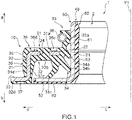
- Fig. 1 is a sectional view for showing a schematic configuration of a sealing device 1 according to the embodiment of the present invention.
- Fig. 2 is an enlarged sectional view for showing a schematic configuration of the vicinity of a through hole 24 and a positioning part 36 of the sealing device 1.
- Figs. 1 and 2 only a one-side portion of the sealing device 1 is shown.
- the sealing device 1 is used in an environment full of dirt or dust, for example, a truck of a railroad vehicle, a truck of a sintering pallet, a construction machine, a trunnion-type suspension of a truck, and an agricultural machine (such as a tiller, a tractor, and a rice transplanter).
- the sealing device 1 has a role in sealing a gap between: an annular outer periphery side member; and an annular inner periphery side member at least partially surrounded by the outer periphery side member, the outer periphery side member and the inner periphery side member being relatively rotatable to each other.
- the target to which the sealing device 1 is applied is not limited to the above.
- the sealing device 1 is a sealing device that seals a gap between: an annular outer periphery side member 101; and an annular inner periphery side member 102 at least partially surrounded by the outer periphery side member 101, the outer periphery side member 101 and the inner periphery side member 102 being relatively rotatable to each other with respect to an axis Y1.
- the sealing device 1 includes: a sealing device main body 10 to be attached to the outer periphery side member 101; and a slinger 40 to be attached to the inner periphery side member 102.
- the sealing device main body 10 includes: an annular reinforcement ring 20 centered on the axis Y1; and an annular elastic body part 30 that is made of an elastic body attached to the reinforcement ring 20 and is centered on the axis Y1.
- the through hole 24 that passes through a portion between an internal space side surface and an atmosphere side surface of the reinforcement ring 20 is formed in the reinforcement ring 20, and the positioning part 36 for fixing the position of the reinforcement ring 20 at the time of vulcanization is formed on an internal space side surface of the elastic body part 30.
- the through hole 24 and the positioning part 36 are formed at positions separated in the radial direction.
- a configuration of the sealing device 1 will be specifically described.
- one (an arrow a direction) of the directions of the axis Y1 (hereinafter, also referred to as the axis Y1 direction) corresponding to the axis of the sealing device 1 in Figs. 1 and 2 is defined as the internal space side, and another (an arrow b direction) thereof is defined as the atmosphere side.
- one (an arrow c direction) of the extending directions orthogonal to the axis Y1 (hereinafter, also referred to as the radial direction) of the sealing device 1 in Figs. 1 and 2 is defined as the inner periphery side, and another (an arrow d direction) thereof is defined as the outer periphery side.
- the positional relation and the direction of each member in the following description respectively represent the positional relation and the direction thereof in the drawings, and do not represent the positional relation and the direction thereof when each member is incorporated in an actual vehicle or the like.
- the outer shape of the sealing device 1 is formed in a circular or substantially circular shape around the axis Y1, and a cylindrical or substantially cylindrical opening part 2 is formed in a central portion of the sealing device 1.
- the sealing device 1 includes: the sealing device main body 10 having a circular or substantially circular shape around the axis Y1; and the slinger 40 that is formed on the inner periphery side of the sealing device main body 10 and has a cylindrical or substantially cylindrical shape around the axis Y1.
- the outer shape of the sealing device main body 10 is formed in a circular or substantially circular shape around the axis Y1.
- the sealing device main body 10 includes: the reinforcement ring 20 having a circular or substantially cylindrical shape around the axis Y1; and the elastic body part 30 that is formed by an elastic body molded integrally with the reinforcement ring 20 and has a circular or substantially circular shape around the axis Y1.
- the elastic body of the elastic body part 30 is, for example, a rubber material such as fluororubber and acrylic rubber.
- the reinforcement ring 20 is made of, for example, metal, and is produced by press working and forging, and the elastic body part 30 is molded by cross-linking (vulcanization) molding using a mold.
- the reinforcement ring 20 includes: a tubular part 21; an annular inner periphery side flange part 22 that extends to the inner periphery side from an internal space side end portion corresponding to an end portion on the internal space side of the tubular part 21; and an annular outer periphery side flange part 23 that extends to the outer periphery side from an atmosphere side end portion corresponding to an end portion on the atmosphere side of the tubular part 21.
- the tubular part 21 extends parallel or substantially parallel to the axis Y1 direction, and is formed in a cylindrical or substantially cylindrical shape around the axis Y1.
- the internal space side end portion, the atmosphere side end portion, an inner periphery side surface, and an outer periphery side surface of the tubular part 21 are buried in the elastic body part 30.
- the inner periphery side flange part 22 is a flange part that extends parallel or substantially parallel to the radial direction, extends to the inner periphery side from the internal space side end portion of the tubular part 21, and has a circular or substantially circular shape around the axis Y1.
- An internal space side surface, an atmosphere side surface, an inner periphery side end portion, and an outer periphery side end portion (the internal space side end portion of the tubular part 21) of the inner periphery side flange part 22 are buried in the elastic body part 30.
- the through hole 24 that passes through a portion between the internal space side surface and the atmosphere side surface of the inner periphery side flange part 22 of the reinforcement ring 20 is formed in a central portion in the radial direction of the inner periphery side flange part 22.
- the through hole 24 is formed in, for example, a cylindrical or substantially cylindrical shape, and a plurality (for example, eight) of the through holes 24 are formed at equal angular intervals or substantially equal angular intervals concentrically or substantially concentrically from the axis Y1.
- the diameter of the through hole 24 is, for example, 3 mm, and the through hole 24 is filled with the elastic body of the elastic body part 30.
- the outer periphery side flange part 23 is a flange part that extends parallel or substantially parallel to the radial direction, extends to the outer periphery side from the atmosphere side end portion of the tubular part 21, and has a circular or substantially circular shape around the axis Y1.
- An inner periphery side end portion (the atmosphere side end portion of the tubular part 21) and an atmosphere side surface of the outer periphery side flange part 23 are buried in the elastic body part 30, and a large portion of an outer periphery side end portion and an internal space side surface of the outer periphery side flange part 23 are exposed from the elastic body part 30.
- the elastic body part 30 includes an internal space side elastic body part 31, an atmosphere side elastic body part 32, a seal lip part 33, and a dust lip part 34.
- the internal space side elastic body part 31 includes: an outer periphery side portion 31d that extends parallel or substantially parallel to the axis Y1 direction and is formed in a cylindrical or substantially cylindrical shape around the axis Y1; and an internal space side portion 31a that extends parallel or substantially parallel to the radial direction, extends to the outer periphery side from an internal space side end portion of the outer periphery side portion 31d, and has a circular or substantially circular shape around the axis Y1.
- the internal space side elastic body part 31 covers the outer periphery side surface of the tubular part 21, the internal space side end portion of the tubular part 21 (the outer periphery side end portion of the inner periphery side flange part 22), and the internal space side surface of the inner periphery side flange part 22.
- the internal space side elastic body part 31 includes an outer periphery side lip part 35 that extends to the outer periphery side from the outer periphery side portion 31d and has a circular or substantially circular shape around the axis Y1.
- the positioning part 36 for fixing the position of the reinforcement ring 20 at the time of vulcanization is formed in the internal space side portion 31a of the internal space side elastic body part 31.
- the positioning part 36 is an annular groove part that is formed on the outer periphery side and/or the inner periphery side of the through hole 24 and is concave from the internal space side to the atmosphere side.
- the positioning part 36 includes an inner periphery side positioning part 36c and an outer periphery side positioning part 36d.
- the inner periphery side positioning part 36c is a groove part that is rectangular or substantially rectangular in a cross-section view and is concave from an internal space side surface 31aa of the internal space side portion 31a of the internal space side elastic body part 31 toward the internal space side surface of the inner periphery side flange part 22 of the reinforcement ring 20, on the inner periphery side of the through hole 24.
- the inner periphery side positioning part 36c is a circumferential groove that is formed in a bottomed cylindrical or substantially bottomed cylindrical shape around the axis Y1.
- the inner periphery side positioning part 36c has a circular or substantially circular bottom surface 36ct that extends parallel or substantially parallel to the radial direction, at a position having a predetermined depth on the atmosphere side from the internal space side surface 31aa of the internal space side portion 31a of the inner periphery side positioning part 36c.
- the bottom surface 36ct does not reach the internal space side surface of the inner periphery side flange part 22 of the reinforcement ring 20, and defines the boundary on the atmosphere side of the inner periphery side positioning part 36c.
- An inner periphery side surface 36cc is formed on the inner periphery side of the bottom surface 36ct of the inner periphery side positioning part 36c, and an outer periphery side surface 36cd is formed on the outer periphery side of the bottom surface 36ct of the inner periphery side positioning part 36c.
- the inner periphery side surface 36cc of the inner periphery side positioning part 36c is a surface that defines the boundary on the inner periphery side of the inner periphery side positioning part 36c
- the outer periphery side surface 36cd of the inner periphery side positioning part 36c is a surface that defines the boundary on the outer periphery side of the inner periphery side positioning part 36c.
- the inner periphery side surface 36cc of the inner periphery side positioning part 36c is a cylindrical or substantially cylindrical surface that extends along the axis Y1 direction and extends toward the internal space side from the edge on the inner periphery side of the bottom surface 36ct with the axis Y1 being centered.
- the outer periphery side surface 36cd of the inner periphery side positioning part 36c is a cylindrical or substantially cylindrical surface that extends along the axis Y1 direction toward the internal space side from the edge on the outer periphery side of the bottom surface 36ct with the axis Y1 being centered.
- the outer periphery side positioning part 36d is a groove part that is rectangular or substantially rectangular in a cross-section view and is concave from the internal space side surface 31aa of the internal space side portion 31a of the internal space side elastic body part 31 toward the internal space side surface of the inner periphery side flange part 22 of the reinforcement ring 20, on the outer periphery side of the through hole 24.
- the outer periphery side positioning part 36d is a circumferential groove that is formed in a bottomed cylindrical or substantially bottomed cylindrical shape around the axis Y1.
- the outer periphery side positioning part 36d has a circular or substantially circular bottom surface 36dt that extends parallel or substantially parallel to the radial direction, at a position having a predetermined depth on the atmosphere side from the internal space side surface 31aa of the internal space side portion 31a of the internal space side elastic body part 31.
- the bottom surface 36dt does not reach the internal space side surface of the inner periphery side flange part 22 of the reinforcement ring 20, and defines the boundary on the atmosphere side of the outer periphery side positioning part 36d.
- An inner periphery side surface 36dc is formed on the inner periphery side of the bottom surface 36dt of the outer periphery side positioning part 36d
- an outer periphery side surface 36dd is formed on the outer periphery side of the bottom surface 36dt of the outer periphery side positioning part 36d.
- the inner periphery side surface 36dc of the outer periphery side positioning part 36d is a surface that defines the boundary on the inner periphery side of the outer periphery side positioning part 36d
- the outer periphery side surface 36dd of the outer periphery side positioning part 36d is a surface that defines the boundary on the outer periphery side of the outer periphery side positioning part 36d.
- the inner periphery side surface 36dc of the outer periphery side positioning part 36d is a cylindrical or substantially cylindrical surface that extends along the axis Y1 direction and extends toward the internal space side from the edge on the inner periphery side of the bottom surface 36dt with the axis Y1 being centered.
- the outer periphery side surface 36dd of the outer periphery side positioning part 36d is a cylindrical or substantially cylindrical surface that extends along the axis Y1 direction toward the internal space side from the edge on the outer periphery side of the bottom surface 36dt with the axis Y1 being centered.
- the through hole 24 and the positioning part 36 are formed at positions separated in the radial direction.
- the outer periphery side surface 36cd of the inner periphery side positioning part 36c is formed on the inner periphery side from a peripheral surface of the through hole 24, and the inner periphery side surface 36dc of the outer periphery side positioning part 36d is formed on the outer periphery side from the peripheral surface of the through hole 24.
- a predetermined width W1 is formed between the outer periphery side surface 36cd of the inner periphery side positioning part 36c and the peripheral surface of the through hole 24, and a predetermined width W2 is formed between the inner periphery side surface 36dc of the outer periphery side positioning part 36d and the peripheral surface of the through hole 24.
- the entire bottom surface 36ct of the inner periphery side positioning part 36c and the entire bottom surface 36dt of the outer periphery side positioning part 36d are opposed to the internal space side surface 22a of the inner periphery side flange part 22.
- the atmosphere side elastic body part 32 includes an inner periphery side portion 32c that extends parallel or substantially parallel to the axis Y1 direction and is formed in a cylindrical or substantially cylindrical shape around the axis Y1. Moreover, the atmosphere side elastic body part 32 includes: an outer periphery atmosphere side portion 32d that extends parallel or substantially parallel to the radial direction, extends to the outer periphery side from an atmosphere side end portion of the inner periphery side portion 32c, and has a circular or substantially circular shape around the axis Y1; and an inner periphery atmosphere side portion 32b that extends parallel or substantially parallel to the radial direction, extends to the inner periphery side from an internal space side end portion of the inner periphery side portion 32c, and has a circular or substantially circular shape around the axis Y1.
- the atmosphere side elastic body part 32 covers the atmosphere side surface of the outer periphery side flange part 23, the inner periphery side end portion of the outer periphery side flange part 23 (the atmosphere side end portion of the tubular part 21), the inner periphery side surface of the tubular part 21, the internal space side end portion of the tubular part 21 (the outer periphery side end portion of the inner periphery side flange part 22), and the atmosphere side surface of the inner periphery side flange part 22 of the reinforcement ring 20.
- a thickness T1 of the inner periphery atmosphere side portion 32b of the elastic body part 30 formed on the atmosphere side of the reinforcement ring 20 is thicker than a thickness T2 of the internal space side portion 31a of the elastic body part 30 formed on the internal space side of the reinforcement ring 20.
- An atmosphere side positioning part 37 for fixing the position of the reinforcement ring 20 at the time of vulcanization is formed on an outer periphery atmosphere side surface of the outer periphery atmosphere side portion 32d of the atmosphere side elastic body part 32.
- the atmosphere side positioning part 37 is a groove part that is rectangular or substantially rectangular in a cross-section view and is concave from the outer periphery atmosphere side surface of the outer periphery atmosphere side portion 32d toward the atmosphere side surface of the outer periphery side flange part 23 of the reinforcement ring 20, in a central portion in the radial direction of the outer periphery atmosphere side portion 32d.
- the atmosphere side positioning part 37 is a circumferential groove that is formed in a bottomed cylindrical or substantially bottomed cylindrical shape around the axis Y1.
- the inner periphery atmosphere side portion 32b of the atmosphere side elastic body part 32 is connected to the internal space side portion 31a of the internal space side elastic body part 31 by filling the inside of the through hole 24 of the inner periphery side flange part 22 of the reinforcement ring 20 with the elastic body, whereby the adhesion force between the reinforcement ring 20 and the elastic body part 30 can be improved.
- the seal lip part 33 further extends to the internal space side as progress from an inner periphery side end portion of the internal space side portion 31a of the internal space side elastic body part 31 toward the inner periphery side, and is formed in a truncated conical or substantially truncated conical shape, and the seal lip part 33 includes a lip leading end part 33a at its leading end.
- the lip leading end part 33a is a circular or substantially circular lip whose cross-sectional shape is a wedge shape that is convex toward the inner periphery side, and the lip leading end part 33a is formed so as to closely contact the slinger 40 slidably together with the slinger 40.
- a garter spring 38 that presses the lip leading end part 33a to the inner periphery side in the radial direction is fitted on the outer periphery side of the lip leading end part 33a.
- the dust lip part 34 includes a first dust lip part 34a, a second dust lip part 34b, and a third dust lip part 34c in the stated order from the internal space side.
- the first dust lip part 34a is a truncated conical or substantially truncated conical lip that further extends to the atmosphere side as progress from the inner periphery side end portion of the internal space side portion 31a of the internal space side elastic body part 31 toward the inner periphery side, and the first dust lip part 34a is formed so as to closely contact the slinger 40 slidably together therewith.
- the second dust lip part 34b is a truncated conical or substantially truncated conical lip that further extends to the atmosphere side as progress from an inner periphery side end portion of the inner periphery atmosphere side portion 32b of the atmosphere side elastic body part 32 toward the inner periphery side, and the second dust lip part 34b is formed so as to closely contact the slinger 40 slidably together therewith.
- the third dust lip part 34c is a truncated conical or substantially truncated conical lip that further extends to the outer periphery side as progress from the inner periphery side end portion of the inner periphery atmosphere side portion 32b of the atmosphere side elastic body part 32 toward the atmosphere side, and the third dust lip part 34c is formed so as to closely contact the slinger 40 slidably together therewith.
- the slinger 40 is formed on the inner periphery side of the sealing device main body 10, and the outer shape of the slinger 40 is formed in a circular or substantially circular shape around the axis Y1.
- the slinger 40 includes: a reinforcement ring 50 having a circular or substantially cylindrical shape around the axis Y1; and an elastic body part 60 that is formed by an elastic body molded integrally with the reinforcement ring 50 and has a circular or substantially circular shape around the axis Y1.
- the elastic body of the elastic body part 60 is, for example, a rubber material such as fluororubber and acrylic rubber.
- the reinforcement ring 50 is made of, for example, metal, and is produced by press working and forging, and the elastic body part 60 is molded by cross-linking (vulcanization) molding using a mold.
- the reinforcement ring 50 includes: a tubular part 51; and an annular outer periphery side flange part 52 that extends to the outer periphery side from an atmosphere side end portion 51b corresponding to an end portion on the atmosphere side of the tubular part 51.
- the tubular part 51 extends parallel or substantially parallel to the axis Y1 direction, and is formed in a cylindrical or substantially cylindrical shape around the axis Y1.
- the atmosphere side end portion and an inner periphery side surface of the tubular part 51 are buried in the elastic body part 60, and an internal space side end portion and an outer periphery side surface of the tubular part 51 are exposed from the elastic body part 60.
- the outer periphery side surface of the tubular part 51 closely contacts the seal lip part 33, the first dust lip part 34a, and the second dust lip part 34b slidably together therewith.
- the outer periphery side flange part 52 is a flange part that extends parallel or substantially parallel to the radial direction, extends to the outer periphery side from the atmosphere side end portion of the tubular part 51, and has a circular or substantially circular shape around the axis Y1.
- An outer periphery side end portion, an inner periphery side end portion (the atmosphere side end portion of the tubular part 51), and an atmosphere side surface of the outer periphery side flange part 52 are buried in the elastic body part 60, and an internal space side surface of the outer periphery side flange part 52 is exposed from the elastic body part 60.
- the internal space side surface 52a of the outer periphery side flange part 52 closely contacts the third dust lip part 34c slidably together therewith.
- the elastic body part 60 includes: an inner periphery side portion 61 that extends parallel or substantially parallel to the axis Y1 direction and is formed in a cylindrical or substantially cylindrical shape around the axis Y1; and an atmosphere side portion 62 that extends parallel or substantially parallel to the radial direction, extends to the outer periphery side from an atmosphere side end portion of the inner periphery side portion 61, and has a circular or substantially circular shape around the axis Y1.
- the elastic body part 60 includes an inner periphery side lip part 63 that extends to the inner periphery side from the inner periphery side portion 61 and has a circular or substantially circular shape around the axis Y1.
- the inner periphery side portion 61 of the elastic body part 60 covers the inner periphery side surface and the atmosphere side end portion of the tubular part 51.
- the atmosphere side portion 62 of the elastic body part 60 covers the inner periphery side end portion (the atmosphere side end portion of the inner periphery side portion 61), the atmosphere side surface, and the outer periphery side end portion of the atmosphere side portion 62.
- An outer periphery side end portion of the atmosphere side portion 62 of the elastic body part 60 is opposed to the outer periphery atmosphere side portion 32d of the atmosphere side elastic body part 32 of the elastic body part 30 with a predetermined clearance therebetween, and a gap G is formed between the outer periphery side end portion of the atmosphere side portion 62 of the elastic body part 60 and the outer periphery atmosphere side portion 32d of the atmosphere side elastic body part 32.
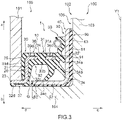
- FIG. 3 is a sectional view showing a schematic configuration of the sealing structure 100 corresponding to the state where the sealing device 1 according to the embodiment of the present invention is incorporated in a sealing target. In Fig. 3 , only a one-side portion of the sealing structure 100 and the sealing device 1 is shown.
- the sealing structure 100 is configured by incorporating the sealing device 1 in an annular gap between: the annular outer periphery side member 101; and the annular inner periphery side member 102 at least partially surrounded by the outer periphery side member 101, the outer periphery side member 101 and the inner periphery side member 102 being relatively rotatable to each other with respect to the axis Y1, and the sealing structure 100 is intended to achieve sealing of the annular gap between the outer periphery side member 101 and the inner periphery side member 102.
- the inner periphery side member 102 includes: a rod-like part 103 that extends parallel or substantially parallel to the axis Y1 direction and is formed in a columnar or substantially columnar shape around the axis Y1; and an outer periphery side flange part 104 that extends parallel or substantially parallel to the radial direction, extends to the outer periphery side from an atmosphere side end portion 103b of the rod-like part 103, and has a circular or substantially circular shape around the axis Y1.
- the outer periphery side member 101 is arranged on the outer periphery side of the inner periphery side member 102, and an opening part 105 having a cylindrical or substantially cylindrical shape around the axis Y1 is formed in the outer periphery side member 101.
- the inner periphery side member 102 is inserted in the opening part 105 of the outer periphery side member 101, and an annular space is formed between the opening part 105 and an outer periphery side surface of the rod-like part 103 of the inner periphery side member 102. That is, the outer periphery side member 101, the rod-like part 103 of the inner periphery side member 102, and the outer periphery side flange part 104 thereof form an accommodating part 106 for accommodating the sealing device 1.
- the accommodating part 106 is concave from the internal space side to the atmosphere side of the outer periphery side member 101 and the inner periphery side member 102, and a predetermined clearance is formed between the outer periphery side member 101 and the outer periphery side flange part 104 of the inner periphery side member 102.
- the slinger 40 of the sealing device 1 is fixed by, for example, interference fit to the outer periphery side surface of the rod-like part 103 of the inner periphery side member 102, by means of the inner periphery side lip part 63 of the inner periphery side portion 61 of the elastic body part 60, and the atmosphere side portion 62 of the elastic body part 60 of the slinger 40 closely contacts an internal space side surface of the outer periphery side flange part 104 of the inner periphery side member 102.
- the sealing device main body 10 of the sealing device 1 is fixed by, for example, interference fit to the opening part 105 of the outer periphery side member 101, by means of the outer periphery side lip part 35 of the internal space side elastic body part 31 of the elastic body part 30, and the internal space side surface of the outer periphery side flange part 23 of the sealing device main body 10 closely contacts an atmosphere side end portion of the outer periphery side member 101.
- the seal lip part 33 of the elastic body part 30 of the sealing device main body 10 of the sealing device 1 and the first dust lip part 34a and the second dust lip part 34b of the dust lip part 34 thereof closely contact the outer periphery side surface of the tubular part 51 of the slinger 40 slidably together therewith.
- the third dust lip part 34c of the dust lip part 34 closely contacts the internal space side surface of the outer periphery side flange part 52 of the slinger 40 slidably together therewith.
- the gap G is formed between the outer periphery side end portion of the inner periphery side portion 61 of the elastic body part 60 and the outer periphery atmosphere side portion 32d of the atmosphere side elastic body part 32, and the outer periphery side end portion of the inner periphery side portion 61 and the outer periphery atmosphere side portion 32d of the atmosphere side elastic body part 32 reduces the predetermined clearance between the outer periphery side member 101 and the outer periphery side flange part 104 of the inner periphery side member 102.
- the sealing structure 100 can achieve the sealing of the annular gap between the outer periphery side member 101 and the inner periphery side member 102.
- the sealing device main body 10 includes: the annular reinforcement ring 20 centered on the axis Y1; and the annular elastic body part 30 that is made of the elastic body attached to the reinforcement ring 20 and is centered on the axis Y1.
- the through hole 24 that passes through the portion between the internal space side surface and the atmosphere side surface of the reinforcement ring 20 is formed in the reinforcement ring 20, and the positioning part 36 for fixing the position of the reinforcement ring 20 at the time of vulcanization is formed on the internal space side surface of the elastic body part 30.
- the through hole 24 and the positioning part 36 are formed at positions separated in the radial direction.
- the thickness T1 of the inner periphery atmosphere side portion 32b of the elastic body part 30 formed on the atmosphere side of the reinforcement ring 20 is thicker than the thickness T2 of the internal space side portion 31a of the elastic body part 30 formed on the internal space side of the reinforcement ring 20. Therefore, the above-mentioned crack can be further suppressed from growing through the through hole 24 to become a through crack.
- the positioning part 36 is the annular groove part that is formed on the outer periphery side and/or the inner periphery side of the through hole 24 and is concave from the internal space side to the atmosphere side. Therefore, the position of the reinforcement ring 20 at the time of vulcanization can be easily fixed.
- the present invention is not limited to the above-mentioned embodiment, and includes all aspects within concepts and Claims of the present invention.
- respective configurations may be selectively combined as appropriate such that at least part of the above-mentioned problem is solved and that at least part of the above-mentioned effect is obtained.
- shape, material, arrangement, size, and the like of each constituent element in the above-mentioned embodiment can be changed as appropriate in accordance with a specific aspect of usage of the present invention.
- the embodiment of the present invention has been described by taking, as an example, the case where: the through hole 24 of the sealing device 1 according to the embodiment of the present invention is formed in, for example, a cylindrical or substantially cylindrical shape; and a plurality (for example, eight) of the through holes 24 are formed at equal angular intervals or substantially equal angular intervals concentrically or substantially concentrically from the axis Y1.
- the present invention is not limited thereto, and the through hole 24 may be a hole having an arbitrary shape, and also may be formed such that the position, number, and size of the hole is an arbitrary position, number, and size, respectively.
- the embodiment of the present invention has been described by taking, as an example, the case where the positioning part 36 of the sealing device 1 according to the embodiment of the present invention is the annular groove part that is formed on the outer periphery side and/or the inner periphery side of the through hole 24 and is concave from the internal space side to the atmosphere side.
- the present invention is not limited thereto, and the positioning part 36 may have an arbitrary shape as long as the position of the reinforcement ring 20 at the time of vulcanization can be fixed.
Landscapes
- Engineering & Computer Science (AREA)
- General Engineering & Computer Science (AREA)
- Mechanical Engineering (AREA)
- Manufacturing & Machinery (AREA)
- Sealing With Elastic Sealing Lips (AREA)
- Sealing Devices (AREA)
Applications Claiming Priority (2)
| Application Number | Priority Date | Filing Date | Title |
|---|---|---|---|
| JP2019105378 | 2019-06-05 | ||
| PCT/JP2020/019064 WO2020246206A1 (ja) | 2019-06-05 | 2020-05-13 | 密封装置 |
Publications (2)
| Publication Number | Publication Date |
|---|---|
| EP3982016A1 true EP3982016A1 (de) | 2022-04-13 |
| EP3982016A4 EP3982016A4 (de) | 2023-06-28 |
Family
ID=73652799
Family Applications (1)
| Application Number | Title | Priority Date | Filing Date |
|---|---|---|---|
| EP20818041.4A Pending EP3982016A4 (de) | 2019-06-05 | 2020-05-13 | Dichtungsvorrichtung |
Country Status (5)
| Country | Link |
|---|---|
| US (1) | US11906049B2 (de) |
| EP (1) | EP3982016A4 (de) |
| JP (1) | JP7319364B2 (de) |
| CN (1) | CN113677917B (de) |
| WO (1) | WO2020246206A1 (de) |
Families Citing this family (1)
| Publication number | Priority date | Publication date | Assignee | Title |
|---|---|---|---|---|
| WO2023167103A1 (ja) * | 2022-03-04 | 2023-09-07 | Nok株式会社 | 密封装置及び密封構造 |
Family Cites Families (17)
| Publication number | Priority date | Publication date | Assignee | Title |
|---|---|---|---|---|
| JPS60194665U (ja) * | 1984-06-06 | 1985-12-25 | 株式会社 荒井製作所 | オイルシ−ル |
| JP2804517B2 (ja) * | 1989-06-15 | 1998-09-30 | エヌオーケー株式会社 | オイルシール用スリンガー付スリーブおよびそのシール組立体 |
| JPH0743547Y2 (ja) * | 1989-12-15 | 1995-10-09 | エヌオーケー株式会社 | 密封装置 |
| JP2005226826A (ja) | 2004-01-14 | 2005-08-25 | Nsk Ltd | 転がり軸受 |
| DE602005009204D1 (de) * | 2004-07-09 | 2008-10-02 | Freudenberg Carl Kg | Wellendichtring |
| KR20060131366A (ko) * | 2005-06-16 | 2006-12-20 | 주식회사 이노씰 | 씰 |
| JP4978074B2 (ja) | 2006-06-19 | 2012-07-18 | Nok株式会社 | 密封装置 |
| US20100244388A1 (en) * | 2007-12-17 | 2010-09-30 | Nok Corporation | Sealing device |
| JP4953022B2 (ja) | 2008-03-07 | 2012-06-13 | 株式会社ジェイテクト | 軸受用密封装置 |
| JP2010185465A (ja) | 2009-02-10 | 2010-08-26 | Nsk Ltd | 組み合わせシールリング付転がり軸受ユニット |
| DE102011002491A1 (de) * | 2011-01-11 | 2012-07-12 | Aktiebolaget Skf | Radialwellendichtring |
| JP5704316B2 (ja) * | 2011-01-14 | 2015-04-22 | Nok株式会社 | オイルシール |
| JP2014126105A (ja) * | 2012-12-26 | 2014-07-07 | Nsk Ltd | 車輪支持用転がり軸受ユニット |
| JP2015059644A (ja) * | 2013-09-20 | 2015-03-30 | Ntn株式会社 | 密封装置およびこれを備えた車輪用軸受装置 |
| JP5778238B2 (ja) | 2013-11-18 | 2015-09-16 | Nok株式会社 | 密封装置の製造方法 |
| JP6610166B2 (ja) | 2015-01-21 | 2019-11-27 | 日本精工株式会社 | ハブユニット軸受 |
| CN206682305U (zh) * | 2017-03-01 | 2017-11-28 | 舍弗勒技术股份两合公司 | 盒式密封装置 |
-
2020
- 2020-05-13 JP JP2021524725A patent/JP7319364B2/ja active Active
- 2020-05-13 US US17/604,090 patent/US11906049B2/en active Active
- 2020-05-13 EP EP20818041.4A patent/EP3982016A4/de active Pending
- 2020-05-13 CN CN202080027877.3A patent/CN113677917B/zh active Active
- 2020-05-13 WO PCT/JP2020/019064 patent/WO2020246206A1/ja not_active Ceased
Also Published As
| Publication number | Publication date |
|---|---|
| JP7319364B2 (ja) | 2023-08-01 |
| US20220205539A1 (en) | 2022-06-30 |
| JPWO2020246206A1 (de) | 2020-12-10 |
| WO2020246206A1 (ja) | 2020-12-10 |
| CN113677917A (zh) | 2021-11-19 |
| EP3982016A4 (de) | 2023-06-28 |
| CN113677917B (zh) | 2025-01-14 |
| US11906049B2 (en) | 2024-02-20 |
Similar Documents
| Publication | Publication Date | Title |
|---|---|---|
| US8231129B2 (en) | Sealing device | |
| EP3184864B1 (de) | Dichtungsstruktur | |
| US10240677B2 (en) | Gasket | |
| KR101889241B1 (ko) | 밀봉구조 | |
| US11460074B2 (en) | Sealing device for wheel hub assembly | |
| US20110193294A1 (en) | Sealing device | |
| KR20190136015A (ko) | 휠 베어링용 밀봉 장치 | |
| EP3982016A1 (de) | Dichtungsvorrichtung | |
| KR20170110604A (ko) | 휠 베어링 유닛 | |
| US9677616B2 (en) | Bearing comprising a wear race | |
| JP6679914B2 (ja) | 密封装置 | |
| US10030715B2 (en) | Bearing, clutch bearing device and motor vehicle equipped with such a clutch bearing device | |
| US20120263406A1 (en) | Rolling bearing, notably for a clutch release bearing device | |
| EP3760901B1 (de) | Dichtungsstruktur | |
| EP4027041B1 (de) | Dichtungsvorrichtung | |
| CN113969942A (zh) | 离合器分离轴承和用于离合器分离轴承的滚动轴承 | |
| CN112013115B (zh) | 密封装置 | |
| US20210025454A1 (en) | Arrangement having machine elements and sealing arrangement therefor | |
| JP7685419B2 (ja) | 農機用密封装置 | |
| US20250027565A1 (en) | Sealing device | |
| US11698112B2 (en) | Clutch release bearing and rolling bearing for a clutch release bearing | |
| KR20190002056A (ko) | 클러치 릴리즈 베어링 | |
| CN110612401B (zh) | 从动缸 | |
| US20210071763A1 (en) | Sealing Device for Wheel Hub Assembly | |
| JP2018028326A (ja) | 密封装置 |
Legal Events
| Date | Code | Title | Description |
|---|---|---|---|
| STAA | Information on the status of an ep patent application or granted ep patent |
Free format text: STATUS: THE INTERNATIONAL PUBLICATION HAS BEEN MADE |
|
| PUAI | Public reference made under article 153(3) epc to a published international application that has entered the european phase |
Free format text: ORIGINAL CODE: 0009012 |
|
| STAA | Information on the status of an ep patent application or granted ep patent |
Free format text: STATUS: REQUEST FOR EXAMINATION WAS MADE |
|
| 17P | Request for examination filed |
Effective date: 20211020 |
|
| AK | Designated contracting states |
Kind code of ref document: A1 Designated state(s): AL AT BE BG CH CY CZ DE DK EE ES FI FR GB GR HR HU IE IS IT LI LT LU LV MC MK MT NL NO PL PT RO RS SE SI SK SM TR |
|
| DAV | Request for validation of the european patent (deleted) | ||
| DAX | Request for extension of the european patent (deleted) | ||
| A4 | Supplementary search report drawn up and despatched |
Effective date: 20230601 |
|
| RIC1 | Information provided on ipc code assigned before grant |
Ipc: F16J 15/3284 20160101ALI20230525BHEP Ipc: F16J 15/328 20160101ALI20230525BHEP Ipc: F16J 15/3276 20160101ALI20230525BHEP Ipc: F16J 15/3264 20160101ALI20230525BHEP Ipc: F16J 15/3232 20160101ALI20230525BHEP Ipc: F16J 15/3224 20160101ALI20230525BHEP Ipc: F16J 15/3204 20160101AFI20230525BHEP |