EP3952070B1 - Outer rotor type motor - Google Patents
Outer rotor type motor Download PDFInfo
- Publication number
- EP3952070B1 EP3952070B1 EP19922672.1A EP19922672A EP3952070B1 EP 3952070 B1 EP3952070 B1 EP 3952070B1 EP 19922672 A EP19922672 A EP 19922672A EP 3952070 B1 EP3952070 B1 EP 3952070B1
- Authority
- EP
- European Patent Office
- Prior art keywords
- rotor
- fan
- outer end
- yoke
- motor shaft
- Prior art date
- Legal status (The legal status is an assumption and is not a legal conclusion. Google has not performed a legal analysis and makes no representation as to the accuracy of the status listed.)
- Active
Links
Images




Classifications
-
- H—ELECTRICITY
- H02—GENERATION; CONVERSION OR DISTRIBUTION OF ELECTRIC POWER
- H02K—DYNAMO-ELECTRIC MACHINES
- H02K1/00—Details of the magnetic circuit
- H02K1/06—Details of the magnetic circuit characterised by the shape, form or construction
- H02K1/22—Rotating parts of the magnetic circuit
- H02K1/28—Means for mounting or fastening rotating magnetic parts on to, or to, the rotor structures
- H02K1/30—Means for mounting or fastening rotating magnetic parts on to, or to, the rotor structures using intermediate parts, e.g. spiders
-
- H—ELECTRICITY
- H02—GENERATION; CONVERSION OR DISTRIBUTION OF ELECTRIC POWER
- H02K—DYNAMO-ELECTRIC MACHINES
- H02K1/00—Details of the magnetic circuit
- H02K1/06—Details of the magnetic circuit characterised by the shape, form or construction
- H02K1/22—Rotating parts of the magnetic circuit
- H02K1/27—Rotor cores with permanent magnets
- H02K1/2786—Outer rotors
-
- H—ELECTRICITY
- H02—GENERATION; CONVERSION OR DISTRIBUTION OF ELECTRIC POWER
- H02K—DYNAMO-ELECTRIC MACHINES
- H02K21/00—Synchronous motors having permanent magnets; Synchronous generators having permanent magnets
- H02K21/12—Synchronous motors having permanent magnets; Synchronous generators having permanent magnets with stationary armatures and rotating magnets
- H02K21/22—Synchronous motors having permanent magnets; Synchronous generators having permanent magnets with stationary armatures and rotating magnets with magnets rotating around the armatures, e.g. flywheel magnetos
-
- H—ELECTRICITY
- H02—GENERATION; CONVERSION OR DISTRIBUTION OF ELECTRIC POWER
- H02K—DYNAMO-ELECTRIC MACHINES
- H02K9/00—Arrangements for cooling or ventilating
- H02K9/02—Arrangements for cooling or ventilating by ambient air flowing through the machine
- H02K9/04—Arrangements for cooling or ventilating by ambient air flowing through the machine having means for generating a flow of cooling medium
- H02K9/06—Arrangements for cooling or ventilating by ambient air flowing through the machine having means for generating a flow of cooling medium with fans or impellers driven by the machine shaft
-
- H—ELECTRICITY
- H02—GENERATION; CONVERSION OR DISTRIBUTION OF ELECTRIC POWER
- H02K—DYNAMO-ELECTRIC MACHINES
- H02K9/00—Arrangements for cooling or ventilating
- H02K9/08—Arrangements for cooling or ventilating by gaseous cooling medium circulating wholly within the machine casing
-
- H—ELECTRICITY
- H02—GENERATION; CONVERSION OR DISTRIBUTION OF ELECTRIC POWER
- H02K—DYNAMO-ELECTRIC MACHINES
- H02K5/00—Casings; Enclosures; Supports
- H02K5/04—Casings or enclosures characterised by the shape, form or construction thereof
- H02K5/20—Casings or enclosures characterised by the shape, form or construction thereof with channels or ducts for flow of cooling medium
- H02K5/207—Casings or enclosures characterised by the shape, form or construction thereof with channels or ducts for flow of cooling medium with openings in the casing specially adapted for ambient air
-
- H—ELECTRICITY
- H02—GENERATION; CONVERSION OR DISTRIBUTION OF ELECTRIC POWER
- H02K—DYNAMO-ELECTRIC MACHINES
- H02K9/00—Arrangements for cooling or ventilating
- H02K9/14—Arrangements for cooling or ventilating wherein gaseous cooling medium circulates between the machine casing and a surrounding mantle
Definitions
- the present invention relates to an outer rotor type motor.
- PTL 1 discloses an outer rotor type motor having a structure in which a rotor main body 31 is attached to a flange portion 43 integrally formed near a motor shaft 40 and an inner fan 70 is also integrally attached on the upper surface of a bottom portion 33 of the rotor main body 31.
- PTL 1 and PTL 2 show a motor according to the preamble of claim 1.
- PTL 3 and PTL 4 also show similar motors.
- the structure disclosed in PTL 1 however, has a problem that the centrifugal force (load) by a magnet 35 provided on the outer end side (the inner side of a tubular portion) of the rotor main body 31 acts on the flange portion 43 formed near the motor shaft, and thus the reliability in strength of the flange portion 43 may lower.
- the present invention has as its object to provide an outer rotor type motor excellent in strength reliability.
- An outer rotor type motor is an outer rotor type motor including a rotor in which magnets are arranged on an inner circumferential surface of a cylindrical rotor yoke.
- the outer rotor type motor comprises a motor shaft configured to rotatably support the rotor and a rotor attachment member including a base end extended from an outer periphery of the motor shaft outward in a radial direction and an outer end formed from an outer periphery of the base end outward in the radial direction.
- the outer end is formed at a position close to the inner circumferential surface of the rotor yoke, as compared with an outer peripheral surface of the motor shaft.
- the rotor is attached to the outer end.
- the base end is formed so that a thickness in an axial direction of the motor shaft gradually decreases from the outer periphery of the motor shaft to the outer end that is radially outside.
- a step is formed between the base end and the outer end along the axial direction of the motor shaft, and the rotor is attached to the outer end in a state in which an opening of the rotor yoke is fitted in the step .
- the cylindrical rotor yoke includes a connecting portion formed to overlap the outer end along a vertical direction intersecting the axial direction of the motor shaft, a tubular portion formed so as to arrange the magnets on the inner circumferential surface and a joint portion configured to join the connecting portion and the tubular portion via a plurality of bending portions that are formed between the connecting portion and the tubular portion.
- the outer rotor type motor comprises a fan formed concentrically with the rotor yoke, and the fan is attached to the outer end in a state in which the rotor yoke is attached between the fan and the outer end.
- a first engaging portion of the outer rotor type motor is configured to be engaged with a yoke attachment member for attaching the rotor yoke and a second engaging portion configured to be engaged with a fan attachment member for attaching the fan is preferably formed along a same circumference in the outer end .
- a through hole through which the yoke attachment member passes and a through hole through which the fan attachment member passes is preferably formed along a same circumference in the rotor yoke.
- the cylindrical rotor yoke includes a blade portion of the fan is arranged in a space formed between the fan and the joint portion.
- the joint portion preferably includes, as the plurality of bending portions, a first bending portion formed by bending the joint portion toward the tubular portion at a first angle formed between the connecting portion formed in the vertical direction with respect to the axial direction of the motor shaft and the tubular portion formed along the axial direction, and a second bending portion formed by bending, at a second angle, formed between the joint portion bent at the first angle and the tubular portion formed along the axial direction.
- a notch portion of the outer rotor type motor is formed not to abut against the yoke attachment member for attaching the rotor yoke to the outer end is formed in the fan.
- the outer end is attached at a position where a relation of the first distance > 0.5 ⁇ the second distance is satisfied.
- the aspect of the present invention it is possible to reduce the influence of the centrifugal force (load) that can be generated by the rotation of a rotor by forming an outer end attached with the rotor at a position close to the inner circumferential surface of a rotor yoke, as compared with the outer peripheral surface of the motor shaft, thereby providing an outer rotor type motor excellent in strength reliability.
- the rotor attachment member includes the base end formed so that the thickness in the axial direction of the motor shaft gradually decreases toward the outer end that is radially outside, it is possible to distribute the load (stress concentration) that can locally occur in a portion on the fixed end side (a portion on the side of the motor shaft) of the base end by the rotation of the rotor while ensuring rigidity of a portion as a base of the outer end to which the rotor is attached.
- faucet joining (mate fitting) using the step, positioning of the rotor and the rotor attachment member becomes easy, thereby making it possible to reduce an error of the shaft center at the time of assembly.
- faucet joining can increase the contact area of the rotor yoke and the outer end and base end of the rotor attachment member, the load acting on the outer end while the rotor is attached can be distributed toward the base end.
- the outer rotor type motor by providing the plurality of bending portions, it is possible to form a portion between the connecting portion and the tubular portion at an obtuse angle as a gentle bending angle in each bending portion. This can further relax the stress concentration in the rotor yoke, as compared with a case in which the portion between the connecting portion and the tubular portion bends at a right angle.
- the outer rotor type motor by concentrically attaching the rotor yoke and the fan to the outer end of the rotor attachment member along a same circumference, it is unnecessary to additionally provide, in the outer end, the fan attachment portion as a structure for attaching the fan, thereby making it possible to decrease the size of the outer end (the dimension of the outer end in the radial direction).
- the outer rotor type motor in shape design of the rotor yoke, it is unnecessary to consider restrictions of the arrangement and sectional shape of the engaging portion for attaching the fan to the rotor yoke. For example, when the fan is attached to the rotor yoke, restrictions such as a restriction that a bottom portion needs to be formed by linearly extending the connecting portion of the rotor yoke in consideration of engagement with a fastening member can be imposed on the shape design.
- the fan With the structure in which the fan is attached to the outer end of the rotor attachment member, it is possible to improve the degree of freedom in the shape design of the rotor yoke. For example, it is possible to form the plurality of bending portions and between the connecting portion and the tubular portion like the sectional shape of the rotor yoke. This can form the rotor yoke in a shape that can relax the stress concentration.
- the space where the blade portion can be arranged can be enlarged, and it is possible to decrease the size, and also cool the outer rotor type motor using the fan with a larger area of the blade portion and improved cooling performance.
- the outer rotor type motor while maintaining the state in which the rotor yoke is attached to the outer end of the rotor attachment member, it is possible to detach only the fan from the outer end of the rotor attachment member. This can improve the maintainability of the outer rotor type motor.
- the outer rotor type motor according to a preferred embodiment, by forming the outer end attached with the rotor at a position (the first distance > 0.5 ⁇ the second distance) close to the inner circumferential surface of the cylindrical rotor yoke, as compared with the outer peripheral surface of the motor shaft, it is possible to reduce the influence of the centrifugal force (load) that can be generated by the rotation of the rotor , thereby providing the outer rotor type motor excellent in strength reliability.
- FIG. 1 is a sectional view showing the arrangement of an outer rotor type motor according to the first embodiment.
- an outer rotor type motor 100 is an outer rotor type motor including a rotor 30 in which a plurality of magnets 35 are arranged on the inner circumferential surface of a cylindrical rotor yoke 31.
- a motor shaft 10 is rotatably supported by bearings 82 and 84 provided in a motor housing 60.
- the plurality of magnets 35 arranged on the inner circumferential surface of the rotor yoke 31 are arranged to alternately form different magnetic poles in the circumferential direction.
- a rotor attachment member 20 is formed integrally with the motor shaft 10.
- the rotor attachment member 20 includes a base end 22 extended from the outer periphery of the motor shaft 10 outward in a radial direction, and an outer end 24 formed from the outer periphery of the base end outward in the radial direction.
- the outer end 24 is formed at a position where a relation of the first distance (R1) > 0.5 ⁇ the second distance (R2) is satisfied.
- the outer end 24 (yoke attachment members 37) of the rotor attachment member 20 is formed at a position (first distance (R1) > 0.5 ⁇ second distance (R2)) close to the inner circumferential surface of the rotor yoke 31, as compared with the outer peripheral surface (tubular portion 34) of the motor shaft 10, and the rotor 30 is attached to the outer end 24.
- the motor shaft 10 rotatably supports the rotor 30, and the rotor 30 attached to the outer end 24 is rotated by the rotation of the motor shaft 10.
- Fig. 2 is an enlarged view of the structure of the rotor attachment member 20 shown in an A portion in Fig. 1 .
- the member thickness (thickness) of the base end 22 on the side of the motor shaft 10 is represented by TH1
- the member thickness (thickness) of the base end 22 on the side of the outer end 24 extending outward in the radial direction is represented by TH2.
- the base end 22 is formed so that the thickness in the axial direction of the motor shaft 10 (to be simply referred to as an axial direction hereinafter) gradually decreases from the outer periphery of the motor shaft 10 to the outer end 24 that is radially outside.
- the outer end 24 By forming the outer end 24 outward in the radial direction from the outer periphery of the base end 22 formed so that the rigidity is ensured and stress concentration is prevented, it is possible to form the outer end 24 at a position close to the inner circumferential surface (tubular portion 34) of the cylindrical rotor yoke 31, as compared with the outer peripheral surface of the motor shaft 10. This can reduce the influence of the centrifugal force (load) that can be generated by the rotation of the rotor 30, thereby providing the outer rotor type motor excellent in strength reliability.
- a step 26 having a different thickness is formed between the base end 22 and the outer end 24 along the axial direction of the motor shaft 10.
- the rotor 30 is attached to the outer end 24 by the yoke attachment members 37 (for example, bolts) in a state in which the opening of the rotor yoke 31 is fitted in the step 26.
- the yoke attachment members 37 for example, bolts
- positioning of the rotor 30 (rotor yoke 31) and the rotor attachment member 20 becomes easy, thereby making it possible to reduce an error of the shaft center at the time of assembly.
- faucet joining can increase the contact area of the rotor yoke 31 and the outer end 24 and base end 22 of the rotor attachment member 20, the load acting on the outer end 24 while the rotor 30 is attached can be distributed toward the base end 22.
- the cylindrical rotor yoke 31 includes a connecting portion 32 formed to overlap the outer end 24, the tubular portion 34 formed so as to arrange the magnets 35 on the inner circumferential surface, and a joint portion 38 that joins the connecting portion 32 and the tubular portion 34 via a plurality of bending portions formed between the connecting portion 32 and the tubular portion 34.
- a portion, contacting the connecting portion 32, of the outer end 24 of the rotor attachment member 20 is formed in a planar shape in a direction (to also be referred to as a vertical direction hereinafter) intersecting the axial direction of the motor shaft 10, and the connecting portion 32 of the rotor yoke 31 is formed along the vertical direction in a planar shape to overlap the outer end 24.
- the tubular portion 34 of the rotor yoke 31 is formed in a cylindrical shape, and arranged so that the plurality of magnets 35 with different magnet poles formed alternately in the circumferential direction can be arranged.
- a plurality of bending portions 33 and 36 are formed between the connecting portion 32 and the tubular portion 34, and the joint portion 38 is formed to join the connecting portion 32 and the tubular portion 34 via the plurality of bending portions 33 and 36.
- the joint portion 38 that includes the two bending portions 33 and 36 as the plurality of bending portions is exemplified.
- an example of the arrangement of the bending portions is not limited to this, and two or more bending portions can be formed.
- the bending portion 36 (to also be referred to as the "first bending portion” hereinafter) is formed to bend the joint portion 38 toward the tubular portion 34 at a predetermined first angle (obtuse angle) between the connecting portion 32 formed in the vertical direction with respect to the axial direction of the motor shaft 10 and the tubular portion 34 formed along the axial direction of the motor shaft 10 (formed almost in parallel to the axial direction of the motor shaft 10).
- the bending portion 33 (to also be referred to as the "second bending portion” hereinafter) is formed to bend, at a predetermined second angle (obtuse angle), the joint portion 38 bending at the first angle (obtuse angle) by the bending portion 36 (first bending portion) to be joined to the tubular portion 34.
- the first and second angles are both obtuse angles, and can be set based on the shape design (the structure of the connecting portion 32, the tubular portion 34, and the like) of the rotor yoke 31. That is, based on the structure of the connecting portion 32, the tubular portion 34, and the like, the first and second angles of the joint portion 38 can be set to the same angle, set so that the first angle is larger than the second angle, or set so that the first angle is smaller than the second angle.
- the rotor yoke 31 is formed in such cylindrical shape that one opening of the tubular portion 34 is partially sealed.
- a stator 90 includes a stator core including a core main body in an almost annular shape, and a plurality of coils wounded around the stator core, and is fixed to the inside of the motor housing 60 by a stator fastening member 92.
- the stator 90 and the magnets 35 arranged on the inner circumferential surface of the tubular portion 34 face each other.
- the coils of the stator 90 are supplied with a driving current from an external motor control apparatus (not shown) via a cable 93 and an electrical connection portion 95, and the rotor 30 is rotated by a magnetic field generated by the driving current.
- Rotation information of the motor shaft 10 detected by a rotation detection element (not shown) is configured to be transmittable to an external control apparatus.
- Fig. 7 is a view schematically showing a state in which the rotor yoke 31 is attached to the outer end 24 of the rotor attachment member 20.
- through holes 39B through which the yoke attachment members 37 (for example, bolts) pass are formed.
- Each of the through holes 39B is formed to have a hole diameter larger than the diameter (screw diameter) of the yoke attachment member 37.
- the yoke attachment members 37 are engaged with first engaging portions 29B (screw holes) formed in the outer end 24 to attach the rotor yoke 31 to the outer end 24.
- FIG. 8 shows a state in which the rotor attachment member 20 (base end 22 and outer end 24) formed in the motor shaft 10 is viewed from a direction of an arrow 71 in Fig. 7 .
- the first engaging portions 29B screw holes
- second engaging portions 29A screw holes
- ST82 shows a state in which a state of attaching the rotor yoke 31 to the outer end 24 is viewed from the direction of the arrow 71 in Fig. 7 .
- An opening 32B is formed at the center of the rotor yoke 31, and the rotor yoke 31 (rotor 30) is attached to the outer end 24 in a state in which the step 26 ( Fig. 2 ) is fitted in the opening 32B.
- through holes 39A are formed so that the fan attachment members 44 for attaching the fan 40 to the outer end 24 pass through the rotor yoke 31.
- the through holes 39B ( Fig.
- each of the through holes 39A is formed to have a hole diameter larger than the diameter (screw diameter) of the fan attachment member 44.
- the outer rotor type motor 100 includes a fan 70 (external fan) and the fan 40 (internal fan) as a cooling mechanism using the rotation driving force of the motor.
- the fan 70 (external fan) is attached to the motor shaft 10 by a fastening member such as a key.
- the fan 40 (internal fan) is formed concentrically with the rotor yoke 31. In a state in which the rotor yoke 31 is attached between the fan 40 and the outer end 24, the fan 40 is attached to the outer end 24.
- the fan 40 is attached to the outer end 24 by the fan attachment members 44 such as bolts.
- a motor cover 65 is attached to the motor housing 60 by a cover fastening member 66 (for example, a bolt or the like), and the fan 70 (external fan) is covered with the motor cover 65.
- a cover fastening member 66 for example, a bolt or the like
- the fan 40 (internal fan) and the fan 70 (external fan) turn by the rotation of the motor shaft 10
- the fan 40 (internal fan) circulates air in the outer rotor type motor 100, thereby cooling the rotor 30, the stator 90, and the like.
- the fan 70 (external fan) sends, toward the outer wall (motor housing 60) of the outer rotor type motor 100, air taken from an intake opening (not shown) formed in the motor cover 65, thereby cooling the outer wall of the outer rotor type motor 100.
- Air (external cooling air) sent by the fan 70 (external fan) cools the outer wall of the motor 100, and also encourages heat exchange between the outer wall and internally circulating air by the fan 40 (internal fan).
- Fig. 5 is a view schematically showing a state in which the fan 40 is attached to the outer end 24 of the rotor attachment member 20.
- the through holes 39A through which the fan attachment members 44 (for example, bolts) pass are formed.
- the fan 40 is attached to the outer end 24 when the fan attachment members 44 are engaged with the second engaging portions 29A (screw holes: Fig. 8 ) formed in the outer end 24.
- FIG. 6 shows a state in which the fan 40 attached to the outer end 24 is viewed from a direction of an arrow 51 in Fig. 5 .
- ST62 shows a state in which only the fan 40 is viewed from the direction of the arrow 51 in Fig. 5 .
- Through holes 46 through which the fan attachment members 44 pass are formed in the fan 40. Similar to the through holes 39A, each of the through holes 46 is formed to have a hole diameter larger than the diameter (screw diameter) of the fan attachment member 44.
- the fan 40 is also attached to the outer end 24 by the fan attachment members 44.
- the notch portions 47 prevent the yoke attachment members 37 and the fan 40 from abutting against each other.
- the fan 40 includes a fan main body 41 and a plurality of blade portions 42 arranged in the circumferential direction.
- the blade portions 42 of the fan 40 are arranged in a space formed between the fan main body 41 and the joint portion 38 bending by the plurality of bending portions 33 and 36.
- the space between the joint portion and the fan main body 41 is small, and the sizes of the blade portions of the fan are limited. If each blade portion is formed in a size equal to that of the blade portion 42 shown in Fig. 1 , the attachment position of the fan 40 shifts in the right direction on the drawing surface of Fig. 1 along the axial direction of the motor shaft 10, and the cooling mechanism increases in size.
- the outer rotor type motor 100 with the cooling mechanism using the rotation driving force of the motor can further be decreased in size.
- the space where the blade portions 42 can be arranged can be enlarged, as shown in Fig. 1 , and it is possible to decrease the size, and also cool the outer rotor type motor 100 using the fan 40 with a larger area of the blade portions 42 and improved cooling performance.
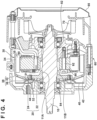
- Fig. 4 is a sectional view showing the arrangement of an outer rotor type motor 100 according to the third embodiment.
- Each of the first and second embodiments has explained an example of the arrangement of the outer rotor type motor 100 in which the rotor attachment member 20 is integrally formed with the motor shaft 10 by, for example, casting or cutting.
- a rotor attachment member 20 and a motor shaft 10 can be formed as separate parts.
- a tapered portion 11A is provided in the motor shaft 10
- an engaging hole 11B that is engaged with the tapered portion 11A is formed on the side of the rotor attachment member 20, and the rotor attachment member 20 is positioned at a predetermined position on the motor shaft 10 by the tapered portion 11A and the engaging hole 11B.
- a fan 70 (external fan) is arranged at one end of the motor shaft 10 and a fan 40 (internal fan) is arranged at the other end of the motor shaft 10.
- the fan 70 (external fan) and the fan 40 (internal fan) may be arranged at one end of the motor shaft 10. In this embodiment as well, it is possible to obtain the same effect as in the outer rotor type motor 100 according to the first embodiment.
Landscapes
- Engineering & Computer Science (AREA)
- Power Engineering (AREA)
- Iron Core Of Rotating Electric Machines (AREA)
- Structures Of Non-Positive Displacement Pumps (AREA)
- Connection Of Motors, Electrical Generators, Mechanical Devices, And The Like (AREA)
- Brushless Motors (AREA)
- Motor Or Generator Cooling System (AREA)
Applications Claiming Priority (1)
| Application Number | Priority Date | Filing Date | Title |
|---|---|---|---|
| PCT/JP2019/014323 WO2020202390A1 (ja) | 2019-03-29 | 2019-03-29 | アウタロータ型モータ |
Publications (3)
| Publication Number | Publication Date |
|---|---|
| EP3952070A1 EP3952070A1 (en) | 2022-02-09 |
| EP3952070A4 EP3952070A4 (en) | 2022-04-06 |
| EP3952070B1 true EP3952070B1 (en) | 2025-04-30 |
Family
ID=72666176
Family Applications (1)
| Application Number | Title | Priority Date | Filing Date |
|---|---|---|---|
| EP19922672.1A Active EP3952070B1 (en) | 2019-03-29 | 2019-03-29 | Outer rotor type motor |
Country Status (5)
| Country | Link |
|---|---|
| US (1) | US12531451B2 (https=) |
| EP (1) | EP3952070B1 (https=) |
| JP (3) | JPWO2020202390A1 (https=) |
| CN (1) | CN113615054A (https=) |
| WO (1) | WO2020202390A1 (https=) |
Families Citing this family (3)
| Publication number | Priority date | Publication date | Assignee | Title |
|---|---|---|---|---|
| KR20230045863A (ko) * | 2021-09-29 | 2023-04-05 | 엘지전자 주식회사 | 외전형 모터 |
| US20230268793A1 (en) * | 2022-02-22 | 2023-08-24 | Techtronic Cordless Gp | Motor for impact tool |
| CN114645847B (zh) * | 2022-05-19 | 2022-08-05 | 浙大城市学院 | 一种二维电机活塞泵 |
Citations (2)
| Publication number | Priority date | Publication date | Assignee | Title |
|---|---|---|---|---|
| DE19513134A1 (de) * | 1995-04-07 | 1996-10-10 | Aeg Kleinmotoren Gmbh | Elektrische Maschine, insbesondere ein Dauermagnetgenerator |
| WO2020255730A1 (ja) * | 2019-06-18 | 2020-12-24 | 株式会社ミツバ | 始動発電機及び始動発電機の製造方法 |
Family Cites Families (19)
| Publication number | Priority date | Publication date | Assignee | Title |
|---|---|---|---|---|
| JPS5931460B2 (ja) | 1976-09-14 | 1984-08-02 | 凸版印刷株式会社 | 多層容器 |
| JP3493971B2 (ja) * | 1997-09-25 | 2004-02-03 | 国産電機株式会社 | フライホイール磁石回転子及びその製造方法 |
| JP3866427B2 (ja) * | 1998-12-08 | 2007-01-10 | 澤藤電機株式会社 | アウタロータ型多極発電機用ステータ |
| JP3494056B2 (ja) * | 1999-01-25 | 2004-02-03 | 国産電機株式会社 | アウターロータ型磁石発電機 |
| IT1308475B1 (it) * | 1999-05-07 | 2001-12-17 | Gate Spa | Motoventilatore, particolarmente per uno scambiatore di calore di unautoveicolo |
| JP2001112226A (ja) * | 1999-10-08 | 2001-04-20 | Moriyama Manufacturing Co Ltd | 3相磁石発電機 |
| AU782017B2 (en) * | 1999-10-18 | 2005-06-30 | Lg Electronics Inc. | A driving unit for a drum type washing machine |
| JP2002084728A (ja) * | 2000-09-08 | 2002-03-22 | Kokusan Denki Co Ltd | アウターロータ式磁石回転機 |
| JP2002263576A (ja) * | 2001-03-13 | 2002-09-17 | Victor Co Of Japan Ltd | 振動型ブラシレスモータ |
| JP2004120848A (ja) * | 2002-09-25 | 2004-04-15 | Sawafuji Electric Co Ltd | アウタロータ型多極発電機 |
| JP4291846B2 (ja) * | 2006-11-24 | 2009-07-08 | アスモ株式会社 | ファンモータ |
| EP2158664A4 (en) * | 2007-06-12 | 2014-02-26 | Carrier Corp | TWO-STAGE FAN FOR AN ELECTRIC GENERATOR |
| CN201290032Y (zh) * | 2008-10-27 | 2009-08-12 | 佛山市南海区东唐电机厂 | 交流电机外转子总成 |
| JP2012244704A (ja) * | 2011-05-17 | 2012-12-10 | Honda Motor Co Ltd | 外転型の電動機 |
| JP5931460B2 (ja) * | 2012-01-19 | 2016-06-08 | 株式会社ミツバ | アウターロータ型ブラシレスモータ |
| JP6206970B2 (ja) * | 2014-09-18 | 2017-10-04 | 東洋電装株式会社 | 動力作業機用回転電機 |
| CN205792124U (zh) * | 2015-05-29 | 2016-12-07 | 日本电产株式会社 | 马达 |
| US10361607B2 (en) * | 2015-11-23 | 2019-07-23 | Borgwarner Inc. | Alternator with series fans |
| DE102016203892A1 (de) * | 2016-03-09 | 2017-09-14 | Mahle International Gmbh | Gebläseanordnung |
-
2019
- 2019-03-29 JP JP2021511764A patent/JPWO2020202390A1/ja active Pending
- 2019-03-29 EP EP19922672.1A patent/EP3952070B1/en active Active
- 2019-03-29 CN CN201980094499.8A patent/CN113615054A/zh active Pending
- 2019-03-29 WO PCT/JP2019/014323 patent/WO2020202390A1/ja not_active Ceased
-
2021
- 2021-09-27 US US17/485,954 patent/US12531451B2/en active Active
-
2023
- 2023-10-20 JP JP2023181125A patent/JP7756132B2/ja active Active
-
2025
- 2025-10-06 JP JP2025168507A patent/JP2025182075A/ja active Pending
Patent Citations (2)
| Publication number | Priority date | Publication date | Assignee | Title |
|---|---|---|---|---|
| DE19513134A1 (de) * | 1995-04-07 | 1996-10-10 | Aeg Kleinmotoren Gmbh | Elektrische Maschine, insbesondere ein Dauermagnetgenerator |
| WO2020255730A1 (ja) * | 2019-06-18 | 2020-12-24 | 株式会社ミツバ | 始動発電機及び始動発電機の製造方法 |
Also Published As
| Publication number | Publication date |
|---|---|
| JP7756132B2 (ja) | 2025-10-17 |
| US20220014061A1 (en) | 2022-01-13 |
| JP2025182075A (ja) | 2025-12-11 |
| US12531451B2 (en) | 2026-01-20 |
| WO2020202390A1 (ja) | 2020-10-08 |
| CN113615054A (zh) | 2021-11-05 |
| JPWO2020202390A1 (https=) | 2020-10-08 |
| JP2024003017A (ja) | 2024-01-11 |
| EP3952070A4 (en) | 2022-04-06 |
| EP3952070A1 (en) | 2022-02-09 |
Similar Documents
| Publication | Publication Date | Title |
|---|---|---|
| US12531451B2 (en) | Outer rotor motor with rotor attachment member | |
| US7323801B2 (en) | Axial air-gap electronic motor | |
| US9062567B2 (en) | Fan | |
| US10958138B2 (en) | Motor | |
| US20180091020A1 (en) | Outer-rotor Motor and Stator Assembly Thereof | |
| US11180247B2 (en) | Drone motor and drone comprising same | |
| US20220275829A1 (en) | Motor | |
| US11489391B2 (en) | Stator, motor, and blowing device | |
| JP2019068604A (ja) | モータ | |
| US20140091667A1 (en) | Armature and motor | |
| JP2007282331A (ja) | ダブルステータ型モータ | |
| JP5326432B2 (ja) | 回転電機のステータ固定構造 | |
| JP6635511B2 (ja) | ブラシレスモータ | |
| US12218564B2 (en) | Motor | |
| US20200366175A1 (en) | Rotating electric machine | |
| EP3364527B1 (en) | Electric motor and blower | |
| US11196317B2 (en) | Motor including a bracket board support structure for a circuit board | |
| US11251666B2 (en) | Motor and electrical product | |
| CN218449645U (zh) | 马达和电气产品 | |
| US12249876B2 (en) | Motor | |
| JP2019146452A (ja) | ステータ及び回転電機 | |
| JP2018098943A (ja) | 回転電機及び回転電機の製造方法 | |
| CN115315888A (zh) | 电动机 | |
| CN110100375A (zh) | 转子和马达 | |
| KR20180001901A (ko) | 모터 하우징 및 이를 포함하는 모터 |
Legal Events
| Date | Code | Title | Description |
|---|---|---|---|
| STAA | Information on the status of an ep patent application or granted ep patent |
Free format text: STATUS: THE INTERNATIONAL PUBLICATION HAS BEEN MADE |
|
| PUAI | Public reference made under article 153(3) epc to a published international application that has entered the european phase |
Free format text: ORIGINAL CODE: 0009012 |
|
| STAA | Information on the status of an ep patent application or granted ep patent |
Free format text: STATUS: REQUEST FOR EXAMINATION WAS MADE |
|
| 17P | Request for examination filed |
Effective date: 20211012 |
|
| AK | Designated contracting states |
Kind code of ref document: A1 Designated state(s): AL AT BE BG CH CY CZ DE DK EE ES FI FR GB GR HR HU IE IS IT LI LT LU LV MC MK MT NL NO PL PT RO RS SE SI SK SM TR |
|
| REG | Reference to a national code |
Ref country code: DE Free format text: PREVIOUS MAIN CLASS: H02K0007000000 Ref country code: DE Ref legal event code: R079 Ref document number: 602019069499 Country of ref document: DE Free format text: PREVIOUS MAIN CLASS: H02K0007000000 Ipc: H02K0001300000 |
|
| A4 | Supplementary search report drawn up and despatched |
Effective date: 20220309 |
|
| RIC1 | Information provided on ipc code assigned before grant |
Ipc: H02K 21/22 20060101ALN20220302BHEP Ipc: H02K 5/20 20060101ALN20220302BHEP Ipc: H02K 9/14 20060101ALN20220302BHEP Ipc: H02K 1/2786 20220101ALN20220302BHEP Ipc: H02K 9/08 20060101ALI20220302BHEP Ipc: H02K 1/30 20060101AFI20220302BHEP |
|
| DAV | Request for validation of the european patent (deleted) | ||
| DAX | Request for extension of the european patent (deleted) | ||
| STAA | Information on the status of an ep patent application or granted ep patent |
Free format text: STATUS: EXAMINATION IS IN PROGRESS |
|
| 17Q | First examination report despatched |
Effective date: 20230213 |
|
| GRAP | Despatch of communication of intention to grant a patent |
Free format text: ORIGINAL CODE: EPIDOSNIGR1 |
|
| STAA | Information on the status of an ep patent application or granted ep patent |
Free format text: STATUS: GRANT OF PATENT IS INTENDED |
|
| RIC1 | Information provided on ipc code assigned before grant |
Ipc: H02K 21/22 20060101ALN20240425BHEP Ipc: H02K 5/20 20060101ALN20240425BHEP Ipc: H02K 9/14 20060101ALN20240425BHEP Ipc: H02K 1/2786 20220101ALN20240425BHEP Ipc: H02K 9/08 20060101ALI20240425BHEP Ipc: H02K 1/30 20060101AFI20240425BHEP |
|
| INTG | Intention to grant announced |
Effective date: 20240508 |
|
| GRAJ | Information related to disapproval of communication of intention to grant by the applicant or resumption of examination proceedings by the epo deleted |
Free format text: ORIGINAL CODE: EPIDOSDIGR1 |
|
| STAA | Information on the status of an ep patent application or granted ep patent |
Free format text: STATUS: EXAMINATION IS IN PROGRESS |
|
| INTC | Intention to grant announced (deleted) | ||
| GRAP | Despatch of communication of intention to grant a patent |
Free format text: ORIGINAL CODE: EPIDOSNIGR1 |
|
| STAA | Information on the status of an ep patent application or granted ep patent |
Free format text: STATUS: GRANT OF PATENT IS INTENDED |
|
| RIC1 | Information provided on ipc code assigned before grant |
Ipc: H02K 21/22 20060101ALN20241112BHEP Ipc: H02K 5/20 20060101ALN20241112BHEP Ipc: H02K 9/14 20060101ALN20241112BHEP Ipc: H02K 1/2786 20220101ALN20241112BHEP Ipc: H02K 9/08 20060101ALI20241112BHEP Ipc: H02K 1/30 20060101AFI20241112BHEP |
|
| INTG | Intention to grant announced |
Effective date: 20241120 |
|
| GRAS | Grant fee paid |
Free format text: ORIGINAL CODE: EPIDOSNIGR3 |
|
| GRAA | (expected) grant |
Free format text: ORIGINAL CODE: 0009210 |
|
| STAA | Information on the status of an ep patent application or granted ep patent |
Free format text: STATUS: THE PATENT HAS BEEN GRANTED |
|
| AK | Designated contracting states |
Kind code of ref document: B1 Designated state(s): AL AT BE BG CH CY CZ DE DK EE ES FI FR GB GR HR HU IE IS IT LI LT LU LV MC MK MT NL NO PL PT RO RS SE SI SK SM TR |
|
| REG | Reference to a national code |
Ref country code: CH Ref legal event code: EP Ref country code: GB Ref legal event code: FG4D |
|
| REG | Reference to a national code |
Ref country code: IE Ref legal event code: FG4D |
|
| REG | Reference to a national code |
Ref country code: DE Ref legal event code: R096 Ref document number: 602019069499 Country of ref document: DE |
|
| RAP4 | Party data changed (patent owner data changed or rights of a patent transferred) |
Owner name: HONDA MOTOR CO., LTD. |
|
| REG | Reference to a national code |
Ref country code: NL Ref legal event code: MP Effective date: 20250430 |
|
| REG | Reference to a national code |
Ref country code: AT Ref legal event code: MK05 Ref document number: 1791021 Country of ref document: AT Kind code of ref document: T Effective date: 20250430 |
|
| PG25 | Lapsed in a contracting state [announced via postgrant information from national office to epo] |
Ref country code: FI Free format text: LAPSE BECAUSE OF FAILURE TO SUBMIT A TRANSLATION OF THE DESCRIPTION OR TO PAY THE FEE WITHIN THE PRESCRIBED TIME-LIMIT Effective date: 20250430 Ref country code: ES Free format text: LAPSE BECAUSE OF FAILURE TO SUBMIT A TRANSLATION OF THE DESCRIPTION OR TO PAY THE FEE WITHIN THE PRESCRIBED TIME-LIMIT Effective date: 20250430 Ref country code: PT Free format text: LAPSE BECAUSE OF FAILURE TO SUBMIT A TRANSLATION OF THE DESCRIPTION OR TO PAY THE FEE WITHIN THE PRESCRIBED TIME-LIMIT Effective date: 20250901 |
|
| REG | Reference to a national code |
Ref country code: LT Ref legal event code: MG9D |
|
| PG25 | Lapsed in a contracting state [announced via postgrant information from national office to epo] |
Ref country code: GR Free format text: LAPSE BECAUSE OF FAILURE TO SUBMIT A TRANSLATION OF THE DESCRIPTION OR TO PAY THE FEE WITHIN THE PRESCRIBED TIME-LIMIT Effective date: 20250731 Ref country code: NO Free format text: LAPSE BECAUSE OF FAILURE TO SUBMIT A TRANSLATION OF THE DESCRIPTION OR TO PAY THE FEE WITHIN THE PRESCRIBED TIME-LIMIT Effective date: 20250730 |
|
| PG25 | Lapsed in a contracting state [announced via postgrant information from national office to epo] |
Ref country code: PL Free format text: LAPSE BECAUSE OF FAILURE TO SUBMIT A TRANSLATION OF THE DESCRIPTION OR TO PAY THE FEE WITHIN THE PRESCRIBED TIME-LIMIT Effective date: 20250430 Ref country code: NL Free format text: LAPSE BECAUSE OF FAILURE TO SUBMIT A TRANSLATION OF THE DESCRIPTION OR TO PAY THE FEE WITHIN THE PRESCRIBED TIME-LIMIT Effective date: 20250430 |
|
| PG25 | Lapsed in a contracting state [announced via postgrant information from national office to epo] |
Ref country code: BG Free format text: LAPSE BECAUSE OF FAILURE TO SUBMIT A TRANSLATION OF THE DESCRIPTION OR TO PAY THE FEE WITHIN THE PRESCRIBED TIME-LIMIT Effective date: 20250430 |
|
| PG25 | Lapsed in a contracting state [announced via postgrant information from national office to epo] |
Ref country code: HR Free format text: LAPSE BECAUSE OF FAILURE TO SUBMIT A TRANSLATION OF THE DESCRIPTION OR TO PAY THE FEE WITHIN THE PRESCRIBED TIME-LIMIT Effective date: 20250430 |
|
| PG25 | Lapsed in a contracting state [announced via postgrant information from national office to epo] |
Ref country code: AT Free format text: LAPSE BECAUSE OF FAILURE TO SUBMIT A TRANSLATION OF THE DESCRIPTION OR TO PAY THE FEE WITHIN THE PRESCRIBED TIME-LIMIT Effective date: 20250430 |
|
| PG25 | Lapsed in a contracting state [announced via postgrant information from national office to epo] |
Ref country code: RS Free format text: LAPSE BECAUSE OF FAILURE TO SUBMIT A TRANSLATION OF THE DESCRIPTION OR TO PAY THE FEE WITHIN THE PRESCRIBED TIME-LIMIT Effective date: 20250731 |
|
| PG25 | Lapsed in a contracting state [announced via postgrant information from national office to epo] |
Ref country code: IS Free format text: LAPSE BECAUSE OF FAILURE TO SUBMIT A TRANSLATION OF THE DESCRIPTION OR TO PAY THE FEE WITHIN THE PRESCRIBED TIME-LIMIT Effective date: 20250830 |
|
| PG25 | Lapsed in a contracting state [announced via postgrant information from national office to epo] |
Ref country code: LV Free format text: LAPSE BECAUSE OF FAILURE TO SUBMIT A TRANSLATION OF THE DESCRIPTION OR TO PAY THE FEE WITHIN THE PRESCRIBED TIME-LIMIT Effective date: 20250430 |
|
| PG25 | Lapsed in a contracting state [announced via postgrant information from national office to epo] |
Ref country code: SM Free format text: LAPSE BECAUSE OF FAILURE TO SUBMIT A TRANSLATION OF THE DESCRIPTION OR TO PAY THE FEE WITHIN THE PRESCRIBED TIME-LIMIT Effective date: 20250430 Ref country code: DK Free format text: LAPSE BECAUSE OF FAILURE TO SUBMIT A TRANSLATION OF THE DESCRIPTION OR TO PAY THE FEE WITHIN THE PRESCRIBED TIME-LIMIT Effective date: 20250430 |
|
| PG25 | Lapsed in a contracting state [announced via postgrant information from national office to epo] |
Ref country code: CZ Free format text: LAPSE BECAUSE OF FAILURE TO SUBMIT A TRANSLATION OF THE DESCRIPTION OR TO PAY THE FEE WITHIN THE PRESCRIBED TIME-LIMIT Effective date: 20250430 |
|
| PG25 | Lapsed in a contracting state [announced via postgrant information from national office to epo] |
Ref country code: EE Free format text: LAPSE BECAUSE OF FAILURE TO SUBMIT A TRANSLATION OF THE DESCRIPTION OR TO PAY THE FEE WITHIN THE PRESCRIBED TIME-LIMIT Effective date: 20250430 |
|
| PG25 | Lapsed in a contracting state [announced via postgrant information from national office to epo] |
Ref country code: SK Free format text: LAPSE BECAUSE OF FAILURE TO SUBMIT A TRANSLATION OF THE DESCRIPTION OR TO PAY THE FEE WITHIN THE PRESCRIBED TIME-LIMIT Effective date: 20250430 Ref country code: RO Free format text: LAPSE BECAUSE OF FAILURE TO SUBMIT A TRANSLATION OF THE DESCRIPTION OR TO PAY THE FEE WITHIN THE PRESCRIBED TIME-LIMIT Effective date: 20250430 |
|
| PG25 | Lapsed in a contracting state [announced via postgrant information from national office to epo] |
Ref country code: IT Free format text: LAPSE BECAUSE OF FAILURE TO SUBMIT A TRANSLATION OF THE DESCRIPTION OR TO PAY THE FEE WITHIN THE PRESCRIBED TIME-LIMIT Effective date: 20250430 |
|
| REG | Reference to a national code |
Ref country code: DE Ref legal event code: R097 Ref document number: 602019069499 Country of ref document: DE |
|
| PLBE | No opposition filed within time limit |
Free format text: ORIGINAL CODE: 0009261 |
|
| STAA | Information on the status of an ep patent application or granted ep patent |
Free format text: STATUS: NO OPPOSITION FILED WITHIN TIME LIMIT |
|
| REG | Reference to a national code |
Ref country code: CH Ref legal event code: L10 Free format text: ST27 STATUS EVENT CODE: U-0-0-L10-L00 (AS PROVIDED BY THE NATIONAL OFFICE) Effective date: 20260311 |
|
| 26N | No opposition filed |
Effective date: 20260202 |
|
| PGFP | Annual fee paid to national office [announced via postgrant information from national office to epo] |
Ref country code: DE Payment date: 20260323 Year of fee payment: 8 |