EP3888158B1 - Integriertes kühlelement für ein batteriemodul - Google Patents
Integriertes kühlelement für ein batteriemodul Download PDFInfo
- Publication number
- EP3888158B1 EP3888158B1 EP19804700.3A EP19804700A EP3888158B1 EP 3888158 B1 EP3888158 B1 EP 3888158B1 EP 19804700 A EP19804700 A EP 19804700A EP 3888158 B1 EP3888158 B1 EP 3888158B1
- Authority
- EP
- European Patent Office
- Prior art keywords
- housing
- polymer composition
- thermoplastic polymer
- housing according
- heat
- Prior art date
- Legal status (The legal status is an assumption and is not a legal conclusion. Google has not performed a legal analysis and makes no representation as to the accuracy of the status listed.)
- Active
Links
Images

Classifications
-
- H—ELECTRICITY
- H01—ELECTRIC ELEMENTS
- H01M—PROCESSES OR MEANS, e.g. BATTERIES, FOR THE DIRECT CONVERSION OF CHEMICAL ENERGY INTO ELECTRICAL ENERGY
- H01M10/00—Secondary cells; Manufacture thereof
- H01M10/60—Heating or cooling; Temperature control
- H01M10/65—Means for temperature control structurally associated with the cells
- H01M10/655—Solid structures for heat exchange or heat conduction
- H01M10/6551—Surfaces specially adapted for heat dissipation or radiation, e.g. fins or coatings
-
- B—PERFORMING OPERATIONS; TRANSPORTING
- B29—WORKING OF PLASTICS; WORKING OF SUBSTANCES IN A PLASTIC STATE IN GENERAL
- B29C—SHAPING OR JOINING OF PLASTICS; SHAPING OF MATERIAL IN A PLASTIC STATE, NOT OTHERWISE PROVIDED FOR; AFTER-TREATMENT OF THE SHAPED PRODUCTS, e.g. REPAIRING
- B29C45/00—Injection moulding, i.e. forcing the required volume of moulding material through a nozzle into a closed mould; Apparatus therefor
- B29C45/16—Making multilayered or multicoloured articles
-
- H—ELECTRICITY
- H01—ELECTRIC ELEMENTS
- H01M—PROCESSES OR MEANS, e.g. BATTERIES, FOR THE DIRECT CONVERSION OF CHEMICAL ENERGY INTO ELECTRICAL ENERGY
- H01M10/00—Secondary cells; Manufacture thereof
- H01M10/60—Heating or cooling; Temperature control
- H01M10/61—Types of temperature control
- H01M10/613—Cooling or keeping cold
-
- H—ELECTRICITY
- H01—ELECTRIC ELEMENTS
- H01M—PROCESSES OR MEANS, e.g. BATTERIES, FOR THE DIRECT CONVERSION OF CHEMICAL ENERGY INTO ELECTRICAL ENERGY
- H01M10/00—Secondary cells; Manufacture thereof
- H01M10/60—Heating or cooling; Temperature control
- H01M10/64—Heating or cooling; Temperature control characterised by the shape of the cells
- H01M10/643—Cylindrical cells
-
- H—ELECTRICITY
- H01—ELECTRIC ELEMENTS
- H01M—PROCESSES OR MEANS, e.g. BATTERIES, FOR THE DIRECT CONVERSION OF CHEMICAL ENERGY INTO ELECTRICAL ENERGY
- H01M10/00—Secondary cells; Manufacture thereof
- H01M10/60—Heating or cooling; Temperature control
- H01M10/65—Means for temperature control structurally associated with the cells
- H01M10/653—Means for temperature control structurally associated with the cells characterised by electrically insulating or thermally conductive materials
-
- H—ELECTRICITY
- H01—ELECTRIC ELEMENTS
- H01M—PROCESSES OR MEANS, e.g. BATTERIES, FOR THE DIRECT CONVERSION OF CHEMICAL ENERGY INTO ELECTRICAL ENERGY
- H01M10/00—Secondary cells; Manufacture thereof
- H01M10/60—Heating or cooling; Temperature control
- H01M10/65—Means for temperature control structurally associated with the cells
- H01M10/655—Solid structures for heat exchange or heat conduction
- H01M10/6554—Rods or plates
- H01M10/6555—Rods or plates arranged between the cells
-
- H—ELECTRICITY
- H01—ELECTRIC ELEMENTS
- H01M—PROCESSES OR MEANS, e.g. BATTERIES, FOR THE DIRECT CONVERSION OF CHEMICAL ENERGY INTO ELECTRICAL ENERGY
- H01M10/00—Secondary cells; Manufacture thereof
- H01M10/60—Heating or cooling; Temperature control
- H01M10/65—Means for temperature control structurally associated with the cells
- H01M10/655—Solid structures for heat exchange or heat conduction
- H01M10/6556—Solid parts with flow channel passages or pipes for heat exchange
-
- H—ELECTRICITY
- H01—ELECTRIC ELEMENTS
- H01M—PROCESSES OR MEANS, e.g. BATTERIES, FOR THE DIRECT CONVERSION OF CHEMICAL ENERGY INTO ELECTRICAL ENERGY
- H01M10/00—Secondary cells; Manufacture thereof
- H01M10/60—Heating or cooling; Temperature control
- H01M10/65—Means for temperature control structurally associated with the cells
- H01M10/656—Means for temperature control structurally associated with the cells characterised by the type of heat-exchange fluid
- H01M10/6567—Liquids
-
- H—ELECTRICITY
- H01—ELECTRIC ELEMENTS
- H01M—PROCESSES OR MEANS, e.g. BATTERIES, FOR THE DIRECT CONVERSION OF CHEMICAL ENERGY INTO ELECTRICAL ENERGY
- H01M50/00—Constructional details or processes of manufacture of the non-active parts of electrochemical cells other than fuel cells, e.g. hybrid cells
- H01M50/20—Mountings; Secondary casings or frames; Racks, modules or packs; Suspension devices; Shock absorbers; Transport or carrying devices; Holders
- H01M50/204—Racks, modules or packs for multiple batteries or multiple cells
- H01M50/207—Racks, modules or packs for multiple batteries or multiple cells characterised by their shape
- H01M50/213—Racks, modules or packs for multiple batteries or multiple cells characterised by their shape adapted for cells having curved cross-section, e.g. round or elliptic
-
- H—ELECTRICITY
- H01—ELECTRIC ELEMENTS
- H01M—PROCESSES OR MEANS, e.g. BATTERIES, FOR THE DIRECT CONVERSION OF CHEMICAL ENERGY INTO ELECTRICAL ENERGY
- H01M50/00—Constructional details or processes of manufacture of the non-active parts of electrochemical cells other than fuel cells, e.g. hybrid cells
- H01M50/20—Mountings; Secondary casings or frames; Racks, modules or packs; Suspension devices; Shock absorbers; Transport or carrying devices; Holders
- H01M50/218—Mountings; Secondary casings or frames; Racks, modules or packs; Suspension devices; Shock absorbers; Transport or carrying devices; Holders characterised by the material
- H01M50/22—Mountings; Secondary casings or frames; Racks, modules or packs; Suspension devices; Shock absorbers; Transport or carrying devices; Holders characterised by the material of the casings or racks
- H01M50/222—Inorganic material
-
- H—ELECTRICITY
- H01—ELECTRIC ELEMENTS
- H01M—PROCESSES OR MEANS, e.g. BATTERIES, FOR THE DIRECT CONVERSION OF CHEMICAL ENERGY INTO ELECTRICAL ENERGY
- H01M50/00—Constructional details or processes of manufacture of the non-active parts of electrochemical cells other than fuel cells, e.g. hybrid cells
- H01M50/20—Mountings; Secondary casings or frames; Racks, modules or packs; Suspension devices; Shock absorbers; Transport or carrying devices; Holders
- H01M50/218—Mountings; Secondary casings or frames; Racks, modules or packs; Suspension devices; Shock absorbers; Transport or carrying devices; Holders characterised by the material
- H01M50/22—Mountings; Secondary casings or frames; Racks, modules or packs; Suspension devices; Shock absorbers; Transport or carrying devices; Holders characterised by the material of the casings or racks
- H01M50/227—Organic material
-
- H—ELECTRICITY
- H01—ELECTRIC ELEMENTS
- H01M—PROCESSES OR MEANS, e.g. BATTERIES, FOR THE DIRECT CONVERSION OF CHEMICAL ENERGY INTO ELECTRICAL ENERGY
- H01M50/00—Constructional details or processes of manufacture of the non-active parts of electrochemical cells other than fuel cells, e.g. hybrid cells
- H01M50/20—Mountings; Secondary casings or frames; Racks, modules or packs; Suspension devices; Shock absorbers; Transport or carrying devices; Holders
- H01M50/218—Mountings; Secondary casings or frames; Racks, modules or packs; Suspension devices; Shock absorbers; Transport or carrying devices; Holders characterised by the material
- H01M50/22—Mountings; Secondary casings or frames; Racks, modules or packs; Suspension devices; Shock absorbers; Transport or carrying devices; Holders characterised by the material of the casings or racks
- H01M50/229—Composite material consisting of a mixture of organic and inorganic materials
-
- H—ELECTRICITY
- H01—ELECTRIC ELEMENTS
- H01M—PROCESSES OR MEANS, e.g. BATTERIES, FOR THE DIRECT CONVERSION OF CHEMICAL ENERGY INTO ELECTRICAL ENERGY
- H01M50/00—Constructional details or processes of manufacture of the non-active parts of electrochemical cells other than fuel cells, e.g. hybrid cells
- H01M50/20—Mountings; Secondary casings or frames; Racks, modules or packs; Suspension devices; Shock absorbers; Transport or carrying devices; Holders
- H01M50/233—Mountings; Secondary casings or frames; Racks, modules or packs; Suspension devices; Shock absorbers; Transport or carrying devices; Holders characterised by physical properties of casings or racks, e.g. dimensions
- H01M50/24—Mountings; Secondary casings or frames; Racks, modules or packs; Suspension devices; Shock absorbers; Transport or carrying devices; Holders characterised by physical properties of casings or racks, e.g. dimensions adapted for protecting batteries from their environment, e.g. from corrosion
-
- B—PERFORMING OPERATIONS; TRANSPORTING
- B29—WORKING OF PLASTICS; WORKING OF SUBSTANCES IN A PLASTIC STATE IN GENERAL
- B29K—INDEXING SCHEME ASSOCIATED WITH SUBCLASSES B29B, B29C OR B29D, RELATING TO MOULDING MATERIALS OR TO MATERIALS FOR MOULDS, REINFORCEMENTS, FILLERS OR PREFORMED PARTS, e.g. INSERTS
- B29K2101/00—Use of unspecified macromolecular compounds as moulding material
- B29K2101/12—Thermoplastic materials
-
- B—PERFORMING OPERATIONS; TRANSPORTING
- B29—WORKING OF PLASTICS; WORKING OF SUBSTANCES IN A PLASTIC STATE IN GENERAL
- B29L—INDEXING SCHEME ASSOCIATED WITH SUBCLASS B29C, RELATING TO PARTICULAR ARTICLES
- B29L2031/00—Other particular articles
- B29L2031/18—Heat-exchangers or parts thereof
-
- H—ELECTRICITY
- H01—ELECTRIC ELEMENTS
- H01M—PROCESSES OR MEANS, e.g. BATTERIES, FOR THE DIRECT CONVERSION OF CHEMICAL ENERGY INTO ELECTRICAL ENERGY
- H01M10/00—Secondary cells; Manufacture thereof
- H01M10/60—Heating or cooling; Temperature control
- H01M10/62—Heating or cooling; Temperature control specially adapted for specific applications
- H01M10/625—Vehicles
-
- H—ELECTRICITY
- H01—ELECTRIC ELEMENTS
- H01M—PROCESSES OR MEANS, e.g. BATTERIES, FOR THE DIRECT CONVERSION OF CHEMICAL ENERGY INTO ELECTRICAL ENERGY
- H01M10/00—Secondary cells; Manufacture thereof
- H01M10/60—Heating or cooling; Temperature control
- H01M10/64—Heating or cooling; Temperature control characterised by the shape of the cells
- H01M10/647—Prismatic or flat cells, e.g. pouch cells
-
- H—ELECTRICITY
- H01—ELECTRIC ELEMENTS
- H01M—PROCESSES OR MEANS, e.g. BATTERIES, FOR THE DIRECT CONVERSION OF CHEMICAL ENERGY INTO ELECTRICAL ENERGY
- H01M2220/00—Batteries for particular applications
- H01M2220/20—Batteries in motive systems, e.g. vehicle, ship, plane
-
- Y—GENERAL TAGGING OF NEW TECHNOLOGICAL DEVELOPMENTS; GENERAL TAGGING OF CROSS-SECTIONAL TECHNOLOGIES SPANNING OVER SEVERAL SECTIONS OF THE IPC; TECHNICAL SUBJECTS COVERED BY FORMER USPC CROSS-REFERENCE ART COLLECTIONS [XRACs] AND DIGESTS
- Y02—TECHNOLOGIES OR APPLICATIONS FOR MITIGATION OR ADAPTATION AGAINST CLIMATE CHANGE
- Y02E—REDUCTION OF GREENHOUSE GAS [GHG] EMISSIONS, RELATED TO ENERGY GENERATION, TRANSMISSION OR DISTRIBUTION
- Y02E60/00—Enabling technologies; Technologies with a potential or indirect contribution to GHG emissions mitigation
- Y02E60/10—Energy storage using batteries
Definitions
- the present invention relates to a housing for at least one heat-emitting element, comprising a housing wall, a bracket connected to the housing wall for receiving the at least one heat-emitting element, and a heat sink, which is arranged on a side of the housing wall opposite the bracket and is connected to the housing wall connected is.
- the heat-emitting element is preferably a store for electrical energy.
- the invention also relates to a vehicle, preferably an electric vehicle, with such a housing.
- the battery modules When operating battery modules, such as those used in electric vehicles, the battery modules can heat up. The battery modules are therefore cooled to increase service life and improve efficiency.
- the battery cells are positioned and fixed in so-called cell holders. These can be made of plastic, for example.
- cell holders can be made of plastic, for example.
- conventional cooling is usually provided by an aluminum plate heat exchanger. As a rule, there is an upper part with the cells fixed in cell holders and a lower part, which implements the cooling.
- the heat-transferring surface is ultimately a plate.
- the individual parts are braced and integrated into the battery housing.
- DE 10 2014 201165 A1 relates to a battery module with a number of battery cells electrically connected to one another, the individual battery cells being temperature-controlled by a temperature control fluid.
- a channel system, through which the temperature control fluid flows, runs between the battery cells, and the channel system is separate from an outgassing system of the battery cells.
- DE 10 2014 221684 A1 discloses a housing for accommodating a large number of battery cells, in particular lithium-ion battery cells, the housing, in particular a plastic housing, comprising a cooling device with an entry point and an exit point for an air flow for cooling the battery cells.
- the housing is designed as a one-piece component together with the cooling device integrated in the housing, the cooling device also having spacers for arranging all of the battery cells to be accommodated with an air-conductive gap between the Having battery cells, whereby the air flow is provided an air duct between the battery cells.
- the object of the present invention is to provide a housing for heat-emitting elements that is easy to manufacture.
- the object is achieved by a housing according to claim 1.
- a method according to claim 11 and a system according to claim 12 are also provided.
- a housing for at least one heat-emitting element comprises a housing wall, a bracket connected to the housing wall for receiving the at least one heat-emitting element and a heat sink, which is arranged on a side of the housing wall opposite the bracket and is connected to the housing wall.
- the housing wall, the mount and the heat sink are all present as a one-piece component.
- the heat sink has at least one channel for a cooling medium. Consequently, the heat sink has a structure molded onto the housing wall. "Located on the opposite side of the case wall" means that the heatsink is located on the outside of the case, while the bracket is located inside the case.
- At least the material of the heat sink comprises a first thermoplastic polymer with a thermal conductivity, determined according to ASTM E1461-01, of ⁇ 0.2 W/(m K).
- thermal conductivity the through-plane thermal conductivity is always meant.
- Polymer is understood herein to mean “polymer composition”.
- at least a partial area of the heat sink consists of a thermoplastic composition with a thermal conductivity, determined according to ASTM E1461-01, of ⁇ 0.2 W/(m K).
- the entire heat sink is made of the first thermoplastic polymer composition.
- the housing can be easily produced using the injection molding process, since the housing wall, holder and heat sink are all in one piece.
- the thermal conductivity of the first thermoplastic polymer composition is preferably in a range from ⁇ 0.2 W/(m K) to ⁇ 20 W/(m K), more preferably from ⁇ 0.3 W/(m K) to ⁇ 16 W/(m K) and particularly preferably >_ 0.4 W/(m K) to ⁇ 8 W/(m K).
- the one-piece housing elements can be made of the same material. However, it is also possible to use different materials and then to bond them to one another in order to obtain the one-piece housing.
- the material of the heat sink comprises the aforementioned thermally conductive thermoplastic polymer composition.
- a method for producing a housing according to the invention comprises the step of producing the housing wall, the holder and the heat sink as a one-piece component in an injection molding process.
- different materials or else the same material can be used everywhere.
- a system comprises a housing according to the invention and a heat-emitting element which is accommodated in the holder of the housing.
- the heat releasing element is an electrochemical store of electrical energy or an electrochemical source of electrical energy.
- Particularly suitable storage devices are supercapacitors/ultracapacitors or accumulators such as lithium polymer accumulators and particularly suitable sources are fuel cells such as polymer electrolyte fuel cells and direct methanol fuel cells.
- the polymer of the first thermoplastic polymer composition is selected from polycarbonate, polyamide, acrylonitrile-butadiene-styrene copolymers, polyphenylene sulfide, polypropylene or a mixture of at least two of the aforementioned polymers.
- all elements involved in the heat transfer consist of polycarbonate-based material.
- polycarbonate-based material Compared to conventional cooling, a significant increase in the heat-transferring surface can be achieved.
- the use of similar materials is associated with similar coefficients of thermal expansion at the joints. As a result, a more direct material contact can take place, so that the heat transfer resistances can be reduced in comparison to the known prior art.
- the dimensional accuracy of polycarbonate is also an advantage.
- Preferred polycarbonates are aromatic polycarbonates, polycarbonates with structural units mainly based on aromatic alcohols, polyester carbonates and blends with the aforementioned polycarbonates as the main component.
- Preferred polycarbonates have weight-average molecular weights Mw from 22,000 to 29,000 g/mol.
- Mw values are determined by gel permeation chromatography, calibrated against bisphenol A polycarbonate standards using dichloromethane as the eluent.
- the polycarbonates are preferably prepared by reactions of bisphenol compounds with carbonic acid compounds, in particular phosgene, or with diphenyl carbonate or dimethyl carbonate in the melt transesterification process.
- polystyrene resin examples include PA-6.1, PA-6.T, PA-6.6, PA-6.6/6T, PA-6.6/6.T/6.1 copolyamide, PA-6 ,T/2-MPMDT copolyamide, PA-9,T, PA-4,6 and their mixtures or copolyamides.
- the first thermoplastic polymer composition contains a polycarbonate which has a melt volume rate MVR of 8 to 20 cm 3 /(10 min), determined according to ISO 1133-1:2012-03 (300°C, 1.2 kg) having.
- this MVR is 15 to 20 cm 3 /(10 min).
- the first thermoplastic polymer composition contains a filler from the group consisting of aluminum oxide, boron nitride, silicon oxide, kaolin, talc or a mixture of at least two of the aforementioned fillers.
- a filler from the group consisting of aluminum oxide, boron nitride, silicon oxide, kaolin, talc or a mixture of at least two of the aforementioned fillers.
- Such fillers serve to increase the thermal conductivity of the polymer composition.
- the first thermoplastic polymer composition can contain other additives such as stabilizers, flow improvers, mold release agents, UV absorbers, flame retardants and the like.
- Such a polymer containing additives can still be regarded overall as a "first thermoplastic polymer", ie it is not necessarily artificially separated between the macromolecules and the additives; "Polymer” and “polymer composition” have the same meaning as used herein.
- Preferred combinations are a polycarbonate with boron nitride,
- the boron nitride used may be cubic boron nitride, hexagonal boron nitride, amorphous boron nitride, partially crystalline boron nitride, turbostratic boron nitride, wurtzite boron nitride, rhombohedral boron nitride and/or another allotropic form, with hexagonal form being preferred.
- the aforementioned thermally conductive fillers preferably have an agglomerated particle size (D(0.5) value) of 1 ⁇ m to 100 ⁇ m, preferably 3 ⁇ m to 60 ⁇ m and particularly preferably 5 ⁇ m to 30 ⁇ m, determined by laser diffraction.
- D(0.5) value agglomerated particle size of 1 ⁇ m to 100 ⁇ m, preferably 3 ⁇ m to 60 ⁇ m and particularly preferably 5 ⁇ m to 30 ⁇ m, determined by laser diffraction.
- particle size distributions are determined by measuring the angular dependence of the intensity of scattered light from a laser beam that penetrates a dispersed particle sample.
- the Mie theory of light scattering is used to calculate the particle size distribution.
- the D(0.5) value means that 50% by volume of all particles occurring in the examined material are smaller than the specified value.
- the housing according to the invention can be damaged by external influences during use, for example as a housing for accumulators in an electric vehicle, the lowest possible electrical conductivity of the material increases safety. If the housing is destroyed or deformed, electrically conductive elements of the housing could otherwise short-circuit the accumulators.
- the first thermoplastic polymer composition is therefore free from electrically conductive fillers. Fillers to be avoided are, in particular, carbon black, graphene, fullerenes and carbon nanotubes.
- the first thermoplastic polymer composition has a modulus of elasticity, determined according to ISO 527-1/-2, from ⁇ 2000 to ⁇ 3500 MPa (preferably ⁇ 2500 to ⁇ 3000 MPa) and/or an Izod impact strength, determined according to ISO 180/A at 23°C, from ⁇ 5 to ⁇ 60 kJ/m 2 (preferably ⁇ 10 to ⁇ 50 kJ/m 2 , more preferably ⁇ 20 to ⁇ 40 kJ/m 2 ).
- polycarbonates with such mechanical characteristics have advantages in the case of crash or impact loads. In the event of temporary stress peaks, the material does not fail suddenly and brittle, but plastically. This contributes to the structural integrity of the component after overloading. Unlike materials that are brittle and fail by breaking, tough polycarbonate merely deforms.
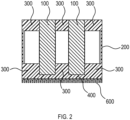
- FIG. 1 shows schematically a system with a housing, which has heat-emitting elements 100, for example accumulators, accommodated in corresponding holders 300.
- the lower part of FIG. 1 shows that System in top view and the upper part a sectional view along the line DD drawn in the lower part.
- the housing has the housing wall 200, a plurality of mounts 300 and a heat sink 400 as a one-piece component.
- the brackets 300 enclose the heat-dissipating members 100 at their upper and lower portions, thereby fixing them.
- the heat sink 400 is arranged on a side of the housing wall 200 opposite the holders 300, in the present case on the underside of the housing. Due to the one-piece structure, the formulation is equivalent, according to which the brackets 300 merge into the housing wall 200 and the housing wall 200 merges into the heat sink 400 at selected sections.
- the heat sink 400 has at least one channel 500 for a cooling medium.
- the at least one channel 500 for the cooling medium is a channel open to the environment and the cooling medium is air. This is in FIG. 1 shown.
- the lateral walls of the channel 500 can thus also be described as cooling ribs.
- the at least one channel 500 is a closed channel and the cooling medium is a liquid. In this way, for example, water cooling can be implemented.
- the heat sink 400 is in two parts, having a portion made of a first thermoplastic composition and a portion made of a second thermoplastic composition, wherein the portion made of the first thermoplastic composition is planar on its side facing away from the mount 300 and this planar side is with bonded to an area of a second thermoplastic composition 600 .
- the material of the housing comprises ⁇ 90% by weight, based on the total weight of the housing, of the first thermoplastic polymer. Fillers and other polymer additives that are incorporated or have already been incorporated during compounding of the polymer are included in this weight fraction of the polymer ("polymer composition"). This proportion is preferably ⁇ 95% by weight and more preferably ⁇ 99% by weight, based on the total weight of the housing.
- the housing can thus be characterized as a "single-component housing". Manufacturing steps can be saved by using only one material.
- the material of the housing further comprises a second thermoplastic polymer composition different from the first thermoplastic polymer composition, which is present on portions of the housing where the first thermoplastic polymer composition is not present.
- the second thermoplastic polymer composition the same statements as for the first polymer composition apply in principle.
- the polymer of the second thermoplastic polymer composition is the same as the first but with the thermally conductive fillers reduced or eliminated.
- the first and the second thermoplastic polymer composition form a material bond at their interfaces with one another.
- the polymer of the second thermoplastic polymer composition is selected from polycarbonate, polyamide, acrylonitrile-butadiene-styrene copolymers, polyphenylene sulfide, polypropylene or a mixture of at least two of the aforementioned polymers. To avoid repetition, reference is made to the previous statements in connection with the first polymer composition.
- the second thermoplastic polymer composition contains a flame retardant.
- Suitable flame retardants are in particular phosphates such as BDP (bisphenol A bis(diphenyl phosphate).
- Other suitable flame retardants are phosphazenes such as cyclic and linear phosphazenes of the formulas (I) and (II): where R 1 , R 2 are identical or different and are alkyl, cycloalkyl, aryl or alkylaryl, R 3 , R 4 are identical or different and are alkyl, cycloalkyl, aryl or alkylaryl
- -N P(OR 4 ) 3
- -N P(OR 4 ) 4
- cyclic phosphazenes of the formula (I) to be used according to the invention preference is given to using those in which a in formula (I) is an integer in the range from 3 to 8, particularly preferably an integer in the range from 3 to 5.
- chain-like phosphazenes of the formula (II) to be used according to the invention preference is given to using those in which b is an integer in the range from 3 to 1000, particularly preferably in the range from 3 to 100, very particularly preferably in the range from 3 to 25.
Landscapes
- Chemical & Material Sciences (AREA)
- Chemical Kinetics & Catalysis (AREA)
- Electrochemistry (AREA)
- General Chemical & Material Sciences (AREA)
- Engineering & Computer Science (AREA)
- Manufacturing & Machinery (AREA)
- Inorganic Chemistry (AREA)
- Composite Materials (AREA)
- Materials Engineering (AREA)
- Mechanical Engineering (AREA)
- Compositions Of Macromolecular Compounds (AREA)
- Injection Moulding Of Plastics Or The Like (AREA)
- Secondary Cells (AREA)
- Battery Mounting, Suspending (AREA)
Description
- Die vorliegende Erfindung betrifft ein Gehäuse für wenigstens ein Wärme abgebendes Element, umfassend eine Gehäusewand, eine mit der Gehäusewand verbundene Halterung zur Aufnahme des wenigstens einen Wärme abgebenden Elements und einen Kühlkörper, welcher auf einer der Halterung gegenüberliegenden Seite der Gehäusewand angeordnet ist und mit der Gehäusewand verbunden ist. Das Wärme abgebende Element ist vorzugsweise ein Speicher für elektrische Energie. Die Erfindung betrifft ebenfalls ein Fahrzeug, vorzugsweise ein Elektrofahrzeug, mit einem solchen Gehäuse.
- Beim Betrieb von Batteriemodulen, wie sie in elektrischen Fahrzeugen eingesetzt werden, können sich die Batteriemodule erwärmen. Zur Erhöhung der Lebensdauer und zur Verbesserung des Wirkungsgrades werden die Batteriemodule daher gekühlt.
- Innerhalb eines Batteriemoduls werden die Batteriezellen in sogenannten Zellhaltern positioniert und fixiert. Diese können zum Beispiel aus Kunststoff gefertigt sein. Unterhalb der Zellen erfolgt die Kühlung konventionell zumeist durch einen Plattenwärmetauscher aus Aluminium. In der Regel existieren somit ein Oberteil mit den in Zellhaltern fixierten Zellen und ein Unterteil, welches die Kühlung realisiert. Die wärmeübertragende Fläche ist letztlich eine Platte. Die einzelnen Teile werden verspannt und in das Batteriegehäuse integriert.
- Es existieren auch Varianten, bei welchen Zellhalter und Gehäuse aus einem Teil gefertigt sind und darunter die Kühlung konventionell mit einem Plattenwärmetauscher aus Aluminium erfolgt.
-
DE 10 2014 201165 A1 betrifft ein Batteriemodul mit einer Anzahl von elektrisch miteinander verschalteten Batteriezellen, wobei die einzelnen Batteriezellen durch ein Temperierfluid temperiert sind. Zwischen den Batteriezellen verläuft ein Kanalsystem, das von dem Temperierfluid durchströmt ist und das Kanalsystem ist von einem Ausgasungssystem der Batteriezellen getrennt. -
DE 10 2014 221684 A1 offenbart ein Gehäuse zur Aufnahme einer Vielzahl von Batteriezellen, insbesondere Lithium-Ionen-Batteriezellen, wobei das Gehäuse, insbesondere ein Kunststoff-Gehäuse, eine Kühlungsvorrichtung mit einer Eintrittsstelle und einer Austrittsstelle für einen Luftstrom zur Kühlung der Batteriezellen umfasst. Das Gehäuse ist zusammen mit der im Gehäuse integrierten Kühlungsvorrichtung als ein einstückiges Bauteil ausgebildet, wobei die Kühlungsvorrichtung zusätzlich Abstandshalter zum Anordnen aller aufzunehmenden Batteriezellen mit einem luftleitbaren Zwischenraum zwischen den Batteriezellen aufweist, wodurch dem Luftstrom ein Luftkanal zwischen den Batteriezellen bereitgestellt wird. - Des Weiteren offenbaren
US 2018/212208 A1 ,EP 2031672 A1 undDE 10 2008 031 175 jeweils ein Gehäuse für ein Wärme abgebendes Element, - Die vorliegende Erfindung hat sich die Aufgabe gestellt, ein Gehäuse für Wärme abgebende Elemente bereitzustellen, welches einfach zu fertigen ist.
- Erfindungsgemäß gelöst wird die Aufgabe durch ein Gehäuse gemäß Anspruch 1. Ein Verfahren gemäß Anspruch 11 und ein System gemäß Anspruch 12 sind ebenfalls
- Gegenstand der Erfindung. Vorteilhafte Weiterbildungen sind in den Unteransprüchen angegeben. Sie können beliebig kombiniert werden, sofern sich aus dem Kontext nicht eindeutig das Gegenteil ergibt. Im Zusammenhang mit dem Gehäuse diskutierte Ausführungsformen sind auch auf das Verfahren und das System anwendbar.
- Ein Gehäuse für wenigstens ein Wärme abgebendes Element umfasst eine Gehäusewand, eine mit der Gehäusewand verbundene Halterung zur Aufnahme des wenigstens einen Wärme abgebenden Elements und einen Kühlkörper, welcher auf einer der Halterung gegenüberliegenden Seite der Gehäusewand angeordnet ist und mit der Gehäusewand verbunden ist. Die Gehäusewand, die Halterung und der Kühlkörper liegen insgesamt als einstückiges Bauteil vor. Der Kühlkörper weist wenigstens einen Kanal für ein Kühlmedium auf. Der Kühlkörper weist folglich eine an die Gehäusewand angeformte Struktur. "Auf der gegenüberliegenden Seite der Gehäusewand angeordnet", bedeutet, dass der Kühlkörper an der Außenseite des Gehäuses angeordnet ist, während die Halterung im Inneren des Gehäuses angeordnet ist. Wenigstens das Material des Kühlkörpers umfasst ein erstes thermoplastisches Polymer mit einer Wärmeleitfähigkeit, bestimmt gemäß ASTM E1461-01, von ≥ 0.2 W/(m K). Sofern in der vorliegenden Anmeldung von "Wärmeleitfähigkeit" gesprochen wird, ist immer die through-plane Wärmeleitfähigkeit gemeint. "Polymer" wird hier verstanden als "Polymer-Zusammensetzung". Es besteht somit wenigstens ein Teilbereich des Kühlkörpers aus einer thermoplastischen Zusammensetzung mit einer Wärmeleitfähigkeit, bestimmt gemäß ASTM E1461-01, von ≥ 0.2 W/(m K). Vorzugsweise besteht der gesamte Kühlkörper aus der ersten thermoplastischen Polymer-Zusammensetzung.
- Das Gehäuse lässt sich leicht im Spritzgussverfahren herstellen, da Gehäusewand, Halterung und Kühlkörper insgesamt einstückig vorliegen. Die Wärmeleitfähigkeit der ersten thermoplastischen Polymer-Zusammensetzung liegt vorzugsweise in einem Bereich von ≥ 0.2 W/(m K) bis ≤ 20 W/(m K), mehr bevorzugt von ≥ 0.3 W/(m K) bis ≤ 16 W/(m K) und besonders bevorzugt >_ 0.4 W/(m K) bis ≤ 8 W/(m K).
- Die einstückigen Gehäuseelemente können aus dem gleichen Material gefertigt sein. Es ist aber auch möglich, verschiedene Materialien zu verwenden und diese dann stoffschlüssig miteinander zu verbinden, um das einstückige Gehäuse zu erhalten. Zur Wärmeabfuhr ist vorgesehen, dass wenigstens das Material des Kühlkörpers die vorgenannte wärmeleitende thermoplastische Polymer-Zusammensetzung umfasst.
- Ein Verfahren zur Herstellung eines erfindungsgemäßen Gehäuses umfasst den Schritt des Herstellens der Gehäusewand, der Halterung und des Kühlkörpers als einstückiges Bauteil in einem Spritzgussverfahren. Auch hier können verschiedene Materialien oder aber überall das gleiche Material (die erste thermoplastische Polymer-Zusammensetzung) eingesetzt werden.
- Im Hinblick auf die Fertigung können alle relevanten Teile vorzugsweise aus zwei Schüssen oder sogar nur einem Schuss hergestellt werden. Dadurch werden der Zusammenbau des Moduls und die Fertigung vereinfacht.
- Ein System umfasst ein erfindungsgemäßes Gehäuse und ein Wärme abgebendes Element, welches in der Halterung des Gehäuses aufgenommen ist. Vorzugsweise ist das Wärme abgebende Element ein elektrochemischer Speicher für elektrische Energie oder eine elektrochemische Quelle von elektrischer Energie. Besonders geeignete Speicher sind Superkondensatoren/Ultrakondensatoren oder Akkumulatoren wie Lithium-Polymer-Akkumulatoren und besonders geeignete Quellen sind Brennstoffzellen wie Polymerelektrolyt-Brennstoffzellen und Direktmethanol-Brennstoffzellen.
- Gemäß einer Ausführungsform ist das Polymer der ersten thermoplastischen Polymer-Zusammensetzung ausgewählt aus Polycarbonat, Polyamid, Acrylnitril-Butadien-Styrol-Copolymeren, Polyphenylensulfid, Polypropylen oder einer Mischung aus mindestens zwei der vorgenannten Polymere.
- Bevorzugt ist, wenn alle an der Wärmeübertragung beteiligten Elemente aus Polycarbonatbasiertem Material bestehen. Im Vergleich zur konventionellen Kühlung kann somit eine deutliche Vergrößerung der wärmeübertragenden Oberfläche erreicht werden. Die Verwendung ähnlicher Materialien geht mit ähnlichen Wärmeausdehnungskoeffizienten an den Fügestellen einher. Dadurch kann ein direkterer Materialkontakt erfolgen, sodass die Wärmedurchgangswiderstände im Vergleich zum bekannten Stand der Technik verringert werden können. Im Hinblick auf die Langzeitstabilität ist zudem die Dimensionsgenauigkeit von Polycarbonat von Vorteil.
- Bevorzugte Polycarbonate sind aromatische Polycarbonate, Polycarbonate mit mehrheitlich auf aromatische Alkohole zurückgehenden Struktureinheiten, Polyestercarbonate und Blends mit den vorgenannten Polycarbonaten als Hauptkomponente. Bevorzugte Polycarbonate haben gewichtsmittlere Molekulargewichte Mw von 22000 bis 29000 g/mol. Hierbei werden die Werte Mw durch Gelpermeationschromotographie ermittelt, kalibriert gegen Bisphenol A-Polycarbonat Standards unter Verwendung von Dichlormethan als Elutionsmittel. Die Polycarbonate werden bevorzugt durch Reaktionen von Bisphenolverbindungen mit Kohlensäureverbindungen, insbesondere Phosgen, oder beim Schmelzeumesterungsprozess mit Diphenylcarbonat oder Dimethylcarbonat dargestellt.
- Hierbei sind Homopolycarbonate auf Basis von Bisphenol-A und Copolycarbonate auf der Basis der Monomere Bisphenol-A und 1,1-Bis-(4-hydroxyphenyl)-3,3,5-trimethylcyclohexan, z.B. Apec® der Covestro Deutschland AG, besonders bevorzugt.
- Beispiele für bevorzugte Polyamide sind PA-6,1, PA-6,T, PA-6,6, PA-6,6/6T, PA-6,6/6,T/6,1-Copolyamid, PA-6,T/2-MPMDT-Copolyamid, PA-9,T, PA-4,6 und deren Mischungen oder Copolyamide.
- Gemäß einer weiteren Ausführungsform enthält die erste thermoplastische Polymer-Zusammensetzung ein Polycarbonat, das eine Schmelzvolumenrate MVR von 8 bis 20 cm3/(10 min), bestimmt nach ISO 1133-1:2012-03 (300°C, 1,2 kg) aufweist. Vorzugsweise beträgt diese MVR 15 bis 20 cm3/(10 min).
- Gemäß einer weiteren Ausführungsform enthält die erste thermoplastische Polymer-Zusammensetzung einen Füllstoff aus der Gruppe Aluminiumoxid, Bornitrid, Siliziumoxid, Kaolin, Talk oder eine Mischung aus wenigstens zwei der vorgenannten Füllstoffe. Solche Füllstoffe dienen dazu, die thermische Leitfähigkeit der Polymer-Zusammensetzung zu erhöhen. Selbstverständlich kann die erste thermoplastische Polymer-Zusammensetzung weitere Additive enthalten wie Stabilisatoren, Fließverbesserer, Entformer, UV-Absorber, Flammschutzmittel und dergleichen. Solch ein Zusätze enthaltendes Polymer kann insgesamt weiterhin als "erstes thermoplastisches Polymer" angesehen werden, das heißt es wird nicht zwingend künstlich zwischen den Makromolekülen und den Zusätzen getrennt; "Polymer" und "Polymer-Zusammensetzung" hat hier die gleiche Bedeutung. Bevorzugte Kombinationen sind ein Polycarbonat mit Bornitrid, ein Polycarbonat mit Kaolin oder ein Polycarbonat mit Talk.
- Das verwendete Bornitrid kann ein kubisches Bornitrid, ein hexagonales Bornitrid, ein amorphes Bornitrid, ein partiell kristallines Bornitrid, ein turbostratisches Bornitrid, ein wurtzitisches Bornitrid, ein rhomboedrisches Bornitrid und/oder eine weitere allotrope Form sein, wobei die hexagonale Form bevorzugt ist.
- Bevorzugt haben die zuvor genannten thermisch leitfähigen Füllstoffe eine agglomerierten Partikelgröße (D(0,5)-Wert) von 1 µm bis 100 µm, bevorzugt von 3 µm bis 60 µm und besonders bevorzugt von 5 µm bis 30 µm, ermittelt durch Laserbeugung. Bei der Laserbeugung werden Partikelgrößenverteilungen durch Messung der Winkelabhängigkeit der Intensität von gestreutem Licht eines Laserstrahls, der eine dispergierte Partikelprobe durchdringt, ermittelt. Hierbei wird die Mie-Theorie der Lichtstreuung zur Berechnung der Partikelgrößenverteilung verwendet. Der D(0,5)-Wert bedeutet, dass 50 Vol.-% aller vorkommenden Partikel in dem untersuchten Material kleiner sind als der angegebene Wert. Wenn das erfindungsgemäße Gehäuse während seines Einsatzes durch externe Einwirkung beschädigt werden kann, beispielsweise als Gehäuse für Akkumulatoren in einem Elektrofahrzeug, erhöht eine möglichst geringe elektrische Leitfähigkeit des Materials die Sicherheit. Bei einer Zerstörung oder Verformung des Gehäuses könnten ansonsten elektrisch leitfähige Elemente des Gehäuses die Akkumulatoren kurzschließen. Gemäß einer weiteren Ausführungsform ist daher die erste thermoplastische Polymer-Zusammensetzung frei von elektrisch leitfähigen Füllstoffen. Zu vermeidende Füllstoffe sind insbesondere Ruß, Graphen, Fullerene und Kohlenstoff-Nanoröhrchen.
- Gemäß einer weiteren Ausführungsform weist die erste thermoplastische Polymer-Zusammensetzung einen Elastizitätsmodul, bestimmt gemäß ISO 527-1/-2, von ≥ 2000 bis ≤ 3500 MPa (bevorzugt ≥ 2500 bis ≤ 3000 MPa) und/oder eine Izod-Schlagzähigkeit, bestimmt gemäß ISO 180/A bei 23 °C, von ≥ 5 bis ≤ 60 kJ/m2 (bevorzugt ≥ 10 bis ≤ 50 kJ/m2, mehr bevorzugt ≥ 20 bis ≤ 40 kJ/m2) auf. Insbesondere Polycarbonate mit solchen mechanischen Kenndaten weisen Vorteile bei Crash- oder Impactbelastungen auf. Das Material versagt bei temporären Spannungsspitzen nicht schlagartig spröde, sondern plastisch. Dieses trägt zur strukturellen Integrität des Bauteils nach Überbelastung bei. Im Gegensatz zu Werkstoffen, die sich spröde verhalten und durch Brechen versagen, deformiert sich das zähe Polycarbonat lediglich.
- Die vorliegende Erfindung wird anhand der nachfolgenden Figuren weiter erläutert, ohne jedoch darauf beschränkt zu sein.
-
FIG. 1 zeigt ein System, dass nicht Bestandteil der Erfindung ist. -
FIG. 2 zeigt ein erfindungsgemäßes System. -
FIG. 1 zeigt schematisch ein System mit einem Gehäuse, welches Wärme abgebende Elemente 100, beispielsweise Akkumulatoren, in entsprechenden Halterungen 300 aufgenommen hat. Der untere Teil vonFIG. 1 zeigt das System in Draufsicht und der obere Teil eine Schnittansicht entlang der im unteren Teil eingezeichneten Linie D-D. - Das Gehäuse weist als einstückiges Bauteil die Gehäusewand 200, eine Mehrzahl von Halterungen 300 und einen Kühlkörper 400 auf. Die Halterungen 300 umschließen die Wärme abgebenden Elemente 100 an ihren oberen und unteren Abschnitten und fixieren sie dadurch. Der Kühlkörper 400 ist auf einer der Halterungen 300 gegenüberliegenden Seite der Gehäusewand 200, im vorliegenden Fall auf der Unterseite des Gehäuses, angeordnet. Aufgrund der Einstückigkeit ist die Formulierung äquivalent, wonach die Halterungen 300 in die Gehäusewand 200 übergehen und die Gehäusewand 200 an ausgewählten Abschnitten in den Kühlkörper 400 übergeht.
- Der Kühlkörper 400 weist wenigstens einen Kanal 500 für ein Kühlmedium auf. Vorzugsweise ist a) der wenigstens eine Kanal 500 für das Kühlmedium ein zur Umgebung hin offener Kanal und das Kühlmedium ist Luft. Dieses ist in
FIG. 1 dargestellt. Die seitlichen Wände des Kanals 500 lassen sich somit auch als Kühlrippen beschreiben. Alternativ ist b) der wenigstens eine Kanal 500 ein geschlossener Kanal und das Kühlmedium ist eine Flüssigkeit. Auf diese Weise kann zum Beispiel eine Wasserkühlung realisiert werden. - Gemäß einer weiteren, in
FIG. 2 dargestellten Ausführungsform ist der Kühlkörper 400 zweiteilig, wobei er einen Teilbereich aus einer ersten thermoplastischen Zusammensetzung und einen Teilbereich aus einer zweiten thermoplastischen Zusammensetzung aufweist, wobei der Teilbereich aus der ersten thermoplastischen Zusammensetzung auf seiner der Halterung 300 abgewandten Seite planar ausgebildet und diese planare Seite ist mit einem Bereich aus einer zweiten thermoplastischen Zusammensetzung 600 stoffschlüssig verbunden. - Gemäß einer weiteren Ausführungsform umfasst das Material des Gehäuses ≥ 90 Gewichts-%, bezogen auf das Gesamtgewicht des Gehäuses, der ersten thermoplastischen Polymers. Füllstoffe und andere Polymeradditive, welche bei der Compoundierung des Polymers eingearbeitet werden oder schon eingearbeitet worden sind, werden bei diesem Gewichtsanteil bei dem Polymer mit berücksichtigt ("Polymer-Zusammensetzung"). Vorzugsweise beträgt dieser Anteil ≥ 95 Gewichts-% und mehr bevorzugt ≥ 99 Gewichts-%, bezogen auf das Gesamtgewicht des Gehäuses. Das Gehäuse lässt sich so als "Einkomponenten-Gehäuse" charakterisieren. Durch die Verwendung nur eines Materials lassen sich Fertigungsschritte einsparen.
- Gemäß einer weiteren Ausführungsform umfasst das Material des Gehäuses weiterhin eine von der ersten thermoplastischen Polymer-Zusammensetzung verschiedene zweite thermoplastische Polymer-Zusammensetzung, welches an Abschnitten des Gehäuses vorliegt, an denen die erste thermoplastische Polymer-Zusammensetzung nicht vorliegt. Bezüglich der zweiten thermoplastischen Polymer-Zusammensetzung gelten grundsätzlich die gleichen Ausführungen wie zur ersten Polymer-Zusammensetzung. Vorzugsweise ist das Polymer der zweiten thermoplastischen Polymer-Zusammensetzung das gleiche wie das erste, wobei jedoch die wärmeleitenden Füllstoffe verringert oder entfernt wurden. Generell kann mit solch einem "Zweikomponenten-Gehäuse" auf fertigungstechnische Anforderungen dadurch eingegangen werden, dass an Stellen des Gehäuses, an denen es weniger auf eine gute Wärmeleitung ankommt, im Spritzgussverfahren anders fließende Thermoplasten eingesetzt werden. Die erste und die zweite thermoplastische Polymer-Zusammensetzung bilden an ihren Grenzflächen zueinander eine stoffschlüssige Verbindung.
- Gemäß einer weiteren Ausführungsform ist das Polymer der zweiten thermoplastischen Polymer-Zusammensetzung ausgewählt aus Polycarbonat, Polyamid, Acrylnitril-Butadien-Styrol-Copolymeren, Polyphenylensulfid, Polypropylen oder einer Mischung aus mindestens zwei der vorgenannten Polymere. Zur Vermeidung von Wiederholungen wird auf die vorangegangenen Ausführungen im Zusammenhang mit der ersten Polymer-Zusammensetzung verwiesen.
- Gemäß einer weiteren Ausführungsform enthält die zweite thermoplastische Polymer-Zusammensetzung ein Flammschutzmittel. Geeignete Flammschutzmittel sind insbesondere Phosphate wie BDP (Bisphenol A-bis(diphenylphosphat). Weitere geeignete Flammschutzmittel sind Phosphazene wie cyclische und lineare Phosphazene der Formeln (I) und (II):

- Unter den ringförmigen erfindungsgemäß einzusetzenden Phosphazenen der Formel (I) werden bevorzugt solche eingesetzt, bei denen a in Formel (I) für eine ganze Zahl im Bereich von 3 bis 8, besonders bevorzugt für eine ganze Zahl im Bereich von 3 bis 5 steht.
- Von den kettenförmigen erfindungsgemäß einzusetzenden Phosphazenen der Formel (II) werden bevorzugt solche eingesetzt, bei denen b für eine ganze Zahl im Bereich von 3 bis 1000, besonders bevorzugt im Bereich von 3 bis 100, ganz besonders bevorzugt im Bereich von 3 bis 25 steht.
- Insbesondere ganz besonders bevorzugt werden ringförmige Phenoxyphosphazene eingesetzt, wie sie z.B. von der Fa. Fushimi Pharmaceutical Co. Ltd, Kagawa, Japan unter der Bezeichnung Rabitle® FP110 [CAS-Nr. 1203646-63-2] erhältlich sind, oder wenn a = 3, dann 2,2,4,4,6,6-Hexahydro-2,2,4,4,6,6-hexaphenoxytriazatriphosphorine [CAS Nr. 1184-10-7].
Claims (13)
- Gehäuse für wenigstens ein Wärme abgebendes Element (100), umfassend:- eine Gehäusewand (200),- eine mit der Gehäusewand (200) verbundene Halterung (300) zur Aufnahme des wenigstens einen Wärme abgebenden Elements (100),- einen Kühlkörper (400), welcher auf einer der Halterung (300) gegenüberliegenden Seite der Gehäusewand (200) angeordnet ist und mit der Gehäusewand (200) verbunden ist,dadurch gekennzeichnet, dass
die Gehäusewand (200), die Halterung (300) und der Kühlkörper (400) insgesamt als einstückiges Bauteil vorliegen, wobei der Kühlkörper (400) wenigstens einen Kanal (500) für ein Kühlmedium aufweist, und wenigstens ein Teilbereich des Kühlkörpers (400) aus einer ersten thermoplastischen Polymer-Zusammensetzung mit einer Wärmeleitfähigkeit, bestimmt gemäß ASTM E1461-01, von ≥ 0.2 W/(m K) besteht, wobei das Material des Gehäuses weiterhin eine von der ersten thermoplastischen Polymer-Zusammensetzung verschiedene zweite thermoplastische Polymer-Zusammensetzung enthält, welche in Bereichen des Gehäuses vorliegt, in denen die erste thermoplastische Polymer-Zusammensetzung nicht vorliegt. - Gehäuse gemäß Anspruch 1, wobei die erste thermoplastische Polymer-Zusammensetzung ein Polymer, ausgewählt aus der Gruppe, bestehend aus Polycarbonat, Polyamid, ABS, PPS, PP oder einer Mischung aus mindestens zwei der vorgenannten Polymere, enthält.
- Gehäuse gemäß Anspruch 2, wobei die erste thermoplastische Polymer-Zusammensetzung ein Polycarbonat enthält, das eine Schmelzvolumenrate MVR von 8 bis 20 cm3/(10 min), bestimmt nach ISO 1133-1:2012-03 (300°C, 1,2 kg) aufweist.
- Gehäuse gemäß einem der Ansprüche 1 bis 3, wobei die erste thermoplastische Polymer-Zusammensetzung einen Füllstoff aus der Gruppe, bestehend aus Aluminiumoxid, Bornitrid, Siliziumoxid, Kaolin, Talk oder eine Mischung aus wenigstens zwei der vorgenannten Füllstoffe, enthält.
- Gehäuse gemäß einem der Ansprüche 1 bis 4, wobei die erste thermoplastische Polymer-Zusammensetzung einen Elastizitätsmodul, bestimmt gemäß ISO 527-1/-2, von ≥ 2000 bis ≤ 3500 MPa und/oder eine Izod-Schlagzähigkeit, bestimmt gemäß ISO 180/A bei 23 °C, von ≥ 5 bis ≤ 60 kJ/m2, aufweist.
- Gehäuse gemäß einem der vorhergehenden Ansprüche, wobei a) der wenigstens eine Kanal (500) für das Kühlmedium ein zur Umgebung hin offener Kanal ist und das Kühlmedium Luft ist oder wobei b) der wenigstens eine Kanal (500) ein geschlossener Kanal ist und das Kühlmedium eine Flüssigkeit ist.
- Gehäuse gemäß einem der Ansprüche 1 bis 6, wobei das Material des Gehäuses ≥ 90 Gewichts-%, bezogen auf das Gesamtgewicht des Gehäuses, der ersten thermoplastischen Polymer-Zusammensetzung, enthält.
- Gehäuse gemäß einem der Ansprüche 1 bis 7, wobei die zweite thermoplastische Polymer-Zusammensetzung Polycarbonat, Polyamid, Acrylnitril-Butadien-Styrol-Copolymere, Polyphenylensulfid, Polypropylen oder einer Mischung aus mindestens zwei der vorgenannten Polymere enthält.
- Gehäuse gemäß Anspruch 8, wobei die zweite thermoplastische Polymer-Zusammensetzung ein Flammschutzmittel enthält.
- Gehäuse gemäß einem der vorhergehenden Ansprüche, wobei der Kühlkörper (400) eine Vielzahl von Kanälen (500) aufweist, welche durch Rippen gebildet sind.
- Verfahren zur Herstellung eines Gehäuses gemäß einem der Ansprüche 1 bis 10, umfassend den Schritt des Herstellens der Gehäusewand (200), der Halterung (300) und des Kühlkörpers (400) als einstückiges Bauteil in einem Spritzgussverfahren.
- System umfassend ein Gehäuse gemäß einem der Ansprüche 1 bis 10 und ein Wärme abgebendes Element, welches in der Halterung (300) des Gehäuses aufgenommen ist.
- System gemäß Anspruch 12, wobei das Wärme abgebende Element ein elektrochemischer Speicher für elektrische Energie oder eine elektrochemische Quelle von elektrischer Energie ist.
Applications Claiming Priority (2)
| Application Number | Priority Date | Filing Date | Title |
|---|---|---|---|
| EP18208973 | 2018-11-28 | ||
| PCT/EP2019/081103 WO2020108988A1 (de) | 2018-11-28 | 2019-11-13 | Integriertes kühlelement für ein batteriemodul |
Publications (2)
| Publication Number | Publication Date |
|---|---|
| EP3888158A1 EP3888158A1 (de) | 2021-10-06 |
| EP3888158B1 true EP3888158B1 (de) | 2023-04-05 |
Family
ID=64556815
Family Applications (1)
| Application Number | Title | Priority Date | Filing Date |
|---|---|---|---|
| EP19804700.3A Active EP3888158B1 (de) | 2018-11-28 | 2019-11-13 | Integriertes kühlelement für ein batteriemodul |
Country Status (6)
| Country | Link |
|---|---|
| US (1) | US20210399358A1 (de) |
| EP (1) | EP3888158B1 (de) |
| JP (1) | JP7635124B2 (de) |
| KR (1) | KR102913594B1 (de) |
| CN (1) | CN113196553B (de) |
| WO (1) | WO2020108988A1 (de) |
Families Citing this family (3)
| Publication number | Priority date | Publication date | Assignee | Title |
|---|---|---|---|---|
| KR102943040B1 (ko) * | 2020-10-22 | 2026-03-24 | 주식회사 엘지에너지솔루션 | 배터리 팩 및 이의 제조방법 |
| DE102022102620A1 (de) | 2022-02-03 | 2023-08-03 | Webasto SE | Zellhalter zum Halten einer Mehrzahl von Batteriezellen und Fahrzeugbatterieanordnung |
| DE102023113877A1 (de) * | 2023-05-26 | 2024-11-28 | Bayerische Motoren Werke Aktiengesellschaft | Gehäuse für eine Batterie, Batterie mit dem Gehäuse, Verfahren zum Herstellen der Batterie und Kraftfahrzeug |
Family Cites Families (17)
| Publication number | Priority date | Publication date | Assignee | Title |
|---|---|---|---|---|
| US6649677B2 (en) | 1998-11-03 | 2003-11-18 | General Electric Company | Polycarbonate sheet with improved fire retardant performance |
| US6886625B1 (en) * | 2001-08-23 | 2005-05-03 | Cool Options, Inc. | Elastomeric heat sink with a pressure sensitive adhesive backing |
| US20070037053A1 (en) * | 2005-08-12 | 2007-02-15 | Satish Anantharaman | Battery case having improved thermal conductivity |
| JP5018119B2 (ja) | 2007-02-16 | 2012-09-05 | パナソニック株式会社 | 蓄電ユニット |
| JP4508221B2 (ja) * | 2007-08-27 | 2010-07-21 | 豊田合成株式会社 | 組電池装置 |
| KR20100060013A (ko) | 2007-09-26 | 2010-06-04 | 다우 글로벌 테크놀로지스 인크. | 감소된 광택을 갖는 개선된 카보네이트 중합체 블렌드 |
| DE102008024672A1 (de) * | 2008-05-21 | 2009-11-26 | Bayer Materialscience Ag | Tieftemperaturzähe Polycarbonat-Blends |
| DE102008031175A1 (de) * | 2008-07-03 | 2010-01-07 | Johnson Controls Hybrid And Recycling Gmbh | Rundzellenakkumulator |
| DE102008058351A1 (de) * | 2008-11-20 | 2010-06-02 | Kronos International, Inc. | Oberflächenbehandelte Titandioxid-Pigmente für Kunststoffe und Verfahren zur Herstellung |
| JP5833519B2 (ja) * | 2012-09-27 | 2015-12-16 | アイシン軽金属株式会社 | セル型電池ケース |
| EP3015494B1 (de) | 2013-06-26 | 2018-05-02 | Mitsubishi Gas Chemical Company, Inc. | Flammhemmende folie oder film, produkte enthaltend diese und verfahren ihrer herstellung |
| WO2015049188A2 (de) * | 2013-10-02 | 2015-04-09 | Bayer Materialscience Ag | Batteriemodul mit sicherheitsabschnitt, batteriepack und elektrofahrzeug |
| DE102014201165A1 (de) * | 2014-01-23 | 2015-08-06 | Robert Bosch Gmbh | Batterie-Pack mit Luftkühlung |
| DE102014221684A1 (de) | 2014-07-11 | 2016-01-14 | Robert Bosch Gmbh | Gehäuse zur Aufnahme einer Vielzahl von Batteriezellen mit einer im Gehäuse integrierten Kühlungsvorrichtung |
| JP5955990B2 (ja) * | 2014-08-27 | 2016-07-20 | 武延 本郷 | 面状発熱装置、融雪装置および照明装置 |
| JP2018116805A (ja) | 2017-01-17 | 2018-07-26 | 積水化学工業株式会社 | 二次電池モジュール |
| JP7152405B2 (ja) * | 2017-01-24 | 2022-10-12 | ティコナ・エルエルシー | 電動輸送機器用の電池モジュール |
-
2019
- 2019-11-13 EP EP19804700.3A patent/EP3888158B1/de active Active
- 2019-11-13 CN CN201980078090.7A patent/CN113196553B/zh active Active
- 2019-11-13 WO PCT/EP2019/081103 patent/WO2020108988A1/de not_active Ceased
- 2019-11-13 JP JP2021529363A patent/JP7635124B2/ja active Active
- 2019-11-13 KR KR1020217015762A patent/KR102913594B1/ko active Active
- 2019-11-13 US US17/294,481 patent/US20210399358A1/en not_active Abandoned
Also Published As
| Publication number | Publication date |
|---|---|
| JP2022510621A (ja) | 2022-01-27 |
| CN113196553A (zh) | 2021-07-30 |
| WO2020108988A1 (de) | 2020-06-04 |
| JP7635124B2 (ja) | 2025-02-25 |
| US20210399358A1 (en) | 2021-12-23 |
| CN113196553B (zh) | 2024-11-29 |
| EP3888158A1 (de) | 2021-10-06 |
| KR20210093912A (ko) | 2021-07-28 |
| KR102913594B1 (ko) | 2026-01-19 |
Similar Documents
| Publication | Publication Date | Title |
|---|---|---|
| EP3888158B1 (de) | Integriertes kühlelement für ein batteriemodul | |
| EP1508182B1 (de) | BATTERIE MIT WENIGSTENS EINER ELEKTROCHEMISCHEN SPEICHERZELLE UND EINER KüHLEINRICHTUNG | |
| DE102020119410A1 (de) | Batteriemodul | |
| DE112021001133T5 (de) | Wärmemanagement-Mehrlagenfolie für eine Batterie | |
| DE112021001583T5 (de) | Mehrschichtige Wärmemanagementfolie für eine Batterie | |
| DE112008001675B4 (de) | Leistungsspeichervorrichtung | |
| DE102012222689A1 (de) | Energiespeicher mit Zellaufnahme | |
| DE102018133391A1 (de) | Batteriemodul und Herstellungsverfahren desselben | |
| DE212012000137U1 (de) | Batteriesatzanordnung | |
| DE19750069A1 (de) | Akkumulatorenbatterie mit Temperiervorrichtung | |
| DE112018004799T5 (de) | Schmelzbare Phasenwechsel-Pulver für die thermische Behandlung, Verfahren zu ihrer Herstellung und Gegenstände, die diese Pulver enthalten | |
| DE102007059805A1 (de) | Batteriepack | |
| EP2153487A1 (de) | Elektrochemische energiespeichereinheit mit kühlvorrichtung | |
| EP2263432A1 (de) | Verbindungsbox für solar-module | |
| DE112009000653T5 (de) | Kondensatormodul | |
| DE102011017375B4 (de) | Elektrische Batterieeinheit und Batteriepack | |
| DE102015121107A1 (de) | Elektrische Energiespeichervorrichtung | |
| EP2745348A2 (de) | Wärmeableiter und elektrischer energiespeicher | |
| DE102009013727A1 (de) | Batterie mit einem Stapel aus Flachzellen, Rahmen zur Halterung einer Flachzelle und Fahrzeug mit einer solchen Batterie | |
| EP2643134A1 (de) | Rahmen für eine elktrochemische energiespeichereinheit | |
| DE102012222924B4 (de) | Batterieanordnung mit einem Wärmemanagementsystem | |
| DE102013226743A1 (de) | Wärmeleitender Polymerseparator | |
| DE102016221492A1 (de) | Zellrahmen zur Aufnahme von Pouch-Zellen | |
| DE102010055614A1 (de) | Batteriegehäuse zur Aufnahme von Batterieeinzelzellen | |
| DE102010005020A1 (de) | Wärmeleitendes Kompositmaterial, Formkörper hieraus sowie Verwendungszwecke |
Legal Events
| Date | Code | Title | Description |
|---|---|---|---|
| STAA | Information on the status of an ep patent application or granted ep patent |
Free format text: STATUS: UNKNOWN |
|
| STAA | Information on the status of an ep patent application or granted ep patent |
Free format text: STATUS: THE INTERNATIONAL PUBLICATION HAS BEEN MADE |
|
| PUAI | Public reference made under article 153(3) epc to a published international application that has entered the european phase |
Free format text: ORIGINAL CODE: 0009012 |
|
| STAA | Information on the status of an ep patent application or granted ep patent |
Free format text: STATUS: REQUEST FOR EXAMINATION WAS MADE |
|
| 17P | Request for examination filed |
Effective date: 20210628 |
|
| AK | Designated contracting states |
Kind code of ref document: A1 Designated state(s): AL AT BE BG CH CY CZ DE DK EE ES FI FR GB GR HR HU IE IS IT LI LT LU LV MC MK MT NL NO PL PT RO RS SE SI SK SM TR |
|
| DAV | Request for validation of the european patent (deleted) | ||
| DAX | Request for extension of the european patent (deleted) | ||
| REG | Reference to a national code |
Ref country code: DE Ref legal event code: R079 Ref document number: 502019007418 Country of ref document: DE Free format text: PREVIOUS MAIN CLASS: H01M0002100000 Ipc: H01M0050213000 |
|
| RIC1 | Information provided on ipc code assigned before grant |
Ipc: H01M 50/24 20210101ALI20221115BHEP Ipc: H01M 50/229 20210101ALI20221115BHEP Ipc: H01M 50/227 20210101ALI20221115BHEP Ipc: H01M 50/222 20210101ALI20221115BHEP Ipc: H01M 50/213 20210101AFI20221115BHEP |
|
| GRAP | Despatch of communication of intention to grant a patent |
Free format text: ORIGINAL CODE: EPIDOSNIGR1 |
|
| STAA | Information on the status of an ep patent application or granted ep patent |
Free format text: STATUS: GRANT OF PATENT IS INTENDED |
|
| INTG | Intention to grant announced |
Effective date: 20230104 |
|
| GRAS | Grant fee paid |
Free format text: ORIGINAL CODE: EPIDOSNIGR3 |
|
| GRAA | (expected) grant |
Free format text: ORIGINAL CODE: 0009210 |
|
| STAA | Information on the status of an ep patent application or granted ep patent |
Free format text: STATUS: THE PATENT HAS BEEN GRANTED |
|
| AK | Designated contracting states |
Kind code of ref document: B1 Designated state(s): AL AT BE BG CH CY CZ DE DK EE ES FI FR GB GR HR HU IE IS IT LI LT LU LV MC MK MT NL NO PL PT RO RS SE SI SK SM TR |
|
| REG | Reference to a national code |
Ref country code: GB Ref legal event code: FG4D Free format text: NOT ENGLISH |
|
| REG | Reference to a national code |
Ref country code: DE Ref legal event code: R096 Ref document number: 502019007418 Country of ref document: DE |
|
| REG | Reference to a national code |
Ref country code: CH Ref legal event code: EP |
|
| REG | Reference to a national code |
Ref country code: AT Ref legal event code: REF Ref document number: 1558946 Country of ref document: AT Kind code of ref document: T Effective date: 20230415 |
|
| REG | Reference to a national code |
Ref country code: IE Ref legal event code: FG4D Free format text: LANGUAGE OF EP DOCUMENT: GERMAN |
|
| REG | Reference to a national code |
Ref country code: LT Ref legal event code: MG9D |
|
| REG | Reference to a national code |
Ref country code: NL Ref legal event code: MP Effective date: 20230405 |
|
| PG25 | Lapsed in a contracting state [announced via postgrant information from national office to epo] |
Ref country code: NL Free format text: LAPSE BECAUSE OF FAILURE TO SUBMIT A TRANSLATION OF THE DESCRIPTION OR TO PAY THE FEE WITHIN THE PRESCRIBED TIME-LIMIT Effective date: 20230405 |
|
| PG25 | Lapsed in a contracting state [announced via postgrant information from national office to epo] |
Ref country code: SE Free format text: LAPSE BECAUSE OF FAILURE TO SUBMIT A TRANSLATION OF THE DESCRIPTION OR TO PAY THE FEE WITHIN THE PRESCRIBED TIME-LIMIT Effective date: 20230405 Ref country code: PT Free format text: LAPSE BECAUSE OF FAILURE TO SUBMIT A TRANSLATION OF THE DESCRIPTION OR TO PAY THE FEE WITHIN THE PRESCRIBED TIME-LIMIT Effective date: 20230807 Ref country code: NO Free format text: LAPSE BECAUSE OF FAILURE TO SUBMIT A TRANSLATION OF THE DESCRIPTION OR TO PAY THE FEE WITHIN THE PRESCRIBED TIME-LIMIT Effective date: 20230705 Ref country code: ES Free format text: LAPSE BECAUSE OF FAILURE TO SUBMIT A TRANSLATION OF THE DESCRIPTION OR TO PAY THE FEE WITHIN THE PRESCRIBED TIME-LIMIT Effective date: 20230405 |
|
| PG25 | Lapsed in a contracting state [announced via postgrant information from national office to epo] |
Ref country code: RS Free format text: LAPSE BECAUSE OF FAILURE TO SUBMIT A TRANSLATION OF THE DESCRIPTION OR TO PAY THE FEE WITHIN THE PRESCRIBED TIME-LIMIT Effective date: 20230405 Ref country code: PL Free format text: LAPSE BECAUSE OF FAILURE TO SUBMIT A TRANSLATION OF THE DESCRIPTION OR TO PAY THE FEE WITHIN THE PRESCRIBED TIME-LIMIT Effective date: 20230405 Ref country code: LV Free format text: LAPSE BECAUSE OF FAILURE TO SUBMIT A TRANSLATION OF THE DESCRIPTION OR TO PAY THE FEE WITHIN THE PRESCRIBED TIME-LIMIT Effective date: 20230405 Ref country code: LT Free format text: LAPSE BECAUSE OF FAILURE TO SUBMIT A TRANSLATION OF THE DESCRIPTION OR TO PAY THE FEE WITHIN THE PRESCRIBED TIME-LIMIT Effective date: 20230405 Ref country code: IS Free format text: LAPSE BECAUSE OF FAILURE TO SUBMIT A TRANSLATION OF THE DESCRIPTION OR TO PAY THE FEE WITHIN THE PRESCRIBED TIME-LIMIT Effective date: 20230805 Ref country code: HR Free format text: LAPSE BECAUSE OF FAILURE TO SUBMIT A TRANSLATION OF THE DESCRIPTION OR TO PAY THE FEE WITHIN THE PRESCRIBED TIME-LIMIT Effective date: 20230405 Ref country code: GR Free format text: LAPSE BECAUSE OF FAILURE TO SUBMIT A TRANSLATION OF THE DESCRIPTION OR TO PAY THE FEE WITHIN THE PRESCRIBED TIME-LIMIT Effective date: 20230706 Ref country code: AL Free format text: LAPSE BECAUSE OF FAILURE TO SUBMIT A TRANSLATION OF THE DESCRIPTION OR TO PAY THE FEE WITHIN THE PRESCRIBED TIME-LIMIT Effective date: 20230405 |
|
| PG25 | Lapsed in a contracting state [announced via postgrant information from national office to epo] |
Ref country code: FI Free format text: LAPSE BECAUSE OF FAILURE TO SUBMIT A TRANSLATION OF THE DESCRIPTION OR TO PAY THE FEE WITHIN THE PRESCRIBED TIME-LIMIT Effective date: 20230405 |
|
| REG | Reference to a national code |
Ref country code: DE Ref legal event code: R097 Ref document number: 502019007418 Country of ref document: DE |
|
| PG25 | Lapsed in a contracting state [announced via postgrant information from national office to epo] |
Ref country code: SK Free format text: LAPSE BECAUSE OF FAILURE TO SUBMIT A TRANSLATION OF THE DESCRIPTION OR TO PAY THE FEE WITHIN THE PRESCRIBED TIME-LIMIT Effective date: 20230405 |
|
| PG25 | Lapsed in a contracting state [announced via postgrant information from national office to epo] |
Ref country code: SM Free format text: LAPSE BECAUSE OF FAILURE TO SUBMIT A TRANSLATION OF THE DESCRIPTION OR TO PAY THE FEE WITHIN THE PRESCRIBED TIME-LIMIT Effective date: 20230405 Ref country code: SK Free format text: LAPSE BECAUSE OF FAILURE TO SUBMIT A TRANSLATION OF THE DESCRIPTION OR TO PAY THE FEE WITHIN THE PRESCRIBED TIME-LIMIT Effective date: 20230405 Ref country code: RO Free format text: LAPSE BECAUSE OF FAILURE TO SUBMIT A TRANSLATION OF THE DESCRIPTION OR TO PAY THE FEE WITHIN THE PRESCRIBED TIME-LIMIT Effective date: 20230405 Ref country code: EE Free format text: LAPSE BECAUSE OF FAILURE TO SUBMIT A TRANSLATION OF THE DESCRIPTION OR TO PAY THE FEE WITHIN THE PRESCRIBED TIME-LIMIT Effective date: 20230405 Ref country code: DK Free format text: LAPSE BECAUSE OF FAILURE TO SUBMIT A TRANSLATION OF THE DESCRIPTION OR TO PAY THE FEE WITHIN THE PRESCRIBED TIME-LIMIT Effective date: 20230405 Ref country code: CZ Free format text: LAPSE BECAUSE OF FAILURE TO SUBMIT A TRANSLATION OF THE DESCRIPTION OR TO PAY THE FEE WITHIN THE PRESCRIBED TIME-LIMIT Effective date: 20230405 |
|
| PLBE | No opposition filed within time limit |
Free format text: ORIGINAL CODE: 0009261 |
|
| STAA | Information on the status of an ep patent application or granted ep patent |
Free format text: STATUS: NO OPPOSITION FILED WITHIN TIME LIMIT |
|
| 26N | No opposition filed |
Effective date: 20240108 |
|
| PG25 | Lapsed in a contracting state [announced via postgrant information from national office to epo] |
Ref country code: SI Free format text: LAPSE BECAUSE OF FAILURE TO SUBMIT A TRANSLATION OF THE DESCRIPTION OR TO PAY THE FEE WITHIN THE PRESCRIBED TIME-LIMIT Effective date: 20230405 |
|
| PG25 | Lapsed in a contracting state [announced via postgrant information from national office to epo] |
Ref country code: SI Free format text: LAPSE BECAUSE OF FAILURE TO SUBMIT A TRANSLATION OF THE DESCRIPTION OR TO PAY THE FEE WITHIN THE PRESCRIBED TIME-LIMIT Effective date: 20230405 Ref country code: IT Free format text: LAPSE BECAUSE OF FAILURE TO SUBMIT A TRANSLATION OF THE DESCRIPTION OR TO PAY THE FEE WITHIN THE PRESCRIBED TIME-LIMIT Effective date: 20230405 |
|
| REG | Reference to a national code |
Ref country code: CH Ref legal event code: PL |
|
| PG25 | Lapsed in a contracting state [announced via postgrant information from national office to epo] |
Ref country code: MC Free format text: LAPSE BECAUSE OF FAILURE TO SUBMIT A TRANSLATION OF THE DESCRIPTION OR TO PAY THE FEE WITHIN THE PRESCRIBED TIME-LIMIT Effective date: 20230405 |
|
| PG25 | Lapsed in a contracting state [announced via postgrant information from national office to epo] |
Ref country code: LU Free format text: LAPSE BECAUSE OF NON-PAYMENT OF DUE FEES Effective date: 20231113 |
|
| PG25 | Lapsed in a contracting state [announced via postgrant information from national office to epo] |
Ref country code: CH Free format text: LAPSE BECAUSE OF NON-PAYMENT OF DUE FEES Effective date: 20231130 |
|
| PG25 | Lapsed in a contracting state [announced via postgrant information from national office to epo] |
Ref country code: MC Free format text: LAPSE BECAUSE OF FAILURE TO SUBMIT A TRANSLATION OF THE DESCRIPTION OR TO PAY THE FEE WITHIN THE PRESCRIBED TIME-LIMIT Effective date: 20230405 Ref country code: LU Free format text: LAPSE BECAUSE OF NON-PAYMENT OF DUE FEES Effective date: 20231113 Ref country code: CH Free format text: LAPSE BECAUSE OF NON-PAYMENT OF DUE FEES Effective date: 20231130 |
|
| REG | Reference to a national code |
Ref country code: BE Ref legal event code: MM Effective date: 20231130 |
|
| REG | Reference to a national code |
Ref country code: IE Ref legal event code: MM4A |
|
| PG25 | Lapsed in a contracting state [announced via postgrant information from national office to epo] |
Ref country code: IE Free format text: LAPSE BECAUSE OF NON-PAYMENT OF DUE FEES Effective date: 20231113 |
|
| PG25 | Lapsed in a contracting state [announced via postgrant information from national office to epo] |
Ref country code: BE Free format text: LAPSE BECAUSE OF NON-PAYMENT OF DUE FEES Effective date: 20231130 |
|
| PG25 | Lapsed in a contracting state [announced via postgrant information from national office to epo] |
Ref country code: IE Free format text: LAPSE BECAUSE OF NON-PAYMENT OF DUE FEES Effective date: 20231113 Ref country code: BE Free format text: LAPSE BECAUSE OF NON-PAYMENT OF DUE FEES Effective date: 20231130 |
|
| PG25 | Lapsed in a contracting state [announced via postgrant information from national office to epo] |
Ref country code: BG Free format text: LAPSE BECAUSE OF FAILURE TO SUBMIT A TRANSLATION OF THE DESCRIPTION OR TO PAY THE FEE WITHIN THE PRESCRIBED TIME-LIMIT Effective date: 20230405 |
|
| PG25 | Lapsed in a contracting state [announced via postgrant information from national office to epo] |
Ref country code: BG Free format text: LAPSE BECAUSE OF FAILURE TO SUBMIT A TRANSLATION OF THE DESCRIPTION OR TO PAY THE FEE WITHIN THE PRESCRIBED TIME-LIMIT Effective date: 20230405 |
|
| PG25 | Lapsed in a contracting state [announced via postgrant information from national office to epo] |
Ref country code: CY Free format text: LAPSE BECAUSE OF FAILURE TO SUBMIT A TRANSLATION OF THE DESCRIPTION OR TO PAY THE FEE WITHIN THE PRESCRIBED TIME-LIMIT; INVALID AB INITIO Effective date: 20191113 |
|
| PG25 | Lapsed in a contracting state [announced via postgrant information from national office to epo] |
Ref country code: HU Free format text: LAPSE BECAUSE OF FAILURE TO SUBMIT A TRANSLATION OF THE DESCRIPTION OR TO PAY THE FEE WITHIN THE PRESCRIBED TIME-LIMIT; INVALID AB INITIO Effective date: 20191113 |
|
| PG25 | Lapsed in a contracting state [announced via postgrant information from national office to epo] |
Ref country code: TR Free format text: LAPSE BECAUSE OF FAILURE TO SUBMIT A TRANSLATION OF THE DESCRIPTION OR TO PAY THE FEE WITHIN THE PRESCRIBED TIME-LIMIT Effective date: 20230405 |
|
| PGFP | Annual fee paid to national office [announced via postgrant information from national office to epo] |
Ref country code: DE Payment date: 20251022 Year of fee payment: 7 |
|
| PGFP | Annual fee paid to national office [announced via postgrant information from national office to epo] |
Ref country code: GB Payment date: 20251016 Year of fee payment: 7 |
|
| PG25 | Lapsed in a contracting state [announced via postgrant information from national office to epo] |
Ref country code: AT Free format text: LAPSE BECAUSE OF NON-PAYMENT OF DUE FEES Effective date: 20241113 |
|
| PGFP | Annual fee paid to national office [announced via postgrant information from national office to epo] |
Ref country code: FR Payment date: 20251023 Year of fee payment: 7 |
|
| REG | Reference to a national code |
Ref country code: AT Ref legal event code: MM01 Ref document number: 1558946 Country of ref document: AT Kind code of ref document: T Effective date: 20241113 |
|
| PGFP | Annual fee paid to national office [announced via postgrant information from national office to epo] |
Ref country code: AT Payment date: 20260410 Year of fee payment: 5 |