EP3862467B1 - Fluide de filage éclair, son utilisation et procédé de sa préparation - Google Patents
Fluide de filage éclair, son utilisation et procédé de sa préparation Download PDFInfo
- Publication number
- EP3862467B1 EP3862467B1 EP21151511.9A EP21151511A EP3862467B1 EP 3862467 B1 EP3862467 B1 EP 3862467B1 EP 21151511 A EP21151511 A EP 21151511A EP 3862467 B1 EP3862467 B1 EP 3862467B1
- Authority
- EP
- European Patent Office
- Prior art keywords
- spin
- perfluorohexane
- polymer
- flash
- dichloroethylene
- Prior art date
- Legal status (The legal status is an assumption and is not a legal conclusion. Google has not performed a legal analysis and makes no representation as to the accuracy of the status listed.)
- Active
Links
Images









Classifications
-
- D—TEXTILES; PAPER
- D01—NATURAL OR MAN-MADE THREADS OR FIBRES; SPINNING
- D01D—MECHANICAL METHODS OR APPARATUS IN THE MANUFACTURE OF ARTIFICIAL FILAMENTS, THREADS, FIBRES, BRISTLES OR RIBBONS
- D01D1/00—Treatment of filament-forming or like material
- D01D1/02—Preparation of spinning solutions
-
- D—TEXTILES; PAPER
- D01—NATURAL OR MAN-MADE THREADS OR FIBRES; SPINNING
- D01D—MECHANICAL METHODS OR APPARATUS IN THE MANUFACTURE OF ARTIFICIAL FILAMENTS, THREADS, FIBRES, BRISTLES OR RIBBONS
- D01D11/00—Other features of manufacture
-
- D—TEXTILES; PAPER
- D01—NATURAL OR MAN-MADE THREADS OR FIBRES; SPINNING
- D01D—MECHANICAL METHODS OR APPARATUS IN THE MANUFACTURE OF ARTIFICIAL FILAMENTS, THREADS, FIBRES, BRISTLES OR RIBBONS
- D01D5/00—Formation of filaments, threads, or the like
- D01D5/11—Flash-spinning
-
- D—TEXTILES; PAPER
- D01—NATURAL OR MAN-MADE THREADS OR FIBRES; SPINNING
- D01F—CHEMICAL FEATURES IN THE MANUFACTURE OF ARTIFICIAL FILAMENTS, THREADS, FIBRES, BRISTLES OR RIBBONS; APPARATUS SPECIALLY ADAPTED FOR THE MANUFACTURE OF CARBON FILAMENTS
- D01F1/00—General methods for the manufacture of artificial filaments or the like
- D01F1/02—Addition of substances to the spinning solution or to the melt
- D01F1/10—Other agents for modifying properties
-
- D—TEXTILES; PAPER
- D01—NATURAL OR MAN-MADE THREADS OR FIBRES; SPINNING
- D01F—CHEMICAL FEATURES IN THE MANUFACTURE OF ARTIFICIAL FILAMENTS, THREADS, FIBRES, BRISTLES OR RIBBONS; APPARATUS SPECIALLY ADAPTED FOR THE MANUFACTURE OF CARBON FILAMENTS
- D01F6/00—Monocomponent artificial filaments or the like of synthetic polymers; Manufacture thereof
- D01F6/02—Monocomponent artificial filaments or the like of synthetic polymers; Manufacture thereof from homopolymers obtained by reactions only involving carbon-to-carbon unsaturated bonds
- D01F6/04—Monocomponent artificial filaments or the like of synthetic polymers; Manufacture thereof from homopolymers obtained by reactions only involving carbon-to-carbon unsaturated bonds from polyolefins
-
- D—TEXTILES; PAPER
- D01—NATURAL OR MAN-MADE THREADS OR FIBRES; SPINNING
- D01F—CHEMICAL FEATURES IN THE MANUFACTURE OF ARTIFICIAL FILAMENTS, THREADS, FIBRES, BRISTLES OR RIBBONS; APPARATUS SPECIALLY ADAPTED FOR THE MANUFACTURE OF CARBON FILAMENTS
- D01F6/00—Monocomponent artificial filaments or the like of synthetic polymers; Manufacture thereof
- D01F6/02—Monocomponent artificial filaments or the like of synthetic polymers; Manufacture thereof from homopolymers obtained by reactions only involving carbon-to-carbon unsaturated bonds
- D01F6/04—Monocomponent artificial filaments or the like of synthetic polymers; Manufacture thereof from homopolymers obtained by reactions only involving carbon-to-carbon unsaturated bonds from polyolefins
- D01F6/06—Monocomponent artificial filaments or the like of synthetic polymers; Manufacture thereof from homopolymers obtained by reactions only involving carbon-to-carbon unsaturated bonds from polyolefins from polypropylene
-
- D—TEXTILES; PAPER
- D01—NATURAL OR MAN-MADE THREADS OR FIBRES; SPINNING
- D01F—CHEMICAL FEATURES IN THE MANUFACTURE OF ARTIFICIAL FILAMENTS, THREADS, FIBRES, BRISTLES OR RIBBONS; APPARATUS SPECIALLY ADAPTED FOR THE MANUFACTURE OF CARBON FILAMENTS
- D01F6/00—Monocomponent artificial filaments or the like of synthetic polymers; Manufacture thereof
- D01F6/02—Monocomponent artificial filaments or the like of synthetic polymers; Manufacture thereof from homopolymers obtained by reactions only involving carbon-to-carbon unsaturated bonds
- D01F6/08—Monocomponent artificial filaments or the like of synthetic polymers; Manufacture thereof from homopolymers obtained by reactions only involving carbon-to-carbon unsaturated bonds from polymers of halogenated hydrocarbons
- D01F6/12—Monocomponent artificial filaments or the like of synthetic polymers; Manufacture thereof from homopolymers obtained by reactions only involving carbon-to-carbon unsaturated bonds from polymers of halogenated hydrocarbons from polymers of fluorinated hydrocarbons
-
- D—TEXTILES; PAPER
- D01—NATURAL OR MAN-MADE THREADS OR FIBRES; SPINNING
- D01F—CHEMICAL FEATURES IN THE MANUFACTURE OF ARTIFICIAL FILAMENTS, THREADS, FIBRES, BRISTLES OR RIBBONS; APPARATUS SPECIALLY ADAPTED FOR THE MANUFACTURE OF CARBON FILAMENTS
- D01F6/00—Monocomponent artificial filaments or the like of synthetic polymers; Manufacture thereof
- D01F6/28—Monocomponent artificial filaments or the like of synthetic polymers; Manufacture thereof from copolymers obtained by reactions only involving carbon-to-carbon unsaturated bonds
- D01F6/32—Monocomponent artificial filaments or the like of synthetic polymers; Manufacture thereof from copolymers obtained by reactions only involving carbon-to-carbon unsaturated bonds comprising halogenated hydrocarbons as the major constituent
-
- D—TEXTILES; PAPER
- D01—NATURAL OR MAN-MADE THREADS OR FIBRES; SPINNING
- D01F—CHEMICAL FEATURES IN THE MANUFACTURE OF ARTIFICIAL FILAMENTS, THREADS, FIBRES, BRISTLES OR RIBBONS; APPARATUS SPECIALLY ADAPTED FOR THE MANUFACTURE OF CARBON FILAMENTS
- D01F6/00—Monocomponent artificial filaments or the like of synthetic polymers; Manufacture thereof
- D01F6/44—Monocomponent artificial filaments or the like of synthetic polymers; Manufacture thereof from mixtures of polymers obtained by reactions only involving carbon-to-carbon unsaturated bonds as major constituent with other polymers or low-molecular-weight compounds
- D01F6/46—Monocomponent artificial filaments or the like of synthetic polymers; Manufacture thereof from mixtures of polymers obtained by reactions only involving carbon-to-carbon unsaturated bonds as major constituent with other polymers or low-molecular-weight compounds of polyolefins
-
- Y—GENERAL TAGGING OF NEW TECHNOLOGICAL DEVELOPMENTS; GENERAL TAGGING OF CROSS-SECTIONAL TECHNOLOGIES SPANNING OVER SEVERAL SECTIONS OF THE IPC; TECHNICAL SUBJECTS COVERED BY FORMER USPC CROSS-REFERENCE ART COLLECTIONS [XRACs] AND DIGESTS
- Y02—TECHNOLOGIES OR APPLICATIONS FOR MITIGATION OR ADAPTATION AGAINST CLIMATE CHANGE
- Y02P—CLIMATE CHANGE MITIGATION TECHNOLOGIES IN THE PRODUCTION OR PROCESSING OF GOODS
- Y02P70/00—Climate change mitigation technologies in the production process for final industrial or consumer products
- Y02P70/50—Manufacturing or production processes characterised by the final manufactured product
- Y02P70/62—Manufacturing or production processes characterised by the final manufactured product related technologies for production or treatment of textile or flexible materials or products thereof, including footwear
Definitions
- the present invention relates to the field of spinning fibers, and more particularly flash spinning of fibers.
- Flash spinning is a process for producing fibers that involves spinning a polymer from a spin fluid.
- the spin agent In the flash spinning process, the spin agent must be recovered and if possible re-used. Recovery and re-use are time and resource extensive operations that if simplified can result in cost savings and quality improvements in the product.
- the present inventors have discovered spin agent compositions that allow for simplified spin agent composition processes under more suitable pressure and temperature conditions. These compositions can be used for a broad range of different polymers and blends thereof.
- US 7,179,413 B1 , US 2004/119196 A1 and JP 3159765 B2 each describe mixtures of solvents for spinning, for example, plexifilamentary film-fibril strands or a fibrillated polyolefin network fiber.
- the flash-spinning may comprise spinning the spin fluid at a pressure that is greater than the autogenous pressure of the spin fluid into a region of lower pressure to form plexifilamentary film-fibril strands of the polymer.
- the polymer may be selected from the group consisting of polyethylene, polypropylene, polybutene-1, poly(4-methyl-1-pentene), polyvinylidenefluoride, poly (ethylene tetrafluoroethylene), and blends of the foregoing.
- the invention is directed to a method for preparing a flash-spin fluid comprising
- the invention is further directed to the use according to claims 5 or 6, and to the method according to claims 9 or 10.
- polymer as used herein, generally includes but is not limited to, homopolymers, copolymers (such as for example, block, graft, random and alternating copolymers), terpolymers, etc. and blends and modifications thereof. Furthermore, unless otherwise specifically limited, the term “polymer” shall include all possible geometrical configurations of the material. These configurations include, but are not limited to isotactic, syndiotactic and random symmetries.
- polyethylene as used herein is intended to encompass not only homopolymers of ethylene, but also copolymers wherein at least 85% of the recurring units are ethylene units.
- One preferred polyethylene is high-density polyethylene which has an upper limit of melting range of about 130 to 140° C., a density in the range of 0.94 to 0.98 gram per cubic centimeter, and a melt index (MI) of between 0.1 and 100, preferably less than 4.
- polypropylene is intended to embrace not only homopolymers of propylene but also copolymers where at least 85% of the recurring units are propylene units. Isotactic and syndiotactic polypropylene are preferred forms.
- polymer type refers to the chemical class into which the polymer falls, for example, polyethylene, polypropylene, polyvinylidene fluoride, poly (ethylene tetrafluoroethylene) copolymer, and so on.
- plexifilamentary as used herein, means a three-dimensional integral network of a multitude of thin, ribbon-like, film-fibril elements of random length and a median fibril width of less than about 25 microns.
- the film-fibril elements are generally coextensively aligned with the longitudinal axis of the structure and they intermittently unite and separate at irregular intervals in various places throughout the length, width and thickness of the structure to form a continuous three-dimensional network.
- spin fluid refers to the total composition that is spun using the spinning apparatus described herein.
- Spin fluid includes polymer and spin agent.
- spin agent refers to the solvent or mixture of solvents and any additives, solubility aids and blends therewith that is used to initially dissolve the polymer to form the spin fluid.
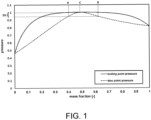
- the dew point pressure is the pressure at which, at constant temperature, a vapour, vapour mixture, or vapour-gas mixture starts condensing into liquid.
- the boiling point pressure is the pressure at which, at constant temperature, a liquid, liquid mixture, or liquid-solution starts to form vapour.
- the azeotropic composition is the composition of a mixture of fluids at which the boiling point pressure equals the dew point pressure.
- the azeotropic compositions are determined at 40°C and expressed in mass fractions. Point C on Figure 1 corresponds to the azeotropic composition.
- Azeotropic-like compositions are compositions of fluids which exhibit only small differences between the boiling point pressure and the dew point pressure, i.e. the boiling point pressure is different by less than 5% from the dew point pressure (both expressed in absolute pressure). In this work, the azeotropic-like compositions are determined at 40°C and expressed in mass fractions. Azeotropic-like compositions correspond to the compositions between and including point A and point B on figure 1 .
- the phrases “Azeotropic-like” and “azeotrope-like” and “azeotrope like” are used interchangeably herein.
- cloud point it is meant the pressure and temperature at which a clear single phase spin fluid separates into two phases. At the cloud phase a clear spin fluid becomes turbid. The turbidity is determined following the protocol described herein.
- the flash-spinning process requires a spin agent that: (1) is a nonsolvent to the polymer below the spin agent's normal boiling point; (2) forms a solution with the polymer at high pressure; (3) forms a desired two-phase dispersion with the polymer when the solution pressure is reduced slightly in a letdown chamber; and (4) flash vaporizes when released from the letdown chamber into a zone of substantially lower pressure through a spin orifice.
- Dichloromethane (DCM) and cis- or trans-1,2-dichloroethylene (DCE) are examples of solvents for polymers, and in particular polyolefins (e.g., polyethylene and polypropylene) that are commercially available.
- polyolefins e.g., polyethylene and polypropylene
- their cloud-point pressures are so close to the bubble point that it is not considered feasible to use them alone as spin agents.
- co-spin agents the solvent power of the mixture is lowered sufficiently so that flash spinning to obtain the desired plexifilamentary product is readily accomplished.
- the present inventors have discovered that it is possible to flash spin a spin fluid of 5 to 30 wt. % of total spin fluid of polymer, and a spin agent comprising a primary spin agent selected from the group consisting of dichloromethane, cis-1,2-dichloroethylene and trans-1,2-dichloroethylene, and a co-spin agent comprising 1H,6H-perfluorohexane, 1H-perfluorohexane, or 1H-perfluoroheptane in an azeotropic mixture or azeotropic-like mixture with the primary spin agent.
- a spin agent comprising a primary spin agent selected from the group consisting of dichloromethane, cis-1,2-dichloroethylene and trans-1,2-dichloroethylene, and a co-spin agent comprising 1H,6H-perfluorohexane, 1H-perfluorohexane, or 1H-perfluoroheptane in an
- the dichloromethane (DCM) used was a high purity grade of 99.99% purity from Merck.
- Dichloromethane also known as methylene chloride, has a CAS Nr. of 75-09-2 .
- Dichloromethane has a molecular weight of 84.9 g/mol and an atmospheric boiling point of 39.9 °C. The dichloromethane is used as received.
- trans-1,2-dichloroethylene used was a high purity grade of 99.99% purity from Sigma-Aldrich.
- Trans-1,2-dichloroethylene has a CAS Nr. of 156-60-5.
- Trans-1,2-dichloroethylene has a molecular weight of 96.9 g/mol and an atmospheric boiling point of 47.7 °C.
- the trans-1,2-dichloroethylene is used as received.
- 1H,6H-perfluorohexane ( CAS Nr. 336-07-2 ) was purchased from Apollo Scientific, Units 3 & 4, Parkway, Denton, Manchester, M34 3SG, United Kingdom. 1H,6H-perfluorohexane is also purchased from Exfluor Research Corporation, 2350 Double Creek Dr., Round Rock, TX,78664, United States. 1H,6H-perfluorohexane has a purity level of about 95% and used as received. The molecular mass is equal to 302 g/mol and the atmospheric boiling temperature equals 92.6°C. The 1H,6H-perfluorohexane was used as received.
- 1H-perfluorohexane ( CAS Nr. 355-37-3 ) was purchased from Apollo Scientific, Units 3 & 4, Parkway, Denton, Manchester, M34 3SG, United Kingdom. The molecular mass is equal to 320 g/mol and the reported boiling temperature by the Apollo Scientific equals 71.6 °C. The 1H-perfluorohexane is used as received.
- 1H-perfluoroheptane (CAS Nr. 27213-61-2 ) was purchased from Apollo Scientific, Units 3 & 4, Parkway, Denton, Manchester, M34 3SG, United Kingdom. The molecular mass is equal to 370 g/mol and the reported atmospheric boiling temperature by the manufacturer is 97 °C. The 1H-perfluoroheptane is used as received.
- the polyethylene was a commercial grade high density polyethylene (HDPE) from Total - refining and chemicals, grade 5802 with a density of 0.957 g/cm3 (ISO 1183), melt flow index of 0.3 (ISO 1133/D, 190°C/2.16 kg) and 22 (ISO 1133/G, 190°C/21.6 kg).
- HDPE high density polyethylene
- the polypropylene (PP) used in the examples is a commercial grade Total PPH 4065 from Total Chemicals.
- the MFR is 4.2 g/10 min (ISO 1133, 2.16 kg-230°C).
- Polybutene-1 (PB-1) used was the commercial grade PB-1 0300M from Lyondell-Basell. The density is 0.915 g/cm3 and MFR is 4.0 g/10min (ISO 1133/D, 190°C, 2.16 kg). The PB-1 was used as received.
- P4M1P poly(4-methyl-1-pentene)
- P4M1P poly(4-methyl-1-pentene)
- the Product number is 190993.
- the reported melting point is 235°C.
- Poly(4-methyl-1-pentene) is also known as polymethylpentene (PMP)
- Polyvinylidene fluoride (PVDF) was performed with Kynar ® 710, Kynar ® 720 and Kynar ® 740 grades from Arkema.
- the Kynar ® 710 has a specific gravity of 1.77-1.79 g/cm 3 (ASTM D792 23°C), melting point of 165-172°C and melt flow rate of 19.0-35.0 g/10 min (ASTM D1238, 450°F, 3.8 kg load).
- Kynar ® 720 has specific gravity of 1.77-1.79 g/cm3 (ASTM D792 23°C), melting point of 165-172°C and melt flow rate of 5.0-29.0 g/10 min (ASTM D1238, 450°F, 3.8 kg load).
- Kynar ® 740 has specific gravity is 1.77-1.79 g/cm3 (ASTM D792 23°C), melting point of 165-172°C and melt flow rate of 1.5-3.0 g/10 min (ASTM D1238, 450°F, 3.8 kg load).
- the ethylene tetrafluoroethylene used in the examples is commercial grade Tefzel ® 2183 from DuPont de Nemours. Ethylene tetrafluoroethylene is also known as poly(ethene-co-tetrafluoroethene) or poly(ethylene tetrafluoroethylene). Reported technical properties are a nominal melting point of 255-280°C (ASTM D3418), Flow rate of 6 g/10 min (ASTM D3159) and a specific gravity 1.7 (ASTM D792).
- the apparatus used consisted of two high pressure cylindrical chambers, each equipped with a piston which is adapted to apply pressure to the contents of the vessel.
- the cylinders have an inside diameter of 1.0 inch (2.54 ⁇ 10 -2 m) and each has an internal capacity of 50 cubic centimeters.
- the cylinders are connected to each other at one end through a 3/32 inch (2.3 ⁇ 10 -3 m) diameter channel and a mixing chamber containing a series of fine mesh screens used as a static mixer.
- a Type J thermocouple is in contact with the spin fluid to record the temperature. Mixing is accomplished by forcing the contents of the vessel back and forth between the two cylinders through the static mixer.
- a spinneret assembly with a quick-acting means for opening the orifice is attached to the channel through a tee.
- the spinneret assembly consists of a lead hole of 0.25 inch (6.3 ⁇ 10 -3 m) diameter and about 2.0 inch (5.08 ⁇ 10 -2 m) length, and a spinneret orifice of 0.030 inch (7.62 ⁇ 10 -4 m) diameter and 0.030 inch (7.62 ⁇ 10 -4 m) length.
- a pressure transmitter is mounted in the lead hole to measure the pressure of the spin fluid.
- the pistons are driven by high pressure hydraulic system.
- the apparatus was charged with polymer pellets and spin agent and a pressure of at least 50 barg is applied to the pistons to compress the charge and avoid the spin fluid from boiling during subsequent heating.
- the contents then were heated to mixing temperature and held at that temperature for about 30 to 45 minutes during which time a differential pressure was alternatively established between the two cylinders to repeatedly force the contents through the mixing channel from one cylinder to the other to provide mixing and effect formation of a spin fluid.
- the spin fluid temperature was then raised to the final spin temperature, and held there for about 5 to 10 minutes to equilibrate the temperature.
- the pressure of the spin fluid is kept above the cloud point pressure during mixing and during the raise from the mixing temperature to the spin temperature. Mixing is continued throughout this period.
- the pressure transducer in the lead hole is calibrated at the spin temperature.
- the accumulator pressure was set to that desired for spinning at the end of the mixing cycle to simulate the letdown chamber effect.
- the valve between the spin cell and the accumulator is opened, and then the spinneret orifice is opened immediately thereafter in rapid succession. It usually took about two to five seconds to open the spinneret orifice after opening the valve between the spin cell and the accumulator. This time should correspond to the residence time in the letdown chamber.
- the residence time in the chamber is usually 0.2 to 0.8 seconds. However, it has been determined that residence time does not have much effect on fiber morphology and/or properties as long as it is greater than about 0.1 second but less than about 30 seconds.
- the resultant flash-spun product was collected in a stainless steel open mesh screen basket. The pressure recorded just before the spinneret using a computer during spinning was entered as the spin pressure.
- the spinneret assembly was replaced with a view cell assembly containing a 1/2 inch (1.23 ⁇ 10 -2 m) diameter high pressure sight glass, through which the contents of the cell could be viewed as they flow through the channel.
- the window was lighted by means of a fiber optic light guide, while the content at the window itself was displayed using a digital camera.
- a Type J thermocouple is located about 5 mm behind the high pressure sight glass.
- the Type J thermocouple and a pressure measuring device located in close proximity to the window provide the pressure and temperature details of the cell behind the sight glass respectively.
- the temperature and pressure of the contents at the window were continuously monitored by a computer.
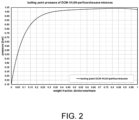
- Figure 2 shows a graph of boiling point pressure of mixtures of dichloromethane and 1H,6H-perfluorohexane@ 40°C, as a function of the weight fraction of dichloromethane.
- the azeotropic composition of dichloromethane and 1H,6H-perfluorohexane at 40°C corresponds to about 83 wt% dichloromethane and about 17 wt% 1H,6H-perfluorohexane.
- the pressure for the boiling point of the azeotropic composition is equal to 104 kPa.
- Azeotrope like compositions with a variation between the dew point and boiling point pressures of less than 5 % can be defined from a weight ratio of dichloromethane to 1H,6H-perfluorohexane of 100:0 wt% to about 73:27 wt-%.
- Figure 3 shows the cloud point curve of 14 wt% high density polyethylene (HDPE) in a spin agent of dichloromethane and 1H,6H-perfluorohexane in a 83:17 wt% composition.
- 14 wt% of high density polyethylene was found soluble in a spin agent of dichloromethane and 1H,6H-perfluorohexane in a 83:17 ratio by weight.
- Flash spin experiments were successfully performed using the spinning equipment described for a high density polyethylene polymer concentration of 14 wt% from a spin agent of DCM and 1H,6H-perfluorohexane in a 83:17 ratio by weight.
- Table 1 Description of flash spin experiments of high density polyethylene (HDPE).
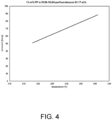
- Figure 4 shows the cloud point curve of 15 wt% PP in a spin agent of DCM and 1H,6H-perfluorohexane in a 83:17 ratio by weight.
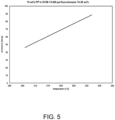
- Figure 5 shows the cloud point curve of 15 wt% PP in a spin agent consisting of DCM and 1H,6H-perfluorohexane in a 74:26 ratio by weight. 15 wt% of polypropylene were found soluble in spin agents of dichloromethane and 1H,6H-perfluorohexane in a 83:17 and 74:26 ratio by weight, respectively.
- Flash spin experiments were performed using the spinning equipment for polypropylene polymer concentration for 10 and 15 wt% from a spin agent of DCM and 1H,6H-perfluorohexane in a 83:17 and 74:26 ratio by weight, respectively.
- Table 2 Description of flash spin experiments of polypropylene. Polymer NAME [-] PP PP PP PP PP Type [-] Total PP Total PP Total PP Total PP Tot.
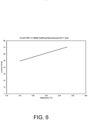
- Figure 6 shows the cloud point curve for 15 wt% polybutene-1 (PB-1) in a spin agent consisting of DCM and 1H,6H-perfluorohexane in a 83:17 ratio by weight.
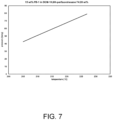
- Figure 7 shows the cloud point curve for 15 wt% polybutene-1 (PB-1) in a spin agent consisting of DCM and 1H,6H-perfluorohexane in a 74:26 ratio by weight.15 wt% of polybutene-1 was found soluble in a spin agent consisting of dichloromethane and 1H,6H-perfluorohexane in a 83:17 and 74:26 ratio by weight.
- Flash spin experiments were performed using the spinning equipment for blends of HDPE and PB-1 with a total concentration of 14 and 18 wt% from a spin agent of DCM and 1H,6H-perfluorohexane in a 83:17 ratio by weight.
- Table 3 Description of flash spin experiments of poly-1-butene and HDPE Polymer 1 NAME [-] HDPE HDPE Type [-] Total 5802 Tot. wt% 80 60 Polymer 2 NAME [-] PB-1 PB-1 Type [-] PB 0300M Tot.
- PVDF polyvinylidene fluoride
- Figure 8 shows the cloud point curve of 20 wt% PVDF/Kynar ® 710 in dichloromethane-1H,6H-perfluorohexane corresponding to a composition of 83:17 ratio by weight.
- 20 wt% of PVDF/Kynar ® 710 was found soluble in mixtures of dichloromethane and 1H,6H-perfluorohexane corresponding to a composition of 83:17 wt%.
- Flash spin experiments were performed using the spinning equipment described in above for a PVDF/Kynar ® 710 concentration of 20 wt% from a spin agent-of DCM and 1H,6H-perfluorohexane in a 83:17 ratio by weight.
- Figure 9 shows a graph of boiling point pressures of mixtures dichloromethane and 1H-perfluorohexane @ 40°C, as a function of the weight fraction of dichloromethane.
- the azeotropic composition of dichloromethane and 1H-perfluorohexane at 40°C corresponds to about 56 wt% dichloromethane and about 44 wt% 1H-perfluorohexane.
- the dew point and boiling point at 40°C for the azeotropic composition is equal to about 118 kPa.
- Azeotropic-like composition with a variation between the dew point and boiling point less than 5 % can be defined from a weight ratio of dichloromethane to 1H-perfluorohexane of about 52:48 wt% to about 66:34 wt%.
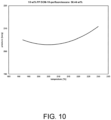
- Figure 10 shows the cloud point curve of 10 wt% polypropylene in a spin agent of dichloromethane and 1H-perfluorohexane in a 56:44 ratio by weight.
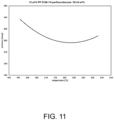
- Figure 11 shows the cloud point curve of 15 wt% polypropylene in a spin agent of DCM and 1H-perfluorohexane in a 56:44 ratio by weight.
- 10 and 15 wt% polypropylene were found soluble in a spin agent of dichloromethane and 1H-perfluorohexane in a 56:44 ratio by weight.
- Flash spin experiments were performed using the flash spinning equipment described for a polymer concentration of 15 wt% PP from a spin agent of dichloromethane and 1H-perfluorohexane in a 56:44 ratio by weight.
- Table 5 Description of flash spin experiments of polypropylene.
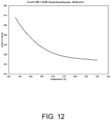
- Figure 12 shows the cloud point curve for 15 wt% polybutene-1 in a spin agent of dichloromethane and 1H-perfluorohexane in a 56:44 ratio by weight.
- 15 wt% polybutene-1 was found soluble in a spin agent of dichloromethane and 1H-perfluorohexane in a 56:44 ratio by weight.
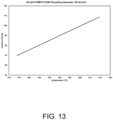
- Figure 13 shows the cloud point curve of 20 wt% P4M1P in a spin agent of dichloromethane and 1H-perfluorohexane in a 56:44 ratio by weight.
- Figure 14 shows the cloud point curve of 20 wt% P4M1P in a spin agent of DCM and 1H-perfluorohexane in a 63:37 ratio by weight.
- 20 wt% poly(4-methyl-1-pentene) (P4M1P) was found soluble in a spin agent consisting of dichloromethane and 1H -perfluorohexane in a 56:44 ratio by weight and 63:37 ratio by weight, respectively.
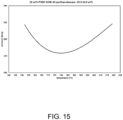
- Figure 15 shows the cloud point curve of 22 wt% PVDF/Kynar ® 720 in a spin agent of dichloromethane and 1H-perfluorohexane in a 65.5:34.5 ratio by weight.
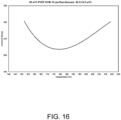
- Figure 16 shows the cloud point curve of 26wt% PVDF/Kynar ® 720 in a spin agent of dichloromethane and 1H-perfluorohexane in a 65.5:34.5 ratio by weight. 22 and 26 wt% of PVDF were found soluble in a spin agent of dichloromethane and 1H-perfluorohexane in a 65.5:34.5 ratio by weight.
- Table 6 Description of flash spin experiments of polyvinylidene fluoride.
- Flash spin experiments were performed using the flash-spinning equipment described for polymer concentrations of 22 wt% and 26 wt% PVDF from a spin agent of dichloromethane and 1H-perfluorohexane in a 65.5:34.5 ratio by weight.
- wt% 80 80 Polymer 2 NAME [-] PB-1 P4M1P Type [-] PB 0300M medium molecular weight Tot. wt% 20 20 Total polymer concentration wt% 28 28 spin agent 1 [-] DCM 2 [-] 1H-perfluorohexane composition wt%:wt% 65.5:34.5 65.5:34.5 spin condition spin orifice mil x mil 30x30 30x30 spin pressure barg 195 195 spin temp. °C 215 215
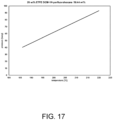
- Figure 17 shows the cloud point curve of 20 wt% ETFE in a spin agent of dichloromethane and 1H-perfluorohexane in a 56:44 ratio by weight.
- 20 wt% of poly (ethylene tetrafluoroethylene) (ETFE) was found soluble in a spin agent of dichloromethane and 1H -perfluorohexane in a 56:44 ratio by weight.
- Flash spin experiments were performed using the spinning equipment described for 20 wt% poly (ethylene tetrafluoroethylene) (ETFE) polymer concentration from a spin agent of of dichloromethane and1H-perfluorohexane in a 56:44 ratio by weight.
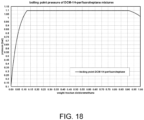
- Figure 18 shows a graph of boiling point pressures of dichloromethane and 1H-perfluoroheptane mixtures @ 40°C, as a function of the weight fraction of dichloromethane.
- the azeotropic composition of dichloromethane and 1H-perfluoroheptane at 40°C corresponds to about 71 wt% dichloromethane and about 29 wt% 1H-perfluoroheptane.
- the dew point and boiling point at 40°C for the azeotropic composition is equal to about 109 kPa.
- Azeotrope like composition with a variation between the dew point and boiling point pressure less than 5 % can be defined from a weight ratio of dichloromethane to 1H-perfluoroheptane of about 70:30 ratio by weight to about 89:11 ratio by weight.
- Figure 19 shows the cloud point curve of 14 wt% high density polyethylene in a spin agent of DCM and 1H-perfluoroheptane in a 76.5:23.5 ratio by weight.
- 14 wt% high density polyethylene was found soluble in a spin agent of DCM and 1H-perfluoroheptane in a 76.5:23.5 ratio by weight.
- Flash spin experiments were performed using the spinning equipment described for high density polyethylene polymer concentration of 14 wt% from a spin agent of DCM and 1H-perfluoroheptane in a 76.5:23.5 ratio by weight.
- Table 9 Description of flash spin experiments of polyethylene Polymer NAME [-] HDPE Type [-] Total 5802 Tot. wt% 14 spin agent 1 DCM 2 1H-perfluoroheptane composition wt%:wt% 76.5/23.5 spin condition spin orifice mil x mil 30x30 spin pressure barg 165 spin temp. °C 210
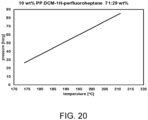
- Figure 20 shows the cloud point curve of 10 wt% PP in a spin agent of DCM and 1H-perfluoroheptane in a 71:29 ratio by weight.
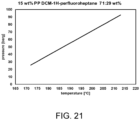
- Figure 21 shows the cloud point curve of 15 wt% PP in a spin agent of DCM and 1H-perfluoroheptane in a 71:29 ratio by weight.
- 10 wt% and 15 wt% of polypropylene were found soluble in a spin agent of DCM and 1H-perfluoroheptane in a 71:29 ratio by weight.
- Flash spin experiments are performed using the flash spinning equipment described for polypropylene polymer concentrations of 10 and 15 wt% from a spin agent of DCM and 1H-perfluoroheptane in a 71:29 ratio by weight.
- Table 10 Description of flash spin experiments of polypropylene Polymer NAME [-] PP PP PP Type [-] Total PPH 4065 Tot. wt% 15 10 10 spin agent 1 DCM 2 1H-perfluoroheptane composition wt%:wt% 71/29 71/29 71/29 spin condition spin orifice mil x mil 30x30 30x30 30x30 30x30 spin pressure barg 60 58 69 spin temp. °C 200 200 210
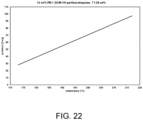
- Figure 22 shows the cloud point curve for 15 wt% PB-1in a spin agent of DCM and 1H-perfluoroheptane in a 71:29 ratio by weight.
- 15 wt% polybutene-1 was found soluble in a spin agent consisting of DCM and 1H-perfluoroheptane in a 71:29 ratio by weight.
- Flash spin experiments were performed using the spinning equipment for blends of HDPE and PB-1 with a total concentration of 14 and 18 wt% from a spin agent of DCM and 1H-perfluoroheptane in a 81.5:18.5 ratio by weight.
- Figure 23 shows the cloud point curve of 28 wt% PVDF/Kynar ® 740 in a spin agent of DCM and 1H-perfluoroheptane in a 71:29 ratio by weight.
- Figure 24 shows the cloud point curve of 28 wt% PVDF/Kynar ® 740 in a spin agent of DCM and 1H-perfluoroheptane in a 76.5:23.5 ratio by weight.
- 28 wt% PVDF/Kynar ® 740 was found soluble in spin agents of DCM and 1H-perfluoroheptane in a 71:29 and 76.5:23.5 ratio by weight, respectively.
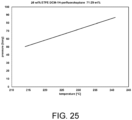
- Figure 25 shows the cloud point curve of 26 wt% ETFE in a spin agent of DCM and 1H-perfluoroheptane in a 71:29 ratio by weight.
- 26 wt% ETFE was found soluble in a spin agent of DCM and 1H-perfluoroheptane in a 71:29 ratio by weight.
- Flash spin experiments were performed using the spinning equipment described before for 22, 26 and 30 wt% ETFE from a spin agent consisting of DCM and 1H-perfluoroheptane in a 71:29 ratio by weight.
- Table 13 Description of flash spin experiments of poly(ethylene tetrafluoroethylene) Polymer NAME [-] ETFE ETFE ETFE Type [-] Tefzel ® 2183 Tot.
- Figure 26 shows a graph of boiling point pressures of mixtures of trans-1,2-dichloroethylene and 1H,6H-perfluorohexane @ 40°C, as a function of the weight fraction of trans-1,2-dichloroethylene.
- the azeotropic composition of trans-1,2-dichloroethylene and 1H,6H-perfluorohexane at 40°C corresponds to about 86 wt% trans-1,2-dichloroethylene and about 14 wt% 1H,6H-perfluorohexane.
- the dew point and boiling point at 40°C for the azeotropic composition is equal to about 78.5 kPa.
- Azeotropic-like composition with a variation between the dew point and boiling point less than 5 % can be defined from a weight ratio of trans-1,2-dichloroethylene to 1H,6H-perfluorohexane of about 72:28 wt% to about 100:0 wt%.
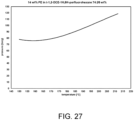
- Figure 27 shows the cloud point curve of 14 wt% high density polyethylene (HDPE) in a spin agent of trans-1,2-dichloroethylene and 1H,6H-perfluorohexane in a 74:26 ratio by weight.
- 14 wt% of high density polyethylene was found soluble in a spin agent of trans-1,2-dichloroethylene and 1H,6H-perfluorohexane in a 74:26 ratio by weight.
- Flash spin experiments were successfully performed using the spinning equipment described for 14 wt% PE from a spin agent consisting of t-1,2-DCE and 1H,6H-perfluorohexane in a 76:24 ratio by weight.
- Table 15 shows the cloud point curve of 14 wt% high density polyethylene (HDPE) in a spin agent of trans-1,2-dichloroethylene and 1H,6H-perfluorohexane in a 74:26 ratio by weight.
- Figure 28 shows a graph of boiling point pressures of mixtures of trans-1,2-dichloroethylene and 1H-perfluorohexane @ 40°C, as a function of the weight fraction of trans-1,2-dichloroethylene.
- the azeotropic composition of trans-1,2-dichloroethylene and 1H-perfluorohexane at 40°C corresponds to about 51 wt% trans-1,2-dichloroethylene and about 49 wt% 1H-perfluoroheptane.
- the dew point and boiling point at 40°C for the azeotropic composition is equal to about 93 kPa.
- Azeotropic-like composition with a variation between the dew point and boiling point less than 5 % can be defined from a weight ratio of trans-1,2-dichloroethylene to 1H-perfluorohexane of about 47:53 wt% to about 64:36 wt%.
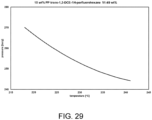
- Figure 29 shows the cloud point curve of 15 wt% polypropylene (PP) in a spinagent of trans-1,2-dichloroethylene and 1H-perfluorohexane in a 51:49 ratio by weight.
- 15 wt% of polypropylene was found soluble in a spin agent of trans-1,2-dichloroethylene and 1H-perfluorohexane in a 51:49 ratio by weight.
- Flash spin experiments were successfully performed using the spinning equipment described for a polypropylene polymer concentration of 15 wt% from a spin agent of trans-1,2-dichloroethylene and 1H-perfluorohexane in a 51:49 ratio by weight.
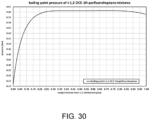
- Figure 30 shows a graph of boiling point pressures of mixtures of trans-1,2-dichloroethylene and 1H-perfluoroheptane @ 40°C, as a function of the weight fraction of trans-1,2-dichloroethylene.
- the azeotropic composition of trans-1,2-dichloroethylene and 1H-perfluoroheptane at 40°C corresponds to about 71 wt% trans-1,2-dichloroethylene and about 29 wt% 1H-perfluoroheptane.
- the dew point and boiling point at 40°C for the azeotropic composition is equal to about 81.4 kPa.
- Azeotropic-like composition with a variation between the dew point and boiling point less than 5 % can be defined from a weight ratio of trans-1,2-dichloroethylene to 1H-perfluoroheptane of about 67:33 wt% to about 100:0 wt%.
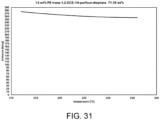
- Figure 31 shows the cloud point curve of 14 wt% high density polyethylene (HDPE) in a spinagent of trans-1,2-dichloroethylene and 1H-perfluoroheptane in a 71:29 ratio by weight. 14 wt% of high density polyethylene was found soluble in a spin agent of trans-1,2-dichloroethylene and 1H-perfluoroheptane in a 71:29 ratio by weight.
- HDPE high density polyethylene
- Flash spin experiments were successfully performed using the spinning equipment described for a high density polyethylene polymer concentration of 14 wt% from a spin agent of trans-1,2-dichloroethylene and 1H-perfluoroheptane in a 71:29 ratio by weight.
- Table 16 Description of flash spin experiments of high density polyethylene (HDPE).
- Polymer NAME [-] HDPE Type [-] Total 5802 Tot. wt% 14 spin agent 1 t-1,2-DCE 2 1H-perfluoroheptane composition wt%:wt% 71/29 spin condition spin orifice mil x mil 30x30 Pressure bar g 225 temperature °C 230
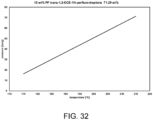
- Figure 32 shows the cloud point curve of 15 wt% polypropylene (PP) in a spin agent of trans-1,2-dichloroethylene and 1H-perfluoroheptane in a 71:29 ratio by weight. 15 wt% of polypropylene was found soluble in a spin agent of trans-1,2-dichloroethylene and 1H-perfluoroheptane in a 71:29 ratio by weight.
Landscapes
- Engineering & Computer Science (AREA)
- Textile Engineering (AREA)
- Chemical & Material Sciences (AREA)
- Chemical Kinetics & Catalysis (AREA)
- General Chemical & Material Sciences (AREA)
- Mechanical Engineering (AREA)
- Manufacturing & Machinery (AREA)
- Spinning Methods And Devices For Manufacturing Artificial Fibers (AREA)
- Artificial Filaments (AREA)
- Compositions Of Macromolecular Compounds (AREA)
Claims (10)
- Fluide de filage éclair comprenant(a) 5 à 30 % en poids du fluide de filage total qui est un polymère d'un ou de plusieurs types de polymères,(b) un agent de filage primaire sélectionné dans le groupe constitué de dichlorométhane, cis-1,2-dichloroéthylène et trans-1,2-dichloroéthylène, et(c) un agent de co-filage sélectionné dans le groupe constitué de 1H,6H-perfluorohexane, 1H-perfluoroheptane, et 1H-perfluorohexane,dans lequel l'agent de co-filage est présent en une quantité suffisante pour former une composition azéotrope ou de type azéotrope avec l'agent de filage primaire dans le fluide de filage, dans lequel les compositions azéotropiques ou de type azéotrope sont déterminées à 40 °C, et dans lequel la composition de type azéotrope est la composition de fluides dans laquelle la pression de point d'ébullition diffère de moins de 5 % de la pression de point de rosée.
- Fluide de filage éclair comprenant(a) 5 à 30 % en poids du fluide de filage total qui est un polymère d'un ou de plusieurs types de polymères,(b) un agent de filage primaire sélectionné dans le groupe constitué de dichlorométhane, cis-1,2-dichloroéthylène et trans-1,2-dichloroéthylène, et(c) un agent de co-filage sélectionné dans le groupe constitué de 1H,6H-perfluorohexane, 1H-perfluoroheptane, et 1H-perfluorohexane,dans lequel l'agent de co-filage est présent en une quantité suffisante pour former un point de trouble, etdans lequel le point de trouble est déterminé selon la procédure détaillée dans la description.
- Fluide de filage éclair selon la revendication 1 ou la revendication 2, dans lequel le filage éclair comprend le filage du fluide de filage à une pression qui est supérieure à la pression autogène du fluide de filage dans une région de pression inférieure pour former des brins de film-fibrille plexifilamentaire du polymère.
- Fluide de filage éclair selon l'une quelconque des revendications 1 à 3, dans lequel le polymère est sélectionné dans le groupe constitué de polyéthylène, polypropylène, polybutène-1, poly(4-méthyl-1-pentène), polyfluorure de vinylidène, poly(éthylènetétrafluoroéthylène), et des mélanges de ceux-ci.
- Utilisation du fluide de filage éclair selon la revendication 3 dans un processus pour la préparation de brins de film-fibrille plexifilamentaire d'un polymère.
- Utilisation selon la revendication 5, dans laquelle le polymère est sélectionné dans le groupe constitué de polyéthylène, polypropylène, polybutène-1, poly(4-méthyl-1-pentène), polyfluorure de vinylidène, poly(éthylènetétrafluoroéthylène), et des mélanges de ceux-ci.
- Procédé de préparation d'un fluide de filage éclair selon la revendication 1, le procédé comprenant la combinaison (a) d'un agent de filage primaire sélectionné dans le groupe constitué de dichlorométhane, cis-1,2-dichloroéthylène et trans-1,2-dichloroéthylène, (b) d'un agent de co-filage sélectionné dans le groupe constitué de 1H,6H-perfluorohexane, 1H-perfluoroheptane, et 1H-perfluorohexane, en une quantité suffisante pour former une composition azéotrope ou de type azéotrope avec l'agent de filage primaire dans le fluide de filage, et (c) d'un polymère d'un ou de plusieurs types de polymères en une quantité de 5 à 30 % en poids d'un fluide de filage total,
dans lequel les compositions azéotropiques ou de type azéotrope sont déterminées à 40 °C, et dans lequel la composition de type azéotrope est la composition de fluides dans laquelle la pression de point d'ébullition diffère de moins de 5 % de la pression de point de rosée. - Procédé de préparation d'un fluide de filage éclair selon la revendication 2, le procédé comprenant la combinaison (a) d'un agent de filage primaire sélectionné dans le groupe constitué de dichlorométhane, cis-1,2-dichloroéthylène et trans-1,2-dichloroéthylène, (b) d'un agent de co-filage sélectionné dans le groupe constitué de 1H,6H-perfluorohexane, 1H-perfluoroheptane, et 1H-perfluorohexane, en une quantité suffisante pour former un point de trouble, et (c) d'un polymère d'un ou de plusieurs types de polymères en une quantité de 5 à 30 % en poids du fluide de filage total,
dans lequel le point de trouble est déterminé selon la procédure détaillée dans la description. - Procédé selon la revendication 7 ou la revendication 8, dans lequel le fluide de filage éclair est destiné à être utilisé dans un processus de préparation de brins de film-fibrille plexifilamentaire de polymère par filage éclair du fluide de filage à une pression qui est supérieure à la pression autogène du fluide de filage dans une région de pression inférieure pour former des brins de film-fibrille plexifilamentaire du polymère.
- Procédé selon l'une quelconque des revendications 7 à 9, dans lequel le polymère est sélectionné dans le groupe constitué de polyéthylène, polypropylène, polybutène-1, poly(4-méthyl-1-pentène), polyfluorure de vinylidène, poly(éthylènetétrafluoroéthylène), et des mélanges de ceux-ci.
Applications Claiming Priority (3)
| Application Number | Priority Date | Filing Date | Title |
|---|---|---|---|
| US201562174014P | 2015-06-11 | 2015-06-11 | |
| EP16731722.1A EP3307930B1 (fr) | 2015-06-11 | 2016-06-08 | Procédé de filage éclair |
| PCT/US2016/036340 WO2016200873A1 (fr) | 2015-06-11 | 2016-06-08 | Procédé de filage éclair |
Related Parent Applications (2)
| Application Number | Title | Priority Date | Filing Date |
|---|---|---|---|
| EP16731722.1A Division EP3307930B1 (fr) | 2015-06-11 | 2016-06-08 | Procédé de filage éclair |
| EP16731722.1A Division-Into EP3307930B1 (fr) | 2015-06-11 | 2016-06-08 | Procédé de filage éclair |
Publications (3)
| Publication Number | Publication Date |
|---|---|
| EP3862467A1 EP3862467A1 (fr) | 2021-08-11 |
| EP3862467B1 true EP3862467B1 (fr) | 2025-05-21 |
| EP3862467C0 EP3862467C0 (fr) | 2025-05-21 |
Family
ID=56194584
Family Applications (3)
| Application Number | Title | Priority Date | Filing Date |
|---|---|---|---|
| EP21151511.9A Active EP3862467B1 (fr) | 2015-06-11 | 2016-06-08 | Fluide de filage éclair, son utilisation et procédé de sa préparation |
| EP16731722.1A Active EP3307930B1 (fr) | 2015-06-11 | 2016-06-08 | Procédé de filage éclair |
| EP21151510.1A Withdrawn EP3828323A1 (fr) | 2015-06-11 | 2016-06-08 | Fils de films fibrilles plexifilamentaires de polymeres |
Family Applications After (2)
| Application Number | Title | Priority Date | Filing Date |
|---|---|---|---|
| EP16731722.1A Active EP3307930B1 (fr) | 2015-06-11 | 2016-06-08 | Procédé de filage éclair |
| EP21151510.1A Withdrawn EP3828323A1 (fr) | 2015-06-11 | 2016-06-08 | Fils de films fibrilles plexifilamentaires de polymeres |
Country Status (5)
| Country | Link |
|---|---|
| US (2) | US11261543B2 (fr) |
| EP (3) | EP3862467B1 (fr) |
| JP (1) | JP6680805B2 (fr) |
| CN (3) | CN107849740B (fr) |
| WO (1) | WO2016200873A1 (fr) |
Families Citing this family (15)
| Publication number | Priority date | Publication date | Assignee | Title |
|---|---|---|---|---|
| US11261543B2 (en) * | 2015-06-11 | 2022-03-01 | Dupont Safety & Construction, Inc. | Flash spinning process |
| CN115198445A (zh) * | 2021-04-16 | 2022-10-18 | 江苏青昀新材料科技有限公司 | 一种闪纺的片材 |
| CN115387031B (zh) * | 2021-05-27 | 2023-10-24 | 江苏青昀新材料有限公司 | 一种高耐破度的片材及其加工方法 |
| CN116356482B (zh) * | 2022-10-26 | 2025-08-08 | 江苏青昀新材料有限公司 | 一种低压缩比功的闪纺织物 |
| WO2025006914A1 (fr) * | 2023-06-30 | 2025-01-02 | Dupont Safety & Construction, Inc. | Feuille respirante à filage éclair résistante à la déchirure |
| WO2025006942A1 (fr) * | 2023-06-30 | 2025-01-02 | Dupont Safety & Construction, Inc. | Feuille filée par filage éclair perméable à l'air à barrière élevée |
| WO2025144674A1 (fr) | 2023-12-27 | 2025-07-03 | Dupont Safety & Construction, Inc. | Compositions azéotropiques et de type azéotrope comprenant du dichlorométhane et du trans-1h, 2h-octafluorocyclopentane et utilisation des compositions en tant qu'agents de filage éclair |
| WO2025144673A1 (fr) | 2023-12-27 | 2025-07-03 | Dupont Safety & Construction, Inc. | Compositions non azéotropiques comprenant du dichlorométhane et du 1h, 1h, 2h-heptafluorocyclopentane et utilisation des compositions en tant qu'agents de filage flash |
| WO2025144676A1 (fr) | 2023-12-27 | 2025-07-03 | Dupont Safety & Construction, Inc. | Processus de filage éclair et fluide de filage éclair |
| WO2025178740A1 (fr) | 2024-02-19 | 2025-08-28 | Dupont Safety & Construction, Inc. | Compositions azéotropiques et de type azéotrope comprenant du cyclopentane et du 1h,1h,2h-heptafluorocyclopentane ou du 2-méthylpentane et 1h,1h,2h-heptafluorocyclopentane et utilisation des compositions en tant qu'agents de filage éclair |
| WO2025178741A1 (fr) | 2024-02-19 | 2025-08-28 | Dupont Safety & Construction, Inc. | Compositions azéotropiques et de type azéotrope comprenant du 1,2-dichloroéthylène et du 1h,2h-octafluorocyclopentane et utilisation des compositions en tant qu'agents de filage éclair |
| WO2025240715A1 (fr) | 2024-05-17 | 2025-11-20 | Dupont Safety & Construction, Inc. | Compositions azéotropiques et de type azéotropiques comprenant du dichlorométhane et du 2-méthylpentane ou du 3-méthylpentane et utilisation des compositions en tant qu'agents de filage éclair |
| WO2025240722A1 (fr) | 2024-05-17 | 2025-11-20 | Dupont Safety & Construction, Inc. | Compositions azéotropiques et de type azéotrope comprenant un composé chloré et un hydrocarbure-c6 et utilisation de ces compositions en tant qu'agents de filage éclair |
| WO2025240719A1 (fr) | 2024-05-17 | 2025-11-20 | Dupont Safety & Construction, Inc. | Procédé de filage éclair pour polymères partiellement fluorés utilisant des agents de filage éclair comprenant un solvant chloré et un hydrocarbure linéaire ou ramifié ayant 5 atomes de carbone ou plus |
| WO2025240708A1 (fr) | 2024-05-17 | 2025-11-20 | Dupont Safety & Construction, Inc. | Procédé amélioré de filage éclair pour polyoléfines utilisant des agents de filage éclair comprenant un solvant chloré et un hydrocarbure linéaire ou ramifié ayant de 5 à 6 atomes de carbone |
Citations (2)
| Publication number | Priority date | Publication date | Assignee | Title |
|---|---|---|---|---|
| JP3159765B2 (ja) * | 1992-03-16 | 2001-04-23 | 旭化成株式会社 | フラッシュ紡糸方法 |
| EP3307930B1 (fr) * | 2015-06-11 | 2021-07-21 | DuPont Safety & Construction, Inc. | Procédé de filage éclair |
Family Cites Families (29)
| Publication number | Priority date | Publication date | Assignee | Title |
|---|---|---|---|---|
| US3081519A (en) | 1962-01-31 | 1963-03-19 | Fibrillated strand | |
| NL300881A (fr) | 1962-11-23 | |||
| US5043109A (en) * | 1988-08-30 | 1991-08-27 | E. I. Du Pont De Nemours And Company | Process for flash-spinning dry polymeric plexifilamentary film-fibril strands |
| DE68909880T2 (de) * | 1988-08-30 | 1994-05-05 | Du Pont | Halogenkohlenwasserstoffe für Flash-Spinnen von polymeren Plexifilamenten. |
| US5032326A (en) * | 1988-08-31 | 1991-07-16 | E. I. Du Pont De Nemours And Company | Flash-spinning of polymeric plexifilaments |
| CA2029550C (fr) * | 1989-11-22 | 2001-07-31 | Don Mayo Coates | Procede de filage eclair de polyolefines |
| DE69115844T2 (de) * | 1990-10-23 | 1996-08-01 | Du Pont | Verfahren zum Flash-Spinnen von Fasern bildenden Polymeren |
| US5250237A (en) | 1992-05-11 | 1993-10-05 | E. I. Du Pont De Nemours And Company | Alcohol-based spin liquids for flash-spinning polymeric plexifilaments |
| ES2146982T3 (es) | 1996-01-11 | 2000-08-16 | Du Pont | Cabo plexifilamentario de polimeros mezclados. |
| US5977237A (en) | 1996-03-08 | 1999-11-02 | E. I. Du Pont De Nemours And Company | Flash-spinning solution |
| US5985196A (en) | 1998-01-20 | 1999-11-16 | E. I. Du Pont De Nemours And Company | Flash spinning process and flash spinning solution |
| US6153134A (en) | 1998-12-15 | 2000-11-28 | E. I. Du Pont De Nemours And Company | Flash spinning process |
| US6270709B1 (en) | 1998-12-15 | 2001-08-07 | E. I. Du Pont De Nemours And Company | Flash spinning polymethylpentene process and product |
| US7179413B1 (en) | 1999-08-20 | 2007-02-20 | E. I. Du Pont De Nemours And Company | Flash-spinning process and solution |
| JP3796443B2 (ja) * | 1999-08-20 | 2006-07-12 | イー・アイ・デュポン・ドウ・ヌムール・アンド・カンパニー | フラッシュ紡糸方法及び溶液 |
| GB2358189B (en) * | 2000-01-11 | 2004-08-11 | Asahi Glass Co Ltd | Method for coating a substance with a lubricant |
| US6458304B1 (en) | 2000-03-22 | 2002-10-01 | E. I. Du Pont De Nemours And Company | Flash spinning process and solutions of polyester |
| US20040032041A1 (en) * | 2000-12-14 | 2004-02-19 | Hyunkook Shin | Flash spinning polycyclopentene |
| JP4974442B2 (ja) | 2000-12-22 | 2012-07-11 | イー・アイ・デュポン・ドウ・ヌムール・アンド・カンパニー | パーフルオロブチルエチレン含有の共沸混合物 |
| AU2002349452A1 (en) * | 2001-11-22 | 2003-06-10 | Asahi Glass Company, Limited | Solvent composition |
| US7300968B2 (en) | 2002-12-18 | 2007-11-27 | E.I. Du Pont De Nemours And Company | Flash spinning solution and flash spinning process using straight chain hydrofluorocarbon co-solvents |
| US20080108749A1 (en) * | 2006-11-07 | 2008-05-08 | Nanomax Technology Company Limited | Fluoropolymer nanoemulsions |
| US8232235B2 (en) * | 2009-09-11 | 2012-07-31 | 3M Innovative Properties Company | Ternary azeotropes containing 1,1,1,2,2,3,4,5,5,5-decafluoro-3-methoxy-4-(trifluoromethyl)-pentane 5 and compositions made therefrom |
| JP3159765U (ja) | 2010-03-12 | 2010-06-03 | オリオン電機株式会社 | 液晶表示装置 |
| EP2588064B1 (fr) * | 2010-07-02 | 2020-03-11 | The Procter and Gamble Company | Article présentant une structure en tissu fibreux soluble et contenant des agents actifs |
| US20120248658A1 (en) * | 2011-03-30 | 2012-10-04 | Seth Gleiman | System and Method for Formation of Biodegradable Ultra-Porous Hollow Fibers and Use Thereof |
| CN103510166B (zh) * | 2012-06-20 | 2016-01-20 | 杭州奥通科技有限公司 | 高湿模量粘胶纤维凝固浴处理流水线 |
| CN104969381B (zh) | 2012-11-14 | 2017-07-11 | 纳幕尔杜邦公司 | 用于电化学电池的分隔体介质 |
| JP6722596B2 (ja) | 2015-06-18 | 2020-07-15 | イー・アイ・デュポン・ドウ・ヌムール・アンド・カンパニーE.I.Du Pont De Nemours And Company | フラッシュ紡糸プレキシフィラメント状ストランド及びシート |
-
2016
- 2016-06-03 US US15/172,753 patent/US11261543B2/en active Active
- 2016-06-08 EP EP21151511.9A patent/EP3862467B1/fr active Active
- 2016-06-08 CN CN201680033302.6A patent/CN107849740B/zh active Active
- 2016-06-08 EP EP16731722.1A patent/EP3307930B1/fr active Active
- 2016-06-08 JP JP2017563297A patent/JP6680805B2/ja active Active
- 2016-06-08 CN CN202110262558.7A patent/CN113005543A/zh active Pending
- 2016-06-08 WO PCT/US2016/036340 patent/WO2016200873A1/fr not_active Ceased
- 2016-06-08 CN CN202110262628.9A patent/CN113046850B/zh active Active
- 2016-06-08 EP EP21151510.1A patent/EP3828323A1/fr not_active Withdrawn
-
2022
- 2022-01-21 US US17/581,233 patent/US12024799B2/en active Active
Patent Citations (2)
| Publication number | Priority date | Publication date | Assignee | Title |
|---|---|---|---|---|
| JP3159765B2 (ja) * | 1992-03-16 | 2001-04-23 | 旭化成株式会社 | フラッシュ紡糸方法 |
| EP3307930B1 (fr) * | 2015-06-11 | 2021-07-21 | DuPont Safety & Construction, Inc. | Procédé de filage éclair |
Also Published As
| Publication number | Publication date |
|---|---|
| EP3862467C0 (fr) | 2025-05-21 |
| EP3307930A1 (fr) | 2018-04-18 |
| CN107849740B (zh) | 2021-04-27 |
| CN113046850A (zh) | 2021-06-29 |
| US12024799B2 (en) | 2024-07-02 |
| US20160362816A1 (en) | 2016-12-15 |
| EP3862467A1 (fr) | 2021-08-11 |
| EP3828323A1 (fr) | 2021-06-02 |
| JP2018517076A (ja) | 2018-06-28 |
| US11261543B2 (en) | 2022-03-01 |
| US20220145497A1 (en) | 2022-05-12 |
| WO2016200873A1 (fr) | 2016-12-15 |
| CN107849740A (zh) | 2018-03-27 |
| CN113046850B (zh) | 2023-03-31 |
| JP6680805B2 (ja) | 2020-04-15 |
| CN113005543A (zh) | 2021-06-22 |
| EP3307930B1 (fr) | 2021-07-21 |
Similar Documents
| Publication | Publication Date | Title |
|---|---|---|
| US12024799B2 (en) | Flash spinning process | |
| EP0640154B1 (fr) | Liquides de filature a base d'alcool pour filature eclair de plexifilaments polymeres | |
| US7300968B2 (en) | Flash spinning solution and flash spinning process using straight chain hydrofluorocarbon co-solvents | |
| US6153134A (en) | Flash spinning process | |
| JP2817808B2 (ja) | ポリエチレンプレキシフイラメントをフラツシユ紡糸するための混合ハロカーボン | |
| EP2883599A2 (fr) | Composition de résine polymère pour la préparation de membranes à fibres creuses, procédé de préparation d'une membrane à fibres creuses et membrane à fibres creuses | |
| US20180179667A1 (en) | Process for the production of acrylic or modacrylic fibers | |
| WO2025144674A1 (fr) | Compositions azéotropiques et de type azéotrope comprenant du dichlorométhane et du trans-1h, 2h-octafluorocyclopentane et utilisation des compositions en tant qu'agents de filage éclair | |
| WO2025144673A1 (fr) | Compositions non azéotropiques comprenant du dichlorométhane et du 1h, 1h, 2h-heptafluorocyclopentane et utilisation des compositions en tant qu'agents de filage flash | |
| EP4578535A1 (fr) | Membrane de séparation et son procédé de production | |
| WO2025178741A1 (fr) | Compositions azéotropiques et de type azéotrope comprenant du 1,2-dichloroéthylène et du 1h,2h-octafluorocyclopentane et utilisation des compositions en tant qu'agents de filage éclair | |
| WO2025178740A1 (fr) | Compositions azéotropiques et de type azéotrope comprenant du cyclopentane et du 1h,1h,2h-heptafluorocyclopentane ou du 2-méthylpentane et 1h,1h,2h-heptafluorocyclopentane et utilisation des compositions en tant qu'agents de filage éclair | |
| TW202410957A (zh) | 分離膜及其製造方法、脫氣膜模組 | |
| KR101557460B1 (ko) | 중공사막 제조용 고분자 수지 조성물, 중공사막의 제조 방법 및 중공사막 | |
| KR20150059987A (ko) | 중공사막 제조용 고분자 수지 조성물, 중공사막의 제조 방법 및 중공사막 | |
| KR20150059986A (ko) | 중공사막 제조용 고분자 수지 조성물, 중공사막의 제조 방법 및 중공사막 | |
| JP2014200752A (ja) | 高分子多孔質膜 |
Legal Events
| Date | Code | Title | Description |
|---|---|---|---|
| PUAI | Public reference made under article 153(3) epc to a published international application that has entered the european phase |
Free format text: ORIGINAL CODE: 0009012 |
|
| STAA | Information on the status of an ep patent application or granted ep patent |
Free format text: STATUS: REQUEST FOR EXAMINATION WAS MADE |
|
| 17P | Request for examination filed |
Effective date: 20210114 |
|
| AC | Divisional application: reference to earlier application |
Ref document number: 3307930 Country of ref document: EP Kind code of ref document: P |
|
| AK | Designated contracting states |
Kind code of ref document: A1 Designated state(s): AL AT BE BG CH CY CZ DE DK EE ES FI FR GB GR HR HU IE IS IT LI LT LU LV MC MK MT NL NO PL PT RO RS SE SI SK SM TR |
|
| STAA | Information on the status of an ep patent application or granted ep patent |
Free format text: STATUS: EXAMINATION IS IN PROGRESS |
|
| 17Q | First examination report despatched |
Effective date: 20220704 |
|
| GRAP | Despatch of communication of intention to grant a patent |
Free format text: ORIGINAL CODE: EPIDOSNIGR1 |
|
| STAA | Information on the status of an ep patent application or granted ep patent |
Free format text: STATUS: GRANT OF PATENT IS INTENDED |
|
| INTG | Intention to grant announced |
Effective date: 20241217 |
|
| GRAS | Grant fee paid |
Free format text: ORIGINAL CODE: EPIDOSNIGR3 |
|
| GRAA | (expected) grant |
Free format text: ORIGINAL CODE: 0009210 |
|
| STAA | Information on the status of an ep patent application or granted ep patent |
Free format text: STATUS: THE PATENT HAS BEEN GRANTED |
|
| AC | Divisional application: reference to earlier application |
Ref document number: 3307930 Country of ref document: EP Kind code of ref document: P |
|
| AK | Designated contracting states |
Kind code of ref document: B1 Designated state(s): AL AT BE BG CH CY CZ DE DK EE ES FI FR GB GR HR HU IE IS IT LI LT LU LV MC MK MT NL NO PL PT RO RS SE SI SK SM TR |
|
| REG | Reference to a national code |
Ref country code: GB Ref legal event code: FG4D |
|
| REG | Reference to a national code |
Ref country code: CH Ref legal event code: EP |
|
| REG | Reference to a national code |
Ref country code: DE Ref legal event code: R096 Ref document number: 602016092364 Country of ref document: DE |
|
| REG | Reference to a national code |
Ref country code: IE Ref legal event code: FG4D |
|
| PGFP | Annual fee paid to national office [announced via postgrant information from national office to epo] |
Ref country code: GB Payment date: 20250528 Year of fee payment: 10 |
|
| U01 | Request for unitary effect filed |
Effective date: 20250617 |
|
| PGFP | Annual fee paid to national office [announced via postgrant information from national office to epo] |
Ref country code: IE Payment date: 20250509 Year of fee payment: 10 |
|
| U07 | Unitary effect registered |
Designated state(s): AT BE BG DE DK EE FI FR IT LT LU LV MT NL PT RO SE SI Effective date: 20250626 |
|
| U20 | Renewal fee for the european patent with unitary effect paid |
Year of fee payment: 10 Effective date: 20250626 |
|
| PG25 | Lapsed in a contracting state [announced via postgrant information from national office to epo] |
Ref country code: ES Free format text: LAPSE BECAUSE OF FAILURE TO SUBMIT A TRANSLATION OF THE DESCRIPTION OR TO PAY THE FEE WITHIN THE PRESCRIBED TIME-LIMIT Effective date: 20250521 |
|
| PG25 | Lapsed in a contracting state [announced via postgrant information from national office to epo] |
Ref country code: GR Free format text: LAPSE BECAUSE OF FAILURE TO SUBMIT A TRANSLATION OF THE DESCRIPTION OR TO PAY THE FEE WITHIN THE PRESCRIBED TIME-LIMIT Effective date: 20250822 Ref country code: NO Free format text: LAPSE BECAUSE OF FAILURE TO SUBMIT A TRANSLATION OF THE DESCRIPTION OR TO PAY THE FEE WITHIN THE PRESCRIBED TIME-LIMIT Effective date: 20250821 |
|
| PG25 | Lapsed in a contracting state [announced via postgrant information from national office to epo] |
Ref country code: PL Free format text: LAPSE BECAUSE OF FAILURE TO SUBMIT A TRANSLATION OF THE DESCRIPTION OR TO PAY THE FEE WITHIN THE PRESCRIBED TIME-LIMIT Effective date: 20250521 |
|
| PG25 | Lapsed in a contracting state [announced via postgrant information from national office to epo] |
Ref country code: HR Free format text: LAPSE BECAUSE OF FAILURE TO SUBMIT A TRANSLATION OF THE DESCRIPTION OR TO PAY THE FEE WITHIN THE PRESCRIBED TIME-LIMIT Effective date: 20250521 |
|
| PG25 | Lapsed in a contracting state [announced via postgrant information from national office to epo] |
Ref country code: RS Free format text: LAPSE BECAUSE OF FAILURE TO SUBMIT A TRANSLATION OF THE DESCRIPTION OR TO PAY THE FEE WITHIN THE PRESCRIBED TIME-LIMIT Effective date: 20250821 |
|
| PG25 | Lapsed in a contracting state [announced via postgrant information from national office to epo] |
Ref country code: IS Free format text: LAPSE BECAUSE OF FAILURE TO SUBMIT A TRANSLATION OF THE DESCRIPTION OR TO PAY THE FEE WITHIN THE PRESCRIBED TIME-LIMIT Effective date: 20250921 |