EP3857047B1 - Common rail für eine brennstoffeinspritzvorrichtung - Google Patents
Common rail für eine brennstoffeinspritzvorrichtung Download PDFInfo
- Publication number
- EP3857047B1 EP3857047B1 EP19759324.7A EP19759324A EP3857047B1 EP 3857047 B1 EP3857047 B1 EP 3857047B1 EP 19759324 A EP19759324 A EP 19759324A EP 3857047 B1 EP3857047 B1 EP 3857047B1
- Authority
- EP
- European Patent Office
- Prior art keywords
- pressure
- low
- rail body
- common rail
- fuel
- Prior art date
- Legal status (The legal status is an assumption and is not a legal conclusion. Google has not performed a legal analysis and makes no representation as to the accuracy of the status listed.)
- Active
Links
Images




Classifications
-
- F—MECHANICAL ENGINEERING; LIGHTING; HEATING; WEAPONS; BLASTING
- F02—COMBUSTION ENGINES; HOT-GAS OR COMBUSTION-PRODUCT ENGINE PLANTS
- F02M—SUPPLYING COMBUSTION ENGINES IN GENERAL WITH COMBUSTIBLE MIXTURES OR CONSTITUENTS THEREOF
- F02M55/00—Fuel-injection apparatus characterised by their fuel conduits or their venting means; Arrangements of conduits between fuel tank and pump F02M37/00
- F02M55/02—Conduits between injection pumps and injectors, e.g. conduits between pump and common-rail or conduits between common-rail and injectors
- F02M55/025—Common rails
-
- F—MECHANICAL ENGINEERING; LIGHTING; HEATING; WEAPONS; BLASTING
- F02—COMBUSTION ENGINES; HOT-GAS OR COMBUSTION-PRODUCT ENGINE PLANTS
- F02D—CONTROLLING COMBUSTION ENGINES
- F02D41/00—Electrical control of supply of combustible mixture or its constituents
- F02D41/30—Controlling fuel injection
- F02D41/38—Controlling fuel injection of the high pressure type
- F02D41/3809—Common rail control systems
- F02D41/3836—Controlling the fuel pressure
- F02D41/3845—Controlling the fuel pressure by controlling the flow into the common rail, e.g. the amount of fuel pumped
- F02D41/3854—Controlling the fuel pressure by controlling the flow into the common rail, e.g. the amount of fuel pumped with elements in the low pressure part, e.g. low pressure pump
-
- F—MECHANICAL ENGINEERING; LIGHTING; HEATING; WEAPONS; BLASTING
- F02—COMBUSTION ENGINES; HOT-GAS OR COMBUSTION-PRODUCT ENGINE PLANTS
- F02M—SUPPLYING COMBUSTION ENGINES IN GENERAL WITH COMBUSTIBLE MIXTURES OR CONSTITUENTS THEREOF
- F02M59/00—Pumps specially adapted for fuel-injection and not provided for in groups F02M39/00 -F02M57/00, e.g. rotary cylinder-block type of pumps
- F02M59/20—Varying fuel delivery in quantity or timing
- F02M59/205—Quantity of fuel admitted to pumping elements being metered by an auxiliary metering device
-
- F—MECHANICAL ENGINEERING; LIGHTING; HEATING; WEAPONS; BLASTING
- F02—COMBUSTION ENGINES; HOT-GAS OR COMBUSTION-PRODUCT ENGINE PLANTS
- F02M—SUPPLYING COMBUSTION ENGINES IN GENERAL WITH COMBUSTIBLE MIXTURES OR CONSTITUENTS THEREOF
- F02M59/00—Pumps specially adapted for fuel-injection and not provided for in groups F02M39/00 -F02M57/00, e.g. rotary cylinder-block type of pumps
- F02M59/20—Varying fuel delivery in quantity or timing
- F02M59/34—Varying fuel delivery in quantity or timing by throttling of passages to pumping elements or of overflow passages, e.g. throttling by means of a pressure-controlled sliding valve having liquid stop or abutment
-
- F—MECHANICAL ENGINEERING; LIGHTING; HEATING; WEAPONS; BLASTING
- F02—COMBUSTION ENGINES; HOT-GAS OR COMBUSTION-PRODUCT ENGINE PLANTS
- F02M—SUPPLYING COMBUSTION ENGINES IN GENERAL WITH COMBUSTIBLE MIXTURES OR CONSTITUENTS THEREOF
- F02M59/00—Pumps specially adapted for fuel-injection and not provided for in groups F02M39/00 -F02M57/00, e.g. rotary cylinder-block type of pumps
- F02M59/20—Varying fuel delivery in quantity or timing
- F02M59/36—Varying fuel delivery in quantity or timing by variably-timed valves controlling fuel passages to pumping elements or overflow passages
- F02M59/366—Valves being actuated electrically
-
- F—MECHANICAL ENGINEERING; LIGHTING; HEATING; WEAPONS; BLASTING
- F02—COMBUSTION ENGINES; HOT-GAS OR COMBUSTION-PRODUCT ENGINE PLANTS
- F02M—SUPPLYING COMBUSTION ENGINES IN GENERAL WITH COMBUSTIBLE MIXTURES OR CONSTITUENTS THEREOF
- F02M59/00—Pumps specially adapted for fuel-injection and not provided for in groups F02M39/00 -F02M57/00, e.g. rotary cylinder-block type of pumps
- F02M59/44—Details, components parts, or accessories not provided for in, or of interest apart from, the apparatus of groups F02M59/02 - F02M59/42; Pumps having transducers, e.g. to measure displacement of pump rack or piston
- F02M59/46—Valves
- F02M59/466—Electrically operated valves, e.g. using electromagnetic or piezoelectric operating means
-
- F—MECHANICAL ENGINEERING; LIGHTING; HEATING; WEAPONS; BLASTING
- F02—COMBUSTION ENGINES; HOT-GAS OR COMBUSTION-PRODUCT ENGINE PLANTS
- F02M—SUPPLYING COMBUSTION ENGINES IN GENERAL WITH COMBUSTIBLE MIXTURES OR CONSTITUENTS THEREOF
- F02M63/00—Other fuel-injection apparatus having pertinent characteristics not provided for in groups F02M39/00 - F02M57/00 or F02M67/00; Details, component parts, or accessories of fuel-injection apparatus, not provided for in, or of interest apart from, the apparatus of groups F02M39/00 - F02M61/00 or F02M67/00; Combination of fuel pump with other devices, e.g. lubricating oil pump
- F02M63/0012—Valves
- F02M63/0031—Valves characterized by the type of valves, e.g. special valve member details, valve seat details, valve housing details
- F02M63/005—Pressure relief valves
-
- F—MECHANICAL ENGINEERING; LIGHTING; HEATING; WEAPONS; BLASTING
- F02—COMBUSTION ENGINES; HOT-GAS OR COMBUSTION-PRODUCT ENGINE PLANTS
- F02M—SUPPLYING COMBUSTION ENGINES IN GENERAL WITH COMBUSTIBLE MIXTURES OR CONSTITUENTS THEREOF
- F02M2200/00—Details of fuel-injection apparatus, not otherwise provided for
- F02M2200/85—Mounting of fuel injection apparatus
Definitions
- the present invention relates to a common rail for a device for intermittently injecting high-pressure fuel into combustion chambers of an internal combustion engine, the device having a high-pressure feed pump for fuel, comprising a low-pressure inlet and a high-pressure outlet, and injection valves, according to the preamble of claim 1.
- a common rail of this type is described, for example, in the article " 3rd generation passenger car common rail from Bosch with piezo inline injectors" in the magazine MTZ 3/2004 Volume 65, pages 180 to 189
- the known device has a quantity-controlled high-pressure pump which feeds the high-pressure storage chamber in two tubular rail bodies of the common rail with high-pressure fuel.
- the high-pressure outlets of the rail bodies are connected to the injection valves.
- a pressure control valve is arranged on one axial end face of a rail body and a rail pressure sensor is arranged on the opposite axial end face of the rail body.
- the document US 5 626 121 A describes a fuel pump for a high-pressure fuel injection system, comprising a high-pressure fuel pump for supplying high-pressure fuel to injectors for injecting high-pressure fuel into cylinders of an engine and a pressure control valve for controlling the fuel pressure of the high-pressure fuel pump, wherein the high-pressure fuel pump and the pressure regulating valve are integrated to form a pump unit, and the pump unit is adapted to be mounted on the engine.
- the high-pressure fuel pump includes a cover, a pump housing and a flange, and the pressure regulating valve has a unit housing formed integrally with the cover of the high-pressure fuel pump.
- WO 95/13474 a control device for a variable-fill pump, in which a suction throttle valve serves as a fuel quantity control valve for the high-pressure feed pump. Electrically controlled suction throttle valves for regulating the fuel quantity of common rail injection devices are also generally known.
- the common rail has a rail body which has a high-pressure storage chamber, a high-pressure inlet connected to the high-pressure storage chamber and high-pressure outlets connected to the high-pressure storage chamber.
- the high-pressure inlet is intended to be connected to a high-pressure outlet of a high-pressure feed pump which supplies the common rail with high-pressure fuel.
- the high-pressure outlets are intended to be connected to injection valves with which high-pressure fuel is intermittently injected into combustion chambers of an internal combustion engine in a known manner.
- the high-pressure outlet of the high-pressure feed pump is preferably connected to the high-pressure inlet of the rail body via a high-pressure feed line, while the high-pressure outlets of the rail body are preferably connected to the associated injection valves via high-pressure connecting lines.
- a fuel quantity control valve is arranged on the rail body to control the amount of fuel sucked in by the high-pressure feed pump.
- the fuel quantity control valve is preferably designed as an electrically controlled suction throttle valve.
- the fuel quantity control valve is connected between a low-pressure feed inlet of the rail body and a low-pressure feed outlet of the rail body.
- the low-pressure feed inlet is intended to be connected to a low-pressure feed line which supplies fuel from a fuel storage tank at a low pressure of typically 2 to 10 bar.
- the low-pressure feed outlet is intended to be connected to a low-pressure inlet of the high-pressure feed pump, preferably via a low-pressure connecting line.
- the fuel quantity control valve is no longer integrated into the high-pressure feed pump, but is assigned to the common rail. This enables a simplified structure of the high-pressure feed pump and excellent accessibility to the fuel quantity control valve.
- a low-pressure connection is formed in the rail body between the low-pressure feed inlet and the low-pressure feed outlet, into which the fuel quantity control valve is connected.
- the low-pressure feed inlet, the low-pressure feed outlet and the low-pressure connection line are of course separated from the high-pressure storage space.
- At least one pressure sensor is further arranged on the rail body, which serves to measure the pressure of the fuel in the high-pressure storage space.
- a pressure control valve is arranged on the rail body, which is connected between the high-pressure storage chamber and a return outlet of the rail body.
- the pressure control valve preferably serves to reduce the pressure of the fuel in the high-pressure storage chamber during rapid Reduction of the power required by the internal combustion engine.
- the return outlet is preferably connected to the fuel storage tank via a return line.
- a preferably mechanical pressure relief valve is also arranged on the rail body, which is also connected between the high-pressure storage chamber and the return flow outlet.
- the pressure relief valve serves as a safety element in the event that a maximum permissible pressure of the fuel in the high-pressure storage chamber is exceeded.
- the fuel quantity control valve, the pressure sensor and the pressure control valve are intended to be electrically connected to a control device.
- the rail body preferably has an at least approximately flat control surface.
- the fuel quantity control valve is arranged on this.
- the pressure sensor or pressure sensors, the pressure control valve and the pressure relief valve, if present, are also arranged on this control surface. This embodiment leads to a compact, maintenance-friendly structure.
- the rail body also has an at least approximately flat connection surface, wherein the low-pressure feed inlet and the low-pressure feed outlet, as well as the high-pressure inlet and the high-pressure outlets are arranged on the side of this connection surface in this. If a return flow outlet is present, this is also preferably arranged on the side of the connection surface in This design means that all hydraulic connections of the rail body are located in the area of the connection surface. This also results in a compact and service-friendly structure.
- the rail body preferably has an at least approximately cuboid shape.
- the control surface and the connection surface are preferably located on opposite sides of the rail body, with the control surface and the connection surface running at least approximately parallel to one another.
- This embodiment is preferably used in V-engines, with the common rail preferably being attached to the structure of the internal combustion engine between the two cylinder banks, directly or preferably via a protective cover, as described further below.
- the connection surface is preferably located on the side facing away from the structure of the internal combustion engine, so that all hydraulic connections are freely accessible.
- connection surface at the top, on the cylinder head side, and to provide the control surface on the exposed side facing away from the engine structure.
- control surface opposite the connection surface on the lower side of the rail housing.
- the rail body is formed by a one-piece, integral body, for example a steel body.
- the high pressure inlet and all or part of the high pressure outlets are arranged in a straight first Connection row arranged one behind the other in the longitudinal direction of the rail body.
- the low-pressure feed inlet and the low-pressure feed outlet and, if present, the return outlet are also arranged one behind the other in the longitudinal direction in a straight second connection row.
- the first connection row and the second connection row are thus aligned at least approximately parallel to one another.
- a straight third connection row is preferably provided in which the high-pressure outlets not present in the first connection row are arranged one behind the other in the longitudinal direction.
- the second connection row is preferably located centrally between the first and third connection rows. This embodiment is preferably used in V-engines.
- the fuel quantity control valve and, if present, the pressure sensor or pressure sensors, the pressure control valve and the pressure relief valve are arranged one behind the other in a straight control row in the longitudinal direction.
- the control row and the second connection row are located in a longitudinal center plane of the rail body.
- the storage space is preferably limited by a longitudinal bore running through the rail body in the longitudinal direction, which is closed at both ends, for example by means of screw plugs.
- Connection bores lead from the high-pressure inlet and the associated high-pressure outlets to the longitudinal bore, but these are Cross-section is smaller than the longitudinal bore.
- the axes of the longitudinal bore and the connection bores are located in the same plane in which the first row of connections is located, wherein this plane preferably runs parallel to the longitudinal center plane of the rail body and at least approximately at right angles to the connection surface.
- connection bores running longitudinally through the rail body, closed at both ends, to which further connection bores with a smaller cross section lead from the associated high-pressure outlets.
- the two parallel longitudinal bores are preferably connected to one another in terms of flow via a connection bore running at right angles to the longitudinal center plane.
- the high-pressure inlet and half of the high-pressure outlets are preferably assigned to the first row of connections, while the other half of the high-pressure outlets are assigned to the third row of connections.
- the longitudinal bore mentioned can be designed as a Sachlock bore or the longitudinal bores mentioned can be designed as Sachlock bores. Accordingly, only A closure, for example a screw plug, shall be provided at each end.
- a protective cover is preferably provided on the rail body, which surrounds the fuel quantity control valve and the pressure sensor, the pressure control valve and the pressure relief valve, if present, to protect it from the environment.
- the control and measuring elements such as the fuel quantity control valve and the pressure control valve and the pressure sensor or sensors
- safety elements such as the pressure relief valve
- the protective cover rests against the structure of the internal combustion engine with its cover side facing away from the rail body, and the rail body is attached to the structure by means of screws, with the screws running outside the protective cover or through it.
- This enables excellent protection for the control and measuring elements as well as safety elements on the one hand, and simple installation on the structure of the internal combustion engine and free access to the hydraulic connections on the other.
- an electrical plug socket is arranged on the protective cover, preferably on the casing side, to which the electrically controlled fuel quantity control valve and, if present, the pressure sensors and the pressure control valve are connected via electrical lines.
- a plug can be connected to the plug socket, from which a control cable runs for controlling the injection device.
- the present disclosure also describes a device having a high-pressure feed pump for fuel, comprising a low-pressure inlet and a high-pressure outlet, and injection valves for intermittently injecting high-pressure fuel into combustion chambers of an internal combustion engine with a common rail according to the invention.
- Fig.1 shows a device for intermittently injecting high-pressure fuel into combustion chambers of an internal combustion engine 10.
- the internal combustion engine 10 is a 12-cylinder V-combustion engine with two cylinder banks of six cylinders each.
- a high-pressure feed pump 14 and a common rail 16 according to the invention are attached to the structure 12 of the internal combustion engine 10, in the embodiment shown between the two cylinder banks.
- the high-pressure feed pump 14 which is driven in a known manner by the internal combustion engine 10 via a toothed belt or via gears, has a low-pressure inlet 18 and a high-pressure outlet 20. Fuel which is fed to the low-pressure inlet 18 via a low-pressure connecting line 22 and is under low pressure of, for example, 2 to 10 bar, is brought to high pressure of, for example, approximately 2000 bar by the high-pressure feed pump 14 in a known manner and fed to the common rail 16 via a high-pressure feed line 24 connected to the high-pressure outlet 20.
- the common rail 16 has an approximately cuboid-shaped rail body 26, preferably made of high-strength steel, in which a high-pressure storage chamber 28 is present, as Fig.5 and 6 show.
- a high-pressure storage chamber 28 With the high pressure storage chamber 28 is a high-pressure inlet 30 to which the high-pressure feed line 24 is connected, and the high-pressure outlets 32 are connected.
- each of the twelve high-pressure outlets 32 is connected via a high-pressure connecting line 34 to an associated injection valve 36 in order to supply it with the high-pressure fuel.
- Fig.1 only those six injection valves 36 are shown which are assigned to the six cylinders of one cylinder bank in order to intermittently inject high-pressure fuel into their cylinders.
- the six injection valves 36 assigned to the second cylinder bank are connected in the same way to the remaining high-pressure outlets 32.
- the rail body 26 further comprises a low-pressure feed inlet 38 and a low-pressure feed outlet 40.
- the low-pressure connecting line 22 is connected to the latter.
- a Fig. 2 schematically indicated low-pressure feed line 42 through which the low-pressure fuel is supplied from a fuel tank, for example by means of a low-pressure fuel feed pump.
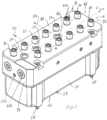
- the rail body 26 in the embodiment shown has a flat connection surface 44 on the upper side, on the side and in the area of which all hydraulic connections of the common rail 16, i.e. the high-pressure inlet 30, the high-pressure outlets 32, the Low pressure feed inlet 38, low pressure feed outlet 40 and, as described below, a return outlet 46 are formed.
- Fig. 2 shows, the high-pressure inlet 30 and the six high-pressure outlets 32 assigned to the cylinder bank mentioned are arranged one behind the other in a straight first connection row 48, wherein the first connection row 48 runs in a longitudinal direction L defined by the cuboid-shaped rail body 26 parallel to the longitudinal center plane E and laterally offset with respect to it.
- the longitudinal center plane E also runs at right angles to the connection surface 44.
- the low-pressure feed inlet 38, the low-pressure feed outlet 40 and the return outlet 46 are arranged one behind the other in a straight second connection row 50 in the longitudinal direction L, wherein the second connection row 50 extends along the longitudinal center plane E in the embodiment shown.
- the remaining six high-pressure outlets 32 assigned to the other cylinder bank are arranged one behind the other in a straight third connection row 52 in the longitudinal direction L.
- the third connection row 52 runs symmetrically to the first connection row 48 with respect to the longitudinal center plane E, with one of the high-pressure outlets 32 being located symmetrically to the high-pressure inlet 30.
- the Common Rail 16 is, as is particularly evident from the Fig.1 , 2 and 4 a protective cover 54 is assigned, on which the rail body 26 is arranged and which is provided with its lower cover wall 56 rests on the structure 12 of the internal combustion engine 10.
- the protective cover 54 and the rail body 26 are fastened to one another by means of screws.
- the rail body 26 is detachably attached to the structure 12 of the internal combustion engine 10 with four screws 58, which run through corresponding passages in the rail body 26 and in the casing 60 of the protective cover 54.
- the protective cover 54 is continuously connected to the casing 60 on the circumference and thus has a cap-like shape.
- the rail body 26 has a flat control surface 62 on its lower side facing away from the connection surface 44 and parallel to it (see also Fig.3 and 4 ), which is covered by the protective cover 54.
- connection surface and the control surface 62 are parallel to the longitudinal direction L.
- a fuel quantity control valve 64 is arranged on the control surface 62, which in the embodiment shown is formed by a generally known, electrically controlled suction throttle valve 66, as can be seen in particular from the Fig.3 and 4
- the fuel quantity control valve 64 arranged on the rail body 26 is connected between the low-pressure feed inlet 38 and the low-pressure feed outlet 40 and serves to regulate the amount of fuel sucked in by the high-pressure feed pump 14 or fed to it.
- two pressure sensors 68 are arranged and fastened to the rail body 26, on the control surface 62, which serve to measure the pressure of the fuel in the high-pressure storage chamber 28 of the common rail 16; of course, it is also possible to provide only a single pressure sensor 68.
- an electrically controlled pressure control valve 70 and a mechanical pressure relief valve 72 are arranged on the rail body 26, on its control surface 62.
- the pressure control valve 70 and the pressure relief valve 72 are connected between the high-pressure storage chamber 28 and the return outlet 46.
- a return line 124 is connected to the return outlet 46, which returns the fuel escaping from the high-pressure storage chamber 28 when the pressure control valve 70 or pressure relief valve 72 is open to the fuel tank.
- the pressure control valve 70 is provided to rapidly reduce the pressure in the high-pressure storage chamber 28 and thus also in the injection valves 36 in the event of a rapid drop in the power required by the internal combustion engine 10.
- the preferably mechanically designed pressure relief valve 72 is closed. It opens when a maximum pressure value is exceeded in the high-pressure storage chamber 28 and closes again when a predetermined pressure value is undershot.
- the fuel quantity control valve 64, the pressure sensors 68, the pressure control valve 70 and the pressure relief valve 72 are arranged one behind the other in a straight control row 74 in the longitudinal direction L, wherein the control row 74 is located in the longitudinal center plane E.
- control elements 76 i.e. in the embodiment shown the fuel quantity control valve 64 and the pressure control valve 70, the measuring elements 78, in the embodiment shown the pressure sensors 68, and the safety elements 80, in the embodiment shown the pressure relief valve 72, are arranged on the control surface 62 of the rail body 26 and fastened thereto and encapsulated by means of the protective cover 54 so as to be protected from the environment.
- the electrical components of the control elements 76 - in the embodiment shown, the fuel quantity control valve 64 and the pressure control valve 70 - and of the measuring elements 78 - in the embodiment shown, the pressure sensors 68 - are connected via electrical lines 82 to a plug socket 84 that passes through the casing 60 of the protective cover 54.
- the plug socket 84 can be connected to an electrical control 86 by means of a control cable in order to control and monitor the device for the intermittent injection of high-pressure fuel into the combustion chambers of the internal combustion engine 10.
- electrical components of the safety elements 80 can also be connected to the control 86 in the same way if necessary.
- the low-pressure connections of the common rail 16, i.e. the low-pressure feed inlet 38, the low-pressure feed outlet 40 and the return outlet 46, are identically designed, as is particularly evident Fig.4 They each have a blind hole 88 extending from the connection surface 24 and running at right angles to it, with a conical bottom area and with an internal thread.
- the connection screws of the low-pressure connection line 22, the low-pressure feed line 42 and the return line 124 can be screwed into the internal threads in a known manner. However, it is also possible to design these low-pressure connections differently.
- all high-pressure connections in the embodiment shown the high-pressure inlet 30 and the high-pressure outlets 32, are identically designed on cylinder stubs 90 protruding from the connection surface 44 and at right angles to it, the cylinder stubs 90 being provided with an external thread; see in particular Fig.1 , 2 , 4 and 5
- the connection nuts of the high-pressure feed line 24 and the high-pressure connecting lines 34 can be screwed onto the external threads in a known manner.
- the rail body 26 could also have internal threaded connections suitable for high pressure for the high pressure connections, here 30 and 32, similar to that disclosed in connection with the low pressure connections, here 38, 40 and 46.
- a high pressure connection nipple can then be provided for each high pressure connection, which is screwed in in a known manner in injectors and common rails and Depending on the design, the rail side can additionally be welded as is known.
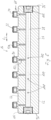
- An oblique bore 92 runs from the bottom area of the blind hole 88 of the low-pressure feed inlet 38 to the bottom area of a blind hole-like receiving bore 94 for the fuel quantity control valve 64; see Fig.4 and 6 .
- the receiving bore 94 runs from the control surface 62 and at a right angle to it.
- a first longitudinal bore 98 running in the longitudinal direction L runs from the first end face 96 of the rail body 26 facing the high-pressure feed pump 14 to the receiving bore 94.
- the first longitudinal bore 98 is closed at the first end face 96 by means of a sealing element 126.
- a connecting bore 100 runs from the bottom region of the blind hole 88 of the low-pressure feed outlet 40 into the first longitudinal bore 98.
- the inclined bore 92, the first longitudinal bore 98 and the connecting bore 100 form a connecting line between the low-pressure feed inlet 38 and the low-pressure feed outlet 40, into which the fuel quantity control valve 64 is connected.
- a second longitudinal bore 102 runs from the second end face 96' of the rail body 26 facing away from the first end face 96, which opens into a further connecting bore 104 extending from the bottom region of the blind hole 88 associated with the return outlet 46 and ends there; cf. Fig.4
- the second longitudinal bore 102 is closed at the front side 96' by means of a sealing element 126'.
- the second longitudinal bore 102 is crossed by further receiving bores 106 for the pressure control valve 70 and the pressure relief valve 72. These blind hole-like further receiving bores 106 run from the control surface 62 and at right angles to it.
- the fuel exiting from the high-pressure storage chamber 28 through the associated transverse bore 108 when the pressure control valve 70 is open is also fed to the return outlet 46 through the second longitudinal bore 102 and the further connecting bore 104.
- blind hole-like pressure sensor receiving bores 110 extend from the control surface 62 and at right angles to it. From the bottoms of the two pressure sensor receiving bores 110, bores extend to a further transverse bore 112, each of which establishes a hydraulic connection to the high-pressure storage chamber 28 or the associated bore 114. As this is particularly evident in the Fig.2 , 3 and 6 show, the cross holes 108 and further cross holes 112 are also closed against the environment by means of sealing screws.
- the high-pressure storage chamber 28 has the two bores 114 which run in the longitudinal direction L from the first end face 96 to the second end face 96' and are tightly closed at these two end faces 96, 96' by means of screw plugs 116.
- the axes of the two bores 114 run in the planes running parallel to the longitudinal center plane E, in which the first and third connection rows 48, 52 are also located.
- Blind hole-like connection bores 120 extend from the free ends of the cylinder stubs 90, the conical bottom surface of which forms a sealing surface which interacts with corresponding sealing surfaces of the high-pressure feed line 24 or high-pressure connecting lines 34.
- a connection bore 122 extends from the bottom of each connection bore 120 at right angles to the connection surface 44 and opens into the associated bore 114.
- the two bores 114 which form a large part of the high-pressure storage space 28, are larger in diameter than the other bores mentioned, which represent hydraulic connections.
- the rail body 26 is machined from a single metal block.
- the cuboid-shaped design of the rail body 26 allows the high-pressure storage chamber 28 and the necessary hydraulic connections to be produced in a simple manner, in particular through holes running in the longitudinal direction L and at right angles to the connection surface 44 or control surface 62 as well as the side surfaces.
- the two bores 114 can also be designed as blind holes, so that they can be closed with a locking screw 116 only on the end face 96 or 96' from which they originate.
Landscapes
- Engineering & Computer Science (AREA)
- Chemical & Material Sciences (AREA)
- Combustion & Propulsion (AREA)
- Mechanical Engineering (AREA)
- General Engineering & Computer Science (AREA)
- Physics & Mathematics (AREA)
- Electromagnetism (AREA)
- Fuel-Injection Apparatus (AREA)
Description
- Die vorliegende Erfindung betrifft ein Common Rail für eine Vorrichtung zum intermittierenden Einspritzen von unter Hochdruck stehendem Brennstoff in Brennräume einer Verbrennungskraftmaschine, wobei die Vorrichtung eine Hochdruckförderpumpe für Brennstoff, umfassend einen Niederdruckeingang und einen Hochdruckausgang, und Einspritzventile aufweist, qemäss dem Oberbegriff des Anspruchs 1.
- Ein Common Rail dieser Art ist beispielsweise im Artikel "3. Generation Pkw-Common-Rail von Bosch mit Piezo-Inline-Injektoren" in der Zeitschrift MTZ 3/2004 Jahrgang 65, Seiten 180 bis 189 offenbart. Die bekannte Vorrichtung weist eine mengengeregelte Hochdruckpumpe auf, welche den Hochdruckspeicherraum in zwei rohrförmigen Railkörpern des Common Rails mit unter Hochdruck stehendem Brennstoff speist. Die Hochdruckauslässe der Railkörper sind mit den Einspritzventilen verbunden. An einer axialen Stirnseite eines Railkörpers ist ein Druckregelventil und an der gegenüberliegenden axialen Stirnseite des Railkörpers ist ein Raildrucksensor angeordnet.
- Das Dokument
US 5 626 121 A beschreibt eine Kraftstoffpumpe für ein Hochdruck-Kraftstoffeinspritzsystem, umfassend eine Hochdruck-Kraftstoffpumpe zum Zuführen von Hochdruck-Kraftstoff zu Injektoren zum Einspritzen von Hochdruck-Kraftstoff in Zylinder eines Motors und ein Druckregelventil zum Steuern des Kraftstoffdrucks der Hochdruck-Kraftstoffpumpe, wobei die Hochdruck-Kraftstoffpumpe und das Druckregelventil integriert sind, um eine Pumpeneinheit zu bilden, und die Pumpeneinheit zur Montage am Motor angepasst ist. Die Hochdruck-Kraftstoffpumpe umfasst einen Deckel, ein Pumpengehäuse und einen Flansch, und das Druckregelventil weist ein Einheitsgehäuse auf, das einstückig mit dem Deckel der Hochdruck-Kraftstoffpumpe ausgebildet ist. - Weiter offenbart das Dokument
WO 95/13474 - Es ist eine Aufgabe der vorliegenden Erfindung, das Common Rail derart weiterzubilden, dass ein kompakter und revisionsfreundlicher Aufbau gegeben ist.
- Diese Aufgabe wird mit einem Common Rail mit den Merkmalen des Anspruchs 1 gelöst. Das Common Rail weist einen Railkörper auf, welcher einen Hochdruckspeicherraum, einen mit dem Hochdruckspeicherraum verbundenen Hochdruckeinlass und mit dem Hochdruckspeicherraum verbundene Hochdruckauslässe aufweist. Der Hochdruckeinlass ist dazu bestimmt, mit einem Hochdruckausgang einer Hochdruckförderpumpe verbunden zu sein, welche das Common Rail mit unter Hochdruck stehendem Brennstoff versorgt. Die Hochdruckauslässe sind dazu bestimmt, mit Einspritzventilen verbunden zu sein, mit welchen in bekannter Art und Weise unter Hochdruck stehender Brennstoff in Brennräume einer Verbrennungskraftmaschine intermittierend eingespritzt wird.
- Der Hochdruckausgang der Hochdruckförderpumpe ist mit dem Hochdruckeinlass des Railkörpers bevorzugt über eine Hochdruckspeiseleitung verbunden, während die Hochdruckauslässe des Railkörpers bevorzugt über Hochdruckverbindungsleitungen mit den zugeordneten Einspritzventilen verbunden sind.
- Erfindungsgemäss ist am Railkörper ein Treibstoffmengenregelventil zur Regelung der von der Hochdruckförderpumpe angesaugten Brennstoffmenge angeordnet. Bevorzugt ist das Treibstoffmengenregelventil als elektrisch gesteuertes Saugdrosselventil ausgebildet. Das Treibstoffmengenregelventil ist zwischen einen Niederdruckspeiseeinlass des Railkörpers und einen Niederdruckspeiseauslass des Railkörpers geschaltet. Der Niederdruckspeiseeinlass ist dazu bestimmt, an eine Niederdruckspeiseleitung angeschlossen zu sein, welche unter Niederdruck von üblicherweise 2 bis 10 bar stehenden Brennstoff aus einem Brennstoffspeichertank zuführt. Der Niederdruckspeiseauslass ist dazu bestimmt, mit einem Niederdruckeingang der Hochdruckförderpumpe verbunden zu sein, dies vorzugsweise über eine Niederdruckverbindungsleitung.
- Gegenüber dem Stand der Technik ist das Treibstoffmengenregelventil nicht mehr in die Hochdruckförderpumpe integriert, sondern dem Commom Rail zugeordnet. Dies ermöglicht einerseits einen vereinfachten Aufbau der Hochdruckförderpumpe und andererseits eine ausgezeichnete Zugänglichkeit zum Treibstoffmengenregelventil.
- Der Vollständigkeit halber sei erwähnt, dass im Railkörper eine Niederdruckverbindung zwischen dem Niederdruckspeiseeinlass und dem Niederdruckspeiseauslass ausgebildet ist, in welche das Treibstoffmengenregelventil geschaltet ist. Der Niederdruckspeiseeinlass, der Niederdruckspeiseauslass und die Niederdruckverbindungsleitung sind selbstredend vom Hochdruckspeicherraum getrennt.
- Bevorzugt ist am Railkörper weiter mindestens ein Drucksensor angeordnet, welcher der Messung des Drucks des Brennstoffs im Hochdruckspeicherraum dient.
- Bevorzugt ist am Railkörper ein Drucksteuerventil angeordnet, welches zwischen den Hochdruckspeicherraum und einen Rücklaufauslass des Railkörpers geschaltet ist. Das Drucksteuerventil dient bevorzugt der Reduktion des Drucks des Brennstoffs im Hochdruckspeicherraum bei rascher Reduktion der von der Verbrennungskraftmaschine verlangten Leistung.
- Der Rücklaufauslass ist bevorzugt über eine Rücklaufleitung mit dem Brennstoffspeichertank verbunden.
- Bevorzugt ist am Railkörper ebenfalls ein bevorzugt mechanisches Überdruckventil angeordnet, welches ebenfalls zwischen den Hochdruckspeicherraum und den Rüoklaufauslass geschaltet ist. Das Überdruckventil dient als Sicherheitselement für den Fall, dass ein maximal zulässiger Druck des Brennstoffs im Hochdruckspeicherraum überschritten werden sollte.
- Der Vollständigkeit halber sei erwähnt, dass das Treibstoffmengenregelventil, der Drucksensor und das Drucksteuerventil dazu bestimmt sind, elektrisch mit einer Steuereinrichtung verbunden zu sein.
- Bevorzugt weist der Railkörper eine wenigstens annähernd ebene Steuerfläche auf. An dieser ist das Treibstoffmengenregelventil angeordnet. Weiter sind an dieser Steuerfläche auch der Drucksensor beziehungsweise die Drucksensoren, das Drucksteuerventil und das Überdruckventil angeordnet, falls diese vorhanden sind. Diese Ausführungsform führt zu einem kompakten, wartungsfreundlichen Aufbau.
- Bevorzugt weist der Railkörper auch eine wenigstens annähernd ebene Anschlussfläche auf, wobei der Niederdruckspeiseeinlass und der Niederdruckspeiseauslass, als auch der Hochdruckeinlass und die Hochdruckauslässe auf der Seite dieser Anschlussfläche in dieser angeordnet sind. Falls ein Rückflussauslass vorhanden ist, ist auch dieser bevorzugt auf der Seite der Anschlussfläche in dieser angeordnet. Diese Ausführungsform führt dazu, dass sämtliche hydraulischen Anschlüsse des Railkörpers sich im Bereich der Anschlussfläche befinden. Auch dies führt zu einem kompakten und servicefreundlichen Aufbau.
- Bevorzugt weist der Railkörper eine wenigstens annähernd quaderförmige Ausbildung auf. Bevorzugt befinden sich die Steuerfläche und die Anschlussfläche auf voneinander abgewandten Seiten des Railkörpers, wobei die Steuerfläche und die Anschlussfläche wenigstens annähernd parallel zueinander verlaufen. Diese Ausführungsform wird bevorzugt bei V-Motoren eingesetzt, wobei das Common Rail bevorzugt zwischen den beiden Zylinderbänken an der Struktur der Verbrennungskraftmaschine befestigt ist, dies direkt oder bevorzugt über einen Schutzdeckel, wie dies weiter unten beschrieben ist. Bevorzugt befindet sich die Anschlussfläche auf der der Struktur der Verbrennungskraftmaschine abgewandten Seite, sodass alle Hydraulikanschlüsse frei zugänglich sind.
- Bei einem Reihenmotor bietet sich bevorzugt auch die Möglichkeit, die Anschlussfläche obenliegend, zylinderkopfseitig anzuordnen und die Steuerfläche auf der der Motorenstruktur abgewandten, freiliegenden Seite vorzusehen. Auch hier ist es jedoch möglich, die Steuerfläche gegenüberliegend der Anschlussfläche auf der untenliegenden Seite des Rail Gehäuses vorzusehen.
- Bevorzugt ist der Railkörper durch einen einstückigen, integralen Körper gebildet, beispielsweise einen Stahlkörper.
- In einer bevorzugten Ausführungsform sind der Hochdruckeinlass sowie alle oder ein Teil der Hochdruckauslässe in einer geradlinigen ersten Anschlussreihe in Längsrichtung des Railkörpers hintereinander angeordnet. Bevorzugt sind dabei der Niederdruckspeiseeinlass sowie der Niederdruckspeiseauslass und, falls vorhanden, der Rücklaufauslass in einer geradlinigen zweiten Anschlussreihe ebenfalls in Längsrichtung hintereinander angeordnet. Die erste Anschlussreihe und die zweite Anschlussreihe sind somit wenigstens annähernd parallel zueinander ausgerichtet. Falls sich nicht alle Hochdruckanschlüsse in der ersten Anschlussreihe befinden, ist bevorzugt eine geradlinige dritte Anschlussreihe vorgesehen, in welcher die nicht in der ersten Anschlussreihe vorhandenen Hochdruckauslässe in Längsrichtung hintereinander angeordnet sind. Bei dieser Ausführungsform befindet sich die zweite Anschlussreihe bevorzugt mittig zwischen der ersten und der dritten Anschlussreihe. Diese Ausführungsform wird bevorzugt bei V-Motoren angewendet.
- Bevorzugt sind das Treibstoffmengenregelventil und, falls vorhanden, der Drucksensor beziehungsweise die Drucksensoren, das Drucksteuerventil und das Überdruckventil in einer geradlinigen Steuerreihe in Längsrichtung hintereinander angeordnet. Bevorzugt befindet sich die Steuerreihe und die zweite Anschlussreihe in einer Längsmittelebene des Railkörpers.
- Der Speicherraum ist bevorzugt durch eine in Längsrichtung durch den Railkörper hindurchverlaufende Längsbohrung begrenzt, welche an beiden Enden, beispielsweise mittels Verschlussschrauben, verschlossen ist. Vom Hochdruckeinlass sowie von den zugeordneten Hochdruckauslässen führen zur Längsbohrung Anschlussverbindungsbohrungen, welche jedoch im Querschnitt kleiner ausgebildet sind als die Längsbohrung. Bevorzugt befinden sich die Achsen der Längsbohrung und der Anschlussverbindungsbohrungen in derselben Ebene, in welcher sich die erste Anschlussreihe befindet, wobei diese Ebene bevorzugt parallel zur Längsmittelebene des Railkörpers und wenigstens annähernd rechtwinklig zur Anschlussfläche verläuft.
- Falls eine dritte Anschlussreihe vorhanden ist, ist bevorzugt eine in Längsrichtung durch den Railkörper hindurch verlaufende, an beiden Enden verschlossene zweite Längsbohrung vorhanden, zu welcher von den zugeordneten Hochdruckauslässen ausgehende, im Querschnitt kleinere weitere Anschlussverbindungsbohrungen führen. Die beiden parallelen Längsbohrungen sind dabei bevorzugt über eine rechtwinklig zur Längsmittelebene verlaufende Verbindungsbohrung miteinander strömungsmässig verbunden.
- Bei dieser Ausführungsform sind bevorzugt der ersten Anschlussreihe der Hochdruckeinlass und die Hälfte der Hochdruckauslässe zugeordnet, während die andere Hälfte der Hochdruckauslässe der dritten Anschlussreihe zugeordnet sind. Dies bietet einerseits eine gute Zugänglichkeit und andererseits die Möglichkeit für kurze Hochdruckverbindungsleitungen zwischen den Hochdruckanschlüssen und den Einspritzventilen. Weiter ist Dank der wenigstens annähernd quaderförmigen Ausführungsform des Railkörpers und den Längsbohrungen sowie Querbohrungen eine einfache spanabhebende Herstellung ermöglicht.
- Die genannte Längsbohrung kann als Sachlockbohrung beziehungsweise die genannten Längsbohrungen können als Sachlockbohrungen ausgebildet sein. Entsprechend ist nur jeweils an einem Ende ein beispielsweise durch eine Verschlussschraube gebildeter Verschluss vorzusehen.
- Wie bereits weiter oben erwähnt, ist bevorzugt ein am Railkörper angeordneter Schutzdeckel vorhanden, welcher das Treibstoffmengenregelventil sowie den Drucksensor, das Drucksteuerventil und das Überdruckventil, falls diese vorhanden sind, gegen die Umgebung schützend umgibt. Somit sind die Steuer- und Messeelemente (wie das Treibstoffmengenregelventil sowie das Drucksteuerventil und der Drucksensor beziehungsweise die Drucksensoren) sowie Sicherheitselemente (wie das Überdruckventil) vom Schutzdeckel gegen die raue Umgebung geschützt.
- Bevorzugt liegt im montierten Zustand der Schutzdeckel mit seiner dem Railkörper abgewandten Deckelseite an der Struktur der Verbrennungskraftmaschine an und ist dabei der Railkörper mittels Schrauben an der Struktur befestigt, wobei die Schrauben ausserhalb des Schutzdeckels oder durch diesen hindurch verlaufen. Dies ermöglicht einerseits für die Steuer- und Messelemente sowie Sicherheitselemente einen ausgezeichneten Schutz und andererseits eine einfache Montage an der Struktur der Verbrennungskraftmaschine sowie einen freien Zugang zu den hydraulischen Anschlüssen.
- Bevorzugt ist am Schutzdeckel eine elektrische Steckerbuchse angeordnet, bevorzugt mantelseitig, mit welcher das elektrisch gesteuerte Treibstoffmengenregelventil sowie, falls vorhanden, die Drucksensoren und das Drucksteuerventil über elektrische Leitungen verbunden sind. An die Steckerbuchse ist ein Stecker anschliessbar, von welchem ein Steuerkabel zur Steuerung der Einspritzvorrichtung verläuft.
- Die vorliegende Offenbarung beschreibt auch eine eine Hochdruckförderpumpe für Brennstoff, umfassend einen Niederdruckeingang und einen Hochdruckausgang, und Einspritzventile aufweisende Vorrichtung zum intermittierenden Einspritzen von unter Hochdruck stehendem Brennstoff in Brennräume einer Verbrennungskraftmaschine mit einem erfindungsgemässen Common Rail.
- Die Erfindung wird anhand eines in der Zeichnung dargestellten Ausführungsbeispiels näher erläutert. Es zeigen rein schematisch:
- Fig. 1
- in isometrischer Darstellung von schräg oben eine Vorrichtung zum intermittierenden Einspritzen von unter Hochdruck stehendem Brennstoff in Brennräume einer Verbrennungskraftmaschine mit einer Hochdruckförderpumpe, einem von dieser gespeisten Common Rail und vom Common Rail mit unter Hochdruck stehendem Brennstoff versorgten Einspritzventilen;
- Fig. 2
- in isometrischer Darstellung von schräg oben das Common Rail gemäss
Fig. 1 ; - Fig. 3
- in isometrischer Darstellung von schräg unten das Common Rail gemäss den
Fig. 1 und2 ohne Schutzdeckel; - Fig. 4
- das Common Rail gemäss den
Fig. 1 bis 3 mit Schutzdeckel in einem Längsschnitt entlang der Längsmittelebene; - Fig. 5
- das Common Rail gemäss den
Fig. 1 bis 4 ohne Schutzdeckel in einem Schnitt parallel zur Längsmittelebene durch eine erste Anschlussreihe, welche den Hochdruckeinlass und sechs Hochdruckauslässe umfasst; und - Fig. 6
- das Common Rail gemäss den
Fig. 1 bis 5 in einem Schnitt entlang der Linie VI - VI derFig. 4 . - In der folgenden Figurenbeschreibung und in allen Figuren werden für die gleichen Merkmale dieselben Bezugszeichen verwendet.
-
Fig. 1 zeigt eine Vorrichtung zum intermittierenden Einspritzen von unter Hochdruck stehendem Brennstoff in Brennräume einer Verbrennungskraftmaschine 10. In gezeigtem Ausführungsbeispiel handelt es sich bei der Verbrennungskraftmaschine 10 um einen 12-Zylinder V-Verbrennungsmotor mit zwei Zylinderbänken à je sechs Zylinder. - An der Struktur 12 der Verbrennungskraftmaschine 10, im gezeigten Ausführungsbeispiel zwischen den beiden Zylinderbänken, sind eine Hochdruckförderpumpe 14 und ein erfindungsgemässes Common Rail 16 befestigt.
- Die in bekannter Art und Weise über einen Zahnriemen oder über Zahnräder von der Verbrennungskraftmaschine 10 angetriebene Hochdruckförderpumpe 14 weist einen Niederdruckeingang 18 und einen Hochdruckausgang 20 auf. Mit einer Niederdruckverbindungsleitung 22 dem Niederdruckeingang 18 zugeführter, unter Niederdruck von beispielsweise 2 bis 10 bar stehender Brennstoff wird von der Hochdruckförderpumpe 14 in bekannter Art und Weise auf Hochdruck von beispielsweise ca. 2000 bar gebracht und mit einer an den Hochdruckausgang 20 angeschlossenen Hochdruckspeiseleitung 24 dem Common Rail 16 zugeführt.
- Das Common Rail 16 weist einen annähernd quaderförmigen Railkörper 26, bevorzugt aus einem hochfestem Stahl, auf, in welchem ein Hochdruckspeicherraum 28 vorhanden ist, wie dies
Fig. 5 und6 zeigen. Mit dem Hochdruckspeicherraum 28 ist ein Hochdruckeinlass 30, an welchem die Hochdruckspeiseleitung 24 angeschlossen ist, und sind die Hochdruckauslässe 32 verbunden. Im gezeigten Ausführungsbeispiel ist jeder der zwölf Hochdruckauslässe 32 über eine Hochdruckverbindungsleitung 34 mit einem zugeordneten Einspritzventil 36 verbunden, um dieses mit dem unter Hochdruck stehenden Brennstoff zu versorgen. - Der besseren Übersichtlichkeit halber sind in
Fig. 1 nur jene sechs Einspritzventile 36 gezeigt, welche den sechs Zylindern der einen Zylinderbank zugeordnet sind, um in deren Zylinder intermittierend unter Hochdruck stehenden Brennstoff einzuspritzen. Die der zweiten Zylinderbank zugeordneten sechs Einspritzventile 36 sind auf gleiche Art und Weise an die verbleibenden Hochdruckauslässe 32 angeschlossen. - Der Railkörper 26 weist weiter einen Niederdruckspeiseeinlass 38 und einen Niederdruckspeiseauslass 40 auf. An Letzteren ist die Niederdruckverbindungsleitung 22 angeschlossen. An den Niederdruckspeiseeinlass 38 ist eine in
Fig. 2 schematisch angedeutete Niederdruckspeiseleitung 42 angeschlossen, durch welche der unter Niederdruck stehende Brennstoff von einem Brennstofftank, beispielsweise mittels einer Niederdruckbrennstoffspeisepumpe, zugeführt wird. - Wie dies insbesondere aus den
Fig. 1 und2 hervorgeht, weist der Railkörper 26 im gezeigten Ausführungsbeispiel auf der obenliegenden Seite eine ebene Anschlussfläche 44 auf, auf deren Seite und in deren Bereich sämtliche hydraulischen Anschlüsse des Common Rails 16, das heisst der Hochdruckeinlass 30, die Hochdruckauslässe 32, der Niederdruckspeiseeinlass 38, der Niederdruckspeiseauslass 40 und, wie weiter unten zu beschreiben ist, ein Rücklaufauslass 46 ausgebildet sind. - Wie dies besonders anschaulich
Fig. 2 zeigt, sind der Hochdruckeinlass 30 und die sechs der genannten Zylinderbank zugeordneten Hochdruckauslässe 32 in einer geradlinigen ersten Anschlussreihe 48 hintereinander angeordnet, wobei die erste Anschlussreihe 48 in einer vom quaderförmigen Railkörper 26 definierten Längsrichtung L parallel zur Längsmittelebene E und bezüglich dieser seitlich versetzt verläuft. Die Längsmittelebene E verläuft weiter rechtwinklig zur Anschlussfläche 44. - Der Niederdruckspeiseeinlass 38, der Niederdruckspeiseauslass 40 und der Rücklaufauslass 46 sind in einer geradlinigen zweiten Anschlussreihe 50 in Längsrichtung L hintereinander angeordnet, wobei sich die zweite Anschlussreihe 50 im gezeigten Ausführungsbeispiel entlang der Längsmittelebene E erstreckt.
- Die verbleibenden sechs, der andern Zylinderbank zugeordneten Hochdruckauslässe 32 sind in einer geradlinigen dritten Anschlussreihe 52 in Längsrichtung L hintereinander angeordnet. Die dritte Anschlussreihe 52 verläuft bezüglich der Längsmittelebene E symmetrisch zur ersten Anschlussreihe 48, wobei symmetrisch zum Hochdruckeinlass 30 sich einer der Hochdruckauslässe 32 befindet.
- Dem Common Rail 16 ist, wie dies insbesondere aus den
Fig. 1 ,2 und4 hervorgeht, ein Schutzdeckel 54 zugeordnet, auf welchem der Railkörper 26 angeordnet ist und welcher mit seiner untenliegenden Deckelwand 56 auf der Struktur 12 der Verbrennungskraftmaschine 10 anliegt. Der Schutzdeckel 54 und der Railkörper 26 sind mittels Schrauben aneinander befestigt. - Der Railkörper 26 ist mit vier Schrauben 58, welche durch entsprechende Durchlässe im Railkörper 26 und im Mantel 60 des Schutzdeckels 54 hindurch verlaufen, an der Struktur 12 der Verbrennungskraftmaschine 10 lösbar befestigt. Der Vollständigkeit halber sei erwähnt, dass der Schutzdeckel 54 mit dem Mantel 60 umfangsseitig ununterbrochen verbunden ist und somit eine kappenartige Form aufweist.
- Der Railkörper 26 weist auf seiner untenliegenden, der Anschlussfläche 44 abgewandten und zu dieser parallelen Seite eine ebene Steuerfläche 62 auf (siehe auch
Fig. 3 und4 ), welche vom Schutzdeckel 54 überdeckt ist. - Die Anschlussfläche und die Steuerfläche 62 sind parallel zur Längsrichtung L.
- An der Steuerfläche 62 ist ein Treibstoffmengenregelventil 64 angeordnet, welches im gezeigten Ausführungsbeispiel durch ein allgemein bekanntes, elektrisch gesteuertes Saugdrosselventil 66 gebildet ist, wie dies insbesondere aus den
Fig. 3 und4 hervorgeht. Das am Railkörper 26 angeordnete Treibstoffmengenregelventil 64 ist zwischen den Niederdruckspeiseeinlass 38 und den Niederdruckspeiseauslass 40 geschaltet und dient der Regelung der von der Hochdruckförderpumpe 14 angesaugten beziehungsweise dieser zugeführten Brennstoffmenge. - Weiter sind am Railkörper 26, an der Steuerfläche 62, zwei Drucksensoren 68 angeordnet und an diesem befestigt, welche dem Messen des Drucks des Brennstoffs im Hochdruckspeicherraum 28 des Common Rails 16 dienen; selbstverständlich ist es auch möglich, nur einen einzigen Drucksensor 68 vorzusehen.
- Weiter sind im gezeigten Ausführungsbeispiel am Railkörper 26, an dessen Steuerfläche 62, ein elektrisch gesteuertes Drucksteuerventil 70 und ein mechanisches Überdruckventil 72 angeordnet.
- Das Drucksteuerventil 70 und das Überdruckventil 72 sind zwischen den Hochdruckspeicherraum 28 und den Rückflussauslass 46 geschaltet.
- An den Rücklaufauslass 46 ist eine Rücklaufleitung 124 angeschlossen, welche den bei geöffnetem Drucksteuerventil 70 oder Überdruckventil 72 aus dem Hochdruckspeicherraum 28 austretenden Brennstoff zum Brennstofftank zurückführt.
- Das Drucksteuerventil 70 ist dazu vorgesehen, bei schnellem Abfall der von der Verbrennungskraftmaschine 10 verlangten Leistung, den Druck im Hochdruckspeicherraum 28 und somit auch in den Einspritzventilen 36 rasch abzusenken.
- Unter normalen Betriebsbedingungen ist das bevorzugt mechanisch ausgebildete Überdruckventil 72 geschlossen. Es öffnet, wenn im Hochdruckspeicherraum 28 ein maximaler Druckwert überschritten wird und schliesst wieder, wenn ein vorbestimmter Druckwert unterschritten wird.
- Das Treibstoffmengenregelventil 64, die Drucksensoren 68, das Drucksteuerventil 70 und das Überdruckventil 72 sind in einer geradlinigen Steuerreihe 74 in Längsrichtung L hintereinander angeordnet, wobei sich die Steuerreihe 74 in der Längsmittelebene E befindet.
- Die Steuerelemente 76, das heisst im gezeigten Ausführungsbeispiel das Treibstoffmengenregelventil 64 und das Drucksteuerventil 70, die Messelemente 78, im gezeigten Ausführungsbeispiel die Drucksensoren 68, und die Sicherheitselemente 80, im gezeigten Ausführungsbeispiel das Überdruckventil 72, sind an der Steuerfläche 62 des Railkörpers 26 angeordnet sowie an diesem befestigt und mittels des Schutzdeckels 54 gegenüber der Umgebung geschützt gekapselt.
- Die elektrischen Komponenten der Steuerelemente 76 - im gezeigten Ausführungsbeispiel das Treibstoffmengenregelventil 64 und das Drucksteuerventil 70 - und der Messelemente 78 - im gezeigten Ausführungsbeispiel die Drucksensoren 68 - sind über elektrische Leitungen 82 mit einer den Mantel 60 des Schutzdeckels 54 durchgreifenden Steckerbuchse 84 verbunden. Mittels eines Steuerkabels ist die Steckerbuchse 84 mit einer elektrischen Steuerung 86 verbindbar, um die Vorrichtung zur intermittierenden Einspritzung von unter Hochdruck stehendem Brennstoff in die Brennräume der Verbrennungskraftmaschine 10 zu steuern und zu überwachen. Der Vollständigkeit halber sei erwähnt, dass gegebenenfalls auch elektrische Komponenten der Sicherheitselemente 80 in gleicher Art und Weise mit der Steuerung 86 verbunden sein können.
- Die Niederdruckanschlüsse des Common Rails 16, das heisst der Niederdruckspeiseeinlass 38, der Niederdruckspeiseauslass 40 und der Rücklaufauslass 46, sind identisch ausgebildet, wie dies insbesondere
Fig. 4 zeigt. Sie weisen je eine von der Anschlussfläche 24 ausgehende und rechtwinklig zu dieser verlaufende Sacklochbohrung 88 mit einem konischen Bodenbereich und mit einem Innengewinde auf. In die Innengewinde sind in bekannter Art und Weise die Anschlussschrauben der Niederdruckverbindungsleitung 22, der Niederdruckspeiseleitung 42 und der Rücklaufleitung 124 einschraubbar. Es ist jedoch auch möglich, diese Niederdruckanschlüsse unterschiedlich auszubilden. - Demgegenüber sind alle Hochdruckanschlüsse, im gezeigten Ausführungsbeispiel der Hochdruckeinlass 30 und die Hochdruckauslässe 32, an aus der Anschlussfläche 44 und rechtwinklig zu dieser vorstehenden Zylinderstummeln 90 identisch ausgebildet, wobei die Zylinderstummel 90 mit einem Aussengewinde versehen sind; siehe dazu insbesondere
Fig. 1 ,2 ,4 und5 . Auf die Aussengewinde sind in bekannter Art und Weise die Anschlussmuttern der Hochdruckspeiseleitung 24 und der Hochdruckverbindungsleitungen 34 aufschraubbar. - Alternativ zu den Gewindestummeln 90 könnte der Railkörper 26 auch für die Hochdruckanschlüsse, hier 30 und 32, für Hochdruck geeignete Innengewinde-Anschlüsse aufweisen, ähnlich wie im Zusammenhang mit den Niderdruckanschlüssen, hier 38, 40 und 46, offenbart. Es kann dann pro Hochdruckanschluss ein Hochdruck-Verbindungsnippel vorgesehen werden, der in bekannter Art und Weise bei Injektoren und bei Common Rails eingeschraubt ist und je nach Ausführungsform Rail seitig zusätzlich wie bekannt verschweisst sein kann.
- Vom Bodenbereich der Sacklochbohrung 88 des Niederddruckspeiseeinlasses 38 verläuft zum Bodenbereich einer sacklochartigen Aufnahmebohrung 94 für das Treibstoffmengenregelventil 64 eine Schrägbohrung 92; siehe
Fig. 4 und6 . Die Aufnahmebohrung 94 verläuft von der Steuerfläche 62 aus und rechtwinklig zu dieser. Weiter verläuft von der der Hochdruckförderpumpe 14 zugewandten ersten Stirnseite 96 des Railkörpers 26 eine in Längsrichtung L verlaufende erste Längsbohrung 98 bis zur Aufnahmebohrung 94. Die erste Längsbohrung 98 ist bei der ersten Stirnseite 96 mittels eines Dichtungselements 126 verschlossen. - Weiter verläuft vom Bodenbereich der Sacklochbohrung 88 des Niederdruckspeiseauslasses 40 eine Verbindungsbohrung 100 in die erste Längsbohrung 98. Die Schrägbohrung 92, die erste Längsbohrung 98 und die Verbindungsbohrung 100 bilden eine Verbindungsleitung zwischen dem Niederdruckspeiseeinlass 38 und dem Niederdruckspeiseauslass 40, in welche das Treibstoffmengenregelventil 64 geschaltet ist.
- An dieser Stelle soll erwähnt sein, dass es auch möglich ist, bei sonst gleich ausgebildetem Common Rail 16, das Treibstoffmengenregelventil 64, wie beim Stand der Technik, der Hochdruckförderpumpe 14 zuzuordnen. Selbstredend wären in diesem Fall am Railkörper 26 kein Niederdruckspeiseeinlass 38, kein Niederdruckspeisauslass 40 und keine diese miteinander verbindende Verbindungsleitung notwendig.
- Achsparallel zur ersten Längsbohrung 98 verläuft von der der ersten Stirnseite 96 abgewandten zweiten Stirnseite 96' des Railkörpers 26 eine zweite Längsbohrung 102, welche in eine vom Bodenbereich der dem Rücklaufauslass 46 zugeordneten Sacklochbohrung 88 ausgehenden weiteren Verbindungsbohrung 104 mündet und dort endet; vergl.
Fig. 4 . Die zweite Längsbohrung 102 ist bei der Stirnseite 96' mittels eines Dichtungselements 126' verschlossen. - Die zweite Längsbohrung 102 wird durch weitere Aufnahmebohrungen 106 für das Drucksteuerventil 70 und das Überdruckventil 72 durchkreuzt. Diese sacklochartigen weiteren Aufnahmebohrungen 106 verlaufen von der Steuerfläche 62 aus und rechtwinklig zu dieser.
- Von den Böden der weiteren Aufnahmebohrungen 106 für das Drucksteuerventil 70 und das Überdruckventil 72 verlaufen Bohrungen, ebenfalls rechtwinklig zur Steuerfläche 62, welche in je eine Querbohrung 108 münden, wobei diese rechtwinklig zur Längsmittelebene E verlaufenden Querbohrungen 108 je eine Strömungsverbindung zum Hochdruckspeicherraum 28 beziehungsweise deren weiter unten beschriebenen Bohrungen 114 darstellen; siehe
Fig. 5 und6 . - Öffnet das in die betreffende Aufnahmebohrung eingesetzte Überdruckventil 72, strömt durch die zugeordnete Querbohrung 108 aus dem Hochruckspeicherraum 28 Brennsoff, welcher durch die zweite Längsbohrung 102 - am Drucksteuerventil 70 vorbei - und die weitere Verbindungsbohrung 104 zum Rückflussauslass 46 geleitet wird.
- Entsprechend wird auch der, bei geöffnetem Drucksteuerventil 70, durch die zugeordnete Querbohrung 108 aus dem Hochdruckspeicherraum 28 austretende Brennstoff durch die zweite Längsbohrung 102 und die weitere Verbindungsbohrung 104 dem Rückflussauslass 46 zugeführt.
- Weiter verlaufen von der Steuerfläche 62 aus und rechtwinklig zu dieser sacklochartige Drucksensor-Aufnahmebohrungen 110. Von den Böden der beiden Drucksensor-Aufnahmebohrungen 110 verlaufen Bohrungen zu je einer weiteren Querbohrung 112, welche je eine hydraulische Verbindung zum Hochdruckspeicherraum 28 beziehungsweise der zugeordneten Bohrung 114 herstellen. Wie dies insbesondere die
Fig. 2 ,3 und6 zeigen, sind die Querbohrungen 108 und weiteren Querbohrungen 112 ebenfalls mittels Dichtungsschrauben gegen die Umgebung verschlossen. - Wie dies aus
Fig. 5 und6 in Verbindung mit denFig. 2 und3 hervorgeht, weist der Hochdruckspeicherraum 28 die zwei Bohrungen 114 auf, welche in Längsrichtung L von der ersten Stirnseite 96 zur zweiten Stirnseite 96' verlaufen und bei diesen beiden Stirnseiten 96, 96' mittels Verschlussschrauben 116 dicht verschlossen sind. Die Achsen der beiden Bohrungen 114 verlaufen in den parallel zur Längsmittelebene E verlaufenden Ebenen, in welchen auch die erste beziehungsweise dritte Anschlussreihe 48, 52 sich befinden. - Wie
Fig. 5 und6 zeigen, sind die beiden Bohrungen 114 über die weiteren Querbohrungen 108 miteinander verbunden, wobei in derFig. 6 auch der zur Seitenfläche des Railkörpers 26 verlaufende und dort verschlossene Abschnitt dieser weiteren Querbohrungen 108 sichtbar ist. - Von den freien Enden der Zylinderstummel 90 verlaufen sacklochartige Anschlussbohrungen 120, deren konische Bodenfläche eine Dichtfläche bildet, welche mit entsprechenden Dichtflächen der Hochdruckspeiseleitung 24 beziehungsweise Hochdruckverbindungsleitungen 34 zusammenwirken. Vom Boden jeder Anschlussbohrung 120 aus verläuft, rechtwinklig zur Anschlussfläche 44, eine Anschlussverbindungsbohrung 122, welche in die zugeordnete Bohrung 114 mündet.
- Der Vollständigkeit halber sei erwähnt, dass die beiden Bohrungen 114, welche einen grossen Anteil des Hochdruckspeicherraums 28 bilden, im Durchmesser grösser ausgebildet sind als die übrigen genannten Bohrungen, welche hydraulische Verbindungen darstellen.
- Im gezeigten Ausführungsbeispiel ist der Railkörper 26 aus einem einzigen Metallblock spanabhebend gefertigt. Die quaderförmige Ausführungsform des Railkörpers 26 erlaubt auf einfache Art und Weise, durch insbesondere in Längsrichtung L und rechtwinklig zur Anschlussfläche 44 beziehungsweise Steuerfläche 62 sowie den Seitenflächen verlaufende Bohrungen, den Hochdruckspeicherraum 28 und die notwendigen hydraulischen Verbindungen herzustellen.
- Die beiden Bohrungen 114 können auch als Sacklochbohrungen ausgebildet sein, so dass sie nur auf jener Stirnseite 96 beziehungsweise 96', von welcher sie ausgehen, mit einer Verschlussschraube 116 zu verschliessen sind.
Claims (12)
- Common Rail für eine Vorrichtung zum intermittierenden Einspritzen von unter Hochdruck stehendem Brennstoff in Brennräume einer Verbrennungskraftmaschine (10), wobei die Vorrichtung eine Hochdruckförderpumpe (14) für Brennstoff, umfassend einen Niederdruckeingang (18) und einen Hochdruckausgang (20), und Einspritzventile (36) aufweist, mit einem Railkörper (26), welcher einen Hochdruckspeicherraum (28), einen mit dem Hockdruckspeicherraum (28) verbundenen Hockdruckeinlass (30) und mit dem Hochdruckspeicherraum (28) verbundene Hockdruckauslässe (32) aufweist, wobei der Hochdruckeinlass (30) dazu bestimmt ist, mit dem Hochdruckausgang (20) der Hockdruckförderpumpe (14) verbunden zu sein, und die Hochdruckauslässe (32) dazu bestimmt sind, mit Einspritzventilen (36) verbunden zu sein, gekennzeichnet durch ein am Railkörper (26) angeordnetes Treibstoffmengenregelventil (64) zur Regelung der von der Hochdruckförderpumpe (14) angesaugten Brennstoffmenge, welches zwischen einen Niederdruckspeiseeinlass (38) des Railkörpers (26) und einen Niederdruckspeiseauslass (40) des Railkörpers (26) geschaltet ist, wobei der Niederdruckspeiseeinlass (38) dazu bestimmt ist, mit einer unter Niederdruck stehenden Brennstoff zuführenden Niederdruckspeiseleitung (42) verbunden zu sein, und der Niederdruckspeiseauslass (40) dazu bestimmt ist, mit dem Niederdruckeingang (18) der Hockdruckförderpumpe (14) verbunden zu sein.
- Common Rail nach Anspruch 1, gekennzeichnet durch einen am Railkörper (26) angeordneten Drucksensor (68) zum Messen des Drucks des Brennstoffs im Hockdruckspeicherraum (28).
- Common Rail nach Anspruch 1 oder 2, gekennzeichnet durch ein am Railkörper (26) angeordnetes Drucksteuerventil (70) und/oder ein am Railkörper (26) angeordnetes Überdruckventil (72), wobei das Drucksteuerventil (70) und/oder das Überdruckventil (72) zwischen den Hochdruckspeicherraum (28) und einen Rücklaufauslass (46) des Railkörpers (26) geschaltet ist beziehungsweise sind.
- Common Rail nach einem der Ansprüche 1 bis 3, dadurch gekennzeichnet, dass der Railkörper (26) eine wenigstens annähernd ebene Steuerfläche (62) aufweist, an welcher das Treibstoffmengenregelventil (64) angeordnet ist und an welcher gegebenenfalls der Drucksensor (68), das Drucksteuerventil (70) und das Überdruckventil (72) angeordnet sind.
- Common Rail nach einem der Ansprüche 1 bis 4, dadurch gekennzeichnet, dass der Railkörper (26) eine wenigstens annähernd ebene Anschlussfläche (44) ausweist, wobei der Niederdruckspeiseeinlass (38), der Niederdruckspeiseauslass (40), der Hockruckeinlass (30) und die Hochdruckauslässe (32) sowie gegebenenfalls der Rücklaufauslass (46) auf der Seite der Anschlussfläche (44) angeordnet sind.
- Common Rail nach Anspruch 4 und 5, dadurch gekennzeichnet, dass der Railkörper (26) wenigstens annähernd quaderförmig ausgebildet ist, wobei die Steuerfläche (62) und die Anschlussfläche (44) voneinander abgewandt wenigstens annähernd parallel zueinander verlaufen.
- Common Rail nach Anspruch 6, dadurch gekennzeichnet, dass der Railkörper (26) eine Längsrichtung (L) definiert, der Hochdruckeinlass (30) sowie Hochdruckauslässe (32) in einer ersten Anschlussreihe (48) in Längsrichtung (L) hintereinander angeordnet sind und der Niederdruckspeiseeinlass (38) sowie der Niederdruckspeiseauslass (40) und gegebenenfalls der Rücklaufauslass (46) in einer zweiten Anschlussreihe (50) in Längsrichtung (L) hintereinander angeordnet sind.
- Common Rail nach Anspruch 7, dadurch gekennzeichnet, dass das Treibstoffmengenregelventil (64) und gegebenenfalls der Drucksensor (68), das Drucksteuerventil (70) und das Überdruckventil (72) in einer Steuerreihe (74) in Längsrichtung (L) hintereinander angeordnet sind.
- Common Rail nach Anspruch 7 oder 8, dadurch gekennzeichnet, dass der Hochdruckspeicherraum (28) durch eine in Längsrichtung (L) im Railkörper (26) verlaufende, an einem Ende oder an beiden Enden mittels eines Verschlusses (116) verschlossene Bohrung (114) und durch vom Hochdruckeinlass (30) sowie von den Hochdruckauslässen (32) zur Bohrung (114) führende, im Querschnitt kleinere Anschlussverbindungsbohrungen (122) begrenzt ist.
- Common Rail nach einem der Ansprüche 1 bis 9, gekennzeichnet durch einen am Railkörper (26) angeordneten Schutzdeckel (54), welcher die Steuerfläche (62), das Treibstoffmengenregelventil (64) sowie gegebenenfalls den Drucksensor (68), das Drucksteuerventil (70) und das Überdruckventil (72) gegen die Umgebung schützend umgibt.
- Common Rail nach Anspruch 10, dadurch gekennzeichnet, dass am Schutzdeckel (54) eine elektrische Steckerbuchse (84) angeordnet ist, mit welcher das Treibstoffmengenregelventil (64) sowie gegebenenfalls der Drucksensor (68) und das Drucksteuerventil (70) elektrisch verbunden ist beziehungsweise sind.
- Common Rail nach einem der Ansprüche 1 bis 11, dadurch gekennzeichnet, dass das Treibstoffmengenregelventil (64) ein Saugdrosselventil (66) aufweist.
Applications Claiming Priority (2)
| Application Number | Priority Date | Filing Date | Title |
|---|---|---|---|
| CH01176/18A CH715387A1 (de) | 2018-09-27 | 2018-09-27 | Common Rail für eine Brennstoffeinspritzvorrichtung. |
| PCT/EP2019/072317 WO2020064225A1 (de) | 2018-09-27 | 2019-08-21 | Common rail für eine brennstoffeinspritzvorrichtung |
Publications (3)
| Publication Number | Publication Date |
|---|---|
| EP3857047A1 EP3857047A1 (de) | 2021-08-04 |
| EP3857047C0 EP3857047C0 (de) | 2024-08-07 |
| EP3857047B1 true EP3857047B1 (de) | 2024-08-07 |
Family
ID=63794243
Family Applications (1)
| Application Number | Title | Priority Date | Filing Date |
|---|---|---|---|
| EP19759324.7A Active EP3857047B1 (de) | 2018-09-27 | 2019-08-21 | Common rail für eine brennstoffeinspritzvorrichtung |
Country Status (3)
| Country | Link |
|---|---|
| EP (1) | EP3857047B1 (de) |
| CH (1) | CH715387A1 (de) |
| WO (1) | WO2020064225A1 (de) |
Families Citing this family (1)
| Publication number | Priority date | Publication date | Assignee | Title |
|---|---|---|---|---|
| CN113757013A (zh) * | 2021-10-21 | 2021-12-07 | 江苏普瑞亚动力科技有限公司 | 一种新型燃油共轨系统 |
Family Cites Families (4)
| Publication number | Priority date | Publication date | Assignee | Title |
|---|---|---|---|---|
| US5701873A (en) | 1993-11-08 | 1997-12-30 | Eidgenoessische Technische Hochschule Laboratorium Fuer Verbrennungsmotoren Und Verbrennungstechnik | Control device for a filling-ratio adjusting pump |
| JP2689226B2 (ja) * | 1994-12-02 | 1997-12-10 | 株式会社ゼクセル | 高圧燃料噴射装置用燃料ポンプ |
| DE102008040901A1 (de) * | 2008-07-31 | 2010-02-04 | Robert Bosch Gmbh | Kraftstoffdruckspeicher für ein Einspritzsystem für Brennkraftmaschinen |
| DE102013220788B3 (de) * | 2013-10-15 | 2014-11-13 | Continental Automotive Gmbh | Anordnung für ein Kraftstoffeinspritzsystem |
-
2018
- 2018-09-27 CH CH01176/18A patent/CH715387A1/de not_active Application Discontinuation
-
2019
- 2019-08-21 EP EP19759324.7A patent/EP3857047B1/de active Active
- 2019-08-21 WO PCT/EP2019/072317 patent/WO2020064225A1/de not_active Ceased
Also Published As
| Publication number | Publication date |
|---|---|
| WO2020064225A1 (de) | 2020-04-02 |
| EP3857047C0 (de) | 2024-08-07 |
| CH715387A1 (de) | 2020-03-31 |
| EP3857047A1 (de) | 2021-08-04 |
Similar Documents
| Publication | Publication Date | Title |
|---|---|---|
| EP2812559B1 (de) | Brennstoffeinspritzventil und vorrichtung zum einspritzen von brennstoff | |
| EP2961977B1 (de) | Vorrichtung zum einspritzen von brennstoff in den brennraum einer vebrennungskraftmaschine | |
| EP0889231B1 (de) | Kraftstoffeinspritzsystem | |
| EP1864014B1 (de) | Kraftstoffeinspritzeinrichtung für eine mehrzylindrige brennkraftmaschine | |
| DE4313852A1 (de) | Kraftstoffeinspritzeinrichtung für Brennkraftmaschinen | |
| DE19716513A1 (de) | Kraftstoffeinspritzsystem für einen Verbrennungsmotor mit einer Common-Rail-Schiene | |
| DE3323010A1 (de) | Kraftstoffzufuehrungseinrichtung fuer brennkraftmaschinen | |
| EP2385238A2 (de) | Hochdruckinjektor | |
| EP1137878B1 (de) | Kraftstoffhochdruckspeicher | |
| EP3857047B1 (de) | Common rail für eine brennstoffeinspritzvorrichtung | |
| WO2001009508A1 (de) | Kraftstoffhochdruckspeicher | |
| DE102016201082B4 (de) | Kraftstoffhochdruckpumpe | |
| DE19900508A1 (de) | Leckageanschluß und Kraftstoffinjektor mit einem solchen Leckageanschluß | |
| DE102018104848B3 (de) | Verteilervorrichtung eines Common-Rail-Systems | |
| AT518510B1 (de) | Speichereinspritzsystem für Verbrennungskraftmaschinen | |
| WO2016055293A1 (de) | Speichereinspritzsystem für verbrennungskraftmaschinen | |
| DE102022213374A1 (de) | Druckregeleinheit für ein Brennstoffversorgungssystem einer Brennkraftmaschine, sowie Brennstoffversorgungssystem | |
| DE10132245A1 (de) | Druckfester Hochdrucksammelraum | |
| DE102006014767A1 (de) | Kraftstoffeinspritzeinrichtung für eine mehrzylindrige Brennkraftmaschine | |
| DE102012004935B4 (de) | Common-Rail | |
| DE10147830A1 (de) | Kraftstoffinjektor | |
| EP1256713A2 (de) | Einspritzvorrichtung für ein Speichereinspritzsystem mit Funktionstrennung von Volumenspeicher und Verteilerstück | |
| DE102004021040A1 (de) | Einspritzeinrichtung für eine Brennkraftmaschine | |
| DE4126879C2 (de) | Gleichdruckentlastungsventil für Kraftstoffeinspritzanlagen | |
| WO2003027484A1 (de) | Kraftstoffhochdruckspeicher |
Legal Events
| Date | Code | Title | Description |
|---|---|---|---|
| STAA | Information on the status of an ep patent application or granted ep patent |
Free format text: STATUS: UNKNOWN |
|
| STAA | Information on the status of an ep patent application or granted ep patent |
Free format text: STATUS: THE INTERNATIONAL PUBLICATION HAS BEEN MADE |
|
| PUAI | Public reference made under article 153(3) epc to a published international application that has entered the european phase |
Free format text: ORIGINAL CODE: 0009012 |
|
| STAA | Information on the status of an ep patent application or granted ep patent |
Free format text: STATUS: REQUEST FOR EXAMINATION WAS MADE |
|
| 17P | Request for examination filed |
Effective date: 20210324 |
|
| AK | Designated contracting states |
Kind code of ref document: A1 Designated state(s): AL AT BE BG CH CY CZ DE DK EE ES FI FR GB GR HR HU IE IS IT LI LT LU LV MC MK MT NL NO PL PT RO RS SE SI SK SM TR |
|
| DAV | Request for validation of the european patent (deleted) | ||
| DAX | Request for extension of the european patent (deleted) | ||
| GRAP | Despatch of communication of intention to grant a patent |
Free format text: ORIGINAL CODE: EPIDOSNIGR1 |
|
| STAA | Information on the status of an ep patent application or granted ep patent |
Free format text: STATUS: GRANT OF PATENT IS INTENDED |
|
| INTG | Intention to grant announced |
Effective date: 20230919 |
|
| GRAJ | Information related to disapproval of communication of intention to grant by the applicant or resumption of examination proceedings by the epo deleted |
Free format text: ORIGINAL CODE: EPIDOSDIGR1 |
|
| STAA | Information on the status of an ep patent application or granted ep patent |
Free format text: STATUS: REQUEST FOR EXAMINATION WAS MADE |
|
| GRAP | Despatch of communication of intention to grant a patent |
Free format text: ORIGINAL CODE: EPIDOSNIGR1 |
|
| STAA | Information on the status of an ep patent application or granted ep patent |
Free format text: STATUS: GRANT OF PATENT IS INTENDED |
|
| INTC | Intention to grant announced (deleted) | ||
| INTG | Intention to grant announced |
Effective date: 20240228 |
|
| GRAS | Grant fee paid |
Free format text: ORIGINAL CODE: EPIDOSNIGR3 |
|
| GRAA | (expected) grant |
Free format text: ORIGINAL CODE: 0009210 |
|
| STAA | Information on the status of an ep patent application or granted ep patent |
Free format text: STATUS: THE PATENT HAS BEEN GRANTED |
|
| AK | Designated contracting states |
Kind code of ref document: B1 Designated state(s): AL AT BE BG CH CY CZ DE DK EE ES FI FR GB GR HR HU IE IS IT LI LT LU LV MC MK MT NL NO PL PT RO RS SE SI SK SM TR |
|
| REG | Reference to a national code |
Ref country code: GB Ref legal event code: FG4D Free format text: NOT ENGLISH |
|
| REG | Reference to a national code |
Ref country code: CH Ref legal event code: EP |
|
| REG | Reference to a national code |
Ref country code: IE Ref legal event code: FG4D Free format text: LANGUAGE OF EP DOCUMENT: GERMAN |
|
| REG | Reference to a national code |
Ref country code: DE Ref legal event code: R096 Ref document number: 502019011847 Country of ref document: DE |
|
| U01 | Request for unitary effect filed |
Effective date: 20240904 |
|
| U07 | Unitary effect registered |
Designated state(s): AT BE BG DE DK EE FI FR IT LT LU LV MT NL PT RO SE SI Effective date: 20240917 |
|
| U20 | Renewal fee for the european patent with unitary effect paid |
Year of fee payment: 6 Effective date: 20241010 |
|
| PG25 | Lapsed in a contracting state [announced via postgrant information from national office to epo] |
Ref country code: NO Free format text: LAPSE BECAUSE OF FAILURE TO SUBMIT A TRANSLATION OF THE DESCRIPTION OR TO PAY THE FEE WITHIN THE PRESCRIBED TIME-LIMIT Effective date: 20241107 |
|
| PG25 | Lapsed in a contracting state [announced via postgrant information from national office to epo] |
Ref country code: GR Free format text: LAPSE BECAUSE OF FAILURE TO SUBMIT A TRANSLATION OF THE DESCRIPTION OR TO PAY THE FEE WITHIN THE PRESCRIBED TIME-LIMIT Effective date: 20241108 Ref country code: PL Free format text: LAPSE BECAUSE OF FAILURE TO SUBMIT A TRANSLATION OF THE DESCRIPTION OR TO PAY THE FEE WITHIN THE PRESCRIBED TIME-LIMIT Effective date: 20240807 |
|
| PG25 | Lapsed in a contracting state [announced via postgrant information from national office to epo] |
Ref country code: IS Free format text: LAPSE BECAUSE OF FAILURE TO SUBMIT A TRANSLATION OF THE DESCRIPTION OR TO PAY THE FEE WITHIN THE PRESCRIBED TIME-LIMIT Effective date: 20241207 |
|
| PG25 | Lapsed in a contracting state [announced via postgrant information from national office to epo] |
Ref country code: HR Free format text: LAPSE BECAUSE OF FAILURE TO SUBMIT A TRANSLATION OF THE DESCRIPTION OR TO PAY THE FEE WITHIN THE PRESCRIBED TIME-LIMIT Effective date: 20240807 |
|
| PG25 | Lapsed in a contracting state [announced via postgrant information from national office to epo] |
Ref country code: RS Free format text: LAPSE BECAUSE OF FAILURE TO SUBMIT A TRANSLATION OF THE DESCRIPTION OR TO PAY THE FEE WITHIN THE PRESCRIBED TIME-LIMIT Effective date: 20241107 Ref country code: ES Free format text: LAPSE BECAUSE OF FAILURE TO SUBMIT A TRANSLATION OF THE DESCRIPTION OR TO PAY THE FEE WITHIN THE PRESCRIBED TIME-LIMIT Effective date: 20240807 |
|
| PG25 | Lapsed in a contracting state [announced via postgrant information from national office to epo] |
Ref country code: RS Free format text: LAPSE BECAUSE OF FAILURE TO SUBMIT A TRANSLATION OF THE DESCRIPTION OR TO PAY THE FEE WITHIN THE PRESCRIBED TIME-LIMIT Effective date: 20241107 Ref country code: PL Free format text: LAPSE BECAUSE OF FAILURE TO SUBMIT A TRANSLATION OF THE DESCRIPTION OR TO PAY THE FEE WITHIN THE PRESCRIBED TIME-LIMIT Effective date: 20240807 Ref country code: NO Free format text: LAPSE BECAUSE OF FAILURE TO SUBMIT A TRANSLATION OF THE DESCRIPTION OR TO PAY THE FEE WITHIN THE PRESCRIBED TIME-LIMIT Effective date: 20241107 Ref country code: IS Free format text: LAPSE BECAUSE OF FAILURE TO SUBMIT A TRANSLATION OF THE DESCRIPTION OR TO PAY THE FEE WITHIN THE PRESCRIBED TIME-LIMIT Effective date: 20241207 Ref country code: HR Free format text: LAPSE BECAUSE OF FAILURE TO SUBMIT A TRANSLATION OF THE DESCRIPTION OR TO PAY THE FEE WITHIN THE PRESCRIBED TIME-LIMIT Effective date: 20240807 Ref country code: GR Free format text: LAPSE BECAUSE OF FAILURE TO SUBMIT A TRANSLATION OF THE DESCRIPTION OR TO PAY THE FEE WITHIN THE PRESCRIBED TIME-LIMIT Effective date: 20241108 Ref country code: ES Free format text: LAPSE BECAUSE OF FAILURE TO SUBMIT A TRANSLATION OF THE DESCRIPTION OR TO PAY THE FEE WITHIN THE PRESCRIBED TIME-LIMIT Effective date: 20240807 |
|
| PG25 | Lapsed in a contracting state [announced via postgrant information from national office to epo] |
Ref country code: SM Free format text: LAPSE BECAUSE OF FAILURE TO SUBMIT A TRANSLATION OF THE DESCRIPTION OR TO PAY THE FEE WITHIN THE PRESCRIBED TIME-LIMIT Effective date: 20240807 |
|
| PG25 | Lapsed in a contracting state [announced via postgrant information from national office to epo] |
Ref country code: CZ Free format text: LAPSE BECAUSE OF FAILURE TO SUBMIT A TRANSLATION OF THE DESCRIPTION OR TO PAY THE FEE WITHIN THE PRESCRIBED TIME-LIMIT Effective date: 20240807 |
|
| PG25 | Lapsed in a contracting state [announced via postgrant information from national office to epo] |
Ref country code: SK Free format text: LAPSE BECAUSE OF FAILURE TO SUBMIT A TRANSLATION OF THE DESCRIPTION OR TO PAY THE FEE WITHIN THE PRESCRIBED TIME-LIMIT Effective date: 20240807 |
|
| PLBE | No opposition filed within time limit |
Free format text: ORIGINAL CODE: 0009261 |
|
| STAA | Information on the status of an ep patent application or granted ep patent |
Free format text: STATUS: NO OPPOSITION FILED WITHIN TIME LIMIT |
|
| PG25 | Lapsed in a contracting state [announced via postgrant information from national office to epo] |
Ref country code: MC Free format text: LAPSE BECAUSE OF FAILURE TO SUBMIT A TRANSLATION OF THE DESCRIPTION OR TO PAY THE FEE WITHIN THE PRESCRIBED TIME-LIMIT Effective date: 20240807 |
|
| 26N | No opposition filed |
Effective date: 20250508 |
|
| PG25 | Lapsed in a contracting state [announced via postgrant information from national office to epo] |
Ref country code: IE Free format text: LAPSE BECAUSE OF NON-PAYMENT OF DUE FEES Effective date: 20240821 |
|
| U20 | Renewal fee for the european patent with unitary effect paid |
Year of fee payment: 7 Effective date: 20250827 |
|
| PGFP | Annual fee paid to national office [announced via postgrant information from national office to epo] |
Ref country code: TR Payment date: 20250812 Year of fee payment: 7 |
|
| PGFP | Annual fee paid to national office [announced via postgrant information from national office to epo] |
Ref country code: GB Payment date: 20250820 Year of fee payment: 7 |
|
| PGFP | Annual fee paid to national office [announced via postgrant information from national office to epo] |
Ref country code: CH Payment date: 20250916 Year of fee payment: 7 |
|
| PG25 | Lapsed in a contracting state [announced via postgrant information from national office to epo] |
Ref country code: CY Free format text: LAPSE BECAUSE OF FAILURE TO SUBMIT A TRANSLATION OF THE DESCRIPTION OR TO PAY THE FEE WITHIN THE PRESCRIBED TIME-LIMIT; INVALID AB INITIO Effective date: 20190821 |
|
| PG25 | Lapsed in a contracting state [announced via postgrant information from national office to epo] |
Ref country code: HU Free format text: LAPSE BECAUSE OF FAILURE TO SUBMIT A TRANSLATION OF THE DESCRIPTION OR TO PAY THE FEE WITHIN THE PRESCRIBED TIME-LIMIT; INVALID AB INITIO Effective date: 20190821 |