EP3854777A2 - Verfahren zur herstellung von ungesättigten carbonsäuren durch carbonylierung acylierter allylalkohole - Google Patents
Verfahren zur herstellung von ungesättigten carbonsäuren durch carbonylierung acylierter allylalkohole Download PDFInfo
- Publication number
- EP3854777A2 EP3854777A2 EP21153270.0A EP21153270A EP3854777A2 EP 3854777 A2 EP3854777 A2 EP 3854777A2 EP 21153270 A EP21153270 A EP 21153270A EP 3854777 A2 EP3854777 A2 EP 3854777A2
- Authority
- EP
- European Patent Office
- Prior art keywords
- acid
- formula
- oder
- alkyl
- ester
- Prior art date
- Legal status (The legal status is an assumption and is not a legal conclusion. Google has not performed a legal analysis and makes no representation as to the accuracy of the status listed.)
- Pending
Links
- 238000000034 method Methods 0.000 title claims abstract description 127
- 238000005810 carbonylation reaction Methods 0.000 title claims abstract description 112
- 230000006315 carbonylation Effects 0.000 title claims abstract description 106
- 150000004808 allyl alcohols Chemical class 0.000 title claims abstract description 56
- 150000001735 carboxylic acids Chemical class 0.000 title claims description 23
- 238000004519 manufacturing process Methods 0.000 title claims description 12
- 230000008569 process Effects 0.000 claims abstract description 104
- 239000003054 catalyst Substances 0.000 claims abstract description 47
- YPZUZOLGGMJZJO-LQKXBSAESA-N ambroxan Chemical compound CC([C@@H]1CC2)(C)CCC[C@]1(C)[C@@H]1[C@]2(C)OCC1 YPZUZOLGGMJZJO-LQKXBSAESA-N 0.000 claims abstract description 44
- YPZUZOLGGMJZJO-UHFFFAOYSA-N ambrofix Natural products C1CC2C(C)(C)CCCC2(C)C2C1(C)OCC2 YPZUZOLGGMJZJO-UHFFFAOYSA-N 0.000 claims abstract description 28
- 238000002360 preparation method Methods 0.000 claims abstract description 13
- 239000002253 acid Substances 0.000 claims description 160
- 239000000203 mixture Substances 0.000 claims description 149
- 238000006243 chemical reaction Methods 0.000 claims description 146
- 230000009021 linear effect Effects 0.000 claims description 132
- -1 ammonium halide Chemical class 0.000 claims description 113
- 150000001875 compounds Chemical class 0.000 claims description 105
- FCINNSNPGOGNMQ-YFVJMOTDSA-N (3e,7e)-4,8,12-trimethyltrideca-3,7,11-trienoic acid Chemical compound CC(C)=CCC\C(C)=C\CC\C(C)=C\CC(O)=O FCINNSNPGOGNMQ-YFVJMOTDSA-N 0.000 claims description 51
- 150000008064 anhydrides Chemical class 0.000 claims description 49
- VHYFNPMBLIVWCW-UHFFFAOYSA-N 4-Dimethylaminopyridine Chemical compound CN(C)C1=CC=NC=C1 VHYFNPMBLIVWCW-UHFFFAOYSA-N 0.000 claims description 44
- ZMANZCXQSJIPKH-UHFFFAOYSA-N Triethylamine Chemical compound CCN(CC)CC ZMANZCXQSJIPKH-UHFFFAOYSA-N 0.000 claims description 42
- 125000000753 cycloalkyl group Chemical group 0.000 claims description 41
- 150000003839 salts Chemical class 0.000 claims description 39
- 229910052723 transition metal Inorganic materials 0.000 claims description 38
- 150000003624 transition metals Chemical class 0.000 claims description 35
- 239000001257 hydrogen Substances 0.000 claims description 34
- 229910052739 hydrogen Inorganic materials 0.000 claims description 34
- JUJWROOIHBZHMG-UHFFFAOYSA-N Pyridine Chemical compound C1=CC=NC=C1 JUJWROOIHBZHMG-UHFFFAOYSA-N 0.000 claims description 33
- LFQSCWFLJHTTHZ-UHFFFAOYSA-N Ethanol Chemical compound CCO LFQSCWFLJHTTHZ-UHFFFAOYSA-N 0.000 claims description 32
- 239000003446 ligand Substances 0.000 claims description 30
- 125000003118 aryl group Chemical group 0.000 claims description 29
- FCINNSNPGOGNMQ-PVMFERMNSA-N (3z,7e)-4,8,12-trimethyltrideca-3,7,11-trienoic acid Chemical compound CC(C)=CCC\C(C)=C\CC\C(C)=C/CC(O)=O FCINNSNPGOGNMQ-PVMFERMNSA-N 0.000 claims description 27
- UGFAIRIUMAVXCW-UHFFFAOYSA-N Carbon monoxide Chemical compound [O+]#[C-] UGFAIRIUMAVXCW-UHFFFAOYSA-N 0.000 claims description 22
- 239000002585 base Substances 0.000 claims description 22
- XLYOFNOQVPJJNP-UHFFFAOYSA-N water Substances O XLYOFNOQVPJJNP-UHFFFAOYSA-N 0.000 claims description 22
- 150000002903 organophosphorus compounds Chemical class 0.000 claims description 21
- 108090001060 Lipase Proteins 0.000 claims description 18
- 102000004882 Lipase Human genes 0.000 claims description 18
- 230000000737 periodic effect Effects 0.000 claims description 18
- IMKJGXCIJJXALX-SHUKQUCYSA-N Norambreinolide Chemical compound CC([C@@H]1CC2)(C)CCC[C@]1(C)[C@@H]1[C@]2(C)OC(=O)C1 IMKJGXCIJJXALX-SHUKQUCYSA-N 0.000 claims description 17
- 229910052799 carbon Inorganic materials 0.000 claims description 17
- 150000002148 esters Chemical class 0.000 claims description 17
- 238000006317 isomerization reaction Methods 0.000 claims description 17
- 230000032050 esterification Effects 0.000 claims description 16
- 238000005886 esterification reaction Methods 0.000 claims description 16
- 239000012434 nucleophilic reagent Substances 0.000 claims description 16
- 238000007363 ring formation reaction Methods 0.000 claims description 16
- 239000004367 Lipase Substances 0.000 claims description 14
- 229910002091 carbon monoxide Inorganic materials 0.000 claims description 14
- 235000019421 lipase Nutrition 0.000 claims description 14
- UMJSCPRVCHMLSP-UHFFFAOYSA-N pyridine Natural products COC1=CC=CN=C1 UMJSCPRVCHMLSP-UHFFFAOYSA-N 0.000 claims description 14
- 239000011541 reaction mixture Substances 0.000 claims description 14
- 229910052751 metal Inorganic materials 0.000 claims description 13
- 239000002184 metal Substances 0.000 claims description 13
- 125000004432 carbon atom Chemical group C* 0.000 claims description 12
- RGUKYNXWOWSRET-UHFFFAOYSA-N 4-pyrrolidin-1-ylpyridine Chemical compound C1CCCN1C1=CC=NC=C1 RGUKYNXWOWSRET-UHFFFAOYSA-N 0.000 claims description 11
- 229910052784 alkaline earth metal Inorganic materials 0.000 claims description 11
- 229910052763 palladium Inorganic materials 0.000 claims description 11
- 230000009467 reduction Effects 0.000 claims description 11
- 150000004820 halides Chemical class 0.000 claims description 10
- 238000000926 separation method Methods 0.000 claims description 10
- 238000007257 deesterification reaction Methods 0.000 claims description 9
- 229910052783 alkali metal Inorganic materials 0.000 claims description 8
- IMKJGXCIJJXALX-UHFFFAOYSA-N ent-Norambreinolide Natural products C1CC2C(C)(C)CCCC2(C)C2C1(C)OC(=O)C2 IMKJGXCIJJXALX-UHFFFAOYSA-N 0.000 claims description 8
- 229940096995 sclareolide Drugs 0.000 claims description 8
- WLPUWLXVBWGYMZ-UHFFFAOYSA-N tricyclohexylphosphine Chemical compound C1CCCCC1P(C1CCCCC1)C1CCCCC1 WLPUWLXVBWGYMZ-UHFFFAOYSA-N 0.000 claims description 8
- 125000000217 alkyl group Chemical group 0.000 claims description 7
- 239000003960 organic solvent Substances 0.000 claims description 7
- 150000003003 phosphines Chemical class 0.000 claims description 7
- 150000001340 alkali metals Chemical class 0.000 claims description 6
- 150000001342 alkaline earth metals Chemical class 0.000 claims description 6
- ZXKWUYWWVSKKQZ-UHFFFAOYSA-N cyclohexyl(diphenyl)phosphane Chemical compound C1CCCCC1P(C=1C=CC=CC=1)C1=CC=CC=C1 ZXKWUYWWVSKKQZ-UHFFFAOYSA-N 0.000 claims description 6
- 230000002255 enzymatic effect Effects 0.000 claims description 6
- 229910052703 rhodium Inorganic materials 0.000 claims description 6
- 229910052707 ruthenium Inorganic materials 0.000 claims description 6
- WXAZIUYTQHYBFW-UHFFFAOYSA-N tris(4-methylphenyl)phosphane Chemical compound C1=CC(C)=CC=C1P(C=1C=CC(C)=CC=1)C1=CC=C(C)C=C1 WXAZIUYTQHYBFW-UHFFFAOYSA-N 0.000 claims description 6
- VPLLTGLLUHLIHA-UHFFFAOYSA-N dicyclohexyl(phenyl)phosphane Chemical compound C1CCCCC1P(C=1C=CC=CC=1)C1CCCCC1 VPLLTGLLUHLIHA-UHFFFAOYSA-N 0.000 claims description 5
- 229910052741 iridium Inorganic materials 0.000 claims description 5
- 229910000288 alkali metal carbonate Inorganic materials 0.000 claims description 4
- 150000008041 alkali metal carbonates Chemical class 0.000 claims description 4
- 229910052742 iron Inorganic materials 0.000 claims description 4
- 150000007524 organic acids Chemical class 0.000 claims description 4
- 238000007127 saponification reaction Methods 0.000 claims description 4
- 125000005270 trialkylamine group Chemical group 0.000 claims description 4
- PVWYTIFUYYJMQO-UHFFFAOYSA-N butyl(phenyl)phosphane Chemical compound CCCCPC1=CC=CC=C1 PVWYTIFUYYJMQO-UHFFFAOYSA-N 0.000 claims description 2
- VURFVHCLMJOLKN-UHFFFAOYSA-N diphosphane Chemical class PP VURFVHCLMJOLKN-UHFFFAOYSA-N 0.000 claims description 2
- 125000004435 hydrogen atom Chemical class [H]* 0.000 claims 2
- 239000000047 product Substances 0.000 abstract description 36
- 238000011068 loading method Methods 0.000 abstract description 11
- 239000006227 byproduct Substances 0.000 abstract 1
- XXROGKLTLUQVRX-UHFFFAOYSA-N allyl alcohol Chemical compound OCC=C XXROGKLTLUQVRX-UHFFFAOYSA-N 0.000 description 92
- WFDIJRYMOXRFFG-UHFFFAOYSA-N Acetic anhydride Chemical compound CC(=O)OC(C)=O WFDIJRYMOXRFFG-UHFFFAOYSA-N 0.000 description 53
- KDLHZDBZIXYQEI-UHFFFAOYSA-N palladium Substances [Pd] KDLHZDBZIXYQEI-UHFFFAOYSA-N 0.000 description 42
- FQTLCLSUCSAZDY-UHFFFAOYSA-N (+) E(S) nerolidol Natural products CC(C)=CCCC(C)=CCCC(C)(O)C=C FQTLCLSUCSAZDY-UHFFFAOYSA-N 0.000 description 37
- CDOSHBSSFJOMGT-UHFFFAOYSA-N linalool Chemical compound CC(C)=CCCC(C)(O)C=C CDOSHBSSFJOMGT-UHFFFAOYSA-N 0.000 description 36
- UFHFLCQGNIYNRP-UHFFFAOYSA-N Hydrogen Chemical compound [H][H] UFHFLCQGNIYNRP-UHFFFAOYSA-N 0.000 description 29
- 150000001732 carboxylic acid derivatives Chemical class 0.000 description 29
- XKRFYHLGVUSROY-UHFFFAOYSA-N Argon Chemical compound [Ar] XKRFYHLGVUSROY-UHFFFAOYSA-N 0.000 description 28
- 150000002431 hydrogen Chemical class 0.000 description 25
- BZLVMXJERCGZMT-UHFFFAOYSA-N Methyl tert-butyl ether Chemical compound COC(C)(C)C BZLVMXJERCGZMT-UHFFFAOYSA-N 0.000 description 24
- WYURNTSHIVDZCO-UHFFFAOYSA-N Tetrahydrofuran Chemical compound C1CCOC1 WYURNTSHIVDZCO-UHFFFAOYSA-N 0.000 description 24
- FQTLCLSUCSAZDY-SDNWHVSQSA-N (6E)-nerolidol Chemical compound CC(C)=CCC\C(C)=C\CCC(C)(O)C=C FQTLCLSUCSAZDY-SDNWHVSQSA-N 0.000 description 23
- 125000006686 (C1-C24) alkyl group Chemical group 0.000 description 22
- FQTLCLSUCSAZDY-SZGZABIGSA-N (E)-Nerolidol Natural products CC(C)=CCC\C(C)=C/CC[C@@](C)(O)C=C FQTLCLSUCSAZDY-SZGZABIGSA-N 0.000 description 22
- RIOQSEWOXXDEQQ-UHFFFAOYSA-N triphenylphosphine Chemical compound C1=CC=CC=C1P(C=1C=CC=CC=1)C1=CC=CC=C1 RIOQSEWOXXDEQQ-UHFFFAOYSA-N 0.000 description 22
- 239000001490 (3R)-3,7-dimethylocta-1,6-dien-3-ol Substances 0.000 description 18
- CDOSHBSSFJOMGT-JTQLQIEISA-N (R)-linalool Natural products CC(C)=CCC[C@@](C)(O)C=C CDOSHBSSFJOMGT-JTQLQIEISA-N 0.000 description 18
- OKKJLVBELUTLKV-UHFFFAOYSA-N Methanol Chemical compound OC OKKJLVBELUTLKV-UHFFFAOYSA-N 0.000 description 18
- 229930007744 linalool Natural products 0.000 description 18
- 150000007523 nucleic acids Chemical class 0.000 description 18
- 102000039446 nucleic acids Human genes 0.000 description 18
- 108020004707 nucleic acids Proteins 0.000 description 18
- FQTLCLSUCSAZDY-ATGUSINASA-N Nerolidol Chemical compound CC(C)=CCC\C(C)=C\CC[C@](C)(O)C=C FQTLCLSUCSAZDY-ATGUSINASA-N 0.000 description 15
- HEMHJVSKTPXQMS-UHFFFAOYSA-M Sodium hydroxide Chemical compound [OH-].[Na+] HEMHJVSKTPXQMS-UHFFFAOYSA-M 0.000 description 15
- YXFVVABEGXRONW-UHFFFAOYSA-N Toluene Chemical compound CC1=CC=CC=C1 YXFVVABEGXRONW-UHFFFAOYSA-N 0.000 description 15
- 150000001721 carbon Chemical group 0.000 description 15
- WASNIKZYIWZQIP-AWEZNQCLSA-N nerolidol Natural products CC(=CCCC(=CCC[C@@H](O)C=C)C)C WASNIKZYIWZQIP-AWEZNQCLSA-N 0.000 description 15
- 229920001184 polypeptide Polymers 0.000 description 15
- 102000004196 processed proteins & peptides Human genes 0.000 description 15
- 108090000765 processed proteins & peptides Proteins 0.000 description 15
- 229960000549 4-dimethylaminophenol Drugs 0.000 description 14
- 229940126062 Compound A Drugs 0.000 description 14
- NLDMNSXOCDLTTB-UHFFFAOYSA-N Heterophylliin A Natural products O1C2COC(=O)C3=CC(O)=C(O)C(O)=C3C3=C(O)C(O)=C(O)C=C3C(=O)OC2C(OC(=O)C=2C=C(O)C(O)=C(O)C=2)C(O)C1OC(=O)C1=CC(O)=C(O)C(O)=C1 NLDMNSXOCDLTTB-UHFFFAOYSA-N 0.000 description 14
- 229910052786 argon Inorganic materials 0.000 description 14
- 239000010948 rhodium Substances 0.000 description 14
- XEEYBQQBJWHFJM-UHFFFAOYSA-N Iron Chemical compound [Fe] XEEYBQQBJWHFJM-UHFFFAOYSA-N 0.000 description 13
- 150000001991 dicarboxylic acids Chemical class 0.000 description 13
- 229930195733 hydrocarbon Natural products 0.000 description 13
- CRDAMVZIKSXKFV-YFVJMOTDSA-N (2-trans,6-trans)-farnesol Chemical compound CC(C)=CCC\C(C)=C\CC\C(C)=C\CO CRDAMVZIKSXKFV-YFVJMOTDSA-N 0.000 description 12
- KOICZDDAVPYKKX-UHFFFAOYSA-N (3E,7Z)-4,8,12-trimethyltrideca-3,7,11-trien-1-ol Chemical compound CC(=C/CCO)CCC=C(/CCC=C(C)C)C KOICZDDAVPYKKX-UHFFFAOYSA-N 0.000 description 12
- 101710095468 Cyclase Proteins 0.000 description 12
- PRNJXUQTUSFYLV-NTCAYCPXSA-N Nerolidyl acetate Chemical compound CC(C)=CCC\C(C)=C\CCC(C)(C=C)OC(C)=O PRNJXUQTUSFYLV-NTCAYCPXSA-N 0.000 description 12
- YJVFFLUZDVXJQI-UHFFFAOYSA-L palladium(ii) acetate Chemical compound [Pd+2].CC([O-])=O.CC([O-])=O YJVFFLUZDVXJQI-UHFFFAOYSA-L 0.000 description 12
- CRDAMVZIKSXKFV-UHFFFAOYSA-N trans-Farnesol Natural products CC(C)=CCCC(C)=CCCC(C)=CCO CRDAMVZIKSXKFV-UHFFFAOYSA-N 0.000 description 12
- 239000000260 (2E,6E)-3,7,11-trimethyldodeca-2,6,10-trien-1-ol Substances 0.000 description 11
- 239000004215 Carbon black (E152) Substances 0.000 description 11
- 125000001931 aliphatic group Chemical group 0.000 description 11
- 239000008346 aqueous phase Substances 0.000 description 11
- 230000000694 effects Effects 0.000 description 11
- 229930002886 farnesol Natural products 0.000 description 11
- 229940043259 farnesol Drugs 0.000 description 11
- 125000002924 primary amino group Chemical group [H]N([H])* 0.000 description 11
- AYEKOFBPNLCAJY-UHFFFAOYSA-O thiamine pyrophosphate Chemical compound CC1=C(CCOP(O)(=O)OP(O)(O)=O)SC=[N+]1CC1=CN=C(C)N=C1N AYEKOFBPNLCAJY-UHFFFAOYSA-O 0.000 description 11
- XYFCBTPGUUZFHI-UHFFFAOYSA-N Phosphine Chemical compound P XYFCBTPGUUZFHI-UHFFFAOYSA-N 0.000 description 10
- 230000003197 catalytic effect Effects 0.000 description 10
- LXNAVEXFUKBNMK-UHFFFAOYSA-N palladium(II) acetate Substances [Pd].CC(O)=O.CC(O)=O LXNAVEXFUKBNMK-UHFFFAOYSA-N 0.000 description 10
- 239000002904 solvent Substances 0.000 description 10
- 239000007858 starting material Substances 0.000 description 10
- 239000000126 substance Substances 0.000 description 10
- 125000001424 substituent group Chemical group 0.000 description 10
- IJGRMHOSHXDMSA-UHFFFAOYSA-N Atomic nitrogen Chemical compound N#N IJGRMHOSHXDMSA-UHFFFAOYSA-N 0.000 description 9
- IMNFDUFMRHMDMM-UHFFFAOYSA-N N-Heptane Chemical compound CCCCCCC IMNFDUFMRHMDMM-UHFFFAOYSA-N 0.000 description 9
- 150000007513 acids Chemical class 0.000 description 9
- 239000012071 phase Substances 0.000 description 9
- 239000001147 (3aR,5aS,9aS,9bR)-3a,6,6,9a-tetramethyl-2,4,5,5a,7,8,9,9b-octahydro-1H-benzo[e][1]benzofuran Substances 0.000 description 8
- QTBSBXVTEAMEQO-UHFFFAOYSA-N Acetic acid Chemical compound CC(O)=O QTBSBXVTEAMEQO-UHFFFAOYSA-N 0.000 description 8
- 102000004190 Enzymes Human genes 0.000 description 8
- 108090000790 Enzymes Proteins 0.000 description 8
- KFZMGEQAYNKOFK-UHFFFAOYSA-N Isopropanol Chemical compound CC(C)O KFZMGEQAYNKOFK-UHFFFAOYSA-N 0.000 description 8
- 230000010933 acylation Effects 0.000 description 8
- 238000005917 acylation reaction Methods 0.000 description 8
- 150000001412 amines Chemical class 0.000 description 8
- 238000000605 extraction Methods 0.000 description 8
- HVAMZGADVCBITI-UHFFFAOYSA-M pent-4-enoate Chemical compound [O-]C(=O)CCC=C HVAMZGADVCBITI-UHFFFAOYSA-M 0.000 description 8
- 125000001997 phenyl group Chemical group [H]C1=C([H])C([H])=C(*)C([H])=C1[H] 0.000 description 8
- 150000003254 radicals Chemical class 0.000 description 8
- 229910052708 sodium Inorganic materials 0.000 description 8
- 239000011734 sodium Substances 0.000 description 8
- UAXLWQGEEXDYOB-YFHOEESVSA-N (3z)-4,8-dimethylnona-3,7-dienoic acid Chemical compound CC(C)=CCC\C(C)=C/CC(O)=O UAXLWQGEEXDYOB-YFHOEESVSA-N 0.000 description 7
- ZXKHOVDDJMJXQP-UHFFFAOYSA-N 1-ethenylcyclohexan-1-ol Chemical compound C=CC1(O)CCCCC1 ZXKHOVDDJMJXQP-UHFFFAOYSA-N 0.000 description 7
- HFYAEUXHCMTPOL-UHFFFAOYSA-N 3-Methyl-1-penten-3-ol Chemical compound CCC(C)(O)C=C HFYAEUXHCMTPOL-UHFFFAOYSA-N 0.000 description 7
- 238000004821 distillation Methods 0.000 description 7
- PZKFYTOLVRCMOA-UHFFFAOYSA-N hept-1-en-3-ol Chemical compound CCCCC(O)C=C PZKFYTOLVRCMOA-UHFFFAOYSA-N 0.000 description 7
- 229910052757 nitrogen Inorganic materials 0.000 description 7
- 125000006527 (C1-C5) alkyl group Chemical group 0.000 description 6
- RTZYCRSRNSTRGC-LNTINUHCSA-K (z)-4-oxopent-2-en-2-olate;ruthenium(3+) Chemical compound [Ru+3].C\C([O-])=C\C(C)=O.C\C([O-])=C\C(C)=O.C\C([O-])=C\C(C)=O RTZYCRSRNSTRGC-LNTINUHCSA-K 0.000 description 6
- 238000001644 13C nuclear magnetic resonance spectroscopy Methods 0.000 description 6
- UHOVQNZJYSORNB-UHFFFAOYSA-N Benzene Chemical compound C1=CC=CC=C1 UHOVQNZJYSORNB-UHFFFAOYSA-N 0.000 description 6
- XEKOWRVHYACXOJ-UHFFFAOYSA-N Ethyl acetate Chemical compound CCOC(C)=O XEKOWRVHYACXOJ-UHFFFAOYSA-N 0.000 description 6
- DGAQECJNVWCQMB-PUAWFVPOSA-M Ilexoside XXIX Chemical compound C[C@@H]1CC[C@@]2(CC[C@@]3(C(=CC[C@H]4[C@]3(CC[C@@H]5[C@@]4(CC[C@@H](C5(C)C)OS(=O)(=O)[O-])C)C)[C@@H]2[C@]1(C)O)C)C(=O)O[C@H]6[C@@H]([C@H]([C@@H]([C@H](O6)CO)O)O)O.[Na+] DGAQECJNVWCQMB-PUAWFVPOSA-M 0.000 description 6
- 150000001298 alcohols Chemical class 0.000 description 6
- 238000004817 gas chromatography Methods 0.000 description 6
- VLKZOEOYAKHREP-UHFFFAOYSA-N n-Hexane Chemical compound CCCCCC VLKZOEOYAKHREP-UHFFFAOYSA-N 0.000 description 6
- JKDRQYIYVJVOPF-FDGPNNRMSA-L palladium(ii) acetylacetonate Chemical compound [Pd+2].C\C([O-])=C\C(C)=O.C\C([O-])=C\C(C)=O JKDRQYIYVJVOPF-FDGPNNRMSA-L 0.000 description 6
- 229910052700 potassium Inorganic materials 0.000 description 6
- 239000012429 reaction media Substances 0.000 description 6
- 239000000758 substrate Substances 0.000 description 6
- WKBOTKDWSSQWDR-UHFFFAOYSA-N Bromine atom Chemical compound [Br] WKBOTKDWSSQWDR-UHFFFAOYSA-N 0.000 description 5
- RTZKZFJDLAIYFH-UHFFFAOYSA-N Diethyl ether Chemical compound CCOCC RTZKZFJDLAIYFH-UHFFFAOYSA-N 0.000 description 5
- 150000001734 carboxylic acid salts Chemical class 0.000 description 5
- 239000000460 chlorine Substances 0.000 description 5
- 125000001072 heteroaryl group Chemical group 0.000 description 5
- 125000005842 heteroatom Chemical group 0.000 description 5
- 125000000623 heterocyclic group Chemical group 0.000 description 5
- 238000005984 hydrogenation reaction Methods 0.000 description 5
- 239000000543 intermediate Substances 0.000 description 5
- 125000004433 nitrogen atom Chemical group N* 0.000 description 5
- 239000012074 organic phase Substances 0.000 description 5
- 239000001301 oxygen Substances 0.000 description 5
- 229910052760 oxygen Inorganic materials 0.000 description 5
- 229910000073 phosphorus hydride Inorganic materials 0.000 description 5
- BASFCYQUMIYNBI-UHFFFAOYSA-N platinum Chemical compound [Pt] BASFCYQUMIYNBI-UHFFFAOYSA-N 0.000 description 5
- YLQBMQCUIZJEEH-UHFFFAOYSA-N tetrahydrofuran Natural products C=1C=COC=1 YLQBMQCUIZJEEH-UHFFFAOYSA-N 0.000 description 5
- LVEYOSJUKRVCCF-UHFFFAOYSA-N 1,3-bis(diphenylphosphino)propane Chemical compound C=1C=CC=CC=1P(C=1C=CC=CC=1)CCCP(C=1C=CC=CC=1)C1=CC=CC=C1 LVEYOSJUKRVCCF-UHFFFAOYSA-N 0.000 description 4
- BBMCTIGTTCKYKF-UHFFFAOYSA-N 1-heptanol Chemical compound CCCCCCCO BBMCTIGTTCKYKF-UHFFFAOYSA-N 0.000 description 4
- KJCVRFUGPWSIIH-UHFFFAOYSA-N 1-naphthol Chemical compound C1=CC=C2C(O)=CC=CC2=C1 KJCVRFUGPWSIIH-UHFFFAOYSA-N 0.000 description 4
- 238000005160 1H NMR spectroscopy Methods 0.000 description 4
- 125000003903 2-propenyl group Chemical group [H]C([*])([H])C([H])=C([H])[H] 0.000 description 4
- HBAQYPYDRFILMT-UHFFFAOYSA-N 8-[3-(1-cyclopropylpyrazol-4-yl)-1H-pyrazolo[4,3-d]pyrimidin-5-yl]-3-methyl-3,8-diazabicyclo[3.2.1]octan-2-one Chemical class C1(CC1)N1N=CC(=C1)C1=NNC2=C1N=C(N=C2)N1C2C(N(CC1CC2)C)=O HBAQYPYDRFILMT-UHFFFAOYSA-N 0.000 description 4
- QTBSBXVTEAMEQO-UHFFFAOYSA-M Acetate Chemical compound CC([O-])=O QTBSBXVTEAMEQO-UHFFFAOYSA-M 0.000 description 4
- XDTMQSROBMDMFD-UHFFFAOYSA-N Cyclohexane Chemical compound C1CCCCC1 XDTMQSROBMDMFD-UHFFFAOYSA-N 0.000 description 4
- LRHPLDYGYMQRHN-UHFFFAOYSA-N N-Butanol Chemical compound CCCCO LRHPLDYGYMQRHN-UHFFFAOYSA-N 0.000 description 4
- AMQJEAYHLZJPGS-UHFFFAOYSA-N N-Pentanol Chemical compound CCCCCO AMQJEAYHLZJPGS-UHFFFAOYSA-N 0.000 description 4
- 101150003085 Pdcl gene Proteins 0.000 description 4
- ZLMJMSJWJFRBEC-UHFFFAOYSA-N Potassium Chemical compound [K] ZLMJMSJWJFRBEC-UHFFFAOYSA-N 0.000 description 4
- 229910000831 Steel Inorganic materials 0.000 description 4
- 230000002378 acidificating effect Effects 0.000 description 4
- 230000009471 action Effects 0.000 description 4
- QVGXLLKOCUKJST-UHFFFAOYSA-N atomic oxygen Chemical compound [O] QVGXLLKOCUKJST-UHFFFAOYSA-N 0.000 description 4
- BTANRVKWQNVYAZ-UHFFFAOYSA-N butan-2-ol Chemical compound CCC(C)O BTANRVKWQNVYAZ-UHFFFAOYSA-N 0.000 description 4
- 150000001733 carboxylic acid esters Chemical class 0.000 description 4
- XOJNEFQLMRCOMS-UHFFFAOYSA-N ditert-butyl(phenyl)phosphane Chemical compound CC(C)(C)P(C(C)(C)C)C1=CC=CC=C1 XOJNEFQLMRCOMS-UHFFFAOYSA-N 0.000 description 4
- 239000011521 glass Substances 0.000 description 4
- ZSIAUFGUXNUGDI-UHFFFAOYSA-N hexan-1-ol Chemical compound CCCCCCO ZSIAUFGUXNUGDI-UHFFFAOYSA-N 0.000 description 4
- 239000012442 inert solvent Substances 0.000 description 4
- AQBLLJNPHDIAPN-LNTINUHCSA-K iron(3+);(z)-4-oxopent-2-en-2-olate Chemical compound [Fe+3].C\C([O-])=C\C(C)=O.C\C([O-])=C\C(C)=O.C\C([O-])=C\C(C)=O AQBLLJNPHDIAPN-LNTINUHCSA-K 0.000 description 4
- ZXEKIIBDNHEJCQ-UHFFFAOYSA-N isobutanol Chemical compound CC(C)CO ZXEKIIBDNHEJCQ-UHFFFAOYSA-N 0.000 description 4
- 229960004592 isopropanol Drugs 0.000 description 4
- 229910052744 lithium Inorganic materials 0.000 description 4
- 150000002763 monocarboxylic acids Chemical class 0.000 description 4
- 230000007935 neutral effect Effects 0.000 description 4
- PIBWKRNGBLPSSY-UHFFFAOYSA-L palladium(II) chloride Chemical compound Cl[Pd]Cl PIBWKRNGBLPSSY-UHFFFAOYSA-L 0.000 description 4
- GPNDARIEYHPYAY-UHFFFAOYSA-N palladium(ii) nitrate Chemical compound [Pd+2].[O-][N+]([O-])=O.[O-][N+]([O-])=O GPNDARIEYHPYAY-UHFFFAOYSA-N 0.000 description 4
- 239000011591 potassium Substances 0.000 description 4
- BDERNNFJNOPAEC-UHFFFAOYSA-N propan-1-ol Chemical compound CCCO BDERNNFJNOPAEC-UHFFFAOYSA-N 0.000 description 4
- MHOVAHRLVXNVSD-UHFFFAOYSA-N rhodium atom Chemical compound [Rh] MHOVAHRLVXNVSD-UHFFFAOYSA-N 0.000 description 4
- JHJLBTNAGRQEKS-UHFFFAOYSA-M sodium bromide Chemical compound [Na+].[Br-] JHJLBTNAGRQEKS-UHFFFAOYSA-M 0.000 description 4
- 239000010959 steel Substances 0.000 description 4
- 150000003623 transition metal compounds Chemical class 0.000 description 4
- CXNIUSPIQKWYAI-UHFFFAOYSA-N xantphos Chemical compound C=12OC3=C(P(C=4C=CC=CC=4)C=4C=CC=CC=4)C=CC=C3C(C)(C)C2=CC=CC=1P(C=1C=CC=CC=1)C1=CC=CC=C1 CXNIUSPIQKWYAI-UHFFFAOYSA-N 0.000 description 4
- POILWHVDKZOXJZ-ARJAWSKDSA-M (z)-4-oxopent-2-en-2-olate Chemical compound C\C([O-])=C\C(C)=O POILWHVDKZOXJZ-ARJAWSKDSA-M 0.000 description 3
- RYHBNJHYFVUHQT-UHFFFAOYSA-N 1,4-Dioxane Chemical compound C1COCCO1 RYHBNJHYFVUHQT-UHFFFAOYSA-N 0.000 description 3
- 239000004912 1,5-cyclooctadiene Substances 0.000 description 3
- GVNVAWHJIKLAGL-UHFFFAOYSA-N 2-(cyclohexen-1-yl)cyclohexan-1-one Chemical compound O=C1CCCCC1C1=CCCCC1 GVNVAWHJIKLAGL-UHFFFAOYSA-N 0.000 description 3
- OYPRJOBELJOOCE-UHFFFAOYSA-N Calcium Chemical compound [Ca] OYPRJOBELJOOCE-UHFFFAOYSA-N 0.000 description 3
- ZAMOUSCENKQFHK-UHFFFAOYSA-N Chlorine atom Chemical compound [Cl] ZAMOUSCENKQFHK-UHFFFAOYSA-N 0.000 description 3
- 101150065749 Churc1 gene Proteins 0.000 description 3
- YMWUJEATGCHHMB-UHFFFAOYSA-N Dichloromethane Chemical compound ClCCl YMWUJEATGCHHMB-UHFFFAOYSA-N 0.000 description 3
- ZAFNJMIOTHYJRJ-UHFFFAOYSA-N Diisopropyl ether Chemical compound CC(C)OC(C)C ZAFNJMIOTHYJRJ-UHFFFAOYSA-N 0.000 description 3
- PXGOKWXKJXAPGV-UHFFFAOYSA-N Fluorine Chemical compound FF PXGOKWXKJXAPGV-UHFFFAOYSA-N 0.000 description 3
- FYYHWMGAXLPEAU-UHFFFAOYSA-N Magnesium Chemical compound [Mg] FYYHWMGAXLPEAU-UHFFFAOYSA-N 0.000 description 3
- SJRJJKPEHAURKC-UHFFFAOYSA-N N-Methylmorpholine Chemical compound CN1CCOCC1 SJRJJKPEHAURKC-UHFFFAOYSA-N 0.000 description 3
- 108010084311 Novozyme 435 Proteins 0.000 description 3
- 102100038239 Protein Churchill Human genes 0.000 description 3
- KJTLSVCANCCWHF-UHFFFAOYSA-N Ruthenium Chemical compound [Ru] KJTLSVCANCCWHF-UHFFFAOYSA-N 0.000 description 3
- CUJRVFIICFDLGR-UHFFFAOYSA-N acetylacetonate Chemical compound CC(=O)[CH-]C(C)=O CUJRVFIICFDLGR-UHFFFAOYSA-N 0.000 description 3
- 239000000654 additive Substances 0.000 description 3
- 150000001338 aliphatic hydrocarbons Chemical class 0.000 description 3
- 239000012431 aqueous reaction media Substances 0.000 description 3
- 150000004945 aromatic hydrocarbons Chemical class 0.000 description 3
- 230000015572 biosynthetic process Effects 0.000 description 3
- GDTBXPJZTBHREO-UHFFFAOYSA-N bromine Substances BrBr GDTBXPJZTBHREO-UHFFFAOYSA-N 0.000 description 3
- 229910052794 bromium Inorganic materials 0.000 description 3
- 229910052791 calcium Inorganic materials 0.000 description 3
- 239000011575 calcium Substances 0.000 description 3
- 125000002915 carbonyl group Chemical group [*:2]C([*:1])=O 0.000 description 3
- 238000006555 catalytic reaction Methods 0.000 description 3
- 239000007795 chemical reaction product Substances 0.000 description 3
- 239000003795 chemical substances by application Substances 0.000 description 3
- 230000000052 comparative effect Effects 0.000 description 3
- 239000002815 homogeneous catalyst Substances 0.000 description 3
- 238000011065 in-situ storage Methods 0.000 description 3
- 229910052749 magnesium Inorganic materials 0.000 description 3
- 239000011777 magnesium Substances 0.000 description 3
- 150000003222 pyridines Chemical class 0.000 description 3
- YNWSXIWHOSSPCO-UHFFFAOYSA-N rhodium(2+) Chemical compound [Rh+2] YNWSXIWHOSSPCO-UHFFFAOYSA-N 0.000 description 3
- 229920006395 saturated elastomer Polymers 0.000 description 3
- 238000003786 synthesis reaction Methods 0.000 description 3
- COIOYMYWGDAQPM-UHFFFAOYSA-N tris(2-methylphenyl)phosphane Chemical compound CC1=CC=CC=C1P(C=1C(=CC=CC=1)C)C1=CC=CC=C1C COIOYMYWGDAQPM-UHFFFAOYSA-N 0.000 description 3
- 238000010626 work up procedure Methods 0.000 description 3
- 239000008096 xylene Substances 0.000 description 3
- 125000004178 (C1-C4) alkyl group Chemical group 0.000 description 2
- 125000004169 (C1-C6) alkyl group Chemical group 0.000 description 2
- 125000002733 (C1-C6) fluoroalkyl group Chemical group 0.000 description 2
- 125000006552 (C3-C8) cycloalkyl group Chemical group 0.000 description 2
- DNIAPMSPPWPWGF-GSVOUGTGSA-N (R)-(-)-Propylene glycol Chemical compound C[C@@H](O)CO DNIAPMSPPWPWGF-GSVOUGTGSA-N 0.000 description 2
- KZPYGQFFRCFCPP-UHFFFAOYSA-N 1,1'-bis(diphenylphosphino)ferrocene Chemical compound [Fe+2].C1=CC=C[C-]1P(C=1C=CC=CC=1)C1=CC=CC=C1.C1=CC=C[C-]1P(C=1C=CC=CC=1)C1=CC=CC=C1 KZPYGQFFRCFCPP-UHFFFAOYSA-N 0.000 description 2
- QPFMBZIOSGYJDE-UHFFFAOYSA-N 1,1,2,2-tetrachloroethane Chemical compound ClC(Cl)C(Cl)Cl QPFMBZIOSGYJDE-UHFFFAOYSA-N 0.000 description 2
- RXYPXQSKLGGKOL-UHFFFAOYSA-N 1,4-dimethylpiperazine Chemical compound CN1CCN(C)CC1 RXYPXQSKLGGKOL-UHFFFAOYSA-N 0.000 description 2
- KBPLFHHGFOOTCA-UHFFFAOYSA-N 1-Octanol Chemical compound CCCCCCCCO KBPLFHHGFOOTCA-UHFFFAOYSA-N 0.000 description 2
- PAMIQIKDUOTOBW-UHFFFAOYSA-N 1-methylpiperidine Chemical compound CN1CCCCC1 PAMIQIKDUOTOBW-UHFFFAOYSA-N 0.000 description 2
- ZGIGZINMAOQWLX-NCZFFCEISA-N 3,7,11-Trimethyl-2,6,10-dodecatrienyl acetate Chemical compound CC(C)=CCC\C(C)=C\CC\C(C)=C\COC(C)=O ZGIGZINMAOQWLX-NCZFFCEISA-N 0.000 description 2
- UWKAYLJWKGQEPM-UHFFFAOYSA-N 3,7-dimethylocta-1,6-dien-3-yl acetate Chemical compound CC(C)=CCCC(C)(C=C)OC(C)=O UWKAYLJWKGQEPM-UHFFFAOYSA-N 0.000 description 2
- CQWYENLYFVSGRS-UHFFFAOYSA-N 3-cyclohexylidenepropanoic acid Chemical compound OC(=O)CC=C1CCCCC1 CQWYENLYFVSGRS-UHFFFAOYSA-N 0.000 description 2
- FKNQCJSGGFJEIZ-UHFFFAOYSA-N 4-methylpyridine Chemical compound CC1=CC=NC=C1 FKNQCJSGGFJEIZ-UHFFFAOYSA-N 0.000 description 2
- 125000006163 5-membered heteroaryl group Chemical group 0.000 description 2
- CPELXLSAUQHCOX-UHFFFAOYSA-M Bromide Chemical compound [Br-] CPELXLSAUQHCOX-UHFFFAOYSA-M 0.000 description 2
- 125000000041 C6-C10 aryl group Chemical group 0.000 description 2
- 102100021851 Calbindin Human genes 0.000 description 2
- OKTJSMMVPCPJKN-UHFFFAOYSA-N Carbon Chemical group [C] OKTJSMMVPCPJKN-UHFFFAOYSA-N 0.000 description 2
- HEDRZPFGACZZDS-UHFFFAOYSA-N Chloroform Chemical compound ClC(Cl)Cl HEDRZPFGACZZDS-UHFFFAOYSA-N 0.000 description 2
- RGSFGYAAUTVSQA-UHFFFAOYSA-N Cyclopentane Chemical compound C1CCCC1 RGSFGYAAUTVSQA-UHFFFAOYSA-N 0.000 description 2
- ZGIGZINMAOQWLX-UHFFFAOYSA-N Farnesyl acetate Natural products CC(C)=CCCC(C)=CCCC(C)=CCOC(C)=O ZGIGZINMAOQWLX-UHFFFAOYSA-N 0.000 description 2
- GLZPCOQZEFWAFX-UHFFFAOYSA-N Geraniol Chemical compound CC(C)=CCCC(C)=CCO GLZPCOQZEFWAFX-UHFFFAOYSA-N 0.000 description 2
- QCNWZROVPSVEJA-UHFFFAOYSA-N Heptadecanedioic acid Chemical compound OC(=O)CCCCCCCCCCCCCCCC(O)=O QCNWZROVPSVEJA-UHFFFAOYSA-N 0.000 description 2
- 101000898082 Homo sapiens Calbindin Proteins 0.000 description 2
- CPELXLSAUQHCOX-UHFFFAOYSA-N Hydrogen bromide Chemical compound Br CPELXLSAUQHCOX-UHFFFAOYSA-N 0.000 description 2
- UWKAYLJWKGQEPM-LBPRGKRZSA-N Linaloyl acetate Natural products CC(C)=CCC[C@](C)(C=C)OC(C)=O UWKAYLJWKGQEPM-LBPRGKRZSA-N 0.000 description 2
- WHXSMMKQMYFTQS-UHFFFAOYSA-N Lithium Chemical compound [Li] WHXSMMKQMYFTQS-UHFFFAOYSA-N 0.000 description 2
- 241001661345 Moesziomyces antarcticus Species 0.000 description 2
- FXHOOIRPVKKKFG-UHFFFAOYSA-N N,N-Dimethylacetamide Chemical compound CN(C)C(C)=O FXHOOIRPVKKKFG-UHFFFAOYSA-N 0.000 description 2
- 238000005481 NMR spectroscopy Methods 0.000 description 2
- PXHVJJICTQNCMI-UHFFFAOYSA-N Nickel Chemical compound [Ni] PXHVJJICTQNCMI-UHFFFAOYSA-N 0.000 description 2
- JCXJVPUVTGWSNB-UHFFFAOYSA-N Nitrogen dioxide Chemical class O=[N]=O JCXJVPUVTGWSNB-UHFFFAOYSA-N 0.000 description 2
- BTZVDPWKGXMQFW-UHFFFAOYSA-N Pentadecanedioic acid Chemical compound OC(=O)CCCCCCCCCCCCCC(O)=O BTZVDPWKGXMQFW-UHFFFAOYSA-N 0.000 description 2
- OFBQJSOFQDEBGM-UHFFFAOYSA-N Pentane Chemical compound CCCCC OFBQJSOFQDEBGM-UHFFFAOYSA-N 0.000 description 2
- LGRFSURHDFAFJT-UHFFFAOYSA-N Phthalic anhydride Natural products C1=CC=C2C(=O)OC(=O)C2=C1 LGRFSURHDFAFJT-UHFFFAOYSA-N 0.000 description 2
- WCUXLLCKKVVCTQ-UHFFFAOYSA-M Potassium chloride Chemical compound [Cl-].[K+] WCUXLLCKKVVCTQ-UHFFFAOYSA-M 0.000 description 2
- 101001021643 Pseudozyma antarctica Lipase B Proteins 0.000 description 2
- SMWDFEZZVXVKRB-UHFFFAOYSA-N Quinoline Chemical compound N1=CC=CC2=CC=CC=C21 SMWDFEZZVXVKRB-UHFFFAOYSA-N 0.000 description 2
- FAPWRFPIFSIZLT-UHFFFAOYSA-M Sodium chloride Chemical compound [Na+].[Cl-] FAPWRFPIFSIZLT-UHFFFAOYSA-M 0.000 description 2
- NINIDFKCEFEMDL-UHFFFAOYSA-N Sulfur Chemical group [S] NINIDFKCEFEMDL-UHFFFAOYSA-N 0.000 description 2
- 239000007983 Tris buffer Substances 0.000 description 2
- 150000001242 acetic acid derivatives Chemical class 0.000 description 2
- 125000002777 acetyl group Chemical group [H]C([H])([H])C(*)=O 0.000 description 2
- 230000021736 acetylation Effects 0.000 description 2
- 238000006640 acetylation reaction Methods 0.000 description 2
- WNLRTRBMVRJNCN-UHFFFAOYSA-N adipic acid Chemical compound OC(=O)CCCCC(O)=O WNLRTRBMVRJNCN-UHFFFAOYSA-N 0.000 description 2
- 125000003342 alkenyl group Chemical group 0.000 description 2
- 125000003545 alkoxy group Chemical group 0.000 description 2
- 125000000746 allylic group Chemical group 0.000 description 2
- XKMRRTOUMJRJIA-UHFFFAOYSA-N ammonia nh3 Chemical compound N.N XKMRRTOUMJRJIA-UHFFFAOYSA-N 0.000 description 2
- 150000003863 ammonium salts Chemical class 0.000 description 2
- 125000001204 arachidyl group Chemical group [H]C([*])([H])C([H])([H])C([H])([H])C([H])([H])C([H])([H])C([H])([H])C([H])([H])C([H])([H])C([H])([H])C([H])([H])C([H])([H])C([H])([H])C([H])([H])C([H])([H])C([H])([H])C([H])([H])C([H])([H])C([H])([H])C([H])([H])C([H])([H])[H] 0.000 description 2
- MUALRAIOVNYAIW-UHFFFAOYSA-N binap Chemical group C1=CC=CC=C1P(C=1C(=C2C=CC=CC2=CC=1)C=1C2=CC=CC=C2C=CC=1P(C=1C=CC=CC=1)C=1C=CC=CC=1)C1=CC=CC=C1 MUALRAIOVNYAIW-UHFFFAOYSA-N 0.000 description 2
- 230000002210 biocatalytic effect Effects 0.000 description 2
- YNHIGQDRGKUECZ-UHFFFAOYSA-L bis(triphenylphosphine)palladium(ii) dichloride Chemical compound [Cl-].[Cl-].[Pd+2].C1=CC=CC=C1P(C=1C=CC=CC=1)C1=CC=CC=C1.C1=CC=CC=C1P(C=1C=CC=CC=1)C1=CC=CC=C1 YNHIGQDRGKUECZ-UHFFFAOYSA-L 0.000 description 2
- 239000000872 buffer Substances 0.000 description 2
- YHASWHZGWUONAO-UHFFFAOYSA-N butanoyl butanoate Chemical compound CCCC(=O)OC(=O)CCC YHASWHZGWUONAO-UHFFFAOYSA-N 0.000 description 2
- JHIWVOJDXOSYLW-UHFFFAOYSA-N butyl 2,2-difluorocyclopropane-1-carboxylate Chemical compound CCCCOC(=O)C1CC1(F)F JHIWVOJDXOSYLW-UHFFFAOYSA-N 0.000 description 2
- DKPFZGUDAPQIHT-UHFFFAOYSA-N butyl acetate Chemical compound CCCCOC(C)=O DKPFZGUDAPQIHT-UHFFFAOYSA-N 0.000 description 2
- GGRQQHADVSXBQN-FGSKAQBVSA-N carbon monoxide;(z)-4-hydroxypent-3-en-2-one;rhodium Chemical compound [Rh].[O+]#[C-].[O+]#[C-].C\C(O)=C\C(C)=O GGRQQHADVSXBQN-FGSKAQBVSA-N 0.000 description 2
- 150000001728 carbonyl compounds Chemical class 0.000 description 2
- 150000001244 carboxylic acid anhydrides Chemical class 0.000 description 2
- 229910052801 chlorine Inorganic materials 0.000 description 2
- MVPPADPHJFYWMZ-UHFFFAOYSA-N chlorobenzene Chemical compound ClC1=CC=CC=C1 MVPPADPHJFYWMZ-UHFFFAOYSA-N 0.000 description 2
- IWPOSDLLFZKGOW-WAYWQWQTSA-N cis-beta-octenoic acid Chemical compound CCCC\C=C/CC(O)=O IWPOSDLLFZKGOW-WAYWQWQTSA-N 0.000 description 2
- 150000004292 cyclic ethers Chemical class 0.000 description 2
- 150000001925 cycloalkenes Chemical class 0.000 description 2
- 125000004663 dialkyl amino group Chemical group 0.000 description 2
- 239000003085 diluting agent Substances 0.000 description 2
- 229940007703 farnesyl acetate Drugs 0.000 description 2
- 239000011737 fluorine Substances 0.000 description 2
- 229910052731 fluorine Inorganic materials 0.000 description 2
- 239000012634 fragment Substances 0.000 description 2
- 239000003205 fragrance Substances 0.000 description 2
- 239000002638 heterogeneous catalyst Substances 0.000 description 2
- QQHJDPROMQRDLA-UHFFFAOYSA-N hexadecanedioic acid Chemical compound OC(=O)CCCCCCCCCCCCCCC(O)=O QQHJDPROMQRDLA-UHFFFAOYSA-N 0.000 description 2
- 238000004128 high performance liquid chromatography Methods 0.000 description 2
- 150000007529 inorganic bases Chemical class 0.000 description 2
- GKOZUEZYRPOHIO-UHFFFAOYSA-N iridium atom Chemical compound [Ir] GKOZUEZYRPOHIO-UHFFFAOYSA-N 0.000 description 2
- 125000001449 isopropyl group Chemical group [H]C([H])([H])C([H])(*)C([H])([H])[H] 0.000 description 2
- 239000007788 liquid Substances 0.000 description 2
- AMXOYNBUYSYVKV-UHFFFAOYSA-M lithium bromide Chemical compound [Li+].[Br-] AMXOYNBUYSYVKV-UHFFFAOYSA-M 0.000 description 2
- KWGKDLIKAYFUFQ-UHFFFAOYSA-M lithium chloride Chemical compound [Li+].[Cl-] KWGKDLIKAYFUFQ-UHFFFAOYSA-M 0.000 description 2
- FPYJFEHAWHCUMM-UHFFFAOYSA-N maleic anhydride Chemical compound O=C1OC(=O)C=C1 FPYJFEHAWHCUMM-UHFFFAOYSA-N 0.000 description 2
- BDAGIHXWWSANSR-UHFFFAOYSA-N methanoic acid Natural products OC=O BDAGIHXWWSANSR-UHFFFAOYSA-N 0.000 description 2
- 125000002496 methyl group Chemical group [H]C([H])([H])* 0.000 description 2
- 125000002950 monocyclic group Chemical group 0.000 description 2
- 125000001624 naphthyl group Chemical group 0.000 description 2
- 125000000449 nitro group Chemical group [O-][N+](*)=O 0.000 description 2
- BDJRBEYXGGNYIS-UHFFFAOYSA-N nonanedioic acid Chemical compound OC(=O)CCCCCCCC(O)=O BDJRBEYXGGNYIS-UHFFFAOYSA-N 0.000 description 2
- SJYNFBVQFBRSIB-UHFFFAOYSA-N norbornadiene Chemical compound C1=CC2C=CC1C2 SJYNFBVQFBRSIB-UHFFFAOYSA-N 0.000 description 2
- BNJOQKFENDDGSC-UHFFFAOYSA-N octadecanedioic acid Chemical compound OC(=O)CCCCCCCCCCCCCCCCC(O)=O BNJOQKFENDDGSC-UHFFFAOYSA-N 0.000 description 2
- TVMXDCGIABBOFY-UHFFFAOYSA-N octane Chemical compound CCCCCCCC TVMXDCGIABBOFY-UHFFFAOYSA-N 0.000 description 2
- 150000007530 organic bases Chemical class 0.000 description 2
- 125000004430 oxygen atom Chemical group O* 0.000 description 2
- 230000020477 pH reduction Effects 0.000 description 2
- MUJIDPITZJWBSW-UHFFFAOYSA-N palladium(2+) Chemical compound [Pd+2] MUJIDPITZJWBSW-UHFFFAOYSA-N 0.000 description 2
- 229910052698 phosphorus Inorganic materials 0.000 description 2
- WLJVNTCWHIRURA-UHFFFAOYSA-N pimelic acid Chemical compound OC(=O)CCCCCC(O)=O WLJVNTCWHIRURA-UHFFFAOYSA-N 0.000 description 2
- 229920000642 polymer Polymers 0.000 description 2
- IOLCXVTUBQKXJR-UHFFFAOYSA-M potassium bromide Chemical compound [K+].[Br-] IOLCXVTUBQKXJR-UHFFFAOYSA-M 0.000 description 2
- WYVAMUWZEOHJOQ-UHFFFAOYSA-N propionic anhydride Chemical compound CCC(=O)OC(=O)CC WYVAMUWZEOHJOQ-UHFFFAOYSA-N 0.000 description 2
- 230000035484 reaction time Effects 0.000 description 2
- 125000006413 ring segment Chemical group 0.000 description 2
- WOCIAKWEIIZHES-UHFFFAOYSA-N ruthenium(iv) oxide Chemical compound O=[Ru]=O WOCIAKWEIIZHES-UHFFFAOYSA-N 0.000 description 2
- CXMXRPHRNRROMY-UHFFFAOYSA-N sebacic acid Chemical compound OC(=O)CCCCCCCCC(O)=O CXMXRPHRNRROMY-UHFFFAOYSA-N 0.000 description 2
- TYFQFVWCELRYAO-UHFFFAOYSA-N suberic acid Chemical compound OC(=O)CCCCCCC(O)=O TYFQFVWCELRYAO-UHFFFAOYSA-N 0.000 description 2
- 125000003107 substituted aryl group Chemical group 0.000 description 2
- 229910052717 sulfur Chemical group 0.000 description 2
- 239000011593 sulfur Chemical group 0.000 description 2
- NUMQCACRALPSHD-UHFFFAOYSA-N tert-butyl ethyl ether Chemical compound CCOC(C)(C)C NUMQCACRALPSHD-UHFFFAOYSA-N 0.000 description 2
- 150000003512 tertiary amines Chemical class 0.000 description 2
- VZGDMQKNWNREIO-UHFFFAOYSA-N tetrachloromethane Chemical compound ClC(Cl)(Cl)Cl VZGDMQKNWNREIO-UHFFFAOYSA-N 0.000 description 2
- HQHCYKULIHKCEB-UHFFFAOYSA-N tetradecanedioic acid Chemical compound OC(=O)CCCCCCCCCCCCC(O)=O HQHCYKULIHKCEB-UHFFFAOYSA-N 0.000 description 2
- GETQZCLCWQTVFV-UHFFFAOYSA-N trimethylamine Chemical compound CN(C)C GETQZCLCWQTVFV-UHFFFAOYSA-N 0.000 description 2
- LENZDBCJOHFCAS-UHFFFAOYSA-N tris Chemical compound OCC(N)(CO)CO LENZDBCJOHFCAS-UHFFFAOYSA-N 0.000 description 2
- BWHDROKFUHTORW-UHFFFAOYSA-N tritert-butylphosphane Chemical compound CC(C)(C)P(C(C)(C)C)C(C)(C)C BWHDROKFUHTORW-UHFFFAOYSA-N 0.000 description 2
- LWBHHRRTOZQPDM-UHFFFAOYSA-N undecanedioic acid Chemical compound OC(=O)CCCCCCCCCC(O)=O LWBHHRRTOZQPDM-UHFFFAOYSA-N 0.000 description 2
- 125000000391 vinyl group Chemical group [H]C([*])=C([H])[H] 0.000 description 2
- 150000003738 xylenes Chemical class 0.000 description 2
- UKSZBOKPHAQOMP-SVLSSHOZSA-N (1e,4e)-1,5-diphenylpenta-1,4-dien-3-one;palladium Chemical compound [Pd].C=1C=CC=CC=1\C=C\C(=O)\C=C\C1=CC=CC=C1.C=1C=CC=CC=1\C=C\C(=O)\C=C\C1=CC=CC=C1 UKSZBOKPHAQOMP-SVLSSHOZSA-N 0.000 description 1
- RRKODOZNUZCUBN-CCAGOZQPSA-N (1z,3z)-cycloocta-1,3-diene Chemical compound C1CC\C=C/C=C\C1 RRKODOZNUZCUBN-CCAGOZQPSA-N 0.000 description 1
- GBXNVYBGIFEOEM-UHFFFAOYSA-N (2-methoxyphenyl)-diphenylphosphane Chemical compound COC1=CC=CC=C1P(C=1C=CC=CC=1)C1=CC=CC=C1 GBXNVYBGIFEOEM-UHFFFAOYSA-N 0.000 description 1
- MLBZLJCMHFCTQM-UHFFFAOYSA-N (2-methylphenyl)-diphenylphosphane Chemical compound CC1=CC=CC=C1P(C=1C=CC=CC=1)C1=CC=CC=C1 MLBZLJCMHFCTQM-UHFFFAOYSA-N 0.000 description 1
- KFCWJXULHYUQKL-UHFFFAOYSA-N (4-bromophenyl)sulfonyl 4-bromobenzenesulfonate Chemical compound C1=CC(Br)=CC=C1S(=O)(=O)OS(=O)(=O)C1=CC=C(Br)C=C1 KFCWJXULHYUQKL-UHFFFAOYSA-N 0.000 description 1
- PDVFSPNIEOYOQL-UHFFFAOYSA-N (4-methylphenyl)sulfonyl 4-methylbenzenesulfonate Chemical compound C1=CC(C)=CC=C1S(=O)(=O)OS(=O)(=O)C1=CC=C(C)C=C1 PDVFSPNIEOYOQL-UHFFFAOYSA-N 0.000 description 1
- KUQSHRXUEGEMBF-UHFFFAOYSA-N (4-nitrophenyl)sulfonyl 4-nitrobenzenesulfonate Chemical compound C1=CC([N+](=O)[O-])=CC=C1S(=O)(=O)OS(=O)(=O)C1=CC=C([N+]([O-])=O)C=C1 KUQSHRXUEGEMBF-UHFFFAOYSA-N 0.000 description 1
- 125000006702 (C1-C18) alkyl group Chemical group 0.000 description 1
- 125000006656 (C2-C4) alkenyl group Chemical group 0.000 description 1
- LFKXWKGYHQXRQA-FDGPNNRMSA-N (z)-4-hydroxypent-3-en-2-one;iron Chemical compound [Fe].C\C(O)=C\C(C)=O.C\C(O)=C\C(C)=O LFKXWKGYHQXRQA-FDGPNNRMSA-N 0.000 description 1
- SCYULBFZEHDVBN-UHFFFAOYSA-N 1,1-Dichloroethane Chemical compound CC(Cl)Cl SCYULBFZEHDVBN-UHFFFAOYSA-N 0.000 description 1
- 125000005919 1,2,2-trimethylpropyl group Chemical group 0.000 description 1
- 125000001607 1,2,3-triazol-1-yl group Chemical group [*]N1N=NC([H])=C1[H] 0.000 description 1
- 125000004504 1,2,4-oxadiazolyl group Chemical group 0.000 description 1
- 125000004514 1,2,4-thiadiazolyl group Chemical group 0.000 description 1
- 125000004530 1,2,4-triazinyl group Chemical group N1=NC(=NC=C1)* 0.000 description 1
- 125000003626 1,2,4-triazol-1-yl group Chemical group [*]N1N=C([H])N=C1[H] 0.000 description 1
- 125000001376 1,2,4-triazolyl group Chemical group N1N=C(N=C1)* 0.000 description 1
- 125000005918 1,2-dimethylbutyl group Chemical group 0.000 description 1
- 125000001781 1,3,4-oxadiazolyl group Chemical group 0.000 description 1
- 125000003363 1,3,5-triazinyl group Chemical group N1=C(N=CN=C1)* 0.000 description 1
- OCJBOOLMMGQPQU-UHFFFAOYSA-N 1,4-dichlorobenzene Chemical compound ClC1=CC=C(Cl)C=C1 OCJBOOLMMGQPQU-UHFFFAOYSA-N 0.000 description 1
- VYXHVRARDIDEHS-UHFFFAOYSA-N 1,5-cyclooctadiene Chemical compound C1CC=CCCC=C1 VYXHVRARDIDEHS-UHFFFAOYSA-N 0.000 description 1
- WMKGGPCROCCUDY-UHFFFAOYSA-N 1,5-diphenylpenta-1,4-dien-3-one Chemical compound C=1C=CC=CC=1C=CC(=O)C=CC1=CC=CC=C1 WMKGGPCROCCUDY-UHFFFAOYSA-N 0.000 description 1
- DURPTKYDGMDSBL-UHFFFAOYSA-N 1-butoxybutane Chemical compound CCCCOCCCC DURPTKYDGMDSBL-UHFFFAOYSA-N 0.000 description 1
- 125000006218 1-ethylbutyl group Chemical group [H]C([H])([H])C([H])([H])C([H])([H])C([H])(*)C([H])([H])C([H])([H])[H] 0.000 description 1
- MCTWTZJPVLRJOU-UHFFFAOYSA-N 1-methyl-1H-imidazole Chemical compound CN1C=CN=C1 MCTWTZJPVLRJOU-UHFFFAOYSA-N 0.000 description 1
- AVFZOVWCLRSYKC-UHFFFAOYSA-N 1-methylpyrrolidine Chemical compound CN1CCCC1 AVFZOVWCLRSYKC-UHFFFAOYSA-N 0.000 description 1
- RTBFRGCFXZNCOE-UHFFFAOYSA-N 1-methylsulfonylpiperidin-4-one Chemical compound CS(=O)(=O)N1CCC(=O)CC1 RTBFRGCFXZNCOE-UHFFFAOYSA-N 0.000 description 1
- 150000004782 1-naphthols Chemical class 0.000 description 1
- 125000001462 1-pyrrolyl group Chemical group [*]N1C([H])=C([H])C([H])=C1[H] 0.000 description 1
- QFGCFKJIPBRJGM-UHFFFAOYSA-N 12-[(2-methylpropan-2-yl)oxy]-12-oxododecanoic acid Chemical compound CC(C)(C)OC(=O)CCCCCCCCCCC(O)=O QFGCFKJIPBRJGM-UHFFFAOYSA-N 0.000 description 1
- TXLHNFOLHRXMAU-UHFFFAOYSA-N 2-(4-benzylphenoxy)-n,n-diethylethanamine;hydron;chloride Chemical compound Cl.C1=CC(OCCN(CC)CC)=CC=C1CC1=CC=CC=C1 TXLHNFOLHRXMAU-UHFFFAOYSA-N 0.000 description 1
- SXGZJKUKBWWHRA-UHFFFAOYSA-N 2-(N-morpholiniumyl)ethanesulfonate Chemical compound [O-]S(=O)(=O)CC[NH+]1CCOCC1 SXGZJKUKBWWHRA-UHFFFAOYSA-N 0.000 description 1
- FALRKNHUBBKYCC-UHFFFAOYSA-N 2-(chloromethyl)pyridine-3-carbonitrile Chemical compound ClCC1=NC=CC=C1C#N FALRKNHUBBKYCC-UHFFFAOYSA-N 0.000 description 1
- HXVJDHROZFWXHT-UHFFFAOYSA-N 2-diphenylphosphanylbenzenesulfonic acid Chemical compound OS(=O)(=O)C1=CC=CC=C1P(C=1C=CC=CC=1)C1=CC=CC=C1 HXVJDHROZFWXHT-UHFFFAOYSA-N 0.000 description 1
- 125000006176 2-ethylbutyl group Chemical group [H]C([H])([H])C([H])([H])C([H])(C([H])([H])*)C([H])([H])C([H])([H])[H] 0.000 description 1
- 125000004847 2-fluorobenzyl group Chemical group [H]C1=C([H])C(F)=C(C([H])=C1[H])C([H])([H])* 0.000 description 1
- 125000004493 2-methylbut-1-yl group Chemical group CC(C*)CC 0.000 description 1
- 125000005916 2-methylpentyl group Chemical group 0.000 description 1
- FGLBSLMDCBOPQK-UHFFFAOYSA-N 2-nitropropane Chemical compound CC(C)[N+]([O-])=O FGLBSLMDCBOPQK-UHFFFAOYSA-N 0.000 description 1
- 125000003542 3-methylbutan-2-yl group Chemical group [H]C([H])([H])C([H])(*)C([H])(C([H])([H])[H])C([H])([H])[H] 0.000 description 1
- OFNISBHGPNMTMS-UHFFFAOYSA-N 3-methylideneoxolane-2,5-dione Chemical compound C=C1CC(=O)OC1=O OFNISBHGPNMTMS-UHFFFAOYSA-N 0.000 description 1
- 125000005917 3-methylpentyl group Chemical group 0.000 description 1
- FCINNSNPGOGNMQ-UHFFFAOYSA-N 4,8,12-trimethyltrideca-3,7,11-trienoic acid Chemical compound CC(C)=CCCC(C)=CCCC(C)=CCC(O)=O FCINNSNPGOGNMQ-UHFFFAOYSA-N 0.000 description 1
- OSWFIVFLDKOXQC-UHFFFAOYSA-N 4-(3-methoxyphenyl)aniline Chemical compound COC1=CC=CC(C=2C=CC(N)=CC=2)=C1 OSWFIVFLDKOXQC-UHFFFAOYSA-N 0.000 description 1
- GNETVOUSGGAEDK-UHFFFAOYSA-N 4-bis[4-(dimethylamino)phenyl]phosphanyl-n,n-dimethylaniline Chemical compound C1=CC(N(C)C)=CC=C1P(C=1C=CC(=CC=1)N(C)C)C1=CC=C(N(C)C)C=C1 GNETVOUSGGAEDK-UHFFFAOYSA-N 0.000 description 1
- BCJVBDBJSMFBRW-UHFFFAOYSA-N 4-diphenylphosphanylbutyl(diphenyl)phosphane Chemical compound C=1C=CC=CC=1P(C=1C=CC=CC=1)CCCCP(C=1C=CC=CC=1)C1=CC=CC=C1 BCJVBDBJSMFBRW-UHFFFAOYSA-N 0.000 description 1
- VJXRKZJMGVSXPX-UHFFFAOYSA-N 4-ethylpyridine Chemical compound CCC1=CC=NC=C1 VJXRKZJMGVSXPX-UHFFFAOYSA-N 0.000 description 1
- UQRONKZLYKUEMO-UHFFFAOYSA-N 4-methyl-1-(2,4,6-trimethylphenyl)pent-4-en-2-one Chemical group CC(=C)CC(=O)Cc1c(C)cc(C)cc1C UQRONKZLYKUEMO-UHFFFAOYSA-N 0.000 description 1
- XVMSFILGAMDHEY-UHFFFAOYSA-N 6-(4-aminophenyl)sulfonylpyridin-3-amine Chemical compound C1=CC(N)=CC=C1S(=O)(=O)C1=CC=C(N)C=N1 XVMSFILGAMDHEY-UHFFFAOYSA-N 0.000 description 1
- ZCYVEMRRCGMTRW-UHFFFAOYSA-N 7553-56-2 Chemical compound [I] ZCYVEMRRCGMTRW-UHFFFAOYSA-N 0.000 description 1
- OSDWBNJEKMUWAV-UHFFFAOYSA-N Allyl chloride Chemical compound ClCC=C OSDWBNJEKMUWAV-UHFFFAOYSA-N 0.000 description 1
- QGZKDVFQNNGYKY-UHFFFAOYSA-N Ammonia Chemical compound N QGZKDVFQNNGYKY-UHFFFAOYSA-N 0.000 description 1
- DPUOLQHDNGRHBS-UHFFFAOYSA-N Brassidinsaeure Natural products CCCCCCCCC=CCCCCCCCCCCCC(O)=O DPUOLQHDNGRHBS-UHFFFAOYSA-N 0.000 description 1
- VEXZGXHMUGYJMC-UHFFFAOYSA-M Chloride anion Chemical compound [Cl-] VEXZGXHMUGYJMC-UHFFFAOYSA-M 0.000 description 1
- KRKNYBCHXYNGOX-UHFFFAOYSA-K Citrate Chemical compound [O-]C(=O)CC(O)(CC([O-])=O)C([O-])=O KRKNYBCHXYNGOX-UHFFFAOYSA-K 0.000 description 1
- MYMOFIZGZYHOMD-UHFFFAOYSA-N Dioxygen Chemical compound O=O MYMOFIZGZYHOMD-UHFFFAOYSA-N 0.000 description 1
- SNRUBQQJIBEYMU-UHFFFAOYSA-N Dodecane Natural products CCCCCCCCCCCC SNRUBQQJIBEYMU-UHFFFAOYSA-N 0.000 description 1
- VTLYFUHAOXGGBS-UHFFFAOYSA-N Fe3+ Chemical class [Fe+3] VTLYFUHAOXGGBS-UHFFFAOYSA-N 0.000 description 1
- KRHYYFGTRYWZRS-UHFFFAOYSA-M Fluoride anion Chemical compound [F-] KRHYYFGTRYWZRS-UHFFFAOYSA-M 0.000 description 1
- 239000005792 Geraniol Substances 0.000 description 1
- GLZPCOQZEFWAFX-YFHOEESVSA-N Geraniol Natural products CC(C)=CCC\C(C)=C/CO GLZPCOQZEFWAFX-YFHOEESVSA-N 0.000 description 1
- VEXZGXHMUGYJMC-UHFFFAOYSA-N Hydrochloric acid Chemical compound Cl VEXZGXHMUGYJMC-UHFFFAOYSA-N 0.000 description 1
- RRHGJUQNOFWUDK-UHFFFAOYSA-N Isoprene Chemical group CC(=C)C=C RRHGJUQNOFWUDK-UHFFFAOYSA-N 0.000 description 1
- 229910010082 LiAlH Inorganic materials 0.000 description 1
- NTIZESTWPVYFNL-UHFFFAOYSA-N Methyl isobutyl ketone Chemical compound CC(C)CC(C)=O NTIZESTWPVYFNL-UHFFFAOYSA-N 0.000 description 1
- UIHCLUNTQKBZGK-UHFFFAOYSA-N Methyl isobutyl ketone Natural products CCC(C)C(C)=O UIHCLUNTQKBZGK-UHFFFAOYSA-N 0.000 description 1
- JLTDJTHDQAWBAV-UHFFFAOYSA-N N,N-dimethylaniline Chemical compound CN(C)C1=CC=CC=C1 JLTDJTHDQAWBAV-UHFFFAOYSA-N 0.000 description 1
- ZSXGLVDWWRXATF-UHFFFAOYSA-N N,N-dimethylformamide dimethyl acetal Chemical compound COC(OC)N(C)C ZSXGLVDWWRXATF-UHFFFAOYSA-N 0.000 description 1
- AHVYPIQETPWLSZ-UHFFFAOYSA-N N-methyl-pyrrolidine Natural products CN1CC=CC1 AHVYPIQETPWLSZ-UHFFFAOYSA-N 0.000 description 1
- 229910003202 NH4 Inorganic materials 0.000 description 1
- GRSMWKLPSNHDHA-UHFFFAOYSA-N Naphthalic anhydride Chemical compound C1=CC(C(=O)OC2=O)=C3C2=CC=CC3=C1 GRSMWKLPSNHDHA-UHFFFAOYSA-N 0.000 description 1
- CTQNGGLPUBDAKN-UHFFFAOYSA-N O-Xylene Chemical compound CC1=CC=CC=C1C CTQNGGLPUBDAKN-UHFFFAOYSA-N 0.000 description 1
- GZLCNRXKVBAALW-UHFFFAOYSA-N O=[Ru](=O)=O Chemical compound O=[Ru](=O)=O GZLCNRXKVBAALW-UHFFFAOYSA-N 0.000 description 1
- 229910019142 PO4 Inorganic materials 0.000 description 1
- 229910021605 Palladium(II) bromide Inorganic materials 0.000 description 1
- OAICVXFJPJFONN-UHFFFAOYSA-N Phosphorus Chemical compound [P] OAICVXFJPJFONN-UHFFFAOYSA-N 0.000 description 1
- 229910006069 SO3H Inorganic materials 0.000 description 1
- KDYFGRWQOYBRFD-UHFFFAOYSA-N Succinic acid Natural products OC(=O)CCC(O)=O KDYFGRWQOYBRFD-UHFFFAOYSA-N 0.000 description 1
- VJDDQSBNUHLBTD-GGWOSOGESA-N [(e)-but-2-enoyl] (e)-but-2-enoate Chemical compound C\C=C\C(=O)OC(=O)\C=C\C VJDDQSBNUHLBTD-GGWOSOGESA-N 0.000 description 1
- VJDDQSBNUHLBTD-GLIMQPGKSA-N [(z)-but-2-enoyl] (z)-but-2-enoate Chemical compound C\C=C/C(=O)OC(=O)\C=C/C VJDDQSBNUHLBTD-GLIMQPGKSA-N 0.000 description 1
- NRULGPVQXYQMSP-UHFFFAOYSA-N [2-[bis(2-methylbutan-2-yl)phosphanylmethyl]phenyl]methyl-bis(2-methylbutan-2-yl)phosphane Chemical compound CCC(C)(C)P(C(C)(C)CC)CC1=CC=CC=C1CP(C(C)(C)CC)C(C)(C)CC NRULGPVQXYQMSP-UHFFFAOYSA-N 0.000 description 1
- XLHIITPIOKXYDF-UHFFFAOYSA-N [3,5-bis(trifluoromethyl)phenyl]phosphane Chemical compound FC(F)(F)C1=CC(P)=CC(C(F)(F)F)=C1 XLHIITPIOKXYDF-UHFFFAOYSA-N 0.000 description 1
- PCBOWMZAEDDKNH-HOTGVXAUSA-N [4-(trifluoromethoxy)phenyl]methyl (3as,6as)-2-(3-fluoro-4-sulfamoylbenzoyl)-1,3,3a,4,6,6a-hexahydropyrrolo[3,4-c]pyrrole-5-carboxylate Chemical compound C1=C(F)C(S(=O)(=O)N)=CC=C1C(=O)N1C[C@H]2CN(C(=O)OCC=3C=CC(OC(F)(F)F)=CC=3)C[C@@H]2C1 PCBOWMZAEDDKNH-HOTGVXAUSA-N 0.000 description 1
- KVNFSFSYJQTSQI-UHFFFAOYSA-N [Ir+].[Ir+].C1CC=CCCC=C1.C1CC=CCCC=C1 Chemical compound [Ir+].[Ir+].C1CC=CCCC=C1.C1CC=CCCC=C1 KVNFSFSYJQTSQI-UHFFFAOYSA-N 0.000 description 1
- ROZSPJBPUVWBHW-UHFFFAOYSA-N [Ru]=O Chemical class [Ru]=O ROZSPJBPUVWBHW-UHFFFAOYSA-N 0.000 description 1
- GNJJZYUJDTUGRI-UHFFFAOYSA-N acetic acid;3-phenylprop-2-enoic acid Chemical class CC(O)=O.OC(=O)C=CC1=CC=CC=C1 GNJJZYUJDTUGRI-UHFFFAOYSA-N 0.000 description 1
- 150000000476 acetylides Chemical class 0.000 description 1
- 230000003213 activating effect Effects 0.000 description 1
- 125000002252 acyl group Chemical group 0.000 description 1
- 230000000996 additive effect Effects 0.000 description 1
- 239000001361 adipic acid Substances 0.000 description 1
- 235000011037 adipic acid Nutrition 0.000 description 1
- 230000002411 adverse Effects 0.000 description 1
- 125000002723 alicyclic group Chemical group 0.000 description 1
- 229910000318 alkali metal phosphate Inorganic materials 0.000 description 1
- 229910000316 alkaline earth metal phosphate Inorganic materials 0.000 description 1
- 150000001336 alkenes Chemical class 0.000 description 1
- 238000007083 alkoxycarbonylation reaction Methods 0.000 description 1
- 125000003282 alkyl amino group Chemical group 0.000 description 1
- 125000005907 alkyl ester group Chemical group 0.000 description 1
- 150000001350 alkyl halides Chemical class 0.000 description 1
- 229940045714 alkyl sulfonate alkylating agent Drugs 0.000 description 1
- 150000008052 alkyl sulfonates Chemical class 0.000 description 1
- 238000004458 analytical method Methods 0.000 description 1
- JFCQEDHGNNZCLN-UHFFFAOYSA-N anhydrous glutaric acid Natural products OC(=O)CCCC(O)=O JFCQEDHGNNZCLN-UHFFFAOYSA-N 0.000 description 1
- 125000002178 anthracenyl group Chemical group C1(=CC=CC2=CC3=CC=CC=C3C=C12)* 0.000 description 1
- 150000004982 aromatic amines Chemical class 0.000 description 1
- 125000002029 aromatic hydrocarbon group Chemical group 0.000 description 1
- 125000003435 aroyl group Chemical group 0.000 description 1
- 229910052788 barium Inorganic materials 0.000 description 1
- DSAJWYNOEDNPEQ-UHFFFAOYSA-N barium atom Chemical compound [Ba] DSAJWYNOEDNPEQ-UHFFFAOYSA-N 0.000 description 1
- 125000002511 behenyl group Chemical group [H]C([*])([H])C([H])([H])C([H])([H])C([H])([H])C([H])([H])C([H])([H])C([H])([H])C([H])([H])C([H])([H])C([H])([H])C([H])([H])C([H])([H])C([H])([H])C([H])([H])C([H])([H])C([H])([H])C([H])([H])C([H])([H])C([H])([H])C([H])([H])C([H])([H])C([H])([H])[H] 0.000 description 1
- MLWPJXZKQOPTKZ-UHFFFAOYSA-N benzenesulfonyl benzenesulfonate Chemical compound C=1C=CC=CC=1S(=O)(=O)OS(=O)(=O)C1=CC=CC=C1 MLWPJXZKQOPTKZ-UHFFFAOYSA-N 0.000 description 1
- CKWZZRQMNIOWCY-UHFFFAOYSA-N benzonitrile;dihydrochloride Chemical compound Cl.Cl.N#CC1=CC=CC=C1.N#CC1=CC=CC=C1 CKWZZRQMNIOWCY-UHFFFAOYSA-N 0.000 description 1
- 125000003236 benzoyl group Chemical group [H]C1=C([H])C([H])=C(C([H])=C1[H])C(*)=O 0.000 description 1
- 229910052790 beryllium Inorganic materials 0.000 description 1
- ATBAMAFKBVZNFJ-UHFFFAOYSA-N beryllium atom Chemical compound [Be] ATBAMAFKBVZNFJ-UHFFFAOYSA-N 0.000 description 1
- 239000011942 biocatalyst Substances 0.000 description 1
- 238000009835 boiling Methods 0.000 description 1
- 150000001649 bromium compounds Chemical class 0.000 description 1
- 239000008366 buffered solution Substances 0.000 description 1
- SIIVGPQREKVCOP-UHFFFAOYSA-N but-1-en-1-ol Chemical class CCC=CO SIIVGPQREKVCOP-UHFFFAOYSA-N 0.000 description 1
- OZQBDSLJTSETCK-UHFFFAOYSA-N but-3-enoyl but-3-enoate Chemical compound C=CCC(=O)OC(=O)CC=C OZQBDSLJTSETCK-UHFFFAOYSA-N 0.000 description 1
- KDYFGRWQOYBRFD-NUQCWPJISA-N butanedioic acid Chemical compound O[14C](=O)CC[14C](O)=O KDYFGRWQOYBRFD-NUQCWPJISA-N 0.000 description 1
- 125000004063 butyryl group Chemical group O=C([*])C([H])([H])C([H])([H])C([H])([H])[H] 0.000 description 1
- 229910052792 caesium Inorganic materials 0.000 description 1
- TVFDJXOCXUVLDH-UHFFFAOYSA-N caesium atom Chemical compound [Cs] TVFDJXOCXUVLDH-UHFFFAOYSA-N 0.000 description 1
- 125000001589 carboacyl group Chemical group 0.000 description 1
- 150000007942 carboxylates Chemical class 0.000 description 1
- 125000002843 carboxylic acid group Chemical group 0.000 description 1
- 125000003901 ceryl group Chemical group [H]C([*])([H])C([H])([H])C([H])([H])C([H])([H])C([H])([H])C([H])([H])C([H])([H])C([H])([H])C([H])([H])C([H])([H])C([H])([H])C([H])([H])C([H])([H])C([H])([H])C([H])([H])C([H])([H])C([H])([H])C([H])([H])C([H])([H])C([H])([H])C([H])([H])C([H])([H])C([H])([H])C([H])([H])C([H])([H])C([H])([H])[H] 0.000 description 1
- 239000003153 chemical reaction reagent Substances 0.000 description 1
- 150000001805 chlorine compounds Chemical class 0.000 description 1
- 229910017052 cobalt Inorganic materials 0.000 description 1
- 239000010941 cobalt Substances 0.000 description 1
- GUTLYIVDDKVIGB-UHFFFAOYSA-N cobalt atom Chemical compound [Co] GUTLYIVDDKVIGB-UHFFFAOYSA-N 0.000 description 1
- 239000002299 complementary DNA Substances 0.000 description 1
- 230000001186 cumulative effect Effects 0.000 description 1
- 125000001995 cyclobutyl group Chemical group [H]C1([H])C([H])([H])C([H])(*)C1([H])[H] 0.000 description 1
- 238000007282 cyclocarbonylation reaction Methods 0.000 description 1
- 125000000582 cycloheptyl group Chemical group [H]C1([H])C([H])([H])C([H])([H])C([H])([H])C([H])(*)C([H])([H])C1([H])[H] 0.000 description 1
- JOHUAELJNSBTGS-UHFFFAOYSA-N cyclohexanecarbonyl cyclohexanecarboxylate Chemical compound C1CCCCC1C(=O)OC(=O)C1CCCCC1 JOHUAELJNSBTGS-UHFFFAOYSA-N 0.000 description 1
- 125000000113 cyclohexyl group Chemical group [H]C1([H])C([H])([H])C([H])([H])C([H])(*)C([H])([H])C1([H])[H] 0.000 description 1
- UQEULBWLTDQNIX-UHFFFAOYSA-N cycloocta-1,3-dien-1-ol Chemical compound OC1=CC=CCCCC1 UQEULBWLTDQNIX-UHFFFAOYSA-N 0.000 description 1
- WJTCGQSWYFHTAC-UHFFFAOYSA-N cyclooctane Chemical compound C1CCCCCCC1 WJTCGQSWYFHTAC-UHFFFAOYSA-N 0.000 description 1
- 239000004914 cyclooctane Substances 0.000 description 1
- URYYVOIYTNXXBN-UPHRSURJSA-N cyclooctene Chemical compound C1CCC\C=C/CC1 URYYVOIYTNXXBN-UPHRSURJSA-N 0.000 description 1
- 239000004913 cyclooctene Substances 0.000 description 1
- 125000000640 cyclooctyl group Chemical group [H]C1([H])C([H])([H])C([H])([H])C([H])([H])C([H])(*)C([H])([H])C([H])([H])C1([H])[H] 0.000 description 1
- YZFOGXKZTWZVFN-UHFFFAOYSA-N cyclopentane-1,1-dicarboxylic acid Chemical compound OC(=O)C1(C(O)=O)CCCC1 YZFOGXKZTWZVFN-UHFFFAOYSA-N 0.000 description 1
- 125000001511 cyclopentyl group Chemical group [H]C1([H])C([H])([H])C([H])([H])C([H])(*)C1([H])[H] 0.000 description 1
- 125000001559 cyclopropyl group Chemical group [H]C1([H])C([H])([H])C1([H])* 0.000 description 1
- 230000009849 deactivation Effects 0.000 description 1
- 230000003247 decreasing effect Effects 0.000 description 1
- 125000002704 decyl group Chemical group [H]C([H])([H])C([H])([H])C([H])([H])C([H])([H])C([H])([H])C([H])([H])C([H])([H])C([H])([H])C([H])([H])C([H])([H])* 0.000 description 1
- 239000003599 detergent Substances 0.000 description 1
- 150000001983 dialkylethers Chemical class 0.000 description 1
- WMKGGPCROCCUDY-PHEQNACWSA-N dibenzylideneacetone Chemical compound C=1C=CC=CC=1\C=C\C(=O)\C=C\C1=CC=CC=C1 WMKGGPCROCCUDY-PHEQNACWSA-N 0.000 description 1
- 229940117389 dichlorobenzene Drugs 0.000 description 1
- 150000001993 dienes Chemical class 0.000 description 1
- HASCQPSFPAKVEK-UHFFFAOYSA-N dimethyl(phenyl)phosphine Chemical compound CP(C)C1=CC=CC=C1 HASCQPSFPAKVEK-UHFFFAOYSA-N 0.000 description 1
- LLZAIAIZAVMQIG-UHFFFAOYSA-N diphenyl(propan-2-yl)phosphane Chemical compound C=1C=CC=CC=1P(C(C)C)C1=CC=CC=C1 LLZAIAIZAVMQIG-UHFFFAOYSA-N 0.000 description 1
- SVABQOITNJTVNJ-UHFFFAOYSA-N diphenyl-2-pyridylphosphine Chemical compound C1=CC=CC=C1P(C=1N=CC=CC=1)C1=CC=CC=C1 SVABQOITNJTVNJ-UHFFFAOYSA-N 0.000 description 1
- POLCUAVZOMRGSN-UHFFFAOYSA-N dipropyl ether Chemical compound CCCOCCC POLCUAVZOMRGSN-UHFFFAOYSA-N 0.000 description 1
- RFHJIKLLDUYFCV-UHFFFAOYSA-N ditert-butyl-[[1-(ditert-butylphosphanylmethyl)naphthalen-2-yl]methyl]phosphane Chemical compound C1=CC=CC2=C(CP(C(C)(C)C)C(C)(C)C)C(CP(C(C)(C)C)C(C)(C)C)=CC=C21 RFHJIKLLDUYFCV-UHFFFAOYSA-N 0.000 description 1
- SFCNPIUDAIFHRD-UHFFFAOYSA-N ditert-butyl-[[2-(ditert-butylphosphanylmethyl)phenyl]methyl]phosphane Chemical compound CC(C)(C)P(C(C)(C)C)CC1=CC=CC=C1CP(C(C)(C)C)C(C)(C)C SFCNPIUDAIFHRD-UHFFFAOYSA-N 0.000 description 1
- 125000003438 dodecyl group Chemical group [H]C([H])([H])C([H])([H])C([H])([H])C([H])([H])C([H])([H])C([H])([H])C([H])([H])C([H])([H])C([H])([H])C([H])([H])C([H])([H])C([H])([H])* 0.000 description 1
- 230000008030 elimination Effects 0.000 description 1
- 238000003379 elimination reaction Methods 0.000 description 1
- 125000004185 ester group Chemical group 0.000 description 1
- 150000002170 ethers Chemical class 0.000 description 1
- 125000001495 ethyl group Chemical group [H]C([H])([H])C([H])([H])* 0.000 description 1
- WUOIAOOSKMHJOV-UHFFFAOYSA-N ethyl(diphenyl)phosphane Chemical compound C=1C=CC=CC=1P(CC)C1=CC=CC=C1 WUOIAOOSKMHJOV-UHFFFAOYSA-N 0.000 description 1
- 125000002534 ethynyl group Chemical group [H]C#C* 0.000 description 1
- 230000007717 exclusion Effects 0.000 description 1
- 239000000796 flavoring agent Substances 0.000 description 1
- 235000019634 flavors Nutrition 0.000 description 1
- 125000003709 fluoroalkyl group Chemical group 0.000 description 1
- UQSQSQZYBQSBJZ-UHFFFAOYSA-N fluorosulfonic acid Chemical compound OS(F)(=O)=O UQSQSQZYBQSBJZ-UHFFFAOYSA-N 0.000 description 1
- 235000019253 formic acid Nutrition 0.000 description 1
- 125000002485 formyl group Chemical group [H]C(*)=O 0.000 description 1
- 125000002541 furyl group Chemical group 0.000 description 1
- 229940113087 geraniol Drugs 0.000 description 1
- 229910052736 halogen Inorganic materials 0.000 description 1
- 150000002366 halogen compounds Chemical class 0.000 description 1
- 150000002367 halogens Chemical class 0.000 description 1
- 125000000755 henicosyl group Chemical group [H]C([*])([H])C([H])([H])C([H])([H])C([H])([H])C([H])([H])C([H])([H])C([H])([H])C([H])([H])C([H])([H])C([H])([H])C([H])([H])C([H])([H])C([H])([H])C([H])([H])C([H])([H])C([H])([H])C([H])([H])C([H])([H])C([H])([H])C([H])([H])C([H])([H])[H] 0.000 description 1
- 125000002818 heptacosyl group Chemical group [H]C([*])([H])C([H])([H])C([H])([H])C([H])([H])C([H])([H])C([H])([H])C([H])([H])C([H])([H])C([H])([H])C([H])([H])C([H])([H])C([H])([H])C([H])([H])C([H])([H])C([H])([H])C([H])([H])C([H])([H])C([H])([H])C([H])([H])C([H])([H])C([H])([H])C([H])([H])C([H])([H])C([H])([H])C([H])([H])C([H])([H])C([H])([H])[H] 0.000 description 1
- DMEGYFMYUHOHGS-UHFFFAOYSA-N heptamethylene Natural products C1CCCCCC1 DMEGYFMYUHOHGS-UHFFFAOYSA-N 0.000 description 1
- 125000003187 heptyl group Chemical group [H]C([*])([H])C([H])([H])C([H])([H])C([H])([H])C([H])([H])C([H])([H])C([H])([H])[H] 0.000 description 1
- 150000002390 heteroarenes Chemical class 0.000 description 1
- 125000000592 heterocycloalkyl group Chemical group 0.000 description 1
- 238000009396 hybridization Methods 0.000 description 1
- 150000004678 hydrides Chemical class 0.000 description 1
- 150000002430 hydrocarbons Chemical class 0.000 description 1
- 239000012433 hydrogen halide Substances 0.000 description 1
- 229910000039 hydrogen halide Inorganic materials 0.000 description 1
- XMBWDFGMSWQBCA-UHFFFAOYSA-N hydrogen iodide Chemical compound I XMBWDFGMSWQBCA-UHFFFAOYSA-N 0.000 description 1
- 125000002962 imidazol-1-yl group Chemical group [*]N1C([H])=NC([H])=C1[H] 0.000 description 1
- 125000002883 imidazolyl group Chemical group 0.000 description 1
- 239000013067 intermediate product Substances 0.000 description 1
- 239000011630 iodine Substances 0.000 description 1
- 229910052740 iodine Inorganic materials 0.000 description 1
- 239000002608 ionic liquid Substances 0.000 description 1
- 150000002500 ions Chemical class 0.000 description 1
- 150000002506 iron compounds Chemical class 0.000 description 1
- 125000000959 isobutyl group Chemical group [H]C([H])([H])C([H])(C([H])([H])[H])C([H])([H])* 0.000 description 1
- 125000004491 isohexyl group Chemical group C(CCC(C)C)* 0.000 description 1
- 125000001972 isopentyl group Chemical group [H]C([H])([H])C([H])(C([H])([H])[H])C([H])([H])C([H])([H])* 0.000 description 1
- 125000001786 isothiazolyl group Chemical group 0.000 description 1
- 125000000842 isoxazolyl group Chemical group 0.000 description 1
- 150000002576 ketones Chemical class 0.000 description 1
- 125000002463 lignoceryl group Chemical group [H]C([*])([H])C([H])([H])C([H])([H])C([H])([H])C([H])([H])C([H])([H])C([H])([H])C([H])([H])C([H])([H])C([H])([H])C([H])([H])C([H])([H])C([H])([H])C([H])([H])C([H])([H])C([H])([H])C([H])([H])C([H])([H])C([H])([H])C([H])([H])C([H])([H])C([H])([H])C([H])([H])C([H])([H])[H] 0.000 description 1
- 125000005644 linolenyl group Chemical group 0.000 description 1
- 239000007791 liquid phase Substances 0.000 description 1
- 125000002960 margaryl group Chemical group [H]C([*])([H])C([H])([H])C([H])([H])C([H])([H])C([H])([H])C([H])([H])C([H])([H])C([H])([H])C([H])([H])C([H])([H])C([H])([H])C([H])([H])C([H])([H])C([H])([H])C([H])([H])C([H])([H])C([H])([H])[H] 0.000 description 1
- IZDROVVXIHRYMH-UHFFFAOYSA-N methanesulfonic anhydride Chemical compound CS(=O)(=O)OS(C)(=O)=O IZDROVVXIHRYMH-UHFFFAOYSA-N 0.000 description 1
- SFDZETWZUCDYMD-UHFFFAOYSA-N monosodium acetylide Chemical compound [Na+].[C-]#C SFDZETWZUCDYMD-UHFFFAOYSA-N 0.000 description 1
- 125000002819 montanyl group Chemical group [H]C([*])([H])C([H])([H])C([H])([H])C([H])([H])C([H])([H])C([H])([H])C([H])([H])C([H])([H])C([H])([H])C([H])([H])C([H])([H])C([H])([H])C([H])([H])C([H])([H])C([H])([H])C([H])([H])C([H])([H])C([H])([H])C([H])([H])C([H])([H])C([H])([H])C([H])([H])C([H])([H])C([H])([H])C([H])([H])C([H])([H])C([H])([H])C([H])([H])[H] 0.000 description 1
- 125000001421 myristyl group Chemical group [H]C([*])([H])C([H])([H])C([H])([H])C([H])([H])C([H])([H])C([H])([H])C([H])([H])C([H])([H])C([H])([H])C([H])([H])C([H])([H])C([H])([H])C([H])([H])C([H])([H])[H] 0.000 description 1
- MXHTZQSKTCCMFG-UHFFFAOYSA-N n,n-dibenzyl-1-phenylmethanamine Chemical compound C=1C=CC=CC=1CN(CC=1C=CC=CC=1)CC1=CC=CC=C1 MXHTZQSKTCCMFG-UHFFFAOYSA-N 0.000 description 1
- XRPITCBWOUOJTH-UHFFFAOYSA-N n,n-diethylpyridin-2-amine Chemical compound CCN(CC)C1=CC=CC=N1 XRPITCBWOUOJTH-UHFFFAOYSA-N 0.000 description 1
- DIAIBWNEUYXDNL-UHFFFAOYSA-N n,n-dihexylhexan-1-amine Chemical compound CCCCCCN(CCCCCC)CCCCCC DIAIBWNEUYXDNL-UHFFFAOYSA-N 0.000 description 1
- DAZXVJBJRMWXJP-UHFFFAOYSA-N n,n-dimethylethylamine Chemical compound CCN(C)C DAZXVJBJRMWXJP-UHFFFAOYSA-N 0.000 description 1
- ZUHZZVMEUAUWHY-UHFFFAOYSA-N n,n-dimethylpropan-1-amine Chemical compound CCCN(C)C ZUHZZVMEUAUWHY-UHFFFAOYSA-N 0.000 description 1
- XTAZYLNFDRKIHJ-UHFFFAOYSA-N n,n-dioctyloctan-1-amine Chemical compound CCCCCCCCN(CCCCCCCC)CCCCCCCC XTAZYLNFDRKIHJ-UHFFFAOYSA-N 0.000 description 1
- 125000004108 n-butyl group Chemical group [H]C([H])([H])C([H])([H])C([H])([H])C([H])([H])* 0.000 description 1
- 125000001280 n-hexyl group Chemical group C(CCCCC)* 0.000 description 1
- 125000000740 n-pentyl group Chemical group [H]C([H])([H])C([H])([H])C([H])([H])C([H])([H])C([H])([H])* 0.000 description 1
- 125000004123 n-propyl group Chemical group [H]C([H])([H])C([H])([H])C([H])([H])* 0.000 description 1
- 125000001038 naphthoyl group Chemical group C1(=CC=CC2=CC=CC=C12)C(=O)* 0.000 description 1
- 125000001971 neopentyl group Chemical group [H]C([*])([H])C(C([H])([H])[H])(C([H])([H])[H])C([H])([H])[H] 0.000 description 1
- 229910052759 nickel Inorganic materials 0.000 description 1
- 150000002825 nitriles Chemical class 0.000 description 1
- QJGQUHMNIGDVPM-UHFFFAOYSA-N nitrogen group Chemical group [N] QJGQUHMNIGDVPM-UHFFFAOYSA-N 0.000 description 1
- 125000002465 nonacosyl group Chemical group [H]C([*])([H])C([H])([H])C([H])([H])C([H])([H])C([H])([H])C([H])([H])C([H])([H])C([H])([H])C([H])([H])C([H])([H])C([H])([H])C([H])([H])C([H])([H])C([H])([H])C([H])([H])C([H])([H])C([H])([H])C([H])([H])C([H])([H])C([H])([H])C([H])([H])C([H])([H])C([H])([H])C([H])([H])C([H])([H])C([H])([H])C([H])([H])C([H])([H])C([H])([H])[H] 0.000 description 1
- 125000001196 nonadecyl group Chemical group [H]C([*])([H])C([H])([H])C([H])([H])C([H])([H])C([H])([H])C([H])([H])C([H])([H])C([H])([H])C([H])([H])C([H])([H])C([H])([H])C([H])([H])C([H])([H])C([H])([H])C([H])([H])C([H])([H])C([H])([H])C([H])([H])C([H])([H])[H] 0.000 description 1
- 125000001400 nonyl group Chemical group [H]C([*])([H])C([H])([H])C([H])([H])C([H])([H])C([H])([H])C([H])([H])C([H])([H])C([H])([H])C([H])([H])[H] 0.000 description 1
- 239000012038 nucleophile Substances 0.000 description 1
- 230000000269 nucleophilic effect Effects 0.000 description 1
- 125000002347 octyl group Chemical group [H]C([*])([H])C([H])([H])C([H])([H])C([H])([H])C([H])([H])C([H])([H])C([H])([H])C([H])([H])[H] 0.000 description 1
- 125000001117 oleyl group Chemical group [H]C([*])([H])C([H])([H])C([H])([H])C([H])([H])C([H])([H])C([H])([H])C([H])([H])C([H])([H])/C([H])=C([H])\C([H])([H])C([H])([H])C([H])([H])C([H])([H])C([H])([H])C([H])([H])C([H])([H])C([H])([H])[H] 0.000 description 1
- 229910052762 osmium Inorganic materials 0.000 description 1
- SYQBFIAQOQZEGI-UHFFFAOYSA-N osmium atom Chemical compound [Os] SYQBFIAQOQZEGI-UHFFFAOYSA-N 0.000 description 1
- 125000002971 oxazolyl group Chemical group 0.000 description 1
- 150000002941 palladium compounds Chemical class 0.000 description 1
- ZVSLRJWQDNRUDU-UHFFFAOYSA-L palladium(2+);propanoate Chemical compound [Pd+2].CCC([O-])=O.CCC([O-])=O ZVSLRJWQDNRUDU-UHFFFAOYSA-L 0.000 description 1
- INIOZDBICVTGEO-UHFFFAOYSA-L palladium(ii) bromide Chemical compound Br[Pd]Br INIOZDBICVTGEO-UHFFFAOYSA-L 0.000 description 1
- NFHFRUOZVGFOOS-UHFFFAOYSA-N palladium;triphenylphosphane Chemical compound [Pd].C1=CC=CC=C1P(C=1C=CC=CC=1)C1=CC=CC=C1.C1=CC=CC=C1P(C=1C=CC=CC=1)C1=CC=CC=C1.C1=CC=CC=C1P(C=1C=CC=CC=1)C1=CC=CC=C1.C1=CC=CC=C1P(C=1C=CC=CC=1)C1=CC=CC=C1 NFHFRUOZVGFOOS-UHFFFAOYSA-N 0.000 description 1
- 125000000913 palmityl group Chemical group [H]C([*])([H])C([H])([H])C([H])([H])C([H])([H])C([H])([H])C([H])([H])C([H])([H])C([H])([H])C([H])([H])C([H])([H])C([H])([H])C([H])([H])C([H])([H])C([H])([H])C([H])([H])C([H])([H])[H] 0.000 description 1
- UIUWNILCHFBLEQ-UHFFFAOYSA-N pent-3-enoic acid Chemical compound CC=CCC(O)=O UIUWNILCHFBLEQ-UHFFFAOYSA-N 0.000 description 1
- 125000002460 pentacosyl group Chemical group [H]C([*])([H])C([H])([H])C([H])([H])C([H])([H])C([H])([H])C([H])([H])C([H])([H])C([H])([H])C([H])([H])C([H])([H])C([H])([H])C([H])([H])C([H])([H])C([H])([H])C([H])([H])C([H])([H])C([H])([H])C([H])([H])C([H])([H])C([H])([H])C([H])([H])C([H])([H])C([H])([H])C([H])([H])C([H])([H])[H] 0.000 description 1
- 125000002958 pentadecyl group Chemical group [H]C([*])([H])C([H])([H])C([H])([H])C([H])([H])C([H])([H])C([H])([H])C([H])([H])C([H])([H])C([H])([H])C([H])([H])C([H])([H])C([H])([H])C([H])([H])C([H])([H])C([H])([H])[H] 0.000 description 1
- 125000003538 pentan-3-yl group Chemical group [H]C([H])([H])C([H])([H])C([H])(*)C([H])([H])C([H])([H])[H] 0.000 description 1
- DUCKXCGALKOSJF-UHFFFAOYSA-N pentanoyl pentanoate Chemical compound CCCCC(=O)OC(=O)CCCC DUCKXCGALKOSJF-UHFFFAOYSA-N 0.000 description 1
- 125000001792 phenanthrenyl group Chemical group C1(=CC=CC=2C3=CC=CC=C3C=CC12)* 0.000 description 1
- JHYGKRLFANBDIF-UHFFFAOYSA-N phosphane;triphenylphosphane Chemical class P.C1=CC=CC=C1P(C=1C=CC=CC=1)C1=CC=CC=C1 JHYGKRLFANBDIF-UHFFFAOYSA-N 0.000 description 1
- NBIIXXVUZAFLBC-UHFFFAOYSA-K phosphate Chemical compound [O-]P([O-])([O-])=O NBIIXXVUZAFLBC-UHFFFAOYSA-K 0.000 description 1
- 239000010452 phosphate Substances 0.000 description 1
- 235000021317 phosphate Nutrition 0.000 description 1
- 125000005538 phosphinite group Chemical group 0.000 description 1
- XRBCRPZXSCBRTK-UHFFFAOYSA-N phosphonous acid Chemical compound OPO XRBCRPZXSCBRTK-UHFFFAOYSA-N 0.000 description 1
- 150000008300 phosphoramidites Chemical class 0.000 description 1
- OJMIONKXNSYLSR-UHFFFAOYSA-N phosphorous acid Chemical compound OP(O)O OJMIONKXNSYLSR-UHFFFAOYSA-N 0.000 description 1
- 239000011574 phosphorus Substances 0.000 description 1
- 125000003386 piperidinyl group Chemical group 0.000 description 1
- 229910052697 platinum Inorganic materials 0.000 description 1
- 150000004291 polyenes Chemical class 0.000 description 1
- 102000040430 polynucleotide Human genes 0.000 description 1
- 108091033319 polynucleotide Proteins 0.000 description 1
- 239000002157 polynucleotide Substances 0.000 description 1
- ARJOQCYCJMAIFR-UHFFFAOYSA-N prop-2-enoyl prop-2-enoate Chemical compound C=CC(=O)OC(=O)C=C ARJOQCYCJMAIFR-UHFFFAOYSA-N 0.000 description 1
- 125000001501 propionyl group Chemical group O=C([*])C([H])([H])C([H])([H])[H] 0.000 description 1
- 238000000746 purification Methods 0.000 description 1
- 125000003373 pyrazinyl group Chemical group 0.000 description 1
- 125000004353 pyrazol-1-yl group Chemical group [H]C1=NN(*)C([H])=C1[H] 0.000 description 1
- 125000003226 pyrazolyl group Chemical group 0.000 description 1
- 125000002098 pyridazinyl group Chemical group 0.000 description 1
- 125000004076 pyridyl group Chemical group 0.000 description 1
- 125000000714 pyrimidinyl group Chemical group 0.000 description 1
- 125000000719 pyrrolidinyl group Chemical group 0.000 description 1
- 125000000168 pyrrolyl group Chemical group 0.000 description 1
- 239000000376 reactant Substances 0.000 description 1
- 230000009257 reactivity Effects 0.000 description 1
- 238000004064 recycling Methods 0.000 description 1
- 150000003283 rhodium Chemical class 0.000 description 1
- 150000003284 rhodium compounds Chemical class 0.000 description 1
- PZSJYEAHAINDJI-UHFFFAOYSA-N rhodium(3+) Chemical class [Rh+3] PZSJYEAHAINDJI-UHFFFAOYSA-N 0.000 description 1
- SVOOVMQUISJERI-UHFFFAOYSA-K rhodium(3+);triacetate Chemical compound [Rh+3].CC([O-])=O.CC([O-])=O.CC([O-])=O SVOOVMQUISJERI-UHFFFAOYSA-K 0.000 description 1
- 229910052701 rubidium Inorganic materials 0.000 description 1
- IGLNJRXAVVLDKE-UHFFFAOYSA-N rubidium atom Chemical compound [Rb] IGLNJRXAVVLDKE-UHFFFAOYSA-N 0.000 description 1
- 150000003303 ruthenium Chemical class 0.000 description 1
- 229910001927 ruthenium tetroxide Inorganic materials 0.000 description 1
- YBCAZPLXEGKKFM-UHFFFAOYSA-K ruthenium(iii) chloride Chemical compound [Cl-].[Cl-].[Cl-].[Ru+3] YBCAZPLXEGKKFM-UHFFFAOYSA-K 0.000 description 1
- 239000000523 sample Substances 0.000 description 1
- 229930195734 saturated hydrocarbon Natural products 0.000 description 1
- 125000002914 sec-butyl group Chemical group [H]C([H])([H])C([H])([H])C([H])(*)C([H])([H])[H] 0.000 description 1
- 125000003548 sec-pentyl group Chemical group [H]C([H])([H])C([H])([H])C([H])([H])C([H])(*)C([H])([H])[H] 0.000 description 1
- 239000011780 sodium chloride Substances 0.000 description 1
- 125000004079 stearyl group Chemical group [H]C([*])([H])C([H])([H])C([H])([H])C([H])([H])C([H])([H])C([H])([H])C([H])([H])C([H])([H])C([H])([H])C([H])([H])C([H])([H])C([H])([H])C([H])([H])C([H])([H])C([H])([H])C([H])([H])C([H])([H])C([H])([H])[H] 0.000 description 1
- 238000003756 stirring Methods 0.000 description 1
- 229910052712 strontium Inorganic materials 0.000 description 1
- CIOAGBVUUVVLOB-UHFFFAOYSA-N strontium atom Chemical compound [Sr] CIOAGBVUUVVLOB-UHFFFAOYSA-N 0.000 description 1
- 125000000547 substituted alkyl group Chemical group 0.000 description 1
- 125000005346 substituted cycloalkyl group Chemical group 0.000 description 1
- 229940014800 succinic anhydride Drugs 0.000 description 1
- 125000000020 sulfo group Chemical group O=S(=O)([*])O[H] 0.000 description 1
- 239000003930 superacid Substances 0.000 description 1
- 239000004094 surface-active agent Substances 0.000 description 1
- AWDRATDZQPNJFN-VAYUFCLWSA-N taurodeoxycholic acid Chemical compound C([C@H]1CC2)[C@H](O)CC[C@]1(C)[C@@H]1[C@@H]2[C@@H]2CC[C@H]([C@@H](CCC(=O)NCCS(O)(=O)=O)C)[C@@]2(C)[C@@H](O)C1 AWDRATDZQPNJFN-VAYUFCLWSA-N 0.000 description 1
- 125000000999 tert-butyl group Chemical group [H]C([H])([H])C(*)(C([H])([H])[H])C([H])([H])[H] 0.000 description 1
- 125000001973 tert-pentyl group Chemical group [H]C([H])([H])C([H])([H])C(*)(C([H])([H])[H])C([H])([H])[H] 0.000 description 1
- 125000003718 tetrahydrofuranyl group Chemical group 0.000 description 1
- 125000001412 tetrahydropyranyl group Chemical group 0.000 description 1
- 125000000335 thiazolyl group Chemical group 0.000 description 1
- 125000001544 thienyl group Chemical group 0.000 description 1
- 125000003944 tolyl group Chemical group 0.000 description 1
- IWPOSDLLFZKGOW-AATRIKPKSA-N trans-beta-octenoic acid Chemical compound CCCC\C=C\CC(O)=O IWPOSDLLFZKGOW-AATRIKPKSA-N 0.000 description 1
- VJDDQSBNUHLBTD-UHFFFAOYSA-N trans-crotonic acid-anhydride Natural products CC=CC(=O)OC(=O)C=CC VJDDQSBNUHLBTD-UHFFFAOYSA-N 0.000 description 1
- 230000007704 transition Effects 0.000 description 1
- IFXORIIYQORRMJ-UHFFFAOYSA-N tribenzylphosphane Chemical compound C=1C=CC=CC=1CP(CC=1C=CC=CC=1)CC1=CC=CC=C1 IFXORIIYQORRMJ-UHFFFAOYSA-N 0.000 description 1
- IMFACGCPASFAPR-UHFFFAOYSA-N tributylamine Chemical compound CCCCN(CCCC)CCCC IMFACGCPASFAPR-UHFFFAOYSA-N 0.000 description 1
- TUQOTMZNTHZOKS-UHFFFAOYSA-N tributylphosphine Chemical compound CCCCP(CCCC)CCCC TUQOTMZNTHZOKS-UHFFFAOYSA-N 0.000 description 1
- 125000002469 tricosyl group Chemical group [H]C([*])([H])C([H])([H])C([H])([H])C([H])([H])C([H])([H])C([H])([H])C([H])([H])C([H])([H])C([H])([H])C([H])([H])C([H])([H])C([H])([H])C([H])([H])C([H])([H])C([H])([H])C([H])([H])C([H])([H])C([H])([H])C([H])([H])C([H])([H])C([H])([H])C([H])([H])C([H])([H])[H] 0.000 description 1
- DHWBYAACHDUFAT-UHFFFAOYSA-N tricyclopentylphosphane Chemical compound C1CCCC1P(C1CCCC1)C1CCCC1 DHWBYAACHDUFAT-UHFFFAOYSA-N 0.000 description 1
- ABVVEAHYODGCLZ-UHFFFAOYSA-N tridecan-1-amine Chemical compound CCCCCCCCCCCCCN ABVVEAHYODGCLZ-UHFFFAOYSA-N 0.000 description 1
- DXNCZXXFRKPEPY-UHFFFAOYSA-N tridecanedioic acid Chemical compound OC(=O)CCCCCCCCCCCC(O)=O DXNCZXXFRKPEPY-UHFFFAOYSA-N 0.000 description 1
- 125000002889 tridecyl group Chemical group [H]C([*])([H])C([H])([H])C([H])([H])C([H])([H])C([H])([H])C([H])([H])C([H])([H])C([H])([H])C([H])([H])C([H])([H])C([H])([H])C([H])([H])C([H])([H])[H] 0.000 description 1
- IMNIMPAHZVJRPE-UHFFFAOYSA-N triethylenediamine Chemical compound C1CN2CCN1CC2 IMNIMPAHZVJRPE-UHFFFAOYSA-N 0.000 description 1
- RXJKFRMDXUJTEX-UHFFFAOYSA-N triethylphosphine Chemical compound CCP(CC)CC RXJKFRMDXUJTEX-UHFFFAOYSA-N 0.000 description 1
- WJKHJLXJJJATHN-UHFFFAOYSA-N triflic anhydride Chemical compound FC(F)(F)S(=O)(=O)OS(=O)(=O)C(F)(F)F WJKHJLXJJJATHN-UHFFFAOYSA-N 0.000 description 1
- DMEUUKUNSVFYAA-UHFFFAOYSA-N trinaphthalen-1-ylphosphane Chemical compound C1=CC=C2C(P(C=3C4=CC=CC=C4C=CC=3)C=3C4=CC=CC=C4C=CC=3)=CC=CC2=C1 DMEUUKUNSVFYAA-UHFFFAOYSA-N 0.000 description 1
- VUZQGRDDIUBFBC-UHFFFAOYSA-N trinaphthalen-2-ylphosphane Chemical compound C1=CC=CC2=CC(P(C=3C=C4C=CC=CC4=CC=3)C3=CC4=CC=CC=C4C=C3)=CC=C21 VUZQGRDDIUBFBC-UHFFFAOYSA-N 0.000 description 1
- YFTHZRPMJXBUME-UHFFFAOYSA-N tripropylamine Chemical compound CCCN(CCC)CCC YFTHZRPMJXBUME-UHFFFAOYSA-N 0.000 description 1
- PXFLCAQHOZXYED-UHFFFAOYSA-N tripyrrolidin-1-ylphosphane Chemical group C1CCCN1P(N1CCCC1)N1CCCC1 PXFLCAQHOZXYED-UHFFFAOYSA-N 0.000 description 1
- FQLSDFNKTNBQLC-UHFFFAOYSA-N tris(2,3,4,5,6-pentafluorophenyl)phosphane Chemical compound FC1=C(F)C(F)=C(F)C(F)=C1P(C=1C(=C(F)C(F)=C(F)C=1F)F)C1=C(F)C(F)=C(F)C(F)=C1F FQLSDFNKTNBQLC-UHFFFAOYSA-N 0.000 description 1
- LZTKJXHKOLJIHI-UHFFFAOYSA-N tris(2-fluorophenyl)phosphane Chemical compound FC1=CC=CC=C1P(C=1C(=CC=CC=1)F)C1=CC=CC=C1F LZTKJXHKOLJIHI-UHFFFAOYSA-N 0.000 description 1
- IIOSDXGZLBPOHD-UHFFFAOYSA-N tris(2-methoxyphenyl)phosphane Chemical compound COC1=CC=CC=C1P(C=1C(=CC=CC=1)OC)C1=CC=CC=C1OC IIOSDXGZLBPOHD-UHFFFAOYSA-N 0.000 description 1
- DAGQYUCAQQEEJD-UHFFFAOYSA-N tris(2-methylpropyl)phosphane Chemical group CC(C)CP(CC(C)C)CC(C)C DAGQYUCAQQEEJD-UHFFFAOYSA-N 0.000 description 1
- XRALRSQLQXKXKP-UHFFFAOYSA-N tris(3,5-dimethylphenyl)phosphane Chemical compound CC1=CC(C)=CC(P(C=2C=C(C)C=C(C)C=2)C=2C=C(C)C=C(C)C=2)=C1 XRALRSQLQXKXKP-UHFFFAOYSA-N 0.000 description 1
- QAPGHLJQIVDTPT-UHFFFAOYSA-N tris(3-chlorophenyl)phosphane Chemical compound ClC1=CC=CC(P(C=2C=C(Cl)C=CC=2)C=2C=C(Cl)C=CC=2)=C1 QAPGHLJQIVDTPT-UHFFFAOYSA-N 0.000 description 1
- CUTRINLXFPIWQB-UHFFFAOYSA-N tris(3-fluorophenyl)phosphane Chemical compound FC1=CC=CC(P(C=2C=C(F)C=CC=2)C=2C=C(F)C=CC=2)=C1 CUTRINLXFPIWQB-UHFFFAOYSA-N 0.000 description 1
- CCXTYQMZVYIQRP-UHFFFAOYSA-N tris(3-methoxyphenyl)phosphane Chemical compound COC1=CC=CC(P(C=2C=C(OC)C=CC=2)C=2C=C(OC)C=CC=2)=C1 CCXTYQMZVYIQRP-UHFFFAOYSA-N 0.000 description 1
- LFNXCUNDYSYVJY-UHFFFAOYSA-N tris(3-methylphenyl)phosphane Chemical compound CC1=CC=CC(P(C=2C=C(C)C=CC=2)C=2C=C(C)C=CC=2)=C1 LFNXCUNDYSYVJY-UHFFFAOYSA-N 0.000 description 1
- IQKSLJOIKWOGIZ-UHFFFAOYSA-N tris(4-chlorophenyl)phosphane Chemical compound C1=CC(Cl)=CC=C1P(C=1C=CC(Cl)=CC=1)C1=CC=C(Cl)C=C1 IQKSLJOIKWOGIZ-UHFFFAOYSA-N 0.000 description 1
- GEPJPYNDFSOARB-UHFFFAOYSA-N tris(4-fluorophenyl)phosphane Chemical compound C1=CC(F)=CC=C1P(C=1C=CC(F)=CC=1)C1=CC=C(F)C=C1 GEPJPYNDFSOARB-UHFFFAOYSA-N 0.000 description 1
- UYUUAUOYLFIRJG-UHFFFAOYSA-N tris(4-methoxyphenyl)phosphane Chemical compound C1=CC(OC)=CC=C1P(C=1C=CC(OC)=CC=1)C1=CC=C(OC)C=C1 UYUUAUOYLFIRJG-UHFFFAOYSA-N 0.000 description 1
- PXYCJKZSCDFXLR-UHFFFAOYSA-N tris[4-(trifluoromethyl)phenyl]phosphane Chemical compound C1=CC(C(F)(F)F)=CC=C1P(C=1C=CC(=CC=1)C(F)(F)F)C1=CC=C(C(F)(F)F)C=C1 PXYCJKZSCDFXLR-UHFFFAOYSA-N 0.000 description 1
- 125000002948 undecyl group Chemical group [H]C([*])([H])C([H])([H])C([H])([H])C([H])([H])C([H])([H])C([H])([H])C([H])([H])C([H])([H])C([H])([H])C([H])([H])C([H])([H])[H] 0.000 description 1
- 125000003774 valeryl group Chemical group O=C([*])C([H])([H])C([H])([H])C([H])([H])C([H])([H])[H] 0.000 description 1
- 150000004794 vinyl magnesium halides Chemical class 0.000 description 1
- 229920002554 vinyl polymer Polymers 0.000 description 1
- 125000005023 xylyl group Chemical group 0.000 description 1
Classifications
-
- C—CHEMISTRY; METALLURGY
- C07—ORGANIC CHEMISTRY
- C07C—ACYCLIC OR CARBOCYCLIC COMPOUNDS
- C07C67/00—Preparation of carboxylic acid esters
- C07C67/08—Preparation of carboxylic acid esters by reacting carboxylic acids or symmetrical anhydrides with the hydroxy or O-metal group of organic compounds
-
- C—CHEMISTRY; METALLURGY
- C07—ORGANIC CHEMISTRY
- C07C—ACYCLIC OR CARBOCYCLIC COMPOUNDS
- C07C51/00—Preparation of carboxylic acids or their salts, halides or anhydrides
- C07C51/09—Preparation of carboxylic acids or their salts, halides or anhydrides from carboxylic acid esters or lactones
-
- C—CHEMISTRY; METALLURGY
- C07—ORGANIC CHEMISTRY
- C07C—ACYCLIC OR CARBOCYCLIC COMPOUNDS
- C07C51/00—Preparation of carboxylic acids or their salts, halides or anhydrides
- C07C51/10—Preparation of carboxylic acids or their salts, halides or anhydrides by reaction with carbon monoxide
- C07C51/12—Preparation of carboxylic acids or their salts, halides or anhydrides by reaction with carbon monoxide on an oxygen-containing group in organic compounds, e.g. alcohols
-
- C—CHEMISTRY; METALLURGY
- C07—ORGANIC CHEMISTRY
- C07C—ACYCLIC OR CARBOCYCLIC COMPOUNDS
- C07C51/00—Preparation of carboxylic acids or their salts, halides or anhydrides
- C07C51/347—Preparation of carboxylic acids or their salts, halides or anhydrides by reactions not involving formation of carboxyl groups
- C07C51/353—Preparation of carboxylic acids or their salts, halides or anhydrides by reactions not involving formation of carboxyl groups by isomerisation; by change of size of the carbon skeleton
-
- C—CHEMISTRY; METALLURGY
- C07—ORGANIC CHEMISTRY
- C07D—HETEROCYCLIC COMPOUNDS
- C07D307/00—Heterocyclic compounds containing five-membered rings having one oxygen atom as the only ring hetero atom
- C07D307/77—Heterocyclic compounds containing five-membered rings having one oxygen atom as the only ring hetero atom ortho- or peri-condensed with carbocyclic rings or ring systems
- C07D307/92—Naphthofurans; Hydrogenated naphthofurans
-
- C—CHEMISTRY; METALLURGY
- C12—BIOCHEMISTRY; BEER; SPIRITS; WINE; VINEGAR; MICROBIOLOGY; ENZYMOLOGY; MUTATION OR GENETIC ENGINEERING
- C12P—FERMENTATION OR ENZYME-USING PROCESSES TO SYNTHESISE A DESIRED CHEMICAL COMPOUND OR COMPOSITION OR TO SEPARATE OPTICAL ISOMERS FROM A RACEMIC MIXTURE
- C12P41/00—Processes using enzymes or microorganisms to separate optical isomers from a racemic mixture
- C12P41/003—Processes using enzymes or microorganisms to separate optical isomers from a racemic mixture by ester formation, lactone formation or the inverse reactions
- C12P41/005—Processes using enzymes or microorganisms to separate optical isomers from a racemic mixture by ester formation, lactone formation or the inverse reactions by esterification of carboxylic acid groups in the enantiomers or the inverse reaction
-
- C—CHEMISTRY; METALLURGY
- C12—BIOCHEMISTRY; BEER; SPIRITS; WINE; VINEGAR; MICROBIOLOGY; ENZYMOLOGY; MUTATION OR GENETIC ENGINEERING
- C12P—FERMENTATION OR ENZYME-USING PROCESSES TO SYNTHESISE A DESIRED CHEMICAL COMPOUND OR COMPOSITION OR TO SEPARATE OPTICAL ISOMERS FROM A RACEMIC MIXTURE
- C12P7/00—Preparation of oxygen-containing organic compounds
- C12P7/40—Preparation of oxygen-containing organic compounds containing a carboxyl group including Peroxycarboxylic acids
-
- C—CHEMISTRY; METALLURGY
- C12—BIOCHEMISTRY; BEER; SPIRITS; WINE; VINEGAR; MICROBIOLOGY; ENZYMOLOGY; MUTATION OR GENETIC ENGINEERING
- C12P—FERMENTATION OR ENZYME-USING PROCESSES TO SYNTHESISE A DESIRED CHEMICAL COMPOUND OR COMPOSITION OR TO SEPARATE OPTICAL ISOMERS FROM A RACEMIC MIXTURE
- C12P7/00—Preparation of oxygen-containing organic compounds
- C12P7/62—Carboxylic acid esters
-
- C—CHEMISTRY; METALLURGY
- C07—ORGANIC CHEMISTRY
- C07B—GENERAL METHODS OF ORGANIC CHEMISTRY; APPARATUS THEREFOR
- C07B2200/00—Indexing scheme relating to specific properties of organic compounds
- C07B2200/09—Geometrical isomers
-
- C—CHEMISTRY; METALLURGY
- C07—ORGANIC CHEMISTRY
- C07C—ACYCLIC OR CARBOCYCLIC COMPOUNDS
- C07C2601/00—Systems containing only non-condensed rings
- C07C2601/12—Systems containing only non-condensed rings with a six-membered ring
- C07C2601/14—The ring being saturated
Definitions
- the present invention relates to a process for the carbonylation of allyl alcohols at low temperature, low pressure and / or low catalyst loading.
- an acylation product of allyl alcohol is used for the carbonylation.
- the present invention further relates to the production of secondary products of these carbonylation products and especially of (-) - Ambrox.
- the carbonylation products of allyl alcohols are valuable intermediates in the manufacture of a large number of commercial products.
- carboxylic acids can be obtained which, after reduction to the corresponding alcohols, can be cyclized to form valuable aroma chemicals.
- the (3E, 7E) -homofarnesylic acid from the carbonylation of E-nerolidol can undergo a reduction to give (3E, 7E) -homofarnesol and this further cyclization to obtain (-) - Ambrox be subjected.
- the WO 92/06063 describes a process for the preparation of unsaturated carboxylic acids by carbonylation of the corresponding allylic alcohols, e.g. B. the carbonylation of ( E ) -Nerolidol with the addition of catalytic amounts of palladium (II) chloride.
- allyl alcohols can be converted into the corresponding acetates and that these acetates can be used as substrates in carbonylation reactions under milder conditions (pressures, for example, of 30 bar below 100 ° C.).
- acylation products of allyl alcohols can also be esters of the substrate trade even various allyl alcohols with carboxylic acids (such as allyl acetate).
- carboxylic acids such as allyl acetate.
- the present invention is therefore based on the object of providing a process for the carbonylation of allyl alcohols or their acylation products to obtain unsaturated carboxylic acids or their salts, in which the aforementioned disadvantages are avoided.
- variable 1 The embodiment of the process according to the invention in which an allyl alcohol selected from compounds of the general formulas (11.1) and (II.2) in the presence of a compound A) is used for the reaction is also referred to below as "variant 1".
- reaction takes place at a temperature of at most 100 ° C. and at a pressure of at most 30 bar.
- variable 3 an allyl alcohol selected from compounds of the general formulas (II.1) and (II.2) in the presence of a compound B) is used for the reaction.
- the meandering bond is intended to indicate that it can be the pure Z isomer, the pure E isomer or any E / Z mixture. It goes without saying for the person skilled in the art that E and Z isomers can only be present in the compounds of the general formulas (I), (II.2), (and IV.2) if two different substituents R1 and R2 E and Z isomers can only be present in the compounds of the general formula (III.2) if two different substituents R3 and R4 are bound to the double bond Cahn-Ingold-Prelog rules determined (see E / Z notation, https://en.wikipedia.org/wiki/E-Z_notation).
- the E / Z mixture of the general formula (I) is also referred to as the E / Z acid mixture of the formula (I).
- R 1 and R 2 have different meanings.
- the E / Z acid mixture of the formula (I) contains the 3- (E) -isomer of the unsaturated carboxylic acid of the formula I and the 3- (Z) -isomer of the unsaturated carboxylic acid of the formula I.
- the 3- (E ) Isomer of the unsaturated carboxylic acid of the formula I is referred to as the 3- (E) isomer of the formula (IE) and the 3- (Z) isomer of the unsaturated carboxylic acid is referred to as the 3- (Z) isomer of the formula (IZ).
- the substituent R 1 has a higher priority according to IUPAC (International Union of Pure and Applied Chemistry) than the substituent R 2 .
- IUPAC International Union of Pure and Applied Chemistry
- the order of priority of the substituents is based on the Cahn-Ingold-Prelog rule.
- transition metal-catalyzed and especially the Pd-catalyzed carbonylation takes place via a pi-allyl complex, which makes it possible, starting from the compounds (11.1) as well as from the compounds (II.2), in each case Reaction products containing the compounds (I) can be obtained.
- the carbonylation is preferably not carried out in the presence of an added hydrohalic acid and not in the presence of an added alkali metal, alkaline earth metal or ammonium halide.
- ammonium salt includes salts derived from NH 4 + as well as mono-, di-, tri- and tetraorganylammonium salts.
- the carbonylation does not take place in the presence of an added alkyl halide, such as NaCl, NaBr, KCl, KBr, LiCl, LiBr, etc.
- the halide content of the carbonylation reaction mixture is preferably not more than 2 mol%, preferably not more than 1 mol%, based on the allyl alcohol content of the general formulas (11.1) and (II.2).
- acylated allyl alcohol In the context of the present invention, the terms “acylated allyl alcohol”, “carboxylic acid allyl ester”, “acylation product of allyl alcohol” and “acylation product of an allyl alcohol” are used synonymously.
- aliphatic encompasses hydrocarbon radicals in which the carbon atoms are arranged in straight or branched chains.
- alkyl and all alkyl parts in alkoxy, alkylamino and dialkylamino encompasses, for the purposes of the present invention, saturated, linear or branched hydrocarbon radicals with 1 to 4 (“C 1 -C 4 -alkyl"), 1 to 6 (“C 1 - C 6 alkyl “), 1 to 10 (“ C 1 -C 10 alkyl “), 1 to 20 (“ C 1 -C 20 alkyl ”) or 1 to 24 (“ C 1 -C 24 alkyl " ) Carbon atoms.
- linear or branched C 1 -C 4 -alkyl examples include methyl, ethyl, n-propyl, 1-methylethyl, n-butyl, 1-methyl-propyl, 2-methylpropyl, 1,1-dimethylethyl.
- Examples of linear or branched C 1 -C 6 -alkyl are, in addition to the meanings mentioned for C 1 -C 4 -alkyl, n-pentyl, 1-methylbutyl, 2-methylbutyl, 3-methylbutyl, 2,2-dimethyl- propyl, 1-ethylpropyl, n-hexyl, 1,1-dimethylpropyl, 1,2-dimethylpropyl, 1-methylpentyl, 2-methylpentyl, 3-methylpentyl, 4-methylpentyl, 1,1-dimethylbutyl, 1,2-dimethylbutyl, 1,3-dimethylbutyl, 2,2-dimethylbutyl, 2,3-dimethylbutyl, 3,3-dimethylbutyl, 1-ethylbutyl, 2-ethylbutyl, 1,1,2-trimethylpropyl, 1,2,2-trimethylpropyl, 1- Ethyl-1-methylpropyl and 1-ethyl-2-methyl
- linear or branched C 1 -C 10 -alkyl are, in addition to the meanings mentioned for C 1 -C 6 -alkyl, heptyl, octyl, nonyl, decyl and positional isomers thereof.
- C 1 -C 20 -alkyl are, in addition to the meanings given for C 1 -C 10 -alkyl, undecyl, dodecyl, tridecyl, tetradecyl, pentadecyl, hexadecyl, heptadecyl, octadecyl, nonadecyl, eicosyl, heneicosyl, docosyl, tricosyl, tetracosyl , Pentacosyl, hexacosyl, heptacosyl, octacosyl, nonacosyl, eicosyl and positional isomers thereof.
- alkenyl encompasses unsaturated, linear or branched hydrocarbon radicals having 2 to 4 (C 2 -C 4 -alkenyl), up to 6, up to 8, up to 10, up to 16, up to 20 or up to 24 carbon atoms and one, two, three or more than three double bonds in any position.
- linear or branched C 2 -C 24 -alkenyl with a double bond examples include vinyl, allyl (2-propen-1-yl), 1-methylprop-2-en-1-yl, 2-buten-1-yl, 3 -Buten-1-yl, n-pentenyl, n-hexenyl, n-heptenyln-octenyl, n-nonenyl, n-decenyl, n-undecenyl, n-dodecenyl, n-tridecenyl, n-tetradecenyl, n-pentadecenyl, n -Hexadecenyl, n-heptadecenyl, n-octadecenyl, oleyl, n-nonadecenyl, n-eicosenyl, n-heneicosenyl, n-docos
- Examples of linear or branched C 4 -C 24 alkenyl with two or three double bonds in any position are n-butadienyl, n-pentadienyl, n-hexadienyl, n-heptadienyl, n-octadienyl, n-octatrienyl, n-nonadienyl, n -Nonatrienyl, n-decadienyl, n-decatrienyl, n-undecadienyl, n-undecatrienyl, n-dodecadienyl, n-dodecatrienyl, n-tridecadienyl, n-tridecatrienyl, n-tetradecadienyl, n-tetradecatrienyl, n-pentadecatrienyl, n-pentadecyl n-Hexadecadien
- cycloalkyl encompasses monocyclic, saturated hydrocarbon radicals with 3 to 8 (“C 3 -C 8 cycloalkyl”), preferably 5 to 7 carbon ring members (“C 5 -C 7 cycloalkyl”).
- C 3 -C 8 cycloalkyl are cyclopropyl, cyclobutyl, cyclopentyl, cyclohexyl, cycloheptyl and cyclooctyl.
- heterocyclyl (also referred to as heterocycloalkyl) includes, for the purposes of the present invention, monocyclic, saturated cycloaliphatic groups with generally 5 to 8 ring atoms, preferably 5 or 6 ring atoms, in which 1 or 2 of the ring carbon atoms are selected by heteroatoms or groups containing heteroatoms are replaced by oxygen, nitrogen, NH and N (C 1 -C 4 -alkyl).
- heterocycloaliphatic groups are pyrrolidinyl, piperidinyl, tetrahydrofuranyl and tetrahydropyranyl.
- aryl encompasses a mono-, di- or trinuclear aromatic ring system containing 6 to 20 carbon ring members.
- Examples of unsubstituted C 6 -C 10 aryl are phenyl and naphthyl.
- C 6 -C 14 aryl are phenyl, naphthyl, anthracenyl and phenanthrenyl.
- Substituted aryl groups generally have 1, 2, 3, 4 or 5 identical or different, preferably 1, 2 or 3, substituents. Suitable substituents are in particular selected from alkyl, cycloalkyl, aryl, alkoxy, dialkylamino. Examples of aryl which has 1, 2 or 3 substituents selected from C 1 -C 6 -alkyl are tolyl, xylyl and mesityl.
- heterol comprises a five- to six-membered aromatic heteromonocycle containing one, two, three or four heteroatoms from the group consisting of oxygen, nitrogen or sulfur, and 9- or 10-membered aromatic heterobicylcene, e.g. B.
- Halogen stands for fluorine, chlorine, bromine or iodine.
- Halide stands for fluoride, chloride, bromide or iodide.
- Alkali metals correspond to the elements of group 1 of the periodic table of the elements according to IUPAC, for example lithium, sodium, potassium, rubidium or cesium, preferably lithium, sodium or potassium, in particular sodium or potassium.
- Alkaline earth metals correspond to the elements of group 2 of the periodic table of the elements according to IUPAC, for example beryllium, magnesium, calcium, strontium or barium, preferably magnesium or calcium.
- Group 8 of the periodic table of the elements according to IUPAC includes iron, ruthenium and osmium.
- Group 9 of the periodic table of the elements according to IUPAC includes cobalt, rhodium, iridium, among others.
- Group 10 of the Periodic Table of the Elements according to IUPAC includes nickel, palladium and platinum, among others.
- ammonium salts includes both salts derived from NH 4 + and mono-, di-, tri- and tetraorganylammonium salts.
- the radicals bound to the ammonium nitrogen are generally each independently selected from hydrogen and aliphatic, alicyclic and aromatic hydrocarbon groups.
- the radicals bonded to the ammonium nitrogen are preferably each independently selected from hydrogen and aliphatic radicals, specifically selected from hydrogen and C 1 -C 20 -alkyl.
- acyl includes alkanoyl or aroyl groups with generally 1 to 11, preferably 2 to 8 carbon atoms, for example the formyl, acetyl, propionyl, butyryl, pentanoyl, benzoyl or naphthoyl group .
- the general formulas (I), (II.2), (III.2) and (IV.2) denote E / Z mixtures of any composition and the pure configurational isomers. Furthermore, the general formulas (I) (II.2), (III.2) and (IV.2) denote all stereoisomers in pure form and also racemic and optically active mixtures of the compounds of the formulas (II.2), (III.2) ) and (IV.2).
- Steps are compounds of the same constitution but different atomic arrangements in three-dimensional space.
- Enantiomers are stereoisomers that relate to one another like image to mirror image.
- terpene-like hydrocarbon radicals encompasses hydrocarbon radicals which are formally derived from one, two, three or more than three isoprene units.
- the terpene-like hydrocarbon radicals can still have double bonds or be completely saturated. The double bonds can assume any position, with the possibility of cumulative double bonds.
- farnesol (3,7,11-trimethyl-2,6,10-dodecatrien-1-ol)
- 2E, 6E the (2E, 6E) -, (2Z, 6Z) -, (2Z, 6E) and the (2E, 6Z) isomer and mixtures of two, three or all of the isomers of farnesol mentioned.
- Farnesol is commercially available.
- Nerolidol has a center of chirality and can exist as an E / Z mixture, so there are four stereoisomers.
- the term "nerolidol (3,7,11-trimethyl-1,6,10-dodecatrien-3-ol)" includes in the context of the present invention the (3 S ), (6 Z ) isomer, (3 R ), (6 Z ) isomer, (3 S ), (6 E ) isomer, (3 R ), (6 E ) isomer and any mixtures thereof.
- Nerolidol is available for purchase.
- Nerolidyl acetate (3,7,11-trimethyl-1,6,10-octatrienyl acetate) is the acetylation product of nerolidol. It is also available for purchase.
- homofarnesic acid is 4,8,12-trimethyltrideca-3,7,11-trienoic acid.
- a first embodiment of the present invention (variant 1) relates to the carbonylation of an allylic alcohol (allyl alcohol) selected from compounds of the formulas (II.1) and (II.2) to give the corresponding C1-extended unsaturated carboxylic acids of the formula (I).
- the starting compounds of the formula (II.1) are commercially available or can be prepared, for example, from the corresponding carbonyl compounds R 1 -CO-R 2 and vinyl magnesium halides.
- the compounds of the formula (11.1) can also be prepared from the corresponding carbonyl compound and acetylides such as sodium acetylide and subsequent partial hydrogenation of the ethynyl group to give the vinyl group.
- Allyl alcohols of the formulas (II.1) and (II.2) preferred in the context of the process according to the invention are those in which the radicals R 1 and R 2 are identical or different and represent hydrogen, linear or branched C 1 -C 16 -alkyl, linear or branched C 2 -C 16 -alkenyl with one or two non-conjugated double bonds or R 1 and R 2 together with the carbon atom to which they are attached represent unsubstituted C 5 -C 7 -cycloalkyl or C 5 -C 7 -Cycloalkyl which carries 1, 2 or 3 linear or branched C 1 -C 6 -alkyl radicals.
- R 1 preferably represents linear or branched C 6 -C 16 -alkyl or linear or branched C 6 -C 16 -alkenyl with one or two non-conjugated double bonds.
- R 2 preferably represents hydrogen or C 1 -C 4 -alkyl, especially C 1 -C 2 -alkyl.
- Allyl alcohols of the formula (11.1) which are particularly preferred according to the invention are 3-methyl-1-penten-3-ol, 1-hepten-3-ol, 1-vinylcyclohexanol, linalool and nerolidol, in particular linalool and nerolidol, especially 6 E -nerolidol.
- Allyl alcohols of the formula (II.2) which are particularly preferred according to the invention are geraniol and farnesol.
- the compounds of the formulas (11.1) and (II.2) have one or more centers of asymmetry, mixtures of enantiomers or mixtures of diastereomers can also be used.
- the process according to the invention can be carried out with a mixture of the compounds of the formulas (II.1) and (II.2).
- the process according to variant 1, in which an allyl alcohol selected from compounds of the general formulas (II.1) and (II.2) is used for the reaction is carried out in the presence of a compound A).
- Preferred compounds A) are the anhydrides of linear or branched monobasic C 1 -C 12 alkanecarboxylic acids. Examples of such anhydrides are acetic anhydride (acetic anhydride), propionic anhydride, isopropionic anhydride, butyric anhydride, n-valeric anhydride, the mixed anhydride of formic acid and acetic acid, and the like.
- the symmetrical anhydrides of the alkane monocarboxylic acids with up to 5 carbon atoms are particularly preferred.
- the anhydrides of linear or branched monobasic C 3 -C 12 -alkene carboxylic acids are also suitable. Examples are (meth) acrylic anhydride, crotonic anhydride and isocrotonic anhydride. Also suitable are the anhydrides of linear or branched dibasic C 4 -C 20 alkanecarboxylic acids, e.g. B.
- anhydrides of linear or branched C 4 -C dibasic 0 2-alkenoic acids such.
- anhydrides of cycloaliphatic C 7 -C 2 0-dicarboxylic acids such as cyclopentanedicarboxylic or Cyclohexancarbonklareanhydrid are.
- the anhydrides of aromatic C 8 -C 20 dicarboxylic acids such as phthalic anhydride, 1,8-naphthoic anhydride or 2,3-naphthoic anhydride are also suitable.
- Acetic anhydride, propionic anhydride, isopropionic anhydride, butyric anhydride, succinic anhydride, maleic anhydride or phthalic anhydride are particularly preferred, especially acetic anhydride.
- Suitable compounds A) are also the esters of the formulas (III.1) and (III.2).
- the double bond is in the terminal position (compound of the formula (III.1)) or whether the double bond is in the internal position (compound of the formula (III.2)). It is therefore also possible to use a mixture of compounds of the formulas (III.1) and (III.2). As a rule, however, no mixture of the compounds of the formulas (III.1) and (III.2) is used.
- radicals R 3 and R 4 are identical or different and represent hydrogen, linear or branched C 1 -C 16 -alkyl, linear or branched C 2 - C 16 -alkenyl with one or two non-conjugated double bonds or R 3 and R 4 together with the carbon atom to which they are bonded for unsubstituted C 5 -C 7 cycloalkyl or C 5 -C 7 cycloalkyl, which is 1, 2 or 3 linear or branched C 1 -C 6 -alkyl radicals.
- R 3 and R 4 together with the carbon atom to which they are attached preferably represent unsubstituted C 5 -C 7 -cycloalkyl.
- R 5 is preferably hydrogen or C 1 -C 4 -alkyl. Specifically, R 5 stands for C 1 -C 2 -alkyl. Allyl acetate is particularly preferred.
- esters of the formula (III.1) or (III.2) which is derived from the alcohol of the formula (II.1) or (II.2) used as starting material for the carbonylation is also preferably used as compound A).
- Esters of the formula (III.1) which are particularly preferred according to the invention are esters of a linear or branched monobasic C 1 -C 3 alkanecarboxylic acid and one of 3-methyl-1-penten-3-ol, 1-hepten-3-ol, 1 -Vinylcyclohexanol, linalool and nerolidol selected alcohol. Linaloylacetate and nerolidyl acetate, especially 6 E -nerolidyl acetate, are particularly preferred.
- a compound of the formula (III.2) which is particularly preferred according to the invention is farnesyl acetate.
- the carbonylation takes place according to the invention in the presence of a sub-stoichiometric amount of a compound A) based on the allyl alcohol used , ie the amount of substance of compound A) is smaller than the amount of substance of allyl alcohol.
- the molar ratio of compound A) to the allyl alcohol selected from compounds of the formulas (II.1) and (II.2) is usually in the range from 0.001: 1 to about 0.95: 1.
- the total amount of compound A) is preferably at most 50 mol%, preferably at most 40 mol%, preferably at most 30 mol%, based on the total molar amount of the compounds (II.1) and (II.2). Molar ratios in the range from 0.1 to 1 to 0.35 to 1 and especially from 0.15 to 1 to 0.30 to 1 are particularly preferred.
- the action of the added anhydride is equivalent to the action of the added acylated allyl alcohol of the formulas (III.1) and (III.2).
- nucleophilic reagents are 4- (C 1 -C 4 -alkyl) pyridines, 4- (1-pyrrolidinyl) pyridine and 4- (di- (C 1 -C 4 -alkyl) amino) -pyridines.
- Suitable 4- (C 1 -C 4 -alkyl) pyridines are 4-methylpyridine and 4-ethylpyridine.
- Suitable 4- (di- (C 1 -C 4 -alkyl) amino) pyridines are 4- (dimethylamino) pyridine and 4- (diethylaminopyridine), in particular 4-dimethylaminopyridine.
- the nucleophilic reagent is selected from 4- (C 1 -C 4 -alkyl) pyridine, 4- (1-pyrrolidinyl) pyridine and 4- (di- (C 1 -C 4 -alkyl) amino) pyridine in an amount of 0.01 to 5 mol%, preferably from 0.05 to 2 mol%, in particular from 0.1 to 1 mol%, based on the total molar amount of the compounds (11.1) and (II.2), are used.
- the upper limit of the amount of carbon monoxide is determined by economic reasons, the use of an excess amount not having an adverse effect on the conversion. Carbon monoxide is advantageously used in excess. Carbon monoxide is usually used in an amount of at least 1.1 mol per total molar amount of compounds (II.1) and (II.2) or per total molar amount of compounds (IV.1) and (IV.2).
- the carbonylation takes place in the presence of a transition metal catalyst which comprises at least one metal from groups 8, 9 or 10 of the Periodic Table of the Elements.
- the transition metals used are preferably palladium, ruthenium, rhodium, iridium and iron, particularly preferably palladium.
- the transition metal catalyst is usually used in an amount of at most 0.5 mol%, in particular 0.001 to 0.3 mol%, based on the total amount of the compounds (II.1) and (11.2) or based on the total amount of the compounds ( IV. 1) and (IV.2) are used.
- At least one organic phosphorus compound is additionally used as a ligand.
- Monodentate and bidentate phosphorus ligands are suitable as organic phosphorus compounds.
- the type of organic phosphorus compound does not matter in principle, so that in general the use of inexpensive tertiary monodentate phosphines of the formula (V) wherein R 7 , R 8 and R 9 are independently selected from unsubstituted and substituted alkyl, unsubstituted and substituted cycloalkyl, unsubstituted and substituted heterocyclyl, unsubstituted and substituted aryl and unsubstituted and substituted hetaryl, recommends.
- Examples of preferred phosphines of the formula (V) are trialkylphosphines, triarylphosphines, dialkylarylphosphines, alkyldiarylphosphines, cycloalkyldiarylphosphines, dicycloalkylarylphosphines, and tricycloalkylphosphines.
- Examples of preferred phosphines of the formula (V) are likewise triheterocyclylphosphines and trietarylphosphines.
- trialkylphosphines are triethylphosphine, tri-n-butylphosphine, tri-tert-butylphosphine, tribenzylphosphine, etc.
- preferred tricycloalkylphosphines are tri (cyclopentyl) phosphine, tri (cyclohexyl) phosphine, etc.
- Triarylphosphines are triphenylphosphine, tri (p-tolyl) phosphine, tri (m-tolyl) phosphine, tri (o-tolyl) phosphine, tri (p-methoxyphenyl) phosphine, tri (p-dimethylaminophenyl) phosphine, tri- (sodium meta-sulfonatophenyl) phosphine, diphenyl (2-sulfonatophenyl) phosphine, tri (1-naphthyl) phosphine and diphenyl-2-pyridylphosphine.
- dialkylarylphosphine examples include dimethylphenylphosphine and di-tert-butylphenylphosphine.
- preferred alkyldiarylphosphines examples include ethyldiphenylphosphine and isopropyldiphenylphosphine.
- An example of preferred cycloalkyldiarylphosphine is cyclohexyldiphenylphosphine.
- dicycloalkylarylphosphine is dicyclohexylphenylphosphine.
- triarylphosphines are tri (o-methoxyphenyl) phosphine, tri (m-methoxyphenyl) phosphine, tri (p-fluorophenyl) phosphine, tri (m-fluorophenyl) phosphine, tri (o-fluorophenyl) phosphine, tri (p- chlorophenyl) phosphine, tri (m-chlorophenyl) phosphine, tri (pentafluorophenyl) phosphine, tris (p-trifluoromethylphenyl) phosphine, tri [3,5-bis (trifluoromethyl) phenyl] phosphine, diphenyl (o-methoxyphenyl) phosphine, Diphenyl (o-methylphenyl) phosphine, tris (3,5-dimethylphenyl) phosphine and tri-2-na
- trietarylphosphine is tri (o-furyl) phosphine.
- Another example of preferred trialkylphosphine is triisobutylphosphine.
- An example of a preferred trihetercyclylphosphine is tris (1-pyrrolidinyl) phosphine.
- Triphenylphosphine, di-tert-butylphenylphosphine, cyclohexyldiphenylphosphine, dicyclohexylphenylphosphine, tri (p-tolyl) phosphine and tri (cyclohexyl) phosphine are particularly preferred.
- Suitable bidentate phosphine ligands are 2,2'-bis (diphenylphosphino) -1,1'-binaphthyl (BINAP), 2-bis (diphenylphosphino) ethane (DPPE), 1,3-bis (diphenylphosphino) propane (DPPP) , 1,4-bis (diphenylphosphino) butane (DPPB), 1,1'-bis (diphenylphosphino) ferrocene (DPPF), 4,5-bis (diphenylphosphino) -9,9-dimethylxanthene (Xantphos), 1,2- Bis (di-tert-butylphosphinomethyl) benzene, 1,2-bis (di-tert-pentylphosphinomethyl) benzene and 1,2-bis (di-tert-butylphosphinomethyl) naphthalene.
- BINAP 2,2'-bis (diphen
- the molar ratio of organic phosphorus compound to transition metal is usually 1: 1 to 10: 1, preferably 2: 1 to 5: 1.
- the molar ratio of organic phosphorus compound of the formula (V) to transition metal is usually 1: 1 to 10: 1, preferably 2: 1 to 5: 1.
- the carbonylation catalysts used according to the invention can also at least have a further ligand, which is preferably selected from halides, amines, acetate, carboxylates, acetylacetonate, aryl or alkyl sulfonates, hydride, CO, olefins, dienes, cycloolefins, nitriles, N-containing heterocycles, aromatics and heteroaromatics, ethers and monodentate phosphinite -, phosphonite, phosphoramidite and phosphite ligands.
- a further ligand which is preferably selected from halides, amines, acetate, carboxylates, acetylacetonate, aryl or alkyl sulfonates, hydride, CO, olefins, dienes, cycloolefins, nitriles, N-containing heterocycles, aromatics and heteroaromatics,
- Particularly suitable further ligands are carbonyl, acetate, acetylacetonate and cycloolefins such as cyclooctadiene or norbornadiene.
- Suitable transition metal sources are very generally transition metals, transition metal compounds and transition metal complexes, from which the carbonylation catalyst is formed in situ in the reaction zone under the carbonylation conditions.
- Suitable compounds of the transition metals mentioned are in particular those which are soluble in the selected reaction medium, such as salts or complex compounds with suitable ligands, such as. B. carbonyl, acetylacetonate, hydroxy, cyclooctadiene, norbornadiene, cyclooctene, methoxy, acetyl or other aliphatic or aromatic carboxylates.
- Suitable ruthenium salts are, for example, ruthenium (III) chloride, ruthenium (IV) oxide, ruthenium (VI) oxide or ruthenium (VIII) oxide, alkali metal salts of ruthenium oxygen acids , such as K 2 RuO 4 or KRuO 4 , or complex compounds of ruthenium.
- metal carbonyls such as Trisrutheniumdodecacarbonyl or Hexarutheniumoctadecacarbonyl, or mixed forms in which CO are partially replaced by ligands of the formula PR 7 R 8 R 9 , such as Ru (CO) 3 (P (C 6 H 5 ) 3 ) 2 or Tris ( acetylacetonato) ruthenium (III).
- Transition metal sources for suitable palladium compounds or complexes are e.g. B. Palladium (II) acetate, palladium (II) chloride, palladium (II) bromide, palladium (II) nitrate, palladium (II) acetylacetonate, palladium (0) dibenzylidene acetone complex, palladium (0) tetrakis (triphenylphosphine), palladium (0) bis (tri-o-tolylphosphine), palladium (II) propionate, palladium (II) bis (triphenylphosphine) dichloride, palladium (II) nitrate, palladium (II) - bis (acetonitrile) dichloride, palladium (II) bis (benzonitrile) dichloride.
- rhodium compounds or complexes are, for. B. Rhodium (II) and rhodium (III) salts, such as rhodium (II) or rhodium (III) carboxylate, rhodium (II) and rhodium (III) acetate, etc.
- rhodium complexes are suitable, such as rhodium biscarbonylacetylacetonate, acetylacetonatobisethylene rhodium (I) acetyl-acetonatocyclooctadienylrhodium (I), Acetylacetonatonorbornadienylrhodium (I), Acetyl-Acetonatocarbonyltriphenylphosphinrhodium (I), Rh 4 (CO) 12 , Rh 6 (CO) 16 etc.
- rhodium biscarbonylacetylacetonate acetylacetonatobisethylene rhodium (I) acetyl-acetonatocyclooctadienylrhodium (I), Acetylacetonatonorbornadienylrhodium (I), Acetyl-Acetonatocarbonyltriphenylphosphinrhodium (I
- the catalyst can be dissolved homogeneously in the liquid reaction medium or, in the case of a multiphase reaction, dissolved in the liquid phase of the reaction medium as a so-called homogeneous catalyst or supported or unsupported as a so-called heterogeneous catalyst.
- the acid of the formula (I) is obtained.
- the acid of the formula (I) obtained can by the person skilled in the art in processes known per se, such as, for. B. by distillation, can be removed from the reaction mixture and the remaining catalyst can be used in further reactions.
- the acid of the formula (I) can also be obtained from the reaction mixture by extraction.
- the carbonylation can (according to all variants) be carried out in the presence or absence of a base.
- the base is different from the nucleophilic reagent.
- Suitable bases are inorganic and organic bases. Examples of preferred inorganic bases are alkali metal carbonates or alkaline earth metal carbonates. Preferred alkali metals are sodium and potassium, sodium is particularly preferred. Preferred alkaline earth metals are magnesium and calcium.
- Suitable bases are also organic bases derived from the nucleophilic reagent selected from 4- (C 1 -C 4 -alkyl) pyridine, 4- (1-pyrrolidinyl) pyridine and 4- (di- (C 1 -C 4 -alkyl) amino) pyridine such as 4- (dimethylamino) pyridine are different.
- the presence of the base such as B. an additional amine promotes the formation of the salt of the carboxylic acid of the general formula (I), so that the conversion rate is significantly improved.
- acids that are formed from the anhydrides under the reaction conditions are neutralized or buffered by the base.
- the free acid can in turn be generated from the salts of the carboxylic acid of the formula (I) thermally, for example by distillation of the reaction discharge, or by acidification.
- the carbonylation is preferably carried out in the presence of an amine other than the nucleophilic reagent such as 4- (dimethylamino) pyridine.
- an amine other than the nucleophilic reagent such as 4- (dimethylamino) pyridine.
- a tertiary amine or a basic N-heteroaromatic is used.
- tertiary amine examples include a trialkylamine, especially a tri (C 1 -C 15 alkyl) amine such as trimethylamine, triethylamine, tripropylamine, tributylamine, trihexylamine, trioctylamine, tridecylamine, N, N-dimethylethylamine, dimethylpropylamine or 1,4-diazabicyclo [2.2.2] octane (DABCO); an aromatic amine such as dimethylaniline or tribenzylamine; a cyclic amine such as N-methylpyrrolidine, N-methylpiperidine, N-methylmorpholine, N, N'-dimethylpiperazine.
- a trialkylamine especially a tri (C 1 -C 15 alkyl) amine such as trimethylamine, triethylamine, tripropylamine, tributylamine, trihexylamine, trioctylamine, tridecylamine
- a trialkylamine such as triethylamine is preferred.
- N-heteroaromatic compounds such as pyridine, N-methylimidazole or quinoline are also suitable.
- the free acid can be separated off from the reaction mixture by distillation, since the salt of the unsaturated acid of the formula (I) decomposes under the action of heat into the free unsaturated acid of the formula (I) and into the amine.
- the carbonylation can take place in the presence or absence of an added inert solvent.
- Inert solvents are to be understood as solvents which, under the reaction conditions, do not chemically react with the compounds used, i.e. the starting materials, the products and the catalysts.
- Suitable inert solvents are aprotic, organic solvents, for example aromatic hydrocarbons such as toluene or xylenes, alicyclic hydrocarbons such as cyclohexane, and cyclic ethers such as tetrahydrofuran or dioxane.
- the carbonylation is preferably carried out in the absence of an inert solvent. However, if the starting material used is sparingly soluble under the reaction conditions, the use of a solvent is advisable.
- the carbonylation can be carried out continuously, semicontinuously or batchwise.
- the pressure can be chosen within a broad range such as from atmospheric pressure to at most 90 bar, preferably to at most 30 bar, more preferably to at most 25 bar, preferably at most 20 bar and in particular at most 15 bar. Suitable pressure ranges are, for example, 1.1 to 90 bar, 1.1 to 30 bar, 2 to 20 bar, 5 to 15 bar.
- the reaction temperature (according to all variants) can be chosen within a wide range from room temperature (25 ° C.) to 100 ° C., but preferably at most 80 ° C., in particular at most 75 ° C.
- the carbonylation takes place at a temperature of at most 90 ° C. and a pressure of at most 20 bar.
- Suitable pressure-resistant reactors are also known to the person skilled in the art and are, for. Am Ullmann's Encyclopedia of Industrial Chemistry, Vol. 1, 3rd Edition, 1951, pp. 769 ff . described.
- an autoclave is used for the process according to the invention, which, if desired, can be provided with a stirring device and an inner lining.
- the catalysts used according to the invention can be separated off from the carbonylation reaction by customary processes known to those skilled in the art and can be reused for a carbonylation.
- a further embodiment of the present invention (variant 2) relates, as stated above, to the carbonylation of an acylated allyl alcohol selected from compounds of the formulas (IV.1) and (IV.2) to give the corresponding C1-extended unsaturated carboxylic acids of the formula (I) or a salt thereof, comprising the reaction of compounds selected from compounds of the formulas (IV.1) and (IV.2) with carbon monoxide in the presence of a transition metal catalyst which comprises at least one metal from groups 8, 9 or 10 of the Periodic Table of the Elements, wherein the reaction is additionally carried out in the presence of at least one organic phosphorus compound as ligand and in the presence of water, and the reaction takes place at a temperature of at most 100.degree.
- a transition metal catalyst which comprises at least one metal from groups 8, 9 or 10 of the Periodic Table of the Elements
- preferred compounds of the formulas (IV.1) and (IV.2) are those in which the radicals R 1 and R 2 are identical or different and represent hydrogen, linear or branched C 1 -C 16 -alkyl, linear or branched C 2 -C 16 -alkenyl with one or two non-conjugated double bonds or R 1 and R 2 together with the carbon atom to which they are attached represent unsubstituted C 5 -C 7 -cycloalkyl or C 5 -C 7 -Cycloalkyl which carries 1, 2 or 3 linear or branched C 1 -C 6 -alkyl radicals.
- R 1 preferably represents linear or branched C 6 -C 16 -alkyl or linear or branched C 6 -C 16 -alkenyl with one or two non-conjugated double bonds.
- R 2 preferably represents hydrogen or C 1 -C 4 -alkyl, especially C 1 -C 2 -alkyl.
- R 6 preferably represents C 1 -C 2 -alkyl.
- Esters of a linear or branched monobasic C 1 -C 3 alkanecarboxylic acid and an allylic selected from 3-methyl-1-penten-3-ol, 1-hepten-3-ol, 1-vinylcyclohexanol, linalool and nerolidol are particularly preferred according to the invention Alcohol.
- linaloylacetate and nerolidyl acetate, especially 6 E -nerolidyl acetate are particularly preferred.
- a compound of the formula (IV.2) which is particularly preferred according to the invention is farnesyl acetate.
- the compounds of the formulas (IV.1) and (IV.2) have one or more centers of asymmetry, mixtures of enantiomers or mixtures of diastereomers can also be used.
- the process according to the invention can be carried out with a mixture of the compounds of the formulas (IV.1) and (IV.2). However, preference is given to using either a compound of the formula (IV.1) or of the formula (IV.2).
- Compounds of the formula (IV.1) are, for example, by esterification of carboxylic acids of the formula R 6- C (O) OH with the allyl alcohol of the formula (II.1) and compounds of the formula (IV.2) are, for example, by esterification of carboxylic acids Formula R 6 -C (O) OH available with the allyl alcohol of the formula (II.2).
- the carbonylation takes place in the presence of water.
- the molar ratio of water to the total molar amount of compounds of the formulas (IV.1) and (IV.2) is usually in the range from 1: 1 to 10: 1, but preferably in the range from 1.1: 1 to 3: 1.
- suitable transition metal catalysts suitable organic phosphorus compounds as ligand, reaction temperature, reaction pressure, reaction time, use of solvent, use of a nucleophilic reagent, use of the nucleophilic reagent of different bases, especially the use of amines other than 4- (dimethylamino) pyridine, and reaction apparatus, reference is made to the foregoing.
- a further embodiment of the present invention (variant 3) relates, as stated above, to the carbonylation of compounds of the general formulas (II.1) and (II.2) to give the corresponding C-1 extended unsaturated carboxylic acids of the formula (I) or a Salt thereof, comprising the reaction of compounds selected from the formulas (II.1) and (II.2) with carbon monoxide in the presence of a transition metal catalyst which contains at least one metal from groups 8, 9 or 10 of the Periodic Table of the Elements, the reaction also taking place in the presence of at least one organic phosphorus compound as a ligand and in the presence of a sub-stoichiometric amount of a compound B) based on the allyl alcohol and the reaction taking place at a temperature of at most 100 ° C.
- R 10 and R 11 preferably have the same meaning.
- Suitable compounds B) are preferably methanesulphonic anhydride, trifluoromethanesulphonic anhydride, phenylsulphonic anhydride, p-toluenesulphonic anhydride, 4-bromophenylsulphonic anhydride and 4-nitrophenylsulphonic anhydride.
- the total amount of compound B) is preferably at most 50 mol%, preferably at most 40 mol%, based on the total molar amount of the compounds (II.1) and (II.2). Molar ratios in the range from 0.1 to 1 to 0.35 to 1 and especially from 0.15 to 1 to 0.30 to 1 are particularly preferred.
- suitable transition metal catalysts suitable organic phosphorus compounds as ligand, reaction temperature, reaction pressure, reaction time, use of solvent, use of nucleophilic agents, use of bases which are different from the nucleophilic reagent, and reaction apparatus, reference is made to the foregoing.
- the carbonylation according to variant 3 takes place at a temperature of at most 100 ° C. and at a pressure of at most 30 bar.
- the process according to the invention is particularly suitable for the preparation of E / Z-4,8-dimethyl-3,7-nonadienoic acid from linalool under mild reaction conditions.
- the process according to the invention is also suitable for the preparation of (3E, 7E) -4,8,12-trimethyltrideca-3,7,11-trienoic acid or a salt thereof and (3Z, 7E) -4,8,12-trimethyltrideca- 3,7,11-trienoic acid or a salt thereof in an amount by weight ratio of 80:20 to 50:50, preferably 70:30 to 55:45, starting from E-nerolidol.
- the proportion of (3E, 7E) -4,8,12-trimethyltrideca-3,7,11-trienoic acid in the isomer mixtures obtained is generally higher than the proportion of (3E, 7E) -4,8,12-trimethyltrideca -3,7,11-trienoic acid.
- the composition obtained can be subjected to an at least partial enrichment of an isomer.
- E / Z isomer mixtures of the formula (I) or salts thereof are generally obtained if R 1 and R 2 in formula (I) have different meanings.
- the E / Z isomer mixture of the formula (I) contain a 3- (E) -acid of the formula (IE) and a 3- (Z) -acid of the formula (IZ), where R 1 and R 2 have different meanings and R 1 has a higher priority according to IUPAC.
- the E / Z isomer mixture of the formula (I) obtained by the process according to the invention is preferably subjected to an at least partial enrichment of one isomer.
- a possible isomer separation of such a mixture for the partial enrichment of an isomer can be chromatographically, by distillation or as in EP 17157974.1 described.
- the product of value is frequently the 3- (E) -acid of the formula (I-E) and not the 3- (Z) -acid of the formula (I-Z), which is likewise obtained in appreciable amounts.
- Processes for the enzymatically catalyzed esterification of a mixture of 3- (E) -unsaturated carboxylic acid and 3- (Z) -unsaturated carboxylic acid with an alcohol are for example from the EP 17157974.1 famous.
- the lipase is preferably Candida antarctica lipase (CALB) or a form such as Novozym 435® immobilized on a polymer carrier.
- the enzyme-catalyzed esterification is preferably carried out in the presence of an aliphatic alcohol.
- Suitable aliphatic alcohols are C 1 -C 20 alkanols such as methanol, ethanol, n-propanol, iso-propanol, n-butanol, iso-butanol, sec-butanol, n-pentanol, n-hexanol, n-heptanol and n- Octanol.
- the enzyme-catalyzed esterification can, if appropriate, be carried out in the presence of a diluent or solvent.
- Suitable diluents or solvents are, in particular, aliphatic hydrocarbons such as hexane, cyclohexane, heptane, octane; aromatic hydrocarbons such as B. toluene, xylene; Dialkyl ethers such as methyl tert-butyl ether and diisopropyl ether.
- aliphatic hydrocarbons such as hexane, cyclohexane, heptane, octane
- aromatic hydrocarbons such as B. toluene, xylene
- Dialkyl ethers such as methyl tert-butyl ether and diisopropyl ether.
- the esterification is usually carried out at a temperature in a range from 0 to 80 ° C.
- a separable composition is therefore obtained which contains the 3- (E) -ester, unreacted 3- (E) -acid of the formula (IE) and unreacted 3- (Z) -acid of the formula (IZ).
- the composition obtained in step (1) can be separated by extraction or distillation.
- step (4) the 3- (E) -ester isolated in step (2) is optionally subjected to an acid-, base- or enzyme-catalyzed ester cleavage, the 3- (E) -acid of the formula (IE) or its salt being obtained will. Since the compound of the formula (I-E) is frequently the product of value, it is advantageous to carry out the ester cleavage.
- the esterification in step (i) is preferably carried out using an aliphatic alcohol.
- Suitable aliphatic alcohols are C 1 -C 20 alkanols such as methanol, ethanol, n-propanol, iso-propanol, n-butanol, iso-butanol, sec-butanol, n-pentanol, n-hexanol, n-heptanol and n- Octanol.
- the esterification can be carried out with acid, base or enzyme catalysis.
- the esterification is usually carried out at a temperature in a range from 0 to 80 ° C.
- step (ii) the composition obtained in step (i) is subjected to enzyme-catalyzed ester cleavage in the presence of water and a lipase enzyme, a composition being obtained in which the 3- (E) -acid of the formula (IE), unreacted Contains 3- (E) -esters and unconverted 3- (Z) -esters.
- the lipase is preferably Candida antarctica lipase (CALB) or a form such as Novozym 435® immobilized on a polymer carrier.
- composition obtained in step (ii) can be separated by distillation or extraction.
- a composition is obtained which contains 3- (E) -acid of the formula (I-E).
- a composition is also obtained which contains the 3- (E) -ester and 3- (Z) -ester.
- the ester cleavage in step (iv) can take place with acid, base or enzyme catalysis.
- a composition is obtained which contains 3- (E) -acid of the formula (IE) or its salt and 3- (Z) -acid of the formula (IZ) or its salt, in comparison with that used in step (i) Composition, the content of 3- ( E ) -acid of the formula (IE) is decreased and the content of 3- (2) -acid of the formula (IZ) is increased.
- the composition obtained is subjected to isomerization of the 3- (Z) -acid of the formula (IZ) to give the 3- (E) -acid of the formula (IE), to increase the share of valuable product.
- the isomerization is preferably carried out in the presence of an anhydride, an organic acid and a base.
- Suitable anhydrides are anhydrides of aliphatic C 1 -C 12 monocarboxylic acids, anhydrides of aliphatic C 4 -C 20 dicarboxylic acids, anhydrides of cycloaliphatic C 7 -C 20 dicarboxylic acids, anhydrides of aromatic C 8 -C 20 dicarboxylic acids, anhydrides of aliphatic sulfonic acids and anhydrides of aromatic sulfonic acids .
- Suitable bases are alkali metal carbonates, alkaline earth metal carbonates, alkali metal hydrogen carbonates, alkaline earth metal hydrogen carbonates, alkali metal phosphates, alkaline earth metal phosphates, amines, basic N-heteroaromatics, basic ion exchangers and mixtures thereof.
- the isomerization is preferably carried out in the presence of an anhydride, an organic acid and a base.
- the process can advantageously be carried out at a temperature of from 60 to 175.degree. C., preferably from 70 to 160.degree.
- the pressure is not critical.
- the isomerization can therefore be carried out at elevated pressure, reduced pressure or at atmospheric pressure.
- the process is carried out using a base and / or an anhydride with a boiling point below normal pressure the reaction temperature is advantageously carried out in a pressure reactor.
- the isomerization can advantageously also be carried out under the conditions of the process according to the invention.
- the presence of a transition metal catalyst is advantageously not required for the isomerization.
- the compounds of the general formula (I) obtained by the process according to the invention can be subjected to a reduction with conversion of the acid or ester group into the corresponding alcohols.
- a mixture of (3E, 7E) -4,8,12-trimethyltrideca-3,7,11-trienoic acid and (3Z, 7E) -4,8,12-trimethyltrideca-3,7,11 -trienoic acid obtainable as described above, subjected to a separation to obtain (3E, 7E) -4,8,12-trimethyltrideca-3,7,11-trienoic acid, for example as described above, and (3E, 7E) -4, 8,12-trimethyl-trideca-3,7,11-trienoic acid of a reduction to give (3E, 7E) -homofarnesol (VI) subjected.
- (3E, 7E) -Homofarnesol (VI) is also an important intermediate in the manufacture of aroma chemicals.
- the invention also relates to the production of (-) - Ambrox.
- the preparation can be carried out by known processes starting from stereoisomerically pure (3E / 7E) -homofarnesylic acid, as shown in Scheme 1 below.
- Sclareolide (VII) can be obtained, for example, by cyclase-catalyzed conversion of (3E / 7E) -homofarnesylic acid prepared according to the invention.
- Sclareolide (VII) can then be chemically, e.g. B. by reaction with LiAlH 4 or NaBH 4 , to obtain Ambrox-1,4-diol (see Mookherjee et al .; Perfumer and Flavourist (1990) 15:27 ). Ambrox-1,4-diol can then be converted further to (-) - Ambrox by known processes.
- Hydrogenation catalysts which enable good selectivity with regard to the hydrogenation of the terminal carboxylic acid group while obtaining the corresponding alcohol are also known to the person skilled in the art.
- the hydrogenation and isomerization of the double bonds contained in the compounds (I) can essentially be avoided.
- biocatalytic cyclization as described in WO 2010/139719 is described.
- the cyclization then takes place in step d1) in the presence of a polypeptide with the activity of a homofarnesol-Ambrox cyclase as enzyme.
- homofarnesol is brought into contact with homofarnesol-ambroxan cyclase in a medium and / or incubated in such a way that homofarnesol is converted to Ambrox in the presence of the cyclase.
- the medium is preferably an aqueous reaction medium.
- the aqueous reaction media it is preferably a buffered solution, which usually has a pH of preferably 5 to 8.
- a citrate, phosphate, TRIS (tris (hydroxymethyl) aminomethane) or MES (2- (N-morpholino) ethanesulfonic acid) buffer can be used as the buffer.
- the reaction medium can contain other additives, such as. B. detergents (e.g. taurodeoxycholate).
- the homofarnesol is preferably used in a concentration of 5 to 100 mM, particularly preferably 15 to 25 mM, in the enzymatic conversion. This can be carried out continuously or discontinuously.
- the enzymatic cyclization is expediently carried out at a reaction temperature below the deactivation temperature of the cyclase used.
- the reaction temperature in step d1) is preferably in a range from -10 to 100.degree. C., particularly preferably from 0 to 80.degree. C., in particular from 15 to 60.degree. C. and especially from 20 to 40.degree.
- reaction product Ambrox can be extracted with organic solvents and, if necessary, distilled for purification. Suitable solvents are specified below.
- two-phase systems can also be used.
- the second phase is preferably selected from ionic liquids and organic non-water-miscible solvents.
- Ambrox can easily be separated in the organic phase from the aqueous phase, which contains the biocatalyst.
- Non-aqueous reaction media are understood to mean reaction media which contain less than 1% by weight, preferably less than 0.5% by weight, based on the total weight of the liquid reaction medium.
- the reaction can be carried out in an organic solvent.
- Suitable organic solvents are, for example, aliphatic hydrocarbons, preferably with 5 to 8 carbon atoms, such as pentane, cyclopentane, hexane, cyclohexane, heptane, octane or cyclooctane, halogenated aliphatic hydrocarbons, preferably with one or two carbon atoms, such as dichloromethane, chloroform, carbon tetrachloride, dichloroethane or Tetrachloroethane, aromatic hydrocarbons such as benzene, toluene, the xylenes, chlorobenzene or dichlorobenzene, aliphatic acyclic and cyclic ethers or alcohols, preferably with 4 to 8 carbon atoms, such as ethanol, isopropanol, diethyl ether, methyl tert-butyl ether, ethyl tert-butyl ether , Di
- Suitable enzymes are in the WO 2010/139719 which is hereby incorporated by reference in its entirety.
- the enzyme is a polypeptide which is encoded by a nucleic acid molecule comprising at least one nucleic acid molecule selected from: a) nucleic acid molecule encoding a polypeptide comprising SEQ ID NO 2, 5, 6, 7, 8, 9, 10 or 11; b) nucleic acid molecule which comprises at least one polynucleotide of the sequence shown in SEQ ID NO 1; c) nucleic acid molecule which encodes a polypeptide whose sequence has an identity of at least 46% to the sequences SEQ ID NO 2, 5, 6, 7, 8, 9, 10 or 11; d) nucleic acid molecule according to (a) to (c), which stands for a functionally equivalent polypeptide or a fragment of the sequence according to SEQ ID NO 2, 5, 6, 7, 8, 9, 10 or 11; e) nucleic acid molecule, coding for a functionally equivalent polypeptide with the activity of a nu
- nucleic acid molecule coding for a functionally equivalent polypeptide with the activity of a homofarnesol ambroxan cyclase which hybridizes under stringent conditions with a nucleic acid molecule according to (a) to (c);
- nucleic acid molecule coding for a functionally equivalent polypeptide with the activity of a homofarnesol ambroxan cyclase which is obtained from a DNA library using a nucleic acid molecule according to (a) to (c) or its partial fragments of at least 15 nt, preferably 20 nt, 30 nt, 50 nt, 100 nt, 200 nt or 500 nt can be isolated as a probe under stringent hybridization conditions; and h) nucleic acid molecule coding for a functionally equivalent polypeptide with the activity of a homofarnesol ambroxan cyclas
- the method according to the invention enables effective production of compounds of the general formula (I) which can serve as interesting synthetic building blocks in the provision of new and already known aroma chemicals, such as (-) - Ambrox. After hydrogenation of the acid function, alcohols can be obtained, which in turn can be interesting synthetic building blocks and are suitable for use as surfactant alcohols.
- Example 1 Pd-catalyzed carbonylation starting from linalool palladium (II) acetate (19 mg, 0.085 mmol), triphenylphosphine (51 mg, 0.195 mmol) and DMAP (49 mg, 0.4 mmol) were placed in a glass autoclave under argon . Linalool (10.8 g, 70 mmol), triethylamine (6.9 g, 68 mmol) and acetic anhydride (2 g, 20 mmol) were added in an argon countercurrent. Then 10 bar CO was applied and at this pressure the mixture was stirred at an internal temperature of 60 ° C. for 24 h at 1000 rpm.
- the NMR data correspond to the data of Snyder et al. Angew. Chem., 121, 2009, 8039 .
- 13 C-NMR (CDCl 3 ) E-homomyrcenylcarboxylic acid: 179.9, 139.5, 131.7, 125.1, 116.2, 40.2, 34.0, 27.2, 26.2, 18.0, 16.6;
- Z-homomyrcenyl carboxylic acid 179.9, 139.5, 132.1, 124.8, 117.0, 34.0, 32.6, 27.0, 26.2, 23.7, 18.0.
- Example 1 was repeated.
- the starting materials for the carbonylation of linalool, the conversion after 24 hours and the selectivity for the target product E / Z-4,8-dimethyl-3,7-nonadienoic acid are given in Table I.
- Table I Carbonylation of Linalool example Transition metal compound / (mol%) TPP (mol%) DMAP (mol%) AC 2 O (mol%) CO (bar) Sales after 24 hours Sel.
- Comparative example 1.10 shows that at 10 bar under the conditions of EP 0146859 (PdCl 2 / TPP) no conversion was achieved in the absence of an anhydride source and even at 100 ° C. very little conversion to the target product was achieved (comparative example 1.11). Comparative Example 1.12 shows that when using Pd (OAc) 2 in the absence of an anhydride source, only minimal conversion was achieved.
- Example 1 was repeated.
- the starting materials for the carbonylation of linalool, the conversion after 24 hours and the selectivity for the target product (E / Z-4,8-dimethyl-3,7-nonadienoic acid) are given in Table II Table II: Carbonylation of Linalool example Transition metal compound Transition metal (mol%) TPP / DMAP (mol%) Ac 2 O (mol%) CO (bar) Sales after 24 hours Sel.
- the NMR data correspond to the data from Wirth et al. Org. Lett., 9, 2007, 3169 . 13 C-NMR (d 8 -toluene), E-3-octenoic acid: 179.4, 135.0, 121.4, 38.0, 32.5, 31.6, 22.6, 14.1.
- Example 4 was repeated.
- the starting materials for the carbonylation of E-nerolidol, conversion after 24 hours and 6 hours and the yield of the target product E / Z-homofarnesylic acid (sum of both isomers) are given in Table III.
- Table III Carbonylation of E-nerolidol example Pd (OAc) 2 (mol%) TPP (mol%) DMAP (mol%) AC 2 O (mol%) CO (bar) Conversion after 24 h / (6 h) Yield "(area% GC) 4th 0.13 0.3 0.3 23 10 95% / (65%) 77% 4.1 0.13 0.3 - - 10 0% - 4.2 0.13 1.3 0.3 23 10 50% 33% 4.3 0.13 - 0.3 23 10 26% 1% 4.4 0.13 0.3 0.3 - 10 0% - 4.5 0.13 0.3 - 23 10 94% / (54%) 77% 4.6 a) 0.13 0.3 0.3 23 10 70% 54% 4.7 0.13 0.3 0.3 b) 10
- Example 5 was repeated.
- the starting materials for the carbonylation of E-nerolidyl acetate, conversion after 4 h and 24 h and the yield of the target product E / Z-homofarnesylic acid (sum of both isomers) are given in Table IV.
- Example 7 Isomer separation of a composition containing E / Z-homofarnesic acid and isomerization for the enrichment of E-homofarnesic acid
- Example 4 The mixture obtained in Example 4 was dissolved in n-heptane (100 g), isopropanol (10 g) and Novozym 435 (0.5 g) were added and the mixture was stirred at 60 ° C. for about 17 h. The enzyme was then filtered off. At a temperature of 0 ° C., methanol and water were added and the pH of the reaction mixture was adjusted to pH 12-13 at a temperature below 10 ° C. by adding aqueous NaOH.
- phase separation was obtained with isopropyl (3 E , 7 E ) -homofarnesylate as the main component and an aqueous phase with a composition comprising 3Z, 7E-homofarnesic acid: 3E, 7E-homofarnesic acid: 2E, 7E-homofarnesic acid: other compounds in the ratio 68%: 14%: 17%: 1% (HPLC).
- the acid mixture of 3Z, 7E-homofarnesylic acid: 3E, 7E-homofarnesylic acid: 2E, 7E-homofarnesylic acid: other compounds (in the ratio 68%: 14%: 17%: 1%) (17.5 g, 51 mmol), triethylamine ( 8.1 g, 80 mmol) and acetic anhydride (1.7 g, 17 mmol) were added in an argon countercurrent and 20 bar CO was applied.
- the mixture was then stirred (1000 rpm) at an internal temperature of 140 ° C. for 14 h.
- the pressure was kept at 20 bar.
- the mixture was then cooled to room temperature and the pressure was released.
- composition which contained 3Z, 7E-homofarnesylic acid: 3E, 7E-homofarnesylic acid: 2E, 7E-homofarnesylic acid: other compounds in a ratio of 22%: 33%: 21%: 24% (HPLC).
Landscapes
- Chemical & Material Sciences (AREA)
- Organic Chemistry (AREA)
- Engineering & Computer Science (AREA)
- Zoology (AREA)
- Life Sciences & Earth Sciences (AREA)
- Wood Science & Technology (AREA)
- Chemical Kinetics & Catalysis (AREA)
- Genetics & Genomics (AREA)
- Oil, Petroleum & Natural Gas (AREA)
- Biotechnology (AREA)
- General Engineering & Computer Science (AREA)
- Health & Medical Sciences (AREA)
- Biochemistry (AREA)
- General Health & Medical Sciences (AREA)
- Bioinformatics & Cheminformatics (AREA)
- General Chemical & Material Sciences (AREA)
- Microbiology (AREA)
- Analytical Chemistry (AREA)
- Organic Low-Molecular-Weight Compounds And Preparation Thereof (AREA)
- Low-Molecular Organic Synthesis Reactions Using Catalysts (AREA)
- Furan Compounds (AREA)
Abstract
Description
- Die vorliegende Erfindung betrifft ein Verfahren zur Carbonylierung von Allylalkoholen bei niedriger Temperatur, niedrigem Druck und/oder niedriger Katalysatorbeladung. In einer alternativen Ausführungsform wird zur Carbonylierung ein Acylierungsprodukt des Allylalkohols eingesetzt. Die vorliegende Erfindung betrifft weiterhin die Herstellung von Folgeprodukten dieser Carbonylierungsprodukte und speziell von (-)-Ambrox.
- Die Carbonylierungsprodukte von Allylakoholen sind wertvolle Zwischenprodukte zur Herstellung einer Vielzahl kommerzieller Produkte. Durch Carbonylierung der Allylalkohole Nerolidol und Farnesol kann man beispielsweise Carbonsäuren erhalten, die nach Reduktion zu den entsprechenden Alkoholen zu wertvollen Aromachemikalien zyklisiert werden können. So kann beispielsweise die (3E,7E)-Homofarnesylsäure aus der Carbonylierung von E-Nerolidol einer Reduktion unter Erhalt von (3E,7E)-Homofarnesol


- Verfahren zur Carbonylierung von Allylalkoholen zu ihren C1-verlängerten linearen Carbonsäuren oder Carbonsäureestern in Gegenwart von homogenen und auch heterogenen Katalysatoren sind aus der Literatur bekannt. Diese Verfahren sind jedoch aus verschiedenen Gründen wirtschaftlich nachteilig. So ist beispielsweise bekannt, dass die direkte Carbonylierung von Allylalkoholen harsche Bedingungen bezüglich Temperatur und Druck und hohe Katalysatorbeladungen benötigt, in den meisten Fällen sind zudem auch beim Einsatz hoher Drücken oder Temperaturen oder Katalysatorbeladungen hohe Umsätze überhaupt nur unter Zusatz von halogenidhaltigen Additiven erreichbar. Es besteht daher ein Bedarf an einem Verfahren, das die ökonomisch vorteilhafte Herstellung der Carbonylierungsprodukte von Allylalkoholen ermöglicht.
- Bertleff, W., Roeper, M. and Sava, X. 2007. beschreiben in Ullmann's Encyclopedia of Industrial Chemsitry, Bd. 7, Seiten 74-98, 2012, Wiley-VCH, industriell relevante Methoden zur Carbonylierung.
- Tsuji et al. beschreiben in J. Am. Chem. Soc. 86, 1964, 4350-4353 die katalytische Carbonylierung von Allylverbindungen unter Einsatz von Palladium(II)-chlorid. Konkret werden Allylchlorid, Allylalkohol und analoge Verbindungen mit CO in organischen Lösungsmittel umgesetzt, wobei mit Ethanol die entsprechenden Carbonsäureester erhalten werden. In Benzol als Lösungsmittel wird aus Allylalkohol das 3-Butensäureanhydrid erhalten. Die Einsatzmenge an Palladiumchlorid bezogen auf Allylverbindung beträgt mehr als 5 Mol-% bei Drücken von 100 bis 150 bar und Temperaturen von größer 80 °C.
- B. Gabriele et al. beschreiben im Journal of Molecular Catalysis A, 111, 1996, 43-48 die Carbonylierung von Allylalkoholen zu ungesättigten Säuren oder Estern. Die Umsetzung erfolgt in Dimethylacetamid oder Methanol/Dimethylacetamid-Gemischen bei Drücken von 50-100 bar und Temperaturen von größer 80 °C unter Einsatz eines Pd-Katalysators in Beladungen von 2 Mol-% bis 4 Mol-%.
- T. Mandai beschreibt in einem Übersichtsartikel im Handbook of Organopalladium Chemistry for Organic Synthesis, Herausgeber E. Negishi, Wiley-VCH, New York, Vol. 2, 2002, 2505-2517 unter anderem die Carbonylierung von Allylverbindungen mit homogenen Palladium-Katalysatoren. Es wird darauf hingewiesen, dass die Carbonylierung allylischer Alkohole drastische Reaktionsbedingungen verlangt. Es wird ebenfalls beschrieben, dass die Carbonylierung von acetylierten Allylalkoholen wie den strukturisomeren Verbindungen (A) und (B) generell schwierig ist. Die Umsetzung gelingt nach der Lehre dieses Dokuments jedoch in Gegenwart katalytischer Mengen von NaBr.

- In ACS Catal., 4, 2014, 2977-2989 wird ebenfalls in einem Übersichtsartikel die Carbonylierung von Allylverbindungen mit homogenen Palladium-Katalysatoren beschrieben.
- Nach den in der Literatur beschriebenen Verfahren sind zur direkten Carbonylierung von Allylalkoholen hohe Drücken oder Temperaturen oder Katalysatorbeladungen oder der Zusatz von Halogeniden als Additiv, meistens sogar eine Kombination aus wenigstens zwei dieser umsatzsteigenden Maßnahmen nötig, um ausreichend hohe Reaktionsgeschwindigkeiten zu erlangen.
- So beschreibt die
US 4,801,743 die Carbonylierung von Allylalkohol (2-Propen-1-ol) unter Einsatz eines heterogenen Pd-Katalysators in Abwesenheit von Wasser und in Anwesenheit einer katalytisch wirksamen Menge eines Halogenwasserstoffs, ausgewählt unter HF, HCl, HBr und HI bei Drücken von größer als 150 bar und Temperaturen von größer 80 °C. - Die
EP 0428979 A2 beschreibt die Carbonylierung von allylischen Butenolen und Butenolestern unter Einsatz eines homogenen Rh-Katalysators in Anwesenheit von HBr oder HI bei CO-Drücken von 1 bis 200 bar und Temperaturen von 10 bis 250 °C. - In den zuvor genannten Dokumenten werden zwar Verfahren zur Carbonylierung von Allylalkoholen zu ihren C1-verlängerten linearen Carbonsäuren oder Carbonsäureestern beschrieben. Nicht beschrieben ist jedoch die Carbonylierung von Allylalkoholen mit terpenartigen Kohlenwasserstoffresten und speziell die Carbonylierung von Linalool zu E/Z-4,8-Dimethyl-3,7-nonadiensäure und von E-Nerolidol oder Farnesol zu E/Z-Homofarnesylsäure. Die in den zuvor genannten Dokumenten beschriebenen Verfahren weisen auch alle einen oder mehrere Nachteile auf, die sie für einen Einsatz zu den besagten Umsetzungen ungeeignet erscheinen lassen. So weisen die in den zuvor genannten Dokumenten beschriebenen Katalysatoren eine zu geringe Aktivität auf oder die Verfahren erfordern zu harsche Reaktionsbedingungen (bzgl. Säure, CO-Druck, Temperatur) um eine effektive, ökonomische Carbonylierung von Allylalkoholen insgesamt und speziell der genannten Allylalkohole mit terpenartigen Kohlenwasserstoffresten zu ermöglichen.
- So sind Verfahren, die eine Hochdruckfahrweise erforderlich machen, industriell sehr kostspielig. In vielen der genannten Verfahren ist auch die eingesetzte Katalysatormenge bezogen auf das zu carbonylierende Substrat sehr hoch. Beim Einsatz homogener Katalysatorsysteme, die in der Regel mit dem Produkt ausgetragen werden, ergeben sich somit hohe Kosten durch das Katalysatorrecycling sowie unvermeidbare Katalysatorverluste. Problematisch ist auch der Einsatz von zugesetzten Halogenwasserstoffsäuren und deren Salzen. Aufgrund der hohen Korrosivität dieser Verbindungen ist der Einsatz von Reaktoren aus besonders hochwertigen Stählen erforderlich. Zudem sind derartige Prozessbedingungen für die Umsetzung von E-Nerolidol zu Homofarnesylsäure nicht geeignet, da E-Nerolidol nicht ausreichend stabil gegenüber starken Säuren wie HI ist.
- Verfahren zur Carbonylierung von E-Nerolidol in Gegenwart von homogenen Katalysatoren zu Homofarnesylsäure oder Homofarnesylsäurealkylestern sind prinzipiell bekannt.
- Die
WO 92/06063 
- Beschrieben ist weiterhin die Reduktion des so erhaltenen Carbonylierungsprodukts zu Homofarnesol oder Monocyclohomofarnesol und die säurekatalysierte Zyklisierung von Homofarnesol unter Erhalt von 3a,6,6,9a-Tetramethyldodecahydronaphtho-[2,1-b]-furan, einem ambraartigen Duftstoff. Nachteilig an diesem Verfahren ist, dass die Carbonylierungsreaktion bei hohen CO-Drücken von ca. 70 bar stattfindet. Zudem wird eine hohe Katalysatorbeladung von 0,6 Mol-% eingesetzt.
- Die
EP 0146859 A2 beschreibt ein Verfahren zur Herstellung von 4-substituierten But-3-en-1-carbonsäuren und deren Estern durch Carbonylierung in Anwesenheit oder Abwesenheit eines niederen Alkanols (speziell Methanol) mit Komplexen aus einen Palladiumhalogenid und einem tertiären organischen Phosphin. Die Umsetzung erfolgt bei Drücken von 200 bis 700 bar und Temperaturen von 50 bis 150 °C. - Weiterhin ist bekannt, zur Carbonylierung Ersatzstoffe für CO einzusetzen, die eine drucklose Umsetzung ermöglichen. In
WO 2015/061764 und Tetrahedron: Asymmetry, 20, 2009, 1637-1640 wird der Pd-katalysierte Einsatz von N,N-Dimethylformamid-dimethylacetal (DMFDMA) als CO-Substitut in der Umsetzung von E-Nerolidol und anschließende Verseifung in Methanol zu Homofarnesylsäuremethylester beschrieben. Ein solches zweistufiges Verfahren ist jedoch synthetisch aufwändig und auch infolge der eingesetzten CO-Substitute kostspielig, so dass es zur Carbonylierung von Allylalkoholen in einem technischen Maßstab nicht ökonomisch ist. - Es ist weiterhin bekannt, dass sich Allylalkohole in die entsprechenden Acetate überführen lassen und diese Acetate als Substrate in Carbonylierungsreaktionen bei milderen Bedingungen (Drücke z. B. von 30 bar unterhalb von 100 °C) eingesetzt werden können.
- In JOC, 53 1988, 3832-3828 wird die Pd- oder Pt-katalysierte cyclisierende Carbonylierung von Zimtsäureacetaten zu 1-Naphtholderivaten beschrieben. Die Reaktion erfolgt in Gegenwart von Acetanhydrid und Triethylamin bei 160 °C und 60 bar CO. Die Zugabe von Acetanhydrid wird mit der Notwendigkeit zur Überführung des intermediär gebildeten 1-Naphthols in das entsprechende Acetat begründet, da freies 1-Naphthol die Cyclocarbonylierung inhibieren würde. Diese Reaktion ist zwar vom Typus her eine Carbonylierung in Gegenwart von Pd und Acetanhydrid, führt jedoch nicht zu Carbonsäurederivaten.
- In Tetrahedron Letters, 29, 1988, 4945-4948 wird die Umsetzung von Allylacetaten in Ethanol zu den entsprechenden C1-verlängerten Carbonsäureestern beschrieben. Die Umsetzungen erfolgen bei 30 bis 80 bar CO und 50 bis 80 °C. Die Umsetzung erfolgt jedoch nicht nur in Gegenwart einer Base sondern auch von katalytischen Mengen Bromid-Ionen, wodurch die Reaktion dramatisch beschleunigt werden soll. Es wird in diesem Dokument zudem darauf hingewiesen, dass mit Pd(II)-Katalysatoren, wie Palladium(II)-acetat (Pd(OAc)2) schlechte Ergebnisse erzielt wurden.
- JOC, 58, 1993, 1538-1545 beschreibt die Pd(0)-katalysierte Alkoxycarbonylierung von Allylacetaten. Auch in diesem Dokument wird auf die Notwendigkeit der Anwesenheit von Halogenidionen zur Beschleunigung der Reaktion hingewiesen. Den Allylacetaten selbst wird hingegen eine nur geringe Reaktivität in der Carbonylierung zugeschrieben.
- In der Literatur findet sich also speziell keine Vorschrift zur direkten Carbonylierung von Allylalkoholen und speziell von E-Nerolidol zu Homofarnesylsäure (oder Derivaten der Homofarnesylsäure wie den entsprechenden Salzen oder Estern), das effektiv und ökonomisch bei milden Reaktionsbedingungen abläuft. Darunter wird verstanden, dass die Umsetzung bei Drücken im Bereich von höchstens 30 bar CO und/oder bei Temperaturen unterhalb von 100 °C und/oder in Abwesenheit von Halogenverbindungen ausgewählt aus Halogenwasserstoffsäuren und Alkalimetall-, Erdalkalimetall- oder Ammoniumhalogeniden oder einer Kombination von wenigstens zwei dieser Maßnahmen abläuft.
- Überraschenderweise wurde gefunden, dass schon die Zugabe katalytischer Mengen an einem Carbonsäureanhydrid, wie AC2O (Acetanhydrid) ausreicht, um Allylalkohole bei milden Reaktionsbedingungen und niedrigen Katalysatorbeladungen vollständig zur entsprechenden Carbonsäure zu carbonylieren. Dabei werden unter Zusatz eines nucleophilen Reagenzes wie ein Alkylpyridin, 4-(1-Pyrrolidinyl)pyridin oder ein Dialkylaminopyridin, speziell DMAP (4-Dimethylaminopyridin) besonders vorteilhafte Ergebnisse erzielt. Besonders überraschend reicht auch die Zugabe von katalytischen Mengen von Acylierungsprodukten von Allylalkoholen ohne die Zugabe von Carbonsäureanhydriden aus, um die Reaktion um Größenordnungen zu beschleunigen. Bei diesen Acylierungsprodukten von Allylalkoholen kann es sich auch um Ester von vom Substrat selbst verschiedenen Allylalkoholen mit Carbonsäuren handeln (wie z. B. Allylacetat). Im Lichte des Standes der Technik hätte der Fachmann, wenn er den Einsatz von Acylierungsprodukten des Allylalkohols überhaupt in Betracht gezogen hätte, eine mindestens stöchiometrische Menge an acyliertem Allylalkohol (oder eines Acylierungsmittels) eingesetzt. Dass diese Reaktionsführung so wie beschrieben mit katalytischen Mengen an aktivierendem Reagenz funktioniert, war unbekannt, nicht naheliegend und ist sehr vorteilhaft für die Effizienz des gesamten Prozesses.
- Der vorliegenden Erfindung liegt daher die Aufgabe zugrunde, ein Verfahren zur Carbonylierung von Allylalkoholen oder deren Acylierungsprodukten unter Erhalt von ungesättigten Carbonsäuren oder deren Salzen zur Verfügung zu stellen, bei dem die zuvor genannten Nachteile vermieden werden.
- In einer speziellen Ausführung liegt der Erfindung die Aufgabe zugrunde, ein Verfahren zur Carbonylierung von E-Nerolidol zur Verfügung zu stellen, bei dem ein Produktgemisch erhalten wird, welches (3E,7E)-4,8,12-Trimethyltrideca-3,7,11-triensäure (Homofarnesylsäure) und (3Z,7E)-4,8,12-Trimethyltrideca-3,7,11-triensäure oder deren Salze enthält.
- Überraschenderweise wurde jetzt gefunden, dass die Carbonylierung von Allylalkoholen und Derivaten des Allylalkohols zu C1-verlängerten ungesättigten Carbonsäuren oder entsprechenden Carbonsäuresalzen bei Temperaturen von höchstens 100 °C durchgeführt werden kann. Vorteilhafterweise wurde gefunden, dass die Carbonylierung von Allylalkoholen und Derivaten des Allylalkohols zu C1-verlängerten ungesättigten Carbonsäuren oder entsprechenden Carbonsäuresalzen bei Temperaturen von höchstens 100 °C und bei niedrigem Druck, z. B. bei einem Druck von höchstens 30 bar durchgeführt werden kann. Vorteilhafterweise wurde zudem gefunden, dass die Carbonylierung von Allylalkoholen und Derivaten des Allylalkohols zu C1-verlängerten ungesättigten Carbonsäuren oder entsprechenden Carbonsäuresalzen bei Temperaturen von höchstens 100 °C bei gleichzeitig niedrigen Katalysatorbeladungen von weniger als 0,3 Mol-% und bei gleichzeitig niedrigem Druck, z. B. bei einem Druck von höchstens 30 bar durchgeführt werden kann. Zudem wurde gefunden, dass die Umsetzung auch ohne Zugabe von beschleunigenden Halogeniden erfolgen kann.
- Ein erster Gegenstand der Erfindung ist ein Verfahren zur Herstellung einer Zusammensetzung, enthaltend wenigstens eine ungesättigte Carbonsäure der allgemeinen Formel (I)

- R1
- für Wasserstoff, lineares oder verzweigtes C1-C24-Alkyl, lineares oder verzweigtes C2-C24-Alkenyl mit 1, 2, 3 oder mehr als 3 C-C-Doppelbindungen, unsubstituiertes oder mit 1, 2 oder 3 C1-C6-Alkylresten substituiertes C5-C12-Cycloalkyl oder unsubstituiertes oder mit 1, 2 oder 3 C1-C6-Alkylresten substituiertes Aryl steht,
- R2
- für Wasserstoff, lineares oder verzweigtes C1-C24-Alkyl oder lineares oder verzweigtes C2-C24-Alkenyl mit 1, 2, 3 oder mehr als 3 C-C-Doppelbindungen steht, oder
- R1 und R2
- gemeinsam mit dem Kohlenstoffatom, an das sie gebunden sind, für unsubstituiertes C5-C7-Cycloalkyl oder für C5-C7-Cycloalkyl, das 1, 2 oder 3 lineare oder verzweigte C1-C6-Alkylreste trägt, stehen,
- R3
- für Wasserstoff, lineares oder verzweigtes C1-C24-Alkyl, lineares oder verzweigtes C2-C24-Alkenyl mit 1, 2, 3 oder mehr als 3 C-C-Doppelbindungen, unsubstituiertes oder mit 1, 2 oder 3 C1-C6-Alkylresten substituiertes C5-C12-Cycloalkyl oder unsubstituiertes oder mit 1, 2 oder 3 C1-C6-Alkylresten substituiertes Aryl steht,
- R4
- für Wasserstoff, lineares oder verzweigtes C1-C24-Alkyl oder lineares oder verzweigtes C2-C24-Alkenyl mit 1, 2, 3 oder mehr als 3 C-C-Doppelbindungen steht, oder
- R3 und R4
- gemeinsam mit dem Kohlenstoffatom, an das sie gebunden sind, für unsubstituiertes C5-C7-Cycloalkyl oder für C5-C7-Cycloalkyl, das 1, 2 oder 3 lineare oder verzweigte C1-C6-Alkylreste trägt, stehen,
- R5
- für C1-C5-Alkyl steht,
- Die Ausführungsform des erfindungsgemäßen Verfahrens, bei der man zur Umsetzung einen Allylalkohol, ausgewählt unter Verbindungen der allgemeinen Formeln (11.1) und (II.2) in Gegenwart einer Verbindung A) einsetzt, wird im folgenden auch als "Variante 1" bezeichnet.
- Eine spezielle Ausführungsform der Variante 1 ist ein Verfahren zur Herstellung einer Zusammensetzung, enthaltend wenigstens eine ungesättigte Carbonsäure der allgemeinen Formel (I)

- R1
- für Wasserstoff, lineares oder verzweigtes C1-C24-Alkyl, lineares oder verzweigtes C2-C24-Alkenyl mit 1, 2, 3 oder mehr als 3 C-C-Doppelbindungen, unsubstituiertes oder mit 1, 2 oder 3 C1-C6-Alkylresten substituiertes C5-C12-Cycloalkyl oder unsubstituiertes oder mit 1, 2 oder 3 C1-C6-Alkylresten substituiertes Aryl steht,
- R2
- für Wasserstoff, lineares oder verzweigtes C1-C24-Alkyl oder lineares oder verzweigtes C2-C24-Alkenyl mit 1, 2, 3 oder mehr als 3 C-C-Doppelbindungen steht, oder
- R1 und R2
- gemeinsam mit dem Kohlenstoffatom, an das sie gebunden sind, für unsubstituiertes C5-C7-Cycloalkyl oder für C5-C7-Cycloalkyl, das 1, 2 oder 3 lineare oder verzweigte C1-C6-Alkylreste trägt, stehen,
- R3
- für Wasserstoff, lineares oder verzweigtes C1-C24-Alkyl, lineares oder verzweigtes C2-C24-Alkenyl mit 1, 2, 3 oder mehr als 3 C-C-Doppelbindungen, unsubstituiertes oder mit 1, 2 oder 3 C1-C6-Alkylresten substituiertes C5-C12-Cycloalkyl oder unsubstituiertes oder mit 1, 2 oder 3 C1-C6-Alkylresten substituiertes Aryl steht,
- R4
- für Wasserstoff, lineares oder verzweigtes C1-C24-Alkyl oder lineares oder verzweigtes C2-C24-Alkenyl mit 1, 2, 3 oder mehr als 3 C-C-Doppelbindungen steht, oder
- R3 und R4
- gemeinsam mit dem Kohlenstoffatom, an das sie gebunden sind, für unsubstituiertes C5-C7-Cycloalkyl oder für C5-C7-Cycloalkyl, das 1, 2 oder 3 lineare oder verzweigte C1-C6-Alkylreste trägt, stehen,
- R5
- für C1-C5-Alkyl steht,
- und wobei die Umsetzung bei einer Temperatur von höchstens 100 °C und bei einem Druck von höchstens 30 bar erfolgt.
- In einer alternativen Ausführungsform ist es möglich, zur Carbonylierung einen acylierten Allylalkohol einzusetzen. Auch in dieser Variante ist es möglich, die Reaktion unter vorteilhaft milden Reaktionsbedingungen durchzuführen. Erfindungsgemäß erfolgt die Umsetzung nach dieser Variante in Gegenwart von Wasser. Ein weiterer Gegenstand der Erfindung ist daher ein Verfahren zur Herstellung einer Zusammensetzung, enthaltend wenigstens eine ungesättigte Carbonsäure der allgemeinen Formel (I)

- R1
- für Wasserstoff, lineares oder verzweigtes C1-C24-Alkyl, lineares oder verzweigtes C2-C24-Alkenyl mit 1, 2, 3 oder mehr als 3 C-C-Doppelbindungen, unsubstituiertes oder mit 1, 2 oder 3 C1-C6-Alkylresten substituiertes C5-C12-Cycloalkyl oder unsubstituiertes oder mit 1, 2 oder 3 C1-C6-Alkylresten substituiertes Aryl steht,
- R2
- für Wasserstoff, lineares oder verzweigtes C1-C24-Alkyl oder lineares oder verzweigtes C2-C24-Alkenyl mit 1, 2, 3 oder mehr als 3 C-C-Doppelbindungen steht, oder
- R1 und R2
- gemeinsam mit dem Kohlenstoffatom, an das sie gebunden sind, für unsubstituiertes C5-C7-Cycloalkyl oder für C5-C7-Cycloalkyl, das 1, 2 oder 3 lineare oder verzweigte C1-C6-Alkylreste trägt, stehen,
- Die Ausführungsform des erfindungsgemäßen Verfahrens, bei der man zur Umsetzung einen acylierten Allylalkohol, ausgewählt unter Verbindungen der allgemeinen Formeln (IV.1) und (IV.2) einsetzt, wird im folgenden auch als "Variante 2" bezeichnet.
- Eine spezielle Ausführungsform der Variante 2 ist ein Verfahren zur Herstellung einer Zusammensetzung, enthaltend wenigstens eine ungesättigte Carbonsäure der allgemeinen Formel (I)

worin - R1
- für Wasserstoff, lineares oder verzweigtes C1-C24-Alkyl, lineares oder verzweigtes C2-C24-Alkenyl mit 1, 2, 3 oder mehr als 3 C-C-Doppelbindungen, unsubstituiertes oder mit 1, 2 oder 3 C1-C6-Alkylresten substituiertes C5-C12-Cycloalkyl oder unsubstituiertes oder mit 1, 2 oder 3 C1-C6-Alkylresten substituiertes Aryl steht,
- R2
- für Wasserstoff, lineares oder verzweigtes C1-C24-Alkyl oder lineares oder verzweigtes C2-C24-Alkenyl mit 1, 2, 3 oder mehr als 3 C-C-Doppelbindungen steht, oder
- R1 und R2
- gemeinsam mit dem Kohlenstoffatom, an das sie gebunden sind, für unsubstituiertes C5-C7-Cycloalkyl oder für C5-C7-Cycloalkyl, das 1, 2 oder 3 lineare oder verzweigte C1-C6-Alkylreste trägt, stehen,
- Eine weitere alternative Ausführungsform betrifft Verfahren zur Herstellung einer Zusammensetzung, enthaltend wenigstens eine ungesättigte Carbonsäure der allgemeinen Formel (I)

worin - R1
- für Wasserstoff, lineares oder verzweigtes C1-C24-Alkyl, lineares oder verzweigtes C2-C24-Alkenyl mit 1, 2, 3 oder mehr als 3 C-C-Doppelbindungen, unsubstituiertes oder mit 1, 2 oder 3 C1-C6-Alkylresten substituiertes C5-C12-Cycloalkyl oder unsubstituiertes oder mit 1, 2 oder 3 C1-C6-Alkylresten substituiertes Aryl steht,
- R2
- für Wasserstoff, lineares oder verzweigtes C1-C24-Alkyl oder lineares oder verzweigtes C2-C24-Alkenyl mit 1, 2, 3 oder mehr als 3 C-C-Doppelbindungen steht, oder
- R1 und R2
- gemeinsam mit dem Kohlenstoffatom, an das sie gebunden sind, für unsubstituiertes C5-C7-Cycloalkyl oder für C5-C7-Cycloalkyl, das 1, 2 oder 3 lineare oder verzweigte C1-C6-Alkylreste trägt, stehen,
- Auch in dieser Variante ist es möglich, die Reaktion unter vorteilhaft milden Reaktionsbedingungen durchzuführen. Die Ausführungsform des erfindungsgemäßen Verfahrens, bei der man zur Umsetzung einen Allylalkohol, ausgewählt unter Verbindungen der allgemeinen Formeln (II.1) und (II.2) in Gegenwart einer Verbindung B) einsetzt, wird im folgenden auch als "Variante 3" bezeichnet.
- Ein weiterer Gegenstand der Erfindung ist ein Verfahren zur Herstellung von (-)-Ambrox (VIII)

- a1) ein Gemisch aus (3E,7E)-4,8,12-Trimethyltrideca-3,7,11-triensäure und (3Z,7E)-4,8,12-Trimethyltrideca-3,7,11-triensäure, erhältlich nach einem Verfahren wie zuvor definiert, bereitstellt;
- b1) das Gemisch aus (3E,7E)-4,8,12-Trimethyltrideca-3,7,11-triensäure und (3Z,7E)-4,8,12-Trimethyltrideca-3,7,11-triensäure einer Trennung unter Erhalt von (3E,7E)-4,8,12-Trimethyltrideca-3,7,11-triensäure unterzieht;
- c1) die (3E,7E)-4,8,12-Trimethyltrideca-3,7,11-triensäure einer Reduktion unter Erhalt von (3E,7E)-Homofarnesol (VI) unterzieht;
- d1) das (3E,7E)-Homofarnesol (VI) einer Zyklisierung unter Erhalt von (-)-Ambrox (VIII) unterzieht;
oder - a2) ein Gemisch aus (3E,7E)-4,8,12-Trimethyltrideca-3,7,11-triensäure und (3Z,7E)-4,8,12-Trimethyltrideca-3,7,11-triensäure, erhältlich nach einem Verfahren wie zuvor definiert bereitstellt;
- b2) das Gemisch aus (3E,7E)-4,8,12-Trimethyltrideca-3,7,11-triensäure und (3Z,7E)-4,8,12-Trimethyltrideca-3,7,11-triensäure einer Trennung unter Erhalt von (3E,7E)-4,8,12-Trimethyltrideca-3,7,11-triensäure unterzieht;
- c2) die (3E,7E)-4,8,12-Trimethyltrideca-3,7,11-triensäure einer Zyklisierung unter Erhalt von Sclareolid (VII) unterzieht;
- d2) das Sclareolid (VII) einer Reduktion unter Erhalt von (-)-Ambrox (VIII) unterzieht.
- Die erfindungsgemäßen Verfahren zur Herstellung einer Zusammensetzung, enthaltend wenigstens eine ungesättigte Carbonsäure der allgemeinen Formel (I) weisen die folgenden Vorteile auf:
- Variante 1 des Verfahrens ermöglicht die effektive und ökonomische Umsetzung von Allylalkoholen zu ihren C1-verlängerten ungesättigten Carbonsäuren oder entsprechenden Carbonsäuresalzen. Dabei sind deutlich mildere Reaktionsbedingungen (bei gleichzeitig sehr niedrigen Katalysatorbeladungen) möglich als bei den aus dem Stand der Technik bekannten Verfahren. Speziell gelingt die Umsetzung bei niedrigerer Temperatur und/oder einem geringeren Druck und/oder einer geringeren Katalysatorbeladung als bei den bekannten Verfahren.
- Besonders vorteilhaft ist, dass in Variante 1 des erfindungsgemäßen Verfahrens die Umsetzung in Gegenwart katalytischer (d. h. unterstöchiometrischer) Mengen an Anhydrid ausreicht, um die allylischen Alkohole bei milden Reaktionsbedingungen und niedrigen Katalysatorbeladungen vollständig zu den entsprechenden Carbonsäuren zu carbonylieren. Besonders überraschend reicht auch die Zugabe von katalytischen Mengen anderer Anhydridbildner, wie Allylacetat (Propenylacetat) oder hiervon verschiedenen Acylierungsprodukten von Allylalkoholen aus, um die Reaktion deutlich zu beschleunigen. Die Zugabe von zusätzlichem Anhydrid ist dabei nicht erforderlich. Ohne an eine Theorie gebunden sein zu wollen, wird angenommen, dass dies darauf zurückzuführen ist, dass unter den Reaktionsbedingungen zunächst eine Carbonylierung des zugesetzten acylierten Allylalkohols (z. B. Allylacetat CH2=CHCH2OAc) zu einer Anhydrid-Zwischenstufe (z. B. CH2=CHCH2C(O)OAc) erfolgt, das in situ gebildete Anhydrid den eingesetzten allylischen Alkohol (z. B. Nerolidol) unter Eliminierung von Carbonsäure (z. B. CH2=CHCH2CO2H) aktiviert, wobei gleichzeitig neuer acylierter Allylalkohol (z. B. Nerolidylacetat) generiert wird, der wiederum erneut zum entsprechenden Anhydridintermediat (gemischtes Anhydrid aus Essigsäure und Homofarnesylsäure) carbonyliert werden kann.
- Die Möglichkeit zum Einsatz katalytischer Mengen eines nucleophilen Reagenzes in Variante 1 des Verfahrens ist sehr vorteilhaft für die Effizienz des gesamten Prozesses.
- Das erfindungsgemäße Verfahren nach Variante 1 ermöglicht die Carbonylierung von Allylalkoholen unter Erhalt der entsprechenden Carbonsäuren oder Carbonsäuresalze in einer einzigen Reaktionsstufe, d.h. ohne die Isolierung eines Zwischenprodukts. So ist es beispielsweise nicht erforderlich, in einem ersten Reaktionsschritt unter Verwendung stöchiometrischer Mengen an Acylierungsmittel den eingesetzten Allylalkohol zu aktivieren.
- Enthalten die zur Carbonylierung eingesetzten Allylalkohole weitere innenliegende Doppelbindungen, so werden diese im Wesentlichen weder carbonyliert noch isomerisiert.
- Die alternative Variante 2 des Verfahrens beruht auf der Carbonylierung von acylierten Allylalkoholen zu ihren C1-verlängerten ungesättigten Carbonsäuren in Gegenwart von Wasser unter milden Reaktionsbedingungen.
- Die Verfahren nach Variante 1 und 2 ermöglichen, auf den Einsatz von zugesetzten Halogenwasserstoffsäuren und deren Salze zu verzichten.
- Das Verfahren nach Variante 1 ermöglicht speziell die Carbonylierung von Allylalkoholen mit terpenartigen Kohlenwasserstoffresten und speziell die Carbonylierung von Linalool zu E/Z-4,8-Dimethyl-3,7-nonadiensäure und von E-Nerolidol oder Farnesol zu E/Z-Homofarnesylsäure bei milden Reaktionsbedingungen.
- Mit dem Verfahren nach Variante 1 gelingt in vorteilhafter Weise die Carbonylierung von E-Nerolidol unter Erhalt eines Reaktionsgemischs aus (3E,7E)-4,8,12-trimethyltrideca-3,7,11-triensäure (Homofarnesylsäure) und (3Z,7E)-4,8,12-trimethyltrideca-3,7,11-triensäure oder den Salzen davon.
- In den Verbindungen der allgemeinen Formeln (I), (II.2), (III.2) und (IV.2)


- Im Rahmen der vorliegenden Erfindung wird das E/Z-Gemisch der allgemeinen Formel (I) auch als E/Z-Säuregemisch der Formel (I) bezeichnet. In dem E/Z-Säuregemisch der allgemeinen Formel (I) weisen R1 und R2 unterschiedliche Bedeutungen auf. Das E/Z-Säuregemisch der Formel (I) enthält das 3-(E)-Isomer der ungesättigten Carbonsäure der Formel I und das 3-(Z)-Isomer der ungesättigten Carbonsäure der Formel I. Im Folgenden wird das 3-(E)-Isomer der ungesättigten Carbonsäure der Formel I als 3-(E)-Isomer der Formel (I-E) bezeichnet und das 3-(Z)-Isomer der ungesättigten Carbonsäure als 3-(Z)-Isomer der Formel (I-Z) bezeichnet.
- In den allgemeinen Formeln der Verbindungen I-Z und I-E

- Es wird allgemein angenommen, dass die Übergangsmetall-katalysierte und speziell die Pd-katalysierte Carbonylierung über einen pi-Allyl-Komplex verläuft, der es ermöglicht, dass sowohl ausgehend von den Verbindungen (11.1) als auch von den Verbindungen (II.2) jeweils Reaktionsprodukte erhalten werden können, die die Verbindungen (I) enthalten.
- Bevorzugt erfolgt die Carbonylierung nicht in Gegenwart einer zugesetzten Halogenwasserstoffsäure und nicht in Gegenwart eines zugesetzten Alkalimetall-, Erdalkalimetall- oder Ammoniumhalogenids. Dabei umfasst der Ausdruck "Ammoniumsalz" sowohl Salze, die sich von NH4 + ableiten, als auch Mono-, Di-, Tri- und Tetraorganylammoniumsalze. Speziell erfolgt die Carbonylierung nicht in Gegenwart eines zugesetzten Alkylhalogenids, wie NaCl, NaBr, KCl, KBr, LiCI, LiBr, etc.
- Bevorzugt beträgt der Halogenidgehalt des Reaktionsgemischs der Carbonylierung nicht mehr als 2 Mol-%, bevorzugt nicht mehr als 1 Mol-%, bezogen auf den Gehalt an Allylalkohol der allgemeinen Formeln (11.1) und (II.2).
- Im Rahmen der vorliegenden Erfindung werden die Begriffe "acylierter Allylalkohol", "Carbonsäureallylester", "Acylierungsprodukt von Allylalkohol" und "Acylierungsprodukt eines Allylalkohols" synonym verwendet.
- Der Ausdruck "aliphatisch" umfasst im Sinne der vorliegenden Erfindung Kohlenwasserstoffreste, in denen die C-Atome in geraden oder verzweigten Ketten angeordnet sind.
- Der Ausdruck "Alkyl" sowie alle Alkylteile in Alkoxy, Alkylamino und Dialkylamino umfasst im Sinne der vorliegenden Erfindung gesättigte, lineare oder verzweigte Kohlenwasserstoffreste mit 1 bis 4 ("C1-C4-Alkyl"), 1 bis 6 ("C1-C6-Alkyl"), 1 bis 10 ("C1-C10-Alkyl"), 1 bis 20 ("C1-C20-Alkyl") oder 1 bis 24 ("C1-C24-Alkyl") Kohlenstoffatomen. Beispiele für lineares oder verzweigtes C1-C4-Alkyl sind Methyl, Ethyl, n-Propyl, 1-Methylethyl, n-Butyl, 1-Methyl-propyl, 2-Methylpropyl, 1,1-Dimethylethyl. Beispiele für lineares oder verzweigtes C1-C6-Alkyl sind zusätzlich zu den für C1-C4-Alkyl genannten Bedeutungen n-Pentyl, 1-Methylbutyl, 2-Methylbutyl, 3-Methylbutyl, 2,2-Di-methyl-propyl, 1-Ethylpropyl, n-Hexyl, 1,1-Dimethylpropyl, 1,2-Dimethylpropyl, 1-Methylpentyl, 2-Methylpentyl, 3-Methylpentyl, 4-Methylpentyl, 1,1-Dimethylbutyl, 1,2-Dimethylbutyl, 1,3-Dimethylbutyl, 2,2-Dimethylbutyl, 2,3-Dimethylbutyl, 3,3-Dimethylbutyl, 1-Ethylbutyl, 2-Ethylbutyl, 1,1,2-Trimethylpropyl, 1,2,2-Trimethylpropyl, 1-Ethyl-1-methylpropyl und 1-Ethyl-2-methylpropyl. Beispiele für lineares oder verzweigtes C1-C10-Alkyl sind zusätzlich zu den für C1-C6-Alkyl genannten Bedeutungen Heptyl, Octyl, Nonyl, Decyl und Stellungsisomere davon. Beispiele für C1-C20-Alkyl sind zusätzlich zu den für C1-C10-Alkyl genannten Bedeutungen Undecyl, Dodecyl, Tridecyl, Tetradecyl, Pentadecyl, Hexadecyl, Heptadecyl, Octadecyl, Nonadecyl, Eicosyl, Heneicosyl, Docosyl, Tricosyl, Tetracosyl, Pentacosyl, Hexacosyl, Heptacosyl, Octacosyl, Nonacosyl, Eicosyl und Stellungsisomere davon.
- Der Ausdruck "Alkenyl" umfasst im Rahmen der vorliegenden Erfindung ungesättigte, lineare oder verzweigte Kohlenwasserstoffreste mit 2 bis 4 (C2-C4-Alkenyl), bis 6, bis 8, bis 10, bis 16, bis 20 oder bis 24 Kohlenstoffatomen und einer, zwei, drei oder mehr als drei Doppelbindungen in beliebiger Position. Beispiele für lineares oder verzweigtes C2-C24-Alkenyl mit einer Doppelbindung sind Vinyl, Allyl (2-Propen-1-yl), 1-Methylprop-2-en-1-yl, 2-Buten-1-yl, 3-Buten-1-yl, n-Pentenyl, n-Hexenyl, n-Heptenyln-Octenyl, n-Nonenyl, n-Decenyl, n-Undecenyl, n-Dodecenyl, n-Tridecenyl, n-Tetradecenyl, n-Pentadecenyl, n-Hexadecenyl, n-Heptadecenyl, n-Octadecenyl, Oleyl, n-Nonadecenyl, n-Eicosenyl, n-Heneicosenyl, n-Docosenyl, n-Tricosenyl, n-Tetracosenyl und deren Konstitutionsisomeren. Beispiele für lineares oder verzweigtes C4-C24-Alkenyl mit zwei oder drei Doppelbindungen in beliebiger Position sind n-Butadienyl, n-Pentadienyl, n-Hexadienyl, n-Heptadienyl, n-Octadienyl, n-Octatrienyl, n-Nonadienyl, n-Nonatrienyl, n-Decadienyl, n-Decatrienyl, n-Undecadienyl, n-Undecatrienyl, n-Dodecadienyl, n-Dodecatrienyl, n-Tridecadienyl, n-Tridecatrienyl, n-Tetradecadienyl n-Tetradecatrienyl, n-Pentadecadienyl, n-Pentadecatrienyl, n-Hexadecadienyl, n-Hexadecatrienyl, n-Heptadecadienyl, n-Heptadecatrienyl, n-Octadecadienyl, n-Octadecatrienyl, n-Nonadecadienyl, n-Nonadecatrienyl, n-Eicosadienyl, n-Eicosatrienyl, n-Heneicosadienyl, n-Heneicosatrienyl, n-Docosadienyl, n-Docosatrienyl, n-Tricosadienyl, n-Tricosatrienyl, n-Tetracosadienyl, n-Tetracosatrienyl, Linolenyl und deren Konstitutionsisomeren. Jede Doppelbindung in C2-C24-Alkenyl kann (soweit nichts anderes angegeben ist) jeweils unabhängig voneinander in der E- als auch in Z-Konfiguration vorliegen.
- Der Ausdruck "Cycloalkyl" umfasst im Sinne der vorliegenden Erfindung monozyklische, gesättigte Kohlenwaserstoffreste mit 3 bis 8 ("C3-C8-Cycloalkyl"), vorzugsweise 5 bis 7 Kohlenstoffringgliedern ("C5-C7-cycloalkyl"). Beispiele für C3-C8-Cycloalkyl sind Cyclopropyl, Cyclobutyl, Cyclopentyl, Cyclohexyl, Cycloheptyl und Cyclooctyl.
- Der Ausdruck "Heterocyclyl" (auch als Heterocycloalkyl bezeichnet) umfasst im Sinne der vorliegenden Erfindung monozyklische, gesättigte zykloaliphatische Gruppen mit im Allgemeinen 5 bis 8 Ringatomen, vorzugsweise 5 oder 6 Ringatomen, in denen 1 oder 2 der Ringkohlenstoffatome durch Heteroatome oder heteroatomhaltige Gruppen, ausgewählt unter Sauerstoff, Stickstoff, NH und N(C1-C4-Alkyl) , ersetzt sind. Beispiele für solche heterocycloaliphatischen Gruppen sind Pyrrolidinyl, Piperidinyl, Tetrahydrofuranyl und Tetrahydropyranyl.
- Der Ausdruck "Aryl" umfasst im Sinne der vorliegenden Erfindung ein ein-, zwei- oder dreikerniges aromatisches Ringsystem, enthaltend 6 bis 20 Kohlenstoffringglieder. Beispiele für unsubstituiertes C6-C10-Aryl sind Phenyl und Naphthyl. Beispiele für C6-C14-Aryl sind Phenyl, Naphthyl, Anthracenyl und Phenanthrenyl. Substituierte Arylgruppen tragen im Allgemeinen 1, 2, 3, 4 oder 5 gleiche oder verschiedene, bevorzugt 1, 2 oder 3 Substituenten. Geeignete Substituenten sind insbesondere ausgewählt unter Alkyl, Cycloalkyl, Aryl, Alkoxy, Dialkylamino. Beispiele für Aryl, das 1, 2 oder 3 unter C1-C6-Alkyl ausgewählte Substituenten trägt sind Tolyl, Xylyl und Mesityl.
- Der Ausdruck "Hetaryl" umfasst im Sinne der vorliegenden Erfindung einen fünf- bis sechsgliedriger aromatischen Heteromonocyclus, enthaltend ein, zwei, drei oder vier Heteroatome aus der Gruppe Sauerstoff, Stickstoff oder Schwefel, und 9- oder 10-gliedrige aromatische Heterobicylcen, z. B. C-gebundenes 5-gliedriges Heteroaryl, enthaltend ein bis drei Stickstoffatome oder ein oder zwei Stickstoffatome und ein Schwefel- oder Sauerstoffatom als Ringglieder wie Furyl, Thienyl, Pyrrolyl, Isoxazolyl, Isothiazolyl, Pyrazolyl, Oxazolyl, Thiazolyl, Imidazolyl, 4-Imidazolyl, 1,2,4-Oxadiazolyl, 1,2,4-Thiadiazolyl, 1,2,4-Triazolyl, 1,3,4-Oxadiazolyl; über Stickstoff gebundenes 5-gliedriges Heteroaryl, enthaltend ein bis drei Stickstoffatome als Ringglieder wie Pyrrol-1-yl, Pyrazol-1-yl, Imidazol-1-yl, 1,2,3-Triazol-1-yl und 1,2,4-Triazol-1-yl; 6-gliedriges Heteroaryl, enthaltend ein bis drei Stickstoffatome als Ringglieder wie Pyridinyl, Pyridazinyl, Pyrimidinyl, Pyrazinyl, 1,3,5-Triazinyl und 1,2,4-Triazinyl.
- Halogen steht für Fluor, Chlor, Brom, oder lod. Halogenid steht für Fluorid, Chlorid, Bromid oder lodid.
- Alkalimetalle entsprechen den Elementen der Gruppe 1 des Periodensystems der Elemente nach IUPAC, beispielsweise Lithium, Natrium, Kalium, Rubidium oder Cäsium, vorzugsweise Lithium, Natrium oder Kalium, insbesondere Natrium oder Kalium.
- Erdalkalimetalle entsprechen den Elementen der Gruppe 2 des Periodensystems der Elemente nach IUPAC, beispielsweise Beryllium, Magnesium, Calcium, Strontium oder Barium, vorzugsweise Magnesium oder Calcium.
- Die Gruppe 8 des Periodensystems der Elemente nach IUPAC umfasst u.a. Eisen, Ruthenium und Osmium. Die Gruppe 9 des Periodensystems der Elemente nach IUPAC umfasst u.a. Cobalt, Rhodium, Iridium. Die Gruppe 10 des Periodensystems der Elemente nach IUPAC umfasst u.a. Nickel, Palladium und Platin.
- Der Ausdruck "Ammoniumsalze" umfasst im Rahmen der vorliegenden Erfindung sowohl Salze, die sich von NH4 + ableiten, als auch Mono-, Di-, Tri- und Tetraorganylammoniumsalze. Die an den Ammonium-Stickstoff gebundenen Reste sind in der Regel jeweils unabhängig ausgewählt aus Wasserstoff und aliphatischen, alicyclischen und aromatischen Kohlenwasserstoffgruppen. Vorzugsweise sind die an den Ammonium-Stickstoff gebundenen Reste jeweils unabhängig ausgewählt aus Wasserstoff und aliphatischen Resten, speziell ausgewählt aus Wasserstoff und C1-C20-Alkyl.
- Der Ausdruck "Acyl" umfasst im Sinne der vorliegenden Erfindung Alkanoyl- oder Aroylgruppen mit im Allgemeinen 1 bis 11, vorzugsweise 2 bis 8 Kohlenstoffatomen, beispielsweise die Formyl, Acetyl-, Propionyl-, Butyryl-, Pentanoyl-, Benzoyl- oder Naphthoyl-Gruppe.
- Die Acetylierung im Sinne der vorliegenden Erfindung ist der Austausch von Wasserstoff durch eine Acetylgruppe (-C(=O)-CH3).
- Soweit im Folgenden nichts genauer angegeben ist, bezeichnen die allgemeinen Formeln (I), (II.2), (III.2) und (IV.2) E/Z-Mischungen jedweder Zusammensetzung und die reinen Konfigurationsisomere. Weiterhin bezeichnen die allgemeinen Formeln (I) (II.2), (III.2) und (IV.2) alle Stereoisomere in reiner Form sowie racemische und optisch aktive Mischungen der Verbindungen der Formeln (II.2), (III.2) und (IV.2).
- "Stereoisomere" sind Verbindungen gleicher Konstitution aber unterschiedlicher Atomanordnung im dreidimensionalen Raum.
- "Enantiomere" sind Stereoisomere, die sich zueinander wie Bild zu Spiegelbild verhalten.
- Der Begriff "terpenartige Kohlenwasserstoffreste" umfasst im Rahmen der vorliegenden Erfindung Kohlenwasserstoffreste, die sich formal von ein, zwei, drei oder mehr als drei Isopreneinheiten ableiten. Die terpenartigen Kohlenwasserstoffreste können dabei noch Doppelbindungen aufweisen oder vollständig gesättigt sein. Die Doppelbindungen können dabei beliebige Positionen einnehmen, wobei kumulierte Doppelbindungen ausgeschlossen sind.
- Der Begriff "Farnesol (3,7,11-Trimethyl-2,6,10-dodecatrien-1-ol)" umfasst im Rahmen der vorliegenden Erfindung das (2E,6E)-, (2Z,6Z)-, (2Z,6E)- und das (2E,6Z)-Isomer sowie Mischungen von zwei, drei oder sämtlichen der genannten Isomeren des Farnesols. Farnesol ist käuflich erhältlich.
- Nerolidol besitzt ein Chiralitätszentrum und kann als E/Z-Gemisch vorliegen, es gibt also vier Stereoisomere. Der Begriff "Nerolidol (3,7,11-Trimethyl-1,6,10-dodecatrien-3-ol)" umfasst im Rahmen der vorliegenden Erfindung das (3S),(6Z)-Isomer, (3R),(6Z)-Isomer, (3S),(6E)-Isomer, (3R),(6E)-Isomer sowie beliebige Mischungen davon. Nerolidol ist käuflich erhältlich. Nerolidylacetat (3,7,11-Trimethyl-1,6,10-octatrienylacetat) ist das Acetylierungsprodukt von Nerolidol. Es ist ebenfalls käuflich.
- Ein anderer Name für Homofarnesylsäure ist 4,8,12,-Trimethyltrideca-3,7,11-triensäure.
- Eine erste Ausführungsform der vorliegenden Erfindung (Variante 1) betrifft die Carbonylierung eines unter Verbindungen der Formeln (II.1) und (II.2) ausgewählten allylischen Alkohols (Allylalkohols) zur entsprechenden C1-verlängerten ungesättigten Carbonsäuren der Formel (I).
- Die Ausgangsverbindungen der Formel (II.1) sind käuflich erhältlich oder können beispielsweise aus den entsprechenden Carbonylverbindungen R1-CO-R2 und Vinylmagnesiumhalogeniden hergestellt werden. Die Verbindungen der Formel (11.1) können auch aus der entsprechenden Carbonylverbindung und Acetyliden wie Natriumacetylid und anschließende partielle Hydrierung der Ethinylgruppe zur Vinylgruppe hergestellt werden.
- Im Rahmen des erfindungsgemäßen Verfahrens bevorzugte Allylalkohole der Formeln (II.1) und (II.2) sind solche, worin die Reste R1 und R2 gleich oder verschieden sind und für Wasserstoff, lineares oder verzweigtes C1-C16-Alkyl, lineares oder verzweigtes C2-C16-Alkenyl mit einer oder zwei nicht konjugierten Doppelbindungen stehen oder R1 und R2 zusammen mit dem Kohlenstoffatom, an das sie gebunden sind, für unsubstituiertes C5-C7-Cycloalkyl oder C5-C7-Cycloalkyl, das 1, 2 oder 3 lineare oder verzweigte C1-C6-Alkylreste trägt, stehen.
- Insbesondere bevorzugt werden Verbindungen der Formel (II.1) und (II.2) mit terpenartigen Kohlenwasserstoffresten. R1 steht vorzugsweise für lineares oder verzweigtes C6-C16-Alkyl oder lineares oder verzweigtes C6-C16-Alkenyl mit einer oder zwei nicht konjugierten Doppelbindungen. R2 steht vorzugsweise für Wasserstoff oder C1-C4-Alkyl, speziell C1-C2-Alkyl. Erfindungsgemäß besonders bevorzugte Allylalkohole der Formel (11.1) sind 3-Methyl-1-penten-3-ol, 1-Hepten-3-ol, 1-Vinylcyclohexanol, Linalool und Nerolidol, insbesondere Linalool und Nerolidol, speziell 6E-Nerolidol. Erfindungsgemäß besonders bevorzugte Allylalkohole der Formel (II.2) sind Geraniol und Farnesol.
- Sofern die Verbindungen der Formeln (11.1) und (II.2) ein oder mehrere Asymmetriezentren aufweisen, können auch Enantiomerengemische oder Diastereomerengemische eingesetzt werden. Das erfindungsgemäße Verfahren kann mit einer Mischung der Verbindungen der Formeln (II.1) und (II.2) durchgeführt werden.
- Erfindungsgemäß wird das Verfahren nach der Variante 1, bei der man einen Allylalkohol, ausgewählt unter Verbindungen der allgemeinen Formeln (II.1) und (II.2) zur Reaktion einsetzt, in Gegenwart einer Verbindung A) ausgeführt. Als Verbindungen A) kommen vorzugsweise die Anhydride von linearen oder verzweigten einbasigen C1-C12-Alkancarbonsäuren in Betracht. Beispiele solcher Anhydride sind Acetanhydrid (Essigsäureanhydrid), Propionsäureanhydrid, Isopropionsäureanhydrid, Buttersäureanhydrid, n-Valeriansäureanhydrid, das gemischte Anhydrid von Ameisensäure und Essigsäure und dergleichen. Insbesondere bevorzugt sind die symmetrischen Anhydride der Alkanmonocarbonsäuren mit bis zu 5 Kohlenstoffatomen. Ebenfalls geeignet sind die Anhydride von linearen oder verzweigten einbasigen C3-C12-Alkencarbonsäuren. Beispiele hierfür sind (Meth)acrylsäureanhydrid, Crotonsäureanhydrid und Isocrotonsäureanhydrid. Ebenfalls geeignet sind die Anhydride von linearen oder verzweigten zweibasigen C4-C20-Alkancarbonsäuren, z. B. das Anhydrid der Bernsteinsäure, Glutarsäure, Adipinsäure, Pimelinsäure, Korksäure, Azelainsäure, Sebazinsäure, Undecandisäure, Dodecandisäure, Brassylsäure, Tetradecandisäure, Pentadecandisäure, Hexadecandisäure, Heptadecandisäure, Octadecandisäure. Ebenfalls geeignet sind die Anhydride von linearen oder verzweigten zweibasigen C4-C20-Alkencarbonsäuren, z. B. Maleinsäureanhydrid oder Itakonsäureanhydrid. Ebenfalls geeignet sind die Anhydride von cycloaliphatischen C7-C20-Dicarbonsäuren wie Cyclopentandicarbonsäureanhydrid oder Cyclohexancarbonsäureanhydrid. Ebenfalls geeignet sind die Anhydride von aromatischen C8-C20-Dicarbonsäuren wie Phthalsäureanhydrid, 1,8-Naphthalincarbonsäureanhydrid oder 2,3-Naphthalincarbonsäureanhydrid. Besonders bevorzugt werden Acetanhydrid, Propionsäureanhydrid, Isopropionsäureanhydrid, Buttersäureanhydrid, Bernsteinsäureanhydrid, Maleinsäureanhydrid oder Phthalsäureanhydrideingesetzt, speziell Acetanhydrid.
- Geeignete Verbindungen A) sind ebenfalls die Ester der Formeln (III.1) und (III.2). Bei dem erfindungsgemäßen Verfahren kommt es nicht darauf an, ob die Doppelbindung endständig angeordnet ist (Verbindung der Formeln (111.1)) oder ob die Doppelbindung innenständig angeordnet ist (Verbindung der Formel (III.2)). Daher kann auch ein Gemisch an Verbindungen der Formeln (III.1) und (III.2) eingesetzt werden. In der Regel wird jedoch kein Gemisch der Verbindungen der Formeln (III.1) und (III.2) eingesetzt.
- Bevorzugt sind Verbindungen der Formeln (III.1) und (III.2), worin die Reste R3 und R4 gleich oder verschieden sind und für Wasserstoff, lineares oder verzweigtes C1-C16-Alkyl, lineares oder verzweigtes C2-C16-Alkenyl mit einer oder zwei nicht konjugierten Doppelbindungen stehen oder R3 und R4 zusammen mit dem Kohlenstoffatom, an das sie gebunden sind, für unsubstituiertes C5-C7-Cycloalkyl oder C5-C7-Cycloalkyl, das 1, 2 oder 3 lineare oder verzweigte C1-C6-Alkylreste trägt, stehen. Alternativ stehen in den Verbindungen der Formeln (III.1) und (III.2) R3 und R4 gemeinsam mit dem Kohlenstoffatom, an das sie gebunden sind, vorzugsweise für unsubstituiertes C5-C7-Cycloalkyl. In den Verbindungen der Formeln (III.1) und (III.2) steht R5 vorzugsweise für Wasserstoff oder C1-C4-Alkyl. Speziell steht R5 für C1-C2-Alkyl. Besonders bevorzugt ist Allylacetat.
- Ebenfalls bevorzugt wird als Verbindung A) ein Ester der Formeln (III.1) oder (III.2) eingesetzt, der sich von dem als Edukt zur Carbonylierung eingesetzten Alkohol der Formel (II.1) oder (II.2) ableitet. Erfindungsgemäß besonders bevorzugte Ester der Formel (III.1) sind Ester aus einer linearen oder verzweigten einbasigen C1-C3-Alkancarbonsäure und eines unter 3-Methy-1-penten-3-ol, 1-Hepten-3-ol, 1-Vinylcyclohexanol, Linalool und Nerolidol ausgewählten Alkohols. Insbesondere bevorzugt sind Linaloylacetat und Nerolidylacetat, speziell 6E-Nerolidylacetat. Eine erfindungsgemäß besonders bevorzugte Verbindung der Formel (III.2) ist Farnesylacetat.
- Sofern die Verbindungen der Formeln (III.1) und (III.2) ein oder mehrere Asymmetriezentren aufweisen, können auch Enantiomerengemische oder Diastereomerengemische eingesetzt werden.
- In der Variante 1, bei der man einen Allylalkohol, ausgewählt unter Verbindungen der allgemeinen Formeln (II.1) und (II.2) zur Reaktion einsetzt, erfolgt die Carbonylierung erfindungsgemäß in Gegenwart einer bezogen auf den eingesetzten Allylalkohol unterstöchiometrischen Menge einer Verbindung A), d.h. die Stoffmenge an Verbindung A) ist kleiner als die Stoffmenge an Allylalkohol. Das molare Verhältnis von Verbindung A) zum aus Verbindungen der Formeln (II.1) und (II.2) ausgewählten Allylalkohol, liegt üblicherweise im Bereich von 0,001 zu 1 bis etwa 0,95 zu 1. Bevorzugt beträgt die Gesamtmenge der Verbindung A) höchstens 50 Mol-%, vorzugsweise höchstens 40 Mol-%, bevorzugt höchstens 30 Mol-%, bezogen auf die Gesamtmolmenge der Verbindungen (II.1) und (II.2). Molare Verhältnisse im Bereich von 0,1 zu 1 bis 0,35 zu 1 und speziell von 0,15 zu 1 bis 0,30 zu 1 sind besonders bevorzugt.
- In den erfindungsgemäßen Verfahren zur Herstellung der Carbonsäure der Formel (I) ist die Wirkung des zugesetzten Anhydrids äquivalent zu der Wirkung des zugesetzten acylierten Allylalkohols der Formeln (III.1) und (III.2).
- Weiterhin kann es zweckmäßig sein, die Carbonylierung nach Variante 1 in Gegenwart eines nucleophilen Reagenzes durchzuführen. Beispiele für nucleophile Reagentien sind 4-(C1-C4-Alkyl)pyridine, 4-(1-Pyrrolidinyl)pyridin und 4-(Di-(C1-C4-alkyl)amino)-pyridine. Geeignete 4-(C1-C4-Alkyl)pyridine sind 4-Methylpyridin und 4-Ethylpyridin. Geeignete 4-(Di-(C1-C4-alkyl)amino)pyridine sind 4-(Dimethylamino)pyridin und 4-(Diethylaminopyridin), insbesondere 4-Dimethylaminopyridin. Üblicherweise wird das nucleophile Reagenz ausgewählt aus 4-(C1-C4-Alkyl)pyridin, 4-(1-Pyrrolidinyl)pyridin und 4-(Di-(C1-C4-alkyl)amino)pyridin in einer Menge von 0,01 bis 5 Mol-%, bevorzugt von 0,05 bis 2 Mol-%, insbesondere von 0,1 bis 1 Mol-%, bezogen auf die Gesamtmolmenge der Verbindungen (11.1) und (II.2), eingesetzt.
- Die folgenden Ausführungen zur Herstellung einer Zusammensetzung, enthaltend wenigstens eine ungesättigte Carbonsäure der allgemeinen Formel (I) beziehen sich auf alle Varianten des erfindungsgemäßen Verfahrens (Variante 1, Variante 2 und Variante 3), sofern nicht ausdrücklich etwas anderes angegeben ist.
- In allen Varianten wird die obere Grenze der Menge an Kohlenmonoxid durch ökonomische Gründe bestimmt, wobei die Verwendung einer überschüssigen Menge die Umsetzung nicht nachteilig beeinflusst. Vorteilhafterweise wird Kohlenmonoxid im Überschuss verwendet. Kohlenmonoxid wird gewöhnlicherweise in einer Menge von mindestens 1,1 Mol pro Gesamtmolmenge der Verbindungen (II.1) und (II.2) oder pro Gesamtmolmenge der Verbindungen (IV.1) und (IV.2) eingesetzt.
- Die Carbonylierung (nach allen Varianten) erfolgt erfindungsgemäß in Gegenwart eines Übergangsmetallkatalysators, der wenigstens ein Metall der Gruppen 8, 9 oder 10 des Periodensystems der Elemente umfasst. Als Übergangsmetalle werden bevorzugt Palladium, Ruthenium, Rhodium, Iridium und Eisen, besonders bevorzugt Palladium, eingesetzt.
- Üblicherweise wird der Übergangsmetallkatalysator in einer Menge von höchstens 0,5 Mol-%, vor allem 0,001 bis 0,3 Mol-%, bezogen auf die Gesamtmenge der Verbindungen (II.1) und (11.2) oder bezogen auf die Gesamtmenge der Verbindungen (IV. 1) und (IV.2), eingesetzt.
- Erfindungsgemäß wird zusätzlich mindestens eine organische Phosphorverbindung als Ligand eingesetzt. Als organische Phosphorverbindungen eignen sich monodentate und bidentate Phosphorliganden. Auf die Art der organischen Phosphorverbindung kommt es prinzipiell nicht an, so dass sich im Allgemeinen die Verwendung von preiswerten tertiären monodentaten Phosphinen der Formel (V)

R7, R8 und R9 unabhängig voneinander ausgewählt sind aus unsubstituiertem und substituiertem Alkyl, unsubstituiertem und substituiertem Cycloalkyl, unsubstituiertem und substituiertem Heterocyclyl, unsubstituiertem und substituiertem Aryl und unsubstituiertes und substituiertes Hetaryl,
empfiehlt. - Vorzugsweise stehen R7, R8 und R9 unabhängig voneinander für
- C1-C18-Alkyl, das unsubstituiert ist oder mit Phenyl substituiert ist;
- C5-C8-Cycloalkyl, das unsubstituiert ist oder mit 1, 2 oder 3 C1-C6-Alkylresten substituiert ist;
- C6-C10-Aryl, das unsubstituiert ist oder mit 1, 2 oder 3 C1-C6-Alkylresten, C1-C6-Alkoxyresten, Di(C1-C4-dialkyl)amino, SO3H oder SO3M substituiert ist, wobei M für Li, Na, K, NH4 steht;
- C6-C10-Aryl, das mit 1, 2 oder 3 Resten ausgewählt aus Fluor, Chlor und C1-C10-Fluoralkyl substituiert ist;
- 5- oder 6-gliedriges gesättigtes Heterocyclyl, enthaltend neben Kohlenstoffatomen ein Stickstoffatom oder ein Sauerstoffatom als Ringglied;
- C5-C8-Cycloalkyl; oder
- 5- oder 6-gliedriges Hetaryl, enthaltend neben Kohlenstoffatomen ein Heteroatom ausgewählt unter Stickstoff und Sauerstoff.
- Beispiele für bevorzugte Phosphine der Formel (V) sind Trialkylphosphine, Triarylphosphine, Dialkylarylphosphine, Alkyldiarylphoshine, Cycloalkyldiarylphosphine, Dicycloalkylarylphosphine, und Tricycloalkylphosphine. Beispiele für bevorzugte Phosphine der Formel (V) sind ebenfalls Triheterocyclylphosphine und Trihetarylphosphine. Beispiele für bevorzugte Trialkylphosphine sind Triethylphosphin, Tri-n-butylphosphin, Tri-tert-butylphosphin, Tribenzylphosphin, etc. Beispiele für bevorzugte Tricycloalkylphosphine sind Tri(cyclopentyl)phosphin, Tri(cyclohexyl)phosphin, etc. Beispiele für bevorzugte Triarylphosphine sind Triphenylphosphin, Tri(p-tolyl)phosphin, Tri(m-tolyl)-phosphin, Tri (o-tolyl)phosphin, Tri(p-methoxyphenyl)phosphin, Tri(p-dimethylaminophenyl)phosphin, Tri-(natrium-meta-sulfonatophenyl)-phosphin, Diphenyl(2-sulfonatophenyl)phosphin, Tri(1-naphthyl)phosphin und Diphenyl-2-pyridylphosphin. Beispiele für bevorzugtes Dialkylarylphosphin sind Dimethylphenylphosphin und Di-tert-butylphenylphosphin. Beispiele für bevorzugte Alkyldiarylphoshine sind Ethyldiphenylphosphin und Isopropyldiphenylphosphin. Ein Beispiel für bevorzugtes Cycloalkyldiarylphosphin ist Cyclohexyldiphenylphosphin. Ein Beispiel für bevorzugtes Dicycloalkylarylphosphin ist Dicyclohexylphenylphosphin. Weitere Beispiele für bevorzugte Triarylphosphine sind Tri(o-methoxyphenyl)phosphin, Tri(m-methoxyphenyl)phosphin, Tri(p-fluorphenyl)phosphin, Tri(m-fluorphenyl)phosphin, Tri(o-fluorphenyl)phosphin, Tri(p-chlorphenyl)phosphin, Tri(m-chlorphenyl)phosphin, Tri(pentafluorphenyl)-phosphin, Tris(p-trifluormethylphenyl)phosphin, Tri[3,5-bis(trifluormethyl)phenyl]-phosphin, Diphenyl(o-methoxyphenyl)phosphin, Diphenyl(o-methylphenyl)phosphin, Tris(3,5-dimethylphenyl)phosphin und Tri-2-naphthylphosphin. Ein Beispiel für bevorzugtes Trihetarylphoshin ist Tri(o-furyl)phosphin. Ein weiteres Beispiel für bevorzugtes Trialkylphosphin ist Triisobutylphosphin. Ein Beispiel für bevorzugtes Trihetercyclylphosphin ist Tris(1-pyrrolidinyl)phosphin. Insbesondere bevorzugt sind Triphenylphosphin, Di-tert-butylphenylphosphin, Cyclohexyldiphenylphosphin, Dicyclohexylphenylphosphin Tri(p-tolyl)phosphin und Tri(cyclohexyl)phosphin.
- Geeignete bidentate Phosphinliganden sind 2,2'-Bis(diphenyl-phosphino)-1,1'-binaphthyl (BINAP), 2-Bis(diphenylphosphino)ethan (DPPE), 1,3-Bis(diphenylphosphino)-propan (DPPP), 1,4-Bis(diphenylphosphino)butan (DPPB), 1,1'-Bis(diphenylphosphino)ferrocen (DPPF), 4,5-Bis(diphenylphosphino)-9,9-dimethylxanthen (Xantphos), 1,2-Bis(di-tert-butylphosphinomethyl)benzol, 1,2-Bis(di-tert-pentylphosphinomethyl)-benzol und 1,2-Bis(di-tert-butylphosphinomethyl)naphthalin.
- Weiterhin kann es zweckmäßig sein, die Reaktion in Gegenwart von freiem, also nicht im Komplex gebundenem Phosphin der Formel (V) und/oder bidentaten Phosphinen durchzuführen.
- Das Molverhältnis von organischer Phosphorverbindung zu Übergangsmetall beträgt üblicherweise 1:1 bis 10:1, vorzugsweise 2:1 bis 5:1. Speziell beträgt das Molverhältnis von organischer Phosphorverbindung der Formel (V) zu Übergangsmetall üblicherweise 1:1 bis 10:1, vorzugsweise 2:1 bis 5:1.
- Es ist vorteilhaft, die Carbonylierung unter Ausschluss von oder verringertem Gehalt an Luftsauerstoff durchzuführen.
- Zusätzlich zu den zuvor als Ligand beschriebenen organischen Phosphorverbindungen können die erfindungsgemäß eingesetzten Carbonylierungskatalysatoren noch wenigstens einen weiteren Liganden aufweisen, der vorzugsweise ausgewählt ist unter Halogeniden, Aminen, Acetat, Carboxylaten, Acetylacetonat, Aryl- oder Alkylsulfonaten, Hydrid, CO, Olefinen, Dienen, Cycloolefinen, Nitrilen, N-haltigen Heterocyclen, Aromaten und Heteroaromaten, Ethern sowie einzähnigen Phosphinit-, Phosphonit-, Phosphoramidit- und Phosphitliganden. Besonders geeignete weitere Liganden sind Carbonyl, Acetat, Acetylacetonat und Cycloolefine wie Cyclooctadien oder Norbornadien. Ebenfalls geeignet sind Halogenide, speziell Chloride und Bromide.
- Geeignete Übergangsmetallquellen sind ganz allgemein Übergangsmetalle, Übergangsmetallverbindungen und Übergangsmetallkomplexe, woraus in der Reaktionszone unter den Carbonylierungsbedingungen der Carbonylsierungskatalysator in situ gebildet wird.
- Geeignete Verbindungen der genannten Übergangsmetalle sind insbesondere solche, die im gewählten Reaktionsmedium löslich sind, wie beispielsweise Salze oder Komplexverbindungen mit geeigneten Liganden, wie z. B. Carbonyl, Acetylacetonat, Hydroxy, Cyclooctadien, Norbornadien, Cycloocten, Methoxy, Acetyl oder sonstige aliphatische oder aromatische Carboxylate. Im Rahmen des erfindungsgemäßen Verfahrens bevorzugte Übergangsmetallverbindungen sind Ru(II), Ru(III), Ru(IV)-, Ru(0)-, Rh(I)-, Rh(III)-, Rh(0)-, Ir(I)-, Ir(III), Ir(IV)-, Ir(0)-Verbindungen, Pd(II)-, Pd(IV)-, Pd(0)-, Pt(II)-, Pt(IV)- Pt(0)-Verbindungen sowie Fe(II)- und Fe(III)-Verbindungen.
- Geeignete Rutheniumsalze sind beispielsweise Ruthenium(III)-chlorid, Ruthenium(IV)-, Ruthenium(VI)-oxid oder Ruthenium(VIII)-oxid, Alkalisalze der Rutheniumsauerstoffsäuren, wie K2RuO4 oder KRuO4, oder Komplexverbindungen des Rutheniums. Dazu zählen die Metallcarbonyle, wie Trisrutheniumdodecacarbonyl oder Hexarutheniumoctadecacarbonyl, oder Mischformen, in denen CO teilweise durch Liganden der Formel PR7R8R9 ersetzt sind, wie Ru(CO)3(P(C6H5)3)2 oder Tris(acetylacetonato)ruthenium(III).
- Übergangsmetallquelle für geeignete Palladiumverbindungen oder -komplexe sind z. B. Palladium(II)-acetat, Palladium(II)-chlorid, Palladium(II)-bromid, Palladium(II)-nitrat, Palladium(II)-acetylacetonat, Palladium(0)-dibenzylidenaceton-Komplex, Palladium(0)-tetrakis(triphenylphosphin), Palladium(0)-bis(tri-o-tolylphosphin), Palladium(II)-propionat, Palladium(II)-bis(triphenylphosphin)dichlorid, Palladium(II)-nitrat, Palladium(II)-bis(acetonitril)dichlorid, Palladium(II)-bis(benzonitril)-dichlorid.
- Als Übergangsmetallquelle geeignete Rhodiumverbindungen oder-komplexe sind z. B. Rhodium(II)- und Rhodium(III)-salze, wie Rhodium(II)- bzw. Rhodium(III)-carboxylat, Rhodium(II)- und Rhodium(III)-acetat, etc. Weiterhin eignen sich Rhodiumkomplexe, wie Rhodiumbiscarbonylacetylacetonat, Acetylacetonatobisethylenrhodium(I) Acetyl-acetonatocyclooctadienylrhodium(I), Acetylacetonatonorbornadienylrhodium(I), Acetyl-acetonatocarbonyltriphenylphosphinrhodium(I), Rh4(CO)12, Rh6(CO)16 etc.
- Als Übergangsmetallquelle geeignete Eisenverbindungen sind Fe2(CO)10, Fe2(CO)9, Tris(acetylacetonato)eisen(III).
- Der Katalysator kann homogen gelöst im flüssigen Reaktionsmedium oder bei einer mehrphasigen Umsetzung gelöst in der flüssigen Phase des Reaktionsmediums als sogenannter Homogenkatalysator oder geträgert oder ungeträgert als sogenannter Heterogenkatalysator eingesetzt werden.
- Erfolgt die Umsetzung in Abwesenheit weiterer Reaktionspartner, so erhält man die Säure der Formel (I). Die erhaltene Säure der Formel (I) kann durch dem Fachmann in an sich bekannten Verfahren, wie z. B. durch Destillation, aus dem Reaktionsgemisch entfernt werden und der zurückbleibende Katalysator kann im Rahmen weiterer Umsetzungen genutzt werden. Die Säure der Formel (I) kann auch durch Extrahieren aus dem Reaktionsgemisch gewonnen.
- Die Carbonylierung kann (nach allen Varianten) in Gegenwart oder Abwesenheit einer Base durchgeführt werden. Die Base ist von dem nucleophilen Reagenz verschieden. Geeignete Basen sind anorganische und organische Basen. Beispiele für bevorzugte anorganische Basen sind Alkalimetallcarbonate oder Erdalkimetallcarbonate. Bevorzugte Alkalimetalle sind Natrium und Kalium, besonders bevorzugt ist Natrium. Bevorzugte Erdalkimetalle sind Magnesium und Calcium. Geeignete Basen sind ebenfalls organische Basen, die von dem nucleophilen Reagenz, das ausgewählt ist aus 4-(C1-C4-Alkyl)pyridin, 4-(1-Pyrrolidinyl)pyridin und 4-(Di-(C1-C4-alkyl)amino)pyridin wie 4-(Dimethylamino)pyridin verschieden sind. Die Gegenwart der Base wie z. B. ein zusätzliches Amin fördert die Bildung des Salzes der Carbonsäure der allgemeinen Formel (I), so dass die Umsetzungsrate deutlich verbessert wird. Zudem werden Säuren, die sich unter den Reaktionsbedingungen aus den Anhydriden bilden, durch die Base neutralisiert oder gepuffert. Aus den Salzen der Carbonsäure der Formel (I) kann wiederum thermisch, beispielsweise durch Destillation des Reaktionsaustrages, oder durch Ansäuern die freie Säure generiert werden. Vorzugsweise erfolgt die Carbonylierung in Gegenwart eines von dem nucleophilen Reagenz wie 4-(Dimethylamino)pyridin verschiedenen Amins. Insbesondere wird ein tertiäres Amin oder ein basischer N-Heteroaromat eingesetzt.
- Beispiele des tertiären Amins umfassen ein Trialkylamin, speziell ein Tri(C1-C15-Alkyl)-amin wie Trimethylamin, Triethylamin, Tripropylamin, Tributylamin, Trihexylamin, Trioctylamin, Tridecylamin, N,N-Dimethylethylamin, Dimethylpropylamin oder 1,4-Diazabicyclo[2.2.2]octan (DABCO); ein aromatisches Amin, wie Dimethylanilin oder Tribenzylamin; ein cyclisches Amin wie N-Methylpyrrolidin, N-Methylpiperidin, N-Methylmorpholin, N,N'-Dimethylpiperazin. Unter diesen ist ein Trialkylamin, wie Triethylamin bevorzugt. Ebenfalls geeignet sind N-Heteroaromaten wir Pyridin, N-Methylimidazol oder Chinolin. Die Base, die von dem nucleophilen Reagenz ausgewählt aus 4-(C1-C4-Alkyl)pyridin, 4-(1-Pyrrolidinyl)pyridin und 4-(Di-(C1-C4-alkyl)amino)pyridin wie 4-(Di-methylamino)pyridin verschieden ist, wird üblicherweise in einer Menge von 0,8 mol bis 1,2 mol pro Mol der Verbindung (I) eingesetzt.
- Insbesondere bei Carbonylierung in Gegenwart eines Amins ist Ansäuern des Reaktionsgemisches und Extraktion ein geeignetes Verfahren, um die freie Säure zu erhalten. Alternativ kann die freie Säure destillativ aus dem Reaktionsgemisch abgetrennt werden, da das Salz der ungesättigten Säure der Formel (I) sich unter Einwirkung von Wärme in die freie ungesättigte Säure der Formel (I) und in das Amin zersetzt.
- Die Carbonylierung (nach allen Varianten) kann in Gegenwart oder Abwesenheit eines zugesetzten inerten Lösungsmittels erfolgen. Als inerte Lösungsmittel sind Lösungsmittel zu verstehen, welche unter den Reaktionsbedingungen chemisch nicht mit den eingesetzten Verbindungen, d.h. den Edukten, den Produkten sowie den Katalysatoren, reagieren. Geeignete inerte Lösungsmittel sind aprotische, organische Lösungsmittel, beispielsweise aromatische Kohlenwasserstoffe wie Toluol oder Xylole, alizyklische Kohlenwasserstoffe wie Cyclohexan, und zyklische Ether wie Tetrahydrofuran oder Dioxan. Aus praktischen Gründen wird die Carbonylierung vorzugsweise in Abwesenheit eines inerten Lösungsmittels durchgeführt. Ist das eingesetzte Edukt jedoch unter den Reaktionsbedingungen schwerlöslich, ist die Verwendung eines Lösungsmittels ratsam.
- Die Carbonylierung kann kontinuierlich, semikontinuierlich oder diskontinuierlich erfolgen.
- Der Druck (nach allen Varianten) kann innerhalb eines breiten Bereichs wie von Atmosphärendruck bis höchstens 90 bar, vorzugsweise bis höchstens 30 bar, mehr vorzugsweise bis höchstens 25 bar, bevorzugt höchstens 20 bar und insbesondere höchstens 15 bar gewählt werden. Geeignete Druckbereiche sind beispielsweise 1,1 bis 90 bar, 1,1 bis 30 bar, 2 bis 20 bar, 5 bis 15 bar.
- Die Reaktionstemperatur (nach allen Varianten) kann innerhalb eines breiten Bereichs von Raumtemperatur (25 °C) bis 100 °C gewählt werden, wobei sie jedoch vorzugsweise höchstens 80 °C, insbesondere höchstens 75 °C beträgt.
- In einer speziellen Ausführungsform des erfindungsgemäßen Verfahrens erfolgt die Carbonylierung bei einer Temperatur von höchstens 90 °C und einem Druck von höchstens 20 bar.
- Geeignete druckfeste Reaktoren sind dem Fachmann ebenfalls bekannt und werden z. B. in Ullmanns Enzyklopädie der technischen Chemie, Bd. 1, 3. Auflage, 1951, S. 769 ff. beschrieben. Im Allgemeinen wird für das erfindungsgemäße Verfahren ein Autoklav verwendet, der gewünschtenfalls mit einer Rührvorrichtung und einer Innenauskleidung versehen sein kann.
- Die erfindungsgemäß verwendeten Katalysatoren lassen sich nach üblichen, dem Fachmann bekannten Verfahren vom Austrag der Carbonylierungsreaktion abtrennen und können erneut für eine Carbonylierung eingesetzt werden.
- Das Reaktionsgemisch kann einer Aufarbeitung nach üblichen, dem Fachmann bekannten Verfahren unterzogen werden. Dazu kann das bei der Carbonylierung erhaltene Reaktionsgemisch wenigstens einem Aufarbeitungsschritt zur Abtrennung wenigstens einer der folgenden Komponenten:
- Carbonylierungskatalysator,
- nicht umgesetzten Verbindungen der Formel (II.1) und (II.2) bzw. (IV.1) und (IV.2),
- von den Verbindungen der Formel (I) verschiedenen Reaktionsprodukten,
- Lösungsmittel,
- Eine weitere Ausführungsform der vorliegenden Erfindung (Variante 2) betrifft, wie zuvor ausgeführt, die Carbonylierung eines unter Verbindungen der Formeln (IV.1) und (IV.2) ausgewählten acylierten Allylalkohols zur entsprechenden C1-verlängerten ungesättigten Carbonsäuren der Formel (I) oder ein Salz davon, umfassend die Umsetzung von unter Verbindungen der Formeln (IV.1) und (IV.2) ausgewählten Verbindungen mit Kohlenmonoxid in Gegenwart eines Übergangsmetallkatalysators, der wenigstens ein Metall der Gruppen 8, 9 oder 10 des Periodensystems der Elemente umfasst, wobei die Umsetzung zusätzlich in Gegenwart wenigstens einer organischen Phosphorverbindung als Ligand und in Gegenwart von Wasser erfolgt und wobei die Umsetzung bei einer Temperatur von höchstens 100 °C erfolgt.
- Im Rahmen des erfindungsgemäßen Verfahrens bevorzugte Verbindungen der Formeln (IV.1) und (IV.2) sind solche, worin die Reste R1 und R2 gleich oder verschieden sind und für Wasserstoff, lineares oder verzweigtes C1-C16-Alkyl, lineares oder verzweigtes C2-C16-Alkenyl mit einer oder zwei nicht konjugierten Doppelbindungen stehen oder R1 und R2 zusammen mit dem Kohlenstoffatom, an das sie gebunden sind, für unsubstituiertes C5-C7-Cycloalkyl oder C5-C7-Cycloalkyl, das 1, 2 oder 3 lineare oder verzweigte C1-C6-Alkylreste trägt, stehen.
- Insbesondere bevorzugt werden Verbindungen der Formel (IV.1) und (IV.2) mit terpenartigen Kohlenwasserstoffresten. R1 steht vorzugsweise für lineares oder verzweigtes C6-C16-Alkyl oder lineares oder verzweigtes C6-C16-Alkenyl mit einer oder zwei nicht konjugierten Doppelbindungen. R2 steht vorzugsweise für Wasserstoff oder C1-C4-Alkyl, speziell C1-C2-Alkyl. R6 steht vorzugsweise für C1-C2-Alkyl. Erfindungsgemäß besonders bevorzugt sind Ester aus einer linearen oder verzweigten einbasigen C1-C3-Alkancarbonsäure und eines unter 3-Methy-1-penten-3-ol, 1-Hepten-3-ol, 1-Vinylcyclohexanol, Linalool und Nerolidol ausgewählten allylischen Alkohols. Erfindungsgemäß besonders bevorzugt sind Linaloylacetat und Nerolidylacetat, speziell 6E-Nerolidylacetat. Eine erfindungsgemäß besonders bevorzugte Verbindung der Formel (IV.2) ist Farnesylacetat.
- Sofern die Verbindungen der Formeln (IV.1) und (IV.2) ein oder mehrere Asymmetriezentren aufweisen, können auch Enantiomerengemische oder Diastereomerengemische eingesetzt werden. Das erfindungsgemäße Verfahren kann mit einer Mischung der Verbindungen der Formeln (IV.1) und (IV.2) durchgeführt werden. Bevorzugt wird jedoch entweder eine Verbindung der Formel (IV.1) oder der Formel (IV.2) eingesetzt.
- Verbindungen der Formeln (IV.1) sind beispielsweise durch Veresterung von Carbonsäuren der Formel R6-C(O)OH mit dem Allylalkohol der Formel (II.1) und Verbindungen der Formel (IV.2) sind beispielsweise durch Veresterung von Carbonsäuren der Formel R6-C(O)OH mit dem Allylalkohol der Formel (II.2) erhältlich.
- Die Carbonylierung erfolgt erfindungsgemäß in Gegenwart von Wasser. Das Molverhältnis von Wasser zur Gesamtmolmenge an Verbindungen der Formel (IV.1) und (IV.2) liegt üblicherweise im Bereich von 1 : 1 bis 10 : 1, bevorzugt jedoch in dem Bereich von 1,1: 1 bis 3 : 1.
- Bezüglich geeigneter Übergangsmetallkatalysatoren, geeigneter organischen Phosphorverbindungen als Ligand, Reaktionstemperatur, Reaktionsdruck, Reaktionszeit, Verwendung von Lösungsmittel, Verwendung eines nucleophilen Reagenzes, Verwendung von dem nucleophilen Reagenz verschiedener Basen, speziell die Verwendung von Aminen, die von 4-(Dimethylamino)pyridin verschiedenen sind, und Reaktionsapparaturen wird auf das Zuvorgesagte Bezug genommen.
- Eine weitere Ausführungsform der vorliegenden Erfindung (Variante 3) betrifft, wie zuvor ausgeführt, die Carbonylierung von Verbindungen der allgemeinen Formeln (II.1) und (II.2) zu den entsprechenden C-1 verlängerten ungesättigten Carbonsäuren der Formel (I) oder einem Salz davon, umfassend die Umsetzung von unter Verbindungen der Formeln (II.1) und (II.2) ausgewählten Verbindungen mit Kohlenmonoxid in Gegenwart eines Übergangsmetallkatalysators, der wenigstens ein Metall der Gruppen 8, 9 oder 10 des Periodensystems der Elemente umfasst, wobei die Umsetzung zusätzlich in Gegenwart wenigstens einer organischen Phosphorverbindung als Ligand und in Gegenwart einer bezogen auf den Allylalkohol unterstöchiometrischen Menge einer Verbindung B) und wobei die Umsetzung bei einer Temperatur von höchstens 100 °C erfolgt. In den Verbindungen B weisen R10 und R11 vorzugsweise die gleiche Bedeutung auf. Als Verbindungen B) kommen vorzugsweise Methansulfonsäureanhydrid, Trifluormethansulfonsäureanhydrid, Phenylsulfonsäureanhydrid, p-Toluolsulfonsäureanhydrid, 4-Bromphenylsulfonsäureanhydrid und 4-Nitrophenylsulfonsäureanhydrid in Betracht.
- In der Variante 3, bei der man einen Allylalkohol, ausgewählt unter Verbindungen der allgemeinen Formeln (II.1) und (II.2) zur Reaktion einsetzt, erfolgt die Carbonylierung erfindungsgemäß in Gegenwart einer bezogen auf den eingesetzten Allylalkohol unterstöchiometrischen Menge einer Verbindung B), d.h. die Stoffmenge an Verbindung B) ist kleiner als die Stoffmenge an Allylalkohol. Das molare Verhältnis von Verbindung B) zum aus Verbindungen der Formeln (II.1) und (II.2) ausgewählten Allylalkohol, liegt üblicherweise im Bereich von 0,001 zu 1 bis etwa 0,95 zu 1. Bevorzugt beträgt die Gesamtmenge der Verbindung B) höchstens 50 Mol-%, bevorzugt höchstens 40 Mol-%, bezogen auf die Gesamtmolmenge der Verbindungen (II.1) und (II.2). Molare Verhältnisse im Bereich von 0,1 zu 1 bis 0,35 zu 1 und speziell von 0,15 zu 1 bis 0,30 zu 1 sind besonders bevorzugt.
- In den erfindungsgemäßen Verfahren zur Herstellung der Carbonsäure der Formel (I) nach Variante 3 ist die Wirkung des zugesetzten Sulfonsäureanhydrids äquivalent zu der Wirkung der zugesetzten Verbindung A) in der Variante 1.
- Bezüglich geeigneter Übergangsmetallkatalysatoren, geeigneter organischen Phosphorverbindungen als Ligand, Reaktionstemperatur, Reaktionsdruck, Reaktionszeit, Verwendung von Lösungsmittel, Verwendung von nucleophilen Agentien, Verwendung von Basen, die von dem nucleophilen Reagenz verschieden sind, und Reaktionsapparaturen wird auf das Zuvorgesagte Bezug genommen.
- Vorzugsweise erfolgt die Carbonylieung nach Variante 3 bei einer Temperatur von höchstens 100 °C und bei einem Druck von höchsten 30 bar.
- Nach den Varianten 1, 2 und 3 des erfindungsgemäßen Verfahrens gelingt es, Homofarnesylsäure, ausgehend von handelsüblichen Substanzen, wie Farnesol oder Nerolidol, unter milden Reaktionsbedingungen in hoher Ausbeute zu gewinnen.
- Insbesondere eignet sich das erfindungsgemäße Verfahren zur Herstellung von E/Z-4,8-Dimethyl-3,7-nonadiensäure aus Linalool unter milden Reaktionsbedingungen. Insbesondere eignet sich das erfindungsgemäße Verfahren ebenfalls zur Herstellung von (3E,7E)-4,8,12-Trimethyltrideca-3,7,11-triensäure oder ein Salz davon und (3Z,7E)-4,8,12-Trimethyltrideca-3,7,11-triensäure oder ein Salz davon in einem Gewichtsmengenverhältnis von 80 : 20 bis 50 : 50, bevorzugt von 70 : 30 bis 55 : 45, ausgehend von E-Nerolidol. Der Anteil an (3E,7E)-4,8,12-Trimethyltrideca-3,7,11-triensäure in den erhaltenen Isomerengemischen ist in der Regel höher als der Anteil an (3E,7E)-4,8,12-Trimethyltrideca-3,7,11-triensäure. Die erhaltene Zusammensetzung kann einer zumindest teilweisen Anreicherung eines Isomers unterzogen werden.
- Bei den Verfahren nach den Varianten 1, 2 und 3 werden in der Regel E/Z-Isomerengemische der Formel (I) oder deren Salze erhalten, wenn R1 und R2 in Formel (I) unterschiedliche Bedeutungen aufweisen. Die E/Z-Isomerengemisch der Formel (I) enthalten eine 3-(E)-Säure der Formel (I-E) und eine 3-(Z)-Säure der Formel (I-Z),
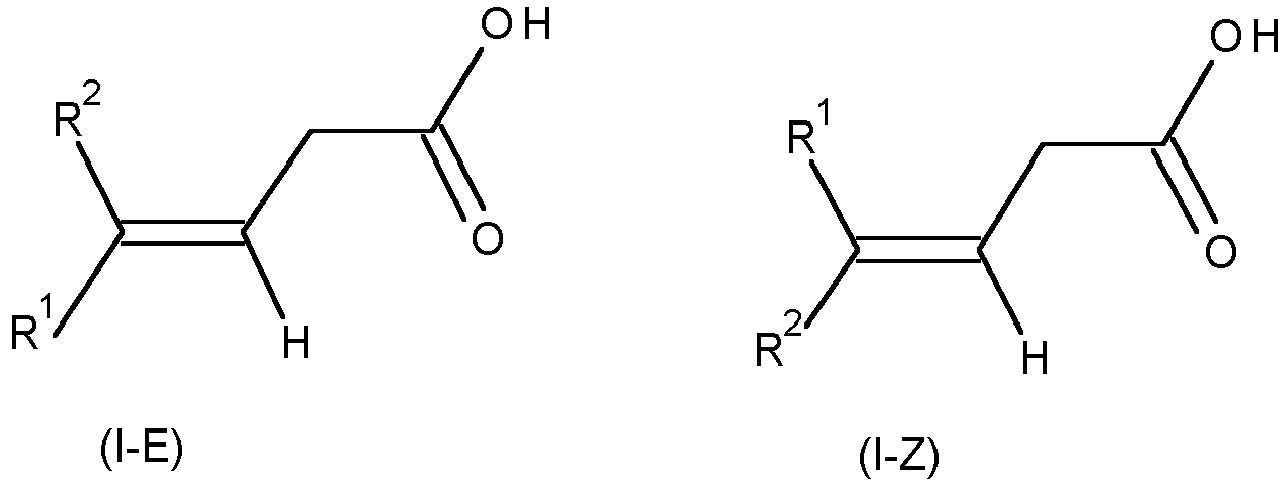
- Häufig ist nur eines der beiden Isomere das Wertprodukt. Vorzugsweise unterzieht man das nach dem erfindungsgemäßen Verfahren erhaltene E/Z-Isomerengemisch der Formel (I) einer zumindest teilweisen Anreicherung eines Isomers. Eine mögliche Isomerentrennung eines solchen Gemisches zur teilweisen Anreicherung eines Isomers kann chromatographisch, destillativ oder wie in
EP 17157974.1 - Häufig ist das Wertprodukt die 3-(E)-Säure der Formel (I-E) und nicht die ebenfalls in nennenswerten Mengen anfallende 3-(Z)-Säure der Formel (I-Z).
- Es wäre daher wirtschaftlich sinnvoll, zunächst zumindest einen Teil der 3-(E)-Säure der Formel (I-E) aus der erfindungsgemäß erhaltenen Zusammensetzung, enthaltend das E/Z-Isomerengemisch der Formel I, abzutrennen und die nicht erwünschte 3-(Z)-Säure der Formel (I-Z) zumindest teilweise in das Wertprodukt, d. h. in die 3-(E)-Säure der Formel (I-E) umzuwandeln.
- Daher umfasst in einer bevorzugten Ausführungsform der vorliegenden Erfindung das erfindungsgemäße Verfahren zur Herstellung eines E/Z-Isomerengemisches der Formel (I) die folgenden zusätzlichen Schritte:
- (1) die das E/Z-Isomerengemisch der Formel (I) enthaltende Zusammensetzung wird in Gegenwart eines Alkohols und eines Lipase-Enzyms einer enzymkatalysierten Veresterung unterzogen, wobei die 3-(E)-Säure der Formel (I-E) zumindest teilweise zu einem 3-(E)-Ester umgesetzt wird, so dass eine Zusammensetzung erhalten wird, die den 3-(E)-Ester, nicht umgesetzte 3-(E)-Säure der Formel (I-E) und nicht umgesetzte 3-(Z)-Säure der Formel (I-Z), enthält;
- (2) die in (1) erhaltene Zusammensetzung wird unter Erhalt einer Zusammensetzung, die an 3-(E)-Säure der Formel (I-E) abgereichert und an 3-(Z)-Säure der Formel (I-Z) angereichert ist, und unter Erhalt einer Zusammensetzung, die den 3-(E)-Ester enthält, aufgetrennt;
- (3) die in (2) erhaltene Zusammensetzung, die an 3-(E)-Säure der Formel (I-E) abgereichert und an 3-(Z)-Säure der Formel (I-Z) angereichert ist, wird einer Isomerisierung zur Erhöhung des Gehalts an 3-(E)-Säure der Formel (I-E) unterzogen; und
- (4) gegebenenfalls wird der in (2) erhaltene 3-(E)-Ester unter Erhalt der 3-(E)-Säure der Formel (I-E) gespalten.
- Verfahren zu enzymatisch katalysierten Veresterungen eines Gemisches von 3-(E)-ungesättigter Carbonsäure und 3-(Z)-ungesättigter Carbonsäure mit einem Alkohol sind beispielsweise aus der
EP 17157974.1 - Viele Lipasen vermögen mit hoher Substratselektivität Veresterungen zu katalysieren. Bevorzugt handelt es sich bei der Lipase um Candida antarctica lipase (CALB) oder um eine auf einem polymeren Träger immobiliserte Form wie Novozym 435®. Die enzymkatalysierte Veresterung erfolgt vorzugsweise in Gegenwart eines aliphatischen Alkohols. Geeignete aliphatische Alkohole sind C1-C20-Alkanole wie Methanol, Ethanol, n-Propanol, iso-Propanol, n-Butanol, iso-Butanol, sec-Butanol, n-Pentanol, n-Hexanol, n-Heptanol und n-Octanol. Die enzymkatalysierte Veresterung kann gegebenenfalls in Gegenwart eines Verdünnungs- oder Lösungsmittels durchgeführt werden. Beispiele für geeignete Verdünnungs- oder Lösungsmittel sind insbesondere aliphatische Kohlenwasserstoffe wie Hexan, Cyclohexan, Heptan, Octan; aromatische Kohlenwasserstoffe wie z. B. Toluol, Xylen; Dialkylether wie Methyl-tert-butylether und Diisopropylether. Üblicherweise setzt man 1 - 5 Äquivalente Alkohol pro Äquivalent an 3-(E)-Säure ein. Die Veresterung wird üblicherweise bei einer Temperatur in einem Bereich von 0 bis 80 °C durchgeführt.
- Die Lipase verestert die 3-(E)-Säure der Formel (I-E) mit Alkoholen sehr viel schneller als die entsprechende 3-(Z)-Säure der Formel (I-Z). Man erhält daher eine trennbare Zusammensetzung, die den 3-(E)-Ester, nicht umgesetzte 3-(E)-Säure der Formel (I-E) und nicht umgesetzte 3-(Z)-Säure der Formel (I-Z) enthält.
- Die in Schritt (1) erhaltene Zusammensetzung kann durch Extraktion oder Destillation aufgetrennt werden.
- In Schritt (4) wird gegebenenfalls der in Schritt (2) isolierte 3-(E)-Ester einer säure-, base- oder enzymkatalysierten Esterspaltung unterzogen, wobei die 3-(E)-Säure der Formel (I-E) oder deren Salz erhalten wird. Da die Verbindung der Formel (I-E) häufig das Wertprodukt ist, ist es zweckmäßig die Esterspaltung durchzuführen.
- In einer weiteren bevorzugten Ausführungsform umfasst das erfindungsgemäße Verfahren zur Herstellung eines E/Z-Isomerengemisches der Formel (I) die folgenden zusätzlichen Schritte:
- (i) die das E/Z-Isomerengemisch der Formel (I) enthaltende Zusammensetzung wird in Gegenwart eines Alkohols einer Veresterung unter Erhalt des 3-(E)-Ester und des 3-(Z)-Esters unterzogen;
- (ii) die in (i) erhaltenen 3-(E)-Ester und des 3-(Z)-Ester werden einer Lipase katalysierten enzymatischen Verseifung unterzogen, wobei die Lipase den 3-(E)-Ester zumindeset teilweise zu der 3-(E)-Säure der Formel (I-E) spaltet, wobei eine Zusammensetzung erhalten wird, die die 3-(E)-Säure der Verbindung der Formel (I-E), nicht umgesetzten 3-(E)-Ester und nicht umgesetzten 3-(Z)-Ester enthält;
- (iii) die in (ii) erhaltene Zusammensetzung wird aufgetrennt wird unter Erhalt einer Zusammensetzung, die die 3-(E)-Säure der Verbindung der Formel (I-E) enthält und unter Erhalt einer Zusammensetzung, die nicht umgesetzten 3-(E)-Ester und nicht umgesetzten 3-(Z)-Ester enthält;
- (iv) die in (iii) erhaltene Zusammensetzung, die nicht umgesetzten 3-(E)-Ester und nicht umgesetzten 3-(Z)-Ester enthält, wird einer Esterspaltung unterzogen, wobei eine Zusammensetzung erhalten wird, die an 3-(E)-Säure der Formel (I-E) oder deren Salz abgereichert und an 3-(Z)-Säure der Formel (I-Z) oder deren Salz angereichert ist; und
- (v) die in (iv) erhaltene Zusammensetzung, die an 3-(E)-Säure der Formel (I-E) abgereichert und an 3-(Z)-Säure der Formel (I-Z) angereichert ist, wird einer Isomerisierung zur Erhöhung des Gehalts an 3-(E)-Säure der Formel (I-E) unterzogen.
- Bevorzugt erfolgt die Veresterung in Schritt (i) mit einem aliphatischen Alkohol. Geeignete aliphatische Alkohole sind C1-C20-Alkanole wie Methanol, Ethanol, n-Propanol, iso-Propanol, n-Butanol, iso-Butanol, sec-Butanol, n-Pentanol, n-Hexanol, n-Heptanol und n-Octanol. Die Veresterung kann säure-, basen- oder enzymkatalysiert durchgeführt werden. Die Veresterung wird üblicherweise bei einer Temperatur in einem Bereich von 0 bis 80 °C durchgeführt.
- Verfahren zu enzymatisch katalysierten Esterspaltung eines Gemisches von 3-(E)-ungesättigten Carbonsäure und 3-(Z)-ungesättigten Carbonsäure in Gegenwart von Wasser sind beispielsweise aus der
EP 17157974.1 - Viele Lipasen vermögen mit hoher Substratselektivität Esterspaltungen zu katalysieren. In Schritt (ii) unterzieht man die in Schritt (i) erhaltene Zusammensetzung in Gegenwart von Wasser und eines Lipase-Enzyms einer enzymkatalysierten Esterspaltung, wobei man eine Zusammensetzung erhält, die 3-(E)-Säure der Formel (I-E), nicht umgesetzten 3-(E)-Ester und nicht umgesetzten 3-(Z)-Ester enthält. Bevorzugt handelt es sich bei der Lipase um Candida antarctica lipase (CALB) oder um eine auf einem polymeren Träger immobiliserte Form wie Novozym 435 ®.
- Die in Schritt (ii) erhaltene Zusammensetzung kann durch Destillation oder Extraktion getrennt werden. Man erhält eine Zusammensetzung, die 3-(E)-Säure der Formel (I-E) enthält. Ebenfalls erhält man eine Zusammensetzung, die den 3-(E)-Ester und 3-(Z)-Ester enthält.
- Die Esterspaltung in Schritt (iv) kann säure-, base- oder enzymkatalysiert erfolgen. Man erhält eine Zusammensetzung, die 3-(E)-Säure der Formel (I-E) oder deren Salz und 3-(Z)-Säure der Formel (I-Z) oder deren Salz enthält, wobei im Vergleich zu der in Schritt (i) eingesetzten Zusammensetzung der Gehalt an 3-(E)-Säure der Formel (I-E) erniedrigt und der Gehalt an 3-(2)-Säure der Formel (I-Z) erhöht ist.
- In den Schritten (3) bzw. (v) der zuvor genannten Verfahren wird die erhaltene Zusammensetzung einer Isomerisierung der 3-(Z)-Säure der Formel (I-Z) zu der 3-(E)-Säure der Formel (I-E) unterzogen, um den Anteil an Wertprodukt zu erhöhen. Die Isomerisierung erfolgt vorzugsweise in Gegenwart eines Anhydrids einer organischen Säure und einer Base. Geeignete Anhydride sind Anhydride aliphatischer C1-C12-Monocarbonsäuren, Anhydride aliphatischer C4-C20-Dicarbonsäuren, Anhydride cycloaliphatischer C7-C20-Dicarbonsäuren, Anhydride aromatischer C8-C20-Dicarbonsäuren, Anhydride aliphatischer Sulfonsäuren und Anhydride aromatischer Sulfonsäuren. Geeignete Basen sind Alkalimetallcarbonate, Erdalkalimetallcarbonate, Alkalimetallhydrogencarbonate, Erdalkalimetallhydrogencarbonate, Alkalimetallphosphate, Erdalkalimetallphosphate, Amine, basische N-Heteroaromaten, basische Ionenaustauscher und Mischungen davon. Die Isomerisierung erfolgt bevorzugt in Gegenwart eines Anhydrids einer organischen Säure und einer Base. Das Verfahren kann vorteilhafterweise bei einer Temperatur von 60 bis 175 °C, vorzugsweise 70 bis 160 °C, durchgeführt werden.
- Der Druck ist nicht kritisch. Daher kann man die Isomerisierung bei Überdruck, Unterdruck oder bei Atmosphärendruck durchführen. Das Verfahren wird bei Verwendung einer Base und/oder eines Anhydrids mit einen Siedepunkt bei Normaldruck unterhalb der Reaktionstemperatur zweckmäßigerweise in einem Druckreaktor durchgeführt. Vorteilhafterweise kann die Isomerisierung auch unter den Bedingungen des erfindungsgemäßen Verfahrens durchgeführt werden. Vorteilhafterweise ist für die Isomerisierung die Anwesenheit eines Übergangmetallkatalysators nicht erforderlich.
- Die nach dem erfindungsgemäßen Verfahren erhaltenen Verbindungen der allgemeinen Formel (I) können einer Reduktion unter Überführung der Säure- oder Estergruppe in die entsprechenden Alkohole unterzogen werden. In einer speziellen Ausführungsform wird zunächst ein Gemisch aus (3E,7E)-4,8,12-Trimethyltrideca-3,7,11-triensäure und (3Z,7E)-4,8,12-Trimethyltrideca-3,7,11-triensäure, erhältlich wie zuvor beschrieben, einer Trennung unter Erhalt von (3E,7E)-4,8,12-Trimethyltrideca-3,7,11-triensäure, beispielweise wie zuvor beschrieben, unterzogen und (3E,7E)-4,8,12-Trimethyl-trideca-3,7,11-triensäure einer Reduktion unter Erhalt von (3E,7E)-Homofarnesol (VI)

- Ein weiterer Gegenstand der Erfindung ist die Herstellung von (-)-Ambrox. Die Herstellung kann nach bekannten Verfahren ausgehend von stereoisomerenreiner (3E/7E)-Homofarnesylsäure erfolgen, wie im folgenden Schema 1 gezeigt.

- Auf die Offenbarung der
EP 16156410 WO 2010/139719 undWO 2012/066059 , welche die biokatalytische Zyklisierung von ungesättigten Substraten, z. B. von terpenartigen Kohlenwasserstoffen, unter Einsatz von Cyclase-Enzymen beschreiben, wird hier in vollem Umfang Bezug genommen. - Sclareolid (VII) kann beispielsweise durch Cyclase-katalysierte Umwandlung von erfindungsgemäß hergestellter (3E/7E)-Homofarnesylsäure erhalten werden. Sclareolid (VII) kann dann chemisch, z. B. durch Umsetzung mit LiAlH4 oder NaBH4, unter Erhalt von Ambrox-1,4-diol reduziert werden (siehe Mookherjee et al.; Perfumer and Flavourist (1990), 15: 27). Ambrox-1,4-diol kann dann nach bekannten Verfahren weiter zu (-)-Ambrox umgesetzt werden.
- Hydrierungskatalysatoren, die eine gute Selektivität bezüglich der Hydrierung der endständigen Carbonsäuregruppe unter Erhalt des entsprechenden Alkohols ermöglichen, sind dem Fachmann ebenfalls bekannt. Die Hydrierung und die Isomerisierung der in den Verbindungen (I) enthaltenen Doppelbindungen kann dabei im Wesentlichen vermieden werden.
- Ebenso ist die Zyklisierung des (3E,7E)-Homofarnesols zu Ambrox bekannt, wobei sowohl enzymatische als auch chemische Cyclisierungen beschrieben sind. Diesbezüglich wird auf die Offenbarung der folgenden Dokumente Bezug genommen:
P. F. Vlad et al. Khimiya Geterotsiklicheskikh Soedinenii, Engl. Trans/. 1991, 746 beschreiben Cyclisierungsreaktionen unter Verwendung einer Supersäure (Fluorsulfonsäure in 2-Nitropropan). Ein weiteres geeignetes Verfahren umfasst die enantioselektive Polyencyclisierung von Homofarnesyltriethylsilylether in Gegenwart von O-(o-Fluorbenzyl)-binol und SnCl4, wie von H. Yamamoto et al. J. Am. Chem. Soc. 2002, 3647 beschrieben. - Bevorzugt ist die biokatalytische Zyklisierung, wie sie in der
WO 2010/139719 beschrieben ist. Danach erfolgt die Zyklisierung in Schritt d1) in Gegenwart eines Polypeptids mit der Aktivität einer Homofarnesol-Ambrox-Cyclase als Enzym. - Zur Herstellung von (-)-Ambrox nach dieser Variante wird Homofarnesol mit der Homofarnesol-Ambroxan-Cyclase in Kontakt gebracht und/oder inkubiert und anschließend das gebildete Ambrox isoliert.
- In einer Ausführung wird Homofarnesol mit der Homofarnesol-Ambroxan-Cyclase in einem Medium in Kontakt gebracht und/oder so inkubiert, dass eine Umsetzung von Homofarnesol zu Ambrox in Gegenwart der Cyclase erfolgt. Bevorzugt handelt es sich bei dem Medium um ein wässriges Reaktionsmedium. Bei den wässrigen Reaktionsmedien handelt es sich vorzugsweise um gepufferte Lösungen, die in der Regel einen pH-Wert von vorzugsweise 5 bis 8 aufweisen. Als Puffer kann ein Citrat-, Phosphat-, TRIS- (Tris(hydroxymethyl)-aminomethan) oder MES-(2-(N-Morpholino)ethansulfonsäure)-Puffer verwendet werden. Ferner kann das Reaktionsmedium noch weitere Zusätze enthalten, wie z. B. Detergentien (beispielsweise Taurodeoxycholat).
- Das Homofarnesol wird vorzugsweise in einer Konzentration von 5 bis 100 mM, besonders bevorzugt von 15 bis 25mM, in der enzymatischen Umsetzung eingesetzt. Diese kann kontinuierlich oder diskontinuierlich durchgeführt werden.
- Die enzymatische Zyklisierung erfolgt zweckmäßig bei einer Reaktionstemperatur unterhalb der Desaktivierungstemperatur der eingesetzten Cyclase. Bevorzugt liegt die Reaktionstemperatur in Schritt d1) in einem Bereich von -10 bis 100 °C, besonders bevorzugt von 0 bis 80 °C, insbesondere von 15 bis 60 °C und speziell von 20 bis 40 °C.
- Das Reaktionsprodukt Ambrox kann mit organischen Lösungsmitteln extrahiert werden und gegebenenfalls zur Aufreinigung destilliert werden. Geeignete Lösungsmittel werden im Folgenden genannt.
- Neben einphasigen wässrigen Systemen können auch zweiphasige Systeme eingesetzt werden. In dieser Variante gelingt es, das gebildete Ambrox in der nicht-wässrigen Phase anzureichern, um es zu isolieren. Die zweite Phase ist dabei vorzugsweise ausgewählt unter ionischen Flüssigkeiten und organischen nicht-wasser-mischbaren Lösungsmitteln. Nach der Reaktion ist Ambrox in der organische Phase leicht von der wässrigen Phase, die den Biokatalysator enthält, abtrennbar. Unter nicht-wässrigen Reaktionsmedien werden Reaktionsmedien verstanden, die weniger als 1 Gew.-%, vorzugsweise weniger als 0,5 Gew.-% Wasser, bezogen auf das Gesamtgewicht des flüssigen Reaktionsmediums, enthalten. Insbesondere kann die Umsetzung in einem organischen Lösungsmittel durchgeführt werden. Geeignete organische Lösungsmittel sind beispielsweise aliphatische Kohlenwasserstoffe, vorzugsweise mit 5 bis 8 Kohlenstoffatomen, wie Pentan, Cyclopentan, Hexan, Cyclohexan, Heptan, Octan oder Cyclooctan, halogenierte aliphatische Kohlenwasserstoffe, vorzugsweise mit einem oder zwei Kohlenstoffatomen, wie Dichlormethan, Chloroform, Tetrachlorkohlenstoff, Dichlorethan oder Tetrachlorethan, aromatische Kohlenwasserstoffe, wie Benzol, Toluol, die Xylole, Chlorbenzol oder Dichlorbenzol, aliphatische acyclische und cyclische Ether oder Alkohole, vorzugsweise mit 4 bis 8 Kohlenstoffatomen, wie Ethanol, Isopropanol, Diethylether, Methyl-tert-butylether, Ethyl-tert-butylether, Dipropylether, Diisopropylether, Dibutylether, Tetrahydrofuran oder Ester wie Ethylacetat oder n-Butylacetat oder Ketone wie Methylisobutylketon oder Dioxan oder Gemische davon. Besonders bevorzugt werden die vorgenannten Heptan, Methyl-tert-butylether, Diisopropylether, Tetrahydrofuran, Ethylacetat verwendet.
- Geeignete Enzyme sind in der
WO 2010/139719 beschrieben, worauf hier in vollem Umfang Bezug genommen wird. Danach ist das Enzym ein Polypeptid, welches kodiert wird von einem Nukleinsäuremolekül, umfassend mindestens ein Nukleinsäuremolekül, ausgewählt aus:
a) Nukleinsäuremolekül, das ein Polypeptid kodiert, umfassend die SEQ ID NO 2, 5, 6, 7, 8, 9, 10 oder 11; b) Nukleinsäuremolekül, das zumindest ein Polynukleotid der Sequenz gezeigt in SEQ ID NO 1 umfasst; c) Nukleinsäuremolekül, das ein Polypeptid kodiert, dessen Sequenz eine Identität von mindestens 46 % zu den Sequenzen SEQ ID NO 2, 5, 6, 7, 8, 9, 10 oder 11 aufweist; d) Nukleinsäuremolekül nach (a) bis (c), das für ein funktional äquivalentes Polypeptid oder ein Fragment der Sequenz gemäß SEQ ID NO 2, 5, 6, 7, 8, 9, 10 oder 11 steht; e) Nukleinsäuremolekül, kodierend für ein funktional äquivalentes Polypeptid mit der Aktivität einer Homofarnesol-Ambroxan-Cyclase, das man erhält, indem man ein Nukleinsäuremolekül aus einer cDNA Bank oder aus genomischer DNA mittels der Primer gemäß Sequenz Nr. 3 und 4 amplifiziert, oder das Nukleinsäuremolekül durch de novo-Synthese chemisch synthetisiert; f) Nukleinsäuremolekül, kodierend für ein funktional äquivalentes Polypeptid mit der Aktivität einer Homofarnesol-Ambroxan-Cyclase, das unter stringenten Bedingungen mit einem Nukleinsäuremolekül gemäß (a) bis (c) hybridisiert; g) Nukleinsäuremolekül, kodierend für ein funktional äquivalentes Polypeptid mit der Aktivität einer Homofarnesol-Ambroxan-Cyclase, das aus einer DNA-Bank unter Verwendung eines Nukleinsäuremoleküls gemäß (a) bis (c) oder deren Teilfragmente von mindestens 15 nt, vorzugsweise 20 nt, 30 nt, 50 nt, 100 nt, 200 nt oder 500 nt als Sonde unter stringenten Hybridisierungsbedingungen isoliert werden kann; und h) Nukleinsäuremolekül, kodierend für ein funktional äquivalentes Polypeptid mit der Aktivität einer Homofarnesol-Ambroxan-Cyclase, wobei die Sequenz des Polypeptids eine Identität von mindestens 46 % zu den Sequenzen SEQ ID NO 2, 5, 6, 7, 8, 9, 10 oder 1 1 aufweist; i) Nukleinsäuremolekül, kodierend für ein funktional äquivalentes Polypeptid mit der Aktivität einer Homofarnesol-Ambroxan-Cyclase, wobei das Polypeptid durch ein Nukleinsäuremolekül, ausgewählt aus der Gruppe der in a) bis h) beschriebenen, kodiert wird und mittels eines monoklonalen Antikörpers isoliert wurde oder isolierbar ist; j) Nukleinsäuremolekül, kodierend für ein funktional äquivalentes Polypeptid mit der Aktivität einer Homofarnesol-Ambroxan-Cyclase, wobei das Polypeptid eine analoge oder ähnliche Bindungsstelle aufweist, wie ein Polypeptid, kodiert durch ein Nukleinsäuremolekül, ausgewählt aus der Gruppe der in a) bis h) beschriebenen. - Trotz einer Vielzahl bereits vorhandener Aromachemikalien (Riech- und Geschmacksstoffe) und Verfahren zu ihrer Herstellung besteht ein ständiger Bedarf an neuen Komponenten, um die Vielzahl der für die äußerst diversen Einsatzbereiche gewünschten Eigenschaften erfüllen zu können sowie an einfachen Syntheserouten, um diese zugängig zu machen. Das erfindungsgemäße Verfahren ermöglicht die effektive Herstellung von Verbindungen der allgemeinen Formel (I) die als interessante Synthesebausteine bei der Bereitstellung von neuen und bereits bekannten Aromachemikalien, wie (-)-Ambrox, dienen können. Nach Hydrierung der Säurefunktion können Alkohole erhalten werden, die ihrerseits interessante Synthesebausteine sein können und sich für einen Einsatz als Tensidalkohole eignen.
- Die Erfindung wird durch die nachstehenden Ausführungsbeispiele näher erläutert. Die nachfolgenden Beispiele belegen, dass die Erfindung vorteilhaft mit unterschiedlichen Edukten und Übergangsmetallkatalysatoren durchgeführt werden kann.
- Abkürzungen:
- AC2O steht für Acetanhydrid (Essigsäureanhydrid); DMAP steht für 4-(Dimethylamino)-pyridin; eq. steht für Äquivalent; Fe(acac)3 steht für Tris(acetylacetonato)eisen(III);
- FI.-% steht für Flächenprozent; GC steht für Gaschromatographie; [Ir(COD)Cl]2 steht für Bis(1,5-cyclooctadien)diiridium(I)-dichlorid; MTBE steht für Methyl-tert-butylether;
- NEt3 steht für Triethylamin; org. steht für organisch; P(Cy)3 steht für Tricyclohexylphosphin; Pd(acac)2 steht für Bis(acetylacetonato)palladium(II); Pd(dba)2 steht für Bis(dibenzylidenaceton)palladium(0); Pd(OAc)2 steht für Palladium(II)-acetat;
- Rh(CO)2(acac) steht für (Acetylacetonato)dicarbonylrhodium(I); Ru(acac)3 steht für Tris(acetylacetonato)ruthenium(III); Sel. Säure steht für Selektivität Säure; THF steht für Tetrahydrofuran; TPP steht für Triphenylphosphin; U/pM steht für Umdrehungen pro Minute.
- Die Produkte wurden mit Hilfe der GC-, 1H-NMR und 13C-NMR-Analyse identifiziert. Die Aufarbeitung der Reaktionsgemische wurde nicht optimiert.
- Beispiel 1: Pd-katalysierte Carbonylierung ausgehend von Linalool Palladium(II)-acetat (19 mg, 0,085 mmol), Triphenylphosphin (51 mg, 0,195 mmol) und DMAP (49 mg, 0,4 mmol) wurden unter Argon in einem Glasautoklaven vorgelegt. Linalool (10,8 g, 70 mmol), Triethylamin (6,9 g, 68 mmol) und Acetanhydrid (2 g, 20 mmol) wurden im Argongegenstrom zugegeben. Anschließend wurden 10 bar CO angelegt und bei diesem Druck wurde bei 60 °C Innentemperatur für 24 h bei 1000 U/pm gerührt. Danach wurde auf Raumtemperatur abgekühlt und entspannt. Eine GC-Analyse des Reaktionsaustrags ergab einen Umsatz von 94 % mit einer Selektivität zum Zielprodukt E/Z-4,8-Dimethyl-3,7-nonadiensäure von 62 %.
- Nach beendeter Reaktion wurden MTBE (25 mL) und wässrige NaOH (5 %, 70 mL) zugegeben. Die Phasen wurden getrennt und die wässrige Phase wurde mit MTBE (2 x 50 mL) gewaschen. Die wässrige Phase wurde mit H2SO4 (20 %) auf pH = 1 gebracht und mit MTBE (3 x 50 mL) extrahiert. Die organischen Phasen aus der sauren Extraktion wurden vereinigt, mit Wasser neutral gewaschen (3 x 70 mL) und über MgSO4 getrocknet. Nach dem Einengen erhielt man 7,1 g (56 %) der E/Z-4,8-Dimethyl-3,7-nonadiensäure mit einem E/Z-Verhältnis von 55:45 (1H-NMR). Die NMR-Daten entsprechen den Daten von Snyder et al. Angew. Chem., 121, 2009, 8039. 13C-NMR (CDCl3), E-Homomyrcenylcarbonsäure: 179.9, 139.5, 131.7, 125.1, 116.2, 40.2, 34.0, 27.2, 26.2, 18.0, 16.6; Z-Homomyrcenylcarbonsäure: 179.9, 139.5, 132.1, 124.8, 117.0, 34.0, 32.6, 27.0, 26.2, 23.7, 18.0.
- Beispiel 1 wurde wiederholt. Die Einsatzstoffe zur Carbonylierung von Linalool, der Umsatz nach 24 h sowie die Selektivität zum Zielprodukt E/Z-4,8-Dimethyl-3,7-nonadiensäure sind in Tabelle I angegeben.
Tabelle I: Carbonylierung von Linalool Beispiel Übergangsmetallverbindung / (Mol-%) TPP (Mol-%) DMAP (Mol-%) AC2O (Mol-%) CO (bar) Umsatz nach 24h Sel. Säure (FI.-% GC) 1 Pd(OAc)2 / 0,12 0,28 0,6 28 10 94% 62 1.1a) Pd(OAc)2 / 0, 12 0,28 0,6 28 10 56% 79 1.2b) Pd(OAc)2 / 0,12 0,28 0,6 28 10 27% 66 1.3c) Pd(OAc)2 / 0,12 0,28 0,6 28 10 41% 47 1.4d) Pd(OAc)2 / 0,12 0,28 0,6 28 10 30% 50 1.5 Pd(acac)2 /0,12 0,28 0,6 28 10 80% 70 1.6 Pd(dba)2 /0,12 0,28 0,6 28 10 75% 60 1.7e) PdCl2 /0,15 0,28 0,3 28 10 69% 58 1.8f) Pd(OAc)2 / 0,12 0,28 0,3 28 10 40% 44 1.9e) Pd(OAc)2 / 0,12 0,28 0,3 28 10 77% 63 1.10 PdCl2 / 0,15 0,28 - - 10 0% - 1.11f) PdCl2 / 0,15 0,28 - - 10 14% 6 1.12f) Pd(OAc)2/ 0,12 0,28 - - 10 3% - a) Zusatz von 10 mL Pyridin anstatt NEt3;
b) Zusatz von 10 mL THF anstatt NEt3;
c) Zusatz von 10 mL Toluol anstatt NEt3;
d) Zusatz von 10 mL Dioxan anstatt NEt3;
e) 80 °C anstatt 60 °C;
f) Zusatz von 10 mL THF anstatt NEt3, 100 °C statt 60 °C;
g) Zusatz von 10 mL THF anstatt NEt3,80 °C statt 60 °C. - Das Vergleichsbeispiel 1.10 zeigt, dass bei 10 bar bei unter den Bedingungen der
EP 0146859 (PdCl2/TPP) in Abwesenheit einer Anhydridquelle kein Umsatz erzielt wurde und auch bei 100 °C höchstens sehr geringe Umsätze zum Zielprodukt (Vergleichsbeispiel 1.11). Das Vergleichsbeispiel 1.12 zeigt, dass bei Verwendung von Pd(OAc)2 in Abwesenheit einer Anhydridquelle nur ein minimaler Umsatz erzielt wurde. - Beispiel 1 wurde wiederholt. Die Einsatzstoffe zur Carbonylierung von Linalool, der Umsatz nach 24 h sowie die Selektivität zum Zielprodukt (E/Z-4,8-Dimethyl-3,7-nonadiensäure) sind in Tabelle II angegeben
Tabelle II: Carbonylierung von Linalool Beispiel Übergangsmetallverbindung Übergangsmetall (Mol-%) TPP/DMAP (Mol-%) Ac2O (Mol-%) CO (bar) Umsatz nach 24h Sel. Säure (FI.%-GC) 1.13 Ru(acac)3 0,12 0,28/0,3 28 10 56% 60 1.14 Ru3(CO)12 0,04 0,28/0,3 28 10 47% 31 1.15 Rh(CO)2(acac) 0,12 0,28/0,3 28 10 58% 49 1.16 Fe(acac)2 0,12 0,28/0,3 28 10 36% 49 1.17 [Ir(COD)Cl]2 0,06 0,28/0,3 28 10 49% 27 - Palladium(II)-acetat (22 mg, 0,1 mmol), Triphenylphosphin (52 mg, 0,2 mmol) und DMAP (49 mg, 0,4 mmol) wurden unter Argon im Glasautoklaven vorgelegt. 3-Methyl-1-penten-3-ol (6,7 g, 67 mmol), Triethylamin (6,7 g, 67 mmol) und Acetanhydrid (2 g, 20 mmol) wurden im Argongegenstrom zugegeben. Anschließend wurden 10 bar CO angelegt und bei diesem Druck wurde bei 60 °C Innentemperatur für 24 h bei 1000 U/pm gerührt. Danach wurde auf Raumtemperatur abgekühlt und entspannt. Eine GC-Analyse des Reaktionsaustrags ergab einen Umsatz von 70 % mit einer Selektivität zum Zielprodukt E/Z-(4-Methyl)-3-hexensäure von 75 %.
- Nach beendeter Reaktion wurden MTBE (25 mL) und wässrige NaOH (5 %, 50mL) zugegeben. Die Phasen wurden getrennt und die wässrige Phase wurde mit MTBE (2 x 25 mL) gewaschen. Die wässrige Phase wurde mit H2SO4 (20 %) auf pH = 1 gebracht und mit MTBE (3 x 25 mL) extrahiert. Die organischen Phasen aus der sauren Extraktion wurden vereinigt, mit Wasser neutral gewaschen (5 x 25 mL) und über MgSO4 getrocknet. Nach dem Einengen erhielt man 2,3 g (27 %) E/Z-(4-Methyl)-3-hexensäure als leicht gelbes Öl mit einem E/Z-Verhältnis von 3:2 (1H-NMR). 13C-NMR (d8-Toluol): E-(4-Methyl)-3-hexensäure: 179.7, 140.8, 114.5, 33.7, 32.5, 16.1, 12.6; Z-(4-Methyl)-3-hexensäure: 179.7, 141.1, 115.5, 33.4, 25.2, 22.8, 12.6.
- Palladium(II)-acetat (22 mg, 0,1 mmol), Triphenylphosphin (52 mg, 0,22 mmol) und DMAP (55 mg, 0,45 mmol) wurden unter Argon im Glasautoklaven vorgelegt. 1-Hepten-3-ol (7,6 g, 66 mmol), Triethylamin (6,7 g, 67 mmol) und Acetanhydrid (1,8 g, 17 mmol) wurden im Argongegenstrom zugegeben. Anschließend wurden 10 bar CO angelegt und bei diesem Druck wurde bei 60 °C Innentemperatur für 24 h bei 1000 U/pm gerührt. Danach wurde auf Raumtemperatur abgekühlt und entspannt. Eine GC-Analyse des Reaktionsaustrags ergab einen Umsatz von 75 % mit einer Selektivität bezüglich des Zielproduktes E/Z-3-Octensäure von 50 %.
- Nach beendeter Reaktion wurden MTBE (25 mL) und wässrige NaOH (5 %, 50 mL) zugegeben. Die Phasen wurden getrennt und die wässrige Phase wurde mit MTBE (2 x 50 mL) gewaschen. Die wässrige Phase wurde mit H2SO4 (ca. 20 mL, 20 %) auf pH = 1 gebracht und mit MTBE (3 x 50 mL) extrahiert. Die organischen Phasen aus der sauren Extraktion wurden vereinigt, mit Wasser neutral gewaschen (4 x 50 mL) und über MgSO4 getrocknet. Nach dem Einengen erhielt man 2,4 g (26 %) E/Z-3-Octensäure mit einem E/Z-Verhältnis von 78:22 (1H-NMR). Die NMR-Daten entsprechen den Daten aus Wirth et al. Org. Lett., 9, 2007, 3169. 13C-NMR (d8-Toluol), E-3-Octensäure: 179.4, 135.0, 121.4, 38.0, 32.5, 31.6, 22.6, 14.1.
- Palladium(II)-acetat (46 mg, 0,2 mmol), Triphenylphosphin (120 mg, 0,46 mmol) und DMAP (56 mg, 0,46 mmol) wurden unter Argon im Stahlautoklaven vorgelegt. E-Nerolidol (34 g, 152,6 mmol), Triethylamin (17 g, 167 mmol) und Acetanhydrid (3,6 g, 35 mmol) wurden im Argongegenstrom zugegeben. Anschließend wurden 10 bar CO angelegt und bei diesem Druck wurde bei 70 °C Innentemperatur für 24 h bei 1000 U/pM gerührt. Nach 24 h wurde auf Raumtemperatur gekühlt und entspannt. Eine GC-Analyse des Reaktionsaustrags ergab einen Umsatz von 95 % mit einer Selektivität zum Zielprodukt E/Z-Homofarnesylsäure von 81 %.
- Nach beendeter Reaktion wurde das Rohproduckt durch Kugelrohdestillation (1 mbar, bis 170 °C) aufgereinigt. Man erhielt 23 g (61 %) E/Z-Homofarnesylsäure mit einer Reinheit (GC) von 97 % mit einem Isomerenverhältnis von E-Homofarnesylsäure : Z-Homofarnesylsäure gleich 64 : 36 (GC).
- 13C-NMR (CDCl3): E-Homofarnesylsäure: 179.1, 139.8, 135.4, 131.4, 124.4, 123.8, 114.9, 33.6, 39.8, 39.6, 26.8, 25.8, 26.4, 17.8, 16.5, 16.1; Z-Homofarnesylsäure: 179.2, 139.7, 135.7, 131.2, 124.5, 123.7, 115.9, 39.8, 33.5, 32.2, 26.8, 26.3, 25.7, 23.4, 17.7, 16.0.
- Beispiel 4 wurde wiederholt. Die Einsatzstoffe zur Carbonylierung von E-Nerolidol, Umsatz nach 24 h und 6 h sowie die Ausbeute an Zielprodukt E/Z-Homofarnesylsäure (Summe beider Isomere) sind in Tabelle III angegeben.
Tabelle III: Carbonylierung von E-Nerolidol Beispiel Pd(OAc)2 (Mol-%) TPP (Mol-%) DMAP (Mol-%) AC2O (Mol-%) CO (bar) Umsatz nach 24 h / (6 h) Ausbeute" (FI.-% GC) 4 0,13 0,3 0,3 23 10 95% / (65%) 77% 4.1 0,13 0,3 - - 10 0% - 4.2 0,13 1,3 0,3 23 10 50% 33% 4.3 0,13 - 0,3 23 10 26% 1% 4.4 0,13 0,3 0,3 - 10 0% - 4.5 0,13 0,3 - 23 10 94% / (54%) 77% 4.6a) 0,13 0,3 0,3 23 10 70% 54% 4.7 0,13 0,3 0,3 b) 10 52% 32% 4.8 0,13 0,3 0,3 c) 10 >99% 95% 4.9 0,13 0,3 - d) 10 >99% 58% 4.10e) 0,13 0,3 0,3 23 10 34% 16% 4.11f) 0,13 0,3 0,3 23 10 30% 18% 4.12 0,13 g) 0,3 23 10 76% 58% 4.13 0,13 h) 0,3 23 10 83% 72% 4.14 0,13 0,3 0,3 23 20 99% 85% 4.15 0,13 0,3 0,3 23 40 97% 85% 4.16 0,13 0,3 0,3 23 80 94% 79% 4.17 0,13 i) 0,3 23 20 93% 72% 4.18 0,13 k) 0,3 23 20 95% 80% 4.19 0,13 0,3 0,3 16 20 93% 79% a) halbe Menge an NEt3;
b) 23 Mol-% Allylacetat (CAS 591-87-7) anstatt AC2O;
c) 30 Mol-% E-Nerolidylacetat anstatt AC2O;
d) 30 Mol-% E-Nerolidylacetat anstatt AC2O;
e) 120 °C;
f) THF anstelle von NEt3;
g) 0,3 Mol-% P(Cy)3 anstatt TPP;
h) 0,3 Mol-%Tri(p-Tolyl)phosphin anstatt TPP;
i) 0,3 Mol-% Di(tert-Butyl)phenylphosphin anstatt TPP;
k) 0,3 Mol-% Cyclohexyldiphenylphosphin anstatt TPP;
# Ausbeute bestimmt über FI.-% GC als Produkt aus Selektivität und Umsatz - Palladium(II)-acetat (50 mg, 0,22 mmol), Triphenylphosphin (130 mg, 0,5 mmol) und DMAP (70 mg, 0,57 mmol) wurden unter Argon im Stahlautoklaven vorgelegt. E-Nerolidylacetat (42,5 g, 142 mmol), Triethylamin (9 g, 89 mmol) und Wasser (2,8 g, 156 mmol) wurden im Argongegenstrom zugegeben. Anschließend wurden 10 bar CO angelegt und bei diesem Druck wurde bei 70 °C Innentemperatur für 24 h bei 1000 U/pM gerührt. Danach wurde auf Raumtemperatur abgekühlt und entspannt. Eine GC-Analyse des Reaktionsaustrags ergab einen Umsatz von 97 % mit einer Selektivität bezüglich E/Z-Homofarnesylsäure von 71 %. Verhältnis von E-Homofarnesylsäure : Z-Homofarnesylsäure = 64 : 36 (GC).
- Beispiel 5 wurde wiederholt. Die Einsatzstoffe zur Carbonylierung von E-Nerolidylacetat, Umsatz nach 4 h und 24 h sowie die Ausbeute zum Zielprodukt E/Z-Homofarnesylsäure (Summe beider Isomere) sind in Tabelle IV angegeben.
Tabelle IV: Carbonylierung von E-Nerolidylacetat Beispiel Pd(OAc)2 (Mol-%) TPP (Mol-%) DMAP (Mol-%) H2O (eq.) CO (bar) Umsatz nach 24 h (4 h) GC-Ausb. Säure (FI.-%) Bemerkung 5 0,15 0,4 0,4 1,1 10 97% (93%) 74% 70°C 5.1 0,13 0,3 0,3 1,1 10 >99% (65%) 69% 70°C, THF anstatt NEt3 5.2 0,13 0,3 0,3 - 10 >99% <20% 70°C 5.3 0,13 0,3 - 1,1 10 >99% 86% 70°C 5.4 0,13 0,3 - 1,0 10 97% 84% 50°C - Palladium(II)acetat (22 mg, 0,1 mmol), Triphenylphosphin (54 mg, 0,21 mmol) und DMAP (50 mg, 0,41 mmol) wurden unter Argon im Glasautoklaven vorgelegt. 1-Vinylcyclohexanol (8,35 g, 66 mmol), Triethylamin (6,7 g, 67 mmol) und Acetanhydrid (1,8 g, 17 mmol) wurden im Argongegenstrom zugegeben und es wurden 10 bar CO angelegt. Es wurde bei 60 °C Innentemperatur für 20 h bei 1000 U/pm gerührt, der Druck wurde bei 10 bar gehalten, nach 48 h wurde auf Raumtemperatur gekühlt und entspannt. GC-Umsatz: 54 %; Selektivität bezüglich 3-Cyclohexylidenpropansäure: 63 %.
- Nach beendeter Reaktion wurde MTBE (25 mL) und wässrige NaOH (5 %, 50 mL) zugegeben. Die Phasen wurden getrennt und die wässrige Phase wurde mit MTBE (2 x 50 mL) gewaschen. Die wässrige Phase wurde mit H2SO4 (ca. 30 mL, 20 %) auf pH = 1 gebracht und mit MTBE (3 x 50 mL) extrahiert. Die org. Phasen aus der sauren Extraktion wurden vereinigt, mit Wasser neutral gewaschen (4 x 50 mL) und über MgSO4 getrocknet. Einengen ergab 3,1 g (31 %) 3-Cyclohexylidenpropansäure. 13C-NMR (d8-Toluol): 180.0, 143.8, 112.9, 37.5, 33.3, 29.4, 29.0, 28.1, 27.4.
- Isomerentrennung:
Das in Beispiel 4 erhaltene Gemisch wurde in n-Heptan(100 g) gelöst, mit Isopropanol (10 g) und Novozym 435 (0.5 g) versetzt und ca 17 h bei 60 °C gerührt. Das Enzym wurde dann abfiltriert. Bei einer Temperatur von 0 °C gab man Methanol und Wasser zu und stellte den pH-Wert des Reaktionsgemisches durch Zugabe von wässriger NaOH auf pH 12-13 bei einer Temperatur unterhalb 10 °C ein. Man trennte die Phasen und erhielt eine organische Phase mit (3E,7E)-Homofarnesylsäureisopropylester als Hauptkomponente und eine wässrige Phase mit einer Zusammensetzung, die 3Z,7E-Homofarnesylsäure : 3E,7E-Homofarnesylsäure : 2E,7E-Homofarnesylsäure : weitere Verbindungen im Verhältnis 68 % : 14 % : 17 % : 1 % enthielt (HPLC). - Isomerisierung:
Palladium(II)-acetat (22 mg, 0,098 mmol), Triphenylphosphin (58 mg, 0,22 mmol) und DMAP (25 mg, 0,2 mmol) wurden unter Argon im Stahlautoklaven vorgelegt. Das Säuregemisch aus 3Z,7E-Homofarnesylsäure : 3E,7E-Homofarnesylsäure : 2E,7E-Homofarnesylsäure : weitere Verbindungen (im Verhältnis 68 % : 14 % : 17 % : 1 %) (17,5 g, 51 mmol), Triethylamin (8,1 g, 80 mmol) und Acetanhydrid (1,7 g, 17 mmol) wurden im Argongegenstrom zugegeben und es wurden 20 bar CO angelegt. Anschließend wurde bei 140 °C Innentemperatur für 14 h gerührt (1000 U/min). Der Druck wurde dabei bei 20 bar gehalten. Anschließend wurde auf Raumtemperatur gekühlt und entspannt. Man erhielt eine Zusammensetzung, die 3Z,7E-Homofarnesylsäure : 3E,7E-Homofarnesylsäure : 2E,7E-Homofarnesylsäure : weitere Verbindungen im Verhältnis 22 % : 33 % : 21 % : 24 % enthielt (HPLC). - Weitere Ausführungsformen ("A.x") der Erfindung sind im Folgenden aufgeführt:
- A.1. Verfahren zur Herstellung einer Zusammensetzung, enthaltend wenigstens eine ungesättigte Carbonsäure der allgemeinen Formel (I)

- R1
- für Wasserstoff, lineares oder verzweigtes C1-C24-Alkyl, lineares oder verzweigtes C2-C24-Alkenyl mit 1, 2, 3 oder mehr als 3 C-C-Doppelbindungen, unsubstituiertes oder mit 1, 2 oder 3 C1-C6-Alkylresten substituiertes C5-C12-Cycloalkyl oder unsubstituiertes oder mit 1, 2 oder 3 C1-C6-Alkylresten substituiertes Aryl steht,
- R2
- für Wasserstoff, lineares oder verzweigtes C1-C24-Alkyl oder lineares oder verzweigtes C2-C24-Alkenyl mit 1, 2, 3 oder mehr als 3 C-C-Doppelbindungen steht, oder
- R1 und R2
- gemeinsam mit dem Kohlenstoffatom, an das sie gebunden sind, für unsubstituiertes C5-C7-Cycloalkyl oder für C5-C7-Cycloalkyl, das 1, 2 oder 3 lineare oder verzweigte C1-C6-Alkylreste trägt, stehen,


- R3
- für Wasserstoff, lineares oder verzweigtes C1-C24-Alkyl, lineares oder verzweigtes C2-C24-Alkenyl mit 1, 2, 3 oder mehr als 3 C-C-Doppelbindungen, unsubstituiertes oder mit 1, 2 oder 3 C1-C6-Alkylresten substituiertes C5-C12-Cycloalkyl oder unsubstituiertes oder mit 1, 2 oder 3 C1-C6-Alkylresten substituiertes Aryl steht,
- R4
- für Wasserstoff, lineares oder verzweigtes C1-C24-Alkyl oder lineares oder verzweigtes C2-C24-Alkenyl mit 1, 2, 3 oder mehr als 3 C-C-Doppelbindungen steht, oder
- R3 und R4
- gemeinsam mit dem Kohlenstoffatom, an das sie gebunden sind, für unsubstituiertes C5-C7-Cycloalkyl oder für C5-C7-Cycloalkyl, das 1, 2 oder 3 lineare oder verzweigte C1-C6-Alkylreste trägt, stehen,
- R5
- für C1-C5-Alkyl steht,
- A.2. Verfahren zur Herstellung einer Zusammensetzung, enthaltend wenigstens eine ungesättigte Carbonsäure der allgemeinen Formel (I)

- R1
- für Wasserstoff, lineares oder verzweigtes C1-C24-Alkyl, lineares oder verzweigtes C2-C24-Alkenyl mit 1, 2, 3 oder mehr als 3 C-C-Doppelbindungen, unsubstituiertes oder mit 1, 2 oder 3 C1-C6-Alkylresten substituiertes C5-C12-Cycloalkyl oder unsubstituiertes oder mit 1, 2 oder 3 C1-C6-Alkylresten substituiertes Aryl steht,
- R2
- für Wasserstoff, lineares oder verzweigtes C1-C24-Alkyl oder lineares oder verzweigtes C2-C24-Alkenyl mit 1, 2, 3 oder mehr als 3 C-C-Doppelbindungen steht, oder
- R1 und R2
- gemeinsam mit dem Kohlenstoffatom, an das sie gebunden sind, für unsubstituiertes C5-C7-Cycloalkyl oder für C5-C7-Cycloalkyl, das 1, 2 oder 3 lineare oder verzweigte C1-C6-Alkylreste trägt, stehen,

einer Carbonylierung durch Umsetzung mit Kohlenmonoxid in Gegenwart eines Übergangsmetallkatalysators unterzieht, der wenigstens ein Metall der Gruppen 8, 9 oder 10 des Periodensystems der Elemente umfasst, wobei die Umsetzung zusätzlich in Gegenwart wenigstens einer organischen Phosphorverbindung als Ligand und in Gegenwart von Wasser erfolgt und wobei die Umsetzung bei einer Temperatur von höchstens 100 °C erfolgt. - A.3. Verfahren zur Herstellung einer Zusammensetzung, enthaltend wenigstens eine ungesättigte Carbonsäure der allgemeinen Formel (I)

- R1
- für Wasserstoff, lineares oder verzweigtes C1-C24-Alkyl, lineares oder verzweigtes C2-C24-Alkenyl mit 1, 2, 3 oder mehr als 3 C-C-Doppelbindungen, unsubstituiertes oder mit 1, 2 oder 3 C1-C6-Alkylresten substituiertes C5-C12-Cycloalkyl oder unsubstituiertes oder mit 1, 2 oder 3 C1-C6-Alkylresten substituiertes Aryl steht,
- R2
- für Wasserstoff, lineares oder verzweigtes C1-C24-Alkyl oder lineares oder verzweigtes C2-C24-Alkenyl mit 1, 2, 3 oder mehr als 3 C-C-Doppelbindungen steht, oder
- R1 und R2
- gemeinsam mit dem Kohlenstoffatom, an das sie gebunden sind, für unsubstituiertes C5-C7-Cycloalkyl oder für C5-C7-Cycloalkyl, das 1, 2 oder 3 lineare oder verzweigte C1-C6-Alkylreste trägt, stehen,


R10 und R11, unabhängig voneinander, für C1-C6-Alkyl, C1-C6-Fluoralkyl oder Phenyl, das unsubstituiert ist oder mit einem Substituenten ausgewählt aus Brom, Nitro und C1-C4-Alkyl substituiert ist, stehen;
und wobei die Umsetzung bei einer Temperatur von höchstens 100 °C erfolgt. - A.4. Verfahren nach einer der Ausführungsformen A.1, A.2 oder A.3, wobei die Umsetzung bei einem Druck von höchstens 30 bar erfolgt.
- A.5. Verfahren nach einer der vorhergehenden Ausführungsformen, wobei die Carbonylierung nicht in Gegenwart einer zugesetzten Halogenwasserstoffsäure und nicht in Gegenwart eines zugesetzten Alkalimetall-, Erdalkalimetall- oder Ammoniumhalogenides erfolgt.
- A.6. Verfahren nach einer der vorhergehenden Ausführungsformen, wobei der Halogenidgehalt des Reaktionsgemischs der Carbonylierung nicht mehr als 2 Mol-%, bevorzugt nicht mehr als 1 Mol-%, bezogen auf den Gesamtgehalt an Allylalkohol der allgemeinen Formeln (II.1) und (II.2) oder bezogen auf den Gesamtgehalt an Ester der allgemeinen Formeln (IV.1) und (IV.2), beträgt.
- A.7. Verfahren nach einer der Ausführungsformen A.1 und A.4 bis A.6, wobei die Verbindung A) ausgewählt ist unter Acetanhydrid und Allylacetat.
- A.8. Verfahren nach einer der Ausführungsformen A.1 und A.4 bis A.6, wobei als Verbindung A) ein Ester der Formel (III.1) oder (III.2) eingesetzt wird, der sich von dem als Edukt zur Carbonylierung eingesetzten Alkohol der Formel (11.1) oder (II.2) ableitet.
- A.9. Verfahren nach einer der Ausführungsformen A.1 und A.3 bis A.8, bei dem die Umsetzung zusätzlich in Gegenwart eines nucleophilen Reagenzes ausgewählt aus 4-(Di-(C1-C4-alkyl)amino)pyridin,4-(C1-C4-Alkyl)pyridin und 4-(1-Pyrrolidinyl)pyridin, bevorzugt von 4-(Dimethylamino)pyridin, erfolgt.
- A.10. Verfahren nach Ausführungsform A.9, bei dem das nucleophile Reagenz, ausgewählt aus 4-(Di-(C1-C4-alkyl)amino)pyridin, 4-(C1-C4-Alkyl)pyridin und 4-(1-Pyrrolidinyl)pyridin, in einer Menge von 0,01 bis 5 Mol-%, bevorzugt von 0,05 bis 2 Mol-%, insbesondere von 0,1 bis 1 Mol-%, bezogen auf die Gesamtmolmenge der Verbindungen (II.1) und (II.2), eingesetzt wird.
- A.11. Verfahren nach einer der vorhergehenden Ausführungsformen, bei dem zur Umsetzung das Übergangsmetall in einer Menge von höchstens 0,5 Mol-%, bevorzugt von höchstens 0,3 Mol-%, bezogen auf die Gesamtmolmenge der Verbindungen (II.1) und (II.2), oder bezogen auf die Gesamtmolmenge der Verbindungen (IV.1) und (IV.2) eingesetzt wird.
- A.12. Verfahren nach einer der vorhergehenden Ausführungsformen, wobei das Übergangsmetall ausgewählt ist unter Pd, Ru, Rh, Ir und Fe, wobei bevorzugt als Übergangsmetall Pd eingesetzt wird.
- A.13. Verfahren nach einer der vorhergehenden Ausführungsformen, wobei die organische Phosphorverbindung ausgewählt ist unter monodentaten und bidentaten Phosphinen, bevorzugt unter Trialkylphosphinen, Triarylphosphinen, Dialkylarylphosphinen, Alkyldiarylphosphinen, Cycloalkyldiarylphosphinen, Dicycloalkylarylphosphinen, Tricycloalkylphosphinen, Triheterocyclylphosphinen und Trihetarylphosphinen, wobei insbesondere als organische Phosphorverbindung Triphenylphosphin, Di-tert-butylphenylphosphin, Cyclohexyldiphenylphosphin, Dicyclohexylphenylphosphin, Tri(p-tolyl)phosphin oder Tricyclohexylphosphin eingesetzt wird.
- A.14. Verfahren nach einer der Ausführungsformen A.1 und A.4 bis A.13, bei dem die Gesamtmenge der Verbindung A) höchstens 50 Mol-%, bevorzugt höchstens 30 Mol-%, bezogen auf die Gesamtmolmenge der Verbindung (11.1) und (II.2), beträgt.
- A.15. Verfahren nach einer der vorhergehenden Ausführungsformen, bei dem die Umsetzung zusätzlich in Gegenwart einer Base, die von dem nucleophilen Reagenz ausgewählt unter 4-(Dimethylamino)pyridin, 4-(C1-C4-Alkyl)pyridin und 4-(1-Pyrrolidinyl)pyridin verschieden ist, bevorzugt in Gegenwart eines basischen N-Heteroaromaten, eines Trialkylamins, Alkalimetallcarbonats oder Erdalkalimetallcarbonats, insbesondere von Triethylamin, erfolgt.
- A.16. Verfahren nach einer der vorhergehenden Ausführungsformen, bei dem die Umsetzung in Gegenwart eines zugesetzten aprotischen organischen Lösungsmittels erfolgt.
- A.17. Verfahren nach einer der vorhergehenden Ausführungsformen, wobei die Umsetzung bei einer Temperatur von höchstens 80 °C, bevorzugt von höchstens 75 °C, erfolgt.
- A.18. Verfahren nach einer der vorhergehenden Ausführungsformen, wobei die Umsetzung bei einem Druck von höchstens 25 bar, bevorzugt von höchstens 20 bar, insbesondere von höchstens 15 bar, erfolgt.
- A.19. Verfahren nach einer der Ausführungsformen A.1 und A.3 bis A.18, wobei zur Umsetzung eine Verbindung der allgemeinen Formel (II.1) eingesetzt wird, die ausgewählt ist unter Nerolidol, Linalool, 3-Methyl-1-penten-3-ol, 1-Hepten-3-ol und 1-Vinylcyclohexanol.
- A.20. Verfahren nach einer der Ausführungsformen A.1 und A.3 bis A.18, wobei zur Umsetzung E-Nerolidol eingesetzt wird.
- A.21. Verfahren nach einer der Ausführungsformen A.1 und A.3 bis A.20, bei dem man E-Nerolidol einer Carbonylierung unterzieht, wobei ein Reaktionsgemisch erhalten wird, das (3E,7E)-4,8,12-Trimethyltrideca-3,7,11-triensäure oder ein Salz davon und (3Z,7E)-4,8,12-Trimethyltrideca-3,7,11-triensäure oder ein Salz davon in einem Gewichtsmengenverhältnis von 80 : 20 bis 50 : 50, bevorzugt von 70 : 30 bis 55 : 45, enthält.
- A.22. Verfahren nach einer der Ausführungsformen A.1 und A.3 bis A.19, wobei zur Umsetzung als Verbindung der allgemeinen Formel (II.2) Farnesol eingesetzt wird.
- A.23. Verfahren nach einer der vorhergehenden Ausführungsformen, wobei es sich bei der Zusammensetzung, die die wenigstens eine ungesättigte Carbonsäure der Formel (I) enthält, um ein E/Z-Isomerengemisch der Formel (I) handelt, enthaltend eine 3-(E)-Säure der Formel (I-E) und eine 3-(Z)-Säure der Formel (I-Z),

R1 und R2 unterschiedliche Bedeutungen aufweisen und R1 nach IUPAC eine höhere Priorität aufweist;
und man dieses E/Z-Isomerengemisch der Formel (I) einer Anreicherung eines Isomers unterzieht. - A.24. Verfahren nach Ausführungsform A.23, wobei es sich bei der Zusammensetzung, die die wenigstens eine ungesättigte Carbonsäure der Formel (I) enthält, um ein E/Z-Isomerengemisch der Formel (I) handelt, enthaltend eine 3-(E)-Säure der Formel (I-E) und eine 3-(Z)-Säure der Formel (I-Z), bei dem zusätzlich
- (1) die das E/Z-Isomerengemisch der Formel (I) enthaltende Zusammensetzung in Gegenwart eines Alkohols und eines Lipase-Enzyms einer enzymkatalysierten Veresterung unterzogen wird, wobei die 3-(E)-Säure der Formel (I-E) zumindest teilweise zu einem 3-(E)-Ester umgesetzt wird, so dass eine Zusammensetzung erhalten wird, die den 3-(E)-Ester, nicht umgesetzte 3-(E)-Säure der Formel (I-E) und nicht umgesetzte 3-(Z)-Säure der Formel (I-Z), enthält;
- (2) die in (1) erhaltene Zusammensetzung unter Erhalt einer Zusammensetzung, die an 3-(E)-Säure der Formel (I-E) abgereichert und an 3-(Z)-Säure der Formel (I-Z) angereichert ist, und unter Erhalt einer Zusammensetzung, die den 3-(E)-Ester enthält, aufgetrennt wird;
- (3) die in (2) erhaltene Zusammensetzung, die an 3-(E)-Säure der Formel (I-E) abgereichert und an 3-(Z)-Säure der Formel (I-Z) angereichert ist, einer Isomerisierung zur Erhöhung des Gehalts an 3-(E)-Säure der Formel (I-E) unterzogen wird; und
- (4) gegebenenfalls der in (2) erhaltene 3-(E)-Ester unter Erhalt der 3-(E)-Säure der Formel (I-E) gespalten wird.
- A.25. Verfahren nach Ausführungsform A.23, wobei es sich bei der Zusammensetzung, die die wenigstens eine ungesättigte Carbonsäure der Formel (I) enthält, um ein E/Z-Isomerengemisch der Formel (I) handelt, enthaltend eine 3-(E)-Säure der Formel (I-E) und eine 3-(Z)-Säure der Formel (I-Z), bei dem zusätzlich
- (i) die das E/Z-Isomerengemisch der Formel (I) enthaltende Zusammensetzung in Gegenwart eines Alkohols einer Veresterung unter Erhalt des 3-(E)-Ester und des 3-(Z)-Esters unterzogen wird;
- (ii) die in (i) erhaltenen 3-(E)-Ester und des 3-(Z)-Ester einer Lipase katalysierten enzymatischen Verseifung unterzogen werden, wobei die Lipase den 3-(E)-Ester zumindest teilweise zu der 3-(E)-Säure der Formel (I-E) spaltet, wobei eine Zusammensetzung erhalten wird, die die 3-(E)-Säure der Verbindung der Formel (I-E), nicht umgesetzten 3-(E)-Ester und nicht umgesetzten 3-(Z)-Ester enthält;
- (iii) die in (ii) erhaltene Zusammensetzung aufgetrennt wird unter Erhalt einer Zusammensetzung, die die 3-(E)-Säure der Verbindung der Formel (I-E) enthält und unter Erhalt einer Zusammensetzung, die nicht umgesetzten 3-(E)-Ester und nicht umgesetzten 3-(Z)-Ester enthält;
- (iv) die in (iii) erhaltene Zusammensetzung, die nicht umgesetzten 3-(E)-Ester und nicht umgesetzten 3-(Z)-Ester enthält, einer Esterspaltung unterzogen wird, wobei eine Zusammensetzung erhalten wird, die an 3-(E)-Säure der Formel (I-E) oder deren Salz abgereichert und an 3-(Z)-Säure der Formel (I-Z) oder deren Salz angereichert ist; und
- (v) die in (iv) erhaltene Zusammensetzung, die an 3-(E)-Säure der Formel (I-E) abgereichert und an 3-(Z)-Säure der Formel (I-Z) angereichert ist, einer Isomerisierung zur Erhöhung des Gehalts an 3-(E)-Säure der Formel (I-E) unterzogen wird.
- A.26. Verfahren nach einer der Ausführungsformen A.24 oder A.25, wobei die Isomerisierung zur Erhöhung des Gehalts an 3-(E)-Säure der Formel (I-E) in Gegenwart eines Anhydrids einer organischen Säure und einer Base erfolgt.
- A.27. Verfahren zur Herstellung von (-)-Ambrox (VIII)

- a1) ein Gemisch aus (3E,7E)-4,8,12-Trimethyltrideca-3,7,11-triensäure und (3Z,7E)-4,8,12-Trimethyltrideca-3,7,11-triensäure, erhältlich nach einem Verfahren wie in einer der Ausführungsformen A.1 bis A.26 definiert, bereitstellt;
- b1) das Gemisch aus (3E,7E)-4,8,12-Trimethyltrideca-3,7,11-triensäure und (3Z,7E)-4,8,12-Trimethyltrideca-3,7,11-triensäure einer Trennung unter Erhalt von (3E,7E)-4,8,12-Trimethyltrideca-3,7,11-triensäure unterzieht;
- c1) die (3E,7E)-4,8,12-Trimethyltrideca-3,7,11-triensäure einer Reduktion unter Erhalt von (3E,7E)-Homofarnesol (VI) unterzieht;
- d1) das (3E,7E)-Homofarnesol (VI) einer Zyklisierung unter Erhalt von (-)-Ambrox (VIII) unterzieht;
oder - a2) ein Gemisch aus (3E,7E)-4,8,12-Trimethyltrideca-3,7,11-triensäure und (3Z,7E)-4,8,12-Trimethyltrideca-3,7,11-triensäure, erhältlich nach einem Verfahren wie in einer der Ausführungsformen A.1 bis A.26 definiert bereitstellt;
- b2) das Gemisch aus (3E,7E)-4,8,12-Trimethyltrideca-3,7,11-triensäure und (3Z,7E)-4,8,12-Trimethyltrideca-3,7,11-triensäure einer Trennung unter Erhalt von (3E,7E)-4,8,12-Trimethyltrideca-3,7,1 1-triensäure unterzieht;
- c2) die (3E,7E)-4,8,12-Trimethyltrideca-3,7,11-triensäure einer Zyklisierung unter Erhalt von Sclareolid (VII) unterzieht;
- d2) das Sclareolid (VII) einer Reduktion unter Erhalt von (-)-Ambrox (VIII) unterzieht.


einer Carbonylierung durch Umsetzung mit Kohlenmonoxid in Gegenwart eines Übergangsmetallkatalysators unterzieht, der wenigstens ein Metall der Gruppen 8, 9 oder 10 des Periodensystems der Elemente umfasst, wobei die Umsetzung zusätzlich in Gegenwart wenigstens einer organischen Phosphorverbindung als Ligand und in Gegenwart von Wasser erfolgt und wobei die Umsetzung bei einer Temperatur von höchstens 100 °C erfolgt.

einer Carbonylierung durch Umsetzung mit Kohlenmonoxid in Gegenwart eines Übergangsmetallkatalysators unterzieht, der wenigstens ein Metall der Gruppen 8, 9 oder 10 des Periodensystems der Elemente umfasst, wobei die Umsetzung zusätzlich in Gegenwart wenigstens einer organischen Phosphorverbindung als Ligand und in Gegenwart von Wasser erfolgt und wobei die Umsetzung bei einer Temperatur von höchstens 100 °C und bei einem Druck von höchstens 30 bar erfolgt.


R10 und R11, unabhängig voneinander, für C1-C6-Alkyl, C1-C6-Fluoralkyl, Phenyl, das unsubstituiert ist oder mit einem Substituenten ausgewählt aus Brom, Nitro und C1-C4-Alkyl ist, stehen;
und wobei die Umsetzung bei einer Temperatur von höchstens 100 °C erfolgt. Speziell erfolgt die Umsetzung bei einer Temperatur von höchstens 100 °C und einem Druck von höchstens 30 bar.
Claims (15)
- Verfahren zur Herstellung einer Zusammensetzung, enthaltend wenigstens eine ungesättigte Carbonsäure der allgemeinen Formel (I)
 R1 für Wasserstoff, lineares oder verzweigtes C1-C24-Alkyl, lineares oder verzweigtes C2-C24-Alkenyl mit 1, 2, 3 oder mehr als 3 C-C-Doppelbindungen, unsubstituiertes oder mit 1, 2 oder 3 C1-C6-Alkylresten substituiertes C5-C12-Cycloalkyl oder unsubstituiertes oder mit 1, 2 oder 3 C1-C6-Alkylresten substituiertes Aryl steht,R2 für Wasserstoff, lineares oder verzweigtes C1-C24-Alkyl oder lineares oder verzweigtes C2-C24-Alkenyl mit 1, 2, 3 oder mehr als 3 C-C-Doppelbindungen steht, oderR1 und R2 gemeinsam mit dem Kohlenstoffatom, an das sie gebunden sind, für unsubstituiertes C5-C7-Cycloalkyl oder für C5-C7-Cycloalkyl, das 1, 2 oder 3 lineare oder verzweigte C1-C6-Alkylreste trägt, stehen,bei dem man einen acylierten Allylalkohol, ausgewählt unter Verbindungen der allgemeinen Formeln (IV.1) und (IV.2)
einer Carbonylierung durch Umsetzung mit Kohlenmonoxid in Gegenwart eines Übergangsmetallkatalysators unterzieht, der wenigstens ein Metall der Gruppen 8, 9 oder 10 des Periodensystems der Elemente umfasst, wobei die Umsetzung zusätzlich in Gegenwart wenigstens einer organischen Phosphorverbindung als Ligand und in Gegenwart von Wasser erfolgt und wobei die Umsetzung bei einer Temperatur von höchstens 100 °C erfolgt;
wobei die Carbonylierung nicht in Gegenwart einer zugesetzten Halogenwasserstoffsäure und nicht in Gegenwart eines zugesetzten Alkalimetall-, Erdalkalimetall- oder Ammoniumhalogenides erfolgt;
wobei der Halogenidgehalt des Reaktionsgemischs der Carbonylierung nicht mehr als 2 Mol-%, bezogen auf den Gesamtgehalt an Ester der allgemeinen Formeln (IV.1) und (IV.2), beträgt. - Verfahren nach Anspruch 1, wobei die Umsetzung bei einem Druck von höchstens 30 bar erfolgt.
- Verfahren nach einem der vorhergehenden Ansprüche, wobei der Halogenidgehalt des Reaktionsgemischs der Carbonylierung nicht mehr als 1 Mol-%, bezogen auf den Gesamtgehalt an Ester der allgemeinen Formeln (IV.1) und (IV.2), beträgt.
- Verfahren nach einem der vorhergehenden Ansprüche, bei dem zur Umsetzung das Übergangsmetall in einer Menge von höchstens 0,5 Mol-%, bevorzugt von höchstens 0,3 Mol-%, bezogen auf die Gesamtmolmenge der Verbindungen (IV.1) und (IV.2) eingesetzt wird.
- Verfahren nach einem der vorhergehenden Ansprüche, wobei das Übergangsmetall ausgewählt ist unter Pd, Ru, Rh, Ir und Fe, wobei bevorzugt als Übergangsmetall Pd eingesetzt wird.
- Verfahren nach einem der vorhergehenden Ansprüche, wobei die organische Phosphorverbindung ausgewählt ist unter monodentaten und bidentaten Phosphinen, bevorzugt unter Trialkylphosphinen, Triarylphosphinen, Dialkylarylphosphinen, Alkyldiarylphosphinen, Cycloalkyldiarylphosphinen, Dicycloalkylarylphosphinen, Tricycloalkylphosphinen, Triheterocyclylphosphinen und Trihetarylphosphinen, wobei insbesondere als organische Phosphorverbindung Triphenylphosphin, Di-tert-butylphenylphosphin, Cyclohexyldiphenylphosphin, Dicyclohexylphenylphosphin, Tri(p-tolyl)phosphin oder Tricyclohexylphosphin eingesetzt wird.
- Verfahren nach einem der vorhergehenden Ansprüche, bei dem die Umsetzung zusätzlich in Gegenwart einer Base, die von dem nucleophilen Reagenz ausgewählt unter 4-(Dimethylamino)pyridin, 4-(C1-C4-Alkyl)pyridin und 4-(1-Pyrrolidinyl)pyridin verschieden ist, bevorzugt in Gegenwart eines basischen N-Heteroaromaten, eines Trialkylamins, Alkalimetallcarbonats oder Erdalkalimetallcarbonats, insbesondere von Triethylamin, erfolgt.
- Verfahren nach einem der vorhergehenden Ansprüche, bei dem die Umsetzung in Gegenwart eines zugesetzten aprotischen organischen Lösungsmittels erfolgt.
- Verfahren nach einem der vorhergehenden Ansprüche, wobei die Umsetzung bei einer Temperatur von höchstens 80 °C, bevorzugt von höchstens 75 °C, erfolgt.
- Verfahren nach einem der vorhergehenden Ansprüche, wobei die Umsetzung bei einem Druck von höchstens 25 bar, bevorzugt von höchstens 20 bar, insbesondere von höchstens 15 bar, erfolgt.
- Verfahren nach einem der vorhergehenden Ansprüche, wobei es sich bei der Zusammensetzung, die die wenigstens eine ungesättigte Carbonsäure der Formel (I) enthält, um ein E/Z-Isomerengemisch der Formel (I) handelt, enthaltend eine 3-(E)-Säure der Formel (I-E) und eine 3-(Z)-Säure der Formel (I-Z),

R1 und R2 unterschiedliche Bedeutungen aufweisen und R1 nach IUPAC eine höhere Priorität aufweist;
und man dieses E/Z-Isomerengemisch der Formel (I) einer Anreicherung eines Isomers unterzieht. - Verfahren nach Anspruch 11, wobei es sich bei der Zusammensetzung, die die wenigstens eine ungesättigte Carbonsäure der Formel (I) enthält, um ein E/Z-Isomerengemisch der Formel (I) handelt, enthaltend eine 3-(E)-Säure der Formel (I-E) und eine 3-(Z)-Säure der Formel (I-Z),
bei dem zusätzlich(1) die das E/Z-Isomerengemisch der Formel (I) enthaltende Zusammensetzung in Gegenwart eines Alkohols und eines Lipase-Enzyms einer enzymkatalysierten Veresterung unterzogen wird, wobei die 3-(E)-Säure der Formel (I-E) zumindest teilweise zu einem 3-(E)-Ester umgesetzt wird, so dass eine Zusammensetzung erhalten wird, die den 3-(E)-Ester, nicht umgesetzte 3-(E)-Säure der Formel (I-E) und nicht umgesetzte 3-(Z)-Säure der Formel (I-Z), enthält;(2) die in (1) erhaltene Zusammensetzung unter Erhalt einer Zusammensetzung, die an 3-(E)-Säure der Formel (I-E) abgereichert und an 3-(Z)-Säure der Formel (I-Z) angereichert ist, und unter Erhalt einer Zusammensetzung, die den 3-(E)-Ester enthält, aufgetrennt wird;(3) die in (2) erhaltene Zusammensetzung, die an 3-(E)-Säure der Formel (I-E) abgereichert und an 3-(Z)-Säure der Formel (I-Z) angereichert ist, einer Isomerisierung zur Erhöhung des Gehalts an 3-(E)-Säure der Formel (I-E) unterzogen wird; und(4) gegebenenfalls der in (2) erhaltene 3-(E)-Ester unter Erhalt der 3-(E)-Säure der Formel (I-E) gespalten wird. - Verfahren nach Anspruch 11, wobei es sich bei der Zusammensetzung, die die wenigstens eine ungesättigte Carbonsäure der Formel (I) enthält, um ein E/Z-Isomerengemisch der Formel (I) handelt, enthaltend eine 3-(E)-Säure der Formel (I-E) und eine 3-(Z)-Säure der Formel (I-Z), bei dem zusätzlich(i) die das E/Z-Isomerengemisch der Formel (I) enthaltende Zusammensetzung in Gegenwart eines Alkohols einer Veresterung unter Erhalt des 3-(E)-Ester und des 3-(Z)-Esters unterzogen wird;(ii) die in (i) erhaltenen 3-(E)-Ester und des 3-(Z)-Ester einer Lipase katalysierten enzymatischen Verseifung unterzogen werden, wobei die Lipase den 3-(E)-Ester zumindest teilweise zu der 3-(E)-Säure der Formel (I-E) spaltet, wobei eine Zusammensetzung erhalten wird, die die 3-(E)-Säure der Verbindung der Formel (I-E), nicht umgesetzten 3-(E)-Ester und nicht umgesetzten 3-(Z)-Ester enthält;(iii) die in (ii) erhaltene Zusammensetzung aufgetrennt wird unter Erhalt einer Zusammensetzung, die die 3-(E)-Säure der Verbindung der Formel (I-E) enthält und unter Erhalt einer Zusammensetzung, die nicht umgesetzten 3-(E)-Ester und nicht umgesetzten 3-(Z)-Ester enthält;(iv) die in (iii) erhaltene Zusammensetzung, die nicht umgesetzten 3-(E)-Ester und nicht umgesetzten 3-(Z)-Ester enthält, einer Esterspaltung unterzogen wird, wobei eine Zusammensetzung erhalten wird, die an 3-(E)-Säure der Formel (I-E) oder deren Salz abgereichert und an 3-(Z)-Säure der Formel (I-Z) oder deren Salz angereichert ist; und(v) die in (iv) erhaltene Zusammensetzung, die an 3-(E)-Säure der Formel (I-E) abgereichert und an 3-(Z)-Säure der Formel (I-Z) angereichert ist, einer Isomerisierung zur Erhöhung des Gehalts an 3-(E)-Säure der Formel (I-E) unterzogen wird.
- Verfahren nach einem der Ansprüche 12 oder 13, wobei die Isomerisierung zur Erhöhung des Gehalts an 3-(E)-Säure der Formel (I-E) in Gegenwart eines Anhydrids einer organischen Säure und einer Base erfolgt.
- Verfahren zur Herstellung von (-)-Ambrox (VIII)
 a1) ein Gemisch aus (3E,7E)-4,8,12-Trimethyltrideca-3,7,11-triensäure und (3Z,7E)-4,8,12-Trimethyltrideca-3,7,11-triensäure, erhalten nach einem Verfahren wie in einem der Ansprüche 1 bis 14 definiert, bereitstellt;b1) das Gemisch aus (3E,7E)-4,8,12-Trimethyltrideca-3,7,11-triensäure und (3Z,7E)-4,8,12-Trimethyltrideca-3,7,11-triensäure einer Trennung unter Erhalt von (3E,7E)-4,8,12-Trimethyltrideca-3,7,11-triensäure unterzieht;c1) die (3E,7E)-4,8,12-Trimethyltrideca-3,7,11-triensäure einer Reduktion unter Erhalt von (3E,7E)-Homofarnesol (VI) unterzieht;d1) das (3E,7E)-Homofarnesol (VI) einer Zyklisierung unter Erhalt von (-)-Ambrox (VIII) unterzieht;
odera2) ein Gemisch aus (3E,7E)-4,8,12-Trimethyltrideca-3,7,11-triensäure und (3Z,7E)-4,8,12-Trimethyltrideca-3,7,11-triensäure, erhalten nach einem Verfahren wie in einem der Ansprüche 1 bis 14 definiert bereitstellt;b2) das Gemisch aus (3E,7E)-4,8,12-Trimethyltrideca-3,7,11-triensäure und (3Z,7E)-4,8,12-Trimethyltrideca-3,7,11-triensäure einer Trennung unter Erhalt von (3E,7E)-4,8,12-Trimethyltrideca-3,7,11-triensäure unterzieht;c2) die (3E,7E)-4,8,12-Trimethyltrideca-3,7,11-triensäure einer Zyklisierung unter Erhalt von Sclareolid (VII) unterzieht;d2) das Sclareolid (VII) einer Reduktion unter Erhalt von (-)-Ambrox (VIII) unterzieht.
Applications Claiming Priority (3)
| Application Number | Priority Date | Filing Date | Title |
|---|---|---|---|
| EP17157950 | 2017-02-24 | ||
| EP18704024.1A EP3585764B1 (de) | 2017-02-24 | 2018-02-13 | Verfahren zur herstellung von ungesättigten carbonsäuren durch carbonylierung von allylalkoholen und deren acylierungsprodukten |
| PCT/EP2018/053535 WO2018153727A2 (de) | 2017-02-24 | 2018-02-13 | Verfahren zur herstellung von ungesättigten carbonsäuren durch carbonylierung von allylalkoholen und deren acylierungsprodukten |
Related Parent Applications (1)
| Application Number | Title | Priority Date | Filing Date |
|---|---|---|---|
| EP18704024.1A Division EP3585764B1 (de) | 2017-02-24 | 2018-02-13 | Verfahren zur herstellung von ungesättigten carbonsäuren durch carbonylierung von allylalkoholen und deren acylierungsprodukten |
Publications (2)
| Publication Number | Publication Date |
|---|---|
| EP3854777A2 true EP3854777A2 (de) | 2021-07-28 |
| EP3854777A3 EP3854777A3 (de) | 2021-10-06 |
Family
ID=58159024
Family Applications (2)
| Application Number | Title | Priority Date | Filing Date |
|---|---|---|---|
| EP21153270.0A Pending EP3854777A3 (de) | 2017-02-24 | 2018-02-13 | Verfahren zur herstellung von ungesättigten carbonsäuren durch carbonylierung acylierter allylalkohole |
| EP18704024.1A Active EP3585764B1 (de) | 2017-02-24 | 2018-02-13 | Verfahren zur herstellung von ungesättigten carbonsäuren durch carbonylierung von allylalkoholen und deren acylierungsprodukten |
Family Applications After (1)
| Application Number | Title | Priority Date | Filing Date |
|---|---|---|---|
| EP18704024.1A Active EP3585764B1 (de) | 2017-02-24 | 2018-02-13 | Verfahren zur herstellung von ungesättigten carbonsäuren durch carbonylierung von allylalkoholen und deren acylierungsprodukten |
Country Status (9)
| Country | Link |
|---|---|
| US (2) | US11192873B2 (de) |
| EP (2) | EP3854777A3 (de) |
| JP (2) | JP7203747B2 (de) |
| CN (2) | CN114989000B (de) |
| BR (1) | BR112019016605B1 (de) |
| ES (1) | ES2867952T3 (de) |
| MX (1) | MX2024010223A (de) |
| PL (1) | PL3585764T3 (de) |
| WO (1) | WO2018153727A2 (de) |
Families Citing this family (6)
| Publication number | Priority date | Publication date | Assignee | Title |
|---|---|---|---|---|
| JP7263244B2 (ja) | 2017-02-24 | 2023-04-24 | ビーエーエスエフ ソシエタス・ヨーロピア | (3E,7E)-ホモファルネセン酸(homofarnesic acid)、または、(3E,7E)-ホモファルネセン酸エステルの製造のための方法 |
| JP7364576B2 (ja) | 2018-02-13 | 2023-10-18 | ビーエーエスエフ ソシエタス・ヨーロピア | 3-(z)-不飽和カルボン酸を3-(e)-異性体に異性化する方法 |
| CN111822050B (zh) * | 2020-07-16 | 2022-07-12 | 万华化学集团股份有限公司 | 一种羰基化反应催化剂组合物及制备新戊二醇的方法 |
| CN114605280B (zh) * | 2022-03-31 | 2024-07-09 | 安徽普利药业有限公司 | 一种制备碘帕醇中间体的改进方法 |
| WO2024211164A2 (en) * | 2023-04-03 | 2024-10-10 | Trustees Of Dartmouth College | Fatty acid mimetics as modulators of gpr40 and/or gpr120 |
| WO2025093710A1 (en) | 2023-11-02 | 2025-05-08 | Basf Se | Process for a stereoselective polyene cyclization |
Citations (7)
| Publication number | Priority date | Publication date | Assignee | Title |
|---|---|---|---|---|
| EP0146859A2 (de) | 1983-12-15 | 1985-07-03 | BASF Aktiengesellschaft | Verfahren zur Herstellung von 4-substituierten But-3-en-1-carbonsäuren und von deren Estern |
| US4801743A (en) | 1981-06-22 | 1989-01-31 | National Distillers And Chemical Corporation | Process for preparing carboxylic acids |
| EP0428979A2 (de) | 1989-11-13 | 1991-05-29 | E.I. Du Pont De Nemours And Company | Carbonylierung von Allylbutenolen und -butenolestern |
| WO1992006063A2 (en) | 1990-10-09 | 1992-04-16 | Henkel Research Corporation | Carbonylation of allylic alcohols and synthesis of an ambergris fragrance compound |
| WO2010139719A2 (de) | 2009-06-05 | 2010-12-09 | Basf Se | Biokatalytische herstellung von ambroxan |
| WO2012066059A2 (de) | 2010-11-17 | 2012-05-24 | Basf Se | Verfahren zur biokatalytischen cyclisierung von terpenen und darin einsetzbare cyclase-mutanten |
| WO2015061764A1 (en) | 2013-10-25 | 2015-04-30 | Asilomar Bio, Inc. | Strigolactone formulations and uses thereof |
Family Cites Families (12)
| Publication number | Priority date | Publication date | Assignee | Title |
|---|---|---|---|---|
| DE2217534C2 (de) * | 1972-04-12 | 1982-02-11 | Hoechst Ag, 6000 Frankfurt | Verfahren zur Herstellung von Vinylessigsäure |
| US4189608A (en) * | 1976-02-19 | 1980-02-19 | Chevron Research Company | Carboxylic acid preparation |
| US4585594A (en) * | 1984-12-11 | 1986-04-29 | Basf Aktiengesellschaft | Preparation of 4-substituted but-3-ene-1-carboxylic acids and their esters |
| DE4301555C1 (de) * | 1993-01-21 | 1994-07-07 | Henkel Kgaa | Verfahren zur Herstellung von Norambreinolid |
| US6015923A (en) * | 1998-12-17 | 2000-01-18 | E. I. Du Pont De Nemours And Company | Process for the preparation of 3-pentenoic acid from allylic butenyl alcohols or esters using a nickel catalyst |
| DE10242636A1 (de) * | 2002-09-13 | 2004-03-18 | Basf Ag | Verfahren zur Herstellung von Dialdehyden und/oder ethylenisch ungesättigten Monoaldehyden durch Hydroformylierung ethylenisch ungesättigter Verbindungen |
| US8932839B2 (en) | 2010-11-17 | 2015-01-13 | Basf Se | Method for the biocatalytic cyclization of terpenes and cyclase mutants employable therein |
| WO2013156398A1 (de) * | 2012-04-16 | 2013-10-24 | Basf Se | Verbessertes verfahren zur herstellung von (3e, 7e)-homofarnesol |
| JP2018516914A (ja) | 2015-05-29 | 2018-06-28 | ビーエーエスエフ ソシエタス・ヨーロピアBasf Se | 環式エステルの製造方法 |
| EP3816297A1 (de) | 2016-02-19 | 2021-05-05 | Basf Se | Biokatalytische zyklisierung von mehrfach ungesättigten carbonsäuren-verbindungen |
| JP7263244B2 (ja) * | 2017-02-24 | 2023-04-24 | ビーエーエスエフ ソシエタス・ヨーロピア | (3E,7E)-ホモファルネセン酸(homofarnesic acid)、または、(3E,7E)-ホモファルネセン酸エステルの製造のための方法 |
| CN107337572A (zh) * | 2017-05-31 | 2017-11-10 | 中国科学技术大学 | 一种制备β,γ‑不饱和羧酸类化合物的方法 |
-
2018
- 2018-02-13 ES ES18704024T patent/ES2867952T3/es active Active
- 2018-02-13 EP EP21153270.0A patent/EP3854777A3/de active Pending
- 2018-02-13 EP EP18704024.1A patent/EP3585764B1/de active Active
- 2018-02-13 PL PL18704024T patent/PL3585764T3/pl unknown
- 2018-02-13 CN CN202210604443.6A patent/CN114989000B/zh active Active
- 2018-02-13 JP JP2019546167A patent/JP7203747B2/ja active Active
- 2018-02-13 WO PCT/EP2018/053535 patent/WO2018153727A2/de not_active Ceased
- 2018-02-13 CN CN201880012854.8A patent/CN110312701B/zh active Active
- 2018-02-13 US US16/487,161 patent/US11192873B2/en active Active
- 2018-02-13 BR BR112019016605-0A patent/BR112019016605B1/pt active IP Right Grant
-
2019
- 2019-08-23 MX MX2024010223A patent/MX2024010223A/es unknown
-
2021
- 2021-12-06 US US17/543,038 patent/US20220089559A1/en not_active Abandoned
-
2022
- 2022-09-22 JP JP2022150915A patent/JP7483818B2/ja active Active
Patent Citations (7)
| Publication number | Priority date | Publication date | Assignee | Title |
|---|---|---|---|---|
| US4801743A (en) | 1981-06-22 | 1989-01-31 | National Distillers And Chemical Corporation | Process for preparing carboxylic acids |
| EP0146859A2 (de) | 1983-12-15 | 1985-07-03 | BASF Aktiengesellschaft | Verfahren zur Herstellung von 4-substituierten But-3-en-1-carbonsäuren und von deren Estern |
| EP0428979A2 (de) | 1989-11-13 | 1991-05-29 | E.I. Du Pont De Nemours And Company | Carbonylierung von Allylbutenolen und -butenolestern |
| WO1992006063A2 (en) | 1990-10-09 | 1992-04-16 | Henkel Research Corporation | Carbonylation of allylic alcohols and synthesis of an ambergris fragrance compound |
| WO2010139719A2 (de) | 2009-06-05 | 2010-12-09 | Basf Se | Biokatalytische herstellung von ambroxan |
| WO2012066059A2 (de) | 2010-11-17 | 2012-05-24 | Basf Se | Verfahren zur biokatalytischen cyclisierung von terpenen und darin einsetzbare cyclase-mutanten |
| WO2015061764A1 (en) | 2013-10-25 | 2015-04-30 | Asilomar Bio, Inc. | Strigolactone formulations and uses thereof |
Non-Patent Citations (13)
| Title |
|---|
| "Ullmanns Enzyklopädie der technischen Chemie", vol. 1, 1951, pages: 769 |
| ACS CATAL., vol. 4, 2014, pages 2977 - 2989 |
| B. GABRIELE ET AL., JOURNAL OF MOLECULAR CATALYSIS A, vol. 111, 1996, pages 43 - 48 |
| JOC, vol. 53, 1988, pages 3832 - 3828 |
| JOC, vol. 58, 1993, pages 1538 - 1545 |
| MOOKHERJEE ET AL., PERFUMER AND FLAVOURIST, vol. 15, 1990, pages 27 |
| P. F. VLAD ET AL.: "Khimiya Geterotsiklicheskikh Soedinenii", ENGL. TRANSL, 1991, pages 746 |
| SNYDER ET AL., ANGEW. CHEM., vol. 121, 2009, pages 8039 |
| TETRAHEDRON LETTERS, vol. 29, 1988, pages 4945 - 4948 |
| TETRAHEDRON: ASYMMETRY, vol. 20, 2009, pages 1637 - 1640 |
| TSUJI ET AL., J. AM. CHEM. SOC., vol. 86, 1964, pages 4350 - 4353 |
| VON H. YAMAMOTO ET AL., J. AM. CHEM. SOC., vol. 2, 2002, pages 3647 - 2517 |
| WIRTH ET AL., ORG. LETT., vol. 9, 2007, pages 3169 - 98 |
Also Published As
| Publication number | Publication date |
|---|---|
| JP2020508330A (ja) | 2020-03-19 |
| CN114989000B (zh) | 2024-05-10 |
| BR112019016605A2 (pt) | 2020-03-31 |
| JP2022188116A (ja) | 2022-12-20 |
| CN110312701B (zh) | 2022-06-03 |
| US20220089559A1 (en) | 2022-03-24 |
| WO2018153727A3 (de) | 2018-10-18 |
| EP3585764B1 (de) | 2021-01-27 |
| EP3854777A3 (de) | 2021-10-06 |
| BR112019016605B1 (pt) | 2023-04-11 |
| ES2867952T3 (es) | 2021-10-21 |
| JP7203747B2 (ja) | 2023-01-13 |
| CN114989000A (zh) | 2022-09-02 |
| MX2024010223A (es) | 2024-09-05 |
| WO2018153727A2 (de) | 2018-08-30 |
| EP3585764A2 (de) | 2020-01-01 |
| US20200055834A1 (en) | 2020-02-20 |
| US11192873B2 (en) | 2021-12-07 |
| CN110312701A (zh) | 2019-10-08 |
| PL3585764T3 (pl) | 2021-09-20 |
| JP7483818B2 (ja) | 2024-05-15 |
Similar Documents
| Publication | Publication Date | Title |
|---|---|---|
| EP3585764B1 (de) | Verfahren zur herstellung von ungesättigten carbonsäuren durch carbonylierung von allylalkoholen und deren acylierungsprodukten | |
| EP3319951B1 (de) | Verfahren zur hydroformylierung von 2-substituierten butadienen und zur herstellung von folgeprodukten davon, speziell von ambrox | |
| EP3750865A1 (de) | Verfahren zur herstellung von carbonsäuren oder deren salzen aus kohlenwasserstoffen | |
| DE2943098C2 (de) | ||
| DE69009237T2 (de) | Verfahren zur Herstellung von optisch aktiven Estern der 6-t-Butoxy-3,5-dihydroxyhexansäure. | |
| DE69521605T2 (de) | Optisch aktive diphosphine und herstellungsverfahren durch auftrennung der racematmischung | |
| WO2007147897A1 (de) | Verfahren zur herstellung von optisch aktiven 2-halogen-1-phenylethanol-derivaten und folgeprodukten davon | |
| DE69314388T2 (de) | Carbonylierung von conjugierten Dienen | |
| EP3180311B1 (de) | Verfahren zur herstellung von astaxanthin aus astacin | |
| DE2303271B2 (de) | Verfahren zur Herstellung von Essigsäure oder deren Gemisch mit Methylacetat | |
| DE69813297T2 (de) | Asymmetrische hydrierung | |
| DE69003579T2 (de) | Verfahren zur Herstellung von beta,gamma-ungesättigten Carbonsäuren. | |
| EP0749953A1 (de) | Herstellung von chiralen alpha-Halogencarbonsäuren | |
| DE3879502T2 (de) | Verfahren zur herstellung 1,4-disubstituierter 2-butene. | |
| EP1760055A2 (de) | Eisen-katalysierte allylische Alkylierung | |
| DE2308227C2 (de) | Verfahren zur Herstellung von &alpha;-6-Desoxytetracyclinen | |
| DE69612563T2 (de) | Hydroformylierungsverfahren | |
| EP3181547B1 (de) | Verfahren zur doppelten carbonylierung von allylethern zu entsprechenden diestern | |
| BR122022026833B1 (pt) | Processo para preparação de uma composição e de (-)-ambrox | |
| EP1771404B1 (de) | Verbessertes verfahren zur herstellung von (e,z)-7,8-cyclohexadecen-1-on | |
| EP0432435B1 (de) | Verfahren zur Herstellung von 2-Formyl-2-methyl-bernsteinsäureestern | |
| DE69914889T2 (de) | Asymmetrische hydrierung | |
| DE3237605C2 (de) | ||
| EP1608642A1 (de) | Enantioselektive hydrierung von intermediaten bei der tipranavir-synthese | |
| DE4134806A1 (de) | Verfahren zur herstellung von vinyloxycarbonsaeureestern |
Legal Events
| Date | Code | Title | Description |
|---|---|---|---|
| PUAI | Public reference made under article 153(3) epc to a published international application that has entered the european phase |
Free format text: ORIGINAL CODE: 0009012 |
|
| STAA | Information on the status of an ep patent application or granted ep patent |
Free format text: STATUS: THE APPLICATION HAS BEEN PUBLISHED |
|
| AC | Divisional application: reference to earlier application |
Ref document number: 3585764 Country of ref document: EP Kind code of ref document: P |
|
| AK | Designated contracting states |
Kind code of ref document: A2 Designated state(s): AL AT BE BG CH CY CZ DE DK EE ES FI FR GB GR HR HU IE IS IT LI LT LU LV MC MK MT NL NO PL PT RO RS SE SI SK SM TR |
|
| PUAL | Search report despatched |
Free format text: ORIGINAL CODE: 0009013 |
|
| AK | Designated contracting states |
Kind code of ref document: A3 Designated state(s): AL AT BE BG CH CY CZ DE DK EE ES FI FR GB GR HR HU IE IS IT LI LT LU LV MC MK MT NL NO PL PT RO RS SE SI SK SM TR |
|
| RIC1 | Information provided on ipc code assigned before grant |
Ipc: C12P 41/00 20060101ALI20210831BHEP Ipc: C12P 7/62 20060101ALI20210831BHEP Ipc: C12P 7/40 20060101ALI20210831BHEP Ipc: C07D 307/92 20060101ALI20210831BHEP Ipc: C07C 69/52 20060101ALI20210831BHEP Ipc: C07C 57/26 20060101ALI20210831BHEP Ipc: C07C 57/03 20060101ALI20210831BHEP Ipc: C07C 57/00 20060101ALI20210831BHEP Ipc: C07C 51/353 20060101ALI20210831BHEP Ipc: C07C 51/12 20060101ALI20210831BHEP Ipc: C07C 51/09 20060101ALI20210831BHEP Ipc: C07C 67/08 20060101AFI20210831BHEP |
|
| STAA | Information on the status of an ep patent application or granted ep patent |
Free format text: STATUS: REQUEST FOR EXAMINATION WAS MADE |
|
| 17P | Request for examination filed |
Effective date: 20220406 |
|
| RBV | Designated contracting states (corrected) |
Designated state(s): AL AT BE BG CH CY CZ DE DK EE ES FI FR GB GR HR HU IE IS IT LI LT LU LV MC MK MT NL NO PL PT RO RS SE SI SK SM TR |