EP3840550A1 - Flexible conductive printed circuits with printed overcoats - Google Patents
Flexible conductive printed circuits with printed overcoats Download PDFInfo
- Publication number
- EP3840550A1 EP3840550A1 EP20211709.9A EP20211709A EP3840550A1 EP 3840550 A1 EP3840550 A1 EP 3840550A1 EP 20211709 A EP20211709 A EP 20211709A EP 3840550 A1 EP3840550 A1 EP 3840550A1
- Authority
- EP
- European Patent Office
- Prior art keywords
- overcoat
- printed circuit
- tpu
- mixture
- centipoise
- Prior art date
- Legal status (The legal status is an assumption and is not a legal conclusion. Google has not performed a legal analysis and makes no representation as to the accuracy of the status listed.)
- Withdrawn
Links
- 239000000203 mixture Substances 0.000 claims abstract description 77
- 239000004433 Thermoplastic polyurethane Substances 0.000 claims abstract description 64
- 229920002803 thermoplastic polyurethane Polymers 0.000 claims abstract description 64
- 239000000758 substrate Substances 0.000 claims abstract description 43
- 239000002904 solvent Substances 0.000 claims abstract description 33
- 238000000034 method Methods 0.000 claims abstract description 29
- 238000007639 printing Methods 0.000 claims abstract description 15
- 238000004519 manufacturing process Methods 0.000 claims abstract description 4
- 239000000443 aerosol Substances 0.000 claims description 20
- -1 polyethylene terephthalate Polymers 0.000 claims description 13
- 239000006185 dispersion Substances 0.000 claims description 12
- 239000011521 glass Substances 0.000 claims description 9
- 239000004698 Polyethylene Substances 0.000 claims description 5
- 229920000573 polyethylene Polymers 0.000 claims description 5
- 229920000139 polyethylene terephthalate Polymers 0.000 claims description 5
- 239000005020 polyethylene terephthalate Substances 0.000 claims description 5
- 238000009835 boiling Methods 0.000 claims description 4
- 239000004417 polycarbonate Substances 0.000 claims description 4
- 229920000515 polycarbonate Polymers 0.000 claims description 4
- 239000011112 polyethylene naphthalate Substances 0.000 claims description 4
- 239000004793 Polystyrene Substances 0.000 claims description 3
- 229920002678 cellulose Polymers 0.000 claims description 3
- 239000001913 cellulose Substances 0.000 claims description 3
- 229920003229 poly(methyl methacrylate) Polymers 0.000 claims description 3
- 239000004926 polymethyl methacrylate Substances 0.000 claims description 3
- 239000004800 polyvinyl chloride Substances 0.000 claims description 3
- 229920000915 polyvinyl chloride Polymers 0.000 claims description 3
- 229920003207 poly(ethylene-2,6-naphthalate) Polymers 0.000 claims 1
- 229920002223 polystyrene Polymers 0.000 claims 1
- 239000000976 ink Substances 0.000 description 30
- LYCAIKOWRPUZTN-UHFFFAOYSA-N Ethylene glycol Chemical compound OCCO LYCAIKOWRPUZTN-UHFFFAOYSA-N 0.000 description 24
- MTHSVFCYNBDYFN-UHFFFAOYSA-N diethylene glycol Chemical compound OCCOCCO MTHSVFCYNBDYFN-UHFFFAOYSA-N 0.000 description 18
- 239000007787 solid Substances 0.000 description 12
- 239000011248 coating agent Substances 0.000 description 6
- 238000000576 coating method Methods 0.000 description 6
- 230000006870 function Effects 0.000 description 6
- 239000004020 conductor Substances 0.000 description 5
- 239000000463 material Substances 0.000 description 5
- 238000012360 testing method Methods 0.000 description 4
- XLYOFNOQVPJJNP-UHFFFAOYSA-N water Substances O XLYOFNOQVPJJNP-UHFFFAOYSA-N 0.000 description 4
- DNIAPMSPPWPWGF-UHFFFAOYSA-N Propylene glycol Chemical compound CC(O)CO DNIAPMSPPWPWGF-UHFFFAOYSA-N 0.000 description 3
- 238000001035 drying Methods 0.000 description 3
- 238000007641 inkjet printing Methods 0.000 description 3
- 238000005507 spraying Methods 0.000 description 3
- RYGMFSIKBFXOCR-UHFFFAOYSA-N Copper Chemical compound [Cu] RYGMFSIKBFXOCR-UHFFFAOYSA-N 0.000 description 2
- BQCADISMDOOEFD-UHFFFAOYSA-N Silver Chemical compound [Ag] BQCADISMDOOEFD-UHFFFAOYSA-N 0.000 description 2
- 229910052802 copper Inorganic materials 0.000 description 2
- 239000010949 copper Substances 0.000 description 2
- 238000010586 diagram Methods 0.000 description 2
- 238000001704 evaporation Methods 0.000 description 2
- 238000009472 formulation Methods 0.000 description 2
- PCHJSUWPFVWCPO-UHFFFAOYSA-N gold Chemical compound [Au] PCHJSUWPFVWCPO-UHFFFAOYSA-N 0.000 description 2
- 229910052737 gold Inorganic materials 0.000 description 2
- 239000010931 gold Substances 0.000 description 2
- 239000004816 latex Substances 0.000 description 2
- 229920000126 latex Polymers 0.000 description 2
- 238000012634 optical imaging Methods 0.000 description 2
- 238000004806 packaging method and process Methods 0.000 description 2
- 239000002245 particle Substances 0.000 description 2
- LLHKCFNBLRBOGN-UHFFFAOYSA-N propylene glycol methyl ether acetate Chemical compound COCC(C)OC(C)=O LLHKCFNBLRBOGN-UHFFFAOYSA-N 0.000 description 2
- 229910052709 silver Inorganic materials 0.000 description 2
- 239000004332 silver Substances 0.000 description 2
- PTTPXKJBFFKCEK-UHFFFAOYSA-N 2-Methyl-4-heptanone Chemical compound CC(C)CC(=O)CC(C)C PTTPXKJBFFKCEK-UHFFFAOYSA-N 0.000 description 1
- WVJDEAVPVAFGLE-UHFFFAOYSA-N 3-(3-methoxypropoxy)propyl acetate Chemical compound COCCCOCCCOC(C)=O WVJDEAVPVAFGLE-UHFFFAOYSA-N 0.000 description 1
- CCTFMNIEFHGTDU-UHFFFAOYSA-N 3-methoxypropyl acetate Chemical compound COCCCOC(C)=O CCTFMNIEFHGTDU-UHFFFAOYSA-N 0.000 description 1
- DKPFZGUDAPQIHT-UHFFFAOYSA-N Butyl acetate Natural products CCCCOC(C)=O DKPFZGUDAPQIHT-UHFFFAOYSA-N 0.000 description 1
- LCGLNKUTAGEVQW-UHFFFAOYSA-N Dimethyl ether Chemical compound COC LCGLNKUTAGEVQW-UHFFFAOYSA-N 0.000 description 1
- NTIZESTWPVYFNL-UHFFFAOYSA-N Methyl isobutyl ketone Chemical compound CC(C)CC(C)=O NTIZESTWPVYFNL-UHFFFAOYSA-N 0.000 description 1
- UIHCLUNTQKBZGK-UHFFFAOYSA-N Methyl isobutyl ketone Natural products CCC(C)C(C)=O UIHCLUNTQKBZGK-UHFFFAOYSA-N 0.000 description 1
- 238000005299 abrasion Methods 0.000 description 1
- 238000000889 atomisation Methods 0.000 description 1
- 229920001400 block copolymer Polymers 0.000 description 1
- 238000001246 colloidal dispersion Methods 0.000 description 1
- 239000008367 deionised water Substances 0.000 description 1
- 229910021641 deionized water Inorganic materials 0.000 description 1
- 239000011929 di(propylene glycol) methyl ether Substances 0.000 description 1
- 229920001971 elastomer Polymers 0.000 description 1
- 239000000806 elastomer Substances 0.000 description 1
- 239000000839 emulsion Substances 0.000 description 1
- FUZZWVXGSFPDMH-UHFFFAOYSA-N hexanoic acid Chemical compound CCCCCC(O)=O FUZZWVXGSFPDMH-UHFFFAOYSA-N 0.000 description 1
- 239000002184 metal Substances 0.000 description 1
- 229910052751 metal Inorganic materials 0.000 description 1
- YDKNBNOOCSNPNS-UHFFFAOYSA-N methyl 1,3-benzoxazole-2-carboxylate Chemical compound C1=CC=C2OC(C(=O)OC)=NC2=C1 YDKNBNOOCSNPNS-UHFFFAOYSA-N 0.000 description 1
- 238000012986 modification Methods 0.000 description 1
- 230000004048 modification Effects 0.000 description 1
- 230000003287 optical effect Effects 0.000 description 1
- 229920003023 plastic Polymers 0.000 description 1
- 239000004033 plastic Substances 0.000 description 1
- 229920002635 polyurethane Polymers 0.000 description 1
- 239000004814 polyurethane Substances 0.000 description 1
- 238000009450 smart packaging Methods 0.000 description 1
- 239000007921 spray Substances 0.000 description 1
- HXJUTPCZVOIRIF-UHFFFAOYSA-N sulfolane Chemical compound O=S1(=O)CCCC1 HXJUTPCZVOIRIF-UHFFFAOYSA-N 0.000 description 1
- 239000002699 waste material Substances 0.000 description 1
Images


Classifications
-
- H—ELECTRICITY
- H05—ELECTRIC TECHNIQUES NOT OTHERWISE PROVIDED FOR
- H05K—PRINTED CIRCUITS; CASINGS OR CONSTRUCTIONAL DETAILS OF ELECTRIC APPARATUS; MANUFACTURE OF ASSEMBLAGES OF ELECTRICAL COMPONENTS
- H05K3/00—Apparatus or processes for manufacturing printed circuits
- H05K3/22—Secondary treatment of printed circuits
- H05K3/28—Applying non-metallic protective coatings
-
- H—ELECTRICITY
- H05—ELECTRIC TECHNIQUES NOT OTHERWISE PROVIDED FOR
- H05K—PRINTED CIRCUITS; CASINGS OR CONSTRUCTIONAL DETAILS OF ELECTRIC APPARATUS; MANUFACTURE OF ASSEMBLAGES OF ELECTRICAL COMPONENTS
- H05K3/00—Apparatus or processes for manufacturing printed circuits
- H05K3/10—Apparatus or processes for manufacturing printed circuits in which conductive material is applied to the insulating support in such a manner as to form the desired conductive pattern
- H05K3/12—Apparatus or processes for manufacturing printed circuits in which conductive material is applied to the insulating support in such a manner as to form the desired conductive pattern using thick film techniques, e.g. printing techniques to apply the conductive material or similar techniques for applying conductive paste or ink patterns
- H05K3/1241—Apparatus or processes for manufacturing printed circuits in which conductive material is applied to the insulating support in such a manner as to form the desired conductive pattern using thick film techniques, e.g. printing techniques to apply the conductive material or similar techniques for applying conductive paste or ink patterns by ink-jet printing or drawing by dispensing
- H05K3/125—Apparatus or processes for manufacturing printed circuits in which conductive material is applied to the insulating support in such a manner as to form the desired conductive pattern using thick film techniques, e.g. printing techniques to apply the conductive material or similar techniques for applying conductive paste or ink patterns by ink-jet printing or drawing by dispensing by ink-jet printing
-
- B—PERFORMING OPERATIONS; TRANSPORTING
- B32—LAYERED PRODUCTS
- B32B—LAYERED PRODUCTS, i.e. PRODUCTS BUILT-UP OF STRATA OF FLAT OR NON-FLAT, e.g. CELLULAR OR HONEYCOMB, FORM
- B32B27/00—Layered products comprising a layer of synthetic resin
- B32B27/06—Layered products comprising a layer of synthetic resin as the main or only constituent of a layer, which is next to another layer of the same or of a different material
-
- B—PERFORMING OPERATIONS; TRANSPORTING
- B32—LAYERED PRODUCTS
- B32B—LAYERED PRODUCTS, i.e. PRODUCTS BUILT-UP OF STRATA OF FLAT OR NON-FLAT, e.g. CELLULAR OR HONEYCOMB, FORM
- B32B27/00—Layered products comprising a layer of synthetic resin
- B32B27/18—Layered products comprising a layer of synthetic resin characterised by the use of special additives
- B32B27/20—Layered products comprising a layer of synthetic resin characterised by the use of special additives using fillers, pigments, thixotroping agents
-
- B—PERFORMING OPERATIONS; TRANSPORTING
- B32—LAYERED PRODUCTS
- B32B—LAYERED PRODUCTS, i.e. PRODUCTS BUILT-UP OF STRATA OF FLAT OR NON-FLAT, e.g. CELLULAR OR HONEYCOMB, FORM
- B32B27/00—Layered products comprising a layer of synthetic resin
- B32B27/40—Layered products comprising a layer of synthetic resin comprising polyurethanes
-
- B—PERFORMING OPERATIONS; TRANSPORTING
- B32—LAYERED PRODUCTS
- B32B—LAYERED PRODUCTS, i.e. PRODUCTS BUILT-UP OF STRATA OF FLAT OR NON-FLAT, e.g. CELLULAR OR HONEYCOMB, FORM
- B32B33/00—Layered products characterised by particular properties or particular surface features, e.g. particular surface coatings; Layered products designed for particular purposes not covered by another single class
-
- B—PERFORMING OPERATIONS; TRANSPORTING
- B41—PRINTING; LINING MACHINES; TYPEWRITERS; STAMPS
- B41M—PRINTING, DUPLICATING, MARKING, OR COPYING PROCESSES; COLOUR PRINTING
- B41M5/00—Duplicating or marking methods; Sheet materials for use therein
- B41M5/0041—Digital printing on surfaces other than ordinary paper
- B41M5/0047—Digital printing on surfaces other than ordinary paper by ink-jet printing
-
- H—ELECTRICITY
- H05—ELECTRIC TECHNIQUES NOT OTHERWISE PROVIDED FOR
- H05K—PRINTED CIRCUITS; CASINGS OR CONSTRUCTIONAL DETAILS OF ELECTRIC APPARATUS; MANUFACTURE OF ASSEMBLAGES OF ELECTRICAL COMPONENTS
- H05K1/00—Printed circuits
- H05K1/02—Details
- H05K1/03—Use of materials for the substrate
- H05K1/0313—Organic insulating material
-
- H—ELECTRICITY
- H05—ELECTRIC TECHNIQUES NOT OTHERWISE PROVIDED FOR
- H05K—PRINTED CIRCUITS; CASINGS OR CONSTRUCTIONAL DETAILS OF ELECTRIC APPARATUS; MANUFACTURE OF ASSEMBLAGES OF ELECTRICAL COMPONENTS
- H05K1/00—Printed circuits
- H05K1/02—Details
- H05K1/03—Use of materials for the substrate
- H05K1/0393—Flexible materials
-
- H—ELECTRICITY
- H05—ELECTRIC TECHNIQUES NOT OTHERWISE PROVIDED FOR
- H05K—PRINTED CIRCUITS; CASINGS OR CONSTRUCTIONAL DETAILS OF ELECTRIC APPARATUS; MANUFACTURE OF ASSEMBLAGES OF ELECTRICAL COMPONENTS
- H05K3/00—Apparatus or processes for manufacturing printed circuits
- H05K3/10—Apparatus or processes for manufacturing printed circuits in which conductive material is applied to the insulating support in such a manner as to form the desired conductive pattern
- H05K3/12—Apparatus or processes for manufacturing printed circuits in which conductive material is applied to the insulating support in such a manner as to form the desired conductive pattern using thick film techniques, e.g. printing techniques to apply the conductive material or similar techniques for applying conductive paste or ink patterns
- H05K3/1283—After-treatment of the printed patterns, e.g. sintering or curing methods
-
- H—ELECTRICITY
- H05—ELECTRIC TECHNIQUES NOT OTHERWISE PROVIDED FOR
- H05K—PRINTED CIRCUITS; CASINGS OR CONSTRUCTIONAL DETAILS OF ELECTRIC APPARATUS; MANUFACTURE OF ASSEMBLAGES OF ELECTRICAL COMPONENTS
- H05K3/00—Apparatus or processes for manufacturing printed circuits
- H05K3/22—Secondary treatment of printed circuits
- H05K3/28—Applying non-metallic protective coatings
- H05K3/285—Permanent coating compositions
-
- B—PERFORMING OPERATIONS; TRANSPORTING
- B32—LAYERED PRODUCTS
- B32B—LAYERED PRODUCTS, i.e. PRODUCTS BUILT-UP OF STRATA OF FLAT OR NON-FLAT, e.g. CELLULAR OR HONEYCOMB, FORM
- B32B2457/00—Electrical equipment
- B32B2457/08—PCBs, i.e. printed circuit boards
-
- H—ELECTRICITY
- H05—ELECTRIC TECHNIQUES NOT OTHERWISE PROVIDED FOR
- H05K—PRINTED CIRCUITS; CASINGS OR CONSTRUCTIONAL DETAILS OF ELECTRIC APPARATUS; MANUFACTURE OF ASSEMBLAGES OF ELECTRICAL COMPONENTS
- H05K2201/00—Indexing scheme relating to printed circuits covered by H05K1/00
- H05K2201/01—Dielectrics
- H05K2201/0104—Properties and characteristics in general
- H05K2201/0129—Thermoplastic polymer, e.g. auto-adhesive layer; Shaping of thermoplastic polymer
-
- H—ELECTRICITY
- H05—ELECTRIC TECHNIQUES NOT OTHERWISE PROVIDED FOR
- H05K—PRINTED CIRCUITS; CASINGS OR CONSTRUCTIONAL DETAILS OF ELECTRIC APPARATUS; MANUFACTURE OF ASSEMBLAGES OF ELECTRICAL COMPONENTS
- H05K2201/00—Indexing scheme relating to printed circuits covered by H05K1/00
- H05K2201/01—Dielectrics
- H05K2201/0137—Materials
- H05K2201/0145—Polyester, e.g. polyethylene terephthalate [PET], polyethylene naphthalate [PEN]
-
- H—ELECTRICITY
- H05—ELECTRIC TECHNIQUES NOT OTHERWISE PROVIDED FOR
- H05K—PRINTED CIRCUITS; CASINGS OR CONSTRUCTIONAL DETAILS OF ELECTRIC APPARATUS; MANUFACTURE OF ASSEMBLAGES OF ELECTRICAL COMPONENTS
- H05K2203/00—Indexing scheme relating to apparatus or processes for manufacturing printed circuits covered by H05K3/00
- H05K2203/01—Tools for processing; Objects used during processing
- H05K2203/0104—Tools for processing; Objects used during processing for patterning or coating
- H05K2203/013—Inkjet printing, e.g. for printing insulating material or resist
-
- H—ELECTRICITY
- H05—ELECTRIC TECHNIQUES NOT OTHERWISE PROVIDED FOR
- H05K—PRINTED CIRCUITS; CASINGS OR CONSTRUCTIONAL DETAILS OF ELECTRIC APPARATUS; MANUFACTURE OF ASSEMBLAGES OF ELECTRICAL COMPONENTS
- H05K2203/00—Indexing scheme relating to apparatus or processes for manufacturing printed circuits covered by H05K3/00
- H05K2203/07—Treatments involving liquids, e.g. plating, rinsing
- H05K2203/0736—Methods for applying liquids, e.g. spraying
- H05K2203/0746—Local treatment using a fluid jet, e.g. for removing or cleaning material; Providing mechanical pressure using a fluid jet
-
- H—ELECTRICITY
- H05—ELECTRIC TECHNIQUES NOT OTHERWISE PROVIDED FOR
- H05K—PRINTED CIRCUITS; CASINGS OR CONSTRUCTIONAL DETAILS OF ELECTRIC APPARATUS; MANUFACTURE OF ASSEMBLAGES OF ELECTRICAL COMPONENTS
- H05K2203/00—Indexing scheme relating to apparatus or processes for manufacturing printed circuits covered by H05K3/00
- H05K2203/07—Treatments involving liquids, e.g. plating, rinsing
- H05K2203/0756—Uses of liquids, e.g. rinsing, coating, dissolving
- H05K2203/0759—Forming a polymer layer by liquid coating, e.g. a non-metallic protective coating or an organic bonding layer
-
- H—ELECTRICITY
- H05—ELECTRIC TECHNIQUES NOT OTHERWISE PROVIDED FOR
- H05K—PRINTED CIRCUITS; CASINGS OR CONSTRUCTIONAL DETAILS OF ELECTRIC APPARATUS; MANUFACTURE OF ASSEMBLAGES OF ELECTRICAL COMPONENTS
- H05K3/00—Apparatus or processes for manufacturing printed circuits
- H05K3/0091—Apparatus for coating printed circuits using liquid non-metallic coating compositions
Definitions
- the present disclosure relates generally to printed circuits and, more particularly, to flexible conductive printed circuits with printed overcoats and methods for producing the same.
- Print electronics is an emerging industry that aims to print low cost electronic components to add function to otherwise inanimate objects.
- printed electronics can be used to add functionality to clothing, sporting equipment, storage containers, and the like.
- digitally printable conductive inks that are currently available are generally not flexible, often suffer from low scratch resistance, and can have poor adhesion to substrates. Due to these factors, the application of these digitally printable conductive inks has been limited in a number of areas that use highly robust circuitry.
- a method, non-transitory computer readable medium, and an apparatus for producing flexible conductive printed circuits with a printed overcoat are provided.
- One disclosed feature of the embodiments is a method that forms conductive printed circuit lines on a flexible substrate, detects locations on the flexible substrate where the conductive printed circuit lines are formed, and prints an overcoat over the conductive printed circuit lines at the locations that are detected on the flexible substrate, wherein the overcoat comprises a mixture of thermoplastic polyurethane (TPU) and a solvent having a viscosity of 1 centipoise to 2,000 centipoise to allow the mixture to be printed.
- TPU thermoplastic polyurethane
- Another disclosed feature of the embodiments is a non-transitory computer-readable medium having stored thereon a plurality of instructions, the plurality of instructions including instructions which, when executed by a processor, cause the processor to perform an operation to form conductive printed circuit lines on a flexible substrate, detect locations on the flexible substrate where the conductive printed circuit lines are formed, and print an overcoat over the conductive printed circuit lines at the locations that are detected on the flexible substrate, wherein the overcoat comprises a mixture of thermoplastic polyurethane (TPU) and a solvent having a viscosity of 1 centipoise to 2,000 centipoise to allow the mixture to be printed.
- TPU thermoplastic polyurethane
- Another disclosed feature of the embodiments is an apparatus comprising a processor and a computer readable medium storing a plurality of instructions which, when executed by the processor, cause the processor to perform an operation that forms conductive printed circuit lines on a flexible substrate, detects locations on the flexible substrate where the conductive printed circuit lines are formed, and prints an overcoat over the conductive printed circuit lines at the locations that are detected on the flexible substrate, wherein the overcoat comprises a mixture of thermoplastic polyurethane (TPU) and a solvent having a viscosity of 1 centipoise to 2,000 centipoise to allow the mixture to be printed.
- TPU thermoplastic polyurethane
- the present disclosure is related to a flexible conductive printed circuit with a printed overcoat and a method for making the same.
- printed electronics is an emerging industry that aims to print low cost electronic components.
- the currently available digitally printable conductive inks suffer drawbacks, such as not being flexible, having low scratch resistance, and poor adhesion.
- the present disclosure provides a solution to the issues associated with digitally printable conductive inks.
- the present disclosure provides a flexible conductive printed circuit that is protected with a printable overcoat.
- the overcoat can be precisely printed over the printed circuits, rather than being applied via a blanket coating, draw down coating, or spray coating.
- Other methods such as blanket coating, draw down coating, and spray coating can waste material and be imprecise, causing the material to perhaps react negatively with other components on the flexible substrate.
- the overcoat of the present disclosure may be a printable flexible overcoat layer on top of the delicate conductive traces of the printed electronics. Besides flexibility and digital printability, the printable flexible overcoat ink of the present disclosure provides compatibility and strong adhesion to the conductive traces of the printed electronics. The printable flexible overcoat ink composition also provides strong scratch resistance.
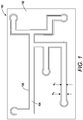
- FIG. 1 illustrates an example of a flexible conductive printed circuit 100 of the present disclosure.
- the flexible conductive printed circuit 100 may include a substrate 102.
- the substrate 102 may be flexible.
- the substrate 102 may comprise carton board, glass, polyethylene terephthalate (PET), polycarbonate (PC), polyethylene naphthalate (PEN), polystyrene (PS), polyethylene (PE), polymethylmethacrylate, poly(vinyl chloride), cellulose, and the like.
- the flexible conductive printed circuit 100 may include printed circuit lines 104.
- the printed circuit lines 104 may be etched or printed into the substrate 102 and filled with a conductive material.
- the conductive material may be any type of conductive material such as silver, gold, copper, and the like.
- the conductive printed circuit 100 may include an overcoat 106.
- the overcoat 106 may be digitally printed over the printed circuit lines 104.
- the overcoat 106 may be applied via a printer (e.g., an inkjet printer or an aerosol jet printer) precisely over the printed circuit lines 104.
- the overcoat 106 may be digitally printed on portions of the substrate 102 that include the printed circuit lines 104.
- the overcoat 106 may be printed at a width (W o ) that is approximately equal to, or slightly larger than, a width (W c ) of the printed circuit lines 104.
- the overcoat 106 may be formulated to allow the overcoat 106 to be digitally printed. Unlike other methods that blanket coat, spray coat, or draw down coat a material over the entire substrate, the overcoat 106 can be digitally printed on desired locations with precision. For example, the overcoat 106 may be printed to widths as small as several hundred microns.
- the flexible conductive printed circuit 100 has been simplified for ease of explanation and may include other features or devices that are not shown.
- the flexible conductive printed circuit 100 may be electrically coupled to other devices, power sources, controllers, and the like as part of an electronic device.
- the flexible conductive printed circuit 100 may be applied to clothing, packaging, and the like.
- FIG. 2 illustrates an example system 200 to produce the flexible conductive printed circuit 100.
- the system 200 may be an apparatus such as an inkjet printer or an aerosol jet printer that is under the control of a controller or processor.
- the system 200 may include a processor 202 and a memory 204.
- the processor 202 may execute instructions stored in the memory 204.
- the memory 204 may be any type of non-transitory computer readable memory, such as a hard disk drive, a solid state drive, read only memory, random access memory, and the like.
- the memory 204 may include print instructions 206.
- the print instructions 206 may include stored locations of the printed circuit lines 104 on the substrate 102. For example, as the printed circuit lines 104 are printed, the locations may be stored in the memory 204 and provided as part of the print instructions 206. In another embodiment, after the printed circuit lines 104 are formed in the substrate 102, the substrate 102 may be scanned to detect and determine the locations of the printed circuit lines 104. The locations of the printed circuit lines 104 may be stored as part of the print instructions 206 in the memory 204.
- the system 200 may also include a printhead 208 that includes a reservoir 210.
- the reservoir 210 may store the overcoat 106.
- the printhead 208 may be movable along a two-dimensional coordinate system over the flexible conductive printed circuit 100.
- the printhead 208 may be fixed and the flexible conductive printed circuit 100 may be positioned on a platform 212 that can be moved below the printhead 208 along a two-dimensional coordinate system.
- the processor 202 may control the printhead 208 to dispense the overcoat 106 in accordance with the print instructions 206.
- the processor 202 may control the printhead 208 to print the overcoat 106 over the printed circuit lines 104.
- the overcoat may be a printable overcoat ink having a composition that includes a mixture of a thermoplastic polyurethane (TPU) and a solvent.
- the mixture of the TPU and the solvent may be an emulsion that is mixed to have a viscosity that allows the printable overcoat ink composition to be digitally printed via an inkjet printhead or an aerosol jet printhead.
- the viscosity may be between approximately 1 centipoise to 2,000 centipoise.
- TPU may be a type of polyurethane plastic that has properties of elasticity, transparency, and resistance to abrasion or scratches.
- the TPU may be an elastomer that consists of linear segmented block copolymers composed of hard and soft segments.
- the TPU in its raw form cannot be digitally printed.
- the embodiments of the present disclosure formulate the TPU with a solvent to a desired viscosity to allow the TPU to be digitally printed (e.g., over conductive traces on a printed circuit board).
- the mixture may be formed with TPU that has an average diameter of approximately 1 nanometer (nm) to 1,000 nm. In one embodiment, the TPU may have an average diameter of approximately 5 nm to 500 nm. In one embodiment, the TPU may have an average diameter of approximately 10 nm to 200 nm.
- the TPU may be purchased as a latex dispersion.
- the TPU dispersion may include a stable dispersion of the TPU particles in water.
- the TPU is not dissolved in the water, but remains in a solid form evenly dispersed in the solution (e.g., a colloidal dispersion).
- the TPU latex dispersion may be purchased from a variety of vendors such as Alberdingk Boley Inc., Covestro, and the like under the tradenames of Alberdingk U 410, Alberdingk U 615, Alberdingk U 2101, Bayhydrol U2757, Bayhydrol U2559, Bayhydrol 2606, and the like.
- the solvent may be a high boiling point solvent.
- the high boiling point of the solvent may allow the mixture of the TPU and solvent to remain stable when stored in a cartridge for printing at room temperature.
- the high boiling point solvent may enable stable printing of the ink in both inkjet printing and aerosol jet printing, and ensure that the mixture does not dry out or evaporate inside of a reservoir (e.g., the printhead).
- the solvents may be selected from groups of solvents that are compatible with the TPU dispersion (e.g., the solvent does not disrupt the TPU dispersion).
- solvents examples may include water, ethylene glycol, diethylene glycol, sulfolane, propylene glycol methyl ether acetate, propylene glycol monomethyl ether acetate, di(propylene glycol) methyl ether acetate, (propylene glycol) methyl ether, di(propylene glycol) methyl ether, methyl isobutyl ketone, diisobutyl ketone, butyl acetate, methoxypropylacetate, or propoxylated neopentylglycoldiacrylate, or any combination thereof.
- the amount of TPU in a dispersion form and solvent in the mixture may have a ratio of approximately 1:1 to 1:20 of TPU to solvent for inkjet printers and approximately 10:1 to 1:20 for aerosol jet printers.
- the amount of TPU to solvent may range from approximately 1:4 to 2:1.
- the amount solid TPU to solvent may have a ratio of approximately 1:8 for inkjet printers and approximately 1:4 for aerosol jet printers. Thus, the ratios may vary based on whether the TPU in a dispersion form is measured or the solid TPU is measured.
- the total solid content of the TPU in the mixture may be approximately 1 per cent to 60 per cent. In one embodiment, the solid content may be approximately 10-25 per cent. In one embodiment, the solid content may be approximately 5-15 per cent.
- the printable flexible overcoat ink composition may be formulated for an inkjet printhead.
- the printable flexible overcoat ink composition may be formulated with a ratio of 1:2 (e.g., of weight) of solid TPU to solvent.
- the printable flexible overcoat ink composition may have a total solid TPU content of approximately 13 per cent by weight.
- the mixture may be mixed to have a viscosity of approximately 1-40 centipoise.
- the printable flexible overcoat ink composition may be formulated such that the composition can be digitally printed without clogging printheads and/or quickly evaporating out of the printhead reservoir.
- the composition may also remain flexible after printing and curing to protect conductive traces that are protected by the printable flexible overcoat ink composition.
- a mixture of 1.0 grams of Alberdingk U615 and 2.0 grams of ethylene glycol was loaded into a glass vial. The mixture was vortexed to mix the Alberdingk U615 and the ethylene glycol well. The mixture was allowed to settle for approximately 30 minutes. The mixture had a viscosity of approximately 5-14 centipoise. The mixture was produced to have a total solid TPU content of approximately 13 per cent.
- a mixture of 1.0 grams of Alberdingk U615 and 1.0 grams of ethylene glycol was loaded into a glass vial. The mixture was vortexed to mix the Alberdingk U615 and the ethylene glycol well. The mixture was allowed to settle for approximately 30 minutes. The mixture was produced to have a total solid TPU content of approximately 20 percent.
- a mixture of 1.0 grams of Alberdingk U2101 and 2.0 grams of ethylene glycol was loaded into a glass vial. The mixture was vortexed to mix the Alberdingk U2101 and the ethylene glycol well. The mixture was allowed to settle for approximately 30 minutes. The mixture was produced to have a total solid TPU content of approximately 13 per cent.
- a Dimatix 2300 printer was used for inkjet printing the mixture.
- the mixture was printed over conductive traces on a substrate at a temperature of approximately 25.2 degrees Celsius (°C), at a drop mass of 5.6 nanograms (ng), and at a velocity of 7 meters per second (m/s).
- the printed overcoat ink was baked in an oven at 120 °C for 10 minutes.
- the printed overcoat ink produced a uniform film over the conductive traces.
- the printed overcoat ink was found to have high adhesion.
- the strength of the printed overcoat ink was shown via fold testing and survived 10 plus folding cycles, where one cycle is defined as a 180 degree inward fold and a 360 degree outward fold.
- the printed overcoat ink also was shown to maintain integrity after being scratched with the tip of sharp tweezers.
- the conductive traces were found to still be conductive after the fold test when protected by the printed overcoat ink.
- the mixture was found to still print after several hours of use. No clogging of the inkjet printhead was observed after three hours of use.
- a mixture of 15.0 grams of Alberdingk U615 and 10.0 grams of diethylene glycol was loaded into a glass vial. The mixture was vortexed to mix the Alberdingk U615 and the diethylene glycol well. The mixture was allowed to settle for approximately 30 minutes. The mixture had a viscosity of approximately 76.51 centipoise. The mixture was produced to have a total TPU content of approximately 24 per cent.
- a mixture of 15.0 grams of Alberdingk U410 and 10.0 grams of diethylene glycol was loaded into a glass vial. The mixture was vortexed to mix the Alberdingk U410 and the diethylene glycol well. The mixture was allowed to settle for approximately 30 minutes. The mixture was produced to have a total TPU content of approximately 24 per cent.
- mixture of 15.0 grams of Alberdingk U615 and 15.0 grams of ethylene glycol was loaded into a glass vial.
- the mixture was vortexed to mix the Alberdingk U615 and the diethylene glycol well.
- the mixture was allowed to settle for approximately 30 minutes.
- the mixture was produced to have a total TPU content of approximately 20 per cent.
- the mixture from the first embodiment of the aerosol jet printer example was printed using an aerosol jet printer using deionized water in the bubbler to prevent a film forming process from happening in the printing system.
- the mixture printed well in the aerosol jet printer for several hours without clogging.
- the printing conditions of the aerosol jet printer are provided below in Table 1: TABLE 1: AEROSOL JET PRINTING CONDITIONS Flow rate (standard cubic centimeters per minute) Pressure (pounds per square inch) Sheath 400 0024 Atom ization 900 22.05 Exhaust 600 0
- the printed overcoat ink was printed over several different substrates, such as Clearwater carton board, polycarbonate, and polyethylene naphthalate (PEN).
- the printed overcoat ink was baked in an oven at 120 °C for 10 minutes.
- the printed overcoat ink produced a uniform film over the conductive traces.
- the printed overcoat ink was found to have high adhesion.
- the strength of the printed overcoat ink was shown via fold testing and survived 10 plus folding cycles, where one cycle is defined as a 180 degree inward fold and a 360 degree outward fold.
- the printed overcoat ink also was shown to maintain integrity after being scratched with the tip of sharp tweezers.
- the conductive traces were found to still be conductive after the fold test when protected by the printed overcoat ink.
- the formulations for the printable flexible overcoat ink composition are provided as examples for inkjet printing and aerosol jet printing.
- the formulation and the printable flexible overcoat ink composition may be adjusted for any desired digital printing application.
- the size of the TPU particles, type of solvent and the amount of solvent mixed with the TPU may be adjusted to tune the viscosity for a particular printing application.
- FIG. 3 illustrates a flow chart of an example method 300 for producing a flexible conductive printed circuit with a printed overcoat of the present disclosure.
- the method 300 may be performed by the system 100 or the apparatus 400 illustrated in FIG. 4 , and described in further details below.
- the method 300 begins.
- the method 300 forms conductive printed circuit lines on a flexible substrate.
- the printed circuit lines may be formed in the flexible substrate with any conductive material or metal.
- the conductive material may include silver, gold, copper, and the like.
- the flexible substrate may provide some movement or flexibility such that the flexible conductive printed circuit can be applied to flexible surfaces, such as clothing, packaging, and the like.
- the flexible substrate may include carton board, glass, polyethylene terephthalate (PET), polycarbonate (PC), polyethylene naphthalate (PEN), polystyrene (PS), polyethylene (PE), polymethylmethacrylate, poly(vinyl chloride), cellulose, and the like.
- the method 300 detects locations on the flexible substrate where the conductive printed circuit lines are formed.
- the locations may be stored in memory as the conductive printed circuit lines are formed.
- the locations may then be provided to a printer to print the overcoat precisely over the conductive printed circuit lines.
- the locations may be detected by examining or scanning with an optical imaging device.
- the optical imaging device may map where the conductive printed circuit lines are located and provide the locations to the printer.
- the method 300 prints an overcoat over the conductive printed circuit lines at the locations that are detected on the flexible substrate, wherein the overcoat comprises a mixture of thermoplastic polyurethane (TPU) and a solvent, wherein the mixture has a viscosity of 1 centipoise to 2,000 centipoise to allow the mixture to be printed.
- the overcoat may be digitally printed to precisely cover the conductive printed circuit lines. Said another way, the overcoat may be printed to have approximately the same width or slightly larger width (e.g., within a micron or several microns on each side of the conductive printed circuit lines) as the width of the conductive printed circuit lines.
- overcoat material can be used than would be used when applying the overcoat with a spray coating, draw down coating, blanket coating, and the like.
- the overcoat material may be contained to desired locations to prevent the overcoat material from interacting or covering other portions of the substrate that may not need the overcoat, or react negatively with the overcoat.
- the overcoat of the present disclosure is formulated to allow the overcoat to be dispensed by a digitally addressable or controllable printhead.
- the overcoat may be stored without evaporating or clogging the apertures of the printhead.
- the overcoat may be cured.
- the overcoat may be cured by drying at room temperature or in an oven.
- the drying time may vary based on the drying temperature.
- the overcoat may be cured in an oven and baked at approximately 120 degrees Celsius for 10 minutes.
- the method 300 ends.
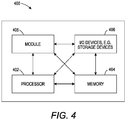
- FIG. 4 depicts a high-level block diagram of a computer that is dedicated to perform the functions described herein.
- the computer 400 comprises one or more hardware processor elements 402 (e.g., a central processing unit (CPU), a microprocessor, or a multi-core processor), a memory 404, e.g., random access memory (RAM) and/or read only memory (ROM), a module 405 for producing a flexible conductive printed circuit with a printed overcoat, and various input/output devices 406 (e.g., storage devices, including but not limited to, a tape drive, a floppy drive, a hard disk drive or a compact disk drive, a receiver, a transmitter, a speaker, a display, a speech synthesizer, an output port, an input port and a user input device (such as a keyboard, a keypad, a mouse, a microphone and the like)).
- a hardware processor element 402 e.g., a central processing unit (CPU), a micro
- the present disclosure can be implemented in software and/or in a combination of software and hardware, e.g., using application specific integrated circuits (ASIC), a programmable logic array (PLA), including a field-programmable gate array (FPGA), or a state machine deployed on a hardware device, a computer or any other hardware equivalents, e.g., computer readable instructions pertaining to the method(s) discussed above can be used to configure a hardware processor to perform the steps, functions and/or operations of the above disclosed methods.
- ASIC application specific integrated circuits
- PDA programmable logic array
- FPGA field-programmable gate array
- instructions and data for the present module or process 405 for producing a flexible conductive printed circuit with a printed overcoat can be loaded into memory 404 and executed by hardware processor element 402 to implement the steps, functions or operations as discussed above in connection with the example method 300.
- a hardware processor executes instructions to perform "operations," this could include the hardware processor performing the operations directly and/or facilitating, directing, or cooperating with another hardware device or component (e.g., a co-processor and the like) to perform the operations.
- the processor executing the computer readable or software instructions relating to the above described method(s) can be perceived as a programmed processor or a specialized processor.
- the present module 405 for producing a flexible conductive printed circuit with a printed overcoat (including associated data structures) of the present disclosure can be stored on a tangible or physical (broadly non-transitory) computer-readable storage device or medium, e.g., volatile memory, non-volatile memory, ROM memory, RAM memory, magnetic or optical drive, device or diskette and the like.
- the computer-readable storage device may comprise any physical devices that provide the ability to store information such as data and/or instructions to be accessed by a processor or a computing device such as a computer or an application server.
Landscapes
- Engineering & Computer Science (AREA)
- Microelectronics & Electronic Packaging (AREA)
- Manufacturing & Machinery (AREA)
- Manufacturing Of Printed Wiring (AREA)
- Ink Jet (AREA)
- Inks, Pencil-Leads, Or Crayons (AREA)
- Non-Metallic Protective Coatings For Printed Circuits (AREA)
- Application Of Or Painting With Fluid Materials (AREA)
Applications Claiming Priority (1)
| Application Number | Priority Date | Filing Date | Title |
|---|---|---|---|
| US16/722,983 US11096288B2 (en) | 2019-12-20 | 2019-12-20 | Flexible conductive printed circuits with printed overcoats |
Publications (1)
| Publication Number | Publication Date |
|---|---|
| EP3840550A1 true EP3840550A1 (en) | 2021-06-23 |
Family
ID=73698733
Family Applications (1)
| Application Number | Title | Priority Date | Filing Date |
|---|---|---|---|
| EP20211709.9A Withdrawn EP3840550A1 (en) | 2019-12-20 | 2020-12-03 | Flexible conductive printed circuits with printed overcoats |
Country Status (6)
| Country | Link |
|---|---|
| US (1) | US11096288B2 (enExample) |
| EP (1) | EP3840550A1 (enExample) |
| JP (1) | JP7423496B2 (enExample) |
| KR (1) | KR102676581B1 (enExample) |
| CN (1) | CN113015345B (enExample) |
| CA (1) | CA3102084C (enExample) |
Cited By (2)
| Publication number | Priority date | Publication date | Assignee | Title |
|---|---|---|---|---|
| EP4192203A1 (en) * | 2021-12-02 | 2023-06-07 | Aptiv Technologies Limited | Flexible electrical circuit and method for selective application of abrasion resistant or noise abatement coating to a flexible electrical circuit |
| EP4192204A1 (en) * | 2021-12-02 | 2023-06-07 | Aptiv Technologies Limited | Integrated flexible circuit attachment features with sound dampening and method of forming said features |
Families Citing this family (1)
| Publication number | Priority date | Publication date | Assignee | Title |
|---|---|---|---|---|
| TWI824277B (zh) * | 2021-08-06 | 2023-12-01 | 友達光電股份有限公司 | 顯示裝置及其製造方法 |
Citations (5)
| Publication number | Priority date | Publication date | Assignee | Title |
|---|---|---|---|---|
| EP0807148A1 (en) * | 1995-02-03 | 1997-11-19 | Videojet Systems International, Inc. | An ink composition |
| US20080081125A1 (en) * | 2006-10-02 | 2008-04-03 | Samsung Electro-Mechanics Co., Ltd. | Method for manufacturing cover lay of printed circuit board |
| DE102010040867A1 (de) * | 2010-09-16 | 2012-03-22 | Robert Bosch Gmbh | Elektronikbauteil mit verbesserter Leitungsstruktur |
| DE102011100556A1 (de) * | 2011-01-25 | 2012-07-26 | Jörg R. Bauer | Verfahren zur Herstellung von dauerhaft leitfähigen, digital erzeugten, Funktionsschichten auf der Oberfläche eines elastischen Substrates |
| WO2018217682A1 (en) * | 2017-05-23 | 2018-11-29 | Alpha Assembly Solutions Inc. | Graphene enhanced and engineered materials for membrane touch switch and other flexible electronic structures |
Family Cites Families (20)
| Publication number | Priority date | Publication date | Assignee | Title |
|---|---|---|---|---|
| KR0137007B1 (ko) * | 1992-09-25 | 1998-04-24 | 고우노 사토시 | 전도도료 및 그것을 이용한 프린트 회로기판 및 전자파 차폐부착 플렉시블 프린트 회로 형성체 |
| US20030157276A1 (en) * | 2002-02-06 | 2003-08-21 | Eastman Kodak Company | Ink recording element |
| US7150522B2 (en) * | 2002-12-04 | 2006-12-19 | Hewlett-Packard Development Company, L.P. | Sealable topcoat for porous media |
| JP4290510B2 (ja) * | 2003-08-22 | 2009-07-08 | 太陽インキ製造株式会社 | インクジェット用光硬化性・熱硬化性組成物とそれを用いたプリント配線板 |
| JP2005183805A (ja) | 2003-12-22 | 2005-07-07 | Canon Inc | 電気回路基体及びその製造方法 |
| US7572481B2 (en) * | 2003-12-22 | 2009-08-11 | Canon Kabushiki Kaisha | Pattern forming method and pattern forming apparatus |
| JPWO2005116152A1 (ja) * | 2004-05-27 | 2008-04-03 | 株式会社ピーアイ技術研究所 | 印刷用ブロック共重合ポリイミドインク組成物 |
| GB0414847D0 (en) * | 2004-07-02 | 2004-08-04 | Avecia Ltd | Process |
| KR100983838B1 (ko) * | 2005-04-06 | 2010-09-27 | 아크조 노벨 엔.브이. | 투명 전도성 산화물의 무기 코팅을 갖는 호일 조각의 제조 방법 |
| JP5735238B2 (ja) * | 2010-09-02 | 2015-06-17 | 積水化学工業株式会社 | インクジェット用硬化性組成物及びプリント配線板の製造方法 |
| JP6066558B2 (ja) | 2010-09-22 | 2017-01-25 | 積水化学工業株式会社 | インクジェット用硬化性組成物及び電子部品の製造方法 |
| JP5969208B2 (ja) | 2010-09-22 | 2016-08-17 | 積水化学工業株式会社 | インクジェット用硬化性組成物及び電子部品の製造方法 |
| US20140035995A1 (en) * | 2010-12-07 | 2014-02-06 | Sun Chemical Corporation | Aerosol jet printable metal conductive inks, glass coated metal conductive inks and uv-curable dielectric inks and methods of preparing and printing the same |
| JP6082516B2 (ja) * | 2011-09-27 | 2017-02-15 | 積水化学工業株式会社 | 電子部品の製造方法 |
| US9357640B2 (en) * | 2014-09-22 | 2016-05-31 | Oce'-Technologies B.V. | Method of manufacturing a multi-layer printed circuit board |
| JP6263138B2 (ja) | 2015-02-12 | 2018-01-17 | 積水化学工業株式会社 | インクジェット用硬化性組成物及び電子部品の製造方法 |
| JP2017069344A (ja) * | 2015-09-29 | 2017-04-06 | 日本シイエムケイ株式会社 | プリント配線板およびその製造方法 |
| WO2017169624A1 (ja) | 2016-03-31 | 2017-10-05 | 太陽インキ製造株式会社 | 硬化装置およびソルダーレジストの製造方法 |
| CN110234688B (zh) * | 2017-03-27 | 2022-04-12 | 株式会社Lg化学 | 热塑性聚氨酯膜及其制备方法 |
| US20190117124A1 (en) * | 2017-10-19 | 2019-04-25 | MedicusTek, Inc. | Sensor pad for monitoring user posture |
-
2019
- 2019-12-20 US US16/722,983 patent/US11096288B2/en active Active
-
2020
- 2020-11-17 CN CN202011289223.6A patent/CN113015345B/zh active Active
- 2020-11-26 KR KR1020200161230A patent/KR102676581B1/ko active Active
- 2020-11-30 JP JP2020198170A patent/JP7423496B2/ja active Active
- 2020-12-03 EP EP20211709.9A patent/EP3840550A1/en not_active Withdrawn
- 2020-12-09 CA CA3102084A patent/CA3102084C/en active Active
Patent Citations (5)
| Publication number | Priority date | Publication date | Assignee | Title |
|---|---|---|---|---|
| EP0807148A1 (en) * | 1995-02-03 | 1997-11-19 | Videojet Systems International, Inc. | An ink composition |
| US20080081125A1 (en) * | 2006-10-02 | 2008-04-03 | Samsung Electro-Mechanics Co., Ltd. | Method for manufacturing cover lay of printed circuit board |
| DE102010040867A1 (de) * | 2010-09-16 | 2012-03-22 | Robert Bosch Gmbh | Elektronikbauteil mit verbesserter Leitungsstruktur |
| DE102011100556A1 (de) * | 2011-01-25 | 2012-07-26 | Jörg R. Bauer | Verfahren zur Herstellung von dauerhaft leitfähigen, digital erzeugten, Funktionsschichten auf der Oberfläche eines elastischen Substrates |
| WO2018217682A1 (en) * | 2017-05-23 | 2018-11-29 | Alpha Assembly Solutions Inc. | Graphene enhanced and engineered materials for membrane touch switch and other flexible electronic structures |
Cited By (4)
| Publication number | Priority date | Publication date | Assignee | Title |
|---|---|---|---|---|
| EP4192203A1 (en) * | 2021-12-02 | 2023-06-07 | Aptiv Technologies Limited | Flexible electrical circuit and method for selective application of abrasion resistant or noise abatement coating to a flexible electrical circuit |
| EP4192204A1 (en) * | 2021-12-02 | 2023-06-07 | Aptiv Technologies Limited | Integrated flexible circuit attachment features with sound dampening and method of forming said features |
| US12198835B2 (en) | 2021-12-02 | 2025-01-14 | Aptiv Technologies AG | Apparatus and method for selective application of abrasion resistant or noise abatement coating to a flexible electrical circuit |
| US12340924B2 (en) | 2021-12-02 | 2025-06-24 | Aptiv Technologies AG | Integrated flexible circuit attachment features with sound dampening and method of forming said features |
Also Published As
| Publication number | Publication date |
|---|---|
| KR20210080205A (ko) | 2021-06-30 |
| CA3102084A1 (en) | 2021-06-20 |
| CA3102084C (en) | 2023-11-14 |
| CN113015345B (zh) | 2023-11-03 |
| KR102676581B1 (ko) | 2024-06-20 |
| JP2021098193A (ja) | 2021-07-01 |
| US20210195759A1 (en) | 2021-06-24 |
| JP7423496B2 (ja) | 2024-01-29 |
| CN113015345A (zh) | 2021-06-22 |
| US11096288B2 (en) | 2021-08-17 |
Similar Documents
| Publication | Publication Date | Title |
|---|---|---|
| CA3102084C (en) | Flexible conductive printed circuits with printed overcoats | |
| EP2782758B1 (en) | Printing system for application of a patterned clear layer for reducing gloss banding | |
| Gardini et al. | Ceramic ink-jet printing for digital decoration: physical constraints for ink design | |
| EP3838995A2 (en) | Printable flexible overcoat ink compositions | |
| JP7230612B2 (ja) | 液体吐出装置、制御方法、及びプログラム | |
| JP2021098193A5 (enExample) | ||
| US20110033637A1 (en) | Method and apparatus for printing on a surface | |
| JP2017222441A (ja) | 画像形成装置、及びニス付与方法 | |
| CN110181954A (zh) | 照射装置、造形系统、照射方法及计算机可读取的存储介质 | |
| US20190064773A1 (en) | Method for indenting coloring areas of colored 3d object | |
| CN103241006B (zh) | 印刷装置、印刷方法以及印刷物 | |
| JP6171028B2 (ja) | プリンタ及び画像処理 | |
| CN110421988A (zh) | 喷墨控制方法和系统、喷墨打印设备 | |
| JP6344314B2 (ja) | インクセット、インクジェット記録装置、及びインクジェット記録方法 | |
| US11261341B2 (en) | Conductive ink composition and article of manufacture made therefrom | |
| CN102582273B (zh) | 实现不同规格纸张印刷的方法 | |
| CN110429208A (zh) | 玻璃基板、玻璃基板的打印方法和系统 | |
| EP4667188A1 (en) | Printer for printing a 3d object and a method therefor | |
| CN111791586A (zh) | 用于制造显示面板的设备和制造显示面板的方法 | |
| US20250222691A1 (en) | Method to reduce satellites when using multi-ejection waveforms | |
| Ashley | Emerging applications for inkjet technology | |
| JP6006710B2 (ja) | インクジェット記録装置、インクジェット記録用インクセット、及びインクジェット記録方法 | |
| US20250229454A1 (en) | Fiberboard structure manufacturing method, fiberboard structure manufacturing system, and fiberboard structure | |
| US20230347651A1 (en) | System and method for scheduling printhead purging in an inkjet printer | |
| JP2019177537A (ja) | インクジェット記録装置 |
Legal Events
| Date | Code | Title | Description |
|---|---|---|---|
| PUAI | Public reference made under article 153(3) epc to a published international application that has entered the european phase |
Free format text: ORIGINAL CODE: 0009012 |
|
| STAA | Information on the status of an ep patent application or granted ep patent |
Free format text: STATUS: THE APPLICATION HAS BEEN PUBLISHED |
|
| AK | Designated contracting states |
Kind code of ref document: A1 Designated state(s): AL AT BE BG CH CY CZ DE DK EE ES FI FR GB GR HR HU IE IS IT LI LT LU LV MC MK MT NL NO PL PT RO RS SE SI SK SM TR |
|
| STAA | Information on the status of an ep patent application or granted ep patent |
Free format text: STATUS: REQUEST FOR EXAMINATION WAS MADE |
|
| 17P | Request for examination filed |
Effective date: 20211223 |
|
| RBV | Designated contracting states (corrected) |
Designated state(s): AL AT BE BG CH CY CZ DE DK EE ES FI FR GB GR HR HU IE IS IT LI LT LU LV MC MK MT NL NO PL PT RO RS SE SI SK SM TR |
|
| GRAP | Despatch of communication of intention to grant a patent |
Free format text: ORIGINAL CODE: EPIDOSNIGR1 |
|
| STAA | Information on the status of an ep patent application or granted ep patent |
Free format text: STATUS: GRANT OF PATENT IS INTENDED |
|
| INTG | Intention to grant announced |
Effective date: 20230922 |
|
| RIC1 | Information provided on ipc code assigned before grant |
Ipc: H05K 3/00 20060101ALN20230912BHEP Ipc: H05K 1/03 20060101ALN20230912BHEP Ipc: H05K 3/28 20060101AFI20230912BHEP |
|
| STAA | Information on the status of an ep patent application or granted ep patent |
Free format text: STATUS: THE APPLICATION IS DEEMED TO BE WITHDRAWN |
|
| 18D | Application deemed to be withdrawn |
Effective date: 20240203 |