EP3818005B1 - Rundschlinge - Google Patents
Rundschlinge Download PDFInfo
- Publication number
- EP3818005B1 EP3818005B1 EP19768998.7A EP19768998A EP3818005B1 EP 3818005 B1 EP3818005 B1 EP 3818005B1 EP 19768998 A EP19768998 A EP 19768998A EP 3818005 B1 EP3818005 B1 EP 3818005B1
- Authority
- EP
- European Patent Office
- Prior art keywords
- protective tube
- round sling
- closure
- sling
- round
- Prior art date
- Legal status (The legal status is an assumption and is not a legal conclusion. Google has not performed a legal analysis and makes no representation as to the accuracy of the status listed.)
- Active
Links
Images

Classifications
-
- B—PERFORMING OPERATIONS; TRANSPORTING
- B66—HOISTING; LIFTING; HAULING
- B66C—CRANES; LOAD-ENGAGING ELEMENTS OR DEVICES FOR CRANES, CAPSTANS, WINCHES, OR TACKLES
- B66C1/00—Load-engaging elements or devices attached to lifting or lowering gear of cranes or adapted for connection therewith for transmitting lifting forces to articles or groups of articles
- B66C1/10—Load-engaging elements or devices attached to lifting or lowering gear of cranes or adapted for connection therewith for transmitting lifting forces to articles or groups of articles by mechanical means
- B66C1/12—Slings comprising chains, wires, ropes, or bands; Nets
- B66C1/122—Sling or load protectors
-
- B—PERFORMING OPERATIONS; TRANSPORTING
- B66—HOISTING; LIFTING; HAULING
- B66C—CRANES; LOAD-ENGAGING ELEMENTS OR DEVICES FOR CRANES, CAPSTANS, WINCHES, OR TACKLES
- B66C1/00—Load-engaging elements or devices attached to lifting or lowering gear of cranes or adapted for connection therewith for transmitting lifting forces to articles or groups of articles
- B66C1/10—Load-engaging elements or devices attached to lifting or lowering gear of cranes or adapted for connection therewith for transmitting lifting forces to articles or groups of articles by mechanical means
- B66C1/12—Slings comprising chains, wires, ropes, or bands; Nets
- B66C1/18—Band-type slings
-
- D—TEXTILES; PAPER
- D07—ROPES; CABLES OTHER THAN ELECTRIC
- D07B—ROPES OR CABLES IN GENERAL
- D07B1/00—Constructional features of ropes or cables
- D07B1/18—Grommets
Definitions
- the invention relates to a round sling for use on carrying means with a first protective tube partially enclosing the round sling to form a sling.
- Round slings and a sling made from them have been known for a long time, for example from the EP 32749 A1 or the WO 03/048023 A1 , which discloses the features of the preamble of claim 1.
- All individual elements of the round sling, which form the strap are known to be irreversibly connected to one another, i.e. sewn.
- openable protective tubes are also known, for example from the US 2015/0267347 A1 which have an openable protective tube for a rope or the JP H07 41279 A for a belt sling.
- the object of the invention is to further improve a round sling in the form of a sling.
- a round sling according to the invention for use on load-bearing means has the following features.
- the round sling has a first protective tube that partially surrounds it to form a sling, whereby end areas of the round sling are not enclosed by the first protective tube and the end areas therefore form loops.
- At least one enclosing band is to be attached to the first protective tube at each end in the direction of the loops as Loop reinforcement is arranged, which rests on an outer surface of the respective loop of the round sling and is thus placed around the loop.
- the at least one enclosing band is preferably not separately connected to the loop by sewing, gluing or similar.
- connection of the at least one enclosing band to the first protective tube is carried out, for example, by sewing. All other suitable connection forms are also within the scope of the invention, such as all force-fitting and/or form-fitting or material-fitting connection types.
- an openable second protective tube is arranged on each of the loops, which encloses the encircling band and thus an area of the round sling on which a tag can be arranged and completely or at least partially covers the loop and the encircling band, i.e. axially covers it in the longitudinal direction.
- a covering is necessary so that the respective encircling band is reliably locked in place by the second protective tube.
- the second protective tube thus ensures that the encircling band is fixed as a loop reinforcement.
- a closure region of the respective second protective tube is advantageously located outside a contact surface with the support means in order to reduce an impairment of the connection region and thus an impairment of the locking of the respective second protective tube due to mechanical stress by the support means.
- the inventive arrangement and the interaction of the individual components described above further improve the load-bearing capacity of the round sling.
- the multi-layer structure also improves the durability of the round sling. It also ensures that individual elements of the round sling in the form of the strap can be replaced.
- an openable third protective tube is arranged above the first protective tube and essentially encloses the first protective tube. This results in improved protection of the round sling in the load-bearing area if, for example, the round sling is used to transport coils, such as steel coils.
- a Velcro fastener for example, is provided as a means of connecting the openable second and third protective tubes.
- the first protective tube can be connected to the round sling, as is known, preferably reversibly, by being loosely pushed onto the round sling or, although this is not preferably the case, irreversibly connected to the round sling by being loosely pushed onto the round sling as part of the formation of the strap and then an area of the first protective tube between the two strands of the round sling is at least partially connected, i.e. sewn.
- the first protective tube then has two chambers. Nevertheless, it is generally arranged so that it can be moved on the round sling and all connections are preferably reversible in order to ensure easy changeability.
- An improved locking of the first or the first and the third protective tube can also be achieved by means of at least one closure, wherein the at least one closure is arranged at the respective ends of the first protective tube or at the respective ends of the first and the third protective tube and preferably, but not necessarily, passes through the loop interior when it is closed.
- the at least one closure can be firmly connected to the first and/or the third protective tube or can be a separate element which can penetrate or clamp the first protective tube and/or the third protective tube for locking purposes.
- the at least one closure can advantageously be closed reversibly, for example by means of a clamping device. Clamp locks, buckles or similar devices can be considered.
- the at least one closure is a section of tape.
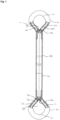
- a round sling 1 according to the invention for use on load-bearing means has a first protective tube 2 partially enclosing it to form a sling, wherein end regions of the round sling 1 are not enclosed by the first protective tube 2 and the end regions therefore form loops 4, 4' .
- a surrounding band 5, 5' is arranged as a loop reinforcement.
- the respective surrounding band 5, 5' rests loosely on an outer surface 6 of the respective loop 4, 4' of the round sling 1 and is thus placed around the loop without further fastening.
- the respective surrounding band 5, 5' is connected to the first protective tube 2 at the ends 3, 3' according to the Fig. 1 and 2 sewn twice at a distance so that the respective enclosing band 5, 5' also forms a loop.
- an openable second protective tube 7, 7' is arranged on the respective loops 4, 4' , which encloses an area of the round sling 1 on which a suspension element can be arranged and almost completely covers the respective enclosing band 5, 5' and thus locks it in place.
- a closure area of the second protective tube 7, 7' is located outside of a contact surface with the suspension element when this is functionally connected to the round sling 1. The closure area is therefore not exposed to any direct stress from the suspension element.
- An openable third protective tube 8 is arranged above the first protective tube 2 , which essentially encloses the first protective tube 2 , i.e. covers it in its longitudinal direction.
- a Velcro fastener is provided as a connecting means for the openable second and third protective tubes 7, 7' and 8 .
- the closure 9 is arranged at the respective ends 3, 3' of the first protective tube 2 and the third protective tube 8.
- the closure 9 passes through the loop interior 10 when it is functionally closed. This prevents it from being pulled off the round sling 1.
- the closure 9 is formed by two detachable straps arranged at the ends 3, 3', each with a belt clamp, with the closure 9 penetrating the first protective tube 2 and the third protective tube 8 at slots provided for this purpose.
Landscapes
- Engineering & Computer Science (AREA)
- Mechanical Engineering (AREA)
- Load-Engaging Elements For Cranes (AREA)
Description
- Die Erfindung betrifft eine Rundschlinge zur Verwendung an Tragmitteln mit einem die Rundschlinge partiell umschließenden ersten Schutzschlauch zur Bildung eines Stropps.
- Rundschlingen und ein daraus gebildeter Stropp sind seit langem bekannt, so zum Beispiel aus der
EP 32749 A1 WO 03/048023 A1 US 2015/0267347 A1 , die einen öffenbaren Schutzschlauch für ein Seil oder dieJP H07 41279 A - Die Aufgabe wird erfüllt durch die Merkmale des Hauptanspruchs 1. Weitere Ausgestaltungen der Erfindung ergeben sich aus den Unteransprüchen. Danach weist eine erfindungsgemäße Rundschlinge zur Verwendung an Tragmitteln folgende Merkmale auf.
- Die Rundschlinge besitzt einen sie partiell umschließenden ersten Schutzschlauch zur Bildung eines. Stropps, wobei Endbereiche der Rundschlinge nicht von dem ersten Schutzschlauch umschlossen sind und die Endbereiche daher Schlaufen bilden.
- An dem ersten Schutzschlauch an seinen jeweiligen Enden ist in Richtung der Schlaufen mindestens je ein Umfassungsband als Schlaufenverstärkung angeordnet, das an einer Außenfläche der jeweiligen Schlaufe der Rundschlinge anliegt und so um die Schlaufe gelegt ist.
- Das mindestens eine Umfassungsband ist vorzugsweise mit der Schlaufe nicht gesondert durch Vernähen, Verkleben oder Ähnlichem verbunden.
- Die Verbindung des mindestens einen Umfassungsbands mit dem ersten Schutzschlauch erfolgt aber beispielhaft durch Vernähen. Im Rahmen der Erfindung sind ebenfalls alle anderen geeigneten Verbindungsformen gelegen, so alle kraft- und/oder formschlüssigen oder stoffschlüssigen Verbindungsarten.
- Weiterhin ist an den jeweiligen Schlaufen jeweils ein öffenbarer zweiter Schutzschlauch angeordnet, der das Umfassungsband und damit gleichsam einen Bereich der Rundschlinge umschließt, an dem ein Tagmittel anordenbar ist und die Schlaufe und das Umfassungsband ganz oder zumindest teilweise verdeckt, das heißt in Längsrichtung axial verdeckt. Jedenfalls ist eine derartige Verdeckung notwendig, sodass eine funktionssichere Arretierung des jeweiligen Umfassungsbandes durch den zweiten Schutzschlauch gegeben ist. So ist durch den zweiten Schutzschlauch eine Fixierung des Umfassungsbandes als Schlaufenverstärkung sichergestellt.
- Ein Verschlussbereich des jeweils zweiten Schutzschlauchs ist vorteilhafterweise außerhalb einer Kontaktfläche mit dem Tragmittel gelegen, um eine Beeinträchtigung des Verbindungsbereichs und damit eine Beeinträchtigung der Arretierung des jeweiligen zweiten Schutzschlauchs aufgrund einer mechanischen Beanspruchung durch das Tragmittel zu reduzieren.
- Durch die erfindungsgemäße Anordnung und das Zusammenwirken der einzelnen vorbeschriebenen Bauteile wird die Tragfähigkeit der Rundschlinge weiter verbessert. Es wird die Kraftableitung innerhalb der Rundschlinge verbessert. Der mehrschichtige Aufbau verbessert ebenfalls die Haltbarkeit der Rundschlinge. Es ist ferner eine Wechselbarkeit einzelner Elemente der Rundschlinge in Form des Stropps gewährleistet.
- In weiterer Ausgestaltung der Erfindung kann vorgesehen werden, dass über dem ersten Schutzschlauch ein öffenbarer dritter Schutzschlauch angeordnet ist und den ersten Schutzschlauch im Wesentlichen umschließt. Dadurch kommt es zu einem verbesserten Schutz der Rundschlinge im Lastaufnahmebereich, wenn beispielhaft die Rundschlinge zum Transport von Coils, so Stahlcoils, eingesetzt wird.
- Als ein Verbindungsmittel des öffenbaren zweiten und dritten Schutzschlauchs ist zum Beispiel ein Klettverschluss vorgesehen. Der erste Schutzschlauch kann mit der Rundschlinge wie bekannt vorzugsweise reversibel verbunden sein, indem er auf die Rundschlinge lose aufgeschoben ist oder aber, was aber nicht vorzugsweise der Fall ist, irreversibel mit der Rundschlinge verbunden sein, indem er auf die Rundschlinge im Rahmen der Bildung des Stropps lose aufgeschoben ist und sodann ein Bereich des ersten Schutzschlauchs zwischen beiden Strängen der Rundschlinge zumindest partiell verbunden, so vernäht ist. Der erste Schutzschlauch weist dann zwei Kammern auf. Nichtsdestotrotz ist er aber auf der Rundschlinge in aller Regel verschiebbar angeordnet und vorzugsweise sind wegen der Gewährung einer leichten Wechselbarkeit alle Verbindungen reversibel vorgesehen.
- Eine verbesserte Arretierung des ersten oder des ersten und des dritten Schutzschlauchs kann ferner mittels mindestens einem Verschluss erfolgen, wobei der mindestens eine Verschluss jeweils an den jeweiligen Enden des ersten Schutzschlauchs oder an den jeweiligen Enden des ersten und des dritten Schutzschlauchs angeordnet ist und vorzugsweise, aber nicht notwendigerweise, durch den Schlaufeninnenraum hindurchführt, wenn er verschlossen ist. Der mindestens eine Verschluss kann dabei mit dem ersten und/oder mit dem dritten Schutzschlauch fest verbunden sein oder aber ein separates Element darstellen, welches den ersten Schutzschlauch und/oder den dritten Schutzschlauch zwecks Arretierung durchdringen oder einklemmen kann. Vorteilhafterweise ist der mindestens eine Verschluss reversibel verschließbar, so beispielhaft mittels einer Klemmvorrichtung. In Betracht kommen Klemmschlösser, Schnallen oder ähnliche Vorrichtungen. In einer Variante ist der mindestens eine Verschluss ein Bandabschnitt.
- Die Erfindung wird nachfolgend anhand eines Ausführungsbeispiels unter Bezugnahme auf die Figur weiter erläutert. Dabei ergeben sich weitere Vorteile, Merkmale und Ausgestaltungen der Erfindung.
- Es zeigt:
-
Fig. 1 eine schematische Darstellung einer erfindungsgemäßen Rundschlinge, -
Fig. 2 eine schematische Darstellung eines Teils einer Rundschlinge mit Endbereich. - Eine erfindungsgemäße Rundschlinge 1 zur Verwendung an Tragmitteln besitzt einem sie partiell umschließenden ersten Schutzschlauch 2 zur Bildung eines Stropps, wobei Endbereiche der Rundschlinge 1 nicht von dem ersten Schutzschlauch 2 umschlossen sind und die Endbereiche daher Schlaufen 4, 4' bilden.
- An dem ersten Schutzschlauch 2 an seinen jeweiligen Enden 3, 3' ist in Richtung der Schlaufen 4, 4' je ein Umfassungsband 5, 5' als Schlaufenverstärkung angeordnet. Das jeweilige Umfassungsband 5, 5' liegt an einer Außenfläche 6 der jeweiligen Schlaufe 4, 4' der Rundschlinge 1 lose an und ist so um die Schlaufe ohne weitere Befestigung gelegt. Das jeweilige Umfassungsband 5, 5' ist mit dem ersten Schutzschlauch 2 jeweils an den Enden 3, 3' gemäß der
Fig. 1 und2 zweimal beabstandet vernäht, sodass das jeweilige Umfassungsband 5, 5' ebenfalls eine Schlaufe bildet. - Weiterhin ist an den jeweiligen Schlaufen 4, 4' jeweils ein öffenbarer zweiter Schutzschlauch 7, 7' angeordnet, der einen Bereich der Rundschlinge 1 umschließt, an dem ein Tragmittel anordenbar ist und gleichsam das jeweilige Umfassungsband 5, 5' fast vollständig verdeckt und so gleichsam arretiert. Ein Verschlussbereich des jeweils zweiten Schutzschlauchs 7, 7' ist im Ausführungsbeispiel außerhalb einer Kontaktfläche mit dem Tragmittel gelegen, wenn dieses funktionsgemäß mit der Rundschlinge 1 verbunden ist. So ist der Verschlussbereich keiner direkten Beanspruchung durch das Tragmittel ausgesetzt.
- Über dem ersten Schutzschlauch 2 ist ein öffenbarer dritter Schutzschlauch 8 angeordnet, der den ersten Schutzschlauch 2 im Wesentlichen umschließt, das heißt in seiner Längsrichtung verdeckt. Als ein Verbindungsmittel des öffenbaren zweiten und dritten Schutzschlauchs 7, 7' und 8 ist im Ausführungsbeispiel ein Klettverschluss vorgesehen.
- Eine verbesserte Arretierung des ersten und des dritten Schutzschlauchs 2, 8 erfolgt ferner mittels zweier Bandabschnitte, die einen Verschluss 9 bilden. Dabei ist der Verschluss 9 jeweils an den jeweiligen Enden 3, 3' des ersten Schutzschlauchs 2 und des dritten Schutzschlauchs 8 angeordnet. Der Verschluss 9 führt durch den Schlaufeninnenraum 10 hindurch, wenn er funktionsgemäß verschlossen ist. So ist ein Abziehen von der Rundschlinge 1 ausgeschlossen. Der Verschluss 9 wird im Ausführungsbeispiel durch jeweils zwei an den Enden 3, 3' angeordnete lösbare Gurte mit je einer Gurtklemme gebildet, wobei der Verschluss 9 den ersten Schutzschlauch 2 und den dritten Schutzschlauch 8 an dafür vorgesehenen Schlitzen durchdringt.
-
- 1.
- Rundschlinge
- 2.
- erster Schutzschlauch
- 3.
- Enden
- 4.
- Schlaufe
- 5.
- Umfassungsband
- 6.
- Außenfläche
- 7.
- zweiter Schutzschlauch
- 8.
- dritter Schutzschlauch
- 9.
- Verschluss
- 10.
- Schlaufeninnenraum
Claims (8)
- Rundschlinge (1) mit einem die Rundschlinge (1) partiell umschließenden ersten Schutzschlauch (2), wobei Endbereiche der Rundschlinge (1) nicht von dem ersten Schutzschlauch (2) umschlossen sind und die Endbereiche Schlaufen (4) bilden, dadurch gekennzeichnet, dass
an dem ersten Schutzschlauch (2) an seinen jeweiligen Enden (3) in Richtung der Schlaufen (4) mindestens je ein Umfassungsband (5) angeordnet ist, das an einer Außenfläche (6) der jeweiligen Schlaufe (4) der Rundschlinge (1) anliegt und an den jeweiligen Schlaufen (4) jeweils ein öffenbarer zweiter Schutzschlauch (7) angeordnet ist, der das Umfassungsband (5) und damit gleichsam einen Bereich der Rundschlinge (1) umschließt, an dem ein Tragmittel anordenbar ist und die Schlaufe und das Umfassungsband ganz oder zumindest teilweise verdeckt. - Rundschlinge (1) nach Anspruch 1, wobei über dem ersten Schutzschlauch (2) ein öffenbarer dritter Schutzschlauch (8) angeordnet ist und den ersten Schutzschlauch (1) im Wesentlichen umschließt.
- Rundschlinge (1) nach Anspruch 1 oder 2, wobei eine Arretierung des ersten oder des ersten und des dritten Schutzschlauchs (8) mittels mindestens einem Verschluss (9) erfolgt, der an den jeweiligen Enden (3) des ersten Schutzschlauchs (2) oder an den jeweiligen Enden (3) des ersten und des dritten Schutzschlauchs (2, 8) angeordnet ist.
- Rundschlinge (1) nach Anspruch 3, wobei der mindestens eine Verschluss (9) ein Bandabschnitt ist.
- Rundschlinge (1) nach einem der vorherigen Ansprüche, wobei ein Verschlussbereich des jeweils zweiten Schutzschlauchs (7) außerhalb einer Kontaktfläche mit dem Tragmittel gelegen ist.
- Rundschlinge (1) nach einem der vorherigen Ansprüche, wobei ein Verbindungsmittel des öffenbaren zweiten und dritten Schutzschlauchs (7, 8) ein Klettverschluss ist.
- Rundschlinge (1) nach einem der vorherigen Ansprüche 3 bis 6, wobei der mindestens eine Verschluss (9) reversibel verschließbar ist.
- Rundschlinge (1) nach einem der vorherigen Ansprüche 3 bis 6, wobei der mindestens eine Verschluss (9) des dritten Schutzschlauchs (8) durch einen Schlaufeninnenraum (10) hindurchführt, wenn der mindestens eine Verschluss (9) funktionsgemäß verschlossen ist.
Applications Claiming Priority (2)
| Application Number | Priority Date | Filing Date | Title |
|---|---|---|---|
| DE102018005229.0A DE102018005229A1 (de) | 2018-07-03 | 2018-07-03 | Rundschlinge |
| PCT/DE2019/000174 WO2020007385A1 (de) | 2018-07-03 | 2019-06-25 | Rundschlinge |
Publications (3)
| Publication Number | Publication Date |
|---|---|
| EP3818005A1 EP3818005A1 (de) | 2021-05-12 |
| EP3818005C0 EP3818005C0 (de) | 2024-10-30 |
| EP3818005B1 true EP3818005B1 (de) | 2024-10-30 |
Family
ID=67956429
Family Applications (1)
| Application Number | Title | Priority Date | Filing Date |
|---|---|---|---|
| EP19768998.7A Active EP3818005B1 (de) | 2018-07-03 | 2019-06-25 | Rundschlinge |
Country Status (3)
| Country | Link |
|---|---|
| EP (1) | EP3818005B1 (de) |
| DE (1) | DE102018005229A1 (de) |
| WO (1) | WO2020007385A1 (de) |
Families Citing this family (1)
| Publication number | Priority date | Publication date | Assignee | Title |
|---|---|---|---|---|
| NL2031064B1 (en) * | 2022-02-24 | 2023-09-06 | Enduro Softslings B V | A Protective Sleeve For A Load Carrying Sling |
Family Cites Families (4)
| Publication number | Priority date | Publication date | Assignee | Title |
|---|---|---|---|---|
| GR73539B (de) | 1980-01-21 | 1984-03-12 | Spanset Inter Ag | |
| JP3165294B2 (ja) * | 1993-07-30 | 2001-05-14 | 明大株式会社 | 高荷重用ベルトスリング |
| EP1451091B1 (de) * | 2001-12-03 | 2011-03-02 | mamutec AG | Hebegurtschlinge |
| US20150267347A1 (en) * | 2014-03-19 | 2015-09-24 | Charles D. Farmer | Chafe protected rope and protective cover therefore |
-
2018
- 2018-07-03 DE DE102018005229.0A patent/DE102018005229A1/de not_active Withdrawn
-
2019
- 2019-06-25 WO PCT/DE2019/000174 patent/WO2020007385A1/de not_active Ceased
- 2019-06-25 EP EP19768998.7A patent/EP3818005B1/de active Active
Also Published As
| Publication number | Publication date |
|---|---|
| WO2020007385A1 (de) | 2020-01-09 |
| EP3818005C0 (de) | 2024-10-30 |
| DE102018005229A1 (de) | 2020-01-09 |
| EP3818005A1 (de) | 2021-05-12 |
Similar Documents
| Publication | Publication Date | Title |
|---|---|---|
| DE69622881T2 (de) | Kupplungsvorrichtung für eine kette | |
| DE102012000202B4 (de) | Vorrichtung zur Verankerung eines Gurtschlosses und Vorrichtungsanordnung mit wenigstens zwei solchen Vorrichtungen | |
| EP3818005B1 (de) | Rundschlinge | |
| EP1791777B1 (de) | Schutzelement für textile zurr- oder anschlagmittel und mit einem solchen schutzelement ausgestattetes zurr- oder anschlagmittel | |
| EP1456559B1 (de) | Anschlagmittel | |
| DE102014208819A1 (de) | Ringelement mit einem geteilten Sockel für ein Zurr- oder Anschlagmittel | |
| DE102009050078A1 (de) | Kettenverbindungsglied | |
| EP2855204B1 (de) | Zugaufnahmemittel | |
| DE2240013A1 (de) | Kupplungsstab | |
| DE20121118U1 (de) | Anschlagmittel | |
| DE102017209004B4 (de) | Gleichlaufgelenk in Faserverbundbauweise | |
| EP1223140B1 (de) | Gehänge zum stufenlosen Einstellen der Länge eines Hebebands | |
| DE202023103521U1 (de) | Spannschraube, Zurrgeschirr aufweisend die Spannschraube und Zurrgeschirr-Set aufweisend die Spannschraube | |
| EP4046953B1 (de) | Modulares system zur aufhängung an einem kranhaken oder einem anschlagpunkt oder einem zurrpunkt | |
| DE3324095A1 (de) | Buendelhebegeschirr fuer langgueter | |
| DE102014002228A1 (de) | Haltevorrichtung | |
| DE202023105734U1 (de) | Vorrichtung zur Anbringung an einer textilen Kette | |
| DE102021117790B4 (de) | Artikel, Verfahren zur Herstellung einer Sicherungsvorrichtung, Verwendung der Sicherungsvorrichtung und Sicherungsvorrichtung | |
| DE29509959U1 (de) | Gurt zur Befestigung eines Gegenstandes, insbesondere eines Netzes | |
| DE2804735C3 (de) | Endbeschlag für Lasthebe- und/oder Verzurrbänder | |
| DE1756317A1 (de) | Hebeband bzw. Ladeband | |
| DE925150C (de) | Abschleppseil, insbesondere fuer Kraftfahrzeuge | |
| DE10338646B4 (de) | Plattenförmiges Verbindungselement | |
| DE202014001493U1 (de) | Haltevorrichtung | |
| DE2630306B1 (de) | Schutzbezug fuer lastaufnahmehaken |
Legal Events
| Date | Code | Title | Description |
|---|---|---|---|
| STAA | Information on the status of an ep patent application or granted ep patent |
Free format text: STATUS: UNKNOWN |
|
| STAA | Information on the status of an ep patent application or granted ep patent |
Free format text: STATUS: THE INTERNATIONAL PUBLICATION HAS BEEN MADE |
|
| PUAI | Public reference made under article 153(3) epc to a published international application that has entered the european phase |
Free format text: ORIGINAL CODE: 0009012 |
|
| STAA | Information on the status of an ep patent application or granted ep patent |
Free format text: STATUS: REQUEST FOR EXAMINATION WAS MADE |
|
| 17P | Request for examination filed |
Effective date: 20201230 |
|
| AK | Designated contracting states |
Kind code of ref document: A1 Designated state(s): AL AT BE BG CH CY CZ DE DK EE ES FI FR GB GR HR HU IE IS IT LI LT LU LV MC MK MT NL NO PL PT RO RS SE SI SK SM TR |
|
| DAV | Request for validation of the european patent (deleted) | ||
| DAX | Request for extension of the european patent (deleted) | ||
| RAP3 | Party data changed (applicant data changed or rights of an application transferred) |
Owner name: SPAN SET GESELLSCHAFT FUER TRANSPORTSYSTEME UND TECHNISCHE BAENDER MIT BESCHRAENKTER HAFTUNG & CO. KOMMANDITGESELLSCHAFT |
|
| GRAP | Despatch of communication of intention to grant a patent |
Free format text: ORIGINAL CODE: EPIDOSNIGR1 |
|
| STAA | Information on the status of an ep patent application or granted ep patent |
Free format text: STATUS: GRANT OF PATENT IS INTENDED |
|
| INTG | Intention to grant announced |
Effective date: 20240606 |
|
| GRAS | Grant fee paid |
Free format text: ORIGINAL CODE: EPIDOSNIGR3 |
|
| GRAA | (expected) grant |
Free format text: ORIGINAL CODE: 0009210 |
|
| STAA | Information on the status of an ep patent application or granted ep patent |
Free format text: STATUS: THE PATENT HAS BEEN GRANTED |
|
| AK | Designated contracting states |
Kind code of ref document: B1 Designated state(s): AL AT BE BG CH CY CZ DE DK EE ES FI FR GB GR HR HU IE IS IT LI LT LU LV MC MK MT NL NO PL PT RO RS SE SI SK SM TR |
|
| REG | Reference to a national code |
Ref country code: GB Ref legal event code: FG4D Free format text: NOT ENGLISH |
|
| REG | Reference to a national code |
Ref country code: CH Ref legal event code: EP |
|
| REG | Reference to a national code |
Ref country code: DE Ref legal event code: R096 Ref document number: 502019012403 Country of ref document: DE |
|
| REG | Reference to a national code |
Ref country code: IE Ref legal event code: FG4D Free format text: LANGUAGE OF EP DOCUMENT: GERMAN |
|
| U01 | Request for unitary effect filed |
Effective date: 20241118 |
|
| U07 | Unitary effect registered |
Designated state(s): AT BE BG DE DK EE FI FR IT LT LU LV MT NL PT RO SE SI Effective date: 20241122 |
|
| PG25 | Lapsed in a contracting state [announced via postgrant information from national office to epo] |
Ref country code: IS Free format text: LAPSE BECAUSE OF FAILURE TO SUBMIT A TRANSLATION OF THE DESCRIPTION OR TO PAY THE FEE WITHIN THE PRESCRIBED TIME-LIMIT Effective date: 20250228 Ref country code: HR Free format text: LAPSE BECAUSE OF FAILURE TO SUBMIT A TRANSLATION OF THE DESCRIPTION OR TO PAY THE FEE WITHIN THE PRESCRIBED TIME-LIMIT Effective date: 20241030 |
|
| PG25 | Lapsed in a contracting state [announced via postgrant information from national office to epo] |
Ref country code: ES Free format text: LAPSE BECAUSE OF FAILURE TO SUBMIT A TRANSLATION OF THE DESCRIPTION OR TO PAY THE FEE WITHIN THE PRESCRIBED TIME-LIMIT Effective date: 20241030 |
|
| PG25 | Lapsed in a contracting state [announced via postgrant information from national office to epo] |
Ref country code: NO Free format text: LAPSE BECAUSE OF FAILURE TO SUBMIT A TRANSLATION OF THE DESCRIPTION OR TO PAY THE FEE WITHIN THE PRESCRIBED TIME-LIMIT Effective date: 20250130 |
|
| PG25 | Lapsed in a contracting state [announced via postgrant information from national office to epo] |
Ref country code: GR Free format text: LAPSE BECAUSE OF FAILURE TO SUBMIT A TRANSLATION OF THE DESCRIPTION OR TO PAY THE FEE WITHIN THE PRESCRIBED TIME-LIMIT Effective date: 20250131 |
|
| PG25 | Lapsed in a contracting state [announced via postgrant information from national office to epo] |
Ref country code: PL Free format text: LAPSE BECAUSE OF FAILURE TO SUBMIT A TRANSLATION OF THE DESCRIPTION OR TO PAY THE FEE WITHIN THE PRESCRIBED TIME-LIMIT Effective date: 20241030 |
|
| PG25 | Lapsed in a contracting state [announced via postgrant information from national office to epo] |
Ref country code: RS Free format text: LAPSE BECAUSE OF FAILURE TO SUBMIT A TRANSLATION OF THE DESCRIPTION OR TO PAY THE FEE WITHIN THE PRESCRIBED TIME-LIMIT Effective date: 20250130 |
|
| PG25 | Lapsed in a contracting state [announced via postgrant information from national office to epo] |
Ref country code: SM Free format text: LAPSE BECAUSE OF FAILURE TO SUBMIT A TRANSLATION OF THE DESCRIPTION OR TO PAY THE FEE WITHIN THE PRESCRIBED TIME-LIMIT Effective date: 20241030 |
|
| U20 | Renewal fee for the european patent with unitary effect paid |
Year of fee payment: 7 Effective date: 20250606 |
|
| PG25 | Lapsed in a contracting state [announced via postgrant information from national office to epo] |
Ref country code: SK Free format text: LAPSE BECAUSE OF FAILURE TO SUBMIT A TRANSLATION OF THE DESCRIPTION OR TO PAY THE FEE WITHIN THE PRESCRIBED TIME-LIMIT Effective date: 20241030 |
|
| PG25 | Lapsed in a contracting state [announced via postgrant information from national office to epo] |
Ref country code: CZ Free format text: LAPSE BECAUSE OF FAILURE TO SUBMIT A TRANSLATION OF THE DESCRIPTION OR TO PAY THE FEE WITHIN THE PRESCRIBED TIME-LIMIT Effective date: 20241030 |
|
| PLBE | No opposition filed within time limit |
Free format text: ORIGINAL CODE: 0009261 |
|
| STAA | Information on the status of an ep patent application or granted ep patent |
Free format text: STATUS: NO OPPOSITION FILED WITHIN TIME LIMIT |
|
| 26N | No opposition filed |
Effective date: 20250731 |