EP3808604B1 - Verstelleinheit für ein indirektes sichtsystem - Google Patents
Verstelleinheit für ein indirektes sichtsystem Download PDFInfo
- Publication number
- EP3808604B1 EP3808604B1 EP20195295.9A EP20195295A EP3808604B1 EP 3808604 B1 EP3808604 B1 EP 3808604B1 EP 20195295 A EP20195295 A EP 20195295A EP 3808604 B1 EP3808604 B1 EP 3808604B1
- Authority
- EP
- European Patent Office
- Prior art keywords
- component
- main connecting
- connecting element
- adjustment unit
- unit according
- Prior art date
- Legal status (The legal status is an assumption and is not a legal conclusion. Google has not performed a legal analysis and makes no representation as to the accuracy of the status listed.)
- Active
Links
Images

Classifications
-
- B—PERFORMING OPERATIONS; TRANSPORTING
- B60—VEHICLES IN GENERAL
- B60R—VEHICLES, VEHICLE FITTINGS, OR VEHICLE PARTS, NOT OTHERWISE PROVIDED FOR
- B60R1/00—Optical viewing arrangements; Real-time viewing arrangements for drivers or passengers using optical image capturing systems, e.g. cameras or video systems specially adapted for use in or on vehicles
- B60R1/02—Rear-view mirror arrangements
- B60R1/06—Rear-view mirror arrangements mounted on vehicle exterior
-
- B—PERFORMING OPERATIONS; TRANSPORTING
- B60—VEHICLES IN GENERAL
- B60R—VEHICLES, VEHICLE FITTINGS, OR VEHICLE PARTS, NOT OTHERWISE PROVIDED FOR
- B60R1/00—Optical viewing arrangements; Real-time viewing arrangements for drivers or passengers using optical image capturing systems, e.g. cameras or video systems specially adapted for use in or on vehicles
- B60R1/02—Rear-view mirror arrangements
- B60R1/06—Rear-view mirror arrangements mounted on vehicle exterior
- B60R1/062—Rear-view mirror arrangements mounted on vehicle exterior with remote control for adjusting position
- B60R1/07—Rear-view mirror arrangements mounted on vehicle exterior with remote control for adjusting position by electrically powered actuators
-
- F—MECHANICAL ENGINEERING; LIGHTING; HEATING; WEAPONS; BLASTING
- F16—ENGINEERING ELEMENTS AND UNITS; GENERAL MEASURES FOR PRODUCING AND MAINTAINING EFFECTIVE FUNCTIONING OF MACHINES OR INSTALLATIONS; THERMAL INSULATION IN GENERAL
- F16C—SHAFTS; FLEXIBLE SHAFTS; ELEMENTS OR CRANKSHAFT MECHANISMS; ROTARY BODIES OTHER THAN GEARING ELEMENTS; BEARINGS
- F16C11/00—Pivots; Pivotal connections
- F16C11/04—Pivotal connections
- F16C11/06—Ball-joints; Other joints having more than one degree of angular freedom, i.e. universal joints
- F16C11/0661—Ball-joints; Other joints having more than one degree of angular freedom, i.e. universal joints the two co-operative parts each having both convex and concave interfaces
-
- F—MECHANICAL ENGINEERING; LIGHTING; HEATING; WEAPONS; BLASTING
- F16—ENGINEERING ELEMENTS AND UNITS; GENERAL MEASURES FOR PRODUCING AND MAINTAINING EFFECTIVE FUNCTIONING OF MACHINES OR INSTALLATIONS; THERMAL INSULATION IN GENERAL
- F16C—SHAFTS; FLEXIBLE SHAFTS; ELEMENTS OR CRANKSHAFT MECHANISMS; ROTARY BODIES OTHER THAN GEARING ELEMENTS; BEARINGS
- F16C2326/00—Articles relating to transporting
- F16C2326/01—Parts of vehicles in general
Definitions
- the present disclosure relates to an adjustment unit for an indirect vision system according to claim 1 and a method for assembling such an adjustment unit according to claim 18.
- An adjustment unit for rearview mirrors on motor vehicles in which a first and a second component are pivotally connected to one another by a main connecting element.
- the main connecting element comprises a spring element that braces the first and second components against one another.
- An adjustment unit for an indirect vision system comprising a first and a second component pivotally connected to one another by a main connecting element.
- the second component comprises a pressure distribution element that is pressurized by a spring element.
- a mirror adjustment unit with two components which are pivotally connected to one another and to a supporting structure via a main connecting element, wherein the two components are braced against one another by a spring element.
- the US4824065A and the WO2007/126190A1 A mirror adjustment device with two components is known, which are pivotally connected to each other and to a supporting structure via a main connecting element.
- the connection between the main connecting element and the supporting structure is made in the DE19644824C1 and the US4824065A via a screw connection and the WO2007/126190A1 via a locking geometry.
- the object of the invention is to provide an adjustment unit that is connected to a support structure of an indirect vision system with as few connecting elements as possible.
- the interface between the adjustment unit and the support structure should withstand robust mechanical requirements in a small installation space.
- the pressure distribution element of the second component is subjected to pressure by the main connecting element, the forces introduced centrally onto the pressure distribution element and thus onto the second component are evenly distributed in a direction transverse to the main connecting element.
- the force connection with the supporting structure is therefore no longer central, but distributed across the transverse extent of the second component. This compensates for dimensional changes due to aging – the creep behavior of plastics – and reduces distortion of the individual components. Furthermore, this results in a clever sandwich construction that enables a direct flow of force between the supporting structure and the first and second components.
- the spring element engages a contact surface in the upper edge region of the main connecting element, e.g., on a circumferential collar, and clamps the first and second components to one another - claim 2.
- connection between the first and second components is effected by means of the main connecting element, and the two components are clamped to one another by means of the spring element in such a way that an axial longitudinal movement along the longitudinal direction of the main connecting element is possible.
- connection between the second component and the supporting structure is established by a direct connection between the lower end region of the main connecting element. This minimizes the number of required components and the installation space required for the connection - claim 4.
- connection between the supporting structure and the main connecting element is not made by direct engagement of the main connecting element in the supporting structure, but by means of a fastening element that is anchored in the supporting structure and in the main connecting element - claim 5.
- the fastening element is preferably a screw or a locking bolt that penetrates the supporting structure and is anchored in the main connecting element, or that penetrates the main connecting element and is anchored in the supporting structure. In both cases, a space-saving connection is achieved - claim 6.
- connection between the main connecting element and the second component and the main connecting element and the supporting structure is preferably made by means of a molded screw connection, a molded clip connection or a molded locking geometry - claim 7.
- the main connecting element can either be located in the second component or it passes through the second component and is located on the supporting structure - claim 8.
- the pressure distribution element is applied to the pressure distribution element by the main connecting element in a simple manner by an axial longitudinal movement of the main connecting element during the connection of the first and second components and/or the connection of the main connecting element to the supporting structure. This axial longitudinal movement additionally clamps the first and second components to one another - claim 9.
- the pressure distribution element advantageously consists of an elastic material and/or an elastic geometry, so that it is deformed by the application of pressure and is subjected to mechanical stress.
- This spring-loaded effect can absorb or compensate for deformations of the plastic components (e.g., the first and second components) and also manufacturing tolerances - claim 10.
- This elasticity is easily achieved by designing the pressure distribution element in the form of a metal plate. The following dimensions have proven advantageous.
- the plate-shaped pressure distribution element has a surface area between 1000 mm2 and 3200 mm2 , a length L of 50 to 80 mm, a width B of 20 to 40 mm, and a thickness of 1 to 3 mm - claim 11.
- the pressure distribution element is almost immobile in the installed state, while the spring element allows axial longitudinal movements and a pivoting movement between the first and second components.
- the advantageous embodiments according to claim 13 result in a sandwich construction which enables a direct flow of forces between the supporting structure and the first and second components.
- the pressure distribution element has at least two and preferably at least three contact areas with the second component.
- the force flow between the main connecting element, the second component, and the supporting structure occurs via these contact areas - claim 14.
- the spatial proximity of the contact areas of the second component to the pressure distribution element with the contact points of the second component to the supporting structure further improves the force flow between the main connecting element, the second component, and the supporting structure - claim 15.
- the first and second components can be pivoted relative to one another by a motor - claim 16.
- An adapter plate between the second component and the supporting structure allows for easy integration into different supporting structures - claim 17.
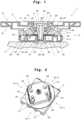
- Fig. 1 shows a simplified sectional view of an exemplary embodiment of the adjustment unit 1 with a first component 2, a second component 3, a support structure 4, and a main connecting element 5.
- the second component 3 comprises a first structural element 3-1 and a second structural element 3-2 with a pressure distribution element 7 in between.
- the first and second components 2, 3 are pivotally connected to one another by the main connecting element 5.
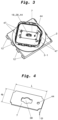
- Fig. 2 shows a perspective view of a view of the side of the second component in Fig. 1 which will rest on the supporting structure. In the Figures 1 and 2 the supporting structure 4 is not yet connected to the other components.
- the first component 2 is a rectangular profile structure made of plastic with a top side 8 and a bottom side 9 as well as four side edges 10-1 to 10-4. On opposite sides 10-1 and 10-3, holding elements 12 for a clamp-slide connection according to EP0609508B1 Centrally, the first component 2 has a hemispherical bulge or depression 14 with a convex and a concave side 16, 17. The bulge 14 has a central opening 18.
- the first component 3-1 of the second component 3 has an upper side 24 and a lower side 25.
- a hemispherical recess 26 is provided with a concave sliding surface 27, which is complementary to the convex side 17 of the bulge 14.
- the first component 3-1 comprises a central opening 28, which is aligned with the central opening 18.
- a sliding element 29 is arranged between the convex side 17 of the bulge 14 and the concave sliding surface 27, as can be seen from the EP1346161B1 is known.
- the second part 3-2 of the second component 3 is designed as a hollow profile having an upper side 30, a lower side 31, and a central internal thread 32 aligned with the central openings 18 and 28.
- the pressure distribution element 7 in the form of a metal plate is arranged between the first and second components 3-1, 3-2.
- the pressure distribution element or pressure distribution plate 7 is completely enclosed by the first and second components 3-1 and 3-2.
- the pressure distribution element 7 has a central opening 38 which is aligned with the central openings 18 and 28 and with the internal thread 32.
- Both the first component 3-1 and the second component 3-2 have contact surfaces 40 which are in contact with the pressure distribution element 7.
- the plate-shaped pressure distribution element 7 rests on at least three contact surfaces 40 on the second component 3-2.
- the contact surfaces 40 are arranged in spatial proximity to the contact points 34 on the underside 31 of the second component 3-2.
- the two components 3-1 and 3-2 are supported on one another and connected to one another via a tongue and groove connection in the outer edge region.
- the plate-shaped pressure distribution element 7 has a fixing opening 44 into which a corresponding fixing pin 46 on the first or second component 3-i engages.
- the pressure distribution plate 7 has rounded corners that allow space for fixing elements 47, by which the first and second components 3-1, 3-2 of the second component 3 are connected to one another.
- the main connecting element 5 is designed as a hollow mandrel and comprises an upper end region 48 and a lower end region 50.
- a seat 49 for a screw or locking bolt head is countersunk in the upper end region.
- the lower end region 50 comprises an external thread 52 that matches the internal thread 32 in the second component 3-2.
- the main connecting element 5 passes through the central openings 18, 22, and 38 and is screwed into the internal thread 32.
- a circumferential collar 54 is provided in the upper end region 48.
- the spring element 6 in the form of a spiral spring is arranged between the circumferential collar 54 and the edge of the central opening 18 in the bulge 14.
- the external thread 52 of the main connecting element 5 is limited in a central region of the main connecting element 5 by a circumferential stop 56.
- the internal thread 32 ends in a threaded seat 57 in the form of a circumferential collar.
- the first component 2 is clamped against the second component and the plate-shaped pressure distribution element 7 is clamped by the stop 56. subjected to pressure.
- the pressure distribution element 7 distributes the pressure applied by the main connecting element 5 transversely to the longitudinal direction of the main connecting element 5, so that the force transmission between the supporting structure 4 and the second component 3 does not occur primarily via the tubular contact area 36, but is also evenly distributed via the contact points 34.
- the external thread 52 and the internal thread 32 have thread play.
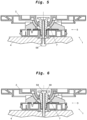
- FIGS. 5 and 6 show two variants of the connection of the supporting structure 4 with the other components by means of a fastening element in the form of a screw 58.
- the screw 58 passes through the supporting structure 4 and is screwed into the main connecting element 5 in the form of a hollow mandrel.
- the screw 58 is screwed from the main fastening element into the supporting structure 4 and the screw head comes to rest in the countersunk seat 49.
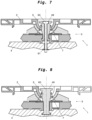
- Figure 7 shows a third variant of connecting the support structure 4 to the remaining components by means of a fastening element in the form of a locking bolt 60.
- the locking bolt 60 penetrates both the main connecting element 5 and the support structure 4, is supported in the countersunk seat 49, and is secured to a surface of the support structure 4 or in the support structure 4 by a locking pin 61.
- the main connecting element 5 does not require an external thread, and the second component 3-2 of the second component 3 does not have a corresponding internal thread.
- Appropriate pressure on the locking bolt 60 also results in additional deformation of the pressure distribution element 7 and a transverse distribution of the forces to the contact points 34.
- Fig. 8 shows a fourth variant of the invention, in which the main connecting element is not designed as a hollow mandrel and the lower end region 50 of the main connecting element 5 is anchored in the support structure 4 in the manner of a bayonet lock.
- the main connecting element 5 also does not comprise an external thread and the second component 3-2 of the second component 3 does not have a corresponding internal thread.
- Fig. 9 shows a fifth variant of the invention with a one-piece second component 3 into which the pressure distribution plate 7 is integrated and which has a central opening 28.
- the lower end region 50 of the main connecting element 5 has a snap-in device 62 distributed over the circumference of the main connecting element 5, which snap-in device can be deformed radially inwards.
- the second component 3 has a circumferential projection 64 or individual projections 64 in the central opening 28 in the region of the lower end region 50.
- the main connecting element 5 with the first component 2 is pressed into the central opening 28 of the second component 3 until the snap-in device 62 engages behind the projection(s) 64 and connects the two components 2 and 3 to one another.
- the connection to the support structure 4 is made as in the first variant according to Fig. 5 with a screw 58 which passes through the supporting structure 4 and is screwed into the main connecting element 5.
- Fig. 10 shows a sixth variant of the invention, which differs from the fifth variant only in that no pressure distribution element is provided.
- the purpose of the sixth variant is to connect the two components 2 and 3 to one another in a pre-assembly using the clip connection and then to connect the two components together to the supporting structure. Due to the pre-assembly or the connection of the two components 2, 3 and the main connecting element 5 with the spring element 6 using clip or snap connections 62, 64, only one part needs to be connected to the supporting structure 4. This considerably simplifies assembly.
- connection variants between the main connecting element 5 and the second component 3 and the main connecting element 5 and the supporting structure 4 after the Figures 5 to 10 i.e. screw connection, locking elements, clip connection, bayonet connection can be combined with each other, so that in addition to the variants shown in the figures, further variants of the connection result and are encompassed by the present invention.
- the slight axial displacement of the main connecting element 5 due to the thread play between the internal thread 32 and the external thread 52, or due to the missing thread, makes it possible to compensate for the positional tolerances between the contact surfaces 40 of the second component 3 and the pressure distribution element 5. Age-related deformations can also be compensated for in this way.
- the entire adjustment unit 1 can be mounted in the tightest of spaces because the fastening element penetrates the main connecting element 5.
- only a single fastening element or, in a variant, no additional fastening element is required, which reduces the number of parts and further reduces the installation space.
Landscapes
- Engineering & Computer Science (AREA)
- Multimedia (AREA)
- Mechanical Engineering (AREA)
- Springs (AREA)
- Connection Of Plates (AREA)
- Mutual Connection Of Rods And Tubes (AREA)
Description
- Die vorliegende Offenbarung betrifft eine Verstelleinheit für ein indirektes Sichtsystem nach Anspruch 1 sowie ein Verfahren zur Montage einer solchen Verstelleinheit nach Anspruch 18.
- Für die Anwendung von Verstelleinheiten bei indirekten Sichtsystemen bei Fahrzeugen, wie Spiegeln oder Kameras, gibt es eine Vielzahl von technischen Lösungen, wiesie z. B in der
WO2002/072386A1 oder derEP1728682A1 beschrieben sind. Jedoch gibt es keine technischen Lösungen, die die Anbindung an das Sichtsystem im kleinstmöglichen Bauraum bereitstellen, und dennoch für robuste mechanische Anforderungen geeignet sind. Auch verschiedene Fügerichtungen sind aktuell auf engem Bauraum schwierig umzusetzen. - Aus der
DE 1020111 01534B4 ist eine Verstelleinheit für Rückspiegel an Kraftfahrzeugen bekannt, bei der eine erste und eine zweite Komponente durch ein Hauptverbindungselement schwenkbar miteinander verbunden sind. Das Hauptverbindungselement umfasst ein Federelement, das die erste und die zweite Komponente gegeneinander verspannt. - Aus der
DE10163318C1 ist eine Verstelleinheit für ein indirektes Sichtsystem mit einer ersten und einer zweiten Komponente bekannt, die mittels einem Hauptverbindungselement schwenkbar miteinander verbunden sind. Die zweite Komponente umfasst ein Druckverteilelement, das durch ein Federelement mit Druck beaufschlagt wird. - Aus der
EP0269081A1 ist eine Spiegelverstelleinheit mit zwei Komponenten bekannt, die über ein Hauptverbindungselement schwenkbar miteinander und mit einer Tragstruktur verbunden sind, wobei die beiden Komponenten durch ein Federelement gegeneinander verspannt sind. - Aus der
DE19644824C1 , derUS4824065A und derWO2007/126190A1 ist jeweils eine Spiegelverstelleinrichtung mit zwei Komponenten bekannt, die über ein Hauptverbindungselement schwenkbar miteinander und mit einer Tragstruktur verbunden sind, Die Verbindung zwischen dem Hauptverbindungselement und der Tragstruktur erfolgt bei derDE19644824C1 und derUS4824065A über eine Schraubverbindung und bei derWO2007/126190A1 über eine Verriegelungsgemometrie. - Aus der
DE102004029229A1 ist es bekannt ist es bekannt den Spiegelkopf eines Fahrzeugaußenspiegels mittels Schnappverbindungen mit dem am Fahrzeug befestigten Spiegelfuß zu verbinden. - Weiterer Stand der Technik ist aus der
DE 10 2014 011 232 A1 bekannt. - Ausgehend von der
DE10163318C1 ist es Aufgabe der Erfindung, eine Verstelleinheit bereitzustellen, die mit möglichst wenigen Verbindungselementen an einer Tragstruktur eines indirekten Sichtsystems verbunden ist. Dabei soll die Schnittstelle der Verstelleinheit zur Tragstruktur in einem kleinen Bauraum robusten mechanischen Anforderungen standhalten. - Die Lösung dieser Aufgabe erfolgt durch die Merkmale des Anspruchs 1.
- Dadurch, dass das Druckverteilelement der zweiten Komponente durch das Hauptverbindungselement mit Druck beaufschlagt ist, werden die mittig auf das Druckverteilelement und damit auf die zweite Komponente eingeleiteten Kräfte gleichmäßig in der in Richtung quer zum Hauptverbindungselement verteilt. Der Kraftschluss mit der Tragstruktur erfolgt daher nicht mehr zentral, sondern verteilt über die Quererstreckung der zweiten Komponente. Damit können Maßveränderungen durch Alterung - Kriechverhalten von Kunststoffen - kompensiert werden und ein Verzug der einzelnen Bauteile wird verringert. Zudem ergibt sich eine geschickte Sandwich-Bauweise, die einen direkten Kraftfluss zwischen Tragstruktur und erster und zweiter Komponente ermöglicht.
- Gemäß einer bevorzugten Ausführungsform greift das Federelement an einer Kontaktfläche im oberen Randbereich des Hauptverbindungselements, z. B. an einem umlaufenden Kragen an und verspannt die erste und zweite Komponente zueinander - Anspruch 2.
- Gemäß einer vorteilhaften Ausgestaltung erfolgen die Verbindung zwischen der ersten und zweiten Komponente mittels dem Hauptverbindungselement und das Verspannen der beiden Komponenten zueinander mittels dem Federelement derart, dass eine axiale Längsbewegung entlang der Längsrichtung des Hauptverbindungselements möglich ist. Hierdurch vereinfacht sich die Schwenkbewegung zwischen der ersten und zweiten Komponente und es werden alterungsbedingte Formänderungen aufgefangen - Anspruch 3.
- Gemäß einer vorteilhaften Ausgestaltung erfolgt die Verbindung zwischen der zweiten Komponente und der Tragstruktur durch eine direkte Verbindung zwischen dem unteren Endbereich des Hauptverbindungselements. Auf diese Weise werden die Anzahl der benötigten Bauteile und der für die Verbindung notwendige Bauraum minimal - Anspruch 4.
- Alternativ erfolgt die Verbindung zwischen der Tragstruktur und dem Hauptverbindungselement nicht durch ein direktes Eingreifen des Hauptverbindungselements in die Tragstruktur, sondern mittels eines Befestigungselements, das in der Tragstruktur und in dem Hauptverbindungselement verankert ist - Anspruch 5.
- Das Befestigungselement ist vorzugsweise eine Schraube oder ein Verriegelungsbolzen, der aus die Tragstruktur durchdringt und in dem Hauptverbindungselement verankert ist oder der das Hauptverbindungselement durchdringt und in der Tragstruktur verankert ist. In beiden Fällen ergibt sich eine platzsparende Verbindung - Anspruch 6.
- Auch die Verbindung zwischen Hauptverbindungselement und zweiter Komponente und Hauptverbindungselement und Tragstruktur erfolgt vorzugsweise mittels angeformter Schraubverbindung, angeformter Clipsverbindung oder angeformter Verriegelungsgeometrie - Anspruch 7.
- Das Hauptverbindungselement kann entweder in der zweiten Komponente zur Anlage kommen oder es durchsetzt die zweite Komponente und kommt auf der Tragstruktur zur Anlage - Anspruch 8.
- Die Druckbeaufschlagung des Druckverteilelements durch das Hauptverbindungselement erfolgt auf einfache Weise durch eine axiale Längsbewegung des Hauptverbindungselements bei der Verbindung der ersten und zweiten Komponente und/oder der Verbindung des Hauptverbindungselements mit der Tragstruktur. Durch diese axiale Längsbewegung werden die erste und zweite Komponente zusätzlich zueinander verspannt - Anspruch 9.
- Das Druckverteilelement besteht in vorteilhafter Weise aus einem elastischen Material und/oder einer elastischen Geometrie, so dass es durch die Druckbeaufschlagung verformt wird und unter mechanischer Spannung steht. Durch diesen Federspeichereffekt können Verformungen der Kunststoffkomponenten (z. B. erste und zweite Komponente) und auch Fertigungstoleranzen aufgefangen bzw. ausgeglichen werden - Anspruch 10.
Diese Elastizität wird auf einfache Weise durch eine Ausgestaltung des Druckverteilelements in Form einer Metallplatte erreicht. Als vorteilhaft haben sich hierbei nachfolgende Dimensionen ergeben. Das plattenförmige Druckverteilelement weist eine Fläche zwischen 1000 mm2 und 3200 mm2, eine Längenausdehnung L von 50 bis 80 mm, eine Breitenausdehnung B von 20 bis 40 mm und eine Dicke von 1 bis 3 mm auf - Anspruch 11. - Durch die vorteilhaften Ausgestaltungen nach Anspruch 12 ist das Druckverteilelement im eingebauten Zustand nahezu unbeweglich, während das Federelement axiale Längsbewegungen und eine Schwenkbewegung zwischen der ersten und zweiten Komponente zulässt.
- Durch die vorteilhaften Ausgestaltungen nach Anspruch 13 ergibt sich eine Sandwich-Bauweise, die einen direkten Kraftfluss zwischen Tragstruktur und erster und zweiter Komponente ermöglicht.
- Das Druckverteilelement weist wenigstens zwei und vorzugsweise wenigstens drei Kontaktbereiche zur zweiten Komponente auf. Über diese Kontaktbereiche erfolgt der Kraftfluss zwischen Hauptverbindungselement, zweiter Komponente und Tragstruktur - Anspruch 14. Durch die räumliche Nähe der Kontaktbereiche der zweiten Komponente zum Druckverteilelement mit den Kontaktstellen der zweiten Komponente zur Tragstruktur verbessert sich der Kraftfluss zwischen Hauptverbindungselement, zweiter Komponente und Tragstruktur zusätzlich - Anspruch 15.
- Gemäß einer vorteilhaften Ausgestaltung sind die erste und zweite Komponente zueinander motorisch verschwenkbar - Anspruch 16.
- Durch eine Adapterplatte zwischen zweiter Komponente und Tragstruktur lassen sich auf einfache Weise an unterschiedliche Tragstrukturen integrieren - Anspruch 17.
- Durch die Vormontage von erster und zweiter Komponente durch das Hauptverbindungselement zu einer Einheit - Anspruch 18 - vereinfacht sich die Montage der Verstelleinheit erheblich, da nach der Vormontage nur noch ein einzelnes Bauteil mit der Tragstruktur verbunden werden muss.
- Weitere Einzelheiten, Merkmale und Vorteile der Erfindung ergeben sich aus der nachfolgenden Beschreibung bevorzugter Ausführungsformen anhand der Zeichnung.
- Es zeigt
-
Fig. 1 eine Schnittdarstellung einer beispielhaften Ausgestaltung der Verstelleinheit, wobei die Verbindung zur Tragstruktur noch nicht hergestellt ist; -
Fig. 2 eine perspektivische Darstellung einer Aufsicht auf die Seite der zweiten Komponente, die auf der Tragstruktur zu liegen kommt; -
Fig. 3 eine perspektivische Darstellung einer Aufsicht auf das Druckverteilelement zwischen erstem und zweitem Bauteil der zweiten Komponente in Richtung der ersten Komponente betrachtet; -
Fig. 4 eine perspektivische Darstellung des Druckverteilelements ausFig. 1 bis 3 ; -
Fig. 5 eineFig. 1 entsprechende Schnittdarstellung in montiertem Zustand, gemäß einer ersten Variante; -
Fig. 6 eineFig. 1 entsprechende Schnittdarstellung in montiertem Zustand, gemäß einer zweiten Variante; -
Fig. 7 eineFig. 1 entsprechende Schnittdarstellung in montiertem Zustand, gemäß einer dritten Variante; -
Fig. 8 eineFig. 1 entsprechende Schnittdarstellung in montiertem Zustand, gemäß einer vierten Variante; -
Fig. 9 eineFig. 1 entsprechende Schnittdarstellung in montiertem Zustand, gemäß einer fünften Variante; und -
Fig. 10 eineFig. 1 entsprechende Schnittdarstellung in montiertem Zustand, gemäß einer sechsten Variante. -
Fig. 1 zeigt eine vereinfachte Schnittdarstellung einer beispielhaften Ausgestaltung der Verstelleinheit 1 mit einer ersten Komponente 2, einer zweiten Komponente 3, einer Tragstruktur 4 und einem Hauptverbindungselement 5. Die zweite Komponente 3 umfasst ein erstes Bauelement 3-1 und ein zweites Bauelement 3-2 mit einem Druckverteilelement 7 dazwischen. Durch das Hauptverbindungselement 5 werden die erste und die zweite Komponente 2, 3 schwenkbar miteinander verbunden.Fig. 2 zeigt eine perspektivische Darstellung einer Ansicht auf die Seite der zweiten Komponente inFig. 1 , die auf der Tragstruktur zu liegen kommt. In denFiguren 1 und 2 ist die Tragstruktur 4 noch nicht mit den übrigen Komponenten verbunden. - Die erste Komponente 2 ist eine rechteckige Profilstruktur aus Kunststoff mit einer Oberseite 8 und einer Unterseite 9 sowie vier Seitenkanten 10-1 bis 10-4. An gegenüberliegenden Seiten 10-1 und 10-3 sind Haltelemente 12 für eine Klemmschiebeverbindung nach
EP0609508B1 vorgesehen. Zentral weist die erste Komponente 2 eine halbkugelförmige Ausbuchtung oder Vertiefung 14 mit einer konvexen und einer konkaven Seite 16, 17 auf. Die Ausbuchtung 14 weist eine zentrale Öffnung 18 auf. - Das erste Bauteil 3-1 der zweiten Komponente 3 weist eine Oberseite 24 und eine Unterseite 25 auf. In der Oberseite 24 ist eine halbkugelförmige Vertiefung 26 mit einer konkaven Gleitfläche 27 vorgesehen, die komplementär zu der konvexen Seite 17 der Ausbuchtung 14 ausgebildet ist. Das erste Bauteil 3-1 umfasst eine zentrale Öffnung 28, die mit der zentralen Öffnung 18 fluchtet. Zwischen der konvexen Seite 17 der Ausbuchtung 14 und der konkaven Gleitfläche 27 ist ein Gleitelement 29 angeordnet, wie es aus der
EP1346161B1 bekannt ist. Das zweite Bauteil 3-2 der zweiten Komponente 3 ist als Hohlprofil ausgebildet, das eine Oberseite 30, eine Unterseite 31 und zentral ein Innengewinde 32 aufweist, das mit den zentralen Öffnungen 18 und 28 fluchtet. Auf der Unterseite 31 sind im äußeren Randbereich drei Kontaktstellen 34 vorgesehen, die im montierten Zustand an der Tragstruktur 4 anliegen. Unter dem Innengewinde 32 ist auf der Unterseite 31 des zweiten Bauteils 3-2 ein rohrförmiger Anlagebereich 36 vorgesehen, der im montierten Zustand ebenfalls an der Tragstruktur 4 anliegt. - Zwischen dem ersten und zweiten Bauteil 3-1, 3-2 ist das Druckverteilelement 7 in Form einer Metallplatte angeordnet. Das Druckverteilelement bzw. die Druckverteilerplatte 7 ist durch das erste und zweite Bauteil 3-1 und 3-2 vollständig umschlossen. Wie aus
Fig. 3 und 4 zu ersehen ist, weist das Druckverteilelement 7 eine zentrale Öffnung 38 auf, die mit den zentralen Öffnungen 18 und 28 und mit dem Innengewinde 32 fluchtet. Sowohl das erste Bauteil 3-1 als auch das zweite Bauteil3-2 weisen Kontaktflächen 40 auf, die in Kontakt mit dem Druckverteilelement 7 stehen. Das plattenförmige Druckverteilelement 7 liegt an wenigstens drei Kontaktflächen 40 auf dem zweiten Bauteil 3-2 auf. Um den Kraftfluss zwischen dem Hauptverbindungselement, der zweiten Komponente 3 und der Tragstruktur 4 zu optimieren, sind die Kontaktflächen 40 in räumlicher Nähe zu den Kontaktstellen 34 auf der Unterseite 31 des zweiten Bauteils 3-2 angeordnet. Über eine Nut- und Feder-Verbindung im äußeren Randbereich stützen sich die beiden Bauteile 3-1 und 3-2 aufeinander ab und sind miteinander verbunden. Das plattenförmige Druckverteilelement 7 weist eine Fixieröffnungen 44 auf, in die ein entsprechender Fixierdorne 46 an dem ersten oder zweiten Bauteil 3-i eingreifen. Die Druckverteilplatte 7 weist abgerundete Ecken auf, die Platz für Fixierelemente 47 lassen, durch die das erste und zweite Bauteil 3-1, 3-2 der zweiten Komponente 3 miteinander verbunden sind. - Das Hauptverbindungselement 5 ist als Hohldorn ausgebildet und umfasst einen oberen Endbereich 48 und einen unteren Endbereich 50. Im oberen Endbereich ist ein Sitz 49 für einen Schraub- oder Riegelbolzenkopf versenkt angeordnet. Der untere Endbereich 50 umfasst ein Außengewinde 52, das zu dem Innengewinde 32 im zweiten Bauteil 3-2 passt. Das Hauptverbindungselement 5 durchsetzt die zentralen Öffnungen 18, 22 und 38 und wird in das Innengewinde 32 eingeschraubt. Im oberen Endbereich 48 ist ein umlaufender Kragen 54 vorgesehen. Zwischen dem umlaufenden Kragen 54 und dem Rand der zentralen Öffnung 18 in der Ausbuchtung 14 ist das Federelement 6 in Form einer Spiralfeder angeordnet. Das Außengewinde 52 des Hauptverbindungselements 5 wird in einem mittleren Bereich des Hauptverbindungselements 5 durch einen umlaufenden Anschlag 56 begrenzt. Das Innengewinde 32 endet in einem Gewindesitz 57 in Form eines umlaufenden Kragens.
- Durch Einschrauben des Hauptverbindungselements 5 mit der Spiralfeder 6 in das Innengewinde 32 wird zum einen die erste Komponente 2 gegen die zweite Komponente verspannt und durch den Anschlag 56 wird das plattenförmige Druckverteilelement 7 mit Druck beaufschlagt. Durch das Druckverteilelement 7 wird die Druckbeaufschlagung durch das Hauptverbindungselement 5 quer zur Längsrichtung des Hauptverbindungselements 5 verteilt, so dass die Kraftübertragung zwischen der Tragstruktur 4 und der zweiten Komponente 3 nicht hauptsächlich über den rohrförmigen Anlagebereich 36, sondern gleichverteilt auch über die Kontaktstellen 34 erfolgt. Das Außengewinde 52 und das Innengewinde 32 weisen ein Gewindespiel auf.
- Die
Figuren 5 und 6 zeigen zwei Varianten der Verbindung der Tragstruktur 4 mit den übrigen Komponenten mittels eines Befestigungselements in Form einer Schraube 58. In der ersten Variante nachFig. 5 durchsetzt die Schraube 58 die Tragstruktur 4 und wird in das Hauptverbindungselement 5 in Form eines Hohldorns eingeschraubt. In der zweiten Variante nachFig. 6 wird die Schraube 58 von dem Hauptbefestigungselement aus in die Tragstruktur 4 eingeschraubt und der Schraubkopf kommt in dem versenkten Sitz 49 zu liegen. Durch das Gewindespiel zwischen Innengewinde 32 und Außengewinde 52 wird beim Verbinden der Tragstruktur 4 mit den übrigen Komponenten zusätzlich durch eine leichte axiale Verschiebung des Hauptverbindungselements 5 zusätzlich Druck auf das Druckverteilelement 7 ausgeübt, das sich dadurch leicht verformt, wie dies in denFiguren 5 und 6 gezeigt ist. Auch dieser zusätzliche Druckwird durch das plattenförmige Druckverteilelement 7 in Querrichtung verteilt, durch die beiden Bauteil 3-2 und 3-2 aufgenommen und gleichmäßig über die Kontaktstellen 34 und den Anlagebereich 36 abgeleitet. -
Figur 7 zeigt eine dritte Variante der Verbindung der Tragestruktur 4 mit den übrigen Komponenten mittels eines Befestigungselements in Form eines Riegelbolzens 60. Der Riegelbolzen 60 durchsetzt sowohl das Hauptverbindungselement 5 als auch die Tragstruktur 4, stützt sich in dem versenkten Sitz 49 ab und wird an einer Oberfläche der Tragstruktur 4 oder in der Tragstruktur 4 durch einen Verriegelungssplint 61 gesichert. Das Hauptverbindungselement 5 benötigt kein Außengewinde und das zweite Bauteil 3-2 der zweiten Komponente 3 weist kein entsprechendes Innengewinde auf. Durch entsprechenden Druck auf den Riegelbolzen 60 ergibt sich ebenfalls eine zusätzliche Verformung des Druckverteilelements 7 und ebenso eine Querverteilung der Kräfte auf die Kontaktstellen 34. -
Fig. 8 zeigt eine vierte Variante der Erfindung, bei der das Hauptverbindungselement nicht als Hohldorn ausgeführt ist und der untere Endbereich 50 des Hauptverbindungselements 5 nach Art eines Bajonettverschlusses in der Tragstruktur 4 verankert ist. Auch bei dieser Variante umfasst das Hauptverbindungselement 5 kein Außengewinde und das zweite Bauteil 3-2 der zweiten Komponente 3 weist kein entsprechendes Innengewinde auf. -
Fig. 9 zeigt eine fünfte Variante der Erfindung mit einer einteiligen zweiten Komponente 3 in die die Druckverteilerplatte 7 integriert ist und die eine zentrale Öffnung 28 aufweist. Der untere Endbereich 50 des Hauptverbindungselements 5 weist eine über den Umfang des Hauptverbindungselements 5 verteilt angeordnete Schnappeinrichtung 62 auf, der sich in radialer Richtung nach innen verformen lässt. Die zweite Komponente 3 weist in der zentralen Öffnung 28 im Bereich des unteren Endbereichs 50 einen umlaufenden Vorsprung 64 oder einzelne Vorsprünge 64 auf. Zur Vormontage wird das Hauptverbindungselement 5 mit der ersten Komponente 2 in die zentrale Öffnung 28 der zweiten Komponente 3 gedrückt bis die Schnappeinrichtung 62 den/die Vorsprung/Vorsprünge 64 hintergreift und die beiden Komponenten 2 und 3 miteinander verbindet. Die Verbindung mit der Tragstruktur 4 erfolgt wie bei der ersten Variante nachFig. 5 mit einer Schraube 58, die die Tragstruktur 4 durchsetzt und in das Hauptverbindungselement 5 eingeschraubt ist. -
Fig. 10 zeigt eine sechste Variante der Erfindung, die sich von der fünften Variante lediglich dadurch unterscheidet, dass kein Druckverteilelement vorgesehen ist. Der Zweck der sechsten Variante besteht darin die beiden Komponenten 2 und 3 in einer Vormontage mittels der Clipsverbindung miteinander zu verbinden und dann die beiden Komponenten zusammen mit der Tragstruktur zu verbinden. Durch die Vormontage bzw. der Verbindung der beiden Komponenten 2, 3 und dem Hauptverbindungselement 5 mit Federelement 6 mittels Clips- oder Schnappverbindung 62, 64 muss nur noch ein Teil mit der Tragstruktur 4 verbunden werden. Hierdurch wird die Montage erheblich vereinfacht. - Die verschiedenen Verbindungsvarianten zwischen dem Hauptverbindungselement 5 und dem zweiten Bauteil 3 und dem Hauptverbindungselement 5 und der Tragstruktur 4 nach den
Figuren 5 bis 10 , d. h. Schraubverbindung, Verriegelungselemente, Clipsverbindung, Bajonettverbindung können miteinander kombiniert werden, so dass sich neben den in den Figuren gezeigten Varianten weitere Varianten der Verbindung ergeben und von der vorliegenden Erfindung umfasst werden. - In den
Figuren 5 bis 10 sind aus Gründen der Übersichtlichkeit nur die für die jeweilige Ausführungsform relevanten Bezugszeichen eingezeichnet. - Durch die leichte axiale Verschiebung des Hauptverbindungselements 5 aufgrund des Gewindespiels zwischen dem Innengewinde 32 und dem Außengewinde 52 bzw, aufgrund des fehlenden Gewindes ist es möglich die Lagetoleranzen zwischen den Kontaktflächen 40 der zweiten Komponente 3 zum Druckverteilelement 5 auszugleichen. Auch alterungsbedingte Formveränderungen können dadurch ausgeglichen werden. Die Befestigung der gesamten Verstelleinheit 1 ist auf engstem Bauraum möglich, da das Befestigungselement das Hauptverbindungselement 5 durchdringt. Auch ist in vorteilhafter Weise nur ein einziges Befestigungselement oder einer Variante kein zusätzliches Befestigungselement erforderlich, was die Anzahl der Teile verringert und zusätzlich den Bauraum verkleinert.
-
- 1
- Verstelleinheit
- 2
- erste Komponente
- 3
- zweite Komponente
- 3-1
- erstes Bauteil von 3
- 3-2
- zweites Bauteil von 3
- 4
- Tragstruktur
- 5
- Hauptverbindungselement
- 6
- Federelement
- 7
- Druckverteilelement
- 8
- Oberseite von 2
- 9
- Unterseite von 2
- 10-i
- Seitenkanten von 2
- 12
- Haltelemente an 2 für Klemmschiebeverbindung
- 14
- halbkugelförmige Ausbuchtung bzw. Vertiefung an/in 2
- 16
- konkave Seite von 14
- 17
- konvexe Seite von 14
- 18
- zentrale Öffnung in 14
- 24
- Oberseite von 3-1
- 25
- Unterseite von 3-1
- 26
- halbkugelförmige Vertiefung in 3-1
- 27
- konkave Gleitfläche in 26
- 28
- zentrale Öffnung in 26, 27
- 29
- Gleitelement zwischen 17 und 27
- 30
- Oberseite von 3-2
- 31
- Unterseite von 3-2
- 32
- Innengewinde in 3-2
- 34
- Kontaktstellen an 31 zu 4
- 36
- rohrförmiger Anlagebereich an 31 zu 4
- 38
- zentrale Öffnung in 7
- 40
- Kontaktflächen an 3-i zu 7
- 42
- Nut- und Federverbindung zwischen 3-1 und 3-2
- 44
- Fixieröffnungen in 7
- 46
- Fixierdorne an 3-1 oder 3-2
- 47
- Fixierelemente
- 48
- oberer Endbereich von 5
- 49
- versenkter Sitz in 5
- 50
- unterer Endbereich von 5
- 52
- Außengewinde an 43
- 54
- umlaufender Kragen an 5
- 56
- umlaufender Anschlag an 5
- 57
- Gewindesitz in 3-2
- 58
- Befestigungselement Schraube
- 60
- Befestigungselement Riegelbolzen
- 61
- Verriegelungssplint
- 62
- Schnappeinrichtung
- 64
- umlaufender Vorsprung oder mehrere Vorsprünge an 3 in 28
Claims (18)
- Verstelleinheit (1) für ein indirektes Sichtsystem für ein Fahrzeug, mit einer ersten Komponente (2), die mit einer indirekten Sichtkomponente verbindbar ist,einer zweiten Komponente (3), die mit einer Tragstruktur (4) des indirekten Sichtsystems verbunden ist,wobei die erste Komponente (2) und die zweite Komponente (3) mittels ersten und zweiten Kontaktflächen (17, 27) schwenkbar zueinander gelagert sind, einem Hauptverbindungselement (5) mit einem der ersten Komponente (2) zugewandtem oberen Endbereich (48) und einem der zweiten Komponente (3) zugewandtem unteren Endbereich (50), wobei das Hauptverbindungselement (5) die erste und zweite Komponente (2, 3) schwenkbar miteinander verbindet, und einem Federelement (6), das die erste und zweite Komponenten (2, 3) miteinander verspannt,wobei die zweite Komponente (3) ein Druckverteilelement (7) umfasst, das sich quer zur Längsrichtung des Hauptverbindungselements (5) erstreckt, und wobei das Druckverteilelement (7) durch das Hauptverbindungselement (5) mit Druck beaufschlagt ist,so dass das Druckverteilelement (7) den Druck des Hauptverbindungselements (5) über die Quererstreckung der zweiten Komponente (3) auf die Tragstruktur (4) ableitet, dadurch gekennzeichnet,dass die zweite Komponente (3) ein erstes, der ersten Komponente (2) zugewandtes Bauteil (3-1) und ein zweites, der Tragstruktur (4) zugewandtes Bauteil (3-2) aufweist und dass das Druckverteilelement (7) zwischen dem ersten und zweiten Bauteil (3-1, 3-2) angeordnet ist und dass das Druckverteilelement (7) im äußeren Randbereich wenigstens zwei Kontaktbereiche (40) zum ersten und zweiten Bauteil (3-1, 3-2) der zweiten Komponente (3) aufweist.
- Verstelleinheit nach Anspruch 1, dadurch gekennzeichnet, dass das Federelement (6) an einer Kontaktfläche (54) am oberen Endbereich (48) des Hauptverbindungselements (5) und an der ersten Komponente (2) angreift und damit die erste Komponente (2) mit der zweiten Komponente (3) verspannt.
- Verstelleinheit nach Anspruch 1 oder 2, dadurch gekennzeichnet, dass die Verbindung von erster und zweiter Komponente (2, 3) mittels dem Hauptverbindungselement (5) und dem Federelement (6) so ausgestaltet sind, dass eine axiale Längsbewegung der ersten Komponente (2) entgegen der Federkraft des Federelements (6) möglich ist.
- Verstelleinheit nach einem der vorhergehenden Ansprüche, dadurch gekennzeichnet, dass das Hauptverbindungselement (5) mit dem unteren Endbereich (50) mit der Tragstruktur (4) verbunden ist.
- Verstelleinheit nach einem der vorhergehenden Ansprüche 1 bis 3, dadurch gekennzeichnet, dass das Hauptverbindungselement (5) mit dem unteren Endbereich (50) mit der zweiten Komponente (3) verbunden ist, dass ein Befestigungselement (58, 60) das Hauptverbindungselement (5) mit der Tragstruktur (4) verbindet, und dass das Befestigungselement (58, 60) das Hauptverbindungselement (5) durchdringt und in der Tragstruktur (4) verankert ist oder dass das Befestigungselement (58, 60) die Tragstruktur (4) durchdringt und in dem Hauptverbindungselement (5) verankert ist.
- Verstelleinheit nach Anspruch 5, dadurch gekennzeichnet, dass das Befestigungselement (58, 60) und das Hauptverbindungselement (5) mittels angeformter Schraubverbindung (58) oder angeformter Verriegelungsgeometrie (60) verbunden sind.
- Verstelleinheit nach einem der vorhergehenden Ansprüche, dadurch gekennzeichnet, dass das Hauptverbindungselement (5) und die zweite Komponente (3) oder das Hauptverbindungselement (5) und die Tragstruktur (4) mittels angeformter Schraubverbindung (32, 52), angeformter Clipsverbindung oder angeformter Verriegelungsgeometrie verbunden sind.
- Verstelleinheit nach einem der vorhergehenden Ansprüche, dadurch gekennzeichnet, dass das Hauptverbindungselement (5) mit der ersten Komponente (2) oder das Hauptverbindungselement (5) mit der Tragstruktur (4) zur Auflage kommt.
- Verstelleinheit nach einem der vorhergehenden Ansprüche, dadurch gekennzeichnet, dass die Druckbeaufschlagung des Druckverteilelements (7) durch axiale Längsbewegung des Hauptverbindungselements (5) erfolgt.
- Verstelleinheit nach einem der vorhergehenden Ansprüche, dadurch gekennzeichnet, dass das Druckverteilelement (7) elastisch ist und sich aufgrund der Druckbeaufschlagung durch das Hauptverbindungselement (5) verformt.
- Verstelleinheit nach einem der vorhergehenden Ansprüche, dadurch gekennzeichnet, dass das Druckverteilelement (7) plattenförmig ausgebildet ist und insbesondere aus einem metallischen Werkstoff besteht.
- Verstelleinheit nach einem der vorhergehenden Ansprüche, dadurch gekennzeichnet, dass das Material des Federelements (6) einen geringeren Elastizitätsmodul als das Material des Druckverteilelements (7) aufweist und das insbesondere das Federelement (6) eine geringere Federkonstante als das Druckverteilelement (7) bei Belastung in Einbaulage aufweist.
- Verstelleinheit nach einem der vorhergehenden Ansprüche, dadurch gekennzeichnet, dass die zweite Komponente (3) mit dem Druckverteilelement (7) und die Tragstruktur (4) durch das Hauptverbindungselement (5) fest miteinander verbunden sind.
- Verstelleinheit nach einem der vorhergehenden Ansprüche, dadurch gekennzeichnet, dass die zweite Komponente (3) wenigstens drei Kontaktbereiche (40) zum Druckverteilelement (7) aufweist, die im äußeren radialen Randbereich der zweiten Komponente (3) angeordnet sind.
- Verstelleinheit nach einem der vorhergehenden Ansprüche, dadurch gekennzeichnet, dass die wenigstens zwei Kontaktbereiche (40) der zweiten Komponente (3) zum Druckverteilelement (7) in räumlicher Nähe zu den Kontaktstellen (34) der zweiten Komponente (3) zur Tragstruktur (4) liegen und dass der Abstand zwischen den Kontaktbereichen (40) der zweiten Komponente (3) und den Kontaktstellen (34) vorzugsweise 5 - 50mm und insbesondere 5 - 20mm beträgt.
- Verstelleinheit nach einem der vorhergehenden Ansprüche, dadurch gekennzeichnet, dass die erste und zweite Komponente (2, 4) motorisch zueinander verschwenkbar sind.
- Verstelleinheit nach einem der vorhergehenden Ansprüche, dadurch gekennzeichnet, dass eine Adapterplatte zwischen der zweiten Komponente (2) und der Tragstruktur (4) angeordnet ist.
- Verfahren zur Montage einer Verstelleinheit nach einem der vorhergehenden Ansprüche, mit den Verfahrensschritten:a) Verbinden der ersten und zweiten Komponente zu einer Einheit durch das Hauptverbindungselement, undb) Verbinden der Einheit aus Schritt a) mit der Tragstruktur.
Applications Claiming Priority (1)
| Application Number | Priority Date | Filing Date | Title |
|---|---|---|---|
| DE102019215773.4A DE102019215773A1 (de) | 2019-10-14 | 2019-10-14 | Verstelleinheit für ein indirektes Sichtsystem |
Publications (2)
| Publication Number | Publication Date |
|---|---|
| EP3808604A1 EP3808604A1 (de) | 2021-04-21 |
| EP3808604B1 true EP3808604B1 (de) | 2025-06-18 |
Family
ID=72470172
Family Applications (1)
| Application Number | Title | Priority Date | Filing Date |
|---|---|---|---|
| EP20195295.9A Active EP3808604B1 (de) | 2019-10-14 | 2020-09-09 | Verstelleinheit für ein indirektes sichtsystem |
Country Status (3)
| Country | Link |
|---|---|
| US (1) | US11485288B2 (de) |
| EP (1) | EP3808604B1 (de) |
| DE (1) | DE102019215773A1 (de) |
Families Citing this family (1)
| Publication number | Priority date | Publication date | Assignee | Title |
|---|---|---|---|---|
| DE102021200187A1 (de) | 2021-01-11 | 2022-07-14 | Vitesco Technologies GmbH | Kugelpfannen/Kugelzapfenverbindung |
Family Cites Families (23)
| Publication number | Priority date | Publication date | Assignee | Title |
|---|---|---|---|---|
| US2452316A (en) * | 1948-02-12 | 1948-10-26 | Charles E Morley | Adjustable support |
| EP0203456B1 (de) * | 1985-05-14 | 1990-03-28 | Ichikoh Industries Limited | Elektrische Steuervorrichtung eines Spiegels |
| JPH05444Y2 (de) * | 1986-11-26 | 1993-01-07 | ||
| US4877214A (en) * | 1987-01-13 | 1989-10-31 | Murakami Kaimeido Co., Ltd. | Holding device of mirror element for rearview mirror |
| FR2609949B1 (fr) * | 1987-01-23 | 1990-07-20 | Manzoni Bouchot Sa | Retroviseur pour vehicules divers, comportant des moyens de frottement particuliers a ses articulations |
| IT1208243B (it) * | 1987-02-11 | 1989-06-12 | Nardino Righi | Specchio retrovisore per autoveicoli |
| JPH0628358Y2 (ja) * | 1988-04-11 | 1994-08-03 | 株式会社村上開明堂 | バックミラー |
| US4981279A (en) * | 1989-11-07 | 1991-01-01 | Sheller-Globe Corporation | Adjustable rear view mirror |
| DE4302950A1 (de) * | 1993-02-03 | 1994-08-04 | Mekra Rangau Plastics | Verstellbare Rückspiegelanordnung für Kraftfahrzeuge |
| DE19644824C1 (de) * | 1996-10-29 | 1997-12-18 | Buehler Gmbh Nachf Geb | Kupplungseinrichtung zur gelenkigen Verbindung des Spiegelglasträgers eines Kraftfahrzeug-Rückblickspiegels mit dem Gehäuse des Spiegelantriebs |
| US5946151A (en) * | 1997-03-17 | 1999-08-31 | Siegel-Robert, Inc. | Automobile pivotal mirror mounting assembly |
| US5986364A (en) * | 1997-04-14 | 1999-11-16 | Donnelly Corporation | Housing with integral weather seals and noise dampeners for a rearview mirror actuator assembly |
| JP2001322497A (ja) * | 2000-05-12 | 2001-11-20 | Tokai Rika Co Ltd | 鏡面角度調整装置 |
| JP4755392B2 (ja) * | 2001-03-12 | 2011-08-24 | エクスラー アクチエンゲゼルシャフト | 特に自動車ミラーを取り付けるための支持体板のためのモータ駆動式の旋回装置 |
| JP3939506B2 (ja) * | 2001-03-19 | 2007-07-04 | 株式会社東海理化電機製作所 | 鏡面角度調整機構 |
| DE10163318C1 (de) * | 2001-12-21 | 2003-08-28 | Mekra Lang Gmbh & Co Kg | Gelenkvorrichtung insbesondere zum Verstellen von Rückblickspiegeln für Kraftfahrzeuge |
| KR100539070B1 (ko) * | 2003-12-16 | 2005-12-26 | 한국프로큅인터내셔널(주) | 차량용 아웃사이더 미러 조립체의 미러조정기구 |
| DE102004029229A1 (de) * | 2004-06-17 | 2006-01-05 | Rücker GmbH | Außenspiegel eines Kraftfahrzeuges |
| DE102005025614A1 (de) * | 2005-06-03 | 2006-12-07 | Mekra Lang Gmbh & Co. Kg | Außenspiegel mit Verstelleinrichtung |
| KR200421538Y1 (ko) * | 2006-05-02 | 2006-07-12 | 주식회사 액트로닉스 | 자동차용 사이드 미러의 조립구조 |
| JP5775263B2 (ja) * | 2010-02-08 | 2015-09-09 | 株式会社東海理化電機製作所 | 車両用ミラー装置 |
| DE102011101534B4 (de) * | 2011-05-14 | 2014-12-11 | Oechsler Aktiengesellschaft | Verstelleinrichtung für eine verschwenkbare Trägerplatte, insbesondere zur Aufnahme eines Kraftfahrzeugspiegels |
| JP6206652B2 (ja) * | 2013-07-31 | 2017-10-04 | スズキ株式会社 | ドアミラー取付構造 |
-
2019
- 2019-10-14 DE DE102019215773.4A patent/DE102019215773A1/de active Pending
-
2020
- 2020-09-09 EP EP20195295.9A patent/EP3808604B1/de active Active
- 2020-10-13 US US17/069,391 patent/US11485288B2/en active Active
Also Published As
| Publication number | Publication date |
|---|---|
| DE102019215773A1 (de) | 2021-04-15 |
| US20210107405A1 (en) | 2021-04-15 |
| US11485288B2 (en) | 2022-11-01 |
| EP3808604A1 (de) | 2021-04-21 |
Similar Documents
| Publication | Publication Date | Title |
|---|---|---|
| EP2546106B1 (de) | Adapter, Baugruppe mit Adapter sowie Verfahren zur Montage einer solchen Baugruppe | |
| EP1979634B1 (de) | Montageeinheit für die befestigungsöse eines gurtschlosses | |
| EP1746294B1 (de) | Steckkupplung mit dreidimensionaler Ausgleichsbewegung in Plattenmontage | |
| EP2098831B1 (de) | Sensor mit Halterung | |
| EP3329132B1 (de) | Zweiteilige steckkupplung zur verbindung von bauteilen | |
| EP3963217B1 (de) | Befestigungsanordnung mit dämpfungswirkung und bauteilverbindung mit der befestigungsanordnung | |
| DE102012009173B4 (de) | Toleranzausgleichseinrichtung | |
| DE102010024870A1 (de) | Vorrichtung zum Befestigen eines Bauteils an einem Befestigungsbolzen | |
| WO2003048591A1 (de) | Verbindungsmutter zum anschrauben von konstruktionselementen an einem plattenartigen bauteil | |
| EP3159552B1 (de) | Spreiznietverbindung und verfahren zur montage derselben | |
| DE102016109499A1 (de) | System aus einem Bauteil und einer Befestigungsvorrichtung | |
| DE102014103535A1 (de) | Vorrichtung zur Befestigung eines Bauteils an einem Trägerbauteil | |
| DE602005002868T2 (de) | Kraftfahrzeugrahmenanordnung | |
| EP3581811B1 (de) | System zur befestigung einer ersten komponente an einer zweiten komponente | |
| EP3721097B1 (de) | Befestigungsanordnung mit winkelausgleichsfunktion | |
| EP0534001B1 (de) | Schraubverbindung zum Verbinden von zwei beabstandeten Bauteilen, insbesondere Blechen | |
| EP3808604B1 (de) | Verstelleinheit für ein indirektes sichtsystem | |
| EP3529868B1 (de) | Verbindungsanordnung für die verbindung von zwei schaltschrankrahmengestellen | |
| DE202011105943U1 (de) | Toleranzausgleichseinrichtung | |
| EP1780425B1 (de) | Verbindungselement | |
| EP1809912B1 (de) | Befestigungssystem, insbesondere für einen wärmeübertrager | |
| DE102015114230B4 (de) | Anbindungssystem zur Befestigung eines Bauteil an einer Fahrzeugkarosserie | |
| DE102013213822B4 (de) | Bauteilanordnung für ein Lenkrad | |
| DE102007003319A1 (de) | Befestigungsclip und Bauteilverbindung mit einem Befestigungsclip | |
| EP1612432A1 (de) | Befestigungsanordnung für eine Verkleidung und Befestigungsverfahren |
Legal Events
| Date | Code | Title | Description |
|---|---|---|---|
| PUAI | Public reference made under article 153(3) epc to a published international application that has entered the european phase |
Free format text: ORIGINAL CODE: 0009012 |
|
| STAA | Information on the status of an ep patent application or granted ep patent |
Free format text: STATUS: THE APPLICATION HAS BEEN PUBLISHED |
|
| AK | Designated contracting states |
Kind code of ref document: A1 Designated state(s): AL AT BE BG CH CY CZ DE DK EE ES FI FR GB GR HR HU IE IS IT LI LT LU LV MC MK MT NL NO PL PT RO RS SE SI SK SM TR |
|
| AX | Request for extension of the european patent |
Extension state: BA ME |
|
| STAA | Information on the status of an ep patent application or granted ep patent |
Free format text: STATUS: REQUEST FOR EXAMINATION WAS MADE |
|
| 17P | Request for examination filed |
Effective date: 20210609 |
|
| RBV | Designated contracting states (corrected) |
Designated state(s): AL AT BE BG CH CY CZ DE DK EE ES FI FR GB GR HR HU IE IS IT LI LT LU LV MC MK MT NL NO PL PT RO RS SE SI SK SM TR |
|
| STAA | Information on the status of an ep patent application or granted ep patent |
Free format text: STATUS: EXAMINATION IS IN PROGRESS |
|
| 17Q | First examination report despatched |
Effective date: 20220121 |
|
| P01 | Opt-out of the competence of the unified patent court (upc) registered |
Effective date: 20230510 |
|
| GRAP | Despatch of communication of intention to grant a patent |
Free format text: ORIGINAL CODE: EPIDOSNIGR1 |
|
| STAA | Information on the status of an ep patent application or granted ep patent |
Free format text: STATUS: GRANT OF PATENT IS INTENDED |
|
| INTG | Intention to grant announced |
Effective date: 20250122 |
|
| RIN1 | Information on inventor provided before grant (corrected) |
Inventor name: GEUDER, FRANZISKA Inventor name: POPP, ALBRECHT Inventor name: LANG, WERNER |
|
| GRAS | Grant fee paid |
Free format text: ORIGINAL CODE: EPIDOSNIGR3 |
|
| GRAA | (expected) grant |
Free format text: ORIGINAL CODE: 0009210 |
|
| STAA | Information on the status of an ep patent application or granted ep patent |
Free format text: STATUS: THE PATENT HAS BEEN GRANTED |
|
| AK | Designated contracting states |
Kind code of ref document: B1 Designated state(s): AL AT BE BG CH CY CZ DE DK EE ES FI FR GB GR HR HU IE IS IT LI LT LU LV MC MK MT NL NO PL PT RO RS SE SI SK SM TR |
|
| RAP3 | Party data changed (applicant data changed or rights of an application transferred) |
Owner name: MEKRA LANG GMBH & CO. KG |
|
| REG | Reference to a national code |
Ref country code: GB Ref legal event code: FG4D Free format text: NOT ENGLISH |
|
| REG | Reference to a national code |
Ref country code: CH Ref legal event code: EP |
|
| REG | Reference to a national code |
Ref country code: DE Ref legal event code: R096 Ref document number: 502020011231 Country of ref document: DE |
|
| REG | Reference to a national code |
Ref country code: CH Ref legal event code: EP |
|
| REG | Reference to a national code |
Ref country code: IE Ref legal event code: FG4D Free format text: LANGUAGE OF EP DOCUMENT: GERMAN |
|
| REG | Reference to a national code |
Ref country code: NL Ref legal event code: FP |
|
| PG25 | Lapsed in a contracting state [announced via postgrant information from national office to epo] |
Ref country code: FI Free format text: LAPSE BECAUSE OF FAILURE TO SUBMIT A TRANSLATION OF THE DESCRIPTION OR TO PAY THE FEE WITHIN THE PRESCRIBED TIME-LIMIT Effective date: 20250618 |
|
| PGFP | Annual fee paid to national office [announced via postgrant information from national office to epo] |
Ref country code: DE Payment date: 20250813 Year of fee payment: 6 |
|
| REG | Reference to a national code |
Ref country code: LT Ref legal event code: MG9D |
|
| PG25 | Lapsed in a contracting state [announced via postgrant information from national office to epo] |
Ref country code: GR Free format text: LAPSE BECAUSE OF FAILURE TO SUBMIT A TRANSLATION OF THE DESCRIPTION OR TO PAY THE FEE WITHIN THE PRESCRIBED TIME-LIMIT Effective date: 20250919 Ref country code: NO Free format text: LAPSE BECAUSE OF FAILURE TO SUBMIT A TRANSLATION OF THE DESCRIPTION OR TO PAY THE FEE WITHIN THE PRESCRIBED TIME-LIMIT Effective date: 20250918 |
|
| PGFP | Annual fee paid to national office [announced via postgrant information from national office to epo] |
Ref country code: NL Payment date: 20250922 Year of fee payment: 6 |
|
| PG25 | Lapsed in a contracting state [announced via postgrant information from national office to epo] |
Ref country code: BG Free format text: LAPSE BECAUSE OF FAILURE TO SUBMIT A TRANSLATION OF THE DESCRIPTION OR TO PAY THE FEE WITHIN THE PRESCRIBED TIME-LIMIT Effective date: 20250618 |
|
| PG25 | Lapsed in a contracting state [announced via postgrant information from national office to epo] |
Ref country code: HR Free format text: LAPSE BECAUSE OF FAILURE TO SUBMIT A TRANSLATION OF THE DESCRIPTION OR TO PAY THE FEE WITHIN THE PRESCRIBED TIME-LIMIT Effective date: 20250618 |
|
| PGFP | Annual fee paid to national office [announced via postgrant information from national office to epo] |
Ref country code: FR Payment date: 20250922 Year of fee payment: 6 |
|
| PG25 | Lapsed in a contracting state [announced via postgrant information from national office to epo] |
Ref country code: RS Free format text: LAPSE BECAUSE OF FAILURE TO SUBMIT A TRANSLATION OF THE DESCRIPTION OR TO PAY THE FEE WITHIN THE PRESCRIBED TIME-LIMIT Effective date: 20250918 |
|
| PG25 | Lapsed in a contracting state [announced via postgrant information from national office to epo] |
Ref country code: LV Free format text: LAPSE BECAUSE OF FAILURE TO SUBMIT A TRANSLATION OF THE DESCRIPTION OR TO PAY THE FEE WITHIN THE PRESCRIBED TIME-LIMIT Effective date: 20250618 |
|
| PG25 | Lapsed in a contracting state [announced via postgrant information from national office to epo] |
Ref country code: PT Free format text: LAPSE BECAUSE OF FAILURE TO SUBMIT A TRANSLATION OF THE DESCRIPTION OR TO PAY THE FEE WITHIN THE PRESCRIBED TIME-LIMIT Effective date: 20251020 |
|
| PG25 | Lapsed in a contracting state [announced via postgrant information from national office to epo] |
Ref country code: IS Free format text: LAPSE BECAUSE OF FAILURE TO SUBMIT A TRANSLATION OF THE DESCRIPTION OR TO PAY THE FEE WITHIN THE PRESCRIBED TIME-LIMIT Effective date: 20251018 |
|
| PG25 | Lapsed in a contracting state [announced via postgrant information from national office to epo] |
Ref country code: SM Free format text: LAPSE BECAUSE OF FAILURE TO SUBMIT A TRANSLATION OF THE DESCRIPTION OR TO PAY THE FEE WITHIN THE PRESCRIBED TIME-LIMIT Effective date: 20250618 |
|
| PG25 | Lapsed in a contracting state [announced via postgrant information from national office to epo] |
Ref country code: CZ Free format text: LAPSE BECAUSE OF FAILURE TO SUBMIT A TRANSLATION OF THE DESCRIPTION OR TO PAY THE FEE WITHIN THE PRESCRIBED TIME-LIMIT Effective date: 20250618 |
|
| PG25 | Lapsed in a contracting state [announced via postgrant information from national office to epo] |
Ref country code: PL Free format text: LAPSE BECAUSE OF FAILURE TO SUBMIT A TRANSLATION OF THE DESCRIPTION OR TO PAY THE FEE WITHIN THE PRESCRIBED TIME-LIMIT Effective date: 20250618 |
|
| PG25 | Lapsed in a contracting state [announced via postgrant information from national office to epo] |
Ref country code: EE Free format text: LAPSE BECAUSE OF FAILURE TO SUBMIT A TRANSLATION OF THE DESCRIPTION OR TO PAY THE FEE WITHIN THE PRESCRIBED TIME-LIMIT Effective date: 20250618 |
|
| PG25 | Lapsed in a contracting state [announced via postgrant information from national office to epo] |
Ref country code: RO Free format text: LAPSE BECAUSE OF FAILURE TO SUBMIT A TRANSLATION OF THE DESCRIPTION OR TO PAY THE FEE WITHIN THE PRESCRIBED TIME-LIMIT Effective date: 20250618 Ref country code: SK Free format text: LAPSE BECAUSE OF FAILURE TO SUBMIT A TRANSLATION OF THE DESCRIPTION OR TO PAY THE FEE WITHIN THE PRESCRIBED TIME-LIMIT Effective date: 20250618 |
|
| PG25 | Lapsed in a contracting state [announced via postgrant information from national office to epo] |
Ref country code: ES Free format text: LAPSE BECAUSE OF FAILURE TO SUBMIT A TRANSLATION OF THE DESCRIPTION OR TO PAY THE FEE WITHIN THE PRESCRIBED TIME-LIMIT Effective date: 20250618 |
|
| REG | Reference to a national code |
Ref country code: DE Ref legal event code: R097 Ref document number: 502020011231 Country of ref document: DE |
|
| PG25 | Lapsed in a contracting state [announced via postgrant information from national office to epo] |
Ref country code: DK Free format text: LAPSE BECAUSE OF FAILURE TO SUBMIT A TRANSLATION OF THE DESCRIPTION OR TO PAY THE FEE WITHIN THE PRESCRIBED TIME-LIMIT Effective date: 20250618 |
|
| PG25 | Lapsed in a contracting state [announced via postgrant information from national office to epo] |
Ref country code: IT Free format text: LAPSE BECAUSE OF FAILURE TO SUBMIT A TRANSLATION OF THE DESCRIPTION OR TO PAY THE FEE WITHIN THE PRESCRIBED TIME-LIMIT Effective date: 20250618 |
|
| PLBE | No opposition filed within time limit |
Free format text: ORIGINAL CODE: 0009261 |
|
| STAA | Information on the status of an ep patent application or granted ep patent |
Free format text: STATUS: NO OPPOSITION FILED WITHIN TIME LIMIT |
|
| REG | Reference to a national code |
Ref country code: CH Ref legal event code: L10 Free format text: ST27 STATUS EVENT CODE: U-0-0-L10-L00 (AS PROVIDED BY THE NATIONAL OFFICE) Effective date: 20260430 |