EP3790180B1 - Vorrichtung und verfahren zur induktiven erwärmung von metallgut - Google Patents
Vorrichtung und verfahren zur induktiven erwärmung von metallgut Download PDFInfo
- Publication number
- EP3790180B1 EP3790180B1 EP19195424.7A EP19195424A EP3790180B1 EP 3790180 B1 EP3790180 B1 EP 3790180B1 EP 19195424 A EP19195424 A EP 19195424A EP 3790180 B1 EP3790180 B1 EP 3790180B1
- Authority
- EP
- European Patent Office
- Prior art keywords
- coil
- current
- induction
- induction coils
- inverters
- Prior art date
- Legal status (The legal status is an assumption and is not a legal conclusion. Google has not performed a legal analysis and makes no representation as to the accuracy of the status listed.)
- Active
Links
Images
Classifications
-
- H—ELECTRICITY
- H02—GENERATION; CONVERSION OR DISTRIBUTION OF ELECTRIC POWER
- H02M—APPARATUS FOR CONVERSION BETWEEN AC AND AC, BETWEEN AC AND DC, OR BETWEEN DC AND DC, AND FOR USE WITH MAINS OR SIMILAR POWER SUPPLY SYSTEMS; CONVERSION OF DC OR AC INPUT POWER INTO SURGE OUTPUT POWER; CONTROL OR REGULATION THEREOF
- H02M5/00—Conversion of AC power input into AC power output, e.g. for change of voltage, for change of frequency, for change of number of phases
- H02M5/40—Conversion of AC power input into AC power output, e.g. for change of voltage, for change of frequency, for change of number of phases with intermediate conversion into DC
- H02M5/42—Conversion of AC power input into AC power output, e.g. for change of voltage, for change of frequency, for change of number of phases with intermediate conversion into DC by static converters
- H02M5/44—Conversion of AC power input into AC power output, e.g. for change of voltage, for change of frequency, for change of number of phases with intermediate conversion into DC by static converters using discharge tubes or semiconductor devices to convert the intermediate DC into AC
- H02M5/453—Conversion of AC power input into AC power output, e.g. for change of voltage, for change of frequency, for change of number of phases with intermediate conversion into DC by static converters using discharge tubes or semiconductor devices to convert the intermediate DC into AC using devices of a triode or transistor type requiring continuous application of a control signal
- H02M5/458—Conversion of AC power input into AC power output, e.g. for change of voltage, for change of frequency, for change of number of phases with intermediate conversion into DC by static converters using discharge tubes or semiconductor devices to convert the intermediate DC into AC using devices of a triode or transistor type requiring continuous application of a control signal using semiconductor devices only
-
- F—MECHANICAL ENGINEERING; LIGHTING; HEATING; WEAPONS; BLASTING
- F27—FURNACES; KILNS; OVENS; RETORTS
- F27B—FURNACES, KILNS, OVENS OR RETORTS IN GENERAL; OPEN SINTERING OR LIKE APPARATUS
- F27B3/00—Hearth-type furnaces, e.g. of reverberatory type; Electric arc furnaces ; Tank furnaces
- F27B3/08—Hearth-type furnaces, e.g. of reverberatory type; Electric arc furnaces ; Tank furnaces heated electrically, with or without any other source of heat
- F27B3/085—Arc furnaces
-
- F—MECHANICAL ENGINEERING; LIGHTING; HEATING; WEAPONS; BLASTING
- F27—FURNACES; KILNS; OVENS; RETORTS
- F27D—DETAILS OR ACCESSORIES OF FURNACES, KILNS, OVENS OR RETORTS, IN SO FAR AS THEY ARE OF KINDS OCCURRING IN MORE THAN ONE KIND OF FURNACE
- F27D11/00—Arrangement of elements for electric heating in or on furnaces
- F27D11/06—Induction heating, i.e. in which the material being heated, or its container or elements embodied therein, form the secondary of a transformer
-
- F—MECHANICAL ENGINEERING; LIGHTING; HEATING; WEAPONS; BLASTING
- F27—FURNACES; KILNS; OVENS; RETORTS
- F27D—DETAILS OR ACCESSORIES OF FURNACES, KILNS, OVENS OR RETORTS, IN SO FAR AS THEY ARE OF KINDS OCCURRING IN MORE THAN ONE KIND OF FURNACE
- F27D19/00—Arrangements of controlling devices
-
- H—ELECTRICITY
- H02—GENERATION; CONVERSION OR DISTRIBUTION OF ELECTRIC POWER
- H02J—ELECTRIC POWER NETWORKS; CIRCUIT ARRANGEMENTS OR SYSTEMS FOR SUPPLYING OR DISTRIBUTING ELECTRIC POWER; SYSTEMS FOR STORING ELECTRIC ENERGY
- H02J50/00—Circuit arrangements or systems for wireless supply or distribution of electric power
- H02J50/10—Circuit arrangements or systems for wireless supply or distribution of electric power using inductive coupling
-
- H—ELECTRICITY
- H05—ELECTRIC TECHNIQUES NOT OTHERWISE PROVIDED FOR
- H05B—ELECTRIC HEATING; ELECTRIC LIGHT SOURCES NOT OTHERWISE PROVIDED FOR; CIRCUIT ARRANGEMENTS FOR ELECTRIC LIGHT SOURCES, IN GENERAL
- H05B6/00—Heating by electric, magnetic or electromagnetic fields
- H05B6/02—Induction heating
- H05B6/06—Control, e.g. of temperature, of power
-
- H—ELECTRICITY
- H05—ELECTRIC TECHNIQUES NOT OTHERWISE PROVIDED FOR
- H05B—ELECTRIC HEATING; ELECTRIC LIGHT SOURCES NOT OTHERWISE PROVIDED FOR; CIRCUIT ARRANGEMENTS FOR ELECTRIC LIGHT SOURCES, IN GENERAL
- H05B6/00—Heating by electric, magnetic or electromagnetic fields
- H05B6/02—Induction heating
- H05B6/10—Induction heating apparatus, other than furnaces, for specific applications
- H05B6/101—Induction heating apparatus, other than furnaces, for specific applications for local heating of metal pieces
-
- H—ELECTRICITY
- H02—GENERATION; CONVERSION OR DISTRIBUTION OF ELECTRIC POWER
- H02M—APPARATUS FOR CONVERSION BETWEEN AC AND AC, BETWEEN AC AND DC, OR BETWEEN DC AND DC, AND FOR USE WITH MAINS OR SIMILAR POWER SUPPLY SYSTEMS; CONVERSION OF DC OR AC INPUT POWER INTO SURGE OUTPUT POWER; CONTROL OR REGULATION THEREOF
- H02M1/00—Details of apparatus for conversion
- H02M1/0067—Converter structures employing plural converter units, other than for parallel operation of the units on a single load
- H02M1/008—Plural converter units for generating at two or more independent and non-parallel outputs, e.g. systems with plural point of load switching regulators
-
- H—ELECTRICITY
- H02—GENERATION; CONVERSION OR DISTRIBUTION OF ELECTRIC POWER
- H02M—APPARATUS FOR CONVERSION BETWEEN AC AND AC, BETWEEN AC AND DC, OR BETWEEN DC AND DC, AND FOR USE WITH MAINS OR SIMILAR POWER SUPPLY SYSTEMS; CONVERSION OF DC OR AC INPUT POWER INTO SURGE OUTPUT POWER; CONTROL OR REGULATION THEREOF
- H02M7/00—Conversion of AC power input into DC power output; Conversion of DC power input into AC power output
- H02M7/42—Conversion of DC power input into AC power output without possibility of reversal
- H02M7/44—Conversion of DC power input into AC power output without possibility of reversal by static converters
- H02M7/48—Conversion of DC power input into AC power output without possibility of reversal by static converters using discharge tubes with control electrode or semiconductor devices with control electrode
- H02M7/4815—Resonant converters
-
- Y—GENERAL TAGGING OF NEW TECHNOLOGICAL DEVELOPMENTS; GENERAL TAGGING OF CROSS-SECTIONAL TECHNOLOGIES SPANNING OVER SEVERAL SECTIONS OF THE IPC; TECHNICAL SUBJECTS COVERED BY FORMER USPC CROSS-REFERENCE ART COLLECTIONS [XRACs] AND DIGESTS
- Y02—TECHNOLOGIES OR APPLICATIONS FOR MITIGATION OR ADAPTATION AGAINST CLIMATE CHANGE
- Y02B—CLIMATE CHANGE MITIGATION TECHNOLOGIES RELATED TO BUILDINGS, e.g. HOUSING, HOUSE APPLIANCES OR RELATED END-USER APPLICATIONS
- Y02B70/00—Technologies for an efficient end-user side electric power management and consumption
- Y02B70/10—Technologies improving the efficiency by using switched-mode power supplies [SMPS], i.e. efficient power electronics conversion e.g. power factor correction or reduction of losses in power supplies or efficient standby modes
Definitions
- the invention relates to a device for the inductive heating of metal goods, in particular metal blocks, according to the preamble of patent claim 1.
- the invention also relates to a method for the uniform heating of metal goods according to patent claim 4.
- induction furnaces Devices for the inductive heating of metal goods, so-called induction furnaces, have been known for decades. They are used to efficiently heat or melt metals.
- the process technology requirements for temperature control when heating metal blocks or bolts for forming have increased steadily in recent years.
- the right billet temperature is of central importance for an economical and quality-oriented extrusion operation.
- the problem of the heating process today usually distinguishes between two subtasks: heating the billet to the process temperature and generating an axial billet temperature profile (taper), which compensates for the heating during the forming process in such a way that an isothermal pressing process is achieved.
- induction systems are used, among other things, in which the energy required for heating is induced directly into the metal block to be heated, so that the desired heat profile is created directly in the metal block, which results in a particularly efficient way of heating.
- several induction coils are arranged, each of which has an associated AC power supply.
- Each power supply circuit consists of an inverter to provide the active power and a compensation capacitor to provide the reactive power.
- Each inverter is powered by a rectifier that converts electrical power from three-phase alternating current to direct current.
- a rectifier can be assigned to each inverter. Alternatively, a rectifier can also be assigned to all inverters be. Alternatively, a rectifier can also be assigned to all inverters. Corresponding arrangements are also used in modern induction crucible furnaces in order to melt metal goods to be melted with the greatest possible power in a short time.
- the induction coils influence each other, particularly when iron blocks are heated, as a result of which high currents are induced in the iron material.
- the induction coils can each be fed by at least one inverter with an adjustable frequency.
- the individual voltages are regulated via the inverters in such a way that the voltages of the induction coils are in phase.
- Such power supply devices for induction furnaces are for example in DE 10 2007 051 666 A1 as well as the EP 2 276 323 A1 , as well as in the EP 1 280 381 A2 , the JP 2001 035645 A , the U.S. 2009/114640 A1 and the EP 2 890 217 A1 described.
- the invention is based on the object of creating a device for the inductive heating of metal goods, in particular metal blocks, which enables a uniform temperature distribution in a metal block to be heated. According to the invention, this object is achieved by a device having the features of the characterizing part of patent claim 1.
- the invention provides a device for the inductive heating of metal goods, in particular metal blocks, which enables a uniform temperature distribution in the metal goods to be heated. Because at least one induction coil is connected to a current measuring device, which is connected to an input of a control and regulating device for the continuous provision of the coil current as a controlled variable, via which the frequency of the output voltage of the at least one inverter feeding the induction coil can be changed as a manipulated variable, with the control and regulating devices assigned to each induction coil being connected to one another via a fieldbus, via which a setpoint value can be specified as a reference variable, a closed control loop is achieved with which an in-phase current flow is effected in the at least two induction coils, as a result of which an even temperature distribution is made possible.
- the core idea of the present invention is that different currents within the metal blocks to be heated lead to different heating.
- the in-phase regulation of the voltages known in the prior art does not cause the currents flowing in the induction coils to be in phase, since these are influenced by currents induced in the metal blocks.
- the power flow between two magnetically coupled zones is created by the phase shift between the coil currents.
- the phase shift depends on the impedance of the induction coils, the compensation capacity and the output inductance of the inverter.
- the impedance of the induction coil is not constant but is a function of the metal block temperature as temperature has an effect on the resistance of the material. Furthermore, the position of the metal block as well as its length has an influence on the coil impedance.
- the current serves as a controlled variable which can be adjusted in phase via the frequency of the output voltages of the inverters feeding the coils.
- the present invention is not limited to use for heating metal blocks for a subsequent forming process, in particular an extrusion process. Rather, the device according to the invention and the method according to the invention can also be used for heating metal goods for melting.
- an induction coil acting as a master coil is arranged, which is connected to a current measuring device Synchronization of the coil current of the remaining induction coils for the continuous provision of the coil current is connected as a reference variable to the fieldbus.
- a current measuring device Synchronization of the coil current of the remaining induction coils for the continuous provision of the coil current is connected as a reference variable to the fieldbus.
- At least one rectifier is preferably arranged for transforming a three-phase AC voltage into a single-phase DC voltage for the voltage supply of the inverter.
- the invention is also based on the object of providing a method for uniformly heating metal goods. According to the invention, this object is achieved by a method having the features of patent claim 4 . Because an AC voltage is applied to at least two induction coils that are offset relative to one another via at least one inverter, the coil current of each induction coil is measured continuously and the frequency of the inverter is changed as a function of a specified setpoint value within a closed control loop in such a way that the measured coil current of the induction coils is adjusted to the desired value, synchronization of the current flow in all induction coils is achieved, which enables uniform heating of the metal goods to be heated.
- a master coil is advantageously used, the coil current of which is continuously recorded by a current measuring device and is specified as a reference variable for the control circuits of the further induction coils.
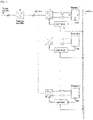
- FIG. 1 shows the schematic representation of the voltage supply of the induction coils of a device according to the invention for the inductive heating of metal goods.
- the device selected as an exemplary embodiment for the inductive heating of metal goods is designed as a multi-channel bolt induction furnace with a number of induction coils.
- the device for the inductive heating of metal goods can also be designed as an induction crucible furnace.
- the general structure of such induction furnaces or induction crucible furnaces is known to those skilled in the art. Therefore, the arrangement of the induction coils and their power supply is discussed below:
- the power supply of the device according to the invention is in figure 1 shown.
- Each channel includes an induction coil 4 which is supplied with voltage via an associated inverter 1 .
- the inverters 1 are fed via a common rectifier 7 .
- the load is connected to the inverters 1 via coils 2 in order to convert the square-wave output voltage of the inverter 1 into a sinusoidal coil voltage.
- the load of the inverter 1 is formed by the induction coil 4 with its compensation capacitor 3 .
- Each inverter 1 is connected to a control and regulation device 6 via which the output voltage of the inverter 1 can be changed as a manipulated variable depending on the difference between a specified target current and the current actual current of the associated induction coil 4 .
- the control and regulating devices 6 of the inverters 1 are connected to a field bus 7 in order to specify the setpoint current as a reference variable.
- the fieldbus 7 serves to synchronize the inverters 1 and to exchange the process values between the control and regulation devices 6.
- the setpoint current as a reference variable can either be fed into the fieldbus 7 as a specification, or an induction coil is used as a master coil, with its current as the reference variable is fed into the field bus 7 via a coil current sensor 5 .
- the output voltage of the respective inverter 1 is changed to the Set master coil predetermined current phase in all induction coils 4, whereby an in-phase current flow of all induction coils 4 is achieved. This optimizes the temperature distribution in the metal to be heated.
Landscapes
- Engineering & Computer Science (AREA)
- Power Engineering (AREA)
- Mechanical Engineering (AREA)
- General Engineering & Computer Science (AREA)
- Physics & Mathematics (AREA)
- Electromagnetism (AREA)
- Computer Networks & Wireless Communication (AREA)
- General Induction Heating (AREA)
Description
- Die Erfindung betrifft eine Vorrichtung zur induktiven Erwärmung von Metallgut, insbesondere von Metallblöcken nach dem Oberbegriff des Patentanspruchs 1. Die Erfindung betrifft weiterhin ein Verfahren zur gleichmäßigen Erwärmung von Metallgut nach dem Patentanspruch 4.
- Vorrichtungen zur induktiven Erwärmung von Metallgut, sogenannte Induktionsöfen, sind seit Jahrzehnten bekannt. Sie werden eingesetzt, um Metalle auf effiziente Art und Weise zu erwärmen oder zu schmelzen.
- Die prozesstechnischen Anforderungen der Temperaturführung bei der Erwärmung von Metallblöcken bzw.-bolzen zur Umformung sind in den letzten Jahren stetig gestiegen. Die richtige Blocktemperatur ist von zentraler Bedeutung für einen wirtschaftlichen und qualitätsgerechten Strangpressbetrieb. Die Problematik des Anwärmprozesses unterscheidet heute in der Regel zwei Teilaufgaben: Die Erwärmung des Bolzens auf Prozesstemperatur und die Erzeugung eines axialen Blocktemperaturprofils (Taper), welches die Erwärmung während des Umformprozesses derart kompensiert, dass ein isothermer Pressprozess erreicht wird. Zur Erwärmung der Metallblöcke werden unter anderem Induktionsanlagen eingesetzt, bei denen die für die Erwärmung erforderliche Energie direkt in den zu erwärmenden Metallblock induziert wird, so dass das gewünschte Wärmeprofil unmittelbar in dem Metallblock entsteht, wodurch eine besonders effiziente Weise der Erwärmung bewirkt ist. Hierzu sind mehrere Induktionsspulen angeordnet, die jeweils über eine zugeordnete Wechselstromversorgung verfügen. Jeder Stromversorgungskreislauf besteht aus einem Wechselrichter zur Bereitstellung der Wirkleistung sowie einem Kompensationskondensator zur Bereitstellung der Blindleistung. Jeder Wechselrichter wird über einen Gleichrichter versorgt, der die elektrische Leistung vom Dreiphasenwechselstrom in Gleichstrom wandelt. Dabei kann jedem Wechselrichter ein Gleichrichter zugeordnet sein. Alternativ kann auch allen Wechselrichtern ein Gleichrichter zugeordnet sein. Alternativ kann auch allen Wechselrichtern ein Gleichrichter zugeordnet sein. Entsprechende Anordnungen werden auch in modernen Induktionstiegelöfen eingesetzt, um zu schmelzendes Metallgut mit möglichst großer Leistung in kurzer Zeit aufzuschmelzen.
- Problematisch bei solchen Mehrspulensystemen ist, dass die einzelnen Induktionsspulen sich gegenseitig beeinflussen, insbesondere dann, wenn Eisenblöcke erwärmt werden, wodurch in dem Eisenmaterial hohe Ströme induziert werden. Um diesem Effekt entgegenzuwirken, ist es bekannt, die Induktionsspulen jeweils durch wenigstens einen Wechselrichter mit einstellbarer Frequenz zu speisen. Über die Wechselrichter werden die einzelnen Spannungen derart geregelt, dass die Spannungen der Induktionsspulen gleichphasig sind. Derartige Stromversorgungseinrichtungen für Induktionsöfen sind beispielsweise in der
DE 10 2007 051 666 A1 sowie derEP 2 276 323 A1 , als auch in derEP 1 280 381 A2 , derJP 2001 035645 A US 2009/114640 A1 und derEP 2 890 217 A1 beschrieben. - Bei den vorbekannten Vorrichtungen hat sich jedoch gezeigt, dass auch bei phasengleicher Einregelung der Spannungen der einzelnen Induktionsspulen sich über die Spulenbereiche unterschiedliche Temperaturen des zu erhitzenden Materials ergeben.
- Hier will die Erfindung Abhilfe schaffen. Der Erfindung liegt die Aufgabe zugrunde, eine Vorrichtung zur induktiven Erwärmung von Metallgut, insbesondere von Metallblöcken zu schaffen, die eine gleichmäßige Temperaturverteilung in einem zu erwärmenden Metallblock ermöglicht. Gemäß der Erfindung wird diese Aufgabe durch eine Vorrichtung mit den Merkmalen des kennzeichnenden Teils des Patentanspruchs 1 gelöst.
- Mit der Erfindung ist eine Vorrichtung zur induktiven Erwärmung von Metallgut, insbesondere von Metallblöcken bereitgestellt, die eine gleichmäßige Temperaturverteilung in dem zu erwärmenden Metallgut ermöglicht. Dadurch, dass wenigstens eine Induktionsspule mit einer Strommesseinrichtung verbunden ist, die zur kontinuierlichen Bereitstellung des Spulenstroms als Regelgröße mit einem Eingang einer Steuer- und Regeleinrichtung verbunden ist, über welche die Frequenz der Ausgangsspannung des die Induktionsspule speisenden wenigstens einen Wechselrichters als Stellgröße veränderbar ist, wobei die jeweils einer Induktionsspule zugeordneten Steuer- und Regeleinrichtungen über einen Feldbus miteinander verbunden sind, über den ein Sollwert als Führungsgröße vorgebbar ist, ist ein geschlossener Regelkreis erzielt, mit dem ein gleichphasiger Stromfluss in den wenigstens zwei Induktionsspulen bewirkt ist, wodurch eine gleichmäßige Temperaturverteilung ermöglicht ist. Kerngedanke der vorliegenden Erfindung ist dabei, dass unterschiedliche Ströme innerhalb der zu erwärmenden Metallblöcke zu unterschiedlichen Erwärmungen führen. Die im Stand der Technik bekannte phasengleiche Einregelung der Spannungen bewirkt jedoch nicht, dass die in den Induktionsspulen fließenden Ströme phasengleich sind, da diese durch in den Metallblöcken induzierten Ströme beeinflusst sind. Der Leistungsfluss zwischen zwei magnetisch gekoppelten Zonen wird durch die Phasenverschiebung zwischen den Spulenströmen erzeugt. Die Phasenverschiebung ist abhängig von der Impedanz der Induktionsspulen, der Kompensationskapazität sowie der Ausgangsinduktivität des Wechselrichters. Die Impedanz der Induktionsspule ist nicht konstant, sondern sie ist eine Funktion der Metallblocktemperatur, da die Temperatur einen Einfluss auf den Widerstand des Materials hat. Weiterhin hat die Position des Metallblocks sowie auch seine Länger einen Einfluss auf die Spulenimpedanz.
- Bei der erfindungsgemäßen Vorrichtung dient daher der Strom als Regelgröße, welche über die Frequenz der Ausgangsspannungen der die Spulen speisenden Wechselrichter phasengleich einregelbar ist.
- Die vorliegende Erfindung ist nicht auf den Einsatz zur Erwärmung von Metallblöcken für ein nachfolgendes Umformverfahren, insbesondere Strangpressverfahren beschränkt. Vielmehr sind die erfindungsgemäße Vorrichtung und das erfindungsgemäße Verfahren auch zur Erwärmung von Metallgut zum Aufschmelzen einsetzbar.
- In Weiterbildung der Erfindung ist eine als Masterspule fungierende Induktionsspule angeordnet, die mit einer Strommesseinrichtung verbunden ist, die zur Synchronisation des Spulenstroms der übrigen Induktionsspulen zur kontinuierlichen Bereitstellung der Spulenstroms als Führungsgröße mit dem Feldbus verbunden ist. Hierdurch ist eine Einstellung des Spulenstroms der Induktionsspulen über die Einstellung der Masterspule ermöglicht. Bevorzugt ist wenigstens ein Gleichrichter zur Transformation einer Dreiphasen-Wechselspannung in eine Einphasen-Gleichspannung zur Spannungsversorgung der Wechselrichter angeordnet.
- Der Erfindung liegt weiterhin die Aufgabe zu Grunde, ein Verfahren zur gleichmäßigen Erwärmung von Metallgut bereitzustellen. Gemäß der Erfindung wird diese Aufgabe durch ein Verfahren mit den Merkmalen des Patentanspruchs 4 gelöst. Dadurch, dass an wenigstens zwei versetzt zueinander angeordneten Induktionsspulen jeweils über wenigstens einen Wechselrichter eine Wechselspannung angelegt wird, der Spulenstrom jeder Induktionsspule kontinuierlich gemessen wird und in Abhängigkeit von einem vorgegebenen Sollwert innerhalb eines geschlossenen Regelkreises die Frequenz der Wechselrichter derart geändert wird, dass der gemessene Spulenstrom der Induktionsspulen auf den Sollwert eingeregelt wird, ist eine Synchronisation des Stromflusses in allen Induktionsspulen erzielt, wodurch eine gleichmäßige Erwärmung des zu erwärmenden Metallguts ermöglicht ist. Vorteilhaft wird eine Masterspule eingesetzt, deren Spulenstrom durch eine Strommessvorrichtung kontinuierlich erfasst und den Regelkreisen der weiteren Induktionsspulen als Führungsgröße vorgegeben wird.
- Andere Weiterbildungen und Ausgestaltungen der Erfindung sind in den übrigen Unteransprüchen angegeben. Ein Ausführungsbeispiel der Erfindung ist in der Zeichnung dargestellt und wird nachfolgend im Einzelnen beschrieben. Die einzige
Figur 1 zeigt die schematische Darstellung der Spannungsversorgung der Induktionsspulen einer erfindungsgemäßen Vorrichtung zur induktiven Erwärmung von Metallgut. - Die als Ausführungsbeispiel gewählte Vorrichtung zur induktiven Erwärmung von Metallgut ist als Mehrkanalbolzeninduktionsofen mit mehreren Induktionsspulen ausgeführt. Alternativ kann die Vorrichtung zur induktiven Erwärmung von Metallgut auch als Induktionstiegelofen ausgeführt sein. Der generelle Aufbau solcher Induktionsöfen oder Induktionstiegelöfen ist dem Fachmann bekannt. Daher wird nachfolgend die Anordnung der Induktionsspulen sowie deren Spannungsversorgung thematisiert:
Die Spannungsversorgung der erfindungsgemäßen Vorrichtung ist inFigur 1 dargestellt. Jeder Kanal umfasst eine Induktionsspule 4, die über einen zugeordneten Wechselrichter 1 mit Spannung versorgt wird. Die Wechselrichter 1 sind über einen gemeinsamen Gleichrichter 7 gespeist. Die Last ist an den Wechselrichtern 1 über Spulen 2 angeschlossen, um die rechteckförmige Ausgangsspannung des Wechselrichters 1 in einer sinusförmige Spulenspannung zu überführen. Die Last des Wechselrichters 1 ist durch die Induktionsspule 4 mit ihrem Kompensations-Kondensator 3 gebildet. - Jeder Wechselrichter 1 ist mit einer Steuer- und Regeleinrichtung 6 verbunden, über den die Ausgangsspannung des Wechselrichters 1 als Stellgröße in Abhängigkeit der Differenz eines vorgegebenen Soll-Stroms zu dem aktuellen Ist-Strom der zugeordneten Induktionsspule 4 veränderbar ist. Zur kontinuierlichen Erfassung des Ist-Stroms der Induktionsspule 4 als Regelgröße ist ein Spulenstrom-Messwertgeber 5 angeordnet, der mit der Steuer- und Regeleinrichtung 6 verbunden ist. Zur Vorgabe des Sollstroms als Führungsgröße sind die Steuerund Regeleinrichtungen 6 der Wechselrichter 1 mit einem Feldbus 7 verbunden. Der Feldbus 7 dient der Synchronisation der Wechselrichter 1 und dem Austausch der Prozesswerte zwischen den Steuer- und Regeleinrichtungen 6. Der Sollstrom als Führungsgröße kann entweder als Vorgabe in den Feldbus 7 eingespeist werden, oder eine Induktionsspule wird als Masterspule eingesetzt, wobei deren Strom als Führungsgröße über einen Spulenstrom-Messwertgeber 5 in den Feldbus 7 eingespeist wird. Basierend auf dem Vergleich des über den Feldbus 7 als Führungsgröße vorgegebenen Soll-Stroms und des über den jeweiligen Spulenstrom-Messwertgeber 5 ermittelten Ist-Stroms wird die Ausgangsspannung des jeweiligen Wechselrichters 1 geändert, um die von der Masterspule vorgegebene Stromphase bei allen Induktionsspulen 4 einzustellen, wodurch ein phasengleicher Stromverlauf aller Induktionsspulen 4 erzielt wird. Hierdurch ist die Temperaturverteilung in dem zu erwärmenden Metallgut optimiert.
Claims (5)
- Vorrichtung zur induktiven Erwärmung von Metallgut, insbesondere von Metallblöcken, umfassend wenigstens zwei zueinander versetzt angeordnete Induktionsspulen (4), die jeweils parallel mit einem Kompensations-Kondensator (3) verbunden sind und wenigstens zwei Wechselrichter (1) mit einstellbarer Frequenz der Ausgangsspannung, die angeordnet sind, die Induktionsspulen mit Strom zu speisen, dadurch gekennzeichnet, dass die Wechselrichter (1) jeweils eine Steuer- und Regeleinrichtung (6) aufweisen, wobei wenigstens eine Induktionsspule (4) mit einer Strommesseinrichtung (5) verbunden ist, die zur kontinuierlichen Bereitstellung des Spulenstroms als Regelgröße mit einem Eingang der angeordneten Steuer- und Regeleinrichtung (6) verbunden ist, die eingerichtet ist, die Frequenz der Ausgangsspannung des die Induktionsspule (4) speisenden wenigstens einen Wechselrichters (1) als Stellgröße zu verändern, wobei die jeweils einer Induktionsspule (4) zugeordneten Steuer- und Regeleinrichtungen (6) über einen Feldbus (7) miteinander verbunden sind, über den ein Sollstrom als Führungsgröße vorgegeben wird.
- Vorrichtung nach Anspruch 1, wobei eine als Masterspule fungierende Induktionsspule (4) angeordnet ist, die mit einer Strommesseinrichtung (5) verbunden ist, die zur Synchronisation des Spulenstroms der übrigen Induktionsspulen (4) zur kontinuierlichen Bereitstellung des Spulenstroms als Führungsgröße mit dem Feldbus (7) verbunden ist.
- Vorrichtung nach einem der vorgenannten Ansprüche, wobei wenigstens ein Gleichrichter (8) zur Transformation einer Dreiphasen-Wechselspannung in eine Einphasen-Gleichspannung zur Spannungsversorgung der Wechselrichter (1) angeordnet ist.
- Verfahren zur gleichmäßigen Erwärmung von Metallgut, mit einer Vorrichtung nach einem der Ansprüche 1 bis 3, wobei an wenigstens zwei versetzt zueinander angeordnete Induktionsspulen (4), die jeweils parallel mit einem Kompensations-Kondensator (3) verbunden sind, jeweils über wenigstens einen Wechselrichter (1) eine Wechselspannung angelegt wird, der Spulenstrom jeder Induktionsspule (4) kontinuierlich gemessen wird und in Abhängigkeit von einem vorgegebenen Sollstrom innerhalb eines geschlossenen Regelkreises die Frequenz der Wechselrichter (1) derart geändert wird, dass der gemessene Spulenstrom der Induktionsspulen (4) auf den Sollstrom eingeregelt wird.
- Verfahren nach Anspruch 4, wobei eine Induktionsspule (4) als Masterspule eingesetzt wird, deren Spulenstrom durch eine Strommessvorrichtung (5) kontinuierlich erfasst und den Regelkreisen der weiteren Induktionsspulen (4) als Führungsgröße vorgegeben wird.
Priority Applications (1)
| Application Number | Priority Date | Filing Date | Title |
|---|---|---|---|
| EP19195424.7A EP3790180B1 (de) | 2019-09-04 | 2019-09-04 | Vorrichtung und verfahren zur induktiven erwärmung von metallgut |
Applications Claiming Priority (1)
| Application Number | Priority Date | Filing Date | Title |
|---|---|---|---|
| EP19195424.7A EP3790180B1 (de) | 2019-09-04 | 2019-09-04 | Vorrichtung und verfahren zur induktiven erwärmung von metallgut |
Publications (2)
| Publication Number | Publication Date |
|---|---|
| EP3790180A1 EP3790180A1 (de) | 2021-03-10 |
| EP3790180B1 true EP3790180B1 (de) | 2022-08-10 |
Family
ID=67851061
Family Applications (1)
| Application Number | Title | Priority Date | Filing Date |
|---|---|---|---|
| EP19195424.7A Active EP3790180B1 (de) | 2019-09-04 | 2019-09-04 | Vorrichtung und verfahren zur induktiven erwärmung von metallgut |
Country Status (1)
| Country | Link |
|---|---|
| EP (1) | EP3790180B1 (de) |
Families Citing this family (3)
| Publication number | Priority date | Publication date | Assignee | Title |
|---|---|---|---|---|
| DE202021004265U1 (de) | 2021-05-20 | 2023-05-05 | Ias Gmbh | Vorrichtung zur induktiven Erwärmung von Metallgut |
| EP4093153B1 (de) | 2021-05-20 | 2023-12-06 | IAS GmbH | Vorrichtung zur induktiven erwärmung von metallgut |
| DE102022132027A1 (de) * | 2022-12-02 | 2024-06-13 | Sms Group Gmbh | Induktionsheizvorrichtung, System, Produktionslinie, Verfahren und Verwendung |
Family Cites Families (6)
| Publication number | Priority date | Publication date | Assignee | Title |
|---|---|---|---|---|
| JP4115634B2 (ja) * | 1999-07-26 | 2008-07-09 | 三井造船株式会社 | 複数の電磁誘導コイルの同期化制御装置 |
| EP1280381A3 (de) * | 2001-07-25 | 2005-12-21 | I. A. S. Induktions- Anlagen + Service GmbH & Co. KG | Vorrichtung und Verfahren zur induktiven Blockerwärmung mit einer Blockerwärmungsspule |
| DE102007051666A1 (de) | 2007-10-26 | 2009-04-30 | Otto Junker Gmbh | Stromversorgungseinrichtung für Induktionsöfen |
| WO2009058820A2 (en) * | 2007-11-03 | 2009-05-07 | Inductotherm Corp. | Electric power system for electric induction heating and melting of materials in a susceptor vessel |
| EP2276323A1 (de) | 2009-07-16 | 2011-01-19 | Calamari S.p.A. | Elektrische Netzteilschaltung |
| KR101617132B1 (ko) * | 2012-08-27 | 2016-04-29 | 도시바 미쓰비시덴키 산교시스템 가부시키가이샤 | 유도가열 장치의 제어 장치 |
-
2019
- 2019-09-04 EP EP19195424.7A patent/EP3790180B1/de active Active
Also Published As
| Publication number | Publication date |
|---|---|
| EP3790180A1 (de) | 2021-03-10 |
Similar Documents
| Publication | Publication Date | Title |
|---|---|---|
| DE2853792C2 (de) | ||
| DE3711645C1 (de) | Hochfrequenzinduktionswaermegeraet | |
| DE4134090C2 (de) | Temperaturregelverfahren für eine Spritzgießmaschine | |
| WO2020200612A1 (de) | Heizungsvorrichtung zum induktiven erhitzen eines flachstahlstreifens in einem warmwalzwerk | |
| EP3790180A1 (de) | Vorrichtung und verfahren zur induktiven erwärmung von metallgut | |
| EP0709000A1 (de) | Verfahren und vorrichtung zur steuerung einer m-pulsigen wechselrichteranordnung, bestehend aus einem master-wechselrichter und wenigstens einem slave-wechselrichter | |
| EP3866567B1 (de) | Prozessgesteuerte energieversorgung einer induktionsspule zur erwärmung von warmschrumpffuttern | |
| DE69318476T3 (de) | Verfahren und Vorrichtung zum Schmelzen von elektrischen Leitern | |
| WO2010031503A1 (de) | Vorrichtung zur erwärmung stangenartiger werkstücke | |
| DE3872369T2 (de) | Ausgleichregler fuer spinnduesen. | |
| EP1280381A2 (de) | Vorrichtung und Verfahren zur induktiven Blockerwärmung mit einer Blockerwärmungsspule | |
| EP0197329A2 (de) | Verfahren zur Symmetrierung elektrischer Grössen in Drehstrom-Lichtbogenöfen und Vorrichtung zur Durchführung des Verfahrens | |
| DE102012109847A1 (de) | Vorrichtung und Verfahren zur prozessgeführten Leistungsregelung eines Lichtbogenofens | |
| DE19722485C2 (de) | Anordnung und Verfahren zur automatischen Steuerung der zugeführten Wärmemenge bei einem elektrischen Hochfrequenz-Widerstandsschweißgerät | |
| WO2026057603A1 (de) | Drahtdurchlaufglühe und verfahren zur regelung der temperatur des drahtes in der drahtdurchlaufglühe | |
| DE3220979C2 (de) | Verfahren zum Betreiben einer supraleitenden Stromspeichervorrichtung sowie Vorrichtung zur Durchführung des Verfahrens | |
| DE69608288T2 (de) | Ausgleichvorrichtung bei induktiver last, bestimmt zum parallel-erwaermen von mehreren teilen | |
| DE2347723A1 (de) | Kraftstromabgabe und -steuereinrichtung und kraftstromabgabesteuerverfahren | |
| EP0315034A2 (de) | Verfahren und Vorrichtung zur Regelung der Temperatur von Glühkerzen | |
| EP0622972A2 (de) | Verfahren zum induktiven Beheizen einer Galette und induktiv beheizte Galette | |
| DE69914573T2 (de) | Magnetische Beheizungssystem | |
| DE3731555C1 (en) | Induction heating device with a setting preset controlled by the actual value | |
| EP3289916A1 (de) | Induktives erhitzen von giessformen | |
| DE3217879C2 (de) | Vorrichtung zur induktiven Beheizung und magnetodynamischen Förderung einer Metallschmelze | |
| DE10206269A1 (de) | Vorrichtung und Verfahren zur induktiven Blockerwärmung mit einer Blockerwärmungsspule |
Legal Events
| Date | Code | Title | Description |
|---|---|---|---|
| STAA | Information on the status of an ep patent application or granted ep patent |
Free format text: STATUS: EXAMINATION IS IN PROGRESS |
|
| PUAI | Public reference made under article 153(3) epc to a published international application that has entered the european phase |
Free format text: ORIGINAL CODE: 0009012 |
|
| 17P | Request for examination filed |
Effective date: 20200626 |
|
| AK | Designated contracting states |
Kind code of ref document: A1 Designated state(s): AL AT BE BG CH CY CZ DE DK EE ES FI FR GB GR HR HU IE IS IT LI LT LU LV MC MK MT NL NO PL PT RO RS SE SI SK SM TR |
|
| AX | Request for extension of the european patent |
Extension state: BA ME |
|
| GRAP | Despatch of communication of intention to grant a patent |
Free format text: ORIGINAL CODE: EPIDOSNIGR1 |
|
| STAA | Information on the status of an ep patent application or granted ep patent |
Free format text: STATUS: GRANT OF PATENT IS INTENDED |
|
| RIC1 | Information provided on ipc code assigned before grant |
Ipc: H02M 7/48 20070101ALN20220401BHEP Ipc: H02M 1/00 20060101ALN20220401BHEP Ipc: H02M 5/451 20060101ALN20220401BHEP Ipc: H05B 6/06 20060101ALI20220401BHEP Ipc: H02J 50/10 20160101ALI20220401BHEP Ipc: F27B 3/08 20060101ALI20220401BHEP Ipc: H05B 6/10 20060101ALI20220401BHEP Ipc: F27D 19/00 20060101ALI20220401BHEP Ipc: F27D 11/06 20060101ALI20220401BHEP Ipc: H02M 5/458 20060101AFI20220401BHEP |
|
| RIC1 | Information provided on ipc code assigned before grant |
Ipc: H05B 6/10 20060101ALI20220411BHEP Ipc: F27D 19/00 20060101ALI20220411BHEP Ipc: F27D 11/06 20060101ALI20220411BHEP Ipc: H02M 5/458 20060101AFI20220411BHEP Ipc: H02M 7/48 20070101ALN20220411BHEP Ipc: H02M 1/00 20060101ALN20220411BHEP Ipc: H02M 5/451 20060101ALN20220411BHEP Ipc: H05B 6/06 20060101ALI20220411BHEP Ipc: H02J 50/10 20160101ALI20220411BHEP Ipc: F27B 3/08 20060101ALI20220411BHEP |
|
| INTG | Intention to grant announced |
Effective date: 20220504 |
|
| GRAS | Grant fee paid |
Free format text: ORIGINAL CODE: EPIDOSNIGR3 |
|
| GRAA | (expected) grant |
Free format text: ORIGINAL CODE: 0009210 |
|
| STAA | Information on the status of an ep patent application or granted ep patent |
Free format text: STATUS: THE PATENT HAS BEEN GRANTED |
|
| AK | Designated contracting states |
Kind code of ref document: B1 Designated state(s): AL AT BE BG CH CY CZ DE DK EE ES FI FR GB GR HR HU IE IS IT LI LT LU LV MC MK MT NL NO PL PT RO RS SE SI SK SM TR |
|
| REG | Reference to a national code |
Ref country code: AT Ref legal event code: REF Ref document number: 1511311 Country of ref document: AT Kind code of ref document: T Effective date: 20220815 Ref country code: CH Ref legal event code: EP |
|
| REG | Reference to a national code |
Ref country code: DE Ref legal event code: R096 Ref document number: 502019005219 Country of ref document: DE |
|
| REG | Reference to a national code |
Ref country code: IE Ref legal event code: FG4D Free format text: LANGUAGE OF EP DOCUMENT: GERMAN |
|
| REG | Reference to a national code |
Ref country code: RO Ref legal event code: EPE |
|
| REG | Reference to a national code |
Ref country code: NL Ref legal event code: MP Effective date: 20220810 |
|
| REG | Reference to a national code |
Ref country code: LT Ref legal event code: MG9D |
|
| PG25 | Lapsed in a contracting state [announced via postgrant information from national office to epo] |
Ref country code: SE Free format text: LAPSE BECAUSE OF FAILURE TO SUBMIT A TRANSLATION OF THE DESCRIPTION OR TO PAY THE FEE WITHIN THE PRESCRIBED TIME-LIMIT Effective date: 20220810 Ref country code: RS Free format text: LAPSE BECAUSE OF FAILURE TO SUBMIT A TRANSLATION OF THE DESCRIPTION OR TO PAY THE FEE WITHIN THE PRESCRIBED TIME-LIMIT Effective date: 20220810 Ref country code: PT Free format text: LAPSE BECAUSE OF FAILURE TO SUBMIT A TRANSLATION OF THE DESCRIPTION OR TO PAY THE FEE WITHIN THE PRESCRIBED TIME-LIMIT Effective date: 20221212 Ref country code: NO Free format text: LAPSE BECAUSE OF FAILURE TO SUBMIT A TRANSLATION OF THE DESCRIPTION OR TO PAY THE FEE WITHIN THE PRESCRIBED TIME-LIMIT Effective date: 20221110 Ref country code: NL Free format text: LAPSE BECAUSE OF FAILURE TO SUBMIT A TRANSLATION OF THE DESCRIPTION OR TO PAY THE FEE WITHIN THE PRESCRIBED TIME-LIMIT Effective date: 20220810 Ref country code: LV Free format text: LAPSE BECAUSE OF FAILURE TO SUBMIT A TRANSLATION OF THE DESCRIPTION OR TO PAY THE FEE WITHIN THE PRESCRIBED TIME-LIMIT Effective date: 20220810 Ref country code: LT Free format text: LAPSE BECAUSE OF FAILURE TO SUBMIT A TRANSLATION OF THE DESCRIPTION OR TO PAY THE FEE WITHIN THE PRESCRIBED TIME-LIMIT Effective date: 20220810 Ref country code: FI Free format text: LAPSE BECAUSE OF FAILURE TO SUBMIT A TRANSLATION OF THE DESCRIPTION OR TO PAY THE FEE WITHIN THE PRESCRIBED TIME-LIMIT Effective date: 20220810 |
|
| PG25 | Lapsed in a contracting state [announced via postgrant information from national office to epo] |
Ref country code: PL Free format text: LAPSE BECAUSE OF FAILURE TO SUBMIT A TRANSLATION OF THE DESCRIPTION OR TO PAY THE FEE WITHIN THE PRESCRIBED TIME-LIMIT Effective date: 20220810 Ref country code: IS Free format text: LAPSE BECAUSE OF FAILURE TO SUBMIT A TRANSLATION OF THE DESCRIPTION OR TO PAY THE FEE WITHIN THE PRESCRIBED TIME-LIMIT Effective date: 20221210 Ref country code: HR Free format text: LAPSE BECAUSE OF FAILURE TO SUBMIT A TRANSLATION OF THE DESCRIPTION OR TO PAY THE FEE WITHIN THE PRESCRIBED TIME-LIMIT Effective date: 20220810 Ref country code: GR Free format text: LAPSE BECAUSE OF FAILURE TO SUBMIT A TRANSLATION OF THE DESCRIPTION OR TO PAY THE FEE WITHIN THE PRESCRIBED TIME-LIMIT Effective date: 20221111 |
|
| PG25 | Lapsed in a contracting state [announced via postgrant information from national office to epo] |
Ref country code: SM Free format text: LAPSE BECAUSE OF FAILURE TO SUBMIT A TRANSLATION OF THE DESCRIPTION OR TO PAY THE FEE WITHIN THE PRESCRIBED TIME-LIMIT Effective date: 20220810 Ref country code: ES Free format text: LAPSE BECAUSE OF FAILURE TO SUBMIT A TRANSLATION OF THE DESCRIPTION OR TO PAY THE FEE WITHIN THE PRESCRIBED TIME-LIMIT Effective date: 20220810 Ref country code: DK Free format text: LAPSE BECAUSE OF FAILURE TO SUBMIT A TRANSLATION OF THE DESCRIPTION OR TO PAY THE FEE WITHIN THE PRESCRIBED TIME-LIMIT Effective date: 20220810 Ref country code: CZ Free format text: LAPSE BECAUSE OF FAILURE TO SUBMIT A TRANSLATION OF THE DESCRIPTION OR TO PAY THE FEE WITHIN THE PRESCRIBED TIME-LIMIT Effective date: 20220810 |
|
| REG | Reference to a national code |
Ref country code: CH Ref legal event code: PL |
|
| REG | Reference to a national code |
Ref country code: DE Ref legal event code: R097 Ref document number: 502019005219 Country of ref document: DE |
|
| REG | Reference to a national code |
Ref country code: BE Ref legal event code: MM Effective date: 20220930 |
|
| PG25 | Lapsed in a contracting state [announced via postgrant information from national office to epo] |
Ref country code: SK Free format text: LAPSE BECAUSE OF FAILURE TO SUBMIT A TRANSLATION OF THE DESCRIPTION OR TO PAY THE FEE WITHIN THE PRESCRIBED TIME-LIMIT Effective date: 20220810 Ref country code: MC Free format text: LAPSE BECAUSE OF FAILURE TO SUBMIT A TRANSLATION OF THE DESCRIPTION OR TO PAY THE FEE WITHIN THE PRESCRIBED TIME-LIMIT Effective date: 20220810 Ref country code: EE Free format text: LAPSE BECAUSE OF FAILURE TO SUBMIT A TRANSLATION OF THE DESCRIPTION OR TO PAY THE FEE WITHIN THE PRESCRIBED TIME-LIMIT Effective date: 20220810 |
|
| PLBE | No opposition filed within time limit |
Free format text: ORIGINAL CODE: 0009261 |
|
| STAA | Information on the status of an ep patent application or granted ep patent |
Free format text: STATUS: NO OPPOSITION FILED WITHIN TIME LIMIT |
|
| PG25 | Lapsed in a contracting state [announced via postgrant information from national office to epo] |
Ref country code: AL Free format text: LAPSE BECAUSE OF FAILURE TO SUBMIT A TRANSLATION OF THE DESCRIPTION OR TO PAY THE FEE WITHIN THE PRESCRIBED TIME-LIMIT Effective date: 20220810 Ref country code: LU Free format text: LAPSE BECAUSE OF NON-PAYMENT OF DUE FEES Effective date: 20220904 |
|
| 26N | No opposition filed |
Effective date: 20230511 |
|
| PG25 | Lapsed in a contracting state [announced via postgrant information from national office to epo] |
Ref country code: LI Free format text: LAPSE BECAUSE OF NON-PAYMENT OF DUE FEES Effective date: 20220930 Ref country code: IE Free format text: LAPSE BECAUSE OF NON-PAYMENT OF DUE FEES Effective date: 20220904 Ref country code: FR Free format text: LAPSE BECAUSE OF NON-PAYMENT OF DUE FEES Effective date: 20221010 Ref country code: CH Free format text: LAPSE BECAUSE OF NON-PAYMENT OF DUE FEES Effective date: 20220930 |
|
| PG25 | Lapsed in a contracting state [announced via postgrant information from national office to epo] |
Ref country code: SI Free format text: LAPSE BECAUSE OF FAILURE TO SUBMIT A TRANSLATION OF THE DESCRIPTION OR TO PAY THE FEE WITHIN THE PRESCRIBED TIME-LIMIT Effective date: 20220810 |
|
| PG25 | Lapsed in a contracting state [announced via postgrant information from national office to epo] |
Ref country code: BE Free format text: LAPSE BECAUSE OF NON-PAYMENT OF DUE FEES Effective date: 20220930 |
|
| PG25 | Lapsed in a contracting state [announced via postgrant information from national office to epo] |
Ref country code: CY Free format text: LAPSE BECAUSE OF FAILURE TO SUBMIT A TRANSLATION OF THE DESCRIPTION OR TO PAY THE FEE WITHIN THE PRESCRIBED TIME-LIMIT Effective date: 20220810 |
|
| GBPC | Gb: european patent ceased through non-payment of renewal fee |
Effective date: 20230904 |
|
| PG25 | Lapsed in a contracting state [announced via postgrant information from national office to epo] |
Ref country code: MK Free format text: LAPSE BECAUSE OF FAILURE TO SUBMIT A TRANSLATION OF THE DESCRIPTION OR TO PAY THE FEE WITHIN THE PRESCRIBED TIME-LIMIT Effective date: 20220810 Ref country code: IT Free format text: LAPSE BECAUSE OF FAILURE TO SUBMIT A TRANSLATION OF THE DESCRIPTION OR TO PAY THE FEE WITHIN THE PRESCRIBED TIME-LIMIT Effective date: 20220810 Ref country code: HU Free format text: LAPSE BECAUSE OF FAILURE TO SUBMIT A TRANSLATION OF THE DESCRIPTION OR TO PAY THE FEE WITHIN THE PRESCRIBED TIME-LIMIT; INVALID AB INITIO Effective date: 20190904 |
|
| PG25 | Lapsed in a contracting state [announced via postgrant information from national office to epo] |
Ref country code: TR Free format text: LAPSE BECAUSE OF FAILURE TO SUBMIT A TRANSLATION OF THE DESCRIPTION OR TO PAY THE FEE WITHIN THE PRESCRIBED TIME-LIMIT Effective date: 20220810 |
|
| PG25 | Lapsed in a contracting state [announced via postgrant information from national office to epo] |
Ref country code: GB Free format text: LAPSE BECAUSE OF NON-PAYMENT OF DUE FEES Effective date: 20230904 |
|
| PG25 | Lapsed in a contracting state [announced via postgrant information from national office to epo] |
Ref country code: GB Free format text: LAPSE BECAUSE OF NON-PAYMENT OF DUE FEES Effective date: 20230904 Ref country code: BG Free format text: LAPSE BECAUSE OF FAILURE TO SUBMIT A TRANSLATION OF THE DESCRIPTION OR TO PAY THE FEE WITHIN THE PRESCRIBED TIME-LIMIT Effective date: 20220810 |
|
| PG25 | Lapsed in a contracting state [announced via postgrant information from national office to epo] |
Ref country code: MT Free format text: LAPSE BECAUSE OF FAILURE TO SUBMIT A TRANSLATION OF THE DESCRIPTION OR TO PAY THE FEE WITHIN THE PRESCRIBED TIME-LIMIT Effective date: 20220810 |
|
| PGFP | Annual fee paid to national office [announced via postgrant information from national office to epo] |
Ref country code: DE Payment date: 20250815 Year of fee payment: 7 |
|
| PGFP | Annual fee paid to national office [announced via postgrant information from national office to epo] |
Ref country code: RO Payment date: 20250901 Year of fee payment: 7 |
|
| REG | Reference to a national code |
Ref country code: AT Ref legal event code: MM01 Ref document number: 1511311 Country of ref document: AT Kind code of ref document: T Effective date: 20240904 |
|
| PG25 | Lapsed in a contracting state [announced via postgrant information from national office to epo] |
Ref country code: AT Free format text: LAPSE BECAUSE OF NON-PAYMENT OF DUE FEES Effective date: 20240904 |
|
| PGFP | Annual fee paid to national office [announced via postgrant information from national office to epo] |
Ref country code: AT Payment date: 20260410 Year of fee payment: 5 |