EP3786152B1 - Method for manufacturing aromatic nitrile compound - Google Patents
Method for manufacturing aromatic nitrile compound Download PDFInfo
- Publication number
- EP3786152B1 EP3786152B1 EP19793649.5A EP19793649A EP3786152B1 EP 3786152 B1 EP3786152 B1 EP 3786152B1 EP 19793649 A EP19793649 A EP 19793649A EP 3786152 B1 EP3786152 B1 EP 3786152B1
- Authority
- EP
- European Patent Office
- Prior art keywords
- compound represented
- formula
- mol
- aforementioned
- amount
- Prior art date
- Legal status (The legal status is an assumption and is not a legal conclusion. Google has not performed a legal analysis and makes no representation as to the accuracy of the status listed.)
- Active
Links
Images



Classifications
-
- C—CHEMISTRY; METALLURGY
- C07—ORGANIC CHEMISTRY
- C07C—ACYCLIC OR CARBOCYCLIC COMPOUNDS
- C07C253/00—Preparation of carboxylic acid nitriles
- C07C253/20—Preparation of carboxylic acid nitriles by dehydration of carboxylic acid amides
-
- C—CHEMISTRY; METALLURGY
- C07—ORGANIC CHEMISTRY
- C07C—ACYCLIC OR CARBOCYCLIC COMPOUNDS
- C07C231/00—Preparation of carboxylic acid amides
- C07C231/02—Preparation of carboxylic acid amides from carboxylic acids or from esters, anhydrides, or halides thereof by reaction with ammonia or amines
-
- C—CHEMISTRY; METALLURGY
- C07—ORGANIC CHEMISTRY
- C07C—ACYCLIC OR CARBOCYCLIC COMPOUNDS
- C07C233/00—Carboxylic acid amides
- C07C233/01—Carboxylic acid amides having carbon atoms of carboxamide groups bound to hydrogen atoms or to acyclic carbon atoms
- C07C233/02—Carboxylic acid amides having carbon atoms of carboxamide groups bound to hydrogen atoms or to acyclic carbon atoms having nitrogen atoms of carboxamide groups bound to hydrogen atoms or to carbon atoms of unsubstituted hydrocarbon radicals
- C07C233/11—Carboxylic acid amides having carbon atoms of carboxamide groups bound to hydrogen atoms or to acyclic carbon atoms having nitrogen atoms of carboxamide groups bound to hydrogen atoms or to carbon atoms of unsubstituted hydrocarbon radicals with carbon atoms of carboxamide groups bound to carbon atoms of an unsaturated carbon skeleton containing six-membered aromatic rings
-
- C—CHEMISTRY; METALLURGY
- C07—ORGANIC CHEMISTRY
- C07C—ACYCLIC OR CARBOCYCLIC COMPOUNDS
- C07C253/00—Preparation of carboxylic acid nitriles
-
- C—CHEMISTRY; METALLURGY
- C07—ORGANIC CHEMISTRY
- C07C—ACYCLIC OR CARBOCYCLIC COMPOUNDS
- C07C303/00—Preparation of esters or amides of sulfuric acids; Preparation of sulfonic acids or of their esters, halides, anhydrides or amides
- C07C303/34—Preparation of esters or amides of sulfuric acids; Preparation of sulfonic acids or of their esters, halides, anhydrides or amides of amides of sulfuric acids
-
- C—CHEMISTRY; METALLURGY
- C07—ORGANIC CHEMISTRY
- C07C—ACYCLIC OR CARBOCYCLIC COMPOUNDS
- C07C51/00—Preparation of carboxylic acids or their salts, halides or anhydrides
-
- C—CHEMISTRY; METALLURGY
- C07—ORGANIC CHEMISTRY
- C07C—ACYCLIC OR CARBOCYCLIC COMPOUNDS
- C07C51/00—Preparation of carboxylic acids or their salts, halides or anhydrides
- C07C51/06—Preparation of carboxylic acids or their salts, halides or anhydrides from carboxylic acid amides
-
- C—CHEMISTRY; METALLURGY
- C07—ORGANIC CHEMISTRY
- C07C—ACYCLIC OR CARBOCYCLIC COMPOUNDS
- C07C51/00—Preparation of carboxylic acids or their salts, halides or anhydrides
- C07C51/16—Preparation of carboxylic acids or their salts, halides or anhydrides by oxidation
- C07C51/305—Preparation of carboxylic acids or their salts, halides or anhydrides by oxidation with sulfur or sulfur-containing compounds
-
- C—CHEMISTRY; METALLURGY
- C07—ORGANIC CHEMISTRY
- C07C—ACYCLIC OR CARBOCYCLIC COMPOUNDS
- C07C51/00—Preparation of carboxylic acids or their salts, halides or anhydrides
- C07C51/58—Preparation of carboxylic acid halides
- C07C51/60—Preparation of carboxylic acid halides by conversion of carboxylic acids or their anhydrides or esters, lactones, salts into halides with the same carboxylic acid part
-
- C—CHEMISTRY; METALLURGY
- C07—ORGANIC CHEMISTRY
- C07C—ACYCLIC OR CARBOCYCLIC COMPOUNDS
- C07C57/00—Unsaturated compounds having carboxyl groups bound to acyclic carbon atoms
- C07C57/30—Unsaturated compounds having carboxyl groups bound to acyclic carbon atoms containing six-membered aromatic rings
- C07C57/38—Unsaturated compounds having carboxyl groups bound to acyclic carbon atoms containing six-membered aromatic rings polycyclic
- C07C57/40—Unsaturated compounds having carboxyl groups bound to acyclic carbon atoms containing six-membered aromatic rings polycyclic containing condensed ring systems
-
- C—CHEMISTRY; METALLURGY
- C07—ORGANIC CHEMISTRY
- C07D—HETEROCYCLIC COMPOUNDS
- C07D295/00—Heterocyclic compounds containing polymethylene-imine rings with at least five ring members, 3-azabicyclo [3.2.2] nonane, piperazine, morpholine or thiomorpholine rings, having only hydrogen atoms directly attached to the ring carbon atoms
- C07D295/16—Heterocyclic compounds containing polymethylene-imine rings with at least five ring members, 3-azabicyclo [3.2.2] nonane, piperazine, morpholine or thiomorpholine rings, having only hydrogen atoms directly attached to the ring carbon atoms acylated on ring nitrogen atoms
- C07D295/18—Heterocyclic compounds containing polymethylene-imine rings with at least five ring members, 3-azabicyclo [3.2.2] nonane, piperazine, morpholine or thiomorpholine rings, having only hydrogen atoms directly attached to the ring carbon atoms acylated on ring nitrogen atoms by radicals derived from carboxylic acids, or sulfur or nitrogen analogues thereof
- C07D295/182—Radicals derived from carboxylic acids
-
- C—CHEMISTRY; METALLURGY
- C07—ORGANIC CHEMISTRY
- C07D—HETEROCYCLIC COMPOUNDS
- C07D295/00—Heterocyclic compounds containing polymethylene-imine rings with at least five ring members, 3-azabicyclo [3.2.2] nonane, piperazine, morpholine or thiomorpholine rings, having only hydrogen atoms directly attached to the ring carbon atoms
- C07D295/16—Heterocyclic compounds containing polymethylene-imine rings with at least five ring members, 3-azabicyclo [3.2.2] nonane, piperazine, morpholine or thiomorpholine rings, having only hydrogen atoms directly attached to the ring carbon atoms acylated on ring nitrogen atoms
- C07D295/18—Heterocyclic compounds containing polymethylene-imine rings with at least five ring members, 3-azabicyclo [3.2.2] nonane, piperazine, morpholine or thiomorpholine rings, having only hydrogen atoms directly attached to the ring carbon atoms acylated on ring nitrogen atoms by radicals derived from carboxylic acids, or sulfur or nitrogen analogues thereof
- C07D295/194—Radicals derived from thio- or thiono carboxylic acids
-
- C—CHEMISTRY; METALLURGY
- C07—ORGANIC CHEMISTRY
- C07C—ACYCLIC OR CARBOCYCLIC COMPOUNDS
- C07C255/00—Carboxylic acid nitriles
- C07C255/01—Carboxylic acid nitriles having cyano groups bound to acyclic carbon atoms
- C07C255/32—Carboxylic acid nitriles having cyano groups bound to acyclic carbon atoms having cyano groups bound to acyclic carbon atoms of a carbon skeleton containing at least one six-membered aromatic ring
- C07C255/33—Carboxylic acid nitriles having cyano groups bound to acyclic carbon atoms having cyano groups bound to acyclic carbon atoms of a carbon skeleton containing at least one six-membered aromatic ring with cyano groups linked to the six-membered aromatic ring, or to the condensed ring system containing that ring, by saturated carbon chains
-
- C—CHEMISTRY; METALLURGY
- C07—ORGANIC CHEMISTRY
- C07C—ACYCLIC OR CARBOCYCLIC COMPOUNDS
- C07C2602/00—Systems containing two condensed rings
- C07C2602/02—Systems containing two condensed rings the rings having only two atoms in common
- C07C2602/04—One of the condensed rings being a six-membered aromatic ring
- C07C2602/10—One of the condensed rings being a six-membered aromatic ring the other ring being six-membered, e.g. tetraline
-
- C—CHEMISTRY; METALLURGY
- C07—ORGANIC CHEMISTRY
- C07C—ACYCLIC OR CARBOCYCLIC COMPOUNDS
- C07C57/00—Unsaturated compounds having carboxyl groups bound to acyclic carbon atoms
- C07C57/30—Unsaturated compounds having carboxyl groups bound to acyclic carbon atoms containing six-membered aromatic rings
- C07C57/38—Unsaturated compounds having carboxyl groups bound to acyclic carbon atoms containing six-membered aromatic rings polycyclic
Definitions
- the present invention is defined in the claims and relates to a method for producing an aromatic nitrile compound, namely 2-naphthylacetonitrile, useful as a starting material for synthesis, or an intermediate for synthesis of various pharmaceutical products, agricultural chemicals, and chemical products.
- an aromatic carboxylic acid compound preferably 2-naphthylacetic acid (2-naphthaleneacetic acid)
- an intermediate for synthesis of the aromatic nitrile compound of the present invention and also useful as a starting material for synthesis, or an intermediate for synthesis of various pharmaceutical products, agricultural chemicals, and chemical products is described.
- 2-Naphthylacetonitrile is useful as a starting material for synthesis, or an intermediate for synthesis of various pharmaceutical products, agricultural chemicals, and chemical products.
- an aromatic nitrile compound having a chemical structure similar to that of 2-naphthylacetonitrile is expected to be usable as a starting material for synthesis, or an intermediate for synthesis of various pharmaceutical products, agricultural chemicals, and chemical products.
- 2-naphthylacetonitrile is useful as a starting material for synthesis, or an intermediate for synthesis of pharmaceutical products such as pharmaceutical products used for the prophylaxis, treatment and the like of depression (e.g., major depressive disorder, bipolar disease), fibromyalgia, pain (e.g., neuropathic pain), sleep disorder, attention deficit disorder (ADD), attention deficit hyperactivity disorder (ADHD), restless legs syndrome, schizophrenia, anxiety, obsessive-compulsive disorder, posttraumatic stress disorder, seasonal affective disorder (SAD), premenstrual dystonia, CNS diseases such as neurodegenerative disease (e.g., Parkinson's disease, Alzheimer's disease) and the like, diseases relating to urinary incontinence and irritable bowel syndrome (IBS), diabetes and the like, erythropoietin (EPO) inducer, calcium antagonist, histamine receptor antagonist, tachykinin receptor antagonist, 12-lipoxygenase inhibitor, protein kinase C
- 2-Naphthylacetonitrile can be particularly preferably used as a starting material/intermediate for producing (1R,5S)-1-(naphthalen-2-yl)-3-azabicyclo[3.1.0]hexane described in patent document 1, patent document 2, patent document 3 and the like.
- non-patent document 2 a method including obtaining 2-(hydroxymethyl)naphthalene from 2-methylnaphthalene by a biochemical reaction using an enzyme and the like, and reacting same with methanesulfonyl chloride and sodium cyanide to give 2-naphthylacetonitrile (non-patent document 2) is known.
- this method is not preferable as an industrial production method since the yield is low, many by-products are generated, highly toxic compounds are used and the like.
- Non-patent document 9 is directed to the synthesis of picene and of 5-methylpicene, 13-methylpicene, and 13-picenol.[Document List]
- the present invention provides a method for industrially producing a highly pure aromatic nitrile compound safely and highly efficiently at low costs.
- the gist of the present invention is as follows.
- the present invention can provide a novel method for industrially producing highly pure 2-naphthylacetonitrile that is useful as starting material for synthesis, or intermediate for synthesis of various pharmaceutical products, agricultural chemicals, and chemical products, safely and highly efficiently at low costs. Furthermore, using the thus-obtained 2-naphthylacetonitrile pharmaceutical products such as (1R,5S)-1-(naphthalen-2-yl)-3-azabicyclo[3.1.0]hexane and the like can be produced safely at low costs.
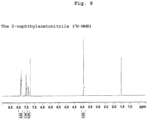
- FIG. 1 to 5 are not according to the invention and are present for illustration purposes only.
- Np is a naphthyl group optionally having substituent(s).
- the naphthyl group is, for example, a 1-naphthyl group or a 2-naphthyl group, preferably a 2-naphthyl group.
- the substituent that Np optionally has is a halogen atom (e.g., a chlorine atom, a bromine atom), a linear or branched alkyl group having 1-6 carbon atoms (e.g., a methyl group, an ethyl group), a linear or branched alkoxy group having 1-6 carbon atoms (e.g., a methoxy group, an ethoxy group) or the like.
- Np is particularly preferably a 2-naphthyl group.
- R 1 is a linear or branched alkyl group having 1-3 carbon atoms.
- R 1 is an alkyl group having 1-2 carbon atoms, particularly preferably methyl group.
- R 3 and R 4 are each independently a linear or branched alkyl group having 1-3 carbon atoms and optionally having a nitrogen atom, an oxygen atom or a sulfur atom, or a hydrogen atom.
- R 3 and R 4 may be bonded to form a ring.
- R 3 and R 4 are each independently alkyl having 1-2 carbon atoms and optionally having an oxygen atom, and R 3 and R 4 are bonded to form a ring.
- -NR 3 R 4 is preferably a morpholino group.
- X is an oxygen atom or a sulfur atom.
- R 5 is an alkylene group having 1-3 carbon atoms.
- R 5 is an alkylene group having 1-2 carbon atoms, particularly preferably a methylene group.
- R 6 and R 7 are each independently a chlorine atom, a hydroxyl group, an amino group, an isocyanate group or a p-tolyl group.
- R 6 is an amino group or an isocyanate group and R 7 is a hydroxyl group, an amino group or a chlorine atom.
- R 6 and R 7 are amino groups, R 6 is an amino group and R 7 is a hydroxyl group, or R 6 is an isocyanate group and R 7 is a chlorine atom.
- Z is a halogen atom.
- it is a bromine atom or a chlorine atom, particularly preferably a chlorine atom.
- step 1 a compound represented by the formula (2') is subjected to Willgerodt reaction in the presence of an additive as necessary, and then the obtained amide compound represented by the formula (3') is hydrolyzed and neutralized to obtain a carboxylic acid compound represented by the formula (4').
- Willgerodt reaction means Willgerodt reaction and Willgerodt-Kindler reaction.
- the compound represented by the formula (2') is 2'-acetonaphthone is .
- the Willgerodt reaction can be performed by reacting a compound represented by the formula (2') with a sulfur compound such as sodium sulfide (Na 2 S•9H 2 O), ammonium sulfide ((NH 4 ) 2 S) and the like under heating.
- a sulfur compound such as sodium sulfide (Na 2 S•9H 2 O), ammonium sulfide ((NH 4 ) 2 S) and the like under heating.
- the sulfur compound one kind may be used alone, or two or more kinds may be used in any combination and ratio.
- the reaction can be performed in the presence of an aqueous solvent such as water and the like.
- the amount of the sulfur compound to be used is not particularly limited as long as it is an amount effective for the Willgerodt reaction of the compound represented by the formula (2').
- the amount of the sulfur compound to be used is generally 1 mol - 5 mol, preferably 1 mol - 3 mol, per 1 mol of the compound represented by the formula (2').
- the reaction temperature is generally 90°C - 150°C, preferably 100°C - 140°C, particularly preferably 110°C - 130°C.
- the reaction is generally performed under normal pressure.
- the reaction time can be appropriately determined according to the progress of the reaction and is generally 1 hr - 12 hr, preferably 2 hr - 10 hr.
- the Willgerodt reaction in the present invention can be performed by reacting a compound represented by the formula (2') with sulfur and secondary amine such as dialkyl amine, morpholine and the like under heating (Willgerodt-Kindler reaction).
- the amount of sulfur to be used is not particularly limited as long as it is an amount effective for the Willgerodt-Kindler reaction of the compound represented by the formula (2').
- the amount of the sulfur to be used is generally 1 mol - 5 mol, preferably 1 mol - 3 mol, per 1 mol of the compound represented by the formula (2').
- the secondary amine for industrial production is preferably morpholine since reaction without solvent can be performed efficiently.
- the amount of the secondary amine to be used is not particularly limited as long as it is an amount effective for the Willgerodt-Kindler reaction of the compound represented by the formula (2').
- the amount of the secondary amine to be used is generally 2 mol - 6 mol, preferably 2 mol - 4 mol, per 1 mol of the compound represented by the formula (2').
- the reaction can be performed without solvent or in an organic solvent inert to the reaction.
- organic solvent include dioxane, water, dimethylformamide and the like.
- these organic solvents one kind may be used alone, or two or more kinds may be used in any combination and ratio.
- the reaction temperature is generally 90°C - 150°C, preferably 100°C - 140°C, particularly preferably 110°C - 130°C.
- the reaction is generally performed under normal pressure.
- the reaction time can be appropriately determined according to the progress of the reaction and is generally 1 hr - not less than 12 hr, preferably 2 hr - 10 hr.
- additives When performing the Willgerodt reaction, additives may also be used as necessary.
- the additive include dehydrating agents such as zeolite, molecular sieves, magnesium sulfate, sodium sulfate and the like.
- the dehydrating agent one kind may be used alone, or two or more kinds may be used in any combination and ratio.
- the reaction can proceed efficiently by controlling the amount of water in the reaction system to a low level.
- the amount of the dehydrating agent to be used is generally 1 mol - 5 mol, preferably 1.5 mol - 4 mol, per 1 mol of the compound represented by the formula (2').
- the additive examples include organic acids such as p-toluenesulfonic acid, methanesulfonic acid, oxalic acid, trifluoroacetic acid and the like.
- organic acids such as p-toluenesulfonic acid, methanesulfonic acid, oxalic acid, trifluoroacetic acid and the like.
- the organic acid one kind may be used alone, or two or more kinds may be used in any combination and ratio.
- p-toluenesulfonic acid or methanesulfonic acid is particularly preferable. Using these organic acids as the additive, production of by-products, particularly a ketothioamide compound represented by the following formula is suppressed, and the reaction can proceed efficiently.
- the amount of the organic acid to be used is generally 0.01 mol - 5 mol, preferably 0.05 mol - 3 mol, per 1 mol of the compound represented by the formula (2').
- the reaction may be performed while dehydrating by distillation.
- the amide compound represented by the formula (3') obtained by the Willgerodt reaction is subjected to hydrolysis after separation from the reaction system, or is subjected to the next hydrolysis without separation.
- the amide compound represented by the formula (3') is hydrolyzed with a base.
- the base include alkali metal hydroxides such as sodium hydroxide, potassium hydroxide and the like; alkaline earth metal hydroxides such as calcium hydroxide and the like; alkali metal carbonates such as sodium carbonate, potassium carbonate and the like; alkaline earth metal carbonates such as calcium carbonate and the like; alkali metal hydrogen carbonates such as sodium hydrogen carbonate, potassium hydrogen carbonate and the like; alkaline earth metal hydrogen carbonates such as calcium hydrogen carbonate and the like; and alkali metal alkoxides such as sodium methoxide, sodium ethoxide, potassium methoxide, potassium ethoxide and the like.
- the base one kind may be used alone, or two or more kinds may be used in any combination and ratio.
- the amount of the base to be used is not particularly limited as long as it is an amount effective for hydrolysis of the amide compound represented by the formula (3').
- the amount of the base to be used is preferably 1 mol - 10 mol, preferably 1 mol - 5 mol, per 1 mol of the amide compound represented by the formula (3').
- Hydrolysis may be performed without a solvent or in a solvent such as water and the like. It is preferably performed in a solvent in view of superior stirrability and uniformity.
- the temperature of hydrolysis is not particularly limited as long as the hydrolysis proceeds.
- the hydrolysis temperature is generally 80°C - 115°C, preferably 85°C - 110°C.
- Hydrolysis is generally performed under normal pressure.
- the reaction product obtained by hydrolysis e.g., sodium 2-naphthylacetate
- a carboxylic acid compound represented by the formula (4') is neutralized to obtain a carboxylic acid compound represented by the formula (4').
- Acids such as hydrochloric acid, sulfuric acid, hydrobromic acid and the like can be used for neutralization.
- the acid one kind may be used alone, or two or more kinds may be used in any combination and ratio.
- hydrochloric acid is preferable because of the reaction efficiency, cost and the like.
- the amount of the acid to be used is not particularly limited as long as it is an amount effective for neutralization.
- the amount of the acid to be used is preferably 1 mol - 20 mol, preferably 3 mol - 10 mol, per 1 mol of the reaction product obtained by hydrolysis.
- the pH at the end-point of neutralization is generally between 0 and 5.
- the neutralization temperature is not particularly limited as long as the neutralization proceeds.
- the neutralization temperature is generally 10°C - 80°C, preferably 20°C - 50°C.
- the reaction product obtained by neutralization may be washed once or multiple times with an appropriate washing solution such as water, an aqueous solution and the like.
- the carboxylic acid compound represented by the formula (4') can be extracted and recovered using an organic solvent from the reaction product obtained by neutralization.
- the organic solvent include hydrocarbon solvents capable of dissolving the carboxylic acid compound represented by the formula (4').
- the hydrocarbon solvent include alicyclic hydrocarbon solvents such as cyclohexane, methylcyclohexane and the like; and aromatic hydrocarbon solvents such as benzene, toluene, xylene, mesitylene, ethylbenzene, tert-butylbenzene, trifluoromethylbenzene, nitrobenzene, chlorobenzene, chlorotoluene, bromobenzene and the like.
- the hydrocarbon solvent may be used alone, or two or more kinds may be used in any combination and ratio.
- the hydrocarbon solvent is particularly preferably cyclohexane, toluene, xylene or chlorobenzene.
- an organic solvent e.g., toluene, xylene, cyclohexane, chlorobenzene, etc.
- an organic solvent capable of dissolving the carboxylic acid compound represented by the formula (4')
- the mixture is stirred under acidic conditions (e.g., not more than pH3) with heating (e.g., 50°C - 90°C), and washing, separation of the aqueous layer, concentration and the like are conducted as necessary, and after cooling, the carboxylic acid compound represented by the formula (4') can be precipitated and recovered as a solid.
- the obtained reaction product generally contains several mol% or more of sulfur.
- Sulfur is an impurity for the carboxylic acid compound represented by the formula (4'), which is the target product of step 1.
- sulfur may decrease the reaction efficiency. Accordingly, it is preferable to remove sulfur as much as possible.
- the sulfur content of the carboxylic acid compound represented by the formula (4') obtained in step 1 can be decreased by contacting same with a hydrocarbon solvent after the aforementioned hydrolysis, performing the aforementioned neutralization in the presence of a hydrocarbon solvent, or contacting the reaction product obtained by the aforementioned neutralization with a hydrocarbon solvent.
- Water, an aqueous solution or the like may be present as necessary when contacting the compound with a hydrocarbon solvent.
- the hydrocarbon solvent is preferably an alicyclic hydrocarbon solvent such as cyclohexane, methylcyclohexane or the like; or an aromatic hydrocarbon solvent such as benzene, toluene, xylene, mesitylene, ethylbenzene, tert-butylbenzene, trifluoromethylbenzene, nitrobenzene, chlorobenzene, chlorotoluene, bromobenzene or the like, more preferably toluene, xylene or chlorobenzene, particularly preferably toluene.
- an aromatic hydrocarbon solvent such as benzene, toluene, xylene, mesitylene, ethylbenzene, tert-butylbenzene, trifluoromethylbenzene, nitrobenzene, chlorobenzene, chlorotoluene, bromobenzene or the like, more preferably toluene, x
- the hydrocarbon solvent When contacting with a hydrocarbon solvent after the aforementioned hydrolysis, the hydrocarbon solvent is added to the reaction product obtained by the hydrolysis reaction, or the reaction product obtained by the hydrolysis reaction is added to the hydrocarbon solvent.
- water, an aqueous solution or the like may be added as necessary.
- the hydrocarbon solvent is used at generally 1 - 20 volume ratio, preferably 1.5 - 10 volume ratio, particularly preferably 3 - 5 volume ratio, to the carboxylic acid compound represented by the formula (4').
- the contact temperature is generally 50°C - 90°C, preferably 60°C - 80°C.
- the contact time is generally 10 min - 5 hr, preferably 30 min - 2 hr.
- the hydrocarbon solvent layer is removed by partitioning or the like, and the aqueous layer containing the reaction product obtained by the hydrolysis reaction is subjected to the neutralization reaction.
- a hydrocarbon solvent When a hydrocarbon solvent is present during the aforementioned neutralization, an acid and a hydrocarbon solvent are added to the reaction product obtained by the hydrolysis reaction, or the reaction product obtained by the hydrolysis reaction is added to a mixture of an acid and a hydrocarbon solvent to perform a neutralization reaction.
- water, an aqueous solution, or the like may be added as necessary.
- the hydrocarbon solvent is used at generally 1 - 30 volume ratio, preferably 3 - 20 volume ratio, particularly preferably 5 - 15 volume ratio, to the carboxylic acid compound represented by the formula (4').
- the aqueous layer is removed by partitioning or the like to obtain an organic layer containing a carboxylic acid compound represented by the formula (4').
- the obtained organic layer may be washed once or multiple times with an appropriate washing solution such as water, an aqueous solution and the like.
- a hydrocarbon solvent When a hydrocarbon solvent is contacted with the reaction product obtained by the aforementioned neutralization, the hydrocarbon solvent is added to the reaction product obtained by the neutralization, or the reaction product obtained by the neutralization is added to the hydrocarbon solvent.
- water, an aqueous solution or the like may be added as necessary.
- the hydrocarbon solvent is used at generally 1 - 20 volume ratio, preferably 1.5 - 10 volume ratio, particularly preferably 3 - 5 volume ratio, to the carboxylic acid compound represented by the formula (4').
- the contact temperature is generally 50°C - 90°C, preferably 60°C - 80°C.
- the contact time is generally 10 min - 5 hr, preferably 30 min - 2 hr.
- the contact is preferably performed under acidic conditions of not more than pH 3, preferably not more than pH 2.
- the aqueous layer is removed by partitioning or the like to obtain an organic layer containing a carboxylic acid compound represented by the formula (4').
- the obtained organic layer may be washed once or multiple times with an appropriate washing solution such as water, an aqueous solution and the like.
- the obtained organic layer is concentrated as necessary and cooled, whereby the carboxylic acid compound represented by the formula (4') can be precipitated and recovered as a solid.
- toluene is particularly preferable as the aforementioned hydrocarbon solvent because the removal of sulfur and the extraction of the carboxylic acid compound represented by the formula (4') can be performed with a single solvent.
- the carboxylic acid compound represented by the formula (4') obtained by contacting with a hydrocarbon solvent or the like in step 1 of the present disclosure has high quality with a sulfur content of 0.001 mol% - 1 mol %, preferably 0.001 mol% - 0.5 mol %, and a purity of not less than 98 mol%, preferably not less than 99 mol%.
- the carboxylic acid compound represented by the formula (4') obtained in step 1 is useful as a starting material for synthesis, or an intermediate for synthesis of various industrial products, pharmaceutical products and the like, and can be subjected to step 2 of the present invention.
- step 2 a nitrile compound represented by the aforementioned formula (1') is obtained from a carboxylic acid compound represented by the aforementioned formula (4').
- Step 2 is step 2B.
- the carboxylic acid compound represented by the formula (4') may be commercially available or one obtained in the aforementioned step 1 can be used.
- the carboxylic acid compound represented by the formula (4') is 2-naphthylacetic acid.
- step 2A according to the disclosure
- step 2A the carboxylic acid compound represented by the formula (4) is reacted with a halogenating agent in the presence of a catalyst as necessary in an organic solvent, further reacted with an amidating agent and the obtained compound represented by the formula (5) or the formula (6) is reacted with a dehydrating agent to give a nitrile compound represented by the aforementioned formula (1).
- the carboxylic acid compound represented by the formula (4) is reacted with a halogenating agent in the presence of a catalyst as necessary (acid halogenation).
- the halogenating agent is not particularly limited as long as it can halogenate the carboxylic acid compound represented by the aforementioned formula (4).
- a chlorinating agent and a brominating agent are preferable, and a chlorinating agent is more preferable.
- the chlorinating agent include thionyl chloride, oxalyl chloride, sulfuryl chloride, phosphoryl chloride, phosphorus trichloride, phosphorus pentachloride and the like
- examples of the brominating agent include thionyl bromide, phosphorus tribromide and the like.
- the halogenating agent one kind may be used alone, or two or more kinds may be used in any combination and ratio.
- thionyl chloride phosphoryl chloride, phosphorus pentachloride, thionyl bromide, and phosphorus tribromide are preferable, and thionyl chloride is particularly preferable, from the aspects of cost, broad utility, reactivity, and the like.
- the amount of the halogenating agent to be used is not particularly limited as long as it is an amount effective for acid halogenation. It is preferably 1 mol - 5 mol, more preferably 1 mol - 3 mol, particularly preferably 1 mol - 2 mol, per 1 mol of the carboxylic acid compound represented by the formula (4).
- the organic solvent is not particularly limited as long as the reaction proceeds, and examples thereof include ester solvent, ether solvent, ketone solvent, nitrile solvent, amide solvent, sulfoxide solvent, hydrocarbon solvent, and basic organic solvent.
- the organic solvent one kind may be used alone, or two or more kinds may be used in any combination and ratio.
- the organic solvent is preferably a hydrocarbon solvent, and alicyclic hydrocarbon solvents such as cyclohexane, methylcyclohexane and the like; and aromatic hydrocarbon solvents such as benzene, toluene, xylene, mesitylene, ethylbenzene, tert-butylbenzene, trifluoromethylbenzene, nitrobenzene, chlorobenzene, chlorotoluene, bromobenzene and the like are preferable. Particularly, toluene, xylene and chlorobenzene are preferable from the aspects of cost, broad utility, reactivity, and the like.
- a catalyst may be present to accelerate the reaction during acid halogenation.
- the catalyst is not particularly limited as long as it promotes the reaction between the carboxylic acid compound represented by the formula (4) and the halogenating agent.
- Examples of the catalyst include N,N-dimethylformamide, N-methylpyrrolidone, N,N-dimethylacetamide and the like, and N,N-dimethylformamide is particularly preferable.
- the amount of the catalyst to be used is not particularly limited as long as it is an amount effective for functioning as a catalyst.
- the amount of the catalyst to be used is preferably 0.0001 mol - 1 mol, particularly preferably 0.001 mol - 0.1 mol, per 1 mol of the carboxylic acid compound represented by the formula (4).
- the temperature of the acid halogenation is generally 20°C - 60°C, preferably 30°C - 50°C, from the aspects of productivity and the like.
- the reaction time can be appropriately determined according to the progress of the reaction and is generally 0.5 hr - 10 hr, preferably 1 hr - 5 hr.
- the reaction is generally performed under normal pressure.
- the obtained acid halogenation solution can be directly subjected to the next amidation step.
- the acid halogenation solution obtained as described above is reacted with an amidating agent to obtain an amide compound represented by the formula (5) or the formula (6).
- amidating agent examples include ammonia (gas, aqueous solution) and hydroxyamine.
- ammonia gas, aqueous solution
- hydroxyamine examples include hydroxyamine.
- ammonia gas, aqueous solution
- the amount of the amidating agent to be used is not particularly limited as long as it is an amount at which amidation is possible. It is preferably 1 mol - 20 mol, preferably 2 mol - 10 mol, per 1 mol of the carboxylic acid compound represented by the formula (4) from the aspects of cost, reactivity and the like.
- an amidating agent may be added to the aforementioned acid halogenation solution, or the aforementioned acid halogenation solution may be added to the amidating agent.
- a solvent such as water, an organic solvent or the like that does not inhibit the amidation reaction may be present.
- the temperature of the amidation reaction is generally 20°C - 60°C, preferably 30°C - 50°C, from the aspects of productivity and the like.
- the reaction time can be appropriately determined according to the progress of the reaction and is generally 0.5 hr - 10 hr, preferably 1 hr - 5 hr.
- the reaction is generally performed under normal pressure.
- the ammonia gas When ammonia gas is used as the amidating agent, the ammonia gas may be supplied by purging into the gaseous phase part of the reactor, or may be supplied by depressurizing the reactor and then repressurizing the reactor with ammonia gas, or may be supplied by bubbling ammonia gas in the reaction mixture.
- the temperature is generally 10°C - 80°C, preferably 20°C - 70°C, from the aspects of productivity and the like.
- ammonia gas is used as the amidating agent, moreover, it is preferable to reduce, before the reaction with the dehydrating agent, the ammonia gas contained in the amidation reaction mixture obtained by amidation. As a result, the amount of the dehydrating agent to be used next can be reduced, the operability can be improved, the production of by-products can be suppressed, and the cost can be reduced.
- Examples of the method for reducing the ammonia gas contained in the reaction mixture include heating the reaction mixture, purging the gaseous phase part in the reactor with nitrogen, and setting the inside of the reactor under a reduced pressure condition.
- the amide compound represented by the formula (5) or the formula (6) obtained as described above is reacted with a dehydrating agent (dehydration cyanation) to obtain a nitrile compound represented by the aforementioned formula (1).
- the amide compound represented by the formula (5) or the formula (6) may be directly subjected to a reaction with a dehydrating agent, or may be once isolated, purified or the like and then subjected to a reaction with a dehydrating agent.
- Examples of the dehydrating agent include phosphorus dehydrating agent, chlorine dehydrating agent, and nitrogen dehydrating agent. Specifically, phosphorus pentoxide, polyphosphoric acid, phosphorus pentachloride, thionyl chloride, phosphoryl chloride, acetyl chloride, tosyl chloride/pyridine, cyanuric chloride, benzenesulfonyl chloride, oxalyl chloride, phosphorus tribromide and the like can be mentioned. As the dehydrating agent, one kind may be used alone, or two or more kinds may be used in any combination and ratio.
- phosphorus pentoxide phosphoryl chloride, cyanuric chloride, and phosphorus tribromide are preferable from the aspects of cost, reactivity and the like.
- the amount of the dehydrating agent to be used is not particularly limited as long as it is an amount at which dehydration cyanation is possible. It is preferably 0.1 mol - 10 mol, preferably 0.5 mol - 10 mol, per 1 mol of the aforementioned amide compound from the aspects of cost, reactivity and the like.
- a dehydrating agent may be added to the aforementioned amidation reaction mixture, or the aforementioned amidation reaction mixture may be added to the dehydrating agent.
- a solvent such as water, an organic solvent or the like that does not inhibit the dehydration cyanation reaction may be present.
- the reaction temperature is generally 20°C - 120°C, preferably 50°C - 110°C, particularly preferably 70°C - 100°C, from the aspects of productivity and the like.
- the reaction time can be appropriately determined according to the progress of the reaction and is generally 0.5 hr - 10 hr, preferably 1 hr - 8 hr.
- the reaction is generally performed under normal pressure.
- the thus-obtained nitrile compound represented by the aforementioned formula (1) can be extracted and recovered using an organic solvent from the dehydration cyanation reaction product.
- an organic solvent e.g., toluene, ethyl acetate, tert-butyl methyl ether etc.
- an organic solvent capable of dissolving the nitrile compound represented by the formula (1)
- washing, separation of the aqueous layer, concentration and the like are conducted as necessary, and after cooling, the nitrile compound represented by the formula (1) can be precipitated and recovered as a solid.
- step 2A the amide compound represented by the formula (5) or the formula (6) is easy to crystallize, and thus a highly pure amide compound can be easily isolated and recovered.
- a nitrile compound represented by the aforementioned formula (1) with high purity and high quality can be obtained.
- step 2B a carboxylic acid compound represented by the aforementioned formula (4') is reacted with a halogenating agent and a compound represented by the following formula (7) R 6 SO 2 R 7 (7) in the presence of a catalyst as necessary in an organic solvent to obtain a nitrile compound represented by the aforementioned formula (1').
- the compound represented by the formula (7) is sulfamide.
- the desired nitrile compound represented by the formula (1') can be purified by crystallizing with an organic solvent such as toluene, heptane or the like.
- the desired nitrile compound represented by the formula (1') can be precipitated as crystals by adding water to the reaction mixture containing the nitrile compound.
- Step 2B is industrially preferable since it can be performed in a single reactor.
- step 2B high quality nitrile compound represented by the formula (1') with a purity (HPLC) of preferably not less than 98 Area%, particularly preferably not less than 99 Area%, can be obtained.
- step 2B may any of the following step 2B-1 and step 2B-2.
- step 2B-1
- step 2B-1 a carboxylic acid compound represented by the aforementioned formula (4') is reacted with a halogenating agent and a compound represented by the formula (7) in the presence of a catalyst as necessary in an organic solvent at 80°C - 180°C to give a nitrile compound represented by the aforementioned formula (1').
- the halogenating agent is a chlorinating agent thionyl chloride).
- Other halogenating agents are brominating agents.
- Examples of halogenating agents in form of chlorinating agents include thionyl chloride, oxalyl chloride, sulfuryl chloride, phosphoryl chloride, phosphorus trichloride, phosphorus pentachloride and the like, and examples of the brominating agent include thionyl bromide, phosphorus tribromide and the like.
- the halogenating agent one kind may be used alone, or two or more kinds may be used in any combination and ratio.
- thionyl chloride phosphoryl chloride, phosphorus pentachloride, thionyl bromide, and phosphorus tribromide are preferable, and thionyl chloride is particularly preferable, from the aspects of cost, broad utility, reactivity, and the like.
- the amount of the halogenating agent to be used is 1 mol - 3 mol, more preferably 1.02 mol - 2 mol, particularly preferably 1.05 mol - 1.5 mol, per 1 mol of the carboxylic acid compound.
- the halogenating agent is preferably used in a slightly larger amount than the theoretical amount in order to complete the reaction.
- the amount of the compound represented by the aforementioned formula (7) to be used is 1 mol - 3 mol, more preferably 1.02 mol - 2 mol, particularly preferably 1.05 mol - 1.5 mol, per 1 mol of the carboxylic acid compound.
- the amount of the compound represented by the aforementioned formula (7) to be used is preferably larger than the amount of the halogenating agent to be used. From the aspects of the effect, cost and the like, the amount of the compound represented by the aforementioned formula (7) to be used is 5% - 15%, larger than the amount of the halogenating agent to be used. As a result, the desired nitrile compound represented by the aforementioned formula (1') can be obtained in a high yield. When the amount of the compound represented by the aforementioned formula (7) to be used is less than the amount of the halogenating agent to be used, many by-products may be produced and the yield of the desired nitrile compound may decrease. Furthermore, when the amount of the compound represented by the aforementioned formula (7) to be used is the same as the amount of the halogenating agent to be used, the reaction may not proceed sufficiently.
- a catalyst is present to accelerate the reaction.
- the catalyst is not particularly limited as long as it promotes the reaction of step 2B-1.
- Examples of the catalyst include N,N-dimethylformamide, N-methylpyrrolidone, N,N-dimethylacetamide and the like, and N,N-dimethylformamide is particularly preferable.
- the amount of the catalyst to be used is not particularly limited as long as it is an amount effective for functioning as a catalyst.
- the amount of the catalyst to be used is preferably 0.0001 mol - 1 mol, preferably 0.001 mol - 0.1 mol, per 1 mol of the carboxylic acid compound represented by the formula (4').
- the organic solvent is not particularly limited as long as the reaction in step 2B-1 proceeds.
- examples of the organic solvent include ester solvent, ether solvent, ketone solvent, nitrile solvent, amide solvent, sulfoxide solvent, sulfone solvent, hydrocarbon solvent, and basic organic solvent.
- the organic solvent one kind may be used alone, or two or more kinds may be used in any combination and ratio.
- ester solvent acetic acid esters such as ethyl acetate, propyl acetate, butyl acetate and the like can be used.
- chain ethers such as diethyl ether, di-n-butyl ether, diisopropyl ether, tert-butyl methyl ether and the like; and cyclic ethers such as cyclopentyl methyl ether, tetrahydrofuran, 2-methyltetrahydrofuran, dioxane and the like can be used.
- ketone solvent aliphatic ketones such as acetone, methyl ethyl ketone, methyl isobutyl ketone and the like can be used.
- nitrile solvent aliphatic nitriles such as acetonitrile, propanonitrile, butyronitrile, isobutyronitrile, valeronitrile, isovaleronitrile and the like; aromatic nitriles such as benzonitrile and the like can be used.
- aprotic amides such as N,N-dimethylformamide, N,N-dimethylacetamide, N-methylpyrrolidinone and the like can be used.
- sulfoxide solvent aprotic sulfoxides such as dimethyl sulfoxide and the like can be used.
- sulfone solvent aprotic sulfones such as ethyl methyl sulfone, ethyl isopropyl sulfone, 3-methylsulfolane, sulfolane and the like can be used.
- hydrocarbon solvent aliphatic hydrocarbons such as hexane, cyclohexane, heptane, cycloheptane and the like; aromatic hydrocarbons such as toluene, xylene and the like can be used.
- pyridine solvents such as pyridine, 2-methylpyridine, 3-methylpyridine, 4-methylpyridine, 2,6-dimethylpyridine and the like can be used.
- the amount of the organic solvent to be used is generally not less than 1 L, preferably not less than 2 L, further preferably not less than 3 L, per 1 kg of the carboxylic acid compound represented by the formula (4'), from the aspects of operability and the like, and the upper limit is generally not more than 50 L, preferably not more than 20 L, more preferably not more than 10 L, further preferably not more than 4.5 L, particularly preferably not more than 4 L, per 1 kg of the carboxylic acid compound represented by the formula (4'), from the aspects of the operability, productivity, cost and the like.
- a sulfone solvent as the organic solvent from the aspects of reactivity, productivity and the like, and it is particularly preferable to use sulfolane because the yield of the desired nitrile compound is improved.
- the sulfone solvent is preferably used alone, but may be used in combination with other organic solvents in any ratio.
- the temperature of reaction with the halogenating agent may vary depending on the organic solvent, catalyst and the like to be used.
- the lower limit is generally not less than 80°C, preferably not less than 85°C, particularly preferably not less than 90°C, from the aspects of quality, reactivity and the like
- the upper limit is generally not more than 180°C, preferably not more than 150°C, particularly preferably not more than 120°C, from the aspects of quality, reactivity, cost and the like.
- reaction temperature When the reaction temperature is too low, the progress of the reaction may be delayed and the productivity may decrease, and when it is too high, many by-products may be produced and the quality of the desired nitrile compound may decrease.
- the temperature of reaction with a compound represented by the aforementioned formula (7) is not particularly limited as long as the reaction proceeds.
- the lower limit is generally not less than 0°C, preferably not less than 10°C, more preferably not less than 15°C, from the aspects of productivity and the like, and the upper limit is generally not more than 180°C, preferably not more than 150°C, more preferably not more than 120°C, from the aspects of quality, cost and the like, particularly preferably 20°C - 110°C.
- reaction temperature When the reaction temperature is too low, the progress of the reaction may be delayed and the productivity may decrease, and when it is too high, many by-products may be produced, and the quality of the desired nitrile compound may decrease.
- the reaction time may vary depending on the organic solvent, catalyst and the like to be used, and can be appropriately determined according to the progress of the reaction. It is generally 0.5 hr - 30 hr, preferably 1 hr - 15 hr.
- the reaction is generally performed under normal pressure.
- a carboxylic acid compound represented by the aforementioned formula (4'), a halogenating agent, a compound represented by the formula (7), an organic solvent, and, where necessary, a catalyst are mixed at 20°C - 70°C, and the mixture is heated to 80°C - 180°C.
- a carboxylic acid compound represented by the aforementioned formula (4'), a halogenating agent, a compound represented by the formula (7), an organic solvent, and, where necessary, a catalyst are mixed at 80°C - 180°C.
- a carboxylic acid compound represented by the aforementioned formula (4'), a compound represented by the formula (7), an organic solvent, and, where necessary, a catalyst are mixed at 20°C - 70°C, the mixture is heated to 80°C - 180°C, and a halogenating agent is added.
- This embodiment is preferable because the precipitation of the sulfonamide compound, which is a reaction intermediate, can be easily suppressed.
- step 2B-2
- reaction starting material 1 which is a mixture of a carboxylic acid compound represented by the aforementioned formula (4'), a halogenating agent, a first organic solvent and, where necessary, a catalyst, is reacted with reaction starting material 2 which is a mixture of a compound represented by the aforementioned formula (7) and a second organic solvent at 80°C - 180°C to give a nitrile compound represented by the aforementioned formula (1').
- the halogenating agent and the compound represented by the formula (7) are the same compounds as in Step 2B-1.
- the amount of the halogenating agent to be used is 1 mol to 3 mol per 1 mol of the carboxylic acid compound represented by the aforementioned formula (4'). Use of not more than 3 mol per 1 mol of the carboxylic acid compound is preferable from the aspects of cost, productivity and the like.
- the amount of the halogenating agent to be used is preferably 1.02 mol - 2 mol, particularly preferably 1.05 mol - 1.5 mol, per 1 mol of the carboxylic acid compound.
- the halogenating agent is preferably used in a slightly larger amount than the theoretical amount in order to complete the reaction.
- the amount of the compound represented by the aforementioned formula (7) to be used is 1 mol to 3 mol per 1 mol of the carboxylic acid compound represented by the aforementioned formula (4').
- the amount of the compound represented by the aforementioned formula (7) to be used is preferably 1.02 mol - 3 mol, particularly preferably 1.05 mol - 2 mol, per 1 mol of the carboxylic acid compound.
- the amount of the compound represented by the aforementioned formula (7) to be used is preferably larger than the amount of the halogenating agent to be used.
- the amount of the compound represented by the aforementioned formula (7) to be used is preferably 2% - 20%, preferably 5% - 15%, larger than the amount of the halogenating agent to be used.
- the desired nitrile compound represented by the aforementioned formula (1') can be obtained in a high yield.
- the amount of the compound represented by the aforementioned formula (7) to be used is less than the amount of the halogenating agent to be used, many by-products may be produced, and the yield of the desired nitrile compound may decrease.
- the amount of the compound represented by the aforementioned formula (7) to be used is the same as the amount of the halogenating agent to be used, the reaction may not proceed sufficiently.
- the first organic solvent is not particularly limited as long as the reaction in step 2B-2 proceeds.
- the organic solvent include ester solvent, ether solvent, ketone solvent, nitrile solvent, amide solvent, sulfoxide solvent, sulfone solvent, hydrocarbon solvent, and basic organic solvent.
- the organic solvent one kind may be used alone, or two or more kinds may be used in any combination and ratio.
- ester solvent acetic acid esters such as ethyl acetate, propyl acetate, butyl acetate and the like can be used.
- chain ethers such as diethyl ether, di-n-butyl ether, diisopropyl ether, tert-butyl methyl ether and the like; and cyclic ethers such as cyclopentyl methyl ether, tetrahydrofuran, 2-methyltetrahydrofuran, dioxane and the like can be used.
- ketone solvent aliphatic ketones such as acetone, methyl ethyl ketone, methyl isobutyl ketone and the like can be used.
- nitrile solvent aliphatic nitriles such as acetonitrile, propanonitrile, butyronitrile, isobutyronitrile, valeronitrile, isovaleronitrile and the like; aromatic nitriles such as benzonitrile and the like can be used.
- aprotic amides such as N,N-dimethylformamide, N,N-dimethylacetamide, N-methylpyrrolidinone and the like can be used.
- sulfoxide solvent aprotic sulfoxides such as dimethyl sulfoxide and the like can be used.
- sulfone solvent aprotic sulfones such as ethyl methyl sulfone, ethyl isopropyl sulfone, 3-methylsulfolane, sulfolane and the like can be used.
- hydrocarbon solvent alicyclic hydrocarbons such as cyclohexane, methylcyclohexane and the like; and aromatic hydrocarbons such as benzene, toluene, xylene, mesitylene, ethylbenzene, tert-butylbenzene, trifluoromethylbenzene, nitrobenzene, chlorobenzene, chlorotoluene, bromobenzene and the like can be used.
- alicyclic hydrocarbons such as cyclohexane, methylcyclohexane and the like
- aromatic hydrocarbons such as benzene, toluene, xylene, mesitylene, ethylbenzene, tert-butylbenzene, trifluoromethylbenzene, nitrobenzene, chlorobenzene, chlorotoluene, bromobenzene and the like
- pyridine solvents such as pyridine, 2-methylpyridine, 3-methylpyridine, 4-methylpyridine, 2,6-dimethylpyridine and the like can be used.
- hydrocarbon solvent is preferable. From the aspects of the operability, productivity, cost and the like, toluene, xylene and chlorobenzene are more preferable, and toluene is particularly preferable.
- a sulfone solvent is also preferable. From the aspects of reactivity, productivity and the like, sulfolane is preferable.
- the first organic solvent a mixture of a hydrocarbon solvent and a sulfone solvent is also preferably used, and a mixture of toluene and sulfolane is particularly preferable.
- the mixing ratio (volume ratio) of the hydrocarbon solvent and the sulfone solvent can be appropriately selected within the range of 1:99 - 99:1.
- the amount of the first organic solvent to be used is generally not less than 1 L, preferably not less than 2 L, further preferably not less than 3 L, per 1 kg of the carboxylic acid compound represented by the aforementioned formula (4'), from the aspects of operability and the like, and the upper limit is generally not more than 50 L, preferably not more than 30 L, more preferably not more than 20 L, further preferably not more than 4.5 L, particularly preferably not more than 4 L, per 1 kg of the carboxylic acid compound represented by the aforementioned formula (4'), from the aspects of the operability, productivity, cost and the like.
- a sulfone solvent is preferably used from the aspects of reactivity, productivity and the like.
- aprotic sulfone such as ethyl methyl sulfone, ethyl isopropyl sulfone, 3-methylsulfolane, sulfolane and the like can be used. It is particularly preferable to use sulfolane because the yield of the desired nitrile compound is improved.
- the sulfone solvent is preferably used alone, but may be used by mixing with other organic solvents (e.g., hydrocarbon solvent) in any ratio.
- the amount of the second organic solvent to be used is generally not less than 1 L, preferably not less than 2 L, further preferably not less than 3 L, per 1 kg of the carboxylic acid compound represented by the aforementioned formula (4'), from the aspects of operability and the like, and the upper limit is generally not more than 50 L, preferably not more than 30 L, more preferably not more than 20 L, further preferably not more than 4.5 L, particularly preferably not more than 4 L, per 1 kg of the carboxylic acid compound represented by the aforementioned formula (4'), from the aspects of the operability, productivity, cost and the like.
- the kind and amount of the catalyst to be used are the same as those in step 2B-1.
- the reaction starting material 1 is prepared by mixing a carboxylic acid compound represented by the aforementioned formula (4'), a halogenating agent, the first organic solvent and, where necessary, a catalyst.
- the preparation temperature is generally 15°C - 65°C, preferably 20°C - 60°C, particularly preferably 30°C - 50°C. When the preparation temperature is too low, the progress of the reaction may be delayed and the productivity may decrease, and when it is too high, many by-products may be produced and the quality of the desired nitrile compound may decrease.
- the reaction starting material 1 may be subjected to concentration, purification and the like.
- the reaction starting material 2 is prepared by mixing a compound represented by the aforementioned formula (7) and the second organic solvent.
- the preparation temperature is not particularly limited, and is generally 10°C - 180°C, preferably 20°C - 150°C.
- the reaction starting materials 1 and 2 may contain, where necessary, inorganic additive (e.g., diatomaceous earth, silicic anhydride, silicon dioxide, sodium sulfate, magnesium sulfate, sodium chloride, magnesium chloride, calcium carbonate, magnesium carbonate, etc.). Using an inorganic additive, the reaction can proceed smoothly.
- inorganic additive e.g., diatomaceous earth, silicic anhydride, silicon dioxide, sodium sulfate, magnesium sulfate, sodium chloride, magnesium chloride, calcium carbonate, magnesium carbonate, etc.
- reaction starting material 1 and the reaction starting material 2 may be mixed and the mixture may be heated and reacted at 80°C - 180°C, or the reaction starting material 1 at 80°C - 180°C and the reaction starting material 2 at 80°C - 180°C may be mixed and reacted.
- the reaction starting material 2 may be added to the reaction starting material 1 and mixed, or the reaction starting material 1 may be added to the reaction starting material 2 and mixed.
- the time of reaction of the reaction starting material 1 and the reaction starting material 2 may vary depending on the halogenating agent, organic solvent, catalyst and the like to be used, and can be appropriately determined according to the progress of the reaction. It is generally 0.5 hr - 30 hr, preferably 1 hr - 15 hr, particularly preferably 2 hr - 10 hr.
- the reaction is generally performed under normal pressure.
- the reaction mixture containing a nitrile compound represented by the formula (1'), which is obtained in the aforementioned step 2A or 2B, may be subjected to a treatment such as neutralization, partitioning, filtration and the like, or the desired nitrile compound represented by the formula (1) may be isolated by an isolation means such as concentration, crystallization and the like.
- the nitrile compound represented by the formula (1') obtained in the present invention has a high quality (HPLC) of preferably not less than 98%, particularly preferably not less than 99%. It may be further purified by a known purification means such as recrystallization, column chromatography and the like.
- the production method of the present invention may be batch or continuous.
- each compound in the present invention may form a solvate such as hydrate, organic solvent solvate, and the like, and the form thereof is not particularly limited as long as the reaction is not inhibited.
- the reaction mixture was cooled to 70°C - 80°C, sodium hydroxide aqueous solution at concentration 20 wt% (mixture of sodium hydroxide (3.53 g) and water (14.1 g), sodium hydroxide at 5 mole ratio to 2'-acetonaphthone) was added, and the mixture was reacted at 90°C - 105°C for 8 hr (hydrolysis).
- the reaction mixture was cooled to 50°C - 60°C, activated carbon (Seisei Shirasagi, 0.15 g) was added, and the mixture was stirred and filtered.
- hydrochloric acid at concentration 35% (mixture of hydrochloric acid (14.69 g) and water (12.4 mL)), and the mixture was stirred and cooled to recover 2-naphthylacetic acid as crude crystals.
- the crude crystals (2.0 g) (purity (HPLC analysis conditions-1) 92.6%) of the obtained 2-naphthylacetic acid were dissolved in toluene (20 mL) at 115°C, and the mixture was cooled to not more than 10°C to allow precipitation of a carboxylic acid compound.
- the obtained 2-naphthylacetic acid was 1.3 g, and the purity measured by HPLC (HPLC analysis conditions-1) was 98.2 Area%.
- the HPLC analysis results of the crude crystals of the obtained carboxylic acid compound (2-naphthylacetic acid) are shown in Fig. 1 .
- the HPLC analysis results of the purified crystals of the obtained carboxylic acid compound (2-naphthylacetic acid) are shown in Fig. 2
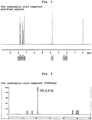
- the 1 H-NMR measurement results are shown in Fig. 3 .
- the reaction mixture was cooled to 70°C - 80°C, sodium hydroxide aqueous solution at concentration 20 wt% (mixture of sodium hydroxide (141.00 g) and water (564.01 g), sodium hydroxide at 5 mole ratio to 2'-acetonaphthone) were added, and the mixture was reacted at 90°C - 105°C for 4 hr (hydrolysis).
- the reaction mixture was cooled to 60°C - 70°C, water (120.00 g) and toluene (240.00 mL) were added, and the mixture was stirred at 65°C - 75°C and left standing, after which the upper layer was discarded (removal of unreacted sulfur).
- the obtained lower layer was added to a mixture of toluene (1200 mL) and hydrochloric acid at concentration 35% (mixture of hydrochloric acid (205.64 g) and water (281.90 mL), hydrochloric acid at 8 mole ratio to 2'-acetonaphthone). Furthermore, the reactor, wherein the lower layer had been contained, was washed by adding water (12.00 g), and the obtained liquid was also added to the mixture. The mixture of the aforementioned lower layer and the like was stirred at 65°C - 75°C, left standing (carboxylic acid compound extraction), and the obtained lower layer was discarded.
- the obtained upper layer was concentrated, cooled to not more than 10°C, and the precipitated carboxylic acid compound (2-naphthylacetic acid) was recovered as crystals.
- the obtained carboxylic acid compound (2-naphthylacetic acid) was 104.14 g, and the purity measured by HPLC (HPLC analysis conditions-3) was 99.6 Area%.
- 1 H-NMR (400 MHz, CDCl 3 ) ⁇ 3.80 (2H, s), 7.40 (1H, dd, J 8.4, 3.0Hz), 7.43-7.49 (2H, m), 7.73 (1H, s), 7.78-7.82 (3H, m)
- the obtained lower layer was added to a mixture of toluene (1200 mL) and hydrochloric acid at concentration 35% (mixture of hydrochloric acid (205.64 g) and water (281.90 mL), 8 mole ratio to 2'-acetonaphthone as hydrochloric acid).
- the mixture was stirred at 65°C - 75°C and left standing, and the lower layer was discarded.
- Water (600.00 g) was added to the upper layer, and the mixture was stirred at 65°C - 75°C and left standing, and the lower layer was discarded.
- Water (600.00 g) was added to the upper layer, and the mixture was stirred at 65°C - 75°C and left standing, and the lower layer was discarded.
- the reaction mixture was cooled to 70°C - 80°C, sodium hydroxide aqueous solution at concentration 20 wt% (mixture of sodium hydroxide (0.70 g) and water (2.82 g), sodium hydroxide at 3 mole ratio to 2'-acetonaphthone) was added, and the mixture was reacted at 90°C - 105°C for 6 hr.
- sodium hydroxide aqueous solution at concentration 48 wt% mixture of sodium hydroxide (0.70 g) and water (0.76 g), sodium hydroxide at 3 mole ratio to 2'-acetonaphthone was added, and the mixture was reacted at 90°C - 105°C for 3 hr (hydrolysis).
- Na 2 SO 4 is sodium sulfate
- MgSO 4 is magnesium sulfate
- pTsOH•H 2 O is p-toluenesulfonic acid monohydrate
- MsOH is methanesulfonic acid.
- an acid chlorination reaction mixture was added dropwise to an aqueous ammonia solution at concentration 28% (0.82 g, ammonia at 5 mole ratio to carboxylic acid compound), and the mixture was reacted at 50°C for 1 hr.
- the mixture was cooled to room temperature, and a precipitated amide compound was recovered by filtration (yield 77%).
- the amide compound (0.40 g) obtained as mentioned above and phosphoryl chloride (0.36 g, 1.1 mole ratio to amide compound) were reacted at 85°C for 4 hr.
- the obtained reaction mixture was subjected to a partitioning treatment, and the obtained organic layer was concentrated under reduced pressure.
- To the obtained concentration residue was added a mixture of 0.8 mL of toluene and 3.2 mL of heptane (2 and 8 volume ratio to amide compound, respectively). After stirring, precipitated 2-naphthylacetonitrile was recovered.
- the obtained 2-naphthylacetonitrile was 0.26 g, and the purity measured by HPLC (HPLC analysis conditions-2) was 97.2 Area%.
- HPLC analysis results (HPLC analysis conditions-2) of the obtained amide compound are shown in Fig. 6
- HPLC analysis results of 2-naphthylacetonitrile are shown in Fig. 7 .
- the residue was mixed with sulfolane (10 mL, 10 volume ratio to 2-naphthylacetic acid) and sulfamide (0.620 g, 1.2 mole ratio to 2-naphthylacetic acid), and the mixture was reacted at 120°C for 3 hr.
- the reaction product was analyzed by HPLC (HPLC analysis conditions-3). As a result, 2-naphthylacetonitrile was produced at a purity of 94.1 Area%.
- the concentrated residue prepared earlier was added dropwise to a solution of sulfamide (0.620 g, 1.2 mole ratio to 2-naphthylacetic acid) and N-methylpyrrolidone (5 mL, 5 volume ratio to 2-naphthylacetic acid), and the mixture was reacted by stirring at 100°C for 7 hr.
- the reaction product was analyzed by HPLC (HPLC analysis conditions-3). As a result, 2-naphthylacetonitrile was produced at a purity of 63.4 Area%.
- MR is a mole ratio to 2-methylnaphthalene
- VR is a volume ratio to 2-methylnaphthalene
- c-Hex is cyclohexane
- Product is 2-(bromomethyl)naphthalene
- S.M. is 2-methylnaphthalene
- DiBr is a dibromo form
- A% is Areal by HPLC analysis
- N.D. means not detected.
- 2-(bromomethyl)naphthalene (2.0 g, containing 17 Area% of dibromo form) synthesized by a method similar to that in the above-mentioned Run6, dimethyl sulfoxide (10.0 mL, 5.0 volume ratio to 2-(bromomethyl)naphthalene), and sodium cyanide (0.89 g, 2.0 mole ratio to 2-(bromomethyl)naphthalene) were added, and the mixture was reacted at 40°C for 3.5 hr. After the reaction, water (10.0 mL, 5.0 volume ratio to 2-(bromomethyl)naphthalene) was added dropwise and crystals were precipitated.
- the present invention can provide a novel method for industrially producing highly pure 2-naphthylacetonitrile that is useful as starting material for synthesis, or intermediate for synthesis of various pharmaceutical products, agricultural chemicals, and chemical products, safely and highly efficiently at low costs. Furthermore, using the thus-obtained 2-naphthylacetonitrile, pharmaceutical products such as (1R,5S)-1-(naphthalen-2-yl)-3-azabicyclo[3.1.0]hexane and the like can be produced safely at low costs.
Landscapes
- Chemical & Material Sciences (AREA)
- Organic Chemistry (AREA)
- Engineering & Computer Science (AREA)
- Oil, Petroleum & Natural Gas (AREA)
- Chemical Kinetics & Catalysis (AREA)
- Organic Low-Molecular-Weight Compounds And Preparation Thereof (AREA)
- Low-Molecular Organic Synthesis Reactions Using Catalysts (AREA)
Priority Applications (1)
| Application Number | Priority Date | Filing Date | Title |
|---|---|---|---|
| EP24219154.2A EP4520753A3 (en) | 2018-04-26 | 2019-04-26 | Method for manufacturing aromatic nitrile compound |
Applications Claiming Priority (3)
| Application Number | Priority Date | Filing Date | Title |
|---|---|---|---|
| US201862663014P | 2018-04-26 | 2018-04-26 | |
| US201862780445P | 2018-12-17 | 2018-12-17 | |
| PCT/JP2019/018065 WO2019208807A1 (ja) | 2018-04-26 | 2019-04-26 | 芳香族ニトリル化合物の製造方法 |
Related Child Applications (1)
| Application Number | Title | Priority Date | Filing Date |
|---|---|---|---|
| EP24219154.2A Division EP4520753A3 (en) | 2018-04-26 | 2019-04-26 | Method for manufacturing aromatic nitrile compound |
Publications (3)
| Publication Number | Publication Date |
|---|---|
| EP3786152A1 EP3786152A1 (en) | 2021-03-03 |
| EP3786152A4 EP3786152A4 (en) | 2021-06-16 |
| EP3786152B1 true EP3786152B1 (en) | 2024-12-25 |
Family
ID=68294176
Family Applications (2)
| Application Number | Title | Priority Date | Filing Date |
|---|---|---|---|
| EP19793649.5A Active EP3786152B1 (en) | 2018-04-26 | 2019-04-26 | Method for manufacturing aromatic nitrile compound |
| EP24219154.2A Pending EP4520753A3 (en) | 2018-04-26 | 2019-04-26 | Method for manufacturing aromatic nitrile compound |
Family Applications After (1)
| Application Number | Title | Priority Date | Filing Date |
|---|---|---|---|
| EP24219154.2A Pending EP4520753A3 (en) | 2018-04-26 | 2019-04-26 | Method for manufacturing aromatic nitrile compound |
Country Status (9)
| Country | Link |
|---|---|
| US (2) | US12054448B2 (pl) |
| EP (2) | EP3786152B1 (pl) |
| JP (1) | JP7399850B2 (pl) |
| KR (2) | KR102796989B1 (pl) |
| CN (3) | CN118439973A (pl) |
| CA (1) | CA3098437C (pl) |
| ES (1) | ES3015171T3 (pl) |
| PL (1) | PL3786152T3 (pl) |
| WO (1) | WO2019208807A1 (pl) |
Families Citing this family (3)
| Publication number | Priority date | Publication date | Assignee | Title |
|---|---|---|---|---|
| WO2018159028A1 (ja) * | 2017-03-01 | 2018-09-07 | 株式会社エーピーアイ コーポレーション | N-ベンジル-2-ブロモ-3-メトキシプロピオン酸アミド及びその中間体の製造方法 |
| WO2021085468A1 (ja) * | 2019-10-29 | 2021-05-06 | 株式会社エーピーアイ コーポレーション | 高純度2-ナフチルアセトニトリル及びその製造方法 |
| CN115784929B (zh) * | 2022-12-21 | 2023-10-13 | 浦拉司科技(上海)有限责任公司 | 一种巴豆腈的制备方法 |
Family Cites Families (8)
| Publication number | Priority date | Publication date | Assignee | Title |
|---|---|---|---|---|
| JPS61268650A (ja) * | 1985-05-21 | 1986-11-28 | Otsuka Pharmaceut Factory Inc | ナフトキノン誘導体 |
| JP2001039904A (ja) | 1999-07-29 | 2001-02-13 | Sumikin Chemical Co Ltd | ブロモアルキルナフタレンの製造方法 |
| SE0201938D0 (sv) | 2002-06-20 | 2002-06-20 | Astrazeneca Ab | New process |
| NZ592836A (en) | 2005-07-27 | 2013-01-25 | Dov Pharmaceutical Inc | Novel 1-aryl-3-azabicyclo[3.1.0]hexanes: preparation and use to treat neuropsychiatric disorders |
| JP2010268650A (ja) * | 2009-05-18 | 2010-11-25 | Daikin Ind Ltd | アキシャルギャップ型回転電機 |
| WO2014001939A1 (en) | 2012-06-30 | 2014-01-03 | Alembic Pharmaceuticals Limited | Process for preparation of agomelatine and crystalline form i thereof |
| KR20160101012A (ko) | 2013-12-09 | 2016-08-24 | 뉴로반스, 인크. | 신규 조성물 |
| WO2021085468A1 (ja) | 2019-10-29 | 2021-05-06 | 株式会社エーピーアイ コーポレーション | 高純度2-ナフチルアセトニトリル及びその製造方法 |
-
2019
- 2019-04-26 JP JP2020515623A patent/JP7399850B2/ja active Active
- 2019-04-26 PL PL19793649.5T patent/PL3786152T3/pl unknown
- 2019-04-26 KR KR1020207033680A patent/KR102796989B1/ko active Active
- 2019-04-26 US US17/050,255 patent/US12054448B2/en active Active
- 2019-04-26 WO PCT/JP2019/018065 patent/WO2019208807A1/ja not_active Ceased
- 2019-04-26 CA CA3098437A patent/CA3098437C/en active Active
- 2019-04-26 EP EP19793649.5A patent/EP3786152B1/en active Active
- 2019-04-26 CN CN202410519014.8A patent/CN118439973A/zh active Pending
- 2019-04-26 CN CN201980028082.1A patent/CN112041298A/zh active Pending
- 2019-04-26 CN CN202510449366.5A patent/CN120441453A/zh active Pending
- 2019-04-26 KR KR1020247025451A patent/KR20240121346A/ko active Pending
- 2019-04-26 ES ES19793649T patent/ES3015171T3/es active Active
- 2019-04-26 EP EP24219154.2A patent/EP4520753A3/en active Pending
-
2024
- 2024-06-10 US US18/738,245 patent/US20240351978A1/en active Pending
Also Published As
| Publication number | Publication date |
|---|---|
| WO2019208807A1 (ja) | 2019-10-31 |
| EP3786152A4 (en) | 2021-06-16 |
| JP7399850B2 (ja) | 2023-12-18 |
| US12054448B2 (en) | 2024-08-06 |
| EP4520753A3 (en) | 2025-05-28 |
| JPWO2019208807A1 (ja) | 2021-04-30 |
| CN120441453A (zh) | 2025-08-08 |
| ES3015171T3 (en) | 2025-04-29 |
| KR20240121346A (ko) | 2024-08-08 |
| PL3786152T3 (pl) | 2025-04-28 |
| CA3098437C (en) | 2025-04-01 |
| EP3786152A1 (en) | 2021-03-03 |
| CA3098437A1 (en) | 2019-10-31 |
| KR20210005663A (ko) | 2021-01-14 |
| US20240351978A1 (en) | 2024-10-24 |
| CN118439973A (zh) | 2024-08-06 |
| EP4520753A2 (en) | 2025-03-12 |
| KR102796989B1 (ko) | 2025-04-18 |
| CN112041298A (zh) | 2020-12-04 |
| US20210078940A1 (en) | 2021-03-18 |
Similar Documents
| Publication | Publication Date | Title |
|---|---|---|
| US20240351978A1 (en) | Method for manufacturing aromatic nitrile compound | |
| US12187664B2 (en) | High purity 2-naphthylacetonitrile and method for producing same | |
| JP5642067B2 (ja) | 1−(2−ハロビフェニル−4−イル)−シクロプロパンカルボン酸の誘導体を調製する方法 | |
| US9056818B2 (en) | Process for the preparation of derivatives of 1-(2-halobiphenyl-4-yl)-cyclopropanecarboxylic acid | |
| US6936720B2 (en) | Method for preparing benzisoxazole methane sulfonyl chloride and its amidation to form zonisamide | |
| TW201643135A (zh) | 製備3-氯-2-乙烯基苯基磺酸酯之方法 | |
| JP5139104B2 (ja) | ジベンゾオキセピン化合物の製造方法 | |
| US9193667B2 (en) | Process for the selective meta-chlorination of alkylanilines | |
| KR100612779B1 (ko) | 키랄 글리시딜프탈이미드를 고광학순도로 제조하는 방법 | |
| EP3409657A1 (en) | Method for producing acid halide solution and method for producing monoester compound | |
| CN110914250B (zh) | 用于合成非罗考昔的新工艺 | |
| HK1251233A1 (en) | Method for producing dicarboxylic acid compound | |
| JPH07188136A (ja) | N−アルキルベンゾイルギ酸アミドの製造方法 | |
| JP2003081892A (ja) | 3,5−ビス(トリフルオロメチル)ブロムベンゼンの製造方法 |
Legal Events
| Date | Code | Title | Description |
|---|---|---|---|
| STAA | Information on the status of an ep patent application or granted ep patent |
Free format text: STATUS: THE INTERNATIONAL PUBLICATION HAS BEEN MADE |
|
| PUAI | Public reference made under article 153(3) epc to a published international application that has entered the european phase |
Free format text: ORIGINAL CODE: 0009012 |
|
| STAA | Information on the status of an ep patent application or granted ep patent |
Free format text: STATUS: REQUEST FOR EXAMINATION WAS MADE |
|
| 17P | Request for examination filed |
Effective date: 20201116 |
|
| AK | Designated contracting states |
Kind code of ref document: A1 Designated state(s): AL AT BE BG CH CY CZ DE DK EE ES FI FR GB GR HR HU IE IS IT LI LT LU LV MC MK MT NL NO PL PT RO RS SE SI SK SM TR |
|
| AX | Request for extension of the european patent |
Extension state: BA ME |
|
| A4 | Supplementary search report drawn up and despatched |
Effective date: 20210514 |
|
| RIC1 | Information provided on ipc code assigned before grant |
Ipc: C07C 253/20 20060101AFI20210508BHEP Ipc: C07C 255/33 20060101ALI20210508BHEP Ipc: C07C 231/02 20060101ALI20210508BHEP Ipc: C07C 233/11 20060101ALI20210508BHEP Ipc: C07C 51/06 20060101ALI20210508BHEP Ipc: C07C 57/38 20060101ALI20210508BHEP Ipc: C07C 51/00 20060101ALI20210508BHEP Ipc: C07C 51/305 20060101ALI20210508BHEP Ipc: C07D 295/182 20060101ALI20210508BHEP |
|
| DAV | Request for validation of the european patent (deleted) | ||
| DAX | Request for extension of the european patent (deleted) | ||
| STAA | Information on the status of an ep patent application or granted ep patent |
Free format text: STATUS: EXAMINATION IS IN PROGRESS |
|
| RAP3 | Party data changed (applicant data changed or rights of an application transferred) |
Owner name: API CORPORATION |
|
| 17Q | First examination report despatched |
Effective date: 20230522 |
|
| GRAP | Despatch of communication of intention to grant a patent |
Free format text: ORIGINAL CODE: EPIDOSNIGR1 |
|
| STAA | Information on the status of an ep patent application or granted ep patent |
Free format text: STATUS: GRANT OF PATENT IS INTENDED |
|
| INTG | Intention to grant announced |
Effective date: 20240725 |
|
| GRAS | Grant fee paid |
Free format text: ORIGINAL CODE: EPIDOSNIGR3 |
|
| RIN1 | Information on inventor provided before grant (corrected) |
Inventor name: TANIIKE, HIROTSUGU Inventor name: OKADO, DAIKI Inventor name: OOMIYA, HIDEKI Inventor name: NAGAHAMA, MASAKI |
|
| GRAA | (expected) grant |
Free format text: ORIGINAL CODE: 0009210 |
|
| STAA | Information on the status of an ep patent application or granted ep patent |
Free format text: STATUS: THE PATENT HAS BEEN GRANTED |
|
| P01 | Opt-out of the competence of the unified patent court (upc) registered |
Free format text: CASE NUMBER: APP_59704/2024 Effective date: 20241105 |
|
| AK | Designated contracting states |
Kind code of ref document: B1 Designated state(s): AL AT BE BG CH CY CZ DE DK EE ES FI FR GB GR HR HU IE IS IT LI LT LU LV MC MK MT NL NO PL PT RO RS SE SI SK SM TR |
|
| REG | Reference to a national code |
Ref country code: GB Ref legal event code: FG4D |
|
| REG | Reference to a national code |
Ref country code: CH Ref legal event code: EP |
|
| REG | Reference to a national code |
Ref country code: DE Ref legal event code: R096 Ref document number: 602019064004 Country of ref document: DE |
|
| REG | Reference to a national code |
Ref country code: IE Ref legal event code: FG4D |
|
| RAP2 | Party data changed (patent owner data changed or rights of a patent transferred) |
Owner name: UBE CORPORATION |
|
| REG | Reference to a national code |
Ref country code: DE Ref legal event code: R081 Ref document number: 602019064004 Country of ref document: DE Owner name: UBE CORPORATION, UBE-SHI, JP Free format text: FORMER OWNER: API CORPORATION, FUKUOKA, JP |
|
| REG | Reference to a national code |
Ref country code: LT Ref legal event code: MG9D |
|
| PG25 | Lapsed in a contracting state [announced via postgrant information from national office to epo] |
Ref country code: HR Free format text: LAPSE BECAUSE OF FAILURE TO SUBMIT A TRANSLATION OF THE DESCRIPTION OR TO PAY THE FEE WITHIN THE PRESCRIBED TIME-LIMIT Effective date: 20241225 |
|
| PG25 | Lapsed in a contracting state [announced via postgrant information from national office to epo] |
Ref country code: FI Free format text: LAPSE BECAUSE OF FAILURE TO SUBMIT A TRANSLATION OF THE DESCRIPTION OR TO PAY THE FEE WITHIN THE PRESCRIBED TIME-LIMIT Effective date: 20241225 |
|
| PG25 | Lapsed in a contracting state [announced via postgrant information from national office to epo] |
Ref country code: BG Free format text: LAPSE BECAUSE OF FAILURE TO SUBMIT A TRANSLATION OF THE DESCRIPTION OR TO PAY THE FEE WITHIN THE PRESCRIBED TIME-LIMIT Effective date: 20241225 |
|
| PG25 | Lapsed in a contracting state [announced via postgrant information from national office to epo] |
Ref country code: NO Free format text: LAPSE BECAUSE OF FAILURE TO SUBMIT A TRANSLATION OF THE DESCRIPTION OR TO PAY THE FEE WITHIN THE PRESCRIBED TIME-LIMIT Effective date: 20250325 |
|
| PG25 | Lapsed in a contracting state [announced via postgrant information from national office to epo] |
Ref country code: LV Free format text: LAPSE BECAUSE OF FAILURE TO SUBMIT A TRANSLATION OF THE DESCRIPTION OR TO PAY THE FEE WITHIN THE PRESCRIBED TIME-LIMIT Effective date: 20241225 Ref country code: GR Free format text: LAPSE BECAUSE OF FAILURE TO SUBMIT A TRANSLATION OF THE DESCRIPTION OR TO PAY THE FEE WITHIN THE PRESCRIBED TIME-LIMIT Effective date: 20250326 |
|
| PG25 | Lapsed in a contracting state [announced via postgrant information from national office to epo] |
Ref country code: RS Free format text: LAPSE BECAUSE OF FAILURE TO SUBMIT A TRANSLATION OF THE DESCRIPTION OR TO PAY THE FEE WITHIN THE PRESCRIBED TIME-LIMIT Effective date: 20250325 |
|
| REG | Reference to a national code |
Ref country code: ES Ref legal event code: FG2A Ref document number: 3015171 Country of ref document: ES Kind code of ref document: T3 Effective date: 20250429 |
|
| REG | Reference to a national code |
Ref country code: NL Ref legal event code: MP Effective date: 20241225 |
|
| REG | Reference to a national code |
Ref country code: GB Ref legal event code: 732E Free format text: REGISTERED BETWEEN 20250410 AND 20250416 |
|
| PG25 | Lapsed in a contracting state [announced via postgrant information from national office to epo] |
Ref country code: NL Free format text: LAPSE BECAUSE OF FAILURE TO SUBMIT A TRANSLATION OF THE DESCRIPTION OR TO PAY THE FEE WITHIN THE PRESCRIBED TIME-LIMIT Effective date: 20241225 |
|
| REG | Reference to a national code |
Ref country code: AT Ref legal event code: MK05 Ref document number: 1754065 Country of ref document: AT Kind code of ref document: T Effective date: 20241225 |
|
| PG25 | Lapsed in a contracting state [announced via postgrant information from national office to epo] |
Ref country code: SM Free format text: LAPSE BECAUSE OF FAILURE TO SUBMIT A TRANSLATION OF THE DESCRIPTION OR TO PAY THE FEE WITHIN THE PRESCRIBED TIME-LIMIT Effective date: 20241225 |
|
| PGFP | Annual fee paid to national office [announced via postgrant information from national office to epo] |
Ref country code: PL Payment date: 20250407 Year of fee payment: 7 Ref country code: DE Payment date: 20250425 Year of fee payment: 7 |
|
| PGFP | Annual fee paid to national office [announced via postgrant information from national office to epo] |
Ref country code: ES Payment date: 20250506 Year of fee payment: 7 |
|
| PG25 | Lapsed in a contracting state [announced via postgrant information from national office to epo] |
Ref country code: IS Free format text: LAPSE BECAUSE OF FAILURE TO SUBMIT A TRANSLATION OF THE DESCRIPTION OR TO PAY THE FEE WITHIN THE PRESCRIBED TIME-LIMIT Effective date: 20250425 |
|
| PG25 | Lapsed in a contracting state [announced via postgrant information from national office to epo] |
Ref country code: PT Free format text: LAPSE BECAUSE OF FAILURE TO SUBMIT A TRANSLATION OF THE DESCRIPTION OR TO PAY THE FEE WITHIN THE PRESCRIBED TIME-LIMIT Effective date: 20250428 |
|
| PG25 | Lapsed in a contracting state [announced via postgrant information from national office to epo] |
Ref country code: EE Free format text: LAPSE BECAUSE OF FAILURE TO SUBMIT A TRANSLATION OF THE DESCRIPTION OR TO PAY THE FEE WITHIN THE PRESCRIBED TIME-LIMIT Effective date: 20241225 |
|
| PGFP | Annual fee paid to national office [announced via postgrant information from national office to epo] |
Ref country code: CH Payment date: 20250501 Year of fee payment: 7 |
|
| PG25 | Lapsed in a contracting state [announced via postgrant information from national office to epo] |
Ref country code: RO Free format text: LAPSE BECAUSE OF FAILURE TO SUBMIT A TRANSLATION OF THE DESCRIPTION OR TO PAY THE FEE WITHIN THE PRESCRIBED TIME-LIMIT Effective date: 20241225 Ref country code: AT Free format text: LAPSE BECAUSE OF FAILURE TO SUBMIT A TRANSLATION OF THE DESCRIPTION OR TO PAY THE FEE WITHIN THE PRESCRIBED TIME-LIMIT Effective date: 20241225 |
|
| PG25 | Lapsed in a contracting state [announced via postgrant information from national office to epo] |
Ref country code: SK Free format text: LAPSE BECAUSE OF FAILURE TO SUBMIT A TRANSLATION OF THE DESCRIPTION OR TO PAY THE FEE WITHIN THE PRESCRIBED TIME-LIMIT Effective date: 20241225 |
|
| PG25 | Lapsed in a contracting state [announced via postgrant information from national office to epo] |
Ref country code: CZ Free format text: LAPSE BECAUSE OF FAILURE TO SUBMIT A TRANSLATION OF THE DESCRIPTION OR TO PAY THE FEE WITHIN THE PRESCRIBED TIME-LIMIT Effective date: 20241225 |
|
| PG25 | Lapsed in a contracting state [announced via postgrant information from national office to epo] |
Ref country code: SE Free format text: LAPSE BECAUSE OF FAILURE TO SUBMIT A TRANSLATION OF THE DESCRIPTION OR TO PAY THE FEE WITHIN THE PRESCRIBED TIME-LIMIT Effective date: 20241225 |
|
| REG | Reference to a national code |
Ref country code: DE Ref legal event code: R097 Ref document number: 602019064004 Country of ref document: DE |
|
| PG25 | Lapsed in a contracting state [announced via postgrant information from national office to epo] |
Ref country code: DK Free format text: LAPSE BECAUSE OF FAILURE TO SUBMIT A TRANSLATION OF THE DESCRIPTION OR TO PAY THE FEE WITHIN THE PRESCRIBED TIME-LIMIT Effective date: 20241225 |
|
| PLBE | No opposition filed within time limit |
Free format text: ORIGINAL CODE: 0009261 |
|
| STAA | Information on the status of an ep patent application or granted ep patent |
Free format text: STATUS: NO OPPOSITION FILED WITHIN TIME LIMIT |
|
| 26N | No opposition filed |
Effective date: 20250926 |
|
| PG25 | Lapsed in a contracting state [announced via postgrant information from national office to epo] |
Ref country code: LU Free format text: LAPSE BECAUSE OF NON-PAYMENT OF DUE FEES Effective date: 20250426 |
|
| PG25 | Lapsed in a contracting state [announced via postgrant information from national office to epo] |
Ref country code: MC Free format text: LAPSE BECAUSE OF FAILURE TO SUBMIT A TRANSLATION OF THE DESCRIPTION OR TO PAY THE FEE WITHIN THE PRESCRIBED TIME-LIMIT Effective date: 20241225 |
|
| REG | Reference to a national code |
Ref country code: BE Ref legal event code: MM Effective date: 20250430 |
|
| PG25 | Lapsed in a contracting state [announced via postgrant information from national office to epo] |
Ref country code: BE Free format text: LAPSE BECAUSE OF NON-PAYMENT OF DUE FEES Effective date: 20250430 |
|
| PGFP | Annual fee paid to national office [announced via postgrant information from national office to epo] |
Ref country code: GB Payment date: 20260313 Year of fee payment: 8 |
|
| PGFP | Annual fee paid to national office [announced via postgrant information from national office to epo] |
Ref country code: IE Payment date: 20260310 Year of fee payment: 8 |
|
| PGFP | Annual fee paid to national office [announced via postgrant information from national office to epo] |
Ref country code: IT Payment date: 20260320 Year of fee payment: 8 |
|
| PGFP | Annual fee paid to national office [announced via postgrant information from national office to epo] |
Ref country code: FR Payment date: 20260309 Year of fee payment: 8 |