EP3781832B1 - Bremssatteleinheit - Google Patents
Bremssatteleinheit Download PDFInfo
- Publication number
- EP3781832B1 EP3781832B1 EP19720776.4A EP19720776A EP3781832B1 EP 3781832 B1 EP3781832 B1 EP 3781832B1 EP 19720776 A EP19720776 A EP 19720776A EP 3781832 B1 EP3781832 B1 EP 3781832B1
- Authority
- EP
- European Patent Office
- Prior art keywords
- piston
- cylinder
- brake
- brake caliper
- unit
- Prior art date
- Legal status (The legal status is an assumption and is not a legal conclusion. Google has not performed a legal analysis and makes no representation as to the accuracy of the status listed.)
- Active
Links
Images

Classifications
-
- F—MECHANICAL ENGINEERING; LIGHTING; HEATING; WEAPONS; BLASTING
- F16—ENGINEERING ELEMENTS AND UNITS; GENERAL MEASURES FOR PRODUCING AND MAINTAINING EFFECTIVE FUNCTIONING OF MACHINES OR INSTALLATIONS; THERMAL INSULATION IN GENERAL
- F16D—COUPLINGS FOR TRANSMITTING ROTATION; CLUTCHES; BRAKES
- F16D55/00—Brakes with substantially-radial braking surfaces pressed together in axial direction, e.g. disc brakes
- F16D55/02—Brakes with substantially-radial braking surfaces pressed together in axial direction, e.g. disc brakes with axially-movable discs or pads pressed against axially-located rotating members
- F16D55/22—Brakes with substantially-radial braking surfaces pressed together in axial direction, e.g. disc brakes with axially-movable discs or pads pressed against axially-located rotating members by clamping an axially-located rotating disc between movable braking members, e.g. movable brake discs or brake pads
- F16D55/224—Brakes with substantially-radial braking surfaces pressed together in axial direction, e.g. disc brakes with axially-movable discs or pads pressed against axially-located rotating members by clamping an axially-located rotating disc between movable braking members, e.g. movable brake discs or brake pads with a common actuating member for the braking members
- F16D55/225—Brakes with substantially-radial braking surfaces pressed together in axial direction, e.g. disc brakes with axially-movable discs or pads pressed against axially-located rotating members by clamping an axially-located rotating disc between movable braking members, e.g. movable brake discs or brake pads with a common actuating member for the braking members the braking members being brake pads
- F16D55/226—Brakes with substantially-radial braking surfaces pressed together in axial direction, e.g. disc brakes with axially-movable discs or pads pressed against axially-located rotating members by clamping an axially-located rotating disc between movable braking members, e.g. movable brake discs or brake pads with a common actuating member for the braking members the braking members being brake pads in which the common actuating member is moved axially, e.g. floating caliper disc brakes
-
- B—PERFORMING OPERATIONS; TRANSPORTING
- B60—VEHICLES IN GENERAL
- B60T—VEHICLE BRAKE CONTROL SYSTEMS OR PARTS THEREOF; BRAKE CONTROL SYSTEMS OR PARTS THEREOF, IN GENERAL; ARRANGEMENT OF BRAKING ELEMENTS ON VEHICLES IN GENERAL; PORTABLE DEVICES FOR PREVENTING UNWANTED MOVEMENT OF VEHICLES; VEHICLE MODIFICATIONS TO FACILITATE COOLING OF BRAKES
- B60T1/00—Arrangements of braking elements, i.e. of those parts where braking effect occurs specially for vehicles
- B60T1/02—Arrangements of braking elements, i.e. of those parts where braking effect occurs specially for vehicles acting by retarding wheels
- B60T1/06—Arrangements of braking elements, i.e. of those parts where braking effect occurs specially for vehicles acting by retarding wheels acting otherwise than on tread, e.g. employing rim, drum, disc, or transmission or on double wheels
- B60T1/065—Arrangements of braking elements, i.e. of those parts where braking effect occurs specially for vehicles acting by retarding wheels acting otherwise than on tread, e.g. employing rim, drum, disc, or transmission or on double wheels employing disc
-
- F—MECHANICAL ENGINEERING; LIGHTING; HEATING; WEAPONS; BLASTING
- F16—ENGINEERING ELEMENTS AND UNITS; GENERAL MEASURES FOR PRODUCING AND MAINTAINING EFFECTIVE FUNCTIONING OF MACHINES OR INSTALLATIONS; THERMAL INSULATION IN GENERAL
- F16D—COUPLINGS FOR TRANSMITTING ROTATION; CLUTCHES; BRAKES
- F16D65/00—Parts or details
- F16D65/005—Components of axially engaging brakes not otherwise provided for
- F16D65/0068—Brake calipers
-
- F—MECHANICAL ENGINEERING; LIGHTING; HEATING; WEAPONS; BLASTING
- F16—ENGINEERING ELEMENTS AND UNITS; GENERAL MEASURES FOR PRODUCING AND MAINTAINING EFFECTIVE FUNCTIONING OF MACHINES OR INSTALLATIONS; THERMAL INSULATION IN GENERAL
- F16D—COUPLINGS FOR TRANSMITTING ROTATION; CLUTCHES; BRAKES
- F16D65/00—Parts or details
- F16D65/14—Actuating mechanisms for brakes; Means for initiating operation at a predetermined position
- F16D65/16—Actuating mechanisms for brakes; Means for initiating operation at a predetermined position arranged in or on the brake
- F16D65/18—Actuating mechanisms for brakes; Means for initiating operation at a predetermined position arranged in or on the brake adapted for drawing members together, e.g. for disc brakes
- F16D65/183—Actuating mechanisms for brakes; Means for initiating operation at a predetermined position arranged in or on the brake adapted for drawing members together, e.g. for disc brakes with force-transmitting members arranged side by side acting on a spot type force-applying member
-
- F—MECHANICAL ENGINEERING; LIGHTING; HEATING; WEAPONS; BLASTING
- F16—ENGINEERING ELEMENTS AND UNITS; GENERAL MEASURES FOR PRODUCING AND MAINTAINING EFFECTIVE FUNCTIONING OF MACHINES OR INSTALLATIONS; THERMAL INSULATION IN GENERAL
- F16D—COUPLINGS FOR TRANSMITTING ROTATION; CLUTCHES; BRAKES
- F16D55/00—Brakes with substantially-radial braking surfaces pressed together in axial direction, e.g. disc brakes
- F16D2055/0004—Parts or details of disc brakes
- F16D2055/0016—Brake calipers
-
- F—MECHANICAL ENGINEERING; LIGHTING; HEATING; WEAPONS; BLASTING
- F16—ENGINEERING ELEMENTS AND UNITS; GENERAL MEASURES FOR PRODUCING AND MAINTAINING EFFECTIVE FUNCTIONING OF MACHINES OR INSTALLATIONS; THERMAL INSULATION IN GENERAL
- F16D—COUPLINGS FOR TRANSMITTING ROTATION; CLUTCHES; BRAKES
- F16D55/00—Brakes with substantially-radial braking surfaces pressed together in axial direction, e.g. disc brakes
- F16D2055/0004—Parts or details of disc brakes
- F16D2055/0066—Brakes having more than one actuator on the same side of the disc
-
- F—MECHANICAL ENGINEERING; LIGHTING; HEATING; WEAPONS; BLASTING
- F16—ENGINEERING ELEMENTS AND UNITS; GENERAL MEASURES FOR PRODUCING AND MAINTAINING EFFECTIVE FUNCTIONING OF MACHINES OR INSTALLATIONS; THERMAL INSULATION IN GENERAL
- F16D—COUPLINGS FOR TRANSMITTING ROTATION; CLUTCHES; BRAKES
- F16D2121/00—Type of actuator operation force
- F16D2121/02—Fluid pressure
- F16D2121/04—Fluid pressure acting on a piston-type actuator, e.g. for liquid pressure
-
- F—MECHANICAL ENGINEERING; LIGHTING; HEATING; WEAPONS; BLASTING
- F16—ENGINEERING ELEMENTS AND UNITS; GENERAL MEASURES FOR PRODUCING AND MAINTAINING EFFECTIVE FUNCTIONING OF MACHINES OR INSTALLATIONS; THERMAL INSULATION IN GENERAL
- F16D—COUPLINGS FOR TRANSMITTING ROTATION; CLUTCHES; BRAKES
- F16D2121/00—Type of actuator operation force
- F16D2121/02—Fluid pressure
- F16D2121/08—Fluid pressure acting on a membrane-type actuator, e.g. for gas pressure
-
- F—MECHANICAL ENGINEERING; LIGHTING; HEATING; WEAPONS; BLASTING
- F16—ENGINEERING ELEMENTS AND UNITS; GENERAL MEASURES FOR PRODUCING AND MAINTAINING EFFECTIVE FUNCTIONING OF MACHINES OR INSTALLATIONS; THERMAL INSULATION IN GENERAL
- F16D—COUPLINGS FOR TRANSMITTING ROTATION; CLUTCHES; BRAKES
- F16D2125/00—Components of actuators
- F16D2125/02—Fluid-pressure mechanisms
- F16D2125/04—Cylinders
-
- F—MECHANICAL ENGINEERING; LIGHTING; HEATING; WEAPONS; BLASTING
- F16—ENGINEERING ELEMENTS AND UNITS; GENERAL MEASURES FOR PRODUCING AND MAINTAINING EFFECTIVE FUNCTIONING OF MACHINES OR INSTALLATIONS; THERMAL INSULATION IN GENERAL
- F16D—COUPLINGS FOR TRANSMITTING ROTATION; CLUTCHES; BRAKES
- F16D2125/00—Components of actuators
- F16D2125/02—Fluid-pressure mechanisms
- F16D2125/06—Pistons
Definitions
- Brake caliper units of the generic type are from the EP 2 754 914 A1 and GB 2 089 916 A known.
- the one from the EP 2 754 914 A1 The previously known brake caliper unit is used on a rail vehicle. It has a cylinder and a brake block that can be moved in the cylinder.
- the brake block works together with an adjustment device, which in turn has a gap mechanism that has a spring-loaded pin.
- the purpose of the gap mechanism is to compensate for wear and tear and to ensure that the gap between the brake block and the brake disc that works with it is always the same.
- Disc brake systems are well known in the art and are used on a large scale. They are rotating discs mounted on axles and shafts which pass through a slot in a brake caliper unit.
- the brake caliper unit contains pistons which can be actuated by a pressure medium and which, when the pressure increases, exert pressure on a brake pad which is usually positioned in the form of a plate between the piston and the disc. The advancing piston presses the brake pad against the disc, thus braking it.
- Systems are known in which the pressure is exerted on one side so that a brake pad is arranged so that it can float relative to a brake disc parallel to its friction surface. Brake pads positioned on both sides of the disc are thus guided onto the brake disc.
- Brake caliper units operated on both sides are also known in which pressure is applied to pistons on both sides of the brake disc so that brake pads are advanced on both sides.
- Pneumatic braking systems bring with them the problem of the necessary pressurization.
- Conventional brake pistons are round-cylindrical units that apply pressure to plate-shaped brake pad units.
- the piston area available for pneumatic pressure is small in relation to the force required, so the pneumatic pressure must be set extremely high. This leads to high operating costs and high design costs for the pneumatic system, lines, seals and the like.
- Pneumatic pressures generally cannot be as high as hydraulic ones because air can be compressed more easily. Generating high pneumatic pressures is uneconomical.
- the invention is based on the object of developing a brake caliper unit of the generic type in such a way that it is suitable for use in pneumatic brake systems while at the same time having a compact design.
- the piston and cylinder of a piston-cylinder arrangement have a non-circular cross-section, i.e. they are not circular, but can have a non-circular cross-sectional shape.
- an elliptical shape is proposed.
- a polygonal shape, a polygon or a cycloid are also generally suitable. This makes it possible to make the piston surface, which is subjected to pressure medium, correspondingly large.
- the piston-cylinder arrangement is designed as a tandem piston assembly.
- a tandem piston is understood, at least in the sense of the present invention, to mean an arrangement where Piston units connected in series are pressurized, with the pressure on one of the pistons increasing the pressure on the following piston accordingly.
- two individual pressure pistons are mounted one behind the other.
- a primary piston is actuated by the tappet, but is pressurized at the same time.
- the piston moving the tappet is also pressurized.
- the term "tandem brake cylinder” is used analogously in the sense of the present invention; it is basically a series connection of pressure piston units, with the result that the resulting pressure is increased accordingly. This increase can exceed 75%.
- the measures according to the invention of increasing the effective piston area and the tandem design generate sufficient pressure through a pneumatic system to be able to exert sufficient force on the brake pads.
- the required installation space and thus also the total weight are not increased compared to existing systems.
- At least two piston/cylinder arrangements are arranged next to one another. It can also be a parallel arrangement of several piston/cylinder arrangements in order to be able to increase the friction surface by means of a corresponding number of brake pads.
- the brake pistons are advantageously designed for floating arrangement on a wheel assembly. This means that the brake piston can move parallel to the friction surface of the brake disc relative to it. In this way, the brake disc is always automatically centered in the brake calliper slot.
- the carrier can advantageously have a receiving chamber for the piston/cylinder arrangement.
- the piston/cylinder arrangement has a pot-shaped piston which has a non-circular cross-section and serves to propel the brake pad.
- the tandem design is formed by two cup-shaped piston units guided into one another, whereby the inner piston unit forms a cylinder space for a piston and is penetrated by the piston rod connected to the piston.
- This piston rod in turn is connected to the outer cup-shaped piston, which accommodates the inner cup-shaped piston in its interior.
- the outer cup-shaped The piston unit thus forms a cylinder space for the inner pot-shaped unit, which thus forms another piston.
- the invention proposes extremely effective features for a brake caliper unit which is suitable for building up sufficient pressure when operating with a pneumatic pressure medium, i.e. compressed air.
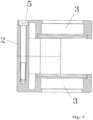
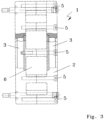
- FIGs 1 to 3 show the general structure of a brake caliper unit 1, which consists of a carrier 2, in which receiving spaces 3 for brake pistons are formed.
- a brake caliper unit 1 runs over a Fig. 1 indicated brake disc 4, which runs between two opposite brake piston receiving spaces 3, as the Figures 2 and 3
- the carrier 2 is made in two parts and the two halves are connected by means of screws 5.
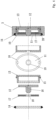
- Fig. 4 shows the structure of a brake piston unit according to the invention, which is arranged in a receiving space 3 in the carrier.
- the element designated as brake piston 10 presses a brake pad (not shown) against the disk with its outer pressure surface 11.
- the brake piston 10 is moved by means of a piston 12, which is guided in a cylinder 13 and is connected to the brake piston 10 at the connection 19 via its piston rod 16.
- Pressure medium lines 15 are formed in the cylinder 13 in order to bring the pressure medium into the area inside the cylinder 13 under the piston 12.
- the piston 12 is thus pushed forward and in this way also pushes the brake piston 10 forward.
- the piston rod 16 extends through a cylinder head plate 17, which has an opening 18 for this purpose.
- the cylinder head plate 17 is arranged on the cylinder 13 so as to close it off.
- the brake piston 10 is also pushed forward via the piston rod 16, which is fastened in the connection 19 of the brake piston 10. A further space is created between the cylinder head plate 17 and the interior of the brake piston 10. Further pressure medium is fed into this resulting gap via a pressure medium line 20 and generates additional pressure at this point, so that the brake piston 10 can exert an additional force.
- the effective piston areas add up, so less pressure is required for the same braking force.
Landscapes
- Engineering & Computer Science (AREA)
- General Engineering & Computer Science (AREA)
- Mechanical Engineering (AREA)
- Transportation (AREA)
- Braking Arrangements (AREA)
Description
- Die vorliegende Erfindung betrifft eine Bremssatteleinheit für Scheibenbremsen, mit einem einen Sattel bildenden Träger, mit einer in dem Sattel angeordneten pneumatisch betriebenen Kolben-/Zylinderanordnung, deren Kolben und Zylinder einen nicht kreisförmigen Querschnitt aufweisen, und mit einem Bremsbelag.
- Bremssatteleinheiten der gattungsgemäßen Art sind aus der
EP 2 754 914 A1 undGB 2 089 916 A - Die aus der
EP 2 754 914 A1 vorbekannte Bremssatteleinheit dient dem Einsatz an einem Schienenfahrzug. Sie verfügt über einen Zylinder sowie über einen im Zylinder verfahrbar angeordneten Bremsblock. Der Bremsblock wirkt verschieblich mit einer Einstelleinrichtung zusammen, die ihrerseits einen Spaltmechanismus aufweist, der über einen federbelasteten Stift verfügt. Der Sinn und Zweck des Spaltmechanismus ist es, verschleißbedingte Abnutzungen zu kompensieren und ein stets gleiches Spaltmaß zwischen dem Bremsblock und einer damit zusammenwirkenden Bremsscheibe sicher zu stellen. - Scheibenbremssysteme sind hinlänglich im Stand der Technik bekannt und werden in großem Umfang eingesetzt. Es handelt sich um auf Achsen und Wellen montierte drehende Scheiben, welche einen Schlitz in einer Bremssatteleinheit durchlaufen. In der Bremssatteleinheit sind von einem Druckmedium betätigbare Kolben angeordnet, welche bei Druckerhöhung Druck auf einen Bremsbelag ausüben, der in der Regel plattenförmig zwischen Kolben und Scheibe positioniert ist. Durch den vortreibenden Kolben wird Bremsbelag gegen die Scheibe gedrückt und diese somit abgebremst. Es sind Systeme bekannt, bei welchem der Druck einseitig ausgeübt wird, so dass ein Bremsbelag gegenüber einer Bremsscheibe parallel zu ihrer Reibfläche verschiebbar schwimmend angeordnet ist. Beidseitig der Scheibe positionierte Bremsbeläge werden somit auf die Bremsscheibe geführt. Auch bekannt sind zweiseitig betriebene Bremssatteleinheiten, bei welchen Druck auf beiden Seiten der Bremsscheibe auf Kolben gegeben wird, so dass beidseitig Bremsbeläge vorgetrieben werden.
- Zunehmend wird versucht, pneumatische Bremssysteme zu entwickeln, die den mechanischen Anforderungen genügen können. Hauptgrund hierfür ist die Tatsache, dass die in den hydraulischen Bremssystemen verwendeten Bremsflüssigkeiten hygroskopisch sind, also durch Wasseraufnahme altern und ihre Kompressionslosigkeitseigenschaften dadurch erheblich abgeschwächt werden. Diese Bremsflüssigkeiten müssen häufig ausgetauscht werden, was insgesamt eine hohe Umweltbelastung und eine hohe Kostenbelastung für Betreiber bewirkt.
- Pneumatische Bremssysteme bringen das Problem der notwendigen Druckbeaufschlagung mit sich. Herkömmliche Bremskolben sind rundzylindrische Einheiten, die auf plattenförmige Bremsbelageinheiten Druck ausüben. Die für pneumatischen Druck zur Verfügung stehende Kolbenfläche ist in Bezug auf den Kraftbedarf gering, so dass hier der pneumatische Druck extrem hoch eingestellt sein muss. Dies führt zu hohen Betriebskosten und zu hohen Auslegungskosten für das pneumatische System, Leitungen, Dichtungen und dergleichen.
- Pneumatische Drücke können im Allgemeinen nicht so hoch wie hydraulische sein, weil sich die Luft stärker komprimieren lässt. Die Erzeugung von hohen pneumatischen Drücken ist unwirtschaftlich.
- Ausgehend vom vorbeschriebenen Stand der Technik liegt der Erfindung die Aufgabe zugrunde, eine Bremssatteleinheit der gattungsgemäßen Art dahingehend weiterzubilden, dass diese bei gleichzeitig kompakter Bauform für den Einsatz in pneumatischen Bremssystemen geeignet ist.
- Zur technischen Lösung dieser Aufgabe wird eine Bremssatteleinheit mit den Merkmalen des Patentanspruches 1 vorgeschlagen. Weitere Vorteile und Merkmale ergeben sich aus den Unteransprüchen.
- Es ist vorgesehen, dass Kolben und Zylinder einer Kolbenzylinderanordnung einen unrunden Querschnitt aufweisen, das heißt, sie sind nicht kreisrund, sondern können eine nicht kreisrunde Querschnittsform aufweisen. Gemäß einem vorteilhaften Vorschlag der Erfindung wird eine elliptische Form vorgeschlagen. Aber auch eine Vieleckform, ein Polygon oder eine Zykloide sind grundsätzlich geeignet. Hierdurch wird die Möglichkeit geschaffen, die Kolbenfläche, die mit Druckmedium beaufschlagt wird, entsprechend groß auszubilden.
- Erfindungsgemäß wird vorgeschlagen, dass die Kolben-Zylinderanordnung als Tandemkolbenbaugruppe ausgebildet ist. Unter Tandemkolben versteht man in der Fachwelt, zumindest im Sinne der vorliegenden Erfindung eine Anordnung, wo hintereinander geschaltete Kolbeneinheiten mit Druck beaufschlagt werden, wobei der Druck auf einen der Kolben den Druck auf den nachfolgenden Kolben entsprechend erhöht. Ähnlich bekannten Tandemzylindern sind zwei einzelne Druckkolben hintereinander angebracht. Ein Primärkolben wird vom Stößel betätigt, zugleich aber druckbeaufschlagt. Zusätzlich wird der den Stößel bewegende Kolben ebenfalls mit Druck beaufschlagt. Die Bezeichnung "Tandembremszylinder" wird im Sinne der vorliegenden Erfindung analog verwendet, es handelt sich dem Grunde nach um eine Serienschaltung von Druckkolbeneinheiten, mit dem Ergebnis, dass der resultierende Druck entsprechend erhöht ist. Diese Erhöhung kann bis über 75% hinausgehen.
- Durch die erfindungsgemäßen Maßnahmen der Vergrößerung der wirksamen Kolbenfläche und der Tandemauslegung wird ausreichend Druck durch ein pneumatisches System erzeugt, um eine ausreichende Kraft auf die Bremsbeläge ausüben zu können. Der erforderliche Bauraum und damit auch das Gesamtgewicht werden im Vergleich zu bestehenden Systemen nicht vergrößert.
- Gemäß der Erfindung sind wenigstens zwei Kolben-/Zylinderanordnungen nebeneinanderliegend angeordnet. Es kann sich auch um die parallele Anordnung mehrerer Kolben-/Zylinderanordnungen handeln, um die Reibfläche durch eine entsprechende Anzahl von Bremsbelägen erhöhen zu können.
- In vorteilhafter Weise sind die Bremskolben zur schwimmenden Anordnung an einer Radbaugruppe ausgebildet. Das bedeutet, dass der Bremskolben sich parallel zur Reibfläche der Bremsscheibe relativ zu dieser bewegen kann. Auf diese Weise findet immer eine automatische Zentrierung der Bremsscheibe im Bremssattelschlitz statt.
- In vorteilhafter Weise kann der Träger eine Aufnahmekammer für die Kolben-/ Zylinderanordnung aufweisen. Die Kolben-/Zylinderanordnung weist einen topfförmigen Kolben auf, der einen unrunden Querschnitt hat und dem Vortrieb des Bremsbelages dient.
- Erfindungsgemäß wird die Tandemausbildung durch zwei ineinander geführte topfförmige Kolbeneinheiten gebildet, wobei die innere Kolbeneinheit einen Zylinderraum für einen Kolben bildet und von der mit dem Kolben verbundenen Kolbenstange durchragt wird. Diese Kolbenstange wiederum ist mit dem äußeren topfförmigen Kolben verbunden, der den inneren topfförmigen Kolben in seinem Inneren aufnimmt. Die äußere topfförmige Kolbeneinheit bildet somit einen Zylinderraum für die innere topfförmige Einheit, die somit einen weiteren Kolben bildet.
- Mit der Erfindung werden äußert wirksame Merkmale für eine Bremssatteleinheit vorgeschlagen, welche geeignet ist, den Aufbau eines ausreichenden Druckes bei Betrieb mit pneumatischem Druckmedium, das heißt Druckluft, durchzuführen.
- Weitere Vorteile und Merkmale der Erfindung ergeben sich aus der folgenden Beschreibung anhand der Figuren. Dabei zeigen:
- Fig. 1
- eine Seitenansicht einer Ausführungsform einer erfindungsgemäßen Bremssatteleinheit;
- Fig. 2
- einen Schnitt entlang der Linie A-A gemäß Fig. 1K;
- Fig. 3
- eine teilgeschnittene Draufsicht auf Bremssatteleinheit gemäß
Fig. 1 ; - Fig. 4
- eine teilgeschnittene Explosionsdarstellung einer erfindungsgemäßen Kolben-Zylinderanordnung.
- In den Figuren sind gleiche Elemente mit gleichen Bezugszeichen versehen.
- Die
Figuren 1 bis 3 zeigen den generellen Aufbau einer Bremssatteleinheit 1, welche aus einem Träger 2 besteht, in welchem Aufnahmeräume 3 für Bremskolben ausgebildet sind. In bekannter Weise läuft eine Bremssatteleinheit 1 über einer nur inFig. 1 angedeuteten Bremsscheibe 4, welche zwischen zwei gegenüberliegenden Bremskolbenaufnahmeräumen 3 hindurchläuft, wie dieFiguren 2 und3 zeigen. Im gezeigten Ausführungsbeispiel ist der Träger 2 zweiteilig ausgebildet und mittels Schrauben 5 sind die beiden Hälften verbunden. -
Fig. 4 zeigt den Aufbau einer erfindungsgemäßen Bremskolbeneinheit, die in einen Aufnahmeraum 3 im Träger angeordnet wird. - Das mit Bremskolben 10 bezeichnete Element drückt mit seiner äußeren Druckfläche 11 einen nicht gezeigten Bremsbelag gegen die Scheibe. Zu diesem Zweck wird der Bremskolben 10 mittels eines Kolbens 12, der in einem Zylinder 13 geführt ist und an der Verbindung 19 über seine Kolbenstange 16 mit dem Bremskolben 10 verbunden ist, bewegt. Im Zylinder 13 sind Druckmittelleitungen 15 ausgebildet, um das Druckmedium in den Bereich im Inneren des Zylinders 13 unter den Kolben 12 zu bringen. Somit wird der Kolben 12 vorgeschoben und drückt auf diese Weise den Bremskolben 10 ebenfalls vor. Die Kolbenstange 16 durchragt eine Zylinderkopfplatte 17, die zu diesem Zweck eine Öffnung 18 aufweist. Die Zylinderkopfplatte 17 ist den Zylinder 13 verschließend an diesem angeordnet. Wird der Kolben 12 aufgrund der Wirkung des Druckmediums im Zylinder vorbewegt, wird auch der Bremskolben 10 über die Kolbenstange 16, die in der Verbindung 19 des Bremskolbens 10 befestigt ist, vorgeschoben. Es entsteht ein weiterer Raum zwischen der Zylinderkopfplatte 17 und dem Inneren des Bremskolbens 10. Über eine Druckmediumleitung 20 wird weiteres Druckmedium in diesen sich ergebenden Spalt geführt und erzeugt an dieser Stelle einen zusätzlichen Druck, so dass der Bremskolben 10 eine zusätzliche Kraft ausüben kann. Die wirkenden Kolbenflächen addieren sich, dadurch wird für die gleiche Bremskraft ein geringerer Druck benötigt.
- Im gezeigten Ausführungsbespiel sind drei elliptische Aufnahmeräume 3 für Bremskolbeneinheiten im Träger ausgebildet. Die elliptische Kontur ermöglicht eine große Kolbenfläche und damit eine große Kraftübertragung bei gleichzeitiger Verdrehsicherung. Die einzelnen Elemente der Kolbeneinheit können unrund gedreht werden, also elliptisch, so dass die Fertigung der einzelnen Bremskolbeneinheiten und der Aufnahmeräume im Sattel denkbar einfach und günstig ist.
- Die beschriebenen Ausführungsbeispiele dienen nur der Erläuterung und sind nicht beschränkend.
-
- 1
- Bremssatteleinheit
- 2
- Träger
- 3
- Aufnahme
- 4
- Bremsscheibe
- 5
- Schraube
- 6
- Öffnungen
- 10
- Bremskolben
- 11
- Druckfläche
- 12
- Kolben
- 13
- Zylinder
- 14
- Dichtung
- 15
- Druckmediumleitung
- 16
- Kolbenstange
- 17
- Zylinderkopfplatte
- 18
- Öffnung
- 19
- Verbindung
- 20
- Druckmediumleitung
Claims (5)
- Bremssatteleinheit (1) für Scheibenbremsen, mit einem einen Sattel bildenden Träger (2), mit einer in dem Sattel angeordneten pneumatisch betriebenen Kolben-/Zylinderanordnung, deren Kolben (10, 12) und Zylinder (13) einen nicht kreisförmigen Querschnitt aufweisen, und mit einem Bremsbelag, wobei die Kolben (10, 12) und Zylinder (13) der Kolben-/Zylinderanordnung als TandemKolben-Baugruppe ausgebildet sind, dadurch gekennzeichnet, dass die Tandem-Kolben-Baugruppe durch zwei ineinander geführte topfförmige Kolbeneinheiten gebildet ist, wobei die innere Kolbeneinheit einen Zylinderraum für einen ersten Kolben (10) bildet und von einer mit dem ersten Kolben (10) verbundenen Kolbenstange (16) durchragt ist, wobei der erste Kolben (10) topfförmig ausgebildet ist und in seinem Inneren einen Zylinderraum für einen weiteren Kolben (12) bildet, wobei der weitere Kolben (12) in einem Zylinder (13) geführt ist, der von einer Zylinderkopfplatte (17) verschlossen ist, wobei die Zylinderkopfplatte (17) von der Kolbenstange (16) durchragt ist, zu welchem Zweck die Zylinderkopfplatte (17) eine Öffnung (18) aufweist.
- Bremssatteleinheit (1) nach Anspruch 1, dadurch gekennzeichnet, dass der Kolben (10) und der dazugehörige Zylinder (13) einen elliptischen Querschnitt aufweisen.
- Bremssatteleinheit (1) nach einem der vorhergehenden Ansprüche, dadurch gekennzeichnet, dass wenigstens zwei Kolben-/Zylinderanordnungen nebeneinanderliegend angeordnet sind.
- Bremssatteleinheit (1) nach einem der vorhergehenden Ansprüche, dadurch gekennzeichnet, dass diese zur schwimmenden Anordnung an einer Radbaugruppe ausgebildet ist.
- Bremssatteleinheit (1) nach einem der vorhergehenden Ansprüche, dadurch gekennzeichnet, dass der Träger (2) eine Aufnahmekammer für die Kolben-/Zylinderanordnung aufweist.
Applications Claiming Priority (2)
| Application Number | Priority Date | Filing Date | Title |
|---|---|---|---|
| EP18167668.5A EP3557090A1 (de) | 2018-04-17 | 2018-04-17 | Bremssatteleinheit |
| PCT/EP2019/058978 WO2019201682A1 (de) | 2018-04-17 | 2019-04-09 | Bremssatteleinheit |
Publications (2)
| Publication Number | Publication Date |
|---|---|
| EP3781832A1 EP3781832A1 (de) | 2021-02-24 |
| EP3781832B1 true EP3781832B1 (de) | 2025-03-05 |
Family
ID=62017191
Family Applications (2)
| Application Number | Title | Priority Date | Filing Date |
|---|---|---|---|
| EP18167668.5A Withdrawn EP3557090A1 (de) | 2018-04-17 | 2018-04-17 | Bremssatteleinheit |
| EP19720776.4A Active EP3781832B1 (de) | 2018-04-17 | 2019-04-09 | Bremssatteleinheit |
Family Applications Before (1)
| Application Number | Title | Priority Date | Filing Date |
|---|---|---|---|
| EP18167668.5A Withdrawn EP3557090A1 (de) | 2018-04-17 | 2018-04-17 | Bremssatteleinheit |
Country Status (5)
| Country | Link |
|---|---|
| US (1) | US20210108688A1 (de) |
| EP (2) | EP3557090A1 (de) |
| CN (1) | CN112074669A (de) |
| ES (1) | ES3025792T3 (de) |
| WO (1) | WO2019201682A1 (de) |
Families Citing this family (1)
| Publication number | Priority date | Publication date | Assignee | Title |
|---|---|---|---|---|
| DE102024121087A1 (de) * | 2024-07-24 | 2026-01-29 | Knorr-Bremse Systeme für Schienenfahrzeuge GmbH | Kompakt-Bremszangeneinheit mit Tandem-Bremszylinder für ein Schienenfahrzeug |
Citations (1)
| Publication number | Priority date | Publication date | Assignee | Title |
|---|---|---|---|---|
| EP2754914A1 (de) * | 2011-09-06 | 2014-07-16 | Kayaba Industry Co., Ltd. | Sattelbremsenvorrichtung |
Family Cites Families (7)
| Publication number | Priority date | Publication date | Assignee | Title |
|---|---|---|---|---|
| GB2089916B (en) * | 1980-11-19 | 1984-12-19 | Nissin Kogyo Kk | Vacuum vehicle brake booster |
| DE9420376U1 (de) * | 1994-12-20 | 1995-02-09 | Wintersohl, Daniel, 51588 Nümbrecht | Bremssattel |
| GB0117102D0 (en) * | 2001-07-13 | 2001-09-05 | Holmes Gordon | Over-run auto-reverse hydraulic braking system on a trailer |
| FR2847870B1 (fr) * | 2002-11-29 | 2005-02-25 | Bosch Robert Sist Frenanti Spa | Frein de parking activable par un fluide sous pression avec blocage mecanique |
| FR2897129B1 (fr) * | 2006-02-07 | 2009-03-27 | Peugeot Citroen Automobiles Sa | Verin et systeme de frein pour vehicule automobile. |
| KR101327944B1 (ko) * | 2012-01-25 | 2013-11-13 | 주식회사 만도 | 디스크 브레이크 |
| DE102015206184A1 (de) * | 2015-04-08 | 2016-10-13 | Robert Bosch Gmbh | Feststellbremse für ein Kraftfahrzeug mit einem Bremskraftverstärker und Verfahren zur Durchführung eines Feststellbremsvorgangs |
-
2018
- 2018-04-17 EP EP18167668.5A patent/EP3557090A1/de not_active Withdrawn
-
2019
- 2019-04-09 WO PCT/EP2019/058978 patent/WO2019201682A1/de not_active Ceased
- 2019-04-09 EP EP19720776.4A patent/EP3781832B1/de active Active
- 2019-04-09 ES ES19720776T patent/ES3025792T3/es active Active
- 2019-04-09 CN CN201980026223.6A patent/CN112074669A/zh active Pending
- 2019-04-09 US US17/047,902 patent/US20210108688A1/en not_active Abandoned
Patent Citations (1)
| Publication number | Priority date | Publication date | Assignee | Title |
|---|---|---|---|---|
| EP2754914A1 (de) * | 2011-09-06 | 2014-07-16 | Kayaba Industry Co., Ltd. | Sattelbremsenvorrichtung |
Also Published As
| Publication number | Publication date |
|---|---|
| CN112074669A (zh) | 2020-12-11 |
| US20210108688A1 (en) | 2021-04-15 |
| ES3025792T3 (en) | 2025-06-09 |
| EP3781832A1 (de) | 2021-02-24 |
| EP3557090A1 (de) | 2019-10-23 |
| WO2019201682A1 (de) | 2019-10-24 |
Similar Documents
| Publication | Publication Date | Title |
|---|---|---|
| DE2502459B2 (de) | Dämpfungselement mit mindestens einer weichelastischen Dämpfungsschicht für Teilbelagscheibenbremsen | |
| DE2039003A1 (de) | Scheibenkonstruktion bei einer Reibungskupplung oder -bremse | |
| DE2057322A1 (de) | Mechanische Betaetigungs- und Rueckstellvorrichtung fuer Bremsen | |
| DE2306460A1 (de) | Bremsbetaetigungsvorrichtung mit federspeicher fuer fahrzeug-radscheibenbremsen | |
| EP3781832B1 (de) | Bremssatteleinheit | |
| DE60211742T2 (de) | Scheibenbremssattel für fahrzeuge | |
| DE2346828A1 (de) | Nachstellvorrichtung fuer bremsen | |
| DE10302334A1 (de) | Scheibenbremse und eine Trägerplatte für einen Bremsbelag | |
| DE69903041T2 (de) | Drehgestellbremseanordnung | |
| DE8519567U1 (de) | Scheibenbremse mit Bremssattel und durch Haken im Bremssattel befestigten Bremsbelägen | |
| DE69401505T2 (de) | Bremsbetätigungsvorrichtung mit rampe | |
| DE1199552B (de) | Teilbelagscheibenbremse | |
| DE102007048363A1 (de) | Bremsbelagsatz mit unterschiedlicher Kompressibilität | |
| DE1800549A1 (de) | Scheibenbremse,insbesondere fuer Fahrzeuge | |
| DE2152246C3 (de) | Befestigungselement für die Befestigung einer kombinierten Klotz- und Scheibenbremse an Schienenfahrzeugen | |
| DE1206225B (de) | Hydraulisch betaetigte Teilbelagscheibenbremse | |
| DE1014857B (de) | Scheibenbremse, insbesondere fuer Kraftfahrzeuge | |
| DE60213220T3 (de) | Scheibenbremse | |
| DE4125881A1 (de) | Scheibenbremse mit fester bremszange | |
| DE102023210630A1 (de) | Bremssattel | |
| EP0479193B1 (de) | Scheibenbremse und Bremsbackenpaar für eine solche | |
| DE2122505A1 (de) | Scheibenbremse für Kraftfahrzeuge | |
| DE102024202733A1 (de) | Elektromechanische Bremse mit Druckplatte | |
| DE558039C (de) | Fluessigkeitsbremseinrichtung, insbesondere fuer Kraftfahrzeuge | |
| DE2855975A1 (de) | Druckschubfeder fuer drehgestelle von schienenfahrzeugen |
Legal Events
| Date | Code | Title | Description |
|---|---|---|---|
| STAA | Information on the status of an ep patent application or granted ep patent |
Free format text: STATUS: UNKNOWN |
|
| STAA | Information on the status of an ep patent application or granted ep patent |
Free format text: STATUS: THE INTERNATIONAL PUBLICATION HAS BEEN MADE |
|
| PUAI | Public reference made under article 153(3) epc to a published international application that has entered the european phase |
Free format text: ORIGINAL CODE: 0009012 |
|
| STAA | Information on the status of an ep patent application or granted ep patent |
Free format text: STATUS: REQUEST FOR EXAMINATION WAS MADE |
|
| 17P | Request for examination filed |
Effective date: 20201028 |
|
| AK | Designated contracting states |
Kind code of ref document: A1 Designated state(s): AL AT BE BG CH CY CZ DE DK EE ES FI FR GB GR HR HU IE IS IT LI LT LU LV MC MK MT NL NO PL PT RO RS SE SI SK SM TR |
|
| AX | Request for extension of the european patent |
Extension state: BA ME |
|
| DAV | Request for validation of the european patent (deleted) | ||
| DAX | Request for extension of the european patent (deleted) | ||
| RAP1 | Party data changed (applicant data changed or rights of an application transferred) |
Owner name: NILES-SIMMONS-HEGENSCHEIDT GMBH |
|
| RIN1 | Information on inventor provided before grant (corrected) |
Inventor name: KOCHSIEK, ADOLF |
|
| STAA | Information on the status of an ep patent application or granted ep patent |
Free format text: STATUS: EXAMINATION IS IN PROGRESS |
|
| 17Q | First examination report despatched |
Effective date: 20230607 |
|
| GRAP | Despatch of communication of intention to grant a patent |
Free format text: ORIGINAL CODE: EPIDOSNIGR1 |
|
| STAA | Information on the status of an ep patent application or granted ep patent |
Free format text: STATUS: GRANT OF PATENT IS INTENDED |
|
| INTG | Intention to grant announced |
Effective date: 20240930 |
|
| GRAS | Grant fee paid |
Free format text: ORIGINAL CODE: EPIDOSNIGR3 |
|
| GRAA | (expected) grant |
Free format text: ORIGINAL CODE: 0009210 |
|
| STAA | Information on the status of an ep patent application or granted ep patent |
Free format text: STATUS: THE PATENT HAS BEEN GRANTED |
|
| AK | Designated contracting states |
Kind code of ref document: B1 Designated state(s): AL AT BE BG CH CY CZ DE DK EE ES FI FR GB GR HR HU IE IS IT LI LT LU LV MC MK MT NL NO PL PT RO RS SE SI SK SM TR |
|
| REG | Reference to a national code |
Ref country code: GB Ref legal event code: FG4D Free format text: NOT ENGLISH |
|
| REG | Reference to a national code |
Ref country code: CH Ref legal event code: EP |
|
| REG | Reference to a national code |
Ref country code: DE Ref legal event code: R096 Ref document number: 502019013014 Country of ref document: DE |
|
| REG | Reference to a national code |
Ref country code: IE Ref legal event code: FG4D Free format text: LANGUAGE OF EP DOCUMENT: GERMAN |
|
| REG | Reference to a national code |
Ref country code: ES Ref legal event code: FG2A Ref document number: 3025792 Country of ref document: ES Kind code of ref document: T3 Effective date: 20250609 |
|
| PG25 | Lapsed in a contracting state [announced via postgrant information from national office to epo] |
Ref country code: RS Free format text: LAPSE BECAUSE OF FAILURE TO SUBMIT A TRANSLATION OF THE DESCRIPTION OR TO PAY THE FEE WITHIN THE PRESCRIBED TIME-LIMIT Effective date: 20250605 |
|
| PG25 | Lapsed in a contracting state [announced via postgrant information from national office to epo] |
Ref country code: FI Free format text: LAPSE BECAUSE OF FAILURE TO SUBMIT A TRANSLATION OF THE DESCRIPTION OR TO PAY THE FEE WITHIN THE PRESCRIBED TIME-LIMIT Effective date: 20250305 |
|
| PGFP | Annual fee paid to national office [announced via postgrant information from national office to epo] |
Ref country code: DE Payment date: 20250528 Year of fee payment: 7 |
|
| REG | Reference to a national code |
Ref country code: NL Ref legal event code: MP Effective date: 20250305 |
|
| PGFP | Annual fee paid to national office [announced via postgrant information from national office to epo] |
Ref country code: ES Payment date: 20250505 Year of fee payment: 7 |
|
| REG | Reference to a national code |
Ref country code: LT Ref legal event code: MG9D |
|
| PG25 | Lapsed in a contracting state [announced via postgrant information from national office to epo] |
Ref country code: NO Free format text: LAPSE BECAUSE OF FAILURE TO SUBMIT A TRANSLATION OF THE DESCRIPTION OR TO PAY THE FEE WITHIN THE PRESCRIBED TIME-LIMIT Effective date: 20250605 |
|
| PGFP | Annual fee paid to national office [announced via postgrant information from national office to epo] |
Ref country code: IT Payment date: 20250423 Year of fee payment: 7 |
|
| PG25 | Lapsed in a contracting state [announced via postgrant information from national office to epo] |
Ref country code: HR Free format text: LAPSE BECAUSE OF FAILURE TO SUBMIT A TRANSLATION OF THE DESCRIPTION OR TO PAY THE FEE WITHIN THE PRESCRIBED TIME-LIMIT Effective date: 20250305 |
|
| PG25 | Lapsed in a contracting state [announced via postgrant information from national office to epo] |
Ref country code: LV Free format text: LAPSE BECAUSE OF FAILURE TO SUBMIT A TRANSLATION OF THE DESCRIPTION OR TO PAY THE FEE WITHIN THE PRESCRIBED TIME-LIMIT Effective date: 20250305 |
|
| PGFP | Annual fee paid to national office [announced via postgrant information from national office to epo] |
Ref country code: FR Payment date: 20250429 Year of fee payment: 7 |
|
| PG25 | Lapsed in a contracting state [announced via postgrant information from national office to epo] |
Ref country code: GR Free format text: LAPSE BECAUSE OF FAILURE TO SUBMIT A TRANSLATION OF THE DESCRIPTION OR TO PAY THE FEE WITHIN THE PRESCRIBED TIME-LIMIT Effective date: 20250606 Ref country code: BG Free format text: LAPSE BECAUSE OF FAILURE TO SUBMIT A TRANSLATION OF THE DESCRIPTION OR TO PAY THE FEE WITHIN THE PRESCRIBED TIME-LIMIT Effective date: 20250305 |
|
| PG25 | Lapsed in a contracting state [announced via postgrant information from national office to epo] |
Ref country code: NL Free format text: LAPSE BECAUSE OF FAILURE TO SUBMIT A TRANSLATION OF THE DESCRIPTION OR TO PAY THE FEE WITHIN THE PRESCRIBED TIME-LIMIT Effective date: 20250305 |
|
| PG25 | Lapsed in a contracting state [announced via postgrant information from national office to epo] |
Ref country code: SE Free format text: LAPSE BECAUSE OF FAILURE TO SUBMIT A TRANSLATION OF THE DESCRIPTION OR TO PAY THE FEE WITHIN THE PRESCRIBED TIME-LIMIT Effective date: 20250305 |
|
| PG25 | Lapsed in a contracting state [announced via postgrant information from national office to epo] |
Ref country code: SM Free format text: LAPSE BECAUSE OF FAILURE TO SUBMIT A TRANSLATION OF THE DESCRIPTION OR TO PAY THE FEE WITHIN THE PRESCRIBED TIME-LIMIT Effective date: 20250305 |
|
| PG25 | Lapsed in a contracting state [announced via postgrant information from national office to epo] |
Ref country code: PT Free format text: LAPSE BECAUSE OF FAILURE TO SUBMIT A TRANSLATION OF THE DESCRIPTION OR TO PAY THE FEE WITHIN THE PRESCRIBED TIME-LIMIT Effective date: 20250707 |
|
| PG25 | Lapsed in a contracting state [announced via postgrant information from national office to epo] |
Ref country code: PL Free format text: LAPSE BECAUSE OF FAILURE TO SUBMIT A TRANSLATION OF THE DESCRIPTION OR TO PAY THE FEE WITHIN THE PRESCRIBED TIME-LIMIT Effective date: 20250305 |
|
| PG25 | Lapsed in a contracting state [announced via postgrant information from national office to epo] |
Ref country code: CZ Free format text: LAPSE BECAUSE OF FAILURE TO SUBMIT A TRANSLATION OF THE DESCRIPTION OR TO PAY THE FEE WITHIN THE PRESCRIBED TIME-LIMIT Effective date: 20250305 Ref country code: EE Free format text: LAPSE BECAUSE OF FAILURE TO SUBMIT A TRANSLATION OF THE DESCRIPTION OR TO PAY THE FEE WITHIN THE PRESCRIBED TIME-LIMIT Effective date: 20250305 |
|
| PG25 | Lapsed in a contracting state [announced via postgrant information from national office to epo] |
Ref country code: RO Free format text: LAPSE BECAUSE OF FAILURE TO SUBMIT A TRANSLATION OF THE DESCRIPTION OR TO PAY THE FEE WITHIN THE PRESCRIBED TIME-LIMIT Effective date: 20250305 |
|
| PG25 | Lapsed in a contracting state [announced via postgrant information from national office to epo] |
Ref country code: SK Free format text: LAPSE BECAUSE OF FAILURE TO SUBMIT A TRANSLATION OF THE DESCRIPTION OR TO PAY THE FEE WITHIN THE PRESCRIBED TIME-LIMIT Effective date: 20250305 |
|
| PG25 | Lapsed in a contracting state [announced via postgrant information from national office to epo] |
Ref country code: IS Free format text: LAPSE BECAUSE OF FAILURE TO SUBMIT A TRANSLATION OF THE DESCRIPTION OR TO PAY THE FEE WITHIN THE PRESCRIBED TIME-LIMIT Effective date: 20250705 |
|
| REG | Reference to a national code |
Ref country code: CH Ref legal event code: H13 Free format text: ST27 STATUS EVENT CODE: U-0-0-H10-H13 (AS PROVIDED BY THE NATIONAL OFFICE) Effective date: 20251125 |
|
| REG | Reference to a national code |
Ref country code: DE Ref legal event code: R097 Ref document number: 502019013014 Country of ref document: DE |
|
| PG25 | Lapsed in a contracting state [announced via postgrant information from national office to epo] |
Ref country code: LU Free format text: LAPSE BECAUSE OF NON-PAYMENT OF DUE FEES Effective date: 20250409 |
|
| PG25 | Lapsed in a contracting state [announced via postgrant information from national office to epo] |
Ref country code: MC Free format text: LAPSE BECAUSE OF FAILURE TO SUBMIT A TRANSLATION OF THE DESCRIPTION OR TO PAY THE FEE WITHIN THE PRESCRIBED TIME-LIMIT Effective date: 20250305 |
|
| REG | Reference to a national code |
Ref country code: BE Ref legal event code: MM Effective date: 20250430 |
|
| PLBE | No opposition filed within time limit |
Free format text: ORIGINAL CODE: 0009261 |
|
| STAA | Information on the status of an ep patent application or granted ep patent |
Free format text: STATUS: NO OPPOSITION FILED WITHIN TIME LIMIT |
|
| PG25 | Lapsed in a contracting state [announced via postgrant information from national office to epo] |
Ref country code: DK Free format text: LAPSE BECAUSE OF FAILURE TO SUBMIT A TRANSLATION OF THE DESCRIPTION OR TO PAY THE FEE WITHIN THE PRESCRIBED TIME-LIMIT Effective date: 20250305 |
|
| REG | Reference to a national code |
Ref country code: CH Ref legal event code: L10 Free format text: ST27 STATUS EVENT CODE: U-0-0-L10-L00 (AS PROVIDED BY THE NATIONAL OFFICE) Effective date: 20260114 |
|
| PG25 | Lapsed in a contracting state [announced via postgrant information from national office to epo] |
Ref country code: BE Free format text: LAPSE BECAUSE OF NON-PAYMENT OF DUE FEES Effective date: 20250430 |
|
| PG25 | Lapsed in a contracting state [announced via postgrant information from national office to epo] |
Ref country code: CH Free format text: LAPSE BECAUSE OF NON-PAYMENT OF DUE FEES Effective date: 20250430 |
|
| 26N | No opposition filed |
Effective date: 20251208 |
|
| GBPC | Gb: european patent ceased through non-payment of renewal fee |
Effective date: 20250605 |
|
| PG25 | Lapsed in a contracting state [announced via postgrant information from national office to epo] |
Ref country code: GB Free format text: LAPSE BECAUSE OF NON-PAYMENT OF DUE FEES Effective date: 20250605 |
|
| PG25 | Lapsed in a contracting state [announced via postgrant information from national office to epo] |
Ref country code: IE Free format text: LAPSE BECAUSE OF NON-PAYMENT OF DUE FEES Effective date: 20250409 |