EP3781252B1 - Nerve block by electrical pulses at sub-threshold intensity - Google Patents
Nerve block by electrical pulses at sub-threshold intensity Download PDFInfo
- Publication number
- EP3781252B1 EP3781252B1 EP19788392.9A EP19788392A EP3781252B1 EP 3781252 B1 EP3781252 B1 EP 3781252B1 EP 19788392 A EP19788392 A EP 19788392A EP 3781252 B1 EP3781252 B1 EP 3781252B1
- Authority
- EP
- European Patent Office
- Prior art keywords
- nerve
- neuron
- intensity
- electrical stimulation
- threshold
- Prior art date
- Legal status (The legal status is an assumption and is not a legal conclusion. Google has not performed a legal analysis and makes no representation as to the accuracy of the status listed.)
- Active
Links
Images






Classifications
-
- A—HUMAN NECESSITIES
- A61—MEDICAL OR VETERINARY SCIENCE; HYGIENE
- A61N—ELECTROTHERAPY; MAGNETOTHERAPY; RADIATION THERAPY; ULTRASOUND THERAPY
- A61N1/00—Electrotherapy; Circuits therefor
- A61N1/18—Applying electric currents by contact electrodes
- A61N1/32—Applying electric currents by contact electrodes alternating or intermittent currents
- A61N1/36—Applying electric currents by contact electrodes alternating or intermittent currents for stimulation
- A61N1/3605—Implantable neurostimulators for stimulating central or peripheral nerve system
- A61N1/3606—Implantable neurostimulators for stimulating central or peripheral nerve system adapted for a particular treatment
-
- A—HUMAN NECESSITIES
- A61—MEDICAL OR VETERINARY SCIENCE; HYGIENE
- A61N—ELECTROTHERAPY; MAGNETOTHERAPY; RADIATION THERAPY; ULTRASOUND THERAPY
- A61N1/00—Electrotherapy; Circuits therefor
- A61N1/02—Details
- A61N1/04—Electrodes
- A61N1/05—Electrodes for implantation or insertion into the body, e.g. heart electrode
- A61N1/0551—Spinal or peripheral nerve electrodes
-
- A—HUMAN NECESSITIES
- A61—MEDICAL OR VETERINARY SCIENCE; HYGIENE
- A61N—ELECTROTHERAPY; MAGNETOTHERAPY; RADIATION THERAPY; ULTRASOUND THERAPY
- A61N1/00—Electrotherapy; Circuits therefor
- A61N1/18—Applying electric currents by contact electrodes
- A61N1/32—Applying electric currents by contact electrodes alternating or intermittent currents
- A61N1/36—Applying electric currents by contact electrodes alternating or intermittent currents for stimulation
- A61N1/3605—Implantable neurostimulators for stimulating central or peripheral nerve system
- A61N1/3606—Implantable neurostimulators for stimulating central or peripheral nerve system adapted for a particular treatment
- A61N1/36062—Spinal stimulation
-
- A—HUMAN NECESSITIES
- A61—MEDICAL OR VETERINARY SCIENCE; HYGIENE
- A61N—ELECTROTHERAPY; MAGNETOTHERAPY; RADIATION THERAPY; ULTRASOUND THERAPY
- A61N1/00—Electrotherapy; Circuits therefor
- A61N1/18—Applying electric currents by contact electrodes
- A61N1/32—Applying electric currents by contact electrodes alternating or intermittent currents
- A61N1/36—Applying electric currents by contact electrodes alternating or intermittent currents for stimulation
- A61N1/3605—Implantable neurostimulators for stimulating central or peripheral nerve system
- A61N1/3606—Implantable neurostimulators for stimulating central or peripheral nerve system adapted for a particular treatment
- A61N1/36071—Pain
-
- A—HUMAN NECESSITIES
- A61—MEDICAL OR VETERINARY SCIENCE; HYGIENE
- A61N—ELECTROTHERAPY; MAGNETOTHERAPY; RADIATION THERAPY; ULTRASOUND THERAPY
- A61N1/00—Electrotherapy; Circuits therefor
- A61N1/18—Applying electric currents by contact electrodes
- A61N1/32—Applying electric currents by contact electrodes alternating or intermittent currents
- A61N1/36—Applying electric currents by contact electrodes alternating or intermittent currents for stimulation
- A61N1/3605—Implantable neurostimulators for stimulating central or peripheral nerve system
- A61N1/36128—Control systems
- A61N1/36146—Control systems specified by the stimulation parameters
- A61N1/3615—Intensity
- A61N1/36153—Voltage
-
- A—HUMAN NECESSITIES
- A61—MEDICAL OR VETERINARY SCIENCE; HYGIENE
- A61N—ELECTROTHERAPY; MAGNETOTHERAPY; RADIATION THERAPY; ULTRASOUND THERAPY
- A61N1/00—Electrotherapy; Circuits therefor
- A61N1/18—Applying electric currents by contact electrodes
- A61N1/32—Applying electric currents by contact electrodes alternating or intermittent currents
- A61N1/36—Applying electric currents by contact electrodes alternating or intermittent currents for stimulation
- A61N1/3605—Implantable neurostimulators for stimulating central or peripheral nerve system
- A61N1/36128—Control systems
- A61N1/36146—Control systems specified by the stimulation parameters
- A61N1/3615—Intensity
- A61N1/36157—Current
-
- A—HUMAN NECESSITIES
- A61—MEDICAL OR VETERINARY SCIENCE; HYGIENE
- A61N—ELECTROTHERAPY; MAGNETOTHERAPY; RADIATION THERAPY; ULTRASOUND THERAPY
- A61N1/00—Electrotherapy; Circuits therefor
- A61N1/18—Applying electric currents by contact electrodes
- A61N1/32—Applying electric currents by contact electrodes alternating or intermittent currents
- A61N1/36—Applying electric currents by contact electrodes alternating or intermittent currents for stimulation
- A61N1/3605—Implantable neurostimulators for stimulating central or peripheral nerve system
- A61N1/36128—Control systems
- A61N1/36146—Control systems specified by the stimulation parameters
- A61N1/3615—Intensity
- A61N1/36164—Sub-threshold or non-excitatory signals
-
- A—HUMAN NECESSITIES
- A61—MEDICAL OR VETERINARY SCIENCE; HYGIENE
- A61N—ELECTROTHERAPY; MAGNETOTHERAPY; RADIATION THERAPY; ULTRASOUND THERAPY
- A61N1/00—Electrotherapy; Circuits therefor
- A61N1/18—Applying electric currents by contact electrodes
- A61N1/32—Applying electric currents by contact electrodes alternating or intermittent currents
- A61N1/36—Applying electric currents by contact electrodes alternating or intermittent currents for stimulation
- A61N1/3605—Implantable neurostimulators for stimulating central or peripheral nerve system
- A61N1/36128—Control systems
- A61N1/36146—Control systems specified by the stimulation parameters
- A61N1/36167—Timing, e.g. stimulation onset
-
- A—HUMAN NECESSITIES
- A61—MEDICAL OR VETERINARY SCIENCE; HYGIENE
- A61N—ELECTROTHERAPY; MAGNETOTHERAPY; RADIATION THERAPY; ULTRASOUND THERAPY
- A61N1/00—Electrotherapy; Circuits therefor
- A61N1/18—Applying electric currents by contact electrodes
- A61N1/32—Applying electric currents by contact electrodes alternating or intermittent currents
- A61N1/36—Applying electric currents by contact electrodes alternating or intermittent currents for stimulation
- A61N1/3605—Implantable neurostimulators for stimulating central or peripheral nerve system
- A61N1/36128—Control systems
- A61N1/36146—Control systems specified by the stimulation parameters
- A61N1/36167—Timing, e.g. stimulation onset
- A61N1/36171—Frequency
Definitions
- devices for blocking nerve conduction or neuron excitation by applying sub-threshold electrical pulses to the nerve or neuron are provided herein devices for blocking nerve conduction or neuron excitation by applying sub-threshold electrical pulses to the nerve or neuron.
- Blocking nerve conduction or neuron excitation has a broad clinical application to treat many disorders including chronic pain, obesity, heart failure, bladder dysfunction or spasm after spinal cord injury, etc.
- electrical nerve block uses kilohertz electrical pulses in clinical applications, which always produce initial nerve excitation because the kilohertz pulses must have a stimulation intensity above the minimal intensity for inducing nerve excitation, that is, they have a super-threshold intensity.
- the initial excitation is problematic, for example, it generates initial strong pain and potential for physical damage due to dangerous muscle contractions before it can block the pain. It also produces paresthesia sensation (vibration, pressure, numbness, etc.) that is not tolerable for many patients.
- US 2004/127953 A1 shows a device for blocking nerve impulses with an implanted electrode located on or around a nerve and applying low-amplitude, charge balanced stimulation pulses.
- US 2017/348540 A1 shows a device with electrodes applying sub-perception neuromodulation.
- US 2013/238049 A1 shows a device sub-perception applying magnetic and/or electrical energy that is transmitted non-invasively to, or in close proximity to, a selected nerve to temporarily stimulate, block and/or modulate the signals in the selected nerve.
- US 2015/032181 A1 shows a device applying super-threshold and sub-threshold stimulation pulses.
- devices configured to block a nerve/neuron by electrical pulses using a sub-threshold intensity, e.g., the intensity is below the minimal intensity required to excite the nerve/neuron.
- a sub-threshold intensity e.g., the intensity is below the minimal intensity required to excite the nerve/neuron.
- patient is any mammal, including humans, and a "human patient” is any human.
- the terms "communication” and "communicate” refer to the receipt, transmission, or transfer of one or more signals, messages, commands, or other type of data.
- one unit or device to be in communication with another unit or device means that the one unit or device is able to receive data from and/or transmit data to the other unit or device.
- a communication can use a direct or indirect connection, and can be wired and/or wireless in nature.
- two units or devices can be in communication with each other even though the data transmitted can be modified, processed, routed, etc., between the first and second unit or device.
- a first unit can be in communication with a second unit even though the first unit passively receives data and does not actively transmit data to the second unit.
- a first unit can be in communication with a second unit if an intermediary unit processes data from one unit and transmits processed data to the second unit.
- any known electronic communication protocols and/or algorithms can be used such as, for example, TCP/IP (including HTTP and other protocols), WLAN (including 802.11a/b/g/n and other radio frequency-based protocols and methods), analog transmissions, Global System for Mobile Communications (GSM), 3G/4G/LTE, BLUETOOTH, ZigBee, EnOcean, TransferJet, Wireless USB, and the like known to those of skill in the art.
- the "excitation threshold" of a nerve or neuron is the minimum level to which a neuron and/or nerve membrane must be depolarized to initiate an action potential, resulting in excitation of the nerve or neuron, e.g., initiation of an action potential and propagation of the action potential, and thereby propagation of a signal in the nerve or neuron.
- the terms “nerve” and “neuron” are used interchangeably herein, particularly with reference to excitation thresholds, though one of skill in the art will appreciate that neuron refers to the cell body at which an action potential is generated and nerve refers to the axon along which an action potential is conducted.
- stimulation parameters sufficient to block excitation in a neuron will be considered suitable to block conduction in a nerve.
- Depolarization of a nerve or neuron membrane potential results in an increase in the membrane voltage, for example from -70 millivolts (mV) to up to +40 mV.
- sub-threshold depolarization or “sub-threshold stimulation” means a stimulation sufficient to increase membrane voltage of a nerve or neuron from resting membrane potential (e.g., -70mV) to a level below the excitation threshold, such that the nerve or neuron does not become excited, e.g., no action potential is initiated or conducted.
- resting membrane potential e.g., -70mV
- an excitation threshold is in the range of -55mV or -45 mV, all subranges therebetween inclusive.
- the excitation thresholds for inducing paresthesia or pain are also different.
- sub-threshold as used herein means that stimulation intensity is below the level to induce muscle contraction, paresthesia, or pain depending on which response (muscle contraction, paresthesia, or pain) is to be blocked.
- sub-threshold stimulation as described herein increases the membrane voltage from resting (-70 mV) to a voltage less than or equal to -55 mV.
- the neuron/nerve can be slightly depolarized (below an excitation threshold) and then hyperpolarized.
- the "intensity" of an electrical pulse is proportional to, and refers to either the voltage or current (e.g., milliAmperes or mA) applied to the nerve or neuron, with an increased intensity being proportional to an increased voltage or an increased current applied to the nerve or neuron.
- voltage or current e.g., milliAmperes or mA
- an exemplary method of blocking a nerve or neuron in a patient including applying an electrical stimulation to the nerve or neuron, wherein the electrical stimulation is a sub-threshold stimulation, configured to increase membrane potential of the nerve/neuron from a resting potential, (e.g. -70 mV), to a value less than an excitation threshold of the nerve/neuron for a length of time able to produce a block in the nerve or neuron.
- the excitation threshold for a given nerve/neuron can vary, and those of skill in the art can determine the excitation threshold by applying stimulation of varying intensities, and determining a threshold below which an action potential is not generated or conducted.
- the excitation threshold of the neuron is -55 mV, thus, in such aspects, the stimulation increases the membrane potential of the neuron to a value below -55 mV.
- the block induced by the sub-threshold electrical stimulation includes a post-stimulation block.
- post-stimulation block refers to a nerve block that extends past the cessation of the electrical stimulation, and can, depending on the length and intensity of the electrical stimulation, persist from seconds to hours, days, weeks, months, or years, including increments therebetween.
- the post-stimulation block lasts at least 1 minute.
- the post-stimulation block can be maintained after a cessation of stimulation for at least 1 minute, optionally at least 5 minutes, 10 minutes, 15 minutes, or 30 minutes, at which time stimulation can be re-applied.
- the stimulation that is re-applied can be of an intensity that is higher than an initial intensity that was used to initiate the block, due to the depletion of ions and the increase in excitation threshold achieved through prolonged sub-threshold stimulation, in particular, prolonged sub-threshold stimulation that is applied in a step-wise manner to increase the excitation threshold, as described herein.
- the frequency and/or intensity of the electrical stimulation can be altered. That is, after achieving post-stimulation block, the frequency of the stimulation can be increased, and/or the intensity of the stimulation can be decreased.
- the electrical stimulation can include electrical pulses that can have any suitable characteristic, so long as the stimulation is sub-threshold stimulation.
- electrical stimulation and “electrical pulses” are used interchangeably herein.
- characteristics of the electrical pulses including, without limitation, amplitude (pulse strength, referring to the magnitude or size of a signal voltage or current), voltage, amperage, duration, frequency, polarity, phase, relative timing, and symmetry of positive and negative pulses in biphasic stimulation, and/or wave shape (e.g., square, sine, triangle, sawtooth, or variations or combinations thereof) may be varied in order to provide the desired sub-threshold stimulation and resultant post-stimulation blocking in a patient or class of patients.
- modulation of the pulse frequency will achieve the desired result of sub-threshold induced blocking of a nerve or neuron.
- effective ranges e.g., frequencies able to produce a stated effect
- certain, non-limiting exemplary ranges may be as follows, with the proviso that the stimulation, or pulses, do not evoke an action potential in the target nerve/neuron or, evoke only a small number of action potentials, such that continued firing of the nerve/neuron is avoided.
- useful frequencies range above 1 Hz (Hertz), from approximately 1 Hz to approximately 50 kHz (kilohertz), or from 0.5 kHz to 50 kHz.
- those frequencies range above 1 Hz, from approximately 1 Hz to approximately 50 kHz, or from 0.5 kHz to 50 kHz. In aspects, the range may be more typically from 5 Hz to 10 kHz. In aspects, stimulation is applied at 1 kHz to 4 kHz, all subranges therebetween inclusive. In aspects, stimulation is applied at ⁇ 1.5 kHz, or ⁇ 1.2 kHz, or between 100 Hz and 1 kHz, all subranges therebetween inclusive. Data below shows a range of at least from 5 kHz, with 10 kHz pulses being preferred in some instances.
- sub-threshold electrical pulses are determined by the intensity of electrical stimulation, which in a medium of stable or relatively stable resistance, such as mammalian tissue, can be characterized as relating to current ( I , typically measured in mA), or voltage (V, typically measured in mV), based on Ohm's Law. It should, therefore, be understood that the intensity of the stimulation is a matter of both V and I , and as such, both are increased, e.g., proportionally or substantially proportionally, with increased intensity of stimulation. As such, one characteristic of the pulses is the current that is applied to produce a sub-threshold stimulation that is capable of nerve blocking.
- Sub-threshold stimulation can be achieved in a typical range of from 0.01 mA to 10 mA. As shown in the examples below, a range of 0.01 mA to 1 mA may be effective in many instances for providing the sub-threshold stimulation. Another characteristic of the pulses are voltage. Sub-threshold nerve stimulation can be achieved in a typical range of from 1 to 10,000 mV, for example, from 100 to 10,000 mV as shown in the examples below.
- an excitation threshold is steadily increased by applying a sub-threshold intensity electrical stimulation for a certain period of time until an excitation threshold of a nerve/neuron increases
- the intensity of the stimulation is increased to a higher level, but below the increased excitation threshold, after a certain period of time, a significant post-stimulation block period can be achieved. Breaks, or periods where no electrical stimulation is applied, or is applied less frequently than necessary to achieve the post-stimulation block, can be introduced. Stimulation can then be reintroduced to maintain blockage. In aspects, this reintroduced stimulation can be of a reduced intensity and/or an increased frequency compared to the stimulation required to provide the initial block.
- the excitation threshold of a nerve or neuron may be increased after a sufficient time period of sub-threshold stimulation, and as such, the limit of the sub-threshold stimulation can increase. That is, while at an initial time point, an increase in membrane voltage potential from -70 mV to -55 mV may be sufficient to depolarize the nerve or neuron and cause an action potential, following exposure of the nerve or neuron to sub-threshold stimulation, the excitation threshold of the nerve can be increased, from -55 mV to -45 mV, or even higher, depending on the duration and intensity of the stimulation. This increase in excitation threshold can be repeated with increasing sub-threshold stimulation, as shown below in the Examples. Accordingly, while a certain I and V may be useful for a first stage of blocking, one or both of I and V can be increased following a sufficient duration sub-threshold stimulation, without concern of causing an action potential to be fired.
- the waveform of the pulses may vary, so long as the desired sub-threshold blocking effect is realized.
- Monophasic or biphasic stimuli, or a mixture thereof, may be used. Damage to nerves by the application of an electrical current may be minimized, as is known in the art, by application of biphasic pulses or biphasic waveforms to the nerve(s), as opposed to monophasic pulses or waveforms that can damage nerves in some instances of long-term use.
- Biphasic current refers to two or more pulses that are of opposite polarity that may be of equal or substantially equal net charge (hence, biphasic and charge balanced), and may be symmetrical, asymmetrical, or substantially symmetrical. This is accomplished, for example, by applying through an electrode one or more positive pulses, followed by one or more negative pulses, typically of the same amplitude and duration as the positive pulses, or vice versa, such that the net charge applied to the target of the electrode is zero, or approximately zero.
- the opposite polarity pulses may have different amplitudes, profiles, or durations, so long as the net applied charge by the biphasic pulse pair (the combination of the positive and negative pulses) is approximately zero.
- the waveform may be of any useful shape, including without limitation: sine, square, rectangular, triangular, sawtooth, rectilinear, pulse, exponential, truncated exponential, or damped sinusoidal.
- the pulses may increase or decrease over the stimulation period.
- the waveform is rectangular.
- the pulses may be applied continuously or intermittently as needed. As indicated below, stimulation of a nerve or neuron at certain voltages or currents for certain time periods elicits post-stimulation nerve blockage. Therefore, the stimulation may be applied for short intervals (e.g., 1-10 minutes) or longer intervals (360 minutes or even longer, for example days, weeks, months, or even years) to achieve longer-lasting blockage/relief, in terms of hours, days, weeks, months, or years.
- the stimulation is applied for at least 5 minutes. In aspects, the stimulation is applied for 30 minutes to 2 hours, all subranges therebetween inclusive. In certain aspects, the stimulation is applied for at least 70 minutes, at least 80 minutes, or at least 90 minutes. In aspects, the pulses are applied for from 100 miiliseconds to 14 days, optionally 100 milliseconds to 10 minutes, optionally 1 minute to 14 days, optionally from 30 minutes to 2 hours, optionally from 1 minute to 7 days, optionally from 1 minute to 5 days, all subranges therebetween inclusive. As described above, the stimulation may be applied intermittently (that is, the pulses are turned on and off alternately during a stimulation interval for any time period) during continuous or interval stimulation protocols.
- the stimulation may be applied for 5 seconds on and 5 seconds off over an interval of, for example, 1-10 minutes or longer (e.g., hours, days, weeks, months, years).
- Other examples of intermittent application of pulses may be 1-90 seconds on and 1-90 seconds off over up to a 360 minute time period. So long as other pulse parameters are within acceptable limits, the inhibition is temporary and does not damage the involved neurons/nerves.
- intermittent application of pulses may be continuous, that is, for as long as the pulses are having the desired effect, and for as long as the patient desires (i.e., is not painful or harmful to the patient).
- the stimulation is provided continuously, for example, to treat severe symptoms, or any symptom that does not respond to intermittent, short-term stimulation to the degree desired by a clinician or the patient.
- a sub-threshold electrical stimulation is applied to a nerve or neuron for a suitable length of time so that the excitation threshold intensity of the nerve or neuron increases.
- the intensity of the electrical pulse can be increased in a stepwise fashion above the initial threshold intensity, but below the newly increased threshold intensity.
- Suitable lengths of time are greater than one minute (compare, Miles, J.D., et al. Effects of ramped amplitude waveforms on the onset response of high-frequency mammalian nerve block (2007) J. Neural Eng.
- the steps for incrementally increasing excitation threshold can be of a duration in the range of hours, for example, and without limitation, 1 hour, 2 hours, 3 hours, or more.
- the excitation threshold can be repeatedly increased to provide long-lasting block of the neuron and/or nerve.
- the stimulation is applied at an intensity below an initial excitation threshold of the neuron (e.g., below -55 mV) for a time sufficient to cause an increase of the initial excitation threshold of the neuron to a first increased excitation threshold (e.g. > -55 mv).
- a first increased intensity electrical stimulation configured to increase the membrane potential of the neuron higher than the initial excitation threshold of the neuron and below the first increased excitation threshold of the neuron can be applied.
- This first increased intensity electrical stimulation can be applied for a time sufficient to cause an increase of the first increased excitation threshold of the neuron to a second increased excitation threshold.
- a second increased intensity electrical stimulation can be applied to the neuron, wherein the second increased intensity electrical stimulation is configured to increase the excitation threshold of the neuron higher than the first increased excitation threshold of the neuron and below the second increased excitation threshold of the neuron.
- the second increased intensity electrical stimulation can be applied for a time sufficient to cause an increase of the second excitation threshold of the neuron to a third increased excitation threshold. This process can be repeated any number of times. Without wishing to be bound by the theory, it is believed that long-term block can be achieved through such a step-wise increase in excitation threshold because of the significant reconfiguration of ion concentrations (e.g., sodium and potassium) between intracellular and extracellular compartments.
- a sub-threshold current of 0.9 mA is applied for a suitable length of time, such as for 30 minutes to 2 hours, at which time the excitation threshold increases to 2 mA.
- the sub-threshold current is raised to 1.9 mA and is applied for a suitable length of time to further increase the excitation threshold, such as for 30 minutes to 2 hours, at which time the excitation threshold increases to 5 mA.
- the step-wise increase in excitation threshold can be repeated until a nerve block, including, in aspects, a post-stimulation nerve block, which can persist beyond cessation of stimulation, of a desired length is achieved.
- the timeframe on which the excitation threshold can be increased can vary.
- the increase e.g., each step
- steps can be of 1 ms, 10 ms, 100 ms, 1 s, 10 s, 1 min, 10 min, 30 min, hour(s), day(s), week(s), month(s), year(s), etc.
- an exemplary method of treating, reducing, or eliminating pain in a patient including applying an electrical stimulation to a nerve or neuron, wherein the electrical stimulation is a sub-threshold stimulation, configured to increase membrane potential of the neuron from a resting potential, (e.g. -70 mV), to a value less than an excitation threshold of the neuron for a length of time able to produce a block, in some aspects a post-stimulation block, in the nerve or neuron, thus reducing or eliminating pain.
- the pain is from a limb
- the method includes stimulating a neuron (centrally) or a nerve (peripherally) innervating that limb.
- sub-threshold electrical pulses are applied to one or more nerves that would otherwise innervate the missing limb.
- sub-threshold electrical pulses are applied at a single intensity to achieve the nerve block, that is, loss of phantom pain.
- the sub-threshold electrical pulses are applied in a step-wise increasing fashion as described above, until nerve block is achieved, that is, pain is lost.
- the sub-threshold electrical pulses described herein may or may not cause a paresthesia sensation in the patient.
- the patient may experience some paresthesia effects when the sub-threshold electrical pulses are applied in any manner, e.g., constant or step-wise increasing, but the patient does not experience acute muscle spasticity or pain associated with typical onset response.
- the sub-threshold electrical pulse can be applied to a nerve of a patient, and can be increased until paresthesia is experienced and then either decreased slightly to remove the paresthesia effect, or if tolerable, the electrical pulse is not reduced and is continued until paresthesia effect disappears.
- paresthesia it may disappear after a sufficient length of time of stimulation, and that event can be used as a signal, e.g., to a patient and/or to a clinician, that the sub-threshold block is effective, and the intensity of the applied current can be increased until paresthesia is again experienced.
- the applied current can be increased step-wise after a suitable time has passed, such as 5, 10, 15, 20, 25, 30, 45, or 60 minutes, or increments therebetween.
- the step-wise increasing of sub-threshold electrical pulses can be continued until nerve block is achieved, corresponding to a loss of pain, such as loss of phantom pain, at which time the blocking current is optionally maintained for a suitable length of time ranging from minutes (e.g., five, ten, 15, 20, 30, 45, or 60 minutes), to hours (e.g., two, four, six, 12, or 24 hours), to days or even weeks, months, or years.
- minutes e.g., five, ten, 15, 20, 30, 45, or 60 minutes
- hours e.g., two, four, six, 12, or 24 hours
- the described sub-threshold blocking method results in a post-stimulation block, meaning that once a blockage is achieved, the blocking electrical pulses can be stopped for a length of time, and re-initiated at full blocking intensity, without need for the step-wise increase of stimulation.
- blocking electrical pulses e.g., at full blocking intensity
- Suitable and optimal blocking timing parameters can be determined case-by-case, especially considering that each individual, nerve, neuron, stimulation device, and stimulation parameter, are likely to dictate how often each application of the blocking pulses is applied and for how long they are applied.
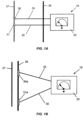
- FIG. 1A provides a general schematic of one non-limiting embodiment or aspect of an electrical stimulation device 10 useful in aspects of the methods described herein.
- the device 10 includes a power supply or pulse generator 20.
- the power supply/pulse generator 20 may be fixed output, or may be adjustable, for example within a useful range as described herein.
- the device 10 includes a first conductive lead 30 and a first nerve cuff 31, and a second conductive lead 35 with a second nerve cuff 36.
- the conductive leads 30 and 35 can be combined into a single lead to connect the nerve cuffs 31 and 36.
- the nerve cuffs 31 and 36 can also be combined into a single cuff, or they can be completely eliminated and replaced by conductive metals/electrodes located on the lead 30 and 35 or located on the single lead that combines both 30 and 35.
- Conductive leads 30, 35 can be directly wired to power supply/pulse generator 20, or may each comprise multiple leads and electrical connectors, fasteners, terminals, or clips to produce a contiguous electrical connection between the power supply/pulse generator 20 and the respective nerve cuffs.
- a nerve 37 also is depicted.
- Skin 38 is also shown, and as such the device 10 is external and can be a hand-held or body-worn device - held in place by a belt or strap, such as by a hook and loop fastener band, though in aspects, the device 10 can be an implantable device (described in more detail below).
- the leads are of opposite polarity and, together, form a circuit for application of any electrical waveform described herein.
- Alternative designs, with different leads, probes, electrodes, or electrical contacts, or combinations thereof will be apparent to those of ordinary skill.
- an "electrical contact” is inclusive of any structure useful for directly applying an electrical current to a nerve or tissue in a patient, such as to the skin of a patient.
- induction probes that is structures capable of generating a magnetic field capable of producing an electrical current, may be used to produce the electrical pulses described herein.
- FIG. 1B depicts schematically another aspect of a device 10 for nerve block, which, like the device of FIG. 1A , has an external power supply.
- a device 10 for nerve block which, like the device of FIG. 1A , has an external power supply.
- like reference numbers as compared to reference numbers of FIG. 1A refer to like elements of the device 10.
- surface electrodes 31a and 36a replace nerve cuffs 31 and 36 of FIG. 1A
- stimulation is transcutaneous.
- surface electrodes 31a and 36a are replaced by electromagnets for magnetic induction stimulation of impulses in nerve 37.
- FIG. 1C depicts a further aspect of the nerve block device 110 that is implanted, and includes an implantable housing 112.
- the housing 112 contains various subunits of the device, including a power supply/pulse generator 120 connected to a first lead 130 connected to a first nerve cuff 131, and a second lead 135 connected to a second cuff 136 for stimulating a nerve 137.
- Skin 138 is depicted for context.
- the conductive leads 130 and 135 can be combined into a single lead to connect the nerve cuffs 131 and 136.
- the nerve cuffs 131 and 136 can also be combined into a single cuff, or they can be completely eliminated and replaced by conductive metals/electrodes located on the lead 130 and 135 or located on the single lead that combines both 130 and 135.
- one of the cuff/electrode can be located on the housing 112.
- the housing may be composed of any biocompatible material as are known in the medical fields for use in such implantable devices, such as a plastic, metal, carbon fiber, or ceramic material, or a polymer-coated material, such as a metal or plastic housing coated with a biocompatible polymer or hydrogel.
- the housing 112 also contains various connected subunits of the device 110, including a processor 140, a storage module 142 including transient data storage (e.g., RAM), and non-transient data storage, such as flash memory or a solid-state drive, and a battery 144 that is optionally rechargeable by magnetic induction.
- the processor 140 can also be connected to a wireless communications module 150 for communicating wirelessly, e.g., by near-field communication, or by BLUETOOTH, Wi-Fi, or over a cellular network, with an external computer or computer network, such as a smartphone, tablet, laptop, personal computer, smart watch, workstation, server, or computer network.
- the devices of FIGs. 1A-1C can be battery-powered, and optionally the battery is rechargeable. Where the device is implanted, the device can be recharged by wireless, e.g., magnetic induction recharging methods, as are known.
- the devices of FIG. 1A and/or FIG. 1B also can include a communications interface, such as a wireless communications interface or module, for transmitting data, and for receiving instructions from a separate computing device, such as from a controller app or software on a smartphone, tablet, laptop, personal computer, workstation, server, or computer network.
- a communications interface such as a wireless communications interface or module
- a separate computing device such as from a controller app or software on a smartphone, tablet, laptop, personal computer, workstation, server, or computer network.
- the device 110 comprises a controller for executing functions related to electrical pulse output of the power supply.
- a controller is a central processing engine including a baseline processor, memory, and communications capabilities.
- the controller can be any suitable processor comprising computer readable memory and configured to execute instructions either stored on the memory or received from other sources.
- Computer readable memory can be, for example, a disk drive, a solid-state drive, an optical drive, a tape drive, flash memory (e.g., a non-volatile computer storage chip), cartridge drive, and control elements for loading new software.
- the controller includes a program, code, a set of instructions, or some combination thereof, executable by the processor for independently or collectively instructing the device to interact and operate as programmed, referred to herein as "programming instructions".
- the controller is configured to issue instructions to the power supply/pulse generator to initiate sub-threshold electrical pulses, and to control output parameters of the power supply in a manner sufficient to induce nerve/neuron block, in aspects post-stimulation block, as described throughout this disclosure (e.g., sub-threshold stimulation, repeatedly increasing stimulation to increase excitation thresholds, and the like).
- a processor associated with a device 10, 110 disclosed herein can be programmed to deliver suitable sub-threshold stimulation as described generally throughout this disclosure.
- the controller is configured to receive and process electrical pulse parameters, either programmed into the device or from an external source, and optionally to output data obtained from the power supply as feedback to determine if the power supply is producing a desired output. Processing can include applying filters and other techniques for removing signal artifacts, noise, baseline waveforms, or other items from captured signals to improve readability.
- the device 10, 110 can include programming instructions that, when executed by the processor 140, cause the power supply/pulse generator 120 to apply electrical stimulation at an intensity below an initial excitation threshold of the neuron (e.g., below -55 mV) for a time sufficient to cause an increase of the initial excitation threshold of the neuron to a first increased excitation threshold (e.g. > -55 mv).
- an intensity below an initial excitation threshold of the neuron e.g., below -55 mV
- a first increased excitation threshold e.g. > -55 mv
- the processor 140 can thereafter instruct the power source/pulse generator 120 to apply a first increased intensity electrical stimulation configured to increase the excitation threshold of the neuron higher than the initial excitation threshold of the nerve/neuron and below the first increased excitation threshold of the nerve/neuron.
- This first increased intensity electrical stimulation can be applied for a time sufficient to cause an increase of the first increased excitation threshold of the nerve/neuron to a second increased excitation threshold.
- the processor 140 can instruct the power supply/pulse generator 120 to apply a second increased intensity electrical stimulation to the nerve/neuron, wherein the second increased intensity electrical stimulation is configured to increase the excitation threshold membrane potential of the nerve/neuron higher than the first increased excitation threshold of the nerve/neuron and below the second increased excitation threshold of the nerve/neuron.
- the second increased intensity electrical stimulation can be applied for a time sufficient to cause an increase of the second excitation threshold of the nerve/neuron to a third increased excitation threshold.
- a device 10, 110 programmed or configured in this way improves the functioning of the device over that of past devices, which, as described previously, apply super-threshold stimulation which can be, at a minimum, uncomfortable/inconvenient, and can be unduly pain-inducing.
- the controller can be programmed or configured to, once block of nerve conduction or neuron excitation is achieved, instruct the pulse generator to change the intensity and/or frequency of the electrical stimulation, optionally by reducing the intensity of the electrical stimulation or increasing the frequency of the electrical stimulation.
- Various sensors and devices can be utilized to determine whether block has been achieved. For example, as described above and illustrated in the examples below, a device can include more than one contact, lead, or cuff.
- one of the contacts/leads/cuffs can be located proximally of the blocking contact/lead/cuff, and blocking can be determined by whether a stimulation pulse applied proximally of the block results in transmission of an action potential distally of the location of the blocking contact/lead/cuff.
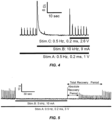
- HFBS high-frequency biphasic stimulation
- Stim.A 0.5 Hz single pulses
- Stim.B 1-10 kHz HFBS
- the 10 kHz HFBS at low intensity induces a strong muscle contraction that is reduced and becomes an initial muscle twitch as the HFBS intensity increases to a higher level (8-10 mA) (see FIG. 3 , panel A).
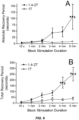
- the muscle contraction force measured at the end of HFBS indicates that a complete nerve block occurs at a minimal intensity (i.e., the block threshold) between 4-6 mA for 5-10 kHz HFBS ( FIG. 3 , panel B).
- the 10 kHz requires slightly higher stimulation intensity than 5 kHz to block the 0.5 Hz muscle twitching induced by Stim.A ( FIG. 3 , panel B).
- FIG. 3 , panel B shows slightly higher stimulation intensity than 5 kHz to block the 0.5 Hz muscle twitching induced by Stim.A ( FIG. 3 , panel B).
- post-stimulation block was observed when the HFBS lasted more than 10 seconds ( FIG. 5 ) .
- the recovery of nerve conduction consisted of two distinct periods. During the first period, a complete block was maintained and no muscle twitching could be induced by 0.5 Hz Stim.A. This period is termed the absolute recovery period ( FIG. 5 ) .
- the muscle twitching induced by 0.5 Hz Stim.A partially recovered ( FIG. 5 ) .
- the total recovery period is defined as the post-stimulation duration required for the muscle twitching response to recover about 95% of pre-stimulation level ( FIG. 5 ) . It is worth noting that the recovery occurred abruptly (see FIG. 5 ) in 13 out of 16 animals.
- the duration of post-stimulation block is proportional to the stimulation duration and intensity ( FIG. 6 ).
- Two monopolar point electrodes (with the indifferent electrode at infinity) are placed at 1 mm distance to the axon.
- the other is the test electrode at the 5 mm location, which delivers a monophasic single pulse (pulse width 0.1 ms at a range of intensities from 0.5 mA to 2 mA) to evoke an action potential and test whether this action potential can propagate through the site of the block electrode.
- the test electrode is always a cathode (negative pulse), and the block electrode always delivers biphasic pulses with the cathodal phase first.
- V n V a,n -V e,n -V rest ;
- V a,n the intracellular potential at the n th node;
- V e,n the extracellular potential at the n th node;
- V rest is the resting membrane potential;
- ⁇ i is the resistivity of axoplasm (100 ⁇ cm);
- C m is the capacity of the membrane (2 ⁇ F/cm 2 );
- I i,n is the ionic current at the nth node described by Frankenhaeuser-Huxley equations. The parameters describing the ionic current I i,n can be found in previous studies.
- the simulation can be performed at a temperature between 15°C and 37°C by setting the temperature parameter in this axonal model.
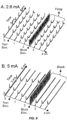
- FIG. 8 shows a typical nerve firing pattern and conduction block induced by HFBS that were simulated by the myelinated axon model as shown in FIG. 7 .
- the HFBS caused repetitive firing of action potentials ( FIG. 8 , panel A) , but only an initial action potential was induced at a higher intensity (5 mA, FIG. 8 , panel B).
- the test pulse was applied by the test electrode at 3 ms after the HFBS started in FIG. 8 , panel B, but was not applied in FIG. 8 , panel A.
- the test pulse generated an action potential propagating toward the block electrode, and the HFBS (8 kHz) successfully blocked the propagation of an action potential at the block electrode ( FIG. 8 , panel B).
- the model simulation also shows that the block threshold is dependent on HFBS frequency and axon diameter ( FIG. 9 ) .
- a small axon requires a higher intensity to block than a large axon, while a higher frequency also requires a higher intensity to block the axons of same diameter.
- the frequency dependence was observed in the frog sciatic nerve-muscle preparation ( FIG. 3B ) where 10 kHz needs higher stimulation intensity than 5 kHz to completely block the nerve conduction.
- the diameter dependence was also reported in previous animal studies indicating that higher stimulation intensity was required to block small diameter axons. More importantly, this model analysis revealed a minimal blocking frequency of 4 kHz at 20°C ( FIG. 9 ), which agrees very well with previous animal studies showing a minimal blocking frequency of about 4-5 kHz.
- FIG. 11 shows the simulation results using the axon model in FIG. 7 .
- Six consecutive nodes at distances of 0-5 mm from the block electrode are investigated (node at 0.0 mm is under the block electrode).
- FIG. 11 panels a-c show that the action potential, sodium current, and potassium current are all propagating toward the block electrode, although their amplitudes are gradually attenuating.
- the inactivation (h) of sodium channels becomes oscillatory.
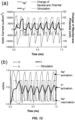
- the combination of activation (m) and inactivation (h) of sodium channels determines that the amplitude of the sodium current gradually attenuates at nodes close to the block electrode and eventually becomes a pulsed inward current at the node (0.0 mm) under the block electrode ( FIG. 11 , panel b). Therefore, the axon model shows that the sodium channels are never completely blocked when conduction block occurs. However, the model does show that the changes in potassium activation (n) induced by the action potentials gradually disappear at the nodes close to the block electrode ( FIG. 11 , panel f) since the potassium channels become constantly activated at those nodes.
- the level of potassium channel activation is maximal at the node (0.0 mm) under the block electrode, which results in a large pulsed outward potassium current ( FIG. 11 , panel c). This large outward potassium current opposes the large inward sodium current, which causes the node (0.0 mm) under the block electrode to become unexcitable leading to block of action potential propagation.
- FIG. 12 shows how the node (0.0 mm) under the block electrode is driven by the HFBS into the unexcitable state.
- the HFBS waveform is also plotted on the background to show the timing.
- panel b after an initial action potential, the potassium channels are activated (n is around 0.4) resulting in pulsed, outward potassium current ( FIG. 12 , panel a).
- both activation (m) and inactivation (h) of sodium channels becomes oscillatory, which results in pulsed, inward sodium current ( FIG. 12 , panel a).
- the depolarization phases cathodal/negative pulse, see FIG.
- the potassium current increases as fast as the sodium current because the potassium channel is already open, which eliminates the delay of potassium current generation relative to the sodium current and thereby causing the node to be unexcitable.
- the delay between potassium current and sodium current is critical for action potential generation and it can be seen in the first pulse at the beginning of the stimulation ( FIG. 12 , panel a). This also explains why HFBS cannot generate action potentials after the initial one (see FIG. 8 , panel B), even though it alternately depolarizes and hyperpolarizes the membrane ( FIG. 12 , panel a). Therefore, the axon model reveals that the conduction block induced by HFBS is due to the constant activation of potassium channels under the block electrode.
- FIG. 13 shows how the activation (n) of potassium channels changes with temperature at a stimulation frequency of 4 kHz.
- the potassium channel kinetics become slower. Therefore, the activation (n) of potassium channels changes from oscillation to constant activation at a higher level (around 0.6).
- a low frequency ( ⁇ 4 kHz) can only block nerve conduction at a low temperature (e.g., ⁇ 20°C) ( FIG. 10 ) .
- the minimal blocking frequency at 37°C increases to 15 kHz.
- the CRRSS model is derived from rabbit myelinated nerves that lack the potassium current in the membrane kinetics. Without potassium channels in the model, a greater than 15 kHz frequency is required, which is consistent with the faster sodium channel kinetics and the need for a higher frequency to drive the sodium channel into inactivation to induce a nerve conduction block.
- the results from the CRRSS model further indicate that it is the potassium channel kinetics that determine the minimal blocking frequency to be 4-5 kHz.
- This axonal conduction block will be maintained after terminating the prolonged HFBS, producing a post-stimulation block (see FIGS. 5 and 6 ) because the ion pump will need time to slowly recover the ion concentrations changed by prolonged HFBS. More importantly, HFBS is not required to have a super-threshold intensity to produce the post-stimulation block because sub-threshold HFBS can also generate the pulsed sodium and potassium current ( FIG. 12 ) but will require a longer time than super-threshold HFBS to accumulate enough change in the ion concentrations to produce axonal conduction block. The results presented herein reveal that the mechanisms underlying acute and post-stimulation block are different.
- Example 3 Pudendal nerve block by a sub-threshold high-frequency (kHz) biphasic stimulation
- the objective of this example was to show that the excitation threshold of high-frequency (10 kHz) biphasic stimulation (HFBS) can be increase with time in pudendal nerve of a cat.
- HFBS high-frequency biphasic stimulation
- a single cat was anesthetized by isoflurane (2-5% oxygen) during surgery and switched to ⁇ -chloralose anesthesia (initial 65 mg/kg i.v. with supplemental as needed) during data collection.
- the right cephalic vein was catheterized for administration of fluid or anesthetics.
- the airway was kept patent by a tracheotomy.
- a catheter was inserted into the right carotid artery to monitor the blood pressure.
- a pulse oximeter (9847V; NONIN Medical, Plymouth, MN) was attached to the tongue to monitor the heart rate and blood oxygen.
- a catheter was inserted into the distal urethra to slowly (1 ml/min) perfuse the urethra with saline and record urethral pressure increase caused by contractions of external urethral sphincter (EUS) that was induced by pudendal nerve stimulation ( FIG. 14 ) .
- EUS external urethral sphincter
- the ureters were tied, cut, and drained externally.
- the left pudendal nerve was exposed via a 3-4 cm incision in the sciatic notch lateral to the tail for implantation of a tripolar cuff electrode (NEC113, MicroProbes Inc, Gaithersburg, MD, USA) to deliver HFBS (Stim.B in FIG. 14 ).
- Two hook electrodes were placed central (Stim.C) and distal (Stim.D) to the tripolar cuff electrode.
- the right pudendal nerve was also exposed and implanted with the same 3 sets of electrodes.
- Pudendal nerves were transected centrally to prevent reflex activation of the EUS ( FIG. 14 ).
- Stimulation pulses (20 Hz, 0.2 ms) generated by a stimulator (Grass S88, Grass Technologies, RI, USA) were delivered via a stimulation isolator (SIU5, Grass Technologies, RI, USA) to the hook electrodes (Stim.C or Stim.D) to induce > 30 cmH 2 O urethral pressure.
- HFBS 10 kHz square waveform without a pulse interval, see FIG. 14
- LabView program National Instrument, TX, USA
- a stimulation isolator A395, World Precision Instruments, FL, USA
- a stimulation isolator A395, World Precision Instruments, FL, USA
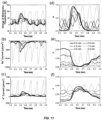
- FIG.15 shows that Stim.C and Stim.D induced the same EUS contractions before the 10 kHz HFBS was applied at Stim.B.
- Stim.B was then applied for more than 5 hours starting at a sub-threshold intensity of 0.15 mA.
- 0.15 mA sub-threshold intensity was gradually increased to 0.16-0.2 mA during the first several minutes of stimulation, it induced irregular weak EUS twitches that were disappeared as the HFBS gradually increased the excitation threshold during a period of 20 minute stimulation.
- sub-threshold HFBS can gradually increase nerve excitation threshold with time and the intensity of HFBS can be gradually increased while always maintaining below the increased excitation threshold.
- the HFBS intensity can be increased high enough to block pudendal nerve conduction and this block is persistent for many hours after termination of the HFBS, i.e., a post-HFBS block.
- the recovery period for post-HFBS block should depend on: 1. the speed of the sodium-potassium pump; and/or 2. the total increases in ion concentrations.
- the initial nerve firing induced by 10 kHz HFBS can be prevented as the HFBS continues. Since the HFBS will gradually change the ion concentrations, the excitation threshold will increase with time. Therefore, the intensity of sub-threshold HFBS can be increased to a new sub-threshold level after minutes or hours of stimulation. Similarly, the new sub-threshold will be further increased with stimulation time and the intensity of the HFBS can be repeatedly increased while always being kept at a sub-threshold level without exciting the nerve. Eventually, HFBS can reach an intensity high enough to produce large changes in ion concentrations causing a nerve conduction block.
Landscapes
- Health & Medical Sciences (AREA)
- Neurology (AREA)
- Life Sciences & Earth Sciences (AREA)
- Animal Behavior & Ethology (AREA)
- Engineering & Computer Science (AREA)
- Biomedical Technology (AREA)
- Nuclear Medicine, Radiotherapy & Molecular Imaging (AREA)
- Radiology & Medical Imaging (AREA)
- Veterinary Medicine (AREA)
- Neurosurgery (AREA)
- General Health & Medical Sciences (AREA)
- Public Health (AREA)
- Heart & Thoracic Surgery (AREA)
- Orthopedic Medicine & Surgery (AREA)
- Cardiology (AREA)
- Pain & Pain Management (AREA)
- Electrotherapy Devices (AREA)
- Magnetic Treatment Devices (AREA)
Applications Claiming Priority (2)
| Application Number | Priority Date | Filing Date | Title |
|---|---|---|---|
| US201862658147P | 2018-04-16 | 2018-04-16 | |
| PCT/US2019/027471 WO2019204198A1 (en) | 2018-04-16 | 2019-04-15 | Nerve block by electrical pulses at sub-threshold intensity |
Publications (3)
| Publication Number | Publication Date |
|---|---|
| EP3781252A1 EP3781252A1 (en) | 2021-02-24 |
| EP3781252A4 EP3781252A4 (en) | 2021-12-15 |
| EP3781252B1 true EP3781252B1 (en) | 2024-11-20 |
Family
ID=68239950
Family Applications (1)
| Application Number | Title | Priority Date | Filing Date |
|---|---|---|---|
| EP19788392.9A Active EP3781252B1 (en) | 2018-04-16 | 2019-04-15 | Nerve block by electrical pulses at sub-threshold intensity |
Country Status (8)
| Country | Link |
|---|---|
| US (3) | US11865346B2 (https=) |
| EP (1) | EP3781252B1 (https=) |
| JP (2) | JP2021520942A (https=) |
| KR (1) | KR102873485B1 (https=) |
| CN (1) | CN112368047A (https=) |
| AU (1) | AU2019255603B2 (https=) |
| CA (1) | CA3097142A1 (https=) |
| WO (1) | WO2019204198A1 (https=) |
Families Citing this family (9)
| Publication number | Priority date | Publication date | Assignee | Title |
|---|---|---|---|---|
| US11413458B2 (en) | 2011-05-19 | 2022-08-16 | Neuros Medical, Inc. | Nerve cuff electrode for neuromodulation in large human nerve trunks |
| KR102648346B1 (ko) | 2017-12-13 | 2024-03-15 | 뉴로스 메디컬 인코포레이티드 | 신경 커프 배치 장치 |
| CN112188915A (zh) | 2018-04-09 | 2021-01-05 | 纽若斯医疗公司 | 用于设置电剂量的装置和方法 |
| JP2021520942A (ja) * | 2018-04-16 | 2021-08-26 | ユニバーシティ オブ ピッツバーグ − オブ ザ コモンウェルス システム オブ ハイヤー エデュケイション | 閾値下強度における電気パルスによる神経ブロック |
| US12370079B2 (en) | 2018-06-19 | 2025-07-29 | Thermaquil, Inc. | Apparatus and method for thermal blockade of nerves |
| EP4103267B1 (en) | 2020-02-11 | 2025-06-04 | Neuros Medical, Inc. | System for quantifying qualitative patient-reported data sets |
| CN115040230B (zh) * | 2022-07-12 | 2024-04-23 | 上海宏桐实业有限公司 | 一种脉冲电场消融系统及电子设备 |
| KR102682382B1 (ko) * | 2023-11-28 | 2024-07-08 | (주)리솔 | 통증 완화 장치 및 그 제어방법 |
| CN118105624B (zh) * | 2024-01-30 | 2024-09-13 | 上海诺诚电气股份有限公司 | 神经电刺激监测方法和系统 |
Family Cites Families (28)
| Publication number | Priority date | Publication date | Assignee | Title |
|---|---|---|---|---|
| US6421566B1 (en) * | 1998-04-30 | 2002-07-16 | Medtronic, Inc. | Selective dorsal column stimulation in SCS, using conditioning pulses |
| US8626302B2 (en) * | 1998-06-03 | 2014-01-07 | Spr Therapeutics, Llc | Systems and methods to place one or more leads in muscle for providing electrical stimulation to treat pain |
| US6697670B2 (en) * | 2001-08-17 | 2004-02-24 | Minnesota Medical Physics, Llc | Apparatus and method for reducing subcutaneous fat deposits by electroporation with improved comfort of patients |
| US7389145B2 (en) * | 2001-02-20 | 2008-06-17 | Case Western Reserve University | Systems and methods for reversibly blocking nerve activity |
| US7904176B2 (en) * | 2006-09-07 | 2011-03-08 | Bio Control Medical (B.C.M.) Ltd. | Techniques for reducing pain associated with nerve stimulation |
| US7689277B2 (en) * | 2002-03-22 | 2010-03-30 | Leptos Biomedical, Inc. | Neural stimulation for treatment of metabolic syndrome and type 2 diabetes |
| US20070025608A1 (en) * | 2005-07-29 | 2007-02-01 | Cyberonics, Inc. | Enhancing intrinsic neural activity using a medical device to treat a patient |
| US20070173908A1 (en) * | 2006-01-20 | 2007-07-26 | Cyberonics, Inc. | Transcutaneous trigeminal nerve stimulation to treat motion sickness |
| US9020597B2 (en) * | 2008-11-12 | 2015-04-28 | Endostim, Inc. | Device and implantation system for electrical stimulation of biological systems |
| US8805510B2 (en) | 2007-08-02 | 2014-08-12 | University of Pittsburgh—of the Commonwealth System of Higher Education | Methods and systems for achieving a physiological response by pudendal nerve stimulation and blockade |
| US20090105786A1 (en) * | 2007-10-22 | 2009-04-23 | University Of Washington | Method and device for strengthening synaptic connections |
| US20090204173A1 (en) | 2007-11-05 | 2009-08-13 | Zi-Ping Fang | Multi-Frequency Neural Treatments and Associated Systems and Methods |
| US8918178B2 (en) * | 2009-03-20 | 2014-12-23 | ElectroCore, LLC | Non-invasive vagal nerve stimulation to treat disorders |
| WO2011041526A2 (en) | 2009-10-01 | 2011-04-07 | University Of Pittsburgh-Of The Commonwealth System Of Higher Education | Non-invasive method to treat urological and gastrointestinal disorders |
| US10279163B2 (en) * | 2011-03-10 | 2019-05-07 | Electrocore, Inc. | Electrical and magnetic stimulators used to treat migraine/sinus headache, rhinitis, sinusitis, rhinosinusitis, and comorbid disorders |
| CN107376115A (zh) * | 2011-11-15 | 2017-11-24 | 神经系统检测公司 | 用于使用经皮电神经刺激减轻疼痛的设备和方法 |
| US20140243943A1 (en) * | 2013-02-25 | 2014-08-28 | Boston Scientific Neuromodulation Corporation | System and method for stimulating intraosseous nerve fibers |
| JP6181307B2 (ja) * | 2013-07-26 | 2017-08-16 | ボストン サイエンティフィック ニューロモデュレイション コーポレイション | 知覚なしに変調治療を与えるシステム |
| US10335596B2 (en) | 2014-03-14 | 2019-07-02 | Nalu Medical, Inc. | Method and apparatus for neuromodulation treatments of pain and other conditions |
| US20160158551A1 (en) * | 2014-12-05 | 2016-06-09 | Pacesstter, Inc. | System and method for dorsal root block during spinal cord stimulation |
| US20170361091A1 (en) | 2014-12-23 | 2017-12-21 | University Of Pittsburgh - Of The Commonwealth System Of Higher Education | Devices, Systems and Methods for Treating Urological and Gastrointestinal Disorders by Electrical Stimulation of the Foot |
| US9962547B2 (en) * | 2015-02-05 | 2018-05-08 | Stimgenics, Llc | Method and apparatus for multimodal electrical modulation of pain |
| US10765863B2 (en) * | 2015-02-24 | 2020-09-08 | Elira, Inc. | Systems and methods for using a transcutaneous electrical stimulation device to deliver titrated therapy |
| US9872985B2 (en) * | 2015-03-03 | 2018-01-23 | Georgia Tech Research Corporation | Glucose regulation via electrical stimulation of nerves innervating the liver |
| CA3014317C (en) * | 2016-02-19 | 2024-07-02 | Nalu Medical, Inc. | DEVICE FEATURING ENHANCED STIMULATION WAVEFORMS |
| US20170348540A1 (en) * | 2016-06-02 | 2017-12-07 | Boston Scientific Neuromodulation Corporation | Priming-assisted neuromodulation therapy |
| US11285318B2 (en) | 2017-05-04 | 2022-03-29 | University of Pittsburgh—of the Commonwealth System of Higher Education | Peripheral neuromodulation to treat bladder and bowel dysfunction |
| JP2021520942A (ja) * | 2018-04-16 | 2021-08-26 | ユニバーシティ オブ ピッツバーグ − オブ ザ コモンウェルス システム オブ ハイヤー エデュケイション | 閾値下強度における電気パルスによる神経ブロック |
-
2019
- 2019-04-15 JP JP2020556963A patent/JP2021520942A/ja active Pending
- 2019-04-15 EP EP19788392.9A patent/EP3781252B1/en active Active
- 2019-04-15 CA CA3097142A patent/CA3097142A1/en active Pending
- 2019-04-15 KR KR1020207032825A patent/KR102873485B1/ko active Active
- 2019-04-15 AU AU2019255603A patent/AU2019255603B2/en active Active
- 2019-04-15 CN CN201980040200.0A patent/CN112368047A/zh active Pending
- 2019-04-15 WO PCT/US2019/027471 patent/WO2019204198A1/en not_active Ceased
- 2019-04-15 US US17/047,754 patent/US11865346B2/en active Active
-
2021
- 2021-05-26 US US17/330,883 patent/US11826572B2/en active Active
-
2023
- 2023-10-20 US US18/490,822 patent/US20240042211A1/en active Pending
-
2024
- 2024-10-24 JP JP2024187316A patent/JP2025013960A/ja active Pending
Also Published As
| Publication number | Publication date |
|---|---|
| JP2021520942A (ja) | 2021-08-26 |
| US20210283401A1 (en) | 2021-09-16 |
| AU2019255603A1 (en) | 2020-11-12 |
| JP2025013960A (ja) | 2025-01-28 |
| US20240042211A1 (en) | 2024-02-08 |
| US11865346B2 (en) | 2024-01-09 |
| AU2019255603B2 (en) | 2024-09-05 |
| CN112368047A (zh) | 2021-02-12 |
| CA3097142A1 (en) | 2019-10-24 |
| WO2019204198A1 (en) | 2019-10-24 |
| US11826572B2 (en) | 2023-11-28 |
| KR20210002535A (ko) | 2021-01-08 |
| KR102873485B1 (ko) | 2025-10-20 |
| US20210106831A1 (en) | 2021-04-15 |
| EP3781252A4 (en) | 2021-12-15 |
| EP3781252A1 (en) | 2021-02-24 |
Similar Documents
| Publication | Publication Date | Title |
|---|---|---|
| EP3781252B1 (en) | Nerve block by electrical pulses at sub-threshold intensity | |
| US20210260381A1 (en) | Onset-mitigating high-frequency nerve block | |
| US6937904B2 (en) | System and method for providing recovery from muscle denervation | |
| JP2022009436A (ja) | 経皮直流電流ブロックによる神経伝導変更システム及び方法 | |
| US20070100377A1 (en) | Providing multiple signal modes for a medical device | |
| US20080243204A1 (en) | Variational parameter neurostimulation paradigm for treatment of neurologic disease | |
| WO2001010375A2 (en) | Inhibition of action potentials | |
| AU2020300506B2 (en) | Neural block by super-threshold low frequency electrical stimulation | |
| EP4277697B1 (en) | Multimodal stimulation control based on ecaps | |
| WO2023017406A1 (en) | Spinal cord injury therapy based on evoked compound action potentials | |
| ES2899684T3 (es) | Bloqueo de conducción nerviosa de corriente continua (CC) subumbral tras cebado supraumbral | |
| US20230047655A1 (en) | Spinal cord injury therapy based on evoked compound action potentials | |
| CN118103107A (zh) | 肠道功能和性功能的骶神经调节 |
Legal Events
| Date | Code | Title | Description |
|---|---|---|---|
| STAA | Information on the status of an ep patent application or granted ep patent |
Free format text: STATUS: THE INTERNATIONAL PUBLICATION HAS BEEN MADE |
|
| PUAI | Public reference made under article 153(3) epc to a published international application that has entered the european phase |
Free format text: ORIGINAL CODE: 0009012 |
|
| STAA | Information on the status of an ep patent application or granted ep patent |
Free format text: STATUS: REQUEST FOR EXAMINATION WAS MADE |
|
| 17P | Request for examination filed |
Effective date: 20201111 |
|
| AK | Designated contracting states |
Kind code of ref document: A1 Designated state(s): AL AT BE BG CH CY CZ DE DK EE ES FI FR GB GR HR HU IE IS IT LI LT LU LV MC MK MT NL NO PL PT RO RS SE SI SK SM TR |
|
| AX | Request for extension of the european patent |
Extension state: BA ME |
|
| DAV | Request for validation of the european patent (deleted) | ||
| DAX | Request for extension of the european patent (deleted) | ||
| A4 | Supplementary search report drawn up and despatched |
Effective date: 20211117 |
|
| RIC1 | Information provided on ipc code assigned before grant |
Ipc: A61N 1/05 20060101ALN20211111BHEP Ipc: A61N 1/36 20060101AFI20211111BHEP |
|
| GRAP | Despatch of communication of intention to grant a patent |
Free format text: ORIGINAL CODE: EPIDOSNIGR1 |
|
| STAA | Information on the status of an ep patent application or granted ep patent |
Free format text: STATUS: GRANT OF PATENT IS INTENDED |
|
| RIC1 | Information provided on ipc code assigned before grant |
Ipc: A61N 1/05 20060101ALN20240523BHEP Ipc: A61N 1/36 20060101AFI20240523BHEP |
|
| INTG | Intention to grant announced |
Effective date: 20240620 |
|
| RIC1 | Information provided on ipc code assigned before grant |
Ipc: A61N 1/05 20060101ALN20240612BHEP Ipc: A61N 1/36 20060101AFI20240612BHEP |
|
| GRAS | Grant fee paid |
Free format text: ORIGINAL CODE: EPIDOSNIGR3 |
|
| GRAA | (expected) grant |
Free format text: ORIGINAL CODE: 0009210 |
|
| STAA | Information on the status of an ep patent application or granted ep patent |
Free format text: STATUS: THE PATENT HAS BEEN GRANTED |
|
| AK | Designated contracting states |
Kind code of ref document: B1 Designated state(s): AL AT BE BG CH CY CZ DE DK EE ES FI FR GB GR HR HU IE IS IT LI LT LU LV MC MK MT NL NO PL PT RO RS SE SI SK SM TR |
|
| REG | Reference to a national code |
Ref country code: GB Ref legal event code: FG4D |
|
| REG | Reference to a national code |
Ref country code: CH Ref legal event code: EP |
|
| P01 | Opt-out of the competence of the unified patent court (upc) registered |
Free format text: CASE NUMBER: APP_58059/2024 Effective date: 20241024 |
|
| REG | Reference to a national code |
Ref country code: DE Ref legal event code: R096 Ref document number: 602019062278 Country of ref document: DE |
|
| REG | Reference to a national code |
Ref country code: IE Ref legal event code: FG4D |
|
| REG | Reference to a national code |
Ref country code: LT Ref legal event code: MG9D |
|
| REG | Reference to a national code |
Ref country code: NL Ref legal event code: MP Effective date: 20241120 |
|
| PG25 | Lapsed in a contracting state [announced via postgrant information from national office to epo] |
Ref country code: PT Free format text: LAPSE BECAUSE OF FAILURE TO SUBMIT A TRANSLATION OF THE DESCRIPTION OR TO PAY THE FEE WITHIN THE PRESCRIBED TIME-LIMIT Effective date: 20250320 Ref country code: HR Free format text: LAPSE BECAUSE OF FAILURE TO SUBMIT A TRANSLATION OF THE DESCRIPTION OR TO PAY THE FEE WITHIN THE PRESCRIBED TIME-LIMIT Effective date: 20241120 Ref country code: IS Free format text: LAPSE BECAUSE OF FAILURE TO SUBMIT A TRANSLATION OF THE DESCRIPTION OR TO PAY THE FEE WITHIN THE PRESCRIBED TIME-LIMIT Effective date: 20250320 |
|
| PG25 | Lapsed in a contracting state [announced via postgrant information from national office to epo] |
Ref country code: FI Free format text: LAPSE BECAUSE OF FAILURE TO SUBMIT A TRANSLATION OF THE DESCRIPTION OR TO PAY THE FEE WITHIN THE PRESCRIBED TIME-LIMIT Effective date: 20241120 Ref country code: NL Free format text: LAPSE BECAUSE OF FAILURE TO SUBMIT A TRANSLATION OF THE DESCRIPTION OR TO PAY THE FEE WITHIN THE PRESCRIBED TIME-LIMIT Effective date: 20241120 |
|
| REG | Reference to a national code |
Ref country code: AT Ref legal event code: MK05 Ref document number: 1743042 Country of ref document: AT Kind code of ref document: T Effective date: 20241120 |
|
| PG25 | Lapsed in a contracting state [announced via postgrant information from national office to epo] |
Ref country code: BG Free format text: LAPSE BECAUSE OF FAILURE TO SUBMIT A TRANSLATION OF THE DESCRIPTION OR TO PAY THE FEE WITHIN THE PRESCRIBED TIME-LIMIT Effective date: 20241120 |
|
| PG25 | Lapsed in a contracting state [announced via postgrant information from national office to epo] |
Ref country code: ES Free format text: LAPSE BECAUSE OF FAILURE TO SUBMIT A TRANSLATION OF THE DESCRIPTION OR TO PAY THE FEE WITHIN THE PRESCRIBED TIME-LIMIT Effective date: 20241120 |
|
| PG25 | Lapsed in a contracting state [announced via postgrant information from national office to epo] |
Ref country code: NO Free format text: LAPSE BECAUSE OF FAILURE TO SUBMIT A TRANSLATION OF THE DESCRIPTION OR TO PAY THE FEE WITHIN THE PRESCRIBED TIME-LIMIT Effective date: 20250220 |
|
| PG25 | Lapsed in a contracting state [announced via postgrant information from national office to epo] |
Ref country code: LV Free format text: LAPSE BECAUSE OF FAILURE TO SUBMIT A TRANSLATION OF THE DESCRIPTION OR TO PAY THE FEE WITHIN THE PRESCRIBED TIME-LIMIT Effective date: 20241120 Ref country code: GR Free format text: LAPSE BECAUSE OF FAILURE TO SUBMIT A TRANSLATION OF THE DESCRIPTION OR TO PAY THE FEE WITHIN THE PRESCRIBED TIME-LIMIT Effective date: 20250221 Ref country code: AT Free format text: LAPSE BECAUSE OF FAILURE TO SUBMIT A TRANSLATION OF THE DESCRIPTION OR TO PAY THE FEE WITHIN THE PRESCRIBED TIME-LIMIT Effective date: 20241120 |
|
| PG25 | Lapsed in a contracting state [announced via postgrant information from national office to epo] |
Ref country code: PL Free format text: LAPSE BECAUSE OF FAILURE TO SUBMIT A TRANSLATION OF THE DESCRIPTION OR TO PAY THE FEE WITHIN THE PRESCRIBED TIME-LIMIT Effective date: 20241120 |
|
| PG25 | Lapsed in a contracting state [announced via postgrant information from national office to epo] |
Ref country code: RS Free format text: LAPSE BECAUSE OF FAILURE TO SUBMIT A TRANSLATION OF THE DESCRIPTION OR TO PAY THE FEE WITHIN THE PRESCRIBED TIME-LIMIT Effective date: 20250220 |
|
| PG25 | Lapsed in a contracting state [announced via postgrant information from national office to epo] |
Ref country code: SM Free format text: LAPSE BECAUSE OF FAILURE TO SUBMIT A TRANSLATION OF THE DESCRIPTION OR TO PAY THE FEE WITHIN THE PRESCRIBED TIME-LIMIT Effective date: 20241120 |
|
| PGFP | Annual fee paid to national office [announced via postgrant information from national office to epo] |
Ref country code: DE Payment date: 20250305 Year of fee payment: 7 |
|
| PG25 | Lapsed in a contracting state [announced via postgrant information from national office to epo] |
Ref country code: DK Free format text: LAPSE BECAUSE OF FAILURE TO SUBMIT A TRANSLATION OF THE DESCRIPTION OR TO PAY THE FEE WITHIN THE PRESCRIBED TIME-LIMIT Effective date: 20241120 |
|
| PG25 | Lapsed in a contracting state [announced via postgrant information from national office to epo] |
Ref country code: EE Free format text: LAPSE BECAUSE OF FAILURE TO SUBMIT A TRANSLATION OF THE DESCRIPTION OR TO PAY THE FEE WITHIN THE PRESCRIBED TIME-LIMIT Effective date: 20241120 |
|
| PG25 | Lapsed in a contracting state [announced via postgrant information from national office to epo] |
Ref country code: RO Free format text: LAPSE BECAUSE OF FAILURE TO SUBMIT A TRANSLATION OF THE DESCRIPTION OR TO PAY THE FEE WITHIN THE PRESCRIBED TIME-LIMIT Effective date: 20241120 |
|
| PG25 | Lapsed in a contracting state [announced via postgrant information from national office to epo] |
Ref country code: SK Free format text: LAPSE BECAUSE OF FAILURE TO SUBMIT A TRANSLATION OF THE DESCRIPTION OR TO PAY THE FEE WITHIN THE PRESCRIBED TIME-LIMIT Effective date: 20241120 |
|
| PG25 | Lapsed in a contracting state [announced via postgrant information from national office to epo] |
Ref country code: CZ Free format text: LAPSE BECAUSE OF FAILURE TO SUBMIT A TRANSLATION OF THE DESCRIPTION OR TO PAY THE FEE WITHIN THE PRESCRIBED TIME-LIMIT Effective date: 20241120 |
|
| PG25 | Lapsed in a contracting state [announced via postgrant information from national office to epo] |
Ref country code: IT Free format text: LAPSE BECAUSE OF FAILURE TO SUBMIT A TRANSLATION OF THE DESCRIPTION OR TO PAY THE FEE WITHIN THE PRESCRIBED TIME-LIMIT Effective date: 20241120 |
|
| REG | Reference to a national code |
Ref country code: DE Ref legal event code: R097 Ref document number: 602019062278 Country of ref document: DE |
|
| PG25 | Lapsed in a contracting state [announced via postgrant information from national office to epo] |
Ref country code: SE Free format text: LAPSE BECAUSE OF FAILURE TO SUBMIT A TRANSLATION OF THE DESCRIPTION OR TO PAY THE FEE WITHIN THE PRESCRIBED TIME-LIMIT Effective date: 20241120 |
|
| PLBE | No opposition filed within time limit |
Free format text: ORIGINAL CODE: 0009261 |
|
| STAA | Information on the status of an ep patent application or granted ep patent |
Free format text: STATUS: NO OPPOSITION FILED WITHIN TIME LIMIT |
|
| 26N | No opposition filed |
Effective date: 20250821 |
|
| REG | Reference to a national code |
Ref country code: CH Ref legal event code: H13 Free format text: ST27 STATUS EVENT CODE: U-0-0-H10-H13 (AS PROVIDED BY THE NATIONAL OFFICE) Effective date: 20251125 |
|
| PG25 | Lapsed in a contracting state [announced via postgrant information from national office to epo] |
Ref country code: LU Free format text: LAPSE BECAUSE OF NON-PAYMENT OF DUE FEES Effective date: 20250415 |
|
| PG25 | Lapsed in a contracting state [announced via postgrant information from national office to epo] |
Ref country code: MC Free format text: LAPSE BECAUSE OF FAILURE TO SUBMIT A TRANSLATION OF THE DESCRIPTION OR TO PAY THE FEE WITHIN THE PRESCRIBED TIME-LIMIT Effective date: 20241120 |
|
| REG | Reference to a national code |
Ref country code: BE Ref legal event code: MM Effective date: 20250430 |
|
| PG25 | Lapsed in a contracting state [announced via postgrant information from national office to epo] |
Ref country code: BE Free format text: LAPSE BECAUSE OF NON-PAYMENT OF DUE FEES Effective date: 20250430 |
|
| PG25 | Lapsed in a contracting state [announced via postgrant information from national office to epo] |
Ref country code: CH Free format text: LAPSE BECAUSE OF NON-PAYMENT OF DUE FEES Effective date: 20250430 |
|
| PGFP | Annual fee paid to national office [announced via postgrant information from national office to epo] |
Ref country code: GB Payment date: 20260313 Year of fee payment: 8 |
|
| PG25 | Lapsed in a contracting state [announced via postgrant information from national office to epo] |
Ref country code: IE Free format text: LAPSE BECAUSE OF NON-PAYMENT OF DUE FEES Effective date: 20250415 |
|
| PGFP | Annual fee paid to national office [announced via postgrant information from national office to epo] |
Ref country code: FR Payment date: 20260309 Year of fee payment: 8 |