EP3774684B1 - Elektrisch leitfähige leimung für kohlenstofffasern - Google Patents
Elektrisch leitfähige leimung für kohlenstofffasern Download PDFInfo
- Publication number
- EP3774684B1 EP3774684B1 EP19717081.4A EP19717081A EP3774684B1 EP 3774684 B1 EP3774684 B1 EP 3774684B1 EP 19717081 A EP19717081 A EP 19717081A EP 3774684 B1 EP3774684 B1 EP 3774684B1
- Authority
- EP
- European Patent Office
- Prior art keywords
- fiber
- electrically conductive
- reinforced resin
- resin composite
- fabric
- Prior art date
- Legal status (The legal status is an assumption and is not a legal conclusion. Google has not performed a legal analysis and makes no representation as to the accuracy of the status listed.)
- Active
Links
Images


Classifications
-
- B—PERFORMING OPERATIONS; TRANSPORTING
- B32—LAYERED PRODUCTS
- B32B—LAYERED PRODUCTS, i.e. PRODUCTS BUILT-UP OF STRATA OF FLAT OR NON-FLAT, e.g. CELLULAR OR HONEYCOMB, FORM
- B32B27/00—Layered products comprising a layer of synthetic resin
- B32B27/18—Layered products comprising a layer of synthetic resin characterised by the use of special additives
- B32B27/20—Layered products comprising a layer of synthetic resin characterised by the use of special additives using fillers, pigments, thixotroping agents
-
- B—PERFORMING OPERATIONS; TRANSPORTING
- B32—LAYERED PRODUCTS
- B32B—LAYERED PRODUCTS, i.e. PRODUCTS BUILT-UP OF STRATA OF FLAT OR NON-FLAT, e.g. CELLULAR OR HONEYCOMB, FORM
- B32B37/00—Methods or apparatus for laminating, e.g. by curing or by ultrasonic bonding
- B32B37/12—Methods or apparatus for laminating, e.g. by curing or by ultrasonic bonding characterised by using adhesives
-
- B—PERFORMING OPERATIONS; TRANSPORTING
- B32—LAYERED PRODUCTS
- B32B—LAYERED PRODUCTS, i.e. PRODUCTS BUILT-UP OF STRATA OF FLAT OR NON-FLAT, e.g. CELLULAR OR HONEYCOMB, FORM
- B32B37/00—Methods or apparatus for laminating, e.g. by curing or by ultrasonic bonding
- B32B37/14—Methods or apparatus for laminating, e.g. by curing or by ultrasonic bonding characterised by the properties of the layers
- B32B37/16—Methods or apparatus for laminating, e.g. by curing or by ultrasonic bonding characterised by the properties of the layers with all layers existing as coherent layers before laminating
- B32B37/18—Methods or apparatus for laminating, e.g. by curing or by ultrasonic bonding characterised by the properties of the layers with all layers existing as coherent layers before laminating involving the assembly of discrete sheets or panels only
- B32B37/182—Methods or apparatus for laminating, e.g. by curing or by ultrasonic bonding characterised by the properties of the layers with all layers existing as coherent layers before laminating involving the assembly of discrete sheets or panels only one or more of the layers being plastic
-
- B—PERFORMING OPERATIONS; TRANSPORTING
- B32—LAYERED PRODUCTS
- B32B—LAYERED PRODUCTS, i.e. PRODUCTS BUILT-UP OF STRATA OF FLAT OR NON-FLAT, e.g. CELLULAR OR HONEYCOMB, FORM
- B32B5/00—Layered products characterised by the non- homogeneity or physical structure, i.e. comprising a fibrous, filamentary, particulate or foam layer; Layered products characterised by having a layer differing constitutionally or physically in different parts
- B32B5/22—Layered products characterised by the non- homogeneity or physical structure, i.e. comprising a fibrous, filamentary, particulate or foam layer; Layered products characterised by having a layer differing constitutionally or physically in different parts characterised by the presence of two or more layers which are next to each other and are fibrous, filamentary, formed of particles or foamed
- B32B5/24—Layered products characterised by the non- homogeneity or physical structure, i.e. comprising a fibrous, filamentary, particulate or foam layer; Layered products characterised by having a layer differing constitutionally or physically in different parts characterised by the presence of two or more layers which are next to each other and are fibrous, filamentary, formed of particles or foamed one layer being a fibrous or filamentary layer
- B32B5/26—Layered products characterised by the non- homogeneity or physical structure, i.e. comprising a fibrous, filamentary, particulate or foam layer; Layered products characterised by having a layer differing constitutionally or physically in different parts characterised by the presence of two or more layers which are next to each other and are fibrous, filamentary, formed of particles or foamed one layer being a fibrous or filamentary layer another layer next to it also being fibrous or filamentary
-
- B—PERFORMING OPERATIONS; TRANSPORTING
- B32—LAYERED PRODUCTS
- B32B—LAYERED PRODUCTS, i.e. PRODUCTS BUILT-UP OF STRATA OF FLAT OR NON-FLAT, e.g. CELLULAR OR HONEYCOMB, FORM
- B32B7/00—Layered products characterised by the relation between layers; Layered products characterised by the relative orientation of features between layers, or by the relative values of a measurable parameter between layers, i.e. products comprising layers having different physical, chemical or physicochemical properties; Layered products characterised by the interconnection of layers
- B32B7/04—Interconnection of layers
- B32B7/12—Interconnection of layers using interposed adhesives or interposed materials with bonding properties
-
- C—CHEMISTRY; METALLURGY
- C01—INORGANIC CHEMISTRY
- C01B—NON-METALLIC ELEMENTS; COMPOUNDS THEREOF; METALLOIDS OR COMPOUNDS THEREOF NOT COVERED BY SUBCLASS C01C
- C01B32/00—Carbon; Compounds thereof
- C01B32/05—Preparation or purification of carbon not covered by groups C01B32/15, C01B32/20, C01B32/25, C01B32/30
-
- C—CHEMISTRY; METALLURGY
- C03—GLASS; MINERAL OR SLAG WOOL
- C03C—CHEMICAL COMPOSITION OF GLASSES, GLAZES OR VITREOUS ENAMELS; SURFACE TREATMENT OF GLASS; SURFACE TREATMENT OF FIBRES OR FILAMENTS MADE FROM GLASS, MINERALS OR SLAGS; JOINING GLASS TO GLASS OR OTHER MATERIALS
- C03C25/00—Surface treatment of fibres or filaments made from glass, minerals or slags
- C03C25/10—Coating
- C03C25/42—Coatings containing inorganic materials
- C03C25/44—Carbon, e.g. graphite
-
- C—CHEMISTRY; METALLURGY
- C07—ORGANIC CHEMISTRY
- C07K—PEPTIDES
- C07K7/00—Peptides having 5 to 20 amino acids in a fully defined sequence; Derivatives thereof
- C07K7/04—Linear peptides containing only normal peptide links
- C07K7/06—Linear peptides containing only normal peptide links having 5 to 11 amino acids
-
- C—CHEMISTRY; METALLURGY
- C08—ORGANIC MACROMOLECULAR COMPOUNDS; THEIR PREPARATION OR CHEMICAL WORKING-UP; COMPOSITIONS BASED THEREON
- C08J—WORKING-UP; GENERAL PROCESSES OF COMPOUNDING; AFTER-TREATMENT NOT COVERED BY SUBCLASSES C08B, C08C, C08F, C08G or C08H
- C08J3/00—Processes of treating or compounding macromolecular substances
- C08J3/20—Compounding polymers with additives, e.g. colouring
- C08J3/203—Solid polymers with solid and/or liquid additives
-
- C—CHEMISTRY; METALLURGY
- C08—ORGANIC MACROMOLECULAR COMPOUNDS; THEIR PREPARATION OR CHEMICAL WORKING-UP; COMPOSITIONS BASED THEREON
- C08J—WORKING-UP; GENERAL PROCESSES OF COMPOUNDING; AFTER-TREATMENT NOT COVERED BY SUBCLASSES C08B, C08C, C08F, C08G or C08H
- C08J5/00—Manufacture of articles or shaped materials containing macromolecular substances
- C08J5/005—Reinforced macromolecular compounds with nanosized materials, e.g. nanoparticles, nanofibres, nanotubes, nanowires, nanorods or nanolayered materials
-
- C—CHEMISTRY; METALLURGY
- C08—ORGANIC MACROMOLECULAR COMPOUNDS; THEIR PREPARATION OR CHEMICAL WORKING-UP; COMPOSITIONS BASED THEREON
- C08J—WORKING-UP; GENERAL PROCESSES OF COMPOUNDING; AFTER-TREATMENT NOT COVERED BY SUBCLASSES C08B, C08C, C08F, C08G or C08H
- C08J5/00—Manufacture of articles or shaped materials containing macromolecular substances
- C08J5/04—Reinforcing macromolecular compounds with loose or coherent fibrous material
- C08J5/0405—Reinforcing macromolecular compounds with loose or coherent fibrous material with inorganic fibres
- C08J5/042—Reinforcing macromolecular compounds with loose or coherent fibrous material with inorganic fibres with carbon fibres
-
- C—CHEMISTRY; METALLURGY
- C08—ORGANIC MACROMOLECULAR COMPOUNDS; THEIR PREPARATION OR CHEMICAL WORKING-UP; COMPOSITIONS BASED THEREON
- C08J—WORKING-UP; GENERAL PROCESSES OF COMPOUNDING; AFTER-TREATMENT NOT COVERED BY SUBCLASSES C08B, C08C, C08F, C08G or C08H
- C08J5/00—Manufacture of articles or shaped materials containing macromolecular substances
- C08J5/04—Reinforcing macromolecular compounds with loose or coherent fibrous material
- C08J5/06—Reinforcing macromolecular compounds with loose or coherent fibrous material using pretreated fibrous materials
-
- C—CHEMISTRY; METALLURGY
- C08—ORGANIC MACROMOLECULAR COMPOUNDS; THEIR PREPARATION OR CHEMICAL WORKING-UP; COMPOSITIONS BASED THEREON
- C08J—WORKING-UP; GENERAL PROCESSES OF COMPOUNDING; AFTER-TREATMENT NOT COVERED BY SUBCLASSES C08B, C08C, C08F, C08G or C08H
- C08J5/00—Manufacture of articles or shaped materials containing macromolecular substances
- C08J5/12—Bonding of a preformed macromolecular material to the same or other solid material such as metal, glass, leather, e.g. using adhesives
- C08J5/124—Bonding of a preformed macromolecular material to the same or other solid material such as metal, glass, leather, e.g. using adhesives using adhesives based on a macromolecular component
-
- C—CHEMISTRY; METALLURGY
- C08—ORGANIC MACROMOLECULAR COMPOUNDS; THEIR PREPARATION OR CHEMICAL WORKING-UP; COMPOSITIONS BASED THEREON
- C08J—WORKING-UP; GENERAL PROCESSES OF COMPOUNDING; AFTER-TREATMENT NOT COVERED BY SUBCLASSES C08B, C08C, C08F, C08G or C08H
- C08J5/00—Manufacture of articles or shaped materials containing macromolecular substances
- C08J5/24—Impregnating materials with prepolymers which can be polymerised in situ, e.g. manufacture of prepregs
-
- C—CHEMISTRY; METALLURGY
- C08—ORGANIC MACROMOLECULAR COMPOUNDS; THEIR PREPARATION OR CHEMICAL WORKING-UP; COMPOSITIONS BASED THEREON
- C08J—WORKING-UP; GENERAL PROCESSES OF COMPOUNDING; AFTER-TREATMENT NOT COVERED BY SUBCLASSES C08B, C08C, C08F, C08G or C08H
- C08J5/00—Manufacture of articles or shaped materials containing macromolecular substances
- C08J5/24—Impregnating materials with prepolymers which can be polymerised in situ, e.g. manufacture of prepregs
- C08J5/248—Impregnating materials with prepolymers which can be polymerised in situ, e.g. manufacture of prepregs using pre-treated fibres
-
- C—CHEMISTRY; METALLURGY
- C08—ORGANIC MACROMOLECULAR COMPOUNDS; THEIR PREPARATION OR CHEMICAL WORKING-UP; COMPOSITIONS BASED THEREON
- C08K—Use of inorganic or non-macromolecular organic substances as compounding ingredients
- C08K9/00—Use of pretreated ingredients
- C08K9/04—Ingredients treated with organic substances
-
- C—CHEMISTRY; METALLURGY
- C08—ORGANIC MACROMOLECULAR COMPOUNDS; THEIR PREPARATION OR CHEMICAL WORKING-UP; COMPOSITIONS BASED THEREON
- C08K—Use of inorganic or non-macromolecular organic substances as compounding ingredients
- C08K9/00—Use of pretreated ingredients
- C08K9/08—Ingredients agglomerated by treatment with a binding agent
-
- C—CHEMISTRY; METALLURGY
- C08—ORGANIC MACROMOLECULAR COMPOUNDS; THEIR PREPARATION OR CHEMICAL WORKING-UP; COMPOSITIONS BASED THEREON
- C08L—COMPOSITIONS OF MACROMOLECULAR COMPOUNDS
- C08L31/00—Compositions of homopolymers or copolymers of compounds having one or more unsaturated aliphatic radicals, each having only one carbon-to-carbon double bond, and at least one being terminated by an acyloxy radical of a saturated carboxylic acid, of carbonic acid or of a haloformic acid; Compositions of derivatives of such polymers
- C08L31/02—Homopolymers or copolymers of esters of monocarboxylic acids
-
- C—CHEMISTRY; METALLURGY
- C08—ORGANIC MACROMOLECULAR COMPOUNDS; THEIR PREPARATION OR CHEMICAL WORKING-UP; COMPOSITIONS BASED THEREON
- C08L—COMPOSITIONS OF MACROMOLECULAR COMPOUNDS
- C08L63/00—Compositions of epoxy resins; Compositions of derivatives of epoxy resins
-
- C—CHEMISTRY; METALLURGY
- C08—ORGANIC MACROMOLECULAR COMPOUNDS; THEIR PREPARATION OR CHEMICAL WORKING-UP; COMPOSITIONS BASED THEREON
- C08L—COMPOSITIONS OF MACROMOLECULAR COMPOUNDS
- C08L67/00—Compositions of polyesters obtained by reactions forming a carboxylic ester link in the main chain; Compositions of derivatives of such polymers
-
- D—TEXTILES; PAPER
- D06—TREATMENT OF TEXTILES OR THE LIKE; LAUNDERING; FLEXIBLE MATERIALS NOT OTHERWISE PROVIDED FOR
- D06M—TREATMENT, NOT PROVIDED FOR ELSEWHERE IN CLASS D06, OF FIBRES, THREADS, YARNS, FABRICS, FEATHERS OR FIBROUS GOODS MADE FROM SUCH MATERIALS
- D06M11/00—Treating fibres, threads, yarns, fabrics or fibrous goods made from such materials, with inorganic substances or complexes thereof; Such treatment combined with mechanical treatment, e.g. mercerising
- D06M11/73—Treating fibres, threads, yarns, fabrics or fibrous goods made from such materials, with inorganic substances or complexes thereof; Such treatment combined with mechanical treatment, e.g. mercerising with carbon or compounds thereof
-
- D—TEXTILES; PAPER
- D06—TREATMENT OF TEXTILES OR THE LIKE; LAUNDERING; FLEXIBLE MATERIALS NOT OTHERWISE PROVIDED FOR
- D06M—TREATMENT, NOT PROVIDED FOR ELSEWHERE IN CLASS D06, OF FIBRES, THREADS, YARNS, FABRICS, FEATHERS OR FIBROUS GOODS MADE FROM SUCH MATERIALS
- D06M11/00—Treating fibres, threads, yarns, fabrics or fibrous goods made from such materials, with inorganic substances or complexes thereof; Such treatment combined with mechanical treatment, e.g. mercerising
- D06M11/73—Treating fibres, threads, yarns, fabrics or fibrous goods made from such materials, with inorganic substances or complexes thereof; Such treatment combined with mechanical treatment, e.g. mercerising with carbon or compounds thereof
- D06M11/76—Treating fibres, threads, yarns, fabrics or fibrous goods made from such materials, with inorganic substances or complexes thereof; Such treatment combined with mechanical treatment, e.g. mercerising with carbon or compounds thereof with carbon oxides or carbonates
-
- D—TEXTILES; PAPER
- D06—TREATMENT OF TEXTILES OR THE LIKE; LAUNDERING; FLEXIBLE MATERIALS NOT OTHERWISE PROVIDED FOR
- D06M—TREATMENT, NOT PROVIDED FOR ELSEWHERE IN CLASS D06, OF FIBRES, THREADS, YARNS, FABRICS, FEATHERS OR FIBROUS GOODS MADE FROM SUCH MATERIALS
- D06M23/00—Treatment of fibres, threads, yarns, fabrics or fibrous goods made from such materials, characterised by the process
- D06M23/08—Processes in which the treating agent is applied in powder or granular form
-
- D—TEXTILES; PAPER
- D06—TREATMENT OF TEXTILES OR THE LIKE; LAUNDERING; FLEXIBLE MATERIALS NOT OTHERWISE PROVIDED FOR
- D06M—TREATMENT, NOT PROVIDED FOR ELSEWHERE IN CLASS D06, OF FIBRES, THREADS, YARNS, FABRICS, FEATHERS OR FIBROUS GOODS MADE FROM SUCH MATERIALS
- D06M23/00—Treatment of fibres, threads, yarns, fabrics or fibrous goods made from such materials, characterised by the process
- D06M23/12—Processes in which the treating agent is incorporated in microcapsules
-
- F—MECHANICAL ENGINEERING; LIGHTING; HEATING; WEAPONS; BLASTING
- F03—MACHINES OR ENGINES FOR LIQUIDS; WIND, SPRING, OR WEIGHT MOTORS; PRODUCING MECHANICAL POWER OR A REACTIVE PROPULSIVE THRUST, NOT OTHERWISE PROVIDED FOR
- F03D—WIND MOTORS
- F03D1/00—Wind motors with rotation axis substantially parallel to the air flow entering the rotor
- F03D1/06—Rotors
- F03D1/065—Rotors characterised by their construction elements
- F03D1/0675—Rotors characterised by their construction elements of the blades
-
- B—PERFORMING OPERATIONS; TRANSPORTING
- B32—LAYERED PRODUCTS
- B32B—LAYERED PRODUCTS, i.e. PRODUCTS BUILT-UP OF STRATA OF FLAT OR NON-FLAT, e.g. CELLULAR OR HONEYCOMB, FORM
- B32B2260/00—Layered product comprising an impregnated, embedded, or bonded layer wherein the layer comprises an impregnation, embedding, or binder material
- B32B2260/02—Composition of the impregnated, bonded or embedded layer
- B32B2260/021—Fibrous or filamentary layer
- B32B2260/023—Two or more layers
-
- B—PERFORMING OPERATIONS; TRANSPORTING
- B32—LAYERED PRODUCTS
- B32B—LAYERED PRODUCTS, i.e. PRODUCTS BUILT-UP OF STRATA OF FLAT OR NON-FLAT, e.g. CELLULAR OR HONEYCOMB, FORM
- B32B2260/00—Layered product comprising an impregnated, embedded, or bonded layer wherein the layer comprises an impregnation, embedding, or binder material
- B32B2260/04—Impregnation, embedding, or binder material
- B32B2260/046—Synthetic resin
-
- B—PERFORMING OPERATIONS; TRANSPORTING
- B32—LAYERED PRODUCTS
- B32B—LAYERED PRODUCTS, i.e. PRODUCTS BUILT-UP OF STRATA OF FLAT OR NON-FLAT, e.g. CELLULAR OR HONEYCOMB, FORM
- B32B2262/00—Composition or structural features of fibres which form a fibrous or filamentary layer or are present as additives
- B32B2262/10—Inorganic fibres
- B32B2262/106—Carbon fibres, e.g. graphite fibres
-
- B—PERFORMING OPERATIONS; TRANSPORTING
- B32—LAYERED PRODUCTS
- B32B—LAYERED PRODUCTS, i.e. PRODUCTS BUILT-UP OF STRATA OF FLAT OR NON-FLAT, e.g. CELLULAR OR HONEYCOMB, FORM
- B32B2305/00—Condition, form or state of the layers or laminate
- B32B2305/07—Parts immersed or impregnated in a matrix
- B32B2305/076—Prepregs
-
- B—PERFORMING OPERATIONS; TRANSPORTING
- B32—LAYERED PRODUCTS
- B32B—LAYERED PRODUCTS, i.e. PRODUCTS BUILT-UP OF STRATA OF FLAT OR NON-FLAT, e.g. CELLULAR OR HONEYCOMB, FORM
- B32B2305/00—Condition, form or state of the layers or laminate
- B32B2305/10—Fibres of continuous length
- B32B2305/20—Fibres of continuous length in the form of a non-woven mat
-
- B—PERFORMING OPERATIONS; TRANSPORTING
- B32—LAYERED PRODUCTS
- B32B—LAYERED PRODUCTS, i.e. PRODUCTS BUILT-UP OF STRATA OF FLAT OR NON-FLAT, e.g. CELLULAR OR HONEYCOMB, FORM
- B32B2307/00—Properties of the layers or laminate
- B32B2307/20—Properties of the layers or laminate having particular electrical or magnetic properties, e.g. piezoelectric
- B32B2307/202—Conductive
-
- B—PERFORMING OPERATIONS; TRANSPORTING
- B32—LAYERED PRODUCTS
- B32B—LAYERED PRODUCTS, i.e. PRODUCTS BUILT-UP OF STRATA OF FLAT OR NON-FLAT, e.g. CELLULAR OR HONEYCOMB, FORM
- B32B2313/00—Elements other than metals
- B32B2313/04—Carbon
-
- B—PERFORMING OPERATIONS; TRANSPORTING
- B32—LAYERED PRODUCTS
- B32B—LAYERED PRODUCTS, i.e. PRODUCTS BUILT-UP OF STRATA OF FLAT OR NON-FLAT, e.g. CELLULAR OR HONEYCOMB, FORM
- B32B2603/00—Vanes, blades, propellers, rotors with blades
-
- C—CHEMISTRY; METALLURGY
- C01—INORGANIC CHEMISTRY
- C01P—INDEXING SCHEME RELATING TO STRUCTURAL AND PHYSICAL ASPECTS OF SOLID INORGANIC COMPOUNDS
- C01P2006/00—Physical properties of inorganic compounds
- C01P2006/40—Electric properties
-
- C—CHEMISTRY; METALLURGY
- C08—ORGANIC MACROMOLECULAR COMPOUNDS; THEIR PREPARATION OR CHEMICAL WORKING-UP; COMPOSITIONS BASED THEREON
- C08J—WORKING-UP; GENERAL PROCESSES OF COMPOUNDING; AFTER-TREATMENT NOT COVERED BY SUBCLASSES C08B, C08C, C08F, C08G or C08H
- C08J2331/00—Characterised by the use of copolymers of compounds having one or more unsaturated aliphatic radicals, each having only one carbon-to-carbon double bond, and at least one being terminated by an acyloxy radical of a saturated carboxylic acid, or carbonic acid, or of a haloformic acid
- C08J2331/02—Characterised by the use of omopolymers or copolymers of esters of monocarboxylic acids
-
- C—CHEMISTRY; METALLURGY
- C08—ORGANIC MACROMOLECULAR COMPOUNDS; THEIR PREPARATION OR CHEMICAL WORKING-UP; COMPOSITIONS BASED THEREON
- C08J—WORKING-UP; GENERAL PROCESSES OF COMPOUNDING; AFTER-TREATMENT NOT COVERED BY SUBCLASSES C08B, C08C, C08F, C08G or C08H
- C08J2363/00—Characterised by the use of epoxy resins; Derivatives of epoxy resins
-
- C—CHEMISTRY; METALLURGY
- C08—ORGANIC MACROMOLECULAR COMPOUNDS; THEIR PREPARATION OR CHEMICAL WORKING-UP; COMPOSITIONS BASED THEREON
- C08J—WORKING-UP; GENERAL PROCESSES OF COMPOUNDING; AFTER-TREATMENT NOT COVERED BY SUBCLASSES C08B, C08C, C08F, C08G or C08H
- C08J2367/00—Characterised by the use of polyesters obtained by reactions forming a carboxylic ester link in the main chain; Derivatives of such polymers
-
- C—CHEMISTRY; METALLURGY
- C08—ORGANIC MACROMOLECULAR COMPOUNDS; THEIR PREPARATION OR CHEMICAL WORKING-UP; COMPOSITIONS BASED THEREON
- C08K—Use of inorganic or non-macromolecular organic substances as compounding ingredients
- C08K7/00—Use of ingredients characterised by shape
- C08K7/02—Fibres or whiskers
- C08K7/04—Fibres or whiskers inorganic
- C08K7/06—Elements
-
- D—TEXTILES; PAPER
- D06—TREATMENT OF TEXTILES OR THE LIKE; LAUNDERING; FLEXIBLE MATERIALS NOT OTHERWISE PROVIDED FOR
- D06M—TREATMENT, NOT PROVIDED FOR ELSEWHERE IN CLASS D06, OF FIBRES, THREADS, YARNS, FABRICS, FEATHERS OR FIBROUS GOODS MADE FROM SUCH MATERIALS
- D06M2101/00—Chemical constitution of the fibres, threads, yarns, fabrics or fibrous goods made from such materials, to be treated
- D06M2101/40—Fibres of carbon
-
- D—TEXTILES; PAPER
- D10—INDEXING SCHEME ASSOCIATED WITH SUBLASSES OF SECTION D, RELATING TO TEXTILES
- D10B—INDEXING SCHEME ASSOCIATED WITH SUBLASSES OF SECTION D, RELATING TO TEXTILES
- D10B2401/00—Physical properties
- D10B2401/16—Physical properties antistatic; conductive
-
- F—MECHANICAL ENGINEERING; LIGHTING; HEATING; WEAPONS; BLASTING
- F03—MACHINES OR ENGINES FOR LIQUIDS; WIND, SPRING, OR WEIGHT MOTORS; PRODUCING MECHANICAL POWER OR A REACTIVE PROPULSIVE THRUST, NOT OTHERWISE PROVIDED FOR
- F03D—WIND MOTORS
- F03D80/00—Details, components or accessories not provided for in groups F03D1/00 - F03D17/00
- F03D80/30—Lightning protection
-
- F—MECHANICAL ENGINEERING; LIGHTING; HEATING; WEAPONS; BLASTING
- F05—INDEXING SCHEMES RELATING TO ENGINES OR PUMPS IN VARIOUS SUBCLASSES OF CLASSES F01-F04
- F05B—INDEXING SCHEME RELATING TO WIND, SPRING, WEIGHT, INERTIA OR LIKE MOTORS, TO MACHINES OR ENGINES FOR LIQUIDS COVERED BY SUBCLASSES F03B, F03D AND F03G
- F05B2280/00—Materials; Properties thereof
- F05B2280/60—Properties or characteristics given to material by treatment or manufacturing
- F05B2280/6003—Composites; e.g. fibre-reinforced
-
- Y—GENERAL TAGGING OF NEW TECHNOLOGICAL DEVELOPMENTS; GENERAL TAGGING OF CROSS-SECTIONAL TECHNOLOGIES SPANNING OVER SEVERAL SECTIONS OF THE IPC; TECHNICAL SUBJECTS COVERED BY FORMER USPC CROSS-REFERENCE ART COLLECTIONS [XRACs] AND DIGESTS
- Y02—TECHNOLOGIES OR APPLICATIONS FOR MITIGATION OR ADAPTATION AGAINST CLIMATE CHANGE
- Y02E—REDUCTION OF GREENHOUSE GAS [GHG] EMISSIONS, RELATED TO ENERGY GENERATION, TRANSMISSION OR DISTRIBUTION
- Y02E10/00—Energy generation through renewable energy sources
- Y02E10/70—Wind energy
- Y02E10/72—Wind turbines with rotation axis in wind direction
Definitions
- the present disclosure relates generally to electrically conductive sized fiber including a fiber and a sizing composition adhered to a surface of the fiber, wherein the sizing composition includes at least one sizing compound and a plurality of graphene oxide nanoparticles.
- the present disclosure also relates generally to fiber-reinforced resin composite including electrically conductive sized fibers, articles including fiber-reinforced resin composites and methods of making such electrically conductive sized fibers.
- the fiber-reinforced resin composites display good longitudinal electrical conductivity, but poor through-thickness transverse electrical conductivity. Hence, there is a need for an improved fiber-reinforced resin composite with improved through-thickness transverse electrical conductivity.
- an article comprising at least two components adhesively bonded to each other, wherein at least one of the at least two components comprises the fiber-reinforced resin composite, as disclosed hereinabove,
- a spar cap comprising a fiber-reinforced resin composite comprising:
- an electrically conductive sized fiber a fiber-reinforced resin composite
- articles including such electrically conductive sized fiber and fiber-reinforced resin composite and methods of making thereof.
- an electrically conductive sized fiber including a fiber and a sizing composition adhered to a surface of the fiber.
- the sizing composition can include at least one sizing compound and a plurality of graphene oxide nanoparticles.
- the sizing composition is substantially free of graphene nanoparticles.
- substantially free of graphene nanoparticles means that the graphene nanoparticles are not added to the sizing composition, but may be present as an impurity in a minor amount along with graphene oxide nanoparticles.
- graphene oxide refers to an oxidized derivative of graphene, with a resultant hydrophilic nature and colloidal stability in aqueous media. Furthermore, as used herein, the term “graphene oxide” does not include graphene, graphyne and graphone.
- Graphyne is a two-dimensional carbon allotrope of graphene with honeycomb structure and directional electronic properties.
- Graphone is a hydrogenated derivative of graphene and is more useful for nanoelectronics and spintronics.
- Graphene composition is largely dependent upon the purity of the graphite from which it was produced, as it is, by definition (Webster) "an extremely electrically conductive form of elemental carbon that is composed of a single flat sheet of carbon atoms arranged in a repeating hexagonal lattice" - so although the intent is pure carbon (C), but impurities such as oxygen (O) may be present.
- C pure carbon
- O oxygen
- the graphene oxide (GO) is typically produced directly from graphite through the use of strong oxidizing agents and concentrated acids using Hummer's Method ( Hummers, William S.; Offeman, Richard E,, "Preparation of Graphitic Oxide", Journal of the American Chemical Society, 1958, 80 (6), 1339 ).
- the GO can be produced by a wet-milling process, resulting in an edge-functionalized version with carboxylic (O-C-O) and hydroxyl (C-OH) functionalities.
- a composition of an exemplary graphene oxide available from Graphen-AD has 72.5% carbon, 21% oxygen, 0.4% sulfur, 1.2% hydrogen and 4.9% nitrogen and another exemplary composition of graphene oxide available from Garmor has 90-95% carbon and corresponding 5-10% oxygen, without the other impurities.
- the graphene oxide nanoparticles are in the form of graphene oxide nanoplatelets (GONP).
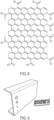
- the graphene oxide nanoparticles are edge oxidized graphene oxide nanoplatelets (GONP), as shown in Figure 8 .
- the graphene oxide nanoplatelets can have a particle size distribution in the range of 200 nm to 1 ⁇ m or 200 nm to 800 nm with an average size in the range of 400 nm to 500 nm and thickness in less than 5 nm.
- the graphene oxide nanoplatelets have an average aspect ratio in the range of 90-1.
- the sizing composition may include graphene oxide nanoparticles in an amount in the range of 0.1-25%, or preferably 1-20%, or more preferably 2-15% by weight, based on the total solid content of the sizing composition.
- graphene oxide may be present in the sizing composition in an amount of at least, 0.1%, 0.5%, 1%, 1.5%, 2%, 2.5%, 3%, 3.5%, 4%, 4.5%, 5%, 5.5%, 6%, 6.5%, 7%, 7.5%, 8%, 8.5%, 9%, 9.5%, or 10% by weight and at most of 25%, 24%, 23%, 22%, 21%, 20%, 19%, 18%, 17%, 16%, 15%, 14%, 13%, 12%, 11%, or 10% by weight, based on the total solid content of the sizing composition.
- the term "solid content of the sizing composition” refers to the total amount of plurality of graphene oxide nanoparticles and at least one sizing compound.
- the sizing composition may include at least one sizing compound from among film formers, coupling agents, and processing aids.
- the film formers play a vital role in protecting the fibers from abrasion and may be present in an amount in the range of 50-99.9%., or 70-95%, or 85-95% by weight, based on the total solid content of the sizing composition.
- Suitable examples of film formers include, but are not limited to polyvinyl acetate, epoxy, polyester, polyurethane, etc.
- Suitable examples of coupling agents include, but are not limited to, chromium (III) methacrylate (available as Volan ® from Zacion LLC), chromium (III) methacrylate, silanes, titanates, etc.
- Suitable examples of processing aids include, but are not limited to, lubricants, wetting agents, neutralizing agents, antistatic agents, antioxidants, nucleating agents, crosslinkers, and any combination thereof.
- US-201619375 discloses in ⁇ 30-32 fig 3-5 an electrically conductive sized fiber comprising a fibre (carbon fiber 30), and a sizing composition adhered to a surface of the fiber, wherein the sizing composition comprises at least one sizing compound (matrix material 32) and a plurality of graphene oxide nanoparticles (34 GNP).
- the sizing composition further includes an aqueous solvent, such that the at least one sizing compound and a plurality of graphene oxide nanoparticles are dispersed in the aqueous solvent, thereby forming an aqueous dispersion.
- the aqueous solvent may be present in an amount in the range of 75-95%, or 85-95%, or 90-95% by weight based on the total weight of the sizing composition.
- the sizing compositions of the present invention have a long, useful shelf life, as compared to most aqueous dispersions, which have very limited shelf lives.
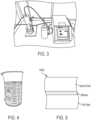
- FIG. 4 shows a picture of a sizing composition comprising at least one sizing compound and a plurality of graphene oxide nanoparticles, being stable after standing over a period of 1 week.
- the sizing composition can be non-hazardous and imposes no environmental effect when disposed of as compared to most aqueous dispersions, the disposal of which incurs expensive disposal fees.
- the electrically conductive sized fiber can include any suitable fiber, including, but not limited to, carbon fibers.
- the fiber is a polyacrylonitrile (PAN)-based carbon fiber.
- PAN polyacrylonitrile
- the electrically conductive fiber can be in any suitable form including, but not limited to, a dry tow, a fabric, a felt, a scrim, a prepreg with thermoplastic or thermosetting resin, a pultruded plate, or a sheet molding compound.
- the electrically conductive sized fiber has a sizing composition in an amount (also referred to as sizing level) in the range of 0.1-5%, 0.5-2.5%, or 1.0-2.0%, by weight, based on the total amount of fiber and sizing composition after drying.
- a sizing composition in an amount (also referred to as sizing level) in the range of 0.1-5%, 0.5-2.5%, or 1.0-2.0%, by weight, based on the total amount of fiber and sizing composition after drying.
- the carbon fibers have an electrical resistivity of about 0.00155 Ohm-cm.
- the carbon fibers can have an average diameter in the range of 5-10 microns, and any suitable length. In an embodiment, milled carbon fibers can have an average diameter of 7.2 microns.
- the carbon fiber can have any suitable tow bundle size, including, but not limited to, at least 3k, 6k, 12k, 24k, 50k or 60k,
- Suitable examples of commercially available carbon fibers include, but are not limited to: PX35 available from Zoltek, TORAYCA ® T700 and T800, all available from Toray, SIGRAFIL available from SGL, Grafil available from Mitsubishi, AKSAKA available from DowAksa, Tenax available from Toho.
- an electrically conductive sized fiber comprising a fiber and a sizing composition adhered to a surface of the fiber, wherein the sizing composition includes at least one sizing compound and a plurality of graphene oxide nanoparticles.
- Figure 2 shows an exemplary method comprising the step of first providing a sizing composition comprising at least one sizing compound and plurality of graphene oxide nanoparticles, followed by coating a sized or an un-sized fiber tow with the sizing composition by drawing the un-sized fiber tow through a sizing bath containing the sizing composition such that the un-sized fiber tow is immersed in the sizing composition.
- the sizing composition contained in the sizing bath can include at least one sizing compound and a plurality of graphene oxide nanoparticles.
- the method can further include the step of drying the coated fiber tow to form an electrically conductive sized fiber including the fiber and the sizing composition adhered to a surface of the fiber, the sizing composition includes the at least one sizing compound and the plurality of graphene oxide nanoparticles.
- the step of drying can be carried out at a temperature in the range of 100-150 °C, or 110-140 °C, or 120-130 °C for an amount of time in the range of 1-15 minutes, or 3-12 minutes, or 4-6 minutes, in air, inert atmosphere like nitrogen, argon, etc, or under vacuum.
- the drying step can be carried out in a forced air, multi-zone, such as a 2-zone continuous oven.
- the drying step can be carried out at for example around 180°C for about 5 minutes in forced air / 2-zone continuous oven.
- the method also includes a step of spooling the electrically conductive sized fiber.
- the step of providing a sizing composition comprises adding a plurality of graphene oxide nanoparticles in solid form to at least one sizing compound.
- the step of providing a sizing composition comprises adding an aqueous dispersion of the plurality of graphene oxide nanoparticles to at least one sizing compound.
- the method may further include re-dispersing graphene oxide nanoparticles in the aqueous dispersion by any suitable mechanical means, such as sonication including horn sonication or bath sonication, and high speed shear mixing, before the step of adding the graphene oxide dispersion to the sizing composition, as shown in Figure 3 .
- the amount of time required for re-dispersing graphene oxide nanoparticles will depend upon the graphene oxide composition and the mechanical means and can be in the range of 5 seconds to 30 minutes, or preferably 15 to 20 minutes.
- the method further comprises forming a fiber-reinforced resin composite in the form of a pultruded sheet or a resin-infused fabric, or a preimpregnated tape (prepreg, impregnated with a thermoplastic resin or a thermosetting resin), or a sheet molding compound (SMC).
- the step of forming a fiber-reinforced resin composite can include arranging the electrically conductive sized fiber into a fabric and infusing the fabric with a binder resin to form a resin infused fabric or a prepreg.
- the step of forming a fiber-reinforced resin composite can include arranging the electrically conductive sized fiber into a planar tow form, infusing the planar tow form with a binder resin and pultruding the resin infused planar tow form to form a pultruded sheet,
- the step of forming a fiber-reinforced resin composite can include arranging a combination of electrically conductive sized fiber and fabric made with electrically conductive sized fiber into a structural cross section form, infusing the structural cross section form with a binder resin and pultruding the resin infused section form to result in a pultruded structural section (for example a C-section, J-section, or Pi-section).
- Figure 9 shows a picture of an exemplary C-section, in accordance with various embodiments of the present invention.
- the step of forming a fiber-reinforced resin composite can include compounding at least one of a plurality of chopped or a plurality of continuous electrically conductive sized fibers with a binder resin and compression molding or injection molding the resulting composition into an article.
- the method can further include forming an article by adhesively bonding at least two components to each other.
- at least one of the at least two components can include the fiber-reinforced resin composite, as disclosed hereinabove.
- the electrically conductive sized fiber of the present invention is suitable for use in wind blade applications.
- a fiber-reinforced resin composite including the electrically conductive sized fiber, as disclosed hereinabove and a binder resin.
- the fiber is a carbon fiber.
- the fiber-reinforced resin composites according to the present invention may be formed from and based on any binder resin known in the art.
- Non-limiting examples of a binder resin that is a thermoset (co)polymer includes unsaturated polyesters, epoxy resins, vinyl ester resins, phenolic resins, thermoset polyurethanes, polyimides, bismaleimide resins, benzoxazine resins, and silicone resins.
- Non-limiting examples of a binder resin that is a thermoplastic (co)polymer includes, polyolefins, cyclic polyolefins, acrylonitrile butadiene styrene, polyvinyl chloride, polystyrene, thermoplastic polyesters, polyvinyl alcohols, polymethyl methacrylates, styrene maleic anhydrides, polyoxymethylene (acetals), thermoplastic polyurethanes, polyethylene terephthalates, polytrimethylene terephthalates, polybutylene terephthalates, polyamides, polycarbonates, polyvinylpyrrolidone, polytetrafluoroethylene, polysulfones, polyethersulfones, polyphenylene sulfides, polyetherimides, polyamide-imides, polyetheretherketones, and polyaryletherketones, including alloys and blends.
- a binder resin that is a thermoplastic (co)polymer includes,
- the fiber-reinforced resin composite is in the form of a pultruded sheet, a fabric, or a prepreg.
- the fiber-reinforced resin composite in the form of a pultruded sheet incudes carbon fibers in a planar tow form fused with the binder resin.
- the fiber-reinforced resin composite in the form of a fabric includes a multidirectional fabric, a uni directional fabric or a woven fabric.
- the fiber-reinforced resin composite includes at least one of 20-80% by volume of electrically conductive sized carbon fiber reinforcement and a vinyl ester resin, 20-80% by volume of electrically conductive sized fiber reinforcement and a polyester resin or 20-80% by volume of electrically conductive sized carbon fiber reinforcement and an epoxy resin, where the amount in % by volume is based on the total volume of the fiber-reinforced resin composite.
- the fiber-reinforced resin composite is in the form of a pultruded sheet, a resin-infused fabric, a pre-impregnated tape, or a sheet molding compound.
- the electrically conductive sized fiber may be present in an amount in the range of 40-80%, or preferably 60-72%, by volume, based on the total volume of the fiber-reinforced resin composite. In the pultruded form, the electrically conductive sized fiber may be present in an amount in the range of 40-80%, or preferably 60-72%, by volume, based on the total volume of the fiber-reinforced resin composite. In the prepreg form, the electrically conductive sized fiber may be present in an amount in the range of 40-80%, or preferably 54-61%, by volume, based on the total volume of the fiber-reinforced resin composite. In the resin-infused fabric form, the electrically conductive sized fiber may be present in an amount in the range of 40-80%, or preferably 48-59%, by volume, based on the total volume of the fiber-reinforced resin composite.
- the fiber-reinforced resin composite in the form of a pre-impregnated tape comprises a preimpregnated unidirectional sheet of fibers or a preimpregnated fabric, where the fabric is one or more of a multidirectional fabric, a unidirectional fabric or a woven fabric.
- the fiber-reinforced resin composite in the form of a sheet molding compound comprises plurality of continuous or discontinuous carbon fibers, a multidirectional fabric, a unidirectional fabric, a woven fabric, or a non-woven fabric, combined with a binder resin.
- the fiber-reinforced resin composite may also include any filler and/or particle, known in the art for reinforcing composites, such as polymer composites.
- filler and/or particle known in the art for reinforcing composites, such as polymer composites.
- particles include, but are not limited to, talc, calcium carbonate, aluminum hydroxide, titanium oxides, and silica.
- an article comprising at least two components adhesively bonded to each other, where at least one of the at least two components includes the fiber-reinforced resin composite, as disclosed hereinabove, including the electrically conductive sized fiber of the present disclosure.
- FIG. 5 shows a sectional view of a portion of an exemplary article comprising a composite panel, in accordance with various embodiments of the present invention.
- the exemplary composite panel includes two components, a first component adhesively bonded to a second component, where at least one of the first component or the second component includes the electrically conductive sized fiber reinforcement of the present disclosure and a binder,
- FIG. 6 shows a sectional view of a portion of another exemplary article comprising a composite panel comprising a plurality of panels adhesively bonded to each other, such that at least one of the plurality of panels includes the electrically conductive sized fiber of the present disclosure.
- the exemplary composite panel comprises at least four panels, a first panel is adhesively bonded to a second panel, the second panel adhesively bonded to a third panel and the third panel adhesively bonded to a fourth panel.
- the panels are stacked on top of each other such that at least one edge is slanted and has a slope.
- the composite panels of the present invention can have any suitable thickness, such as in the range of 0.5-30 mm.
- the article is a spar cap including a fiber-reinforced resin composite and configured to distribute high energy electricity and reduce arcing or delamination when exposed to the high energy electricity.
- the spar cap includes the fiber-reinforced resin composite, as disclosed hereinabove, including, an electrically conductive sized fiber reinforcement and a binder resin.
- FIG. 7 shows a schematic sectional diagram of a portion of a spar cap.
- the fiber-reinforced resin composite comprises 20-80% by volume of electrically conductive sized carbon fibers fused and a binder resin, wherein the amount in % by volume is based on the total volume of the fiber-reinforced resin composite.
- the fiber-reinforced resin composite sheet includes 20-80% by volume of electrically conductive sized carbon fibers fused with a vinyl ester resin.
- the fiber-reinforced resin composite sheet includes 20-80% by volume of electrically conductive sized carbon fibers fused with an epoxy resin.
- the fiber-reinforced resin composite sheet includes 20-80% by volume of electrically conductive sized fiber reinforcement fused with a polyester resin.
- the fiber-reinforced resin composite sheet in the spar cap is a pultruded sheet comprising 40-80%, or preferably 60-72%, by volume of electrically conductive sized fiber, based on the total volume of the fiber-reinforced resin composite
- the inclusion of the graphene oxide nanoparticles in the electrically conductive sized fiber substantially enhances the electrical conductivity of the fiber-reinforced resin composite in the transvers direction.
- the resulting spar cap of the present invention will be far more lightning resistant in comparison to one without electrically conductive graphene oxide nanoparticles into the sizing of the fiber.
- ZOLTEK PX-35 carbon fiber bundle (having carbon size diameter of ⁇ 7 ⁇ m in diameter) were obtained from Zoltek Corporation.
- Edge-Oxidized Graphene Oxide (EOGO), graphene oxide nanoplatelets (with carboxylic and hydroxyl groups) available as 1 weight% dispersion in water were obtained Garmor, Inc. (Orlando, FL).
- EOGO used herein had a composition of 90-95% carbon and corresponding 5-10% oxygen present in the form of carboxy! groups and hydroxyl groups, without the other impurities, and was produced by wet milling process.
- the graphene oxide nanoplatelets were used as is except the dispersion was sonicated before use to redisperse graphene oxide nanoparticles in water.
- % solids was determined by moisture balance @ 120°C until there was no change in weight.
- % moisture was determined by weighing before and after heating at 2 hours in oven @ 105°C; % size content was determined by weighing before and after solvent extraction; tow mass (g/m) was based on weight of 1m long sample; and fuzz (ppm) was determined by dragging the fiber across a rough surface and weighing before and after,
- FIG. 2 shows an overall process of making an electrically conductive sized fiber. The process included the following steps:
- the graphene oxide dispersion was re-sonicated for 15 minutes before adding to a general purpose epoxy-compatible sizing composition including at least one sizing compound. Then, the un-sized carbon fiber bundle (called a tow) was run through a bath of sizing which contained typical sizing compounds used for carbon fibers plus the inclusion of Graphene-oxide (GO) nano-platelets. Standard conditions, as would be used for sizing composition with graphene oxide nanoplatelets, but the amount of sizing deposited on the fiber was controlled through adjustment of the sizing concentration in the bath. The wetted, sized tow was then pulled through a set of nip rolls set at 50psi to reduce the moisture content to a target of 20%. The wetted, sized fiber tow was then dried at 180°C for 5 minutes under air and wrapped up on a spool.
- a tow un-sized carbon fiber bundle
- Standard conditions as would be used for sizing composition with graphene oxide nanoplatelets, but the
- the sizing composition with graphene oxide was found to be stable with solids constant over weekend and even one-week old sample appeared relatively stable, as shown in FIG. 4 . Some graphene oxide nanoparticles were found to settle to the bottom immediately, probably due to lack of functionalization.
- FIG. 1 shows scanning electron microscopy (SEM) micrographs of an electrically conductive sized fiber tow comprising 10 weight% graphene oxide, based on the total amount of sizing composition; with 0.15 weight% total sizing on the fiber in comparison to the standard sized fibers with no graphene oxide nanoplatelets.
- SEM scanning electron microscopy
Landscapes
- Chemical & Material Sciences (AREA)
- Engineering & Computer Science (AREA)
- Organic Chemistry (AREA)
- Chemical Kinetics & Catalysis (AREA)
- Medicinal Chemistry (AREA)
- Health & Medical Sciences (AREA)
- Materials Engineering (AREA)
- Polymers & Plastics (AREA)
- Manufacturing & Machinery (AREA)
- Textile Engineering (AREA)
- Inorganic Chemistry (AREA)
- Life Sciences & Earth Sciences (AREA)
- General Life Sciences & Earth Sciences (AREA)
- Geochemistry & Mineralogy (AREA)
- General Chemical & Material Sciences (AREA)
- Combustion & Propulsion (AREA)
- Sustainable Development (AREA)
- General Engineering & Computer Science (AREA)
- Mechanical Engineering (AREA)
- Sustainable Energy (AREA)
- Nanotechnology (AREA)
- Proteomics, Peptides & Aminoacids (AREA)
- Molecular Biology (AREA)
- Genetics & Genomics (AREA)
- Biochemistry (AREA)
- General Health & Medical Sciences (AREA)
- Biophysics (AREA)
- Reinforced Plastic Materials (AREA)
- Compositions Of Macromolecular Compounds (AREA)
- Laminated Bodies (AREA)
- Chemical Or Physical Treatment Of Fibers (AREA)
- Treatments For Attaching Organic Compounds To Fibrous Goods (AREA)
Claims (20)
- Elektrisch leitfähige, geschlichtete Faser, umfassend:eine Kohlenstofffaser undeine Schlichtemittelzusammensetzung, die an einer Oberfläche der Faser haftet, wobei die Schlichtemittelzusammensetzung mindestens eine Schlichtemittelverbindung und eine Vielzahl von Graphenoxid-Nanopartikeln umfasst, wobei die Graphenoxid-Nanopartikel in Form von Graphenoxid-Nanoplättchen vorliegen undwobei die Graphenoxid-Nanopartikel von der mindestens einenSchlichtemittelverbindung eingekapselt sind und an der Oberfläche der Faser haften.
- Verfahren, umfassend die Schritte:(a) Beschichten eines geschlichteten oder ungeschlichteten Faserkabels mit der Schlichtemittelzusammensetzung durch Ziehen des geschlichteten oder ungeschlichteten Faserkabels durch ein Schlichtemittelbad, das die Schlichtemittelzusammensetzung enthält, so dass das ungeschlichtete Faserkabel in die Schlichtemittelzusammensetzung eingetaucht wird, wobei die im Schlichtemittelbad enthaltene Schlichtemittelzusammensetzung mindestens eine Schlichtemittelverbindung und eine Vielzahl von Graphenoxid-Nanopartikeln umfasst;(b) Trocknen des beschichteten Faserkabels, um eine elektrisch leitfähige, beschichtete Faser zu bilden, die die Faser und die Beschichtungszusammensetzung umfasst, die an einer Oberfläche der Faser anhaften, wobei die Beschichtungszusammensetzung die mindestens eine Beschichtungsverbindung und die Vielzahl von Graphenoxid-Nanopartikeln umfasst; und(c) Aufwickeln der elektrisch leitfähigen, beschichteten Faser.
- Verfahren nach Anspruch 2 umfasst ferner das Bilden eines faserverstärkten Harzverbundstoffs in Form einer pultrudierten Folie, eines harzgetränkten Gewebes, einer Folienformmasse oder eines vorimprägnierten Bandes.
- Verfahren nach Anspruch 3, wobei der Schritt des Bildens eines faserverstärkten Harzverbundstoffs umfasst:a) Anordnen der elektrisch leitfähigen, geschlichteten Faser zu einem Gewebe; undb) Tränken des Gewebes mit einem Bindeharz, um ein harzgetränktes Gewebe oder ein Prepreg zu bilden.
- Verfahren nach Anspruch 3, wobei der Schritt des Bildens eines faserverstärkten Harzverbundstoffs umfasst:a) Anordnen der elektrisch leitfähigen, geschlichteten Faser in einer planaren Kabelform; undb) Tränken der planaren Kabelform mit einem Bindeharz; undc) Pultrudieren der mit Harz infundierten planaren Kabelform, um eine pultrudierte Bahn zu bilden.
- Verfahren nach Anspruch 3, wobei der Schritt des Bildens eines faserverstärkten Harzverbundstoffs umfasst:a) Mischen mindestens einer von mehreren geschnittenen oder mehreren kontinuierlichen elektrisch leitfähigen Fasern mit einem Bindeharz; undb) Formpressen oder Spritzgießen der resultierenden Zusammensetzung zu einem Gegenstand.
- Verfahren nach Anspruch 3, wobei der Schritt des Bildens eines faserverstärkten Harzverbundstoffs umfasst:a) Anordnen einer Kombination aus elektrisch leitender, geschlichteter Faser und Gewebe, das aus elektrisch leitender, geschlichteter Faser hergestellt ist, in einer Form mit strukturellem Querschnitt;b) Infundieren eines Bindeharzes in die Form mit strukturellem Querschnitt; undc) Pultrudieren der mit Harz infundierten Querschnittsform, um einen pultrudierten Strukturquerschnitt zu erhalten
- Verfahren gemäß einem der Ansprüche 3-7 umfasst ferner das Formen eines Gegenstands durch Verkleben von mindestens zwei Komponenten miteinander, wobei mindestens eine der mindestens zwei Komponenten den faserverstärkten Harzverbundwerkstoff umfasst.
- Faserverstärkter Harzverbundwerkstoff, umfassend:a) eine elektrisch leitfähige, geschlichtete Faserverstärkung, umfassendi) eine Kohlenstoffaser undii) eine an einer Oberfläche der Faser haftende Schlichtezusammensetzung, wobei die Schlichtezusammensetzung mindestens eine Schlichtemischung und eine Vielzahl von Graphenoxid-Nanopartikeln umfasst; undb) ein Bindeharz.
- Faserverstärkter Harzverbundwerkstoff nach Anspruch 9, wobei der Verbundwerkstoff in Form einer pultrudierten Folie, eines harzgetränkten Gewebes, eines vorimprägnierten Bandes oder einer Folienformmasse vorliegt.
- Faserverstärkter Harzverbundwerkstoff nach Anspruch 10, wobei die pultrudierte Bahn Kohlenstofffasern in einer planaren, mit dem Bindemittelharz verschmolzenen Strangform umfasst.
- Faserverstärkter Harzverbundwerkstoff nach Anspruch 10, wobei das Gewebe ein multidirektionales Gewebe, ein unidirektionales Gewebe oder ein gewebtes Gewebe umfasst.
- Faserverstärkter Harzverbundwerkstoff nach Anspruch 10, wobei das vorimprägnierte Band eine vorimprägnierte unidirektionale Faserbahn oder ein vorimprägniertes Gewebe umfasst, wobei das Gewebe ein oder mehrere multidirektionale Gewebe, unidirektionale Gewebe oder gewebte Gewebe ist.
- Faserverstärkter Harzverbundwerkstoff nach Anspruch 10, wobei die Schichtpressmasse eine Vielzahl von kontinuierlichen oder diskontinuierlichen Kohlenstofffasern, ein multidirektionales Gewebe, ein unidirektionales Gewebe, ein gewebtes Gewebe oder ein Vlies, kombiniert mit einem Bindeharz, umfasst.
- Faserverstärkter Harzverbundwerkstoff nach einem der Ansprüche 9 bis 20, wobei das Bindemittelharz ein wärmehärtendes Bindemittelharz umfasst, das aus ungesättigten Polyestern, Epoxidharzen, Vinylesterharzen, Phenolharzen, wärmehärtenden Polyurethanen, Polyimiden, Bismaleimidharzen, Benzoxazinharzen und Silikonharzen ausgewählt ist.
- Faserverstärkter Harzverbundwerkstoff gemäß einem der Ansprüche 9 bis 20, wobei das Bindemittelharz ein thermoplastisches Bindemittelharz umfasst, das aus Polyolefinen, cyclischen Polyolefinen, Acrylnitril-Butadien-Styrol, Polyvinylchlorid, Polystyrol, thermoplastischen Polyestern, Polyvinylalkoholen, Polymethylmethacrylaten, Styrolmaleinsäureanhydriden, Polyoxymethylen (Acetalen), thermoplastischen Polyurethanen, Polyethylenterephthalaten, Polytrimethylenterephthalaten, Polybutylenterephthalaten, Polyamiden , Polycarbonate, Polyvinylpyrrolidon, Polytetrafluorethylen, Polysulfone, Polyethersulfone, Polyphenylensulfide, Polyetherimide, Polyamidimide, Polyetheretherketone und Polyaryletherketone, einschließlich Legierungen und Mischungen.
- Faserverstärkter Harzverbundwerkstoff gemäß einem der Ansprüche 9-22, umfassend mindestens eines von:a) 40-80 Vol.-% einer elektrisch leitfähigen, geschlichteten Faserverstärkung und einem Vinylesterharz,b) 40-80 Vol.-% einer elektrisch leitfähigen, geschlichteten Faserverstärkung und einem Polyesterharz oderc) 40-80 Vol.-% einer elektrisch leitfähigen, geschlichteten Faserverstärkung und einem Epoxidharz,wobei die Menge in Vol.-% auf dem Gesamtvolumen des faserverstärkten Harzverbundstoffs basiert.
- Gegenstand, umfassend mindestens zwei Komponenten, die durch Kleben miteinander verbunden sind, wobei mindestens eine der mindestens zwei Komponenten den faserverstärkten Harzverbundstoff gemäß einem der Ansprüche 9-23 umfasst.
- Holmverstärkung, umfassend einen faserverstärkten Harzverbundwerkstoff, umfassend:a) eine elektrisch leitfähige, geschlichtete Faserverstärkung, umfassendi) eine Faser undii) eine Schlichtemittelzusammensetzung, die an der Oberfläche der Faser haftet, wobei die Schlichtemittelzusammensetzung mindestens eine Schlichtemittelverbindung und eine Vielzahl von Graphenoxid-Nanopartikeln umfasstumfasst, wobei der faserverstärkte Harzverbundstoff 20-80 Vol.-% elektrisch leitfähige, geschlichtete Kohlenstofffasern umfasst, die mit einem Bindeharz verschmolzen sind, wobei die Menge in Vol.% auf dem Gesamtvolumen des faserverstärkten Harzverbundstoffs basiert; undb) ein Bindeharz.
- Holmverkleidung nach Anspruch 19, wobei die faserverstärkte Harzverbundplatte 20-80 Vol.-% elektrisch leitfähige, geschlichtete Kohlenstoffasern und ein Vinylesterharz oder 20-80 Vol.
Applications Claiming Priority (2)
| Application Number | Priority Date | Filing Date | Title |
|---|---|---|---|
| US201862649035P | 2018-03-28 | 2018-03-28 | |
| PCT/US2019/024557 WO2019191411A1 (en) | 2018-03-28 | 2019-03-28 | Electrically conductive sizing for carbon fibers |
Publications (3)
| Publication Number | Publication Date |
|---|---|
| EP3774684A1 EP3774684A1 (de) | 2021-02-17 |
| EP3774684B1 true EP3774684B1 (de) | 2024-12-18 |
| EP3774684C0 EP3774684C0 (de) | 2024-12-18 |
Family
ID=66102815
Family Applications (1)
| Application Number | Title | Priority Date | Filing Date |
|---|---|---|---|
| EP19717081.4A Active EP3774684B1 (de) | 2018-03-28 | 2019-03-28 | Elektrisch leitfähige leimung für kohlenstofffasern |
Country Status (9)
| Country | Link |
|---|---|
| US (1) | US11566369B2 (de) |
| EP (1) | EP3774684B1 (de) |
| JP (1) | JP2021519870A (de) |
| KR (1) | KR20200144556A (de) |
| CN (1) | CN112292361A (de) |
| AR (1) | AR114458A1 (de) |
| AU (1) | AU2019242896B2 (de) |
| CA (1) | CA3095445A1 (de) |
| WO (1) | WO2019191411A1 (de) |
Families Citing this family (14)
| Publication number | Priority date | Publication date | Assignee | Title |
|---|---|---|---|---|
| IT202000012262A1 (it) * | 2020-05-25 | 2021-11-25 | Directa Plus Spa | Articolo tessile comprendente grafene e manufatto filtrante comprendente lo stesso. |
| US20220042494A1 (en) * | 2020-08-10 | 2022-02-10 | Ut-Battelle, Llc | Low-cost carbon fiber-based lightning strike protection |
| CN112186382B (zh) * | 2020-10-12 | 2021-04-13 | 南京瑞敬自动化科技有限公司 | 一种超小密封型高温高压连接器 |
| CA3203267A1 (en) * | 2020-12-23 | 2022-06-30 | Siddhartha Asthana | Graphene enhanced sheet molding compound |
| CN117597390A (zh) * | 2021-06-03 | 2024-02-23 | 巴尔弗莱克斯图有限责任公司 | 热塑性复合材料 |
| CN113293605B (zh) * | 2021-07-02 | 2022-07-12 | 四川大学 | 提高树脂基体与碳纤维界面性能的方法 |
| JP2023159916A (ja) * | 2022-04-21 | 2023-11-02 | 株式会社日本触媒 | 高弾性率繊維強化プラスチックの製造方法 |
| CN115159866B (zh) * | 2022-06-28 | 2023-09-08 | 南京玻璃纤维研究设计院有限公司 | 一种适用于pps树脂的玻璃纤维浸润剂及其制备方法 |
| CN115071166B (zh) * | 2022-08-04 | 2023-05-30 | 中复神鹰(上海)科技有限公司 | 改性连续碳纤维增强聚醚醚酮复合材料层合板及其制备方法 |
| CN115449183A (zh) * | 2022-08-30 | 2022-12-09 | 明阳智慧能源集团股份公司 | 一种风电叶片导电梁帽制备方法 |
| CN115625944A (zh) * | 2022-09-30 | 2023-01-20 | 南京海柯玛新材料科技有限公司 | 一种风电叶片用frp材料及其制造方法 |
| CN116949821B (zh) * | 2023-07-24 | 2025-10-03 | 太原理工大学 | 一种改性包芯纱线及其制备方法和应用 |
| CN117965009A (zh) * | 2024-01-19 | 2024-05-03 | 广州傲群刷业科技有限公司 | 一种碳纤维复合材料及其拉丝工艺及应用 |
| CN120738931B (zh) * | 2025-09-08 | 2025-11-28 | 南京玻璃纤维研究设计院有限公司 | 一种乳液型上浆剂及其制备方法与应用 |
Family Cites Families (18)
| Publication number | Priority date | Publication date | Assignee | Title |
|---|---|---|---|---|
| NL124947C (de) * | 1961-02-10 | |||
| GB1434926A (en) * | 1972-04-25 | 1976-05-12 | Imp Metal Ind Kynoch Ltd | Impregnating fibre material |
| JPS63254667A (ja) * | 1987-04-10 | 1988-10-21 | Kuraray Co Ltd | 活性炭素繊維電極 |
| JPH0665787B2 (ja) * | 1987-12-19 | 1994-08-24 | 東邦レーヨン株式会社 | 炭素繊維ストランドのサイジング方法 |
| JPH085137B2 (ja) * | 1988-07-28 | 1996-01-24 | 東レ株式会社 | 繊維強化プラスチックの引抜成形法 |
| JPH0264133A (ja) * | 1988-08-30 | 1990-03-05 | Toho Rayon Co Ltd | サイズされた炭素繊維チョップドストランド及び樹脂組成物 |
| EP2363429A1 (de) | 2006-03-10 | 2011-09-07 | Goodrich Corporation | Blitzschlagschutz mit geringer Dichte zur Verwendung in Flugzeugen |
| US7832983B2 (en) | 2006-05-02 | 2010-11-16 | Goodrich Corporation | Nacelles and nacelle components containing nanoreinforced carbon fiber composite material |
| US20080160281A1 (en) | 2006-12-29 | 2008-07-03 | Vickery Eric L | Sizing composition for glass fibers |
| CN101990518A (zh) * | 2008-02-05 | 2011-03-23 | 普林斯顿大学理事会 | 包含官能化的石墨烯片的涂料以及用其涂覆的物品 |
| GB201122296D0 (en) | 2011-12-23 | 2012-02-01 | Cytec Tech Corp | Composite materials |
| CN102785437B (zh) * | 2012-07-19 | 2016-08-03 | 中国航空工业集团公司北京航空材料研究院 | 一种复合导电薄层及其制备方法和应用 |
| US20160276056A1 (en) | 2013-06-28 | 2016-09-22 | Graphene 3D Lab Inc. | Dispersions for nanoplatelets of graphene-like materials and methods for preparing and using same |
| GB201322093D0 (en) | 2013-12-13 | 2014-01-29 | Cytec Ind Inc | Compositive materials with electrically conductive and delamination resistant properties |
| CN104264484B (zh) * | 2014-09-26 | 2016-10-26 | 济南大学 | 乳液型碳纤维上浆剂及其制备方法和应用 |
| US10266677B2 (en) * | 2015-01-05 | 2019-04-23 | The Boeing Company | Graphene-augmented composite materials |
| CN105176008A (zh) * | 2015-10-29 | 2015-12-23 | 济南大学 | 一种增强聚丙烯的碳纤维上浆剂的配方及其制备方法 |
| CN105968718A (zh) * | 2016-05-20 | 2016-09-28 | 北京化工大学 | 一种碳纤维/石墨烯/环氧树脂预浸料及碳纤维复合材料的制备方法 |
-
2019
- 2019-03-28 AU AU2019242896A patent/AU2019242896B2/en active Active
- 2019-03-28 AR ARP190100803A patent/AR114458A1/es active IP Right Grant
- 2019-03-28 WO PCT/US2019/024557 patent/WO2019191411A1/en not_active Ceased
- 2019-03-28 KR KR1020207031183A patent/KR20200144556A/ko not_active Withdrawn
- 2019-03-28 CA CA3095445A patent/CA3095445A1/en active Pending
- 2019-03-28 JP JP2020552187A patent/JP2021519870A/ja active Pending
- 2019-03-28 EP EP19717081.4A patent/EP3774684B1/de active Active
- 2019-03-28 CN CN201980033789.1A patent/CN112292361A/zh active Pending
- 2019-03-28 US US17/041,753 patent/US11566369B2/en active Active
Also Published As
| Publication number | Publication date |
|---|---|
| US20210040679A1 (en) | 2021-02-11 |
| AU2019242896B2 (en) | 2023-08-03 |
| CA3095445A1 (en) | 2019-10-03 |
| CN112292361A (zh) | 2021-01-29 |
| EP3774684A1 (de) | 2021-02-17 |
| WO2019191411A1 (en) | 2019-10-03 |
| AU2019242896A1 (en) | 2020-10-15 |
| US11566369B2 (en) | 2023-01-31 |
| KR20200144556A (ko) | 2020-12-29 |
| AR114458A1 (es) | 2020-09-09 |
| EP3774684C0 (de) | 2024-12-18 |
| JP2021519870A (ja) | 2021-08-12 |
Similar Documents
| Publication | Publication Date | Title |
|---|---|---|
| EP3774684B1 (de) | Elektrisch leitfähige leimung für kohlenstofffasern | |
| Su et al. | Preparation and properties of carbon nanotubes/carbon fiber/poly (ether ether ketone) multiscale composites | |
| Pham et al. | Mechanical and electrical properties of polycarbonate nanotube buckypaper composite sheets | |
| Guadagno et al. | Correlation between electrical conductivity and manufacturing processes of nanofilled carbon fiber reinforced composites | |
| Kostopoulos et al. | A critical review of nanotechnologies for composite aerospace structures | |
| Gou et al. | Damping augmentation of nanocomposites using carbon nanofiber paper | |
| US11834593B2 (en) | Electrically conductive adhesive | |
| TWI457376B (zh) | Composites | |
| US20220235191A1 (en) | Fibers, prepreg materials, compositions, composite articles, and methods of producing composite articles | |
| Wan Dalina et al. | Multi-walled carbon nanotubes buckypaper/epoxy composites: effect of loading and pressure on tensile and electrical properties | |
| Burkov et al. | Hybrid CFRP/SWCNT composites with enhanced electrical conductivity and mechanical properties | |
| KR101843795B1 (ko) | 나노 박막 코팅의 제조방법 | |
| KR20130091496A (ko) | 탄소섬유 프리프레그 및 그의 제조방법 | |
| Ekrem | The effects of carbon nanotubes added polyvinyl alcohol nanofibers on mechanical properties of carbon reinforced composite laminates | |
| Zhang et al. | Improved interlaminar crack resistance of glass fiber/poly (phenylene sulfide) thermoplastic composites modified with multiwalled carbon nanotubes | |
| Gadtya et al. | Carbon nanotube-based polymer nanocomposites for aerospace applications | |
| Ricciardi et al. | Mechanical behavior of hybrid fiber‐reinforced composites manufactured by pulse infusion | |
| Shah et al. | Carbon Nanostructures for electromagnetic shielding and lightning strike protection applications in aircraft | |
| Zegeye et al. | AC and DC electrical properties of graphene nanoplatelets reinforced epoxy syntactic foam | |
| Wan Dalina et al. | Effect of black ink loading on the properties of multi-walled carbon nanotubes/glass fibre/epoxy laminated hybrid composites | |
| Suresha et al. | Structural properties and electromagnetic shielding performance of bidirectional carbon fabric and Fe 2 O 3 nano filler reinforced epoxy composites | |
| Eremin et al. | Carbon fiber reinforced epoxy with enhanced electrical conductivity | |
| Bera et al. | Anti‐Static Performance of Graphene and Carbon Nanotube (CNT) Tailored Glass Fiber/Polyester Composites Under Ambient and Hygrothermal Aging Conditions | |
| Hassan et al. | PREPARATION AND CHARACTERIZATION OF CARBON FIBER EPOXY COMPOSITE COATED BY GRAPHENE | |
| Madhu | Effects of Multiwalled Carbon Nanotubes and Graphene Nanoplatelets Filled Hybrid Epoxy Nanocomposites on Electrical and Mechanical Properties |
Legal Events
| Date | Code | Title | Description |
|---|---|---|---|
| STAA | Information on the status of an ep patent application or granted ep patent |
Free format text: STATUS: UNKNOWN |
|
| STAA | Information on the status of an ep patent application or granted ep patent |
Free format text: STATUS: THE INTERNATIONAL PUBLICATION HAS BEEN MADE |
|
| PUAI | Public reference made under article 153(3) epc to a published international application that has entered the european phase |
Free format text: ORIGINAL CODE: 0009012 |
|
| STAA | Information on the status of an ep patent application or granted ep patent |
Free format text: STATUS: REQUEST FOR EXAMINATION WAS MADE |
|
| 17P | Request for examination filed |
Effective date: 20201027 |
|
| AK | Designated contracting states |
Kind code of ref document: A1 Designated state(s): AL AT BE BG CH CY CZ DE DK EE ES FI FR GB GR HR HU IE IS IT LI LT LU LV MC MK MT NL NO PL PT RO RS SE SI SK SM TR |
|
| AX | Request for extension of the european patent |
Extension state: BA ME |
|
| DAV | Request for validation of the european patent (deleted) | ||
| DAX | Request for extension of the european patent (deleted) | ||
| GRAP | Despatch of communication of intention to grant a patent |
Free format text: ORIGINAL CODE: EPIDOSNIGR1 |
|
| STAA | Information on the status of an ep patent application or granted ep patent |
Free format text: STATUS: GRANT OF PATENT IS INTENDED |
|
| INTG | Intention to grant announced |
Effective date: 20240716 |
|
| GRAS | Grant fee paid |
Free format text: ORIGINAL CODE: EPIDOSNIGR3 |
|
| GRAA | (expected) grant |
Free format text: ORIGINAL CODE: 0009210 |
|
| STAA | Information on the status of an ep patent application or granted ep patent |
Free format text: STATUS: THE PATENT HAS BEEN GRANTED |
|
| AK | Designated contracting states |
Kind code of ref document: B1 Designated state(s): AL AT BE BG CH CY CZ DE DK EE ES FI FR GB GR HR HU IE IS IT LI LT LU LV MC MK MT NL NO PL PT RO RS SE SI SK SM TR |
|
| REG | Reference to a national code |
Ref country code: CH Ref legal event code: EP |
|
| REG | Reference to a national code |
Ref country code: DE Ref legal event code: R096 Ref document number: 602019063609 Country of ref document: DE |
|
| REG | Reference to a national code |
Ref country code: IE Ref legal event code: FG4D |
|
| U01 | Request for unitary effect filed |
Effective date: 20250117 |
|
| U07 | Unitary effect registered |
Designated state(s): AT BE BG DE DK EE FI FR IT LT LU LV MT NL PT RO SE SI Effective date: 20250123 |
|
| U20 | Renewal fee for the european patent with unitary effect paid |
Year of fee payment: 7 Effective date: 20250220 |
|
| PG25 | Lapsed in a contracting state [announced via postgrant information from national office to epo] |
Ref country code: HR Free format text: LAPSE BECAUSE OF FAILURE TO SUBMIT A TRANSLATION OF THE DESCRIPTION OR TO PAY THE FEE WITHIN THE PRESCRIBED TIME-LIMIT Effective date: 20241218 |
|
| PG25 | Lapsed in a contracting state [announced via postgrant information from national office to epo] |
Ref country code: NO Free format text: LAPSE BECAUSE OF FAILURE TO SUBMIT A TRANSLATION OF THE DESCRIPTION OR TO PAY THE FEE WITHIN THE PRESCRIBED TIME-LIMIT Effective date: 20250318 |
|
| PG25 | Lapsed in a contracting state [announced via postgrant information from national office to epo] |
Ref country code: GR Free format text: LAPSE BECAUSE OF FAILURE TO SUBMIT A TRANSLATION OF THE DESCRIPTION OR TO PAY THE FEE WITHIN THE PRESCRIBED TIME-LIMIT Effective date: 20250319 |
|
| PG25 | Lapsed in a contracting state [announced via postgrant information from national office to epo] |
Ref country code: RS Free format text: LAPSE BECAUSE OF FAILURE TO SUBMIT A TRANSLATION OF THE DESCRIPTION OR TO PAY THE FEE WITHIN THE PRESCRIBED TIME-LIMIT Effective date: 20250318 |
|
| PG25 | Lapsed in a contracting state [announced via postgrant information from national office to epo] |
Ref country code: SM Free format text: LAPSE BECAUSE OF FAILURE TO SUBMIT A TRANSLATION OF THE DESCRIPTION OR TO PAY THE FEE WITHIN THE PRESCRIBED TIME-LIMIT Effective date: 20241218 |
|
| PG25 | Lapsed in a contracting state [announced via postgrant information from national office to epo] |
Ref country code: PL Free format text: LAPSE BECAUSE OF FAILURE TO SUBMIT A TRANSLATION OF THE DESCRIPTION OR TO PAY THE FEE WITHIN THE PRESCRIBED TIME-LIMIT Effective date: 20241218 |
|
| PG25 | Lapsed in a contracting state [announced via postgrant information from national office to epo] |
Ref country code: ES Free format text: LAPSE BECAUSE OF FAILURE TO SUBMIT A TRANSLATION OF THE DESCRIPTION OR TO PAY THE FEE WITHIN THE PRESCRIBED TIME-LIMIT Effective date: 20241218 |
|
| PG25 | Lapsed in a contracting state [announced via postgrant information from national office to epo] |
Ref country code: IS Free format text: LAPSE BECAUSE OF FAILURE TO SUBMIT A TRANSLATION OF THE DESCRIPTION OR TO PAY THE FEE WITHIN THE PRESCRIBED TIME-LIMIT Effective date: 20250418 |
|
| PG25 | Lapsed in a contracting state [announced via postgrant information from national office to epo] |
Ref country code: SK Free format text: LAPSE BECAUSE OF FAILURE TO SUBMIT A TRANSLATION OF THE DESCRIPTION OR TO PAY THE FEE WITHIN THE PRESCRIBED TIME-LIMIT Effective date: 20241218 |
|
| PG25 | Lapsed in a contracting state [announced via postgrant information from national office to epo] |
Ref country code: CZ Free format text: LAPSE BECAUSE OF FAILURE TO SUBMIT A TRANSLATION OF THE DESCRIPTION OR TO PAY THE FEE WITHIN THE PRESCRIBED TIME-LIMIT Effective date: 20241218 |
|
| PG25 | Lapsed in a contracting state [announced via postgrant information from national office to epo] |
Ref country code: MC Free format text: LAPSE BECAUSE OF FAILURE TO SUBMIT A TRANSLATION OF THE DESCRIPTION OR TO PAY THE FEE WITHIN THE PRESCRIBED TIME-LIMIT Effective date: 20241218 |
|
| PLBE | No opposition filed within time limit |
Free format text: ORIGINAL CODE: 0009261 |
|
| REG | Reference to a national code |
Ref country code: CH Ref legal event code: H13 Free format text: ST27 STATUS EVENT CODE: U-0-0-H10-H13 (AS PROVIDED BY THE NATIONAL OFFICE) Effective date: 20251024 |
|
| STAA | Information on the status of an ep patent application or granted ep patent |
Free format text: STATUS: NO OPPOSITION FILED WITHIN TIME LIMIT |
|
| 26N | No opposition filed |
Effective date: 20250919 |
|
| GBPC | Gb: european patent ceased through non-payment of renewal fee |
Effective date: 20250328 |
|
| PG25 | Lapsed in a contracting state [announced via postgrant information from national office to epo] |
Ref country code: GB Free format text: LAPSE BECAUSE OF NON-PAYMENT OF DUE FEES Effective date: 20250328 |
|
| PG25 | Lapsed in a contracting state [announced via postgrant information from national office to epo] |
Ref country code: CH Free format text: LAPSE BECAUSE OF NON-PAYMENT OF DUE FEES Effective date: 20250331 |
|
| PG25 | Lapsed in a contracting state [announced via postgrant information from national office to epo] |
Ref country code: IE Free format text: LAPSE BECAUSE OF NON-PAYMENT OF DUE FEES Effective date: 20250328 |