EP3774584B1 - Récipient doté d'éléments isolants - Google Patents
Récipient doté d'éléments isolants Download PDFInfo
- Publication number
- EP3774584B1 EP3774584B1 EP19784621.5A EP19784621A EP3774584B1 EP 3774584 B1 EP3774584 B1 EP 3774584B1 EP 19784621 A EP19784621 A EP 19784621A EP 3774584 B1 EP3774584 B1 EP 3774584B1
- Authority
- EP
- European Patent Office
- Prior art keywords
- inner sidewall
- outer sleeve
- container
- annular
- spacers
- Prior art date
- Legal status (The legal status is an assumption and is not a legal conclusion. Google has not performed a legal analysis and makes no representation as to the accuracy of the status listed.)
- Active
Links
Images


Classifications
-
- B—PERFORMING OPERATIONS; TRANSPORTING
- B65—CONVEYING; PACKING; STORING; HANDLING THIN OR FILAMENTARY MATERIAL
- B65D—CONTAINERS FOR STORAGE OR TRANSPORT OF ARTICLES OR MATERIALS, e.g. BAGS, BARRELS, BOTTLES, BOXES, CANS, CARTONS, CRATES, DRUMS, JARS, TANKS, HOPPERS, FORWARDING CONTAINERS; ACCESSORIES, CLOSURES, OR FITTINGS THEREFOR; PACKAGING ELEMENTS; PACKAGES
- B65D21/00—Nestable, stackable or joinable containers; Containers of variable capacity
- B65D21/02—Containers specially shaped, or provided with fittings or attachments, to facilitate nesting, stacking, or joining together
- B65D21/0233—Nestable containers
-
- B—PERFORMING OPERATIONS; TRANSPORTING
- B65—CONVEYING; PACKING; STORING; HANDLING THIN OR FILAMENTARY MATERIAL
- B65D—CONTAINERS FOR STORAGE OR TRANSPORT OF ARTICLES OR MATERIALS, e.g. BAGS, BARRELS, BOTTLES, BOXES, CANS, CARTONS, CRATES, DRUMS, JARS, TANKS, HOPPERS, FORWARDING CONTAINERS; ACCESSORIES, CLOSURES, OR FITTINGS THEREFOR; PACKAGING ELEMENTS; PACKAGES
- B65D21/00—Nestable, stackable or joinable containers; Containers of variable capacity
- B65D21/08—Containers of variable capacity
-
- B—PERFORMING OPERATIONS; TRANSPORTING
- B65—CONVEYING; PACKING; STORING; HANDLING THIN OR FILAMENTARY MATERIAL
- B65D—CONTAINERS FOR STORAGE OR TRANSPORT OF ARTICLES OR MATERIALS, e.g. BAGS, BARRELS, BOTTLES, BOXES, CANS, CARTONS, CRATES, DRUMS, JARS, TANKS, HOPPERS, FORWARDING CONTAINERS; ACCESSORIES, CLOSURES, OR FITTINGS THEREFOR; PACKAGING ELEMENTS; PACKAGES
- B65D3/00—Rigid or semi-rigid containers having bodies or peripheral walls of curved or partially-curved cross-section made by winding or bending paper without folding along defined lines
- B65D3/02—Rigid or semi-rigid containers having bodies or peripheral walls of curved or partially-curved cross-section made by winding or bending paper without folding along defined lines characterised by shape
- B65D3/06—Rigid or semi-rigid containers having bodies or peripheral walls of curved or partially-curved cross-section made by winding or bending paper without folding along defined lines characterised by shape essentially conical or frusto-conical
-
- B—PERFORMING OPERATIONS; TRANSPORTING
- B65—CONVEYING; PACKING; STORING; HANDLING THIN OR FILAMENTARY MATERIAL
- B65D—CONTAINERS FOR STORAGE OR TRANSPORT OF ARTICLES OR MATERIALS, e.g. BAGS, BARRELS, BOTTLES, BOXES, CANS, CARTONS, CRATES, DRUMS, JARS, TANKS, HOPPERS, FORWARDING CONTAINERS; ACCESSORIES, CLOSURES, OR FITTINGS THEREFOR; PACKAGING ELEMENTS; PACKAGES
- B65D3/00—Rigid or semi-rigid containers having bodies or peripheral walls of curved or partially-curved cross-section made by winding or bending paper without folding along defined lines
- B65D3/10—Rigid or semi-rigid containers having bodies or peripheral walls of curved or partially-curved cross-section made by winding or bending paper without folding along defined lines characterised by form of integral or permanently secured end closure
- B65D3/12—Flanged discs permanently secured, e.g. by adhesives or by heat-sealing
- B65D3/14—Discs fitting within container end and secured by bending, rolling, or folding operations
-
- B—PERFORMING OPERATIONS; TRANSPORTING
- B65—CONVEYING; PACKING; STORING; HANDLING THIN OR FILAMENTARY MATERIAL
- B65D—CONTAINERS FOR STORAGE OR TRANSPORT OF ARTICLES OR MATERIALS, e.g. BAGS, BARRELS, BOTTLES, BOXES, CANS, CARTONS, CRATES, DRUMS, JARS, TANKS, HOPPERS, FORWARDING CONTAINERS; ACCESSORIES, CLOSURES, OR FITTINGS THEREFOR; PACKAGING ELEMENTS; PACKAGES
- B65D81/00—Containers, packaging elements, or packages, for contents presenting particular transport or storage problems, or adapted to be used for non-packaging purposes after removal of contents
- B65D81/38—Containers, packaging elements, or packages, for contents presenting particular transport or storage problems, or adapted to be used for non-packaging purposes after removal of contents with thermal insulation
- B65D81/3865—Containers, packaging elements, or packages, for contents presenting particular transport or storage problems, or adapted to be used for non-packaging purposes after removal of contents with thermal insulation drinking cups or like containers
- B65D81/3869—Containers, packaging elements, or packages, for contents presenting particular transport or storage problems, or adapted to be used for non-packaging purposes after removal of contents with thermal insulation drinking cups or like containers formed with double walls, i.e. hollow
Definitions
- the present disclosure generally relates to containers for containing fluids, for example, beverage containers.
- the present disclosure relates to a container for heated fluids that includes insulating features.
- US 2018/016052 A1 discloses a dual container that can maintain effective heat insulation and reduce a used amount of thermoplastic resin.
- the dual container has an inner container provided with a tubular barrel portion having a curled portion formed at the upper circumferential edge thereof, and a bottom portion arranged at the lower end of the barrel portion so as to close the lower surface thereof.
- An exterior sleeve covers the barrel portion so as to form a heat insulating space between the outside of the barrel portion. The exterior sleeve is fixed to the barrel portion.
- a plurality of elongated projection portions each of which is made of plastic resin extending elongatedly in the circumferential direction and projecting by 1.0 mm to 2.0 mm are arranged in line over the entire circumference in the circumferential direction, at intervals from one another.
- EP 2 848 554 A2 discloses a double-walled container including an inner sleeve, an outer sleeve and a base.
- the inner sleeve is positioned within the outer sleeve.
- a sidewall cavity may be formed between an inner sleeve sidewall and an outer sleeve sidewall.
- the lower end of the outer sleeve forms an elongated loop located below a lowermost edge of the inner sleeve.
- a flange may extend from the elongated loop upwardly above the lowermost edge of the inner sleeve and is attached to the inner sleeve.
- the elongated loop may form a loop cavity.
- the loop cavity may be in fluid communication with the sidewall cavity.
- US 2008/078825 A1 discloses a container with an inner wall and an outer wall wrapped therearound so as to define a double-wall container construction.
- a plurality of spacer elements are interposed between the inner and the outer walls so as to maintain a minimum thickness of an air space defined therebetween. In normal use conditions, the spacer elements do not contact the inner wall; however, the spacer elements prevent the outer wall from contacting the inner wall during non-standard use conditions.
- the invention is generally directed to containers, sidewall constructs, and methods, as recited in the independent claims. Further embodiments are recited in the dependent claims.
- a container for containing a fluid comprises a sidewall construct, a closed bottom, and insulating features.
- the sidewall construct comprises an inner sidewall extending at least partially around an interior of the container, an outer sleeve attached to the inner sidewall, and a cavity defined between the inner sidewall and the outer sleeve.
- the closed bottom defines a bottom of the interior of the container.
- the insulating features comprise the cavity and a plurality of annular bands, each annular band of the plurality of annular bands comprises a plurality of spacers and a plurality of gaps separating respective adjacent spacers in a respective annular band, each spacer extends in the cavity from the inner sidewall to the outer sleeve.
- a sidewall construct for forming a fluid container comprises an inner sidewall for extending at least partially around an interior of a fluid container formed from the sidewall construct, an outer sleeve attached to the inner sidewall, and a cavity defined between the inner sidewall and the outer sleeve.
- the sidewall construct further comprises insulating features comprising the cavity and a plurality of annular bands, each annular band of the plurality of annular bands comprises a plurality of spacers and a plurality of gaps separating respective adjacent spacers in a respective annular band, each spacer extends in the cavity from the inner sidewall to the outer sleeve.
- a method of forming a container for containing a fluid comprises obtaining an inner sidewall and an outer sleeve and attaching the outer sleeve to the inner sidewall to form a sidewall construct with a cavity defined between the inner sidewall and the outer sleeve.
- the attaching comprises forming insulating features in the sidewall construct, the insulating features comprise the cavity and a plurality of annular bands, each annular band of the plurality of annular bands comprises a plurality of spacers and a plurality of gaps separating respective adjacent spacers in a respective annular band, each spacer extends in the cavity from the inner sidewall to the outer sleeve.
- the method further comprises forming an interior of the fluid container by positioning the sidewall construct so that the inner sidewall extends at least partially around the interior.
- the method further comprises positioning a closed bottom relative to the sidewall construct to define a bottom of the interior.
- Containers according to the present disclosure can accommodate fluids, e.g., beverages, of different sizes and compositions.
- fluids e.g., beverages
- the following detailed description describes a container for heated fluids, e.g., coffee or coffee-based products, tea, hot chocolate, cider, soup, etc. It will be understood that the containers described herein can hold cold beverages or room temperature beverages, and can hold at least partially solid food products, without departing from the disclosure.
- containers can be formed from blanks by overlapping multiple portions, panels, and/or end flaps. Such portions, panels, and/or end flaps may be designated herein in terms relative to one another, e.g., “first”, “second”, “third”, etc., in sequential or non-sequential reference, without departing from the disclosure.
- Fig. 1 is a perspective view
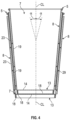
- Fig. 2 is a schematic cross-sectional view, of a fluid vessel or fluid container 5 according to a first exemplary embodiment of the disclosure.
- the container 5 is a cup having the general shape of a truncated cone, with an open top 6, a closed bottom 13, and a sidewall construct 8 extending from a bottom edge to a top edge of the container 5.
- the closed bottom 13 and the sidewall construct 8 define an interior space 7 of the container 5 that is for holding fluids, e.g. hot beverages such as tea, coffee, cider, hot chocolate, etc.
- the sidewall construct 8 comprises an annular inner sidewall 19 (broadly, “inner wall”) and an outer sleeve 23 (broadly, “outer wall”) attached to the inner sidewall 19 such that the sidewall construct 8 can be referred to as a double wall structure.
- the container 5 includes insulating features in the sidewall construct 8 that include radially adjacent spacers 29 separated by respective radial gaps 31.
- the spacers 29 can be at least partially formed from an adhesive, such as a hot melt glue or other glue, and can extend from the inner sidewall 19 to the outer sleeve 23 to adhesively attach the outer sleeve 23 to the inner sidewall 19.
- the spacers 29 can be formed from a different polymeric material.
- the insulating features of the container 5 are arranged such that cost and materials savings can be realized, and so that an insulation profile of the container 5 can be selected so as to be enhanced, for example, so that the fluid in the container 5 can be maintained at a selected or desired temperature or temperature range, and such that a customer can be provided with a more comfortable surface about which to grasp the container 5.
- the bottom 13 of the container 5 includes a generally circular bottom panel 14 and an annular leg 15 foldably connected to and downwardly-depending from the bottom panel 14 at a circular line of weakening 17.
- the annular inner sidewall 19 extends upwardly from the bottom panel 14 to define the interior 7 of the container 5.
- the inner sidewall 19 extends downwardly below the bottom panel 14 to define a lower edge margin 20 thereof, along a portion of which the annular leg 15 is adhesively attached to secure the bottom panel 14 to the inner sidewall 19 and to form the bottom 13 of the interior 7 of the container 5.
- the lower edge margin 20 of the inner sidewall 19 extends along the outer surface of the annular leg 15, wraps under a bottom edge or lower edge thereof, and extends upwardly along the interior surface of the annular leg 15 toward the bottom panel 14.
- the lower edge margin 20 of the inner sidewall 19 can be an at least partially flexible portion of the inner sidewall 19 configured to engage the annular leg 15, and can include surface features to facilitate such engagement, for example, an adhesive treatment and/or frictionally-enhancing patterning.
- the portion of the lower edge margin 20 of the inner sidewall 19 overlying the lower edge of the annular leg 15 will define a bottom edge or lower edge 18 of the inner sidewall 19.
- the lower edge of the annular leg 15 can define the lower edge of the coupled inner sidewall 19 and the bottom 13.
- the bottom 13 can be secured to the sidewall construct 8 in a different configuration without departing from the disclosure.
- an upper portion of the inner sidewall 19 is curved or curled to define a top or upper rim 21 of the container 5 that circumscribes an opening 22 in communication with the interior 7 of the container 5.
- the rim 21 and/or an upper portion of the container 5 can be flanged or otherwise configured to engage a lid or other top container closure structure.
- the bottom 13 of the container 5 can be integrally formed with the inner sidewall 19, e.g., such that the annular leg 15 is integrally formed with the inner sidewall 19, or the bottom 13 can be otherwise attached to a portion of the inner sidewall 19 by other attachment means, for example, crimping, heat sealing, etc.
- the illustrated configuration of the truncated conical shape of the container 5 can be achieved by forming the inner sidewall 19 from a flat blank that is folded around a mandrel such that an overlapping seam is provided, and which can be secured, for example, with an adhesive such as glue.
- the generally truncated conical shape of the sleeve 23 can be formed in a similar manner, or can be formed through a different process without departing from the disclosure.
- the arrangement of the bottom panel 14 and the annular leg 15 of the closed bottom 13 of the container 5 can be formed, in one example, by providing a generally circular blank having an outer periphery that is downwardly folded to provide the annular leg 15 that intersects the bottom panel 14 at the line of weakening 17. It will be understood that the container 5 can have a different configuration and can be formed by other methods and mechanisms without departing from the disclosure.
- the outer sleeve or sleeve 23 e.g., a wrap or other layer, is disposed in at least partial circumferential engagement with the inner sidewall 19 such that the sleeve 23 presents an outer surface of the container 5 for engagement by a customer, e.g., such that the customer can wrap his or her fingers around a portion of the sleeve 23.
- the sleeve 23 can be formed, for example, from materials that include single layer structures, multi-layer structures (with or without inserts therebetween), corrugated materials, etc.
- the sleeve 23 includes an upper edge 25 proximate the rim 21 and a lower edge 27 proximate the lower portion of the inner sidewall 19 generally adjacent the bottom 13.
- at least the interface between the sleeve 23 and the inner sidewall 19 provide insulating features of the container 5 that include a cavity 24 defined between the inner sidewall 19 and the outer sleeve 23.
- the insulating features of the container 5 can also include one or more portions of the inner sidewall 19 and/or the sleeve 23.
- FIG. 3 a front view of the container 5 with the sleeve 23 removed is illustrated.
- a plurality of annular bands B1, B2, B3, B4, B5, B6, and B7 of adhesive are applied around the circumference of the inner sidewall 19 and are positioned between the inner sidewall 19 and the outer sleeve 23 to attach the outer sleeve 23 to the inner sidewall 19 and to form the spacers 29.
- One or more of the annular bands B1, B2, B3, B4, B5, B6, and B7 can be a discontinuous pattern of adhesive such that the bands comprise adhesive that form the spacers 29 that each extend from the inner sidewall 19 to the outer sleeve 23, and the gaps 31 are radially spaced between adjacent spacers 29 along the circumferential length of each of the respective bands around the inner sidewall 19.
- the gaps 31 are sections of each respective band that can be voids, interruptions, or discontinuities of the material that forms the spacers 29 along the bands B1, B2, B3, B4, B5, B6, and B7. It will be understood that a different numbers of bands of spacers 29 can be provided without departing from the disclosure.
- the spacers 29, as shown, can be elongate members, for example, beads, dots, dashes, tracks, trails, and/or other arrangements of material.
- the spacers 29 can be formed of a composite material or polymeric material, such as a hot melt adhesive or other type of adhesive or glue, though the spacers 29 could be material other than adhesive and the outer sleeve 23 could be attached to the inner wall 19 by means other than the annular bands without departing from the disclosure.
- the spacers 29 can provide and/or maintain spacing between the inner sidewall 19 and the sleeve 23, and can additionally provide an attachment, e.g., adhesion, between the inner sidewall 19 and the sleeve 23.
- the spacers 29 have a length L1 corresponding to the length of an arc around the circumference of the portion of the inner sidewall 19 covered by the spacer 29, with the length L1 extending between respective first and second ends 29a, 29b of a spacer 29.
- the gaps 31 have a length L2 corresponding to the length of an arc around the circumference of the portion of the inner sidewall 19 corresponding to the location of the gap that is a portion of the corresponding band that is void of the material that forms the spacers 29, with the length L2 extending from a second end 29b to a first end 29a of adjacent spacers 29.
- the length L1 can be greater than the length L2.
- the length L2 can be greater than the length L1.
- the sum of the lengths L2 of respective gaps 31 of a respective annular band of spacers 29 can correspond to a materials savings of the respective annular band, and by extension, the container 5.
- Such material savings can be represented as a percentage of the material of a comparative annular band having a continuous spacer (i.e., with substantially no gaps therealong), for example, between about 20% and about 80% of such material, such as 20%, 25%, 30%, 35%, 40%, 45%, 50%, 55%, 60%, 65%, 70%, 75%, 80%, or other integer or non-integer numbers therebetween.
- the materials savings of the entire container 5 can be determined by the summation of the material corresponding to the respective lengths L2 of all gaps 31 in the annular bands B1, B2, B3, B4, B5, B6, B7, and can represented as a percentage of material of a summed comparative set of annular bands having respective continuous spacers as described above.
- spacers 29 and the gaps 31 have been shown as having a generally uniform configuration along the container 5, it will be understood that one or more spacers 29 and/or gaps 31 can have a different configuration without departing from the disclosure.
- the spacers 29 and the gaps 31 of the bands B1, B2, B3, B4, B5, B6, B7 are arranged along the inner sidewall 19 such that a plurality of fluid pathways F1, F2 are presented around the spacers 29 and through respective gaps 31 between the upper edge 25 of the sleeve 23 and the lower edge 27 of the sleeve 23 (shown with broken lines in Fig. 3 for reference). While two fluid pathways F1, F2 are illustrated, the configuration of the annular bands B1, B2, B3, B4, B5, B6, B7 provide much more than two possible fluid pathways.
- the configuration of the fluid pathways F1, F2 can be at least partially defined by the arrangement and relative offset of spacers 29 and gaps 31 in adjacent bands B1, B2, B3, B4, B5, B6, B7, which can be uniform or non-uniform, such that the fluid pathways F1, F2 can have a substantially linear (e.g., vertical or oblique) or curved configuration.
- vertically-adjacent gaps 31 are generally offset from one another, though vertically adjacent gaps 31 in one or more of the bands B1, B2, B3, B4, B5, B6, B7 can be aligned without departing from the disclosure.
- the fluid pathways F1, F2 can follow a substantially torturous or serpentine path.
- fluid pathways F1, F2 can be defined around spacers 29 through gaps 31 that are not necessarily adjacent, e.g., such that fluid pathways F1, F2 can extend at least partially around the inner sidewall 19 between one or more of bands B1, B2, B3, B4, B5, B6, B7 before traveling through a vertically-adjacent gap 31 without departing from the disclosure.
- the configuration of the bands B1, B2, B3, B4, B5, B6, B7 that create the tortious pathways F1, F2 help create resistance to air flow from the cavity 24 between the inner sidewall 9 and the outer sleeve 23, to the environment outside the cavity 24 which helps maintain the temperature of the beverage in the container by reducing the amount of heat transfer from the cavity 24 to the atmosphere E ( Fig. 2 ).
- a pocket P1 is formed in the cavity 24 between the inner sidewall 19 and the sleeve 23 between the band B1 and the band B2
- a pocket P2 is formed in the cavity 24 between the inner sidewall 19 and the sleeve 23 between the band B2 and the band B3
- a pocket P3 is formed in the cavity 24 between the inner sidewall 19 and the sleeve 23 between the band B3 and the band B4
- a pocket P4 is formed in the cavity 24 between the inner sidewall 19 and the sleeve 23 between the band B4 and the band B5
- a pocket P5 is formed in the cavity 24 between the inner sidewall 19 and the sleeve 23 between the band B5 and the band B6
- a pocket P6 is formed in the cavity 24 between the inner sidewall 19 and the sleeve 23 between the band B6 and the band B7.
- At least the pockets P1, P2, P3, P4, P5, P6 provide insulating gaps or spaces between the inner sidewall 19 and the
- each pocket P1, P2, P3, P4, P5, P6 can have a width measured from the inner sidewall 19 to the sleeve 23 and at least partially determined by the size of the spacers 29, which also have such width between about 0,76 mm (30 mils) and about 0,97 mm (38 mi1s).
- the arrangement of the spacers 29 and the gaps 31 along the inner sidewall 19 is such that the gaps 31 provides for fluid communication/air flow between the respective pockets at various locations along the container 5.
- the fluid pathways F1, F2 comprise one or more of the respective pockets P1, P2, P3, P4, P5, P6.
- the arrangement of the spacers 29 and the gaps 31 of the annular bands B1, B2, B3, B4, B5, B6, B7 provide the one or more fluid pathways.
- the disclosed arrangement of insulating features is such that heat H generated or held by a fluid in the interior 7 of the container 5 can transfer, for example, through conduction, convection, and/or radiation, through the inner sidewall 19 and/or spacers 29 into one or more of the pockets P1, P2, P3, P4, P5, P6, and can be released into the external environment E via the one or more fluid pathways, e.g., F1, F2.
- Such insulating features can maintain the temperature of the fluid inside the container 5 by resisting heat transfer from the cavity 24 between the inner sidewall 19 and the sleeve 23 to the atmosphere E while still maintaining a desired surface temperature of the sleeve 23 to facilitate grasping by a customer.
- the surface temperature of the sleeve 23 can be higher at points along the sleeve 23 that are aligned with the spacers 29, for example, due to thermal conduction of heat H through the solid material of the spacers 29, i.e., such that the spacers 29 are formed of a thermally-conductive material. Accordingly, regions of the sleeve 23 aligned with the gaps 31 and/or the pockets P1, P2, P3, P4, P5, P6 present surface regions of lower temperature at which a user can grasp the sleeve 23, for example, by shifting the placement of his or her fingers along the sleeve 23 to provide for more comfortable use of the container 5.
- the dimensioning and arrangement of the spacers 29 and the gaps 31 can be selected to provide a desired thermal profile along the outer surface of the sleeve 23 when the container 5 is filled with a hot fluid such as tea, coffee, cider, hot chocolate, etc.
- a hot fluid such as tea, coffee, cider, hot chocolate, etc.
- the fluid in the container 5 can have a temperature up to, including, or greater than about 88° C (190° F).
- the aforementioned reduction in material for forming the annular bands B1, B2, B3, B4, B5, B6, B7 of spacers 29 with gaps 31 can provide material and cost-saving benefits as compared to annular bands of continuous spacers with no gaps, e.g., by reducing the cost and materials required to form the container 5, and can also provide streamlining in product production and waste management.
- the relative configuration of the spacers 29 and the gaps 31 can impart desired structural properties to the container 5, for example, by providing a desired pattern of rigidity such that an optimal pattern of flexion is provided to the container 5 during use.
- portions of the sleeve 23/inner sidewall 19 can bend or flex inwardly into one or more of the gaps 31 or pockets P1, P2, P3, P4, P5, P6 to provide a textured or irregular surface configuration to enhance the customer's grip on the container 5.
- the rigidity of the container 5 can be between about 1.30 kgf and about 2.30 kgf, for example, 1.30 kgf, 1.40 kgf, 1.50 kgf, 1.60 kgf, 1.70 kgf, 1.80 kgf, 1.90 kgf, 2.0 kgf, 2.1 kgf, 2.2 kgf, 2.3 kgf, or other integer or non-integer values therebetween, with the rigidity being the amount of force applied to the container 5 to cause bending or flexing of the sidewall construct 8.
- the container 5 is further provided with a configuration that can realize significant space savings, for example, during storage and transport.
- the inner sidewall 19 (and the sleeve 23 disposed therearound) of the container 5, as shown, have a tapered configuration such that the inner sidewall 19 and the sleeve 23 extend at an ⁇ relative to a vertical centerline CL of the container 5.
- the arrangement of the inner sidewall 19, the sleeve 23, and the bottom 13 can be such that, upon nesting of multiple containers 5, e.g., such that a container 5 is at least partially disposed in the interior space 7 of a respective container 5 below, the bottom edge 18 of the inner sidewall 19 of the upper container 5 contacts the bottom panel 14 of the lower container 5 before the respective sidewall constructs 8 substantially frictionally engage one another.
- uncoupling of the nested containers 5 is not substantially inhibited by frictional resistance.
- such a nested arrangement of containers 5 provides significant space savings for the transport and/or storage of multiple containers 5 because the interior 7 of a respective container 5 can be utilized to at least partially receive the sidewall construct 8 and bottom 13 of a vertically-adjacent container 5. It will be understood that the container 5 can have a different configuration and can be formed by other methods and mechanisms without departing from the disclosure.
- the containers and/or the blanks that form the containers according to the present disclosure can be, for example, formed from coated paperboard and similar materials.
- the interior and/or exterior sides of the blanks can be coated with a clay coating.
- the clay coating may then be printed over with product, advertising, price coding, and other information or images.
- the blanks may then be coated with a varnish to protect any information printed on the blank.
- the blanks may also be coated with, for example, a moisture barrier layer, on either or both sides of the blank.
- the blanks may be constructed of paperboard of a caliper such that it is heavier and more rigid than ordinary paper.
- the blanks can also be constructed of other materials, such as cardboard, hard paper, or any other material having properties suitable for enabling the container to function at least generally as described herein.
- the blanks can also be laminated or coated with one or more sheet-like materials at selected panels or panel sections.
- a fold line can be any substantially linear, although not necessarily straight, form of weakening that facilitates folding there along. More specifically, but not for the purpose of narrowing the scope of the present disclosure, fold lines include: a score line, such as lines formed with a blunt scoring knife, or the like, which creates a crushed portion in the material along the desired line of weakness; a cut that extends partially into a material along the desired line of weakness, and/or a series of cuts that extend partially into and/or completely through the material along the desired line of weakness; and various combinations of these features.
- a score line such as lines formed with a blunt scoring knife, or the like, which creates a crushed portion in the material along the desired line of weakness
- a cut that extends partially into a material along the desired line of weakness, and/or a series of cuts that extend partially into and/or completely through the material along the desired line of weakness; and various combinations of these features.
- glue is intended to encompass all manner of adhesives commonly used to secure containers in place.
Landscapes
- Engineering & Computer Science (AREA)
- Mechanical Engineering (AREA)
- Packages (AREA)
- Rigid Containers With Two Or More Constituent Elements (AREA)
Claims (17)
- Récipient (5) destiné à contenir un fluide, comprenant :une structure de paroi latérale (8) comprenant une paroi latérale intérieure (19) s'étendant au moins partiellement autour d'un intérieur (7) du récipient (5), un manchon extérieur (23) fixé à la paroi latérale intérieure (19), et une cavité (24) définie entre la paroi latérale intérieure (19) et le manchon extérieur (23) ; etun fond fermé (13) définissant un fond de l'intérieur (7) du récipient (5),le récipient (5) comprenant des éléments d'isolation comprenant la cavité (24) et une pluralité de bandes annulaires (B1, B2, B3, B4, B5, B6, B7), chaque bande annulaire parmi la pluralité de bandes annulaires (B1, B2, B3, B4, B5, B6, B7) comprend une pluralité d'écarteurs (29) et une pluralité d'espaces (31) séparant des écarteurs (29) adjacents respectifs dans une bande annulaire respective, chaque écarteur s'étend dans la cavité (24) à partir de la paroi latérale intérieure (19) vers le manchon extérieur (23) et un ou plusieurs des écarteurs présentant une largeur comprise entre environ 0,76 mm (30 mils) et environ 0,97 mm (38 mils),les espaces (31) des bandes annulaires respectives définissent une pluralité de trajets de fluide (F1, F2) à travers la cavité (24), les espaces (31) respectifs de bandes annulaires adjacentes respectives sont décalés les uns par rapport aux autres, au moins un trajet de fluide parmi la pluralité de trajets de fluide (F1, F2) s'étend à partir d'un bord inférieur (27) du manchon extérieur (23) vers un bord supérieur (25) du manchon extérieur (23), la cavité est ouverte vers un environnement extérieur au niveau de chacun parmi le bord supérieur du manchon extérieur et le bord inférieur du manchon extérieur, de sorte que l'au moins un trajet de fluide parmi la pluralité de trajets de fluide est en communication avec l'environnement extérieur.
- Récipient (5) selon la revendication 1, dans lequel une pluralité respective de poches (P1, P2, P3, P4, P5, P6) sont définies entre des bandes annulaires adjacentes respectives,
la pluralité de poches (P1, P2, P3, P4, P5, P6) fournissent une pluralité respective d'espaces d'isolation entre la paroi latérale intérieure (19) et le manchon extérieur (23). - Récipient (5) selon la revendication 1, dans lequel chaque bande annulaire respective parmi la pluralité de bandes annulaires (B1, B2, B3, B4, B5, B6, B7) s'étend autour de la circonférence de la paroi latérale intérieure (19) et est discontinue du fait que les espaces (31) comprennent des sections de chaque bande annulaire, lesquelles sont exemptes du matériau formant les écarteurs (29).
- Récipient (5) selon la revendication 1, dans lequel la pluralité d'écarteurs (29) comprennent un matériau polymérique consistant en une colle, laquelle colle le manchon extérieur (23) à la paroi latérale intérieure (19), la colle étant un matériau à conduction thermique.
- Récipient (5) selon la revendication 1, dans lequel le fond fermé (13) comprend un panneau inférieur (14) et une branche annulaire (15) reliée de façon pliable au panneau inférieur (14),
la branche annulaire (15) s'étend vers le bas à partir du panneau inférieur (14), la branche annulaire (15) est fixée à une marge de bord inférieur de la paroi latérale intérieure (19). - Récipient (5) selon la revendication 1, dans lequel une partie supérieure de la paroi latérale intérieure (19) définit un rebord à bride (21), le rebord (21) étant configuré pour s'inter-engager avec une fermeture de récipient.
- Structure de paroi latérale (8) destinée à former un récipient de fluide (5), la structure de paroi latérale (8) comprenant :une paroi latérale intérieure (19) destinée à s'étendre au moins partiellement autour d'un intérieur d'un récipient de fluide (5) formé à partir de la structure de paroi latérale (8) ;un manchon extérieur (23) fixé à la paroi latérale intérieure (19) ;une cavité (24) définie entre la paroi latérale intérieure (19) et le manchon extérieur (23) ; etdes éléments d'isolation comprenant la cavité (24) et une pluralité de bandes annulaires (B1, B2, B3, B4, B5, B6, B7), chaque bande annulaire parmi la pluralité de bandes annulaires (B1, B2, B3, B4, B5, B6, B7) comprend une pluralité d'écarteurs (29) et une pluralité d'espaces (31) séparant des écarteurs (29) adjacents respectifs dans une bande annulaire respective, chaque écarteur s'étend dans la cavité (24) à partir de la paroi latérale intérieure (19) vers le manchon extérieur (23) et un ou plusieurs des écarteurs présentant une largeur comprise entre environ 0,76 mm (30 mils) et environ 0,97 mm (38 mils),les espaces (31) des bandes annulaires respectives définissent une pluralité de trajets de fluide (F1, F2) à travers la cavité (24), les espaces (31) respectifs de bandes annulaires adjacentes respectives sont décalés les uns par rapport aux autres, au moins un trajet de fluide parmi la pluralité de trajets de fluide (F1, F2) s'étend à partir d'un bord inférieur (27) du manchon extérieur (23) vers un bord supérieur (25) du manchon extérieur (23), la cavité est ouverte vers un environnement extérieur au niveau de chacun parmi le bord supérieur du manchon extérieur et le bord inférieur du manchon extérieur, de sorte que l'au moins un trajet de fluide parmi la pluralité de trajets de fluide est en communication avec l'environnement extérieur.
- Structure de paroi latérale (8) selon la revendication 7, dans laquelle une pluralité respective de poches (P1, P2, P3, P4, P5, P6) sont définies entre des bandes annulaires adjacentes respectives,
la pluralité de poches (P1, P2, P3, P4, P5, P6) fournissent une pluralité respective d'espaces d'isolation entre la paroi latérale intérieure (19) et le manchon extérieur (23). - Structure de paroi latérale (8) selon la revendication 7, dans laquelle chaque bande annulaire respective parmi la pluralité de bandes annulaires (B1, B2, B3, B4, B5, B6, B7) s'étend autour de la circonférence de la paroi latérale intérieure (19) et est discontinue du fait que les espaces (31) comprennent des sections de chaque bande annulaire, lesquelles sont exemptes du matériau formant les écarteurs (29).
- Structure de paroi latérale (8) selon la revendication 7, dans laquelle la pluralité d'écarteurs (29) comprennent un matériau polymérique consistant en une colle, laquelle colle le manchon extérieur (23) à la paroi latérale intérieure (19), la colle étant un matériau à conduction thermique.
- Structure de paroi latérale (8) selon la revendication 7, dans laquelle une partie supérieure de la paroi latérale intérieure (19) définit un rebord à bride (21), le rebord (21) étant configuré pour s'inter-engager avec une fermeture de récipient.
- Procédé de formation d'un récipient (5) destiné à contenir un fluide, comprenant :l'obtention d'une paroi latérale intérieure (19) et d'un manchon extérieur (23) ;la fixation du manchon extérieur (23) à la paroi latérale intérieure (19) pour former une structure de paroi latérale (8) avec une cavité (24) définie entre la paroi latérale intérieure (19) et le manchon extérieur (23), la fixation comprend la formation d'éléments d'isolation dans la structure de paroi latérale (8), les éléments d'isolation comprennent la cavité (24) et une pluralité de bandes annulaires (B1, B2, B3, B4, B5, B6, B7), chaque bande annulaire parmi la pluralité de bandes annulaires (B1, B2, B3, B4, B5, B6, B7) comprend une pluralité d'écarteurs (29) et une pluralité d'espaces (31) séparant des écarteurs (29) adjacents respectifs dans une bande annulaire respective, chaque écarteur s'étend dans la cavité (24) à partir de la paroi latérale intérieure (19) vers le manchon extérieur (23) et un ou plusieurs des écarteurs présentant une largeur comprise entre environ 0,76 mm (30 mils) et environ 0,97 mm (38 mils),les espaces (31) des bandes annulaires respectives définissent une pluralité de trajets de fluide (F1, F2) à travers la cavité (24), les espaces (31) respectifs de bandes annulaires adjacentes respectives sont décalés les uns par rapport aux autres, au moins un trajet de fluide parmi la pluralité de trajets de fluide (F1, F2) s'étend à partir d'un bord inférieur (27) du manchon extérieur (23) vers un bord supérieur (25) du manchon extérieur (23) et la cavité est ouverte vers un environnement extérieur au niveau de chacun parmi le bord supérieur du manchon extérieur et le bord inférieur du manchon extérieur, de sorte que l'au moins un trajet de fluide parmi la pluralité de trajets de fluide est en communication avec l'environnement extérieur ;la formation d'un intérieur du récipient de fluide (5) par positionnement de la structure de paroi latérale (8) de manière à ce que la paroi latérale intérieure (19) s'étende au moins partiellement autour de l'intérieur ;le positionnement d'un fond fermé (13) par rapport à la structure de paroi latérale (8) pour définir un fond de l'intérieur.
- Procédé selon la revendication 12, dans lequel une pluralité respective de poches (P1, P2, P3, P4, P5, P6) sont définies entre des bandes annulaires adjacentes respectives,
la pluralité de poches (P1, P2, P3, P4, P5, P6) fournissent une pluralité respective d'espaces d'isolation entre la paroi latérale intérieure (19) et le manchon extérieur (23). - Procédé selon la revendication 12, dans lequel chaque bande annulaire respective parmi la pluralité de bandes annulaires (B1, B2, B3, B4, B5, B6, B7) s'étend autour de la circonférence de la paroi latérale intérieure (19) et est discontinue du fait que les espaces (31) comprennent des sections de chaque bande annulaire, lesquelles sont exemptes du matériau formant les écarteurs (29).
- Procédé selon la revendication 12, dans lequel la pluralité d'écarteurs (29) comprennent un matériau polymérique consistant en une colle, laquelle colle le manchon extérieur (23) à la paroi latérale intérieure (19), la colle étant un matériau à conduction thermique.
- Procédé selon la revendication 12, dans lequel le fond fermé (13) comprend un panneau inférieur (14) et une branche annulaire (15) reliée de façon pliable au panneau inférieur (14),
la branche annulaire (15) s'étend vers le bas à partir du panneau inférieur (14), la branche annulaire (15) est fixée à une marge de bord inférieur de la paroi latérale intérieure (19). - Procédé selon la revendication 12, dans lequel une partie supérieure de la paroi latérale intérieure (19) définit un rebord à bride (21), le rebord (21) étant configuré pour s'inter-engager avec une fermeture de récipient.
Applications Claiming Priority (4)
| Application Number | Priority Date | Filing Date | Title |
|---|---|---|---|
| US201862657246P | 2018-04-13 | 2018-04-13 | |
| US201862674834P | 2018-05-22 | 2018-05-22 | |
| US201962794131P | 2019-01-18 | 2019-01-18 | |
| PCT/US2019/027119 WO2019200188A1 (fr) | 2018-04-13 | 2019-04-12 | Récipient doté d'éléments isolants |
Publications (4)
| Publication Number | Publication Date |
|---|---|
| EP3774584A1 EP3774584A1 (fr) | 2021-02-17 |
| EP3774584A4 EP3774584A4 (fr) | 2022-02-16 |
| EP3774584C0 EP3774584C0 (fr) | 2025-06-25 |
| EP3774584B1 true EP3774584B1 (fr) | 2025-06-25 |
Family
ID=68160695
Family Applications (3)
| Application Number | Title | Priority Date | Filing Date |
|---|---|---|---|
| EP19784621.5A Active EP3774584B1 (fr) | 2018-04-13 | 2019-04-12 | Récipient doté d'éléments isolants |
| EP19785215.5A Pending EP3774585A4 (fr) | 2018-04-13 | 2019-04-12 | Récipient doté d'éléments évolutifs |
| EP19785699.0A Pending EP3774586A4 (fr) | 2018-04-13 | 2019-04-12 | Récipient doté d'éléments isolants |
Family Applications After (2)
| Application Number | Title | Priority Date | Filing Date |
|---|---|---|---|
| EP19785215.5A Pending EP3774585A4 (fr) | 2018-04-13 | 2019-04-12 | Récipient doté d'éléments évolutifs |
| EP19785699.0A Pending EP3774586A4 (fr) | 2018-04-13 | 2019-04-12 | Récipient doté d'éléments isolants |
Country Status (7)
| Country | Link |
|---|---|
| US (3) | US11738932B2 (fr) |
| EP (3) | EP3774584B1 (fr) |
| CA (3) | CA3095800C (fr) |
| ES (1) | ES3035822T3 (fr) |
| MX (3) | MX2020010643A (fr) |
| PL (1) | PL3774584T3 (fr) |
| WO (3) | WO2019200189A1 (fr) |
Families Citing this family (3)
| Publication number | Priority date | Publication date | Assignee | Title |
|---|---|---|---|---|
| US12291003B2 (en) | 2018-04-13 | 2025-05-06 | Graphic Packaging International, Llc | Method and system for forming a container with insulating features |
| US11760529B2 (en) | 2019-04-05 | 2023-09-19 | Huhtamaki, Inc. | Container and bottom end construction therefor |
| WO2023205117A1 (fr) * | 2022-04-19 | 2023-10-26 | Graphic Packaging International, Llc | Procédé et système de formation d'un récipient à caractéristiques isolantes |
Citations (1)
| Publication number | Priority date | Publication date | Assignee | Title |
|---|---|---|---|---|
| US20180016052A1 (en) * | 2015-02-25 | 2018-01-18 | Dai Nippon Printing Co., Ltd. | Double container and exterior sleeve used in double container |
Family Cites Families (104)
| Publication number | Priority date | Publication date | Assignee | Title |
|---|---|---|---|---|
| US21955A (en) | 1858-11-02 | Louis grosholz | ||
| US1771765A (en) | 1925-01-24 | 1930-07-29 | Kalix Cup Company | Waterproof paper receptacle |
| US2266828A (en) | 1939-01-05 | 1941-12-23 | Milwaukee Lace Paper Company | Paper cup |
| US2675954A (en) | 1952-03-03 | 1954-04-20 | Frank W Vogel | Drinking cup |
| US3208631A (en) | 1957-11-29 | 1965-09-28 | Illinois Tool Works | Nestable cup |
| USRE25618E (en) | 1959-07-21 | 1964-07-14 | Figure | |
| US3079027A (en) | 1959-12-10 | 1963-02-26 | Illinois Tool Works | Double walled nestable plastic container |
| US3169689A (en) | 1963-05-13 | 1965-02-16 | Traders Leasing Ltd | Thin walled container |
| GB1261532A (en) | 1968-01-04 | 1972-01-26 | Mono Containers Ltd | Double walled drinking cup |
| US3456860A (en) | 1968-01-09 | 1969-07-22 | Illinois Tool Works | Double wall cup |
| US3526316A (en) | 1968-08-08 | 1970-09-01 | Theodore P Kalogris | Hydratable substance-containing single service drinking receptacle |
| US3580468A (en) | 1969-08-05 | 1971-05-25 | Continental Can Co | Nestable double-walled disposable container |
| DE2003011C3 (de) | 1970-01-23 | 1974-05-16 | Gustav Konig | Fertigplattenverbindung |
| US4007670A (en) | 1974-02-28 | 1977-02-15 | St. Regis Paper Company | Insulated container |
| US4049122A (en) | 1974-10-21 | 1977-09-20 | Maxwell Earl G | Nestable non-corrosive container for pressurized beverages and processes for manufacture and handling thereof |
| US4231476A (en) | 1979-07-02 | 1980-11-04 | Mars Limited | Plastics containers |
| US4261501A (en) | 1979-10-31 | 1981-04-14 | Hallmark Cards Incorporated | Laminated insulated hot drink cup |
| JPS57110439A (en) | 1980-12-29 | 1982-07-09 | Nihon Dixie Co Ltd | Vessel made of heat insulating paper and its manufacture |
| US5226585A (en) | 1991-11-19 | 1993-07-13 | Sherwood Tool, Inc. | Disposable biodegradable insulated container and method for making |
| US5145107A (en) * | 1991-12-10 | 1992-09-08 | International Paper Company | Insulated paper cup |
| US5205473A (en) | 1992-03-19 | 1993-04-27 | Design By Us Company | Recyclable corrugated beverage container and holder |
| DE4226313A1 (de) | 1992-08-08 | 1994-02-10 | Eger Albert Gmbh & Co | Verfahren und Vorrichtung zur Herstellung von einseitig verschlossenen, im wesentlichen zylindrischen Hülsen aus Pappe |
| US5326019A (en) | 1993-05-03 | 1994-07-05 | Wolff Steven K | Double walled paper cup |
| JP3054989B2 (ja) | 1993-06-19 | 2000-06-19 | 八幡 貞男 | 断熱発現容器 |
| US5425497A (en) | 1993-11-09 | 1995-06-20 | Sorensen; Jay | Cup holder |
| US5769311A (en) | 1994-08-02 | 1998-06-23 | Toppan Printing Co., Ltd. | Heat insulating cup and method of manufacturing the same |
| US5460323A (en) | 1995-01-10 | 1995-10-24 | California Environmental Cup, Inc. | Disposable insulated container |
| JPH08276927A (ja) | 1995-03-31 | 1996-10-22 | Toppan Printing Co Ltd | 断熱カップ容器 |
| US5524817A (en) | 1995-04-04 | 1996-06-11 | Paper Machinery Corporation | Dual walled container |
| JPH11505297A (ja) | 1995-04-24 | 1999-05-18 | ザ、プロクター、エンド、ギャンブル、カンパニー | 指示手段を有する使い捨て紙製品 |
| US5547124A (en) | 1995-07-18 | 1996-08-20 | Michael Hoerauf Maschinenfabrik Gmbh & Co. Kg | Heat insulating container |
| US5542599A (en) | 1995-08-07 | 1996-08-06 | Sobol; Ronald E. | Biodegradable thermally insulated beverage cup |
| US5660326A (en) | 1995-08-18 | 1997-08-26 | Sherwood Tool Incorporated | Multi-layered insulated cup formed from folded sheet |
| US5628453A (en) | 1996-01-16 | 1997-05-13 | Packaging Resources, Inc. | Cup with thermally insulated side wall |
| US5826786A (en) | 1996-03-06 | 1998-10-27 | Dickert; James | Cup holder sleeve in pre-assembled flat-folded form |
| US5772111A (en) | 1996-03-12 | 1998-06-30 | Kirsch; John M. | Container structure |
| GB9606288D0 (en) | 1996-03-26 | 1996-05-29 | Ivex Corp | Sleeve for beverage cups |
| US5667135A (en) | 1996-04-17 | 1997-09-16 | Sweetheart Cup Company, Inc. | Thermal insulating sleeve for drink cups |
| US5752653A (en) | 1996-05-13 | 1998-05-19 | Razzaghi; Mahmoud | Paper cup with air insulation |
| US6265040B1 (en) | 1996-06-14 | 2001-07-24 | Insulation Dimension Corporation | Self-bonding syntactic foam insulated container sleeve |
| US5952068A (en) | 1996-06-14 | 1999-09-14 | Insulation Dimension Corporation | Syntactic foam insulated container |
| US5839653A (en) | 1996-07-12 | 1998-11-24 | Zadravetz; Robert B. | Container with corrugated wall |
| US5685480A (en) | 1996-08-16 | 1997-11-11 | Choi; Danny K. | Insulated drinking cup |
| US5713512A (en) | 1996-09-03 | 1998-02-03 | Polytainers, Inc. | Polymeric insulated container |
| US5775577A (en) | 1996-10-15 | 1998-07-07 | Baldocci, Modena, Scherrer, Stanghellini Family Trust, And Titus | Disposable insulated container with microflute structure |
| US5794843A (en) | 1996-11-08 | 1998-08-18 | Sanchez; Rafael S. | Cup wrap |
| US5746372A (en) | 1996-12-12 | 1998-05-05 | American Excelsior Company | Biodegradable cup holder |
| US6416829B2 (en) | 1997-06-06 | 2002-07-09 | Fort James Corporation | Heat insulating paper cups |
| US5950917A (en) | 1997-07-14 | 1999-09-14 | Sealright Co., Inc. | Dual wall insulated container and method for making the same |
| EP0934202B1 (fr) * | 1997-08-28 | 2004-04-14 | Dai Nippon Printing Co., Ltd. | Conteneur isolant thermiquement |
| JPH11157525A (ja) | 1997-11-27 | 1999-06-15 | Keiichi Tokunaga | 容 器 |
| US5975336A (en) | 1998-02-13 | 1999-11-02 | Hart; David Alan | Containing device with removable thermal insulating layer |
| EP1031514B1 (fr) | 1998-05-20 | 2007-10-31 | Dai Nippon Printing Co., Ltd. | Recipient isolant |
| DE19840841B4 (de) | 1998-09-07 | 2007-02-08 | Michael Hörauf Maschinenfabrik GmbH & Co. KG | Wärmeisolierender Becher |
| JP4097807B2 (ja) | 1998-10-19 | 2008-06-11 | 大日本印刷株式会社 | 断熱性容器 |
| JP2000142834A (ja) | 1998-11-04 | 2000-05-23 | Tokan Kogyo Co Ltd | 簡易容器 |
| US6085970A (en) | 1998-11-30 | 2000-07-11 | Insulair, Inc. | Insulated cup and method of manufacture |
| JP2000226022A (ja) | 1999-02-04 | 2000-08-15 | Tokan Kogyo Co Ltd | 簡易容器 |
| US6152363A (en) | 1999-05-03 | 2000-11-28 | Westvaco Corporation | Sleeve construction for improved paperboard cup insulation |
| US6253995B1 (en) | 2000-05-16 | 2001-07-03 | Burrows Paper Corporation | Insulated containers and sidewalls having laterally extending flutes, and methods |
| CA2309621A1 (fr) | 2000-06-29 | 2001-12-29 | Paul A. Taylor | Porte-gobelet absorbant |
| ATE268294T1 (de) | 2001-01-30 | 2004-06-15 | Seda Spa | Doppelwandbehälter |
| TR200400866T4 (tr) | 2001-01-30 | 2004-06-21 | Seda S.P.A | Karton içecek konteyneri ve bunu üretmek için yöntem |
| US20020179617A1 (en) | 2001-05-31 | 2002-12-05 | Landra Barthlow | Wrap-around for a beverage container |
| US7614993B2 (en) | 2001-07-20 | 2009-11-10 | Dixie Consumer Products Llc | Liquid container with uninterrupted comfort band and method of forming same |
| US6598786B1 (en) | 2002-03-05 | 2003-07-29 | Tzer-Huang Guo | Melioration of insulating paper container |
| US6926197B2 (en) | 2002-12-12 | 2005-08-09 | Aharon Zeev Hed | Disposable and biodegradable paper cup |
| US7537136B2 (en) | 2003-06-11 | 2009-05-26 | Laurent Hechmati | Foldable air insulating sleeve |
| US20050184137A1 (en) | 2004-01-02 | 2005-08-25 | Dorsey Massai Z. | Bullhorn cup |
| US20050236468A1 (en) | 2004-04-22 | 2005-10-27 | Insulair, Inc. | Insulating cup wrapper and insulated container formed with wrapper |
| US7281649B2 (en) | 2004-11-19 | 2007-10-16 | Solo Cup Operating Corporation | Bottom seal for container |
| DE102004056932B4 (de) * | 2004-11-22 | 2022-07-28 | Ptm Packaging Tools Machinery Pte. Ltd. | Doppelwandiger Pappbecher und Verfahren zum Herstellen eines doppelwandigen Pappbechers |
| BRPI0601188B1 (pt) | 2005-04-15 | 2018-06-26 | Seda S.P.A. | Recipiente isolado; método de fabricar o mesmo e aparelho para a fabricação |
| DE102005030310B3 (de) | 2005-06-23 | 2006-12-21 | Fraunhofer-Gesellschaft zur Förderung der angewandten Forschung e.V. | Wärmeisolierendes Behältnis |
| DE202005014177U1 (de) | 2005-09-08 | 2005-11-17 | Seda S.P.A., Arzano | Doppelwandiger Becher |
| ATE389600T1 (de) | 2005-11-11 | 2008-04-15 | Seda Spa | Isolierbecher |
| US8061551B2 (en) | 2006-02-27 | 2011-11-22 | Lisa Mary Matlovich | Insulating holder for beverage container |
| DE602006003524D1 (de) | 2006-03-02 | 2008-12-18 | Fiat Ricerche | Brennkraftmaschine mit Mitteln zur Bestimmung Frischluftmasse, und dazugehörige Methode zur Bestimmung |
| US20130303351A1 (en) | 2006-04-03 | 2013-11-14 | Lbp Manufacturing, Inc. | Microwave heating of heat-expandable materials for making packaging substrates and products |
| US9648969B2 (en) * | 2006-04-03 | 2017-05-16 | Lbp Manufacturing Llc | Insulating packaging |
| US20070284426A1 (en) | 2006-06-07 | 2007-12-13 | Chih-Hsien Lo | Heat-isolating container |
| US20080078824A1 (en) | 2006-08-23 | 2008-04-03 | Andhow Innovations, Llc | Beverage cup sleeving system and method |
| CA2664625C (fr) | 2006-09-29 | 2012-09-11 | International Paper Company | Recipient a doubles parois avec piece d'espacement interne |
| US7458504B2 (en) | 2006-10-12 | 2008-12-02 | Huhtamaki Consumer Packaging, Inc. | Multi walled container and method |
| US8708880B2 (en) | 2006-11-15 | 2014-04-29 | Pactiv LLC | Three-layered containers and methods of making the same |
| US20080156857A1 (en) | 2006-12-28 | 2008-07-03 | Weyerhaeuser Co. | Method For Forming A Rim And Edge Seal For An Insulating Cup |
| US8056757B2 (en) | 2008-08-04 | 2011-11-15 | King Fahd University Of Petroleum And Minerals | Hot beverage cup sleeve |
| US20100108693A1 (en) | 2008-11-04 | 2010-05-06 | The Coca-Cola Company | Insulated double-walled disposable plastic cup |
| US20120199641A1 (en) * | 2010-01-21 | 2012-08-09 | Hsieh Albert | Heat-insulating paper cup |
| US20120097685A1 (en) | 2010-10-25 | 2012-04-26 | Vladislav Babinsky | Insulated Beverage Container |
| US20120261427A1 (en) | 2011-04-12 | 2012-10-18 | Bates Aaron L | Insulated Container with Debossed Overwrap |
| AU2012363114B2 (en) | 2011-06-17 | 2016-10-06 | Berry Plastics Corporation | Insulated sleeve for a cup |
| GB2506796B (en) * | 2011-06-17 | 2017-03-22 | Berry Plastics Corp | Insulated container |
| US20130001289A1 (en) | 2011-06-28 | 2013-01-03 | International Paper Company | Paperboard cup with moisture absorbing protection |
| DE102011078479A1 (de) * | 2011-06-30 | 2013-01-03 | Ptm Packaging Tools Machinery Pte. Ltd. | Becher aus einem Papiermaterial und Verfahren zum Herstellen eines Bechers aus Papiermaterial |
| US9266660B2 (en) | 2012-05-04 | 2016-02-23 | Pactiv LLC | Insulating cup |
| US8608018B2 (en) | 2012-05-21 | 2013-12-17 | Meadwestvaco Corporation | Insulated container with comfort zone |
| US9290312B2 (en) * | 2013-08-14 | 2016-03-22 | Dart Container Corporation | Double-walled container |
| US20150108146A1 (en) * | 2013-10-22 | 2015-04-23 | Meadwestvaco Corporation | Beverage Container |
| DE102015220747A1 (de) | 2015-10-23 | 2017-04-27 | Michael Hörauf Maschinenfabrik Gmbh Und Co. Kg | Verfahren zum Herstellen eines doppelwandigen Bechers aus Papier oder papierähnlichem Material, Vorrichtung zum Durchführen des Verfahrens und doppelwandiger Becher |
| US10398242B2 (en) | 2015-10-30 | 2019-09-03 | Paper Machinery Corporation | Overwrap container, method of and apparatus for producing same |
| ES2770790T3 (es) * | 2016-05-24 | 2020-07-03 | Paper Machinery Corp | Proceso y aparato para formar un recipiente de envoltura utilizando sujeción y reformado |
| US10377517B2 (en) | 2017-03-16 | 2019-08-13 | Dart Container Corporation | Method and apparatus for assembling a double-walled container |
| US10512345B2 (en) * | 2017-03-16 | 2019-12-24 | Dart Container Corporation | Method of assembling a double-walled container |
-
2019
- 2019-04-12 CA CA3095800A patent/CA3095800C/fr active Active
- 2019-04-12 PL PL19784621.5T patent/PL3774584T3/pl unknown
- 2019-04-12 WO PCT/US2019/027120 patent/WO2019200189A1/fr not_active Ceased
- 2019-04-12 CA CA3095796A patent/CA3095796C/fr active Active
- 2019-04-12 CA CA3095801A patent/CA3095801C/fr active Active
- 2019-04-12 US US16/382,270 patent/US11738932B2/en active Active
- 2019-04-12 EP EP19784621.5A patent/EP3774584B1/fr active Active
- 2019-04-12 EP EP19785215.5A patent/EP3774585A4/fr active Pending
- 2019-04-12 WO PCT/US2019/027117 patent/WO2019200186A1/fr not_active Ceased
- 2019-04-12 ES ES19784621T patent/ES3035822T3/es active Active
- 2019-04-12 US US16/382,265 patent/US11401100B2/en active Active
- 2019-04-12 WO PCT/US2019/027119 patent/WO2019200188A1/fr not_active Ceased
- 2019-04-12 MX MX2020010643A patent/MX2020010643A/es unknown
- 2019-04-12 MX MX2020010730A patent/MX2020010730A/es unknown
- 2019-04-12 EP EP19785699.0A patent/EP3774586A4/fr active Pending
- 2019-04-12 MX MX2020010646A patent/MX2020010646A/es unknown
- 2019-04-12 US US16/382,260 patent/US20190315555A1/en not_active Abandoned
Patent Citations (1)
| Publication number | Priority date | Publication date | Assignee | Title |
|---|---|---|---|---|
| US20180016052A1 (en) * | 2015-02-25 | 2018-01-18 | Dai Nippon Printing Co., Ltd. | Double container and exterior sleeve used in double container |
Also Published As
| Publication number | Publication date |
|---|---|
| EP3774585A1 (fr) | 2021-02-17 |
| WO2019200186A1 (fr) | 2019-10-17 |
| CA3095796C (fr) | 2022-10-25 |
| US11738932B2 (en) | 2023-08-29 |
| MX2020010730A (es) | 2020-11-09 |
| WO2019200189A1 (fr) | 2019-10-17 |
| US20190315556A1 (en) | 2019-10-17 |
| MX2020010643A (es) | 2020-10-28 |
| US20190315555A1 (en) | 2019-10-17 |
| CA3095801C (fr) | 2023-09-26 |
| WO2019200188A1 (fr) | 2019-10-17 |
| EP3774585A4 (fr) | 2022-01-05 |
| BR112020020980A2 (pt) | 2021-01-19 |
| PL3774584T3 (pl) | 2025-09-22 |
| CA3095801A1 (fr) | 2019-10-17 |
| US20190315557A1 (en) | 2019-10-17 |
| BR112020020975A2 (pt) | 2021-01-19 |
| BR112020020985A2 (pt) | 2021-01-26 |
| EP3774584A1 (fr) | 2021-02-17 |
| CA3095800A1 (fr) | 2019-10-17 |
| CA3095800C (fr) | 2023-05-23 |
| EP3774586A1 (fr) | 2021-02-17 |
| CA3095796A1 (fr) | 2019-10-17 |
| US11401100B2 (en) | 2022-08-02 |
| EP3774584A4 (fr) | 2022-02-16 |
| ES3035822T3 (en) | 2025-09-09 |
| MX2020010646A (es) | 2020-10-28 |
| EP3774586A4 (fr) | 2022-02-16 |
| EP3774584C0 (fr) | 2025-06-25 |
Similar Documents
| Publication | Publication Date | Title |
|---|---|---|
| US5950917A (en) | Dual wall insulated container and method for making the same | |
| US11584561B2 (en) | Container with liner | |
| EP0471969B1 (fr) | Manchon pour pizza susceptif aux micro-ondes et facile à ouvrir | |
| US11945641B2 (en) | Container with insulating features | |
| EP2658786B1 (fr) | Gobelet en papier amélioré | |
| CA3095800C (fr) | Recipient dote d'elements isolants | |
| ES2909923T3 (es) | Bote reforzado, combinación de una pieza en bruto reforzada y una pieza en bruto de fondo, y procedimiento para formar un bote | |
| US20100147937A1 (en) | Brown-bag-it insulation cup sleeve | |
| JP2024509469A (ja) | 区画付きトレイ | |
| US20100019023A1 (en) | Protective sleeve | |
| EP1365964B1 (fr) | Contenant pour produits alimentaires et procede de fabrication du contenant | |
| US20100276480A1 (en) | Cup insulating insert and method | |
| US20090283537A1 (en) | Protective Sleeve | |
| BR112020020980B1 (pt) | Recipiente para conter um fluido, e método para formar um recipiente para conter um fluido | |
| JP4169728B2 (ja) | カップ状容器 | |
| US20210086494A1 (en) | Layer Structures, Constructs, And Methods Of Forming And Using The Same | |
| BR112020020975B1 (pt) | Recipiente para conter um fluido, e método para formar um recipiente para conter um fluido | |
| BR112020020985B1 (pt) | Recipiente para conter um fluido frio, construção de parede lateral para formar um recipiente de fluido para conter um fluido frio, e método para formar um recipiente para conter um fluido frio |
Legal Events
| Date | Code | Title | Description |
|---|---|---|---|
| STAA | Information on the status of an ep patent application or granted ep patent |
Free format text: STATUS: THE INTERNATIONAL PUBLICATION HAS BEEN MADE |
|
| PUAI | Public reference made under article 153(3) epc to a published international application that has entered the european phase |
Free format text: ORIGINAL CODE: 0009012 |
|
| STAA | Information on the status of an ep patent application or granted ep patent |
Free format text: STATUS: REQUEST FOR EXAMINATION WAS MADE |
|
| 17P | Request for examination filed |
Effective date: 20201113 |
|
| AK | Designated contracting states |
Kind code of ref document: A1 Designated state(s): AL AT BE BG CH CY CZ DE DK EE ES FI FR GB GR HR HU IE IS IT LI LT LU LV MC MK MT NL NO PL PT RO RS SE SI SK SM TR |
|
| AX | Request for extension of the european patent |
Extension state: BA ME |
|
| DAV | Request for validation of the european patent (deleted) | ||
| DAX | Request for extension of the european patent (deleted) | ||
| A4 | Supplementary search report drawn up and despatched |
Effective date: 20220114 |
|
| RIC1 | Information provided on ipc code assigned before grant |
Ipc: A47G 23/02 20060101ALI20220110BHEP Ipc: B65D 1/26 20060101ALI20220110BHEP Ipc: B65D 81/38 20060101AFI20220110BHEP |
|
| STAA | Information on the status of an ep patent application or granted ep patent |
Free format text: STATUS: EXAMINATION IS IN PROGRESS |
|
| 17Q | First examination report despatched |
Effective date: 20240503 |
|
| GRAP | Despatch of communication of intention to grant a patent |
Free format text: ORIGINAL CODE: EPIDOSNIGR1 |
|
| STAA | Information on the status of an ep patent application or granted ep patent |
Free format text: STATUS: GRANT OF PATENT IS INTENDED |
|
| RIC1 | Information provided on ipc code assigned before grant |
Ipc: A47G 23/02 20060101ALI20250130BHEP Ipc: B65D 21/02 20060101ALI20250130BHEP Ipc: B65D 3/14 20060101ALI20250130BHEP Ipc: B65D 3/06 20060101ALI20250130BHEP Ipc: B65D 1/26 20060101ALI20250130BHEP Ipc: B65D 81/38 20060101AFI20250130BHEP |
|
| INTG | Intention to grant announced |
Effective date: 20250210 |
|
| GRAS | Grant fee paid |
Free format text: ORIGINAL CODE: EPIDOSNIGR3 |
|
| GRAA | (expected) grant |
Free format text: ORIGINAL CODE: 0009210 |
|
| STAA | Information on the status of an ep patent application or granted ep patent |
Free format text: STATUS: THE PATENT HAS BEEN GRANTED |
|
| AK | Designated contracting states |
Kind code of ref document: B1 Designated state(s): AL AT BE BG CH CY CZ DE DK EE ES FI FR GB GR HR HU IE IS IT LI LT LU LV MC MK MT NL NO PL PT RO RS SE SI SK SM TR |
|
| REG | Reference to a national code |
Ref country code: GB Ref legal event code: FG4D |
|
| REG | Reference to a national code |
Ref country code: CH Ref legal event code: EP |
|
| REG | Reference to a national code |
Ref country code: CH Ref legal event code: EP |
|
| REG | Reference to a national code |
Ref country code: IE Ref legal event code: FG4D |
|
| U01 | Request for unitary effect filed |
Effective date: 20250625 |
|
| U07 | Unitary effect registered |
Designated state(s): AT BE BG DE DK EE FI FR IT LT LU LV MT NL PT RO SE SI Effective date: 20250701 |
|
| REG | Reference to a national code |
Ref country code: ES Ref legal event code: FG2A Ref document number: 3035822 Country of ref document: ES Kind code of ref document: T3 Effective date: 20250909 |
|
| PG25 | Lapsed in a contracting state [announced via postgrant information from national office to epo] |
Ref country code: GR Free format text: LAPSE BECAUSE OF FAILURE TO SUBMIT A TRANSLATION OF THE DESCRIPTION OR TO PAY THE FEE WITHIN THE PRESCRIBED TIME-LIMIT Effective date: 20250926 Ref country code: NO Free format text: LAPSE BECAUSE OF FAILURE TO SUBMIT A TRANSLATION OF THE DESCRIPTION OR TO PAY THE FEE WITHIN THE PRESCRIBED TIME-LIMIT Effective date: 20250925 |
|
| PG25 | Lapsed in a contracting state [announced via postgrant information from national office to epo] |
Ref country code: HR Free format text: LAPSE BECAUSE OF FAILURE TO SUBMIT A TRANSLATION OF THE DESCRIPTION OR TO PAY THE FEE WITHIN THE PRESCRIBED TIME-LIMIT Effective date: 20250625 |
|
| PG25 | Lapsed in a contracting state [announced via postgrant information from national office to epo] |
Ref country code: RS Free format text: LAPSE BECAUSE OF FAILURE TO SUBMIT A TRANSLATION OF THE DESCRIPTION OR TO PAY THE FEE WITHIN THE PRESCRIBED TIME-LIMIT Effective date: 20250925 |
|
| PG25 | Lapsed in a contracting state [announced via postgrant information from national office to epo] |
Ref country code: IS Free format text: LAPSE BECAUSE OF FAILURE TO SUBMIT A TRANSLATION OF THE DESCRIPTION OR TO PAY THE FEE WITHIN THE PRESCRIBED TIME-LIMIT Effective date: 20251025 |
|
| PG25 | Lapsed in a contracting state [announced via postgrant information from national office to epo] |
Ref country code: SM Free format text: LAPSE BECAUSE OF FAILURE TO SUBMIT A TRANSLATION OF THE DESCRIPTION OR TO PAY THE FEE WITHIN THE PRESCRIBED TIME-LIMIT Effective date: 20250625 |
|
| PG25 | Lapsed in a contracting state [announced via postgrant information from national office to epo] |
Ref country code: CZ Free format text: LAPSE BECAUSE OF FAILURE TO SUBMIT A TRANSLATION OF THE DESCRIPTION OR TO PAY THE FEE WITHIN THE PRESCRIBED TIME-LIMIT Effective date: 20250625 |
|
| PG25 | Lapsed in a contracting state [announced via postgrant information from national office to epo] |
Ref country code: SK Free format text: LAPSE BECAUSE OF FAILURE TO SUBMIT A TRANSLATION OF THE DESCRIPTION OR TO PAY THE FEE WITHIN THE PRESCRIBED TIME-LIMIT Effective date: 20250625 |
|
| PGFP | Annual fee paid to national office [announced via postgrant information from national office to epo] |
Ref country code: PL Payment date: 20260318 Year of fee payment: 8 |
|
| PLBE | No opposition filed within time limit |
Free format text: ORIGINAL CODE: 0009261 |
|
| STAA | Information on the status of an ep patent application or granted ep patent |
Free format text: STATUS: NO OPPOSITION FILED WITHIN TIME LIMIT |
|
| REG | Reference to a national code |
Ref country code: CH Ref legal event code: L10 Free format text: ST27 STATUS EVENT CODE: U-0-0-L10-L00 (AS PROVIDED BY THE NATIONAL OFFICE) Effective date: 20260507 |