EP3770486B2 - Strassenleuchte zur verhinderung von wildunfällen - Google Patents
Strassenleuchte zur verhinderung von wildunfällen Download PDFInfo
- Publication number
- EP3770486B2 EP3770486B2 EP20187595.2A EP20187595A EP3770486B2 EP 3770486 B2 EP3770486 B2 EP 3770486B2 EP 20187595 A EP20187595 A EP 20187595A EP 3770486 B2 EP3770486 B2 EP 3770486B2
- Authority
- EP
- European Patent Office
- Prior art keywords
- light
- sensor
- lighting
- street
- spectral distribution
- Prior art date
- Legal status (The legal status is an assumption and is not a legal conclusion. Google has not performed a legal analysis and makes no representation as to the accuracy of the status listed.)
- Active
Links
Images
Classifications
-
- F—MECHANICAL ENGINEERING; LIGHTING; HEATING; WEAPONS; BLASTING
- F21—LIGHTING
- F21V—FUNCTIONAL FEATURES OR DETAILS OF LIGHTING DEVICES OR SYSTEMS THEREOF; STRUCTURAL COMBINATIONS OF LIGHTING DEVICES WITH OTHER ARTICLES, NOT OTHERWISE PROVIDED FOR
- F21V23/00—Arrangement of electric circuit elements in or on lighting devices
- F21V23/04—Arrangement of electric circuit elements in or on lighting devices the elements being switches
- F21V23/0442—Arrangement of electric circuit elements in or on lighting devices the elements being switches activated by means of a sensor, e.g. motion or photodetectors
- F21V23/0471—Arrangement of electric circuit elements in or on lighting devices the elements being switches activated by means of a sensor, e.g. motion or photodetectors the sensor detecting the proximity, the presence or the movement of an object or a person
-
- A—HUMAN NECESSITIES
- A01—AGRICULTURE; FORESTRY; ANIMAL HUSBANDRY; HUNTING; TRAPPING; FISHING
- A01M—CATCHING, TRAPPING OR SCARING OF ANIMALS; APPARATUS FOR THE DESTRUCTION OF NOXIOUS ANIMALS OR NOXIOUS PLANTS
- A01M29/00—Scaring or repelling devices, e.g. bird-scaring apparatus
- A01M29/06—Scaring or repelling devices, e.g. bird-scaring apparatus using visual means, e.g. scarecrows, moving elements, specific shapes, patterns or the like
- A01M29/10—Scaring or repelling devices, e.g. bird-scaring apparatus using visual means, e.g. scarecrows, moving elements, specific shapes, patterns or the like using light sources, e.g. lasers or flashing lights
-
- F—MECHANICAL ENGINEERING; LIGHTING; HEATING; WEAPONS; BLASTING
- F21—LIGHTING
- F21S—NON-PORTABLE LIGHTING DEVICES; SYSTEMS THEREOF; VEHICLE LIGHTING DEVICES SPECIALLY ADAPTED FOR VEHICLE EXTERIORS
- F21S8/00—Lighting devices intended for fixed installation
- F21S8/08—Lighting devices intended for fixed installation with a standard
- F21S8/085—Lighting devices intended for fixed installation with a standard of high-built type, e.g. street light
- F21S8/086—Lighting devices intended for fixed installation with a standard of high-built type, e.g. street light with lighting device attached sideways of the standard, e.g. for roads and highways
-
- G—PHYSICS
- G08—SIGNALLING
- G08G—TRAFFIC CONTROL SYSTEMS
- G08G1/00—Traffic control systems for road vehicles
- G08G1/01—Detecting movement of traffic to be counted or controlled
- G08G1/0104—Measuring and analyzing of parameters relative to traffic conditions
- G08G1/0108—Measuring and analyzing of parameters relative to traffic conditions based on the source of data
- G08G1/0116—Measuring and analyzing of parameters relative to traffic conditions based on the source of data from roadside infrastructure, e.g. beacons
-
- G—PHYSICS
- G08—SIGNALLING
- G08G—TRAFFIC CONTROL SYSTEMS
- G08G1/00—Traffic control systems for road vehicles
- G08G1/01—Detecting movement of traffic to be counted or controlled
- G08G1/04—Detecting movement of traffic to be counted or controlled using optical or ultrasonic detectors
-
- G—PHYSICS
- G08—SIGNALLING
- G08G—TRAFFIC CONTROL SYSTEMS
- G08G1/00—Traffic control systems for road vehicles
- G08G1/09—Arrangements for giving variable traffic instructions
- G08G1/095—Traffic lights
-
- G—PHYSICS
- G08—SIGNALLING
- G08G—TRAFFIC CONTROL SYSTEMS
- G08G1/00—Traffic control systems for road vehicles
- G08G1/16—Anti-collision systems
- G08G1/166—Anti-collision systems for active traffic, e.g. moving vehicles, pedestrians, bikes
-
- F—MECHANICAL ENGINEERING; LIGHTING; HEATING; WEAPONS; BLASTING
- F21—LIGHTING
- F21W—INDEXING SCHEME ASSOCIATED WITH SUBCLASSES F21K, F21L, F21S and F21V, RELATING TO USES OR APPLICATIONS OF LIGHTING DEVICES OR SYSTEMS
- F21W2131/00—Use or application of lighting devices or systems not provided for in codes F21W2102/00-F21W2121/00
- F21W2131/10—Outdoor lighting
- F21W2131/103—Outdoor lighting of streets or roads
-
- F—MECHANICAL ENGINEERING; LIGHTING; HEATING; WEAPONS; BLASTING
- F21—LIGHTING
- F21Y—INDEXING SCHEME ASSOCIATED WITH SUBCLASSES F21K, F21L, F21S and F21V, RELATING TO THE FORM OR THE KIND OF THE LIGHT SOURCES OR OF THE COLOUR OF THE LIGHT EMITTED
- F21Y2113/00—Combination of light sources
- F21Y2113/10—Combination of light sources of different colours
-
- F—MECHANICAL ENGINEERING; LIGHTING; HEATING; WEAPONS; BLASTING
- F21—LIGHTING
- F21Y—INDEXING SCHEME ASSOCIATED WITH SUBCLASSES F21K, F21L, F21S and F21V, RELATING TO THE FORM OR THE KIND OF THE LIGHT SOURCES OR OF THE COLOUR OF THE LIGHT EMITTED
- F21Y2113/00—Combination of light sources
- F21Y2113/30—Combination of light sources of visible and non-visible spectrum
-
- Y—GENERAL TAGGING OF NEW TECHNOLOGICAL DEVELOPMENTS; GENERAL TAGGING OF CROSS-SECTIONAL TECHNOLOGIES SPANNING OVER SEVERAL SECTIONS OF THE IPC; TECHNICAL SUBJECTS COVERED BY FORMER USPC CROSS-REFERENCE ART COLLECTIONS [XRACs] AND DIGESTS
- Y02—TECHNOLOGIES OR APPLICATIONS FOR MITIGATION OR ADAPTATION AGAINST CLIMATE CHANGE
- Y02B—CLIMATE CHANGE MITIGATION TECHNOLOGIES RELATED TO BUILDINGS, e.g. HOUSING, HOUSE APPLIANCES OR RELATED END-USER APPLICATIONS
- Y02B20/00—Energy efficient lighting technologies, e.g. halogen lamps or gas discharge lamps
- Y02B20/72—Energy efficient lighting technologies, e.g. halogen lamps or gas discharge lamps in street lighting
Definitions
- the present invention relates to a street lamp which is specially designed to prevent accidents between wildlife and vehicles.
- static wildlife reflectors are installed to reflect vehicle headlights from the roadway to adjacent areas. Such static wildlife reflectors have already been shown to reduce the number of wildlife accidents. These static wildlife reflectors can, for example, be retrofitted to road cones. However, due to the small amount of reflected light that is effectively redirected from the roadway into adjacent areas to an endangered animal, a large number of these reflectors are necessary. The reflectors should be placed even closer together around curves. Furthermore, it has been observed that wildlife gradually becomes accustomed to the installed wildlife reflectors, so that the effectiveness of this measure diminishes.
- CN 204806197 U discloses a street light comprising a lamp post, a main lamp holder, an auxiliary lamp holder, a protective housing, a forced air cooling system, a heat sink, an infrared detector, and a switch.
- Two sides of the lamp post are each provided with sliders, and the main lamp holder and the auxiliary lamp holder are guided through the sliders.
- the infrared detector activates the main and auxiliary lamps, which have a color rendering index of 80 and 60, respectively, via the switch.
- the object of the present invention is to make wildlife protection more effective using measures that are as cost-effective as possible and, at the same time, to still allow free movement of wildlife across the road in the wildlife protection zones.
- the street light of the present invention enables the emission of light with two different spectral distributions.
- One light component is intended to illuminate the street with a wide beam like a normal street light, while the second light component, with a different spectral distribution, is directed away from the street into a rear area to prevent wildlife from crossing the road.
- a sensor in the street light detects the presence and/or movement of animals in the endangered area and activates the emission of the light with the second spectral distribution in the second solid angle range.
- the sensor can also detect a vehicle in order to emit the light of the second spectral range into the second solid angle range only when a vehicle is detected.
- the light emission in the second spectral range is actively controlled by at least one detector.
- the detector can monitor a relatively large solid angle range.
- the device is therefore much more efficient than wildlife reflectors, which are usually only mounted at the height of roadside posts.
- the light in the second spectral range can also be directed specifically towards the game at a higher intensity than could be achieved with simple game reflectors.
- Another advantage is that, since the light is only emitted when game or a vehicle is detected, the game's habituation effect to the light intended for deterrence is reduced. Since the game observes the devices from a greater, safe distance, the sensor for detecting the animal does not respond at all, so that according to one embodiment, no light of the second spectral distribution is emitted. The habituation effect is therefore prevented because the animal only perceives the light of the second spectral distribution in the immediate danger situation.
- the second spectral distribution has a higher blue component than the first spectral distribution.
- Wild animals, especially hoofed game which are crepuscular and nocturnal, have a proportion of rod cells for vision in low light that is up to 90% higher than that of humans.
- the highest sensitivity of these rod cells lies in the short-wave blue range, combined in hoofed game with a strongly developed vision of motion.
- the emission of a higher blue component of the light is therefore very strongly perceived by the animals and deters them from crossing the road.
- an ultraviolet component can also be emitted in the second spectral distribution. This light can cause fluorescence phenomena, so that the driver of the approaching vehicle can better recognize the game due to fluorescence phenomena.
- the light in the second spectral range therefore generally serves not only to deter game from crossing the road but also to make the game more visible to the driver of the approaching vehicle in a dangerous situation.
- the light of the second spectral distribution is emitted as a flashing light.
- the flashing light has the effect of alerting the driver of the approaching vehicle to the presence of wildlife, allowing them to prevent the dangerous situation by braking in time.
- the senor comprises a camera sensor, an infrared camera, a PIR sensor, an RF sensor, and/or a lidar sensor.
- a camera sensor an infrared camera
- PIR sensor a PIR sensor
- RF sensor a lidar sensor
- lidar sensor any sensors that can be used to detect the presence or movement of animals, as well as the approach of vehicles, are suitable. This is especially true when the sensor is positioned elevated in a light fixture. Therefore, the system can be installed at greater distances along the road compared to conventional wildlife reflectors.
- the senor is configured to communicate with a transmitter of an approaching vehicle in order to detect the vehicle.
- the vehicle can be detected more precisely, as data such as speed can also be transmitted.
- bidirectional communication also allows data regarding a detected animal to be sent directly to the vehicle, so that the driver receives a warning regarding wildlife in the danger zone, for example, on the instrument panel or in a head-up display on the windshield.
- the street light is configured to emit the light of the second spectral distribution only at dusk and at night, with dusk and night being detected by the light via a timer or a light measurement. Since most wildlife accidents only occur at dusk and at night, it is sufficient if the system is only operated during these periods. Dusk and night are preferably detected by light sensors on the light because, in this embodiment, the critical time window, which naturally changes over the seasons, does not need to be preprogrammed or transmitted via an external data connection.
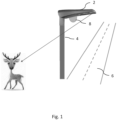
- FIG. 1 1 shows a conventional street light 2 arranged on a lamp post 4 in an elevated position at the edge of a roadway 6.
- the street light 2 has a light exit surface on the side facing the roadway, via which light can be emitted in several directions along the roadway but also in a rearward direction behind the roadway.
- the different directions for the light emission can be achieved by optics and/or by the orientation of the light sources within the light.
- the invention is not limited to any particular optics, as long as they are suitable for emitting the light in a rearward direction behind the light on the side opposite the roadway 6.
- at least two types of light sources are provided, wherein the second type of light source can emit light in a different spectral range than the first type of light source.
- at least one light source with an increased blue component is configured to emit light into the rear region of the light.
- the light 2 has a detector 8 configured to detect living beings from a solid angle range behind the light, i.e., on the side facing away from the roadway. This can be achieved, for example, by an infrared sensor.
- the light of the second spectral range i.e., in the described embodiment, light with a higher blue component, is emitted. Particularly in the case of hoofed game, this light has the effect of deterring the game from approaching further in the direction of the light, i.e., in the direction of the roadway.
- the light further includes a detector that detects vehicles along the road. According to the invention, the emission of the light in the second spectral report is only triggered when both a wild animal and a vehicle on the road approaching the light or the wild animal are detected.
Landscapes
- Physics & Mathematics (AREA)
- General Physics & Mathematics (AREA)
- Engineering & Computer Science (AREA)
- General Engineering & Computer Science (AREA)
- Life Sciences & Earth Sciences (AREA)
- Zoology (AREA)
- Pest Control & Pesticides (AREA)
- Wood Science & Technology (AREA)
- Insects & Arthropods (AREA)
- Environmental Sciences (AREA)
- Birds (AREA)
- Chemical & Material Sciences (AREA)
- Analytical Chemistry (AREA)
- Optics & Photonics (AREA)
- Traffic Control Systems (AREA)
- Road Signs Or Road Markings (AREA)
Description
- Die vorliegende Erfindung betrifft eine Straßenleuchte, die speziell dafür eingerichtet ist, Unfälle zwischen Wild und Fahrzeugen zu verhindern.
- Wildunfälle nehmen durch das sich stetig vergrößernde Straßennetz und die Anzahl der Verkehrsteilnehmer jährlich zu. Ein weiteres Problem wird die vergrößerte Anzahl von Elektrofahrzeugen darstellen, die kaum ein Motorgeräusch erzeugen, welches der Abschreckung von Wild dienen kann.
- Aktuell werden in besonders gefährdeten Gebieten Wildschutzzäune oder Barrieren zur Straße errichtet. Die Installation solcher Barrieren oder Zäune ist jedoch sehr kostspielig und hat ferner den Nachteil, dass das Wild die Straße nicht mehr überqueren kann.
- An anderer Stelle werden statische Wildschutzreflektoren installiert, die das Scheinwerferlicht von Fahrzeugen in Richtung von der Fahrbahn zu angrenzenden Gebieten reflektieren soll. Mit solchen statischen Wildschutzreflektoren konnte die Zahl der Wildunfälle bereits reduziert werden. Die statischen Wildschutzreflektoren können beispielsweise nachträglich an Straßenpylonen geschraubt werden. Aufgrund der geringen Ausläufe von Reflexionslicht, welches effektiv von der Straße in die angrenzenden Gebiete zu einem gefährdeten Tier umgelenkt wird, sind jedoch eine Vielzahl dieser Reflektoren notwendig. Im Bereich von Kurven sind die Reflektoren sogar mit noch geringerem Abstand zu setzen. Ferner wird beobachtet, dass sich beim Wild allmählich ein Gewöhnungseffekt an die verbauten Wildschutzreflektoren einstellt, so dass die Effektivität dieser Maßnahme wieder nachlässt.
- Um dem Gewöhnungseffekt statischer Wildschutzreflektoren entgegenzutreten ist es im Stand der Technik bereits bekannt, auch sich drehende Reflektoren oder solarbetriebene Geräte, die mit Lichtsensoren arbeiten, einzusetzen. Die Effizienz dieser Geräte ist jedoch ähnlich wie bei statischen Wildschutzreflektoren begrenzt.
-
CN 204806197 U offenbart eine Straßenleuchte, die Folgendes umfasst: einen Lampenmast, einen Hauptlampenhalter, einen Zusatzlampenhalter, ein Schutzgehäuse, eine Zwangsluftkühlung, einen Kühlkörper, einen Infrarotdetektor und einen Schalter, wobei zwei Seiten des Lampenmastes jeweils mit Schieber versehen sind und der Hauptlampenhalter und der Zusatzlampenhalter durch die Schieber geführt sind. Der Infrarotdetektor aktiviert beim Erfassen eines Fahrzeuges oder eines Fußgängers über den Schalter die Haupt- und Zusatzlampen, welche einen Farbwiedergabeindex von 80 bzw. 60 aufweisen. - Aufgabe der vorliegenden Erfindung ist es, mit möglichst kostengünstigen Maßnahmen den Wildschutz effektiver zu gestalten und dabei ferner in den Wildschutzzonen trotzdem einen freien Wildwechsel über die Straße zu ermöglichen.
- Gelöst wird die Aufgabe durch eine Straßenleuchte nach Anspruch 1.
- Die Straßenleuchte der vorliegenden Erfindung ermöglicht die Abgabe von Licht mit zwei verschiedenen Spektralverteilungen. Ein Lichtanteil ist dafür bestimmt, die Straße wie eine normale Straßenleuchte breitstrahlend auszuleuchten, während der zweite Lichtanteil mit einer anderen Spektralverteilung von der Straße abgewandt in einen rückwärtigen Bereich gegeben wird, um das Wild an der Überquerung der Straße zu hindern. Dazu ist ferner vorgesehen, dass ein Sensor in der Straßenleuchte die Anwesenheit und/oder Bewegung von Tieren im gefährdeten Bereich erfasst und die Lichtabgabe des Lichts mit der zweiten Spektralverteilung im zweiten Raumwinkelbereich aktiviert. Zusätzlich kann der Sensor auch ein Fahrzeug erkennen, um das Licht des zweiten Spektralbereichs in den zweiten Raumwinkelbereich nur bei erkanntem Fahrzeug abgeben. Die Lichtabgabe im zweiten Spektralbereich wird aktiv durch wenigstens einen Detektor angesteuert. Durch die erhöhte Position der Leuchte kann der Detektor einen verhältnismäßig großen Raumwinkelbereich überwachen. Das Gerät wirkt daher sehr viel effizienter als Wildreflektoren, die üblicherweise lediglich auf Höhe der Straßenbegrenzungspfähle angebracht werden. Ferner kann das Licht im zweiten Spektralbereich auch gezielt in Richtung zum Wild eine höhere Intensität aufweisen, als dies durch einfache Wildreflektoren zu erzielen wäre. Ferner besteht ein weiterer Vorteil darin, da das Licht nur bei detektiertem Wild bzw. detektiertem Fahrzeug abgegeben wird, dass auch der Gewöhnungseffekt des Wildes an das zur Abschreckung vorgesehene Licht verringert wird. Da das Wild die Einrichtungen aus einer größeren ungefährlichen Distanz beobachtet, spricht der Sensor zur Erfassung des Tieres noch gar nicht an, so dass gemäß einer Ausführungsform kein Licht der zweiten Spektralverteilung abgegeben wird. Der Gewöhnungseffekt wird daher verhindert, weil das Tier nur in der unmittelbaren Gefahrensituation das Licht der zweiten Spektralverteilung wahrnimmt.
- Erfindungsgemäß weist die zweite Spektralverteilung gegenüber der ersten Spektralverteilung einen höheren Blauanteil auf. Wildtiere, v.a. Schalenwild, die dämmerungs- und nachtaktiv sind, weisen einen Anteil von Stäbchen für das Sehen bei geringer Helligkeit auf, der bis zu 90% höher im Vergleich zum Menschen ist. Die höchste Empfindlichkeit dieser Stäbchen liegt im kurzwelligen blauen Bereich, kombiniert beim Schalenwild mit einem stark ausgeprägten Bewegungssehen. Die Abgabe eines höheren Blauanteils der Leuchte wird daher von den Tieren sehr stark wahrgenommen und hält sie vom Überqueren der Straße ab. Ferner kann auch ein Ultraviolettanteil in der zweiten Spektralverteilung abgegeben werden. Dieses Licht kann Fluoreszenzerscheinungen hervorrufen, so dass der Fahrer des sich annähernden Fahrzeuges das Wild durch Fluoreszenzerscheinungen besser erkennen kann. Das Licht im zweiten Spektralbereich dient daher allgemein nicht nur dazu, das Wild von dem Überqueren der Straße abzuhalten sondern außerdem auch dazu, das Wild in einer Gefahrensituation besser für den Fahrer des sich annähernden Fahrzeuges sichtbar zu machen.
- Gemäß einer bevorzugten Ausführungsform wird das Licht der zweiten Spektralverteilung als Blinklicht abgegeben. Das Blinklicht hat den Effekt, dass der Fahrer des sich annähernden Fahrzeuges auch auf das Wild aufmerksam gemacht wird, um die Gefahrensituation durch rechtzeitiges Bremsen verhindern zu können.
- Gemäß einer Ausführungsform weist der Sensor einen Kamerasensor, eine Infrarotkamera, einen PIR-Sensor, einen HF-Sensor und/oder einen Lidar-Sensor auf. Allgemein sind alle Sensoren geeignet, die dazu dienen können, die Präsenz oder Bewegung von Tieren sowie ggf. auch das Annähern von Fahrzeugen zu erkennen. Dies gilt insbesondere bei einer erhöhten Positionierung des Sensors in einer Leuchte. Daher kann das System im Vergleich zu konventionellen Wildreflektoren in einem größeren Abständen entlang der Straße vorgesehen werden.
- Gemäß einer bevorzugten Ausführungsform ist der Sensor dafür eingerichtet, mit einem Sender eines sich nähernden Fahrzeuges zu kommunizieren, um das Fahrzeug zu detektieren. In Verbindung mit einer Sendereinrichtung, die ein aktives Kommunizieren zu dem Fahrzeug ermöglicht, kann das Fahrzeug präziser detektiert werden, da auch Daten wie die Geschwindigkeit übertragen werden können. Ferner ermöglicht eine bidirektionale Kommunikation auch, die Daten bzgl. eines erfassten Tieres direkt zu dem Fahrzeug zu senden, so dass der Fahrer beispielsweise in dem Instrumentenbrett oder in einem Headup-Display auf der Windschutzscheibe eine Warnung bzgl. des Wilds im Gefahrenbereich erhält.
- Gemäß einer bevorzugten Ausführungsform ist die Straßenleuchte dafür eingerichtet, das Licht der zweiten Spektralverteilung nur in der Dämmerung und der Nacht abzugeben, wobei die Dämmerung und die Nacht über eine Zeitschaltung oder eine Lichtmessung von der Leuchte erkannt wird. Da die meisten Wildunfälle nur im Bereich der Dämmerung und der Nacht zu verzeichnen sind, ist es ausreichend, wenn die Anlage auch nur in diesen Zeiträumen betrieben wird. Vorzugsweise wird die Dämmerung und Nacht durch Lichtsensoren an der Leuchte erfasst, weil in dieser Ausführungsform das kritische Zeitfenster, welches sich über die Jahreszeiten selbstverständlich ändert, nicht vorprogrammiert oder über eine externe Datenverbindung übertragen werden muss.
- Weitere Vorteile und Merkmale der vorliegenden Erfindung werden aus der nachfolgenden Beschreibung bevorzugter Ausführungsformen deutlich, die in Verbindung mit der beigefügten Figur beschrieben wird. In der Figur ist Folgendes dargestellt:
- Figur 1
- zeigt schematisch eine Straßenleuchte einer Ausführungsform der Erfindung, welche zwischen einer Straße und einem Wildtier eingerichtet ist.
- Bezugnehmend auf die
Figur 1 ist eine konventionelle Straßenleuchte 2 dargestellt, die auf einem Leuchtenmast 4 in einer erhöhten Position am Rand einer Fahrbahn 6 angeordnet ist. Die Straßenleuchte 2 weist auf der zur Fahrbahn weisenden Seite eine Lichtaustrittsfläche auf, über die Licht in mehreren Richtungen entlang der Fahrbahn aber auch in eine rückwärtige Richtung hinter die Fahrbahn abgegeben werden kann. Die unterschiedlichen Richtungen für die Lichtabgabe können durch Optiken und/oder durch die Ausrichtung der Lichtquellen innerhalb der Leuchte erzielt werden. Die Erfindung ist auf keine besondere Optik eingeschränkt, soweit diese dazu geeignet ist, das Licht auch in eine rückwärtige Richtung hinter der Leuchte auf der der Fahrbahn 6 entgegengesetzten Seite abzugeben. Ferner sind wenigstens zwei Arten von Lichtquellen vorgesehen wobei der zweite Typ von Lichtquelle Licht in einen anderen Spektralbereich abgeben kann als der erste Lichtquellentyp. In der vorliegenden Ausführungsform ist vorgesehen, dass wenigstens eine Lichtquelle mit einem erhöhten Blauanteil dafür eingerichtete ist, Licht in den rückwärtigen Bereich der Leuchte abzugeben. - Ferner weist die Leuchte 2 einen Detektor 8 auf, der dafür eingerichtet ist aus einem Raumwinkelbereich hinter der Leuchte, d.h. auf der der Fahrbahn abgewandte Seite, Lebewesen zu erfassen. Dies kann beispielsweise durch einen Infrarotsensor erfolgen. Gemäß einer nicht beanspruchten Ausführungsform wird, sobald ein Wildtier in einem Gefährdungsbereich neben der Straße rückseitig der Leuchte 2 erfasst wird, die Aussendung von dem Licht des zweiten Spektralbereichs, d.h. der beschriebenen Ausführungsform Licht mit einem erhöhten Blauanteil, abgegeben. Insbesondere im Fall von Schalenwild hat dieses Licht den Effekt, dass das Wild davon abgehalten wird, sich weiter in Richtung der Leuchte, d.h. in Richtung der Fahrbahn zu nähern.
- Die Leuchte weist ferner einen Detektor auf, der Fahrzeuge entlang der Straße erfasst. Gemäß der Erfindung wird die Abgabe des Lichts im zweiten Spektralbericht nur ausgelöst, wenn sowohl ein Wildtier als auch ein Fahrzeug auf der Straße, welches sich der Leuchte bzw. dem Wildtier nähert, detektiert wird.
- Weitere Ausführungsformen sind möglich. Insbesondere kann vorgesehen sein, dass auch Licht im UV-Bereich oder Blinklicht abgegeben wird, um die Aufmerksamkeit des Fahrers auf Wild zu erhöhen. Auch dieser Lichtanteil wird nur aufgegeben, wenn tatsächlich ein Wildtier durch die Sensoreinheit 8 erfasst worden ist.
-
- 2
- Straßenleuchte
- 4
- Leuchtenmast
- 6
- Fahrbahn
- 8
- Sensor
Claims (5)
- Straßenleuchte (2) mit wenigstens zwei Leuchtmitteln, wobei eines der Leuchtmittel zur Abgabe von Licht einer ersten Spektralverteilung in einen ersten Raumwinkelbereich für eine zu beleuchtende Straße eingerichtet ist, und ein zweites Leuchtmittel zur Abgabe von Licht einer zu der ersten Spektralverteilung unterschiedlichen zweiten Spektralverteilung in einen zweiten Raumwinkelbereich eingerichtet ist, dadurch gekennzeichnet, dass der zweite Raumwinkelbereich dem ersten Raumwinkelbereich abgewandt ist und das zweite Leuchtmittel nur aktiviert ist, wenn ein mit der Straßenleuchte verbundener Sensor (8) ein Lebewesen im zweiten Raumwinkelbereich und ein Fahrzeug im ersten Raumwinkelbereich detektiert,
wobei die zweite Spektralverteilung gegenüber der ersten Spektralverteilung einen höheren Blauanteil aufweist. - Straßenleuchte nach Anspruch 1, wobei das Licht des zweiten Spektralbereichs als Blinklicht abgegeben wird.
- Straßenleuchte nach einem der vorhergehenden Ansprüche, wobei der Sensor (8) einen Kamerasensor, eine Infrarotkamera, einen PIR-Sensor, einen HF-Sensor und/oder einen Lidar-Sensor aufweist.
- Straßenleuchte nach einem der vorhergehenden Ansprüche, die ferner einen Sensor aufweist, der dafür eingerichtet ist, ein sich der Straßenleuchte näherndes Fahrzeug zu detektieren, und die Leuchte eingerichtet ist, um das zweite Leuchtmittel nur zu aktivieren, wenn auch ein sich annäherndes Fahrzeug detektiert wird.
- Straßenleuchte nach einem der vorhergehenden Ansprüche, wobei die Straßenleuchte dafür eingerichtet ist, das Licht der zweiten Spektralverteilung nur in der Dämmerung und der Nacht abzugeben, wobei die Dämmerung und die Nacht über eine Zeitschaltung oder eine Lichtmessung von der Leuchte erkannt wird.
Applications Claiming Priority (1)
| Application Number | Priority Date | Filing Date | Title |
|---|---|---|---|
| DE102019120255.8A DE102019120255A1 (de) | 2019-07-26 | 2019-07-26 | Straßenleuchte zur Verhinderung von Wildunfällen |
Publications (3)
| Publication Number | Publication Date |
|---|---|
| EP3770486A1 EP3770486A1 (de) | 2021-01-27 |
| EP3770486B1 EP3770486B1 (de) | 2022-03-09 |
| EP3770486B2 true EP3770486B2 (de) | 2025-04-23 |
Family
ID=71786788
Family Applications (1)
| Application Number | Title | Priority Date | Filing Date |
|---|---|---|---|
| EP20187595.2A Active EP3770486B2 (de) | 2019-07-26 | 2020-07-24 | Strassenleuchte zur verhinderung von wildunfällen |
Country Status (3)
| Country | Link |
|---|---|
| EP (1) | EP3770486B2 (de) |
| DE (1) | DE102019120255A1 (de) |
| DK (1) | DK3770486T4 (de) |
Citations (6)
| Publication number | Priority date | Publication date | Assignee | Title |
|---|---|---|---|---|
| US5939987A (en) † | 1998-01-26 | 1999-08-17 | Cram; Randall S. | Roadside deer warning method and system |
| JP2005056689A (ja) † | 2003-08-05 | 2005-03-03 | Sekisui Jushi Co Ltd | 遮音壁用照明装置 |
| JP2009032260A (ja) † | 2007-07-24 | 2009-02-12 | Choruju Yun | 歩行者保護装置 |
| EP3073465A1 (de) † | 2015-03-25 | 2016-09-28 | Application Solutions (Electronics and Vision) Limited | Tiererkennungssystem für ein fahrzeug |
| US20190107273A1 (en) † | 2016-05-19 | 2019-04-11 | Cimcon Lighting, Inc. | Configurable Streetlight Sensor Platform |
| WO2019135587A1 (ko) † | 2018-01-03 | 2019-07-11 | 주식회사 티엘이 | 저고도 설치형 저전력 스마트 가로등 시스템 |
Family Cites Families (7)
| Publication number | Priority date | Publication date | Assignee | Title |
|---|---|---|---|---|
| JP4745184B2 (ja) * | 2006-10-03 | 2011-08-10 | スタンレー電気株式会社 | 照明装置 |
| EP2831862B1 (de) * | 2012-03-29 | 2021-08-25 | IPTE - Schalk & Schalk OG | Wildwarnsystem |
| DE202013007713U1 (de) * | 2012-11-09 | 2013-09-12 | Konrad Löhnert | Wildscheuchvorrichtung zum Vertreiben von Wildtieren aus landwirtschaftlichen Nutzflächen |
| KR101552391B1 (ko) * | 2013-08-19 | 2015-09-10 | 김호겸 | 야생 동물의 로드 킬 방지시스템 |
| KR101556991B1 (ko) * | 2013-11-28 | 2015-10-05 | 주식회사 이엑스크리에이티브 | 광고 시스템 |
| CN204806197U (zh) * | 2015-07-24 | 2015-11-25 | 赵燕羽 | 一种新型路灯 |
| EP3540709A1 (de) * | 2018-03-16 | 2019-09-18 | Swareflex GmbH | Strassenüberwachungssystem |
-
2019
- 2019-07-26 DE DE102019120255.8A patent/DE102019120255A1/de active Pending
-
2020
- 2020-07-24 EP EP20187595.2A patent/EP3770486B2/de active Active
- 2020-07-24 DK DK20187595.2T patent/DK3770486T4/da active
Patent Citations (6)
| Publication number | Priority date | Publication date | Assignee | Title |
|---|---|---|---|---|
| US5939987A (en) † | 1998-01-26 | 1999-08-17 | Cram; Randall S. | Roadside deer warning method and system |
| JP2005056689A (ja) † | 2003-08-05 | 2005-03-03 | Sekisui Jushi Co Ltd | 遮音壁用照明装置 |
| JP2009032260A (ja) † | 2007-07-24 | 2009-02-12 | Choruju Yun | 歩行者保護装置 |
| EP3073465A1 (de) † | 2015-03-25 | 2016-09-28 | Application Solutions (Electronics and Vision) Limited | Tiererkennungssystem für ein fahrzeug |
| US20190107273A1 (en) † | 2016-05-19 | 2019-04-11 | Cimcon Lighting, Inc. | Configurable Streetlight Sensor Platform |
| WO2019135587A1 (ko) † | 2018-01-03 | 2019-07-11 | 주식회사 티엘이 | 저고도 설치형 저전력 스마트 가로등 시스템 |
Also Published As
| Publication number | Publication date |
|---|---|
| DE102019120255A1 (de) | 2021-01-28 |
| EP3770486B1 (de) | 2022-03-09 |
| EP3770486A1 (de) | 2021-01-27 |
| DK3770486T3 (da) | 2022-06-13 |
| DK3770486T4 (da) | 2025-06-10 |
Similar Documents
| Publication | Publication Date | Title |
|---|---|---|
| DE10126492B4 (de) | Verfahren zur Verbesserung der Sicht in Fahrzeugen | |
| DE10354104A1 (de) | Verfahren zur Steuerung der Ausleuchtung eines seitlichen Fahrbahnbereichs mittels eines Hilfsscheinwerfers für ein Fahrzeug | |
| DE102019201947A1 (de) | Verfahren und Vorrichtung zum Warnen vor sich öffnenden Kraftfahrzeugtüren | |
| DE102017203893A1 (de) | Kraftfahrzeug mit einem Beleuchtungsmodul zur Generierung einer Symbolik | |
| DE202021101367U1 (de) | Mehrlicht-Warnvorrichtung für das Abbiegen eines Kraftfahrzeugs | |
| DE102015115240A1 (de) | Fahrzeug mit Lichtprojektionssystem und Verfahren zur Erzeugung einer Sicherheitsmarkierung auf einer Bodenoberfläche | |
| EP3770488A1 (de) | Strassenleuchte mit kommunikationsschnittstelle zu fahrzeugen | |
| DE19929645A1 (de) | Straßenverkehrsleitsystem für Gefahrenstrecken, insbesondere Tunnels | |
| DE102008008880B4 (de) | Fahrzeugleuchtensystem | |
| EP3682432B1 (de) | Anzeigeeinrichtung zur optischen warnung vor radfahrern beim abbiegen von einer haupt- in eine nebenstrasse | |
| EP3770486B1 (de) | Strassenleuchte zur verhinderung von wildunfällen | |
| DE202021102226U1 (de) | Verkehrssicherheitssystem | |
| EP1546464B1 (de) | Nebelwarn- und -leiteinrichtung | |
| DE102013021465B4 (de) | Wildwarn-reflektor | |
| EP3692793A1 (de) | Warngerät zur verringerung des risikos von unfällen durch wildwechsel | |
| AT398441B (de) | Einrichtung an in nur einer richtung zu befahrenden strassenstücken | |
| DE102020119664B4 (de) | Hinweisschild, insbesondere ein Richtungs-Warnschild | |
| EP3770489B1 (de) | Adaptive strassenleuchte mit personendetektor | |
| EP3670749A1 (de) | Reflektor sowie reflektorsystem | |
| DE202011108278U1 (de) | Wildwarnreflektor | |
| DE202021106390U1 (de) | Fahrzeugradar reflektierendes sicheres Warndreieck | |
| DE202008002619U1 (de) | Wildwechsel-Warnanlage | |
| EP3933161B1 (de) | Karusselltür mit lichtsignalfunktion | |
| DE20212474U1 (de) | Warnsystem zur Warnung von Kraftfahrzeugfahrern vor plötzlich auftretenden Gefahrensituationen | |
| CH708132A1 (de) | Sicherheitssystem an Fussgängerstreifen. |
Legal Events
| Date | Code | Title | Description |
|---|---|---|---|
| PUAI | Public reference made under article 153(3) epc to a published international application that has entered the european phase |
Free format text: ORIGINAL CODE: 0009012 |
|
| STAA | Information on the status of an ep patent application or granted ep patent |
Free format text: STATUS: THE APPLICATION HAS BEEN PUBLISHED |
|
| AK | Designated contracting states |
Kind code of ref document: A1 Designated state(s): AL AT BE BG CH CY CZ DE DK EE ES FI FR GB GR HR HU IE IS IT LI LT LU LV MC MK MT NL NO PL PT RO RS SE SI SK SM TR |
|
| AX | Request for extension of the european patent |
Extension state: BA ME |
|
| STAA | Information on the status of an ep patent application or granted ep patent |
Free format text: STATUS: REQUEST FOR EXAMINATION WAS MADE |
|
| 17P | Request for examination filed |
Effective date: 20210722 |
|
| RBV | Designated contracting states (corrected) |
Designated state(s): AL AT BE BG CH CY CZ DE DK EE ES FI FR GB GR HR HU IE IS IT LI LT LU LV MC MK MT NL NO PL PT RO RS SE SI SK SM TR |
|
| RIC1 | Information provided on ipc code assigned before grant |
Ipc: F21W 131/103 20060101ALN20210824BHEP Ipc: F21Y 113/10 20160101ALN20210824BHEP Ipc: G08G 1/01 20060101ALI20210824BHEP Ipc: A01M 29/00 20110101ALI20210824BHEP Ipc: F21V 23/04 20060101ALI20210824BHEP Ipc: F21S 8/08 20060101AFI20210824BHEP |
|
| GRAP | Despatch of communication of intention to grant a patent |
Free format text: ORIGINAL CODE: EPIDOSNIGR1 |
|
| STAA | Information on the status of an ep patent application or granted ep patent |
Free format text: STATUS: GRANT OF PATENT IS INTENDED |
|
| INTG | Intention to grant announced |
Effective date: 20211018 |
|
| GRAS | Grant fee paid |
Free format text: ORIGINAL CODE: EPIDOSNIGR3 |
|
| GRAA | (expected) grant |
Free format text: ORIGINAL CODE: 0009210 |
|
| STAA | Information on the status of an ep patent application or granted ep patent |
Free format text: STATUS: THE PATENT HAS BEEN GRANTED |
|
| AK | Designated contracting states |
Kind code of ref document: B1 Designated state(s): AL AT BE BG CH CY CZ DE DK EE ES FI FR GB GR HR HU IE IS IT LI LT LU LV MC MK MT NL NO PL PT RO RS SE SI SK SM TR |
|
| REG | Reference to a national code |
Ref country code: CH Ref legal event code: EP Ref country code: AT Ref legal event code: REF Ref document number: 1474451 Country of ref document: AT Kind code of ref document: T Effective date: 20220315 |
|
| REG | Reference to a national code |
Ref country code: DE Ref legal event code: R096 Ref document number: 502020000778 Country of ref document: DE |
|
| REG | Reference to a national code |
Ref country code: IE Ref legal event code: FG4D Free format text: LANGUAGE OF EP DOCUMENT: GERMAN |
|
| REG | Reference to a national code |
Ref country code: SE Ref legal event code: TRGR |
|
| REG | Reference to a national code |
Ref country code: DK Ref legal event code: T3 Effective date: 20220607 |
|
| REG | Reference to a national code |
Ref country code: NO Ref legal event code: T2 Effective date: 20220309 |
|
| REG | Reference to a national code |
Ref country code: LT Ref legal event code: MG9D |
|
| REG | Reference to a national code |
Ref country code: NL Ref legal event code: MP Effective date: 20220309 |
|
| PG25 | Lapsed in a contracting state [announced via postgrant information from national office to epo] |
Ref country code: RS Free format text: LAPSE BECAUSE OF FAILURE TO SUBMIT A TRANSLATION OF THE DESCRIPTION OR TO PAY THE FEE WITHIN THE PRESCRIBED TIME-LIMIT Effective date: 20220309 Ref country code: LT Free format text: LAPSE BECAUSE OF FAILURE TO SUBMIT A TRANSLATION OF THE DESCRIPTION OR TO PAY THE FEE WITHIN THE PRESCRIBED TIME-LIMIT Effective date: 20220309 Ref country code: HR Free format text: LAPSE BECAUSE OF FAILURE TO SUBMIT A TRANSLATION OF THE DESCRIPTION OR TO PAY THE FEE WITHIN THE PRESCRIBED TIME-LIMIT Effective date: 20220309 Ref country code: BG Free format text: LAPSE BECAUSE OF FAILURE TO SUBMIT A TRANSLATION OF THE DESCRIPTION OR TO PAY THE FEE WITHIN THE PRESCRIBED TIME-LIMIT Effective date: 20220609 |
|
| PG25 | Lapsed in a contracting state [announced via postgrant information from national office to epo] |
Ref country code: LV Free format text: LAPSE BECAUSE OF FAILURE TO SUBMIT A TRANSLATION OF THE DESCRIPTION OR TO PAY THE FEE WITHIN THE PRESCRIBED TIME-LIMIT Effective date: 20220309 Ref country code: GR Free format text: LAPSE BECAUSE OF FAILURE TO SUBMIT A TRANSLATION OF THE DESCRIPTION OR TO PAY THE FEE WITHIN THE PRESCRIBED TIME-LIMIT Effective date: 20220610 Ref country code: FI Free format text: LAPSE BECAUSE OF FAILURE TO SUBMIT A TRANSLATION OF THE DESCRIPTION OR TO PAY THE FEE WITHIN THE PRESCRIBED TIME-LIMIT Effective date: 20220309 |
|
| PG25 | Lapsed in a contracting state [announced via postgrant information from national office to epo] |
Ref country code: NL Free format text: LAPSE BECAUSE OF FAILURE TO SUBMIT A TRANSLATION OF THE DESCRIPTION OR TO PAY THE FEE WITHIN THE PRESCRIBED TIME-LIMIT Effective date: 20220309 |
|
| PG25 | Lapsed in a contracting state [announced via postgrant information from national office to epo] |
Ref country code: SM Free format text: LAPSE BECAUSE OF FAILURE TO SUBMIT A TRANSLATION OF THE DESCRIPTION OR TO PAY THE FEE WITHIN THE PRESCRIBED TIME-LIMIT Effective date: 20220309 Ref country code: SK Free format text: LAPSE BECAUSE OF FAILURE TO SUBMIT A TRANSLATION OF THE DESCRIPTION OR TO PAY THE FEE WITHIN THE PRESCRIBED TIME-LIMIT Effective date: 20220309 Ref country code: RO Free format text: LAPSE BECAUSE OF FAILURE TO SUBMIT A TRANSLATION OF THE DESCRIPTION OR TO PAY THE FEE WITHIN THE PRESCRIBED TIME-LIMIT Effective date: 20220309 Ref country code: PT Free format text: LAPSE BECAUSE OF FAILURE TO SUBMIT A TRANSLATION OF THE DESCRIPTION OR TO PAY THE FEE WITHIN THE PRESCRIBED TIME-LIMIT Effective date: 20220711 Ref country code: ES Free format text: LAPSE BECAUSE OF FAILURE TO SUBMIT A TRANSLATION OF THE DESCRIPTION OR TO PAY THE FEE WITHIN THE PRESCRIBED TIME-LIMIT Effective date: 20220309 Ref country code: EE Free format text: LAPSE BECAUSE OF FAILURE TO SUBMIT A TRANSLATION OF THE DESCRIPTION OR TO PAY THE FEE WITHIN THE PRESCRIBED TIME-LIMIT Effective date: 20220309 Ref country code: CZ Free format text: LAPSE BECAUSE OF FAILURE TO SUBMIT A TRANSLATION OF THE DESCRIPTION OR TO PAY THE FEE WITHIN THE PRESCRIBED TIME-LIMIT Effective date: 20220309 |
|
| PG25 | Lapsed in a contracting state [announced via postgrant information from national office to epo] |
Ref country code: PL Free format text: LAPSE BECAUSE OF FAILURE TO SUBMIT A TRANSLATION OF THE DESCRIPTION OR TO PAY THE FEE WITHIN THE PRESCRIBED TIME-LIMIT Effective date: 20220309 Ref country code: IS Free format text: LAPSE BECAUSE OF FAILURE TO SUBMIT A TRANSLATION OF THE DESCRIPTION OR TO PAY THE FEE WITHIN THE PRESCRIBED TIME-LIMIT Effective date: 20220709 Ref country code: AL Free format text: LAPSE BECAUSE OF FAILURE TO SUBMIT A TRANSLATION OF THE DESCRIPTION OR TO PAY THE FEE WITHIN THE PRESCRIBED TIME-LIMIT Effective date: 20220309 |
|
| REG | Reference to a national code |
Ref country code: DE Ref legal event code: R026 Ref document number: 502020000778 Country of ref document: DE |
|
| PLBI | Opposition filed |
Free format text: ORIGINAL CODE: 0009260 |
|
| PLAX | Notice of opposition and request to file observation + time limit sent |
Free format text: ORIGINAL CODE: EPIDOSNOBS2 |
|
| 26 | Opposition filed |
Opponent name: SCHOEPF, PATRICK Effective date: 20221209 |
|
| PG25 | Lapsed in a contracting state [announced via postgrant information from national office to epo] |
Ref country code: SI Free format text: LAPSE BECAUSE OF FAILURE TO SUBMIT A TRANSLATION OF THE DESCRIPTION OR TO PAY THE FEE WITHIN THE PRESCRIBED TIME-LIMIT Effective date: 20220309 Ref country code: MC Free format text: LAPSE BECAUSE OF FAILURE TO SUBMIT A TRANSLATION OF THE DESCRIPTION OR TO PAY THE FEE WITHIN THE PRESCRIBED TIME-LIMIT Effective date: 20220309 |
|
| REG | Reference to a national code |
Ref country code: BE Ref legal event code: MM Effective date: 20220731 |
|
| PG25 | Lapsed in a contracting state [announced via postgrant information from national office to epo] |
Ref country code: LU Free format text: LAPSE BECAUSE OF NON-PAYMENT OF DUE FEES Effective date: 20220724 Ref country code: FR Free format text: LAPSE BECAUSE OF NON-PAYMENT OF DUE FEES Effective date: 20220731 |
|
| PLBB | Reply of patent proprietor to notice(s) of opposition received |
Free format text: ORIGINAL CODE: EPIDOSNOBS3 |
|
| PG25 | Lapsed in a contracting state [announced via postgrant information from national office to epo] |
Ref country code: BE Free format text: LAPSE BECAUSE OF NON-PAYMENT OF DUE FEES Effective date: 20220731 |
|
| PG25 | Lapsed in a contracting state [announced via postgrant information from national office to epo] |
Ref country code: IT Free format text: LAPSE BECAUSE OF FAILURE TO SUBMIT A TRANSLATION OF THE DESCRIPTION OR TO PAY THE FEE WITHIN THE PRESCRIBED TIME-LIMIT Effective date: 20220309 Ref country code: IE Free format text: LAPSE BECAUSE OF NON-PAYMENT OF DUE FEES Effective date: 20220724 |
|
| PG25 | Lapsed in a contracting state [announced via postgrant information from national office to epo] |
Ref country code: MK Free format text: LAPSE BECAUSE OF FAILURE TO SUBMIT A TRANSLATION OF THE DESCRIPTION OR TO PAY THE FEE WITHIN THE PRESCRIBED TIME-LIMIT Effective date: 20220309 Ref country code: CY Free format text: LAPSE BECAUSE OF FAILURE TO SUBMIT A TRANSLATION OF THE DESCRIPTION OR TO PAY THE FEE WITHIN THE PRESCRIBED TIME-LIMIT Effective date: 20220309 |
|
| PG25 | Lapsed in a contracting state [announced via postgrant information from national office to epo] |
Ref country code: HU Free format text: LAPSE BECAUSE OF FAILURE TO SUBMIT A TRANSLATION OF THE DESCRIPTION OR TO PAY THE FEE WITHIN THE PRESCRIBED TIME-LIMIT; INVALID AB INITIO Effective date: 20200724 |
|
| PG25 | Lapsed in a contracting state [announced via postgrant information from national office to epo] |
Ref country code: MT Free format text: LAPSE BECAUSE OF FAILURE TO SUBMIT A TRANSLATION OF THE DESCRIPTION OR TO PAY THE FEE WITHIN THE PRESCRIBED TIME-LIMIT Effective date: 20220309 |
|
| APAH | Appeal reference modified |
Free format text: ORIGINAL CODE: EPIDOSCREFNO |
|
| APAW | Appeal reference deleted |
Free format text: ORIGINAL CODE: EPIDOSDREFNO |
|
| APBP | Date of receipt of notice of appeal recorded |
Free format text: ORIGINAL CODE: EPIDOSNNOA2O |
|
| APBU | Appeal procedure closed |
Free format text: ORIGINAL CODE: EPIDOSNNOA9O |
|
| PUAH | Patent maintained in amended form |
Free format text: ORIGINAL CODE: 0009272 |
|
| STAA | Information on the status of an ep patent application or granted ep patent |
Free format text: STATUS: PATENT MAINTAINED AS AMENDED |
|
| GBPC | Gb: european patent ceased through non-payment of renewal fee |
Effective date: 20240724 |
|
| 27A | Patent maintained in amended form |
Effective date: 20250423 |
|
| AK | Designated contracting states |
Kind code of ref document: B2 Designated state(s): AL AT BE BG CH CY CZ DE DK EE ES FI FR GB GR HR HU IE IS IT LI LT LU LV MC MK MT NL NO PL PT RO RS SE SI SK SM TR |
|
| REG | Reference to a national code |
Ref country code: DE Ref legal event code: R102 Ref document number: 502020000778 Country of ref document: DE |
|
| PG25 | Lapsed in a contracting state [announced via postgrant information from national office to epo] |
Ref country code: GB Free format text: LAPSE BECAUSE OF NON-PAYMENT OF DUE FEES Effective date: 20240724 |
|
| REG | Reference to a national code |
Ref country code: SE Ref legal event code: RPEO |
|
| REG | Reference to a national code |
Ref country code: DK Ref legal event code: T4 Effective date: 20250606 |
|
| PGFP | Annual fee paid to national office [announced via postgrant information from national office to epo] |
Ref country code: DK Payment date: 20250723 Year of fee payment: 6 Ref country code: DE Payment date: 20250722 Year of fee payment: 6 |
|
| PGFP | Annual fee paid to national office [announced via postgrant information from national office to epo] |
Ref country code: NO Payment date: 20250722 Year of fee payment: 6 |
|
| PGFP | Annual fee paid to national office [announced via postgrant information from national office to epo] |
Ref country code: AT Payment date: 20250721 Year of fee payment: 6 |
|
| PGFP | Annual fee paid to national office [announced via postgrant information from national office to epo] |
Ref country code: CH Payment date: 20250801 Year of fee payment: 6 Ref country code: SE Payment date: 20250723 Year of fee payment: 6 |
|
| PG25 | Lapsed in a contracting state [announced via postgrant information from national office to epo] |
Ref country code: TR Free format text: LAPSE BECAUSE OF FAILURE TO SUBMIT A TRANSLATION OF THE DESCRIPTION OR TO PAY THE FEE WITHIN THE PRESCRIBED TIME-LIMIT Effective date: 20220309 |