EP3769115B1 - Verfahren und systeme zur identifizierung der materialzusammensetzung bewegter objekte - Google Patents
Verfahren und systeme zur identifizierung der materialzusammensetzung bewegter objekte Download PDFInfo
- Publication number
- EP3769115B1 EP3769115B1 EP19713398.6A EP19713398A EP3769115B1 EP 3769115 B1 EP3769115 B1 EP 3769115B1 EP 19713398 A EP19713398 A EP 19713398A EP 3769115 B1 EP3769115 B1 EP 3769115B1
- Authority
- EP
- European Patent Office
- Prior art keywords
- gcs
- point cloud
- pcf
- coordinate system
- cloud frame
- Prior art date
- Legal status (The legal status is an assumption and is not a legal conclusion. Google has not performed a legal analysis and makes no representation as to the accuracy of the status listed.)
- Active
Links
Images




Classifications
-
- G—PHYSICS
- G01—MEASURING; TESTING
- G01N—INVESTIGATING OR ANALYSING MATERIALS BY DETERMINING THEIR CHEMICAL OR PHYSICAL PROPERTIES
- G01N21/00—Investigating or analysing materials by the use of optical means, i.e. using sub-millimetre waves, infrared, visible or ultraviolet light
- G01N21/17—Systems in which incident light is modified in accordance with the properties of the material investigated
- G01N21/21—Polarisation-affecting properties
-
- G—PHYSICS
- G01—MEASURING; TESTING
- G01N—INVESTIGATING OR ANALYSING MATERIALS BY DETERMINING THEIR CHEMICAL OR PHYSICAL PROPERTIES
- G01N21/00—Investigating or analysing materials by the use of optical means, i.e. using sub-millimetre waves, infrared, visible or ultraviolet light
- G01N21/17—Systems in which incident light is modified in accordance with the properties of the material investigated
- G01N21/55—Specular reflectivity
-
- B—PERFORMING OPERATIONS; TRANSPORTING
- B60—VEHICLES IN GENERAL
- B60W—CONJOINT CONTROL OF VEHICLE SUB-UNITS OF DIFFERENT TYPE OR DIFFERENT FUNCTION; CONTROL SYSTEMS SPECIALLY ADAPTED FOR HYBRID VEHICLES; ROAD VEHICLE DRIVE CONTROL SYSTEMS FOR PURPOSES NOT RELATED TO THE CONTROL OF A PARTICULAR SUB-UNIT
- B60W30/00—Purposes of road vehicle drive control systems not related to the control of a particular sub-unit, e.g. of systems using conjoint control of vehicle sub-units
- B60W30/08—Active safety systems predicting or avoiding probable or impending collision or attempting to minimise its consequences
- B60W30/095—Predicting travel path or likelihood of collision
- B60W30/0956—Predicting travel path or likelihood of collision the prediction being responsive to traffic or environmental parameters
-
- B—PERFORMING OPERATIONS; TRANSPORTING
- B60—VEHICLES IN GENERAL
- B60W—CONJOINT CONTROL OF VEHICLE SUB-UNITS OF DIFFERENT TYPE OR DIFFERENT FUNCTION; CONTROL SYSTEMS SPECIALLY ADAPTED FOR HYBRID VEHICLES; ROAD VEHICLE DRIVE CONTROL SYSTEMS FOR PURPOSES NOT RELATED TO THE CONTROL OF A PARTICULAR SUB-UNIT
- B60W60/00—Drive control systems specially adapted for autonomous road vehicles
- B60W60/001—Planning or execution of driving tasks
-
- G—PHYSICS
- G01—MEASURING; TESTING
- G01S—RADIO DIRECTION-FINDING; RADIO NAVIGATION; DETERMINING DISTANCE OR VELOCITY BY USE OF RADIO WAVES; LOCATING OR PRESENCE-DETECTING BY USE OF THE REFLECTION OR RERADIATION OF RADIO WAVES; ANALOGOUS ARRANGEMENTS USING OTHER WAVES
- G01S17/00—Systems using the reflection or reradiation of electromagnetic waves other than radio waves, e.g. lidar systems
- G01S17/02—Systems using the reflection of electromagnetic waves other than radio waves
- G01S17/06—Systems determining position data of a target
- G01S17/08—Systems determining position data of a target for measuring distance only
-
- G—PHYSICS
- G01—MEASURING; TESTING
- G01S—RADIO DIRECTION-FINDING; RADIO NAVIGATION; DETERMINING DISTANCE OR VELOCITY BY USE OF RADIO WAVES; LOCATING OR PRESENCE-DETECTING BY USE OF THE REFLECTION OR RERADIATION OF RADIO WAVES; ANALOGOUS ARRANGEMENTS USING OTHER WAVES
- G01S17/00—Systems using the reflection or reradiation of electromagnetic waves other than radio waves, e.g. lidar systems
- G01S17/02—Systems using the reflection of electromagnetic waves other than radio waves
- G01S17/50—Systems of measurement based on relative movement of target
-
- G—PHYSICS
- G01—MEASURING; TESTING
- G01S—RADIO DIRECTION-FINDING; RADIO NAVIGATION; DETERMINING DISTANCE OR VELOCITY BY USE OF RADIO WAVES; LOCATING OR PRESENCE-DETECTING BY USE OF THE REFLECTION OR RERADIATION OF RADIO WAVES; ANALOGOUS ARRANGEMENTS USING OTHER WAVES
- G01S17/00—Systems using the reflection or reradiation of electromagnetic waves other than radio waves, e.g. lidar systems
- G01S17/88—Lidar systems specially adapted for specific applications
- G01S17/89—Lidar systems specially adapted for specific applications for mapping or imaging
-
- G—PHYSICS
- G01—MEASURING; TESTING
- G01S—RADIO DIRECTION-FINDING; RADIO NAVIGATION; DETERMINING DISTANCE OR VELOCITY BY USE OF RADIO WAVES; LOCATING OR PRESENCE-DETECTING BY USE OF THE REFLECTION OR RERADIATION OF RADIO WAVES; ANALOGOUS ARRANGEMENTS USING OTHER WAVES
- G01S17/00—Systems using the reflection or reradiation of electromagnetic waves other than radio waves, e.g. lidar systems
- G01S17/88—Lidar systems specially adapted for specific applications
- G01S17/89—Lidar systems specially adapted for specific applications for mapping or imaging
- G01S17/894—Three-dimensional [3D] imaging with simultaneous measurement of time-of-flight at a two-dimensional [2D] array of receiver pixels, e.g. time-of-flight cameras or flash lidar
-
- G—PHYSICS
- G01—MEASURING; TESTING
- G01S—RADIO DIRECTION-FINDING; RADIO NAVIGATION; DETERMINING DISTANCE OR VELOCITY BY USE OF RADIO WAVES; LOCATING OR PRESENCE-DETECTING BY USE OF THE REFLECTION OR RERADIATION OF RADIO WAVES; ANALOGOUS ARRANGEMENTS USING OTHER WAVES
- G01S7/00—Details of systems according to groups G01S13/00, G01S15/00, G01S17/00
- G01S7/48—Details of systems according to groups G01S13/00, G01S15/00, G01S17/00 of systems according to group G01S17/00
- G01S7/4802—Details of systems according to groups G01S13/00, G01S15/00, G01S17/00 of systems according to group G01S17/00 using analysis of echo signal for target characterisation; Target signature; Target cross-section
-
- G—PHYSICS
- G01—MEASURING; TESTING
- G01S—RADIO DIRECTION-FINDING; RADIO NAVIGATION; DETERMINING DISTANCE OR VELOCITY BY USE OF RADIO WAVES; LOCATING OR PRESENCE-DETECTING BY USE OF THE REFLECTION OR RERADIATION OF RADIO WAVES; ANALOGOUS ARRANGEMENTS USING OTHER WAVES
- G01S7/00—Details of systems according to groups G01S13/00, G01S15/00, G01S17/00
- G01S7/48—Details of systems according to groups G01S13/00, G01S15/00, G01S17/00 of systems according to group G01S17/00
- G01S7/481—Constructional features, e.g. arrangements of optical elements
- G01S7/4814—Constructional features, e.g. arrangements of optical elements of transmitters alone
-
- G—PHYSICS
- G01—MEASURING; TESTING
- G01S—RADIO DIRECTION-FINDING; RADIO NAVIGATION; DETERMINING DISTANCE OR VELOCITY BY USE OF RADIO WAVES; LOCATING OR PRESENCE-DETECTING BY USE OF THE REFLECTION OR RERADIATION OF RADIO WAVES; ANALOGOUS ARRANGEMENTS USING OTHER WAVES
- G01S7/00—Details of systems according to groups G01S13/00, G01S15/00, G01S17/00
- G01S7/48—Details of systems according to groups G01S13/00, G01S15/00, G01S17/00 of systems according to group G01S17/00
- G01S7/481—Constructional features, e.g. arrangements of optical elements
- G01S7/4816—Constructional features, e.g. arrangements of optical elements of receivers alone
-
- G—PHYSICS
- G01—MEASURING; TESTING
- G01S—RADIO DIRECTION-FINDING; RADIO NAVIGATION; DETERMINING DISTANCE OR VELOCITY BY USE OF RADIO WAVES; LOCATING OR PRESENCE-DETECTING BY USE OF THE REFLECTION OR RERADIATION OF RADIO WAVES; ANALOGOUS ARRANGEMENTS USING OTHER WAVES
- G01S7/00—Details of systems according to groups G01S13/00, G01S15/00, G01S17/00
- G01S7/48—Details of systems according to groups G01S13/00, G01S15/00, G01S17/00 of systems according to group G01S17/00
- G01S7/481—Constructional features, e.g. arrangements of optical elements
- G01S7/4817—Constructional features, e.g. arrangements of optical elements relating to scanning
-
- G—PHYSICS
- G06—COMPUTING OR CALCULATING; COUNTING
- G06T—IMAGE DATA PROCESSING OR GENERATION, IN GENERAL
- G06T17/00—Three-dimensional [3D] modelling for computer graphics
-
- G—PHYSICS
- G06—COMPUTING OR CALCULATING; COUNTING
- G06T—IMAGE DATA PROCESSING OR GENERATION, IN GENERAL
- G06T19/00—Manipulating three-dimensional [3D] models or images for computer graphics
- G06T19/20—Editing of three-dimensional [3D] images, e.g. changing shapes or colours, aligning objects or positioning parts
-
- G—PHYSICS
- G06—COMPUTING OR CALCULATING; COUNTING
- G06V—IMAGE OR VIDEO RECOGNITION OR UNDERSTANDING
- G06V20/00—Scenes; Scene-specific elements
- G06V20/50—Context or environment of the image
- G06V20/56—Context or environment of the image exterior to a vehicle by using sensors mounted on the vehicle
- G06V20/58—Recognition of moving objects or obstacles, e.g. vehicles or pedestrians; Recognition of traffic objects, e.g. traffic signs, traffic lights or roads
-
- H—ELECTRICITY
- H04—ELECTRIC COMMUNICATION TECHNIQUE
- H04N—PICTORIAL COMMUNICATION, e.g. TELEVISION
- H04N1/00—Scanning, transmission or reproduction of documents or the like, e.g. facsimile transmission; Details thereof
- H04N1/00795—Reading arrangements
- H04N1/00827—Arrangements for reading an image from an unusual original, e.g. 3-dimensional objects
-
- B—PERFORMING OPERATIONS; TRANSPORTING
- B60—VEHICLES IN GENERAL
- B60W—CONJOINT CONTROL OF VEHICLE SUB-UNITS OF DIFFERENT TYPE OR DIFFERENT FUNCTION; CONTROL SYSTEMS SPECIALLY ADAPTED FOR HYBRID VEHICLES; ROAD VEHICLE DRIVE CONTROL SYSTEMS FOR PURPOSES NOT RELATED TO THE CONTROL OF A PARTICULAR SUB-UNIT
- B60W2420/00—Indexing codes relating to the type of sensors based on the principle of their operation
- B60W2420/40—Photo, light or radio wave sensitive means, e.g. infrared sensors
- B60W2420/408—Radar; Laser, e.g. lidar
-
- B—PERFORMING OPERATIONS; TRANSPORTING
- B60—VEHICLES IN GENERAL
- B60W—CONJOINT CONTROL OF VEHICLE SUB-UNITS OF DIFFERENT TYPE OR DIFFERENT FUNCTION; CONTROL SYSTEMS SPECIALLY ADAPTED FOR HYBRID VEHICLES; ROAD VEHICLE DRIVE CONTROL SYSTEMS FOR PURPOSES NOT RELATED TO THE CONTROL OF A PARTICULAR SUB-UNIT
- B60W2420/00—Indexing codes relating to the type of sensors based on the principle of their operation
- B60W2420/54—Audio sensitive means, e.g. ultrasound
-
- G—PHYSICS
- G01—MEASURING; TESTING
- G01N—INVESTIGATING OR ANALYSING MATERIALS BY DETERMINING THEIR CHEMICAL OR PHYSICAL PROPERTIES
- G01N21/00—Investigating or analysing materials by the use of optical means, i.e. using sub-millimetre waves, infrared, visible or ultraviolet light
- G01N21/17—Systems in which incident light is modified in accordance with the properties of the material investigated
- G01N21/21—Polarisation-affecting properties
- G01N2021/217—Measuring depolarisation or comparing polarised and depolarised parts of light
-
- G—PHYSICS
- G01—MEASURING; TESTING
- G01N—INVESTIGATING OR ANALYSING MATERIALS BY DETERMINING THEIR CHEMICAL OR PHYSICAL PROPERTIES
- G01N21/00—Investigating or analysing materials by the use of optical means, i.e. using sub-millimetre waves, infrared, visible or ultraviolet light
- G01N21/17—Systems in which incident light is modified in accordance with the properties of the material investigated
- G01N21/47—Scattering, i.e. diffuse reflection
- G01N2021/4792—Polarisation of scatter light
-
- G—PHYSICS
- G01—MEASURING; TESTING
- G01N—INVESTIGATING OR ANALYSING MATERIALS BY DETERMINING THEIR CHEMICAL OR PHYSICAL PROPERTIES
- G01N2201/00—Features of devices classified in G01N21/00
- G01N2201/06—Illumination; Optics
- G01N2201/061—Sources
- G01N2201/06113—Coherent sources; lasers
-
- G—PHYSICS
- G01—MEASURING; TESTING
- G01S—RADIO DIRECTION-FINDING; RADIO NAVIGATION; DETERMINING DISTANCE OR VELOCITY BY USE OF RADIO WAVES; LOCATING OR PRESENCE-DETECTING BY USE OF THE REFLECTION OR RERADIATION OF RADIO WAVES; ANALOGOUS ARRANGEMENTS USING OTHER WAVES
- G01S17/00—Systems using the reflection or reradiation of electromagnetic waves other than radio waves, e.g. lidar systems
- G01S17/86—Combinations of lidar systems with systems other than lidar, radar or sonar, e.g. with direction finders
-
- G—PHYSICS
- G01—MEASURING; TESTING
- G01S—RADIO DIRECTION-FINDING; RADIO NAVIGATION; DETERMINING DISTANCE OR VELOCITY BY USE OF RADIO WAVES; LOCATING OR PRESENCE-DETECTING BY USE OF THE REFLECTION OR RERADIATION OF RADIO WAVES; ANALOGOUS ARRANGEMENTS USING OTHER WAVES
- G01S17/00—Systems using the reflection or reradiation of electromagnetic waves other than radio waves, e.g. lidar systems
- G01S17/87—Combinations of systems using electromagnetic waves other than radio waves
-
- G—PHYSICS
- G06—COMPUTING OR CALCULATING; COUNTING
- G06T—IMAGE DATA PROCESSING OR GENERATION, IN GENERAL
- G06T2210/00—Indexing scheme for image generation or computer graphics
- G06T2210/56—Particle system, point based geometry or rendering
-
- G—PHYSICS
- G06—COMPUTING OR CALCULATING; COUNTING
- G06T—IMAGE DATA PROCESSING OR GENERATION, IN GENERAL
- G06T2219/00—Indexing scheme for manipulating 3D models or images for computer graphics
- G06T2219/20—Indexing scheme for editing of 3D models
- G06T2219/2004—Aligning objects, relative positioning of parts
-
- G—PHYSICS
- G06—COMPUTING OR CALCULATING; COUNTING
- G06V—IMAGE OR VIDEO RECOGNITION OR UNDERSTANDING
- G06V2201/00—Indexing scheme relating to image or video recognition or understanding
- G06V2201/07—Target detection
Definitions
- the disclosure relates to methods and systems for identifying material composition of moving objects in a 3-dimensional (3D) volume or space.
- the disclosure also relates to methods and systems for reconstructing 3-dimensional views of moving objects.
- the disclosure also relates to the field of tridimensional sensors that are mounted on a device, such as a vehicle.
- the generated point clouds may for instance be used to map an area travelled by a vehicle.
- the generated point clouds may also be used to assist or to automate the driving system of the vehicle.
- Examples of applications for driving assistance are object detection to trigger collision warning or collision avoidance, but the sensors may also be used in a fully autonomous vehicle, in order to automate the driving system of the vehicle.
- the vehicle may operate differently if the detected object is a child inadvertently crossing a street or a trash bin that has been left on the road on the path of the vehicle. Depending on the circumstances, the vehicle may decide or not to avoid a collision.
- the detected material composition will likely be the fabrics of his clothes or his skin, whereas in the case of a trash bin, the material composition will be rigid metal or plastic for instance.
- sensors that can emit a physical signal at multiple optical wavelengths.
- the sensors can then receive the signal that is reflected by the object for these different wavelengths. From this reflectivity response, it is possible to identify the material composition of the object by comparing the received reflectivity response with a database comprising reference reflectivity responses for known materials.
- Document US 9 315 192 describes an autonomous vehicle with LIDAR and other range-based sensors .
- Some prior art systems operate by emitting simultaneously at multiple optical wavelengths and by receiving successively the reflected response at different wavelengths.
- some systems comprise a single emitter that can emit simultaneously at multiple wavelengths and a plurality of receivers, each receiver being configured to receive one reflected physical signal at a specific wavelength. In this way, the receivers when taken altogether can receive simultaneously the reflected signals for all the different emitted wavelengths.
- each receiver is assigned to a specific wavelength or wavelength range.
- the system is therefore not easily adjustable, which makes it less flexible if other wavelengths have to be used in the future with the same receivers.
- the present disclosure aims at improving this situation.
- the object of the present disclosure is to provide reflectivity response of an object at multiple optical wavelengths in real time of an object that moves into the environment of the device.
- the central processing unit determines the coordinates of each data point of the point cloud frame in the global coordinate system of the environment surrounding the device by:
- the central processing unit determines the coordinates of the object at time t j in a global coordinate system by:
- the method comprises an additional step of obtaining a three-dimensional reconstruction of the object from the coordinates of the object in the global coordinate system and generated at least two different times,
- the sensor comprises at least one emitter and at least one receiver, the emitter being configured to emit a physical signal and the receiver being configured to receive the emitted physical signal once reflected on the object.
- the sensor comprises the emitter and the receiver as a single unit.
- the central processing unit identifies the composition material of the object by comparing the reflectivity response determined at step /E/ with reference reflectivity responses of known materials stored in a library.
- the wavelengths of the physical signals emitted for the point cloud frames are selected in a random manner.
- the wavelengths of the physical signals emitted for the point cloud frames are selected in a predetermined order.
- the device comprises a plurality of sensors, wherein the sensors can respectively generate a point cloud frame by emitting a physical signal at a wavelength comprised in different spectral domains.
- the sensors all communicate wirelessly with the central processing unit.
- a point cloud frame corresponds to a full scan of the local volume of the sensor.
- the coordinates of the object in the local coordinate system of the sensor comprises two angular coordinates and one radial coordinate.
- the radial coordinate corresponds to the distance from the sensor to the data point, the distance being computed by comparing timing of the emitted physical signal and the reflected physical signal.
- Steps /A/ to /D/ are repeated at least four times, so that at least four intensity values are associated to coordinates of the object in the global coordinate system.
- the physical signal is a laser signal.
- the device is a vehicle able to move in the environment.
- an autonomous or semi-autonomous vehicle comprising a system according to the disclosure.
- a non-transitory computer readable storage medium having stored thereon a computer program comprising program instructions, the computer program being loadable into a central processing unit of the system according to the disclosure and configured to cause the central processing unit to carry out the steps of a method according to the disclosure, when the computer program is run by the central processing unit.
- the disclosure relates to a device.
- the device is advantageously movable into an environment E.
- the device can be any type of device, such as a handheld device, or it can be mounted on a relatively bigger element.
- the device can be hand-carried by a person for instance.
- the device is a vehicle 1 in an environment E.
- the vehicle can be any type of vehicle configured to move in the environment E.
- Vehicles includes motor vehicles (motorcycles, cars, trucks, and buses), railed vehicles (trains, trams), watercraft (ships, boats), amphibious vehicles (screw-propelled vehicle, hovercraft), aircraft (airplanes, helicopters, drones) and spacecraft.
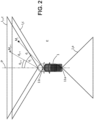
- Figure 1 and Figure 2 illustrate a vehicle 1 according to one embodiment of the disclosure.
- the vehicle 1 is a wheeled vehicle whose direction can be controlled to follow a specific path P. It should be noted that the disclosure can be applied to a wide range of wheeled vehicles, rear-wheel-steering car, trucks, motorcycles and the like.
- the vehicle 1 is provided with a body 2, bearing at least one wheel 3, which delimits an inside of the vehicle from the environment E of the vehicle 1.
- the vehicle 1 comprises a system 10 for identifying a material composition of an object 20 located in the environment E of the vehicle 1.
- the system 10 comprises at least one sensor 11.
- the system 10 comprises a plurality of sensors 11a, 11b, 11c that are mounted on or inside the body 2 of the vehicle 1.
- the vehicle 1 may be provided with three sensors 11a, 11b, 11c respectively mounted on the back, on the top and the front of the vehicle 1, as illustrated on [ Fig; 1 ].
- the vehicle 1 may comprise only two sensors 11 or a higher number of sensors 11.
- Each sensor 11 generates a continuous stream of point cloud frames of a local volume L j surrounding the sensor 11.
- point cloud frame it is understood a frame generated at a specific time, or during a short interval of acquisition.
- continuous stream of point cloud frames it is understood a succession of point cloud frames, periodically generated or not, organized in a stream of data.
- the senor 11 is able to periodically generate point cloud frames with a given framerate of the continuous stream.
- the framerate can be equal or higher than 20 Hz (Hertz).
- the framerate can also be lower, for instance lower than 20 Hz, even lower than 10 Hz, or even lower than 5 Hz.
- a point cloud frame generated by a sensor 11 is referred to as PCF j
- the time of acquisition of this point cloud frame PCF j is referred as t j
- a local volume L j of the sensor 11 at said time t j is referred as L j .
- the subscript j is the index of the frame in the continuous stream ST, j increasing over time with each newly generated frame.
- the point cloud frames PCF j can also be generated in parallel and asynchronously with other point cloud frames from other sensors 11.
- point cloud frames PCF j a, PCF j b, PCF j c of respective continuous streams STa, STb, STc of the sensors 11a, 11b, 11c may be generated at different respective times t j a, t j b, t j c.
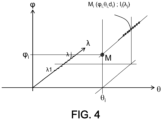
- Each point cloud frame PCF j of a stream ST comprises a set of data points M i in a local coordinate system LCS of the sensor 11.
- a data point M i corresponds to a tridimensional portion, such as a voxel, of the local volume L j .
- a point cloud frame can comprise a high number of data points, such as 10,000 or even 100,0000 data points, or even higher.
- the number of data points can vary, depending on the desired resolution when scanning the environment E of the vehicle 1 with the sensor 11.
- the number of data points of a point cloud frame may also vary according to the framerate that is used; it the framerate is high, the number of data points of a point cloud frame that is needed may be lower.
- a data point M i can correspond to an object 20, or a part of an object 20, located in the environment E of the vehicle 1.
- the local coordinate system LCS is a coordinate system related to the vehicle 1, and more particularly to the sensor 11, for instance with an origin point located at the sensor location.
- the local coordinate system LCS may be a cartesian, cylindrical or polar coordinate system.
- Each data point M i comprises three-dimensional coordinates ( ⁇ i , ⁇ i ,d i ) LCS , in particular in the local coordinate system LCS of the sensor.
- the coordinates ( ⁇ i , ⁇ i ,d i ) LCS are representative of the location of the data point M i in the local volume L j of the sensor 11 at time t j .
- Each data point M i also comprises an intensity value I i associated with the coordinates ( ⁇ i , ⁇ i ,d i ) LCS of the data point M i .
- the intensity value I i is representative of a physical feature associated to the object 20 located at the coordinates ( ⁇ i , ⁇ i ,d i ) LCS of the data point M i , as detailed below.
- the object 20 is movable or moving in the environment E of the vehicle 1.
- movable or moving it is understood that the object 20 can move or moves relative to the vehicle 1. Also, the object 20 can move while the vehicle 1 is motionless, or the object 20 can move while the vehicle 1 is also moving. In the latter case, the object 20 moves relative to a reference frame of the vehicle 1.
- the object 20 can have any path in the environment E.
- the object 20 can have a straight or curved path, in any direction.
- the object can also pivot or change orientation.
- Such object 20 can be of various types. As illustrated on Figure 1 , non-limitative examples of objects 20 include animals, pedestrians or vehicles that can move into the environment E of the vehicle 1.
- the sensor 11 comprises at least one emitter 14 and at least one receiver 15.
- the senor 11 comprises a single emitter 14 and a single receiver 15, preferably as a single unit, as illustrated on Figure 3 .
- the emitter 14 is configured to emit a physical signal 16.
- the physical signal can be a light beam, an electromagnetic wave or an acoustic wave.
- the receiver 15 is configured to receive a reflected physical signal 17, corresponding to the emitted physical signal 16 once reflected in the environment E of the vehicle 1.
- a sensor 11 may for instance comprise a laser rangefinder such as a light detection and ranging (Lidar) module, a radar module, an ultrasonic ranging module, a sonar module, a ranging module using triangulation or any other element able to generated a point cloud frame.
- a laser rangefinder such as a light detection and ranging (Lidar) module, a radar module, an ultrasonic ranging module, a sonar module, a ranging module using triangulation or any other element able to generated a point cloud frame.
- a point cloud frame PCF j corresponds to a full scan of the local volume L j of the sensor 11.
- full scan of the local volume it is understood that the sensor 11 has covered its complete field of view.
- the emitter 14 emits a physical signal that is deflected by a moving mirror rotating along two directions. After a full scan of the local volume, the moving mirror of the sensor 11 is back to its original position and ready to start a new period of rotational movement.
- a full scan of the local volume L j by the sensor 11 is thus the three-dimensional equivalent of an image acquired by a bi-dimensional camera.
- the sensor 11 can operate a full scan by moving along two angular directions ⁇ , ⁇ in the local coordinate system LCS of the sensor 11.
- each data point Mi of a point cloud frame PCF j thus comprises two angular coordinates ⁇ i , ⁇ i .
- the coordinates of a data point M i in the local coordinate system LCS also comprise a radial coordinate, corresponding to the distance d i from the sensor 11 to the data point M i .
- Said distance d i may be computed by comparing timing of the emitted physical signal 16 and the reflected physical signal 17, for instance by comparing the time or the phases of emission and reception between the emitter 14 and the receiver 15.
- a time to digital converter can measure the time of flight (TOF) of the physical signal in order to provide the distance d; to the point M i .
- Each point cloud frame PCF j of a continuous stream ST is generated at a given wavelength ⁇ ej .
- the emitter 14 of a sensor 11 can emit the physical signal in various spectral domains.
- the physical signal 16 can belong to the electromagnetic spectrum, such as ultraviolet, visible or infrared spectrum.
- the emitter 14 of the sensor 11 is configured to emit the physical signal 16 at a single wavelength ⁇ ej or around a single wavelength ⁇ ej , for each point cloud frame PCF j .
- the continuous stream ST can comprise a first point cloud frame PCF 1 generated at a first wavelength ⁇ 1 , a second point cloud frame PCF 2 generated at a second wavelength ⁇ 2 , a third point cloud frame PCF 3 generated at a third wavelength ⁇ 3 , etc.
- the wavelengths ⁇ ej of the emitted physical signal 16 for each point cloud frame PCF j can all be different or not.
- the wavelengths ⁇ ej of the emitted physical signal 16 for each point cloud frame PCF j can be selected in a predetermined order.
- the wavelength ⁇ ej of the emitted physical signal 16 for a point cloud frame PCF j can be chosen incrementally when compared with the wavelength ⁇ ej-1 of the emitted physical signal 16 for the previous point cloud frame PCF j-1 .
- the wavelengths ⁇ ej of the emitted physical signal 16 for each point cloud frame PCF j can be selected in a random manner.
- the receiver 15 is configured to receive the reflected physical signal 17 for each data point M i of the point cloud frame PCF j on a wavelength range ⁇ r .
- the wavelength range ⁇ r of the reflected physical signal 17 can for instance be comprised between 10 nm (nanometers) to and 250 nm.
- the reflected physical signal 17 can be received over a time interval.
- the intensity value I i may correspond to the maximum amplitude of the received reflected physical signal 17 or to the attenuation of the physical signal 16 for a given wavelength. However, other calculations or measures of the intensity values are possible.
- the intensity value provides information on the reflectivity response at the data point M i for a physical signal 16 emitted at the wavelength ⁇ ej .
- a point cloud frame PCF j generated by a sensor 11 at a time t j comprises a full scan of a local volume L j of the sensor 11 that is different from, but may overlap with, another point cloud frame PCF j+1 generated by the same sensor 11 at a different time t j+1 , or generated by another sensor 11.
- each point cloud frame being generated with physical signals 16 emitted at different wavelengths ⁇ ej .
- the system 10 is able to determine that a set of data point of a point cloud frame, corresponding to part or the totality of the object 20, is moving in the environment E.
- the system 10 can observe that a local volume L j of the sensor 11, that was clear from any object at a time t j (and thus clear from any data point), now comprises a set of data points at another time t j+1 .
- the system then deduces that the object 20 observed in said local volume L j at time t j+1 .is a moving object that has moved between times t j and t j+1 .
- a set of data points corresponds to a moving object 20.
- the system 10 can be used.
- any other external element such as another light source, can be used for instance.
- the system 10 further comprises a central processing unit 12 connected to the sensor 11 or the plurality of sensors 11.
- the central processing unit 12 can be integrated inside the sensors 11 as a single unit or alternatively, can be a distinct unit secured inside a vehicle 1. In some embodiments, the central processing unit 12 may be a part of the vehicle processing unit.
- the vehicle may be able to operate a self-driving or a driving assistance algorithm to drive or assist the driving of the vehicle 10, in particular by using the information provided by the system 10.
- the system 10 may control several actuators 4 connected to several vehicle elements 5a, 5b, 5c, 5c, such as the drivetrain, the brakes, etc.
- the central processing unit 12 may communicate with the sensors 11 by wireless communication, such as radio or optic communications, or by wired communications, for instance if the central processing unit 12 and the sensor 11 are mounted on the same vehicle 1.
- the central processing unit 12 may communicate with the sensors 11 by using some intermediary element, in particular for long range communication.
- the central processing unit 12 is configured to continuously receive the continuous stream ST from the sensor. 11
- the central processing unit 12 stores the continuous stream in a memory 13.
- the memory 13 might be integrated in the central processing unit 12.
- the central processing unit 12 is configured to dynamically determine the coordinates ( ⁇ i , ⁇ i ,d i ) GCS of each data point M l of a point cloud frame PCF j in a global coordinate system GCS of the environment E surrounding the vehicle 1.
- the global coordinate system GCS may in particular be independent of the vehicle 1 and of the movement of the vehicle 1.
- the global coordinate system GCS can for instance relate to an International Terrestrial Reference Frame (ITRF).
- ITRF International Terrestrial Reference Frame
- the global coordinate system GCS may also be dependent on the local reference frame of the vehicle 1, for instance by being defined from the local coordinate system LCS associated to a sensor 11.
- the central processing unit 12 is then configured to determine a reflectivity response 30 of the object 20 and to identify the material composition of the object 20 located in the environment E from the reflectivity response 30.
- material composition it is understood the composition of the material forming the object 20 or the surface of the object 20.
- Non limitative examples of material composition include metal, plastics, glass, skin, plant material, ice, snow, asphalt, cement, water etc. More generally, material composition can be of any object that is located in the environment E of the vehicle 1.
- a point cloud frame PCF j of a continuous stream ST is generated by emitting a physical signal 16 at a given wavelength ⁇ ej .
- the point cloud frame PCF j comprises a set of data points M i , in the local coordinate system LCS.
- a data point M i comprises coordinates ( ⁇ i , ⁇ i ,d i ) LCS of an object 20 in a local volume L j at time t j in a local coordinate system LCS.
- the data point M i also comprises an intensity value I i representative of the physical signal 17 reflected on the object 20.
- a second step B from the point cloud frame PCF j , the central processing unit 12 dynamically determines the coordinates (( ⁇ i , ⁇ i ,d i ) GCS of the data point M i of the point cloud frame PCF j in the global coordinate system GCS.
- the central processing unit 12 determines an aligned point cloud frame PCF j,align in the global coordinate system GCS by comparing the point cloud frame PCF j with a global cumulated tridimensional map CM.
- the global cumulated tridimensional map CM is also sometimes referred as a global tridimensional map, a global 3D map or a 3D map. These expressions cover the same concept and the same feature of the disclosure.
- the global cumulated tridimensional map CM is a map of the environment E of the vehicle 1 in the global coordinate system GCS.
- the second step B comprises the operation of creating the global cumulated tridimensional map CM from the point cloud frame PCF j .
- the point cloud frame PCF j may be the first received point cloud frame PCF 1 from a sensor 11.
- a global coordinate system GCS of the environment may then for instance be defined from the local coordinate system LCS associated to the sensor 11.
- the second step B comprises the operation of determining an aligned point cloud frame PCF j,align in the global coordinate system GCS of the environment E of the vehicle.
- the alignment may be performed for instance by using image registration, or Simultaneous Localization and Mapping (SLAM) such as the method disclosed in the patent document WO2018/091651 .
- SLAM Simultaneous Localization and Mapping
- determining an aligned point cloud frame PCF j,align is performed by comparing the generated point cloud frame PCF j with the global cumulated tridimensional map CM of the environment E.
- the aligned point cloud frame PCF j,align may be computed only from the point clouds generated by the sensor or the plurality of sensors 11 and without additional positioning information.
- the computation of the aligned point cloud frame PCF j,align does not require other input data than the point cloud frames generated by the sensors 11 and the global cumulated tridimensional map CM.
- no additional positioning or orientation element such as a GPS or an accelerometer, is required.
- no assumption has to be made on the location or movement of the sensor.
- the central processing unit 12 tries to align said point cloud frame PCF j so that at least a portion of the aligned point cloud frame matches at least a portion of the global cumulated tridimensional map CM.
- the global cumulated tridimensional map CM is then updated by merging said aligned point cloud frame PCF j,align with the global cumulated tridimensional map CM.
- the aligned point cloud frame PCF j,align is merged with said at least one portion of the global cumulated tridimensional map CM.
- the central processing unit can determine the coordinates (( ⁇ i , ⁇ i ,d i ) GCS of the data points M i of the object in the global coordinate system GCS.
- the central processing unit 12 stores in the memory 13 the intensity value I i and the coordinates (( ⁇ i, ⁇ j, d i ) GCS of the data point M i in the global coordinate system GCS.
- a portion of data points of the aligned point cloud frame can match the global cumulated tridimensional map CM.
- This portion of data points corresponds to a part of the environment E that has not move with time (such as mapping of buildings, road, etc.)
- the set of data points corresponding to the object 20 cannot match the global cumulated tridimensional map CM. This is due to the fact that the global cumulated tridimensional map CM was created from earlier point cloud frames when the moving object was not present, or was located elsewhere, in the environment E. T
- the set of data points corresponding to the object 20 cannot therefore be aligned with the data points from the rest of the environment E.
- the system 10 can then determine the coordinates ( ⁇ i , ⁇ i ,d i ) GCS of the set of data points M i of the object 20 in the global coordinate system GCS at a given time. It is thus possible to know the location and/or orientation of the object 20 at different times for the respective point cloud frames.
- Steps A to D are repeated with one of the sensors 11 generating a second point cloud frame of a continuous stream by emitting the physical signal at a second wavelength ⁇ j+1 .
- steps A to D can be repeated several times, and more particularly more than two times, so that several point cloud frames are generated by emitting the physical signal at several other wavelengths.
- Some of the subsequent point cloud frames can be emitted by the same sensors or by several sensors.
- At least two, and preferably a higher number of intensity values can be associated to the same object 20 in the global coordinate system GCS.
- the wavelengths of the corresponding emitted physical signals can belong to different spectral domains, which can be useful to acquire intensity values for various types of physical signals (infrared, visible light, ultraviolet, etc.).
- the central processing unit 12 determines the reflectivity response 30 of the object 20 from the intensity values acquired for the object 20 with each point cloud frame PCF j .
- the reflectivity response 30 is obtained by aggregating the intensity values I acquired at several different wavelengths ⁇ ej .
- the reflectivity response 30 is obtained from the reflected physical signals 17 1 , 17 2 , 17 3 , 17 4 , 17 5 corresponding to physical signals emitted at several different wavelengths ⁇ e1 , ⁇ e2 , ⁇ e3 , ⁇ e4 , ⁇ e5 once reflected on the object 20. From this reflected physical signals 17 1 , 17 2 , 17 3 , 17 4 , 17 5 , intensity values I 1 , I 2 , I 3 , I 4 , I 5 , such as the maximum amplitude value, can be obtained.
- a step F the central processing unit 12 identifies the material composition of the object 20.
- the reflectivity response 30 can then be compared with reference reflectivity responses of known materials stored in a library.
- the library can be stored in the memory 13 of the central processing unit 12.
- one or several sensors 11 of the vehicle 1 may be able to acquire sets of data points from the object 20 according to different view angles.
- Several point cloud frames PCF j permit to obtain these different view angles.
- Figure 6 illustrates a car 20 that moves relative to the vehicle 1.
- the vehicle 1 can thus acquire different set of data points of the car 20 for different point cloud frames at different times (two point cloud frames are illustrated with the car 20 and the vehicle 1 respectively in solid lines and in dash lines on Figure 6 ).
- 3D reconstruction can be useful for obtaining more detailed information or features concerning the object 20.
- Such 3D reconstruction information can thus be combined or compared with material composition of the object 20 obtained thanks to the method described above.
- the 3D reconstruction of the object 20 permit to determine that the object is a car, it can be expected the body of this car to be mainly made of metal. It can then be checked whether this information is consistent with the material composition obtained from the reflectivity response of the object.
- the method can be implemented even though the relative positions and orientations between the sensors are unknown.
- the vehicle 1 can implement the method in any known driving conditions, for instance during daytime or night-time, in various weather conditions, in various road conditions, etc.
- the timeframe of the point cloud frames is determined and/or managed by the central processing unit 13. This way, there is no need to communicate with a remote server for instance that would be located outside of the vehicle 1.
- the successive physical signals emitted by the sensor 11 for the respective point cloud frames can be selected randomly.
- a random selection permits to prevent any interference with other physical signals 16 that could be emitted by other vehicles or devices in the environment E.
- the system 10 is thus safer and robust against fake signals that could undermine the security and integrity of the vehicle for instance.
- the successive physical signal 16 emitted by the sensor 11 for the respective point cloud frames can be selected in a predetermined order.
- the wavelength of the emitted physical signal 16 for a point cloud frame can depend on the reflected physical signal 17 acquired for a previous point cloud frame.
- the wavelength of the emitted physical signal 16 for the point cloud frame should be selected so as to discriminate specifically between these two materials.
- the wavelengths of the successive emitted signals 16 can be selected so as to converge toward a probability threshold above which material composition of the object 20 is considered to be determined. Such convergence can be implemented by using any classification method, such as a decision tree.
Landscapes
- Engineering & Computer Science (AREA)
- Physics & Mathematics (AREA)
- General Physics & Mathematics (AREA)
- Radar, Positioning & Navigation (AREA)
- Remote Sensing (AREA)
- Computer Networks & Wireless Communication (AREA)
- Electromagnetism (AREA)
- Theoretical Computer Science (AREA)
- Mechanical Engineering (AREA)
- Transportation (AREA)
- Automation & Control Theory (AREA)
- Software Systems (AREA)
- Computer Graphics (AREA)
- Life Sciences & Earth Sciences (AREA)
- Pathology (AREA)
- Health & Medical Sciences (AREA)
- Chemical & Material Sciences (AREA)
- Analytical Chemistry (AREA)
- Biochemistry (AREA)
- General Health & Medical Sciences (AREA)
- Immunology (AREA)
- Multimedia (AREA)
- Human Computer Interaction (AREA)
- Computer Hardware Design (AREA)
- Geometry (AREA)
- Architecture (AREA)
- General Engineering & Computer Science (AREA)
- Signal Processing (AREA)
- Optical Radar Systems And Details Thereof (AREA)
- Investigating Or Analysing Materials By Optical Means (AREA)
- Mechanical Optical Scanning Systems (AREA)
- Traffic Control Systems (AREA)
- Radar Systems Or Details Thereof (AREA)
- Measurement Of Velocity Or Position Using Acoustic Or Ultrasonic Waves (AREA)
Claims (18)
- Verfahren zum Identifizieren eines Zusammensetzungsmaterials eines Objekts (20), das sich in einer Umgebung (E) befindet, die mindestens eine Vorrichtung (1) umgibt, wobei sich das Objekt (20) relativ zu der Vorrichtung (1) bewegt, bei dem mindestens ein Sensor (11) an der Vorrichtung (1) angebracht ist und mit mindestens einer zentralen Verarbeitungseinheit (12) kommuniziert, wobei:/A/ der Sensor (11) einen Punktwolkenrahmen (PCFj) eines kontinuierlichen Stroms (ST) durch Aussenden eines physikalischen Signals (16) mit einer ersten Wellenlänge (λej) einer Vielzahl unterschiedlicher Wellenlängen erzeugt, wobei der Punktwolkenrahmen (PCFj) eine Menge von Datenpunkten (Mi) umfasst, von denen mindestens ein Datenpunkt (Mi) Koordinaten (ϕi,θi,di)LCS des Objekts (20) in einem lokalen Volumen (Lj) umfasst, das den Sensor (11) zum Zeitpunkt tj in einem lokalen Koordinatensystem (CS) des Sensors (11) umgibt, wobei der Datenpunkt (Mi) außerdem einen Intensitätswert (Ii) eines reflektierten physikalischen Signals (17) umfasst, das dem ausgesendeten physikalischen Signal (16) entspricht, nachdem es an dem Objekt (20) reflektiert wurde,/B/ die zentrale Verarbeitungseinheit (12) den Punktwolkenrahmen (PCFj) empfängt und die Koordinaten (ϕi,θi,di)GCS des Datenpunkts (Mi) des Punktwolkenrahmens (PCFj) in einem globalen Koordinatensystem (GCS) der Umgebung (E), die die Vorrichtung (1) umgibt, bestimmt, wobei der Intensitätswert (Ii) den Koordinaten (ϕi,θi,di)GCS jedes Datenpunkts (Mi) im globalen Koordinatensystem (GCS) zugeordnet ist,/C/ die zentrale Verarbeitungseinheit (12) die Koordinaten (ϕi,θi,di)GCS des Objekts (20) zum Zeitpunkt tj im globalen Koordinatensystem (GCS) bestimmt,/D/ die zentrale Verarbeitungseinheit (12) in einem Speicher (13) die Koordinaten (ϕi,θi,di)GCS des Objekts (20) im globalen Koordinatensystem (GCS) zum Zeitpunkt tj speichert,- Schritte /A/ bis /D/ mit dem Sensor (11) oder einem anderen Sensor (11) wiederholt werden, wodurch ein weiterer Punktwolkenrahmen (PCFj+1) durch Aussenden eines weiteren physikalischen Signals bei einer zweiten Wellenlänge (λej+1) der Vielzahl unterschiedlicher Wellenlängen zum Zeitpunkt tj+1 erzeugt wird, so dass mindestens zwei Intensitätswerte (Ii,j, Ii,j+1) den Koordinaten (ϕi,θi,di)GCS des Objekts (20) im globalen Koordinatensystem (GCS) zu zwei verschiedenen Zeitpunkten (tj, tj+1) zugeordnet sind,/E/ die zentrale Verarbeitungseinheit (12) aus den mindestens zwei Intensitätswerten (Ii,j, Ii,j+1) eine Reflexionsantwort (30) des Objekts (20) bestimmt, und/F/ die zentrale Verarbeitungseinheit das Zusammensetzungsmaterial des Objekts (20) identifiziert, indem sie die in Schritt /E/ bestimmte Reflexionsantwort (30) mit Referenzreflexionsantworten bekannter Materialien vergleicht, die in einer Bibliothek gespeichert sind, und
wobei die zentrale Verarbeitungseinheit (12) die Koordinaten (ϕi,θi,di)GCS des Objekts (20) zum Zeitpunkt tj in einem globalen Koordinatensystem (GCS) bestimmt durch:- Vergleichen des Punktwolkenrahmens (PCFj) mit einer globalen kumulierten dreidimensionalen Karte (CM) der Umgebung (E), um einen ausgerichteten Punktwolkenrahmen (PCFj,align) im globalen Koordinatensystem (GCS) zu bestimmen, und- Identifizieren eines Satzes von Datenpunkten des Punktwolkenrahmens (PCFj), die nicht im globalen Koordinatensystem (GCS) ausgerichtet werden können, so dass dieser Satz von Datenpunkten dem bewegten Objekt (20) entspricht. - Verfahren nach Anspruch 1, wobei die zentrale Verarbeitungseinheit (12) die Koordinaten (ϕi,θi,di)GCS jedes Datenpunkts (Mi) des Punktwolkenrahmens (PCFj) im globalen Koordinatensystem (GCS) der die Vorrichtung (1) umgebenden Umgebung (E) bestimmt durch:- Vergleichen des Punktwolkenrahmens (PCFj) mit einer globalen kumulierten dreidimensionalen Karte (CM) der Umgebung (E), um einen ausgerichteten Punktwolkenrahmen (PCFj,align) im globalen Koordinatensystem (GCS) zu bestimmen, und- Aktualisieren der globalen kumulierten dreidimensionalen Karte durch Zusammenführen des ausgerichteten Punktwolkenrahmens (PCFj,align) mit der globalen kumulierten dreidimensionalen Karte (CM).
- Verfahren nach einem der vorhergehenden Ansprüche, das außerdem einen zusätzlichen Schritt zum Erhalten einer dreidimensionalen Rekonstruktion des Objekts (20) aus den Koordinaten (ϕi,θi,di)GCS des Objekts (20) im globalen Koordinatensystem (GCS) und zu mindestens zwei verschiedenen Zeitpunkten (tj, tj+1) umfasst.
- Verfahren nach einem der vorhergehenden Ansprüche, wobei der Sensor (11) mindestens einen Sender (14) und mindestens einen Empfänger (15) umfasst, wobei der Sender (14) dazu konfiguriert ist, ein physikalisches Signal auszusenden, und der Empfänger (15) dazu konfiguriert ist, das ausgesendete physikalische Signal (16) zu empfangen, nachdem es an dem Objekt (20) reflektiert wurde.
- Verfahren nach Anspruch 4, wobei der Sensor (11) den Sender (14) und den Empfänger (15) als eine Einheit umfasst.
- Verfahren nach einem der vorhergehenden Ansprüche, wobei die Wellenlängen der ausgesendeten physikalischen Signale (16) unter der Vielzahl von verschiedenen Wellenlängen für die Punktwolkenrahmen (PCFj) nach dem Zufallsprinzip ausgewählt werden.
- Verfahren nach einem der Ansprüche 1 bis 5, wobei die Wellenlängen der ausgesendeten physikalischen Signale (16) unter der Vielzahl von verschiedenen Wellenlängen für die Punktwolkenrahmen (PCFj) in einer vorgegebenen Reihenfolge ausgewählt werden.
- Verfahren nach einem der vorhergehenden Ansprüche, wobei die Vorrichtung (1) eine Vielzahl von Sensoren (11) umfasst, wobei die Sensoren (11) jeweils einen Punktwolkenrahmen (PCFj) erzeugen können durch Aussenden eines physikalischen Signals (16) mit einer Wellenlänge, die in verschiedenen Spektralbereichen liegt.
- Verfahren nach Anspruch 8, wobei alle Sensoren drahtlos mit der zentralen Verarbeitungseinheit (12) kommunizieren.
- Verfahren nach einem der vorhergehenden Ansprüche, wobei ein Punktwolkenrahmen (PCFj) einem vollständigen Scan des lokalen Volumens (Lj) des Sensors (11) entspricht.
- Verfahren nach einem der vorhergehenden Ansprüche, wobei die Koordinaten (ϕi,θi,di)LCS des Objekts (20) im lokalen Koordinatensystem (LCS) des Sensors (11) zwei Winkelkoordinaten (θi, ϕi) und eine Radialkoordinate (di) umfasst.
- Verfahren nach Anspruch 11, wobei die Radialkoordinate (d) dem Abstand vom Sensor (11) zum Datenpunkt (Mi) entspricht, wobei der Abstand (di) durch einen zeitlichen Vergleich des ausgesendeten physikalischen Signals (16) und des reflektierten physikalischen Signals (17) berechnet wird.
- Verfahren nach einem der vorhergehenden Ansprüche, wobei die Schritte /A/
bis /D/ mindestens viermal wiederholt werden, so dass mindestens vier Intensitätswerte (Ii,j, Ii,j+1) den Koordinaten (ϕi,θi,di)GCS des Objekts (20) im globalen Koordinatensystem (GCS) zugeordnet sind. - Verfahren nach einem der vorhergehenden Ansprüche, wobei das physikalische Signal (16) ein Lasersignal ist.
- Verfahren nach einem der vorhergehenden Ansprüche, wobei die Vorrichtung (1) ein Fahrzeug ist, das sich in der Umgebung (E) bewegen kann.
- System (10) zum Identifizieren des Zusammensetzungsmaterials eines Objekts (20), das sich in einer Umgebung (E) befindet, die mindestens eine Vorrichtung (1) umgibt, wobei sich das Objekt (20) relativ zu der Vorrichtung (1) bewegt, wobei das System (10) umfasst:- eine Vielzahl von Sensoren (11), die so konfiguriert sind, dass sie an der mindestens einen Vorrichtung (1) angebracht werden können, wobei jeder Sensor (11i) so konfiguriert ist, dass ein kontinuierlicher Strom (ST) von Punktwolkenrahmen (PCFj) parallel und asynchron zu den anderen Sensoren (11) durch Aussenden eines physikalischen Signals mit einer Wellenlänge (λej) aus einer Vielzahl von verschiedenen Wellenlängen erzeugt wird, wobei der Punktwolkenrahmen (PCFj) eine Menge von Datenpunkten (Mi) umfasst, wobei jeder Datenpunkt (Mi) Koordinaten (ϕi,θi,di)LCS des Objekts (20) in einem lokalen Volumen (Lj) der den Sensor (11) umgebenden Umgebung zum Zeitpunkt tj in einem lokalen Koordinatensystem (CS) des Sensors (11) umfasst, wobei jeder Datenpunkt (Mi) außerdem einen Intensitätswert Ii) eines reflektierten physikalischen Signals (17) umfasst, das dem ausgesendeten physikalischen Signal (16) entspricht, nachdem es an dem Objekt (20) reflektiert wurde,- eine zentrale Verarbeitungseinheit (12), die so konfiguriert ist, dass sie mit jedem Sensor (11) kommuniziert, um kontinuierlich die kontinuierlichen Ströme (ST) von den Sensoren (11) zu empfangen, die Koordinaten (ϕi,θi,di)GCS jedes Datenpunkts (Mi) des Punktwolkenrahmens (PCFj) in einem globalen Koordinatensystem (GCS) der Umgebung (E), die die Vorrichtung (1) umgibt, zu bestimmen, die Koordinaten (ϕi,θi,di)GCS des Objekts (20) im globalen Koordinatensystem (GCS) zum Zeitpunkt tj zu bestimmen, und in einem Speicher (13) den Intensitätswert (Ii) und die Koordinaten (ϕi,θi,di)GCS im globalen Koordinatensystem (GCS) zu speichern,wobei die zentrale Verarbeitungseinheit dazu konfiguriert ist, aus den Intensitätswerten eine Reflexionsantwort des Objekts (20) zu bestimmen und das Zusammensetzungsmaterial des Objekts (20) durch Vergleichen der Reflexionsantwort (30) mit Referenzreflexionsantworten bekannter Materialien, die in einer Bibliothek gespeichert sind, zu identifizieren,und die Koordinaten (ϕi,θi,di)GCS des Objekts (20) zum Zeitpunkt tj in einem globalen Koordinatensystem (GCS) zu bestimmen durch:- Vergleichen des Punktwolkenrahmens (PCFj) mit einer globalen kumulierten dreidimensionalen Karte (CM) der Umgebung (E), um einen ausgerichteten Punktwolkenrahmen (PCFj,align) im globalen Koordinatensystem (GCS) zu bestimmen, und- Identifizieren eines Satzes von Datenpunkten des Punktwolkenrahmens (PCFj), die nicht im globalen Koordinatensystem (GCS) ausgerichtet werden können, so dass dieser Satz von Datenpunkten dem bewegten Objekt (20) entspricht.
- Autonomes oder halbautonomes Fahrzeug (10), das ein System (10) nach Anspruch 16 umfasst.
- Nicht flüchtiges, computerlesbares Speichermedium, auf dem ein Computerprogramm gespeichert ist, das Programmbefehle umfasst, wobei das Computerprogramm in eine zentrale Verarbeitungseinheit (12) des Systems (10) nach Anspruch 16 geladen werden kann und so konfiguriert ist, dass es die zentrale Verarbeitungseinheit (12) veranlasst, die Schritte eines Verfahrens gemäß einem der Ansprüche 1 bis 15 auszuführen, wenn das Computerprogramm von der zentralen Verarbeitungseinheit (12) ausgeführt wird.
Applications Claiming Priority (3)
| Application Number | Priority Date | Filing Date | Title |
|---|---|---|---|
| US201862644746P | 2018-03-19 | 2018-03-19 | |
| US201862745370P | 2018-10-14 | 2018-10-14 | |
| PCT/EP2019/056843 WO2019180021A1 (en) | 2018-03-19 | 2019-03-19 | Methods and systems for identifying material composition of moving objects |
Publications (3)
| Publication Number | Publication Date |
|---|---|
| EP3769115A1 EP3769115A1 (de) | 2021-01-27 |
| EP3769115C0 EP3769115C0 (de) | 2025-01-29 |
| EP3769115B1 true EP3769115B1 (de) | 2025-01-29 |
Family
ID=65904405
Family Applications (3)
| Application Number | Title | Priority Date | Filing Date |
|---|---|---|---|
| EP19712956.2A Pending EP3769113A1 (de) | 2018-03-19 | 2019-03-19 | Multispektraler lidar-transceiver |
| EP19713397.8A Withdrawn EP3769114A1 (de) | 2018-03-19 | 2019-03-19 | Verfahren und systeme zur identifizierung der materialzusammensetzung von objekten |
| EP19713398.6A Active EP3769115B1 (de) | 2018-03-19 | 2019-03-19 | Verfahren und systeme zur identifizierung der materialzusammensetzung bewegter objekte |
Family Applications Before (2)
| Application Number | Title | Priority Date | Filing Date |
|---|---|---|---|
| EP19712956.2A Pending EP3769113A1 (de) | 2018-03-19 | 2019-03-19 | Multispektraler lidar-transceiver |
| EP19713397.8A Withdrawn EP3769114A1 (de) | 2018-03-19 | 2019-03-19 | Verfahren und systeme zur identifizierung der materialzusammensetzung von objekten |
Country Status (6)
| Country | Link |
|---|---|
| US (3) | US20210117702A1 (de) |
| EP (3) | EP3769113A1 (de) |
| JP (3) | JP2021518560A (de) |
| CA (3) | CA3093512A1 (de) |
| ES (1) | ES3022993T3 (de) |
| WO (3) | WO2019180020A1 (de) |
Families Citing this family (10)
| Publication number | Priority date | Publication date | Assignee | Title |
|---|---|---|---|---|
| US20210223363A1 (en) | 2020-01-16 | 2021-07-22 | Outsight SA | Object detection on a path of travel and obstacle detection on railway tracks using free space information |
| EP4094092A1 (de) * | 2020-01-24 | 2022-11-30 | Outsight | Multispektraler lidar, der eine spektrale verzögerungseinheit umfasst |
| EP3928066B1 (de) * | 2020-01-30 | 2022-11-30 | Outsight | Multispektraler aktiver fernsensor |
| DE102021111224A1 (de) | 2021-04-30 | 2022-11-03 | Audi Aktiengesellschaft | Computerimplementiertes Verfahren zur Ermittlung einer dreidimensionalen Karte und zur Simulation einer Sensordatenaufnahme, Ermittlungseinrichtung, Computerprogramm und elektronisch lesbarer Datenträger |
| CN113807182B (zh) * | 2021-08-17 | 2024-02-27 | 北京地平线信息技术有限公司 | 用于处理点云的方法、装置、介质以及电子设备 |
| JP7807310B2 (ja) * | 2022-04-27 | 2026-01-27 | 株式会社Screenホールディングス | 検知装置、および、検知方法 |
| EP4486183A4 (de) * | 2022-05-25 | 2025-06-11 | TriEye Ltd. | System und verfahren zur verwendung von swir-erfassung in reinigungsmaschinen |
| EP4312060A1 (de) * | 2022-07-26 | 2024-01-31 | Nokia Technologies Oy | Materialempfindliches lidar |
| JP7658473B1 (ja) | 2024-01-15 | 2025-04-08 | 日本電気株式会社 | 測定装置、測定方法及びプログラム |
| WO2025197086A1 (ja) * | 2024-03-22 | 2025-09-25 | 富士通株式会社 | 測定プログラム、測定方法、および測定装置 |
Family Cites Families (37)
| Publication number | Priority date | Publication date | Assignee | Title |
|---|---|---|---|---|
| JPH0659038A (ja) * | 1992-08-07 | 1994-03-04 | Nissan Motor Co Ltd | 車両用レーザレーダ |
| US7049597B2 (en) * | 2001-12-21 | 2006-05-23 | Andrew Bodkin | Multi-mode optical imager |
| JP3915742B2 (ja) * | 2003-06-20 | 2007-05-16 | 株式会社デンソー | 車両用物体認識装置 |
| TWI245473B (en) * | 2003-06-30 | 2005-12-11 | Delta Electronics Inc | Tunable laser source and wavelength selecting method thereof |
| US7339670B2 (en) | 2005-07-29 | 2008-03-04 | Lockheed Martin Coherent Technologies, Inc. | Wavelength normalized depolarization ratio lidar |
| US8244026B2 (en) * | 2008-01-09 | 2012-08-14 | Tiltan Systems Engineering Ltd. | Apparatus and method for automatic airborne LiDAR data processing and mapping using data obtained thereby |
| JP2010175435A (ja) * | 2009-01-30 | 2010-08-12 | Nippon Hoso Kyokai <Nhk> | 三次元情報検出装置及び三次元情報検出方法 |
| US8269652B2 (en) | 2009-04-02 | 2012-09-18 | GM Global Technology Operations LLC | Vehicle-to-vehicle communicator on full-windshield head-up display |
| US20120113412A1 (en) * | 2009-05-29 | 2012-05-10 | Toyota Jidosha Kabushiki Kaisha | Spectrum measuring apparatus for mover |
| JP2012189535A (ja) * | 2011-03-14 | 2012-10-04 | Ihi Corp | 植生検出装置及び植生検出方法 |
| JP5822255B2 (ja) * | 2011-04-14 | 2015-11-24 | 株式会社豊田中央研究所 | 対象物識別装置及びプログラム |
| US9097800B1 (en) * | 2012-10-11 | 2015-08-04 | Google Inc. | Solid object detection system using laser and radar sensor fusion |
| JP6015367B2 (ja) * | 2012-11-09 | 2016-10-26 | 株式会社デンソー | レーダ装置 |
| US10598769B2 (en) * | 2013-05-06 | 2020-03-24 | Danmarks Tekniske Universitet | Coaxial direct-detection LIDAR-system |
| JP6184237B2 (ja) | 2013-08-07 | 2017-08-23 | 株式会社東芝 | 3次元データの処理装置、その処理方法及びその処理プログラム |
| US9315192B1 (en) * | 2013-09-30 | 2016-04-19 | Google Inc. | Methods and systems for pedestrian avoidance using LIDAR |
| JP6354556B2 (ja) * | 2014-12-10 | 2018-07-11 | 株式会社デンソー | 位置推定装置、位置推定方法、位置推定プログラム |
| JP2016151565A (ja) * | 2015-02-19 | 2016-08-22 | 富士通株式会社 | レーザ測距装置及びレーザ測距方法 |
| WO2017079341A2 (en) * | 2015-11-04 | 2017-05-11 | Zoox, Inc. | Automated extraction of semantic information to enhance incremental mapping modifications for robotic vehicles |
| US9612123B1 (en) * | 2015-11-04 | 2017-04-04 | Zoox, Inc. | Adaptive mapping to navigate autonomous vehicles responsive to physical environment changes |
| WO2017095817A1 (en) | 2015-11-30 | 2017-06-08 | Luminar Technologies, Inc. | Lidar system with distributed laser and multiple sensor heads and pulsed laser for lidar system |
| JP6658001B2 (ja) * | 2016-01-27 | 2020-03-04 | 株式会社リコー | 位置推定装置、プログラム、位置推定方法 |
| JP2017138813A (ja) | 2016-02-04 | 2017-08-10 | 三菱電機株式会社 | 保全点検システム、保全点検携帯端末および保全点検作業支援方法 |
| JP6938846B2 (ja) | 2016-03-14 | 2021-09-22 | 株式会社デンソー | 物体認識装置 |
| CN109154661A (zh) * | 2016-03-19 | 2019-01-04 | 威力登激光雷达有限公司 | 用于基于lidar的3-d成像的集成照射和检测 |
| WO2017176901A1 (en) * | 2016-04-07 | 2017-10-12 | Arizona Board Of Regents On Behalf Of The University Of Arizona | Diffraction-based light beam scanner |
| US10761195B2 (en) * | 2016-04-22 | 2020-09-01 | OPSYS Tech Ltd. | Multi-wavelength LIDAR system |
| EP3324209A1 (de) | 2016-11-18 | 2018-05-23 | Dibotics | Verfahren und systeme zur fahrzeugumgebungskartenerzeugung und -aktualisierung |
| US20180284246A1 (en) * | 2017-03-31 | 2018-10-04 | Luminar Technologies, Inc. | Using Acoustic Signals to Modify Operation of a Lidar System |
| CN107179086B (zh) * | 2017-05-24 | 2020-04-24 | 北京数字绿土科技有限公司 | 一种基于激光雷达的制图方法、装置及系统 |
| EP3657216A4 (de) * | 2017-07-18 | 2021-04-07 | Pioneer Corporation | Optische vorrichtung |
| US10163017B2 (en) | 2017-09-01 | 2018-12-25 | GM Global Technology Operations LLC | Systems and methods for vehicle signal light detection |
| WO2019157193A1 (en) * | 2018-02-09 | 2019-08-15 | Nvidia Corporation | Controlling autonomous vehicles using safe arrival times |
| US11698445B2 (en) * | 2018-09-04 | 2023-07-11 | GM Global Technology Operations LLC | Automotive Lidar with multi-spectral depth imaging and discrete scanning mechanism |
| US12204050B2 (en) * | 2018-09-14 | 2025-01-21 | Magna Electronics, Llc | Scanning assembly for a detection system |
| US11079546B2 (en) * | 2019-04-22 | 2021-08-03 | Blackmore Sensors & Analytics, LLC. | Providing spatial displacement of transmit and receive modes in LIDAR system |
| US10948598B1 (en) * | 2020-11-25 | 2021-03-16 | Aeva, Inc. | Coherent LiDAR system utilizing polarization-diverse architecture |
-
2019
- 2019-03-19 CA CA3093512A patent/CA3093512A1/en active Pending
- 2019-03-19 EP EP19712956.2A patent/EP3769113A1/de active Pending
- 2019-03-19 US US16/981,820 patent/US20210117702A1/en not_active Abandoned
- 2019-03-19 CA CA3094264A patent/CA3094264A1/en active Pending
- 2019-03-19 JP JP2020551417A patent/JP2021518560A/ja not_active Ceased
- 2019-03-19 WO PCT/EP2019/056842 patent/WO2019180020A1/en not_active Ceased
- 2019-03-19 WO PCT/EP2019/056841 patent/WO2019180019A1/en not_active Ceased
- 2019-03-19 WO PCT/EP2019/056843 patent/WO2019180021A1/en not_active Ceased
- 2019-03-19 US US16/981,795 patent/US12000781B2/en active Active
- 2019-03-19 ES ES19713398T patent/ES3022993T3/es active Active
- 2019-03-19 EP EP19713397.8A patent/EP3769114A1/de not_active Withdrawn
- 2019-03-19 US US16/981,844 patent/US11994466B2/en active Active
- 2019-03-19 JP JP2020551259A patent/JP2021518557A/ja active Pending
- 2019-03-19 CA CA3093503A patent/CA3093503A1/en active Pending
- 2019-03-19 JP JP2020551260A patent/JP2021518558A/ja active Pending
- 2019-03-19 EP EP19713398.6A patent/EP3769115B1/de active Active
Also Published As
| Publication number | Publication date |
|---|---|
| US20210117702A1 (en) | 2021-04-22 |
| JP2021518557A (ja) | 2021-08-02 |
| WO2019180019A1 (en) | 2019-09-26 |
| WO2019180020A1 (en) | 2019-09-26 |
| JP2021518560A (ja) | 2021-08-02 |
| US20210033533A1 (en) | 2021-02-04 |
| CA3093512A1 (en) | 2019-09-26 |
| CA3094264A1 (en) | 2019-09-26 |
| EP3769114A1 (de) | 2021-01-27 |
| US20210041537A1 (en) | 2021-02-11 |
| CA3093503A1 (en) | 2019-09-26 |
| WO2019180021A1 (en) | 2019-09-26 |
| JP2021518558A (ja) | 2021-08-02 |
| US11994466B2 (en) | 2024-05-28 |
| EP3769115C0 (de) | 2025-01-29 |
| US12000781B2 (en) | 2024-06-04 |
| ES3022993T3 (en) | 2025-05-29 |
| EP3769113A1 (de) | 2021-01-27 |
| EP3769115A1 (de) | 2021-01-27 |
Similar Documents
| Publication | Publication Date | Title |
|---|---|---|
| EP3769115B1 (de) | Verfahren und systeme zur identifizierung der materialzusammensetzung bewegter objekte | |
| US11593950B2 (en) | System and method for movement detection | |
| JP7506829B2 (ja) | 自律車両用途のための速度推定および物体追跡 | |
| JP6827627B2 (ja) | ビークル環境マップを生成および更新するための方法およびシステム | |
| CN110389586B (zh) | 用于地面和自由空间探测的系统和方法 | |
| US10131446B1 (en) | Addressing multiple time around (MTA) ambiguities, particularly for lidar systems, and particularly for autonomous aircraft | |
| US20240134054A1 (en) | Point cloud segmentation using a coherent lidar for autonomous vehicle applications | |
| US10024965B2 (en) | Generating 3-dimensional maps of a scene using passive and active measurements | |
| US10317519B2 (en) | Systems and methods for environment sensing using radar | |
| US10078335B2 (en) | Ray tracing for hidden obstacle detection | |
| CN109307869B (zh) | 用于增加激光雷达探测器的视场的设备和照明装置 | |
| US10317524B2 (en) | Systems and methods for side-directed radar from a vehicle | |
| CN112041702A (zh) | 基于使用相位相干lidar数据确定的环境对象分类对自动驾驶车辆的控制 | |
| US20210018611A1 (en) | Object detection system and method | |
| US20230161014A1 (en) | Methods and systems for reducing lidar memory load | |
| HK40050604A (en) | Generating 3-dimensional maps of a scene using passive and active measurements |
Legal Events
| Date | Code | Title | Description |
|---|---|---|---|
| STAA | Information on the status of an ep patent application or granted ep patent |
Free format text: STATUS: UNKNOWN |
|
| STAA | Information on the status of an ep patent application or granted ep patent |
Free format text: STATUS: THE INTERNATIONAL PUBLICATION HAS BEEN MADE |
|
| PUAI | Public reference made under article 153(3) epc to a published international application that has entered the european phase |
Free format text: ORIGINAL CODE: 0009012 |
|
| STAA | Information on the status of an ep patent application or granted ep patent |
Free format text: STATUS: REQUEST FOR EXAMINATION WAS MADE |
|
| 17P | Request for examination filed |
Effective date: 20200824 |
|
| AK | Designated contracting states |
Kind code of ref document: A1 Designated state(s): AL AT BE BG CH CY CZ DE DK EE ES FI FR GB GR HR HU IE IS IT LI LT LU LV MC MK MT NL NO PL PT RO RS SE SI SK SM TR |
|
| AX | Request for extension of the european patent |
Extension state: BA ME |
|
| DAV | Request for validation of the european patent (deleted) | ||
| DAX | Request for extension of the european patent (deleted) | ||
| RAP1 | Party data changed (applicant data changed or rights of an application transferred) |
Owner name: IRIDESENSE |
|
| STAA | Information on the status of an ep patent application or granted ep patent |
Free format text: STATUS: EXAMINATION IS IN PROGRESS |
|
| 17Q | First examination report despatched |
Effective date: 20240304 |
|
| GRAP | Despatch of communication of intention to grant a patent |
Free format text: ORIGINAL CODE: EPIDOSNIGR1 |
|
| STAA | Information on the status of an ep patent application or granted ep patent |
Free format text: STATUS: GRANT OF PATENT IS INTENDED |
|
| INTG | Intention to grant announced |
Effective date: 20240830 |
|
| GRAS | Grant fee paid |
Free format text: ORIGINAL CODE: EPIDOSNIGR3 |
|
| GRAA | (expected) grant |
Free format text: ORIGINAL CODE: 0009210 |
|
| STAA | Information on the status of an ep patent application or granted ep patent |
Free format text: STATUS: THE PATENT HAS BEEN GRANTED |
|
| AK | Designated contracting states |
Kind code of ref document: B1 Designated state(s): AL AT BE BG CH CY CZ DE DK EE ES FI FR GB GR HR HU IE IS IT LI LT LU LV MC MK MT NL NO PL PT RO RS SE SI SK SM TR |
|
| REG | Reference to a national code |
Ref country code: GB Ref legal event code: FG4D |
|
| REG | Reference to a national code |
Ref country code: CH Ref legal event code: EP |
|
| REG | Reference to a national code |
Ref country code: DE Ref legal event code: R096 Ref document number: 602019065370 Country of ref document: DE |
|
| REG | Reference to a national code |
Ref country code: IE Ref legal event code: FG4D |
|
| U01 | Request for unitary effect filed |
Effective date: 20250228 |
|
| U07 | Unitary effect registered |
Designated state(s): AT BE BG DE DK EE FI FR IT LT LU LV MT NL PT RO SE SI Effective date: 20250310 |
|
| REG | Reference to a national code |
Ref country code: ES Ref legal event code: FG2A Ref document number: 3022993 Country of ref document: ES Kind code of ref document: T3 Effective date: 20250529 |
|
| U20 | Renewal fee for the european patent with unitary effect paid |
Year of fee payment: 7 Effective date: 20250528 |
|
| PG25 | Lapsed in a contracting state [announced via postgrant information from national office to epo] |
Ref country code: RS Free format text: LAPSE BECAUSE OF FAILURE TO SUBMIT A TRANSLATION OF THE DESCRIPTION OR TO PAY THE FEE WITHIN THE PRESCRIBED TIME-LIMIT Effective date: 20250429 |
|
| PG25 | Lapsed in a contracting state [announced via postgrant information from national office to epo] |
Ref country code: PL Free format text: LAPSE BECAUSE OF FAILURE TO SUBMIT A TRANSLATION OF THE DESCRIPTION OR TO PAY THE FEE WITHIN THE PRESCRIBED TIME-LIMIT Effective date: 20250129 |
|
| PGFP | Annual fee paid to national office [announced via postgrant information from national office to epo] |
Ref country code: ES Payment date: 20250429 Year of fee payment: 7 |
|
| PG25 | Lapsed in a contracting state [announced via postgrant information from national office to epo] |
Ref country code: NO Free format text: LAPSE BECAUSE OF FAILURE TO SUBMIT A TRANSLATION OF THE DESCRIPTION OR TO PAY THE FEE WITHIN THE PRESCRIBED TIME-LIMIT Effective date: 20250429 Ref country code: IS Free format text: LAPSE BECAUSE OF FAILURE TO SUBMIT A TRANSLATION OF THE DESCRIPTION OR TO PAY THE FEE WITHIN THE PRESCRIBED TIME-LIMIT Effective date: 20250529 |
|
| PG25 | Lapsed in a contracting state [announced via postgrant information from national office to epo] |
Ref country code: HR Free format text: LAPSE BECAUSE OF FAILURE TO SUBMIT A TRANSLATION OF THE DESCRIPTION OR TO PAY THE FEE WITHIN THE PRESCRIBED TIME-LIMIT Effective date: 20250129 |
|
| PG25 | Lapsed in a contracting state [announced via postgrant information from national office to epo] |
Ref country code: GR Free format text: LAPSE BECAUSE OF FAILURE TO SUBMIT A TRANSLATION OF THE DESCRIPTION OR TO PAY THE FEE WITHIN THE PRESCRIBED TIME-LIMIT Effective date: 20250430 |
|
| U1N | Appointed representative for the unitary patent procedure changed after the registration of the unitary effect |
Representative=s name: BANDPAY & GREUTER; FR |
|
| PG25 | Lapsed in a contracting state [announced via postgrant information from national office to epo] |
Ref country code: SM Free format text: LAPSE BECAUSE OF FAILURE TO SUBMIT A TRANSLATION OF THE DESCRIPTION OR TO PAY THE FEE WITHIN THE PRESCRIBED TIME-LIMIT Effective date: 20250129 |
|
| PG25 | Lapsed in a contracting state [announced via postgrant information from national office to epo] |
Ref country code: MC Free format text: LAPSE BECAUSE OF FAILURE TO SUBMIT A TRANSLATION OF THE DESCRIPTION OR TO PAY THE FEE WITHIN THE PRESCRIBED TIME-LIMIT Effective date: 20250129 |
|
| PG25 | Lapsed in a contracting state [announced via postgrant information from national office to epo] |
Ref country code: CZ Free format text: LAPSE BECAUSE OF FAILURE TO SUBMIT A TRANSLATION OF THE DESCRIPTION OR TO PAY THE FEE WITHIN THE PRESCRIBED TIME-LIMIT Effective date: 20250129 |
|
| REG | Reference to a national code |
Ref country code: CH Ref legal event code: H13 Free format text: ST27 STATUS EVENT CODE: U-0-0-H10-H13 (AS PROVIDED BY THE NATIONAL OFFICE) Effective date: 20251023 |
|
| PG25 | Lapsed in a contracting state [announced via postgrant information from national office to epo] |
Ref country code: SK Free format text: LAPSE BECAUSE OF FAILURE TO SUBMIT A TRANSLATION OF THE DESCRIPTION OR TO PAY THE FEE WITHIN THE PRESCRIBED TIME-LIMIT Effective date: 20250129 |
|
| PLBE | No opposition filed within time limit |
Free format text: ORIGINAL CODE: 0009261 |
|
| STAA | Information on the status of an ep patent application or granted ep patent |
Free format text: STATUS: NO OPPOSITION FILED WITHIN TIME LIMIT |
|
| 26N | No opposition filed |
Effective date: 20251030 |
|
| PG25 | Lapsed in a contracting state [announced via postgrant information from national office to epo] |
Ref country code: CH Free format text: LAPSE BECAUSE OF NON-PAYMENT OF DUE FEES Effective date: 20250331 |
|
| PG25 | Lapsed in a contracting state [announced via postgrant information from national office to epo] |
Ref country code: IE Free format text: LAPSE BECAUSE OF NON-PAYMENT OF DUE FEES Effective date: 20250319 |
|
| PGFP | Annual fee paid to national office [announced via postgrant information from national office to epo] |
Ref country code: GB Payment date: 20260324 Year of fee payment: 8 |