EP3752883B1 - Electro-optic display backplane - Google Patents
Electro-optic display backplane Download PDFInfo
- Publication number
- EP3752883B1 EP3752883B1 EP19754049.5A EP19754049A EP3752883B1 EP 3752883 B1 EP3752883 B1 EP 3752883B1 EP 19754049 A EP19754049 A EP 19754049A EP 3752883 B1 EP3752883 B1 EP 3752883B1
- Authority
- EP
- European Patent Office
- Prior art keywords
- electro
- back side
- display
- pixel
- optic display
- Prior art date
- Legal status (The legal status is an assumption and is not a legal conclusion. Google has not performed a legal analysis and makes no representation as to the accuracy of the status listed.)
- Active
Links
Images



Classifications
-
- G—PHYSICS
- G09—EDUCATION; CRYPTOGRAPHY; DISPLAY; ADVERTISING; SEALS
- G09G—ARRANGEMENTS OR CIRCUITS FOR CONTROL OF INDICATING DEVICES USING STATIC MEANS TO PRESENT VARIABLE INFORMATION
- G09G3/00—Control arrangements or circuits, of interest only in connection with visual indicators other than cathode-ray tubes
- G09G3/20—Control arrangements or circuits, of interest only in connection with visual indicators other than cathode-ray tubes for presentation of an assembly of a number of characters, e.g. a page, by composing the assembly by combination of individual elements arranged in a matrix no fixed position being assigned to or needed to be assigned to the individual characters or partial characters
- G09G3/34—Control arrangements or circuits, of interest only in connection with visual indicators other than cathode-ray tubes for presentation of an assembly of a number of characters, e.g. a page, by composing the assembly by combination of individual elements arranged in a matrix no fixed position being assigned to or needed to be assigned to the individual characters or partial characters by control of light from an independent source
- G09G3/3433—Control arrangements or circuits, of interest only in connection with visual indicators other than cathode-ray tubes for presentation of an assembly of a number of characters, e.g. a page, by composing the assembly by combination of individual elements arranged in a matrix no fixed position being assigned to or needed to be assigned to the individual characters or partial characters by control of light from an independent source using light modulating elements actuated by an electric field and being other than liquid crystal devices and electrochromic devices
- G09G3/344—Control arrangements or circuits, of interest only in connection with visual indicators other than cathode-ray tubes for presentation of an assembly of a number of characters, e.g. a page, by composing the assembly by combination of individual elements arranged in a matrix no fixed position being assigned to or needed to be assigned to the individual characters or partial characters by control of light from an independent source using light modulating elements actuated by an electric field and being other than liquid crystal devices and electrochromic devices based on particles moving in a fluid or in a gas, e.g. electrophoretic devices
-
- G—PHYSICS
- G02—OPTICS
- G02F—OPTICAL DEVICES OR ARRANGEMENTS FOR THE CONTROL OF LIGHT BY MODIFICATION OF THE OPTICAL PROPERTIES OF THE MEDIA OF THE ELEMENTS INVOLVED THEREIN; NON-LINEAR OPTICS; FREQUENCY-CHANGING OF LIGHT; OPTICAL LOGIC ELEMENTS; OPTICAL ANALOGUE/DIGITAL CONVERTERS
- G02F1/00—Devices or arrangements for the control of the intensity, colour, phase, polarisation or direction of light arriving from an independent light source, e.g. switching, gating or modulating; Non-linear optics
- G02F1/01—Devices or arrangements for the control of the intensity, colour, phase, polarisation or direction of light arriving from an independent light source, e.g. switching, gating or modulating; Non-linear optics for the control of the intensity, phase, polarisation or colour
- G02F1/13—Devices or arrangements for the control of the intensity, colour, phase, polarisation or direction of light arriving from an independent light source, e.g. switching, gating or modulating; Non-linear optics for the control of the intensity, phase, polarisation or colour based on liquid crystals, e.g. single liquid crystal display cells
- G02F1/133—Constructional arrangements; Operation of liquid crystal cells; Circuit arrangements
- G02F1/1333—Constructional arrangements; Manufacturing methods
- G02F1/1345—Conductors connecting electrodes to cell terminals
-
- G—PHYSICS
- G02—OPTICS
- G02F—OPTICAL DEVICES OR ARRANGEMENTS FOR THE CONTROL OF LIGHT BY MODIFICATION OF THE OPTICAL PROPERTIES OF THE MEDIA OF THE ELEMENTS INVOLVED THEREIN; NON-LINEAR OPTICS; FREQUENCY-CHANGING OF LIGHT; OPTICAL LOGIC ELEMENTS; OPTICAL ANALOGUE/DIGITAL CONVERTERS
- G02F1/00—Devices or arrangements for the control of the intensity, colour, phase, polarisation or direction of light arriving from an independent light source, e.g. switching, gating or modulating; Non-linear optics
- G02F1/01—Devices or arrangements for the control of the intensity, colour, phase, polarisation or direction of light arriving from an independent light source, e.g. switching, gating or modulating; Non-linear optics for the control of the intensity, phase, polarisation or colour
- G02F1/165—Devices or arrangements for the control of the intensity, colour, phase, polarisation or direction of light arriving from an independent light source, e.g. switching, gating or modulating; Non-linear optics for the control of the intensity, phase, polarisation or colour based on translational movement of particles in a fluid under the influence of an applied field
- G02F1/166—Devices or arrangements for the control of the intensity, colour, phase, polarisation or direction of light arriving from an independent light source, e.g. switching, gating or modulating; Non-linear optics for the control of the intensity, phase, polarisation or colour based on translational movement of particles in a fluid under the influence of an applied field characterised by the electro-optical or magneto-optical effect
- G02F1/167—Devices or arrangements for the control of the intensity, colour, phase, polarisation or direction of light arriving from an independent light source, e.g. switching, gating or modulating; Non-linear optics for the control of the intensity, phase, polarisation or colour based on translational movement of particles in a fluid under the influence of an applied field characterised by the electro-optical or magneto-optical effect by electrophoresis
-
- G—PHYSICS
- G02—OPTICS
- G02F—OPTICAL DEVICES OR ARRANGEMENTS FOR THE CONTROL OF LIGHT BY MODIFICATION OF THE OPTICAL PROPERTIES OF THE MEDIA OF THE ELEMENTS INVOLVED THEREIN; NON-LINEAR OPTICS; FREQUENCY-CHANGING OF LIGHT; OPTICAL LOGIC ELEMENTS; OPTICAL ANALOGUE/DIGITAL CONVERTERS
- G02F1/00—Devices or arrangements for the control of the intensity, colour, phase, polarisation or direction of light arriving from an independent light source, e.g. switching, gating or modulating; Non-linear optics
- G02F1/01—Devices or arrangements for the control of the intensity, colour, phase, polarisation or direction of light arriving from an independent light source, e.g. switching, gating or modulating; Non-linear optics for the control of the intensity, phase, polarisation or colour
- G02F1/165—Devices or arrangements for the control of the intensity, colour, phase, polarisation or direction of light arriving from an independent light source, e.g. switching, gating or modulating; Non-linear optics for the control of the intensity, phase, polarisation or colour based on translational movement of particles in a fluid under the influence of an applied field
- G02F1/1675—Constructional details
- G02F1/1676—Electrodes
-
- G—PHYSICS
- G02—OPTICS
- G02F—OPTICAL DEVICES OR ARRANGEMENTS FOR THE CONTROL OF LIGHT BY MODIFICATION OF THE OPTICAL PROPERTIES OF THE MEDIA OF THE ELEMENTS INVOLVED THEREIN; NON-LINEAR OPTICS; FREQUENCY-CHANGING OF LIGHT; OPTICAL LOGIC ELEMENTS; OPTICAL ANALOGUE/DIGITAL CONVERTERS
- G02F1/00—Devices or arrangements for the control of the intensity, colour, phase, polarisation or direction of light arriving from an independent light source, e.g. switching, gating or modulating; Non-linear optics
- G02F1/01—Devices or arrangements for the control of the intensity, colour, phase, polarisation or direction of light arriving from an independent light source, e.g. switching, gating or modulating; Non-linear optics for the control of the intensity, phase, polarisation or colour
- G02F1/165—Devices or arrangements for the control of the intensity, colour, phase, polarisation or direction of light arriving from an independent light source, e.g. switching, gating or modulating; Non-linear optics for the control of the intensity, phase, polarisation or colour based on translational movement of particles in a fluid under the influence of an applied field
- G02F1/1675—Constructional details
- G02F1/1676—Electrodes
- G02F1/16766—Electrodes for active matrices
-
- G—PHYSICS
- G02—OPTICS
- G02F—OPTICAL DEVICES OR ARRANGEMENTS FOR THE CONTROL OF LIGHT BY MODIFICATION OF THE OPTICAL PROPERTIES OF THE MEDIA OF THE ELEMENTS INVOLVED THEREIN; NON-LINEAR OPTICS; FREQUENCY-CHANGING OF LIGHT; OPTICAL LOGIC ELEMENTS; OPTICAL ANALOGUE/DIGITAL CONVERTERS
- G02F1/00—Devices or arrangements for the control of the intensity, colour, phase, polarisation or direction of light arriving from an independent light source, e.g. switching, gating or modulating; Non-linear optics
- G02F1/01—Devices or arrangements for the control of the intensity, colour, phase, polarisation or direction of light arriving from an independent light source, e.g. switching, gating or modulating; Non-linear optics for the control of the intensity, phase, polarisation or colour
- G02F1/13—Devices or arrangements for the control of the intensity, colour, phase, polarisation or direction of light arriving from an independent light source, e.g. switching, gating or modulating; Non-linear optics for the control of the intensity, phase, polarisation or colour based on liquid crystals, e.g. single liquid crystal display cells
- G02F1/133—Constructional arrangements; Operation of liquid crystal cells; Circuit arrangements
- G02F1/1333—Constructional arrangements; Manufacturing methods
- G02F1/1345—Conductors connecting electrodes to cell terminals
- G02F1/13456—Cell terminals located on one side of the display only
-
- G—PHYSICS
- G09—EDUCATION; CRYPTOGRAPHY; DISPLAY; ADVERTISING; SEALS
- G09G—ARRANGEMENTS OR CIRCUITS FOR CONTROL OF INDICATING DEVICES USING STATIC MEANS TO PRESENT VARIABLE INFORMATION
- G09G2300/00—Aspects of the constitution of display devices
- G09G2300/04—Structural and physical details of display devices
- G09G2300/0421—Structural details of the set of electrodes
- G09G2300/0426—Layout of electrodes and connections
-
- G—PHYSICS
- G09—EDUCATION; CRYPTOGRAPHY; DISPLAY; ADVERTISING; SEALS
- G09G—ARRANGEMENTS OR CIRCUITS FOR CONTROL OF INDICATING DEVICES USING STATIC MEANS TO PRESENT VARIABLE INFORMATION
- G09G2300/00—Aspects of the constitution of display devices
- G09G2300/08—Active matrix structure, i.e. with use of active elements, inclusive of non-linear two terminal elements, in the pixels together with light emitting or modulating elements
-
- G—PHYSICS
- G09—EDUCATION; CRYPTOGRAPHY; DISPLAY; ADVERTISING; SEALS
- G09G—ARRANGEMENTS OR CIRCUITS FOR CONTROL OF INDICATING DEVICES USING STATIC MEANS TO PRESENT VARIABLE INFORMATION
- G09G2320/00—Control of display operating conditions
- G09G2320/02—Improving the quality of display appearance
- G09G2320/0219—Reducing feedthrough effects in active matrix panels, i.e. voltage changes on the scan electrode influencing the pixel voltage due to capacitive coupling
Definitions
- This invention relates to electro-optic display backplanes and method for forming such backplanes.
- This invention can provide slim border display panels for tiled electro-optic displays, e.g., electrophoretic displays. It would be beneficial to develop systems and methods having reduced capacitive coupling to pixel electrodes in the display panel.
- US 2017/0148864 A1 describes an array substrate (intended for use in a smart watch or similar device) comprising a base substrate with a plurality of via holes, a plurality of first signal lines on one side of the base substrate, and a plurality of signal driver lines on the other side of the base substrate, wherein each signal line is connected with at least one signal driver line through at least one via hole.
- WO 2013/105357 A1 describes a display panel formed on a single substrate but having a plurality of independently drivable regions. Each drivable region has a separate signal line and scanning line.
- the display panel comprises a plurality of display drive circuit units, one associated with each of the drivable regions.
- the display drive circuit units are mounted on the opposite side of the substrate drive the display and are connected to their drivable regions by means of vias passing through the substrate.
- this invention provides an electro-optic display, and a method for forming such a display, in accordance with the appended claims.
- the nearest neighbor of a via can be identified by drawing consecutive circles with increasing radii, but having a center at the via. The first time a second via is captured by one of the concentric circles, it is a nearest neighbor via. There may be two or more equivalent nearest neighbors based upon radial distance.
- the displays of the invention may be used in a large format display including a plurality of electro-optic displays. Because of the back side wire arrangement, individual electro-optic displays can be butted together with very little non-active area between the panels. Because the vias are staggered, or arranged in a pseudo-random pattern, the capacitive coupling between the pixel electrodes and the back side wire is greatly reduced, thereby resulting in higher quality images (i.e., better contrast between color states and less remnant image after an image is switched, a.k.a. "ghosting").
- electro-optic display technology is expanding beyond "typical" display applications like TV screens and monitors to include display products such as electronic books, product labels, retail shelf labels, device monitoring indicators, wristwatches, signs, and promotional or advertising displays.
- electro-optic displays are encased by a frame or a bezel to hide the electrical connections of the display which generally lay along the perimeter of the display.
- TFTs thin film transistors
- the substrate is typically made from a nonconductive material
- a capacitance is created between a pixel electrode and the multiple back side wires.
- the back side wires are typically arranged in an orderly fashion, it is often the case that multiple back side wires in close proximity are energized at the same time because they are being used to drive transitions of nearby pixel neighbors in the pixel array. This capacitive coupling can lead to unwanted optical defects.
- the invention overcomes this capacitive coupling by distributing the back side wires to spread out the capacitive coupling over the entire pixel array.
- the vias are spaced out, such as in a zig-zag pattern or a pseudo-random pattern, to reduce the capacitive coupling between the back side wires when adjacent pixels are driven, for example when presenting text characters.
- backplane is used herein consistent with its conventional meaning in the art of electro-optic displays and in the aforementioned patents and published applications, to mean a rigid or flexible material provided with one or more electrodes.
- the backplane may also be provided with electronics for addressing the display, or such electronics may be provided in a unit separate from the backplane.
- a backplane may contain multiple layers.
- a backplane may be referred to as a rear electrode structure.
- the front surface of a backplane refers to the surface closest to the front electrode of the display.
- the reverse surface of a backplane refers to the surface farthest from the front electrode.
- viewing surface is used herein consistent with its conventional meaning in the art of electro-optic displays and in the aforementioned patents and published applications, to mean the surface closest to the front electrode (the surface remote from the backplane).
- non-viewing surface is used herein to mean any surface or side that is not the viewing surface. This includes the reverse side of a backplane, the sides of a backplane and, if multi-layered, any layer of the backplane that is not on the viewing surface.
- a backplane has an array of pixel electrodes.
- Each pixel electrode forms part of a "pixel unit” which usually also includes a thin-film transistor, a storage capacitor, and conductors that electrically connect each pixel unit to a driver chip.
- a pixel electrode is technically a subpart of a pixel unit, the terms “pixel” and “pixel electrode” are commonly used interchangeably and refer to a unit cell of a backplane active area.
- the terms “column lines” and “row lines” generally refer to the “gate lines” and “source lines,” respectively, of a pixel transistor. These terms are used interchangeably herein.
- Arrays of transistors can be manufactured using any one of many appropriate methods.
- vacuum based methods such as evaporation or sputtering can be used to deposit the materials necessary to form the transistor and thereafter the deposited material can be patterned.
- wet printing methods or transfer methods can be used to deposit the materials necessary to form the transistors.
- the substrate may be, for example: a silicon wafer; a glass plate; a steel foil; or a plastic sheet.
- the gate electrodes for example, may be any conductive material such as metal or conductive polymer.
- the materials for use as the semiconductor layer can be inorganic materials such as amorphous silicon or polysilicon.
- the semiconductor layer may be formed of organic semiconductors such as: polythiophene and its derivatives; oligothiophenes; and pentacene.
- any semiconductive material useful in creating conventional thin film transistors can be used in this embodiment.
- the material for the gate dielectric layer may be an organic or an inorganic material. Examples of suitable materials include, but are not limited to, polyimides, silicon dioxide, and a variety of inorganic coatings and glasses.
- the source and gate electrodes may be made of any conductive material such as metal or conductive polymer.
- the array of transistors may be any type of transistors used for addressing an electronic display.
- the addressing electronic backplane could incorporate diodes as the nonlinear element, rather than transistors.
- the present invention is applicable to a variety of electronic displays, including electrophoretic displays, liquid crystal displays, emissive displays (including organic light emitting materials) and rotating ball displays.
- electro-optic as applied to a material or a display, is used herein in its conventional meaning in the imaging art to refer to a material having first and second display states differing in at least one optical property, the material being changed from its first to its second display state by application of an electric field to the material.
- the optical property is typically color perceptible to the human eye, it may be another optical property, such as optical transmission, reflectance, luminescence or, in the case of displays intended for machine reading, pseudo-color in the sense of a change in reflectance of electromagnetic wavelengths outside the visible range.
- An electro-optic display may include a liquid crystal display (LCD), a light-emitting diode (LED) or organic light emitting diode (OLED) display, or an electrophoretic display (EPD or EPID).
- solid electro-optic displays includes rotating bichromal member displays, encapsulated electrophoretic displays, microcell electrophoretic displays and encapsulated liquid crystal displays.
- bistable and “bistability” are used herein in their conventional meaning in the art to refer to displays comprising display elements having first and second display states differing in at least one optical property, and such that after any given element has been driven, by means of an addressing pulse of finite duration, to assume either its first or second display state, after the addressing pulse has terminated, that state will persist for at least several times, for example at least four times, the minimum duration of the addressing pulse required to change the state of the display element.
- addressing pulse of finite duration
- some particle-based electrophoretic displays capable of gray scale are stable not only in their extreme black and white states but also in their intermediate gray states, and the same is true of some other types of electro-optic displays.
- This type of display is properly called “multi-stable” rather than bistable, although for convenience the term “bistable” may be used herein to cover both bistable and multi-stable displays.
- electro-optic displays are known.
- One type of electro-optic display is a rotating bichromal member type as described, for example, in U.S. Patents Nos. 5,808,783 ; 5,777,782 ; 5,760,761 ; 6,054,071 6,055,091 ; 6,097,531 ; 6,128,124 ; 6,137,467 ; and 6,147,791 (although this type of display is often referred to as a "rotating bichromal ball" display, the term "rotating bichromal member" is preferred as more accurate since in some of the patents mentioned above the rotating members are not spherical).
- Such a display uses a large number of small bodies (typically spherical or cylindrical) which have two or more sections with differing optical characteristics, and an internal dipole. These bodies are suspended within liquid-filled vacuoles within a matrix, the vacuoles being filled with liquid so that the bodies are free to rotate. The appearance of the display is changed by applying an electric field thereto, thus rotating the bodies to various positions and varying which of the sections of the bodies is seen through a viewing surface.
- This type of electro-optic medium is typically bistable.
- electro-optic display uses an electrochromic medium, for example an electrochromic medium in the form of a nanochromic film comprising an electrode formed at least in part from a semi-conducting metal oxide and a plurality of dye molecules capable of reversible color change attached to the electrode; see, for example O'Regan, B., et al., Nature 1991, 353, 737; and Wood, D., Information Display, 18(3), 24 (March 2002). See also Bach, D., et al., Adv. Mater., 2002, 14(11) , 845. Nanochromic films of this type are also described, for example, in U.S. Patents Nos. 6,301,038 ; 6,870,657 ; and 6,950,220 . This type of medium is also typically bistable.
- electro-optic display is an electro-wetting display developed by Philips and described in Hayes, R.A., et al., "Video-Speed Electronic Paper Based on Electrowetting", Nature, 425, 383-385 (2003 ). It is shown in U.S. Patent No. 7,420,549 that such electro-wetting displays can be made bistable.
- Electrophoretic displays can have attributes of good brightness and contrast, wide viewing angles, state bistability, and low power consumption when compared with liquid crystal displays. Nevertheless, problems with the long-term image quality of these displays have prevented their widespread usage. For example, particles that make up electrophoretic displays tend to settle, resulting in inadequate service-life for these displays.
- electrophoretic media require the presence of a fluid.
- this fluid is a liquid, but electrophoretic media can be produced using gaseous fluids; see, for example, Kitamura, T., et al., "Electrical toner movement for electronic paper-like display", IDW Japan, 2001, Paper HCS1-1 , and Yamaguchi, Y., et al., "Toner display using insulative particles charged triboelectrically", IDW Japan, 2001, Paper AMD4-4 ). See also U.S. Patents Nos. 7,321,459 and 7,236,291 .
- Such gas-based electrophoretic media appear to be susceptible to the same types of problems due to particle settling as liquid-based electrophoretic media, when the media are used in an orientation which permits such settling, for example in a sign where the medium is disposed in a vertical plane. Indeed, particle settling appears to be a more serious problem in gas-based electrophoretic media than in liquid-based ones, since the lower viscosity of gaseous suspending fluids as compared with liquid ones allows more rapid settling of the electrophoretic particles.
- encapsulated electrophoretic and other electro-optic media comprise numerous small capsules, each of which itself comprises an internal phase containing electrophoretically-mobile particles in a fluid medium, and a capsule wall surrounding the internal phase.
- the capsules are themselves held within a polymeric binder to form a coherent layer positioned between two electrodes.
- the technologies described in these patents and applications include:
- the walls surrounding the discrete microcapsules in an encapsulated electrophoretic medium could be replaced by a continuous phase, thus producing a so-called polymer-dispersed electrophoretic display, in which the electrophoretic medium comprises a plurality of discrete droplets of an electrophoretic fluid and a continuous phase of a polymeric material, and that the discrete droplets of electrophoretic fluid within such a polymer-dispersed electrophoretic display may be regarded as capsules or microcapsules even though no discrete capsule membrane is associated with each individual droplet; see for example, the aforementioned U.S. Pat. No. 6,866,760 . Accordingly, for purposes of the present application, such polymer-dispersed electrophoretic media are regarded as sub-species of encapsulated electrophoretic media.
- microcell electrophoretic display A related type of electrophoretic display is a so-called "microcell electrophoretic display".
- the charged particles and the fluid are not encapsulated within microcapsules but instead are retained within a plurality of cavities formed within a carrier medium, typically a polymeric film. See, for example, U.S. Pat. Nos. 6,672,921 and 6,788,449 , both assigned to SiPix Imaging, Inc.
- electrophoretic media are often opaque (since, for example, in many electrophoretic media, the particles substantially block transmission of visible light through the display) and operate in a reflective mode
- many electrophoretic displays can be made to operate in a so-called "shutter mode" in which one display state is substantially opaque and one is light-transmissive. See, for example, U.S. Pat. Nos. 5,872,552 ; 6,130,774 ; 6,144,361 ; 6,172,798 ; 6,271,823 ; 6,225,971 ; and 6,184,856 .
- Dielectrophoretic displays which are similar to electrophoretic displays but rely upon variations in electric field strength, can operate in a similar mode; see U.S. Pat. No.
- Electro-optic media operating in shutter mode may be useful in multi-layer structures for full color displays; in such structures, at least one layer adjacent the viewing surface of the display operates in shutter made to expose or conceal a second layer more distant from the viewing surface.
- An encapsulated electrophoretic display typically does not suffer from the clustering and settling failure mode of traditional electrophoretic devices and provides further advantages, such as the ability to print or coat the display on a wide variety of flexible and rigid substrates.
- printing is intended to include all forms of printing and coating, including, but without limitation: pre-metered coatings such as patch die coating, slot or extrusion coating, slide or cascade coating, curtain coating; roll coating such as knife over roll coating, forward and reverse roll coating; gravure coating; dip coating; spray coating; meniscus coating; spin coating; brush coating; air knife coating; silk screen printing processes; electrostatic printing processes; thermal printing processes; ink-jet printing processes; electrophoretic deposition (See U.S. Pat. No. 7,339,715 ); and other similar techniques.)
- pre-metered coatings such as patch die coating, slot or extrusion coating, slide or cascade coating, curtain coating
- roll coating such as knife over roll coating, forward and reverse roll coating
- gravure coating dip coating
- spray coating meniscus coating
- bistable ferroelectric liquid crystal (FLC's) and cholesteric liquid crystal displays are known in the art.
- electro-optic media may also be used in the displays of the present invention.
- An electrophoretic display normally comprises a layer of electrophoretic material and at least two other layers disposed on opposed sides of the electrophoretic material, one of these two layers being an electrode layer.
- both the layers are electrode layers, and one or both of the electrode layers are patterned to define the pixels of the display.
- one electrode layer may be patterned into elongate row electrodes and the other into elongate column electrodes running at right angles to the row electrodes, the pixels being defined by the intersections of the row and column electrodes.
- one electrode layer has the form of a single continuous electrode and the other electrode layer is patterned into a matrix of pixel electrodes, each of which defines one pixel of the display.
- electrophoretic display which is intended for use with a stylus, print head or similar movable electrode separate from the display
- only one of the layers adjacent the electrophoretic layer comprises an electrode, the layer on the opposed side of the electrophoretic layer typically being a protective layer intended to prevent the movable electrode damaging the electrophoretic layer.
- the manufacture of a three-layer electrophoretic display normally involves at least one lamination operation.
- a process for manufacturing an encapsulated electrophoretic display in which an encapsulated electrophoretic medium comprising capsules in a binder is coated on to a flexible substrate comprising indium-tin-oxide (ITO) or a similar conductive coating (which acts as one electrode of the final display) on a plastic film, the capsules/binder coating being dried to form a coherent layer of the electrophoretic medium firmly adhered to the substrate.
- ITO indium-tin-oxide
- a similar conductive coating which acts as one electrode of the final display
- a backplane containing an array of pixel electrodes and an appropriate arrangement of conductors to connect the pixel electrodes to drive circuitry, is prepared.
- the substrate having the capsule/binder layer thereon is laminated to the backplane using a lamination adhesive.
- a lamination adhesive A very similar process can be used to prepare an electrophoretic display usable with a stylus or similar movable electrode by replacing the backplane with a simple protective layer, such as a plastic film, over which the stylus or other movable electrode can slide.
- the backplane is itself flexible and is prepared by printing the pixel electrodes and conductors on a plastic film or other flexible substrate.
- the preferred lamination technique for mass production of displays by this process is roll lamination using a lamination adhesive. Similar manufacturing techniques can be used with other types of electro-optic displays.
- a microcell electrophoretic medium or a rotating bichromal member medium may be laminated to a backplane in substantially the same manner as an encapsulated electrophoretic medium.
- electrophoretic displays are derived from technology used in liquid crystal displays (LCD's).
- LCD's liquid crystal displays
- electrophoretic displays may make use of a backplane comprising an array of transistors or diodes and a corresponding array of pixel electrodes, and a "continuous" front electrode (in the sense of an electrode which extends over multiple pixels and typically the whole display) on a transparent substrate, these components being essentially the same as in LCD's.
- the methods used for assembling LCD's cannot be used with encapsulated electrophoretic displays.
- LCD's are normally assembled by forming the backplane and front electrode on separate glass substrates, then adhesively securing these components together leaving a small aperture between them, placing the resultant assembly under vacuum, and immersing the assembly in a bath of the liquid crystal, so that the liquid crystal flows through the aperture between the backplane and the front electrode. Finally, with the liquid crystal in place, the aperture is sealed to provide the final display.
- This LCD assembly process cannot readily be transferred to encapsulated displays. Because the electrophoretic material is solid, it must be present between the backplane and the front electrode before these two integers are secured to each other. Furthermore, in contrast to a liquid crystal material, which is simply placed between the front electrode and the backplane without being attached to either, an encapsulated electrophoretic medium normally needs to be secured to both; in most cases the electrophoretic medium is formed on the front electrode, since this is generally easier than forming the medium on the circuitry-containing backplane, and the front electrode/electrophoretic medium combination is then laminated to the backplane, typically by covering the entire surface of the electrophoretic medium with an adhesive and laminating under heat, pressure and possibly vacuum.
- Electro-optic displays can be costly; for example, the cost of the color LCD found in a portable computer is typically a substantial fraction of the entire cost of the computer. As the use of such displays spreads to devices, such as cellular telephones and personal digital assistants (PDA's), much less costly than portable computers, there is great pressure to reduce the costs of such displays.
- PDA's personal digital assistants
- a display is reflective or transmissive, and whether or not the electro-optic medium used is bistable, to obtain a high-resolution display
- individual pixels of a display must be addressable without interference from adjacent pixels.
- One way to achieve this objective is to provide an array of non-linear elements, such as transistors or diodes, with at least one non-linear element associated with each pixel, to produce an "active-matrix" display.
- An addressing or pixel electrode which addresses one pixel, is connected to an appropriate voltage source through the associated non-linear element.
- the pixel electrode is connected to the drain of the transistor, and this arrangement will be assumed in the following description, although it is essentially arbitrary and the pixel electrode could be connected to the source of the transistor.
- the pixels are arranged in a two-dimensional array of rows and columns, such that any specific pixel is uniquely defined by the intersection of one specified row and one specified column.
- the sources of all the transistors in each column are connected to a single column electrode, while the gates of all the transistors in each row are connected to a single row electrode; again the assignment of sources to rows and gates to columns is conventional but essentially arbitrary, and could be reversed if desired.
- the row electrodes are connected to a row driver, which essentially ensures that at any given moment only one row is selected, i.e., that there is applied to the selected row electrode a voltage such as to ensure that all the transistors in the selected row are conductive, while there is applied to all other rows a voltage such as to ensure that all the transistors in these non-selected rows remain non-conductive.
- the column electrodes are connected to column drivers, which place upon the various column electrodes voltages selected to drive the pixels in the selected row to their desired optical states.
- the aforementioned voltages are relative to a common front electrode, which is conventionally provided on the opposed side of the electro-optic medium from the non-linear array and extends across the whole display.) After a pre-selected interval known as the "line address time" the selected row is deselected, the next row is selected, and the voltages on the column drivers are changed to that the next line of the display is written. This process is repeated so that the entire display is written in a row-by-row manner.
- a transistor includes a gate electrode, an insulating dielectric layer, a semiconductor layer and source and drain electrodes.
- Application of a voltage to the gate electrode provides an electric field across the dielectric layer, which dramatically increases the source-to-drain conductivity of the semiconductor layer. This change permits electrical conduction between the source and the drain electrodes.
- the gate electrode, the source electrode, and the drain electrode are patterned.
- the semiconductor layer is also patterned in order to minimize stray conduction (i.e., cross-talk) between neighboring circuit elements.
- Electro-optic displays are often used to form large area displays, for example in the form of large signs or billboards. Such large area displays are frequently formed by "tiling" (i.e., juxtaposing) a two-dimensional array of discrete electro-optic displays together since, for technical reasons, such as limitations on the size of backplanes produced by photolithography, individual electro-optic displays cannot economically exceed a certain size. To create the illusion of a single large area display, it is important that the whole visible area of the display be active, with no inactive borders between adjacent displays. Unfortunately, conventional electro-optic displays require driver electronics which are normally disposed around the periphery of the display.
- peripheral driver electronics are not a problem when displays are used individually, since the active area of the display is normally surrounded by a bezel which serves to hide the driver electronics.
- peripheral driver electronics do create a problem when multiple displays are used to form a large area display since the peripheral areas are inherently optically inactive. Accordingly, there is a need a way of tiling electro-optic displays together to form large area displays without introducing inactive areas in peripheral portions of the individual displays.
- Slim border displays may be used in certain arrangements ("tiling") in which a number of such display panels are arranged in a group to produce a larger display. In so doing, it is preferable to reduce or eliminate the border regions on such display panels so that the pixels of adjacent display panels may be as close together as possible, which facilitates joining together multiple such display panels together to create an appearance of a single, continuous array of pixels across the grouping of display panels.
- Components that may sometimes be located in a border region of a display panel include lines that lead to pixels, where the lines are used for controlling display of individual pixels, for example changing a color or gray level of one or more individual pixels ( FIG. 1A).
- FIG. 1A shows a single display panel having a series of source lines having connections that run along a border of the display panel.
- a strategy for reducing or eliminating a need for a border that extends beyond the pixels themselves is to route such lines in the region of the pixel array along a back side of the display panel (i.e., the side opposite the display pixels on a front side of the panel) and through one or more vias (sometimes referred to as "via holes” or “conductive vias") toward the front side of the display panel.
- a series of back side wires run from a driver chip (labeled "IC" in FIG. 1B ) along the back side of the display panel and are then electrically coupled to particular source lines on the front side of the panel through individual conductive vias that run through the display panel.
- FIG. 1A and 1B may be located on the front or the back of the substrate.) As shown in FIG. 1B , it is typical that one separate back side wire and one separate via are used to establish a connection with each individual source line. In the arrangement shown in FIG. 1B most of the columns of pixels (i.e. the lines of pixels in the long dimension, which are shown as being vertically arranged in FIG. 1B ) are associated with three separate back side wires; in various embodiments other numbers of back side wires (e.g. 2, 4, or larger numbers) may be associated with each pixel column. In any case, according to the claimed invention, multiple back side wires run adjacent each pixel column. The grouping of back side wires running in the vertical direction typically corresponds to adjacent source lines, as shown in FIG. 1B .
- via apertures are made through the backplane and filled with conductive material to facilitate interconnecting electronic components on the viewing side to electronic components on the reverse side of the backplane.
- the conductive material may be electronic solder, silver, tin, aluminum, gold, lead, or another conductive metal.
- the via apertures may be, for example, etched, punched, drilled or laser-drilled through the polymeric material of the backplane so as to connect the electronic components on the viewing side to the drivers on the reverse side.
- the via apertures may be filled using a variety of materials and techniques including printing (for example, ink-jet, screen, or offset printing) application of conductive resins, shadow-mask evaporation, or conventional photolithographic methods.
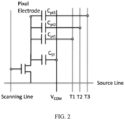
- FIG. 2 shows an equivalent circuit model of a single pixel of the type that may be used in the pixel arrays of FIGs. 1A, 1B , 3A, and 3B .
- the capacitive coupling of three underlying back side wires is depicted as C pt1 , C pt2 , and C pt3 , however fewer or more than three wires may be included in the model as correspond to the number of wires running proximate to a pixel.
- multiple back side wires run adjacent each pixel column.
- FIG. 3A Because of the additive effects of capacitive coupling from several back side wires, spurious or inappropriate activation of multiple adjacent pixels may lead to a phenomenon known as "ghosting" (e.g., a lack of clean switching in a vertical group of pixels to a gray or black appearance, as shown in FIG. 3A , when the pixel display state is supposed to be white). Because of this capacitive coupling, one or more rows that are nominally in a first state are actually pulled toward their last state, i.e., they retain a memory of their last state that is visible in their new state. Furthermore, as shown in FIG. 2 , each of the back side wires that receives a voltage when the corresponding source line is activated adds to the total capacitance. Thus, when a block of adjacent pixels is activated, multiple adjacent back side wires are simultaneously activated, resulting in stronger ghosting in the pixels adjacent the back side wires. The effect is illustrated in FIGs. 3A and 3B .
- the ghosting phenomenon is more pronounced in situations such as that shown in FIG. 1B in which the panel has many more pixels in one dimension than in the other (orthogonal) dimension. Situations such as these require there to be multiple back side wires running adjacent to each column of pixels in order to make connections to all of the source lines. Thus, if several of the back side wires associated with a particular column of pixels are activated at the same time this causes capacitive coupling, with the resultant ghosting, of that column of pixels.
- twelve pixels on the right side of the display panel are activated to turn black.
- the three back side wires in each of the second and third columns deliver the same voltage sequence, which is different from the rest of back side wires in the panel.
- the capacitive coupling effect in the pixels of the two columns are different from the others, leading to the observable band of activation of the pixel columns. That is, given the distribution of vias in the panel of FIG.
- the back side wires that are associated with the source lines needed to activate the group of dark pixels are adjacent the second and third columns of pixels.
- activating the 12-pixel block in FIG. 3A requires activation of six back side wires, three of which are adjacent to the second column of pixels and three of which are adjacent to the third column of pixels.
- each of the second and third columns of pixels is at least partially activated due to capacitive coupling that occurs between the groups of back side wires and the pixel electrodes, causing ghosting of these columns of pixels.
- the vias are formed in the panels in a pattern that results in an arrangement of back side wires in which the back side wires that couple to the source lines of two adjacent pixel rows are associated with different pixel columns.
- one way to create this distribution of back side wires is to locate the vias in a staggered, or "zigzag,” pattern in which the vias are arranged in a diagonal pattern that extends back and forth across the width of the panel, such that each of the plurality of back side wires are connected to row lines associated with a plurality of non-adjacent rows. As seen in the example zigzag design in FIG.
- the vias within the same column are vertically separated (e.g., by four or more intervening rows) and they are horizontally separated (e.g., by at least one column), which reduces the likelihood of two or more back side wires in the same pixel column being simultaneously activated when a contiguous block of nearby pixels is displayed.
- vertically separated e.g., by four or more intervening rows
- horizontally separated e.g., by at least one column
- Nearest neighbor vias may be separated by, e.g., at least one pixel row, e.g., at least two pixel rows, e.g., at least three pixel rows, e.g., at least four pixel rows, and/or by at least one pixel column, e.g., at least two pixel columns, e.g., at least three pixel r columns, e.g., at least four pixel columns.
- the vias corresponding to adjacent source lines are associated with different pixel columns so that when pixels in adjacent rows are activated, each of the back side wires is associated with a different pixel column. That is, the zigzag via hole design separates the via holes in each column and hence decreases the probability of capacitive coupling from the three back side wires occurring at the same time.
- the maximum number of back side wires in each pixel column that delivers the voltage sequences for black is one. Hence, the reduced difference of luminance shift between each pixel column leads to a reduction in ghosting.
- a further advantage of the zigzag via design is that adjacent data lines have similar RC loading, which reduces or eliminates ghosting due to differences in RC delays between adjacent data lines.
- this design one can separate vias associated with adjacent rows into different pixel columns while maintaining a similar RC constant for the adjacent data lines/back side wires.
- a randomly-distributed via hole design may also be used to address back side wire induced ghosting.
- the vias may be distributed in a random or pseudorandom arrangement.
- the random or pseudorandom arrangement can be coupled with other rules such as prohibiting an arrangement of vias that leads to two or more back side wires that are associated with adjacent pixel rows being adjacent the same pixel column.
- a pseudorandom number generator for example, may be used to generate a sequence of numbers representing the order of vias.
- an advantage of a random or pseudorandom via arrangement is that it can avoid the ghosting which might occur in the zigzag design when displaying images having a periodic structure.
- the proposed via designs separate the vias within each pixel column which decreases the probability of multiple (e.g. three) back side wires simultaneously delivering the same signal. Hence, the luminance shift due to the capacitive coupling from the back side wires to the pixel electrode is minimized.
- FIG. 4 is a flow chart of an exemplary process 400 for forming an electro-optic display.
- the process 400 includes a step of providing a driver chip and a backplane (step 410).
- the backplane may include a substrate having a plurality of pixel electrodes arranged in an array of pixel rows and pixel columns, where each of the pixel rows has a row line associated therewith.
- the process 400 may also include a step of forming a plurality of back side wires associated with at least one of the pixel columns (step 420). Each of the plurality of back side wires may be connected to the driver chip.
- the process 400 may further include a step of forming a plurality of vias within the backplane (step 430) such that no two nearest neighbor vias are associated with adjacent pixel rows of any pixel column.
- the process 400 may also include a step of connecting each of the plurality of back side wires to a respective plurality of row lines (step 440) using one of the plurality of vias disposed within the backplane.
- Process 400 of FIG. 4 may be used to produce displays such as those disclosed herein including the display panel shown in FIG. 3B .
- multiple backplanes of the invention may be tiled together to create a large format display.
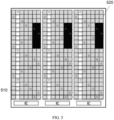
- three backplanes 510 may be arranged on a support 520 so that they appear at a distance to be a singular large display.
- Such constructions are particularly useful for digital signage, and greatly reduce fabrication costs because they can be built in a modular fashion.
Landscapes
- Physics & Mathematics (AREA)
- Nonlinear Science (AREA)
- General Physics & Mathematics (AREA)
- Optics & Photonics (AREA)
- Engineering & Computer Science (AREA)
- Chemical & Material Sciences (AREA)
- Theoretical Computer Science (AREA)
- Computer Hardware Design (AREA)
- Health & Medical Sciences (AREA)
- Life Sciences & Earth Sciences (AREA)
- Chemical Kinetics & Catalysis (AREA)
- Electrochemistry (AREA)
- Molecular Biology (AREA)
- Crystallography & Structural Chemistry (AREA)
- Mathematical Physics (AREA)
- Electrochromic Elements, Electrophoresis, Or Variable Reflection Or Absorption Elements (AREA)
- Devices For Indicating Variable Information By Combining Individual Elements (AREA)
- Liquid Crystal (AREA)
- Control Of Indicators Other Than Cathode Ray Tubes (AREA)
Applications Claiming Priority (2)
| Application Number | Priority Date | Filing Date | Title |
|---|---|---|---|
| US201862631261P | 2018-02-15 | 2018-02-15 | |
| PCT/US2019/017592 WO2019160841A1 (en) | 2018-02-15 | 2019-02-12 | Via placement for slim border electro-optic display backplanes with decreased capacitive coupling between t-wires and pixel electrodes |
Publications (4)
| Publication Number | Publication Date |
|---|---|
| EP3752883A1 EP3752883A1 (en) | 2020-12-23 |
| EP3752883A4 EP3752883A4 (en) | 2021-11-10 |
| EP3752883C0 EP3752883C0 (en) | 2024-10-09 |
| EP3752883B1 true EP3752883B1 (en) | 2024-10-09 |
Family
ID=67541051
Family Applications (1)
| Application Number | Title | Priority Date | Filing Date |
|---|---|---|---|
| EP19754049.5A Active EP3752883B1 (en) | 2018-02-15 | 2019-02-12 | Electro-optic display backplane |
Country Status (7)
| Country | Link |
|---|---|
| US (1) | US11081066B2 (enExample) |
| EP (1) | EP3752883B1 (enExample) |
| JP (2) | JP2021514073A (enExample) |
| CN (1) | CN111712759A (enExample) |
| ES (1) | ES2993991T3 (enExample) |
| TW (1) | TWI698690B (enExample) |
| WO (1) | WO2019160841A1 (enExample) |
Families Citing this family (3)
| Publication number | Priority date | Publication date | Assignee | Title |
|---|---|---|---|---|
| US10984691B2 (en) * | 2018-03-29 | 2021-04-20 | Solomon Systech (Shenzhen) Limited | Panel defect detection method and a display driver apparatus incorporating the same |
| JP7506769B2 (ja) * | 2020-06-03 | 2024-06-26 | イー インク コーポレイション | 非伝導性支持板を含む折り畳み可能電気泳動ディスプレイモジュール |
| CN115482720A (zh) * | 2021-06-15 | 2022-12-16 | 群创光电股份有限公司 | 电子装置 |
Family Cites Families (140)
| Publication number | Priority date | Publication date | Assignee | Title |
|---|---|---|---|---|
| US4418346A (en) | 1981-05-20 | 1983-11-29 | Batchelder J Samuel | Method and apparatus for providing a dielectrophoretic display of visual information |
| US5745094A (en) | 1994-12-28 | 1998-04-28 | International Business Machines Corporation | Electrophoretic display |
| US6137467A (en) | 1995-01-03 | 2000-10-24 | Xerox Corporation | Optically sensitive electric paper |
| US7259744B2 (en) | 1995-07-20 | 2007-08-21 | E Ink Corporation | Dielectrophoretic displays |
| US6120588A (en) | 1996-07-19 | 2000-09-19 | E Ink Corporation | Electronically addressable microencapsulated ink and display thereof |
| US6639578B1 (en) | 1995-07-20 | 2003-10-28 | E Ink Corporation | Flexible displays |
| US6124851A (en) | 1995-07-20 | 2000-09-26 | E Ink Corporation | Electronic book with multiple page displays |
| US7352353B2 (en) | 1995-07-20 | 2008-04-01 | E Ink Corporation | Electrostatically addressable electrophoretic display |
| US6664944B1 (en) | 1995-07-20 | 2003-12-16 | E-Ink Corporation | Rear electrode structures for electrophoretic displays |
| US8089453B2 (en) | 1995-07-20 | 2012-01-03 | E Ink Corporation | Stylus-based addressing structures for displays |
| US7411719B2 (en) | 1995-07-20 | 2008-08-12 | E Ink Corporation | Electrophoretic medium and process for the production thereof |
| US7106296B1 (en) | 1995-07-20 | 2006-09-12 | E Ink Corporation | Electronic book with multiple page displays |
| US7327511B2 (en) | 2004-03-23 | 2008-02-05 | E Ink Corporation | Light modulators |
| US6866760B2 (en) | 1998-08-27 | 2005-03-15 | E Ink Corporation | Electrophoretic medium and process for the production thereof |
| US7167155B1 (en) | 1995-07-20 | 2007-01-23 | E Ink Corporation | Color electrophoretic displays |
| US5760761A (en) | 1995-12-15 | 1998-06-02 | Xerox Corporation | Highlight color twisting ball display |
| US6055091A (en) | 1996-06-27 | 2000-04-25 | Xerox Corporation | Twisting-cylinder display |
| US5808783A (en) | 1996-06-27 | 1998-09-15 | Xerox Corporation | High reflectance gyricon display |
| CA2260947A1 (en) | 1996-07-19 | 1998-01-29 | E Ink Corporation | Electronically addressable microencapsulated ink and display thereof |
| US5930026A (en) | 1996-10-25 | 1999-07-27 | Massachusetts Institute Of Technology | Nonemissive displays and piezoelectric power supplies therefor |
| US5777782A (en) | 1996-12-24 | 1998-07-07 | Xerox Corporation | Auxiliary optics for a twisting ball display |
| JP3955641B2 (ja) | 1997-02-06 | 2007-08-08 | ユニバーシティ カレッジ ダブリン | エレクトロクロミック装置 |
| US6980196B1 (en) | 1997-03-18 | 2005-12-27 | Massachusetts Institute Of Technology | Printable electronic display |
| US6232950B1 (en) | 1997-08-28 | 2001-05-15 | E Ink Corporation | Rear electrode structures for displays |
| US6252564B1 (en) | 1997-08-28 | 2001-06-26 | E Ink Corporation | Tiled displays |
| US7002728B2 (en) | 1997-08-28 | 2006-02-21 | E Ink Corporation | Electrophoretic particles, and processes for the production thereof |
| US6177921B1 (en) | 1997-08-28 | 2001-01-23 | E Ink Corporation | Printable electrode structures for displays |
| US6054071A (en) | 1998-01-28 | 2000-04-25 | Xerox Corporation | Poled electrets for gyricon-based electric-paper displays |
| US7075502B1 (en) | 1998-04-10 | 2006-07-11 | E Ink Corporation | Full color reflective display with multichromatic sub-pixels |
| WO1999053371A1 (en) | 1998-04-10 | 1999-10-21 | E-Ink Corporation | Electronic displays using organic-based field effect transistors |
| JP2002513169A (ja) | 1998-04-27 | 2002-05-08 | イー−インク コーポレイション | シャッターモードのマイクロカプセル化された電気泳動ディスプレイ |
| US6241921B1 (en) | 1998-05-15 | 2001-06-05 | Massachusetts Institute Of Technology | Heterogeneous display elements and methods for their fabrication |
| EP1145072B1 (en) | 1998-06-22 | 2003-05-07 | E-Ink Corporation | Method of addressing microencapsulated display media |
| USD485294S1 (en) | 1998-07-22 | 2004-01-13 | E Ink Corporation | Electrode structure for an electronic display |
| CA2336744A1 (en) | 1998-07-22 | 2000-02-03 | Jonathan D. Albert | Electronic display |
| US7256766B2 (en) | 1998-08-27 | 2007-08-14 | E Ink Corporation | Electrophoretic display comprising optical biasing element |
| US6144361A (en) | 1998-09-16 | 2000-11-07 | International Business Machines Corporation | Transmissive electrophoretic display with vertical electrodes |
| US6184856B1 (en) | 1998-09-16 | 2001-02-06 | International Business Machines Corporation | Transmissive electrophoretic display with laterally adjacent color cells |
| US6271823B1 (en) | 1998-09-16 | 2001-08-07 | International Business Machines Corporation | Reflective electrophoretic display with laterally adjacent color cells using a reflective panel |
| US6225971B1 (en) | 1998-09-16 | 2001-05-01 | International Business Machines Corporation | Reflective electrophoretic display with laterally adjacent color cells using an absorbing panel |
| ATE232307T1 (de) | 1998-10-07 | 2003-02-15 | E Ink Corp | Beleuchtungssystem für nicht-emitierende elektronische anzeigeeinrichtungen |
| US6128124A (en) | 1998-10-16 | 2000-10-03 | Xerox Corporation | Additive color electric paper without registration or alignment of individual elements |
| US6097531A (en) | 1998-11-25 | 2000-08-01 | Xerox Corporation | Method of making uniformly magnetized elements for a gyricon display |
| US6147791A (en) | 1998-11-25 | 2000-11-14 | Xerox Corporation | Gyricon displays utilizing rotating elements and magnetic latching |
| US6506438B2 (en) | 1998-12-15 | 2003-01-14 | E Ink Corporation | Method for printing of transistor arrays on plastic substrates |
| US6312304B1 (en) | 1998-12-15 | 2001-11-06 | E Ink Corporation | Assembly of microencapsulated electronic displays |
| US6724519B1 (en) | 1998-12-21 | 2004-04-20 | E-Ink Corporation | Protective electrodes for electrophoretic displays |
| WO2000038000A1 (en) | 1998-12-22 | 2000-06-29 | E Ink Corporation | Method of manufacturing of a discrete electronic device |
| US6842657B1 (en) | 1999-04-09 | 2005-01-11 | E Ink Corporation | Reactive formation of dielectric layers and protection of organic layers in organic semiconductor device fabrication |
| US6498114B1 (en) | 1999-04-09 | 2002-12-24 | E Ink Corporation | Method for forming a patterned semiconductor film |
| US7012600B2 (en) | 1999-04-30 | 2006-03-14 | E Ink Corporation | Methods for driving bistable electro-optic displays, and apparatus for use therein |
| US8009348B2 (en) | 1999-05-03 | 2011-08-30 | E Ink Corporation | Machine-readable displays |
| US7030412B1 (en) | 1999-05-05 | 2006-04-18 | E Ink Corporation | Minimally-patterned semiconductor devices for display applications |
| US6392786B1 (en) | 1999-07-01 | 2002-05-21 | E Ink Corporation | Electrophoretic medium provided with spacers |
| AU7137800A (en) | 1999-07-21 | 2001-02-13 | E-Ink Corporation | Preferred methods for producing electrical circuit elements used to control an electronic display |
| EP1196814A1 (en) | 1999-07-21 | 2002-04-17 | E Ink Corporation | Use of a storage capacitor to enhance the performance of an active matrix driven electronic display |
| WO2001017029A1 (en) | 1999-08-31 | 2001-03-08 | E Ink Corporation | Transistor for an electronically driven display |
| AU7094400A (en) | 1999-08-31 | 2001-03-26 | E-Ink Corporation | A solvent annealing process for forming a thin semiconductor film with advantageous properties |
| EP1224505B1 (en) | 1999-10-11 | 2005-01-12 | University College Dublin | Electrochromic device |
| US6672921B1 (en) | 2000-03-03 | 2004-01-06 | Sipix Imaging, Inc. | Manufacturing process for electrophoretic display |
| US6788449B2 (en) | 2000-03-03 | 2004-09-07 | Sipix Imaging, Inc. | Electrophoretic display and novel process for its manufacture |
| US7893435B2 (en) | 2000-04-18 | 2011-02-22 | E Ink Corporation | Flexible electronic circuits and displays including a backplane comprising a patterned metal foil having a plurality of apertures extending therethrough |
| AU2001253575A1 (en) | 2000-04-18 | 2001-10-30 | E-Ink Corporation | Process for fabricating thin film transistors |
| US20020060321A1 (en) | 2000-07-14 | 2002-05-23 | Kazlas Peter T. | Minimally- patterned, thin-film semiconductor devices for display applications |
| US6816147B2 (en) | 2000-08-17 | 2004-11-09 | E Ink Corporation | Bistable electro-optic display, and method for addressing same |
| JP4198999B2 (ja) | 2001-03-13 | 2008-12-17 | イー インク コーポレイション | 図面を表示するための装置 |
| JP4568477B2 (ja) | 2001-04-02 | 2010-10-27 | イー インク コーポレイション | 画像安定性を改良した電気泳動媒体 |
| US7679814B2 (en) | 2001-04-02 | 2010-03-16 | E Ink Corporation | Materials for use in electrophoretic displays |
| US6573660B2 (en) * | 2001-04-30 | 2003-06-03 | Intel Corporation | Driving emissive displays |
| US7535624B2 (en) | 2001-07-09 | 2009-05-19 | E Ink Corporation | Electro-optic display and materials for use therein |
| AU2002354672A1 (en) | 2001-07-09 | 2003-01-29 | E Ink Corporation | Electro-optical display having a lamination adhesive layer |
| DE60216924T2 (de) | 2001-07-09 | 2007-04-05 | E Ink Corp., Cambridge | Elektrooptische anzeige und kleberzusammensetzung |
| US6982178B2 (en) | 2002-06-10 | 2006-01-03 | E Ink Corporation | Components and methods for use in electro-optic displays |
| US7110163B2 (en) | 2001-07-09 | 2006-09-19 | E Ink Corporation | Electro-optic display and lamination adhesive for use therein |
| US6967640B2 (en) | 2001-07-27 | 2005-11-22 | E Ink Corporation | Microencapsulated electrophoretic display with integrated driver |
| US6819471B2 (en) | 2001-08-16 | 2004-11-16 | E Ink Corporation | Light modulation by frustration of total internal reflection |
| WO2003050607A1 (en) | 2001-12-13 | 2003-06-19 | E Ink Corporation | Electrophoretic electronic displays with films having a low index of refraction |
| EP1482354B1 (en) | 2002-03-06 | 2008-04-30 | Bridgestone Corporation | Image displaying apparatus and method |
| US6950220B2 (en) | 2002-03-18 | 2005-09-27 | E Ink Corporation | Electro-optic displays, and methods for driving same |
| US7190008B2 (en) | 2002-04-24 | 2007-03-13 | E Ink Corporation | Electro-optic displays, and components for use therein |
| US7223672B2 (en) | 2002-04-24 | 2007-05-29 | E Ink Corporation | Processes for forming backplanes for electro-optic displays |
| EP1497867A2 (en) | 2002-04-24 | 2005-01-19 | E Ink Corporation | Electronic displays |
| US7649674B2 (en) | 2002-06-10 | 2010-01-19 | E Ink Corporation | Electro-optic display with edge seal |
| US7583427B2 (en) | 2002-06-10 | 2009-09-01 | E Ink Corporation | Components and methods for use in electro-optic displays |
| US6842279B2 (en) | 2002-06-27 | 2005-01-11 | E Ink Corporation | Illumination system for nonemissive electronic displays |
| AU2003257197A1 (en) | 2002-08-06 | 2004-03-03 | E Ink Corporation | Protection of electro-optic displays against thermal effects |
| US7839564B2 (en) | 2002-09-03 | 2010-11-23 | E Ink Corporation | Components and methods for use in electro-optic displays |
| WO2004059378A2 (en) | 2002-12-16 | 2004-07-15 | E Ink Corporation | Backplanes for electro-optic displays |
| US6922276B2 (en) | 2002-12-23 | 2005-07-26 | E Ink Corporation | Flexible electro-optic displays |
| US7339715B2 (en) | 2003-03-25 | 2008-03-04 | E Ink Corporation | Processes for the production of electrophoretic displays |
| JP5044215B2 (ja) | 2003-03-27 | 2012-10-10 | イー インク コーポレイション | 電気光学アセンブリ |
| JP4579823B2 (ja) | 2003-04-02 | 2010-11-10 | 株式会社ブリヂストン | 画像表示媒体に用いる粒子、それを用いた画像表示用パネル及び画像表示装置 |
| US20050122563A1 (en) | 2003-07-24 | 2005-06-09 | E Ink Corporation | Electro-optic displays |
| US8319759B2 (en) | 2003-10-08 | 2012-11-27 | E Ink Corporation | Electrowetting displays |
| WO2005038764A1 (en) | 2003-10-08 | 2005-04-28 | E Ink Corporation | Electro-wetting displays |
| US20050122306A1 (en) | 2003-10-29 | 2005-06-09 | E Ink Corporation | Electro-optic displays with single edge addressing and removable driver circuitry |
| US20110187683A1 (en) | 2003-10-30 | 2011-08-04 | E Ink Corporation | Electro-optic displays with single edge addressing and removable driver circuitry |
| US7672040B2 (en) | 2003-11-05 | 2010-03-02 | E Ink Corporation | Electro-optic displays, and materials for use therein |
| US8177942B2 (en) | 2003-11-05 | 2012-05-15 | E Ink Corporation | Electro-optic displays, and materials for use therein |
| US7551346B2 (en) | 2003-11-05 | 2009-06-23 | E Ink Corporation | Electro-optic displays, and materials for use therein |
| CN101142510B (zh) | 2003-11-05 | 2010-04-14 | 伊英克公司 | 电光显示器 |
| US7206119B2 (en) | 2003-12-31 | 2007-04-17 | E Ink Corporation | Electro-optic displays, and method for driving same |
| US7075703B2 (en) | 2004-01-16 | 2006-07-11 | E Ink Corporation | Process for sealing electro-optic displays |
| US7388572B2 (en) | 2004-02-27 | 2008-06-17 | E Ink Corporation | Backplanes for electro-optic displays |
| US7453445B2 (en) | 2004-08-13 | 2008-11-18 | E Ink Corproation | Methods for driving electro-optic displays |
| US7230751B2 (en) | 2005-01-26 | 2007-06-12 | E Ink Corporation | Electrophoretic displays using gaseous fluids |
| WO2007002452A2 (en) | 2005-06-23 | 2007-01-04 | E Ink Corporation | Edge seals and processes for electro-optic displays |
| US8610988B2 (en) | 2006-03-09 | 2013-12-17 | E Ink Corporation | Electro-optic display with edge seal |
| US7492497B2 (en) | 2006-08-02 | 2009-02-17 | E Ink Corporation | Multi-layer light modulator |
| EP2111562B1 (en) | 2007-01-22 | 2018-09-19 | E Ink Corporation | Multi-layer sheet for use in electro-optic displays |
| US7688497B2 (en) | 2007-01-22 | 2010-03-30 | E Ink Corporation | Multi-layer sheet for use in electro-optic displays |
| US7826129B2 (en) | 2007-03-06 | 2010-11-02 | E Ink Corporation | Materials for use in electrophoretic displays |
| WO2009006248A1 (en) | 2007-06-29 | 2009-01-08 | E Ink Corporation | Electro-optic displays, and materials and methods for production thereof |
| US20090122389A1 (en) | 2007-11-14 | 2009-05-14 | E Ink Corporation | Electro-optic assemblies, and adhesives and binders for use therein |
| CN100587576C (zh) * | 2008-05-20 | 2010-02-03 | 友达光电股份有限公司 | 液晶显示面板及其像素结构 |
| JPWO2010024255A1 (ja) * | 2008-08-28 | 2012-01-26 | 株式会社ブリヂストン | 情報表示装置 |
| US8456387B2 (en) * | 2009-02-18 | 2013-06-04 | Global Oled Technology Llc | Display device with chiplet drivers |
| EP2443622A4 (en) * | 2009-06-18 | 2012-11-14 | Hewlett Packard Development Co | POWER-OPERATED PIXEL CIRCUITS AND RELATED METHODS |
| EP2494428A4 (en) | 2009-10-28 | 2015-07-22 | E Ink Corp | ELECTRO-OPTICAL INDICATORS WITH TOUCH SENSORS |
| US9620066B2 (en) | 2010-02-02 | 2017-04-11 | E Ink Corporation | Method for driving electro-optic displays |
| TW201207535A (en) | 2010-05-27 | 2012-02-16 | E Ink Corp | Dual mode electro-optic displays |
| KR20130129951A (ko) * | 2010-10-21 | 2013-11-29 | 코닌클리케 필립스 엔.브이. | 휘도 분포 제어 수단을 갖는 oled 장치 |
| CN103688212B (zh) | 2011-05-21 | 2017-11-28 | 伊英克公司 | 电光显示器 |
| JP6176117B2 (ja) | 2012-01-10 | 2017-08-09 | 株式会社Joled | 表示装置および表示方法 |
| US20140283508A1 (en) | 2012-01-11 | 2014-09-25 | Hitachi Construction Machinery Co., Ltd. | Drive system for hydraulic closed circuit |
| GB2504141B (en) * | 2012-07-20 | 2020-01-29 | Flexenable Ltd | Method of reducing artefacts in an electro-optic display by using a null frame |
| CN102955637B (zh) * | 2012-11-02 | 2015-09-09 | 北京京东方光电科技有限公司 | 一种电容式内嵌触摸屏、其驱动方法及显示装置 |
| CN102981339B (zh) | 2012-12-10 | 2016-12-21 | 京东方科技集团股份有限公司 | 阵列基板、3d显示装置及其驱动方法 |
| WO2015023804A1 (en) * | 2013-08-13 | 2015-02-19 | Polyera Corporation | Optimization of electronic display areas |
| EP3103113A4 (en) * | 2014-02-07 | 2017-07-19 | E Ink Corporation | Electro-optic display backplane structures |
| JP6532270B2 (ja) * | 2015-04-16 | 2019-06-19 | 株式会社竹中工務店 | 低温再生デシカント空調機 |
| JP6462478B2 (ja) * | 2015-04-27 | 2019-01-30 | 日本放送協会 | 多分割駆動ディスプレイ及び表示装置 |
| TWI643177B (zh) * | 2015-04-29 | 2018-12-01 | 元太科技工業股份有限公司 | 電子紙顯示裝置及其製作方法 |
| CN104795043B (zh) * | 2015-05-11 | 2018-01-16 | 京东方科技集团股份有限公司 | 一种阵列基板、液晶显示面板及显示装置 |
| CN104900658B (zh) * | 2015-06-15 | 2018-07-27 | 京东方科技集团股份有限公司 | 触控面板及其制备方法、触控显示装置 |
| CN104916252B (zh) | 2015-07-13 | 2017-08-25 | 京东方科技集团股份有限公司 | 圆形显示面板及其制作方法、显示装置 |
| TWI561891B (en) * | 2016-01-04 | 2016-12-11 | Au Optronics Corp | Pixel array substrate |
| CN105914202B (zh) * | 2016-06-13 | 2018-11-13 | 上海珏芯光电科技有限公司 | 显示驱动背板、显示器以及制造方法 |
| CN106200184B (zh) | 2016-09-29 | 2023-01-24 | 厦门天马微电子有限公司 | 一种显示装置、显示面板、阵列基板及其驱动方法 |
| CN106847864B (zh) | 2017-01-09 | 2019-11-12 | 张一帆 | 一种窄边框触控显示面板及显示装置及其制作方法 |
-
2019
- 2019-02-12 JP JP2020543285A patent/JP2021514073A/ja active Pending
- 2019-02-12 US US16/273,334 patent/US11081066B2/en active Active
- 2019-02-12 WO PCT/US2019/017592 patent/WO2019160841A1/en not_active Ceased
- 2019-02-12 CN CN201980012722.XA patent/CN111712759A/zh active Pending
- 2019-02-12 ES ES19754049T patent/ES2993991T3/es active Active
- 2019-02-12 EP EP19754049.5A patent/EP3752883B1/en active Active
- 2019-02-14 TW TW108104907A patent/TWI698690B/zh active
-
2021
- 2021-12-15 JP JP2021203137A patent/JP2022027921A/ja active Pending
Also Published As
| Publication number | Publication date |
|---|---|
| CN111712759A (zh) | 2020-09-25 |
| US20190251911A1 (en) | 2019-08-15 |
| ES2993991T3 (en) | 2025-01-15 |
| US11081066B2 (en) | 2021-08-03 |
| EP3752883C0 (en) | 2024-10-09 |
| TWI698690B (zh) | 2020-07-11 |
| JP2021514073A (ja) | 2021-06-03 |
| WO2019160841A1 (en) | 2019-08-22 |
| EP3752883A4 (en) | 2021-11-10 |
| TW201940952A (zh) | 2019-10-16 |
| EP3752883A1 (en) | 2020-12-23 |
| JP2022027921A (ja) | 2022-02-14 |
Similar Documents
| Publication | Publication Date | Title |
|---|---|---|
| US9671635B2 (en) | Electro-optic display backplane structures with drive components and pixel electrodes on opposed surfaces | |
| US10446585B2 (en) | Multi-layer expanding electrode structures for backplane assemblies | |
| US9881565B2 (en) | Method for driving electro-optic displays | |
| US10317767B2 (en) | Electro-optic display backplane structure with drive components and pixel electrodes on opposed surfaces | |
| US11450287B2 (en) | Electro-optic displays | |
| JP2022027921A (ja) | Tワイヤと画素電極との間の減少した容量結合を伴う狭額縁電気光学ディスプレイバックプレーンのためのビアの設置 | |
| CN111399303B (zh) | 电光显示器 | |
| US20220398956A1 (en) | Methods and apparatuses for driving electro-optic displays | |
| HK40028803A (en) | Via placement for slim border electro-optic display backplanes with decreased capacitive coupling between t-wires and pixel electrodes | |
| WO2018187077A1 (en) | Electro-optic display backplane structures with drive components and pixel electrodes on opposed surfaces | |
| JP6702637B2 (ja) | バックプレーンアセンブリのための複数層拡張電極構造 | |
| HK40026776B (en) | Electro-optic displays | |
| HK1226147A1 (zh) | 用於背板組件的多層擴展電極結構 | |
| HK1226147B (zh) | 用於背板组件的多层扩展电极结构 |
Legal Events
| Date | Code | Title | Description |
|---|---|---|---|
| STAA | Information on the status of an ep patent application or granted ep patent |
Free format text: STATUS: THE INTERNATIONAL PUBLICATION HAS BEEN MADE |
|
| PUAI | Public reference made under article 153(3) epc to a published international application that has entered the european phase |
Free format text: ORIGINAL CODE: 0009012 |
|
| STAA | Information on the status of an ep patent application or granted ep patent |
Free format text: STATUS: REQUEST FOR EXAMINATION WAS MADE |
|
| 17P | Request for examination filed |
Effective date: 20200915 |
|
| AK | Designated contracting states |
Kind code of ref document: A1 Designated state(s): AL AT BE BG CH CY CZ DE DK EE ES FI FR GB GR HR HU IE IS IT LI LT LU LV MC MK MT NL NO PL PT RO RS SE SI SK SM TR |
|
| AX | Request for extension of the european patent |
Extension state: BA ME |
|
| DAV | Request for validation of the european patent (deleted) | ||
| DAX | Request for extension of the european patent (deleted) | ||
| A4 | Supplementary search report drawn up and despatched |
Effective date: 20211013 |
|
| RIC1 | Information provided on ipc code assigned before grant |
Ipc: G02F 1/1676 20190101ALI20211007BHEP Ipc: G02F 1/167 20190101ALI20211007BHEP Ipc: G02F 1/1685 20190101AFI20211007BHEP |
|
| STAA | Information on the status of an ep patent application or granted ep patent |
Free format text: STATUS: EXAMINATION IS IN PROGRESS |
|
| 17Q | First examination report despatched |
Effective date: 20220722 |
|
| REG | Reference to a national code |
Ref country code: DE Ref legal event code: R079 Free format text: PREVIOUS MAIN CLASS: G02F0001168500 Ipc: G02F0001134500 Ref document number: 602019060097 Country of ref document: DE |
|
| RIC1 | Information provided on ipc code assigned before grant |
Ipc: G09G 3/34 20060101ALI20240423BHEP Ipc: G02F 1/16766 20190101ALI20240423BHEP Ipc: G02F 1/167 20190101ALI20240423BHEP Ipc: G02F 1/1345 20060101AFI20240423BHEP |
|
| GRAP | Despatch of communication of intention to grant a patent |
Free format text: ORIGINAL CODE: EPIDOSNIGR1 |
|
| STAA | Information on the status of an ep patent application or granted ep patent |
Free format text: STATUS: GRANT OF PATENT IS INTENDED |
|
| INTG | Intention to grant announced |
Effective date: 20240603 |
|
| GRAS | Grant fee paid |
Free format text: ORIGINAL CODE: EPIDOSNIGR3 |
|
| GRAA | (expected) grant |
Free format text: ORIGINAL CODE: 0009210 |
|
| STAA | Information on the status of an ep patent application or granted ep patent |
Free format text: STATUS: THE PATENT HAS BEEN GRANTED |
|
| AK | Designated contracting states |
Kind code of ref document: B1 Designated state(s): AL AT BE BG CH CY CZ DE DK EE ES FI FR GB GR HR HU IE IS IT LI LT LU LV MC MK MT NL NO PL PT RO RS SE SI SK SM TR |
|
| REG | Reference to a national code |
Ref country code: CH Ref legal event code: EP |
|
| REG | Reference to a national code |
Ref country code: DE Ref legal event code: R096 Ref document number: 602019060097 Country of ref document: DE |
|
| REG | Reference to a national code |
Ref country code: IE Ref legal event code: FG4D |
|
| U01 | Request for unitary effect filed |
Effective date: 20241107 |
|
| U07 | Unitary effect registered |
Designated state(s): AT BE BG DE DK EE FI FR IT LT LU LV MT NL PT RO SE SI Effective date: 20241113 |
|
| REG | Reference to a national code |
Ref country code: ES Ref legal event code: FG2A Ref document number: 2993991 Country of ref document: ES Kind code of ref document: T3 Effective date: 20250115 |
|
| U20 | Renewal fee for the european patent with unitary effect paid |
Year of fee payment: 7 Effective date: 20250121 |
|
| PG25 | Lapsed in a contracting state [announced via postgrant information from national office to epo] |
Ref country code: HR Free format text: LAPSE BECAUSE OF FAILURE TO SUBMIT A TRANSLATION OF THE DESCRIPTION OR TO PAY THE FEE WITHIN THE PRESCRIBED TIME-LIMIT Effective date: 20241009 Ref country code: IS Free format text: LAPSE BECAUSE OF FAILURE TO SUBMIT A TRANSLATION OF THE DESCRIPTION OR TO PAY THE FEE WITHIN THE PRESCRIBED TIME-LIMIT Effective date: 20250209 |
|
| PGFP | Annual fee paid to national office [announced via postgrant information from national office to epo] |
Ref country code: ES Payment date: 20250303 Year of fee payment: 7 |
|
| PG25 | Lapsed in a contracting state [announced via postgrant information from national office to epo] |
Ref country code: NO Free format text: LAPSE BECAUSE OF FAILURE TO SUBMIT A TRANSLATION OF THE DESCRIPTION OR TO PAY THE FEE WITHIN THE PRESCRIBED TIME-LIMIT Effective date: 20250109 |
|
| PG25 | Lapsed in a contracting state [announced via postgrant information from national office to epo] |
Ref country code: GR Free format text: LAPSE BECAUSE OF FAILURE TO SUBMIT A TRANSLATION OF THE DESCRIPTION OR TO PAY THE FEE WITHIN THE PRESCRIBED TIME-LIMIT Effective date: 20250110 |
|
| PG25 | Lapsed in a contracting state [announced via postgrant information from national office to epo] |
Ref country code: PL Free format text: LAPSE BECAUSE OF FAILURE TO SUBMIT A TRANSLATION OF THE DESCRIPTION OR TO PAY THE FEE WITHIN THE PRESCRIBED TIME-LIMIT Effective date: 20241009 |
|
| PGFP | Annual fee paid to national office [announced via postgrant information from national office to epo] |
Ref country code: GB Payment date: 20250123 Year of fee payment: 7 |
|
| PG25 | Lapsed in a contracting state [announced via postgrant information from national office to epo] |
Ref country code: RS Free format text: LAPSE BECAUSE OF FAILURE TO SUBMIT A TRANSLATION OF THE DESCRIPTION OR TO PAY THE FEE WITHIN THE PRESCRIBED TIME-LIMIT Effective date: 20250109 |
|
| PG25 | Lapsed in a contracting state [announced via postgrant information from national office to epo] |
Ref country code: SM Free format text: LAPSE BECAUSE OF FAILURE TO SUBMIT A TRANSLATION OF THE DESCRIPTION OR TO PAY THE FEE WITHIN THE PRESCRIBED TIME-LIMIT Effective date: 20241009 |
|
| PG25 | Lapsed in a contracting state [announced via postgrant information from national office to epo] |
Ref country code: SK Free format text: LAPSE BECAUSE OF FAILURE TO SUBMIT A TRANSLATION OF THE DESCRIPTION OR TO PAY THE FEE WITHIN THE PRESCRIBED TIME-LIMIT Effective date: 20241009 |
|
| PG25 | Lapsed in a contracting state [announced via postgrant information from national office to epo] |
Ref country code: CZ Free format text: LAPSE BECAUSE OF FAILURE TO SUBMIT A TRANSLATION OF THE DESCRIPTION OR TO PAY THE FEE WITHIN THE PRESCRIBED TIME-LIMIT Effective date: 20241009 |
|
| PLBE | No opposition filed within time limit |
Free format text: ORIGINAL CODE: 0009261 |
|
| STAA | Information on the status of an ep patent application or granted ep patent |
Free format text: STATUS: NO OPPOSITION FILED WITHIN TIME LIMIT |
|
| PG25 | Lapsed in a contracting state [announced via postgrant information from national office to epo] |
Ref country code: MC Free format text: LAPSE BECAUSE OF FAILURE TO SUBMIT A TRANSLATION OF THE DESCRIPTION OR TO PAY THE FEE WITHIN THE PRESCRIBED TIME-LIMIT Effective date: 20241009 |
|
| 26N | No opposition filed |
Effective date: 20250710 |
|
| REG | Reference to a national code |
Ref country code: CH Ref legal event code: PL |
|
| PG25 | Lapsed in a contracting state [announced via postgrant information from national office to epo] |
Ref country code: CH Free format text: LAPSE BECAUSE OF NON-PAYMENT OF DUE FEES Effective date: 20250228 |