EP3752449B1 - Getränkeausgabesystem mit zusammenklappbaren einwegfässern für den einmaligen gebrauch - Google Patents
Getränkeausgabesystem mit zusammenklappbaren einwegfässern für den einmaligen gebrauch Download PDFInfo
- Publication number
- EP3752449B1 EP3752449B1 EP19704331.8A EP19704331A EP3752449B1 EP 3752449 B1 EP3752449 B1 EP 3752449B1 EP 19704331 A EP19704331 A EP 19704331A EP 3752449 B1 EP3752449 B1 EP 3752449B1
- Authority
- EP
- European Patent Office
- Prior art keywords
- beverage
- tapping
- collapsible
- container
- dispensing system
- Prior art date
- Legal status (The legal status is an assumption and is not a legal conclusion. Google has not performed a legal analysis and makes no representation as to the accuracy of the status listed.)
- Active
Links
Images




Classifications
-
- B—PERFORMING OPERATIONS; TRANSPORTING
- B67—OPENING, CLOSING OR CLEANING BOTTLES, JARS OR SIMILAR CONTAINERS; LIQUID HANDLING
- B67D—DISPENSING, DELIVERING OR TRANSFERRING LIQUIDS, NOT OTHERWISE PROVIDED FOR
- B67D1/00—Apparatus or devices for dispensing beverages on draught
- B67D1/04—Apparatus utilising compressed air or other gas acting directly or indirectly on beverages in storage containers
- B67D1/0462—Squeezing collapsible or flexible beverage containers, e.g. bag-in-box containers
-
- B—PERFORMING OPERATIONS; TRANSPORTING
- B67—OPENING, CLOSING OR CLEANING BOTTLES, JARS OR SIMILAR CONTAINERS; LIQUID HANDLING
- B67D—DISPENSING, DELIVERING OR TRANSFERRING LIQUIDS, NOT OTHERWISE PROVIDED FOR
- B67D1/00—Apparatus or devices for dispensing beverages on draught
- B67D1/08—Details
- B67D1/0801—Details of beverage containers, e.g. casks, kegs
-
- B—PERFORMING OPERATIONS; TRANSPORTING
- B67—OPENING, CLOSING OR CLEANING BOTTLES, JARS OR SIMILAR CONTAINERS; LIQUID HANDLING
- B67D—DISPENSING, DELIVERING OR TRANSFERRING LIQUIDS, NOT OTHERWISE PROVIDED FOR
- B67D1/00—Apparatus or devices for dispensing beverages on draught
- B67D1/08—Details
- B67D1/0857—Cooling arrangements
-
- B—PERFORMING OPERATIONS; TRANSPORTING
- B67—OPENING, CLOSING OR CLEANING BOTTLES, JARS OR SIMILAR CONTAINERS; LIQUID HANDLING
- B67D—DISPENSING, DELIVERING OR TRANSFERRING LIQUIDS, NOT OTHERWISE PROVIDED FOR
- B67D1/00—Apparatus or devices for dispensing beverages on draught
- B67D1/08—Details
- B67D1/0878—Safety, warning or controlling devices
- B67D1/0882—Devices for controlling the dispensing conditions
- B67D1/0884—Means for controlling the parameters of the state of the liquid to be dispensed, e.g. temperature, pressure
-
- B—PERFORMING OPERATIONS; TRANSPORTING
- B67—OPENING, CLOSING OR CLEANING BOTTLES, JARS OR SIMILAR CONTAINERS; LIQUID HANDLING
- B67D—DISPENSING, DELIVERING OR TRANSFERRING LIQUIDS, NOT OTHERWISE PROVIDED FOR
- B67D1/00—Apparatus or devices for dispensing beverages on draught
- B67D1/08—Details
- B67D1/0888—Means comprising electronic circuitry (e.g. control panels, switching or controlling means)
-
- B—PERFORMING OPERATIONS; TRANSPORTING
- B67—OPENING, CLOSING OR CLEANING BOTTLES, JARS OR SIMILAR CONTAINERS; LIQUID HANDLING
- B67D—DISPENSING, DELIVERING OR TRANSFERRING LIQUIDS, NOT OTHERWISE PROVIDED FOR
- B67D1/00—Apparatus or devices for dispensing beverages on draught
- B67D1/08—Details
- B67D1/12—Flow or pressure control devices or systems, e.g. valves, gas pressure control, level control in storage containers
- B67D1/1202—Flow control, e.g. for controlling total amount or mixture ratio of liquids to be dispensed
- B67D1/1204—Flow control, e.g. for controlling total amount or mixture ratio of liquids to be dispensed for ratio control purposes
- B67D1/1225—Weighing
-
- B—PERFORMING OPERATIONS; TRANSPORTING
- B67—OPENING, CLOSING OR CLEANING BOTTLES, JARS OR SIMILAR CONTAINERS; LIQUID HANDLING
- B67D—DISPENSING, DELIVERING OR TRANSFERRING LIQUIDS, NOT OTHERWISE PROVIDED FOR
- B67D1/00—Apparatus or devices for dispensing beverages on draught
- B67D1/08—Details
- B67D1/0801—Details of beverage containers, e.g. casks, kegs
- B67D2001/0827—Bags in box
- B67D2001/0828—Bags in box in pressurised housing
-
- B—PERFORMING OPERATIONS; TRANSPORTING
- B67—OPENING, CLOSING OR CLEANING BOTTLES, JARS OR SIMILAR CONTAINERS; LIQUID HANDLING
- B67D—DISPENSING, DELIVERING OR TRANSFERRING LIQUIDS, NOT OTHERWISE PROVIDED FOR
- B67D2210/00—Indexing scheme relating to aspects and details of apparatus or devices for dispensing beverages on draught or for controlling flow of liquids under gravity from storage containers for dispensing purposes
- B67D2210/00028—Constructional details
- B67D2210/00099—Temperature control
- B67D2210/00104—Cooling only
Definitions
- the present disclosure relates to system and method for dispensing a beverage stored in a single use collapsible beverage container and measuring several properties or parameters of the beverage and/or the collapsible beverage container.
- Beverage dispensing systems are typically used in beverage dispensing establishments for efficiently dispensing large quantities of beverage.
- beverage dispensing systems are used to dispense carbonated alcoholic beverages such as draught beer and cider.
- non-alcoholic beverages such as non-alcoholic beers, soft drinks and non-carbonated beverages such as wine and fruit juice may be dispensed using a beverage dispensing system.
- Beverage dispensing systems are mostly for professional users such as in establishments like bars, restaurants and hotels, however, increasingly also for private users such as in private homes.
- beverage kegs typically dispense beverage provided in large beverage kegs. Such beverage kegs may for instance hold 20-50 L of beverage for a professional beverage dispensing system for allowing typically 50-100 beverage dispensing operations before needing to exchange the beverage keg.
- beverage kegs are made of solid materials such as steel and re-filled a number of times. In between each filling, the beverage kegs are carefully cleaned. Insufficient cleaning may lead to unhygienic beverage kegs, which may in turn lead to health problems for the beverage consumer. While there exist beverage kegs made of plastic such as PET for single use, such beverage containers are not collapsible during operation. Today, beverage kegs are made collapsible and for single use only, at least partly due to the above hygiene concern.
- Such beverage dispensing systems using collapsible beverage kegs can have the beverage keg installed or placed in a pressure chamber.
- a pressure source e.g. an air compressor
- single use beverage systems uses air from a pressure source, e.g. an air compressor, to push the beer out and collapsing the keg, which means that nothing touches the beer from when it leaves the brewery until it goes in the beverage recipient, e.g. beer glass.
- the beverage stored in such collapsible beverage container is pre-carbonized or pre-mixed with nitrogen when dispensing English type beer such as ales and stouts.
- the pressure fluid e.g. compressed air
- the collapsible beverage kegs are preferably made of flexible and disposable material such as plastic.
- the tapping line leads to a tapping device comprising a tapping head having a beverage dispensing control means, such as a tap handle, and a spout for dispensing beverage into a beverage recipient.
- the tapping head includes typically also a tapping handle for allowing an operator to control the tapping valve and thereby the beverage dispensing operation.
- the operator such as a bartender or barmaid, uses the tapping handle to control the dispensing of beverage.
- the tapping head is a part of a font mounted in a bar counter.
- a first aspect of the present invention relates to a beverage dispensing system according to claim 1.
- information in terms of the properties or parameters of the beverage and/or the collapsible beverage container, including content of beverage in said collapsible beverage container, can be measured and thereby identified.
- the retrieved information is then stored, read, and processed by the electronic sensor device, preferably a digital sensor device, included in the base part and/or the lid.
- the type of the beverage may be stored or an identification for a database with other information about the beverage, e.g. whether the beverage is a beer, a specific beer type, soda or other, the name of the beverage as well as other information relevant to the user or customer such as the date and/or origin of production, alcohol percentage if applicable, etc.
- the information may then be displayed automatically at for instance the tapping head.
- the beverage container information may also relate to the volume of the container. This will allow the beverage dispensing system to be informed about the initial volume of the container in order to deduce the remaining volume by means of flow measurements.
- RFID/NFC tags or bar codes may store some or all of this information in a convenient way.
- Said collapsible beverage container is preferably a single use collapsible beverage container.
- the terms "single use collapsible beverage container” or “single use collapsible keg” are used interchangeably throughout this disclosure.
- it can be blow-molded and preferably having a volume between 5-50 liters which is constituted by a beverage filled space defined by the beverage and a gas filled head space which typically is carbon dioxide.
- the collapsible beverage container contains a beverage outlet, which is closed off during transport and handling.
- the collapsible keg instead of utilizing a plastic material such as PET, may use a multilayer foil.
- beverage systems comprising single use collapsible kegs may be provided with a wireless electronic device, a visible identifier or combinations thereof, despite the disposal of the keg after use, i.e. after the beverage has been dispensed.
- a wireless electronic device a visible identifier or combinations thereof
- the presently disclosed system and method may be configured such that data read from the identification must be in a specific format and/or must contain a predefined security code, and/or the production data of the beer cannot be too old, e.g. less than one, two, three or six months, otherwise tapping from the specific keg and/or the entire system is not possible, e.g. by blocking a valve or not providing the required pressure, etc., thereby ensuring a consistently high quality of the beverage.
- the beverage container When installed in a beverage dispensing system like the applicant's DraughtMaster TM , the beverage container is typically oriented in a predetermined position such as an "upside down" position, i.e. the beverage outlet is oriented in a downward direction so that the head space is thereby oriented in an upwards direction.
- the base part is typically rigid and suitable for supporting the weight of the beverage container, and the beverage container connector forms a fluid-tight connection between the beverage outlet and the tapping line.
- the tapping head comprises at least one tapping valve, which is controlled by a beverage dispensing control means, such as a pushing button or preferably a tapping handle.
- a beverage dispensing control means such as a pushing button or preferably a tapping handle.
- a user wishing to dispense beverage will for example move the handle from a vertical position to a horizontal position and thereby operate and open the valve for allowing a flow or stream of beverage from the beverage filled space via the tapping line to the tapping head.
- the lid is connectable to the base part in a fluid-tight fashion in order to be able to form a hermetically sealed inner space, which has a suitable volume for encapsulating the beverage container.
- the base part is made of rigid material in order to support the collapsible beverage container.
- rigid material should be understood as being capable of supporting the weight of the beverage without bulging.
- Pressure is applied to the collapsible beverage container in order to apply a dispensing pressure for forcing the beverage from the beverage filled volume via the tapping line to the tapping head when the tapping valve is open as a result of the tapping handle being moved from its original vertical (close) position.
- the pressure should be sufficiently great to overcome the crumpling pressure of the collapsible beverage container plus the gas pressure of brewage, i.e. the pressure required for collapsing the beverage container, and as well overcome the pressure losses in the dispensing line, e.g. for elevating the beverage from a cellar located below a bar.
- a certain pressure at the tapping head is required for allowing a suitable flow velocity, however, too much flow or too small pressure may cause undesired foaming.
- the term "visible identifier” means that the identifier is able to be recognized optically, for instance by a scanner.
- RFID-tags and NFC-tags are adapted to at least retrieving information of for instance what type of beer or brand that is contained within a collapsible beverage container.
- at least retrieving information is meant that not only retrieving information is possible, but also storing information and optionally also processing information.
- the term “retrieving” means receiving.
- NFC- and RFID-tags in particular, also known as RFID-chips may retrieve (i.e. receive), store and process information, in particular store and process information e.g. transmit information, here of the beverage and/or the collapsible beverage container.
- RFID enables uniquely identifying items using radio waves.
- the NFC / RFID system comprises a reader and a tag. The reader sends a radio frequency signal to the tag via an antenna, and the tag responds with its unique information.
- said digital sensor device for reading said information from said wireless electronic device preferably an NFC- or RFID- tag, said visible identifier such as a bar code, or said combinations thereof, is an RFID-reader, a bar code reader, or combinations thereof.
- said digital sensor device is an RFID-reader.
- the beverage container includes a digital identifier, such as an NFC / RFID tag, which is readable by an NFC / RFID sensor in the pressure chamber or any other suitable location in the beverage dispensing system.
- the pressure chamber comprises the lid and base part.
- a measuring device may be provided for measuring the resonance frequency after a perturbation of the pressure chamber or the collapsible beverage container, thus enabling useful information about the status of the pressure chamber and the keg itself, thereby increasing safety of the beverage dispensing system.
- the pressure chamber includes the lid.
- a measuring device for measuring the flow of gas in the pressure shell is provided.
- said collapsible beverage container includes a closure adapted to cooperate with said beverage container connector, wherein an identification tag, e.g. NFC or RFID-tag, is mounted on the rim of said closure, sealing of said closure, or internally in said closure, and optionally the NFC/ RFID-reader is mounted on the base part adjacent to said closure.
- an identification tag e.g. NFC or RFID-tag
- the identification tag is mounted in a less visible location.
- the present disclosure further relates to a collapsible beverage container, preferably single use, for use in the presently disclosed beverage dispensing system, said collapsible beverage container comprising a closure and an identification tag, such as a NFC / RFID tag and/or a barcode.
- the closure is preferably configured to cooperate and/or engage with the beverage container connector disclosed herein.
- the ID tag may be mounted on the rim of said closure, sealing of said closure, or internally in said closure.
- One or more visible bar codes may be printed or attached on the rim, closure and/or body of the collapsible beverage container.
- this disclosure relates to a collapsible beverage container for use in presently disclosed beverage dispensing system
- the collapsible beverage container comprising a collapsible body and a closure with a beverage outlet configured for engagement with the beverage container connector of the beverage dispensing system
- the collapsible beverage container further comprising at least one identification tag mounted on a rim of said closure, a sealing of said closure or internally in said closure, and/or on the body of said container, said identification tag readable by a corresponding reader in the beverage dispensing system.
- the identification tag may be a radio frequency identification tag, such as RFID / NFC, a visible / optical tag, such as a barcode, or a combination thereof.
- the identification tag may comprise identification information for uniquely identifying said container.
- the identification tag may further comprise information selected the group of: type of the beverage, producer of beverage, origin of beverage, production date of beverage, production place of beverage and shipping date of beverage.
- the identification tag may further comprise at least one of one or more predefined codes for approval by the beverage dispensing system.
- the present disclosure further relates to a kit of parts according to claim 11.
- the provision of an identification tag enables identification of the keg and improved inventory management, as already discussed above and further explained below.
- the ID tag may be mounted prior to filling a single use collapsible keg so that after filling, the tag is logged centrally, a production label is written to the tag and/or ID from the tag is correlated in a database or data logging system with all information. Inventory management is improved, since each collapsible keg has a unique ID, i.e. identification concerning what, when and where it is produced, as well as when it is shipped, to whom, when it is emptied or opened, etc. In addition, each serving incident on the system can be logged to the specific tag and unknown tags may be identified and if necessary, rejected.
- the beverage dispensing system optionally comprises an RFID-reader, e.g. a high frequency RFID-reader such as NFC (Near-Field Communication) reader, mounted preferably on the base part adjacent to said closure.
- NFC Near-Field Communication
- adjacent in this embodiment is meant that the RFID-reader, e.g. NFC reader is mounted on the outside of the base part at a non-touching distance of the closure of the collapsible beverage container.
- the tag reader When pressure is applied and is above say 2 bar, the tag reader is activated and initiates a reading-process of the ID-tag mounted on the rim or sealing of the closure. ID and timestamp comprising data on when this takes place is recorded and communicated to a data logging system for retrieving and storing said data.
- pressure is released, i.e. decreases below e.g. 2 bar, the ID-reader is reactivated and a new timestamp is created for the collapsible beverage container.
- This embodiment is particularly suitable when using modular systems, i.e. a plurality of collapsible beverage containers sharing a common tapping line.
- the presently disclosed approach enables quickly identifying and correcting any misalignment of a given property or parameter in the beverage in the beverage dispensing system. For instance, if a device of the beverage dispensing system in a bar has a failure, the technician being located far from the bar becomes immediately aware of the issue and thus may arrive within a few minutes to fix the failure, hence reducing significantly any downtime period. As a particular example, if the beer temperature is decreasing, the technician may become aware of this immediately and quickly arrive at the bar, inspect and fix the cooling device of the beverage dispensing system so that the beer temperature has the desired level.
- the invention enables not only use of information stored for use inside a drinking establishment, such as a bar, but also outside the drinking establishment.
- a cooling device is adapted downstream said beverage connector and upstream said tapping device for cooling said tapping line, and said cooling device further comprises a measuring device in the form of a temperature sensor for measuring the temperature of a cooling line running adjacent said tapping line and which is mounted on said cooling device.
- a temperature sensor is affixed the cooling device for obtaining the cooling tube flow temperature so that the temperature is measured at the cooling device.
- Temperature T1 is suitably 3 or 4°C and since T2 is normally above T1, if T1 is above 6°C, this can immediately be detected as an error message, thus indicating the status of the cooling device and tapping line, here in particular that the cooling device may not be working properly.
- the measuring device(s) in the form of temperature sensors for measuring the temperature of the tapping line may also be mounted on the cooling device.
- a measuring device is adapted to a specific beverage line within the tapping line.
- a cooling device is adapted downstream said beverage connector and upstream said tapping device for cooling said tapping line, wherein said tapping line includes a measuring device in the form of a temperature sensor and the measuring device is mounted in the tapping line in close proximity to said tapping device.
- close proximity is meant the measuring device being mounted within the last 30%, preferably the last 20%, more preferably the last 10% of the length of the tapping line, measured from the cooling device and until the tapping head of the tapping device, e.g. until the beverage dispensing control means, such as the tapping handle.
- This enables proper serving temperature in instances where the cooling of the beverage line takes place without the use of a cooling line running adjacent the beverage line (so-called "dry Python").
- the sensor may be provided inside the font i.e. within the vertical portion of the font, or upstream the font just before the tapping line enters the font underneath the bar counter.
- the tapping line comprises a plurality of beverage lines, preferably two to five beverage lines, more preferably three beverage lines, each beverage line corresponding to a specific beverage type and adapted to cooperate with a tapping head of the tapping device, each tapping head corresponding to said beverage type, and in which said beverage line includes a measuring device in the form of a flow sensor, temperature sensor, or a combined flow and temperature sensor.
- a combined flow and temperature sensor is preferred.
- this sensor is in the form of black box, e.g. "clamp on" black box, operated by ultrasonic measuring system and including slot for beverage line insertion, e.g. beer tube insertion so that there is no contact with beverage.
- the combined flow and temperature sensor is preferably adapted to fit not only beverage lines such as beer tubes, but also cooling lines, i.e. cooling tubes.
- This combined temperature and flow sensor enables continuous and accurate measurement of the beverage volume flow as beer is dispensed from a tapping head. Thereby, every time the beverage is dispensed, i.e. poured, the amount poured is measured, with an accuracy of about 10 ml per pouring. At the same time, the temperature of the beverage with an accuracy of about 0.5°C is possible, thus rendering immediate information on the beverage about to be dispensed. Furthermore, timestamps providing information regarding an event, such as when a given amount of beverage was dispensed, are also possible.
- the base part includes a weighing device, preferably a digital weighing device, for continuously weighing the beverage container during dispensing and establish digital data representing a weight of the beverage container and a flow of beverage through the tapping device deduced via the weight.
- a weighing device preferably a digital weighing device
- the loss in weight may be considered to correspond to the flow of beverage.
- the amount of remaining beverage in the beverage container may be deduced using standard arithmetic.
- a keg in a beverage dispensing system comprising a plurality of collapsible kegs may provide information to the staff or bartenders as well as a manager of a first keg having a certain type of beer A and how much the keg is filled with a beverage, e.g. a beer, say beer type A keg 60% filled.
- a beverage e.g. a beer, say beer type A keg 60% filled.
- information is also provided about the second keg, which may have another beer type B and is 80% filled, and about a third keg having a third beer type C with the keg being filled 10%.
- Such information suitably represented as:
- the beverage dispensing system comprises: a first pressure sensor for continuously measuring a first pressure within the inner space during dispensing, a second pressure sensor for continuously measuring a second pressure at the tapping device during dispensing, and a digital processing unit for establishing digital data representing a flow of beverage from the beverage filled space through the tapping device deduced via the first pressure and the second pressure.
- This embodiment may also comprise a third pressure sensor for continuously measuring the pressure inside said beverage container.
- this pressure sensor may be adapted to measure the pressure at the tapping line at the outlet of the collapsible beverage container. The pressure difference between this pressure and the pressure within the inner space can be tracked. Because of the height of the beverage within the collapsible beverage container, the pressure at the bottom will be higher while there is still beverage therein to be dispensed.
- the pressure difference between the inner space and the tapping device or the pressure difference between inside the beverage container and the tapping device corresponds to the driving pressure forcing the beverage from the beverage container to the tapping device.
- a correction may be made taking into account the crumpling pressure of the beverage container.
- Bernoulli's principles the flow of beverage may be deduced.
- any of the first, second and third pressure sensors comprises a piezo-electric sensor. Piezo-electric sensors form compact and accurate pressure sensors.
- the invention also encompasses the beverage dispensing system of the first aspect, wherein said tapping head includes a beverage dispensing control means and a spout for dispensing beverage into a beverage recipient, wherein said tapping head is part of a beverage font, said beverage font being mounted in a bar counter, said bar counter defining an operator side and a customer side opposite said operator side, said beverage dispensing system further including a measuring device in the form of a non-contact measuring device which is integrated in said beverage font and is adapted to detect a parameter or property, such as the temperature, of said beverage recipient.
- non-contact measuring device is meant a measurement device which is located at a significant distance from the object being measured, and hence does not touch the object. This distance is 5-200 cm, for instance 5-100 cm, or 10-30 cm.
- said non-contact measuring device is a digital sensor in the form of an infrared sensor (IR).
- IR-sensor integrated in the font sends a signal or beam onto the object being measured, this object in particular being the beverage recipient, e.g. beverage glass. This enables reading a spot-surface temperature of the beverage recipient.
- a visual indication on the font may be provided for visualizing the reading if outside of an acceptable range of 3-6°C when using a beer glass.
- the beverage dispensing system includes a data logging system for receiving and storing the digital data.
- the data received about the flow of beverage and/or remaining volume as well as other information of the beverage and/or collapsible beverage container may be stored in a data logging system in order to optimize the beverage dispensing system with regard to dispensing pressures, beverage temperatures, etc. Further, the data may be used to establish statistics about beverage consumption.
- the lid is preferably flexible and made of an elastic material such as rubber or alternatively said lid is flexible and is made of a non-elastic flexible material such as plastic.
- Flexible in the context of the present patent application is understood to mean that it is made of a material, which will be deformed when a force is applied to the material, the material will yield and conform to the applied force without breaking.
- Non-rigid materials may be used as a flexible lid.
- the lid must be fluid-tight, but not able to resist pressure to any significant degree and must thus deform in accordance with the applied pressure. Both elastic materials, such as rubber, and non-elastic flexible material, such as plastic, are feasible.
- the lid may thus conform to the shape of the beverage container during dispensing.
- the beverage dispensing system further comprises a pressure source such as a compressor, e.g. an air compressor, in fluid communication with said inner space for pressurizing the inner space for applying a force onto said collapsible beverage container, collapsing said collapsible beverage container and forcing said beverage from said beverage filled space through the tapping line and out through the tapping device.
- a pressure source such as a compressor, e.g. an air compressor, in fluid communication with said inner space for pressurizing the inner space for applying a force onto said collapsible beverage container, collapsing said collapsible beverage container and forcing said beverage from said beverage filled space through the tapping line and out through the tapping device.
- the beverage dispensing system may also include a plurality of base parts and a plurality of lids connectable to the base parts.
- the present beverage dispensing system may be expanded to an assembly including a plurality of base parts and a plurality of lids.
- the respective beverage container connectors of the base parts may be interconnected by a common tapping line to form a series connected assembly of collapsible beverage containers; that is, as a modular system.
- the beverage from said beverage filled space of said collapsible beverage container is a beer pre-carbonized or pre-mixed with nitrogen, with the collapsible beverage container preferably being made of a polymeric material such as plastic.
- a beverage dispensing system for dispensing a beverage stored in a collapsible beverage container, said collapsible beverage container defining a beverage filled space, a gas-filled head space and a beverage outlet in communication with said beverage filled space for extracting said beverage from said beverage filled space, said beverage dispensing system comprising:
- non-contact measuring device is meant a measurement device which is located at a significant distance from the object being measured, and thus does not touch the object. This distance is 5-200 cm, for instance 5-100 cm, or 10-30 cm.
- said non-contact measuring device is a digital sensor in the form of an infrared sensor (IR).
- IR-sensor integrated in the font sends a signal or beam onto the object being measured, this object in particular being the beverage recipient, e.g. beverage glass. This enables reading a spot-surface temperature of the beverage recipient.
- a visual indication on the font may be provided for visualizing the reading if outside of an acceptable range of 3-6°C when using a beer glass.
- the beverage dispensing system includes a data logging system for receiving and storing the digital data.
- the data received about the temperature of the beverage may be stored in a data logging system in order to optimize the beverage dispensing system with regard to dispensing temperatures, whether there is too much foam in a beer, as this translates into a lower temperature of the beer in glass, etc.
- beverage dispensing system according to the second aspect may be used together with one or more of the other embodiments of the beverage dispensing system in accordance with the first aspect.
- the above-mentioned objects and more are achieved by a method of dispensing a beverage stored in a collapsible beverage container in a beverage dispensing system, said collapsible beverage container defining a beverage filled space, a gas-filled head space and a beverage outlet in communication with said beverage filled space for extracting said beverage from said beverage filled space according to claim 14.
- the method according to the third aspect may be used together with one or more of the embodiments of the beverage dispensing system in accordance with the first aspect.
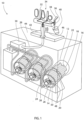
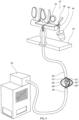
- Fig. 1 shows a perspective view of a beverage dispensing system 10 having a pressure chamber comprising lid 12 and a rigid base part 14 which are sealed together establishing an inner space or inner volume 16 including a filled single use collapsible beverage container 18.
- the beverage container 18, also known as keg, is of the collapsible type made of a collapsible polymeric material, thus the term collapsible beverage container.
- the collapsible beverage container 18 defines a beverage filled space containing the beverage 20, typically being a carbonated beverage such as beer.
- the beverage container 18 also defines a gas filled head space 22 at its top portion, above the level of the beverage inside the beverage container 18, as better illustrated in Fig. 3 .
- the lid 12 and the rigid base part 14 are separable but during operation, they are sealed together for defining the inner space 16 for accommodating the beverage container 18.
- the lid 12 may e.g. be made of rubber.
- the collapsible beverage container 18 includes a closure 24 adapted to cooperate with a beverage container connector 26 for connecting the beverage outlet (not shown) of the collapsible beverage container 18 with tapping line 28.
- the tapping line passes through a cooling device or unit 30 in order to provide the beverage with the appropriate serving temperature, e.g. 3-6°C for beer. Downstream the cooling device 30, the tapping 28 containing one or more beverage lines 32 reaches tapping device 34.
- the tapping device 34 comprises one or more tapping heads 36, with each tapping head 36 including a tapping handle 38 to dispense beer into beverage recipient (glass) 40.
- Temperature sensor units (not shown) on the tapping line mounted close to the tapping device, just before reaching the bottom of font 42 or inside the font 42, may be provided to obtain a near serving temperature of the beer when poured in glass 40.
- the font 42 is mounted on bar counter 44 and the font has integrated an infrared sensor 46 to read a spot-surface temperature of the glass 40.
- the closure 24 of the collapsible beverage container 18 includes a digital sensor in the form of an RFID-tag 50 for identification of different properties of the beverage 20 and/or the collapsible beverage container 18, such as the age of the collapsible beverage container and hence its quality, type of beer, volume of beverage remaining, etc.
- a digital sensor in the form of an RFID-reader 48 is mounted on the outside of the bottom of the pressure chamber, that is in the base part.
- the RFID-reader 48 is activated and initiates the reading process of the RFID-tag 50.
- the ID of the collapsible beverage container and timestamp is recorded and communicated to a data logging system (not shown).
- a data logging system not shown.
- pressure decreases to below 2 bar the reader is reactivated and a new timestamp is created for the collapsible beverage container.
- Fig. 2 shows an expanded front view of the bottom portion of collapsible beverage container 18 including closure 24 with RFID-tag 50 incorporated therein.
- the RFID-tag 50 is mounted on the rim of the closure 24.
- the RFID-tag may also be mounted (installed) in the sealing of the closure 24.
- the RFID-tag 50 may also be mounted internally in the closure 24.
- Fig. 3 shows a schematic representation of beverage dispensing system 10' comprising a single collapsible beverage container contained in the inner space 16 created by the sealing of lid 12 and base part 14, tapping line 28 and tapping device 34, as described in connection with Fig. 1 .
- the base part 14 is also connected to a pressure source, such as an air compressor 58.
- the compressor 58 enables pressurizing the sealed inner volume 16 between the beverage container 18 and the pressure chamber comprising lid 12 and base part 14.
- the tapping device 28 is enabling beverage flow, the pressure applied onto the beverage container 18 will result in its gradual collapse, as beverage is forced out of the beverage container 18 and towards the tapping device 28.
- the beverage dispensing system 10' includes a weight sensor 52 and optionally a pressure sensor 54.
- the weight sensor 52 may be used in order to establish the volume of remaining beverage in the beverage container 18 and the flow of beverage through the tapping device 28.
- the beverage container 18 includes a digital identifier, such as an RFID tag 50 which is readable by an RFID sensor (not shown) in the pressure chamber or any other suitable location in the beverage dispensing system 10.
- the weight sensor 52 derives the volume of remaining beverage as well as the flow of beverage through the tapping device 28 by continuously weighting the beverage container 18 during dispensing.
- the initial weight, volume and density of the beverage in the beverage container 18 and the container itself may be entered manually or entered by automatic means as explained below.
- the remaining volume may simply be derived as the initial volume minus the loss of weight of the container 18 divided by the density of the beverage.
- the pressure sensor 52 measures the pressure at the junction between the tapping line 28 and the tapping device by means of tapping handle 38.
- tapping handle 38 When the tapping handle 38 is in closed position (vertical position), the pressure at the junction between the tapping line 28 and the tapping handle 38 will be equal to the pressure inside the pressure chamber as the system is in steady state, i.e. no beverage is flowing.
- a pressure difference relative to the pressure inside the pressure chamber will be identified by the pressure sensor 54.
- the pressure difference constitutes the pressure drop along the tapping line 28. This gives a clear indication as to whether beverage is flowing through or not.
- a second pressure sensor 56 may be provided for continuously measuring the pressure within the inner space 16 during dispensing.
- a third pressure sensor (not shown) may also be provided for continuously measuring the pressure inside the beverage container.
- Temperature sensor(s) (not shown) may also be adapted for continuously measuring the temperature of the beverage.
- the RFID tag 50 may thus include information about the volume of beverage e.g. in litres, the weight of the beverage container and/or the density of the beverage.
- the RFID tag 50 may also include information about the kind of beverage, e.g. beer, which kind of beer, e.g. ale, lager etc. and the specification of the beverage, e.g. alcoholic content. This will enable automatic processing of the information.
- the information may be stored locally or communicated to data logging system at a central data storage location e.g. at the brewery.
- the flow of beverage and the volume of remaining beverage may be stored as well together with the time and date to enable the generation of statistics for optimizing the supply of beverage from the brewery.
- Fig. 4 is an expansion of a portion of the tapping line 28 coming out of the cooling device 30 and including a combined flow and temperature sensor 60', 60", 60′′′ inserted in each beverage line 32', 32", 32"'.
- Each beverage line carries a given type of beverage.
- the combined flow and temperature sensor is an ultrasonic measuring device, thus avoiding direct contact with the beverage and provides i.a. time-stamped data login and communication with data logging system (not shown).
- Fig. 5 shows an illustration of a particular embodiment of a portion of the beverage dispensing system in which temperature sensors 62 are mounted on (affixed) the cooling device 30 to obtain the temperature of cooling line 64 so that the temperature is measured at the cooling device 30.
- This enables proper serving temperature in instances where the cooling of the tapping line 28 takes place by a cooling line running adjacent such tapping line (so-called "wet Python").
- the serving temperature of the beverage when this is a beer, is suitably 3-6°C.
- This serving temperature (T serv ) may be calculated as the average of the temperature of the cooling line at the point of leaving the cooling device 30 (T1 in °C) and its temperature at the point of entering the cooling device 30 when it is returned (T2 in °C), i.e.
- T serv (T1 + T2) /2.
- Temperature T1 is suitably 3 or 4°C and since T2 is normally above T1, if T1 is above 6°C, this can immediately be detected as an error message, thus indicating the status of the cooling device, here in particular that the cooling device is not working properly.
- a measuring device suitably also in the form of temperature a sensor 62 is also mounted on (affixed) the cooling device 30 on any of beverage lines 32 of the tapping line 28.
- Fig. 6 shows temperature sensors 62 (62', 62", 62′′′) mounted in the tapping line in close proximity to said tapping device 34.
- close proximity is meant the last 20%, preferably the last 10% of the length of the tapping line, measured from the cooling device until the tapping handle 38.
- the cooling of the beverage lines 32', 32", 32′′′ takes place without the use of a cooling line running adjacent the beverage line (so-called “dry Python").
- a font 42 is provided and the temperature sensors 62' are positioned just before the tapping line 28 enters the font.
Landscapes
- Devices For Dispensing Beverages (AREA)
- Details Of Rigid Or Semi-Rigid Containers (AREA)
- Apparatus For Making Beverages (AREA)
- Basic Packing Technique (AREA)
Claims (14)
- Getränkeausgabesystem (10), umfassend einen zusammenklappbaren Getränkebehälter (18) zum Ausgeben eines in dem zusammenklappbaren Getränkebehälter gelagerten Getränks (20), wobei der zusammenklappbare Getränkebehälter einen Getränkefüllraum, einen gasgefüllten Kopfraum (22) und einen mit dem Getränkefüllraum in Verbindung stehenden Getränkeauslass zur Entnahme des Getränks aus dem Getränkefüllraum definiert, wobei das Getränkeausgabesystem Folgendes umfasst:ein Basisteil (14), das dazu ausgelegt ist, mit einem Getränkebehälterverbinder (26) zum Verbinden mit dem Getränkeauslass des zusammenklappbaren Getränkebehälters zusammenzuwirken,eine Zapfvorrichtung (34), die einen oder mehrere Zapfköpfe (36) zum Entnehmen des Getränks aus dem Getränkefüllraum umfasst,eine Zapfleitung (28), die sich von dem Getränkebehälterverbinder zu der Zapfvorrichtung erstreckt, wobei die Zapfleitung eine oder mehrere Getränkeleitungen (32) umfasst, undeinen Deckel (12), der mit dem Basisteil verbindbar ist, wobei der Deckel und das Basisteil einen abgedichteten Innenraum (16) zum Aufnehmen und Einkapseln des zusammenklappbaren Getränkebehälters definieren,eine mit dem Innenraum in Fluidverbindung stehende Druckquelle zum Druckbeaufschlagen des Innenraums zum Aufbringen einer Kraft auf den zusammenklappbaren Getränkebehälter, zum Zusammenklappen des zusammenklappbaren Getränkebehälters und zum Herausdrücken des Getränks aus dem Getränkefüllraum durch die Zapfleitung und durch die Zapfvorrichtung,wobei der zusammenklappbare Getränkebehälter eine drahtlose elektronische Vorrichtung, vorzugsweise ein NFC- oder RFID-Tag (50), eine sichtbare Kennung, wie etwa einen Strichcode, oder Kombinationen davon, umfasst,dadurch gekennzeichnet, dass das Basisteil (14) und/oder der Deckel (12) eine elektronische Sensorvorrichtung zum Lesen von Informationen über das Getränk und/oder den zusammenklappbaren Getränkebehälter von der drahtlosen elektronischen Vorrichtung, vorzugsweise einem NFC- oder RFID-Tag (50), der sichtbaren Kennung, wie etwa einem Strichcode, oder Kombinationen davon, beinhalten/beinhaltet, wodurch digitale Daten erstellt werden, die die Informationen über das Getränk (20) und/oder den zusammenklappbaren Getränkebehälter (18) repräsentieren.
- Getränkeausgabesystem (10) nach Anspruch 1, wobei die elektronische Sensorvorrichtung Folgendes ist: eine digitale Sensorvorrichtung zum Lesen der Informationen von der drahtlosen elektronischen Vorrichtung, vorzugsweise einem NFC- oder RFID-Tag (50), die sichtbare Kennung, wie etwa ein Strichcode, oder die Kombinationen davon ein NFC- oder RFID-Leser (48), ein Strichcodeleser oder Kombinationen davon sind.
- Getränkeausgabesystem (10) nach einem der vorhergehenden Ansprüche, wobei der zusammenklappbare Getränkebehälter (18) einen Verschluss (24) beinhaltet, der dazu ausgelegt ist, mit dem Getränkebehälterverbinder (26) zusammenzuwirken, wobei ein Identifikations-Tag auf dem Rand des Verschlusses, einer Dichtung des Verschlusses oder innen in dem Verschluss montiert ist und wobei optional der Identifikations-Tag-Leser (48) auf dem Basisteil (14) benachbart zu dem Verschluss montiert ist.
- Getränkeausgabesystem (10) nach einem der vorhergehenden Ansprüche, wobei eine Kühlvorrichtung (30) stromabwärts des Getränkeverbinders (26) und stromaufwärts der Zapfvorrichtung (34) zum Kühlen der Zapfleitung (28) ausgelegt ist und die Kühlvorrichtung ferner eine Messvorrichtung in Form eines Temperatursensors (62) zum Messen der Temperatur einer Kühlleitung (64) umfasst, die benachbart zu der Zapfleitung verläuft und die an der Kühlvorrichtung montiert ist.
- Getränkeausgabesystem (10) nach einem der vorhergehenden Ansprüche, wobei die Zapfleitung (28) eine Getränkeleitung (32), vorzugsweise zwei bis fünf Getränkeleitungen, besonders bevorzugt drei Getränkeleitungen, umfasst, wobei vorzugsweise jede der zwei bis fünf oder drei Getränkeleitungen einem bestimmten Getränketyp entspricht und dazu ausgelegt ist, mit einem Zapfkopf der Zapfvorrichtung zusammenzuwirken, jeder Zapfkopf dem Getränketyp entspricht und die Getränkeleitung eine Messvorrichtung in Form eines Durchflusssensors, Temperatursensors (62) oder eines kombinierten Durchfluss- und Temperatursensors (60) umfasst.
- Getränkeausgabesystem (10) nach einem der vorhergehenden Ansprüche, wobei das Basisteil (14) eine Wägevorrichtung, vorzugsweise eine digitale Wägevorrichtung, zum kontinuierlichen Wiegen des Getränkebehälters (18) während des Ausgebens und zum Erstellen digitaler Daten, die ein Gewicht des Getränkebehälters repräsentieren, und eines Durchflusses des Getränks (20) durch die Zapfvorrichtung (34), der über das Gewicht abgeleitet wird, beinhaltet.
- Getränkeausgabesystem (10) nach einem der vorhergehenden Ansprüche, wobei das Getränkeausgabesystem Folgendes umfasst:einen ersten Drucksensor (56) zum kontinuierlichen Messen eines ersten Drucks innerhalb des Innenraums (16) während des Ausgebens,einen zweiten Drucksensor (54) zum kontinuierlichen Messen eines zweiten Drucks an der Zapfvorrichtung (34) während des Ausgebens undeine digitale Verarbeitungseinheit zum Erstellen digitaler Daten, die einen Durchfluss des Getränks (20) aus dem Getränkefüllraum durch die Zapfleitung (28) und die Zapfvorrichtung repräsentieren, abgeleitet über den ersten Druck und den zweiten Druck.
- Getränkeausgabesystem (10) nach Anspruch 7, ferner umfassend einen dritten Drucksensor zum kontinuierlichen Messen des Drucks im Inneren des Getränkebehälters (18).
- Getränkeausgabesystem (10) nach einem der vorhergehenden Ansprüche, wobei der Zapfkopf (36) ein Getränkeausgabesteuermittel und ein Auslaufrohr zum Ausgeben des Getränks (20) in eine Getränkeaufnahme (40) beinhaltet, wobei der Zapfkopf Teil eines Getränkespenders (40) ist, die Getränkespender in einem Bartresen (44) montiert ist, der Bartresen eine Bedienerseite und eine der Bedienerseite gegenüberliegende Kundenseite definiert, das Getränkeausgabesystem ferner eine Messvorrichtung in Form einer kontaktlosen Messvorrichtung, wie etwa einen digitalen Sensor in Form eines Infrarotsensors, beinhaltet, die in den Getränkespender integriert ist und dazu ausgelegt ist, einen Parameter oder eine Eigenschaft, wie etwa die Temperatur, der Getränkeaufnahme zu detektieren.
- Getränkeausgabesystem (10) nach einem der vorhergehenden Ansprüche, wobei das Getränkeausgabesystem ein Datenprotokollierungssystem zum Abrufen und Speichern der digitalen Daten beinhaltet.
- Teilesatz, umfassend das Getränkeausgabesystem (10) nach einem der Ansprüche 1 bis 10, wobei der zusammenklappbare Getränkebehälter einen zusammenklappbaren Körper und einen Verschluss (24) mit einem Getränkeauslass, der zum Eingriff mit dem Getränkebehälterverbinder (26) des Getränkeausgabesystems konfiguriert ist, umfasst, dadurch gekennzeichnet, dass die drahtlose elektronische Vorrichtung, vorzugsweise ein NFC- oder RFID-Tag (50), die sichtbare Kennung, wie etwa ein Strichcode, oder die Kombinationen davon, auf einem Rand des Verschlusses montiert ist, und dass das Getränkeausgabesystem derart konfiguriert ist, dass ein Zapfen des Getränks (20) aus dem zusammenklappbaren Getränkebehälter nur möglich ist, wenn eine vordefinierte Übereinstimmung zwischen der drahtlosen elektronischen Vorrichtung, vorzugsweise einem NFC- oder RFID-Tag (50), der sichtbaren Kennung, wie etwa einem Strichcode, oder den Kombinationen davon, und der elektronischen Sensorvorrichtung des Getränkeausgabesystems (10) erreicht wird.
- Teilesatz nach Anspruch 11, wobei die drahtlose elektronische Vorrichtung, vorzugsweise ein NFC- oder RFID-Tag (50), die sichtbare Kennung, wie etwa ein Strichcode, oder die Kombinationen davon, Informationen umfasst, die ausgewählt sind aus der Gruppe von Folgendem: Typ des Getränks, Hersteller des Getränks, Herkunft des Getränks, Herstellungsdatum des Getränks, Herstellungsort des Getränks und Versanddatum des Getränks.
- Teilesatz nach einem der Ansprüche 11-12, wobei die drahtlose elektronische Vorrichtung, vorzugsweise ein NFC- oder RFID-Tag (50), die sichtbare Kennung, wie etwa ein Strichcode, oder die Kombinationen davon, mindestens einen von einem oder mehreren vordefinierten Codes zur Genehmigung durch das Getränkeausgabesystem (10) umfasst.
- Verfahren zum Ausgeben eines in einem zusammenklappbaren Getränkebehälter (18) in einem Getränkeausgabesystem (10) gelagerten Getränks, wobei der zusammenklappbare Getränkebehälter einen Getränkefüllraum, einen gasgefüllten Kopfraum (22) und einen mit dem Getränkefüllraum in Verbindung stehenden Getränkeauslass zum Entnehmen des Getränks (20) aus dem Getränkefüllraum definiert, wobei das Verfahren Folgendes umfasst:Bereitstellen eines Basisteils (14) mit einem Getränkebehälterverbinder (26) zum Verbinden mit dem Getränkeauslass des zusammenklappbaren Getränkebehälters,Bereitstellen einer Zapfvorrichtung (34), die einen oder mehrere Zapfköpfe (36) zum Entnehmen des Getränks aus dem Getränkefüllraum umfasst,Bereitstellen einer Zapfleitung (28), die sich von dem Behälterverbinder zu der Zapfvorrichtung erstreckt, wobei die Zapfleitung eine oder mehrere Getränkeleitungen (32) umfasst, undBereitstellen eines mit dem Basisteil verbindbaren Deckels (12), wobei der Deckel und das Basisteil einen Innenraum (16) zur Aufnehmen des zusammenklappbaren Getränkebehälters definieren, und Aufnehmen und Einkapseln des zusammenklappbaren Getränkebehälters,Bereitstellen einer mit dem Innenraum in Fluidverbindung stehende Druckquelle zum Druckbeaufschlagen des Innenraums zum Aufbringen einer Kraft auf den zusammenklappbaren Getränkebehälter, zum Zusammenklappen des zusammenklappbaren Getränkebehälters und zum Herausdrücken des Getränks aus dem Getränkefüllraum durch die Zapfleitung und durch die Zapfvorrichtung,wobei das Verfahren ferner Installieren, in dem der zusammenklappbaren Getränkebehälter, einer drahtlosen elektronischen Vorrichtung, vorzugsweise eines RFID-Tags (50), einer sichtbaren Kennung, wie etwa einem Strichcode, oder Kombinationen davon, umfasst,dadurch gekennzeichnet, dass das Verfahren ferner Installieren, in dem Basisteil (14) und/oder dem Deckel (12), einer elektronischen Sensorvorrichtung, vorzugsweise einer digitalen Sensorvorrichtung, umfasst, die dazu ausgelegt ist, mindestens die Informationen von der drahtlosen elektronischen Vorrichtung, vorzugsweise einem NFC- oder RFID-Tag (50), der sichtbaren Kennung, wie etwa einem Strichcode, oder den Kombinationen davon, zu lesen, wodurch digitale Daten erstellt werden, die die Informationen über das Getränk (20) und/oder den zusammenklappbaren Getränkebehälter (18) repräsentieren.
Priority Applications (2)
| Application Number | Priority Date | Filing Date | Title |
|---|---|---|---|
| HRP20251000TT HRP20251000T1 (hr) | 2018-02-13 | 2019-02-13 | Sustav za točenje pića uključujući sklopive bačve za jednokratnu uporabu |
| EP25156551.1A EP4527786A3 (de) | 2018-02-13 | 2019-02-13 | Getränkeausgabesystem mit zusammenklappbaren einwegfässern |
Applications Claiming Priority (2)
| Application Number | Priority Date | Filing Date | Title |
|---|---|---|---|
| EP18156533 | 2018-02-13 | ||
| PCT/EP2019/053509 WO2019158562A1 (en) | 2018-02-13 | 2019-02-13 | Beverage dispensing system including single use collapsible kegs |
Related Child Applications (2)
| Application Number | Title | Priority Date | Filing Date |
|---|---|---|---|
| EP25156551.1A Division-Into EP4527786A3 (de) | 2018-02-13 | 2019-02-13 | Getränkeausgabesystem mit zusammenklappbaren einwegfässern |
| EP25156551.1A Division EP4527786A3 (de) | 2018-02-13 | 2019-02-13 | Getränkeausgabesystem mit zusammenklappbaren einwegfässern |
Publications (3)
| Publication Number | Publication Date |
|---|---|
| EP3752449A1 EP3752449A1 (de) | 2020-12-23 |
| EP3752449B1 true EP3752449B1 (de) | 2025-06-11 |
| EP3752449C0 EP3752449C0 (de) | 2025-06-11 |
Family
ID=61223745
Family Applications (2)
| Application Number | Title | Priority Date | Filing Date |
|---|---|---|---|
| EP25156551.1A Pending EP4527786A3 (de) | 2018-02-13 | 2019-02-13 | Getränkeausgabesystem mit zusammenklappbaren einwegfässern |
| EP19704331.8A Active EP3752449B1 (de) | 2018-02-13 | 2019-02-13 | Getränkeausgabesystem mit zusammenklappbaren einwegfässern für den einmaligen gebrauch |
Family Applications Before (1)
| Application Number | Title | Priority Date | Filing Date |
|---|---|---|---|
| EP25156551.1A Pending EP4527786A3 (de) | 2018-02-13 | 2019-02-13 | Getränkeausgabesystem mit zusammenklappbaren einwegfässern |
Country Status (17)
| Country | Link |
|---|---|
| US (1) | US11091360B2 (de) |
| EP (2) | EP4527786A3 (de) |
| JP (1) | JP7374127B2 (de) |
| KR (1) | KR20200119267A (de) |
| CN (1) | CN111727166B (de) |
| AU (1) | AU2019221517B2 (de) |
| BR (1) | BR112020016472A2 (de) |
| EA (1) | EA202091899A1 (de) |
| ES (1) | ES3037349T3 (de) |
| HR (1) | HRP20251000T1 (de) |
| IL (1) | IL276461B2 (de) |
| MX (1) | MX2020008439A (de) |
| PH (1) | PH12020551243A1 (de) |
| PL (1) | PL3752449T3 (de) |
| UA (1) | UA128132C2 (de) |
| WO (1) | WO2019158562A1 (de) |
| ZA (1) | ZA202004866B (de) |
Families Citing this family (23)
| Publication number | Priority date | Publication date | Assignee | Title |
|---|---|---|---|---|
| US12264056B2 (en) | 2011-09-02 | 2025-04-01 | Versabev, Inc. | System and method for storing and selectively dispensing liquids |
| US20130056504A1 (en) * | 2011-09-02 | 2013-03-07 | Ottocom, Llc | System and Method for Interfacing with, and Controlling, Beverage Dispensing Containers |
| US10870565B2 (en) | 2011-09-02 | 2020-12-22 | Bevolution Systems, Llc | Scalable modular system and method for storing, preserving, managing, and selectively dispensing beverages |
| US10703620B1 (en) | 2015-04-06 | 2020-07-07 | Steven P. Keeling | Beverage dispensing system |
| AU2018231368B2 (en) * | 2017-03-10 | 2023-10-26 | Carlsberg Breweries A/S | A beverage dispensing system, a beverage dispensing assembly, a method of operating a beverage dispensing system and a pressure housing |
| CN111278764B (zh) * | 2017-10-27 | 2022-08-16 | 嘉士伯酿酒有限公司 | 用于向饮料分配系统供应清洗液的清洗单元 |
| EP4034468B1 (de) | 2019-09-23 | 2023-11-15 | Carlsberg Breweries A/S | Druckkammer für keg mit rfid |
| US11655134B1 (en) * | 2020-01-28 | 2023-05-23 | Tendedbar Llc | Modular beverage dispenser and methods of use |
| US11180358B1 (en) * | 2020-05-04 | 2021-11-23 | Jose Antonio Reyes Perez Valenzuela | Portable beverage dispenser with multiple fluid chambers |
| USD958577S1 (en) | 2020-05-04 | 2022-07-26 | Jose Antonio Reyes Perez Valenzuela | Portable beverage dispenser |
| JP7550548B2 (ja) * | 2020-06-26 | 2024-09-13 | 京セラ株式会社 | 発注システムおよび重量計 |
| JP7397778B2 (ja) * | 2020-08-27 | 2023-12-13 | ホシザキ株式会社 | ディスペンサ |
| CN116324953A (zh) * | 2020-10-05 | 2023-06-23 | 嘉士伯酿酒有限公司 | 数字饮料盛装器透镜 |
| SE2051547A1 (en) * | 2020-12-22 | 2022-06-23 | Wayout Int Ab | Tracking beverage containers in a filling station |
| US11524886B2 (en) | 2021-02-05 | 2022-12-13 | Cana Technology, Inc. | Ingredients cartridge for a beverage mixture dispensing system |
| CN117157245B (zh) * | 2021-03-03 | 2026-02-06 | 迈克罗迈帝克美国股份有限公司 | 具有清洁阀的饮料分配装置 |
| US20250256951A1 (en) * | 2022-04-14 | 2025-08-14 | Ecospirits Pte. Ltd. | Beverage dispensing system |
| BR102022010428A2 (pt) * | 2022-05-27 | 2023-12-05 | Aviel Dafna | Sistema, método e dispositivo para controle total de cervejarias artesanais |
| WO2024030072A1 (en) * | 2022-08-01 | 2024-02-08 | Ecospirits Pte. Ltd. | Beverage dispensing system |
| DE102022122874B3 (de) | 2022-09-08 | 2023-12-21 | D. S. I. Getränkearmaturen GmbH | Zapfkopf mit Sensor für ein Getränkefass |
| DE102022122873B3 (de) | 2022-09-08 | 2023-12-21 | D. S. I. Getränkearmaturen GmbH | Fitting mit Datenträger für ein Getränkefass |
| US20240400365A1 (en) * | 2023-06-05 | 2024-12-05 | Versabev, Inc. | Scalable systems and methods for selectively dispensing beverages |
| CN117228616B (zh) * | 2023-11-02 | 2026-02-13 | 上海市安装工程集团有限公司 | 一种船用多芯管啤酒调配系统及其使用方法 |
Family Cites Families (44)
| Publication number | Priority date | Publication date | Assignee | Title |
|---|---|---|---|---|
| DE3511224A1 (de) | 1985-03-28 | 1986-10-02 | Meir 4005 Meerbusch Mendelssohn | Vorrichtung zum erfassen und anzeigen des fluessigkeitsinhaltes bzw. fluessigkeitsverbrauches von bzw. aus getraenkebehaeltern |
| US4800492A (en) | 1987-05-13 | 1989-01-24 | The Coca-Cola Company | Data logger for a post-mix beverage dispensing system |
| US4827426A (en) | 1987-05-18 | 1989-05-02 | The Coca-Cola Company | Data acquisition and processing system for post-mix beverage dispensers |
| WO2004096694A1 (en) | 2003-04-30 | 2004-11-11 | At Group International Limited | Pressurised drink dispensing system |
| US20050087255A1 (en) * | 2003-10-23 | 2005-04-28 | Humphrey Richard L. | RF device in drinkware to record data/initiate sequence of behavior |
| JP4179203B2 (ja) | 2004-03-24 | 2008-11-12 | 富士電機リテイルシステムズ株式会社 | 飲料ディスペンサ |
| US7394375B2 (en) * | 2004-09-24 | 2008-07-01 | Colder Products Company | Coupler with radio frequency identification tag |
| DE102004061633A1 (de) | 2004-12-17 | 2006-06-29 | Lossau, Harald, Dr. | Behälter mit Transponder |
| WO2007070032A1 (en) * | 2005-12-12 | 2007-06-21 | Carrier Corporation | Data input system in postmix dispenser |
| JP3914559B1 (ja) * | 2006-01-31 | 2007-05-16 | 東京応化工業株式会社 | 流体用容器 |
| KR20100102240A (ko) * | 2006-06-13 | 2010-09-20 | 어드밴스드 테크놀러지 머티리얼즈, 인코포레이티드 | 가스 제거를 수행하는 액체 분배 시스템 |
| DE102006047524A1 (de) * | 2006-10-07 | 2008-04-17 | Khs Ag | Verfahren sowie Vorrichtung zum Ausschenken und/oder Lagerung von Produkten, insbesondere Getränken |
| KR101470051B1 (ko) * | 2007-08-28 | 2014-12-05 | 엔테그리스, 아이엔씨. | 유체 분배용 방법 및 장치 |
| EP2227434A2 (de) * | 2007-09-06 | 2010-09-15 | The Coca-Cola Company | Systeme und verfahren zur bereitstellung von portionssteuerprogrammierung in einem produktformungsabgeber |
| US20090125457A1 (en) | 2007-11-13 | 2009-05-14 | Farhan Fariborz M | Self-service, monitored and controlled beverage distribution and dispensing system |
| DE102008028376A1 (de) | 2008-06-13 | 2009-12-17 | Krones Ag | Vorrichtung und Verfahren zum Kennzeichnen von Kunststoffbehältnissen |
| DE102008062385C5 (de) | 2008-12-17 | 2016-10-20 | Khs Gmbh | Verfahren sowie Inspektionsvorrichtung zum Überprüfen von Behältern |
| US20110000923A1 (en) * | 2009-07-03 | 2011-01-06 | Morales Manuel A | Method and Apparatus for Refilling a Container with a Fluid |
| NL2003133C2 (en) * | 2009-07-03 | 2011-01-04 | Heineken Supply Chain Bv | Tapping apparatus and compressible bottle therefore, and a preform for forming such container. |
| GB0915826D0 (en) * | 2009-09-10 | 2009-10-07 | Imi Cornelius Uk Ltd | Foodstuff dispenser |
| TWI433389B (zh) | 2010-04-22 | 2014-04-01 | Taiwan Lamination Ind Inc | Packaging bag with radio frequency identification capability and its manufacturing method |
| US20130081443A1 (en) | 2010-07-21 | 2013-04-04 | Carlsberg Breweries A/S | Volumetric measurement of beverage |
| US20120059513A1 (en) * | 2010-09-03 | 2012-03-08 | Shannon Perkins | Beverage dispensing and monitoring system |
| WO2012097403A1 (en) | 2011-01-19 | 2012-07-26 | NKOTB Pty Ltd | Formula dispensing unit |
| CN103429500A (zh) | 2011-01-28 | 2013-12-04 | 赛特公司 | 用于在饮料容器中自动发消息的方法和装置 |
| US8989895B2 (en) * | 2011-08-26 | 2015-03-24 | Elwha, Llc | Substance control system and method for dispensing systems |
| PT2809609T (pt) * | 2012-02-03 | 2021-03-04 | Carlsberg Breweries As | Um método de distribuição de bebidas gaseificadas, um sistema de distribuição de bebidas e um recipiente compressível |
| NL2009237C2 (en) * | 2012-07-26 | 2014-01-28 | Heineken Supply Chain Bv | Connecting device and tapping assembly as well as a container and method for beverage dispensing. |
| WO2014204857A1 (en) | 2013-06-17 | 2014-12-24 | Prime ITS | Material tracking system |
| WO2015044730A1 (en) | 2013-09-26 | 2015-04-02 | Blupura S.R.L. | Combination of dispenser and container with system for the correct placing and identification of the container |
| US20160264394A1 (en) | 2013-11-03 | 2016-09-15 | SteadyServ Technologies, LLC | Draft beer supply chain systems and methods |
| US10101082B2 (en) | 2014-06-09 | 2018-10-16 | MetaDesign LLC | Cooling system for beverage dispensing systems |
| US10125002B2 (en) | 2014-07-13 | 2018-11-13 | Sestra Systems, Inc | Beverage dispensing system |
| US9932218B2 (en) * | 2016-03-04 | 2018-04-03 | BIBO Barmaid LLC | Cold beverage dispenser and cutter assembly for cold beverage dispenser |
| WO2016014729A1 (en) * | 2014-07-22 | 2016-01-28 | BIBO Barmaid LLC | Cold beverage dispenser |
| EP3006394A1 (de) | 2014-10-07 | 2016-04-13 | Micro Matic A/S | Karbonisierter Getränk-Abgeber mit Drucksteuerung |
| WO2016139585A1 (en) * | 2015-03-04 | 2016-09-09 | Sodastream Industries Ltd. | Dosing system |
| US20200247654A1 (en) * | 2015-04-29 | 2020-08-06 | Keith W. McIntyre | Systems and methods for beverage preservation |
| WO2017062361A1 (en) | 2015-10-06 | 2017-04-13 | Focus Evolution LLC | Systems for dispensing alcoholic beverages |
| US20170099981A1 (en) | 2015-10-08 | 2017-04-13 | Michel Abou Haidar | Callisto integrated tablet computer in hot and cold dispensing machine |
| FR3044653B1 (fr) * | 2015-12-08 | 2017-12-01 | 10-Vins | Installation pour la preparation a la degustation de boisson et procede d'ouverture d'un contenant de boisson a l'aide d'une telle installation |
| US20170291808A1 (en) | 2016-04-07 | 2017-10-12 | Steve Young | Wine Dispensing Systems and Methods |
| EP3239093A1 (de) | 2016-04-25 | 2017-11-01 | Charles Seadon | Automatischer dispenser für getränke und snacks |
| US11406219B2 (en) * | 2018-10-07 | 2022-08-09 | Red River Tea Company | Apparatus, system, and method for beverage dispensing |
-
2019
- 2019-02-13 UA UAA202004950A patent/UA128132C2/uk unknown
- 2019-02-13 MX MX2020008439A patent/MX2020008439A/es unknown
- 2019-02-13 IL IL276461A patent/IL276461B2/en unknown
- 2019-02-13 EP EP25156551.1A patent/EP4527786A3/de active Pending
- 2019-02-13 WO PCT/EP2019/053509 patent/WO2019158562A1/en not_active Ceased
- 2019-02-13 CN CN201980013398.3A patent/CN111727166B/zh active Active
- 2019-02-13 ES ES19704331T patent/ES3037349T3/es active Active
- 2019-02-13 KR KR1020207024493A patent/KR20200119267A/ko active Pending
- 2019-02-13 EP EP19704331.8A patent/EP3752449B1/de active Active
- 2019-02-13 US US16/969,004 patent/US11091360B2/en active Active
- 2019-02-13 EA EA202091899A patent/EA202091899A1/ru unknown
- 2019-02-13 BR BR112020016472-0A patent/BR112020016472A2/pt active Search and Examination
- 2019-02-13 HR HRP20251000TT patent/HRP20251000T1/hr unknown
- 2019-02-13 AU AU2019221517A patent/AU2019221517B2/en active Active
- 2019-02-13 PL PL19704331.8T patent/PL3752449T3/pl unknown
- 2019-02-13 JP JP2020565547A patent/JP7374127B2/ja active Active
-
2020
- 2020-08-05 ZA ZA2020/04866A patent/ZA202004866B/en unknown
- 2020-08-13 PH PH12020551243A patent/PH12020551243A1/en unknown
Also Published As
| Publication number | Publication date |
|---|---|
| US20210024341A1 (en) | 2021-01-28 |
| EA202091899A1 (ru) | 2020-11-02 |
| EP3752449A1 (de) | 2020-12-23 |
| JP2021513492A (ja) | 2021-05-27 |
| WO2019158562A1 (en) | 2019-08-22 |
| ES3037349T3 (en) | 2025-10-01 |
| IL276461A (en) | 2020-09-30 |
| IL276461B1 (en) | 2025-06-01 |
| KR20200119267A (ko) | 2020-10-19 |
| AU2019221517B2 (en) | 2025-01-23 |
| BR112020016472A2 (pt) | 2020-12-15 |
| MX2020008439A (es) | 2020-09-28 |
| US11091360B2 (en) | 2021-08-17 |
| HRP20251000T1 (hr) | 2025-10-24 |
| CN111727166A (zh) | 2020-09-29 |
| EP4527786A3 (de) | 2025-04-30 |
| EP4527786A2 (de) | 2025-03-26 |
| PL3752449T3 (pl) | 2025-09-22 |
| EP3752449C0 (de) | 2025-06-11 |
| UA128132C2 (uk) | 2024-04-17 |
| AU2019221517A1 (en) | 2020-09-24 |
| CN111727166B (zh) | 2022-08-19 |
| IL276461B2 (en) | 2025-10-01 |
| PH12020551243A1 (en) | 2021-05-17 |
| ZA202004866B (en) | 2022-10-26 |
| JP7374127B2 (ja) | 2023-11-06 |
Similar Documents
| Publication | Publication Date | Title |
|---|---|---|
| EP3752449B1 (de) | Getränkeausgabesystem mit zusammenklappbaren einwegfässern für den einmaligen gebrauch | |
| US8857666B2 (en) | Wine dispensing system | |
| US9102508B2 (en) | Wine dispensing system | |
| EP2404865A1 (de) | Anordnung zum spenden von getränken aus einem flexiblen behälter | |
| US11834321B2 (en) | Monitoring of a beverage dispensing system | |
| CN107148395A (zh) | 饮料分装装置和方法 | |
| WO2019158563A1 (en) | Beverage dispensing system including point of sales data acquisition | |
| CN111433150A (zh) | 液体售卖管理装置 | |
| JP2017509556A (ja) | 飲料注出デバイス、制御システム及び飲料注出方法 | |
| US11964862B2 (en) | System and method for monitoring beverage dispenser | |
| AU2019412989B2 (en) | System and method for predicting dirt in drinking fluid pipe | |
| EA045038B1 (ru) | Система розлива напитков, содержащая одноразовые сжимаемые бочонки | |
| EP4114788B1 (de) | Anordnung zum füllen von getränkebehältern in einem geschäft | |
| CN111566041B (zh) | 液体售卖管理系统 | |
| WO2019185718A1 (en) | System and method for controlling nitrogen level in a beverage container | |
| HK1117130A (en) | Assembly for dispensing beverages from a flexible container |
Legal Events
| Date | Code | Title | Description |
|---|---|---|---|
| REG | Reference to a national code |
Ref country code: HR Ref legal event code: TUEP Ref document number: P20251000T Country of ref document: HR |
|
| STAA | Information on the status of an ep patent application or granted ep patent |
Free format text: STATUS: UNKNOWN |
|
| STAA | Information on the status of an ep patent application or granted ep patent |
Free format text: STATUS: THE INTERNATIONAL PUBLICATION HAS BEEN MADE |
|
| PUAI | Public reference made under article 153(3) epc to a published international application that has entered the european phase |
Free format text: ORIGINAL CODE: 0009012 |
|
| STAA | Information on the status of an ep patent application or granted ep patent |
Free format text: STATUS: REQUEST FOR EXAMINATION WAS MADE |
|
| 17P | Request for examination filed |
Effective date: 20200909 |
|
| AK | Designated contracting states |
Kind code of ref document: A1 Designated state(s): AL AT BE BG CH CY CZ DE DK EE ES FI FR GB GR HR HU IE IS IT LI LT LU LV MC MK MT NL NO PL PT RO RS SE SI SK SM TR |
|
| AX | Request for extension of the european patent |
Extension state: BA ME |
|
| DAX | Request for extension of the european patent (deleted) | ||
| RAV | Requested validation state of the european patent: fee paid |
Extension state: KH Effective date: 20200909 |
|
| STAA | Information on the status of an ep patent application or granted ep patent |
Free format text: STATUS: EXAMINATION IS IN PROGRESS |
|
| 17Q | First examination report despatched |
Effective date: 20240207 |
|
| GRAP | Despatch of communication of intention to grant a patent |
Free format text: ORIGINAL CODE: EPIDOSNIGR1 |
|
| STAA | Information on the status of an ep patent application or granted ep patent |
Free format text: STATUS: GRANT OF PATENT IS INTENDED |
|
| INTG | Intention to grant announced |
Effective date: 20250109 |
|
| GRAS | Grant fee paid |
Free format text: ORIGINAL CODE: EPIDOSNIGR3 |
|
| GRAA | (expected) grant |
Free format text: ORIGINAL CODE: 0009210 |
|
| STAA | Information on the status of an ep patent application or granted ep patent |
Free format text: STATUS: THE PATENT HAS BEEN GRANTED |
|
| AK | Designated contracting states |
Kind code of ref document: B1 Designated state(s): AL AT BE BG CH CY CZ DE DK EE ES FI FR GB GR HR HU IE IS IT LI LT LU LV MC MK MT NL NO PL PT RO RS SE SI SK SM TR |
|
| REG | Reference to a national code |
Ref country code: GB Ref legal event code: FG4D |
|
| REG | Reference to a national code |
Ref country code: CH Ref legal event code: EP |
|
| REG | Reference to a national code |
Ref country code: IE Ref legal event code: FG4D |
|
| REG | Reference to a national code |
Ref country code: DE Ref legal event code: R096 Ref document number: 602019071001 Country of ref document: DE |
|
| U01 | Request for unitary effect filed |
Effective date: 20250703 |
|
| U07 | Unitary effect registered |
Designated state(s): AT BE BG DE DK EE FI FR IT LT LU LV MT NL PT RO SE SI Effective date: 20250718 |
|
| REG | Reference to a national code |
Ref country code: ES Ref legal event code: FG2A Ref document number: 3037349 Country of ref document: ES Kind code of ref document: T3 Effective date: 20251001 |
|
| PG25 | Lapsed in a contracting state [announced via postgrant information from national office to epo] |
Ref country code: GR Free format text: LAPSE BECAUSE OF FAILURE TO SUBMIT A TRANSLATION OF THE DESCRIPTION OR TO PAY THE FEE WITHIN THE PRESCRIBED TIME-LIMIT Effective date: 20250912 |
|
| PG25 | Lapsed in a contracting state [announced via postgrant information from national office to epo] |
Ref country code: RS Free format text: LAPSE BECAUSE OF FAILURE TO SUBMIT A TRANSLATION OF THE DESCRIPTION OR TO PAY THE FEE WITHIN THE PRESCRIBED TIME-LIMIT Effective date: 20250911 |
|
| REG | Reference to a national code |
Ref country code: HR Ref legal event code: T1PR Ref document number: P20251000 Country of ref document: HR |
|
| PG25 | Lapsed in a contracting state [announced via postgrant information from national office to epo] |
Ref country code: IS Free format text: LAPSE BECAUSE OF FAILURE TO SUBMIT A TRANSLATION OF THE DESCRIPTION OR TO PAY THE FEE WITHIN THE PRESCRIBED TIME-LIMIT Effective date: 20251011 |
|
| PG25 | Lapsed in a contracting state [announced via postgrant information from national office to epo] |
Ref country code: SM Free format text: LAPSE BECAUSE OF FAILURE TO SUBMIT A TRANSLATION OF THE DESCRIPTION OR TO PAY THE FEE WITHIN THE PRESCRIBED TIME-LIMIT Effective date: 20250611 |
|
| PG25 | Lapsed in a contracting state [announced via postgrant information from national office to epo] |
Ref country code: CZ Free format text: LAPSE BECAUSE OF FAILURE TO SUBMIT A TRANSLATION OF THE DESCRIPTION OR TO PAY THE FEE WITHIN THE PRESCRIBED TIME-LIMIT Effective date: 20250611 |
|
| PG25 | Lapsed in a contracting state [announced via postgrant information from national office to epo] |
Ref country code: SK Free format text: LAPSE BECAUSE OF FAILURE TO SUBMIT A TRANSLATION OF THE DESCRIPTION OR TO PAY THE FEE WITHIN THE PRESCRIBED TIME-LIMIT Effective date: 20250611 |
|
| REG | Reference to a national code |
Ref country code: HR Ref legal event code: ODRP Ref document number: P20251000 Country of ref document: HR Payment date: 20260120 Year of fee payment: 8 |
|
| REG | Reference to a national code |
Ref country code: CH Ref legal event code: U11 Free format text: ST27 STATUS EVENT CODE: U-0-0-U10-U11 (AS PROVIDED BY THE NATIONAL OFFICE) Effective date: 20260301 |
|
| U20 | Renewal fee for the european patent with unitary effect paid |
Year of fee payment: 8 Effective date: 20260202 |
|
| PGFP | Annual fee paid to national office [announced via postgrant information from national office to epo] |
Ref country code: GB Payment date: 20260202 Year of fee payment: 8 |
|
| PGFP | Annual fee paid to national office [announced via postgrant information from national office to epo] |
Ref country code: ES Payment date: 20260306 Year of fee payment: 8 |
|
| PGFP | Annual fee paid to national office [announced via postgrant information from national office to epo] |
Ref country code: NO Payment date: 20260204 Year of fee payment: 8 |
|
| PGFP | Annual fee paid to national office [announced via postgrant information from national office to epo] |
Ref country code: HR Payment date: 20260120 Year of fee payment: 8 |
|
| PLBE | No opposition filed within time limit |
Free format text: ORIGINAL CODE: 0009261 |
|
| STAA | Information on the status of an ep patent application or granted ep patent |
Free format text: STATUS: NO OPPOSITION FILED WITHIN TIME LIMIT |
|
| PGFP | Annual fee paid to national office [announced via postgrant information from national office to epo] |
Ref country code: CH Payment date: 20260301 Year of fee payment: 8 |
|
| REG | Reference to a national code |
Ref country code: CH Ref legal event code: L10 Free format text: ST27 STATUS EVENT CODE: U-0-0-L10-L00 (AS PROVIDED BY THE NATIONAL OFFICE) Effective date: 20260423 |
|
| PGFP | Annual fee paid to national office [announced via postgrant information from national office to epo] |
Ref country code: PL Payment date: 20260123 Year of fee payment: 8 |