EP3743398B1 - Verfahren zur herstellung einer fuge - Google Patents
Verfahren zur herstellung einer fuge Download PDFInfo
- Publication number
- EP3743398B1 EP3743398B1 EP19702210.6A EP19702210A EP3743398B1 EP 3743398 B1 EP3743398 B1 EP 3743398B1 EP 19702210 A EP19702210 A EP 19702210A EP 3743398 B1 EP3743398 B1 EP 3743398B1
- Authority
- EP
- European Patent Office
- Prior art keywords
- oil
- weight
- water
- parts
- fatty acid
- Prior art date
- Legal status (The legal status is an assumption and is not a legal conclusion. Google has not performed a legal analysis and makes no representation as to the accuracy of the status listed.)
- Active
Links
Images
Classifications
-
- C—CHEMISTRY; METALLURGY
- C04—CEMENTS; CONCRETE; ARTIFICIAL STONE; CERAMICS; REFRACTORIES
- C04B—LIME, MAGNESIA; SLAG; CEMENTS; COMPOSITIONS THEREOF, e.g. MORTARS, CONCRETE OR LIKE BUILDING MATERIALS; ARTIFICIAL STONE; CERAMICS; REFRACTORIES; TREATMENT OF NATURAL STONE
- C04B26/00—Compositions of mortars, concrete or artificial stone, containing only organic binders, e.g. polymer or resin concrete
- C04B26/02—Macromolecular compounds
- C04B26/04—Macromolecular compounds obtained by reactions only involving carbon-to-carbon unsaturated bonds
- C04B26/045—Polyalkenes
-
- C—CHEMISTRY; METALLURGY
- C04—CEMENTS; CONCRETE; ARTIFICIAL STONE; CERAMICS; REFRACTORIES
- C04B—LIME, MAGNESIA; SLAG; CEMENTS; COMPOSITIONS THEREOF, e.g. MORTARS, CONCRETE OR LIKE BUILDING MATERIALS; ARTIFICIAL STONE; CERAMICS; REFRACTORIES; TREATMENT OF NATURAL STONE
- C04B2111/00—Mortars, concrete or artificial stone or mixtures to prepare them, characterised by specific function, property or use
- C04B2111/00474—Uses not provided for elsewhere in C04B2111/00
- C04B2111/00663—Uses not provided for elsewhere in C04B2111/00 as filling material for cavities or the like
- C04B2111/00672—Pointing or jointing materials
-
- C—CHEMISTRY; METALLURGY
- C04—CEMENTS; CONCRETE; ARTIFICIAL STONE; CERAMICS; REFRACTORIES
- C04B—LIME, MAGNESIA; SLAG; CEMENTS; COMPOSITIONS THEREOF, e.g. MORTARS, CONCRETE OR LIKE BUILDING MATERIALS; ARTIFICIAL STONE; CERAMICS; REFRACTORIES; TREATMENT OF NATURAL STONE
- C04B2111/00—Mortars, concrete or artificial stone or mixtures to prepare them, characterised by specific function, property or use
- C04B2111/00474—Uses not provided for elsewhere in C04B2111/00
- C04B2111/0075—Uses not provided for elsewhere in C04B2111/00 for road construction
Definitions
- the present invention relates to a method for producing a joint
- Joint materials or joint mortar are used to fill a wide variety of gaps, such as joints between paving stones.
- paving stone coverings grouted with loose sand can respond extremely well to temperature changes and the associated joint widths, they can also easily be carried out of the joints by sweeping or high-pressure cleaners.
- heavy rainfall leads to the sand slowly dissolving from the joint.
- insects can carry away the loose sand and pile it up elsewhere, which also shifts the sand concentration and means that the paving stones can no longer be firmly fixed.
- one-component synthetic resin-based joint mortars have become established over the years.
- the synthetic resins fulfil several functions. Firstly, these mortars have a plastic-elastic character even when hardened and can therefore compensate for temperature fluctuations and the associated changes in the joint width, so that a closed surface is always present.
- the hardened joint mortar is stable enough that cleaning work and even heavy rainfall do not cause the joint material to be carried out.
- Another advantage of hardened joint mortar is that it prevents weed growth in the joint.
- the preferred method for curing one-component systems is oxidative crosslinking with atmospheric oxygen.
- siccatives are ionic metal compounds that are added to unsaturated oils and binders to significantly reduce their drying time.
- the active components here are metallic cations that cause oxidative cross-linking of the unsaturated compounds with atmospheric oxygen and significantly accelerate their curing compared to unsiccative formulations.
- siccatives are metal soaps such as isooctanoic acid, naphthenic acid, linoleic fatty acid, ricinene fatty acid or tall oil fatty acid, which are produced by direct reaction of metals and carboxylic acids or after the precipitation and melting process from the carboxylic acids and the metal oxides or hydroxides.
- the common siccatives can be solid, water-soluble or present as a water-dilutable emulsion or simply dissolved in organic solvents.
- the standard types used for oxidative drying are based on the following metal cations: cobalt, manganese, iron, nickel, zirconium, cerium, titanium and bismuth.
- Silanes can be added to further improve the moisture stability and adhesion of the mortar to the stone. Normal addition amounts for this application range from 0.1 to 5% by weight based on the binder. In addition to a significant improvement in moisture stability, such silanes also have a positive effect on the hardness development and also act as an excellent adhesion promoter between the resin coating and inorganic surfaces.
- Silanes suitable for this application include aminosilanes, epoxysilanes, mercaptosilanes, hydroxysilanes, methacrylsilanes, ureidosilanes, polysiloxanes, vinylsilanes and alkylsilanes.
- EP 0211712 A1 describes a binder formulation based on polybutadiene oil, which is used with solvents such as xylene, toluene or white spirit to treat porous building materials.
- the polybutadiene fulfills almost all properties such as good alkali stability after curing and yet elastic character in order to be able to react to temperature fluctuations. Due to the flammability of the solvents used here, commercial use is limited.
- DE 1 242 573 A1 describes a specific process for encapsulating granules containing a water-soluble substance, particularly fertilizers, for the delayed release of the active ingredients.
- a copolymer of dicyclopentadiene and linseed oil in mineral spirits is used as the coating agent.
- the oxidatively drying binder is mixed with a granular substance and sold as a ready-mix.
- the material is vacuum packed, thus preventing the entry of oxygen into the air. This provides a joint compound that can be stored well and hardens in the air.
- polybutadiene oil-based binder formulations have a fundamental problem: these binders and the formulations made from them have a strong and very unpleasant odor. This odor is mainly caused by the volatile organic solvents used and the high proportion of polybutadiene oil.
- solvents is described in the state of the art, which means that emissions and the associated odor nuisance are unavoidable.
- the potential flammability can lead to a further safety risk.
- the invention is based on the object of providing a composition that can provide a joint compound that has very good flexibility and excellent saponification and weather stability. Furthermore, the joint compound should have at least a comparable strength to commercially available polybutadiene oil-based binder formulations.
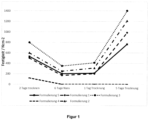
- Figure 1 shows the determined breaking strength after different periods of time and incubation in water as well as after subsequent drying for different binders.
- the process of the present invention employs a composition comprising a plurality of water-insoluble particles; and a copolymer obtainable by polymerizing dicyclopentadiene or cyclopentadiene and an ester of an unsaturated fatty acid.
- the water-insoluble particles are not particularly restricted. Preference is given to particles whose solubility in water under normal conditions is at most about 50 mg/l, preferably at most about 45 mg/l, more preferably at most about 40 mg/l. Normal conditions are understood to mean a temperature of 273.15 K and a pressure of 101.325 kPa.
- the water-insoluble particles can be any water-insoluble particles that are usually used for joint compounds. These include inorganic and organic water-insoluble particles, with inorganic water-insoluble particles being preferred.
- the inorganic water-insoluble particles can be water-insoluble metal or semi-metal compounds, the metals and semi-metals being selected, for example, from groups 1 to 14 of the periodic table, in particular from alkali metals, alkaline earth metals, transition metals, silicon, aluminum or mixtures thereof, preferably they are selected from alkali metals, alkaline earth metals, iron, silicon, aluminum or mixtures thereof.
- water-insoluble non-metal elements such as graphite can be used.
- the water-insoluble metal or semi-metal compounds are not particularly limited and can be selected, for example, from oxides, carbonates, hydroxides, silicates, aluminates, aluminosilicates, borates, sulfates, carbides, nitrides, nitrates, chlorides, phosphates or mixtures thereof.
- inorganic water-insoluble particles include oxides or hydroxides of Si or Al (such as SiO 2 , Al 2 O 3 and Al(OH) 3 ), glass (such as glass particles, glass spheres or hollow glass spheres), ceramics, oxides, phosphates, hydroxides or carbonates of alkali or alkaline earth metal compounds (such as CaO, MgO, MgCO 3 and CaCOs), phosphates, oxides, carbonates or hydroxides of transition metal compounds (such as titanium oxide, cerium oxide and zirconium oxide) and SiCN, SiBCN, silicon carbide or mixtures thereof.
- transition metal compounds such as titanium oxide, cerium oxide and zirconium oxide
- the inorganic water-insoluble particles can be of synthetic or natural origin.
- Inorganic water-insoluble particles of natural origin are, for example, sand, feldspar, clay, loam, talc, minerals of the mica group, kaolin, silica, chalk, dolomite, barite or mixtures thereof.
- the water-insoluble inorganic particles are preferably sand and feldspar, more preferably sand, particularly preferably quartz sand.
- the water-insoluble particles can be organic water-insoluble particles. These include, for example, wood flour, cellulose, textile fibers, fabric chips, cork, wheat chaff, carbon fibers, polymer particles and mixtures thereof.
- the polymers can be, for example, homopolymers or copolymers (e.g. polyolefins, polystyrene, polyvinyl chloride, fluorinated polyolefins such as polytetrafluoroethylene, meth(acrylates) such as PMMA (polymethyl methacrylate), polyamides such as PA6.6, polyesters such as polyethylene terephthalate, polyurethanes or polymers based on polybutadiene such as ABS).
- polyolefins e.g. polyolefins, polystyrene, polyvinyl chloride, fluorinated polyolefins such as polytetrafluoroethylene, meth(acrylates) such as PMMA (polymethyl methacrylate),
- the water-insoluble particles can have any conventional shape.
- the water-insoluble particles do not have a spherical shape in order to increase the strength of the joint. Irregular shapes are preferred.
- the water-insoluble particles can be in fiber form.
- the size of the water-insoluble particles is not particularly limited.
- the water-insoluble particles can preferably have an average particle diameter of about 1 to about 5000 ⁇ m, particularly preferably from about 10 to about 2000 ⁇ m.
- the average particle diameter can be determined by means of sieve analysis according to DIN 66165.
- the composition consists of a plurality of water-insoluble particles and a binder.
- binder all components of the composition other than the plurality of water-insoluble particles.
- the composition preferably contains about 80 parts by weight to 99 parts by weight of water-insoluble particles, more preferably about 85 parts by weight to 98 parts by weight of water-insoluble particles, even more preferably about 87 parts by weight to 98 parts by weight of water-insoluble particles, based on 100 parts by weight of binder.
- the copolymer obtainable by polymerization of dicyclopentadiene or cyclopentadiene and an ester of an unsaturated fatty acid comprises at least one unit derived from dicyclopentadiene or cyclopentadiene and at least one unit derived from an ester of an unsaturated fatty acid.
- DCPD dicyclopentadiene
- IUPAC tricyclo[5.2.1.0 2,6 ]deca-3,8-diene
- cyclopentadiene IUPAC: cyclopenta-1,3-diene
- dicyclopentadiene or “DCPD” refers to both the dimer Tricyclo[5.2.1.0 2,6 ]deca-3,8-diene as well as the monomer cyclopenta-1 ,3-diene.
- Dicyclopentadiene is preferably used.
- DCPD can optionally be functionalized.
- Possible functional groups include organic and inorganic groups.
- esters of an unsaturated fatty acid are not particularly limited.
- these can be derived from polyhydric alcohols, more preferably from dihydric alcohols (such as ethylene glycol, butanediol, pentanediol, hexanediol, heptanediol, neopentyl glycol, diethylene glycol and/or triethyl glycol), trihydric alcohols (such as glycerin, trimethylolethane and/or trimethylolpropane), tetrahydric alcohols (such as pentaerythritol), or hexahydric alcohols (such as dipentaerythritol) or mixtures thereof.
- dihydric alcohols such as ethylene glycol, butanediol, pentanediol, hexanediol, heptanediol, neopentyl glycol, diethylene glycol and/
- the esters of an unsaturated fatty acid can be derived from glycerin.
- the esters of an unsaturated fatty acid derived from glycerin can be triglycerides of an unsaturated fatty acid.
- Triglyceride refers to triple esters of the trivalent alcohol glycerin with an organic carboxylic acid.
- the organic carboxylic acids can be the same or different from each other.
- the triglycerides can carry three identical or different ester groups.
- the organic carboxylic acids can be a fatty acid.
- a fatty acid is an aliphatic monocarboxylic acid having from about 4 to about 36 carbon atoms, preferably from about 8 to about 24 carbon atoms, more preferably from about 12 to about 20 carbon atoms.
- the fatty acids can be straight chain or branched, preferably straight chain.
- the fatty acids may be saturated or unsaturated. According to the present invention, at least one of the organic carboxylic acids is an unsaturated fatty acid.
- the unsaturated fatty acid may have one or more unsaturated bonds, for example one to six unsaturated bonds.
- Possible unsaturated fatty acids are oleic acid, linoleic acid, linolenic acid, palmitoleic acid, gadoleic acid, eleostearic acid, oxoeleostearic acid, erucic acid, gondoic acid, nervonic acid, ricinoleic acid, eicosapentaenoic acid, docosahexaenoic acid, docosapentaenoic acid, stearidonic acid and mixtures thereof.
- the unsaturated fatty acid is selected from oleic acid, linoleic acid, linolenic acid and mixtures thereof.
- saturated fatty acids are palmitic acid, stearic acid, myristic acid, eicosanoic acid, behenic acid and mixtures thereof.
- the saturated fatty acid is selected from palmitic acid, stearic acid and mixtures thereof.
- the fatty acids can be used in the form of a natural mixture of fatty acids.
- the preferred natural mixture of fatty acids is tall oil.
- the ester can preferably be used in the form of a natural oil.
- Natural oils are oils that can be obtained from plants or animals such as fish. This is particularly preferred because these compounds are obtained from renewable raw materials and are therefore particularly sustainable and environmentally friendly.
- Preferred vegetable oils are selected from soybean oil, linseed oil, sunflower oil, safflower oil, rapeseed oil, tung oil, oiticica oil, castor oil, cottonseed oil, corn oil, safflower oil, wood oil, rapeseed oil, perilla oil, poppy seed oil, castor oil, sesame oil, wheat germ oil, peanut oil, hemp oil, grape seed oil, walnut oil, linseed oil, blackcurrant seed oil, perilla seed oil, rosehip oil and mixtures thereof.
- Preferred are linseed oil, soybean oil, sunflower oil, safflower oil, rapeseed oil, tung oil, oiticica oil, castor oil and mixtures thereof.
- Soybean oil is a vegetable oil obtained from the soybean (Glycine max). Soybean oil is a mixture of triglycerides of fatty acids, the fatty acids including oleic acid, linoleic acid, linolenic acid, palmitic acid, and stearic acid.
- oleic acid is present in a proportion of about 17 to 31% by weight, linoleic acid in a proportion of about 48 to 59% by weight, linolenic acid in a proportion of about 2 to 11% by weight, palmitic acid in a proportion of about 2 to 11% by weight, and stearic acid in a proportion of about 2 to 7% by weight.
- Linseed oil is a vegetable oil obtained from linseed, the mature seeds of the linseed plant (Linum usitatissimum).
- Linseed oil is a mixture of triglycerides of fatty acids, the fatty acids including oleic acid, linoleic acid, linolenic acid, palmitic acid, and stearic acid.
- Oleic acid is present in a proportion of about 10% to about 22% by weight, linoleic acid in a proportion of about 12% to about 18% by weight, linolenic acid in a proportion of about 56% to about 71% by weight, palmitic acid in a proportion of about 4% to about 6% by weight and stearic acid in a proportion of about 2% to about 3% by weight.
- Preferred fish oils are herring oil, menhaden oil, cod oil, whale oil or mixtures thereof.
- the natural oil is selected from soybean oil, linseed oil, tung oil, fish oils and mixtures thereof. Even more preferred is soybean oil.
- natural oils can be characterized by their double bond content. This can be determined quantitatively using the iodine number.
- the iodine number is a number that indicates the amount of iodine in grams that can formally be added to 100 g of oil. A higher iodine number corresponds to a higher proportion of double bonds. The proportion of double bonds is related to the drying behavior of the oils. Oils with a higher iodine number dry more quickly in the presence of atmospheric oxygen. Drying oils have an iodine number of about 170 or more, semi-drying oils from about 100 to about 170 and non-drying oils from 0 to about 100.
- the preferred vegetable or fish oils are semi-drying and drying oils with an iodine number in the range of about 100 to about 400, preferably about 100 to about 300, more preferably about 110 to about 250, even more preferably about 140 to about 220.
- the iodine number is determined according to NF EN ISO 3961; AFNOR NFT60-203.
- the copolymer is obtainable by the polymerization of dicyclopentadiene or cyclopentadiene and the ester of an unsaturated fatty acid.
- the polymerization can be carried out under any conditions suitable for the polymerization.
- a Diels-Alder reaction can be carried out between dicyclopentadiene or cyclopentadiene and the ester of an unsaturated fatty acid. This reaction can be carried out, for example, at a temperature of about 200 °C to about 290 °C and a pressure of about 0.05 MPa to about 1.00 MPa.
- n and m are not particularly limited and depend on the unsaturated fatty acid used.
- the copolymer obtainable by the polymerization of dicyclopentadiene or cyclopentadiene and the ester of an unsaturated fatty acid is a random copolymer.
- the copolymer has a weight average molecular weight of about 5,000 to about 1,000,000, preferably from about 10,000 to about 500,000, particularly preferably from about 30,000 to about 60,000.
- the copolymer has a number average molecular weight of about 1,000 to about 3,000, preferably from about 1,200 to about 2,500, particularly preferably from about 1,400 to about 2,000. The measurements were carried out by GPC.
- the ratio of the ester of an unsaturated fatty acid and dicyclopentadiene (DCPD) or cyclopentadiene (CPD) is not particularly limited according to the present invention and can be, for example, from about 40:60 to about 90:10 wt.%, particularly preferably in the range from about 50:50 to about 80:20 wt.%.
- the proportion of the copolymer obtainable by polymerization of dicyclopentadiene or cyclopentadiene and an ester of an unsaturated fatty acid, based on the composition, is not particularly limited according to the invention.
- the proportion of the copolymer is preferably from about 25 parts by weight to about 100 parts by weight, more preferably from about 30 parts by weight to about 90 parts by weight, particularly preferably from about 35 parts by weight to about 90 parts by weight, based on 100 parts by weight of binder.
- the dynamic viscosity of the copolymer can be from about 5000 mPa ⁇ s to about 100,000 mPa ⁇ s, more preferably from about 10,000 mPa ⁇ s to about 90,000 mPa ⁇ s, most preferably from about 20,000 mPa ⁇ s to about 70,000 mPa ⁇ s (measured using a Brookfield CAP 2000 viscometer, 75°C, spindle 6, 100 rpm, 90 seconds according to ISO 2884).
- the composition may contain other components in addition to the majority of water-insoluble particles and the copolymer.
- the composition may optionally contain an ester, preferably a triglyceride, of an unsaturated fatty acid to control viscosity.
- an ester preferably a triglyceride
- the ester of an unsaturated fatty acid is not particularly limited and reference is made to the above discussion of the ester of an unsaturated fatty acid which can be used in the preparation of the copolymer.
- the ester of an unsaturated fatty acid is characterized by an iodine number of about 20 to about 250, preferably from about 150 to about 200, and further by a viscosity of about 50 to about 2000 mPa ⁇ s, preferably from about 50 to about 1000 mPa ⁇ s.
- Linseed oil, tung oil or soybean oil are particularly preferred as esters of an unsaturated fatty acid.
- the proportion of the ester of an unsaturated fatty acid is not particularly limited.
- the proportion of the ester of an unsaturated fatty acid may be from about 0 parts by weight to about 70 parts by weight, more preferably from about 0 parts by weight to about 65 parts by weight, particularly preferably from about 0 parts by weight to about 60 parts by weight, based on 100 parts by weight of binder.
- the viscosity can be controlled by adding polybutadiene oil.
- Polybutadiene oil is a 1,4-polybutadiene that is liquid under normal conditions and whose number average molecular weight is, for example, in a range from 1500 to 3000 g mol -1 .
- the proportion of polybutadiene oil based on the total amount of the composition is not particularly limited. Preferably, this can be in the range from about 0 parts by weight to about 70 parts by weight. More preferably, the proportion can be in a range from about 0 parts by weight to about 65 parts by weight, particularly preferably in the range from about 0 parts by weight to about 60 parts by weight, in each case based on 100 parts by weight of binder.
- the composition may optionally contain a siccative to accelerate the solidification process.
- siccatives such as metal salts of fatty acids, where the fatty acids may have from about 5 to about 22 carbon atoms, such as isooctanoic acid, naphthenic acid, linoleic fatty acid, ricinene fatty acid or tall oil fatty acid, based on the metal cations cobalt, manganese, iron, nickel, zirconium, cerium, titanium or bismuth, can be used in the compositions.
- Preferred siccatives are salts of 2-ethylhexanoic acid ("octoates”) or naphthenic acid, such as Co-octoate, Mn-octoate, Zr-octoate, Co-naphthenate, Mn-naphthenate or Zr-naphthenate.
- Co-octoate or Mn-octoate, in particular Co-octoate are particularly preferred.
- an iron complex which is commercially available as Borchi ® Oxy from Borchers GmbH, Langenfeld. Mixtures of siccatives can also be used.
- the proportion of the siccative is not particularly limited.
- the composition can contain from about 0 parts by weight to about 5 parts by weight, more preferably from about 0.5 parts by weight to about 4 parts by weight, particularly preferably from about 0.7 parts by weight to about 3 parts by weight of siccative based on 100 parts by weight of binder.
- the composition may further contain a silane to increase the strength.
- the type of silane is not particularly limited.
- the silane may be an amino-, epoxy-, mercapto-, hydroxy-, (meth)acryl-, ureido-functionalized silane, vinylsilane or alkylsilane.
- the silane may contain further hydrolyzable functional groups. These may be alkoxy, aryloxy and/or acetoxy groups and/or polysiloxane groups.
- the silane can preferably be selected from the group of epoxy-functionalized silanes and vinylsilanes. More preferably, the silane can be selected from the group of alkoxy-containing epoxy-functionalized silanes or vinylsilanes.
- the silane can particularly preferably be the vinylsilane Dynasylan 6498 from Evonik.
- Dynasylan 6498 is a vinylsilane concentrate (oligomeric siloxane) containing vinyl and ethoxy groups.
- Preferred addition amounts based on 100 parts by weight of binder can be in the range from about 0 parts by weight to about 2 parts by weight, more preferably from about 0.1 part by weight to about 1.5 parts by weight, particularly preferably from about 0.2 part by weight to about 1 part by weight.
- the compositions preferably contain at most small amounts of solvent, for example at most about 5 parts by weight, preferably at most about 2 parts by weight, more preferably at most about 0.5 parts by weight, even more preferably about 0 parts by weight, based on 100 parts by weight of binder.
- Solvents can be understood to mean organic compounds with a boiling point of 200°C or less under normal conditions. These include in particular aliphatic and aromatic hydrocarbons (in particular alkanes, alkenes, benzene, toluene and xylene), ethers, ketones, aldehydes, alcohols, halogenated hydrocarbons or gasolines.
- the amount of volatile solvents (VOC) can be determined using DIN EN ISO 11890-1 and 11890-2.
- the composition may optionally contain pigments for coloring the composition.
- the type of pigment is not particularly limited; all conventional pigments can be used. Titanium dioxide, iron oxides, ultramarine blue, phthalocyanine blue, phthalocyanine green or mixtures thereof can preferably be used.
- the proportion of pigments is not particularly limited; it can be from about 0 parts by weight to about 10 parts by weight, preferably from about 1 part by weight to about 8 parts by weight, particularly preferably from about 2 parts by weight to about 6 parts by weight, based on 100 parts by weight of binder.
- composition may optionally contain other conventional additives such as weed killers, fungicides, or any other conventional additive or mixtures thereof.
- the total amount of the optional ingredients is not particularly limited. It can range from about 0 parts by weight to about 10 parts by weight, based on 100 parts by weight. Binder, preferably from about 0 parts by weight to about 5 parts by weight, more preferably from about 0 parts by weight to about 2 parts by weight.
- individual elements of a surface covering are applied to a surface.
- the surface is not particularly limited and can be aligned horizontally or vertically or inclined at any angle and can be located outdoors or indoors.
- the surface can preferably be a floor or a wall.
- the composition can preferably be used outdoors.
- the individual elements of the surface covering can be made of all common materials. These include paving stones, natural stones, concrete elements, clinker bricks, pebbles, stones, tiles, wooden elements or mixtures thereof.
- the individual elements are applied to the surface next to one another, so that a gap is formed between them.
- the width of the gap i.e. the distance between the individual elements, is not particularly limited. It can be, for example, from about 0.1 mm to about 150 mm, preferably from about 0.5 mm to about 60 mm, particularly preferably from about 1 mm to about 10 mm.
- water is applied to the individual elements of the surface coating in order to provide a hydrophilic surface and thus avoid contamination of the individual elements of the surface coating with the copolymer obtainable by polymerization of dicyclopentadiene or cyclopentadiene and an ester of an unsaturated fatty acid or other optional components of the composition.
- the copolymer obtainable by polymerization of dicyclopentadiene or cyclopentadiene and an ester of an unsaturated fatty acid is first mixed with the majority of water-insoluble particles and the optional components.
- the mixing of the copolymer obtainable by polymerization of dicyclopentadiene or cyclopentadiene and an ester of an unsaturated fatty acid with the majority of water-insoluble particles can be carried out before introduction, alternatively the mixing can be carried out beforehand and the composition stored in an airtight manner. Preferably the mixing is carried out beforehand and the composition stored in an airtight manner.
- the copolymer obtainable by polymerization of dicyclopentadiene or cyclopentadiene and an ester of an unsaturated fatty acid and the optional components are mixed and then the majority of water-insoluble particles are added.
- the area of the individual elements of the surface covering is rinsed with water.
- This firstly causes the mixture of the copolymer, which is obtainable by polymerizing dicyclopentadiene or cyclopentadiene and an ester of an unsaturated fatty acid, with the majority of water-insoluble particles to slurry into the gap between the individual elements of the surface covering, and secondly allows residues of copolymer and other optional components of the composition to be removed from the surface of the individual elements of the surface covering.
- the composition hardens under the influence of atmospheric oxygen.
- the resulting joints have very good flexibility and excellent saponification and weather stability. Furthermore, they have comparable and in some cases higher strengths than commercially available polybutadiene oil-based binder formulations.
- the compositions can be made from renewable raw materials. Furthermore, the excellent performance properties mentioned above can be achieved without the use of volatile organic solvents. The compositions therefore make a significant contribution to sustainability and environmental and consumer protection.
- Preparation Example 1 Synthesis of a copolymer obtainable from dicyclopentadiene and an ester of an unsaturated fatty acid
- the reaction mixture was then cooled to 240°C and kept at this temperature until a target viscosity of 50000 mPa s was reached (Brookfield CAP 2000 viscometer according to ISO 2884, 75°C, spindle 6, 50 rpm, 90 sec.).
- the resulting copolymer can be used for further processing or formulation.
- the DCPD copolymer can be mixed with linseed oil and adjusted to a desired target viscosity, as explained in the following examples.
- DCPD copolymer from Example 1 40 parts by weight of DCPD copolymer from Example 1 were mixed with 60 parts by weight of linseed oil and homogenized while stirring. This mixture was then mixed with 1% by weight of Co-octoate (Co-octoate in aromatic-free white spirit D60 (25 to 50%), 12% by weight of Co) and also homogenized.
- Co-octoate Co-octoate in aromatic-free white spirit D60 (25 to 50%), 12% by weight of Co
- DCPD copolymer from Example 1 40 parts by weight of DCPD copolymer from Example 1 were mixed with 59 parts by weight of linseed oil and homogenized with stirring. 1% by weight of Dynasylan 6498 was then added and homogenized with stirring. This mixture was then mixed with 1% by weight of Co-octoate (Co-octoate in aromatic-free white spirit D60 (25 to 50%), 12% by weight of Co) and also homogenized.
- Co-octoate Co-octoate in aromatic-free white spirit D60 (25 to 50%), 12% by weight of Co
- polybutadiene oil Polyvest110 (PV110) from Evonik was tested.
- the pure polybutadiene oil was mixed with 1 wt.% Co-octoate (Co-octoate in aromatic-free white spirit D60 (25 to 50%), 12 wt.% Co) and homogenized.
- the iodine number was determined according to NF EN ISO 3961; AFNOR NFT60-203.
- the formulations investigated are summarized in Table 1 and the corresponding iodine number results in Table 2.
- Joint material was prepared by mixing 89.1 g of a formulation mentioned above with 0.9 g Co octoate (12 wt.% Co in white spirit D60) and 2910 g quartz sand (H31, with an average grain size of -250 ⁇ m).
- the mixture was mixed in a Hobart planetary mixer (Hobart GmbH, model: HSM10) at speed level 4 of 6 with 221 revolutions per minute for 2 minutes using a flat stirrer model B (Hobart GmbH).
- the joint mortar was introduced into this mold, compacted and stored in the mold for 24 hours at 18 to 30 °C and a humidity of 40 to 75 %.
- the formwork was then removed and the cores were allowed to mature in the air for 24 hours.
- the flexural strength was determined using a strength testing device (model PFG, +GF+) in accordance with VdG data sheet P 72.
- Test variant 1 simulates hardening and cross-linking under dry conditions.
- Four test specimens were provided for this test, two test specimens per time interval, which are used for duplicate determination.
- the immediate strengths were measured, i.e. as soon as the 24-hour ripening period was completed.
- the second test point was reached five days after the ripening period.
- the test specimens were temporarily stored under the conditions already mentioned above. After the respective storage time had elapsed, the test specimens were broken using a strength testing device.
- the second method simulates a wet/dry cycle.
- the focus was on checking the regeneration capacity, wet resistance and final strength after washing out the different joint mortars.
- Eight test specimens were provided for this test method, two test specimens per time interval, which were used for the duplicate determination.
- the test specimens were produced in the same way as above. After the formwork had been removed and the 24-hour maturing period, the first test point was measured. All other test specimens were then immediately stored in demineralized water (1 liter). The container was chosen so that all of the test specimens were stored horizontally in the water and were not exposed to any transverse forces.
- the test specimens were stored in the water at a temperature of 18 to 30 °C and for a period of six days.
- test specimens were then carefully lifted out of the water and placed on cellulose paper. Two test specimens were then immediately tested for strength. The remaining test specimens were temporarily stored under the conditions mentioned above. The next duplicate determination was carried out one day later. Four days later, i.e. five days after the water sampling, the last duplicate determination was carried out. The results are shown in Figure 1 shown.
- Table 3 describes the strengths obtained according to VdG Data Sheet P 72 after 2 days of oxidative drying at room temperature. The test specimens were then stored in deionized water for 6 days and the strengths in the wet state were determined immediately afterwards. The strengths were then examined again after 1 and 5 days of dry storage at room temperature.
- Rectangular stone slabs measuring 20 cm x 10 cm were laid on a compacted surface covered with sand at a distance of 1 to 2 cm and sprayed with water.
- Jointing material was prepared by mixing 89.1 g of formulation 1 with 0.9 g Co octoate (12 wt.% Co in white spirit D60) and 2910 g quartz sand (H31, with an average grain size of -250 ⁇ m) and introduced into the gap between the stone slabs by sweeping. The stone slabs were then rinsed with water. The jointing material was left to harden overnight and was evaluated on the 3rd day.
- the joint material was solid, dimensionally stable and showed good flank adhesion. After rain, the water was able to drain away quickly and there was no waterlogging. Even after 1 year of outdoor exposure, the subsurface was solid. In addition, no weed growth was visible between the treated joints. However, in untreated areas, there was clear weed growth.
Landscapes
- Chemical & Material Sciences (AREA)
- Engineering & Computer Science (AREA)
- Ceramic Engineering (AREA)
- Chemical Kinetics & Catalysis (AREA)
- Materials Engineering (AREA)
- Structural Engineering (AREA)
- Organic Chemistry (AREA)
- Compositions Of Macromolecular Compounds (AREA)
- Sealing Material Composition (AREA)
Description
- Die vorliegende Erfindung betrifft ein Verfahren zur Herstellung einer Fuge,
- Fugenmaterialien bzw. Fugenmörtel werden zum Füllen von Zwischenräumen unterschiedlichster Art eingesetzt wie z. B. Fugen zwischen Pflastersteinen. Die gängigen Pflastersteinbeläge werden heutzutage überwiegend mit losem Sand oder zementgebundenem Mörtel verfugt. Die mit losem Sand verfugten Pflastersteinbeläge können zwar außerordentlich gut auf Temperaturänderungen und die damit einhergehenden Fugenbreiten reagieren, allerdings durch Kehrarbeiten oder Hochdruckreiniger auch leicht aus den Fugen herausgetragen werden. Ebenso führen starke Niederschläge zu einem langsamen Herauslösen des Sandes aus der Fuge. Darüber hinaus können Insekten den losen Sand abtragen und an anderer Stelle anhäufen, wodurch ebenfalls eine Verlagerung der Sandkonzentration stattfindet und die Pflastersteine dadurch nicht mehr fest fixiert werden können.
- Alternative zementgebundene Mörtel sind sehr stabil, allerdings kommt es beim Einsatz von Mörtel zu Verschmutzungen, die sich wenn überhaupt nur schwer vom Pflasterstein ablösen, oder dadurch Reinigungen nur kostenintensiv durchführen lassen. Zusätzlich kommt es in Frostperioden immer wieder zum Aufplatzen des ausgehärteten Fugenmörtels, so dass Reparatur- und Instandhaltungsarbeiten eingeplant werden müssen.
- Im Profibereich sind zweikomponentige Systeme beispielsweise basierend auf Epoxidharz und Härter gängig. Für eine erfolgreiche Anwendung muss das Mischungsverhältnis von Harz und Härter exakt eingehalten werden. Als problematisch erweist sich, dass die jeweiligen Formulierungen nur eine begrenzte Verarbeitungszeit besitzen. Damit sind diese Systeme für den DIY-Bereich nur bedingt geeignet.
- Um diese Nachteile zu beseitigen, haben sich einkomponentige Kunstharz-basierte Fugenmörtel im Laufe der Jahre etabliert. Die Kunstharze erfüllen dabei gleich mehrere Aufgaben. Zum einen zeigen diese Mörtel selbst im ausgehärteten Zustand einen plastischelastischen Charakter und können demnach Temperaturschwankungen und die damit einhergehenden Fugenbreitenveränderungen kompensieren, so dass stets eine geschlossene Oberfläche vorliegt. Zum anderen ist der ausgehärtete Fugenmörtel stabil genug, dass Reinigungsarbeiten und selbst heftige Niederschläge kein Heraustragen des Fugenmaterials mit sich führen. Ein weiterer Vorteil von ausgehärtetem Fugenmörtel besteht in der Verhinderung von Unkrautwachstum in der Fuge.
- Die bevorzugte Möglichkeit zur Härtung von einkomponentigen Systemen ist die oxidative Vernetzung mit Luftsauerstoff.
- Um eine akzeptable Aushärtung der einkomponentigen Fugenmörtelmischung zu gewährleisten, werden die eingesetzten Bindemittel vorab mit speziellen Additiven, sogenannten Sikkativen/Trockenstoffen, vermischt. Die Eigenschaften und Beispiele der Sikkative werden in
Patent DE 19714825 A1 detailliert beschrieben und werden im Folgenden näher spezifiziert:
Sikkative sind ionogene Metallverbindungen, die ungesättigten Ölen und Bindemitteln zugesetzt werden, um deren Trockenzeit erheblich zu verkürzen. Als aktive Komponenten fungieren hier metallische Kationen, die eine oxidative Vernetzung der ungesättigten Verbindungen mit Luftsauerstoff herbeiführen und deren Aushärtung im Vergleich zu unsikkativierten Formulierungen signifikant beschleunigen. Herkömmliche Sikkative sind Metallseifen von z. B. Isooctansäure, Naphthensäure, Linolfettsäure, Ricinenfettsäure oder Tallölfettsäure, die durch direkte Umsetzung von Metallen und Carbonsäuren oder nach dem Fällungs- und Schmelzprozess aus den Carbonsäuren und den Metalloxiden oder -hydroxiden hergestellt werden. Die gängigen Sikkative können fest, wasserlöslich oder als wasserverdünnbare Emulsion vorliegen oder aber auch einfach in organischen Lösungsmitteln gelöst sein. Die für die oxidative Trocknung eingesetzten Standardtypen basieren auf den folgenden Metallkationen: Cobalt, Mangan, Eisen, Nickel, Zirconium, Cer, Titan und Bismut. - Um die Feuchtestabilität und Haftung des Mörtels auf dem Stein weiter zu verbessern, können Silane zugesetzt werden. Normale Zusatzmengen betragen für diesen Anwendungsbereich von 0,1 bis 5 Gew.-% bezogen auf Bindemittel. Neben einer deutlichen Verbesserung der Feuchtestabilität nehmen solche Silane ebenfalls einen positiven Einfluss auf die Härteentwicklung und fungieren darüber hinaus als ausgezeichneter Haftvermittler zwischen Harzmantel und anorganischen Oberflächen.
- Für diesen Anwendungszweck geeignete Silane sind beispielsweise Aminosilane, Epoxysilane, Mercaptosilane, Hydroxysilane, Methacrylsilane, Ureidosilane, Polysiloxane, Vinylsilane und Alkylsilane.
-
EP 0211712 A1 beschreibt eine Bindemittelformulierung auf Basis von Polybutadienöl, welches mit Lösungsmitteln wie Xylol, Toluol oder Testbenzin zur Behandlung von porösen Baustoffen eingesetzt wird. Das Polybutadien erfüllt dabei nahezu alle Eigenschaften wie gute Alkalistabilität nach Aushärtung und dennoch elastischen Charakter, um auf Temperaturschwankungen reagieren zu können. Aufgrund der Entflammbarkeit der hier eingesetzten Lösungsmittel ist der kommerzielle Einsatz allerdings begrenzt. - Eine Weiterentwicklung wird in Patentschrift
DE 40 35 359 C1 vorgestellt. Die in der Patentschrift aufgeführte Formulierung zielt auf eine verbesserte Lagerfähigkeit und Verarbeitbarkeit durch den Einsatz von aliphatischen Lösungsmitteln wie Terpentinöl ab. -
DE 44 21 970 A1 beschreibt darüber hinaus eine Fugenmörtelformulierung auf Basis von Polybutadienöl, die mit unterschiedlichsten Quarzsandkorngrößen ausgestattet ist, sodass eine dichte Kugelpackung innerhalb der Fuge resultiert. So ergibt sich ein harter und dennoch elastischer Fugenmörtel. - In "Unkrautschreck und Tausendsassa", Adhesives Das Klebstoffmagazin von Evonik Industries vom 31. Januar 2013 wird die Verwendung eines flüssigen Polybutadien-basierten Mörtels (Polyvest 110) als Fugenmörtel beschrieben.
-
DE 1 242 573 A1 beschreibt ein bestimmtes Verfahren zum Einkapseln von Granulaten, die eine wasserlösliche Substanz enthalten, insbesondere von Düngemitteln zur verzögerten Freisetzung der wirksamen Bestandteile. Als Überzugsmittel wird im Beispiel ein Copolymerisat aus Dicyclopentadien und Leinsamenöl in Lackbenzin verwendet. -
US 5,288,805 sowieUS 5,693,715 beschreiben ein Copolymer aus Leinsamenöl und Dicyclopentadien, das in Beschichtungszusammensetzungen verwendet wird. - Üblicherweise wird das oxidativ trocknende Bindemittel mit einem körnigen Stoff vermischt und als Fertigmischung in den Handel gebracht. Um eine vorzeitige oxidative Trocknung in der Verpackung zu verhindern, wird das Material vakuumverpackt und damit der Luftsauerstoffeintrag verhindert. Auf diese Weise wird eine gut lagerfähige, an der Luft härtende Fugenmasse bereitgestellt.
- Dennoch haben Polybutadienöl-basierte Bindemittelformulierungen ein grundsätzliches Problem: Diese Bindemittel und die daraus gefertigten Formulierungen besitzen einen starken und sehr unangenehmen Eigengeruch. Dieser Eigengeruch rührt vor allem von den verwendeten leichtflüchtigen organischen Lösungsmitteln sowie dem hohen Anteil an Polybutadienöl her. Im Stand der Technik ist die Verwendung von Lösungsmitteln beschrieben, wodurch einerseits Emissionen und damit verbundene Geruchsbelästigungen unvermeidbar sind. Außerdem kann die potenzielle Entflammbarkeit zu einem weiteren Sicherheitsrisiko führen.
- Der Erfindung liegt die Aufgabe zugrunde eine Zusammensetzung bereitzustellen, die eine Fugenmasse bereitstellen kann, die eine sehr gute Flexibilität sowie ausgezeichnete Verseifungs- und Wetterstabilität aufweist. Des Weiteren sollte die Fugenmasse zumindest eine vergleichbare Festigkeit wie handelsübliche Polybutadienöl-basierte Bindemittelformulierungen aufweisen.
- Die vorliegende Erfindung ist in den Ansprüchen definiert.
-
Figur 1 zeigt die ermittelte Bruchfestigkeit nach unterschiedlichen Zeitspannen und Inkubation in Wasser sowie nach anschließender Trocknung für unterschiedliche Bindemittel. - Bei dem Verfahren der vorliegenden Erfindung wird eine Zusammensetzung eingesetzt, umfassend eine Mehrzahl an wasserunlöslichen Teilchen; und ein Copolymer, das durch Polymerisation von Dicyclopentadien oder Cyclopentadien und einem Ester einer ungesättigten Fettsäure erhältlich ist.
- Die wasserunlöslichen Teilchen sind nicht besonders beschränkt. Bevorzugt sind Teilchen, deren Löslichkeit in Wasser unter Normalbedingungen höchstens etwa 50 mg/l, bevorzugt höchstens etwa 45 mg/l, stärker bevorzugt höchstens etwa 40 mg/l beträgt. Unter Normalbedingungen wird eine Temperatur von 273,15 K sowie ein Druck von 101,325 kPa verstanden.
- Die wasserunlöslichen Teilchen können alle wasserunlöslichen Teilchen sein, die üblicherweise für Fugenmassen verwendet werden. Hierzu zählen anorganische und organische wasserunlösliche Teilchen, bevorzugt sind anorganische wasserunlösliche Teilchen.
- Die anorganischen wasserunlöslichen Teilchen können wasserunlösliche Metall- oder Halbmetallverbindungen sein, wobei die Metalle und Halbmetalle bspw. aus der 1. bis 14. Gruppe des Periodensystems, insbesondere aus Alkalimetallen, Erdalkalimetallen, Übergangsmetallen, Silicium, Aluminium oder Gemischen davon ausgewählt sind, bevorzugt sind sie aus Alkalimetallen, Erdalkalimetallen, Eisen, Silicium, Aluminium oder Gemischen ausgewählt. Alternativ können wasserunlösliche Nichtmetallelemente wie Graphit eingesetzt werden.
- Die wasserunlöslichen Metall- oder Halbmetallverbindungen sind nicht besonders beschränkt und können beispielsweise aus Oxiden, Carbonaten, Hydroxiden, Silicaten, Aluminaten, Aluminosilicaten, Boraten, Sulfaten, Carbiden, Nitriden, Nitraten, Chloriden, Phosphaten oder Gemischen davon ausgewählt sein.
- Beispiele für anorganische wasserunlösliche Teilchen umfassen Oxide oder Hydroxide von Si oder Al (wie SiO2, Al2O3 und Al(OH)3), Glas (wie Glaspartikel, Glaskugeln oder Hohlglaskugeln), Keramik, Oxide, Phosphate, Hydroxide oder Carbonate der Alkali- oder Erdalkalimetallverbindungen (wie CaO, MgO, MgCO3 und CaCOs), Phosphate, Oxide, Carbonate oder Hydroxide der Übergangsmetallverbindungen (wie Titanoxid, Ceroxid und Zirconiumoxid) und SiCN, SiBCN, Siliciumcarbid oder Gemische davon.
- Die anorganischen wasserunlöslichen Teilchen können synthetischen oder natürlichen Ursprungs sein. Anorganische wasserunlösliche Teilchen natürlichen Ursprungs sind bspw. Sand, Feldspat, Ton, Lehm, Talk, Minerale der Glimmergruppe, Kaolin, Kieselerde, Kreide, Dolomit, Baryt oder Gemische davon. Bevorzugt sind die wasserunlöslichen anorganischen Teilchen Sand und Feldspat, stärker bevorzugt Sand, besonders bevorzugt Quarzsand.
- Die wasserunlöslichen Teilchen können organische wasserunlösliche Teilchen sein. Dazu zählen beispielsweise Holzmehl, Zellstoffe, Textilfasern, Gewebeschnitzel, Kork, Weizenspreu, Carbonfasern, Polymerteilchen und Gemische davon. Die Polymere können beispielsweise Homo- oder Copolymere (bspw. Polyolefine, Polystyrol, Polyvinylchlorid, fluorierte Polyolefine wie beispielsweise Polytetrafluorethylen, Meth(acrylate) wie PMMA (Polymethylmethacrylat), Polyamide wie PA6.6, Polyester wie Polyethylenterephthalat, Polyurethane oder Polymere auf der Basis von Polybutadien wie beispielsweise ABS) sein.
- Die wasserunlöslichen Teilchen können jegliche übliche Form haben. Bevorzugt haben die wasserunlöslichen Teilchen keine sphärische Form, um die Festigkeit der Fuge zu erhöhen. Bevorzugt sind unregelmäßige Formen. Alternativ können die wasserunlöslichen Teilchen in Faserform vorliegen.
- Die Größe der wasserunlöslichen Teilchen ist nicht besonders beschränkt. Bevorzugt können die wasserunlöslichen Teilchen einen mittleren Teilchendurchmesser von etwa 1 bis etwa 5000 µm, besonders bevorzugt von etwa 10 bis etwa 2000 µm aufweisen. Der mittlere Teilchendurchmesser kann mittels Siebanalyse nach DIN 66165 bestimmt werden.
- Die Zusammensetzung besteht aus einer Mehrzahl an wasserunlöslichen Teilchen und einem Bindemittel. Im Rahmen der Erfindung werden alle Bestandteile der Zusammensetzung, die von der Mehrzahl an wasserunlöslichen Teilchen verschieden sind, als "Bindemittel" bezeichnet. Die Zusammensetzung enthält bevorzugt etwa 80 Gewichtsteile bis 99 Gewichtsteile wasserunlösliche Teilchen, stärker bevorzugt etwa 85 Gewichtsteile bis 98 Gewichtsteile wasserunlösliche Teilchen, noch stärker bevorzugt etwa 87 Gewichtsteile bis 98 Gewichtsteile wasserunlösliche Teilchen, bezogen auf 100 Gewichtsteile Bindemittel.
- Das Copolymer, welches durch Polymerisation von Dicyclopentadien oder Cyclopentadien und einem Ester einer ungesättigten Fettsäure erhältlich ist, umfasst mindestens eine von Dicyclopentadien oder Cyclopentadien abgeleitete Einheit und mindestens eine von einem Ester einer ungesättigten Fettsäure abgeleitete Einheit.
- "Dicylopentadien" (DCPD) bezeichnet das Dimer des Cyclopentadiens. DCPD (IUPAC: Tricyclo[5.2.1.02,6]deca-3,8-dien) kann durch thermische Retro-Diels-Alder Reaktion mittels Erhitzen über 150 °C in Cyclopentadien (IUPAC: Cyclopenta-1,3-dien) überführt werden. In der vorliegenden Anmeldung bezeichnet "Dicyclopentadien" oder "DCPD" sowohl das Dimer Tricyclo[5.2.1.02,6]deca-3,8-dien als auch das Monomer Cyclopenta-1 ,3-dien. Bevorzugt wird Dicyclopentadien eingesetzt.
- Weiterhin kann DCPD gegebenenfalls funktionalisiert sein. Mögliche funktionelle Gruppen schließen organische sowie anorganische Gruppen mit ein.
- Die Ester einer ungesättigten Fettsäure sind nicht besonders beschränkt. Bevorzugt können diese von mehrwertigen Alkoholen abgeleitet sein, weiter bevorzugt von zweiwertigen Alkoholen (wie Ethylenglykol, Butandiol, Pentandiol, Hexandiol, Heptandiol, Neopentylglykol, Diethylenglykol und/oder Triethylglykol), dreiwertigen Alkoholen (wie Glycerin, Trimethylolethan und/oder Trimethylolpropan), vierwertigen Alkoholen (wie Pentaerythrit), oder sechswertigen Alkoholen (wie Dipentaerythrit) oder Gemischen davon. Besonders bevorzugt können die Ester einer ungesättigten Fettsäure von Glycerin abgeleitet sein. Bevorzugt können die von Glycerin abgeleiteten Ester einer ungesättigten Fettsäure Triglyceride einer ungesättigten Fettsäure sein.
- "Triglycerid" bezeichnet dreifache Ester des dreiwertigen Alkohols Glycerin mit einer organischen Carbonsäure. Die organischen Carbonsäuren können gleich oder voneinander verschieden sein. Somit können die Triglyceride drei gleichartige oder voneinander verschiedene Estergruppen tragen.
- Die organischen Carbonsäuren können eine Fettsäure sein. Eine Fettsäure ist eine aliphatische Monocarbonsäure mit etwa 4 bis etwa 36 Kohlenstoffatomen, bevorzugt etwa 8 bis etwa 24 Kohlenstoffatomen, stärker bevorzugt etwa 12 bis etwa 20 Kohlenstoffatomen. Die Fettsäuren können geradkettig oder verzweigt, bevorzugt geradkettig sein.
- Die Fettsäuren können gesättigt oder ungesättigt sein. Gemäß der vorliegenden Erfindung ist mindestens eine der organischen Carbonsäuren eine ungesättigte Fettsäure. Die ungesättigte Fettsäure kann eine oder mehrere ungesättigte Bindungen aufweisen, beispielsweise eine bis sechs ungesättigte Bindungen.
- Mögliche ungesättigte Fettsäuren sind Ölsäure, Linolsäure, Linolensäure, Palmitoleinsäure, Gadoleinsäure, Eleostearinsäure, Oxoeleostearinsäure, Erucasäure, Gondosäure, Nervonsäure, Ricinolsäure, Eicosapentaensäure, Docosahexaensäure, Docosapentaensäure, Stearidonsäure und Gemische davon. In einer bevorzugten Ausführungsform ist die ungesättigte Fettsäure aus Ölsäure, Linolsäure, Linolensäure und Gemischen davon ausgewählt.
- Mögliche gesättigte Fettsäuren sind Palmitinsäure, Stearinsäure, Myristinsäure, Eicosansäure, Behensäure und Gemischen davon. In einer bevorzugten Ausführungsform ist die gesättigte Fettsäure aus Palmitinsäure, Stearinsäure und Gemischen davon ausgewählt.
- Die Fettsäuren können in Form eines natürlichen Gemisches aus Fettsäuren eingesetzt werden. Bevorzugt kann das natürliche Gemisch aus Fettsäuren Tallöl sein.
- Der Ester kann bevorzugt in Form eines natürlichen Öls eingesetzt werden. Als natürliche Öle werden Öle bezeichnet, welche aus Pflanzen oder Tieren wie Fischen erhalten werden können. Dies ist besonders bevorzugt, da diese Verbindungen aus nachwachsenden Rohstoffen erhalten werden und deshalb besonders nachhaltig und umweltfreundlich sind.
- Bevorzugte Pflanzenöle sind aus Sojaöl, Leinöl, Sonnenblumenöl, Distelöl, Rapsöl, Tungöl, Oiticikaöl, Ricinusöl, Baumwollsamenöl, Maisöl, Safloröl, Holzöl, Rüböl, Perillaöl, Mohnsamenöl, Ricineenöl, Sesamöl, Weizenkeimöl, Erdnussöl, Hanföl, Traubenkernöl, Walnussöl, Lackleinöl, Johannisbeerkernöl, Perillasamenöl, Wildrosenöl und Gemischen davon ausgewählt. Bevorzugt sind Leinöl, Sojaöl, Sonnenblumenöl, Distelöl, Rapsöl, Tungöl, Oiticikaöl, Rizinusöl, und Gemische davon. Stärker bevorzugt sind Leinöl, Sojaöl und Gemische davon. Besonders bevorzugt ist das Pflanzenöl Sojaöl. Sojaöl ist ein aus der Sojabohne (Glycine max) gewonnenes pflanzliches Öl. Sojaöl ist ein Gemisch von Triglyceriden von Fettsäuren, wobei die Fettsäuren Ölsäure, Linolsäure, Linolensäure, Palmitinsäure und Stearinsäure beinhalten. Üblicherweise liegt Ölsäure in einem Anteil von etwa 17 bis 31 Gew.-% vor, Linolsäure in einem Anteil von etwa 48 bis 59 Gew.-%, Linolensäure in einem Anteil von etwa 2 bis 11 Gew.-%, Palmitinsäure in einem Anteil von etwa 2 bis 11 Gew.-% und Stearinsäure in einem Anteil von etwa 2 bis 7 Gew.-%. Leinöl ist ein pflanzliches Öl, das aus Leinsamen, den reifen Samen von Öllein (Linum usitatissimum), gewonnen wird. Leinöl ist ein Gemisch von Trigylceriden von Fettsäuren, wobei die Fettsäuren Ölsäure, Linolsäure, Linolensäure, Palmitinsäure und Stearinsäure beinhalten. Dabei liegt Ölsäure in einem Anteil von etwa 10 Gew.-% bis etwa 22 Gew.-% vor, Linolsäure in einem Anteil von etwa 12 Gew.-% bis etwa 18 Gew.-%, Linolensäure in einem Anteil von etwa 56 Gew.-% bis etwa 71 Gew.-%, Palmitinsäure in einem Anteil von etwa 4 Gew.-% bis etwa 6 Gew.-% und Stearinsäure in einem Anteil von etwa 2 Gew.-% bis etwa 3 Gew.-%.
- Bevorzugte Fischöle sind Heringstran, Menhadentran, Kabeljauöl, Walöl oder Gemische davon.
- Stärker bevorzugt ist das natürliche Öl ausgewählt aus Sojaöl, Leinöl, Tungöl, Fischölen und Gemischen davon. Noch stärker bevorzugt ist Sojaöl.
- Im Allgemeinen können natürliche Öle anhand ihres Gehalts an Doppelbindungen charakterisiert werden. Dies kann quantitativ anhand der lodzahl bestimmt werden. Die lodzahl ist eine Kennzahl, welche die Menge an lod in Gramm angibt, die formal an 100 g Öl addiert werden kann. Eine höhere lodzahl entspricht einem höheren Anteil an Doppelbindungen. Der Anteil an Doppelbindungen steht in Zusammenhang mit dem Trocknungsverhalten der Öle. Öle mit einer höheren lodzahl weisen ein schnelleres Trocknungsverhalten in Gegenwart von Luftsauerstoff auf. Trocknende Öle besitzen eine lodzahl von etwa 170 oder mehr, halb-trocknende Öle von etwa 100 bis etwa 170 und nicht trocknende Öle von 0 bis etwa 100. Die bevorzugten Pflanzen- oder Fischöle sind halb-trocknende und trocknende Öle mit einer lodzahl im Bereich von etwa 100 bis etwa 400, bevorzugt etwa 100 bis etwa 300, stärker bevorzugt etwa 110 bis etwa 250, noch stärker bevorzugt etwa 140 bis etwa 220. Die Bestimmung der lodzahl erfolgt nach NF EN ISO 3961; AFNOR NFT60-203.
- Das Copolymer ist durch die Polymerisation von Dicyclopentadien oder Cyclopentadien und dem Ester einer ungesättigten Fettsäure erhältlich. Die Polymerisation kann unter beliebigen Bedingungen, die für die Polymerisation geeignet sind, durchgeführt werden. In einer Ausführungsform kann zum Beispiel eine Diels-Alder-Reaktion zwischen Dicyclopentadien oder Cyclopentadien und dem Ester einer ungesättigten Fettsäure erfolgen. Diese Umsetzung kann beispielsweise bei einer Temperatur von etwa 200 °C bis etwa 290 °C und einem Druck von etwa 0,05 MPa bis etwa 1,00 MPa durchgeführt werden.
- Obwohl wir nicht durch die Theorie beschränkt sein möchten, wird angenommen, dass in einem ersten Schritt eine Retro-Diels-Alder Reaktion des Dicyclopentadien zu Cyclopentadien stattfindet. Es wird vermutet, dass im weiteren Reaktionsverlauf Cyclopentadien mit Doppelbindungen, welche im Ester einer ungesättigten Fettsäure vorhanden sind, unter Bildung eines Diels-Alder Reaktionsproduktes wie in dem folgenden Schema gezeigt reagiert. Im Schema bezeichnet R einen von einer gesättigten oder ungesättigten Fettsäure abgeleiteten Rest.

- Die Werte von n und m sind nicht besonders beschränkt und hängen von der eingesetzten ungesättigten Fettsäure ab.
- Unter den vorstehend beschriebenen Reaktionsbedingungen können weitere Reaktionen stattfinden, wie beispielsweise Umlagerungsreaktionen, wozu beispielsweise die cis-trans-Isomerisierung zählen oder Umlagerungsreaktionen von nicht konjugierten Dienen zu konjugierten Dienen. Diese konjugierten Diene können ihrerseits an weiteren intra- sowie intermolekularen Vernetzungsreaktionen teilnehmen, wodurch höhermolekulare Polymerisationsprodukte gebildet werden können. Ebenfalls ist eine Kettenbildung auf Basis mehrerer Cyclopentadieneinheiten, die miteinander reagieren, anzunehmen.
- Das Copolymer, das durch die Polymerisation von Dicyclopentadien oder Cyclopentadien und dem Ester einer ungesättigten Fettsäure erhältlich ist, ist ein statistisches Copolymer. Das Copolymer weist ein Gewichtsmittel des Molekulargewichts von etwa 5000 bis etwa 1000000 auf, bevorzugt von etwa 10000 bis etwa 500000, besonders bevorzugt von etwa 30000 bis etwa 60000. Das Copolymer weist ein Zahlenmittel des Molekulargewichts von etwa 1000 bis etwa 3000 auf, bevorzugt von etwa 1200 bis etwa 2500, besonders bevorzugt von etwa 1400 bis etwa 2000. Die Messungen wurden mittels GPC durchgeführt.
- Das Verhältnis des Esters einer ungesättigten Fettsäure und Dicyclopentadien (DCPD) bzw. Cyclopentadien (CPD) ist gemäß der vorliegenden Erfindung nicht besonders beschränkt und kann bspw. von etwa 40 : 60 bis etwa 90 : 10 Gew.-%, besonders bevorzugt im Bereich von etwa 50 : 50 bis etwa 80 : 20 Gew.-% betragen.
- Der Anteil des Copolymers, das durch Polymerisation von Dicyclopentadien oder Cyclopentadien und einem Ester einer ungesättigten Fettsäure erhältlich ist, bezogen auf die Zusammensetzung, ist gemäß der Erfindung nicht besonders beschränkt. Der Anteil des Copolymers beträgt vorzugsweise von etwa 25 Gewichtsteilen bis etwa 100 Gewichtsteile, weiter bevorzugt von etwa 30 Gewichtsteilen bis etwa 90 Gewichtsteile, besonders bevorzugt von etwa 35 Gewichtsteilen bis etwa 90 Gewichtsteile, bezogen auf 100 Gewichtsteile Bindemittel.
- Bevorzugt kann die dynamische Viskosität des Copolymers von etwa 5000 mPa·s bis etwa 100000 mPa·s betragen, weiter bevorzugt von etwa 10000 mPa·s bis etwa 90000 mPa·s, besonders bevorzugt von etwa 20000 mPa·s bis etwa 70000 mPa·s (gemessen mittels Brookfield CAP 2000 Viskosimeter, 75°C, Spindel 6, 100 UpM, 90 Sekunden gemäß ISO 2884).
- Die Zusammensetzung kann neben der Mehrzahl an wasserunlöslichen Teilchen und dem Copolymer weitere Bestandteile enthalten.
- Die Zusammensetzung kann ggf. einen Ester, bevorzugt ein Triglycerid, einer ungesättigten Fettsäure enthalten, um die Viskosität zu kontrollieren. Der Ester einer ungesättigten Fettsäure ist nicht besonders beschränkt und es wird auf die vorstehende Diskussion des Esters einer ungesättigten Fettsäure, der bei der Herstellung des Copolymers verwendet werden kann, verwiesen.
- Bevorzugt ist der Ester einer ungesättigten Fettsäure gekennzeichnet durch eine lodzahl von etwa 20 bis etwa 250, bevorzugt von etwa 150 bis etwa 200, ferner durch eine Viskosität von etwa 50 bis etwa 2000 mPa·s, bevorzugt von etwa 50 bis etwa 1000 mPa·s.
- Besonders bevorzugt wird Leinöl, Tungöl oder Sojaöl als Ester einer ungesättigten Fettsäure eingesetzt.
- Der Anteil des Esters einer ungesättigten Fettsäure ist nicht besonders beschränkt. Bevorzugt kann der Anteil des Esters einer ungesättigten Fettsäure von etwa 0 Gewichtsteilen bis etwa 70 Gewichtsteile betragen, stärker bevorzugt von etwa 0 Gewichtsteilen bis etwa 65 Gewichtsteile, besonders bevorzugt von etwa 0 Gewichtsteilen bis etwa 60 Gewichtsteile, bezogen auf 100 Gewichtsteile Bindemittel.
- Alternativ oder zusätzlich kann die Viskosität durch die Zugabe von Polybutadienöl kontrolliert werden. Als Polybutadienöl wird ein unter Normalbedingungen flüssiges 1,4-Polybutadien bezeichnet, dessen Zahlenmittel des Molekulargewichts z.B. in einem Bereich von 1500 bis 3000 g mol-1 liegt. Der Anteil des Polybutadienöls bezogen auf die Gesamtmenge der Zusammensetzung ist nicht besonders beschränkt. Bevorzugt kann dieser im Bereich von etwa 0 Gewichtsteilen bis etwa 70 Gewichtsteile liegen. Weiter bevorzugt kann der Anteil in einem Bereich von etwa 0 Gewichtsteilen bis etwa 65 Gewichtsteile liegen, besonders bevorzugt im Bereich von etwa 0 Gewichtsteilen bis etwa 60 Gewichtsteile, Jeweils bezogen auf 100 Gewichtsteile Bindemittel.
- Die Zusammensetzung kann ggf. zur Beschleunigung der Verfestigung ein Sikkativ enthalten. In den Zusammensetzungen können herkömmliche Sikkative wie Metallsalze von Fettsäuren, wobei die Fettsäuren von etwa 5 bis etwa 22 Kohlenstoffatome aufweisen können, wie z. B. Isooctansäure, Naphthensäure, Linolfettsäure, Ricinenfettsäure oder Tallölfettsäure, basierend auf den Metallkationen Cobalt, Mangan, Eisen, Nickel, Zirconium, Cer, Titan oder Bismut, eingesetzt werden. Bevorzugte Sikkative sind Salze der 2-Ethylhexansäure ("Octoate") oder Naphthensäure, wie Co-Octoat, Mn-Octoat, Zr-Octoat, Co-Naphthenat, Mn-Naphthenat oder Zr-Naphthenat. Besonders bevorzugt sind Co-Octoat oder Mn-Octoat, insbesondere Co-Octoat. Ebenfalls bevorzugt ist der Einsatz eines Eisenkomplexes, welcher als Borchi® Oxy von Borchers GmbH, Langenfeld, kommerziell erhältlich ist. Gemische von Sikkativen können ebenfalls eingesetzt werden.
- Der Anteil des Sikkativs ist nicht besonders beschränkt. Bevorzugt kann die Zusammensetzung von etwa 0 Gewichtsteilen bis etwa 5 Gewichtsteile, weiter bevorzugt von etwa 0,5 Gewichtsteilen bis etwa 4 Gewichtsteile, besonders bevorzugt von etwa 0,7 Gewichtsteilen bis etwa 3 Gewichtsteile Sikkativ bezogen auf 100 Gewichtsteile Bindemittel enthalten.
- Die Zusammensetzung kann weiterhin ein Silan enthalten, um eine Steigerung der Festigkeit zu bewirken. Die Art des Silans ist nicht besonders beschränkt. Bevorzugt kann das Silan ein Amino-, Epoxy-, Mercapto-, Hydroxy-, (Meth)acryl-, Ureido-funktionalisiertes Silan, Vinylsilan oder Alkylsilan sein. Das Silan kann weitere hydrolysierbare funktionelle Gruppen enthalten. Diese können Alkoxy-, Aryloxy-, und/oder Acetoxy-Gruppen und/oder Polysiloxangruppen sein. Vorzugsweise kann das Silan aus der Gruppe der Epoxy-funktionalisierten Silane und Vinylsilane ausgewählt sein. Weiter bevorzugt kann das Silan aus der Gruppe der alkoxygruppenhaltigen Epoxy-funktionalisierten Silane oder Vinylsilane ausgewählt sein. Insbesondere bevorzugt kann das Silan das Vinylsilan Dynasylan 6498 von der Firma Evonik sein. Dynasylan 6498 ist ein vinyl- und ethoxygruppenhaltiges Vinylsilankonzentrat (oligomeres Siloxan). Bevorzugte Zusatzmengen bezogen auf 100 Gewichtsteile Bindemittel können im Bereich von etwa 0 Gewichtsteilen bis etwa 2 Gewichtsteile liegen, weiter bevorzugt von etwa 0,1 Gewichtsteilen bis etwa 1,5 Gewichtsteile, insbesondere bevorzugt von etwa 0,2 Gewichtsteilen bis etwa 1 Gewichtsteil.
- Um die Geruchsbelästigung und die Umweltbelastung zu verringern sowie das Sicherheitsrisiko durch die potentielle Entflammbarkeit zu vermeiden, enthalten die Zusammensetzungen bevorzugt höchstens kleine Mengen an Lösungsmittel, beispielsweise höchstens etwa 5 Gewichtsteile, bevorzugt höchstens etwa 2 Gewichtsteile, stärker bevorzugt höchstens etwa 0,5 Gewichtsteile, noch stärker bevorzugt etwa 0 Gewichtsteile, bezogen auf 100 Gewichtsteile Bindemittel. Als Lösungsmittel können organische Verbindungen mit einem Siedepunkt von 200°C oder weniger unter Normalbedingungen verstanden werden. Hierzu zählen vor allem aliphatische und aromatische Kohlenwasserstoffe (insbesondere Alkane, Alkene, Benzol, Toluol und Xylol), Ether, Ketone, Aldehyde, Alkohole halogenierte Kohlenwasserstoffe, oder Benzine. Die Menge an leichtflüchtigen Lösungsmitteln (VOC) kann mittels DIN EN ISO 11890-1 und 11890-2 bestimmt werden.
- Die Zusammensetzung kann gegebenenfalls Pigmente zum Einfärben der Zusammensetzung enthalten. Die Art der Pigmente ist dabei nicht besonders beschränkt, es können alle üblichen Pigmente verwendet werden. Bevorzugt verwendet werden können Titandioxid, Eisenoxide, Ultramarinblau, Phthalocyaninblau, Phthalocyaningrün oder Gemische davon. Der Anteil der Pigmente ist nicht besonders beschränkt, er kann von etwa 0 Gewichtsteilen bis etwa 10 Gewichtsteile, bevorzugt können von etwa 1 Gewichtsteil bis etwa 8 Gewichtsteile, besonders bevorzugt von etwa 2 Gewichtsteilen bis etwa 6 Gewichtsteile bezogen auf 100 Gewichtsteile Bindemittel enthalten sein.
- Die Zusammensetzung kann gegebenenfalls weitere übliche Additive wie unkrauthemmende Stoffe, Fungizide, oder jedes weitere übliche Additiv oder Gemische davon enthalten.
- Die Gesamtmenge der optionalen Bestandteile ist nicht besonders beschränkt. Diese kann von etwa 0 Gewichtsteilen bis etwa 10 Gewichtsteile, bezogen auf 100 Gewichtsteile Bindemittel, bevorzugt von etwa 0 Gewichtsteilen bis etwa 5 Gewichtsteile, besonders bevorzugt von etwa 0 Gewichtsteilen bis etwa 2 Gewichtsteile betragen.
- Die Zusammensetzung wird als Fugenmaterial eingesetzt. Das Fugenmaterial wird erfindungsgemäß in einem Verfahren zur Herstellung einer Fuge bei einem Oberflächenbelag eingesetzt, welches die Schritte umfasst:
- (i) Aufbringen von Einzelelementen eines Oberflächenbelags auf eine Oberfläche, so dass sich ein Spalt zwischen den Einzelelementen des Oberflächenbelags ergibt;
- (ii) gegebenenfalls Benetzen der Einzelelemente des Oberflächenbelags mit Wasser;
- (iii) Einbringen der Zusammensetzung in den Spalt zwischen den Einzelelementen des Oberflächenbelags;
- (iv) gegebenenfalls Nachspülen des Bereichs der Einzelelemente des Oberflächenbelags mit Wasser; und
- (v) Härten der Zusammensetzung.
- Bei dem erfindungsgemäßen Verfahren werden Einzelelemente eines Oberflächenbelags auf eine Oberfläche aufgebracht. Die Oberfläche ist nicht besonders beschränkt und kann horizontal oder vertikal ausgerichtet sein oder beliebig geneigt sein und kann sich im Außenbereich oder im Innenbereich befinden. Bevorzugt kann die Oberfläche ein Boden oder eine Wand sein. Die Zusammensetzung kann bevorzugt im Außenbereich eingesetzt werden.
- Die Einzelelemente des Oberflächenbelags können aus allen üblichen Materialien bestehen. Hierzu gehören u.a. Pflastersteine, Natursteine, Betonelemente, Klinker, Kieselsteine, Lesesteine, Fliesen, Holzelemente oder Gemische davon.
- Die Einzelelemente werden nebeneinander auf die Oberfläche aufgebracht, so dass sich dazwischen ein Spalt ergibt. Die Breite des Spalts, d.h. der Abstand zwischen den Einzelelementen, ist nicht besonders beschränkt. Sie kann beispielsweise von etwa 0,1 mm bis etwa 150 mm, bevorzugt von etwa 0,5 mm bis etwa 60 mm, insbesondere bevorzugt von etwa 1 mm bis etwa 10 mm betragen.
- Dann wird gegebenenfalls Wasser auf die Einzelelemente des Oberflächenbelags aufgebracht, um eine hydrophile Oberfläche bereitzustellen und damit Verunreinigungen der Einzelelemente des Oberflächenbelags mit dem Copolymer, das durch Polymerisation von Dicyclopentadien oder Cyclopentadien und einem Ester einer ungesättigten Fettsäure erhältlich ist, oder weiteren optionalen Bestandteilen der Zusammenfassung zu vermeiden.
- Die Zusammensetzung wird anschließend nach auf dem Fachgebiet üblichen Verfahren in den Spalt zwischen den Einzelelementen des Oberflächenbelags eingebracht. Dazu wird zunächst das Copolymer, das durch Polymerisation von Dicyclopentadien oder Cyclopentadien und einem Ester einer ungesättigten Fettsäure erhältlich ist, mit der Mehrzahl an wasserunlöslichen Teilchen und den optionalen Bestandteilen gemischt. Das Mischen des Copolymers, das durch Polymerisation von Dicyclopentadien oder Cyclopentadien und einem Ester einer ungesättigten Fettsäure erhältlich ist, mit der Mehrzahl an wasserunlöslichen Teilchen kann vor dem Einbringen durchgeführt werden, alternativ kann das Mischen vorab durchgeführt werden und die Zusammensetzung unter Luftabschluss aufbewahrt werden. Bevorzugt wird das Mischen vorab durchgeführt und die Zusammensetzung unter Luftabschluss aufbewahrt. Typischerweise werden das Copolymer, das durch Polymerisation von Dicyclopentadien oder Cyclopentadien und einem Ester einer ungesättigten Fettsäure erhältlich ist, und die optionalen Bestandteile gemischt und anschließend wird die Mehrzahl an wasserunlöslichen Teilchen zugegeben.
- Anschließend wird gegebenenfalls der Bereich der Einzelelemente des Oberflächenbelags mit Wasser nachgespült. Dadurch wird zum einen ein Einschlämmen der Mischung des Copolymers, das durch Polymerisation von Dicyclopentadien oder Cyclopentadien und einem Ester einer ungesättigten Fettsäure erhältlich ist, mit der Mehrzahl an wasserunlöslichen Teilchen in den Spalt zwischen den Einzelelementen des Oberflächenbelags erreicht, zum anderen können dadurch Reste an Copolymer und weiteren optionalen Bestandteilen der Zusammensetzung von der Oberfläche der Einzelelemente des Oberflächenbelags entfernt werden.
- Nach dem optionalen Nachspülen härtet die Zusammensetzung unter Einwirkung von Luftsauerstoff aus. Die dabei entstehenden Fugen weisen eine sehr gute Flexibilität sowie ausgezeichnete Verseifungs- und Wetterstabilität auf. Des Weiteren besitzen sie vergleichbare und teilweise höhere Festigkeiten als handelsübliche Polybutadienöl-basierte Bindemittelformulierungen.
- Durch die Verwendung von natürlichen Ölen als Ester einer ungesättigten Fettsäure können die Zusammensetzungen aus nachwachsenden Rohstoffen hergestellt werden. Des Weiteren können die vorstehenden erwähnten hervorragenden Gebrauchseigenschaften ohne die Verwendung von flüchtigen organischen Lösungsmitteln erreicht werden. Hierdurch leisten die Zusammensetzungen einen signifikanten Betrag zur Nachhaltigkeit und zum Umwelt- und Verbraucherschutz.
- Die folgenden Beispiele erläutern die Erfindung, ohne diese einzuschränken.
- 600 g Sojaöl wurden zusammen mit 400 g DCPD in einen Druckreaktor gefüllt und mit Stickstoff gespült. Das Reaktionsgemisch wurde dann unter Rühren auf 275°C erhitzt. Dabei wurde die Heizrate so gewählt, dass ein Druckaufbau von über 6 bar vermieden wurde. Das Reaktionsgemisch wurde bei 275°C so lange gehalten, bis eine Viskosität von 8000 mPa·s (Brookfield CAP 2000 Viskosimeter gemäß ISO 2884, 75°C, Spindel 6, 100 UpM, 90 Sek.) erreicht wurde. Dann wurde das Reaktionsgemisch auf 240°C gekühlt und bei dieser Temperatur so lange gehalten, bis eine Zielviskosität von 50000 mPa·s erreicht wurde (Brookfield CAP 2000 Viskosimeter gemäß ISO 2884, 75°C, Spindel 6, 50 UpM, 90 Sek.).
- Das erhaltene Copolymer kann zur weiteren Verarbeitung bzw. Formulierung eingesetzt werden. Beispielsweise kann das DCPD-Copolymer mit Leinöl vermischt und auf eine gewünschte Zielviskosität eingestellt werden, wie in den folgenden Beispielen erläutert.
- Es wurden 40 Gewichtsteile DCPD-Copolymer aus Beispiel 1 mit 60 Gewichtsteilen Leinöl vermischt und unter Rühren homogenisiert. Diese Mischung wurde dann mit 1 Gew.-% Co-Octoat (Co-Octoat in aromatenfreiem Testbenzin D60 (25 bis 50%), 12 Gew.-% Co) versetzt und ebenfalls homogenisiert.
- Es wurden 40 Gewichtsteile DCPD-Copolymer aus Beispiel 1 mit 59,8 Gewichtsteilen Leinöl vermischt und unter Rühren homogenisiert. Im Anschluss wurden 0,2 Gew.-% Dynasylan 6498 hinzudosiert und unter Rühren homogenisiert. Diese Mischung wurde dann mit 1 Gew.-% Co-Octoat (Co-Octoat in aromatenfreiem Testbenzin D60 (25 bis 50%), 12 Gew.-% Co) versetzt und ebenfalls homogenisiert.
- Es wurden 40 Gewichtsteile DCPD-Copolymer aus Beispiel 1 mit 59 Gewichtsteilen Leinöl vermischt und unter Rühren homogenisiert. Im Anschluss wurden 1 Gew.-% Dynasylan 6498 hinzudosiert und unter Rühren homogenisiert. Diese Mischung wurde dann mit 1 Gew.-% Co-Octoat (Co-Octoat in aromatenfreiem Testbenzin D60 (25 bis 50%), 12 Gew.-% Co) versetzt und ebenfalls homogenisiert.
- Als erstes Vergleichsbeispiel wurde handelsübliches Holzöl/Tungöl der Firma Merck mit einer angegebenen lodzahl von >220 getestet. Hierzu wurde das reine Holzöl/Tungöl mit 1 Gew.-% Co-Octoat (Co-Octoat in aromatenfreiem Testbenzin D60 (25 bis 50%), 12 Gew.-% Co) versetzt und homogenisiert.
- Als zweites Vergleichsbeispiel wurde handelsübliches Polybutadienöl Polyvest110 (PV110) der Firma Evonik getestet. Hierzu wurde das reine Polybutadienöl mit 1 Gew.-% Co-Octoat (Co-Octoat in aromatenfreiem Testbenzin D60 (25 bis 50%), 12 Gew.-% Co) versetzt und homogenisiert.
- Um die potenzielle Vernetzungsdichte und damit die Trocknungsgeschwindigkeit abschätzen zu können, wurde die lodzahl nach NF EN ISO 3961; AFNOR NFT60-203 bestimmt. Die untersuchten Formulierungen sind in Tabelle 1 und die zugehörigen Ergebnisse der lodzahl in Tabelle 2 zusammengefasst.
Tabelle 1: Formulierungen Formulierung Zusammensetzung / Gew.-% Bemerkung Formulierung 1 DCPD-Copolymer 40,0Gew.teile, erfindungsgemäß Leinöl 60,0 Gew.teile Formulierung 2 DCPD-Copolymer 40,0 Gew.teile, erfindungsgemäß Leinöl 59,8 Gew.teile, Silan 0,2% Formulierung 3 DCPD-Copolymer 40,0 Gew.teile, Leinöl 59,0 Gew.teile Silan 1,0% erfindungsgemäß Formulierung 4 Holzöl/Tungöl 100,0% Vergleich Formulierung 5 PV110 100,0% Vergleich Tabelle 2: Bestimmung der lodzahl für unterschiedliche Bindemittel Formulierung Iodzahl (g l / 100 g) Formulierung 1 250 ± 3 Formulierung 2 250 ± 3 Formulierung 3 250 ± 3 Formulierung 4 >211 Formulierung 5 444 ± 3 - Fugenmaterial wurde durch Mischen von 89,1 g einer vorstehend genannten Formulierung mit 0,9 g Co-Octoat (12 Gew.-% Co in Testbenzin D60) und 2910 g Quarzsand (H31, mit einer mittleren Körnung von -250 µm) hergestellt.
- Die Mischung wurde in einem Hobartplanetenmischer (Hobart GmbH, Modell: HSM10) auf Geschwindigkeitsstufe 4 von 6 mit 221 Umdrehungen pro Minute für 2 Minuten mit einem Flachrührer Modell B (Hobart GmbH) vermengt. Für die Herstellung der Prüfkörper zur Bestimmung der Härteentwicklung wurde eine Holzform aus kunstharzbeschichtetem Holz mit den Außenmaßen L = 498 mm, B= 62 mm, H= 312 mm und 16 innenliegenden Losformen zur Herstellung von Prüfkörpern mit den Maßen L=22,36 mm, B=22,36 mm, H=171 mm verwendet. Der Fugenmörtel wurde in diese Form eingebracht, verdichtet und für 24 h bei 18 bis 30 °C und einer Luftfeuchte von 40 bis 75 % in der Form gelagert. Dann erfolgte das Ausschalen und eine Nachreifung der Kerne an der Luft über 24 Stunden. Die Bestimmung der Biegefestigkeit wurde mittels eines Festigkeitsprüfgerätes (Modell PFG, +GF+) gemäß VdG Merkblatt P 72 durchgeführt.
- Es wurden zwei unterschiedliche Prüfmethoden, die unterschiedliche Umwelteinflüsse und Behandlungen simulieren sollen, denen der Fugenmörtel typischerweise in seinem Lebenszyklus ausgesetzt ist, zur Prüfung der Festigkeit herangezogen. Prüfvariante 1 simuliert ein Aushärten und Vernetzen unter trockenen Bedingungen. Zu dieser Untersuchung wurden vier Prüfkörper bereitgestellt, je zwei Prüfkörper pro Zeitintervall, die zur Doppelbestimmung dienen. Zuerst wurden die Sofortfestigkeiten gemessen, d.h. sobald die Nachreifung von 24 Stunden abgeschlossen war. Der zweite Prüfpunkt war fünf Tage nach der Nachreife erreicht. Während dieser Zeit wurden die Prüfkörper unter den schon oben genannten Bedingungen zwischengelagert. Nach Ablauf der jeweiligen Lagerzeit wurden die Prüfkörper mit einem Festigkeitsprüfgerät gebrochen.
- Die zweite Methode simuliert einen Nass/Trockenzyklus. Die Überprüfung der Regenerationsfähigkeit, der Nassbeständigkeit und der Endfestigkeit nach Auswaschung der unterschiedlichen Fugenmörtel wurde dort in den Fokus gesetzt. Für diese Prüfmethode wurden acht Prüfkörper bereitgestellt, je zwei Prüfkörper pro Zeitintervall, die zur Doppelbestimmung herangezogen werden. Die Herstellung der Prüfkörper entspricht den obigen Abläufen. Nach der Ausschalung und der Nachreifezeit von 24 Stunden wurde der erste Prüfpunkt gemessen. Danach wurden unverzüglich alle übrigen Prüfkörper in entmineralisiertem Wasser (1 Liter) gelagert. Das Gefäß wurde dabei so gewählt, dass die gesamten Prüfkörper im Wasser waagrecht gelagert wurden und dabei keinen Querkräften ausgesetzt waren. Die Lagerung der Prüfkörper im Wasser erfolgte bei einer Temperatur von 18 bis 30 °C und über einen Zeitraum von sechs Tagen. Danach wurden die Prüfkörper vorsichtig aus dem Wasser gehoben und auf Zellstoffpapier abgelegt. Zwei Prüfkörper wurden dann unverzüglich auf Festigkeit geprüft. Die restlichen Prüfkörper wurden bei den oben genannten Bedingungen weiter zwischengelagert. Einen Tag später wurde die nächste Doppelbestimmung durchgeführt. Weitere vier Tage später, also fünf Tage nach der Wasserentnahme, wurde die letzte Doppelbestimmung durchgeführt. Die Ergebnisse sind in
Figur 1 dargestellt. - Aus
Figur 1 und Tabelle 3 geht hervor, dass Formulierung 1 überraschend ein vergleichbares Festigkeitsniveau erreicht wie die kommerziell erhältliche Formulierung 5 auf Basis von Polybutadien. Dies ist dahingehend überraschend, als dass die lodzahl und damit die Anzahl an Doppelbindungen im Falle der Formulierung 1 deutlich geringer sind als im Falle der Formulierung 5 auf Basis von Polybutadien. Man hätte vermuten können, dass aufgrund der geringeren Anzahl an Doppelbindungen die Festigkeiten deutlich niedriger ausfallen, da dadurch die Möglichkeiten einer oxidativen Vernetzung reduziert werden. Weiterhin zeigt sich in den Formulierungen 2 und 3, dass die Festigkeit durch Zugabe von Silanen deutlich gesteigert werden kann. Auch ist zu sehen, dass die nicht erfindungsgemäße Formulierung 4 basierend auf Holzöl/Tungöl deutlich schlechtere Festigkeiten aufweist, obwohl die lodzahl vergleichbar zur Formulierung 1 ist. - Im Falle der Formulierung 5 wurde ein unangenehm "muffiger" Geruch festgestellt, während bei den erfindungsgemäßen Formulierungen 1 bis 3 ein charakteristischer natürlicher Ölgeruch festgestellt wurde.
Tabelle 3: Festigkeiten (in N cm-2) von Prüfkörpern für unterschiedliche Formulierungen 2 Tage Trocknung 6 Tage Nass 1 Tag Trocknung 5 Tage Trocknung Formulierung 1 500 N cm-2 170 N cm-2 200 N cm-2 985 N cm-2 Formulierung 2 600 N cm-2 250 N cm-2 310 N cm-2 1210 N cm-2 Formulierung 3 800 N cm-2 350 N cm-2 410 N cm-2 1400 N cm-2 Formulierung 4 120 N cm-2 0 N cm-2 0 N cm-2 0 N cm-2 Formulierung 5 530 N cm-2 200 N cm-2 210 N cm-2 765 N cm-2 - Tabelle 3 beschreibt die nach VdG Merkblatt P 72 erhaltenen Festigkeiten nach 2 Tagen oxidativer Trocknung bei Raumtemperatur. Im Anschluss wurden die Prüfkörper für 6 Tage in VE-Wasser gelagert und direkt im Anschluss die Festigkeiten im nassen Zustand bestimmt. Die Festigkeiten wurden dann erneut nach erfolgter Trockenlagerung bei Raumtemperatur nach 1 und 5 Tagen untersucht.
- Auf eine verdichtete mit Sand bedeckte Fläche wurden rechteckige Steinplatten mit einer Größe von 20 cm x 10 cm in einem Abstand von 1 bis 2 cm verlegt und mit Wasser bespritzt. Fugenmaterial wurde durch Mischen von 89,1 g der Formulierung 1 mit 0,9 g Co-Octoat (12 Gew.-% Co in Testbenzin D60) und 2910 g Quarzsand (H31, mit einer mittleren Körnung von -250 µm) hergestellt und durch Einfegen in den Spalt zwischen den Steinplatten eingebracht. Anschließend wurden die Steinplatten mit Wasser nachgespült. Das Aushärten des Fugenmaterials erfolgte über Nacht und wurde am 3. Tag bewertet.
- Das Fugenmaterial war fest, formstabil und zeigte eine gute Flankenhaftung. Nach erfolgtem Regen konnte das Wasser schnell ablaufen und es war keine Staunässe erkennbar. Auch nach 1 Jahr Außenbewitterung zeigte sich ein fester Untergrund. Zusätzlich war keine Unkrautbildung zwischen den behandelten Fugen zu erkennen. An unbehandelten Stellen war allerdings eine deutliche Unkrautbildung sichtbar.
Claims (11)
- Ein Verfahren zur Herstellung einer Fuge bei einem Oberflächenbelag:(i) Aufbringen von Einzelelementen eines Oberflächenbelags auf eine Oberfläche, so dass sich ein Spalt zwischen den Einzelelementen des Oberflächenbelags ergibt;(ii) gegebenenfalls Benetzen der Einzelelemente des Oberflächenbelags mit Wasser;(iii) Einbringen einer Zusammensetzung in den Spalt zwischen den Einzelelementen des Oberflächenbelags;(iv) gegebenenfalls Nachspülen des Bereichs der Einzelelemente des Oberflächenbelags mit Wasser; und(v) Härten der Zusammensetzung;wobei die Zusammensetzung umfassteine Mehrzahl an wasserunlöslichen Teilchen; undein Copolymer, das durch Polymerisation von Dicyclopentadien oder Cyclopentadien und einem Ester einer ungesättigten Fettsäure erhältlich ist.
- Das Verfahren gemäß Anspruch 1, wobei die wasserunlöslichen Teilchen aus Sand, Glaspartikeln, Glaskugeln, Hohlglaskugeln, Feldspat, Ton, Lehm, Talk, Mineralen der Glimmergruppe, Kaolin, Kieselerde, Kreide, Dolomit, Baryt, Holzmehl, Zellstoffen, Textilfasern, Gewebeschnitzel, Kork, Weizenspreu, Polymerpartikeln, gemahlenen Polymeren oder Gemischen davon ausgewählt sind.
- Das Verfahren gemäß Anspruch 1 oder 2, wobei der Ester in Form eines natürlichen Öls eingesetzt wird.
- Das Verfahren gemäß Anspruch 3, wobei das natürliche Öl aus Pflanzenölen, bevorzugt aus Sojaöl, Leinöl, Baumwollsamenöl, Maisöl, Safloröl, Tungöl, Holzöl, Sonnenblumenöl, Oiticikaöl, Rüböl, Perillaöl, Mohnsamenöl, Ricineenöl, Ricinusöl, Sesamöl, Weizenkeimöl, Erdnussöl, Distelöl, Hanföl, Traubenkernöl, Walnussöl, Lackleinöl, Johannisbeerkernöl, Perillasamenöl, Wildrosenöl und Gemischen davon ausgewählt ist, stärker bevorzugt aus Sojaöl, Leinöl, und Gemischen davon ausgewählt ist, noch stärker bevorzugt Sojaöl ist.
- Das Verfahren gemäß einen der Ansprüche 1 bis 4, wobei die Zusammensetzung ferner einen Ester einer ungesättigten Fettsäure enthält, wobei der Ester bevorzugt in Form eines natürlichen Öls vorliegt.
- Das Verfahren gemäß einen der Ansprüche 1 bis 5, wobei die Zusammensetzung ferner ein Sikkativ, bevorzugt ausgewählt aus Fettsäuresalzen des Co, Mn, Fe, Ni, Zr Ce, Ti, Bi oder Gemischen davon, umfasst.
- Das Verfahren gemäß einen der Ansprüche 1 bis 6, wobei die Zusammensetzung ferner ein Silan, bevorzugt ausgewählt aus alkoxygruppenhaltigen Epoxy-funktionalisierten Silanen, Aminosilanen oder Vinylsilanen, umfasst.
- Das Verfahren gemäß einem der Ansprüche 1 bis 7, wobei die Oberfläche sich im Außenbereich oder im Innenbereich befindet.
- Das Verfahren gemäß einem der Ansprüche 1 bis 8, wobei die Einzelelemente des Oberflächenbelags aus Pflastersteinen, Natursteinen, Betonelementen, Klinkern, Kieselsteinen, Lesesteinen, Fliesen, Holzelementen oder Gemischen davon ausgewählt sind.
- Verwendung eines Copolymers, das durch Polymerisation von Dicyclopentadien oder Cyclopentadien und einem Ester einer ungesättigten Fettsäure erhältlich ist, zum Verfugen.
- Die Verwendung gemäß Anspruch 10, wobei das Copolymer vor dem Verfugen mit einer Mehrzahl an wasserunlöslichen Teilchen gemischt wird.
Applications Claiming Priority (2)
| Application Number | Priority Date | Filing Date | Title |
|---|---|---|---|
| DE102018000529.2A DE102018000529A1 (de) | 2018-01-23 | 2018-01-23 | Zusammensetzung, Fugenmasse und Verfahren zur Herstellung einer Fuge |
| PCT/EP2019/051510 WO2019145302A1 (de) | 2018-01-23 | 2019-01-22 | Zusammensetzung, fugenmasse und verfahren zur herstellung einer fuge |
Publications (2)
| Publication Number | Publication Date |
|---|---|
| EP3743398A1 EP3743398A1 (de) | 2020-12-02 |
| EP3743398B1 true EP3743398B1 (de) | 2024-12-18 |
Family
ID=65241228
Family Applications (1)
| Application Number | Title | Priority Date | Filing Date |
|---|---|---|---|
| EP19702210.6A Active EP3743398B1 (de) | 2018-01-23 | 2019-01-22 | Verfahren zur herstellung einer fuge |
Country Status (3)
| Country | Link |
|---|---|
| EP (1) | EP3743398B1 (de) |
| DE (1) | DE102018000529A1 (de) |
| WO (1) | WO2019145302A1 (de) |
Family Cites Families (14)
| Publication number | Priority date | Publication date | Assignee | Title |
|---|---|---|---|---|
| GB715228A (en) * | 1952-05-02 | 1954-09-08 | Pittsburgh Plate Glass Co | Improvements in or relating to copolymers of cyclopentadiene |
| US3285223A (en) | 1963-12-09 | 1966-11-15 | Archer Daniels Midland Co | Apparatus for coating granules |
| DE2438135C3 (de) * | 1974-08-08 | 1979-09-06 | Chemische Werke Huels Ag, 4370 Marl | Chemikalienbeständiger und erosionsfester Fußbodenbelag |
| DE2618629C3 (de) * | 1976-04-28 | 1982-04-22 | Hoechst Ag, 6000 Frankfurt | Modifizierte lufttrocknende Alkydharze |
| US4412088A (en) * | 1981-09-10 | 1983-10-25 | Ashland Oil, Inc. | Cyclopentadiene derivatives, method for preparing, and use thereof |
| FR2584065B1 (fr) | 1985-06-27 | 1987-10-02 | Pecha Jean Claude | Nouveau liant pour le traitement dans la masse des materiaux poreux d'un batiment. |
| DE4035359C2 (de) | 1990-11-07 | 1996-09-26 | Volker Guels | Lufttrocknende Bindemittel |
| US5288805A (en) | 1992-08-14 | 1994-02-22 | Cargill, Incorporated | Linseed oil based polymeric vehicle |
| DE4421970A1 (de) | 1993-06-26 | 1995-01-05 | Steidle Sailer Manfred | Fugenmaterial |
| DE19714825A1 (de) | 1997-04-10 | 1998-10-15 | Borchers Gmbh | Verwendung spezieller Vanadiumverbindungen als Sikkative für oxidativ trocknende Lacke |
| US20050250874A1 (en) * | 2004-05-04 | 2005-11-10 | Ha-International, Llc | Phenolic urethane foundry binder |
| US8124244B2 (en) * | 2007-08-17 | 2012-02-28 | Fine Harry M | Zero VOC oleoresinous stains and coatings for prestain applications |
| ES2589889T3 (es) * | 2013-04-22 | 2016-11-16 | Denso-Holding Gmbh & Co. | Masa para llenar juntas y/o fisuras |
| DE102015105686A1 (de) * | 2015-04-14 | 2016-10-20 | Denso-Holding Gmbh & Co. | Fugenabdichtung für eine Fuge mit mindestens einer Schicht einer bitumenhaltigen ersten und einer bitumenhaltigen zweiten Masse |
-
2018
- 2018-01-23 DE DE102018000529.2A patent/DE102018000529A1/de not_active Ceased
-
2019
- 2019-01-22 EP EP19702210.6A patent/EP3743398B1/de active Active
- 2019-01-22 WO PCT/EP2019/051510 patent/WO2019145302A1/de not_active Ceased
Also Published As
| Publication number | Publication date |
|---|---|
| WO2019145302A1 (de) | 2019-08-01 |
| DE102018000529A1 (de) | 2019-07-25 |
| EP3743398A1 (de) | 2020-12-02 |
Similar Documents
| Publication | Publication Date | Title |
|---|---|---|
| DE2301617C3 (de) | Verfahren zur Herstellung einer dekorativen Schicht auf einem Substrat durch Aufsprühen oder Aufspritzen einer Mörtelmasse auf der Basis von Zement, Harz und Zuschlagstoffen und Aufbringen einer abschließenden Kunstharzschicht | |
| EP0868500A1 (de) | Verbessertes verfahren zur intensivierung der oberflächenverfestigung erosionsgefährdeten erdreichs | |
| WO1995003372A1 (de) | Verwendung ausgewählter polyvinylacetat-dispersionen für die oberflächenverfestigung von sand und/oder erdreich | |
| WO2016071298A1 (de) | Verfahren zur herstellung von granulaten aus zementzusammensetzungen | |
| DE4317302A1 (de) | Leitfähige Bodenbeschichtung | |
| DD275469A5 (de) | Wasser- und lösungsmittelfreies, kaltbindendes, in der Bauindustrie verwendbares Mittel | |
| EP0775181A1 (de) | Verwendung ausgewählter und biologisch verträglicher stabilisatoren in polyvinylester-basierten imprägniermitteln zur erdreichverfestigung | |
| DE1925358B2 (de) | Mörtel aus Zuschlagstoff, gegebenenfalls einem feinkörnigen Füllstoff und einem Bindemittel auf Kunstharzbasis | |
| DE2617685C3 (de) | Putzzusammensetzung für Baumaterial | |
| DE202008007910U1 (de) | Material zur Bearbeitung einer Fuge insbesondere bei der Fugensanierung | |
| CH684945A5 (de) | Feinputzmasse. | |
| EP2208544B1 (de) | Kombinationsbeschichtung für Holz | |
| DE102008032083B4 (de) | Verfahren zur Verbesserung der Frühschlagregenfestigkeit von Beschichtungsmassen | |
| EP3743398A1 (de) | Zusammensetzung, fugenmasse und verfahren zur herstellung einer fuge | |
| EP0808345A1 (de) | Wässrige markierungsmasse und verfahren zu deren herstellung | |
| EP0107764A2 (de) | Giessharze auf Basis von Acrylsäureestern | |
| DE2156182A1 (de) | Verfahren zur herstellung eines beschichtungsmittels | |
| DE102023132594A1 (de) | Verfahren zur Herstellung eines Trennmittels, ein Trennmittel und Verwendung des Trennmittels | |
| DE3542369A1 (de) | Verfahren zur herstellung von betondachsteinen mit naturrauher oberflaeche | |
| AT520755B1 (de) | Bindemittel zur Herstellung eines auf Hartgesteinsplitt basierenden Freiflächenbelags mit Zement | |
| WO2024175540A1 (de) | Silikatische zweikomponenten-beschichtungszusammensetzung | |
| DE3111036A1 (de) | Verfahren zur erzeugung von markierungen an einem belag fuer sportanlagen | |
| EP0407796B1 (de) | Lufttrocknende Alydharze sowie ihre Verwendung in Beschichtungsmitteln, insbesondere für die Beschichtung von Holz | |
| DE1124862B (de) | Belagsmasse fuer Spiel- und Sportplaetze | |
| DE1769792A1 (de) | UEberzugs-,Beschichtungs- und Ausfuellmittel |
Legal Events
| Date | Code | Title | Description |
|---|---|---|---|
| STAA | Information on the status of an ep patent application or granted ep patent |
Free format text: STATUS: UNKNOWN |
|
| STAA | Information on the status of an ep patent application or granted ep patent |
Free format text: STATUS: THE INTERNATIONAL PUBLICATION HAS BEEN MADE |
|
| PUAI | Public reference made under article 153(3) epc to a published international application that has entered the european phase |
Free format text: ORIGINAL CODE: 0009012 |
|
| STAA | Information on the status of an ep patent application or granted ep patent |
Free format text: STATUS: REQUEST FOR EXAMINATION WAS MADE |
|
| 17P | Request for examination filed |
Effective date: 20200717 |
|
| AK | Designated contracting states |
Kind code of ref document: A1 Designated state(s): AL AT BE BG CH CY CZ DE DK EE ES FI FR GB GR HR HU IE IS IT LI LT LU LV MC MK MT NL NO PL PT RO RS SE SI SK SM TR |
|
| AX | Request for extension of the european patent |
Extension state: BA ME |
|
| RIN1 | Information on inventor provided before grant (corrected) |
Inventor name: WINTER, REINHARD Inventor name: WALLENHORST, CAROLIN Inventor name: KLESING, JAN |
|
| DAV | Request for validation of the european patent (deleted) | ||
| DAX | Request for extension of the european patent (deleted) | ||
| GRAP | Despatch of communication of intention to grant a patent |
Free format text: ORIGINAL CODE: EPIDOSNIGR1 |
|
| STAA | Information on the status of an ep patent application or granted ep patent |
Free format text: STATUS: GRANT OF PATENT IS INTENDED |
|
| INTG | Intention to grant announced |
Effective date: 20240822 |
|
| GRAS | Grant fee paid |
Free format text: ORIGINAL CODE: EPIDOSNIGR3 |
|
| GRAA | (expected) grant |
Free format text: ORIGINAL CODE: 0009210 |
|
| STAA | Information on the status of an ep patent application or granted ep patent |
Free format text: STATUS: THE PATENT HAS BEEN GRANTED |
|
| AK | Designated contracting states |
Kind code of ref document: B1 Designated state(s): AL AT BE BG CH CY CZ DE DK EE ES FI FR GB GR HR HU IE IS IT LI LT LU LV MC MK MT NL NO PL PT RO RS SE SI SK SM TR |
|
| P01 | Opt-out of the competence of the unified patent court (upc) registered |
Free format text: CASE NUMBER: APP_60658/2024 Effective date: 20241111 |
|
| REG | Reference to a national code |
Ref country code: CH Ref legal event code: EP |
|
| REG | Reference to a national code |
Ref country code: DE Ref legal event code: R096 Ref document number: 502019012662 Country of ref document: DE |
|
| REG | Reference to a national code |
Ref country code: IE Ref legal event code: FG4D Free format text: LANGUAGE OF EP DOCUMENT: GERMAN |
|
| REG | Reference to a national code |
Ref country code: LT Ref legal event code: MG9D |
|
| PG25 | Lapsed in a contracting state [announced via postgrant information from national office to epo] |
Ref country code: HR Free format text: LAPSE BECAUSE OF FAILURE TO SUBMIT A TRANSLATION OF THE DESCRIPTION OR TO PAY THE FEE WITHIN THE PRESCRIBED TIME-LIMIT Effective date: 20241218 |
|
| PG25 | Lapsed in a contracting state [announced via postgrant information from national office to epo] |
Ref country code: FI Free format text: LAPSE BECAUSE OF FAILURE TO SUBMIT A TRANSLATION OF THE DESCRIPTION OR TO PAY THE FEE WITHIN THE PRESCRIBED TIME-LIMIT Effective date: 20241218 |
|
| PG25 | Lapsed in a contracting state [announced via postgrant information from national office to epo] |
Ref country code: BG Free format text: LAPSE BECAUSE OF FAILURE TO SUBMIT A TRANSLATION OF THE DESCRIPTION OR TO PAY THE FEE WITHIN THE PRESCRIBED TIME-LIMIT Effective date: 20241218 |
|
| PG25 | Lapsed in a contracting state [announced via postgrant information from national office to epo] |
Ref country code: NO Free format text: LAPSE BECAUSE OF FAILURE TO SUBMIT A TRANSLATION OF THE DESCRIPTION OR TO PAY THE FEE WITHIN THE PRESCRIBED TIME-LIMIT Effective date: 20250318 |
|
| REG | Reference to a national code |
Ref country code: NL Ref legal event code: MP Effective date: 20241218 |
|
| PG25 | Lapsed in a contracting state [announced via postgrant information from national office to epo] |
Ref country code: GR Free format text: LAPSE BECAUSE OF FAILURE TO SUBMIT A TRANSLATION OF THE DESCRIPTION OR TO PAY THE FEE WITHIN THE PRESCRIBED TIME-LIMIT Effective date: 20250319 Ref country code: LV Free format text: LAPSE BECAUSE OF FAILURE TO SUBMIT A TRANSLATION OF THE DESCRIPTION OR TO PAY THE FEE WITHIN THE PRESCRIBED TIME-LIMIT Effective date: 20241218 |
|
| PG25 | Lapsed in a contracting state [announced via postgrant information from national office to epo] |
Ref country code: RS Free format text: LAPSE BECAUSE OF FAILURE TO SUBMIT A TRANSLATION OF THE DESCRIPTION OR TO PAY THE FEE WITHIN THE PRESCRIBED TIME-LIMIT Effective date: 20250318 |
|
| PG25 | Lapsed in a contracting state [announced via postgrant information from national office to epo] |
Ref country code: NL Free format text: LAPSE BECAUSE OF FAILURE TO SUBMIT A TRANSLATION OF THE DESCRIPTION OR TO PAY THE FEE WITHIN THE PRESCRIBED TIME-LIMIT Effective date: 20241218 |
|
| PG25 | Lapsed in a contracting state [announced via postgrant information from national office to epo] |
Ref country code: SM Free format text: LAPSE BECAUSE OF FAILURE TO SUBMIT A TRANSLATION OF THE DESCRIPTION OR TO PAY THE FEE WITHIN THE PRESCRIBED TIME-LIMIT Effective date: 20241218 |
|
| PG25 | Lapsed in a contracting state [announced via postgrant information from national office to epo] |
Ref country code: PL Free format text: LAPSE BECAUSE OF FAILURE TO SUBMIT A TRANSLATION OF THE DESCRIPTION OR TO PAY THE FEE WITHIN THE PRESCRIBED TIME-LIMIT Effective date: 20241218 |
|
| PG25 | Lapsed in a contracting state [announced via postgrant information from national office to epo] |
Ref country code: ES Free format text: LAPSE BECAUSE OF FAILURE TO SUBMIT A TRANSLATION OF THE DESCRIPTION OR TO PAY THE FEE WITHIN THE PRESCRIBED TIME-LIMIT Effective date: 20241218 |
|
| PG25 | Lapsed in a contracting state [announced via postgrant information from national office to epo] |
Ref country code: IS Free format text: LAPSE BECAUSE OF FAILURE TO SUBMIT A TRANSLATION OF THE DESCRIPTION OR TO PAY THE FEE WITHIN THE PRESCRIBED TIME-LIMIT Effective date: 20250418 |
|
| PG25 | Lapsed in a contracting state [announced via postgrant information from national office to epo] |
Ref country code: PT Free format text: LAPSE BECAUSE OF FAILURE TO SUBMIT A TRANSLATION OF THE DESCRIPTION OR TO PAY THE FEE WITHIN THE PRESCRIBED TIME-LIMIT Effective date: 20250421 |
|
| PG25 | Lapsed in a contracting state [announced via postgrant information from national office to epo] |
Ref country code: EE Free format text: LAPSE BECAUSE OF FAILURE TO SUBMIT A TRANSLATION OF THE DESCRIPTION OR TO PAY THE FEE WITHIN THE PRESCRIBED TIME-LIMIT Effective date: 20241218 |
|
| PG25 | Lapsed in a contracting state [announced via postgrant information from national office to epo] |
Ref country code: RO Free format text: LAPSE BECAUSE OF FAILURE TO SUBMIT A TRANSLATION OF THE DESCRIPTION OR TO PAY THE FEE WITHIN THE PRESCRIBED TIME-LIMIT Effective date: 20241218 |
|
| PG25 | Lapsed in a contracting state [announced via postgrant information from national office to epo] |
Ref country code: SK Free format text: LAPSE BECAUSE OF FAILURE TO SUBMIT A TRANSLATION OF THE DESCRIPTION OR TO PAY THE FEE WITHIN THE PRESCRIBED TIME-LIMIT Effective date: 20241218 |
|
| PG25 | Lapsed in a contracting state [announced via postgrant information from national office to epo] |
Ref country code: CZ Free format text: LAPSE BECAUSE OF FAILURE TO SUBMIT A TRANSLATION OF THE DESCRIPTION OR TO PAY THE FEE WITHIN THE PRESCRIBED TIME-LIMIT Effective date: 20241218 |
|
| PG25 | Lapsed in a contracting state [announced via postgrant information from national office to epo] |
Ref country code: IT Free format text: LAPSE BECAUSE OF FAILURE TO SUBMIT A TRANSLATION OF THE DESCRIPTION OR TO PAY THE FEE WITHIN THE PRESCRIBED TIME-LIMIT Effective date: 20241218 |
|
| REG | Reference to a national code |
Ref country code: CH Ref legal event code: PL |
|
| PG25 | Lapsed in a contracting state [announced via postgrant information from national office to epo] |
Ref country code: SE Free format text: LAPSE BECAUSE OF FAILURE TO SUBMIT A TRANSLATION OF THE DESCRIPTION OR TO PAY THE FEE WITHIN THE PRESCRIBED TIME-LIMIT Effective date: 20241218 |
|
| PG25 | Lapsed in a contracting state [announced via postgrant information from national office to epo] |
Ref country code: MC Free format text: LAPSE BECAUSE OF FAILURE TO SUBMIT A TRANSLATION OF THE DESCRIPTION OR TO PAY THE FEE WITHIN THE PRESCRIBED TIME-LIMIT Effective date: 20241218 Ref country code: LU Free format text: LAPSE BECAUSE OF NON-PAYMENT OF DUE FEES Effective date: 20250122 |
|
| REG | Reference to a national code |
Ref country code: DE Ref legal event code: R097 Ref document number: 502019012662 Country of ref document: DE |
|
| PG25 | Lapsed in a contracting state [announced via postgrant information from national office to epo] |
Ref country code: DK Free format text: LAPSE BECAUSE OF FAILURE TO SUBMIT A TRANSLATION OF THE DESCRIPTION OR TO PAY THE FEE WITHIN THE PRESCRIBED TIME-LIMIT Effective date: 20241218 |
|
| PG25 | Lapsed in a contracting state [announced via postgrant information from national office to epo] |
Ref country code: BE Free format text: LAPSE BECAUSE OF NON-PAYMENT OF DUE FEES Effective date: 20250131 |
|
| PG25 | Lapsed in a contracting state [announced via postgrant information from national office to epo] |
Ref country code: CH Free format text: LAPSE BECAUSE OF NON-PAYMENT OF DUE FEES Effective date: 20250131 |
|
| REG | Reference to a national code |
Ref country code: BE Ref legal event code: MM Effective date: 20250131 |
|
| PLBE | No opposition filed within time limit |
Free format text: ORIGINAL CODE: 0009261 |
|
| STAA | Information on the status of an ep patent application or granted ep patent |
Free format text: STATUS: NO OPPOSITION FILED WITHIN TIME LIMIT |
|
| 26N | No opposition filed |
Effective date: 20250919 |
|
| GBPC | Gb: european patent ceased through non-payment of renewal fee |
Effective date: 20250318 |
|
| PG25 | Lapsed in a contracting state [announced via postgrant information from national office to epo] |
Ref country code: GB Free format text: LAPSE BECAUSE OF NON-PAYMENT OF DUE FEES Effective date: 20250318 |
|
| PG25 | Lapsed in a contracting state [announced via postgrant information from national office to epo] |
Ref country code: FR Free format text: LAPSE BECAUSE OF NON-PAYMENT OF DUE FEES Effective date: 20250218 |
|
| PG25 | Lapsed in a contracting state [announced via postgrant information from national office to epo] |
Ref country code: IE Free format text: LAPSE BECAUSE OF NON-PAYMENT OF DUE FEES Effective date: 20250122 |
|
| REG | Reference to a national code |
Ref country code: AT Ref legal event code: MM01 Ref document number: 1752154 Country of ref document: AT Kind code of ref document: T Effective date: 20250122 |
|
| PGFP | Annual fee paid to national office [announced via postgrant information from national office to epo] |
Ref country code: DE Payment date: 20260129 Year of fee payment: 8 |
|
| PG25 | Lapsed in a contracting state [announced via postgrant information from national office to epo] |
Ref country code: AT Free format text: LAPSE BECAUSE OF NON-PAYMENT OF DUE FEES Effective date: 20250122 |
|
| PG25 | Lapsed in a contracting state [announced via postgrant information from national office to epo] |
Ref country code: CY Free format text: LAPSE BECAUSE OF FAILURE TO SUBMIT A TRANSLATION OF THE DESCRIPTION OR TO PAY THE FEE WITHIN THE PRESCRIBED TIME-LIMIT Effective date: 20241218 |
|
| PG25 | Lapsed in a contracting state [announced via postgrant information from national office to epo] |
Ref country code: TR Free format text: LAPSE BECAUSE OF FAILURE TO SUBMIT A TRANSLATION OF THE DESCRIPTION OR TO PAY THE FEE WITHIN THE PRESCRIBED TIME-LIMIT Effective date: 20241218 |
|
| PG25 | Lapsed in a contracting state [announced via postgrant information from national office to epo] |
Ref country code: LT Free format text: LAPSE BECAUSE OF FAILURE TO SUBMIT A TRANSLATION OF THE DESCRIPTION OR TO PAY THE FEE WITHIN THE PRESCRIBED TIME-LIMIT Effective date: 20241218 |