EP3733776B1 - Radomsubstrat und herstellungsverfahren dafür - Google Patents
Radomsubstrat und herstellungsverfahren dafür Download PDFInfo
- Publication number
- EP3733776B1 EP3733776B1 EP18896095.9A EP18896095A EP3733776B1 EP 3733776 B1 EP3733776 B1 EP 3733776B1 EP 18896095 A EP18896095 A EP 18896095A EP 3733776 B1 EP3733776 B1 EP 3733776B1
- Authority
- EP
- European Patent Office
- Prior art keywords
- masterbatch
- polyphenylene ether
- ether resin
- parts
- ceramic
- Prior art date
- Legal status (The legal status is an assumption and is not a legal conclusion. Google has not performed a legal analysis and makes no representation as to the accuracy of the status listed.)
- Active
Links
Images
Classifications
-
- C—CHEMISTRY; METALLURGY
- C08—ORGANIC MACROMOLECULAR COMPOUNDS; THEIR PREPARATION OR CHEMICAL WORKING-UP; COMPOSITIONS BASED THEREON
- C08F—MACROMOLECULAR COMPOUNDS OBTAINED BY REACTIONS ONLY INVOLVING CARBON-TO-CARBON UNSATURATED BONDS
- C08F283/00—Macromolecular compounds obtained by polymerising monomers on to polymers provided for in subclass C08G
- C08F283/06—Macromolecular compounds obtained by polymerising monomers on to polymers provided for in subclass C08G on to polyethers, polyoxymethylenes or polyacetals
- C08F283/08—Macromolecular compounds obtained by polymerising monomers on to polymers provided for in subclass C08G on to polyethers, polyoxymethylenes or polyacetals on to polyphenylene oxides
-
- C—CHEMISTRY; METALLURGY
- C08—ORGANIC MACROMOLECULAR COMPOUNDS; THEIR PREPARATION OR CHEMICAL WORKING-UP; COMPOSITIONS BASED THEREON
- C08J—WORKING-UP; GENERAL PROCESSES OF COMPOUNDING; AFTER-TREATMENT NOT COVERED BY SUBCLASSES C08B, C08C, C08F, C08G or C08H
- C08J3/00—Processes of treating or compounding macromolecular substances
- C08J3/20—Compounding polymers with additives, e.g. colouring
- C08J3/22—Compounding polymers with additives, e.g. colouring using masterbatch techniques
- C08J3/226—Compounding polymers with additives, e.g. colouring using masterbatch techniques using a polymer as a carrier
-
- C—CHEMISTRY; METALLURGY
- C08—ORGANIC MACROMOLECULAR COMPOUNDS; THEIR PREPARATION OR CHEMICAL WORKING-UP; COMPOSITIONS BASED THEREON
- C08K—Use of inorganic or non-macromolecular organic substances as compounding ingredients
- C08K3/00—Use of inorganic substances as compounding ingredients
- C08K3/34—Silicon-containing compounds
- C08K3/346—Clay
-
- C—CHEMISTRY; METALLURGY
- C08—ORGANIC MACROMOLECULAR COMPOUNDS; THEIR PREPARATION OR CHEMICAL WORKING-UP; COMPOSITIONS BASED THEREON
- C08K—Use of inorganic or non-macromolecular organic substances as compounding ingredients
- C08K7/00—Use of ingredients characterised by shape
- C08K7/22—Expanded, porous or hollow particles
- C08K7/24—Expanded, porous or hollow particles inorganic
- C08K7/28—Glass
-
- C—CHEMISTRY; METALLURGY
- C08—ORGANIC MACROMOLECULAR COMPOUNDS; THEIR PREPARATION OR CHEMICAL WORKING-UP; COMPOSITIONS BASED THEREON
- C08K—Use of inorganic or non-macromolecular organic substances as compounding ingredients
- C08K9/00—Use of pretreated ingredients
- C08K9/04—Ingredients treated with organic substances
- C08K9/06—Ingredients treated with organic substances with silicon-containing compounds
-
- C—CHEMISTRY; METALLURGY
- C08—ORGANIC MACROMOLECULAR COMPOUNDS; THEIR PREPARATION OR CHEMICAL WORKING-UP; COMPOSITIONS BASED THEREON
- C08L—COMPOSITIONS OF MACROMOLECULAR COMPOUNDS
- C08L51/00—Compositions of graft polymers in which the grafted component is obtained by reactions only involving carbon-to-carbon unsaturated bonds; Compositions of derivatives of such polymers
- C08L51/08—Compositions of graft polymers in which the grafted component is obtained by reactions only involving carbon-to-carbon unsaturated bonds; Compositions of derivatives of such polymers grafted on to macromolecular compounds obtained otherwise than by reactions only involving unsaturated carbon-to-carbon bonds
-
- C—CHEMISTRY; METALLURGY
- C08—ORGANIC MACROMOLECULAR COMPOUNDS; THEIR PREPARATION OR CHEMICAL WORKING-UP; COMPOSITIONS BASED THEREON
- C08L—COMPOSITIONS OF MACROMOLECULAR COMPOUNDS
- C08L71/00—Compositions of polyethers obtained by reactions forming an ether link in the main chain; Compositions of derivatives of such polymers
- C08L71/08—Polyethers derived from hydroxy compounds or from their metallic derivatives
- C08L71/10—Polyethers derived from hydroxy compounds or from their metallic derivatives from phenols
- C08L71/12—Polyphenylene oxides
-
- C—CHEMISTRY; METALLURGY
- C08—ORGANIC MACROMOLECULAR COMPOUNDS; THEIR PREPARATION OR CHEMICAL WORKING-UP; COMPOSITIONS BASED THEREON
- C08J—WORKING-UP; GENERAL PROCESSES OF COMPOUNDING; AFTER-TREATMENT NOT COVERED BY SUBCLASSES C08B, C08C, C08F, C08G or C08H
- C08J2371/00—Characterised by the use of polyethers obtained by reactions forming an ether link in the main chain; Derivatives of such polymers
- C08J2371/08—Polyethers derived from hydroxy compounds or from their metallic derivatives
- C08J2371/10—Polyethers derived from hydroxy compounds or from their metallic derivatives from phenols
- C08J2371/12—Polyphenylene oxides
-
- C—CHEMISTRY; METALLURGY
- C08—ORGANIC MACROMOLECULAR COMPOUNDS; THEIR PREPARATION OR CHEMICAL WORKING-UP; COMPOSITIONS BASED THEREON
- C08J—WORKING-UP; GENERAL PROCESSES OF COMPOUNDING; AFTER-TREATMENT NOT COVERED BY SUBCLASSES C08B, C08C, C08F, C08G or C08H
- C08J2451/00—Characterised by the use of graft polymers in which the grafted component is obtained by reactions only involving carbon-to-carbon unsaturated bonds; Derivatives of such polymers
- C08J2451/08—Characterised by the use of graft polymers in which the grafted component is obtained by reactions only involving carbon-to-carbon unsaturated bonds; Derivatives of such polymers grafted on to macromolecular compounds obtained otherwise than by reactions only involving carbon-to-carbon unsaturated bonds
-
- C—CHEMISTRY; METALLURGY
- C08—ORGANIC MACROMOLECULAR COMPOUNDS; THEIR PREPARATION OR CHEMICAL WORKING-UP; COMPOSITIONS BASED THEREON
- C08J—WORKING-UP; GENERAL PROCESSES OF COMPOUNDING; AFTER-TREATMENT NOT COVERED BY SUBCLASSES C08B, C08C, C08F, C08G or C08H
- C08J2471/00—Characterised by the use of polyethers obtained by reactions forming an ether link in the main chain; Derivatives of such polymers
- C08J2471/08—Polyethers derived from hydroxy compounds or from their metallic derivatives
- C08J2471/10—Polyethers derived from hydroxy compounds or from their metallic derivatives from phenols
- C08J2471/12—Polyphenylene oxides
-
- C—CHEMISTRY; METALLURGY
- C08—ORGANIC MACROMOLECULAR COMPOUNDS; THEIR PREPARATION OR CHEMICAL WORKING-UP; COMPOSITIONS BASED THEREON
- C08K—Use of inorganic or non-macromolecular organic substances as compounding ingredients
- C08K3/00—Use of inorganic substances as compounding ingredients
-
- H—ELECTRICITY
- H01—ELECTRIC ELEMENTS
- H01Q—ANTENNAS, i.e. RADIO AERIALS
- H01Q1/00—Details of, or arrangements associated with, antennas
- H01Q1/42—Housings not intimately mechanically associated with radiating elements, e.g. radome
Definitions
- the present invention relates to a radome, and more particularly, to a radome substrate and a preparation method thereof.
- radome substrates used on the market mainly include polytetrafluoroethylene (PTFE), polyimide (PI), etc.
- PTFE polytetrafluoroethylene
- PI polyimide
- Such materials have high rigidity, high heat deformation temperature, and excellent electrical performance.
- material and processing costs of polytetrafluoroethylene and polyimide are high, and a processing temperature range of the polytetrafluoroethylene is narrow.
- the molecular structure of polyphenylene ether is rigid, and the products are prone to stress cracking, which is not suitable for secondary thermal processing.
- CN105440665A disclosed a low-filling high-heat conductivity insulating nylon/ polyphenylene ether composite material and a preparation method thereof.
- the composite material was prepared from a nylon resin, a polyphenylene ether resin, a flexibilizer, a modified magnesium oxide, an anti-oxidant, a lubricant and a titanium dioxide powder.
- the modified magnesium oxide was high-crystalline magnesium oxide having undergone surface treatment by an epoxy silane coupling agent KH560, and had good compatibility with the nylon matrix.
- the nylon resin and polyphenylene ether form a bicontinuous structure in situ and the modified magnesium oxide was selectively dispersed in a nylon phase, so heat-conductive net chains can be formed under the condition of a lower magnesium oxide filling amount, and a high heat conductivity coefficient and high mechanical properties were obtained; meanwhile, due to addition of polyphenylene ether, the electrical insulating property of the composite material was improved, and the composite material became an ideal material for a heat-radiation shell of an energy-saving LED lamp.
- CN107459805 A discloses a radome substrate made from a material comprising 50 to 80 weight% of a resin matrix, for example polyphenylene ether, 0 to 10 weight% hollow glass beads, 0.2 to 4 weight% of a lubricant and reinforcing glass fibers.
- the present invention provides a radome substrate and a preparation method thereof.
- a radome substrate includes, based on parts by weight:
- the ceramic masterbatch is obtained by surface-modifying ceramic powder with a coupling agent, mixing the surface-modified ceramic powder with the second polyphenylene ether resin, and granulating them; and the ceramic powder comprises one or a combination of rutile TiO 2 , BaO 6 SrTi 2 , SrTiO 3 , BaTiO 3 , and CaCu 3 Ti 4 O 12 .
- the hollow microbead masterbatch is obtained by surface-modifying hollow glass microbeads with a coupling agent, mixing the surface-modified hollow glass microbeads with the third polyphenylene ether resin, and granulating them.
- the coupling agent comprises one or a combination of ⁇ -aminopropyltriethoxysilane, ⁇ -(2,3-epoxypropoxy), and propyl trimethoxy silane.
- the compatibilizer comprises one or a combination of polyphenylene oxide grafted maleic anhydride (PPO-g-MAH) and polyphenylene oxide grafted glycidyl methacrylate (PPO-g-GMA), and a grafting rate of each of the polyphenylene-oxide-grafted-maleic-anhydride and the polyphenylene oxide grafted glycidyl methacrylate is 0.5%-1.0%.
- PPO-g-MAH polyphenylene oxide grafted maleic anhydride
- PPO-g-GMA polyphenylene oxide grafted glycidyl methacrylate
- the lubricant comprises one or a combination of glyceryl monostearate, N,N'-ethylene hisstearamide, ethylene bis-stearamide, ethylene stearamide, and polysiloxane.
- a preparation method of the above radome substrate comprises:
- the coupling agent comprises one or a combination of ⁇ -aminopropyltriethoxysilane, ⁇ -(2,3-epoxypropoxy), and propyl trimethoxy silane;
- the compatibilizer comprises one or a combination of polyphenylene oxide grafted maleic anhydride (PPO-g-MAH) and polyphenylene oxide grafted glycidyl methacrylate (PPO-g-GMA);
- the lubricant comprises one or a combination of glyceryl monostearate, N,N'-ethylene hisstearamide, ethylene bis-stearamide, ethylene stearamide, and polysiloxane.
- the method further comprises: separately drying the ceramic powder and the second polyphenylene ether resin in an oven at 85°C to 115°C for 2 to 3 hours; and
- the ceramic powder is processed by using the coupling agent and then mixed with the second polyphenylene ether resin, so as to prepare the masterbatch.
- the hollow glass microbeads is processed by using the coupling agent and then mixed with the third polyphenylene ether resin, so as to prepare the masterbatch.
- the compatibilizer is added, so as to improve interface bonding strength between the first polyphenylene ether resin, the ceramic masterbatch, and the hollow microbead masterbatch, and improve distribution uniformity of the ceramic powder and the hollow glass microbeads in the first polyphenylene ether resin.
- the compatibilizer includes one or a combination of polyphenylene oxide grafted maleic anhydride (PPO-g-MAH) and polyphenylene oxide grafted glycidyl methacrylate (PPO-g-GMA), which can effectively improve the interface bonding force between the first polyphenylene ether resin, the ceramic masterbatch, and the hollow microbead masterbatch.
- PPO-g-MAH polyphenylene oxide grafted maleic anhydride
- PPO-g-GMA polyphenylene oxide grafted glycidyl methacrylate
- the present invention provides a lightweight polyphenylene ether radome substrate having high dielectric constant and resistance to stress cracking, which effectively improves stress cracking resistance performance of the polyphenylene ether substrate.
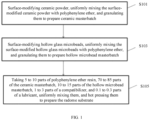
- FIG. 1 is a process flowchart of preparing a radome substrate according to an embodiment of the present invention.
- the present invention provides a radome substrate and a preparation method thereof, wherein the preparation method of the radome substrate includes the following steps.
- step S101 in FIG. 1 surface-modifying ceramic powder, uniformly mixing the surface-modified ceramic powder with a second polyphenylene ether resin, and granulating them to prepare ceramic masterbatch. Specifically, firstly drying the ceramic powder and the second polyphenylene ether resin in an oven at 85°C to 115°C for 2 to 3 hours; and surface-modifying the ceramic powder, uniformly mixing the surface-modified ceramic powder with the second polyphenylene ether resin, and granulating them to prepare ceramic masterbatch.
- the ceramic powder is surface-modified by using the coupling agent that accounts for 0.3% to 0.5% of the total weight of the ceramic masterbatch, and weights of the surface-modified ceramic powder and the second polyphenylene ether resin account for 80% to 85% and 10% to 20% of the total weight of the ceramic masterbatch respectively.
- the coupling agent includes one or a combination of ⁇ -aminopropyltriethoxysilane, ⁇ -(2,3-epoxypropoxy), and propyl trimethoxy silane.
- step S103 in FIG. 1 surface-modifying hollow glass microbeads, uniformly mixing the surface-modified hollow glass microbeads with a third polyphenylene ether resin, and granulating them to prepare hollow microbead masterbatch. Specifically, firstly drying the hollow glass microbeads and the third polyphenylene ether resin in an oven at 85°C to 115°C for 2 to 3 hours; and then surface modifying the hollow glass microbeads, uniformly mixing the surface-modified hollow glass microbeads with the third polyphenylene ether resin, and granulating them to prepare the hollow microbead masterbatch.
- the hollow glass microbeads are surface-modified by using the coupling agent that accounts for 0.3% to 0.5% of a total weight of the hollow microbead masterbatch, and weights of the surface-modified hollow glass microbeads and the third polyphenylene ether resin account for 50% to 55% and 45% to 55% of the total weight of the hollow microbead masterbatch respectively.
- the coupling agent includes one or a combination of ⁇ -aminopropyltriethoxysilane, ⁇ -(2,3-epoxypropoxy), and propyl trimethoxy silane.
- step S105 in FIG. 1 based on parts by weight, taking 5 to 10 parts of the first polyphenylene ether resin, 70 to 85 parts of ceramic masterbatch comprising the second polyphenylene ether resin, 10 to 15 parts of hollow microbead masterbatch comprising the third polyphenylene ether resin, 1 to 3 parts of compatibilizer, and 0.1 to 0.3 parts of lubricant, adding them to a high-speed mixer, uniformly mixing them, and hot pressing them to prepare the radome substrate.
- the compatibilizer includes one or a combination of polyphenylene oxide grafted maleic anhydride (PPO-g-MAH) and polyphenylene oxide grafted glycidyl methacrylate (PPO-g-GMA), and a grafting rate of each of the polyphenylene-oxide-grafted-maleic-anhydride and the polyphenylene oxide grafted glycidyl methacrylate is 0.5%-1.0%.
- the lubricant includes one or a combination of glyceryl monostearate, N,N'-ethylene hisstearamide, ethylene bis-stearamide, ethylene stearamide, and polysiloxane.
- the hot pressing is performed by a hot press machine, the operating temperature of the hot press machine is 230°C to 280°C, and the operating pressure of the hot press machine is 20 to 50MPa.
- the ceramic powder is surface-modified by using the coupling agent that accounts for 0.3% of the total weight of the ceramic masterbatch, and weights of the surface-modified ceramic powder and the second polyphenylene ether resin account for 80% and 20% of the total weight of the ceramic masterbatch respectively.
- hollow glass microbeads and third polyphenylene ether resin Separately drying hollow glass microbeads and third polyphenylene ether resin in an oven at 85°C for 3 hours, surface-modifying the hollow glass microbeads with the coupling agent (for example ⁇ -aminopropyltriethoxysilane), uniformly mixing the surface-modified hollow glass microbeads with the third polyphenylene ether resin, and granulating them by using a granulator to prepare hollow microbead masterbatch.
- the coupling agent for example ⁇ -aminopropyltriethoxysilane
- the hollow glass microbeads are surface-modified by using the coupling agent that accounts for 0.3% of a total weight of the hollow microbead masterbatch, and weights of the surface-modified hollow glass microbeads and the third polyphenylene ether resin account for 50% and 50% of the total weight of the hollow microbead masterbatch respectively.
- first polyphenylene ether resin Based on parts by weight, taking 5 parts of first polyphenylene ether resin, 85 parts of ceramic masterbatch comprising the second polyphenylene ether resin, 10 parts of hollow microbead masterbatch comprising the third polyphenylene ether resin, 1 parts of compatibilizer (for example polyphenylene oxide grafted glycidyl methacrylate (PPO-g-GMA)), and 0.1 parts of lubricant (for example N,N'-ethylene hisstearamide), adding them to a high-speed mixer, uniformly mixing them, and hot pressing them by using a hot press machine to prepare the radome substrate.
- compatibilizer for example polyphenylene oxide grafted glycidyl methacrylate (PPO-g-GMA)
- lubricant for example N,N'-ethylene hisstearamide
- the ceramic powder is surface-modified by using the coupling agent that accounts for 0.4% of the total weight of the ceramic masterbatch, and weights of the surface-modified ceramic powder and the second polyphenylene ether resin account for 85% and 15% of the total weight of the ceramic masterbatch respectively.
- hollow glass microbeads and third polyphenylene ether resin Separately drying hollow glass microbeads and third polyphenylene ether resin in an oven at 115°C for 2 hours, surface-modifying the hollow glass microbeads with the coupling agent (for example ⁇ -(2,3-epoxypropoxy)), uniformly mixing the surface-modified hollow glass microbeads with the third polyphenylene ether resin, and granulating them by using a granulator to prepare hollow microbead masterbatch.
- the coupling agent for example ⁇ -(2,3-epoxypropoxy
- the hollow glass microbeads are surface-modified by using the coupling agent that accounts for 0.4% of a total weight of the hollow microbead masterbatch, and weights of the surface-modified hollow glass microbeads and the third polyphenylene ether resin account for 55% and 45% of the total weight of the hollow microbead masterbatch respectively.
- first polyphenylene ether resin Based on parts by weight, taking 10 parts of first polyphenylene ether resin, 70 parts of the ceramic masterbatch comprising the second polyphenylene ether resin, 150 parts of the hollow microbead masterbatch comprising the third polyphenylene ether resin, 3 parts of compatibilizer (for example polyphenylene oxide grafted glycidyl methacrylate (PPO-g-GMA)), and 0.3 parts of lubricant (for example glyceryl monostearate), adding them to a high-speed mixer, uniformly mixing them, and hot pressing them by using a hot press machine to prepare the radome substrate.
- compatibilizer for example polyphenylene oxide grafted glycidyl methacrylate (PPO-g-GMA)
- lubricant for example glyceryl monostearate
- the ceramic powder is surface-modified by using the coupling agent that accounts for 0.5% of the total weight of the ceramic masterbatch, and weights of the surface-modified ceramic powder and the second polyphenylene ether resin account for 82% and 18% of the total weight of the ceramic masterbatch respectively.
- hollow glass microbeads and third polyphenylene ether resin Separately drying hollow glass microbeads and third polyphenylene ether resin in an oven at 90°C for 2.5 hours, surface-modifying the hollow glass microbeads with the coupling agent (for example ⁇ -aminopropyltriethoxysilane), uniformly mixing the surface-modified hollow glass microbeads with the third polyphenylene ether resin, and granulating them by using a granulator to prepare hollow microbead masterbatch.
- the coupling agent for example ⁇ -aminopropyltriethoxysilane
- the hollow glass microbeads are surface-modified by using the coupling agent that accounts for 0.5% of a total weight of the hollow microbead masterbatch, and weights of the surface-modified hollow glass microbeads and the third polyphenylene ether resin account for 45% and 55% of the total weight of the hollow microbead masterbatch respectively.
- first polyphenylene ether resin Based on parts by weight, taking 5 parts of first polyphenylene ether resin, 81 parts of ceramic masterbatch comprising the second polyphenylene ether resin, 13 parts of hollow microbead masterbatch comprising the third polyphenylene ether resin, 1 parts of compatibilizer (for example polyphenylene oxide grafted glycidyl methacrylate (PPO-g-GMA)), and 0.1 parts of lubricant (for example polysiloxane), adding them to a high-speed mixer, uniformly mixing them, and hot pressing them by using a hot press machine to prepare the radome substrate.
- compatibilizer for example polyphenylene oxide grafted glycidyl methacrylate (PPO-g-GMA)
- lubricant for example polysiloxane
- the ceramic powder is surface-modified by using the coupling agent that accounts for 0.4% of the total weight of the ceramic masterbatch, and weights of the surface-modified ceramic powder and the second polyphenylene ether resin account for 83% and 17% of the total weight of the ceramic masterbatch respectively.
- hollow glass microbeads and third polyphenylene ether resin Separately drying hollow glass microbeads and third polyphenylene ether resin in an oven at 110°C for 2 hours, surface-modifying the hollow glass microbeads with the coupling agent (for example ⁇ -(2,3-epoxypropoxy)), uniformly mixing the surface-modified hollow glass microbeads with the third polyphenylene ether resin, and granulating them by using a granulator to prepare hollow microbead masterbatch.
- the coupling agent for example ⁇ -(2,3-epoxypropoxy
- the hollow glass microbeads are surface-modified by using the coupling agent that accounts for 0.4% of a total weight of the hollow microbead masterbatch, and weights of the surface-modified hollow glass microbeads and the third polyphenylene ether resin account for 52% and 48% of the total weight of the hollow microbead masterbatch respectively.
- the ceramic powder is surface-modified by using the coupling agent that accounts for 0.4% of the total weight of the ceramic masterbatch, and weights of the surface-modified ceramic powder and the second polyphenylene ether resin account for 83% and 17% of the total weight of the ceramic masterbatch respectively.
- hollow glass microbeads and third polyphenylene ether resin Separately drying hollow glass microbeads and third polyphenylene ether resin in an oven at 100°C for 3 hours, surface-modifying the hollow glass microbeads with the coupling agent (for example propyl trimethoxy silane), uniformly mixing the surface-modified hollow glass microbeads with the third polyphenylene ether resin, and granulating them by using a granulator to prepare hollow microbead masterbatch.
- the coupling agent for example propyl trimethoxy silane
- the hollow glass microbeads are surface-modified by using the coupling agent that accounts for 0.4% of a total weight of the hollow microbead masterbatch, and weights of the surface-modified hollow glass microbeads and the third polyphenylene ether resin account for 53% and 47% of the total weight of the hollow microbead masterbatch respectively.
- the ceramic powder is surface-modified by using the coupling agent that accounts for 0.4% of the total weight of the ceramic masterbatch, and weights of the surface-modified ceramic powder and the second polyphenylene ether resin account for 84% and 16% of the total weight of the ceramic masterbatch respectively.
- hollow glass microbeads and third polyphenylene ether resin Separately drying hollow glass microbeads and third polyphenylene ether resin in an oven at 85°C for 2.5 hours, surface-modifying the hollow glass microbeads with the coupling agent (for example propyl trimethoxy silane), uniformly mixing the surface-modified hollow glass microbeads with the third polyphenylene ether resin, and granulating them by using a granulator to prepare hollow microbead masterbatch.
- the coupling agent for example propyl trimethoxy silane
- the hollow glass microbeads are surface-modified by using the coupling agent that accounts for 0.5% of a total weight of the hollow microbead masterbatch, and weights of the surface-modified hollow glass microbeads and the second polyphenylene ether resin account for 54% and 46% of the total weight of the hollow microbead masterbatch respectively.
- first polyphenylene ether resin Based on parts by weight, taking 7 parts of first polyphenylene ether resin, 75 parts of ceramic masterbatch comprising the second polyphenylene ether resin, 11 parts of hollow microbead masterbatch comprising the third polyphenylene ether resin, 2 parts of compatibilizer (for example polyphenylene oxide grafted glycidyl methacrylate (PPO-g-GMA)), and 0.15 parts of lubricant (for example N,N'-ethylene hisstearamide), adding them to a high-speed mixer, uniformly mixing them, and hot pressing them by using a hot press machine to prepare the radome substrate, wherein the operating temperature of the hot press machine is 260°C, and the operating pressure of the hot press machine is 45MPa.
- compatibilizer for example polyphenylene oxide grafted glycidyl methacrylate (PPO-g-GMA)
- lubricant for example N,N'-ethylene hisstearamide
- the radome substrate manufactured according to the method provided in the embodiments of the present invention effectively alleviates an stress cracking resistance disadvantage of the radome substrate.
- the ceramic powder processed by using the coupling agent and the hollow glass microbeads processed by using the coupling agent each are made into the masterbatches respectively by using the second polyphenylene ether resin and the third polyphenylene ether resin, and then the compatibilizer is added, to improve interface bonding strength between the first polyphenylene ether resin, the ceramic masterbatch, and the hollow microbead masterbatch, and improve distribution uniformity of the ceramic powder and the hollow glass microbeads in the first polyphenylene ether resin.
- Proportions and content of the ceramic powder and the hollow glass microbeads are controlled to optimize a stacking and arrangement manner of the ceramic powder and the hollow glass microbeads, to effectively reduce stress concentration between the first polyphenylene ether resin, the ceramic powder, and the hollow glass microbeads.
- an stress cracking resistance disadvantage of a radome substrate manufactured by using polyphenylene ether is effectively alleviated.
- the present invention provides a lightweight stress cracking resistance polyphenylene ether radome substrate that has a high dielectric constant, to effectively improve stress cracking resistance performance of the polyphenylene ether substrate.
Landscapes
- Chemical & Material Sciences (AREA)
- Health & Medical Sciences (AREA)
- Chemical Kinetics & Catalysis (AREA)
- Medicinal Chemistry (AREA)
- Polymers & Plastics (AREA)
- Organic Chemistry (AREA)
- Dispersion Chemistry (AREA)
- Compositions Of Macromolecular Compounds (AREA)
- Processes Of Treating Macromolecular Substances (AREA)
- Manufacture Of Macromolecular Shaped Articles (AREA)
- Details Of Aerials (AREA)
Claims (15)
- Radomsubstrat, dadurch gekennzeichnet, dass es, bezogen auf Gewichtsteile, Folgendes umfasst:Polyphenylenetherharz, bestehend aus einem ersten Polyphenylenetherharz, einem zweiten Polyphenylenetherharz und einem dritten Polyphenylenetherharz;5 bis 10 Teile des ersten Polyphenylenetherharzes, 70 bis 85 Teile eines keramischen Masterbatch, der das zweite Polyphenylenetherharz umfasst, 10 bis 15 Teile eines Mikrohohlkugel-Masterbatch, der das dritte Polyphenylenetherharz umfasst, 1 bis 3 Teile eines Verträglichkeitsvermittlers und 0,1 bis 0,3 Teile eines Schmiermittels.
- Radomsubstrat nach Anspruch 1, wobei der keramische Masterbatch durch Oberflächenmodifizieren von Keramikpulver mit einem Kopplungsmittel, Mischen des oberflächenmodifizierten Keramikpulvers mit dem zweiten Polyphenylenetherharz und Granulieren derselben erhalten wird; und das Keramikpulver eines oder eine Kombination von Rutil TiO2, BaO6SrTi2, SrTiO3, BaTiO3 und CaCu3Ti4O12 umfasst.
- Radomsubstrat nach Anspruch 1, wobei der Mikrohohlkugel-Masterbatch durch Oberflächenmodifizieren von Mikrohohlglaskugeln mit einem Kopplungsmittel, Mischen der oberflächenmodifizierten Mikrohohlglaskugeln mit dem dritten Polyphenylenetherharz und Granulieren derselben erhalten wird.
- Radomsubstrat nach Anspruch 2 oder 3, wobei das Kopplungsmittel eines oder eine Kombination von γ-Aminopropyltriethoxysilan, γ-(2,3-Epoxypropoxy) und Propyltrimethoxysilan umfasst.
- Radomsubstrat nach Anspruch 1, wobei der Verträglichkeitsvermittler eines oder eine Kombination von Polyphenylenoxid-gepfropftem Maleinsäureanhydrid und Polyphenylenoxid-gepfropftem Glycidylmethacrylat umfasst und eine Pfropfrate von jedem des Polyphenylenoxid-gepfropften Maleinsäureanhydrids und des Polyphenylenoxid-gepfropften Glycidylmethacrylats 0,5%-1,0% beträgt.
- Radomsubstrat nach Anspruch 1, wobei das Schmiermittel eines oder eine Kombination von Glycerylmonostearat, N,N'-Ethylenhisstearamid, Ethylenbisstearamid, Ethylenstearamid und Polysiloxan umfasst.
- Verfahren zur Herstellung eines Radomsubstrats nach einem der Ansprüche 1 bis 6, umfassend:Polyphenylenetherharz, bestehend aus einem ersten Polyphenylenetherharz, einem zweiten Polyphenylenetherharz und einem dritten Polyphenylenetherharz;Oberflächenmodifizieren von Keramikpulver, gleichmäßiges Mischen des oberflächenmodifizierten Keramikpulvers mit dem zweiten Polyphenylenetherharz und Granulieren derselben, um einen keramischen Masterbatch herzustellen;Oberflächenmodifizieren von Mikrohohlglaskugeln, gleichmäßiges Mischen der oberflächenmodifizierten Mikrohohlglaskugeln mit dem dritten Polyphenylenetherharz und Granulieren derselben, um einen Mikrohohlkugel-Masterbatch herzustellen; undbezogen auf Gewichtsteile, Nehmen von 5 bis 10 Teilen des ersten Polyphenylenetherharzes, 70 bis 85 Teilen des keramischen Masterbatch, 10 bis 15 Teilen des Mikrohohlkugel-Masterbatch, 1 bis 3 Teilen eines Verträglichkeitsvermittlers und 0,1 bis 0,3 Teilen eines Schmiermittels, gleichmäßiges Mischen derselben und Heißpressen derselben, um das Radomsubstrat herzustellen.
- Verfahren zur Herstellung des Radomsubstrats nach Anspruch 7, wobei in dem Schritt des Herstellens des keramischen Masterbatch, Verwenden eines Kopplungsmittels, dessen Gewicht 0,3 % bis 0,5 % eines Gesamtgewichts des keramischen Masterbatch ausmacht, um das Keramikpulver oberflächenzumodifizieren, wobei Gewichte des oberflächenmodifizierten Keramikpulvers und des zweiten Polyphenylenetherharzes jeweils 80 % bis 85 % und 10 % bis 20 % des Gesamtgewichts des keramischen Masterbatch ausmachen; und
in dem Schritt des Herstellens des Mikrohohlkugel-Masterbatch, Verwenden eines Kopplungsmittels, dessen Gewicht 0,3 % bis 0,5 % eines Gesamtgewichts des Mikrohohlkugel-Masterbatch ausmacht, um die Mikrohohlglaskugeln oberflächenzumodifizieren, wobei Gewichte der oberflächenmodifizierten Mikrohohlglaskugeln und des dritten Polyphenylenetherharzes jeweils 50 % bis 55 % und 45 % bis 55 % des Gesamtgewichts des Mikrohohlkugel-Masterbatch ausmachen. - Verfahren zur Herstellung des Radomsubstrats nach Anspruch 8, wobei das Kopplungsmittel eines oder eine Kombination von γ-Aminopropyltriethoxysilan, γ-(2,3-Epoxypropoxy) und Propyltrimethoxysilan umfasst; der Verträglichkeitsvermittler eines oder eine Kombination von Polyphenylenoxid-gepfropftem Maleinsäureanhydrid und Polyphenylenoxid-gepfropftem Glycidylmethacrylat umfasst; und das Schmiermittel eines oder eine Kombination von Glycerylmonostearat, N,N'-Ethylenhisstearamid, Ethylenbisstearamid, Ethylenstearamid und Polysiloxan umfasst.
- Verfahren zur Herstellung des Radomsubstrats nach Anspruch 7, wobei vor dem Schritt des Oberflächenmodifizierens des Keramikpulvers das Verfahren ferner umfasst: separates Trocknen des Keramikpulvers und des zweiten Polyphenylenetherharzes in einem Ofen bei 85 °C bis 115 °C für 2 bis 3 Stunden; undvor dem Schritt des Oberflächenmodifizierens der Mikrohohlglaskugeln das Verfahren ferner umfasst: separates Trocknen der Mikrohohlglaskugeln und des dritten Polyphenylenetherharzes in einem Ofen bei 85 °C bis 115 °C für 2 bis 3 Stunden;wobei das Heißpressen durch eine Heißpressmaschine durchgeführt wird, die Betriebstemperatur der Heißpressmaschine 230 °C bis 280 °C beträgt und der Betriebsdruck der Heißpressmaschine 20 bis 50 MPa beträgt.
- Verfahren zur Herstellung des Radomsubstrats nach Anspruch 7, wobei vor dem Schritt des Oberflächenmodifizierens des Keramikpulvers das Verfahren ferner umfasst: separates Trocknen des Keramikpulvers und des zweiten Polyphenylenetherharzes in einem Ofen bei 85 °C für 3 Stunden; und in dem keramischen Masterbatch das Gewicht des oberflächenmodifizierten Keramikpulvers 80 % des Gesamtgewichts des keramischen Masterbatch ausmacht, das Gewicht des zweiten Polyphenylenetherharzes 20 % des Gesamtgewichts des keramischen Masterbatch ausmacht;vor dem Schritt des Oberflächenmodifizierens der Mikrohohlglaskugeln das Verfahren ferner umfasst: separates Trocknen der Mikrohohlglaskugeln und des dritten Polyphenylenetherharzes in einem Ofen bei 85 °C für 3 Stunden, und in dem Mikrohohlkugel-Masterbatch das Gewicht der oberflächenmodifizierten Mikrohohlglaskugeln 50 % des Gesamtgewichts des Mikrohohlkugel-Masterbatch ausmacht, das Gewicht des dritten Polyphenylenetherharzes 50 % des Gesamtgewichts des Mikrohohlkugel-Masterbatch ausmacht;bezogen auf Gewichtsteile, Nehmen von 5 Teilen des ersten Polyphenylenetherharzes, 85 Teilen des keramischen Masterbatch, 10 Teilen des Mikrohohlkugel-Masterbatch, 1 Teil des Polyphenylenoxid-gepfropften Glycidylmethacrylats und 0,1 Teilen N,N'-Ethylenhisstearamid, gleichmäßiges Mischen derselben und Heißpressen derselben, um das Radomsubstrat herzustellen, wobei der Schritt des Heißpressens durch eine Heißpressmaschine durchgeführt wird, die Betriebstemperatur der Heißpressmaschine 230 °C beträgt und der Betriebsdruck der Heißpressmaschine 20 MPa beträgt.
- Verfahren zur Herstellung des Radomsubstrats nach Anspruch 10, wobei vor dem Schritt des Oberflächenmodifizierens des Keramikpulvers das Verfahren ferner umfasst: separates Trocknen des Keramikpulvers und des zweiten Polyphenylenetherharzes in einem Ofen bei 115 °C für 2 Stunden; und in dem keramischen Masterbatch das Gewicht des oberflächenmodifizierten Keramikpulvers 85 % des Gesamtgewichts des keramischen Masterbatch ausmacht, das Gewicht des zweiten Polyphenylenetherharzes 15 % des Gesamtgewichts des keramischen Masterbatch ausmacht;vor dem Schritt des Oberflächenmodifizierens der Mikrohohlglaskugeln das Verfahren ferner umfasst: separates Trocknen der Mikrohohlglaskugeln und des dritten Polyphenylenetherharzes in einem Ofen bei 115 °C für 2 Stunden, und in dem Mikrohohlkugel-Masterbatch das Gewicht der oberflächenmodifizierten Mikrohohlglaskugeln 55 % des Gesamtgewichts des Mikrohohlkugel-Masterbatch ausmacht, das Gewicht des dritten Polyphenylenetherharzes 45 % des Gesamtgewichts des Mikrohohlkugel-Masterbatch ausmacht;bezogen auf Gewichtsteile, Nehmen von 10 Teilen des ersten Polyphenylenetherharzes, 70 Teilen des keramischen Masterbatch, 150 Teilen des Mikrohohlkugel-Masterbatch, 3 Teilen des Polyphenylenoxid-gepfropften Glycidylmethacrylats und 0,3 Teilen Glycerylmonostearat, gleichmäßiges Mischen derselben und Heißpressen derselben, um das Radomsubstrat herzustellen, wobei der Schritt des Heißpressens durch eine Heißpressmaschine durchgeführt wird, die Betriebstemperatur der Heißpressmaschine 250 °C beträgt und der Betriebsdruck der Heißpressmaschine 30 MPa beträgt.
- Verfahren zur Herstellung des Radomsubstrats nach Anspruch 8, wobei vor dem Schritt des Oberflächenmodifizierens des Keramikpulvers das Verfahren ferner umfasst: separates Trocknen des Keramikpulvers und des zweiten Polyphenylenetherharzes in einem Ofen bei 90 °C für 2,5 Stunden; und in dem keramischen Masterbatch das Gewicht des oberflächenmodifizierten Keramikpulvers 82 % des Gesamtgewichts des keramischen Masterbatch ausmacht, das Gewicht des zweiten Polyphenylenetherharzes 18 % des Gesamtgewichts des keramischen Masterbatch ausmacht;vor dem Schritt des Oberflächenmodifizierens der Mikrohohlglaskugeln das Verfahren ferner umfasst: separates Trocknen der Mikrohohlglaskugeln und des dritten Polyphenylenetherharzes in einem Ofen bei 90 °C für 2,5 Stunden, und in dem Mikrohohlkugel-Masterbatch das Gewicht der oberflächenmodifizierten Mikrohohlglaskugeln 45 % des Gesamtgewichts des Mikrohohlkugel-Masterbatch ausmacht, das Gewicht des dritten Polyphenylenetherharzes 55 % des Gesamtgewichts des Mikrohohlkugel-Masterbatch ausmacht;bezogen auf Gewichtsteile, Nehmen von 5 Teilen des ersten Polyphenylenetherharzes, 81 Teilen des keramischen Masterbatch, 13 Teilen des Mikrohohlkugel-Masterbatch, 1 Teil des Polyphenylenoxid-gepfropften Glycidylmethacrylats und 0,1 Teilen Polysiloxan, gleichmäßiges Mischen derselben und Heißpressen derselben, um das Radomsubstrat herzustellen, wobei der Schritt des Heißpressens durch eine Heißpressmaschine durchgeführt wird, die Betriebstemperatur der Heißpressmaschine 270 °C beträgt und der Betriebsdruck der Heißpressmaschine 50 MPa beträgt.
- Verfahren zur Herstellung des Radomsubstrats nach Anspruch 8, wobei vor dem Schritt des Oberflächenmodifizierens des Keramikpulvers das Verfahren ferner umfasst: separates Trocknen des Keramikpulvers und des zweiten Polyphenylenetherharzes in einem Ofen bei 110 °C für 2 Stunden; und in dem keramischen Masterbatch das Gewicht des oberflächenmodifizierten Keramikpulvers 83 % des Gesamtgewichts des keramischen Masterbatch ausmacht, das Gewicht des zweiten Polyphenylenetherharzes 17 % des Gesamtgewichts des keramischen Masterbatch ausmacht;vor dem Schritt des Oberflächenmodifizierens der Mikrohohlglaskugeln das Verfahren ferner umfasst: separates Trocknen der Mikrohohlglaskugeln und des dritten Polyphenylenetherharzes in einem Ofen bei 110 °C für 2 Stunden, und in dem Mikrohohlkugel-Masterbatch das Gewicht der oberflächenmodifizierten Mikrohohlglaskugeln 52 % des Gesamtgewichts des Mikrohohlkugel-Masterbatch ausmacht, das Gewicht des dritten Polyphenylenetherharzes 48 % des Gesamtgewichts des Mikrohohlkugel-Masterbatch ausmacht;bezogen auf Gewichtsteile, Nehmen von 8 Teilen des ersten Polyphenylenetherharzes, 77 Teilen des keramischen Masterbatch, 12 Teilen des Mikrohohlkugel-Masterbatch, 3 Teilen des Polyphenylenoxid-gepfropften Glycidylmethacrylats und 0,2 Teilen Ethylenstearamid, gleichmäßiges Mischen derselben und Heißpressen derselben, um das Radomsubstrat herzustellen, wobei der Schritt des Heißpressens durch eine Heißpressmaschine durchgeführt wird, die Betriebstemperatur der Heißpressmaschine 280 °C beträgt und der Betriebsdruck der Heißpressmaschine 40 MPa beträgt.
- Verfahren zur Herstellung des Radomsubstrats nach Anspruch 10, wobei vor dem Schritt des Oberflächenmodifizierens des Keramikpulvers das Verfahren ferner umfasst: separates Trocknen des Keramikpulvers und des zweiten Polyphenylenetherharzes in einem Ofen bei 100 °C für 3 Stunden; und in dem keramischen Masterbatch das Gewicht des oberflächenmodifizierten Keramikpulvers 83 % des Gesamtgewichts des keramischen Masterbatch ausmacht, das Gewicht des zweiten Polyphenylenetherharzes 17 % des Gesamtgewichts des keramischen Masterbatch ausmacht;vor dem Schritt des Oberflächenmodifizierens der Mikrohohlglaskugeln das Verfahren ferner umfasst: separates Trocknen der Mikrohohlglaskugeln und des dritten Polyphenylenetherharzes in einem Ofen bei 100 °C für 3 Stunden, und in dem Mikrohohlkugel-Masterbatch das Gewicht der oberflächenmodifizierten Mikrohohlglaskugeln 53 % des Gesamtgewichts des Mikrohohlkugel-Masterbatch ausmacht, das Gewicht des dritten Polyphenylenetherharzes 47 % des Gesamtgewichts des Mikrohohlkugel-Masterbatch ausmacht;bezogen auf Gewichtsteile, Nehmen von 10 Teilen des ersten Polyphenylenetherharzes, 79 Teilen des keramischen Masterbatch, 10 Teilen des Mikrohohlkugel-Masterbatch, 1 Teil des Polyphenylenoxid-gepfropften Glycidylmethacrylats und 0,1 Teilen Ethylenbisstearamid, gleichmäßiges Mischen derselben und Heißpressen derselben, um das Radomsubstrat herzustellen, wobei der Schritt des Heißpressens durch eine Heißpressmaschine durchgeführt wird, die Betriebstemperatur der Heißpressmaschine 240 °C beträgt und der Betriebsdruck der Heißpressmaschine 35 MPa beträgt.
Applications Claiming Priority (2)
| Application Number | Priority Date | Filing Date | Title |
|---|---|---|---|
| CN201711435107.9A CN109957228A (zh) | 2017-12-26 | 2017-12-26 | 一种天线罩基材及其制备方法 |
| PCT/CN2018/079867 WO2019127939A1 (zh) | 2017-12-26 | 2018-03-21 | 一种天线罩基材及其制备方法 |
Publications (3)
| Publication Number | Publication Date |
|---|---|
| EP3733776A1 EP3733776A1 (de) | 2020-11-04 |
| EP3733776A4 EP3733776A4 (de) | 2021-08-25 |
| EP3733776B1 true EP3733776B1 (de) | 2024-09-11 |
Family
ID=67022351
Family Applications (1)
| Application Number | Title | Priority Date | Filing Date |
|---|---|---|---|
| EP18896095.9A Active EP3733776B1 (de) | 2017-12-26 | 2018-03-21 | Radomsubstrat und herstellungsverfahren dafür |
Country Status (5)
| Country | Link |
|---|---|
| US (1) | US11512172B2 (de) |
| EP (1) | EP3733776B1 (de) |
| JP (1) | JP7135102B2 (de) |
| CN (1) | CN109957228A (de) |
| WO (1) | WO2019127939A1 (de) |
Families Citing this family (5)
| Publication number | Priority date | Publication date | Assignee | Title |
|---|---|---|---|---|
| CN111073257B (zh) * | 2019-12-23 | 2022-08-12 | 南京海兆新材料有限公司 | 一种5g专用ppo陶瓷母粒及注塑产品和应用 |
| CN112646344A (zh) * | 2020-12-23 | 2021-04-13 | 郑州圣莱特空心微珠新材料有限公司 | 制备天线罩的材料及其制备方法 |
| CN113549327B (zh) * | 2021-07-30 | 2023-07-25 | 深圳陶陶科技有限公司 | 复合材料、复合材料注塑料、复合材料产品及制备方法 |
| CN116426084A (zh) * | 2023-02-09 | 2023-07-14 | 广西鑫锋高新技术有限公司 | 一种蓄电池外壳用隔热防晒的工程塑料及其制备方法 |
| CN120310378A (zh) * | 2025-05-16 | 2025-07-15 | 正辰激光科技(山东)有限公司 | 一种锅炉耐高温防腐涂料及其制备方法 |
Family Cites Families (12)
| Publication number | Priority date | Publication date | Assignee | Title |
|---|---|---|---|---|
| JP2001274615A (ja) * | 2000-03-24 | 2001-10-05 | Asahi Kasei Corp | 誘電特性に優れたアンテナ用レドーム |
| CN100441637C (zh) * | 2002-12-20 | 2008-12-10 | 通用电气公司 | 热固性复合材料组合物、方法及产品 |
| JP2005200562A (ja) * | 2004-01-16 | 2005-07-28 | Asahi Kasei Chemicals Corp | 強化ポリフェニレンエーテル系樹脂組成物 |
| KR101124033B1 (ko) * | 2008-03-10 | 2012-04-19 | 주식회사 모비텍 | 탄소 나노 튜브를 이용한 전도성 중합체 및 이의 제조 방법 |
| JP5293537B2 (ja) * | 2009-09-28 | 2013-09-18 | 三菱エンジニアリングプラスチックス株式会社 | ミリ波レーダー用カバー及びミリ波レーダー |
| JP5470014B2 (ja) * | 2009-12-04 | 2014-04-16 | 三菱エンジニアリングプラスチックス株式会社 | 誘電体用樹脂組成物及び誘電体アンテナ部品 |
| CN103625063A (zh) * | 2012-08-23 | 2014-03-12 | 上海杰事杰新材料(集团)股份有限公司 | 一种asa/as与改性ppo共挤材料、制备方法及其用途 |
| US9914803B2 (en) * | 2013-06-28 | 2018-03-13 | Saint-Gobain Performance Plastics Corporation | Cyanate resin blends and radomes including them |
| CN106336643B (zh) * | 2015-07-10 | 2020-06-16 | 深圳光启创新技术有限公司 | 复合基板及其制造方法和应用 |
| CN105440665B (zh) * | 2015-12-11 | 2018-03-20 | 会通新材料股份有限公司 | 一种低填充高导热绝缘尼龙/聚苯醚合金及其制备方法 |
| CN106893303A (zh) * | 2015-12-18 | 2017-06-27 | 深圳光启高等理工研究院 | 一种高介电常数轻质介质基材及其制备方法 |
| CN107459805B (zh) * | 2016-06-06 | 2020-11-24 | 华为技术有限公司 | 一种基站天线罩及其制造方法 |
-
2017
- 2017-12-26 CN CN201711435107.9A patent/CN109957228A/zh active Pending
-
2018
- 2018-03-21 WO PCT/CN2018/079867 patent/WO2019127939A1/zh not_active Ceased
- 2018-03-21 JP JP2020555271A patent/JP7135102B2/ja active Active
- 2018-03-21 EP EP18896095.9A patent/EP3733776B1/de active Active
-
2020
- 2020-06-24 US US16/910,797 patent/US11512172B2/en active Active
Also Published As
| Publication number | Publication date |
|---|---|
| EP3733776A1 (de) | 2020-11-04 |
| CN109957228A (zh) | 2019-07-02 |
| WO2019127939A1 (zh) | 2019-07-04 |
| EP3733776A4 (de) | 2021-08-25 |
| US20200332075A1 (en) | 2020-10-22 |
| US11512172B2 (en) | 2022-11-29 |
| JP7135102B2 (ja) | 2022-09-12 |
| JP2021508761A (ja) | 2021-03-11 |
Similar Documents
| Publication | Publication Date | Title |
|---|---|---|
| EP3733776B1 (de) | Radomsubstrat und herstellungsverfahren dafür | |
| CN103242767B (zh) | 一种耐高温双马来酰亚胺树脂载体结构胶膜及其制备方法 | |
| CN107502000B (zh) | 一种表面化学改性的硅微粉及其制备方法与应用 | |
| CN104788909B (zh) | 一种导热绝缘复合材料及其制备方法 | |
| CN104312147B (zh) | 一种氧化锌晶须/石墨烯纳米片协同改性氰酸酯树脂导热复合材料及其制备方法 | |
| Wang et al. | Surface-modified Li3Mg2NbO6 ceramic particles and hexagonal boron nitride sheets filled PTFE composites with high through-plane thermal conductivity and extremely low dielectric loss | |
| CN103031058B (zh) | 一种室温硫化硅橡胶电磁屏蔽涂料及其制备方法 | |
| CN109437663B (zh) | 一种具有近零介电常数温度系数的聚四氟乙烯基陶瓷复合材料及其制备方法 | |
| CN104911917A (zh) | 一种适用于热塑性基体的碳纤维水性上浆剂的制备方法 | |
| CN103965585B (zh) | 一种空心玻璃微珠改性环氧树脂复合材料的制备方法 | |
| CN105176081A (zh) | 一种阻燃耐热天线罩基材的制备方法 | |
| CN106977927A (zh) | 一种高强度加成型液体硅橡胶浸渍液及其制备和成型方法 | |
| CN103951939A (zh) | 基于环氧树脂基体纳米氧化铝纤维复合材料的制备方法 | |
| CN105728005A (zh) | 一种以配合物为前驱体的碳掺杂氧化铟的制备方法 | |
| CN117264375A (zh) | 一种环氧树脂组合物及其制备方法 | |
| CN106893303A (zh) | 一种高介电常数轻质介质基材及其制备方法 | |
| CN107778015B (zh) | 以SiCN为核层的红外遮光剂及其制备方法和应用 | |
| CN106243500A (zh) | 一种聚丙烯改性用复合材料的制备方法及其产物 | |
| CN110627073A (zh) | 一种用于改性氰酸酯树脂的功能化中空二氧化硅的合成方法 | |
| CN110615877A (zh) | 一种接枝改性氧化铝及其制备方法、环氧复合材料及其应用 | |
| Hsieh et al. | Rice husk‐derived hierarchical micro/mesoporous carbon–silica nanocomposite as superior filler for green electronic packaging material | |
| Mu et al. | Enhancing the thermal conductivities of SiO2/Epoxy composites by orientation | |
| CN116041966B (zh) | 一种通过添加纳米粒子改善材料力学性能的方法 | |
| CN111909524A (zh) | 一种用于高频焊接的硅胶吸波材料及其制备方法 | |
| CN111040380A (zh) | 一种导热改性环氧树脂基复合材料及其制备方法 |
Legal Events
| Date | Code | Title | Description |
|---|---|---|---|
| STAA | Information on the status of an ep patent application or granted ep patent |
Free format text: STATUS: THE INTERNATIONAL PUBLICATION HAS BEEN MADE |
|
| PUAI | Public reference made under article 153(3) epc to a published international application that has entered the european phase |
Free format text: ORIGINAL CODE: 0009012 |
|
| STAA | Information on the status of an ep patent application or granted ep patent |
Free format text: STATUS: REQUEST FOR EXAMINATION WAS MADE |
|
| 17P | Request for examination filed |
Effective date: 20200624 |
|
| AK | Designated contracting states |
Kind code of ref document: A1 Designated state(s): AL AT BE BG CH CY CZ DE DK EE ES FI FR GB GR HR HU IE IS IT LI LT LU LV MC MK MT NL NO PL PT RO RS SE SI SK SM TR |
|
| AX | Request for extension of the european patent |
Extension state: BA ME |
|
| DAV | Request for validation of the european patent (deleted) | ||
| DAX | Request for extension of the european patent (deleted) | ||
| A4 | Supplementary search report drawn up and despatched |
Effective date: 20210728 |
|
| RIC1 | Information provided on ipc code assigned before grant |
Ipc: C08L 71/12 20060101AFI20210722BHEP Ipc: C08L 51/08 20060101ALI20210722BHEP Ipc: C08K 9/06 20060101ALI20210722BHEP Ipc: C08K 7/28 20060101ALI20210722BHEP Ipc: C08J 3/22 20060101ALI20210722BHEP Ipc: H01Q 1/42 20060101ALI20210722BHEP |
|
| STAA | Information on the status of an ep patent application or granted ep patent |
Free format text: STATUS: EXAMINATION IS IN PROGRESS |
|
| 17Q | First examination report despatched |
Effective date: 20231120 |
|
| GRAP | Despatch of communication of intention to grant a patent |
Free format text: ORIGINAL CODE: EPIDOSNIGR1 |
|
| STAA | Information on the status of an ep patent application or granted ep patent |
Free format text: STATUS: GRANT OF PATENT IS INTENDED |
|
| INTG | Intention to grant announced |
Effective date: 20240423 |
|
| GRAS | Grant fee paid |
Free format text: ORIGINAL CODE: EPIDOSNIGR3 |
|
| GRAA | (expected) grant |
Free format text: ORIGINAL CODE: 0009210 |
|
| STAA | Information on the status of an ep patent application or granted ep patent |
Free format text: STATUS: THE PATENT HAS BEEN GRANTED |
|
| AK | Designated contracting states |
Kind code of ref document: B1 Designated state(s): AL AT BE BG CH CY CZ DE DK EE ES FI FR GB GR HR HU IE IS IT LI LT LU LV MC MK MT NL NO PL PT RO RS SE SI SK SM TR |
|
| REG | Reference to a national code |
Ref country code: GB Ref legal event code: FG4D |
|
| REG | Reference to a national code |
Ref country code: CH Ref legal event code: EP |
|
| REG | Reference to a national code |
Ref country code: DE Ref legal event code: R096 Ref document number: 602018074394 Country of ref document: DE |
|
| REG | Reference to a national code |
Ref country code: IE Ref legal event code: FG4D |
|
| REG | Reference to a national code |
Ref country code: LT Ref legal event code: MG9D |
|
| PG25 | Lapsed in a contracting state [announced via postgrant information from national office to epo] |
Ref country code: NO Free format text: LAPSE BECAUSE OF FAILURE TO SUBMIT A TRANSLATION OF THE DESCRIPTION OR TO PAY THE FEE WITHIN THE PRESCRIBED TIME-LIMIT Effective date: 20241211 |
|
| REG | Reference to a national code |
Ref country code: NL Ref legal event code: MP Effective date: 20240911 |
|
| PG25 | Lapsed in a contracting state [announced via postgrant information from national office to epo] |
Ref country code: FI Free format text: LAPSE BECAUSE OF FAILURE TO SUBMIT A TRANSLATION OF THE DESCRIPTION OR TO PAY THE FEE WITHIN THE PRESCRIBED TIME-LIMIT Effective date: 20240911 Ref country code: GR Free format text: LAPSE BECAUSE OF FAILURE TO SUBMIT A TRANSLATION OF THE DESCRIPTION OR TO PAY THE FEE WITHIN THE PRESCRIBED TIME-LIMIT Effective date: 20241212 |
|
| PG25 | Lapsed in a contracting state [announced via postgrant information from national office to epo] |
Ref country code: BG Free format text: LAPSE BECAUSE OF FAILURE TO SUBMIT A TRANSLATION OF THE DESCRIPTION OR TO PAY THE FEE WITHIN THE PRESCRIBED TIME-LIMIT Effective date: 20240911 |
|
| PG25 | Lapsed in a contracting state [announced via postgrant information from national office to epo] |
Ref country code: LV Free format text: LAPSE BECAUSE OF FAILURE TO SUBMIT A TRANSLATION OF THE DESCRIPTION OR TO PAY THE FEE WITHIN THE PRESCRIBED TIME-LIMIT Effective date: 20240911 |
|
| PG25 | Lapsed in a contracting state [announced via postgrant information from national office to epo] |
Ref country code: HR Free format text: LAPSE BECAUSE OF FAILURE TO SUBMIT A TRANSLATION OF THE DESCRIPTION OR TO PAY THE FEE WITHIN THE PRESCRIBED TIME-LIMIT Effective date: 20240911 |
|
| PG25 | Lapsed in a contracting state [announced via postgrant information from national office to epo] |
Ref country code: RS Free format text: LAPSE BECAUSE OF FAILURE TO SUBMIT A TRANSLATION OF THE DESCRIPTION OR TO PAY THE FEE WITHIN THE PRESCRIBED TIME-LIMIT Effective date: 20241211 Ref country code: ES Free format text: LAPSE BECAUSE OF FAILURE TO SUBMIT A TRANSLATION OF THE DESCRIPTION OR TO PAY THE FEE WITHIN THE PRESCRIBED TIME-LIMIT Effective date: 20240911 |
|
| PG25 | Lapsed in a contracting state [announced via postgrant information from national office to epo] |
Ref country code: RS Free format text: LAPSE BECAUSE OF FAILURE TO SUBMIT A TRANSLATION OF THE DESCRIPTION OR TO PAY THE FEE WITHIN THE PRESCRIBED TIME-LIMIT Effective date: 20241211 Ref country code: NO Free format text: LAPSE BECAUSE OF FAILURE TO SUBMIT A TRANSLATION OF THE DESCRIPTION OR TO PAY THE FEE WITHIN THE PRESCRIBED TIME-LIMIT Effective date: 20241211 Ref country code: LV Free format text: LAPSE BECAUSE OF FAILURE TO SUBMIT A TRANSLATION OF THE DESCRIPTION OR TO PAY THE FEE WITHIN THE PRESCRIBED TIME-LIMIT Effective date: 20240911 Ref country code: HR Free format text: LAPSE BECAUSE OF FAILURE TO SUBMIT A TRANSLATION OF THE DESCRIPTION OR TO PAY THE FEE WITHIN THE PRESCRIBED TIME-LIMIT Effective date: 20240911 Ref country code: GR Free format text: LAPSE BECAUSE OF FAILURE TO SUBMIT A TRANSLATION OF THE DESCRIPTION OR TO PAY THE FEE WITHIN THE PRESCRIBED TIME-LIMIT Effective date: 20241212 Ref country code: FI Free format text: LAPSE BECAUSE OF FAILURE TO SUBMIT A TRANSLATION OF THE DESCRIPTION OR TO PAY THE FEE WITHIN THE PRESCRIBED TIME-LIMIT Effective date: 20240911 Ref country code: ES Free format text: LAPSE BECAUSE OF FAILURE TO SUBMIT A TRANSLATION OF THE DESCRIPTION OR TO PAY THE FEE WITHIN THE PRESCRIBED TIME-LIMIT Effective date: 20240911 Ref country code: BG Free format text: LAPSE BECAUSE OF FAILURE TO SUBMIT A TRANSLATION OF THE DESCRIPTION OR TO PAY THE FEE WITHIN THE PRESCRIBED TIME-LIMIT Effective date: 20240911 |
|
| REG | Reference to a national code |
Ref country code: AT Ref legal event code: MK05 Ref document number: 1722660 Country of ref document: AT Kind code of ref document: T Effective date: 20240911 |
|
| PG25 | Lapsed in a contracting state [announced via postgrant information from national office to epo] |
Ref country code: NL Free format text: LAPSE BECAUSE OF FAILURE TO SUBMIT A TRANSLATION OF THE DESCRIPTION OR TO PAY THE FEE WITHIN THE PRESCRIBED TIME-LIMIT Effective date: 20240911 |
|
| PG25 | Lapsed in a contracting state [announced via postgrant information from national office to epo] |
Ref country code: PT Free format text: LAPSE BECAUSE OF FAILURE TO SUBMIT A TRANSLATION OF THE DESCRIPTION OR TO PAY THE FEE WITHIN THE PRESCRIBED TIME-LIMIT Effective date: 20250113 Ref country code: IS Free format text: LAPSE BECAUSE OF FAILURE TO SUBMIT A TRANSLATION OF THE DESCRIPTION OR TO PAY THE FEE WITHIN THE PRESCRIBED TIME-LIMIT Effective date: 20250111 |
|
| PG25 | Lapsed in a contracting state [announced via postgrant information from national office to epo] |
Ref country code: SM Free format text: LAPSE BECAUSE OF FAILURE TO SUBMIT A TRANSLATION OF THE DESCRIPTION OR TO PAY THE FEE WITHIN THE PRESCRIBED TIME-LIMIT Effective date: 20240911 Ref country code: RO Free format text: LAPSE BECAUSE OF FAILURE TO SUBMIT A TRANSLATION OF THE DESCRIPTION OR TO PAY THE FEE WITHIN THE PRESCRIBED TIME-LIMIT Effective date: 20240911 |
|
| PG25 | Lapsed in a contracting state [announced via postgrant information from national office to epo] |
Ref country code: EE Free format text: LAPSE BECAUSE OF FAILURE TO SUBMIT A TRANSLATION OF THE DESCRIPTION OR TO PAY THE FEE WITHIN THE PRESCRIBED TIME-LIMIT Effective date: 20240911 Ref country code: AT Free format text: LAPSE BECAUSE OF FAILURE TO SUBMIT A TRANSLATION OF THE DESCRIPTION OR TO PAY THE FEE WITHIN THE PRESCRIBED TIME-LIMIT Effective date: 20240911 |
|
| PG25 | Lapsed in a contracting state [announced via postgrant information from national office to epo] |
Ref country code: CZ Free format text: LAPSE BECAUSE OF FAILURE TO SUBMIT A TRANSLATION OF THE DESCRIPTION OR TO PAY THE FEE WITHIN THE PRESCRIBED TIME-LIMIT Effective date: 20240911 Ref country code: PL Free format text: LAPSE BECAUSE OF FAILURE TO SUBMIT A TRANSLATION OF THE DESCRIPTION OR TO PAY THE FEE WITHIN THE PRESCRIBED TIME-LIMIT Effective date: 20240911 |
|
| PGFP | Annual fee paid to national office [announced via postgrant information from national office to epo] |
Ref country code: FR Payment date: 20250328 Year of fee payment: 8 |
|
| PG25 | Lapsed in a contracting state [announced via postgrant information from national office to epo] |
Ref country code: SK Free format text: LAPSE BECAUSE OF FAILURE TO SUBMIT A TRANSLATION OF THE DESCRIPTION OR TO PAY THE FEE WITHIN THE PRESCRIBED TIME-LIMIT Effective date: 20240911 Ref country code: IT Free format text: LAPSE BECAUSE OF FAILURE TO SUBMIT A TRANSLATION OF THE DESCRIPTION OR TO PAY THE FEE WITHIN THE PRESCRIBED TIME-LIMIT Effective date: 20240911 |
|
| PGFP | Annual fee paid to national office [announced via postgrant information from national office to epo] |
Ref country code: GB Payment date: 20250327 Year of fee payment: 8 |
|
| REG | Reference to a national code |
Ref country code: DE Ref legal event code: R097 Ref document number: 602018074394 Country of ref document: DE |
|
| PGFP | Annual fee paid to national office [announced via postgrant information from national office to epo] |
Ref country code: DE Payment date: 20250425 Year of fee payment: 8 |
|
| PG25 | Lapsed in a contracting state [announced via postgrant information from national office to epo] |
Ref country code: DK Free format text: LAPSE BECAUSE OF FAILURE TO SUBMIT A TRANSLATION OF THE DESCRIPTION OR TO PAY THE FEE WITHIN THE PRESCRIBED TIME-LIMIT Effective date: 20240911 |
|
| PLBE | No opposition filed within time limit |
Free format text: ORIGINAL CODE: 0009261 |
|
| STAA | Information on the status of an ep patent application or granted ep patent |
Free format text: STATUS: NO OPPOSITION FILED WITHIN TIME LIMIT |
|
| 26N | No opposition filed |
Effective date: 20250612 |
|
| PG25 | Lapsed in a contracting state [announced via postgrant information from national office to epo] |
Ref country code: SE Free format text: LAPSE BECAUSE OF FAILURE TO SUBMIT A TRANSLATION OF THE DESCRIPTION OR TO PAY THE FEE WITHIN THE PRESCRIBED TIME-LIMIT Effective date: 20240911 |
|
| PG25 | Lapsed in a contracting state [announced via postgrant information from national office to epo] |
Ref country code: MC Free format text: LAPSE BECAUSE OF FAILURE TO SUBMIT A TRANSLATION OF THE DESCRIPTION OR TO PAY THE FEE WITHIN THE PRESCRIBED TIME-LIMIT Effective date: 20240911 |
|
| REG | Reference to a national code |
Ref country code: CH Ref legal event code: H13 Free format text: ST27 STATUS EVENT CODE: U-0-0-H10-H13 (AS PROVIDED BY THE NATIONAL OFFICE) Effective date: 20251023 |
|
| PG25 | Lapsed in a contracting state [announced via postgrant information from national office to epo] |
Ref country code: LU Free format text: LAPSE BECAUSE OF NON-PAYMENT OF DUE FEES Effective date: 20250321 |
|
| REG | Reference to a national code |
Ref country code: BE Ref legal event code: MM Effective date: 20250331 |
|
| PG25 | Lapsed in a contracting state [announced via postgrant information from national office to epo] |
Ref country code: BE Free format text: LAPSE BECAUSE OF NON-PAYMENT OF DUE FEES Effective date: 20250331 |
|
| PG25 | Lapsed in a contracting state [announced via postgrant information from national office to epo] |
Ref country code: CH Free format text: LAPSE BECAUSE OF NON-PAYMENT OF DUE FEES Effective date: 20250331 |
|
| PG25 | Lapsed in a contracting state [announced via postgrant information from national office to epo] |
Ref country code: IE Free format text: LAPSE BECAUSE OF NON-PAYMENT OF DUE FEES Effective date: 20250321 |