EP3722871B1 - Imaging apparatus, imaging control method, and storage medium - Google Patents
Imaging apparatus, imaging control method, and storage medium Download PDFInfo
- Publication number
- EP3722871B1 EP3722871B1 EP20162323.8A EP20162323A EP3722871B1 EP 3722871 B1 EP3722871 B1 EP 3722871B1 EP 20162323 A EP20162323 A EP 20162323A EP 3722871 B1 EP3722871 B1 EP 3722871B1
- Authority
- EP
- European Patent Office
- Prior art keywords
- control
- focus
- tilt
- focus lens
- control unit
- Prior art date
- Legal status (The legal status is an assumption and is not a legal conclusion. Google has not performed a legal analysis and makes no representation as to the accuracy of the status listed.)
- Active
Links
Images




Classifications
-
- H—ELECTRICITY
- H04—ELECTRIC COMMUNICATION TECHNIQUE
- H04N—PICTORIAL COMMUNICATION, e.g. TELEVISION
- H04N23/00—Cameras or camera modules comprising electronic image sensors; Control thereof
- H04N23/60—Control of cameras or camera modules
- H04N23/67—Focus control based on electronic image sensor signals
-
- G—PHYSICS
- G03—PHOTOGRAPHY; CINEMATOGRAPHY; ANALOGOUS TECHNIQUES USING WAVES OTHER THAN OPTICAL WAVES; ELECTROGRAPHY; HOLOGRAPHY
- G03B—APPARATUS OR ARRANGEMENTS FOR TAKING PHOTOGRAPHS OR FOR PROJECTING OR VIEWING THEM; APPARATUS OR ARRANGEMENTS EMPLOYING ANALOGOUS TECHNIQUES USING WAVES OTHER THAN OPTICAL WAVES; ACCESSORIES THEREFOR
- G03B5/00—Adjustment of optical system relative to image or object surface other than for focusing
- G03B5/06—Swinging lens about normal to the optical axis
-
- H—ELECTRICITY
- H04—ELECTRIC COMMUNICATION TECHNIQUE
- H04N—PICTORIAL COMMUNICATION, e.g. TELEVISION
- H04N23/00—Cameras or camera modules comprising electronic image sensors; Control thereof
- H04N23/95—Computational photography systems, e.g. light-field imaging systems
- H04N23/958—Computational photography systems, e.g. light-field imaging systems for extended depth of field imaging
- H04N23/959—Computational photography systems, e.g. light-field imaging systems for extended depth of field imaging by adjusting depth of field during image capture, e.g. maximising or setting range based on scene characteristics
-
- G—PHYSICS
- G02—OPTICS
- G02B—OPTICAL ELEMENTS, SYSTEMS OR APPARATUS
- G02B27/00—Optical systems or apparatus not provided for by any of the groups G02B1/00 - G02B26/00, G02B30/00
- G02B27/0025—Optical systems or apparatus not provided for by any of the groups G02B1/00 - G02B26/00, G02B30/00 for optical correction, e.g. distorsion, aberration
- G02B27/0068—Optical systems or apparatus not provided for by any of the groups G02B1/00 - G02B26/00, G02B30/00 for optical correction, e.g. distorsion, aberration having means for controlling the degree of correction, e.g. using phase modulators, movable elements
-
- G—PHYSICS
- G02—OPTICS
- G02B—OPTICAL ELEMENTS, SYSTEMS OR APPARATUS
- G02B7/00—Mountings, adjusting means, or light-tight connections, for optical elements
- G02B7/02—Mountings, adjusting means, or light-tight connections, for optical elements for lenses
- G02B7/04—Mountings, adjusting means, or light-tight connections, for optical elements for lenses with mechanism for focusing or varying magnification
- G02B7/09—Mountings, adjusting means, or light-tight connections, for optical elements for lenses with mechanism for focusing or varying magnification adapted for automatic focusing or varying magnification
-
- G—PHYSICS
- G03—PHOTOGRAPHY; CINEMATOGRAPHY; ANALOGOUS TECHNIQUES USING WAVES OTHER THAN OPTICAL WAVES; ELECTROGRAPHY; HOLOGRAPHY
- G03B—APPARATUS OR ARRANGEMENTS FOR TAKING PHOTOGRAPHS OR FOR PROJECTING OR VIEWING THEM; APPARATUS OR ARRANGEMENTS EMPLOYING ANALOGOUS TECHNIQUES USING WAVES OTHER THAN OPTICAL WAVES; ACCESSORIES THEREFOR
- G03B3/00—Focusing arrangements of general interest for cameras, projectors or printers
- G03B3/02—Focusing arrangements of general interest for cameras, projectors or printers moving lens along baseboard
-
- G—PHYSICS
- G03—PHOTOGRAPHY; CINEMATOGRAPHY; ANALOGOUS TECHNIQUES USING WAVES OTHER THAN OPTICAL WAVES; ELECTROGRAPHY; HOLOGRAPHY
- G03B—APPARATUS OR ARRANGEMENTS FOR TAKING PHOTOGRAPHS OR FOR PROJECTING OR VIEWING THEM; APPARATUS OR ARRANGEMENTS EMPLOYING ANALOGOUS TECHNIQUES USING WAVES OTHER THAN OPTICAL WAVES; ACCESSORIES THEREFOR
- G03B5/00—Adjustment of optical system relative to image or object surface other than for focusing
- G03B5/08—Swing backs
-
- H—ELECTRICITY
- H04—ELECTRIC COMMUNICATION TECHNIQUE
- H04N—PICTORIAL COMMUNICATION, e.g. TELEVISION
- H04N23/00—Cameras or camera modules comprising electronic image sensors; Control thereof
- H04N23/58—Means for changing the camera field of view without moving the camera body, e.g. nutating or panning of optics or image sensors
-
- H—ELECTRICITY
- H04—ELECTRIC COMMUNICATION TECHNIQUE
- H04N—PICTORIAL COMMUNICATION, e.g. TELEVISION
- H04N23/00—Cameras or camera modules comprising electronic image sensors; Control thereof
- H04N23/60—Control of cameras or camera modules
- H04N23/61—Control of cameras or camera modules based on recognised objects
-
- H—ELECTRICITY
- H04—ELECTRIC COMMUNICATION TECHNIQUE
- H04N—PICTORIAL COMMUNICATION, e.g. TELEVISION
- H04N23/00—Cameras or camera modules comprising electronic image sensors; Control thereof
- H04N23/60—Control of cameras or camera modules
- H04N23/63—Control of cameras or camera modules by using electronic viewfinders
- H04N23/631—Graphical user interfaces [GUI] specially adapted for controlling image capture or setting capture parameters
- H04N23/632—Graphical user interfaces [GUI] specially adapted for controlling image capture or setting capture parameters for displaying or modifying preview images prior to image capturing, e.g. variety of image resolutions or capturing parameters
-
- H—ELECTRICITY
- H04—ELECTRIC COMMUNICATION TECHNIQUE
- H04N—PICTORIAL COMMUNICATION, e.g. TELEVISION
- H04N23/00—Cameras or camera modules comprising electronic image sensors; Control thereof
- H04N23/60—Control of cameras or camera modules
- H04N23/667—Camera operation mode switching, e.g. between still and video, sport and normal or high- and low-resolution modes
-
- H—ELECTRICITY
- H04—ELECTRIC COMMUNICATION TECHNIQUE
- H04N—PICTORIAL COMMUNICATION, e.g. TELEVISION
- H04N23/00—Cameras or camera modules comprising electronic image sensors; Control thereof
- H04N23/60—Control of cameras or camera modules
- H04N23/67—Focus control based on electronic image sensor signals
- H04N23/673—Focus control based on electronic image sensor signals based on contrast or high frequency components of image signals, e.g. hill climbing method
-
- H—ELECTRICITY
- H04—ELECTRIC COMMUNICATION TECHNIQUE
- H04N—PICTORIAL COMMUNICATION, e.g. TELEVISION
- H04N23/00—Cameras or camera modules comprising electronic image sensors; Control thereof
- H04N23/60—Control of cameras or camera modules
- H04N23/67—Focus control based on electronic image sensor signals
- H04N23/675—Focus control based on electronic image sensor signals comprising setting of focusing regions
-
- H—ELECTRICITY
- H04—ELECTRIC COMMUNICATION TECHNIQUE
- H04N—PICTORIAL COMMUNICATION, e.g. TELEVISION
- H04N23/00—Cameras or camera modules comprising electronic image sensors; Control thereof
- H04N23/60—Control of cameras or camera modules
- H04N23/695—Control of camera direction for changing a field of view, e.g. pan, tilt or based on tracking of objects
-
- G—PHYSICS
- G02—OPTICS
- G02B—OPTICAL ELEMENTS, SYSTEMS OR APPARATUS
- G02B27/00—Optical systems or apparatus not provided for by any of the groups G02B1/00 - G02B26/00, G02B30/00
- G02B27/0075—Optical systems or apparatus not provided for by any of the groups G02B1/00 - G02B26/00, G02B30/00 with means for altering, e.g. increasing, the depth of field or depth of focus
-
- H—ELECTRICITY
- H04—ELECTRIC COMMUNICATION TECHNIQUE
- H04N—PICTORIAL COMMUNICATION, e.g. TELEVISION
- H04N23/00—Cameras or camera modules comprising electronic image sensors; Control thereof
- H04N23/60—Control of cameras or camera modules
- H04N23/66—Remote control of cameras or camera parts, e.g. by remote control devices
- H04N23/661—Transmitting camera control signals through networks, e.g. control via the Internet
Definitions
- the present invention relates to an imaging apparatus and the like capable of performing tilt control.
- tilt control an imaging apparatus to which the Scheimpflug principle for broadening the range of the depth of field by performing control of relatively inclining a lens or an imaging device (hereinafter referred to as tilt control) is applied is generally known.
- tilt control at a predetermined angle when tilt control at a predetermined angle is performed for both of a subject at a short distance and a subject at a long distance, there may be differences between heights of positions of the subjects, differences between heights of the subjects themselves, or the like, and therefore there may be a plurality of tilt angles for focusing both of the subject at a short distance and the subject at a long distance. For this reason, tilt control for focusing on both of subjects positioned at a short distance and subjects positioned at a long distance cannot be performed with only one tilt angle. It is important for a monitoring camera to recognize subjects from a short distance and a long distance.
- Document JP H11 190864 A discloses an image pickup device equipped with a swing mechanism turning the input medium for the optical image with the fixed turning center as center, wherein the swing mechanism is controlled so that an interval between the lens focusing positions of plural maximal values corresponding to plural subjects having the different subject distance is made to be minimum, furthermore, the swing mechanism is driven and controlled so that the maximal value is made to be the greatest thereafter.
- Document JP 2015 230 414 A refers to an imaging device, which comprises first setting means which sets the number of photographing times in which the lens position of the focus lens is changed to consecutively photograph the subject, and second setting means which sets a photographing condition upon photographing the subject by changing the lens position of the focus lens.
- the second setting means is configured to set an aperture value as the photographing condition on the basis of the information related to the subject distance detected by the distance detection means and the number of photographing times set by the first setting means.
- Document JP 2008 205569 A describes a tilt mechanism that rotates a light receiving surface around the vertical shaft when the posture of the light receiving surface is the posture of a horizontal position, and rotates the light receiving surface around the horizontal shaft when the posture of the light receiving surface is a vertical position.
- An object of the present invention is to provide an imaging apparatus capable of performing optimal tilt control at a high speed by optimizing focus lens driving and tilt control even in a case in which a subject changes or the like.
- an imaging apparatus including: a tilt control unit that performs tilt control by driving at least one of an imaging device and an imaging optical system; a focus lens driving unit that drives a focus lens; and a control unit that selects one of a plurality of control modes for performing focus control using at least one of the tilt control unit and the focus lens driving unit in accordance with the number of subject areas in an image.
- the control unit selects a first control mode in which focus control is performed using one of the tilt control unit and the focus lens driving unit, and in a case in which the number of subject areas displayed in the image is equal to or larger than two, the control unit selects a second control mode in which focus control is performed using the tilt control unit and the focus lens driving unit.
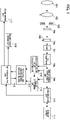
- Fig. 1 is a block diagram illustrating the configuration of an imaging apparatus according to Embodiment 1 of the present invention.
- a lens unit that is an imaging optical system according to this embodiment includes a zoom lens 101 that changes a focal distance by moving in the direction of an optical axis, a focus lens 102 that performs control of focus by moving in the direction of the optical axis, and a diaphragm unit 103 that adjusts an amount of light entering on an imaging device 106.
- the imaging optical system illustrated in Fig. 1 is one example, and the zoom lens 101, the focus lens 102, and the diaphragm unit 103 need not all be included.
- a subject image forms an optical image on an imaging device 106 through a bandpass filter (hereinafter referred to as a BPF) 104 and a color filter 105.
- a bandpass filter hereinafter referred to as a BPF
- the BPF 104 may be selectively retracted from an optical path of the imaging optical system.
- a subject image is photoelectrically converted by the imaging device 106, whereby an imaging signal is formed.
- An analog imaging signal output from the imaging device 106 is gain adjusted by auto gain control (AGC) 107, is converted into a digital signal by an AD converter 108, and then is input to a camera signal processing unit 109.
- AGC auto gain control
- the camera signal processing unit 109 performs various kinds of image processing (for example, gamma conversion, white balance adjustment, and the like) for a digital imaging signal, thereby generating a video signal.
- image processing for example, gamma conversion, white balance adjustment, and the like
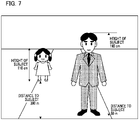
- a digital imaging signal By displaying this video signal as an image on a display unit included in a monitor device 111, an image screen can be displayed as shown in Figs. 6 , 7 , 10 , and 12 .
- the video signal is output to at least one monitor device 111 through a network using wired or wireless communication via a communication unit 110.
- the communication unit 110 receives a command from an external control device such as an external PC included in the monitor device 111 and transmits a control signal corresponding to the command to a tilt/focus control unit 115 of the imaging apparatus.
- a system including the monitor device 111 and the like will be referred to as an imaging apparatus.
- members other than the monitor device 111 are housed inside one casing and configure a security camera.
- a focus evaluation value calculating unit 112 receives pixel values or luminance values of RGB from the AD converter 108 or the camera signal processing unit 109 and calculates a focus evaluation value used for tilt control or auto focusing (hereinafter referred to as AF). For example, by dividing an image screen displayed on a display unit of the monitor device 111 into a plurality of subject areas, the focus evaluation value is calculated on the basis of contrast and high-frequency components of the image for each subject area.
- the focus evaluation value may be acquired using any method such as a phase difference AF method, an infrared AF method, or the like as long as the focus evaluation value can be used for focus adjustment.
- a display unit for displaying an image screen may be selectively connected to an output side of the camera signal processing unit 109 and may allow the image screen to be monitored also on the security camera side.
- a subject determining unit 113 performs an image recognition on a video signal from the camera signal processing unit 109 and detects a specific subject on the image screen.
- the specific subject is a subject (for example, a person, a face, a vehicle, or the like) that is arbitrarily designated by a user or is set as a default in advance but is not limited to such examples.
- a focus evaluation value from the focus evaluation value calculating unit 112 and a subject recognition result from the subject determining unit 113 are input to a tilt/focus lens driving amount calculating unit 114.
- the tilt/focus lens driving amount calculating unit 114 calculates a tilt angle and a focus position that are optimal to a scene based on the focus evaluation value, the subject recognition result, and the tilt angle information and the focus position information from the tilt/focus control unit 115.
- the tilt angle and the focus position are controlled by transmitting the tilt angle and the focus position that have been calculated to the tilt/focus control unit 115.
- the tilt/focus control unit 115 has a CPU as a computer and executes various operations of the entire apparatus as a control unit on the basis of a computer program stored in a memory that is not illustrated in the drawing.
- the tilt/focus control unit 115 performs focus lens driving in AF or manual focus (hereinafter referred to as MF) on the basis of a direction from an external control device such as the external PC through the communication unit 110.
- the tilt/focus control unit 115 receives the current lens position information from an imaging device driving unit 116 and a focus driving unit 117, and transmits the current position to the tilt/focus lens driving amount calculating unit 114.
- the tilt/focus control unit 115 performs drive control by sending the tilt angle and the focus position calculated by the tilt/focus lens driving amount calculating unit 114 to the imaging device driving unit 116 and the focus driving unit 117.
- the imaging device driving unit 116 functions as a tilt control unit (a tilt angle control unit) and tilts the imaging device 106 on the basis of a tilt angle designated by the tilt/focus control unit 115. By inclining the imaging device 106, a tilt angle that is an angle between the imaging device 106 and a plane orthogonal to the optical axis of the imaging optical system is changed.
- a rotation axis (a tilt axis) for tilting the imaging device 106 is arranged to pass through the center of the imaging plane in a horizontal direction (the longitudinal direction of the imaging device), around which the imaging device 106 is controlled to tilt relative to the imaging optical system.
- some lenses of the imaging optical system may be controlled to tilt relative to the imaging device.
- the focus driving unit 117 controls the position of the focus lens 102 on the basis of a focus setting position directed from the tilt/focus control unit 115.
- Fig. 2 is a diagram illustrating an example of a scene on which tilt control is performed.
- FIG. 3 is a diagram illustrating a tilt control method, and tilt control, as illustrated in Fig. 3 , is control for setting a (focused) plane that is focused on to be in parallel with a horizontal plane such as the ground, for example, by tilting the imaging device 106. In this way, with respect to a plane parallel to the ground, a subject positioned at a short distance and a subject positioned at a long distance enter the depth of field and can remain in focus.
- a tilt angle b is calculated using the following Equation (1) based on the Scheimpflug principle.
- b arctan f / Ltan ⁇
- f is a focal distance
- L is a subject distance
- ⁇ is an angle between an optical axis and a focused plane.
- Figs. 4 and 5 are diagrams illustrating Examples 1 and 2 in which a plurality of optimal tilt angles are present.
- an optimal tilt angle is different for each subject.
- a subject positioned at the center of an image screen, corresponding to the center of the imaging device through which a tilt rotation axis passes, is out of focus by AF or MF or the like
- an optimal tilt angle is different for each subject.
- Figs. 6 and 7 are diagrams illustrating examples of images displayed on the imaged screen, and in a case in which a plurality of subjects having different heights are present at different distances as illustrated in Figs. 6 and 7 or the like, the subjects may be out of focus.
- optimal control may not be able to be performed using only tilt control in many cases.
- Fig. 8 is a diagram illustrating focus lens driving and tilt control.
- x is an amount of focus correction (an amount of defocusing) from an imaging plane of the imaging optical system that should be reduced to be zero for focusing on the subject person 801.
- y is an amount of focus correction (an amount of defocusing) from a focal plane of the imaging optical system that should be reduced to be zero for focusing on the subject vehicle 802. In many cases, it may be difficult to focus on both the subject person 801 and the subject vehicle 802 only by performing tilt control.
- a distance (an image height) from a tilt axis passing through the center of the imaging plane of the imaging device 106 to a subject image will be denoted by k1 [ ⁇ m] for the subject person 801 and k2 [ ⁇ m] for the subject vehicle 802.
- k1 and k2 respectively correspond to the position information of a first area of the image screen and the position information of a second area of the image screen.
- ⁇ an amount of focus correction on an imaging plane according to movement of the focus lens 102
- ⁇ there is a method of calculating ⁇ from a product of sensitivity of the focus lens 102 and a drive amount of the focus lens 102.
- ⁇ ⁇ /(sensitivity of the focus lens).
- an equation of a higher degree or a polynomial according to sensitivity may be solved.
- the method of calculating the focus lens driving amount ⁇ can be variously modified or approximated, or the like, and a calculation method using such a modification, an approximation, or the like may be employed.
- Fig. 9 is a diagram illustrating focus lens driving and tilt control in a case in which there are three or more subjects on the image screen. In a case in which there are subjects positioned at a short distance and a long distance as in Fig. 9 , all the subjects may not be focused on by performing only tilt control and focus lens driving.
- Amounts of focus correction (defocus amounts; blur amounts) from the focal plane of the imaging optical system for a subject person 901 positioned at a long distance, and a subject person 902 positioned at a middle distance, and a subject person 903 positioned at a short distance will be respectively denoted by a [ ⁇ m], b [ ⁇ m], and c [ ⁇ m].
- a control method in this case will be described.
- a first method there is a method in which a maximum value of the amounts of focus correction such as a [ ⁇ m], b [ ⁇ m], c [ ⁇ m], and the like is controlled to be a minimum.
- a maximum value of a [ ⁇ m], b [ ⁇ m], and c [ ⁇ m] is controlled to be a minimum. According to this method, blurring of subjects in the scene as in Fig. 9 can be suppressed to be a minimum.
- a permissible focus range that is a depth of field
- the amounts of focus correction such as a [ ⁇ m], b [ ⁇ m], and c [ ⁇ m] are controlled to be within the depth of field.
- the depth of field is a value that is determined using a cell pitch per pixel of the imaging device 106 and an aperture value.
- F ⁇ the depth of field
- ⁇ and ⁇ are calculated by solving Equations 6 to 8 described above, and a tilt angle ⁇ and a focus lens driving amount ⁇ is calculated from ⁇ and ⁇ .
- a user does not perceive blurring of the image and does not need to make a maximum value of a [ ⁇ m], b [ ⁇ m], and c [ ⁇ m] to be a minimum as in the first method.
- control is performed using the second method, and if a subject to be focused is not within the depth of field, the control for driving using the first method may also be used.
- the long-distance side has a larger depth of field for the tilt control, and accordingly, it is also effective to perform tilt control and focus lens driving with a subject at a short distance with priority. For this reason, by using a distance measuring unit that measures a distance to a subject, distances to a plurality of subjects may be measured, and tilt control and focus lens driving may be performed for a subject that is relatively close to the imaging device with priority.
- disappearance may also be considered as a change in the subject.
- a method to cope with those cases should be taken into consideration.
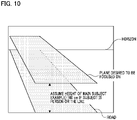
- Fig. 10 is a diagram illustrating an example of a representative plane desired to be focused on in a case in which there is no subject or the like.
- a plane desired to be focused on may be set to a plane shifted, for example, by 1.6 m above the ground or the like, assuming the main subject is a person or the like.
- a plane desired to be focused on may be a plane that is determined by a user or a plane that is determined in advance.
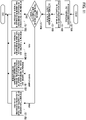
- control modes for performing focus correction using at least one of the tilt control unit and the focus lens driving unit described above.
- one of the plurality of control modes is selected in accordance with the number of subject areas displayed on the image screen.
- Scanning is performed in S1101.
- the scanning is control of driving such that the tilt angle of the imaging device 106 or the position of the focus lens 102 is gradually changed in one direction.
- the focus evaluation value calculating unit 112 calculates an evaluation value for each area among a plurality of areas displayed on the image screen during the scanning.
- the subject determining unit 113 determines areas in which a subject is present.
- An area in which a subject is present is an area of which an evaluation value calculated for each area in S1102 is high or an area in which a subject to be focused such as a person or a vehicle is found by image recognition.
- the number of areas in which a subject is present (the number of subject areas displayed on the image screen) is determined.
- the number of subject areas is determined to be one in S1104, a first control mode is selected in S 1105, in which focus correction is performed using one of tilt control and focus lens driving such that the area in which a subject is present is focused on.
- focus correction is performed using tilt control.
- tilt control is performed in a case in which a distance (an image height) to a subject from the vertical center on the image screen is longer than a predetermined value
- focus correction is performed using focus lens driving in a case in which the distance (the image height) to a subject from the vertical center of the image screen is shorter than the predetermined value.
- a second control mode is selected in S 1106.
- focus correction is performed using both tilt control and focus lens driving. More specifically, for example, the amounts of focus correction is calculated such that both the areas in which subjects are present are focused on by using Equations 2 to 5 as described above.
- the position of the focus lens at which the evaluation value for each area becomes a peak value is acquired, for example, as x and y represented in Equations 2 and 3.
- k1 and k2 represented in Equations 2 and 3 are acquired on the basis of the position of the area on the image screen.
- a tilt angle ⁇ and a focus lens driving amount ⁇ are calculated using Equations 4 and 5.
- tilt control and focus lens driving are performed based on the tilt angle ⁇ and the focus lens driving amount ⁇ described above.
- a method for calculating a focus correction amount for each area is not limited to the method described above, and a distance to a subject may be acquired using an external measurement sensor or an image-plane-phase-difference image sensor in which each pixel includes a plurality of photoelectric conversion units having a parallax therebetween.
- the second control mode is selected in S1107.
- focus correction is performed using both the tilt control and the focus lens driving.
- a specific calculation method (calculation algorithm) is different from S1106.
- a tilt angle ⁇ and a focus lens driving amount ⁇ are calculated, for example, using Equations 6 to 8 such that a maximum value of the amount of focus correction (the amount of blurring) of the area in which a subject is present becomes a minimum.
- tilt control and focus lens driving are performed based on the tilt angle ⁇ and the focus lens driving amount ⁇ that have been calculated by the above method.
- Step S1107 control is performed such that the area in which the subject is present comes into a diameter of permissible circle of confusion.
- the process proceeds to Step S1107 in a case in which the number of areas in which a subject is present is equal to or larger than a predetermined number "three", the predetermined number may be, for example, equal to or larger than "four". In such a case, where the number of areas in which a subject is present is two or three, the process proceeds to S1106. As another embodiment, in a case where the number of areas in which a subject is present is equal to or larger than two, the process may proceed to Step S1107, and Step S1106 may be omitted.
- a third control mode is selected in S1108, where control is performed such that an amount of focus correction set in advance is used.
- the focus lens driving position and the tilt angle are returned to the focus lens driving position and the tilt angle in the past that are immediately before the start of control such as scanning.
- a most-frequently stopped position in focus lens driving and tilt control in the past may be stored, and focus lens driving and tilt control may be performed using the most-frequently stopped position as a default.
- a history of focus lens driving positions and tilt angles in the past and the amounts of focus corrections in the past is stored in a memory, and the focus position and the tilt angle are controlled on the basis of the history information.
- control similar to that of a case in which there is no area in which a subject is present may be performed.
- the number of subject areas on the image screen is automatically determined in S1103. Then, one of a plurality of control modes for focus corrections using at least one of the tilt control unit and the focus lens driving unit is selected in accordance with the number. Accordingly, the subject does not become out of focus depending on a change in the subject, and tilt control and focus lens driving optimal for the situation can be realized.
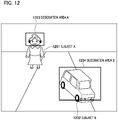
- Embodiment 2 of the present invention will be described with reference to Fig. 12 .
- arbitrary areas of a captured image are designated by a user, and a focus position and a tilt angle are controlled.
- Fig. 12 is a diagram illustrating one example of an imaging scene according to Embodiment 2.
- a user designates these two areas using an area designating unit (a touch panel, a mouse, or the like).
- the user sets designation areas by designating an area itself, a corner, a width, a height, and the like of each area using the area designating unit.
- a predetermined frame having a predetermined size may be displayed on the image screen in advance, and the frame may be moved to an arbitrary position to designate a position and the determination operation is carried out.
- a first designation area 1203 can be easily set, and subsequently, a second designation area 1204 can be also easily set similarly.
- subject areas on the image screen may be manually designated by the user.
- the number of subject areas on the image screen that are designated by the user corresponds to the number of areas in which a subject is present in Step S1104.
- Embodiment 2 after subject areas on the image screen are manually designated by the user, the number of areas in which a subject is present is determined in Step S1104. However, in Embodiment 3, a tilt angle and a focus position are controlled without determining the number of areas.
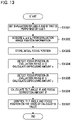
- Fig. 13 is a flowchart illustrating one example of a process flow according to Embodiment 3.
- a user sets arbitrary two designation areas including a designation area A (a first area) (1203) and a designation area B (a second area) (1204) as illustrated in Fig. 12 .
- the designation area A will be referred to as an evaluation range A
- the designation area B will be referred to as an evaluation range B.
- S1302 functions as a position information acquiring unit that acquires position information of the first area from a vertical center of the image screen and position information of the second area from a vertical center of the image screen.
- S1303 functions as a defocusing amount detecting unit that detects a defocusing amount of each of the first area and the second area.
- the calculation method is the same as described in Embodiment 1.
- tilt control can be performed by controlling the tilt angle and the focus position in S1307.
- designation areas have a rectangular shape in this embodiment, any designation method and any shape may be employed as long as the purpose of designation of areas can be achieved.
- a tilt angle of the imaging device is changed in the tilt control
- a tilt angle of the lens may be changed.
- not only the tilt control in the horizontal direction but also tilt control in a vertical direction may be used.
- Embodiments 1 to 3 described above an example in which a calculation result is derived by performing calculation using a CPU or the like using equations has been described. However, instead of calculation using equations, a table corresponding to such equations may be stored in a memory, and a result similar to the calculation result based on the equations may be directly derived using the table.
- a computer program realizing the function of the embodiment described above may be supplied to the imaging apparatus or the imaging control device through a network or various storage media. Then, a computer (or a CPU, an MPU, or the like) of the imaging apparatus or the image control device may be configured to read and execute the program. In such a case, the program and the storage medium storing the program configure the present invention.
Landscapes
- Engineering & Computer Science (AREA)
- Multimedia (AREA)
- Signal Processing (AREA)
- Physics & Mathematics (AREA)
- General Physics & Mathematics (AREA)
- Computing Systems (AREA)
- Theoretical Computer Science (AREA)
- Optics & Photonics (AREA)
- Human Computer Interaction (AREA)
- Studio Devices (AREA)
- Automatic Focus Adjustment (AREA)
- Lens Barrels (AREA)
- Focusing (AREA)
- Closed-Circuit Television Systems (AREA)
Applications Claiming Priority (2)
| Application Number | Priority Date | Filing Date | Title |
|---|---|---|---|
| JP2019048401 | 2019-03-15 | ||
| JP2019204141A JP7433848B2 (ja) | 2019-03-15 | 2019-11-11 | 撮像装置、コンピュータプログラム、記憶媒体および撮像制御方法 |
Publications (2)
| Publication Number | Publication Date |
|---|---|
| EP3722871A1 EP3722871A1 (en) | 2020-10-14 |
| EP3722871B1 true EP3722871B1 (en) | 2023-01-18 |
Family
ID=69804606
Family Applications (1)
| Application Number | Title | Priority Date | Filing Date |
|---|---|---|---|
| EP20162323.8A Active EP3722871B1 (en) | 2019-03-15 | 2020-03-11 | Imaging apparatus, imaging control method, and storage medium |
Country Status (5)
| Country | Link |
|---|---|
| US (2) | US11381731B2 (enExample) |
| EP (1) | EP3722871B1 (enExample) |
| JP (2) | JP7433848B2 (enExample) |
| KR (1) | KR102874689B1 (enExample) |
| CN (1) | CN111698417B (enExample) |
Families Citing this family (15)
| Publication number | Priority date | Publication date | Assignee | Title |
|---|---|---|---|---|
| KR102510704B1 (ko) * | 2018-10-30 | 2023-03-16 | 캐논 가부시끼가이샤 | 촬상 장치 |
| JP7271159B2 (ja) | 2018-12-14 | 2023-05-11 | キヤノン株式会社 | 制御装置、撮像装置、レンズ装置、プログラム、および制御装置の制御方法 |
| JP7305485B2 (ja) | 2019-08-29 | 2023-07-10 | キヤノン株式会社 | 制御装置、撮像装置、レンズ装置、制御方法、および、プログラム |
| JP7362360B2 (ja) | 2019-08-29 | 2023-10-17 | キヤノン株式会社 | 制御装置、撮像装置、レンズ装置、および、プログラム |
| JP7336330B2 (ja) | 2019-09-24 | 2023-08-31 | キヤノン株式会社 | 制御装置、撮像装置、制御方法、および、プログラム |
| JP7471799B2 (ja) * | 2019-11-12 | 2024-04-22 | キヤノン株式会社 | 制御装置、撮像装置、制御方法、および、プログラム |
| CN114095645B (zh) * | 2020-08-24 | 2023-04-18 | 浙江大华技术股份有限公司 | 景深调整方法以及摄像器件、存储装置 |
| EP3968624B1 (en) * | 2020-09-14 | 2023-11-15 | Canon Kabushiki Kaisha | Information processing apparatus, information processing method, and program |
| JP7646389B2 (ja) * | 2021-02-24 | 2025-03-17 | キヤノン株式会社 | 撮像装置、コンピュータプログラム、記憶媒体及び撮像装置の制御方法 |
| JP7293309B2 (ja) * | 2021-03-17 | 2023-06-19 | キヤノン株式会社 | 撮像装置、制御方法および記憶媒体 |
| US11722769B2 (en) | 2021-03-17 | 2023-08-08 | Canon Kabushiki Kaisha | Image pickup apparatus, control method, and storage medium |
| JP7731692B2 (ja) * | 2021-04-21 | 2025-09-01 | キヤノン株式会社 | 制御装置、撮像装置、制御方法、およびプログラム |
| US12047681B2 (en) | 2021-04-21 | 2024-07-23 | Canon Kabushiki Kaisha | Image pickup apparatus including tilt driving portion, control method, and memory medium |
| US11722775B2 (en) * | 2021-08-17 | 2023-08-08 | Canon Kabushiki Kaisha | Image pickup apparatus and controlling method thereof |
| JP2023140195A (ja) * | 2022-03-22 | 2023-10-04 | キヤノン株式会社 | 制御装置、レンズ装置、撮像装置、カメラシステム、制御方法、及びプログラム |
Citations (1)
| Publication number | Priority date | Publication date | Assignee | Title |
|---|---|---|---|---|
| EP0984319B1 (en) * | 1998-07-08 | 2004-01-02 | Hewlett-Packard Company, A Delaware Corporation | Camera with keystone distortion correction |
Family Cites Families (34)
| Publication number | Priority date | Publication date | Assignee | Title |
|---|---|---|---|---|
| JPH0437935A (ja) | 1990-06-01 | 1992-02-07 | Hitachi Ltd | キャッシュメモリを有する計算機 |
| JPH04324843A (ja) * | 1991-04-25 | 1992-11-13 | Canon Inc | チルト手段を有したカメラ |
| JP3733228B2 (ja) * | 1997-12-25 | 2006-01-11 | キヤノン株式会社 | アオリ機構付き撮像装置、方法、及び記憶媒体 |
| JP3207169B2 (ja) | 1998-12-09 | 2001-09-10 | オリンパス光学工業株式会社 | 撮像装置 |
| US6985177B2 (en) | 2000-07-04 | 2006-01-10 | Canon Kabushiki Kaisha | Image sensing system and its control method |
| JP4297630B2 (ja) | 2001-04-25 | 2009-07-15 | 株式会社リコー | 電子撮像装置 |
| JP2003075716A (ja) * | 2001-09-06 | 2003-03-12 | Nikon Corp | 撮像装置 |
| JP3639574B2 (ja) | 2002-10-24 | 2005-04-20 | オリンパス株式会社 | カメラ |
| DE102005041431B4 (de) * | 2005-08-31 | 2011-04-28 | WÖHLER, Christian | Digitale Kamera mit verschwenkbarem Bildsensor |
| JP2008165142A (ja) * | 2007-01-05 | 2008-07-17 | Elmo Co Ltd | 撮影装置および焦点調整方法 |
| JP2008205569A (ja) | 2007-02-16 | 2008-09-04 | Fujifilm Corp | 撮像装置及び方法 |
| JP5109803B2 (ja) | 2007-06-06 | 2012-12-26 | ソニー株式会社 | 画像処理装置、画像処理方法及び画像処理プログラム |
| KR101271641B1 (ko) * | 2011-05-25 | 2013-06-11 | 에스엘 주식회사 | 차량의 전방 감지 시스템 |
| JP5627652B2 (ja) * | 2012-06-06 | 2014-11-19 | キヤノン株式会社 | 撮像装置およびその制御方法、並びにレンズ装置およびその制御方法 |
| JP5938281B2 (ja) * | 2012-06-25 | 2016-06-22 | キヤノン株式会社 | 撮像装置およびその制御方法ならびにプログラム |
| JP2014155063A (ja) | 2013-02-08 | 2014-08-25 | Sharp Corp | 解像度測定用チャート、解像度測定方法、カメラモジュールにおける位置調整方法およびカメラモジュールの製造方法 |
| KR20140102443A (ko) * | 2013-02-14 | 2014-08-22 | 삼성전자주식회사 | 카메라를 이용한 물체 추적 방법 및 이를 위한 카메라 시스템 |
| JP6304964B2 (ja) | 2013-07-31 | 2018-04-04 | キヤノン株式会社 | 情報処理装置及びその制御方法、及び、システム |
| US9183620B2 (en) | 2013-11-21 | 2015-11-10 | International Business Machines Corporation | Automated tilt and shift optimization |
| JP6312410B2 (ja) | 2013-11-25 | 2018-04-18 | オリンパス株式会社 | アライメント装置、顕微鏡システム、アライメント方法、及びアライメントプログラム |
| JP6391304B2 (ja) | 2014-06-05 | 2018-09-19 | キヤノン株式会社 | 撮像装置、制御方法およびプログラム |
| JP6635764B2 (ja) | 2015-11-18 | 2020-01-29 | キヤノン株式会社 | 撮像装置、その制御方法、および制御プログラム |
| US9955057B2 (en) * | 2015-12-21 | 2018-04-24 | Qualcomm Incorporated | Method and apparatus for computational scheimpflug camera |
| JP2017134322A (ja) | 2016-01-29 | 2017-08-03 | キヤノン株式会社 | レンズ装置 |
| JP6838417B2 (ja) | 2016-03-16 | 2021-03-03 | リコーイメージング株式会社 | 撮影装置 |
| US10341567B2 (en) | 2016-03-16 | 2019-07-02 | Ricoh Imaging Company, Ltd. | Photographing apparatus |
| WO2018044314A1 (en) * | 2016-09-01 | 2018-03-08 | Duelight Llc | Systems and methods for adjusting focus based on focus target information |
| JP6772726B2 (ja) | 2016-09-29 | 2020-10-21 | リコーイメージング株式会社 | 撮像装置及び撮像方法 |
| JP2019048401A (ja) | 2017-09-08 | 2019-03-28 | キヤノンファインテックニスカ株式会社 | 記録装置および記録方法 |
| EP3467561A1 (en) | 2017-09-27 | 2019-04-10 | Canon Kabushiki Kaisha | Control apparatus, image capturing apparatus, control method, and program |
| JP7034705B2 (ja) * | 2017-12-22 | 2022-03-14 | キヤノン株式会社 | レンズ装置、撮像装置及びカメラシステム |
| JP2019204141A (ja) | 2018-05-21 | 2019-11-28 | 京セラドキュメントソリューションズ株式会社 | 著作物提示装置及び著作物提示プログラム |
| KR102510704B1 (ko) | 2018-10-30 | 2023-03-16 | 캐논 가부시끼가이샤 | 촬상 장치 |
| JP7271159B2 (ja) | 2018-12-14 | 2023-05-11 | キヤノン株式会社 | 制御装置、撮像装置、レンズ装置、プログラム、および制御装置の制御方法 |
-
2019
- 2019-11-11 JP JP2019204141A patent/JP7433848B2/ja active Active
-
2020
- 2020-03-06 US US16/811,454 patent/US11381731B2/en active Active
- 2020-03-11 KR KR1020200030133A patent/KR102874689B1/ko active Active
- 2020-03-11 EP EP20162323.8A patent/EP3722871B1/en active Active
- 2020-03-13 CN CN202010174269.7A patent/CN111698417B/zh active Active
-
2022
- 2022-06-06 US US17/833,271 patent/US11750939B2/en active Active
-
2024
- 2024-02-06 JP JP2024016683A patent/JP7676604B2/ja active Active
Patent Citations (1)
| Publication number | Priority date | Publication date | Assignee | Title |
|---|---|---|---|---|
| EP0984319B1 (en) * | 1998-07-08 | 2004-01-02 | Hewlett-Packard Company, A Delaware Corporation | Camera with keystone distortion correction |
Also Published As
| Publication number | Publication date |
|---|---|
| KR20200110210A (ko) | 2020-09-23 |
| US11750939B2 (en) | 2023-09-05 |
| CN111698417B (zh) | 2022-08-19 |
| CN111698417A (zh) | 2020-09-22 |
| JP7676604B2 (ja) | 2025-05-14 |
| JP2024040284A (ja) | 2024-03-25 |
| JP7433848B2 (ja) | 2024-02-20 |
| JP2020154283A (ja) | 2020-09-24 |
| US11381731B2 (en) | 2022-07-05 |
| US20220321790A1 (en) | 2022-10-06 |
| KR102874689B1 (ko) | 2025-10-23 |
| EP3722871A1 (en) | 2020-10-14 |
| US20200296296A1 (en) | 2020-09-17 |
Similar Documents
| Publication | Publication Date | Title |
|---|---|---|
| EP3722871B1 (en) | Imaging apparatus, imaging control method, and storage medium | |
| US11343432B2 (en) | Imaging apparatus | |
| US11159711B2 (en) | Image-capturing apparatus | |
| EP3787279B1 (en) | Control apparatus, control method, and program | |
| US11582394B2 (en) | Control apparatus, control method, and storage medium for providing tilt control | |
| EP1458181B1 (en) | Digital camera with distance-dependent focussing method | |
| JP2020134904A (ja) | 撮像装置、撮像装置の制御方法、プログラム、および、記憶媒体 | |
| US10873694B2 (en) | Imaging apparatus, control apparatus, and storage medium providing phase difference detection focusing control of an image having a saturated object | |
| JP6265602B2 (ja) | 監視カメラシステム、撮像装置及び撮像方法 | |
| JP2021076777A (ja) | 制御装置、撮像装置、制御方法、および、プログラム | |
| US20110211107A1 (en) | Method to perform sobel calculations and normalization for auto-focus in a digital camera | |
| EP4307699A1 (en) | Image capturing apparatus, control method, and program | |
| JP7646389B2 (ja) | 撮像装置、コンピュータプログラム、記憶媒体及び撮像装置の制御方法 | |
| US20250350841A1 (en) | Subject tracking apparatus and control method thereof, image capturing system, and storage medium | |
| US12047681B2 (en) | Image pickup apparatus including tilt driving portion, control method, and memory medium | |
| JP7427912B2 (ja) | 撮像装置 | |
| JPH086538A (ja) | 映像信号処理装置 |
Legal Events
| Date | Code | Title | Description |
|---|---|---|---|
| PUAI | Public reference made under article 153(3) epc to a published international application that has entered the european phase |
Free format text: ORIGINAL CODE: 0009012 |
|
| STAA | Information on the status of an ep patent application or granted ep patent |
Free format text: STATUS: THE APPLICATION HAS BEEN PUBLISHED |
|
| AK | Designated contracting states |
Kind code of ref document: A1 Designated state(s): AL AT BE BG CH CY CZ DE DK EE ES FI FR GB GR HR HU IE IS IT LI LT LU LV MC MK MT NL NO PL PT RO RS SE SI SK SM TR |
|
| AX | Request for extension of the european patent |
Extension state: BA ME |
|
| STAA | Information on the status of an ep patent application or granted ep patent |
Free format text: STATUS: REQUEST FOR EXAMINATION WAS MADE |
|
| 17P | Request for examination filed |
Effective date: 20210414 |
|
| RBV | Designated contracting states (corrected) |
Designated state(s): AL AT BE BG CH CY CZ DE DK EE ES FI FR GB GR HR HU IE IS IT LI LT LU LV MC MK MT NL NO PL PT RO RS SE SI SK SM TR |
|
| RIC1 | Information provided on ipc code assigned before grant |
Ipc: G02B 27/00 20060101ALI20220622BHEP Ipc: H04N 5/232 20060101ALI20220622BHEP Ipc: G03B 5/08 20060101ALI20220622BHEP Ipc: G03B 5/06 20060101ALI20220622BHEP Ipc: G03B 3/02 20060101AFI20220622BHEP |
|
| GRAP | Despatch of communication of intention to grant a patent |
Free format text: ORIGINAL CODE: EPIDOSNIGR1 |
|
| STAA | Information on the status of an ep patent application or granted ep patent |
Free format text: STATUS: GRANT OF PATENT IS INTENDED |
|
| INTG | Intention to grant announced |
Effective date: 20220802 |
|
| GRAS | Grant fee paid |
Free format text: ORIGINAL CODE: EPIDOSNIGR3 |
|
| GRAA | (expected) grant |
Free format text: ORIGINAL CODE: 0009210 |
|
| STAA | Information on the status of an ep patent application or granted ep patent |
Free format text: STATUS: THE PATENT HAS BEEN GRANTED |
|
| AK | Designated contracting states |
Kind code of ref document: B1 Designated state(s): AL AT BE BG CH CY CZ DE DK EE ES FI FR GB GR HR HU IE IS IT LI LT LU LV MC MK MT NL NO PL PT RO RS SE SI SK SM TR |
|
| REG | Reference to a national code |
Ref country code: GB Ref legal event code: FG4D |
|
| REG | Reference to a national code |
Ref country code: CH Ref legal event code: EP |
|
| REG | Reference to a national code |
Ref country code: DE Ref legal event code: R096 Ref document number: 602020007598 Country of ref document: DE |
|
| REG | Reference to a national code |
Ref country code: AT Ref legal event code: REF Ref document number: 1545032 Country of ref document: AT Kind code of ref document: T Effective date: 20230215 Ref country code: IE Ref legal event code: FG4D |
|
| REG | Reference to a national code |
Ref country code: LT Ref legal event code: MG9D |
|
| REG | Reference to a national code |
Ref country code: NL Ref legal event code: MP Effective date: 20230118 |
|
| REG | Reference to a national code |
Ref country code: AT Ref legal event code: MK05 Ref document number: 1545032 Country of ref document: AT Kind code of ref document: T Effective date: 20230118 |
|
| PG25 | Lapsed in a contracting state [announced via postgrant information from national office to epo] |
Ref country code: NL Free format text: LAPSE BECAUSE OF FAILURE TO SUBMIT A TRANSLATION OF THE DESCRIPTION OR TO PAY THE FEE WITHIN THE PRESCRIBED TIME-LIMIT Effective date: 20230118 |
|
| PG25 | Lapsed in a contracting state [announced via postgrant information from national office to epo] |
Ref country code: RS Free format text: LAPSE BECAUSE OF FAILURE TO SUBMIT A TRANSLATION OF THE DESCRIPTION OR TO PAY THE FEE WITHIN THE PRESCRIBED TIME-LIMIT Effective date: 20230118 Ref country code: PT Free format text: LAPSE BECAUSE OF FAILURE TO SUBMIT A TRANSLATION OF THE DESCRIPTION OR TO PAY THE FEE WITHIN THE PRESCRIBED TIME-LIMIT Effective date: 20230518 Ref country code: NO Free format text: LAPSE BECAUSE OF FAILURE TO SUBMIT A TRANSLATION OF THE DESCRIPTION OR TO PAY THE FEE WITHIN THE PRESCRIBED TIME-LIMIT Effective date: 20230418 Ref country code: LV Free format text: LAPSE BECAUSE OF FAILURE TO SUBMIT A TRANSLATION OF THE DESCRIPTION OR TO PAY THE FEE WITHIN THE PRESCRIBED TIME-LIMIT Effective date: 20230118 Ref country code: LT Free format text: LAPSE BECAUSE OF FAILURE TO SUBMIT A TRANSLATION OF THE DESCRIPTION OR TO PAY THE FEE WITHIN THE PRESCRIBED TIME-LIMIT Effective date: 20230118 Ref country code: HR Free format text: LAPSE BECAUSE OF FAILURE TO SUBMIT A TRANSLATION OF THE DESCRIPTION OR TO PAY THE FEE WITHIN THE PRESCRIBED TIME-LIMIT Effective date: 20230118 Ref country code: ES Free format text: LAPSE BECAUSE OF FAILURE TO SUBMIT A TRANSLATION OF THE DESCRIPTION OR TO PAY THE FEE WITHIN THE PRESCRIBED TIME-LIMIT Effective date: 20230118 Ref country code: AT Free format text: LAPSE BECAUSE OF FAILURE TO SUBMIT A TRANSLATION OF THE DESCRIPTION OR TO PAY THE FEE WITHIN THE PRESCRIBED TIME-LIMIT Effective date: 20230118 |
|
| PG25 | Lapsed in a contracting state [announced via postgrant information from national office to epo] |
Ref country code: SE Free format text: LAPSE BECAUSE OF FAILURE TO SUBMIT A TRANSLATION OF THE DESCRIPTION OR TO PAY THE FEE WITHIN THE PRESCRIBED TIME-LIMIT Effective date: 20230118 Ref country code: PL Free format text: LAPSE BECAUSE OF FAILURE TO SUBMIT A TRANSLATION OF THE DESCRIPTION OR TO PAY THE FEE WITHIN THE PRESCRIBED TIME-LIMIT Effective date: 20230118 Ref country code: IS Free format text: LAPSE BECAUSE OF FAILURE TO SUBMIT A TRANSLATION OF THE DESCRIPTION OR TO PAY THE FEE WITHIN THE PRESCRIBED TIME-LIMIT Effective date: 20230518 Ref country code: GR Free format text: LAPSE BECAUSE OF FAILURE TO SUBMIT A TRANSLATION OF THE DESCRIPTION OR TO PAY THE FEE WITHIN THE PRESCRIBED TIME-LIMIT Effective date: 20230419 Ref country code: FI Free format text: LAPSE BECAUSE OF FAILURE TO SUBMIT A TRANSLATION OF THE DESCRIPTION OR TO PAY THE FEE WITHIN THE PRESCRIBED TIME-LIMIT Effective date: 20230118 |
|
| REG | Reference to a national code |
Ref country code: DE Ref legal event code: R097 Ref document number: 602020007598 Country of ref document: DE |
|
| PG25 | Lapsed in a contracting state [announced via postgrant information from national office to epo] |
Ref country code: SM Free format text: LAPSE BECAUSE OF FAILURE TO SUBMIT A TRANSLATION OF THE DESCRIPTION OR TO PAY THE FEE WITHIN THE PRESCRIBED TIME-LIMIT Effective date: 20230118 Ref country code: RO Free format text: LAPSE BECAUSE OF FAILURE TO SUBMIT A TRANSLATION OF THE DESCRIPTION OR TO PAY THE FEE WITHIN THE PRESCRIBED TIME-LIMIT Effective date: 20230118 Ref country code: MC Free format text: LAPSE BECAUSE OF FAILURE TO SUBMIT A TRANSLATION OF THE DESCRIPTION OR TO PAY THE FEE WITHIN THE PRESCRIBED TIME-LIMIT Effective date: 20230118 Ref country code: EE Free format text: LAPSE BECAUSE OF FAILURE TO SUBMIT A TRANSLATION OF THE DESCRIPTION OR TO PAY THE FEE WITHIN THE PRESCRIBED TIME-LIMIT Effective date: 20230118 Ref country code: DK Free format text: LAPSE BECAUSE OF FAILURE TO SUBMIT A TRANSLATION OF THE DESCRIPTION OR TO PAY THE FEE WITHIN THE PRESCRIBED TIME-LIMIT Effective date: 20230118 Ref country code: CZ Free format text: LAPSE BECAUSE OF FAILURE TO SUBMIT A TRANSLATION OF THE DESCRIPTION OR TO PAY THE FEE WITHIN THE PRESCRIBED TIME-LIMIT Effective date: 20230118 |
|
| REG | Reference to a national code |
Ref country code: CH Ref legal event code: PL |
|
| PLBE | No opposition filed within time limit |
Free format text: ORIGINAL CODE: 0009261 |
|
| STAA | Information on the status of an ep patent application or granted ep patent |
Free format text: STATUS: NO OPPOSITION FILED WITHIN TIME LIMIT |
|
| PG25 | Lapsed in a contracting state [announced via postgrant information from national office to epo] |
Ref country code: SK Free format text: LAPSE BECAUSE OF FAILURE TO SUBMIT A TRANSLATION OF THE DESCRIPTION OR TO PAY THE FEE WITHIN THE PRESCRIBED TIME-LIMIT Effective date: 20230118 |
|
| REG | Reference to a national code |
Ref country code: BE Ref legal event code: MM Effective date: 20230331 |
|
| 26N | No opposition filed |
Effective date: 20231019 |
|
| PG25 | Lapsed in a contracting state [announced via postgrant information from national office to epo] |
Ref country code: LU Free format text: LAPSE BECAUSE OF NON-PAYMENT OF DUE FEES Effective date: 20230311 |
|
| REG | Reference to a national code |
Ref country code: IE Ref legal event code: MM4A |
|
| PG25 | Lapsed in a contracting state [announced via postgrant information from national office to epo] |
Ref country code: SI Free format text: LAPSE BECAUSE OF FAILURE TO SUBMIT A TRANSLATION OF THE DESCRIPTION OR TO PAY THE FEE WITHIN THE PRESCRIBED TIME-LIMIT Effective date: 20230118 Ref country code: LI Free format text: LAPSE BECAUSE OF NON-PAYMENT OF DUE FEES Effective date: 20230331 Ref country code: IE Free format text: LAPSE BECAUSE OF NON-PAYMENT OF DUE FEES Effective date: 20230311 Ref country code: CH Free format text: LAPSE BECAUSE OF NON-PAYMENT OF DUE FEES Effective date: 20230331 |
|
| PG25 | Lapsed in a contracting state [announced via postgrant information from national office to epo] |
Ref country code: BE Free format text: LAPSE BECAUSE OF NON-PAYMENT OF DUE FEES Effective date: 20230331 |
|
| PG25 | Lapsed in a contracting state [announced via postgrant information from national office to epo] |
Ref country code: IT Free format text: LAPSE BECAUSE OF FAILURE TO SUBMIT A TRANSLATION OF THE DESCRIPTION OR TO PAY THE FEE WITHIN THE PRESCRIBED TIME-LIMIT Effective date: 20230118 |
|
| PG25 | Lapsed in a contracting state [announced via postgrant information from national office to epo] |
Ref country code: BG Free format text: LAPSE BECAUSE OF FAILURE TO SUBMIT A TRANSLATION OF THE DESCRIPTION OR TO PAY THE FEE WITHIN THE PRESCRIBED TIME-LIMIT Effective date: 20230118 |
|
| PG25 | Lapsed in a contracting state [announced via postgrant information from national office to epo] |
Ref country code: BG Free format text: LAPSE BECAUSE OF FAILURE TO SUBMIT A TRANSLATION OF THE DESCRIPTION OR TO PAY THE FEE WITHIN THE PRESCRIBED TIME-LIMIT Effective date: 20230118 |
|
| PGFP | Annual fee paid to national office [announced via postgrant information from national office to epo] |
Ref country code: DE Payment date: 20250218 Year of fee payment: 6 |
|
| PGFP | Annual fee paid to national office [announced via postgrant information from national office to epo] |
Ref country code: FR Payment date: 20250218 Year of fee payment: 6 |
|
| PGFP | Annual fee paid to national office [announced via postgrant information from national office to epo] |
Ref country code: GB Payment date: 20250221 Year of fee payment: 6 |
|
| PG25 | Lapsed in a contracting state [announced via postgrant information from national office to epo] |
Ref country code: CY Free format text: LAPSE BECAUSE OF FAILURE TO SUBMIT A TRANSLATION OF THE DESCRIPTION OR TO PAY THE FEE WITHIN THE PRESCRIBED TIME-LIMIT; INVALID AB INITIO Effective date: 20200311 |
|
| PG25 | Lapsed in a contracting state [announced via postgrant information from national office to epo] |
Ref country code: HU Free format text: LAPSE BECAUSE OF FAILURE TO SUBMIT A TRANSLATION OF THE DESCRIPTION OR TO PAY THE FEE WITHIN THE PRESCRIBED TIME-LIMIT; INVALID AB INITIO Effective date: 20200311 |