EP3722356B1 - Prepreg und faserverstärktes verbundmaterial - Google Patents
Prepreg und faserverstärktes verbundmaterial Download PDFInfo
- Publication number
- EP3722356B1 EP3722356B1 EP18885897.1A EP18885897A EP3722356B1 EP 3722356 B1 EP3722356 B1 EP 3722356B1 EP 18885897 A EP18885897 A EP 18885897A EP 3722356 B1 EP3722356 B1 EP 3722356B1
- Authority
- EP
- European Patent Office
- Prior art keywords
- epoxy resin
- mass
- resin composition
- parts
- cured
- Prior art date
- Legal status (The legal status is an assumption and is not a legal conclusion. Google has not performed a legal analysis and makes no representation as to the accuracy of the status listed.)
- Active
Links
Classifications
-
- C—CHEMISTRY; METALLURGY
- C08—ORGANIC MACROMOLECULAR COMPOUNDS; THEIR PREPARATION OR CHEMICAL WORKING-UP; COMPOSITIONS BASED THEREON
- C08G—MACROMOLECULAR COMPOUNDS OBTAINED OTHERWISE THAN BY REACTIONS ONLY INVOLVING UNSATURATED CARBON-TO-CARBON BONDS
- C08G59/00—Polycondensates containing more than one epoxy group per molecule; Macromolecules obtained by polymerising compounds containing more than one epoxy group per molecule using curing agents or catalysts which react with the epoxy groups
- C08G59/18—Macromolecules obtained by polymerising compounds containing more than one epoxy group per molecule using curing agents or catalysts which react with the epoxy groups ; e.g. general methods of curing
- C08G59/20—Macromolecules obtained by polymerising compounds containing more than one epoxy group per molecule using curing agents or catalysts which react with the epoxy groups ; e.g. general methods of curing characterised by the epoxy compounds used
- C08G59/32—Epoxy compounds containing three or more epoxy groups
-
- C—CHEMISTRY; METALLURGY
- C08—ORGANIC MACROMOLECULAR COMPOUNDS; THEIR PREPARATION OR CHEMICAL WORKING-UP; COMPOSITIONS BASED THEREON
- C08G—MACROMOLECULAR COMPOUNDS OBTAINED OTHERWISE THAN BY REACTIONS ONLY INVOLVING UNSATURATED CARBON-TO-CARBON BONDS
- C08G59/00—Polycondensates containing more than one epoxy group per molecule; Macromolecules obtained by polymerising compounds containing more than one epoxy group per molecule using curing agents or catalysts which react with the epoxy groups
- C08G59/18—Macromolecules obtained by polymerising compounds containing more than one epoxy group per molecule using curing agents or catalysts which react with the epoxy groups ; e.g. general methods of curing
- C08G59/20—Macromolecules obtained by polymerising compounds containing more than one epoxy group per molecule using curing agents or catalysts which react with the epoxy groups ; e.g. general methods of curing characterised by the epoxy compounds used
- C08G59/32—Epoxy compounds containing three or more epoxy groups
- C08G59/3218—Carbocyclic compounds
-
- C—CHEMISTRY; METALLURGY
- C08—ORGANIC MACROMOLECULAR COMPOUNDS; THEIR PREPARATION OR CHEMICAL WORKING-UP; COMPOSITIONS BASED THEREON
- C08G—MACROMOLECULAR COMPOUNDS OBTAINED OTHERWISE THAN BY REACTIONS ONLY INVOLVING UNSATURATED CARBON-TO-CARBON BONDS
- C08G59/00—Polycondensates containing more than one epoxy group per molecule; Macromolecules obtained by polymerising compounds containing more than one epoxy group per molecule using curing agents or catalysts which react with the epoxy groups
- C08G59/18—Macromolecules obtained by polymerising compounds containing more than one epoxy group per molecule using curing agents or catalysts which react with the epoxy groups ; e.g. general methods of curing
- C08G59/20—Macromolecules obtained by polymerising compounds containing more than one epoxy group per molecule using curing agents or catalysts which react with the epoxy groups ; e.g. general methods of curing characterised by the epoxy compounds used
- C08G59/32—Epoxy compounds containing three or more epoxy groups
- C08G59/38—Epoxy compounds containing three or more epoxy groups together with di-epoxy compounds
-
- C—CHEMISTRY; METALLURGY
- C08—ORGANIC MACROMOLECULAR COMPOUNDS; THEIR PREPARATION OR CHEMICAL WORKING-UP; COMPOSITIONS BASED THEREON
- C08G—MACROMOLECULAR COMPOUNDS OBTAINED OTHERWISE THAN BY REACTIONS ONLY INVOLVING UNSATURATED CARBON-TO-CARBON BONDS
- C08G59/00—Polycondensates containing more than one epoxy group per molecule; Macromolecules obtained by polymerising compounds containing more than one epoxy group per molecule using curing agents or catalysts which react with the epoxy groups
- C08G59/18—Macromolecules obtained by polymerising compounds containing more than one epoxy group per molecule using curing agents or catalysts which react with the epoxy groups ; e.g. general methods of curing
- C08G59/40—Macromolecules obtained by polymerising compounds containing more than one epoxy group per molecule using curing agents or catalysts which react with the epoxy groups ; e.g. general methods of curing characterised by the curing agents used
- C08G59/4007—Curing agents not provided for by the groups C08G59/42 - C08G59/66
- C08G59/4014—Nitrogen containing compounds
- C08G59/4021—Ureas; Thioureas; Guanidines; Dicyandiamides
-
- C—CHEMISTRY; METALLURGY
- C08—ORGANIC MACROMOLECULAR COMPOUNDS; THEIR PREPARATION OR CHEMICAL WORKING-UP; COMPOSITIONS BASED THEREON
- C08G—MACROMOLECULAR COMPOUNDS OBTAINED OTHERWISE THAN BY REACTIONS ONLY INVOLVING UNSATURATED CARBON-TO-CARBON BONDS
- C08G59/00—Polycondensates containing more than one epoxy group per molecule; Macromolecules obtained by polymerising compounds containing more than one epoxy group per molecule using curing agents or catalysts which react with the epoxy groups
- C08G59/18—Macromolecules obtained by polymerising compounds containing more than one epoxy group per molecule using curing agents or catalysts which react with the epoxy groups ; e.g. general methods of curing
- C08G59/68—Macromolecules obtained by polymerising compounds containing more than one epoxy group per molecule using curing agents or catalysts which react with the epoxy groups ; e.g. general methods of curing characterised by the catalysts used
- C08G59/686—Macromolecules obtained by polymerising compounds containing more than one epoxy group per molecule using curing agents or catalysts which react with the epoxy groups ; e.g. general methods of curing characterised by the catalysts used containing nitrogen
-
- C—CHEMISTRY; METALLURGY
- C08—ORGANIC MACROMOLECULAR COMPOUNDS; THEIR PREPARATION OR CHEMICAL WORKING-UP; COMPOSITIONS BASED THEREON
- C08J—WORKING-UP; GENERAL PROCESSES OF COMPOUNDING; AFTER-TREATMENT NOT COVERED BY SUBCLASSES C08B, C08C, C08F, C08G or C08H
- C08J5/00—Manufacture of articles or shaped materials containing macromolecular substances
- C08J5/04—Reinforcing macromolecular compounds with loose or coherent fibrous material
- C08J5/0405—Reinforcing macromolecular compounds with loose or coherent fibrous material with inorganic fibres
- C08J5/042—Reinforcing macromolecular compounds with loose or coherent fibrous material with inorganic fibres with carbon fibres
-
- C—CHEMISTRY; METALLURGY
- C08—ORGANIC MACROMOLECULAR COMPOUNDS; THEIR PREPARATION OR CHEMICAL WORKING-UP; COMPOSITIONS BASED THEREON
- C08J—WORKING-UP; GENERAL PROCESSES OF COMPOUNDING; AFTER-TREATMENT NOT COVERED BY SUBCLASSES C08B, C08C, C08F, C08G or C08H
- C08J5/00—Manufacture of articles or shaped materials containing macromolecular substances
- C08J5/24—Impregnating materials with prepolymers which can be polymerised in situ, e.g. manufacture of prepregs
- C08J5/241—Impregnating materials with prepolymers which can be polymerised in situ, e.g. manufacture of prepregs using inorganic fibres
- C08J5/243—Impregnating materials with prepolymers which can be polymerised in situ, e.g. manufacture of prepregs using inorganic fibres using carbon fibres
-
- C—CHEMISTRY; METALLURGY
- C08—ORGANIC MACROMOLECULAR COMPOUNDS; THEIR PREPARATION OR CHEMICAL WORKING-UP; COMPOSITIONS BASED THEREON
- C08L—COMPOSITIONS OF MACROMOLECULAR COMPOUNDS
- C08L63/00—Compositions of epoxy resins; Compositions of derivatives of epoxy resins
- C08L63/04—Epoxynovolacs
-
- B—PERFORMING OPERATIONS; TRANSPORTING
- B29—WORKING OF PLASTICS; WORKING OF SUBSTANCES IN A PLASTIC STATE IN GENERAL
- B29C—SHAPING OR JOINING OF PLASTICS; SHAPING OF MATERIAL IN A PLASTIC STATE, NOT OTHERWISE PROVIDED FOR; AFTER-TREATMENT OF THE SHAPED PRODUCTS, e.g. REPAIRING
- B29C43/00—Compression moulding, i.e. applying external pressure to flow the moulding material; Apparatus therefor
- B29C43/02—Compression moulding, i.e. applying external pressure to flow the moulding material; Apparatus therefor of articles of definite length, i.e. discrete articles
- B29C43/10—Isostatic pressing, i.e. using non-rigid pressure-exerting members against rigid parts or dies
- B29C43/12—Isostatic pressing, i.e. using non-rigid pressure-exerting members against rigid parts or dies using bags surrounding the moulding material or using membranes contacting the moulding material
-
- C—CHEMISTRY; METALLURGY
- C08—ORGANIC MACROMOLECULAR COMPOUNDS; THEIR PREPARATION OR CHEMICAL WORKING-UP; COMPOSITIONS BASED THEREON
- C08J—WORKING-UP; GENERAL PROCESSES OF COMPOUNDING; AFTER-TREATMENT NOT COVERED BY SUBCLASSES C08B, C08C, C08F, C08G or C08H
- C08J2363/00—Characterised by the use of epoxy resins; Derivatives of epoxy resins
Definitions
- the present invention relates to a prepreg and a fiber-reinforced composite material, which are suited for sports applications and general industrial applications.
- Epoxy resins are widely used in various industrial fields including coating materials, adhesives, electric and electronic information materials, advanced composite materials and the like by making use of their excellent mechanical properties.
- the epoxy resin is often used in applications of fiber-reinforced composite materials composed of reinforcing fibers such as carbon fibers, glass fibers and aramid fibers, and a matrix resin.
- a prepreg in which a carbon fiber substrate is impregnated in advance with an epoxy resin is often used.
- a molded article is obtained by laminating or preforming the prepreg, followed by heating to cure an epoxy resin.
- the epoxy resin used for the prepreg is required to have high storage stability, and dicyandiamide having excellent latent curability is widely used as a curing agent.
- the carbon fiber composite material is used in a wide field ranging from sports and leisure applications to industrial applications of motor vehicles and aircraft by making use of its features such as lightweight, high strength and high rigidity.
- the carbon fiber composite material is used as a structural member, but also the carbon fiber woven fabric is arranged on a surface and texture of cloth is used as a design. Therefore, a cured product of the epoxy resin to be used as a matrix resin is required to exhibit excellent heat resistance and mechanical property of material, and low color of the cured product and the appearance of the molded article also become more highly valued.
- dicyandiamide as the curing agent may cause white spots on a surface of the molded article, leading to deterioration of the appearance.
- Patent Document 1 discloses, as a method in which white spots originating from dicyandiamide are suppressed, a technique in which dicyandiamide and an epoxy resin are dissolved or compatibilized when a substrate is impregnated with them by using a masterbatch of dicyandiamide having a small particle diameter, thus suppressing white spots of a prepreg.
- Patent Document 2 discloses, as a method using no dicyandiamide, a technique in which polythiol and a urea compound are used as the curing agents
- Patent Document 3 discloses a technique in which an acid anhydride is used as the curing agent.
- Patent Document 4 discloses a prepreg comprising an epoxy resin composition containing two types of epoxy resins, a combination of an aromatic urea and dicyandiamide as the curing agent composition, and reinforcing fibers. Patent Document 4 teaches to use carbon black to improve the appearance.
- the prepreg is often stored in a frozen state to prevent deterioration, and is commonly thawed after every use. When freezing and thawing are repeated, frost may adhere to the prepreg, leading to mixing of moisture into the prepreg.
- the prepreg may be shaped and bagged in a mold having a complicated shape, followed by curing in an autoclave. In this case, moisture contained in the mold or a subsidiary material may evaporate during a curing process, leading to mixing of moisture into the prepreg.
- the prepreg is cured in a state where moisture is mixed therein, the heat resistance of the cured product may deteriorate, thus causing a problem in applications where the appearance is highly valued.
- One object of the present invention is to ameliorate the disadvantages of the prior arts and thus to provide a prepreg which achieves both high heat resistance and low color and does not cause white spots on the surface of a molded article, and is capable of obtaining a fiber-reinforced composite material having excellent appearance and is also capable of obtaining a fiber-reinforced composite material having high heat resistance even when curing is performed under the condition where moisture can be mixed therein.
- Another object of the present invention is to provide a fiber-reinforced composite material having high heat resistance and excellent appearance.
- the present inventors have conducted intensive investigations to solve the above-mentioned problems, as a result, found out a prepreg having the following configuration, and thus completed the present invention.
- the present invention consists of the following configuration.
- a prepreg comprising an epoxy resin composition containing [A] an epoxy resin and [B] a curing agent, and a reinforcing fiber, wherein the epoxy resin composition satisfies the following conditions (a) to (e):
- a fiber-reinforced composite material of the present invention is a fiber-reinforced composite material comprising the above prepreg being cured.
- a prepreg which achieves both high heat resistance and low color and does not cause white spots on the surface of a molded article, and is capable of obtaining a fiber-reinforced composite material having excellent appearance and is also capable of obtaining a fiber-reinforced composite material having high heat resistance even when curing is performed under the condition where moisture can be mixed therein.
- the component [A] in the present invention is an epoxy resin.
- the epoxy resin include a bisphenol type epoxy resin, a biphenyl type epoxy resin, a naphthalene type epoxy resin, a novolac type epoxy resin, an epoxy resin having a fluorene skeleton, an epoxy resin having an oxazolidone ring, an epoxy resin in which a phenol compound and a copolymer of dicyclopentadiene are used as raw materials, a glycidyl ether type epoxy resin such as diglycidylresorcinol, tetrakis(glycidyloxyphenyl)ethane or tris(glycidyloxyphenyl)methane, a glycidyl amine type epoxy resin such as tetraglycidyldiaminodiphenylmethane, triglycidylaminophenol, triglycidylaminocresol or tetraglycidylxylenedi
- R 1 , R 2 and R 3 each independently represent a hydrogen atom or a methyl group.
- n represents an integer of 1 or more.
- the upper limit of n is preferably 15, and more preferably 12.
- the component [A1] is required to contain in an amount of 50 to 100 parts by mass in 100 parts by mass of the entire epoxy resin contained in the epoxy resin composition.
- the lower limit is preferably 60 parts by mass or more, and the upper limit is preferably 90 parts by mass or less.
- the component [A1'] among the component [A1] is also required to contain the component [A1'] among the component [A1] in an amount of 50 to 80 parts by mass in 100 parts by mass of the entire epoxy resin contained in the epoxy resin composition.
- the component [A1'] is contained within the above range, the heat resistance of the cured product scarcely deteriorates even when curing is performed in a state where moisture is mixed therein, it is possible to obtain a molded article having excellent heat resistance.
- Examples of the component [A1] include a phenol novolac type epoxy resin and a cresol novolac type epoxy resin.
- Examples of commercially available products of the phenol novolac type epoxy resin include "jER (registered trademark)” 152 and 154 (these products are manufactured by Mitsubishi Chemical Corporation), EPPN-201 (manufactured by Nippon Kayaku Co., Ltd.), "EPICRON (registered trademark)” N-740, N-770 and N-775 (these products are manufactured by DIC Corporation), "DEN (registered trademark)” 431, 438 and 439 (these products are manufactured by Olin Corporation), and the like.
- cresol novolac type epoxy resin examples include "EPICRON (registered trademark)" N-660, N-665, N-670, N-673, N-680, N-690 and N-695 (these products are manufactured by DIC Corporation), EOCN-102S, EOCN-103S and EOCN-104S (these products are manufactured by Nippon Kayaku Co., Ltd.), and the like.
- the entire epoxy resin of the epoxy resin composition is required to have an average epoxy equivalent of 165 to 265 g/eq.
- the lower limit of the average epoxy equivalent is preferably 180 g/eq or more, and the upper limit is preferably 250 g/eq or less. If the average epoxy equivalent of the entire epoxy resin is less than 165 g/eq, since the heat resistance of the cured resin deteriorates and drastic coloration occurs, the appearance of the resulting fiber-reinforced composite material deteriorates. If the average epoxy equivalent of the entire epoxy resin is more than 265 g/eq, although the cured resin causes little coloration, the heat resistance of the cured resin deteriorates.
- the average epoxy equivalent of the entire epoxy resin of the epoxy resin composition is calculated by the following method.
- n types of epoxy resins are used in combination as the component [A]
- G the total parts by mass of the entire epoxy resin
- Ey g/eq
- Average epoxy equivalent g/eq of entire epoxy resin of epoxy resin composition G W 1 E 1 + W 2 E 2 ⁇ + W y E y ⁇ + W n E n
- the component [B] in the present invention is a curing agent and contains [B1] an aromatic urea.
- the curing agent [B] is preferably a self-polymerization type hardener which works as a curing agent proceeding self-polymerization of [A] an epoxy resin, and particularly preferably [B1] an aromatic urea.
- the curing agent [B] containing the aromatic urea [B1] it is possible to obtain a cured epoxy resin which causes little coloration and has satisfactory balance with the heat resistance, compared with other self-polymerization type hardeners.
- the content of the aromatic urea [B1] is preferably within a range of 2.5 to 7.5 parts by mass based on 100 parts by mass of the entire epoxy resin contained in the epoxy resin composition.
- the lower limit of the content is preferably 3 parts by mass or more, and the upper limit is preferably 7 parts by mass or less. If the content of the aromatic urea [B1] is less than 2.5 parts by mass, the heat resistance of the cured resin deteriorates. If the content exceeds 7.5 parts by mass, since drastic coloration of the cured resin occurs, the appearance of the resulting fiber-reinforced composite material deteriorates.
- aromatic urea [B1] examples include 3-(3,4-dichlorophenyl)-1,1-dimethylurea, 3-(4-chlorophenyl)-1,1-dimethylurea, phenyldimethylurea, 4,4-methylenebis(diphenyldimethylurea), toluenebisdimethylurea and the like. It is possible to use, as commercially available products of the aromatic urea, DCMU99 (manufactured by Hodogaya Chemical Co., Ltd.), "Omicure (registered trademark)” 24, “Omicure (registered trademark)” 52, “Omicure (registered trademark)” 94 (these products are manufactured by PTI Japan Limited) and the like.
- the aromatic urea [B1] is preferably a compound having two dimethylureide groups in one molecule of the aromatic urea, and more preferably a compound represented by the following general formula (II).
- the content of dicyandiamide [B2] is required to be 0.5 part by mass or less, more preferably 0.2 part by mass or less, based on 100 parts by mass of the entire epoxy resin, and most preferably, dicyandiamide [B2] is not contained.
- Dicyandiamide is a compound having high polarity and extremely high water absorbency.
- dicyandiamide reacts with an epoxy resin, hydroxyl groups having high polarity are generated. Therefore, in the case of containing dicyandiamide in the resin composition, the heat resistance of the cured product may drastically deteriorate when curing is performed in a state where moisture is mixed therein.
- curing agents other than the aromatic urea [B1] and dicyandiamide [B2] may be blended.
- the aromatic urea [B1] as the curing agent [B]
- substantially as used herein means excluding compounds contained unintentionally, such as impurities produced inevitably during production of the curing agent, and means that it is only the aromatic urea [B1] which is blended intentionally as the curing agent in the epoxy resin composition. Specifically, the case where the aromatic urea [B1] accounts for 95% by mass or more of the curing agent [B] is defined as substantially containing only the aromatic urea [B1].
- the epoxy resin composition used in the prepreg of the present invention is characterized in that moisture generated in the curing process is not easily mixed. First, a factor that influences the water absorption coefficient of the epoxy resin composition will be described.
- the water absorption coefficient tends to increase. It is also required to consider functional groups produced by a reaction between epoxy groups and the curing agent, and functional groups generated by hydrolysis of epoxy groups themselves.
- a compound having primary or secondary amino groups is used as the curing agent, since hydroxyl groups are generated by a reaction with epoxy groups, the resin composition tends to easily absorb water in accordance with the progress of a curing reaction.
- a curing agent having high basicity since the curing agent accelerates hydrolysis of epoxy groups and hydroxyl groups generated by hydrolysis have high polarity, the epoxy resin composition tends to easily absorb water.
- the epoxy resin composition to be used in the present invention contains an aromatic urea as the curing agent.
- the aromatic urea often has a reaction starting temperature of around 85°C.
- the liquidity increases with a rise in temperature. Therefore, within a temperature range of lower than 85°C, as the temperature rises, moisture is easily mixed in the resin composition. Meanwhile, within a temperature range of higher than 85°C, the liquidity decreases with the progress of the curing reaction, the epoxy resin composition does not easily absorb water, and thus the water absorption coefficient tends to be saturated.
- the epoxy resin composition used in the present invention it is required for the epoxy resin composition used in the present invention to exhibit a water absorption coefficient of 3.0% by mass or less, preferably 2.5% by mass or less, and more preferably 2.0% by mass or less, based on 100% by mass of the epoxy resin composition, when the epoxy resin composition is stored in an atmosphere at 85°C and 95%RH for 2 hours. If the water absorption coefficient is more than 3.0% by mass, when the epoxy resin composition is stored in an atmosphere at 85°C and 95%RH for 2 hours, the heat resistance of the cured resin deteriorates when curing is performed in a state where moisture is mixed therein. It is possible to suppress the water absorption coefficient of the epoxy resin composition by increasing the amount of [A1'] blended among the epoxy resin [A]. It is also possible to suppress the water absorption coefficient by decreasing the amount of dicyandiamide [B2] blended in the curing agent [B].
- a machine such as a kneader, a planetary mixer, a triple roll mil, and a twin screw extruder may be used for kneading, or kneading may be performed by hand using a beaker and a spatula as long as uniform kneading is possible.
- kneading may be performed by hand using a beaker and a spatula as long as uniform kneading is possible.
- preferable preparation method include the following methods. Namely, a component [A] is charged in a container and the temperature is raised to any temperature of 130°C to 180°C while stirring, thus uniformly dissolving an epoxy resin.
- the temperature is preferably lowered to the temperature of 100°C or lower, more preferably 80°C or lower, and still more preferably 60°C or lower, while stirring, and a component [B] is charged, followed by kneading.
- a component [B] is charged, followed by kneading.
- prepregs are preferably formed of the epoxy resin composition and the reinforcing fibers in advance since it becomes easy to store and the handling property is excellent.
- the prepreg can be obtained by impregnating the reinforcing fibers with the epoxy resin composition. Examples of the impregnation method include a hot melt method (a dry method).
- the hot melt method is a method in which the reinforcing fibers are directly impregnated with the epoxy resin composition of which viscosity is decreased by heating. Specifically, a film in which a release paper is coated with the epoxy resin composition is fabricated in advance. Subsequently, the film is stacked on one side or both sides of a sheet formed by arranging the reinforcing fibers or woven reinforcing fibers (a cloth), and heat and pressure are applied, thereby impregnating the reinforcing fibers with the resin.
- the form of the reinforcing fiber to be used for the prepreg there is no particular limitation on the form of the reinforcing fiber to be used for the prepreg, and a woven fabric is preferable since the resulting molded article has beautiful intersections of fibers and high design properties.
- dicyandiamide is used as the curing agent, white spots are often generated in the vicinity of intersections of fibers in the case of molding a prepreg using a woven fabric.
- the woven fabric is used as the reinforcing fiber of the prepreg, the effects of the present invention are especially largely exerted.
- the reinforcing fibers used in the present invention are not particularly limited, and glass fibers, carbon fibers, aramid fibers, boron fibers, alumina fibers, silicon carbide fibers and the like are used. Two or more types of fibers may be used in combination. Of these fibers, the carbon fibers are preferably used from the viewpoint of obtaining the fiber-reinforced material having light weight and high stiffness and obtaining the molded article in which the fibers have black gloss and high design properties.
- White spots generated on the surface of the molded article which are the problem in the present invention, are considered to be generated by filtering out dicyandiamide with fibers in the case of impregnating with the epoxy resin composition, or by causing segregation of dicyandiamide in the vicinity of the fibers due to the flow of the resin during molding.
- dicyandiamide is used as the curing agent, since white spots are easily generated in the fibers having a small single fiber diameter, the effects of the present invention are largely exerted in case where the reinforcing fibers to be used in the fiber-reinforced composite material have a small single fiber diameter.
- the single fiber diameter of the reinforcing fiber is preferably 3 to 20 ⁇ m, and still more preferably 3 to 10 ⁇ m. By adjusting the single fiber diameter within the above range, the effects of the present invention are largely exerted.
- a mass ratio of the epoxy resin composition to the reinforcing fibers in the prepreg is preferably within a range of 10:90 to 70:30, more preferably 20:80 to 60:40, and still more preferably 30:70 to 50:50.
- the heat resistance of the fiber-reinforced composite material can be evaluated by measuring Tg of a cured epoxy resin obtained by curing the epoxy resin composition contained in the prepreg.
- High Tg of the cured epoxy resin indicates that the resulting fiber-reinforced composite material has high heat resistance.
- Tg is preferably 115°C or higher, more preferably 120°C or higher, and still more preferably 125°C or higher.
- the low color of the fiber-reinforced composite material can be evaluated by measuring a yellowness index of a cured epoxy resin obtained by curing the epoxy resin composition contained in the prepreg.
- Low yellowness index of the cured epoxy resin indicates that the resulting fiber-reinforced composite material is excellent in low color.
- the yellowness index is preferably 90 or less, more preferably 80 or less, and still more preferably 70 or less.
- the fiber-reinforced composite material of the present invention is preferably used in sports applications, general industrial applications and aerospace applications. More specifically, in sports applications, the fiber-reinforced composite material is preferably used for golf shafts, fishing rods, tennis and badminton rackets, hockey sticks and ski poles. In general industrial applications, the fiber-reinforced composite material is preferably used for structural materials and interior materials for mobile bodies such as motor vehicles, motorcycles, bicycles, ships and railway vehicles; drive shafts, leaf springs, windmill blades, pressure vessels, flywheels, paper making rollers, roofing materials, cables and repair reinforcing materials.
- the materials used to prepare the respective epoxy resin compositions are as follows.
- the water absorption coefficient as determined when an epoxy resin composition is stored in an atmosphere at 85°C and 95%RH for 2 hours was evaluated in the following manner.
- Water absorption coefficient (% by mass) [(mass of epoxy resin composition after storage - mass of epoxy resin composition before storage)/(mass of epoxy resin composition before storage)] ⁇ 100
- the epoxy resin composition prepared in accordance with aforementioned ⁇ Method for Preparing Epoxy Resin Composition> was defoamed in a vacuum and cured at a temperature of 130°C for 90 minutes in a mold having a 2 mm thick spacer of "Teflon (registered trademark)" set to produce a product having a thickness of 2 mm, thus obtaining a plate-shaped cured epoxy resin having a thickness of 2 mm.
- the epoxy resin composition prepared in accordance with aforementioned ⁇ Method for Preparing Epoxy Resin Composition> was applied on a release paper using a film coater to fabricate a resin film having an areal weight of 66 g/m 2 .
- the content of the resin of the prepreg was 40% by mass.
- the woven fabric prepreg was overlaid 10 plies and the resulting article was covered with a nylon film without making a gap, and then cured by applying heat and pressure in an autoclave at 130°C under an internal pressure of 0.3 MPa over 2 hours to fabricate a woven fabric CFRP.
- the cured epoxy resin fabricated in accordance with aforementioned ⁇ Method for Fabricating Cured Epoxy Resin> was finely ground. After weighing 3 mg of the ground cured epoxy resin in a sample pan, the measurement was performed from 30°C to 230° under constant temperature rise condition of 10°C/minute using a differential scanning calorimeter (Q-2000: manufactured by TA Instruments). The midpoint of the inflection point of the obtained caloric-temperature curve was regarded as a glass transition temperature (hereinafter referred to as Tg).
- a test piece with dimensions of a width of 10 mm and a length of 60 mm was cut out of the cured epoxy resin prepared in accordance with aforementioned ⁇ Method for Fabricating Cured Epoxy Resin>.
- an Instron universal tester manufactured by INSTRON, Ltd.
- three-point bending was performed in accordance with JIS K7171 (1994) and a bending elastic modulus was measured.
- An average of values measured using six test pieces (n 6) was regarded as the elastic modulus.
- a test piece with dimensions of 3 cm square and a thickness of 2 mm was cut out of the cured epoxy resin prepared in accordance with aforementioned ⁇ Method for Fabricating Cured Epoxy Resin>.
- color of transmitting objects was measured in accordance with JIS Z8722 (2009) and Tristimulus values was determined.
- Illuminant was D65
- the geometrical condition was e
- the measurement method was spectrophotometric colorimetry
- the effective wavelength width was 5 nm
- the wavelength interval was 5 nm
- the color system was XYZ color system.
- the yellowness index was calculated in accordance with JIS K7373 (2006).
- the woven fabric CFRP fabricated in accordance with aforementioned ⁇ Method for Fabricating Woven Fabric CFRP> was immersed in water at 40°C for 7 days. With respect to the woven fabric CFRP after immersion, the appearance of intersections of fibers was visually observed. As a result, the case where white spots are not observed was rated "good", whereas, the case where white spots are observed was rated "poor".
- the content of the component [A1] was 66 parts by mass and the content of the component [A1'] was 54 parts by mass.
- the water absorption coefficient as determined when the epoxy resin composition was stored in an atmosphere at 85°C and 95%RH for 2 hours was 1.7% by mass.
- a cured epoxy resin was fabricated from the obtained epoxy resin composition in accordance with aforementioned ⁇ Method for Fabricating Cured Epoxy Resin>.
- Tg, Tg as determined when cured by blending 5% by mass of water, the bending elastic modulus and the yellowness index were measured.
- Tg was 129°C
- Tg as determined when cured by blending water was 126°C
- the bending elastic modulus was 3.5 GPa
- the yellowness index was 64
- the cured resin exhibited satisfactory physical properties.
- a woven fabric CFRP was fabricated from the obtained epoxy resin composition and then the appearance was evaluated. As a result, white spots were not observed.
- Example 2 With respect to the resin composition shown in Table 2, an epoxy resin composition, a cured epoxy resin and a woven fabric CFRP were fabricated in the same manner as in Example 1. The evaluation results of physical properties are shown in Table 2. Tg of the cured epoxy resin, the elastic modulus and the appearance of the woven fabric CFRP were satisfactory. However, the water absorption coefficient as determined when stored at 85°C and 95%RH for 2 hours was 3.1% by mass, thus failing to satisfy the condition (c) in the present invention, leading to low Tg as determined when cured by blending water.
- Example 2 With respect to the resin composition shown in Table 2, an epoxy resin composition, a cured epoxy resin and a woven fabric CFRP were fabricated in the same manner as in Example 1. The evaluation results of physical properties are shown in Table 2. Tg of the cured epoxy resin, the elastic modulus and the appearance of the woven fabric CFRP were satisfactory. However, the water absorption coefficient as determined when stored at 85°C and 95%RH for 2 hours was 3.7% by mass, thus failing to satisfy the condition (c) in the present invention, leading to low Tg as determined when cured by blending water.
- Example 2 With respect to the resin composition shown in Table 2, an epoxy resin composition, a cured epoxy resin and a woven fabric CFRP were fabricated in the same manner as in Example 1. The evaluation results of physical properties are shown in Table 2. Tg of the cured epoxy resin, the elastic modulus and the appearance of the woven fabric CFRP were satisfactory. However, the water absorption coefficient as determined when stored at 85°C and 95%RH for 2 hours was 4.1% by mass, thus failing to satisfy the condition (c) in the present invention, leading to low Tg as determined when cured by blending water.
- Example 2 With respect to the resin composition shown in Table 2, an epoxy resin composition, a cured epoxy resin and a woven fabric CFRP were fabricated in the same manner as in Example 1. The evaluation results of physical properties are shown in Table 2.
- the average epoxy equivalent of the entire epoxy resin exceeds 265 g/eq, thus failing to satisfy the condition (b), leading to low Tg of the cured epoxy resin.
- the content of [A1'] in 100 parts by mass of the entire epoxy resin is less than 50 parts by mass, thus failing to satisfy the condition (a) in the present invention, leading to low Tg as determined when cured by blending water.
- the fiber-reinforced composite material using the prepreg of the present invention has excellent heat resistance and low color. Since white spots are not generated on the surface of a molded article of the fiber-reinforced composite material, the fiber-reinforced composite material has excellent design properties together with low color. Moreover, since the heat resistance scarcely deteriorates even when curing is performed in a state where moisture is mixed therein, the fiber-reinforced composite material can be used without worrying about an influence of mixing of moisture occurred when freezing and thawing of the prepreg are repeated, and mixing of moisture generated from a mold and a subsidiary material in the curing process.
- the prepreg and the fiber-reinforced composite material of the present invention are preferably used in sports applications and general industrial applications.
Landscapes
- Chemical & Material Sciences (AREA)
- Health & Medical Sciences (AREA)
- Chemical Kinetics & Catalysis (AREA)
- Medicinal Chemistry (AREA)
- Polymers & Plastics (AREA)
- Organic Chemistry (AREA)
- Engineering & Computer Science (AREA)
- Materials Engineering (AREA)
- Manufacturing & Machinery (AREA)
- Inorganic Chemistry (AREA)
- Epoxy Resins (AREA)
- Reinforced Plastic Materials (AREA)
Claims (10)
- Prepreg, das eine Epoxidharz-Zusammensetzung, die [A] ein Epoxidharz und [B] ein Härtungsmittel enthält, und eine Verstärkungsfaser umfasst, wobei die Epoxidharz-Zusammensetzung die folgenden Bedingungen (a) bis (e) erfüllt.(a) [A1] ein durch die allgemeine Formel (I) wiedergegebenes Epoxidharz ist als das Epoxidharz [A] mit einem Anteil von 50 bis 100 Massenteilen in 100 Massenteilen des gesamten Epoxidharzes enthalten, und [A1'] ein die Ungleichung n ≥ 2 erfüllendes Epoxidharz in der Komponente [A1] ist mit einem Anteil von 50 bis 80 Massenteilen in 100 Massenteilen des gesamten Epoxidharzes enthalten,
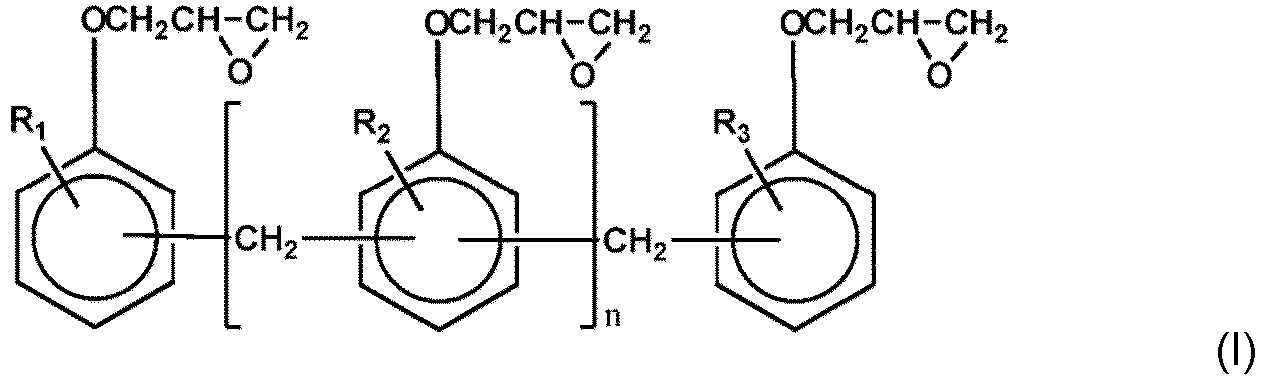 (b) das gesamte Epoxidharz weist ein durchschnittliches Epoxidäquivalent von 165 bis 265 g/Äq auf, wobei das durchschnittliche Epoxidäquivalent wie in der Beschreibung beschrieben gemessen wird,(c) der Wasserabsorptionskoeffizient, der bestimmt wird, wenn die Epoxidharz-Zusammensetzung in einer Atmosphäre bei 85°C und 95%RH für 2 Stunden gelagert wird, beträgt 3,0 Massenprozent oder weniger basierend auf 100 Massenprozent der Epoxidharz-Zusammensetzung, wobei der Wasserabsorptionskoeffizient wie in der Beschreibung beschrieben gemessen wird,(d) [B1] ein aromatischer Harnstoff ist als [B] das Härtungsmittel enthalten, und(e) der Anteil von [B2] Dicyandiamid des Härtungsmittels [B] beträgt 0,5 Massenteile oder weniger basierend auf 100 Massenteilen des gesamten Epoxidharzes.
 - Prepreg nach Anspruch 1, wobei der Anteil des Dicyanimids [B2] 0,2 Massenteile oder weniger basierend auf 100 Massenteilen des gesamten Epoxidharzes beträgt.
- Prepreg nach Anspruch 2, wobei das Dicyanimid [B2] nicht in der Epoxidharz-Zusammensetzung enthalten ist.
- Prepreg nach Anspruch 3, wobei im Wesentlichen nur [B1] ein aromatischer Harnstoff als das Härtungsmittel [B] enthalten ist.
- Prepreg nach einem der Ansprüche 1 bis 4, wobei der aromatische Harnstoff [B1] eine Verbindung mit zwei Dimethylureidgruppen in einem Molekül des aromatischen Harnstoffs enthält.
- Prepreg nach Anspruch 5, wobei der aromatische Harnstoff [B1] eine durch die allgemeine Formel (II) wiedergegebene Verbindung enthält:

- Prepreg nach einem der Ansprüche 1 bis 6, wobei der Anteil des aromatischen Harnstoffs [B1] 2,5 bis 7,5 Massenteile basierend auf 100 Massenteilen des gesamten Epoxidharzes beträgt.
- Prepreg nach einem der Ansprüche 1 bis 7, wobei die Verstärkungsfaser die Form eines Gewebes aufweist.
- Prepreg nach einem der Ansprüche 1 bis 8, wobei die Verstärkungsfaser eine Kohlefaser ist.
- Faserverstärktes Verbundmaterial, das das ausgehärtete Prepreg gemäß einem der Ansprüche 1 bis 9 umfasst.
Applications Claiming Priority (2)
| Application Number | Priority Date | Filing Date | Title |
|---|---|---|---|
| JP2017232356 | 2017-12-04 | ||
| PCT/JP2018/043481 WO2019111747A1 (ja) | 2017-12-04 | 2018-11-27 | プリプレグおよび繊維強化複合材料 |
Publications (3)
| Publication Number | Publication Date |
|---|---|
| EP3722356A1 EP3722356A1 (de) | 2020-10-14 |
| EP3722356A4 EP3722356A4 (de) | 2021-08-25 |
| EP3722356B1 true EP3722356B1 (de) | 2025-02-12 |
Family
ID=66750562
Family Applications (1)
| Application Number | Title | Priority Date | Filing Date |
|---|---|---|---|
| EP18885897.1A Active EP3722356B1 (de) | 2017-12-04 | 2018-11-27 | Prepreg und faserverstärktes verbundmaterial |
Country Status (7)
| Country | Link |
|---|---|
| US (1) | US20210189078A1 (de) |
| EP (1) | EP3722356B1 (de) |
| JP (1) | JP7159875B2 (de) |
| KR (1) | KR102566686B1 (de) |
| CN (1) | CN111372978B (de) |
| TW (1) | TWI805651B (de) |
| WO (1) | WO2019111747A1 (de) |
Families Citing this family (1)
| Publication number | Priority date | Publication date | Assignee | Title |
|---|---|---|---|---|
| TW202603029A (zh) * | 2024-03-25 | 2026-01-16 | 日商三菱化學股份有限公司 | 預浸體、纖維強化複合材料以及纖維強化複合材料的製造方法、自行車用零件、高爾夫球棒用柄、網球拍、釣竿及曲棍球棒 |
Family Cites Families (17)
| Publication number | Priority date | Publication date | Assignee | Title |
|---|---|---|---|---|
| JPH0776616A (ja) * | 1993-07-15 | 1995-03-20 | Toray Ind Inc | プリプレグ用エポキシ樹脂組成物およびプリプレグ |
| JP3339815B2 (ja) * | 1998-01-27 | 2002-10-28 | 松下電工株式会社 | 電気絶縁材料用積層板製造用のエポキシ樹脂組成物及びプリプレグの製造方法 |
| JP2002284852A (ja) | 2001-01-19 | 2002-10-03 | Toray Ind Inc | エポキシ樹脂組成物、プリプレグおよび繊維強化複合材料 |
| WO2008143044A1 (ja) * | 2007-05-16 | 2008-11-27 | Toray Industries, Inc. | エポキシ樹脂組成物、プリプレグ、繊維強化複合材料 |
| TWI435887B (zh) | 2008-02-26 | 2014-05-01 | Toray Industries | 環氧樹脂組成物、預浸透物及纖維強化複合材料 |
| JP5229252B2 (ja) * | 2009-03-25 | 2013-07-03 | 東レ株式会社 | 炭素繊維強化複合材料用エポキシ樹脂組成物、プリプレグ、炭素繊維強化複合材料および電子電気部品筐体 |
| CN103140536B (zh) * | 2010-09-28 | 2015-09-23 | 东丽株式会社 | 环氧树脂组合物、预浸料坯及纤维增强复合材料 |
| JP5783020B2 (ja) | 2011-12-05 | 2015-09-24 | 東レ株式会社 | プリプレグおよび炭素繊維強化複合材料 |
| EP2794735B1 (de) * | 2011-12-22 | 2019-07-17 | Hexcel Holding GmbH | Verbesserungen an oder im zusammenhang mit verstärkten verbundwerkstoffen |
| JP5832023B2 (ja) | 2011-12-27 | 2015-12-16 | 日本化薬株式会社 | 透明回路基板用エポキシ樹脂組成物及びその硬化物 |
| JP6131593B2 (ja) | 2012-01-19 | 2017-05-24 | 東レ株式会社 | プリプレグおよび繊維強化複合材料 |
| JP2013253194A (ja) | 2012-06-08 | 2013-12-19 | Mitsubishi Rayon Co Ltd | エポキシ樹脂組成物 |
| US9868266B2 (en) * | 2012-08-27 | 2018-01-16 | Hexcel Holding Gmbh | Prepreg materials |
| JP6449553B2 (ja) * | 2014-03-27 | 2019-01-09 | 株式会社スリーボンド | エポキシ樹脂組成物 |
| JP6771884B2 (ja) | 2015-02-09 | 2020-10-21 | 東レ株式会社 | エポキシ樹脂組成物、プリプレグおよび繊維強化複合材料 |
| US10344117B2 (en) * | 2015-02-09 | 2019-07-09 | Toray Industries, Inc. | Epoxy resin composition, prepreg, and fiber reinforced composite material |
| WO2018003691A1 (ja) | 2016-06-28 | 2018-01-04 | 東レ株式会社 | エポキシ樹脂組成物、プリプレグおよび繊維強化複合材料 |
-
2018
- 2018-11-27 KR KR1020207010454A patent/KR102566686B1/ko active Active
- 2018-11-27 WO PCT/JP2018/043481 patent/WO2019111747A1/ja not_active Ceased
- 2018-11-27 EP EP18885897.1A patent/EP3722356B1/de active Active
- 2018-11-27 US US16/757,839 patent/US20210189078A1/en not_active Abandoned
- 2018-11-27 CN CN201880074967.0A patent/CN111372978B/zh active Active
- 2018-11-27 JP JP2018567969A patent/JP7159875B2/ja active Active
- 2018-11-29 TW TW107142678A patent/TWI805651B/zh active
Also Published As
| Publication number | Publication date |
|---|---|
| WO2019111747A1 (ja) | 2019-06-13 |
| JPWO2019111747A1 (ja) | 2020-11-19 |
| TWI805651B (zh) | 2023-06-21 |
| US20210189078A1 (en) | 2021-06-24 |
| CN111372978A (zh) | 2020-07-03 |
| TW201925290A (zh) | 2019-07-01 |
| KR102566686B1 (ko) | 2023-08-14 |
| EP3722356A4 (de) | 2021-08-25 |
| KR20200088291A (ko) | 2020-07-22 |
| EP3722356A1 (de) | 2020-10-14 |
| CN111372978B (zh) | 2022-05-31 |
| JP7159875B2 (ja) | 2022-10-25 |
Similar Documents
| Publication | Publication Date | Title |
|---|---|---|
| EP3476881B1 (de) | Epoxidharzzusammensetzung, prepreg und faserverstärktes verbundmaterial | |
| US20110111663A1 (en) | Epoxy resin composition and prepreg using the same | |
| EP3766926B1 (de) | Prepreg und faserverstärktes verbundmaterial | |
| EP3333212B1 (de) | Epoxidharzzusammensetzung, prepreg und faserverstärktes verbundmaterial | |
| KR20100133963A (ko) | 에폭시 수지 조성물, 프리프레그 및 섬유 강화 복합 재료 | |
| JP6131593B2 (ja) | プリプレグおよび繊維強化複合材料 | |
| EP3760661A1 (de) | Hitzehärtbare harzzusammensetzung, prepreg und faserverstärktes verbundmaterial | |
| EP4495156A1 (de) | Epoxidharzzusammensetzung zur harztransferformung, gehärtetes harzprodukt, faserverstärktes verbundmaterial und verfahren zur herstellung davon | |
| EP4674884A1 (de) | Epoxidharzzusammensetzung für rtm, gehärtetes harzprodukt und faserverstärktes verbundmaterial sowie herstellungsverfahren dafür | |
| EP4495160A1 (de) | Epoxidharzzusammensetzung, faserverstärkter verbundstoff und herstellungsverfahren dafür | |
| EP3722356A1 (de) | Prepreg und faserverstärktes verbundmaterial | |
| KR102557230B1 (ko) | 에폭시 수지 조성물, 프리프레그 및 섬유 강화 복합 재료 | |
| EP3808789A1 (de) | Epoxidharzzusammensetzung, prepreg und faserverstärktes verbundmaterial | |
| EP3476880B1 (de) | Epoxidharzzusammensetzung, prepreg und faserverstärktes verbundmaterial | |
| EP3623406B1 (de) | Epoxidharzzusammensetzung, prepreg, faserverstärkter verbundwerkstoff und verfahren zur herstellung davon | |
| JP2025086435A (ja) | プリプレグ、繊維強化複合材料、繊維強化複合材料製管状体、ゴルフクラブシャフト、釣り竿、自動車構造部材および外装用部材 | |
| JP2025153516A (ja) | エポキシ樹脂組成物、樹脂硬化物、繊維強化複合材料およびその製造方法 |
Legal Events
| Date | Code | Title | Description |
|---|---|---|---|
| STAA | Information on the status of an ep patent application or granted ep patent |
Free format text: STATUS: THE INTERNATIONAL PUBLICATION HAS BEEN MADE |
|
| PUAI | Public reference made under article 153(3) epc to a published international application that has entered the european phase |
Free format text: ORIGINAL CODE: 0009012 |
|
| STAA | Information on the status of an ep patent application or granted ep patent |
Free format text: STATUS: REQUEST FOR EXAMINATION WAS MADE |
|
| 17P | Request for examination filed |
Effective date: 20200513 |
|
| AK | Designated contracting states |
Kind code of ref document: A1 Designated state(s): AL AT BE BG CH CY CZ DE DK EE ES FI FR GB GR HR HU IE IS IT LI LT LU LV MC MK MT NL NO PL PT RO RS SE SI SK SM TR |
|
| AX | Request for extension of the european patent |
Extension state: BA ME |
|
| DAV | Request for validation of the european patent (deleted) | ||
| DAX | Request for extension of the european patent (deleted) | ||
| A4 | Supplementary search report drawn up and despatched |
Effective date: 20210723 |
|
| RIC1 | Information provided on ipc code assigned before grant |
Ipc: C08J 5/10 20060101AFI20210719BHEP Ipc: B29C 43/12 20060101ALI20210719BHEP Ipc: C08G 59/32 20060101ALI20210719BHEP Ipc: C08G 59/40 20060101ALI20210719BHEP Ipc: C08J 5/24 20060101ALI20210719BHEP Ipc: C08L 63/00 20060101ALI20210719BHEP Ipc: C08L 63/04 20060101ALI20210719BHEP |
|
| REG | Reference to a national code |
Ref country code: DE Ref legal event code: R079 Free format text: PREVIOUS MAIN CLASS: C08J0005100000 Ipc: C08G0059380000 Ref document number: 602018079175 Country of ref document: DE |
|
| GRAP | Despatch of communication of intention to grant a patent |
Free format text: ORIGINAL CODE: EPIDOSNIGR1 |
|
| STAA | Information on the status of an ep patent application or granted ep patent |
Free format text: STATUS: GRANT OF PATENT IS INTENDED |
|
| RIC1 | Information provided on ipc code assigned before grant |
Ipc: C08J 5/24 20060101ALI20240925BHEP Ipc: C08G 59/40 20060101ALI20240925BHEP Ipc: C08G 59/32 20060101ALI20240925BHEP Ipc: B29C 43/12 20060101ALI20240925BHEP Ipc: C08L 63/04 20060101ALI20240925BHEP Ipc: C08G 59/68 20060101ALI20240925BHEP Ipc: C08G 59/38 20060101AFI20240925BHEP |
|
| INTG | Intention to grant announced |
Effective date: 20241011 |
|
| GRAS | Grant fee paid |
Free format text: ORIGINAL CODE: EPIDOSNIGR3 |
|
| GRAA | (expected) grant |
Free format text: ORIGINAL CODE: 0009210 |
|
| STAA | Information on the status of an ep patent application or granted ep patent |
Free format text: STATUS: THE PATENT HAS BEEN GRANTED |
|
| P01 | Opt-out of the competence of the unified patent court (upc) registered |
Free format text: CASE NUMBER: APP_65467/2024 Effective date: 20241211 |
|
| AK | Designated contracting states |
Kind code of ref document: B1 Designated state(s): AL AT BE BG CH CY CZ DE DK EE ES FI FR GB GR HR HU IE IS IT LI LT LU LV MC MK MT NL NO PL PT RO RS SE SI SK SM TR |
|
| REG | Reference to a national code |
Ref country code: GB Ref legal event code: FG4D |
|
| REG | Reference to a national code |
Ref country code: CH Ref legal event code: EP |
|
| REG | Reference to a national code |
Ref country code: DE Ref legal event code: R096 Ref document number: 602018079175 Country of ref document: DE |
|
| REG | Reference to a national code |
Ref country code: IE Ref legal event code: FG4D |
|
| REG | Reference to a national code |
Ref country code: NL Ref legal event code: MP Effective date: 20250212 |
|
| PG25 | Lapsed in a contracting state [announced via postgrant information from national office to epo] |
Ref country code: RS Free format text: LAPSE BECAUSE OF FAILURE TO SUBMIT A TRANSLATION OF THE DESCRIPTION OR TO PAY THE FEE WITHIN THE PRESCRIBED TIME-LIMIT Effective date: 20250512 |
|
| PG25 | Lapsed in a contracting state [announced via postgrant information from national office to epo] |
Ref country code: FI Free format text: LAPSE BECAUSE OF FAILURE TO SUBMIT A TRANSLATION OF THE DESCRIPTION OR TO PAY THE FEE WITHIN THE PRESCRIBED TIME-LIMIT Effective date: 20250212 |
|
| PG25 | Lapsed in a contracting state [announced via postgrant information from national office to epo] |
Ref country code: PL Free format text: LAPSE BECAUSE OF FAILURE TO SUBMIT A TRANSLATION OF THE DESCRIPTION OR TO PAY THE FEE WITHIN THE PRESCRIBED TIME-LIMIT Effective date: 20250212 |
|
| PG25 | Lapsed in a contracting state [announced via postgrant information from national office to epo] |
Ref country code: ES Free format text: LAPSE BECAUSE OF FAILURE TO SUBMIT A TRANSLATION OF THE DESCRIPTION OR TO PAY THE FEE WITHIN THE PRESCRIBED TIME-LIMIT Effective date: 20250212 |
|
| REG | Reference to a national code |
Ref country code: LT Ref legal event code: MG9D |
|
| PG25 | Lapsed in a contracting state [announced via postgrant information from national office to epo] |
Ref country code: IS Free format text: LAPSE BECAUSE OF FAILURE TO SUBMIT A TRANSLATION OF THE DESCRIPTION OR TO PAY THE FEE WITHIN THE PRESCRIBED TIME-LIMIT Effective date: 20250612 Ref country code: NO Free format text: LAPSE BECAUSE OF FAILURE TO SUBMIT A TRANSLATION OF THE DESCRIPTION OR TO PAY THE FEE WITHIN THE PRESCRIBED TIME-LIMIT Effective date: 20250512 |
|
| PG25 | Lapsed in a contracting state [announced via postgrant information from national office to epo] |
Ref country code: NL Free format text: LAPSE BECAUSE OF FAILURE TO SUBMIT A TRANSLATION OF THE DESCRIPTION OR TO PAY THE FEE WITHIN THE PRESCRIBED TIME-LIMIT Effective date: 20250212 |
|
| PG25 | Lapsed in a contracting state [announced via postgrant information from national office to epo] |
Ref country code: HR Free format text: LAPSE BECAUSE OF FAILURE TO SUBMIT A TRANSLATION OF THE DESCRIPTION OR TO PAY THE FEE WITHIN THE PRESCRIBED TIME-LIMIT Effective date: 20250212 |
|
| PG25 | Lapsed in a contracting state [announced via postgrant information from national office to epo] |
Ref country code: PT Free format text: LAPSE BECAUSE OF FAILURE TO SUBMIT A TRANSLATION OF THE DESCRIPTION OR TO PAY THE FEE WITHIN THE PRESCRIBED TIME-LIMIT Effective date: 20250612 Ref country code: LV Free format text: LAPSE BECAUSE OF FAILURE TO SUBMIT A TRANSLATION OF THE DESCRIPTION OR TO PAY THE FEE WITHIN THE PRESCRIBED TIME-LIMIT Effective date: 20250212 |
|
| PG25 | Lapsed in a contracting state [announced via postgrant information from national office to epo] |
Ref country code: BG Free format text: LAPSE BECAUSE OF FAILURE TO SUBMIT A TRANSLATION OF THE DESCRIPTION OR TO PAY THE FEE WITHIN THE PRESCRIBED TIME-LIMIT Effective date: 20250212 Ref country code: GR Free format text: LAPSE BECAUSE OF FAILURE TO SUBMIT A TRANSLATION OF THE DESCRIPTION OR TO PAY THE FEE WITHIN THE PRESCRIBED TIME-LIMIT Effective date: 20250513 |
|
| REG | Reference to a national code |
Ref country code: AT Ref legal event code: MK05 Ref document number: 1766025 Country of ref document: AT Kind code of ref document: T Effective date: 20250212 |
|
| PG25 | Lapsed in a contracting state [announced via postgrant information from national office to epo] |
Ref country code: SE Free format text: LAPSE BECAUSE OF FAILURE TO SUBMIT A TRANSLATION OF THE DESCRIPTION OR TO PAY THE FEE WITHIN THE PRESCRIBED TIME-LIMIT Effective date: 20250212 |
|
| PG25 | Lapsed in a contracting state [announced via postgrant information from national office to epo] |
Ref country code: SM Free format text: LAPSE BECAUSE OF FAILURE TO SUBMIT A TRANSLATION OF THE DESCRIPTION OR TO PAY THE FEE WITHIN THE PRESCRIBED TIME-LIMIT Effective date: 20250212 |
|
| PG25 | Lapsed in a contracting state [announced via postgrant information from national office to epo] |
Ref country code: DK Free format text: LAPSE BECAUSE OF FAILURE TO SUBMIT A TRANSLATION OF THE DESCRIPTION OR TO PAY THE FEE WITHIN THE PRESCRIBED TIME-LIMIT Effective date: 20250212 |
|
| PG25 | Lapsed in a contracting state [announced via postgrant information from national office to epo] |
Ref country code: AT Free format text: LAPSE BECAUSE OF FAILURE TO SUBMIT A TRANSLATION OF THE DESCRIPTION OR TO PAY THE FEE WITHIN THE PRESCRIBED TIME-LIMIT Effective date: 20250212 |
|
| PGFP | Annual fee paid to national office [announced via postgrant information from national office to epo] |
Ref country code: FR Payment date: 20250930 Year of fee payment: 8 |
|
| PG25 | Lapsed in a contracting state [announced via postgrant information from national office to epo] |
Ref country code: EE Free format text: LAPSE BECAUSE OF FAILURE TO SUBMIT A TRANSLATION OF THE DESCRIPTION OR TO PAY THE FEE WITHIN THE PRESCRIBED TIME-LIMIT Effective date: 20250212 Ref country code: CZ Free format text: LAPSE BECAUSE OF FAILURE TO SUBMIT A TRANSLATION OF THE DESCRIPTION OR TO PAY THE FEE WITHIN THE PRESCRIBED TIME-LIMIT Effective date: 20250212 |
|
| PG25 | Lapsed in a contracting state [announced via postgrant information from national office to epo] |
Ref country code: RO Free format text: LAPSE BECAUSE OF FAILURE TO SUBMIT A TRANSLATION OF THE DESCRIPTION OR TO PAY THE FEE WITHIN THE PRESCRIBED TIME-LIMIT Effective date: 20250212 |
|
| PG25 | Lapsed in a contracting state [announced via postgrant information from national office to epo] |
Ref country code: SK Free format text: LAPSE BECAUSE OF FAILURE TO SUBMIT A TRANSLATION OF THE DESCRIPTION OR TO PAY THE FEE WITHIN THE PRESCRIBED TIME-LIMIT Effective date: 20250212 |
|
| REG | Reference to a national code |
Ref country code: DE Ref legal event code: R097 Ref document number: 602018079175 Country of ref document: DE |
|
| PLBE | No opposition filed within time limit |
Free format text: ORIGINAL CODE: 0009261 |
|
| STAA | Information on the status of an ep patent application or granted ep patent |
Free format text: STATUS: NO OPPOSITION FILED WITHIN TIME LIMIT |
|
| PGFP | Annual fee paid to national office [announced via postgrant information from national office to epo] |
Ref country code: DE Payment date: 20250930 Year of fee payment: 8 |
|
| PGFP | Annual fee paid to national office [announced via postgrant information from national office to epo] |
Ref country code: GB Payment date: 20251001 Year of fee payment: 8 |
|
| PGFP | Annual fee paid to national office [announced via postgrant information from national office to epo] |
Ref country code: IT Payment date: 20251022 Year of fee payment: 8 |
|
| 26N | No opposition filed |
Effective date: 20251113 |