EP3717150B1 - Multicomponent aluminum alloys for applications such as additive manufacturing - Google Patents
Multicomponent aluminum alloys for applications such as additive manufacturing Download PDFInfo
- Publication number
- EP3717150B1 EP3717150B1 EP18884266.0A EP18884266A EP3717150B1 EP 3717150 B1 EP3717150 B1 EP 3717150B1 EP 18884266 A EP18884266 A EP 18884266A EP 3717150 B1 EP3717150 B1 EP 3717150B1
- Authority
- EP
- European Patent Office
- Prior art keywords
- alloy
- additive manufacturing
- dmls
- aged
- manufacturing process
- Prior art date
- Legal status (The legal status is an assumption and is not a legal conclusion. Google has not performed a legal analysis and makes no representation as to the accuracy of the status listed.)
- Active
Links
Images





Classifications
-
- C—CHEMISTRY; METALLURGY
- C22—METALLURGY; FERROUS OR NON-FERROUS ALLOYS; TREATMENT OF ALLOYS OR NON-FERROUS METALS
- C22C—ALLOYS
- C22C21/00—Alloys based on aluminium
-
- B—PERFORMING OPERATIONS; TRANSPORTING
- B22—CASTING; POWDER METALLURGY
- B22F—WORKING METALLIC POWDER; MANUFACTURE OF ARTICLES FROM METALLIC POWDER; MAKING METALLIC POWDER; APPARATUS OR DEVICES SPECIALLY ADAPTED FOR METALLIC POWDER
- B22F10/00—Additive manufacturing of workpieces or articles from metallic powder
- B22F10/60—Treatment of workpieces or articles after build-up
- B22F10/64—Treatment of workpieces or articles after build-up by thermal means
-
- B—PERFORMING OPERATIONS; TRANSPORTING
- B22—CASTING; POWDER METALLURGY
- B22F—WORKING METALLIC POWDER; MANUFACTURE OF ARTICLES FROM METALLIC POWDER; MAKING METALLIC POWDER; APPARATUS OR DEVICES SPECIALLY ADAPTED FOR METALLIC POWDER
- B22F3/00—Manufacture of workpieces or articles from metallic powder characterised by the manner of compacting or sintering; Apparatus specially adapted therefor ; Presses and furnaces
- B22F3/24—After-treatment of workpieces or articles
-
- B—PERFORMING OPERATIONS; TRANSPORTING
- B22—CASTING; POWDER METALLURGY
- B22F—WORKING METALLIC POWDER; MANUFACTURE OF ARTICLES FROM METALLIC POWDER; MAKING METALLIC POWDER; APPARATUS OR DEVICES SPECIALLY ADAPTED FOR METALLIC POWDER
- B22F9/00—Making metallic powder or suspensions thereof
- B22F9/02—Making metallic powder or suspensions thereof using physical processes
- B22F9/06—Making metallic powder or suspensions thereof using physical processes starting from liquid material
- B22F9/08—Making metallic powder or suspensions thereof using physical processes starting from liquid material by casting, e.g. through sieves or in water, by atomising or spraying
-
- B—PERFORMING OPERATIONS; TRANSPORTING
- B33—ADDITIVE MANUFACTURING TECHNOLOGY
- B33Y—ADDITIVE MANUFACTURING, i.e. MANUFACTURING OF THREE-DIMENSIONAL [3D] OBJECTS BY ADDITIVE DEPOSITION, ADDITIVE AGGLOMERATION OR ADDITIVE LAYERING, e.g. BY 3D PRINTING, STEREOLITHOGRAPHY OR SELECTIVE LASER SINTERING
- B33Y40/00—Auxiliary operations or equipment, e.g. for material handling
- B33Y40/10—Pre-treatment
-
- B—PERFORMING OPERATIONS; TRANSPORTING
- B33—ADDITIVE MANUFACTURING TECHNOLOGY
- B33Y—ADDITIVE MANUFACTURING, i.e. MANUFACTURING OF THREE-DIMENSIONAL [3D] OBJECTS BY ADDITIVE DEPOSITION, ADDITIVE AGGLOMERATION OR ADDITIVE LAYERING, e.g. BY 3D PRINTING, STEREOLITHOGRAPHY OR SELECTIVE LASER SINTERING
- B33Y70/00—Materials specially adapted for additive manufacturing
-
- C—CHEMISTRY; METALLURGY
- C21—METALLURGY OF IRON
- C21D—MODIFYING THE PHYSICAL STRUCTURE OF FERROUS METALS; GENERAL DEVICES FOR HEAT TREATMENT OF FERROUS OR NON-FERROUS METALS OR ALLOYS; MAKING METAL MALLEABLE, e.g. BY DECARBURISATION OR TEMPERING
- C21D9/00—Heat treatment, e.g. annealing, hardening, quenching or tempering, adapted for particular articles; Furnaces therefor
-
- C—CHEMISTRY; METALLURGY
- C22—METALLURGY; FERROUS OR NON-FERROUS ALLOYS; TREATMENT OF ALLOYS OR NON-FERROUS METALS
- C22C—ALLOYS
- C22C21/00—Alloys based on aluminium
- C22C21/06—Alloys based on aluminium with magnesium as the next major constituent
- C22C21/08—Alloys based on aluminium with magnesium as the next major constituent with silicon
-
- C—CHEMISTRY; METALLURGY
- C22—METALLURGY; FERROUS OR NON-FERROUS ALLOYS; TREATMENT OF ALLOYS OR NON-FERROUS METALS
- C22F—CHANGING THE PHYSICAL STRUCTURE OF NON-FERROUS METALS AND NON-FERROUS ALLOYS
- C22F1/00—Changing the physical structure of non-ferrous metals or alloys by heat treatment or by hot or cold working
- C22F1/04—Changing the physical structure of non-ferrous metals or alloys by heat treatment or by hot or cold working of aluminium or alloys based thereon
-
- C—CHEMISTRY; METALLURGY
- C22—METALLURGY; FERROUS OR NON-FERROUS ALLOYS; TREATMENT OF ALLOYS OR NON-FERROUS METALS
- C22F—CHANGING THE PHYSICAL STRUCTURE OF NON-FERROUS METALS AND NON-FERROUS ALLOYS
- C22F1/00—Changing the physical structure of non-ferrous metals or alloys by heat treatment or by hot or cold working
- C22F1/04—Changing the physical structure of non-ferrous metals or alloys by heat treatment or by hot or cold working of aluminium or alloys based thereon
- C22F1/047—Changing the physical structure of non-ferrous metals or alloys by heat treatment or by hot or cold working of aluminium or alloys based thereon of alloys with magnesium as the next major constituent
-
- B—PERFORMING OPERATIONS; TRANSPORTING
- B22—CASTING; POWDER METALLURGY
- B22F—WORKING METALLIC POWDER; MANUFACTURE OF ARTICLES FROM METALLIC POWDER; MAKING METALLIC POWDER; APPARATUS OR DEVICES SPECIALLY ADAPTED FOR METALLIC POWDER
- B22F10/00—Additive manufacturing of workpieces or articles from metallic powder
- B22F10/20—Direct sintering or melting
- B22F10/25—Direct deposition of metal particles, e.g. direct metal deposition [DMD] or laser engineered net shaping [LENS]
-
- B—PERFORMING OPERATIONS; TRANSPORTING
- B22—CASTING; POWDER METALLURGY
- B22F—WORKING METALLIC POWDER; MANUFACTURE OF ARTICLES FROM METALLIC POWDER; MAKING METALLIC POWDER; APPARATUS OR DEVICES SPECIALLY ADAPTED FOR METALLIC POWDER
- B22F10/00—Additive manufacturing of workpieces or articles from metallic powder
- B22F10/20—Direct sintering or melting
- B22F10/28—Powder bed fusion, e.g. selective laser melting [SLM] or electron beam melting [EBM]
-
- B—PERFORMING OPERATIONS; TRANSPORTING
- B22—CASTING; POWDER METALLURGY
- B22F—WORKING METALLIC POWDER; MANUFACTURE OF ARTICLES FROM METALLIC POWDER; MAKING METALLIC POWDER; APPARATUS OR DEVICES SPECIALLY ADAPTED FOR METALLIC POWDER
- B22F10/00—Additive manufacturing of workpieces or articles from metallic powder
- B22F10/30—Process control
- B22F10/34—Process control of powder characteristics, e.g. density, oxidation or flowability
-
- B—PERFORMING OPERATIONS; TRANSPORTING
- B22—CASTING; POWDER METALLURGY
- B22F—WORKING METALLIC POWDER; MANUFACTURE OF ARTICLES FROM METALLIC POWDER; MAKING METALLIC POWDER; APPARATUS OR DEVICES SPECIALLY ADAPTED FOR METALLIC POWDER
- B22F10/00—Additive manufacturing of workpieces or articles from metallic powder
- B22F10/30—Process control
- B22F10/36—Process control of energy beam parameters
-
- B—PERFORMING OPERATIONS; TRANSPORTING
- B22—CASTING; POWDER METALLURGY
- B22F—WORKING METALLIC POWDER; MANUFACTURE OF ARTICLES FROM METALLIC POWDER; MAKING METALLIC POWDER; APPARATUS OR DEVICES SPECIALLY ADAPTED FOR METALLIC POWDER
- B22F10/00—Additive manufacturing of workpieces or articles from metallic powder
- B22F10/30—Process control
- B22F10/36—Process control of energy beam parameters
- B22F10/366—Scanning parameters, e.g. hatch distance or scanning strategy
-
- B—PERFORMING OPERATIONS; TRANSPORTING
- B22—CASTING; POWDER METALLURGY
- B22F—WORKING METALLIC POWDER; MANUFACTURE OF ARTICLES FROM METALLIC POWDER; MAKING METALLIC POWDER; APPARATUS OR DEVICES SPECIALLY ADAPTED FOR METALLIC POWDER
- B22F10/00—Additive manufacturing of workpieces or articles from metallic powder
- B22F10/30—Process control
- B22F10/38—Process control to achieve specific product aspects, e.g. surface smoothness, density, porosity or hollow structures
-
- B—PERFORMING OPERATIONS; TRANSPORTING
- B22—CASTING; POWDER METALLURGY
- B22F—WORKING METALLIC POWDER; MANUFACTURE OF ARTICLES FROM METALLIC POWDER; MAKING METALLIC POWDER; APPARATUS OR DEVICES SPECIALLY ADAPTED FOR METALLIC POWDER
- B22F3/00—Manufacture of workpieces or articles from metallic powder characterised by the manner of compacting or sintering; Apparatus specially adapted therefor ; Presses and furnaces
- B22F3/24—After-treatment of workpieces or articles
- B22F2003/248—Thermal after-treatment
-
- B—PERFORMING OPERATIONS; TRANSPORTING
- B22—CASTING; POWDER METALLURGY
- B22F—WORKING METALLIC POWDER; MANUFACTURE OF ARTICLES FROM METALLIC POWDER; MAKING METALLIC POWDER; APPARATUS OR DEVICES SPECIALLY ADAPTED FOR METALLIC POWDER
- B22F2301/00—Metallic composition of the powder or its coating
- B22F2301/05—Light metals
- B22F2301/052—Aluminium
-
- B—PERFORMING OPERATIONS; TRANSPORTING
- B22—CASTING; POWDER METALLURGY
- B22F—WORKING METALLIC POWDER; MANUFACTURE OF ARTICLES FROM METALLIC POWDER; MAKING METALLIC POWDER; APPARATUS OR DEVICES SPECIALLY ADAPTED FOR METALLIC POWDER
- B22F2998/00—Supplementary information concerning processes or compositions relating to powder metallurgy
- B22F2998/10—Processes characterised by the sequence of their steps
-
- B—PERFORMING OPERATIONS; TRANSPORTING
- B33—ADDITIVE MANUFACTURING TECHNOLOGY
- B33Y—ADDITIVE MANUFACTURING, i.e. MANUFACTURING OF THREE-DIMENSIONAL [3D] OBJECTS BY ADDITIVE DEPOSITION, ADDITIVE AGGLOMERATION OR ADDITIVE LAYERING, e.g. BY 3D PRINTING, STEREOLITHOGRAPHY OR SELECTIVE LASER SINTERING
- B33Y10/00—Processes of additive manufacturing
-
- Y—GENERAL TAGGING OF NEW TECHNOLOGICAL DEVELOPMENTS; GENERAL TAGGING OF CROSS-SECTIONAL TECHNOLOGIES SPANNING OVER SEVERAL SECTIONS OF THE IPC; TECHNICAL SUBJECTS COVERED BY FORMER USPC CROSS-REFERENCE ART COLLECTIONS [XRACs] AND DIGESTS
- Y02—TECHNOLOGIES OR APPLICATIONS FOR MITIGATION OR ADAPTATION AGAINST CLIMATE CHANGE
- Y02P—CLIMATE CHANGE MITIGATION TECHNOLOGIES IN THE PRODUCTION OR PROCESSING OF GOODS
- Y02P10/00—Technologies related to metal processing
- Y02P10/25—Process efficiency
Definitions
- the present disclosure relates to materials, methods and techniques for manufacturing multicomponent alloys.
- Multicomponent aluminum alloys disclosed and contemplated herein are particularly suited for additive manufacturing applications.
- Additive manufacturing also known as 3-D printing, is a fabrication technique that utilizes successive layer generation to produce an article of manufacture.
- additive manufacturing methods use powders, wires, or liquid bases to generate layers under direction of computer-aided design data.
- Example additive manufacturing processes include stereolithography, selective laser sintering (SLS), direct metal laser sintering (DMLS), electron beam melting (EBM), and laser powder deposition (LPD).
- EP2110450 A1 describes high temperature aluminum alloys that can be used at temperatures from about -420°F (-251°C) up to about 650°F (343°C). The alloys are strengthened by dispersion of particles based on the L1 2 intermetallic compound Al 3 X.
- These alloys comprise aluminum, at least one of nickel, iron and chromium; at least one of scandium, erbium, thulium, ytterbium, and lutetium, and at least one of gadolinium, yttrium, zirconium, titanium, hafnium, and niobium.
- multicomponent aluminum alloys include aluminum, nickel, zirconium, and rare earth elements, and include L1 2 precipitates having an Al 3 X composition.
- Rare earth elements used in example multicomponent aluminum alloys disclosed and contemplated herein include erbium (Er), zirconium (Zr), yttrium (Y), and ytterbium (Yb).
- the invention is directed to an alloy comprising, by weight percentage: 1% to 4.2% nickel; 0.5% to 2.6% erbium; 0.1% to 1.5% zirconium; 0.05% to 0.3% yttrium; 0.1% to 1.2% ytterbium; no more than 0.5% impurities; and the balance of weight percent consisting of aluminum, wherein the alloy includes L1 2 precipitates having an Al 3 X composition, where X is at least one of: erbium, zirconium, yttrium, and ytterbium.
- the invention is directed to an atomized alloy powder usable in additive manufacturing, the atomized alloy powder comprising: alloy particles comprising, by weight percentage: 1% to 4.2% nickel; 0.5% to 2.6% erbium; 0.1% to 1.5% zirconium; 0.05% to 0.3% yttrium; 0.1% to 1.2% ytterbium; no more than 0.5% impurities; and the balance of weight percent consisting of aluminum, wherein the alloy particles include L1 2 precipitates having an Al 3 X composition, where X is at least one of: erbium, zirconium, yttrium, and ytterbium.
- the invention is directed to a method of using an atomized alloy powder in additive manufacturing, the method comprising: receiving the atomized alloy powder comprising alloy particles, the alloy particles comprising, by weight percentage: 1% to 4.2% nickel; 0.5% to 2.6% erbium; 0.1% to 1.5% zirconium; 0.05% to 0.3% yttrium; 0.1% to 1.2% ytterbium; no more than 0.5 impurities; and the balance of weight percent consisting of aluminum, wherein the alloy particles also include L1 2 precipitates having an Al 3 X composition, where X is at least one of: erbium, zirconium, yttrium, and ytterbium; conducting Direct Metal Laser Sintering (DMLS) additive manufacturing with the atomized alloy powder to generate a manufactured article, the DMLS additive manufacturing comprising a laser power of 370 W, a scan speed of 1300 mm/s, a scan spacing 0.17 mm, and a layer depth 30 pm; and aging the manufactured article in
- DMLS
- Example multicomponent aluminum alloys include aluminum-based alloys comprising one or more of: nickel (Ni), erbium (Er), zirconium (Zr), yttrium (Y), and ytterbium (Yb).
- the example multicomponent aluminum alloys can include L1 2 precipitates having an Al 3 X structure, where X is at least one of: erbium, zirconium, yttrium, and ytterbium.
- Multicomponent aluminum alloys disclosed and contemplated herein are well suited for additive manufacturing applications.
- an atomized alloy powder usable in additive manufacturing can include alloy particles comprising multicomponent aluminum alloys disclosed and contemplated herein.
- example multicomponent aluminum alloys disclosed and contemplated herein can display improved processability, strength, and/or corrosion resistance in harsh environments, for instance, when compared to existing aluminum alloys.
- Example applications of multicomponent aluminum alloys disclosed and contemplated herein include aerospace, automotive, energy industries, as well as other applications where materials can be subjected to extreme temperature and/or loading conditions.
- Example applications of multicomponent aluminum alloys disclosed and contemplated herein also include those requiring materials that have high strength and/or are corrosion resistant.
- Various manufactured articles can be prepared using the multicomponent aluminum alloys disclosed herein, including for the aforementioned industries and the aforementioned applications.
- Example multicomponent aluminum alloys can have a combination of hot tear resistance and strength, making them amenable to additive manufacturing for production of articles requiring high strength (e.g., aircraft components).
- Example multicomponent aluminum alloys are described below regarding example components and amounts, phase and nanostructure characteristics, physical properties, methods of manufacture, exemplary articles of manufacture, and exemplary methods of use.
- Multicomponent aluminum alloys disclosed and contemplated herein include various components at various amounts.
- example multicomponent aluminum alloys include aluminum and one or more of: nickel (Ni), erbium (Er), zirconium (Zr), yttrium (Y), and ytterbium (Yb).
- nickel Ni
- Er erbium
- Zr zirconium
- Y yttrium
- Yb ytterbium
- “multicomponent aluminum alloys” mean alloys including aluminum, nickel, and one or more "rare earth” elements, such as erbium, zirconium, yttrium, and/or ytterbium.
- Example multicomponent aluminum alloys disclosed and contemplated herein include nickel (Ni).
- multicomponent aluminum alloys include 1 to 4 weight percent ("wt %") Ni; 1 wt % to 3 wt % Ni; 1 wt % to 2 wt % Ni; 2 wt % to 4 wt % Ni; or 2 wt % to 3 wt % Ni.
- the multicomponent aluminum alloys include 1 to 4.2 wt % Ni.
- example multicomponent aluminum alloys include no greater than 4 wt% Ni; no greater than 3 wt % Ni; or no greater than 2 wt % Ni.
- Example multicomponent aluminum alloys disclosed and contemplated herein include erbium (Er).
- the multicomponent aluminum alloys include 0.5 wt % to 2.6 wt % Er; 0.8 wt % to 2.4 wt % Er; 1.0 wt % to 2.2 wt % Er; 1.2 wt % to 1.8 wt % Er; 0.6 wt % to 1.6 wt % Er; 0.8 wt % to 1.4 wt % Er; 1.2 wt% to 2.3 wt% Er; 1.0 wt % to 1.4 wt % Er; to 1.0 wt % to 1.6 wt % Er.
- Example multicomponent aluminum alloys disclosed and contemplated herein include zirconium (Zr).
- the multicomponent aluminum alloys include 0.1 wt % to 1.5 wt % Zr; 0.3 wt % to 1.3 wt % Zr; 0.5 wt % to 1.0 wt % Zr; 0.3 wt % to 0.8 wt % Zr; 0.5 wt % to 1.3 wt % Zr; 0.7 wt % to 1.1 wt % Zr; or 0.9 wt % to 1.2 wt % Zr.
- Example multicomponent aluminum alloys disclosed and contemplated herein include yttrium (Y).
- the multicomponent aluminum alloys include 0.05 wt % to 0.3 wt % Y; 0.1 wt % to 0.2 wt % Y; 0.08 wt % to 0.2 wt % Y; 0.1 wt % to 0.25 wt % Y; 0.2 wt % to 0.3 wt % Y; 0.15 wt % to 0.25 wt % Y; or 0.09 wt % to 0.3 wt % Y.
- Example multicomponent aluminum alloys disclosed and contemplated herein include ytterbium (Yb).
- the multicomponent aluminum alloys include 0.1 wt % to 1.2 wt % Yb; 0.3 wt % to 1.0 wt % Yb; 0.5 wt % to 0.8 wt % Yb; 0.3 wt % to 0.8 wt % Yb; 0.5 wt % to 1.0 wt % Yb; 0.7 wt % to 1.1 wt % Yb; or 0.9 wt % to 1.2 wt % Yb.
- example multicomponent aluminum alloys disclosed and contemplated herein significantly reduce, or eliminate, the use of scandium. In some implementations, example multicomponent aluminum alloys do not have any added scandium.
- Example multicomponent aluminum alloys can include nickel, erbium, zirconium, yttrium, and ytterbium in amounts and ranges disclosed above as well as a balance of weight percent aluminum.
- example multicomponent aluminum alloys include 1 wt % to 4 wt % Ni; 0.6 wt % to 1.6 wt % Er; 0.1 wt % to 1.2 wt % Zr; 0.05 wt % to 0.3 wt % Y; 0.1 wt % to 1.2 wt % Yb, and the balance aluminum.
- example multicomponent aluminum alloys include 2 wt % to 3 wt % Ni; 1.0 wt % to 1.4 wt % Er; 0.5 wt % to 1.2 wt % Zr; 0.10 wt % to 0.3 wt % Y; and 0.5 wt % to 1.0 wt % Yb, and the balance aluminum.
- Other ranges and amounts within the limits defined in the appended claims are contemplated.
- Incidental elements and impurities in the disclosed multicomponent aluminum alloys may include, but are not limited to, silicon, iron, elements adhering to raw material stock, or mixtures thereof.
- impurities may be present in the alloys disclosed herein in amounts totaling no more than 0.5 wt %, no more than 0.4 wt %, no more than 0.3 wt %, no more than 0.2 wt %, no more than 0.1 wt %, no more than 0.05 wt %, no more than 0.01 wt %, or no more than 0.001 wt %.
- Multicomponent aluminum alloys disclosed and contemplated herein have various phase and nanostructure characteristics.
- example multicomponent aluminum alloys can include a stable Al 3 Ni eutectic phase.
- Grain structures within example multicomponent aluminum alloys can be maintained using a grain pinning dispersion combined with an oxygen gettering phase. These grain structures can aid in maintaining fine grain sizes through building and optional post-build thermal treatments.
- Example multicomponent aluminum alloys can include L1 2 precipitation phase in addition to the Al 3 Ni eutectic phase.
- an L1 2 precipitation phase is a high-temperature stable phase that can be retained into solution during the rapid solidification found during additive manufacturing, such as during DMLS processing.
- L1 2 precipitation phases can directly precipitate during post-build stress relief without requiring solutionizing and/or quenching processes typically used during forged alloy manufacturing.
- L1 2 precipitation phases can improve the processability of atomized alloy powders used during additive manufacturing. Additionally, L1 2 precipitation phases can provide added strength to a manufactured article.
- example multicomponent aluminum alloys disclosed and contemplated herein include L1 2 precipitation phases with one or more design properties.
- example multicomponent aluminum alloys include a L1 2 precipitation phase that is stable over competing phases.
- example multicomponent aluminum alloys have reduced, or minimized, lattice misfit between an L1 2 precipitation phase and a face centered cubic (FCC) matrix. Minimizing lattice misfit can maximize thermal stability.
- example multicomponent aluminum alloys have minimized an L1 2 precipitation phase coarsening rate. Minimizing the coarsening rate can result in a fine dispersion of the L1 2 precipitation phase in additively manufactured articles. Minimizing the coarsening rate can also enable direct aging during post-build stress relief processes, such as aging at a temperature of from 300°C to 425°C.
- Example multicomponent aluminum alloys disclosed and contemplated herein have a L1 2 precipitation phase fraction of, by volume fraction or atomic fraction, from 0.5% to 6%.
- L1 2 precipitation phase fraction can be from 0.5% to 6% at 350°C; from 1% to 3% at 350°C; from 1.5% to 2.5% at 350°C; or from 2.5% to 4.5% at 350°C.
- the L1 2 precipitation phases found in multicomponent aluminum alloys disclosed and contemplated herein have an Al 3 X structure, where X is at least one of: erbium, zirconium, yttrium, and ytterbium.
- X is at least one of: erbium, zirconium, yttrium, and ytterbium.
- the Al 3 X composition has sluggish kinetics, which provides a potential for precipitate strengthening without requiring solution and quenching treatments.
- the Al 3 X composition has low solubility in aluminum, high temperature stability and coarsening resistance, and low lattice misfit with the aluminum matrix.
- Zr can be used in example multicomponent aluminum alloys to stabilize the multicomponent Al 3 X L1 2 phase for precipitate strengthening and grain inoculation.
- erbium and/or ytterbium can stabilize the L1 2 phase crystal structure, which improves precipitate strengthening response.
- Example multicomponent aluminum alloys disclosed and contemplated herein can have one or more desirable physical properties.
- example multicomponent aluminum alloys may have hot tear resistance during an additive manufacturing process and resulting alloys may have high strength.
- the following section describes certain physical characteristics of example multicomponent aluminum alloys, including ultimate tensile strength, yield strength, fatigue test performance, hardness, and fracture toughness.
- ultimate tensile strength is the maximum stress that a material can withstand while experiencing tensile elongation.
- Tensile strength testing conducted on example multicomponent aluminum alloys was performed at room temperature in accordance with ASTM E8.
- Tensile strength testing conducted on example multicomponent aluminum alloys was performed at elevated temperatures in accordance with ASTM E21.
- a multicomponent aluminum alloy after being subjected to an additive manufacturing process and after aging at 300°C to 425°C, has an ultimate tensile strength of at least 379.2 MPa (55 ksi) at 22°C.
- a multicomponent aluminum alloy after subjecting the alloy to an additive manufacturing process and after aging at 375°C to 425°C to produce an aged alloy, the aged alloy has an ultimate tensile strength of at least 137.9 MPa (20 ksi) at 250°C.
- the alloy product after subjecting an example atomized alloy powder to an additive manufacturing process to generate an alloy product, the alloy product has an ultimate tensile strength of at least 172.4 MPa (25 ksi) at 300°C.
- the alloy product has an ultimate tensile strength of at least 172.4 MPa (25 ksi) at 300°C.
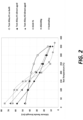
- Other example values are shown in FIG. 2 , described in greater detail below.
- ambient temperature or “room temperature” refer to the temperature of the external environment at the location at which the system and/or the process of the present disclosure is operated. As an example, in certain environments, ambient temperature or room temperature is approximately 22°C.
- Yield strength can be determined by evaluation of data obtained during tensile strength testing. Generally, yield strength relates to a yield point of a material during tensile strength testing; beyond the yield strength point deformations to the material are not recoverable upon removal of the load. Put another way, yield strength is the stress level at which plastic deformation begins.
- a multicomponent aluminum alloy after being subjected to an additive manufacturing process, has a yield strength of at least 206.8 MPa (30 ksi) at 250°C.
- stress corrosion tests evaluate a material's performance when under tensile stress in a corrosive environment. Stress corrosion tests were performed on example multicomponent aluminum alloys in accordance with ASTM G47 and ASTM G49. Experimental performance of example multicomponent alloys when subjected to stress corrosion tests are described below in section II.D.
- fatigue testing can evaluate a material's ability to resist fatigue when subjected to direct stress for a relatively large number of cycles.
- Fatigue testing for constant force was performed in accordance with ASTM E466.
- a multicomponent alloy after being subjected to an additive manufacturing process and after aging at 300°C to 425°C, is capable of passing a fatigue test without failure, the fatigue test including a stress amplitude of 103.4 MPa (15 ksi), a frequency of 50 Hz, a R ratio of -1, and a number of cycles being 10,000,000.
- K Ic fracture toughness
- example multicomponent aluminum alloys have a hardness of at least 120 HV after aging the alloy at a temperature of 350°C for 24 hours. In some implementations, example multicomponent aluminum alloys have a hardness of at least 125 HV after aging the alloy at a temperature of 400 °C for 2 hours. In some implementations, example multicomponent aluminum alloys have a hardness of at least 130 HV.
- Example multicomponent aluminum alloys disclosed and contemplated herein can be fabricated into various input stock forms relevant to the additive manufacturing system of interest.
- example multicomponent aluminum alloys disclosed and contemplated herein can be manufactured into atomized alloy powder using available atomization techniques such as inert gas atomization. Resulting atomized alloy powders can be used in powder-bed fusion and directed energy deposition systems.
- An example method of manufacturing an atomized alloy powder includes melting elemental metal feedstock or pre-alloyed feedstock such that a desired chemistry is produced.
- a desired chemistry reaches temperatures at or above temperatures where there is no solid material fraction in the melt, atomization processes should take place.
- the melt is a homogenous distribution of the feedstock elements.
- Example components in the feedstock are described herein, and include, for instance, nickel, erbium, zirconium, yttrium, ytterbium, and aluminum, in amounts disclosed and contemplated herein. Additional components in the feedstock are contemplated, such as incidental elements and impurities.
- melt is passed through a nozzle and immediately exposed to high velocity inert gas, such as argon.
- high velocity inert gas such as argon.
- the high velocity inert gas breaks up the molten stream and produces spherical powders.
- the spherical powders then cool and fall into an atomizing tower.
- This example method can produce spherical powder with desirable flow characteristics and high chemical purity.
- Example atomized alloy powders can have particles sized for a particular use and/or fabrication system.
- example atomized alloy powders include particles having diameters of from 20 ⁇ m to 63 ⁇ m.
- Example multicomponent aluminum alloys disclosed and contemplated herein can also be fabricated into wire form via conventional ingot metallurgy and wire drawing techniques for use in wire-based additive manufacturing systems.
- Example multicomponent aluminum alloys disclosed and contemplated herein can be used in additive manufacturing systems.
- Additive manufacturing is a process by which parts are built in a layered fashion by selectively fusing metal using a computer-controlled energy source (e.g., laser, electron beam, weld torch, or the like).
- a computer-controlled energy source e.g., laser, electron beam, weld torch, or the like.
- Additive manufacturing is also defined in ASTM F2792-12a entitled "Standard Terminology for Additively Manufacturing Technologies.”
- Example additive layer manufacturing processes include: selective laser sintering in which a laser is used to sinter a powder media in precisely controlled locations; laser wire deposition in which a wire feedstock is melted by a laser and then deposited and solidified in precise locations to build the product; electron beam melting; laser engineered net shaping; and direct metal deposition.
- additive manufacturing techniques provide flexibility in free-form fabrication without geometric constraints, fast material processing time, and innovative joining techniques.
- Suitable additive manufacturing systems include the EOSINT M 280 Direct Metal Laser Sintering (DMLS) additive manufacturing system, available from EOS GmbH (Robert-Stirling-Ring 1, 82152 Krailling/Munich, Germany).
- DMLS Direct Metal Laser Sintering
- direct metal laser sintering is used to produce articles comprising the inventive multicomponent aluminum alloys.
- an atomized alloy powder may be spread in a bed and a laser is used to selectively melt and fuse regions of the bed.
- Articles of manufacture can be built in a layer-by-layer fashion by continually spreading and fusing layers of powder.
- the DMLS laser parameters include: laser power of 370 W, scan speed of 1300 mm/s, scan spacing 0.17 mm. and layer depth 30 ⁇ m.
- post-processing operations can be performed after the build process.
- post-processing operations improve one or more characteristics of the "as-built" article of manufacture.
- certain articles may contain defects that preclude use "as-built.” For example, certain articles may include unacceptable porosity, chemical inhomogeneity, or anisotropy. Post-processing operations can eliminate or minimize such defects.
- Post-processing operations can include various heat treatments.
- the manufactured article can be directly transferred from the additive manufacturing system to a heated enclosure, such as a furnace, without first requiring solutionizing (also referred to as solution heat treating) the article.
- solution heat treating also referred to as solution heat treating
- These heat treatments applied to the manufactured article are referred to herein as "aging" processes.
- the heated enclosure may be pressurized to perform hot isostatic pressing of the material to reduce porosity.
- Post-processing thermal treatment may relieve stress and/or strengthen one or more portions of the aluminum alloy article.
- thermal treatments may result in precipitation hardening of one or more portions of the aluminum alloy part.
- Aging can include placing an as-built article in a heated environment at a temperature for a given period of time. In some instances, aging can be conducted at two distinct temperatures for two distinct times.
- post processing heat treatment occurs at a temperature of from 300°C to 425°C.
- heat treatment can occur at a temperature of from 325° to 400°C; from 350°C to 375°C; from 300°C to 400°C; from 325°C to 425°C; from 300°C to 350°C; from 350°C to 425°C; and from 375°C to 425°C.
- heat treatment can occur at a temperature of from 175°C to 250°C for 1 hour to 4 hours.
- heat treatment can occur at 200°C for 1 hour, 375°C for 2 hours, and 400°C for 2 hours.
- FIG. 1 shows an example method 100 of using an atomized alloy powder in additive manufacturing.
- Example method 100 begins by receiving an atomized alloy powder (operation 102).
- the atomized alloy powder can be example atomized alloy powders disclosed and contemplated herein.
- the atomized alloy powder comprises alloy particles comprising, by weight percentage: 1% to 4.2% nickel; 0.5% to 2.6% erbium; 0.1% to 1.5% zirconium; 0.05% to 0.3% yttrium; 0.1% to 1.2% ytterbium; no more than 0.5% impurities ; and the balance of atomic percent consisting of aluminum, wherein alloy particles include L1 2 precipitates having an Al 3 X structure, where X is at least one of: erbium, zirconium, yttrium, and ytterbium.
- Conducting additive manufacturing includes operating an additive manufacturing system in such a way as to produce a desired manufactured article.
- Example apparatus and laser parameters are discussed above, although different apparatus and modifications to those parameters are contemplated and within the scope of this disclosure (not part of the inventive method).
- Aluminum alloys in the manufactured article can solidify with about 10% of non-equilibrium (soluble) eutectic constituents for improved resistance to hot tearing during additive manufacturing.
- Heat treatment (operation 106) can include post-processing aging operations as disclosed and contemplated herein.
- heat treatment (operation 106) includes positioning the manufactured article in a heated container, such as a furnace, for a predetermined period of time at one or more temperatures. This process is also referred to herein as an aging process.
- eutectic constituents can be dissolved to restore a single-phase aluminum matrix, which can be free of coarse eutectic constituents that provided hot tearing resistance.
- Cooling can include positioning the manufactured article in an uncirculated air environment at room temperature.
- the disclosed aluminum alloys can be used to manufacture a variety of articles.
- Exemplary articles include, but are not limited to, gearbox housings (e.g., helicopter gearbox housing) and aerospace structural components.
- Experimental multicomponent aluminum alloys were designed using proprietary software to QuesTek. These experimental alloys and their elemental components are detailed in Table 1 below. Table 1. Experimental multicomponent alloys, where components are listed in weight percentage (wt %). Element Test Alloy #1 (wt %) Test Alloy #2 (wt %) (comparative) Ni 2.14 4.16 Er 1.35 1.14 Zr 1.15 1.19 Y 0.25 - Yb 0.73 - Al Balance Balance Total Other ⁇ 0.5 ⁇ 0.2
- Test alloy #1 and comparative test alloy #2 were manufactured into atomized alloy powders designed for additive manufacturing operations. Atomized alloy powders including particles comprising test alloy #1 and comparative test alloy #2 were manufactured into articles for experimental testing. Two versions of articles manufactured with test alloy #1 atomized powder were evaluated: an "as-built” article that had not been aged and a "direct aged” article that was aged for2 hours at 400 °C. One version of an article manufactured with comparative test alloy #2 was evaluated: an article that was aged for 1 hour at 200°C and for 2 hours at 375°C.
- test alloy #1 articles and comparative test alloy #2 article were compared to commercially-available alloys.
- articles manufactured with 2618-T6, A356, AlSi10Mg, and Scalmalloy were evaluated.
- Alloy 2618-T6 is a wrought alloy that has been solution heat treated and then artificially aged.
- Alloy A356 is a casting alloy.
- Alloy AlSi10Mg is an additive manufacturing alloy.
- Scalmalloy is an additive manufacturing alloy with Scandium (Sc).
- Alloy AlSi10Mg was the only commercially-available alloy experimentally evaluated.
- Experimental data for 2618-T6, A356, and Scalmalloy were obtained from publicly available sources, such as literature, handbooks, or datasheets.
- test alloy #1 both as-built and direct aged
- comparative test alloy #2 both as-built and direct aged
- alloy AlSi10Mg alloy AlSi10Mg
- Tensile strength testing conducted on example multicomponent aluminum alloys was performed at room temperature in accordance with ASTM E8.
- Tensile strength testing conducted on example multicomponent aluminum alloys was performed at elevated temperatures in accordance with ASTM E21.
- FIG. 2 shows ultimate tensile strength (in ksi) for articles manufactured with each of the alloys listed above at test temperatures of: 22°C, 100°C, 150°C, 200°C, 250°C, 300°C, and 350°C. As shown in FIG. 2 , particularly as the test temperature increases above 150°C, test alloy #1 (both as-built and direct-aged) and test alloy #2 retain their strength properties better than the commercial alloys.
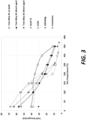
- FIG. 3 shows yield strength (in ksi) of articles manufactured with the various alloys at test temperatures of: 22°C, 100°C, 150°C, 200°C, 250°C, 300°C, and 350°C. As shown in FIG. 3 , particularly as the test temperature increases above 150°C, test alloy #1 (both as-built and direct-aged) and comparative test alloy #2 retain their strength properties better than the commercial alloys.
- FIG. 4 shows elongation (in %) of articles manufactured with the various alloys at test temperatures of: 22°C, 100°C, 150°C, 200°C, 250°C, 300°C, and 350°C.
- the elongation of test alloy #1 exceeds all other alloys at a 22 °C test temperature.
- Test alloy #1 and comparative alloy #2 have elongations that exceed commercial alloys at elevated temperatures of practical application (e.g. 150-200 °C). Although 2618 and AlSi10Mg have significant elongations above 250 °C, their strength levels decline below test alloy #1 and comparative alloy #2 above this temperature.
- Test alloy #1 Articles manufactured with test alloy #1 were direct aged and subjected to fatigue testing. Specifically, fatigue testing for constant force tests were performed in accordance with ASTM E466. Four sample articles were evaluated where the R ratio was -1, stress amplitude was 103.4 MPa (15 ksi), and frequency was 50 Hz. Testing was discontinued for each of the four sample articles after 10,000,000 cycles. Put another way, all four samples did not fail at the maximum number of cycles. Each sample article exhibited an endurance limit of at least 103.4 MPa (15 ksi).
- test alloy #1 both as-built and direct aged were subjected stress corrosion testing per ASTM G47 and ASTM G49. Samples of the as-built and direct aged articles were tested in triplicate. The samples were tested at 75% UTS for 10 days using a 3.5% NaCl alternate immersion method. Each of the samples, both the as-built and direct aged articles, completed the 10 day test period and were rated "light-moderate" for pitting. Put another way, the samples exhibited light to moderate pitting under stress corrosion testing conditions.
- test alloy #1 in as-built condition was heated to 232°C and pulled to its yield stress (approximately 227.5 MPa (33 ksi)) and strain (approximately 0.55%). The strain was then held constant at approximately 0.55% out for 176 hours. During this time, the stress remained at or above 172.4 MPa (25 ksi).
- FIG. 5 shows a plot of stress (in ksi) versus time for the sample during the test. The sample did not fail and was unloaded after the test.
- a sample is prepared by electropolishing, or with a focused ion beam, to create a tip with a radius on the order of tens of nanometers.
- This tip has a voltage passed through it and is pulsed with a laser to evaporate layers of atoms at a time, which pass through a detector that measures their mass to charge ratio, and records their position with respect to the current voltage and experiment time.
- Atom probe tomography produces a three-dimensional atom-by-atom elementally and isotopically resolved image with sub-nanometer spatial resolution and a sampling volume typically 100 nm by 100 nm by 100 nm.
- FIG. 6A, FIG. 6B, and FIG. 6C show visualizations of the isosurfaces.
- FIG. 6A highlights 9 percent (atomic percent, "at %") nickel, 12 at % Zr, and 5 at % Er.
- FIG. 6B shows the zirconium fraction and
- FIG. 6C shows the erbium fraction.
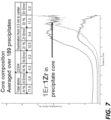
- FIG. 7 shows a compositional analysis for the 5 at % Er isosurfaces, excluding 6 isosurfaces with large surface areas.
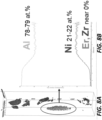
- FIG. 8A shows another isosurface, considering Al, Ni, Er, and Zr components, and highlighting the reconstruction of a near 3:1 atomic ratio particle at the edge of the sampling area.
- FIG. 8B shows a compositional analysis of the data shown in FIG. 8A.
- FIGS. 8A and 8B validate the existence of an Al 3 Ni eutectic phase.
- test alloy #1 achieved a hardness of at least 120 HV after 2 hours and maintained a hardness of at least 120 HV during the test and until the test ended at 24 hours.
- Table 3 Laser parameters during DMLS additive manufacturing test runs.
- FIG. 9A shows a plot of average hardness (HV) versus aging time in hours for test alloy #1 at 350°C.
- FIG. 9B shows a plot of average hardness (HV) versus aging time in hours for test alloy #1 at 400°C.
- Sample hardness was evaluated according to the Vickers hardness test.
- test alloy #1 achieved a hardness of at least 120 HV after 24 hours of aging, and retained its hardness to at least 240 hours of aging.
- test alloy #1 maintained a hardness of at least 120 HV during the test and until the test ended at 24 hours.
- FIG. 10A shows a micrograph image of an as-built article manufactured with test alloy #1.
- FIG. 10B shows the same article's surface after aging for 72 hours at 350°C.
- FIG. 10A and FIG. 10B have the same scale.
- numeric ranges For the recitation of numeric ranges herein, each intervening number there between with the same degree of precision is explicitly contemplated. Each numeric range is inclusive of the end points. For example, for the range of 6-9, the numbers 7 and 8 are contemplated in addition to 6 and 9, and for the range 6.0-7.0, the number 6.0, 6.1, 6.2, 6.3, 6.4, 6.5, 6.6, 6.7, 6.8, 6.9, and 7.0 are explicitly contemplated.
Landscapes
- Chemical & Material Sciences (AREA)
- Engineering & Computer Science (AREA)
- Materials Engineering (AREA)
- Mechanical Engineering (AREA)
- Metallurgy (AREA)
- Organic Chemistry (AREA)
- Manufacturing & Machinery (AREA)
- Thermal Sciences (AREA)
- Physics & Mathematics (AREA)
- Crystallography & Structural Chemistry (AREA)
- Powder Metallurgy (AREA)
- Manufacture Of Metal Powder And Suspensions Thereof (AREA)
- Treatment Of Steel In Its Molten State (AREA)
Applications Claiming Priority (2)
| Application Number | Priority Date | Filing Date | Title |
|---|---|---|---|
| US201762591515P | 2017-11-28 | 2017-11-28 | |
| PCT/US2018/062761 WO2019108596A1 (en) | 2017-11-28 | 2018-11-28 | Multicomponent aluminum alloys for applications such as additive manufacturing |
Publications (3)
| Publication Number | Publication Date |
|---|---|
| EP3717150A1 EP3717150A1 (en) | 2020-10-07 |
| EP3717150A4 EP3717150A4 (en) | 2021-09-08 |
| EP3717150B1 true EP3717150B1 (en) | 2024-06-05 |
Family
ID=66665261
Family Applications (2)
| Application Number | Title | Priority Date | Filing Date |
|---|---|---|---|
| EP18884266.0A Active EP3717150B1 (en) | 2017-11-28 | 2018-11-28 | Multicomponent aluminum alloys for applications such as additive manufacturing |
| EP18913552.8A Active EP3717245B1 (en) | 2017-11-28 | 2018-11-28 | A method of using an atomized alloy powder in additive manufacturing |
Family Applications After (1)
| Application Number | Title | Priority Date | Filing Date |
|---|---|---|---|
| EP18913552.8A Active EP3717245B1 (en) | 2017-11-28 | 2018-11-28 | A method of using an atomized alloy powder in additive manufacturing |
Country Status (4)
| Country | Link |
|---|---|
| US (2) | US11401585B2 (https=) |
| EP (2) | EP3717150B1 (https=) |
| JP (2) | JP7465803B2 (https=) |
| WO (2) | WO2019194869A2 (https=) |
Families Citing this family (20)
| Publication number | Priority date | Publication date | Assignee | Title |
|---|---|---|---|---|
| US20210164081A1 (en) | 2018-03-29 | 2021-06-03 | Oerlikon Metco (Us) Inc. | Reduced carbides ferrous alloys |
| WO2020086971A1 (en) | 2018-10-26 | 2020-04-30 | Oerlikon Metco (Us) Inc. | Corrosion and wear resistant nickel based alloys |
| FR3092777A1 (fr) * | 2019-02-15 | 2020-08-21 | C-Tec Constellium Technology Center | Procédé de fabrication d'une pièce en alliage d'aluminium |
| US12227853B2 (en) | 2019-03-28 | 2025-02-18 | Oerlikon Metco (Us) Inc. | Thermal spray iron-based alloys for coating engine cylinder bores |
| EP3962693A1 (en) | 2019-05-03 | 2022-03-09 | Oerlikon Metco (US) Inc. | Powder feedstock for wear resistant bulk welding configured to optimize manufacturability |
| CN114341385A (zh) | 2019-07-09 | 2022-04-12 | 欧瑞康美科(美国)公司 | 针对耐磨性和耐腐蚀性设计的铁基合金 |
| EP4085157A4 (en) | 2019-12-30 | 2024-01-17 | Entegris, Inc. | METAL BODY WITH MAGNESIUM FLUORIDE AREA FORMED THEREOF |
| WO2021215305A1 (ja) * | 2020-04-21 | 2021-10-28 | 日本軽金属株式会社 | アルミニウム合金成形体及びその製造方法 |
| WO2021215306A1 (ja) * | 2020-04-21 | 2021-10-28 | 日本軽金属株式会社 | アルミニウム成形体及びその製造方法 |
| DE102020208086A1 (de) | 2020-06-30 | 2021-12-30 | Fraunhofer-Gesellschaft zur Förderung der angewandten Forschung eingetragener Verein | Bauteil aus einer Aluminium-Nickel-Legierung sowie Verfahren zu dessen Herstellung und dessen Verwendung |
| CN112831694B (zh) | 2020-12-30 | 2022-12-20 | 上海交通大学 | 一种适用于增材制造的稀土铝合金粉末及其制备方法 |
| CN113684403A (zh) * | 2021-08-17 | 2021-11-23 | 北京工业大学 | 一种用于3d打印的高强铝合金粉及其制备方法 |
| EP4408600A4 (en) * | 2021-09-30 | 2025-07-30 | Entegris Inc | ARTICLES PRODUCED BY ADDITIVE MANUFACTURING HAVING PASSIVATED SURFACES AND RELATED PROCESSES |
| WO2024086118A1 (en) * | 2022-10-17 | 2024-04-25 | MELD Manufacturing Corporation | 5000 series aluminum alloy products produced using solid state manufacturing |
| KR20250160118A (ko) * | 2022-10-17 | 2025-11-11 | 멜드 매뉴팩쳐링 코포레이션 | 고체 상태 제조법으로 생산된 6000계 알루미늄 합금 제품 |
| US20240175106A1 (en) * | 2022-10-17 | 2024-05-30 | MELD Manufacturing Corporation | 7050-type aluminum alloy products produced using solid state manufacturing |
| US12601050B2 (en) | 2023-07-27 | 2026-04-14 | Entegris, Inc. | Surface modified substrates and related methods |
| CN117265338A (zh) * | 2023-09-19 | 2023-12-22 | 南京理工大学 | 一种增材制造用高性能Al-V-Cr-Fe合金 |
| CN117245084B (zh) * | 2023-11-20 | 2024-01-16 | 中航迈特增材科技(北京)有限公司 | 一种3d打印用高强耐温铝合金粉末及其制备方法和应用 |
| CN119410964B (zh) * | 2024-11-11 | 2025-11-11 | 中航迈特增材科技(北京)有限公司 | 一种抑制增材制造飞溅的含铒高强铝合金及其制备方法 |
Family Cites Families (38)
| Publication number | Priority date | Publication date | Assignee | Title |
|---|---|---|---|---|
| US4520145A (en) | 1982-07-21 | 1985-05-28 | The Boots Company Plc | Modified thermosetting imide resins with improved fracture toughness |
| US4711762A (en) | 1982-09-22 | 1987-12-08 | Aluminum Company Of America | Aluminum base alloys of the A1-Cu-Mg-Zn type |
| US4668290A (en) | 1985-08-13 | 1987-05-26 | Pfizer Hospital Products Group Inc. | Dispersion strengthened cobalt-chromium-molybdenum alloy produced by gas atomization |
| US4874440A (en) | 1986-03-20 | 1989-10-17 | Aluminum Company Of America | Superplastic aluminum products and alloys |
| US4861391A (en) | 1987-12-14 | 1989-08-29 | Aluminum Company Of America | Aluminum alloy two-step aging method and article |
| JPH0776701A (ja) | 1993-09-10 | 1995-03-20 | Suzuki Motor Corp | 金属間化合物分散強化アルミニウム合金(粉末)およびその製造方法 |
| US5599467A (en) | 1993-11-19 | 1997-02-04 | Honda Giken Kogyo Kabushiki Kaisha | Aluminum weldment and method of welding aluminum workpieces |
| IL156386A0 (en) * | 2000-12-21 | 2004-01-04 | Alcoa Inc | Aluminum alloy products and artificial aging method |
| JP4129507B2 (ja) | 2002-03-25 | 2008-08-06 | 太平洋セメント株式会社 | 金属−セラミックス複合材料の製造方法 |
| JP2005528530A (ja) | 2002-04-24 | 2005-09-22 | ケステック イノベーションズ エルエルシー | 非晶質状態を経て処理されたナノ相析出強化Al合金 |
| US7048815B2 (en) | 2002-11-08 | 2006-05-23 | Ues, Inc. | Method of making a high strength aluminum alloy composition |
| DE102005032544B4 (de) | 2004-07-14 | 2011-01-20 | Hitachi Powdered Metals Co., Ltd., Matsudo | Abriebsresistente gesinterte Aluminiumlegierung mit hoher Festigkeit und Herstellugsverfahren hierfür |
| US20110044843A1 (en) | 2008-01-16 | 2011-02-24 | Questek Innovations Llc | High-strength aluminum casting alloys resistant to hot tearing |
| US8017072B2 (en) * | 2008-04-18 | 2011-09-13 | United Technologies Corporation | Dispersion strengthened L12 aluminum alloys |
| US8002912B2 (en) * | 2008-04-18 | 2011-08-23 | United Technologies Corporation | High strength L12 aluminum alloys |
| US7875131B2 (en) * | 2008-04-18 | 2011-01-25 | United Technologies Corporation | L12 strengthened amorphous aluminum alloys |
| US20100143177A1 (en) * | 2008-12-09 | 2010-06-10 | United Technologies Corporation | Method for forming high strength aluminum alloys containing L12 intermetallic dispersoids |
| US20100226817A1 (en) | 2009-03-05 | 2010-09-09 | United Technologies Corporation | High strength l12 aluminum alloys produced by cryomilling |
| JP2011021218A (ja) | 2009-07-14 | 2011-02-03 | Kinki Univ | 積層造形用粉末材料及び粉末積層造形法 |
| EP2867473B1 (en) | 2012-06-21 | 2020-07-29 | United Technologies Corporation | Blades for an aviation engine and corresponding gas turbine aviation engine |
| EP2914394B1 (en) | 2012-11-01 | 2020-01-01 | General Electric Company | Additive manufacturing method |
| US9587298B2 (en) | 2013-02-19 | 2017-03-07 | Arconic Inc. | Heat treatable aluminum alloys having magnesium and zinc and methods for producing the same |
| US9267189B2 (en) | 2013-03-13 | 2016-02-23 | Honeywell International Inc. | Methods for forming dispersion-strengthened aluminum alloys |
| WO2014144482A1 (en) | 2013-03-15 | 2014-09-18 | Matterfab Corp. | Apparatus and methods for manufacturing |
| JP6165687B2 (ja) | 2013-09-04 | 2017-07-19 | 株式会社神戸製鋼所 | アルミニウム合金板 |
| JP6229130B2 (ja) * | 2013-10-08 | 2017-11-15 | 国立大学法人富山大学 | 鋳造用アルミニウム合金及びそれを用いた鋳物 |
| US20160348216A1 (en) | 2014-12-16 | 2016-12-01 | Honeywell International Inc. | Nickel-based superalloys and additive manufacturing processes using nickel-based superalloys |
| US20160228950A1 (en) | 2015-02-05 | 2016-08-11 | Alcoa Inc. | Methods for relieving stress in an additively manufactured alloy body |
| JP6102987B2 (ja) * | 2015-06-12 | 2017-03-29 | 株式会社オートネットワーク技術研究所 | アルミニウム合金線、アルミニウム合金撚線、被覆電線およびワイヤーハーネス |
| JP2018519412A (ja) | 2015-06-15 | 2018-07-19 | ノースロップ グルマン システムズ コーポレーションNorthrop Grumman Systems Corporation | パウダーベッドレーザープロセスによって付加製造される高強度アルミニウム |
| EP3344787B1 (en) | 2015-09-03 | 2022-11-02 | Questek Innovations LLC | Aluminum alloys |
| JP6794100B2 (ja) * | 2015-09-28 | 2020-12-02 | 東洋アルミニウム株式会社 | アルミニウム粒子群およびその製造方法 |
| DE102015221643A1 (de) * | 2015-11-04 | 2017-05-04 | Airbus Defence and Space GmbH | Al-Mg-Si-Legierung mit Scandium für den integralen Aufbau von ALM-Strukturen |
| JP2017155251A (ja) * | 2016-02-29 | 2017-09-07 | 株式会社神戸製鋼所 | 強度と延性に優れたアルミニウム合金鍛造材およびその製造方法 |
| JP2017155291A (ja) | 2016-03-02 | 2017-09-07 | 株式会社コイワイ | 高強度アルミニウム合金積層成形体の製造方法 |
| US11603583B2 (en) | 2016-07-05 | 2023-03-14 | NanoAL LLC | Ribbons and powders from high strength corrosion resistant aluminum alloys |
| TWI613296B (zh) * | 2016-11-10 | 2018-02-01 | 財團法人工業技術研究院 | 鋁合金粉體及鋁合金物件的製造方法 |
| CN107234240A (zh) | 2017-06-29 | 2017-10-10 | 西安欧中材料科技有限公司 | 一种采用SS‑PREP Ti6Al4V球形粉末的电子束铺粉增材的制造方法 |
-
2018
- 2018-11-28 US US16/767,516 patent/US11401585B2/en active Active
- 2018-11-28 EP EP18884266.0A patent/EP3717150B1/en active Active
- 2018-11-28 WO PCT/US2018/062779 patent/WO2019194869A2/en not_active Ceased
- 2018-11-28 JP JP2020529355A patent/JP7465803B2/ja active Active
- 2018-11-28 EP EP18913552.8A patent/EP3717245B1/en active Active
- 2018-11-28 WO PCT/US2018/062761 patent/WO2019108596A1/en not_active Ceased
- 2018-11-28 US US16/767,537 patent/US11773468B2/en active Active
- 2018-11-28 JP JP2020529360A patent/JP7461292B2/ja active Active
Also Published As
| Publication number | Publication date |
|---|---|
| EP3717150A1 (en) | 2020-10-07 |
| US11773468B2 (en) | 2023-10-03 |
| JP7465803B2 (ja) | 2024-04-11 |
| US11401585B2 (en) | 2022-08-02 |
| JP2021504578A (ja) | 2021-02-15 |
| WO2019108596A1 (en) | 2019-06-06 |
| WO2019194869A2 (en) | 2019-10-10 |
| EP3717150A4 (en) | 2021-09-08 |
| US20200385845A1 (en) | 2020-12-10 |
| EP3717245A2 (en) | 2020-10-07 |
| WO2019194869A3 (en) | 2019-12-19 |
| JP2021504579A (ja) | 2021-02-15 |
| JP7461292B2 (ja) | 2024-04-03 |
| US20200370149A1 (en) | 2020-11-26 |
| EP3717245A4 (en) | 2021-07-28 |
| EP3717245B1 (en) | 2023-09-20 |
Similar Documents
| Publication | Publication Date | Title |
|---|---|---|
| EP3717150B1 (en) | Multicomponent aluminum alloys for applications such as additive manufacturing | |
| EP3344787B1 (en) | Aluminum alloys | |
| JP7314184B2 (ja) | アルミニウム合金からなる部品の製造方法 | |
| EP4190933B1 (en) | Alloy powder | |
| US11780014B2 (en) | Auto-tempering steels for additive manufacturing | |
| KR20210118131A (ko) | 알루미늄 합금 부품 제조 방법 | |
| EP3967423A1 (en) | Stainless steel powders for additive manufacturing | |
| WO2021004579A1 (de) | Nickel-basislegierung für pulver und verfahren zur herstellung eines pulvers | |
| EP3701054B1 (en) | Titanium alloy | |
| AU2020209472A1 (en) | Aluminum alloys | |
| CN112384636A (zh) | 制造铝合金零件的方法 | |
| JP2019516017A (ja) | チタン、アルミニウム、ニオビウム、バナジウム、及びモリブデンのbcc材料、並びにそれから製造される生成物 | |
| JP2022148950A (ja) | Fe基合金粉末を用いた造形物の製造方法 | |
| JP7698181B2 (ja) | チタン合金材及びその製造方法 | |
| WO2019191450A1 (en) | Titanium aluminide alloys and titanium aluminide alloy products and methods for making the same | |
| WO2019099719A1 (en) | Cobalt-chromium-aluminum alloys, and methods for producing the same | |
| Khan et al. | Investigate the height dependency of the micro-/defect-structure and mechanical properties of additively manufactured AlF357 aluminum alloy | |
| Sarentica | Conventional heat treatment of additively manufactured AlSi10Mg | |
| Weisheit | Materials for Additive Manufacturing | |
| EP4223898A1 (en) | Alloy material, alloy product in which alloy material is used, and machine device having alloy product | |
| Merino-Gomez | Mechanical Properties and Microstructure Evolution of Thermally Treated Laser Powder Bed Fusion ALSI10mg | |
| Gonzalez et al. | Characterization of Inconel 625 Fabricated Using |
Legal Events
| Date | Code | Title | Description |
|---|---|---|---|
| STAA | Information on the status of an ep patent application or granted ep patent |
Free format text: STATUS: THE INTERNATIONAL PUBLICATION HAS BEEN MADE |
|
| PUAI | Public reference made under article 153(3) epc to a published international application that has entered the european phase |
Free format text: ORIGINAL CODE: 0009012 |
|
| STAA | Information on the status of an ep patent application or granted ep patent |
Free format text: STATUS: REQUEST FOR EXAMINATION WAS MADE |
|
| 17P | Request for examination filed |
Effective date: 20200611 |
|
| AK | Designated contracting states |
Kind code of ref document: A1 Designated state(s): AL AT BE BG CH CY CZ DE DK EE ES FI FR GB GR HR HU IE IS IT LI LT LU LV MC MK MT NL NO PL PT RO RS SE SI SK SM TR |
|
| AX | Request for extension of the european patent |
Extension state: BA ME |
|
| RIN1 | Information on inventor provided before grant (corrected) |
Inventor name: GONG, JIADONG Inventor name: SNYDER, DAVID R. Inventor name: OLSON, GREGORY B. Inventor name: KOZMEL II, THOMAS S. |
|
| DAV | Request for validation of the european patent (deleted) | ||
| DAX | Request for extension of the european patent (deleted) | ||
| A4 | Supplementary search report drawn up and despatched |
Effective date: 20210806 |
|
| RIC1 | Information provided on ipc code assigned before grant |
Ipc: C22F 1/047 20060101ALI20210802BHEP Ipc: C22F 1/04 20060101ALI20210802BHEP Ipc: C22C 1/04 20060101ALI20210802BHEP Ipc: B22F 10/64 20210101ALI20210802BHEP Ipc: B33Y 10/00 20150101ALI20210802BHEP Ipc: B33Y 70/00 20200101ALI20210802BHEP Ipc: C22C 21/00 20060101ALI20210802BHEP Ipc: B22F 1/00 20060101AFI20210802BHEP |
|
| P01 | Opt-out of the competence of the unified patent court (upc) registered |
Effective date: 20230707 |
|
| GRAP | Despatch of communication of intention to grant a patent |
Free format text: ORIGINAL CODE: EPIDOSNIGR1 |
|
| STAA | Information on the status of an ep patent application or granted ep patent |
Free format text: STATUS: GRANT OF PATENT IS INTENDED |
|
| INTG | Intention to grant announced |
Effective date: 20240220 |
|
| GRAS | Grant fee paid |
Free format text: ORIGINAL CODE: EPIDOSNIGR3 |
|
| GRAA | (expected) grant |
Free format text: ORIGINAL CODE: 0009210 |
|
| STAA | Information on the status of an ep patent application or granted ep patent |
Free format text: STATUS: THE PATENT HAS BEEN GRANTED |
|
| AK | Designated contracting states |
Kind code of ref document: B1 Designated state(s): AL AT BE BG CH CY CZ DE DK EE ES FI FR GB GR HR HU IE IS IT LI LT LU LV MC MK MT NL NO PL PT RO RS SE SI SK SM TR |
|
| REG | Reference to a national code |
Ref country code: CH Ref legal event code: EP |
|
| REG | Reference to a national code |
Ref country code: DE Ref legal event code: R096 Ref document number: 602018070401 Country of ref document: DE |
|
| REG | Reference to a national code |
Ref country code: IE Ref legal event code: FG4D |
|
| REG | Reference to a national code |
Ref country code: LT Ref legal event code: MG9D |
|
| PG25 | Lapsed in a contracting state [announced via postgrant information from national office to epo] |
Ref country code: BG Free format text: LAPSE BECAUSE OF FAILURE TO SUBMIT A TRANSLATION OF THE DESCRIPTION OR TO PAY THE FEE WITHIN THE PRESCRIBED TIME-LIMIT Effective date: 20240605 |
|
| REG | Reference to a national code |
Ref country code: NL Ref legal event code: MP Effective date: 20240605 |
|
| PG25 | Lapsed in a contracting state [announced via postgrant information from national office to epo] |
Ref country code: HR Free format text: LAPSE BECAUSE OF FAILURE TO SUBMIT A TRANSLATION OF THE DESCRIPTION OR TO PAY THE FEE WITHIN THE PRESCRIBED TIME-LIMIT Effective date: 20240605 Ref country code: FI Free format text: LAPSE BECAUSE OF FAILURE TO SUBMIT A TRANSLATION OF THE DESCRIPTION OR TO PAY THE FEE WITHIN THE PRESCRIBED TIME-LIMIT Effective date: 20240605 |
|
| PG25 | Lapsed in a contracting state [announced via postgrant information from national office to epo] |
Ref country code: GR Free format text: LAPSE BECAUSE OF FAILURE TO SUBMIT A TRANSLATION OF THE DESCRIPTION OR TO PAY THE FEE WITHIN THE PRESCRIBED TIME-LIMIT Effective date: 20240906 |
|
| PG25 | Lapsed in a contracting state [announced via postgrant information from national office to epo] |
Ref country code: ES Free format text: LAPSE BECAUSE OF FAILURE TO SUBMIT A TRANSLATION OF THE DESCRIPTION OR TO PAY THE FEE WITHIN THE PRESCRIBED TIME-LIMIT Effective date: 20240605 |
|
| PG25 | Lapsed in a contracting state [announced via postgrant information from national office to epo] |
Ref country code: LV Free format text: LAPSE BECAUSE OF FAILURE TO SUBMIT A TRANSLATION OF THE DESCRIPTION OR TO PAY THE FEE WITHIN THE PRESCRIBED TIME-LIMIT Effective date: 20240605 |
|
| PG25 | Lapsed in a contracting state [announced via postgrant information from national office to epo] |
Ref country code: NO Free format text: LAPSE BECAUSE OF FAILURE TO SUBMIT A TRANSLATION OF THE DESCRIPTION OR TO PAY THE FEE WITHIN THE PRESCRIBED TIME-LIMIT Effective date: 20240905 Ref country code: LV Free format text: LAPSE BECAUSE OF FAILURE TO SUBMIT A TRANSLATION OF THE DESCRIPTION OR TO PAY THE FEE WITHIN THE PRESCRIBED TIME-LIMIT Effective date: 20240605 Ref country code: HR Free format text: LAPSE BECAUSE OF FAILURE TO SUBMIT A TRANSLATION OF THE DESCRIPTION OR TO PAY THE FEE WITHIN THE PRESCRIBED TIME-LIMIT Effective date: 20240605 Ref country code: GR Free format text: LAPSE BECAUSE OF FAILURE TO SUBMIT A TRANSLATION OF THE DESCRIPTION OR TO PAY THE FEE WITHIN THE PRESCRIBED TIME-LIMIT Effective date: 20240906 Ref country code: FI Free format text: LAPSE BECAUSE OF FAILURE TO SUBMIT A TRANSLATION OF THE DESCRIPTION OR TO PAY THE FEE WITHIN THE PRESCRIBED TIME-LIMIT Effective date: 20240605 Ref country code: ES Free format text: LAPSE BECAUSE OF FAILURE TO SUBMIT A TRANSLATION OF THE DESCRIPTION OR TO PAY THE FEE WITHIN THE PRESCRIBED TIME-LIMIT Effective date: 20240605 Ref country code: BG Free format text: LAPSE BECAUSE OF FAILURE TO SUBMIT A TRANSLATION OF THE DESCRIPTION OR TO PAY THE FEE WITHIN THE PRESCRIBED TIME-LIMIT Effective date: 20240605 Ref country code: RS Free format text: LAPSE BECAUSE OF FAILURE TO SUBMIT A TRANSLATION OF THE DESCRIPTION OR TO PAY THE FEE WITHIN THE PRESCRIBED TIME-LIMIT Effective date: 20240905 |
|
| PG25 | Lapsed in a contracting state [announced via postgrant information from national office to epo] |
Ref country code: NL Free format text: LAPSE BECAUSE OF FAILURE TO SUBMIT A TRANSLATION OF THE DESCRIPTION OR TO PAY THE FEE WITHIN THE PRESCRIBED TIME-LIMIT Effective date: 20240605 |
|
| REG | Reference to a national code |
Ref country code: AT Ref legal event code: MK05 Ref document number: 1692094 Country of ref document: AT Kind code of ref document: T Effective date: 20240605 |
|
| PG25 | Lapsed in a contracting state [announced via postgrant information from national office to epo] |
Ref country code: NL Free format text: LAPSE BECAUSE OF FAILURE TO SUBMIT A TRANSLATION OF THE DESCRIPTION OR TO PAY THE FEE WITHIN THE PRESCRIBED TIME-LIMIT Effective date: 20240605 |
|
| PG25 | Lapsed in a contracting state [announced via postgrant information from national office to epo] |
Ref country code: PT Free format text: LAPSE BECAUSE OF FAILURE TO SUBMIT A TRANSLATION OF THE DESCRIPTION OR TO PAY THE FEE WITHIN THE PRESCRIBED TIME-LIMIT Effective date: 20241007 |
|
| PG25 | Lapsed in a contracting state [announced via postgrant information from national office to epo] |
Ref country code: PT Free format text: LAPSE BECAUSE OF FAILURE TO SUBMIT A TRANSLATION OF THE DESCRIPTION OR TO PAY THE FEE WITHIN THE PRESCRIBED TIME-LIMIT Effective date: 20241007 |
|
| PG25 | Lapsed in a contracting state [announced via postgrant information from national office to epo] |
Ref country code: PL Free format text: LAPSE BECAUSE OF FAILURE TO SUBMIT A TRANSLATION OF THE DESCRIPTION OR TO PAY THE FEE WITHIN THE PRESCRIBED TIME-LIMIT Effective date: 20240605 |
|
| PG25 | Lapsed in a contracting state [announced via postgrant information from national office to epo] |
Ref country code: EE Free format text: LAPSE BECAUSE OF FAILURE TO SUBMIT A TRANSLATION OF THE DESCRIPTION OR TO PAY THE FEE WITHIN THE PRESCRIBED TIME-LIMIT Effective date: 20240605 |
|
| PG25 | Lapsed in a contracting state [announced via postgrant information from national office to epo] |
Ref country code: AT Free format text: LAPSE BECAUSE OF FAILURE TO SUBMIT A TRANSLATION OF THE DESCRIPTION OR TO PAY THE FEE WITHIN THE PRESCRIBED TIME-LIMIT Effective date: 20240605 Ref country code: IS Free format text: LAPSE BECAUSE OF FAILURE TO SUBMIT A TRANSLATION OF THE DESCRIPTION OR TO PAY THE FEE WITHIN THE PRESCRIBED TIME-LIMIT Effective date: 20241005 |
|
| PG25 | Lapsed in a contracting state [announced via postgrant information from national office to epo] |
Ref country code: CZ Free format text: LAPSE BECAUSE OF FAILURE TO SUBMIT A TRANSLATION OF THE DESCRIPTION OR TO PAY THE FEE WITHIN THE PRESCRIBED TIME-LIMIT Effective date: 20240605 |
|
| PG25 | Lapsed in a contracting state [announced via postgrant information from national office to epo] |
Ref country code: SK Free format text: LAPSE BECAUSE OF FAILURE TO SUBMIT A TRANSLATION OF THE DESCRIPTION OR TO PAY THE FEE WITHIN THE PRESCRIBED TIME-LIMIT Effective date: 20240605 Ref country code: RO Free format text: LAPSE BECAUSE OF FAILURE TO SUBMIT A TRANSLATION OF THE DESCRIPTION OR TO PAY THE FEE WITHIN THE PRESCRIBED TIME-LIMIT Effective date: 20240605 |
|
| PG25 | Lapsed in a contracting state [announced via postgrant information from national office to epo] |
Ref country code: SM Free format text: LAPSE BECAUSE OF FAILURE TO SUBMIT A TRANSLATION OF THE DESCRIPTION OR TO PAY THE FEE WITHIN THE PRESCRIBED TIME-LIMIT Effective date: 20240605 |
|
| PG25 | Lapsed in a contracting state [announced via postgrant information from national office to epo] |
Ref country code: SM Free format text: LAPSE BECAUSE OF FAILURE TO SUBMIT A TRANSLATION OF THE DESCRIPTION OR TO PAY THE FEE WITHIN THE PRESCRIBED TIME-LIMIT Effective date: 20240605 Ref country code: SK Free format text: LAPSE BECAUSE OF FAILURE TO SUBMIT A TRANSLATION OF THE DESCRIPTION OR TO PAY THE FEE WITHIN THE PRESCRIBED TIME-LIMIT Effective date: 20240605 Ref country code: RO Free format text: LAPSE BECAUSE OF FAILURE TO SUBMIT A TRANSLATION OF THE DESCRIPTION OR TO PAY THE FEE WITHIN THE PRESCRIBED TIME-LIMIT Effective date: 20240605 Ref country code: PL Free format text: LAPSE BECAUSE OF FAILURE TO SUBMIT A TRANSLATION OF THE DESCRIPTION OR TO PAY THE FEE WITHIN THE PRESCRIBED TIME-LIMIT Effective date: 20240605 Ref country code: IS Free format text: LAPSE BECAUSE OF FAILURE TO SUBMIT A TRANSLATION OF THE DESCRIPTION OR TO PAY THE FEE WITHIN THE PRESCRIBED TIME-LIMIT Effective date: 20241005 Ref country code: EE Free format text: LAPSE BECAUSE OF FAILURE TO SUBMIT A TRANSLATION OF THE DESCRIPTION OR TO PAY THE FEE WITHIN THE PRESCRIBED TIME-LIMIT Effective date: 20240605 Ref country code: CZ Free format text: LAPSE BECAUSE OF FAILURE TO SUBMIT A TRANSLATION OF THE DESCRIPTION OR TO PAY THE FEE WITHIN THE PRESCRIBED TIME-LIMIT Effective date: 20240605 Ref country code: AT Free format text: LAPSE BECAUSE OF FAILURE TO SUBMIT A TRANSLATION OF THE DESCRIPTION OR TO PAY THE FEE WITHIN THE PRESCRIBED TIME-LIMIT Effective date: 20240605 |
|
| PG25 | Lapsed in a contracting state [announced via postgrant information from national office to epo] |
Ref country code: IT Free format text: LAPSE BECAUSE OF FAILURE TO SUBMIT A TRANSLATION OF THE DESCRIPTION OR TO PAY THE FEE WITHIN THE PRESCRIBED TIME-LIMIT Effective date: 20240605 |
|
| REG | Reference to a national code |
Ref country code: DE Ref legal event code: R097 Ref document number: 602018070401 Country of ref document: DE |
|
| PLBE | No opposition filed within time limit |
Free format text: ORIGINAL CODE: 0009261 |
|
| STAA | Information on the status of an ep patent application or granted ep patent |
Free format text: STATUS: NO OPPOSITION FILED WITHIN TIME LIMIT |
|
| PG25 | Lapsed in a contracting state [announced via postgrant information from national office to epo] |
Ref country code: DK Free format text: LAPSE BECAUSE OF FAILURE TO SUBMIT A TRANSLATION OF THE DESCRIPTION OR TO PAY THE FEE WITHIN THE PRESCRIBED TIME-LIMIT Effective date: 20240605 |
|
| 26N | No opposition filed |
Effective date: 20250306 |
|
| REG | Reference to a national code |
Ref country code: DE Ref legal event code: R119 Ref document number: 602018070401 Country of ref document: DE |
|
| REG | Reference to a national code |
Ref country code: CH Ref legal event code: PL |
|
| PG25 | Lapsed in a contracting state [announced via postgrant information from national office to epo] |
Ref country code: MC Free format text: LAPSE BECAUSE OF FAILURE TO SUBMIT A TRANSLATION OF THE DESCRIPTION OR TO PAY THE FEE WITHIN THE PRESCRIBED TIME-LIMIT Effective date: 20240605 |
|
| PG25 | Lapsed in a contracting state [announced via postgrant information from national office to epo] |
Ref country code: LU Free format text: LAPSE BECAUSE OF NON-PAYMENT OF DUE FEES Effective date: 20241128 |
|
| REG | Reference to a national code |
Ref country code: CH Ref legal event code: PL |
|
| PG25 | Lapsed in a contracting state [announced via postgrant information from national office to epo] |
Ref country code: CH Free format text: LAPSE BECAUSE OF NON-PAYMENT OF DUE FEES Effective date: 20241130 |
|
| REG | Reference to a national code |
Ref country code: BE Ref legal event code: MM Effective date: 20241130 |
|
| PG25 | Lapsed in a contracting state [announced via postgrant information from national office to epo] |
Ref country code: SE Free format text: LAPSE BECAUSE OF FAILURE TO SUBMIT A TRANSLATION OF THE DESCRIPTION OR TO PAY THE FEE WITHIN THE PRESCRIBED TIME-LIMIT Effective date: 20240605 |
|
| PG25 | Lapsed in a contracting state [announced via postgrant information from national office to epo] |
Ref country code: DE Free format text: LAPSE BECAUSE OF NON-PAYMENT OF DUE FEES Effective date: 20250603 |
|
| PG25 | Lapsed in a contracting state [announced via postgrant information from national office to epo] |
Ref country code: BE Free format text: LAPSE BECAUSE OF NON-PAYMENT OF DUE FEES Effective date: 20241130 |
|
| PG25 | Lapsed in a contracting state [announced via postgrant information from national office to epo] |
Ref country code: IE Free format text: LAPSE BECAUSE OF NON-PAYMENT OF DUE FEES Effective date: 20241128 |
|
| PGFP | Annual fee paid to national office [announced via postgrant information from national office to epo] |
Ref country code: GB Payment date: 20251127 Year of fee payment: 8 |
|
| PGFP | Annual fee paid to national office [announced via postgrant information from national office to epo] |
Ref country code: FR Payment date: 20251125 Year of fee payment: 8 |
|
| PG25 | Lapsed in a contracting state [announced via postgrant information from national office to epo] |
Ref country code: HU Free format text: LAPSE BECAUSE OF FAILURE TO SUBMIT A TRANSLATION OF THE DESCRIPTION OR TO PAY THE FEE WITHIN THE PRESCRIBED TIME-LIMIT; INVALID AB INITIO Effective date: 20181128 |
|
| PG25 | Lapsed in a contracting state [announced via postgrant information from national office to epo] |
Ref country code: CY Free format text: LAPSE BECAUSE OF FAILURE TO SUBMIT A TRANSLATION OF THE DESCRIPTION OR TO PAY THE FEE WITHIN THE PRESCRIBED TIME-LIMIT; INVALID AB INITIO Effective date: 20181128 |