EP3705528B1 - Härtbare zusammensetzung - Google Patents
Härtbare zusammensetzung Download PDFInfo
- Publication number
- EP3705528B1 EP3705528B1 EP18874133.4A EP18874133A EP3705528B1 EP 3705528 B1 EP3705528 B1 EP 3705528B1 EP 18874133 A EP18874133 A EP 18874133A EP 3705528 B1 EP3705528 B1 EP 3705528B1
- Authority
- EP
- European Patent Office
- Prior art keywords
- group
- integer
- sir
- ocf
- conh
- Prior art date
- Legal status (The legal status is an assumption and is not a legal conclusion. Google has not performed a legal analysis and makes no representation as to the accuracy of the status listed.)
- Active
Links
Classifications
-
- C—CHEMISTRY; METALLURGY
- C08—ORGANIC MACROMOLECULAR COMPOUNDS; THEIR PREPARATION OR CHEMICAL WORKING-UP; COMPOSITIONS BASED THEREON
- C08G—MACROMOLECULAR COMPOUNDS OBTAINED OTHERWISE THAN BY REACTIONS ONLY INVOLVING UNSATURATED CARBON-TO-CARBON BONDS
- C08G77/00—Macromolecular compounds obtained by reactions forming a linkage containing silicon with or without sulfur, nitrogen, oxygen or carbon in the main chain of the macromolecule
- C08G77/42—Block-or graft-polymers containing polysiloxane sequences
- C08G77/46—Block-or graft-polymers containing polysiloxane sequences containing polyether sequences
-
- C—CHEMISTRY; METALLURGY
- C08—ORGANIC MACROMOLECULAR COMPOUNDS; THEIR PREPARATION OR CHEMICAL WORKING-UP; COMPOSITIONS BASED THEREON
- C08G—MACROMOLECULAR COMPOUNDS OBTAINED OTHERWISE THAN BY REACTIONS ONLY INVOLVING UNSATURATED CARBON-TO-CARBON BONDS
- C08G65/00—Macromolecular compounds obtained by reactions forming an ether link in the main chain of the macromolecule
- C08G65/002—Macromolecular compounds obtained by reactions forming an ether link in the main chain of the macromolecule from unsaturated compounds
- C08G65/005—Macromolecular compounds obtained by reactions forming an ether link in the main chain of the macromolecule from unsaturated compounds containing halogens
- C08G65/007—Macromolecular compounds obtained by reactions forming an ether link in the main chain of the macromolecule from unsaturated compounds containing halogens containing fluorine
-
- C—CHEMISTRY; METALLURGY
- C08—ORGANIC MACROMOLECULAR COMPOUNDS; THEIR PREPARATION OR CHEMICAL WORKING-UP; COMPOSITIONS BASED THEREON
- C08G—MACROMOLECULAR COMPOUNDS OBTAINED OTHERWISE THAN BY REACTIONS ONLY INVOLVING UNSATURATED CARBON-TO-CARBON BONDS
- C08G65/00—Macromolecular compounds obtained by reactions forming an ether link in the main chain of the macromolecule
- C08G65/02—Macromolecular compounds obtained by reactions forming an ether link in the main chain of the macromolecule from cyclic ethers by opening of the heterocyclic ring
- C08G65/32—Polymers modified by chemical after-treatment
- C08G65/329—Polymers modified by chemical after-treatment with organic compounds
- C08G65/336—Polymers modified by chemical after-treatment with organic compounds containing silicon
-
- C—CHEMISTRY; METALLURGY
- C08—ORGANIC MACROMOLECULAR COMPOUNDS; THEIR PREPARATION OR CHEMICAL WORKING-UP; COMPOSITIONS BASED THEREON
- C08G—MACROMOLECULAR COMPOUNDS OBTAINED OTHERWISE THAN BY REACTIONS ONLY INVOLVING UNSATURATED CARBON-TO-CARBON BONDS
- C08G77/00—Macromolecular compounds obtained by reactions forming a linkage containing silicon with or without sulfur, nitrogen, oxygen or carbon in the main chain of the macromolecule
- C08G77/04—Polysiloxanes
- C08G77/06—Preparatory processes
- C08G77/08—Preparatory processes characterised by the catalysts used
-
- C—CHEMISTRY; METALLURGY
- C08—ORGANIC MACROMOLECULAR COMPOUNDS; THEIR PREPARATION OR CHEMICAL WORKING-UP; COMPOSITIONS BASED THEREON
- C08G—MACROMOLECULAR COMPOUNDS OBTAINED OTHERWISE THAN BY REACTIONS ONLY INVOLVING UNSATURATED CARBON-TO-CARBON BONDS
- C08G77/00—Macromolecular compounds obtained by reactions forming a linkage containing silicon with or without sulfur, nitrogen, oxygen or carbon in the main chain of the macromolecule
- C08G77/48—Macromolecular compounds obtained by reactions forming a linkage containing silicon with or without sulfur, nitrogen, oxygen or carbon in the main chain of the macromolecule in which at least two but not all the silicon atoms are connected by linkages other than oxygen atoms
- C08G77/50—Macromolecular compounds obtained by reactions forming a linkage containing silicon with or without sulfur, nitrogen, oxygen or carbon in the main chain of the macromolecule in which at least two but not all the silicon atoms are connected by linkages other than oxygen atoms by carbon linkages
-
- C—CHEMISTRY; METALLURGY
- C08—ORGANIC MACROMOLECULAR COMPOUNDS; THEIR PREPARATION OR CHEMICAL WORKING-UP; COMPOSITIONS BASED THEREON
- C08L—COMPOSITIONS OF MACROMOLECULAR COMPOUNDS
- C08L71/00—Compositions of polyethers obtained by reactions forming an ether link in the main chain; Compositions of derivatives of such polymers
- C08L71/02—Polyalkylene oxides
-
- C—CHEMISTRY; METALLURGY
- C08—ORGANIC MACROMOLECULAR COMPOUNDS; THEIR PREPARATION OR CHEMICAL WORKING-UP; COMPOSITIONS BASED THEREON
- C08L—COMPOSITIONS OF MACROMOLECULAR COMPOUNDS
- C08L83/00—Compositions of macromolecular compounds obtained by reactions forming in the main chain of the macromolecule a linkage containing silicon with or without sulfur, nitrogen, oxygen or carbon only; Compositions of derivatives of such polymers
- C08L83/10—Block- or graft-copolymers containing polysiloxane sequences
- C08L83/12—Block- or graft-copolymers containing polysiloxane sequences containing polyether sequences
-
- C—CHEMISTRY; METALLURGY
- C08—ORGANIC MACROMOLECULAR COMPOUNDS; THEIR PREPARATION OR CHEMICAL WORKING-UP; COMPOSITIONS BASED THEREON
- C08G—MACROMOLECULAR COMPOUNDS OBTAINED OTHERWISE THAN BY REACTIONS ONLY INVOLVING UNSATURATED CARBON-TO-CARBON BONDS
- C08G77/00—Macromolecular compounds obtained by reactions forming a linkage containing silicon with or without sulfur, nitrogen, oxygen or carbon in the main chain of the macromolecule
- C08G77/04—Polysiloxanes
- C08G77/22—Polysiloxanes containing silicon bound to organic groups containing atoms other than carbon, hydrogen and oxygen
- C08G77/24—Polysiloxanes containing silicon bound to organic groups containing atoms other than carbon, hydrogen and oxygen halogen-containing groups
-
- C—CHEMISTRY; METALLURGY
- C08—ORGANIC MACROMOLECULAR COMPOUNDS; THEIR PREPARATION OR CHEMICAL WORKING-UP; COMPOSITIONS BASED THEREON
- C08K—Use of inorganic or non-macromolecular organic substances as compounding ingredients
- C08K5/00—Use of organic ingredients
- C08K5/54—Silicon-containing compounds
- C08K5/541—Silicon-containing compounds containing oxygen
- C08K5/5415—Silicon-containing compounds containing oxygen containing at least one Si—O bond
- C08K5/5419—Silicon-containing compounds containing oxygen containing at least one Si—O bond containing at least one Si—C bond
-
- C—CHEMISTRY; METALLURGY
- C08—ORGANIC MACROMOLECULAR COMPOUNDS; THEIR PREPARATION OR CHEMICAL WORKING-UP; COMPOSITIONS BASED THEREON
- C08L—COMPOSITIONS OF MACROMOLECULAR COMPOUNDS
- C08L83/00—Compositions of macromolecular compounds obtained by reactions forming in the main chain of the macromolecule a linkage containing silicon with or without sulfur, nitrogen, oxygen or carbon only; Compositions of derivatives of such polymers
- C08L83/04—Polysiloxanes
- C08L83/08—Polysiloxanes containing silicon bound to organic groups containing atoms other than carbon, hydrogen and oxygen
-
- C—CHEMISTRY; METALLURGY
- C09—DYES; PAINTS; POLISHES; NATURAL RESINS; ADHESIVES; COMPOSITIONS NOT OTHERWISE PROVIDED FOR; APPLICATIONS OF MATERIALS NOT OTHERWISE PROVIDED FOR
- C09D—COATING COMPOSITIONS, e.g. PAINTS, VARNISHES OR LACQUERS; FILLING PASTES; CHEMICAL PAINT OR INK REMOVERS; INKS; CORRECTING FLUIDS; WOODSTAINS; PASTES OR SOLIDS FOR COLOURING OR PRINTING; USE OF MATERIALS THEREFOR
- C09D4/00—Coating compositions, e.g. paints, varnishes or lacquers, based on organic non-macromolecular compounds having at least one polymerisable carbon-to-carbon unsaturated bond ; Coating compositions, based on monomers of macromolecular compounds of groups C09D183/00 - C09D183/16
Definitions
- the present invention relates to a curable composition.
- Patent Literature 1 describes a perfluoropolyether group-containing silane compound having a perfluoropolyether group in a molecular backbone and having a hydrolyzable group bonding to a Si atom at a molecular end or an end.
- Patent Literatures 1 and 2 each describe a perfluoropolyether group-containing silane compound having a Si atom having a hydrolyzable group at an end of a branched chain.
- Patent Literature 3 discloses coating compositions comprising fluorochemical polyether silane compounds having polyfluoropolyether segments and at least two silane groups per molecule, and non-fluorinated compounds.
- Patent Literature 4 discloses a surface treating agent comprising perfluoro(poly)ether group-containing silane compounds and polysiloxane group-containing silane compounds.
- a sealing material and the like can also be demanded to have water-repellency, oil-repellency, and the like.
- An object of the present invention is to provide a curable composition which includes a fluorine-containing silane compound to thereby allow a continuous thin film which not only has water-repellency and oil-repellency, but also can be particularly suitable as a sealing material or the like to be formed.
- Patent Literatures 1 and 2 each describe a composition including a fluorine-containing silane compound and a solvent. It, however, have found according to studies by the present inventor that the composition described in Examples of Patent Literature 1 or 2 may be unsuitable for formation of a continuous thin film.
- the present invention provides a curable composition according to the present claims comprising
- the present invention can provide a curable composition which enables a continuous thin film which not only has water-repellency and oil-repellency, but also can be particularly suitable as a sealing material or the like to be formed.
- the curable composition as defined in the present claims includes
- the fluorine-containing silane compound has a fluorine-containing moiety imparting water-repellency and chemical proofness and a silane moiety imparting a binding ability to other substance.
- the fluorine-containing silane compound includes a perfluoro(poly)ether group. That is, the fluorine-containing silane compound is a perfluoropolyether group-containing silane compound (hereinafter, also referred to as "PFPE-containing silane compound (A)").
- the perfluoropolyether group here means a group where all hydrogen atoms of a polyether group are each substituted with a fluorine atom.
- the fluorine-containing silane compound may be adopted singly or in combinations of two or more kinds thereof.
- hydrolyzable group means a group which can undergo a hydrolysis reaction, namely, means a group which can be removed from a main backbone of the compound by a hydrolysis reaction.
- R examples include unsubstituted alkyl groups such as a methyl group, an ethyl group, a propyl group, an isopropyl group, a n-butyl group and an isobutyl group; and substituted alkyl groups such as a chloromethyl group.
- an alkyl group in particular, an unsubstituted alkyl group is preferable, and a methyl group or an ethyl group is more preferable.
- the hydroxyl group is not limited and may be generated by hydrolyzing the hydrolyzable group.
- the halogen can include a fluorine atom, a chlorine atom, a bromine atom and an iodine atom, and in particular, a chlorine atom is preferable.
- Such a Si atom bonding to at least one group selected from the group consisting of a hydroxyl group and a hydrolyzable group is preferably present at each of both ends of a molecular backbone of the fluorine-containing silane compound (for example, PFPE-containing silane compound (A)).
- the molecular end means an end of a molecular backbone or a side chain.
- the molecular end is preferably an end of a molecular backbone, or the vicinity thereof, more preferably an end of a molecular backbone.
- the molecular backbone of the fluorine-containing silane compound here represents a relatively longest binding chain in a molecule of the fluorine-containing silane compound (for example, PFPE-containing silane compound (A)).
- the PFPE-containing silane compound (A) is at least one compound represented by formula (A), (B), (C) or (D).
- the "di- to decavalent organic group”, as used herein, means a di- to decavalent group containing carbon.
- the di- to decavalent organic group is not limited, and examples thereof include a di- to decavalent group where 1 to 9 hydrogen atoms are further removed from a hydrocarbon group.
- the divalent organic group is not limited, and examples thereof include a divalent group where one hydrogen atom is further removed from a hydrocarbon group.
- the "hydrocarbon group”, as used herein, means a group which contains carbon and hydrogen and which is obtained by removing one hydrogen atom from a molecule.
- the hydrocarbon group is not limited, and examples thereof include a hydrocarbon group having 1 to 20 carbon atoms, optionally substituted with one or more substituents, such as an aliphatic hydrocarbon group and an aromatic hydrocarbon group.
- the "aliphatic hydrocarbon group” may be any linear, branched or cyclic group, and may be any saturated or unsaturated group.
- the hydrocarbon group may contain one or more ring structures.
- the hydrocarbon group may have one or more N, O, S, Si, amide, sulfonyl, siloxane, carbonyl, carbonyloxy, and the like at an end thereof or in a molecular chain thereof.
- Each substituent of the "hydrocarbon group”, as used herein, is not limited, and examples thereof include a halogen atom; and one or more groups selected from a C 1-6 alkyl group, a C 2-6 alkenyl group, a C 2-6 alkynyl group, a C 3-10 cycloalkyl group, a C 3-10 unsaturated cycloalkyl group, a 5 to 10-membered heterocyclyl group, a 5 to 10-membered unsaturated heterocyclyl group, a C 6-10 aryl group and a 5 to 10-membered heteroaryl group each optionally substituted with one or more halogen atoms.
- alkyl group and the phenyl group may be herein unsubstituted or substituted, unless particularly noted.
- Each substituent of such groups is not limited, and examples thereof include one or more groups selected from a halogen atom, a C 1-6 alkyl group, a C 2-6 alkenyl group and a C 2-6 alkynyl group.
- each PFPE is independently a group represented by: -(OC 6 F 12 ) a -(OC 5 F 10 ) b -(OC 4 F B ) c -(OC 3 X 10 6 ) d -(OC 2 F 4 ) e -(OCF 2 ) f -.
- a, b, c, d, e and f are each independently an integer of 0 or more and 200 or less, and the sum of a, b, c, d, e and f is at least 1.
- a, b, c, d, e and f are each independently an integer of 0 or more and 100 or less.
- the sum of a, b, c, d, e and f is 5 or more, more preferably 10 or more.
- the sum of a, b, c, d, e and f is 200 or less, more preferably 100 or less, for example, 10 or more and 200 or less, more specifically 10 or more and 100 or less.
- the occurrence order of the respective repeating units in parentheses with a, b, c, d, e or f is not limited in the formula.
- Each X 10 at each occurrence, independently represents a hydrogen atom, a fluorine atom or a chlorine atom, preferably a hydrogen atom or a fluorine atom, more preferably a fluorine atom.
- Such repeating units may, for example, be linear or branched, and are preferably linear.
- - (OC 6 F 12 )- may be -(OCF 2 CF 2 CF 2 CF 2 CF 2 CF 2 )-, - (OCF(CF 3 )CF 2 CF 2 CF 2 )-, -(OCF 2 CF(CF 3 )CF 2 CF 2 CF 2 )-,-(OCF 2 CF 2 CF(CF 3 )CF 2 CF 2 )-, -(OCF 2 CF 2 CF 2 CF(CF 3 )CF 2 )-, -(OCF 2 CF 2 CF 2 CF(CF 3 )CF 2 )-, or the like, and is preferably-(OCF 2 CF 2 CF 2 CF 2 CF 2 CF 2 CF 2 )-.
- -(OC 5 F 10 )- may be-(OCF 2 CF 2 CF 2 CF 2 CF 2 )-, - (OCF(CF 3 )CF 2 CF 2 CF 2 )-,-(OCF 2 CF(CF 3 )CF 2 CF 2 )-, -(OCF 2 CF 2 CF(CF 3 )CF 2 )-,-(OCF 2 CF 2 CF(CF 3 ))-, or the like, and is preferably - (OCF 2 CF 2 CF 2 CF 2 CF 2 )-.
- -(OC 4 F B )- may be any of-(OCF 2 CF 2 CF 2 CF 2 )-, -(OCF(CF 3 )CF 2 CF 2 )-, -(OCF 2 CF(CF 3 )CF 2 )-,-(OCF 2 CF 2 CF(CF 3 )) -, -(OC(CF 3 ) 2 CF 2 )-, - (OCF 2 C(CF 3 ) 2 )-,-(OCF(CF 3 )CF(CF 3 )) -, - (OCF(C 2 F 5 )CF 2 )- and - (OCF 2 CF(C 2 F 5 ))-, and is preferably -(OCF 2 CF 2 CF 2 CF 2 )-.
- -(OC 3 F 6 )- (namely, in the formulae, X 10 represents a fluorine atom) may be any of -(OCF 2 CF 2 CF 2 )-, - (OCF(CF 3 )CF 2 )- and - (OCF 2 CF(CF 3 ))-, and is preferably -(OCF 2 CF 2 CF 2 )-.
- -(OC 2 F 4 )- may be any of - (OCF 2 CF 2 )- and -(OCF (CF 3 ))-, and is preferably -(OCF 2 CF 2 )-.
- PFPE is -(OC 3 F 6 ) d -, wherein d is an integer of 1 or more and 200 or less, preferably 5 or more and 200 or less, more preferably 10 or more and 200 or less.
- PFPE is -(OCF 2 CF 2 CF 2 ) d -, wherein d is an integer of 1 or more and 200 or less, preferably 5 or more and 200 or less, more preferably 10 or more and 200 or less, or -(OCF(CF 3 )CF 2 ) d -, wherein d is an integer of 1 or more and 200 or less, preferably 5 or more and 200 or less, more preferably 10 or more and 200 or less.
- PFPE is -(OCF 2 CF 2 CF 2 ) d -, wherein d is an integer of 1 or more and 200 or less, preferably 5 or more and 200 or less, more preferably 10 or more and 200 or less.
- PFPE is -(OC 4 F B ) c -(OC 3 F 6 ) d -(OC 2 F 4 ) e -(OCF 2 ) f -, wherein c and d are each independently an integer of 0 or more and 30 or less, e and f are each independently 1 or more and 200 or less, preferably 5 or more and 200 or less, more preferably an integer of 10 or more and 200 or less, the sum of c, d, e and f is at least 5 or more, preferably 10 or more, and the occurrence order of the respective repeating units in parentheses with the subscript c, d, e or f is not limited in the formulae.
- PFPE is - (OCF 2 CF 2 CF 2 CF 2 ) c -(OCF 2 CF 2 CF 2 ) d -(OCF 2 CF 2 ) e -(OCF 2 ) f -.
- PFPE may be -(OC 2 F 4 )- (OCF 2 ) f -, wherein e and f are each independently an integer of 1 or more and 200 or less, preferably 5 or more and 200 or less, more preferably 10 or more and 200 or less, and the occurrence order of the respective repeating units in parentheses with the subscript e or f is not limited in the formulae.
- the curable composition of the present invention which includes the PFPE-containing silane compound (A), can contribute to formation of a cured product which may keep rubber properties even at a low temperature.
- PFPE is a group represented by -(R 6 -R 7 ) j -.
- R 6 represents OCF 2 or OC 2 F 4 , preferably OC 2 F 4 .
- R 7 represents a group selected from OC 2 F 4 , OC 3 F 6 , OC 4 F 8 , OC 5 F 10 and OC 6 F 12 , or a combination of two or three groups independently selected from the above groups.
- R 7 represents a group selected from OC 2 F 4 , OC 3 F 6 and OC 4 F 8 , or a combination of two or three groups independently selected from the above groups, and is more preferably a group selected from OC 3 F 6 and OC 4 F 8 .
- Such a combination of two or three groups independently selected from OC 2 F 4 , OC 3 F 6 and OC 4 F 8 is not limited, and examples thereof include -OC 2 F 4 OC 3 F 6 -, -OC 2 F 4 OC 4 F 8 -, -OC 3 F 6 OC 2 F 4 -, -OC 3 F 6 OC 3 F 6 -, -OC 3 F 6 OC 4 F 8 -, -OC 4 F 8 OC 4 F 8 -, -OC 4 F 8 OC 3 F 6 -, -OC 4 F 8 OC 2 F 4 -,-OC 2 F 4 OC 2 F 4 OC 3 F 6 -, -OC 2 F 4 OC 2 F 4 OC 3 F 6 -, -OC 2 F 4 OC 2 F 4 OC 3 F 6 -, -OC 2 F 4 OC 2 F 4 OC 4 F 8 -, -OC 2 F 4 OC 3 F 6 -, -OC 2 F 4 OC 2 F 4 OC 4 F
- OC 2 F 4 , OC 3 F 6 , OC 4 F 8 , OC 5 F 10 and OC 6 F 12 may be linear or branched, and is preferably linear.
- PFPE is preferably -(OC 2 F c OC 3 F 6 ) j - or -(OC 2 F 4 -OC 4 F 8 ) j -.
- the ratio of e to f in PFPE (hereinafter, referred to as "e/f ratio") is 0.1 or more and 10 or less, preferably 0.2 or more and 5 or less, more preferably 0.2 or more and 2 or less, further preferably 0.2 or more and 1.5 or less.
- the e/f ratio which falls within the range, can more enhance water-repellency, oil-repellency and chemical resistance (for example, durability to brine, aqueous acidic or basic solution, acetone, oleic acid or hexane) of a cured product obtained from the compound.
- a lower e/f ratio more enhances water-repellency, oil-repellency and chemical resistance of the cured product.
- an e/f ratio of 0.1 or more can more enhance stability of the compound. A higher e/f ratio more enhances stability of the compound.
- the e/f ratio is less than 1.0.
- the e/f ratio is preferably 0.10 or more, more preferably 0.20 or more, further preferably 0.40 or more.
- the e/f ratio is preferably 0.90 or less, more preferably 0.85 or less, further preferably 0.80 or less.
- the e/f ratio is preferably 0.10 or more and 1.0 or less, 0.20 or more and 0.90 or less, further preferably 0.40 or more and 0.85 or less, particularly preferably 0.40 or more and 0.80 or less.
- the e/f ratio is 1.0 or more.
- the e/f ratio is preferably 1.1 or more, more preferably 1.2 or more.
- the e/f ratio is preferably 10.0 or less, more preferably 5.0 or less, further preferably 2.0 or less, particularly preferably 1.5 or less.
- the e/f ratio is preferably 1.0 or more and 10.0 or less, more preferably 1.0 or more and 5.0 or less, further preferably 1.0 or more and 2.0 or less, particularly preferably 1.0 or more and 1.5 or less.
- the temperature of 1% decomposition of a cured product of the curable composition of the present embodiment can be a relatively high temperature. That is, the curable composition of the present embodiment can contribute to formation of a cured product usable in a wide temperature range.
- the "temperature of 1% decomposition” herein means a temperature at which 1% by mass of a cured product relative to the entire cured product is decomposed.
- the temperature of 1% decomposition means a value obtained by measurement according to thermogravimetric/differential thermal analysis (TG/DTA), and is specifically measured in the range from 25°C to 600°C at a temperature-increasing rate of 10°C/min under an air atmosphere. Examples of the TG/DTA can include DTG-60 manufactured by Shimadzu Corporation.
- the number average molecular weight of the -PFPE-moiety in the PFPE-containing silane compound (A) is not limited, can be in the range from 2,000 to 200,000, and is preferably in the range from 3,000 to 100,000.
- the number average molecular weight is defined as a value obtained by 19 F-NMR measurement.
- the number average molecular weight of the -PFPE- moiety can be in the range from 2,000 to 10,000, and is preferably in the range from 2,000 to 3,000.
- the compound can have such a number average molecular weight of the -PFPE- moiety to thereby allow the curable composition to be low in viscosity and be improved in handleability.
- the number average molecular weight of the -PFPE- moiety can be in the range from 10,000 to 100,000, and is preferably in the range from 10,000 to 50,000.
- the compound can have such a number average molecular weight of the -PFPE- moiety to thereby allow the curable composition to be improved in physical properties such as stretching properties after curing.
- each R 13 at each occurrence, independently represents a hydroxyl group or a hydrolyzable group.
- the hydrolyzable group has the same meaning as described above.
- each R 14 independently represents a hydrogen atom or an alkyl group having 1 to 22 carbon atoms, preferably an alkyl group having 1 to 4 carbon atoms.
- each R 11 at each occurrence, independently represents a hydrogen atom or a halogen atom.
- the halogen atom is preferably an iodine atom, a chlorine atom or a fluorine atom, more preferably a fluorine atom.
- each R 12 at each occurrence, independently represents a hydrogen atom or a lower alkyl group.
- the lower alkyl group is preferably an alkyl group having 1 to 20 carbon atoms, more preferably an alkyl group having 1 to 6 carbon atoms, and examples thereof include a methyl group, an ethyl group and a propyl group.
- R 11" , R 12" , R 13" and R 14" have the same meanings as R 11 , R 12 , R 13 and R 14 , respectively.
- such a Si atom bonding to at least one group selected from the group consisting of a hydroxyl group and a hydrolyzable group indicates a Si atom contained in (-SiR 13 n1 R 14 3-n1 ) or (-SiR 13" n1 R 14" 3-n1 ) where n1 is an integer of 1 to 3.
- n1 with respect to each (-SiR 13 n1 R 14 3-n1 ) unit or each (-SiR 13" n1 R 14" 3-n1 ) unit is independently an integer of 0 to 3, preferably 1 to 3, more preferably 3.
- at least two n1(s) are each an integer of 1 to 3, namely, there is not any case where all n1(s) are simultaneously 0. That is, at least two Si atoms each bonding to R 13 or R 13" are present in the formulae.
- At least two structures selected from the group consisting of a -SiR 13 n1 R 14 3-n1 structure (namely, - SiR 13 moiety) where n1 is 1 or more and a -SiR 13" n1 R 14" 3-n1 structure (namely, -SiR 13" moiety) where n1 is 1 or more are present in formula (A).
- the Si atom bonding to at least one group selected from the group consisting of a hydroxyl group and a hydrolyzable group is present at both ends of a molecular backbone in formula (A). That is, at least one -SiR 13 n1 R 14 3-n1 structure (namely, -SiR 13 moiety) where n1 is 1 or more and at least one -SiR 13" n1 R 14" 3-n1 structure (namely, -SiR 13" moiety) where n1 is 1 or more are present in formula (A).
- each X 1 independently represents a single bond or a di- to decavalent organic group.
- X 1 is understood to be a linker which links a perfluoropolyether moiety (namely, -PFPE- moiety) mainly providing water-repellency, surface lubricity, and the like, and a silane moiety (namely, group in parentheses with ⁇ 1) providing a binding ability to the base material, in any compound represented by formula (A).
- X 1 may be a single bond or any organic group as long as such any compound represented by formula (A) can be stably present.
- a left portion and a right portion of the group designated as X 1 are bonding to the group represented by PFPE and the group in parentheses with ⁇ 1, respectively.
- X 1 can be X e .
- X e represents a single bond or a di- to decavalent organic group, preferably represents a single bond or a di- to decavalent organic group having at least one selected from the group consisting of -C 6 H 4 - (namely, -phenylene-, hereinafter, representing a phenylene group), -CO-(carbonyl group), -NR 4 - and -SO 2 -.
- Each R 4 independently represents a hydrogen atom, a phenyl group, or a C 1-6 alkyl group (preferably a methyl group), preferably represents a hydrogen atom or a methyl group.
- Such -C 6 H 4 -, -CO-, -NR 4 - or -SO 2 - is preferably contained in a molecular backbone of the PFPE-containing silane compound (A).
- X e more preferably represents a single bond or a di-to decavalent organic group having at least one selected from the group consisting of -C 6 H 4 -, -CONR 4 -, -CONR 4 -C 6 H 4 -, -CO-, -CO-C 6 H 4 -, -SO 2 NR 4 -, -SO 2 NR 4 -C 6 H 4 -, -SO 2 -, and -SO 2 -C 6 H 4 -.
- Such -C 6 H 4 -, -CONR 4 -, -CONR 4 -C 6 H 4 -, -CO-, -CO-C 6 H 4 -, -SO 2 NR 4 -, -SO 2 NR 4 -C 6 H 4 -, -SO 2 -, or -SO 2 -C 6 H 4 - is preferably contained in a molecular backbone of the PFPE-containing silane compound (A).
- ⁇ 1 is an integer of 1 to 9, and may be varied depending on the valence of X 1 .
- ⁇ 1 corresponds to a value obtained by subtracting 1 from the valence of X 1 .
- ⁇ 1 is 1.
- X 1 is preferably a di- to heptavalent, more preferably di- to tetravalent, further preferably divalent organic group.
- X 1 is a di- to tetravalent organic group, and ⁇ 1 is 1 to 3.
- X 1 is a divalent organic group, and ⁇ 1 is 1.
- formula (A) is represented by the following formula (A').
- Examples of X 1 are not limited, and include a divalent group represented by the following formula: -(R 31 ) p' -(X a ) q' - wherein:
- l' is 1.
- X 1 is -(R 31 ) p ,-(X a ) q' -R 32 -.
- R 32 represents a single bond, -(CH 2 ) t' -, or an o-, m- or p-phenylene group, preferably -(CH 2 ) t' -.
- t' is an integer of 1 to 20, preferably an integer of 2 to 6, more preferably an integer of 2 to 3.
- R 32 (typically, any hydrogen atom in R 32 ) is optionally substituted with one or more substituents selected from a fluorine atom, a C 1-3 alkyl group and a C 1-3 fluoroalkyl group.
- X 1 can be
- X 1 is
- X 1 is -X f - ,
- X f is an alkylene group having 1 to 6 carbon atoms, preferably 1 to 4 carbon atoms, more preferably 1 to 2 carbon atoms, for example, a methylene group. Any hydrogen atom in X f is optionally substituted with one or more substituents selected from a fluorine atom, a C 1-3 alkyl group and a C 1-3 fluoroalkyl group, and is preferably substituted.
- X f may be linear or branched, and is preferably linear.
- X c represents -O-, -S-, -C(O)O-, -CONR 34 -, -O-CONR 34 -, -Si(R 33 ) 2 -, -(Si(R 33 ) 2 O) m' -Si(R 33 ) 2 -, -O-(CH 2 ) u' -(Si(R 33 ) 2 O) m' -Si(R 33 ) 2 -, -O-(CH 2 ) u' -Si(R 33 ) 2 -O-Si(R 33 ) 2 -CH 2 CH 2 -Si(R 33 ) 2 -O-Si(R 33 ) 2 -, -O-(CH 2 ) u' -Si(OCH 3 ) 2 OSi(OCH 3 ) 2 -, -CONR 34 -(CH 2 ) u' -(Si(R 33 )
- X d represents -S-, -C(O)O-, -CONR 34 -, -CONR 34 -(CH 2 ) u' -(Si(R 33 ) 2 O) m' -Si(R 33 ) 2 -, -CONR 34 -(CH 2 ) u' -N(R 34 )-, or -CONR 34 -(o-, m- or p-phenylene) -Si(R 33 ) 2 - wherein each symbol has the same meaning as described above.
- X 1 is a group represented by -X f -,
- X 1 is a group represented by -X f -(CH 2 ) s' -X c -, -X f -(CH 2 ) s' -X c -(CH 2 ) t' - -X f -X d -, or -X f -X d -(CH 2 ) t' - wherein X f , s' and t' have the same meanings as described above;
- X 1 can be,
- X 1 is
- -(C v H 2v )- is optionally linear or branched, and can be, for example, -CH 2 -, -CH 2 CH 2 -,-CH 2 CH 2 CH 2 -, -CH(CH 3 )- or -CH(CH 3 )CH 2 -.
- the X 1 group is optionally substituted with one or more substituents selected from a fluorine atom, a C 1-3 alkyl group and a C 1-3 fluoroalkyl group (preferably C 1-3 perfluoroalkyl group).
- the X 1 group can be other than a -O-C 1-6 alkylene group.
- examples of the X 1 group include the following groups: wherein each R 41 independently represents a hydrogen atom, a phenyl group, an alkyl group having 1 to 6 carbon atoms, or a C 1-6 alkoxy group, preferably a methyl group; D is a group selected from -CH 2 O(CH 2 ) 2 -, -CH 2 O(CH 2 ) 3 -, -CF 2 O(CH 2 ) 3 -, -(CH 2 ) 2 -, -(CH 2 ) 3 -, -(CH 2 ) 4 -, -CONH-(CH 2 ) 3 -, -CON(CH 3 )-(CH 2 ) 3 -, -CON(Ph)-(CH 2 ) 3 -, wherein Ph means phenyl; and wherein each R 42 independently represents a hydrogen atom, a C 1-6 alkyl group or a C 1-6 alkoxy group, preferably a methyl group or a me
- X 1 Specific examples include:
- X 1 is preferably -CH 2 OCH 2 -, -CH 2 O(CH 2 ) 2 -, -CH 2 O(CH 2 ) 3 -, -CH 2 O(CH 2 ) 6 -, -CF 2 -CH 2 -O-CH 2 -, -CF 2 -CH 2 -O-(CH 2 ) 2 -, -CF 2 -CH 2 -O-(CH 2 ) 3 -, -CF 2 -CH 2 -O-(CH 2 ) 6 -, -CH 2 OCF 2 CHFOCF 2 -, -CH 2 OCF 2 CHFOCF 2 CF 2 -, -CH 2 OCF 2 CHFOCF 2 CF 2 CF 2 -, -CH 2 OCH 2 CF 2 CF 2 OCF 2 -, -CH 2 OCH 2 CF 2 CF 2 OCF 2 -, -CH 2 OCH 2 CF 2 CF 2 OCF 2 -, -CH 2 OCH 2
- X 1 is more preferably -CH 2 OCF 2 CHFOCF 2 CF 2 CF 2 -C(O)NH-CH 2 -, -CONH-, -CONH-CH 2 -, -CONH-(CH 2 ) 2 -, -CONH-(CH 2 ) 3 -, -CONH-(CH 2 ) 6 -, -CF 2 CONH-, -CF 2 CONHCH 2 -, -CF 2 CONH(CH 2 ) 2 -, -CF 2 CONH(CH 2 ) 3 -, -CF 2 CONH(CH 2 ) 6 -, -CON(CH 3 )-(CH 2 ) 3 -, -CON(Ph)-(CH 2 ) 3 -, wherein Ph means phenyl, -CON(CH 3 )-(CH 2 ) 6 -, -CON(Ph)-(CH 2 ) 6 -, wherein Ph means phenyl, -CON(CH 3
- X 1 represents X e '.
- X e ' is a single bond, an alkylene group having 1 to 6 carbon atoms, -R 51 -C 6 H 4 -R 52 -, -R 51 -CONR 4 -R 52 -, -R 51 -CONR 4 -C 6 H 4 -R 52 -, -R 51 -CO-R 52 -, -R 51 -CO-C 6 H 4 -R 52 -, -R 51 -SO 2 NR 4 -R 52 -, -R 51 -SO 2 NR 4 -C 6 H 4 -R 52 -, - R 51 -SO 2 -R 52 -, or-R 51 -SO 2 -C 6 H 4 -R 52 -.
- R 51 and R 52 each independently represent a single bond or an alkylene group having 1 to 6 carbon atoms, preferably a single bond or an alkylene group having 1 to 3 carbon atoms.
- R 4 has the same meaning as described above.
- the alkylene group is substituted or unsubstituted, preferably unsubstituted. Examples of the substituent of the alkylene group can include a halogen atom, preferably a fluorine atom.
- the alkylene group is linear or branched, preferably linear.
- X e ' can be
- X e ' can be preferably -X f -
- X e ' can be more preferably -CONR 4 '-R 52 '-, -CONR 4 '-C 6 H 4 -R 52 '-, -X f -CONR 4 '-R 52 '-, -X f -CONR 4 '-C 6 H 4 -R 52 '-, -R 51 '-CONR 4 '-, -R 51 '-CONR 4 '-C 6 H 4 -, -CONR 4 '-, -CONR 4 '-C 6 H 4 -, -X f -CONR 4 '-, or -X f -CONR 4 '-C 6 H 4 -.
- examples of preferable X e ' include an alkylene group having 1 to 6 carbon atoms,
- examples of more preferable X e ' include -CONH-, -CONH-CH 2 -, -CONH-(CH 2 ) 2 -, -CONH-(CH 2 ) 3 -, -CF 2 CONH-, -CF 2 CONHCH 2 -, -CF 2 CONH(CH 2 ) 2 -, -CF 2 CONH(CH 2 ) 3 -, -CON(CH 3 )-, -CON(CH 3 )-CH 2 -, -CON(CH 3 )-(CH 2 ) 2 -, -CON(CH 3 )-(CH 2 ) 3 -, -CF 2 -CON(CH 3 )-, -CF 2 -CON(CH 3 )CH 2 -, -CF 2 -CON(CH 3 )CH 2 -, -CF 2 -CON(CH 3 )-(CH 2 ) 2 -, -CF 2 -CON(CH 3 )-, -CF 2
- X e ' is a single bond.
- PFPE and a group having a binding ability to the base material are directly bonded.
- X 1 is a group represented by formula: -(R 16 ) x -(CFR 17 ) y -(CH 2 ) z -.
- x, y and z are each independently an integer of 0 to 10, the sum of x, y and z is 1 or more, and the occurrence order of the respective repeating units in parentheses is not limited in the formula.
- each R 16 at each occurrence, independently represents an oxygen atom, phenylene, carbazolylene, -NR 18 -, or a divalent organic group, wherein R 18 represents a hydrogen atom or an organic group.
- R 16 is an oxygen atom or a divalent polar group.
- the "lower alkyl group” is, for example, an alkyl group having 1 to 6 carbon atoms, such as a methyl group, an ethyl group, or a n-propyl group, and such a group is optionally substituted with one or more fluorine atoms.
- each R 17 is independently a hydrogen atom, a fluorine atom or a lower fluoroalkyl group, preferably a fluorine atom.
- the "lower fluoroalkyl group” is, for example, a fluoroalkyl group having 1 to 6 carbon atoms, preferably 1 to 3 carbon atoms, preferably a perfluoroalkyl group having 1 to 3 carbon atoms, more preferably a trifluoromethyl group or a pentafluoroethyl group, further preferably a trifluoromethyl group.
- X 1 is preferably a group represented by formula: -(O) x -(CF 2 ) y -(CH 2 ) 2 -, wherein x, y and z have the same meanings as described above, and the occurrence order of the respective repeating units in parentheses is not limited in the formula.
- Examples of the group represented by formula: -(O) x -(CF 2 ) y -(CH 2 ) 2 - include any group represented by -(O) x' -(CH 2 ) z" -O-[(CH 2 ) z′′′ -O-] z"" , and -(O) x' -(CF 2 ) y" -(CH 2 ) z" -O-[(CH 2 )-O-] z"” , wherein x' is 0 or 1, y", z" and z′′′ are each independently an integer of 1 to 10, and z"" is 0 or 1.
- a left end of such a group is bonding to PFPE.
- X 1 is -O-CFR 20 -(CF 2 ) e' -.
- Each R 20 independently represents a fluorine atom or a lower fluoroalkyl group.
- the lower fluoroalkyl group is, for example, a fluoroalkyl group having 1 to 3 carbon atoms, preferably a perfluoroalkyl group having 1 to 3 carbon atoms, more preferably a trifluoromethyl group or a pentafluoroethyl group, further preferably a trifluoromethyl group.
- Each e' is independently 0 or 1.
- R 20 is a fluorine atom and e' is 1.
- examples of the X 1 group include the following groups: wherein
- the radical scavenging group is not limited as long as it can scavenge a radial generated by light irradiation, and examples thereof include a residue of benzophenones, benzotriazoles, benzoates, phenyl salicylates, crotonic acids, malonates, organoacrylates, hindered amines, hindered phenols, or triazines.
- the UV absorbing group is not limited as long as it can absorb ultraviolet light, and examples thereof include a residue of benzotriazoles, hydroxybenzophenones, esters of substituted and unsubstituted benzoic acid or salicylic acid compounds, acrylates or alkoxy cinnamates, oxamides, oxanilides, benzoxazinones, and benzoxazoles.
- examples of a preferable radical scavenging group or an UV absorbing group include
- X 1 (and, the following X 3 , X 5 and X 7 ) can be a tri- to decavalent organic group.
- each X 2 at each occurrence, independently represents a single bond or a divalent organic group.
- X 2 is preferably an alkylene group having 1 to 20 carbon atoms, more preferably -(CH 2 ) u -, wherein u is an integer of 0 to 2.
- each t is independently an integer of 1 to 10. In a preferable embodiment, t is an integer of 1 to 6. In another preferable embodiment, t is an integer of 2 to 10, preferably an integer of 2 to 6.
- a preferable compound represented by formula (A) is a compound represented by the following formula (A'): wherein:
- Such any compound represented by formula (A) can be obtained by, for example, introducing iodine into an end of a perfluoropolyether derivative corresponding to a - PFPE- moiety, as a raw material, and reacting a vinyl monomer corresponding to -CH 2 CR 12 (X 2 -SiR 13 n1 R 14 3-n1 )-.
- PFPE, R 13 , R 13 ", R 14 , R 14 " and n1 have the same meanings as described with respect to the formula (A).
- such a Si atom bonding to at least one group selected from the group consisting of a hydroxyl group and a hydrolyzable group indicates a Si atom contained in (-SiR 13 n1 R 14 3-n1 ) or (-SiR 13 " n1 R 14 " 3-n1 ) where n1 is an integer of 1 to 3.
- n1 with respect to each (-SiR 13 n1 R 14 3-n1 ) unit or each (-SiR 13 " n1 R 14 " 3-n1 ) unit is independently an integer of 0 to 3, preferably 1 to 3, more preferably 3.
- at least two n1(s) are each an integer of 1 to 3, namely, there is not any case where all n1(s) are simultaneously 0. That is, at least two of R 13 and R 13 " are present in the formulae.
- At least two structures selected from the group consisting of a - SiR 13 n1 R 14 3-n1 structure (namely, -SiR 13 moiety) where n1 is 1 or more and a -SiR 13 " n1 R 14 " 3-n1 structure (namely, -SiR 13 " moiety) where n1 is 1 or more are present in formula (B).
- At least one Si bonding to the hydroxyl group or the hydrolyzable group is present at each of both ends of a molecular backbone of the PFPE-containing silane compound (A), in formula (B). That is, at least one -SiR 13 moiety is present, and at least one - SiR 13 " moiety is present.
- each X 3 independently represents a single bond or a di- to decavalent organic group.
- X 3 is understood to be a linker which links a perfluoropolyether moiety (namely, -PFPE- moiety) mainly providing water-repellency, surface lubricity, and the like, and a silane moiety (specifically, -SiR 13 n1 R 14 3-n1 or -SiR 13 " n1 R 14 " 3-n1 ) providing a binding ability to the base material, in any compound represented by formula (B).
- X 3 may be a single bond or any organic group as long as such any compound represented by formula (B) can be stably present.
- a left portion and a right portion of the structure designated as X 3 are bonding to the group represented by PFPE and the group in parentheses with ⁇ 1, respectively.
- X 3 represents X e .
- X e has the same meaning as described above.
- ⁇ 1 is an integer of 1 to 9, and may be varied depending on the valence of X 3 .
- ⁇ 1 corresponds to a value obtained by subtracting 1 from the value of the valence of X 3 .
- ⁇ 1 is 1.
- X 3 is preferably a di- to heptavalent, more preferably di- to tetravalent, further preferably divalent organic group.
- X 3 is a di- to tetravalent organic group, and ⁇ 1 is 1 to 3.
- X 3 is a divalent organic group, and ⁇ 1 is 1.
- formula (B) is represented by the following formula (B'). R 14 3-n1 R13 n1 Si-X 3 -PFPE-X 3 -SiR 13 " n1 R 14 " 3-n1 ⁇ (B').
- Examples of X 3 are not limited, and include the same as described with respect to X 1 .
- X 3 include a single bond, -CH 2 OCH 2 -, -CH 2O (CH 2 ) 2 -, -CH 2 O(CH 2 ) 3 -, -CH 2O (CH 2 ) 6 -, -CF 2 -CH 2 -O-CH 2 -, -CF 2 -CH 2 -O-(CH 2 ) 2 -, -CF 2 -CH 2 -O-(CH 2 ) 3 -, -CF 2 -CH 2 -O-(CH 2 ) 6 -, -CH 2 O(CH 2 ) 3 Si(CH 3 ) 2 OSi(CH 3 ) 2 (CH 2 ) 2 -, -CH 2 O(CH 2 ) 3 Si(CH 3 ) 2 OSi(CH 3 ) 2 OSi(CH 3 ) 2 (CH 2 ) 2 -, -CH 2 O(CH 2 ) 3 Si(CH 3 ) 2 OSi(CH 3 ) 2 OSi(CH 3 ) 2 (
- X 3 is preferably -CH 2 OCH 2 -, -CH 2 O(CH 2 ) 2 -, -CH 2 O(CH 2 ) 3 -, -CH 2 O(CH 2 ) 6 -, -CF 2 -CH 2 -O-CH 2 -, -CF 2 -CH 2 -O-(CH 2 ) 2 -, -CF 2 -CH 2 -O-(CH 2 ) 3 -, -CF 2 -CH 2 -O-(CH 2 ) 6 -, -CH 2 OCF 2 CHFOCF 2 -, -CH 2 OCF 2 CHFOCF 2 CF 2 -, -CH 2 OCF 2 CHFOCF 2 CF 2 CF 2 -, -CH 2 OCH 2 CF 2 CF 2 OCF 2 -, -CH 2 OCH 2 CF 2 CF 2 OCF 2 -, -CH 2 OCH 2 CF 2 CF 2 OCF 2 -, -CH 2 OCH 2
- X 3 is more preferably -CH 2 OCF 2 CHFOCF 2 CF 2 CF 2 -C(O)NH-CH 2 -, -CF 2 -CH 2 OCF 2 CHFOCF 2 CF 2 CF 2 -C(O)NH-CH 2 -, -CONH-, -CONH-CH 2 -, -CONH-(CH 2 ) 2 -, -CONH-(CH 2 ) 3 -, -CONH-(CH 2 ) 6 -, -CF 2 CONH-, -CF 2 CONHCH 2 -, -CF 2 CONH(CH 2 ) 2 -, -CF 2 CONH(CH 2 ) 3 -, -CF 2 CONH(CH 2 ) 6 -, -CON(CH 3 )-(CH 2 ) 3 -, -CON(Ph)-(CH 2 ) 3 -, wherein Ph means phenyl, -CON(CH 3 )-(CH 2 ) 6
- X 3 represents X e '.
- X e ' has the same meaning as described above.
- X e ' is a single bond.
- PFPE and a group having a binding ability to the base material are directly bonded.
- At least two Si each bonding to the hydroxyl group or the hydrolyzable group are present in formula (B). That is, at least two SiR 13 moieties are present in formula (B).
- a preferable compound represented by formula (B) is a compound represented by the following formula (B'): R 14 3-n1 R 13 n1 Si-X 3 -PFPE-X 3 -SiR 13" n1 R 14" 3-n1 ⁇ (B') wherein:
- Such any compound represented by formula (B) can be produced by a known method, for example, a method described in JP 2013-117012 A , or an improved method thereof.
- PFPE has the same meaning as described above.
- each X 5 independently represents a single bond or a di- to decavalent organic group.
- X 5 is understood to be a linker which links a perfluoropolyether moiety (namely, -PFPE- moiety) mainly providing water-repellency, surface lubricity, and the like, and a silane moiety (specifically, -SiR a k1 R b l1 R c m1 group or -SiR a" k1 R b" l1 R c" m1 group) providing a binding ability to the base material, in any compound represented by formula (C).
- a perfluoropolyether moiety namely, -PFPE- moiety
- silane moiety specifically, -SiR a k1 R b l1 R c m1 group or -SiR a" k1 R b" l1 R c" m1 group
- X 5 may be a single bond or any organic group as long as such any compound represented by formula (C) can be stably present.
- a left portion and a right portion of the structure designated as X 5 are bonding to the group represented by PFPE and the group in parentheses with ⁇ 1, respectively.
- X 5 represents X e .
- X e has the same meaning as described above.
- ⁇ 1 is an integer of 1 to 9, and ⁇ 1 may be varied depending on the valence of X 5 .
- ⁇ 1 corresponds to a value obtained by subtracting 1 from the value of the valence of X 5 . In the case where X 5 is a single bond, ⁇ 1 is 1.
- X 5 is preferably a di- to heptavalent, more preferably di- to tetravalent, further preferably divalent organic group.
- X 5 is a di- to tetravalent organic group, and ⁇ 1 is 1 to 3.
- X 5 is a divalent organic group, and ⁇ 1 is 1.
- formula (C) is represented by the following formula (C').
- Examples of X 5 are not limited, and include the same as described with respect to X 1 .
- X 5 include a single bond, -CH 2 OCH 2 -, -CH 2 O(CH 2 ) 2 -, -CH 2 O(CH 2 ) 3 -, -CH 2 O(CH 2 ) 6 -, -CF 2 -CH 2 -O-CH 2 -, -CF 2 -CH 2 -O-(CH 2 ) 2 -, -CF 2 -CH 2 -O-(CH 2 ) 3 -, -CF 2 -CH 2 -O-(CH 2 ) 6 -, -CH 2 O(CH 2 ) 3 Si(CH 3 ) 2 OSi(CH 3 ) 2 (CH 2 ) 2 -, -CH 2 O(CH 2 ) 3 Si(CH 3 ) 2 OSi(CH 3 ) 2 OSi(CH 3 ) 2 (CH 2 ) 2 -, -CH 2 O(CH 2 ) 3 Si(CH 3 ) 2 OSi(CH 3 ) 2 OSi(CH 3 ) 2 (
- X 5 is preferably -CH 2 OCH 2 -, -CH 2 O(CH 2 ) 2 -, -CH 2 O(CH 2 ) 3 -, -CH 2 O(CH 2 ) 6 -, -CF 2 -CH 2 -O-CH 2 -, -CF 2 -CH 2 -O-(CH 2 ) 2 -, -CF 2 -CH 2 -O-(CH 2 ) 3 -, -CF 2 -CH 2 -O-(CH 2 ) 6 -, -CH 2 OCF 2 CHFOCF 2 -, -CH 2 OCF 2 CHFOCF 2 CF 2 -, -CH 2 OCF 2 CHFOCF 2 CF 2 CF 2 -, -CH 2 OCH 2 CF 2 CF 2 OCF 2 -, -CH 2 OCH 2 CF 2 CF 2 OCF 2 -, -CH 2 OCH 2 CF 2 CF 2 OCF 2 -, -CH 2 OCH 2
- X 5 is more preferably -CH 2 OCF 2 CHFOCF 2 CF 2 CF 2 -C(O)NH-CH 2 -, -CF 2 -CH 2 OCF 2C HFOCF 2C F 2C F 2 -C(O)NH-CH 2 -, -CONH-, -CONH-CH 2 -, -CONH-(CH 2 ) 2 -, -CONH-(CH 2 ) 3 -, -CONH-(CH 2 ) 6 -, -CF 2 CONH-, -CF 2 CONHCH 2 -, -CF 2 CONH(CH 2 ) 2 -, -CF 2 CONH(CH 2 ) 3 -, -CF 2 CONH(CH 2 ) 6 -, -CON(CH 3 )-(CH 2 ) 3 - , -CON(Ph)-(CH 2 ) 3 -, wherein Ph means phenyl, -CON(CH 3 )-(CH 2 -(
- X 5 represents X e' .
- X e' has the same meaning as described above.
- X e' is a single bond.
- PFPE and a group having a binding ability to the base material are directly bonded.
- each R a at each occurrence, independently represents -Z 3 -SiR 71 p1 R 72 q1 R 73 r1 .
- each Z 3 at each occurrence, independently represents an oxygen atom or a divalent organic group.
- Z 3 is preferably a divalent organic group, and does not encompass any group which is taken together with a Si atom at an end of a molecular backbone in formula (C) (Si atom to which R a is bonded) to form a siloxane bond.
- Z 3 is preferably a C 1-6 alkylene group, -(CH 2 ) g -O-(CH 2 ) h -, wherein g is an integer of 1 to 6, h is an integer of 1 to 6), or -phenylene-(CH 2 ) i -, wherein i is an integer of 0 to 6), more preferably a C 1-3 alkylene group.
- Such a group is optionally substituted with one or more substituents selected from, for example, a fluorine atom, a C 1-6 alkyl group, a C 2-6 alkenyl group and a C 2-6 alkynyl group.
- Z 3 is more preferably a linear or branched alkylene group, further preferably a linear alkylene group from the viewpoint of particularly favorable ultraviolet durability.
- the number of carbon atoms constituting the alkylene group of Z 3 is preferably in the range from 1 to 6, more preferably in the range from 1 to 3.
- the alkylene group is as described above.
- each R 71 at each occurrence, independently represents R a' .
- R a' has the same meaning as R a .
- the number of Si linearly linked via a Z 3 group is at most 5 in R a . That is, in the case where at least one R 71 is present in R a , two or more Si atoms linearly linked via a Z 3 group are present in R a , and the number of such Si atoms linearly linked via a Z 3 group is at most 5.
- the "number of Si atoms linearly linked via a Z 3 group in R a " is equal to the number of repeatings of -Z 3 -Si- linearly linked in R a .
- Si atoms are linked via a Z 3 group in R a .
- a chain where repeating of Z 3 Si is terminated at Si 2 is a chain where the "number of Si atoms linearly linked via a Z 3 group in R a " is 2, and similarly, chains where repeating of Z 3 Si is terminated at Si 3 , Si 4 and Si 5 mean chains where the "number of Si atoms linearly linked via a Z 3 group in R a " is 3, 4 and 5, respectively.
- a plurality of Z 3 Si chains are present in R a , and all the chains do not necessarily have the same length, and, for example, may each have any length.
- the "number of Si atoms linearly linked via a Z 3 group in R a " is 1 (left formula) or 2 (right formula) in all chains, as represented below.
- the number of Si atoms linearly linked via a Z 3 group in R a is 1 or 2, preferably 1.
- each R 72 at each occurrence, independently represents a hydroxyl group or a hydrolyzable group.
- the "hydrolyzable group” has the same meaning as described above.
- R 72 is -OR, wherein R represents a substituted or unsubstituted C 1-3 alkyl group, more preferably a methyl group.
- each R 73 at each occurrence, independently represents a hydrogen atom or a lower alkyl group.
- the lower alkyl group is preferably an alkyl group having 1 to 20 carbon atoms, more preferably an alkyl group having 1 to 6 carbon atoms, further preferably a methyl group.
- each p1, at each occurrence is independently an integer of 0 to 3; each q1, at each occurrence, is independently an integer of 0 to 3; and each r1, at each occurrence, is independently an integer of 0 to 3, provided that the sum of p1, q1 and r1 with respect to (-Z 3 -SiR 71 p1 R 72 q1 R 73 r1 ) is 3.
- q1 is preferably 2 or more, for example, 2 or 3, more preferably 3.
- At least one end of R a can be -Si(-Z 3 -SiR 72 q1 R 73 r1 ) 2 R 72 q1' (R 73 r1' (provided that either one of q1' and r1' is 1 and the other is 0) or -Si(-Z 3 -SiR 72 q1 R 73 r1 ) 3 , preferably -Si(-Z 3 -SiR 72 q1 R 73 r1 ) 3 (wherein the total of q1 and r1 is 3).
- a (-Z 3 -SiR 72 q1 R 73 r1 ) unit is preferably (-Z 3 SiR 72 3 ).
- all ends of R a can be -Si(-Z 3 -SiR 72 q1 R 73 r1 ) 3 , preferably -Si(-Z 3 -SiR 72 3 ) 3.
- an end of a group represented by (SiR a k1 R b l1 R c m1 ) can be -Si(-Z 3 -SiR 72 q1 R 73 r1 ) 2 R b R c m1 (provided that any one of l1 and m1 is 1 and the other is 0), -Si(-Z 3 -SiR 72 q1 R 73 r1 ) 2R 72 q1 ,R 73 r1 , (provided that any one of q1' and r1' is 1 and the other is 0), or -Si(-Z 3 -SiR 72 q1R 73 r1 ) 3 , preferably -Si(-Z 3 -SiR 72 q1 R 73 r1 ) 3 (wherein the total of q1 and r1 is 3). More preferably, an end of a group represented by (SiR a k1 R b
- each R a" at each occurrence, independently represents -Z 3 -SiR 71 p1 R 72 " q1 R 73 r1 .
- Z 3 , R 71 , R 73 , p1, q1 and r1 have the same meanings as described above.
- R 72" has the same meaning as R 72 .
- At least one end of R a" can be -Si(-Z 3 -SiR 72" q1 R 73 r1 ) 2 R 72 " q1 ,R 73 r1 , (provided that either one of q1' and r1' is 1 and the other is 0), or - Si(-Z 3 -SiR 72" q1 R 73 r1 ) 3 , preferably -Si(-Z 3 -SiR 72" q1 R 73 r1 ) 3 (wherein the total of q1 and r1 is 3).
- a (-Z 3 -SiR 72" q1 R 73 r1 ) unit is preferably (-Z 3 -SiR 72" 3 ).
- all ends of R a can be - Si(-Z 3 -SiR 72" q1 R 73 r1 ) 3 , preferably -Si(-Z 3 -SiR 72" 3 ) 3.
- an end of a group represented by (SiR a" k1 R b" l1 R c" m1 ) can be -Si(-Z 3 -SiR 72" q1 R 73 r1 ) 2 R b" l1 R c" m1 (provided that any one of 11 and m1 is 1 and the other is 0), -Si(-Z 3 -SiR 72" q1 R 73 r1 ) 2 R 72" q1' R 73 r1 , (provided that any one of q1' and r1' is 1 and the other is 0), or -Si(-Z 3 -SiR 72" q1 R 73 r1 ) 3 , preferably -Si(-Z 3 -SiR 72" ql R 73 r1 ) 3 (wherein the total of q1 and r1 is 3). More preferably, an end of
- At least two Si atoms each bonding to the hydroxyl group or the hydrolyzable group are present in formula (C). That is, at least two structures selected from the group consisting of SiR 72 (specifically, a group represented by -SiR 71 p1 R 72 q1 R 73 r1 , provided that q1 is an integer of 1 to 3), SiR 72 " (specifically, a group represented by -SiR 71 p1 R 72" q1 R 73 r1 , provided that q1 is an integer of 1 to 3), SiR b (specifically, a group represented by -SiR a k1 R b l1 R c m1 , provided that l1 is an integer of 1 to 3) and SiR b" (specifically, a group represented by -SiR a" k1 R b" l1 R c" m1 , provided that l1 is an integer of 1 to 3) are present.
- At least one Si bonding to the hydroxyl group or the hydrolyzable group is present at each of both ends of a molecular backbone of the PFPE-containing silane compound (A), in formula (C). That is, at least one SiR 72 and/or SiR b structure is present, and at least one SiR 72" and/or SiR b" structure is present.
- each R b at each occurrence, independently represents a hydroxyl group or a hydrolyzable group.
- R include unsubstituted alkyl groups such as a methyl group, an ethyl group, a propyl group, an isopropyl group, a n-butyl group and an isobutyl group; and substituted alkyl groups such as a chloromethyl group.
- an alkyl group in particular, an unsubstituted alkyl group is preferable, and a methyl group or an ethyl group is more preferable.
- the hydroxyl group is not limited, and, may be generated by hydrolyzing the hydrolyzable group. More preferably, R b represents -OR, wherein R represents a substituted or unsubstituted C 1-3 alkyl group, more preferably a methyl group.
- R b has the same meaning as R b .
- each R c independently represents a hydrogen atom or a lower alkyl group.
- the lower alkyl group is preferably an alkyl group having 1 to 20 carbon atoms, more preferably an alkyl group having 1 to 6 carbon atoms, further preferably a methyl group.
- R c has the same meaning as R c .
- each k1, at each occurrence is independently an integer of 0 to 3; each l1, at each occurrence, is independently an integer of 0 to 3; and each m1, at each occurrence, is independently an integer of 0 to 3, provided that the sum of k1, l1 and m1 with respect to (SiR a k R b l1 R e m1 ) or with respect to (SiR a" k1 R b " l1 R c " m1 ) is 3.
- k1 is preferably 1 to 3, more preferably 3.
- PFPE has the same meaning as described with respect to formula (A).
- each X 7 independently represents a single bond or a di- to decavalent organic group.
- X 7 is understood to be a linker which links a perfluoropolyether moiety (namely, -PFPE- moiety) mainly providing water-repellency, surface lubricity, and the like, and a moiety (namely, group in parentheses with ⁇ 1) providing a binding ability to the base material, in any compound represented by formula (D).
- X 7 may be a single bond or any organic group as long as such any compound represented by formula (D) can be stably present.
- a left portion and a right portion of the structure designated as X 7 are bonding to the group represented by PFPE and the group in parentheses with ⁇ 1, respectively.
- X 7 represents X e .
- X e has the same meaning as described above.
- ⁇ 1 is an integer of 1 to 9, and ⁇ 1 may be varied depending on the valence of X 7 .
- ⁇ 1 corresponds to a value obtained by subtracting 1 from the valence of X 7 .
- ⁇ 1 is 1.
- X 7 is preferably a di- to heptavalent, more preferably di- to tetravalent, further preferably divalent organic group.
- X 7 is a di- to tetravalent organic group, and ⁇ 1 is 1 to 3.
- X 7 is a divalent organic group, and ⁇ 1 is 1.
- formula (D) is represented by the following formula (D'): R f m2 R e l2 R d k2 C-X 7 -PFPE-X 7 -CR d" k2 R e" l2R f" m2 ⁇ (D')
- Examples of X 7 are not limited, and include the same as described with respect to X 1 .
- X 7 include a single bond, -CF 2 - , -(CF 2 ) 2 -, -CH 2 OCH 2 -, -CH 2 O(CH 2 ) 2 -, -CH 2 O(CH 2 ) 3 -, -CH 2 O(CH 2 ) 6 -, -CF 2 -CH 2 -O-CH 2 -, -CF 2 -CH 2 -O-(CH 2 ) 2 -, -CF 2 -CH 2 -O-(CH 2 ) 3 -, -CF 2 -CH 2 -O-(CH 2 ) 6 -, -CH 2 O(CH 2 ) 3 Si(CH 3 ) 2 OSi(CH 3 ) 2 (CH 2 ) 2 -, -CH 2 O(CH 2 ) 3 Si(CH 3 ) 2 OSi(CH 3 ) 2 OSi(CH 3 ) 2 (CH 2 ) 2 -, -CH 2 O(CH 2 ) 3 Si(CH 3
- specific X 7 is more preferably -CH 2 OCH 2 -, -CH 2 O(CH 2 ) 2 -, -CH 2 O(CH 2 ) 3 -, -CH 2 O(CH 2 ) 6 -, -CF 2 -CH 2 -O-CH 2 -, -CF 2 -CH 2 -O-(CH 2 ) 2 -, -CF 2 -CH 2 -O-(CH 2 ) 3 -, -CF 2 -CH 2 -O-(CH 2 ) 6 -, -CH 2 OCF 2 CHFOCF 2 -, -CH 2 OCF 2 CHFOCF 2 CF 2 -, -CH 2 OCF 2 CHFOCF 2 CF 2 CF 2 -, -CH 2 OCH 2 CF 2 CF 2 OCF 2 -, -CH 2 OCH 2 CF 2 CF 2 OCF 2 -, -CH 2 OCH 2 CF 2 CF 2 OCF 2 -, -CH 2 OCH
- X 7 is more preferably -CH 2 OCF 2 CHFOCF 2 CF 2 CF 2 -C(O)NH-CH 2 -, -CF 2 -CH 2 OCF 2C HFOCF 2C F 2C F 2 -C(O)NH-CH 2 -, -CONH-, -CONH-CH 2 -, -CONH-(CH 2 ) 2 -, -CONH-(CH 2 ) 3 -, -CONH-(CH 2 ) 6 -, -CF 2 CONH-, -CF 2 CONHCH 2 -, -CF 2 CONH(CH 2 ) 2 -, -CF 2 CONH(CH 2 ) 3 -, -CF 2 CONH(CH 2 ) 6 -, -CON(CH 3 )-(CH 2 ) 3 -, -CON(Ph)-(CH 2 ) 3 -, wherein Ph means phenyl, -CON(CH 3 )-(CH 2 )-,
- X 7 represents X e' .
- X e' has the same meaning as described above.
- X e' is a single bond.
- PFPE and a group having a binding ability to the base material are directly bonded. It is considered that such a structure is included to thereby strengthen a bonding force between PFPE and the group in parentheses with ⁇ 1.
- a carbon atom (namely, in the group in parentheses with ⁇ 1, a carbon atom bonding to R d , R e and R f or a carbon atom bonding to R d" , R e" and R f" ) directly bonding to PFPE is less biased in charge and, as a result, a nucleophilic reaction or the like hardly occurs at the carbon atom and the compound is stably bonding to the base material.
- Such a structure has the advantage of being capable of more enhancing friction durability of a layer formed by the PFPE-containing silane compound.
- each R d at each occurrence, independently represents -Z 4 -CR 81 p2 R 82 q2 R 83 r2 .
- each Z 4 at each occurrence, independently represents an oxygen atom or a divalent organic group.
- Z 4 is preferably a C 1-6 alkylene group, -(CH 2 ) g -O-(CH 2 ) h -, wherein g is an integer of 0 to 6, for example, an integer of 1 to 6, and h is an integer of 0 to 6, for example, an integer of 1 to 6, or -phenylene-(CH 2 ) i -, wherein i is an integer of 0 to 6, more preferably a C 1-3 alkylene group.
- Such a group is optionally substituted with one or more substituents selected from, for example, a fluorine atom, a C 1-6 alkyl group, a C 2-6 alkenyl group and a C 2-6 alkynyl group.
- each R 81 at each occurrence, independently represents R d' .
- R d' has the same meaning as R d .
- the number of C linearly linked via a Z 4 group in R d is at most 5. That is, in the case where at least one R 81 is present in R d , two or more C atoms linearly linked via a Z 4 group are present in R d , and the number of such C atoms linearly linked via a Z 4 group is at most 5.
- the "number of C atoms linearly linked via a Z 4 group in R d " is equal to the number of repeating units of -Z 4 -C- linearly linked in R d .
- the "number of C atoms linearly linked via a Z 4 group in R d " is 1 (left formula) or 2 (right formula) in all chains, as represented below.
- the number of C atoms linearly linked via a Z 4 group in R d is 1 or 2, preferably 1.
- each R 82 at each occurrence, independently represents -Y-SiR 85 n2 R 86 3-n2 .
- Each Y at each occurrence, independently represents a divalent organic group.
- Y is a C 1-6 alkylene group, -(CH 2 ) g' -O-(CH 2 ) h' -, wherein g' is an integer of 0 to 6, for example, an integer of 1 to 6, and h' is an integer of 0 to 6, for example, an integer of 1 to 6, or -phenylene-(CH 2 ) i' -, wherein i' is an integer of 0 to 6.
- Such a group is optionally substituted with one or more substituents selected from, for example, a fluorine atom, a C 1-6 alkyl group, a C 2-6 alkenyl group and a C 2-6 alkynyl group.
- Y can be a C 1-6 alkylene group or -phenylene-(CH 2 ) i' -.
- light resistance in particular, ultraviolet resistance can be more enhanced.
- Each R 85 at each occurrence, independently represents a hydroxyl group or a hydrolyzable group.
- hydrolyzable group examples include the same as in formula (C).
- R 85 is -OR, wherein R represents a substituted or unsubstituted C 1-3 alkyl group, more preferably an ethyl group or a methyl group, in particular, a methyl group.
- Each R 86 at each occurrence, independently represents a hydrogen atom or a lower alkyl group.
- the lower alkyl group is preferably an alkyl group having 1 to 20 carbon atoms, more preferably an alkyl group having 1 to 6 carbon atoms, further preferably a methyl group.
- n2 with respect to a (-Y-SiR 85 n2 R 86 3-n2 ) unit or with respect to a (-Y-SiR 85" n2 R 86" 3-n2 ) unit independently represents an integer of 0 to 3, preferably an integer of 1 to 3, more preferably 2 or 3, particularly preferably 3.
- R 85" and R 86" are described below.
- Each R 83 at each occurrence, independently represents a hydrogen atom, a hydroxyl group or a lower alkyl group, preferably a hydrogen atom or a lower alkyl group.
- the lower alkyl group is preferably an alkyl group having 1 to 20 carbon atoms, more preferably an alkyl group having 1 to 6 carbon atoms, further preferably a methyl group.
- each p2, at each occurrence is independently an integer of 0 to 3; each q2, at each occurrence, is independently an integer of 0 to 3; and each r2, at each occurrence, is independently an integer of 0 to 3, provided that the sum of p2, q2 and r2 with respect to (-Z 4 -CR 81 p2 R 82 q2 R 83 r2 ) or with respect to (-Z 4 -CR 81 p2 R 82" q2 R 83 r2 ) is 3.
- R 82" is described below.
- q2 is preferably 2 or more, for example, 2 or 3, more preferably 3.
- At least one end of R d can be -C(-Y-SiR 85 n2 R 86 3-n2 ) 2 (specifically, -C(-Y-SiR 85 n2 R 86 3-n2 ) 2 R 83 ) or -C(-Y-SiR 85 n2 R 86 3-n2 ) 3 , preferably -C(-Y-SiR 85 n2 R 86 3-n2 ) 3 .
- n2 is an integer of 1 to 3.
- a (-Y-SiR 85 n2 R 86 3-n2 ) unit is preferably (-Y-SiR 85 3 ).
- all ends of R d can be each -C(-Y-SiR 85 n2 R 86 3-n2 ) 3 , preferably -C(-Y-SiR 85 3 ) 3 .
- an end of a group represented by (CR d k2 R e 12 R f m2 ) is C(-Y-SiR 85 n2 R 86 3-n2 ) 2 R f , C(-Y-SiR 85 n2 R 86 3-n2 ) 2 R 83 or C(-Y-SiR 85 n2 R 86 3-n2 ) 3 , preferably C (-Y-SiR 85 n2R 86 3-n2 ) 3 .
- n2 is an integer of 1 to 3.
- a (-Y-SiR 85 n2 R 86 3-n2 ) unit is preferably (-Y-SiR 85 3 ).
- all ends of the group can be each C(-Y-SiR 85 n2 R 86 3-n2 ) 3 , preferably C(-Y-SiR 85 3 ) 3 .
- each R d" at each occurrence, independently represents -Z 4 -CR 81 p2 R 82" p2 R 83 r2 .
- Z 4 , R 81 , R 83 , p2, q2 and r2 have the same meanings as described above.
- Each R 82" at each occurrence, independently represents - Y-SiR 85" n2 R 86" 3-n2 .
- Y and n2 have the same meanings as described above.
- R 85" and R 86" have the same meanings as R 85 and R 86 , respectively.
- q2 is preferably 2 or more, for example, 2 or 3, more preferably 3.
- At least one end of R d" can be -C(-Y-SiR 85" n2 R 86" 3-n2 ) 2 (specifically, -C(-Y-SiR e5" n2 R 86" 3-n2 ) 2 R 83 ) or -C(-Y-SiR 85" n2 R 86" 3-n2 ) 3 , preferably - C(-Y-SiR 85" n2 R 86" 3-n2 ) 3 .
- n2 is an integer of 1 to 3.
- a (-Y-SiR 85" n2 R 86" 3-n2 )unit is preferably (-Y-SiR 85" 3 ).
- all ends of R d can be each -C(-Y-SiR 85" n2 R 86" 3-n2 ) 3 , preferably - C(-Y-SiR 85" 3 ) 3 .
- an end of a group represented by (CR d" k2 R e" l2 R f" m2 ) is C(-Y-SiR 85" n2 R 86" 3-n2 ) 2 R f" , C(-Y-SiR 85" n2 R 86" 3-n2 ) 2 R 83 or C(-Y-SiR 85" n2 R 86" 3-n2 ) 3 , preferably C(-Y-SiR B5" 2 R B6" 3-n2 ) 3 .
- n2 is an integer of 1 to 3.
- a (-Y-SiR 85" n2 R 86" 3-n2 )unit is preferably (-Y-SiR 85" 3 ).
- all ends of the group can be each C(-Y-SiR 85" n2 R 86" 3-n2 ) 3 , preferably C(-Y-SiR 85 " 3 ) 3 .
- each R e at each occurrence, independently represents -Y-SiR 85 n2R 86 3-n2 .
- Y, R 85 , R 86 and n2 have the same meanings as described in R 82 .
- each R e" at each occurrence, independently represents -Y-SiR 85" n2 R 86" 3-n2 .
- R 85" , R 86" , Y, and n2 have the same meanings as described above.
- each R f at each occurrence, independently represents a hydrogen atom, a hydroxyl group or a lower alkyl group.
- each R f at each occurrence, independently represents a hydrogen atom or a lower alkyl group.
- the lower alkyl group is preferably an alkyl group having 1 to 20 carbon atoms, more preferably an alkyl group having 1 to 6 carbon atoms, further preferably a methyl group.
- R f has the same meaning as R f .
- each k2, at each occurrence is independently an integer of 0 to 3; each 12, at each occurrence, is independently an integer of 0 to 3; and each m2, at each occurrence, is independently an integer of 0 to 3, provided that the sum of k2, l2 and m2 is 3.
- At least one k2 is 2 or 3, preferably 3.
- k2 is 2 or 3, preferably 3.
- l2 is 2 or 3, preferably 3.
- formula (D) two or more groups selected from the group consisting of a group represented by -Y-SiR 85 and a group represented by -Y-SiR 85" are present. In formula (D), preferably, one or more groups represented by -Y-SiR 85 and one or more groups represented by -Y-SiR 85" are present.
- one or more carbon atoms each bonding to two or more groups each represented by -Y-SiR 85 n2 R 86 3-n2 are present, and one or more carbon atoms each bonding to two or more groups each represented by - Y-SiR 85" n2R 86" 3-n2 are present, wherein n2 is an integer of 1 to 3.
- one or more groups each represented by -C-(Y-SiR 85 n2 R 86 3-n2 ) 2 and one or more groups each represented by -C-(Y-SiR 85" n2 R 86" 3-n2 ) 2 , wherein n2 is an integer of 1 to 3, are preferably present in formula (D).
- one or more groups each represented by -C-(Y-SiR 85 n2 R 86 3-n2 ) 3 and one or more groups each represented by -C-(Y-SiR 85" n2 R 86" 3-n2 ) 3 , wherein n2 is an integer of 1 to 3, are preferably present in formula (D).
- n2 is an integer of 1 to 3 and at least one q2 is 2 or 3, or at least one l2 is 2 or 3.
- At least two of -Y-SiR 85 n2 R 86 3-n2 group and -Y-SiR 85" n2 R 86 " 3-n2 group are preferably present.
- one or more -Y-SiR 85 n2 R 86 3-n2 groups and one or more -Y-SiR 85" n2 R 86" 3-n2 groups are more preferably present. That is, a group containing -SiR 85 and a group containing -SiR 85" are preferably present at each of both ends of a molecular backbone of the PFPE-containing silane compound (A).
- the compound represented by formula (D) can be produced by combining known methods.
- the PFPE-containing silane compound (A) is represented by formula (B) or (C).
- the PFPE-containing silane compound (A) can be a compound represented by formula (A), (C) or (D).
- a silane compound can be used to thereby allow adhesion properties to the base material to be enhanced.
- the PFPE-containing silane compound (A) there is two or more, preferably three or more Si atoms each having a hydroxyl group or a hydrolyzable group.
- the PFPE-containing silane compound (A) can have a number average molecular weight of 5 ⁇ 10 2 to 1 ⁇ 10 5 , without any limitation.
- the compound preferably has a number average molecular weight of 2,000 to 30,000, more preferably 2,500 to 12,000, further preferably 3,000 to 6,000.
- the number average molecular weight is defined as a value obtained by 19 F-NMR measurement.
- the cross-linking agent is an organosilicon compound having at least two -O-R g3 (s) each bonding to a Si atom.
- each R g3 at each occurrence, independently represents a hydrogen atom or a monovalent organic group.
- the monovalent organic group means a carbon atom-containing group.
- Such a monovalent organic group is not limited, and examples thereof include a group where one hydrogen atom is further removed from a hydrocarbon group.
- the hydrocarbon group has the same meaning as described above.
- the cross-linking agent is a compound having a moiety which can undergo a crosslinking reaction (condensation reaction) with the fluorine-containing silane compound ( PFPE-containing silane compound (A), specifically, a silane moiety having a hydroxyl group or a hydrolyzable group bonding to a Si atom of the PFPE-containing silane compound (A)).
- the fluorine-containing silane compound (PFPE-containing silane compound (A)) and the cross-linking agent are included, thereby improving physical properties (for example, tensile strength and elastic modulus) of a cured product obtained from the curable composition of the present invention.
- the cross-linking agent has a structure different from the structure of the fluorine-containing silane compound (for example, PFPE-containing silane compound (A)).
- the cross-linking agent is an organosilicon compound represented by formulae (E1)-(E5) described below.
- Organosilicon compound having at least two silanol groups in one molecule Such silanol groups are preferably present at both respective ends of a molecular backbone in the organosilicon compound.
- the molecular backbone here represents a relatively longest binding chain in a molecule of the organosilicon compound.
- Examples of the compound having silanol groups at both respective ends of a molecular backbone can include a compound represented by the following formula (E1) or (E2).
- each R g1 is independently a substituted or unsubstituted monovalent hydrocarbon group having 1 to 8 carbon atoms.
- R g1 include alkyl groups such as a methyl group, an ethyl group, a propyl group, an isopropyl group, a butyl group, an isobutyl group, a tert-butyl group, a pentyl group, a neopentyl group, a hexyl group, a heptyl group, an octyl group, a nonyl group and a decyl group; cycloalkyl groups such as a cyclopentyl group, a cyclohexyl group and a cycloheptyl group; alkenyl groups such as a vinyl group, an allyl group, a propenyl group, an isopropenyl group,
- each R g2 independently represents a substituted or unsubstituted divalent hydrocarbon group having 1 to 20 carbon atoms, preferably 2 to 10 carbon atoms.
- R g2 include alkylene groups such as a methylene group, an ethylene group, a propylene group, a methylethylene group, a butylene group and a hexamethylene group; cycloalkylene groups such as a cyclohexylene group, arylene groups such as a phenylene group, a tolylene group, a xylylene group, a naphthylene group and a biphenylene group; a group where some or all hydrogen atoms of such a group are substituted with a halogen atom; and a combination of such a substituted or unsubstituted alkylene group and an arylene group.
- R g2 is preferably a methylene group, an ethylene group, a propylene group, a butylene group, a hexamethylene group, a cyclohexylene group or a phenylene group, and is particularly preferably an ethylene group, a propylene group, a butylene group or a phenylene group.
- the compound having silanol groups in a molecule include a resin compound including a bond of one unit of R g1 3 SiO 1/2 , R 91 2 SiO, R g1 SiO 3/2 , and SiO 2 , or a combination of two or more kinds thereof, with a silanol group. Constituent units of the resin compound may be directly bonded or may be bonded via a di- or higher valent hydrocarbon group.
- each ⁇ 1, at each occurrence, is independently an integer of 1 or more, and ⁇ 1 is preferably 2 or more, more preferably 5 or more, preferably 50 or less, more preferably 20 or less.
- the organosilicon compound having at least two silanol groups in one molecule preferably has no PFPE structure in a molecular structure.
- R g3 has the same meaning as described above.
- R g3 is a moiety which can react with a moiety having a hydroxyl group or a hydrolyzable group bonding to a Si atom of the fluorine-containing silane compound (for example, the PFPE-containing silane compound (A) represented by formula (A), (B), (C) or (D)).
- R g3 is preferably a monovalent organic group.
- each R g4 is independently a monovalent organic group.
- R g4 is preferably a substituted or unsubstituted monovalent hydrocarbon group, more preferably a substituted or unsubstituted monovalent hydrocarbon group having 1 to 12 carbon atoms.
- R g4 can include alkyl groups such as a methyl group, an ethyl group, a propyl group, an isopropyl group, a butyl group, an isobutyl group, a tert-butyl group, a pentyl group, a neopentyl group, a hexyl group, a heptyl group, an octyl group, a nonyl group and a decyl group; cycloalkyl groups such as a cyclopentyl group, a cyclohexyl group and a cycloheptyl group; aryl groups such as a phenyl group, a tolyl group, a xylyl group and a naphthyl group; aralkyl groups such as a benzyl group, a phenylethyl group and a phenylpropyl group; alkenyl groups such as
- R g4 can be a group represented by the following general formula. Rf 1 -R g5 -
- Rf 1 is a monovalent fluorinated polyether group.
- Rf 1 include one having a structure where CF 3 O-, CF 3 CF 2 O-, CF 3 CF 2 CF 2 O-, (CF 3 ) 2 CFO-, CF 3 CF 2 CF 2 CF 2 O- or the like is bonding to a CF 2 end of PFPE above.
- R 95 is a divalent organic group.
- the divalent organic group has the same meaning as described above.
- R g5 can be a substituted or unsubstituted divalent hydrocarbon group, for example, optionally containing one or more of an oxygen atom, a nitrogen atom, a silicon atom and a sulfur atom, and optionally containing an amide bond or a sulfonamide bond.
- the divalent hydrocarbon group preferably has 2 to 20 carbon atoms.
- a substituted or unsubstituted divalent hydrocarbon group not having any oxygen atom, nitrogen atom, silicon atom or sulfur atom interposed and not containing any amide bond or sulfonamide bond include alkylene groups such as an ethylene group, a propylene group, a methylethylene group, a butylene group and a hexamethylene group; cycloalkylene groups such as a cyclohexylene group; arylene groups such as a phenylene group, a tolylene group, a xylylene group, a naphthylene group and a biphenylene group; a combination of any alkylene group and any arylene group; and a group where some or all hydrogen atoms of such alkylene group and arylene group are substituted with a halogen atom.
- a divalent hydrocarbon group include the following.
- Me represents a methyl group and Ph represents a phenyl group
- an Rf 1 group is bonding to a left portion of each of the following formulae.
- J -CH 2 CH 2 OCH 2 CH 2 CH 2 - , J-CH 2 OCH 2 CH 2 CH 2 -, J -CH 2 CH 2 SCH 2 CH 2 CH2- J represents a bonding site.
- each ⁇ 2, at each occurrence, is independently 2 or 3
- each ⁇ 3, at each occurrence, is independently 2 or 3.
- R g3 and R g4 have the same meanings as described above.
- each R g6 - at each occurrence, independently represents R g8 -R g7 -.
- Each R g7 at each occurrence, independently represents a single bond, an oxygen atom or a divalent organic group.
- the divalent organic group is as described above.
- R g7 is preferably an alkylene group having 1 to 10 carbon atoms or a group having 1 to 10 carbon atoms and containing a nitrogen atom or an oxygen atom in a main chain.
- R g7 is more preferably an alkylene group having 1 to 3 carbon atoms, CH 2 CH 2 -NH-CH 2 CH 2 CH 2 , or CH 2 -O-CH 2 CH 2 CH 2 .
- R g8 is a reactive functional group.
- Each R g8 is preferably independently an amino group, an epoxy group, a methacrylic group, a vinyl group or a mercapto group, more preferably an amino group.
- ⁇ 4 is an integer of 2 or more, preferably 2 or 3, more preferably 3.
- ⁇ 5 is an integer of 0 or more, preferably 0 or 1.
- ⁇ 6 is 1 or 2, preferably 1, provided that the sum of ⁇ 4, ⁇ 5 and ⁇ 6 is 4.
- ⁇ 4 is 2 or 3
- ⁇ 5 is 0 or 1 and ⁇ 6 is 1 or 2, more preferably ⁇ 4 is 3, ⁇ 5 is 0 and ⁇ 6 is 1.
- the cross-linking agent is any compound represented by formula (E3) or formula (E5), more preferably any compound represented by formula (E3).
- the cross-linking agent does not have any group represented by PFPE in a molecular chain.
- the molecular weight of the cross-linking agent is 1,000 or less, preferably 600 or less, more preferably 250 or less.
- the lower limit of the molecular weight of the cross-linking agent may be 50 or more or 100 or more.
- the cross-linking agent is at least one selected from the group consisting of tetraethoxysilane, tetratrimethoyxsilane, methyltriethoxysilane, methyltrimethoxysilane, dimethyldimethoxysilane, dimethyltrimethoxysilane, aminopropyltriethoxysilane, aminopropyltrimethoxysilane, tridecafluoro-n-octyltriethoxysilane and tridecafluoro-n-octyltrimethoxysilane.
- the curable composition of the present invention can include, for example, 0.1 parts by mass or more, specifically 0.3 parts by mass or more, and 30 parts by mass or less, specifically 10 parts by mass or less of the cross-linking agent based on 100 parts by mass of the fluorine-containing silane compound (for example, PFPE-containing silane compound (A)).
- the curable composition of the present invention can include 0.1 to 30 parts by mass, specifically 1.0 to 15 parts by mass, 5.0 to 15 parts by mass or 0.3 to 10 parts by mass, more specifically 0.3 to 5.0 parts by mass of the cross-linking agent based on 100 parts by mass of the fluorine-containing silane compound (for example, PFPE-containing silane compound (A)).
- the cross-linking agent can contain, for example, 1 mol or more, specifically 2 mol or more of -O-R g3 based on 1 mol of the hydroxyl group or hydrolyzable group bonding to any Si atom of the fluorine-containing silane compound (for example, PFPE-containing silane compound (A)), in the curable composition of the present invention.
- the cross-linking agent can contain, for example, 30 mol or less, specifically 20 mol or less, more specifically 10 mol or less of -O-R g3 based on 1 mol of the hydroxyl group or hydrolyzable group bonding to any Si atom of the PFPE-containing silane compound (A).
- R g3 has the same meaning as described above.
- the cross-linking agent can contain, for example, - O-R g3 , for example, in the range from 1 to 30 mol, specifically in the range from 2 to 20 mol based on 1 mol of the hydroxyl group or hydrolyzable group bonding to any Si atom of the fluorine-containing silane compound (for example, PFPE-containing silane compound (A)).
- the cross-linking agent can be included, for example, in the range from 0.1 to 30 parts by mass, specifically in the range from 0.3 to 10 parts by mass based on 100 parts by mass of the curable composition of the present invention.
- the cross-linking agent may be used singly or in combinations of two or more kinds thereof.
- the catalyst promotes a condensation reaction of the fluorine-containing silane compound (for example, PFPE-containing silane compound (A)) and the cross-linking agent.
- fluorine-containing silane compound for example, PFPE-containing silane compound (A)
- the curable composition of the present invention preferably includes 0.05 parts by mass or more, more preferably 0.07 parts by mass or more of the catalyst based on 100 parts by mass of the fluorine-containing silane compound (for example, PFPE-containing silane compound (A)).
- the curable composition of the present invention preferably includes 1.0 part by mass or less, more preferably 0.7 parts by mass or less of the catalyst based on 100 parts by mass of the fluorine-containing silane compound (for example, PFPE-containing silane compound (A)).
- the curable composition includes the concentration of the catalyst, thereby allowing a condensation reaction of the fluorine-containing silane compound and the cross-linking agent to be particularly promoted.
- the curable composition includes the concentration of the catalyst, thereby allowing a condensation reaction of the fluorine-containing silane compound (for example, PFPE-containing silane compound (A)) and the cross-linking agent to be particularly promoted.
- the curable composition of the present invention preferably includes 0.05 to 1.0 parts by mass, more preferably 0.07 to 0.7 parts by mass of the catalyst based on 100 parts by mass of the fluorine-containing silane compound (for example, PFPE-containing silane compound (A)).
- the fluorine-containing silane compound for example, PFPE-containing silane compound (A)
- the catalyst can be a metal-based catalyst, an organic acid-based catalyst, an inorganic acid-based catalyst, a base-based catalyst (for example, ammonia, triethylamine or diethylamine), or the like.
- Examples of the organic acid-based catalyst can include a compound having carboxylic acid, sulfonic acid or phosphoric acid, and can specifically include acetic acid, trifluoroacetic acid, methanesulfonic acid, toluenezenesulfonic acid and alkylphosphoric acid.
- Examples of the inorganic acid-based catalyst can include hydrochloric acid and sulfuric acid.
- the catalyst is preferably a metal-based catalyst.
- Examples of any metal atom contained in the metal-based catalyst can include titanium, zirconium and tin.
- titanium or zirconium is preferably used.
- the metal-based catalyst preferably has alkoxide (-O-R h ) as a ligand.
- a metal-based catalyst is preferably at least one selected from the group consisting of tetrabutyl titanate (for example, tetra-n-butyl titanate), tetrapropyl titanate (for example, tetraisopropyl titanate, tetra-n-propyl titanate), tetrapropyl zirconate(tetraisopropyl zirconia, tetra-n-propyl zirconate), tetra-n-butyl zirconate, dibutyltin dimethoxide and dibutyltin dilaurate, more preferably at least one selected from the group consisting of tetraisopropyl titanate and tetra-n-propyl zirconate.
- Such a metal-based catalyst is used to thereby promote a condensation reaction of the fluorine-containing silane compound (for example, PFPE-containing silane compound (A)) and the cross-linking agent.
- PFPE-containing silane compound (A) fluorine-containing silane compound
- Such a metal-based catalyst can be easily dissolved or dispersed in the curable composition and can contribute to promotion of a reaction uniformly.
- the curable composition which includes such a metal-based catalyst, can contribute to formation of a cured product of the curable composition, having less foreign substances and high transparency.
- R h is preferably an alkyl group having 1 to 4 carbon atoms.
- a catalyst having such an alkyl group is used to particularly promote a condensation reaction.
- R h is further preferably an alkyl group having 1 to 3 carbon atoms.
- the alkyl group having 1 to 3 carbon atoms is, namely, a methyl group, an ethyl group, a n-propyl group or an i-propyl group.
- the catalyst which has such R h , can be easily dissolved in a solvent and can contribute to promotion of a reaction uniformly.
- the catalyst may be used singly or in combinations of two or more kinds thereof.
- the curable composition of the present invention includes a solvent.
- the composition, which includes a solvent, is thus improved in handleability.
- the layer formed can be a continuous thin film.
- Such a curable composition can contribute to formation of a thin film having any thickness.
- the curable composition of the present invention can be used for, for example, uniformly filling even any narrow and fine void (for example, any void between electronic members) therewith.
- the curable composition of the present invention can hardly cause any bubbles (air bubbles) to be generated in filling of such any void, or can allow any bubbles generated to disappear naturally (without any particular operation), even if such any bubbles are generated.
- the composition preferably includes 300 parts by mass or less, more preferably 200 parts by mass or less, further preferably 100 parts by mass or less of the solvent based on 100 parts by mass of the total of the fluorine-containing silane compound, the organosilicon compound and the catalyst.
- the composition includes 1 part by mass or more, more preferably 20 parts by mass or more, further preferably 50 parts by mass or more of the solvent based on 100 parts by mass of the total of the fluorine-containing silane compound, the organosilicon compound and the catalyst.
- the solvent is preferably included in the range from 1 to 300 parts by mass, more preferably in the range from 20 to 200 parts by mass, further preferably in the range from 50 to 100 parts by mass based on 100 parts by mass of the total of the fluorine-containing silane compound, the cross-linking agent and the catalyst.
- a preferable solvent is a fluorine atom-containing solvent.
- the fluorine atom-containing solvent is preferably at least one selected from the group consisting of ethyl perfluorobutyl ether and methyl perfluorobutyl ether. Such a solvent is used to thereby enhance storage stability of the curable composition of the present invention.
- the curable composition of the present invention includes the fluorine-containing silane compound, the cross-linking agent, the catalyst and the solvent to thereby allow for formation of a continuous film (sometimes referred to such a film as "uniformity").
- the continuous film refers to a film not having any region not coated, like a pinhole.
- a thin film having any thickness for example, 0.1 to 100 ⁇ m, specifically 1 to 50 ⁇ m can be formed.
- the curable composition of the present invention enables a gel-like cured product to be formed.
- the curable composition of the present invention can be thus suited for use as, for example, a sealing material.
- the curable composition of the present invention can be used for, for example, uniformly filling even any narrow and fine void (for example, any void between electronic members) therewith.
- the curable composition of the present invention can hardly cause any bubbles to be generated in filling of such any void, or even if such any bubbles are generated, can allow any bubbles generated to disappear naturally (without any particular operation).
- the content of moisture contained in the solvent is preferably 100 ppm by mass or less, more preferably 50 ppm by mass or less.
- the lower limit of the content of moisture contained in the solvent is not limited, and is, for example, 1 ppm by mass or more.
- the content of moisture can be measured with a Karl Fischer method.
- the content of moisture can be in the range to thereby allow storage stability of the curable composition to be enhanced.
- the content of moisture contained in the curable composition of the present invention is preferably 20 ppm by mass or less relative to the composition.
- the lower limit of the content of moisture contained in the curable composition is not limited, and no moisture may be substantially contained (for example, 0 ppm by mass).
- the content of moisture can be measured with a Karl Fischer method.
- the content of moisture can be in the range to thereby allow storage stability of the curable composition to be enhanced.
- the content of moisture can be in the range to thereby allow stability (for example, storage stability) of the curable composition of the present invention to be enhanced.
- the viscosity of the curable composition of the present invention is preferably in the range from 5 to 1000 mPa ⁇ s.
- the viscosity of the curable composition is more preferably 500 mPa ⁇ s or less, further preferably 300 mPa ⁇ s or less, more preferably 100 mPa ⁇ s or less, further preferably 60 mPa ⁇ s or less, particularly preferably 50 mPa ⁇ s or less.
- the viscosity of the curable composition is more preferably 3 mPa ⁇ s or more, further preferably 5 mPa ⁇ s or more.
- the viscosity of the composition for formation of a cured product is in the range from 3 to 500 mPa ⁇ s, more preferably in the range from 5 to 300 mPa ⁇ s.
- the curable composition of the present invention which has such a viscosity, can be thus more enhanced in handleability.
- the viscosity corresponds to a viscosity at 25°C, as determined by a B-type viscometer, and can be measured according to JIS K7117-1:1999.
- the curable composition of the present invention can further include any compound represented by the following formula (A1), (B1), (C1) or (D1).
- Rf-PFPE ⁇ 1' -X 7 -(CR d k2 R e l2 R f m2 ) ⁇ 1 ⁇ (D1)
- Rf at each occurrence, independently represents an alkyl group having 1 to 16 carbon atoms, optionally substituted with one or more fluorine atoms.
- alkyl group having 1 to 16 carbon atoms with respect to the alkyl group having 1 to 16 carbon atoms, the group being optionally substituted with one or more fluorine atoms, is optionally linear or branched, is preferably a linear or branched alkyl group having 1 to 6 carbon atoms, particularly 1 to 3 carbon atoms, more preferably a linear alkyl group having 1 to 3 carbon atoms.
- Rf is preferably an alkyl group having 1 to 16 carbon atoms, the group being optionally substituted with one or more fluorine atoms, more preferably a CF 2 H-C 1-15 fluoroalkylene group or a C 1-16 perfluoroalkyl group, further preferably a C 1-16 perfluoroalkyl group.
- the perfluoroalkyl group having 1 to 16 carbon atoms may be linear or branched, and is preferably a linear or branched perfluoroalkyl group having 1 to 6 carbon atoms, in particular, 1 to 3 carbon atoms, more preferably a linear perfluoroalkyl group having 1 to 3 carbon atoms, specifically -CF 3 , -CF 2 CF 3 , or -CF 2 CF 2 CF 3 .
- ⁇ 1 is an integer of 1 to 9 and ⁇ 1' is an integer of 1 to 9.
- ⁇ 1' may be varied depending on the valence of X 1 .
- the sum of ⁇ 1 and ⁇ 1' is the same as the valence of X 1 .
- the sum of ⁇ 1 and ⁇ 1' is 10, for example, ⁇ 1 can be 9 and ⁇ 1' can be 1, ⁇ 1 can be 5 and ⁇ 1' can be 5, or ⁇ 1 can be 1 and ⁇ 1' can be 9.
- ⁇ 1 and ⁇ 1' are 1.
- ⁇ 1 and ⁇ '1 are 1.
- X 1 is preferably a di- to heptavalent, more preferably di- to tetravalent, further preferably divalent organic group.
- X 1 is a di- to tetravalent organic group
- ⁇ 1 is 1 to 3
- ⁇ 1' is 1.
- X 1 is a divalent organic group
- ⁇ 1 is 1, and ⁇ 1' is 1.
- n1' with respect to a (-SiR 13 n1' R 14 3-n1' ) unit is independently an integer of 0 to 3, preferably 1 to 3, more preferably 3.
- at least one n1' is an integer of 1 to 3, namely, there is not any case where all n1'(s) are simultaneously 0.
- at least one R 13 is present in formula (A1).
- ⁇ 1 is an integer of 1 to 9 and ⁇ 1' is an integer of 1 to 9. Such ⁇ 1 and ⁇ 1' may be varied depending on the valence of X 3 .
- the sum of ⁇ 1 and ⁇ 1' is the same as the valence of, X 3 .
- the sum of ⁇ 1 and ⁇ 1' is 10, for example, ⁇ 1 can be 9 and ⁇ 1' can be 1, ⁇ 1 can be 5 and ⁇ 1' can be 5, or ⁇ 1 can be 1 and ⁇ 1' can be 9.
- ⁇ 1 and ⁇ 1' are 1.
- ⁇ 1 and ⁇ '1 are 1.
- X 3 is preferably a di- to heptavalent, more preferably di- to tetravalent, further preferably divalent organic group.
- X 3 is a di- to tetravalent organic group
- ⁇ 1 is 1 to 3
- ⁇ 1' is 1.
- X 3 is a divalent organic group, ⁇ 1 is 1, and ⁇ 1' is 1.
- n1' has the same meaning as described with respect to (A1).
- ⁇ 1 is an integer of 1 to 9 and ⁇ 1' is an integer of 1 to 9. Such ⁇ 1 and ⁇ 1' may be varied depending on the valence of X 5 .
- the sum of ⁇ 1 and ⁇ 1' is the same as the valence of X 5 .
- the sum of ⁇ 1 and ⁇ 1' is 10, for example, ⁇ 1 can be 9 and ⁇ 1' can be 1, ⁇ 1 can be 5 and ⁇ 1' can be 5, or ⁇ 1 can be 1 and ⁇ 1' can be 9.
- ⁇ 1 and ⁇ 1' are 1.
- ⁇ 1 and ⁇ '1 are 1.
- X 5 is preferably a di- to heptavalent, more preferably di- to tetravalent, further preferably divalent organic group.
- X 5 is a di- to tetravalent organic group
- ⁇ 1 is 1 to 3
- ⁇ 1' is 1.
- X 5 is a divalent organic group
- ⁇ 1 is 1
- ⁇ 1' is 1.
- ⁇ 1 is an integer of 1 to 9 and ⁇ 1' is an integer of 1 to 9. Such ⁇ 1 and ⁇ 1' may be varied depending on the valence of X 7 .
- the sum of ⁇ 1 and ⁇ 1' is the same as the valence of X 7 .
- the sum of ⁇ 1 and ⁇ 1' is 10, for example, ⁇ 1 can be 9 and ⁇ 1' can be 1, ⁇ 1 can be 5 and ⁇ 1' can be 5, or ⁇ 1 can be 1 and ⁇ 1' can be 9.
- ⁇ 1 and ⁇ 1' are 1.
- ⁇ 1 and ⁇ '1 are 1.
- X 7 is preferably a di- to heptavalent, more preferably di- to tetravalent, further preferably divalent organic group.
- X 7 is a di- to tetravalent organic group
- ⁇ 1 is 1 to 3
- ⁇ 1' is 1.
- X 7 is a divalent organic group, ⁇ 1 is 1, and ⁇ 1' is 1.
- the curable composition can further include the compound represented by formula (A1), (B1), (C1) or (D1).
- the curable composition may include 400 parts by mass or less, 300 parts by mass or less, 250 parts by mass or less, or 150 parts by mass or less, and 0.1 parts by mass or more, 1 part by mass or more, 10 parts by mass or more, or 50 parts by mass or more of the compound represented by formula (A1), (B1), (C1) or (D1) based on 100 parts by mass of the fluorine-containing silane compound (for example, PFPE-containing silane compound (A)).
- the fluorine-containing silane compound for example, PFPE-containing silane compound (A)
- the curable composition preferably includes 0.1 to 400 parts by mass, more preferably 1 to 250 parts by mass, further preferably 1 to 150 parts by mass of the compound represented by formula (A1), (B1), (C1) or (D1) based on 100 parts by mass of the fluorine-containing silane compound (for example, PFPE-containing silane compound (A)).
- the proportion thereof means the proportion of the total amount of such compounds represented by formulae (A1), (B1), (C1) and (D1) based on 100 parts by mass of the fluorine-containing silane compound (for example, PFPE-containing silane compound (A)).
- the compound represented by formula (A1), (B1), (C1) or (D1) is preferably a compound represented by formula (A1), (C1) or (D1).
- a silane compound can be used to thereby allow adhesion properties to the base material to be enhanced.
- the compound represented by formula (A1), (B1), (C1) or (D1) has two or more, preferably three or more Si atoms each having a hydroxyl group or a hydrolyzable group at an end.
- the curable composition of the present invention includes 0.1% by mol or more and 35% by mol or less of any compound represented by formulae (A1), (B1), (C1) and (D1) based on the total of any compound represented by formulae (A), (B), (C) and (D) (hereinafter, also referred to as "component (1)”) and any compound represented by formulae (A1), (B1), (C1) and (D1) (hereinafter, also referred to as "component (2)").
- the lower limit of the content of any compound represented by formulae (A1), (B1), (C1) and (D1) based on the total of the component (1) and the component (2) can be preferably 0.1% by mol, more preferably 0.2% by mol, further preferably 0.5% by mol, still more preferably 1% by mol, particularly preferably 2% by mol, particularly 5% by mol.
- the upper limit of the content of any compound represented by formulae (A1), (B1), (C1) and (D1) based on the total of the component (1) and the component (2) can be preferably 35% by mol, more preferably 30% by mol, further preferably 20% by mol, still more preferably 15% by mol or 10% by mol.
- Any compound represented by formulae (A1), (B1), (C1) and (D1) based on the total of the component (1) and the component (2) is preferably 0.1% by mol or more and 30% by mol or less, more preferably 0.1% by mol or more and 20% by mol or less, further preferably 0.2% by mol or more and 10% by mol or less, still more preferably 0.5% by mol or more and 10% by mol or less, particularly preferably 1% by mol or more and 10% by mol or less, for example, 2% by mol or more and 10% by mol or less or 5% by mol or more and 10% by mol or less.
- the component (1) and the component (2) can be included in such a range, thereby allowing the curable composition of the present invention to contribute to formation of a cured product favorable in friction durability.
- the combination of the component (1) and the component (2) in the curable composition is preferably a combination of a compound represented by formula (A) and a compound represented by formula (A1), a combination of a compound represented by formula (B) and a compound represented by formula (B1), a combination of a compound represented by formula (C) and a compound represented by formula (C1), or a combination of a compound represented by formula (D) and a compound represented by formula (D1).
- t is preferably 2 or more, more preferably an integer of 2 to 10, further preferably an integer of 2 to 6.
- t can be 2 or more, thereby allowing a plurality of Si atoms each having R 13 or R 13" to be present and allowing a cured product formed from the curable composition of the present invention to achieve higher durability (for example, friction durability).
- k1 is preferably 2 or 3, more preferably 3.
- the compound represented by formula (C) has a structure represented by -Si-(Z 3 -SiR 72 3 ) 2 , -Si-(Z 3 SiR 72" 3 ) 2 , -Si-(Z 3 -SiR 72 3 ) 3 or -Si-(Z 3 -SiR 72" 3 ) 3 , further preferably has a structure represented by -Si-(Z 3 -SiR 72 3 ) 3 or -Si-(Z 3 SiR 72" 3 ) 3 at an end;
- the compound represented by formula (C1) has a structure represented by -Si-(Z 3 -SiR 2 3 ) 2 or -Si-(Z 3 -SiR 72 3 ) 3 , further preferably has a structure represented by -Si-(Z 3 -SiR 2 3 ) 3 at an end.
- Such a structure can be at an end, thereby allowing a cured product formed from the curable
- l2 is preferably 2 or 3, more preferably 3.
- the compound represented by formula (D) has a -C-(Y-SiR 85 3 ) 2 , -C-(Y-SiR B5" 3 ) 2 (specifically, -C-(Y-SiR B5 3 ) 2 R B3 , -C-(Y-SiR e5" 3 ) 2 R 83 ), -C-(Y-SiR 85 ) 3 or -C-(Y-SiR 85" ) 3 structure, further preferably a - C-(Y-SiR 85 ) 3 or -C-(Y-SiR 85" ) 3 structure at an end; and the compound represented by formula (D1) has a -C-(Y-SiR 85 3 ) 2 (specifically, -C-(Y-SiR 85 3 ) 2 R 83 ) or -C-(Y-SiR e5 ) 3 structure, further preferably a -C-(Y-SiR
- the curable composition of the present invention may further include other component.
- other component is not limited, and may include, for example, a (nonreactive) fluoropolyether compound which can be understood as a fluorine-containing oil, preferably a perfluoro(poly)ether compound (hereinafter, referred to as "fluorine-containing oil") a stabilizing material (dehydrating agent, molecular sieve, magnesium sulfate or methyl o-formate), a viscosity modifier, a filler, a fluorescent agent, a storage stabilizer, a filling agent, a colorant, a heat resistance improver, a cold resistance improver, a rust inhibitor, an adhesiveness improver, and/or a liquid strengthening agent.
- a (nonreactive) fluoropolyether compound which can be understood as a fluorine-containing oil, preferably a perfluoro(poly)ether compound (hereinafter, referred to as "fluorine-containing oil”)
- the fluorine-containing oil is not limited, and examples thereof include a compound (perfluoro(poly)ether compound) represented by the following general formula (III): Rf 5 -(OC 4 F 8 ) a' -(OC 3 F 6 ) b' -(OC 2 F 4 ) c' -(OCF 2 ) d' -Rf 6 ...
- Rf 5 represents an alkyl group having 1 to 16 carbon atoms optionally substituted with one or more fluorine atoms (preferably C 1-16 perfluoroalkyl group)
- Rf 6 represents an alkyl group having 1 to 16 carbon atoms optionally substituted with one or more fluorine atoms (preferably C 1-16 perfluoroalkyl group), a fluorine atom or a hydrogen atom
- Rf 5 and Rf 6 are more preferably, each independently, a C 1-3 perfluoroalkyl group
- a', b', c' and d' represent the respective four numbers of repeating units in perfluoro(poly)ether constituting a main backbone of the polymer and are mutually independently an integer of 0 or more and 300 or less, the sum of a', b', c' and d' is at least 1, preferably 1 to 300, more preferably 20 to 300, the occurrence order of the respective repeating units in parentheses with the subscript
- Examples of the perfluoro(poly)ether compound represented by general formula (III) include a compound represented by any of the following general formulae (IIIa) and (IIIb) (which may be adopted singly or as a mixture of two or more kinds thereof).
- IIIa Rf 5 -(OCF 2 CF 2 CF 2 ) a" -(OCF 2 CF 2 CF 2 ) b'' - (OCF 2 CF 2 ) c" -(OCF 2 ) d" -Rf 6 ...
- Rf 5 and Rf 6 are as described above; in formula (IIIa), b'' is an integer of 1 or more and 100 or less; in formula (IIIb), a'' and b'' are each independently an integer of 1 or more and 30 or less, and c'' and d'' are each independently an integer of 1 or more and 300 or less, and the occurrence order of the respective repeating units in parentheses with subscript a'', b'', c'', d'' is not limited in the formulae.
- the fluorine-containing oil may have a number average molecular weight of 1,000 to 30,000.
- the number average molecular weight of the compound represented by formula (IIIa) is preferably 2,000 to 8,000.
- the number average molecular weight of the compound represented by formula (IIIb) is 3,000 to 8,000.
- the number average molecular weight of the compound represented by formula (IIIb) is 8,000 to 30,000.
- the curable composition can contain, for example, 0 to 500 parts by mass, preferably 0 to 100 parts by mass, more preferably 1 to 50 parts by mass, further preferably 1 to 5 parts by mass of the fluorine-containing oil based on 100 parts by mass of the PFPE-containing silane compound.
- the fluorine-containing oil may be a compound represented by general formula Rf'-F, wherein Rf' is C 5-16 perfluoroalkyl group, from another viewpoint.
- the fluorine-containing oil may be a chlorotrifluoroethylene oligomer.
- the compound represented by Rf'-F and the chlorotrifluoroethylene oligomer are preferable in that high affinity with the perfluoro(poly)ether group-containing silane compound where Rf is a C 1-16 perfluoroalkyl group is obtained.
- the curable composition of the present invention contains the fluorine-containing oil, thereby enabling a more flexible cured product to be formed.
- the average molecular weight of the fluorine-containing oil may be higher than the average molecular weight of the fluorine-containing silane compound (for example, a compound represented by formula (A), (B), (C) or (D)).
- a compound represented by formula (A), (B), (C) or (D) for example, a compound represented by formula (A), (B), (C) or (D).
- Such an average molecular weight can be set, thereby allowing a cured product formed by using the curable composition of the present invention to achieve more excellent friction durability and surface lubricity.
- the average molecular weight of the fluorine-containing oil may be lower than the average molecular weight of the fluorine-containing silane compound (for example, a compound represented by formula (A), (B), (C) or (D)).
- a compound represented by formula (A), (B), (C) or (D) for example, a compound represented by formula (A), (B), (C) or (D).
- Such an average molecular weight can be set, thereby allowing the curable composition of the present invention to not only be suppressed from being reduced in transparency of a cured product formed by using the curable composition, but also lead to formation of a cured product having high friction durability and high surface lubricity.
- Examples of the storage stabilizer can include methyltrimethoxysilane, methyltripropenoxysilane, vinyltributanoximesilane and methyltriacetoxysilane.
- the filling agent can include fibrous filling agents such as asbestos, glass fiber and an organic fiber.
- Examples of the colorant can include a pigment and a dye.
- Examples of the heat resistance improver can include colcothar and cerium oxide.
- Examples of the adhesiveness improver can include ⁇ -(3,4-epoxycyclohexyl)ethyltrimethoxysilane, ⁇ -glycidoxypropyltriethoxysilane, ⁇ -methacryloxypropyltrimethoxysilane, ⁇ -methacryloxypropylmethyldiethoxysilane, N- ⁇ -(aminoethyl)- ⁇ -aminopropyltrimethoxysilane, ⁇ -aminopropyltriethoxysilane, ⁇ -chloropropyltrimethoxysilane, ⁇ -mercaptopropyltrimethoxysilane and ⁇ -isocyanatopropyltriethoxysilane.
- liquid strengthening agent can include reticular polysiloxane having a triorganosiloxy unit and a SiO 2 unit.
- the curable composition can be formed into a pellet by impregnating, therewith, a porous material, for example, a porous ceramic material or a metal fiber, for example, any material obtained by solidifying a steel wool in a cotton-like manner.
- a porous material for example, a porous ceramic material or a metal fiber, for example, any material obtained by solidifying a steel wool in a cotton-like manner.
- the pellet can be used in, for example, vacuum deposition.
- a cured product of the curable composition of the present invention can be used in, for example, a potting material or a sealing material.
- a cured product of the curable composition of the present invention can be used by, for example, filling any void (for example, a bonding section of a housing and a printed board, or a space between a metal terminal section and a mold resin subjected to resin-molding) of an electronic member with the cured product, and drying the resultant after such filling.
- an object to be treated is preferably washed with acetone, hydrofluoroether or the like and thereafter dried for removal of an oily content on the wall of any void, before the treatment with the curable composition of the present invention.
- the object can be further subjected to a pre-treatment with UV ozone, oxygen plasma or the like, in addition to the washing, thereby allowing abrasion resistance of the cured product to be more enhanced.
- a primer treatment can be, if necessary, applied onto, for example, the wall of any void before the treatment with the curable composition of the present invention, thereby enhancing adhesiveness of a potting material formed from the curable composition and more enhancing abrasion resistance.
- the primer treatment may be performed in the same conditions as those of a primer treatment with a silane coupling agent, according to an ordinary method.
- various primers can also be used in combination in the case where the cured product obtained from the curable composition of the present invention is allowed to adhere to various base materials.
- the temperature in the treatment is not limited, and the treatment may be usually performed at room temperature.
- the treatment time is also not limited, and can be, for example, 5 minutes to 48 hours.
- the curable composition can be cured at room temperature.
- the curable composition is particularly useful as a composition for formation of a potting material.
- the curable composition of the present invention when used, may be further diluted with a solvent and thus used, depending on the application and the intended use.
- a solvent such as 1,3-bis(trifluoromethyl)benzene, Fluorinert (manufactured by 3M), perfluorobutyl methyl ether or perfluorobutyl ethyl ether so that a desired concentration is achieved.
- the solvent is preferably used in the application of thin film coating.
- the curable composition of the present invention enables a cured product having favorable adhesiveness to a metal or a plastic base material to be formed, and thus can be useful particularly as an adhesive to be applied to peripherals of electrical and electronic components and peripherals of in-car members.
- the curable composition of the present invention has a favorable elastic modulus particularly even at a low temperature, and thus can be usefully used in, for example, an automobile member (for example, a sealing material, specifically, a gasket), particularly an automobile member usable in a cool region (for example, -50°C or less).
- a cured product of the curable composition of the present invention is favorable in chemical resistance, acid resistance and base resistance.
- Such a cured product of the curable composition of the present invention can also be used in a chemical plant, a semiconductor manufacturing equipment, or the like.
- the present invention is more specifically described with reference to the following Examples, but is not intended to be limited to such Examples.
- the occurrence order of repeating units constituting perfluoropolyether is not limited in the present Examples.
- a curable composition was prepared which included the following PFPE-containing silane compound (fluorine-containing silane compound), cross-linking agent, catalyst and solvent and which had a solid concentration of 10% by mass.
- the solid concentration refers to a mass ratio of the PFPE-containing silane compound, the cross-linking agent and the catalyst to the curable composition.
- Each curable composition was prepared in the same manner as in Example 1 except that the solid concentration was changed to the concentration described in Table 1.
- a glass plate was spray-coated with each of the curable compositions obtained in Examples 1 to 4. Thereafter, the resultant was left to still stand under an atmosphere of 25°C and a humidity of 65% for 24 hours, thereby forming a cured product.
- a composition was prepared in the same manner as in Example 1 except that no solvent was included.
- composition obtained in Comparative Example 1 was used to try to form a cured product according to the same method as in the compositions obtained in Examples, but the composition obtained in Comparative Example 1 was high in viscosity and did not enable any cured product to be formed according to the above method.
- a composition was prepared which included the following compound having PFPE and the following solvent and which had a solid concentration of 80% by mass.
- a cured product was formed from the composition obtained in Comparative Example 2, according to the same operation as in the compositions obtained in Examples.
- the cured product obtained from the composition of Comparative Example 2 was not in the form of gel, and a film formed was not uniform.
- the present invention can be suitably utilized for forming a fluorine-containing sealing material for embedding any void (for example, a void at a display edge) of a display or between electronic members such as a printed board in electronic equipment.
Landscapes
- Chemical & Material Sciences (AREA)
- Health & Medical Sciences (AREA)
- Chemical Kinetics & Catalysis (AREA)
- Medicinal Chemistry (AREA)
- Polymers & Plastics (AREA)
- Organic Chemistry (AREA)
- General Chemical & Material Sciences (AREA)
- Polyethers (AREA)
- Compositions Of Macromolecular Compounds (AREA)
Claims (8)
- Zusammensetzung, die eine härtbare Zusammensetzung ist, umfassend:eine fluorhaltige Silanverbindung mit zwei oder mehr Si-Atomen, die jeweils an mindestens eine Gruppe, ausgewählt aus OH und einer hydrolysierbaren Gruppe, gebunden sind;eine Organosiliciumverbindung mit mindestens zwei -O-Rg3(s), die jeweils an ein Si-Atom gebunden sind, worin jedes Rg3 jeweils unabhängig H oder eine monovalente organische Gruppe ist;einen Katalysator; undein Lösungsmittel; unddie Zusammensetzung umfasst 0,1-30 Massenteile der Organosiliciumverbindung, bezogen auf 100 Massenteile der fluorhaltigen Silanverbindung;worindie fluorhaltige Silanverbindung mindestens eine Perfluorpolyethergruppen-haltige Silanverbindung der Formel (A), (B), (C) oder (D) ist:

(R14 3-n1R13 n1Si)β1-X3-PFPE-X3-(SiR13" n1R14" 3-n1)β1 ··· (B)
(Rc m1Rb l1Ra k1Si)γ1-X5-PFPE-X5-(SiRa" k1Rb" l1Rc" m1)γ1 ··· (C)
(Rf m2Re l2Rd k2C)δ1-X7-PFPE-X7-(CRd" k2Re" l2Rf" m2)δ1 ··· (D)
worin, jeweils unabhängig bei jedem Auftreten,
PFPE eine Gruppe ist mit der Formel:
- (OC6F12)a-(OC5F10)b-(OC4F8)c-(OC3X10 6)d-(OC2F4)e-(OCF2)f
worin a-f jeweils unabhängig eine ganze Zahl von 0-200 sind, (a+b+c+d+e+f) ≥ 1 ist, die Reihenfolge der Wiederholungseinheiten in Klammern mit a-f nicht begrenzt ist und X10 jeweils unabhängig H, F oder Cl ist;R11, R11" H oder Halogen ist;R12, R12" H oder niedermolekulares Alkyl ist;R13, R13" OH oder eine hydrolysierbare Gruppe ist;R14, R14" H oder C1-22-Alkyl ist;n1 eine ganze Zahl von 0-3 ist;vorausgesetzt, dass mindestens zwei Gruppen, ausgewählt aus R13 und R13", in den Formeln (A) und (B) vorhanden sind;X1 eine Einfachbindung oder eine di- bis dekavalente organische Gruppe ist;X2 eine Einfachbindung oder eine divalente organische Gruppe ist;t eine ganze Zahl von 1-10 ist;α1 eine ganze Zahl von 1-9 ist;X3 eine Einfachbindung oder eine di- bis dekavalente organische Gruppe ist;β1 eine ganze Zahl von 1-9 ist;X5 eine Einfachbindung oder eine di- bis dekavalente organische Gruppe ist;γ1 eine ganze Zahl von 1-9 ist;Ra, Ra" -Z3-SiR71 p1R72 q1R73 r1 ist, worin, jeweils unabhängig bei jedem Auftreten,Z3 -O- oder eine divalente organische Gruppe ist;R71 Ra' ist, das die gleiche Bedeutung wie Ra hat;die Anzahl an Si, die über eine Z3-Gruppe in Ra linear gebunden sind, ≤ 5 ist;R72 OH oder eine hydrolysierbare Gruppe ist;R73 H oder niedermolekulares Alkyl ist;p1 eine ganze Zahl von 0 bis 3 ist;q1 eine ganze Zahl von 0 bis 3 ist;r1 eine ganze Zahl von 0 bis 3 ist;vorausgesetzt, dass (p1+q1+r1) = 3 für jedes (-Z3-SiR71 p1R72 q1R73 r1) und mindestens ein q1 in Formel (C) eine ganze Zahl von 1-3 ist;Rb, Rb" OH oder eine hydrolysierbare Gruppe ist;Rc, Rc" H oder niedermolekulares Alkyl ist;k1 eine ganze Zahl von 0-3 ist;l1 eine ganze Zahl von 0-3 ist;m1 eine ganze Zahl von 0-3 ist;vorausgesetzt, dass (k1+l1+m1) = 3 für jedes (SiRa k1Rb l1Rc m1) oder (SiRa" k1Rb" l1Rc" m1);mindestens zwei Gruppen, ausgewählt aus Rb, Rb" und R72, in Formel (C) vorhanden sind;X7 eine Einfachbindung oder eine di- bis dekavalente organische Gruppe ist;d1 eine ganze Zahl von 1-9 ist;Rd, Rd" -Z4-CR81 p2R82 q2R83 r2 ist;Z4 -O- oder eine divalente organische Gruppe ist;R81 Rd' ist, das die gleiche Bedeutung wie Rd hat;die Anzahl an C, die über eine Z4-Gruppe in Rd linear gebunden sind, ≤ 5 ist;R82 -Y-SiR85 n2R86 3-n2 ist;Y eine divalente organische Gruppe ist;R85 OH oder eine hydrolysierbare Gruppe ist;R86 H oder niedermolekulares Alkyl ist;R83 H, OH oder niedermolekulares Alkyl ist;p2 eine ganze Zahl von 0-3 ist;q2 eine ganze Zahl von 0-3 ist;r2 eine ganze Zahl von 0-3 ist;vorausgesetzt, dass (p2+q2+r2) = 3 für jedes (-Z4-CR81 p2R82 q2R83 r2);n2 eine ganze Zahl von 0-3 ist für jedes (Y-SiR85 n2R86 3-n2);Re -Y-SiR85 n2R86 3-n2 ist;Re" -Y-SiR85" n2R86" 3-n2 ist;Rf, Rf" H, OH oder niedermolekulares Alkyl ist;k2 eine ganze Zahl von 0-3 ist;l2 eine ganze Zahl von 0-3 ist; undm2 eine ganze Zahl von 0-3 ist;vorausgesetzt, dass (k2+l2+m2) = 3 für jedes (CRd k2Re 12Rf m2) oder (CRd" k2Re" l2Rf" m2), und dass zwei oder mehr Gruppen, ausgewählt aus einer Gruppe -Y-SiR85 n2R86 3-n2 worin n2 ≥ 1 ist, und einer Gruppe -Y-SiR85" n2R86" 3-n2 worin n2 ≥ 1 ist, in Formel (D) vorhanden sind, unddie Organosiliciumverbindung durch die folgende Formel (E1), (E2), (E3), (E4) oder (E5) dargestellt wird:

(Rg3-O)ε2-Si-Rg4 4-ε2 ··· (E3)
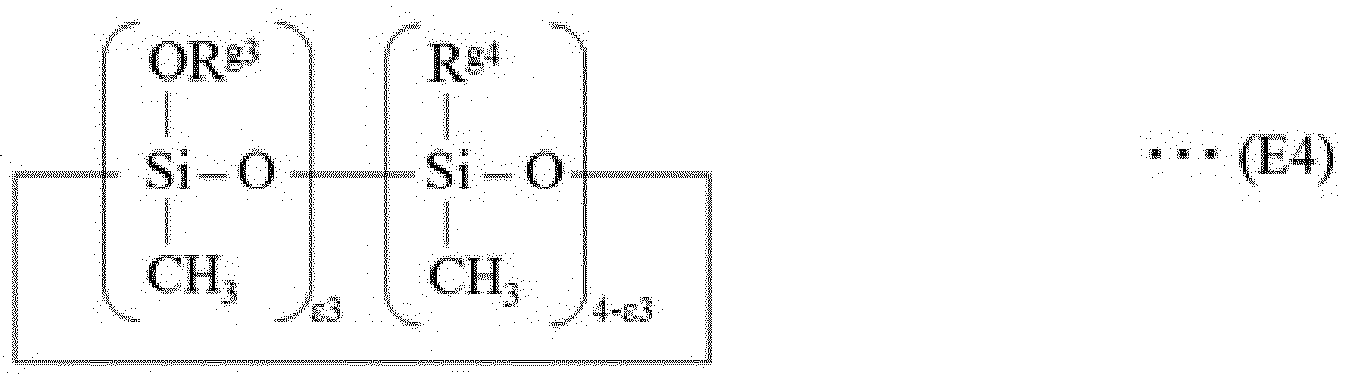
 worinjedes Rg1 bei jedem Auftreten unabhängig eine substituierte oder unsubstituierte monovalente Kohlenwasserstoffgruppe mit 1 bis 8 Kohlenstoffatomen ist;jedes Rg2 bei jedem Auftreten unabhängig eine substituierte oder unsubstituierte divalente Kohlenwasserstoffgruppe mit 1 bis 20 Kohlenstoffatomen darstellt;jedes Rg3 bei jedem Auftreten unabhängig ein Wasserstoffatom oder eine monovalente organische Gruppe darstellt;jedes Rg4 bei jedem Auftreten unabhängig eine monovalente organische Gruppe ist;jedes Rg6- bei jedem Auftreten unabhängig Rg8-Rg7-ist;jedes Rg7 bei jedem Auftreten unabhängig eine Einfachbindung, ein Sauerstoffatom oder eine divalente organische Gruppe darstellt;jedes Rg8 eine reaktive funktionelle Gruppe ist;jedes ε1 bei jedem Auftreten unabhängig eine ganze Zahl von 1 oder mehr und 50 oder weniger ist;jedes ε2 bei jedem Auftreten unabhängig 2 oder 3 ist;jedes ε3 bei jedem Auftreten unabhängig 2 oder 3 ist;ε4 eine ganze Zahl von 2 oder mehr ist;ε5 eine ganze Zahl von 0 oder mehr ist;ε6 ist 1 oder 2; undvorausgesetzt, dass die Summe von ε4, ε5 und ε6 4 ist, oderdie Organosiliciumverbindung ausgewählt ist aus der Gruppe, bestehend aus Tetraethoxysilan, Methyltriethoxysilan, Methyltrimethoxysilan, Dimethyldimethoxysilan, Aminopropyltriethoxysilan, Aminopropyltrimethoxysilan, Tridecafluor-n-octyltriethoxysilan und Tridecafluor-n-octyltrimethoxysilan.
 - Zusammensetzung gemäß Anspruch 1, umfassend 1-300 Massenteile (parts by mass (pbm)) des Lösungsmittels, bezogen auf 100 pbm einer Gesamtmenge der fluorhaltigen Silanverbindung, der Organosiliciumverbindung und des Katalysators.
- Zusammensetzung gemäß Anspruch 1, worin X10 F ist.
- Zusammensetzung gemäß einem der Ansprüche 1 bis 3, worin das Si-Atom, das an mindestens eines, ausgewählt aus OH und einer hydrolysierbaren Gruppe, gebunden ist, an jedem der beiden Enden eines Molekülrückgrats der fluorhaltigen Silanverbindung vorhanden ist.
- Zusammensetzung gemäß einem der Ansprüche 1 bis 4, worin der Katalysator ein metallbasierter Katalysator, ein auf einer organischen Säure basierender Katalysator, ein auf einer anorganischen Säure basierender Katalysator oder ein basischer Katalysator ist.
- Zusammensetzung gemäß einem der Ansprüche 1 bis 5, worin der Katalysator ein metallbasierter Katalysator ist.
- Zusammensetzung gemäß einem der Ansprüche 1 bis 6, worin der Katalysator ein Titanatom, ein Zirkoniumatom oder ein Zinnatom umfasst.
- Zusammensetzung gemäß einem der Ansprüche 1 bis 7, worin der Katalysator mindestens einer ist, ausgewählt aus der Gruppe, bestehend aus Tetrabutyltitanat, Tetrapropyltitanat, Tetrapropylzirkonat, Tetra-n-butylzirkonat, Tetra-n-propylzirkonat, Dibutylzinndimethoxid und Dibutylzinndilaurat.
Applications Claiming Priority (2)
| Application Number | Priority Date | Filing Date | Title |
|---|---|---|---|
| JP2017211198 | 2017-10-31 | ||
| PCT/JP2018/040355 WO2019088110A1 (ja) | 2017-10-31 | 2018-10-30 | 硬化性組成物 |
Publications (3)
| Publication Number | Publication Date |
|---|---|
| EP3705528A1 EP3705528A1 (de) | 2020-09-09 |
| EP3705528A4 EP3705528A4 (de) | 2021-08-25 |
| EP3705528B1 true EP3705528B1 (de) | 2025-01-15 |
Family
ID=66331851
Family Applications (1)
| Application Number | Title | Priority Date | Filing Date |
|---|---|---|---|
| EP18874133.4A Active EP3705528B1 (de) | 2017-10-31 | 2018-10-30 | Härtbare zusammensetzung |
Country Status (6)
| Country | Link |
|---|---|
| US (2) | US11591439B2 (de) |
| EP (1) | EP3705528B1 (de) |
| JP (1) | JP7007599B2 (de) |
| KR (1) | KR102315590B1 (de) |
| CN (1) | CN111278921B (de) |
| WO (1) | WO2019088110A1 (de) |
Families Citing this family (6)
| Publication number | Priority date | Publication date | Assignee | Title |
|---|---|---|---|---|
| WO2019088117A1 (ja) * | 2017-10-31 | 2019-05-09 | ダイキン工業株式会社 | 硬化性組成物 |
| US11560454B2 (en) * | 2017-10-31 | 2023-01-24 | Daikin Industries, Ltd. | Curable composition |
| US12606672B2 (en) | 2019-12-19 | 2026-04-21 | Daikin Industries, Ltd. | Curable composition |
| JP6945087B1 (ja) * | 2019-12-19 | 2021-10-06 | モメンティブ・パフォーマンス・マテリアルズ・ジャパン合同会社 | 硬化性組成物 |
| WO2022006400A1 (en) * | 2020-07-02 | 2022-01-06 | Momentive Performance Materials Inc. | Surface treating composition |
| KR20240035557A (ko) * | 2021-08-26 | 2024-03-15 | 다이킨 고교 가부시키가이샤 | 표면 처리제 |
Family Cites Families (29)
| Publication number | Priority date | Publication date | Assignee | Title |
|---|---|---|---|---|
| JPH0753919A (ja) * | 1993-08-11 | 1995-02-28 | Shin Etsu Chem Co Ltd | 常温硬化性組成物 |
| JP3102284B2 (ja) * | 1994-10-03 | 2000-10-23 | 信越化学工業株式会社 | 接着性シリコーン組成物 |
| JP3121245B2 (ja) | 1995-09-14 | 2000-12-25 | 信越化学工業株式会社 | 含フッ素有機ケイ素化合物及びその製造方法並びにそれを含有する室温硬化性シリコーン組成物 |
| EP0745604A3 (de) | 1995-05-29 | 1998-07-29 | Shin-Etsu Chemical Co., Ltd. | RTV-Fluorpolymerzusammensetzung; fluorhaltige Organosiliziumverbindungen, ein Verfahren zu deren Herstellung und diese enthaltende RTV-Silikonzusammensetzung |
| JP3712031B2 (ja) * | 1998-02-23 | 2005-11-02 | 信越化学工業株式会社 | 硬化性組成物 |
| JP3702944B2 (ja) * | 2000-10-16 | 2005-10-05 | 信越化学工業株式会社 | パーフルオロポリエーテル変性アミノシラン及び表面処理剤並びに該アミノシランの硬化皮膜が形成された物品 |
| US6716534B2 (en) * | 2001-11-08 | 2004-04-06 | 3M Innovative Properties Company | Coating composition comprising a fluorochemical polyether silane partial condensate and use thereof |
| JP2008214566A (ja) | 2007-03-07 | 2008-09-18 | Shin Etsu Chem Co Ltd | 硬化性フルオロポリエーテル組成物の硬化皮膜を有するゴム |
| JP4632069B2 (ja) * | 2008-06-02 | 2011-02-16 | 信越化学工業株式会社 | 硬化性フルオロポリエーテル系コーティング剤組成物 |
| JP4666667B2 (ja) | 2008-08-21 | 2011-04-06 | 信越化学工業株式会社 | 含フッ素表面処理剤及び該表面処理剤で処理された物品 |
| JP5165644B2 (ja) * | 2009-07-02 | 2013-03-21 | 信越化学工業株式会社 | オルガノポリシロキサン組成物及びその製造方法 |
| JP5235026B2 (ja) * | 2010-09-28 | 2013-07-10 | 信越化学工業株式会社 | フルオロオキシアルキレン基含有ポリマー組成物および該組成物を含む表面処理剤並びに該表面処理剤で表面処理された物品 |
| EP2638107A1 (de) | 2010-11-10 | 2013-09-18 | 3M Innovative Properties Company | Hydrophobe fluorierte beschichtungen |
| JP5788852B2 (ja) * | 2011-11-01 | 2015-10-07 | 信越化学工業株式会社 | フルオロオキシアルキレン基含有ポリマー組成物、該組成物を含む表面処理剤、該表面処理剤で処理された物品及び光学物品 |
| WO2013168514A1 (ja) * | 2012-05-10 | 2013-11-14 | ダイキン工業株式会社 | フルオロポリエーテル基含有シリコーン化合物 |
| JP2014070164A (ja) * | 2012-09-28 | 2014-04-21 | Fujifilm Corp | 表面改質剤、処理基材、化合物の製造方法、及び化合物 |
| CN104769009B (zh) * | 2012-11-05 | 2017-08-11 | 大金工业株式会社 | 含全氟(聚)醚基硅烷化合物 |
| JP2015168785A (ja) * | 2014-03-07 | 2015-09-28 | ダイキン工業株式会社 | パーフルオロ(ポリ)エーテル基含有シラン化合物を含む組成物 |
| JP5835512B2 (ja) * | 2014-04-30 | 2015-12-24 | ダイキン工業株式会社 | パーフルオロ(ポリ)エーテル基含有シラン化合物 |
| JP2016017176A (ja) * | 2014-07-11 | 2016-02-01 | ダイキン工業株式会社 | 表面処理剤 |
| CN107001619B (zh) * | 2014-11-28 | 2019-07-19 | 大金工业株式会社 | 含氟氧亚甲基的全氟聚醚改性体 |
| EP3085749B1 (de) | 2015-04-20 | 2017-06-28 | Shin-Etsu Chemical Co., Ltd. | Fluorpolyetherhaltiges polymermodifiziertes silan, oberflächenbehandlungsmittel und behandelter artikel |
| JP6107891B2 (ja) * | 2015-06-25 | 2017-04-05 | ダイキン工業株式会社 | パーフルオロ(ポリ)エーテル基含有シラン化合物を含む表面処理剤 |
| JP6724994B2 (ja) * | 2016-09-08 | 2020-07-15 | ダイキン工業株式会社 | パーフルオロ(ポリ)エーテル基含有シラン化合物を含む組成物 |
| CN121873524A (zh) * | 2017-02-14 | 2026-04-17 | Agc株式会社 | 含氟醚组合物、涂布液和物品 |
| KR102526826B1 (ko) * | 2017-03-15 | 2023-04-27 | 에이지씨 가부시키가이샤 | 함불소 에테르 조성물, 코팅액 및 물품 |
| US11560454B2 (en) * | 2017-10-31 | 2023-01-24 | Daikin Industries, Ltd. | Curable composition |
| WO2019088129A1 (ja) * | 2017-10-31 | 2019-05-09 | ダイキン工業株式会社 | 硬化性組成物 |
| WO2019088117A1 (ja) | 2017-10-31 | 2019-05-09 | ダイキン工業株式会社 | 硬化性組成物 |
-
2018
- 2018-10-30 JP JP2019550420A patent/JP7007599B2/ja active Active
- 2018-10-30 KR KR1020207011921A patent/KR102315590B1/ko active Active
- 2018-10-30 EP EP18874133.4A patent/EP3705528B1/de active Active
- 2018-10-30 WO PCT/JP2018/040355 patent/WO2019088110A1/ja not_active Ceased
- 2018-10-30 CN CN201880070366.2A patent/CN111278921B/zh active Active
- 2018-10-30 US US16/759,385 patent/US11591439B2/en active Active
-
2023
- 2023-01-26 US US18/102,051 patent/US12454600B2/en active Active
Also Published As
| Publication number | Publication date |
|---|---|
| JPWO2019088110A1 (ja) | 2020-07-02 |
| KR20200055781A (ko) | 2020-05-21 |
| KR102315590B1 (ko) | 2021-10-21 |
| JP7007599B2 (ja) | 2022-01-24 |
| EP3705528A1 (de) | 2020-09-09 |
| US12454600B2 (en) | 2025-10-28 |
| US11591439B2 (en) | 2023-02-28 |
| US20200325277A1 (en) | 2020-10-15 |
| WO2019088110A1 (ja) | 2019-05-09 |
| CN111278921A (zh) | 2020-06-12 |
| CN111278921B (zh) | 2023-05-23 |
| EP3705528A4 (de) | 2021-08-25 |
| US20230167245A1 (en) | 2023-06-01 |
Similar Documents
| Publication | Publication Date | Title |
|---|---|---|
| EP3705531B1 (de) | Härtbare zusammensetzung | |
| US12454600B2 (en) | Curable composition | |
| EP3705529A1 (de) | Härtbare zusammensetzung | |
| EP3705530A1 (de) | Härtbare zusammensetzung | |
| EP3705527B1 (de) | Verwendung einer härtbaren zusammensetzung zur herstellung eines vergussmaterials oder eines dichtungsmaterials | |
| KR20220117919A (ko) | 경화성 조성물 | |
| TWI763946B (zh) | 積層體 | |
| US12297325B2 (en) | Curable composition |
Legal Events
| Date | Code | Title | Description |
|---|---|---|---|
| STAA | Information on the status of an ep patent application or granted ep patent |
Free format text: STATUS: THE INTERNATIONAL PUBLICATION HAS BEEN MADE |
|
| PUAI | Public reference made under article 153(3) epc to a published international application that has entered the european phase |
Free format text: ORIGINAL CODE: 0009012 |
|
| STAA | Information on the status of an ep patent application or granted ep patent |
Free format text: STATUS: REQUEST FOR EXAMINATION WAS MADE |
|
| 17P | Request for examination filed |
Effective date: 20200416 |
|
| AK | Designated contracting states |
Kind code of ref document: A1 Designated state(s): AL AT BE BG CH CY CZ DE DK EE ES FI FR GB GR HR HU IE IS IT LI LT LU LV MC MK MT NL NO PL PT RO RS SE SI SK SM TR |
|
| AX | Request for extension of the european patent |
Extension state: BA ME |
|
| DAV | Request for validation of the european patent (deleted) | ||
| DAX | Request for extension of the european patent (deleted) | ||
| A4 | Supplementary search report drawn up and despatched |
Effective date: 20210723 |
|
| RIC1 | Information provided on ipc code assigned before grant |
Ipc: C08L 71/00 20060101AFI20210719BHEP Ipc: C08G 77/46 20060101ALI20210719BHEP Ipc: C08G 77/50 20060101ALI20210719BHEP Ipc: C08K 5/057 20060101ALI20210719BHEP Ipc: C08K 5/5415 20060101ALI20210719BHEP Ipc: C08K 5/5419 20060101ALI20210719BHEP Ipc: C08K 5/57 20060101ALI20210719BHEP Ipc: C08G 65/00 20060101ALI20210719BHEP Ipc: C08G 65/336 20060101ALI20210719BHEP |
|
| RAP3 | Party data changed (applicant data changed or rights of an application transferred) |
Owner name: DAIKIN INDUSTRIES, LTD. |
|
| P01 | Opt-out of the competence of the unified patent court (upc) registered |
Effective date: 20230525 |
|
| GRAP | Despatch of communication of intention to grant a patent |
Free format text: ORIGINAL CODE: EPIDOSNIGR1 |
|
| STAA | Information on the status of an ep patent application or granted ep patent |
Free format text: STATUS: GRANT OF PATENT IS INTENDED |
|
| INTG | Intention to grant announced |
Effective date: 20240620 |
|
| GRAJ | Information related to disapproval of communication of intention to grant by the applicant or resumption of examination proceedings by the epo deleted |
Free format text: ORIGINAL CODE: EPIDOSDIGR1 |
|
| STAA | Information on the status of an ep patent application or granted ep patent |
Free format text: STATUS: REQUEST FOR EXAMINATION WAS MADE |
|
| INTC | Intention to grant announced (deleted) | ||
| GRAP | Despatch of communication of intention to grant a patent |
Free format text: ORIGINAL CODE: EPIDOSNIGR1 |
|
| STAA | Information on the status of an ep patent application or granted ep patent |
Free format text: STATUS: GRANT OF PATENT IS INTENDED |
|
| RIC1 | Information provided on ipc code assigned before grant |
Ipc: C09D 4/00 20060101ALN20240925BHEP Ipc: C08G 77/24 20060101ALN20240925BHEP Ipc: C08L 83/08 20060101ALI20240925BHEP Ipc: C08G 65/336 20060101ALI20240925BHEP Ipc: C08G 65/00 20060101ALI20240925BHEP Ipc: C08K 5/57 20060101ALI20240925BHEP Ipc: C08K 5/5419 20060101ALI20240925BHEP Ipc: C08K 5/5415 20060101ALI20240925BHEP Ipc: C08K 5/057 20060101ALI20240925BHEP Ipc: C08G 77/50 20060101ALI20240925BHEP Ipc: C08G 77/46 20060101ALI20240925BHEP Ipc: C08L 71/00 20060101AFI20240925BHEP |
|
| INTG | Intention to grant announced |
Effective date: 20241004 |
|
| GRAS | Grant fee paid |
Free format text: ORIGINAL CODE: EPIDOSNIGR3 |
|
| GRAA | (expected) grant |
Free format text: ORIGINAL CODE: 0009210 |
|
| STAA | Information on the status of an ep patent application or granted ep patent |
Free format text: STATUS: THE PATENT HAS BEEN GRANTED |
|
| AK | Designated contracting states |
Kind code of ref document: B1 Designated state(s): AL AT BE BG CH CY CZ DE DK EE ES FI FR GB GR HR HU IE IS IT LI LT LU LV MC MK MT NL NO PL PT RO RS SE SI SK SM TR |
|
| REG | Reference to a national code |
Ref country code: CH Ref legal event code: EP Ref country code: GB Ref legal event code: FG4D |
|
| REG | Reference to a national code |
Ref country code: DE Ref legal event code: R096 Ref document number: 602018078592 Country of ref document: DE |
|
| REG | Reference to a national code |
Ref country code: IE Ref legal event code: FG4D |
|
| REG | Reference to a national code |
Ref country code: NL Ref legal event code: MP Effective date: 20250115 |
|
| PG25 | Lapsed in a contracting state [announced via postgrant information from national office to epo] |
Ref country code: NL Free format text: LAPSE BECAUSE OF FAILURE TO SUBMIT A TRANSLATION OF THE DESCRIPTION OR TO PAY THE FEE WITHIN THE PRESCRIBED TIME-LIMIT Effective date: 20250115 |
|
| PG25 | Lapsed in a contracting state [announced via postgrant information from national office to epo] |
Ref country code: RS Free format text: LAPSE BECAUSE OF FAILURE TO SUBMIT A TRANSLATION OF THE DESCRIPTION OR TO PAY THE FEE WITHIN THE PRESCRIBED TIME-LIMIT Effective date: 20250415 |
|
| PG25 | Lapsed in a contracting state [announced via postgrant information from national office to epo] |
Ref country code: FI Free format text: LAPSE BECAUSE OF FAILURE TO SUBMIT A TRANSLATION OF THE DESCRIPTION OR TO PAY THE FEE WITHIN THE PRESCRIBED TIME-LIMIT Effective date: 20250115 |
|
| PG25 | Lapsed in a contracting state [announced via postgrant information from national office to epo] |
Ref country code: PL Free format text: LAPSE BECAUSE OF FAILURE TO SUBMIT A TRANSLATION OF THE DESCRIPTION OR TO PAY THE FEE WITHIN THE PRESCRIBED TIME-LIMIT Effective date: 20250115 |
|
| PG25 | Lapsed in a contracting state [announced via postgrant information from national office to epo] |
Ref country code: ES Free format text: LAPSE BECAUSE OF FAILURE TO SUBMIT A TRANSLATION OF THE DESCRIPTION OR TO PAY THE FEE WITHIN THE PRESCRIBED TIME-LIMIT Effective date: 20250115 |
|
| REG | Reference to a national code |
Ref country code: LT Ref legal event code: MG9D |
|
| PG25 | Lapsed in a contracting state [announced via postgrant information from national office to epo] |
Ref country code: NO Free format text: LAPSE BECAUSE OF FAILURE TO SUBMIT A TRANSLATION OF THE DESCRIPTION OR TO PAY THE FEE WITHIN THE PRESCRIBED TIME-LIMIT Effective date: 20250415 Ref country code: IS Free format text: LAPSE BECAUSE OF FAILURE TO SUBMIT A TRANSLATION OF THE DESCRIPTION OR TO PAY THE FEE WITHIN THE PRESCRIBED TIME-LIMIT Effective date: 20250515 |
|
| REG | Reference to a national code |
Ref country code: AT Ref legal event code: MK05 Ref document number: 1759870 Country of ref document: AT Kind code of ref document: T Effective date: 20250115 |
|
| PG25 | Lapsed in a contracting state [announced via postgrant information from national office to epo] |
Ref country code: HR Free format text: LAPSE BECAUSE OF FAILURE TO SUBMIT A TRANSLATION OF THE DESCRIPTION OR TO PAY THE FEE WITHIN THE PRESCRIBED TIME-LIMIT Effective date: 20250115 |
|
| PG25 | Lapsed in a contracting state [announced via postgrant information from national office to epo] |
Ref country code: PT Free format text: LAPSE BECAUSE OF FAILURE TO SUBMIT A TRANSLATION OF THE DESCRIPTION OR TO PAY THE FEE WITHIN THE PRESCRIBED TIME-LIMIT Effective date: 20250515 Ref country code: LV Free format text: LAPSE BECAUSE OF FAILURE TO SUBMIT A TRANSLATION OF THE DESCRIPTION OR TO PAY THE FEE WITHIN THE PRESCRIBED TIME-LIMIT Effective date: 20250115 |
|
| PG25 | Lapsed in a contracting state [announced via postgrant information from national office to epo] |
Ref country code: BG Free format text: LAPSE BECAUSE OF FAILURE TO SUBMIT A TRANSLATION OF THE DESCRIPTION OR TO PAY THE FEE WITHIN THE PRESCRIBED TIME-LIMIT Effective date: 20250115 Ref country code: GR Free format text: LAPSE BECAUSE OF FAILURE TO SUBMIT A TRANSLATION OF THE DESCRIPTION OR TO PAY THE FEE WITHIN THE PRESCRIBED TIME-LIMIT Effective date: 20250416 |
|
| PG25 | Lapsed in a contracting state [announced via postgrant information from national office to epo] |
Ref country code: AT Free format text: LAPSE BECAUSE OF FAILURE TO SUBMIT A TRANSLATION OF THE DESCRIPTION OR TO PAY THE FEE WITHIN THE PRESCRIBED TIME-LIMIT Effective date: 20250115 |
|
| PG25 | Lapsed in a contracting state [announced via postgrant information from national office to epo] |
Ref country code: SE Free format text: LAPSE BECAUSE OF FAILURE TO SUBMIT A TRANSLATION OF THE DESCRIPTION OR TO PAY THE FEE WITHIN THE PRESCRIBED TIME-LIMIT Effective date: 20250115 |
|
| PG25 | Lapsed in a contracting state [announced via postgrant information from national office to epo] |
Ref country code: SM Free format text: LAPSE BECAUSE OF FAILURE TO SUBMIT A TRANSLATION OF THE DESCRIPTION OR TO PAY THE FEE WITHIN THE PRESCRIBED TIME-LIMIT Effective date: 20250115 |
|
| PG25 | Lapsed in a contracting state [announced via postgrant information from national office to epo] |
Ref country code: DK Free format text: LAPSE BECAUSE OF FAILURE TO SUBMIT A TRANSLATION OF THE DESCRIPTION OR TO PAY THE FEE WITHIN THE PRESCRIBED TIME-LIMIT Effective date: 20250115 |
|
| REG | Reference to a national code |
Ref country code: DE Ref legal event code: R097 Ref document number: 602018078592 Country of ref document: DE |
|
| PG25 | Lapsed in a contracting state [announced via postgrant information from national office to epo] |
Ref country code: CZ Free format text: LAPSE BECAUSE OF FAILURE TO SUBMIT A TRANSLATION OF THE DESCRIPTION OR TO PAY THE FEE WITHIN THE PRESCRIBED TIME-LIMIT Effective date: 20250115 Ref country code: EE Free format text: LAPSE BECAUSE OF FAILURE TO SUBMIT A TRANSLATION OF THE DESCRIPTION OR TO PAY THE FEE WITHIN THE PRESCRIBED TIME-LIMIT Effective date: 20250115 |
|
| PG25 | Lapsed in a contracting state [announced via postgrant information from national office to epo] |
Ref country code: RO Free format text: LAPSE BECAUSE OF FAILURE TO SUBMIT A TRANSLATION OF THE DESCRIPTION OR TO PAY THE FEE WITHIN THE PRESCRIBED TIME-LIMIT Effective date: 20250115 |
|
| PG25 | Lapsed in a contracting state [announced via postgrant information from national office to epo] |
Ref country code: SK Free format text: LAPSE BECAUSE OF FAILURE TO SUBMIT A TRANSLATION OF THE DESCRIPTION OR TO PAY THE FEE WITHIN THE PRESCRIBED TIME-LIMIT Effective date: 20250115 |
|
| PLBE | No opposition filed within time limit |
Free format text: ORIGINAL CODE: 0009261 |
|
| STAA | Information on the status of an ep patent application or granted ep patent |
Free format text: STATUS: NO OPPOSITION FILED WITHIN TIME LIMIT |
|
| 26N | No opposition filed |
Effective date: 20251016 |
|
| PGFP | Annual fee paid to national office [announced via postgrant information from national office to epo] |
Ref country code: DE Payment date: 20251021 Year of fee payment: 8 |
|
| PGFP | Annual fee paid to national office [announced via postgrant information from national office to epo] |
Ref country code: IT Payment date: 20251024 Year of fee payment: 8 |
|
| PGFP | Annual fee paid to national office [announced via postgrant information from national office to epo] |
Ref country code: FR Payment date: 20251030 Year of fee payment: 8 |