EP3705263B1 - Kautschukzusammensetzung zum formen eines dreidimensionalen laminats - Google Patents
Kautschukzusammensetzung zum formen eines dreidimensionalen laminats Download PDFInfo
- Publication number
- EP3705263B1 EP3705263B1 EP18846377.2A EP18846377A EP3705263B1 EP 3705263 B1 EP3705263 B1 EP 3705263B1 EP 18846377 A EP18846377 A EP 18846377A EP 3705263 B1 EP3705263 B1 EP 3705263B1
- Authority
- EP
- European Patent Office
- Prior art keywords
- rubber
- meth
- additive manufacturing
- rubber composition
- shaped article
- Prior art date
- Legal status (The legal status is an assumption and is not a legal conclusion. Google has not performed a legal analysis and makes no representation as to the accuracy of the status listed.)
- Active
Links
Images

Classifications
-
- B—PERFORMING OPERATIONS; TRANSPORTING
- B33—ADDITIVE MANUFACTURING TECHNOLOGY
- B33Y—ADDITIVE MANUFACTURING, i.e. MANUFACTURING OF THREE-DIMENSIONAL [3D] OBJECTS BY ADDITIVE DEPOSITION, ADDITIVE AGGLOMERATION OR ADDITIVE LAYERING, e.g. BY 3D PRINTING, STEREOLITHOGRAPHY OR SELECTIVE LASER SINTERING
- B33Y40/00—Auxiliary operations or equipment, e.g. for material handling
- B33Y40/20—Post-treatment, e.g. curing, coating or polishing
-
- B—PERFORMING OPERATIONS; TRANSPORTING
- B33—ADDITIVE MANUFACTURING TECHNOLOGY
- B33Y—ADDITIVE MANUFACTURING, i.e. MANUFACTURING OF THREE-DIMENSIONAL [3D] OBJECTS BY ADDITIVE DEPOSITION, ADDITIVE AGGLOMERATION OR ADDITIVE LAYERING, e.g. BY 3D PRINTING, STEREOLITHOGRAPHY OR SELECTIVE LASER SINTERING
- B33Y70/00—Materials specially adapted for additive manufacturing
- B33Y70/10—Composites of different types of material, e.g. mixtures of ceramics and polymers or mixtures of metals and biomaterials
-
- B—PERFORMING OPERATIONS; TRANSPORTING
- B33—ADDITIVE MANUFACTURING TECHNOLOGY
- B33Y—ADDITIVE MANUFACTURING, i.e. MANUFACTURING OF THREE-DIMENSIONAL [3D] OBJECTS BY ADDITIVE DEPOSITION, ADDITIVE AGGLOMERATION OR ADDITIVE LAYERING, e.g. BY 3D PRINTING, STEREOLITHOGRAPHY OR SELECTIVE LASER SINTERING
- B33Y80/00—Products made by additive manufacturing
-
- C—CHEMISTRY; METALLURGY
- C08—ORGANIC MACROMOLECULAR COMPOUNDS; THEIR PREPARATION OR CHEMICAL WORKING-UP; COMPOSITIONS BASED THEREON
- C08F—MACROMOLECULAR COMPOUNDS OBTAINED BY REACTIONS ONLY INVOLVING CARBON-TO-CARBON UNSATURATED BONDS
- C08F2/00—Processes of polymerisation
- C08F2/44—Polymerisation in the presence of compounding ingredients, e.g. plasticisers, dyestuffs, fillers
-
- C—CHEMISTRY; METALLURGY
- C08—ORGANIC MACROMOLECULAR COMPOUNDS; THEIR PREPARATION OR CHEMICAL WORKING-UP; COMPOSITIONS BASED THEREON
- C08F—MACROMOLECULAR COMPOUNDS OBTAINED BY REACTIONS ONLY INVOLVING CARBON-TO-CARBON UNSATURATED BONDS
- C08F279/00—Macromolecular compounds obtained by polymerising monomers on to polymers of monomers having two or more carbon-to-carbon double bonds as defined in group C08F36/00
- C08F279/02—Macromolecular compounds obtained by polymerising monomers on to polymers of monomers having two or more carbon-to-carbon double bonds as defined in group C08F36/00 on to polymers of conjugated dienes
-
- C—CHEMISTRY; METALLURGY
- C08—ORGANIC MACROMOLECULAR COMPOUNDS; THEIR PREPARATION OR CHEMICAL WORKING-UP; COMPOSITIONS BASED THEREON
- C08L—COMPOSITIONS OF MACROMOLECULAR COMPOUNDS
- C08L21/00—Compositions of unspecified rubbers
-
- C—CHEMISTRY; METALLURGY
- C08—ORGANIC MACROMOLECULAR COMPOUNDS; THEIR PREPARATION OR CHEMICAL WORKING-UP; COMPOSITIONS BASED THEREON
- C08L—COMPOSITIONS OF MACROMOLECULAR COMPOUNDS
- C08L33/00—Compositions of homopolymers or copolymers of compounds having one or more unsaturated aliphatic radicals, each having only one carbon-to-carbon double bond, and only one being terminated by only one carboxyl radical, or of salts, anhydrides, esters, amides, imides or nitriles thereof; Compositions of derivatives of such polymers
- C08L33/04—Homopolymers or copolymers of esters
- C08L33/14—Homopolymers or copolymers of esters of esters containing halogen, nitrogen, sulfur, or oxygen atoms in addition to the carboxy oxygen
-
- C—CHEMISTRY; METALLURGY
- C09—DYES; PAINTS; POLISHES; NATURAL RESINS; ADHESIVES; COMPOSITIONS NOT OTHERWISE PROVIDED FOR; APPLICATIONS OF MATERIALS NOT OTHERWISE PROVIDED FOR
- C09D—COATING COMPOSITIONS, e.g. PAINTS, VARNISHES OR LACQUERS; FILLING PASTES; CHEMICAL PAINT OR INK REMOVERS; INKS; CORRECTING FLUIDS; WOODSTAINS; PASTES OR SOLIDS FOR COLOURING OR PRINTING; USE OF MATERIALS THEREFOR
- C09D11/00—Inks
- C09D11/02—Printing inks
- C09D11/10—Printing inks based on artificial resins
- C09D11/101—Inks specially adapted for printing processes involving curing by wave energy or particle radiation, e.g. with UV-curing following the printing
-
- C—CHEMISTRY; METALLURGY
- C09—DYES; PAINTS; POLISHES; NATURAL RESINS; ADHESIVES; COMPOSITIONS NOT OTHERWISE PROVIDED FOR; APPLICATIONS OF MATERIALS NOT OTHERWISE PROVIDED FOR
- C09D—COATING COMPOSITIONS, e.g. PAINTS, VARNISHES OR LACQUERS; FILLING PASTES; CHEMICAL PAINT OR INK REMOVERS; INKS; CORRECTING FLUIDS; WOODSTAINS; PASTES OR SOLIDS FOR COLOURING OR PRINTING; USE OF MATERIALS THEREFOR
- C09D11/00—Inks
- C09D11/02—Printing inks
- C09D11/10—Printing inks based on artificial resins
- C09D11/106—Printing inks based on artificial resins containing macromolecular compounds obtained by reactions only involving carbon-to-carbon unsaturated bonds
- C09D11/108—Hydrocarbon resins
-
- C—CHEMISTRY; METALLURGY
- C09—DYES; PAINTS; POLISHES; NATURAL RESINS; ADHESIVES; COMPOSITIONS NOT OTHERWISE PROVIDED FOR; APPLICATIONS OF MATERIALS NOT OTHERWISE PROVIDED FOR
- C09D—COATING COMPOSITIONS, e.g. PAINTS, VARNISHES OR LACQUERS; FILLING PASTES; CHEMICAL PAINT OR INK REMOVERS; INKS; CORRECTING FLUIDS; WOODSTAINS; PASTES OR SOLIDS FOR COLOURING OR PRINTING; USE OF MATERIALS THEREFOR
- C09D11/00—Inks
- C09D11/30—Inkjet printing inks
-
- C—CHEMISTRY; METALLURGY
- C09—DYES; PAINTS; POLISHES; NATURAL RESINS; ADHESIVES; COMPOSITIONS NOT OTHERWISE PROVIDED FOR; APPLICATIONS OF MATERIALS NOT OTHERWISE PROVIDED FOR
- C09D—COATING COMPOSITIONS, e.g. PAINTS, VARNISHES OR LACQUERS; FILLING PASTES; CHEMICAL PAINT OR INK REMOVERS; INKS; CORRECTING FLUIDS; WOODSTAINS; PASTES OR SOLIDS FOR COLOURING OR PRINTING; USE OF MATERIALS THEREFOR
- C09D121/00—Coating compositions based on unspecified rubbers
-
- B—PERFORMING OPERATIONS; TRANSPORTING
- B29—WORKING OF PLASTICS; WORKING OF SUBSTANCES IN A PLASTIC STATE IN GENERAL
- B29C—SHAPING OR JOINING OF PLASTICS; SHAPING OF MATERIAL IN A PLASTIC STATE, NOT OTHERWISE PROVIDED FOR; AFTER-TREATMENT OF THE SHAPED PRODUCTS, e.g. REPAIRING
- B29C64/00—Additive manufacturing, i.e. manufacturing of three-dimensional [3D] objects by additive deposition, additive agglomeration or additive layering, e.g. by 3D printing, stereolithography or selective laser sintering
- B29C64/10—Processes of additive manufacturing
- B29C64/106—Processes of additive manufacturing using only liquids or viscous materials, e.g. depositing a continuous bead of viscous material
- B29C64/112—Processes of additive manufacturing using only liquids or viscous materials, e.g. depositing a continuous bead of viscous material using individual droplets, e.g. from jetting heads
-
- B—PERFORMING OPERATIONS; TRANSPORTING
- B33—ADDITIVE MANUFACTURING TECHNOLOGY
- B33Y—ADDITIVE MANUFACTURING, i.e. MANUFACTURING OF THREE-DIMENSIONAL [3D] OBJECTS BY ADDITIVE DEPOSITION, ADDITIVE AGGLOMERATION OR ADDITIVE LAYERING, e.g. BY 3D PRINTING, STEREOLITHOGRAPHY OR SELECTIVE LASER SINTERING
- B33Y10/00—Processes of additive manufacturing
Definitions
- the present invention relates to a rubber composition for additive manufacturing, a rubber shaped article obtained by curing the composition, and a method for producing a rubber shaped article using the composition.
- additive manufacturing apparatuses for producing three-dimensional structures by depositing and curing layers of resin on the basis of the design data of the three-dimensional structures have been put to practical use.
- Many methods are known for such additive manufacturing apparatuses, including an ink-jet method, a method in which a photocurable resin is cured by laser beam irradiation, and a method in which layers of a melted ABS resin or the like are deposited.
- the ink-jet method produces a three-dimensional structure by discharging microdroplets of a photocurable liquid resin composition from a nozzle to draw a pattern with a predetermined shape, irradiating the pattern with UV light to form a cured thin film, and repeatedly depositing such films.
- fused deposition modeling produces a three-dimensional structure by melting a solid ABS resin or the like by heating, dropping the melted resin from a nozzle to draw a pattern with a predetermined shape, cooling the resin to reduce the flowability, and repeating this process to deposit layers of the resin.
- WO 2017/044381 A1 discloses an epoxy dual cure resin for additive manufacturing of three-dimensional objects, including:(i) a photoinitiator; (ii) monomers and/or prepolymers that are polymerizable by exposure to actinic radiation or light; (iii) optionally, a light absorbing pigment or dye; (iv) an epoxy resin; (v) optionally, but in some embodiments preferably, an organic hardener co-polymerizable with the epoxy resin; (vi) optionally but preferably a dual reactive compound having substituted thereon a first reactive group reactive with said monomers and/or prepolymers that are polymerizable by exposure to actinic radiation or light, and a second reactive group reactive with said epoxy resin (e.g., an epoxy acrylate); (vii) optionally a diluent; (viii) optionally a filler; and (ix) optionally, a co-monomer and/or a co-prepolymer.
- US 2016/145452 A1 relates to an ink for use in a three-dimensional printing system comprising: up to 90 wt. % monofunctional curable material; up to 10 wt. % difunctional curable material; and up to 10 wt. % liquid rubber, based on the total weight of the ink, wherein the liquid rubber comprises one or more curable moieties.
- Three-dimensional structures produced using an additive manufacturing apparatus that are made of resins are generally known.
- rubber has low temperature dependence in terms of elastic modulus compared to resins, and has a low compression set; therefore, if three-dimensional structures made of rubber (rubber shaped articles) can be produced, these structures are expected to be used for applications different from those of three-dimensional structures made of resins or metals.
- the inventors of the present invention conducted extensive research to solve the aforementioned problem. As a result, they found that when a rubber composition for additive manufacturing comprising a liquid rubber, an amine-based urethane acrylate oligomer, and a monomer, wherein a total content of the amine-based urethane acrylate oligomer and the monomer is 30 parts by mass or more, per 100 parts by mass of the liquid rubber, is used for an additive manufacturing method, a rubber shaped article is favorably obtained, and the rubber shaped article achieves both high mechanical strength and excellent elongation.
- the present invention was completed as a result of further research based on these findings.
- the present invention can provide a rubber composition for additive manufacturing that allows a rubber shaped article to be favorably produced using an additive manufacturing apparatus, and allows the obtained rubber shaped article to achieve both high mechanical strength and excellent elongation.
- the present invention can also provide a rubber shaped article obtained by curing the rubber composition for additive manufacturing, and a method for producing a rubber shaped article using the composition.
- a rubber composition for additive manufacturing according to the present invention comprises a liquid rubber, an amine-based urethane acrylate oligomer, and a monomer, wherein a total content of the amine-based urethane acrylate oligomer and the monomer is 30 parts by mass or more, per 100 parts by mass of the liquid rubber.
- the amine-based urethane acrylate oligomer and the monomer are used in a predetermined amount based on the amount of the liquid rubber.
- the term "rubber composition for additive manufacturing” refers to a rubber composition that is used for an additive manufacturing apparatus (a so-called 3D printer or the like) for producing a three-dimensional structure by depositing and curing layers of the rubber composition on the basis of the design data of the three-dimensional structure, for example.
- an additive manufacturing apparatus a so-called 3D printer or the like
- Many methods are known for such an additive manufacturing apparatus, including an ink-jet method, a method in which a photocurable resin is cured by laser beam irradiation, and a method in which layers of a melted ABS resin or the like are deposited.
- a desired rubber shaped article is obtained by repeatedly depositing layers of the rubber composition of the present invention, and curing the rubber composition.
- the rubber composition for additive manufacturing of the present invention comprises a liquid rubber.
- the liquid rubber is not particularly limited, and any known liquid rubbers can be used. Specific examples of the liquid rubber include liquid butadiene rubber, liquid styrene-butadiene copolymer rubber, liquid isoprene-butadiene copolymer rubber, liquid isoprene rubber, liquid hydrogenated isoprene rubber, and liquid isoprene-styrene copolymer rubber.
- a liquid rubber having an unsaturated bond such as a (meth)acryloyl group or a vinyl group, that is crosslinked by heat, light, electron beam, or the like
- a liquid rubber having a cyclic ether such as an epoxy compound or an oxetane compound
- a liquid rubber having a (meth)acryloyl group is preferred.
- a single liquid rubber or two or more liquid rubbers may be contained.
- the term "(meth)acryloyl group” refers to "an acryloyl group or a methacryloyl group”. The same applies to similar expressions.
- the content of the liquid rubber in the rubber composition for additive manufacturing of the present invention is not particularly limited, it is preferably 30 mass% or more, and more preferably 40 mass% or more, and the range of the content of the liquid rubber is about 30 to 70 mass%, about 30 to 60 mass%, about 40 to 70 mass%, or about 40 to 60 mass%, for example, from the viewpoint of imparting excellent rubber characteristics to a rubber shaped article obtained by curing the rubber composition, while having an appropriate viscosity for additive manufacturing, and further allowing the obtained rubber shaped article to achieve both high mechanical strength and excellent elongation.
- the number average molecular weight (Mn) of the liquid rubber is not particularly limited, it is preferably 500 or more, more preferably about 5,000 to 60,000, and still more preferably about 5,000 to 40,000, for example, from the same viewpoint as described above.
- the number average molecular weight (Mn) of the liquid rubber is a value measured using gel permeation chromatography relative to polystyrene standards.
- the rubber composition for additive manufacturing of the present invention comprises an amine-based urethane acrylate oligomer.
- the amine-based urethane acrylate oligomer is not particularly limited so long as it is a urethane acrylate oligomer further containing a nitrogen atom in addition to the isocyanate group in the urethane linkage.
- Examples of the amine-based urethane acrylate oligomer include (meth)acrylamide-based urethane oligomers and urethane oligomers having an alkoxyalkyl (meth)acrylamide.
- Examples of (meth)acrylamide-based urethane oligomers include the (meth)acrylamide-based urethane oligomer disclosed in JP 2016-113518 A , for example.
- Examples of urethane oligomers having an alkoxyalkyl (meth)acrylamide include the urethane oligomer having an alkoxyalkyl (meth)acrylamide disclosed in JP 2016-181370 A , for example.
- a (meth)acrylamide-based urethane oligomer is a urethane oligomer having a (meth)acrylamide group on an end or a side chain thereof.
- the (meth)acrylamide-based urethane oligomer can be synthesized using a known urethane-forming reaction technique. Specifically, the (meth)acrylamide-based urethane oligomer can be synthesized by reacting an alcohol compound (a1) having one or more hydroxy groups in one molecule, with a polyisocyanate compound (a2) having two or more isocyanate groups in one molecule and a (meth)acrylamide compound (a3) having a hydroxy group.
- the target (meth)acrylamide-based urethane oligomer can be synthesized by reacting a polyol and an isocyanate compound to synthesize a polyurethane having one or more isocyanate groups in the molecule, and then further reacting the isocyanate groups in the urethane compound with a (meth)acrylamide monomer having a hydroxyl group.
- Examples of the alcohol compound (a1) having one or more hydroxy groups in one molecule include C 2-9 alkylene glycols having one or more hydroxy groups on an end or a side chain of the backbone, C 2-6 polyalkylene glycols, polyester polyols, polycarbonate polyols, polybutadiene polyols, hydrogenated polybutadiene polyols, polyisoprene polyols, and hydrogenated polyisoprene polyols. These polyols may be used alone or as a mixture of two or more.
- polyisocyanate compound (a2) having two or more isocyanate groups in one molecule examples include aliphatic isocyanates, such as trimethylene diisocyanate, tetramethylene diisocyanate, pentamethylene diisocyanate, hexamethylene diisocyanate, 1,2-propylene diisocyanate, 1,2-butylene diisocyanate, 2,3-butylene diisocyanate, 1,3-butylene diisocyanate, 2,4,4-trimethylhexamethylene diisocyanate, and 2,2,4-trimethylhexamethylene diisocyanate; aromatic isocyanates, such as 1,3-phenylene diisocyanate, 1,4-phenylene diisocyanate, 2,4-tolylene diisocyanate, 2,6-tolylene diisocyanate, 4,4'-diphenylmethane diisocyanate, 2,4-diphenylmethane diisocyanate, and xylylene diiso
- Examples of the (meth)acrylamide compound (a3) having a hydroxy group include a compound represented by the following general formula:
- R 1 is a hydrogen atom or a methyl group
- R 2 is a hydrogen atom, a C 1-6 alkyl group, or a hydroxyalkyl group
- R 3 is a C 1-6 alkylene group or a phenylene group.
- the weight average molecular weight of the (meth)acrylamide-based urethane oligomer is not particularly limited, it is preferably about 1,000 to 50,000, and more preferably about 2,000 to 20,000, from the viewpoint of imparting excellent rubber characteristics to a rubber shaped article obtained by curing the rubber composition, while imparting an appropriate viscosity for additive manufacturing to the rubber composition, and further imparting high mechanical strength and excellent elongation to the rubber shaped article.
- a urethane oligomer having an alkoxyalkyl (meth)acrylamide is produced by the addition reaction between a (meth)acrylamide having a hydroxy group and an isocyanate compound, and is characterized by having a (meth)acrylamide group as a photocurable functional group.
- the urethane oligomer having an alkoxyalkyl (meth)acrylamide can be synthesized using a known urethane-forming reaction technique. Specifically, the urethane oligomer having an alkoxyalkyl (meth)acrylamide can be synthesized by reacting a monofunctional or polyfunctional alcohol (b 1) (hereinafter sometimes abbreviated as polyol (b 1)) having, as the backbone, a polymer having one or more repeating units selected from butadiene, hydrogenated butadiene, isoprene, hydrogenated isoprene, carbonates, ethers, esters, and silicones; an isocyanate monomer (b2) having two or more isocyanate groups in one molecule; and a (meth)acrylamide (b3) having a hydroxy group.
- a monofunctional or polyfunctional alcohol (b 1) having, as the backbone, a polymer having one or more repeating units selected from butadiene, hydrogenated butadiene, isopre
- the target urethane oligomer having an alkoxyalkyl (meth)acrylamide can be obtained by initially reacting the polyol (b 1) and the isocyanate monomer (b2) to synthesize an isocyanate compound having one or more isocyanate groups in the molecule, and then reacting the isocyanate compound with the (meth)acrylamide (b3) having a hydroxy group.
- Examples of a polybutadiene-based polyol (b1) include those having a backbone selected from the group consisting of polybutadiene, hydrogenated polybutadiene, polyisoprene, and hydrogenated polyisoprene, and having one or more hydroxy groups on an end or a side chain of the backbone.
- the polybutadiene-based polyol (b1) is preferably a liquid polybutadiene-based polyol (b1) having hydroxy group(s) on both ends, which contains a 1,4-vinyl bond and/or a 1,2-vinyl bond in the molecule, or contains hydrogenated vinyl group(s) thereof in the molecule.
- Examples of a polycarbonate-based polyol (b1) include those obtained by the transesterification reaction of a diol and a carbonate as raw materials, and having a backbone formed of a carbonate group and having one or more hydroxy groups on an end or a side chain of the backbone chain.
- the polycarbonate-based polyol (b1) is preferably a liquid polycarbonate-based polyol (b1) having a carbonate backbone in the molecule, and having hydroxy group(s) on both ends.
- a polyether-based polyol (b1) (that is, a polyether polyol) has a polyether backbone in the molecule, and has one or more hydroxy groups on an end or a side chain of the backbone.
- a silicone-based polyol (b1) (that is, a silicone polyol) has a silicone backbone in the molecule, and has one or more hydroxy groups on an end or a side chain of the backbone.
- Examples of the isocyanate monomer (b2) having two or more isocyanate groups in one molecule include aliphatic isocyanates, such as hexamethylene diisocyanate and trimethylhexamethylene diisocyanate (2,2,4-, 2,4,4-, or a mixture thereof); aromatic isocyanates, such as 1,3- or 1,4-phenylene diisocyanate, 2,4- or 2,6-tolylene diisocyanate, 4,4'- or 2,4-diphenylmethane diisocyanate, and xylylene diisocyanate; alicyclic isocyanates, such as cyclohexylene diisocyanate, isophorone diisocyanate, 4,4'-dicyclohexylmethane diisocyanate, methylcyclohexylene diisocyanate, and 2,5- or 2,6-norbornane diisocyanate; and the adduct type, the isocyanurate type, the bi
- the (meth)acrylamide (b3) having a hydroxy group is a methacrylamide containing a hydroxy group or an acrylamide containing a hydroxy group.
- Such (meth)acrylamides (b3) having a hydroxy group can be used alone or in combinations of two or more. It is particularly preferred to use an acrylamide containing a hydroxy group, which significantly improves the curing properties.
- Examples of the (meth)acrylamide (b3) having a hydroxy group include N-hydroxymethyl(meth)acrylamide, N-hydroxyethyl(meth)acrylamide, N-hydroxypropyl(meth)acrylamide, N-hydroxyisopropyl(meth)acrylamide, N-methylhydroxymethyl(meth)acrylamide, N-methylhydroxyethyl(meth)acrylamide, N-methylhydroxypropyl(meth)acrylamide, N-methylhydroxyisopropyl(meth)acrylamide, N-ethylhydroxymethyl(meth)acrylamide, N-ethylhydroxyethyl(meth)acrylamide, N-ethylhydroxypropyl(meth)acrylamide, N-ethylhydroxyisopropyl(meth)acrylamide, N-propylhydroxymethyl(meth)acrylamide, N-propylhydroxyethyl(meth)acrylamide, N-propylhydroxyethyl(meth)acrylamide, N-propylhydroxyiso
- the weight average molecular weight of the urethane oligomer having an alkoxyalkyl (meth)acrylamide is not particularly limited, it is preferably about 1,000 to 100,000, and more preferably about 1,500 to 60,000, from the viewpoint of imparting excellent rubber characteristics to a rubber shaped article obtained by curing the rubber composition, while imparting an appropriate viscosity for additive manufacturing to the rubber composition, and further imparting high mechanical strength and excellent elongation to the rubber shaped article.
- the average functionality of the urethane oligomer having an alkoxyalkyl (meth)acrylamide is preferably 1.2 to 20, and more preferably 1.5 to 10, from the same viewpoint as described above.
- the amine-based urethane acrylate oligomer preferably has a functionality of about 2 to 6, more preferably about 2 to 4, and still more preferably 2, from the same viewpoint as described above.
- Examples of commercial products of the amine-based urethane acrylate oligomer include trade name "KJSA-7100" manufactured by KJ Chemicals Corporation.
- Examples of the monomer contained in the rubber composition for additive manufacturing of the present invention include, although not particularly limited to, monofunctional monomers and polyfunctional monomers.
- the monomer is preferably a monofunctional monomer, from the viewpoint of imparting excellent rubber characteristics to a rubber shaped article obtained by curing the rubber composition, while imparting an appropriate viscosity for additive manufacturing to the rubber composition, and further imparting high mechanical strength and excellent elongation to the rubber shaped article.
- Examples of preferred monofunctional monomers include monofunctional acrylates.
- the monofunctional monomer examples include phenoxyethyl (meth)acrylate, phenoxy-2-methylethyl (meth)acrylate, phenoxyethoxyethyl (meth)acrylate, 3-phenoxy-2-hydroxypropyl (meth)acrylate, 2-phenylphenoxyethyl (meth)acrylate, 4-phenylphenoxyethyl (meth)acrylate, 3-(2-phenylphenyl)-2-hydroxypropyl (meth)acrylate, (meth)acrylate of p-cumylphenol reacted with ethylene oxide, 2-bromophenoxyethyl (meth)acrylate, 2,4-dibromophenoxyethyl (meth)acrylate, 2,4,6-tribromophenoxyethyl (meth)acrylate, phenoxy (meth)acrylate modified with a plurality of moles of ethylene oxide or propylene oxide, isobornyl (meth)acrylate, bornyl (
- isobornyl (meth)acrylate and bornyl (meth)acrylate are particularly preferred, from the viewpoint of imparting excellent rubber characteristics to a rubber shaped article obtained by curing the rubber composition, while imparting an appropriate viscosity for additive manufacturing to the rubber composition, and further imparting high mechanical strength and excellent elongation to the rubber shaped article.
- These monofunctional monomers may be used alone or as a mixture of two or more.
- polyfunctional monomer examples include trimethylolpropane tri(meth)acrylate, pentaerythritol tri(meth)acrylate, pentaerythritol tetra(meth)acrylate, ethylene glycol di(meth)acrylate, tetraethylene glycol di(meth)acrylate, polyethylene glycol di(meth)acrylate, polypropylene glycol di(meth)acrylate, 1,4-butanediol di(meth)acrylate, 1,6-hexanediol di(meth)acrylate, neopentyl glycol di(meth)acrylate, trimethylolpropanetrioxyethyl (meth)acrylate, tris(2-hydroxyethyl)isocyanurate tri(meth)acrylate, tris(acryloyloxy)isocyanurate, bis(hydroxymethyl)tricyclodecane di(meth)acrylate, dipentaerythritol
- the amine-based urethane acrylate oligomer and the monomer function as co-crosslinking agents.
- the rubber composition for additive manufacturing of the present invention may or may not further contain another co-crosslinking agent, in addition to the amine-based urethane acrylate oligomer and the monomer.
- the other co-crosslinking agent include zinc acrylate, magnesium acrylate, zinc methacrylate, magnesium methacrylate, and styrene.
- the rubber composition for additive manufacturing of the present invention may contain one, or two or more of these other co-crosslinking agents.
- the total content of the amine-based urethane acrylate oligomer and the monomer is 30 parts by mass or more, per 100 parts by mass of the liquid rubber; however, it is preferably about 30 to 150 parts by mass, more preferably about 35 to 120 parts by mass, and still more preferably about 40 to 100 parts by mass, from the viewpoint of imparting excellent rubber characteristics to a rubber shaped article obtained by curing the rubber composition, while imparting an appropriate viscosity for additive manufacturing to the rubber composition, and further imparting high mechanical strength and excellent elongation to the rubber shaped article.
- the mass ratio of the amine-based urethane acrylate oligomer to the monomer is not particularly limited, it is preferably about 1:9 to 9: 1, more preferably about 2:8 to 8:2, and still more preferably about 3:7 to 7:3, from the same viewpoint as described above.
- the rubber composition for additive manufacturing of the present invention preferably comprises a radical initiator.
- a radical initiator allows curing of the above-described liquid rubber to be promoted.
- the radical initiator is not particularly limited, and any known radical initiators that generate radicals upon heating, light irradiation, electron beam irradiation, or the like can be used.
- radical initiators examples include acetophenone, 4,4'-dimethoxybenzyl, dibenzoyl, 2-hydroxy-2-phenylacetophenone, benzophenone, benzophenone-2-carboxylic acid, benzophenone-4-carboxylic acid, benzophenone-2-carboxylic acid methyl ester, N,N,N',N'-tetraethyl-4,4'-diaminobenzophenone, 2-methoxy-2-phenylacetophenone, 2-isopropoxy-2-phenylacetophenone, 2-isobutoxy-2-phenylacetophenone, 2-ethoxy-2-phenylacetophenone, 2,2'-bis(2-chlorophenyl)-4,4',5,5'-tetraphenyl-1,2'-biimidazole, 2-(1,3-benzodioxol-5-yl)-4,6-bis(trichloromethyl)-1,3,5-triazine, 2-
- the content of the radical initiator is preferably about 0.5 to 10 parts by mass, and more preferably about 1 to 7 parts by mass, per 100 parts by mass of the liquid rubber.
- the rubber composition for additive manufacturing of the present invention may further comprise a filler.
- a filler allows the viscosity of the rubber composition for additive manufacturing or the rubber characteristics of a rubber shaped article obtained by curing the rubber composition to be adjusted.
- the rubber composition for additive manufacturing of the present invention comprises a filler, it can impart higher mechanical strength and excellent elongation to the rubber shaped article.
- the rubber composition for additive manufacturing of the present invention comprises a filler, it can achieve the following effect: the mechanical strength is further improved, and additionally, the decrease in elongation due to the inclusion of a filler is small, or the elongation is improved or reduced only slightly by the addition of a filler.
- the filler examples include, although not particularly limited to, carbon black, silica, calcium carbonate, clay, and talc.
- silica surface-unmodified silica may be used.
- surface-modified silica whose surface is modified with a silane coupling agent or the like, or a mixture of silica and a silane coupling agent is used as the filler, the mechanical strength of a rubber shaped article obtained by curing the rubber composition can be further improved.
- These fillers may be used alone or in combinations of two or more.
- the rubber composition for additive manufacturing of the present invention comprises a filler
- it may further comprise a silane coupling agent.
- a silane coupling agent allows the liquid rubber and the filler to be strongly bonded, thus allowing a rubber shaped article obtained by curing the rubber composition to be imparted with excellent rubber characteristics.
- the content of the filler is not particularly limited, it is preferably 5 mass% or more, more preferably about 5 to 70 mass%, and still more preferably about 10 to 50 mass%, from the viewpoint of imparting excellent rubber characteristics to a rubber shaped article obtained by curing the rubber composition, while having an appropriate viscosity for additive manufacturing.
- the rubber composition for additive manufacturing of the present invention may further comprise a vulcanized rubber, from the viewpoint of imparting excellent rubber characteristics to a rubber shaped article obtained by curing the rubber composition, while having an appropriate viscosity for additive manufacturing.
- the vulcanized rubber is not particularly limited, and any known vulcanized rubbers obtained by vulcanizing natural rubbers or synthetic rubbers may be used.
- Examples of the rubber component constituting the vulcanized rubber include natural rubbers, isoprene rubber, butadiene rubber, styrene-butadiene rubber, butyl rubber, ethylene propylene diene rubber, ethylene propylene rubber, chloroprene rubber, acrylonitrile-butadiene rubber, chlorosulfonated polyethylene, epichlorohydrin rubber, chlorinated polyethylene, silicone rubber, fluororubber, and urethane rubber.
- a vulcanized rubber obtained by vulcanizing a natural rubber is preferred, from the viewpoint of imparting excellent rubber characteristics to a rubber shaped article obtained by curing the rubber composition, while having an appropriate viscosity for additive manufacturing.
- a single vulcanized rubber or two or more vulcanized rubbers may be contained.
- the vulcanized rubber is preferably in the form of particles, from the viewpoint of imparting excellent rubber characteristics to a rubber shaped article obtained by curing the rubber composition, while having an appropriate viscosity for additive manufacturing. While the particle diameter of the vulcanized rubber is not particularly limited, the median particle diameter is preferably about 200 ⁇ m or less, more preferably about 100 ⁇ m or less, and still more preferably about 50 ⁇ m or less, from the same viewpoint as described above.
- the median particle diameter of the vulcanized rubber refers to the median diameter (cumulative 50% of the particle diameter) measured with a laser diffraction/scattering-type particle size measurement apparatus.
- the content of the vulcanized rubber in the rubber composition for additive manufacturing of the present invention is not particularly limited, it is preferably 10 mass% or more, more preferably about 20 to 80 mass%, and still more preferably about 30 to 50 mass%, from the viewpoint of imparting excellent rubber characteristics to a rubber shaped article obtained by curing the rubber composition, while having an appropriate viscosity for additive manufacturing.
- the rubber composition for additive manufacturing of the present invention may further comprise various additives, so long as the effects of the present invention are not impaired.
- the additives include, although not particularly limited to, polymers, dyes, pigments, leveling gents, rheology modifiers, defoaming agents, plasticizers, polymerization inhibitors, flame retardants, dispersion stabilizers, storage stabilizers, antioxidants, metals, metal oxides, metal salts, and ceramics.
- the rubber composition may contain a single additive or two or more additives.
- the viscosity of the rubber composition for additive manufacturing of the present invention is not particularly limited, so long as the viscosity allows drawing and layer deposition to be performed by an additive manufacturing apparatus
- the viscosity of the rubber composition as measured using an E-type viscometer in an environment at a temperature of 35°C (error within ⁇ 2°C) and a relative humidity of 50% is preferably 1000 Pa ⁇ s or less, more preferably about 0.1 to 1000 Pa.s, and still more preferably about 1 to 700 Pa ⁇ s, from the viewpoint of having an appropriate viscosity for additive manufacturing, and imparting excellent rubber characteristics to a rubber shaped article obtained by curing the composition. More specifically, this viscosity represents a viscosity as measured using an E-type viscometer (MCR301 manufactured by Anton-Paar) at an amplitude of 1% and a frequency of 1 Hz.
- MCR301 manufactured by Anton-Paar
- the rubber composition for additive manufacturing of the present invention is readily produced by mixing the amine-based urethane acrylate oligomer and the monomer such that the total content of the amine-based urethane acrylate oligomer and the monomer is 30 parts by mass or more, per 100 parts by mass of the liquid rubber, and further optionally mixing the radical initiator, the filler, the vulcanized rubber, the various additives, and the like.
- the rubber shaped article of the present invention is a cured product of the above-described rubber composition for additive manufacturing.
- the rubber shaped article of the present invention is a product obtained by curing the rubber composition for additive manufacturing by heating, light irradiation, electron beam irradiation, or the like.
- the Shore A hardness of the rubber shaped article of the present invention may be appropriately adjusted according to the hardness required in the product, it is preferably in the range of 35 to 90, from the viewpoint of imparting excellent rubber characteristics.
- the Shore C hardness of the rubber shaped article of the present invention may be appropriately adjusted according to the hardness required in the product, it is preferably in the range of 45 to 90, from the viewpoint of imparting excellent rubber characteristics.
- the Shore A hardness and the Shore C hardness of the rubber shaped article represent values measured in accordance with the methods defined in JIS K6253 and JIS K7312, respectively.
- the elongation at break of the rubber shaped article of the present invention may be appropriately adjusted according to the elongation at break required in the product, and is generally about 100 to 1000% or 100 to 500%, for example; however, from the viewpoint of imparting excellent rubber characteristics, it is preferably 90% or more, and more preferably about 90 to 280%.
- the upper limit of the elongation at break is typically about 500%.
- the elongation of the rubber shaped article represents a value measured in accordance with the method defined in JIS K6251.
- the tensile strength at break of the rubber shaped article of the present invention may be appropriately adjusted according to the tensile strength at break required in the product, and is generally about 3 to 45 MPa or about 3 to 20 MPa, for example; however, from the viewpoint of imparting excellent rubber characteristics, it is preferably 2.0 MPa or more, and more preferably about 2.0 to 8.0 MPa.
- the upper limit of the tensile strength at break is typically about 20 MPa.
- the tensile strength at break of the rubber shaped article represents a value measured in accordance with the method defined in JIS K6251.
- the energy at break which is the product of the value of tensile strength at break (MPa) and the value of elongation at break (%), is preferably 400 or more, more preferably about 400 to 2500, still more preferably about 700 to 2200, and particularly preferably about 1600 to 2200.
- the compression set (after 24 hours) of the rubber shaped article of the present invention may be appropriately adjusted according to the compression set required in the product, it is preferably 25% or less, and more preferably 20% or less, from the viewpoint of imparting rubber characteristics.
- the compression set (after 0.5 hour) of the rubber shaped article of the present invention may be appropriately adjusted according to the compression set required in the product, it is preferably 50% or less, and more preferably 45% or less, from the viewpoint of imparting rubber characteristics.
- the compression set of the rubber shaped article represents a value measured in accordance with the method defined in JIS K6262.
- the density of the rubber shaped article of the present invention may be appropriately adjusted according to the density required in the product, it is preferably about 0.8 to 2.2 g/cm 3 , from the viewpoint of imparting excellent rubber characteristics.
- the shape of the rubber shaped article of the present invention is not particularly limited, and may be any desired shape produced using an additive manufacturing method.
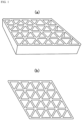
- a three-dimensional shape may be obtained by forming a layer whose plan shape is a grid shape as shown in FIG. 1 , and depositing these layers.
- layers with the same shape may be deposited to produce a rubber shaped article; alternatively, layers with different plan shapes may be deposited to produce a rubber shaped article.
- FIG. 2 a rubber shaped article that is grid-shaped as viewed from the side may also be produced.
- the rubber composition is viscous, and, for example, each time one layer is formed, the layer is cured by light such as UV light or an electron beam; therefore, even if layers of the rubber composition are deposited in a direction inclined with respect to the vertical direction, rather than the vertical direction, the layers of the rubber composition can be deposited without collapsing.
- the shape of the rubber shaped article is not particularly limited, and instead of being a grid shape, it may be a hollow or solid three-dimensional shape having any of various shapes.
- the method for producing the rubber shaped article of the present invention is not particularly limited, and the rubber shaped article may be produced in accordance with a known additive manufacturing method, using the above-described rubber composition for additive manufacturing as a raw material.
- the details of the method for producing the rubber shaped article of the present invention are as described in the
- the method for producing the rubber shaped article of the present invention may employ a conventionally known additive manufacturing method that uses a liquid resin as a raw material, by using the above-described rubber composition for additive manufacturing.
- a conventionally known additive manufacturing method that uses a liquid resin as a raw material, by using the above-described rubber composition for additive manufacturing.
- the rubber composition for additive manufacturing of the present invention instead of a liquid resin, the rubber shaped article can be produced using any of various additive manufacturing methods, such as an ink-jet method, a method in which a raw material is cured by laser beam irradiation, and a method in which layers of a melted raw material are deposited.
- the rubber shaped article of the present invention can be favorably produced using, for example, a method comprising a layer deposition step of depositing layers of the above-described rubber composition for additive manufacturing; and a curing step of curing the deposited layers of the rubber composition for additive manufacturing.
- microdroplets of the above-described rubber composition for additive manufacturing are discharged from a nozzle to draw a pattern with a predetermined shape to form a thin film of the rubber composition, and then the thin film is cured by heating, light irradiation, or electron beam irradiation.
- a thin film of the rubber composition is similarly formed on the cured thin film, and then the thin film is cured. This process is repeated to deposit cured thin films of the rubber composition.
- a rubber shaped article three-dimensional structure
- the viscosity of the rubber composition for additive manufacturing is reduced by heating, and the rubber composition is dropped from a nozzle, so as to be discharged to draw a pattern with a predetermined shape to form a thin film of the rubber composition, and then the thin film is cured by heating, light irradiation, or electron beam irradiation.
- a thin film of the rubber composition having a reduced viscosity is similarly formed on the cured thin film, and then the thin film is cured. This process is repeated to deposit cured thin films of the rubber composition.
- a rubber shaped article three-dimensional structure
- at least one of the table and the nozzle for depositing layers of the rubber composition may be moved two-dimensionally or three-dimensionally to deposit layers of the rubber composition in a desired shape.
- the heating temperature is preferably about 80 to 170°C, and more preferably about 100 to 160°C, although not particularly limited thereto.
- the heating time is preferably about 1 to 60 minutes, and more preferably about 5 to 30 minutes.
- the rubber composition for additive manufacturing is cured by light irradiation, it is preferably cured by UV irradiation at a wavelength of about 365 nm, a UV intensity of about 1 mW/cm 2 to 10 W/cm 2 , and a cumulative dose of about 1 mJ/cm 2 to 100 J/cm 2 .
- UV light may be emitted each time one layer of the rubber composition is formed, or may be emitted each time a plurality of layers are formed.
- the nozzle may be equipped with a UV irradiation device, and UV light may be emitted while the rubber composition is being discharged from the nozzle. The same also applies to irradiation of light other than UV light.
- the thickness of one thin film is preferably about 0.001 to 1 mm, and more preferably about 0.01 to 0.5 mm.
- the diameter of the nozzle for discharging the rubber composition for additive manufacturing of the present invention which may vary depending on the additive manufacturing method or apparatus, is preferably about 0.001 to 1 mm, and more preferably about 0.01 to 0.5 mm.
- the rubber composition for additive manufacturing of the present invention which has an appropriate viscosity for additive manufacturing, is suitably used as the rubber composition to be discharged from a nozzle having such a diameter.
- Rubber compositions were each prepared by mixing a liquid rubber, a radical initiator, and co-crosslinking agents in the proportions (parts by mass) shown in Table 1 or 2. Each of the rubber compositions was produced by homogeneously mixing the components. The details of each of the components are as set forth below. Table 2 shows Examples 6 and 9, Examples 7 and 10, and Examples 8 and 11 side by side for easy comparison.
- a rubber shaped article having a truss structure as shown in FIG. 2(a) was produced by repeating the formation of one layer of the rubber composition and UV curing. Specifically, each time one layer (the thickness of one layer: 0.4 mm) of the rubber composition was formed by discharging the rubber composition heated to 60°C from a nozzle (nozzle size: inner diameter: 0.25 ⁇ m), the layer was irradiated with UV light to cure the rubber composition.
- the UV light wavelength was 365 nm
- the UV light intensity was 14 mW/cm 2
- the UV light irradiation time was 60 sec/layer.
- the Shore A hardness and the Shore C hardness were measured under the following measurement conditions, in accordance with the method defined in JIS K6253 and the method defined in JIS K7312, respectively. The results are shown in Tables 1 and 2.
- the rubber compositions for additive manufacturing each comprising a liquid rubber, an amine-based urethane acrylate oligomer, and a monomer, wherein the total content of the amine-based urethane acrylate oligomer and the monomer is 30 parts by mass or more, per 100 parts by mass of the liquid rubber, allow a rubber shaped article to be favorably produced using an additive manufacturing apparatus, and allow the obtained rubber shaped article to achieve both high mechanical strength and excellent elongation, and have high energy at break.
Landscapes
- Chemical & Material Sciences (AREA)
- Engineering & Computer Science (AREA)
- Materials Engineering (AREA)
- Organic Chemistry (AREA)
- Wood Science & Technology (AREA)
- Life Sciences & Earth Sciences (AREA)
- Chemical Kinetics & Catalysis (AREA)
- Manufacturing & Machinery (AREA)
- Health & Medical Sciences (AREA)
- Medicinal Chemistry (AREA)
- Polymers & Plastics (AREA)
- Structural Engineering (AREA)
- Composite Materials (AREA)
- Civil Engineering (AREA)
- Ceramic Engineering (AREA)
- Macromonomer-Based Addition Polymer (AREA)
- Graft Or Block Polymers (AREA)
- Laminated Bodies (AREA)
- Compositions Of Macromolecular Compounds (AREA)
Claims (14)
- Kautschukzusammensetzung für additive Fertigung, umfassend:einen flüssigen Kautschuk, ein Amin-basiertes Urethan-Acrylat-Oligomer und ein Monomer,wobei ein Gesamtgehalt des Amin-basierten Urethan-Acrylat-Oligomers und des Monomers 30 Massenteile oder mehr, pro 100 Massenteile des flüssigen Kautschuks, beträgt.
- Kautschukzusammensetzung für additive Fertigung nach Anspruch 1,
wobei das Amin-basierte Urethan-Acrylat-Oligomer eine Funktionalität von 2 bis 6 aufweist. - Kautschukzusammensetzung für additive Fertigung nach Anspruch 1 oder 2,
wobei das Monomer ein monofunktionelles Monomer ist. - Kautschukzusammensetzung für additive Fertigung nach einem der Ansprüche 1 bis 3, zudem umfassend einen Füllstoff.
- Kautschukzusammensetzung für additive Fertigung nach einem der Ansprüche 1 bis 3, wobei ein Gehalt des flüssigen Kautschuks 30 Massen-% oder mehr beträgt.
- Kautschukzusammensetzung für additive Fertigung nach einem der Ansprüche 1 bis 4, wobei eine Viskosität, wie gemessen unter Verwendung eines Viskosimeters vom Typ E bei einer Amplitude von 1% und einer Frequenz von 1 Hz, in einer Umgebung bei einer Temperatur von 35°C und einer relativen Feuchte von 50%, 1000 Pa.s oder weniger beträgt.
- Kautschuk-Formkörper, welcher ein gehärtetes Produkt der Kautschukzusammensetzung für additive Fertigung nach einem der Ansprüche 1 bis 6 ist.
- Kautschuk-Formkörper nach Anspruch 7, wobei Bruchenergie, die ein Produkt eines Bruchzugfestigkeitswerts (MPa) und eines Bruchdehnungswerts (%) ist, 400 oder mehr beträgt.
- Kautschuk-Formkörper nach Anspruch 7 oder 8, wobei die Bruchzugfestigkeit 2,0 MPa oder mehr beträgt.
- Kautschuk-Formkörper nach einem der Ansprüche 7 bis 9, wobei die Bruchdehnung 90% oder mehr beträgt.
- Kautschuk-Formkörper nach einem der Ansprüche 7 bis 10, wobei eine Shore-A-Härte in einem Bereich von 35 bis 90 liegt.
- Kautschuk-Formkörper nach einem der Ansprüche 7 bis 11, wobei ein Druckverformungsrest (24 Stunden) 25% oder weniger beträgt.
- Verfahren zur Herstellung eines Kautschuk-Formkörpers, umfassend:einen Lagenabscheidungsschritt des Abscheidens von Lagen der Kautschukzusammensetzung für additive Fertigung nach einem der Ansprüche 1 bis 6; undeinen Härtungsschritt des Härtens der abgeschiedenen Schichten der Kautschukzusammensetzung für additive Fertigung.
- Verwendung einer Kautschukzusammensetzung für additive Fertigung, wobei die Kautschukzusammensetzung nach Anspruch 1 ist.
Applications Claiming Priority (2)
| Application Number | Priority Date | Filing Date | Title |
|---|---|---|---|
| JP2017156793 | 2017-08-15 | ||
| PCT/JP2018/029529 WO2019035387A1 (ja) | 2017-08-15 | 2018-08-07 | 三次元積層造形用ゴム組成物 |
Publications (3)
| Publication Number | Publication Date |
|---|---|
| EP3705263A1 EP3705263A1 (de) | 2020-09-09 |
| EP3705263A4 EP3705263A4 (de) | 2021-04-28 |
| EP3705263B1 true EP3705263B1 (de) | 2024-12-04 |
Family
ID=65362286
Family Applications (1)
| Application Number | Title | Priority Date | Filing Date |
|---|---|---|---|
| EP18846377.2A Active EP3705263B1 (de) | 2017-08-15 | 2018-08-07 | Kautschukzusammensetzung zum formen eines dreidimensionalen laminats |
Country Status (5)
| Country | Link |
|---|---|
| US (1) | US11407910B2 (de) |
| EP (1) | EP3705263B1 (de) |
| JP (1) | JP7092134B2 (de) |
| CN (1) | CN111212722B (de) |
| WO (1) | WO2019035387A1 (de) |
Families Citing this family (7)
| Publication number | Priority date | Publication date | Assignee | Title |
|---|---|---|---|---|
| US11891462B2 (en) | 2019-02-19 | 2024-02-06 | Nagase Chemtex Corporation | Photocurable resin composition and 3D stereolithography product using same |
| JP7232723B2 (ja) * | 2019-06-17 | 2023-03-03 | 株式会社ブリヂストン | ゴム製品の造形方法 |
| JP7232724B2 (ja) * | 2019-06-17 | 2023-03-03 | 株式会社ブリヂストン | ゴム製品の造形方法 |
| CN114341280B (zh) * | 2019-07-12 | 2023-08-01 | 3D系统公司 | 用于3d印刷的建筑材料 |
| JP2022061282A (ja) * | 2020-10-06 | 2022-04-18 | 住友ゴム工業株式会社 | 光造形用ポリマー組成物 |
| JP7199611B2 (ja) | 2021-02-01 | 2023-01-05 | ナガセケムテックス株式会社 | 光硬化性樹脂組成物および三次元光造形物 |
| JP2023170177A (ja) * | 2022-05-18 | 2023-12-01 | 内山工業株式会社 | ゴム製品の造形方法およびゴム製品の造形装置 |
Family Cites Families (13)
| Publication number | Priority date | Publication date | Assignee | Title |
|---|---|---|---|---|
| JP3951344B2 (ja) * | 1997-03-19 | 2007-08-01 | Jsr株式会社 | 感光性樹脂組成物 |
| US8440779B2 (en) * | 2004-11-04 | 2013-05-14 | 3M Innovative Properties Company | Carbodiimide compound and compositions for rendering substrates oil and water repellent |
| DE102006021471A1 (de) * | 2006-05-09 | 2007-11-15 | Degussa Gmbh | Zusammensetzung mit trübem Erscheinungsbild und verbesserter Barrierewirkung, Verfahren zu ihrer Herstellung sowie ihre Verwendung |
| EP2465875A1 (de) * | 2010-12-17 | 2012-06-20 | Cytec Surface Specialties, S.A. | Verfahren zur Herstellung von strahlungshärtbaren Zusammensetzungen |
| CN102898957A (zh) * | 2011-07-25 | 2013-01-30 | 汉高股份有限公司 | 一种液态光学透明的粘合剂组合物及其用途 |
| JP2015168135A (ja) | 2014-03-06 | 2015-09-28 | 三井化学株式会社 | 三次元物体の製造装置および三次元物体の製造方法 |
| WO2016085863A1 (en) | 2014-11-24 | 2016-06-02 | 3D Systems, Incorporated | Inks comprising liquid rubber for 3d printing |
| JP2016113518A (ja) * | 2014-12-12 | 2016-06-23 | Kjケミカルズ株式会社 | (メタ)アクリルアミド系ウレタンオリゴマーを有する活性エネルギー線硬化性樹脂組成物 |
| JP2016181370A (ja) | 2015-03-24 | 2016-10-13 | Kjケミカルズ株式会社 | アルコキシアルキル(メタ)アクリルアミドを有するウレタンオリゴマー及びそれを含有する光硬化性樹脂組成物 |
| JP2016186327A (ja) | 2015-03-27 | 2016-10-27 | Nok株式会社 | プレート一体ガスケットの成形方法 |
| EP3347399B1 (de) * | 2015-09-09 | 2020-12-09 | Carbon, Inc. | Doppelhärtende epoxidharze zur generativen fertigung |
| CN108350141B (zh) * | 2015-09-16 | 2021-06-25 | 科巨希化学股份有限公司 | (甲基)丙烯酰胺系氨基甲酸酯低聚物及含有该低聚物的活性能量射线固化性树脂组合物 |
| US11021593B2 (en) | 2016-03-07 | 2021-06-01 | Sumitomo Rubber Industries, Ltd. | Rubber composition for additive manufacturing |
-
2018
- 2018-08-07 WO PCT/JP2018/029529 patent/WO2019035387A1/ja not_active Ceased
- 2018-08-07 CN CN201880066903.6A patent/CN111212722B/zh active Active
- 2018-08-07 US US16/639,041 patent/US11407910B2/en active Active
- 2018-08-07 JP JP2019536743A patent/JP7092134B2/ja active Active
- 2018-08-07 EP EP18846377.2A patent/EP3705263B1/de active Active
Also Published As
| Publication number | Publication date |
|---|---|
| WO2019035387A1 (ja) | 2019-02-21 |
| CN111212722A (zh) | 2020-05-29 |
| EP3705263A4 (de) | 2021-04-28 |
| US11407910B2 (en) | 2022-08-09 |
| CN111212722B (zh) | 2022-03-15 |
| US20200181433A1 (en) | 2020-06-11 |
| EP3705263A1 (de) | 2020-09-09 |
| JPWO2019035387A1 (ja) | 2020-07-16 |
| JP7092134B2 (ja) | 2022-06-28 |
Similar Documents
| Publication | Publication Date | Title |
|---|---|---|
| US11407910B2 (en) | Rubber composition for additive manufacturing | |
| JP7410637B2 (ja) | 三次元構造物 | |
| EP3418037B1 (de) | Kautschukzusammensetzung zur dreidimensionalen generativen fertigung | |
| JP5445215B2 (ja) | 活性エネルギー線硬化性樹脂組成物、硬化膜及び積層体 | |
| US12013638B2 (en) | Dual-cure phase-separation type photosensitive resin composition for continuous 3D printing with high precision | |
| JP7547894B2 (ja) | 光造形用ポリマー組成物 | |
| CN117098792A (zh) | 光造形用固化性树脂组合物、固化物和立体造形物 | |
| CN110982246A (zh) | 一种3d打印用材料及其制备方法 | |
| EP3882028B1 (de) | Photohärtbare zusammensetzung zum dreidimensionalen formen, dreidimensionales formprodukt und verfahren zur herstellung eines dreidimensionalen formprodukts | |
| JP2025160504A (ja) | 光硬化性組成物およびこれからなる成形体 | |
| EP3815899B1 (de) | Polymerzusammensetzung für stereolithographie | |
| WO2021200794A1 (ja) | 活性エネルギー線硬化性ポリウレタン樹脂、硬化性樹脂組成物、および、活性エネルギー線硬化性ポリウレタン樹脂の製造方法 | |
| EP4324864A1 (de) | Lichthärtbare zusammensetzung und aus der lichthärtbaren zusammensetzung geformtes produkt | |
| JP2022061282A (ja) | 光造形用ポリマー組成物 | |
| JP7826932B2 (ja) | 光硬化性組成物およびこれからなる成形体 | |
| JP6705165B2 (ja) | ウレタン(メタ)アクリレートオリゴマー | |
| JP2025137465A (ja) | 光硬化性組成物 | |
| WO2025187720A1 (ja) | 光硬化性組成物 | |
| WO2026018490A1 (ja) | 光硬化性組成物 |
Legal Events
| Date | Code | Title | Description |
|---|---|---|---|
| STAA | Information on the status of an ep patent application or granted ep patent |
Free format text: STATUS: THE INTERNATIONAL PUBLICATION HAS BEEN MADE |
|
| PUAI | Public reference made under article 153(3) epc to a published international application that has entered the european phase |
Free format text: ORIGINAL CODE: 0009012 |
|
| STAA | Information on the status of an ep patent application or granted ep patent |
Free format text: STATUS: REQUEST FOR EXAMINATION WAS MADE |
|
| 17P | Request for examination filed |
Effective date: 20200312 |
|
| AK | Designated contracting states |
Kind code of ref document: A1 Designated state(s): AL AT BE BG CH CY CZ DE DK EE ES FI FR GB GR HR HU IE IS IT LI LT LU LV MC MK MT NL NO PL PT RO RS SE SI SK SM TR |
|
| AX | Request for extension of the european patent |
Extension state: BA ME |
|
| DAV | Request for validation of the european patent (deleted) | ||
| DAX | Request for extension of the european patent (deleted) | ||
| REG | Reference to a national code |
Ref country code: DE Ref legal event code: R079 Free format text: PREVIOUS MAIN CLASS: B29C0064112000 Ipc: C09D0011101000 Ref document number: 602018077336 Country of ref document: DE |
|
| A4 | Supplementary search report drawn up and despatched |
Effective date: 20210326 |
|
| RIC1 | Information provided on ipc code assigned before grant |
Ipc: C09D 11/101 20140101AFI20210322BHEP Ipc: B29C 64/112 20170101ALI20210322BHEP Ipc: B33Y 70/00 20200101ALI20210322BHEP Ipc: C08F 2/44 20060101ALI20210322BHEP Ipc: C08F 279/02 20060101ALI20210322BHEP Ipc: C08L 21/00 20060101ALI20210322BHEP Ipc: C08L 33/14 20060101ALI20210322BHEP Ipc: B33Y 10/00 20150101ALI20210322BHEP Ipc: B33Y 40/20 20200101ALI20210322BHEP Ipc: B33Y 80/00 20150101ALI20210322BHEP Ipc: C09D 11/108 20140101ALI20210322BHEP Ipc: C09D 11/30 20140101ALI20210322BHEP |
|
| STAA | Information on the status of an ep patent application or granted ep patent |
Free format text: STATUS: EXAMINATION IS IN PROGRESS |
|
| 17Q | First examination report despatched |
Effective date: 20230213 |
|
| GRAP | Despatch of communication of intention to grant a patent |
Free format text: ORIGINAL CODE: EPIDOSNIGR1 |
|
| STAA | Information on the status of an ep patent application or granted ep patent |
Free format text: STATUS: GRANT OF PATENT IS INTENDED |
|
| RIC1 | Information provided on ipc code assigned before grant |
Ipc: B33Y 70/10 20200101ALI20240821BHEP Ipc: C09D 11/30 20140101ALI20240821BHEP Ipc: C09D 11/108 20140101ALI20240821BHEP Ipc: B33Y 80/00 20150101ALI20240821BHEP Ipc: B33Y 40/20 20200101ALI20240821BHEP Ipc: B33Y 10/00 20150101ALI20240821BHEP Ipc: C08L 33/14 20060101ALI20240821BHEP Ipc: C08L 21/00 20060101ALI20240821BHEP Ipc: C08F 279/02 20060101ALI20240821BHEP Ipc: C08F 2/44 20060101ALI20240821BHEP Ipc: B33Y 70/00 20200101ALI20240821BHEP Ipc: B29C 64/112 20170101ALI20240821BHEP Ipc: C09D 11/101 20140101AFI20240821BHEP |
|
| INTG | Intention to grant announced |
Effective date: 20240902 |
|
| GRAS | Grant fee paid |
Free format text: ORIGINAL CODE: EPIDOSNIGR3 |
|
| GRAA | (expected) grant |
Free format text: ORIGINAL CODE: 0009210 |
|
| STAA | Information on the status of an ep patent application or granted ep patent |
Free format text: STATUS: THE PATENT HAS BEEN GRANTED |
|
| P01 | Opt-out of the competence of the unified patent court (upc) registered |
Free format text: CASE NUMBER: UPC_APP_109482/2023 Effective date: 20230510 |
|
| AK | Designated contracting states |
Kind code of ref document: B1 Designated state(s): AL AT BE BG CH CY CZ DE DK EE ES FI FR GB GR HR HU IE IS IT LI LT LU LV MC MK MT NL NO PL PT RO RS SE SI SK SM TR |
|
| REG | Reference to a national code |
Ref country code: GB Ref legal event code: FG4D |
|
| REG | Reference to a national code |
Ref country code: CH Ref legal event code: EP |
|
| REG | Reference to a national code |
Ref country code: DE Ref legal event code: R096 Ref document number: 602018077336 Country of ref document: DE |
|
| REG | Reference to a national code |
Ref country code: IE Ref legal event code: FG4D |
|
| REG | Reference to a national code |
Ref country code: LT Ref legal event code: MG9D |
|
| REG | Reference to a national code |
Ref country code: NL Ref legal event code: MP Effective date: 20241204 |
|
| PG25 | Lapsed in a contracting state [announced via postgrant information from national office to epo] |
Ref country code: HR Free format text: LAPSE BECAUSE OF FAILURE TO SUBMIT A TRANSLATION OF THE DESCRIPTION OR TO PAY THE FEE WITHIN THE PRESCRIBED TIME-LIMIT Effective date: 20241204 |
|
| PG25 | Lapsed in a contracting state [announced via postgrant information from national office to epo] |
Ref country code: FI Free format text: LAPSE BECAUSE OF FAILURE TO SUBMIT A TRANSLATION OF THE DESCRIPTION OR TO PAY THE FEE WITHIN THE PRESCRIBED TIME-LIMIT Effective date: 20241204 |
|
| PG25 | Lapsed in a contracting state [announced via postgrant information from national office to epo] |
Ref country code: BG Free format text: LAPSE BECAUSE OF FAILURE TO SUBMIT A TRANSLATION OF THE DESCRIPTION OR TO PAY THE FEE WITHIN THE PRESCRIBED TIME-LIMIT Effective date: 20241204 |
|
| PG25 | Lapsed in a contracting state [announced via postgrant information from national office to epo] |
Ref country code: ES Free format text: LAPSE BECAUSE OF FAILURE TO SUBMIT A TRANSLATION OF THE DESCRIPTION OR TO PAY THE FEE WITHIN THE PRESCRIBED TIME-LIMIT Effective date: 20241204 |
|
| PG25 | Lapsed in a contracting state [announced via postgrant information from national office to epo] |
Ref country code: NO Free format text: LAPSE BECAUSE OF FAILURE TO SUBMIT A TRANSLATION OF THE DESCRIPTION OR TO PAY THE FEE WITHIN THE PRESCRIBED TIME-LIMIT Effective date: 20250304 |
|
| PG25 | Lapsed in a contracting state [announced via postgrant information from national office to epo] |
Ref country code: LV Free format text: LAPSE BECAUSE OF FAILURE TO SUBMIT A TRANSLATION OF THE DESCRIPTION OR TO PAY THE FEE WITHIN THE PRESCRIBED TIME-LIMIT Effective date: 20241204 Ref country code: GR Free format text: LAPSE BECAUSE OF FAILURE TO SUBMIT A TRANSLATION OF THE DESCRIPTION OR TO PAY THE FEE WITHIN THE PRESCRIBED TIME-LIMIT Effective date: 20250305 |
|
| PG25 | Lapsed in a contracting state [announced via postgrant information from national office to epo] |
Ref country code: RS Free format text: LAPSE BECAUSE OF FAILURE TO SUBMIT A TRANSLATION OF THE DESCRIPTION OR TO PAY THE FEE WITHIN THE PRESCRIBED TIME-LIMIT Effective date: 20250304 |
|
| PG25 | Lapsed in a contracting state [announced via postgrant information from national office to epo] |
Ref country code: NL Free format text: LAPSE BECAUSE OF FAILURE TO SUBMIT A TRANSLATION OF THE DESCRIPTION OR TO PAY THE FEE WITHIN THE PRESCRIBED TIME-LIMIT Effective date: 20241204 |
|
| REG | Reference to a national code |
Ref country code: AT Ref legal event code: MK05 Ref document number: 1748155 Country of ref document: AT Kind code of ref document: T Effective date: 20241204 |
|
| PG25 | Lapsed in a contracting state [announced via postgrant information from national office to epo] |
Ref country code: SM Free format text: LAPSE BECAUSE OF FAILURE TO SUBMIT A TRANSLATION OF THE DESCRIPTION OR TO PAY THE FEE WITHIN THE PRESCRIBED TIME-LIMIT Effective date: 20241204 |
|
| PG25 | Lapsed in a contracting state [announced via postgrant information from national office to epo] |
Ref country code: PL Free format text: LAPSE BECAUSE OF FAILURE TO SUBMIT A TRANSLATION OF THE DESCRIPTION OR TO PAY THE FEE WITHIN THE PRESCRIBED TIME-LIMIT Effective date: 20241204 |
|
| PG25 | Lapsed in a contracting state [announced via postgrant information from national office to epo] |
Ref country code: IS Free format text: LAPSE BECAUSE OF FAILURE TO SUBMIT A TRANSLATION OF THE DESCRIPTION OR TO PAY THE FEE WITHIN THE PRESCRIBED TIME-LIMIT Effective date: 20250404 |
|
| PG25 | Lapsed in a contracting state [announced via postgrant information from national office to epo] |
Ref country code: PT Free format text: LAPSE BECAUSE OF FAILURE TO SUBMIT A TRANSLATION OF THE DESCRIPTION OR TO PAY THE FEE WITHIN THE PRESCRIBED TIME-LIMIT Effective date: 20250404 |
|
| PG25 | Lapsed in a contracting state [announced via postgrant information from national office to epo] |
Ref country code: EE Free format text: LAPSE BECAUSE OF FAILURE TO SUBMIT A TRANSLATION OF THE DESCRIPTION OR TO PAY THE FEE WITHIN THE PRESCRIBED TIME-LIMIT Effective date: 20241204 |
|
| PG25 | Lapsed in a contracting state [announced via postgrant information from national office to epo] |
Ref country code: AT Free format text: LAPSE BECAUSE OF FAILURE TO SUBMIT A TRANSLATION OF THE DESCRIPTION OR TO PAY THE FEE WITHIN THE PRESCRIBED TIME-LIMIT Effective date: 20241204 Ref country code: RO Free format text: LAPSE BECAUSE OF FAILURE TO SUBMIT A TRANSLATION OF THE DESCRIPTION OR TO PAY THE FEE WITHIN THE PRESCRIBED TIME-LIMIT Effective date: 20241204 |
|
| PG25 | Lapsed in a contracting state [announced via postgrant information from national office to epo] |
Ref country code: SK Free format text: LAPSE BECAUSE OF FAILURE TO SUBMIT A TRANSLATION OF THE DESCRIPTION OR TO PAY THE FEE WITHIN THE PRESCRIBED TIME-LIMIT Effective date: 20241204 |
|
| PG25 | Lapsed in a contracting state [announced via postgrant information from national office to epo] |
Ref country code: CZ Free format text: LAPSE BECAUSE OF FAILURE TO SUBMIT A TRANSLATION OF THE DESCRIPTION OR TO PAY THE FEE WITHIN THE PRESCRIBED TIME-LIMIT Effective date: 20241204 |
|
| PG25 | Lapsed in a contracting state [announced via postgrant information from national office to epo] |
Ref country code: IT Free format text: LAPSE BECAUSE OF FAILURE TO SUBMIT A TRANSLATION OF THE DESCRIPTION OR TO PAY THE FEE WITHIN THE PRESCRIBED TIME-LIMIT Effective date: 20241204 |
|
| REG | Reference to a national code |
Ref country code: DE Ref legal event code: R097 Ref document number: 602018077336 Country of ref document: DE |
|
| PG25 | Lapsed in a contracting state [announced via postgrant information from national office to epo] |
Ref country code: SE Free format text: LAPSE BECAUSE OF FAILURE TO SUBMIT A TRANSLATION OF THE DESCRIPTION OR TO PAY THE FEE WITHIN THE PRESCRIBED TIME-LIMIT Effective date: 20241204 |
|
| PG25 | Lapsed in a contracting state [announced via postgrant information from national office to epo] |
Ref country code: DK Free format text: LAPSE BECAUSE OF FAILURE TO SUBMIT A TRANSLATION OF THE DESCRIPTION OR TO PAY THE FEE WITHIN THE PRESCRIBED TIME-LIMIT Effective date: 20241204 |
|
| PGFP | Annual fee paid to national office [announced via postgrant information from national office to epo] |
Ref country code: DE Payment date: 20250702 Year of fee payment: 8 |
|
| PLBE | No opposition filed within time limit |
Free format text: ORIGINAL CODE: 0009261 |
|
| STAA | Information on the status of an ep patent application or granted ep patent |
Free format text: STATUS: NO OPPOSITION FILED WITHIN TIME LIMIT |
|
| REG | Reference to a national code |
Ref country code: CH Ref legal event code: L10 Free format text: ST27 STATUS EVENT CODE: U-0-0-L10-L00 (AS PROVIDED BY THE NATIONAL OFFICE) Effective date: 20251015 |
|
| PGFP | Annual fee paid to national office [announced via postgrant information from national office to epo] |
Ref country code: FR Payment date: 20250703 Year of fee payment: 8 |
|
| 26N | No opposition filed |
Effective date: 20250905 |
|
| REG | Reference to a national code |
Ref country code: CH Ref legal event code: H13 Free format text: ST27 STATUS EVENT CODE: U-0-0-H10-H13 (AS PROVIDED BY THE NATIONAL OFFICE) Effective date: 20260324 |
|
| PG25 | Lapsed in a contracting state [announced via postgrant information from national office to epo] |
Ref country code: MC Free format text: LAPSE BECAUSE OF FAILURE TO SUBMIT A TRANSLATION OF THE DESCRIPTION OR TO PAY THE FEE WITHIN THE PRESCRIBED TIME-LIMIT Effective date: 20241204 |
|
| PG25 | Lapsed in a contracting state [announced via postgrant information from national office to epo] |
Ref country code: LU Free format text: LAPSE BECAUSE OF NON-PAYMENT OF DUE FEES Effective date: 20250807 |
|
| PG25 | Lapsed in a contracting state [announced via postgrant information from national office to epo] |
Ref country code: CH Free format text: LAPSE BECAUSE OF NON-PAYMENT OF DUE FEES Effective date: 20250831 |
|
| GBPC | Gb: european patent ceased through non-payment of renewal fee |
Effective date: 20250807 |