EP3703893B1 - Fräswerkzeug-halter und fräswerkzeug - Google Patents
Fräswerkzeug-halter und fräswerkzeug Download PDFInfo
- Publication number
- EP3703893B1 EP3703893B1 EP18826016.0A EP18826016A EP3703893B1 EP 3703893 B1 EP3703893 B1 EP 3703893B1 EP 18826016 A EP18826016 A EP 18826016A EP 3703893 B1 EP3703893 B1 EP 3703893B1
- Authority
- EP
- European Patent Office
- Prior art keywords
- holder
- cutting insert
- milling tool
- holder part
- spacer element
- Prior art date
- Legal status (The legal status is an assumption and is not a legal conclusion. Google has not performed a legal analysis and makes no representation as to the accuracy of the status listed.)
- Active
Links
Images




Classifications
-
- B—PERFORMING OPERATIONS; TRANSPORTING
- B23—MACHINE TOOLS; METAL-WORKING NOT OTHERWISE PROVIDED FOR
- B23C—MILLING
- B23C5/00—Milling-cutters
- B23C5/02—Milling-cutters characterised by the shape of the cutter
- B23C5/08—Disc-type cutters
-
- B—PERFORMING OPERATIONS; TRANSPORTING
- B23—MACHINE TOOLS; METAL-WORKING NOT OTHERWISE PROVIDED FOR
- B23C—MILLING
- B23C5/00—Milling-cutters
- B23C5/02—Milling-cutters characterised by the shape of the cutter
- B23C5/10—Shank-type cutters, i.e. with an integral shaft
-
- B—PERFORMING OPERATIONS; TRANSPORTING
- B23—MACHINE TOOLS; METAL-WORKING NOT OTHERWISE PROVIDED FOR
- B23C—MILLING
- B23C5/00—Milling-cutters
- B23C5/16—Milling-cutters characterised by physical features other than shape
- B23C5/20—Milling-cutters characterised by physical features other than shape with removable cutter bits or teeth or cutting inserts
- B23C5/22—Securing arrangements for bits or teeth or cutting inserts
- B23C5/24—Securing arrangements for bits or teeth or cutting inserts adjustable
- B23C5/2472—Securing arrangements for bits or teeth or cutting inserts adjustable the adjusting means being screws
-
- B—PERFORMING OPERATIONS; TRANSPORTING
- B27—WORKING OR PRESERVING WOOD OR SIMILAR MATERIAL; NAILING OR STAPLING MACHINES IN GENERAL
- B27G—ACCESSORY MACHINES OR APPARATUS FOR WORKING WOOD OR SIMILAR MATERIALS; TOOLS FOR WORKING WOOD OR SIMILAR MATERIALS; SAFETY DEVICES FOR WOOD WORKING MACHINES OR TOOLS
- B27G13/00—Cutter blocks; Other rotary cutting tools
- B27G13/005—Tools composed of two or more rotating discs
- B27G13/007—Tools composed of two or more rotating discs which are adjustable relatively to each other
-
- B—PERFORMING OPERATIONS; TRANSPORTING
- B27—WORKING OR PRESERVING WOOD OR SIMILAR MATERIAL; NAILING OR STAPLING MACHINES IN GENERAL
- B27G—ACCESSORY MACHINES OR APPARATUS FOR WORKING WOOD OR SIMILAR MATERIALS; TOOLS FOR WORKING WOOD OR SIMILAR MATERIALS; SAFETY DEVICES FOR WOOD WORKING MACHINES OR TOOLS
- B27G13/00—Cutter blocks; Other rotary cutting tools
- B27G13/02—Cutter blocks; Other rotary cutting tools in the shape of long arbors, i.e. cylinder cutting blocks
- B27G13/04—Securing the cutters by mechanical clamping means
-
- B—PERFORMING OPERATIONS; TRANSPORTING
- B23—MACHINE TOOLS; METAL-WORKING NOT OTHERWISE PROVIDED FOR
- B23C—MILLING
- B23C2210/00—Details of milling cutters
- B23C2210/02—Connections between the shanks and detachable cutting heads
-
- B—PERFORMING OPERATIONS; TRANSPORTING
- B23—MACHINE TOOLS; METAL-WORKING NOT OTHERWISE PROVIDED FOR
- B23C—MILLING
- B23C2210/00—Details of milling cutters
- B23C2210/24—Overall form of the milling cutter
- B23C2210/244—Milling cutters comprised of disc-shaped modules or multiple disc-like cutters
-
- B—PERFORMING OPERATIONS; TRANSPORTING
- B23—MACHINE TOOLS; METAL-WORKING NOT OTHERWISE PROVIDED FOR
- B23C—MILLING
- B23C2260/00—Details of constructional elements
- B23C2260/04—Adjustable elements
Definitions
- the present invention relates to a milling tool holder according to the preamble of patent claim 1, as well as a milling tool with the milling tool holder and a plurality of cutting inserts arranged thereon.
- This milling tool is particularly suitable as a grooving and separating milling cutter.
- the present invention is not limited to this type of application. In principle, other milling applications can also be considered for the milling tool according to the invention.
- Grooving and separating cutters are used to cut off workpieces and to form grooves in workpieces.
- the WO 2015/017874 A1 shows an example of a grooving and parting cutter.
- the U.S.A. 4,936,717 shows a milling tool which forms the basis for the preamble of claim 1.
- Other milling tools are from the DE 25 03 830 A1 and the U.S. 2006/086424 A1 refer to.
- the essentially disc-shaped base body is mostly rotationally symmetrical to a longitudinal axis.
- a large number of cutting inserts for machining the workpiece to be machined are arranged on the outer circumference of the base body.
- the cutting inserts protrude from the disc-shaped base body on both sides in the axial direction.
- the base body itself is often made of tool steel, whereas the cutting inserts are usually made of hard metal.
- the cutting plates are either permanently or detachably attached to the base body by soldering, welding, clamping or screwing. Releasable attachment by means of clamps or screws allows easy replacement of the cutting tips when they are worn, whereas brazed or welded cutting tips must be reground when they are worn.
- grooving and separating cutters of various sizes are used.
- a large number of groove cutters and parting cutters of different sizes have to be provided. This is not only expensive for milling machine users, but also requires increased storage costs.
- a milling tool which has the milling tool holder according to the invention and a first, a second, a third and a fourth cutting insert which are arranged in the corresponding cutting insert receptacles of the milling tool holder are.
- the milling tool holder according to the invention is therefore distinguished by two holder parts which can be variably positioned relative to one another along the longitudinal axis in order to be able to set the milling width to a desired size. Once the user has positioned the two holder parts relative to each other and the desired milling width is set, the two holder parts can be fixed to each other with the help of a lock.
- a lock is understood to mean any type of mechanical device by means of which two or more parts that can move in relation to one another can be fixed.
- a locking device can have any type of catch, screw, clamping, bolt or clamping element.
- the locking serves to prevent an unintentional change in the set milling width while the milling tool is being used.
- a further advantage of the milling tool holder according to the invention is the way in which the two holder parts are positioned relative to one another in the assembled state, e.g.
- the two holder parts engage with each other like a kind of toothing.
- the two holder parts are nested within each other.
- the cutting insert receptacles of the two holder parts are each arranged alternately. Between two cutting plate holders, which are arranged on the first holder part, one cutting plate holder is arranged in each case, which is arranged on the second holder part.
- one cutting plate holder is arranged in each case, which is arranged on the first holder part.
- the first and second holder parts therefore contact one another along the circumference at a plurality of torque-carrying points which are spaced apart from one another in the circumferential direction. This leads to an optimal torque transmission between the two holder parts.
- the milling tool according to the invention therefore does not differ in terms of precision, stability and strength from milling tools of the same type whose milling width is fixed, ie not variably adjustable.
- the milling tool holder according to the invention can also have more cutting plate holders, depending on the application and desire.
- the cutting plates although preferred, do not necessarily have to be detachably attached to the milling tool holder, but can also be permanently attached to it (e.g. by soldering or welding) or can even be integrally connected to it.
- the cutting inserts can also be made of the same material as the milling tool holder. In principle, however, it is preferred that the cutting plates are made of hard metal and the milling tool holder is made of steel.
- the first holder part has a connecting flange for clamping the milling tool in a tool holder of a machine tool
- the second holder part is designed essentially in the shape of a disk.
- the second holder part is thus placed on the first holder part as a type of disk.
- the connection of the two holder parts to one another or the fixing of the two holder parts relative to one another takes place, as already mentioned, via the locking device, which preferably has a clamping screw.
- the milling tool holder has a spacer element which is used to set the milling width and is arranged between the first and the second holder part.
- This spacer element not only serves to adjust the distance between the two holder parts, it also assumes the function of axial force transmission (along the longitudinal axis) between the first and the second holder part.
- the spacer element is designed as a sleeve.
- This sleeve is preferably arranged in the first holder part and braced with the second holder part with the aid of the locking device.
- the spacer element can be arranged at different positions distributed along the longitudinal axis relative to the first holder part.
- the spacer element is positioned relative to the first holder part, preferably via a screw connection between the two components.
- the spacer element has a first thread, which corresponds to a second thread arranged in the first holder part, with the interaction of the first and second threads serving to set the milling width.
- the milling width is set by screwing the spacer element more or less far into the first holder part.
- the spacer element contacts the second holder part along an annular contact surface.
- This annular contact surface is preferably aligned orthogonally to the longitudinal axis of the milling tool holder.
- the annular contact surface serves as a plane support for the axial support of the second holder part on the spacer element.
- the circular one The contact surface offers the particular advantage that this minimizes wobbling errors, which could otherwise occur in the case of such a multi-part structure of the milling tool when the axial forces are applied unevenly.
- the first holder part has a first cylindrical surface running symmetrically to the longitudinal axis of the milling tool holder for centering the spacer element.
- the second holder part also has a second cylinder surface running symmetrically to the longitudinal axis of the milling tool holder for centering the spacer element.
- the two cylindrical surfaces preferably run coaxially with one another, but are offset from one another along the longitudinal axis.
- Two corresponding cylinder surfaces are also arranged on the spacer element, which correspond to the cylinder surfaces (first and second cylinder surface) arranged on the two holder parts.
- a clearance fit is preferably provided between the cylinder surfaces of the spacer element and the corresponding cylinder surfaces of the two holder parts. This loose fit must be dimensioned in such a way that the tolerance for concentricity and axial runout is kept as small as possible. Too much play between the cylinder surfaces could lead to the two holder parts tilting towards one another.
- the locking device has a clamping screw which can be screwed through the spacer element into a third thread which is arranged in the first holder part.
- Both the spacer element and the clamping screw serving as a lock are therefore preferably screwed into the first holder part.
- Both screw connections are particularly preferably realized by fine threads.
- the implementation of the first and second thread as a fine thread serves in particular to enable fine adjustment of the milling width.
- the realization of the third thread as a fine thread has the advantage that the overall height of the third thread is limited.
- the locking device has a clamping screw
- the clamping screw is screwed in State the first holder part and the second holder part, but not contacted the spacer element.
- the clamping screw only contacts the two holder parts, but not the spacer element. Furthermore, it is preferred that the two holder parts only contact each other to transmit the torque in the circumferential direction, but not to transmit axial and radial forces. The transmission of axial and radial forces between the two holder parts preferably takes place exclusively via the spacer element and the clamping screw.
- the clamping screw contacts the second holder part along a conical surface.
- This conical surface is preferably symmetrical to the longitudinal axis of the milling tool holder.
- the conical surface has the particular advantage that forces in the axial and in the radial direction can be transmitted between the clamping screw and the second holder part at the same time.
- the invention also relates to a tool set that has the milling tool holder according to the invention and an adjustment adapter for adjusting the position of the spacer element, the spacer element having a first tool engagement that matches the adjustment adapter, and the adjustment adapter also having a second tool engagement.
- the adjustment adapter makes it easier to set the milling width.
- the lock is released to adjust the milling width.
- the clamping screw is loosened in the case described above.
- the spacer element can then be repositioned using the screw connection between the first and second thread.
- the adjustment adapter can be inserted from the outside into the first tool opening provided in the spacer element.
- a tool is used which engages in the second tool engagement on the adjustment adapter. Both tool engagements are preferably internal polygons.
- the torque entrainment between the first and the second holder part preferably takes place via a plurality of torque entrainment surfaces arranged distributed along the circumference of the milling tool holder.
- the first and the second holder part contact each other along a plurality of such torque entrainment surfaces that correspond to one another, wherein the torque entrainment surfaces make an angle ⁇ with a radial direction that runs orthogonally to the longitudinal axis and the circumferential direction include 5°. This ensures very efficient torque transmission.
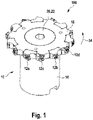
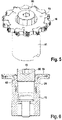
- the Figures 1-10 show an embodiment of the milling tool according to the invention in different views and different states.
- the illustration of the different states serves to explain the function of the milling tool.
- the milling tool is in the Figures 1-10 each designated as a whole with the reference numeral 100.
- the milling tool 100 has a milling tool holder 10 and a plurality of cutting inserts 12 arranged on the milling tool holder 10 .
- these cutting inserts are provided with the reference numerals 12a-12d as an example.
- these tips are numbered as follows: tip 12a is referred to as the first tip, tip 12b is referred to as the second tip, tip 12c is referred to as the third tip, and tip 12d is referred to as the fourth tip.
- the milling tool 100 can have any number of cutting inserts 12 greater than four.
- the milling tool 100 according to the invention preferably has an even number of cutting inserts 12 .
- the cutting inserts 12 are detachably fastened to the milling tool holder 10 with the aid of fastening screws 14 (see FIG 2 ).
- the cutting inserts 12 are detachably arranged in cutting insert receptacles 13 provided for this purpose, with 2 again, for example, only four of these cutting insert receptacles 13a-13d are provided with reference symbols. Equivalent to the naming of the cutting inserts 12a-12d, the cutting insert receptacles 13a-13d are also present as follows denoted: first cutting plate holder 13a, second cutting plate holder 13b, third cutting plate holder 13c and fourth cutting plate holder 13d.
- the cutting inserts 12 may be detachably or permanently attached to the milling tool holder 10 in a different manner, for example by clamping, soldering or welding. Regardless of the type of attachment, the cutting plates 12 are preferably made of hard metal, while the milling tool holder 10 is preferably made of steel.
- the milling tool holder 10 is constructed in several parts. Has a first holder part 16 and a second holder part 18 .
- the two holder parts 16, 18 are movable relative to each other. Of course, this is not the case when installed. However, the two holder parts 16, 18 can be positioned in relation to one another in different positions that can be selected by the user in order to set the milling width. With the aid of a locking mechanism 20, which in this case has a clamping screw 22, the two holder parts 16, 18 can be fixed or locked in the desired position (according to the set milling width) relative to one another. Preferably, the distance between the two holder parts 16, 18 can be continuously adjusted.
- a spacer element 24 is used to adjust the milling width, i.e. to vary the relative position between the two holder parts 16, 18.
- this spacer element 24 is designed as a sleeve which can be screwed into the first holder part 16.
- the distance between the first holder part 16 and the second holder part 18 is reduced the further the spacer element 24 is screwed into the first holder part 16 .
- This then leads to a correspondingly smaller milling width during use of the milling tool 100.
- the milling tool 100 is usually clamped in a tool holder provided for this purpose.
- the first holder part 16 has a connecting flange 26 at its lower end. This connection flange 26 is used together with a fastening screw 28 and an associated washer 30 to fasten or fix the milling tool 100 to the tool holder.
- the first holder part 16 has a substantially elongated shape, which very roughly corresponds to a T-shape in cross section.
- the second holder part 18, on the other hand, is designed essentially in the shape of a disk. It is placed on top of the first holder part 16 . As will be explained later in more detail, the second holder part 18 does not lie directly on the first holder part 16 in the axial direction, but on the spacer element 24 .
- Both holder parts 16, 18 as well as the entire milling tool 100 are preferably symmetrical to a longitudinal axis 32.
- the two holder parts 16, 18 are nested in one another in the assembled state. You could also say that they mesh like gears.
- Viewed in the circumferential direction 34 , ie around the longitudinal axis 32 between each two cutting insert mounts 13 arranged on the first holder part 16 there is one cutting insert mount 13 which belongs to the second holder part 18 .
- one cutting insert receptacle 13 which belongs to the first holder part 16 is also arranged between each two cutting insert receptacles 13 of the second holder part 18 .
- the third cutting-insert holder 13c is arranged in the circumferential direction between the first cutting-insert holder 13a and the second cutting-insert holder 13b, the third cutting-insert holder 13c belonging to the second holder part 18 and the first and second cutting-insert holder 13a, 13b belong to the first holder part 16.
- the second cutting-insert holder 13b which belongs to the first holder part 16, is arranged between the third cutting-insert holder 13c and the fourth cutting-insert holder 13d, which belong to the second holder part 18.
- Torque entrainment surfaces 36 which are arranged on the first holder part 16 and correspond to corresponding torque entrainment surfaces 38, which are arranged on the second holder part 18, ensure the transmission of torque from the first holder part 16 to the second holder part 18.
- These corresponding torque entrainment surfaces 36, 38 preferably run along a radial direction 40 of the tool 100, which is orthogonal to the longitudinal axis 32 and orthogonal to the circumferential direction 34. At least the torque driving surfaces 36, 38 enclose an angle of ⁇ 5° with this radial direction 40. In relation to the longitudinal axis 32, the torque entrainment surfaces 36, 38 either run parallel or are slightly inclined to it.
- the cutting inserts 12 arranged on the first holder part 16 protrude from the head part of the milling tool holder 10 in different directions than the cutting inserts 12 arranged on the second holder part 18 .
- the first and second cutting plates 12a, 12b, which are arranged on the first holder part 16, project downwards, for example, from the head part of the milling tool holder 10, whereas the third and fourth cutting plates 12c, 12d, which are arranged on the second holder part 18 are projecting upwards from the head part of the milling tool holder 10.
- “down” and “up” mean two oppositely aligned directions which are parallel to the longitudinal axis 32 .
- the cutting inserts 12 arranged on the first holder part 16 slightly different cutting inserts are preferably used than for the second holder part 18.
- the cutting inserts arranged on the two holder parts 16, 18 are basically the same in nature, but they are constructed mirror-inverted to one another.
- technical jargon usually speaks of left-hand and right-hand cutting inserts, which in the present case are arranged in an alternating sequence on the first and second holder parts 16, 18.
- the cutting inserts 12 are arranged tangentially on the two holder parts 16, 18 in the present case.
- the cutting inserts 12 can also be arranged axially or in a different orientation on the milling tool holder 10 without departing from the scope of the present invention.
- Figures 3 and 4 show a first state of the milling tool 100 according to the invention, in which the milling width is set to the smallest value, i.e. the distance between the first and the second holder part 16, 18 is as small as possible, and in which the two holder parts 16, 18 are locked with the aid of the lock 20 or the clamping screw 22 are fixed.
- the clamping screw 22 presses with its conically shaped head against a correspondingly shaped, conical surface 42 of the second holder part 18.
- the clamping screw 22 exerts force on the second holder part 18 both in the axial direction and in the radial direction.
- the spacer element 24 is not contacted by the clamping screw 22 .
- the clamping screw 22 is screwed through the spacer element 24 into the first holder part 16 without touching the spacer element 24 .
- an external thread 44 is provided on the underside of the clamping screw 22 , which corresponds to an internal thread 46 provided in the interior of the first holder part 16 .
- Both threads 44, 46 are preferably designed as fine threads.
- the spacer element 24 is also screwed into the first holder part 16 .
- an external thread 48 is provided at the lower end of the spacer element 24 , which corresponds to an internal thread 50 arranged inside the first holder part 16 .
- the threads 44-50 are referred to below as follows:
- the external thread 48 provided on the spacer element 24 is referred to as the first thread.
- the internal thread 50 provided in the first holder part 16 is referred to as the second thread.
- the internal thread 46 also provided in the first holder part 16 is referred to as the third thread.
- the external thread 44 arranged on the clamping screw 22 is referred to as the fourth thread. All threads 44-50 are preferably fine threads.
- the threads 46 , 50 (second and third threads) provided in the first holder part 16 preferably run coaxially, but are offset from one another along the longitudinal axis 32 .
- the clamping screw 22 presses against the second holder part 18 in the axial direction, among other things.
- the second holder part 18 rests on the spacer element 24 in the axial direction.
- the spacer element 24 and the second holder part 18 each have an annular contact surface 52, 54, along which these two components make contact with one another.
- the annular contact surfaces 52, 54 serve as an axial plane contact. This essentially serves to minimize wobble errors.
- the spacer element 24 is screwed into the first holder part 16 . in the in 4
- the state shown is that the spacer element 24 is screwed in completely up to a lower stop 56 which is provided for this purpose inside the first holder part 16 .
- a clearance fit acting as a centering is provided in the radial direction between the spacer element 24 and the first holder part 16 and also between the spacer element 24 and the second holder part 18 .
- a cylinder surface 58 running symmetrically to the longitudinal axis 32 is provided in the first holder part 16 and is referred to here as the first cylinder surface.
- This first cylinder surface 58 corresponds to a cylinder surface 60 provided on the outer circumference of the spacer element 24.
- a cylindrical surface 62 running symmetrically to the longitudinal axis 32 is provided in a similar manner on the second holder part 18 .
- This cylinder surface 62 is referred to here as the second cylinder surface. It corresponds to a cylinder surface 64 provided on the outer circumference of the upper end of the spacer element 24.
- a clearance fit is preferably provided between the cylinder surfaces 58, 60 and between the cylinder surfaces 62, 64.
- the first cylinder surface 58 preferably runs coaxially to the second cylinder surface 62, the two cylinder surfaces 58, 62 being arranged axially offset from one another when the tool is in the installed state.
- the adjustment adapter 66 engages in a tool grip 68 which is arranged in the area of the upper end on the inside of the spacer element 24 .
- This tool engagement 68 is referred to here as the first tool engagement.
- a second tool grip 70 is provided inside the adjustment adapter 66, with the aid of which the adjustment adapter 66 can be moved.
- this is designed as an Allen tool engagement.
Landscapes
- Engineering & Computer Science (AREA)
- Mechanical Engineering (AREA)
- Life Sciences & Earth Sciences (AREA)
- Wood Science & Technology (AREA)
- Forests & Forestry (AREA)
- Milling Processes (AREA)
Applications Claiming Priority (2)
| Application Number | Priority Date | Filing Date | Title |
|---|---|---|---|
| DE102017131001.0A DE102017131001A1 (de) | 2017-12-21 | 2017-12-21 | Fräswerkzeug-Halter und Fräswerkzeug |
| PCT/EP2018/085966 WO2019121998A1 (de) | 2017-12-21 | 2018-12-19 | Fräswerkzeug-halter und fräswerkzeug |
Publications (2)
| Publication Number | Publication Date |
|---|---|
| EP3703893A1 EP3703893A1 (de) | 2020-09-09 |
| EP3703893B1 true EP3703893B1 (de) | 2022-09-28 |
Family
ID=64870495
Family Applications (1)
| Application Number | Title | Priority Date | Filing Date |
|---|---|---|---|
| EP18826016.0A Active EP3703893B1 (de) | 2017-12-21 | 2018-12-19 | Fräswerkzeug-halter und fräswerkzeug |
Country Status (9)
| Country | Link |
|---|---|
| US (1) | US11484954B2 (enExample) |
| EP (1) | EP3703893B1 (enExample) |
| JP (1) | JP7063983B2 (enExample) |
| CN (1) | CN111212700B (enExample) |
| CA (1) | CA3074661A1 (enExample) |
| DE (1) | DE102017131001A1 (enExample) |
| MX (1) | MX2020002602A (enExample) |
| RU (1) | RU2735701C1 (enExample) |
| WO (1) | WO2019121998A1 (enExample) |
Families Citing this family (5)
| Publication number | Priority date | Publication date | Assignee | Title |
|---|---|---|---|---|
| EP3782751B1 (en) * | 2019-08-21 | 2024-05-29 | Seco Tools Ab | A milling cutter |
| CN111215679A (zh) * | 2019-11-05 | 2020-06-02 | 合肥百恒设备模具有限公司 | 一种逆向铣刀结构 |
| CN113145912B (zh) * | 2021-01-19 | 2024-09-17 | 西安海纳精密机械有限公司 | 可调三面刃铣刀盘和调整方法 |
| CN119426684B (zh) * | 2024-12-04 | 2025-08-01 | 宜昌永鑫精工科技股份有限公司 | 一种便于调节工位的铣刀盘 |
| CN119589003A (zh) * | 2024-12-23 | 2025-03-11 | 乐客精密工具(太仓)有限公司 | 一种可转位面铣刀 |
Family Cites Families (25)
| Publication number | Priority date | Publication date | Assignee | Title |
|---|---|---|---|---|
| DE192233C (enExample) * | ||||
| DE536135C (de) * | 1929-03-23 | 1931-10-19 | Henning Larsson | Mehrteiliger Nuten- und Formfraeser |
| US2592382A (en) * | 1947-03-06 | 1952-04-08 | Phillipe J Blais | Adjustable milling cutter |
| AT189883B (de) * | 1955-07-11 | 1957-05-10 | Josef Weisz | Klauengekuppelter verstellbarer Nutenfräser |
| DE1179080B (de) * | 1959-11-05 | 1964-10-01 | Friedrich Link | Zweiteiliger Scheibenfraeser |
| CH588337A5 (enExample) * | 1975-01-06 | 1977-05-31 | Oertli Werkzeuge Ag | |
| SU848188A1 (ru) * | 1975-10-20 | 1981-07-23 | Предприятие П/Я Р-6760 | Дискова сборна фреза |
| DE2754499A1 (de) * | 1977-12-07 | 1979-06-13 | Hans Heinlein | Mikroeinstellvorrichtung fuer wendeplatten |
| JPS5921722B2 (ja) * | 1978-10-26 | 1984-05-22 | 三菱マテリアル株式会社 | 千鳥刃転削工具 |
| SU908553A1 (ru) * | 1980-06-05 | 1982-02-28 | Краматорский Научно-Исследовательский И Проектно-Технологический Институт Машиностроения | Механизм настройки фрез при обработке пазов |
| SU1296318A1 (ru) * | 1984-02-08 | 1987-03-15 | Предприятие П/Я Р-6491 | Торцова фреза |
| CN88211122U (zh) * | 1988-03-04 | 1988-11-09 | 李旭淮 | 可调式不重磨立铣刀 |
| US4936717A (en) * | 1988-12-19 | 1990-06-26 | Gte Valenite Corporation | Adjustable narrow width slotting cutter |
| DE8910441U1 (de) * | 1989-09-01 | 1989-11-02 | Wilhelm Fette Gmbh, 2053 Schwarzenbek | Scheibenfräser mit Wendeschneidplatten und verstellbarer Schnittbreite |
| IL149909A0 (en) * | 2002-05-29 | 2002-12-01 | Dimar Ltd | A slotter having cutters with adjustable width |
| EP2020270B9 (en) | 2006-04-28 | 2012-02-15 | Union Tool Co. | Rotary cutting tool |
| DE102007001864A1 (de) * | 2007-01-12 | 2008-07-17 | Kennametal Inc. | Fräsvorrichtung |
| JP5115352B2 (ja) * | 2008-06-20 | 2013-01-09 | 株式会社ジェイテクト | 研削装置と切削装置 |
| DE102009022051B3 (de) * | 2009-05-18 | 2010-09-30 | Leitz Gmbh & Co. Kg | Mehrteiliges Schneidwerkzeug |
| SE535541C2 (sv) * | 2011-02-11 | 2012-09-18 | Sandvik Intellectual Property | Skärinsats för ett fräsverktyg som är utformat för kuggfräsning |
| AT13700U1 (de) | 2013-08-06 | 2014-06-15 | Ceratizit Austria Gmbh | Trennfräser-Schneideinsatz |
| CN203526662U (zh) * | 2013-09-17 | 2014-04-09 | 郧西县神风实业有限公司 | 铣内挡面可转位刀盘 |
| DK3092107T3 (en) * | 2014-01-10 | 2018-12-17 | Schiavon S R L | A WOOD PANEL MACHINE INCLUDING A MECHANICAL DEVICE FOR A DYNAMIC ADJUSTMENT OF TURNING TOOLS |
| CN106312160A (zh) * | 2016-09-22 | 2017-01-11 | 成都飞机工业(集团)有限责任公司 | 可变刃宽组合铣刀 |
| DE102017110754B4 (de) * | 2017-05-17 | 2023-08-17 | Leitz Gmbh & Co. Kg | Werkzeugvorrichtung, insbesondere Fräswerkzeug |
-
2017
- 2017-12-21 DE DE102017131001.0A patent/DE102017131001A1/de not_active Ceased
-
2018
- 2018-12-19 MX MX2020002602A patent/MX2020002602A/es unknown
- 2018-12-19 JP JP2020515703A patent/JP7063983B2/ja active Active
- 2018-12-19 RU RU2020109573A patent/RU2735701C1/ru active
- 2018-12-19 CA CA3074661A patent/CA3074661A1/en not_active Abandoned
- 2018-12-19 WO PCT/EP2018/085966 patent/WO2019121998A1/de not_active Ceased
- 2018-12-19 CN CN201880067125.2A patent/CN111212700B/zh active Active
- 2018-12-19 EP EP18826016.0A patent/EP3703893B1/de active Active
-
2020
- 2020-03-03 US US16/807,363 patent/US11484954B2/en active Active
Also Published As
| Publication number | Publication date |
|---|---|
| CN111212700A (zh) | 2020-05-29 |
| MX2020002602A (es) | 2020-10-01 |
| US11484954B2 (en) | 2022-11-01 |
| JP7063983B2 (ja) | 2022-05-09 |
| CA3074661A1 (en) | 2019-06-27 |
| EP3703893A1 (de) | 2020-09-09 |
| JP2020534169A (ja) | 2020-11-26 |
| WO2019121998A1 (de) | 2019-06-27 |
| RU2735701C1 (ru) | 2020-11-06 |
| US20200198028A1 (en) | 2020-06-25 |
| CN111212700B (zh) | 2021-07-13 |
| DE102017131001A1 (de) | 2019-06-27 |
Similar Documents
| Publication | Publication Date | Title |
|---|---|---|
| EP3703893B1 (de) | Fräswerkzeug-halter und fräswerkzeug | |
| EP0859679B1 (de) | Bohrwerkzeug mit auswechselbarer spitze | |
| EP1321210B1 (de) | Werkzeug | |
| EP0126432B1 (de) | Fräswerkzeug | |
| EP0674561A1 (de) | Vollbohrer | |
| EP0282090A1 (de) | Messerkopf | |
| CH656080A5 (de) | Drehwerkzeug fuer die endenbearbeitung von wellen, zapfen, rohren. | |
| DE4421002A1 (de) | Kombinationswerkzeug | |
| DE102011113494A1 (de) | Spannsystem sowie Grundkörper, Spannzange und Rotationswerkzeug dafür und ein Installationsverfahren für das Rotationswerkzeug im Spannsystem | |
| EP0125434A2 (de) | Werkzeugmaschine mit Werkzeugwechselvorrichtung | |
| DE4309321C2 (de) | Anordnung zur zentrierten und axial fixierten Aufnahme eines rotierenden Körpers und zugehöriger Adapter | |
| CH668723A5 (de) | Revolverkopf fuer eine drehmaschine und hierzu passende werkzeughalter. | |
| EP0123220A2 (de) | Werkzeugmaschinenspindel mit hierzu passendem Werkzeughalter | |
| EP2114601B1 (de) | Werkzeughalter | |
| EP0563979B1 (de) | Schnittstelle | |
| DE3128121C2 (de) | Drehwerkzeug für die Endenbearbeitung von Wellen, Zapfen, Rohren und dergleichen | |
| DE3029133C2 (de) | Werkzeughalter | |
| CH673966A5 (enExample) | ||
| DE102004008167B4 (de) | Aufbohrwerkzeug | |
| DE3340320C2 (de) | Modular-Spannzeug und Verfahren zum Einspannen eines Werkzeuges | |
| EP0389788A2 (de) | Kombination zur Herstellung kreisrunder Ausnehmungen mit stufenlos veränderbarem Durchmesser im vollen Material | |
| EP1268107B1 (de) | Bohrwekzeug | |
| DE10137055A1 (de) | Kupplungsvorrichtung für das Verbinden einer Spindel mit einem Werkzeughalter | |
| DE102004001148B3 (de) | Werkzeugaufnahmevorrichtung | |
| AT382543B (de) | Schneidwerkzeug |
Legal Events
| Date | Code | Title | Description |
|---|---|---|---|
| STAA | Information on the status of an ep patent application or granted ep patent |
Free format text: STATUS: UNKNOWN |
|
| STAA | Information on the status of an ep patent application or granted ep patent |
Free format text: STATUS: THE INTERNATIONAL PUBLICATION HAS BEEN MADE |
|
| PUAI | Public reference made under article 153(3) epc to a published international application that has entered the european phase |
Free format text: ORIGINAL CODE: 0009012 |
|
| STAA | Information on the status of an ep patent application or granted ep patent |
Free format text: STATUS: REQUEST FOR EXAMINATION WAS MADE |
|
| 17P | Request for examination filed |
Effective date: 20200401 |
|
| AK | Designated contracting states |
Kind code of ref document: A1 Designated state(s): AL AT BE BG CH CY CZ DE DK EE ES FI FR GB GR HR HU IE IS IT LI LT LU LV MC MK MT NL NO PL PT RO RS SE SI SK SM TR |
|
| AX | Request for extension of the european patent |
Extension state: BA ME |
|
| DAV | Request for validation of the european patent (deleted) | ||
| DAX | Request for extension of the european patent (deleted) | ||
| GRAP | Despatch of communication of intention to grant a patent |
Free format text: ORIGINAL CODE: EPIDOSNIGR1 |
|
| STAA | Information on the status of an ep patent application or granted ep patent |
Free format text: STATUS: GRANT OF PATENT IS INTENDED |
|
| INTG | Intention to grant announced |
Effective date: 20220408 |
|
| GRAS | Grant fee paid |
Free format text: ORIGINAL CODE: EPIDOSNIGR3 |
|
| GRAA | (expected) grant |
Free format text: ORIGINAL CODE: 0009210 |
|
| STAA | Information on the status of an ep patent application or granted ep patent |
Free format text: STATUS: THE PATENT HAS BEEN GRANTED |
|
| AK | Designated contracting states |
Kind code of ref document: B1 Designated state(s): AL AT BE BG CH CY CZ DE DK EE ES FI FR GB GR HR HU IE IS IT LI LT LU LV MC MK MT NL NO PL PT RO RS SE SI SK SM TR |
|
| REG | Reference to a national code |
Ref country code: GB Ref legal event code: FG4D Free format text: NOT ENGLISH |
|
| REG | Reference to a national code |
Ref country code: CH Ref legal event code: EP |
|
| REG | Reference to a national code |
Ref country code: AT Ref legal event code: REF Ref document number: 1520930 Country of ref document: AT Kind code of ref document: T Effective date: 20221015 |
|
| REG | Reference to a national code |
Ref country code: DE Ref legal event code: R096 Ref document number: 502018010740 Country of ref document: DE |
|
| REG | Reference to a national code |
Ref country code: IE Ref legal event code: FG4D Free format text: LANGUAGE OF EP DOCUMENT: GERMAN |
|
| REG | Reference to a national code |
Ref country code: LT Ref legal event code: MG9D |
|
| PG25 | Lapsed in a contracting state [announced via postgrant information from national office to epo] |
Ref country code: RS Free format text: LAPSE BECAUSE OF FAILURE TO SUBMIT A TRANSLATION OF THE DESCRIPTION OR TO PAY THE FEE WITHIN THE PRESCRIBED TIME-LIMIT Effective date: 20220928 Ref country code: NO Free format text: LAPSE BECAUSE OF FAILURE TO SUBMIT A TRANSLATION OF THE DESCRIPTION OR TO PAY THE FEE WITHIN THE PRESCRIBED TIME-LIMIT Effective date: 20221228 Ref country code: LV Free format text: LAPSE BECAUSE OF FAILURE TO SUBMIT A TRANSLATION OF THE DESCRIPTION OR TO PAY THE FEE WITHIN THE PRESCRIBED TIME-LIMIT Effective date: 20220928 Ref country code: LT Free format text: LAPSE BECAUSE OF FAILURE TO SUBMIT A TRANSLATION OF THE DESCRIPTION OR TO PAY THE FEE WITHIN THE PRESCRIBED TIME-LIMIT Effective date: 20220928 Ref country code: FI Free format text: LAPSE BECAUSE OF FAILURE TO SUBMIT A TRANSLATION OF THE DESCRIPTION OR TO PAY THE FEE WITHIN THE PRESCRIBED TIME-LIMIT Effective date: 20220928 |
|
| REG | Reference to a national code |
Ref country code: SE Ref legal event code: TRGR |
|
| REG | Reference to a national code |
Ref country code: NL Ref legal event code: MP Effective date: 20220928 |
|
| PG25 | Lapsed in a contracting state [announced via postgrant information from national office to epo] |
Ref country code: HR Free format text: LAPSE BECAUSE OF FAILURE TO SUBMIT A TRANSLATION OF THE DESCRIPTION OR TO PAY THE FEE WITHIN THE PRESCRIBED TIME-LIMIT Effective date: 20220928 Ref country code: GR Free format text: LAPSE BECAUSE OF FAILURE TO SUBMIT A TRANSLATION OF THE DESCRIPTION OR TO PAY THE FEE WITHIN THE PRESCRIBED TIME-LIMIT Effective date: 20221229 |
|
| PG25 | Lapsed in a contracting state [announced via postgrant information from national office to epo] |
Ref country code: SM Free format text: LAPSE BECAUSE OF FAILURE TO SUBMIT A TRANSLATION OF THE DESCRIPTION OR TO PAY THE FEE WITHIN THE PRESCRIBED TIME-LIMIT Effective date: 20220928 Ref country code: RO Free format text: LAPSE BECAUSE OF FAILURE TO SUBMIT A TRANSLATION OF THE DESCRIPTION OR TO PAY THE FEE WITHIN THE PRESCRIBED TIME-LIMIT Effective date: 20220928 Ref country code: PT Free format text: LAPSE BECAUSE OF FAILURE TO SUBMIT A TRANSLATION OF THE DESCRIPTION OR TO PAY THE FEE WITHIN THE PRESCRIBED TIME-LIMIT Effective date: 20230130 Ref country code: ES Free format text: LAPSE BECAUSE OF FAILURE TO SUBMIT A TRANSLATION OF THE DESCRIPTION OR TO PAY THE FEE WITHIN THE PRESCRIBED TIME-LIMIT Effective date: 20220928 |
|
| PG25 | Lapsed in a contracting state [announced via postgrant information from national office to epo] |
Ref country code: SK Free format text: LAPSE BECAUSE OF FAILURE TO SUBMIT A TRANSLATION OF THE DESCRIPTION OR TO PAY THE FEE WITHIN THE PRESCRIBED TIME-LIMIT Effective date: 20220928 Ref country code: PL Free format text: LAPSE BECAUSE OF FAILURE TO SUBMIT A TRANSLATION OF THE DESCRIPTION OR TO PAY THE FEE WITHIN THE PRESCRIBED TIME-LIMIT Effective date: 20220928 Ref country code: IS Free format text: LAPSE BECAUSE OF FAILURE TO SUBMIT A TRANSLATION OF THE DESCRIPTION OR TO PAY THE FEE WITHIN THE PRESCRIBED TIME-LIMIT Effective date: 20230128 Ref country code: EE Free format text: LAPSE BECAUSE OF FAILURE TO SUBMIT A TRANSLATION OF THE DESCRIPTION OR TO PAY THE FEE WITHIN THE PRESCRIBED TIME-LIMIT Effective date: 20220928 |
|
| P01 | Opt-out of the competence of the unified patent court (upc) registered |
Effective date: 20230503 |
|
| REG | Reference to a national code |
Ref country code: DE Ref legal event code: R097 Ref document number: 502018010740 Country of ref document: DE |
|
| PG25 | Lapsed in a contracting state [announced via postgrant information from national office to epo] |
Ref country code: NL Free format text: LAPSE BECAUSE OF FAILURE TO SUBMIT A TRANSLATION OF THE DESCRIPTION OR TO PAY THE FEE WITHIN THE PRESCRIBED TIME-LIMIT Effective date: 20220928 Ref country code: AL Free format text: LAPSE BECAUSE OF FAILURE TO SUBMIT A TRANSLATION OF THE DESCRIPTION OR TO PAY THE FEE WITHIN THE PRESCRIBED TIME-LIMIT Effective date: 20220928 |
|
| PG25 | Lapsed in a contracting state [announced via postgrant information from national office to epo] |
Ref country code: DK Free format text: LAPSE BECAUSE OF FAILURE TO SUBMIT A TRANSLATION OF THE DESCRIPTION OR TO PAY THE FEE WITHIN THE PRESCRIBED TIME-LIMIT Effective date: 20220928 |
|
| PLBE | No opposition filed within time limit |
Free format text: ORIGINAL CODE: 0009261 |
|
| STAA | Information on the status of an ep patent application or granted ep patent |
Free format text: STATUS: NO OPPOSITION FILED WITHIN TIME LIMIT |
|
| REG | Reference to a national code |
Ref country code: BE Ref legal event code: MM Effective date: 20221231 |
|
| PG25 | Lapsed in a contracting state [announced via postgrant information from national office to epo] |
Ref country code: LU Free format text: LAPSE BECAUSE OF NON-PAYMENT OF DUE FEES Effective date: 20221219 |
|
| 26N | No opposition filed |
Effective date: 20230629 |
|
| PG25 | Lapsed in a contracting state [announced via postgrant information from national office to epo] |
Ref country code: IE Free format text: LAPSE BECAUSE OF NON-PAYMENT OF DUE FEES Effective date: 20221219 |
|
| PG25 | Lapsed in a contracting state [announced via postgrant information from national office to epo] |
Ref country code: SI Free format text: LAPSE BECAUSE OF FAILURE TO SUBMIT A TRANSLATION OF THE DESCRIPTION OR TO PAY THE FEE WITHIN THE PRESCRIBED TIME-LIMIT Effective date: 20220928 Ref country code: BE Free format text: LAPSE BECAUSE OF NON-PAYMENT OF DUE FEES Effective date: 20221231 |
|
| PG25 | Lapsed in a contracting state [announced via postgrant information from national office to epo] |
Ref country code: CY Free format text: LAPSE BECAUSE OF FAILURE TO SUBMIT A TRANSLATION OF THE DESCRIPTION OR TO PAY THE FEE WITHIN THE PRESCRIBED TIME-LIMIT Effective date: 20220928 |
|
| PG25 | Lapsed in a contracting state [announced via postgrant information from national office to epo] |
Ref country code: MK Free format text: LAPSE BECAUSE OF FAILURE TO SUBMIT A TRANSLATION OF THE DESCRIPTION OR TO PAY THE FEE WITHIN THE PRESCRIBED TIME-LIMIT Effective date: 20220928 Ref country code: IT Free format text: LAPSE BECAUSE OF FAILURE TO SUBMIT A TRANSLATION OF THE DESCRIPTION OR TO PAY THE FEE WITHIN THE PRESCRIBED TIME-LIMIT Effective date: 20220928 Ref country code: HU Free format text: LAPSE BECAUSE OF FAILURE TO SUBMIT A TRANSLATION OF THE DESCRIPTION OR TO PAY THE FEE WITHIN THE PRESCRIBED TIME-LIMIT; INVALID AB INITIO Effective date: 20181219 |
|
| PG25 | Lapsed in a contracting state [announced via postgrant information from national office to epo] |
Ref country code: MC Free format text: LAPSE BECAUSE OF FAILURE TO SUBMIT A TRANSLATION OF THE DESCRIPTION OR TO PAY THE FEE WITHIN THE PRESCRIBED TIME-LIMIT Effective date: 20220928 |
|
| PG25 | Lapsed in a contracting state [announced via postgrant information from national office to epo] |
Ref country code: MC Free format text: LAPSE BECAUSE OF FAILURE TO SUBMIT A TRANSLATION OF THE DESCRIPTION OR TO PAY THE FEE WITHIN THE PRESCRIBED TIME-LIMIT Effective date: 20220928 |
|
| PG25 | Lapsed in a contracting state [announced via postgrant information from national office to epo] |
Ref country code: BG Free format text: LAPSE BECAUSE OF FAILURE TO SUBMIT A TRANSLATION OF THE DESCRIPTION OR TO PAY THE FEE WITHIN THE PRESCRIBED TIME-LIMIT Effective date: 20220928 |
|
| PG25 | Lapsed in a contracting state [announced via postgrant information from national office to epo] |
Ref country code: MT Free format text: LAPSE BECAUSE OF FAILURE TO SUBMIT A TRANSLATION OF THE DESCRIPTION OR TO PAY THE FEE WITHIN THE PRESCRIBED TIME-LIMIT Effective date: 20220928 |
|
| PGFP | Annual fee paid to national office [announced via postgrant information from national office to epo] |
Ref country code: GB Payment date: 20241226 Year of fee payment: 7 |
|
| PGFP | Annual fee paid to national office [announced via postgrant information from national office to epo] |
Ref country code: FR Payment date: 20241224 Year of fee payment: 7 |
|
| PGFP | Annual fee paid to national office [announced via postgrant information from national office to epo] |
Ref country code: AT Payment date: 20241220 Year of fee payment: 7 |
|
| PGFP | Annual fee paid to national office [announced via postgrant information from national office to epo] |
Ref country code: CZ Payment date: 20241210 Year of fee payment: 7 |
|
| PGFP | Annual fee paid to national office [announced via postgrant information from national office to epo] |
Ref country code: SE Payment date: 20241219 Year of fee payment: 7 |
|
| PGFP | Annual fee paid to national office [announced via postgrant information from national office to epo] |
Ref country code: DE Payment date: 20250123 Year of fee payment: 7 |
|
| PGFP | Annual fee paid to national office [announced via postgrant information from national office to epo] |
Ref country code: CH Payment date: 20250101 Year of fee payment: 7 |
|
| PG25 | Lapsed in a contracting state [announced via postgrant information from national office to epo] |
Ref country code: TR Free format text: LAPSE BECAUSE OF FAILURE TO SUBMIT A TRANSLATION OF THE DESCRIPTION OR TO PAY THE FEE WITHIN THE PRESCRIBED TIME-LIMIT Effective date: 20220928 |