EP3687951B1 - Accelerating admixture for hydraulic compositions - Google Patents
Accelerating admixture for hydraulic compositions Download PDFInfo
- Publication number
- EP3687951B1 EP3687951B1 EP18786402.0A EP18786402A EP3687951B1 EP 3687951 B1 EP3687951 B1 EP 3687951B1 EP 18786402 A EP18786402 A EP 18786402A EP 3687951 B1 EP3687951 B1 EP 3687951B1
- Authority
- EP
- European Patent Office
- Prior art keywords
- cement
- accelerating admixture
- mix
- admixture
- hours
- Prior art date
- Legal status (The legal status is an assumption and is not a legal conclusion. Google has not performed a legal analysis and makes no representation as to the accuracy of the status listed.)
- Active
Links
Images

Classifications
-
- C—CHEMISTRY; METALLURGY
- C04—CEMENTS; CONCRETE; ARTIFICIAL STONE; CERAMICS; REFRACTORIES
- C04B—LIME, MAGNESIA; SLAG; CEMENTS; COMPOSITIONS THEREOF, e.g. MORTARS, CONCRETE OR LIKE BUILDING MATERIALS; ARTIFICIAL STONE; CERAMICS; REFRACTORIES; TREATMENT OF NATURAL STONE
- C04B14/00—Use of inorganic materials as fillers, e.g. pigments, for mortars, concrete or artificial stone; Treatment of inorganic materials specially adapted to enhance their filling properties in mortars, concrete or artificial stone
- C04B14/02—Granular materials, e.g. microballoons
- C04B14/04—Silica-rich materials; Silicates
- C04B14/043—Alkaline-earth metal silicates, e.g. wollastonite
-
- C—CHEMISTRY; METALLURGY
- C04—CEMENTS; CONCRETE; ARTIFICIAL STONE; CERAMICS; REFRACTORIES
- C04B—LIME, MAGNESIA; SLAG; CEMENTS; COMPOSITIONS THEREOF, e.g. MORTARS, CONCRETE OR LIKE BUILDING MATERIALS; ARTIFICIAL STONE; CERAMICS; REFRACTORIES; TREATMENT OF NATURAL STONE
- C04B20/00—Use of materials as fillers for mortars, concrete or artificial stone according to more than one of groups C04B14/00 - C04B18/00 and characterised by shape or grain distribution; Treatment of materials according to more than one of the groups C04B14/00 - C04B18/00 specially adapted to enhance their filling properties in mortars, concrete or artificial stone; Expanding or defibrillating materials
- C04B20/02—Treatment
- C04B20/023—Chemical treatment
-
- C—CHEMISTRY; METALLURGY
- C04—CEMENTS; CONCRETE; ARTIFICIAL STONE; CERAMICS; REFRACTORIES
- C04B—LIME, MAGNESIA; SLAG; CEMENTS; COMPOSITIONS THEREOF, e.g. MORTARS, CONCRETE OR LIKE BUILDING MATERIALS; ARTIFICIAL STONE; CERAMICS; REFRACTORIES; TREATMENT OF NATURAL STONE
- C04B22/00—Use of inorganic materials as active ingredients for mortars, concrete or artificial stone, e.g. accelerators or shrinkage compensating agents
- C04B22/0086—Seeding materials
- C04B22/00863—Calcium silicate hydrate
-
- C—CHEMISTRY; METALLURGY
- C04—CEMENTS; CONCRETE; ARTIFICIAL STONE; CERAMICS; REFRACTORIES
- C04B—LIME, MAGNESIA; SLAG; CEMENTS; COMPOSITIONS THEREOF, e.g. MORTARS, CONCRETE OR LIKE BUILDING MATERIALS; ARTIFICIAL STONE; CERAMICS; REFRACTORIES; TREATMENT OF NATURAL STONE
- C04B22/00—Use of inorganic materials as active ingredients for mortars, concrete or artificial stone, e.g. accelerators or shrinkage compensating agents
- C04B22/06—Oxides, Hydroxides
- C04B22/062—Oxides, Hydroxides of the alkali or alkaline-earth metals
- C04B22/064—Oxides, Hydroxides of the alkali or alkaline-earth metals of the alkaline-earth metals
-
- C—CHEMISTRY; METALLURGY
- C04—CEMENTS; CONCRETE; ARTIFICIAL STONE; CERAMICS; REFRACTORIES
- C04B—LIME, MAGNESIA; SLAG; CEMENTS; COMPOSITIONS THEREOF, e.g. MORTARS, CONCRETE OR LIKE BUILDING MATERIALS; ARTIFICIAL STONE; CERAMICS; REFRACTORIES; TREATMENT OF NATURAL STONE
- C04B22/00—Use of inorganic materials as active ingredients for mortars, concrete or artificial stone, e.g. accelerators or shrinkage compensating agents
- C04B22/08—Acids or salts thereof
- C04B22/10—Acids or salts thereof containing carbon in the anion, e.g. carbonates
-
- C—CHEMISTRY; METALLURGY
- C04—CEMENTS; CONCRETE; ARTIFICIAL STONE; CERAMICS; REFRACTORIES
- C04B—LIME, MAGNESIA; SLAG; CEMENTS; COMPOSITIONS THEREOF, e.g. MORTARS, CONCRETE OR LIKE BUILDING MATERIALS; ARTIFICIAL STONE; CERAMICS; REFRACTORIES; TREATMENT OF NATURAL STONE
- C04B24/00—Use of organic materials as active ingredients for mortars, concrete or artificial stone, e.g. plasticisers
- C04B24/24—Macromolecular compounds
- C04B24/38—Polysaccharides or derivatives thereof
- C04B24/383—Cellulose or derivatives thereof
-
- C—CHEMISTRY; METALLURGY
- C04—CEMENTS; CONCRETE; ARTIFICIAL STONE; CERAMICS; REFRACTORIES
- C04B—LIME, MAGNESIA; SLAG; CEMENTS; COMPOSITIONS THEREOF, e.g. MORTARS, CONCRETE OR LIKE BUILDING MATERIALS; ARTIFICIAL STONE; CERAMICS; REFRACTORIES; TREATMENT OF NATURAL STONE
- C04B28/00—Compositions of mortars, concrete or artificial stone, containing inorganic binders or the reaction product of an inorganic and an organic binder, e.g. polycarboxylate cements
- C04B28/02—Compositions of mortars, concrete or artificial stone, containing inorganic binders or the reaction product of an inorganic and an organic binder, e.g. polycarboxylate cements containing hydraulic cements other than calcium sulfates
- C04B28/04—Portland cements
-
- C—CHEMISTRY; METALLURGY
- C04—CEMENTS; CONCRETE; ARTIFICIAL STONE; CERAMICS; REFRACTORIES
- C04B—LIME, MAGNESIA; SLAG; CEMENTS; COMPOSITIONS THEREOF, e.g. MORTARS, CONCRETE OR LIKE BUILDING MATERIALS; ARTIFICIAL STONE; CERAMICS; REFRACTORIES; TREATMENT OF NATURAL STONE
- C04B2103/00—Function or property of ingredients for mortars, concrete or artificial stone
- C04B2103/0068—Ingredients with a function or property not provided for elsewhere in C04B2103/00
- C04B2103/0079—Rheology influencing agents
-
- C—CHEMISTRY; METALLURGY
- C04—CEMENTS; CONCRETE; ARTIFICIAL STONE; CERAMICS; REFRACTORIES
- C04B—LIME, MAGNESIA; SLAG; CEMENTS; COMPOSITIONS THEREOF, e.g. MORTARS, CONCRETE OR LIKE BUILDING MATERIALS; ARTIFICIAL STONE; CERAMICS; REFRACTORIES; TREATMENT OF NATURAL STONE
- C04B2103/00—Function or property of ingredients for mortars, concrete or artificial stone
- C04B2103/10—Accelerators; Activators
- C04B2103/14—Hardening accelerators
-
- C—CHEMISTRY; METALLURGY
- C04—CEMENTS; CONCRETE; ARTIFICIAL STONE; CERAMICS; REFRACTORIES
- C04B—LIME, MAGNESIA; SLAG; CEMENTS; COMPOSITIONS THEREOF, e.g. MORTARS, CONCRETE OR LIKE BUILDING MATERIALS; ARTIFICIAL STONE; CERAMICS; REFRACTORIES; TREATMENT OF NATURAL STONE
- C04B2201/00—Mortars, concrete or artificial stone characterised by specific physical values
- C04B2201/10—Mortars, concrete or artificial stone characterised by specific physical values for the viscosity
-
- Y—GENERAL TAGGING OF NEW TECHNOLOGICAL DEVELOPMENTS; GENERAL TAGGING OF CROSS-SECTIONAL TECHNOLOGIES SPANNING OVER SEVERAL SECTIONS OF THE IPC; TECHNICAL SUBJECTS COVERED BY FORMER USPC CROSS-REFERENCE ART COLLECTIONS [XRACs] AND DIGESTS
- Y02—TECHNOLOGIES OR APPLICATIONS FOR MITIGATION OR ADAPTATION AGAINST CLIMATE CHANGE
- Y02W—CLIMATE CHANGE MITIGATION TECHNOLOGIES RELATED TO WASTEWATER TREATMENT OR WASTE MANAGEMENT
- Y02W30/00—Technologies for solid waste management
- Y02W30/50—Reuse, recycling or recovery technologies
- Y02W30/91—Use of waste materials as fillers for mortars or concrete
Definitions
- the object of the present invention is a novel admixture comprising a hardening accelerator for hydraulic compositions based on Portland cement and other supplementary cementitious materials.
- Hardening accelerators are admixtures which are widely used in the construction industry to increase the mechanical strength of cement mixes at short curing times. Their use is dictated by the need for faster removal of the steel forms, and consequently faster recovery and reuse thereof, or to enable the work to advance more quickly if said structures are already subjected to a considerable load a few days after placement.
- the use of accelerating admixtures is most widespread in the geographical areas and periods with the coldest climates, because low temperatures slow the cement hydration reaction, with the result that longer curing times are needed for the structure to reach sufficient mechanical strength values to be self-supporting. Accelerating admixtures increase mechanical strength at short curing times because they accelerate the cement hydration reaction rate, but do not affect the total amount of cement that reacts with water at longer times, and therefore do not substantially alter the final mechanical strength of the product.
- organic compounds used as accelerators include triethanolamine, diethanolamine, urea, glyoxal and formate.
- Chlorides and nitrates are among the most effective accelerators, but have the drawback of promoting corrosion of the reinforcing bars, so that their use in reinforced concrete is precluded.
- Calcium formate does not present said risk, and acts as a hardening accelerator when a small percentage thereof by weight of the cement mass is added; the greatest limit on its use lies in its low solubility in water, which prevents its use in aqueous solution; it must therefore be used in powder form to be added directly to the concrete at the time of mixing.
- organic accelerators such as triethanolamine, act as cement hydration accelerators at low doses (0.025 per cent by weight of the cement weight), whereas they reduce the hydration rate at higher doses (0.06 per cent by weight of the cement weight).
- tricalcium silicate 3CaO ⁇ SiO 2
- the hydration reaction of tricalcium silicate is as follows: C 3 S + (3-x+y) ⁇ H 2 O ⁇ (3-x) ⁇ Ca(OH) 2 + C x SH y
- the product that forms by hydration of C 3 S with water namely calcium silicate hydrate
- C-S-H is a porous product that covers the cement granules and is characterised by a large surface area; it presents as a mass of fibrous particles with a length of up to a few microns and a thickness of a few tenths of a micron, the interlinking of which contributes to determining the binding properties of the cement.
- C-S-H can act as a C 3 S hydration accelerator ( Kondo, R., Daimon, M., J. Am. Ceram. Soc. 52, 1969 ). These results were recently confirmed using synthetic C-S-H, obtained by precipitation from a calcium nitrate solution and a sodium metasilicate solution ( Thomas, J.J. et al., J. Phys. Chem., 113, 2009, pp. 4327-4334 ).
- WO2010026155 describes a process for the production of C-S-H useful as a hardening accelerator, wherein the precipitation of calcium silicate hydrate from aqueous solutions containing calcium ions and silicate or silica ions is conducted in the presence of a branched polymer superplasticiser for cement mixes ("comb polymer").
- Examples of said compounds are polycarboxylate ethers based on terpolymers of maleic acid, acrylic acid and vinyloxybutyl-polyethylene glycol-5800 with a molecular weight (Mw) of about 40,000 g/mol, terpolymers of maleic acid, acrylic acid and vinyloxybutyl-polyethylene glycol-12000 with a molecular weight (Mw) of about 73,000 g/mol, and polycarboxylate ethers based on copolymers of methacrylic acid and methoxy polyethylene glycol methacrylate-5,000 with a molecular weight (Mw) of about 40,000 g/mol.
- a commercial example of a product made by said method is the product Master X-Seed 100 (BASF), the data sheet whereof declares a 5% alkali content.
- BASF Master X-Seed 100
- US 5,709,743 claims the use of a setting and hardening accelerator for siliceous binders, in the form of a aqueous suspension, obtained by hydration and grinding of a suspension of a siliceous hydraulic binder.
- the admixture based on the accelerating effect of C-S-H seeds, is obtained by hydrating Portland cement, or another hydraulic binder rich in silicate phases, at temperatures ranging from 5°C to 90°C, in the presence of an amount of water such as to form a water to binder weight ratio (W/B) ranging from 0.6 and 25, and subjecting the resulting suspension to a grinding process in a micronising mill until the desired particle size is obtained.
- W/B water to binder weight ratio
- the hydration and grinding stages can be concomitant, and can be performed, for example, in a porcelain mill with corundum balls.
- the end product has a solid content ranging from 5% and 55% by weight, and sedimentation amounting to at least 60% of the initial height after 2 days.
- the hardening accelerators developed to date which mainly act on the silicate phases of Portland cement, are not equally effective towards hydraulic systems wherein Portland cement is partly or wholly replaced with alternative binders, in particular with industrial by-products originating from other types of production, such as fly ash from coal-operated thermal power stations or ground-granulated blast furnace slag obtained in the cast iron manufacturing process, which are used to reduce the consumption of Portland cement.
- the present invention relates to a novel admixture based on C-S-H seeds in aqueous suspension, obtained from Portland cement or other hydraulic binders with a siliceous base, able to produce an accelerating admixture that is highly effective in promoting the rapid development of the mechanical strength of cement mixes and, at the same time, presents none of the drawbacks of the accelerating admixtures developed to date.
- the process unlike the method described in WO2010026155 , does not introduce alkalis or nitrate ions into the end product, and therefore does not increase the risk of promoting the alkali-aggregate reaction and corrosion of the reinforcing bars when the product is used in concrete.
- the process unlike US 5,709,743 , does not require a grinding stage to ensure the maximum efficacy of the C-S-H seeds and the stability of the resulting suspension.
- the admixture according to the invention either alone or in formulation with sodium carbonate, is particularly effective in activating supplementary cementitious materials such as fly ash and ground-granulated blast-furnace slag, promoting their hardening even when little or no Portland cement is present. This characteristic considerably increases the percentage substitution of supplementary cementitious materials in hydraulic compositions, without penalising mechanical strength at short curing times.
- the crucial aspect of the invention is that the hydration reaction of Portland cement (or other hydraulic binder with a siliceous base) is conducted in aqueous suspension, in the presence of carboxylic acids or the calcium salts thereof, polyethanolamines or mixtures thereof.
- MOFs Metal-Organic Frameworks
- the amount of the carboxylic acids or calcium salts thereof and polyethanolamine to be used according to the invention varies within a wide range, from 2% to 40%, preferably from 5% to 25%, and even more preferably from 10% to 20% of the weight of the Portland cement or other mainly silicate-based hydraulic binders.
- cements are those based only on clinker and gypsum (type CEM I), limestone cements (type CEM II/A-L, CEM II/B-L, CEM II/A-LL, CEM II/B-LL), blast-furnace slag cements (type CEM II/A-S, CEM II/B-S), and pozzolanic cements (type CEM IV/A, CEM IV/B).
- Cements with the highest silicate phase content are naturally preferable, because they can produce, by hydration, the maximum amount of C-S-H seeds.
- the hydration of the binder in the aqueous solution containing the compounds according to the invention is preferably conducted in stirred tanks or reactors, at atmospheric pressure and at temperatures ranging from 10°C to 90°C, preferably from 20°C to 80°C, and even more preferably from 40°C to 60°C, for times ranging from 2 hours to 300 hours.
- Stirring can be continuous or discontinuous, with anchor or rotor stirrers, which must be effective in order to guarantee the homogenisation of the mass during the reaction.
- Auxiliary ultradispersion systems can be conveniently associated with traditional stirring systems.
- the reactor or tank is filled with the established amount of water wherein the compound according to the invention is dissolved.
- the temperature is adjusted to the value established • for the reaction, and the hydraulic binder is gradually added under stirring.
- the hydration reaction can be conducted in the presence of auxiliary ingredients such as dispersing agents, viscosity-controlling agents or stabilisers, to give the end product the desired properties.
- auxiliary ingredients such as dispersing agents, viscosity-controlling agents or stabilisers.
- the dispersing agents that can be used include, for example, gluconic acid and the salts thereof, polyethercarboxylate-based polymers, lignin sulphonate, condensates of naphthalene sulphonate and melamine sulphonate with formaldehyde, polysaccharide derivatives and phosphonated polymers.
- the viscosity-controlling agents that can be used are sodium carbonate, polysaccharide derivatives selected from the group comprising methylcellulose, hydroxyethylcellulose (HEC), hydroxypropylcellulose (HPC), methylhydroxyethylcellulose (MHEC), methylhydroxypropylcellulose (MHPC) and/or (co)polymers with an average molecular weight greater than 500,000 g/mol, preferably greater than 1,000,000 g/mol, containing structural units preferably derived from non-ionic monomers of (meth)acrylamide and sulphonated monomers, or modified polyureas.
- Hydroxycarboxylic acids or salts thereof such as citric acid, malic acid or oxalic acid, can be used as stabilisers.
- said auxiliary ingredients can be added at the end of the hydration reaction.
- the addition of sodium carbonate or sodium sulphate during or at the end of the hydration stage effectively promotes the hydraulic properties of supplementary cementitious materials such as fly ash, ground-granulated blast-furnace slag and calcined clays, even in the absence of Portland cement.
- the admixture according to the invention can therefore be conveniently used for the production of hydraulic mixes that do not use Portland cement, known as "geopolymers” or alkali-activated binders, namely binder systems wherein aluminosilicate structural units are condensed with the sodium ions originating from sodium carbonate.
- the usable amount of sodium carbonate to be added ranges from 3% to 40%, preferably from 5% to 30%, and even more preferably from 10% to 20% of the dry weight of the hydrated suspension.
- the accelerator according to the invention can be used as activator of mixes based on "geopolymer” binders, also in combination with the normal plasticising and superplasticising admixtures.
- This aspect represents a considerable improvement on the state of the art, because it is known that the common "geopolymer” activators, such as those based on alkali silicates and alkali hydroxides, are incompatible with the use of plasticisers and superplasticisers.
- the accelerator according to the invention can be added to the concrete production unit, together with the mix water and other admixtures, or can be premixed, optionally in solid form after drying, with the other constituents of the mix, such as cement, fly ash or other supplementary cementitious materials.
- the accelerator according to the invention can also be added during the clinker grinding stage.
- the typical dose of the accelerator according to the invention can range from 1% to 60%, preferably from 2% to 45%, and . even more preferably from 5% to 35% of the weight of the cementitious materials used for the production of the cement mix.
- the hydration reaction is continued, under stirring, at the temperature of 80°C for 6 hours.
- the product remains in the form of a fluid suspension, the grey colour of which tends to become paler over time.
- the product is cooled and transferred to a plastic container. About 2000 g of product is obtained, with a dry matter content of 32% measured at 105°C to a constant weight.
- the cement used to make the plastic mortars was the same CEMI 52.5R cement as in Table 1.
- the superplasticising admixture Dynamon SP1 (Mapei), based on polyethercarboxylate-based polymers, was used to achieve the desired workability. All the mixes were made with a water/cement ratio W/C 0.42, counting any water introduced with the admixtures as mix water in the various cases.
- Example 1 and Comparative Example 1 The proportion of the admixtures of Example 1 and Comparative Example 1 was 6.2% dry matter as a percentage of the weight of the cement in both cases.
- Table 2 Composition and characteristics of plastic mortars containing the admixture according to the invention, and comparative tests Ingredient/Parameter Unit of measurement Mix 1 Mix 2 Mix 3 Mix 4 52.5R cement g 450 450 450 Standard sand g 1350 1350 1350 1350 1350 1350 1350 1350 1350 1350 1350 1350 1350 1350 1350 1350 1350 1350 1350 1350 1350 1350 1350 Water g 129.8 128.4 128.4 189
- Mix 1 containing the admixture of Example 1 of the invention, is the one that develops mechanical strength most rapidly (14.5 MPa after 7 hours' curing).
- the product of Comparative Example 1, used in Mix 2 was synthesised without calcium formate and, after 7 hours' curing, develops about half the mechanical strength of the product according to the invention (7.8 MPa after 7 hours' curing).
- the addition of an amount of calcium formate equivalent to that introduced with the product of Example 1 (2.5 g) to the product of Comparative Example 1 does not substantially alter the development of mechanical strength, increasing the mechanical strength value after 7 hours from 7.8 MPa to 8.0 MPa.
- the calcium formate (CaF) of the synthesis of Example 1 was replaced by other substances, according to the recipes set out in Table 3 below.
- 100% calcium acetate (CaAC) (Recipe 3A), diethanolamine (DEA) in 85% aqueous solution (Recipe 3B) and triethanolamine (TEA) in 85% aqueous solution (Recipe 3C) were used.
- the type of cement used is the same as that of Example 1, as are the synthesis methods.
- a synthesis was conducted under the same conditions as the synthesis of Example 1, wherein the calcium formate was replaced by an equivalent amount of 100% calcium nitrate (CaN) (Recipe 3COMP), commonly used as a cement hydration accelerator.
- CaN calcium nitrate
- Table 4 shows the characteristics of the mortars made with the products synthesised according to the recipes in Table 3.
- Table 4 Composition and characteristics of plastic mortars containing the admixtures according to the invention produced with carboxylic acids and ethanolamines, by comparison with an admixture produced with calcium nitrate (Example 3COMP)
- Ingredient/ Parameter Unit of measurement Mix 5 Mix 6
- Mix 7 Mix 8
- Mix 9 52.5R cement g 450 450 450 450 450 450 Standard sand g 1350 1350 1350 1350 1350 1350 1350 1350 1350 1350 1350 1350 1350 1350 1350 1350 1350 1350 1350 1350 1350 1350 1350 1350 1350 Water g 129.8 128.1 125.2 128.1 125.2
- Example 1 (CaF) g 93.5 - - - - Example 3a
- (CaAc) g - 90.9 - - - Example 3b MEA) g - - 93.8 -
- Example 4 and Comparative Example 2 After being centrifuged, washed with acetone and dried, were analysed by ESEM (Environmental Scanning Electron Microscope) for the microstructural analysis.
- ESEM Environmental Scanning Electron Microscope
- Figure 1 shows an image of the product of Example 4, synthesised in the presence of 10% calcium formate to cement
- Figure 2 shows an image of the product of Comparative Example 2, synthesised without calcium formate.
- the specific surface area was measured by the BET technique on the same samples as used for the microstructural analysis in Example 4 and Comparative Example 2, using a Beckman-Coulter SA3100 instrument.
- the results of the analysis indicate a specific surface area value of 154 m 2 /gram for the sample of Example 3 and a value of 27 m 2 /gram for the sample of Comparative Example 2, demonstrating the huge increase in the specific surface area of the synthesised product in the presence of 10% calcium formate compared with that synthesised in pure water.
- mix 10 containing the admixture of Example 4 according to the invention, synthesised with 10% calcium formate, develops mechanical strengths after 6 and 7 hours' curing which are about 10 times greater than those of mix 11, made with the admixture of Comparative Example 2, synthesised in pure water.
- 560 g of 52.5 Portland cement having the characteristics reported in Table 1 was dispersed in 1400 ml of water at 22°C and hydrated for 60 hours in an alumina jar with a volume of 8 litres, loaded with 4 kg of alumina balls having a diameter of between 20 mm and 40 mm.
- the rotation speed of the jar was 70 rpm, as reported in example A1 of US 5,709,743 .
- Example 6 The products of Example 6 and Comparative Examples 3 and 4 were tested in plastic mortar tests, using the same 52.5R Portland cement having the characteristics of Table 1.
- the dose of the different admixtures was regulated to ensure that the same amount of admixture on a dry base, namely 5% of the weight of the cement, was added in all cases.
- Example 6 accelerates the development of mechanical strength at short curing times (6 and 7 hours) to a greater extent than the products of Comparative Examples 3 and 4, synthesised according to the teachings of US 5,709,743 , which involve increasing the fineness of the product by means of the wet grinding process during the cement hydration stage.
- Example 8 The product of Example 8 was used to make cementitious mixes wherein the cement was progressively replaced with fly ash originating from fossil-fuel thermocombustion plants. Said by-products are used to partly replace cement in cementitious mixes, as they are supplementary cementitious materials which, in turn, form cementing products very similar to the calcium silicate hydrate C-S-H deriving from cement.
- the benefit of using fly ash in cementitious mixes is the lower environmental impact deriving from the lower dose of cement, and the improvement that said by-products produce in the durability of the cementitious conglomerates.
- the cement used to make plastic mortars was the same 52.5R cement as in Table 1, while the composition of the fly ash used, classifiable as type F according to standard ASTM C618, is set out in Table 7 below.
- Table 7 Composition of fly ash used to make plastic mortars, partly replacing Portland cement Type ASTMC618 % CaO % SiO 2 % Al 2 O 3 % MgO Density g/cm 3 F 18.1 38.8 14.7 3.3 2.1-3.0
- Example 8 The product of Example 8 was used to make cementitious mixes wherein the cement was progressively replaced by ground-granulated blast-furnace slag (GGBFS). Said by-products are used to partly replace cement in cementitious mixes, as they are supplementary cementitious materials which, in turn, form cementing products very similar to the calcium silicate hydrate C-S-H deriving from cement.
- GGBFS ground-granulated blast-furnace slag
- the benefit of using GGBFS in cementitious mixes, as in the case of fly ash, is the lower environmental impact deriving from the lower dose of cement, and the improvement that said by-products produce in the durability of the cementitious conglomerates.
- the cement used to make the plastic mortars was the same 52.5R cement as in Table 1, while the composition of the slag used is reported in Table 9 below.
- Table 9 Composition of the ground-granulated blast-furnace slag (GGBFS) used to make the plastic mortars, partly replacing Portland cement Main ingredients Density g/cm 3 % CaO % SiO 2 % Al 2 O 3 % MgO 40.3 35.1 13.6 8.4 2.9
- the mix water was calculated by including the water introduced into the mix with the product of Example 7, having a dry weight of 39%. After the spreading measurement, prismatic specimens with dimensions of 4 cm x 4 cm x 16 cm were made, and left to cure under standard laboratory conditions (20°C and 95% R/H). Their compressive strength was measured after 7 hours', 24 hours' and 90 days' curing. The results are set out in Table 10 below.
- Example 8 of the invention accelerates the development of mechanical strength at short curing times (7 hours) even in mixes containing large amounts of slag, without prejudicing their final long-term strength (90 days).
- the accelerator of Example 8 it is possible not only to eliminate the delay at short curing times caused by the introduction of slag into cementitious mixes, but also to increase the mechanical strength value at short curing times (7 hours), unlike with the mix made with Portland cement only.
- the product resulting from synthesis was divided into 3 aliquots of 750 g each. One of them was maintained unchanged, while different aliquots of powdered sodium carbonate Na 2 CO 3 were added to the other two. The addition took place under stirring, adding the powdered carbonate to the aqueous suspension of the admixture in 10 minutes. The addition of sodium carbonate produced an increase in the viscosity of the aqueous suspension. Stirring continued for 30 minutes after the end of the addition. The samples reported in Table 11 below were produced. Table 11.
- Example 11 The samples of Example 11 were used to make cementitious mixes wherein the cement was completely replaced by fly ash originating from fossil-fuel thermocombustion plants, classifiable as type F according to standard ASTM C618, and having the composition reported in Table 7.
- the superplasticising admixture Dynamon SP1 (Mapei) was used to achieve the desired workability. After the spreading measurement, prismatic specimens with dimensions of 4 cm x 4 cm x 16 cm were made, and left to cure under standard laboratory conditions (20°C and 95% R/H). Their compressive strength was measured after 7 and 28 days' curing. The results are set out in Table 12 below.
- the water/binder ratio W/B was calculated by including in the calculation the water introduced into the mix with the product of Example 11, having a dry matter content of 34%
- Example 11 The samples of Example 11 were used to make cementitious mixes wherein the cement was completely replaced by ground-granulated blast-furnace slag (GGBFS) having the composition set out in Table 9.
- GGBFS ground-granulated blast-furnace slag
- the superplasticising admixture Dynamon SP1 (Mapei) was used to achieve the desired workability.
- prismatic specimens with dimensions of 4 cm x 4 cm x 16 cm were made, and left to cure under standard laboratory conditions (20°C and 95% R/H). Their compressive strength was measured after 24 hours', 7 and 28 days' curing. The results are set out in Table 13 below.
- the water/binder ratio W/B was calculated by including in the calculation the water introduced into the mix with the product of Example 11, having a dry matter content of 34%
- the hydration reaction was continued, under stirring, for 8 hours. Throughout the reaction, the product presents in the form of a fluid suspension, the grey colour of which tends to become paler over time.
- the product is cooled and transferred to a plastic container. About 2300 g of a fluid aqueous dispersion is obtained, with a dry matter content of 32%, measured at 105°C to a constant weight, and a viscosity of 400 cP at 20°C.
- Example 14 and Comparative Example 5 were evaluated in plastic mortar tests, using the same 52.5R Portland cement having the characteristics of Table 1. A reference mix based on cement only was made by way of comparison.
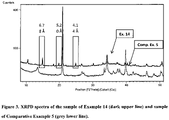
- Example 14 and Comparative Example 5 were analysed by the XRPD technique, using a mod. PANalytical X'Pert Pro MPD diffractometer equipped with an X'Celerator detector.
- the samples were acquired by exposing the powders to Co-K ⁇ 1.2 radiation, generated by a Co anode with voltage of 40 kV and a current of 40 mA.
- the diffraction spectra are shown in Figure 3 .
- the spectrum of the sample corresponding to Example 14 is represented by the darker line in the upper part, while the spectrum relating to Comparative Example 5 is represented by the grey line below.
- the spectrum corresponding to the product of Example 14, synthesised in the presence of calcium formate presents some peaks (6.78 , 5.20 and 4.14 ) which are not present in the spectrum of the sample of Comparative Example 5, wherein calcium formate was not added during synthesis.
- said peaks do not correspond to the peaks of crystalline calcium formate, but are indexed consistently with a tetragonal or orthorhombic cell having a volume of 380-390 angstroms 3 or 790 angstroms 3 , and are indicative of different polymorphic structures wherein the calcium cation is coordinated with the formate binder to create a three-dimensional crystalline structure typical of MOFs (Metal Organic Frameworks).
- MOFs Metal Organic Frameworks
Landscapes
- Chemical & Material Sciences (AREA)
- Engineering & Computer Science (AREA)
- Ceramic Engineering (AREA)
- Materials Engineering (AREA)
- Structural Engineering (AREA)
- Organic Chemistry (AREA)
- Inorganic Chemistry (AREA)
- Chemical Kinetics & Catalysis (AREA)
- General Chemical & Material Sciences (AREA)
- Civil Engineering (AREA)
- Curing Cements, Concrete, And Artificial Stone (AREA)
- Lubricants (AREA)
Applications Claiming Priority (2)
| Application Number | Priority Date | Filing Date | Title |
|---|---|---|---|
| IT102017000107064A IT201700107064A1 (it) | 2017-09-25 | 2017-09-25 | Additivo accelerante per composizioni idrauliche |
| PCT/IB2018/057284 WO2019058313A1 (en) | 2017-09-25 | 2018-09-21 | ACCELERATOR ADJUVANT FOR HYDRAULIC COMPOSITIONS |
Publications (2)
| Publication Number | Publication Date |
|---|---|
| EP3687951A1 EP3687951A1 (en) | 2020-08-05 |
| EP3687951B1 true EP3687951B1 (en) | 2022-08-31 |
Family
ID=61024892
Family Applications (1)
| Application Number | Title | Priority Date | Filing Date |
|---|---|---|---|
| EP18786402.0A Active EP3687951B1 (en) | 2017-09-25 | 2018-09-21 | Accelerating admixture for hydraulic compositions |
Country Status (10)
| Country | Link |
|---|---|
| US (1) | US11365151B2 (https=) |
| EP (1) | EP3687951B1 (https=) |
| JP (2) | JP2020535096A (https=) |
| AU (1) | AU2018335595B2 (https=) |
| CA (1) | CA3074065A1 (https=) |
| DK (1) | DK3687951T3 (https=) |
| ES (1) | ES2931056T3 (https=) |
| IT (1) | IT201700107064A1 (https=) |
| WO (1) | WO2019058313A1 (https=) |
| ZA (1) | ZA202001261B (https=) |
Families Citing this family (14)
| Publication number | Priority date | Publication date | Assignee | Title |
|---|---|---|---|---|
| CN110467401B (zh) * | 2019-09-16 | 2021-06-29 | 沈阳建筑大学 | 一种基于稳定性的自密实混凝土配合比设计方法 |
| CN110950573B (zh) * | 2019-12-13 | 2021-11-16 | 成都轨道建设管理有限公司 | 一种地铁施工用混凝土速凝剂 |
| CN116323519A (zh) | 2020-10-09 | 2023-06-23 | 巴斯夫欧洲公司 | 制备硅酸钙水合物的方法 |
| CN112456845B (zh) * | 2020-12-14 | 2022-06-17 | 河北红墙新材料有限公司 | 一种水泥熟料水化悬浮液混凝土早强剂及其应用 |
| JP2022134233A (ja) * | 2021-03-03 | 2022-09-15 | Ube三菱セメント株式会社 | セメント組成物及びその製造方法、アルカリシリカ反応抑制剤、アルカリシリカ反応抑制方法 |
| EP4194419A1 (en) * | 2021-12-08 | 2023-06-14 | Holcim Technology Ltd | Method for increasing the strength of a hydraulic binder and a mineral accelerator therefore |
| JP2023095192A (ja) * | 2021-12-24 | 2023-07-06 | ポゾリス ソリューションズ株式会社 | ジオポリマー組成物用強度増進助材及びジオポリマー組成物 |
| EP4353699A1 (en) | 2022-10-12 | 2024-04-17 | Mapei S.p.A. | Low carbon concrete admixture |
| CN117401925B (zh) * | 2022-10-28 | 2025-11-18 | 中国科学院深圳先进技术研究院 | 一种晶核增强剂、胶凝材料及其制备方法 |
| CN115557723B (zh) * | 2022-11-21 | 2023-03-14 | 湖南大学 | 一种硅酸钙盐晶种胶体及其制备方法 |
| KR102686411B1 (ko) * | 2023-07-17 | 2024-07-19 | 주식회사 부흥건설화학 | 콘크리트용 혼화제 및 이를 포함하는 콘크리트 |
| EP4516759A1 (en) * | 2023-09-01 | 2025-03-05 | Construction Research & Technology GmbH | Low carbon footprint construction material with improved early and late strengths |
| EP4574792A1 (en) | 2023-12-22 | 2025-06-25 | A2A Ambiente SpA | Method for simultaneous production of artificial aggregates and salt from solid waste incinerator plants |
| CN121107767B (zh) * | 2025-11-13 | 2026-02-06 | 丹阳市基零佳崮新型建筑材料有限公司 | 一种电石渣基低碳胶凝材料及其制备方法 |
Family Cites Families (18)
| Publication number | Priority date | Publication date | Assignee | Title |
|---|---|---|---|---|
| JPS58181752A (ja) * | 1982-04-19 | 1983-10-24 | 日本板硝子株式会社 | Grc製造用混合セメント質材料 |
| US5211751A (en) * | 1992-02-28 | 1993-05-18 | W.R. Grace & Co.-Conn. | Hydraulic cement set-accelerating admixtures incorporating amino acid derivatives |
| FR2708592B1 (fr) * | 1993-07-29 | 1995-09-29 | Lafarge Coppee | Agent accélérateur de prise et du durcissement des liants hydrauliques siliciques. |
| JP3273934B2 (ja) * | 1999-11-30 | 2002-04-15 | ニチハ株式会社 | セメント硬化促進剤およびセメント硬化促進方法 |
| US6869474B2 (en) * | 2002-08-29 | 2005-03-22 | United States Gypsum Company | Very fast setting cementitious composition |
| IL164748A0 (en) * | 2004-10-21 | 2005-12-18 | Irland Peles Ltd | Retardation of hydration of cmentitous slurry |
| JP4981457B2 (ja) * | 2007-01-09 | 2012-07-18 | 電気化学工業株式会社 | セメント組成物、それを用いた注入材、及びその使用方法 |
| JP4725742B2 (ja) * | 2007-02-19 | 2011-07-13 | 信越化学工業株式会社 | 水硬性組成物 |
| JP2009203145A (ja) * | 2008-02-29 | 2009-09-10 | Sumitomo Osaka Cement Co Ltd | ポーラスコンクリート及びその製造方法 |
| JP2009227544A (ja) * | 2008-03-25 | 2009-10-08 | Ube Ind Ltd | 水硬性組成物並びに水硬性モルタル及び硬化体 |
| JP5501649B2 (ja) * | 2009-03-31 | 2014-05-28 | 電気化学工業株式会社 | セメント混和材及びセメント組成物 |
| WO2011104347A1 (en) * | 2010-02-25 | 2011-09-01 | Construction Research & Technology Gmbh | Hardening accelerator composition containing dispersants |
| CN103906720B (zh) * | 2011-12-05 | 2016-12-14 | Sika技术股份公司 | 制备用于矿物粘结剂组合物的固化促进剂的方法 |
| US20140221534A1 (en) * | 2013-02-07 | 2014-08-07 | Jesse Osborne, JR. | Tunneling annulus grout |
| ITMI20132059A1 (it) * | 2013-12-10 | 2015-06-11 | Mapei Spa | Additivo accelerante per composizioni cementizie |
| JP2017508709A (ja) * | 2014-02-27 | 2017-03-30 | ハリバートン エナジー サヴィシーズ インコーポレイテッド | 不動態化されたセメント促進剤 |
| US10144673B2 (en) * | 2015-04-21 | 2018-12-04 | Basf Se | Method for producing a calcium silicate hydrate-comprising hardening accelerator in powder form |
| JP6905795B2 (ja) * | 2015-12-16 | 2021-07-21 | コンストラクション リサーチ アンド テクノロジー ゲーエムベーハーConstruction Research & Technology GmbH | 吹付コンクリート組成物およびその製造方法 |
-
2017
- 2017-09-25 IT IT102017000107064A patent/IT201700107064A1/it unknown
-
2018
- 2018-09-21 CA CA3074065A patent/CA3074065A1/en active Pending
- 2018-09-21 JP JP2020516396A patent/JP2020535096A/ja active Pending
- 2018-09-21 AU AU2018335595A patent/AU2018335595B2/en active Active
- 2018-09-21 ES ES18786402T patent/ES2931056T3/es active Active
- 2018-09-21 WO PCT/IB2018/057284 patent/WO2019058313A1/en not_active Ceased
- 2018-09-21 US US16/650,003 patent/US11365151B2/en active Active
- 2018-09-21 DK DK18786402.0T patent/DK3687951T3/da active
- 2018-09-21 EP EP18786402.0A patent/EP3687951B1/en active Active
-
2020
- 2020-02-27 ZA ZA2020/01261A patent/ZA202001261B/en unknown
-
2023
- 2023-03-20 JP JP2023043746A patent/JP7560592B2/ja active Active
Also Published As
| Publication number | Publication date |
|---|---|
| CA3074065A1 (en) | 2019-03-28 |
| ZA202001261B (en) | 2021-08-25 |
| AU2018335595A1 (en) | 2020-04-16 |
| JP2023078316A (ja) | 2023-06-06 |
| JP2020535096A (ja) | 2020-12-03 |
| JP7560592B2 (ja) | 2024-10-02 |
| ES2931056T3 (es) | 2022-12-23 |
| US20200277229A1 (en) | 2020-09-03 |
| AU2018335595B2 (en) | 2024-07-04 |
| EP3687951A1 (en) | 2020-08-05 |
| WO2019058313A1 (en) | 2019-03-28 |
| US11365151B2 (en) | 2022-06-21 |
| IT201700107064A1 (it) | 2019-03-25 |
| DK3687951T3 (da) | 2022-11-21 |
Similar Documents
| Publication | Publication Date | Title |
|---|---|---|
| EP3687951B1 (en) | Accelerating admixture for hydraulic compositions | |
| Li et al. | The mechanism of alkali-free liquid accelerator on the hydration of cement pastes | |
| EP3468936B1 (en) | Hydration control mixture for mortar and cement compositions | |
| US4997484A (en) | Hydraulic cement and composition employing the same | |
| EP3468934B1 (en) | Construction chemical compositions comprising a bisulfite adduct of glyoxylic acid | |
| JP2865149B2 (ja) | 強化混合セメント組成物および強化ポルトランドセメント組成物 | |
| Zhou et al. | Effect and mechanism of composite early-strength agents on sulfoaluminate cement-based UHPC | |
| EP2467347A1 (en) | Robust air-detraining for cement milling | |
| EP3615491B1 (en) | Agents for enhancing cement strength | |
| Wang et al. | Ascorbic acid: A green admixture for eco-efficient metakaolin blended cement with enhanced properties and corrosion resistance | |
| JP3871594B2 (ja) | 硬化促進剤及びセメント組成物 | |
| Zhou et al. | Effect of calcium hydroxide on the microstructure and performance of super sulfated cement | |
| TW202306925A (zh) | 改進包含至少一種礦物黏合劑和另外地再循環粉末的礦物黏合劑組成物的工作性之方法 | |
| US11008262B2 (en) | Hardening acceleration/hardening retardation composition for building materials | |
| WO2024153614A1 (en) | Activation of ground granulated blast furnace slag, admixture for the activation of ground granulated blast furnace slag, and activated hydraulic composition | |
| GB2378946A (en) | Preparation of an admixture for cementitious compositions | |
| Zhang et al. | Hydration, microstructure and compressive strength development of seawater-mixed calcium sulphoaluminate cement-based systems | |
| CN116535158A (zh) | 抗侵蚀高石灰石掺量高延性水泥基复合材料及其制备方法 | |
| WO2017214108A1 (en) | Strength enhancing admixtures for hydraulic cements | |
| CN118271021B (zh) | 钢渣早强活化剂及其制备方法与应用 | |
| Borovets et al. | Effect of synthetic calcium hydrosilicate on the hydration of portland cement | |
| Nofalah et al. | The Influence of Metakaolin to Vaterite Ratio on the Properties of Vaterite Calcined Clay Cement: Microstructure, and Mechanical Performance | |
| Dikshit et al. | Formulation of lignosulfonate by-product for construction industry: in favour of sustainability and circular economy | |
| Tzouvalas et al. | Optimum Combinations Of Calcium Sulfate Setting Regulator And Various Superplasticizers For Concrete Production | |
| HK1020714A1 (en) | Hydraulic cement composition |
Legal Events
| Date | Code | Title | Description |
|---|---|---|---|
| STAA | Information on the status of an ep patent application or granted ep patent |
Free format text: STATUS: UNKNOWN |
|
| STAA | Information on the status of an ep patent application or granted ep patent |
Free format text: STATUS: THE INTERNATIONAL PUBLICATION HAS BEEN MADE |
|
| PUAI | Public reference made under article 153(3) epc to a published international application that has entered the european phase |
Free format text: ORIGINAL CODE: 0009012 |
|
| STAA | Information on the status of an ep patent application or granted ep patent |
Free format text: STATUS: REQUEST FOR EXAMINATION WAS MADE |
|
| 17P | Request for examination filed |
Effective date: 20200420 |
|
| AK | Designated contracting states |
Kind code of ref document: A1 Designated state(s): AL AT BE BG CH CY CZ DE DK EE ES FI FR GB GR HR HU IE IS IT LI LT LU LV MC MK MT NL NO PL PT RO RS SE SI SK SM TR |
|
| AX | Request for extension of the european patent |
Extension state: BA ME |
|
| DAV | Request for validation of the european patent (deleted) | ||
| DAX | Request for extension of the european patent (deleted) | ||
| REG | Reference to a national code |
Ref country code: DE Ref legal event code: R079 Ref document number: 602018040059 Country of ref document: DE Free format text: PREVIOUS MAIN CLASS: C04B0022000000 Ipc: C04B0020020000 |
|
| GRAP | Despatch of communication of intention to grant a patent |
Free format text: ORIGINAL CODE: EPIDOSNIGR1 |
|
| RIC1 | Information provided on ipc code assigned before grant |
Ipc: C04B 22/00 20060101ALI20220222BHEP Ipc: C04B 103/14 20060101ALI20220222BHEP Ipc: C04B 14/04 20060101ALI20220222BHEP Ipc: C04B 20/02 20060101AFI20220222BHEP |
|
| STAA | Information on the status of an ep patent application or granted ep patent |
Free format text: STATUS: GRANT OF PATENT IS INTENDED |
|
| INTG | Intention to grant announced |
Effective date: 20220331 |
|
| GRAS | Grant fee paid |
Free format text: ORIGINAL CODE: EPIDOSNIGR3 |
|
| GRAA | (expected) grant |
Free format text: ORIGINAL CODE: 0009210 |
|
| STAA | Information on the status of an ep patent application or granted ep patent |
Free format text: STATUS: THE PATENT HAS BEEN GRANTED |
|
| AK | Designated contracting states |
Kind code of ref document: B1 Designated state(s): AL AT BE BG CH CY CZ DE DK EE ES FI FR GB GR HR HU IE IS IT LI LT LU LV MC MK MT NL NO PL PT RO RS SE SI SK SM TR |
|
| REG | Reference to a national code |
Ref country code: CH Ref legal event code: EP Ref country code: GB Ref legal event code: FG4D |
|
| REG | Reference to a national code |
Ref country code: AT Ref legal event code: REF Ref document number: 1515201 Country of ref document: AT Kind code of ref document: T Effective date: 20220915 Ref country code: DE Ref legal event code: R096 Ref document number: 602018040059 Country of ref document: DE |
|
| REG | Reference to a national code |
Ref country code: IE Ref legal event code: FG4D |
|
| REG | Reference to a national code |
Ref country code: DK Ref legal event code: T3 Effective date: 20221116 |
|
| REG | Reference to a national code |
Ref country code: SE Ref legal event code: TRGR |
|
| REG | Reference to a national code |
Ref country code: NL Ref legal event code: FP |
|
| REG | Reference to a national code |
Ref country code: ES Ref legal event code: FG2A Ref document number: 2931056 Country of ref document: ES Kind code of ref document: T3 Effective date: 20221223 |
|
| REG | Reference to a national code |
Ref country code: LT Ref legal event code: MG9D |
|
| REG | Reference to a national code |
Ref country code: NO Ref legal event code: T2 Effective date: 20220831 |
|
| PG25 | Lapsed in a contracting state [announced via postgrant information from national office to epo] |
Ref country code: RS Free format text: LAPSE BECAUSE OF FAILURE TO SUBMIT A TRANSLATION OF THE DESCRIPTION OR TO PAY THE FEE WITHIN THE PRESCRIBED TIME-LIMIT Effective date: 20220831 Ref country code: LV Free format text: LAPSE BECAUSE OF FAILURE TO SUBMIT A TRANSLATION OF THE DESCRIPTION OR TO PAY THE FEE WITHIN THE PRESCRIBED TIME-LIMIT Effective date: 20220831 Ref country code: LT Free format text: LAPSE BECAUSE OF FAILURE TO SUBMIT A TRANSLATION OF THE DESCRIPTION OR TO PAY THE FEE WITHIN THE PRESCRIBED TIME-LIMIT Effective date: 20220831 Ref country code: FI Free format text: LAPSE BECAUSE OF FAILURE TO SUBMIT A TRANSLATION OF THE DESCRIPTION OR TO PAY THE FEE WITHIN THE PRESCRIBED TIME-LIMIT Effective date: 20220831 |
|
| PG25 | Lapsed in a contracting state [announced via postgrant information from national office to epo] |
Ref country code: PL Free format text: LAPSE BECAUSE OF FAILURE TO SUBMIT A TRANSLATION OF THE DESCRIPTION OR TO PAY THE FEE WITHIN THE PRESCRIBED TIME-LIMIT Effective date: 20220831 Ref country code: IS Free format text: LAPSE BECAUSE OF FAILURE TO SUBMIT A TRANSLATION OF THE DESCRIPTION OR TO PAY THE FEE WITHIN THE PRESCRIBED TIME-LIMIT Effective date: 20221231 Ref country code: HR Free format text: LAPSE BECAUSE OF FAILURE TO SUBMIT A TRANSLATION OF THE DESCRIPTION OR TO PAY THE FEE WITHIN THE PRESCRIBED TIME-LIMIT Effective date: 20220831 Ref country code: GR Free format text: LAPSE BECAUSE OF FAILURE TO SUBMIT A TRANSLATION OF THE DESCRIPTION OR TO PAY THE FEE WITHIN THE PRESCRIBED TIME-LIMIT Effective date: 20221201 |
|
| PG25 | Lapsed in a contracting state [announced via postgrant information from national office to epo] |
Ref country code: SM Free format text: LAPSE BECAUSE OF FAILURE TO SUBMIT A TRANSLATION OF THE DESCRIPTION OR TO PAY THE FEE WITHIN THE PRESCRIBED TIME-LIMIT Effective date: 20220831 Ref country code: RO Free format text: LAPSE BECAUSE OF FAILURE TO SUBMIT A TRANSLATION OF THE DESCRIPTION OR TO PAY THE FEE WITHIN THE PRESCRIBED TIME-LIMIT Effective date: 20220831 Ref country code: PT Free format text: LAPSE BECAUSE OF FAILURE TO SUBMIT A TRANSLATION OF THE DESCRIPTION OR TO PAY THE FEE WITHIN THE PRESCRIBED TIME-LIMIT Effective date: 20230102 |
|
| PG25 | Lapsed in a contracting state [announced via postgrant information from national office to epo] |
Ref country code: SK Free format text: LAPSE BECAUSE OF FAILURE TO SUBMIT A TRANSLATION OF THE DESCRIPTION OR TO PAY THE FEE WITHIN THE PRESCRIBED TIME-LIMIT Effective date: 20220831 Ref country code: MC Free format text: LAPSE BECAUSE OF FAILURE TO SUBMIT A TRANSLATION OF THE DESCRIPTION OR TO PAY THE FEE WITHIN THE PRESCRIBED TIME-LIMIT Effective date: 20220831 Ref country code: EE Free format text: LAPSE BECAUSE OF FAILURE TO SUBMIT A TRANSLATION OF THE DESCRIPTION OR TO PAY THE FEE WITHIN THE PRESCRIBED TIME-LIMIT Effective date: 20220831 |
|
| REG | Reference to a national code |
Ref country code: DE Ref legal event code: R097 Ref document number: 602018040059 Country of ref document: DE |
|
| P01 | Opt-out of the competence of the unified patent court (upc) registered |
Effective date: 20230515 |
|
| PG25 | Lapsed in a contracting state [announced via postgrant information from national office to epo] |
Ref country code: LU Free format text: LAPSE BECAUSE OF NON-PAYMENT OF DUE FEES Effective date: 20220921 Ref country code: AL Free format text: LAPSE BECAUSE OF FAILURE TO SUBMIT A TRANSLATION OF THE DESCRIPTION OR TO PAY THE FEE WITHIN THE PRESCRIBED TIME-LIMIT Effective date: 20220831 |
|
| PLBE | No opposition filed within time limit |
Free format text: ORIGINAL CODE: 0009261 |
|
| STAA | Information on the status of an ep patent application or granted ep patent |
Free format text: STATUS: NO OPPOSITION FILED WITHIN TIME LIMIT |
|
| PG25 | Lapsed in a contracting state [announced via postgrant information from national office to epo] |
Ref country code: IE Free format text: LAPSE BECAUSE OF NON-PAYMENT OF DUE FEES Effective date: 20220921 |
|
| 26N | No opposition filed |
Effective date: 20230601 |
|
| PG25 | Lapsed in a contracting state [announced via postgrant information from national office to epo] |
Ref country code: SI Free format text: LAPSE BECAUSE OF FAILURE TO SUBMIT A TRANSLATION OF THE DESCRIPTION OR TO PAY THE FEE WITHIN THE PRESCRIBED TIME-LIMIT Effective date: 20220831 |
|
| REG | Reference to a national code |
Ref country code: AT Ref legal event code: UEP Ref document number: 1515201 Country of ref document: AT Kind code of ref document: T Effective date: 20220831 |
|
| PG25 | Lapsed in a contracting state [announced via postgrant information from national office to epo] |
Ref country code: CY Free format text: LAPSE BECAUSE OF FAILURE TO SUBMIT A TRANSLATION OF THE DESCRIPTION OR TO PAY THE FEE WITHIN THE PRESCRIBED TIME-LIMIT Effective date: 20220831 |
|
| PG25 | Lapsed in a contracting state [announced via postgrant information from national office to epo] |
Ref country code: MK Free format text: LAPSE BECAUSE OF FAILURE TO SUBMIT A TRANSLATION OF THE DESCRIPTION OR TO PAY THE FEE WITHIN THE PRESCRIBED TIME-LIMIT Effective date: 20220831 Ref country code: HU Free format text: LAPSE BECAUSE OF FAILURE TO SUBMIT A TRANSLATION OF THE DESCRIPTION OR TO PAY THE FEE WITHIN THE PRESCRIBED TIME-LIMIT; INVALID AB INITIO Effective date: 20180921 |
|
| PG25 | Lapsed in a contracting state [announced via postgrant information from national office to epo] |
Ref country code: BG Free format text: LAPSE BECAUSE OF FAILURE TO SUBMIT A TRANSLATION OF THE DESCRIPTION OR TO PAY THE FEE WITHIN THE PRESCRIBED TIME-LIMIT Effective date: 20220831 |
|
| PG25 | Lapsed in a contracting state [announced via postgrant information from national office to epo] |
Ref country code: MT Free format text: LAPSE BECAUSE OF FAILURE TO SUBMIT A TRANSLATION OF THE DESCRIPTION OR TO PAY THE FEE WITHIN THE PRESCRIBED TIME-LIMIT Effective date: 20220831 |
|
| PGFP | Annual fee paid to national office [announced via postgrant information from national office to epo] |
Ref country code: NL Payment date: 20250828 Year of fee payment: 8 |
|
| REG | Reference to a national code |
Ref country code: CH Ref legal event code: U11 Free format text: ST27 STATUS EVENT CODE: U-0-0-U10-U11 (AS PROVIDED BY THE NATIONAL OFFICE) Effective date: 20251001 |
|
| PGFP | Annual fee paid to national office [announced via postgrant information from national office to epo] |
Ref country code: DK Payment date: 20250826 Year of fee payment: 8 |
|
| PGFP | Annual fee paid to national office [announced via postgrant information from national office to epo] |
Ref country code: NO Payment date: 20250828 Year of fee payment: 8 |
|
| PGFP | Annual fee paid to national office [announced via postgrant information from national office to epo] |
Ref country code: TR Payment date: 20250909 Year of fee payment: 8 Ref country code: IT Payment date: 20250901 Year of fee payment: 8 |
|
| PGFP | Annual fee paid to national office [announced via postgrant information from national office to epo] |
Ref country code: BE Payment date: 20250916 Year of fee payment: 8 Ref country code: GB Payment date: 20250929 Year of fee payment: 8 |
|
| PGFP | Annual fee paid to national office [announced via postgrant information from national office to epo] |
Ref country code: FR Payment date: 20250916 Year of fee payment: 8 Ref country code: AT Payment date: 20250930 Year of fee payment: 8 |
|
| PGFP | Annual fee paid to national office [announced via postgrant information from national office to epo] |
Ref country code: SE Payment date: 20250923 Year of fee payment: 8 |
|
| PGFP | Annual fee paid to national office [announced via postgrant information from national office to epo] |
Ref country code: CZ Payment date: 20250827 Year of fee payment: 8 |
|
| PGFP | Annual fee paid to national office [announced via postgrant information from national office to epo] |
Ref country code: DE Payment date: 20250929 Year of fee payment: 8 |
|
| PGFP | Annual fee paid to national office [announced via postgrant information from national office to epo] |
Ref country code: CH Payment date: 20251001 Year of fee payment: 8 |
|
| PGFP | Annual fee paid to national office [announced via postgrant information from national office to epo] |
Ref country code: ES Payment date: 20251003 Year of fee payment: 8 |