EP3681509B1 - Wound healing medicament - Google Patents
Wound healing medicament Download PDFInfo
- Publication number
- EP3681509B1 EP3681509B1 EP18711636.3A EP18711636A EP3681509B1 EP 3681509 B1 EP3681509 B1 EP 3681509B1 EP 18711636 A EP18711636 A EP 18711636A EP 3681509 B1 EP3681509 B1 EP 3681509B1
- Authority
- EP
- European Patent Office
- Prior art keywords
- hydrogel
- wound
- carrier
- deoxyribose
- sugar
- Prior art date
- Legal status (The legal status is an assumption and is not a legal conclusion. Google has not performed a legal analysis and makes no representation as to the accuracy of the status listed.)
- Active
Links
Images







Classifications
-
- A—HUMAN NECESSITIES
- A61—MEDICAL OR VETERINARY SCIENCE; HYGIENE
- A61K—PREPARATIONS FOR MEDICAL, DENTAL OR TOILETRY PURPOSES
- A61K31/00—Medicinal preparations containing organic active ingredients
- A61K31/56—Compounds containing cyclopenta[a]hydrophenanthrene ring systems; Derivatives thereof, e.g. steroids
- A61K31/565—Compounds containing cyclopenta[a]hydrophenanthrene ring systems; Derivatives thereof, e.g. steroids not substituted in position 17 beta by a carbon atom, e.g. estrane, estradiol
-
- A—HUMAN NECESSITIES
- A61—MEDICAL OR VETERINARY SCIENCE; HYGIENE
- A61K—PREPARATIONS FOR MEDICAL, DENTAL OR TOILETRY PURPOSES
- A61K9/00—Medicinal preparations characterised by special physical form
- A61K9/0012—Galenical forms characterised by the site of application
- A61K9/0014—Skin, i.e. galenical aspects of topical compositions
-
- A—HUMAN NECESSITIES
- A61—MEDICAL OR VETERINARY SCIENCE; HYGIENE
- A61K—PREPARATIONS FOR MEDICAL, DENTAL OR TOILETRY PURPOSES
- A61K31/00—Medicinal preparations containing organic active ingredients
- A61K31/70—Carbohydrates; Sugars; Derivatives thereof
- A61K31/7004—Monosaccharides having only carbon, hydrogen and oxygen atoms
-
- A—HUMAN NECESSITIES
- A61—MEDICAL OR VETERINARY SCIENCE; HYGIENE
- A61K—PREPARATIONS FOR MEDICAL, DENTAL OR TOILETRY PURPOSES
- A61K33/00—Medicinal preparations containing inorganic active ingredients
- A61K33/24—Heavy metals; Compounds thereof
- A61K33/244—Lanthanides; Compounds thereof
-
- A—HUMAN NECESSITIES
- A61—MEDICAL OR VETERINARY SCIENCE; HYGIENE
- A61K—PREPARATIONS FOR MEDICAL, DENTAL OR TOILETRY PURPOSES
- A61K33/00—Medicinal preparations containing inorganic active ingredients
- A61K33/24—Heavy metals; Compounds thereof
- A61K33/38—Silver; Compounds thereof
-
- A—HUMAN NECESSITIES
- A61—MEDICAL OR VETERINARY SCIENCE; HYGIENE
- A61K—PREPARATIONS FOR MEDICAL, DENTAL OR TOILETRY PURPOSES
- A61K45/00—Medicinal preparations containing active ingredients not provided for in groups A61K31/00 - A61K41/00
- A61K45/06—Mixtures of active ingredients without chemical characterisation, e.g. antiphlogistics and cardiaca
-
- A—HUMAN NECESSITIES
- A61—MEDICAL OR VETERINARY SCIENCE; HYGIENE
- A61K—PREPARATIONS FOR MEDICAL, DENTAL OR TOILETRY PURPOSES
- A61K47/00—Medicinal preparations characterised by the non-active ingredients used, e.g. carriers or inert additives; Targeting or modifying agents chemically bound to the active ingredient
- A61K47/30—Macromolecular organic or inorganic compounds, e.g. inorganic polyphosphates
- A61K47/32—Macromolecular compounds obtained by reactions only involving carbon-to-carbon unsaturated bonds, e.g. carbomers, poly(meth)acrylates, or polyvinyl pyrrolidone
-
- A—HUMAN NECESSITIES
- A61—MEDICAL OR VETERINARY SCIENCE; HYGIENE
- A61K—PREPARATIONS FOR MEDICAL, DENTAL OR TOILETRY PURPOSES
- A61K47/00—Medicinal preparations characterised by the non-active ingredients used, e.g. carriers or inert additives; Targeting or modifying agents chemically bound to the active ingredient
- A61K47/30—Macromolecular organic or inorganic compounds, e.g. inorganic polyphosphates
- A61K47/34—Macromolecular compounds obtained otherwise than by reactions only involving carbon-to-carbon unsaturated bonds, e.g. polyesters, polyamino acids, polysiloxanes, polyphosphazines, copolymers of polyalkylene glycol or poloxamers
-
- A—HUMAN NECESSITIES
- A61—MEDICAL OR VETERINARY SCIENCE; HYGIENE
- A61K—PREPARATIONS FOR MEDICAL, DENTAL OR TOILETRY PURPOSES
- A61K47/00—Medicinal preparations characterised by the non-active ingredients used, e.g. carriers or inert additives; Targeting or modifying agents chemically bound to the active ingredient
- A61K47/30—Macromolecular organic or inorganic compounds, e.g. inorganic polyphosphates
- A61K47/36—Polysaccharides; Derivatives thereof, e.g. gums, starch, alginate, dextrin, hyaluronic acid, chitosan, inulin, agar or pectin
-
- A—HUMAN NECESSITIES
- A61—MEDICAL OR VETERINARY SCIENCE; HYGIENE
- A61K—PREPARATIONS FOR MEDICAL, DENTAL OR TOILETRY PURPOSES
- A61K47/00—Medicinal preparations characterised by the non-active ingredients used, e.g. carriers or inert additives; Targeting or modifying agents chemically bound to the active ingredient
- A61K47/30—Macromolecular organic or inorganic compounds, e.g. inorganic polyphosphates
- A61K47/36—Polysaccharides; Derivatives thereof, e.g. gums, starch, alginate, dextrin, hyaluronic acid, chitosan, inulin, agar or pectin
- A61K47/38—Cellulose; Derivatives thereof
-
- A—HUMAN NECESSITIES
- A61—MEDICAL OR VETERINARY SCIENCE; HYGIENE
- A61K—PREPARATIONS FOR MEDICAL, DENTAL OR TOILETRY PURPOSES
- A61K47/00—Medicinal preparations characterised by the non-active ingredients used, e.g. carriers or inert additives; Targeting or modifying agents chemically bound to the active ingredient
- A61K47/30—Macromolecular organic or inorganic compounds, e.g. inorganic polyphosphates
- A61K47/42—Proteins; Polypeptides; Degradation products thereof; Derivatives thereof, e.g. albumin, gelatin or zein
-
- A—HUMAN NECESSITIES
- A61—MEDICAL OR VETERINARY SCIENCE; HYGIENE
- A61K—PREPARATIONS FOR MEDICAL, DENTAL OR TOILETRY PURPOSES
- A61K8/00—Cosmetics or similar toiletry preparations
- A61K8/18—Cosmetics or similar toiletry preparations characterised by the composition
- A61K8/19—Cosmetics or similar toiletry preparations characterised by the composition containing inorganic ingredients
-
- A—HUMAN NECESSITIES
- A61—MEDICAL OR VETERINARY SCIENCE; HYGIENE
- A61K—PREPARATIONS FOR MEDICAL, DENTAL OR TOILETRY PURPOSES
- A61K8/00—Cosmetics or similar toiletry preparations
- A61K8/18—Cosmetics or similar toiletry preparations characterised by the composition
- A61K8/30—Cosmetics or similar toiletry preparations characterised by the composition containing organic compounds
- A61K8/60—Sugars; Derivatives thereof
-
- A—HUMAN NECESSITIES
- A61—MEDICAL OR VETERINARY SCIENCE; HYGIENE
- A61K—PREPARATIONS FOR MEDICAL, DENTAL OR TOILETRY PURPOSES
- A61K8/00—Cosmetics or similar toiletry preparations
- A61K8/18—Cosmetics or similar toiletry preparations characterised by the composition
- A61K8/30—Cosmetics or similar toiletry preparations characterised by the composition containing organic compounds
- A61K8/64—Proteins; Peptides; Derivatives or degradation products thereof
-
- A—HUMAN NECESSITIES
- A61—MEDICAL OR VETERINARY SCIENCE; HYGIENE
- A61K—PREPARATIONS FOR MEDICAL, DENTAL OR TOILETRY PURPOSES
- A61K8/00—Cosmetics or similar toiletry preparations
- A61K8/18—Cosmetics or similar toiletry preparations characterised by the composition
- A61K8/72—Cosmetics or similar toiletry preparations characterised by the composition containing organic macromolecular compounds
- A61K8/73—Polysaccharides
- A61K8/731—Cellulose; Quaternized cellulose derivatives
-
- A—HUMAN NECESSITIES
- A61—MEDICAL OR VETERINARY SCIENCE; HYGIENE
- A61K—PREPARATIONS FOR MEDICAL, DENTAL OR TOILETRY PURPOSES
- A61K9/00—Medicinal preparations characterised by special physical form
- A61K9/06—Ointments; Bases therefor; Other semi-solid forms, e.g. creams, sticks, gels
-
- A—HUMAN NECESSITIES
- A61—MEDICAL OR VETERINARY SCIENCE; HYGIENE
- A61K—PREPARATIONS FOR MEDICAL, DENTAL OR TOILETRY PURPOSES
- A61K9/00—Medicinal preparations characterised by special physical form
- A61K9/70—Web, sheet or filament bases ; Films; Fibres of the matrix type containing drug
- A61K9/7007—Drug-containing films, membranes or sheets
-
- A—HUMAN NECESSITIES
- A61—MEDICAL OR VETERINARY SCIENCE; HYGIENE
- A61L—METHODS OR APPARATUS FOR STERILISING MATERIALS OR OBJECTS IN GENERAL; DISINFECTION, STERILISATION OR DEODORISATION OF AIR; CHEMICAL ASPECTS OF BANDAGES, DRESSINGS, ABSORBENT PADS OR SURGICAL ARTICLES; MATERIALS FOR BANDAGES, DRESSINGS, ABSORBENT PADS OR SURGICAL ARTICLES
- A61L26/00—Chemical aspects of, or use of materials for, wound dressings or bandages in liquid, gel or powder form
- A61L26/0009—Chemical aspects of, or use of materials for, wound dressings or bandages in liquid, gel or powder form containing macromolecular materials
- A61L26/0052—Mixtures of macromolecular compounds
-
- A—HUMAN NECESSITIES
- A61—MEDICAL OR VETERINARY SCIENCE; HYGIENE
- A61L—METHODS OR APPARATUS FOR STERILISING MATERIALS OR OBJECTS IN GENERAL; DISINFECTION, STERILISATION OR DEODORISATION OF AIR; CHEMICAL ASPECTS OF BANDAGES, DRESSINGS, ABSORBENT PADS OR SURGICAL ARTICLES; MATERIALS FOR BANDAGES, DRESSINGS, ABSORBENT PADS OR SURGICAL ARTICLES
- A61L26/00—Chemical aspects of, or use of materials for, wound dressings or bandages in liquid, gel or powder form
- A61L26/0061—Use of materials characterised by their function or physical properties
- A61L26/008—Hydrogels or hydrocolloids
-
- A—HUMAN NECESSITIES
- A61—MEDICAL OR VETERINARY SCIENCE; HYGIENE
- A61P—SPECIFIC THERAPEUTIC ACTIVITY OF CHEMICAL COMPOUNDS OR MEDICINAL PREPARATIONS
- A61P17/00—Drugs for dermatological disorders
- A61P17/02—Drugs for dermatological disorders for treating wounds, ulcers, burns, scars, keloids, or the like
-
- A—HUMAN NECESSITIES
- A61—MEDICAL OR VETERINARY SCIENCE; HYGIENE
- A61Q—SPECIFIC USE OF COSMETICS OR SIMILAR TOILETRY PREPARATIONS
- A61Q7/00—Preparations for affecting hair growth
Definitions
- This invention generally relates to the field of skin and hair restoration. More particularly, the present invention relates to the application of a chemical composition that promotes wound healing, angiogenesis, vascularisation and hair re-growth.
- VEGF vascular endothelial growth factor
- biomaterials can take various forms including hydrogels, scaffolds or particles ( Chiu et al., Biomaterials. 2010 ; ⁇ ak r- ⁇ zkan et al., Journal of Oral and Maxillofacial Surgery. 2017; Zhang et al., ACS Biomaterials Science & Engineering. 2016 ; Zhao et al., Advanced healthcare materials. 2016 ).
- MacNeil group Several groups, including the MacNeil group, have looked to deliver VEGF from heparin bound to materials because heparin is a natural glycosaminoglycan present in the body at high concentrations in wounds where it acts to bind VEGF and other pro-angiogenic factors ( Wu et al., Biomacromolecules. 2016 ; Gigliobianco et al., Journal of biomaterials applications. 2015 ).
- the MacNeil group have developed materials where they have sought to immobilise heparin on an electrostatic basis either to hydrogels ( Gilmore et al., Biotechnology and bioengineering.
- VEGF's potential has been explored in the preparation of materials where angiogenesis is required, for example in the preparation of synthetic dermis for the treatment of full thickness burns injuries ( Tan et al., Journal of tissue engineering and regenerative medicine. 2014 ; Xie et al., Acta biomaterialia. 2013 ; Guo R et al., Biomaterials. 2011 ) and to stimulate wound healing in chronic non-healing wounds such as diabetic ulcers where the microvasculature is compromised.
- VEGF vascular endothelial growth factor
- the loss of barrier function of skin can be life-threatening ( Chua et al., Burns & trauma. 2016 ; Blais et al., Stem cells translational medicine. 2013 ).
- the first-line treatment is usually the use of autologous split-skin grafts but in extensively burned patients there are insufficient grafts available to achieve rapid restoration of the barrier layer ( Yi et al., Plastic and reconstructive surgery. 2015 ).
- Despite 30 years of research in this area there remains a need for a functional and cost-effective permanent dermal substitute to assist surgeons in managing patients with more than 30% full thickness wounding ( Chua et al., Burns & trauma. 2016 ).
- Integra is composed of a substrate of bovine collagen with shark chondroitin sulphate onto which a silicon membrane has been bonded ( Chua et al., Burns & trauma. 2016 ).
- the burnt tissue is excised clinically, Integra put in place and then left in place until it becomes vascularised which often takes three weeks or more.
- surgeons can remove the silicon barrier membrane and place on top of it a thin split thickness skin graft.
- the alternative material that is used is cadaveric skin. This can be used to provide immediate wound cover (once the burnt tissue is excised) and restore the barrier function.
- Hair loss is a common condition in humans and is characterised by the loss or reduction in the amount of hair from the head or body.
- a number of different conditions can involve hair loss. Whilst there are known causes of some types of hair loss including infection, drugs, trauma and pregnancy the cause of other types of hair loss remains unknown.
- Conventional therapies for some hair loss may include drug therapy, for example with medications such as minoxidil or finasteride.
- Another therapy used is hair transplant surgery, which involves harvesting hair follicles with hair fibres from a portion of the body with hair and re-locating the hair follicles to a portion of the body that is devoid of hair.
- Patent document WO 2014/165253 generally discloses wound healing to be promoted by carbohydrates, monosaccharaides, disaccharides and polysaccharides.
- the invention provides a D-deoxyribose sugar for use in promoting wound healing wherein the sugar is provided in a carrier and wherein the carrier is a biocompatible matrix material or a hydrogel.
- the D-deoxyribose is 2-deoxyribose.
- the carrier is a biodegradable carrier.
- the matrix material is an electrospun scaffold.
- the electrospun scaffold comprises at least one of polylactic acid (PLA), polyglycolide (PGA), poly(lactic-co-glycolic acid) (PLGA) or poly(3-hydroxybutyrate-co-3-hydroxyvalerate) PHBV.
- the hydrogel is a crosslinked hydrogel.
- the hydrogel comprises at least one of chitosan, gelatin, alginate, agarose, methylcellulose, hyaluronan or any combination thereof.
- the hydrogel comprises chitosan and collagen.
- the hydrogel may comprise polyvinyl alcohol, sodium polyacrylate, acrylate polymers or any combination thereof.
- the hydrogel comprises chitosan and polyvinyl alcohol.
- the carrier further comprises an antimicrobial agent.
- the wound is a chronic wound.
- the wound is a full thickness wound.
- the wound is a burn injury.
- the invention provides a biocompatible matrix material comprising a D-deoxyribose sugar.
- the matrix material is an electrospun scaffold.
- the electrospun scaffold comprises at least one of polylactic acid (PLA), polyglycolide (PGA), poly(lactic-co-glycolic acid) (PLGA) or poly(3-hydroxybutyrate-co-3-hydroxyvalerate) PHBV.
- the invention provides a hydrogel comprising a D-deoxyribose sugar.
- the hydrogel is a crosslinked hydrogel.
- the hydrogel comprises at least one of chitosan, gelatin, alginate, agarose, methylcellulose, hyaluronan or any combination thereof.
- the hydrogel comprises chitosan and collagen.
- the hydrogel may comprise polyvinyl alcohol, sodium polyacrylate, acrylate polymers or any combination thereof.
- the hydrogel comprises chitosan and polyvinyl alcohol.
- the invention provides the biocompatible material of any one the aforementioned aspects or embodiments for use in promoting wound healing or for use in the treatment of alopecia.
- the invention provides the hydrogel of any one of the aforementioned aspects or embodiments for use in promoting wound healing or for use in the treatment of alopecia.
- the invention provides the biocompatible material of any one the aforementioned aspects or embodiments for use in a method of increasing or inducing vascularization in a wound bed.
- the invention provides the hydrogel of any one of any one the aforementioned aspects or embodiments for use in a method of increasing or inducing angiogenesis in a wound bed.
- the invention provides a D-deoxyribose sugar for use in the treatment of alopecia wherein the sugar is provided in a carrier and wherein the carrier is a biocompatible matrix material or a hydrogel.
- the D-deoxyribose is 2-deoxyribose.
- the carrier is a biodegradable carrier.
- the matrix material is an electrospun scaffold.
- the electrospun scaffold comprises at least one of polylactic acid (PLA), polyglycolide (PGA), poly(lactic-co-glycolic acid) (PLGA) or poly(3-hydroxybutyrate-co-3-hydroxyvalerate) PHBV.
- the hydrogel is a crosslinked hydrogel.
- the hydrogel comprises at least one of chitosan, gelatin, alginate, agarose, methylcellulose, hyaluronan or any combination thereof.
- the hydrogel comprises chitosan and collagen.
- the hydrogel may comprise polyvinyl alcohol, sodium polyacrylate, acrylate polymers or any combination thereof.
- the hydrogel comprises chitosan and polyvinyl alcohol.
- the carrier further comprises an antimicrobial agent.
- the invention provides a non-therapeutic method for promoting hair regrowth, said method comprising administration of a D-deoxyribose sugar, wherein the sugar is provided in a carrier and wherein the carrier is a biocompatible matrix material or a hydrogel
- the D-deoxyribose is 2-deoxyribose.
- the carrier is a biodegradable carrier.
- the matrix material is an electrospun scaffold.
- the electrospun scaffold comprises at least one of polylactic acid (PLA), polyglycolide (PGA), poly(lactic-co-glycolic acid) (PLGA) or poly(3-hydroxybutyrate-co-3-hydroxyvalerate) PHBV.
- the hydrogel is a crosslinked hydrogel.
- the hydrogel comprises at least one of chitosan, gelatin, alginate, agarose, methylcellulose, hyaluronan or any combination thereof.
- the hydrogel comprises chitosan and collagen.
- the hydrogel may comprise polyvinyl alcohol, sodium polyacrylate, acrylate polymers or any combination thereof.
- the hydrogel comprises chitosan and polyvinyl alcohol.
- the carrier further comprises an antimicrobial agent.
- the invention provides a wound dressing comprising the biocompatible matrix material according to any one of the aforementioned aspects or embodiments.
- the invention provides a wound dressing comprising the hydrogel according to any one of the aforementioned aspects or embodiments.
- biomaterials loaded with d-deoxyribose or L-deoxy sugars supported the rapid formation of new blood vessels and aided wound healing.
- a hydrogel loaded with deoxyribose also stimulated healing in an in vivo wound model. Wound healing was associated with new blood vessel formation.
- the ability of d-deoxyribose to promote wound healing is particularly surprising given that other D-deoxy sugars, such as 2-deoxy-D-glucose are known to inhibit angiogenesis ( Merchan J. et al., PLoS ONE 5(10): e13699 ).
- the inventors have also found that common Gram-positive pathogens were unable to metabolise any of the D or L isomers of the three deoxy-sugars tested (-deoxy ribose, -deoxy fucose and deoxy rhamnose) but some of these sugars could be metabolised by a Gramnegative pathogenic species.
- the inventors have demonstrated that a hydrogel of chitosan/collagen hydrogel loaded with 2-deoxy-D-ribose stimulated healing in an in vivo rat cutaneous wound model. Wound healing was associated with new blood vessel formation.
- the contribution of the D isomer of deoxy-ribose to wound healing was assessed in vivo, using a chitosan/collagen hydrogel.
- a chitosan/collagen hydrogel For this the inventors used a rat cutaneous wound model. The inventors surprisingly found that the addition of D-deoxy-ribose to a chitosan/collagen hydrogel greatly accelerated cutaneous wound healing associated with an increase in vascularisation as detected by staining for CD34 positive cells. It was clear from this model that the chitosan collagen gel itself stimulated wound healing but this was greatly increased by the addition of the D sugar. By day 17 the D sugar treated wounds had completely closed and histology showed the presence of very mature hair follicles. On the basis of this evidence the inventors conclude that the release of D sugar from a chitosan /collagen gel stimulates angiogenesis and we propose that the increased wound healing is a natural consequence of this.
- deoxy sugar-releasing hydrogels are a promising approach to stimulate angiogenesis in chronic non-healing wounds and also to act as a dermal replacement material in the management of extensive full thickness burns.
- this D-sugar to stimulate VEGF production; it is stable and inexpensive and can be introduced into biomaterials to give sustained release over several days to stimulate the growth of new blood vessels.
- a chitosan-based hydrogel releasing D-deoxy ribose could act as a substitute for a dermis as it will stimulate new blood vessel ingrowth and provide a vascularised wound bed for subsequent grafting with a thin skin graft or cultured autologous keratinocytes to provide a permanent skin barrier layer.
- tissue engineered carriers that overcome the delayed neovascularisation commonly seen post transplantation of tissue engineered constructs.
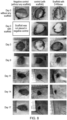
- 2dDR loaded CS/collagen hydrogels were firmly attached to the wound bed of full thickness excisional wounds (20mm) in rats by day 3 and wounds treated with 2dDR, were completely closed by day 17 with clear hair growth while control wounds remained open with no evidence of epithelial tissue or hair growth.
- the histology of the wound beds of all animals sacrificed at day 17, showed complete healing in the case of 2dDR treated wounds with well-developed hair follicles and the presence of new blood vessels in the healed wounds was confirmed with CD34 staining [ M. Yar, L. Shahzadi, M. Azra, M.I. Raheem, S. Roman, A.A. Chaudhry, I.
- Carbohydrates can have D- and L- enantiomeric configurations which are determined by the configuration of the chiral carbon that is furthest from the anomeric carbon.
- the hydroxyl group bonded to the chiral carbon may be positioned to either the left or right of the carbon. If the hydroxyl is to the right of the chiral carbon then the carbohydrate is annotated as a D-carbohydrate whereas if the hydroxyl group is to the left of the chiral carbon the carbohydrate is annotated as an L-carbohydrate.
- the following example illustrates the configurations of the D- and L-enantiomeric forms of glucose:
- the D-enantiomers of carbohydrates are the most prevalent form found to occur in nature and many can be isolated from natural sources. In contrast, non-naturally occurring L-enantiomers of carbohydrates can be expensive to manufacture by chemical or enzymatic synthesis. However, L-enantiomers of some carbohydrates are also known to occur in nature.
- D-ribose (chemical formula C 5 H 10 O 5 ): linearised form of D-ribose Phosphorylated forms of D-ribose are involved in amino acid synthesis, used in the pentose phosphate pathway and are constituents of ribonucleic acid (RNA).
- D-ribose can also be de-hydroxylated, for example at the 2', 3', 4' or 5' position.
- a de-hydroxylated ribose is 2-D-deoxyribose wherein the hydroxyl group at the 2' position replaced with a Hydrogen atom.
- This sugar is a constituent of deoxyribonucleic acid (DNA).
- Deoxy-D-ribose exists predominantly as a cyclic form in solution rather than in a linearised form: Linearised form of 2-D-deoxyribose Cyclic forms of 2-D-deoxyribose D-enantiomers of deoxy ribose find particular use in the invention.
- Deoxy sugars are sugars that have a hydroxyl group replaced with a hydrogen atom.
- Examples of deoxy sugars include L-2 deoxyribose, L-fucose (equivalent to 6-deoxy-L-galactose) and L-rhamnose (equivalent to 6-deoxy-L-mannose),
- L-enantiomers of deoxy sugars find particular use in the disclosure, but are not claimed.
- Oestradiol (E2) has an important role in neovascularisation during the menstrual cycle [ D.W. Losordo, J.M. Isner, Estrogen and Angiogenesis: A Review, Arterioscler 30 Thromb Vasc Biol. 21 (2001) 6-12. doi:10.1161/01.ATV.21.1.6 , Y. Matsubara, K. Matsubara, Estrogen and progesterone play pivotal roles in endothelial progenitor cell proliferation, Reprod Biol Endocrinol. 10 (2012) 2 .
- E2 was previously reported as angiogenic both in vitro and in vivo by many groups as well 15 as our research group.
- Albrecht et al. suggested that E2 promotes angiogenesis through upregulation of VEGF. They reported rapidly increased VEGF expression and cell permeability by E2 administration to ovariectomized baboons [ E.D. Albrecht, J.S. Babischkin, Y. Lidor, L.D. Anderson, L.C. Udoff, G.J. Pepe, Effect 15 of estrogen on angiogenesis in co-cultures of human endometrial cells and microvascular endothelial cells., Hum Reprod. 18 (2003) 2039-2047. doi:10.1093/humrep/deg415 ].
- MacNeil Demonstration of improved tissue integration and angiogenesis with an elastic, estradiol releasing polyurethane material designed for use in pelvic floor repair, Neurourol Urodyn. (n.d.) n/a-n/a. doi:10.1002/nau.23510 ]) fibres with both electrospun scaffolds showing good pro angiogenic activity in the CAM assay.
- wound healing is to be understood as restoring a break in the continuity of skin tissue and includes disorders characterized by any disease, disorder, syndrome, anomaly, pathology, or abnormal condition of the skin (dermis and epidermis) and/or underlying connective tissue.
- wounds may comprise minor cuts or abrasions; partial thickness wounds; complicated/full thickness wounds; traumatic wounds such as e.g.
- abrasions, lacerations surgical wounds; post-surgical incisions; chronic/non-healing wounds like pressure sores or non-healing diabetic foot wound; ulcers, in particular a venous ulcer, a decubitus, a skin ulcer derived from infection, a pressure ulcer or a diabetic ulcer; injuries to connective tissue like bone or cartilage; chemical or thermal burn injuries, in particular a third degree burn; an accidental wound; a necrotic wound like ischemic necrosis; an infected wound; a donor site of full thickness and split thickness skin graft; a bedsore; diabetes-induced and age-induced difficulty of skin surface wound healing and scars such as e.g.
- the wound may be an open wound or a closed wound.
- a 'closed' wound as used herein means a wound that was open at one point (e.g. a surgical incision or an accidental cut) and that has been purposefully closed by means of a suture, staple, surgical adhesive and the like.
- full thickness wound refers to disruption of the dermis, tissue and disruption to the dermal blood vessels.
- partial thickness wound refers to disruption of the dermal tissue only.
- D-deoxyribose or E2 (not claimed) is for use on extensive full thickness wounds due to burns injuries.
- wound healing can be achieved by administration to a subject any suitable dosage regimen, procedure and/or administration route of a composition comprising a D-deoxyribose sugar or E2 (not claimed) to a wound bed.
- wound bed refers to the exposed surface on the body when a break in the continuity of the skin tissue has occurred.
- Restoration of a wound can mean full healing or substantially full healing of the wound wherein the wounded tissue is restored to substantially the same state prior to wounding.
- restoration of a wound can mean partial healing of the wound.
- restoration of a wound may include the reduction of formation of fibrous scar tissue. Wound healing may be for use in therapeutic or non-therapeutic [cosmetic] purposes.
- induce refers to the action of generating, promoting, forming, regulating or activating a particular phenomenon.
- increase refers to the action of accelerating or enhancing a particular phenomenon.
- D-deoxyribose or E2 may also be used to increase or induce angiogenesis in a wound bed.
- D-deoxyribose or E2 may be used to increase or induce vascularisation in a wound bed.
- vascularisation includes de novo formation, growth, development or proliferation of blood vessels derived from undifferentiated or under-differentiated cells.
- blood vessels may form by the de novo production of endothelial cells.
- angiogenesis refers to the formation of new vasculature (e.g., blood vessels; e.g., veins, arteries, venules, arterioles, capillaries) from pre-existing vasculature.
- angiogenesis can occur by sprouting of new vessels from an existing vessel (sprouting angiogenesis), and/or by branching of a vessel (intussusceptive angiogenesis).
- D-deoxyribose may induce chemical stimulation of angiogenesis via induction and/or stimulation and/or production of VEGF.
- VEGF is a known chemical stimulator of angiogenesis.
- D-deoxyribose or E2 may be used in the treatment of hair loss.
- D-deoxyribose or E2 can be used to increase or induce hair re-growth.
- D-deoxyribose or E2 may also be used to slow, prevent or minimise hair loss. It is contemplated that for this purpose D-deoxyribose may have both therapeutic and non-therapeutic [cosmetic] uses.
- D-deoxyribose or E2 may be used to treat alopecia.
- alopecia is a generic term which encompasses all forms of medical hair loss. Alopecia may be due to follicle absence, destruction (which may be scarring), disease, infection, shrinkage, disregulation (hair cycle alterations), or complete shut-down/dormancy. These changes can be temporary or permanent, partial, regional and/or apparently total.
- alopecia examples of specific types of alopecia that are encompassed by the use of the term alopecia are selected from the group consisting of: androgenic alopecia; alopecia areata; alopecia totalis; alopecia univeralis; telogen effluvium; anagen effluvium; traumatic alopecia, mechanical traction alopecia' from hairstyling routines; chemical-induced alopecia; heatinduced alopecia; radiation-induced alopecia; chemotherapy-induced alopecia; scarring alopecia; auto-immune disease induced alopecia (e.g.
- alopecia e.g. from discoid lupus erythematosus or chronic cutaneous lupus erythematosus
- disease-related alopecia e.g. from hyperthyroidism or hypothyroidism, iron deficiency
- medication-induced alopecia e.g. alopecia induced by antibiotics and antifungal drugs; antidepressants, anticonvulsants; anticoagulants such as heparin and some LMWH; NSAIDs such as aspirin; anti-hypertensives, hormone replacement therapy
- syphilitic alopecia e.g. alopecia induced by antibiotics and antifungal drugs
- antidepressants, anticonvulsants e.g. alopecia induced by antibiotics and antifungal drugs
- anticoagulants such as heparin and some LMWH
- NSAIDs such as aspirin
- anti-hypertensives, hormone replacement therapy syphil
- hypopituitarism e.g. Simmonds' disease and Sheehan's syndrome
- other endocrinopathies e.g. hypothyroidism, diabetes mellitus, adrenal dyperplasia
- chronic disease e.g. lupus erythematosus, neoplasma
- monilethrix e.g. lupus erythematosus, neoplasma
- pseudomilethrix hereditary hypotrichosis simplex of the scalp
- congenital triangular temporal alopecia alopecia of the cranial sutures - Hallermann Streiff's syndrome
- hereditary cicatrical alopecia e.g.
- hypotrichosis which is defined as a decrease in the production of hair.
- a composition comprising a D-deoxyribose sugar or E2 may be applied to an isolated hair follicle.
- hair follicle refers to a tube-like structure originating from the epidermis where a hair fibre may develop.
- a hair follicle typically comprises the following structures: papilla, matrix, root sheath, sebaceous gland and optionally hair fibre (which comprises of a hair shaft and a hair root).
- the hair fibre may be of decreased diameter or not present at all, depending on the extent of alopecia or depending on the extent and stage of the formed follicle development.
- D-deoxyribose or E2 can be provided with a carrier.
- the carrier is preferably selected from a gel, more preferably a hydrogel, or a biocompatible matrix material, preferably an electrospun scaffold, a particle, a wound dressing or a swab that is impregnated with a solution containing D-deoxyribose or E2 (not claimed).
- Carriers may consist of amorphous materials having no defined surfaces and lacking a specific shape or solid matrices.
- a carrier releasing D-deoxy ribose or E2 could act as a substitute for a dermis as it will stimulate new blood vessel ingrowth and provide a vascularised wound bed for subsequent grafting with a thin skin graft or cultured autologous keratinocytes to provide a permanent skin barrier layer.
- the carrier may further comprise a substance that acts as an antimicrobial, for example silver or cerium.
- These carriers may be suitable for sustained release of D-deoxyribose or E2 (not claimed) into the wound.
- Preparations of D-deoxyribose or E2 (not claimed) with a carrier are especially suitable for topical administration.
- D-deoxyribose or E2 can be formulated with or coupled to a biocompatible matrix material.
- Matrix material as used herein means a carrier or a scaffold for cell recruitment, attachment, proliferation and differentiation and a potential delivery and storage device for D-deoxyribose or E2 (not claimed).
- Biocompatible matrix materials are well known in the art.
- Biocompatible matrices preferably support wound healing and/or increase or induce angiogeneisis or vascularisation in a wound bed.
- biocompatible matrix materials may comprise a polymeric material.
- the polymeric material may comprise a homopolymer or a heteropolymer/copolymer of two or more different polymeric substances, or a combination of the two.
- polymer refers to a macromolecule formed by the chemical bonding of five or more identical combining units called monomers e.g. sugars.
- Polymers may be naturally derived [e.g., polysaccharides, such as starch, cellulose, pectin, seaweed gums, vegetable gums; polypeptides, such as casein, albumin, globulin, keratin, insulin, DNA; and hydrocarbons], synthetic [such as thermoplastics (unvulcanized elastomers, nylon, polyvinyl chloride, poly (vinylidene fluoride trifluoroethylene) linear polyethylene, polystyrene, polypropylene, polyurethane, acrylate resins); thermosetting (e.g., vulcanized elastomers, crosslinked polyethylene, phenolics, alkyds, polyesters), and semisynthetic (e.g., cellulosics, such as rayon, methylcellulose, cellulose acetate; and modified starches)].
- polysaccharides such as starch, cellulose, pectin, seaweed gums, vegetable gums
- polypeptides such as
- homopolymer refers to a natural or synthetic polymer derived from a single monomer.
- heteropolymer refers to a natural or synthetic polymer derived from more than one monomer subunit (i.e., co-polymer). Unless otherwise indicated, the term “polymer” is used generally to refer to both homopolymers and heteropolymers (i.e., copolymer) as described herein.
- biocompatible material or “biocompatible matrix material” means that the material does not stimulate a response or stimulates only a mild and/or transient response, as opposed to a severe or escalating response when the matrix material is placed or implanted at the desired wound bed.
- Biocompatible matrix materials may include for example, synthetic or naturally occurring matrices such as collagen, acellular matrix, crosslinked biological scaffold molecules, tissue based bioengineered structural framework, biomanufactured bioprostheses, and other implanted structures such as for example, vascular grafts suitable for cell infiltration and proliferation useful in the promotion of wound healing. Additional suitable biocompatible matrix materials may include chemically modified collagenous tissue to reduce antigenicity and immunogenicity. Other suitable examples include collagen sheets for wound dressings, antigen-free or antigen reduced acellular matrix ( Wilson G J et al. (1990) Trans Am Soc Artif Intern 36:340-343 ) or other biocompatible matrices which have been engineered to reduce the antigenic response to the xenograft material.
- synthetic or naturally occurring matrices such as collagen, acellular matrix, crosslinked biological scaffold molecules, tissue based bioengineered structural framework, biomanufactured bioprostheses, and other implanted structures such as for example, vascular grafts suitable for cell
- matrices useful in promotion of wound healing may include for example, processed bovine pericardium proteins comprising insoluble collagen and elastin ( Courtman DW et al. (1994) J Biomed Mater Res 28:655-666 ) and other acellular tissue which may be useful for providing a natural microenvironment for host cell migration to accelerate tissue regeneration ( Malone J M et al. (1984) J Vasc Surg 1:181-91 ).
- the biocompatible matrix material can be formed by electrospinning to form a scaffold.
- the process of electrospinning involves application of a high voltage to an ejectable polymer solution to synthesise polymeric matrix materials.
- the high voltage applied is sufficient to overcome the surface tension of a polymeric solution such that it causes the polymer droplets to elongate thereby becoming fine fibres that form a non-woven matrix, mat or mesh with a random orientation.
- Electrospinning typically yields non-woven (i.e., mesh) matrices (also referred to as mats and/or scaffolds) with fibre diameters in the hundreds of nanometres range with interrelated pores.
- the electrospinning process typically leads to the formation of a smooth surface that is substantially free of any beaded fibres.
- the matrix fibres may comprise a non-woven mesh of random and/or aligned nanofibers or a combination thereof.
- the nanofibres will typically increase in diameter.
- the loaded fibres may have a diameter of from about 0.2 microns to about 5.0 microns.
- the electrospun nanofibers may comprise polycaprolactone.
- polycaprolactone is biodegradable.
- other biodegradable polymer(s) may be used instead of polycaprolactone.
- suitable biodegradable polymers include polylactic acid (PLA), polyglycolide (PGA), poly(lactic-coglycolic acid) (PLGA) and poly(3-hydroxybutyrate-co-3-hydroxyvalerate) PHBV.
- the term a "biodegradable" material is one which is able to decompose under normal in vivo physiological conditions over a finite period into components which can be metabolized or excreted and have no harmful effects when decomposing in vivo.
- the carrier may be a hydrogel.
- Hydrogels comprise a network of hydrophilic functional groups attached to natural or synthetic polymeric backbone chains. They may comprise a colloidal gel with an aqueous dispersion medium. The protrusion of the hydrophilic functional groups from the polymeric chains makes hydrogels highly absorbent (some can contain over 99.9% water). The high liquid content of hydrogels allows the hydrogels to have a degree of flexibility comparable to natural tissue.
- hydrogels also allows for hydrogels to act as a reservoir for topical drug delivery.
- the hydrogel may be a cross-linked hydrogel. Cross-linking of the hydrogel can prevent dissolution. Cross-linking may be achieved by reacting with suitable cross-linking agents.
- Suitable hydrogels may include for example, three-dimensional networks of cross-linked hydrophilic polymers that are insoluble in water and interact with aqueous solutions by swelling. Exemplary hydrogels are highly conformable and permeable and can absorb varying amounts of aqueous solution, depending on their composition. Suitably, the hydrogel may be non-adhesive against the treatment site or treated for easy removal.
- a hydrogel may preferably comprise at least one of chitosan, gelatin, alginate, agarose, methylcellulose, collagen, hyaluronan or any combination thereof.
- the hydrogel may comprise chitosan and collagen.
- organo-chemical hydrogels may comprise polyvinyl alcohol, sodium polyacrylate, acrylate polymers and copolymers with an abundance of hydrophilic groups.
- the carrier comprises ascorbic acid or a derivative thereof such as, for example, L-ascorbic acid or acscorbate-2-phosphate ( Mangir et al Acta Biomater. 2016 Jan 1; 29: 188-197.doi: 10.1016/i.actbio.2015.10.019 )
- wound dressing refers to a dressing for topical application to a wound and excludes compositions suitable for systemic administration.
- the D-deoxyribose sugar or E2 may be dispersed in or on a solid sheet of wound contacting material such as a woven or nonwoven textile material, or may be dispersed in a layer of foam such as polyurethane foam, or in a hydrogel such as a polychitosan hydrogel, a polyvinyl alcohol, a polyacrylate hydrogel, gelatin, methyl cellulose, agarose, alginate, hyaluronic acid hydrogel or any combination thereof for example in a gel or ointment.
- the D-deoxyribose sugar or E2 may be dispersed in or on a solid sheet of wound contacting material such as a woven or nonwoven textile material, or may be dispersed in a layer of foam such as polyurethane foam, or in a hydrogel such as a polychitosan hydrogel, a polyviny
- E2 (not claimed) is dispersed in or on a biodegradable sheet material that provides sustained release of the active ingredients into the wound, for example a sheet of freeze-dried chitosan/polyvinyl alcohol mixture.
- D-deoxyribose or E2 may be provided in the form of a liquid, semi solid or solid composition for application directly, or the composition is applied to the surface of, or incorporated into, a solid contacting layer such as a wound dressing, hydrogel, scaffold or matrix.
- the dressing composition may be provided for example, in the form of a fluid or a gel.
- Suitable amorphous hydrogel dressings may include, for example, formulations of water, polymers and other ingredients with no shape, designed to donate moisture and to maintain a moist healing environments and or to rehydrate the wound site.
- the hydrogels may be used in combination with a secondary dressing cover.
- Hydrogel dressings may include, for example, gauzes and non-woven sponges, ropes and strips saturated with an amorphous hydrogel.
- Suitable impregnated dressings may include, for example, gauzes and non-woven sponges, ropes and strips saturated with a solution, an emulsion, oil, gel or some other pharmaceutically active compound or carrier agent, including for example, saline, oil, zinc salts, petrolatum, xeroform and scarlet red as well as the compounds described herein.
- Suitable silicone gel sheet dressings may include, for example, soft covers composed of crosslinked polymers reinforced with or bonded to mesh or fabric.
- Suitable liquid dressings may include, for example, mixtures of multiprotein material and other elements found in the extracellular matrix.
- the solutions may be applied to the treatment site after debridement and cleansing and then covered with an absorbent dressing or a non-adherent pad.
- Suitable transparent film dressings may include polymer membranes of varying thickness coated on one side with an adhesive.
- the transparent films may be impermeable to liquid, water and bacteria but permeable to moisture vapor and atmospheric gases. The transparency of the film may allow visualization of the treatment site.
- Suitable filler dressings may include, for example, beads, creams, foams, gels, ointments, pads, pastes, pillows, powders, strands or other formulations.
- the fillers may be non-adherent and may include a time-released antimicrobial.
- Exemplary fillers may be useful to maintain a moist environment, manage exudate, and for treatment of for example, partial- and full-thickness wounds, infected wounds, draining wounds and deep wounds that require packing.
- the D-deoxyribose or E2 may be provided in combination with conventional pharmaceutical excipients for topical application.
- suitable pharmaceutical carriers include: pluronic gels, polaxamer gels, hydrogels containing cellulose derivatives, including hydroxyethyl cellulose, hydroxymethyl cellulose, carboxymethyl cellulose, hydroxypropylmethyl cellulose and mixtures thereof, and hydrogels containing polyacrylic acid (Carbopols).
- suitable carriers also include creams/ointments used for topical pharmaceutical preparations, e.g., creams based on cetomacrogol emulsifying ointment.
- the above carriers may include alginate (as a thickener or stimulant), preservatives such as benzyl alcohol, buffers to control pH such as disodium hydrogen phosphate/sodium dihydrogen phosphate, agents to adjust osmolarity such as sodium chloride, and stabilizers such as EDTA.
- compositions for topical administration. Also encompassed are compositions comprising incorporation of D-deoxyribose or E2 (not claimed) into liposomes, microemulsions, micelles, microparticles or vesicles for controlled delivery over an extended period of time to a wound bed.
- the pharmaceutical composition may comprise D-deoxyribose or E2 (not claimed) formulated with or coupled to a biocompatible matrix, preferably comprising collagen, gelatin, chitosan and/or hyaluronan, as described above.
- the pharmaceutical composition may also comprise a hydrogel with D-deoxyribose or E2 (not claimed) as described above.
- the pharmaceutical composition may comprise an antimicrobial agent, such as silver or cerium.
- the present invention provides the pharmaceutical composition for use as a medicament.
- Particular uses are in wound healing and/or the stimulation of angiogenesis as described above.
- Alternative uses are for treatment of alopecia and other associated disorders as described above.
- a further alternative is for the cosmetic treatment of hair loss.
- Topical administration means administration to a definite surface, e.g. directly to the wound surface, or if the wound has been closed, to the area around or within the closure.
- subject refers to vertebrates. Subject preferably refers to a mammalian animal, including a human, a veterinary or farm animal, a domestic animal or pet, and animals normally used for clinical research, including non-human primates, dogs, rats and mice. More specifically, the subject of the present invention may be a human.
- Polycaprolactone (Mw: 45,000), L-rhamnose and NaOH were purchased from Sigma-Aldrich (USA).
- Chitosan (CS) was purchased from Mian Scientific Company, Lahore, Pakistan and further purified in our laboratories (degree of deacetylation (DD) 84%; Mw: 87047.26 g/mol) ( Farooq et al., Materials Science and Engineering: C. 2015 ).
- Collagen was purchased from Mian Scientific suppliers Lahore.
- Poly(vinyl alcohol) (PVA) (Mw: 72,000, degree of hydrolysis 98%), hydrochloric acid (HCl) and sulfuric acid (H 2 SO 4 ) were purchased from Merck (Germany).
- Triethyl orthoformate (98%) was purchased from Alfa Aesar (Germany). Glacial acetic acid (CH 3 COOH) was purchased from AnalaR BDH Laboratory Supplies (UK). Ethanol (99.8%) was purchased from Sigma-Aldrich (Germany.) 2-deoxy-D-ribose, D-fucose and L-fucose were purchased from Sigma-Aldrich China, UK and Slovakia, respectively. 2-deoxy-L-ribose and D-rhamnose were products of Carbosynth (UK). Brain Heart Infusion broth and Tryptone soy broth (1% w/v) were purchased from Oxoid Ltd. Phenol red was purchased from Sigma-Aldrich UK.
- PCL (10 wt%) was dissolved in 5 ml DMF/DCM (4:1, 10% w/v) and 2-deoxy-D-ribose (1.8 wt%) was dissolved into DMF (0.5 mL). Both solutions were combined and left on a rocking station overnight to produce a homogenous solution at room temperature. The following day, this solution was electrospun using 4 ⁇ 5mL syringes. These were placed horizontally on a programmable syringe pump (Kent Scientific, USA) and discharged at a rate of 40 ⁇ L/min. The syringes were supplied with 17 kV using a high voltage power supply (Genvolt, UK).
- the fibrous scaffold was collected on a rotating drum 16 cmx6 cm in diameter at a distance of 17 cm from the needle tips. This drum rotated at 300 rpm, resulting in an 18 ⁇ 16 cm mat. Scaffolds were produced at a room temperature of around 20°C.
- CS acetic acid
- PVA % w/v
- distilled water 80°C under magnetic stirring.
- the two solutions were mixed in 80:20 ratios of CS and PVA, respectively, and further stirred for 24 hours.
- the solution was then cast into separate petri dishes and the dishes were frozen at -80°C for 24 hours.
- the samples were lyophilized for 24 hours in a freeze dryer at -40°C.
- lyophilized hydrogels were rehydrated and soaked in different concentrations of TEOF (i.e.
- CS and collagen were dissolved in acetic acid (0.5M, 20mL) and stirred at room temperature until completely dissolved and a clear solution was obtained.
- triethyl orthoformate 4% v/v, 0.8mL was added as cross-linker and the solution was further stirred overnight for better homogeneity and cross-linking of materials.
- the mixture was then poured into a petri dish and frozen at -20°C overnight.
- the frozen membranes were then immersed in a pre-cooled ethanolic solution of sodium hydroxide (3M) and again placed at -20°C for 24 hours. After that, the frozen membranes were washed in 50% (v/v) ethanol solution and then with distilled water to remove the sodium hydroxide.
- the membranes were finally washed twice in absolute ethanol for 15 minutes and dried at room temperature to obtain porous scaffolds.
- FT-IR infrared
- the surface morphology of the composite matrices was examined under SEM, Model JEOL JSM 6480.
- the samples were gold sputtered coated prior to examination at a range of magnifications.
- hydrogels were soaked in an aqueous solution of 2-deoxy-D-ribose (1 mg/ml) at 37°C until all the liquid had been absorbed by the hydrogels. Following storage at - 20°C overnight, hydrogels were dried in a lyophilizer (Christ, Alpha 1-2 LD plus, Germany) at -40°C before further characterization.
- Fertilized chicken ( Gallus domesticus ) eggs were purchased from Big Bird (Raiwind road, Lahore, Pakistan) and incubated at 37°C from day 2 of fertilization until day 8 in a humidified egg incubator (HHD, 435, China). At day 8, a square window (1 cm 2 ) was cut into the shell and removed, and a 2 cm 2 piece of the electrospun scaffold or hydrogels (16% PCL electrospun scaffold/ CS/PVA hydrogel/ CS/collagen hydrogels) placed onto the CAM. Each egg was implanted with one scaffold or hydrogel only.
- the shell window was closed with parafilm (Bemis Flexible Packaging, USA) and sealed with adhesive tape.
- eggs were placed again at 37°C in a 40% humidified incubator until day 14.
- biomaterials were retrieved and the eggs were sacrificed.
- Angiogenesis was quantified by taking light microscope pictures just before scaffold retrieval and then blindly scored by four assessors using histological images of the retrieved materials. The number of implanted and survived eggs is given in the caption of respective CAM assay figures.
- Surgical dressings were removed after three days of membrane implantation. On days 0, 3, 9, 11, 14 and 17 post-wounding, the wounds were measured and photographed. The wound areas were quantified using Image j software.
- rats were euthanized with an overdose of anaesthesia and tissue sections from implantation sites of normal, sham, control and 2-deoxy-D-ribose -loaded scaffold treated groups were removed.
- the samples were fixed in 3.7% paraformaldehyde (Sigma-Aldrich, USA) solution for 24 hours at room temperature. They were dehydrated using various concentrations of ethanol and water from 70% to 100% and paraffin blocks were made.
- Sections of 6 ⁇ m thick were cut from the paraffin embedded samples with a microtome (Leica TP 1020 Automatic Tissue Processor) and placed on Superfrost ® plus slides (Menzel-Gläser, Denmark).
- Conventional Haematoxylin and Eosin (H&E) staining and Gouldner's trichrome staining was performed ( Yar et al., International Journal of Polymeric Materials and Polymeric Biomaterials. 2016 ) before mounting in DPX mounting medium (Fisher Scientific) with a coverslip.
- S . aureus strains Five bacterial strains were employed in the study; four strains of Staphylococcus aureus and one strain of Pseudomonas aeruginosa.
- the S . aureus strains were S235 -a recent clinical isolate that was used in development of a bacterial infected skin model reported from this laboratory previously ( Shepherd J et al., Tissue Engineering Part C: Methods. 2009 ).
- Bacteria were grown in Brain Heart Infusion broth for 16h at 37 °C. Aliquots (100 ml) of Tryptone Soy broth (1% w/v) supplemented with phenol red (0.02% w/v; Sigma-Aldrich UK) and appropriate sugars (1% final conc.) were added to sterile 96 well plates. 5 ⁇ of the overnight broth cultures of each bacterial strain was then added to wells and incubated for 16h at 37 °C. The ability of each strain to ferment each sugar was judged by the production of acid and change of the phenol red pH indicator.
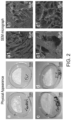
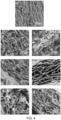
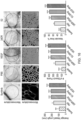
- 2-deoxy-D-ribose was encapsulated into electrospun nanofibers and DMF in DCM was used as the solvent for electrospinning. Electrospinning produced a sheet of sugar-loaded soft fibrous material ( Figure 1 ). The average diameter of the PCL fibres without sugar was 224 nm ⁇ 82 nm, whereas the average diameter of the 2-deoxy-D-ribose loaded fibers was significantly increased to 323 nm ⁇ 25 nm (average diameter of 40 random fibers) ( p ⁇ 0.05). However, both types of fibres were randomly oriented with interrelated pores and their surfaces were smooth and free of any beads. After sugar loading, the colour of the membrane was light blue.
- the hydrogels Prior to cross-linking the hydrogels had a layered structure rather than interconnected pores.
- the average pore size was 103 ⁇ m ⁇ 52 ⁇ m. After cross-linking the pore size was significantly reduced ( p ⁇ 0.05). Addition of sugar in the absence of cross-linking changed the layered structure to distorted pores. With the introduction of both cross-linking and sugars the average pore size was significantly reduced to 68 ⁇ m ⁇ 31 ⁇ m ( p ⁇ 0.05). These new interconnected pores had a more uniform morphology and the pores were well-distributed throughout the hydrogel matrix.
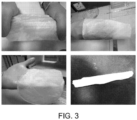
- Chitosan and collagen were crosslinked by using triethylorthoformate and then loaded with 2-deoxy-D-ribose by soaking in the aqueous sugar solution (1mg/ml).
- the membranes were strong and exhibited excellent flexibility, stretching and handling properties.
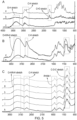
- FTIR spectroscopy was used to look at the interactions between the sugar and the microfibers of PCL.
- Figure 5A shows that the major peak for D-ribose seen at around 3400 cm -1 was detected in the PCL fibers when this sugar was added to the polymer prior to spinning.
- a major absorbance band was observed at 1720 cm -1 corresponding to the carbonyl ester of PCL.
- the peaks of alkyl groups, both in D-sugar and PCL, showed absorbance peaks between 2700-2900 cm -1 .
- the spectrum of D-sugar-loaded PCL fibers also shows that the sugar was distributed homogeneously in the electrospinning mixture.
- the CS/PVA hydrogels without ( Figure 5d ) and with ( Figure 5e ) cross-linker, contain the characteristic peaks of chitosan and PVA ( Figure 5B ).
- the peaks near 2900 cm -1 were assigned to C-H stretching vibrations ( Islam et al., Carbohydrate Polymers. 2012 ).
- a peak at 1530 cm -1 was assigned to O-H bending vibrations of PVA ( Li et al., Polymer. 2000 ).
- the bands which appeared near 1400 cm -1 were due to C-H bending vibrations.
- the peaks at 1099 cm -1 were due to C-O-C stretching vibrations.
- Figure 5C shows the cross-linked CS/collagen spectra loaded with different sugars.
- the spectra show all the characteristic peaks of CS and collagen.
- a broad absorption band from 3200-3500 cm-1 was mainly due to O-H/N-H stretch vibrations.
- the broadness of the band was due to the intermolecular hydrogen bonding. Peaks between 2600-2800 cm -1 appeared because of C-H stretching vibrations. Amide I peaks appeared at 1650 cm-1.
- the ether linkage C-O-C and C-O stretching vibrations were also shifted to 1147 cm -1 and 1053 cm -1 .
- the sugar loading did not affect the FTIR peaks of hydrogels probably due to very low concentration of sugars in the polymer matrix.
- the CAM assay was used to investigate the angiogenic potential of the synthesized materials.
- 2-deoxy-D-ribose-loaded fibers we observed the growth of extensive new blood vessels under the material (see Figure 6A (b) . This confirms the chemoattractant and angiogenic potential of the 2-deoxy-D-ribose-loaded materials.
- 2-deoxy-D-ribose was loaded into the chitosan/PVA triethyl orthoformate cross-linked hydrogels by soaking in an aqueous solution of D-deoxysugar. After drying in a lyophilizer the hydrogels were grafted into the fertilized eggs at day 8 and at day 14 the eggs were sacrificed. It was observed that the 2-deoxy-D-ribose-loaded scaffolds promoted angiogenesis as judged by observing more new blood vessels compared to the control material ( Fig 6A ) .
- D and L isomers of three -deoxysugars (ribose, fucose and rhamnose) were loaded onto the porous freeze gelated triethyl orthoformate (4%) covalently cross-linked chitosan/collagen (1:1) hydrogels.
- the hydrogels were soaked in an aqueous solution of sugars (1mg/ml) and were further lyophilized (freeze dried) to produce porous membranes.
- the hydrogels were grafted into the fertilized eggs at day 8 and after day 14 the eggs were sacrificed and the effect of sugars on angiogenesis was investigated.
- Sham wound without any treatment
- control the wounds treated with chitosan and collagen scaffold
- D-dexoyribose the wounds treated with scaffold loaded with 2-deoxy-D-ribose
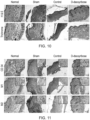
- wound healing in the group treated with 2-deoxy-D-ribose was essentially complete and the structure of the explanted tissue was similar to normal skin as demonstrated by hematoxylin and eosin (H&E) staining ( Figure 10 ).
- Goldren's Trichrome stains in blue/green collagen while muscle, epithelium, hair follicles and blood vessels are stained in red.
- the rest looks very similar to the D-deoxyribose treated group with an epithelium and hair follicles already formed.
- sham and control groups still showed disorganized granulation wound tissue by 17 days ( Figure 10 ).
- Macrophages expressing an M1 response markers are associated with implant rejection and activation of a chronic inflammatory response, while the M2 response markers are expressed by macrophages with an inflammatory response associated with constructive remodeling ( Badylak et al., Tissue Engineering Part A. 2008 ).
- the six sugars under investigation were compared to glucose with respect to acting as substrates for bacterial metabolism.
- Four strains of S . aureus were investigated and one strain of Pseudomonas aeruginosa as representatives of common pathogens in wound infections. Results with all four S . aureus strains were identical in that all could use glucose as a substrate for fermentation but none of these strains were able to use L- or D-isomers of the three deoxy sugars under investigation.
- P . aeruginosa was, however, able to ferment all sugars except for the L isomers of deoxy-fucose and deoxy-rhamnose.
- the upper surface of the eggs were marked with a felt pen.
- the eggs were held horizontally (with the marked surface on top) and cracked on the edge of a 1000 ml glass beaker and kept close to the bottom surface of petri dishes.
- the embryos were then transferred gently into sterile petri dishes and kept in a humidified incubator (Binder, Tuttlingen, Germany) at 38°C.
- Plastic rings ( ⁇ 6.5 mm in diameter) were used as a reservoir for substances and a marker for the implantation area, were placed on the CAM, and the substances were applied as 20 ⁇ l volume onto the CAM twice a day to give a total volume of 40 ⁇ l between EDD7 and EDD11. Images of the rings were acquired using a digital microscope at EDD11, and then 20% lens culinaris agglutinin (LCA) (Vector Laboratories, Peterborough, UK) was injected into the circulation for labelling the intravascular endothelial cells using 30G needles under a dissection microscope (Wild Heerbrugg, Heerbrugg, Switzerland). CAMs were then removed and fixed in 3.7% formaldehyde solution.
- LCA lens culinaris agglutinin
- Embryos were sacrificed at the end of EDD11. Fixed CAM samples were then imaged under a confocal microscope (Zeiss LSM 510 Meta, Jena, Germany) for investigating the effect of substances on the microvascular structure of the CAMs.
- VA% The percentage vascular area (VA%) of the microvasculature of CAMs were quantified using confocal images of rhodamine labelled lectin injected CAM samples as shown in Figure 14B . To do this, images were imported to imaged (Wayne Rasband, National Institutes of Health, USA) and converted to binary images after filtering and smoothing processes prior to quantification. VA% was calculated using the histogram list of black and white areas in the image.
- VEGF165 stock solution was diluted to 2 ng/ ⁇ l (VEGF-80ng) concentrations.
- E2 was dissolved in methanol then working solutions were prepared with phosphate buffered saline (PBS) so as to be (a) 100 ng/day (E2-100ng), (b) 200 ng/day (E2-200ng), and (b) 600 ng/day (E2-600ng) concentrations.
- 2dDR solutions were prepared by dissolving in PBS so as the final concentrations to be (a) 20 ⁇ g/day (2dDR-20), (b) 200 ⁇ g/day (2dDR-200), and (c) 1000 ⁇ g/day (2dDR-1000).
- Sunitinib malate (Sunitinib) was dissolved in DMSO and diluted with PBS with a final concentration of 50 ng/ ⁇ l. Working solutions of all substances were prepared immediately before EDD7. Angiogenic efficiency of the different substance concentrations were evaluated by direct application of the substances to CAM (2 doses/day/embryo). Angiogenic activity was determined by quantifying the number of branch points and calculating the average blood vessel lengths.
- PHBV solution loaded was prepared prior to electrospinning. 1 g of PHBV granules (Goodfellow, London, UK) were dissolved in 1 g of methanol (Fisher Scientific, Massachusetts, USA) and 8 g of DCM (Fisher Scientific, Massachusetts, USA) in a fume hood. Four 10% PHBV solutions were prepared prior to addition of substances. Finally, 25 mg E2, 50 mg of E2, 250 mg of 2dDR and 500 mg of 2dDR were then added to each solution per 1g of PHBV. The mixtures were magnetically stirred overnight.
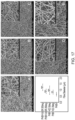
- the surface morphology of E2 and 2dDR releasing scaffolds were observed under SEM (Philips/FEI XL-20 SEM; Cambridge, UK).
- the samples were coated with gold using a gold sputter (Edwards sputter coater S150B, Crawley, England) prior to imaging. Fiber diameter and pore sizes were measured using imaged.
- Scaffolds were cut into 5.5 mm diameter circles using a laser cutting machine (Epilog Laser Cutter, Clevedon, UK) and sterilised under UV light for 1 hour prior to implantation.
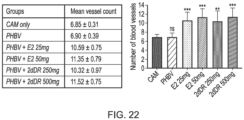
- Two circular scaffolds were placed on CAM at EDD8. Images of the scaffolds were acquired using a digital microscope at EDD12 and EDD14. Microinjection of rhodamine labelled lectin into the circulation was performed, CAMs were removed and fixed in 3.7% formaldehyde solution. Embryos were then sacrificed at the end of EDD14. Angiogenesis was quantified by counting all blood vessels that converged towards the graft.
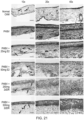
- Haematoxylin and Eosin (H&E) staining was performed on cell impregnated scaffolds by modifiying a standard protocol [47]. Briefly, fixed samples were embedded in optimal cutting temperature OCT and frozen in liquid nitrogen for 3 minutes. Sections were cut 8-10 ⁇ m thick using a cryostat (Leica Biosystems Nussloch, Germany) at -20°C. Sections were then stained with haematoxylin for 90 seconds and eosin for 5 minutes respectively. Finally H&E images were acquired under a light microscope (Motic DM-B1, Xiamen, China). The total number of blood vessels adjacent to the scaffolds were quantified by counting blood vessels in H&E sections [ A. Minajeva, M. Kase, M.
- UTS Ultimate tensile strength
- Wettability tests of drug releasing electrospun scaffolds were also undertaken using a drop shape analyser (Krüss DSA100, Germany) under ambient laboratory conditions in order to see the effect of E2 and 2dDR on wettability of the scaffolds.
- a 5 ⁇ l droplet was dropped onto the scaffold surface, and the retention times of the droplet on scaffolds before complete absorption were calculated from recorded movies of the tests. The retention time for a minimum of three drops on three different substrates was measured for each type of sample.
- the rate of release of E2 and 2dDR from scaffolds was assessed over 30 days as shown in Figure 18 .
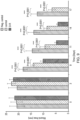
- 2dDR release from the scaffolds was 81.3% and 86.5% of the 2dDR present in the polymer solution for 250 mg and 500 mg 2dDR scaffolds, respectively ( Figure 18A ).
- the total E2 release from scaffolds within 7 days represented 1.3% and 1.6% of the initial E2 present in the polymer solution for 25 mg and 50 mg E2 scaffolds respectively ( Figure 18B ).
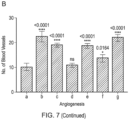
- the mean number of blood vessels adjacent to the scaffolds were significantly increased in response to all concentrations of both E2 and 2dDR releasing scaffolds when compared with controls and CAM only groups (see Figures 21 and 22 ).
Landscapes
- Health & Medical Sciences (AREA)
- Life Sciences & Earth Sciences (AREA)
- Chemical & Material Sciences (AREA)
- General Health & Medical Sciences (AREA)
- Veterinary Medicine (AREA)
- Public Health (AREA)
- Animal Behavior & Ethology (AREA)
- Epidemiology (AREA)
- Pharmacology & Pharmacy (AREA)
- Medicinal Chemistry (AREA)
- Inorganic Chemistry (AREA)
- Engineering & Computer Science (AREA)
- Bioinformatics & Cheminformatics (AREA)
- Proteomics, Peptides & Aminoacids (AREA)
- Dermatology (AREA)
- Birds (AREA)
- Materials Engineering (AREA)
- Molecular Biology (AREA)
- Chemical Kinetics & Catalysis (AREA)
- General Chemical & Material Sciences (AREA)
- Nuclear Medicine, Radiotherapy & Molecular Imaging (AREA)
- Organic Chemistry (AREA)
- Dispersion Chemistry (AREA)
- Materials For Medical Uses (AREA)
- Pharmaceuticals Containing Other Organic And Inorganic Compounds (AREA)
- Medicinal Preparation (AREA)
- Steroid Compounds (AREA)
- Medicines Containing Material From Animals Or Micro-Organisms (AREA)
- Saccharide Compounds (AREA)
Priority Applications (1)
| Application Number | Priority Date | Filing Date | Title |
|---|---|---|---|
| EP23176529.8A EP4233911A3 (en) | 2017-03-07 | 2018-03-07 | Wound healing medicament |
Applications Claiming Priority (2)
| Application Number | Priority Date | Filing Date | Title |
|---|---|---|---|
| GBGB1703656.7A GB201703656D0 (en) | 2017-03-07 | 2017-03-07 | Wound healing medicament |
| PCT/GB2018/050579 WO2018162900A1 (en) | 2017-03-07 | 2018-03-07 | Wound healing medicament |
Related Child Applications (1)
| Application Number | Title | Priority Date | Filing Date |
|---|---|---|---|
| EP23176529.8A Division EP4233911A3 (en) | 2017-03-07 | 2018-03-07 | Wound healing medicament |
Publications (3)
| Publication Number | Publication Date |
|---|---|
| EP3681509A1 EP3681509A1 (en) | 2020-07-22 |
| EP3681509C0 EP3681509C0 (en) | 2023-06-07 |
| EP3681509B1 true EP3681509B1 (en) | 2023-06-07 |
Family
ID=58543858
Family Applications (2)
| Application Number | Title | Priority Date | Filing Date |
|---|---|---|---|
| EP18711636.3A Active EP3681509B1 (en) | 2017-03-07 | 2018-03-07 | Wound healing medicament |
| EP23176529.8A Pending EP4233911A3 (en) | 2017-03-07 | 2018-03-07 | Wound healing medicament |
Family Applications After (1)
| Application Number | Title | Priority Date | Filing Date |
|---|---|---|---|
| EP23176529.8A Pending EP4233911A3 (en) | 2017-03-07 | 2018-03-07 | Wound healing medicament |
Country Status (9)
| Country | Link |
|---|---|
| US (3) | US20210154206A1 (enExample) |
| EP (2) | EP3681509B1 (enExample) |
| JP (3) | JP7710206B2 (enExample) |
| CN (1) | CN110612106A (enExample) |
| CA (1) | CA3055467A1 (enExample) |
| ES (1) | ES2955029T3 (enExample) |
| GB (1) | GB201703656D0 (enExample) |
| SG (1) | SG11201908060PA (enExample) |
| WO (1) | WO2018162900A1 (enExample) |
Families Citing this family (11)
| Publication number | Priority date | Publication date | Assignee | Title |
|---|---|---|---|---|
| US9884027B2 (en) | 2012-01-12 | 2018-02-06 | Nanofiber Solutions, Inc. | Nanofiber scaffolds for biological structures |
| GB201703656D0 (en) | 2017-03-07 | 2017-04-19 | Univ Sheffield | Wound healing medicament |
| EP3870125A4 (en) * | 2018-10-24 | 2022-08-03 | Somnio Global Holdings, LLC | FUNCTIONAL WOUND HEALING DRESSINGS |
| JP2022513442A (ja) | 2018-12-11 | 2022-02-08 | ナノファイバー ソリューションズ、エルエルシー | 電界紡糸繊維を使用した慢性創傷の治療方法 |
| CA3182868A1 (en) * | 2020-07-22 | 2022-01-27 | John K. Jackson | Blended polyvinyl alcohol drug delivery systems |
| WO2022076117A1 (en) * | 2020-09-08 | 2022-04-14 | Protein Genomics Inc. | Biomimetic wound healing devices and related methods of treating diabetic wounds |
| CN115770322A (zh) * | 2022-11-29 | 2023-03-10 | 江南大学 | 一种免疫调节水凝胶及其制备方法和应用 |
| CN115944774A (zh) * | 2022-12-04 | 2023-04-11 | 吉林大学 | 一种迷迭香酸-壳聚糖-聚乙烯醇水凝胶敷料及其制备方法和应用 |
| US20250288716A1 (en) * | 2022-12-30 | 2025-09-18 | Süleyman Demirel Üniversitesi Idari Ve Mali Isler Daire Baskanligi Genel Sekreterlik | Development of egg white based nanofiber treatment material |
| CN116459383B (zh) * | 2023-02-28 | 2024-07-19 | 兰州大学 | 一种用于促进糖尿病伤口愈合的铈基mof水凝胶及其制备方法和应用 |
| CN118831037B (zh) * | 2024-06-28 | 2025-02-25 | 广东适配生物科技有限公司 | 一种负载微球和纳米酶的多功能微针及其制备方法和应用 |
Family Cites Families (13)
| Publication number | Priority date | Publication date | Assignee | Title |
|---|---|---|---|---|
| IT1232318B (it) * | 1989-09-07 | 1992-01-28 | Crinos Industria Farmaco | Composizioni ad uso topico contenenti acidi nucleici depolimerizzati per la cosmesi della pelle e del corpo. |
| US5177065A (en) * | 1990-12-26 | 1993-01-05 | Silvetti Sr Anthony N | Monosaccharide containing wound healing preparation |
| US7090745B2 (en) * | 2002-09-13 | 2006-08-15 | University Of Pittsburgh | Method for increasing the strength of a cellulosic product |
| FR2854243A1 (fr) * | 2003-04-24 | 2004-10-29 | Oreal | Procede de determination d'etats pre-alopeciques et/ou d'atteintes cutanees au moyen d'un marqueur predictif: hif-1(hypoxia inducible factor-1) |
| EP1773240B1 (en) * | 2004-06-11 | 2019-11-20 | Trustees of the Tufts College | Silk-based drug delivery system |
| FR2879443B1 (fr) * | 2004-12-21 | 2007-07-13 | Jean Noel Thorel | Utilisation d'une base nutritive complexe dans le domaine cosmetique, en particulier capillaire |
| JPWO2007129618A1 (ja) * | 2006-05-08 | 2009-09-17 | 国立大学法人 香川大学 | 好中球の活性化および遊走因子の抑制剤およびその利用 |
| GB0813541D0 (en) * | 2008-07-24 | 2008-08-27 | Brightwake Ltd | Honey wound dressing |
| US20110104279A1 (en) * | 2009-11-04 | 2011-05-05 | Marraccini Philip A | Healing powder and method of use thereof |
| WO2011106599A1 (en) * | 2010-02-25 | 2011-09-01 | Alcon Research, Ltd. | Method of accelerating corneal wound healing |
| GB2509439A (en) * | 2011-10-28 | 2014-07-02 | Afexa Life Sciences Inc | Use of a ginseng extract to prevent and treat alopecia areata |
| WO2014165253A1 (en) * | 2013-03-12 | 2014-10-09 | Nbip, Llc | Compositions and methods for preventing infection of a wound and for advancing the healing process |
| GB201703656D0 (en) | 2017-03-07 | 2017-04-19 | Univ Sheffield | Wound healing medicament |
-
2017
- 2017-03-07 GB GBGB1703656.7A patent/GB201703656D0/en not_active Ceased
-
2018
- 2018-03-07 US US16/491,683 patent/US20210154206A1/en not_active Abandoned
- 2018-03-07 JP JP2019571114A patent/JP7710206B2/ja active Active
- 2018-03-07 ES ES18711636T patent/ES2955029T3/es active Active
- 2018-03-07 EP EP18711636.3A patent/EP3681509B1/en active Active
- 2018-03-07 CA CA3055467A patent/CA3055467A1/en not_active Abandoned
- 2018-03-07 SG SG11201908060PA patent/SG11201908060PA/en unknown
- 2018-03-07 EP EP23176529.8A patent/EP4233911A3/en active Pending
- 2018-03-07 WO PCT/GB2018/050579 patent/WO2018162900A1/en not_active Ceased
- 2018-03-07 CN CN201880028799.1A patent/CN110612106A/zh active Pending
-
2023
- 2023-03-17 JP JP2023043133A patent/JP2023078307A/ja active Pending
-
2024
- 2024-02-23 US US18/585,838 patent/US20250025474A1/en active Pending
- 2024-12-11 US US18/976,791 patent/US20250099486A1/en active Pending
-
2025
- 2025-08-22 JP JP2025138878A patent/JP2025172803A/ja active Pending
Also Published As
| Publication number | Publication date |
|---|---|
| EP4233911A2 (en) | 2023-08-30 |
| US20250099486A1 (en) | 2025-03-27 |
| BR112019018596A2 (pt) | 2020-04-07 |
| US20250025474A1 (en) | 2025-01-23 |
| EP3681509A1 (en) | 2020-07-22 |
| SG11201908060PA (en) | 2019-09-27 |
| JP2020510701A (ja) | 2020-04-09 |
| CA3055467A1 (en) | 2018-09-13 |
| GB201703656D0 (en) | 2017-04-19 |
| EP3681509C0 (en) | 2023-06-07 |
| US20210154206A1 (en) | 2021-05-27 |
| JP7710206B2 (ja) | 2025-07-18 |
| ES2955029T3 (es) | 2023-11-28 |
| JP2025172803A (ja) | 2025-11-26 |
| EP4233911A3 (en) | 2023-09-20 |
| JP2023078307A (ja) | 2023-06-06 |
| WO2018162900A1 (en) | 2018-09-13 |
| CN110612106A (zh) | 2019-12-24 |
Similar Documents
| Publication | Publication Date | Title |
|---|---|---|
| US20250099486A1 (en) | Wound healing medicament | |
| Wong et al. | Engineered pullulan–collagen composite dermal hydrogels improve early cutaneous wound healing | |
| Murphy et al. | Amnion membrane hydrogel and amnion membrane powder accelerate wound healing in a full thickness porcine skin wound model | |
| JP7486404B2 (ja) | 羊膜粉末ならびに創傷治癒および組織工学構築物におけるその使用 | |
| Mohanty et al. | A human epidermal growth factor-curcumin bandage bioconjugate loaded with mesenchymal stem cell for in vivo diabetic wound healing | |
| Sundaramurthi et al. | Electrospun nanostructured chitosan–poly (vinyl alcohol) scaffolds: a biomimetic extracellular matrix as dermal substitute | |
| Cruz‐Maya et al. | Highly polydisperse keratin rich nanofibers: Scaffold design and in vitro characterization | |
| Wu et al. | RETRACTED ARTICLE: Decellularized scaffolds containing hyaluronic acid and EGF for promoting the recovery of skin wounds | |
| Yar et al. | Deoxy-sugar releasing biodegradable hydrogels promote angiogenesis and stimulate wound healing | |
| Konop et al. | The role of allogenic keratin‐derived dressing in wound healing in a mouse model | |
| McGrath et al. | A biomimetic, bilayered antimicrobial collagen-based scaffold for enhanced healing of complex wound conditions | |
| Arasteh et al. | Efficient wound healing using a synthetic nanofibrous bilayer skin substitute in murine model | |
| Du et al. | Heparin-based sericin hydrogel–encapsulated basic fibroblast growth factor for in vitro and in vivo skin repair | |
| Bashiri et al. | RETRACTED: In-vitro and in-vivo evaluation of angiogenic potential of a novel lithium chloride loaded silk fibroin/alginate 3D porous scaffold with antibacterial activity, for promoting diabetic wound healing | |
| Safina et al. | Cell-Biomaterial constructs for wound healing and skin regeneration | |
| Shakya et al. | Bubaline cholecyst derived extracellular matrix for reconstruction of full thickness skin wounds in rats | |
| CN121013736A (zh) | 组合物及使用所述组合物的脂肪移植 | |
| Zhang et al. | Radiation cross-linked collagen/dextran dermal scaffolds: effects of dextran on cross-linking and degradation | |
| Saravanakumar et al. | l-Arginine-Loaded Oxidized Isabgol/Chitosan-Based Biomimetic Composite Scaffold Accelerates Collagen Synthesis, Vascularization, and Re-epithelialization during Wound Healing in Diabetic Rats | |
| BR112019018596B1 (pt) | Uso de um açúcar d-desoxirribose para promover a cicatrização de feridas, bem como material de matriz biocompatível, hidrogel e uso destes para promover a cicatrização de feridas e curativos para feridas | |
| Forouzandeh et al. | Bilayer Wound Dressing Composed of Allograft Collagen-Glycosaminoglycan and Silicone: Synthesis, Characterization and Biological Behavior | |
| JP4464056B2 (ja) | 発毛促進用複合材料 | |
| Bhattacharya et al. | Bioengineered Decellularized Extracellular Matrices in Diabetic Ulcer Therapy: Therapeutic and Clinical Outlook | |
| KR20240158910A (ko) | 세포외 기질(ecm)을 탈세포화하고 탈세포화된 ecm 젤을 제조하기 위한 개선된 방법 및 이의 용도 |
Legal Events
| Date | Code | Title | Description |
|---|---|---|---|
| STAA | Information on the status of an ep patent application or granted ep patent |
Free format text: STATUS: UNKNOWN |
|
| STAA | Information on the status of an ep patent application or granted ep patent |
Free format text: STATUS: THE INTERNATIONAL PUBLICATION HAS BEEN MADE |
|
| PUAI | Public reference made under article 153(3) epc to a published international application that has entered the european phase |
Free format text: ORIGINAL CODE: 0009012 |
|
| STAA | Information on the status of an ep patent application or granted ep patent |
Free format text: STATUS: REQUEST FOR EXAMINATION WAS MADE |
|
| 17P | Request for examination filed |
Effective date: 20191004 |
|
| AK | Designated contracting states |
Kind code of ref document: A1 Designated state(s): AL AT BE BG CH CY CZ DE DK EE ES FI FR GB GR HR HU IE IS IT LI LT LU LV MC MK MT NL NO PL PT RO RS SE SI SK SM TR |
|
| STAA | Information on the status of an ep patent application or granted ep patent |
Free format text: STATUS: EXAMINATION IS IN PROGRESS |
|
| 17Q | First examination report despatched |
Effective date: 20210514 |
|
| REG | Reference to a national code |
Ref country code: DE Ref legal event code: R079 Ref document number: 602018050909 Country of ref document: DE Free format text: PREVIOUS MAIN CLASS: A61K0031565000 Ipc: A61K0009000000 |
|
| GRAP | Despatch of communication of intention to grant a patent |
Free format text: ORIGINAL CODE: EPIDOSNIGR1 |
|
| STAA | Information on the status of an ep patent application or granted ep patent |
Free format text: STATUS: GRANT OF PATENT IS INTENDED |
|
| RIC1 | Information provided on ipc code assigned before grant |
Ipc: A61K 45/06 20060101ALI20220909BHEP Ipc: A61K 33/38 20060101ALI20220909BHEP Ipc: A61K 8/73 20060101ALI20220909BHEP Ipc: A61K 47/34 20170101ALI20220909BHEP Ipc: A61K 33/244 20190101ALI20220909BHEP Ipc: A61K 31/7004 20060101ALI20220909BHEP Ipc: A61K 8/64 20060101ALI20220909BHEP Ipc: A61K 8/60 20060101ALI20220909BHEP Ipc: A61K 8/19 20060101ALI20220909BHEP Ipc: A61K 47/42 20170101ALI20220909BHEP Ipc: A61K 47/38 20060101ALI20220909BHEP Ipc: A61K 47/36 20060101ALI20220909BHEP Ipc: A61K 47/32 20060101ALI20220909BHEP Ipc: A61K 31/565 20060101ALI20220909BHEP Ipc: A61K 9/06 20060101ALI20220909BHEP Ipc: A61P 17/02 20060101ALI20220909BHEP Ipc: A61K 9/00 20060101AFI20220909BHEP |
|
| INTG | Intention to grant announced |
Effective date: 20220929 |
|
| GRAS | Grant fee paid |
Free format text: ORIGINAL CODE: EPIDOSNIGR3 |
|
| GRAA | (expected) grant |
Free format text: ORIGINAL CODE: 0009210 |
|
| STAA | Information on the status of an ep patent application or granted ep patent |
Free format text: STATUS: THE PATENT HAS BEEN GRANTED |
|
| AK | Designated contracting states |
Kind code of ref document: B1 Designated state(s): AL AT BE BG CH CY CZ DE DK EE ES FI FR GB GR HR HU IE IS IT LI LT LU LV MC MK MT NL NO PL PT RO RS SE SI SK SM TR |
|
| REG | Reference to a national code |
Ref country code: GB Ref legal event code: FG4D |
|
| REG | Reference to a national code |
Ref country code: CH Ref legal event code: EP Ref country code: AT Ref legal event code: REF Ref document number: 1572737 Country of ref document: AT Kind code of ref document: T Effective date: 20230615 Ref country code: DE Ref legal event code: R096 Ref document number: 602018050909 Country of ref document: DE |
|
| U01 | Request for unitary effect filed |
Effective date: 20230706 |
|
| U07 | Unitary effect registered |
Designated state(s): AT BE BG DE DK EE FI FR IT LT LU LV MT NL PT SE SI Effective date: 20230718 |
|
| REG | Reference to a national code |
Ref country code: LT Ref legal event code: MG9D |
|
| PG25 | Lapsed in a contracting state [announced via postgrant information from national office to epo] |
Ref country code: NO Free format text: LAPSE BECAUSE OF FAILURE TO SUBMIT A TRANSLATION OF THE DESCRIPTION OR TO PAY THE FEE WITHIN THE PRESCRIBED TIME-LIMIT Effective date: 20230907 |
|
| REG | Reference to a national code |
Ref country code: ES Ref legal event code: FG2A Ref document number: 2955029 Country of ref document: ES Kind code of ref document: T3 Effective date: 20231128 |
|
| PG25 | Lapsed in a contracting state [announced via postgrant information from national office to epo] |
Ref country code: RS Free format text: LAPSE BECAUSE OF FAILURE TO SUBMIT A TRANSLATION OF THE DESCRIPTION OR TO PAY THE FEE WITHIN THE PRESCRIBED TIME-LIMIT Effective date: 20230607 Ref country code: HR Free format text: LAPSE BECAUSE OF FAILURE TO SUBMIT A TRANSLATION OF THE DESCRIPTION OR TO PAY THE FEE WITHIN THE PRESCRIBED TIME-LIMIT Effective date: 20230607 Ref country code: GR Free format text: LAPSE BECAUSE OF FAILURE TO SUBMIT A TRANSLATION OF THE DESCRIPTION OR TO PAY THE FEE WITHIN THE PRESCRIBED TIME-LIMIT Effective date: 20230908 |
|
| PG25 | Lapsed in a contracting state [announced via postgrant information from national office to epo] |
Ref country code: SK Free format text: LAPSE BECAUSE OF FAILURE TO SUBMIT A TRANSLATION OF THE DESCRIPTION OR TO PAY THE FEE WITHIN THE PRESCRIBED TIME-LIMIT Effective date: 20230607 |
|
| PG25 | Lapsed in a contracting state [announced via postgrant information from national office to epo] |
Ref country code: IS Free format text: LAPSE BECAUSE OF FAILURE TO SUBMIT A TRANSLATION OF THE DESCRIPTION OR TO PAY THE FEE WITHIN THE PRESCRIBED TIME-LIMIT Effective date: 20231007 |
|
| PG25 | Lapsed in a contracting state [announced via postgrant information from national office to epo] |
Ref country code: SM Free format text: LAPSE BECAUSE OF FAILURE TO SUBMIT A TRANSLATION OF THE DESCRIPTION OR TO PAY THE FEE WITHIN THE PRESCRIBED TIME-LIMIT Effective date: 20230607 Ref country code: SK Free format text: LAPSE BECAUSE OF FAILURE TO SUBMIT A TRANSLATION OF THE DESCRIPTION OR TO PAY THE FEE WITHIN THE PRESCRIBED TIME-LIMIT Effective date: 20230607 Ref country code: RO Free format text: LAPSE BECAUSE OF FAILURE TO SUBMIT A TRANSLATION OF THE DESCRIPTION OR TO PAY THE FEE WITHIN THE PRESCRIBED TIME-LIMIT Effective date: 20230607 Ref country code: IS Free format text: LAPSE BECAUSE OF FAILURE TO SUBMIT A TRANSLATION OF THE DESCRIPTION OR TO PAY THE FEE WITHIN THE PRESCRIBED TIME-LIMIT Effective date: 20231007 Ref country code: CZ Free format text: LAPSE BECAUSE OF FAILURE TO SUBMIT A TRANSLATION OF THE DESCRIPTION OR TO PAY THE FEE WITHIN THE PRESCRIBED TIME-LIMIT Effective date: 20230607 |
|
| U20 | Renewal fee for the european patent with unitary effect paid |
Year of fee payment: 7 Effective date: 20240125 |
|
| PG25 | Lapsed in a contracting state [announced via postgrant information from national office to epo] |
Ref country code: PL Free format text: LAPSE BECAUSE OF FAILURE TO SUBMIT A TRANSLATION OF THE DESCRIPTION OR TO PAY THE FEE WITHIN THE PRESCRIBED TIME-LIMIT Effective date: 20230607 |
|
| REG | Reference to a national code |
Ref country code: DE Ref legal event code: R097 Ref document number: 602018050909 Country of ref document: DE |
|
| PLBE | No opposition filed within time limit |
Free format text: ORIGINAL CODE: 0009261 |
|
| STAA | Information on the status of an ep patent application or granted ep patent |
Free format text: STATUS: NO OPPOSITION FILED WITHIN TIME LIMIT |
|
| 26N | No opposition filed |
Effective date: 20240308 |
|
| REG | Reference to a national code |
Ref country code: CH Ref legal event code: PL |
|
| PG25 | Lapsed in a contracting state [announced via postgrant information from national office to epo] |
Ref country code: MC Free format text: LAPSE BECAUSE OF FAILURE TO SUBMIT A TRANSLATION OF THE DESCRIPTION OR TO PAY THE FEE WITHIN THE PRESCRIBED TIME-LIMIT Effective date: 20230607 |
|
| PG25 | Lapsed in a contracting state [announced via postgrant information from national office to epo] |
Ref country code: MC Free format text: LAPSE BECAUSE OF FAILURE TO SUBMIT A TRANSLATION OF THE DESCRIPTION OR TO PAY THE FEE WITHIN THE PRESCRIBED TIME-LIMIT Effective date: 20230607 |
|
| PG25 | Lapsed in a contracting state [announced via postgrant information from national office to epo] |
Ref country code: IE Free format text: LAPSE BECAUSE OF NON-PAYMENT OF DUE FEES Effective date: 20240307 |
|
| PG25 | Lapsed in a contracting state [announced via postgrant information from national office to epo] |
Ref country code: IE Free format text: LAPSE BECAUSE OF NON-PAYMENT OF DUE FEES Effective date: 20240307 Ref country code: CH Free format text: LAPSE BECAUSE OF NON-PAYMENT OF DUE FEES Effective date: 20240331 |
|
| U20 | Renewal fee for the european patent with unitary effect paid |
Year of fee payment: 8 Effective date: 20250206 |
|
| PGFP | Annual fee paid to national office [announced via postgrant information from national office to epo] |
Ref country code: GB Payment date: 20250206 Year of fee payment: 8 |
|
| PGFP | Annual fee paid to national office [announced via postgrant information from national office to epo] |
Ref country code: ES Payment date: 20250404 Year of fee payment: 8 |
|
| PG25 | Lapsed in a contracting state [announced via postgrant information from national office to epo] |
Ref country code: CY Free format text: LAPSE BECAUSE OF FAILURE TO SUBMIT A TRANSLATION OF THE DESCRIPTION OR TO PAY THE FEE WITHIN THE PRESCRIBED TIME-LIMIT; INVALID AB INITIO Effective date: 20180307 |
|
| PG25 | Lapsed in a contracting state [announced via postgrant information from national office to epo] |
Ref country code: HU Free format text: LAPSE BECAUSE OF FAILURE TO SUBMIT A TRANSLATION OF THE DESCRIPTION OR TO PAY THE FEE WITHIN THE PRESCRIBED TIME-LIMIT; INVALID AB INITIO Effective date: 20180307 |
|
| PG25 | Lapsed in a contracting state [announced via postgrant information from national office to epo] |
Ref country code: TR Free format text: LAPSE BECAUSE OF FAILURE TO SUBMIT A TRANSLATION OF THE DESCRIPTION OR TO PAY THE FEE WITHIN THE PRESCRIBED TIME-LIMIT Effective date: 20230607 |