EP3674051B1 - Thermisch expandierbare folie, herstellungsverfahren für thermisch expandierbare folie und formobjekt - Google Patents
Thermisch expandierbare folie, herstellungsverfahren für thermisch expandierbare folie und formobjekt Download PDFInfo
- Publication number
- EP3674051B1 EP3674051B1 EP19212393.3A EP19212393A EP3674051B1 EP 3674051 B1 EP3674051 B1 EP 3674051B1 EP 19212393 A EP19212393 A EP 19212393A EP 3674051 B1 EP3674051 B1 EP 3674051B1
- Authority
- EP
- European Patent Office
- Prior art keywords
- thermally expandable
- expandable material
- temperature
- expansion
- shaped object
- Prior art date
- Legal status (The legal status is an assumption and is not a legal conclusion. Google has not performed a legal analysis and makes no representation as to the accuracy of the status listed.)
- Active
Links
Images


Classifications
-
- B—PERFORMING OPERATIONS; TRANSPORTING
- B29—WORKING OF PLASTICS; WORKING OF SUBSTANCES IN A PLASTIC STATE IN GENERAL
- B29C—SHAPING OR JOINING OF PLASTICS; SHAPING OF MATERIAL IN A PLASTIC STATE, NOT OTHERWISE PROVIDED FOR; AFTER-TREATMENT OF THE SHAPED PRODUCTS, e.g. REPAIRING
- B29C44/00—Shaping by internal pressure generated in the material, e.g. swelling or foaming ; Producing porous or cellular expanded plastics articles
- B29C44/02—Shaping by internal pressure generated in the material, e.g. swelling or foaming ; Producing porous or cellular expanded plastics articles for articles of definite length, i.e. discrete articles
- B29C44/022—Foaming unrestricted by cavity walls, e.g. without using moulds or using only internal cores
-
- B—PERFORMING OPERATIONS; TRANSPORTING
- B29—WORKING OF PLASTICS; WORKING OF SUBSTANCES IN A PLASTIC STATE IN GENERAL
- B29C—SHAPING OR JOINING OF PLASTICS; SHAPING OF MATERIAL IN A PLASTIC STATE, NOT OTHERWISE PROVIDED FOR; AFTER-TREATMENT OF THE SHAPED PRODUCTS, e.g. REPAIRING
- B29C35/00—Heating, cooling or curing, e.g. crosslinking or vulcanising; Apparatus therefor
- B29C35/02—Heating or curing, e.g. crosslinking or vulcanizing during moulding, e.g. in a mould
- B29C35/0266—Local curing
-
- B—PERFORMING OPERATIONS; TRANSPORTING
- B29—WORKING OF PLASTICS; WORKING OF SUBSTANCES IN A PLASTIC STATE IN GENERAL
- B29C—SHAPING OR JOINING OF PLASTICS; SHAPING OF MATERIAL IN A PLASTIC STATE, NOT OTHERWISE PROVIDED FOR; AFTER-TREATMENT OF THE SHAPED PRODUCTS, e.g. REPAIRING
- B29C35/00—Heating, cooling or curing, e.g. crosslinking or vulcanising; Apparatus therefor
- B29C35/02—Heating or curing, e.g. crosslinking or vulcanizing during moulding, e.g. in a mould
- B29C35/08—Heating or curing, e.g. crosslinking or vulcanizing during moulding, e.g. in a mould by wave energy or particle radiation
- B29C35/0805—Heating or curing, e.g. crosslinking or vulcanizing during moulding, e.g. in a mould by wave energy or particle radiation using electromagnetic radiation
-
- B—PERFORMING OPERATIONS; TRANSPORTING
- B29—WORKING OF PLASTICS; WORKING OF SUBSTANCES IN A PLASTIC STATE IN GENERAL
- B29C—SHAPING OR JOINING OF PLASTICS; SHAPING OF MATERIAL IN A PLASTIC STATE, NOT OTHERWISE PROVIDED FOR; AFTER-TREATMENT OF THE SHAPED PRODUCTS, e.g. REPAIRING
- B29C44/00—Shaping by internal pressure generated in the material, e.g. swelling or foaming ; Producing porous or cellular expanded plastics articles
- B29C44/34—Auxiliary operations
- B29C44/3415—Heating or cooling
-
- B—PERFORMING OPERATIONS; TRANSPORTING
- B41—PRINTING; LINING MACHINES; TYPEWRITERS; STAMPS
- B41M—PRINTING, DUPLICATING, MARKING, OR COPYING PROCESSES; COLOUR PRINTING
- B41M7/00—After-treatment of prints, e.g. heating, irradiating, setting of the ink, protection of the printed stock
- B41M7/009—After-treatment of prints, e.g. heating, irradiating, setting of the ink, protection of the printed stock using thermal means, e.g. infrared radiation, heat
-
- B—PERFORMING OPERATIONS; TRANSPORTING
- B29—WORKING OF PLASTICS; WORKING OF SUBSTANCES IN A PLASTIC STATE IN GENERAL
- B29C—SHAPING OR JOINING OF PLASTICS; SHAPING OF MATERIAL IN A PLASTIC STATE, NOT OTHERWISE PROVIDED FOR; AFTER-TREATMENT OF THE SHAPED PRODUCTS, e.g. REPAIRING
- B29C35/00—Heating, cooling or curing, e.g. crosslinking or vulcanising; Apparatus therefor
- B29C35/02—Heating or curing, e.g. crosslinking or vulcanizing during moulding, e.g. in a mould
- B29C35/08—Heating or curing, e.g. crosslinking or vulcanizing during moulding, e.g. in a mould by wave energy or particle radiation
- B29C35/0805—Heating or curing, e.g. crosslinking or vulcanizing during moulding, e.g. in a mould by wave energy or particle radiation using electromagnetic radiation
- B29C2035/0822—Heating or curing, e.g. crosslinking or vulcanizing during moulding, e.g. in a mould by wave energy or particle radiation using electromagnetic radiation using IR radiation
-
- B—PERFORMING OPERATIONS; TRANSPORTING
- B29—WORKING OF PLASTICS; WORKING OF SUBSTANCES IN A PLASTIC STATE IN GENERAL
- B29K—INDEXING SCHEME ASSOCIATED WITH SUBCLASSES B29B, B29C OR B29D, RELATING TO MOULDING MATERIALS OR TO MATERIALS FOR MOULDS, REINFORCEMENTS, FILLERS OR PREFORMED PARTS, e.g. INSERTS
- B29K2067/00—Use of polyesters or derivatives thereof, as moulding material
- B29K2067/003—PET, i.e. poylethylene terephthalate
-
- B—PERFORMING OPERATIONS; TRANSPORTING
- B41—PRINTING; LINING MACHINES; TYPEWRITERS; STAMPS
- B41M—PRINTING, DUPLICATING, MARKING, OR COPYING PROCESSES; COLOUR PRINTING
- B41M3/00—Printing processes to produce particular kinds of printed work, e.g. patterns
- B41M3/06—Veined printings; Fluorescent printings; Stereoscopic images; Imitated patterns, e.g. tissues, textiles
Definitions
- the present disclosure relates to a thermally expandable sheet that expands due to foaming in accordance with an absorbed heat amount, a manufacturing method of the thermally expandable sheet, and a shaped object using the thermally expandable sheet.
- a thermally expandable sheet that has a thermal expansion layer formed on one surface of a base sheet, the thermal expansion layer including a thermally expandable material that foams and expands in accordance with an absorbed heat amount. Due to formation of a photothermal conversion layer that converts light to heat on this thermally expandable sheet and irradiation of the photothermal conversion layer with light, the thermal expansion layer can be expanded in part or on the whole. Moreover, methods are known for formation of a shaped object having three-dimensional unevenness on a thermally expandable sheet by causing a change of shape of the photothermal conversion layer (for example, see Unexamined Japanese Patent Application Kokai Publication No. S64-28660 and Unexamined Japanese Patent Application Kokai Publication No. 2001-150812 ).
- a thermally expandable sheet includes: a first thermally expansive layer that is formed on one side of a base and contains a first thermally expandable material and a first binder, the first thermally expansive layer having a first ratio of the first thermally expandable material with respect to the first binder; and a second thermally expansive layer that is formed on the first thermally expansive layer and contains a second thermally expandable material and a second binder, the second thermally expansive layer having a second ratio of the second thermally expandable material with respect to the second binder, wherein the first ratio is lower than the second ratio.
- the shaped object formed using such a thermally expandable sheet may change in shape depending on the environment in which the shaped object is placed after shaping.
- the shape of the shaped object may change due to the thermally expandable material expanding further, or due to shrinkage of the thermally expandable material due to excessive heat.
- an objective of the present disclosure is to provide a thermally expandable sheet, a manufacturing method of the thermally expandable sheet, and a shaped object using the thermally expandable sheet that enable suppression of the occurrence of deformation after shaping.
- manufacturing method of a thermally expandable sheet for manufacturing a shaped object by swelling of at least a portion of an expansion layer that comprises a binder and is arranged on one surface of a base includes a thermal expansion layer forming step of forming the thermal expansion layer on the one surface of the base.
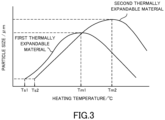
- the thermal expansion layer (12) is formed by applying, to the base (11), a coating liquid in which (i) a first thermally expandable material having a first expansion initiation temperature and a first maximum expansion temperature and (ii) a second thermally expandable material having a second expansion initiation temperature and a second maximum expansion temperature are intermingled in the binder are used in the thermal expansion layer forming step.
- the first expansion initiation temperature of the first thermally expandable material is set to be at least 35°C above the temperature of an environment in which the shaped object is to be placed.
- the second expansion initiation temperature of the second thermally expandable material is set to be at least 35°C above the temperature of an environment in which the shaped object is to be placed.
- the second maximum expansion temperature is set to be higher than the first maximum expansion temperature.
- a shaped object in a third aspect of the present disclosure, includes a thermally expandable sheet having a base and a thermal expansion layer comprising a binder arranged on one surface of the base. At least a portion of the thermal expansion layer swells.
- the thermal expansion layer further includes a first thermally expandable material having a first expansion initiation temperature and a first maximum expansion temperature, and a second thermally expandable material having a second expansion initiation temperature and a second maximum expansion temperature.
- the first thermally expandable material and the second thermally expandable material are intermingled in the binder.
- the first expansion initiation temperature of the first thermally expandable material is set to be at least 35°C above the temperature of an environment in which the shaped object is to be placed.
- the second expansion initiation temperature of the second thermally expandable material is set to be at least 35°C above the temperature of an environment in which the shaped object is to be placed.
- the second maximum expansion temperature is set to be higher than the first maximum expansion temperature, and at least a portion of the thermal expansion layer is swollen.
- the thermally expandable sheet 10 includes a base 11 and a thermal expansion layer 12. Convexities or unevennesses are formed on the surface of the thermally expandable sheet 10 by swelling of at least a portion of the thermal expansion layer 12.
- the shaped object can be expressed by a combination of height of such a convexity or unevenness, a position of formation thereof, or the like.
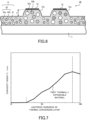
- a sheet is prepared that has the thermal expansion layer using only the aforementioned first thermally expandable material 32a, the thermal conversion layer at multiple concentrations is then formed as illustrated in FIG. 7 , the thermal expansion layer is then expanded, and environmental testing is then performed at 60°C and 90% humidity for 120 hours.
- the portion corresponding to values of "10" to "80" in FIG. 7
- the maximum expansion height corresponding to the height h of FIG. 6
- environmental testing is then performed at 60°C and 90% humidity for 120 hours.
- the concentration where the expansion height is maximum corresponding to the value "90" in FIG. 7
- lowering of height after the environmental testing occurs. This is considered to be due to the first thermally expandable material 32a reaching the excessive-heating state.
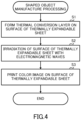
- the thermal conversion layer is formed that includes the electromagnetic wave-to-heat conversion material, that irradiates the thermal conversion layer with the electromagnetic waves, and that heats a specified region of the thermal expansion layer.
- the method for causing expansion of the thermal expansion layer is not limited to that of the aforementioned embodiments.
- the thermal expansion layer can be heated by a device such as a heater.
- the thermal expansion layer 12 of the aforementioned thermally expandable sheet 10 may include an ink receiving layer on the surface, that is, the surface appearing upward in FIG. 1 .
- the ink receiving layer is a layer for receiving and fixing of ink of the inkjet printer.
- the ink receiving layer is formed using publically-known materials.
- the ink receiving layer of a type that receives the ink by use of voids is formed by use of porous silica, for example.
- the ink receiving layer is formed, for example, from a resin selected from among polyvinyl alcohol (PVA, polyesters, polyurethanes, polyacrylic resins, or the like.
- PVA polyvinyl alcohol
- the base 11 may be provided with the ink receiving layer at the backside, that is, the lower surface as viewed in FIG. 1 .
- the thermal conversion layer 81 is formed on the surface side, that is, above the thermal expansion layer 12 illustrated in FIG. 1 , of the thermally expandable sheet 10.
- the method of causing expansion of the thermal expansion layer 12 is not limited to that of this example.
- the thermal conversion layer 81 may be formed on the surface of the backside of the thermally expandable sheet 10, that is, on the lower surface of the base 11 as illustrated in FIG. 1 .
- a thermal conversion layer 81 can be formed on the surfaces of the front side and backside of the thermally expandable sheet 10, and each of the thermal conversion layers 81 can be irradiated with the electromagnetic waves.
- the thermally expandable sheet 10 may be irradiated with the electromagnetic waves without formation of the thermal conversion layer 81, thereby causing expansion of the thermal expansion layer 12.
- the thermal conversion layer 81 is not necessarily formed directly on the thermal expansion layer 12.
- a film may be provided on the outermost surface of the thermal expansion layer 12, and the thermal conversion layer 81 may be formed on this film.
Landscapes
- Health & Medical Sciences (AREA)
- Physics & Mathematics (AREA)
- Thermal Sciences (AREA)
- Engineering & Computer Science (AREA)
- Toxicology (AREA)
- General Health & Medical Sciences (AREA)
- Oral & Maxillofacial Surgery (AREA)
- Mechanical Engineering (AREA)
- Electromagnetism (AREA)
- Textile Engineering (AREA)
- Vascular Medicine (AREA)
- Laminated Bodies (AREA)
- Printing Methods (AREA)
- Thermal Transfer Or Thermal Recording In General (AREA)
Claims (15)
- Thermisch expandierbare Folie (10), umfassend:eine Basis (11); undeine thermische Expansionsschicht (12), die ein Bindemittel (31) umfasst, das auf einer Oberfläche der Basis (11) angeordnet ist und konfiguriert ist, um bei der Herstellung eines Formobjekts (20) durch Aufquellen mindestens eines Abschnitts der thermischen Expansionschicht (12) verwendet zu werden, wobei die thermisch expandierbare Folie (10) dadurch gekennzeichnet ist, dassdie thermische Expansionsschicht (12) weiter folgendes umfasstein erstes thermisch expandierbares Material (32a), das eine erste Expansionsinitiationstemperatur (Ts1) und eine erste maximale Expansionstemperatur (Tm1) aufweist, undein zweites thermisch expandierbares Material (32b), das eine zweite Expansionsinitiationstemperatur (Ts2) und eine zweite maximale Expansionstemperatur (Tm2) aufweist,wobei das erste thermisch expandierbare Material (32a) und das zweite thermisch expandierbare Material (32b) in dem Bindemittel (31) miteinander vermischt sind,wobei die erste Expansionsinititationstemperatur (Ts1) des ersten thermisch expandierbaren Materials (32a) auf mindestens 35°C über der Temperatur einer Umgebung eingestellt ist, in der das Formobjekt (20) platziert werden soll, unddie zweite Expansionsinititationstemperatur (Ts2) des zweiten thermisch expandierbaren Materials (32b) auf mindestens 35°C über der Temperatur einer Umgebung eingestellt ist, in der das Formobjekt (20) platziert werden soll, unddie zweite maximale Expansionstemperatur (Tm2) höher eingestellt ist als die erste maximale Expasionstemperatur (Tm1).
- Thermisch expandierbare Folie (10) nach Anspruch 1, wobei
die erste Expansionsinitiationstemperatur (Ts1) des ersten thermisch expandierbaren Materials (32a) niedriger eingestellt ist als die zweite Expansionsinitiationstemperatur (Ts2). - Thermisch expandierbare Folie (10) nach Anspruch 1 oder 2, wobei
die zweite Expansionsinitiationstemperatur (Ts2) des zweiten thermisch expandierbaren Materials (32b) niedriger eingestellt ist als die erste maximale Expansionstemperatur (Tm1). - Thermisch expandierbare Folie (10) nach einem der Ansprüche 1 bis 3, wobeidas Bindemittel (31) ein thermoplastisches Harz ist, undein Gewichtsverhältnis des Bindemittels (31) zu dem ersten thermisch expandierbaren Material (32a) zu dem zweiten thermisch expandierbaren Material (32b) 2:1:1 ist.
- Thermisch expandierbare Folie (10) nach einem der Ansprüche 1 bis 3, wobeidie thermische Expansionsschicht (12) weiter ein Bindemittel (31) umfasst, das ein thermoplastisches Harz ist, undein Gewichtsverhältnis des Bindemittels (31) zur Gesamtheit des ersten thermisch expandierbaren Materials (32a) und des zweiten thermisch expandierbaren Materials (32b) 4:1 bis 1:1 ist.
- Thermisch expandierbare Folie (10) nach einem der Ansprüche 1 bis 5, wobei
ein Gewichtsverhältnis des zweiten thermisch expandierbaren Materials (32b) zu dem ersten thermisch expandierbaren Material (32a) 0,2 bis einschließlich 4 ist. - Herstellungsverfahren einer thermisch expandierbaren Folie (10) zur Herstellung eines Formobjekts (20) durch Aufquellen mindestens eines Abschnitts einer thermischen Expansionschicht (12), die ein Bindemittel (31) umfasst, und auf einer Oberfläche einer Basis (11) angeordnet ist, wobei das Verfahren folgendes umfasst:einen thermischen Expansionsschichtausbildungsschritt zum Ausbilden der thermischen Expansionsschicht (12) auf der einen Oberfläche der Basis (11), wobei das Verfahren dadurch gekennzeichnet ist, dassin dem thermischen Expansionsschichtausbildungsschritt die thermische Expansionsschicht (12) durch Aufbringen einer Beschichtungsflüssigkeit auf die Basis (11) ausgebildet wird, in der (i) ein erstes thermisch expandierbares Material (32a), das eine erste Expansionsinitiationstemperatur (Ts1) und eine erste maximale Expansionstemperatur (Tm1) aufweist, und (ii) ein zweites thermisch expandierbares Material (32b), das eine zweite Expansionsinitiationstemperatur (Ts2) und eine zweite maximale Expansionstemperatur (Tm2) aufweist, in dem Bindemittel (31) vermischt sind,die erste Expansionsinitiationstemperatur (Ts1) des ersten thermisch expandierbaren Materials (32a) auf mindestens 35°C über der Temperatur einer Umgebung eingestellt ist, in der das Formobjekt (20) platziert werden soll, unddie zweite Expansionsinitiationstemperatur (Ts2) des zweiten thermisch expandierbaren Materials (32b) auf mindestens 35°C über der Temperatur einer Umgebung eingestellt ist, in der das Formobjekt (20) platziert werden soll, und die zweite maximale Expansionstemperatur (Tm2) auf einen höheren Wert als die erste maximale Expansionstemperatur (Tm1) eingestellt ist.
- Herstellungsverfahren nach Anspruch 7, wobei
die erste Expansionsinitiationstemperatur (Ts1) des ersten thermisch expandierbaren Materials (32a) niedriger eingestellt wird als die zweite Expansionsinitiationstemperatur (Ts2). - Herstellungsverfahren nach Anspruch 7 oder 8, wobei
die zweite Expansionsinitiationstemperatur (Ts2) des zweiten thermisch expandierbaren Materials (32b) niedriger eingestellt wird als die erste maximale Expansionstemperatur (Tm1). - Herstellungsverfahren nach einem der Ansprüche 7 bis 9, wobeidas Bindemittel (31) ein thermoplastisches Harz ist, undein Gewichtsverhältnis des Bindemittels (31) zu dem ersten thermisch expandierbaren Material (32a) zu dem zweiten thermisch expandierbaren Material (32b) 2:1:1 ist.
- Herstellungsverfahren nach einem der Ansprüche 7 bis 9, wobeidie thermische Expansionsschicht (12) ein Bindemittel (31) umfasst, das ein thermoplastisches Harz ist, undein Gewichtsverhältnis des Bindemittels (31) zur Gesamtheit des ersten thermisch expandierbaren Materials (32a) und des zweiten thermisch expandierbaren Materials (32b) 4:1 bis 1:1 ist.
- Herstellungsverfahren nach einem der Ansprüche 7 bis 11, wobei
ein Gewichtsverhältnis des zweiten thermisch expandierbaren Materials (32b) zu dem ersten thermisch expandierbaren Material (32a) 0,2 bis einschließlich 4 ist. - Formobjekt (20), umfassend:eine thermisch expandierbare Folie (10), die eine Basis (11) aufweist, und eine thermische Expansionsschicht (12), die ein Bindemittel (31)umfasst, das auf einer Oberfläche der Basis (11) angeordnet ist, wobei das Formobjekt (20) dadurch gekennzeichnet ist, dass die thermische Expansionsschicht (12) weiter folgendes umfasstein erstes thermisch expandierbares Material (32a), das eine erste Expansionsinitiationstemperatur (Ts1) und eine erste maximale Expansionstemperatur (Tm1) aufweist, undein zweites thermisch expandierbares Material (32b), das eine zweite Expansionsinitiationstemperatur (Ts2) und eine zweite maximale Expansionstemperatur (Tm2) aufweist,wobei das erste thermisch expandierbare Material (32a) und das zweite thermisch expandierbare Material (32b) in dem Bindemittel (31) miteinander vermischt sind,wobei die erste Expansionsinitiationstemperatur (Ts1) des ersten thermisch expandierbaren Materials (32a) auf mindestens 35°C über der Temperatur einer Umgebung eingestellt ist, in der das Formobjekt (20) platziert werden soll, unddie zweite Expansionsinitiationstemperatur (Ts2) des zweiten thermisch expandierbaren Materials (32b) auf mindestens 35°C über der Temperatur einer Umgebung eingestellt ist, in der das Formobjekt (20) platziert werden soll, und die zweite maximale Expansionstemperatur (Tm2) höher eingestellt ist als die erste maximale Expansionstemperatur (Tm1), undmindestens ein Abschnitt der thermischen Expansionsschicht (12) durch Expansion aufgequollen ist.
- Formobjekt (20) nach Anspruch 13, wobei
ein Gewichtsverhältnis des zweiten thermisch expandierbaren Materials (32b) zu dem ersten thermisch expandierbaren Material (32a) 0,2 bis einschließlich 4 ist. - Formobjekt (20) nach Anspruch 14, wobeidas Bindemittel (31) ein thermoplastisches Harz ist, undein Gewichtsverhältnis des Bindemittels (31) zu dem ersten thermisch expandierbaren Material (32a) zu dem zweiten thermisch expandierbaren Material (32b) 2:1:1 ist.
Applications Claiming Priority (1)
| Application Number | Priority Date | Filing Date | Title |
|---|---|---|---|
| JP2018247004A JP2020104455A (ja) | 2018-12-28 | 2018-12-28 | 熱膨張性シート、熱膨張性シートの製造方法及び造形物 |
Publications (2)
| Publication Number | Publication Date |
|---|---|
| EP3674051A1 EP3674051A1 (de) | 2020-07-01 |
| EP3674051B1 true EP3674051B1 (de) | 2025-07-02 |
Family
ID=68732827
Family Applications (1)
| Application Number | Title | Priority Date | Filing Date |
|---|---|---|---|
| EP19212393.3A Active EP3674051B1 (de) | 2018-12-28 | 2019-11-29 | Thermisch expandierbare folie, herstellungsverfahren für thermisch expandierbare folie und formobjekt |
Country Status (4)
| Country | Link |
|---|---|
| US (1) | US20200206990A1 (de) |
| EP (1) | EP3674051B1 (de) |
| JP (2) | JP2020104455A (de) |
| CN (1) | CN111376625B (de) |
Family Cites Families (21)
| Publication number | Priority date | Publication date | Assignee | Title |
|---|---|---|---|---|
| JPS6428660A (en) | 1987-07-24 | 1989-01-31 | Minolta Camera Kk | Stereoscopic image forming method |
| JPH04229243A (ja) * | 1990-12-25 | 1992-08-18 | Achilles Corp | 装飾シ−ト |
| JP2998253B2 (ja) * | 1991-03-29 | 2000-01-11 | 凸版印刷株式会社 | 発泡化粧材の製造方法 |
| JP3203960B2 (ja) * | 1994-07-04 | 2001-09-04 | 日立電線株式会社 | 発泡絶縁電線及びその製造方法 |
| JPH09207428A (ja) * | 1996-02-02 | 1997-08-12 | Canon Inc | 立体画像形成媒体、及び同媒体を用いた立体画像形成方法 |
| JP3842440B2 (ja) * | 1998-06-25 | 2006-11-08 | アキレス株式会社 | 装飾シート |
| JP4199363B2 (ja) * | 1999-03-01 | 2008-12-17 | ミヨシ油脂株式会社 | 発泡性マイクロカプセルウェットケーキの分散化方法 |
| JP2001150812A (ja) | 1999-11-25 | 2001-06-05 | Minolta Co Ltd | 発泡造形システム、発泡造形方法、印刷済みの発泡シートおよび発泡造形物 |
| JP2002088693A (ja) * | 2000-09-08 | 2002-03-27 | Matsui Shikiso Chem Co Ltd | ステキヒトサイズ度が30分以上である壁紙及びその製造方法 |
| JP2005242316A (ja) * | 2004-01-30 | 2005-09-08 | Fuji Xerox Co Ltd | 立体画像形成用トナーとその製造方法及びそれを用いた現像剤、並びにその現像剤を用いる立体画像の形成方法及び形成装置 |
| JP2012233132A (ja) * | 2011-05-09 | 2012-11-29 | Nitto Denko Corp | 熱発泡性樹脂組成物、熱発泡性樹脂シート、発泡体およびその製造方法 |
| RU2015139599A (ru) * | 2013-02-18 | 2017-03-23 | Роквул Интернэшнл А/С | Изолирующий элемент |
| CN104694775B (zh) * | 2015-03-20 | 2017-03-08 | 江苏时代华宜电子科技有限公司 | 一种可调热膨胀的SiC/Al2(WO4)3/Al复合材料 |
| WO2016175748A1 (en) * | 2015-04-27 | 2016-11-03 | Hewlett-Packard Development Company, L.P. | Three-dimensional (3d) printing |
| JP2017066555A (ja) * | 2015-09-30 | 2017-04-06 | 凸版印刷株式会社 | 壁紙 |
| JP6657763B2 (ja) * | 2015-10-16 | 2020-03-04 | 凸版印刷株式会社 | 壁紙の製造方法 |
| JP6897078B2 (ja) * | 2016-12-01 | 2021-06-30 | カシオ計算機株式会社 | 立体造形物形成シートおよび立体造形物の製造方法 |
| JP6558386B2 (ja) * | 2017-03-07 | 2019-08-14 | カシオ計算機株式会社 | 熱膨張性シート、熱膨張性シートの製造方法および造形物の製造方法 |
| JP6536604B2 (ja) * | 2017-03-07 | 2019-07-03 | カシオ計算機株式会社 | 造形物の製造方法 |
| JP6540733B2 (ja) * | 2017-03-07 | 2019-07-10 | カシオ計算機株式会社 | 熱膨張性シート及び熱膨張性シートの製造方法 |
| JP6658641B2 (ja) * | 2017-03-23 | 2020-03-04 | カシオ計算機株式会社 | 熱膨張性シート及び立体画像の製造方法 |
-
2018
- 2018-12-28 JP JP2018247004A patent/JP2020104455A/ja active Pending
-
2019
- 2019-11-29 EP EP19212393.3A patent/EP3674051B1/de active Active
- 2019-12-13 US US16/713,156 patent/US20200206990A1/en not_active Abandoned
- 2019-12-16 CN CN201911299372.8A patent/CN111376625B/zh active Active
-
2021
- 2021-08-17 JP JP2021132503A patent/JP7201039B2/ja active Active
Also Published As
| Publication number | Publication date |
|---|---|
| EP3674051A1 (de) | 2020-07-01 |
| CN111376625A (zh) | 2020-07-07 |
| JP7201039B2 (ja) | 2023-01-10 |
| US20200206990A1 (en) | 2020-07-02 |
| CN111376625B (zh) | 2022-01-07 |
| JP2021185035A (ja) | 2021-12-09 |
| JP2020104455A (ja) | 2020-07-09 |
Similar Documents
| Publication | Publication Date | Title |
|---|---|---|
| CN108569006B (zh) | 热膨胀性薄片、热膨胀性薄片和造形物的制造方法 | |
| CN111301020B (zh) | 造形物的制造方法以及热膨胀性薄片 | |
| CN108569057B (zh) | 造形物的制造方法 | |
| CN110733155A (zh) | 造形物的制造方法 | |
| EP3674051B1 (de) | Thermisch expandierbare folie, herstellungsverfahren für thermisch expandierbare folie und formobjekt | |
| EP3670133B1 (de) | Formfolie, herstellungsverfahren einer formfolie und herstellungsverfahren eines geformten gegenstands | |
| CN108621621B (zh) | 热膨胀性薄片 | |
| JP7276524B2 (ja) | 造形物の製造方法 | |
| JP7263973B2 (ja) | 造形物の製造方法 | |
| US11065838B2 (en) | Shaped object and shaped object manufacturing method | |
| US11511533B2 (en) | Shaped object production method and expansion device | |
| JP6923018B2 (ja) | 熱膨張性シート及び立体画像の製造方法 | |
| JP6834824B2 (ja) | 立体画像形成方法 | |
| US20210229129A1 (en) | Formation sheet, formation sheet manufacturing method, and shaped object | |
| JP2021175612A (ja) | 熱膨張性シート及び立体画像の製造方法 | |
| JP2023034918A (ja) | 印画物の製造方法、印画物製造システム及び印画物 | |
| JP2020044775A (ja) | 造形物及び造形物の製造方法 | |
| JP2020175614A (ja) | 成形シート、成形シートの製造方法、造形物、造形物の製造方法及びインク | |
| JP2019194020A (ja) | 造形物の製造方法及び熱膨張性シート | |
| JP2020151990A (ja) | 熱膨張層を有する媒体及び熱膨張層を有する媒体の製造方法 |
Legal Events
| Date | Code | Title | Description |
|---|---|---|---|
| PUAI | Public reference made under article 153(3) epc to a published international application that has entered the european phase |
Free format text: ORIGINAL CODE: 0009012 |
|
| STAA | Information on the status of an ep patent application or granted ep patent |
Free format text: STATUS: REQUEST FOR EXAMINATION WAS MADE |
|
| 17P | Request for examination filed |
Effective date: 20191129 |
|
| AK | Designated contracting states |
Kind code of ref document: A1 Designated state(s): AL AT BE BG CH CY CZ DE DK EE ES FI FR GB GR HR HU IE IS IT LI LT LU LV MC MK MT NL NO PL PT RO RS SE SI SK SM TR |
|
| AX | Request for extension of the european patent |
Extension state: BA ME |
|
| STAA | Information on the status of an ep patent application or granted ep patent |
Free format text: STATUS: EXAMINATION IS IN PROGRESS |
|
| 17Q | First examination report despatched |
Effective date: 20220909 |
|
| GRAP | Despatch of communication of intention to grant a patent |
Free format text: ORIGINAL CODE: EPIDOSNIGR1 |
|
| STAA | Information on the status of an ep patent application or granted ep patent |
Free format text: STATUS: GRANT OF PATENT IS INTENDED |
|
| RIC1 | Information provided on ipc code assigned before grant |
Ipc: B41M 3/06 20060101ALN20250205BHEP Ipc: B29C 35/08 20060101ALN20250205BHEP Ipc: B29C 35/02 20060101ALI20250205BHEP Ipc: B29C 44/34 20060101ALI20250205BHEP Ipc: B29C 44/02 20060101AFI20250205BHEP |
|
| INTG | Intention to grant announced |
Effective date: 20250214 |
|
| GRAJ | Information related to disapproval of communication of intention to grant by the applicant or resumption of examination proceedings by the epo deleted |
Free format text: ORIGINAL CODE: EPIDOSDIGR1 |
|
| STAA | Information on the status of an ep patent application or granted ep patent |
Free format text: STATUS: EXAMINATION IS IN PROGRESS |
|
| GRAP | Despatch of communication of intention to grant a patent |
Free format text: ORIGINAL CODE: EPIDOSNIGR1 |
|
| STAA | Information on the status of an ep patent application or granted ep patent |
Free format text: STATUS: GRANT OF PATENT IS INTENDED |
|
| GRAS | Grant fee paid |
Free format text: ORIGINAL CODE: EPIDOSNIGR3 |
|
| GRAA | (expected) grant |
Free format text: ORIGINAL CODE: 0009210 |
|
| STAA | Information on the status of an ep patent application or granted ep patent |
Free format text: STATUS: THE PATENT HAS BEEN GRANTED |
|
| INTC | Intention to grant announced (deleted) | ||
| RIC1 | Information provided on ipc code assigned before grant |
Ipc: B41M 3/06 20060101ALN20250508BHEP Ipc: B29C 35/08 20060101ALN20250508BHEP Ipc: B29C 35/02 20060101ALI20250508BHEP Ipc: B29C 44/34 20060101ALI20250508BHEP Ipc: B29C 44/02 20060101AFI20250508BHEP |
|
| INTG | Intention to grant announced |
Effective date: 20250516 |
|
| AK | Designated contracting states |
Kind code of ref document: B1 Designated state(s): AL AT BE BG CH CY CZ DE DK EE ES FI FR GB GR HR HU IE IS IT LI LT LU LV MC MK MT NL NO PL PT RO RS SE SI SK SM TR |
|
| REG | Reference to a national code |
Ref country code: GB Ref legal event code: FG4D |
|
| REG | Reference to a national code |
Ref country code: CH Ref legal event code: EP |
|
| REG | Reference to a national code |
Ref country code: DE Ref legal event code: R096 Ref document number: 602019071881 Country of ref document: DE |
|
| REG | Reference to a national code |
Ref country code: IE Ref legal event code: FG4D |
|
| PGFP | Annual fee paid to national office [announced via postgrant information from national office to epo] |
Ref country code: FR Payment date: 20250930 Year of fee payment: 7 |
|
| REG | Reference to a national code |
Ref country code: NL Ref legal event code: MP Effective date: 20250702 |
|
| PG25 | Lapsed in a contracting state [announced via postgrant information from national office to epo] |
Ref country code: PT Free format text: LAPSE BECAUSE OF FAILURE TO SUBMIT A TRANSLATION OF THE DESCRIPTION OR TO PAY THE FEE WITHIN THE PRESCRIBED TIME-LIMIT Effective date: 20251103 |
|
| PG25 | Lapsed in a contracting state [announced via postgrant information from national office to epo] |
Ref country code: NL Free format text: LAPSE BECAUSE OF FAILURE TO SUBMIT A TRANSLATION OF THE DESCRIPTION OR TO PAY THE FEE WITHIN THE PRESCRIBED TIME-LIMIT Effective date: 20250702 |
|
| REG | Reference to a national code |
Ref country code: AT Ref legal event code: MK05 Ref document number: 1808758 Country of ref document: AT Kind code of ref document: T Effective date: 20250702 |
|
| PG25 | Lapsed in a contracting state [announced via postgrant information from national office to epo] |
Ref country code: IS Free format text: LAPSE BECAUSE OF FAILURE TO SUBMIT A TRANSLATION OF THE DESCRIPTION OR TO PAY THE FEE WITHIN THE PRESCRIBED TIME-LIMIT Effective date: 20251102 |
|
| PGFP | Annual fee paid to national office [announced via postgrant information from national office to epo] |
Ref country code: DE Payment date: 20250930 Year of fee payment: 7 |
|
| PGFP | Annual fee paid to national office [announced via postgrant information from national office to epo] |
Ref country code: GB Payment date: 20251001 Year of fee payment: 7 |
|
| PG25 | Lapsed in a contracting state [announced via postgrant information from national office to epo] |
Ref country code: NO Free format text: LAPSE BECAUSE OF FAILURE TO SUBMIT A TRANSLATION OF THE DESCRIPTION OR TO PAY THE FEE WITHIN THE PRESCRIBED TIME-LIMIT Effective date: 20251002 |
|
| REG | Reference to a national code |
Ref country code: LT Ref legal event code: MG9D |
|
| PG25 | Lapsed in a contracting state [announced via postgrant information from national office to epo] |
Ref country code: AT Free format text: LAPSE BECAUSE OF FAILURE TO SUBMIT A TRANSLATION OF THE DESCRIPTION OR TO PAY THE FEE WITHIN THE PRESCRIBED TIME-LIMIT Effective date: 20250702 |
|
| PG25 | Lapsed in a contracting state [announced via postgrant information from national office to epo] |
Ref country code: FI Free format text: LAPSE BECAUSE OF FAILURE TO SUBMIT A TRANSLATION OF THE DESCRIPTION OR TO PAY THE FEE WITHIN THE PRESCRIBED TIME-LIMIT Effective date: 20250702 |
|
| PG25 | Lapsed in a contracting state [announced via postgrant information from national office to epo] |
Ref country code: HR Free format text: LAPSE BECAUSE OF FAILURE TO SUBMIT A TRANSLATION OF THE DESCRIPTION OR TO PAY THE FEE WITHIN THE PRESCRIBED TIME-LIMIT Effective date: 20250702 |
|
| PG25 | Lapsed in a contracting state [announced via postgrant information from national office to epo] |
Ref country code: GR Free format text: LAPSE BECAUSE OF FAILURE TO SUBMIT A TRANSLATION OF THE DESCRIPTION OR TO PAY THE FEE WITHIN THE PRESCRIBED TIME-LIMIT Effective date: 20251003 |
|
| PG25 | Lapsed in a contracting state [announced via postgrant information from national office to epo] |
Ref country code: SE Free format text: LAPSE BECAUSE OF FAILURE TO SUBMIT A TRANSLATION OF THE DESCRIPTION OR TO PAY THE FEE WITHIN THE PRESCRIBED TIME-LIMIT Effective date: 20250702 Ref country code: CZ Free format text: LAPSE BECAUSE OF FAILURE TO SUBMIT A TRANSLATION OF THE DESCRIPTION OR TO PAY THE FEE WITHIN THE PRESCRIBED TIME-LIMIT Effective date: 20250702 |
|
| PG25 | Lapsed in a contracting state [announced via postgrant information from national office to epo] |
Ref country code: LV Free format text: LAPSE BECAUSE OF FAILURE TO SUBMIT A TRANSLATION OF THE DESCRIPTION OR TO PAY THE FEE WITHIN THE PRESCRIBED TIME-LIMIT Effective date: 20250702 |
|
| PG25 | Lapsed in a contracting state [announced via postgrant information from national office to epo] |
Ref country code: BG Free format text: LAPSE BECAUSE OF FAILURE TO SUBMIT A TRANSLATION OF THE DESCRIPTION OR TO PAY THE FEE WITHIN THE PRESCRIBED TIME-LIMIT Effective date: 20250702 Ref country code: PL Free format text: LAPSE BECAUSE OF FAILURE TO SUBMIT A TRANSLATION OF THE DESCRIPTION OR TO PAY THE FEE WITHIN THE PRESCRIBED TIME-LIMIT Effective date: 20250702 |
|
| PG25 | Lapsed in a contracting state [announced via postgrant information from national office to epo] |
Ref country code: RS Free format text: LAPSE BECAUSE OF FAILURE TO SUBMIT A TRANSLATION OF THE DESCRIPTION OR TO PAY THE FEE WITHIN THE PRESCRIBED TIME-LIMIT Effective date: 20251002 |
|
| PG25 | Lapsed in a contracting state [announced via postgrant information from national office to epo] |
Ref country code: ES Free format text: LAPSE BECAUSE OF FAILURE TO SUBMIT A TRANSLATION OF THE DESCRIPTION OR TO PAY THE FEE WITHIN THE PRESCRIBED TIME-LIMIT Effective date: 20250702 |
|
| PG25 | Lapsed in a contracting state [announced via postgrant information from national office to epo] |
Ref country code: RO Free format text: LAPSE BECAUSE OF FAILURE TO SUBMIT A TRANSLATION OF THE DESCRIPTION OR TO PAY THE FEE WITHIN THE PRESCRIBED TIME-LIMIT Effective date: 20250702 |
|
| PG25 | Lapsed in a contracting state [announced via postgrant information from national office to epo] |
Ref country code: SM Free format text: LAPSE BECAUSE OF FAILURE TO SUBMIT A TRANSLATION OF THE DESCRIPTION OR TO PAY THE FEE WITHIN THE PRESCRIBED TIME-LIMIT Effective date: 20250702 |
|
| PG25 | Lapsed in a contracting state [announced via postgrant information from national office to epo] |
Ref country code: DK Free format text: LAPSE BECAUSE OF FAILURE TO SUBMIT A TRANSLATION OF THE DESCRIPTION OR TO PAY THE FEE WITHIN THE PRESCRIBED TIME-LIMIT Effective date: 20250702 |
|
| PG25 | Lapsed in a contracting state [announced via postgrant information from national office to epo] |
Ref country code: IT Free format text: LAPSE BECAUSE OF FAILURE TO SUBMIT A TRANSLATION OF THE DESCRIPTION OR TO PAY THE FEE WITHIN THE PRESCRIBED TIME-LIMIT Effective date: 20250702 |
|
| PG25 | Lapsed in a contracting state [announced via postgrant information from national office to epo] |
Ref country code: SK Free format text: LAPSE BECAUSE OF FAILURE TO SUBMIT A TRANSLATION OF THE DESCRIPTION OR TO PAY THE FEE WITHIN THE PRESCRIBED TIME-LIMIT Effective date: 20250702 Ref country code: EE Free format text: LAPSE BECAUSE OF FAILURE TO SUBMIT A TRANSLATION OF THE DESCRIPTION OR TO PAY THE FEE WITHIN THE PRESCRIBED TIME-LIMIT Effective date: 20250702 |