EP3672915B1 - Vorrichtung und verfahren zur dosierung und verabreichung von flüssigen chemikalien - Google Patents
Vorrichtung und verfahren zur dosierung und verabreichung von flüssigen chemikalien Download PDFInfo
- Publication number
- EP3672915B1 EP3672915B1 EP18857630.0A EP18857630A EP3672915B1 EP 3672915 B1 EP3672915 B1 EP 3672915B1 EP 18857630 A EP18857630 A EP 18857630A EP 3672915 B1 EP3672915 B1 EP 3672915B1
- Authority
- EP
- European Patent Office
- Prior art keywords
- channel block
- chemical liquid
- valve
- pressure
- outlet
- Prior art date
- Legal status (The legal status is an assumption and is not a legal conclusion. Google has not performed a legal analysis and makes no representation as to the accuracy of the status listed.)
- Active
Links
Images







Classifications
-
- C—CHEMISTRY; METALLURGY
- C02—TREATMENT OF WATER, WASTE WATER, SEWAGE, OR SLUDGE
- C02F—TREATMENT OF WATER, WASTE WATER, SEWAGE, OR SLUDGE
- C02F1/00—Treatment of water, waste water, or sewage
- C02F1/68—Treatment of water, waste water, or sewage by addition of specified substances, e.g. trace elements, for ameliorating potable water
- C02F1/685—Devices for dosing the additives
- C02F1/686—Devices for dosing liquid additives
-
- C—CHEMISTRY; METALLURGY
- C02—TREATMENT OF WATER, WASTE WATER, SEWAGE, OR SLUDGE
- C02F—TREATMENT OF WATER, WASTE WATER, SEWAGE, OR SLUDGE
- C02F1/00—Treatment of water, waste water, or sewage
- C02F1/008—Control or steering systems not provided for elsewhere in subclass C02F
-
- G—PHYSICS
- G01—MEASURING; TESTING
- G01F—MEASURING VOLUME, VOLUME FLOW, MASS FLOW OR LIQUID LEVEL; METERING BY VOLUME
- G01F11/00—Apparatus requiring external operation adapted at each repeated and identical operation to measure and separate a predetermined volume of fluid or fluent solid material from a supply or container, without regard to weight, and to deliver it
- G01F11/28—Apparatus requiring external operation adapted at each repeated and identical operation to measure and separate a predetermined volume of fluid or fluent solid material from a supply or container, without regard to weight, and to deliver it with stationary measuring chambers having constant volume during measurement
-
- G—PHYSICS
- G01—MEASURING; TESTING
- G01F—MEASURING VOLUME, VOLUME FLOW, MASS FLOW OR LIQUID LEVEL; METERING BY VOLUME
- G01F25/00—Testing or calibration of apparatus for measuring volume, volume flow or liquid level or for metering by volume
- G01F25/0092—Testing or calibration of apparatus for measuring volume, volume flow or liquid level or for metering by volume for metering by volume
-
- G—PHYSICS
- G05—CONTROLLING; REGULATING
- G05D—SYSTEMS FOR CONTROLLING OR REGULATING NON-ELECTRIC VARIABLES
- G05D16/00—Control of fluid pressure
- G05D16/04—Control of fluid pressure without auxiliary power
- G05D16/06—Control of fluid pressure without auxiliary power the sensing element being a flexible membrane, yielding to pressure, e.g. diaphragm, bellows, capsule
- G05D16/063—Control of fluid pressure without auxiliary power the sensing element being a flexible membrane, yielding to pressure, e.g. diaphragm, bellows, capsule the sensing element being a membrane
-
- G—PHYSICS
- G05—CONTROLLING; REGULATING
- G05D—SYSTEMS FOR CONTROLLING OR REGULATING NON-ELECTRIC VARIABLES
- G05D7/00—Control of flow
- G05D7/06—Control of flow characterised by the use of electric means
- G05D7/0617—Control of flow characterised by the use of electric means specially adapted for fluid materials
- G05D7/0629—Control of flow characterised by the use of electric means specially adapted for fluid materials characterised by the type of regulator means
- G05D7/0635—Control of flow characterised by the use of electric means specially adapted for fluid materials characterised by the type of regulator means by action on throttling means
- G05D7/0641—Control of flow characterised by the use of electric means specially adapted for fluid materials characterised by the type of regulator means by action on throttling means using a plurality of throttling means
- G05D7/0652—Control of flow characterised by the use of electric means specially adapted for fluid materials characterised by the type of regulator means by action on throttling means using a plurality of throttling means the plurality of throttling means being arranged in parallel
-
- C—CHEMISTRY; METALLURGY
- C02—TREATMENT OF WATER, WASTE WATER, SEWAGE, OR SLUDGE
- C02F—TREATMENT OF WATER, WASTE WATER, SEWAGE, OR SLUDGE
- C02F2201/00—Apparatus for treatment of water, waste water or sewage
- C02F2201/002—Construction details of the apparatus
- C02F2201/005—Valves
-
- C—CHEMISTRY; METALLURGY
- C02—TREATMENT OF WATER, WASTE WATER, SEWAGE, OR SLUDGE
- C02F—TREATMENT OF WATER, WASTE WATER, SEWAGE, OR SLUDGE
- C02F2209/00—Controlling or monitoring parameters in water treatment
- C02F2209/03—Pressure
Definitions
- the assembly of the piping system can require considerable labour and can be costly due to the extent of the parts required. Moreover, due to the number of joints and connections between the different components of the system, as the different pipes are connected to one another, this multiplies the risks tied to leakage from the joints and connectors between the pipe parts. This is emphasized by the damaging nature of the chemicals that are transported in the pipes, which can result in leakage over time, especially when some of the joints may be poorly joined together (e.g. poorly welded, or the polymer material used breaks down over time when exposed to the chemical(s) that is/are being carried through the pipes). For instance, threaded connections may be an important source of leakage. A leakage can pose a serious risk to workers due to the toxic and noxious nature of certain of the chemicals used for water treatment. Additionally, system failure can have a dramatic repercussion in drinking water treatment applications. It can also create unexpected downtime which may be costly to repair.
- US 2014/0090731 A1 discloses a dosing system for delivering a dosing fluid including a dosing manifold having a front panel and a rear panel with a plurality of channels and a plurality of inlet and outlet ports in fluid communication with corresponding channels.
- the front panel holds a plurality of flow control devices in fluid communication with corresponding channels to control the flow of the dosing fluid in the channels.
- a dosing pump is in fluid communication with the dosing manifold and is configured to pump the dosing fluid through the dosing manifold.
- the channel block includes ports includes one or more inlets and one or more outlets, wherein the one or more inlets includes a liquid chemical inlet, and wherein the one or more outlets includes a process outlet.
- the channel block has channels integrated within the channel block, for passing a chemical liquid, connecting the ports.
- the channel block includes a ball valve mounted to the channel block for controlling the passage of chemical liquid through at least one of the channels.
- the ball valve includes a ball with an aperture to allow passage of a chemical liquid; a carrier adapted to restrict the rotational movement of the ball; two ball seats for maintaining a seal surface around the ball; a handle; a stem connected to the handle adapted to transfer torque from the handle to the ball; and a housing configured to receive and house the ball, the two ball seats and the entire carrier, and dimensioned so that a portion of the housing extends beyond the housed carrier.
- the ball, the housing, the carrier and the two ball seats are within the channel block, and the portion of the housing that extends beyond the housed carrier is adapted to receive at least a part of a connector that connects the channel block to an external component, wherein the connector receivable within the housing is received within the channel block.
- the one or more outlets may have an evacuation outlet.
- the one or more outlets may have a calibration column outlet.
- the channel block may have a calibration column connected to the calibration column outlet.
- the channel block may be composed of two or more sub-blocks.
- the channel block may a pressure indicator configured to measure the pressure of the chemical liquid entering the channel block from the liquid chemical inlet.
- the pressure indicator may be a pressure gauge.
- the channel block may include the connector.
- the connector may protrude from a surface of the channel block.
- one extremity of the connector may be flush with a surface of the channel block.
- a first extremity of the connector, opposite to a second extremity of the connector that is in contact with the carrier, may be sunken with respect to a surface of the channel block surrounding the connector.
- a broad aspect is a chemical dosage apparatus.
- the apparatus includes a channel block including ports including at least one inlet and at least one outlet, wherein the at least one inlet comprises a liquid chemical inlet, and wherein the at least one outlet comprises a process outlet.
- the channel block includes channels integrated within the channel block, for passing a chemical liquid, connecting the ports.
- the apparatus includes a pump at least partially integrated into the channel block, for pumping a chemical liquid directly into the channel block.
- the chemical liquid may flow from the pump into at least one channel of the channels of the channel block.
- the chemical liquid may flow from the pump into the at least one channel of the channels without passing through a conduit positioned between the pump and the channel block.
- the apparatus may include a pump mounting to secure the pump to a support surface, wherein the pump, secured to the support surface, may support the channel block that is mounted thereon. In some embodiments, the pump may support entirely the channel block.
- the apparatus may include a channel block mounting for mounting the channel block to a vertical surface, wherein the channel block is supported by at least the channel block mounting.
- the pump mounting may be configured to secure the pump to a vertical support surface.
- the at least one outlet may include a calibration column outlet
- the apparatus may include a calibration column connected to the calibration column outlet
- the channel block may include at least one regulation valve to regulate the pressure of the chemical liquid flowing through the channel block.
- the at least one regulation valve may include a diaphragm valve.
- the channel block may have at least one control valve with a closed position and an opened position, wherein the at least one control valve may be mounted to the channel block such that the chemical liquid may flow through a channel of the channels when a control valve of the at least one control valve is in the opened position, and the chemical liquid is prevented from flowing through the channel of the channels when the control valve of the at least one control valve is in the closed position.
- the channel block may include a pressure indicator mounted to the channel block in proximity of the chemical inlet, wherein the pressure indicator is configured to measure pressure of the chemical liquid entering the chemical inlet.
- the chemical inlet may be located on a bottom surface of the channel block.
- the at least one outlet further may have an evacuation outlet.
- the channel block may be composed of two or more sub-blocks.
- the at least one outlet may include a calibration column outlet.
- the apparatus may include a calibration column connected to the calibration column outlet.
- the pump may be a diaphragm pump.
- the diaphragm pump may include a pump diaphragm and an actuating rod connected to the pump diaphragm.
- the pump diaphragm and the actuating rod may be at least partially integrated into the channel block.
- the channel block may include one or more control valves positioned to regulate the chemical liquid entering from the liquid chemical inlet.
- the channel block may include one or more control valves positioned to regulate the chemical liquid flowing in a channel positioned that directly or indirectly connects the integrated pump to the process outlet.
- the liquid chemical dosing apparatus is for water treatment. However, it will be understood that the chemical dosing apparatus may be that for other utilities requiring chemical dosing.
- the channel block has an upper surface and a bottom surface opposite to the upper surface, a front surface, and a rear surface opposite to the front surface, wherein the front surface is orthogonal to the upper surface.
- the channel block includes a process outlet positioned to allow the discharge of a chemical liquid from the channel block travelling towards a delivery point of the chemical liquid.
- the channel block includes a chemical liquid inlet configured to receive the chemical liquid travelling into the channel block.
- the channel block includes an evacuation outlet positioned for evacuating excess chemical liquid in channels of the channel block.
- the channel block includes a calibration column outlet configured to connect to a calibration column.
- the channel block includes channels provided within the channel block that connect at least the process outlet, the chemical liquid inlet, the evacuation outlet and the calibration column outlet.
- the channel block includes a pressure indicator mounted to the channel block to measure the pressure of the chemical liquid entering through the chemical liquid inlet.
- the channel block includes a evacuation regulation valve mounted to the channel block upstream of the evacuation outlet, and interacting with the channels to control passage of the chemical liquid through a channel of the channels connecting the chemical liquid inlet to the evacuation outlet.
- the channel block includes at least three control valves mounted to the block configured to control the chemical liquid passing through the channels, wherein a first control valve of the at least three control valves is situated with respect to the channels to control the flow of the chemical liquid to the process outlet, wherein a second control valve of the at least three control valves is situated with respect to the channels to control the flow of the chemical liquid to the evacuation outlet; and a third control valve of the at least three control valves is situated with respect to the channels to control the flow of the chemical liquid to the calibration column outlet.
- the additional regulation valve is positioned with respect to the first control valve, second control valve and third control valve such that a pressure set point of the additional regulation valve may be calibrated using the pressure indicator when the first control valve is in an open position, and the second control valve and the third control valve are in a closed position, and/or the third control valve is in an open position, and the first control valve and the second control valve are in a closed position.
- the channel block may include an additional regulation valve mounted to the channel block upstream of at least one of the process outlet and the calibration column outlet, and interacting with the channels to control passage of the chemical liquid through a channel of the channels connecting the chemical liquid inlet to the process outlet.
- the additional regulation valve is positioned with respect to the first control valve, second control valve and third control valve such that a pressure set point of the additional regulation valve may be calibrated using the pressure indicator when the first control valve is in an open position, and the second control valve and the third control valve are in a closed position, and/or the third control valve is in an open position, and the first control valve and the second control valve are in a closed position.
- the at least three control valves may consist of three control valves.
- the at least three control valves may include ball valves.
- the pressure indicator may be positioned in proximity of the liquid chemical inlet.
- the at least three control valves may be ball valves.
- the channel block may have an auxiliary port, and wherein the channels may connect at least the process outlet, the chemical liquid inlet, the evacuation outlet, the calibration column outlet and the auxiliary port.
- the additional regulation valve may be a back-pressure valve.
- the evacuation regulation valve may be a pressure relief valve.
- the additional regulation valve may be a diaphragm valve.
- the evacuation regulation valve may be a diaphragm valve.
- the pressure indicator may be a pressure gauge.
- the evacuation regulation valve may be positioned with respect to the three control valves such that a pressure set point of the evacuation regulation valve may be calibrated using the pressure indicator when the first control valve, the second control valve and the third control valve are in a closed position.
- the process outlet may be located on the upper surface.
- the liquid chemical inlet may be located on a surface of the channel block other than a surface of the channel block on which the process outlet is located.
- the at least three control valves, the additional regulation valve and the evacuation regulation valve may be positioned on the front surface.
- the channel block may be composed of at least two sub-blocks.
- a second aspect is a water treatment chemical liquid dosing apparatus.
- the water treatment chemical liquid dosing apparatus has the channel block as defined herein, and a calibration column connected to the calibration column outlet of the channel block.
- Another aspect of the invention is a method of treating water according to claim 14 using the channel block of the invention.
- the method includes pumping chemical liquid from a source of the chemical liquid.
- the method includes receiving the chemical liquid at a liquid chemical inlet of a channel block so that the chemical liquid flows within channels defined within the channel block.
- the method includes regulating the pressure of the chemical liquid flowing in the channels of the channel block so that the pressure is set at a desired pressure.
- the method includes outflowing a dosed amount of the chemical liquid at the desired pressure towards a body of water that requires treatment.
- the method includes treating the water with the chemical liquid.
- the regulating may be performed by a back-pressure valve of the channel block.
- the method includes, prior to the pumping, calibrating the back-pressure valve by using a pressure indicator of the channel block located at the chemical liquid by measuring the pressure of the chemical liquid entering the chemical inlet.
- the method may include cleaning the channels of the channel block by using an auxiliary port of the channel block.
- the present application relates to a channel block, tailored for the purposes of chemical dosing for water treatment, having internally channels adapted to receive and direct chemicals between different inlets and outlets of the channel block.
- the channel network contained with the channel block provides for a mechanism to direct the chemicals while reducing the risks of chemical leakage.
- the configuration of the channels may vary depending upon the desired passage of the chemical liquid, or the configuration of the channel block (e.g. number of ports; number of components, etc.)
- the different valves for directing and controlling the flow of chemicals within the channels of the channel block are directly mounted onto the channel block.
- the channel block is configured to allow for the passage of a liquid therein (e.g. chemical liquid).
- a liquid therein e.g. chemical liquid
- gases may be found in the channel block (e.g. as a result of chemical reactions, chemical breakdown, etc.), and require evacuation as explained herein.
- some of the chemical liquid may also solidify (e.g. crystallize) in the channels or in the channel block, requiring cleaning of the channel block.
- process outlet it is meant an outlet to allow for chemical liquid to travel out from the channel block towards a delivery point for the chemical liquid, such as a body of water that is to be treated (e.g. water tank, water basin), a processing unit for the chemical liquid, etc.
- a delivery point for the chemical liquid such as a body of water that is to be treated (e.g. water tank, water basin), a processing unit for the chemical liquid, etc.
- evacuation outlet it is meant an outlet to evacuate chemical liquid that is in the channel block, such as when the pressure of the chemical liquid is too high, and the chemical liquid flows, for example, through the pressure-relief valve, or when the calibration column is being emptied, etc.
- chemical inlet it is meant the entry point of the chemical liquid into the channel block, for instance, that is being pumped by a pump from a source of the chemical liquid.
- calibration column outlet it is meant an outlet that allows the chemical liquid to enter and/or exit the calibration column from and/or into the channel block.
- channel block 100 is shown as being two modular blocks 1 and 2. However, channel block 100 may be one single block as shown in Figure 1B . Moreover, in some examples, channel block 100 may be composed of a plurality of modular blocks, where each of the blocks is configured to join with another in order to form a composite channel block. Additionally, the configuration, and the geometry of the modular block(s) can vary depending on the application and the integrated features.
- Exemplary channel block 100 has one lower block 1 with four connecting ports, an integrated valve 6 and a top interface to be assembled with an upper block2.
- integrated valve 6 also defined as a regulation valve 6
- integrated 6 is a diaphragm valve.
- integrated 6 is a pressure relief valve.
- Channel block 100 also has one upper block 2 with three connecting ports, three integrated ball valves.
- channel block 100 may have an integrated valve 5 (also defined as a regulation valve 5) and a lower interface to be assembled with the lower block 1 (in the example where channel block 100 is composed of more than one modular block).
- integrated valve 5 is a diaphragm valve.
- integrated valve 5 is a back-pressure valve.
- the pump may regulate the pressure entering the chemical inlet port, so there may be any need for an integrated valve 5.
- the lower block 1 may have a number of ports configured to act as inputs and outputs, connected to the channels of the lower block 1.
- the lower block 1 has three ports.
- port 3 is the chemical inlet which is directly connected to the dosing pump discharge line.
- the port 4 can be used to connect with a pressure indicator to measure the pressure of the chemicals flowing in the channel to which it is connected.
- the pressure indicator 7 is positioned in proximity integrated valve 5 and integrated valve 6, where the pressure reading allows the operator to adjust the set point of the diaphragm valves 5 and/or 6.
- the pressure indicator 7 is a pressure gauge with an isolator 8. It will be understood that other pressure indicators may be used.
- the port 9 (evacuation outlet) serves as a tank return port for the pressure relief valve 6 outlet and the upper block/calibration column drainage.
- a same port may be used as a chemical inlet for receiving chemical into the channel block 100, and an outlet to drain chemical from the channel block 100.
- the port 10 can serve as an auxiliary port where a variety of components can be connected and installed thereto, such as, e.g., a pressure transmitter. In some examples, port 10 can also be used as a cleaning port.
- the top surface of the lower block 1 is mountable to the lower face of the upper block 2. In one example, the two blocks 1 and 2 are assembled with mounting screws and aligned with at least two dowel pins. It will be understood that other mechanisms to assemble blocks 1 and 2 may be used without departing from the present teachings.
- the lower block 1 has located within channels 11 to allow the communication/passage of the fluid between the ports and the components.
- the upper block may be equipped with mounting holes 12 that allow the module to be installed vertically to, for instance, a panel, wall or any other plane surface.
- the upper block 2 has three ball valves. It will be understood that upper block 2 may have more or less valves depending on the desired flow and control of the passage of chemicals therein.
- each of the three ball valves may have a housing with, in some examples, sub-housings 13 that are directly integrated inside the block.
- the bottom portion 14 may serve as guide for the seat 25, the middle portion 15 is the ball valve chamber where the ball 23 has room to rotate and the top portion 16 is threaded for the carrier and connector to be screwed in.
- the block 2 may also feature a hole 17 adapted to receive a stem 27, and a groove 18 to guide movement of the valve handle 28.
- the ports 19 and 20 can either be used as an outlet (to process) port or for the bottom mount of the calibration column 110.
- upper block 2 may have a port 21 that may serve as an auxiliary port to which, e.g., a variety of components can be installed such as: a pulsation dampener, pressure indicator, pressure transmitter, etc.
- port 21 can also be used as a cleaning port.
- the upper block has channels 22. The channels 22 are located inside the block and allow the communication/passage of the fluids between the ports and the components.
- the exemplary ball valve 50 a control valve, is composed of a ball 23, a carrier 24, two seats 25 and 26, a stem 27 and a handle 28.
- the ball 23 is spherical with a hole at its center to allow the passage of fluid and with a groove on one side to be driven by the stem 27. The transition from an open to a closed ball valve position (and the opposite) can be attained by rotating the ball 23.
- the stem 27 is responsible for transferring the torque of the handle 28, induced by the operator, to the ball inside the block 2.
- the handle 28 is limited in its rotation by the groove 18 located on the block face.
- the two valve seats 25 and 26 are responsible for maintaining a sealed surface around the ball 23.
- the seat 25 is located at the bottom of the ball valve housing 13 inside the block 2.
- the seat 26 is located in the carrier 24.
- the purpose of the carrier 24 is to create a pressure between the ball 23 and the two seats 25 and 26, squeezing the ball 23 in place and constraining its translational movement. This pressure also allows the seal to be made between the ball 23 and the two seats 25 and 26.
- the threaded portion of the carrier 24 is screwed inside the upper portion of the ball valve housing 16 on the block 2.
- the end connector 30 will also be screwed on the top portion of the valve housing.
- One end will be seated on the carrier 24 and the other will be connected either directly to an instrument or to a piping / tubing.
- the type of connector can vary from a flanged connection, threaded connection, welded connection, etc.
- the connector 30 may be protruding from a surface of the channel block 100, as is shown in Figures 4 and 5 .
- the connector may be flush with a surface of the channel block, where, for instance, a sealer (e.g.; a seal ring; an O ring) may be used to seal off the connection between the connector and an external component (e.g. another channel block; an instrument; piping or tubing, etc.), creating a watertight and/or airtight seal.
- the connector may be sunken with respect to the surface of the channel block 100, where the connecting portion of the external component is configured to join within the connector within the channel block 100.
- the connector 30 is part of the external component, where the connector 30 of the external component is configured to fit at least partially within the valve housing and connect with the channel block 100.
- the channel block 100 may have two integrated valves 5 and 6. In some examples, as shown in Figure 1B , the channel block 100 has only integrated valve 6. It will be understood that the number of diaphragm valves of channel block 100 may vary depending on the configuration, purposes and the channel formation of channel block 100.
- the integrated valve 5 of exemplary channel block 100 operates as a back-pressure valve.
- Integrated valve 5 maintains a certain set pressure on the pump discharge line (e.g. connected to pump 120) and the lower block inlet port 3 during normal operation. Maintaining a constant pump discharge pressure allows fora better flow precision. It will be understood that volumetric pumps may generate a slightly different flow depending on the suction and discharge pressure for a given pumping set point. By fixing the discharge pressure, the variation may be limited, allowing for better precision.
- the integrated valve 6 may be a pressure relief valve. Integrated valve 6 may be configured to evacuate the pump liquid coming from the pump discharge line into the lower block inlet port 3 to limit the inlet pressure in a condition that the fluid can no longer flow through one of the possible exists 19 and 20. Integrated valve 6 may serve as a safety feature to protect the system from a failure caused by excessive pressure.
- FIG. 5 illustrating an exemplary integrated valve 5 configured as a back-pressure valve (or an integrated valve 6 configured as a pressure-relief valve).
- Integrated valve 5 may have a bolt or knob (31 or 32) that can be adjusted (e.g. tightened or loosened) to set its pressure set point.
- Exemplary integrated valve 5 may have an upper assembly including an upper body/ bonnet 33, a spring 34, a lower spring seat 35, an upper spring seat 36, an adjusting screw 32 with locking nut 37 and a diaphragm 38.
- the upper assembly of integrated valve 5 may be configured to mount directly to the blocks 1 and 2.
- the fluid passages 40 and 41 delimitated by the diaphragm seat 42 may be integrated to one the blocks (e.g. block 1 and/or block 2).
- the pressure set point of the integrated valve 5 will be adjusted and fixed by screwing and unscrewing the adjustment screw 32 into the threads of the upper body 33 threads.
- the adjustment screw 32 constrains via the upper seat 36 the spring 34 into a compressed position.
- the compressed spring 34 applies a force on the lower spring seat 35 that is transmitted on the diaphragm 38 which is seated on the diaphragm seat 42.
- the fluid has to create sufficient pressure to exceed the pressure applied by the lower spring seat 35.
- fluid is then able to pass from the valve inlet channel 40 to the valve outlet channel 41.
- the diaphragm 38 is compressed on its peripheral by the assembly of the upper body 33 and the block 2 which creates a seal.
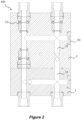
- a cap 43 may be provided, as shown in Figure 2 , shaped to plug the unused or unnecessary ports of the channel block 100.
- FIG. 6 illustrating an exemplary water treatment chemical dosing apparatus having a channel block (e.g. channel block 100), connected to a pump 100 for pumping a liquid to the channel block.
- the water treatment chemical dosing apparatus also has a calibration column 110 connected to the channel block 100.
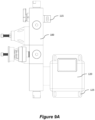
- FIG. 9A and 9B illustrating an exemplary pump 120 integrated to a channel block 100.
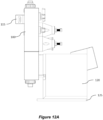
- FIG. 12A and 12B Another exemplar pump 120 integrated to a channel block 100 is illustrated in Figures 12A and 12B .
- the pump 120 may be entirely or partially integrated to the channel block 100.
- the pump 120 is directly connected to the channel block 100, where there is no conduit present between the pump 120 and the channel block 100. Therefore, the chemical liquid may pass directly from the pump 120 into a channel (or channels) of the channel block 100.
- the pump pumps the chemical liquid directly into the channel block (without passing through a conduit to reach the channel block).
- the integrated or partially integrated pump 120 may come into contact and be joined to a surface of the channel block 100 (e.g. the surface with the process outlet, or the surface with the chemical inlet), where the chemical liquid may flow from the pump head into a channel of the channel block 100 (e.g. through a port of the channel block 100).
- a part of the integrated or partially integrated pump 120 e.g. the pump head
- the entire head 153 of the integrated or partially integrated pump 120 may be integrated into the channel block 100, including, e.g., the inlet and outlet of the pump, where the chemical liquid flows through the pump into a channel of the channel block (in some examples, it may flow from a channel or port of the channel block to the pump inlet, and from the pump outlet back into a channel of the channel block or towards a port of the channel block).
- the check valves 150, the pump diaphragm 151 and the actuating rod 152 of the pump 120 may be integrated (or, in some examples, partially integrated), to the channel block 100, where the parts of the pump 100 are integrated into the channel block 100.
- one of the check valve 150 is integrated within the channel block 100 and is in communication with the chemical inlet of the channel block 100.
- the other check valve is in communication with a channel of the channel block 100.
- the pump 120 may cycle through suction strokes and discharge strokes.
- the pump 120 may pull (e.g. mechanically, magnetically, etc.) on the diaphragm 151 using the actuating rod 152.
- a vacuum pressure is created.
- This vacuum pressure results in the closing of the upper check valve 150 and allows for the introduction of new liquid into the constantly increasing volume of the pump head chamber 156.
- This liquid may be introduced via the inlet connector 154, then through the lower check valve 150 and into the pump head chamber 156.
- the discharge stroke may begin.
- the discharge stroke may be characterised by the pump 120 pushing (e.g.
- the pump 120 may operate by cycling through suction strokes and discharge strokes.
- the pump head 153 may be equipped with four valves 150, two on the pump head suction (lower) side and two on the discharge (upper) side.
- a valve 150 may be equipped with spring 157 (the valves 150 equipped with springs 157) adapted to help the check valves 150 close properly.
- the pump head 153 may be equipped with a pressure transmitter 155 reading the pressure inside the pump head chamber 156. The readings obtained by the pressure transmitter 155 may be displayed or transmitted via wireless or wired connection to, e.g., a controller, allowing for controlling or monitoring the operation of the pump 120.
- exemplary pump 120 is shown as being a diaphragm pump. However, it will be understood that pump 120 may be any other pump for pumping chemical liquid through the channel block 100 without departing from the present teachings, where the pump is at least partially integrated into the channel block 100.
- the pump 120 may have a mounting 125 (e.g. brackets; a stand - for example, rooted to the floor or secured to a vertical surface- on which the pump 120 is positioned; rods attaching the pump to the ceiling) for securing the pump 120 to a surface, such as a wall, the ground, a ceiling, etc.
- the mounting may be connected or connectable to at least one surface of the pump 125, such as a rear surface, a side surface, or its base.
- the pump 120 provides support for the channel block 100, supporting at least in part the weight of the channel block 100.
- the channel block may also have a mounting device 115 (e.g. brackets) to secure the channel block to a vertical surface, such as a wall.
- a mounting device 115 e.g. brackets
- valves located on the surface of the channel block 100 may be, in some examples, placed in the same direction as the pump 120, such that a user can access the pump and the valves from the front (as shown in Figures 12A and 12B ).
- the channel from the check valve 150 leading to the pump 120 may be angled with respect to the base of the channel block 100, and with respect to the channel leading from the pump 120 to the upper check valve 150.
- the pressure-relief valve 6 provides an outlet for the chemical liquid when the pressure of chemical liquid in the channels of the channel block is too great (e.g. as a result of a block), which may jeopardize the integrity of the water treatment apparatus if the liquid is not evacuated.
- the pressure-relief valve 6 may be placed so that it can control the liquid flowing through the channel(s) between the chemical inlet to receive the chemical liquid (e.g. port 3) and the evacuation outlet to discharge the chemical from the channel block (e.g. port 9).
- Figure 7 illustrating an exemplary method 700 for calibrating a pressure-relief valve mounted to a channel block, such as channel block 100.
- Ball valves 51, 52 and 53 of channel block 100 are positioned in a closed position at step 710. It will be understood that, depending upon the configuration and properties of the channel block, the number and configuration of the ball valves that are to be in a closed position may vary, where the open or closed state of the ball valves may be determined to provide a path for the chemical liquid that is to flow from the chemical inlet towards the evacuation outlet, and towards the pressure-relief valve positioned upstream of the evacuation outlet.
- the chemical liquid is then provided (e.g. pumped) into the channel block through the chemical inlet at a given pressure at step 720.
- the pressure of the chemical liquid may be set and/or adjusted by the pump.
- the pressure of the chemical liquid is then measured at, for instance, pressure indicator 7 at step 730.
- the pressure may be adjusted to a given pressure at which the pressure set point of the pressure relief valve is to be set.
- the pressure of the chemical liquid is provided initially at a low pressure, and gradually increased until the desired pressure is reached. It may be observed by monitoring the flow through the evacuation outlet if the chemical liquid is passing through the pressure relief valve. If chemical liquid is passing through the pressure relief valve, but the chemical liquid is allowed to pass at a pressure lower than what is sought (indicating that the pressure set point is too low), then the pressure set point can be adjusted (e.g. for a diaphragm valve, by compressing the spring using the adjustment screw) at step 740 until the desired pressure set point is reached. Similarly, it will be understood that the reverse may be performed if the pressure set point is too high.
- a back-pressure valve may be provided to regulate the flow of the chemical liquid passing through a channel or through channels that connect the chemical inlet to the process outlet.
- the back-pressure valve is placed upstream from the process outlet.
- the back-pressure valve may allow for the flow of the chemical liquid when the pressure of the chemical liquid is greater than a pressure set point of the back-pressure valve.
- Ball valve 51 is placed in a closed position, and either ball valve 52 or ball valve 53 are placed in an open position where the other is in a closed position at step 810. It will be understood that, depending upon the configuration and properties of the channel block, the number and configuration of the ball valves that are to be in a closed position may vary, where the open or closed state of the ball valves may be determined to provide a path for the chemical liquid that is to flow from the chemical inlet towards the process outlet (and/or the calibration column outlet), and towards the back-pressure valve positioned upstream of the process outlet.
- the chemical liquid is then provided (e.g. pumped) into the channel block through the chemical inlet at a given pressure at step 820.
- the pressure of the chemical liquid may be set and/or adjusted by the pump.
- the pressure of the chemical liquid is then measured at, for instance, pressure indicator 7 at step 830.
- the pressure may be adjusted to a given pressure at which level the pressure set point of the back-pressure valve is to be set.
- the pressure of the chemical liquid is provided initially at a low pressure, and gradually increased until the desired pressure is reached.
- the channel block has a pressure-relief valve, where the pressure-relief valve has already been calibrated, it is possible to start calibration at higher liquid chemical pressure levels, as the chemical liquid may exit, for instance, through the pressure-relief valve if the pressure of the chemical liquid is undesirably high.
- the pressure set point can be adjusted (e.g. for a diaphragm valve, by compressing the spring using the adjustment screw) at step 840 until the desired pressure is reached. The reverse is possible if the pressure of the chemical liquid passing through the back-pressure valve is too high. In some examples, it will be understood that the pressure set point of the back-pressure valve is set at a value lower than the pressure set point of the pressure-relief valve.
- the back-pressure valve may reduce the pressure of the chemical liquid that passes therein so that the pressure of chemical liquid entering the process outlet is lowered.
- FIG. 10 illustrating an exemplary method 900 for calibrating an exemplary dosage apparatus using a calibration column mounted to a channel block, such as channel block 100.
- Ball valves 51 and 52 are closed at step 910. Ball valve 53 leading to the calibration column is left open. It will be understood that other configurations of open/closed ball valves, depending upon the configuration or properties of the channel block, may be used in order to create a path to allow chemical liquid to flow from the chemical inlet to the calibration column without taking any other paths.
- Chemical liquid is then pumped through the channel block to the calibration column at step 920.
- the correction factor can be adjusted in the pump settings.
- Some pumps are equipped with a calibration feature that allows for a preset calibrating volume (no need for the calculation of pump flow set point x time of pumping). This allows for the calibration of the dosage apparatus.
- Ball valve 51 is then opened at step 930.
- Ball valve 53 is left in an open position.
- Ball valve 52 is left in a closed position. It will be understood that other configurations of open/closed ball valves, depending upon the configuration or properties of the channel block, may be used in order to create a path to allow chemical liquid to flow from the calibration column to the evacuation outlet. The chemical liquid is then allowed to flow from the calibration column at step 940.
- ball valves 51 and 53 are closed, and ball valve 52 is opened at step 950. This allows the chemical liquid that is being pumped to flow directly from the chemical inlet to the process outlet. It will be understood that other configurations of open/closed ball valves, depending upon the configuration or properties of the channel block, may be used in order to create a path to allow chemical liquid to flow from the chemical inlet to the process outlet without taking any other paths.
- FIG. 11 illustrating an exemplary method 1000 of treating a body of water with a chemical liquid using a chemical dosage apparatus having a channel block.
- the regulation valves of the channel block may be calibrated prior to pumping chemical liquid towards the untreated body of water, the calibration performed as explained herein.
- the chemical liquid is pumped (e.g. by a pump connected to a source of chemical liquid) from the source of chemical liquid at step 1010.
- the chemical liquid enters the chemical inlet of the channel block at step 1020, entering the channels of the channel block.
- the flow through the channel block of the dosage apparatus provides for a vehicle to receive the chemical liquid that minimizes risks of leaks and spillage as the channels are integrated with the modular block(s).
- the pressure of the chemical liquid is regulated within the channel block, where, for instance, a regulation valve (e.g. back-pressure valve with a given pressure set point) may be used to control the pressure of the chemical liquid that flows from the chemical inlet to the process outlet at step 1030.
- a regulation valve e.g. back-pressure valve with a given pressure set point
- a dosed amount of the chemical liquid then flows out of the channel block from its process outlet towards the water requiring treatment at step 1040.
- the untreated water then receives the chemical liquid for its treatment at step 1050.
- the channels of the channel block may be cleaned periodically at step 1060. This may be to remove residue accumulating in the channels, such as crystallized or solidified chemicals.
- the channels may be cleaned by using the auxiliary port of the channel block.
Landscapes
- Physics & Mathematics (AREA)
- General Physics & Mathematics (AREA)
- Engineering & Computer Science (AREA)
- Chemical & Material Sciences (AREA)
- Fluid Mechanics (AREA)
- Organic Chemistry (AREA)
- Environmental & Geological Engineering (AREA)
- Water Supply & Treatment (AREA)
- Hydrology & Water Resources (AREA)
- Life Sciences & Earth Sciences (AREA)
- Automation & Control Theory (AREA)
- Health & Medical Sciences (AREA)
- Medicinal Chemistry (AREA)
- Feeding, Discharge, Calcimining, Fusing, And Gas-Generation Devices (AREA)
- Pharmaceuticals Containing Other Organic And Inorganic Compounds (AREA)
- Details Of Reciprocating Pumps (AREA)
Claims (15)
- Kanalblock (100) für eine Dosierungsvorrichtung für chemische Flüssigkeit mit einer oberen Oberfläche und einer unteren Oberfläche gegenüber der oberen Oberfläche, einer vorderen Oberfläche und einer hinteren Oberfläche gegenüber der vorderen Oberfläche, bei der die vordere Oberfläche orthogonal zu der oberen Oberfläche ist, mit:einem Prozessauslass (19), der so positioniert ist, dass er eine Abgabe einer chemischen Flüssigkeit aus dem Kanalblock, die in Richtung eines Zustellpunkts der chemischen Flüssigkeit wandert, zulässt;einem Einlass (3) für chemische Flüssigkeit, der dazu ausgebildet ist, die chemische Flüssigkeit, die in den Kanalblock (100) wandert, aufzunehmen;einem Evakuierungsauslass (9), der zum Evakuieren übermäßiger chemischer Flüssigkeit in Kanälen (11) des Kanalblocks (100) positioniert ist;Kanälen (11), die innerhalb des Kanalblocks (100) vorgesehen sind, die zumindest den Prozessauslass (19), den Einlass (3) für chemische Flüssigkeit und den Evakuierungsauslass (9) verbinden;einem Druckanzeiger (7), der auf dem Kanalblock (100) montiert ist, zum Messen eines Drucks der chemischen Flüssigkeit, die durch den Einlass (3) für die chemische Flüssigkeit eintritt;einem Evakuierungsregelventil (6), das an dem Kanalblock (100) stromaufwärts des Evakuierungsauslasses (9) montiert ist und mit den Kanälen (11) zum Steuern eines Durchgangs der chemischen Flüssigkeit durch einen Kanal der Kanäle (11), der den Einlass (3) für chemische Flüssigkeit mit dem Evakuierungsauslass (9) verbindet, interagiert; undmindestens einem Steuerungsventil (51, 52, 53), das an dem Block montiert ist, das dazu ausgebildet ist, die chemische Flüssigkeit, die durch die Kanäle (11) verläuft, zu steuern, bei dem ein erstes Steuerungsventil (52) des mindestens einen Steuerungsventils (51, 52, 53) in Bezug auf die Kanäle (11) so liegt, dass es eine Strömung der chemischen Flüssigkeit zu dem Prozessauslass (19) steuert,bei dem das Evakuierungsregelventil (6) in Bezug auf das mindestens eine Steuerungsventil derart positioniert ist, dass ein Druckeinstellpunkt des Evakuierungsregelventils (6) unter Verwendung des Druckanzeigers (7) angepasst werden kann, wenn das mindestens eine Steuerungsventil in einer geschlossenen Position ist.
- Kanalblock (100), wie in Anspruch 1 definiert, ferner mit:einem Kalibriersäulenauslass (20), der dazu ausgebildet ist, eine Verbindung mit einer Kalibriersäule (110) herzustellen;Kanälen (11), die mit dem Kanalblock (100) vorgesehen sind, die zumindest den Prozessauslass (19), den Einlass (3) für chemische Flüssigkeit, den Evakuierungsauslass (9) und den Kalibriersäulenauslass (20) verbinden;bei dem ein zweites Steuerungsventil (51) des mindestens einen Steuerungsventils in Bezug auf die Kanäle (11) so liegt, dass es eine Strömung der chemischen Flüssigkeit zu dem Evakuierungsauslass (9) steuert; und ein drittes Steuerungsventil (53) des mindestens einen Steuerungsventils in Bezug auf die Kanäle (11) so liegt, dass es eine Strömung der chemischen Flüssigkeit zu dem Kalibriersäulenauslass (20) steuert.
- Kanalblock (100), wie in Anspruch 2 definiert, ferner mit:einem zusätzlichen Regelventil, das an dem Kanalblock (100) stromaufwärts mindestens eines von dem Prozessauslass (19) und dem Kalibriersäulenauslass (20) montiert ist und mit den Kanälen (11) zum Steuern eines Durchgangs der chemischen Flüssigkeit durch einen Kanal der Kanäle (11), der den Einlass (3) für chemische Flüssigkeit mit dem Prozessauslass (19) verbindet, interagiert;bei dem das zusätzliche Regelventil in Bezug auf das erste Steuerungsventil (52), das zweite Steuerungsventil (51) und das dritte Steuerungsventil (53) derart positioniert ist, dass ein Druckeinstellpunkt des zusätzlichen Regelventils unter Verwendung des Druckanzeigers (7) in einem der folgenden Fälle kalibriert werden kann:das erste Steuerungsventil (52) ist in einer offenen Position, und das zweite Steuerungsventil (51) und das dritte Steuerungsventil (53) sind in einer geschlossenen Position; unddas dritte Steuerungsventil (53) ist in einer offenen Position, und das erste Steuerungsventil (52) und das zweite Steuerungsventil (51) sind in einer geschlossenen Position.
- Kanalblock (100), wie in Anspruch 3 definiert, bei dem das zusätzliche Regelventil ein Rückschlagventil (5) ist.
- Kanalblock (100), wie in einem Anspruch 3 oder Anspruch 4 definiert, bei dem das zusätzliche Regelventil ein Membranventil ist.
- Kanalblock (100), wie in einem der Ansprüche 2 bis 5 definiert, bei dem mindestens eines der mindestens drei Steuerungsventile (51, 52, 53) ein Kugelventil ist.
- Kanalblock (100), wie in einem der Ansprüche 2 bis 6 definiert, bei dem der Kanalblock (100) einen Hilfsanschluss aufweist, und bei dem die Kanäle (11) zumindest den Prozessauslass (19), den Einlass (3) für chemische Flüssigkeit, den Evakuierungsauslass (9), den Kalibriersäulenauslass (20) und den Hilfsanschluss verbinden.
- Kanalblock (100), wie in einem der Ansprüche 2 bis 7 definiert, bei dem das Evakuierungsregelventil (6) ein Überdruckventil ist.
- Kanalblock (100), wie in einem der Ansprüche 2 bis 8 definiert, bei dem das Evakuierungsregelventil (6) ein Membranventil ist.
- Kanalblock (100), wie in einem der Ansprüche 2 bis 9 definiert, bei dem das Evakuierungsregelventil (6) in Bezug auf die drei Steuerungsventile (51, 52, 53) derart positioniert ist, dass ein Druckeinstellpunkt des Evakuierungsregelventils (6) unter Verwendung des Druckanzeigers (7) kalibriert werden kann, wenn das erste Steuerungsventil (52), das zweite Steuerungsventil (51) und das dritte Steuerungsventil (53) in einer geschlossenen Position sind.
- Kanalblock (100), wie in einem der Ansprüche 2 bis 10 definiert, bei dem die hintere Oberfläche ferner eine Montierung zum Befestigen des Kanalblocks (100) an einer vertikalen Oberfläche aufweist.
- Kanalblock (100), wie in einem der Ansprüche 2 bis 11 definiert, bei dem der Kanalblock (100) aus mindestens zwei Unterblöcken zusammengesetzt ist.
- Wasserbehandlungsdosierungsvorrichtung für chemische Flüssigkeit, mit:dem Kanalblock (100) nach einem der Ansprüche 1 bis 12;einer Pumpe (120), die mit dem Einlass (3) für chemische Flüssigkeit verbunden ist; undeiner Kalibriersäule (110), die mit dem Kalibriersäulenauslass (20) verbunden ist.
- Verfahren zum Behandeln von Wasser, umfassend:Kalibrieren eines Rückschlagventils (5) unter Verwendung eines Druckanzeigers (7) des Kanalblocks (100) wie in einem der Ansprüche 1 bis 12 definiert, der an dem Einlass (3) des Kanalblocks (100) für chemische Flüssigkeit liegt, durch Messen des Drucks chemischer Flüssigkeit, die in den Einlass (3) für chemische Flüssigkeit eintritt;Pumpen der chemischen Flüssigkeit von einer Quelle der chemischen Flüssigkeit;Aufnehmen der chemischen Flüssigkeit an dem Einlass (3) des Kanalblocks (100) für chemische Flüssigkeit, so dass die chemische Flüssigkeit innerhalb von Kanälen (11), die innerhalb des Kanalblocks (100) definiert sind, strömt;Regeln des Drucks der chemischen Flüssigkeit, die in den Kanälen (11) des Kanalblocks (100) strömt, so dass der Druck auf einen gewünschten Druck eingestellt wird;Ausströmen einer dosierten Menge der chemischen Flüssigkeit bei dem gewünschten Druck in Richtung eines Wasserkörpers, der einer Behandlung bedarf; undBehandeln des Wassers mit der chemischen Flüssigkeit.
- Verfahren, wie in Anspruch 14 definiert, ferner umfassend ein Reinigen der Kanäle (11) des Kanalblocks (100) unter Verwendung eines Hilfsanschlusses des Kanalblocks (100).
Applications Claiming Priority (6)
| Application Number | Priority Date | Filing Date | Title |
|---|---|---|---|
| US201762562615P | 2017-09-25 | 2017-09-25 | |
| US201762562630P | 2017-09-25 | 2017-09-25 | |
| US201862648128P | 2018-03-26 | 2018-03-26 | |
| US201862653234P | 2018-04-05 | 2018-04-05 | |
| US201862678660P | 2018-05-31 | 2018-05-31 | |
| PCT/CA2018/051183 WO2019056115A1 (en) | 2017-09-25 | 2018-09-21 | APPARATUS AND METHOD FOR ASSAYING AND ADMINISTERING LIQUID CHEMICALS |
Publications (4)
| Publication Number | Publication Date |
|---|---|
| EP3672915A1 EP3672915A1 (de) | 2020-07-01 |
| EP3672915A4 EP3672915A4 (de) | 2021-04-28 |
| EP3672915B1 true EP3672915B1 (de) | 2024-08-21 |
| EP3672915C0 EP3672915C0 (de) | 2024-08-21 |
Family
ID=65809531
Family Applications (1)
| Application Number | Title | Priority Date | Filing Date |
|---|---|---|---|
| EP18857630.0A Active EP3672915B1 (de) | 2017-09-25 | 2018-09-21 | Vorrichtung und verfahren zur dosierung und verabreichung von flüssigen chemikalien |
Country Status (7)
| Country | Link |
|---|---|
| US (2) | US11306011B2 (de) |
| EP (1) | EP3672915B1 (de) |
| CN (1) | CN111328321B (de) |
| AU (1) | AU2018336080B2 (de) |
| CA (1) | CA3075945A1 (de) |
| ES (1) | ES2986463T3 (de) |
| WO (1) | WO2019056115A1 (de) |
Families Citing this family (2)
| Publication number | Priority date | Publication date | Assignee | Title |
|---|---|---|---|---|
| WO2025256768A1 (en) * | 2024-06-14 | 2025-12-18 | Grundfos Holding A/S | A fluid line adapter |
| WO2025256767A1 (en) * | 2024-06-14 | 2025-12-18 | Grundfos Holding A/S | A dosing skid system and a method for operating a dosing skid system |
Family Cites Families (36)
| Publication number | Priority date | Publication date | Assignee | Title |
|---|---|---|---|---|
| AU537780B2 (en) | 1978-05-19 | 1984-07-12 | Albert, Robert J. | Diaphragm valves and valve systems |
| US4254797A (en) | 1979-01-26 | 1981-03-10 | Bi-M Instrument Company | Apparatus for producing calibration gases suitable for analytical instrumentation |
| GB8327418D0 (en) | 1983-10-13 | 1983-11-16 | Unilever Plc | Liquid dispensing system |
| US4714091A (en) | 1985-06-10 | 1987-12-22 | Emcore, Inc. | Modular gas handling apparatus |
| EP0780134B1 (de) | 1995-12-19 | 2001-09-19 | Fresenius AG | Modulares System, insbesondere für biomedizinische Anwendungen, eine Einheit sowie ein Kommunikationssystem dafür |
| US5662143A (en) | 1996-05-16 | 1997-09-02 | Gasonics International | Modular gas box system |
| US5836355A (en) | 1996-12-03 | 1998-11-17 | Insync Systems, Inc. | Building blocks for integrated gas panel |
| DE19704656A1 (de) * | 1997-02-07 | 1998-08-13 | Gruenbeck Josef Wasseraufb | Einrichtung zur Lenkung, Steuerung, Regelung, Messung und Überwachung von Flüssigkeitsströmen und Wasseraufbereitungsanlage |
| DE29703788U1 (de) | 1997-03-03 | 1997-06-26 | Bürkert Werke GmbH & Co., 74653 Ingelfingen | Modularer Steuerblock für die Analysentechnik |
| US5860676A (en) | 1997-06-13 | 1999-01-19 | Swagelok Marketing Co. | Modular block assembly using angled fasteners for interconnecting fluid components |
| AU2218699A (en) | 1998-01-09 | 1999-07-26 | Swagelok Company | Seal for a modular flow devices |
| WO1999064771A1 (en) | 1998-06-12 | 1999-12-16 | Hollingshead J Gregory | Unified modular chemical delivery blocks |
| US6228255B1 (en) | 1998-07-24 | 2001-05-08 | Dialysis Systems, Inc. | Portable water treatment facility |
| US6729353B2 (en) | 1999-09-01 | 2004-05-04 | Asml Us, Inc. | Modular fluid delivery apparatus |
| DE10134885B4 (de) | 2001-07-18 | 2004-02-05 | Roche Diagnostics Gmbh | Modulares Analysesystem |
| WO2005001285A2 (en) * | 2003-06-26 | 2005-01-06 | The Gorman-Rupp Company | Diaphragm pump with control module |
| DE10329834A1 (de) | 2003-07-02 | 2005-02-03 | Dräger Safety AG & Co. KGaA | Modulares Gasmesssystem |
| US7178556B2 (en) | 2003-08-07 | 2007-02-20 | Parker-Hannifin Corporation | Modular component connector substrate assembly system |
| US7294262B2 (en) | 2003-08-27 | 2007-11-13 | Sta-Rite Industries, Llc | Modular fluid treatment apparatus |
| US7530255B2 (en) | 2005-01-18 | 2009-05-12 | Mine Safety Appliances Company | Devices, systems and methods for testing of gas detectors |
| EP1717208B1 (de) * | 2005-04-28 | 2013-06-26 | Grundfos Management A/S | Vorrichtung zur Fluidbehandlung, insbesondere Abwasserbehandlung, mit einem Scheibenstapel |
| KR20080039351A (ko) | 2005-06-01 | 2008-05-07 | 커민즈코프 리미티드 | 모듈식 수처리 유닛 |
| JP4828605B2 (ja) | 2005-08-02 | 2011-11-30 | トランスオーシャン オフショア ディープウォーター ドリリング, インコーポレイテッド | モジュール方式バックアップ流体供給システム |
| US20070289652A1 (en) | 2006-06-16 | 2007-12-20 | Matheson Tri-Gas | High flow surface mount components |
| US20080302426A1 (en) | 2007-06-06 | 2008-12-11 | Greg Patrick Mulligan | System and method of securing removable components for distribution of fluids |
| US8560130B2 (en) | 2007-12-04 | 2013-10-15 | Lester F. Ludwig | Software controlled lab-on-a-chip emulation |
| US8727029B2 (en) * | 2009-09-10 | 2014-05-20 | The Viking Corporation | Trim manifold assembly for a sprinkler system |
| NZ605639A (en) | 2010-06-30 | 2014-10-31 | Acid Ip Pty Ltd | Modular water treatment system |
| PH12013501965A1 (en) | 2011-04-05 | 2018-03-21 | Nestec Sa | Set of modular beverage preparation machines and processes for configuring and manufacturing the machines |
| US8950433B2 (en) | 2011-05-02 | 2015-02-10 | Advantage Group International Inc. | Manifold system for gas and fluid delivery |
| HRP20161257T1 (hr) * | 2012-06-01 | 2016-11-18 | Avk Holding A/S | Sklop hidrauličkog upravljačkog ventila i nadzorni sustav za vodoopskrbne mreže |
| US9157435B2 (en) | 2012-09-28 | 2015-10-13 | Grundfos Pumps Manufacturing Corporation | Dosing manifold and system |
| MX2015010024A (es) * | 2013-02-01 | 2016-03-03 | Lake Country Fracwater Specialists Llc | Método y aparato para el tratamiento de gas natural y aceite así aguas residuales para la eliminación de contaminantes y solidos disueltos. |
| DE102013109969A1 (de) | 2013-09-11 | 2015-03-12 | Krones Ag | Vorrichtung zum Dosieren eines Füllprodukts in einen zu befüllenden Behälter |
| KR101394992B1 (ko) | 2013-11-11 | 2014-05-14 | 한국건설기술연구원 | 카세트형 정수처리 패키지 시스템 |
| CN206126876U (zh) | 2016-08-22 | 2017-04-26 | 江苏辰盛环保科技有限公司 | 一种组合式加药系统 |
-
2018
- 2018-09-21 EP EP18857630.0A patent/EP3672915B1/de active Active
- 2018-09-21 WO PCT/CA2018/051183 patent/WO2019056115A1/en not_active Ceased
- 2018-09-21 US US16/647,771 patent/US11306011B2/en active Active
- 2018-09-21 CA CA3075945A patent/CA3075945A1/en active Pending
- 2018-09-21 CN CN201880062240.0A patent/CN111328321B/zh active Active
- 2018-09-21 ES ES18857630T patent/ES2986463T3/es active Active
- 2018-09-21 AU AU2018336080A patent/AU2018336080B2/en active Active
-
2022
- 2022-03-11 US US17/692,866 patent/US12398054B2/en active Active
Also Published As
| Publication number | Publication date |
|---|---|
| US12398054B2 (en) | 2025-08-26 |
| US20220194827A1 (en) | 2022-06-23 |
| CA3075945A1 (en) | 2019-03-28 |
| CN111328321A (zh) | 2020-06-23 |
| ES2986463T3 (es) | 2024-11-11 |
| US20200231474A1 (en) | 2020-07-23 |
| US11306011B2 (en) | 2022-04-19 |
| CN111328321B (zh) | 2024-09-27 |
| WO2019056115A1 (en) | 2019-03-28 |
| EP3672915A4 (de) | 2021-04-28 |
| AU2018336080B2 (en) | 2023-11-02 |
| AU2018336080A1 (en) | 2020-04-16 |
| EP3672915C0 (de) | 2024-08-21 |
| EP3672915A1 (de) | 2020-07-01 |
Similar Documents
| Publication | Publication Date | Title |
|---|---|---|
| US12398054B2 (en) | Apparatus and method for dosage and administration of liquid chemicals | |
| US6168048B1 (en) | Methods and systems for distributing liquid chemicals | |
| TWI687594B (zh) | 具有一快換馬達驅動、自動式氣體移除與流體回收系統以及其遠端監測、觀察與控制的綜合式泵系統和方法 | |
| TWI400389B (zh) | 用於一幫浦中之壓力補償的系統與方法 | |
| JP2009517618A (ja) | Oリング無し薄型取付部品および取付部品アセンブリ | |
| KR20090007375U (ko) | 진공릴리프밸브 성능시험장치 | |
| KR102154962B1 (ko) | 반도체 세정 공정용 정량 공급을 위한 미소유량 컨트롤밸브 구조 | |
| WO2011139430A2 (en) | Refueling apparatus | |
| CN1262760C (zh) | 活塞式泵的气流调节装置 | |
| RU2351748C2 (ru) | Способ программно-регулируемого поддержания пластового давления в нефтедобыче | |
| JP3897619B2 (ja) | 自動給水装置 | |
| KR101830622B1 (ko) | 지중매설형 상수도 가압장치 | |
| WO2005066535A1 (ja) | 流体継手及び継手一体型集積ユニット | |
| KR20010076831A (ko) | 반도체 제조용 약액 충전장치 | |
| RU2466374C2 (ru) | Способ для размещения в трубопроводе элемента для прокачки жидкости и устройство для его осуществления | |
| KR100509446B1 (ko) | 반도체 제조 공정에서 사용되는 약액 공급 장치 | |
| CN223925951U (zh) | 一种溢流阀密封检测结构 | |
| RU2074433C1 (ru) | Способ дозаправки маслом вводов высоковольтных аппаратов, преимущественно трансформаторов, и устройство для его осуществления | |
| WO2017017670A1 (en) | Fluid flow valve | |
| RU2606002C1 (ru) | Поплавковый наполнительный клапан | |
| CN219493125U (zh) | 一种调节式罐底阀 | |
| JP2004011542A (ja) | ジェットポンプならびにその揚程及び吐出量設定方法 | |
| RU196299U1 (ru) | Устройство для откачки нефти до нижней образующей нефтепровода | |
| JP3492674B1 (ja) | 貯水槽の配管施工方法及びそれに用いる工具 | |
| SU688830A1 (ru) | Устройство дл подачи присадочной жидкости |
Legal Events
| Date | Code | Title | Description |
|---|---|---|---|
| STAA | Information on the status of an ep patent application or granted ep patent |
Free format text: STATUS: THE INTERNATIONAL PUBLICATION HAS BEEN MADE |
|
| PUAI | Public reference made under article 153(3) epc to a published international application that has entered the european phase |
Free format text: ORIGINAL CODE: 0009012 |
|
| STAA | Information on the status of an ep patent application or granted ep patent |
Free format text: STATUS: REQUEST FOR EXAMINATION WAS MADE |
|
| 17P | Request for examination filed |
Effective date: 20200327 |
|
| AK | Designated contracting states |
Kind code of ref document: A1 Designated state(s): AL AT BE BG CH CY CZ DE DK EE ES FI FR GB GR HR HU IE IS IT LI LT LU LV MC MK MT NL NO PL PT RO RS SE SI SK SM TR |
|
| AX | Request for extension of the european patent |
Extension state: BA ME |
|
| RIN1 | Information on inventor provided before grant (corrected) |
Inventor name: TREMBLAY-MEUNIER, VINCENT Inventor name: FORTIN HOUDE, JEAN-CHRISTOPHE |
|
| RIN1 | Information on inventor provided before grant (corrected) |
Inventor name: TREMBLAY-MEUNIER, VINCENT Inventor name: FORTIN HOUDE, JEAN-CHRISTOPHE |
|
| DAV | Request for validation of the european patent (deleted) | ||
| DAX | Request for extension of the european patent (deleted) | ||
| A4 | Supplementary search report drawn up and despatched |
Effective date: 20210326 |
|
| RIC1 | Information provided on ipc code assigned before grant |
Ipc: C02F 1/68 20060101ALI20210322BHEP Ipc: B01J 4/00 20060101ALI20210322BHEP Ipc: C02F 1/00 20060101AFI20210322BHEP |
|
| STAA | Information on the status of an ep patent application or granted ep patent |
Free format text: STATUS: EXAMINATION IS IN PROGRESS |
|
| 17Q | First examination report despatched |
Effective date: 20220225 |
|
| GRAP | Despatch of communication of intention to grant a patent |
Free format text: ORIGINAL CODE: EPIDOSNIGR1 |
|
| STAA | Information on the status of an ep patent application or granted ep patent |
Free format text: STATUS: GRANT OF PATENT IS INTENDED |
|
| INTG | Intention to grant announced |
Effective date: 20240325 |
|
| GRAS | Grant fee paid |
Free format text: ORIGINAL CODE: EPIDOSNIGR3 |
|
| GRAA | (expected) grant |
Free format text: ORIGINAL CODE: 0009210 |
|
| STAA | Information on the status of an ep patent application or granted ep patent |
Free format text: STATUS: THE PATENT HAS BEEN GRANTED |
|
| AK | Designated contracting states |
Kind code of ref document: B1 Designated state(s): AL AT BE BG CH CY CZ DE DK EE ES FI FR GB GR HR HU IE IS IT LI LT LU LV MC MK MT NL NO PL PT RO RS SE SI SK SM TR |
|
| REG | Reference to a national code |
Ref country code: GB Ref legal event code: FG4D |
|
| REG | Reference to a national code |
Ref country code: CH Ref legal event code: EP |
|
| REG | Reference to a national code |
Ref country code: DE Ref legal event code: R096 Ref document number: 602018073460 Country of ref document: DE |
|
| REG | Reference to a national code |
Ref country code: IE Ref legal event code: FG4D |
|
| U01 | Request for unitary effect filed |
Effective date: 20240828 |
|
| U07 | Unitary effect registered |
Designated state(s): AT BE BG DE DK EE FI FR IT LT LU LV MT NL PT RO SE SI Effective date: 20240906 |
|
| U20 | Renewal fee for the european patent with unitary effect paid |
Year of fee payment: 7 Effective date: 20240912 |
|
| REG | Reference to a national code |
Ref country code: ES Ref legal event code: FG2A Ref document number: 2986463 Country of ref document: ES Kind code of ref document: T3 Effective date: 20241111 |
|
| PG25 | Lapsed in a contracting state [announced via postgrant information from national office to epo] |
Ref country code: NO Free format text: LAPSE BECAUSE OF FAILURE TO SUBMIT A TRANSLATION OF THE DESCRIPTION OR TO PAY THE FEE WITHIN THE PRESCRIBED TIME-LIMIT Effective date: 20241121 |
|
| PG25 | Lapsed in a contracting state [announced via postgrant information from national office to epo] |
Ref country code: GR Free format text: LAPSE BECAUSE OF FAILURE TO SUBMIT A TRANSLATION OF THE DESCRIPTION OR TO PAY THE FEE WITHIN THE PRESCRIBED TIME-LIMIT Effective date: 20241122 Ref country code: PL Free format text: LAPSE BECAUSE OF FAILURE TO SUBMIT A TRANSLATION OF THE DESCRIPTION OR TO PAY THE FEE WITHIN THE PRESCRIBED TIME-LIMIT Effective date: 20240821 |
|
| PG25 | Lapsed in a contracting state [announced via postgrant information from national office to epo] |
Ref country code: IS Free format text: LAPSE BECAUSE OF FAILURE TO SUBMIT A TRANSLATION OF THE DESCRIPTION OR TO PAY THE FEE WITHIN THE PRESCRIBED TIME-LIMIT Effective date: 20241221 |
|
| PG25 | Lapsed in a contracting state [announced via postgrant information from national office to epo] |
Ref country code: HR Free format text: LAPSE BECAUSE OF FAILURE TO SUBMIT A TRANSLATION OF THE DESCRIPTION OR TO PAY THE FEE WITHIN THE PRESCRIBED TIME-LIMIT Effective date: 20240821 |
|
| PG25 | Lapsed in a contracting state [announced via postgrant information from national office to epo] |
Ref country code: RS Free format text: LAPSE BECAUSE OF FAILURE TO SUBMIT A TRANSLATION OF THE DESCRIPTION OR TO PAY THE FEE WITHIN THE PRESCRIBED TIME-LIMIT Effective date: 20241121 |
|
| PG25 | Lapsed in a contracting state [announced via postgrant information from national office to epo] |
Ref country code: RS Free format text: LAPSE BECAUSE OF FAILURE TO SUBMIT A TRANSLATION OF THE DESCRIPTION OR TO PAY THE FEE WITHIN THE PRESCRIBED TIME-LIMIT Effective date: 20241121 Ref country code: PL Free format text: LAPSE BECAUSE OF FAILURE TO SUBMIT A TRANSLATION OF THE DESCRIPTION OR TO PAY THE FEE WITHIN THE PRESCRIBED TIME-LIMIT Effective date: 20240821 Ref country code: NO Free format text: LAPSE BECAUSE OF FAILURE TO SUBMIT A TRANSLATION OF THE DESCRIPTION OR TO PAY THE FEE WITHIN THE PRESCRIBED TIME-LIMIT Effective date: 20241121 Ref country code: IS Free format text: LAPSE BECAUSE OF FAILURE TO SUBMIT A TRANSLATION OF THE DESCRIPTION OR TO PAY THE FEE WITHIN THE PRESCRIBED TIME-LIMIT Effective date: 20241221 Ref country code: HR Free format text: LAPSE BECAUSE OF FAILURE TO SUBMIT A TRANSLATION OF THE DESCRIPTION OR TO PAY THE FEE WITHIN THE PRESCRIBED TIME-LIMIT Effective date: 20240821 Ref country code: GR Free format text: LAPSE BECAUSE OF FAILURE TO SUBMIT A TRANSLATION OF THE DESCRIPTION OR TO PAY THE FEE WITHIN THE PRESCRIBED TIME-LIMIT Effective date: 20241122 |
|
| PG25 | Lapsed in a contracting state [announced via postgrant information from national office to epo] |
Ref country code: SM Free format text: LAPSE BECAUSE OF FAILURE TO SUBMIT A TRANSLATION OF THE DESCRIPTION OR TO PAY THE FEE WITHIN THE PRESCRIBED TIME-LIMIT Effective date: 20240821 |
|
| PG25 | Lapsed in a contracting state [announced via postgrant information from national office to epo] |
Ref country code: CZ Free format text: LAPSE BECAUSE OF FAILURE TO SUBMIT A TRANSLATION OF THE DESCRIPTION OR TO PAY THE FEE WITHIN THE PRESCRIBED TIME-LIMIT Effective date: 20240821 |
|
| PG25 | Lapsed in a contracting state [announced via postgrant information from national office to epo] |
Ref country code: SK Free format text: LAPSE BECAUSE OF FAILURE TO SUBMIT A TRANSLATION OF THE DESCRIPTION OR TO PAY THE FEE WITHIN THE PRESCRIBED TIME-LIMIT Effective date: 20240821 |
|
| REG | Reference to a national code |
Ref country code: CH Ref legal event code: PL |
|
| PLBE | No opposition filed within time limit |
Free format text: ORIGINAL CODE: 0009261 |
|
| STAA | Information on the status of an ep patent application or granted ep patent |
Free format text: STATUS: NO OPPOSITION FILED WITHIN TIME LIMIT |
|
| PG25 | Lapsed in a contracting state [announced via postgrant information from national office to epo] |
Ref country code: MC Free format text: LAPSE BECAUSE OF FAILURE TO SUBMIT A TRANSLATION OF THE DESCRIPTION OR TO PAY THE FEE WITHIN THE PRESCRIBED TIME-LIMIT Effective date: 20240821 |
|
| PG25 | Lapsed in a contracting state [announced via postgrant information from national office to epo] |
Ref country code: CH Free format text: LAPSE BECAUSE OF NON-PAYMENT OF DUE FEES Effective date: 20240930 |
|
| PG25 | Lapsed in a contracting state [announced via postgrant information from national office to epo] |
Ref country code: IE Free format text: LAPSE BECAUSE OF NON-PAYMENT OF DUE FEES Effective date: 20240921 |
|
| 26N | No opposition filed |
Effective date: 20250522 |
|
| PGFP | Annual fee paid to national office [announced via postgrant information from national office to epo] |
Ref country code: GB Payment date: 20250911 Year of fee payment: 8 |
|
| U20 | Renewal fee for the european patent with unitary effect paid |
Year of fee payment: 8 Effective date: 20250922 |
|
| PG25 | Lapsed in a contracting state [announced via postgrant information from national office to epo] |
Ref country code: CY Free format text: LAPSE BECAUSE OF FAILURE TO SUBMIT A TRANSLATION OF THE DESCRIPTION OR TO PAY THE FEE WITHIN THE PRESCRIBED TIME-LIMIT; INVALID AB INITIO Effective date: 20180921 |
|
| PGFP | Annual fee paid to national office [announced via postgrant information from national office to epo] |
Ref country code: ES Payment date: 20251008 Year of fee payment: 8 |
|
| PG25 | Lapsed in a contracting state [announced via postgrant information from national office to epo] |
Ref country code: HU Free format text: LAPSE BECAUSE OF FAILURE TO SUBMIT A TRANSLATION OF THE DESCRIPTION OR TO PAY THE FEE WITHIN THE PRESCRIBED TIME-LIMIT; INVALID AB INITIO Effective date: 20180921 |