EP3666115B1 - Tuchmaske - Google Patents
Tuchmaske Download PDFInfo
- Publication number
- EP3666115B1 EP3666115B1 EP18843278.5A EP18843278A EP3666115B1 EP 3666115 B1 EP3666115 B1 EP 3666115B1 EP 18843278 A EP18843278 A EP 18843278A EP 3666115 B1 EP3666115 B1 EP 3666115B1
- Authority
- EP
- European Patent Office
- Prior art keywords
- sheet mask
- positive electrode
- negative electrode
- battery part
- battery
- Prior art date
- Legal status (The legal status is an assumption and is not a legal conclusion. Google has not performed a legal analysis and makes no representation as to the accuracy of the status listed.)
- Active
Links
Images



Classifications
-
- A—HUMAN NECESSITIES
- A61—MEDICAL OR VETERINARY SCIENCE; HYGIENE
- A61M—DEVICES FOR INTRODUCING MEDIA INTO, OR ONTO, THE BODY; DEVICES FOR TRANSDUCING BODY MEDIA OR FOR TAKING MEDIA FROM THE BODY; DEVICES FOR PRODUCING OR ENDING SLEEP OR STUPOR
- A61M35/00—Devices for applying media, e.g. remedies, on the human body
- A61M35/10—Wearable devices, e.g. garments, glasses or masks
-
- A—HUMAN NECESSITIES
- A45—HAND OR TRAVELLING ARTICLES
- A45D—HAIRDRESSING OR SHAVING EQUIPMENT; EQUIPMENT FOR COSMETICS OR COSMETIC TREATMENTS, e.g. FOR MANICURING OR PEDICURING
- A45D44/00—Other cosmetic or toiletry articles, e.g. for hairdressers' rooms
- A45D44/002—Masks for cosmetic treatment of the face
-
- A—HUMAN NECESSITIES
- A45—HAND OR TRAVELLING ARTICLES
- A45D—HAIRDRESSING OR SHAVING EQUIPMENT; EQUIPMENT FOR COSMETICS OR COSMETIC TREATMENTS, e.g. FOR MANICURING OR PEDICURING
- A45D44/00—Other cosmetic or toiletry articles, e.g. for hairdressers' rooms
- A45D44/22—Face shaping devices, e.g. chin straps; Wrinkle removers, e.g. stretching the skin
-
- A—HUMAN NECESSITIES
- A61—MEDICAL OR VETERINARY SCIENCE; HYGIENE
- A61M—DEVICES FOR INTRODUCING MEDIA INTO, OR ONTO, THE BODY; DEVICES FOR TRANSDUCING BODY MEDIA OR FOR TAKING MEDIA FROM THE BODY; DEVICES FOR PRODUCING OR ENDING SLEEP OR STUPOR
- A61M37/00—Other apparatus for introducing media into the body; Percutany, i.e. introducing medicines into the body by diffusion through the skin
-
- H—ELECTRICITY
- H01—ELECTRIC ELEMENTS
- H01M—PROCESSES OR MEANS, e.g. BATTERIES, FOR THE DIRECT CONVERSION OF CHEMICAL ENERGY INTO ELECTRICAL ENERGY
- H01M12/00—Hybrid cells; Manufacture thereof
- H01M12/02—Details
-
- H—ELECTRICITY
- H01—ELECTRIC ELEMENTS
- H01M—PROCESSES OR MEANS, e.g. BATTERIES, FOR THE DIRECT CONVERSION OF CHEMICAL ENERGY INTO ELECTRICAL ENERGY
- H01M12/00—Hybrid cells; Manufacture thereof
- H01M12/04—Hybrid cells; Manufacture thereof composed of a half-cell of the fuel-cell type and of a half-cell of the primary-cell type
- H01M12/06—Hybrid cells; Manufacture thereof composed of a half-cell of the fuel-cell type and of a half-cell of the primary-cell type with one metallic and one gaseous electrode
-
- H—ELECTRICITY
- H01—ELECTRIC ELEMENTS
- H01M—PROCESSES OR MEANS, e.g. BATTERIES, FOR THE DIRECT CONVERSION OF CHEMICAL ENERGY INTO ELECTRICAL ENERGY
- H01M4/00—Electrodes
- H01M4/02—Electrodes composed of, or comprising, active material
- H01M4/36—Selection of substances as active materials, active masses, active liquids
- H01M4/38—Selection of substances as active materials, active masses, active liquids of elements or alloys
-
- H—ELECTRICITY
- H01—ELECTRIC ELEMENTS
- H01M—PROCESSES OR MEANS, e.g. BATTERIES, FOR THE DIRECT CONVERSION OF CHEMICAL ENERGY INTO ELECTRICAL ENERGY
- H01M4/00—Electrodes
- H01M4/86—Inert electrodes with catalytic activity, e.g. for fuel cells
- H01M4/96—Carbon-based electrodes
-
- A—HUMAN NECESSITIES
- A61—MEDICAL OR VETERINARY SCIENCE; HYGIENE
- A61M—DEVICES FOR INTRODUCING MEDIA INTO, OR ONTO, THE BODY; DEVICES FOR TRANSDUCING BODY MEDIA OR FOR TAKING MEDIA FROM THE BODY; DEVICES FOR PRODUCING OR ENDING SLEEP OR STUPOR
- A61M37/00—Other apparatus for introducing media into the body; Percutany, i.e. introducing medicines into the body by diffusion through the skin
- A61M2037/0007—Other apparatus for introducing media into the body; Percutany, i.e. introducing medicines into the body by diffusion through the skin having means for enhancing the permeation of substances through the epidermis, e.g. using suction or depression, electric or magnetic fields, sound waves or chemical agents
-
- A—HUMAN NECESSITIES
- A61—MEDICAL OR VETERINARY SCIENCE; HYGIENE
- A61M—DEVICES FOR INTRODUCING MEDIA INTO, OR ONTO, THE BODY; DEVICES FOR TRANSDUCING BODY MEDIA OR FOR TAKING MEDIA FROM THE BODY; DEVICES FOR PRODUCING OR ENDING SLEEP OR STUPOR
- A61M2205/00—General characteristics of the apparatus
- A61M2205/82—Internal energy supply devices
- A61M2205/8206—Internal energy supply devices battery-operated
-
- A—HUMAN NECESSITIES
- A61—MEDICAL OR VETERINARY SCIENCE; HYGIENE
- A61N—ELECTROTHERAPY; MAGNETOTHERAPY; RADIATION THERAPY; ULTRASOUND THERAPY
- A61N1/00—Electrotherapy; Circuits therefor
- A61N1/18—Applying electric currents by contact electrodes
- A61N1/20—Applying electric currents by contact electrodes continuous direct currents
- A61N1/30—Apparatus for iontophoresis, i.e. transfer of media in ionic state by an electromotoric force into the body, or cataphoresis
-
- H—ELECTRICITY
- H01—ELECTRIC ELEMENTS
- H01M—PROCESSES OR MEANS, e.g. BATTERIES, FOR THE DIRECT CONVERSION OF CHEMICAL ENERGY INTO ELECTRICAL ENERGY
- H01M4/00—Electrodes
- H01M4/02—Electrodes composed of, or comprising, active material
- H01M2004/026—Electrodes composed of, or comprising, active material characterised by the polarity
- H01M2004/027—Negative electrodes
-
- H—ELECTRICITY
- H01—ELECTRIC ELEMENTS
- H01M—PROCESSES OR MEANS, e.g. BATTERIES, FOR THE DIRECT CONVERSION OF CHEMICAL ENERGY INTO ELECTRICAL ENERGY
- H01M4/00—Electrodes
- H01M4/86—Inert electrodes with catalytic activity, e.g. for fuel cells
- H01M2004/8678—Inert electrodes with catalytic activity, e.g. for fuel cells characterised by the polarity
- H01M2004/8689—Positive electrodes
-
- H—ELECTRICITY
- H01—ELECTRIC ELEMENTS
- H01M—PROCESSES OR MEANS, e.g. BATTERIES, FOR THE DIRECT CONVERSION OF CHEMICAL ENERGY INTO ELECTRICAL ENERGY
- H01M2220/00—Batteries for particular applications
- H01M2220/30—Batteries in portable systems, e.g. mobile phone, laptop
-
- Y—GENERAL TAGGING OF NEW TECHNOLOGICAL DEVELOPMENTS; GENERAL TAGGING OF CROSS-SECTIONAL TECHNOLOGIES SPANNING OVER SEVERAL SECTIONS OF THE IPC; TECHNICAL SUBJECTS COVERED BY FORMER USPC CROSS-REFERENCE ART COLLECTIONS [XRACs] AND DIGESTS
- Y02—TECHNOLOGIES OR APPLICATIONS FOR MITIGATION OR ADAPTATION AGAINST CLIMATE CHANGE
- Y02E—REDUCTION OF GREENHOUSE GAS [GHG] EMISSIONS, RELATED TO ENERGY GENERATION, TRANSMISSION OR DISTRIBUTION
- Y02E60/00—Enabling technologies; Technologies with a potential or indirect contribution to GHG emissions mitigation
- Y02E60/10—Energy storage using batteries
Definitions
- the present invention relates to a sheet mask including a battery.
- a sheet mask formed of a sheet impregnated with lotion or solution containing a cosmetic ingredient has been used for skincare of the face.
- a commercially-available general sheet mask is a disposable product and can be easily handled in everyday life.
- proposals have been made in anticipation of further promotion of cosmetic effects. For example, there is proposed a technique in which protrusions are arranged on a sheet mask to make the positions of major acupuncture points in the face recognizable and obtain effects of acupressure in addition to activation of the skin achieved by penetration of serum (Patent Document 1).
- Patent Document 2 proposes a technique in which an attachable and detachable sheet electrode is attached to a sheet mask and signals are sent to the electrode by using a smartphone or the like as an external power source to cause microcurrents to flow to the skin, thereby promoting effective penetration (iontophoresis) of a cosmetic ingredient.
- Document WO 2016/053683 A1 relates to cosmetic facial treatment delivery system with skincare benefit agents and iontophoresis micro-current zones provided for delivering skincare treatments to multiple targeted areas of the skin to treat different concerns of an individual user.
- the system includes a sheet substrate with skincare agents and a dual-phase cream that generates micro-current when activated.
- a first phase contains a reduction agent and a second phase contains an oxidation agent.
- the cream is activated to produce micro-current when the two phases are combined.
- the cream is applied to skin along with the sheet substrate.
- the sheet mask provided with the protrusions has such a problem that how the fingers come into contact with protruding objects varies among individuals and not everyone can necessarily obtain the same effect.
- the period for skincare with the sheet mask worn is generally referred to as a blissful period and is a period of relaxation. Accordingly, this sheet mask also has a problem that it is not psychologically easy to keep pressing acupuncture points when the sheet mask is worn.
- the present invention has been made in view of the aforementioned circumstances and an object thereof is to provide a sheet mask which can be expected to provide further effects while being used in the same method as a conventional general sheet mask.
- the sheet mask according to claim 1 is provided.
- the present invention can provide a sheet mask which can be expected to provide further effects while being used in the same method as a conventional general sheet mask.
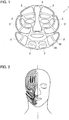
- Fig. 1 is a plan view illustrating a configuration of a sheet mask 1 in the embodiment.
- the sheet mask 1 of the embodiment includes a sheet mask main body 3 in which portions corresponding to the eyes and the mouth are cut out and multiple battery parts 2 in each of which a positive electrode portion 21 and a negative electrode portion 22 are arranged such that an electric current flows along mimic muscles.
- the multiple battery parts 2 are arranged over the entire surface of the sheet mask 1.
- the sheet mask 1 is used by impregnating the battery parts 2 with an active ingredient and bringing the positive electrode portions 21 and the negative electrode portions 22 into contact with the face.
- Fig. 2 illustrates the positions of the mimic muscles.
- the mimic muscles are muscles which move the eyes, the mouth, the nose, and the like and weaken due to aging or the like.
- the weakened mimic muscles are known to lead to loss of balance in firmness of the face and the like and cause wrinkles and sagging.
- the sheet mask 1 of the embodiment causes lotion and solution containing the active ingredient to penetrate into a biological tissue and also electrically stimulates the muscles under the skin with microcurrents generated by battery reaction of the battery parts 2. An improvement in sagging of the muscles can be thereby expected in addition to promoting of penetration of the active ingredient.
- Fig. 2 illustrates the contraction directions of the mimic muscles by solid lines.
- the positive electrode portions 21 and the negative electrode portions 22 are arranged such that the electric currents flow along the solid lines of Fig. 2 when the sheet mask 1 of Fig. 1 is worn.
- Fig. 3 is a plan view illustrating a configuration of a sheet mask 1 in a modified example.
- the sheet mask 1 in the modified example includes the sheet mask main body 3 in which portions corresponding to the eyes and the mouth are cut out and the multiple battery parts 2 in each of which the positive electrode portion 21 and the negative electrode portion 22 are arranged such that an electric current flows along a flow of lymph in the face.
- the multiple battery parts 2 are arranged over the entire surface of the sheet mask 1.
- the sheet mask 1 is used by impregnating the battery parts 2 with the active ingredient and bringing the positive electrode portions 21 and the negative electrode portions 22 into contact with the face.
- the configurations and functions of the battery parts 2 are the same as those in the sheet mask 1 of Fig. 1 .
- the arrangement of the positive electrode portions 21 and the negative electrode portions 22 is different and the directions in which the microcurrents flow are different.
- Fig. 4 illustrates flows of lymph in the face.
- the lymph refers to lymph fluid flowing through lymphatic vessels extending across the entire body like blood vessels. It is known that, when the flow of lymph stagnates, excessive water in the body cannot be excreted and this leads to swelling of the body and to a decrease in immune functions due to deposit of waste products included in the water.
- the sheet mask 1 in the modified example causes lotion and solution containing the active ingredient to penetrate into the biological tissue and also electrically stimulates the lymphatic vessels with the microcurrents generated by the battery reaction of the battery parts 2. Promoting of excreting of waste products can be thereby expected in addition to promoting of penetration of the active ingredient.
- Fig. 4 illustrates the flows of lymph by solid lines.
- the positive electrode portions 21 and the negative electrode portions 22 are arranged such that the electric currents flow along the solid lines of Fig. 4 when the sheet mask 1 of Fig. 3 is worn.
- each of the battery parts 2 arranged in the sheet mask 1 is described.
- the battery part 2 described below can be applied to both of the sheet mask 1 of Fig. 1 and the sheet mask of Fig. 3 .
- Fig. 5 is a view illustrating an outline of a cross-sectional configuration of the battery part 2.
- Fig. 5 illustrates compounds relating to reaction together with the elements forming the battery part 2.
- a battery using magnesium is described herein, the present invention is not limited to the battery using magnesium and batteries using aluminum, zinc, and manganese, a bio-fuel cell with high biocompatibility, and the like can be also used.
- the battery part 2 includes the positive electrode portion 21, the negative electrode portion 22, and an electrically-conductive layer 204 electrically connecting the positive electrode portion 21 and the negative electrode portion 22 to each other.
- the positive electrode portion 21 includes a positive electrode 201 and a positive electrode portion separator 203A arranged in contact with the positive electrode 201 and out of contact with a negative electrode 202.
- the negative electrode portion 22 includes the negative electrode 202 formed to contain magnesium and a negative electrode portion separator 203B arranged in contact with the negative electrode 202 and out of contact with the positive electrode 201.
- the positive electrode portion separator 203A and the negative electrode portion separator 203B are out of contact with each other.
- the positive electrode portion separator 203A and the negative electrode portion separator 203B contain no electrolyte.
- the positive electrode portion separator 203A and the negative electrode portion separator 203B are impregnated with the active ingredient and are brought into contact with a biological tissue (skin) 100.
- the active ingredient thereby serves the role of the electrolyte of the battery part 2 as well as the role of a cosmetic ingredient and the battery reaction starts in the battery part 2.
- a positive electrode used in a general magnesium-air battery can be used as the positive electrode 201.
- carbon, metal, oxide, nitride, carbide, sulfide, or phosphide can be used. Two or more of these materials may be mixed.
- the positive electrode 201 may support a catalyst. Metal, oxide, nitride, carbide, sulfide, or phosphide can be used as the catalyst. Two or more of these materials may be mixed.
- the positive electrode 201 can be fabricated in publicly-known processing of shaping carbon powder with a binder. However, a resin containing fluorine is generally used as the binder and, when the positive electrode 201 is combusted in disposal or the like, hydrofluoric acid is generated. Using carbonized bacterial cellulose or cellulose nanofiber carbon for the positive electrode 201 eliminates the need for the resin containing fluorine. As a result, the sheet mask 1 of the embodiment can reduce the environmental load and be easily disposed in everyday life.
- the carbonized bacterial cellulose and the cellulose nanofiber carbon are both carbonized cellulose with a three-dimensional network structure.
- the negative electrode 202 is made of a negative electrode active material.
- the negative electrode active material may be any material which can be used as a negative electrode material of a magnesium-air battery, that is any material containing metal magnesium or a magnesium-containing substance. Materials other than magnesium which can be used for a metal-air battery such as iron, zinc, aluminum, calcium, lithium, and sodium can be also used as the negative electrode material.
- the positive electrode portion separator 203A and the negative electrode portion separator 203B may be made of any substance which can contain the active ingredient and has no electrical conductivity.
- Japanese paper, cotton, collagen, bacterial gel, or bacterial xerogel can be used.
- the material of the electrically-conductive layer 204 is not limited to a particular material and may be any material as long as it is electrically conductive. Examples of the material include a carbon cloth, a carbon sheet, a metal mesh, a metal wire, an electrically-conductive cloth, an electrically-conductive rubber, and an electrically-conductive polymer.
- the positive electrode portion 21 and the negative electrode portion 22 may be arranged on the sheet mask main body 3 with the sheet mask main body 3 serving as the electrically-conductive layer 204.
- the "active ingredient” of the embodiment refers to water, alcohol, a drug solution which has an effect on a specific disease, or a cosmetic liquid which is used to clean and beautify the body of a human, make a person more attractive, change the appearance, and maintain the skin or hair healthy.
- the active ingredient may be any substance in which magnesium ions and hydroxide ions are movable between the positive electrode 201 and the negative electrode 202 via the biological tissue 100. Examples of the active ingredient include organic and inorganic acids, derivatives thereof, and solution containing salts of these acids.
- Electrode reactions in the positive electrode 201 and the negative electrode 202 are described.
- Theoretical electromotive force is about 2.7 V.
- Fig. 6 is a view illustrating an outline of a cross-sectional configuration of the battery part 2 in a modified example.
- the battery part 2 in the modified example may be used in the sheet masks 1 of Figs. 1 and 3 .
- the battery part 2 of Fig. 6 includes the positive electrode portion 21, the negative electrode portion 22, and a separator 203 arranged in contact with the positive electrode portion 21 and the negative electrode portion 22.
- the positive electrode portion 21 includes the positive electrode 201 and a positive electrode portion electrically-conductive layer 204A arranged in contact with the positive electrode 201 and out of contact with the negative electrode 202.
- the negative electrode portion 22 includes the negative electrode 202 formed to contain magnesium and a negative electrode portion electrically-conductive layer 204B arranged in contact with the negative electrode 202 and out of contact with the positive electrode 201.
- the separator 203 contains no electrolyte.
- the separator 203 When the battery part 2 is to be attached to the biological tissue 100, the separator 203 is impregnated with the active ingredient.
- the active ingredient thereby serves the role of the electrolyte of the battery part 2 as well as the role of a cosmetic ingredient and the battery reaction starts in the battery part 2.
- the same elements as the battery part 2 in Fig. 5 can be used as elements of the battery part 2 in the modified example.
- the positive electrode portion 21 and the negative electrode portion 22 may be arranged on the sheet mask main body 3 with the sheet mask main body 3 serving as the separator 203.
- the battery part 2 in the modified example is different from the battery part 2 of Fig. 5 in that the positive electrode portion electrically-conductive layer 204A and the negative electrode portion electrically-conductive layer 204B are brought into contact with the biological tissue 100 and electrons (e - ) are made to move to the biological tissue 100.
- Electrode reaction is the same as that in the battery part 2 of Fig. 5 .
- anionic species and cationic species of the active ingredient penetrate into the biological tissue 100 with the flow of electrons into the biological tissue 100.
- the electric current flows in the biological tissue 100 and stimulates the muscles or the lymphatic vessels and improvements in the sagging of the muscle or improvements in the action of excreting waste products can be thereby expected.
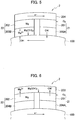
- Fig. 7 is an exploded perspective view of the battery part 2 in Example 1.
- Fig. 8 is a cross-sectional view of the battery part 2 in Example 1.
- the battery part 2 of Example 1 included the positive electrode 201, the negative electrode 202, the positive electrode portion separator 203A, the negative electrode portion separator 203B, and the electrically-conductive layer 204.
- the carbonized bacterial cellulose which was carbonized cellulose with a three-dimensional network structure was used for the positive electrode 201. Preparation of the battery part 2 of Example 1 is described below.
- the carbonized bacterial cellulose used in the positive electrode 201 was obtained in the following method.
- nata de coco manufactured by Fujicco which was a bacteria cellulose gel produced by acetobacter xylinum being acetobacter was used as the bacterial gel and the bacterial gel was immersed in liquid nitrogen for 30 minutes in a styrene foam box to be completely frozen. After the bacterial gel was completely frozen, the frozen bacterial gel was taken out and put on a petri dish and was dried in vacuum of 10 Pa or less by using a freeze dryer (manufactured by Tokyo Rikakikai Co, Ltd) to obtain a bacterial xerogel. After the drying in vacuum, the bacterial xerogel was carbonized by being baked at 1200°C for two hours in a nitrogen atmosphere and the carbonized bacterial cellulose was obtained.
- the BET specific surface area of the carbonized bacterial cellulose was measured by using a BET apparatus and was 830 m 2 /g.
- the porosity of the carbonized bacterial cellulose was measured by performing mercury intrusion porosimetry and was 99% or more.
- the porosity was calculated from a pore size distribution of the carbonized bacterial cellulose obtained by the mercury intrusion porosimetry with pores modeled as cylindrical shapes. It was confirmed from the results of the tensile test that, when strain of 80% was applied by tensile stress, the tensile stress did not exceed the elastic region and the carbonized bacterial cellulose returned to its shape before the application of the stress. Thus, it was found that the bacterial cellulose had an excellent elastic property also after being carbonized.
- the positive electrode 201 was fabricated by cutting out the obtained carbonized bacterial cellulose into a desired shape by using a blanking blade, a laser cutter, and the like.
- the negative electrode 202 was fabricated by cutting out a commercially-available metal magnesium foil (thickness: 200 ⁇ m. manufactured by Nilaco Corporation) into a desired shape by using a blanking blade, a laser cutter, and the like.
- the positive electrode portion separator 203A and the negative electrode portion separator 203B were fabricated by cutting out a commercially-available cellulose cotton (BEMCOT, manufactured by Asahi Kasei Corporation) into a desired shape by using a blanking blade, a laser cutter, and the like.
- BEMCOT commercially-available cellulose cotton
- the electrically-conductive layer 204 was fabricated by cutting out a commercially-available carbon cloth (manufactured by TORAY industries, Inc.) into a desired shape by using a blanking blade, a laser cutter, and the like.
- the battery part 2 was fabricated by using the aforementioned elements as follows. First, the positive electrode 201 and the negative electrode 202 were laid on the electrically-conductive layer 204 and were sandwiched between the electrically-conductive layer 204, the positive electrode portion separator 203A and the negative electrode portion separator 203B. In this case, the positive electrode 201 and the negative electrode 202 were arranged out of contact with each other. Portions 1 mm inside outer peripheries of the positive electrode 201 and the negative electrode 202 were sewed by using a sewing machine to pressure-bond these elements to one another and the battery part 2 was thus obtained.
- the multiple battery parts 2 were arranged on the sheet mask main body 3.
- the active ingredient for starting the battery reaction was prepared as follows. A carbonate aqueous solution with pH of 8.8 and an L-ascorbic acid (vitamin C) aqueous solution with concentration of 100 ⁇ mol/ml were mixed such that a mixture with pH of about 7.4 was prepared. Although the L-ascorbic acid was used as the active ingredient in Example 1, the active ingredient is not limited to this.
- the sheet mask 1 of Example 1 impregnated with the active ingredient was attached to a subject and, after 15 minutes, the moisture amount in the skin was measured.
- the positive electrode portion separator 203A and the negative electrode portion separator 203B were sufficiently impregnated with the active ingredient to start the battery reaction.
- the sheet mask 1 was attached to the face of each of 100 subjects aging from teens to sixties to perform skincare for 15 minutes and the moisture amount in the skin was measured.
- the moisture amount was measured by using a skin moisture checker (manufactured by Scalar Corporation).
- Example 2 was different from Example 1 in that a carbonized bacterial cellulose sheet containing carbonized bacterial cellulose and bacterial cellulose was used for the positive electrode.
- the carbonized bacterial cellulose sheet used for the positive electrode 201 was obtained by the following method.
- the carbonized bacterial cellulose fabricated in Example 1 was impregnated with water and then the carbonized bacterial cellulose and bacterial gel were mixed at a weight ratio of 1:1 and stirred in a homogenizer (manufactured by SMT CO., LTD.) for 12 hours to obtain a mixture in a slurry form.
- the mixture was subjected to suction filtration by using an aspirator (manufactured by Sibata Scientific Technology LTD.) and the mixture was peeled off from filter paper to obtain a carbonized bacterial cellulose sheet.
- the carbonized bacterial cellulose sheet was put into a thermostat chamber and subjected to drying processing at 60 degrees Celsius for 12 hours to fabricate the carbonized bacterial cellulose sheet used for the positive electrode 201 of Example 2.
- the carbonized bacterial cellulose sheet was cut into a desired shape by using a blanking blade, a laser cutter, and the like and the positive electrode 201 was thereby fabricated. Since the carbonized bacterial cellulose sheet had a sheet shape, processing into a desired shape was easy. Moreover, since the positive electrode 201 had the sheet shape, the flexibility of the sheet mask was not impaired and adhesion to the skin was improved.
- Example 1 the sheet mask 1 of Example 2 impregnated with the active ingredient was attached to a subject and, after 15 minutes, the moisture amount in the skin was measured. Results of the evaluation test are described later.
- Example 3 was different from Example 2 in that the sheet mask main body 3 was made of an electrically-conductive substance to be used as the electrically-conductive layer 204 and multiple positive electrode portions 21 and negative electrode portions 22 were arranged on one electrically-conductive layer 204.
- the positive electrode, the negative electrode, the separator, and the active ingredient were the same as those in Example 2.
- the positive electrode portion 21 was fabricated by pressure-bonding the positive electrode 201 and the positive electrode portion separator 203A and the negative electrode portion 22 was fabricated by pressure-bonding the negative electrode 202 and the negative electrode portion separator 203B.
- the sheet mask main body 3 used the same carbon cloth as the electrically-conductive layer 204 of Examples 1 and 2.
- the carbon cloth was cut out into a shape of a contour of the face and portions corresponding to the eyes and the mouth were cut out to fabricate the sheet mask main body 3.
- the multiple positive electrode portions 21 and the negative electrode portions 22 were arranged on the sheet mask main body 3.
- Example 3 the sheet mask main body 3 is shared by the multiple battery parts 2 as the electrically-conductive layer 204. Thus, there is no need to process the electrically-conductive layer 204 for each battery part 2 and the manufacturing cost can be reduced.
- Example 1 the sheet mask 1 of Example 3 impregnated with the active ingredient was attached to a subject and, after 15 minutes, the moisture amount in the skin was measured. Results of the evaluation test are described later.
- Example 4 was the same as Example 1 except for the material of the positive electrode 201.
- the positive electrode 201 of Example 4 was fabricated by using carbon (Ketjenblack EC600JD) publicly-known to be used for an air electrode of a general magnesium-air battery. Specifically, Ketjenblack powder (manufactured by Lion Corporation) and polytetrafluoroethylene (PTFE) powder (manufactured by Daikin Industries, Ltd.) were sufficiently pulverized and mixed at a weight ratio of 50:30:20 by using a mortar machine and subjected to roll forming to be fabricated into a sheet-shaped electrode with thickness of 0.5 mm. The sheet-shaped electrode was cut into a desired shape by using a blanking blade and the positive electrode 201 was obtained.
- carbon Ketjenblack EC600JD
- PTFE polytetrafluoroethylene
- Example 1 the sheet mask 1 of Example 4 impregnated with the active ingredient was attached to a subject and, after 15 minutes, the moisture amount in the skin was measured. Results of the evaluation test are described later.
- Fig. 9 is a perspective view of a separator portion to be attached to a sheet mask main body of Comparative Example 1 and Fig. 10 is a cross-sectional view of the separator portion of Comparative Example 1.
- a sheet mask using only the separator and the active ingredient which were the same as those in Example 1 was fabricated as a comparative example including no battery part.
- the separator portion 501 was fabricated by cutting out a commercially-available cellulose cotton (BEMCOT, manufactured by Asahi Kasei Corporation) as in Example 1 into a desired shape by using a blanking blade, a laser cutter, and the like.
- BEMCOT commercially-available cellulose cotton
- the separator portion 501 was arranged on the sheet mask main body 3 to correspond to the positive electrode portion 21 and the negative electrode portion 22 illustrated in Fig. 1 .
- the active ingredient to be impregnated into the sheet mask was prepared as described below as in Example 1.
- a carbonate aqueous solution with pH of 8. 8 and an L-ascorbic acid (vitamin C) aqueous solution with concentration of 100 ⁇ mol/ml were mixed such that a mixture with pH of about 7.4 was prepared.
- the sheet mask of Comparative Example 1 in which the separator portion 501 was impregnated with the active ingredient was attached to a subject and, after 15 minutes, the moisture amount in the skin was measured.
- Table 1 illustrates the measurement results of Examples 1 to 4 and Comparative Example 1.
- Table 1 illustrates average values of moisture amounts in the skins of 100 subjects which were measured before usage, just after the usage, after one hour, after three hours, after five hours, and after 12 hours for Examples 1 to 4 and Comparative Example 1.
- Example 2 It is found that the increase in the moisture amount in Example 2 is greater than that in Example 1. This is because the carbonized bacterial cellulose sheet was used for the positive electrode and adhesion between the skin and the sheet mask was improved.
- Example 3 the increase in the moisture amount in Example 3 is greater than that in Example 2. This is assumed to be because, in Example 3, the electrically-conductive layer was used while being shared by the battery parts and routes of ion currents flowing through the skin increased from those in the case where the electrically-conductive layer was provided for each battery, thereby promoting the effect of iontophoresis.
- Example 4 The increase in the moisture amount in Example 4 is smaller than those in Examples 1 to 3. Moreover, when the positive electrode of Example 4 was observed after the measurement, part of the positive electrode was destroyed and smear due to carbon powder was confirmed on the skin.
- Examples 5 to 8 each had a configuration in which the positive electrode portion electrically-conductive layer and the negative electrode portion electrically-conductive layer are brought into contact with the skin to make electrons flow to the skin.
- Examples 5 to 8 were examples in which the battery parts 2 of Examples 1 to 4 had the configuration of the battery part 2 of Fig. 6 .
- Example 5 was an example in which the battery part 2 of Example 1 had the configuration of the battery part 2 of Fig. 6 .
- Fig. 11 is an exploded perspective view of the battery part 2 in Example 5.
- Fig. 12 is a cross-sectional view of the battery part 2 in Example 5.
- the battery part 2 of Example 5 included the positive electrode 201, the negative electrode 202, the separator 203, the positive electrode portion electrically-conductive layer 204A, and the negative electrode portion electrically-conductive layer 204B.
- the battery part 2 of Example 5 was different from that of Example 1 in that the battery part 2 was configured to cause electrons to flow to the skin.
- the elements of the battery part 2 were fabricated as in Example 1 and the battery part 2 of Example 5 was fabricated as follows.
- the positive electrode 201 and the negative electrode 202 were laid on the separator 203 and were sandwiched between the separator 203 and a set of the positive electrode portion electrically-conductive layer 204A and the negative electrode portion electrically-conductive layer 204B. Then, portions 1 mm inside outer peripheries of the positive electrode 201 and the negative electrode 202 were sewed by using a sewing machine to pressure-bond these elements and the battery part 2 was thus obtained.
- the active ingredient impregnated into the sheet mask 1 was the same as that in Example 1.
- Example 1 the sheet mask 1 of Example 5 impregnated with the active ingredient was attached to a subject and, after 15 minutes, the moisture amount in the skin was measured. Results of the evaluation test are described later.
- Example 6 was an example in which the battery part 2 of Example 2 had the configuration of the battery part 2 of Fig. 6 .
- Example 6 was different from Example 5 in that a carbonized bacterial cellulose sheet containing carbonized bacterial cellulose and bacterial cellulose was used for the positive electrode.
- a method of fabricating the positive electrode was the same as that in Example 2.
- Methods of fabricating the negative electrode, the electrically-conductive layer, the battery part, the sheet mask, and the active ingredient were the same as those in Example 5.
- Example 1 the sheet mask 1 of Example 6 impregnated with the active ingredient was attached to a subject and, after 15 minutes, the moisture amount in the skin was measured. Results of the evaluation test are described later.
- Example 7 was an example in which the battery part 2 of Example 3 had the configuration of the battery part 2 of Fig. 6 .
- Example 7 was different from Example 6 in that the sheet mask main body 3 was used as the separator 203 and the multiple positive electrode portions 21 and the negative electrode portions 22 were arranged on one separator 203.
- the positive electrode, the negative electrode, the electrically-conductive layer, and the active ingredient were the same as those in Example 6.
- the positive electrode portion 21 was fabricated by pressure-bonding the positive electrode 201 and the positive electrode portion electrically-conductive layer 204A and the negative electrode portion 22 was fabricated by pressure-bonding the negative electrode 202 and the negative electrode portion electrically-conductive layer 204B.
- the sheet mask main body 3 used the same cellulose cotton as the separator 203 of Examples 5 and 6.
- the cellulose cotton was cut out into a shape of a contour of the face and portions corresponding to the eyes and the mouth were cut out to fabricate the sheet mask main body 3.
- the multiple positive electrode portions 21 and the negative electrode portions 22 were arranged on the sheet mask main body 3.
- Example 7 the sheet mask main body 3 is shared by the multiple battery parts 2 as the separator 203. Thus, there is no need to process the separator 203 for each battery part 2 and the manufacturing cost can be reduced.
- Example 1 the sheet mask 1 of Example 7 impregnated with the active ingredient was attached to a subject and, after 15 minutes, the moisture amount in the skin was measured. Results of the evaluation test are described later.
- Example 8 was an example in which the battery part 2 of Example 4 had the configuration of battery part 2 of Fig. 6 .
- Example 8 was the same as Example 5 except for the material of the positive electrode 201.
- the positive electrode 201 of Example 8 was fabricated by using carbon (Ketjenblack EC600JD) publicly-known to be used for an air electrode of a general magnesium-air battery.
- Example 1 the sheet mask 1 of Example 8 impregnated with the active ingredient was attached to a subject and, after 15 minutes, the moisture amount in the skin was measured.
- Table 2 illustrates the measurement results of Examples 5 to 8. Table 2 also illustrates the measurement results of aforementioned Comparative Example 1. Table 2 illustrates average values of moisture amounts in the skins of 100 subjects which were measured before usage, just after the usage, after one hour, after three hours, after five hours, and after 12 hours for Examples 5 to 8 and Comparative Example 1.
- Example 8 as in Example 4, part of the positive electrode was destroyed and smear due to carbon powder was confirmed on the skin.
- the sheet mask 1 includes the multiple battery parts 2 arranged such that the electric currents flow along the mimic muscles or the flows of lymph. This allows the active ingredient to penetrate into the in-body tissues more effectively and also allows the mimic muscles and the lymphatic vessels to be electrically stimulated. Forming the battery part 2 by using materials with low environmental load allows easy disposal of the sheet mask 1 in everyday life.
- the separator of each battery part 2 contains no electrolyte necessary for the battery reaction and, for use of the sheet mask 1, the battery reaction is started by impregnating the separator with the active ingredient. This can suppress self-discharging of the battery part 2 during storage of the sheet mask 1.
Landscapes
- Health & Medical Sciences (AREA)
- Engineering & Computer Science (AREA)
- Chemical & Material Sciences (AREA)
- Chemical Kinetics & Catalysis (AREA)
- Electrochemistry (AREA)
- General Chemical & Material Sciences (AREA)
- Heart & Thoracic Surgery (AREA)
- Public Health (AREA)
- Anesthesiology (AREA)
- Biomedical Technology (AREA)
- Manufacturing & Machinery (AREA)
- Hematology (AREA)
- Life Sciences & Earth Sciences (AREA)
- Animal Behavior & Ethology (AREA)
- General Health & Medical Sciences (AREA)
- Veterinary Medicine (AREA)
- Medical Informatics (AREA)
- Dermatology (AREA)
- Battery Electrode And Active Subsutance (AREA)
- Cell Separators (AREA)
- Respiratory Apparatuses And Protective Means (AREA)
- Primary Cells (AREA)
- Cosmetics (AREA)
Claims (4)
- Tuchmaske (1), die zur Verwendung an einem Gesicht befestigt ist, umfassend:einen Tuchmaskenhauptkörper (3); undeinen Batterieteil (2), der auf dem Tuchmaskenhauptkörper (3) angeordnet ist und konfiguriert ist, mit dem Gesicht in Kontakt zu kommen, wenn die Tuchmaske (1) getragen wird, wobei der Batterieteil (2) einen Positivelektrodenabschnitt (21) und einen Negativelektrodenabschnitt (22) einschließt, wobei der Positivelektrodenabschnitt (21) und der Negativelektrodenabschnitt (22) so angeordnet sind, dass ein elektrischer Strom entlang eines mimischen Muskels oder eines Lymphflusses im Gesicht fließt,dadurch gekennzeichnet, dass eine positive Elektrode (201) des Batterieteils (2) karbonisierte Zellulose enthält, die eine dreidimensionale Netzwerkstruktur aufweist.
- Tuchmaske (1) nach Anspruch 1, wobei
der Batterieteil (2) einen Separator (203) einschließt, der keinen Elektrolyten enthält,
der Separator (203), zur Verwendung der Tuchmaske, mit einem Wirkstoff imprägniert ist, um Batteriereaktion einzuleiten. - Tuchmaske (1) nach Anspruch 1, wobei der Tuchmaskenhauptkörper (3) ein Separator (203) oder eine elektrisch leitfähige Schicht (204) des Batterieteils (2) ist.
- Tuchmaske (1) nach Anspruch 1, wobei eine negative Elektrode (202) des Batterieteils (2) mindestens eines von Magnesium, Zink, Aluminium, Eisen, Calcium, Lithium und Natrium enthält.
Applications Claiming Priority (2)
| Application Number | Priority Date | Filing Date | Title |
|---|---|---|---|
| JP2017152157 | 2017-08-07 | ||
| PCT/JP2018/019012 WO2019031017A1 (ja) | 2017-08-07 | 2018-05-17 | シートマスク |
Publications (3)
| Publication Number | Publication Date |
|---|---|
| EP3666115A1 EP3666115A1 (de) | 2020-06-17 |
| EP3666115A4 EP3666115A4 (de) | 2020-12-09 |
| EP3666115B1 true EP3666115B1 (de) | 2021-06-23 |
Family
ID=65272266
Family Applications (1)
| Application Number | Title | Priority Date | Filing Date |
|---|---|---|---|
| EP18843278.5A Active EP3666115B1 (de) | 2017-08-07 | 2018-05-17 | Tuchmaske |
Country Status (5)
| Country | Link |
|---|---|
| US (1) | US11642504B2 (de) |
| EP (1) | EP3666115B1 (de) |
| JP (1) | JP6832435B2 (de) |
| CN (1) | CN110996717B (de) |
| WO (1) | WO2019031017A1 (de) |
Families Citing this family (5)
| Publication number | Priority date | Publication date | Assignee | Title |
|---|---|---|---|---|
| CN112642053B (zh) * | 2019-10-11 | 2024-09-20 | 北京富纳特创新科技有限公司 | 面膜式美容仪的使用方法 |
| KR102715110B1 (ko) * | 2021-07-22 | 2024-10-11 | (주) 레지에나 | 시트 마스크 장치 |
| USD1038512S1 (en) * | 2022-03-01 | 2024-08-06 | Hollywood Glow Girl Enterprises, Llc | Face mask |
| TWI835463B (zh) * | 2022-12-14 | 2024-03-11 | 達運精密工業股份有限公司 | 面膜 |
| WO2025017894A1 (ja) * | 2023-07-20 | 2025-01-23 | 日本電信電話株式会社 | 生体組織貼付けシートおよびその製造方法 |
Family Cites Families (28)
| Publication number | Priority date | Publication date | Assignee | Title |
|---|---|---|---|---|
| JP3504536B2 (ja) * | 1999-05-19 | 2004-03-08 | Necトーキン株式会社 | セパレータ、これを備えた電池用組立体及び電池 |
| DE10065390A1 (de) * | 2000-10-09 | 2002-04-11 | Bernhard Trier | Drucksensor sowie Verfahren zur Herstellung dieses Drucksensors |
| US20090309072A1 (en) * | 2008-06-13 | 2009-12-17 | Shiaw-Min Hwang | Bacterial cellulose film and carbon nanotubes-like thin film structures developed from bacterial cellulose |
| US8747383B2 (en) * | 2009-12-18 | 2014-06-10 | University Medical Pharmaceuticals Corp. | Process and system for iontophoretic wrinkle reduction |
| JP2011166043A (ja) | 2010-02-15 | 2011-08-25 | Panasonic Corp | 蓄電デバイスおよび蓄電デバイスの製造方法 |
| US8735001B2 (en) * | 2011-04-08 | 2014-05-27 | Empire Technology Development Llc | Gel formed battery |
| TW201311310A (zh) * | 2011-09-02 | 2013-03-16 | Wei-Han Wang | 用於電離子導入之立體膜片 |
| JP5706539B2 (ja) * | 2011-11-17 | 2015-04-22 | 日本電信電話株式会社 | 導電性高分子繊維、生体電極、体内埋め込み型電極、および生体信号測定装置 |
| JP2013131675A (ja) * | 2011-12-22 | 2013-07-04 | Murata Mfg Co Ltd | 蓄電デバイスのセパレータ、絶縁性接着層、それに用いられる組成物、蓄電デバイス用素子、蓄電デバイス、および蓄電デバイス用素子の製造方法 |
| KR101139956B1 (ko) * | 2012-01-12 | 2012-04-30 | 원창연 | 기미?주름?미백 관리를 위한 초미세 진동 마사지기 |
| CN103474632B (zh) * | 2012-06-07 | 2016-08-03 | 中国科学院物理研究所 | 一种用于锂电池的负极材料及其制备方法和应用 |
| JP5755623B2 (ja) | 2012-09-28 | 2015-07-29 | 株式会社 資生堂 | シート電極 |
| US9843033B2 (en) * | 2013-02-28 | 2017-12-12 | Nissan Motor Co., Ltd. | Positive electrode active substance, positive electrode material, positive electrode, and non-aqueous electrolyte secondary battery |
| JP6377385B2 (ja) * | 2013-03-28 | 2018-08-22 | 株式会社 東北テクノアーチ | 生体組織貼付用キット及び生体組織貼付用パッチ |
| JP2014200359A (ja) | 2013-04-02 | 2014-10-27 | 誠 福島 | 多機能フェイスマスク |
| KR101610446B1 (ko) * | 2013-12-30 | 2016-04-07 | 현대자동차주식회사 | 리튬 황 이차전지 분리막 |
| KR20160035205A (ko) * | 2014-09-23 | 2016-03-31 | 박철 | 전도성 시트가 부착된 마스크 팩 |
| US20160089534A1 (en) * | 2014-09-29 | 2016-03-31 | Elc Management Llc | Targeted And Individualized Delivery Of Skincare Treatments With Micro-Current In A Mask Or Patch Form |
| US20160089535A1 (en) * | 2014-09-29 | 2016-03-31 | Elc Management Llc | Targeted And Individualized Delivery Of Skincare Treatments With Micro-Current In A Mask Or Patch Form |
| CN205198499U (zh) * | 2015-11-05 | 2016-05-04 | 朱九成 | 一种带电离子化妆品的活性面膜 |
| US10128529B2 (en) * | 2015-11-13 | 2018-11-13 | Semiconductor Energy Laboratory Co., Ltd. | Lithium-ion secondary battery, fabricating method therof, and electronic device |
| WO2017119520A1 (ko) * | 2016-01-05 | 2017-07-13 | 바이오센서연구소 주식회사 | 역전기 투석을 이용한 마스크팩 및 그를 포함하는 키트 |
| FR3048363A1 (fr) * | 2016-03-04 | 2017-09-08 | Oreal | Article cosmetique electrique a pile repositionnable |
| CN105958006B (zh) * | 2016-07-20 | 2018-09-21 | 孙健春 | 一种具有散热功能的锂电池电极、制法及锂电池 |
| CN106169570A (zh) * | 2016-08-25 | 2016-11-30 | 合肥国轩高科动力能源有限公司 | 一种金属元素掺杂锂离子电池用磷酸钒锂正极材料的制备方法 |
| CN106450104A (zh) * | 2016-10-09 | 2017-02-22 | 中国人民解放军63971部队 | 一种应用于锂硫电池中的新型正极隔层及其制备方法 |
| CN109891632A (zh) * | 2016-10-24 | 2019-06-14 | 住友化学株式会社 | 间隔件、和包含间隔件的二次电池 |
| CN106601990B (zh) * | 2016-12-26 | 2019-06-21 | 南京理工大学 | 一种基于氮掺杂碳化细菌纤维素的电池正极、锂硫电池及其制备方法 |
-
2018
- 2018-05-17 WO PCT/JP2018/019012 patent/WO2019031017A1/ja not_active Ceased
- 2018-05-17 JP JP2019535608A patent/JP6832435B2/ja active Active
- 2018-05-17 EP EP18843278.5A patent/EP3666115B1/de active Active
- 2018-05-17 CN CN201880051169.6A patent/CN110996717B/zh active Active
- 2018-05-17 US US16/636,805 patent/US11642504B2/en active Active
Also Published As
| Publication number | Publication date |
|---|---|
| CN110996717A (zh) | 2020-04-10 |
| EP3666115A1 (de) | 2020-06-17 |
| JP6832435B2 (ja) | 2021-02-24 |
| EP3666115A4 (de) | 2020-12-09 |
| US11642504B2 (en) | 2023-05-09 |
| CN110996717B (zh) | 2023-03-31 |
| WO2019031017A1 (ja) | 2019-02-14 |
| US20200368510A1 (en) | 2020-11-26 |
| JPWO2019031017A1 (ja) | 2020-07-02 |
Similar Documents
| Publication | Publication Date | Title |
|---|---|---|
| EP3666115B1 (de) | Tuchmaske | |
| EP2349459B1 (de) | Behandlung von schweissausbrüchen und hyperhidrose | |
| CN1826153B (zh) | 用原电池产生的电流治疗痤疮和红斑痤疮的方法 | |
| JP2006526454A5 (de) | ||
| JP2006526454A (ja) | 皮膚内へ酸化剤を制御デリバリーするためのキット、装置及び方法 | |
| JP5068530B2 (ja) | 人間または動物のバリア膜の治療のための装置 | |
| EP3613465B1 (de) | Transdermales pflaster für biologisches gewebe | |
| US20100082088A1 (en) | Treatment of sweating and hyperhydrosis | |
| EP3191170B1 (de) | Pflaster zum produzieren von mikroströmen | |
| CN105686959A (zh) | 一种微电流面膜 | |
| US20100228180A1 (en) | Power Source Electrode Treatment Device | |
| KR20060101206A (ko) | 전기를 사용한 피부 모공의 치료 방법 | |
| CN104147694A (zh) | 处理人或动物屏障膜的装置 | |
| KR20240018188A (ko) | 초박막 배터리를 포함하는 미세전류 마스크팩 | |
| KR102816767B1 (ko) | 생체분해성 금속을 포함하는 자가 전류 발생 피부 적용 패치 | |
| JP2025531614A (ja) | 生体内分解性金属を含む自己電流発生皮膚適用パッチ | |
| HK1092397B (en) | Methods of treating acne and rosacea with galvanic generated electricity | |
| HK1092398A (en) | Methods of treating pores on the skin with electricity | |
| HK1092399B (en) | Methods of treating acne and rosacea with electrochemically generated zinc ions |
Legal Events
| Date | Code | Title | Description |
|---|---|---|---|
| STAA | Information on the status of an ep patent application or granted ep patent |
Free format text: STATUS: THE INTERNATIONAL PUBLICATION HAS BEEN MADE |
|
| PUAI | Public reference made under article 153(3) epc to a published international application that has entered the european phase |
Free format text: ORIGINAL CODE: 0009012 |
|
| STAA | Information on the status of an ep patent application or granted ep patent |
Free format text: STATUS: REQUEST FOR EXAMINATION WAS MADE |
|
| 17P | Request for examination filed |
Effective date: 20200131 |
|
| AK | Designated contracting states |
Kind code of ref document: A1 Designated state(s): AL AT BE BG CH CY CZ DE DK EE ES FI FR GB GR HR HU IE IS IT LI LT LU LV MC MK MT NL NO PL PT RO RS SE SI SK SM TR |
|
| AX | Request for extension of the european patent |
Extension state: BA ME |
|
| DAV | Request for validation of the european patent (deleted) | ||
| DAX | Request for extension of the european patent (deleted) | ||
| A4 | Supplementary search report drawn up and despatched |
Effective date: 20201109 |
|
| RIC1 | Information provided on ipc code assigned before grant |
Ipc: A45D 44/22 20060101AFI20201103BHEP Ipc: A45D 44/00 20060101ALI20201103BHEP |
|
| GRAP | Despatch of communication of intention to grant a patent |
Free format text: ORIGINAL CODE: EPIDOSNIGR1 |
|
| STAA | Information on the status of an ep patent application or granted ep patent |
Free format text: STATUS: GRANT OF PATENT IS INTENDED |
|
| INTG | Intention to grant announced |
Effective date: 20210310 |
|
| GRAS | Grant fee paid |
Free format text: ORIGINAL CODE: EPIDOSNIGR3 |
|
| GRAA | (expected) grant |
Free format text: ORIGINAL CODE: 0009210 |
|
| STAA | Information on the status of an ep patent application or granted ep patent |
Free format text: STATUS: THE PATENT HAS BEEN GRANTED |
|
| AK | Designated contracting states |
Kind code of ref document: B1 Designated state(s): AL AT BE BG CH CY CZ DE DK EE ES FI FR GB GR HR HU IE IS IT LI LT LU LV MC MK MT NL NO PL PT RO RS SE SI SK SM TR |
|
| REG | Reference to a national code |
Ref country code: GB Ref legal event code: FG4D |
|
| REG | Reference to a national code |
Ref country code: CH Ref legal event code: EP |
|
| REG | Reference to a national code |
Ref country code: DE Ref legal event code: R096 Ref document number: 602018019127 Country of ref document: DE Ref country code: AT Ref legal event code: REF Ref document number: 1403506 Country of ref document: AT Kind code of ref document: T Effective date: 20210715 |
|
| REG | Reference to a national code |
Ref country code: IE Ref legal event code: FG4D |
|
| REG | Reference to a national code |
Ref country code: LT Ref legal event code: MG9D |
|
| PG25 | Lapsed in a contracting state [announced via postgrant information from national office to epo] |
Ref country code: BG Free format text: LAPSE BECAUSE OF FAILURE TO SUBMIT A TRANSLATION OF THE DESCRIPTION OR TO PAY THE FEE WITHIN THE PRESCRIBED TIME-LIMIT Effective date: 20210923 Ref country code: FI Free format text: LAPSE BECAUSE OF FAILURE TO SUBMIT A TRANSLATION OF THE DESCRIPTION OR TO PAY THE FEE WITHIN THE PRESCRIBED TIME-LIMIT Effective date: 20210623 Ref country code: LT Free format text: LAPSE BECAUSE OF FAILURE TO SUBMIT A TRANSLATION OF THE DESCRIPTION OR TO PAY THE FEE WITHIN THE PRESCRIBED TIME-LIMIT Effective date: 20210623 Ref country code: HR Free format text: LAPSE BECAUSE OF FAILURE TO SUBMIT A TRANSLATION OF THE DESCRIPTION OR TO PAY THE FEE WITHIN THE PRESCRIBED TIME-LIMIT Effective date: 20210623 |
|
| REG | Reference to a national code |
Ref country code: AT Ref legal event code: MK05 Ref document number: 1403506 Country of ref document: AT Kind code of ref document: T Effective date: 20210623 |
|
| PG25 | Lapsed in a contracting state [announced via postgrant information from national office to epo] |
Ref country code: GR Free format text: LAPSE BECAUSE OF FAILURE TO SUBMIT A TRANSLATION OF THE DESCRIPTION OR TO PAY THE FEE WITHIN THE PRESCRIBED TIME-LIMIT Effective date: 20210924 Ref country code: SE Free format text: LAPSE BECAUSE OF FAILURE TO SUBMIT A TRANSLATION OF THE DESCRIPTION OR TO PAY THE FEE WITHIN THE PRESCRIBED TIME-LIMIT Effective date: 20210623 Ref country code: RS Free format text: LAPSE BECAUSE OF FAILURE TO SUBMIT A TRANSLATION OF THE DESCRIPTION OR TO PAY THE FEE WITHIN THE PRESCRIBED TIME-LIMIT Effective date: 20210623 Ref country code: LV Free format text: LAPSE BECAUSE OF FAILURE TO SUBMIT A TRANSLATION OF THE DESCRIPTION OR TO PAY THE FEE WITHIN THE PRESCRIBED TIME-LIMIT Effective date: 20210623 Ref country code: NO Free format text: LAPSE BECAUSE OF FAILURE TO SUBMIT A TRANSLATION OF THE DESCRIPTION OR TO PAY THE FEE WITHIN THE PRESCRIBED TIME-LIMIT Effective date: 20210923 |
|
| REG | Reference to a national code |
Ref country code: NL Ref legal event code: MP Effective date: 20210623 |
|
| PG25 | Lapsed in a contracting state [announced via postgrant information from national office to epo] |
Ref country code: SM Free format text: LAPSE BECAUSE OF FAILURE TO SUBMIT A TRANSLATION OF THE DESCRIPTION OR TO PAY THE FEE WITHIN THE PRESCRIBED TIME-LIMIT Effective date: 20210623 Ref country code: PT Free format text: LAPSE BECAUSE OF FAILURE TO SUBMIT A TRANSLATION OF THE DESCRIPTION OR TO PAY THE FEE WITHIN THE PRESCRIBED TIME-LIMIT Effective date: 20211025 Ref country code: RO Free format text: LAPSE BECAUSE OF FAILURE TO SUBMIT A TRANSLATION OF THE DESCRIPTION OR TO PAY THE FEE WITHIN THE PRESCRIBED TIME-LIMIT Effective date: 20210623 Ref country code: NL Free format text: LAPSE BECAUSE OF FAILURE TO SUBMIT A TRANSLATION OF THE DESCRIPTION OR TO PAY THE FEE WITHIN THE PRESCRIBED TIME-LIMIT Effective date: 20210623 Ref country code: CZ Free format text: LAPSE BECAUSE OF FAILURE TO SUBMIT A TRANSLATION OF THE DESCRIPTION OR TO PAY THE FEE WITHIN THE PRESCRIBED TIME-LIMIT Effective date: 20210623 Ref country code: AT Free format text: LAPSE BECAUSE OF FAILURE TO SUBMIT A TRANSLATION OF THE DESCRIPTION OR TO PAY THE FEE WITHIN THE PRESCRIBED TIME-LIMIT Effective date: 20210623 Ref country code: SK Free format text: LAPSE BECAUSE OF FAILURE TO SUBMIT A TRANSLATION OF THE DESCRIPTION OR TO PAY THE FEE WITHIN THE PRESCRIBED TIME-LIMIT Effective date: 20210623 Ref country code: ES Free format text: LAPSE BECAUSE OF FAILURE TO SUBMIT A TRANSLATION OF THE DESCRIPTION OR TO PAY THE FEE WITHIN THE PRESCRIBED TIME-LIMIT Effective date: 20210623 Ref country code: EE Free format text: LAPSE BECAUSE OF FAILURE TO SUBMIT A TRANSLATION OF THE DESCRIPTION OR TO PAY THE FEE WITHIN THE PRESCRIBED TIME-LIMIT Effective date: 20210623 |
|
| PG25 | Lapsed in a contracting state [announced via postgrant information from national office to epo] |
Ref country code: PL Free format text: LAPSE BECAUSE OF FAILURE TO SUBMIT A TRANSLATION OF THE DESCRIPTION OR TO PAY THE FEE WITHIN THE PRESCRIBED TIME-LIMIT Effective date: 20210623 |
|
| REG | Reference to a national code |
Ref country code: DE Ref legal event code: R097 Ref document number: 602018019127 Country of ref document: DE |
|
| PG25 | Lapsed in a contracting state [announced via postgrant information from national office to epo] |
Ref country code: DK Free format text: LAPSE BECAUSE OF FAILURE TO SUBMIT A TRANSLATION OF THE DESCRIPTION OR TO PAY THE FEE WITHIN THE PRESCRIBED TIME-LIMIT Effective date: 20210623 |
|
| PLBE | No opposition filed within time limit |
Free format text: ORIGINAL CODE: 0009261 |
|
| STAA | Information on the status of an ep patent application or granted ep patent |
Free format text: STATUS: NO OPPOSITION FILED WITHIN TIME LIMIT |
|
| 26N | No opposition filed |
Effective date: 20220324 |
|
| PG25 | Lapsed in a contracting state [announced via postgrant information from national office to epo] |
Ref country code: AL Free format text: LAPSE BECAUSE OF FAILURE TO SUBMIT A TRANSLATION OF THE DESCRIPTION OR TO PAY THE FEE WITHIN THE PRESCRIBED TIME-LIMIT Effective date: 20210623 |
|
| PG25 | Lapsed in a contracting state [announced via postgrant information from national office to epo] |
Ref country code: IT Free format text: LAPSE BECAUSE OF FAILURE TO SUBMIT A TRANSLATION OF THE DESCRIPTION OR TO PAY THE FEE WITHIN THE PRESCRIBED TIME-LIMIT Effective date: 20210623 |
|
| REG | Reference to a national code |
Ref country code: CH Ref legal event code: PL |
|
| REG | Reference to a national code |
Ref country code: BE Ref legal event code: MM Effective date: 20220531 |
|
| PG25 | Lapsed in a contracting state [announced via postgrant information from national office to epo] |
Ref country code: MC Free format text: LAPSE BECAUSE OF FAILURE TO SUBMIT A TRANSLATION OF THE DESCRIPTION OR TO PAY THE FEE WITHIN THE PRESCRIBED TIME-LIMIT Effective date: 20210623 Ref country code: LU Free format text: LAPSE BECAUSE OF NON-PAYMENT OF DUE FEES Effective date: 20220517 Ref country code: LI Free format text: LAPSE BECAUSE OF NON-PAYMENT OF DUE FEES Effective date: 20220531 Ref country code: CH Free format text: LAPSE BECAUSE OF NON-PAYMENT OF DUE FEES Effective date: 20220531 |
|
| PG25 | Lapsed in a contracting state [announced via postgrant information from national office to epo] |
Ref country code: IE Free format text: LAPSE BECAUSE OF NON-PAYMENT OF DUE FEES Effective date: 20220517 |
|
| PG25 | Lapsed in a contracting state [announced via postgrant information from national office to epo] |
Ref country code: BE Free format text: LAPSE BECAUSE OF NON-PAYMENT OF DUE FEES Effective date: 20220531 |
|
| PG25 | Lapsed in a contracting state [announced via postgrant information from national office to epo] |
Ref country code: MK Free format text: LAPSE BECAUSE OF FAILURE TO SUBMIT A TRANSLATION OF THE DESCRIPTION OR TO PAY THE FEE WITHIN THE PRESCRIBED TIME-LIMIT Effective date: 20210623 Ref country code: CY Free format text: LAPSE BECAUSE OF FAILURE TO SUBMIT A TRANSLATION OF THE DESCRIPTION OR TO PAY THE FEE WITHIN THE PRESCRIBED TIME-LIMIT Effective date: 20210623 |
|
| PG25 | Lapsed in a contracting state [announced via postgrant information from national office to epo] |
Ref country code: HU Free format text: LAPSE BECAUSE OF FAILURE TO SUBMIT A TRANSLATION OF THE DESCRIPTION OR TO PAY THE FEE WITHIN THE PRESCRIBED TIME-LIMIT; INVALID AB INITIO Effective date: 20180517 |
|
| PG25 | Lapsed in a contracting state [announced via postgrant information from national office to epo] |
Ref country code: TR Free format text: LAPSE BECAUSE OF FAILURE TO SUBMIT A TRANSLATION OF THE DESCRIPTION OR TO PAY THE FEE WITHIN THE PRESCRIBED TIME-LIMIT Effective date: 20210623 |
|
| PG25 | Lapsed in a contracting state [announced via postgrant information from national office to epo] |
Ref country code: MT Free format text: LAPSE BECAUSE OF FAILURE TO SUBMIT A TRANSLATION OF THE DESCRIPTION OR TO PAY THE FEE WITHIN THE PRESCRIBED TIME-LIMIT Effective date: 20210623 |
|
| PGFP | Annual fee paid to national office [announced via postgrant information from national office to epo] |
Ref country code: DE Payment date: 20250521 Year of fee payment: 8 |
|
| PGFP | Annual fee paid to national office [announced via postgrant information from national office to epo] |
Ref country code: GB Payment date: 20250527 Year of fee payment: 8 |
|
| PGFP | Annual fee paid to national office [announced via postgrant information from national office to epo] |
Ref country code: FR Payment date: 20250528 Year of fee payment: 8 |
|
| REG | Reference to a national code |
Ref country code: DE Ref legal event code: R081 Ref document number: 602018019127 Country of ref document: DE Owner name: NTT, INC., JP Free format text: FORMER OWNER: NIPPON TELEGRAPH AND TELEPHONE CORPORATION, TOKYO, JP Ref country code: DE Ref legal event code: R082 Ref document number: 602018019127 Country of ref document: DE Representative=s name: DENNEMEYER & ASSOCIATES RECHTSANWALTSGESELLSCH, DE |