EP3663854A1 - Pellikel - Google Patents
Pellikel Download PDFInfo
- Publication number
- EP3663854A1 EP3663854A1 EP19210268.9A EP19210268A EP3663854A1 EP 3663854 A1 EP3663854 A1 EP 3663854A1 EP 19210268 A EP19210268 A EP 19210268A EP 3663854 A1 EP3663854 A1 EP 3663854A1
- Authority
- EP
- European Patent Office
- Prior art keywords
- pellicle
- adhesive agent
- sensitive adhesive
- amount
- pressure
- Prior art date
- Legal status (The legal status is an assumption and is not a legal conclusion. Google has not performed a legal analysis and makes no representation as to the accuracy of the status listed.)
- Pending
Links
- 239000004215 Carbon black (E152) Substances 0.000 claims abstract description 25
- 229930195733 hydrocarbon Natural products 0.000 claims abstract description 25
- 150000002430 hydrocarbons Chemical class 0.000 claims abstract description 25
- 239000003795 chemical substances by application Substances 0.000 claims description 75
- 239000004820 Pressure-sensitive adhesive Substances 0.000 claims description 59
- 239000000853 adhesive Substances 0.000 claims description 16
- 238000010438 heat treatment Methods 0.000 claims description 5
- 239000007789 gas Substances 0.000 description 63
- 229920001296 polysiloxane Polymers 0.000 description 26
- 239000003054 catalyst Substances 0.000 description 16
- 238000011109 contamination Methods 0.000 description 15
- NIXOWILDQLNWCW-UHFFFAOYSA-N acrylic acid group Chemical group C(C=C)(=O)O NIXOWILDQLNWCW-UHFFFAOYSA-N 0.000 description 13
- 239000011651 chromium Substances 0.000 description 9
- 230000000052 comparative effect Effects 0.000 description 8
- 239000000428 dust Substances 0.000 description 7
- 239000000463 material Substances 0.000 description 7
- 229910001374 Invar Inorganic materials 0.000 description 5
- XUIMIQQOPSSXEZ-UHFFFAOYSA-N Silicon Chemical compound [Si] XUIMIQQOPSSXEZ-UHFFFAOYSA-N 0.000 description 5
- 238000007872 degassing Methods 0.000 description 5
- 150000002500 ions Chemical class 0.000 description 5
- 239000004065 semiconductor Substances 0.000 description 5
- 229910052710 silicon Inorganic materials 0.000 description 5
- 239000010703 silicon Substances 0.000 description 5
- 238000001179 sorption measurement Methods 0.000 description 5
- 238000009423 ventilation Methods 0.000 description 5
- 238000005229 chemical vapour deposition Methods 0.000 description 4
- 239000004973 liquid crystal related substance Substances 0.000 description 4
- 238000000034 method Methods 0.000 description 4
- -1 polyethylene terephthalate Polymers 0.000 description 4
- 229920000139 polyethylene terephthalate Polymers 0.000 description 4
- 239000005020 polyethylene terephthalate Substances 0.000 description 4
- 229910052814 silicon oxide Inorganic materials 0.000 description 4
- 239000000126 substance Substances 0.000 description 4
- 239000004593 Epoxy Substances 0.000 description 3
- 238000004519 manufacturing process Methods 0.000 description 3
- 238000005259 measurement Methods 0.000 description 3
- YCKRFDGAMUMZLT-UHFFFAOYSA-N Fluorine atom Chemical compound [F] YCKRFDGAMUMZLT-UHFFFAOYSA-N 0.000 description 2
- 239000004698 Polyethylene Substances 0.000 description 2
- 239000004743 Polypropylene Substances 0.000 description 2
- 230000001070 adhesive effect Effects 0.000 description 2
- 239000011248 coating agent Substances 0.000 description 2
- 238000000576 coating method Methods 0.000 description 2
- 230000006837 decompression Effects 0.000 description 2
- 229910052731 fluorine Inorganic materials 0.000 description 2
- 239000011737 fluorine Substances 0.000 description 2
- 238000001459 lithography Methods 0.000 description 2
- QSHDDOUJBYECFT-UHFFFAOYSA-N mercury Chemical compound [Hg] QSHDDOUJBYECFT-UHFFFAOYSA-N 0.000 description 2
- 229910052753 mercury Inorganic materials 0.000 description 2
- 229920000573 polyethylene Polymers 0.000 description 2
- 229920001155 polypropylene Polymers 0.000 description 2
- 229920001343 polytetrafluoroethylene Polymers 0.000 description 2
- 239000004810 polytetrafluoroethylene Substances 0.000 description 2
- 238000007789 sealing Methods 0.000 description 2
- 238000002834 transmittance Methods 0.000 description 2
- OKTJSMMVPCPJKN-UHFFFAOYSA-N Carbon Chemical compound [C] OKTJSMMVPCPJKN-UHFFFAOYSA-N 0.000 description 1
- VYZAMTAEIAYCRO-UHFFFAOYSA-N Chromium Chemical compound [Cr] VYZAMTAEIAYCRO-UHFFFAOYSA-N 0.000 description 1
- 239000000020 Nitrocellulose Substances 0.000 description 1
- RTAQQCXQSZGOHL-UHFFFAOYSA-N Titanium Chemical compound [Ti] RTAQQCXQSZGOHL-UHFFFAOYSA-N 0.000 description 1
- 229910052799 carbon Inorganic materials 0.000 description 1
- 229920002301 cellulose acetate Polymers 0.000 description 1
- 239000000919 ceramic Substances 0.000 description 1
- 229910052804 chromium Inorganic materials 0.000 description 1
- 229920001577 copolymer Polymers 0.000 description 1
- 238000013461 design Methods 0.000 description 1
- 238000011161 development Methods 0.000 description 1
- 230000000694 effects Effects 0.000 description 1
- 238000007687 exposure technique Methods 0.000 description 1
- 238000001900 extreme ultraviolet lithography Methods 0.000 description 1
- 230000001771 impaired effect Effects 0.000 description 1
- 230000010354 integration Effects 0.000 description 1
- 230000001678 irradiating effect Effects 0.000 description 1
- 238000000691 measurement method Methods 0.000 description 1
- 229910052751 metal Inorganic materials 0.000 description 1
- 239000002184 metal Substances 0.000 description 1
- 238000012986 modification Methods 0.000 description 1
- 230000004048 modification Effects 0.000 description 1
- 229920001220 nitrocellulos Polymers 0.000 description 1
- 238000010943 off-gassing Methods 0.000 description 1
- 239000004417 polycarbonate Substances 0.000 description 1
- 229920000515 polycarbonate Polymers 0.000 description 1
- 229920000642 polymer Polymers 0.000 description 1
- 239000004800 polyvinyl chloride Substances 0.000 description 1
- 239000010453 quartz Substances 0.000 description 1
- VYPSYNLAJGMNEJ-UHFFFAOYSA-N silicon dioxide Inorganic materials O=[Si]=O VYPSYNLAJGMNEJ-UHFFFAOYSA-N 0.000 description 1
- 239000010936 titanium Substances 0.000 description 1
- 229910052719 titanium Inorganic materials 0.000 description 1
- 238000012546 transfer Methods 0.000 description 1
Images

Classifications
-
- G—PHYSICS
- G03—PHOTOGRAPHY; CINEMATOGRAPHY; ANALOGOUS TECHNIQUES USING WAVES OTHER THAN OPTICAL WAVES; ELECTROGRAPHY; HOLOGRAPHY
- G03F—PHOTOMECHANICAL PRODUCTION OF TEXTURED OR PATTERNED SURFACES, e.g. FOR PRINTING, FOR PROCESSING OF SEMICONDUCTOR DEVICES; MATERIALS THEREFOR; ORIGINALS THEREFOR; APPARATUS SPECIALLY ADAPTED THEREFOR
- G03F1/00—Originals for photomechanical production of textured or patterned surfaces, e.g., masks, photo-masks, reticles; Mask blanks or pellicles therefor; Containers specially adapted therefor; Preparation thereof
- G03F1/62—Pellicles, e.g. pellicle assemblies, e.g. having membrane on support frame; Preparation thereof
-
- G—PHYSICS
- G03—PHOTOGRAPHY; CINEMATOGRAPHY; ANALOGOUS TECHNIQUES USING WAVES OTHER THAN OPTICAL WAVES; ELECTROGRAPHY; HOLOGRAPHY
- G03F—PHOTOMECHANICAL PRODUCTION OF TEXTURED OR PATTERNED SURFACES, e.g. FOR PRINTING, FOR PROCESSING OF SEMICONDUCTOR DEVICES; MATERIALS THEREFOR; ORIGINALS THEREFOR; APPARATUS SPECIALLY ADAPTED THEREFOR
- G03F1/00—Originals for photomechanical production of textured or patterned surfaces, e.g., masks, photo-masks, reticles; Mask blanks or pellicles therefor; Containers specially adapted therefor; Preparation thereof
- G03F1/62—Pellicles, e.g. pellicle assemblies, e.g. having membrane on support frame; Preparation thereof
- G03F1/64—Pellicles, e.g. pellicle assemblies, e.g. having membrane on support frame; Preparation thereof characterised by the frames, e.g. structure or material, including bonding means therefor
-
- G—PHYSICS
- G03—PHOTOGRAPHY; CINEMATOGRAPHY; ANALOGOUS TECHNIQUES USING WAVES OTHER THAN OPTICAL WAVES; ELECTROGRAPHY; HOLOGRAPHY
- G03F—PHOTOMECHANICAL PRODUCTION OF TEXTURED OR PATTERNED SURFACES, e.g. FOR PRINTING, FOR PROCESSING OF SEMICONDUCTOR DEVICES; MATERIALS THEREFOR; ORIGINALS THEREFOR; APPARATUS SPECIALLY ADAPTED THEREFOR
- G03F7/00—Photomechanical, e.g. photolithographic, production of textured or patterned surfaces, e.g. printing surfaces; Materials therefor, e.g. comprising photoresists; Apparatus specially adapted therefor
- G03F7/70—Microphotolithographic exposure; Apparatus therefor
- G03F7/708—Construction of apparatus, e.g. environment aspects, hygiene aspects or materials
- G03F7/70908—Hygiene, e.g. preventing apparatus pollution, mitigating effect of pollution or removing pollutants from apparatus
- G03F7/70916—Pollution mitigation, i.e. mitigating effect of contamination or debris, e.g. foil traps
-
- G—PHYSICS
- G03—PHOTOGRAPHY; CINEMATOGRAPHY; ANALOGOUS TECHNIQUES USING WAVES OTHER THAN OPTICAL WAVES; ELECTROGRAPHY; HOLOGRAPHY
- G03F—PHOTOMECHANICAL PRODUCTION OF TEXTURED OR PATTERNED SURFACES, e.g. FOR PRINTING, FOR PROCESSING OF SEMICONDUCTOR DEVICES; MATERIALS THEREFOR; ORIGINALS THEREFOR; APPARATUS SPECIALLY ADAPTED THEREFOR
- G03F7/00—Photomechanical, e.g. photolithographic, production of textured or patterned surfaces, e.g. printing surfaces; Materials therefor, e.g. comprising photoresists; Apparatus specially adapted therefor
- G03F7/70—Microphotolithographic exposure; Apparatus therefor
- G03F7/708—Construction of apparatus, e.g. environment aspects, hygiene aspects or materials
- G03F7/70983—Optical system protection, e.g. pellicles or removable covers for protection of mask
Definitions
- the present invention relates to a pellicle to be used as a dust guard when a semiconductor device such as a large scale integrated circuit (LSI) or a very large scale integrated circuit (VLSI), a printed board, a liquid crystal display, or the like is produced.
- LSI large scale integrated circuit
- VLSI very large scale integrated circuit
- the wavelength of an exposure light source has been shortened. That is, the exposing light source has shifted from a g-line (436 nm) or i-line (365 nm) by a mercury lamp to a KrF excimer laser (248 nm), an ArF excimer laser (193 nm) or the like, and further, extreme ultra violet (EUV) exposure using an EUV light having a main wavelength of 13.5 nm has been studied.
- EUV extreme ultra violet
- a pattern is formed by irradiating a semiconductor wafer or an original plate for liquid crystal with light, however, if dust adheres to a mask for lithography (simply also referred to as "mask") and a reticle (hereinafter, collectively referred to as an "exposure original plate”), which are used in the above production case, this dust absorbs the light or bends the light, so that there has been a problem that the transferred pattern is deformed or the edge becomes coarse, further the base becomes black and dirty, and the dimension, the quality, the appearance, and the like are impaired.
- mask mask for lithography
- exposure original plate reticle
- a pellicle film having a high transmittance for the light to be used for exposure is stretched on an upper end face of a pellicle frame, and further an airtight gasket is formed on a lower end face of the pellicle frame.
- a pressure-sensitive adhesive agent layer is used for the airtight gasket.
- the pellicle film is made of nitrocellulose, cellulose acetate, a fluorine-based polymer or the like, which well transmits the light (a g-line (436 nm) or i-line (365 nm) by a mercury lamp, a KrF excimer laser (248 nm), an ArF excimer laser (193 nm) or the like) to be used for exposure.
- a mercury lamp a KrF excimer laser (248 nm), an ArF excimer laser (193 nm) or the like
- Patent Document 1 JP-A 2015-200868
- the present invention has been made in view of such circumstances, and an object of the present invention is to provide a pellicle, with which the outgas generated from the entire pellicle can be reduced as much as possible, and it can be prevented that the outgas components are adsorbed onto a surface of a reflection mirror or mask in an exposure device, the reflectance is reduced, and the contamination of adsorption of the outgas components onto the inner wall surface of the device is generated.
- the present inventor has found that by setting the entire pellicle to have an amount of released aqueous gas of 1 ⁇ 10 -3 Pa. L/s or less per pellicle, an amount of released hydrocarbon-based gas of 1 ⁇ 10 -5 Pa ⁇ L/s or less per pellicle in a range of measured mass number of 45 to 100 amu, and an amount of released hydrocarbon-based gas of 4 ⁇ 10 -7 Pa ⁇ L/s or less per pellicle in a range of measured mass number of 101 to 200 amu, under vacuum after the pellicle has been left to stand for 10 minutes in an atmosphere of ordinary temperature and 1 ⁇ 10 -3 Pa or less, it can be prevented that the outgas components generated from the entire pellicle are adsorbed onto a surface of a reflection mirror or mask in an exposure device, the reflectance is reduced, and the contamination of adsorption of the outgas components onto the inner wall surface of the device is generated, and thus have completed the present invention.
- the present invention is to provide the following pellicle.
- the outgas generated from the entire pellicle can be reduced as much as possible, and it can be prevented that the outgas components are adsorbed onto a surface of a reflection mirror or mask in the exposure device, the reflectance is reduced, and the contamination of adsorption of the outgas onto the inner wall surface of the device is generated.
- the pellicle according to the present invention is not particularly limited in the structure, however, in general, includes a pellicle film, and a pellicle frame.
- the pellicle frame corresponds to a shape of a photomask to which the pellicle is to be attached, and generally has a quadrangular frame shape (rectangular frame shape or square frame shape).
- the material for a pellicle frame is not particularly limited, and a known material can be used.
- As the material for the pellicle frame for example, since the pellicle may be exposed to high temperature by EUV exposure, a material with low thermal expansion is preferred, and specifically, quartz, invar, titanium, ceramic, or the like can be mentioned.
- a pressure adjustment part may be arranged in the pellicle frame.
- a pressure adjustment part By arranging a pressure adjustment part, the pressure difference between the inside and outside of a closed space formed by a pellicle and a photomask can be eliminated, and the pellicle film can be prevented from being swollen or recessed.
- the part may be prepared by making a through hole in a pellicle frame, or a ventilation part may be arranged between the mask and the frame or between the film and the frame by providing a projection part and a notch part on an end face of the pellicle frame.
- a filter for dust removal may be attached.
- a pressure-sensitive adhesive agent can be applied onto a lower end face (mask side) of the pellicle frame.
- the pressure-sensitive adhesive agent is formed so as to have a width equal to or smaller than the width of the pellicle frame over the entire circumferential direction of an end face of the pellicle frame.
- the ventilation part is arranged by providing a notch part on an end face of the pellicle frame
- the pressure-sensitive adhesive agent may be arranged only on the projection part.
- a known agent can be used, and for example, an acrylic pressure-sensitive adhesive agent or a silicone-based pressure-sensitive adhesive agent can be suitably used.
- a silicone pressure-sensitive adhesive agent is suitably used.
- the pressure-sensitive adhesive agent to be used for the pellicle frame may be processed into any shape as needed.
- an adhesive agent or a pressure-sensitive adhesive agent can be applied also onto an upper end face (film side) of the pellicle frame.
- the adhesive agent or the pressure-sensitive adhesive agent is formed so as to have a width equal to or smaller than the width of the pellicle frame over the entire circumferential direction of an end face of the pellicle frame.
- the adhesive agent or the pressure-sensitive adhesive agent may be arranged only on the projection part.
- a known agent can be used as the adhesive agent or the pressure-sensitive adhesive agent.
- a silicone-based adhesive agent, a silicone-based pressure-sensitive adhesive agent, or an epoxy-based adhesive agent can be suitably used.
- a silicone-based adhesive agent or a silicone-based pressure-sensitive adhesive agent can be suitably used.
- the adhesive agent or the pressure-sensitive adhesive agent to be used for the pellicle frame may be processed into any shape as needed.
- a release layer for protecting a pressure-sensitive adhesive agent may be attached onto a lower end face on the mask side of the pressure-sensitive adhesive agent of the pellicle frame.
- the material for the release layer (separator) it is not particularly limited, and for example, polyethylene terephthalate (PET), polytetrafluoroethylene (PTFE), tetrafluoroethylene-perfluoroalkyl vinyl ether copolymer (PFA), polyethylene (PE), polycarbonate (PC), polyvinyl chloride (PVC), polypropylene (PP) or the like can be used.
- a release agent such as a silicone-based release agent, or a fluorine-based release agent may be applied onto a surface of the release layer (separator).
- the pellicle film is attached to the pellicle frame on the upper end side with an adhesive agent or a pressure-sensitive adhesive agent interposed therebetween.
- an adhesive agent or a pressure-sensitive adhesive agent interposed therebetween.
- the material for the pellicle film it is not particularly limited, and a material having a high transmittance and a high light resistance, at a wavelength of an exposure light source is preferred.
- an ultrathin silicon film, a carbon film, or the like is used for EUV exposure.
- the method for stretching the pellicle film on the pellicle frame it is not particularly limited, and a known method can be used.
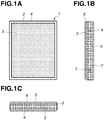
- FIGS. 1A to 1C and FIGS. 2A to 2C each show one example of the pellicle 1 according to the present invention.
- a pellicle film 3 is bonded and stretched onto an upper end face of a pellicle frame 2 by an adhesive agent 5. Further, on a lower end face of the pellicle frame 2, a pressure-sensitive adhesive agent 4 to be attached onto a photomask (particularly not shown) is arranged.
- the reference sign 6 shows a ventilation part (vent hole), and in the pellicle frame in FIGS. 2A to 2C , a ventilation part (vent hole) is formed so as to form a recess 6 on a lower end face of the pellicle frame unlike in the case of FIGS. 1A to 1C .
- the reference sign 7 shows a jig hole formed for peeling off a pellicle from a photomask by using a jig.
- an amount of released aqueous gas is 1 ⁇ 10 -3 Pa ⁇ L/s or less per pellicle
- an amount of released hydrocarbon-based gas is 1 ⁇ 10 -5 Pa ⁇ L/s or less per pellicle in a range of measured mass number of 45 to 100 amu
- an amount of released hydrocarbon-based gas is 4 ⁇ 10 -7 Pa ⁇ L/s or less per pellicle in a range of measured mass number of 101 to 200 amu, under vacuum after the pellicle has been left to stand for 10 minutes in an atmosphere of ordinary temperature (23°C) and 1 ⁇ 10 -3 Pa or less.
- the completed pellicle is left to stand for 10 minutes under reduced pressure at ordinary temperature in an atmosphere of 1 ⁇ 10 -3 Pa or less, and then the amount of released gas (Pa/s) is measured.
- ordinary temperature means 23°C.
- a load-lock type vacuum device an atmosphere-open type vacuum device including one main chamber, or the like can be mentioned, in particular, a load-lock type vacuum device is suitably adopted.
- the amount of released gas As to the amount of released gas, a pellicle is attached onto a mask, the amount of the gas released from the mask with the pellicle is measured, and further, the amount of the gas released from the mask itself is measured, and from the difference between these amounts of released gas, the amount of the gas released from the pellicle can be calculated.
- the inside of a chamber of a decompression (vacuum) device is completely sealed after the lapse of 10 minutes from the start of depressurization, and by measuring the return speed of the pressure at the time of sealing, the amount can be calculated as the "amount of released gas under vacuum after being left to stand for 10 minutes" that is referred to in the present invention.
- the partial pressure of an amount of released gas under vacuum can be calculated from an ion current value for each range of measured mass numbers. That is, the proportion of aqueous gas (1, 2, 17, and 18 amu), hydrocarbon-based gas (45 to 100 amu), and hydrocarbon-based gas (101 to 200 amu) is calculated from ion current values, and by multiplying the proportion by the total amount of released gas, the amount of released gas of each component can be calculated.
- quadrupole-type mass spectrometer As the above-described quadrupole-type mass spectrometer, a commercially available quadrupole-type mass spectrometer can be used, and for example, "M-201QA-TDM" (product name, manufactured by CANON ANELVA CORPORATION) can be used.
- M-201QA-TDM product name, manufactured by CANON ANELVA CORPORATION
- a chamber is sealed for 2 minutes, and then the line between the chamber and a pump is opened, and the ion current in a mass number range of 1 to 200 amu can be measured after the lapse of 13 minutes from the start of depressurization when the pressure is stabilized.
- an amount of released aqueous gas is 1 ⁇ 10 -3 Pa ⁇ L/s or less, and preferably 8.5 ⁇ 10 -4 Pa ⁇ L/s or less, per pellicle in a measured mass number of 1, 2, 17, or 18 amu. If the amount exceeds the range, contamination is generated in the chamber. If the amount of released gas is extremely large, the ultimate vacuum may be deteriorated.
- an amount of released hydrocarbon-based gas is 1 ⁇ 10 -5 Pa ⁇ L/s or less, and preferably 8.9 ⁇ 10 -6 Pa ⁇ L/s or less, per pellicle in a range of measured mass number of 45 to 100 amu. If the amount exceeds the range, contamination is generated in the chamber. If the amount of released gas is extremely large, the ultimate vacuum may be deteriorated.
- an amount of released hydrocarbon-based gas is 4 ⁇ 10 -7 Pa/s or less, and preferably 3.5 ⁇ 10 -6 Pa ⁇ L/s or less, per pellicle in a range of measured mass number of 101 to 200 amu. If the amount exceeds the range, contamination is generated in the chamber. If the amount of released gas is extremely large, the ultimate vacuum may be deteriorated.
- a pellicle having the structure described above is completed, and then the completed pellicle may be subjected to degassing treatment by heating under reduced pressure, or the entire completed pellicle may be coated with a gas-impermeable film such as a SiON film or a metal film.
- a gas-impermeable film such as a SiON film or a metal film.
- the pellicle can be heated under reduced pressure for 12 hours by using a vacuum device or the like having a heater in the chamber under the conditions of 90°C and 5 ⁇ 10 -2 Pa or less.
- the SiON can be deposited on the entire pellicle so as to have a thickness of 100 nm while controlling a sample temperature to be roughly 50°C or less and not to reach high temperature.
- the pellicle according to the present invention obtained in this way can sufficiently reduce the outgas generated from the entire pellicle, and is useful as a dust guard member when a semiconductor device such as a LSI or a VLSI, a printed board, a liquid crystal display, or the like is produced, the dust guard member can prevent that the outgas components are adsorbed onto a surface of a reflection mirror or mask in an exposure device, the reflectance is reduced, and the contamination of adsorption of the outgas onto the inner wall surface of the device is generated.
- a pellicle frame (having an outer size of 150 ⁇ 118 ⁇ 1.5 mm and a frame width of 4 mm) made of invar was washed.
- a silicone pressure-sensitive adhesive agent (X-40-3264 manufactured by Shin-Etsu Chemical Co., Ltd.)
- catalyst PL-56 manufactured by Shin-Etsu Chemical Co., Ltd.
- the prepared silicone pressure-sensitive adhesive agent with catalyst was applied onto a lower end face of the pellicle frame. Further, the silicone pressure-sensitive adhesive agent with catalyst was also applied onto an upper end face of the pellicle frame.
- the pellicle frame was heated under the conditions of 90°C for 12 hours to cure the silicone pressure-sensitive adhesive agent with catalyst.
- an ultrathin silicon film was press bonded as a pellicle film to the cured silicone pressure-sensitive adhesive agent with catalyst on the upper end face of the pellicle frame, and a pellicle was completed.
- the completed pellicle was attached onto a 6-inch chromium mask (hereinafter, referred to as "Cr mask").
- Cr mask 6-inch chromium mask
- a Cr mask was placed in a load-lock type vacuum device [New SUBARU (facility name) BL-10, University of Hyogo] at ordinary temperature, and the pressure reduction was started.
- the main body chamber was depressurized in advance so as to be stable at a vacuum degree of 1.0 ⁇ 10 -3 Pa or less, and was transferred from the load-lock chamber to a main body chamber after the lapse of five minutes from the start of depressurization.
- the chamber was completely sealed for 2 minutes after the lapse of 10 minutes from the start of depressurization.
- the return speed of the pressure at the time of sealing that is, the amount of released gas (Pa ⁇ L/s) was calculated.
- the line between the chamber and a pump was opened after the lapse of 12 minutes from the start of depressurization, and the ion current in a mass number range of 1 to 200 amu was measured by a quadrupole-type mass spectrometer ("M-201QA-TDM" manufactured by CANON ANELVA CORPORATION) after the lapse of 13 minutes from the start of depressurization.
- M-201QA-TDM quadrupole-type mass spectrometer
- hydrocarbon-based gas 45 to 100 amu
- hydrocarbon-based gas 101 to 200 amu
- the amount of released gas of each component of the Cr mask with a pellicle was calculated in the same way, and by subtracting the amount of released gas of each component of only the Cr mask from the above calculated amount, the amount of released gas from the pellicle was calculated.
- the amount of released gas of only the Cr mask was measured again, and in a case where the increase by 15% or more was confirmed in at least one of the amounts of released aqueous gas, released hydrocarbon-based gas (45 to 100 amu), and released hydrocarbon-based gas (101 to 200 amu), it was determined that the chamber was contaminated.
- a pellicle frame (having an outer size of 150 ⁇ 118 ⁇ 1.5 mm and a frame width of 4 mm) made of invar was washed.
- an acrylic pressure-sensitive adhesive agent (SK-1495 manufactured by Soken Chemical & Engineering Co., Ltd.)
- 0.1 part by weight of curing agent (L-45 manufactured by Soken Chemical & Engineering Co., Ltd.) was added per 100 parts by weight of the acrylic pressure-sensitive adhesive agent to prepare an acrylic pressure-sensitive adhesive agent with curing agent.
- the acrylic pressure-sensitive adhesive agent with curing agent was applied onto a lower end face of the pellicle frame, and the pellicle frame was heated at 100°C for 16 hours to cure the acrylic pressure-sensitive adhesive agent with curing agent.
- a silicone pressure-sensitive adhesive agent (X-40-3264 manufactured by Shin-Etsu Chemical Co., Ltd.)
- catalyst PL-56 manufactured by Shin-Etsu Chemical Co., Ltd.
- the silicone pressure-sensitive adhesive agent with catalyst was applied onto an upper end face of the pellicle frame, and the pellicle frame was heated at 90°C for 12 hours to cure the silicone pressure-sensitive adhesive agent with catalyst.
- the pellicle frame was left to stand in a vacuum evacuation device ("Z106-VAC07" manufactured by Mega Trust Co., Ltd.) at 90°C and 1.0 ⁇ 10 -2 Pa for 12 hours, and degassing treatment was performed. After the temperature of the pellicle frame was returned to room temperature, an ultrathin silicon film was press bonded as a pellicle film to the silicone pressure-sensitive adhesive agent with catalyst on the upper end face of the pellicle frame, and a pellicle was completed.
- a vacuum evacuation device (“Z106-VAC07” manufactured by Mega Trust Co., Ltd.) at 90°C and 1.0 ⁇ 10 -2 Pa for 12 hours, and degassing treatment was performed. After the temperature of the pellicle frame was returned to room temperature, an ultrathin silicon film was press bonded as a pellicle film to the silicone pressure-sensitive adhesive agent with catalyst on the upper end face of the pellicle frame, and a pellicle was completed.
- the completed pellicle was attached onto a 6-inch Cr mask. The amount of the gas released under vacuum from the pellicle and the presence or absence of the chamber contamination were checked.
- a pellicle frame (having an outer size of 150 ⁇ 118 ⁇ 1.5 mm and a frame width of 4 mm) made of invar was washed.
- an acrylic pressure-sensitive adhesive agent (SK-1495 manufactured by Soken Chemical & Engineering Co., Ltd.)
- 0.1 part by weight of curing agent (L-45 manufactured by Soken Chemical & Engineering Co., Ltd.) was added per 100 parts by weight of the acrylic pressure-sensitive adhesive agent to prepare an acrylic pressure-sensitive adhesive agent with curing agent.
- the acrylic pressure-sensitive adhesive agent with curing agent was applied onto a lower end face of the pellicle frame, the applied acrylic pressure-sensitive adhesive agent with curing agent was flattened, and the flattened acrylic pressure-sensitive adhesive agent with curing agent was heated at 100°C for 12 hours to cure the acrylic pressure-sensitive adhesive agent with curing agent. Subsequently, into a silicone pressure-sensitive adhesive agent (X-40-3264 manufactured by Shin-Etsu Chemical Co., Ltd.), 0.5 part by weight of catalyst (PL-56 manufactured by Shin-Etsu Chemical Co., Ltd.) was added per 100 parts by weight of the silicone pressure-sensitive adhesive agent to prepare a silicone pressure-sensitive adhesive agent with catalyst.
- X-40-3264 manufactured by Shin-Etsu Chemical Co., Ltd.
- catalyst PL-56 manufactured by Shin-Etsu Chemical Co., Ltd.
- the silicone pressure-sensitive adhesive agent with catalyst was applied onto an upper end face of the pellicle frame, and the applied silicone pressure-sensitive adhesive agent with catalyst was flattened, and the pellicle frame was heated at 90°C for 12 hours to cure the silicone pressure-sensitive adhesive agent with catalyst. After that, the adhesive face was protected by attaching PET with a release agent to the pressure-sensitive adhesive agents on both end faces of the pellicle frame. After that, by using a chemical vapor deposition (CVD) device, the entire pellicle was coated with a SiON layer.
- CVD chemical vapor deposition
- the PET that had protected the adhesive face of the film pressure-sensitive adhesive agent was removed, and then an ultrathin silicon film was press bonded as a pellicle film to the pressure-sensitive adhesive agent on the upper end face of the pellicle frame, and a pellicle was completed.
- the completed pellicle was attached onto a 6-inch Cr mask. The amount of the gas released under vacuum from the pellicle and the presence or absence of the chamber contamination were checked.
- a pellicle frame (having an outer size of 150 ⁇ 118 ⁇ 1.5 mm and a frame width of 4 mm) made of invar was washed, and an epoxy pressure-sensitive adhesive agent (DP-460EG manufactured by 3M Company) was applied onto a lower end face of the pellicle frame.
- An ultrathin silicon film was attached as a pellicle film onto an upper end face of the pellicle frame, and a Cr mask was attached onto a lower end face of the pellicle frame, the pellicle frame was heated at 150°C for 2.5 hours to cure the epoxy pressure-sensitive adhesive agent. The amount of the gas released under vacuum from the pellicle and the presence or absence of the chamber contamination were checked.
- Comparative Example 2 was performed in a similar manner as in Example 2 except that the degassing treatment by heating under reduced pressure was not performed.
- Table 1 Aqueous gas (Pa/s) Hydrocarbon-based gas (45 to 100 amu) (Pa/s) Hydrocarbon-based gas (101 to 200 amu) (Pa/s) Presence or absence of chamber contamination
- Example 1 5.3 ⁇ 10 -4 3.4 ⁇ 10 -6 2.0 ⁇ 10 -7 Absence
- Example 2 8.2 ⁇ 10 -4 8.9 ⁇ 10 -6 3.5 ⁇ 10 -7 Absence
- Example 3 6.1 ⁇ 10 -4 4.0 ⁇ 10 -6 2.7 ⁇ 10 -7 Absence Comparative Example 1 8.4 ⁇ 10 -3 4.4 ⁇ 10 -6 6.8 ⁇ 10 -7 Presence Comparative Example 2 1.7 ⁇ 10 -3 1.2 ⁇ 10 -5 2.7 ⁇ 10 -7 Presence
- Examples 1 to 3 it was found that the amounts of released gases per pellicle were within the ranges of 1 ⁇ 10 -3 Pa ⁇ L/s or less for aqueous gas, 1 ⁇ 10 -5 Pa ⁇ L/s or less for hydrocarbon-based gas (45 to 100 amu), and 4 ⁇ 10 -7 Pa ⁇ L/s or less for hydrocarbon-based gas (101 to 200 amu), respectively, and the chamber contamination was not generated.
- Comparative Example 1 it was found that the amount of the released hydrocarbon-based gas (45 to 100 amu) exceeded 1 ⁇ 10 -5 Pa ⁇ L/s, the amount of the released hydrocarbon-based gas (101 to 200 amu) exceeded 4 ⁇ 10 -7 Pa ⁇ L/s, and the chamber was contaminated. In Comparative Example 2, it was found that the amount of the released aqueous gas exceeded 1 ⁇ 10 -3 Pa ⁇ L/s and the chamber was contaminated.
Landscapes
- Physics & Mathematics (AREA)
- General Physics & Mathematics (AREA)
- Health & Medical Sciences (AREA)
- Epidemiology (AREA)
- Public Health (AREA)
- Engineering & Computer Science (AREA)
- Environmental & Geological Engineering (AREA)
- Life Sciences & Earth Sciences (AREA)
- Atmospheric Sciences (AREA)
- Preparing Plates And Mask In Photomechanical Process (AREA)
- Exposure And Positioning Against Photoresist Photosensitive Materials (AREA)
Applications Claiming Priority (1)
| Application Number | Priority Date | Filing Date | Title |
|---|---|---|---|
| JP2018226457A JP7040427B2 (ja) | 2018-12-03 | 2018-12-03 | ペリクル、ペリクル付露光原版、露光方法及び半導体の製造方法 |
Publications (1)
| Publication Number | Publication Date |
|---|---|
| EP3663854A1 true EP3663854A1 (de) | 2020-06-10 |
Family
ID=68621141
Family Applications (1)
| Application Number | Title | Priority Date | Filing Date |
|---|---|---|---|
| EP19210268.9A Pending EP3663854A1 (de) | 2018-12-03 | 2019-11-20 | Pellikel |
Country Status (6)
| Country | Link |
|---|---|
| US (6) | US11054738B2 (de) |
| EP (1) | EP3663854A1 (de) |
| JP (2) | JP7040427B2 (de) |
| KR (1) | KR102877214B1 (de) |
| CN (1) | CN111258179B (de) |
| TW (2) | TWI885618B (de) |
Cited By (1)
| Publication number | Priority date | Publication date | Assignee | Title |
|---|---|---|---|---|
| EP4325290A4 (de) * | 2021-04-13 | 2025-07-09 | Shinetsu Chemical Co | Pellikelrahmenlaminat und verfahren zur herstellung eines pellikels unter verwendung des laminats |
Families Citing this family (5)
| Publication number | Priority date | Publication date | Assignee | Title |
|---|---|---|---|---|
| JP7040427B2 (ja) * | 2018-12-03 | 2022-03-23 | 信越化学工業株式会社 | ペリクル、ペリクル付露光原版、露光方法及び半導体の製造方法 |
| WO2021251157A1 (ja) * | 2020-06-08 | 2021-12-16 | 信越化学工業株式会社 | ペリクルフレーム、ペリクル、ペリクル付露光原版、露光方法、半導体の製造方法及び液晶表示板の製造方法 |
| JPWO2022030499A1 (de) * | 2020-08-06 | 2022-02-10 | ||
| US20220365420A1 (en) * | 2021-05-12 | 2022-11-17 | Taiwan Semiconductor Manufacturing Company, Ltd. | Multi-layer pellicle membrane |
| US12461440B2 (en) | 2022-06-30 | 2025-11-04 | Taiwan Semiconductor Manufacturing Company, Ltd. | Pellicle membrane with improved properties |
Citations (5)
| Publication number | Priority date | Publication date | Assignee | Title |
|---|---|---|---|---|
| US20060115741A1 (en) * | 2002-11-15 | 2006-06-01 | Mitsui Chemical, Inc. | Pellicle with small gas generation amount |
| US20070292775A1 (en) * | 2006-06-14 | 2007-12-20 | Shin-Etsu Chemical Co., Ltd | Pellicle |
| US20090274962A1 (en) * | 2008-05-02 | 2009-11-05 | Shin-Etsu Chemical Co., Ltd. | Pellicle and method for producing pellicle |
| WO2015045414A1 (ja) * | 2013-09-30 | 2015-04-02 | 三井化学株式会社 | ペリクル膜、それを用いたペリクル、露光原版および露光装置、ならびに半導体装置の製造方法 |
| US20150286133A1 (en) * | 2014-04-02 | 2015-10-08 | Shin-Etsu Chemical Co., Ltd. | Pellicle for lithography |
Family Cites Families (14)
| Publication number | Priority date | Publication date | Assignee | Title |
|---|---|---|---|---|
| JP2002158153A (ja) | 2000-11-16 | 2002-05-31 | Canon Inc | 露光装置およびペリクル空間内ガス置換方法 |
| ATE431575T1 (de) * | 2006-08-28 | 2009-05-15 | Imec Inter Uni Micro Electr | Verfahren und system zur kontaminationsmessung bei einem lithografischen element |
| JP4870788B2 (ja) * | 2009-01-27 | 2012-02-08 | 信越化学工業株式会社 | リソグラフィー用ペリクル |
| JP5381167B2 (ja) * | 2009-03-04 | 2014-01-08 | 凸版印刷株式会社 | 反射型フォトマスク用ブランク及び反射型フォトマスク |
| KR102149853B1 (ko) * | 2012-04-02 | 2020-09-01 | 에이에스엠엘 네델란즈 비.브이. | 미립자 오염 측정 방법 및 장치 |
| JP2014113599A (ja) * | 2012-12-06 | 2014-06-26 | Nippon Chuzo Co Ltd | 精密機器用部品およびその製造方法 |
| JP6370255B2 (ja) * | 2015-04-07 | 2018-08-08 | 信越化学工業株式会社 | ペリクル用フレーム及びそれを用いたペリクル |
| JP6376601B2 (ja) * | 2015-05-18 | 2018-08-22 | 信越化学工業株式会社 | ペリクル支持手段及びこれを用いたペリクル支持装置とペリクル装着方法 |
| JP6478283B2 (ja) * | 2015-12-24 | 2019-03-06 | 信越化学工業株式会社 | Euv露光用ペリクル |
| KR20190003752A (ko) * | 2016-07-05 | 2019-01-09 | 미쯔이가가꾸가부시끼가이샤 | 펠리클막, 펠리클 프레임체, 펠리클, 그 제조 방법, 노광 원판, 노광 장치, 반도체 장치의 제조 방법 |
| JP6706575B2 (ja) * | 2016-12-22 | 2020-06-10 | 信越化学工業株式会社 | ペリクルフレーム及びこれを用いたペリクル |
| JP6787799B2 (ja) * | 2017-01-24 | 2020-11-18 | 信越化学工業株式会社 | 粘着剤の成形方法及びこの成形方法によるペリクルの製造方法 |
| CN110325908A (zh) | 2017-02-17 | 2019-10-11 | 三井化学株式会社 | 防护膜组件、曝光原版、曝光装置及半导体装置的制造方法 |
| JP7040427B2 (ja) * | 2018-12-03 | 2022-03-23 | 信越化学工業株式会社 | ペリクル、ペリクル付露光原版、露光方法及び半導体の製造方法 |
-
2018
- 2018-12-03 JP JP2018226457A patent/JP7040427B2/ja active Active
-
2019
- 2019-11-20 EP EP19210268.9A patent/EP3663854A1/de active Pending
- 2019-11-28 TW TW112146717A patent/TWI885618B/zh active
- 2019-11-28 KR KR1020190155111A patent/KR102877214B1/ko active Active
- 2019-11-28 TW TW108143314A patent/TWI827740B/zh active
- 2019-12-02 US US16/700,228 patent/US11054738B2/en active Active
- 2019-12-03 CN CN201911218263.9A patent/CN111258179B/zh active Active
-
2021
- 2021-05-27 US US17/332,463 patent/US11422457B2/en active Active
-
2022
- 2022-03-08 JP JP2022035403A patent/JP2022066486A/ja active Pending
- 2022-07-20 US US17/868,871 patent/US11774847B2/en active Active
-
2023
- 2023-09-01 US US18/459,703 patent/US12164224B2/en active Active
- 2023-09-01 US US18/241,442 patent/US12085847B2/en active Active
-
2024
- 2024-11-13 US US18/946,030 patent/US20250068055A1/en active Pending
Patent Citations (6)
| Publication number | Priority date | Publication date | Assignee | Title |
|---|---|---|---|---|
| US20060115741A1 (en) * | 2002-11-15 | 2006-06-01 | Mitsui Chemical, Inc. | Pellicle with small gas generation amount |
| US20070292775A1 (en) * | 2006-06-14 | 2007-12-20 | Shin-Etsu Chemical Co., Ltd | Pellicle |
| US20090274962A1 (en) * | 2008-05-02 | 2009-11-05 | Shin-Etsu Chemical Co., Ltd. | Pellicle and method for producing pellicle |
| WO2015045414A1 (ja) * | 2013-09-30 | 2015-04-02 | 三井化学株式会社 | ペリクル膜、それを用いたペリクル、露光原版および露光装置、ならびに半導体装置の製造方法 |
| US20150286133A1 (en) * | 2014-04-02 | 2015-10-08 | Shin-Etsu Chemical Co., Ltd. | Pellicle for lithography |
| JP2015200868A (ja) | 2014-04-02 | 2015-11-12 | 信越化学工業株式会社 | ペリクル用接着剤及びこれを用いたペリクル |
Cited By (1)
| Publication number | Priority date | Publication date | Assignee | Title |
|---|---|---|---|---|
| EP4325290A4 (de) * | 2021-04-13 | 2025-07-09 | Shinetsu Chemical Co | Pellikelrahmenlaminat und verfahren zur herstellung eines pellikels unter verwendung des laminats |
Also Published As
| Publication number | Publication date |
|---|---|
| US12164224B2 (en) | 2024-12-10 |
| JP2022066486A (ja) | 2022-04-28 |
| US11054738B2 (en) | 2021-07-06 |
| KR20200067094A (ko) | 2020-06-11 |
| US20200174361A1 (en) | 2020-06-04 |
| TWI827740B (zh) | 2024-01-01 |
| TW202429188A (zh) | 2024-07-16 |
| JP2020091310A (ja) | 2020-06-11 |
| US20250068055A1 (en) | 2025-02-27 |
| CN111258179B (zh) | 2023-01-24 |
| TWI885618B (zh) | 2025-06-01 |
| TW202024781A (zh) | 2020-07-01 |
| US11774847B2 (en) | 2023-10-03 |
| US20220350241A1 (en) | 2022-11-03 |
| US12085847B2 (en) | 2024-09-10 |
| US20230408910A1 (en) | 2023-12-21 |
| KR102877214B1 (ko) | 2025-10-27 |
| CN111258179A (zh) | 2020-06-09 |
| US20230408907A1 (en) | 2023-12-21 |
| US20210286257A1 (en) | 2021-09-16 |
| US11422457B2 (en) | 2022-08-23 |
| JP7040427B2 (ja) | 2022-03-23 |
Similar Documents
| Publication | Publication Date | Title |
|---|---|---|
| US12085847B2 (en) | Pellicle | |
| US12164222B2 (en) | Pellicle frame, pellicle, and method for peeling pellicle | |
| TWI613511B (zh) | 防塵薄膜組件 | |
| JP7103252B2 (ja) | ペリクルフレーム、ペリクル、マスク粘着剤付ペリクルフレーム、ペリクル付露光原版、露光方法及び半導体の製造方法 | |
| JP7643604B2 (ja) | ペリクルフレーム、ペリクル、ペリクル付露光原版、露光方法及び半導体の製造方法 | |
| JP7823689B2 (ja) | ペリクルフレーム、ペリクル、ペリクル付露光原版、露光方法及び半導体の製造方法 | |
| CN215416267U (zh) | 防护薄膜框架及其组件、曝光原版、曝光系统及制造系统 | |
| JP7533659B2 (ja) | ペリクルフレーム、ペリクル、ペリクル付露光原版、露光方法及び半導体の製造方法 | |
| WO2026100332A1 (ja) | ペリクルフレーム、ペリクル、ペリクル付き露光原版、露光方法及び半導体の製造方法 |
Legal Events
| Date | Code | Title | Description |
|---|---|---|---|
| PUAI | Public reference made under article 153(3) epc to a published international application that has entered the european phase |
Free format text: ORIGINAL CODE: 0009012 |
|
| STAA | Information on the status of an ep patent application or granted ep patent |
Free format text: STATUS: THE APPLICATION HAS BEEN PUBLISHED |
|
| AK | Designated contracting states |
Kind code of ref document: A1 Designated state(s): AL AT BE BG CH CY CZ DE DK EE ES FI FR GB GR HR HU IE IS IT LI LT LU LV MC MK MT NL NO PL PT RO RS SE SI SK SM TR |
|
| AX | Request for extension of the european patent |
Extension state: BA ME |
|
| STAA | Information on the status of an ep patent application or granted ep patent |
Free format text: STATUS: REQUEST FOR EXAMINATION WAS MADE |
|
| 17P | Request for examination filed |
Effective date: 20201209 |
|
| RBV | Designated contracting states (corrected) |
Designated state(s): AL AT BE BG CH CY CZ DE DK EE ES FI FR GB GR HR HU IE IS IT LI LT LU LV MC MK MT NL NO PL PT RO RS SE SI SK SM TR |
|
| STAA | Information on the status of an ep patent application or granted ep patent |
Free format text: STATUS: EXAMINATION IS IN PROGRESS |
|
| 17Q | First examination report despatched |
Effective date: 20230516 |